Printed by Park Communications, a Carbon Neutral Company, on FSC® certified paper.
Park works to the EMAS standard and its Environmental Management System is certified to ISO 14001.
This publication has been manufactured using 100% offshore wind electricity sourced from UK wind.
100% of the inks used are vegetable oil based, 95% of press chemicals are recycled for further use and, on average 99% of any waste associated with this production will be recycled and the remaining 1% used to generate energy.
This document is printed on Magno Satin paper made of material from wellmanaged, FSC®-certified forests and other controlled sources.
ISLAMIC & INDIAN ART
Sale Number LT904 Lyon & Turnbull 22 Connaught Street LONDON W2 2AF
BIDDING AT THIS SALE
Online, telephone and commission bidding only - please see the guide to bidding on page 156
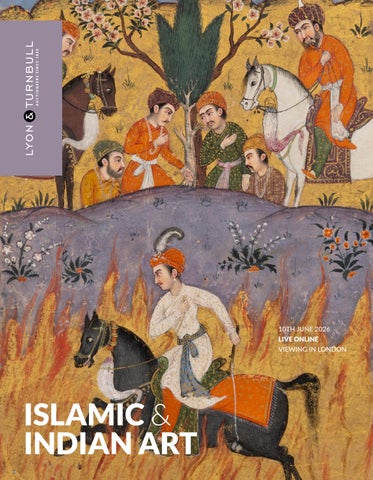
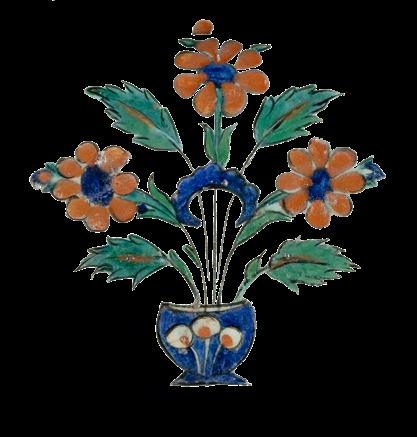
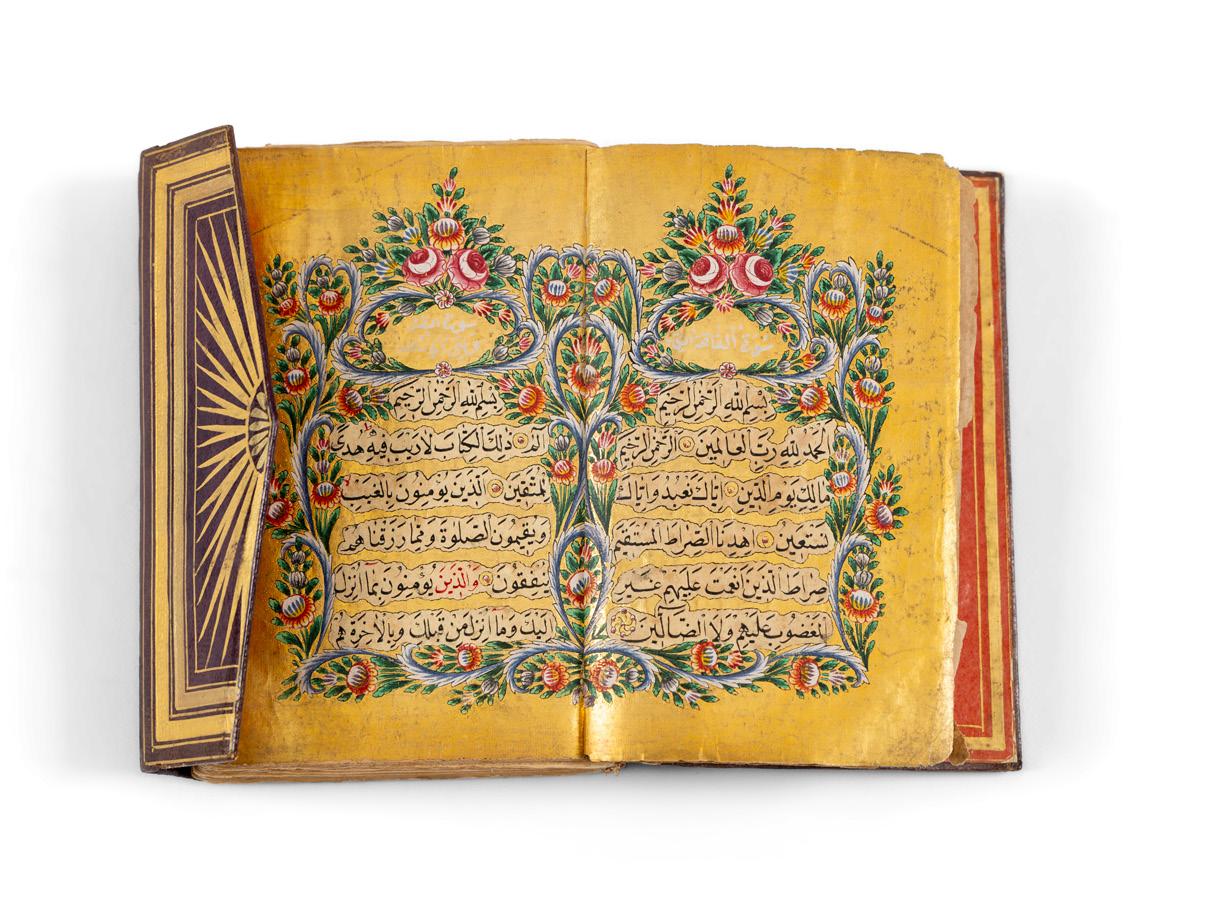
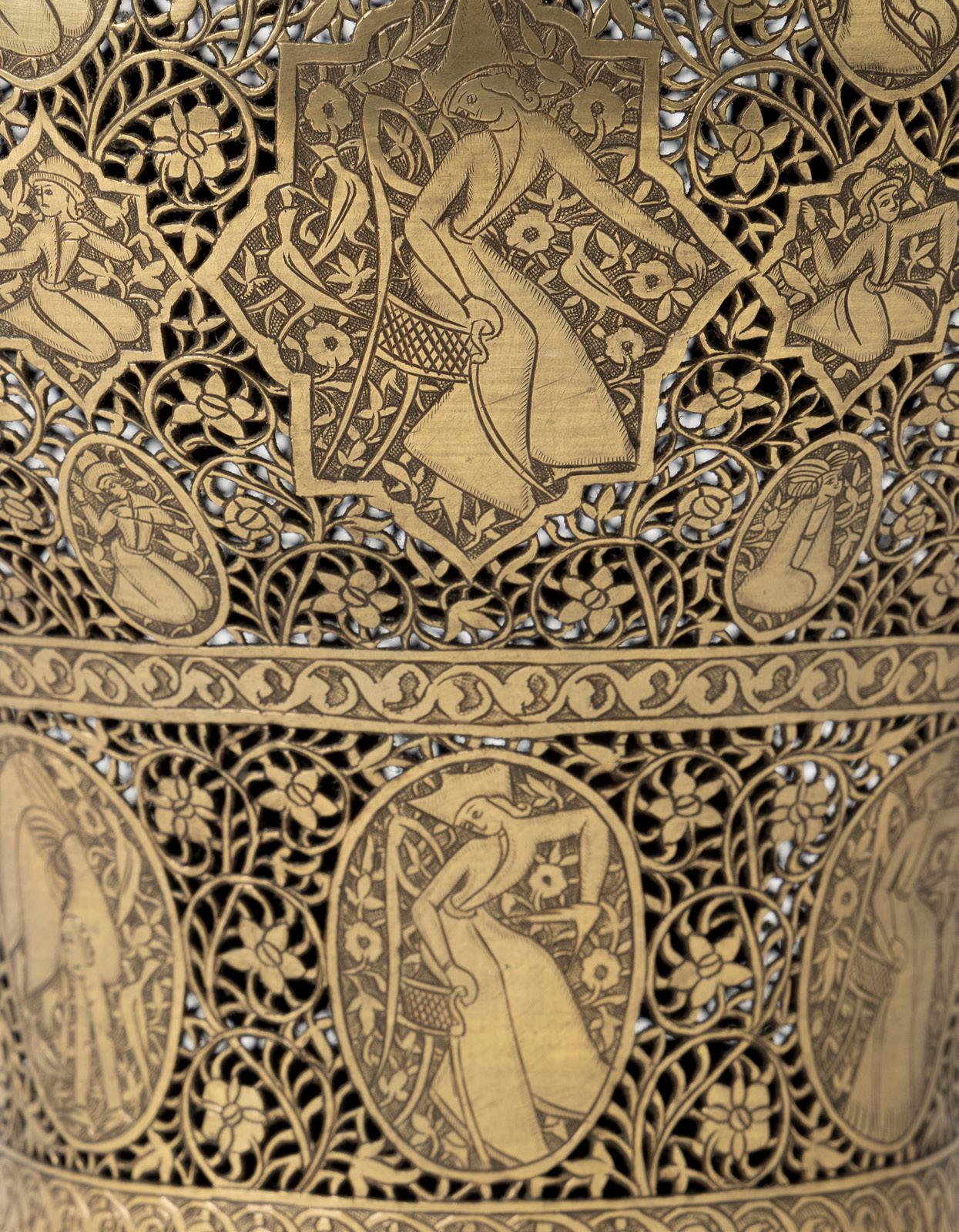
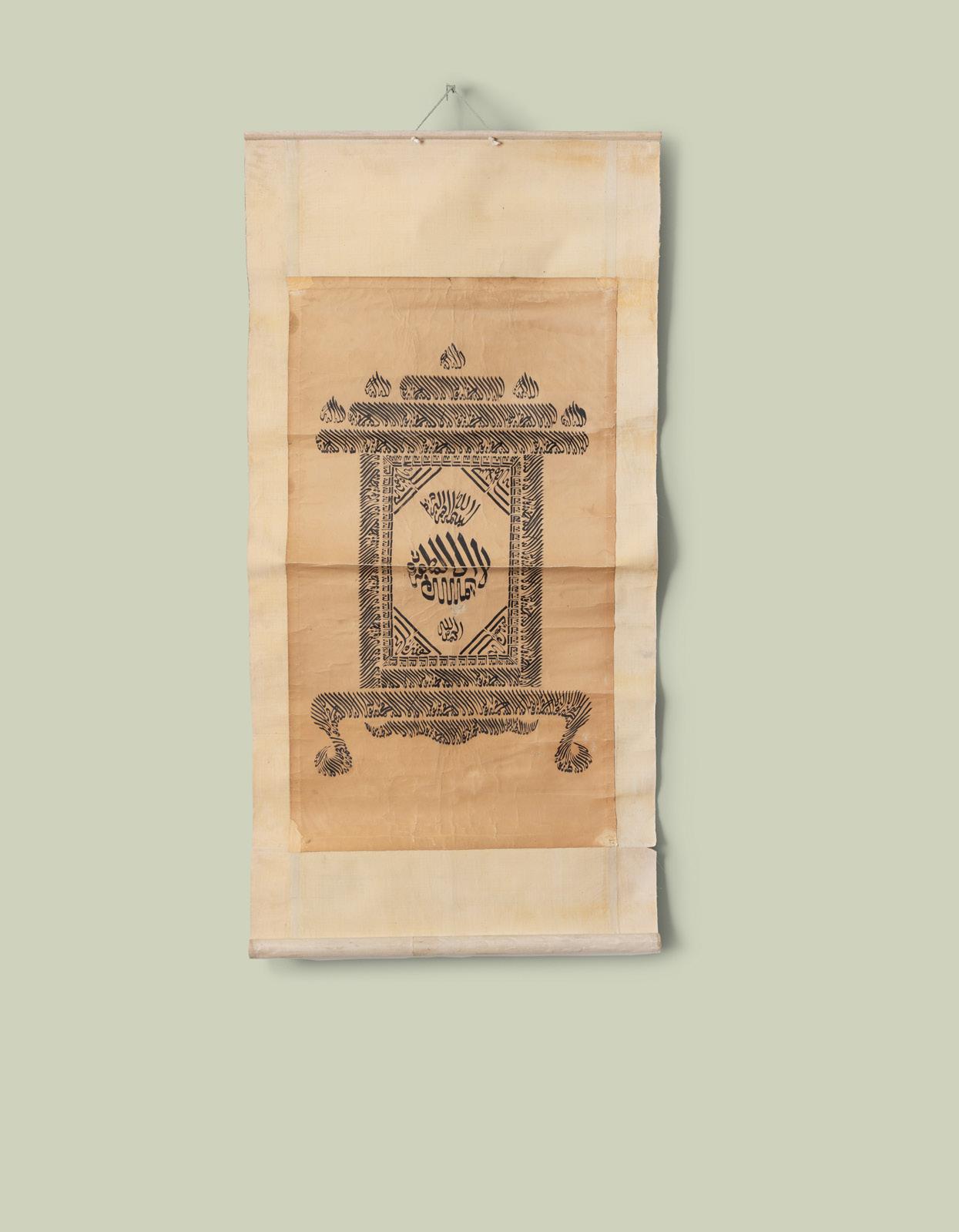
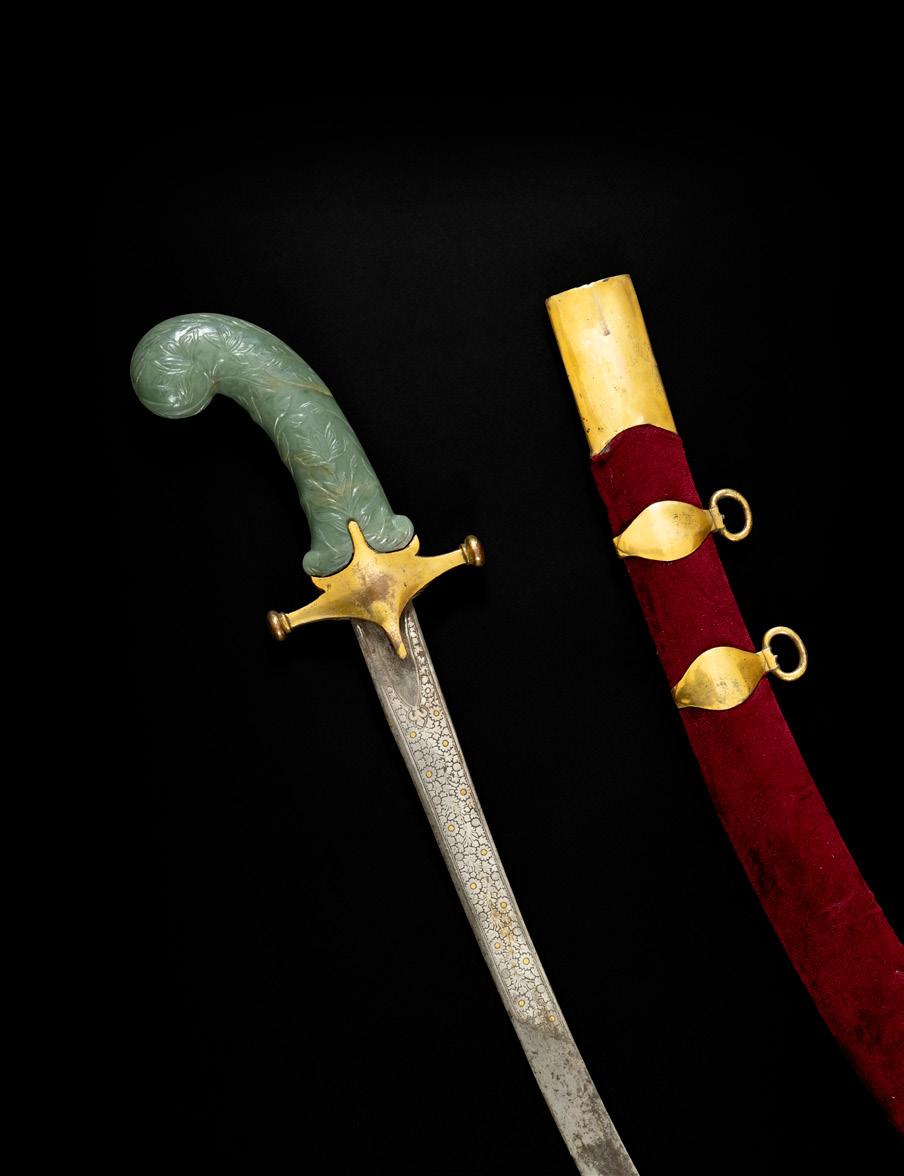
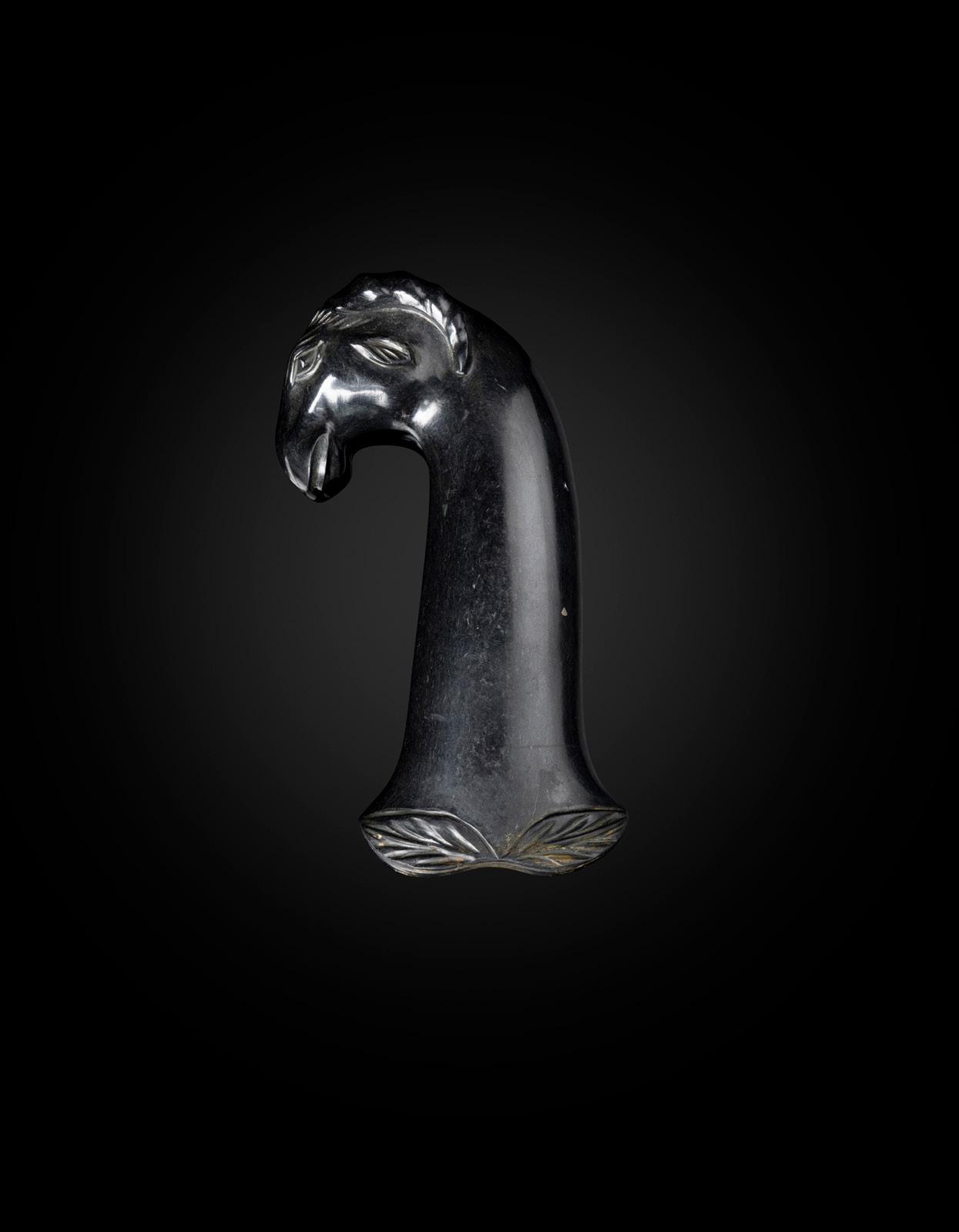
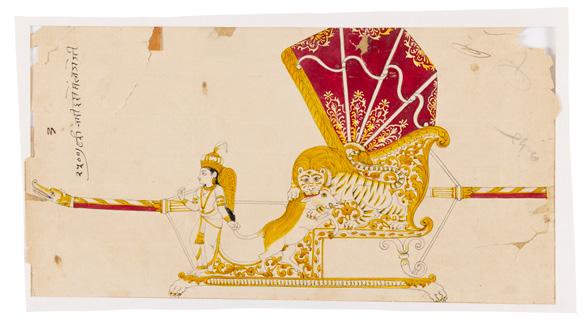
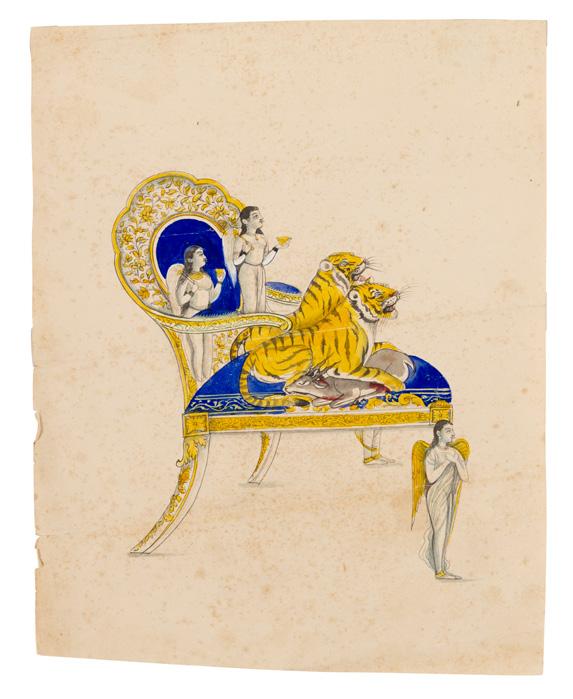
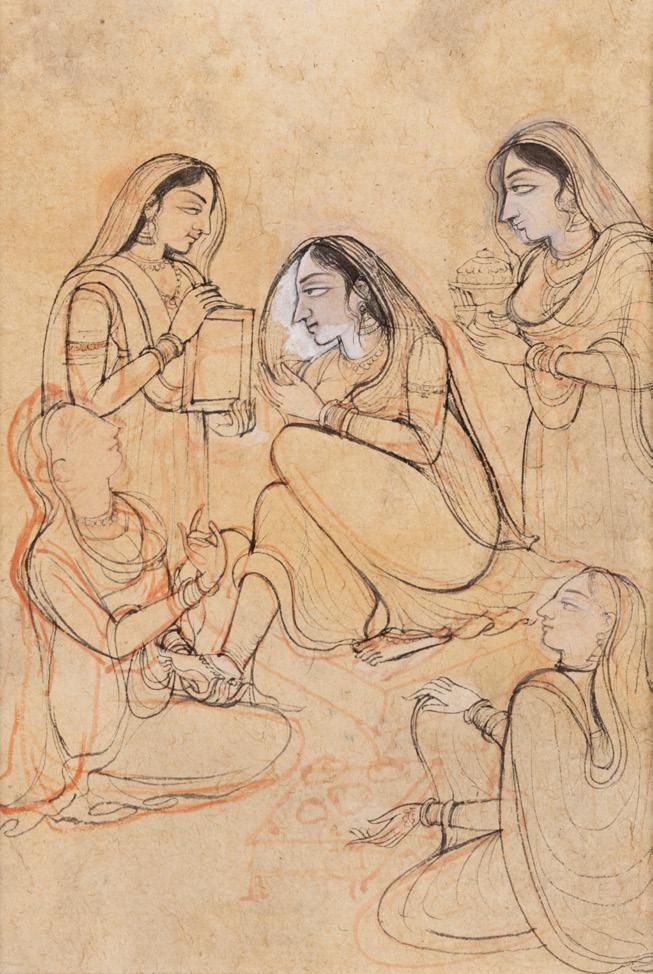
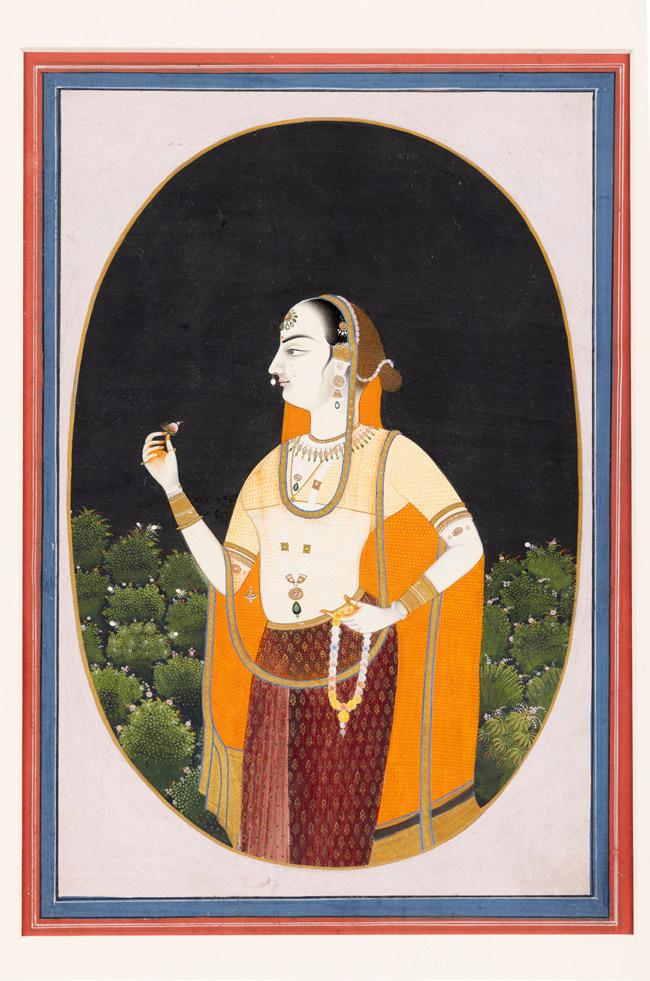
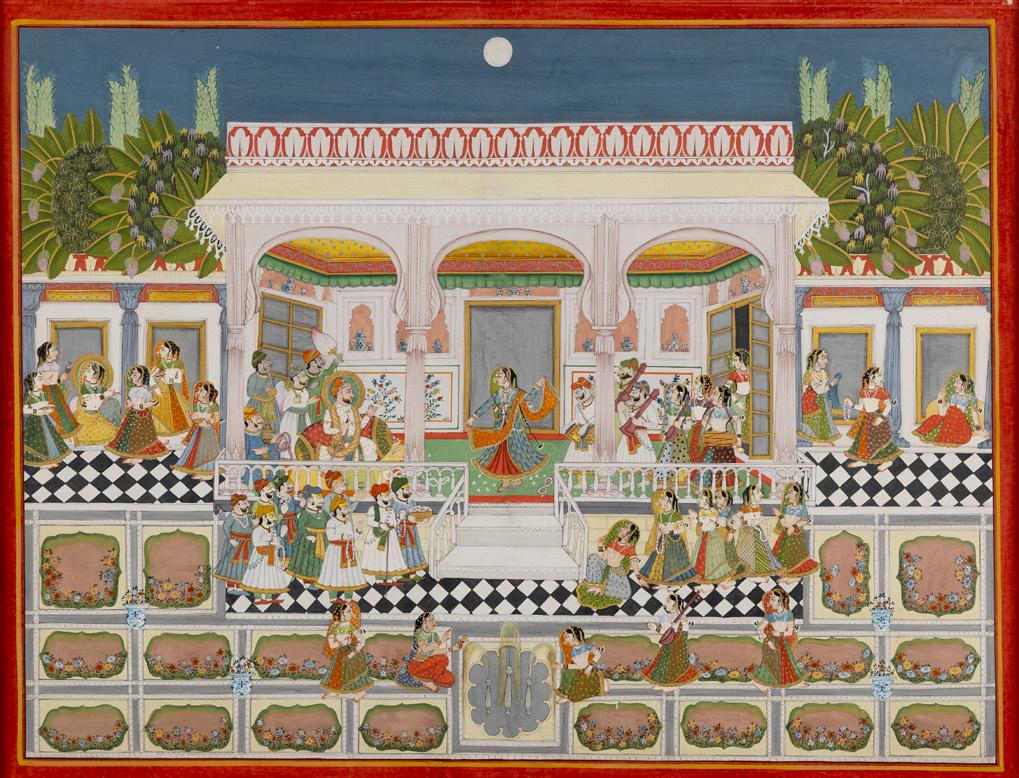
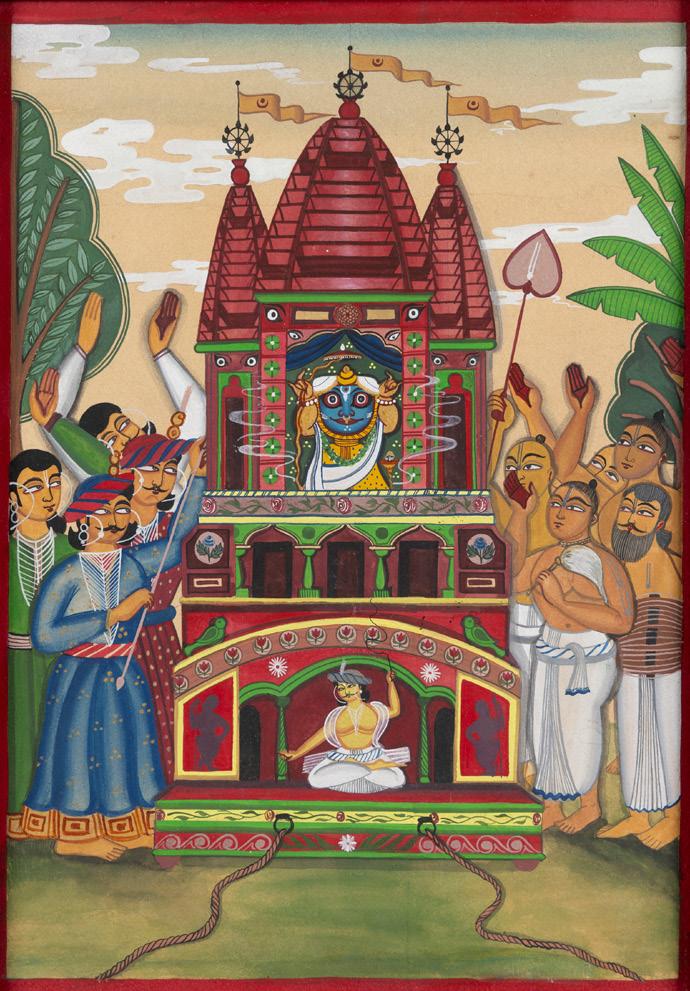
Front Cover Lot 70 [detail] Inside Front Cover Lot 74 [detail] WEDNESDAY 10 JUNE 2026 AT 2PM
VIEWING
Thursday 4th June 1pm - 4pm
Friday 5th June 10am - 4pm
Saturday 6th June 10am - 4pm
Monday 8th June 10am - 4pm
Tuesday 9th June 10am - 4pm
CONTACT
BUYER'S GUIDE
BUYER’S PREMIUM
The buyer shall pay the hammer price together with a premium, at the following rate, thereon.
27% up to £20,000
26% from £20,001 to £800,000
20% thereafter
VAT will be charged on the premium at the rate imposed by law (see our Conditions of Sale at the back of this catalogue).
ADDITIONAL VAT
† VAT at the standard rate payable on the hammer price
‡ Reduced rate of 5% import VAT payable on the hammer price
Ω Standard rate of import VAT on the hammer price
Lots affixed with ‡ or Ω symbols may be subject to further regulations upon export / import, please see Conditions of Sale for Buyers Section D.2.
No VAT is payable on the hammer price or premium for books bought at auction.
DROIT DE SUITE
§ indicates works which may be subject to the Droit de Suite or Artist’s Resale Right, a royalty payment for all qualifying works of art. Under legislation which came into effect on 1st January 2012, this applies to living artists and artists who have died in the last 70 years. This royalty will be charged to the buyer on the hammer price and in addition to the buyer’s premium. It will not apply to works where the Hammer Price is less than £1,000. The charge for works of art sold at and above £1,000 and below £50,000 is 4%. For items selling above £50,000, charges are calculated on a sliding scale.
More information on Droit de Suite is available at www.dacs.org.uk.
This sale is subject to our Standard conditions of Sale (available at the back of every catalogue and on our website). If you have not bought before we will be delighted to help you.
REGISTRATION
All potential buyers must register prior to placing a bid. Registration information may be submitted in person at our registration desk, by email, or on our website. Please note that first-time bidders, and those returning after an extended period, will be asked to supply the following documents in order to facilitate registration:
1 – Government issued photo ID (Passport/ Driving licence)
2 – Proof of address (utility bill/bank statement).
We may, at our option, also ask you to provide a bank reference and/ or deposit. (Particularly for bidding on lots marked by the high value lot symbol )
By registering for the sale, the buyer acknowledges that he or she has read, understood and accepted our Conditions of Sale (available at the back of every catalogue and on our website).
BIDDING & PAYMENT
For information on bidding options see our Guide to Bidding & Payment at the back of the catalogue.
REMOVAL OF PURCHASES
Responsibility for packing, shipping and insurance shall be exclusively that of the purchaser. See Collections & Storage section for more info specific to this particular auction.
CATALOGUE DESCRIPTIONS
All item descriptions, dimensions and estimates are provided for guidance only. It is the buyer’s responsibility to inspect all lots prior to bidding to ensure that the condition is to their satisfaction. Our specialists will be happy to prepare condition reports and additional images. These are for guidance only and all lots are sold ‘as found’, as per our Conditions of Sale.
IMPORT/EXPORT
Prospective buyers are advised that several countries prohibit the importation of property containing materials from endangered species, including but not limited to; rhino horn, ivory, coral and tortoiseshell. Accordingly, prospective buyers should familiarise themselves with all relevant customs regulations prior to bidding if they intend to import lots to another country. It is the buyer’s sole responsibility to obtain any relevant export or import licence. The denial of any licence or any delay in obtaining licences shall neither justify the recession of any sale nor any delay in making full payment for the lot.
ENDANGERED SPECIES
Please be aware that lots marked with the symbol Y contain material which may be subject to CITES regulations when exporting outside Great Britain. For more information visit http://www.defra.gov.uk/ahvla-en/ imports-exports/cites
COLLECTIONS & STORAGE OF PURCHASED LOTS
FOR INTERNATIONAL BUYERS & UK (OUTSIDE SCOTLAND) BUYERS
STORAGE: All items will be stored at 22 Connaught Street, until Wednesday 24th June at 5pm. Thereafter we will store all items at Stephen Morris Shipping Ltd., 15 Ockham Drive, Greenford Park, Greenford, UB6 0FD. Telephone +44(0)20 8832 2222. Items will be available to collect from 9am on Friday 26th June.
Please ensure payment has been made prior to collection. This can be done online, bank transfer or in person at our London office – details will be shown on your invoice also. Please note we are unable to accept cash or payments over the phone.
COST: Please note from Friday 26th June you will be charged by our storage partners.
Smalls paintings and objects: £20.50 moving and admin fee then £1.00 per day / Large items and furniture – £32.50 moving and admin fee then £2.50 per day / Insurance: 0.25% of declared value per 28-day period or part thereof, subject to 12% insurance premium tax.
FOR BUYERS IN SCOTLAND
STORAGE: If you would like to collect from our Edinburgh office, please contact Neil Graham (neil.graham@lyonandturnbull.com) by 5pm on the 26th June. Items will be transported to our Edinburgh saleroom and will be available to collect from Friday 10th July from 9am from Lyon & Turnbull, 33 Broughton Place Edinburgh EH1 3RR. All collections will be by appointment only (this applies to both carriers and personal collections). To make an appointment email info@lyonandturnbull.com or call 0131 557 8844.
Please ensure that payment is made prior to collection. This can be done by bank transfer, and debit card online (powered by stripe) –details will be shown on your invoice. Please note we are unable to take payments over the phone.
ORDER OF SALE
Early Islamic Manuscripts
Ottoman Works of Art & Manuscripts
Lots 1-5
Lots 10-31
Persian Works of Art Lots 35-61
Chinese Works of Art
made for the Islamic Market Lots 62-63
Gandharan Sculpture from a Private Collection Lots 64-66
Arts of India Lots 67-150
Formerly, the collection of Stuart Cary Welch
MEET THE SPECIALISTS
At Lyon & Turnbull we want to make buying at auction as easy and enjoyable as possible. Our specialist team are on hand to assist you, whether you are looking for something in particular for your home or collection, require more detailed information about the history or current condition of a lot, or just want to find out more about the auction process.
KRISTINA SANNE Head of Sale | Consultant Specialist kristina.sanne@lyonandturnbull.com
Lots 126-133
A private collection, Aberdeenshire, Scotland Lots 134-139
A special thanks to William Greenwood and Dominic Somerville-Brown for their invaluable assistance in cataloguing the Islamic Manuscripts and Works of Art, and Margaret Erskine for her invaluable expertise on the Indian miniature paintings.
GRAHAM Associate Specialist neil.graham@lyonandturnbull.com
NEIL
EARLY ISLAMIC MANUSCRIPTS
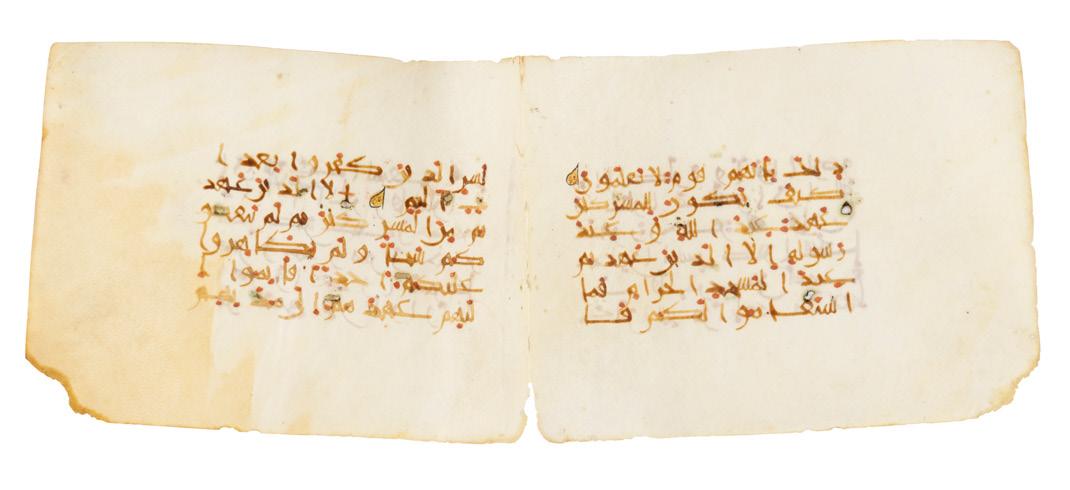
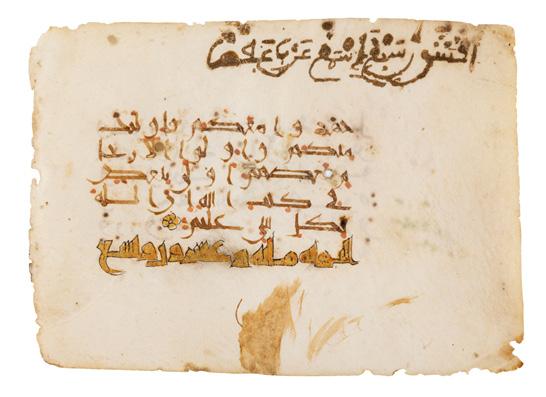
THREE FOLIOS FROM AN ILLUMINATED QUR’AN ON VELLUM NORTH AFRICA, TUNISIA, PROBABLY KAIROUAN, 10TH CENTURY
Arabic manuscript on vellum comprising a bifolium and single folio, 6 lines to the page written in Eastern kufic script in sepia ink, the bifolio comprising Qur’an chapter 9, al-Tawba, verses 3 to 6 from, and the single folio comprising Qur’an chapter 8, al-Anfal, verse 75, up until title of chapter 9, verses separated by gold florets, red diacritics, catch phrases highlighted in gold single folio 12cm x 16.5cm
£5,000-7,000
Provenance: Acquired from the London art market in circa 1995. Further unpublished folios from the same Qur’an are kept in the collection of the Great Mosque of Kairouan, Tunisia.
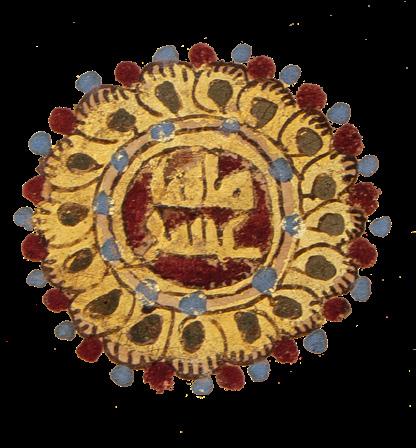
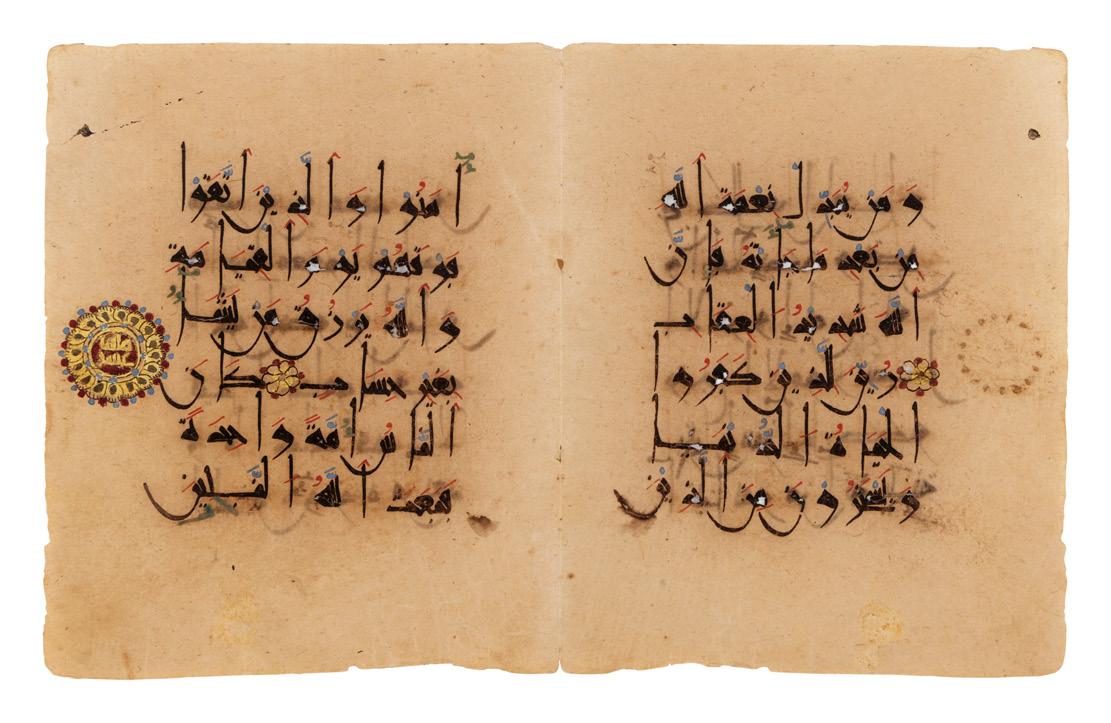
A FINE ILLUMINATED PINK KUFIC QUR’AN BIFOLIUM
PERSIA OR MESOPOTAMIA, 10TH/ 11TH CENTURY
Arabic manuscript on pinkish-brown paper, 6 lines to the page written in elegant Eastern kufic script in sepia ink, comprising Qur’an chapter 2, Al-Baqara, verses 211 to 213, verso with large elegant illuminated gold, red and blue medallion, ‘ashr, in the margin marking the 210th verse, diacritics in red and blue single folio 17.3cm x 14.1cm
£8,000-12,000
Provenance: Acquired from the London art market in circa 1995.
The elegant Eastern kufic script used for this bifolium was developed from the chancery hand used by Abbasid scribes of the 10th century, and by the end of that century this style was used for copying Qur’ans across the Islamic world from Isfahan to Palermo. The majestic form of the letters seen here corresponds to Déroche’s NS.I, a monumental type in which the line conforms as far as possible to an underlying geometry and there is a deliberate emphasis on thick and thin lines [see Déroche, F., The Abbasid Tradition: Qur’ans of the 8th to 10th Centuries, The Nasser D. Khalili Collection of Islamic Art vol.1, The Nour Foundation in association with Azimuth Editions and Oxford University Press: 1992, pp. 132-37]. Especially noteworthy here is the large ‘ashr marker with its impressive polychrome decoration. Parallels to this can be seen in a fragmentary 11th century Qur’an from the Khalili Collection (inv. no. QUR89 and QUR89A), which features a very similar example on folio 38 [ibid., pp. 156-65 no. 84, esp. p. 163].
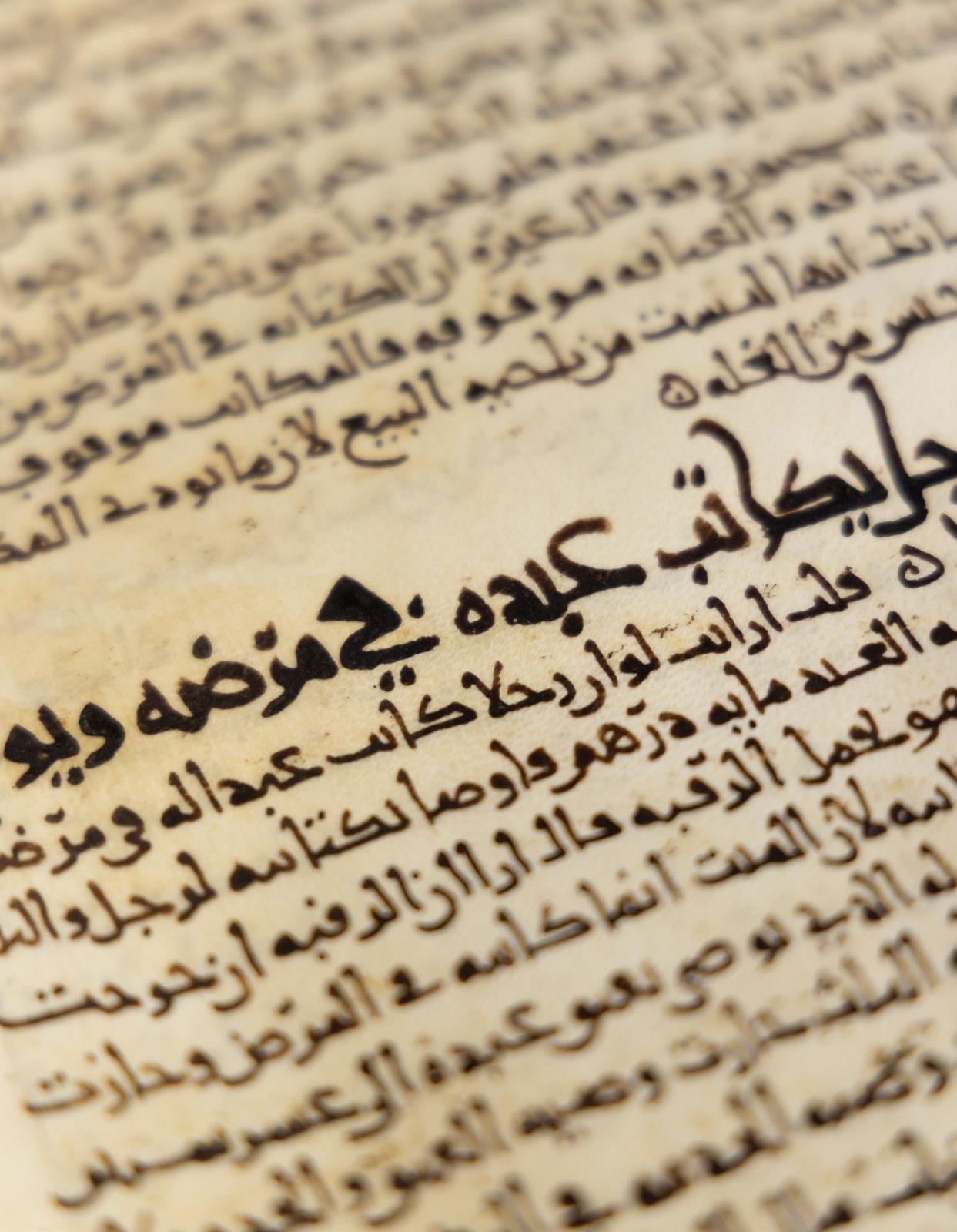
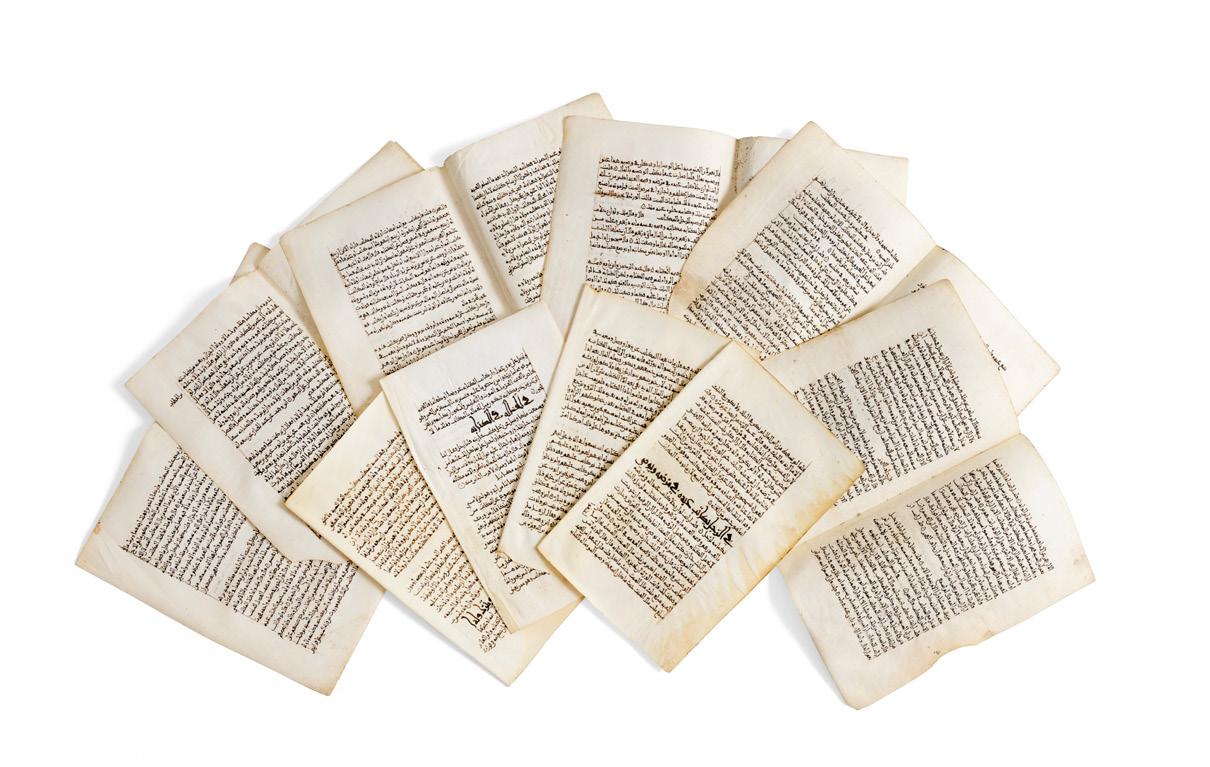
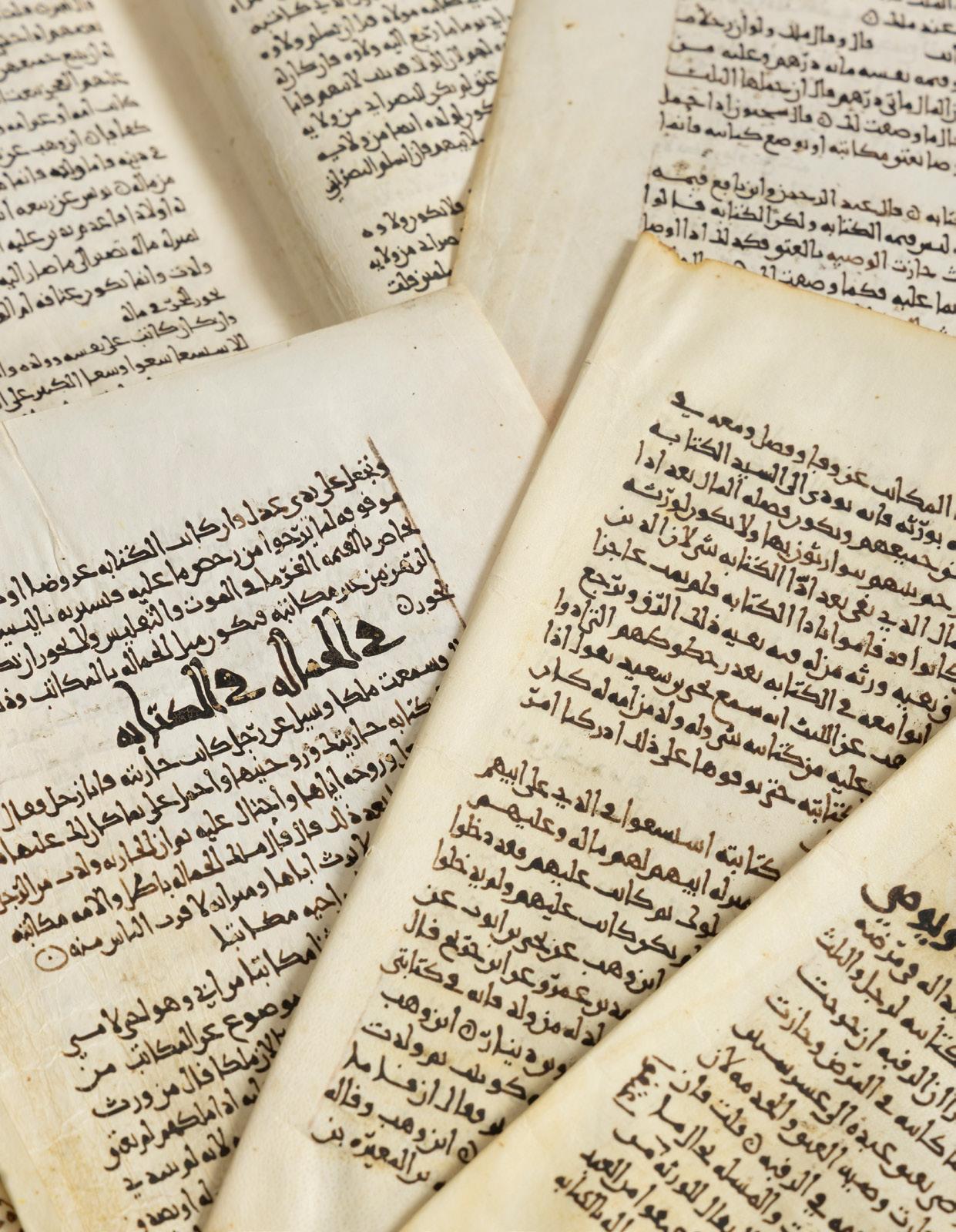
SAHNUN BIN SA’ID BIN HABIB AL-TANUKHI (D. 854 AD): KITAB AL-MUDAWWANA AL-KUBRA NORTH AFRICA, PROBABLY TUNISIA, KAIROUAN, 11TH CENTURY
section of the first volume of the great compendium of law, Arabic manuscript on vellum, comprising 6 bifolium (sewn together) and 4 detached folios, totalling 16 folios, 25 lines to the page written in elegant maghribi or Ifriqi script in sepia ink, each folio arranged around a two-paragraph format, headings and important words written in larger script single folio 29.3cm x 19cm
£12,000-18,000
Provenance: Acquired from the London art market in circa 1995.
The hand of the scribe is superbly controlled, elegant and measured, providing a beautiful visual as well as an important historical document. No doubt that it was copied for a learned and powerful patron. Ifriqi script, derived from the ‘New Style’ of Qur’anic calligraphy, is a distinctive scholarly script that was used and developed in Kairouan from 9th until the mid-11th century. Kairouan and its scholarly milieu played a decisive role in the intellectual history of the early Islamic Maghrib, particularly in the formation and transmission of foundational works of Maliki jurisprudence. As the capital of the province of Ifriqiya (approximately modern-day Tunisia), Kairouan was home to some of the most influential students of the Islamic west. As a definitive text of the Maliki school, the Mudawwana consists of legal opinions issued by ‘Abd al-Rahman b. al-Qasim al-Utaqi (d. 806 AD) in reply to questions from Sahnun al-Tanukhi (d. 240 AH/854 CE). These rulings derived from the foundational principles established by Malik b. Anas (d. 179 AH/795 CE), the founder of the Maliki school (madhhab) and ‘Abd al-Rahman’s mentor. Sahnun further enriched the work by appending prophetic traditions (hadith) to validate the expressed opinions. Comprising 16 parts subdivided into various books, the text’s doctrines were rapidly adopted in the Maghrib and the Iberian Peninsula, becoming the primary rite for the Andalusian Umayyads.
The libraries of the Kairouan have yielded the earliest dated Arabic literary manuscripts from the Islamic West, many of which concern Maliki law. The manuscripts typically survive as narrow, unbound parchment quires of varying quality, dated or datable from the mid-9th century to the 11th century, as with the present manuscript. There are several studies dedicated to these manuscripts which shed light both on the history of the Great Mosque of Kairouan as a centre of learning and on the development of Islamic jurisprudence in North Africa from its beginnings through to the 11th century. For these, please see M. Maruanyi and J. Brockopp, “Early Maliki Manuscripts: A Retrospective” in Asiatischen Studien - Études Asiatiques 78/1, 2024, pp. 3-17; and Bongianino, U., and Salah, C., “The Earliest Manuscript of Qairouan, 9th-11th centuries: New Approaches for a more Accurate Dating” in Arabica 71 (2024), pp. 247-303. Comparable examples can be found in the British Library (ms or. 9810 c) and the Great Mosque of Kairouan (ms Rutbi 424/2, ff. 1-2), and a Spanish copy of the Muwatta of Malik b. Anas dated 20 Dhu’l-Hijja 490 AH/8 December 1097 is in Zayed National Museum (inv. no. ZNM.2009.00038).
Sections from a manuscript of Kitab al-Mudawwana dated 1133 AD were sold at Christie’s, 25 April 1997, lot 41; 11 October 2005, lot 32 and 23 October 2007, lot 59. Another copy, attributed to 11th century Spain, was sold in Christie’s, 24 April, 2015, lot 247.
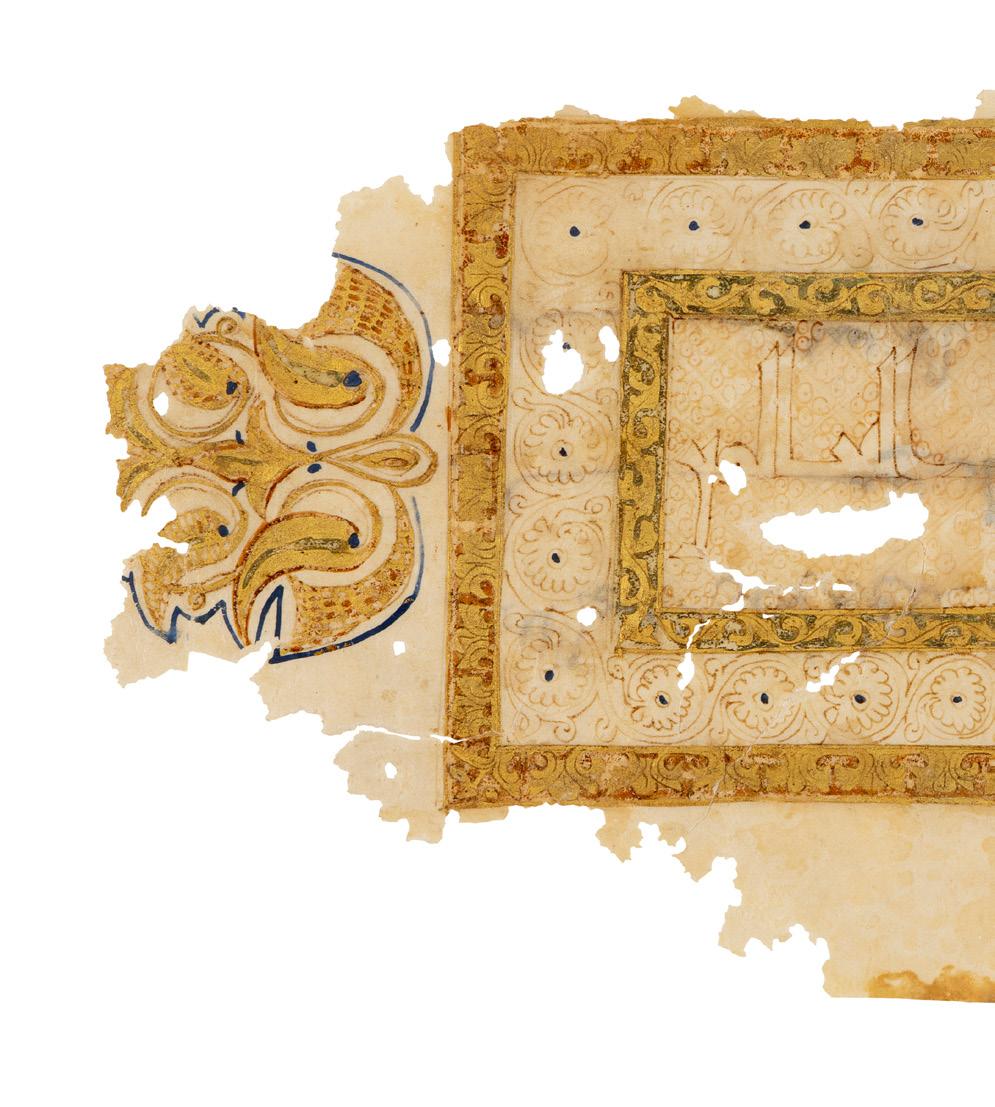
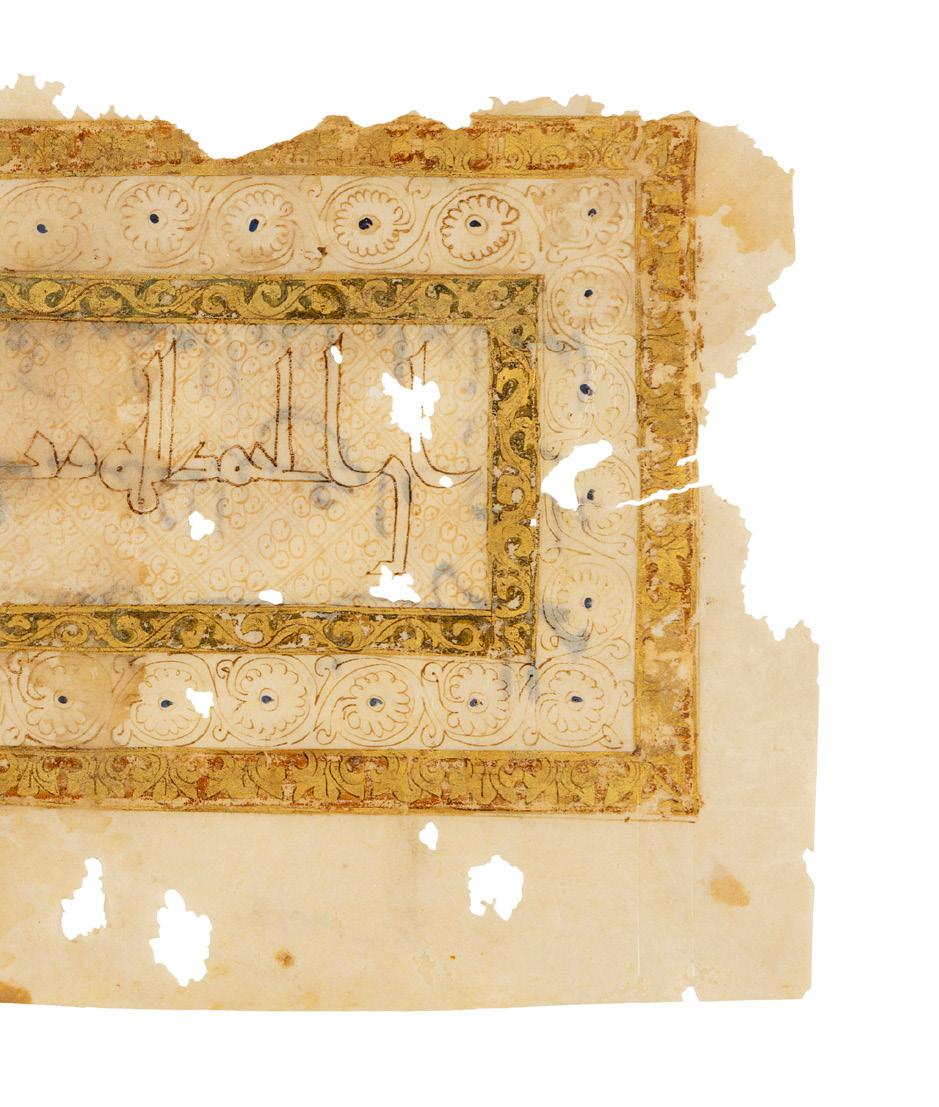
A FINELY ILLUMINATED ABBASID QUR’AN FINISPIECE
NORTH AFRICA OR NEAR EAST, 9TH CENTURY
Arabic manuscript on vellum laid down on rice paper, through the centre one line of kufic script in sepia ink comprising Qur’an chapter 10, end of verse 10, the enveloping rectangular panels illuminated in bands of gold and colours with continuous vegetal and floral designs, to one side of the outer rectangle, a stylised arabesque half-palmette element approx. 27cm x 15cm
£8,000-12,000
Provenance: Acquired from the London art market in circa 1995.
This exceptionally fine fragment originally formed the finispiece (illuminated final page) of the 10th volume of what must have been a truly splendid 60-part Qur’an. Its decoration demonstrates a sophisticated mastery of geometric design, where simple elements such as lines, circles, and rectangles are combined into intricate and harmonious compositions. The closest comparison to the present finispiece is the carpet page from a Qur’an now in the J. Paul Getty Museum (inv. no. 83.MM.118.2.10.recto). This shares a very similar aesthetic of delicate floral and vegetal elements drawn in reserve on a shaded background, as well as interlaced borders of gold on red and a large palmette extending from the main panel. This manuscript has been attributed to the 9th century, of either North African or Iranian production [see Sahragard, M., “Northern Africa or Central Iran? An Investigation into the Production Place of a Fragmentary Kufic Qur’an at the J. Paul Getty Museum” in Getty Research Journal, No. 19 (2024), pp. 3-17, esp. pp. 6-8 fig. 1]. Other comparable 9th century illuminated elements are in the Khalili Collection (inv. no. KFQ 78) and the Chester Beatty Library (inv. no. Is 1407) [see Déroche, F., The Abbasid Tradition: Qur’ans of the 8th to 10th Centuries, The Nasser D. Khalili Collection of Islamic Art vol.1, The Nour Foundation in association with Azimuth Editions and Oxford University Press: 1992, pp.123–4 cat.67; Arberry, A.J., The Koran Illuminated: A Handlist of the Korans in the Chester Beatty Library, Hodges, Figgis & Co., Ltd: 1967, p. 5 no. 6 and pl. 15].
On the reverse, written upside down, are three lines of text from a waqf deed in cursive script, datable to the 10th or 11th century. The text is very damaged, but it is possible to decipher the beginning of the first line, mimmˉa amara bi-tahbˉısihi li-llˉah (‘what was given as an endowment to God’), and that of the second, ila masjid Ibn ʿAbd al-Muttalib (‘to the Mosque of Ibn ‘Abd al-Muttalib’). The latter offers the possibility that this fragment might once have been endowed to the famous Mosque of Hamza Ibn ‘Abd al-Muttalib, which is named after the Prophet’s uncle and is built near the site where he fell at the Battle of Uhud (just outside Madina) in 3 AH/625 CE. There are other mosques with this name so the theory must be treated with some caution, but a manuscript as fine as the one from which this finispiece came would surely have been an appropriate endowment for such a storied place of worship.
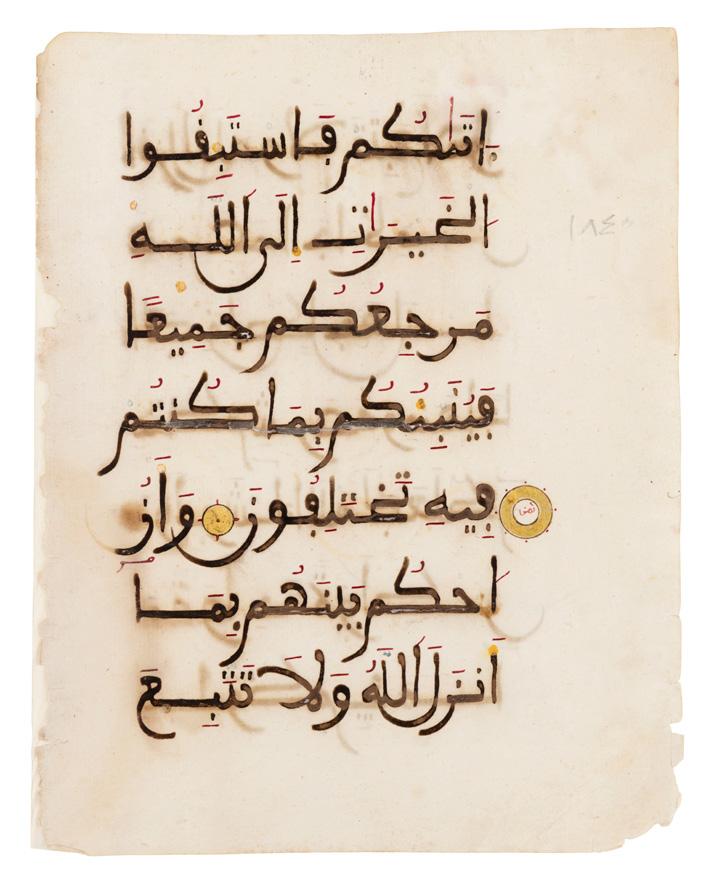
A FINE QUR’AN FOLIO IN MAGHRIBI SCRIPT NORTH AFRICA, TUNISIA, 15TH/16TH CENTURY
Arabic manuscript on high-quality paper, 7 lines writing in elegant maghribi script in sepia ink, gold and red medalion verse separators, and a gold ashr in the margin 26.6cm x 21cm
£3,000-4,000
Provenance: Acquired from the London art market in circa 1995. This folio, which contains the text of Q.5:48-49, is part of a small but important group which can be attributed to late 15th or early 16th century Hafsid Tunisia. Many of these were carried away as the spoils of war by the forces of Charles V when he conquered Tunis in 1535, and this date provides a helpful terminus ante quem for their production. One such example with seven lines is a Qur’an dedicated on the death of the Hafsid prince Abdallah Muhammad al-Mas ʿud in 893 AH/1487 CE, now in the Kantonsbibliothek Vadiana (inv. no. VadSlg Ms 387), which is also extremely close in terms of its calligraphic style with distinctive ‘dancing’ lam-alifs and the elongation of certain forms such as the body of the kafand the bowl shape of the final nun. Other seven-line Qur’an manuscripts from this period include examples from Tunisia, such as those in the Bibliothèque nationale, Tunis (inv. no. MS 3443) and Musée des Arts Islamiques, Raqqada (inv. no. Rutbi 191) [for these manuscripts, see Hinrichsen, L., The Lost Libraries of Tunis: Book Culture of Ḥafṣid Ifrˉıqiya and Arabic Manuscripts in Europe after the Sack of Tunis (1535), De Gruyter: 2024, p. 240 no. Q013, p. 241 no. Q015, p. 243 no. Q018].
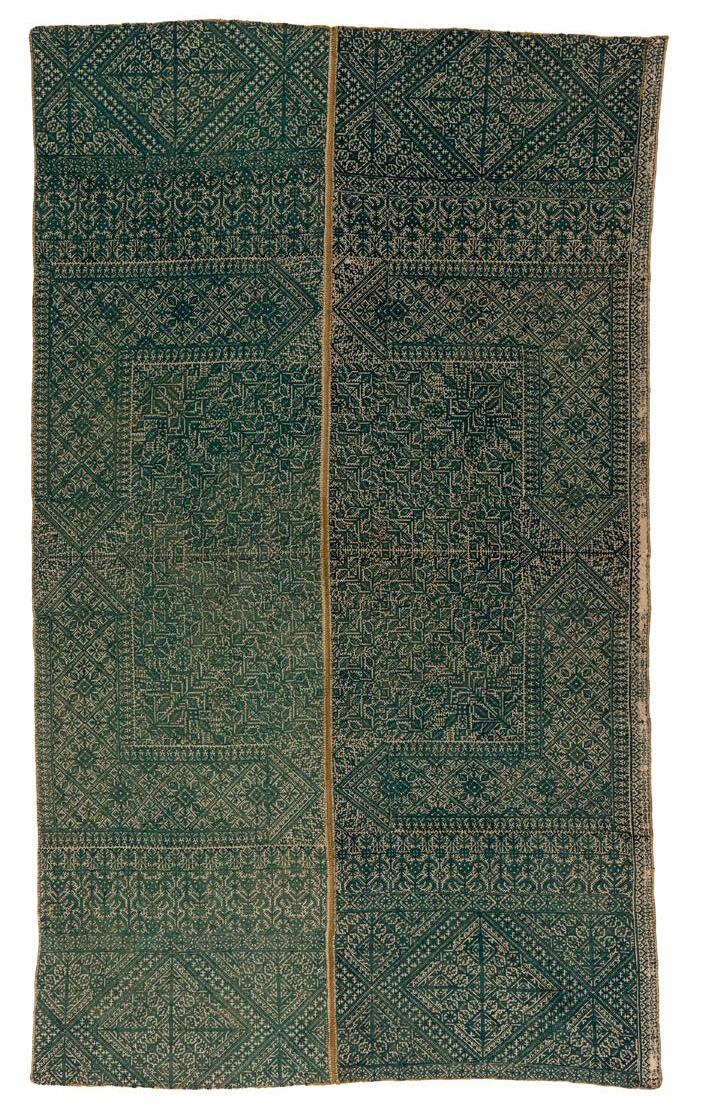
A LARGE EMBROIDERED GREEN PANEL WITH GEOMETRIC MOTIFS NORTH AFRICA, FEZ, 19TH CENTURY
rectangular, formed of two lengths sewn together, each intricately embroidered in rich green threads with symmetrical designs, forming geometric motifs consisting of diamond-and-square shapes, and lattice designs
161cm x 92.8cm
£800-1,200
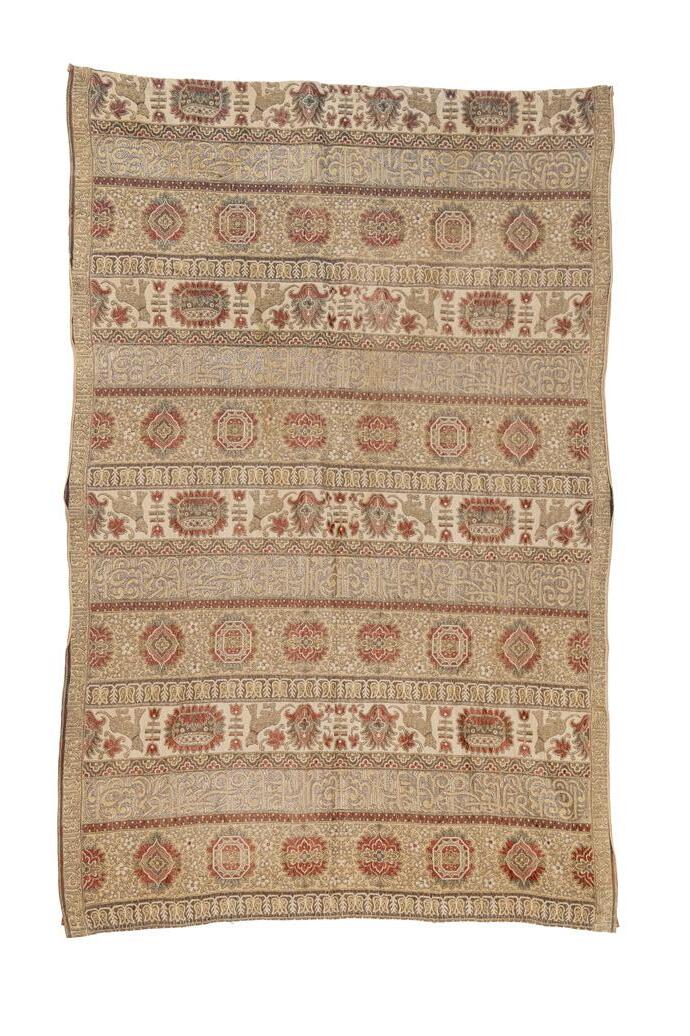
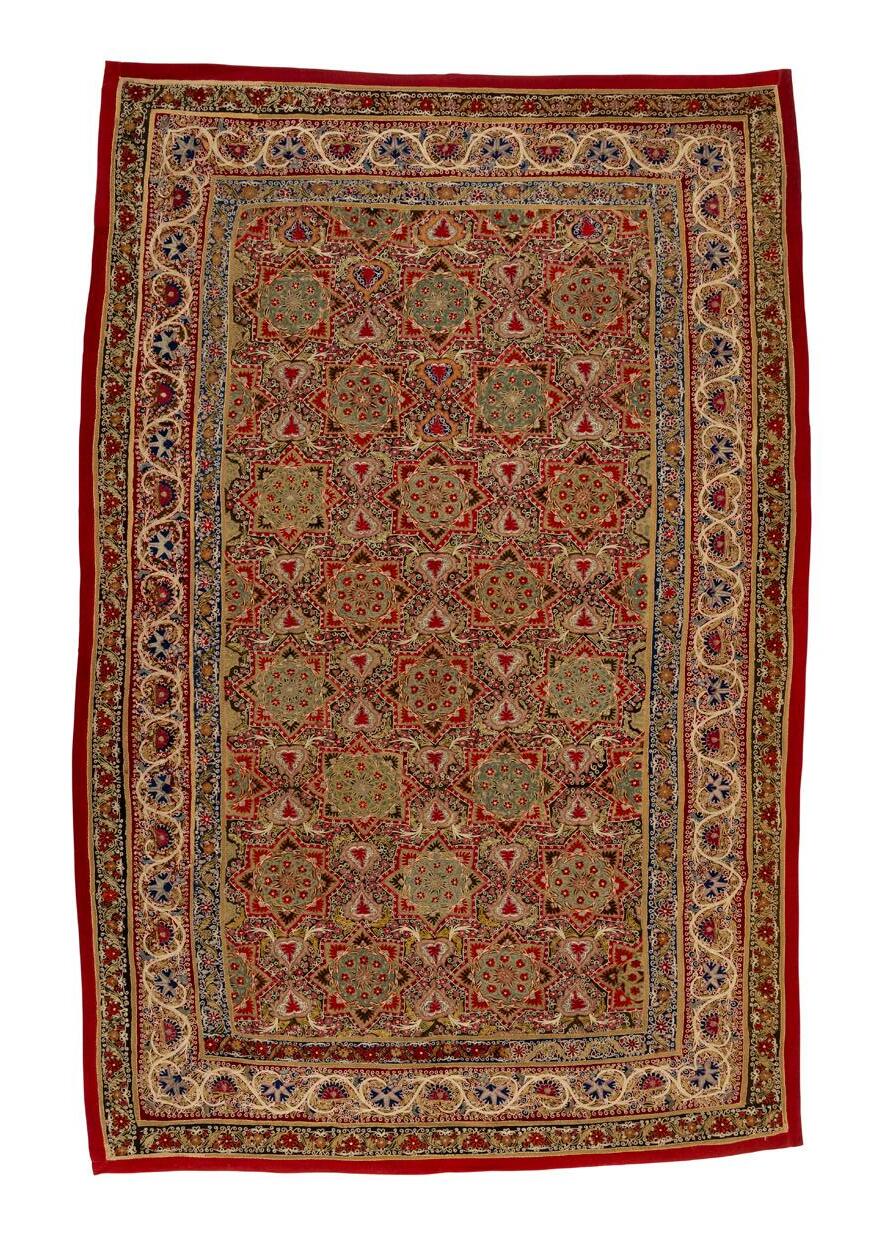
AN HISPANO-MORESQUE REVIVAL TAPESTRY
SPAIN, ANDALUSIA, LATE 19TH CENTURY
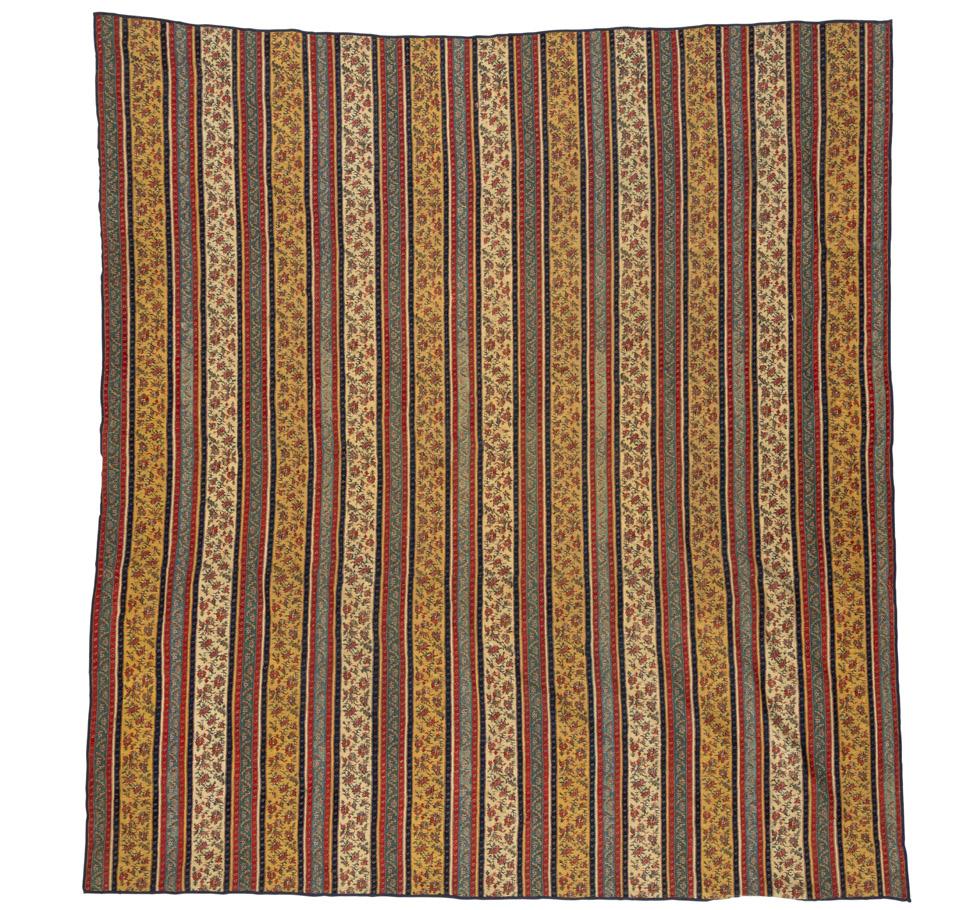
of rectangular form, the cream ground woven with red, yellow, brown and metal threads, forming repeat bands of continuous stylised motifs comprising tulip-heads, arabesque, geometric and floral cartouches, noble hounds and stylised calligraphy
195cm x 131cm
£800-1,200
Using soft earthen colours, this textile panel offers a glimpse into the rich heritage of the 14th century Hispano-Moresque tradition. For a fourteenth century example, see A. Welch, Calligraphy in the Arts of the Muslim World, Kent, 1979, no. 18.
8
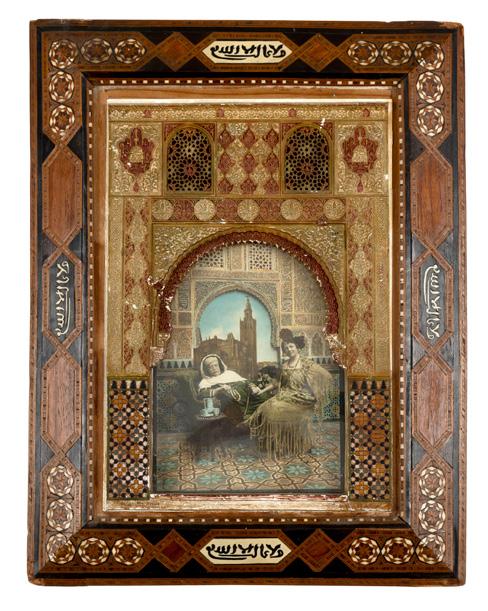
A GESSO ALHAMBRA PLAQUE WITH A MARQUETRY FRAME
BY FRANCISCO GIMENEZ, SPAIN, GRANADA, CIRCA 1900
depicting a mihrab with two arched windows above, decorated in gilt and polychrome in the Nasrid-style, a vintage coloured photograph of two figures having tea, mounted in a marquetry wood frame with inscriptions in cartouches
51.5cm x 39cm
£600-800
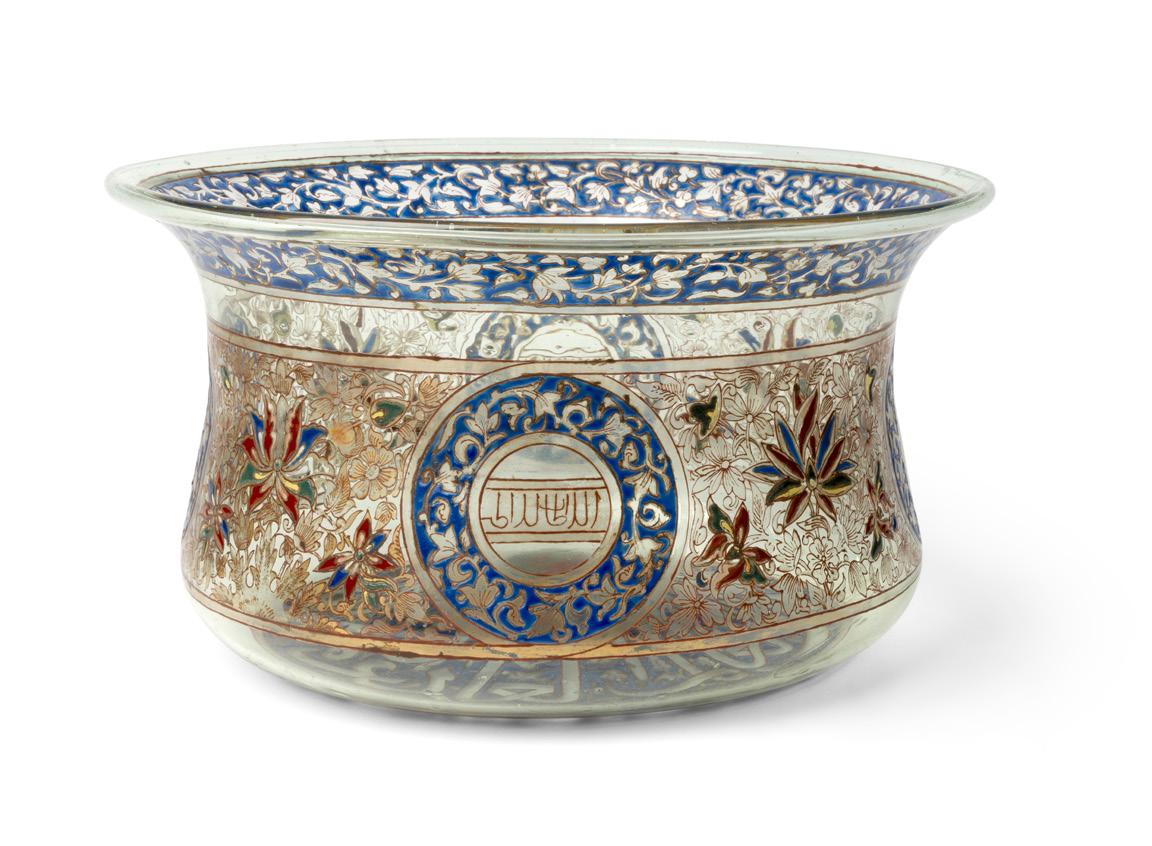
A LARGE MAMLUK-STYLE ENAMELLED AND GILT GLASS BASIN
FRANCE OR GERMANY, 19TH CENTURY
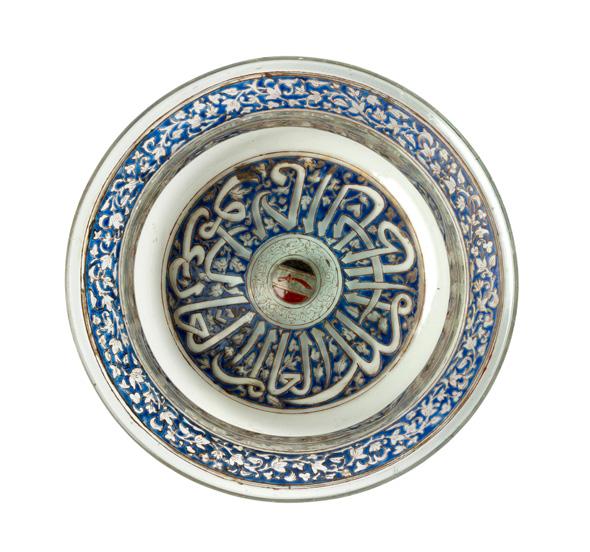
upright with slightly inward sides with outward flaring rim, the transparent glass enamelled in blue, green, iron-red, white, yellow, and gilt, the body with four large medallions containing Arabic benedictory inscriptions, all on a ground of luscious floral and foliate motifs, the rim with a band of continuous repeat wavering floral motifs on a blue ground, the base with a wide band of Arabic inscriptions that comprise ‘Glory to our lord, the sultan, the learned king, the just’ encircling a Mamluk-style emblem containing a dagger 28cm diameter
£6,000-8,000
This 19th century bowl copies the shape of a Mamluk metal-prototype - the most well known being the 14th century Baptistiere de Saint Louis profusely inlaid with silver and housed in the Louvre, Paris.
OTTOMAN WORKS OF ART & MANUSCRIPTS
A PAIR OF EARLY OTTOMAN CARVED IVORY CALLIGRAPHIC PANELS
TURKEY, 15TH/ 16TH CENTURY
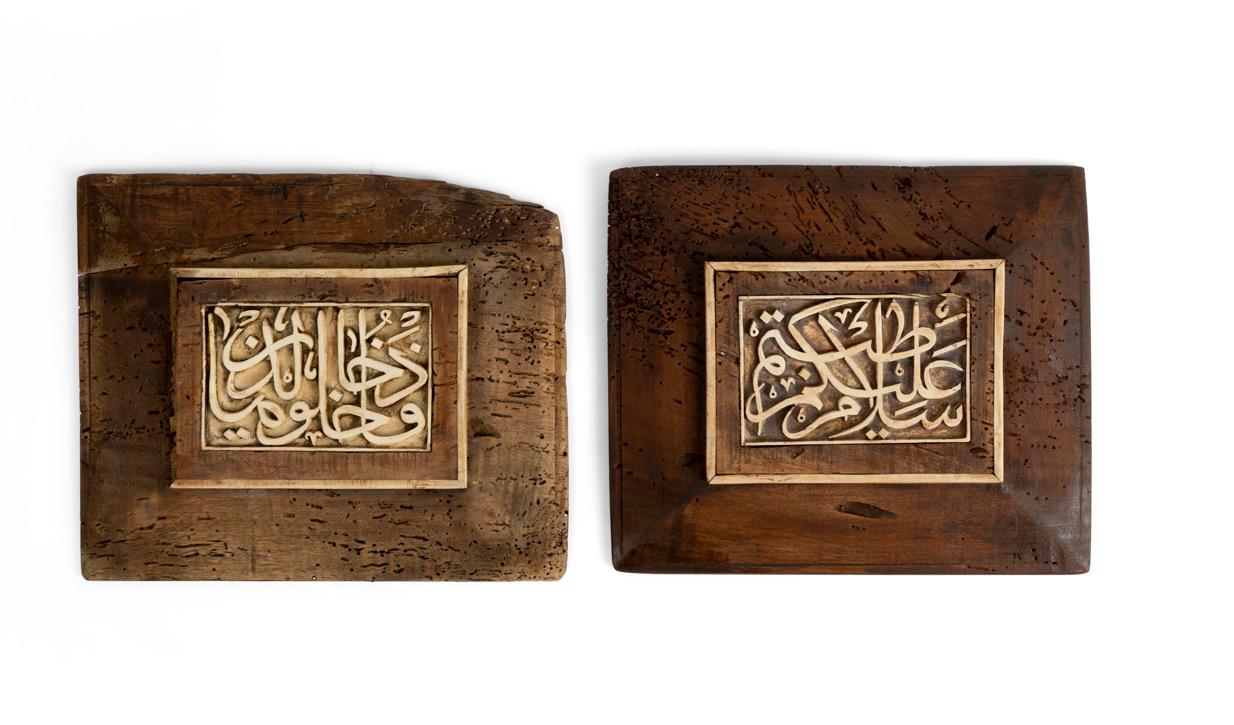
rectangular with sloping wood frame, each with raised ivory plaque relief carved with thuluth inscription, comprising one with a partial verse from Qur’an 39:73, and the other with ‘Peace be upon you! well have ye done! enter ye here, to dwell therein’ each 17.5cm x 22.5cm
£4,000-6,000
Provenance: Formerly, Oliver Hoare Ltd., London, 2019.
For a very similar pair of Ottoman ivory calligraphic panels, see Bonhams, Islamic and Indian Art, 7 October 2014, lot 84.
Please be aware that this lot contains material which may be subject to import/export restrictions, especially outside the EU, due to CITES regulations. Please note it is the buyer’s sole responsibility to obtain any relevant export or import licence. For more information visit http://www.defra.gov.uk/ahvla-en/imports-exports/cites/
Sold in compliance with UK Government and APHA regulations, with (non-transferable) exemption registration reference ~ PY6Q4SKL & 129CC3FR
A FINE OTTOMAN BOOK COVER
TURKEY, LATE 19TH/ EARLY 20TH CENTURY
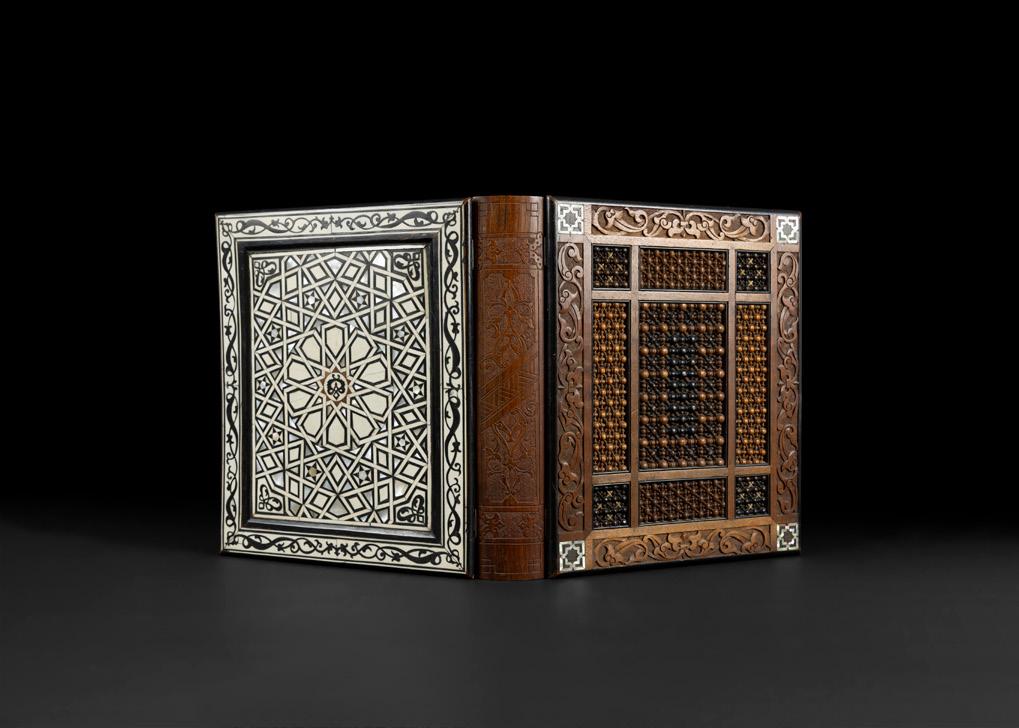
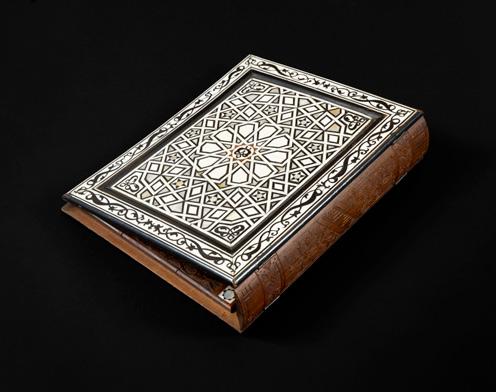
of typical form made of wood, the front cover inlaid with bone, motherof-pearl and stained wood elements forming Ottoman-style geometric designs, with a central emblematic medalion, borders with continuous interlace arabesque and split palmettes, the spine elegantly carved with typical Ottoman book designs, verso made in the mashrabiya technique
36cm x 29.8cm x 8.6cm
£4,000-6,000
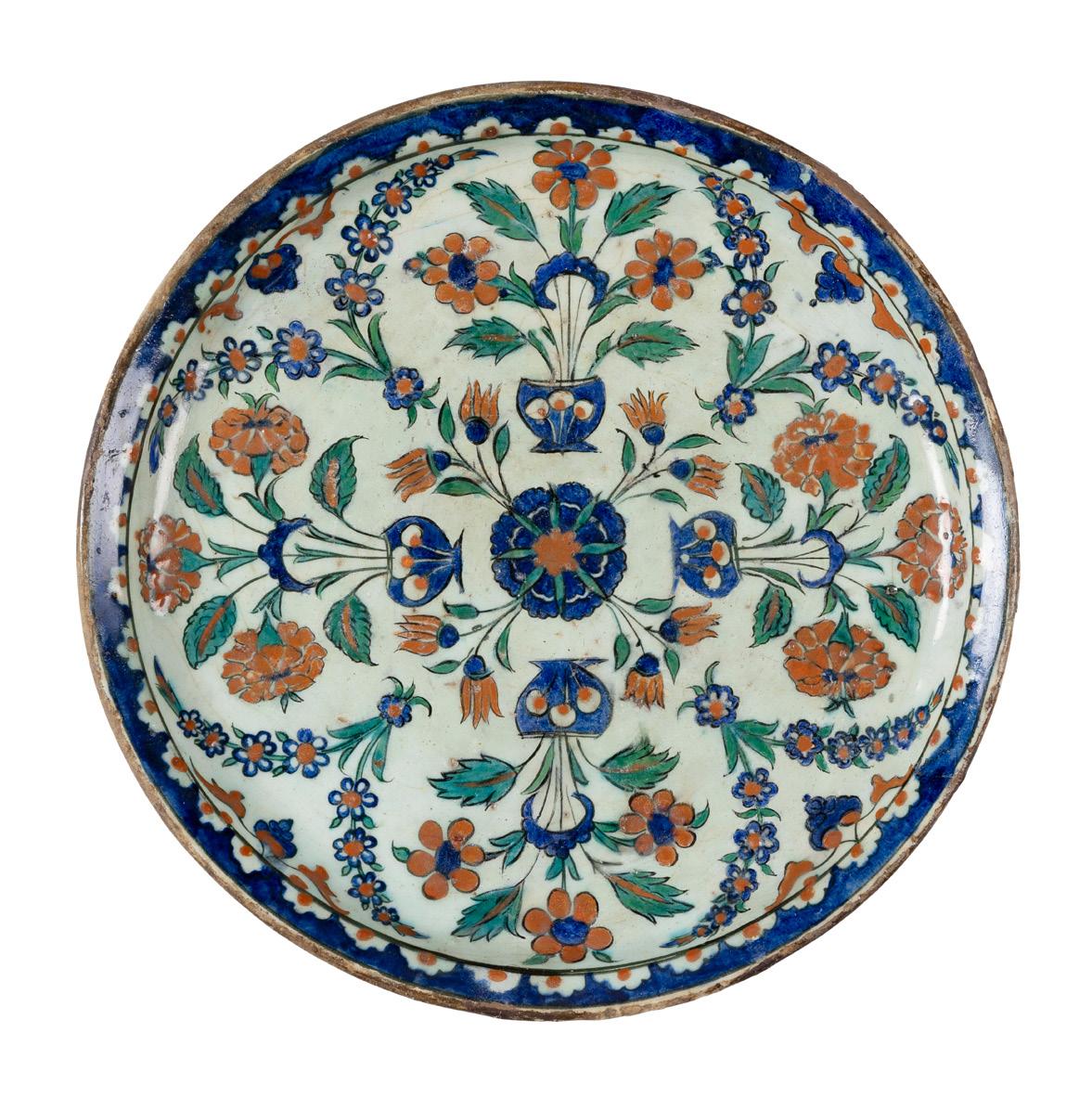
A RARE RIMLESS IZNIK ‘QUATRE BOUQUETS’ POTTERY DISH
OTTOMAN TURKEY, CIRCA 1575
of shallow form with short curved rim on a short ring foot, decorated in cobalt blue, bole red, green and black outline on a white ground under a transparent glaze with a central blue flower with four issuing floral sprays, and four larger motifs at right angles comprising vases with floral bouquets enveloped by blue floral stems, verso with green and blue floral motifs 28.5cm diameter
£10,000-15,000
This Iznik dish is rather unusual for not having the traditional ‘rock and wave’ rim. Instead, the artist has painted a narrow rim and allowed more space for the overall design.
A closely related Iznik quatre bouquets dish is in the Musée National de la Renaissance – Chateau d’Écouen. See, Frédéric Hitzel et al. Iznik – L’Aventure d’une Collection, Musée National de la Renaissance – Chateau d’Écouen, Paris, 2005, No. 175, p. 155, and for a comparable dish in the Benaki Museum, Athens, please see John Carswell & Mina Moraitou and Melanie Gibson, Iznik Ceramics at the Benaki Museum, Benaki Museum - Gingko, London, 2023, No. 39, p. 93, and lastly for comparable compositions, although with the rock and wave design rim, in the Koc collection, see Hulya Bilgi, The Omer Koc Iznik Collection, 2015, nos. 124-126.
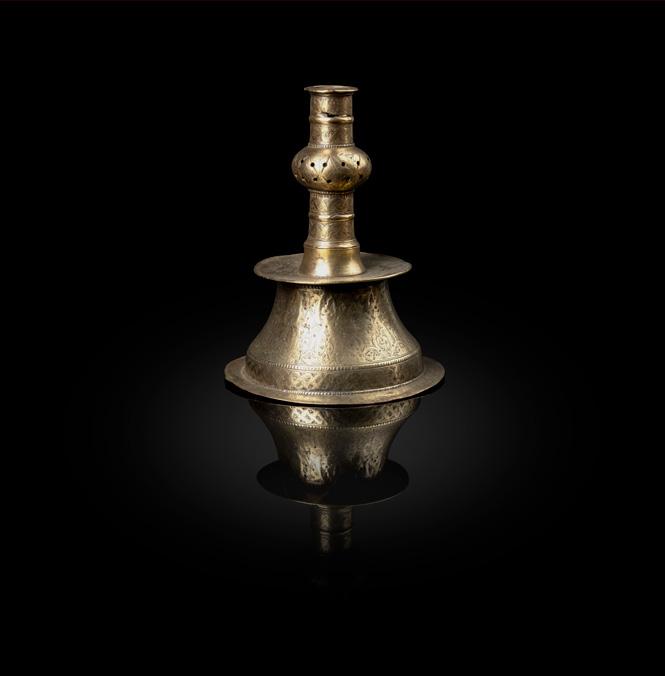
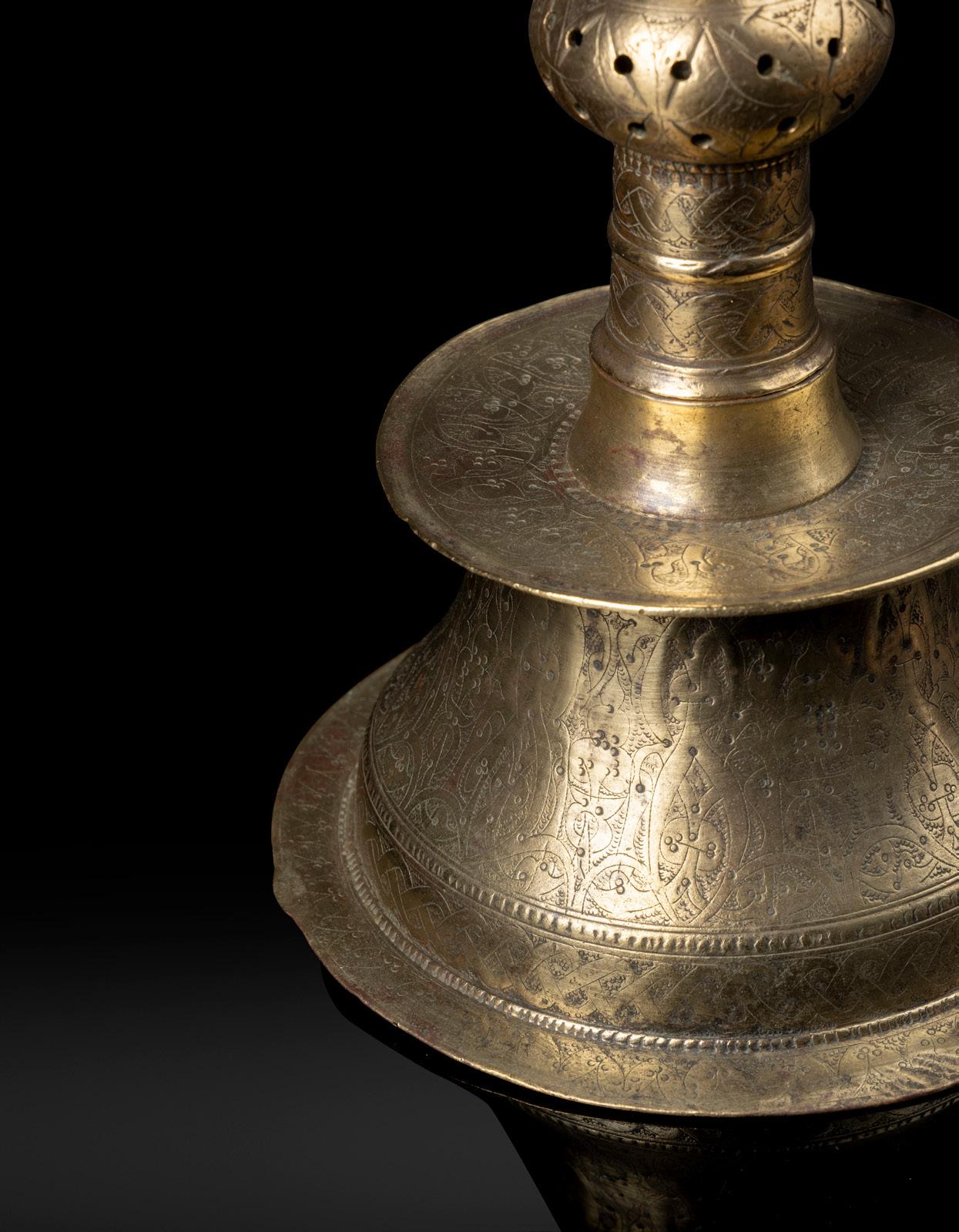
AN EARLY OTTOMAN ENGRAVED BRASS CANDLESTICK
TURKEY, EARLY 16TH CENTURY
cast in two parts, the body of truncated conical form with flanged base and flat drip tray, the neck with globed perforated bulb, the engraved designs on the drip tray and lower body forming wide bands of interlace and arabesque on a ring-punched ground, the upper socket with interlace punctuated by small cintamani motifs
21.5cm high
£7,000-9,000
The shape and the inclusion of the simple cintemani decoration at the top of the socket of the candlestick leaves one in no doubt of its Ottoman origins. In addition to the arabesque interlace palette that can be paralleled in bookbindings of the period, these elements place it with certainty into the corpus of decorative objects from Bayezid II’s reign (r. 1481-1512).
For a very similar candlestick in the Freer Gallery of Art see Y. Petsopoulos et al, Tulips, Arabesques & Turbans, Decorative Arts from the Ottoman Empire, New York, 1982, no. 22 and for another comparable in the Victoria and Albert Museum E. Atil et al, Islamic Metalwork in the Freer Gallery, Washington D.C., 1985, p. 192, fig. 66.
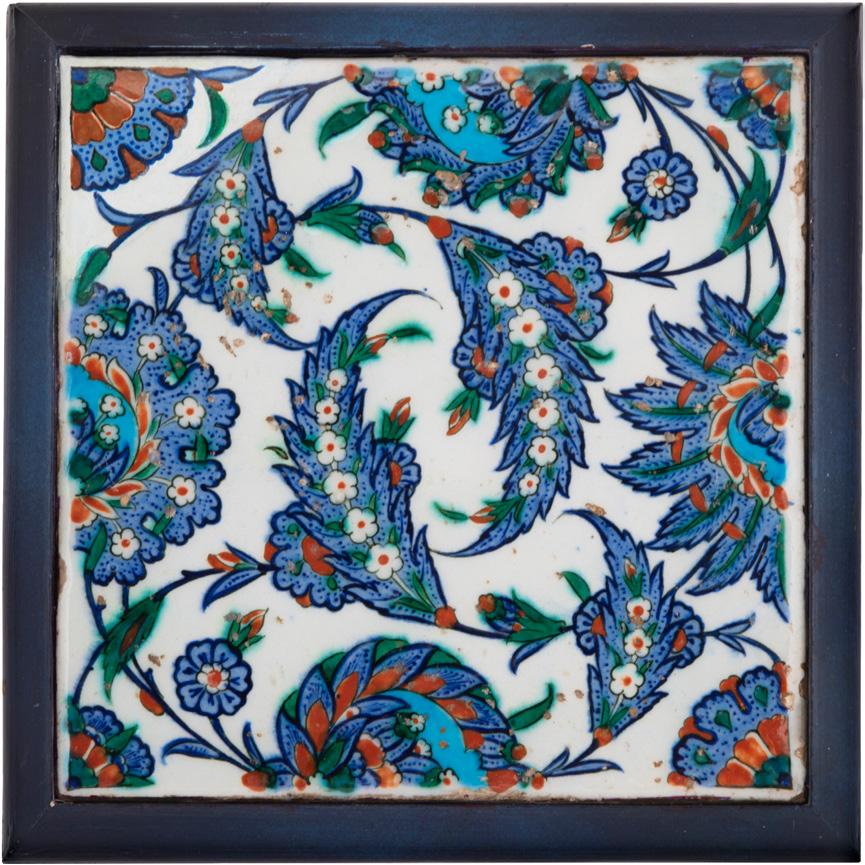
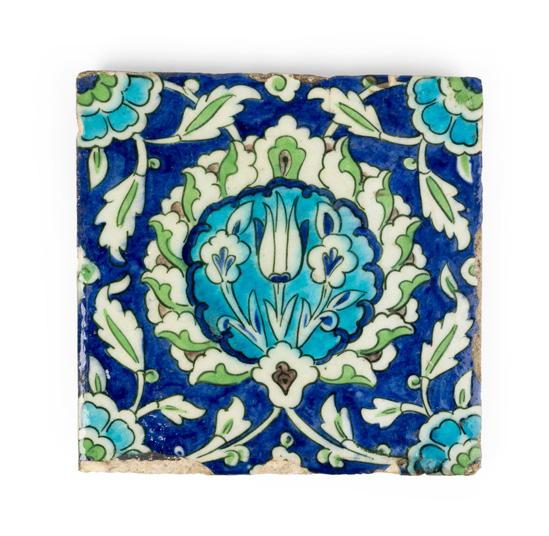
A IZNIK POTTERY TILE DECORATED WITH ‘SAZ’ LEAVES
OTTOMAN TURKEY, CIRCA 1575 of square form, decoration in two shades of cobalt blue, bole red and green on a white ground under a transparent glaze, with tendrils with issuing saz leaves containing prunus blossom, and flowering lotus palmettes, mounted and framed 26cm x 26cm
£8,000-12,000
Provenance: Formerly, the property of a lady in the 1980s. This striking tile is a fine example of Iznik production at its height. Rather than the use of black outline which was introduced some years later, the cobalt blue is used in two shades - the darker shade is used to form the outline of the saz leaves as well as the stylised floral palmettes and stems.
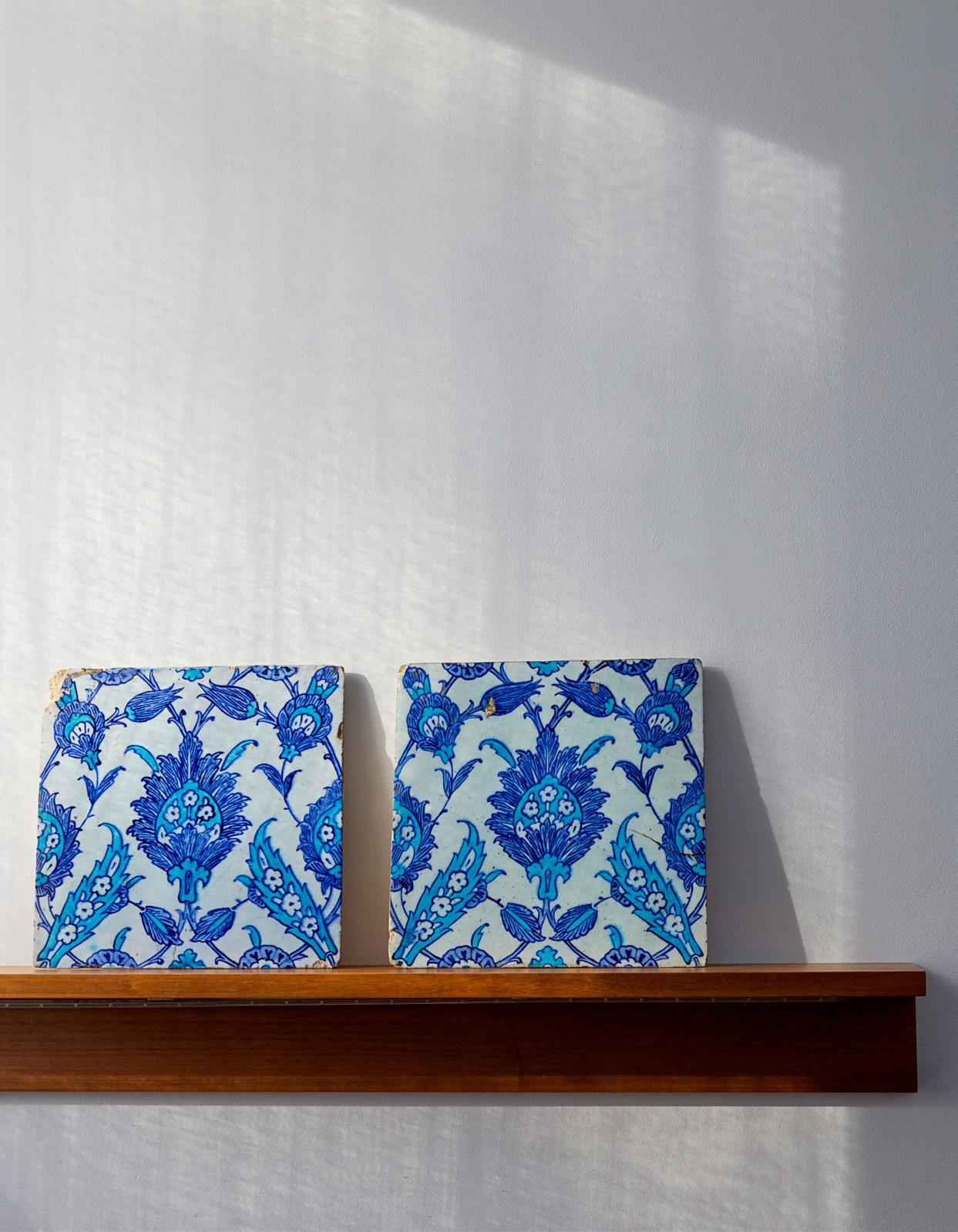
A PAIR OF IZNIK BLUE AND WHITE POTTERY TILES
OTTOMAN TURKEY, 17TH CENTURY
each of square form, decorated in cobalt blue and turquoise on a white ground under a transparent glaze, with a central stylised flowerhead surrounded by tulips and saz leaves
each 25cm x 25cm
£3,000-5,000
Provenance: Formerly, old Irish family collection.
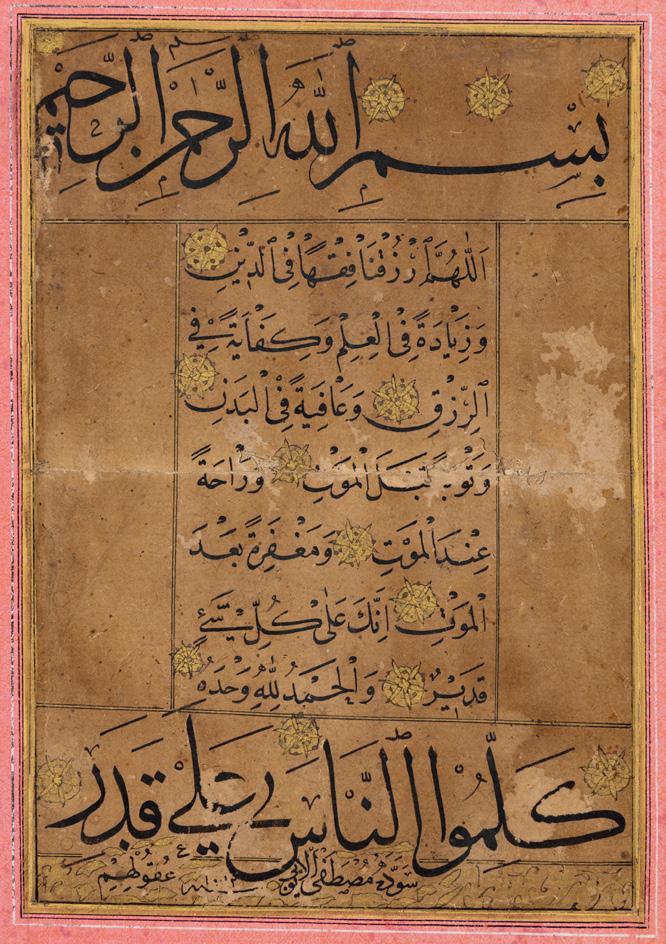
AN OTTOMAN CALLIGRAPHY SIGNED BY SUYOLCUZADE MUSTAFA EYYUBI, MASTER OF HAFIZ OSMAN
TURKEY, ISTANBUL, DATED, AH 1072/ AD 1661
black ink on paper, comprising a central rectangular panel with 7 lines in elegant naskh script with gold florette verse separators, the larger script above and below in thuluth, gold and black margin rules, red mount, reverse with marbled effect 22.4cm x 16cm
£2,000-3,000
Written in thuluth and naskh scripts, this is a rare example composed by Suyolcuzade Mustafa Eyyubi Efendi, the calligraphy teacher of the infamous Hafiz Osman Efendi (d. 1698). The calligrapher was born in the Eyub district of Istanbul. His father’s name was Ömer. He studied calligraphy under the supervision of the famous Dervish Ali the Elder (d. 1673). He was celebrated for his mastery in the six pens (al-aqlam al-sitta), particularly in thuluth and naskh Mustafa Eyyubi owed most of his fame to being the calligraphy teacher of the court calligrapher Hafiz Osman Efendi (d. 1689) who taught calligraphy to Sultan Mustafa II (r. 1695-1703) and Sultan Ahmed III (r. 1703-1730). In addition, Eyyubi was the grandfather of the Ottoman historian Suyolcuzade Mehmed Necib Efendi (d. 1757), the author of calligraphers’ biographies Devhat al-Kuttab. He died in 1685, in Istanbul.
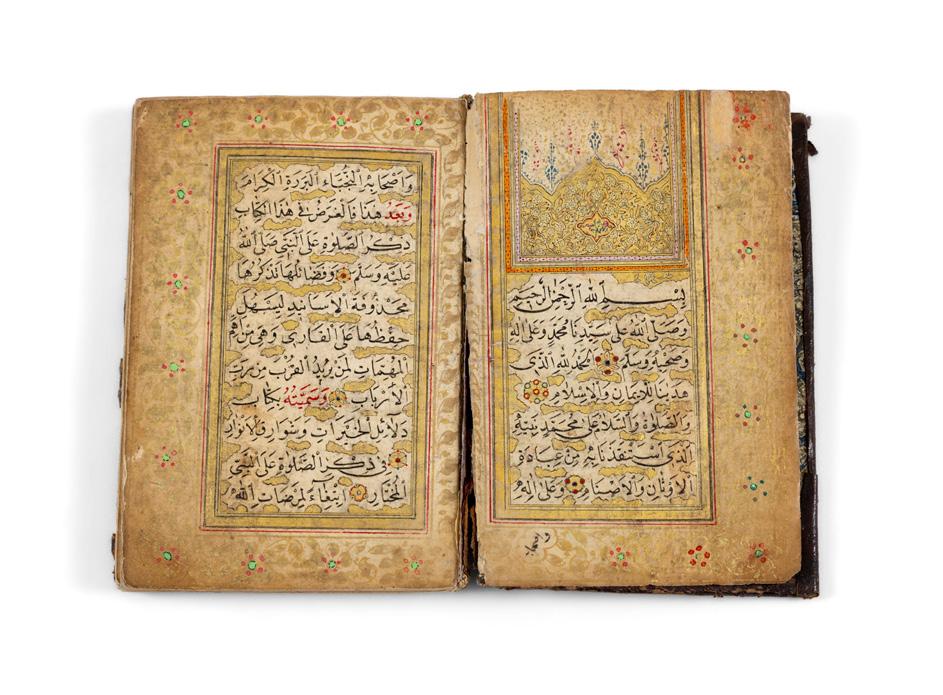
A COLLECTION OF PRAYERS INCLUDING AL-JAZULI’S DALA’IL AL-KHAYRAT
COPIED BY MUHAMMAD ANIS, OTTOMAN TURKEY, 18TH CENTURY
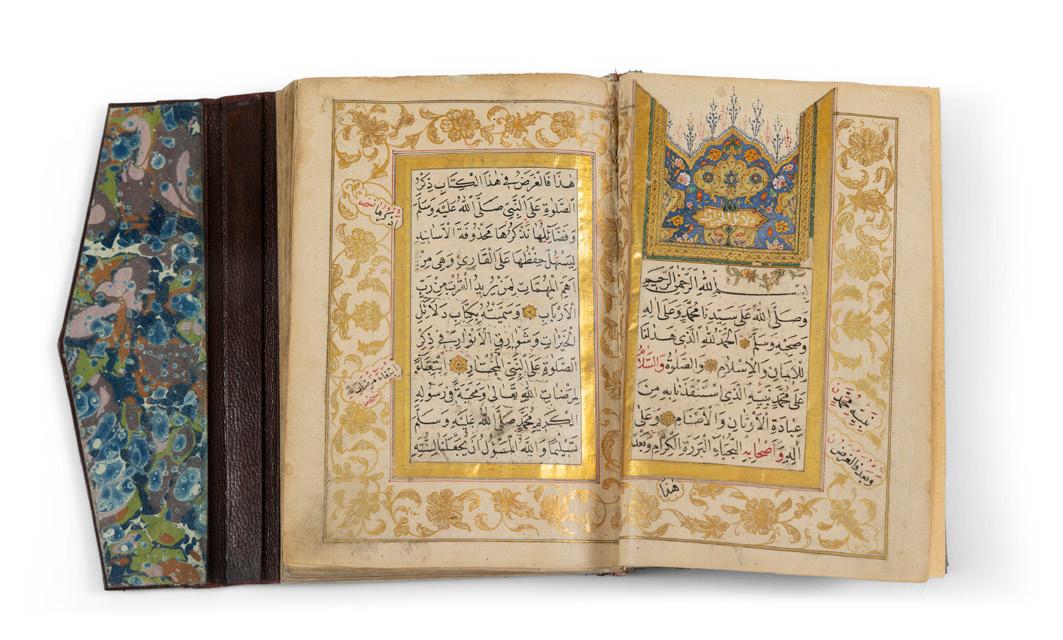
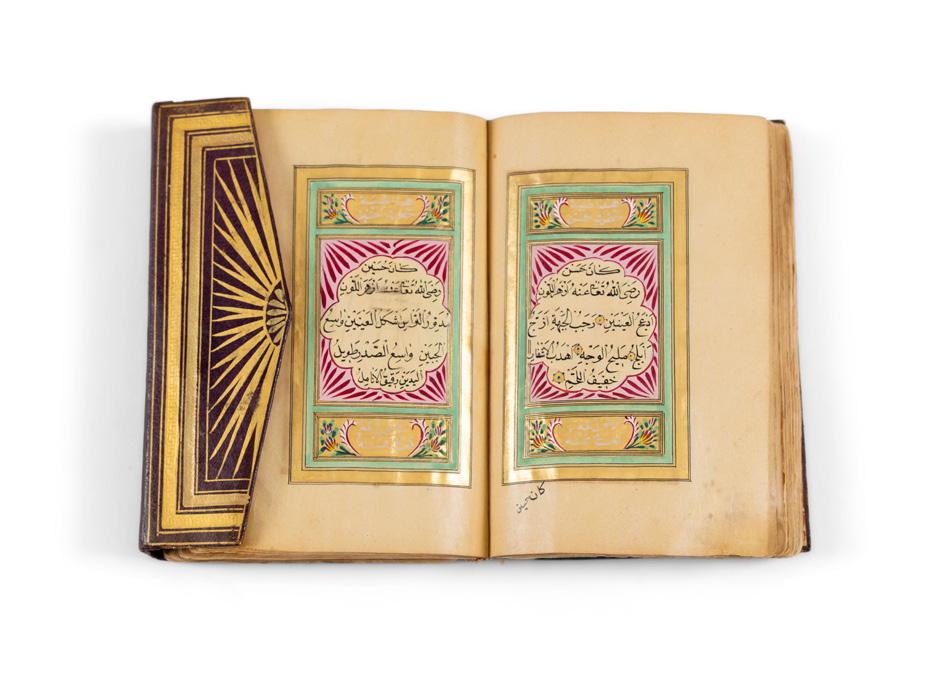
Arabic manuscript on paper, 100 leaves, 11 lines to the page written in naskhi script in black ink, verse separators of gold roundels with alternating blue and red dots, inner margins ruled in gold, black and red, catchwords and phrases in red, illuminated frontispiece with floral decoration in the outer margins, 12 illuminated headpieces in colours and gold, red morocco with gilt floral sprays and margins, doublures of marbled paper
15.2cm x 10.5cm
£5,000-7,000
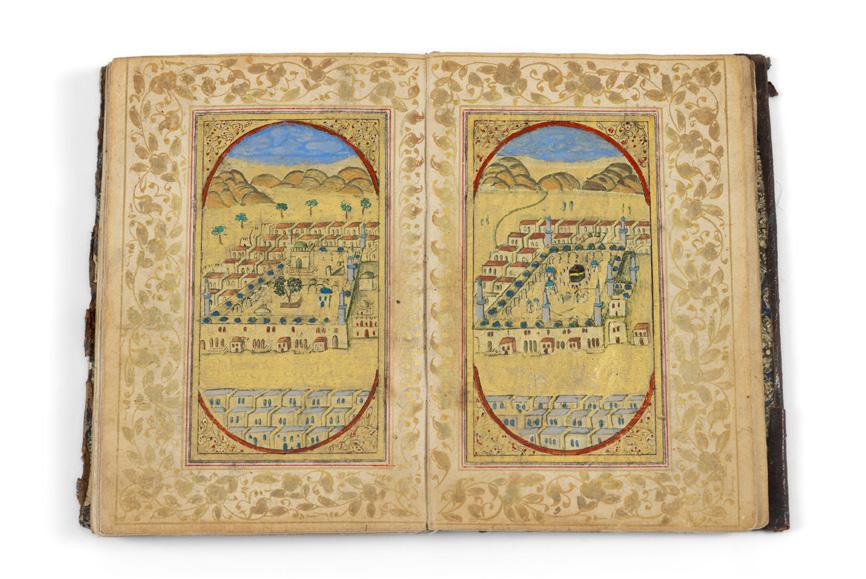
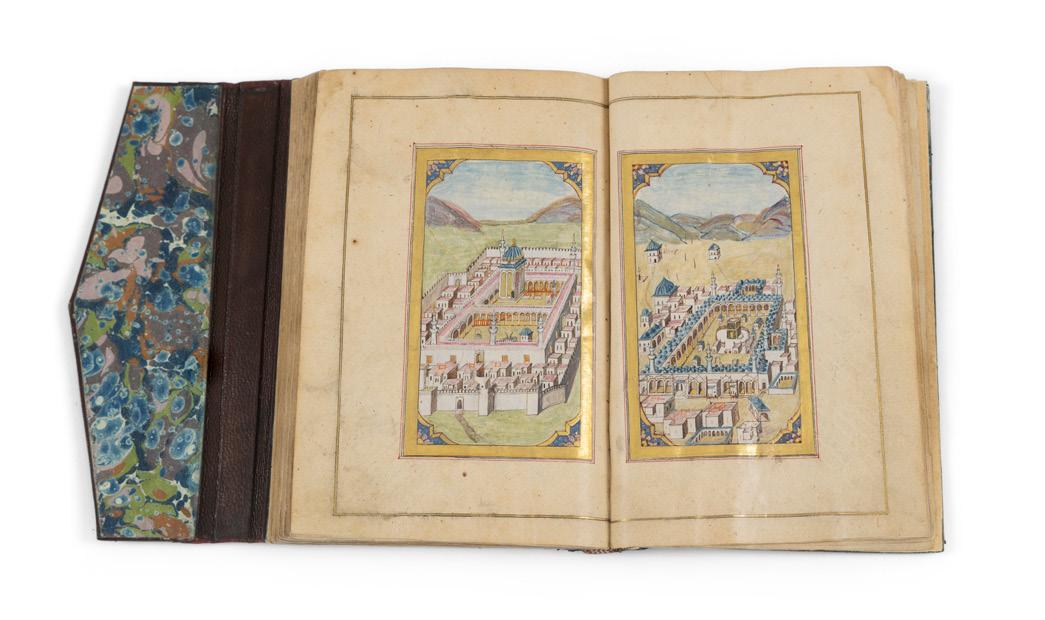
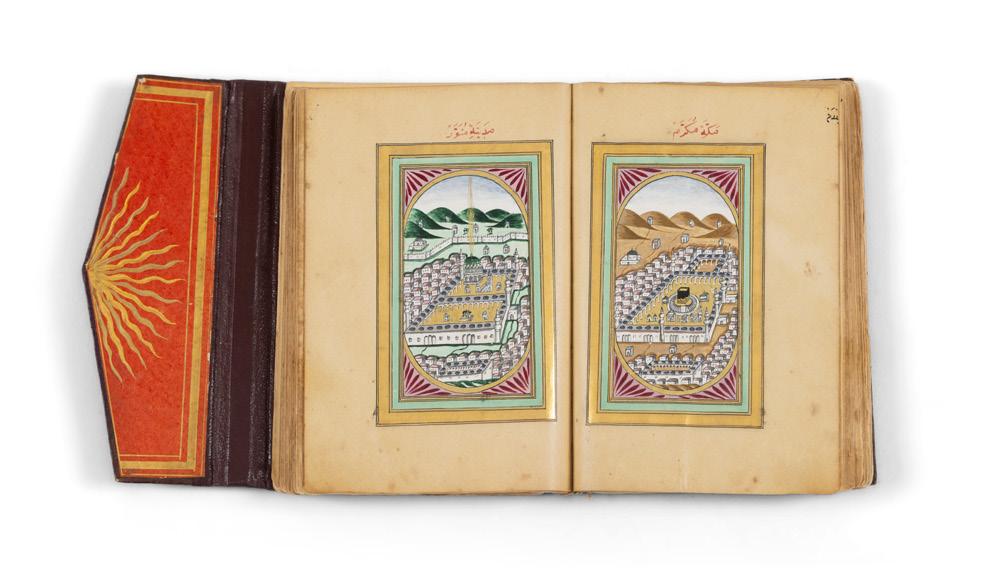
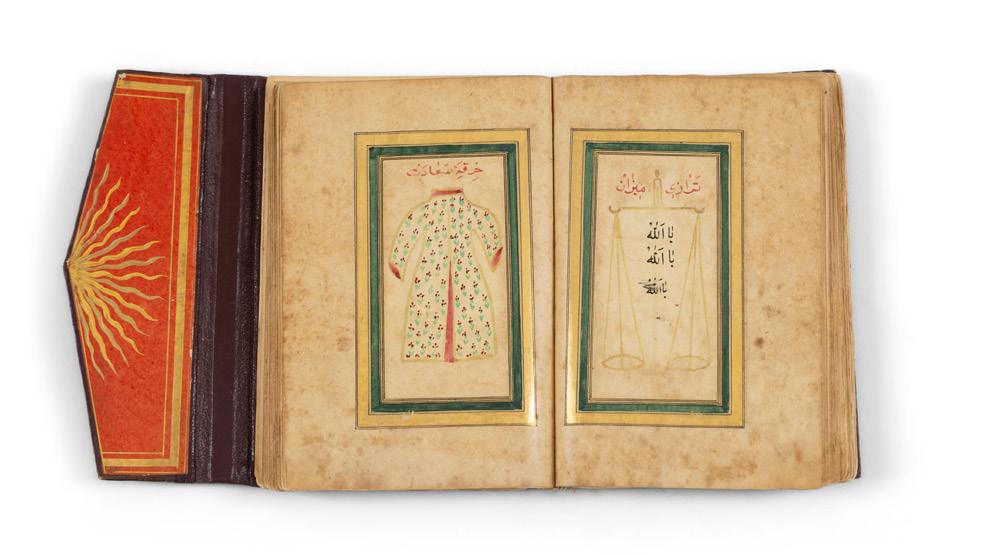
A collection of prayers for the Prophet originally composed by the 15th century Moroccan scholar Muhammad al-Jazuli, this manuscript and the following two are known as the Dala’il al-Khayrat, literally translated as ’Guides of Goodness’’. These prayer manuals were particularly popular during the 18th and 19th centuries and generally include illustrations of the holy cities of Mecca and Medina.
A COLLECTION OF PRAYERS INCLUDING AL-JAZULI’S DALA-IL AL-KHAYRAT OTTOMAN TURKEY, 18TH CENTURY
Arabic manuscript on paper, 106 leaves, 11 lines to the page written in an elegant naskhi script in black ink, verse separators of gold roundels with alternating blue and red dots, inner margins ruled in gold and red, some catchwords and phrases in red, some notes in outer margins, illuminated frontispiece and colophon, 14 illuminated headpieces in colours and gold, red morocco with stamped medallions and florets highlighted in gold, with flap, doublures of marbled paper
15.5cm x 11cm
£5,000-7,000
A LAVISHLY DECORATED AND EXTENDED COLLECTION OF PRAYERS, INCLUDING AL-JAZULI’S DALA’IL AL-KHAYRAT
OTTOMAN TURKEY, EARLY 19TH CENTURY
Arabic manuscript on paper, 258 leaves with 9 lines written in naskhi script in black ink, 58 calligraphic cartouches or hiliye, illustrations of the holy sanctuaries at Mecca and Medina, followed by 24 diagrams, headpieces in gold and colours, red morocco with flap, with gilt decoration
14.5cm x 10.2cm
£6,000-8,000
20
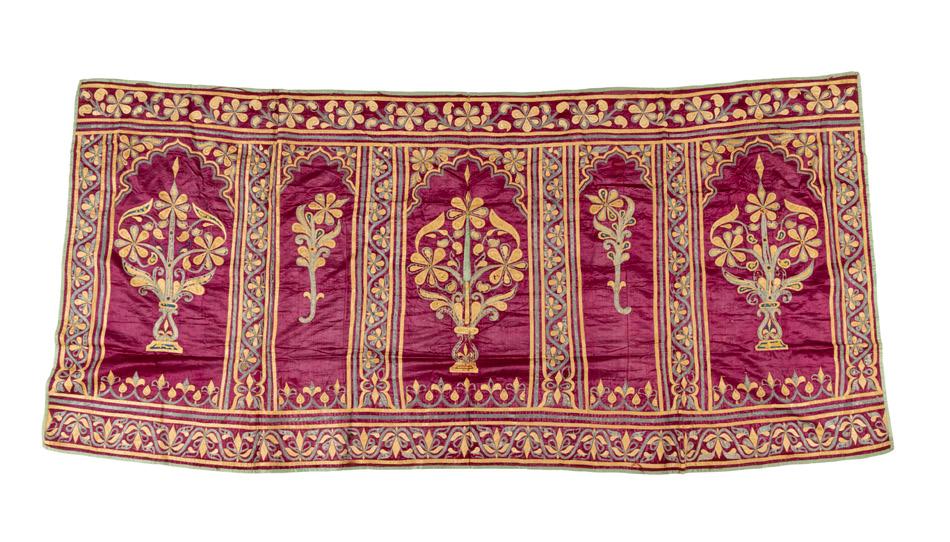
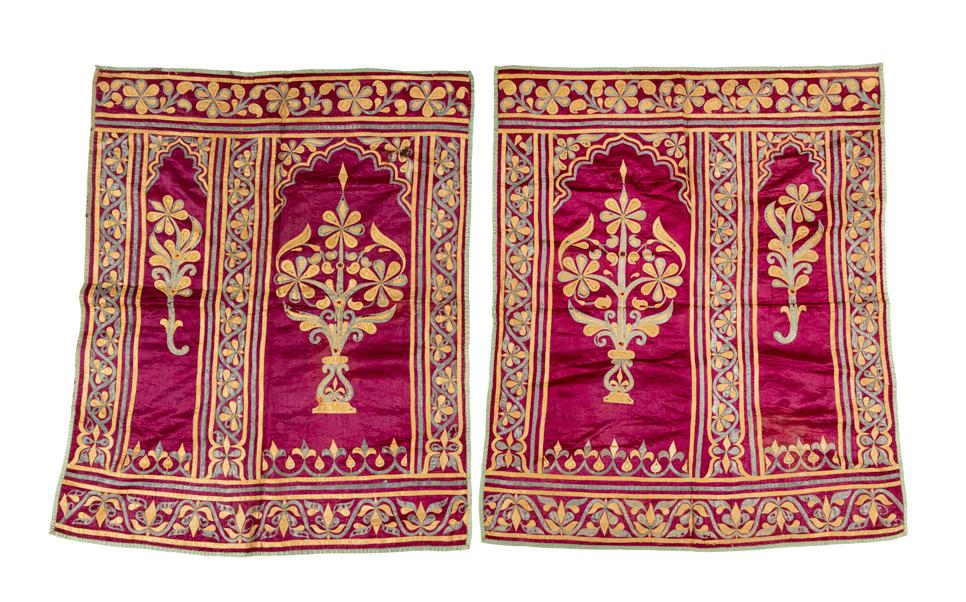
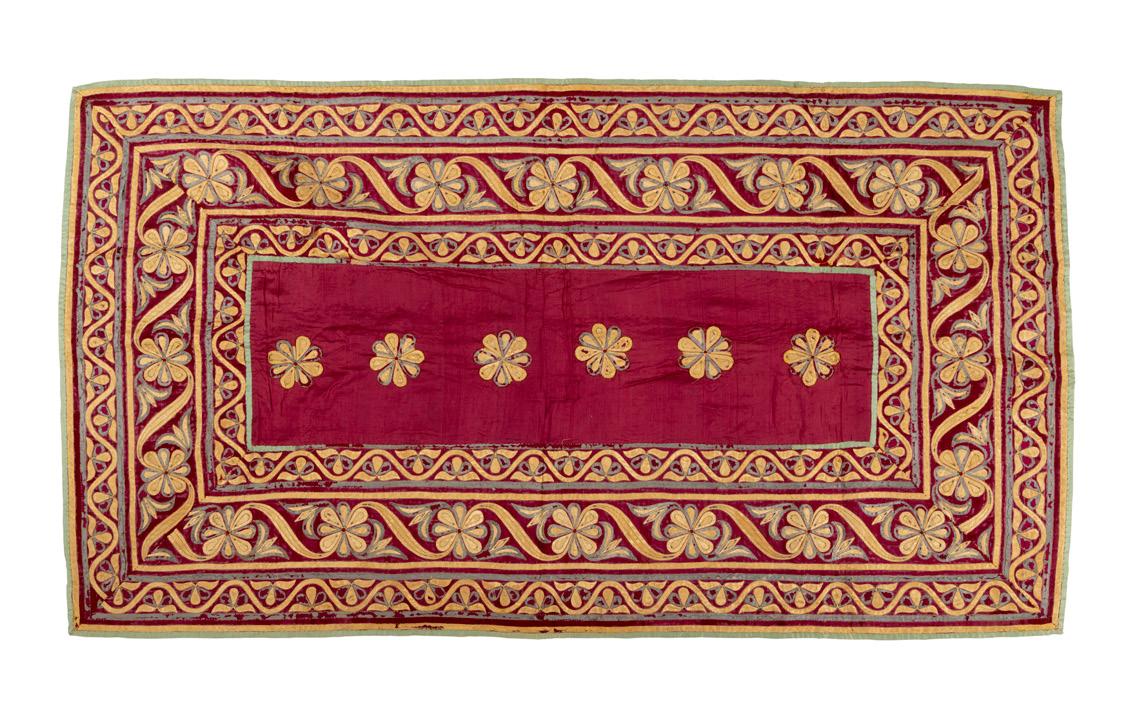
A RARE GROUP OF OTTOMAN SILK APPLIQUÉ TENT PANELS
TURKEY, 18TH CENTURY
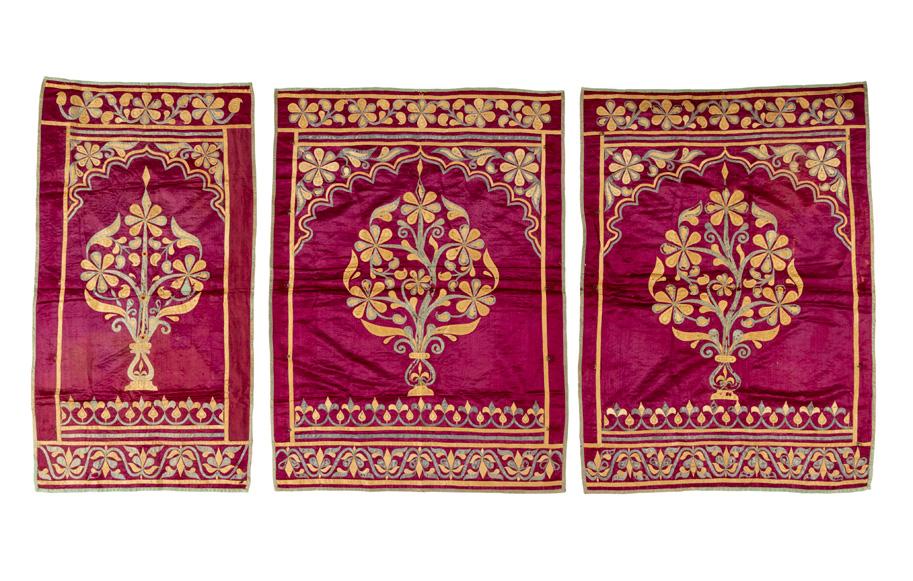
comprising six panels of various rectangular sizes, the burgundy silk ground applied and sewn with light silver-blue and yellow silk strips, the majority of the panels with decoration forming a vase with issuing branches and floral stems or a single stem within a lobed arch, inner borders with continuous meandering vegetal designs, one rectangular panel with a single band of six vertical flowerheads through the middle, enclosed by three narrow bands of interlace, hemmed in light turquoise, backed in cotton smallest 100cm x 52cm; largest 97cm x 215cm
£8,000-12,000
These magnificent panels, which would originally have formed part of the inner shell of a luxurious tent (hazine), are superb examples of 18th century Ottoman textile production. They are in excellent condition and retain their original, vibrant colour scheme of yellow and silver-blue on a rich burgundy purple background, comparable with examples in museum collections across Europe and Türkiye.
Reflecting its origins as a fighting force which was constantly on the move, tents held a longstanding significance within the Ottoman empire. Writing in the 15th century, the Spanish traveller Pero Tafur wrote that “The Grand Turk and his people are always in the field in tents, both winter and summer. . . although the city is close at hand”, and any early Ottoman cityscape should also be understood as having a temporary extension of portable fabric dwellings [see Singer, A., “Enter, Riding on an Elephant: How to Approach Early Ottoman Edirne” in Journal of the Ottoman and Turkish Studies Association, Vol. 3, No. 1 (May 2016), pp. 89-109, p. 104]. This love of the luxury tent city, a place where the Sultan could self-represent as both nomadic warrior and refined ruler, continued into the 18th century. In the Surname, a book devoted to the fifteen days of festivity around the circumcision of Sultan Ahmet II’s sons in 1720, an entire double-page spread is devoted to images of the grand tent city erected in Istanbul’s Ok Meydani for the celebrations [see Atil, E., “The Story of an Eighteenth-Century Ottoman Festival” in Muqarnas, Vol. 10 (1993), pp. 181-200, p. 185 and fig. 3].
By the time that the present panels were made, tents were much less for war than for pleasure. Ottoman elites could enjoy the natural surroundings in which these temporary pavilions were arranged, and the floral appliqué designs seen here would have echoed such idyllic settings. If one considers the floral motifs set within arches featured on the present panels, then for the viewer standing within such a tent the impression would have been like being inside a covered arcade, looking outward toward a garden framed between the archways. Beyond the illusory impression of infinite space, this might even have had paradisical associations [Dimmig, A., “Fabricating a New Image: Imperial Tents in the Late Ottoman Period” in International Journal of Islamic Architecture, Volume 3 Number 2 (2014), pp. 341-72, pp. 343-51].
An 18th century dating for the present panels is made by comparison with a tent now in the Askeri Müze ve Kültür Sitesi, Istanbul (inv. no. 26379). This previously belonged to Sultan Mahmud II (r. 1808-39) and is dated 1224 AH/1809 CE. It features many of the same elements as the present example, including a reddish-purple background, sunburst motifs, and scalloped arches, but the much more solid floral designs on the present panels suggest a slightly earlier dating [see Atasoy, N., Otag-i Humayun: The Ottoman Imperial Tent Complex, Aygaz: 200, pp. 79-81 fig. 23]. Another tent, in the Czartoryski Museum, Kraków (inv. no. XIV-892), resembles the present example in its use of two colours within the same appliqué element to suggest shading. This can also be seen in the present example, where silver is used for the edges of leaves and stems. The Kraków tent has been dated to the late 18th or early 19th century [Dimmig, op. cit., pp. 357-60]. A similar attribution may be given to the present tent panels.
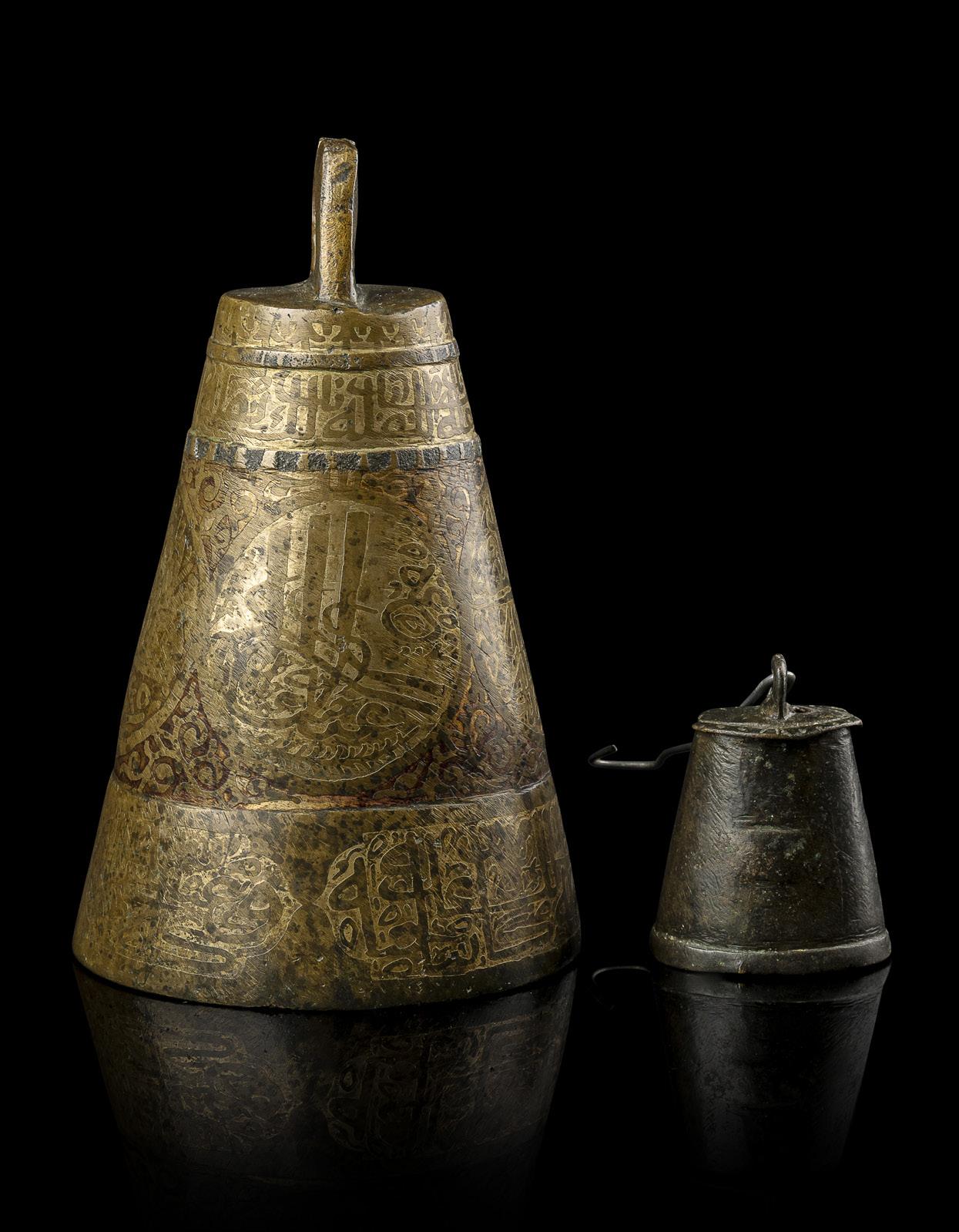
AN OTTOMAN ENAMELLED BRONZE HAJJ CAMEL BELL WITH TUGHRA PROVINCIAL OTTOMAN, SYRIA OR EGYPT, DATED AH 1254/ AD 1829-30 of conical form surmounted by a loop, engraved with bands of calligraphy, calligraphic medallions and cartouches, remnants of coloured enamels in black and red, with associated inner bronze plain gong 25cm high, 15.1cm diameter max.
£6,000-8,000
A particularly fine camel bell such as this would only have been used for important and highly visible occasions, the most obvious of which would be the Hajj procession. During the Ottoman era, the Surre Regiment was the official convoy tasked with delivering annual gifts and funds (the Surre-i Hümayun or ‘Imperial Purse’, from which the regiment took its name) from Istanbul to the holy cities of Mecca and Medina. At the heart of this magnificent caravan was the Mahmal, the sultan’s personal offerings borne by a grandly decorated camel. The lead camels, particularly those bearing the Mahmal, were adorned with traditional ornaments including specialised camel bells. The rhythmic chiming of the bells maintained caravan discipline, signalling movement to the pilgrims and announcing the regiment’s arrival to nearby towns. Their sound also heightened the ceremony’s grandeur, echoing the collective longing and devotion for the Hijaz. Typically cast from brass or bronze, these bells were often engraved with intricate prayers, Ottoman motifs, or sacred verses, as seen here. The tughra here is difficult to read but there is a date of AH 1245, which corresponds to AD 1829/ 30, suggesting it would have been made during the reign of Sultan Mahmud II.
The use of camel bells on the Hajj can be seen across the centuries, shown in a manuscript of the Anis al-Hujjaj copied in late 17th century Gujarat now in the Khalili Collection (inv. no. MS 1025, see Porter, V. (ed.), Hajj: journey to the heart of Islam, The British Museum Press, 2012, p. 153 fig. 106) as well as a British print of 1882 showing the blessing of the Mahmal also in the Khalili Collection (inv. no. ARC.pt 101). This bell is therefore an important and rare example of the material culture of the pilgrimage and its sultanic patronage under the Ottoman Empire.
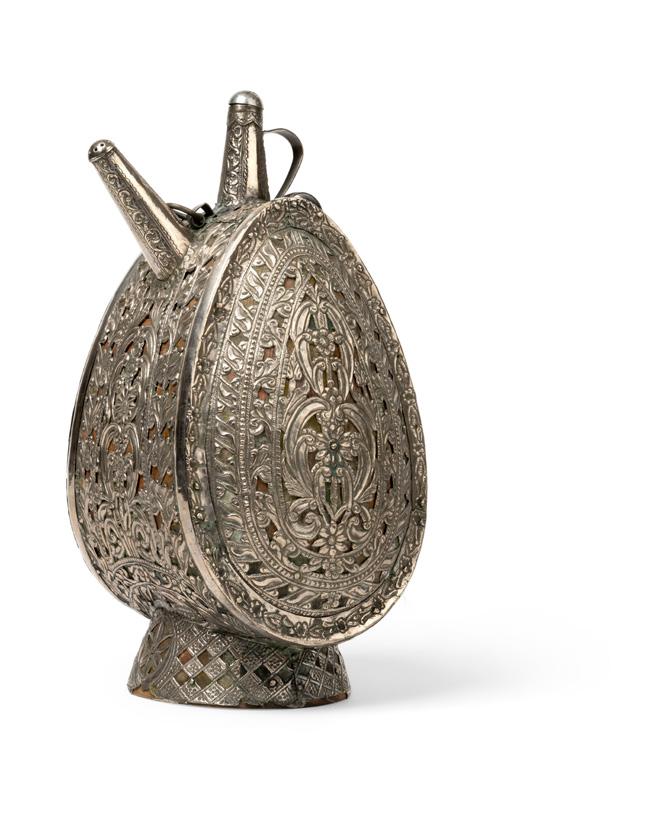
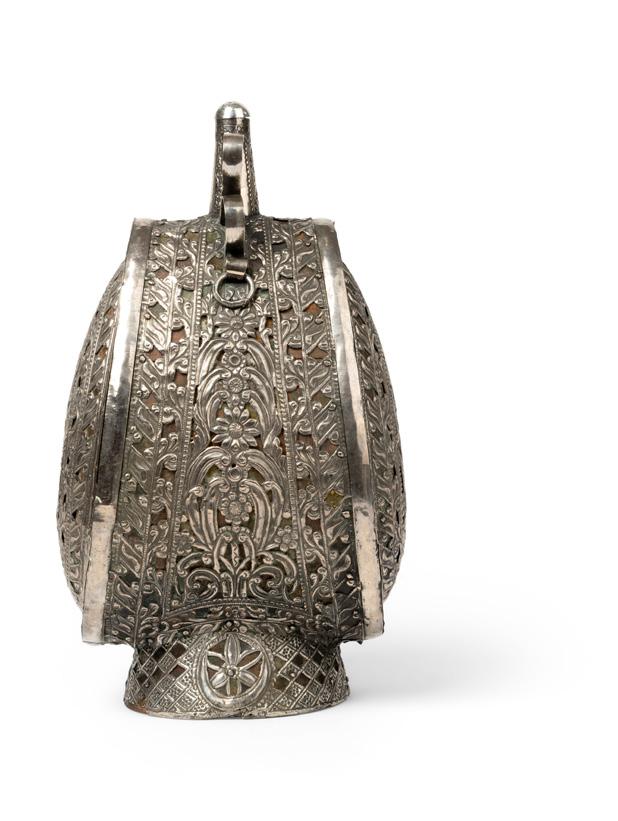
AN OTTOMAN SILVER MATARA OTTOMAN PROVINCES, 19TH CENTURY
of wide oval shape, the wood interior overlaid with repoussé openwork silver, the decoration comprising typical Ottoman rococo-style decoration forming repeat vertical floral swags and borders with bands of repeat floral and geometric motifs, with short cylindrical forward pointing spout and upright lid, on a tall splayed foot 30cm x 15.2cm x 11.3cm
£3,000-4,000
This matara (flask) is a rare example of the late-Ottoman taste for openwork silver. In its exuberant profusion of vegetal and floral designs, it reflects a taste for complexity bordering on the baroque which can be seen across the arts and architecture of the empire from the mid-18th century onward [for which see Rüstem, Ü., Ottoman Baroque: The Architectural Refashioning of Eighteenth-Century Istanbul, Princeton University Press: 2019, esp. pp. 221-65]. This type of openwork decoration, where the silver is pierced allowing the vessel underneath to be seen, most closely resembles a karlik (cooling vessel) bearing the tughra of Sultan Abdülhamit II (r.1876-1909), which sold at Sotheby’s, Arts of the Islamic World, 19 October 2016, lot 297. Given the fine craftsmanship on display, it is evident that the contents of a matara of this type would have been of some value. It is tempting to suggest that this example may have been intended as a container for water from the well of Zamzam in Mecca. This was regularly brought back to the imperial capital by pilgrims returning from Hajj, and such a flask would have been used by elite pilgrims [see Porter, V. (ed.), Hajj: journey to the heart of Islam, The British Museum Press, 2012, pp. 72-75]. Silver was generally preferred over gold for religious objects and their fittings. Even in its final years, the Ottoman court’s devotion to the Mecca pilgrimage remained clear, as seen in this flask designed specifically for the prestigious task of collecting Zamzam water. A fine gilt-copper matara was sold in these rooms, 12 June 2024, lot 42.
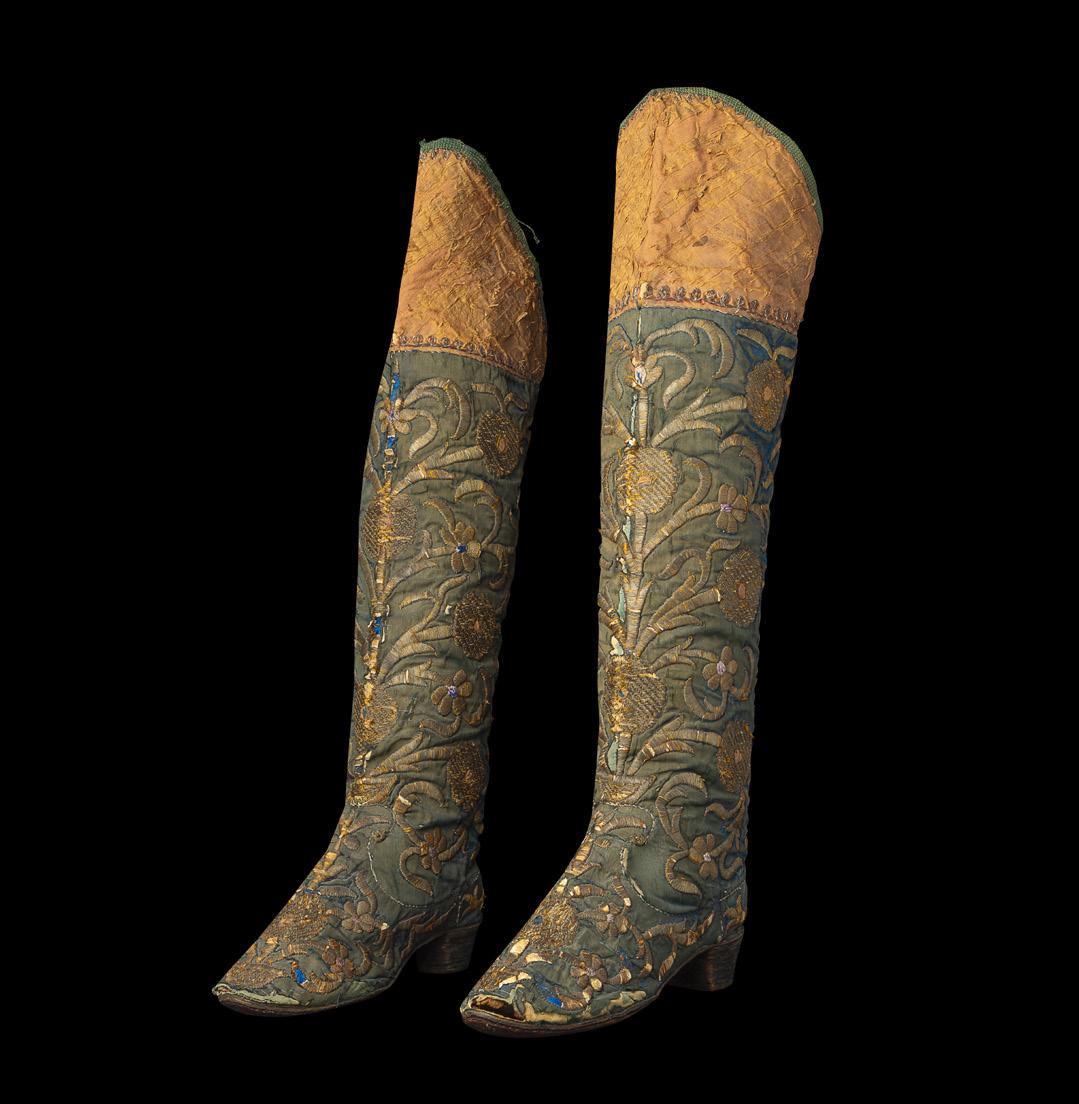
A PAIR OF OTTOMAN EMBROIDERED SILK BOOTS
TURKEY, LATE 18TH/ EARLY 19TH CENTURY
the faint turquoise velvet ground embroidered in relief with silver thread, the decoration comprising symmetrical rococo-style floral and pomegranate stems issuing from a vase from the tip of the toe
59.5cm high
£2,000-3,000
Judging from small parts of the velvet, these would have originally been a vibrant and turquoise colour reflecting a rather bold fashion amongst the Ottoman elite.
For a pair of Ottoman silk-embroidered leather boots attributed to the 16th century, see Y. Petsopoulos (ed.), Tulips, Arabesques & Turbans: Decorative Arts from the Ottoman Empire, New York, 1982, plate no. 137, p. 149 (illustrated).
A
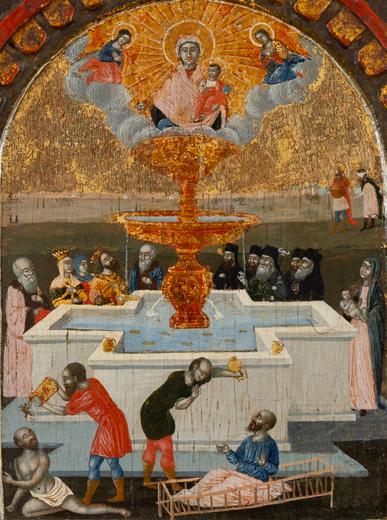
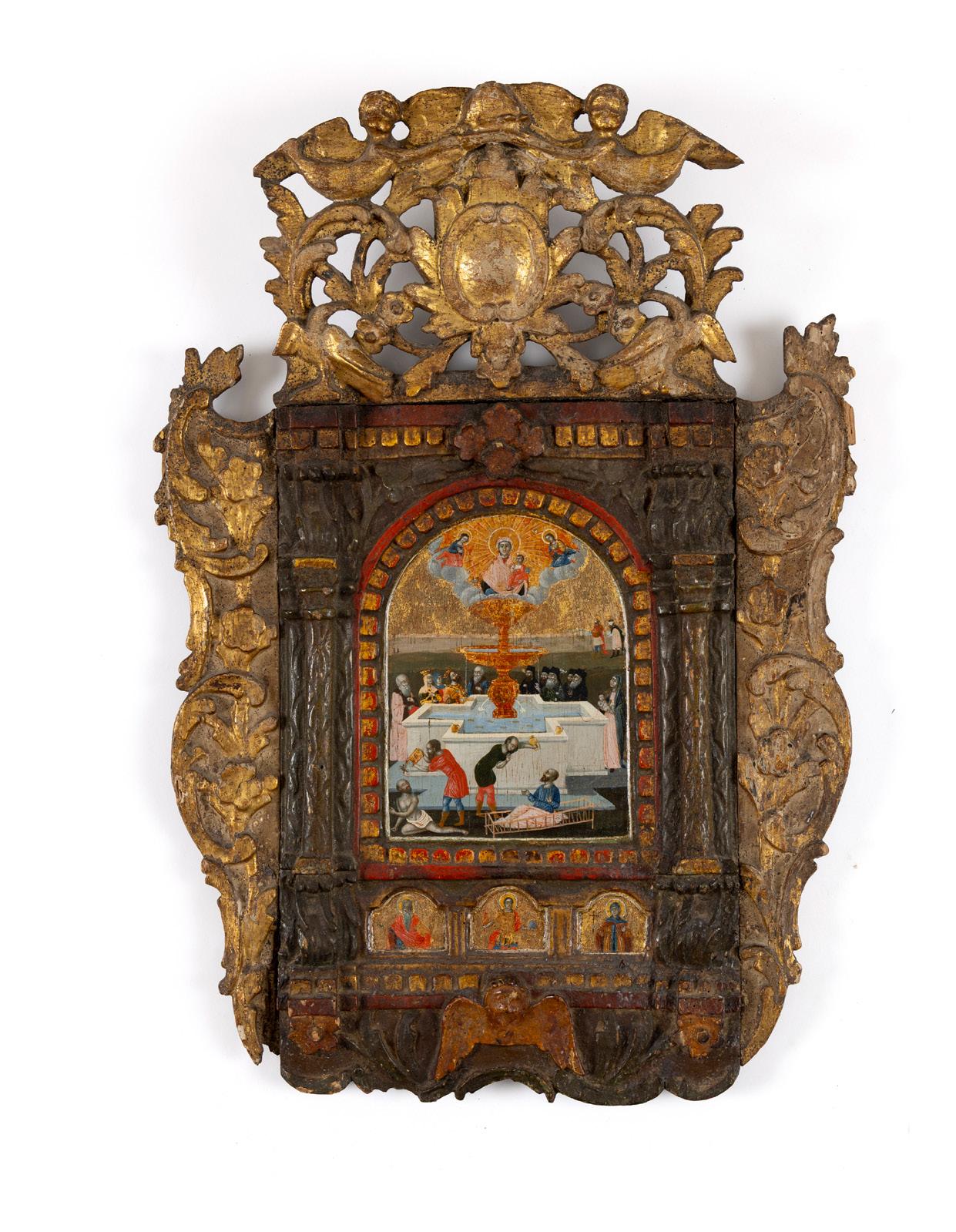
RARE OTTOMAN-GREEK ICON MOUNTED IN AN ‘EDIRNE’ FRAME
TURKEY, ISTANBUL, 18TH CENTURY
tempera on panel heightened in gold, holy figures look down from the heavens onto a life-giving spring, to the rear royal, religious and courtly figures gather around the fountain, whilst in the foreground two helpers bring water to sick and infirm, within an ornately carved gilt wood frame
Framed: 71cm x 49.5cm
Picture: 23cm x 17cm
£7,000-10,000
Provenance: Florence Number Nine, Florence, Italy, 3rd June 2015, Lot 658.
Reputed to have healing properties, the present icon is a rare example depicting the “life-giving spring” in the Balikli Monastery in Istanbul. Also known as the Monastery of the “Mother of God at the Spring”, this is one of the most important centers of Eastern Orthodoxy. The present church, reconstructed and restored in 1835, bears the same dedication as the famous shrine erected in this place between the end of the 5th and the beginning of the 6th century. After several renovations, this building was destroyed in the first half of the 15th century. The complex got its name from a holy spring, reputed to have healing properties. For almost fifteen hundred years, it has been one of the most important pilgrimage sites of the Greek Orthodox community. The holy water flows into a marble basin, where fish are swimming. These fish, also depicted in the icon, gave origin to the Turkish name of the complex (Balikli which means “with fish”).
The present icon has an Edirne-ware frame. Edirne-ware (Edirnekari) is an Ottoman Turkish wood-work style which experienced its heyday from the 18th and 19th centuries among palace circles. It was a special technique for painting and gilding carved wood. According to traditional lore, this type of work was an Edirne speciality stretching back as early as the 17th century. The frame/head piece of the present icon is a beautiful and finely crafted example of the Edirne-ware.
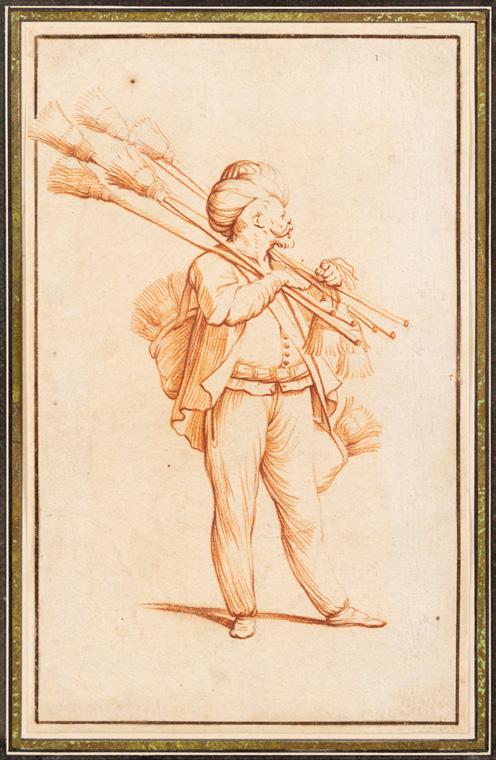
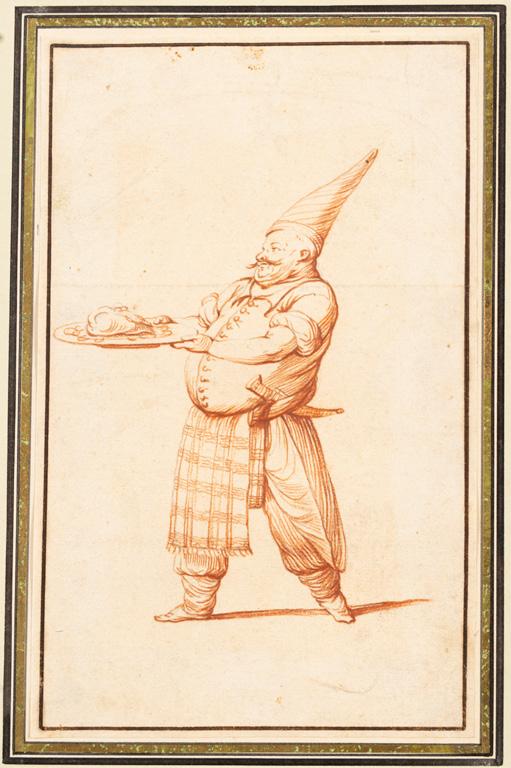
THE COURT COOK AND THE BROOM SELLER ATTRIBUTED TO CHARLES-FRANÇOIS SILVESTRE (FRANCE, 1667-1738)
red chalk and pencil on paper, pasted on a light blue album page with gold margin, each depicting a Turkish figure, one depicting a court cook serving food, the other a broom seller, within brown ink margins largest: 20.4cm x 13.8cm
£5,000-7,000
This charming pair of drawings, executed by one of the most highly respected artists of late 17th century France, demonstrate the taste for all things Ottoman which swept Europe at the time. Charles-François Silvestre (1667-1738) was the eldest son of the renowned French artist Israel Silvestre. He became himself a respected draughtsman and engraver. After studying with his father, and then under the court painter Charles Le Brun’s mentorship, Charles-François was only fourteen years old when he was made drawing master of the Great Royal Stables in Versailles. In 1691 he was given a studio in the Louvre; in 1695 he was appointed to the office of drawing master to the grandchildren of Louis XIV; and in 1717 to that of a draughtsman of Louis XV.
These sanguines served as models for a series of engravings dedicated to one of Silvestre’s three students, the Duke of Burgundy, titled Différents Habillements des Turcs Dédiez à Monseigneur le Duc de Bourgogne (‘Different Costumes of Turks Dedicated to the Duke of Burgundy’). The engraving of the first sanguine bears the French title Un Atagi ou Cuisinier du Sérail (‘Atagi, or cook of the Seraglio’). The engraving based on the second sanguine bears the French title Vendeur de balets Turc (‘Turkish broom-seller’). Such turqueries were a major trend in 18th-century France, offering artists a stylish excuse to play with exotic figures and elaborate, imaginative details. Silvestre’s drawing style is both sharp and economical, and his skills as a draughtsman shine through in these two spirited sketches. He achieves delicate chiaroscuro through varying the pressure of his red chalk, while his meticulous hatching suggests these works were specifically intended as blueprints for engravers.
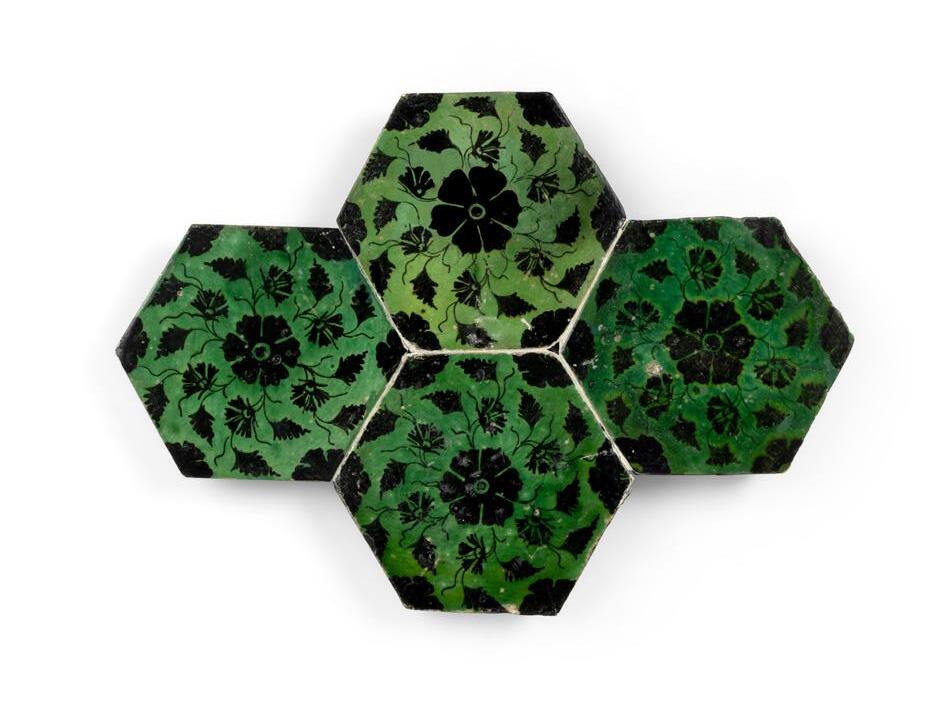
A GROUP OF FOUR ‘DOME OF THE ROCK’ POTTERY TILES
OTTOMAN PROVINCES, JERUSALEM, 16TH CENTURY
hexagonal, decorated in black under a green glaze with a central rosette surrounded by a whorl of carnations and leaves, mounted
Each: 12.6cm x 14.5cm
Overall: 26cm x 37cm
£2,000-3,000
Provenance: Bonham’s, Islamic and Indian Art, 5th April 2011, Lot 146.
Suleyman the Magnificent (1494–1566) was the most powerful and influential ruler of the Ottoman Empire, presiding over its political, military, cultural, and architectural golden age. In the 16th century he played a decisive role in transforming the exterior of the Dome of the Rock, replacing its deteriorated early mosaics with the brilliant Ottoman tilework that still defines its appearance today.
The transparent green glaze found on mid-sixteenth-century “Dome of the Rock” tiles is a hallmark of Ottoman Syrian craftsmanship, created by applying black underglaze designs and covering them with a copper-based, lead-silica glaze that fires into a clear, glasslike green. This technique allowed the black stellar or floral motifs to remain sharply visible beneath the surface while giving the tile a jewel-like depth unique to Jerusalem and Damascus workshops of the Suleimanic period. Its technical difficulty, distinctive colour, and direct association with the Ottoman renovation of the Dome of the Rock make this glaze one of the most recognisable and historically significant features of these tiles.
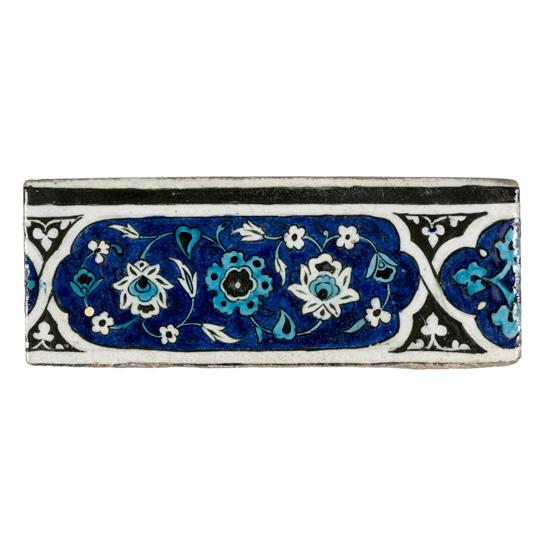
27 A ‘DOME OF
THE ROCK’ POTTERY TILE
PROVINCIAL OTTOMAN, JERUSALEM, CIRCA 1550 of rectangular form, painted in cobalt blue, turquoise, and black on a white ground under a transparent glaze, featuring a lobed central cartouche with a floral vine and rosette flanked by lotus blossoms, partial side cartouches contain palmette motifs, with additional palmettes filling the spaces between, all enclosed within horizontal borders
10.2cm x 26.5cm
£2,000-3,000
This type of tile was typically used as decorative wall panels in Ottoman-period architecture, especially in Jerusalem and Damascus. Their flowing floral designs filled larger wall surfaces often between windows, around doorways, or as interior dado panels providing a rich, colourful backdrop that complemented the more geometric friezes made from hexagonal tiles. These rectangular floral tiles acted as the “field” decoration of a building, creating continuous patterned surfaces that balanced the stricter, star-patterned bands used elsewhere on the façade.
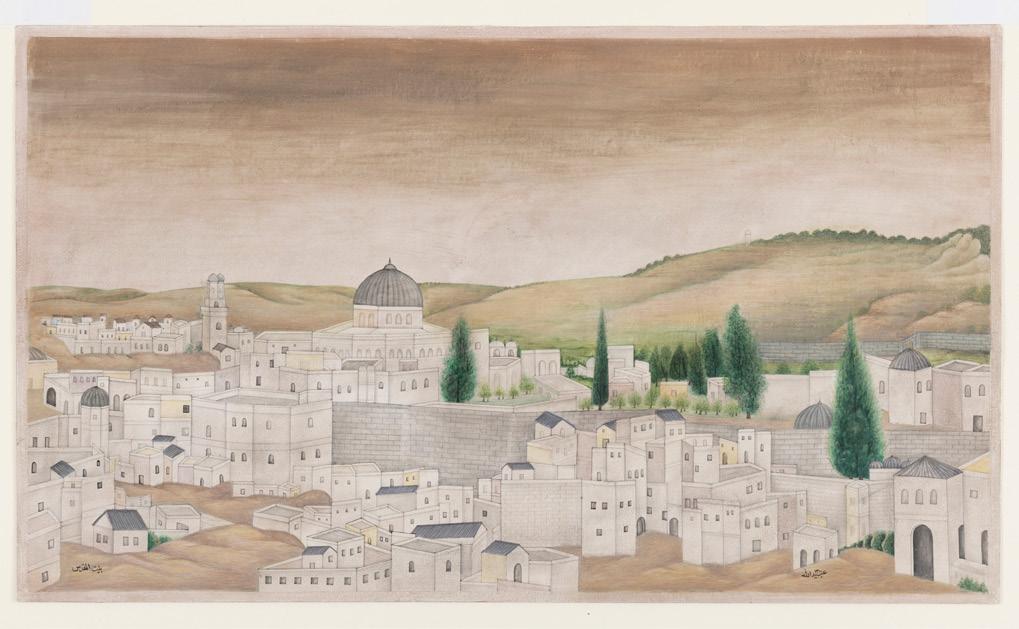
VIEW OF THE DOME OF THE ROCK, JERUSALEM
BY UBAYD ALLAH, DATED 1892-3
gouache on paper, signed in Arabic “Ubayd Allah [A.H.] 1310’ (1892-3 A.D.) in lower right (a name meaning servant of God) and inscribed lower left ‘Bayt al-Maqdis’ lower right the Arabic name for the Dome of the Rock and al-Aqsa Mosque site 28.5cm x 49cm
£5,000-7,000
Provenance: Millon, Hôtel Drouot, Paris, 5 December 2023, lot 87.
For images of the Holy Sites, that were produced by Indian artists for pilgrims visiting Jerusalem or, Mecca and Madina, see M. Tütüncü, ‘The Chronological Development of Mecca Views’ in Khan Q. M., with Nassar., N., Hajj and the Arts of Pilgrimage. Essays in Honour of Nasser David Khalili, vol. 2, London, 2023, p.22. Perhaps the best known of these is Muhammad ‘Abdallah, a cartographer and painter from Delhi, whose panoramic view of Mecca, circa 1846, is in the Khalili Collection, London, see M. Rogers, The Arts of Islam, Masterpieces from the Nasser D. Khalili Collection, London 2010, pp.260–61, no.298.
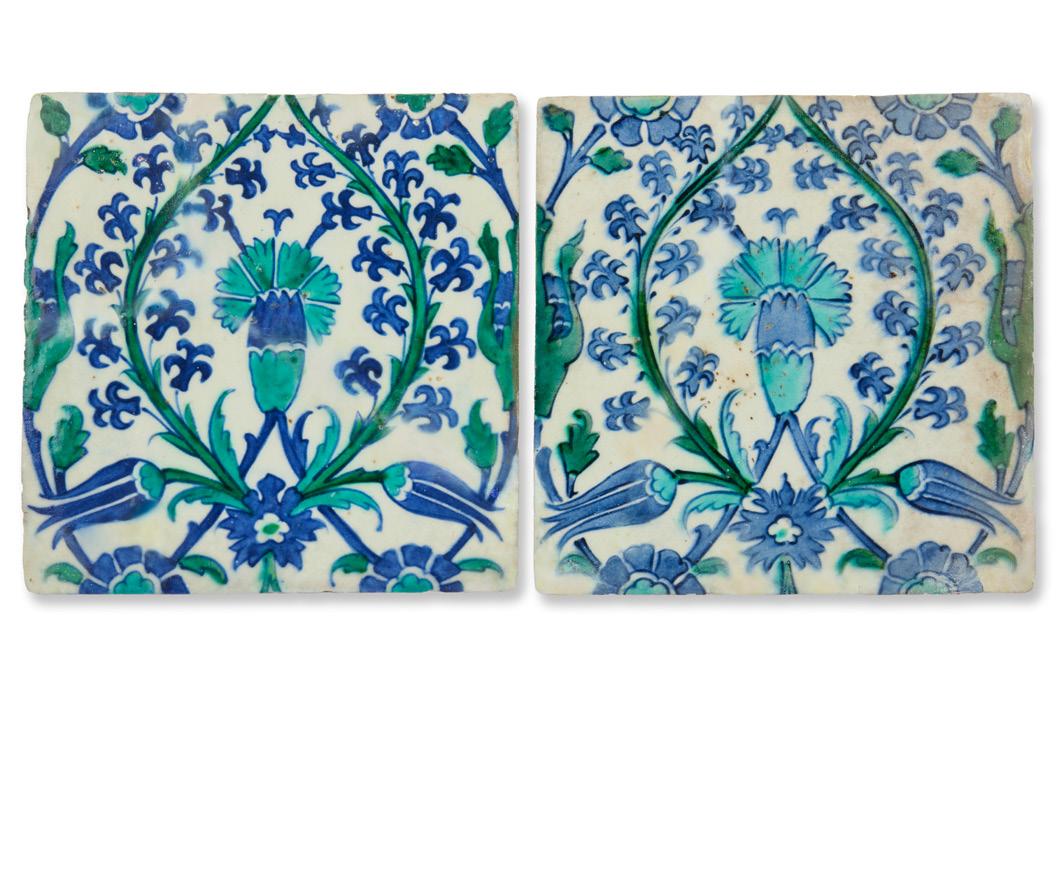
TWO DAMASCUS POTTERY TILES
OTTOMAN SYRIA, DAMASCUS, 17TH CENTURY
each of square form, decorated in cobalt blue and turquoise on a white ground under a transparent glaze with a central budding carnation enveloped by hyacinths, tulips and flowerheads in the corners each 25cm x 25cm
£800-1,200 30
A DAMASCUS POTTERY TILE
OTTOMAN SYRIA, DAMASCUS, 17TH CENTURY of square form, decorated in turquoise, green, cobalt blue and black outline on a white ground under a transparent glaze with carnations and tulips
22.5cm x 23cm
£500-700
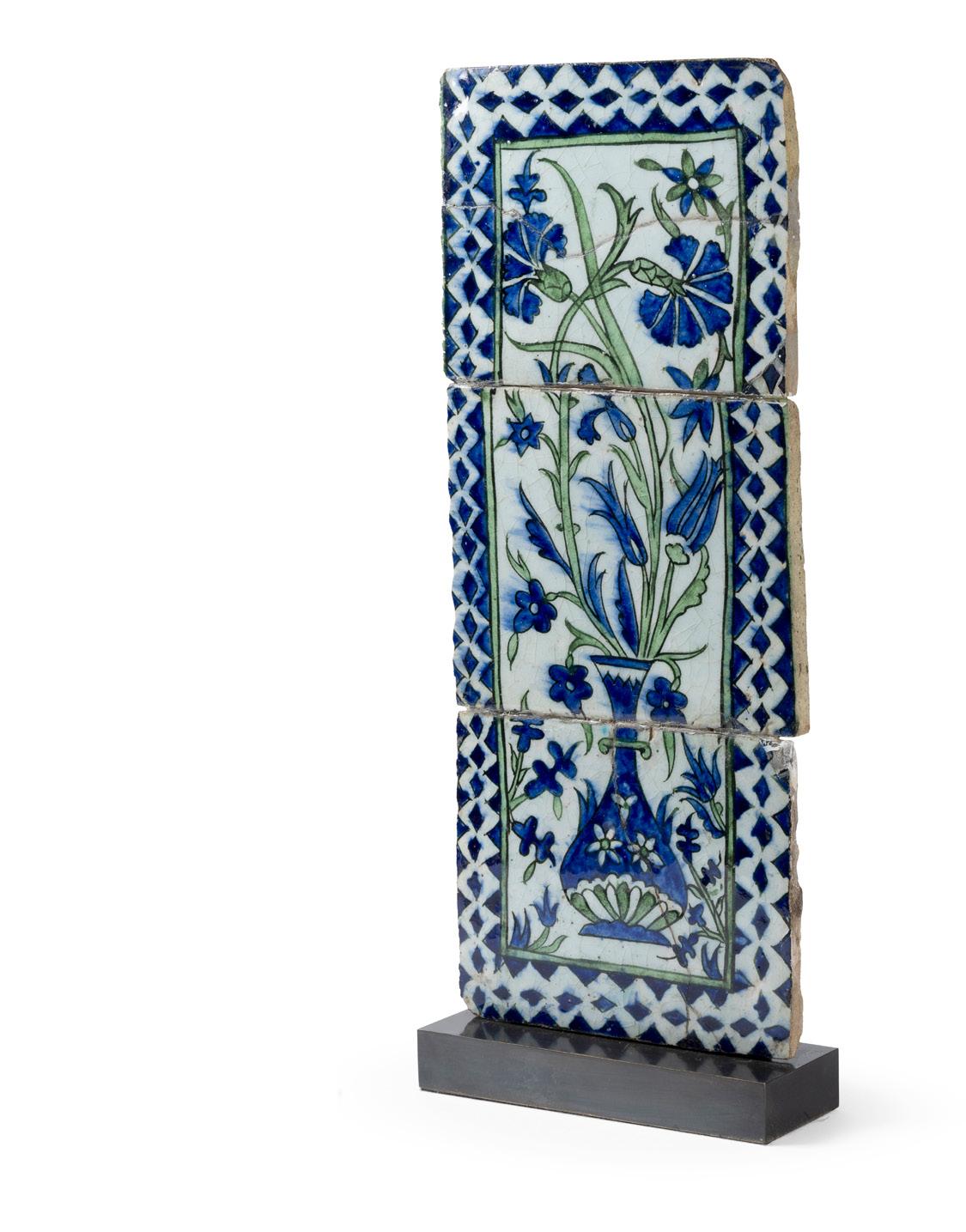
A DAMASCUS POTTERY TILE PANEL DEPICTING A VASE AND FLOWERS
OTTOMAN SYRIA, DAMASCUS, 17TH CENTURY
formed of three tiles, decorated in cobalt blue and green and on a white ground under a transparent glaze, depicting a vase with issuing flowers, within a zigzag band, mounted onto a stand
60cm x 24cm
£1,500-2,000
32
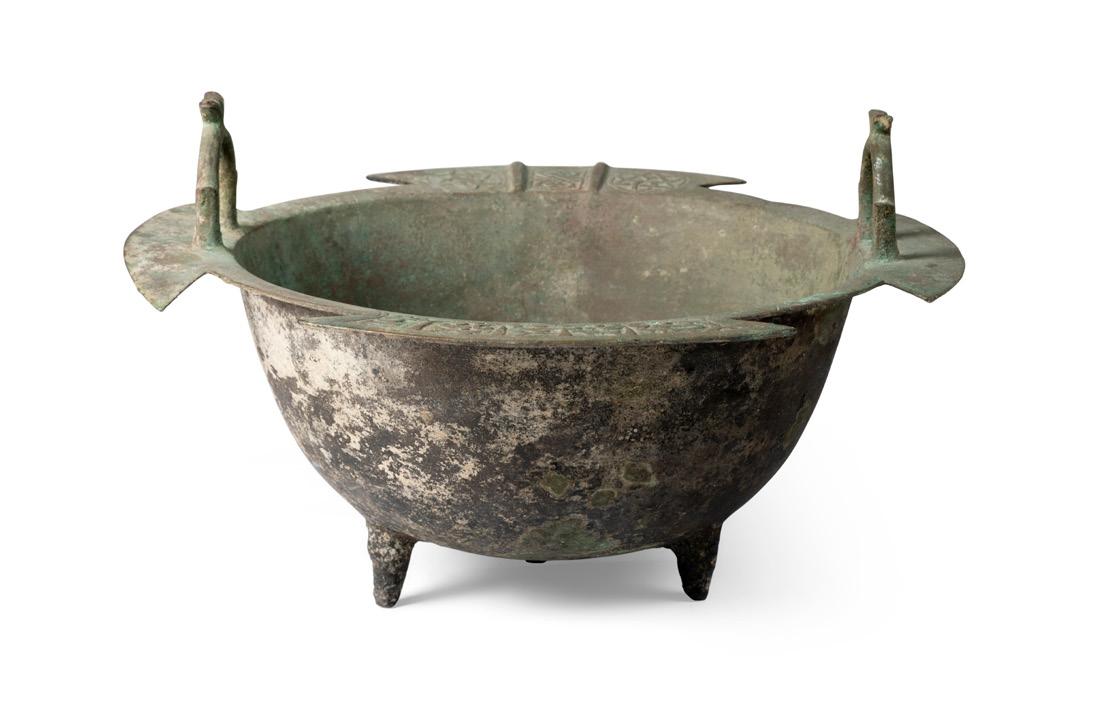
A LARGE BRASS CAULDRON ENGRAVED WITH ARABIC SCRIPT
CENTRAL ASIA, PROBABLY SAMARKAND, 13TH CENTURY
cast in deep rounded form supported on three feet, narrow horizontal rim extending in four places to pointed flanges with circular terminals, pair of handles of u-shape on two of these flanges diametrically opposed, one flange with Arabic script comprising ‘The work of Khwajagi Tusi’, and another with two stellar medalions, exterior plain 27cm high; 47cm diameter
£800-1,200
Provenance: Private collection, London.
For a very similar cauldron in the Victoria and Albert Museum, attributed to Samarkand, Central Asia, 1250-1350, see accession number 1953-1899.
33
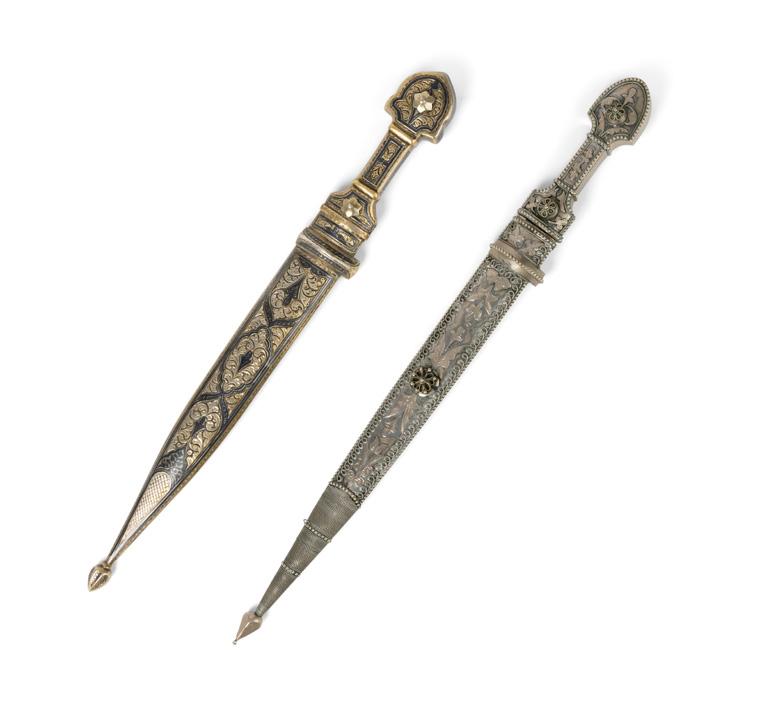
TWO SILVER-MOUNTED DAGGERS OR KHANJALI CAUCASUS, 19TH CENTURY
each with straight-tapering steel blades, one with parcel-gilt and silver niello mounts, the other with silver filigree and decoration in relief forming vegetal designs longest 45.5cm long
£800-1,200
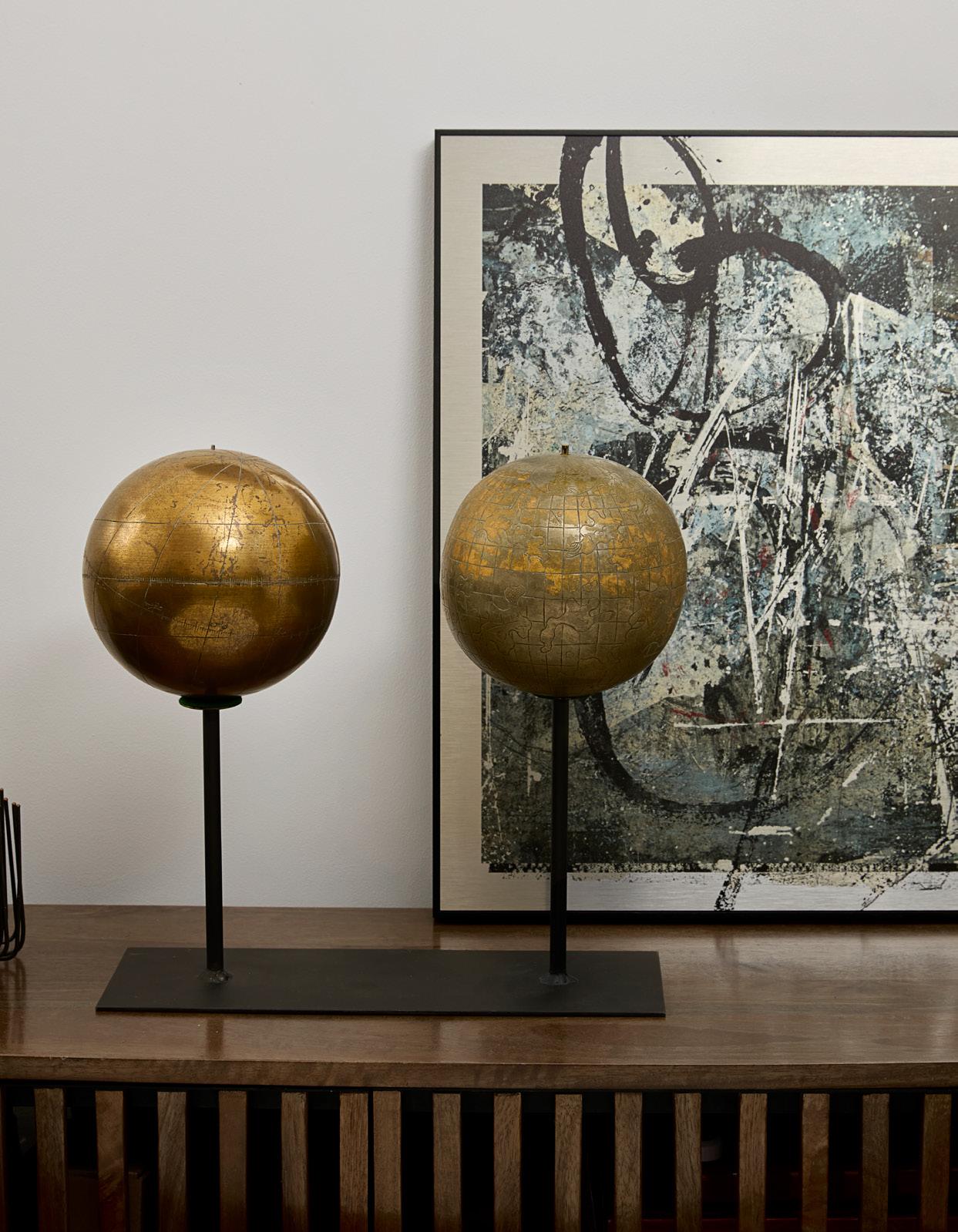
PAIR OF ENGRAVED GILT COPPER CELESTIAL AND TERRESTRIAL GLOBES
PERSIA OR EGYPT, 19TH CENTURY
each of spherical form with holes on either end, gilt-copper bronze, one engraved with concentric lines, the other engraved with land mass and concentric lines, mounted on stand each 15.5cm diameter
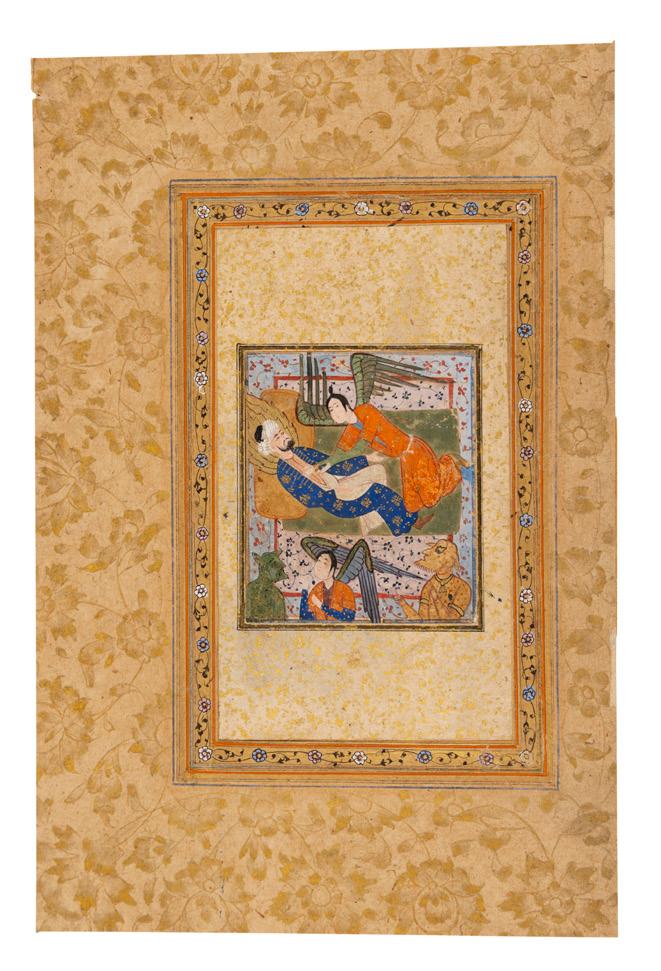
gouache and gold on paper, depicting a prophet dressed in a blue and gold robe and white turban, lying down with a flame behind his head, an angel dressed in orange is tending to him, below in the foreground another angel is flanked by a green and yellow demon, mounted on to a speckled gold album page, with a narrow floral border and a Mughal-style wide gold outer border, framed and glazed 21.2cm x 14cm
£1,200-1,800
Provenance: Private collection, Spain.
This unusual scene corresponds to an episode from the life of the Prophet Muhammad where he is awakened by the Archangel Gabriel to accompany him on the Mi’raj (ascension to heaven). This reading of the painting is supported by the fact that there is a bolster and bed on which the Prophet lays, with Gabriel approaching as if to rouse him. The appearance of two demons or jinn below is not in keeping with the normal imagery of this scene, but they may have been intended to heighten the miraculous and unearthly aspect of this angelic visitation.
A closely related painting showing the Prophet awakened by Gabriel is now in the British Library (inv. no. Johnson MS., MS. 888; Ethe 1437, fol. 109v).
Originally from a Khamsa of Qasimi attributed to Qazvin c. 1580, this scene shows the Archangel leaning over Muhammad, who reclines on a large bolster [Taşkent, A., and Kancal-Ferrari, N. (eds.), The Ascension of the Prophet and the Stations of His Journey: The Mi ʿrˉaj and the Three Sacred Cities of Islam in Literature, Music, and Illustrated Manuscripts in the Ottoman Cultural Environment (vol. 2), Dergâh Yayınları: 2021, p. 583 cat. 1]. The British Library image is much more typical of Safavid depictions of the Prophet, in that his face is covered by a white veil rather than fully exposed. Angels with similarly angular wings in shades of green and red can be seen in a Kulliyat of Amir Khusraw Dihlavi attributed to Shiraz or Yazd c. 1580, also in the British Library (inv. no. Ms. Add. 21104, fol. 317r) [Gruber, C., “Between Logos (Kalima) and Light (Nur): Representations of the Prophet Muhammad in Islamic Painting” in Muqarnas 26 (2009), pp. 229-62, p. 244 fig. 9]. The jinn at the lower edge of the image resemble the supernatural beings which regularly appear in mid-16th century Falnamas such as an example attributed to Qazvin in the Chester Beatty Library (inv. no. MS 395) [Farhad, M., and Bağcı, S. (eds.), Falnama: The Book of Omens, Thames & Hudson: 2009, pp. 152-53 cat. 38].
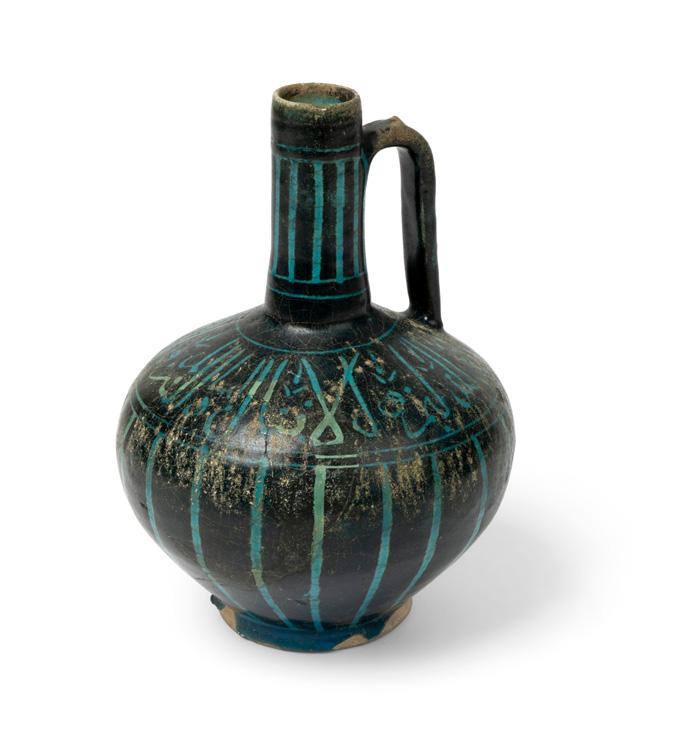
A KASHAN SILHOUETTE-WARE POTTERY JUG
PERSIA, 12TH/ 13TH CENTURY
of globular form with tall cylindrical neck and strap handle, decorated in black and turquoise with vertical radial lines around the body, around the shoulder inscribed in Persian: ‘Perpetual glory and prosperity…and long life for its owner’
20cm high
£1,000-1,500
37
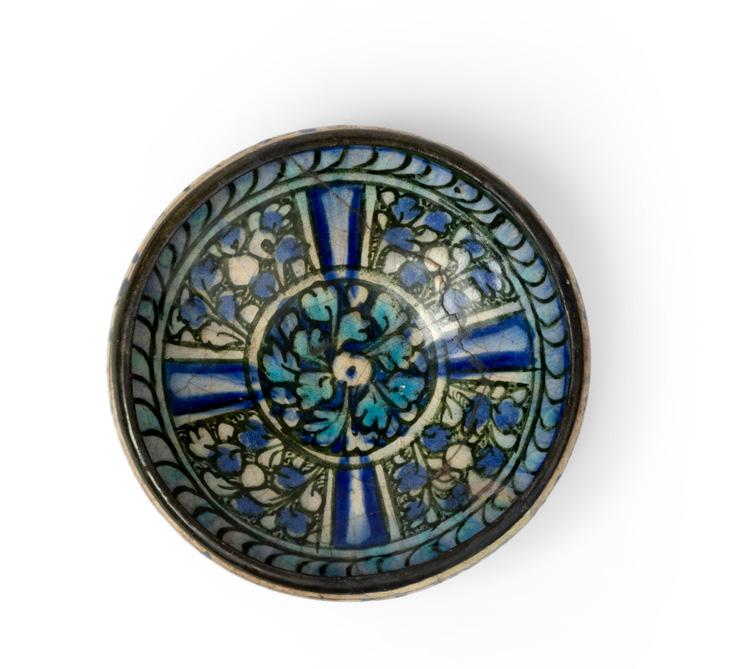
A SULTANABAD POTTERY BOWL
PERSIA, 13TH/ 14TH CENTURY
of conical form with inward rounded rim on a short ring-foot, decorated in blue and turquoise glaze with black outline, the decoration comprising a floral medallion within a cruciform, the panels with floral decoration on a hatched ground, verso with a band of vertical blue dashes and two black concentric lines
16cm diameter
£500-700
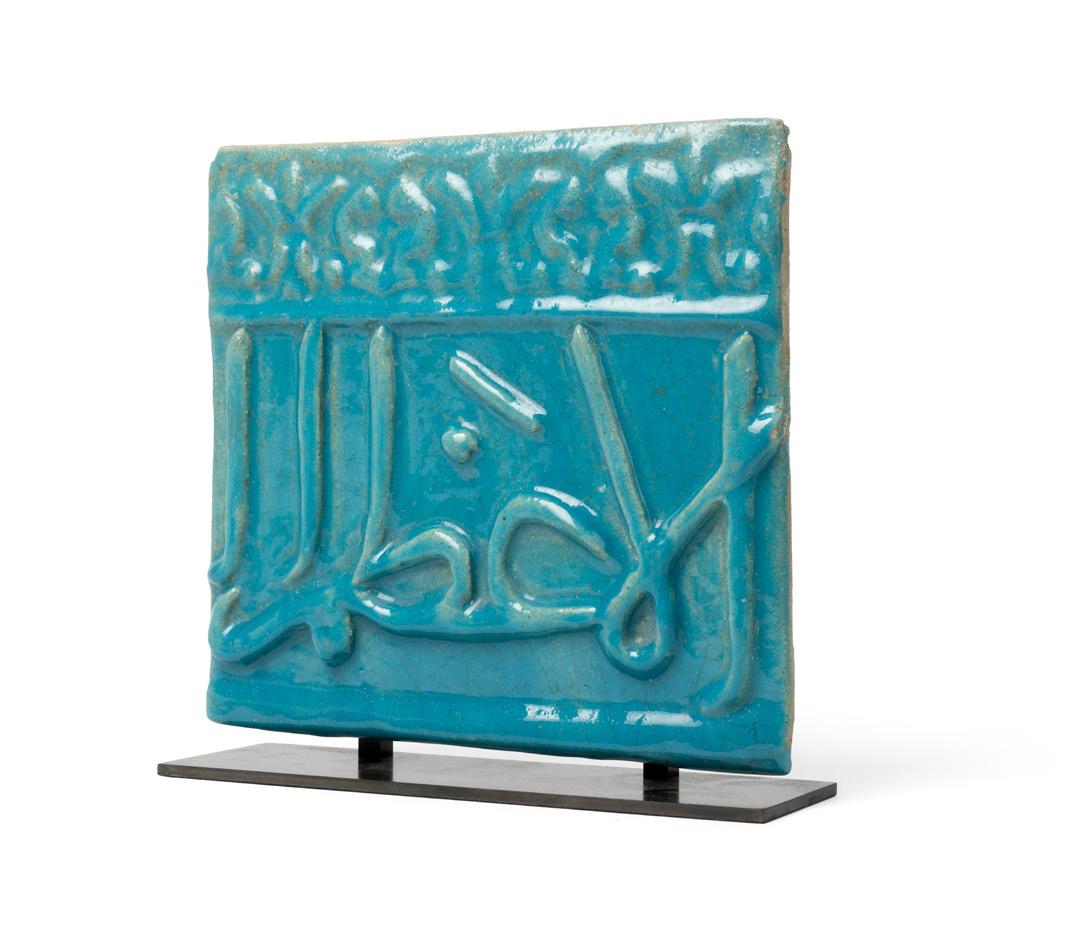
A KASHAN TURQUOISE POTTERY CALLIGRAPHIC TILE
PERSIA, KASHAN, 13TH CENTURY
of square form, moulded and decorated in a turquoise glaze with a calligraphic inscription in relief, that reads: ‘… the greatest …, the …’. , with a wide band of an intertwined vegetative design above 22.5cm x 23.5cm
£3,000-5,000
This beautiful turquoise-glazed tile would have decorated the exterior of an edifice and captured the bright sunlight. The inscriptions include the word al-a‘zam (the greatest) which appears most often in inscriptions of the period as parts of titles, e.g. al-sultan al-a‘zam (the greatest Sultan).
For a similar tile, see Sotheby’s, Arts of the Islamic World, 7th October 2015, lot 301.
39
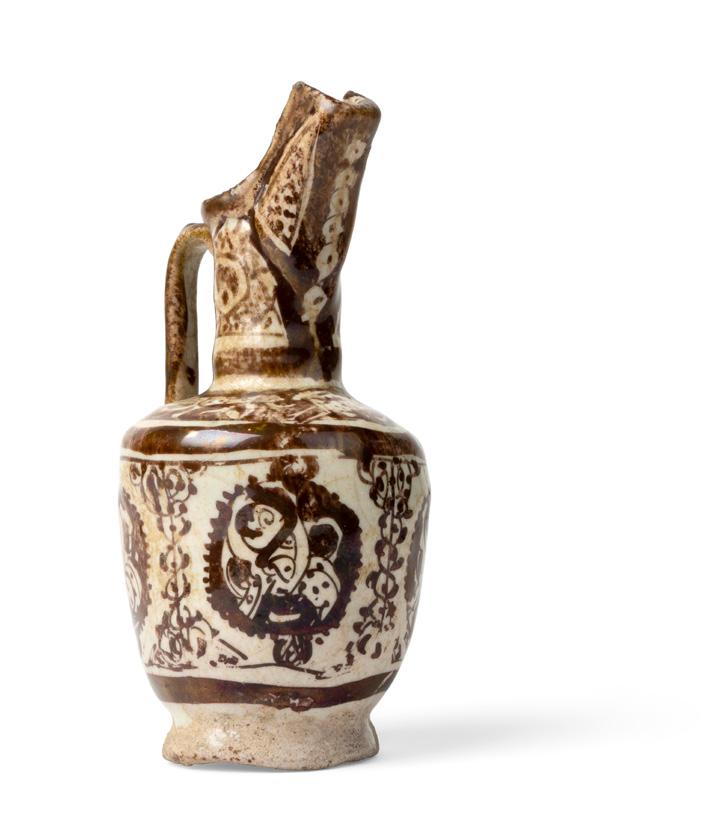
A SMALL KASHAN LUSTRE POTTERY EWER
PERSIA, 13TH CENTURY
of pear-shape with cylindrical neck and upward sloping spout, simple loop handle with thumb rest, decorated in a brownish-honey coloured lustre on a white ground with four medalions around the body, that appear to comprise a seated winged quadruped, various vegetal designs, including chain motifs
16cm high
£1,500-2,000
40
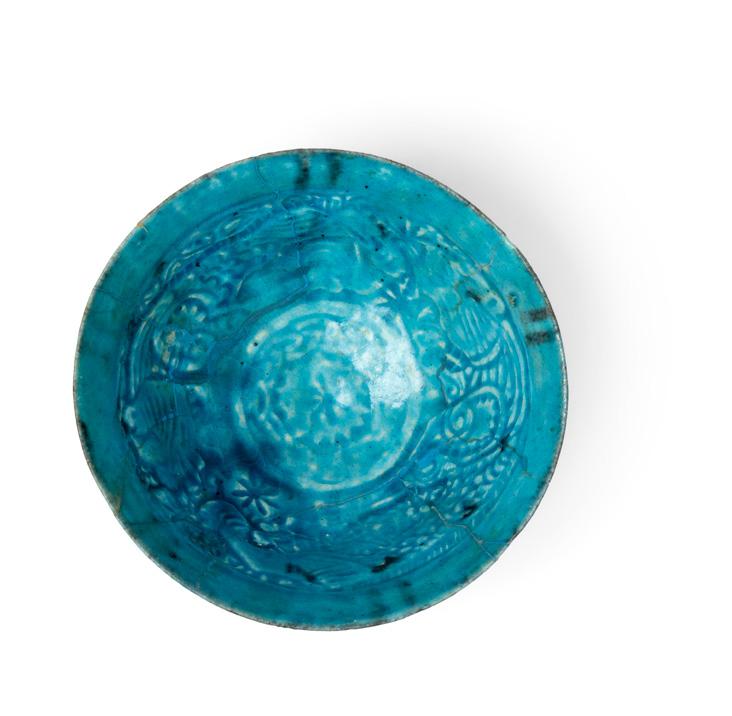
A BAMIYAN MONOCHROME TURQUOISE POTTERY BOWL
AFGHANISTAN, 12TH/ 13TH CENTURY
with flaring sides on a short foot, the interior incised with two extravagant facing lions, covered in a monochrome turquoise glaze, touches of double black stripes around the rim
16cm diameter
£600-800
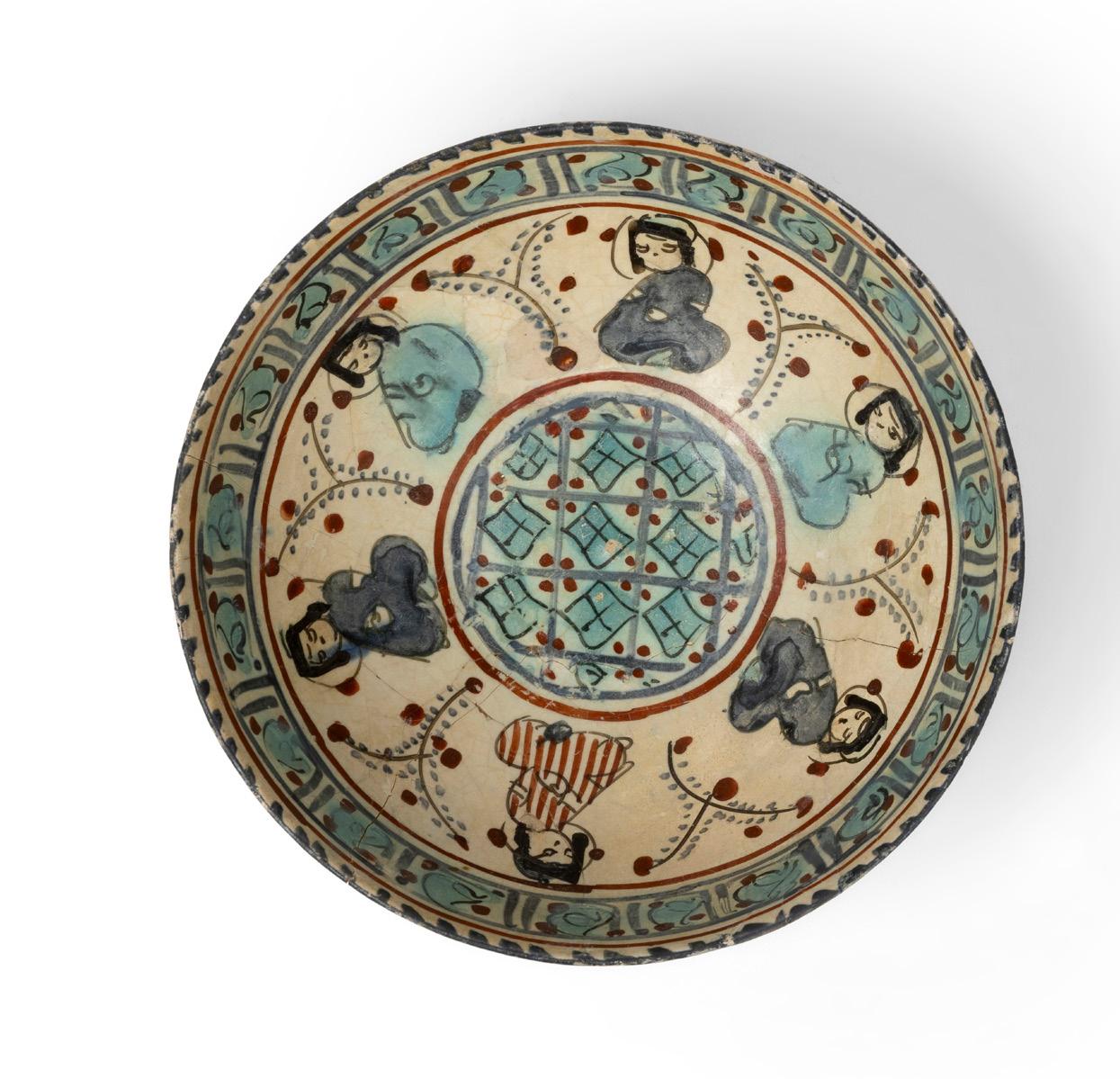
A MINAI POTTERY BOWL WITH FIGURES
PERSIA, 12TH/ 13TH CENTURY
of deep rounded form on a short foot, decorated in polychrome on a cream ground with a central roundel containing a lattice design, surrounded by a series of seated figures interspersed by stylised trees, the rim with a series of panels containing stylised vegetal motifs, the exterior with a band of inscription, possible comprising the word ‘al-’izz’, translated as glory
17cm diameter
£4,000-6,000
Provenance: Acquired Bonhams, Islamic and Indian Art including Modern and Contemporary South Asian Art, 24 April 2018, lot 170, and according to their provenance, UK private collection.
This is a charming example of Minai ware, also known as the ‘seven colours’ technique, that emerged in Iran in the 12th Century and was accompanied by a revolutionary development that enabled potters to paint more complex and polychromatic designs. Not all the pigments were applied at the same point, making the process a long and difficult one. The subjects portrayed are often court life pleasures, such as in the case of this one.
For a Minai bowl with a very similar composition in the Al-Sabbah collection, see O. Watson, Ceramics from Islamic Lands, London, 2004, Cat. P.4, p. 369.
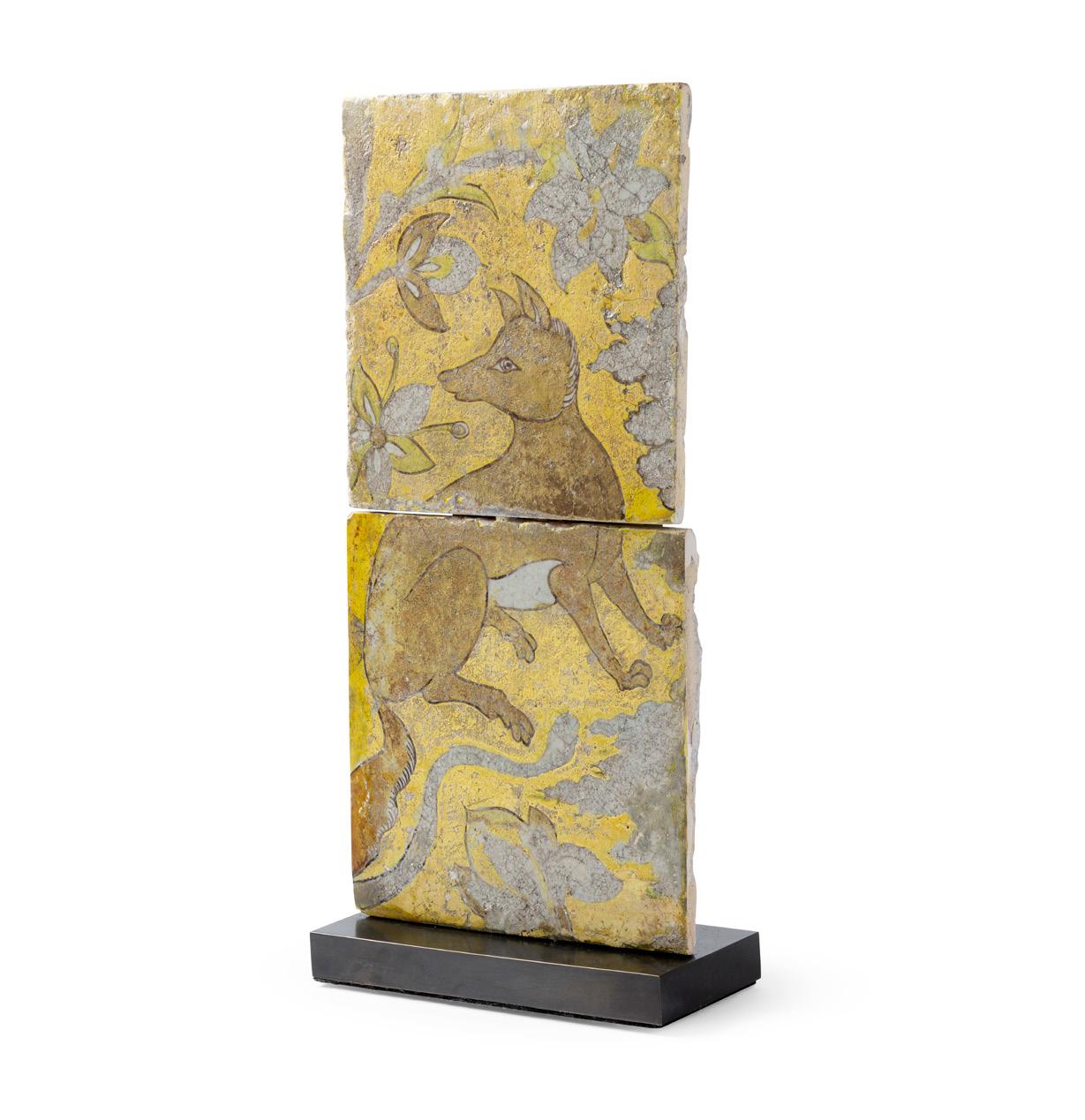
A PAIR OF SAFAVID CUERDA SECA POTTERY TILES WITH A FOX OR WILD DOG PERSIA, 17TH CENTURY
each tile is of square form, decorated in brown, yellow and manganese on a yellow ground with black outline, depicting a fox in the wild surrounded by floral designs, mounted on a stand
45.2cm x 22.4cm
£5,000-7,000
The fox is beautifully depicted in an earthly tone with a white stomach. The head is turned in the opposite direction to the body as if disturbed by a noise or movement, the front legs are stretched out as if resisting forward motion with ears pricked up and alert. The fox is surrounded by floral decoration of similar colour tones from all sides enabling fox to blend into its natural habitat. This tile would have formed part of a much larger ceramic scene and is likely to have been placed on the walls of an important house or palace.
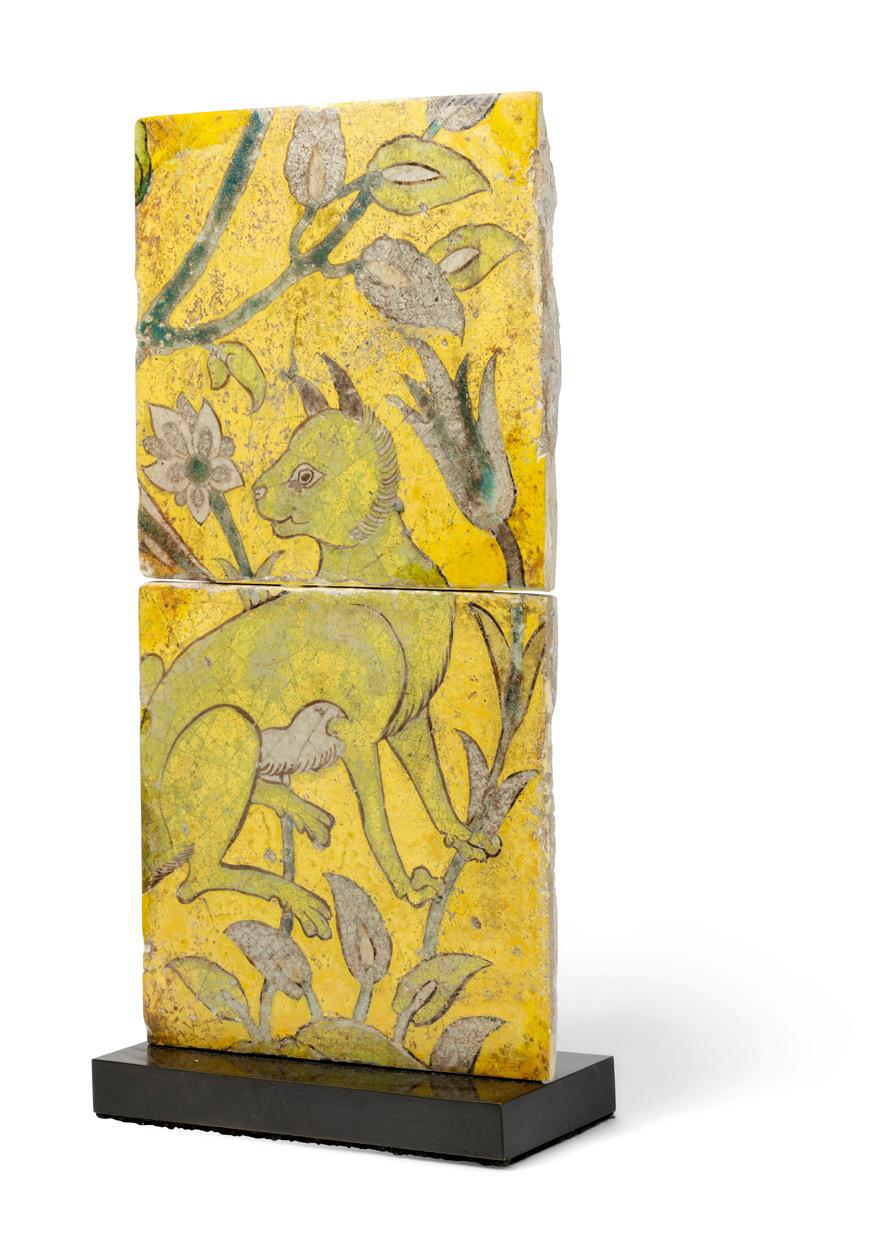
A
each tile is of square form, decorated in green, blue and manganese on a yellow ground, depicting a wild dog surrounded by floral designs. mounted on stand
44.6cm x 22.4cm
£5,000-7,000
PAIR OF SAFAVID CUERDA SECA POTTERY TILES WITH A FOX OR WILD DOG PERSIA, 17TH CENTURY
A QAJAR RESHT EMBROIDERED APPLIQUÉ WOOL PANEL
PERSIA, CIRCA 1850
rectangular, the black, dark blue and red felt ground profusely embroidered in polychrome silks, the central panel with repeat tear-shaped motifs and eight-pointed stars filled with floral motifs, the surrounds with bands of continuous floral motifs, backed with black cotton
212cm x 131cm
£2,000-3,000
This textile panel, and lots 47 and 48, are wonderful examples of Resht embroidery - a traditional needlework art originating in the northern Iranian city of Resht. Known for its intricate chain-stitch designs sewn onto wool, felt, or velvet fabrics, this embroidery style flourished during the Safavid era and later became a celebrated symbol of Persian craftsmanship. Artisans typically create floral arabesques, birds, and geometric motifs using brightly coloured silk threads, producing richly textured decorative pieces such as tablecloths, garments, wall hangings, and ceremonial textiles. The elegance and precision of Recht embroidery reflect the deep artistic heritage of Iran, blending local folk traditions with classical Persian aesthetics.
45
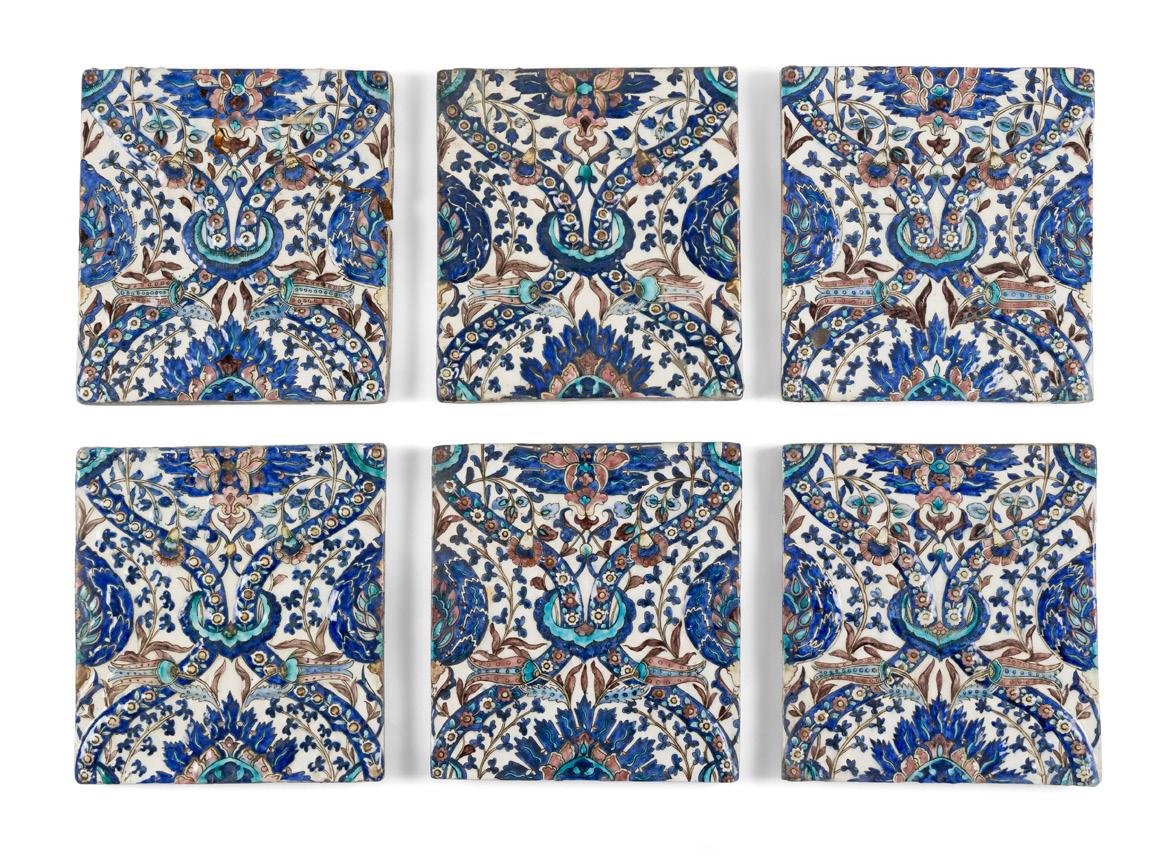
A GROUP OF QAJAR POTTERY TILES
PERSIA, 19TH CENTURY
comprising six tiles of square form, moulded in relief and decorated in polychrome on a white ground under a transparent glaze, forming a symmetrical design consisting of intertwining vines, the tiles join to create an ogival lattice with large lotus flowers and tulips
Each approx. 34cm x 31cm
£3,000-5,000
Provenance: Private Scottish collection.
For a similar group of tiles sold through these rooms, see, Islamic and Indian Art, 11th December 2024, lot 36.
46
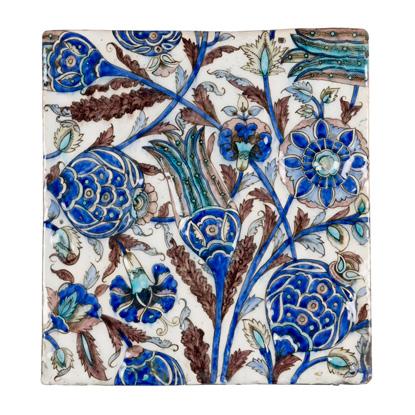
AN IZNIK-STYLE QAJAR POTTERY TILE
PERSIA, 19TH CENTURY
of square form, moulded in relief and decorated in polychrome under a transparent glaze with a large central tulip surrounded by roses and other flowerheads interwoven into floral interlace
34cm x 31cm
£500-700
Provenance: Private Scottish collection.
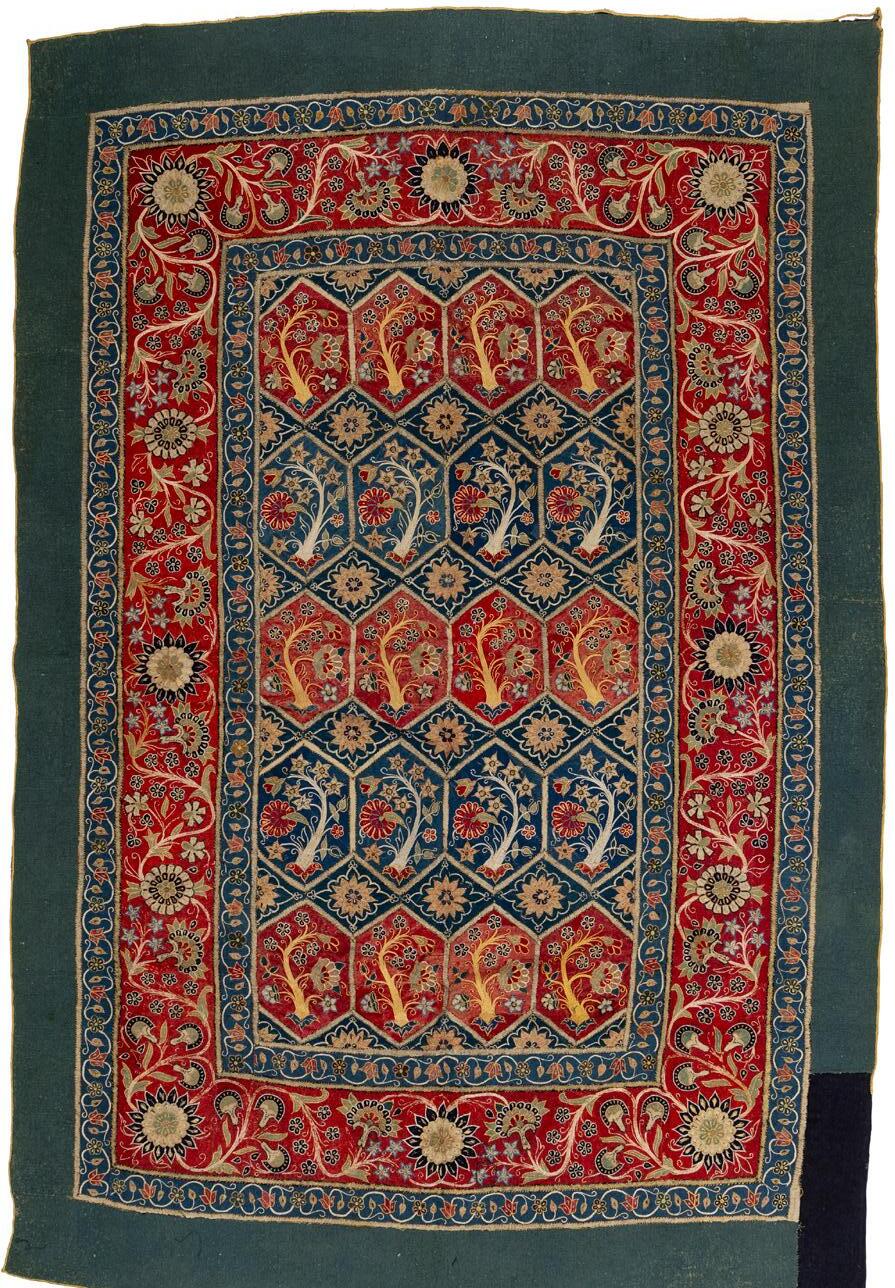
A QAJAR RESHT EMBROIDERED APPLIQUÉ WOOL PANEL
PERSIA, CIRCA 1850
rectangular, the dark blue and red felt ground embroidered in polychrome silk, the central panel decorated with rows of hexagonal-shaped cartouches containing budding trees, surrounds with bands of continuous floral interlace and vines, backed with black cotton 160cm x 107cm
£1,000-1,500
Please refer to lot 44, for a discussion of Recht embroidery.
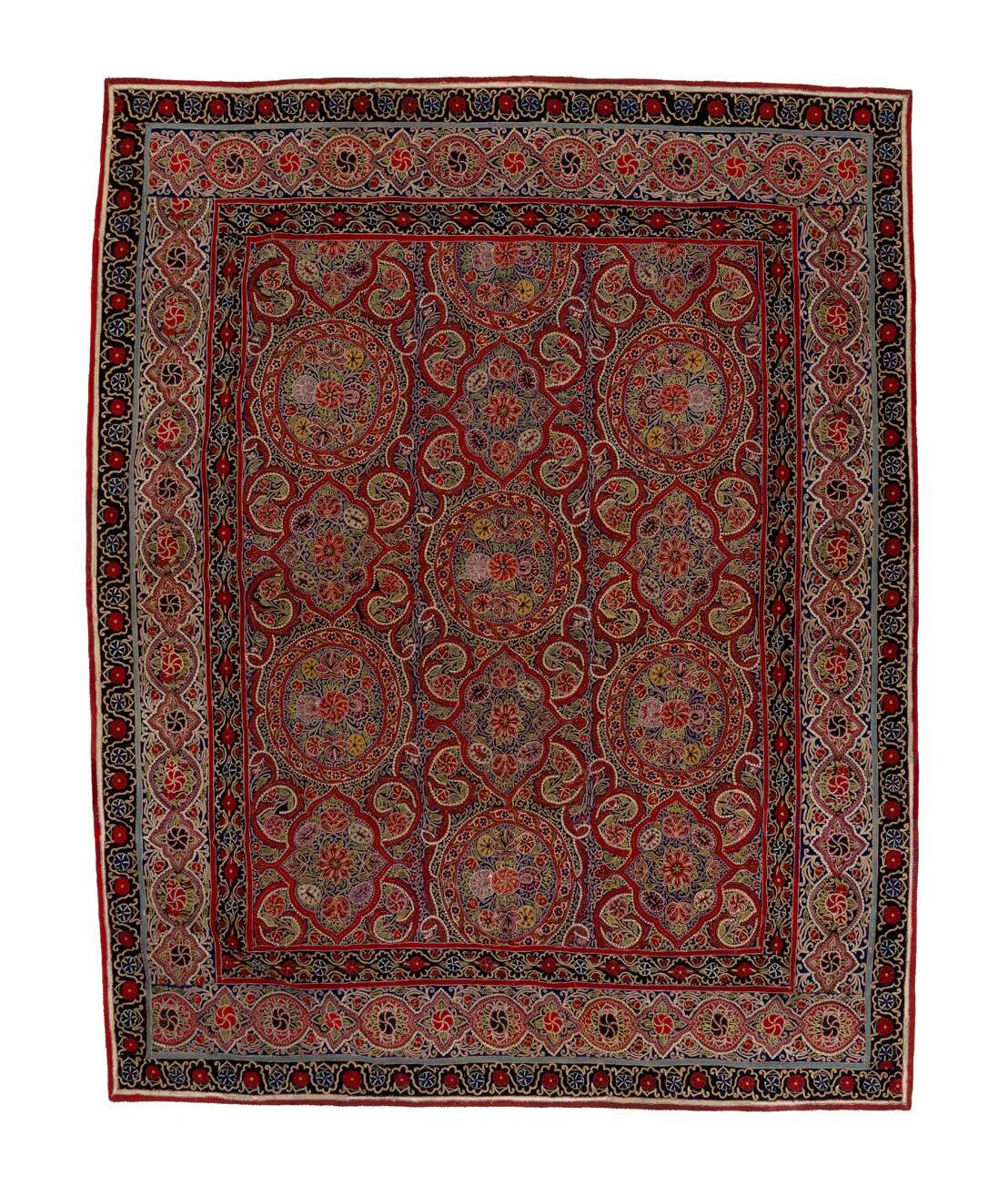
A QAJAR RESHT EMBROIDERED APPLIQUÉ WOOL PANEL
PERSIA, CIRCA 1850
rectangular, the black and dark blue felt grounds embroidered in polychrome silk, the central panel with flower-filled medallions and lobed cartouches, surrounds with bands of continuous floral motifs, backed with floral patterned red cotton
184cm x 155cm
£3,000-4,000
Please refer to lot 44, for a discussion on Recht embroidery.
49
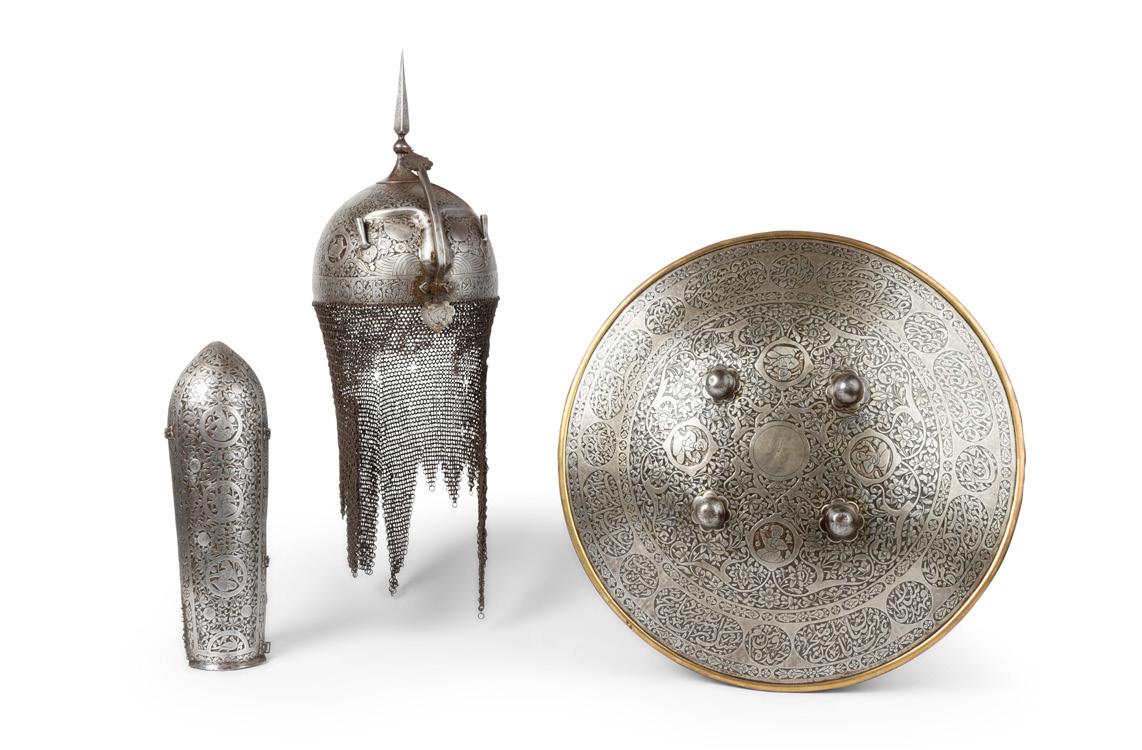
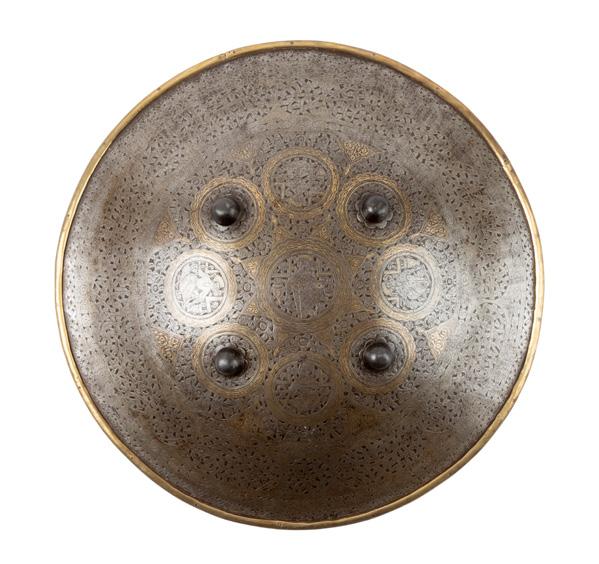
A QAJAR SET OF STEEL ARMOUR PERSIA, 19TH CENTURY
comprising a shield, helmet and armband, each profusely engraved and decorated with figural and animal medallions on a reserve of floral and leafy tendrils, the helmet and shield with bands of inscription-filled cartouches around the borders helmet 29cm high; armband 34cm long; shield 46.2cm diameter
£3,000-4,000
50
A QAJAR GOLD DAMASCENED STEEL SHIELD PERSIA, 19TH CENTURY
of typical form with four raised bosses, profusely engraved with a central stellar motif containing a regal court figure with a cup, surrounded by medallions containing further court figures all reserved on a ground of floral and leafy tendrils, the border with inscription-filled cartouches, probably comprising Persian verses 52cm diameter
£800-1,200
51
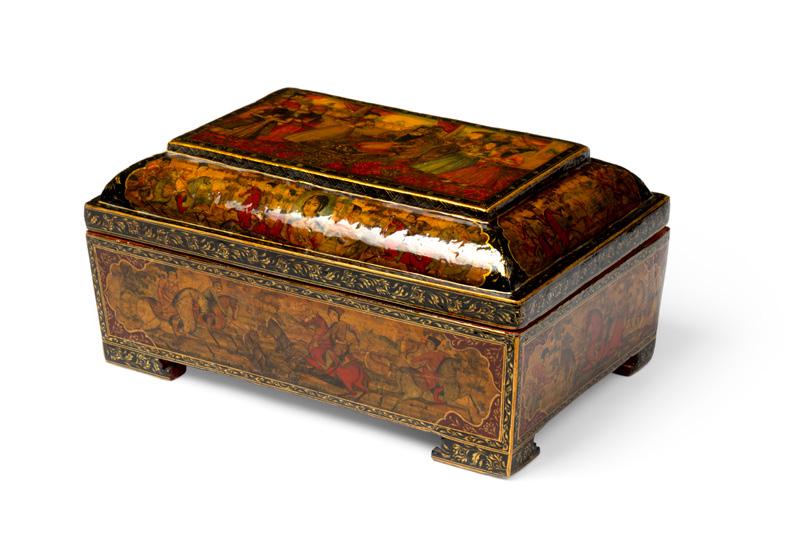
A QAJAR LACQUER PAPIER MACHE LIDDED BOX WITH FATH ALI SHAH PERSIA, 19TH CENTURY
of rectangular form with a detachable lid, the exterior depicting Fath Ali Shah seated on a day bed surrounded by his courtiers, around the outside courtiers engage in hunting battles with wild animals, whilst on the inside, possibly created by another hand, Fath Ali Shah spears a deer whilst out hunting
21.4cm x 31cm x 15.5cm
£1,200-1,800
52
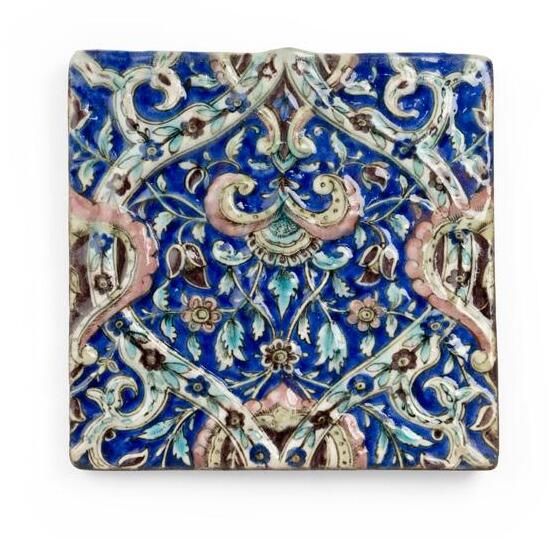
A SMALL QAJAR POTTERY TILE
PERSIA, 19TH CENTURY
of square form, moulded in relief and decorated in turquoise, pink, ochre and cobalt blue with black outline under a transparent glaze, with symmetrical interlocking vines and intertwined floral designs
21cm x 21.5cm
£300-400
Provenance: Private collection, Scotland.
53
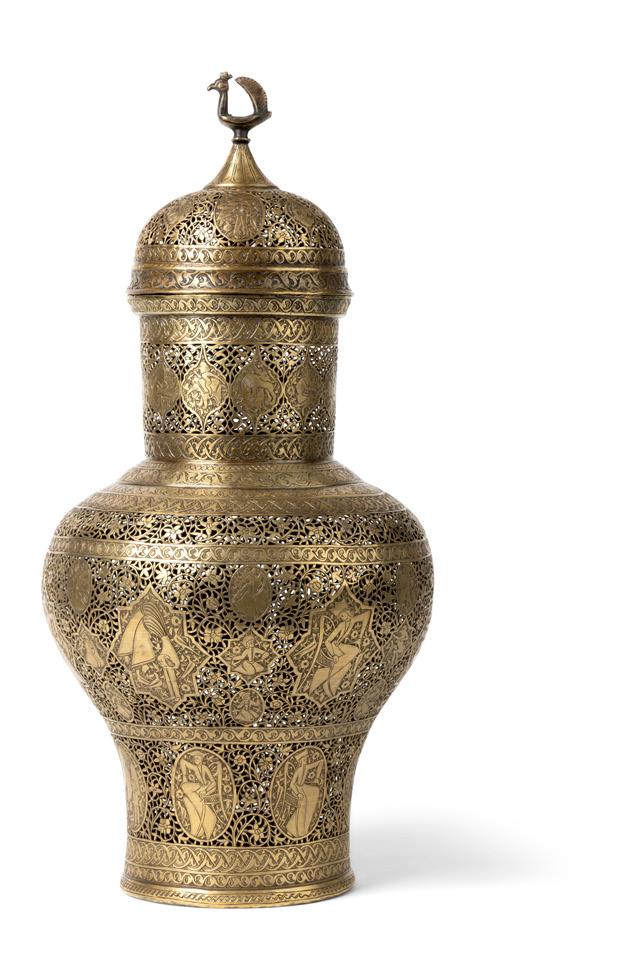
A TALL QAJAR BRASS INCENSE BURNER
PERSIA, 19TH CENTURY
of tall baluster form, the domed-lid surmounted by a cockerel finial, the openwork body profusely decorated with various-shaped medallions and cartouches containing figures on a ground of floral and leafy tendrils, bands of continuous interlinking split-palmettes
48cm high
£800-1,000
54
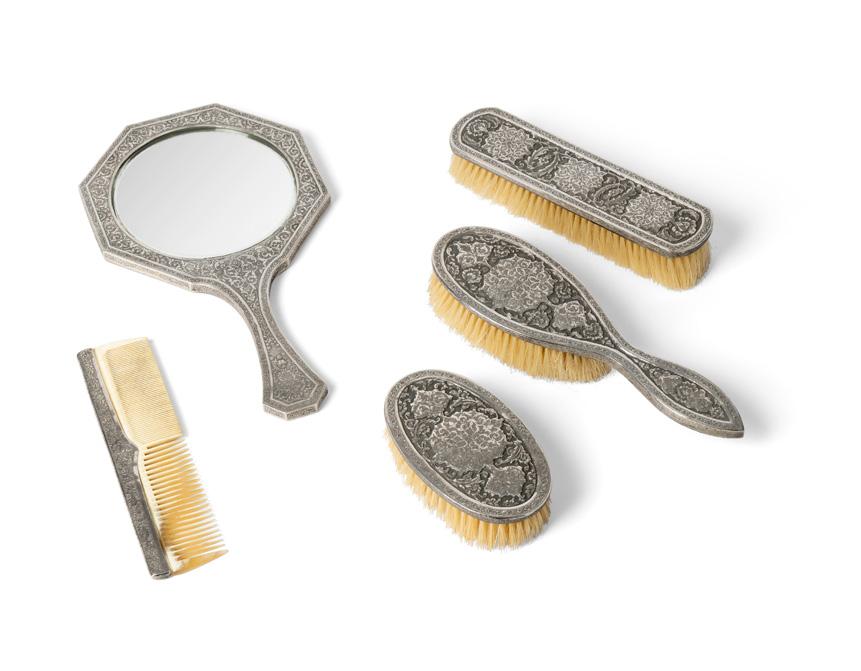
A QAJAR SILVER DRESSING TABLE SET
PERSIA, ISFAHAN, 19TH CENTURY
comprising a mirror, three brushes and a comb, each mounted in silver profusely engraved with floral and vegetal decoration mirror 28cm; comb 18cm; brush 23cm max.
£1,000-1,200
55
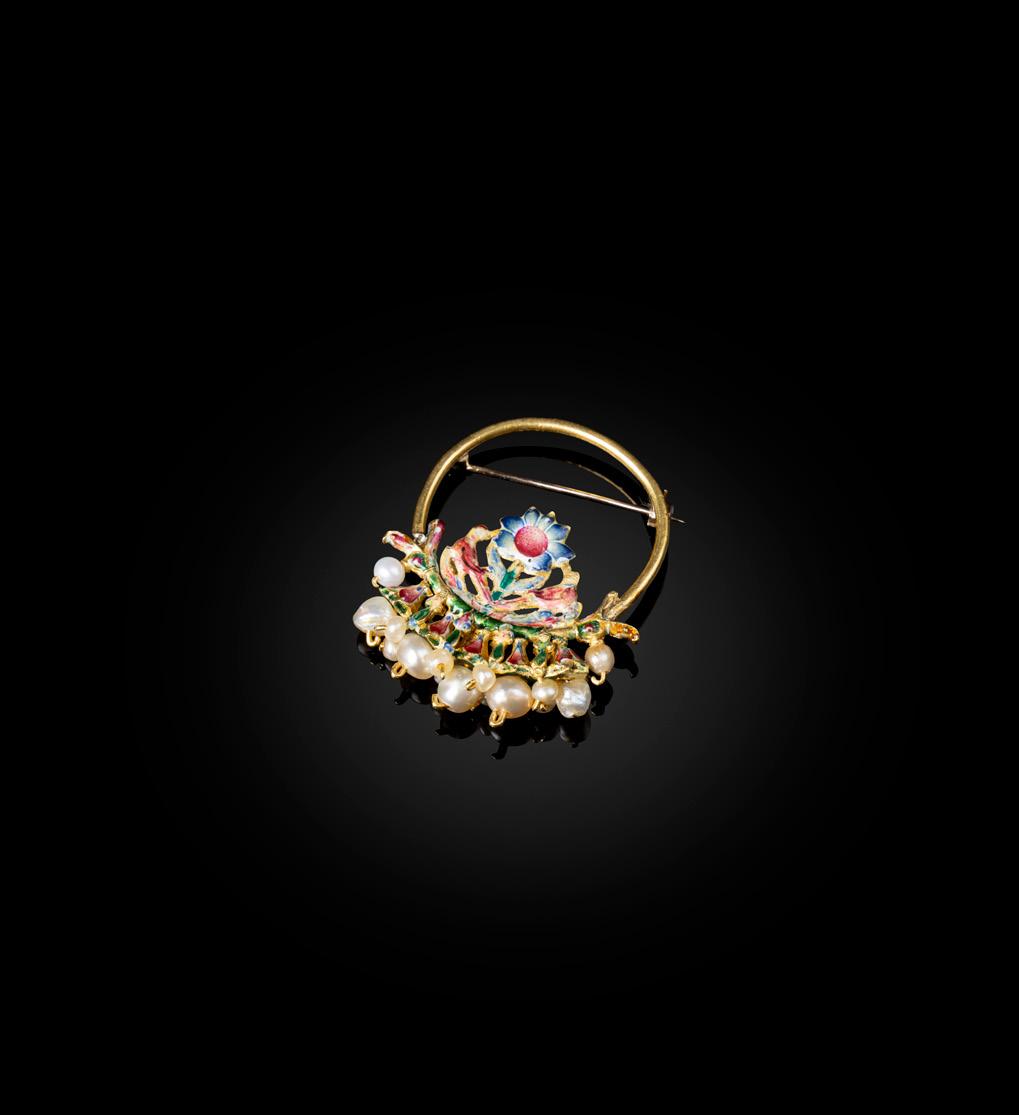
A QAJAR ENAMELLED GOLD BROOCH PERSIA, 19TH CENTURY of circular form mounted with a pin stem, the gold openwork element forming a flower enamelled in polychrome, the base fringed with pearls 4cm diameter
£800-1,200
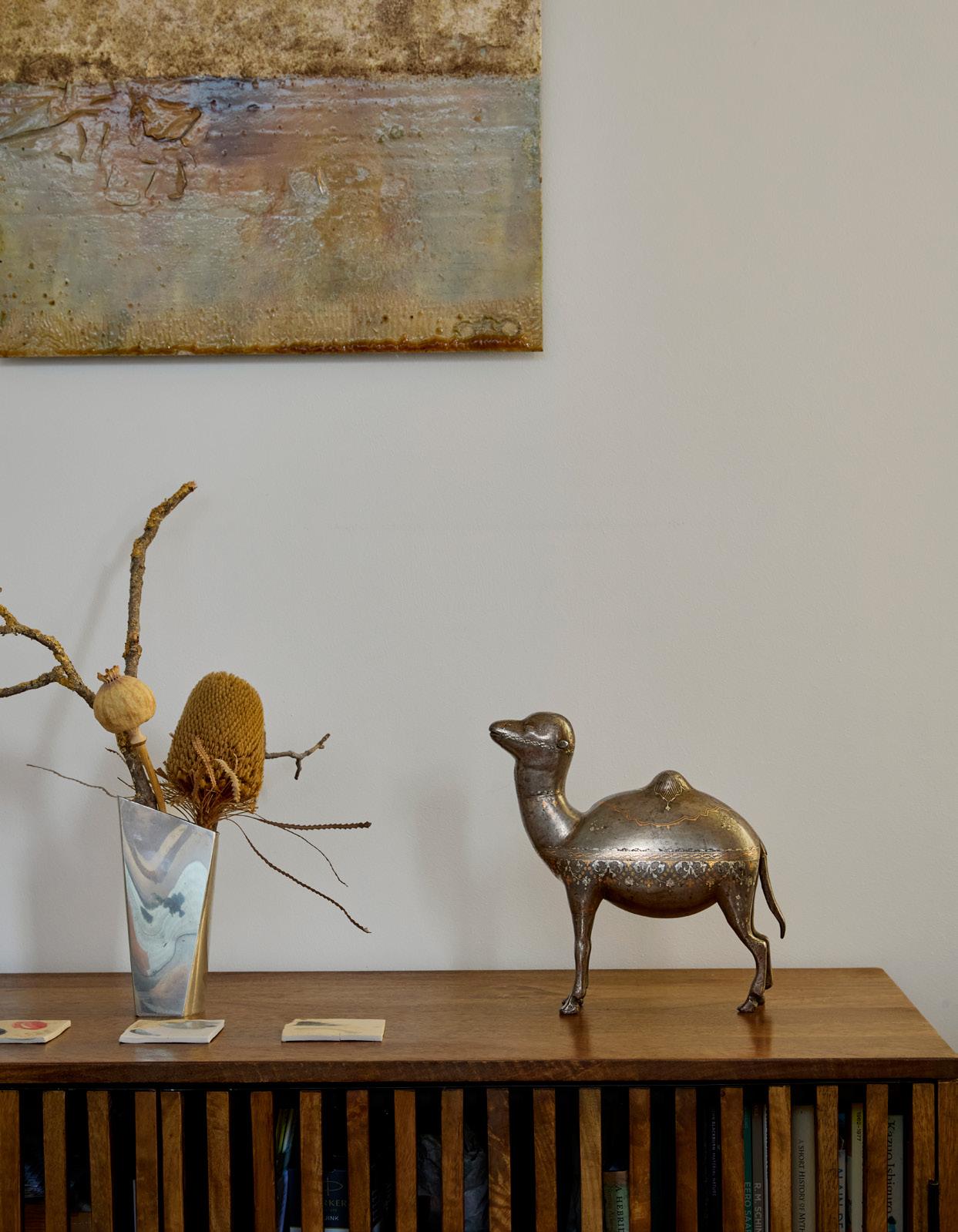
A QAJAR GOLD AND SILVER DAMASCENED STEEL CAMEL PERSIA, 19TH CENTURY
of characteristic form with single hump, the body decorated with a band of repeat elegant interlinking half-scrolls and split-palmettes amidst flower-heads across the middle, the neck with further similar motifs, the head with damascened eyes
25cm high
£2,000-3,000
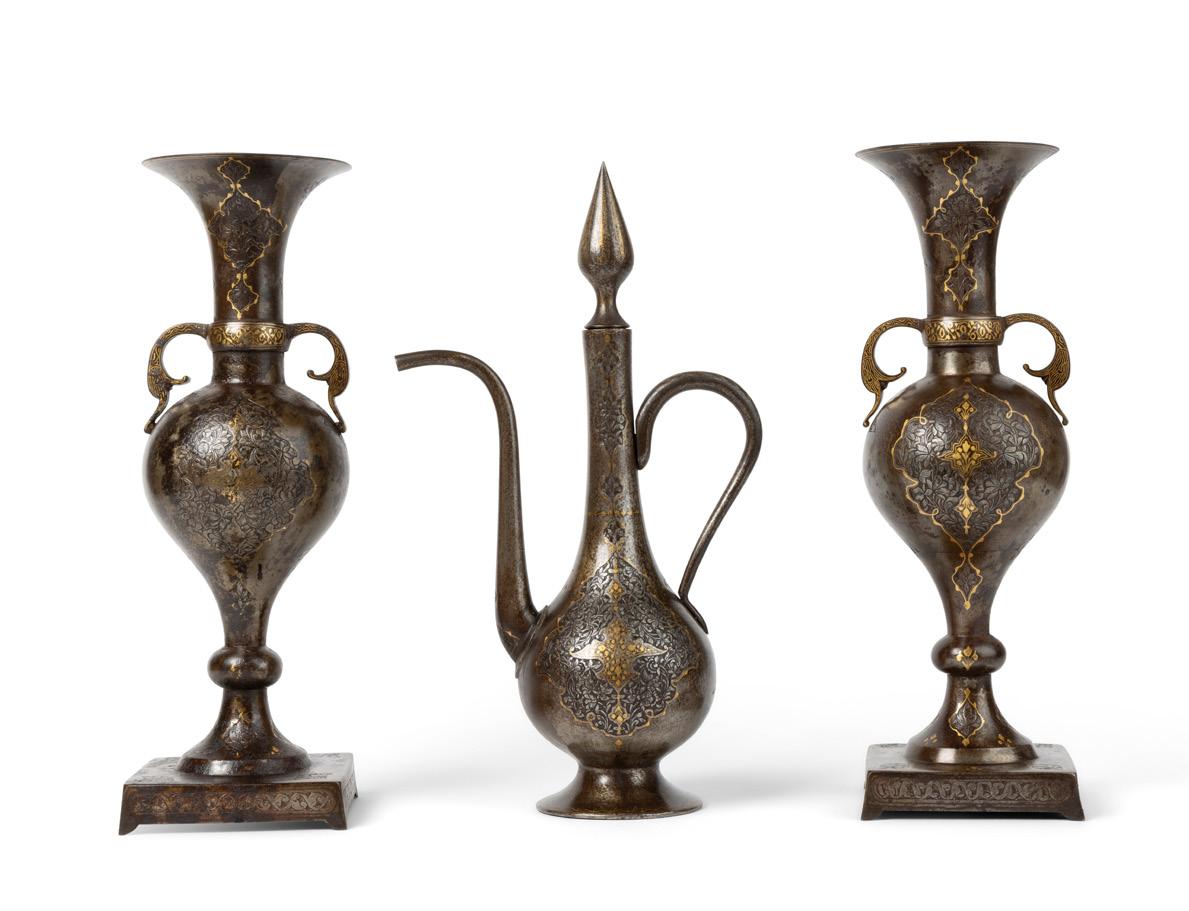
AN ELEGANT MATCHING SET OF QAJAR GOLD DAMASCENED STEEL VASES AND ONE EWER PERSIA, 19TH CENTURY
the pair of vases of baluster-form with double handles on square bases, the ewer with ‘s’ shaped spout and handle, the bodies decorated with pointed lobed cartouches and engraved with leafy vines with gold damascened decoration in the middle each 33cm high
£3,000-5,000
58
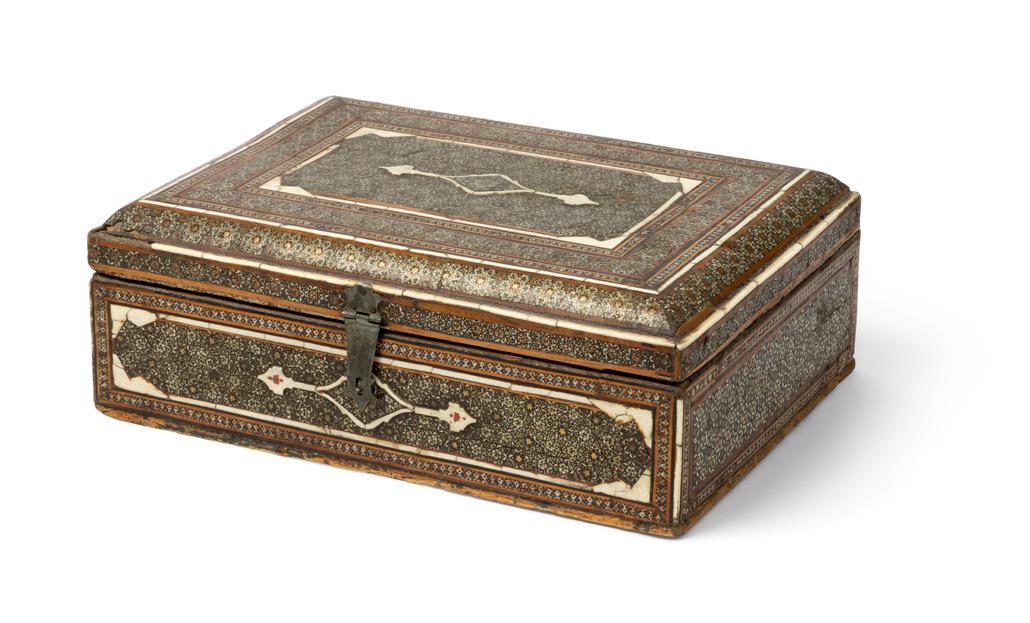
A QAJAR KHATAMKARI WORK BOX PERSIA, 19TH CENTURY
rectangular with hinged lid, all the surfaces inlaid with micro-mosaic segments of bone, brass and stained wood, forming geometric motifs including a stellar lattice, the interior with compartments and drawers to the side
22cm x 30.8cm x 10.7cm
£600-800
59
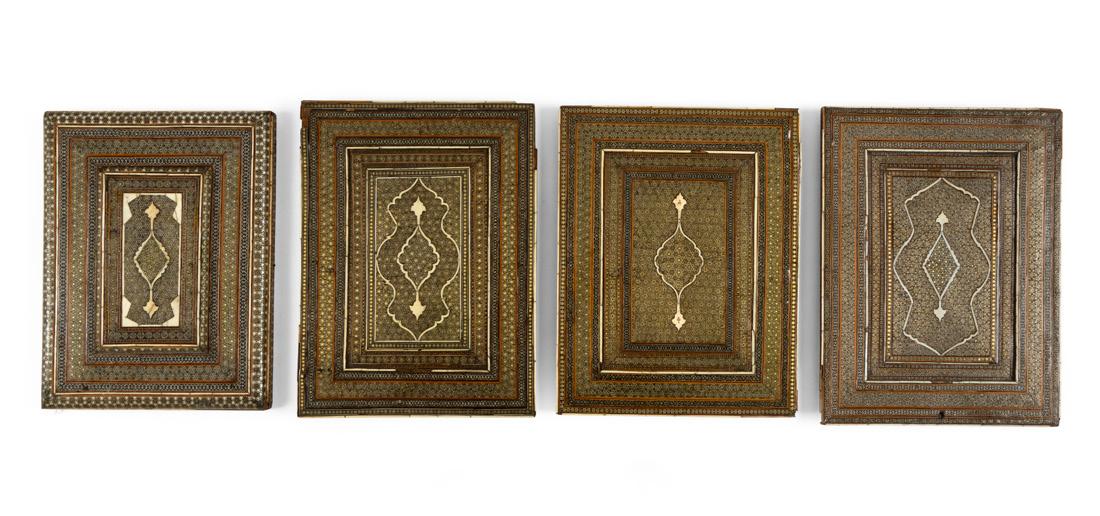
A GROUP OF QAJAR KHATAMKARI FRAMES PERSIA, 19TH CENTURY
comprising three frames and one lid, each rectangular with surfaces inlaid with micro-mosaic segments of bone, brass and stained wood, forming geometric motifs including a stellar lattice, the lid features a floral painted motif on the reverse Lid 36.7cm x 27.7cm; frame: 38.4cm x 30cm
£500-700
60
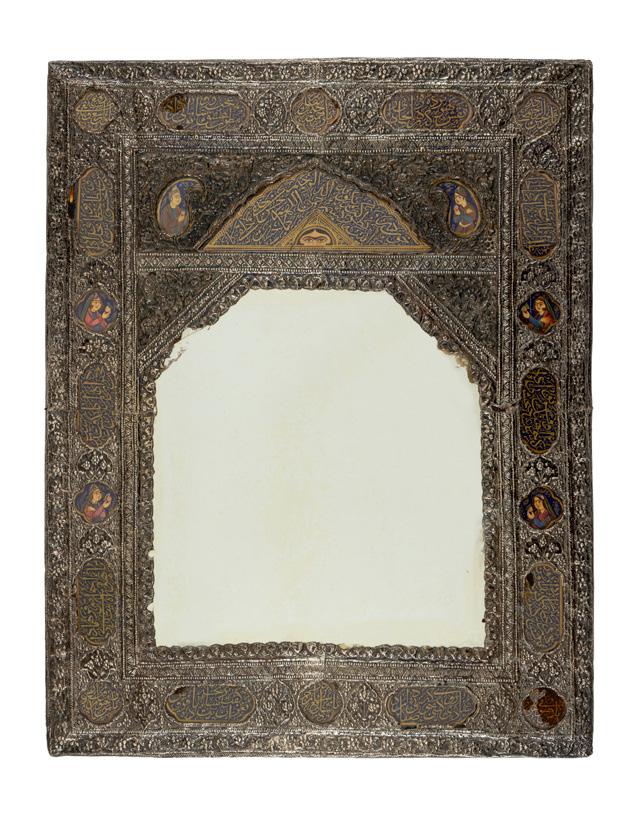
A QAJAR ENAMELLED SILVER REPOUSSÉ MIRROR
PERSIA, 19TH CENTURY
of rectangular form, the silver repoussé decoration forming repeat vegetal and geometric motifs, enclosing a band of lobed cartouches and medallions with inscriptions in gold on a blue ground, as well as a few bust portraits around the border, the upper part with a mihrab enclosing further inscriptions, flanked by boteh-shaped cartouches comprising portraits 65.4cm x 51cm
£1,000-1,500
The inscriptions include: around the border, verses from a ghazal of Hafiz and an Arabic prayer; in the arched cartouche, Arabic prayers: “[Whomsoever] looks good in the mirror, let him say: ”In the Name of the Merciful, the Compassionate! My God, just as you made my exterior beautiful, make my morals beautiful.”
61
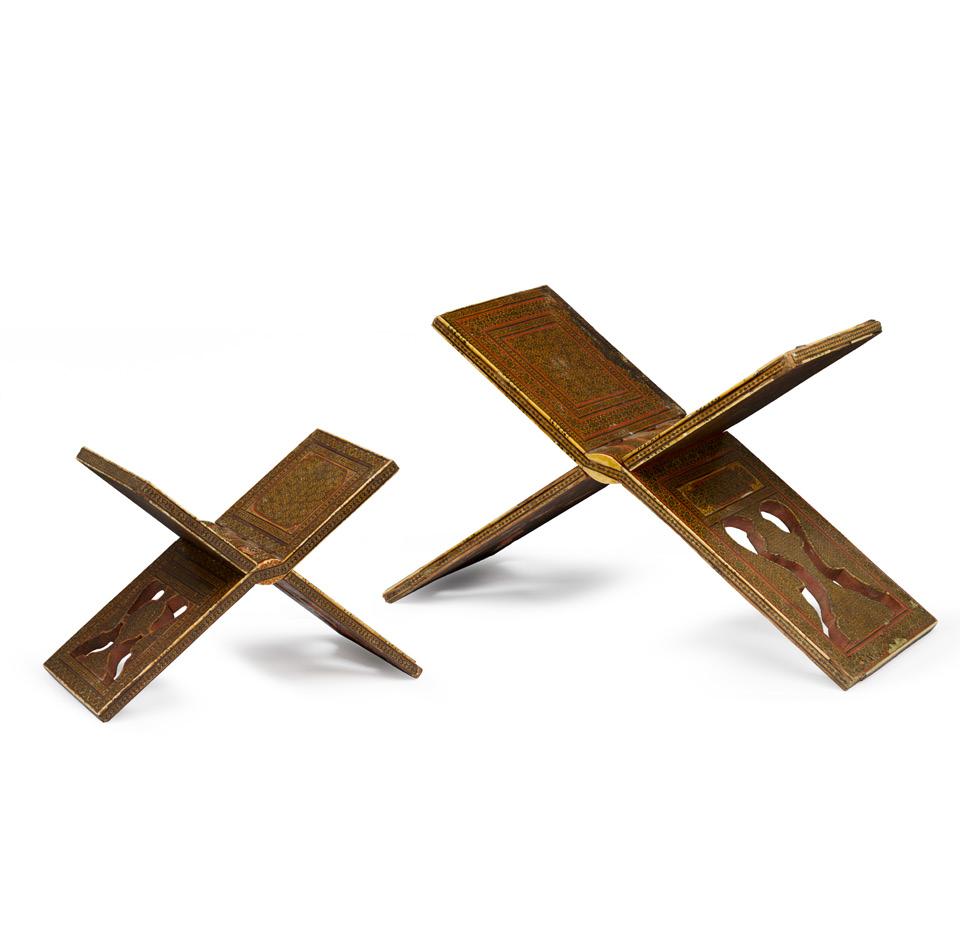
TWO QAJAR KHATAMKARI QUR’AN STANDS
PERSIA, 19TH CENTURY
each of rectangular form opening up to an ‘x’ shape stand, profusely inlaid with micro-mosaic segments, including bone, copper and wood, forming geometric motifs, the lower legs with carved openwork decoration
26.7cm x 46cm x 18.1cm; 20.5cm x 31cm x 14.2cm
£600-800
A SCROLL WITH STYLISED ARABIC CALLIGRAPHY
CHINA, 18TH CENTURY
black ink on paper, the shahhada repeated many times in black sini forming a mosque, laid down on paper
78.8cm x 44.5cm
£5,000-7,000
Provenance: Acquired, Christie’s, Islamic Art and Manuscripts, 1 May 2001, lot 77.
An almost identical example is in the Farjam Foundation, which was acquired from Christie’s, Islamic Art and Manuscripts, 15 October 2002, lot 222.
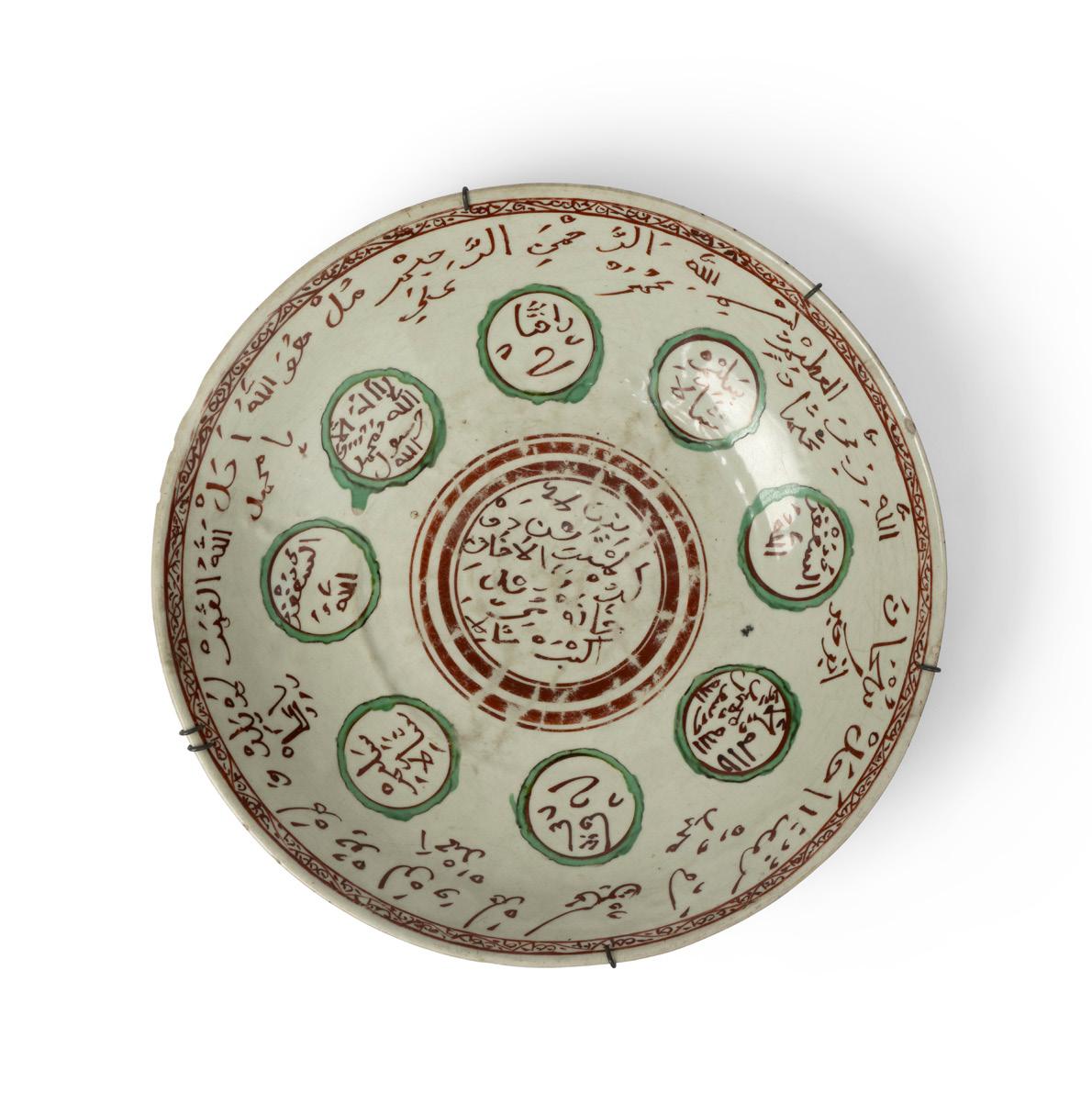
A CHINESE ‘SWATOW’ PORCELAIN CHARGER MADE FOR THE ISLAMIC MARKET LATE MING DYNASTY, LATE 16TH/ EARLY 17TH CENTURY
circular with curved sides rising from a short foot-ring, the opaque white glaze decorated in green and red enamels, with a central large roundel comprising Arabic calligraphy comprising Qur’anic blessings, verses and invocations to the Prophet Muhammad, surrounded by eight small calligraphic roundels, a narrow band with further Arabic calligraphy below the rim
37cm diameter
£4,000-6,000
Provenance: David Baker Oriental Art, 2015
Porcelain ‘magic bowls’ bearing Arabic inscriptions were produced in China for export to Muslim communities, particularly in Southeast Asia and India. These objects can be divided into two principal groups: the first produced from the late sixteenth to the early seventeenth century, and the second emerging in the late eighteenth century. The earlier bowls feature inscriptions that reflect their talismanic purpose, whereas the later examples are decorated with magic squares.
A similar dish with less elaborate inscriptions is illustrated in B. Harrisson, Swatow in het Princessehof, Leeuwarden, 1979, p. 110-113, pl. 226, 227, 227a.
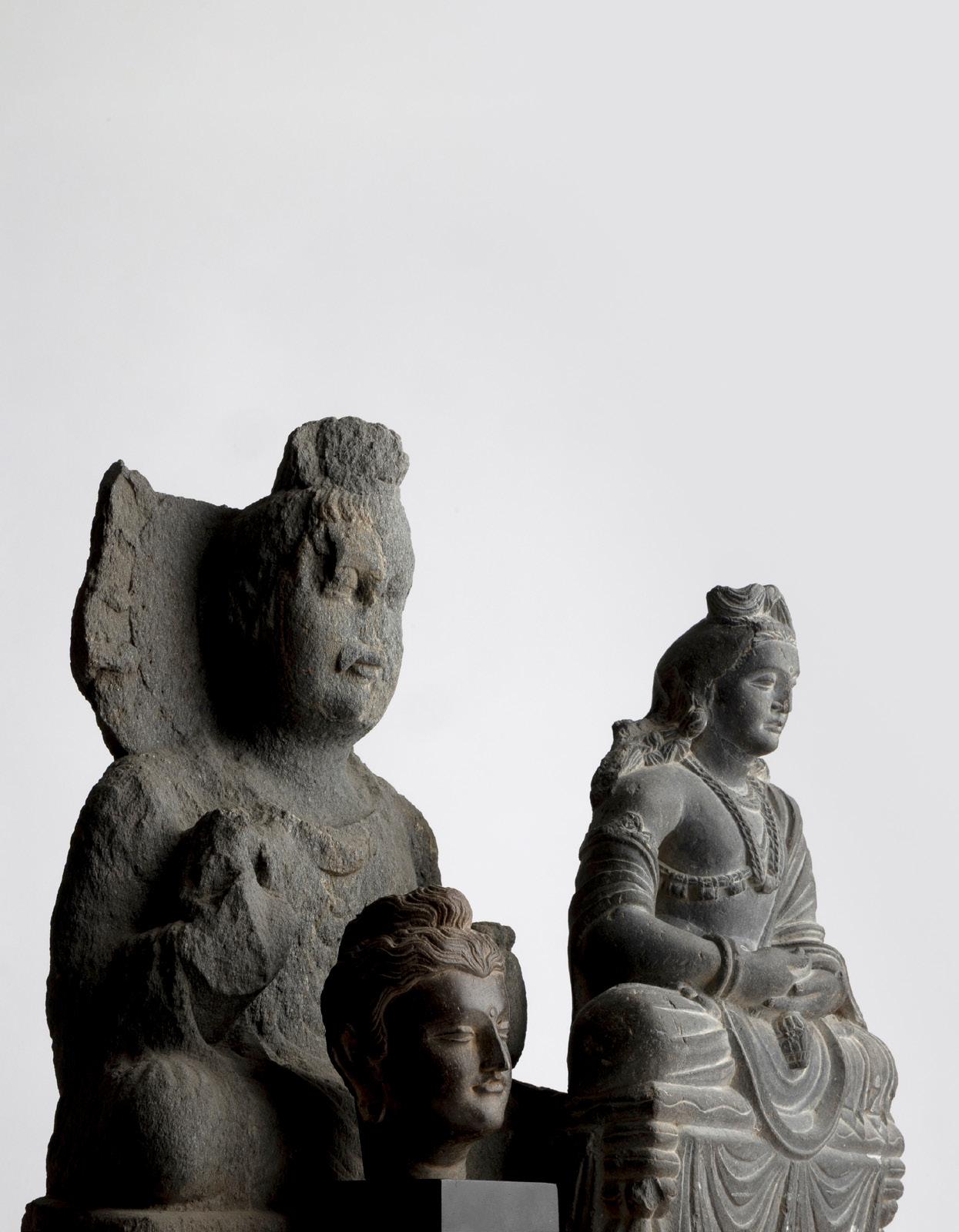
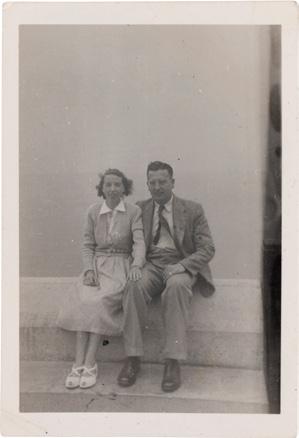
THREE GANDHARAN SCULPTURES FROM THE COLLECTION OF THE LATE VICTOR TAYLOR
Victor Taylor (1910-1985) was a man whose life was shaped by curiosity and a lifelong passion for collecting. During the Second World War he served overseas in several European countries. On his return he recalled moments of camaraderie including football matches with German and French soldiers. He also brought with him keepsakes such as a sailor’s valentine which captivated his wife and young family. His fascination with antiques was already well-formed, and the Gandara pieces he acquired were guarded treasures.
After the war, Taylor joined Beaties as a buyer and eventually rose to director. He specialised in antiquities, travelling across the UK to source British porcelain and other collectible pieces for the store. His expertise in ceramics became widely respected, and his personal collection grew into something both extensive and deeply studied. Taylor retired in the 1970s, after which he and his wife moved to the Brecon Beacons, spending their retirement between Wales and winters in Málaga; A quieter chapter for a man who had spent a lifetime seeking out the world’s objects and the stories behind them.
64
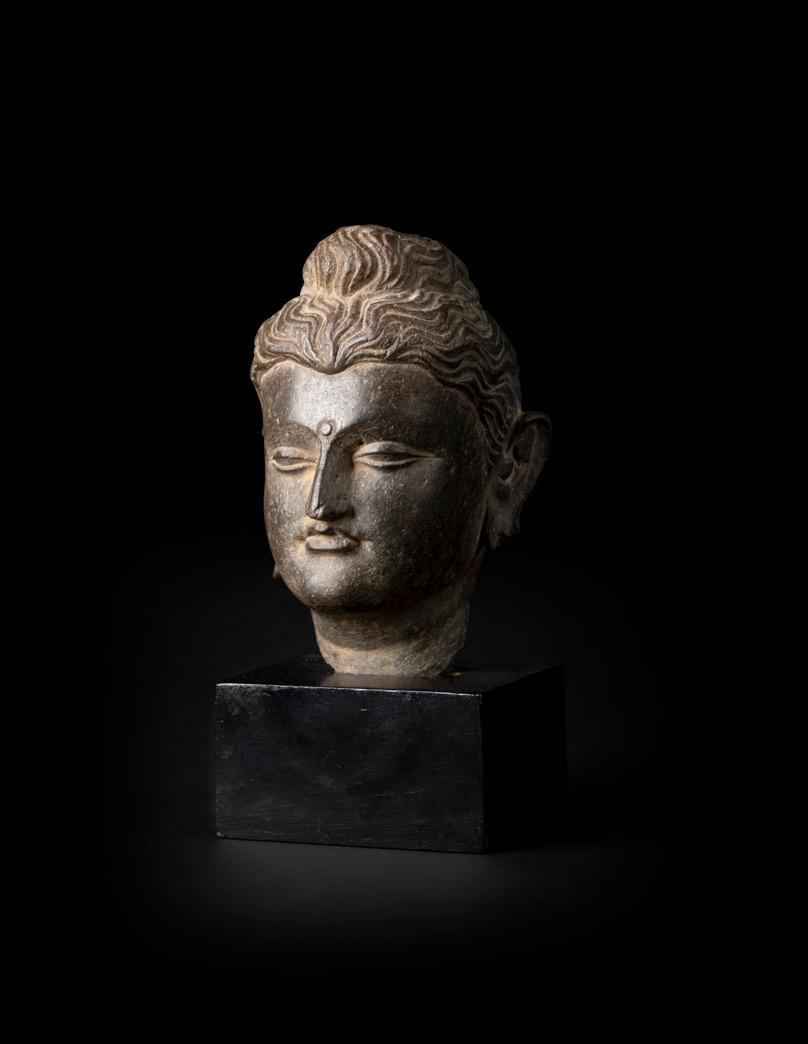
A FINE GRAY SCHIST HEAD OF BUDDHA
NORTHWESTERN INDIA, GANDHARA, 2ND/ 3RD CENTURY
very finely carved with gentle bow-shaped mouth, straight nose and almond shaped eyes, centered by a raised urna, long pendant earlobes with piercings, hair in wavy locks over the prominent ushnisha 12cm x 7.5cm x 6cm
£4,000-6,000
Provenance: The collection of the late Victor Taylor (1910-1985), thence by descent, for the past 80 years. Accompanied by a letter from the collector’s grandson.
This piece represents a beautiful example of the Graeco-Buddhist style; such statues were commonly seen in the religious precincts of Gandhara, the birthplace of some of the most iconic and important works of Buddhist art.
Ancient Gandhara, nestled in the snowy speaks and lush valleys of the Hindu Kush, was a meeting place between East and West. The region’s strategic position encouraged successive waves of foreign invaders, whose cultures were aptly adopted and re-contextualised by the local population. This dynamic multiculturalism brought forth sculpture of incredible sophistication, melding the complex nontheistic world of Buddhism with the idealism of the Hellenistic art of the Greek settlers, who had been first lead into the region by Alexander the Great. This Indo-Greek population remained in contact with the Mediterranean world throughout antiquity, and through them the precepts of Buddhism became known to philosophers like Phyrro and Onesicritus, and even to early Church Fathers like Clement of Alexandria. This syncretic relationship also produced the first anthropomorphic depictions of the Buddha – who had previously been represented only in symbols, like the Bodhi tree or the empty chair – and so represents an important turning point in the history of Asian art, the impact of which would spread as far as Thailand and Japan.
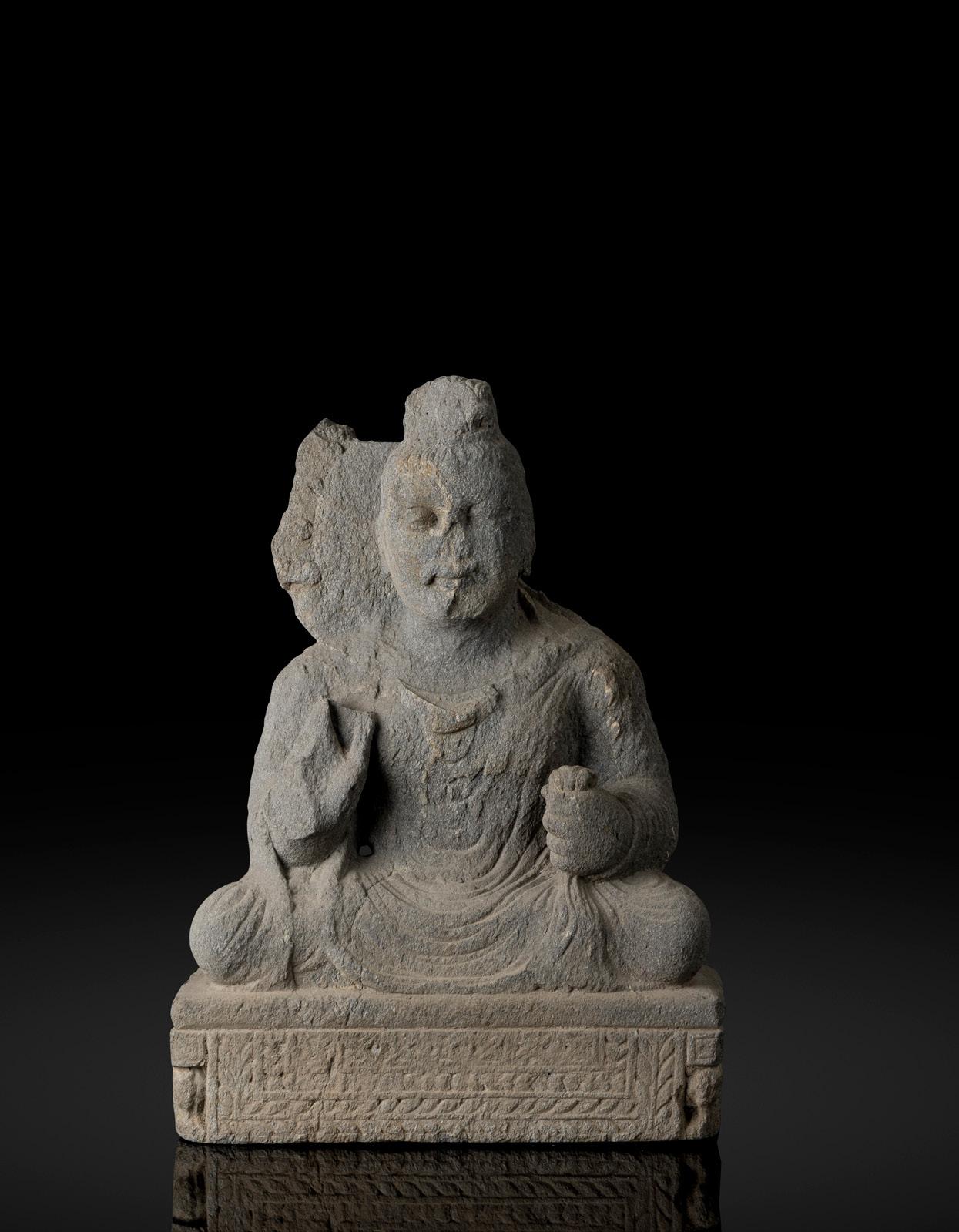
A GRAY SCHIST SEATED BUDDHA
NORTHWESTERN INDIA, GANDHARA, 2ND/ 3RD CENTURY
carved, seated in dhyanasana with cascading folds of fabric clasped in one hand, pair of heavy lidded eyes, hair in wavy locks over the prominent ushnisha, backed by a nimbus now partially lost, this carved figure has extensive weathering consistent with an exterior placement
44.2cm x 31.8cm x 9.5cm
£1,000-1,500
Provenance: The collection of the late Victor Taylor (1910-1985), thence by descent, for the past 80 years. Accompanied by a letter from the collector’s grandson.
For an extended note about the collector and Gandhara please refer to lot 64.
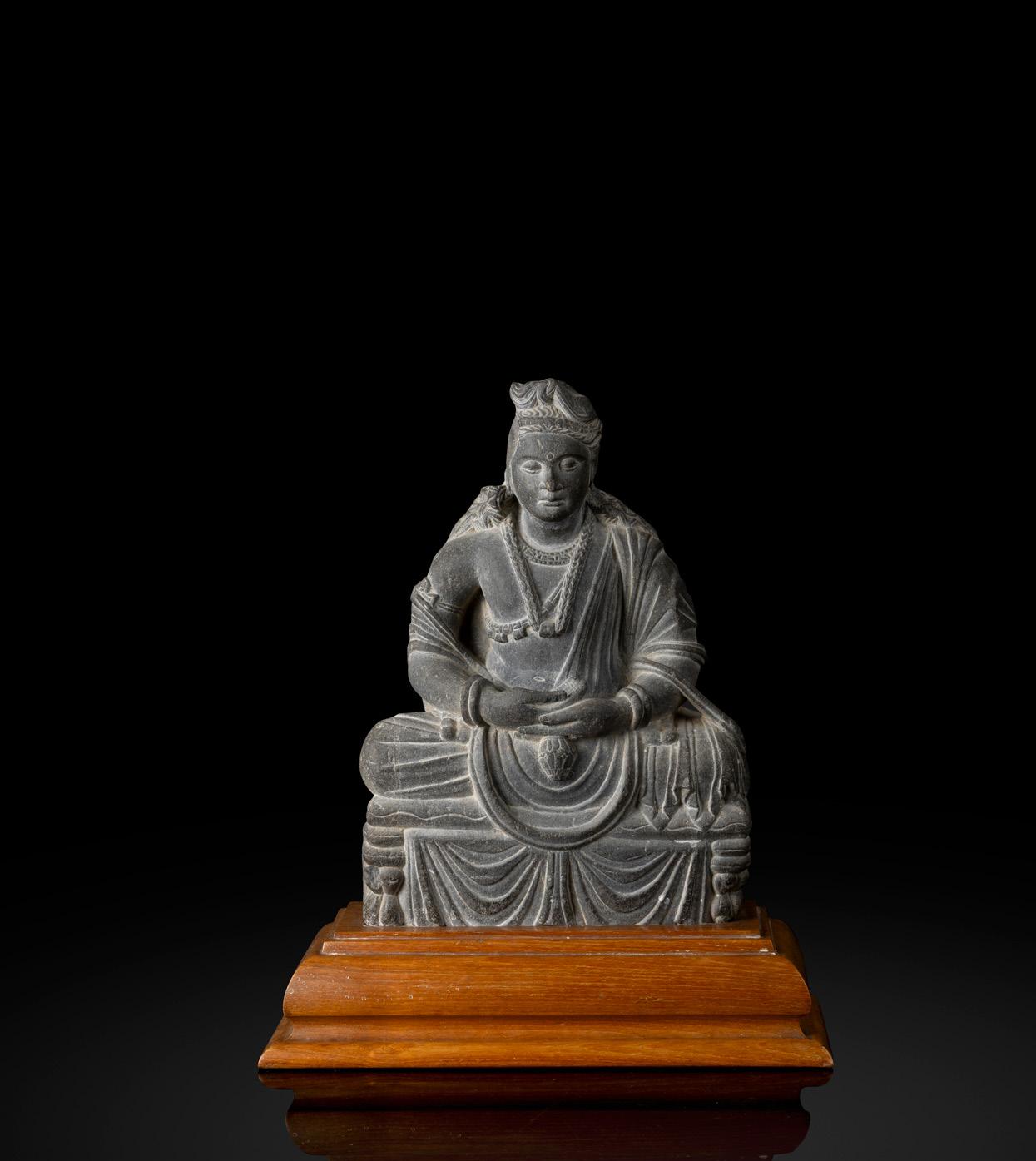
A GRAY SCHIST SEATED BUDDHA
NORTHWESTERN INDIA, GANDHARA, 3RD/ 4TH CENTURY
finely carved seated in dhyanasana, possibly a Bodhisattva or Bodhisattva Maitreya, with hands in dhyanamudra in the lap, cascading folds of fabric, pair of heavy lidded eyes, centred by a raised urna, the wavy locks of hair tied up in a topknot and secured with a headband 31cm x 21.5cm x 5.5cm
£6,000-8,000
Provenance: The collection of the late Victor Taylor (1910-1985), thence by descent, for the past 80 years. Accompanied by a letter from the collector’s grandson.
For an extended note about the collector and Gandhara please refer to lot 64.
‡
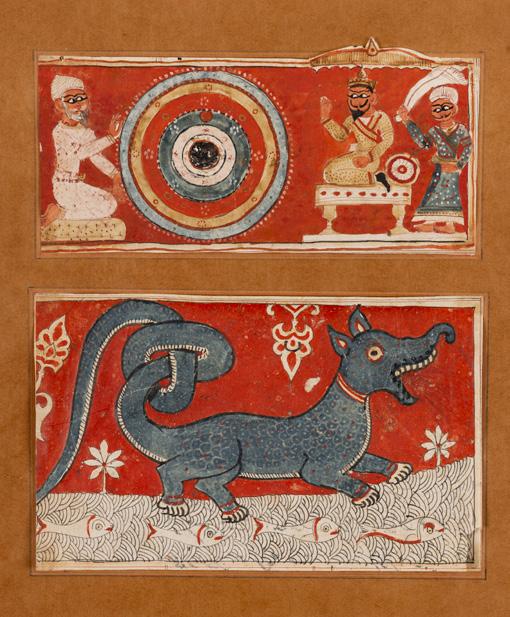
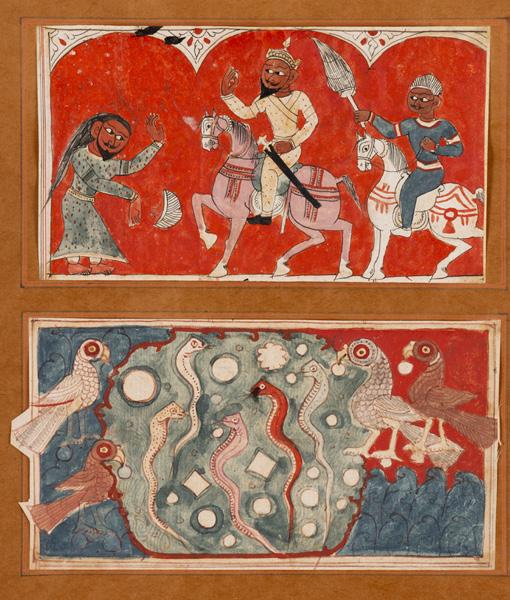
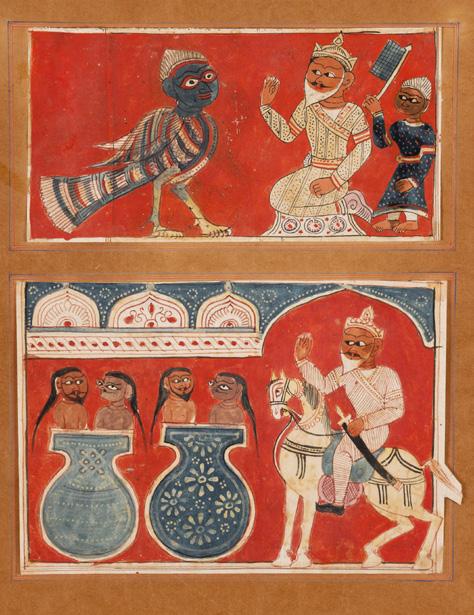
GROUP OF SIX SULTANATE ILLUSTRATIONS TO THE ISKANDARNAMA
NORTH INDIA, SULTANATE, CIRCA 1500
gouache on paper cut down from a manuscript laid down on brown paper, the scenes depict a) Alexander meets a hybrid human being; Alexander on horseback encounters male figures emerging from tall jars; b) Alexander consults an astrologer; a makara, a strange creature of the Eastern seas; c) Alexander on horseback accompanied by an attendant, also on horseback and waving a chauri, receiving a courtier bowing before him; a swirling ocean
Each approx. 11cm x 15.8cm
£600-800
Provenance: Private collection, Spain.
These vivacious illustrations are to the Iskandar Nama and are from a Sultanate manuscript from Northern India dating to circa 1500. They were commissioned by the early sultans of Delhi, hence the term ‘Sultanate’. These sultans were foreign invaders conquering the Northern Plains of India who retained their Persian language, customs and Islamic religion. The paintings are particularly distinctive with their strong palettes often featuring bright brick-red colours and figures outlined in black with the use of a broad brush.
For further discussion, see: S.C. Welch and M.C. Beach, Gods, Thrones and Peacocks, New York, 1965, no. 2; K. Khandalavala and M. Chandra, New Documents of Indian Painting, Bombay, 1969, p.56; Fine Indian and Persian Miniatures and a Manuscript selected from the well-known collection of Cary Welch, Sotheby & Co., 12th December , 1972, lots 178 and 179, and; E. Binney, Indian Miniature Painting from the Collection of Edwin Binney, 3rd., Portland, Oregon, 1973, no. 5.
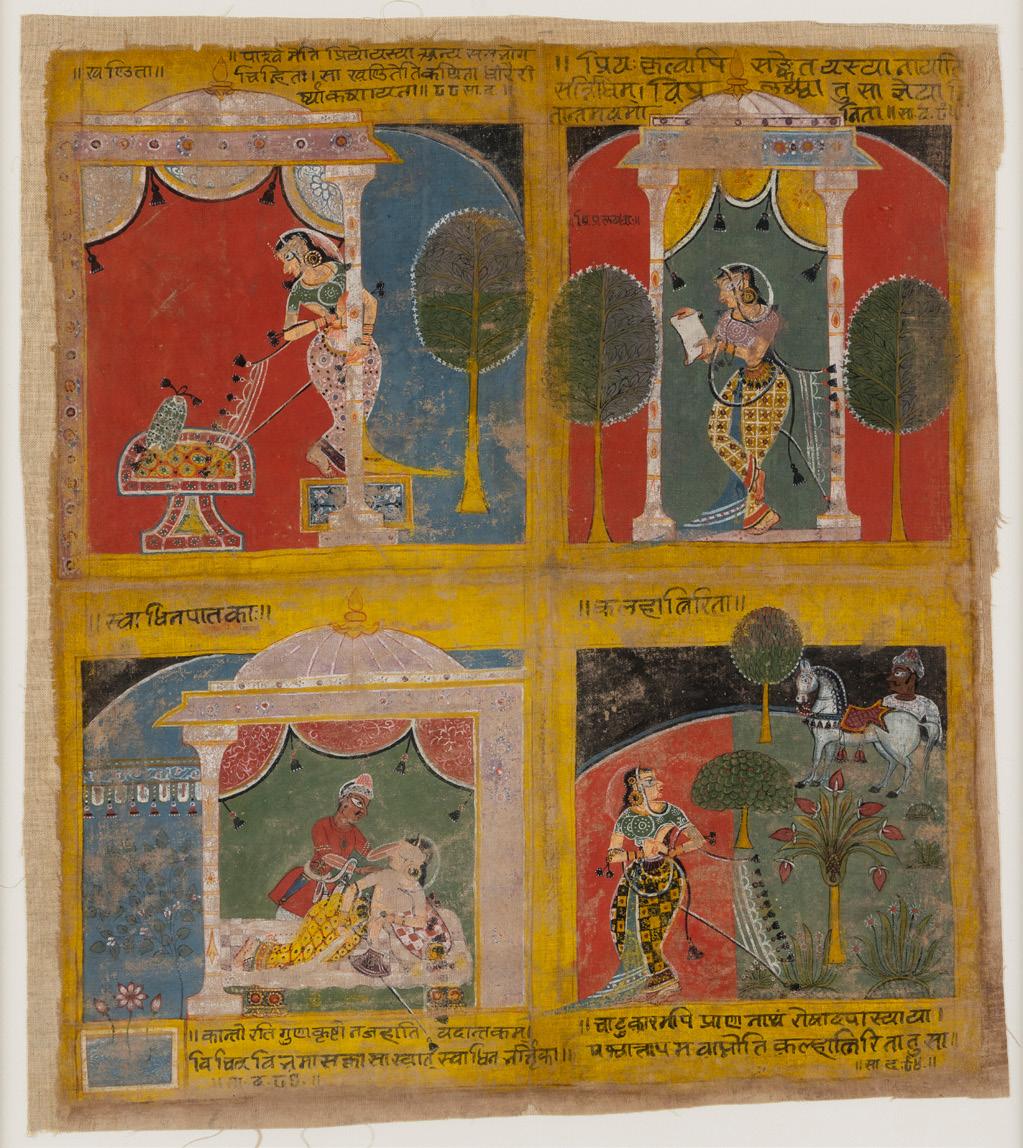
FOUR RAGAMALA SCENES ON CLOTH
CENTRAL INDIA, MEWAR, CIRCA 1565
painting on cloth, the four scenes comprising Ramkali ragini: a mistress leaving a bedchamber; Bhairavi ragini: a mistress singing in a pavilion; Lalit ragini: a prince leaving his mistress in a bedchamber; Kedar ragini: a prince arriving on horseback surprising his mistress in a glade, yellow borders with nagari inscriptions, mounted, framed and glazed
49cm x 44cm
£2,000-3,000
For comparison, see E. Binney, Rajput Paintings from the Collection of Edwin Binney, 3rd., Portland, Oregon, 1968, nos. 1 (a-c), and; J. Seyller (ed.) Rajasthani Paintings in the Jagdish and Kamla Mittal Museum of Indian Art, Hyderabad, 2015, nos 1-8.
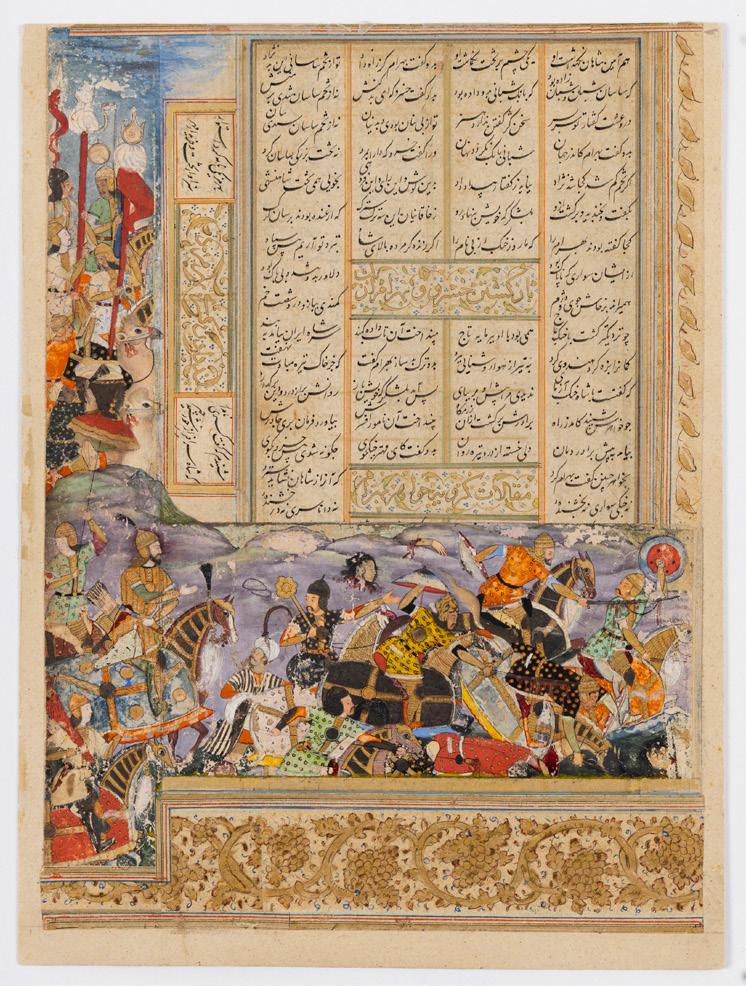
AN ILLUSTRATED LEAF FROM A MUGHAL SHAHNAMA
NORTHERN INDIA, CIRCA 1590-1600
ink and gouache on paper heightened in gold, the text with 16 lines of black nasta’liq organised in four columns with gold and polychrome rules, the miniature below expanding to the left margin, likely from the story of Rustam, the latter depicted in a tiger-striped yellow tunic on horseback at the centre of the battle, with other figures on horseback and on camels, with added Mughal-style illumination below, the miniature originally from another folio, laid down on card
£4,000-6,000
Provenance: Acquired from Christie’s, Art & Textiles of the Islamic & Indian Worlds, including works from the collection of the late Simon Digby, 7 October 2011, lot 366.
The detail of the painting is superbly executed in the Mughal-court style, with each individual in different coloured tunics.
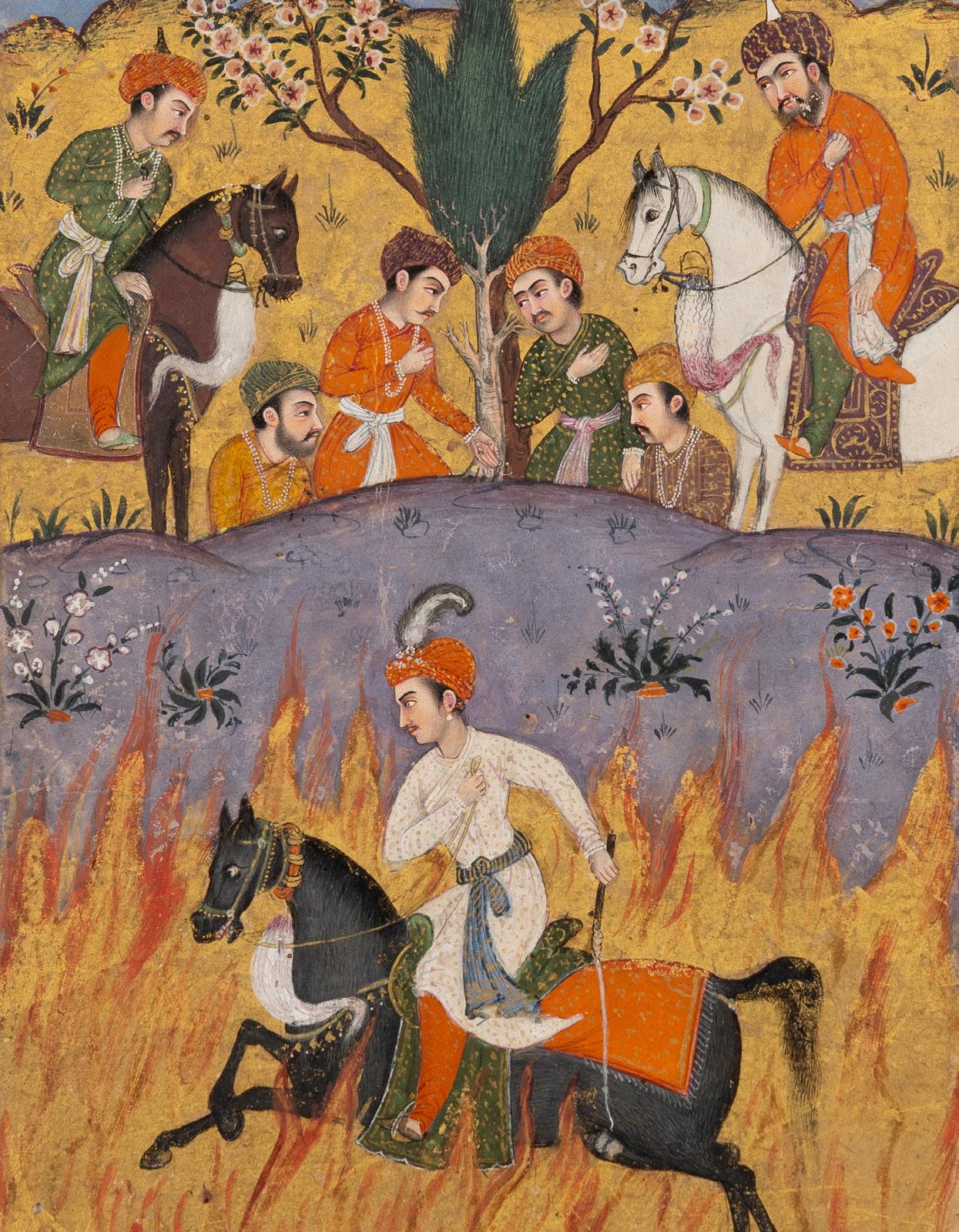
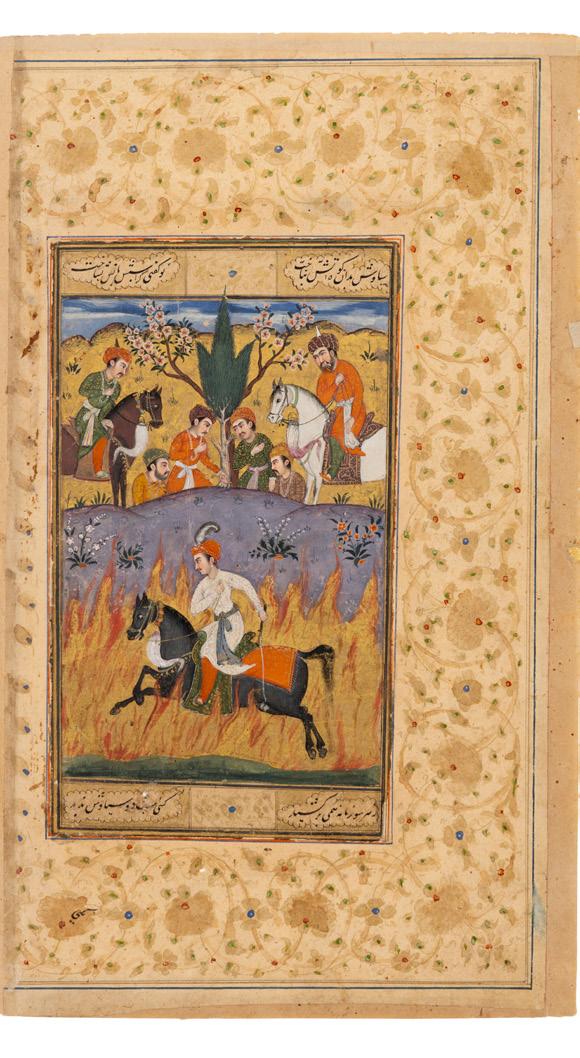
AN ILLUSTRATED FOLIO FROM A DISPERSED SHAHNAMA: THE FIRE ORDEAL OF SIYAVUSH INDIA, PROVINCIAL MUGHAL, DECCAN, SECOND HALF OF 18TH CENTURY
gouache, gold and ink on paper, mounted onto a gold floral decorated album folio, depicting Siyavush in white robes astride his black steed amidst flames in the foreground, in the mountainous background two horsemen and four footmen watch over him around a cherry blossom tree, rectangular panels of nasta’liq inscriptions above and below, verso with further inscriptions in nasta’liq arranged in four columns and diagonal lines above, mounted, framed and glazed
Folio 29cm x 18cm
£3,000-4,000
Provenance: Private UK collection.
This beautifully executed scene illustrates the fire ordeal of Siyavush. After Prince Siyavush spurned the romantic advances of his stepmother, Sudaba, she retaliated by falsely accusing him of initiating the affair. Determined to clear his name, the young prince chose to undergo a trial by fire. This scene reflects the tale faithfully, showing him clad entirely in white atop a dark horse. Emerging from the flames unharmed, Siyavush becomes a powerful emblem of purity and innocence. Despite this, he is later slain by traitors - an act that sparks the prolonged cycle of wars between Iran and Turan, as vividly chronicled in the Shahnama
Another dispersed folio from the same manuscript was sold in these rooms, Islamic and Indian Art, 11 June 2025, lot 79.
71
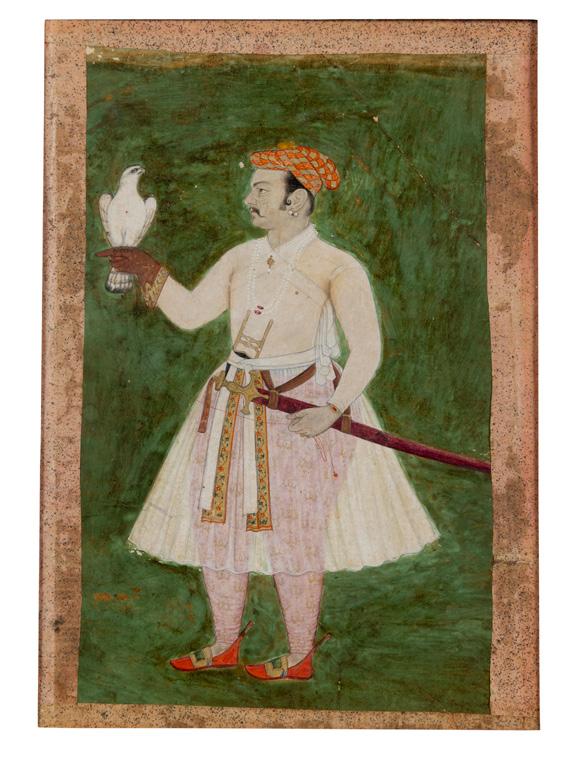
A MUGHAL FALCONER, POSSIBLY THE EMPEROR JAHANGIR
INDIA, RAJASTAN, FIRST QUARTER 17TH CENTURY
gouache on paper heightened in gold, within a light red and green border, depicting a Mughal noble (possibly Jahangir), dressed in a transparent white jama over red pantaloons, a gold katar is tucked into his patka, orange and gold turban, holding a sword in his left hand and a falcon is sat on a brown glove on his right hand, verso inscribed with a Mewar Royal Collection inventory number 16/38, mounted, glazed and framed
Folio 20cm x 14.2cm; image 16cm x 10cm
£2,000-3,000
Provenance: Formerly, Mewar Royal collection. Falconry was important to Mughals because it embodied their royal identity, Central Asian heritage, and political culture. It signalled nobility and kingship, preserved their nomadic Turko-Mongol traditions, and served as a prestigious diplomatic practice through the exchange of prized birds. It shaped courtly life and inspired Mughal art, while also functioning as a form of military-style training during hunts. Falconry also reflected the emperors’ scientific curiosity, as they studied, bred, and cared for raptors with remarkable attention.
72
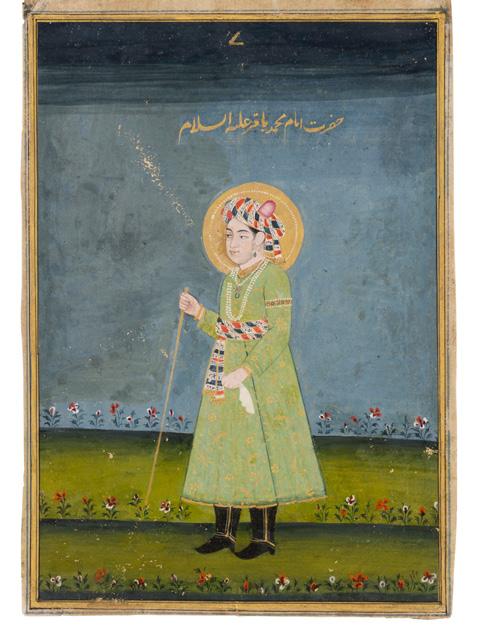
PRINCE LEANING ON A STAFF MUGHAL INDIA, CIRCA 1780
gouache on paper heightened in gold, the jewelled nimbate prince depicted standing facing to the left, dressed in a green jama and striped red and blue patka and turban, holding a staff in his right hand, standing on a grass verge against a dark blue sky, a Persian inscription above in gold
17.5cm x 11.9cm
£800-1,000
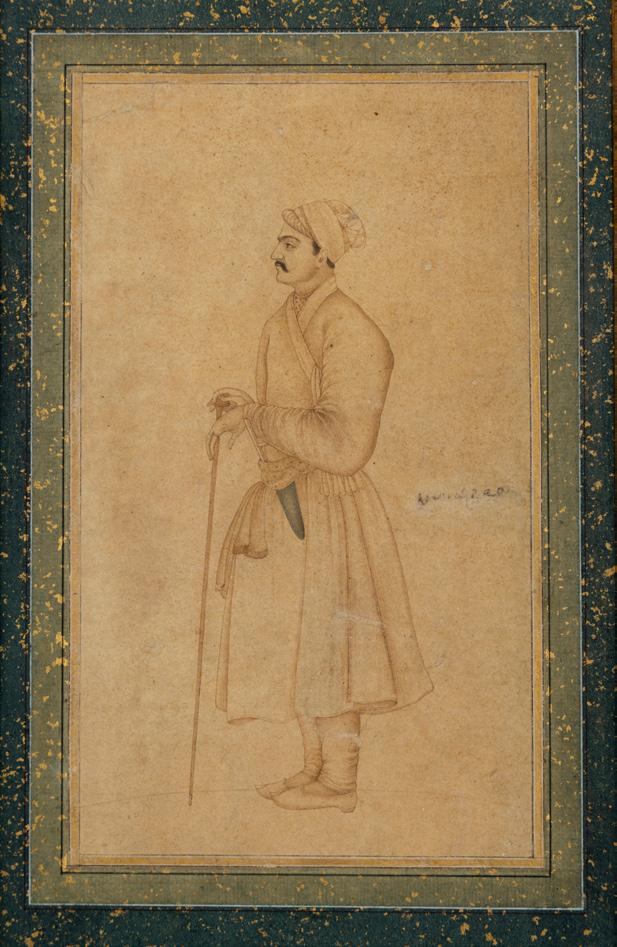
A PORTRAIT OF A MUGHAL COURTIER, POSSIBLY ISLAM KHAN RUMI IN THE STYLE OF RAI CHITARMAN, INDIA, CIRCA 1670
drawing on paper, depicting the courtier standing facing left leaning on a sword, dressed in a jama and turban, a dagger secured to his patka, rubbed ink inscription towards the middle left, gold sprinkled green and dark blue borders, handwritten pencil notes on the reverse and on the backboard, mounted, glazed and framed 21cm x 13.5cm
£1,500-2,000
Provenance: Previously, acquired from Ader Prichard Tajan, Paris, Hotel Drouot, 20 June 1973, lot 95.
Rai Chitarman was a fine portrait artist working in the Mughal atelier for both the Mughal emperor Shah Jahan (r. 1592-1666) and his son Aurangzeb (r. 1658-1707). The drawing is possibly a portrait of Islam Khan Rumi, a courtier who came from to India from Basra in 1669 to serve at the court of Aurangzeb. He was killed at the battle of Bijapur on 13 June 1676.
For further discussion and comparisons see: M.C. Beach, The Grand Mogul Imperial Painting in India 1600 - 1660, Williamstown, Massachusetts, 1976, pp. 28, 74, 76, 77, 111f, no. 37, and; T. Falk and M. Archer, Indian Miniatures in the India Office Library, London, 1981, no. 107.
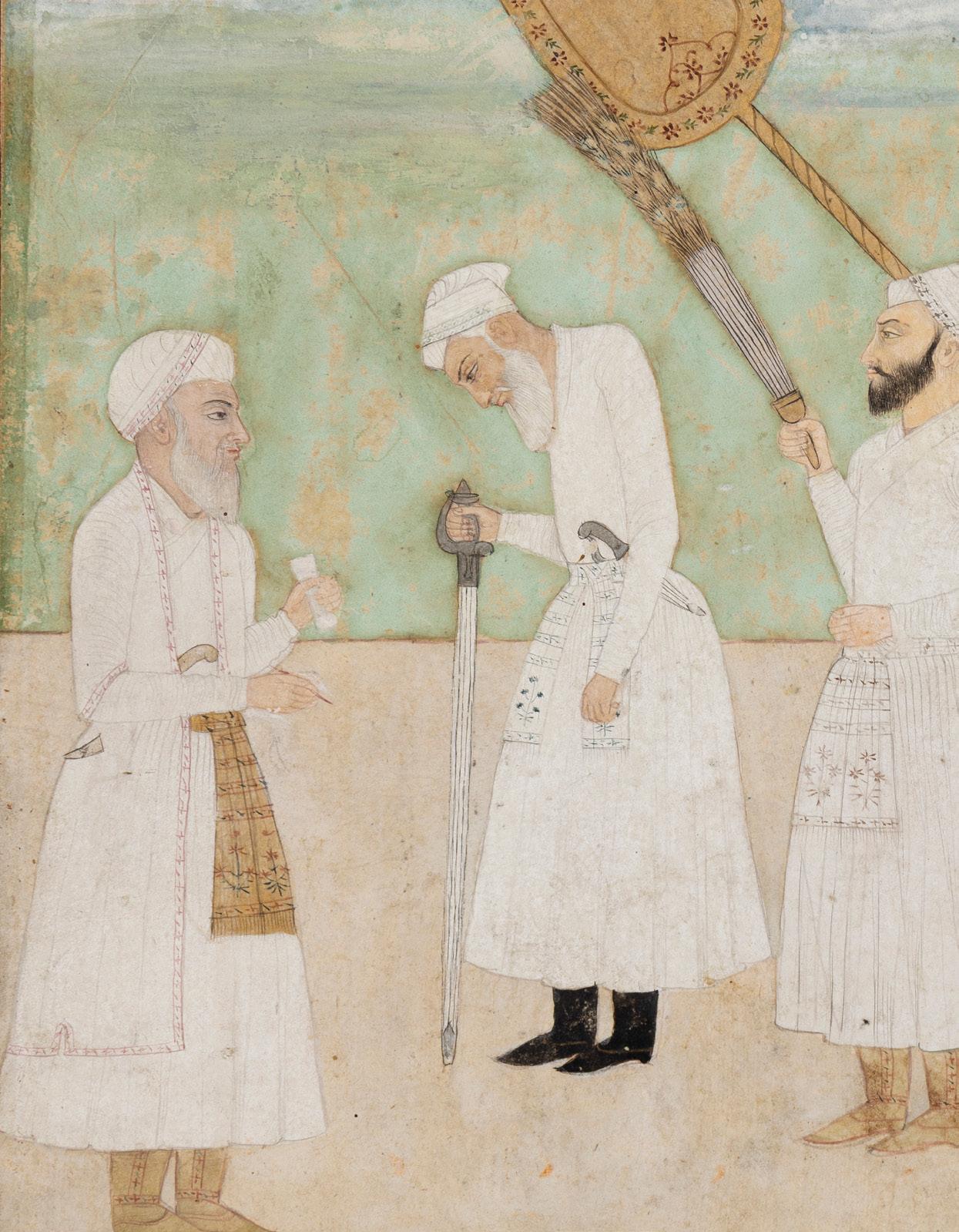
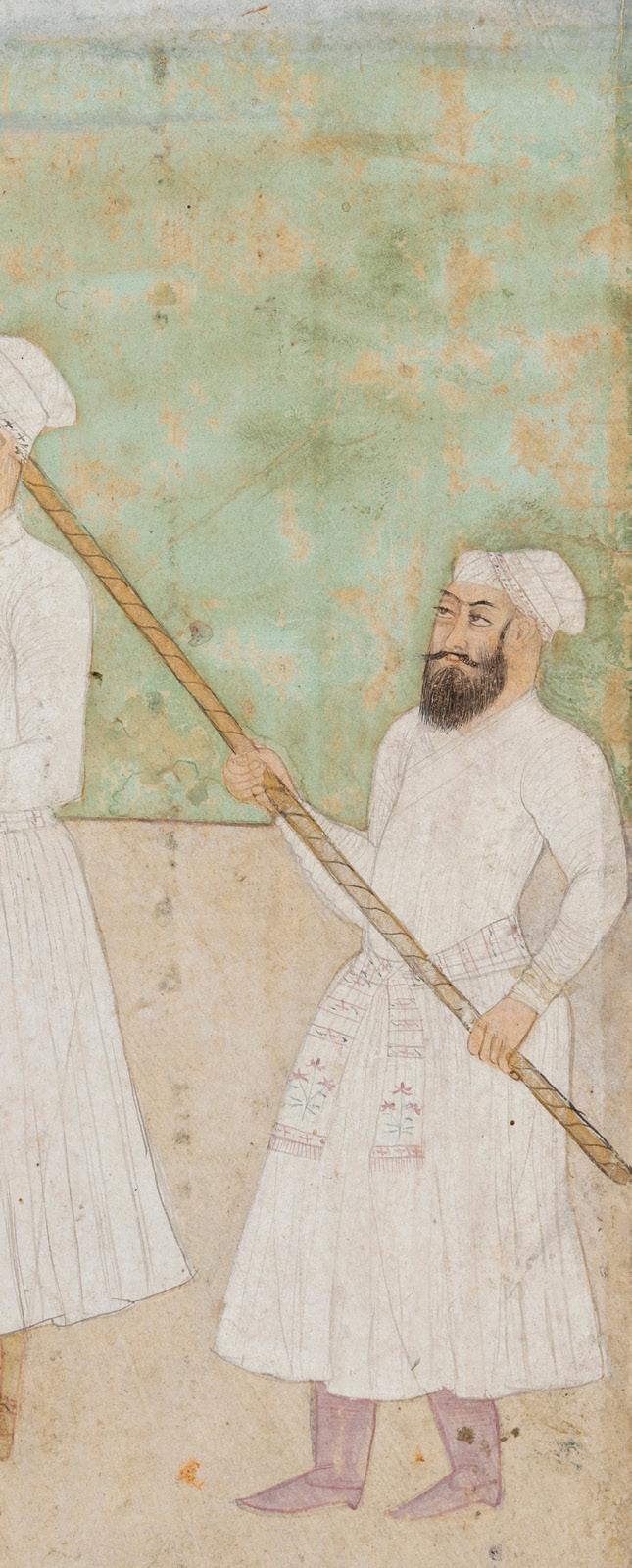
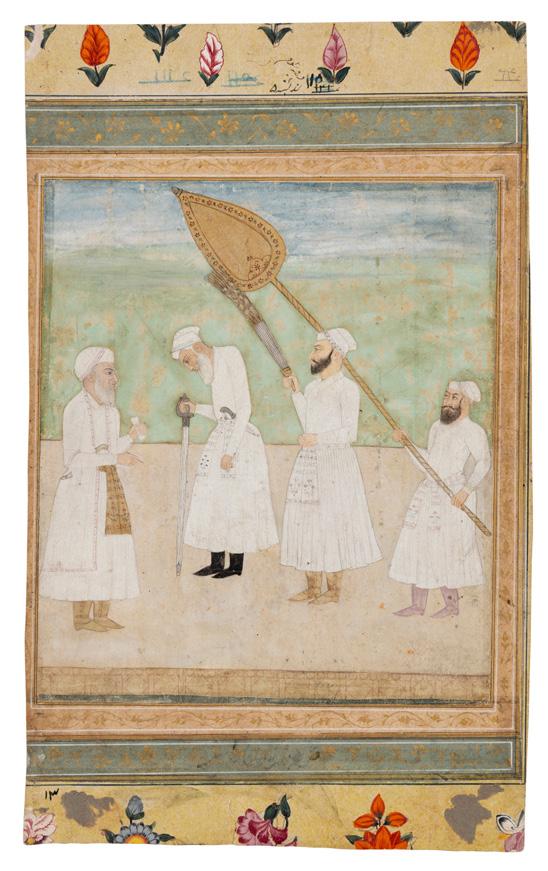
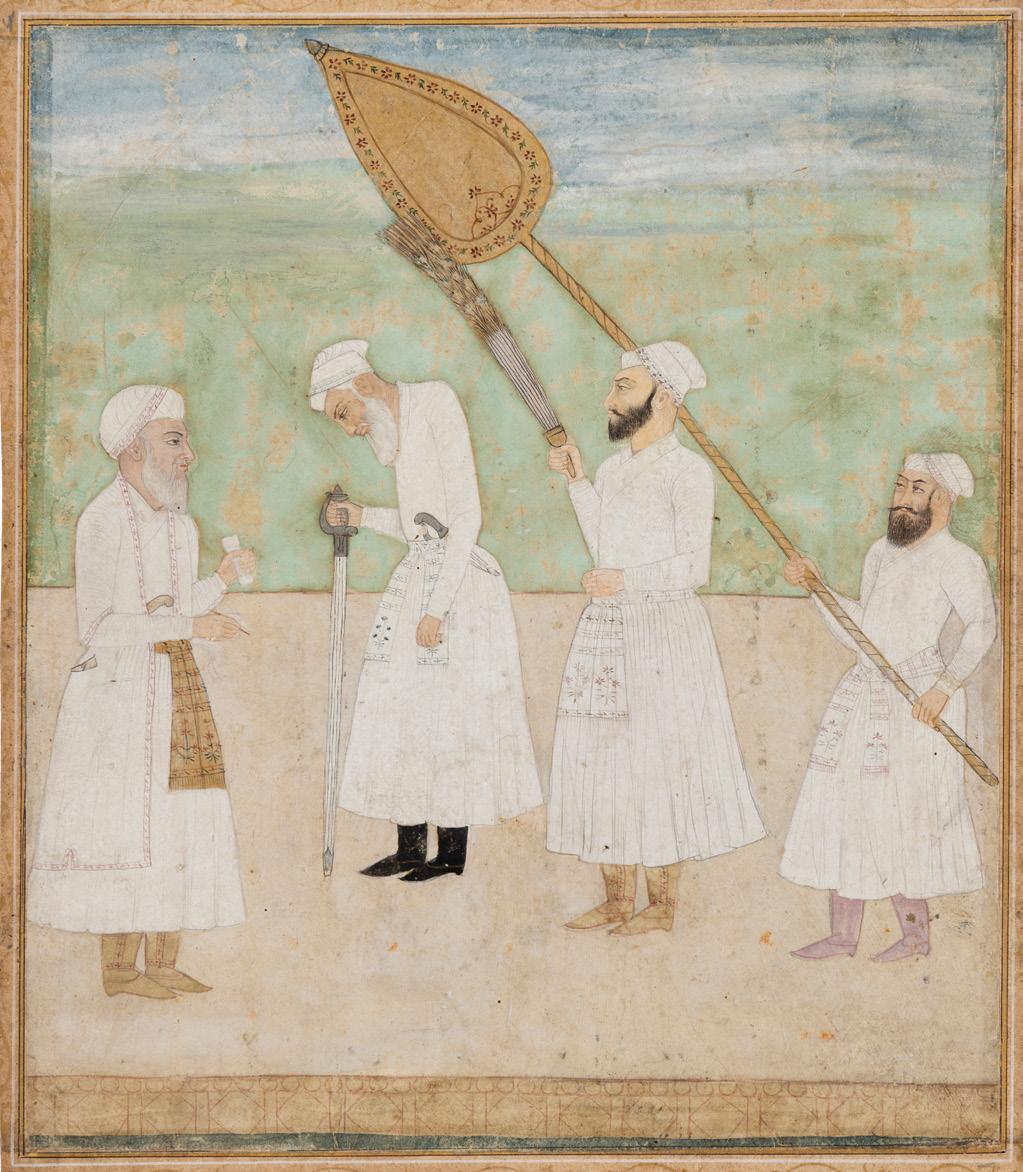
A MUGHAL ALBUM PAGE: THE ELDERLY AURENGZEB WITH COURTIERS
MUGHAL INDIA, CIRCA 1700
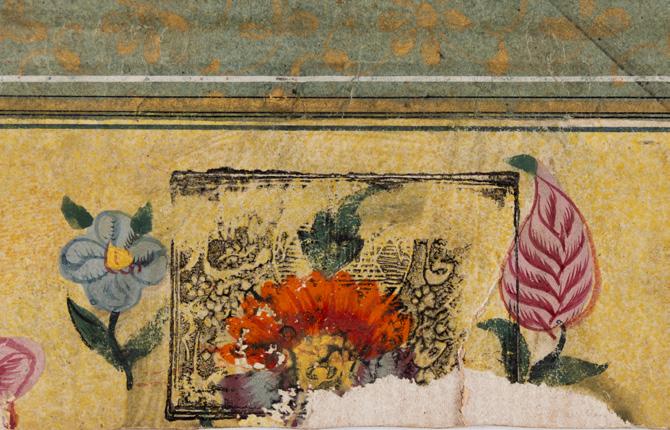
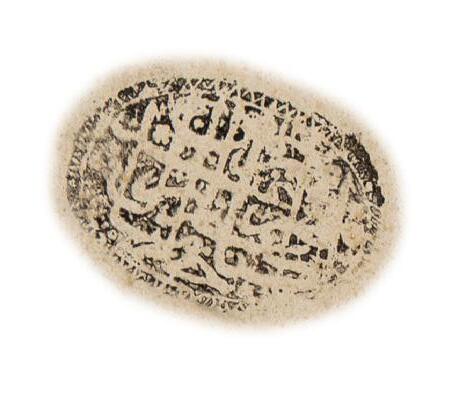
gouache on paper heightened in gold, mounted on to a polychrome floral-decorated album page, depicting an elderly Aurangzeb stooped over his sword, dressed in a white jama with a jade-hilted dagger tucked into his patka, two attendants behind him, one holding a chowrie, and the other holding a royal banner high over his head, a bearded man facing him, possibly his son, Azam Shah, verso with a quatrain in praise of Imam Ali, written in diagonal lines in elegant nasta’liq script in black ink, a visible library seal impression within the panel, of a certain ’Abd al-Rahman, another seal impression in the margin of the album page, possibly dating the latter to circa AH 1208/ AD, mounted, framed and glazed
Album page 31.9cm 19.2cm; image 20.3cm x 17.7cm
£20,000-25,000
This fine portrait of the Mughal emperor Aurangzeb (1618-1707) shows the piety of the ruler in his later years. Aurangzeb is shown standing stooped accompanied by two attendants and a royal courtier with all four figures dressed in white, demonstrating the emperor’s devout Muslim faith and rejection of the world’s luxuries. An accomplished linguist and scholar, he mastered several languages at a young age with a preference for Persian and immersed himself in the knowledge of the Qur’an, following the daily practise of the hadith. Aurangzeb was highly trained in military combat and administration and during his reign, the Mughal empire reached its greatest extent, dominating and stretching across the Indian subcontinent. His obsession with conquering the Deccan and further campaigns led to artists from the Mughal studios being influenced by the Deccani schools but others too in Rajasthan and the Punjab Hills. Although the padshah is depicted as simply attired and nearly defeated by age, this image is not devoid of the imagery of power. His attendants carry the chowrie (flywhisk) and chhatri (parasol) originally derived from Hindu notions of divine kingship, which were later adopted as part of Mughal regalia [Khare, G.H., “Emblems of royalty in art and literature” in Annals of the Bhandarkar Oriental Research Institute, Vol. 58/59 (1977-1978), pp. 683-689]. Aurangzeb himself holds, or rather leans, on a sword of firangi type with a long straight blade and distinctive basket handle. This may symbolise his martial prowess and determination to conquer, as a similar weapon appears alongside him in a contemporary painting in the Victoria & Albert Museum (see below).
The verso carries a Persian quatrain written in nasta’liq, arranged in the chalipa (diagonal) format on a gold-sprinkled and illuminated background. The panel is framed by an inner border with gold floral patterns and an outer border with larger, hand-painted floral motifs. The poem is a devotional quatrain praising the Prophet Muhammad (referred to by his celestial name, Ahmad) and his cousin and son-in-law, Imam Ali (referred to as Haydar, “The Lion”). The author of this specific quatrain has not been identified, but anonymous devotional ruba’iyat are extremely common in the muraqqa calligraphic tradition, where the beauty of the script often mattered more than the fame of the poet. The verso also bears at least two seal impressions. The first, stamped on the upper righthand side of the calligraphic panel, is an oval seal with a background of floral scrollwork. Its shape and style are typical of eighteenthcentury late Mughal or Awadhi (Lucknow) seals. The second, partly effaced by the 18th century border decoration, may belong to an earlier owner.
For comparison and in particular a portrait of Aurangzeb reading from the Qur’an see Falk, T., and Archer, M., Indian Miniatures in the India Office Library, Sotheby Parke Bernet: 1981, pp. 89-90, nos. 138 (i-v). Early 18th century paintings showing the emperor in old age include those in LACMA (inv. no. M.72.88.1), one in the Victoria & Albert Museum (inv. no. CIRC.225A-1922), and another in the British Library (inv. no. Johnson Album 2, no. 2). This exceedingly fine muraqqa page is an important addition to the group and shows the excellence of Mughal painting into the later period of their rule.
Provenance: By repute, the Nawab of Bahawalpur.
Private UK collection.
A MUGHAL JADE-HILTED STEEL SWORD (TALWAR) INDIA, 17TH CENTURY AND LATER
the single-edged slender watered steel blade and gilt-copper cross-guard set with a spinach coloured jade hilt carved with stylised lotus flowers, the cloth covered wood scabbard with finely engraved ensuite gilt chape, lock and suspension bracket
98cm long
£8,000-12,000
Provenance: By repute, formerly, the Nizam of Hyderabad.
A
MUGHAL JADE-HILTED STEEL SWORD (TALWAR)
INDIA, 18TH/ 19TH CENTURY
the single-edged slender water steel blade decorated with a band of elegant Bidri-style decoration forming floral motifs towards the cross-guard, the light green jade hilt finely carved with lotus flowers, the red cloth covered wood scabbard with gilt copper cape, lock and suspension bracket 90cm long
£5,000-7,000
77
A FINE MUGHAL NEPHRITE HILT IN THE FORM OF A RAM’S HEAD
INDIA, 18TH CENTURY
the dark nephrite hilt terminating in a fine and realistically rendered ram’s head with features elegantly carved, the base with symmetrical leaves 12cm long
£5,000-7,000
A MUGHAL BATTLE SCENE
INDIA, RAJASTHAN, 18TH CENTURY
gouache on paper heightened with gold, laid down on card, dark brown border with gold floral decoration within blue, red and black margin rulings, depicting Mughal warriors with swords drawn and shields raised, riding horses protected by elephant shaped armour, the faces of fallen warriors look out from between the horses legs which trample on them
26.6cm x 34.5cm
£3,000-4,000
This fierce battle scene reflects a strong Mughal influence, yet certain facial features attribute the painting to Rajasthan. During the 18th century, Mughal influence greatly shaped the development of Rajasthani painting and artistic traditions. As the Mughal Empire declined, many artists from the imperial courts migrated to the royal courts of Rajasthan, including Jaipur, Udaipur, Bundi, and Kishangarh. These artists brought with them refined techniques of Mughal miniature painting, such as delicate brushwork, realistic portraiture, detailed landscapes, and the use of rich colours. Rajasthani artists blended these Mughal elements with their own traditional styles, which were more vibrant, decorative, and focused on themes from Hindu mythology, folk tales, and royal life. The result was a unique fusion of Mughal elegance and Rajput creativity, visible in court scenes, portraits, hunting scenes, and depictions of Krishna and Radha. This cultural exchange enriched Rajasthani art and helped create some of the most celebrated schools of Indian miniature painting.
A FINE EQUESTRIAN PORTRAIT OF MUGHAL EMPEROR MUHAMMAD AZAM SHAH
INDIA, DECCAN, CIRCA 1700
gouache on paper heightened in gold, inscribed in nasta’liq above left in black ink: “The exalted king, A’zam Shah”, depicting the ruler riding a richly caparisoned and henna’ed palomino stallion rearing and facing to the right, the ruler dressed in a floral and white jama secured with a gold and coloured patka, red boots, a brown turban with a jewelled aigrette, an attendant running alongside carrying a morchal over his shoulder, against a blue background and a line of white cranes flying above, a white crane in the bottom left and right hand corner, poppy and carnation sprays along a green tuft of grass below, mounted, glazed and framed 35.5cm x 24.6cm
£5,000-7,000
Provenance: Formerly, a French collection (illegible handwriting on the back).
Private Spanish collection.
This is a magnificent portrait of Muhammad Azam Shah, quite possibly painted around the time he became the seventh Mughal Emperora post he held for a mere 3 months from 14 March 1707 to 20 June 1707, before he was defeated and killed at the battle of Jajau. Azam Shah was the third and favourite son of Mughal Emperor Aurangzeb (1618-1707) and his chief consort, Dilras Bank Begum. He was a high-ranking Mughal prince who served as a governor before he ruled as the seventh Mughal Emperor upon his father’s death. His father had sent him to the Deccan in 1685 to seize Bijapur which finally fell to the Mughals the following year in 1686. Aurangzeb’s invasion of the Deccan lasted twenty-six years from 1681-1707 and it is at this time, towards the end of the seventeenth century, that Deccani artists were productive and influenced by their counterparts in the Mughal studios. There is also a link between Kishangarh and Bikaner painting during this period as Rajasthani generals serving Aurangzeb’s Mughal army were also in the Deccan commissioning local studios.
For another equestrian portrait of Azam Shah as a younger boy out hawking in the Chester Beatty Library, see L. York Leach, Mughal and other Indian paintings from the Chester Beatty Library, no. 4.36, p. 510, and for another painting with very similar background, see Luminaries, Myths and Fantasy in Indian and Persian Painting, Forge & Lynch, Exhibition Catalogue, London and New York, 2026, no. 10. For comparable portraits of Azam Shah that have sold through auction, see Christie’s, Islamic, 11 April 2000, lot 91, and Arts & Textiles of the Islamic & Indian Worlds including works from the collection of Simon Digby, 7 October 2011, lot 386.
For further discussion and comparisons see: M.C. Beach, The Grand Mogul Imperial Painting in India, 1600-1660, Williamstown, Massachusetts,1978, p. 171, no. 67; T. Falk and M. Archer, Indian Miniatures in the India Office Library, London, 1981, pp. 89-90, no.97, and; M. Zebrowski, Deccani Painting, London, 1983, pp. 209-216 , nos. 183 and 185.
A LATE MUGHAL ILLUSTRATED COPY OF THE AKBARNAMA FROM THE ROYAL LIBRARY OF BAHAWALPUR INDIA, DELHI, 25 MUHARRAM REGNAL YEAR 45 OF SHAL ‘ALAM II/ AD 17TH MAY 1803
comprising the history of Mughal Emperor Akbar reaching as far as his 17th regnal year, Persian manuscript on paper, 213 leaves, 21 lines to the page written in elegant nasta’liq script in black ink within gold, red and blue margins with black rule, blue rule outer margins, important words and punctuation picked out in red, occasional marginal notes in black nasta’liq, 8 miniature paintings in gouache heightened with gold, opening bifolio with gold and polychrome illumination, floral scrolls in the margins and text in cloud bands on gold ground, colophon dated ‘Tuesday 25 Muharram, Regnal year 45 of Shah ‘Alam II’, the inside folio with the stamp of the library of Sultani in Bhawalpur, later leather binding with marbled cover
Folio 32.4cm x 20.3cm
£30,000-35,000
Provenance: The Royal Library of Bahawalpur.
Christie’s, Arts of the Islamic & Indian Worlds, 17 April 2007, lot 168. Private UK collection.
This manuscript is an important example of the late-Mughal book arts and the continuous interest by the Mughal emperors in their predecessors even as their power decreased. It was also previously part of the Kutubkhana-yi Sultani in Bahawalpur (modern Pakistan), a princely library founded and patronised by the nawabs who ruled over the state. The Akbarnama, composed by the Mughal vizier Abu’l Fazl ‘Allami (1551-1602) is the official chronicle of the rule of the third Mughal emperor Akbar (r. 1556-1605). The text is divided into three books, of which this is the first. The first book presents Akbar’s horoscope and the Indian and Greek astrological theories upon which it is based, followed by a history from Adam through the Timurid line to Akbar himself, including a year-by-year description of Akbar’s reign from his accession to the 17th year of his reign, 1572 [see Eaton, R.M., “AKBAR-NĀMA” in Encyclopaedia Iranica, published December 15, 1984: <a href=”https://doi.org/10.1163/2330-4804_EIRO_COM_5004”>https://doi.org/10.1163/23304804_EIRO_COM_5004</a>]. Several illustrated copies of the Akbarnama, all of which are dispersed, survive from the late 16th or early 17th century. These include the ‘First’ Akbarnama which is largely divided between the Golestan Palace and the Victoria & Albert Museum, the ‘Second’ between the British Library and the Chester Beatty Library, and the ‘Third’ between the Khalil Collection Cleveland Museum of Art, and other collections [York Leach, L., “Pages from an Akbarnama” in Crill, R., Stronge, S., and Topsfield, A. (eds.), Arts of Mughal India: studies in honour of Robert Skelton, Mapin Publishing: 2004, pp. 42-55].
The paintings in the present manuscript are bright and jewel-like, showing all the signs of the artistic revival which took place during the 18th century following the death of the austere Aurangzeb (r. 1658-1707). As one scholar has described it, the artists of the Delhi workshops were “increasingly aware of spatial conventions and perspective. By doubling the picture plane and folio size, they could now accommodate elaborate background settings filled with Mughal pavilions, stylized interior views, and luxurious gardens. Additionally, artists used vibrant hues to simulate atmospheric conditions and create a striking contrast against brilliant white architecture” [Roy, M., “The Revival of the Mughal Painting Tradition during the Reign of Muhammad Shah” in Dalrymple, W., and Sharma, Y. (eds.), Princes and Painters in Mughal Delhi, 1707-1857, Asia Society: 2012]. Of particular note are the depiction of Akbar’s charging elephant Lakhna subduing its foe (p. 113), and the beautiful celebrations for the birth of Prince Salim enlivened with vivid lapis highlights on the instruments, carpet, and cups (p. 507).
The colophon of this manuscript places it within the rule of the 17th Mughal emperor Shah ‘Alam II (r. 1759-1806). He ascended the throne at a time of great turmoil and faced repeated attacks from Sikhs, Afghans, Marathas, and his own rebellious officers as well as the British East India Company. In the year that the manuscript was produced the latter captured Delhi and reduced the emperor, who had already been blinded by his enemies 15 years earlier, to a puppet ruler. His misfortunes gave rise to the satirical saying Sultanat-e-Shah Alam, az Dihli ta Palam (‘the Sultanate of Shah ‘Alam extends from Delhi to Palam’, the latter being a suburb of Delhi). It is quite possible that a copy of the text associated with the period of the Mughal Empire’s greatest heights would have reminded Shah ‘Alam II and his court of better times in the face of political decline [for the life and times of this ruler, see Datta, K., Shah Alam II and the East India Company, World Press Private: 1965]. That a fine manuscript such as this could be made at such a time is a testament to the survival of Mughal traditions in the book arts.
The miniature paintings include:
1. Seated Akbar (small image)
2. Akbar enthroned
3. Shah Quli Khan brings Hemu as prisoner before Akbar (p.62)
4. Akbar on the elephant Lakhna subduing another elephant (p.113)
5. Akbar kills a tiger (p. 222)
6. Akbar arranges for the great hunt at the beginning of the 12th year of his reign (p. 416)
7. Ali Quli Khan is trampled by an elephant (p. 433)
8. Celebrations for the birth of Prince Salim (p. 507)
A PORTRAIT OF A MUGHAL COURTESAN WITH A FAN INDIA, FAIZABAD, MID-18TH CENTURY gouache on paper heightened in gold, within decorative blue, gold and red borders, mounted on an album page with green scrolling foliage on a gilt ground, depicting a courtesan richly adorned with jewels holding a fan standing facing left, wearing a transparent robe over gold pantaloons, a floral embroidered sash about her waist and a transparent dopatta draped over her head and shoulders, verso with five diagonal lines in nasta’liq script in black wash within a border of floral lattice design 15cm x 6.9cm; album page 34.5cm x 12cm
£1,500-2,000
82
COURTESAN AT A LINGHAM SHRINE
MUGHAL INDIA, CIRCA 1760
gouache on paper heightened in gold, within gold and blue borders, mounted on an album page with gilt-floral lattice, a bare-breasted maiden richly adorned with jewels worshipping at a shrine, bearing offerings and wearing an orange skirt about her waist, a transparent dopatta over her head and shoulders
15.1cm x 10.7cm., album page 33.2cm x 26.5cm
£2,000-3,000
The subject of this painting closely resembles the ragamala illustration, Bhairavi ragini.
83
TWO NAYIKAS
INDIA, PROVINCIAL MUGHAL, CIRCA 1800
gouache on paper heightened in gold, depicting one nayika in green and orange robes with floral details facing to the right holding a hookah; another nayika in mauve and green robes with floral details facing to the right holding a flower arrangement, both mounted, framed and glazed
Sight size 11.2cm x 7.6cm each
£1,500-2,000
Provenance: Herbert Rieser Gallery, London, 1950s. Formerly, private collection, Yorkshire.
AN ILLUSTRATION TO THE MAHABHARATA
INDIA, DECCAN, MAHARASHTRA, CIRCA 1840
gouache on paper heightened in gold, a ruler with a consort receiving two warriors in a pavilion, a female attendant standing to the right; verso a warrior with his consort firing spears from a chariot towards an army of female warriors
£1,000-1,500
For many decades these types of illustrations to the Mahabharata with their strong primary colours were thought to have been painted at Paithan after the father-in-law of the collector D.G. Kelkar (died circa 1990) received as a payment, eight hundred illustrations to the series from a client living in Paithan, a town in Maharashtra. However, later research shows that the paintings are from Pinguli, a small town, also in Maharashtra, further south on the coast of Goa. Artists from Pinguli are well-known for painting illustrations to the Mahabharata and for puppetry too. For further discussion and comparisons see: A.L. Dallapiccola, South Indian Paintings - A Catalogue of the British Museum Collections, London, 2010, pp. 278-295; Christie’s, The Collection of Paul F. Walter, New York, 28 September, 2017, lot 644; Metropolitan Museum of Art, New York, accession no. 1987.424.12; These rooms, Islamic & Indian featuring paintings from the Collection of Wiliam and Mildred Archer, sale in these rooms, 12 June, 2024, lot 110; Emily Hannam et al, Beyond the Page South Asian Miniatures and Britain, 1600 to now, Milton Keynes Gallery Exhibition Catalogue, London, 2023, no. 68.
A RARE DECCANI BRONZE VASE OR INCENSE BURNER
INDIA, DECCAN, 16TH CENTURY
of bulbous baluster form with openwork neck and slightly flaring mouth, the body engraved and decorated with repeat floral designs, palmettes and trefoil designs, the inside of the rim finely engraved in Persian script with verses from Qur’an chapter 114, al-Nas
19.2cm height; 13.3cm diameter
£5,000-7,000
The shape, decoration, and epigraphy of this elegant vase or incense burner strongly suggest an attribution to the Deccan Sultanates of India during the 16th century. These polities – comprising Ahmednagar, Berar, Bijapur, Bidar, and Golconda – were heavily influenced by Persian and Central Asian culture, and often Shi’a in their religious orientation. They were also fabulously wealthy, with access to raw materials as well as skilled craftsmen.
The exact form of this vessel is not repeated in other known examples. It somewhat resembles a spittoon or incense burner in the Metropolitan Museum of Art (inv. no. 2007.287) in the outline of its lower part, with the splayed foot rising to a rounded knop and then out again to the main body [Haidar, N., and Sardar, M., Sultans of Deccan India 1500–1700: Opulence and Fantasy, The Metropolitan Museum of Art: 2015, pp. 128–29 no. 51]. An incense burner with an openwork arcade at the top as seen here was offered at Sotheby’s and attributed to the 16th century Deccan through comparison with the fretwork seen in the Islamic architecture of southern India [Sotheby’s, Arts of the Islamic World, London, 5 April 2006, lot 151]. The inscriptions around the inside of the rim, meanwhile, are closest to those on a pair of spouted vessels, one in the Metropolitan Museum of Art (inv. no. 2014.689) and another formerly in the Stuart Cary Welch Collection [Haidar and Sardar, op. cit., pp. 266-67 no. 159; Sotheby’s, The Stuart Cary Welch Collection. Part I, Arts of the Islamic World, London, 6 April 2011, lot 141]. This vessel is therefore an important and beautiful addition to the small body of inscribed metal pieces from the pre-Mughal Deccan.
A DECCANI BRONZE OIL CONTAINER
INDIA, DECCAN, 16TH CENTURY
cast in the form of a bird with naturalistic details with extended tail, surmounted by a hoop on the neck, its beak with handle extended to the chest, the wings engraved with floral motifs
13.5cm high
£400-600
Provenance: Private UK collection.
This elegant bronze bird would have been used as an oil container from a lamp. For two very similar oil containers, see M. Zebrowski, Gold, Silver and Bronze from Mughal India, London, 1997, nos. 94 and 95.
87
A METAL-THREAD EMBROIDERED SILK PANEL WITH A PEACOCK EATING A WORM INDIA, 19TH CENTURY
mounted as a screen within a rectangular mahogany standing frame, the red velvet ground embroidered in relief with a proud standing peacock eating a worm with a tree in the background, a floral band below 134cm x 65.4cm
£500-700
A BIDRI SILVER AND BRASS INLAID HAIR FLY-WHISK OR CHAURI
INDIA, DECCAN, BIDAR, LATE 19TH/ EARLY 20TH CENTURY
the tapering baluster-style handle, inlaid with Bidri-style brass and silver ogival patterns comprising flowerhead and serrated leaves, terminating in a faceted bud-shaped pommel rising to an everted lotus pedestal and tall cylindrical neck, topped with a red cotton-lined, metal-embroidered conical pad supporting a large plume of cream and yellow horse or yak hair
handle 24.5cm, overall 71cm long
£1,000-1,500
Provenance: Chiswick Auctions, Islamic & Indian Art, 31st October 2023, Lot 155.
89
AN ENAMEL AND ROSE-CUT DIAMOND-SET
PENDANT
INDIA, 19TH CENTURY
of rectangular form with cusped edges, enamelled in red blue and green with a peacock and set with kundan-style diamonds, verso with a floral spray on a cream ground
3.1cm x 2.2cm
£400-600
Provenance: Acquired in Agra in 1982 (accompanied by an invoice that states it belonged to the family of the Maharaja of Baratphur); private collection, UK.
90
A GOLD DAMASCENED STEEL ‘COBRA’ SWORD
INDIA, DECCAN, 19TH CENTURY
the wide double edged steel blade with two flat grooves curving outwards at top engraved with repeat floral decoration and edged with bands of Persian inscriptions, the hilt and disc pommel decorated with floral lattice designs 85cm long
£600-800
Provenance: Private UK collection.
91
A BRONZE TRIDENT SPEAR OR TRISULA
INDIA OR SOUTHEAST ASIA, 19TH CENTURY
the bronze spear head mounted on to a red lacquered painted pole 201cm long
£300-500
Provenance: Private UK Collection.
A BIDRI SILVER-INLAID SPICE BOX OR PANDAN
INDIA, BIDAR OR DECCAN, 18TH CENTURY
of circular form, the sloping domic lid with bud finial, the body decorated overall with a lattice design composed of trefoil motifs, border with meandering vegetal designs
15cm high, 18.3cm diameter
£1,000-1,500
For a discussion on pandan boxes, see M. Zebrowski, Gold, Silver & Bronze from Mughal India, London 1997, chapter 18 and for similar examples, op. cit, see nos. 452, 453 and 454a and 454b.
A STRIKING BIDRI SILVER INLAID HOOKAH BASE WITH POPPY SPRAYS
INDIA, BIDAR, CIRCA 1700
of bell-shaped form, the main body and spout decorated with elegant poppy sprays, narrow borders with continuous undulating flower heads and interlinking vegetal vines
17cm high
£2,000-3,000
These stylised Hyderabad poppy sprays never cease to appeal. They were frequently depicted in eighteenth century Deccani decorative arts and often used in the foreground gardens of Hyderabad paintings. For a sphericalshaped hookah base sold through these rooms, see Islamic & Indian Art, London, 11 December 2024, lot 53.
AN ELEGANT BRASS SPICE BOX OR PANDAN NORTHERN INDIA, 18TH CENTURY
of circular from, the ribbed body and domed detached lid engraved with continuous vegetal motifs
10cm high, diameter 14cm
£2,000-3,000
This brass container, known as a ‘pandan’, was used to hold leaf packets filled with areca nut (betel nut), lime, and fragrant spices. Such containers frequently appear in Mughal paintings of courtly life and entertainment, where they are depicted in luxurious forms made from precious metals and hardstones like jade and crystal, as well as finely decorated base metals. This particular example was produced in northern India during the 18th century. Crafted from a golden-toned alloy, it takes the form of a circular box with a domed lid. Both the body and the cover are shaped with vertical ribs, which are intricately engraved with scrolling floral designs. For comparable examples, see M. Zebrowski, Gold, Silver & Bronze from Mughal India, London. 1997, p. 272, nos. 466 and 468, and; The Victoria and Albert Museum, accession number 2068&A-1883.
Y
AN ANGLO-INDIAN VIZAGAPATAM IVORY-VENEERED WORK BOX OR TEA CADDY INDIA, EARLY 19TH CENTURY
rectangular box made of sandalwood with hinged lid, veneered in ivory with lac highlights, the body decorated with palm trees and bird scapes, the stepped lid decorated with a central floral frame, the borders with narrow bands of continuous vegetal designs, the interior with four compartments
8cm x 19.4cm x 14.2cm
£800-1,200
Please be aware that this lot contains material which may be subject to import/export restrictions, especially outside the EU, due to CITES regulations. Please note it is the buyer’s sole responsibility to obtain any relevant export or import licence. For more information visit http://www.defra.gov.uk/ahvla-en/imports-exports/cites/
Sold in compliance with UK Government and APHA regulations, with (non-transferable) exemption registration reference ~ RFNR1ADC 96
AN ANGLO-INDIAN CARVED SANDALWOOD WRITING BOX
INDIA, 19TH CENTURY
of rectangular form with sloping hinged lid, the surfaces profusely carved in low relief with birds and animals within a multitude of leaves and vegetal motifs, the interior hollow
9.2cm x 35.2cm x 22.7cm
£500-700
A KASHMIRI STRIPED SHAWL
INDIA, KASHMIR, EARLY 19TH CENTURY
of irregular square form, woven with vertical bands, comprising polychrome floral bands on a saffron yellow and cream ground, separated by blue, red and cream bands of zig-zag vegetal motifs
130cm x 144cm
£1,500-2,000
AN ELEPHANT WITH HIS MAHOUT WRESTLING A TIGER
SOUTH INDIA, PROBABLY MYSORE, CIRCA 1800
the carved wood elephant, mahout and tiger, all lacquered in gilt and polychrome, showing the elephant in movement being attacked by a tiger, on oval stand
26.5cm x 29.2cm x 14cm
£3,000-5,000
Showing the movement within a sculpture of this type is unusual. Most wood elephant sculptures are static. Comparable stylistic elements can be drawn with the semi-automaton lacquered wood, Tippoo’s Tiger, in the Victoria and Albert Museum, made for Tipu Sultan in 1799 (see accession number 2545(IS)).
A LONG YELLOW SHAWL (DOCHALLA) INDIA, KASHMIR, CIRCA 1810
of elongated rectangular form, the saffron yellow pashmina wool ground woven with borders (palla) composed of primarily red and green mosaic boteh reserved in yellow, embroidered merchant’s name in Persian script and circular stamp in one corner
300cm x 132.5cm
£2,000-3,000
For a very similar shawl, see Bonhams, Islamic and Indian Art including Sikh Treasures and Arts of the Punjab, 23 October 2018, lot 210, and Christie’s, An Important Collection of Kashmir Shawls, online sale, 11-18 June 2019, lot 66.
100 NO LOT
101 Y
A GROUP OF PORTRAIT MINIATURES ON IVORY OF MUGHAL EMPERORS
NORTHERN INDIA, DELHI, 19TH CENTURY
gouache on ivory, each finely painted, comprising twenty-three portraits of Mughal Emperors, framed in sets of twelve and eleven, including Akbar, Jehangir, Shah Jahan and Aurangzeb and two portraits of Mumtaz Mahal, on the back of each frame old labels identifying all the emperors portrayed, glazed and framed Frame size: 27.4cm x 34cm; portrait size 4.7cm x 3.7cm
£2,000-3,000
Please be aware that this lot contains material which may be subject to import/export restrictions, especially outside the EU, due to CITES regulations. Please note it is the buyer’s sole responsibility to obtain any relevant export or import licence. For more information visit http://www.defra.gov.uk/ahvla-en/imports-exports/cites/ Sold in compliance with UK Government and APHA regulations, with (non-transferable) exemption registration reference ~ WGZ5S8QJ
102
AN OVAL PORTRAIT OF A LADY STROKING HER DOG INDIA, BENGAL, CALCUTTA, CIRCA 1840
gouache on paper, depicting a mistress with her thick red hair tied up above her head, sitting on a burgundy velvet chair leaning on a green table stroking her dog
10.5cm x 7.5cm
£800-1,000
THE TAJ MAHAL INDIA, COMPANY SCHOOL, 19TH CENTURY
watercolour, pen and ink, set within double black rules, faint pencil notes in the top right hand corner referring to four points on the monument (A,B,C,D) also marked in pencil, a tracing paper fly-leaf
Image; 34cm x 54.6cm Folio; 36.5cm x 57.5cm
£8,000-12,000
Provenance: Christies, Indian, Himalayan, and Southeast Asian works of Art, Including property from the Pal Family collection, 10-24th Sept 2025, lot 655.
104 Y
AN ANGLO-INDIAN VIZAGAPATAM IVORY-VENEERED TEA CADDY
CENTRAL INDIA, CIRCA 1760
rectangular box made of sandalwood with hinged lid, veneered in ivory with lac highlights, depicting a tree of life on the lid, the interior with divided compartments
13.7cm x 22.5cm x 12.5cm
£1,200-1,800
Provenance: Lieutenant-General Sir Eyre Coote, K.B (1726-1783), then; General, Sir Eyre Coote (1762-1823) Nephew, then; Sir Charles Henry Coote, 9th Baronet Coote (1794-1864), then; George Lionel Jameson, O.B.E (1880-1961).
Hamilton & Hamilton Auctioneers, Rahemy park contents, 15th - 16th November, 1961.
Acquired from the above by Honorable Garech Browne (1939--2018), Luggala House. Mealy’s, Luggala, County Wicklow, 2nd May 2006, Lot 171.
Acquired from the above; Private collection, Ireland. Sir Eyre Coote (1726–1783) was a leading British general who helped secure early British rule in India. He fought at Plassey and won the decisive Battle of Wandiwash against the French. Later, as Commander‑in‑Chief in India, he defeated Hyder Ali at Porto Novo. He also served as a Member of Parliament and was made a Knight of the Bath. Coote died in Madras after a long and intense military career.
Tea’s rising popularity in seventeenth- and eighteenth-century England led to the creation of specialised tea‑drinking accessories. Because tea was costly, caddies were made with locks and fitted with separate canisters for black and green tea. The word caddy which replaced tea chest in the late eighteenth century comes from kati, a Malay-Javanese weight of about 625 grams used in the Asian tea trade. Vizagapatam became a major centre for producing these luxury caddies, its artisans catering to the demands of the East India Company.
Literature:
A. Jaffer, Furniture from India & Ceylon, 2001 V&A publications. Furniture decorated in similar manner or illustrated as no. 41 & 42.
Please be aware that this lot contains material which may be subject to import/export restrictions, especially outside the EU, due to CITES regulations. Please note it is the buyer’s sole responsibility to obtain any relevant export or import licence. For more information visit http://www.defra.gov.uk/ahvla en/imports exports/cites/ Sold in compliance with UK Government and APHA regulations, with (non transferable) exemption registration reference.
A FINE ANGLO-INDIAN EBONY PLANTER’S CHAIR
CEYLON, GALLE DISTRICT, 19TH CENTURY
standing on two claw feet to the rear and two hoof feet to the fore with a swirling vegetal design down the front legs, the chair has two long fixed armrests, the armrests, the skirt and top of the chair are finely carved with continuous floral designs, caned seat
93.5cm x 154cm x 67cm
£3,000-4,000
Provenance: Private collection, London.
In India’s intense heat, people often ended the day by propping their feet on whatever was available, footstools, morhas, even tables. By the mid-nineteenth century this habit inspired the creation of the planter’s chair, a low, reclining seat with extended arms designed to support the legs. Its exact origins are unclear, but by the end of the century it’s success had seen it become permanent a fixture of Anglo-Indian homes, prominently placed on verandas and widely recognised as a symbol of colonial comfort.
TWO DESIGNS FOR FURNITURE
INDIA, BENARES, CIRCA 1880
watercolour on paper, one illustrating a luxuriously animal-stylised palanquin, bearing a nagari inscription to the left, the other depicting a blue armchair with gilt details, with two tigers sitting on it
15.9cm x 30.2cm; 31.4cm x 40.2cm
£800-1,200
These two watercolours are from a series of designs for elaborate furniture, interior ornaments and palanquins, each with a strong mixture of Victorian influence incorporated into the Indian and European styles. Grand pieces of furniture with such elaborate designs were ordered by Indian rulers for their palaces in the second half of the nineteenth century, often from the firm Madhu Prasad and Beni Prasad in the Roti Kunwan district, close to Benares as established by J.P. Losty following the examination of a similar watercolour in the James Ivory Collection, bearing watermarks and inscriptions relating to the Prasad furniture makers. Refer to lot 132, formerly from the collection of Stuart Cary Welch, for further examples of furniture and vessel designs from the same series. For further discussion and comparisons see: S.C. Welch, Room for Wonder, Indian Painting during the British Period, 1760-1880, New York, 1978, pp. 150-151, no. 67; R.W. Skelton, The Indian Court Life and Arts under Mughal rule, Victoria and Albert Museum, London, 1982, p. 69, no. 188; J. Guy and D. Swallow, (eds.), Arts of India: 1550-1900, London, 1990, p. 182, no. 157; A.Jaffer, Furniture from British India and Ceylon, London and Salem, 2001, p. 227, fig. 100; A. Jackson and A. Jaffer, Maharaja. The Splendour of India’s Royal Courts, London, 2009, p. 227, and; J.P.Losty, Indian Paintings from the James Ivory Collection, Francesca Galloway Exhibition Catalogue, London, 2010, no. 68, pp. 154-155.
‡
ATTRIBUTED TO THE ARTIST HARKHU: VASAKKASAJJA NAYIKA
INDIA, PUNJAB HILLS, CHAMBA, CIRCA 1820
pencil and watercolour on paper, depicting an impatient mistress holding a mirror and surrounded by four female attendants
18.7cm x 13.6cm
£1,000-1,500
Harkhu, (1765-1850) was the grandson of the celebrated Pahari master Nainsukh (1710- 1778). For further discussions and comparisons of Harkhu’s work see: W.G. Archer, Indian Paintings from the Punjab Hills, London, 1973, Vol. I, pp. 74-78, 87, 89, 90 and 138, Vol. II, pp. 66-67, nos. 50-52; S.C. Welch, Indian Drawings and Painted Sketches, New York, 1976, no. 78, and B.N. Goswamy and E. Fischer, Pahari Masters Court Painters of Northern India, Zurich, 1992.
A BEJEWELLED MAIDEN OR COURTESAN INDIA, JAIPUR, CIRCA 1810-1820
gouache on paper heightened in gold, red and blue border with white margin lines, set within gardens at night time, depicting a bejewelled maiden in orange and dark red robes with gold detailing, the maiden holds a necklace in her left hand and a small floral decoration in her right hand, mounted, glazed and framed sight size 28cm x 19cm
£2,000-3,000
Provenance: Acquired by Robert Henry Wallace Dunlop (1823-1887) and thence by descent. Rosebery’s, Arts of India, 17th June 2020, Lot 165. Private collection, London.
Wallace Dunlop was born in Madras and later served as district officer of Meerut during the 1857 First War of Independence. He recorded his experiences in Service and Adventure with the Khakee Ressalah; or, Meerut Volunteer Horse, during the Mutinies of 1857–58, published in London by Richard Bentley in 1858. He also authored Hunting in the Himalaya in 1860.
AN ILLUSTRATION FROM A RAGAMALA SERIES: DEVAKARI RAGINI INDIA, UTTAR PRADESH, FAIZABAD, CIRCA 1770
gouache on paper heightened by gold, within a red border, depicting a Lingam shrine set in a garden with water, flora and birds to the foreground and trees behind, four bejewelled females worship at the shrine, one is seated inside alongside golden ornaments whilst to the right a second female holds up a floral garland, the other two females both hold their hands together in prayer, both are positioned to the left of shrine, one is standing whilst the other is bent over in prayer on the ground, mounted, glazed and framed
sight size 21cm x 14.2cm
£1,500-2,000
Provenance: Herbert Rieser Gallery, London, 1950s. Formerly, private collection, Yorkshire.
THE ELEPHANT LAKSHMI
INDIA, RAJASTHAN, UDAIPUR, CIRCA 1760
gouache on paper heightened in gold, within a red border with black margin line, the mahout who is dressed in a white robe and orange turban and holding an ankus, rides his elephant through a rural scene with tufts of grass below, the elephant richly adorned in coloured cloths with a golden saddle and bridal wear, inscribed to the top of the red border in black ink: ‘hathani lichhami / maharana sri partap sighji chhota ri var ro’, verso inscribed with the royal Mewar inventory number 13/45, mounted, glazed and framed 20.8cm x 23.8cm
£3,000-5,000
Provenance: Formerly, Mewar Royal collection. Christies, Indian & Islamic Works of Art & Textiles, 8 October 2010, Lot 452.
111
A NAUTCH PERFORMANCE BEFORE A NAWAB IN THE STYLE OF SITA DAS, INDIA, FAIZABAD, CIRCA 1770
gouache on paper heightened by gold, within a red border, the scene depicts a seated Nawab wearing white jama over pink and gold pantaloons, holding a flower wand watching the performance before him, a female attendant standing to the left wearing light blue robes and waving a morchal, to the right five nautch dancers and musicians dressed in brightly coloured robes of green, orange, blue, white and mauve with gold trimming, mounted, glazed and framed 18.5cm x 24.5cm
£4,000-6,000
Provenance: Herbert Rieser Gallery, London, 1950s. Formerly private collection, Yorkshire.
Sital Das, a close contemporary of the artist Bahadur Singh, was active in Oudh during the reign of Nawab Shuja ud-Daula (r. 1754-1775). Lucknow was the accepted centre of power in Oudh but Shuja ud-Daula’s family appointed by the Mughals were often at odds with the local Lucknow dignitaries. Although Faizabad, about 125 kilometres to the east of Lucknow, was rather underdeveloped at the beginning of this period, it soon became an important city with the help of Mughal officers, working under the nawabs, building beautiful and elegant residences and gardens. An ideal setting to develop a school of painting. For further references and comparisons see: S.C. Welch, Room for Wonder Indian Painting during the British Period 1760-1880, HAMSO, London, 1979. no 34; Sotheby’s, Fine Oriental Miniatures, Manuscripts, Qajar Paintings and Lacquer, Sotheby’s, 24 April, 1979, lot 44; T. Falk and M. Archer, Indian Miniatures in the India Office Library, London, 1981, pp. 20 and 136, nos. 251, 252, 290, 291, 351, 352 (vi, ix,xii,xiv,xvii) and 354; Linda York Leach, Mughal and Other Indian Paintings, from the Chester Beatty Library, London, 1995, pp. 617, 660-661, no. 6. 236, and; Exhibition Catalogue, Sanne Grundberg, The Dance and the Divine, The Bengt and Lilavati Hager Collection of Indian, Southeast Asian, Chinese and Japanese Art, June 2015, no. 9.
AN ILLUSTRATION TO THE SAT SAI OF BIHARI: MALE FIGURES BY A FOUNTAIN WITH AN ATTENDANT INDIA, DATIA, CIRCA 1780
gouache on paper heightened with gold on paper, within a dark blue margin with white margin rules, inscribed with two lines of devanagari script in white, illustrating two noblemen in gold turbans, standing side by side next to a fountain wearing transparent jamas over red, blue and gold pantaloons, an attendant dressed in orange and white robes stands behind them, all set in front of a green hillside with trees and shrubs and blue sky, verso with three lines of red and black devanagari, mounted, glazed and framed Folio 22.6cm x 23.9cm
£2,000-3,000
This refined composition portrays two noblemen strolling in close embrace across the marble terrace of a sandstone fountain, their gazes fixed deeply upon one another. The moment carries a subtle sensuality and a quiet sense of romance. An attendant stands to the left, while in the background, gentle hills stretch into the distance, scattered with trees.
The Sat Sai, or “Seven Hundred” couplets (1662) by Bihari Lal, is a Hindi poetic work that explores the many emotional states of lovers, much like Keshav Das’s Rasikapriya (1581). While some verses celebrate Krishna, others depict anonymous lovers, shifting between the divine and the worldly.
According to Stuart Cary Welch and Milo Cleveland Beach, Datia in Bundelkhand - an eastern region of Central India - was granted as a fief in 1626 to Bhagwan Rao, the son of Birsingh Deo. A Ragamala series from the early eighteenth century may have originated there, while inscribed works from the reign of Rao Indrajit reveal a synthesis of Mughal influences and earlier Central Indian traditions. Portraits of Rao Shatrujit - during whose reign the present painting was most likely produced - are published in N. C. Mehta, Studies in Indian Painting (1928).
For other examples of this Sat Sai series, see Stella Kramrisch, Painted Delight: Indian Paintings from Philadelphia Collections, 1986, pp. 102 and 178, no. 95; Stan Czuma, Indian Art from the George P. Bickford Collection, 1975, no. 75, Stuart Carey Welch and Milo Cleveland Beach, Gods, Thrones and Peacocks, 1965, no. 43. For a painting from a closely related, earlier Sat Sai series, dating to circa 1750, see W. G. Archer and Edwin E. Binney, 3rd, Rajput Miniatures from the collection of Edwin Binney, 3rd, 1968, p. 65, no. 50.
AN ILLUSTRATION FROM A RAGAMALA SERIES: KAKHUBA RAGINI
INDIA, RAJASTHAN, KOTAH, CIRCA 1760
gouache on paper heightened in gold, with four lines of black nagari text against a yellow ground above, depicting a barefoot nayika dressed in a blue, orange and gold robe, wearing strings of pearls, holding two floral garlands with three peacocks beside her, all in a vibrant and luscious green arboretum with palm trees, black margin line, red border, verso with cover-leaf, mounted, glazed and framed
40cm x 26.5cm
£4,000-6,000
Provenance: Private UK collection.
This vibrant painting with the different species of exotic trees in the background is typical of Rajasthani painting. A painting from the same series was sold through these rooms, Islamic and Indian Art, 11 June 2025, lot 89.
114
A TANTRIC DRAWING OF HANUMAN
INDIA, 18TH CENTURY
ink and watercolour on paper, depicting the many different faces of Lord Hanuman, holding weapons and items of worship symbolising his role both as a warrior and a devotee, glazed and framed 36.4cm x 27.2cm
£1,500-2,000
Provenance: Formerly, private collection, London, Hanuman is a central Hindu deity celebrated for his strength, devotion, and heroic role in the Ramayana, but he is also a figure whose appearance shifts across traditions, reflecting the many ways people understand him. Sometimes he is shown as a playful monkey-child, sometimes as a powerful warrior with pronounced animal features, and sometimes as a more human-like devotee who opens his chest to reveal Rama and Sita within. These changing faces come from his origins among the vanaras a semi-divine forest people depicted with both human and animal traits and from the diverse cultural, regional, and spiritual meanings he has carried over centuries.
115
AVATAR OF HANUMAN
INDIA, RAJASTHAN, BUNDI, FIRST HALF 19TH CENTURY
ink and watercolour on paper, depicting the many different faces of Lord Hanuman, including Narasimha (man-lion), Garuda (eagle), Hayagriva (horse), Varaha (boar) and Vanara (monkey), Hanuman is depicted armed with various weapons as well as objects of worship symbolising his role both as a warrior and a devotee, mounted, glazed and framed 27.7cm x 19.5cm
£2,000-3,000
Provenance: Formerly, private collection, London, 1960s. For further discussion on Hanuman please refer to the previous lot.
116
A PORTRAIT OF A BEJEWELLED LADY
INDIA, RAJASTHAN, KISHANGARH, CIRCA 1790
pencil and watercolour on paper, with margin line, mounted 14.2cm x 9.5cm
£3,000-5,000
Provenance: Formerly, collection of John and Berthe Ford. R.E. Lewis Gallery, San Francisco.
Sotheby’s New York, 19 September 2008, lot 214.
John Gilmore Ford (1928–2024) and Berthe Ford are renowned, Baltimore-based collectors of South Asian and Chinese art, specifically celebrated for holding one of the world’s most significant private collections of Indian and Himalayan art. They donated over 200 pieces to the Walters Art Museum, which houses the dedicated John and Berthe Ford Gallery.
This work presents an idealised profile portrait of a woman. Rendered with a wet brush and only lightly tinted, it exemplifies the distinctive Kishangarh style, noted for its exceptionally fine brushwork and the elegantly elongated, highly stylised eye. A closely comparable portrait can be found in the Edwin Binney III Collection (see W. G. Archer, Rajput Miniatures from the Collection of Edwin Binney III, Portland, 1968, p. 43, no. 29).
A MAGNIFICENT PALACE TERRACE SCENE
INDIA, RAJASTHAN, UDAIPUR, CIRCA 1735
gouache on paper heightened in gold, depicting Krishna being worshipped at court, the foreground showing a procession of footmen, followed by Horseguards, the horses in rows according to colours, followed by mounted elephants and a horse-drawn chariot, the facade behind them composed of jali windows and open balconies, the two large courtyards covered in luxurious carpets, to the left Krishna with two attendants visited by palace ladies, and to the right the ruler is holding court, further palace facades at the back, luscious arboretum behind the palace walls upper left, mounted, glazed and framed
31.4cm x 26cm
£2,000-3,000
Provenance: Private collection, London.
Although it is difficult to precisely identify the ruler in this painting, it may possibly depict Maharana Jagat Singh II (r. 1734-51) worshipping at a Krishna festival. Unlike his father Maharana Sangram Singh (r. 1710-1734), Jagat Singh II was a weak ruler and as noted by James Tod was ‘addicted to pleasure’. However, like the rest of his family, he was a great patron of the arts and extended the Udaipur palace, spending £250,000 adding to the embellishment of the islets of Lake Pichola. Hindu festivals were a prominent part of court life instituted by Jagat Singh II and again as noted by Tod ‘nine holidays in seven days’ gave plenty of scope for the active school of Mewar painting. For further comparisons and discussion see: J. Tod, Annals and Antiquities of Rajasthan, London, 1920; A. Topsfield, Paintings from Rajasthan in the National Gallery of Victoria, Melbourne, 1980, pp. 12-13, nos. 113 and 114.
NAWAB KHAN DAURAN SEATED AT A WINDOW WITH FOUR OFFICIERS STANDING
INDIA, RAJASTHAN, UDAIPUR, CIRCA 1700
gouache on paper heightened in gold, one line of script in black ink above, the image within a red and yellow border with black margin lines, depicting a scene of an elderly nobleman framed under a shamiana with four noblemen, two on each side, facing towards him, wearing white robes and turbans with gold detailing, the nobleman are stood on a large rectangular Mughal carpet, with a pattern of cartouches filled with floral motifs, in front of the carpet is a low fence also featuring quatrefoil cartouches, mounted, glazed and framed 40.4cm x 25cm
£4,000-6,000
Provenance: Formerly, Mewar royal collection.
On the back on Devanagari: number ‘40’ at the top left; deleted Mewar inventory number ‘nam. 85’, replaced by red Mewar inventory numbers ‘20/82’; and a valuation of ‘Rs. 15’ below. In pencil in English: ‘Udaipur Durbar’ and ‘Nawan Khan Dauran’, these inscriptions were added when a selection of Mughal and other portrait paintings from the Mewar Royal Collection travelled to Delhi for the 1911 Royal Durbar exhibition held at the Delhi Museum of Archaeology.
There was great connection between the Mughal court and Rajput rulers in the seventeenth century as clearly shown in this painting with the Muslim Nawab Khan Dauran at an Udaipur palace window with four courtiers in attendance. Mughal customs and fashions were adopted by the court at Udaipur with Mewar artists influenced by their Mughal counterparts, combining Mughal attention to detail with the warm palettes of Rajasthan. For further discussion see A. Topsfield, Painting from Rajasthan in the National Gallery of Victoria, Melbourne, 1980, p. 9, no. 54
A RULER OF TONK SEATED IN A PALANQUIN IN PROCESSION
INDIA, RAJASTHAN, TONK, CIRCA 1830
pen on paper, depicting the ruler of Tonk seated in a palanquin carried by several bearers on foot, one of which with a pair of hunting dogs, up ahead a close knit group of soldiers carrying their swords, spears and other arms, a riderless horse up ahead, inscribed in nagari above left 19cm x 31.5cm
£500-700
Provenance: Private Spanish collection.
This is an extremely detailed and well-executed drawing. Tonk, a princely state in Rajasthan close to Jaipur, was founded by Nawab Muhammad Amir Khan (1769-1834). It was the only princely state in Rajasthan governed by Muslim Nawabs. For comparable but larger drawings, see Sotheby’s, Howard Hodgkin, Portrait of the Artist, 24 October 2017, lots 94 and 136.
120
FEMALE ACROBATS PERFORMING UP BAMBOO POLES
SOUTH INDIA, TANJORE, 18TH CENTURY
gouache and gold on paper, depicting three men holding up long bamboo sticks with women performing on them, a presenter to the left and a drummer on to the right, against a blue ground, orange border with black ink margin lines, watermarked cover leaf with handwritten note in ink ‘Performances by women upon bamboos 25 or 30 feet in length, & supported by men.’ and series ‘no. 57’, mounted, framed and glazed 43cm x 27.9cm
£3,000-5,000
Provenance: Private collection, London.
The cover leaf is watermarked ‘FIN D’ANGOUMOIS’, referring to a high-quality paper mill in Aungoumois in France, which was active during the 18th century. The paper mill was known to produce paper for export to the British. For another painting from the same series, see Bonhams, Islamic and Indian Art, 19 April 2016, lot 243. For slightly later versions of this style of painting from Tanjore, see A. L, Dallapiccola, South Indian Paintings: a catalogue of the British Museum Collection, no. 14.11, p. 182.
A MINIATURE INDO-PORTUGUESE MOTHER-OF-PEARL DISH
INDIA, GUJARAT, 17TH CENTURY
with rounded sides and narrow flat jagged-edge rim, on a short brass foot ring, composed of mother-of-pearl sections forming a circular panel with radiating panels, brass band below the rim
2.5cm high; 10cm diameter
£4,000-6,000
Provenance: Since the 17th century, Penicuik House, Midlothian, Scotland; acquired from these rooms, 11th December 2024, lot 65.
AN INDO-PORTUGUESE MOTHER-OF-PEARL DISH
INDIA, GUJARAT, EARLY 17TH CENTURY
of shallow rounded form with a narrow flat rim on a short brass foot ring, composed of geometric mother-of-pearl sections forming a flowerhead within a central roundel with an outer band of radiating panels, all sections secured by pins, jagged rim edge, verso with central circular panel and radiating panels, brass band below rim 20cm diameter
£8,000-12,000
For a very similar Indo-Portuguese dish, see Bonhams, Islamic and Indian Art, 14 November 2023, lot 92.
123
A SEATED NOBLEMAN
INDIA, 19TH CENTURY
Chinese export reverse-painted glass picture, made for the Indian market, depicting a seated nobleman in white robes facing to the right holding a sword in one hand and a flower in his other hand, under the chair is a small dog, framed and glazed
Sight size 49.5cm x 34.5cm
£400-500
Provenance: Acquired from Sotheby’s during the late 1960s / early 1970s . Private collection, London.
This painting and the following lot illustrate cross-cultural traditions between China and India. In the 19th century, Chinese artists in India, often brought via the Canton trade, specialised in reverse glass painting and portraits for the Indian elite, merchants, and royalty, notably in Bombay, Satara, Kutch, and Mysore. They created personalised portraits, idealised images of courtesans, and depictions of Indian gods.
124
A NOBLEMAN ON HORSEBACK INDIA, 19TH CENTURY
reverse glass painting depicting a nobleman wearing a Chinese-style crown, green and white robe, on horseback, holding a ceremonial wand in his left hand, against a montainous background, framed and glazed
Sight size 49.7cm x 34.5cm
£400-500
Provenance: Acquired from Sotheby’s during the late 1960s / early 1970s. Private collection, London.
A FINE PICCHAVAI OF SRI NATHJI
INDIA, RAJASTHAN, NATHDWARA, 19TH CENTURY
gouache on cloth with silver and gold highlights, depicting Sri Nathji wearing beaded and pearl necklaces, garlands of flowers and a large peacock-feather headdress, holding the lakut and lotuses in his right hand, backed by a patterned blue background, with the golden pandan box, betel leaves and covered pitcher of holy Jamuna water at his feet, a row of cows bearing auspicious handprints at bottom, all within a floral yellow border, on stretcher
143.5cm x 86.5cm
£1,500-2,000
Provenance: Ex Private Collection, Spain.
FORMERLY FROM THE COLLECTION OF STUART CARY WELCH
LOTS 126-133
AN INJURED VETERAN INDIA, DELHI, CIRCA 1875
after a photograph, gouache on paper, ruled borders in gold, black, blue and red
Page: 28.6cm x 19.6cm
Image: 15.6cm x 11cm
£5,000-7,000
Provenance: Formerly, the Stuart Cary Welch Collection (1928-2008); acquired, Sotheby’s, The Stuart Cary Welch Collection, Part Two, Art of India, 31 May 2011, Lot 140.
Photography came to India in the nineteenth century and the earliest known photographs are from an album of c. 1843. The Photographic Society of Bombay was founded in 1854, only a year after its counterpart in London, and photography quickly replaced painting as a way to record architectural and ethnographical subjects. Officers of the East India Company were well placed to make such recordings and in 1855 students at the East India Company’s military academy at Addiscombe in England were taught the principles of photography.
For further references see : Wild, The East India Company Trade and Conquest from 1600, London, 2000, pp. 116 and 120.
YOUNG WOMAN IN A GREEN SARI
INDIA, RAJASTHAN OR PUNJAB HILLS, 19TH CENTURY
ink and watercolour on paper, a young woman in a green sari, Cary Welch’s handwritten note on the blackboard of the frame reads “Jagdish Mittal thinks that this is from Rajasthan - not from the Punjab hills - probably Bikaner or even Kishangarh - Feb 1 1995” 9.3cm x 10cm
£1,000-2,000
Provenance: Formerly, the Stuart Cary Welch Collection (1928-2008); acquired, Sotheby’s, The Stuart Cary Welch Collection, Part Two, Art of India, 31st May 2011, Lot 142.
The young woman in a green sari is exquisitely painted. This drawing not only highlights the passion and fascination that Stuart Cary Welch had with Indian miniature painting, but also the readiness to discuss the attributions with other great minds within the field.
Fine portraiture has always been a distinctive quality of Indian painting across the centuries. For further examples and discussion see: M.C. Beach and E. Koch, King of the World, The Padshahnama, A Mughal Manuscript from the Royal Library, Windsor Castle, London, 1997; M. Archer and T. Falk, India Revealed The Art and Adventures of James and William Fraser, London, 1989; E. Hannam et al, Beyond the Page South Asian Miniatures and Britain, 1600 to now, Milton Keynes Gallery Exhibition Catalogue, London, 2023; B. Keskiner and M. Keskiner, When Elephants walked with Kings, Kent Antiques exhibition catalogue, London, 2026, no. 50.
TWO PORTRAITS
NORTH INDIA, FIRST HALF 19TH CENTURY
ink and watercolour on paper, including
a) a seated man wearing a green turban, Punjab Hills, Late 19th century, and; b) an old lady of Gwalior, circa 1835
a) 17cm x 13cm; b) 11.5cm x 12.7cm
£2,000-3,000
Provenance: Formerly, the Stuart Cary Welch Collection (1928-2008); acquired, Sotheby’s, The Stuart Cary Welch Collection, Part Two, Art of India, 31st May 2011, Lot 142.
The seated man is exquisitely painted and typically Pahari in style, possibly by a master.
THREE PORTRAIT STUDIES
NORTH INDIA, 19TH CENTURY
ink and watercolour on paper, including a) study of the head of a man, verso with a youth and maiden by a stream, in Bukhara Style, North India, early 20th century; b) a portrait of a Maharaja, verso with a drawing of a baby Baroda, early 20th century, and; c) a portrait study of a nobleman, verso with a river scene
a) 21.1cm x 16.5cm; b) recto. 8.2cm x 7cm, Verso 16cm x 13.5cm; c) 16cm x 13.5cm
£1,500-2,000
Provenance: Formerly, the Stuart Cary Welch Collection (1928-2008); acquired, Sotheby’s, The Stuart Cary Welch Collection, Part Two, Art of India, 31st May 2011, Lot 127.
A PORTRAIT OF A HUNCHBACK
INDIA, KARNATAKA, POSSIBLY SHORAPUR, CIRCA 1840
pen and ink and opaque watercolour on paper, two line inscription in Telgu, on the backboard are several hand written notes by Stuart Cary Welch, including ‘A Hunchback, Twice Blessed by the Goddess [he also shows pock-marks poor fellow], perhaps South Indian, 1st half 19th c., Shorapur? Dr Z Telegu, Shorapur, North Camataka, Meadows Taylor lived there, J. Mittal - 1995 Jan, Somewhere between the Buddha and a roast chicken’ 9.8cm x 11.5cm
£1,500-2,000
Provenance: Formerly, the Stuart Cary Welch Collection (1928-2008), Sotheby’s The Stuart Cary Welch Collection, Part Two, Art of India, 31st May 2011, Lot 126
Linked to this drawing is a note by Cary Welch on the back of the frame, suggesting a possible association with Colonel Meadows Taylor (1808–1876). Taylor—novelist, administrator, and a scholar of Central and Southern India’s history and languages—was appointed by the Nizam of Hyderabad to govern the principality of Shorapur, and was later given a post by the East India Company as Deputy Commissioner of the Deccan’s ceded districts.
Other notes also show a very personal side to Welch, perhaps one of frustration, not quite being able to place something.
MR C.M. CALDECOTT, CIVIL SESSIONS JUDGE AND SON AND DAUGHTER OF SAME INDIA, HUSHANGABAD, 1845
watercolour on paper with photographs, two folios from an album, the first showing the judge in profile seated at a table in contemplation, fountain pen and papers on the table, handwritten notes below the photograph and below right, the other of his son holding a book and his daughter behind 20.8cm x 33.2cm; 20.4cm x 33.3cm
£2,000-3,000
Provenance: Formerly, the Stuart Cary Welch Collection (1928-2008); acquired, Sotheby’s, The Stuart Cary Welch Collection, Part Two, 31 May 2011, Lot 130.
Charles Marriott Caldecott (1807-1881) was a high-ranking British official who joined the East India Company’s civil service in 1826. In March 1927 he married Margaret, only daughter of Mr Thomas Smith, Physician General, Bengal Establishment, by whom he had seven sons and five daughters. By 1845 he had risen through the ranks of magistrate and collector to be appointed the Civil and Sessions Judge in Bareilly, India. He wielded significant legal power over both criminal and civil matters in the North-Western Provinces. After retiring from India, he returned to England and continued his legal service as a Magistrate for Warwickshire, where he was remembered as a highly “able administrator” until his death in 1881. He is perhaps most famous today for his legacy: he was the father of Randolph Caldecott (1846-1881), the legendary Victorian artist for whom the prestigious Caldecott Medal in children’s literature is named. Another son Francis James Caldecott (b. 1842) was a leading cricketer in India.
SIX DESIGNS FOR FURNITURE AND OBJECTS
NORTHERN INDIA, 19TH CENTURY
ink with use of colours on paper, comprising designs for a) stylized bowl, b) one rosewater sprinkler, c) red vase, d) a design of various stellar motifs, possibly for wood or tiles, e) green vase, f) one folio with various designs of furniture palanquins, and lastly f) a design of various stellar motifs, possibly for wood or tiles
a) 16.5cm x 15.5cm; b) 27.2cm x 14cm c) 24cm x 10.5cm d) main design 12.7cm x 13cm, 26cm x 16cm e) 25.1cm x 10.1cm f) 22.6cm x 17cm.
£1,000-1,500
Provenance: Formerly, the Stuart Cary Welch Collection (1928-2008); acquired, Sotheby’s, The Stuart Cary Welch Collection, Part Two, Art of India, 31 May 2011, Lot 135.
A group of design drawings created for and often by Indian craftsmen offers valuable insight into workshop practices across different media. Many survive in institutional collections, including a substantial group at the Victoria and Albert Museum in London, ranging from sword fittings and furniture to Kashmir shawl patterns (Skelton 1982, pp. 68–69, nos. 171–190). Several of the howdah designs feature tigers. While lions commonly symbolised royal authority across India, the tiger is more closely associated with Mysore, suggesting that these drawings may have been produced by craftsmen working at that court.
KRISHNA SUBDUING A KALIYA INDIA, BENGAL, LATE 19TH CENTURY
gouache on grey-brown rough paper, depicting the flute-playing Krishna standing on Kaliya and implored by two of Naga’s wives, within cusped arch with scroling floral decoration in the spandrel, verso with seal and inscription
33.1cm x 27.8cm
£1,200-1,500
Provenance: Formerly, the Stuart Cary Welch Collection (1928-2008); acquired, Sotheby’s, The Stuart Cary Welch Collection, Part Two, Art of India, 31 May 2011, Lot 140.
This enchanting picture portrays Kaliya, the multi-headed serpent demon, who lived with his wives in the river Jumuna where they fouled the waters of a deep pool poisoning the cattle brought by Krishna’s cowherds from Brindaban to drink. Krishna leapt into the waters to destroy the demon but with the intervention of Kaliya’s wives he spared the demon’s life but banished him from the river. The painting is likely to be after a fresco painting.
PROPERTY FROM A PRIVATE COLLECTION, ABERDEENSHIRE, SCOTLAND LOTS 134-139
134
COMPANY SCHOOL: FRANCIS CLIFTON FYERS’ HORSE AND GROOM CIRCLE OF SHAYKH MUHAMMAD AMIR OF KARRAYA, INDIA, PUNE, CIRCA 1838
oil on panel, depicting a groom holding a caparisoned white stallion facing left, calvary officer in the right background, old hand written note on reverse: Francis Clifton Fyers’ horse when he was in the 4th Dragoons in Bombay where he died to our great grief in the end of 1838; (in a separate hand) 2nd son of Major General Thomas Fyers, R.E. my third brother R M Brownrigg, framed 22.6cm x 30.4cm
£5,000-7,000
Provenance: Christie’s, Visions of India, 5 June 1996, lot 146. Private collection, Aberdeenshire.
This striking portrait of a white stallion and its attentive carer immediately conjures up images of a bygone era. Silhouetted against empty plains and a large sky the painting emphasises the muscular features of this magnificent horse and leaves us wondering about the identity of its owner. The golden insignia, dark blue saddle blanket and presence of a lone calvary man cantering into the distance connect this military painting with the 4th (The Queen’s Own) Regiment of (Light) Dragoons. This elite fighting force initially raised in 1685 was trained to fight both on horseback and foot and served in India and Afghanistan between 1822 to 1842.
Horse and Groom shows strong stylistic similarities to the work of Shaykh Muhammad Amir of Karraya, widely acknowledged as ‘by far the most talented and original’ of all Calcutta painters specialising in work for the British (M. Archer, Company Drawings in the India Office Library, HMASO, London, 1972, plates 29 and 30). His distinctive style is easy to recognise: refined portraits of the servants who kept the great Calcutta villas running, and even more accomplished depictions of dogs and horses, often shown as prize animals posed with their grooms against landscaped backgrounds. In many of these pictures he creates distinctive curved shadows which are also evident in Horse and Groom. Shaykh Muhammad Amir’s success enabled him to create a large studio employing many artists to work in his style to satisfy the ever-increasing demand for his work. For further examples see, S.C. Welch, Room for Wonder, Indian Painting during the British Period, New York, 1979, nos. 21-23 and W. Dalrymple (ed.), Forgotten Masters, Indian Painting for the East India Company, London, 2019, pp. 118-130. On the reverse of this picture is an old handwritten note which provides a historical insight: Francis Clifton Fyers’ horse when he was in the 4th Dragoons in Bombay where he died to our great grief in the end of 1838; (in a separate hand) 2nd son of Major General Thomas Fyers, R.E. my third brother R M Brownrigg. Whilst not much is known about Francis Clifton Fyers this intimate portrait of his horse and groom serve as a poignant reminder of a family steeped in military tradition and a unique period of history.
THOMAS DANIELL R.A. (1749-1837) AND WILLIAM DANIELL R.A. (1769-1837)
PART OF THE PALACE OF IN THE FORT OF ALLAHABAD
hand-coloured aquatint, March 1800, glazed and framed
framed 68.5cm x 83.8cm; plate 45.8cm x 59.4cm
£1,000-2,000
Provenance: Acquired from Christies in the 1990s and early 2000s Private collection, Aberdeenshire.
Thomas and William Daniell are arguably the foremost topographical artists produced by Britain. Mastering both oil paint and the delicate aquatint printmaking process. Orphaned at an early age William was adopted by his uncle the renowned landscape painter Thomas Daniell (1749-1840). At the age of fifteen, William accompanied his uncle on a journey to India during which time they executed their first series of aquatints, with the guidance of local Indian craftsmen. This extraordinary journey lasted some eight years, ranging from Calcutta to Delhi and as far as Garhwal in the Himalayas. Upon their return to London Thomas and William began work on the aquatints of Oriental Scenery (1795-1808) which took 13 years to complete and within which this work is featured.
Literature
T. Daniell, Oriental scenery, London 1795[-97], pl.VIII.
136
TWO ENGRAVINGS RELATING TO THE DEFEAT OF TIPU SULTAN, 1793-1799
etching and etching in colour, comprising Joseph Grozer (British 1755-1799) after Henry Singleton (British 1766-1839) The Marquis Cornwallis receiving the hostage princes; and Francesco Bartolozzi (Italian 1727-1815) after Henry Singleton (British 1766-1839) The departure of the sons of Tippoo from the Zenana, 1793), mounted glazed and framed plate 65.4cm x 78.7cm; sight seen: 47cm x 58.8cm
£1,000-1,500
Provenance: Acquired from Christies in the 1990s and early 2000s.
Private collection, Aberdeenshire.
Tipu Sultan (1751-1799) was the Sultan of Mysore between 1782-1799. More commonly known as Sher-e-Mysore or the Tiger of Mysore he was a fierce opponent of the British. He pioneered new weaponry including rocket artillery which was used to repel British during many battles in the Anglo-Mysore wars. During the 3rd Mysore war (1790-1792) LieutenantGeneral Lord Cornwallis, Governor General of India besieged Tipu Sultan in his fortified island capital of Seringapatam. The siege was ended when Tipu Sultan agreed to conceding a large part of his kingdom to the British. Not trusting the Sultan Cornwallis demanded two of Tipu’s sons as hostages to ensure that the terms of treaty were delivered.
Both of these etchings portray the young Princes Abdul Khaliq (aged ten) and Mohin-ud-din (aged eight), leaving their father’s city. Accounts speak of the grandeur of their journey with processions of elephants, camels and standard bearers triumphantly signally their departure. They were received by Cornwallis with a 21-gun salute, and were each presented with a gold watch. In return, the princes presented Cornwallis with a fine Persian sword. In March 1794, on the fulfilment of his promises, the hostages were returned to their father.
C.G LEWIS (BRITISH 1808-1880), AFTER THOMAS JONES BARKER (BRITISH 1813-1882)
THE RELIEF OF LUCKNOW AND TRIUMPHANT MEETING OF HAVELOCK, OUTRAM AND SIR COLIN CAMPBELL, NOVEMBER 1857
mixed method engraving, on india proof paper, early state before title, signed by Barker and Lewis in pencil, published by Thos. Agnew & Sons, Manchester, Liverpool and London, 1862
Framed 106cm x 161cm; image size: 66cm x 124.5cm
£2,000-3,000
Provenance: Christies, The Travel sale, 28th September 2001, Lot 356. Private collection, Aberdeenshire.
This is a rare early engraving signed by both the artist and the engraver, accurately capturing the drama of the original oil painting currently on display at the National Portrait Gallery (NPG 5851). This historically important picture portrays the relief and evacuation of Lucknow where the British Residency had been besieged from May to November 1857. The city was one of the major centres of the Indian rebellion and Independence movement in the North of India.
Major-General Sir James Outram was a key British commander during the 1857 Indian Mutiny who led the first relief of the besieged Lucknow Residency alongside Sir Henry Havelock in September 1857. Whilst Outram outranked Havelock, Outram allowed him to retain command until the end. Outram became trapped himself before finally being relieved by Sir Colin Campbell in November 1857. The picture depicts the triumphant meeting of the three following the siege.
The original version in oils is now in the National Portrait Gallery, London (NPG5851).
TWO PORTRAIT ENGRAVINGS OF NOTABLE BRITISH EMPIRE FIGURES IN INDIA
mezzotint, Thomas Watson (British 1743-1741) after Sir Joshua Reynolds (British 1723-1792) Warren Hastings Esq; Governor General of Bengal, 1777 and Samuel William Reynolds (British 1773-1835) after George Chinnery (British 1774-1852) The Honorable Sir Henry Russel, Bart, mounted, framed and glazed plate: 45.5cm x 32.8cm; plate: 65.5cm x 45.4cm £600-800
Provenance: Acquired from Christies in the 1990s and early 2000s Private collection, Aberdeenshire.
William Hastings joined the British East India Company at the age of 18 setting sail to India in 1750. First employed as a clerk in Calcutta he quickly impressed through the quality of his work and language ability. Hastings was quickly promoted working for William Watt (1722-1764) and later Robert Clive of India (1725-1774) where he built his experience of East India politics. Appointed Governor and then Governor General of Bengal Hastings implemented sweeping reforms, including currency unification, law codification and tax reforms. Hastings had a deep respect for the land he had lived in since his teens and by the time he became Governor General he not only spoke Bengali and Urdu but also fluent court and literary Persian.
Sir Henry Russell was called to the bar on 7th July 1783 and following a successful career was appointed a Pusine Judge in the supreme court of Bengal in 1797. After nearly 10 years in India Russell was appointed Chief Justice of the Supreme court of Bengal in 1807. In 1808 he presided over a landmark case in which a company cadet was found guilty of maliciously setting fire to an Indian hut. In passing sentence Russell defended the right of Indians to have their property and lives protected.
EMILY EDEN (1797-1869)
PORTRAITS OF THE PRINCES AND PEOPLE OF INDIA
Taken during the Years 1838, 39, 40, 41.
London: J. Dickinson and Son, 1844.
4 original parts as issued, folio (53 x 36.8cm), original cloth-backed printed wrappers (with imprints dated 1843), tinted lithographic vignette titlepage, lithographic list of plates, 24 tinted lithographic plates, each plate with tissue-guard and leaf of descriptive text, publisher’s advertisement leaf, publisher’s notice slip (‘Messers Dickinson have prepared a suitable Binding …’) tipped to tissue guard itself tipped to inside front cover of part 4, gutta percha perished and all leaves loose in wrappers, wrappers marked and finger-soiled tissue-guards variably spotted and with a few marginal chips, part 3 backstrip chipped at foot, text-leaf for plate 13 with repaired closed tears to inner margin [not in Abbey Travel].
52.6cm x 36.8cm
£6,000-8,000
Provenance: Acquired from Christies in the 1990s and early 2000s.
Private collection, Aberdeenshire.
First edition of this important pictorial survey of the Sikh rulers of the Punjab and assorted other characters from Indian life. The artist was the sister of Lord Auckland, governor-general of India from 1836 to 1842. No other copy in the original wrappers traced at auction for over 50 years.
141
THOMAS DANIELL R.A. (1749-1840) AND WILLIAM DANIELL R.A. (1769-1837)
GATE LEADING TO A MUSJED AT CHUNAR GHUR hand-coloured aquatint, glazed and framed
Plate 48.5cm x 65cm
£1,000-1,500
Provenance: Private collection, London.
Literature
From Oriental Scenery [Abbey, Travel, no. XXIV].
140
THOMAS DANIELL R.A. (1749-1840) AND WILLIAM DANIELL R.A. (1769-1837)
VIEW OF MUTURA ON THE RIVER JUMNA hand-coloured aquatint, glazed and framed sight seen 49.3cm x 64.2cm
£1,000-1,500
Provenance: Private collection, London. Thomas and William Daniell are arguably the foremost topographical artists produced by Britain. Mastering both oil paint and the delicate aquatint printmaking process. Orphaned at an early age William was adopted by his uncle the renowned landscape painter Thomas Daniell (1749-1840). At the age of fifteen, William accompanied his uncle on a journey to India during which time they executed their first series of aquatints, with the guidance of local Indian craftsmen. This extraordinary journey lasted some eight years, ranging from Calcutta to Delhi and as far as Garhwal in the Himalayas. Upon their return to London Thomas and William began work on the aquatints of Oriental Scenery (1795-1808) which took 13 years to complete and within which this work is featured.
Literature
From Oriental Scenery [Abbey, Travel, no. XXII].
142
THOMAS DANIELL R.A. (1749-1840) AND WILLIAM DANIELL R.A. (1769-1837)
AN ANCIENT HINDOO TEMPLE, IN THE FORT OF ROTAS, BAHAR
hand-coloured aquatint, glazed and framed Plate 49cm x 64.3cm
£1,000-1,500
Provenance: Private collection, London.
Literature
From Oriental Scenery [Abbey, Travel, no. XI].
143
DAVID ROBERTS, R.A. (1796-1864)
THEBES: THE COLLOSSAL STATUES OF AMUNOPH III, GENERAL VIEW OF ESOUAN AND THE ISLAND OF ELEPHANTINE, THE GREAT SPHINX, PYRAMIDS OF GIZEH
tinted lithograph, mounted glazed and framed
Largest 34cm x 53cm
£300-500
Provenance: Private Collection, London. Literature
Egypt & Nubia, from drawings made on the spot by David Roberts, R.A., with historical descriptions by William Brockedon.... London: F.G. Moon, 1846-1849.
SAMUEL BOURNE (BRITISH 1834-1912)
SIX CITY VIEWS IN INDIA
six albumen prints, on three album pages (double sided) two signed within the print, one captioned within the print, all captioned in ink and number in pencil outside the image
Folio 29cm x 39.5cm (Double sided)
£1,000-1,500
Plate titles
A) Palaces at Lucknow; verso The Massacre Ghat, Cawnpore
B) Bathing in the Hooghly, Calcutta; verso Banian tree, Botanical Gardens, Calcutta
C) The Old Court House Street, Calcutta; verso Government House, Calcutta, (some years ago)
Samuel Bourne (1834–1912) was a British photographer whose work in India in the 1860s made him one of the leading landscape and architectural photographers of the 19th century. After arriving in India in 1863, he produced more than two thousand images, including three ambitious Himalayan expeditions that demonstrated exceptional technical skill with the wet-plate process. His clear, carefully composed photographs helped shape Victorian views of the Indian subcontinent. Together with Charles Shepherd (1858-1878), Bourne founded Bourne & Shepherd Studios one of the world’s longest-running photographic firms. Known for portraits, topographical views, and ethnographic studies, the studio earned a reputation for technical excellence and wide distribution. It continued to operate under the Bourne name long after he died, issuing prints well into the 20th century, and remained a major photographic institution until its closure in 2016.
A DANCE CELEBRATION WITHIN A PALACE
INDIA, RAJASTHAN, BUNDI, 20TH CENTURY
gouache on paper heightened in gold, black margin lines, gold and red border, depicting a lavish palace setting with a bejewelled female dancer with flowing robes performing in front of the Maharaja, the later is surrounded by his courtiers with nautch dancers to the side, behind the dancer plays a small orchestra, on the black and white terrace below admirers have congregated to enjoy the performance, mounted, glazed and framed Sight size 46.3cm x 61cm
£5,000-7,000
Provenance: Formerly, the estate of an English gentleman, Nantes, France.
THE JAGANNATH SHRINE
INDIA, BENGAL, CALCUTTA, CIRCA 1900-1920
gouache on paper heightened in gold, depicted within a red border, worshippers surround the shrine from all sides waving their arms in celebration, ornately displayed in red and green with Jagannath depicted at the centre, the shrine has two ropes attached at the front perhaps indicating its involvement in a procession or festival, glazed and framed
Sight size: 41cm x 28.5cm
£1,500-2,000
147
A KALIGHAT PAINTING OF HANUMAN
INDIA, BENGAL, CALCUTTA, 1900-1920
gouache on paper, red border with white margin lines, Hanuman is depicted in the guise of a monkey in running motion holding palms of vegetation in his arms and in his tail, mounted, glazed and framed
29.3cm x 20.5cm
£1,200-1,500
148
A KALIGHAT PAINTING OF A CAT
INDIA, BENGAL, CALCUTTA, CIRCA 1900-1920
gouache on paper, depicting a black and white cat standing next to a small bowl on a pink background, glazed and framed
Sight size 40.8cm x 28.5cm
£700-900
CONDITIONS OF SALE 26.1
FOR BUYERS (UK)
These Conditions of Sale and the Saleroom Notices as well as specific Catalogue terms, set out the terms on which we offer the Lots listed in this Catalogue for sale. By registering to bid and/or by bidding at auction You agree to these terms, we recommend that You read them carefully before doing so. You will find a list of definitions and a glossary at the end providing explanations for the meanings of the words and expressions used.
Special terms may be used in Catalogue descriptions of particular classes of items (Books, Jewellery, Paintings, Guns, Firearms, etc.) in which case the descriptions must be interpreted in accordance with any glossary appearing in the Catalogue. These notices and terms will also form part of our terms and conditions of sales.
In these Conditions the words “Us”, “Our”, “We” etc. refers to Lyon & Turnbull Ltd, the singular includes the plural and vice versa as appropriate. “You”, “Your” means the Buyer.
Lyon & Turnbull Ltd. acts as agent for the Seller. Lyon & Turnbull Ltd. acts as agent for the Seller. On occasion where Lyon & Turnbull Ltd. own a lot in part or full the property will be identified in the catalogue with the symbol (��) next to its lot number.
A. BEFORE THE SALE
A1. DESCRIPTIONS OF LOTS
Whilst we seek to describe Lots accurately, it may be impractical for us to carry out exhaustive due diligence on each Lot. Prospective Buyers are given ample opportunities to view and inspect before any sale and they (and any independent experts on their behalf) must satisfy themselves as to the accuracy of any description applied to a Lot. Prospective Buyers also bid on the understanding that, inevitably, representations or statements by us as to authorship, genuineness, origin, date, age, provenance, condition or Estimated selling price involve matters of opinion. We undertake that any such opinion shall be honestly and reasonably held and only accept liability for opinions given negligently or fraudulently. Subject to the foregoing neither we the Auctioneer or our employees or agents accept liability for the correctness of such opinions and no warranties, whether relating to description, condition or quality of Lots, express, implied or statutory, are given. Please note that photographs/images provided may not be fully representative of the condition of the Lot and should not be relied upon as indicative of the overall condition of the Lot. All dimensions and weights are approximate only.
A2. OUR RESPONSIBILITY FOR OUR DESCRIPTION OF LOTS
We do not provide any guarantee in relation to the nature of a Lot apart from our authenticity warranty contained in paragraph E.2 and to the extent provided below.
(a) Condition Reports: Condition Reports are provided on our Website or upon request. The absence of a report does not imply that a Lot is without imperfections. Large numbers of such requests are received shortly before each sale and department specialists and administration will endeavour to respond to all requests although we offer no guarantee. Any statement in relation to the Lot is merely an expression of opinion of the Seller or us and should not be relied upon as an inducement to bid on the Lot. Lots are available for inspection prior to the sale and You are strongly advised to examine any Lot in which You are interested prior to the sale. Our Condition Reports are not prepared by professional conservators, restorers or engineers. Our Condition Report does not form any contract between us and the Buyer. The Condition Reports do not affect the Buyer’s obligations in any way.
(b) Estimates: Estimates are placed on each Lot to help Buyers gauge the sums involved for the purchase of a particular Lot. Estimates do not include the Buyer’s Premium or VAT. Estimates are a matter of opinion and prepared in advance. Estimates may be subject to change and are for guidance only and should not be relied upon.
(c) Catalogue Alterations: Lot descriptions and Estimates are prepared in advance of the sale and may be subject to change. Any alterations will be announced on the Catalogue alteration sheet, made available prior to the sale. It is the responsibility of the Buyer to make themselves aware to any alterations which may have occurred.
A3. WITHDRAWAL
Lyon & Turnbull may, at its discretion, withdraw any Lot at any time prior to or during the sale of the Lot. Lyon & Turnbull has no liability to You for any decision to withdraw.
A4. JEWELLERY, CLOCKS & OTHER ITEMS
(a) Jewellery:
(i) Coloured gemstones (such as rubies, sapphires and emeralds) may have been treated to enhance their look, through methods such as heating and oiling. These methods are accepted practice but may make the gemstone less strong and/or require special care in future.
(ii) All types of gemstones may have been improved by some method. You may request a gemmological report for any Lot which does not have a report if the request is made to us at least three weeks before the date of the sale and You pay the fee for the report in advance of receiving said report.
(iii) We do not obtain a gemmological report for every gemstone sold in our sales. Where we do get gemmological reports from internationally accepted gemmological laboratories, such reports may be described in the Sale Particulars. Reports will describe any improvement or treatment only if we request that they do so, but will confirm when no improvement or treatment has been made. Because of differences in approach and technology, laboratories may not agree whether a particular gemstone has been treated, the amount of treatment or whether treatment is permanent. The gemmological laboratories will only report on the improvements or treatments known to the laboratories at the date of the report.
(iv) For jewellery sales, all Estimates are based on the information in any gemmological report or, if no gemmological report is available, You should assume that the gemstones may have been treated or enhanced.
(b) Clocks & Watches: All Lots are sold “as seen”, and the absence of any reference to the condition of a clock or watch does not imply the Lot is in good condition and without defects, repairs or restorations. Most clocks and watches will have been repaired during their normal lifetime and may now incorporate additional/newer parts. Furthermore, we make no representation or warranty that any clock or watch is in working order. As clocks and watches often contain fine and complex mechanisms, Buyers should be aware that a general service, change of battery or further repair work, for which the Buyer is solely responsible, may be necessary. Buyers should also be aware that we cannot guarantee a watch will remain waterproof if the back is removed. Buyers should be aware that the importing watches such as Rolex, Frank Muller and Corum into the United States is highly restricted. These watches cannot be shipped to the USA and only imported personally. Clocks may be sold without pendulums, weights or keys.
(c) Alcohol: may only be sold to persons aged of 18 years and over. By registering to bid, You affirm that You are at least that age. All collections must be signed for by a person over the age of 18. We Reserve the right to ask for ID from the person collecting. Buyers of alcohol must make appropriate allowances for natural variations of ullages, conditions of corks and wine. We can provide no guarantees as to how the alcohol may have been stored. There is always a risk of cork failure and allowance by the Buyer must be made. Alcohol is sold “as is” and quality of the alcohol is entirely at the risk of the Buyer and no warranties are given.
(d) Books-Collation: If on collation any named item in the sale Catalogue proves defective, in text or illustration the Buyer may reject the Lot provided he returns it within 21 days of the sale stating the defect in writing. This, however, shall not apply in the case of unnamed items, periodicals, autographed letters, music
M.M.S., maps, drawings nor in respect of damage to bindings, stains, foxing, marginal worm holes or other defects not affecting the completeness of the text nor in respect of Defects mentioned in the Catalogue, or at the time of sale, nor in respect of Lots sold for less than £300.
(e) Electrical Goods: are sold as “works of art” only and if bought for use must be checked over for compliance with safety regulations by a qualified electrician first. Use of such goods is entirely at the risk of the Buyer and no warranties as to safety of the goods are given.
(f) Upholstered items: are sold as “works of art” only and if bought for use must be checked over for compliance with safety regulations (items manufactured prior to 1950 are exempt from any regulations). Use of such goods is entirely at the risk of the Buyer and no warranties as to safety of the goods are given. We provide no guarantee as to the originality of any wood/material contained within the item.
B. REGISTERING TO BID
B1.
NEW BIDDERS
(a) If this is Your first time bidding at Lyon & Turnbull or You are a returning Bidder who has not bought anything from us within the last two years You must register at least 48 hours before an auction to give us enough time to process and approve Your registration. We may, at our discretion, decline to permit You to register as a Bidder. You will be asked for the following:
(i) Individuals: Photo identification (driving licence, national identity card or passport) and, if not shown on the ID document, proof of Your current address (for example, a current utility bill or bank statement)
(ii) Corporate clients: Your Certificate of Incorporation or equivalent document (s) showing Your name and registered address together with documentary proof of directors and beneficial owners, and;
(iii) Trusts, partnerships, offshore companies and other business structures please contact us directly in advance to discuss requirements.
(b) We may also ask You to provide a financial reference and/or a deposit to allow You to bid. For help, please contact our Finance Department on +44 (0)131 557 8844.
B2.
RETURNING BIDDERS
We may at our discretion ask You for current identification as described in paragraph B.1. (a) above, a finance reference or a deposit as a condition of allowing You to bid. If You have not bought anything from us in the last two years, or if You want to spend more than on previous occasions, please contact our Finance Department on +44 (0)131 557 8844.
B3.
FAILURE TO PROVIDE THE RIGHT DOCUMENTS
If in our opinion You do not satisfy our Bidder identification and registration procedures including, but not limited to, completing any anti-money laundering and/or anti-terrorism financing checks we may require to our satisfaction, we may refuse to register You to bid, and if You make a successful bid, we may cancel the contract between You and the Seller.
B4. BIDDING ON BEHALF OF ANOTHER PERSON
(a) As an authorised Bidder: If You are bidding on behalf of another person, that person will need to complete the registration requirements above before You can bid, and supply a signed letter authorising You to bid for him/her.
(b) As agent for an undisclosed principal: If You are bidding as an agent for an undisclosed principle (the ultimate Buyer (s)) You accept personal liability to pay the Purchase Price and all other sums due, unless it has been agreed in writing with us before commencement of the auction that the Bidder is acting as an agent on behalf of a named third party acceptable to us and we will seek payment from the named third party.
B5. BIDDING IN PERSON
If You wish to bid in the saleroom You must register for a numbered bidding paddle before You begin bidding. Please ensure You bring photo identification with You to allow us to verify Your registration.
B6. BIDDING SERVICES
The bidding services described below are a free service offered as a convenience to our clients and we are not responsible for any error (human or otherwise), omission or breakdown in providing these services.
(a) Phone bids
Your request for this service must be made no later than 12 hours prior to the auction. We will accept bids by telephone for Lots only if our staff are available to take the bids. If You need to bid in a language other than English You should arrange this Well before the auction. We do not accept liability for failure to do so or for errors and omissions in connections.
(b) Internet Bids
For certain auctions we will accept bids over the internet. For more information please visit our Website. We will use reasonable efforts to carry out online bids and do not accept liability for equipment failure, inability to access the internet or software malfunctions related to execution of online bids/ live bidding.
(c) Written Bids
While prospective Buyers are strongly advised to attend the auction and are always responsible for any decision to bid for a particular Lot and shall be assumed to have carefully inspected and satisfied themselves as to its condition we shall, if so instructed,
clearly and in writing execute bids on their behalf. Neither the Auctioneer nor our employees nor agents shall be responsible for any failure to do so. Where two or more commission bids at the same level are recorded we Reserve the right in our absolute discretion to prefer the first bid so made. Bids must be expressed in the currency of the saleroom. The Auctioneer will take reasonable steps to carry out written bids at the lowest possible price, taking into account the Reserve. If You make a written bid on a Lot which does not have a Reserve and there is no higher bid than Yours, we will bid on Your behalf at around 50% of the lower Estimate or, if lower, the amount of Your bid.
C. DURING THE SALE
C1. ADMISSION TO OUR AUCTIONS
We shall have the right at our discretion, to refuse admission to our premises or attendance at our auctions by any person. We may refuse admission at any time before, during or after the auction.
C2. RESERVES
Unless indicated by an insert symbol (∆), all Lots in this Catalogue are offered subject to a Reserve. A Reserve is the confidential Hammer Price established between us and the Seller. The Reserve is generally set at a percentage of the low Estimate and will not exceed the low Estimate for the Lot.
C3. AUCTIONEER’S DISCRETION
The maker of the highest bid accepted by the Auctioneer conducting the sale shall be the Buyer and any dispute shall be settled at the Auctioneer’s absolute discretion. The Auctioneer may move the bidding backwards of forwards in any way he or she may decide or change the order of the Lots. The Auctioneer may also; refuse any bid, withdraw any Lot, divide any Lot or combine any two or more Lots, reopen or continuing bidding even after the hammer has fallen.
C4. BIDDING
The Auctioneer accepts bids from:
(a) Bidders in the saleroom; (b) Telephone Bidders, and internet Bidders through Lyon & Turnbull Live or any other online bidding platform we have chosen to list on and; (c) Written bids (also known as absentee bids or commission bids) left with us by a Bidder before the auction.
C5. BIDDING INCREMENTS
Bidding increments shall be at the Auctioneer’s sole discretion.
C6. CURRENCY CONVERTER
The saleroom video screens and bidding platforms may show bids in some other major currencies as Well as sterling. Any conversion is for guidance only and we cannot be bound be any rate of exchange used. We are not responsible for any error (human or otherwise) omission or breakdown in providing these services.
C7.
SUCCESSFUL BIDS
Unless the Auctioneer decides to use their discretion as set out above, when the Auctioneer’s hammer falls, we have accepted the last bid. This means a contract for sale has been formed between the Seller and the successful Bidder. We will issue an invoice only to the registered Bidder who made the successful bid. While we send out invoices by post/or email after the auction, we do not accept responsibility for telling You whether or not Your bid was successful. If You have bid by written bid, You should contact us by telephone or in person as soon as possible after the auction to get details of the outcome of our bid to avoid having to pay unnecessary storage charges.
C8. RELEVANT LEGISLATION
You agree that when bidding in any of our sales that You will strictly comply with all relevant legislation including local laws and regulations in force at the time of the sale for the relevant saleroom location.
D.
THE BUYER’S PREMIUM, TAXES AND ARTIST’S RESALE ROYALTY
D1. THE PURCHASE PRICE
For each Lot purchased a Buyer’s Premium of 27% of the Hammer Price of each Lot up to and including £20,000, plus 26% from £20,001 to £800,000, plus 20% from £800,001 thereafter. VAT at the appropriate rate is charged on the Buyer’s Premium. No VAT is payable on the Hammer Price or premium for printed books or unframed maps bought at auction. Live online bidding may be subject to an additional premium (level dependent on the live bidding service provider chosen). This additional premium is subject to VAT at the appropriate rate as above.
D2. VALUE ADDED TAX
Value Added Tax is charged at the appropriate rate prevailing by law at the date of sale and is payable by Buyers of relevant Lots.
(a) Lots affixed with (†): Value Added Tax on the Hammer Price is imposed by law on all items affixed with a dagger (†). This imposition of VAT maybe because the Seller is registered for VAT within the European Union and is not operating under a Margin Scheme.
(b) Lots affixed with (*): A reduced rate of Value Added Tax on the Hammer Price of 5% is payable. This indicates that a Lot has been imported from outwit the European Union. This reduced rate is applicable to Antique items.
(c) Lots affixed with [Ω]: Standard rate of Value Added Tax on the Hammer Price and premium is payable. This applies to items that have been imported from outwit the European Union and do not fall within the reduced rate category outlined above.
D3.
ARTIST’S RESALE ROYALTY (DROIT DE SUITE)
This symbol § indicates works which may be subject to the Droit de Suite or Artist’s Resale Right, which took effect in the United Kingdom on 14th February 2006. We are required to collect a royalty payment for all qualifying works of art. Under new legislation which came into effect on 1st January 2012 this applies to living artists and artists who have died in the last 70 years. This royalty will be charged to the Buyer on the Hammer Price and in addition to the Buyer’s Premium. It will not apply to works where the Hammer Price is less than £1,000. The charge for works of art sold at and above £1,000 and below £50,000 is 4%. For items selling above £50,000, charges are calculated on a sliding scale. All royalty charges are paid to the Design and Artists Copyright Society (‘DACS’) and no handling costs or additional fees are retained by the Auctioneer. Resale royalties are not subject to VAT. More information on Droit de Suite is available at www.dacs.org.uk.
E. WARRANTIES
E1.
SELLER’S WARRANTIES
For each Lot, the Seller gives a warranty that the Seller;
(a) Is the owner of the Lot or a joint owner of the Lot acting with the permission of the other co-owners, or if the Sellers is not the owner of or a joint owner of the Lot, has the permission of the owner to sell the Lot, or the right to do so in law, and;
(b) Had the right to transfer ownership of the Lot to the Buyer without any restrictions or claims by anyone else. If either other above warranties are incorrect, the Seller shall not have to pay more than the Purchase Price (as defined in the glossary) paid by You to us. The Seller will not be responsible to You for any reason for loss of profits or business, expected savings, loss of opportunity or interest, costs, damages, other damages or expense. The Seller gives no warranty in relation to any Lot other than as set out above and, as far as the Seller is allowed by law, all warranties from the Seller to You, and all obligations upon the Seller which may be added to this agreement by law, are excluded.
E2.
AUTHENTICITY GUARANTEE
We guarantee that the authorship, period, or origin (collectively, “Authorship”) of each Lot in this Catalogue is as stated in the BOLD or CAPITALISED type heading in the Catalogue description of the Lot, as amended by oral or written saleroom notes or announcements. We make no warranties whatsoever, whether express or implied, with respect to any material in the Catalogue other than that appearing in the Bold or Capitalised heading and subject to the exclusions below.
In the event we, in our reasonable opinion, deem that the conditions of the authenticity guarantee have been satisfied, it shall refund to the original purchaser of the Lot the Hammer Price and applicable Buyer’s Premium paid for the Lot by the original purchaser. This Guarantee does not apply if:
(a) The Catalogue description was in accordance with the opinion (s) of generally accepted scholar (s) and expert (s) at the date of the sale, or the Catalogue description indicated that there was a conflict of such opinions; or (b) the only method of establishing that the Authorship was not as described in the Bold or Capitalised heading at the date of the sale would have been by means or processes not then generally available or accepted; unreasonably expensive or impractical to use; or likely (in our reasonable opinion) to have caused damage to the Lot or likely to have caused loss of value to the Lot; or (c) There has been no material loss in value of the Lot from its value had it been in accordance with its description in the Bold or Capitalised type heading. This Guarantee is provided for a period of one year from the date of the relevant auction, is solely for the benefit of the original purchaser of the Lot at the auction and may not be transferred to any third party. To be able to claim under this Authenticity Guarantee, the original purchaser of the Lot must:
(a) notify us in writing within one month of receiving any information that causes the original purchaser of record to dispute the accuracy of the Bold or Capitalised type heading, specifying the Lot number, date of the auction at which it was purchased and the reasons for such dispute; and
(b) return the Lot to our registered office in the same condition as at the date of sale to the original purchaser of record and be able to transfer good title to the Lot, free from any third party claims arising after the date of such sale. We have discretion to waive any of the above requirements. We may require the original purchaser of the Lot to obtain, at the original purchaser of Lot’s cost, the reports of two independent and recognised experts in the field. The reports must be mutually acceptable to us and the original purchaser of the Lot. We shall not be bound by any reports produced by the original purchaser of the Lot, and Reserves the right to seek additional expert advice at its own expense. It is specifically understood and agreed that the rescission of a sale and the refund of the original Purchase Price paid (the successful Hammer Price, plus the Buyer’s Premium) is exclusive and in lieu of any other remedy which might otherwise be available as a matter of law. Lyon & Turnbull and the Seller shall not be liable for any incidental or consequential damages incurred or claimed, including without limitation, loss of profits or interest.
E3. YOUR WARRANTIES
(a) You warrant that the funds used for settlement are not connected with
any criminal activities, including tax evasion and You are neither; under investigation, have been charged with or convicted of money laundering, terrorist activities or other crimes.
(b) Where You are bidding on behalf of another person You warrant that:
(i) You have conducted appropriate customer due diligence on the ultimate Buyer (s) of the Lot (s) in accordance with all relevant antimoney laundering legislation, consent to us relying on this due diligence, and You will retain for a period of not less than five years the documentation evidencing the due diligence. You will make such documentation promptly available for immediate inspection by a third party auditor upon our written request to do so;
(ii) The arrangements between You and the ultimate Buyer (s) in relation to the Lot or otherwise do not, in whole or in part, facilitate tax crimes, and;
(iii) You do not know, and have no reason to suspect that the funds used for settlement are connected with the proceeds of any criminal activity, including tax evasion, or that the ultimate Buyer (s) are under investigation or have been charged with or convicted of moneylaundering, terrorist activities, or other crimes.
F. PAYMENT
F1. MAKING PAYMENT
(a) Within 7 days of a Lot being sold You will pay to us the Total Amount Due in cash or by such other method as is agreed by us. We accept cash, bank transfer (details on request), debit cards and Visa or MasterCard credit cards. Please note that we do not accept cash payments over £5,000 per Buyer per year.
(b) Any payments by You to us can be applied by us towards any sums owing by You to us howsoever incurred and without agreement by You or Your agent, whether express or implied.
(c) We will only accept payment from the registered Bidder. Once issued, we cannot change the Buyer’s name on an invoice or re-issue the invoice in a different name.
(d) The ownership of any Lots purchased shall not pass to You until You have made payment in full to us of the Total Amount Due. The risk in and the responsibility for the Lot will transfer to You from whichever is the earlier of the following:
(i) When You collect the Lot; or (ii) At the end of the 30th day following the date of the auction, or, if earlier, the date the Lot is taken into care by a third party unless we have agreed otherwise with You in writing.
(e) You shall at Your own risk and expense take away any Lots that You have purchased and paid for not later than 7 working days following the day of the auction or upon the clearance of any payment whichever is later. Please note we do not accept cheques. We can provide You with a list of shippers.
However, we will not be responsible for the acts or omissions of carriers or packers whether or not recommended by us.
(f) No purchase can be claimed or removed until it has been paid for.
(g) It is the Buyer’s responsibility to ascertain collection procedures, particularly if the sale is not being held at our main sale room and the potential storage charges for Lots not collected by the appropriate time.
F2. IN THE EVENT OF NON-PAYMENT
If any Lot is not paid for in full and taken away in accordance with these Conditions or if there is any other breach of these Conditions, we, as agent for the Sellers and on their behalf, shall at our absolute discretion and without prejudice to any other rights we may have, be entitled to exercise one or more of the following rights and remedies:
(a) To proceed against You for damages for breach of contract;
(b) To rescind the contract for sale of that Lot and/or any other Lots sold by us to You;
(c) To resell the Lot (s) (by auction or private treaty) in which case You shall be responsible for any resulting deficiency in the Total Amount Due (after crediting any part payment and adding any resale costs).
(d) To remove, store and insure the Lot in the case of storage, either at our premises or elsewhere and to recover from You all costs incurred in respect thereof;
(e) To charge interest at a rate of 5% a year above the Bank of Scotland base rate from time to time on all sums outstanding for more than 7 working days after the sale;
(f) To retain that or any other Lot sold to You until You pay the Total Amount Due;
(g) To reject or ignore bids from You or Your agent at future auctions or to impose conditions before any such bids shall be accepted;
(h) To apply any proceeds of sale of other Lots due or which become due to You towards the settlement of the Total Amount Due by You and to exercise a lien over any of Your property in our possession for any purpose until the debt due is satisfied. You will be deemed to have granted such security to us and we may retain such property as collateral security for Your obligations to us; we may decide to sell Your property in any way we think appropriate. We will use the proceeds of the sale against any amounts You owe us and we will pay any amount left from that sale to You. If there is a shortfall, You must pay us the balance; and
(i) Take any other action we see necessary or appropriate.
G. COLLECTION & STORAGE
(1) It is the Buyer’s responsibility to ascertain collection procedures, particularly if the sale is not being held at our main sale room and the potential storage charges for Lots not collected by the appropriate time. Information on collection is set out in the Catalogue and our Website
(2) Unless agreed otherwise, You must collect purchased Lots within seven days from the auction. Please note the Lots will only be released upon full payment being received. We will assume your authority to release your item(s) to a recognised shipper providing they can provide your invoice details.
(3) If You do not collect any Lot within seven days following the auction we can, at our discretion;
(i) Charge You storage costs at the rates set out on our Website.
(ii) Move the Lot to another location or an affiliate or third party and charge You transport and administration costs for doing so and You will be subject to the third party storage terms and pay for their fees and costs.
(iii) Sell the Lot in any way we think reasonable.
H. TRANSPORT & SHIPPING
H1. TRANSPORT AND SHIPPING
We will include transport and shipping information with each invoice sent to You as well as displayed on our Website. You must make all transport and shipping arrangements.
H2. EXPORT OF GOODS
Buyers intending to export goods should ascertain;
(a) Whether an export licence is required; and
(b) Whether there is any specific prohibition on importing goods of that character, e.g. items that may contain prohibited materials such as ivory or rhino horn. It is the Buyer’s sole responsibility to obtain any relevant export or import licence. The denial of any licence or any delay in obtaining licences shall neither justify the recession of any sale not any delay in making full payment for the Lot.
H3. CITES: ENDANGERED PLANTS AND ANIMALS LEGISLATION
Please be aware that all Lots marked with the symbol Y may be subject to CITES regulations when exporting these items outside the EU. These regulations may be found at http:// www.defra.gov.uk/ahvla-en/importsexports/cites
We accept no liability for any Lots which may be subject to CITES but have not be identified as such.
I. OUR LIABILITY TO YOU
(a) We give no warranty in relation to any statement made, or information give, by us, our representatives or employees about any Lot other than as set out in the authenticity warranty and as far as we are allowed by law, all warranties and other terms which may be added to this agreement by law are exclude. The Seller’s warranties contained in paragraph E.1 are their own and we do not have a liability in relation to those warranties.
(b) (i) We are not responsible to You for any reason whether for breaking this agreement or any other matter relating to Your purchase of, or bid for, any Lot other than in the event of fraud or fraudulent misrepresentation by us other than as expressly set out in these conditions of sale; or
(ii) We do not give any representation, warranty or guarantee or assume any liability for a kind in respect of any Lot with regard to merchantability, fitness for a particular purpose, description, size, quality, condition, attribution, authenticity, rarity, importance, medium, provenance, exhibition history, literature or historical relevance, except as required by local law, any warranty of any kind is excluded by this paragraph.
(c) in particular, please be aware that our written and telephone bidding services, Lyon & Turnbull Live, Condition Reports, currency converter and saleroom video screens are free services and we are not responsible for any error (human or otherwise) omission or breakdown in these services.
(d) We have no responsibility to any person other than a Buyer in connection with the purchase of any Lot
(e) If in spite of the terms of this paragraph we are found to be liable to You for any reason, we shall not have to pay more than the Purchase Price paid by You to us. We will not be responsible for any reason for loss of profits, business, loss of opportunity or value, expected savings or interest, costs damages or expenses.
J. OTHER TERMS
J1. OUR ABILITY TO CANCEL
In addition to the other rights of cancellation contained in this agreement, we can cancel the sale of a Lot if;
(i) Any of our warranties are not correct, as set out in paragraph E3,
(ii) We reasonably believe that completing the transaction is or may be unlawful; or
(iii) We reasonably believe that the sale places us or the Seller under any liability to anyone else or may damage our reputation.
J2. RECORDINGS
We may videotape and record proceedings at any auction. We will keep any personal information confidential, except to the extent disclosure is required by law if You do not wish to be videotaped, You
may make arrangements to bit by telephone or a written bid or bid on Lyon & Turnbull Live instead. Unless we agree otherwise in writing, You may not videotape or record proceedings at any auction.
J3. COPYRIGHT
We own the copyright in respect of all images, illustrations and written material produced by or for us relating to a Lot. (Including Catalogue entries unless otherwise noted in the Catalogue) You cannot use them without our prior written permission. We do not offer any guarantee that You will gain any copyright or other reproductions to the Lot.
J4. ENFORCING THIS AGREEMENT
If a court finds that any part of this agreement is not valid or is illegal or impossible to enforce, that part of the agreement will be treated as deleted and the rest of this agreement will remain in force.
J5. TRANSFERRING YOUR RIGHTS AND RESPONSIBILITIES
You may not grant a security over or transfer Your rights of responsibilities under these terms on the contract of sale with the Buyer unless we have given our written permission. This agreement will be binding on Your successors or estate and anyone who takes over Your rights and responsibilities.
J6. REPORTING ON LYONANDTURNBULL.COM
Details of all Lots sold by us, including Catalogue disruptions and prices, may be reported on www.lyonandturnbull. com. Sales totals are Hammer Price plus Buyer’s Premium and do not reflect any additional fees that may have been incurred. We regret we cannot agree to requests to remove these details from our Website.
J7. SALE BY PRIVATE TREATY
(a) The same Conditions of Sale (Buyers) shall apply to sales by private treaty.
(b) Private treaty sales made under these Conditions are deemed to be sales by auction and subject to our agreed charges for Sellers and Buyers.
(c) We undertake to inform the Seller of any offers it receives in relation to an item prior to any Proposed Sale, excluding the normal method of commission bids.
(d) For the purposes of a private treaty sale, if a Lot is sold in any other currency than Sterling, the exchange rate is to be taken on the date of sale.
J8. THIRD PARTY LIABILITY
All members of the public on our premises are there at their own risk and must note the lay-out of the premises, safety and security arrangements. Accordingly, neither the Auctioneer nor our employees or agents shall incur liability for death or personal injury or similarly for the safety of the property of persons visiting prior to, during or after a sale.
J9. DATA PROTECTION
Where we obtain any personal
information about You, we shall use it in accordance with the terms of our Privacy Policy (subject to any additional specific consent (s) You may have given at the time Your information was disclosed). A copy of our Privacy Policy can be found on our Website www.lyonandturnbull.com or requested from Client Services, 33 Broughton Place, Edinburgh, EH1 3RR or by email from data enquiries@ lyonandturnbull.com.
J10. FORCE MAJEURE
We shall be under no liability if they shall be unable to carry out any provision of the Contract of Sale for any reason beyond their control including (without limiting the foregoing) an act of God, legislation, war, fire, flood, drought, failure of power supply, lock-out, strike or other action taken by employees in contemplation or furtherance of a dispute or owing to any inability to procure materials required for the performance of the contract.
J11.
LAW AND JURISDICTION
(a) Governing Law: These Conditions of Sale and all aspects of all matters, transactions or disputes to which they relate or apply shall be governed by, and interpreted in accordance with, Scots law
(b) Jurisdiction: The Buyer agrees that the Courts of Scotland are to have exclusive jurisdiction to settle all disputes arising in connection with all aspects of all matters or transactions to which these Conditions of Sale relate or apply.
K. DEFINITIONS & GLOSSARY
The following words and phrases used have (unless the context otherwise requires) the meaning to given to them below. The go Glossary is to assist You to understand words and phrases which have a specific legal meaning which You may not be familiar with.
K1. DEFINITIONS
“Auctioneer” Lyon & Turnbull Ltd
(Registered in Scotland No: 191166
| Registered address: 33 Broughton Place, Edinburgh, EH1 3RR) or it’s authorised representative conducting the sale, as appropriate;
“Bidder” a person who has completed a Bidding Form
“Bidding Form” our Bidding Registration Form our Absentee Bidding Form or our Telephone Bidding Form.
“Buyer” the person to whom a Lot is knocked down by the Auctioneer. The Buyer is also referred to by the words
“You” and “Your”
“Buyer’s Premium” the sum calculated on the Hammer Price at the rates stated in Catalogue.
“Catalogue” the Catalogue relating to the relevant Sale, including any representation on our Website
“Condition Report” the report on the physical condition of a Lot provided to a Bidder or potential Bidder by us on behalf of the Seller.
“Estimate” a statement of our opinion of the range within the hammer is likely to fall.
“Hammer Price” the level of bidding reached (at or above any Reserve) when the Auctioneer brings down the hammer;
“High Cumulative Value of Lot” several Lots with a total lower Estimate value of £30,000 or above;
“High Value Lot” a Lot with a lower Estimate of £30,000 or above;
“Lot” each Item offered for sale by Lyon & Turnbull;
“Purchase Price” is the aggregate of Hammer Price and any applicable Buyer’s Premium, VAT on the Hammer Price (where applicable), VAT on the Buyer’s Premium and any other applicable expenses;
“Reserve” the lowest price below which an item cannot be sold whether at auction or by private treaty;
“Sale” the auction sale at which a Lot is to be offered for sale by us.
“Seller” the person who offers the Lot for Sale. We act as agent for the Seller.
“Total Amount Due” the Hammer Price in respect of the Lot sold together with any premium, Value Added Tax or other taxes chargeable and any additional charges payable by a defaulting Buyer under these Conditions;
“VAT” value added tax at the prevailing rate at the date of the sale in the United Kingdom.
“Website” Lyon & Turnbull’s Website at www.lyonandturnbull.com
K2. GLOSSARY
The following have specific legal meaning which You may not be familiar with. The following glossary is intended to give You an understanding of those expressions but is not intended to restrict their legal meanings:
“Artist’s Resale Right” the right of the creator of a work of art to receive a payment on Sales of that work subsequent to
“Knocked Down” when a Lot is sold to a Bidder, indicated by the fall of the hammer at the Sale.
“Lien” a right for the person who has possession of the Lot to retain possession of it.
“Risk” the possibility that a Lot may be lost, damaged, destroyed, stolen, or deteriorate in condition or value.
“Title” the legal and equitable right to the ownership of a Lot.
GUIDE
TO BIDDING & PAYMENT
REGISTRATION
All potential buyers must register prior to placing a bid. Registration information may be submitted in person at our registration desk, by email, or on our website. Please note that first-time bidders, and those returning after an extended period, will be asked to supply the following documents in order to facilitate registration:
1
– Government issued photo ID (Passport/Driving licence)
2 – Proof of address (utility bill/bank statement).
We may, at our option, also ask you to provide a bank reference and/or deposit. By registering for the sale, the buyer acknowledges that he or she has read, understood and accepted our Conditions of Sale.
BIDDING
Registered bidders will be assigned a nontransferable bidder number. Once the first bid has been placed, the auctioneer asks for higher bids in increments determined by the auctioneer. All lots will be invoiced to the name and address given during your registration. There will be no in-room bidding for this auction.
BIDDING OUTSIDE THE SALEROOM BY PHONE
A limited number of telephone lines are available for bidding by phone through a Lyon & Turnbull representative. Phone lines must be reserved in advance. All bid requests must be received an hour before the sale. All telephone bids must be confirmed in writing, listing the relevant lots and appropriate number to be called. We recommend that a covering bid is also left in the event that we are unable to make the call. We cannot guarantee that lines will be available, or that we will be able to call you on the day, but will endeavour to undertake such bids to the best of our abilities. This service is available entirely at our discretion and at the bidder’s risk.
IN WRITING
Bid forms are available at the sale and/or the back of the catalogue. These should be submitted in person, by post, or by fax as soon as possible prior to the sale and we will bid on your behalf up to the limit indicated. In the event of receiving two identical bids the first one received will take precedence All bids must be received an hour before the sale. This service is provided entirely at the bidder’s risk.
ON THE INTERNET
- ABSENTEE BIDDING
Leave a bid online through our website, call us on 0131 557 8844 or email info@lyonandturnbull.com
- BID LIVE ONLINE
Bid live online, for free, with Lyon & Turnbull Live. Just click the button from the auction calendar, sale page or any lot page online to register.
PAYMENT
Our accounts teams will continue to be available to process payments and answer queries. We will be able to accept online payments through our website and bank transfer. On-site payment facilities are available by appointment.
Payment is due within seven (7) days of the sale. Lots purchased will not be released until full payment has been received. Payment may be made by the following methods:
BANK TRANSFER
Account details are included on any invoices we issue or upon request from our accounts department.
ONLINE CREDIT OR DEBIT CARD PAYMENTS
We no longer accept card payments by phone. Please use our online payment service (provided by Opayo).
You will find a link to this service in any email invoice issued or you can visit the payments section of our website.
CASH
No cash payments will be accepted for this auction.