MEET THE SPECIALISTS
At Lyon & Turnbull we want to make buying at auction as easy and enjoyable as possible. Our specialist team are on hand to assist you, whether you are looking for something in particular for your home or collection, require more detailed information about the history or current condition of a lot, or just want to find out more about the auction process.
John Mackie Head of Sale john.mackie@lyonandturnbull.com
Philip Smith Senior Specialist philip.smith@lyonandturnbull.com
Joy McCall Senior Specialist joy.mccall@lyonandturnbull.com
Ursula Goldsmith Associate
Specialist
ursula.goldsmith@lyonandturnbull.com
2
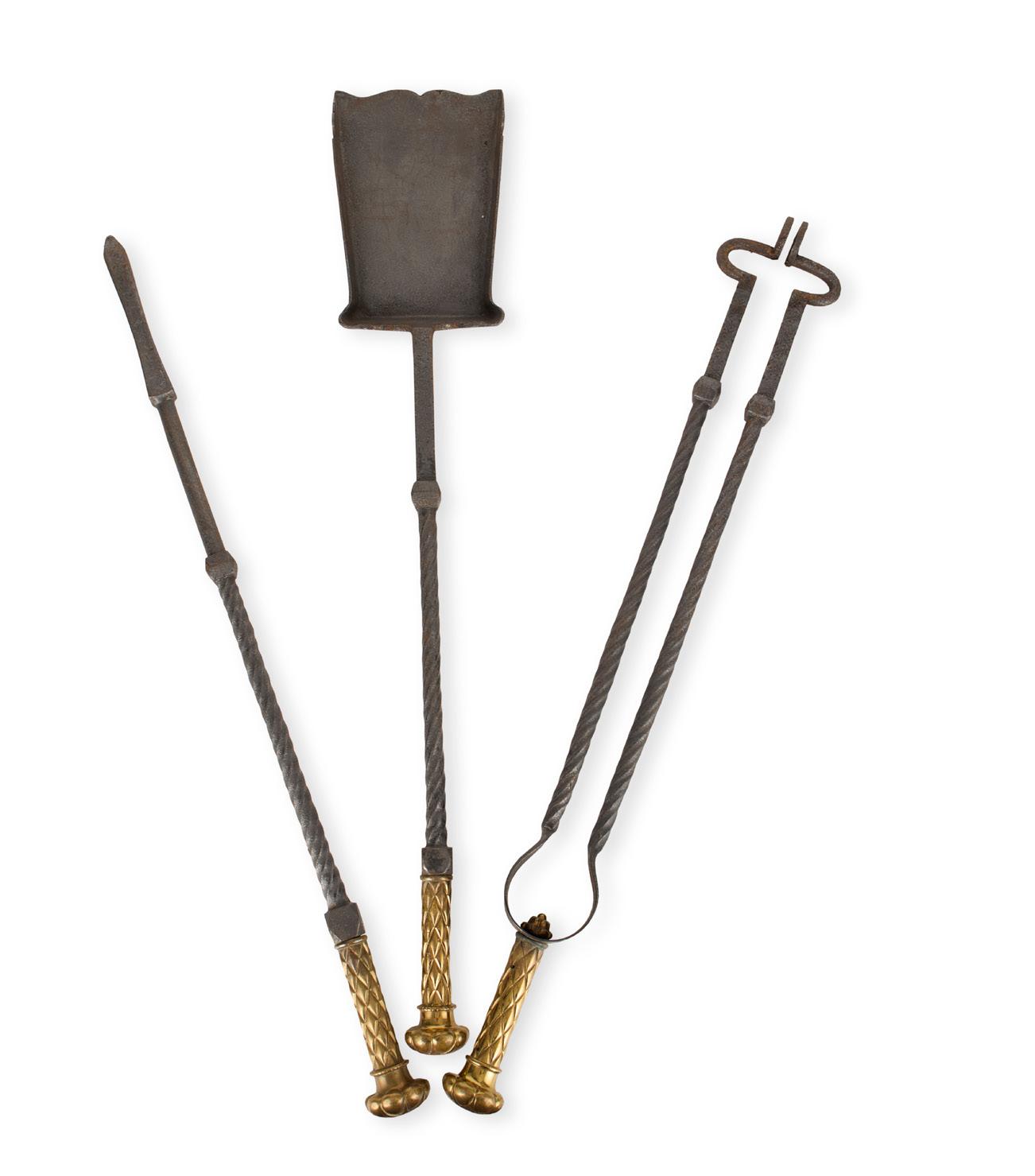
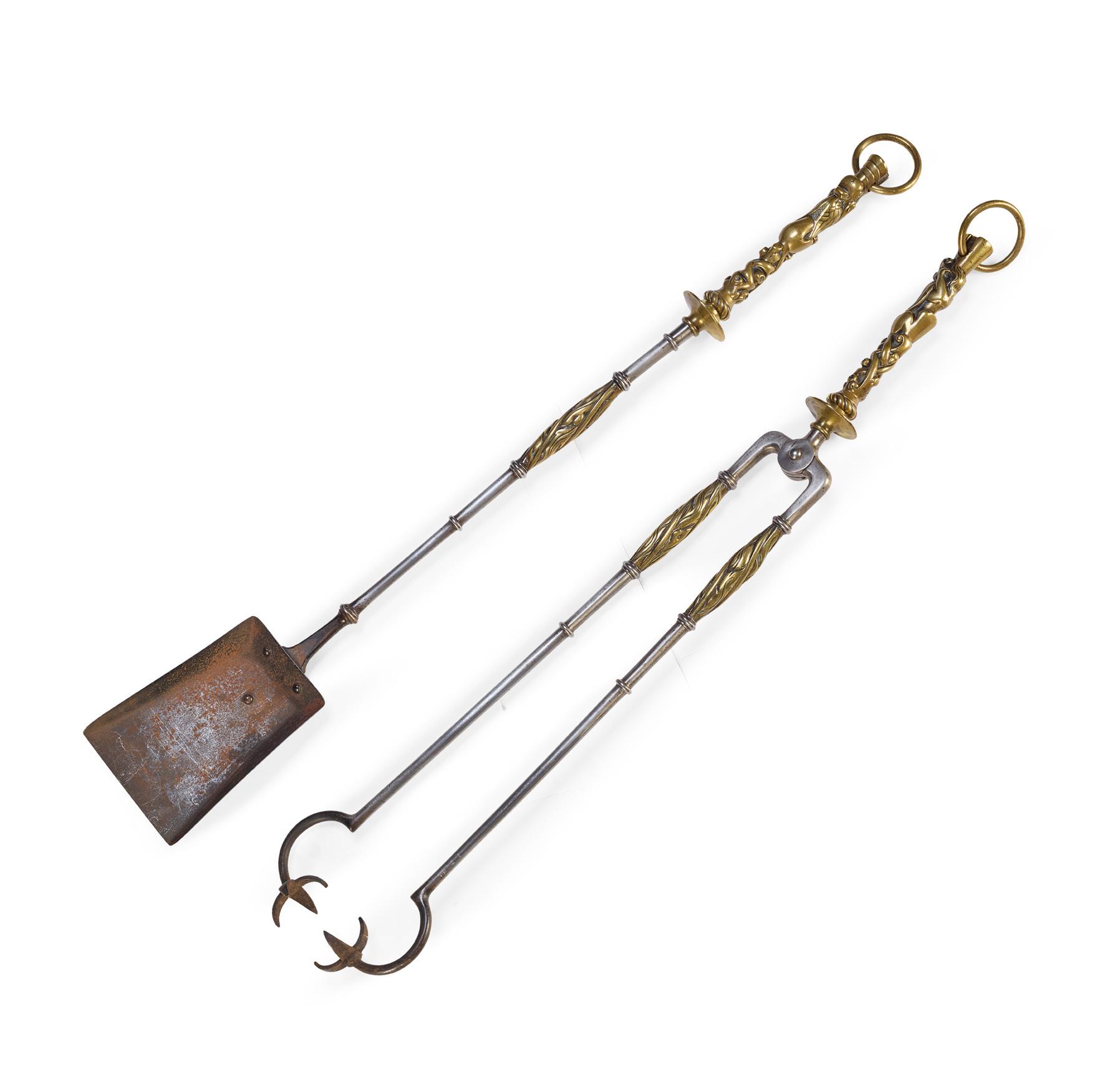
A. W. N. PUGIN (1812-1852) FOR JOHN HARDMAN & CO.
SET OF GOTHIC REVIVAL FIRE IRONS, CIRCA 1850
cast iron and brass, comprising; a SHOVEL, 74cm long, a PAIR OF TONGS, 70cm long, and a POKER 72cm long (3)
Literature: See Historic Furniture & Decorative Arts Collection, Houses of Parliament, London, no. POW 05245 for related fire irons (heritagecollections.parliament.uk/collections/getrecord/HOP_POW_05245)
£800-1,200
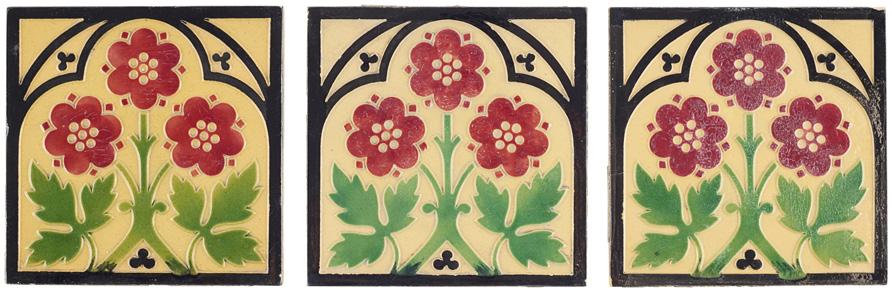
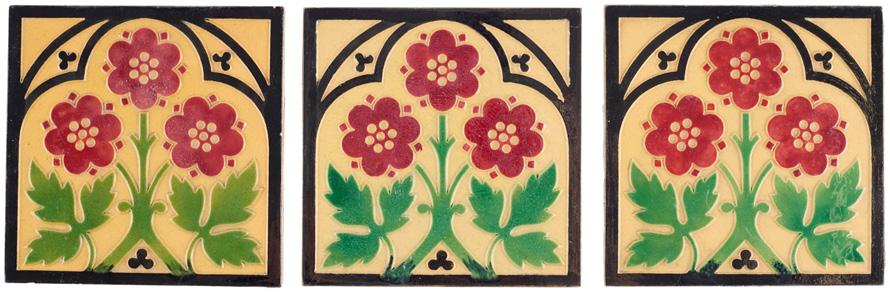
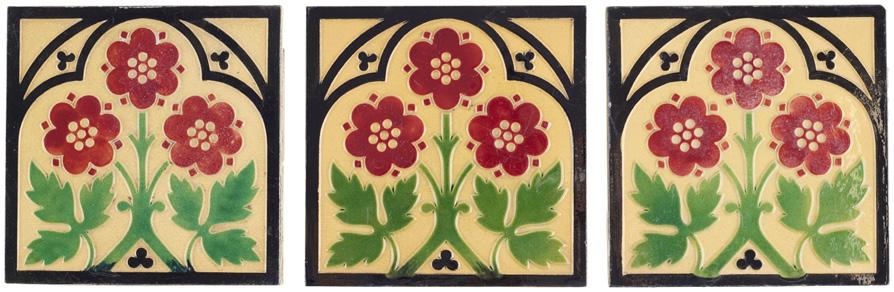
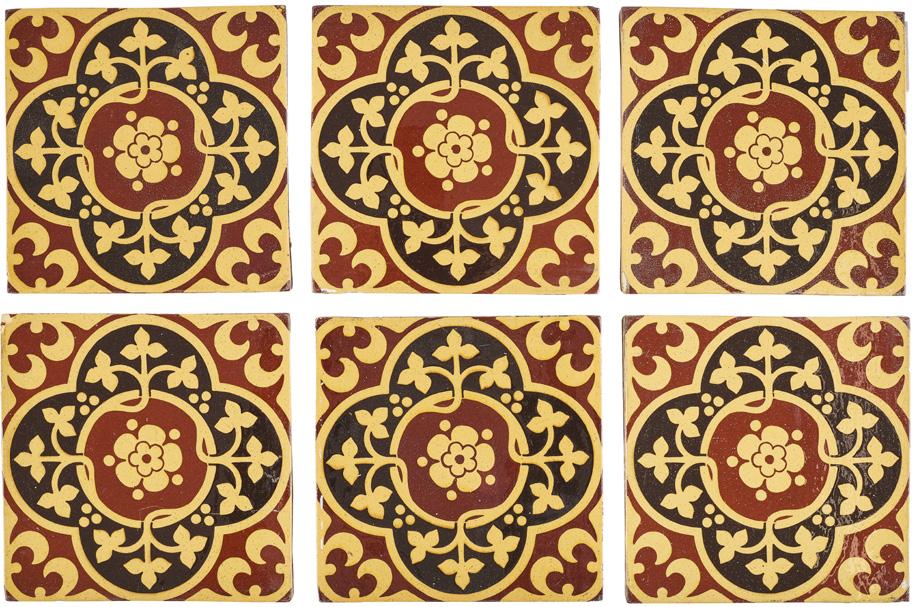
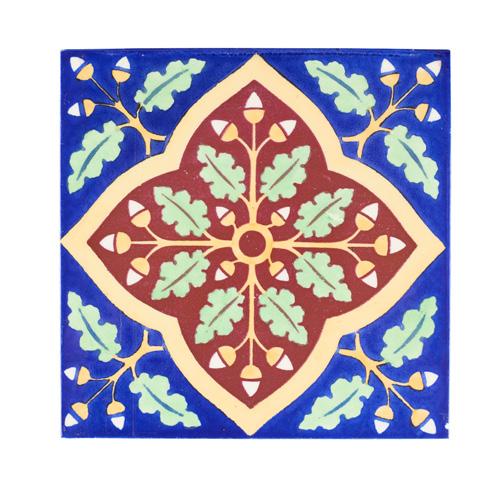
A.W.N. PUGIN (1812-1852) FOR MINTON, HOLLINS & CO. GROUP OF NINE GOTHIC REVIVAL TILES, CIRCA 1860 glazed earthenware, moulded maker’s marks (9) each 15cm square
£400-600
3
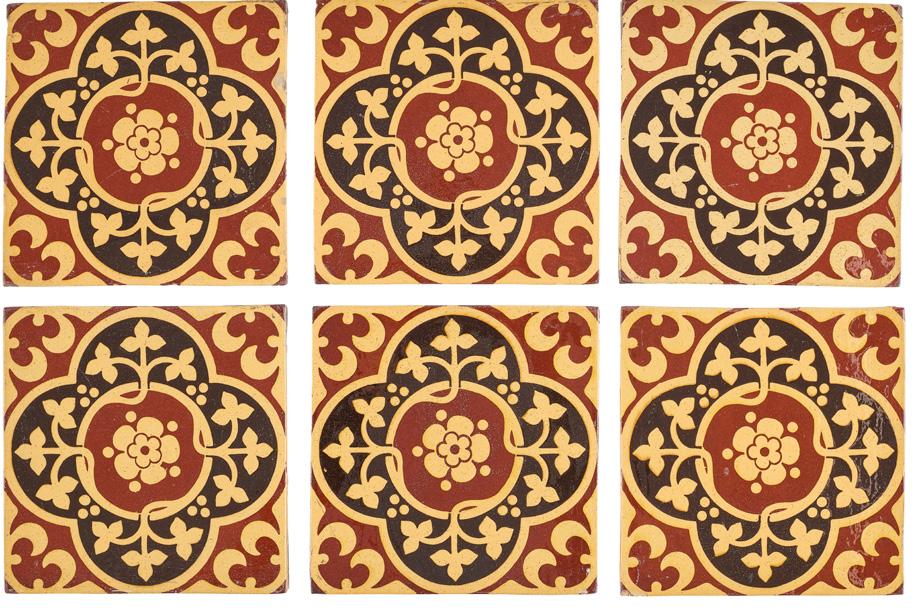
A.W.N. PUGIN (1812-1852) FOR MINTON & CO. TWELVE 6-INCH GOTHIC REVIVAL ENCAUSTIC TILES, CIRCA 1860 earthenware, stamped maker’s marks (12) 15cm square
£400-600
4
ENGLISH
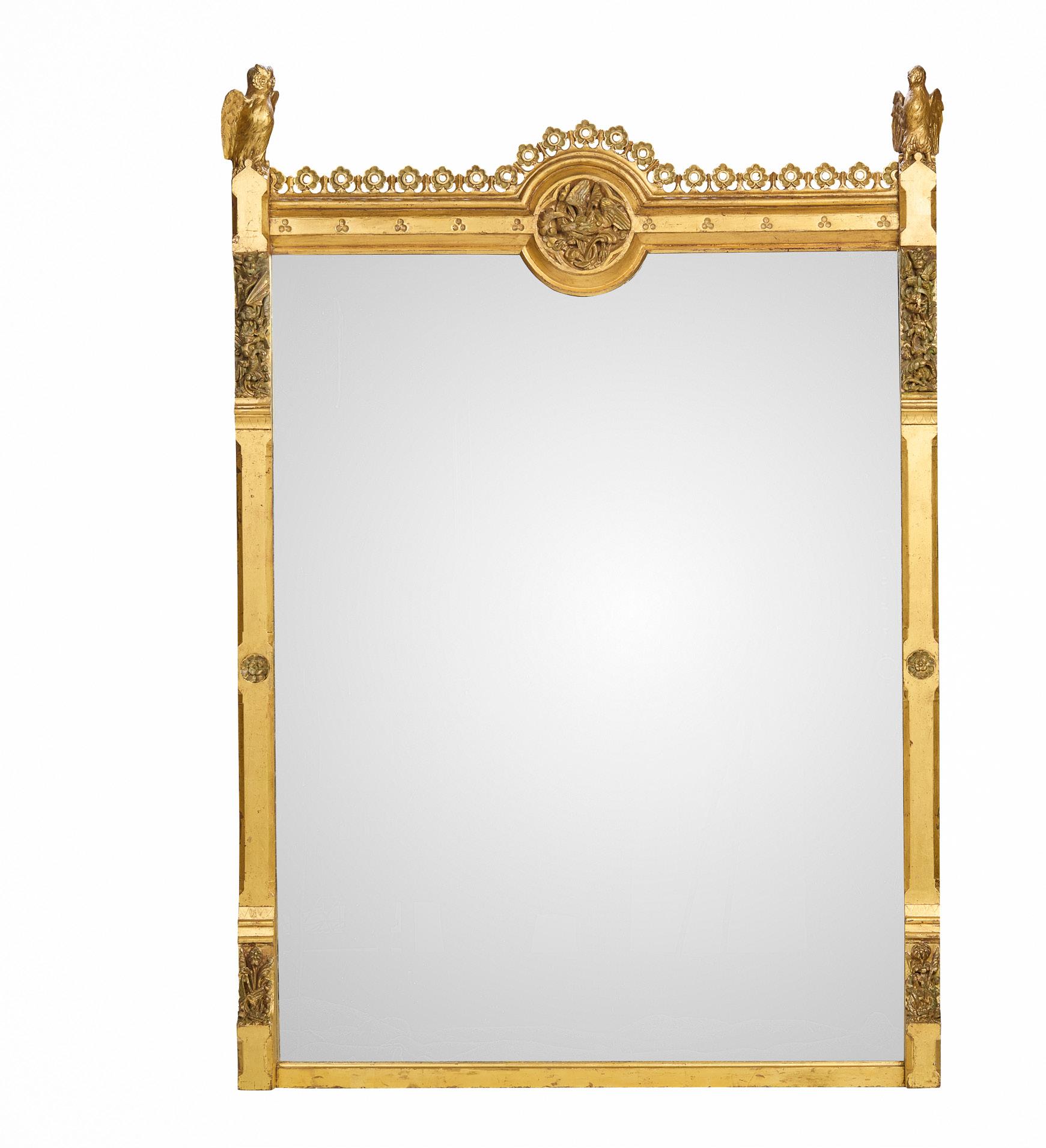
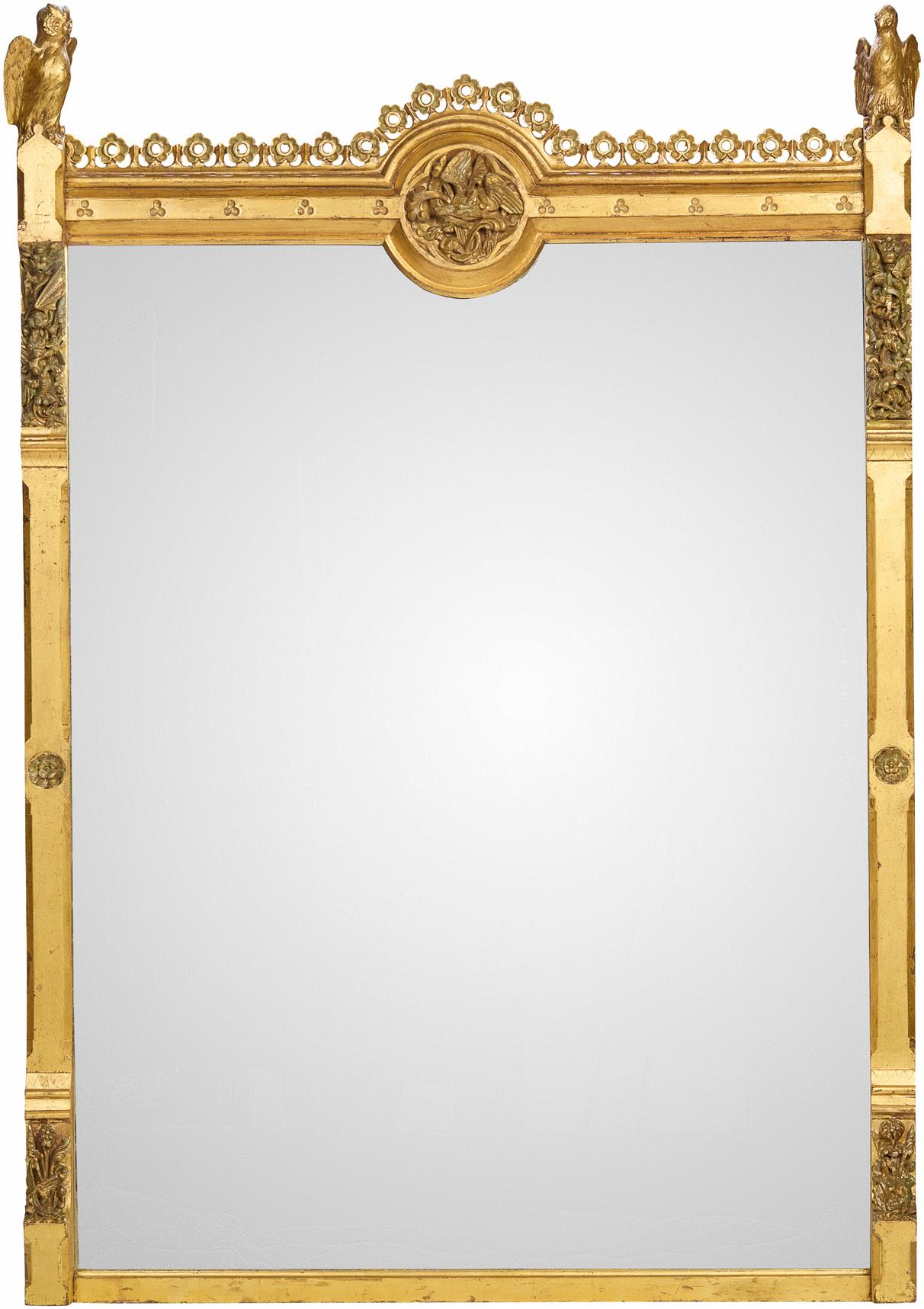
GOTHIC REVIVAL GILTWOOD
WALL MIRROR, CIRCA 1870
giltwood and gesso, mirror plate
172cm x 117cm
Provenance: Lyon & Turnbull, Edinburgh, Paul Reeves, An Eye for Design, 14 February 2019, lot 35
£1,000-1,500
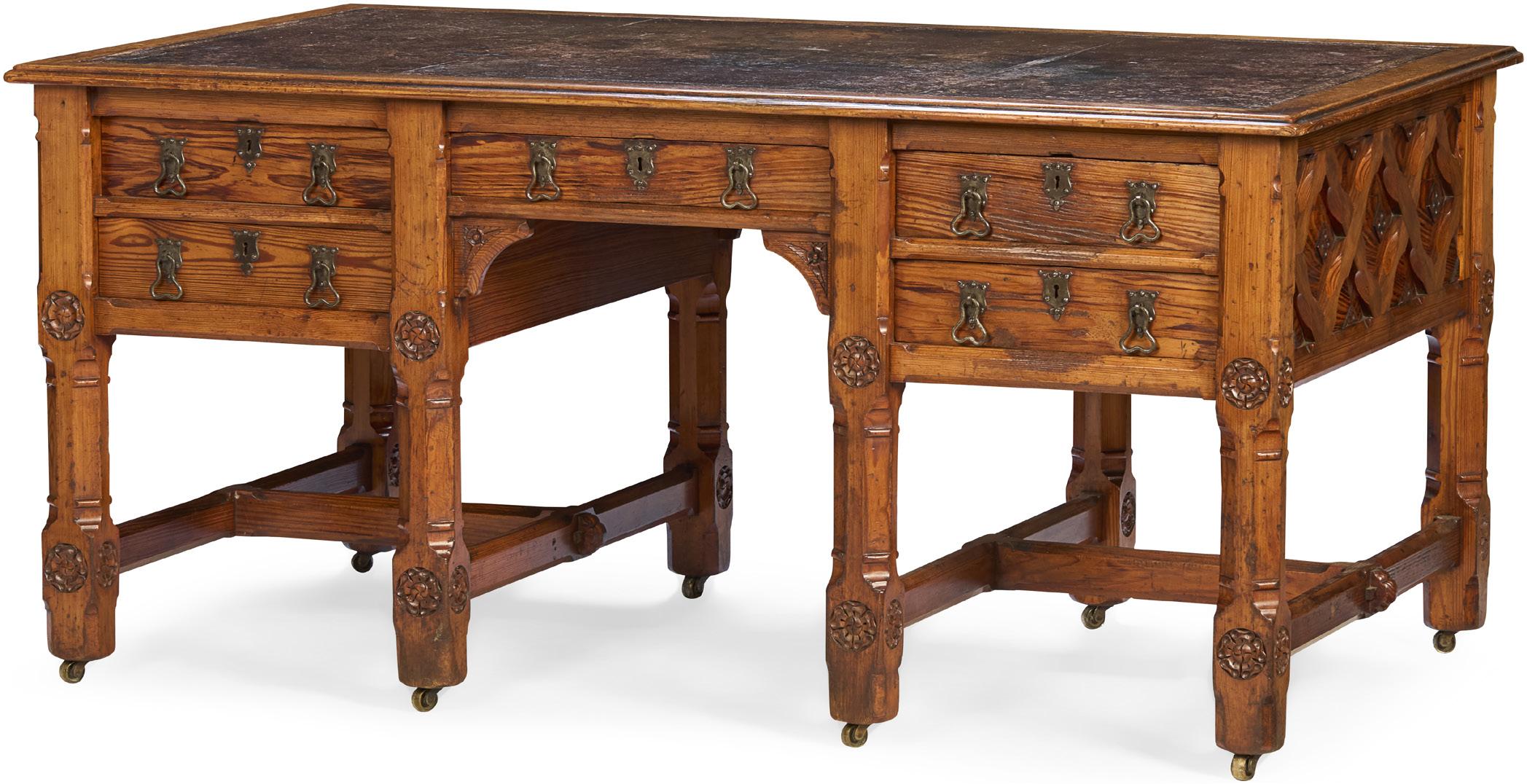
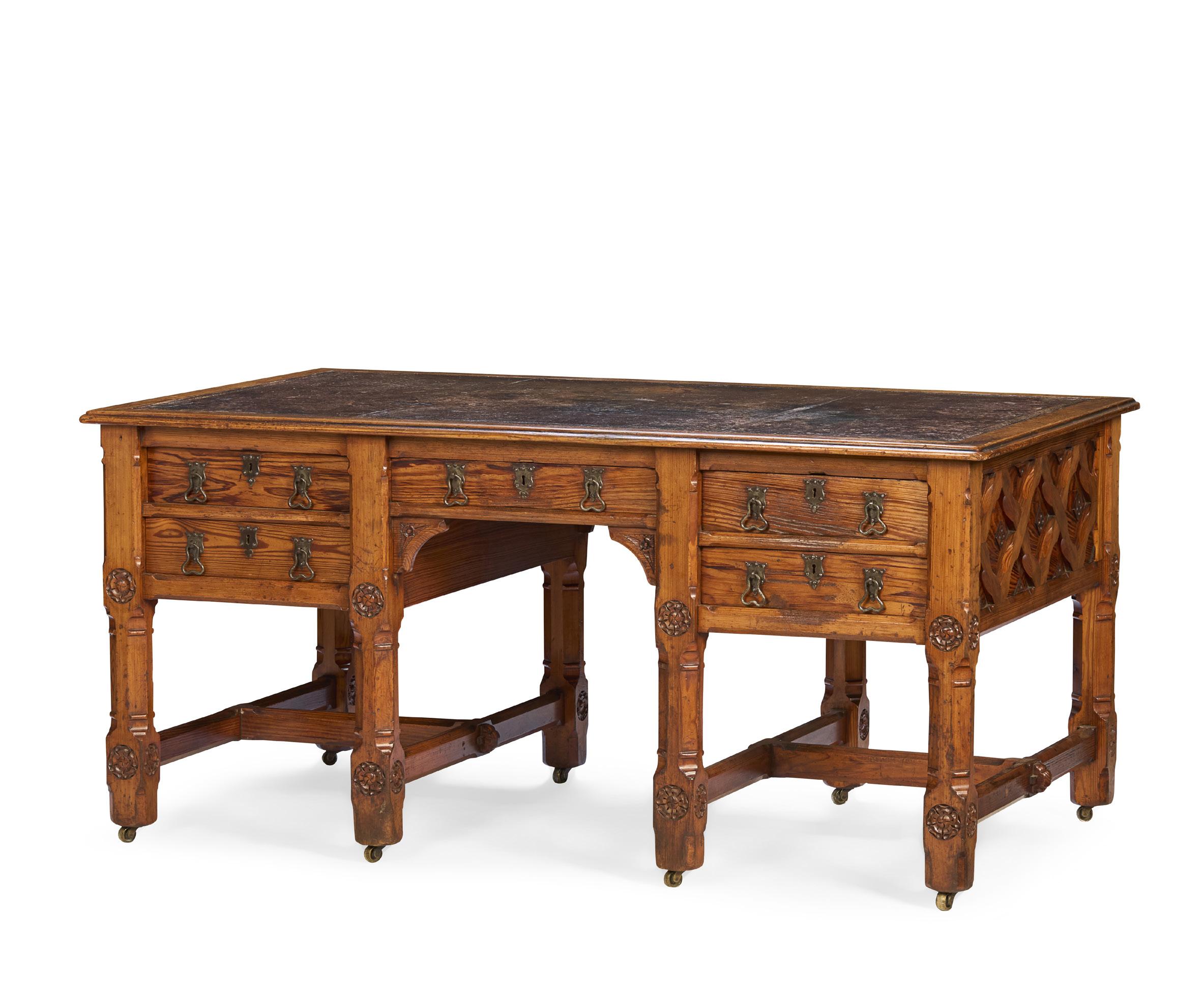
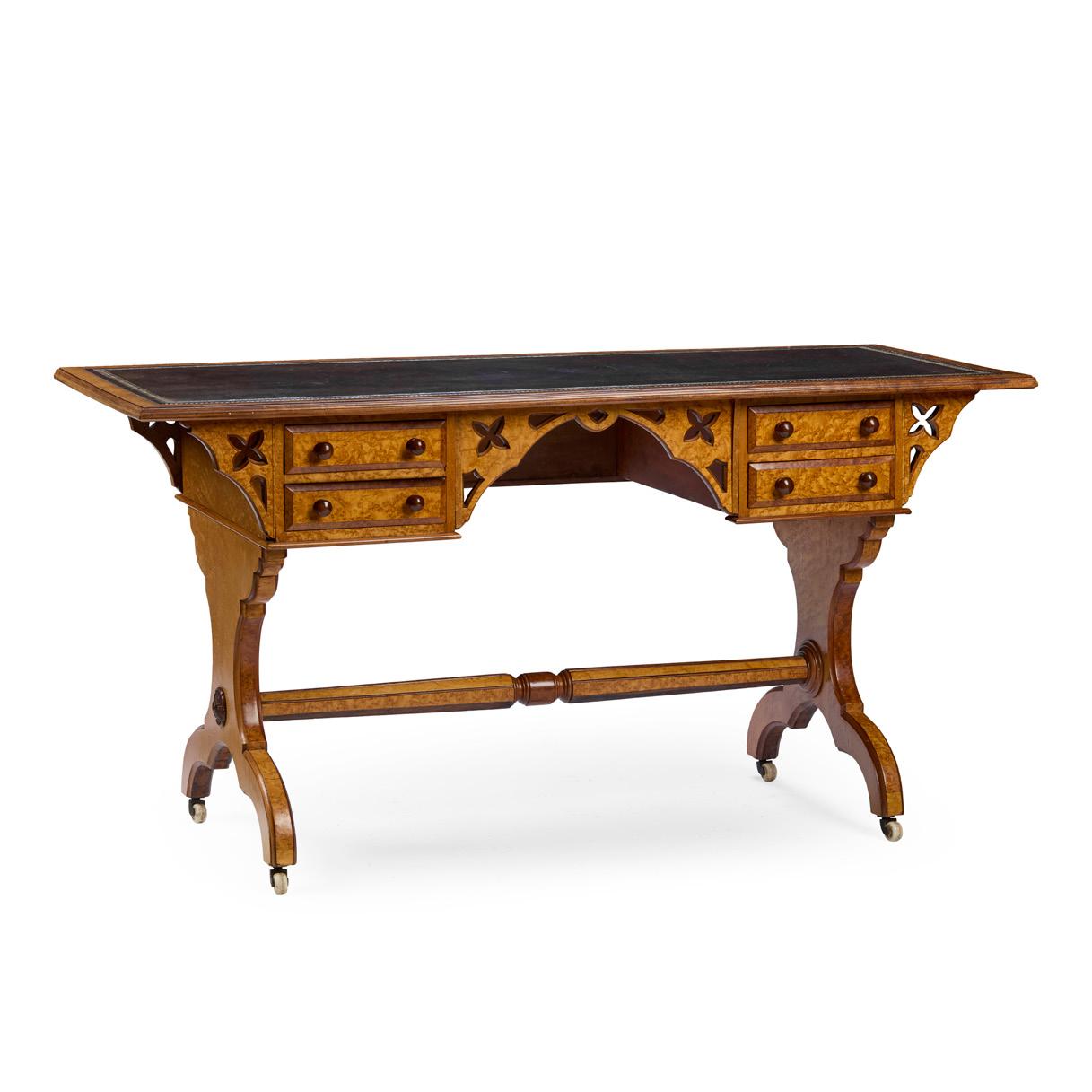
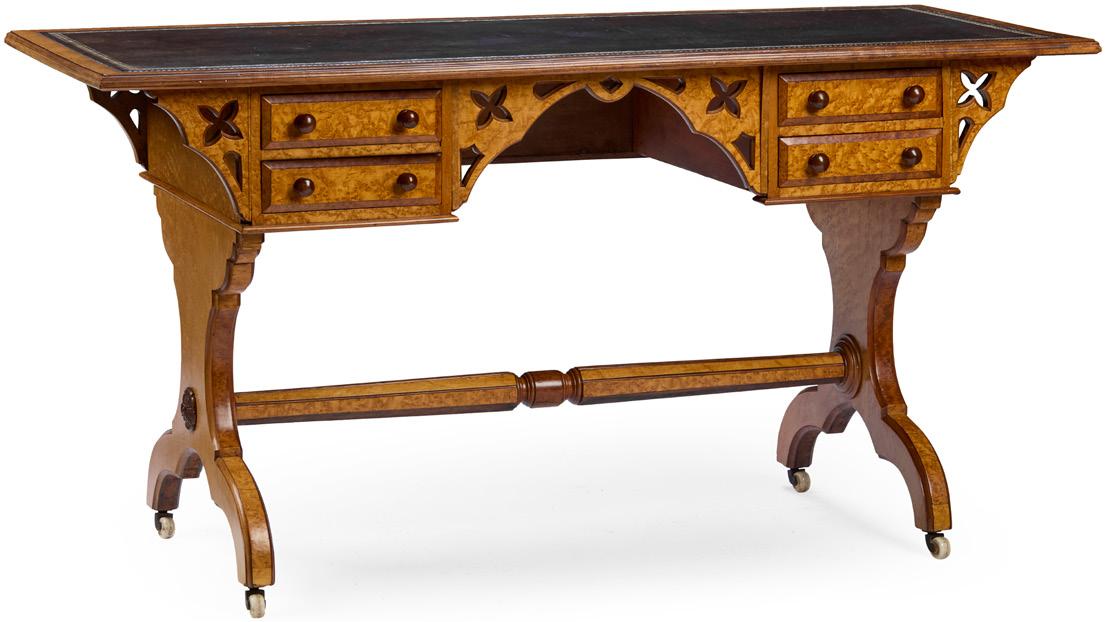
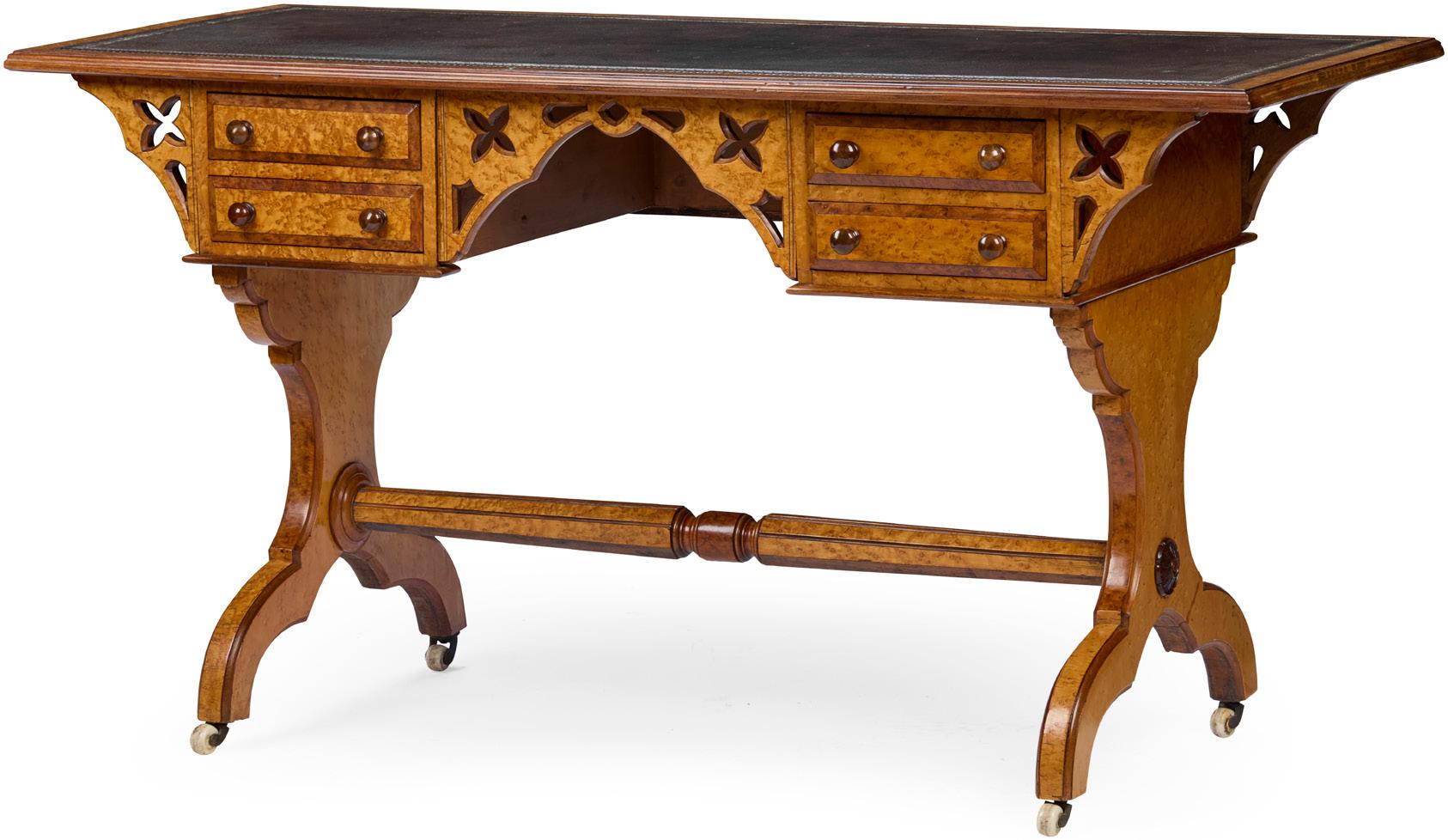
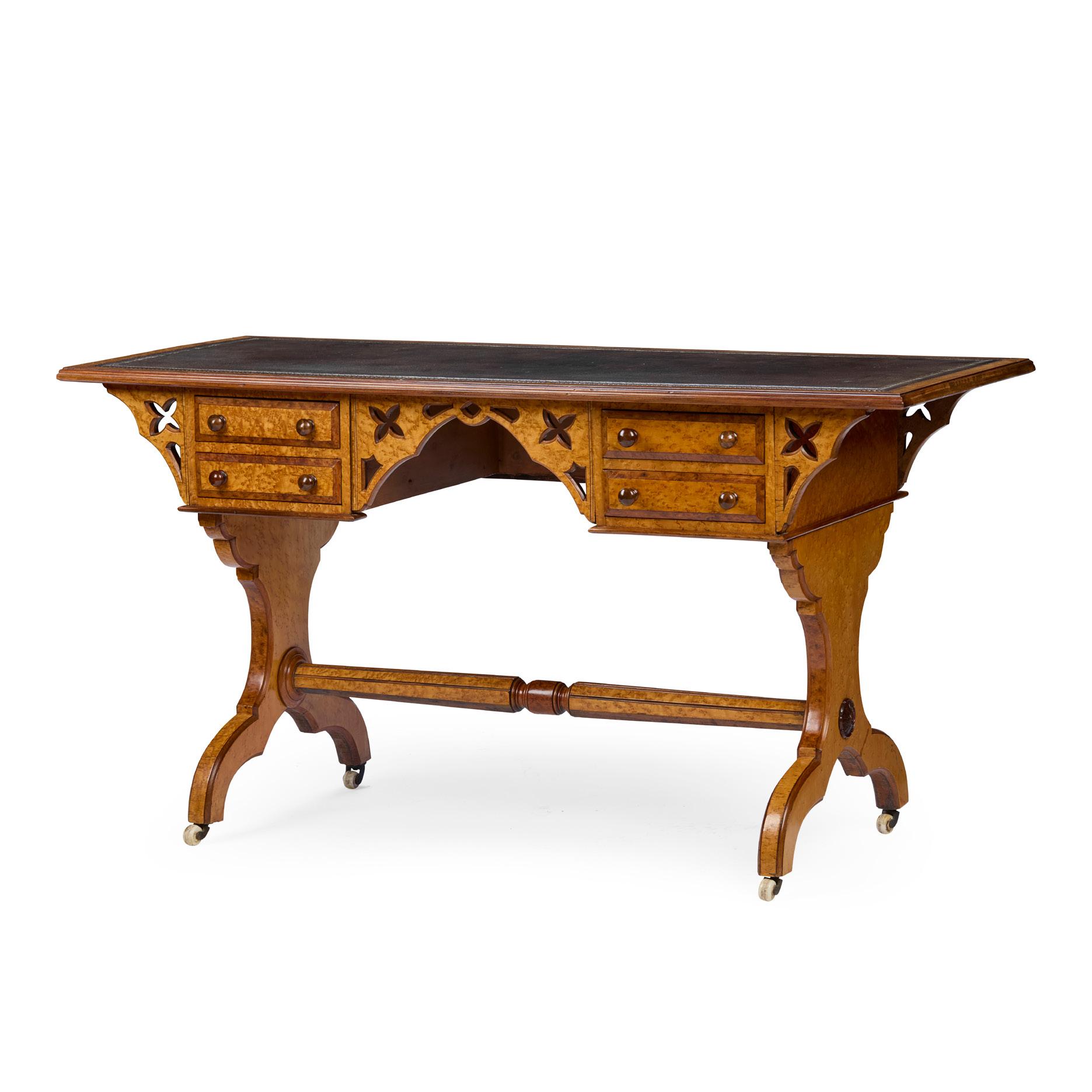
ATTRIBUTED TO E. W. PUGIN (1834-1875)
LARGE GOTHIC REVIVAL FREE-STANDING DESK, CIRCA 1870
pitch pine, with original tooled leather writing surface and steel fittings
167cm wide, 78.5cm high, 96cm deep
£1,500-2,000
6
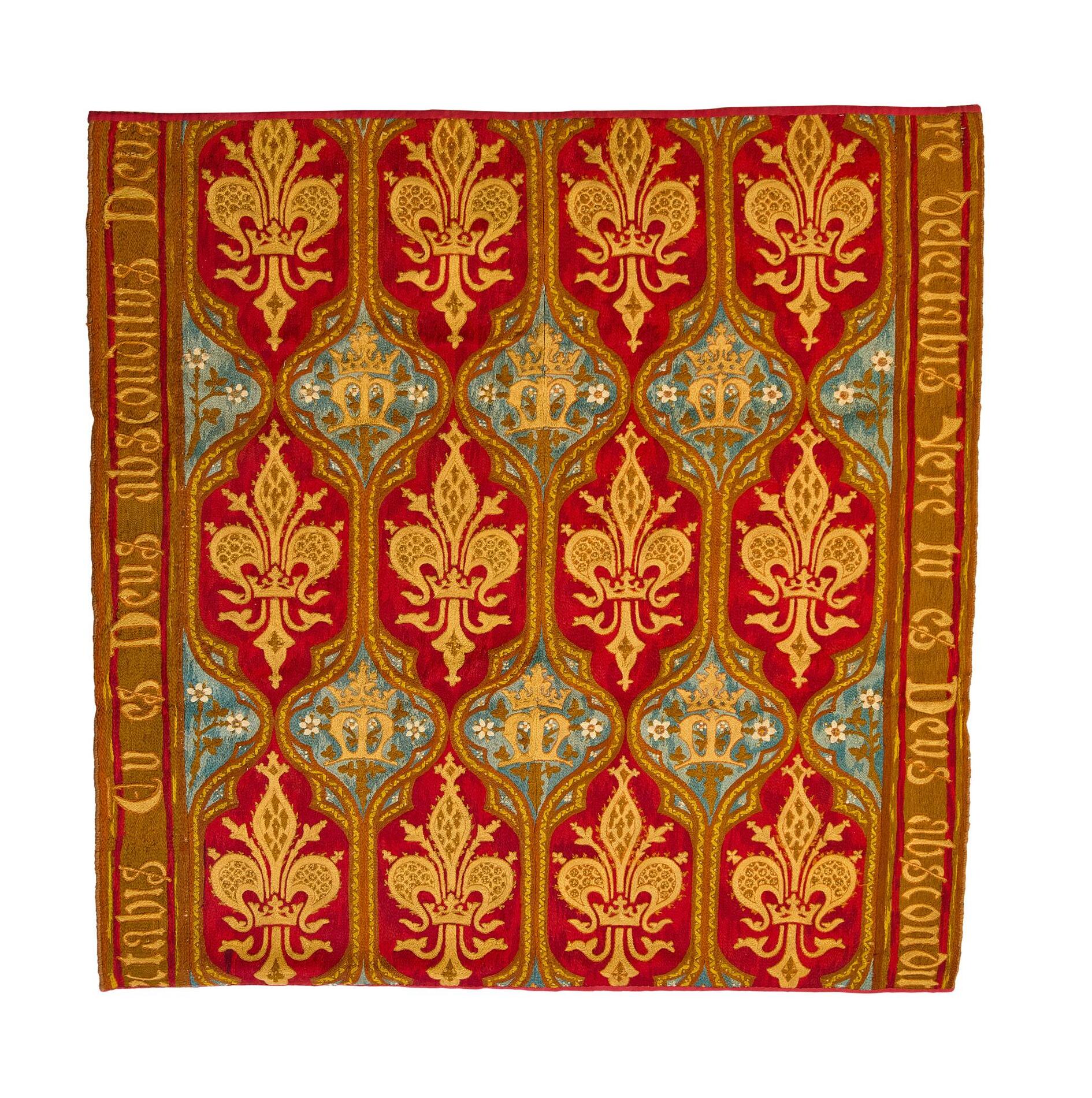
A. W. N. PUGIN (1812-1852) OR E. W. PUGIN (1834-1875)
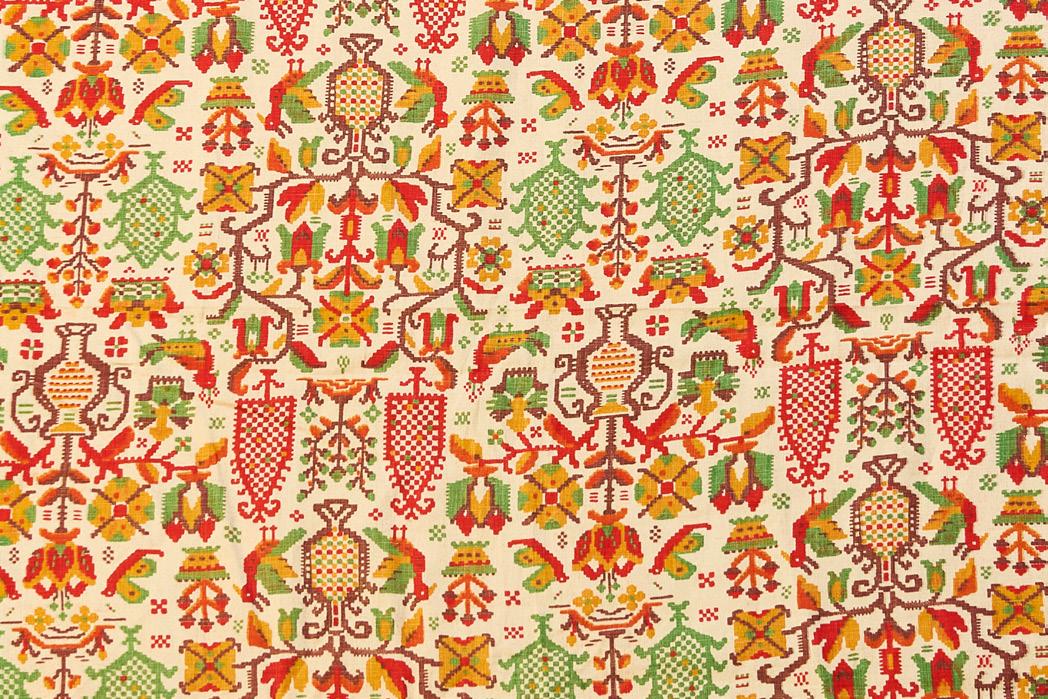
NEEDLEWORK WOOL PANEL, CIRCA 1850
wool, with later linen backing, with later cotton binding to each end, the panel a section of a larger carpet 154cm x 144cm
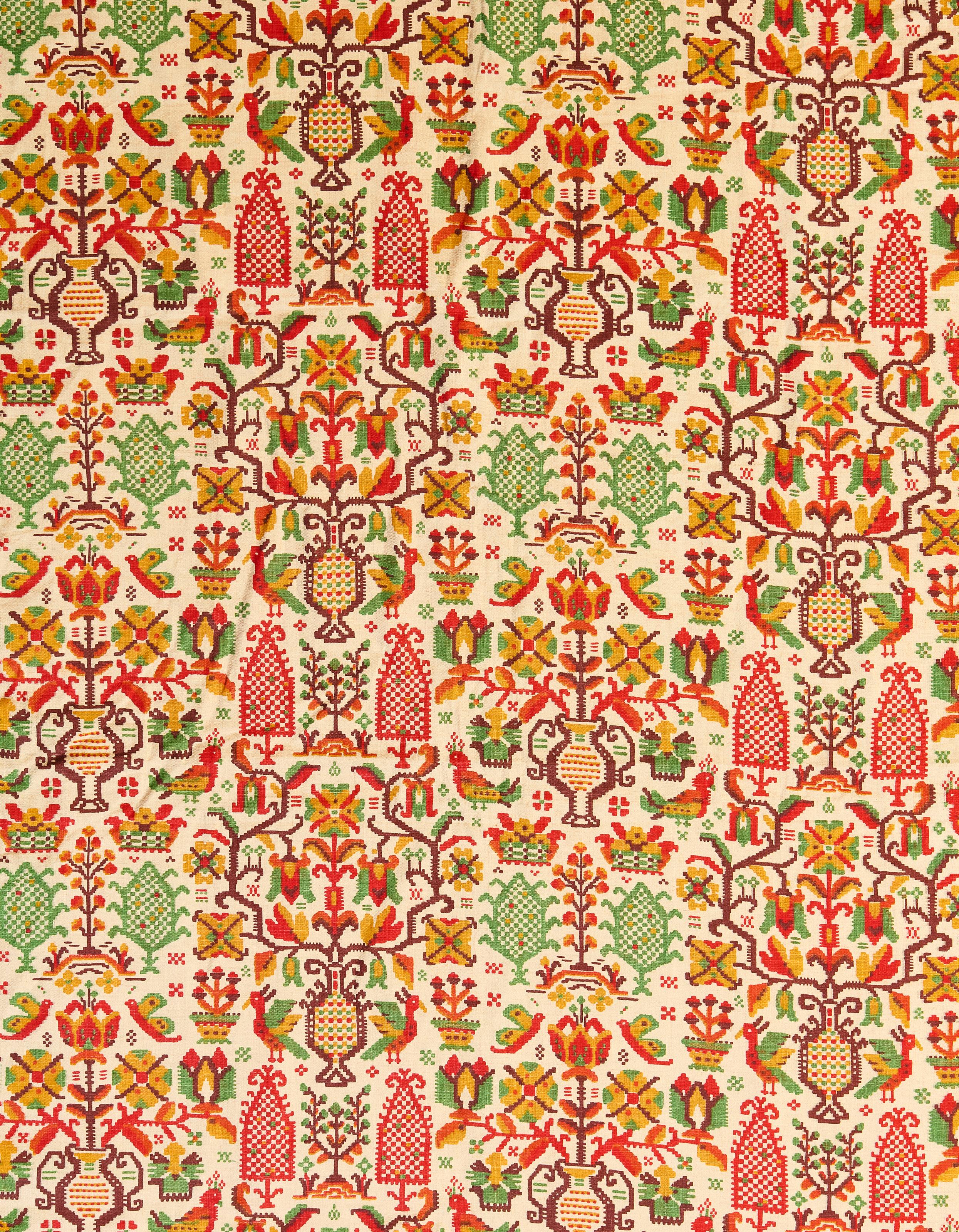
Between 1863 and 1866, Edward Welby Pugin converted the remains of a medieval palace, once owned by the Archbishops of Canterbury, into Mayfield School of the Holy Child. One significant work from this time is a needlework carpet or runner that covered the entire Chapel floor. Due to its large size, the rug was made in small sections and then stitched together. It was handsewn by the sisters of Mayfield Chapel for Mother Cornelia Connelly, the founder of the Society of the Holy Child Jesus. Pugin likely used decorative designs created by his father, as he did in other projects.
£1,000-1,500
7
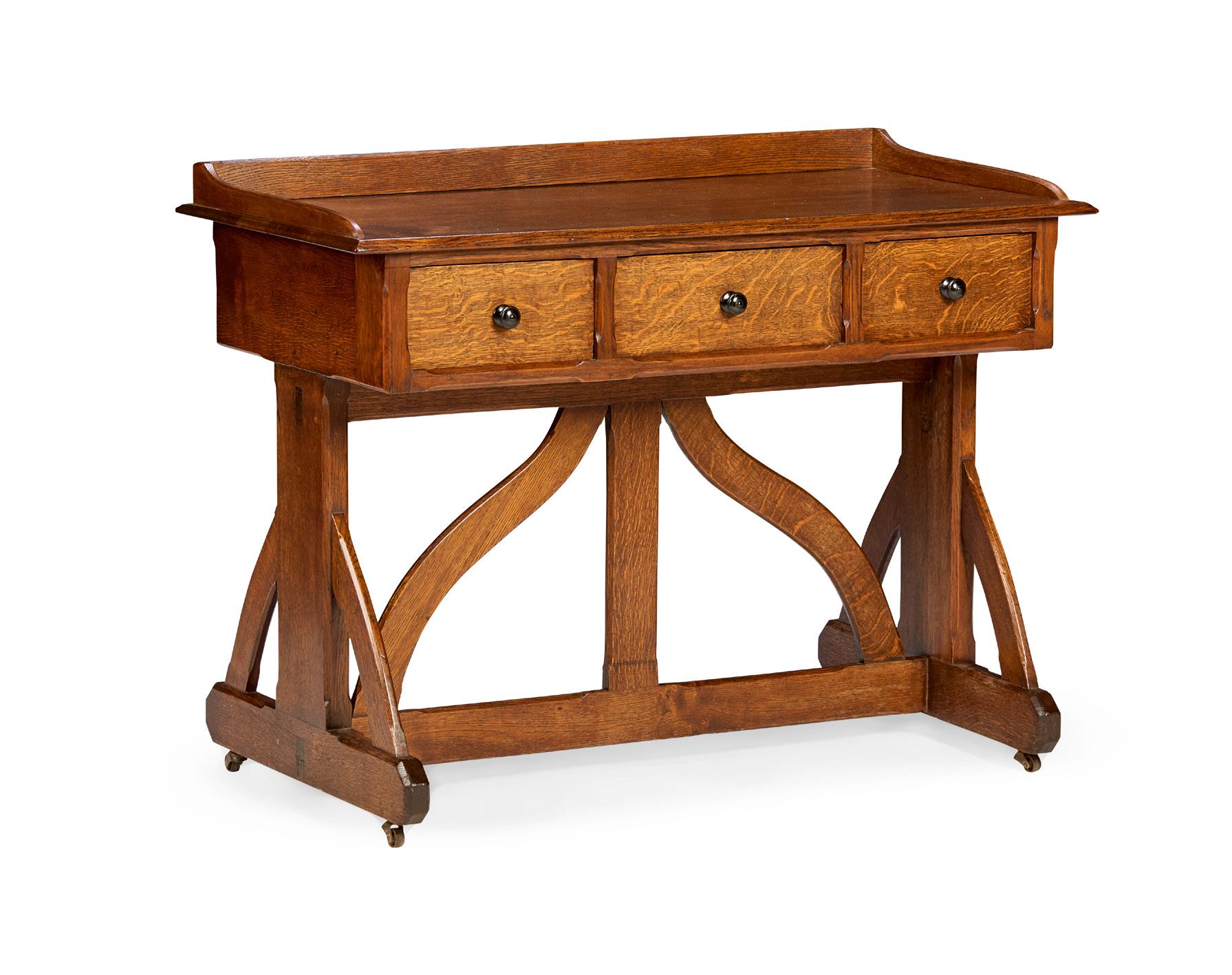
ATTRIBUTED TO A.W.N PUGIN (1812-1852)
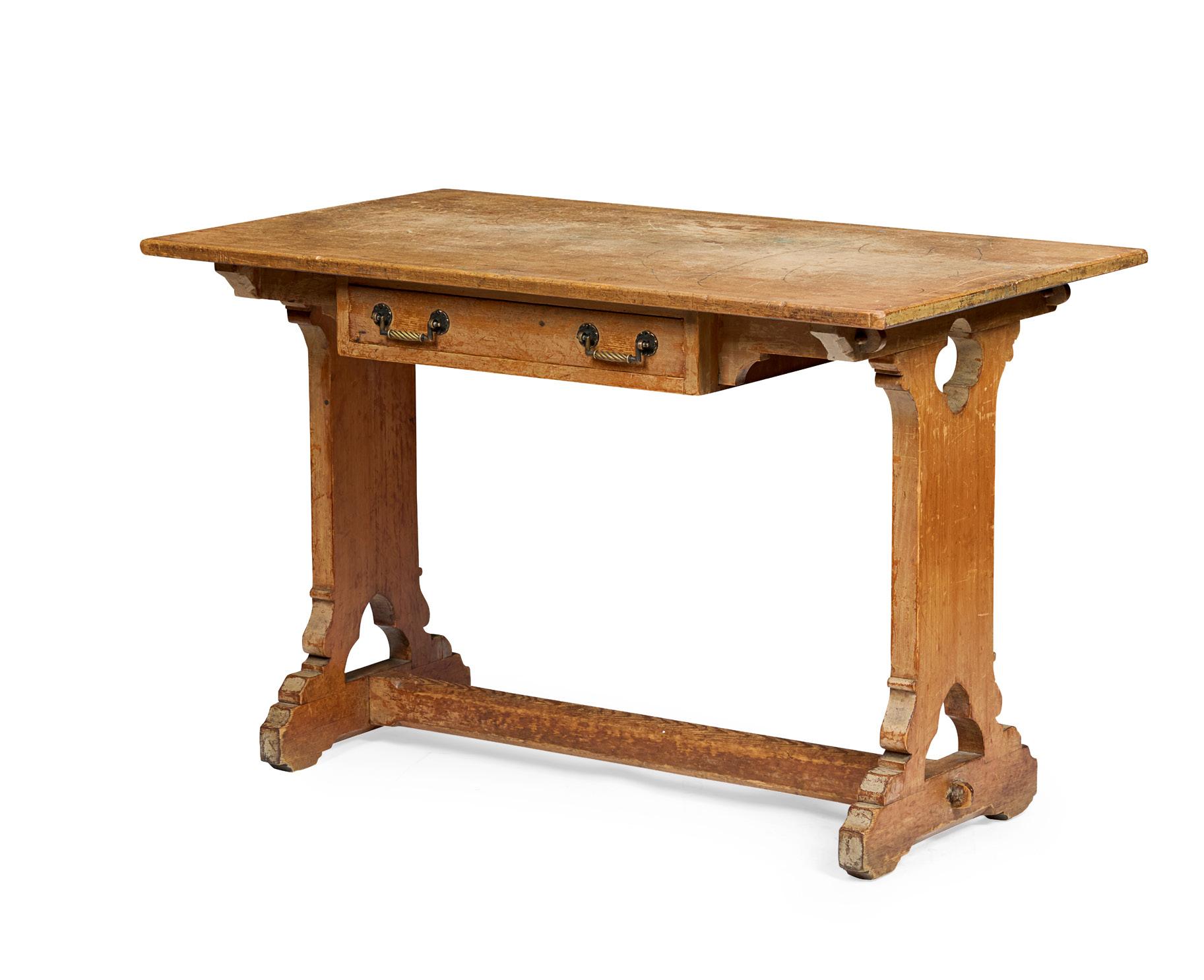
SIDE TABLE, CIRCA 1850
oak, with turned ebonised wood handles
107.5cm wide, 82cm high, 55.5cm deep
£700-1,000
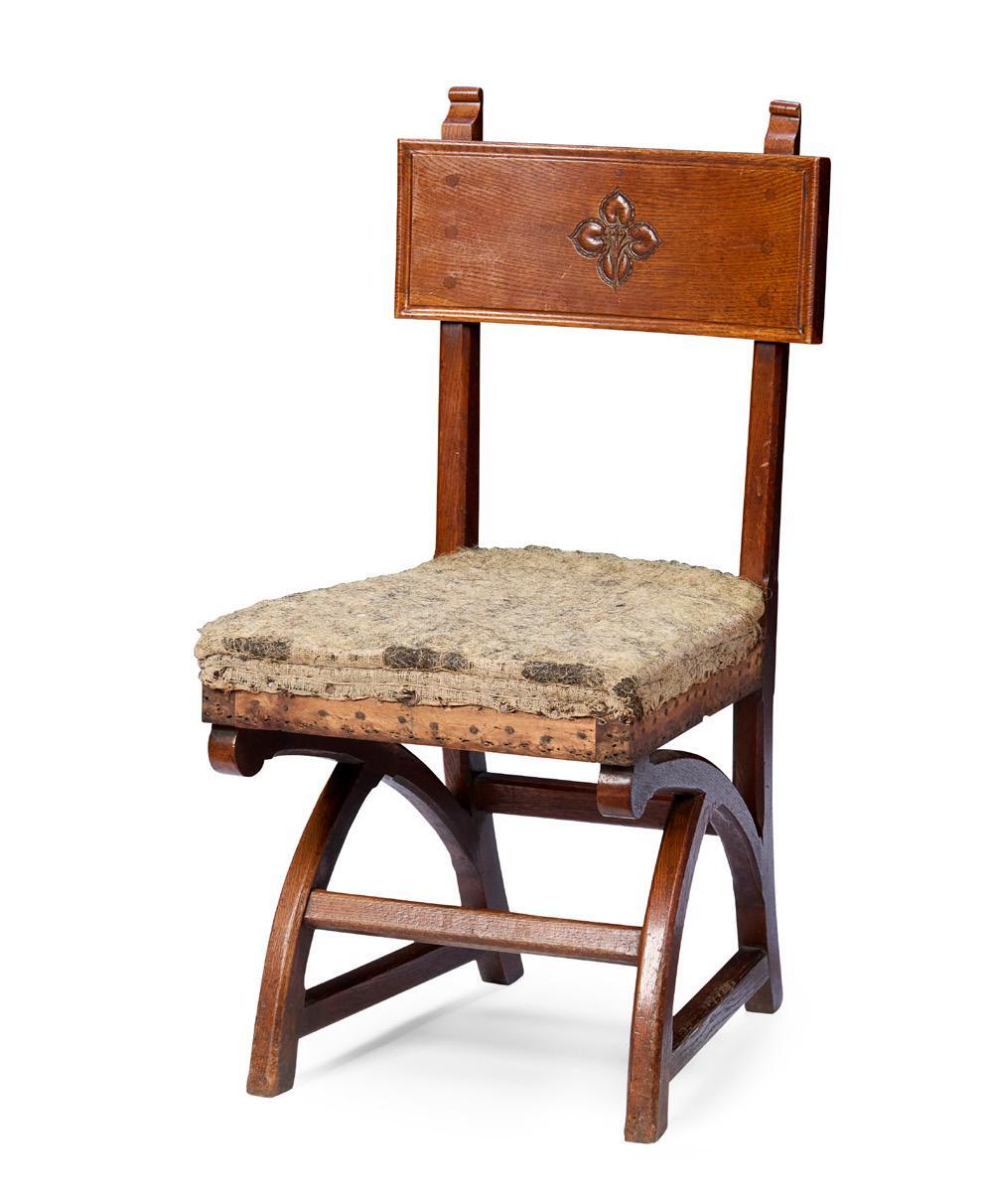
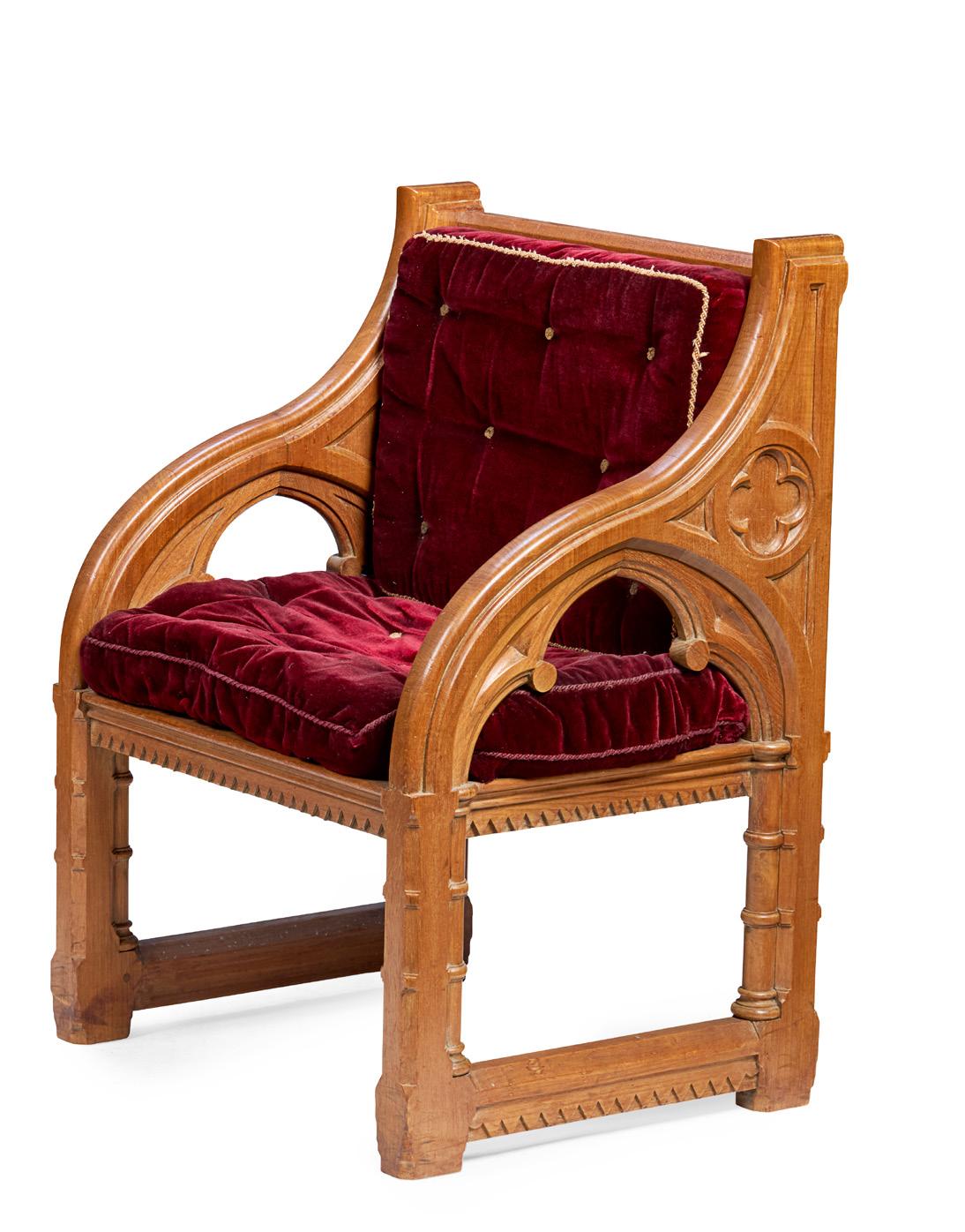
E. W. PUGIN (1834-1875)
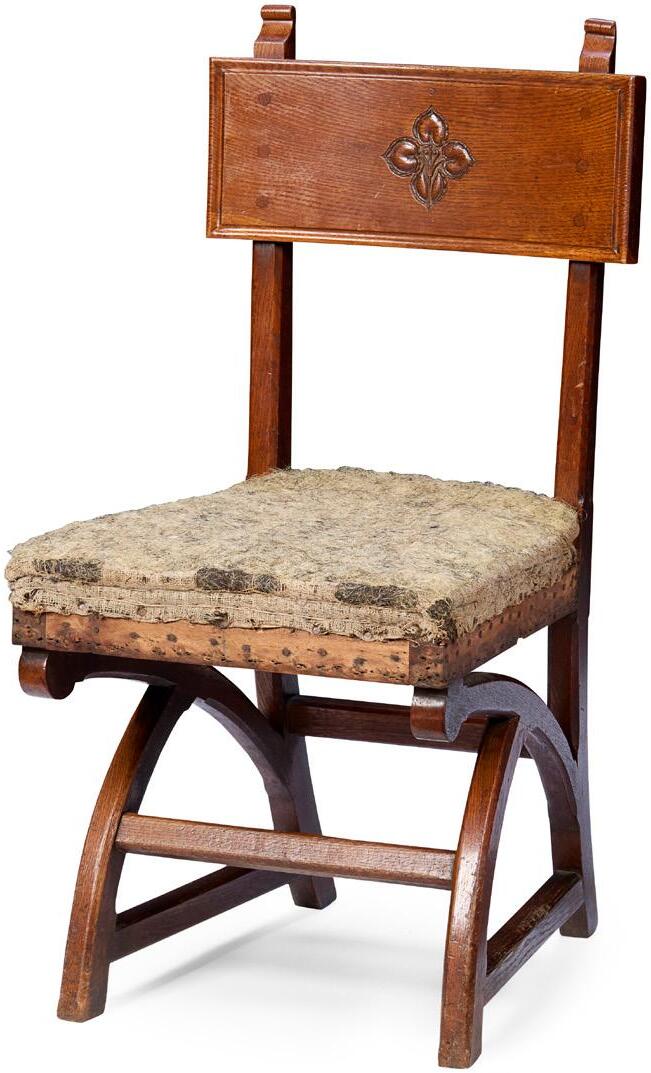
GOTHIC REVIVAL CHAIR, CIRCA 1870
oak, with original stuffed seat 44cm wide, 91cm high, 47cm deep
Literature: V&A Accession no W.1-1991
This chair is similar to chairs designed by Edward Welby Pugin for the Grange, his family home, in Ramsgate in about 1864. The Grange was designed and built circa 1843 by his father A.W.N. Pugin who also designed the original furniture. After A.W.N. Pugin’s death in 1852, the house was let until 1864 when the Pugin family returned.
E.W. Pugin inherited his father’s architectural practice and followed the same principles when designing furniture. This chair shows A.W.N. Pugin’s preference for revealed construction in the pegs holding the legs and stretchers together. E.W. Pugin combined his father’s ideas with new details of his own such as the broad back support.
£800-1,200
10
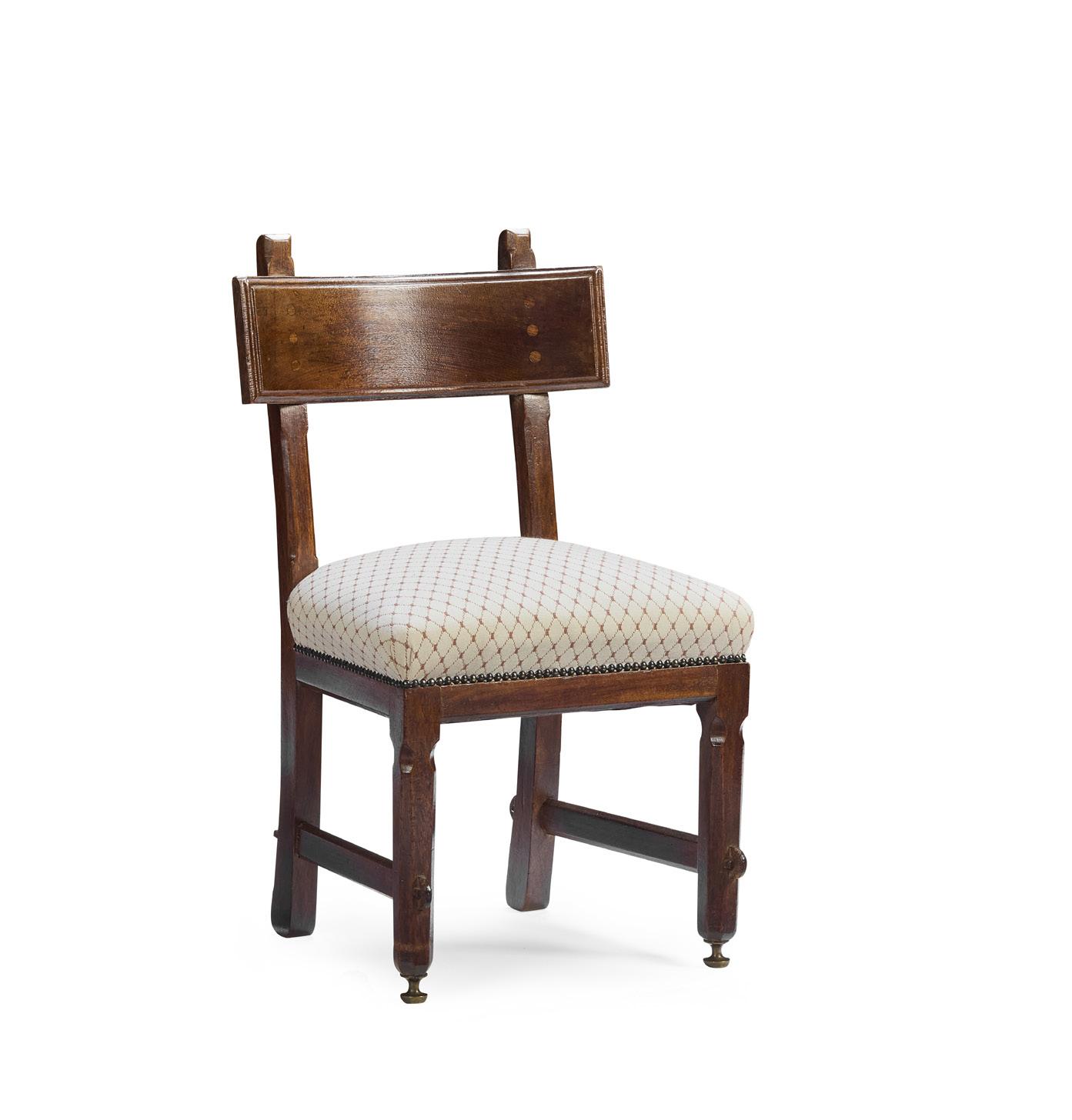
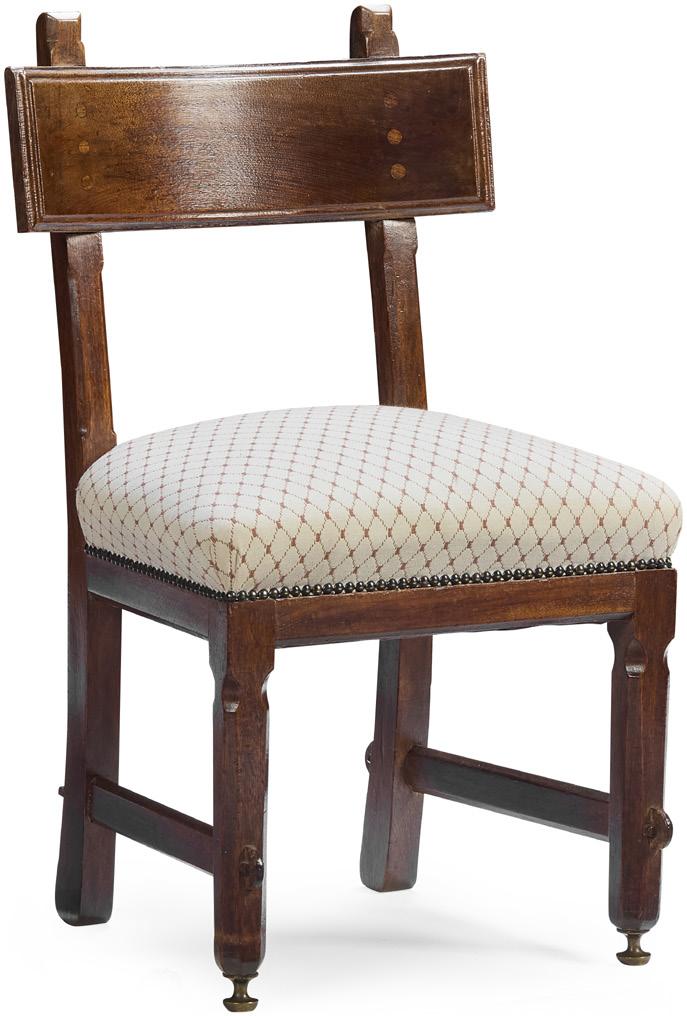
E. W. PUGIN (1834-1875)
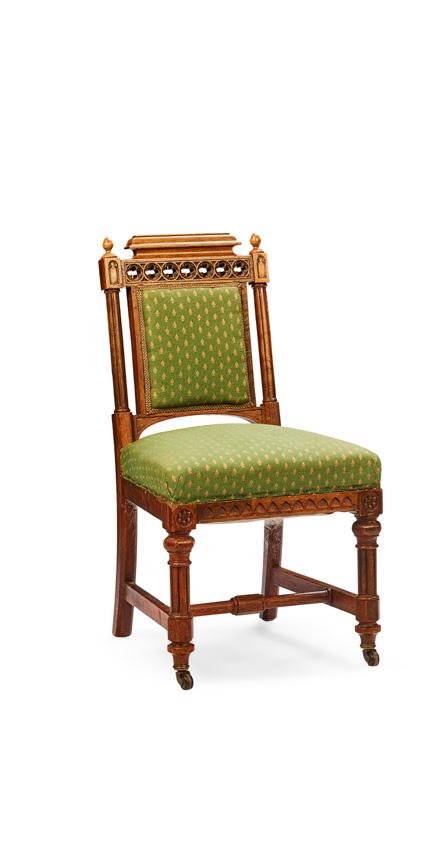
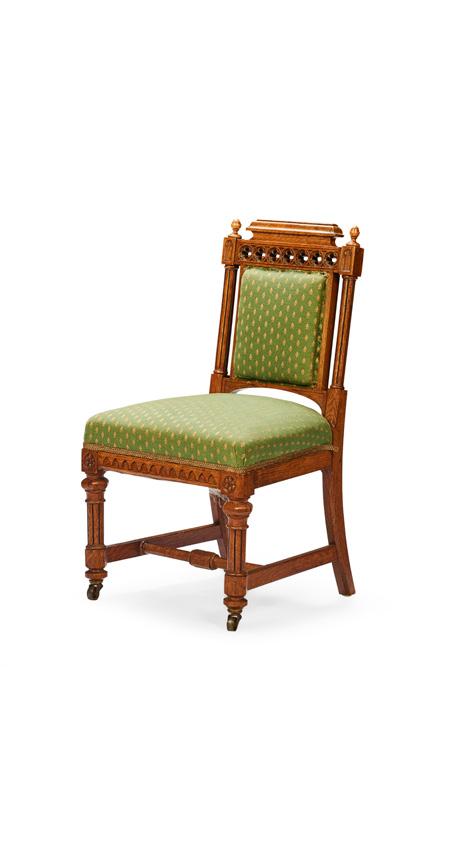
GOTHIC REVIVAL CHAIR, CIRCA 1870
oak, with close-nailed upholstery and brass front feet
47.5cm wide, 81cm high, 42cm deep
£500-700
brown leather top, on ceramic castors (2) 146cm wide, 73.5cm high, 58cm deep
Provenance: Purchased Lyon & Turnbull, 7 May 2008, lot 632, The Contents of South Hall
£1,000-1,500
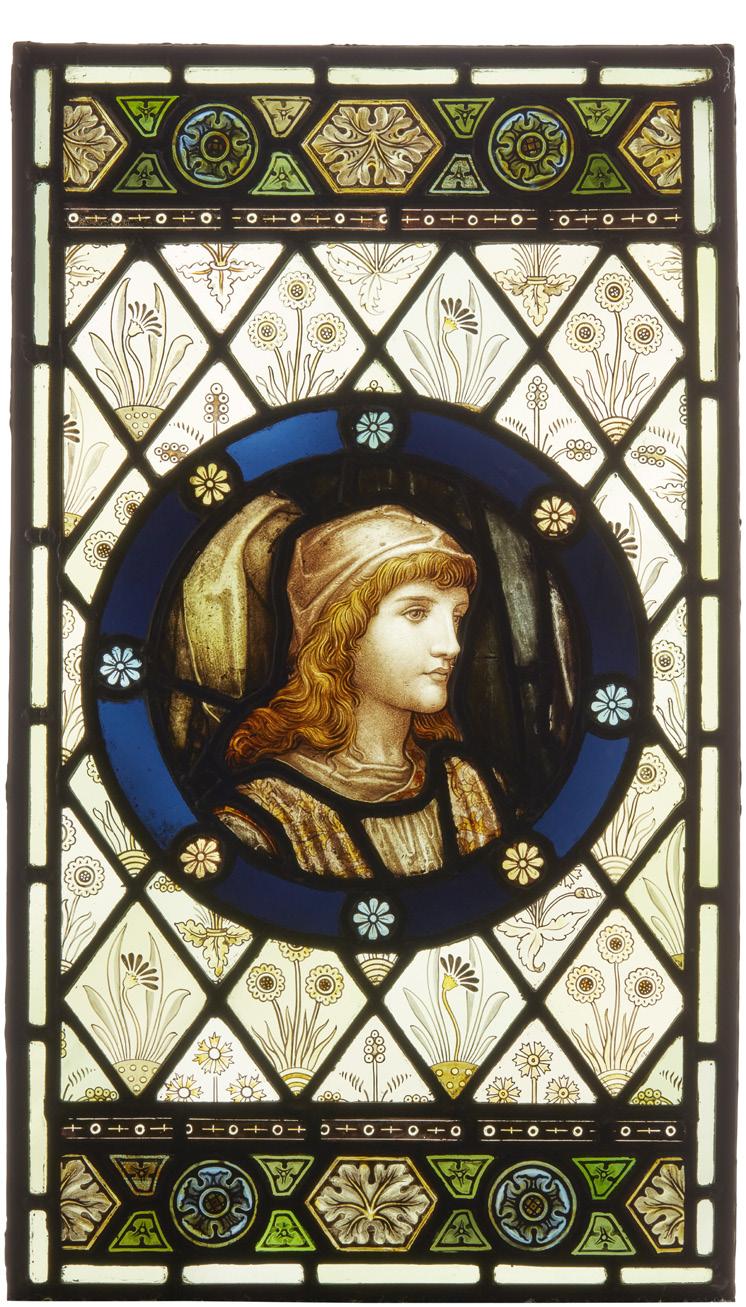
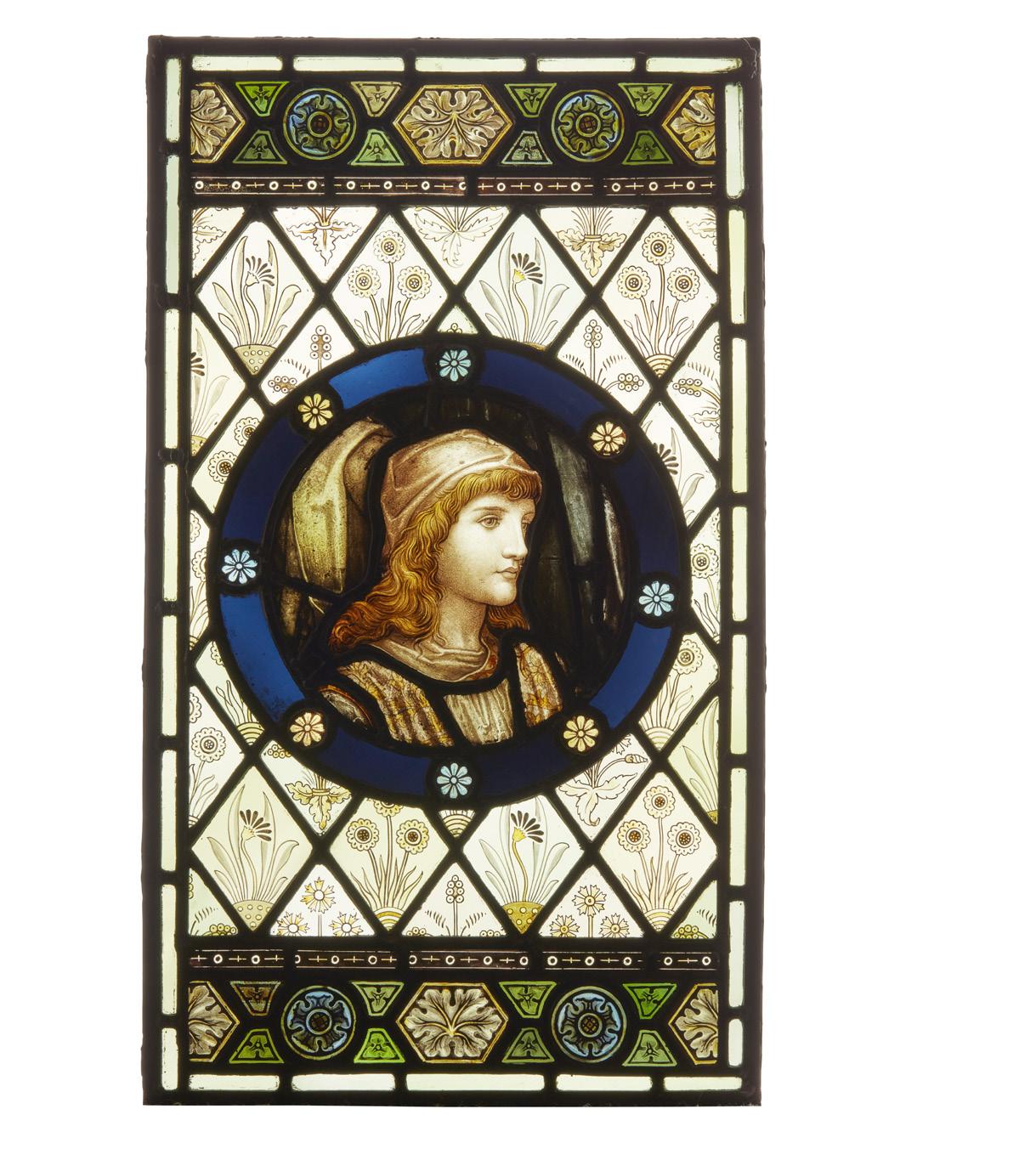
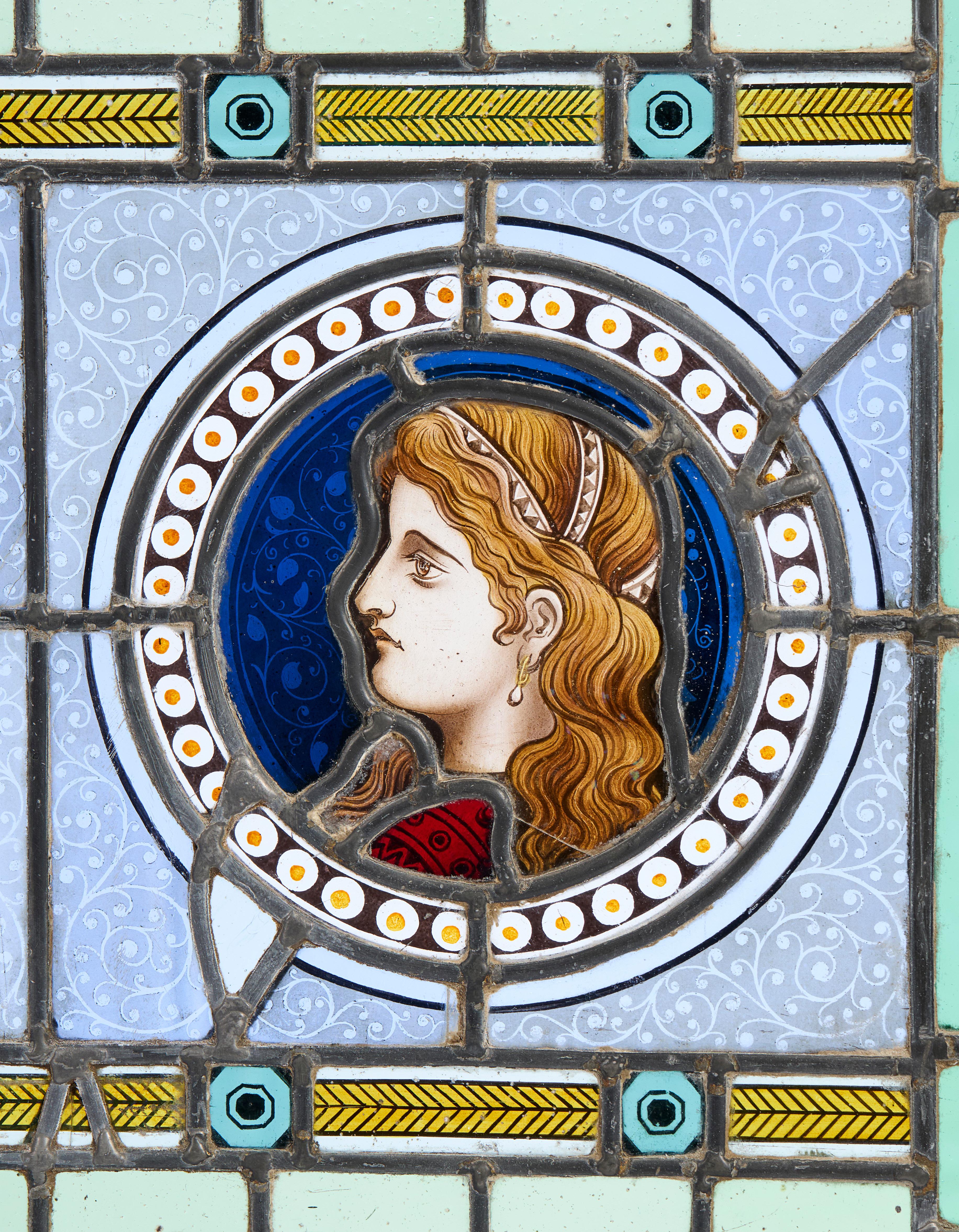
ATTRIBUTED TO HEATON, BUTLER & BAYNE
STAINED GLASS PANEL, CIRCA 1890 painted, leaded and stained glass, the roundel within associated quarry field in the manner of Morris & Co.
£1,500-2,000
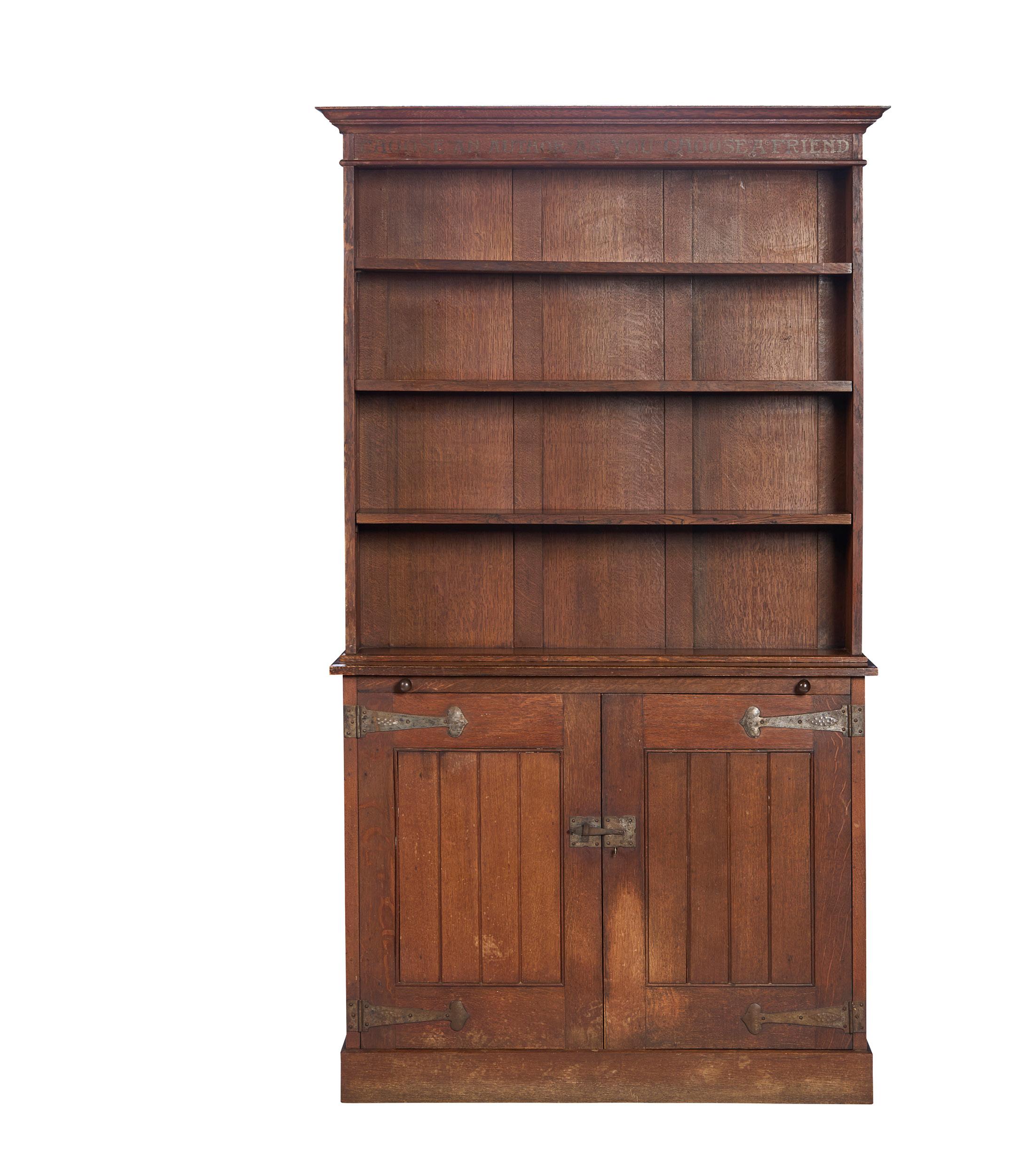
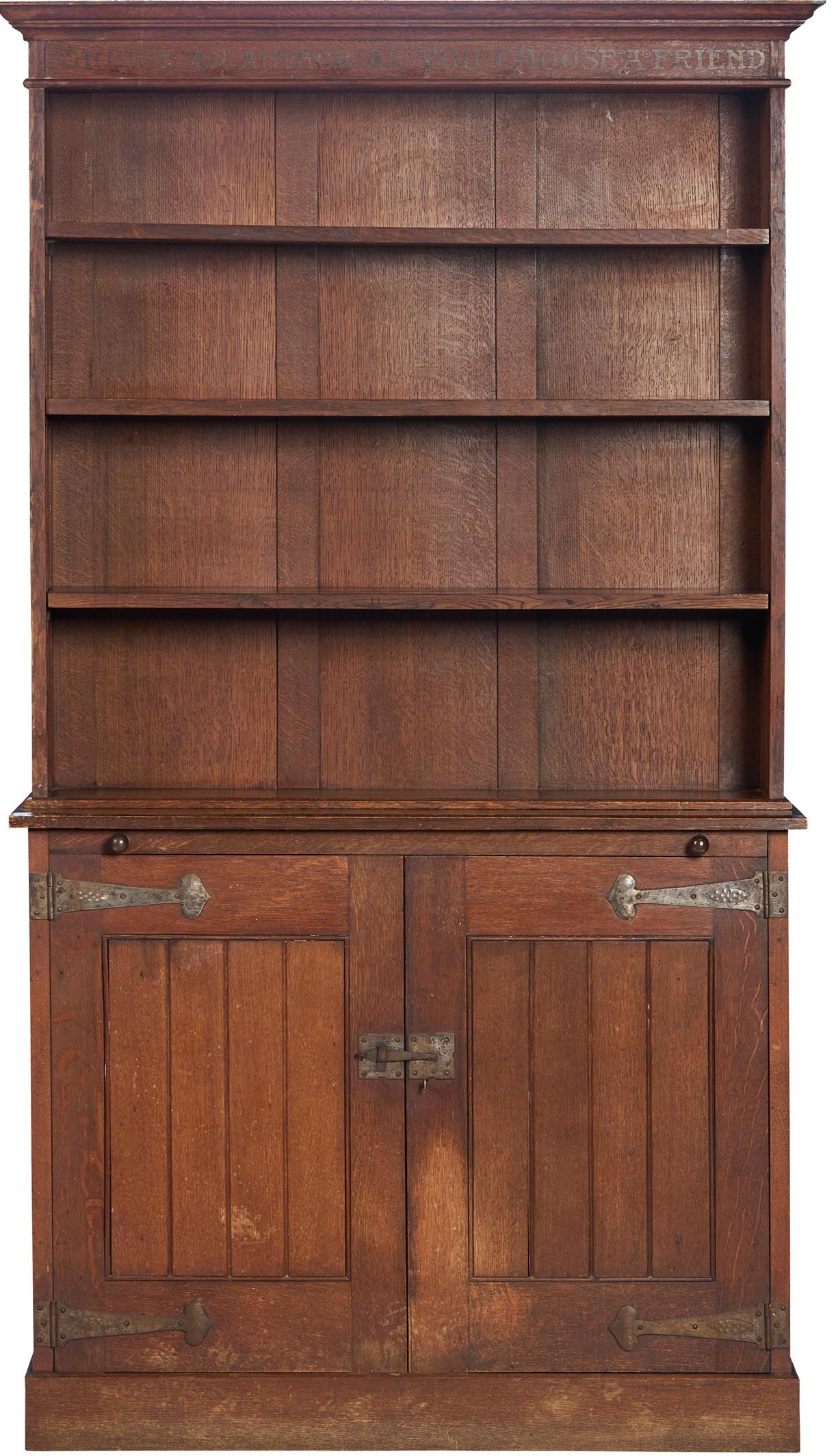
12
ENGLISH GOTHIC REVIVAL BOOKCASE, CIRCA 1890
oak, with steel fittings, the upper section bears painted inscription CHOOSE AN AUTHOR AS YOU CHOOSE A FRIEND
117cm wide, 206cm high, 36.5cm deep
£600-800
13
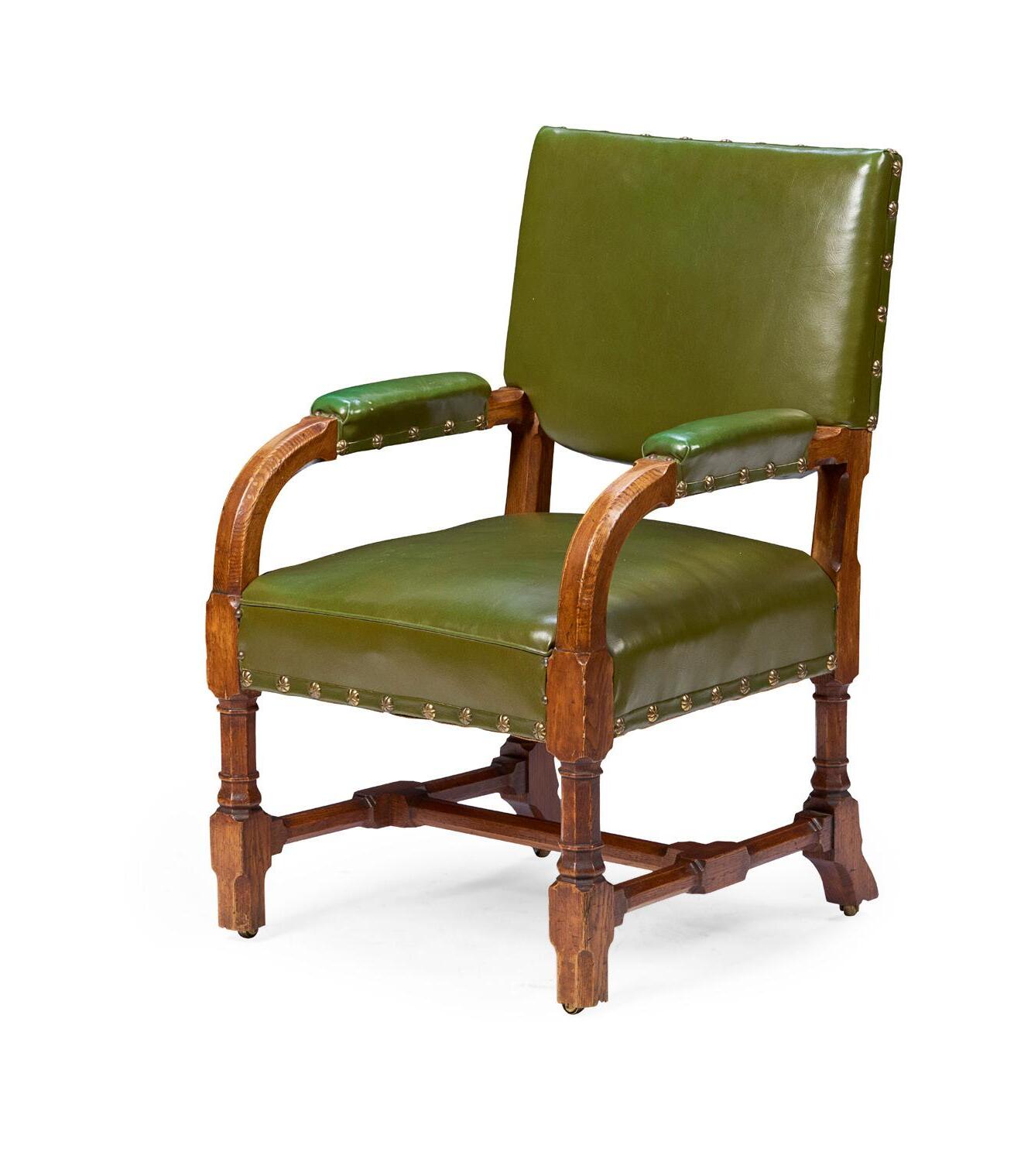
A.W.N. PUGIN (1812-1852)
GOTHIC REVIVAL ARMCHAIR, CIRCA 1850
oak, leather upholstery, on brass castors
60cm wide, 97cm high, 65cm deep
£800-1,200
14
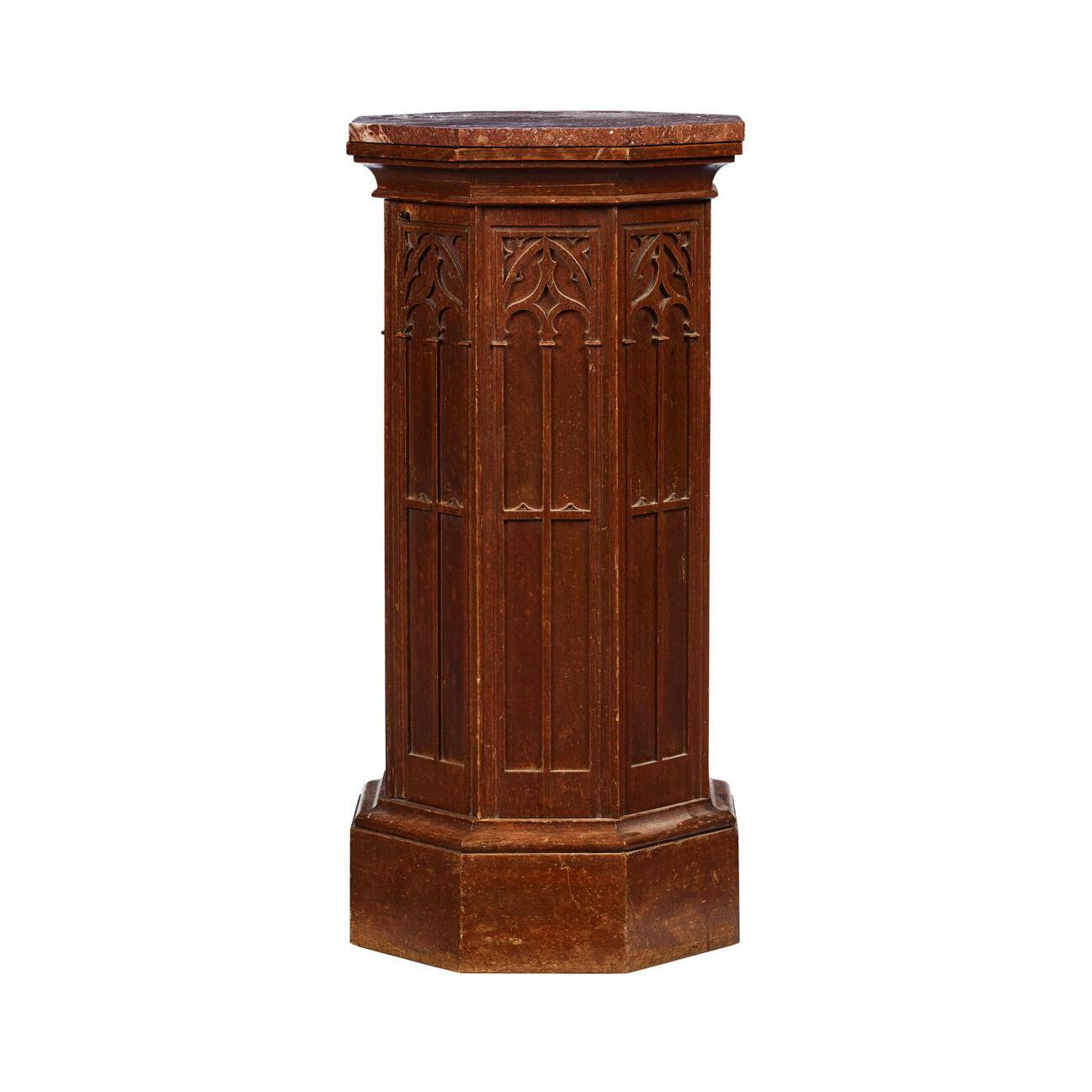
ENGLISH
GOTHIC REVIVAL PEDESTAL CUPBOARD, CIRCA 1880
carved oak, with marble top
43cm wide, 91.5cm high
Provenance: Private collection, London
£300-500
15
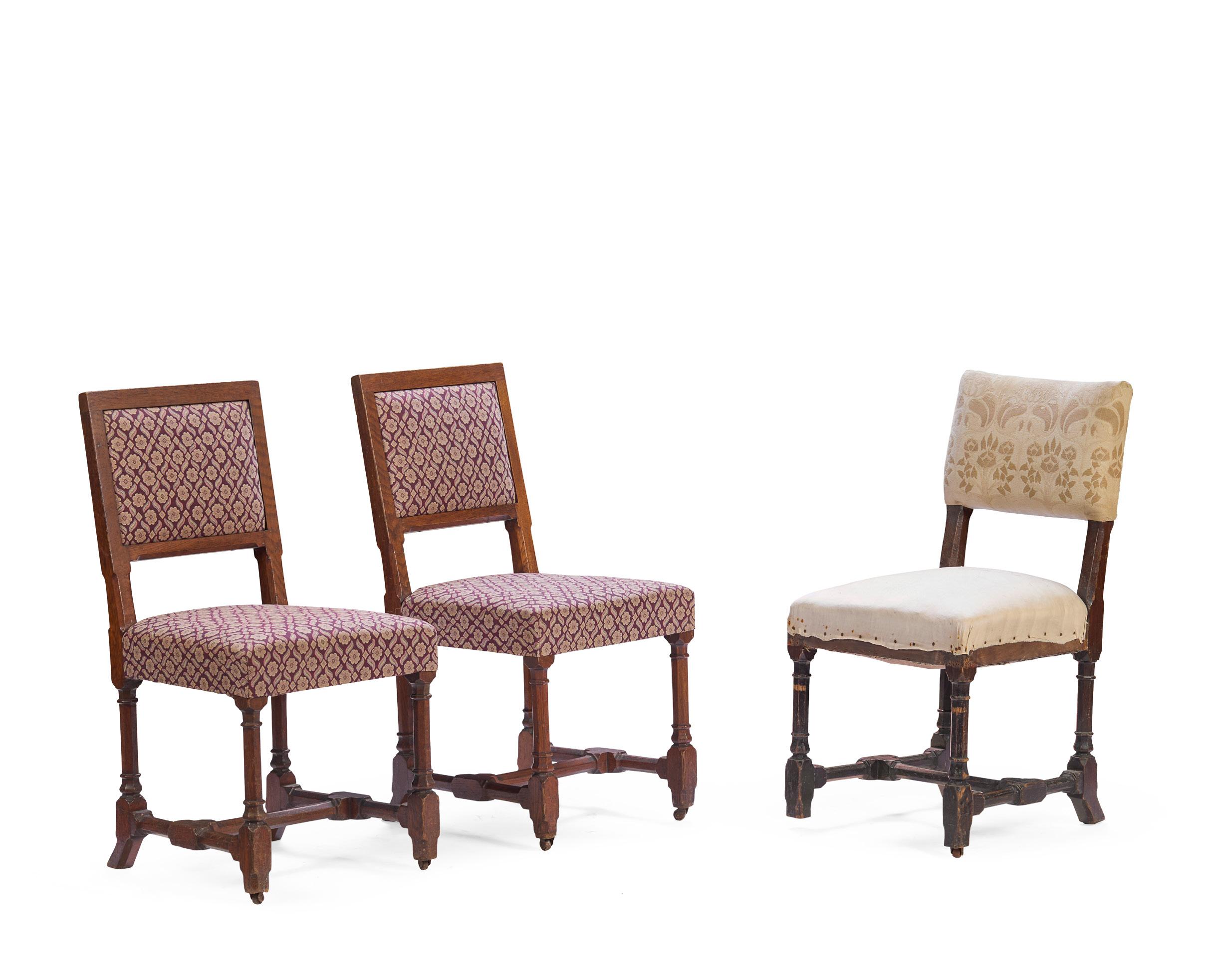
A.W.N. PUGIN (1812-1852) FOR GILLOWS
PAIR OF GOTHIC REVIVAL CHAIRS, CIRCA 1850
oak, with upholstery, stamped GILLOWS, 47cm wide, 91cm high, 46cm deep; together with a SINGLE CHAIR, 46cm wide, 89cm high, 46cm deep (3)
£300-500
16
ENGLISH
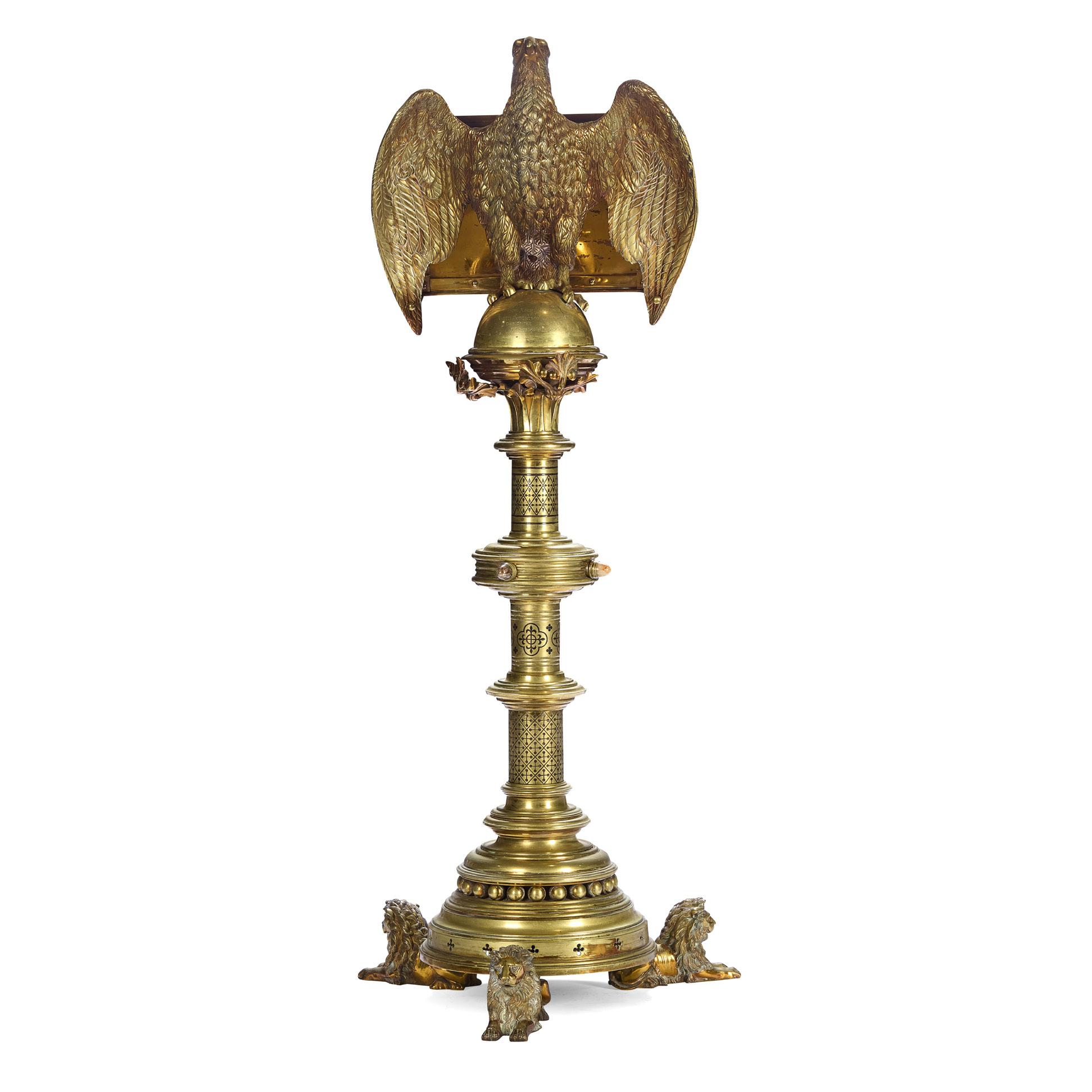
GOTHIC REVIVAL CHURCH LECTURN, CIRCA 1890
inlaid brass, hardstone, bears inscription ‘PRESENTED TO THE ABBEY CHURCH BY DAVID ROBERTSON MERCHANT, LEITH, ONE OF THE TRUSTEES 1ST SEPTEMBER 1893’
175cm high, 63cm wide, 73cm deep at base
Provenance: Presented to Abbey Church, Edinburgh, in 1893 by David Robertson, a merchant of Leith. Abbey Church was built at the foot of Montrose Terrace in 1875 and closed in 1975, merging with Greenside Church. The building was then demolished in the early 1990s and selected contents then formed part of the contents of Greenside Church, Edinburgh, until its recent deconsecration.
£1,500-2,500
18
SCOTTISH
PAIR OF GOTHIC REVIVAL ARMCHAIRS, CIRCA 1886
carved oak, velvet cushions, brass plaque to the back inscribed ‘Gifted by James Taylor Esquire of Starley Hall, an elder of Greenside Church, January 1886’ (2)
67cm wide, 97cm high, 56cm deep
Provenance: Part of the contents of Greenside Church, Edinburgh, until its recent deconsecration.
£500-700
17
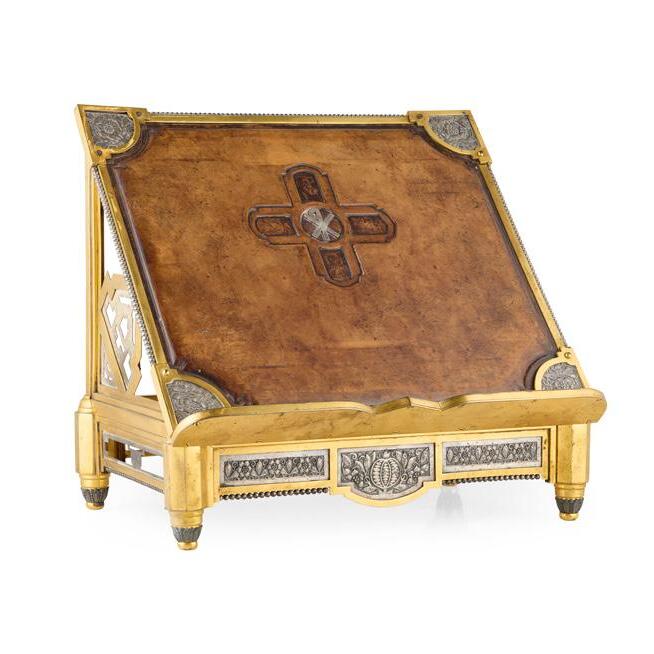
ENGLISH ECCLESIASTICAL BOOK REST, CIRCA 1920 brass, leather, silver-plated metal 38cm wide, 35cm high, 27cm deep
£300-500
19
ENGLISH
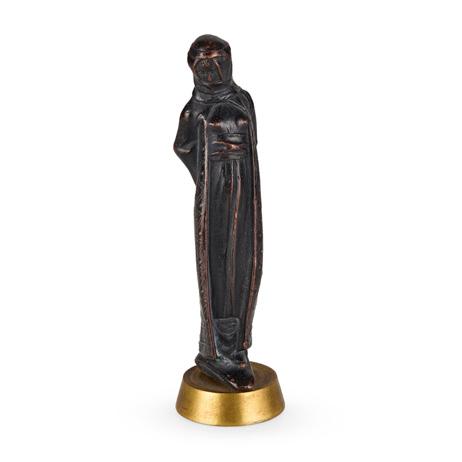
‘QUEEN OF HEARTS’ DESK SEAL, CIRCA 1880
bronze, with brass seal to base 8.2cm high
£200-300
20
JONES & WILLIS, BIRMINGHAM
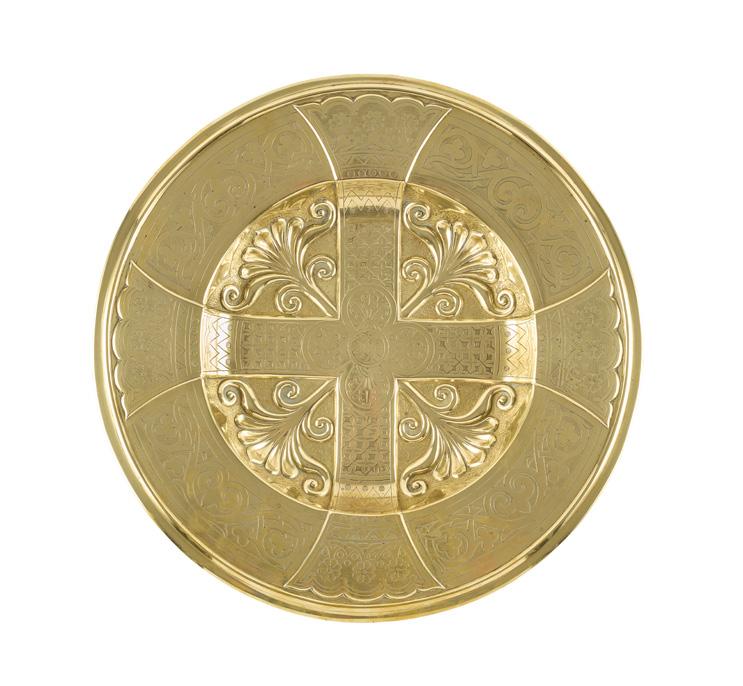
GOTHIC REVIVAL OFFERTORY PLATE, CIRCA 1880
repoussé-decorated and incised brass, stamped maker’s mark JONES & WILLIS LTD.
41cm diameter
Literature: Illustrated in catalogue of ecclesiastical art by Jones & Willis, Ltd., 1905, p. 28, no. 5
Established in Birmingham around 1847, the firm was originally called Newton, Jones & Willis. By 1858 they were known as Jones & Willis. By this date they held the royal warrant as silk mercers and over the next seventy-five years produced more than eighty illustrated catalogues of church furnishings, both textile & furniture. George Edmund Street (1824–1881) designed a series of ecclesiastical furnishings for the firm in the late 19th century.
£400-600
21
SCOTTISH
GOTHIC REVIVAL LIBRARY
TABLE, CIRCA 1880
oak, with brass fittings
122cm wide, 79cm high, 70cm deep
Provenance: Part of the contents of Greenside Church, Edinburgh, until its recent deconsecration.
£300-500
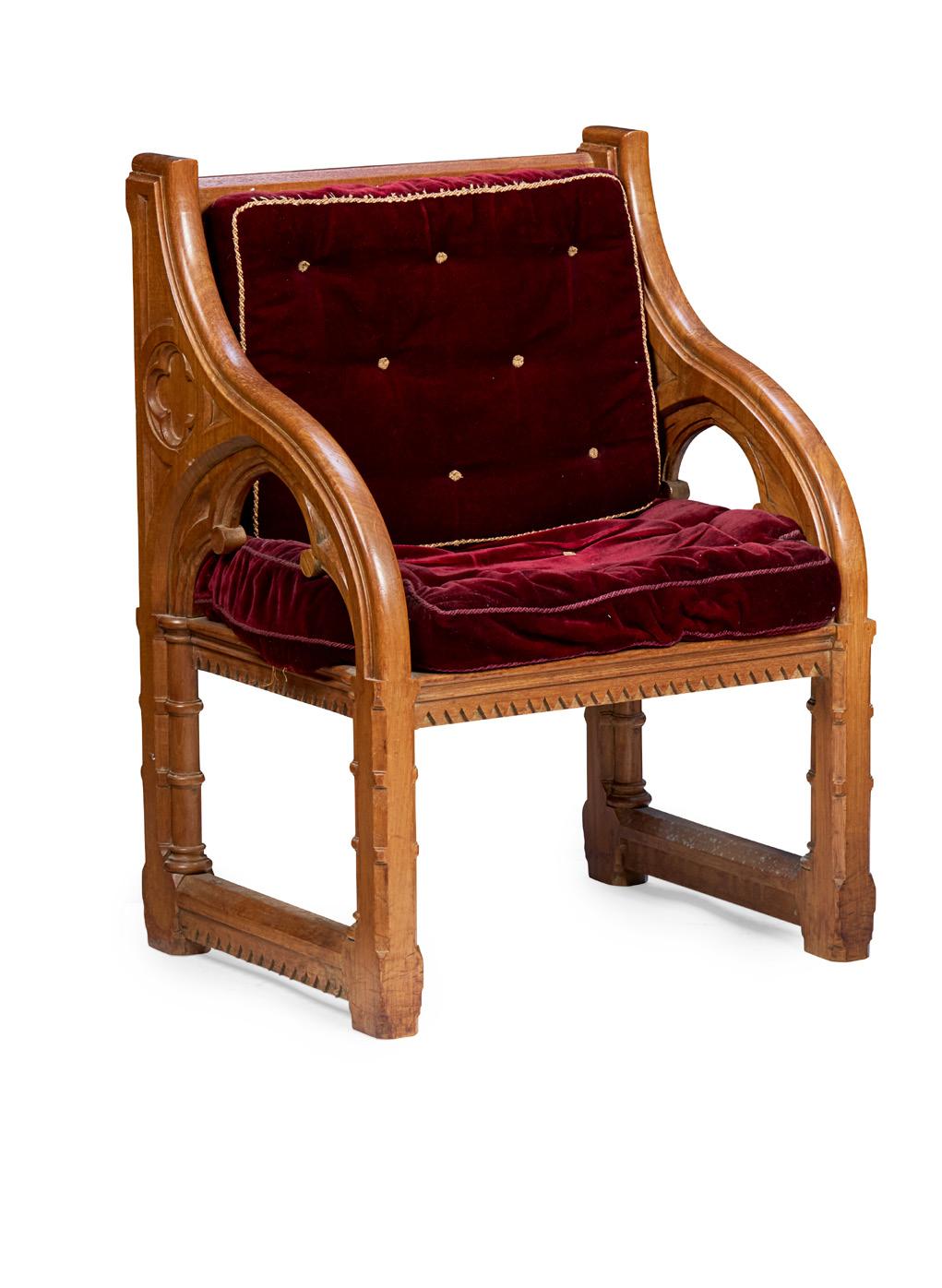
SCOTTISH
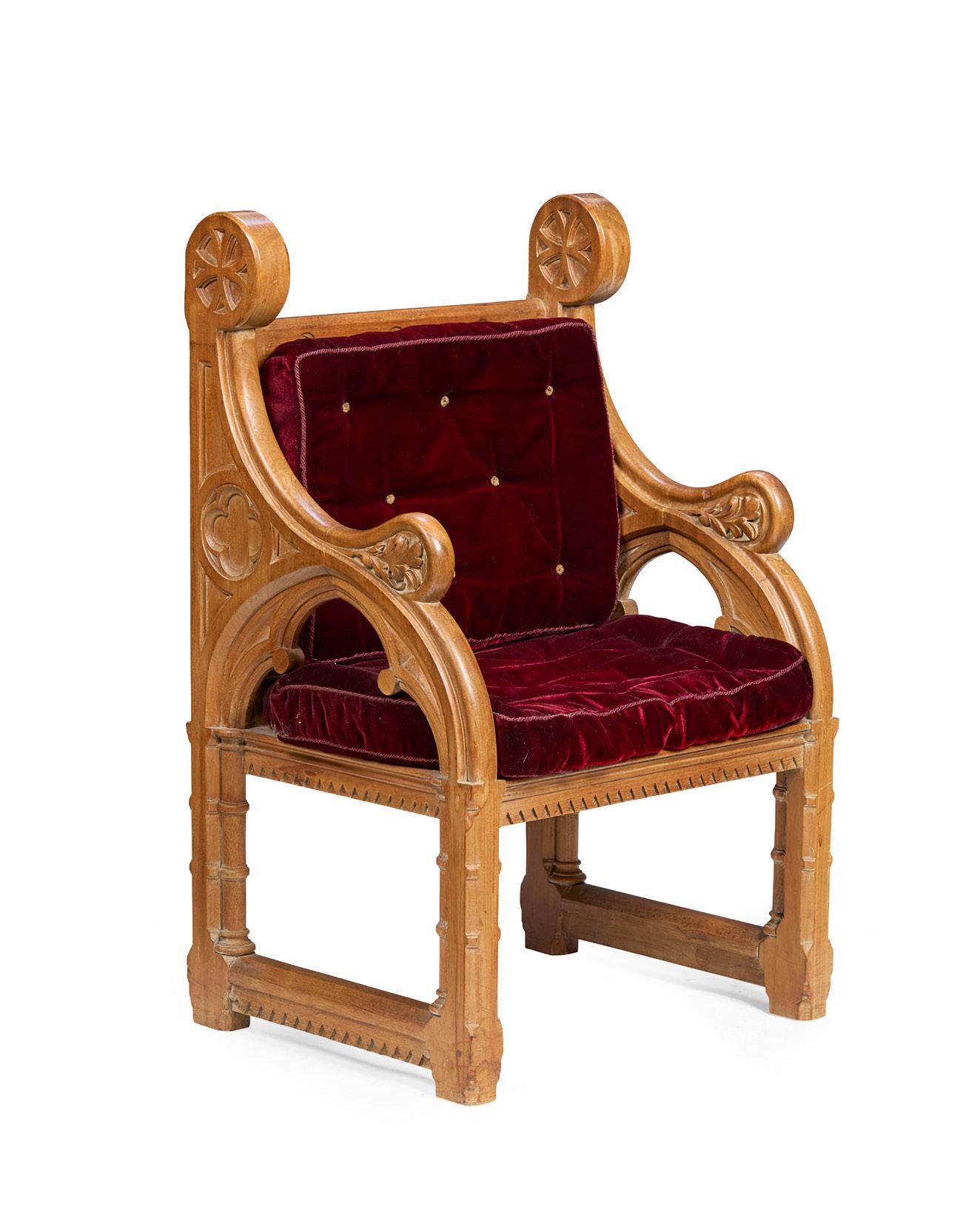
GOTHIC REVIVAL ARMCHAIR, CIRCA 1886
carved oak, velvet covered cushions, with brass plaque to the back inscribed ‘Gifted by James Taylor Esquire of Starley Hall, an elder of Greenside Church, January 1886’
67.5cm wide, 109cm high, 56cm deep
Provenance: Part of the contents of Greenside Church, Edinburgh, until its recent deconsecration.
£300-500
23
A.W.N. PUGIN (1812-1852) FOR MINTONS TWO GOTHIC REVIVAL TILES, CIRCA 1860 dust pressed clay, impressed maker’s marks, comprising; a MINTONS CHINA WORKS SIX-INCH TILE, 15cm square; a MINTON, HOLLINS & CO 8-INCH FRAMED TILE, frame size 26cm square (2)
£250-350
24
ENGLISH
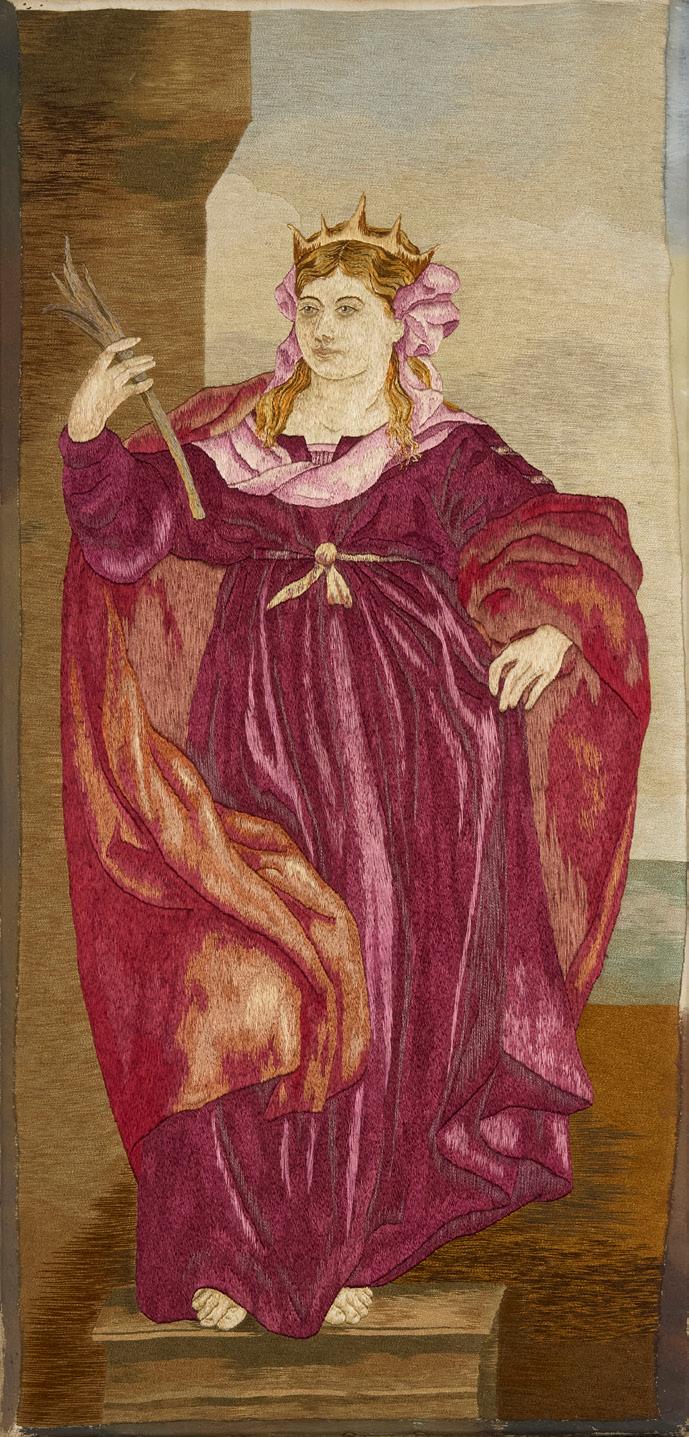
‘MINERVA’ EMBROIDERED
PANEL, CIRCA 1890
coloured silks, indistinctly signed verso, unframed
52cm x 23cm
£200-300
25
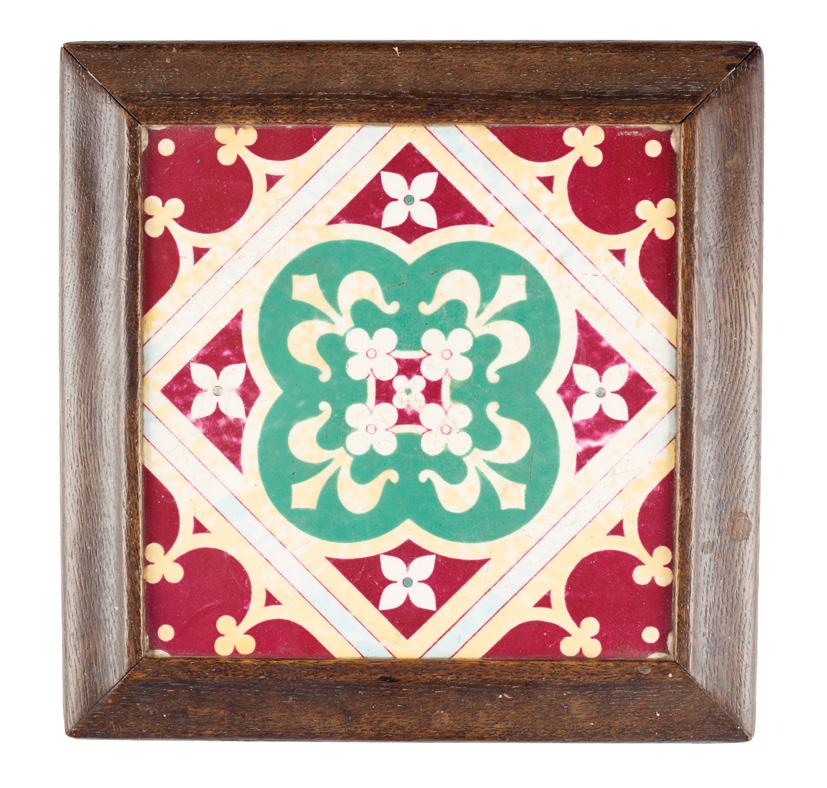
A.W.N PUGIN (1812-1852) FOR MINTON & CO.
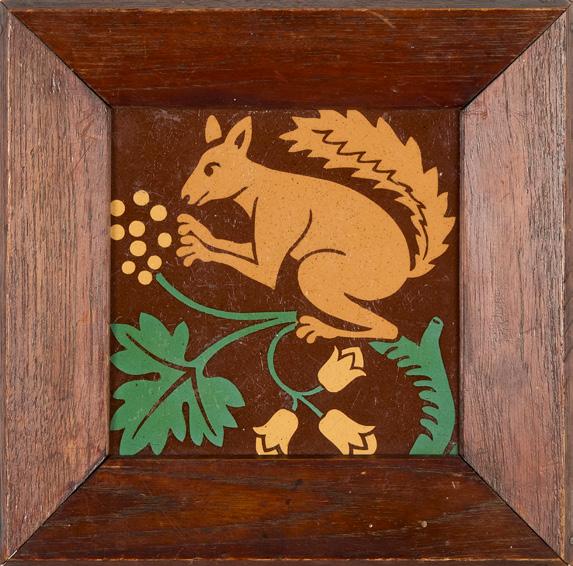
FRAMED TILE, CIRCA 1860 glazed earthenware, stamped maker’s marks, with registration lozenge 15cm square (frame size 23cm square)
£250-350
26
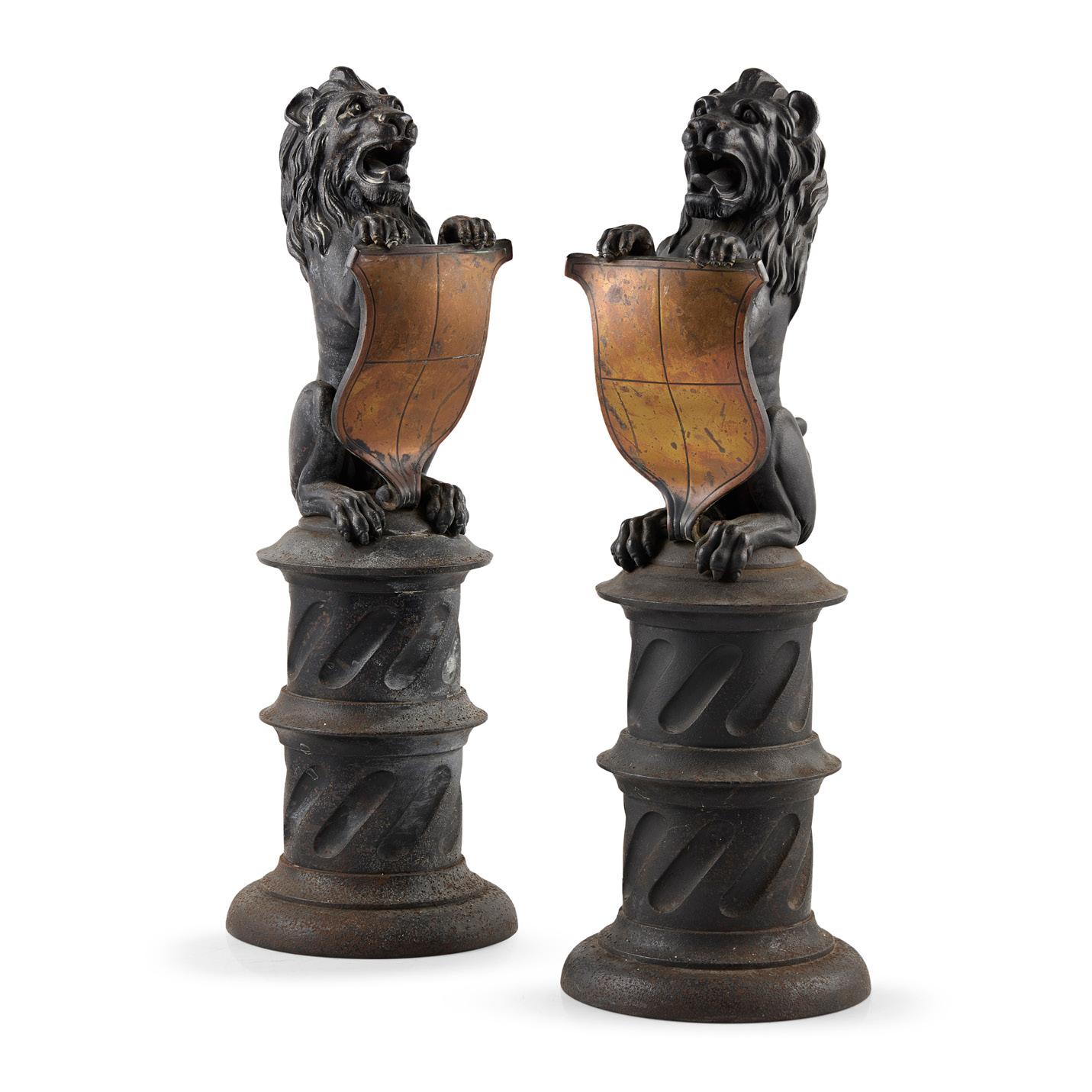
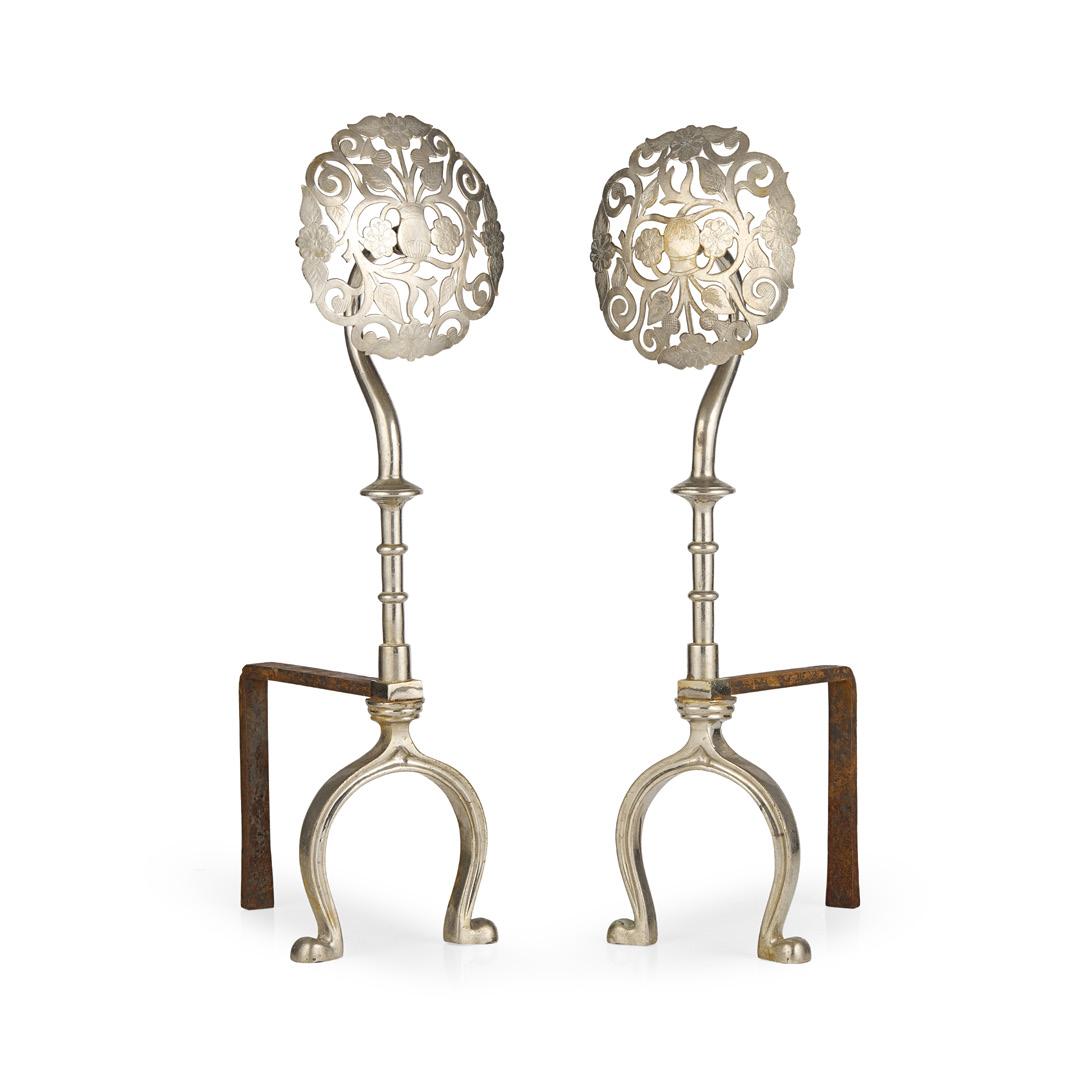
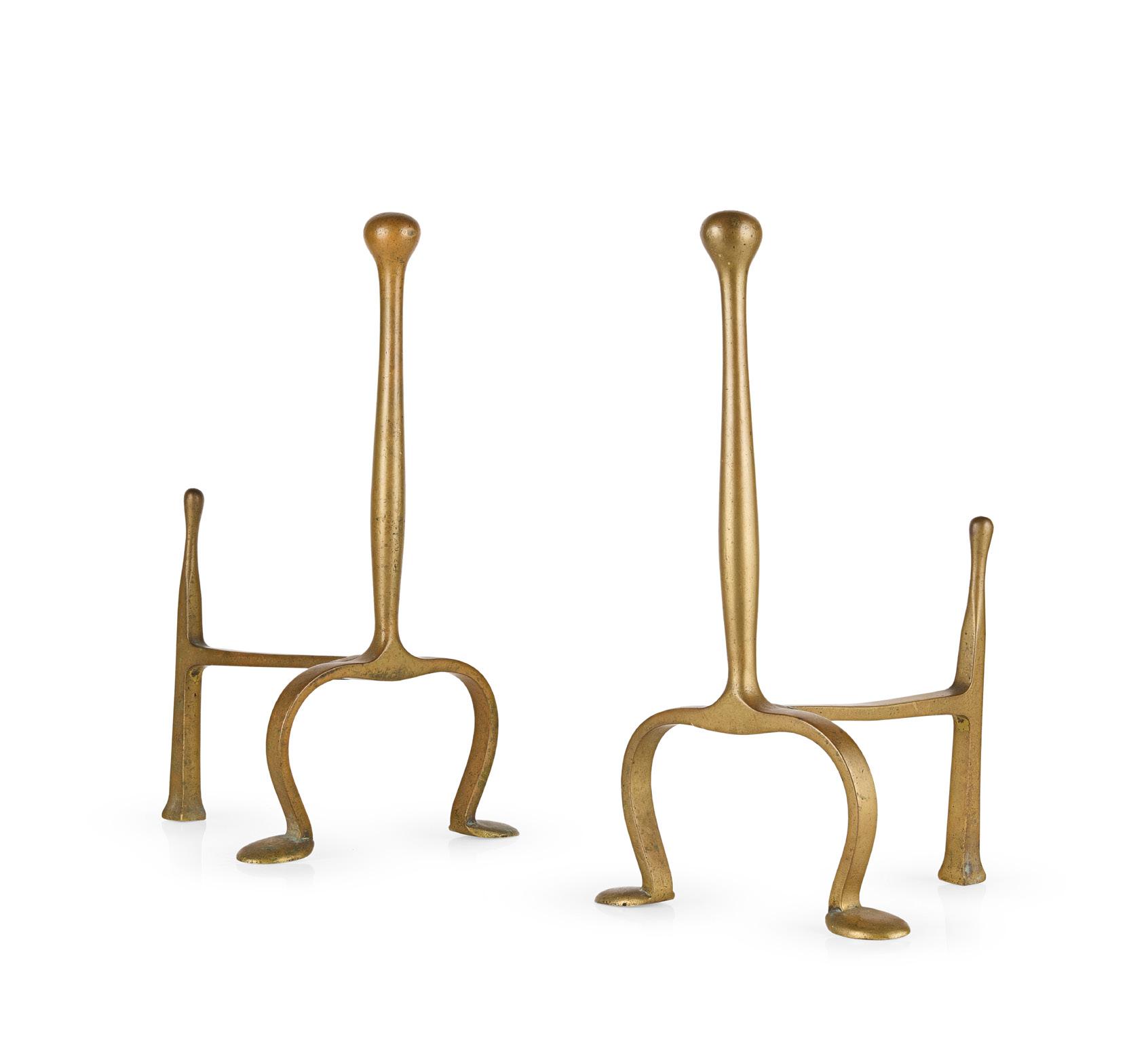
MANNER OF A.W.N. PUGIN PAIR OF GOTHIC REVIVAL FIRE DOGS, CIRCA 1880 cast iron, copper (2) 56cm high
£400-600
29
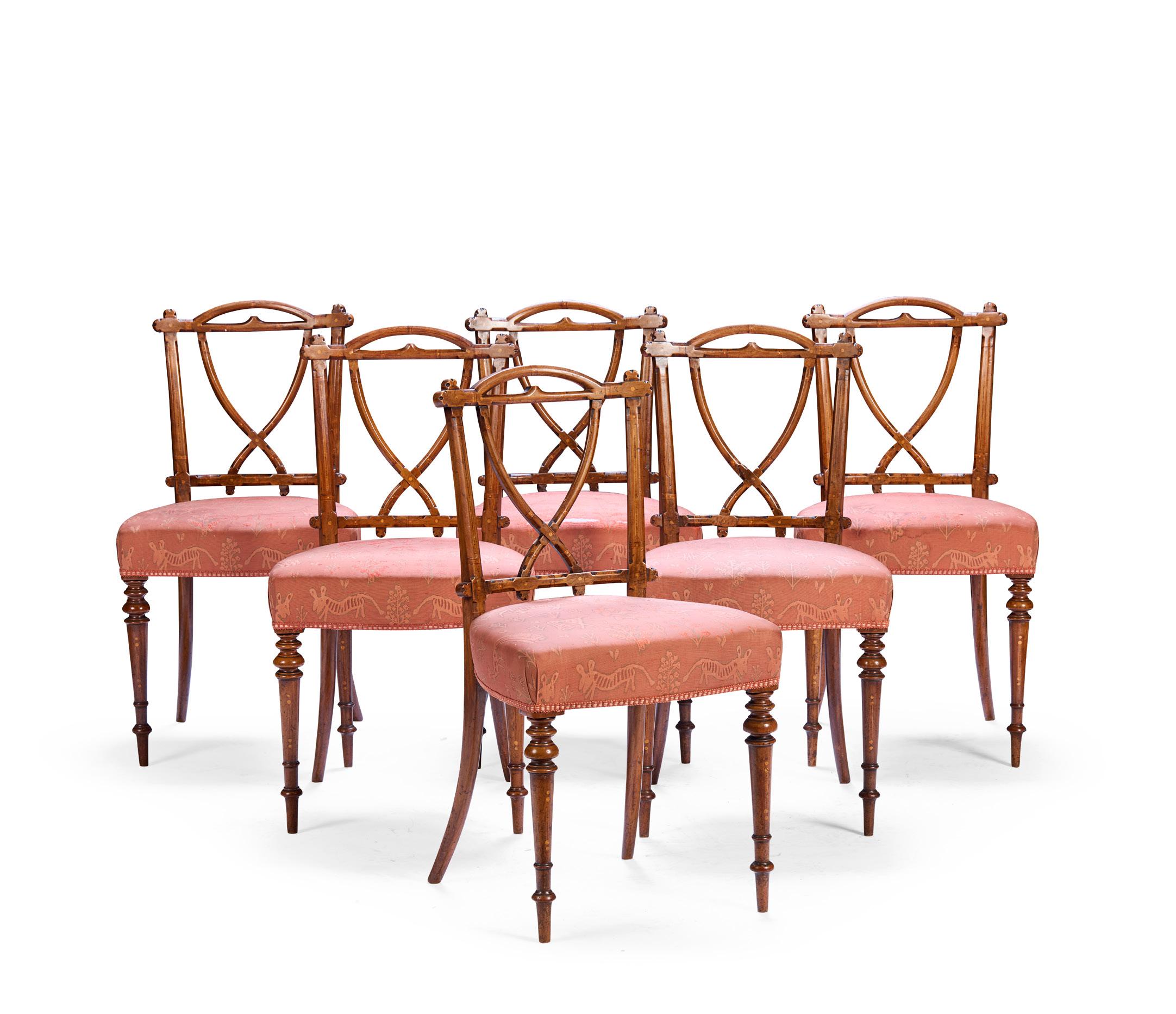
ATTRIBUTED TO CHARLES BEVAN (1815-1891)
SET OF SIX SIDE CHAIRS, CIRCA 1880
inlaid walnut and upholstery (6)
44cm wide, 83.5cm high, 42cm deep
£1,000-1,500 27
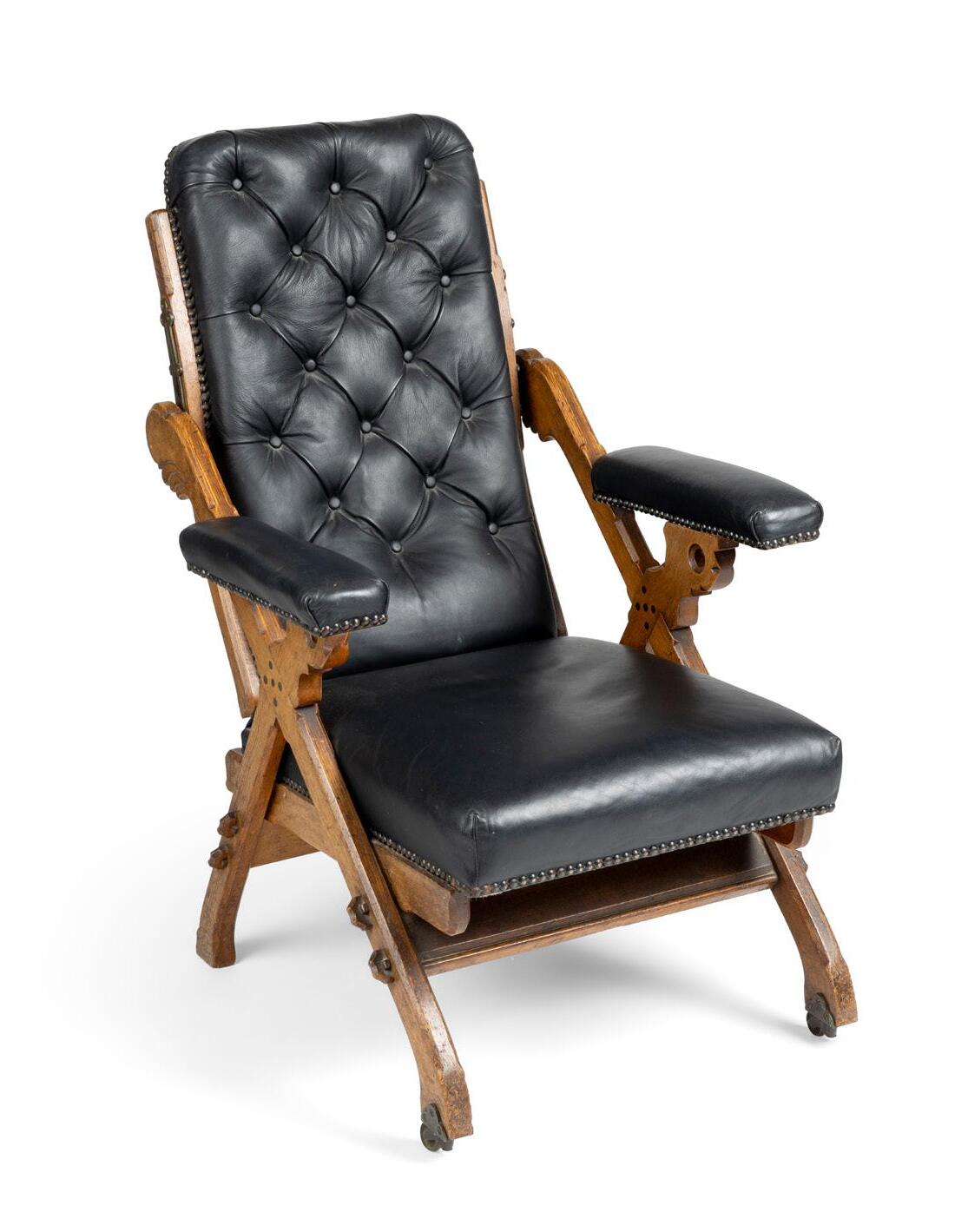
CHARLES
BEVAN (1815-1891) FOR MARSH, JONES & CRIBB
REFORMED GOTHIC ADJUSTABLE ARMCHAIR, CIRCA 1870
oak, with buttoned leather upholstery
70cm wide, 104cm high, 67cm deep
Cooper J. Victorian and Edwardian Furniture and Interiors, Thames & Hudson, 1987, fig. 267 where a related chair designed by Charles Bevan, and manufactured on licence by Marsh & Jones is illustrated.
H. Blairman & Son, Gothic-Revival Furniture by Charles Bevan, 2006
28
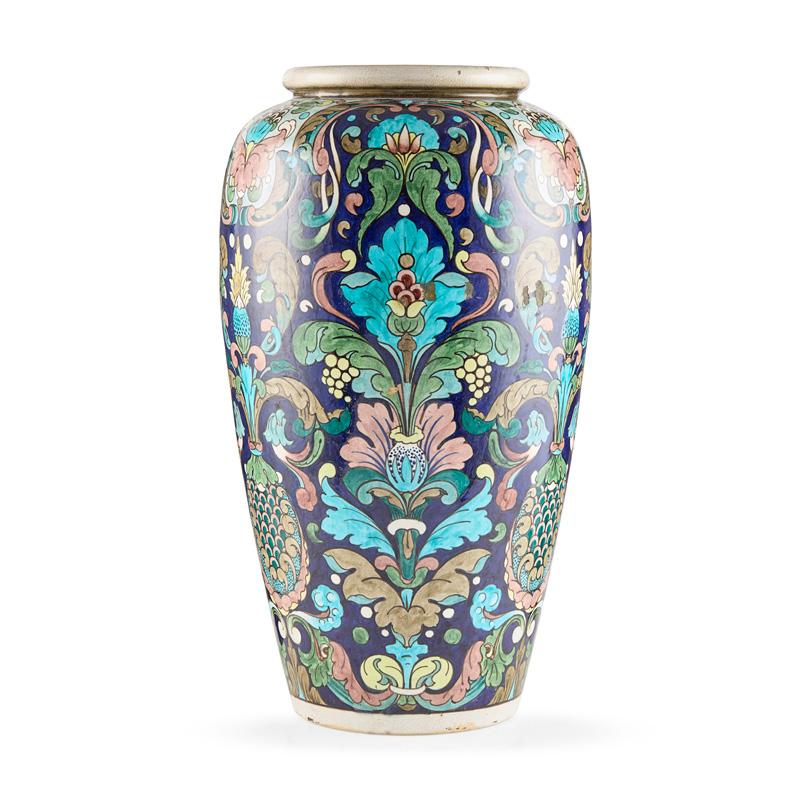
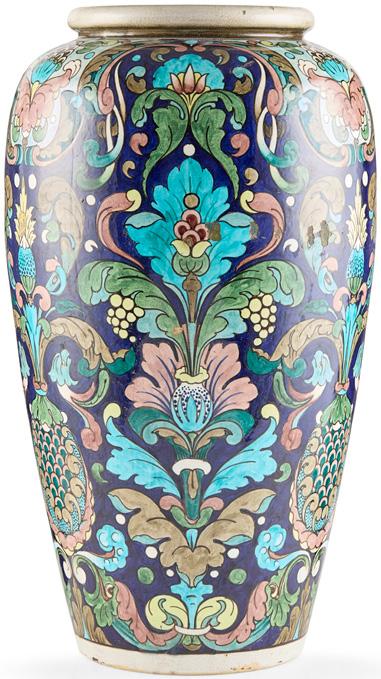
All Burmantofts ‘AngloPersian’ wares bear the initials of the decorator Leonard King. These wares made their first documented appearance at the Saltaire Exhibition in 1887 and were inspired by the ‘Persian’ wares of William de Morgan. Large pieces such as the present lot were expensive to produce and are rare examples.
LEONARD KING FOR BURMANTOFTS POTTERY, LEEDS LARGE ANGLO-PERSIAN FAIENCE OVOID VASE, CIRCA 1890
model 156, design 629, numbered ‘D629, 2921’, glazed and painted earthenware, decorated by Leonard King, bears impressed and painted maker’s marks ‘463/ DESIGN 80/ 21/ BURMANTOFTS FAIENCE/ 156 / D.629 / 2921’
£300-500
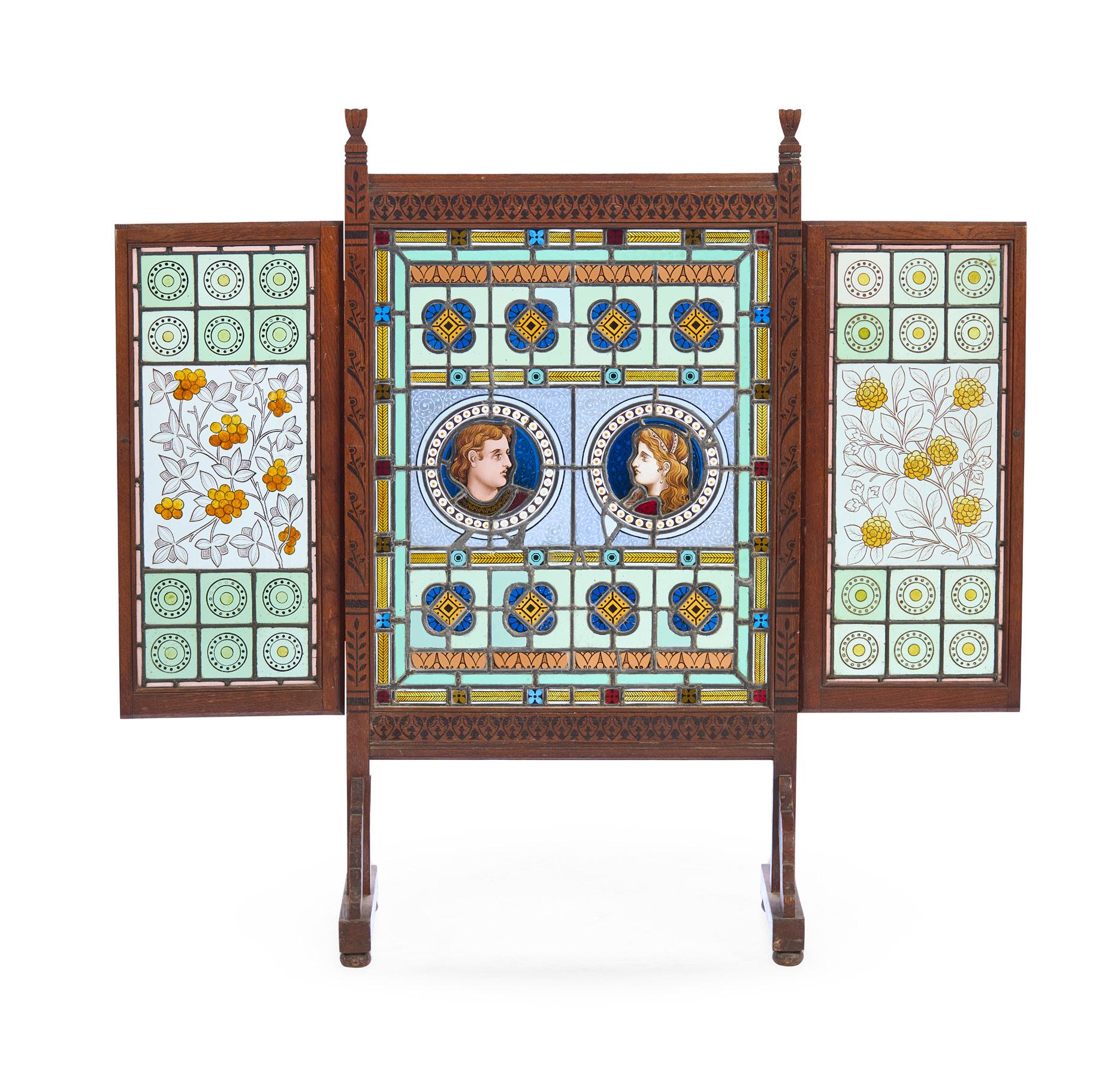
COX & SON, LONDON
AESTHETIC MOVEMENT THREEFOLD FIRESCREEN, CIRCA 1870
stained, painted and leaded glass, set in an oak frame
127cm high, 117.5cm wide (open), 63cm wide (closed)
£1,200-1,800
Cox & Sons was a large operation that catered to the Gothic Revival. They were famous for their “Catalogues of Art Manufactures,” which allowed homeowners and clergy to order high-quality artistic pieces through mail-order style booklets. The design for the current lot appears in one of these illustrated catalogues circa 1870-2, the specific page highlighting their “Artistic Domestic Glass,” which was designed to bring the beauty of stained glass into the Victorian home. The screen, no. 269, was advertised at 10 guineas.
31
ATTRIBUTED TO CHARLES BEVAN (1815-1891)
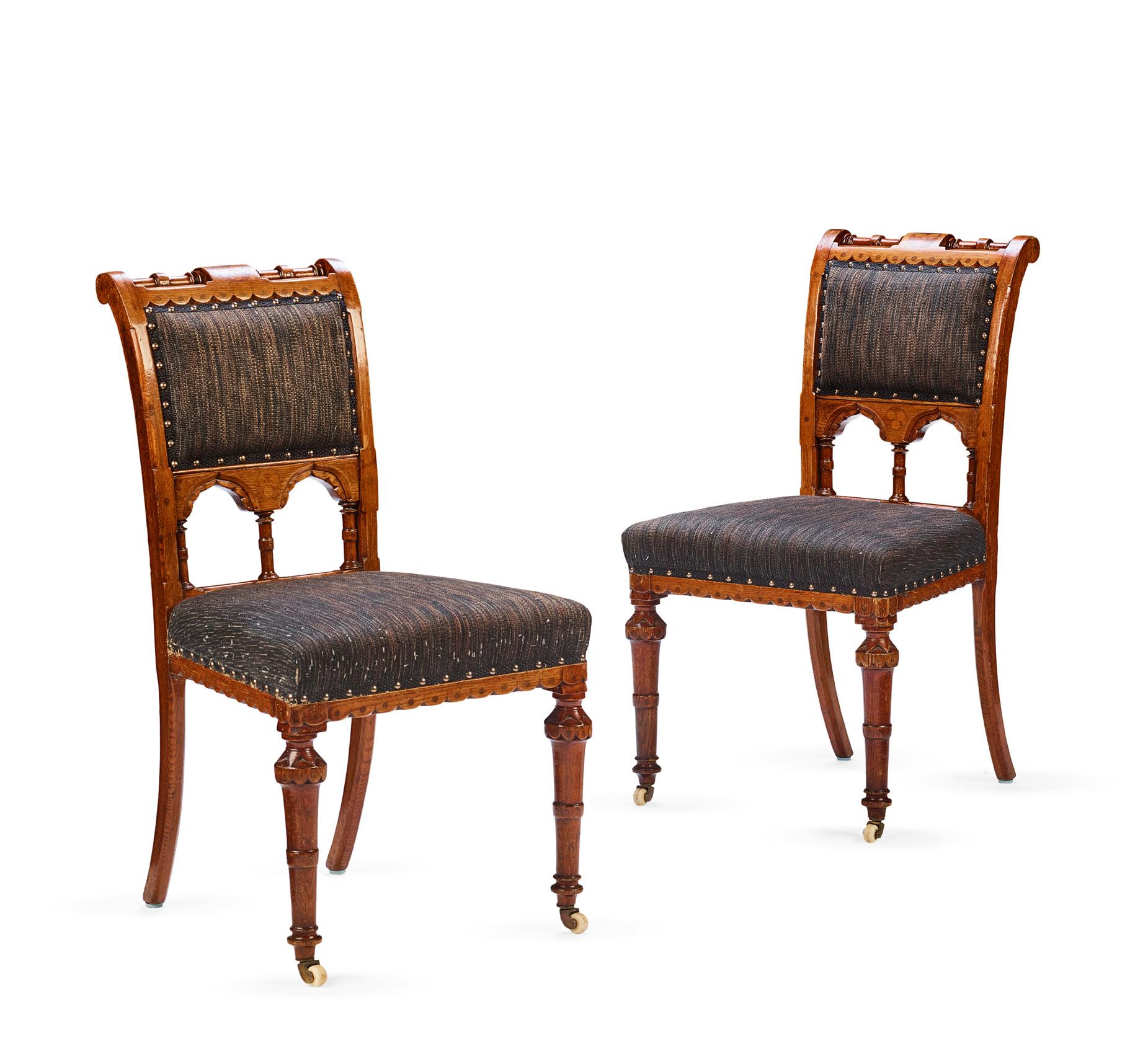
PAIR OF REFORMED GOTHIC SIDE CHAIRS, CIRCA 1875
inlaid oak, with later close-nailed upholstery, 49cm wide, 92cm high, 53cm deep; together with a PAIR OF GOTHIC REVIVAL SIDE CHAIRS, CIRCA 1890, oak, with ebony detail and later upholstery, 49cm wide, 91cm high, 50cm deep (4)
Provenance: Private collection, London
£300-500
32
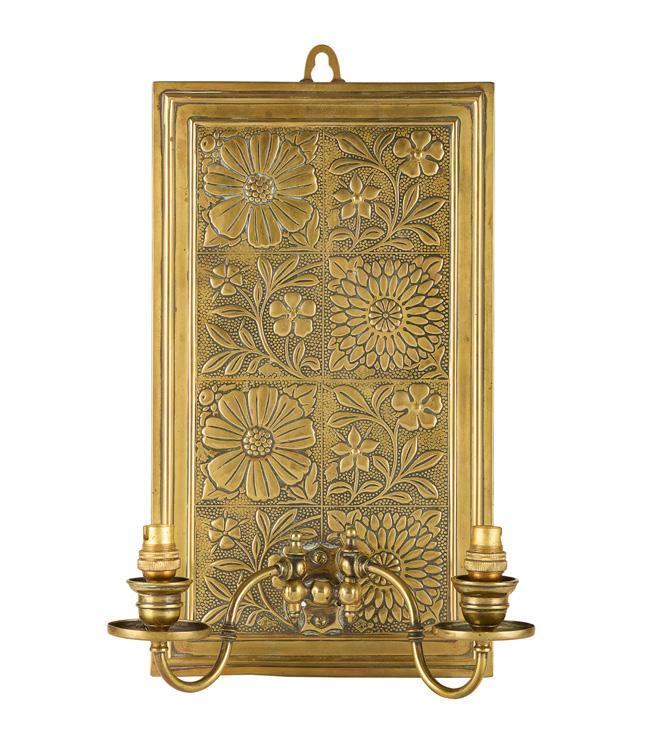
MANNER OF BRUCE TALBERT (1838-1881)
AESTHETIC MOVEMENT
SCONCE, CIRCA 1880
repoussé-decorated brass
20.5cm wide, 36cm high
£250-350
34
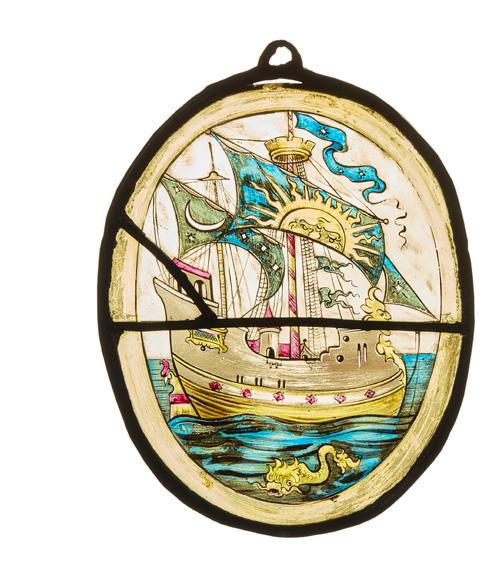
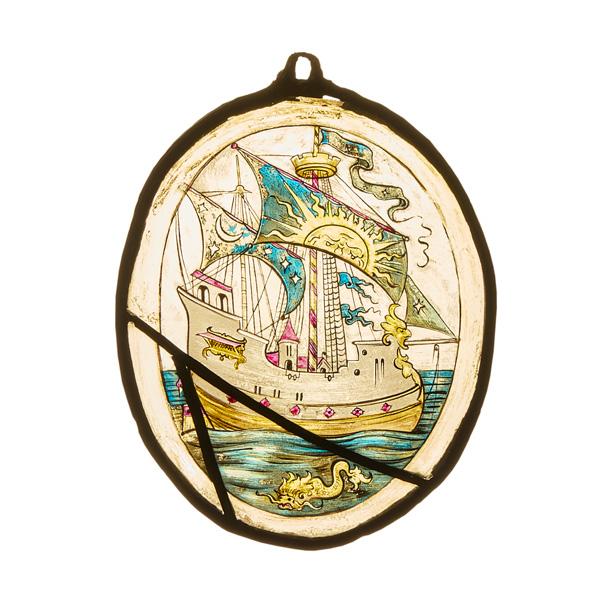
MANNER OF WILLIAM DE MORGAN
PAIR OF ARTS & CRAFTS STAINED
GLASS ROUNDELS, CIRCA 1890
painted, stained and leaded glass, depicting galleons at sea (2)
26.5cm x 21cm
£600-800
33
MANNER OF SELWYN IMAGE
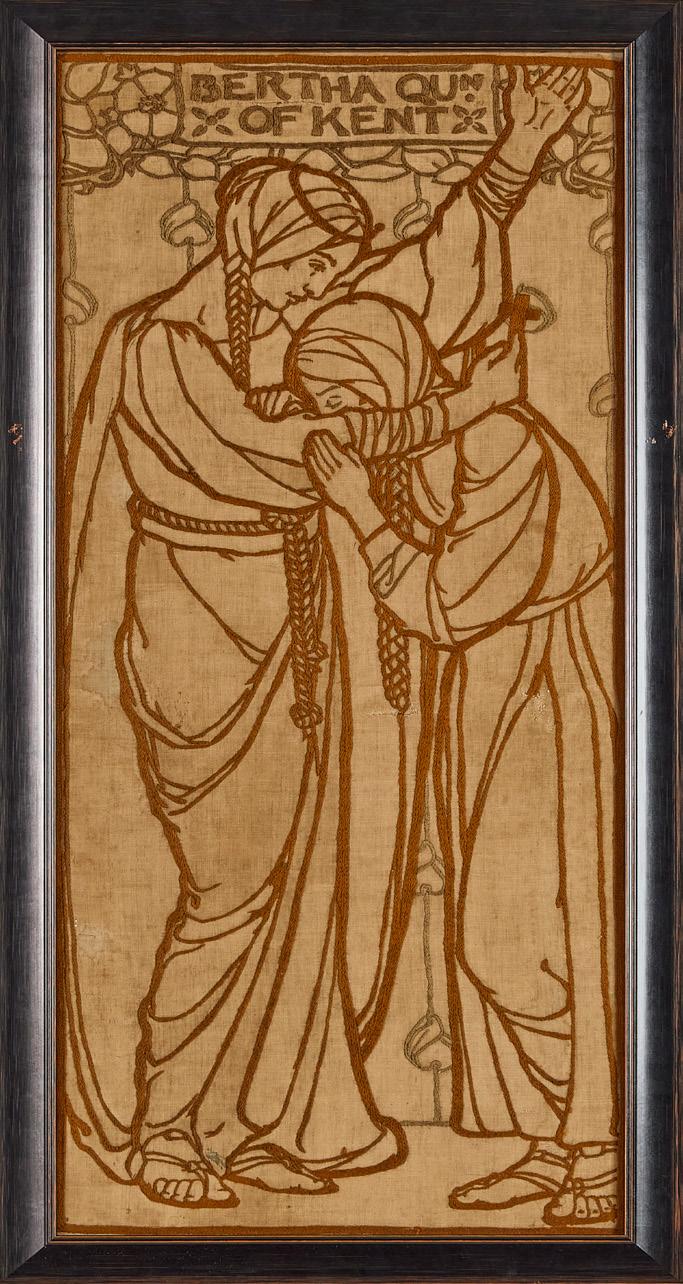
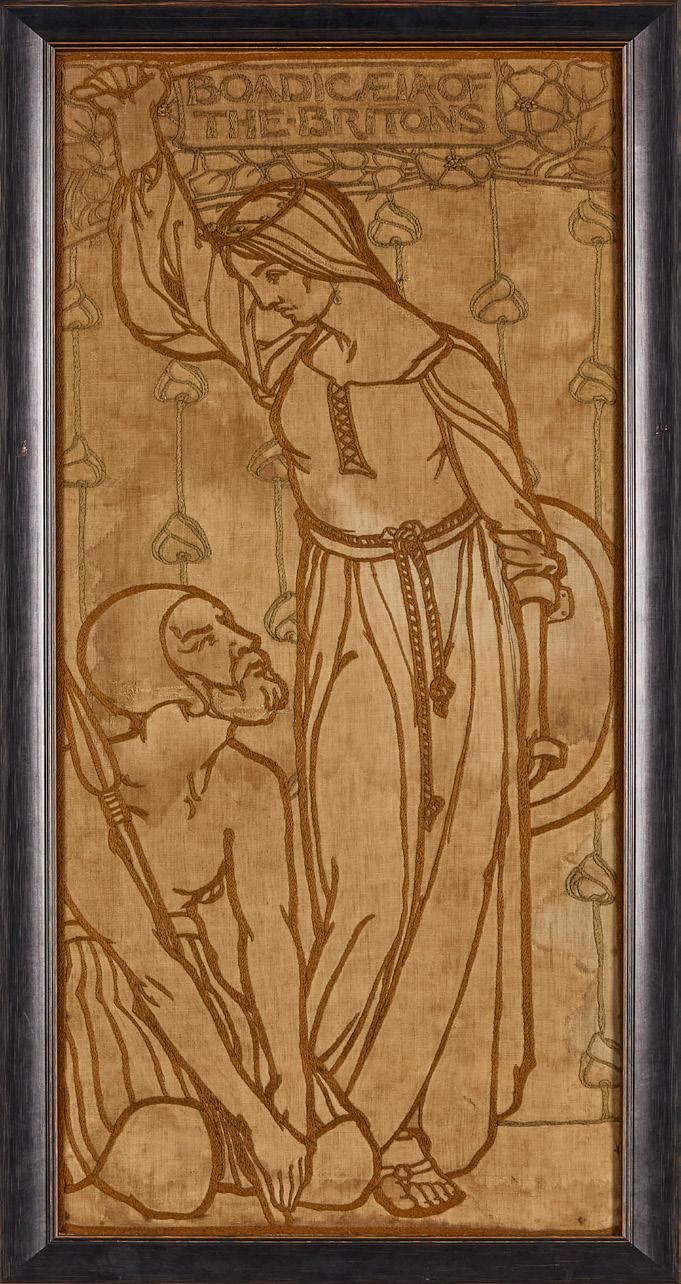
PAIR OF ARTS & CRAFTS EMBROIDERED PANELS, CIRCA 1890
coloured wools on an unbleached linen ground, ‘BERTHA QUN/ OF KENT’ and ‘BOADICAEIA OF/ THE BRITONS’, framed (2) 101cm x 40.5cm (frame size 110cm x 49cm)
£800-1,200
35 ENGLISH AESTHETIC MOVEMENT
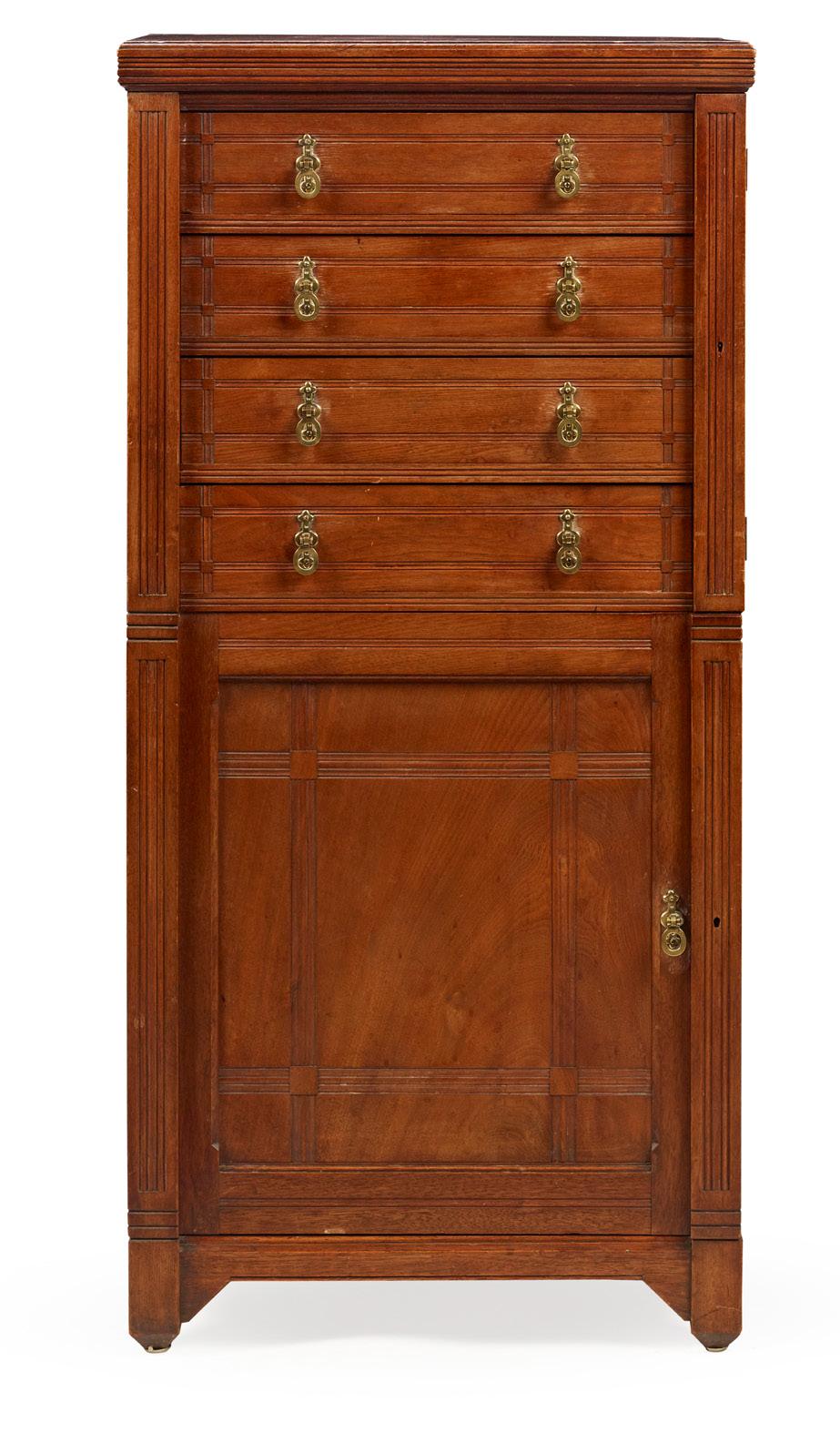
WELLINGTON CHEST/ CABINET CIRCA 1880 mahogany, with brass handles
54.5cm wide, 114.5cm high, 39cm deep
£400-600
36
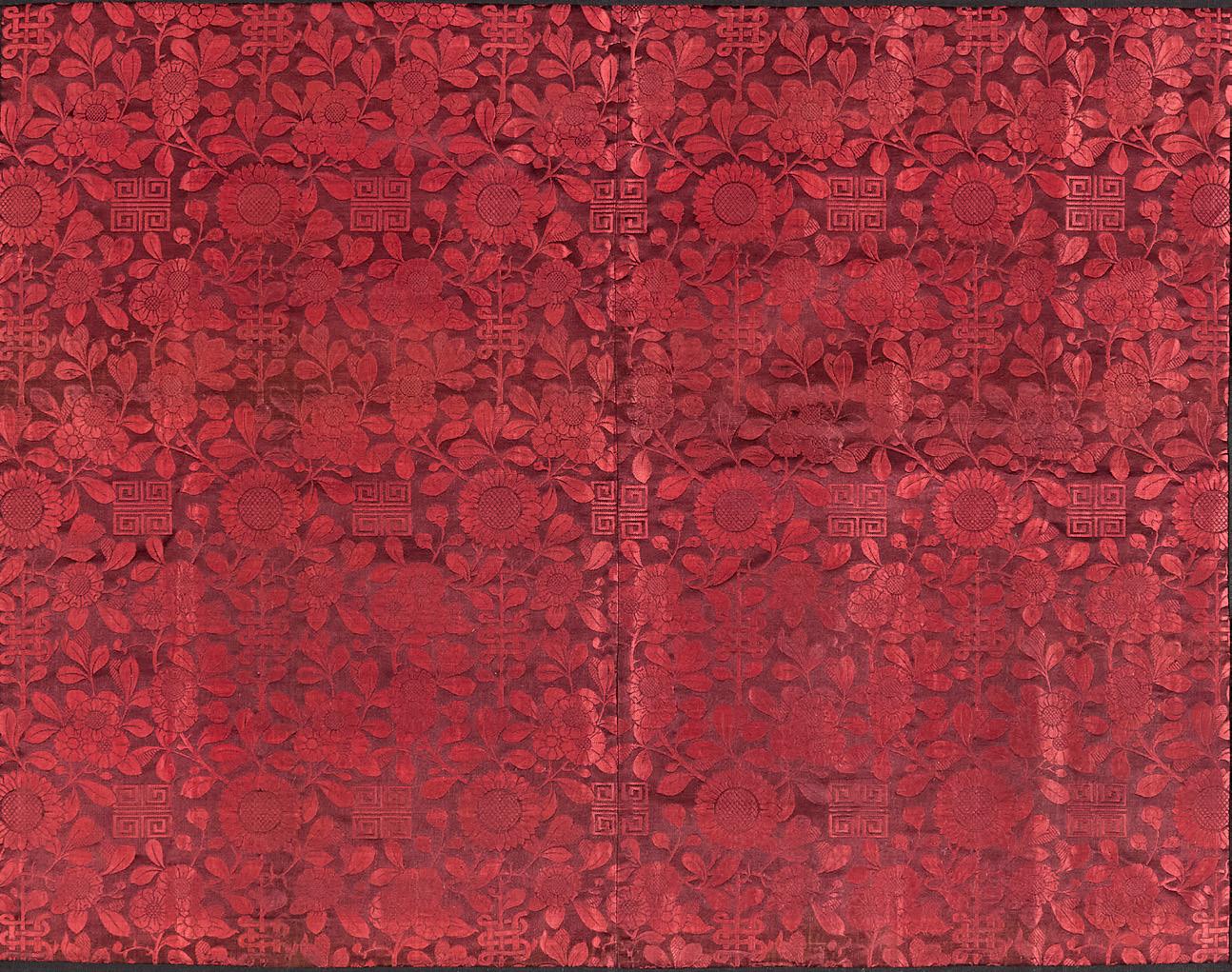
BRUCE TALBERT (1838-1881) FOR COWLISHAW, NICHOL & CO., MANCHESTER
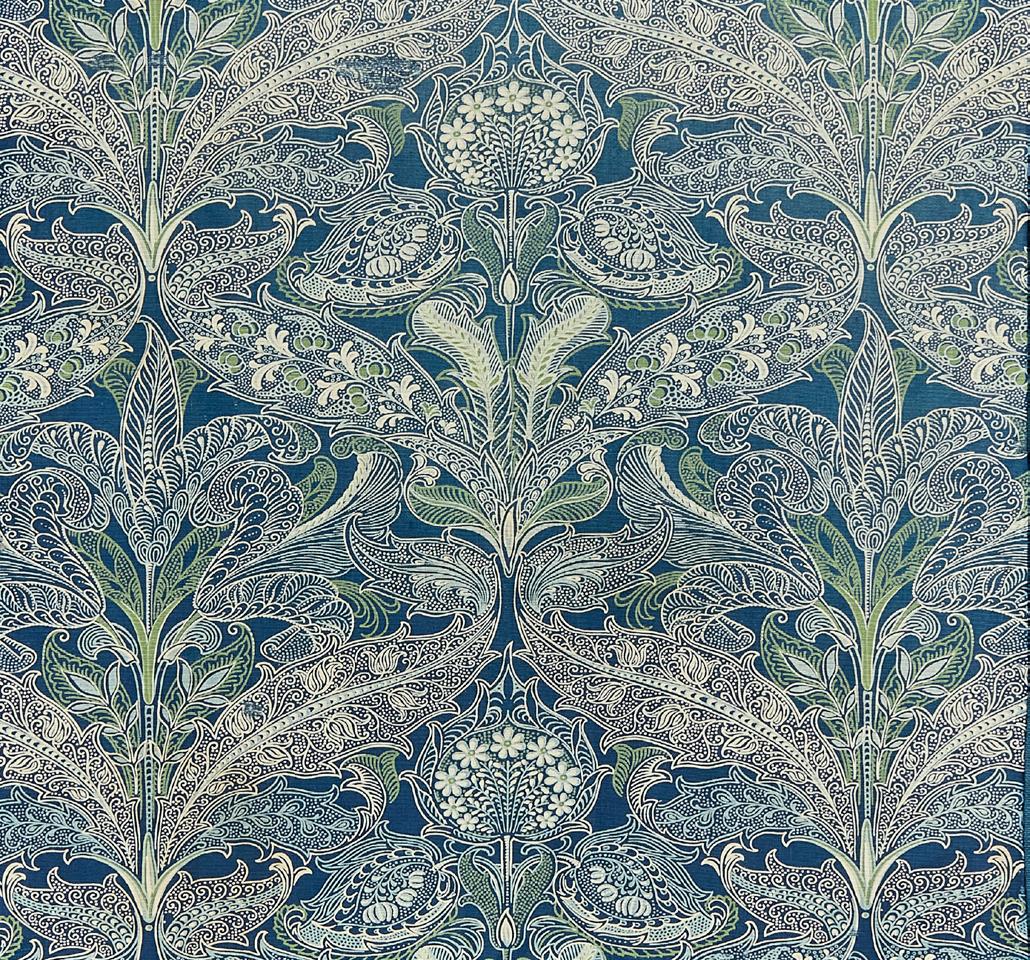
AESTHETIC MOVEMENT FURNISHING TEXTILE PANEL, 1878
woven silk damask, within a later black linen border, mounted on cloth covered board, within a Perspex box frame
90cm x 71cm (frame size 133cm x 113cm)
Exhibited: Tokyo, The Mitsubishi Ichigokan Museum, Beardsley, a Singular Prodigy. 15 February, 2025 - 11 May, 2025, no. 146
£400-600
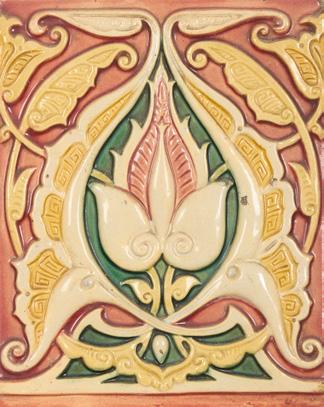
37 CRAVEN DUNNILL & CO THREE ALHAMBRA-STYLE ARCHITECTURAL TILES, CIRCA 1895 dust pressed clay, impressed maker’s marks (3) each tile 30cm x 24.5cm
£300-500
38
ENGLISH
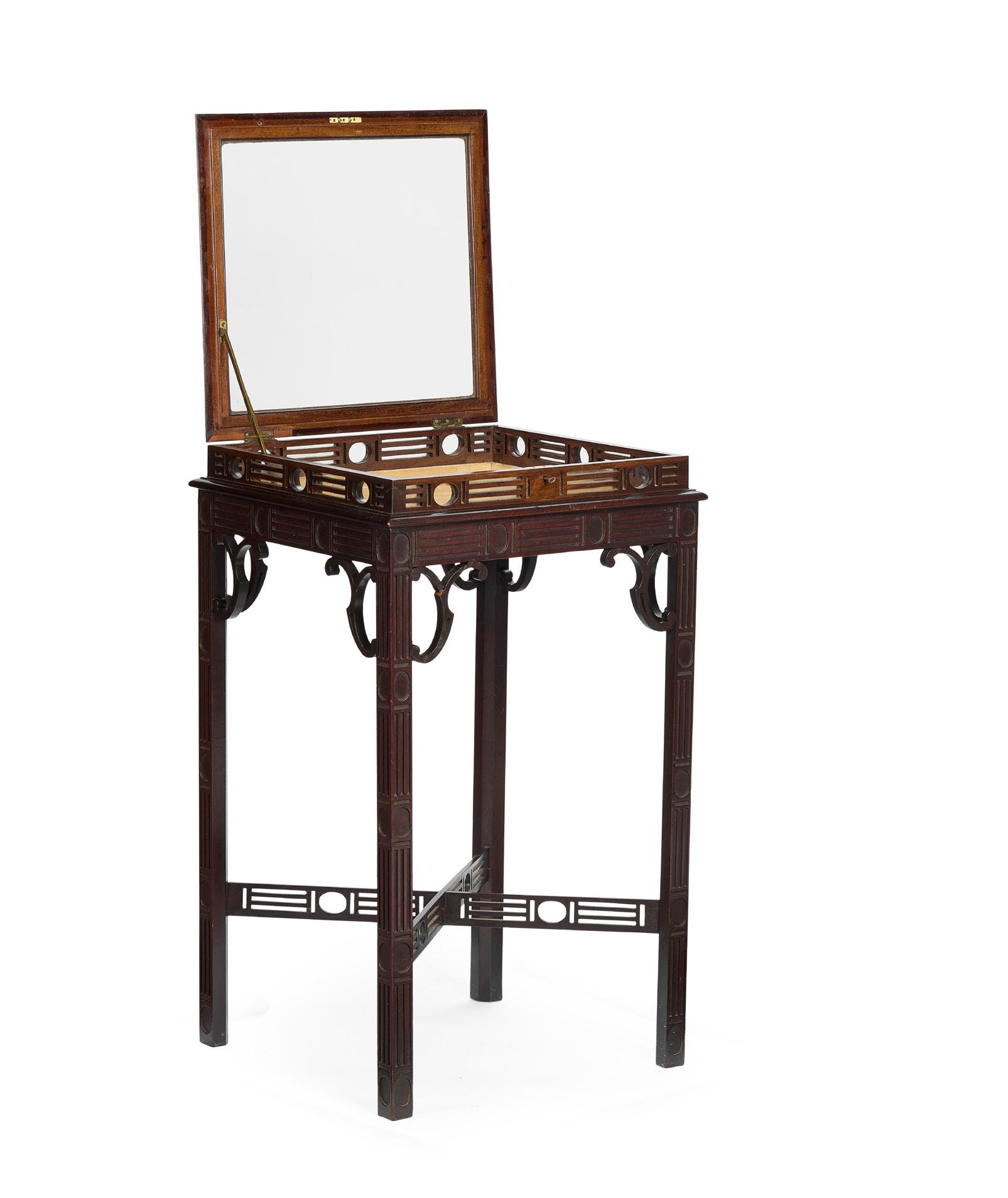
AESTHETIC MOVEMENT BIJOUTERIE TABLE, CIRCA 1880
ebonised wood with glazed top and velvet lined interior
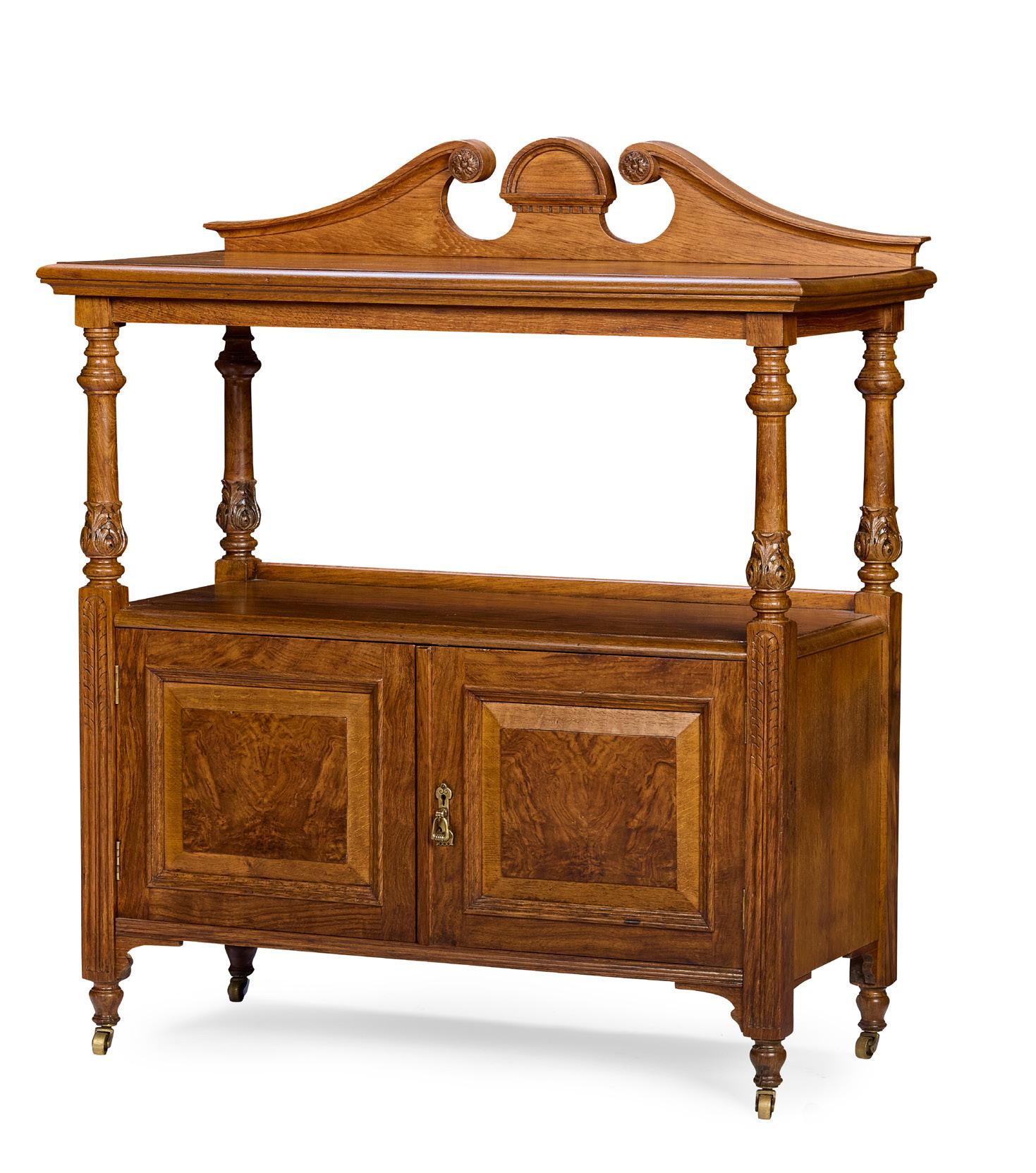
49cm wide, 80cm high, 45cm deep
£400-600
39
WILLIAM DE MORGAN (1839-1917)
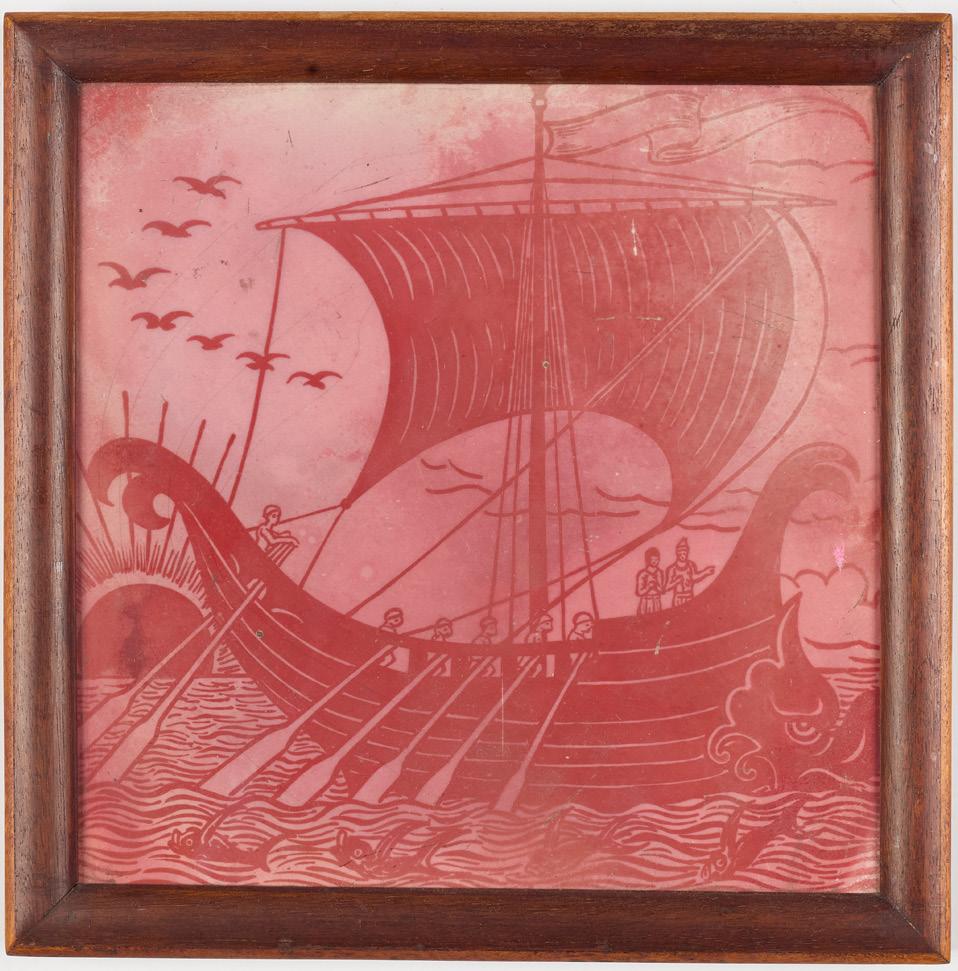
RUBY LUSTRE ‘GALLEON’ TILE
glazed earthenware with ruby lustre, on a Minton Hollins blank, bears label inscribed LENT BY MRS H. HOLIDAY/ 6-3-17, framed tile 19cm square, frame size 22cm square
£400-600
40
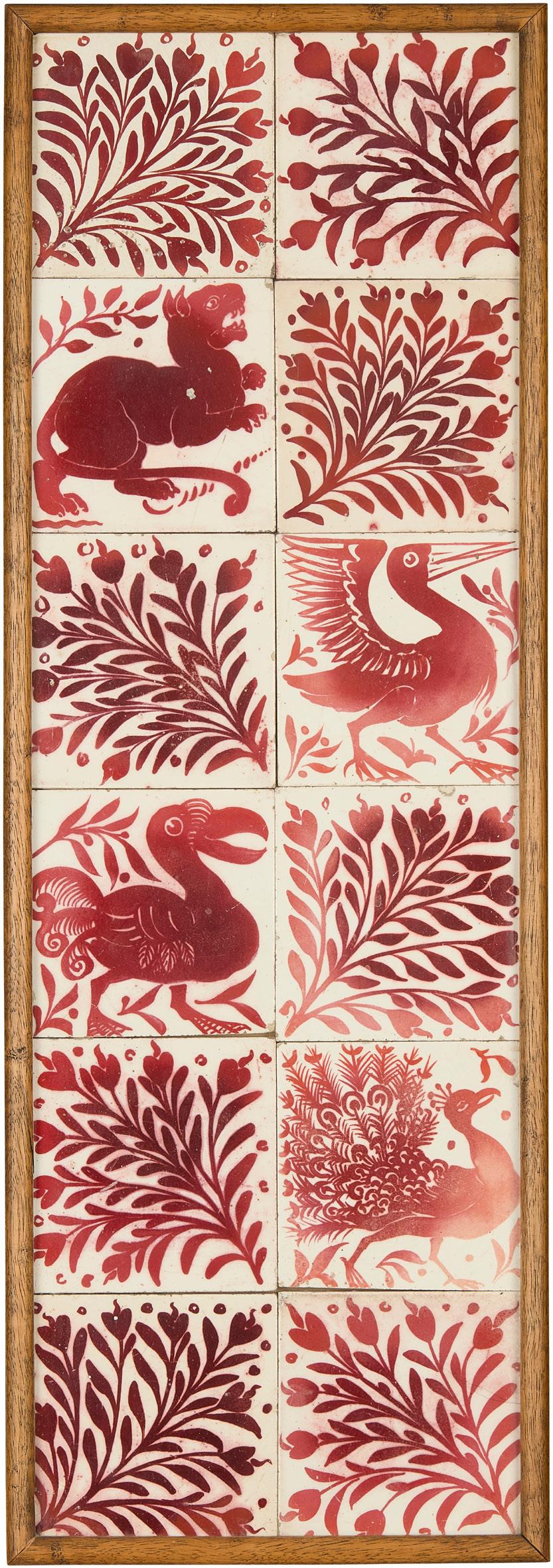
WILLIAM DE MORGAN (1839-1917)
RUBY LUSTRE TWELVE-TILE
PANEL, CIRCA 1885
glazed earthenware with ruby lustre, framed and glazed (12)
each tile 10.3cm square, frame size 64cm x 22cm
£2,000-3,000
41
WILLIAM DE MORGAN (1839-1917)
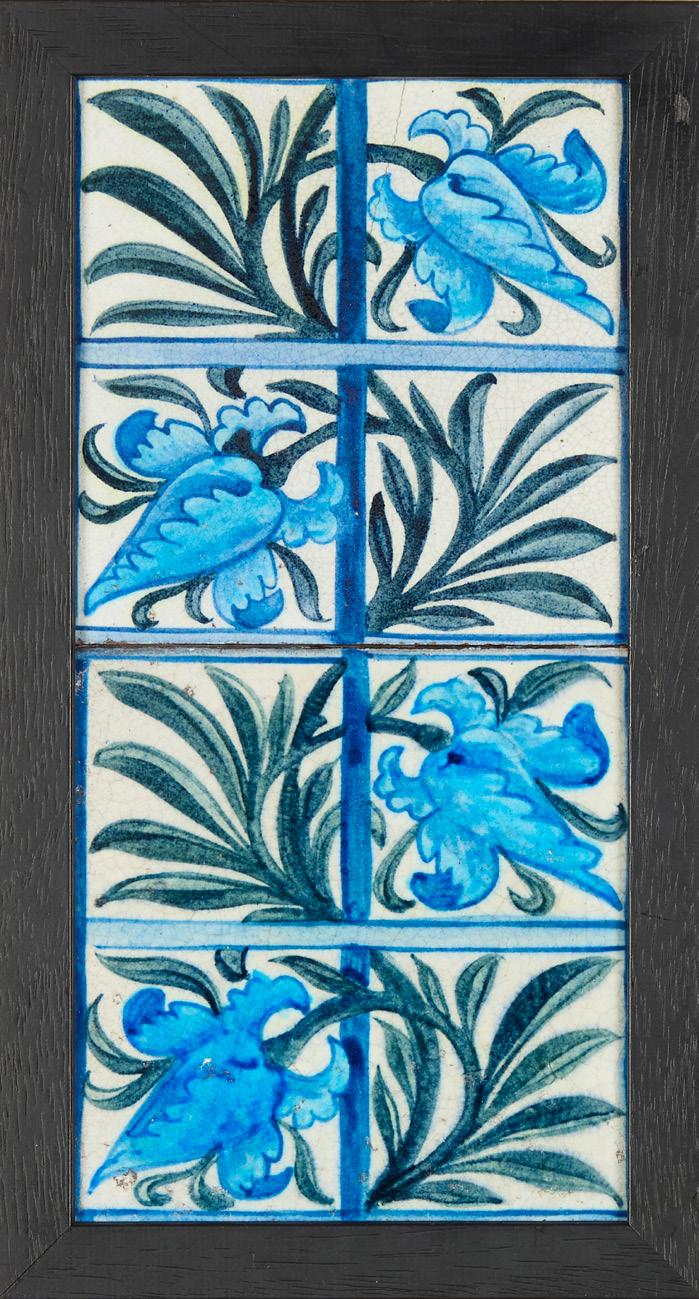
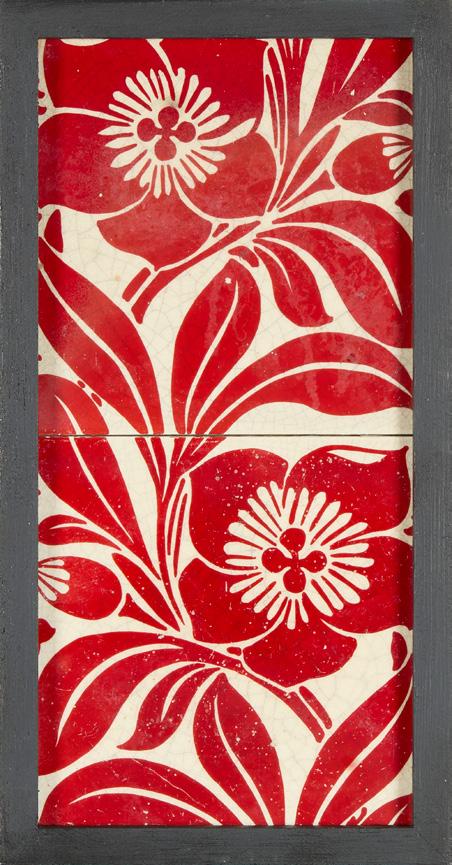
‘TULIP AND TRELLIS’ TWO TILE PANEL, CIRCA 1880
glazed ceramic, reserved on Poole Pottery blanks
each tile 15.5cm square (frame size 34.5cm x 19cm)
£400-600
43
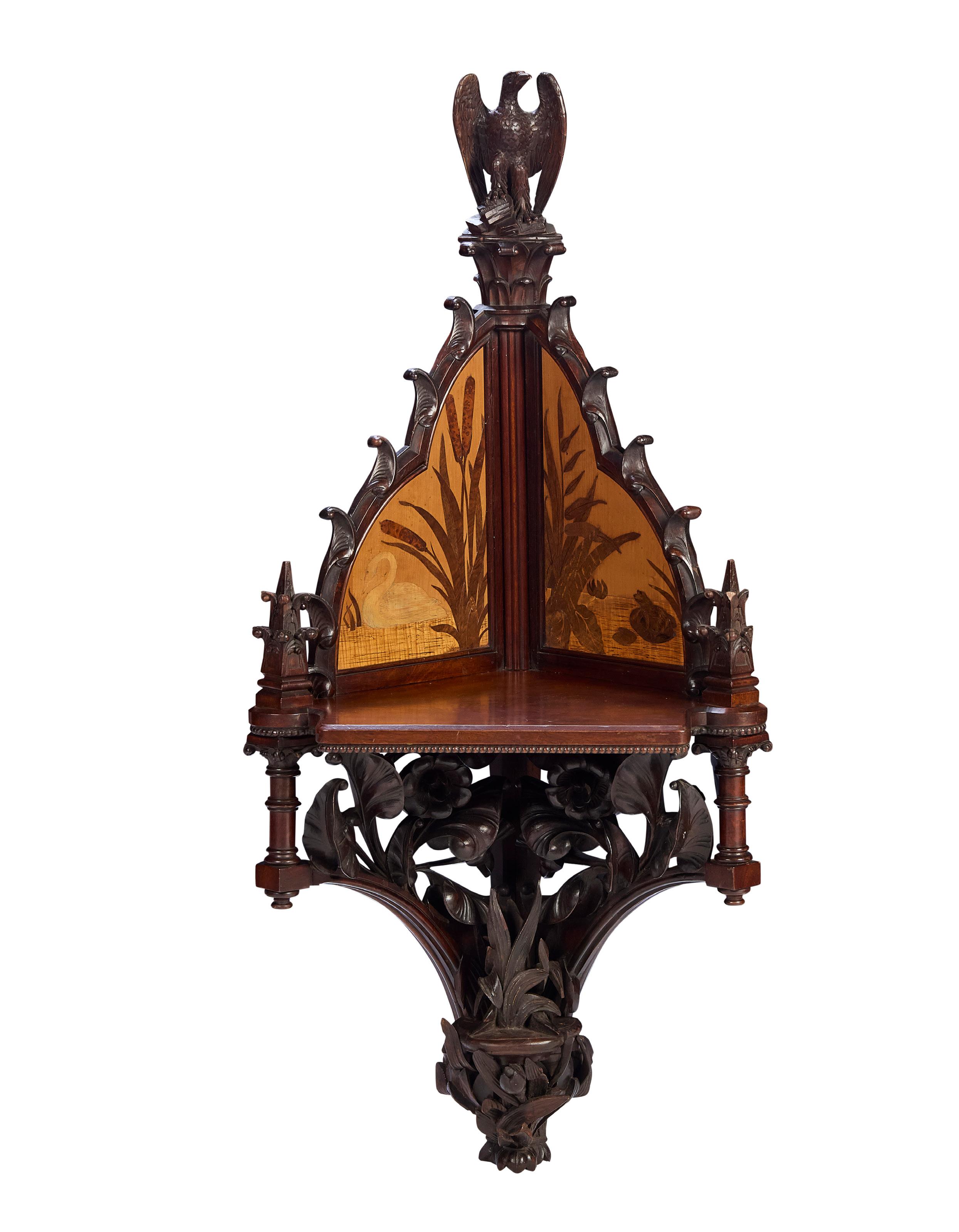
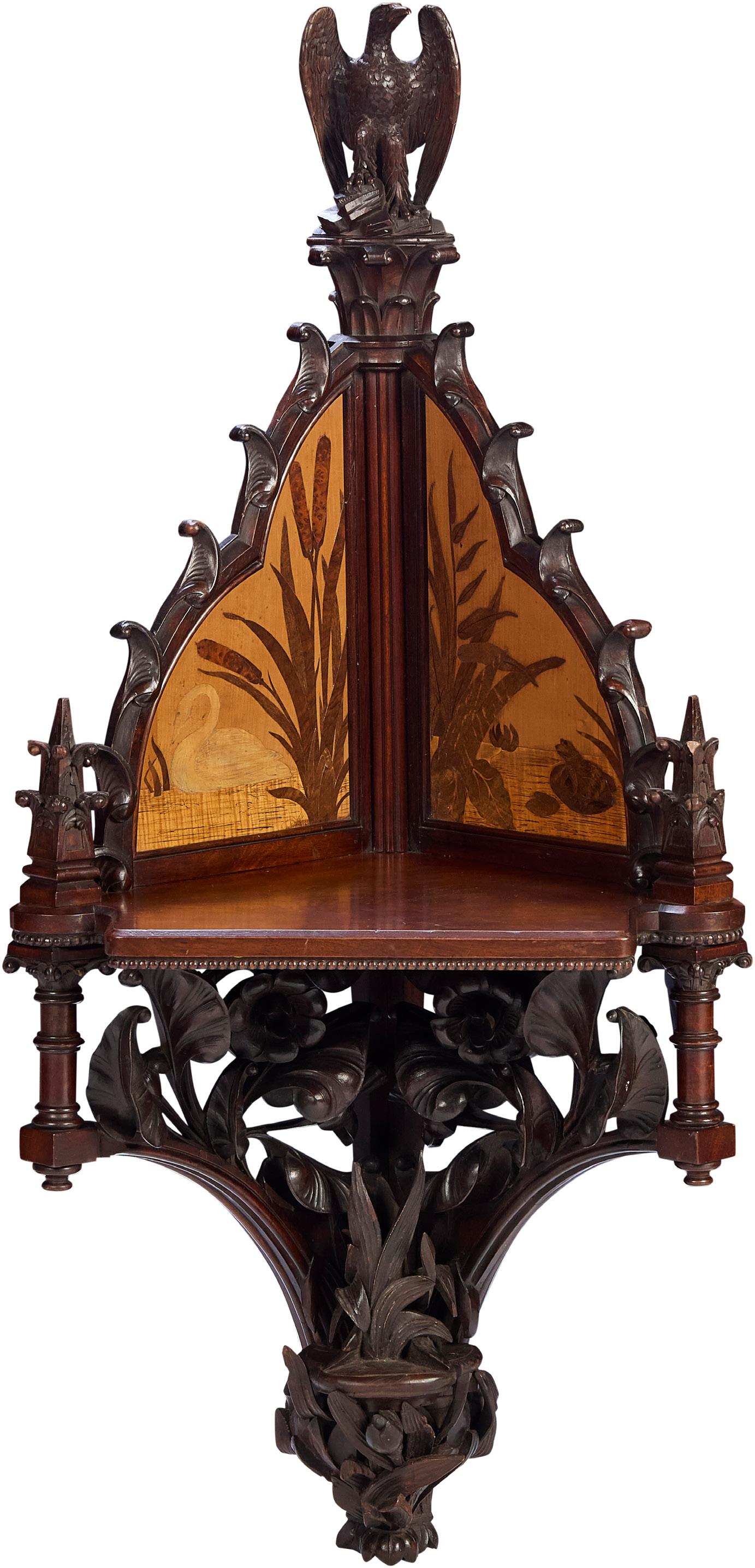
42
MANNER OF J. H. CHAMBERLAIN GOTHIC REVIVAL CORNER WALL SHELF, CIRCA 1880
carved walnut, with marquetry inlaid panels
57cm wide, 129cm high, 42cm deep
£600-800
MANNER OF HENRY STACEY MARKS
AESTHETIC MOVEMENT CORNER CABINET, CIRCA 1880
ebonised and gilded wood, with polychrome painted panel and mirror plates
43cm wide, 109cm high, 22.5cm deep
£300-500
Frequently designing in the Ruskinian Gothic style Chamberlain and his partner William Martin (1828-1900) produced designs for pumping stations, libraries, schools, shops, churches and chapels as well as a number of private houses. His ideals chimed perfectly with Birmingham’s ruling liberals at the time, who sought to transform industrial Birmingham into a cultural centre to rival the great European capitals. One of his finest achievements, the Municipal School of Art of 1885, still stands today in Margaret Street. Chamberlain was one of the earliest practical exponents of the ideas of architectural theorist, John Ruskin and was increasingly influenced by the early Arts & Crafts movement in his later works. His belief in the value of individual craftsmanship and patterns inspired by nature are evident in the profuse carving and marquetry inlay of his furniture designs.
45
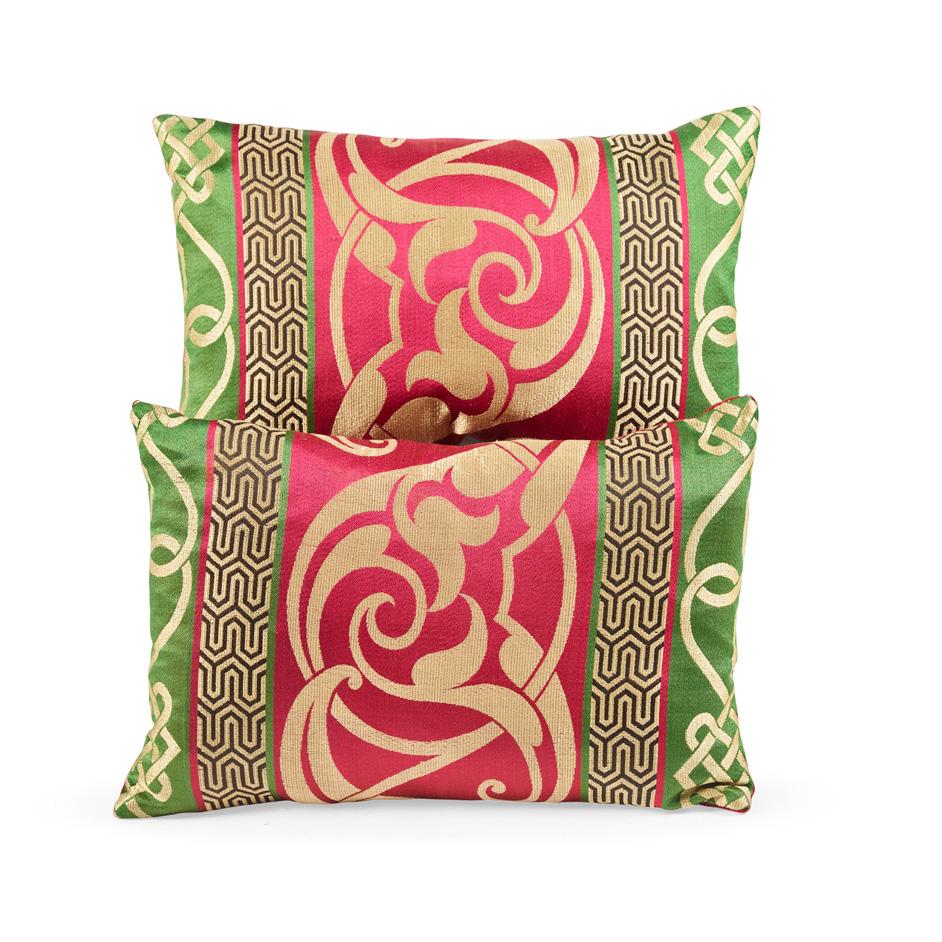
WARD OF HALIFAX
PAIR OF CUSHIONS, THE FABRIC CIRCA 1870
44
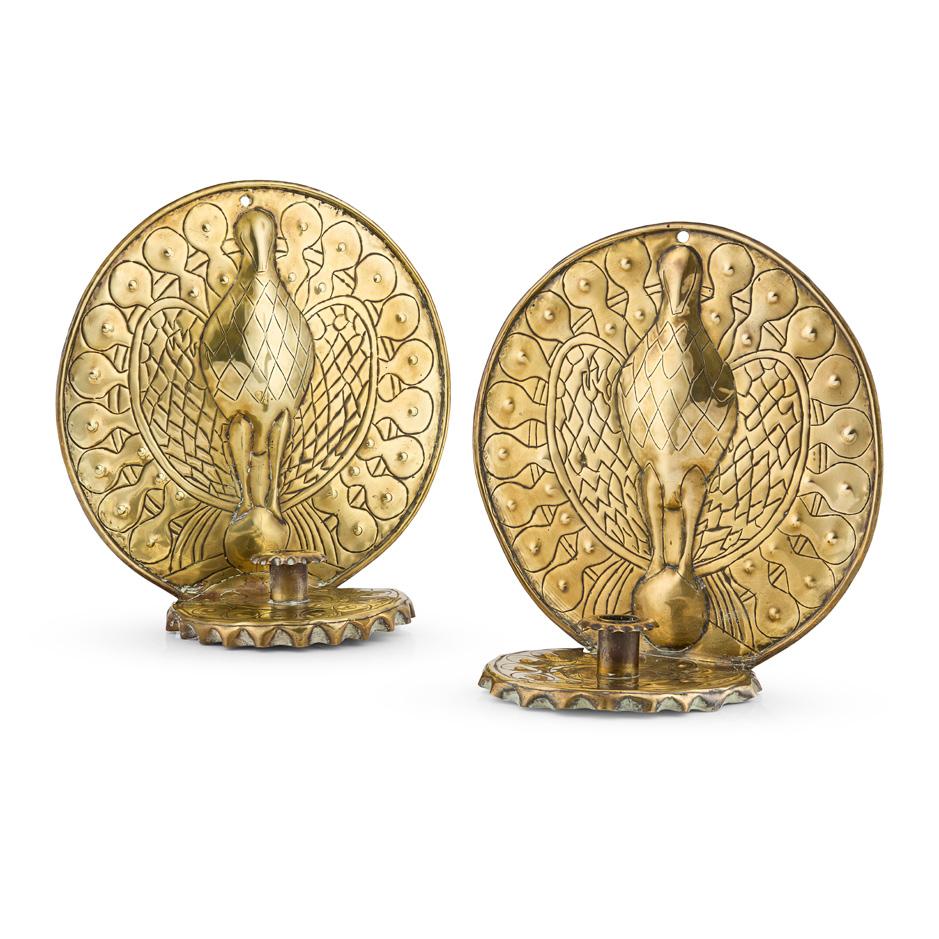
ENGLISH
PAIR OF AESTHETIC MOVEMENT CANDLE SCONCES, CIRCA 1880
brass, with repoussé peacock design (3) 24.5cm high. 13cm deep
£500-800
cotton and silk backed with red linen and covered buttons, later made up (2)
43cm x 30cm
£200-300
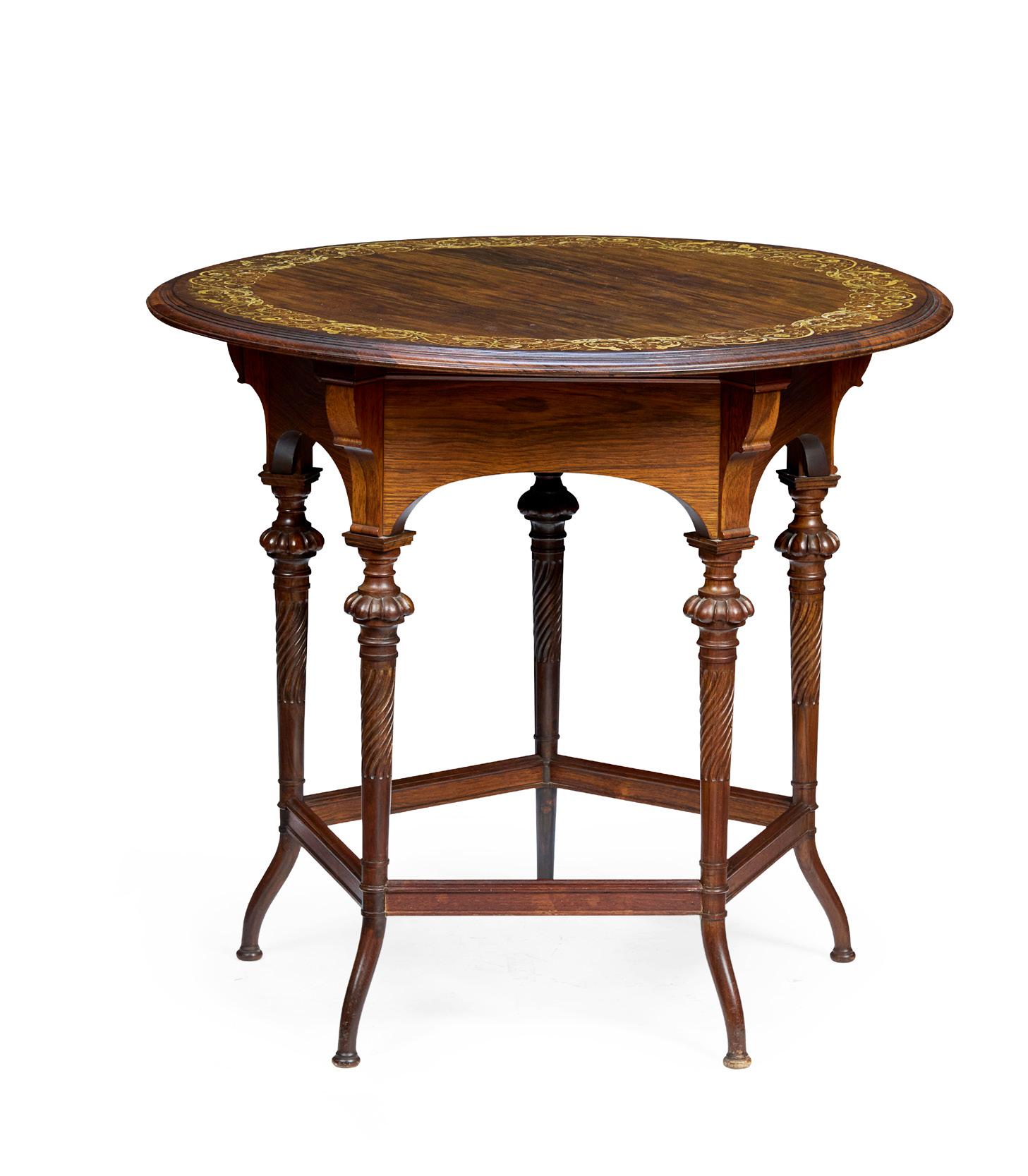
ATTRIBUTED TO STEPHEN WEBB (1849-1933) FOR COLLINSON & LOCK
AESTHETIC MOVEMENT CENTRE TABLE, CIRCA 1880
inlaid rosewood
84.5cm diameter, 74.5cm high
Literature: Edwards C. Collinson & Lock: Art Furnishers, Interior Decorators and Designers, 1870-1900, Matador 2022, p. 179, pl. 4.154 where a related table is illustrated.
£400-600
47
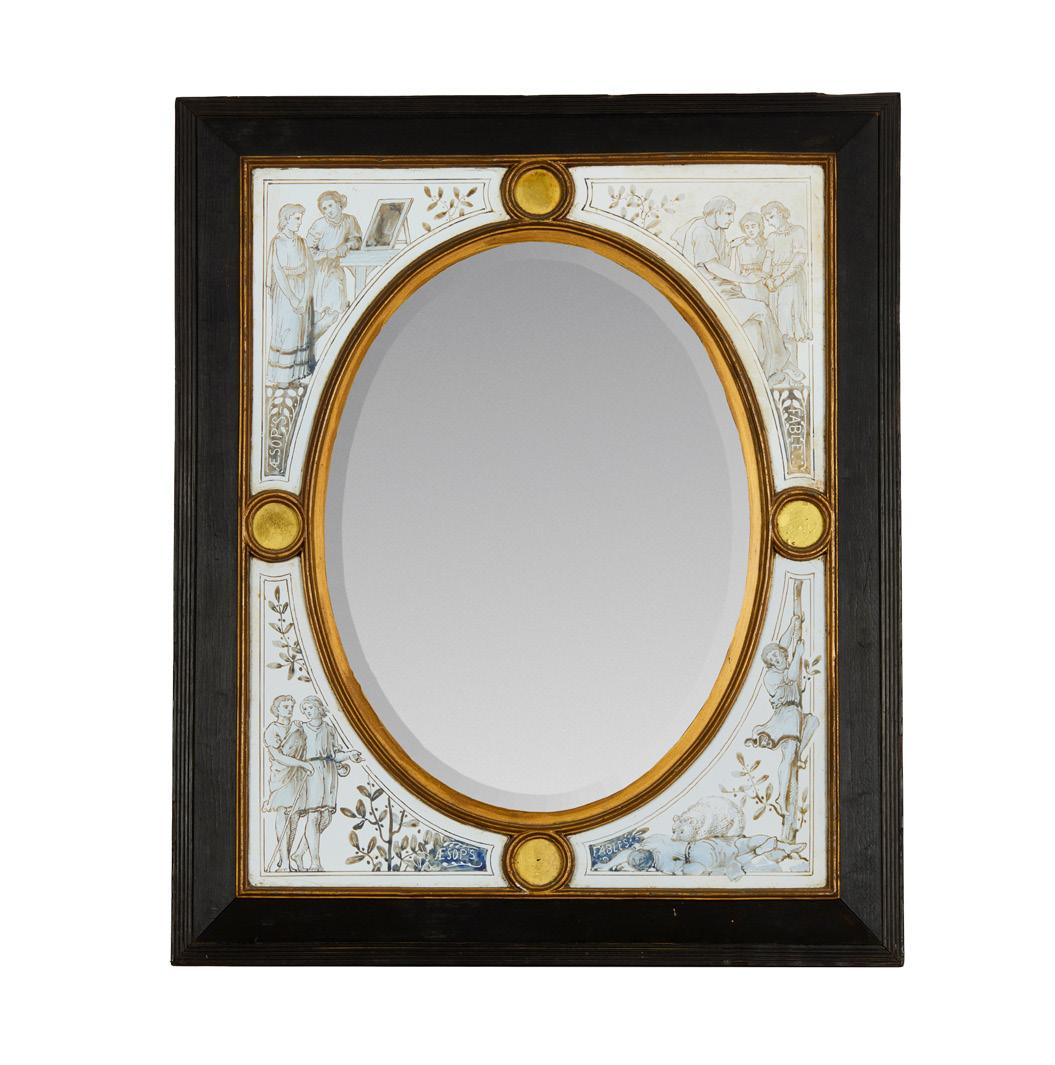
MANNER OF JAMES POWELL & SON
‘AESOP’S FABLES’ MIRROR, CIRCA 1880 painted ceramic, gilded and ebonised wood, bevelled mirror plate, inscribed twice AESOP’S FABLES
56cm x 46cm
£600-800
48
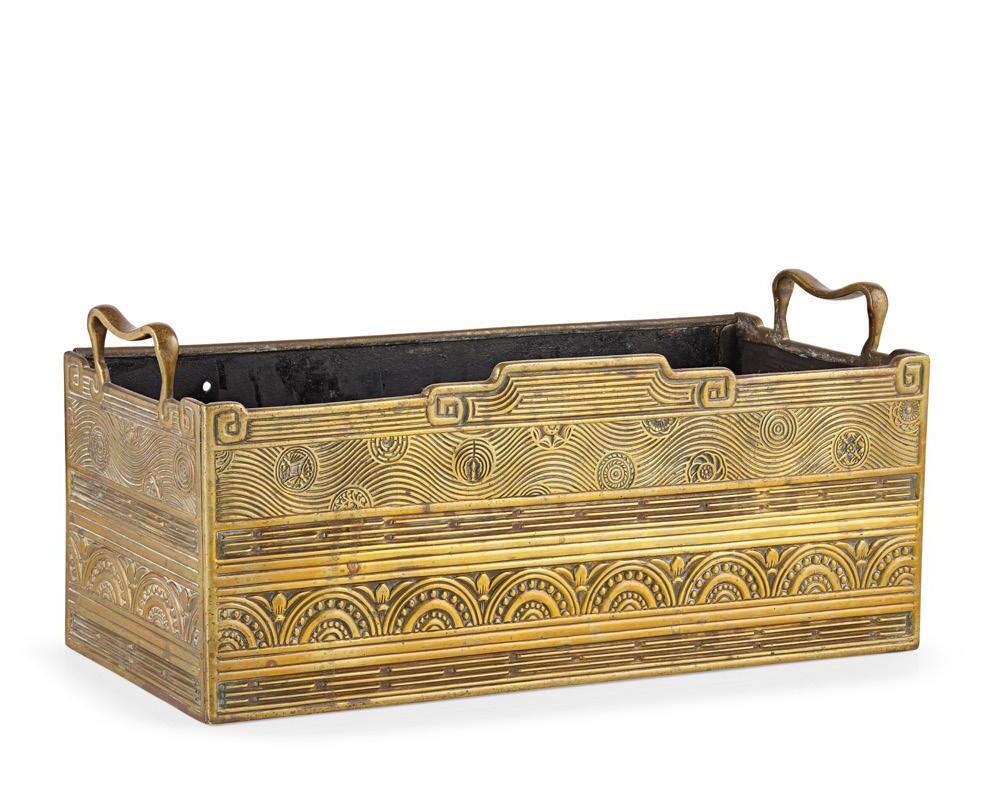
THOMAS JECKYLL (1827-1881) FOR ROBBINS & CO.
AESTHETIC MOVEMENT PLANTER, CIRCA 1880 repoussé-decorated brass, patinated iron
45.5cm wide, 21cm high, 17cm deep
£600-800
49
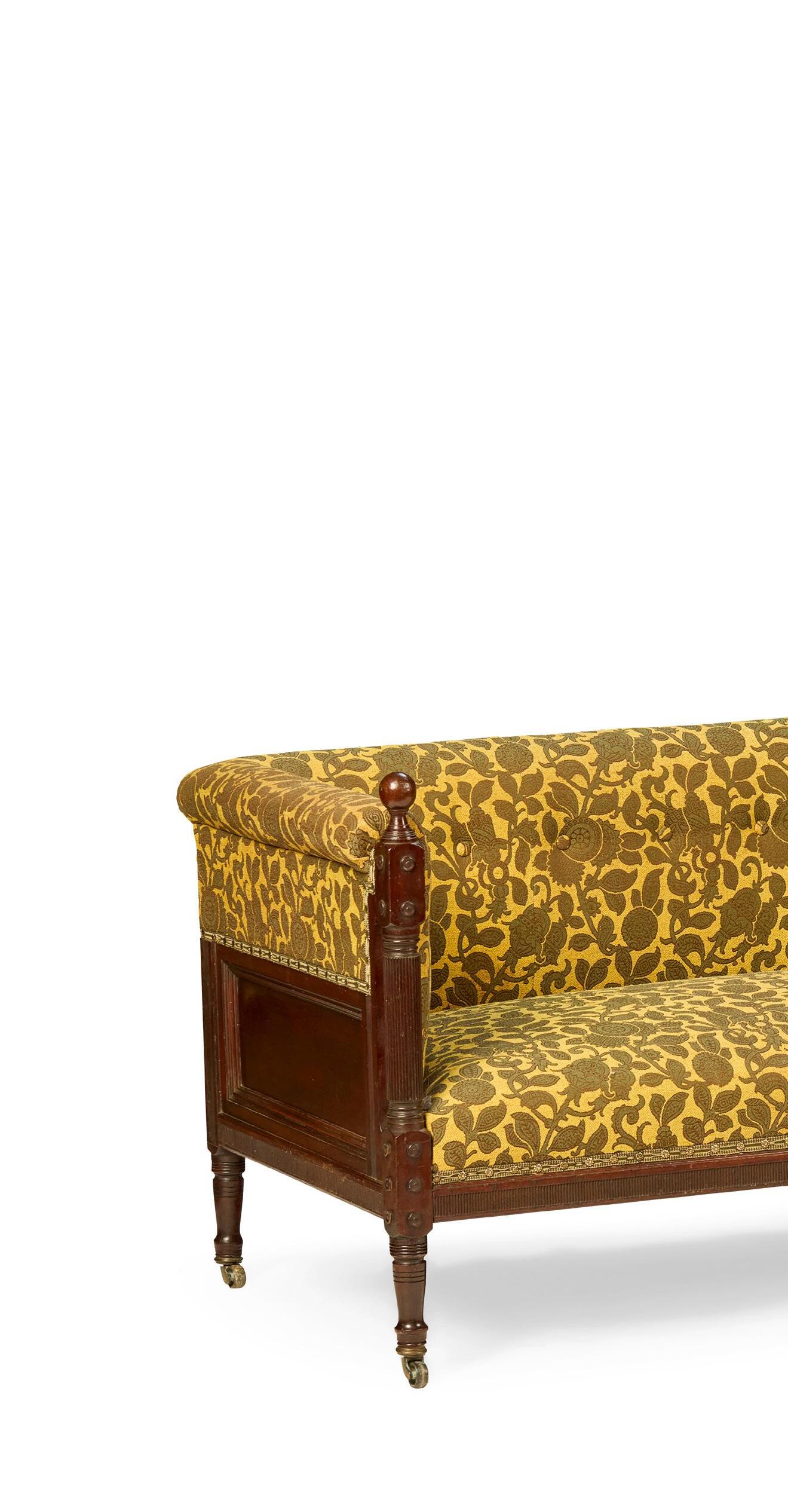
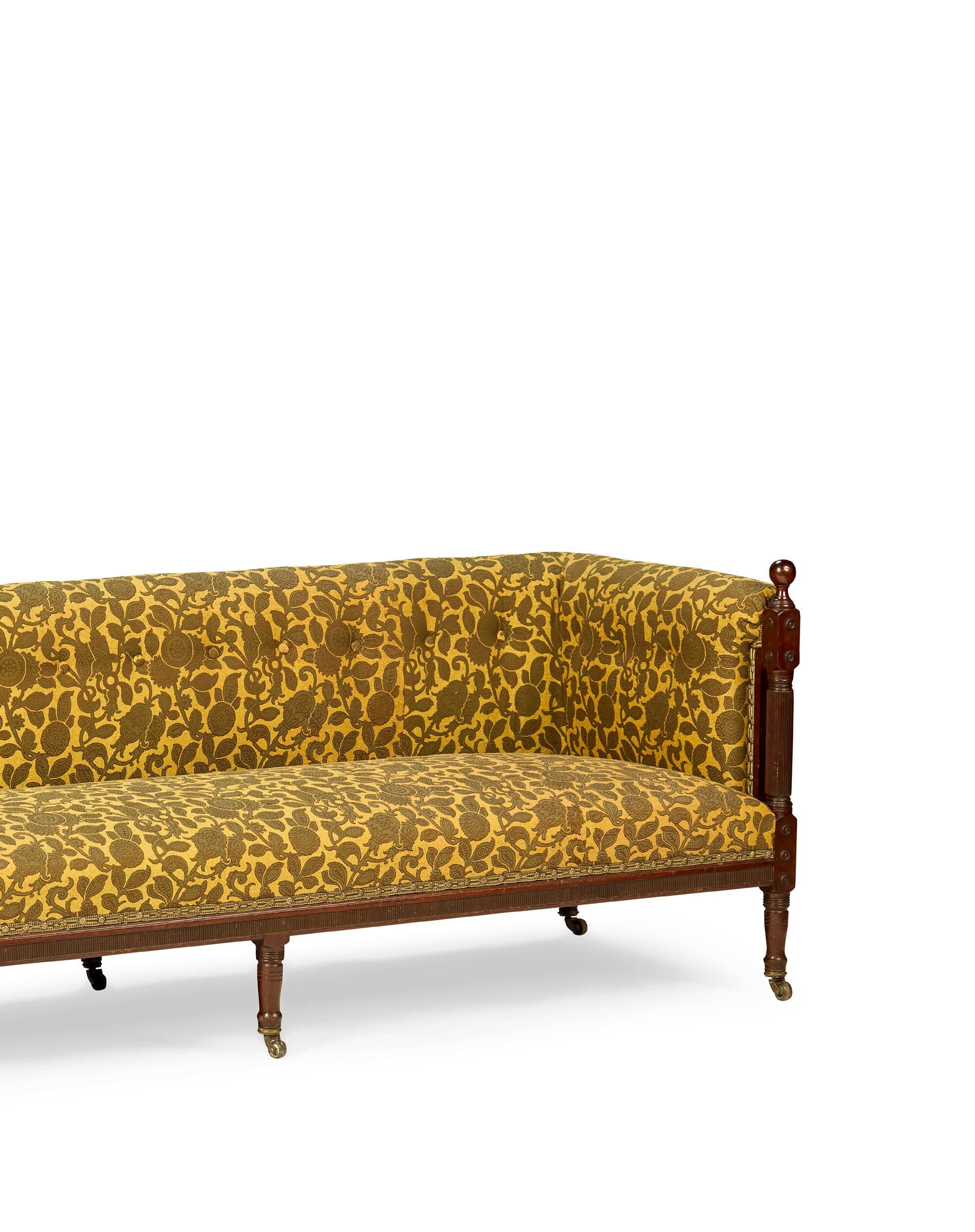
ATTRIBUTED TO COLLINSON & LOCK, LONDON
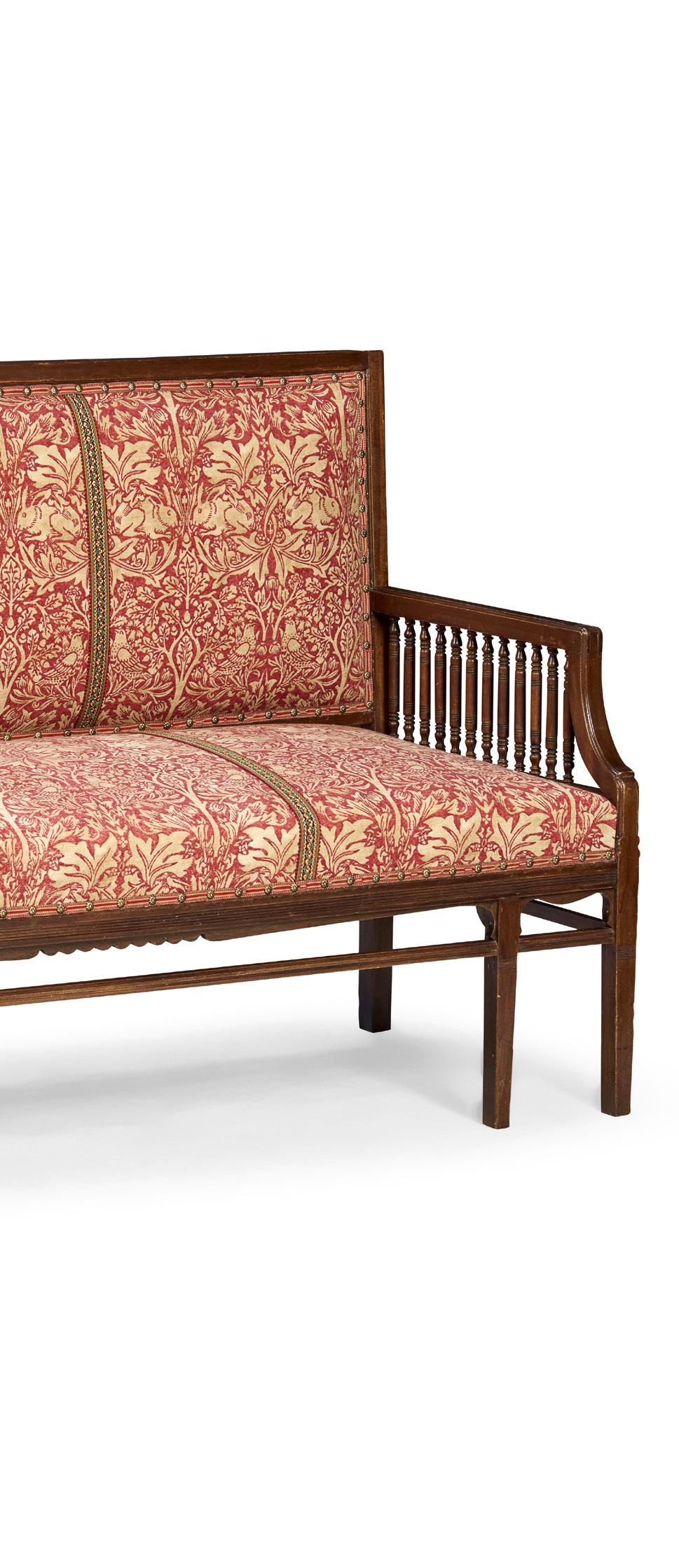
AESTHETIC MOVEMENT SOFA, CIRCA 1880
mahogany frame, with close-nailed buttoned upholstery
202cm wide, 75cm high, 71cm deep
Literature: Edwards C. Collinson & Lock: Art Furnishers, Interior Decorators and Designers, 1870-1900, Matador 2022, p.188, pl. 4.174 and 4.175 for related examples.
£3,000-5,000
50
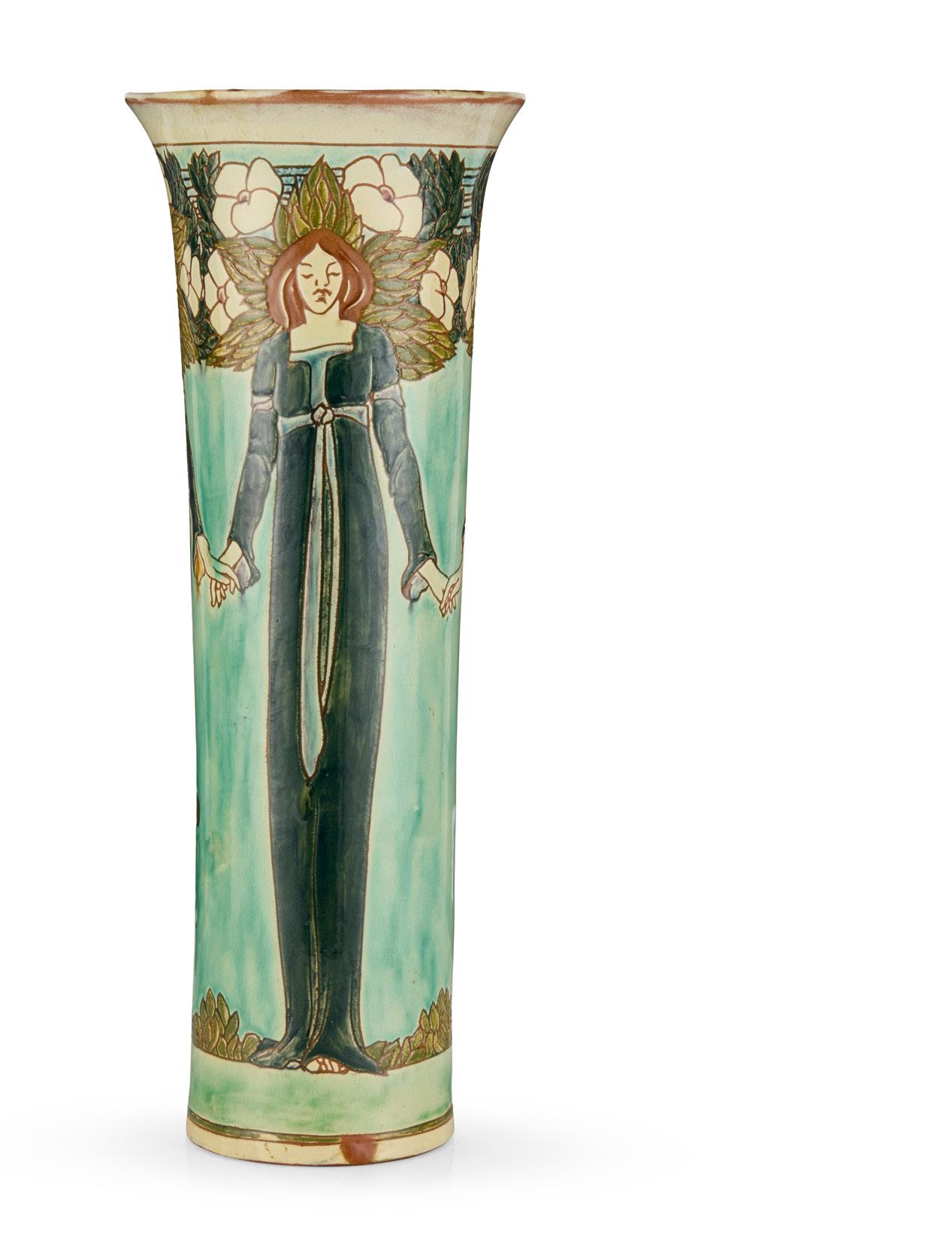
CASSANDRA ANNIE WALKER (1875-1957) FOR DELLA ROBBIA POTTERY, BIRKENHEAD
TALL VASE, 1899
glazed earthenware, incised DR/ CAW/ 1899
41.4cm high
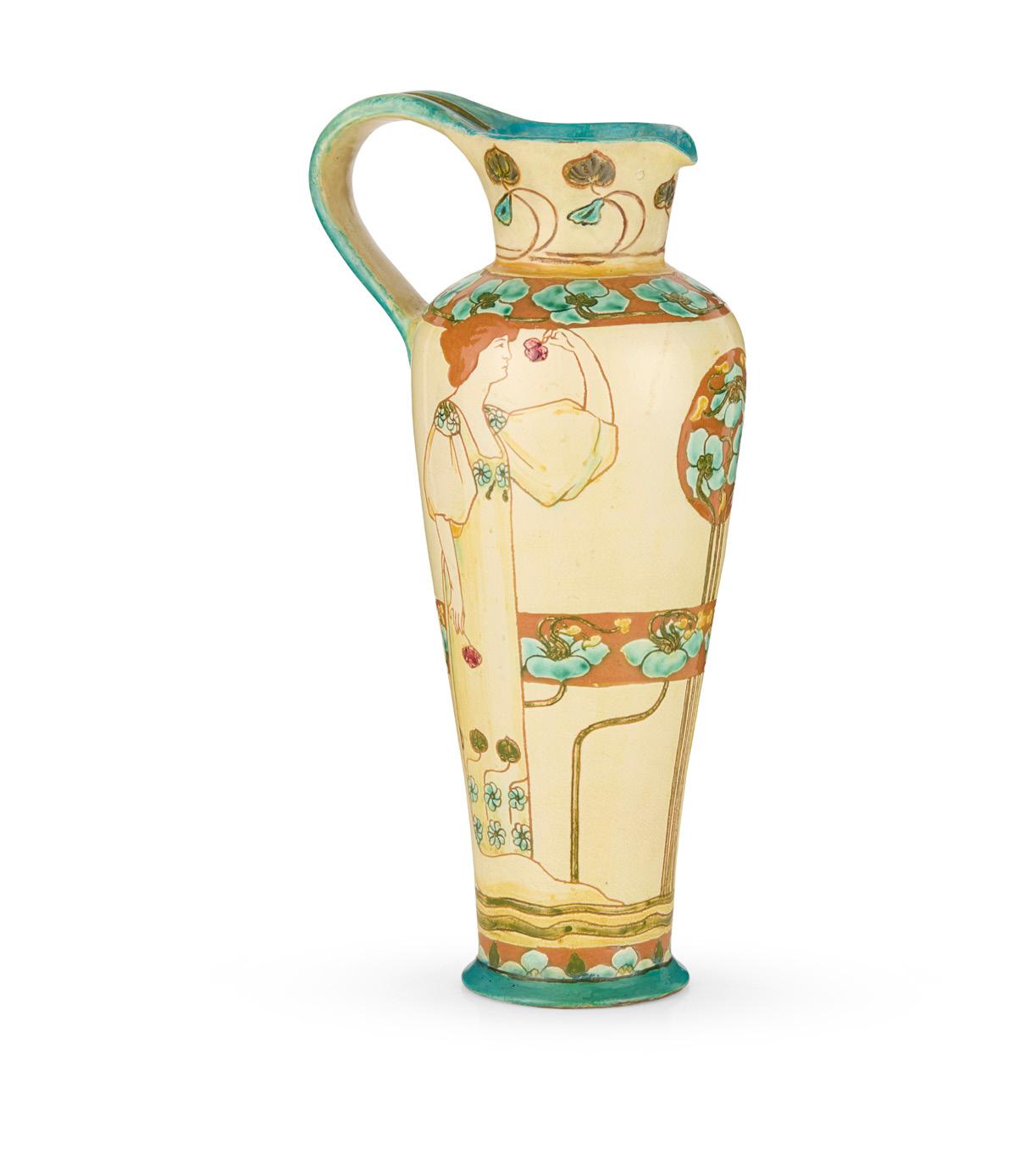
£1,500-2,000
51
CASSANDRA ANNIE WALKER (1875-1957) FOR DELLA ROBBIA POTTERY, BIRKENHEAD
EWER, 1897
glazed earthenware, incised DR/ CAW. 1897
31cm high
£300-500
52
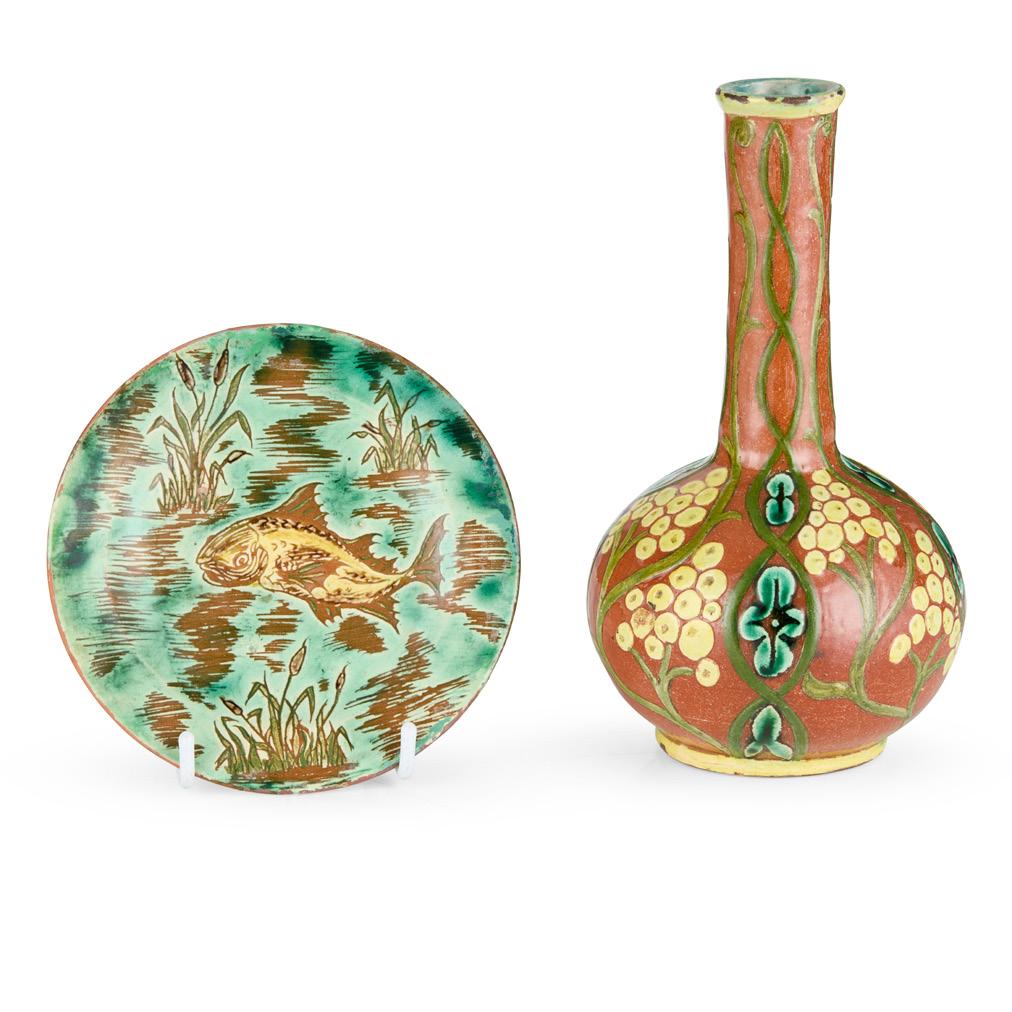
DELLA ROBBIA POTTERY, BIRKENHEAD
VASE AND PLATE, CIRCA 1900
glazed earthenware, each incised DR, the VASE incised JF (John Foggo)/ 424/ TRISH, 18cm high; the PLATE incised ENID (Enid Woodhouse), 12.5cm diameter (2)
£200-300
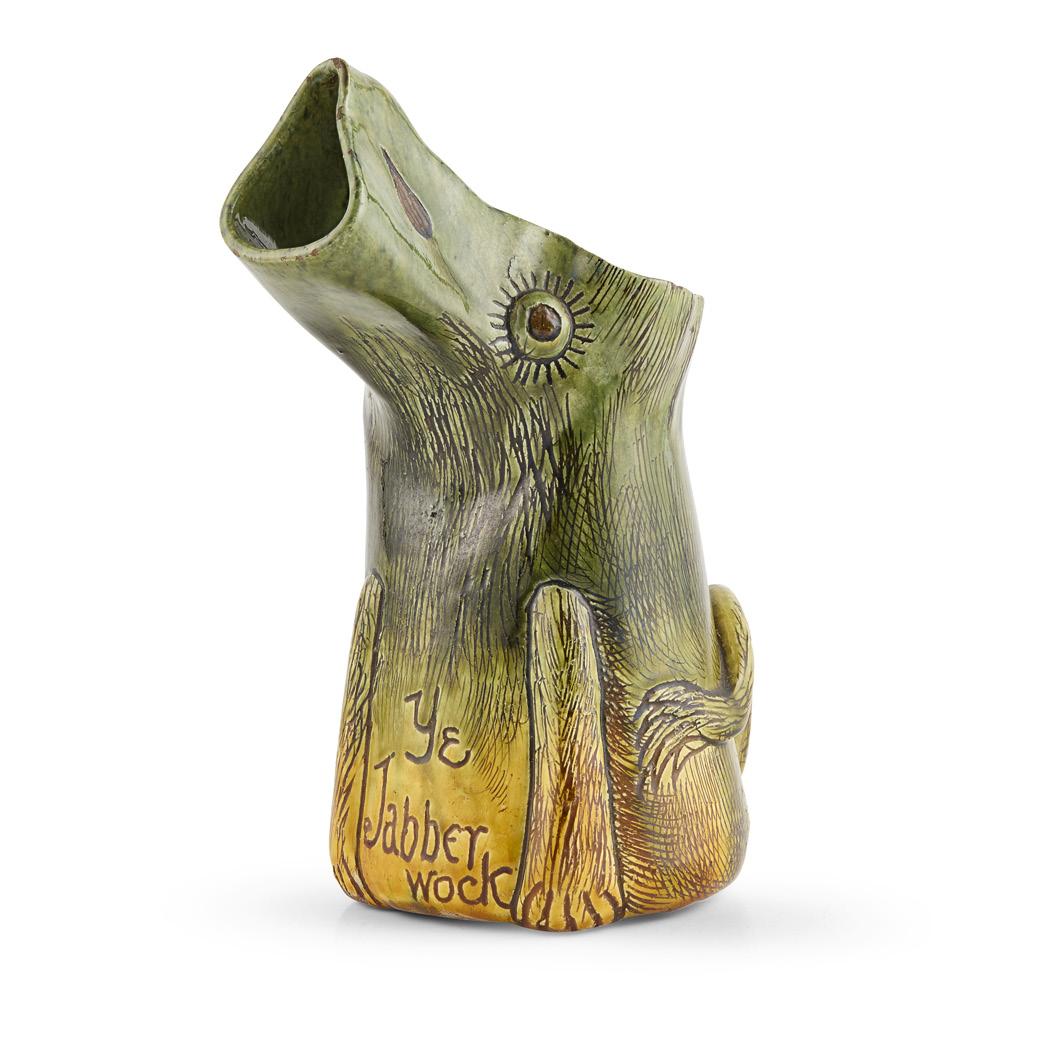
53
MANNER OF HORACE ELLIOT FOR EWENNY POTTERY
‘YE JABBERWOCK’ PIG JUG, CIRCA 1900
glazed earthenware, inscribed ‘YE JABBER WOCK’
23.5cm high
£300-500
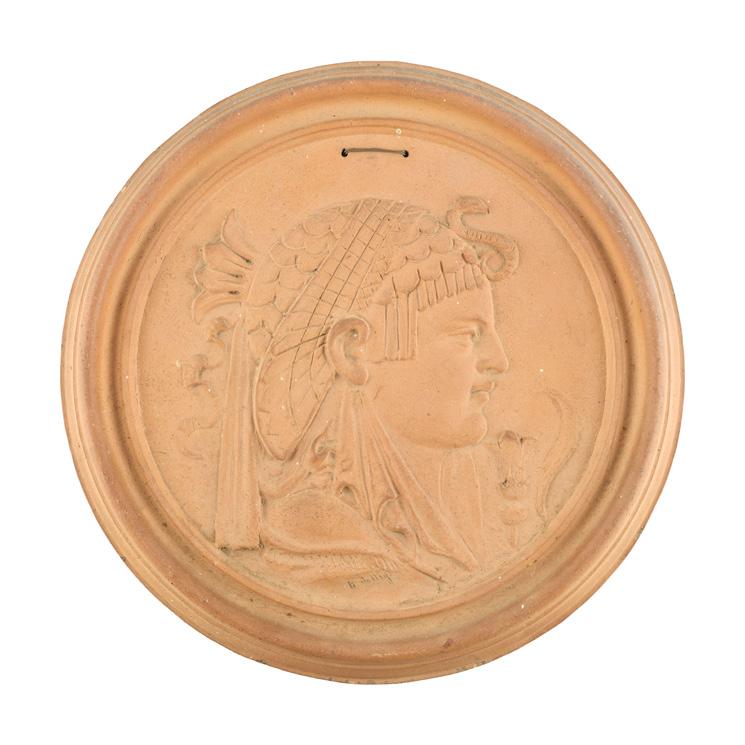
54
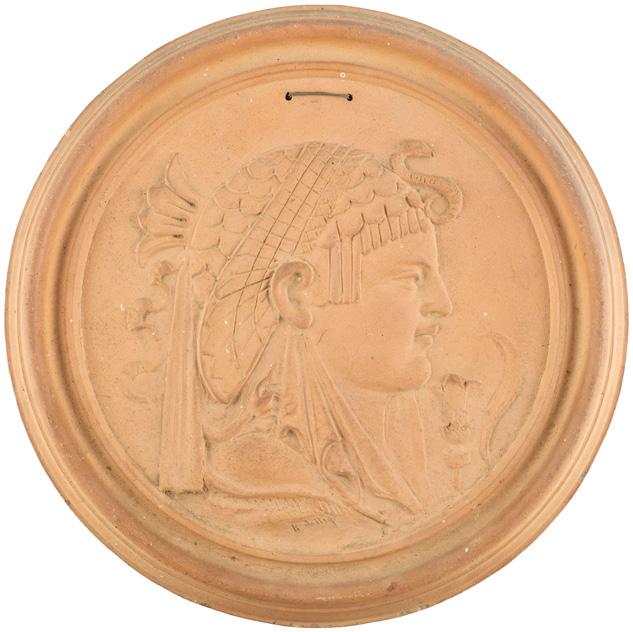
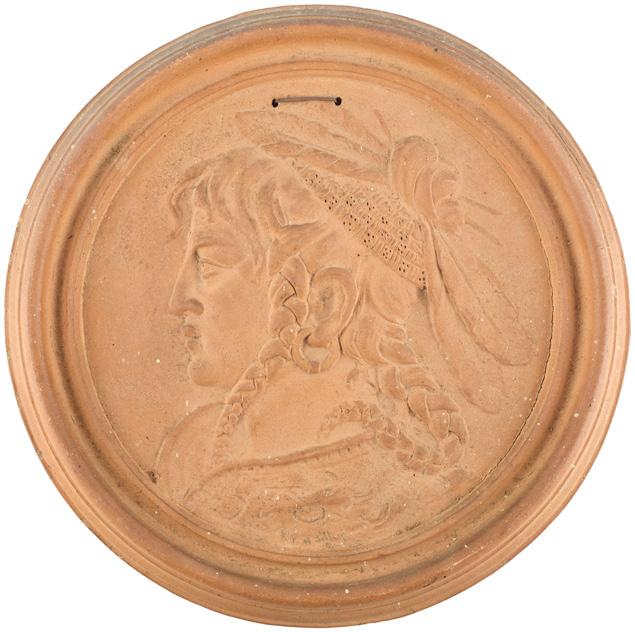
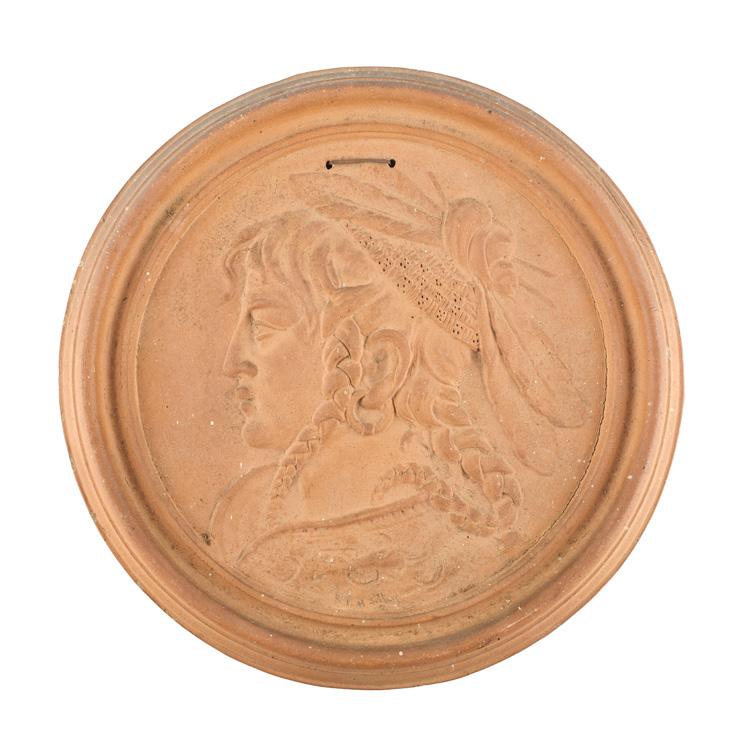
H. JOLLEY
PAIR OF NEO-CLASSICAL PORTRAIT ROUNDELS, CIRCA 1880
terracotta, each signed H. JOLLEY (2)
35cm diameter
£300-500
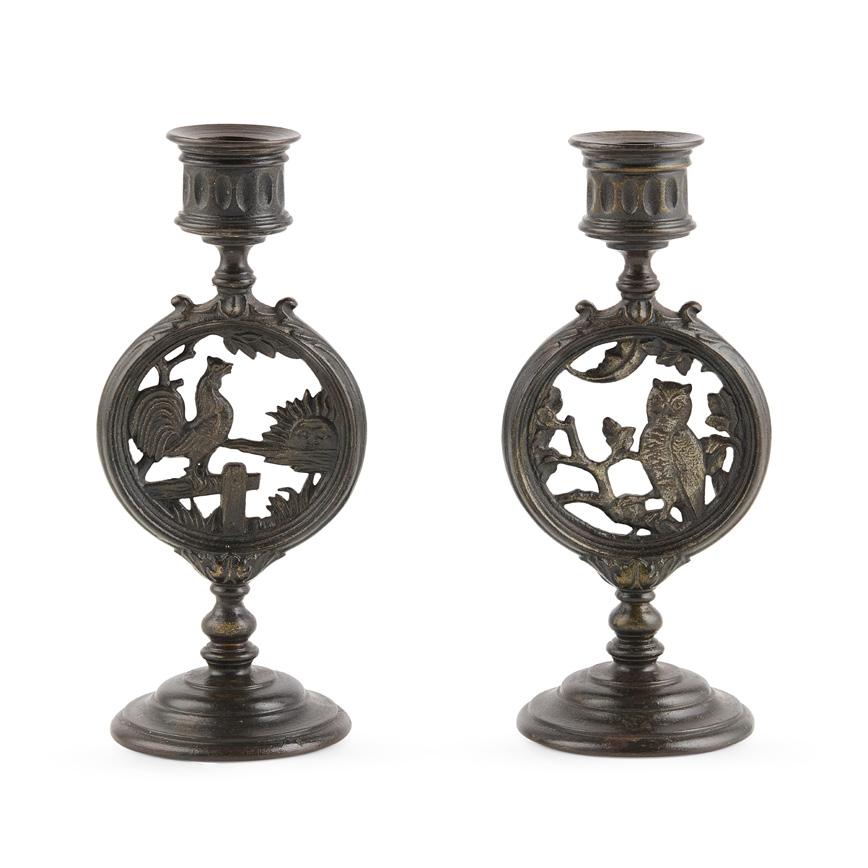
55
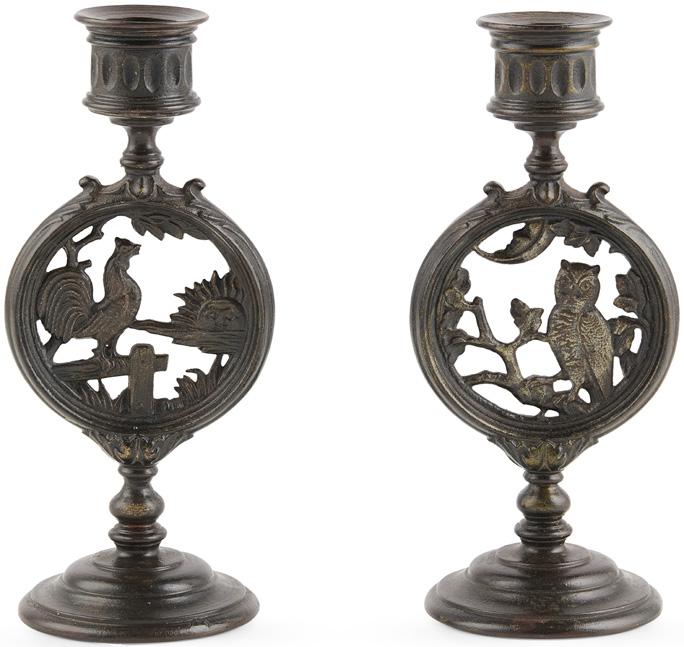
HART, SON, PEARD & CO.
PAIR OF ‘DAWN’ AND ‘DUSK’ CANDLESTICKS, 1882
patinated bronze, with registration lozenge for 1882 (2) 18cm high
£300-500
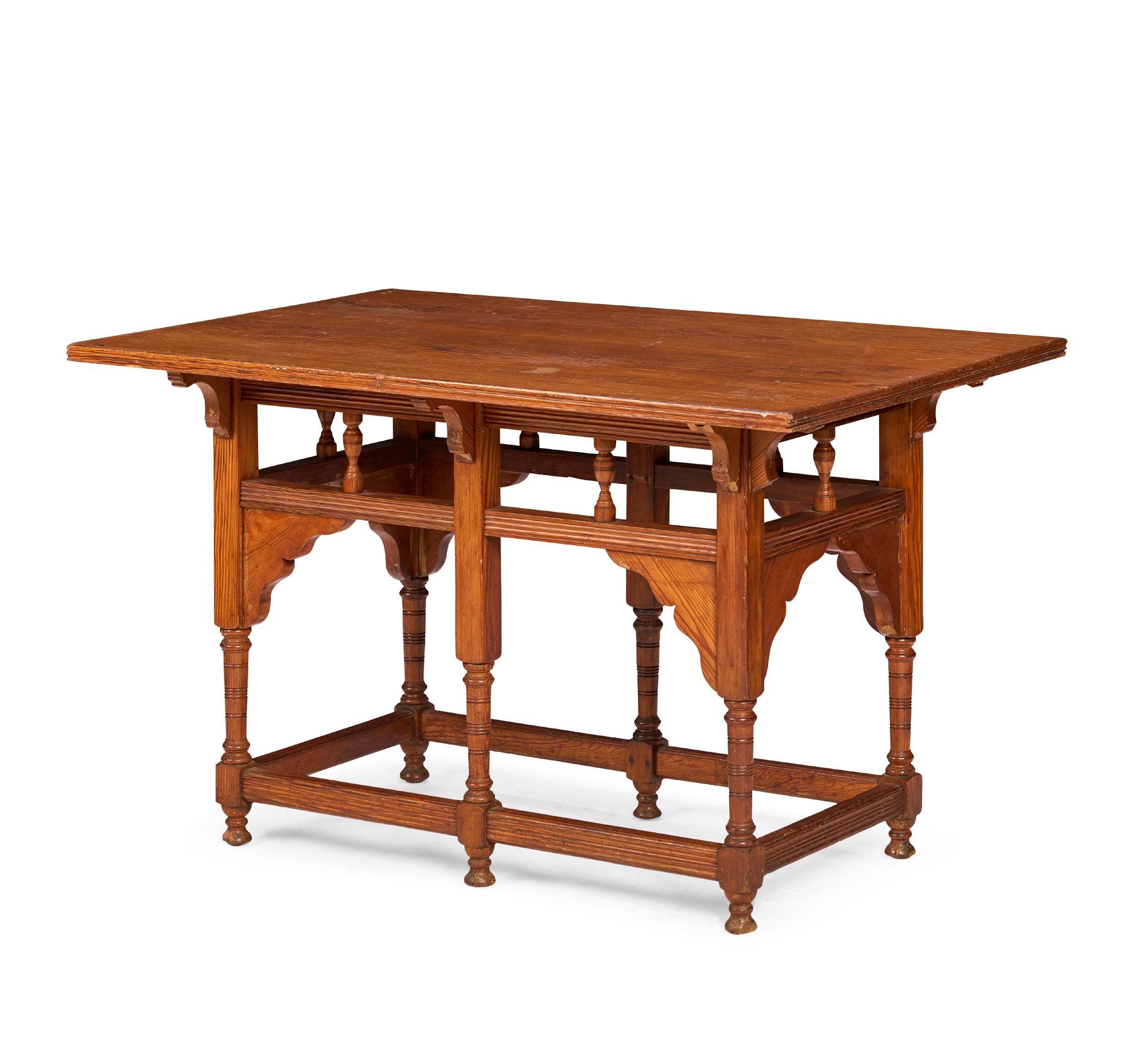
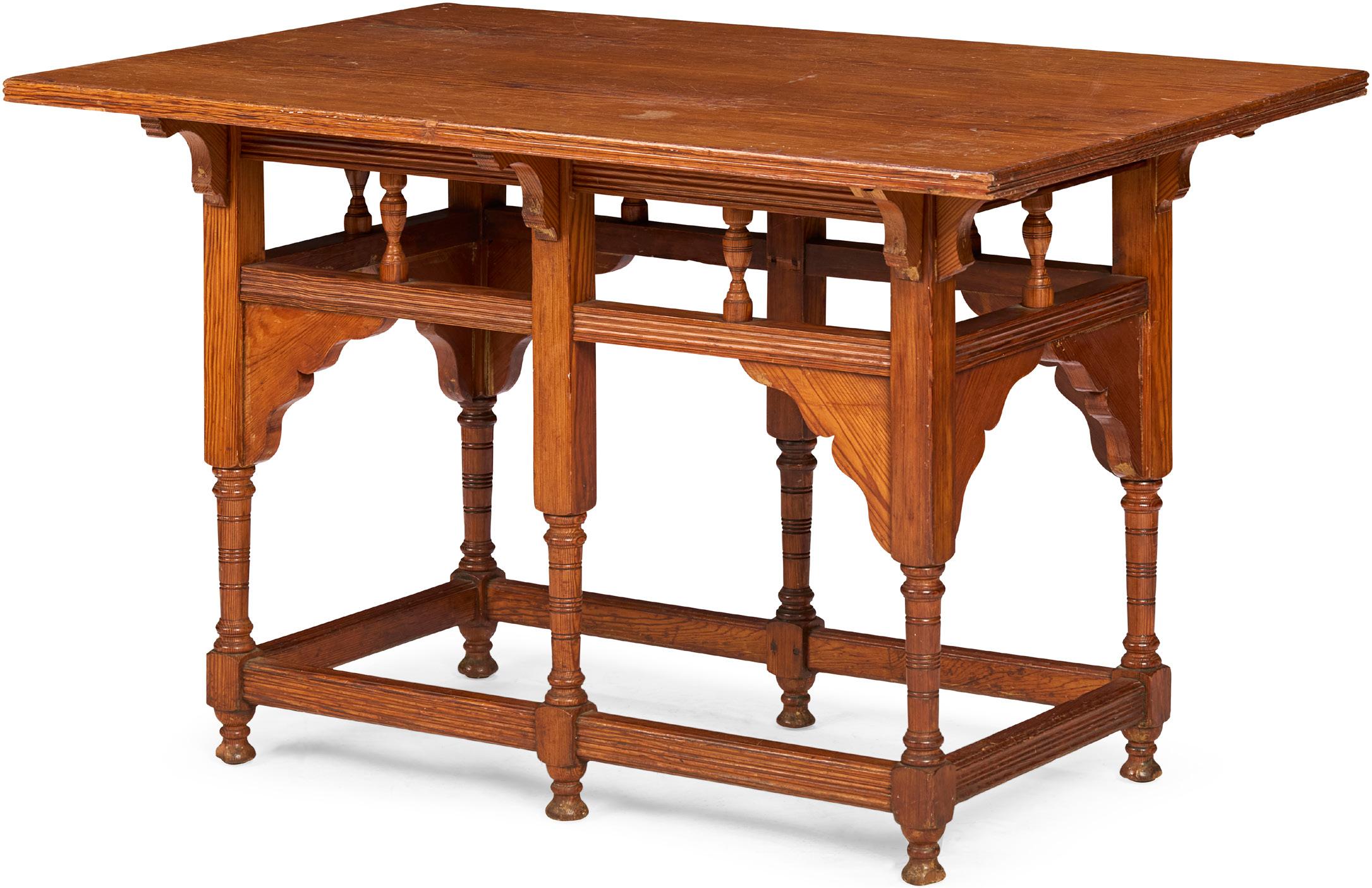
pitch pine
117cm wide, 74.5cm high, 74.5cm deep
£400-600
57
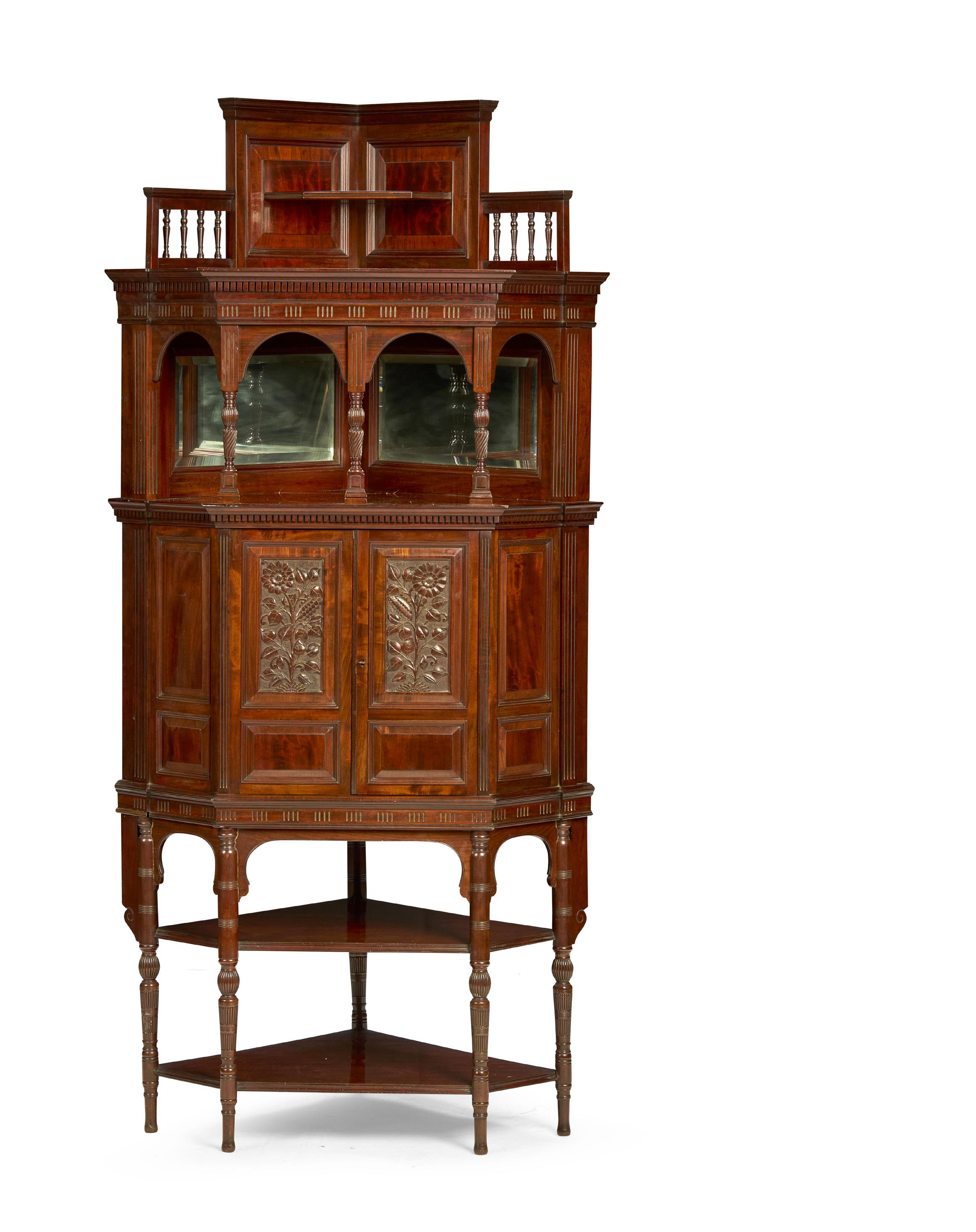
COLLINSON & LOCK, LONDON
AESTHETIC MOVEMENT CORNER
CABINET, CIRCA 1876
mahogany, stamped DOVESTONE, DAVEY, HULL & CO/ MANCHESTER
87cm wide, 180.5cm high, 63.5cm deep
Literature: Smith W. Examples of Household Taste, R. Worthington New York 1876, p. 492
Edwards C. Collinson & Lock: Art Furnishers, Interior Decorators and Designers, 1870-1900, Matador 2022, pp. 125-127 and p.128, pl. 4.38 where this cabinet is illustrated.
£800-1,200
The current lot is a version of the corner cabinet displayed by Collinson & Lock at the Philadelphia International exhibition of 1876. This version was produced in red walnut with painted doors.
The Art Journal illustrated this comer cabinet in their review of the exhibition. They noted that “these productions are original in composition arrangement and finish: they cannot be said to belong to any style and are in no way borrowed from the past, although thoroughly in the Old English manner. It is a style that Messrs Collinson and Lock have in great measure made their own, and which more or less, characterises all the issues of the establishment.”
The American commentator Walter Smith, in a discussion about the same exhibits at the exhibition, elaborated on this cabinet and its design, explaining its importance:
“Even in a light and delicate article like the cabinet... the joinery was of the best, and an examination of the construction showed that the work was done thoroughly throughout. This, however, is not all that recommends this particular object to the reader’s attention for it is a charmingly ornamental piece of furniture as well, admirably proportioned, graceful in outline, and ornamented with taste and judgement. The panels on the doors of this cabinet are exquisitely painted with figures on a gold ground. This sort of panel painting whether on wood or clay makes a very effective ornamentation for furniture and we are glad to observe that it is becoming popular in this country.”
The current version with carved door panels in place of the painted ones follows the same pattern as the walnut cabinet described above and was also made in rosewood.
58
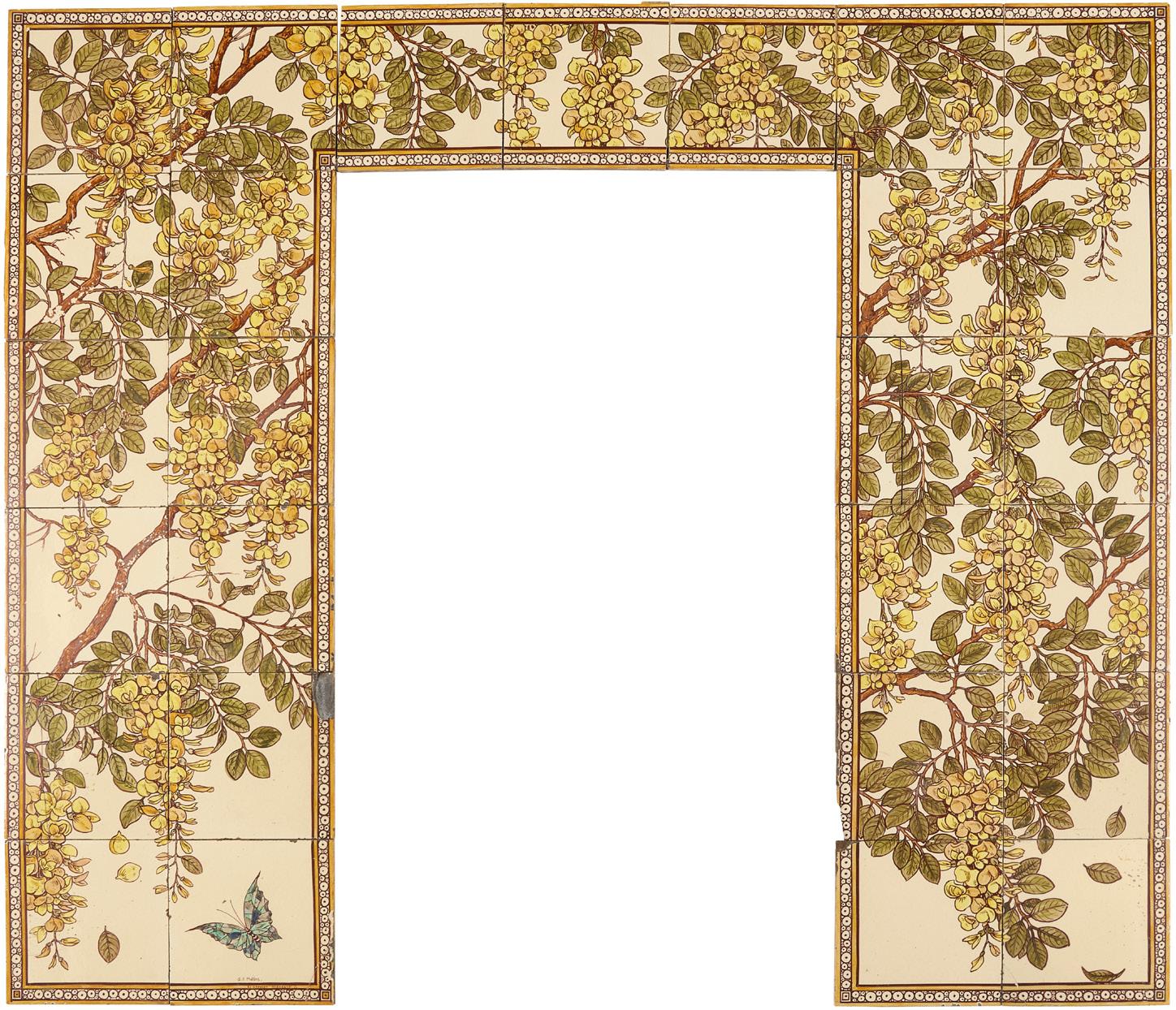
G. F. MALINS FOR MINTON, HOLLINS & CO.
AESTHETIC MOVEMENT FIREPLACE TILE PANEL, CIRCA 1880
dust-pressed clay, comprising 27 hand-painted tiles decorated with laburnum, moulded maker’s marks, one tile signed G. F. MALINS/ 51 CHESTER ROAD/ HIGHGATE N.
91cm high, 106cm wide; inside measurement 76cm high, 45.5cm wide, each tile 15.2cm square
G.F. Malins decorated tile panels for Mintons architectural schemes and has also been recorded as a decorator for the successful London architectural practice Ernest George & Peto [also known as George & Peto].
£600-1,000
59
G. F. MALINS FOR MINTON, HOLLINS & CO.
AESTHETIC MOVEMENT FIREPLACE TILE
PANEL, CIRCA 1880
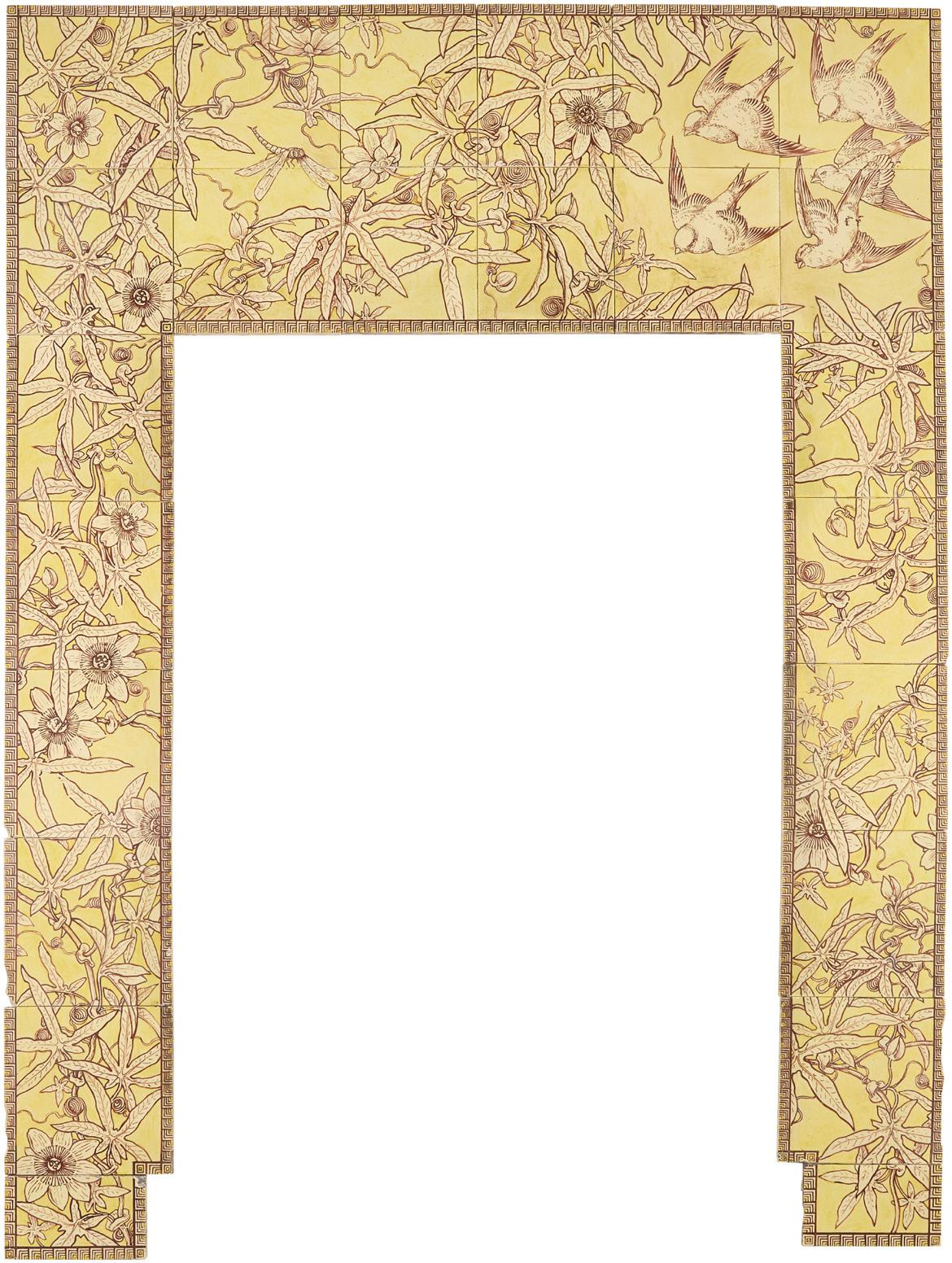
dust-pressed clay, comprising 19 hand-painted tiles decorated with passion flowers, moulded maker’s marks (24)
113.5cm high, 85.5cm wide, inside measurement
83.3cm high, 55.5cm wide, most tiles 15.2cm square
£600-1,000
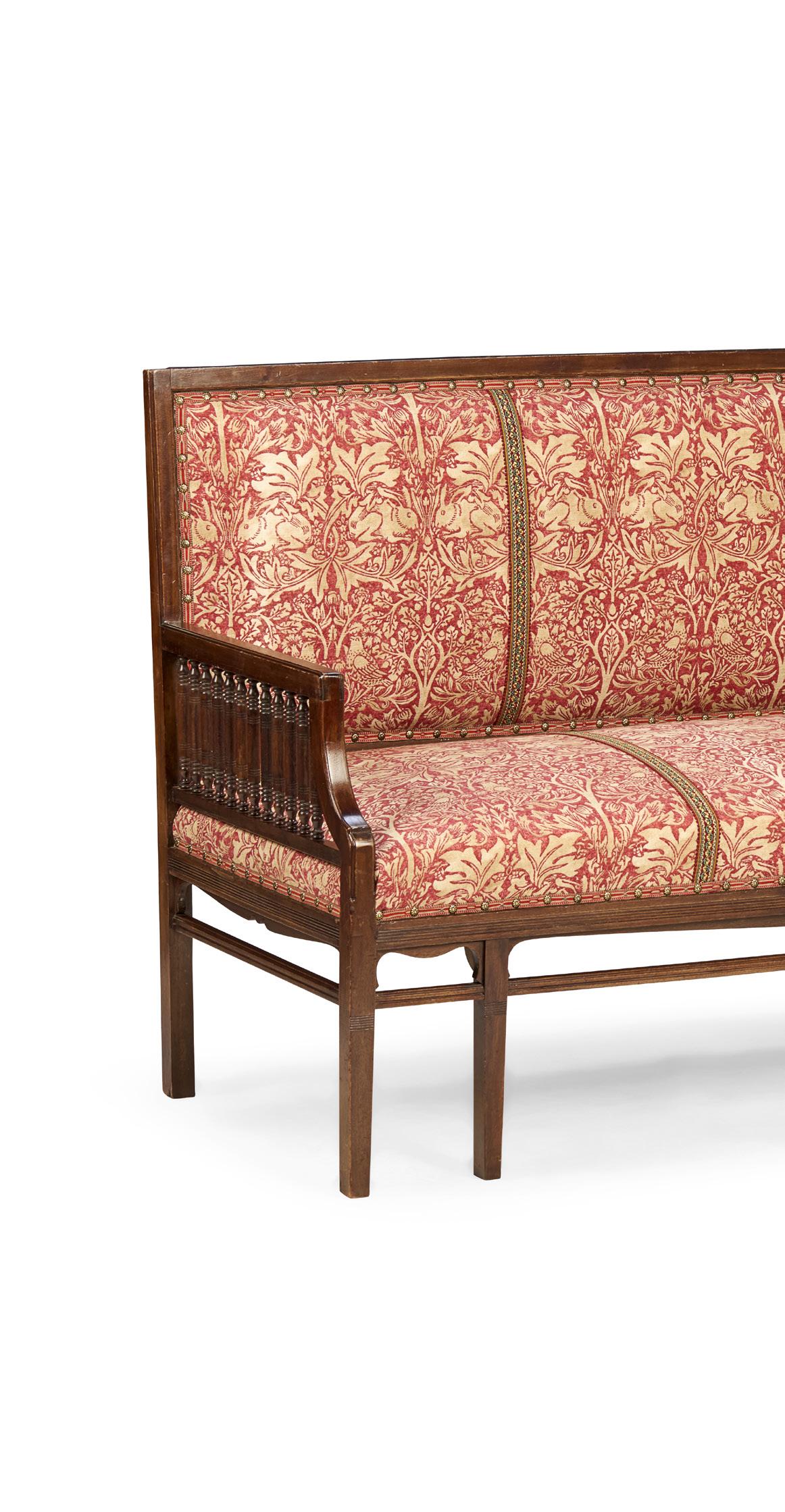
61
ATTRIBUTED TO COLLINSON & LOCK, LONDON
AESTHETIC MOVEMENT SOFA, CIRCA 1880 mahogany, with later close-nailed linen upholstery
153cm wide, 95.5cm high, 61cm deep
60
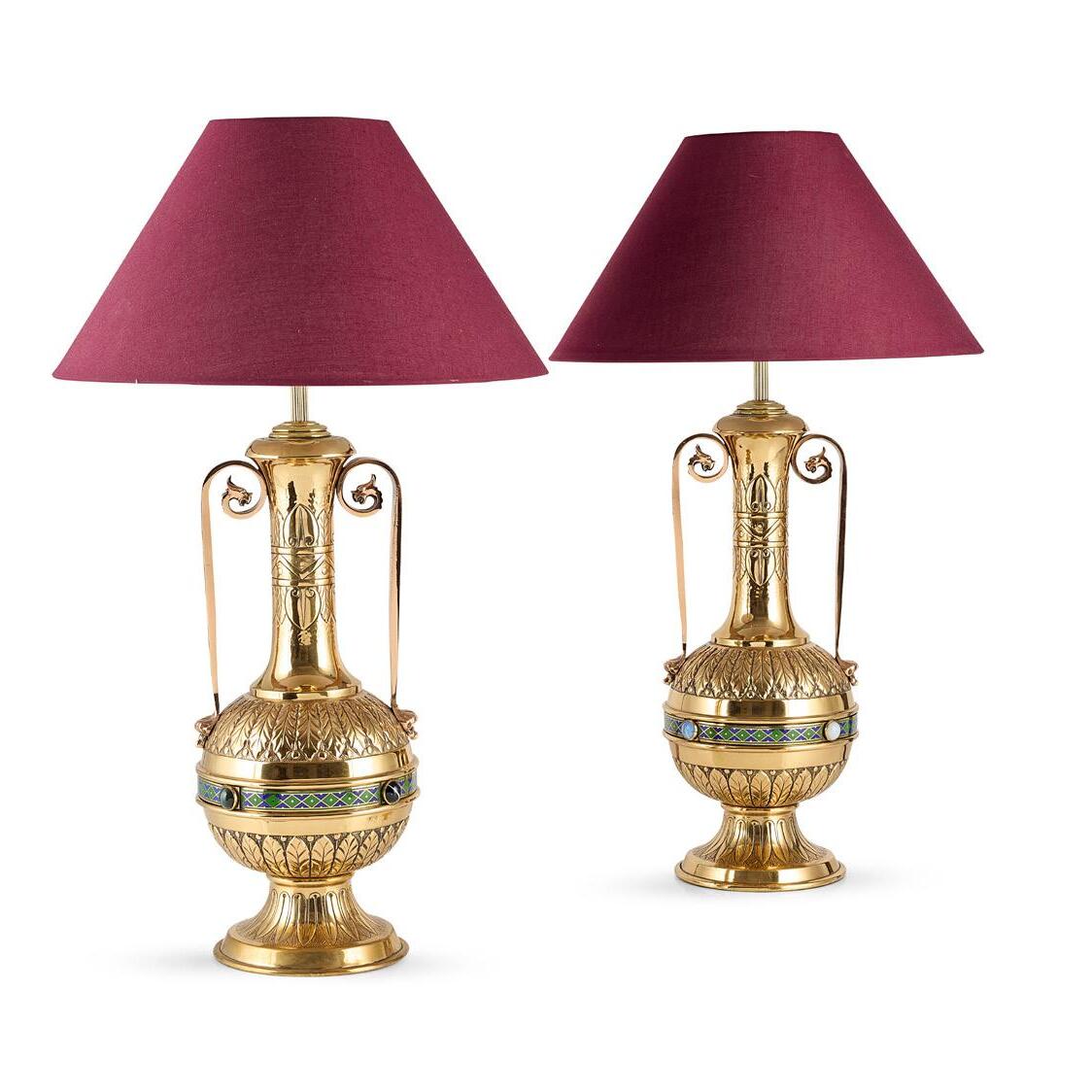
ENGLISH
PAIR OF AESTHETIC MOVEMENT
TABLE LAMPS, CIRCA 1880 brass, copper, enamel, hardstone cabochons, with later silk shades (2) 48cm high to base of fitting £600-800
Literature: Edwards C. Collinson & Lock: Art Furnishers, Interior Decorators and Designers, 1870-1900, Matador 2022, p.188, pl. 4.174 and 4.175 for related examples.
£3,000-5,000
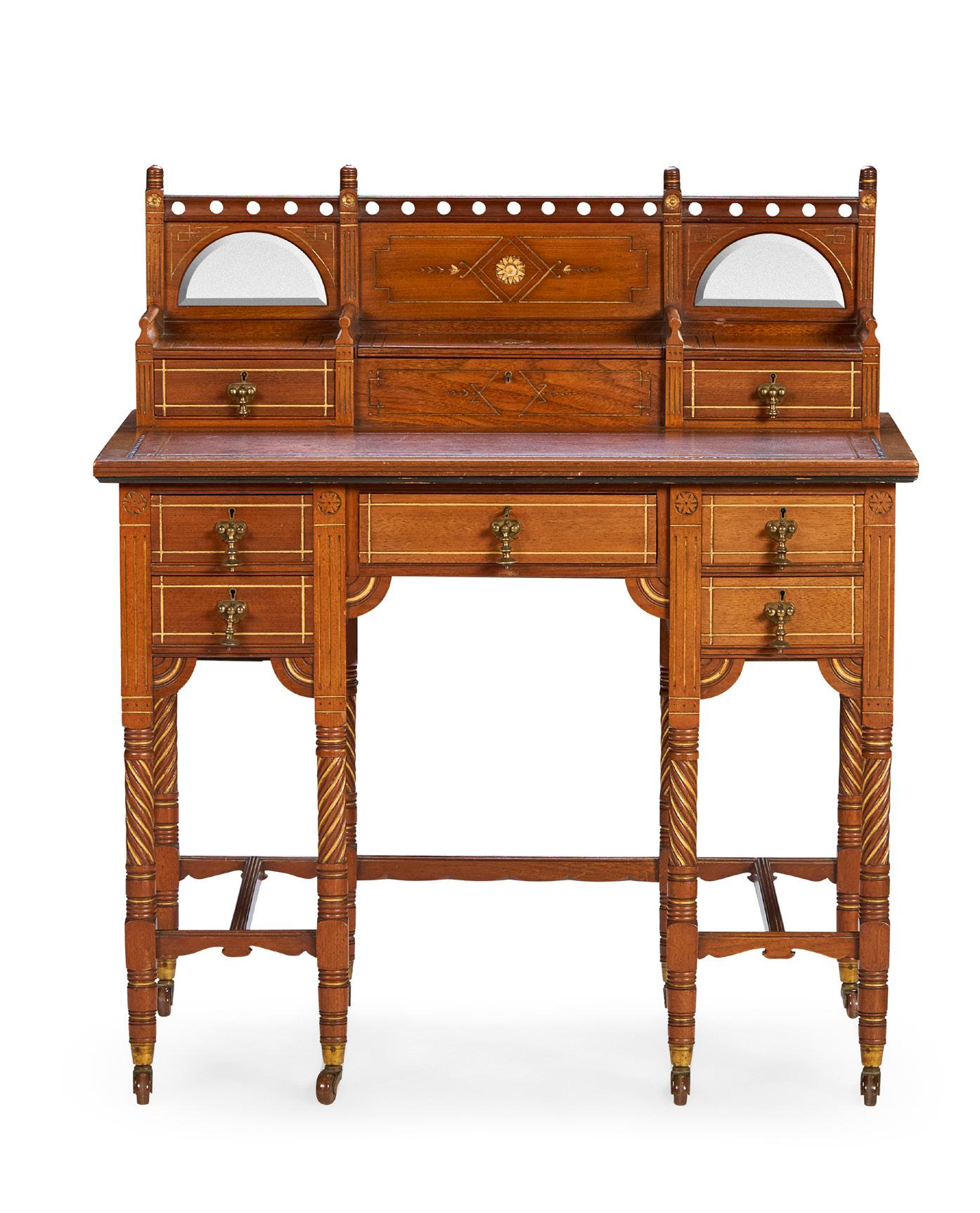
62
ENGLISH
AESTHETIC MOVEMENT LADY’S DESK, CIRCA 1875 walnut, with mirrored panels, incised gilded decoration, leather writing surface and brass fittings
91.5cm wide, 103cm high, 56cm deep
£600-800
ENGLISH, AESTHETIC MOVEMENT
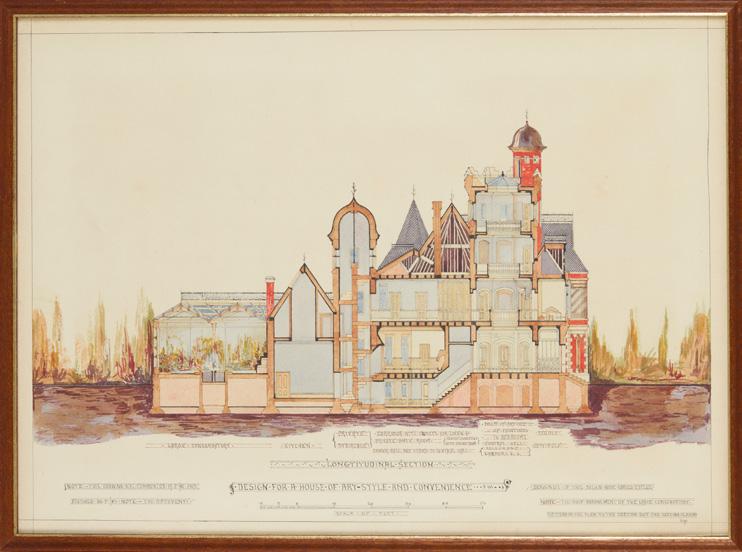
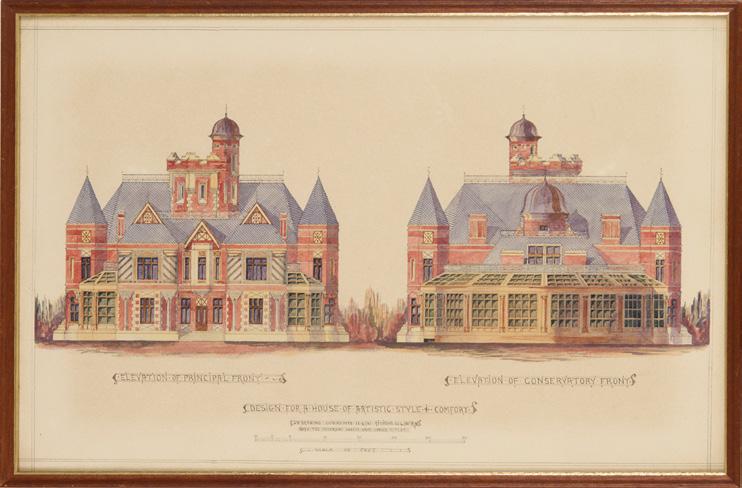
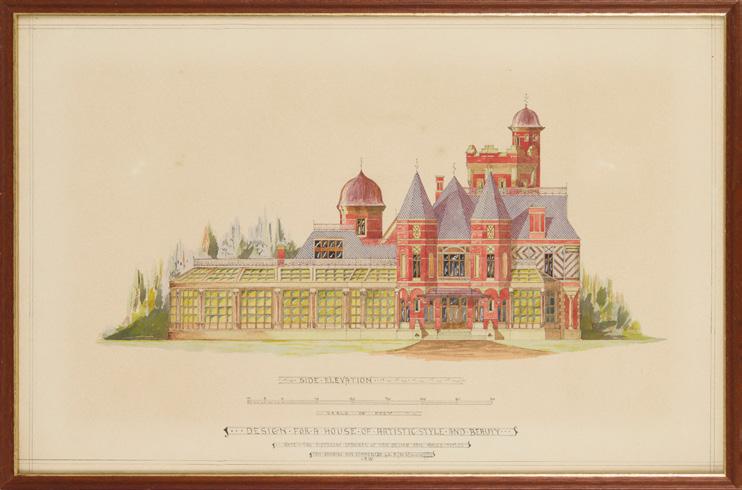
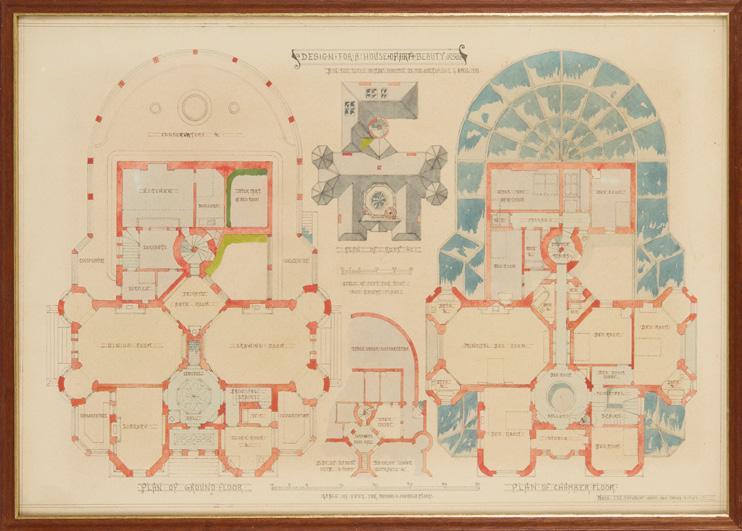
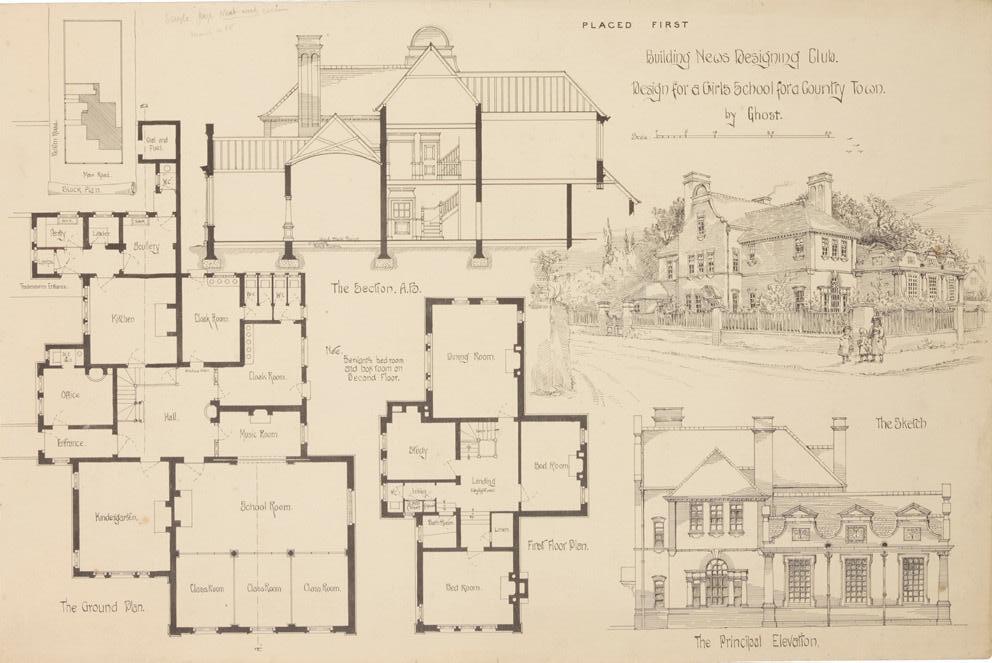
FOUR DESIGNS FOR ARTISTIC HOUSES, 1881
pen and ink and watercolour, each signed with initials A.W. and dated 1881 (4)
each 33cm x 51cm (frame size 35.5cm x 54cm)
Provenance: Jeremy Cooper Ltd., London
£800-1,200
64
THOMAS EDWARDS & SONS
AESTHETIC MOVEMENT BUFFET, CIRCA 1890
walnut and oak, bears maker’s label THOS EDWARDS & SONS, NEWCASTLE, STAFFS
106cm wide, 121.5cm high, 50.5cm deep
£400-600
66
ENGLISH
65
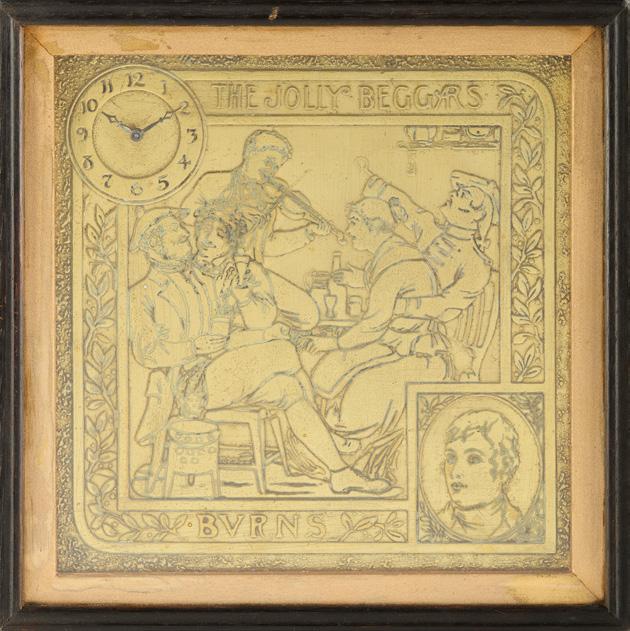
JOHN MOYR SMITH (1839-1912)
‘THE JOLLY BEGGARS’ WALL CLOCK, CIRCA 1890 brass, with an E.N. Welch Manufacturing Co. movement, ebonised wood frame 26cm square
Literature: Stapleton A. John Moyr Smith: A Victorian Designer, Richard Dennis 2002, p.59, where this design, illustrating Robert Burn’s poem of circa 1785, is illustrated £400-600
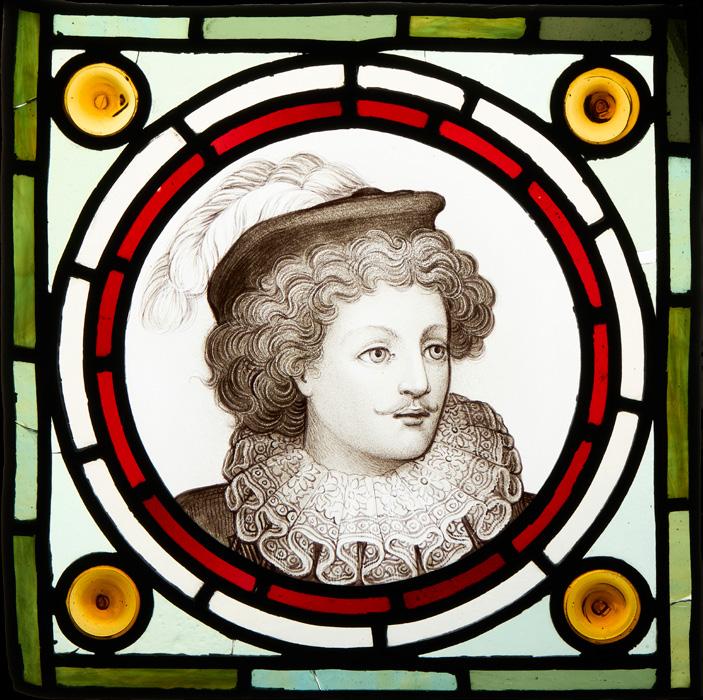
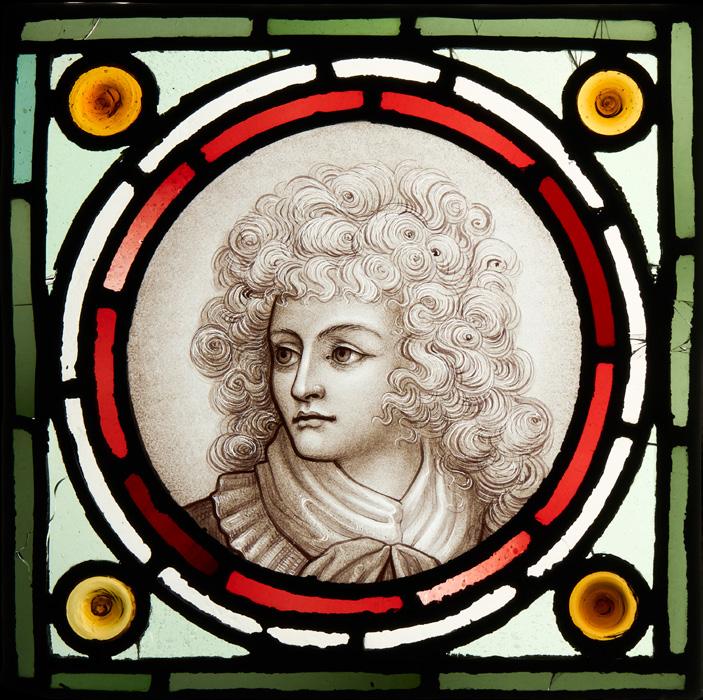
PAIR OF AESTHETIC MOVEMENT STAINED GLASS PANELS, CIRCA 1880
painted, stained and leaded glass (2) each 29cm square
Provenance: The Michael Blood Collection
67
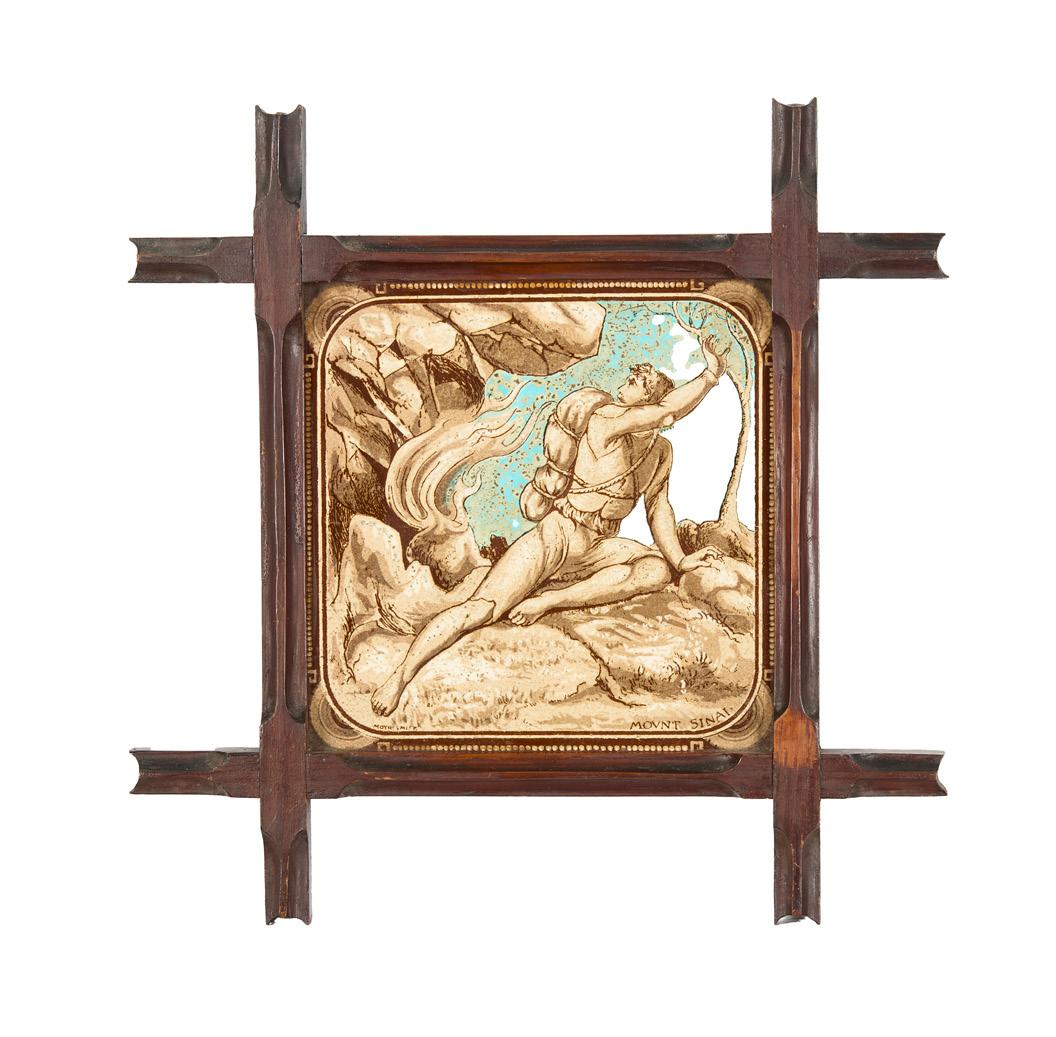
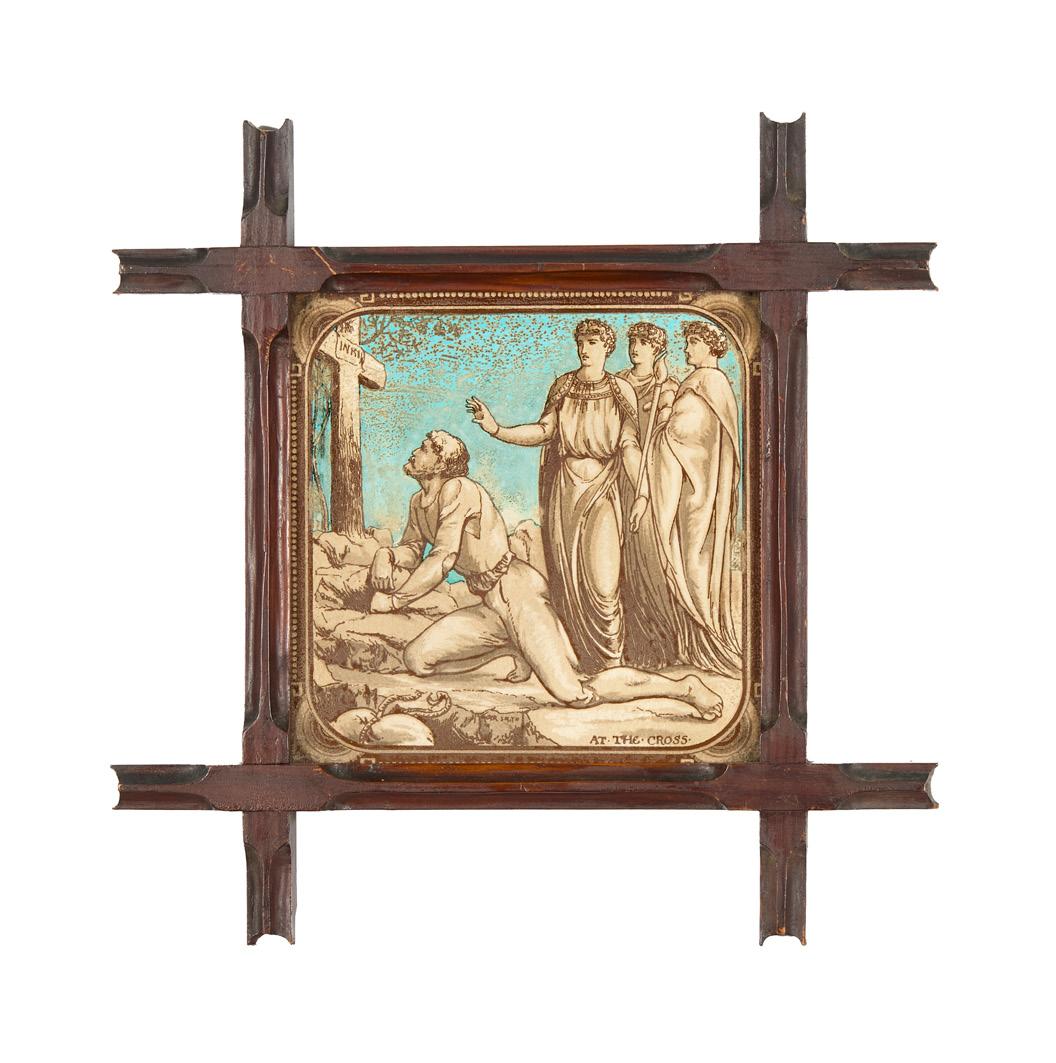
JOHN MOYR SMITH (1839-1912) FOR MINTON, HOLLINS & CO TWO ‘PILGRIM’S PROGRESS’ FRAMED TILES, CIRCA 1880 dust pressed clay, each signed MOYR SMITH, impressed maker’s marks, comprising ‘MOUNT SINAI’ and ‘AT THE CROSS’ (2) 20cm square (frame size 23.5cm square)
Literature: Stapleton A. John Moyr Smith: A Victorian Designer, Richard Dennis 2002, p.70
£200-300
ATTRIBUTED
JOHN MOYR SMITH (1839-1912)
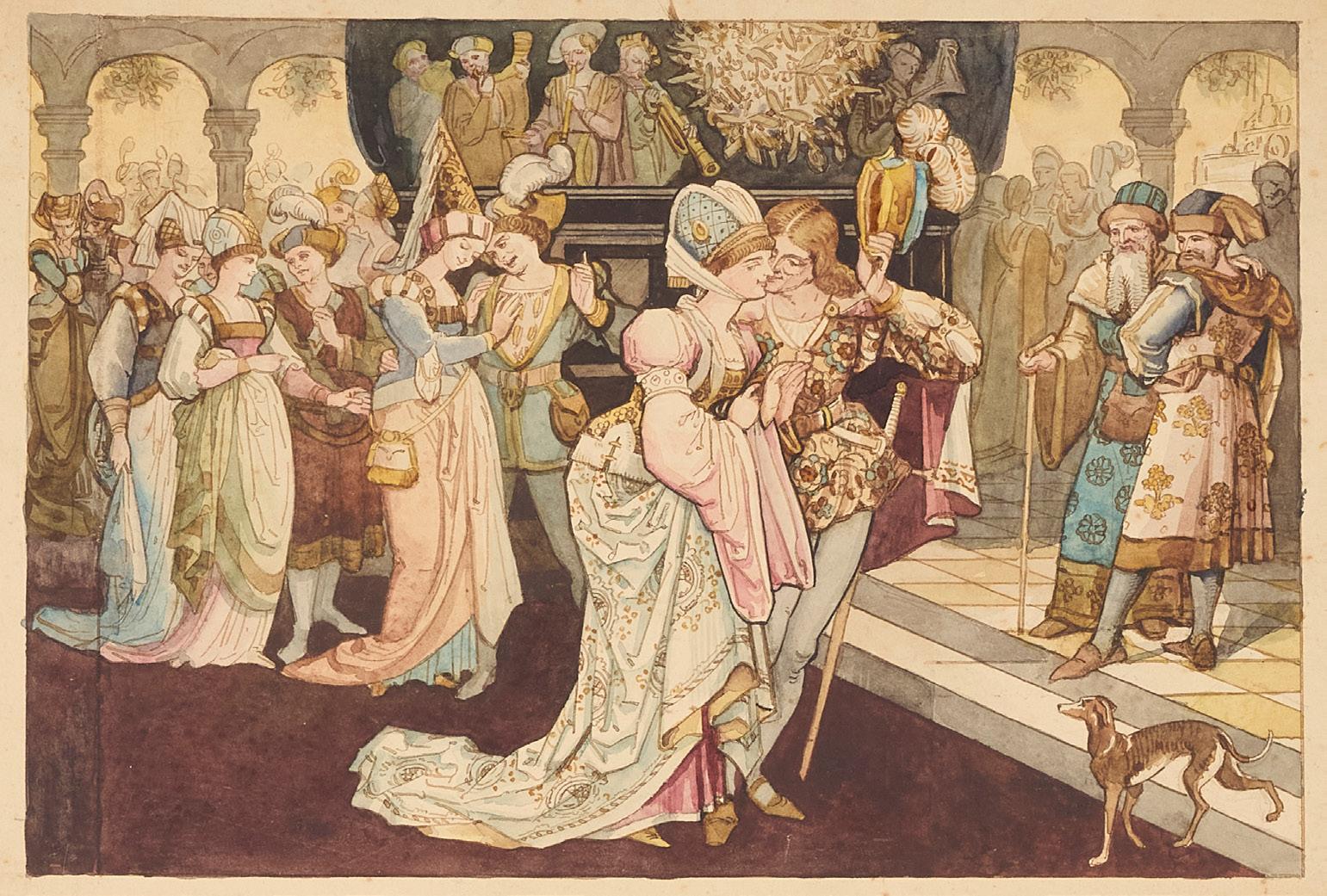
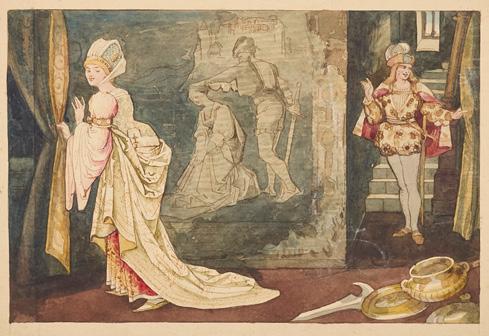
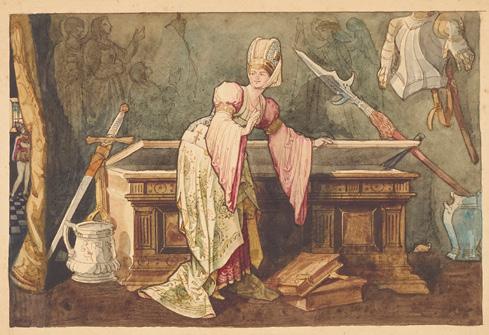
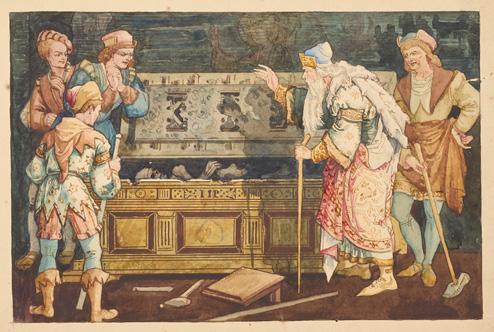
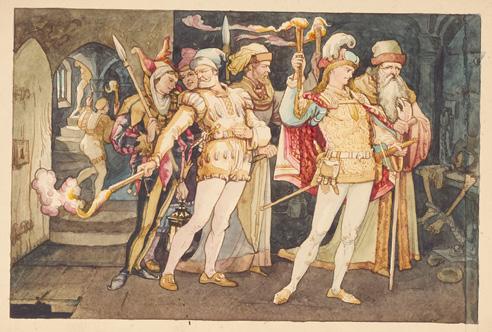
FIVE ILLUSTRATIONS FOR ‘THE MISTLETOE BOUGH’, CIRCA 1890 watercolour, framed (5) each approx. 16.5cm x 24.5cm
Provenance: Ernest Biddle Esq. Biddle & Webb Auctioneers, 1997 Private Collection
£3,000-5,000
‘The Mistletoe Bough’ was written as a song and tells the story of a game of hide and seek that goes tragically wrong. When the young bride climbs into an old oak chest, the lid slams shut, and she is not found until many years later. The song was composed circa 1830 by Sir Henry Bishop (1786–1855) with words by Thomas Haynes Bayly (1797–1839). The direct inspiration for Bayly’s rendition was probably ‘Ginevra’, a poem published in 1822 by the English poet Samuel Rogers, telling much the same story. These illustrations may have been commissioned for one of Marcus Ward’s ‘Illuminated Tales’ series but were never published.
69
ENGLISH
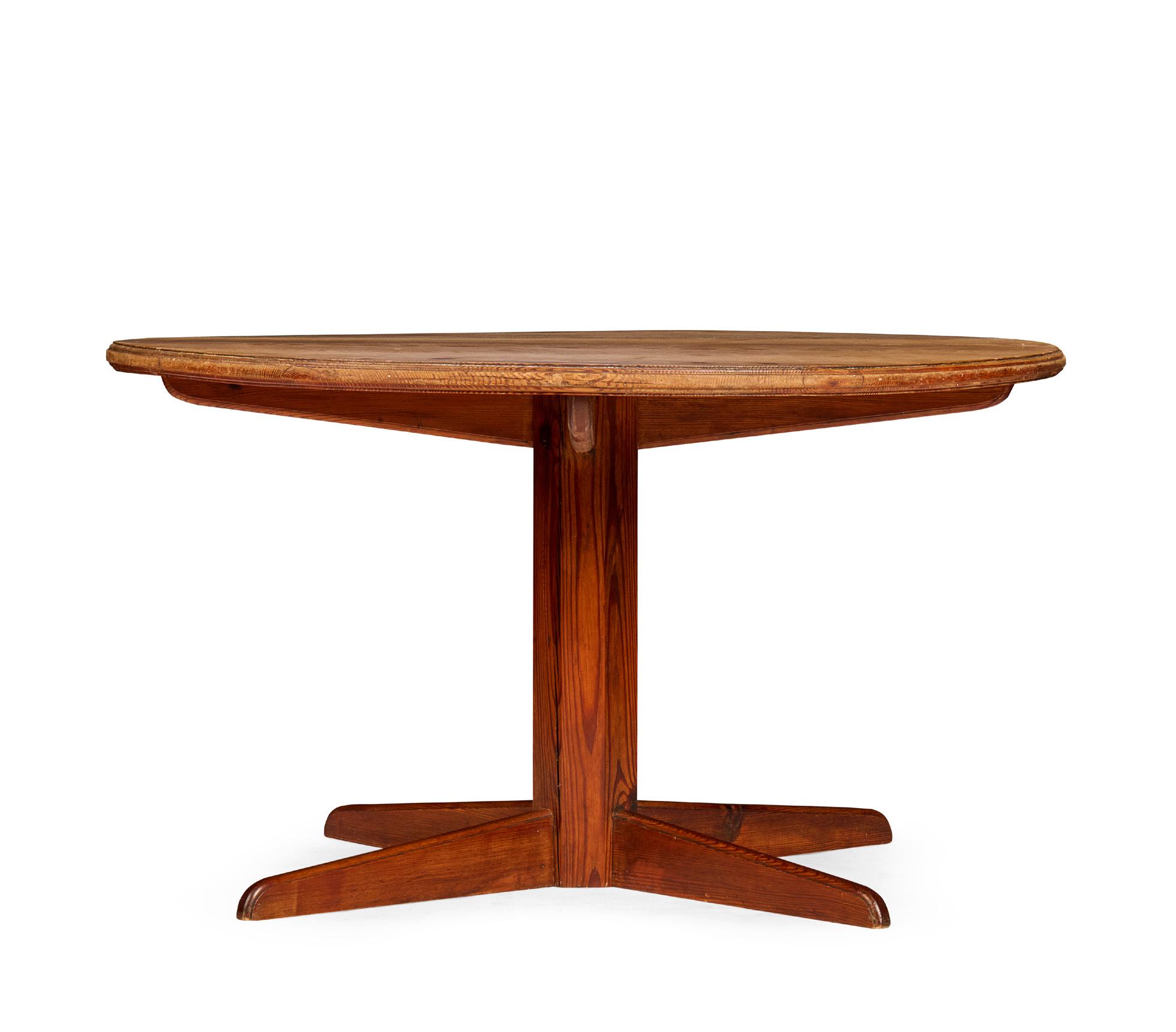
CENTRE TABLE, CIRCA 1870
pitch pine
135cm diameter, 77cm high
£500-800
HEAL & SON, LONDON
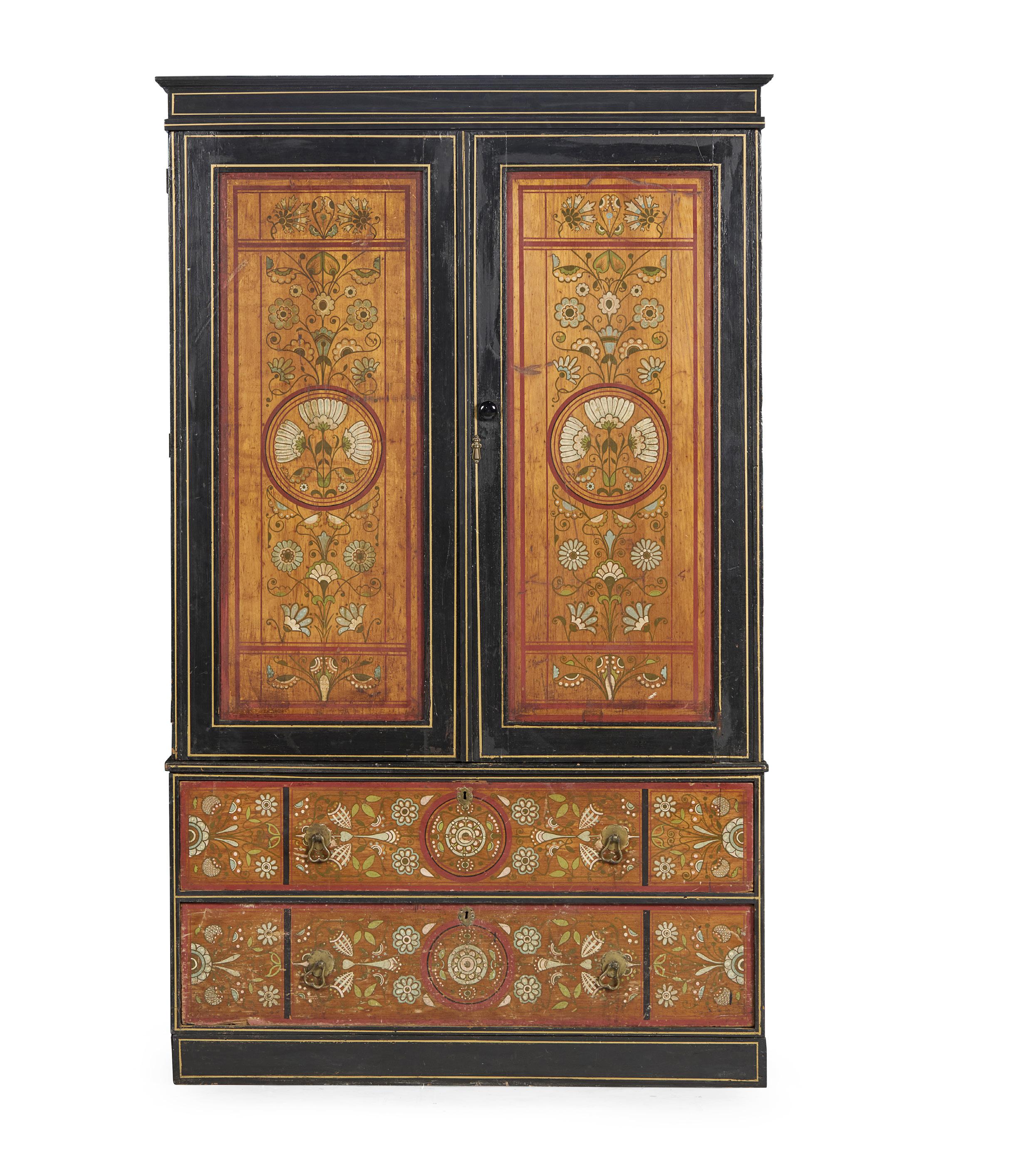
LINEN PRESS, CIRCA 1890
painted and ebonised wood, with brass fittings, stamped to drawer, HEAL & SON LONDON
123.5cm wide, 205.5cm high, 52cm deep
£600-800
71
WILLIAM BROWNFIELD & SONS
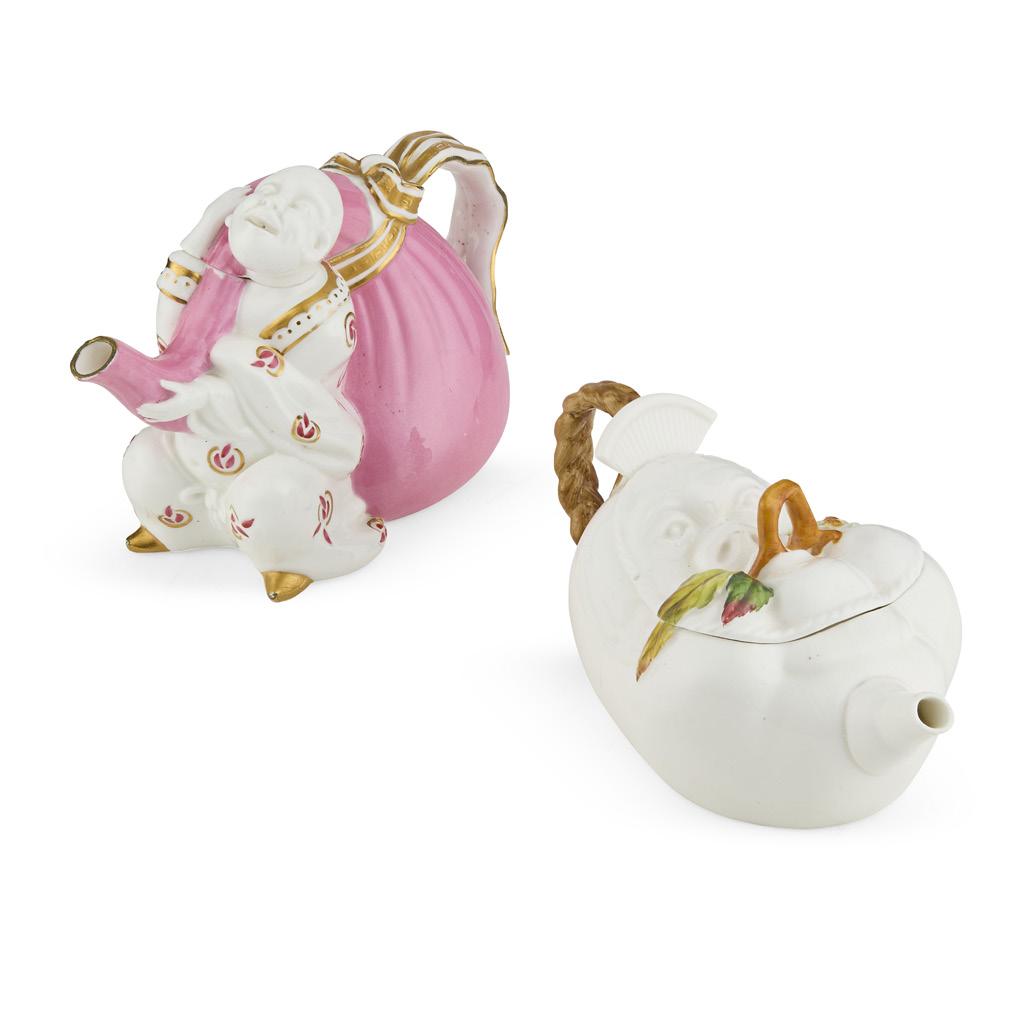
TWO TEAPOTS, CIRCA 1877
majolica, stamped maker’s mark and registration lozenge, comprising; a FACE TEAPOT, dated 11/77, 8.5cm high; and a CHINAMAN TEAPOT, dated 4/78, 13cm high (2)
£400-600
72
ENGLISH
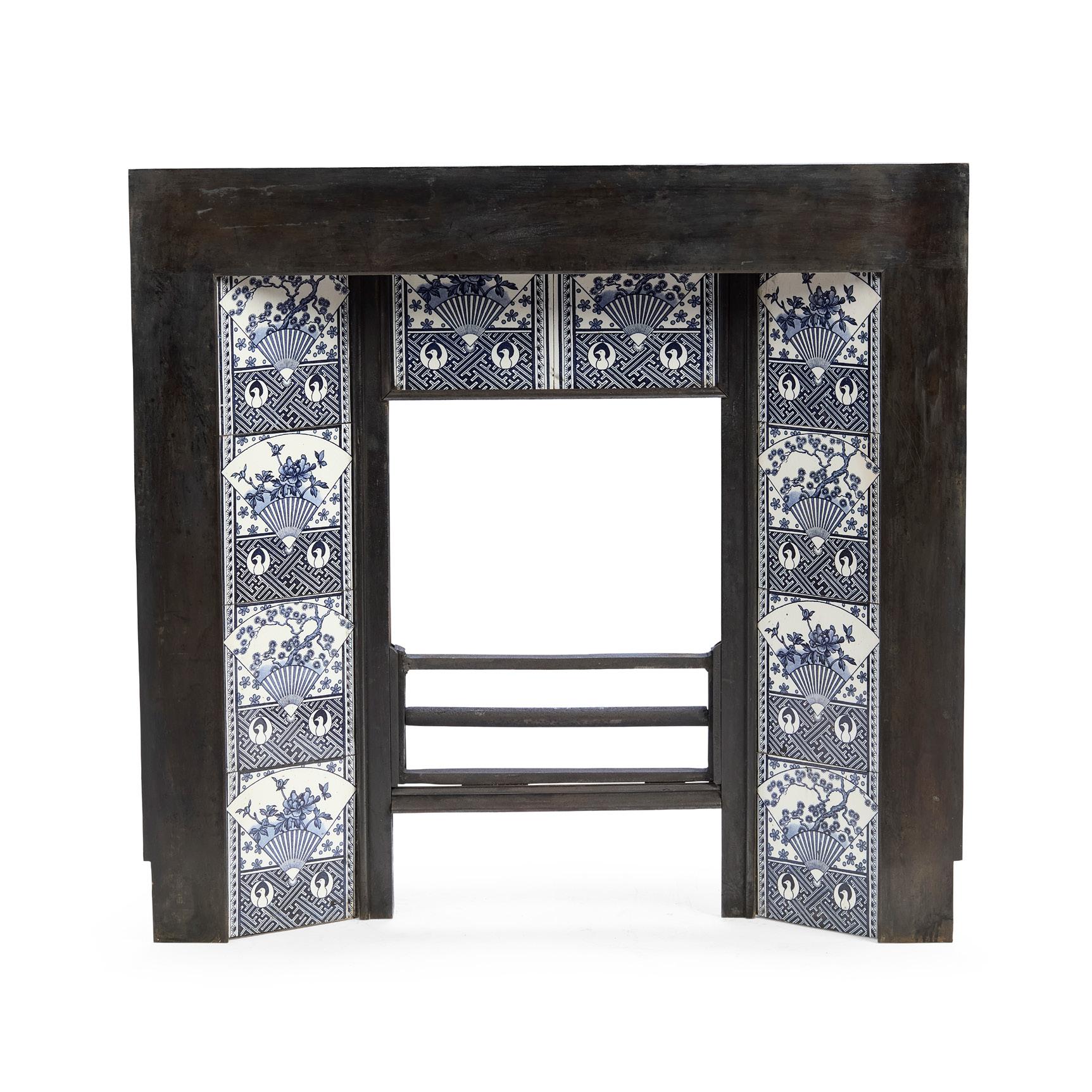
AESTHETIC MOVEMENT FIRE INSERT, CIRCA 1880
wrought and cast steel, inset with Anglo-Japanese tiles exterior 99.5cm wide, 94cm high, interior 64.7cm high, 40.5cm wide
£700-1,000
73
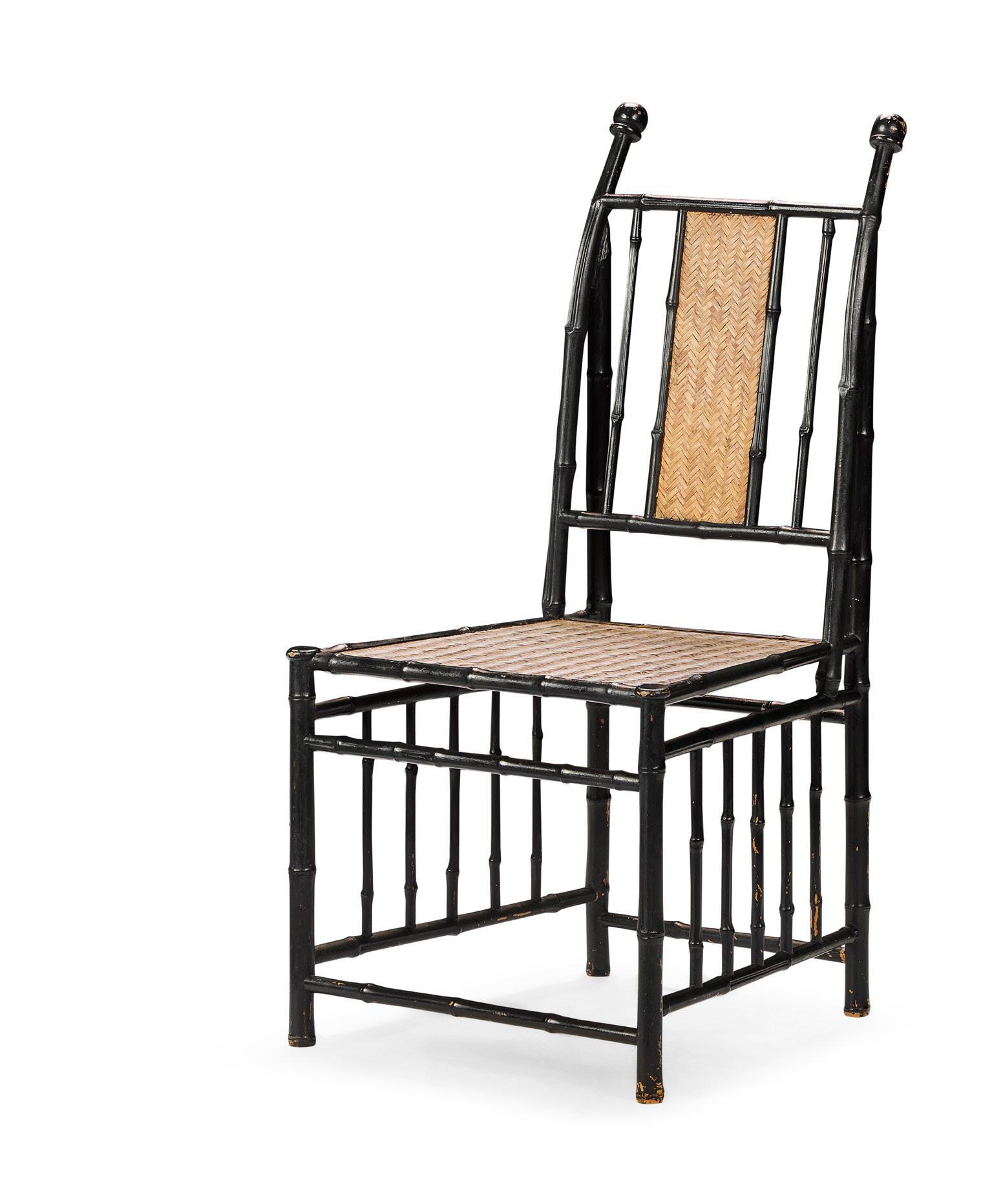
ENGLISH
AESTHETIC MOVEMENT SIDE CHAIR, CIRCA 1890
ebonised bamboo, woven rattan
51.5cm wide, 105cm high, 55cm deep
£200-300
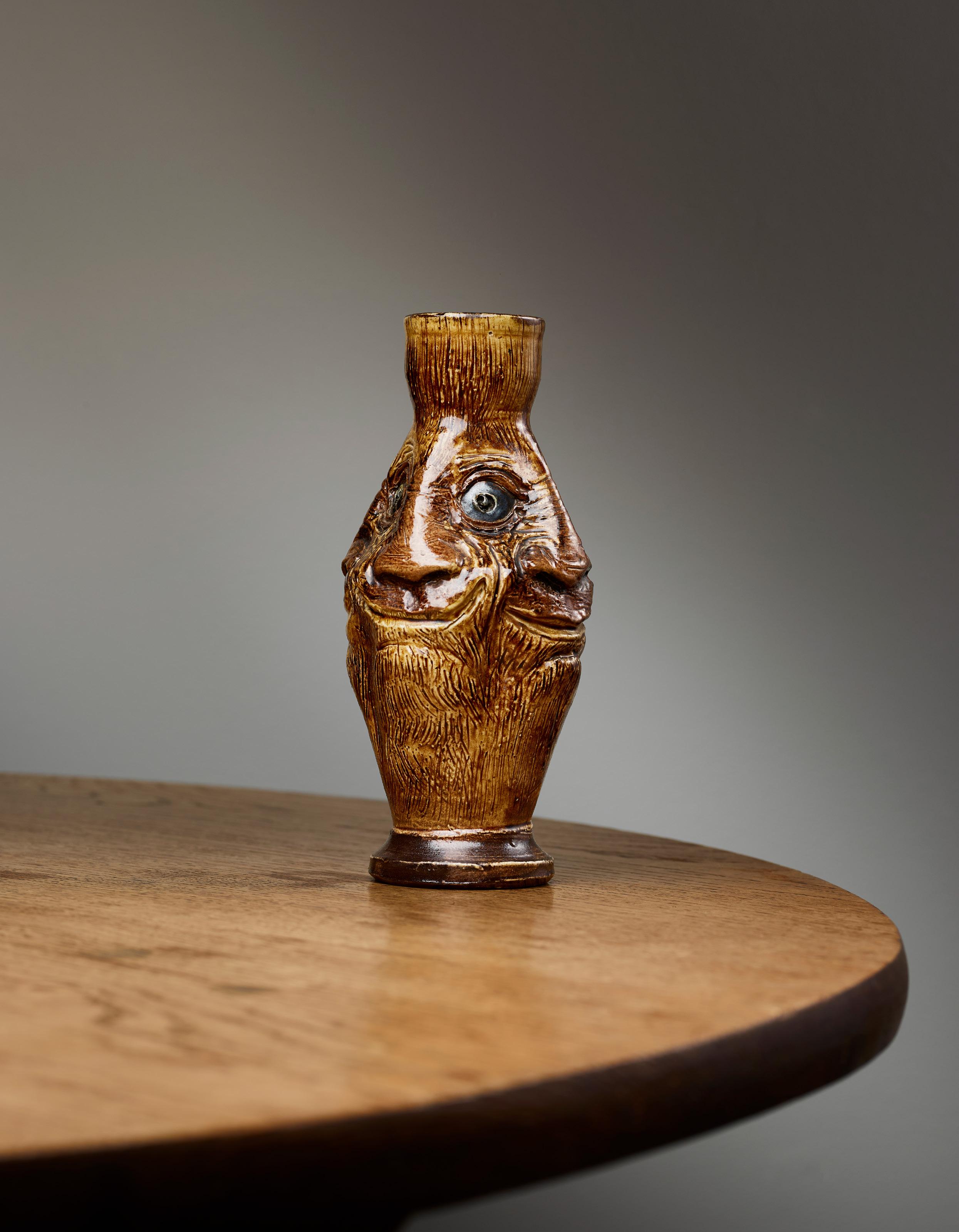
The Martin Brothers, Robert Wallace, Charles, Walter, and Edwin, were pioneering British ceramicists known for their eccentric and highly collectible stoneware. Operating in London from the 1870s to the early 20th century, they created some of the most distinctive ceramics of the Arts and Crafts movement, blending elements of Gothic revival, medieval grotesques, and natural forms.
At the heart of their production was Robert Wallace Martin (1843–1923), the eldest brother and creative force behind their whimsical and often macabre Wally Birds, sculptural tobacco jars with expressive, exaggerated features. These creatures, along with their salt-glazed vases, grotesque face jugs, and aquatic-inspired designs, set them apart from traditional Victorian ceramics.
While Walter (1857–1912) and Edwin (1860–1915) Martin specialised in glazing and throwing, Charles Martin (1846–1910) was more involved in the business side of the workshop. Together, they developed a distinctive textured, earthy glaze, often in rich browns, greens, and blues, that gave their ceramics an organic, almost ancient quality.
Despite their artistry, financial struggles plagued the brothers throughout their careers. However, their work gained a cult following among collectors, and today, Martinware is highly sought after, with pieces commanding significant prices at our auctions.
This vase is being sold to support the Hugo Burge Foundation.
74
MARTIN BROTHERS FACES VASE, 1884
incised MARTIN BRO LONDON & SOUTHALL / 6-84, glazed stoneware
23.7cm high
Provenance: Cheffins, 26 May 2022, lot 50. Hugo Burge Collection
£4,000-6,000
75
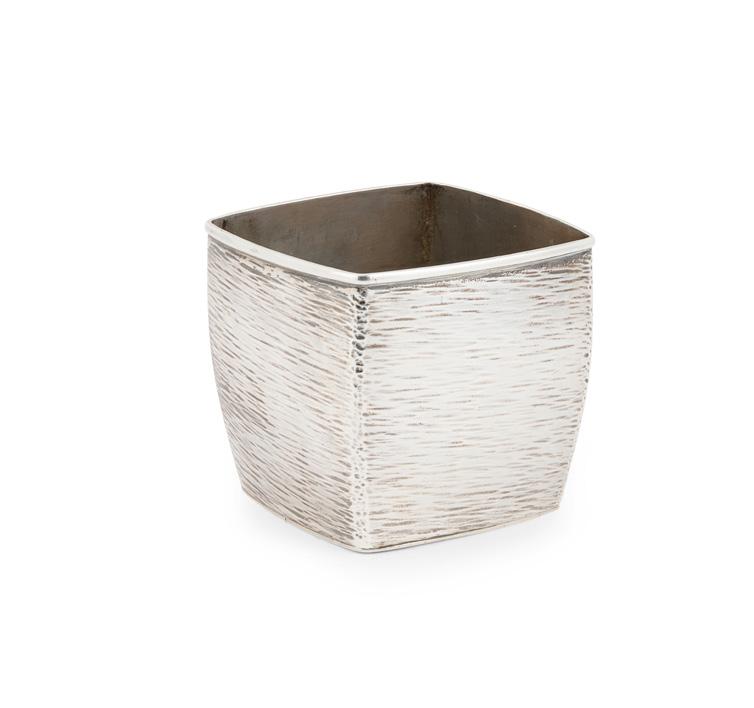
ATTRIBUTED TO CHRISTOPHER DRESSER (1834-1904) FOR HUKIN & HEATH, LONDON BOWL, 1885
silver with ‘bark’ finish, stamped maker’s mark H&H, hallmarked Birmingham 1885, 124g
6.5cm high
Provenance: Private Collection, London
Literature: Durant S. Christopher Dresser, Academy Editions, 1993, p. 89 where an example of this model is illustrated.
£300-500
77
76
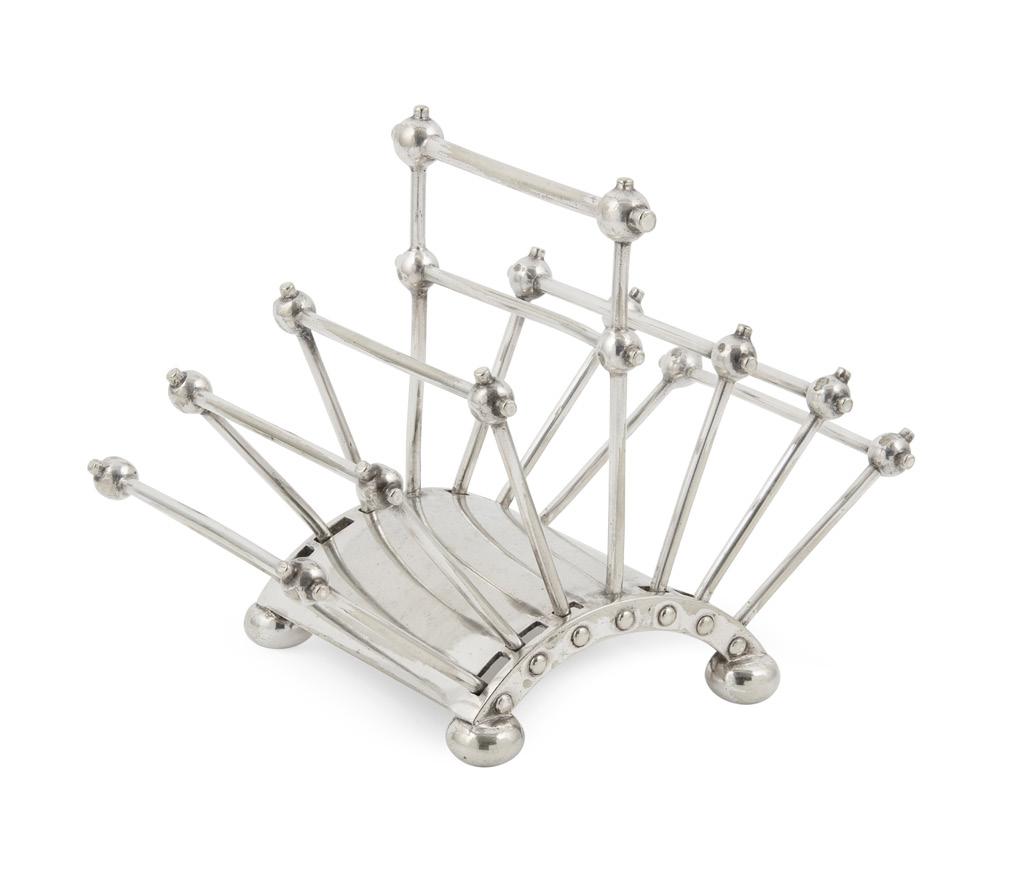
CHRISTOPHER DRESSER (1834-1904) FOR HUKIN & HEATH
LETTER RACK, 1881
electroplated metal, stamped maker’s mark, 2555, and with registration lozenge
16.5cm wide, 12cm high, 10cm deep
£600-800
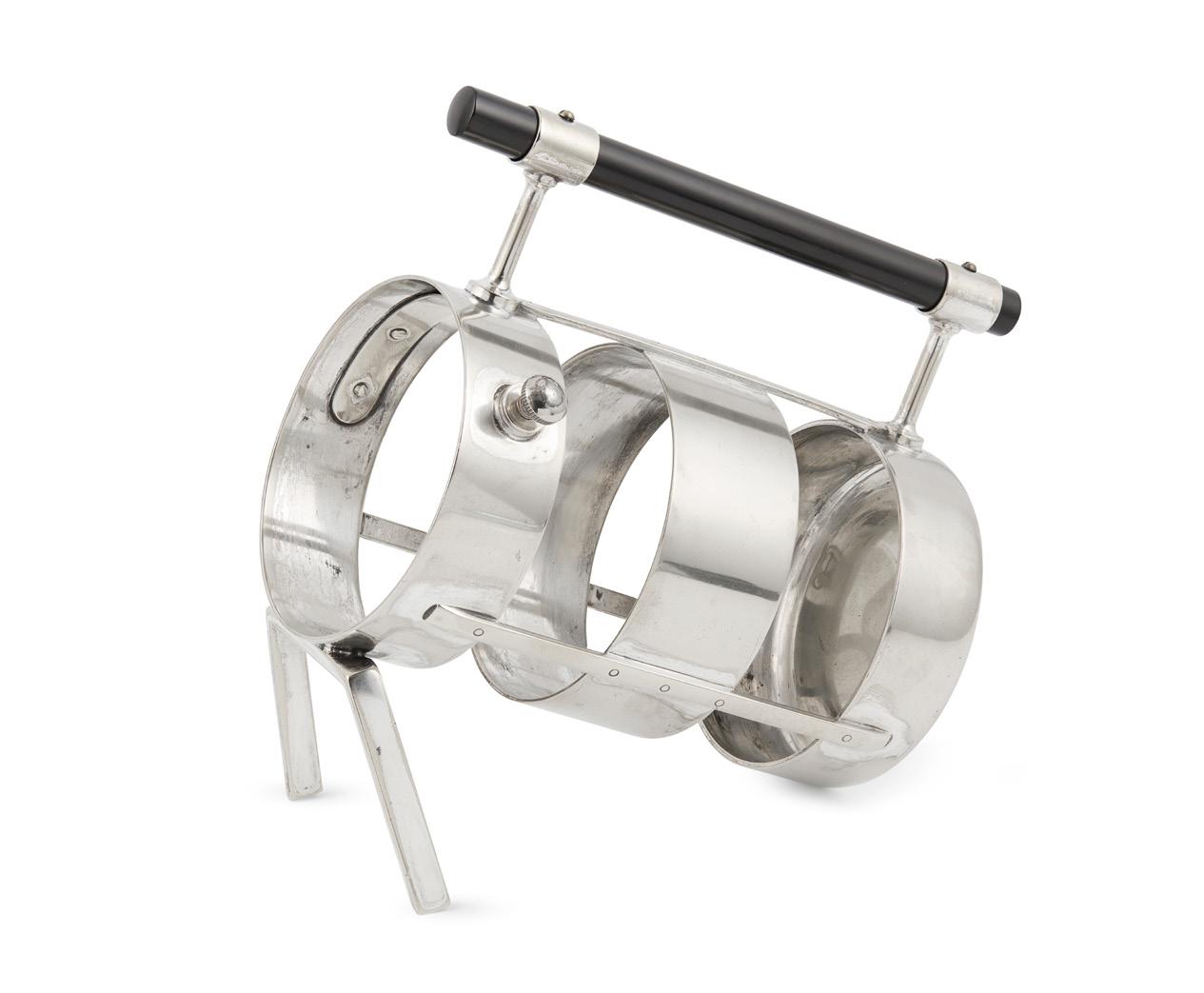
CHRISTOPHER DRESSER (1834-1904) FOR HUKIN & HEATH
WINE BOTTLE HOLDER, CIRCA 1880
electroplated metal, with ebonised handle, stamped maker’s mark, RD NO 1343, 3128
18.5cm high
Literature: Whiteway M. Christopher Dresser 1834-1904, Skira, 2001, p. 92, pl. 75
£800-1,200
78
79
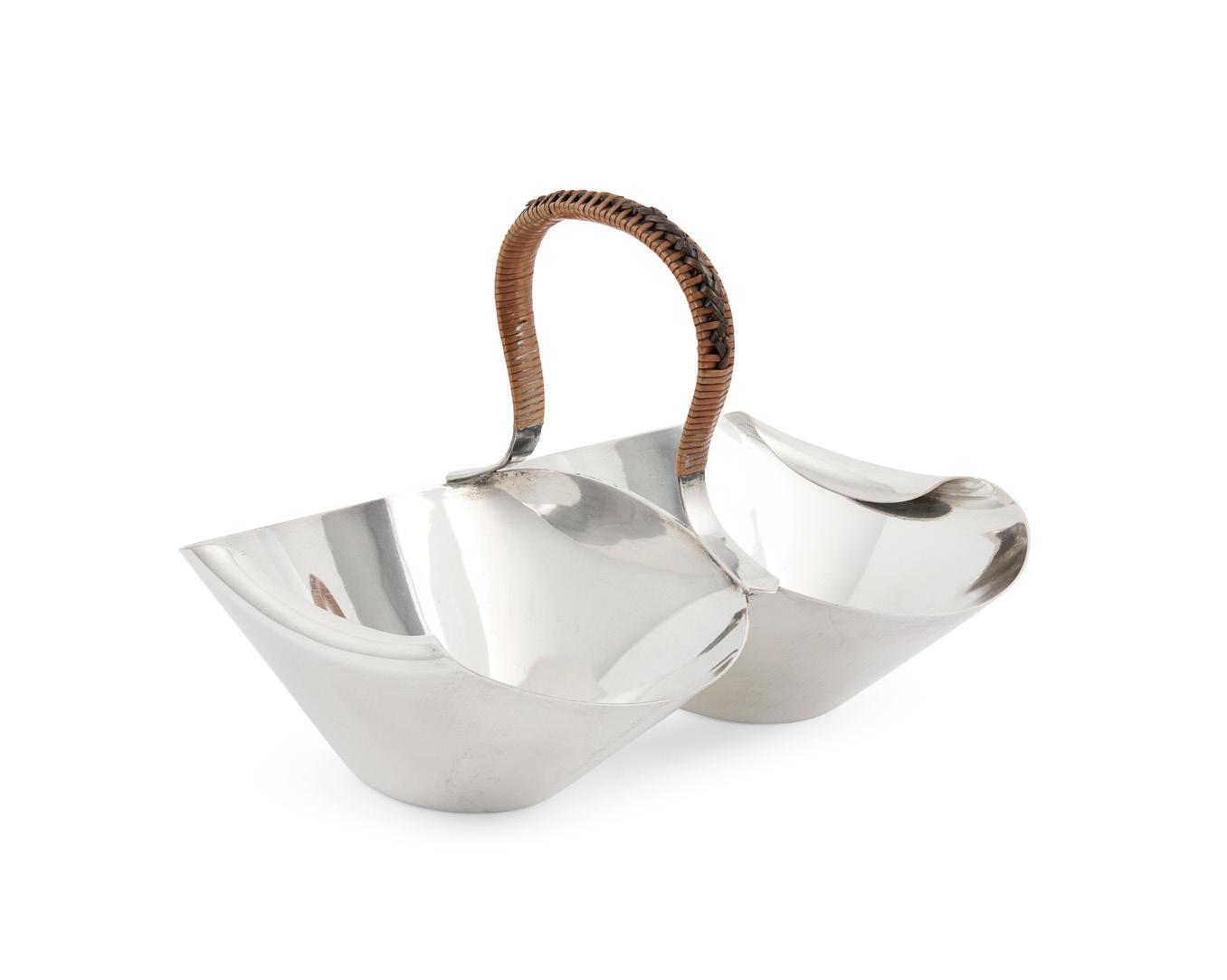
CHRISTOPHER DRESSER (1834-1904) FOR HUKIN & HEATH
DOUBLE DISH, CIRCA 1880
electroplated metal, with rush handle, stamped maker’s mark, 2223, DESIGNED BY DR C. DRESSER
20cm wide, 14.5cm high, 17cm deep
£500-800
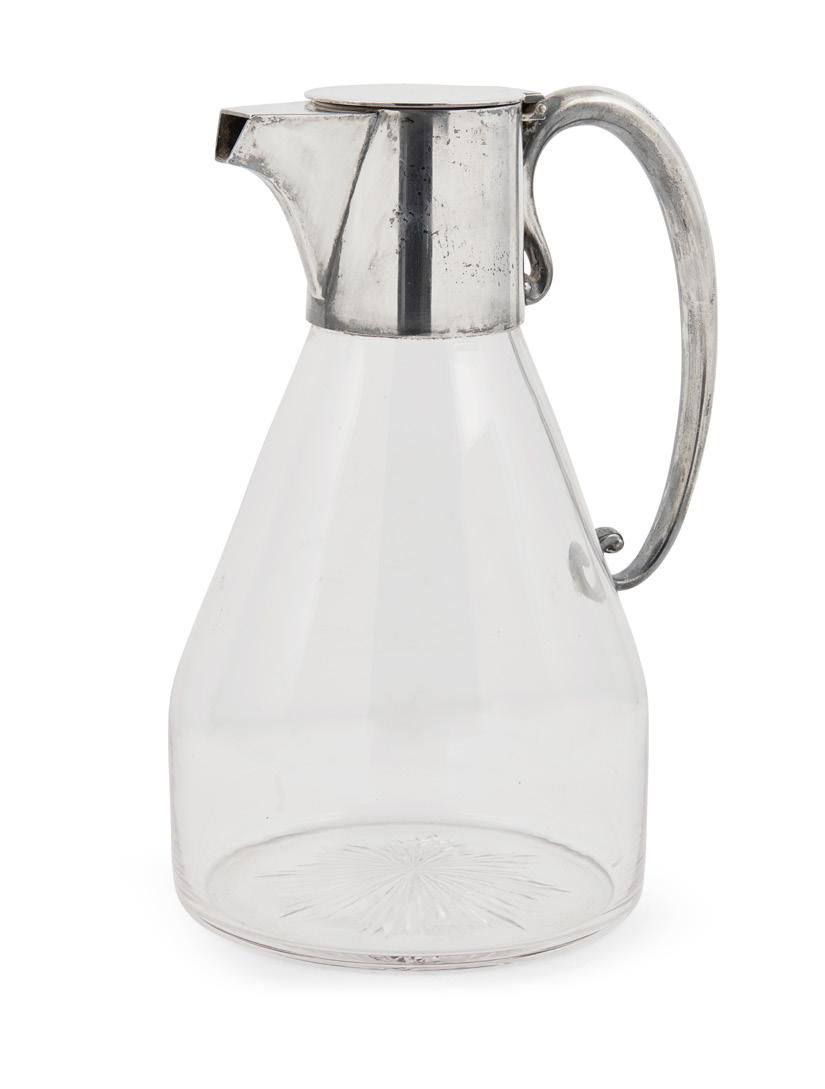
ATTRIBUTED TO CHRISTOPHER DRESSER (1834-1904) FOR HUKIN & HEATH
WINE DECANTER, CIRCA 1880
silver plate, glass, stamped to the collar H&H
20.3cm high
£400-600
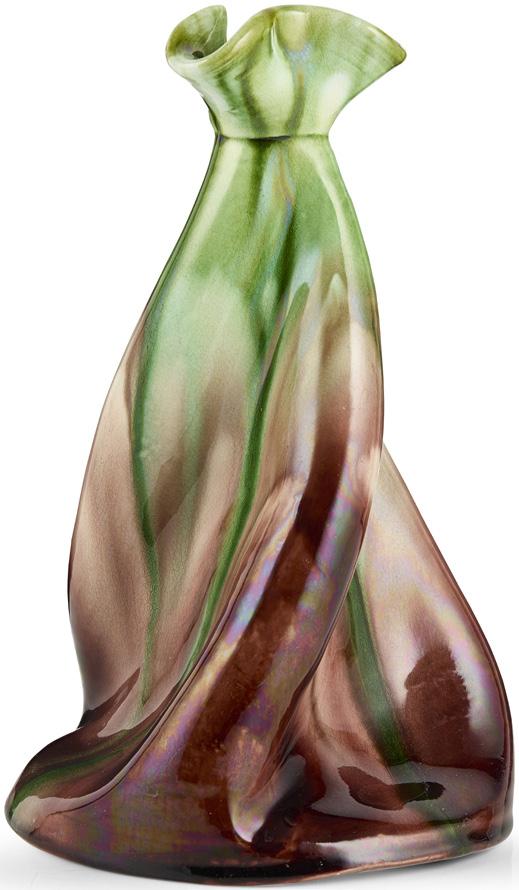
CHRISTOPHER DRESSER (1834-1904) FOR AULT POTTERY ‘PROPELLER’ VASE, CIRCA 1880
glazed earthenware
Literature: Whiteway, M. Christopher Dresser 1834-1904, Skira 2001, p. 191, pl. 234 where a similar Ault vase is illustrated
£400-600
81
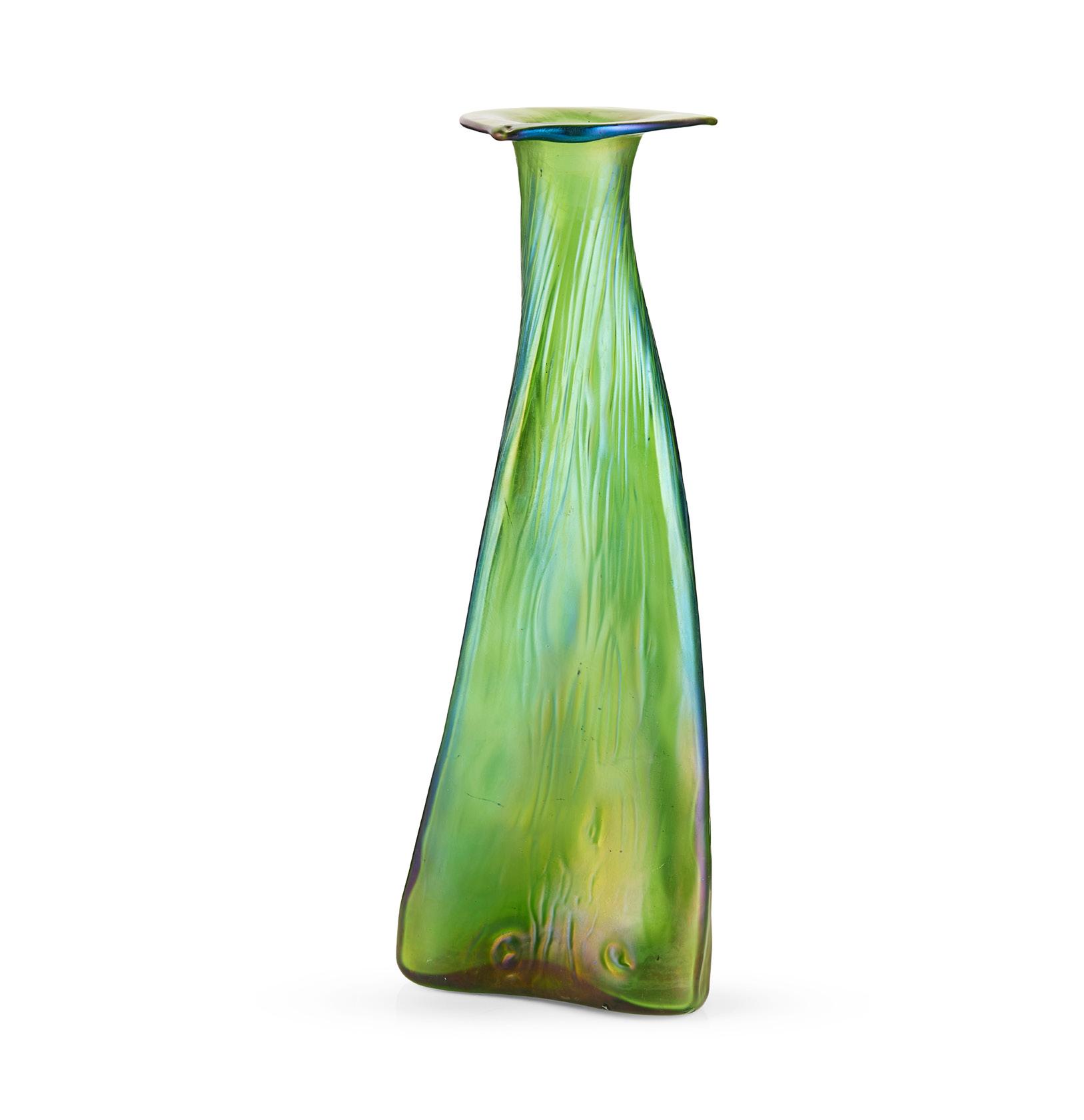
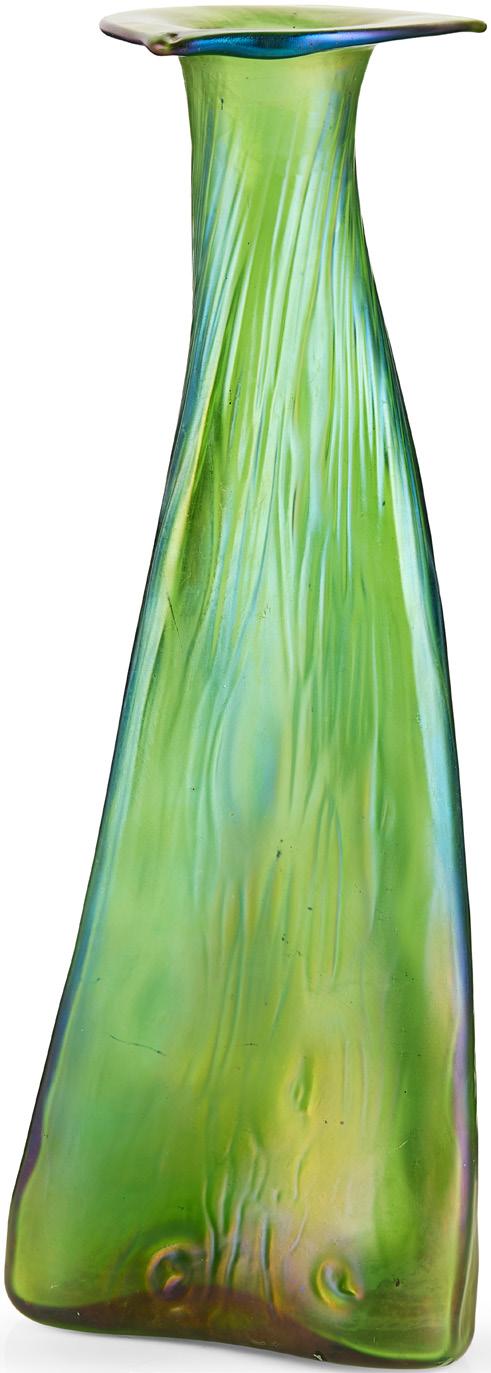
LOETZ, AFTER CHRISTOPHER DRESSER ‘PROPELLER’ VASE, CIRCA 1910
iridescent glass
32.5cm high
£300-500
82
CHRISTOPHER DRESSER (1834-1904) FOR LINTHORPE ART POTTERY VASE, CIRCA 1880
glazed earthenware, inscribed 16 to the base 23cm high
Literature: Whiteway, M. Christopher Dresser 1834-1904, Skira 2001, p. 116, pl. 114 where a similar vase is illustrated.
£500-700
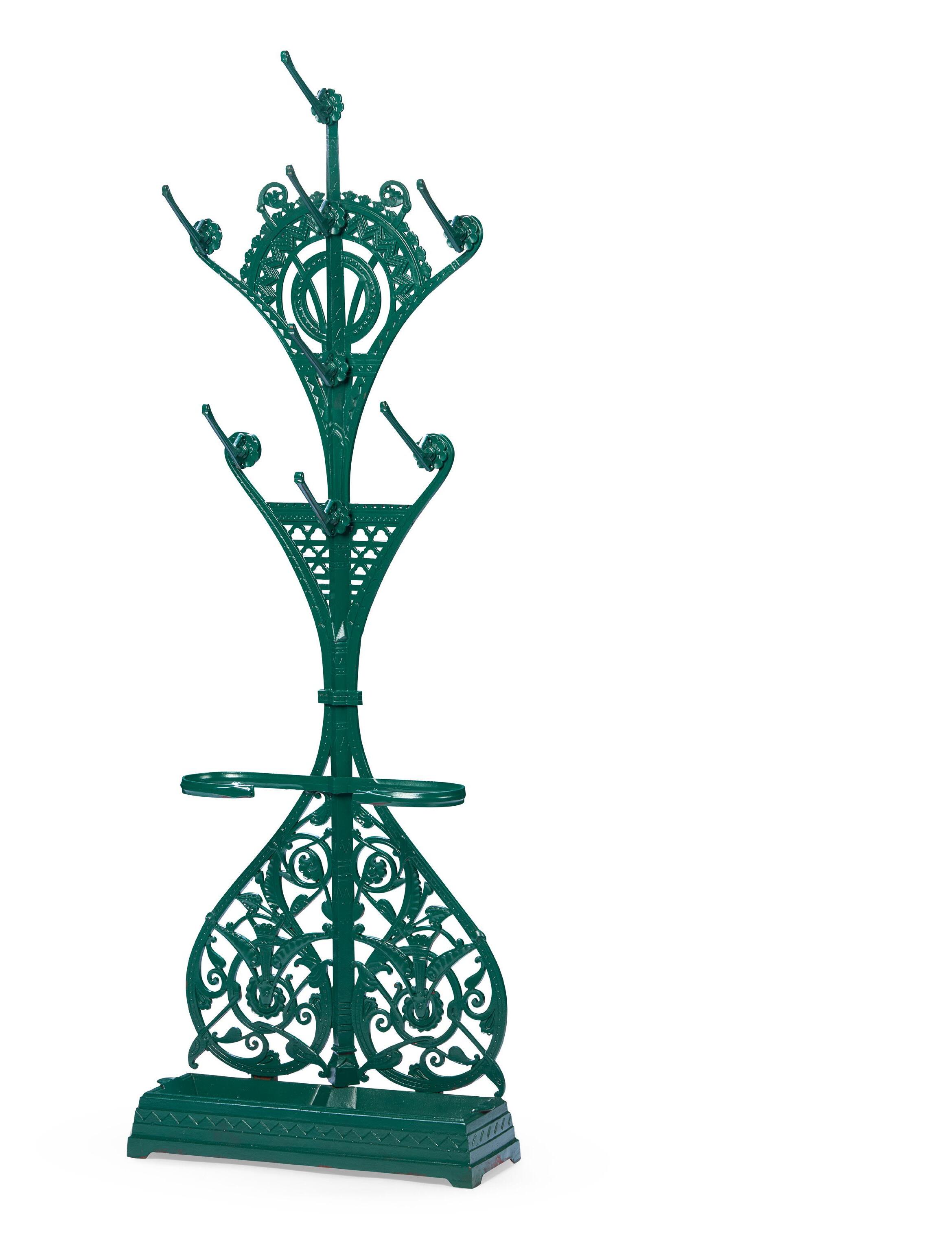
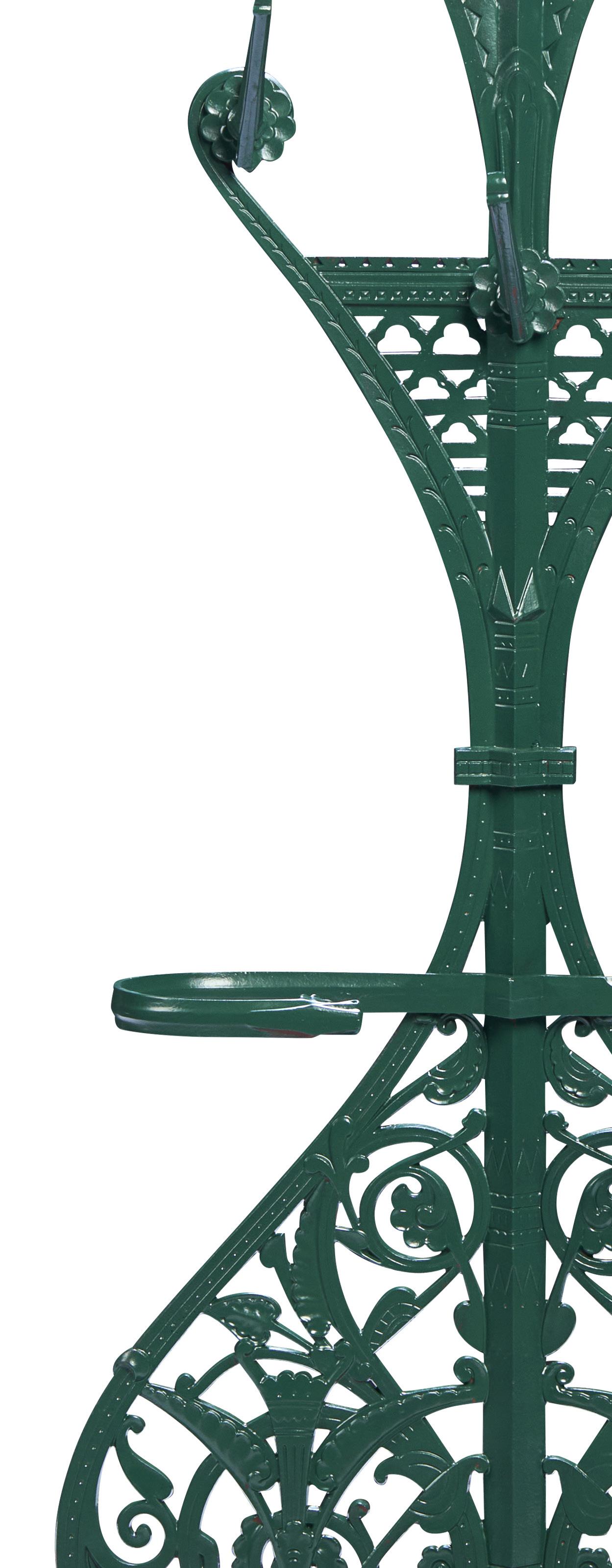
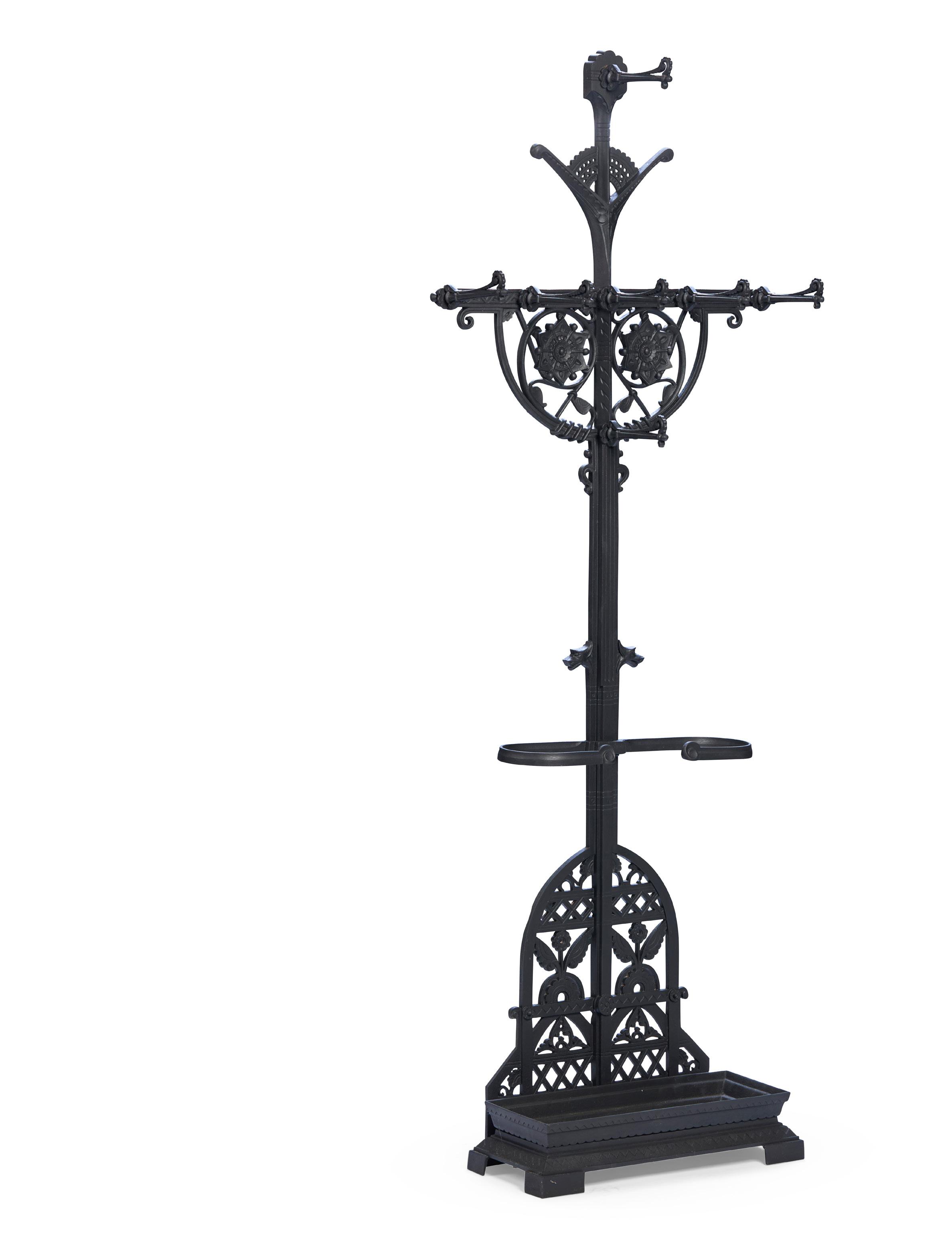
CHRISTOPHER DRESSER (1834-1904) FOR THE COALBROOKDALE IRON COMPANY
AESTHETIC MOVEMENT HALLSTAND, CIRCA 1870
cast iron, cast marks to drip tray COALBROOKDALE NO. 214963/ NO. 25 with registration lozenge
65cm wide, 189cm high, 22.5cm deep
Literature: Whiteway, Michael Christopher Dresser 1834-1904 Skira Editore S.p.A., Milan, 2001, p. 77, pl. 48
Cooper J. Victorian & Edwardian Furniture & Interiors, Thames & Hudson 1998, p.144, pl. 351 where a similar example is illustrated.
£3,000-5,000
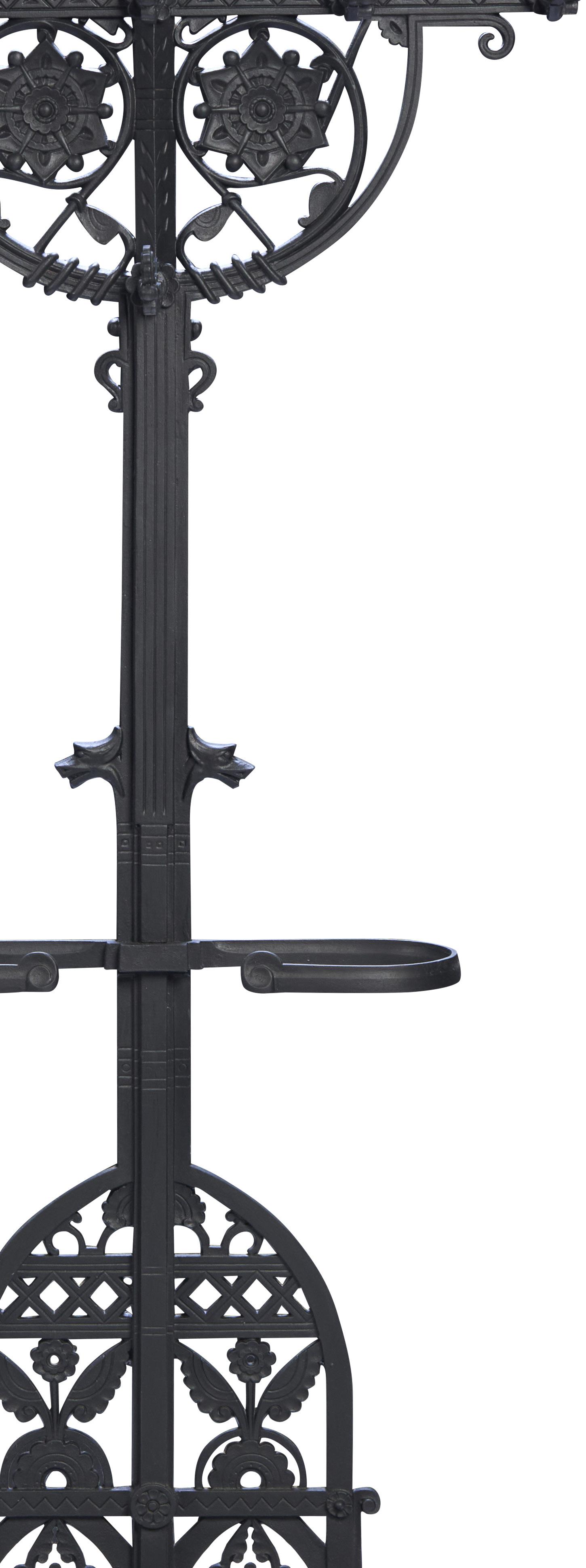
CHRISTOPHER DRESSER (1834-1904)
FOR THE COALBROOKDALE IRON COMPANY
AESTHETIC MOVEMENT HALLSTAND, CIRCA 1870
cast iron
67.5cm wide, 187.5cm high, 22.5cm deep
Literature: Whiteway, Michael Christopher Dresser 1834-1904 Skira Editore S.p.A., Milan, 2001, p. 77, pl. 46
£3,000-5,000
85
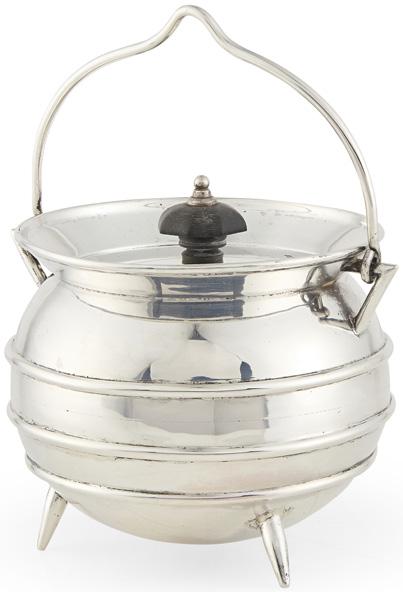
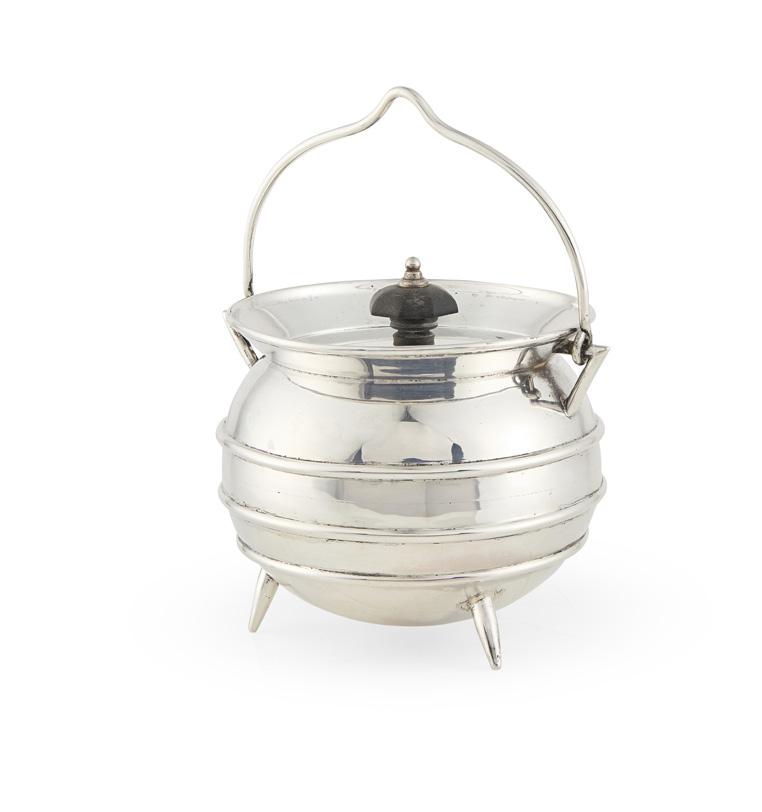
GOLDSMITHS & SILVERSMITHS CO., MANNER OF CHRISTOPHER DRESSER
CAULDRON, 1896
silver, stamped maker’s mark, hallmarked London 1896, weight 385g 9.5cm high
£300-500
86
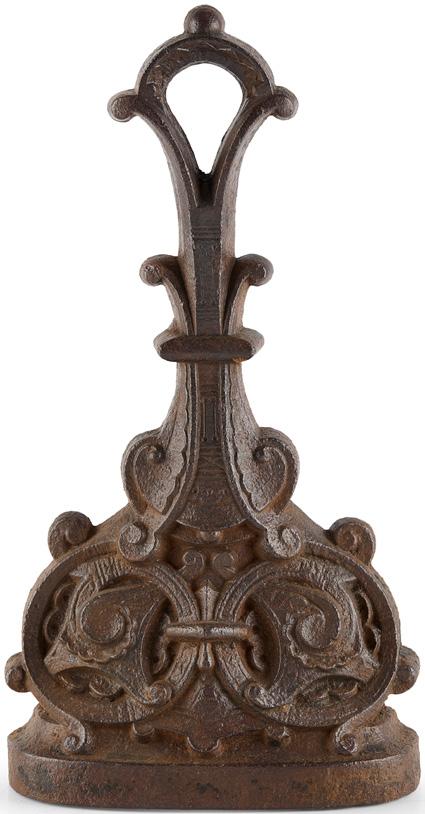
ATTRIBUTED TO CHRISTOPHER
DRESSER (1834-1904) FOR KENRICK & CO. AESTHETIC MOVEMENT
DOORSTOP, CIRCA 1880
cast iron
32.5cm high
£200-300
87
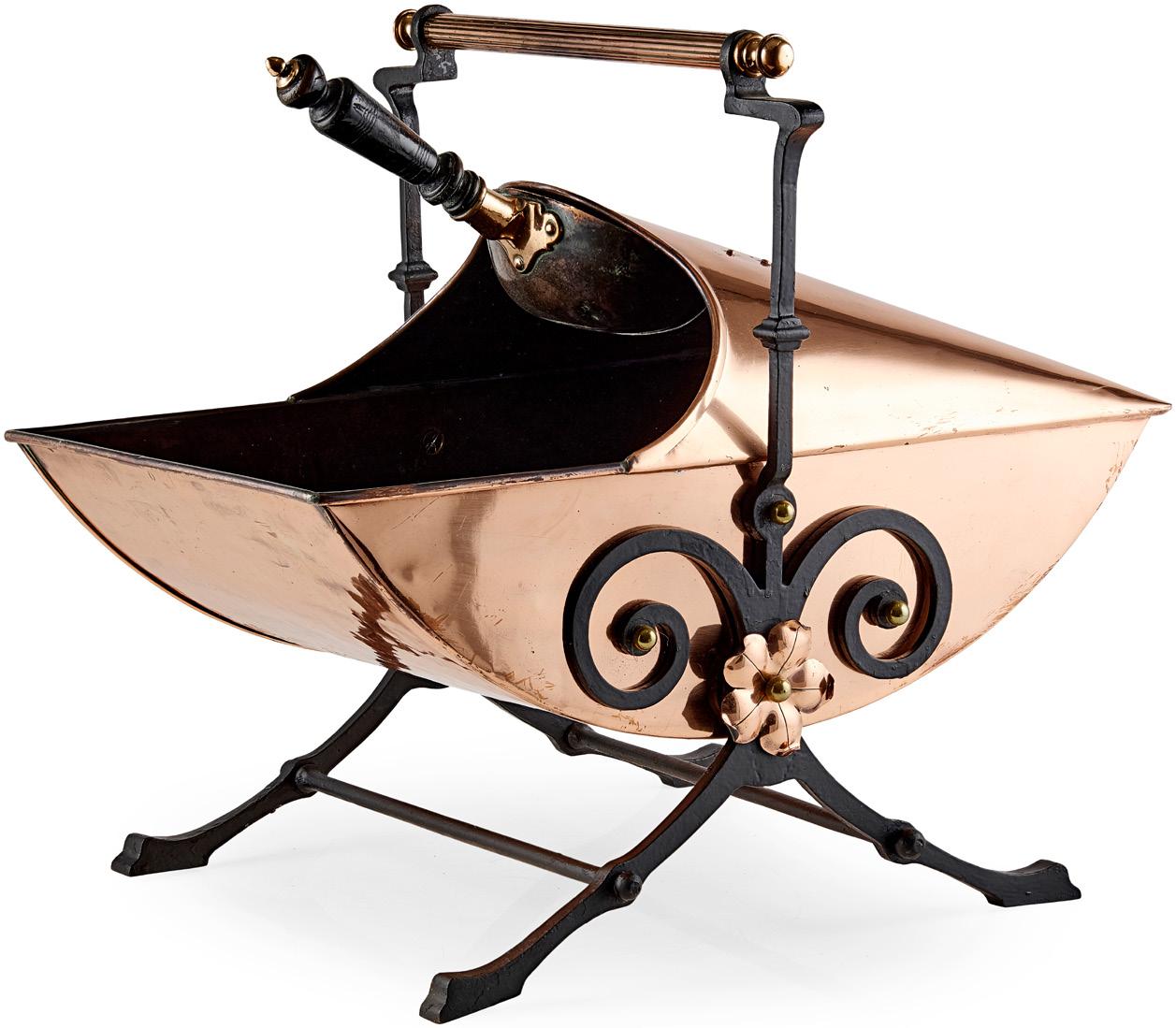
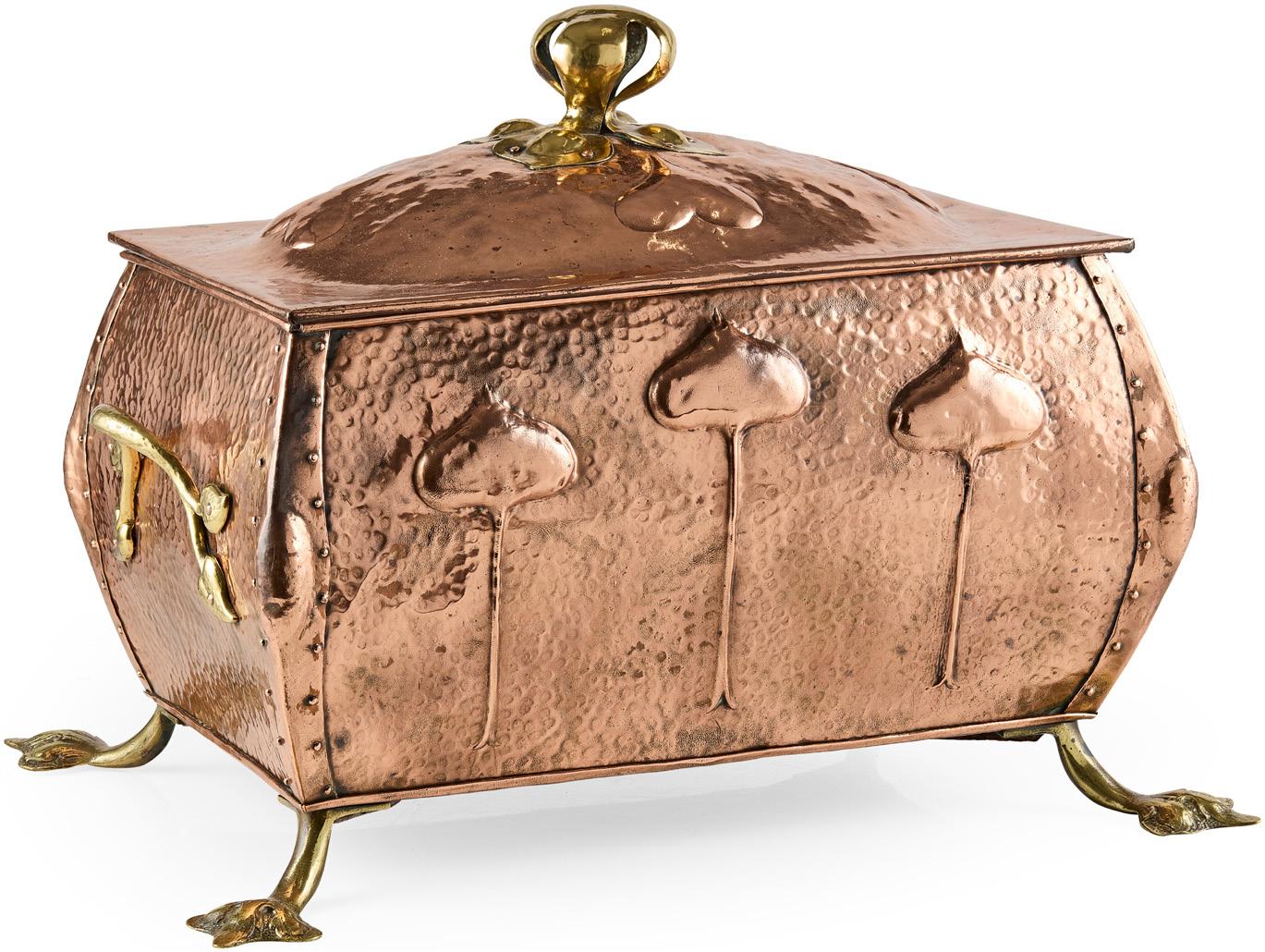
ATTRIBUTED TO CHRISTOPHER DRESSER (1834-1904) FOR BENHAM & FROUD, LONDON
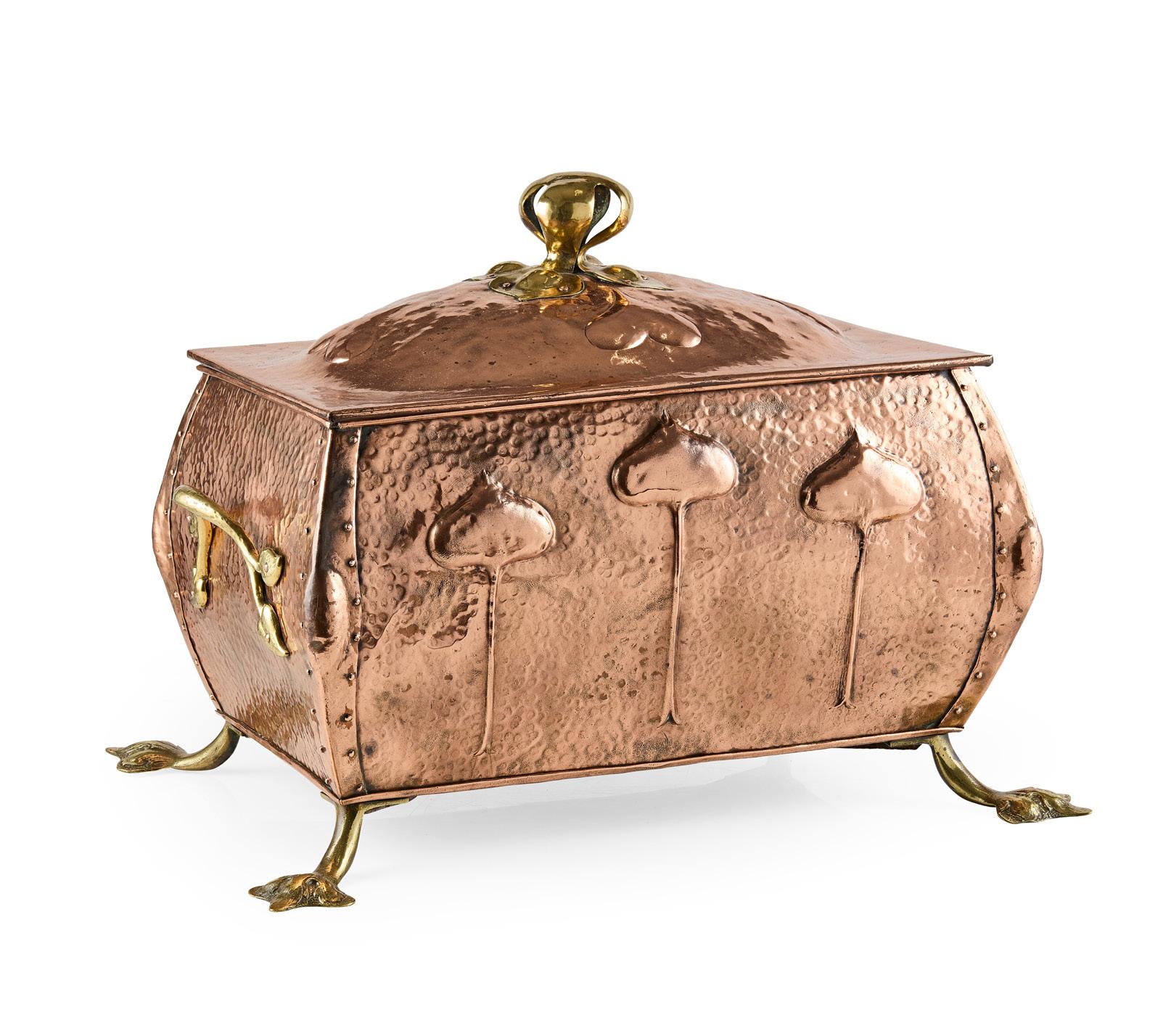
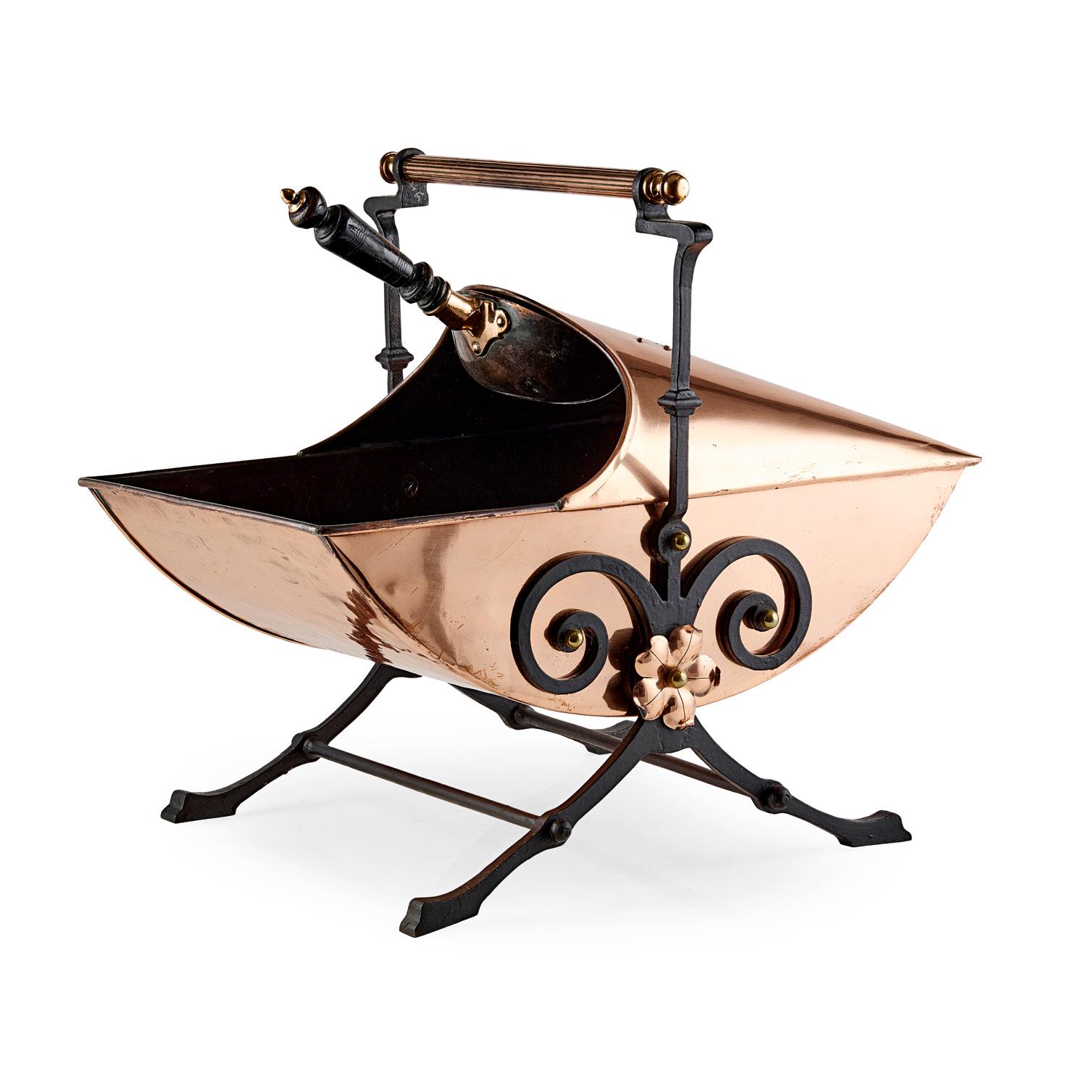
COAL SCUTTLE, CIRCA 1885
copper, brass, patinated, wrought steel, ebonised wood, 32cm wide, 44cm high, 39cm deep; together with an ART NOUVEAU COAL BOX, CIRCA 1900, repoussé-decorated copper, brass, 55cm wide, 42cm high, 40cm deep (2)
£400-600
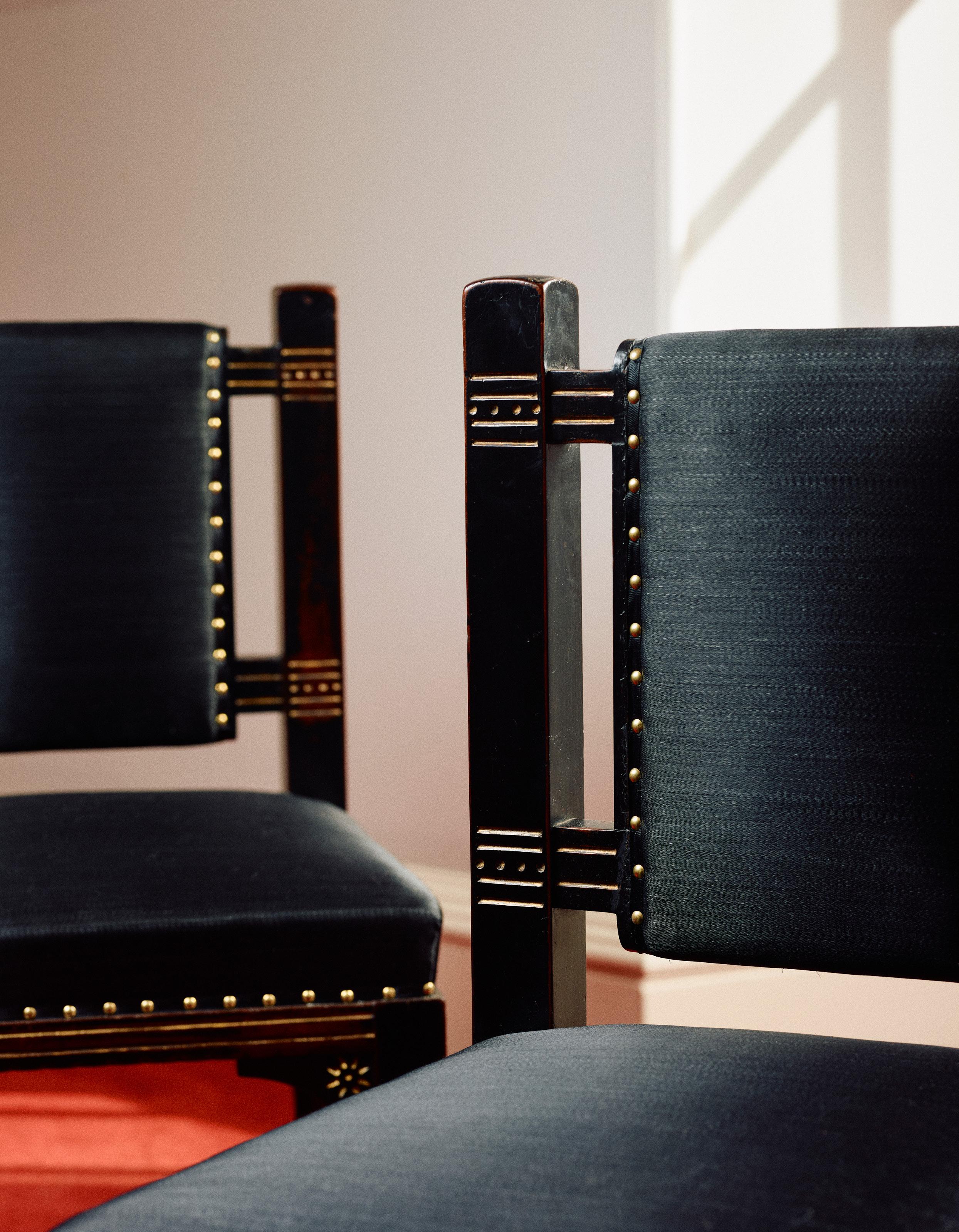
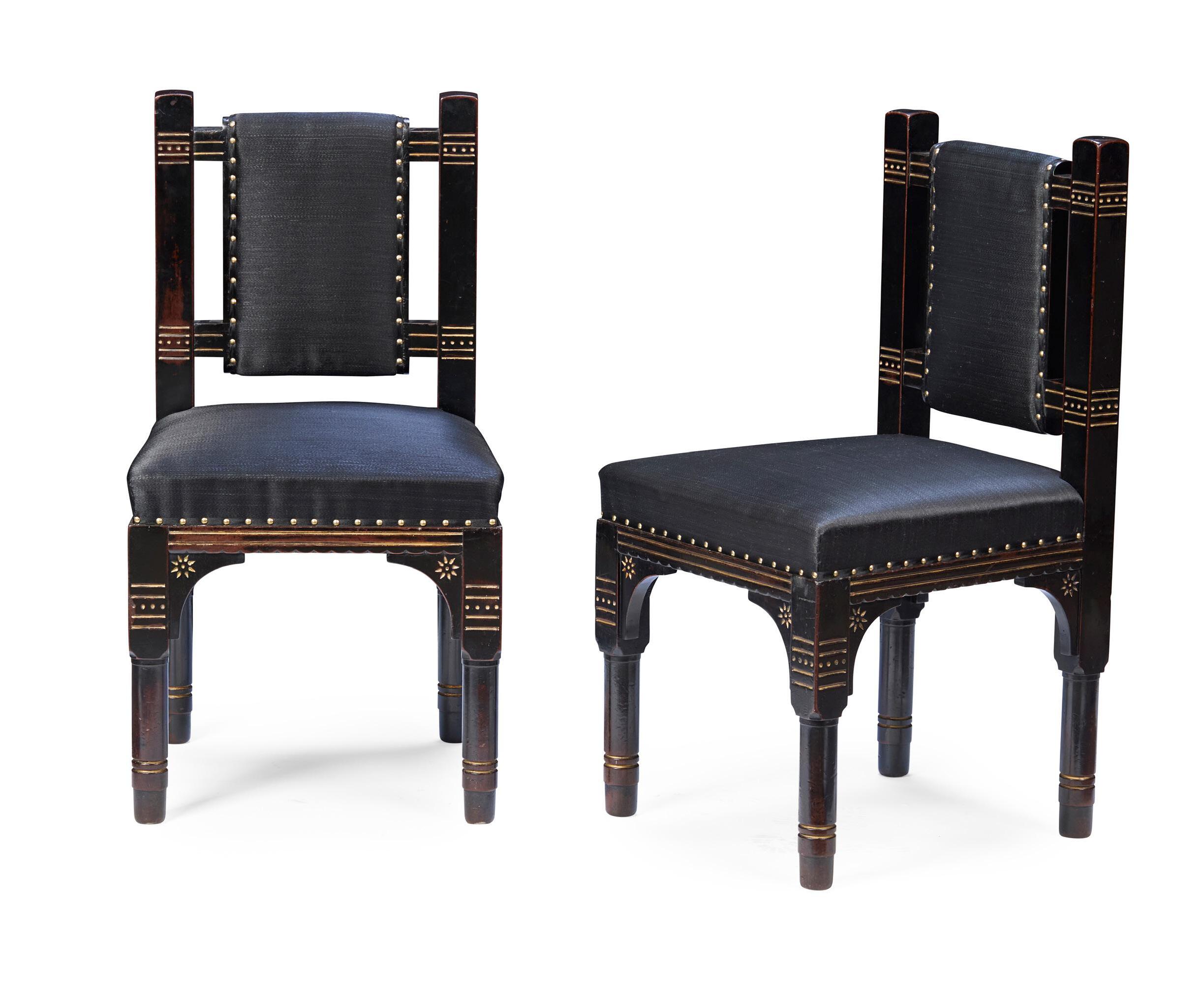
ATTRIBUTED TO CHRISTOPHER DRESSER (1834-1904) FOR THE ART FURNISHER’S ALLIANCE
PAIR OF SIDE CHAIRS, CIRCA 1880
ebonised wood, with incised and gilded decoration and upholstered seats and backs (2)
47.5cm wide, 90cm high, 50cm deep
Literature: Lyons H. Christopher Dresser: The People’s Designer: 1834-1904, Woodbridge, 2005, pp. 136-151 for related furniture designs by Christopher Dresser.
Fine Art Society, London The John Scott Collection: The Designs of Dr Christopher Dresser, 2014, pp. 68-78 for examples of furniture by Christopher Dresser.
£8,000-12,000
The Art Furnisher’s Alliance was an association of art manufacturers founded in 1880 by Christopher Dresser. The principal objective of the organisation was to facilitate the purchase and sale of high-quality goods distinguished by artistic design and to provide a comprehensive service for the “complete artistic furnishing of a house.” George Hayter Chubb was appointed chairman, while Dresser served as Art Manager, overseeing the design of furniture, pottery, glass, and metalwork. He was assisted in this role by Holme and Arthur Lasenby Liberty.
Photographic evidence preserved in the archive of Messrs Chubb indicates that furniture marketed by the Alliance was stylistically more refined than other pieces by Dresser illustrated in The Furniture Gazette. Nevertheless, the characteristic features of Dresser’s design approach are clearly evident. These include the use of ebonised wood, the incorporation of Japanese stylistic influences, and the combination of Egyptian, Greek and Gothic motifs. Simplified and symmetrical plant forms, frequently employed by Dresser, are also visible in the decorative treatment of several chairs.
Additional objects attributed to both the Alliance and Dresser are illustrated in Christopher Dresser, 1834–1904 by Michael Whiteway. These include a table, chairs, a fireplace surround, and a coal box, all characterised by ebonised and gilded frames, linear ornament, and repeated decorative patterns. Similarly, Jeremy Cooper, in Victorian & Edwardian Furniture & Interiors, illustrates a dresser produced by the Alliance and observes that such pieces “are firmly attributed to Dresser on stylistic grounds; they have deeply incised gilt lines typical of furniture marketed by the Art Furnishers’ Alliance.”
The Alliance operated from Queen Street in London until 1883, when the company entered liquidation and its stock was dispersed through auction. This event effectively ended Dresser’s attempt to establish a single retail outlet capable of supplying all the elements required to furnish what he conceived as the artistic home.
89
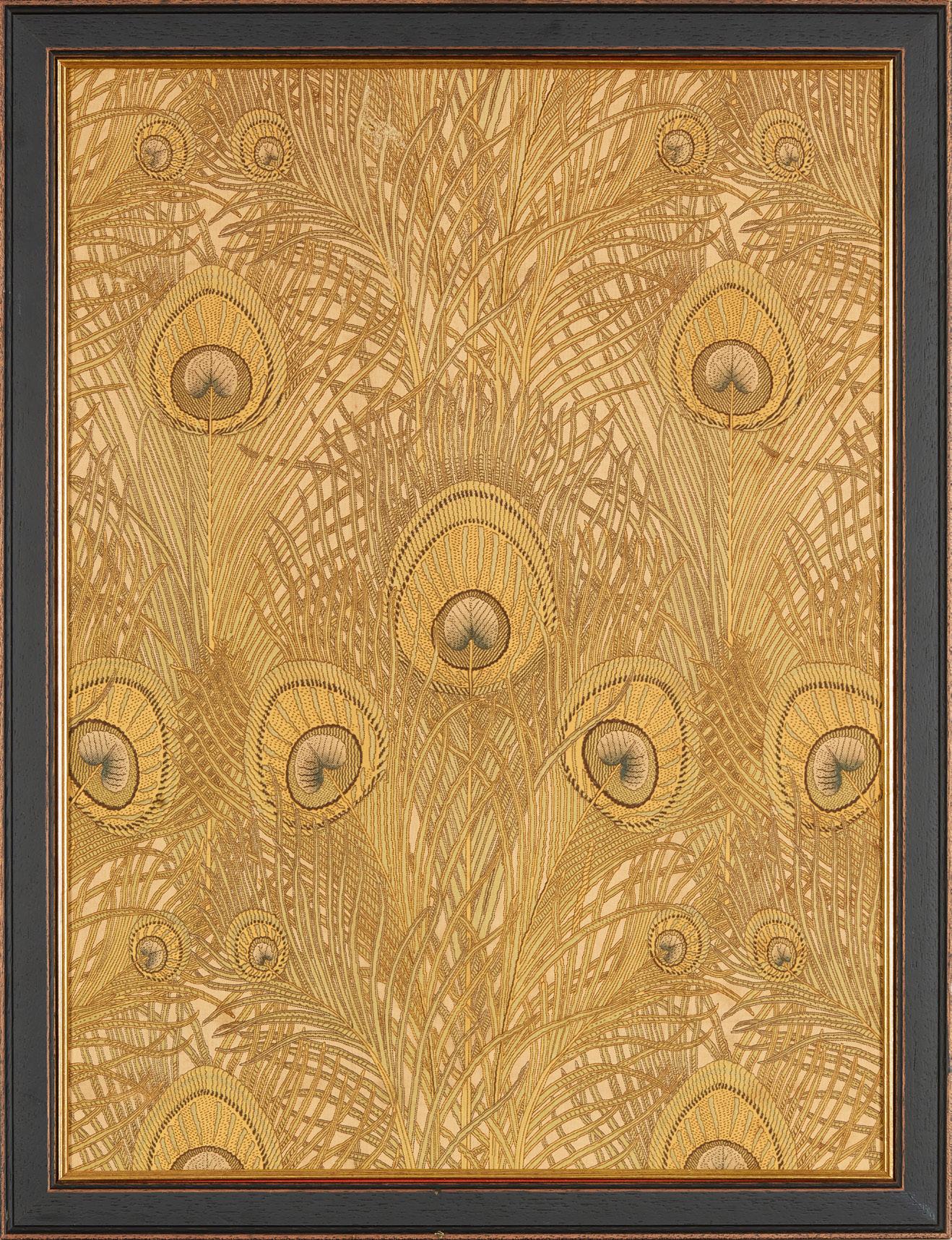
CHRISTOPHER DRESSER (1834-1904) FOR WILLIAM FRY OF DUBLIN ‘HERA’ WOVEN SILK PANEL, CIRCA 1876
woven silk, framed 55cm x 41cm (frame size 62.5cm x 48.3cm)
Provenance: Exhibited: Tokyo, The Mitsubishi Ichigokan Museum, Beardsley, a Singular Prodigy 15 February, 2025 - 11 May, 2025, no. 57
Literature: The Aesthetic Movement The Decorative Arts Society, 2010, p.124, fig. 11
Dresser first produced ‘Hera’ as a woven silk fabric for William Fry of Dublin circa 1876, as in this example. It was later produced as a printed cotton sold through Liberty & Co., London.
£600-800
90
CHRISTOPHER DRESSER (1834-1904)
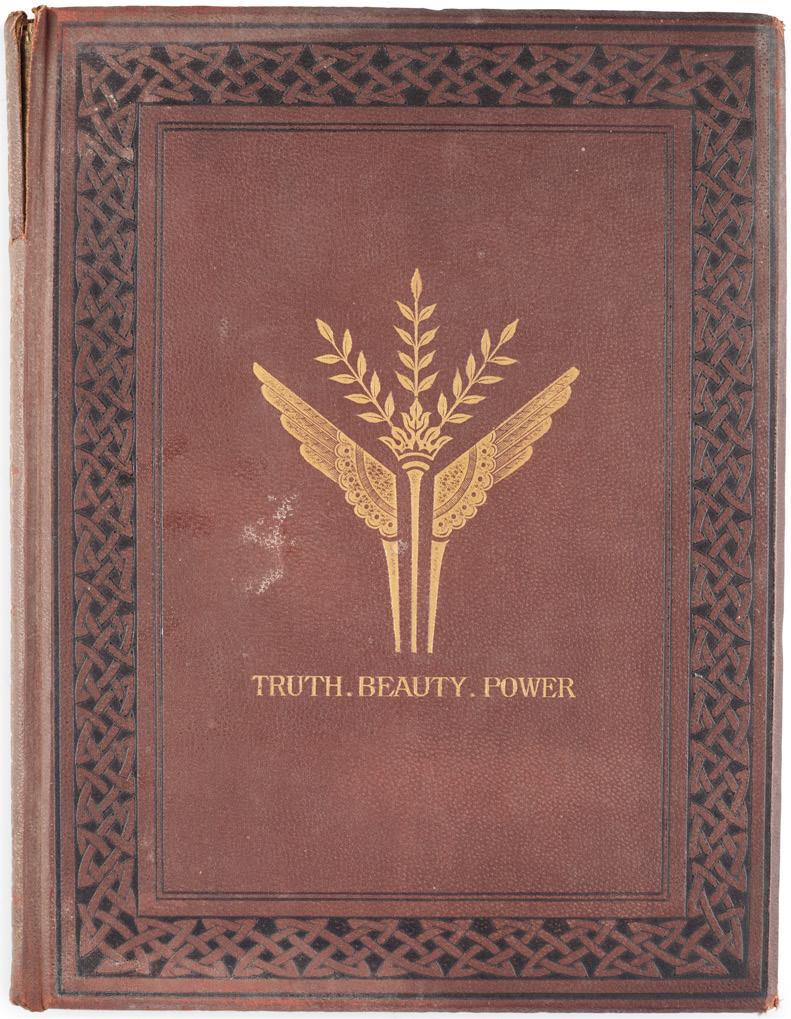
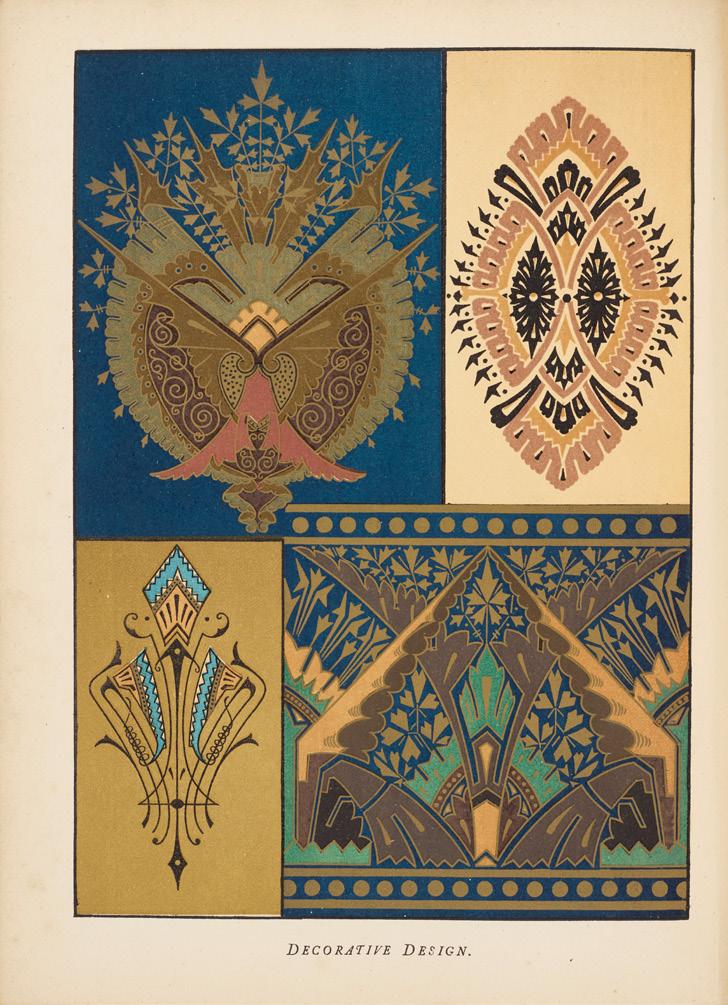
‘PRINCIPLES OF DECORATIVE DESIGN’, SECOND EDITION
London: Cassell, Petter & Galpin, circa 1873, 2 chromolithograph plates, monochrome illustrations, small 4to £300-500
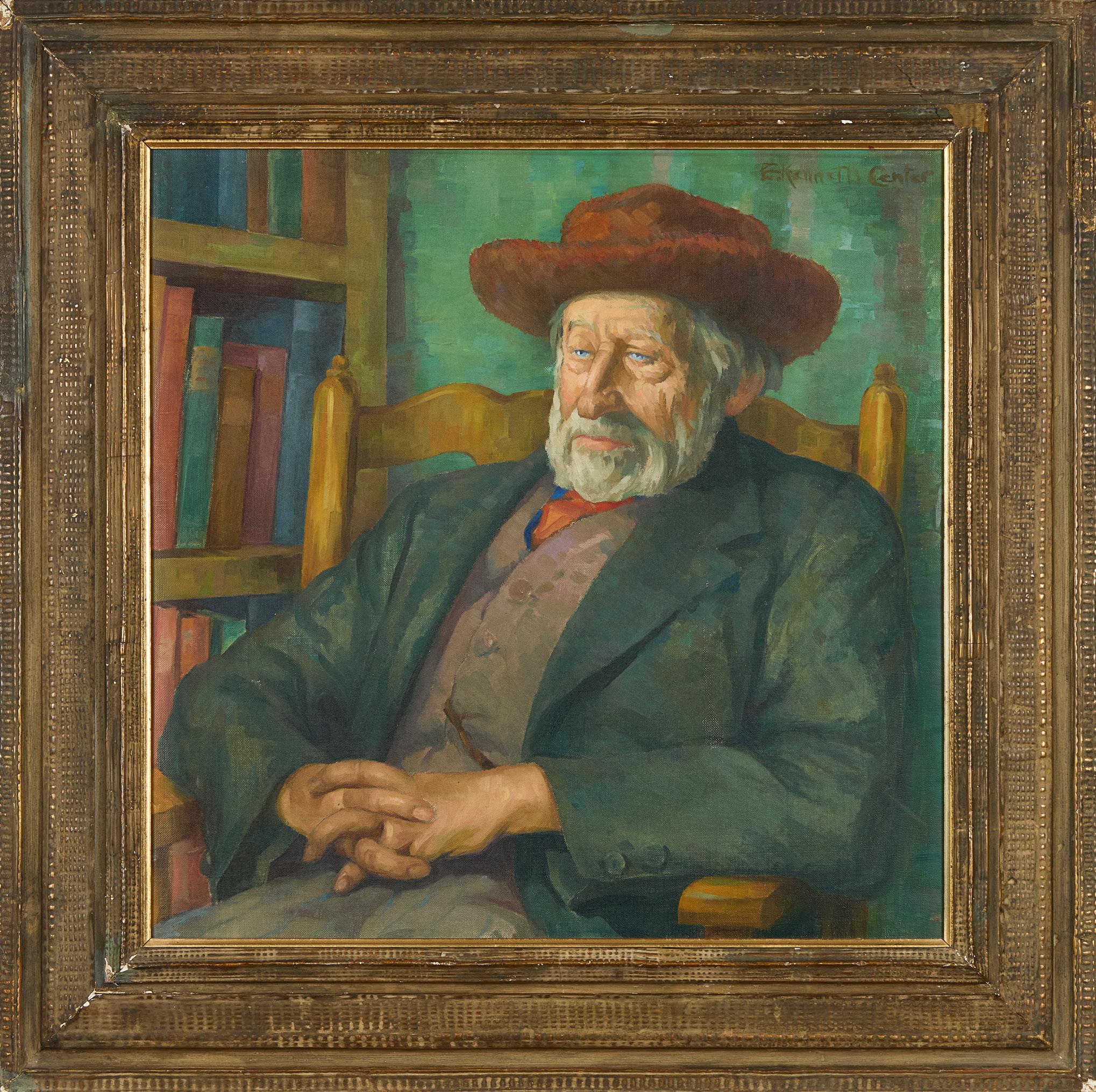
EDWARD KENNETH CENTER (1902-1986)
PORTRAIT OF ARTHUR HEYGATE MACKMURDO oil on canvas, signed upper right E. KENNETH CENTER, framed
58.5cm square (frame size 82cm square)
£2,000-3,000
Arthur Heygate Mackmurdo (1851-1942), pioneering architect and designer, founded the Century Guild with his fellow architect and friend, Herbert Percy Horne, in 1882. The Century Guild acted as forerunners to the Arts and Crafts movement, with some of the work created by Mackmurdo in particular viewed as early examples of the ‘Modern Style’, a particular British type of Art Nouveau. Much of his work was historically inspired, with references spanning the Italian renaissance to 18th century design motifs.
Kenneth Center was the studio assistant of Mackmurdo’s friend and mentor Sir Frank Brangwyn for many years and another of his extant works is a portrait of Brangwyn. It is thought however that Brangwyn’s picture was painted posthumously, using a photograph of Mackmurdo for reference. This photograph shows the designer sitting in the same armchair to the one depicted in both Brangwyn’s portrait and the current lot.
92
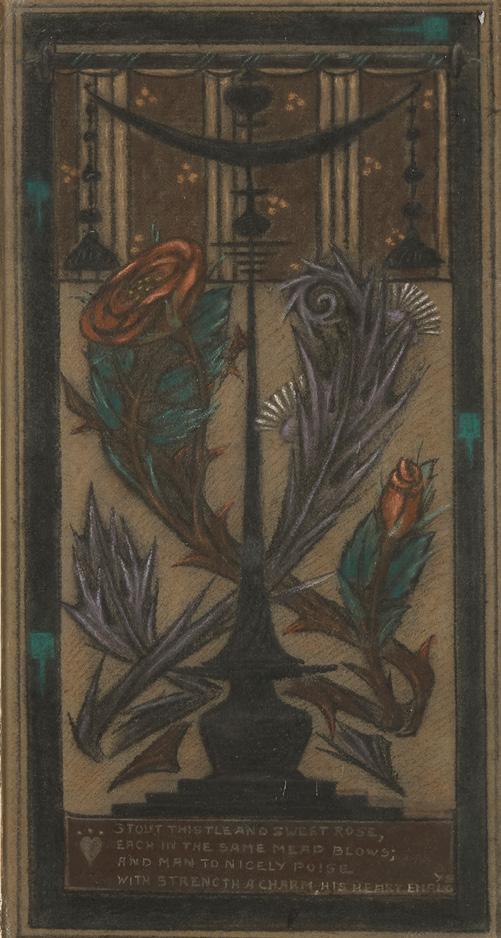
A. H. MACKMURDO (1851-1942)
‘STOUT THISTLE AND SWEET ROSE’ pastel, inscribed verses STOUT THISTLE AND SWEET ROSE/ EACH IN THE SAME MEAD BLOWS;/ AND MAN TO NICELY POISE/ WITH STRENGTH A CHARM HIS HEART EMPLOYS
41cm x 21.5cm (frame size 51.5cm x 32cm)
£500-700
This design is thought to have been for Mackmurdo’s wife Eliza Carte, youngest sister of Richard D’Oyly Carte, the impresario famed for managing the first Gilbert and Sullivan opera productions and establishing the D’Oyly Carte Opera Company. Mackmurdo, a pioneer of both the Arts & Crafts and Art Nouveau movements, designed a bookplate circa 1880 dedicated to his wife with similar rose and thorn motifs. This work is now held by the William Morris Gallery.
Please see our online catalogue for more informaton.
93
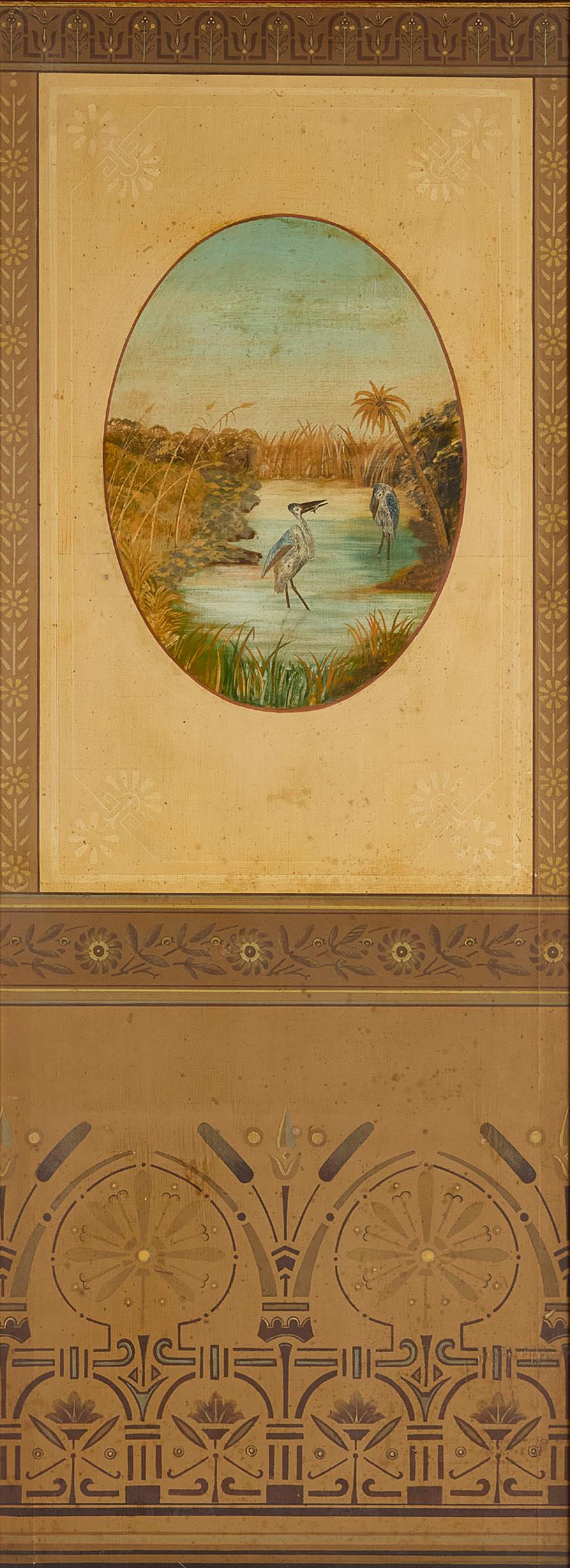
ATTRIBUTED TO DANIEL COTTIER (1838-1891) FOR COTTIER & CO.
AESTHETIC MOVEMENT WALL PANEL, CIRCA 1880
painted and glazed paper, framed 175cm x 59.5cm (frame size 190cm x 74cm)
Literature: Ten-Doesschate P., Donnelly M. et al. Daniel Cottier: Designer, Decorator, Dealer, Paul Mellon Centre 2021, pp. 154-5, pls. 139 and 140 where a related dado frieze in the drawing room, Government House, Sydney, part of a scheme by Cottier & Co. of 1879, is illustrated.
£1,000-1,500
94
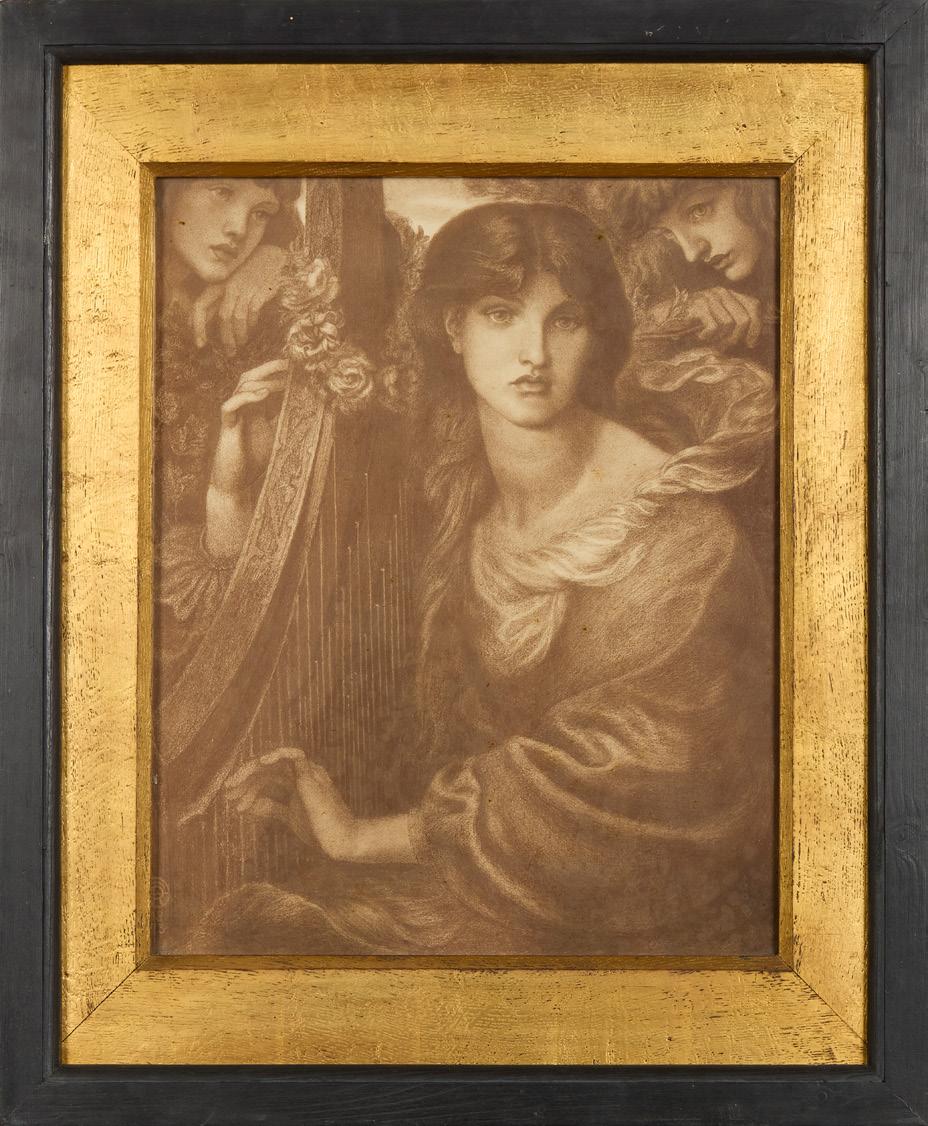
FREDERICK HOLLYER (1838-1933) AFTER DANTE GABRIEL ROSSETTI
‘LA GHIRLANDATA’, CIRCA 1880 platinotype photographic reproduction, artist’s monogram and dated 1873 lower left 44cm x 35.5cm (frame size 64cm x 52.5cm)
£300-500
95
ATTRIBUTED TO HARRY POWELL (1853-1922) FOR JAMES POWELL & SONS, WHITEFRIARS
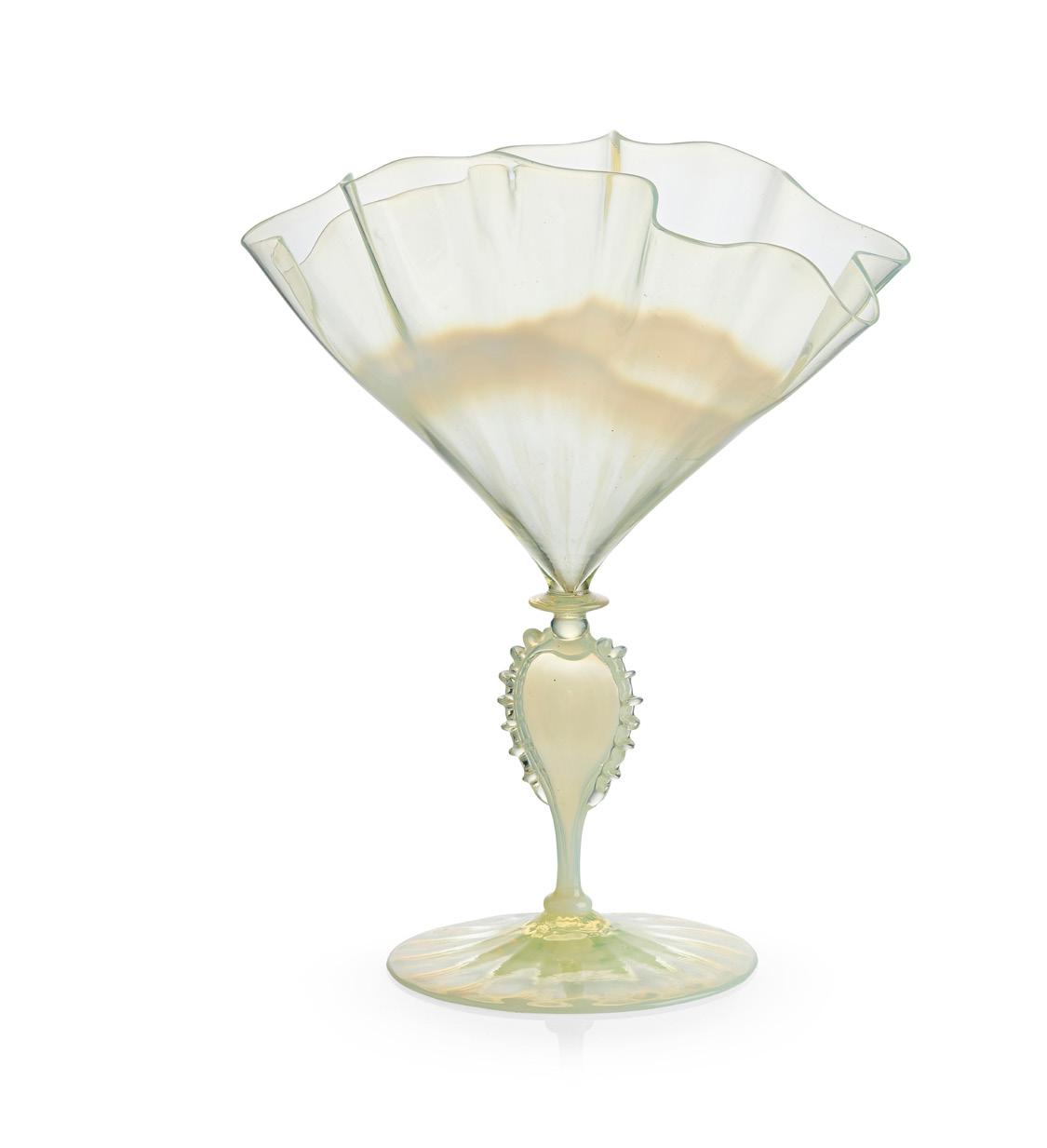
‘VENETIAN’ VASE, CIRCA 1880
opalescent glass
19cm high
Literature: Jackson, L., Whitefriars Glass: The Art of James Powell & Sons, Richard Dennis, 1996, p.100, pl. 16, where a similar example is illustrated.
£600-800
96
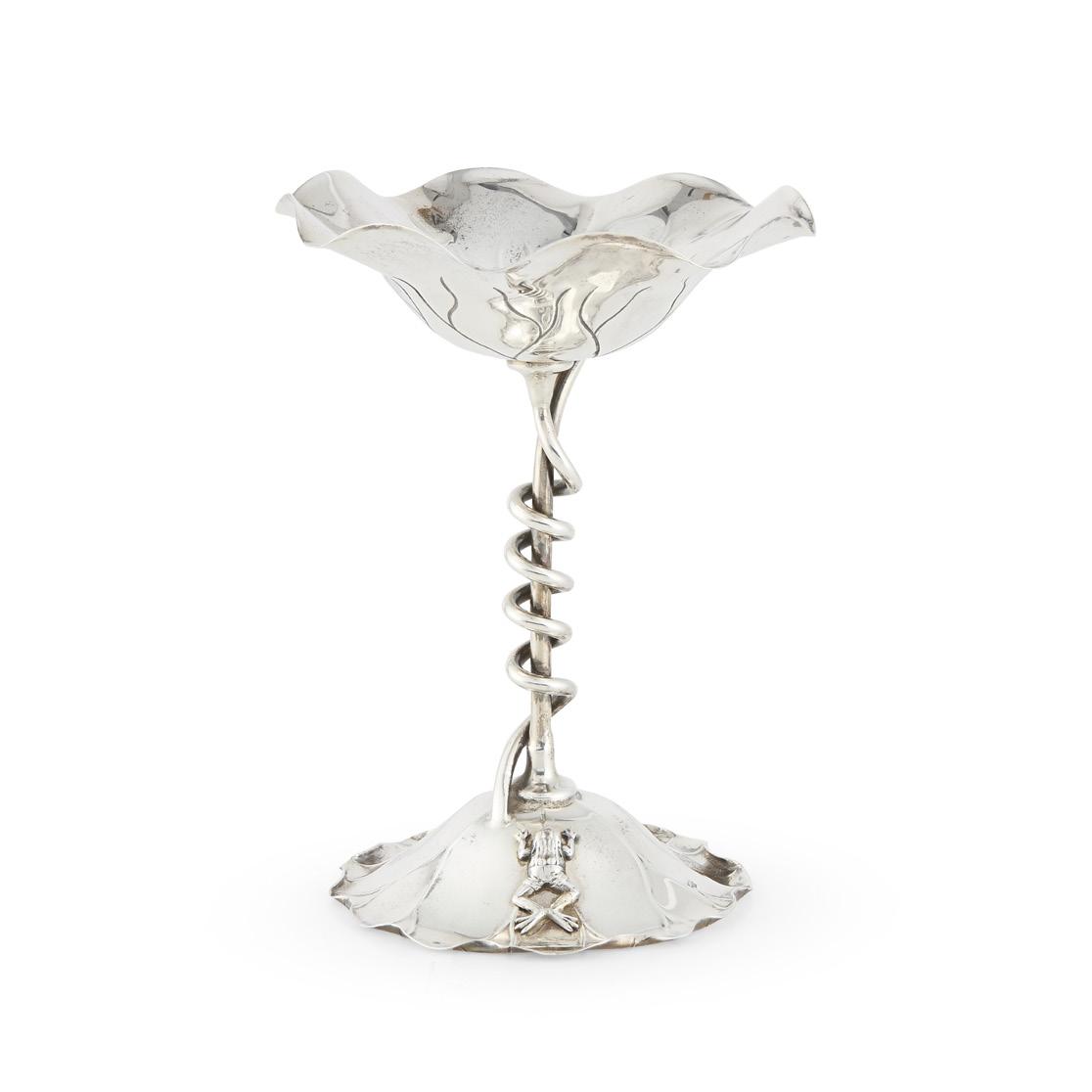
WILLIAM HUTTON & SONS LTD.
BON BON DISH, 1899
silver, with applied frog, stamped maker’s mark, hallmarked London 1899, 171g 15.2cm high
£500-700
97
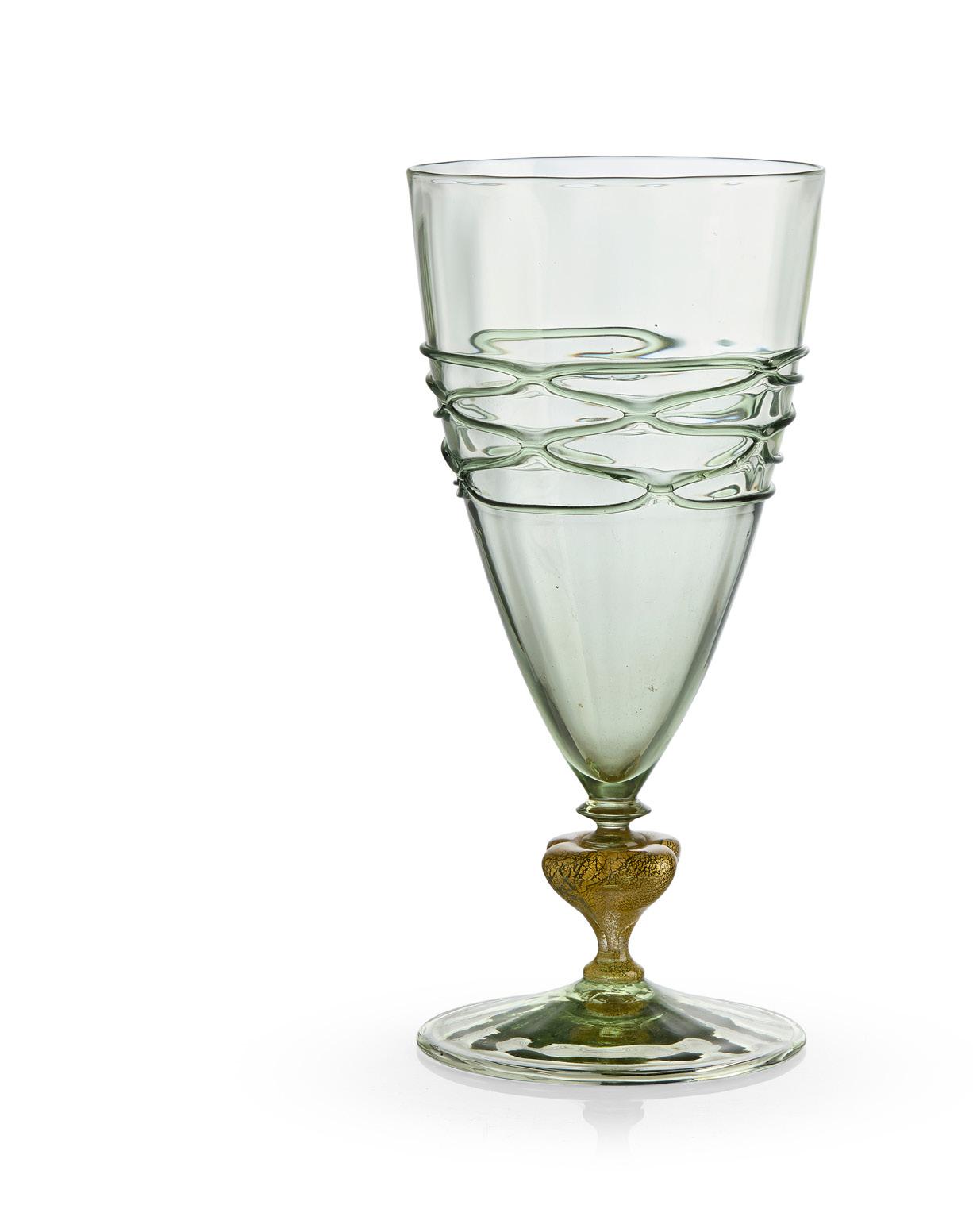
HARRY POWELL (1853-1922)
FOR JAMES POWELL & SONS, WHITEFRIARS GOBLET, CIRCA 1910 glass, gold foil
23cm high
Literature: Jackson, L., Whitefriars Glass: The Art of James Powell & Sons, Richard Dennis, 1996, p.111, pl. 65, where a similar example is illustrated.
£500-700
98
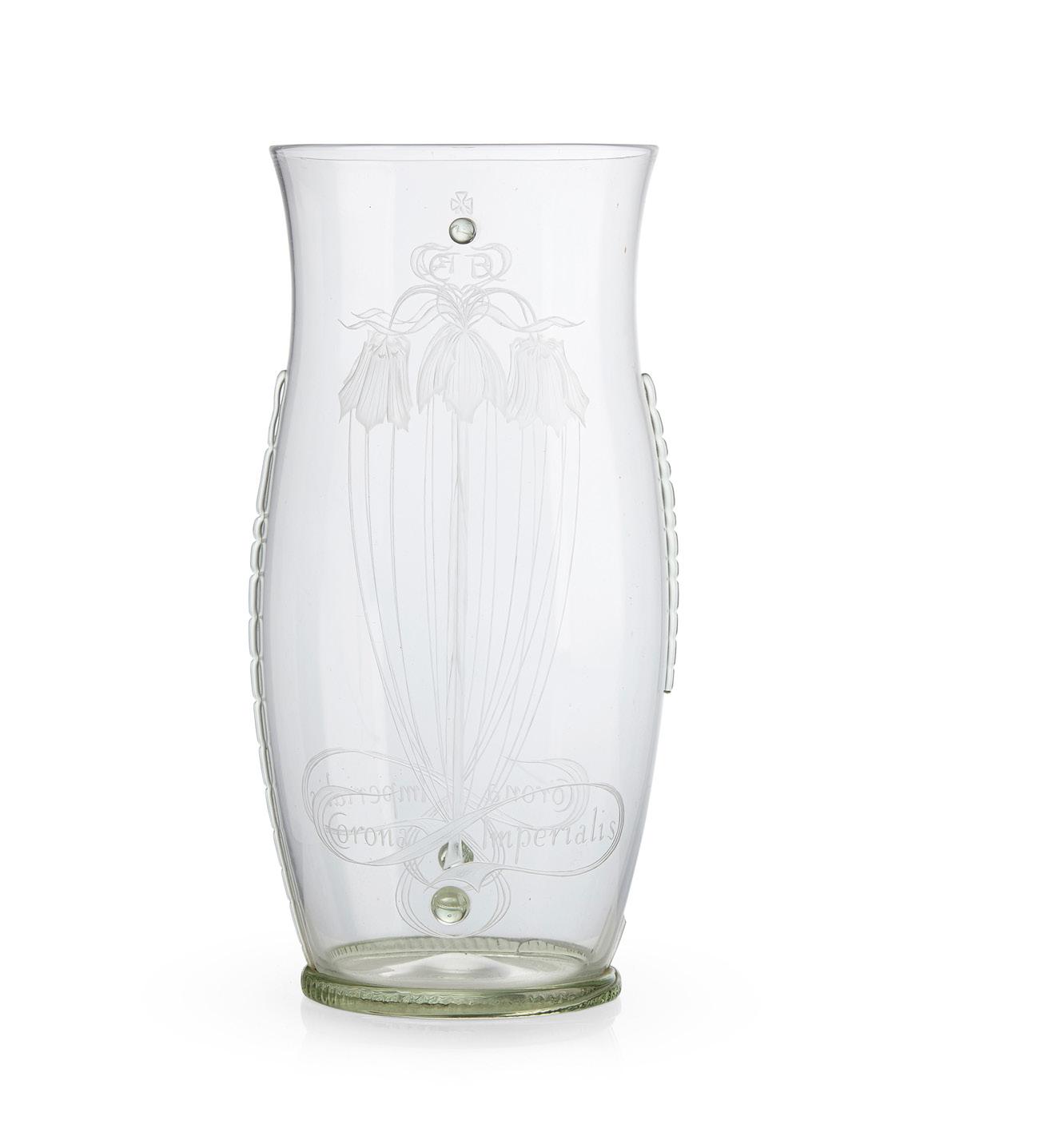
HARRY POWELL (1853-1922)
FOR JAMES POWELL & SONS, WHITEFRIARS ‘CORONA IMPERIALIS’ VASE, CIRCA 1902 etched glass, inscribed ER/ CORONA IMPERIALIS
22cm high
Literature: Jackson L. Whitefriars Glass: The Art of James Powell & Sons, Richard Dennis 1996, p. 30, fig. 78 where a similar glass vase with engraved date of 1902 is illustrated. These vases were produced to commemorate the coronation of Edward VII in 1902.
£300-500
99
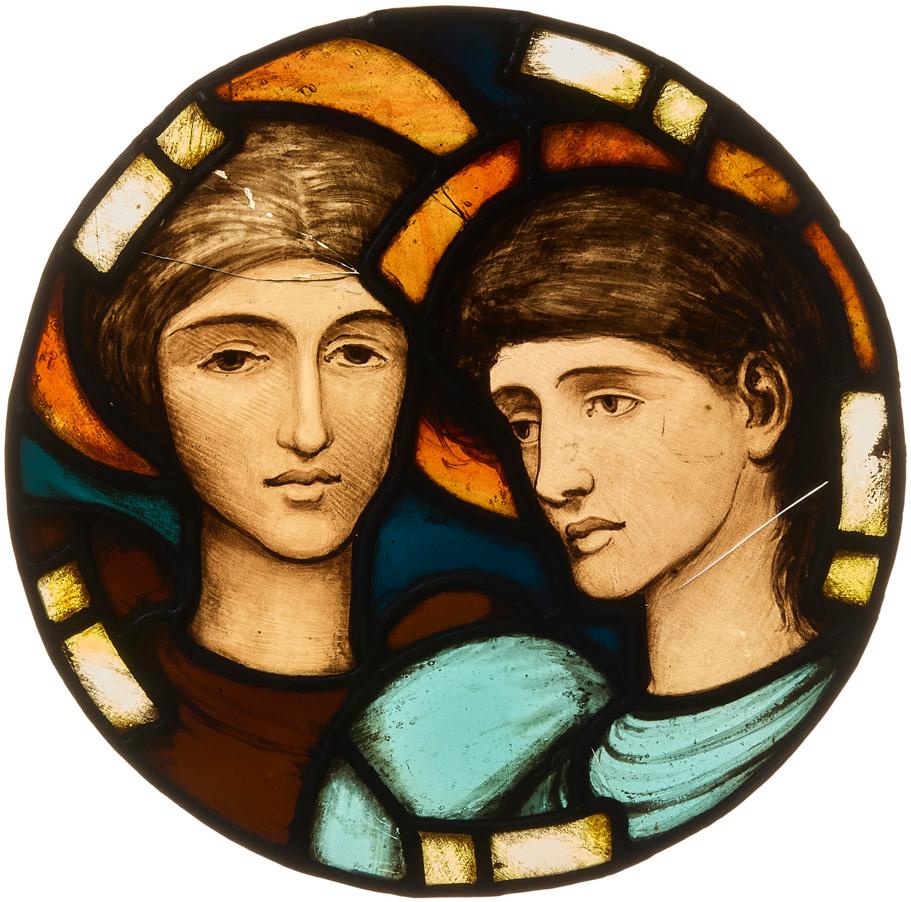
ATTRIBUTED TO DAVID GAULD (1865-1936) FOR J. & W. GUTHRIE, GLASGOW
STAINED GLASS ROUNDEL, CIRCA 1890
painted, stained and leaded glass
37cm diameter
£300-500
100 §
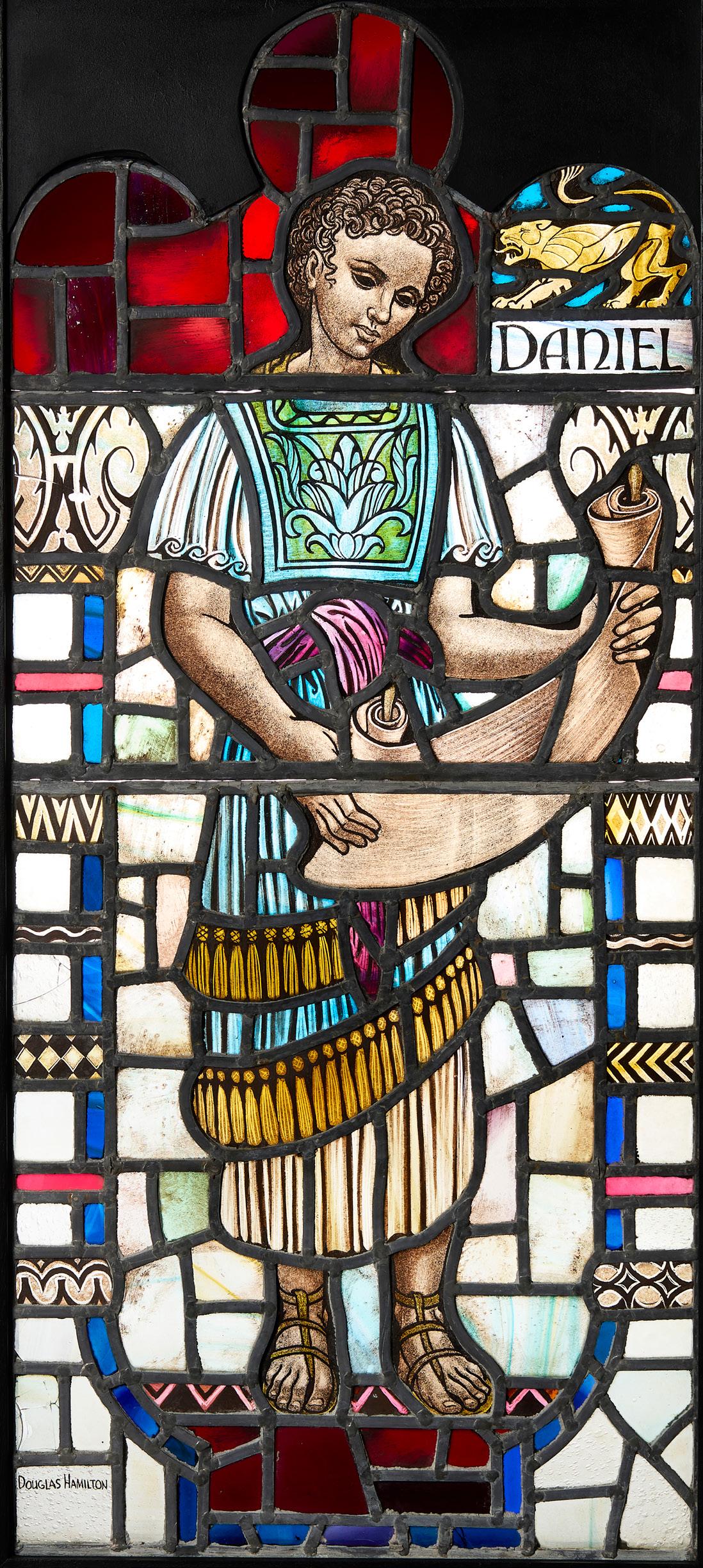
DOUGLAS HAMILTON (1895-1959)
‘DANIEL’
stained, painted and leaded glass panel, in pine frame frame size 110cm x 51cm)
Douglas Hamilton trained with the Stephen Adam Studio and worked for Guthrie & Wells before setting up his own business in 1938. Over the next 21 years, until his death in 1959, he made stained glass for well over 90 churches, mainly in Scotland.
£1,500-2,000
102
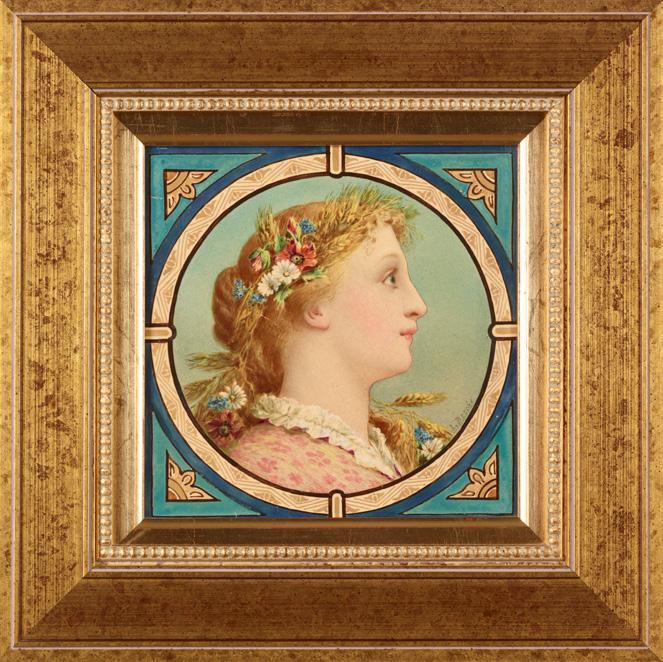
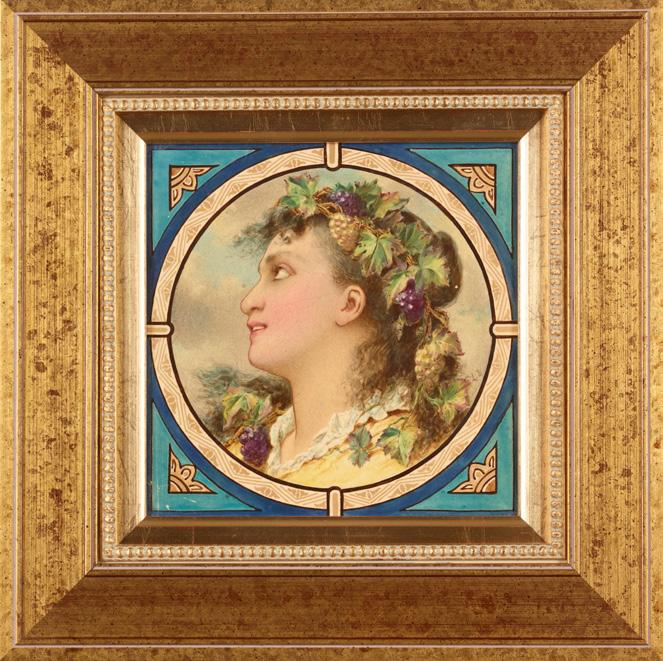
LUCIEN BESCHE (1851-1899) FOR STEELE & WOOD, STOKE-ON-TRENT
PAIR OF FRAMED 8-INCH
PORTRAIT TILES, CIRCA 1880
painted dust-pressed clay, signed to one L. BESCHE, and to the other L.B., moulded STEELE & WOOD/ STOKE UPON TRENT (2)
19.5cm square
Provenance: The Michael Blood Collection
£600-800
101
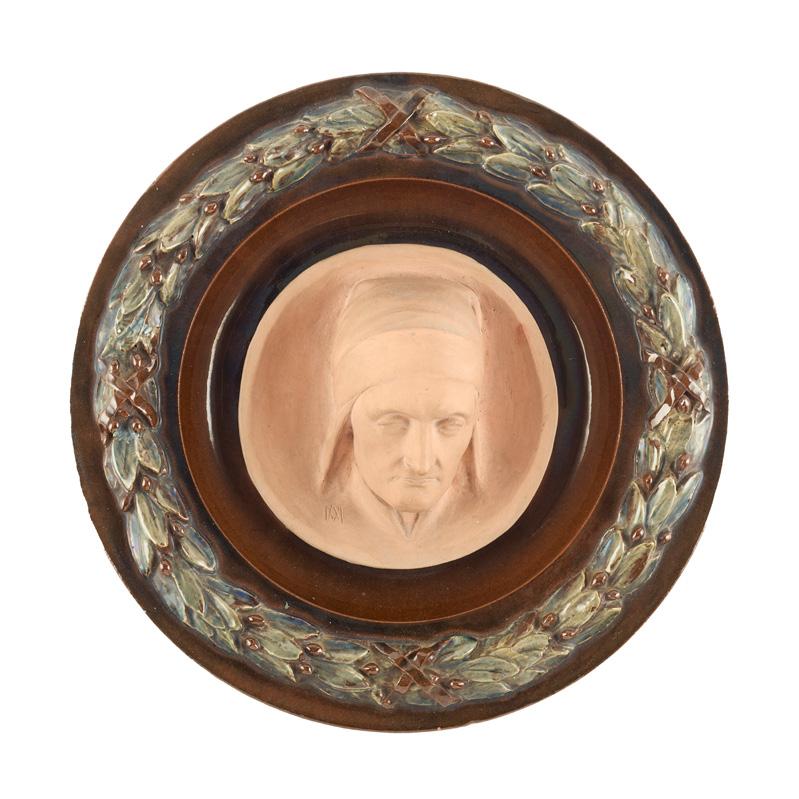
ALEXANDER MUNRO (1825-1871)
‘DANTE’ ROUNDEL, CIRCA 1860 moulded terracotta, glazed ceramic, incised artist’s monogram, signed AM verso 32cm diameter
Alexander Munro was a sculptor of the Pre-Raphaelite movement whose early talents were supported by financial assistance from his father’s employer, the Duchess of Sutherland. From 1842 he assisted and trained in the Edinburgh studio of the sculptor Alexander Handyside Ritchie. He came to London in 1848 to study sculpture under Charles Barry. At this time he also worked as a mason on the new Palace of Westminster. He exhibited at the Royal Academy from 1849 to 1870, and at the Great Exhibition of 1851 where his Rossetti-influenced figure-group ‘Paolo and Francesca’ was first exhibited.
£400-600
104
LEWIS FOREMAN DAY (1845-1910) FOR TURNBULL & STOCKDALE, RAMSBOTTOM
‘THE NEW DOT’ FABRIC PANEL, 1898
woven cotton, discharge-printed, within a blue linen border, mounted on cotton covered board, within a Perspex box frame 54cm x 56cm (frame size 86cm x 87cm)
103
MANNER OF CHRISTOPHER DRESSER FOR BENHAM & FROUD, LONDON
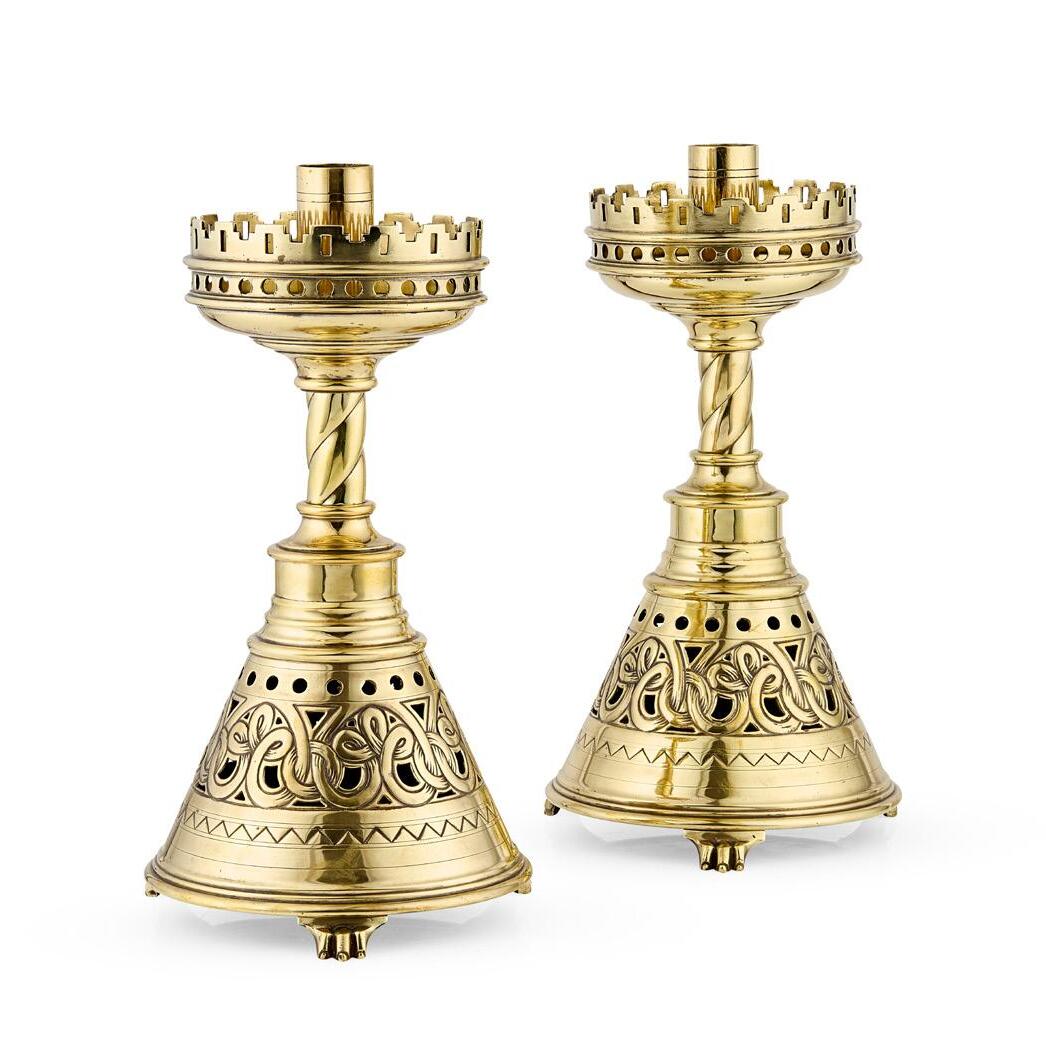
PAIR OF CANDLESTICKS, CIRCA 1890 brass (2) 37cm high
£400-600
Provenance: Exhibited: Tokyo, The Mitsubishi Ichigokan Museum, Beardsley, a Singular Prodigy. 15 February, 2025 - 11 May, 2025, no. 186
£300-500
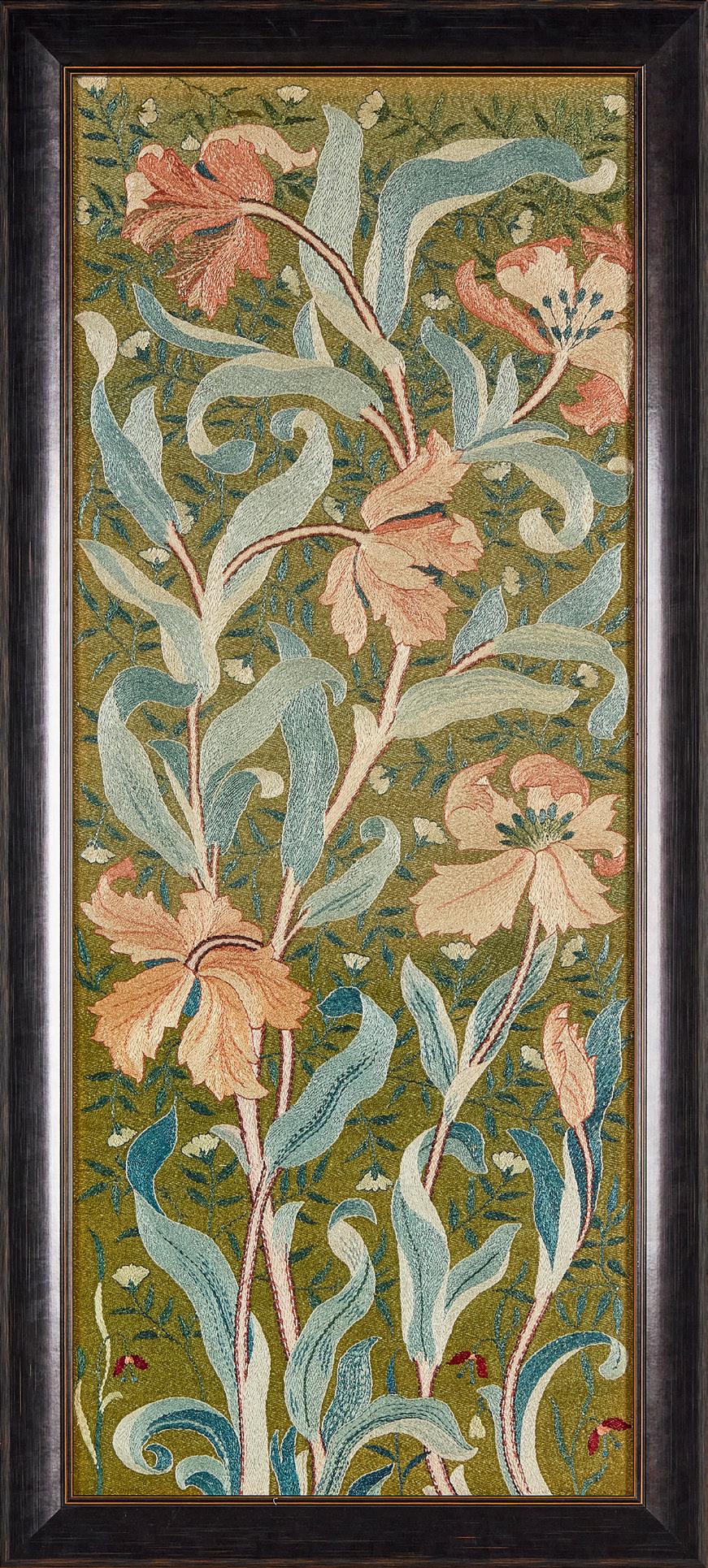
JOHN HENRY DEARLE (1859-1932) FOR MORRIS & COMPANY
‘PARROT TULIP’ EMBROIDERED PANEL, CIRCA 1890
coloured silks, framed
128.5cm x 50.5cm (frame size 142cm x 64cm)
£2,000-3,000
106
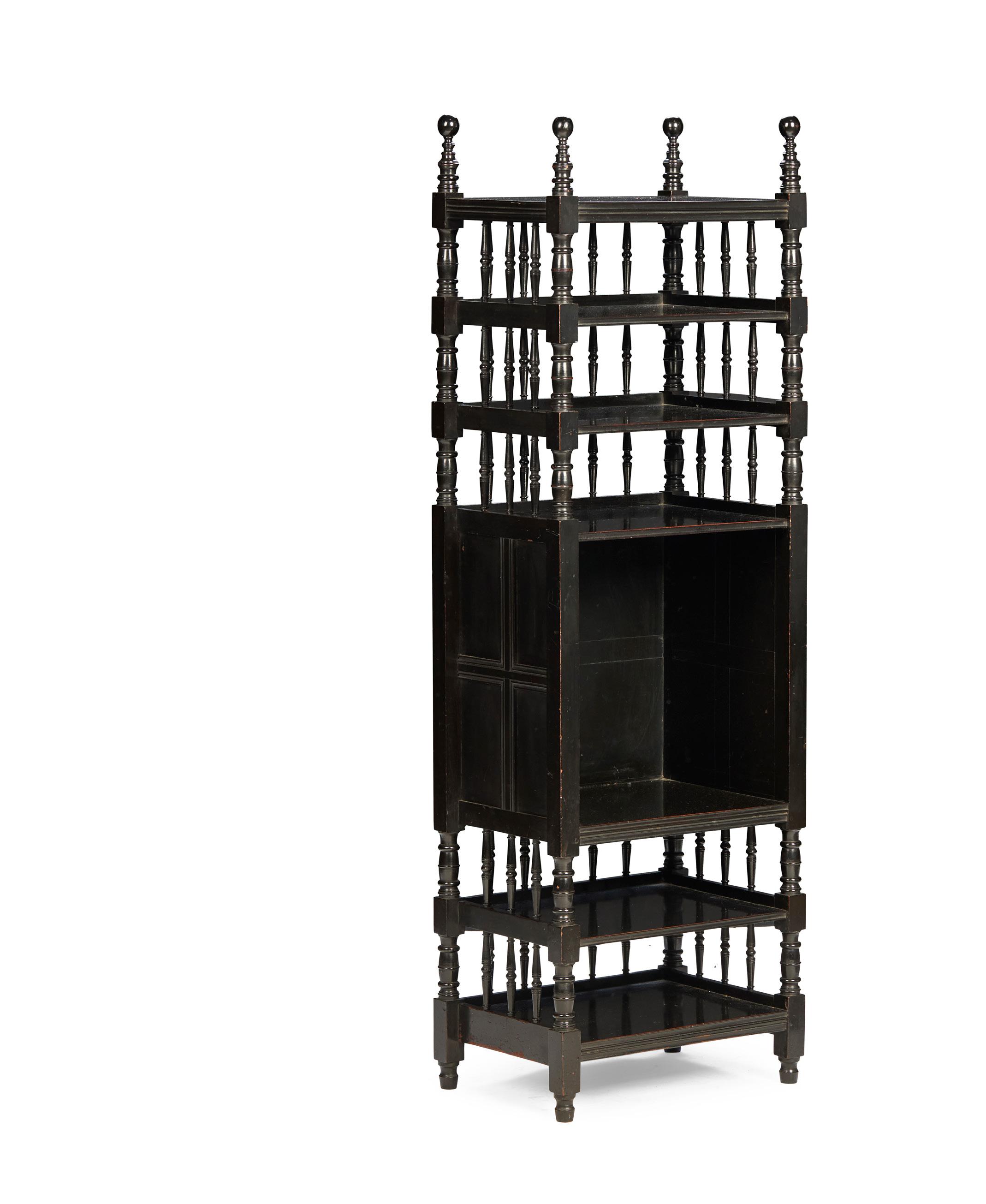
PHILIP WEBB (1831-1915) FOR MORRIS & CO.
ÉTAGÈRE, CIRCA 1880
ebonised mahogany
45.5cm wide, 145cm high, 31.5cm deep
Literature: Crow G. William Morris, Designer, New York 1934, p.75
A similar étagère can be seen in an 1879 photograph of the Morris & Company shop window at 449 Oxford Street.
£2,000-3,000
107
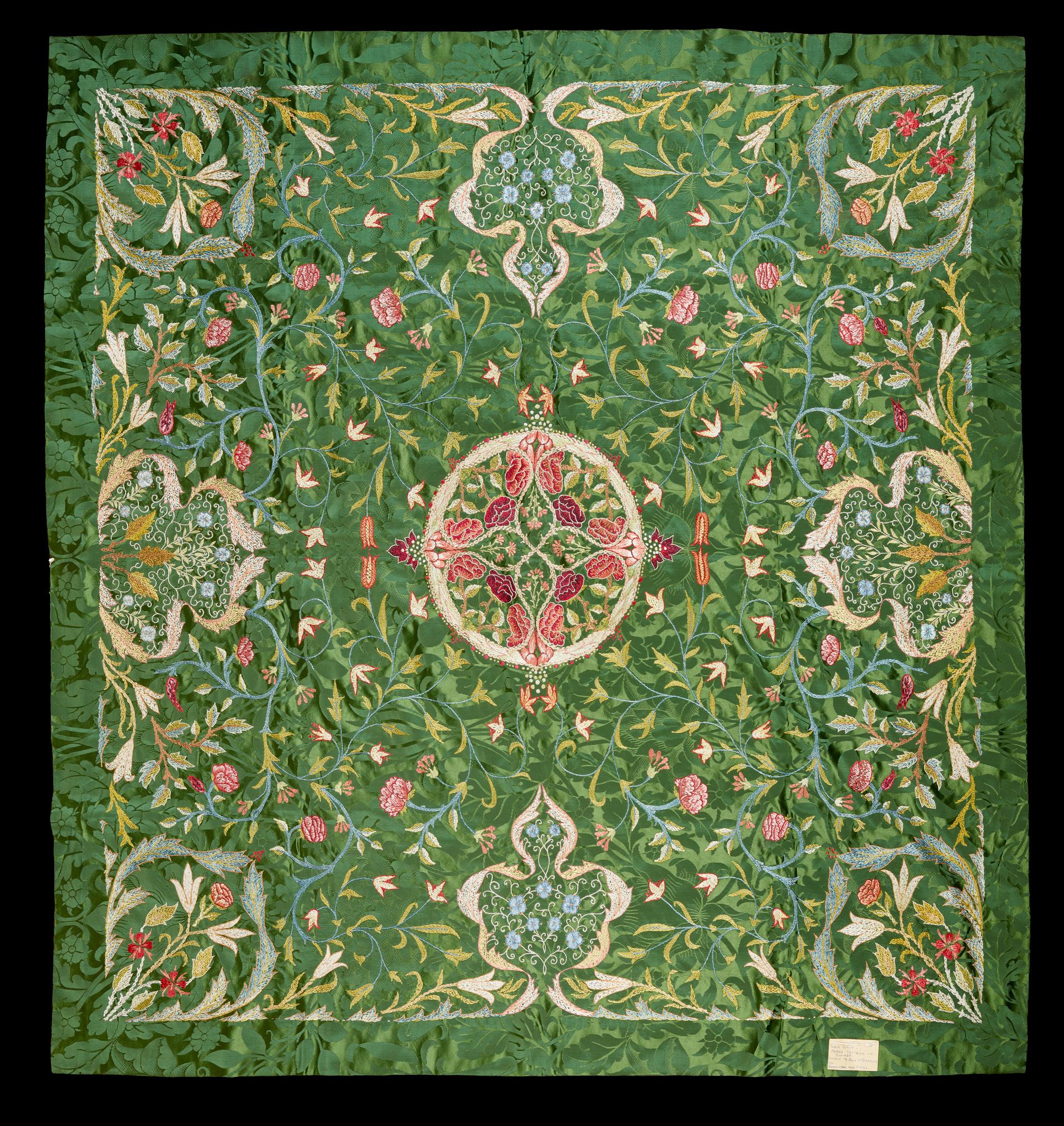
ATTRIBUTED TO MAY MORRIS (1862-1938)
EMBROIDERED TABLE COVER, CIRCA 1900
coloured silks reserved on Morris & Co. ‘Oak’ pattern silk damask, lined, bears applied card inscribed TABLE COVER/ MORRIS PATTERN ON/ BROCADE/ WORKED BY ALICE G. BALFOUR/ KIRKFORTHAT FEUS S.W.R.I. 1920
147cm x 148cm
Provenance: Alice G. Balfour (1880-1979), Balbirnie House, Markinch, Fife
Literature: Hulse, Lynn, May Morris Designs, Ashmolean Museum 2025, pp. 34, 43, figs.13, 22, where similar designs are illustrated
£2,000-3,000
This table cover is reserved on a Morris & Co. damask, a known practice of May Morris’ when she was working for the firm. Whilst the label on the piece states an exhibition date of 1920, the pattern components suggest a design date of 1890-1900. The geometric layout of the design, with vegetal-shaped motifs emerging from the border echoes Morris’ Vine Leaf table cover of 1896, whilst the artichoke-like rendering of the flowers amongst leafy stems is reminiscent of her Autumn and Winter panel of 1894. The latter, like the table cover offered here, is also executed on Morris & Co. Oak silk.
The label attached to the table cover identifies the embroiderer of the piece as Alice G. Balfour. Born in 1880, Alice Georgiana Balfour was the daughter of Edward Balfour and Isabella Wyman Hooper of Balbirnie House. Kirkforthar Feus, where this piece was exhibited, lies within two miles of Balbirnie and would therefore have been Balfour’s local Scottish Women’s Institute group. Census records reveal that having spent her youth in Scotland and London, Alice emigrated to New York in 1938. She returned to her homeland however and having lived to the age of 98 was buried in Glenrothes, Fife. Alice was loosely related to the prime minister and lynchpin of the elite ‘Souls’ set A. J. Balfour, the two sharing a great-great grandfather.
108
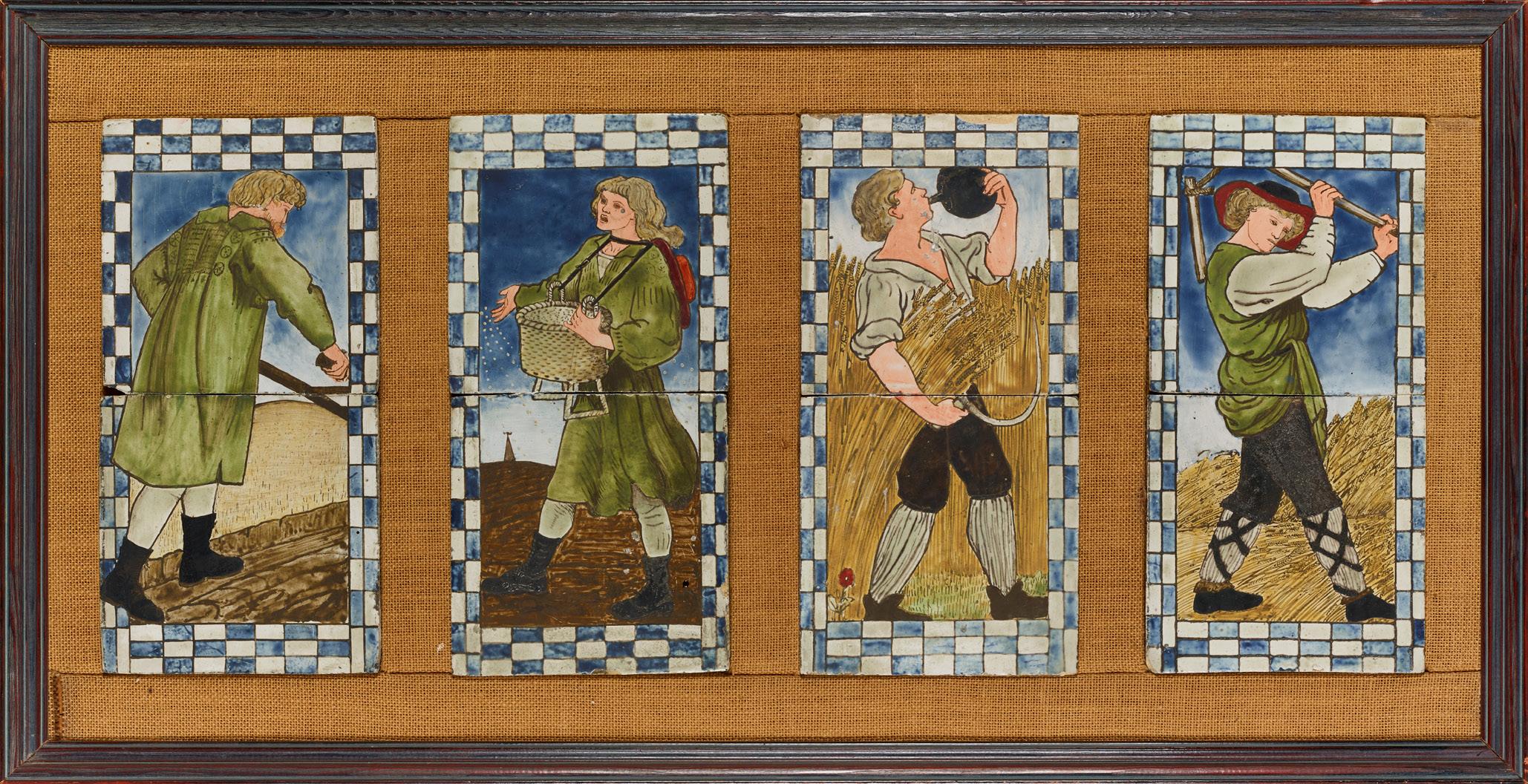
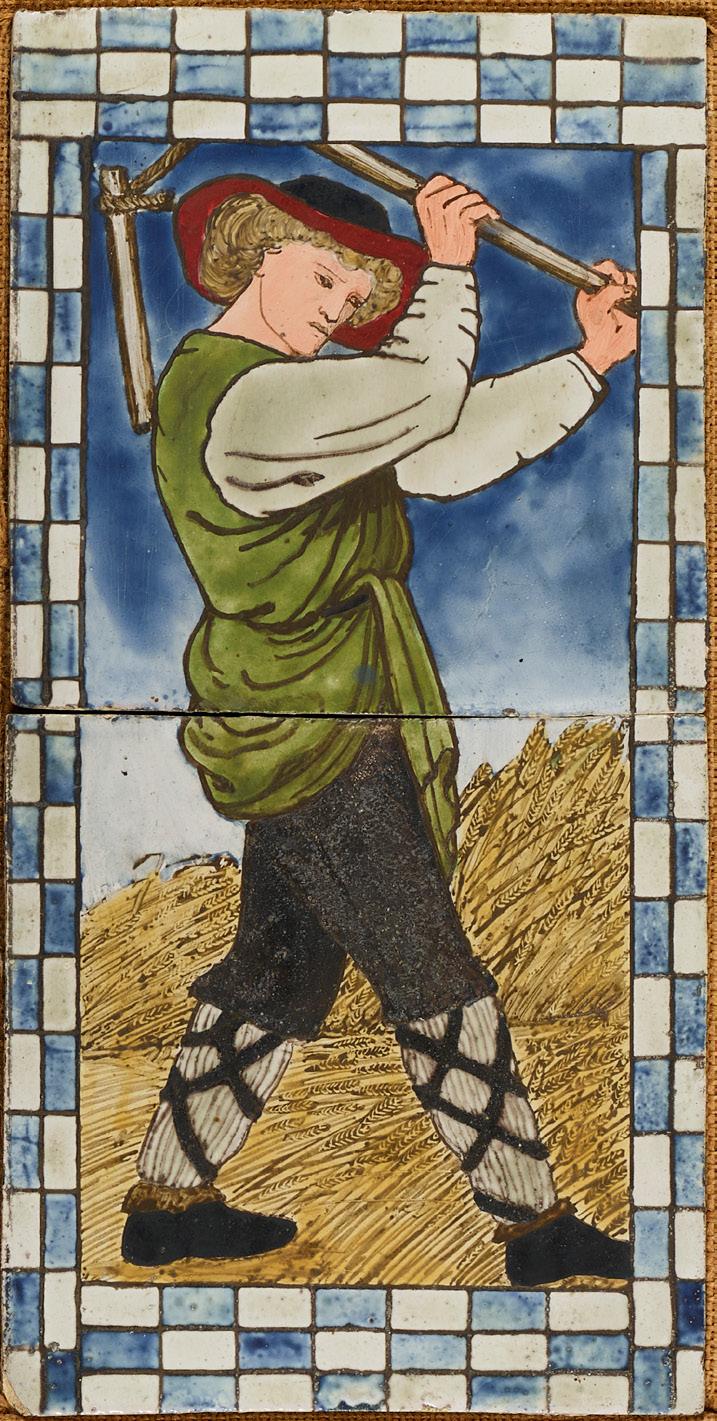
WILLIAM MORRIS (1834-1896), DANTE GABRIEL ROSSETTI (1828-1882) AND FORD MADOX BROWN (1821-1893) FOR MORRIS, MARSHALL, FAULKNER & CO. (1861–1875) FOUR ‘LABOURS OF THE MONTHS’ TILE PANELS, CIRCA 1865
painted and glazed earthenware, later mounted together in one frame (4) each tile 15.5cm square (frame size 43cm x 84cm)
Provenance: From The Rectory in Cavendish
Literature: Myers, Richard and Hilary William Morris Tiles, Richard Dennis 1996, pp. 62-66, back cover illustration Robinson, Duncan and Wildman, Stephen, Morris & Company in Cambridge, September 30th-November 16th 1980, Fitzwilliam Museum Cambridge, Cambridge University Press 1980, pp. 26-28 £20,000-30,000
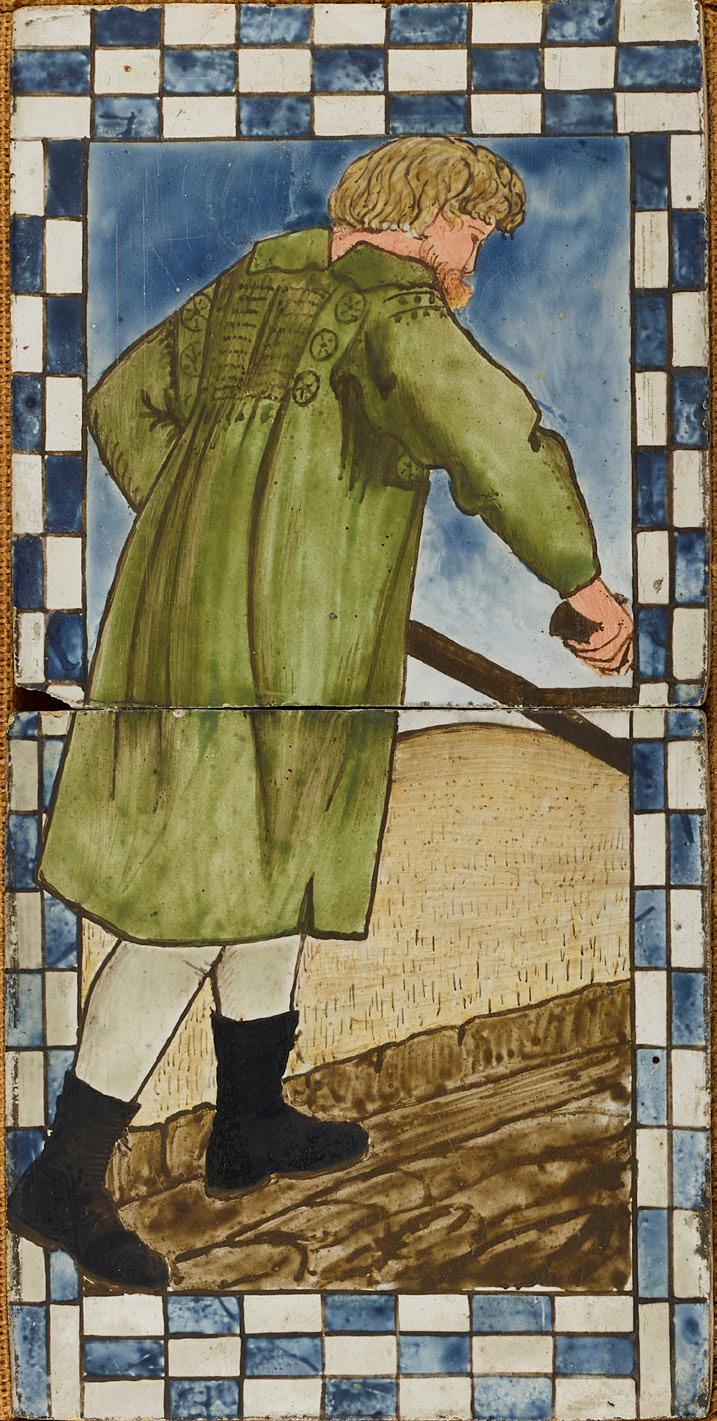
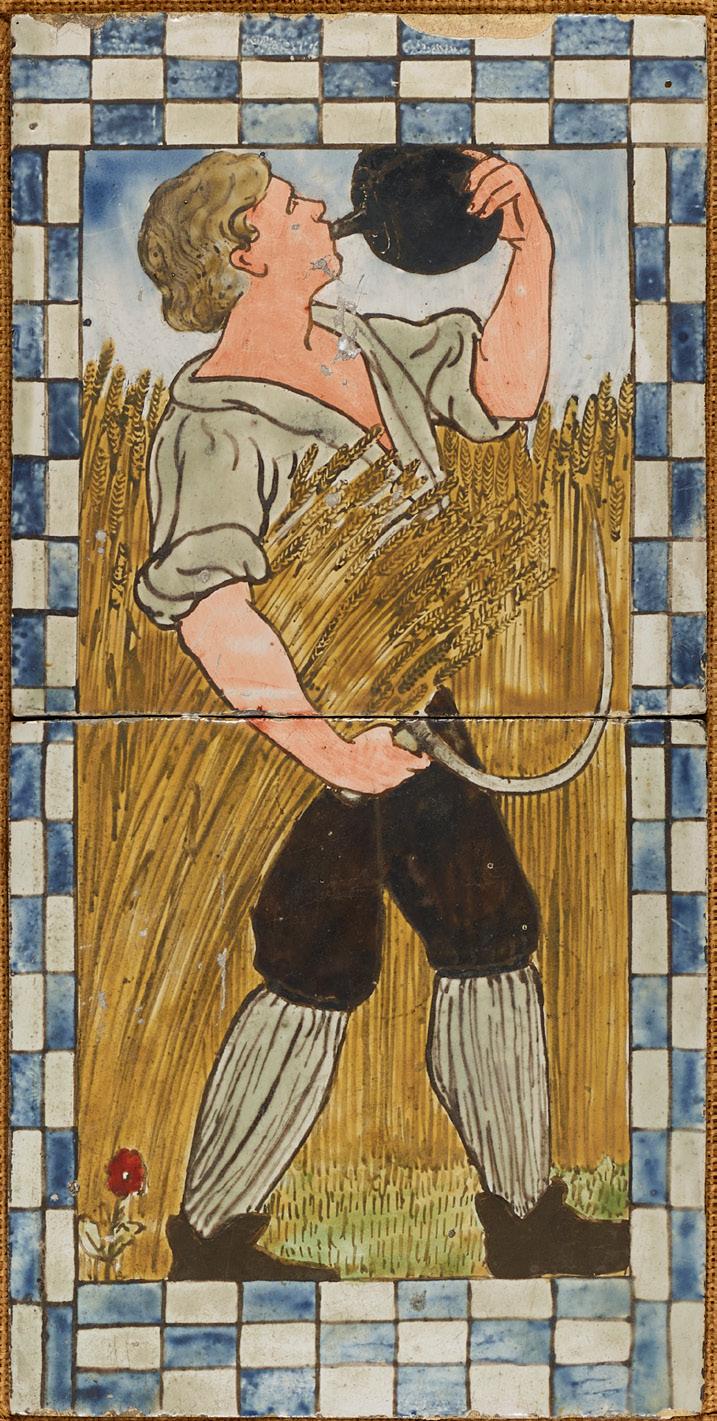
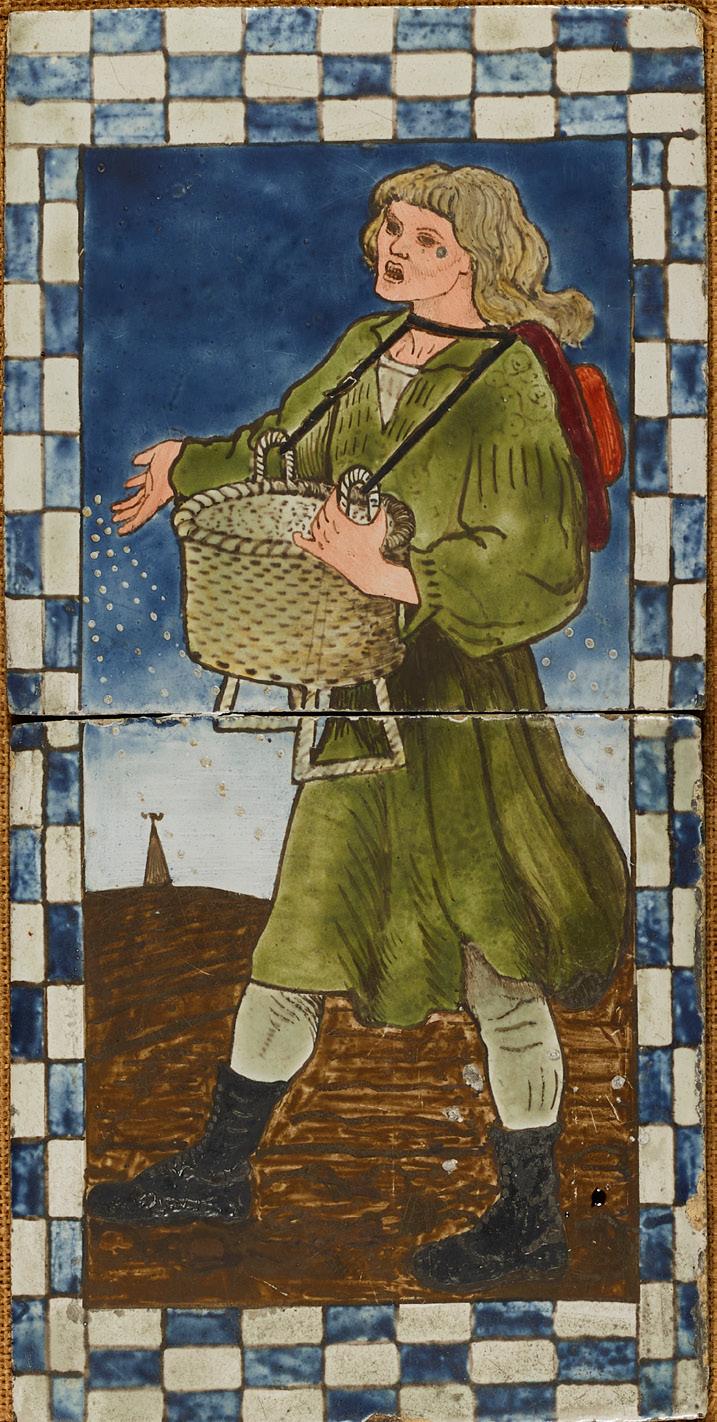
Produced by Morris & Co., these remarkable four Labours of the Months tiles come from a Rectory in Cavendish, Suffolk. Removed prior to the demolition of the building, they were given by the vicar to the current vendor’s grandfather, and thence by descent. They represent one of three known partial sets of the Labours of the Months. Working left to right they comprise February (ploughing), November (sowing), July (reaping) and August (threshing). The February tile depicts William Morris as the ploughman and is thought to be a self-portrait as Morris makes a comment on his lot in life.
Another set of Morris & Co. ‘Labours of the Months’ tiles was installed 1862-3 in the Old Hall of Queens’ College, University of Cambridge. Commissioned by architect G. F. Bodley as part of the fireplace and overmantel, they constitute an early important job for the new firm, only founded in 1861. Each of the twelve-month panels has
a latinised label and the group are set amongst representations of the college’s two patron saints and the Angels of Night and Day. Comparisons have been drawn between the medieval style of the tiles and the Books of Hours, the Morris & Co. sketchbooks referring to these fifteenth century calendars strengthening this tie. Regarding the forms of the months, the 1857 publication of the twelfth-century mosaic floor in Aosta Cathedral, North-west Italy has been suggested as possible inspiration. Morris and Co. contributed again to the Old Hall decorative scheme, providing ceiling painting designs around 1875.
A further full Labours set predates the Cambridge iteration, differing in some of the subjects and featuring inset Zodiac signs. Morris and Co. kept this earlier set until at least 1934. They were then bought by the great patron of the firm, Mrs Lucius Gubbins of Eastbourne, before eventually being offered in October 1995 at Phillips Auctioneers,
Glasgow and now held at the William Morris Gallery, Walthamstow. A third set was destined for the home of Lord Justice and Lady White who lived on Unthank Road, Norwich, and is noted as being set with a blue and white pattern, perhaps a similar arrangement to the four tiles being sold.
It is not known whether the four tiles offered here were initially part of a full set or were made as a special commission. A lone January tile currently sits in the Ashmolean Museum Oxford and the top half of a representation of April has also been documented, but whether the remaining months were made and then lost is unresolved. Similarly, the Morris & Co. Minute Book does not record which of the designers was responsible for each month. The scheme was certainly a collaborative effort, with stylistic analysis leading to the following attributions: July by Rossetti or Morris, August by Rossetti, November by Madox Brown and February by Morris.
110
GEORGE WASHINGTON JACK (1855-1931)
FOR MORRIS & COMPANY
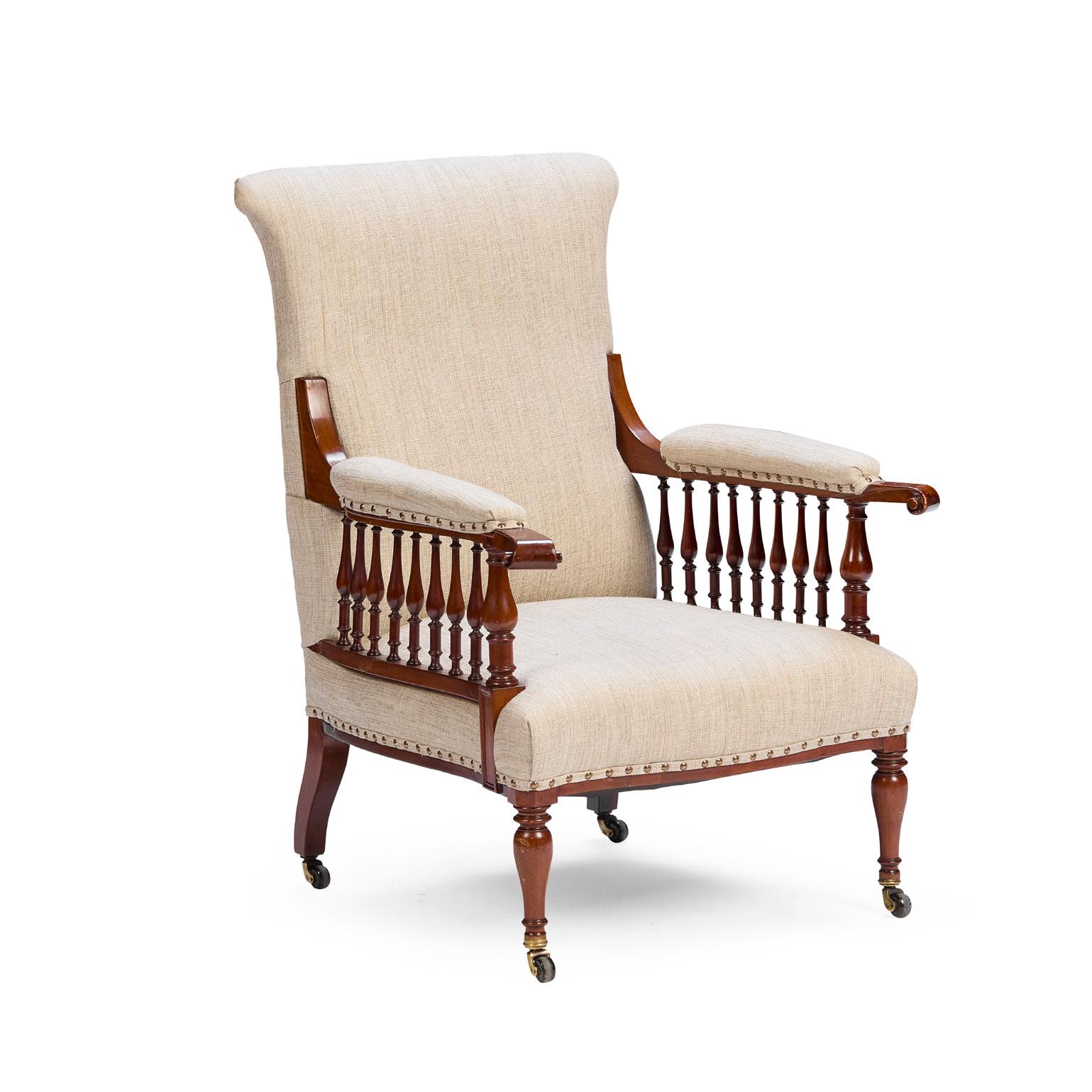
ARTS & CRAFTS ‘SAVILLE’ ARMCHAIR, CIRCA 1890
mahogany, later linen upholstery
65cm wide, 93cm high, 65cm deep
Literature: Anscombe I. and Gere C. Arts and Crafts in Britain & America, Academy Editions 1978, p. 39, pl. 3
A similar ‘Saville’ armchair with turned legs can be found in the entrance hall of Standen, Sussex.
£2,000-3,000
109
ATTRIBUTED TO FORD MADOX BROWN (1821-1893) FOR MORRIS & COMPANY
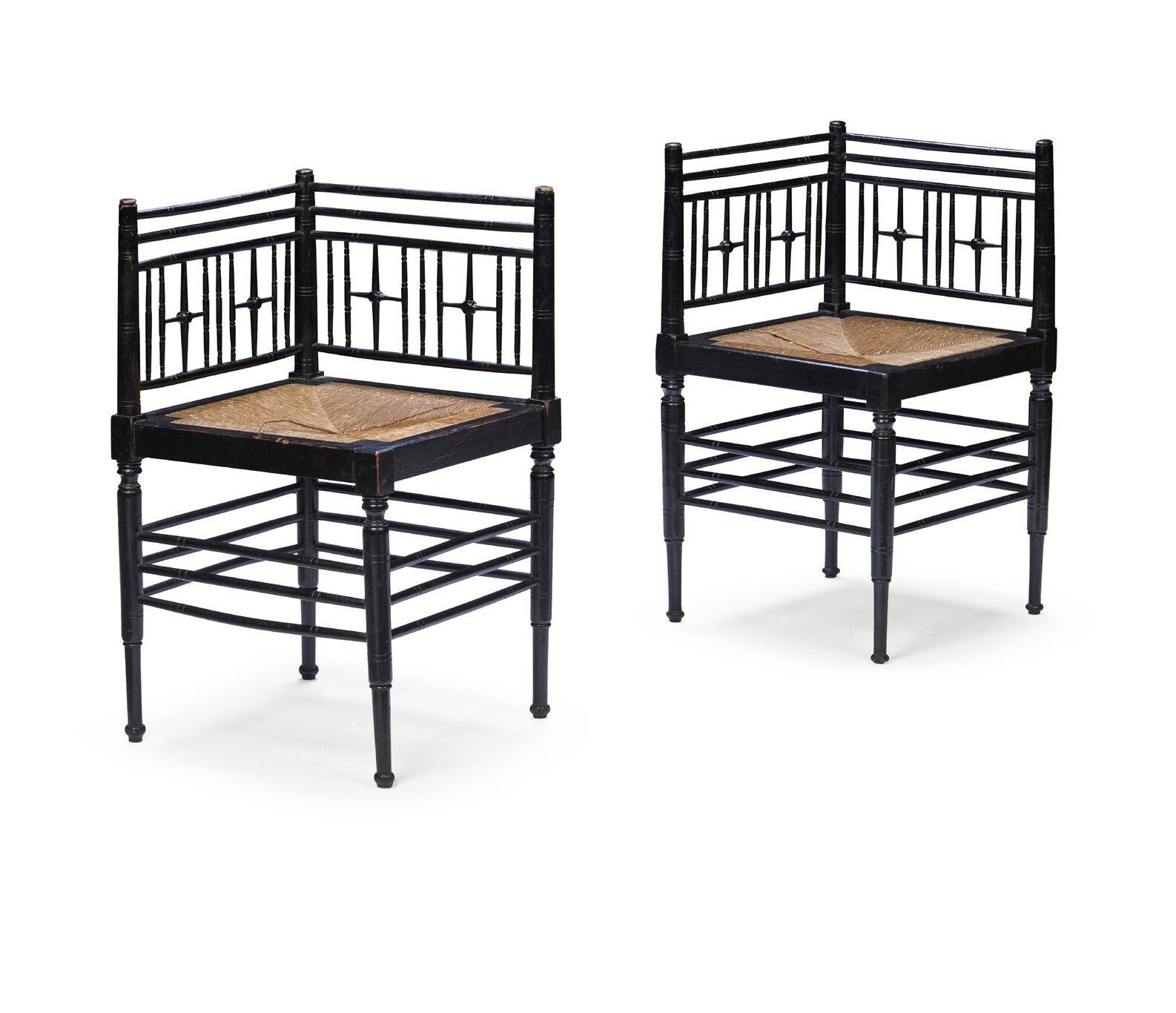
TWO ARTS AND CRAFTS ‘SUSSEX’ CORNER ARMCHAIRS, CIRCA 1875
ebonised wood with drop-in seat (2)
42cm square, 71cm high
£400-600
111
MAY MORRIS (1862-1938)
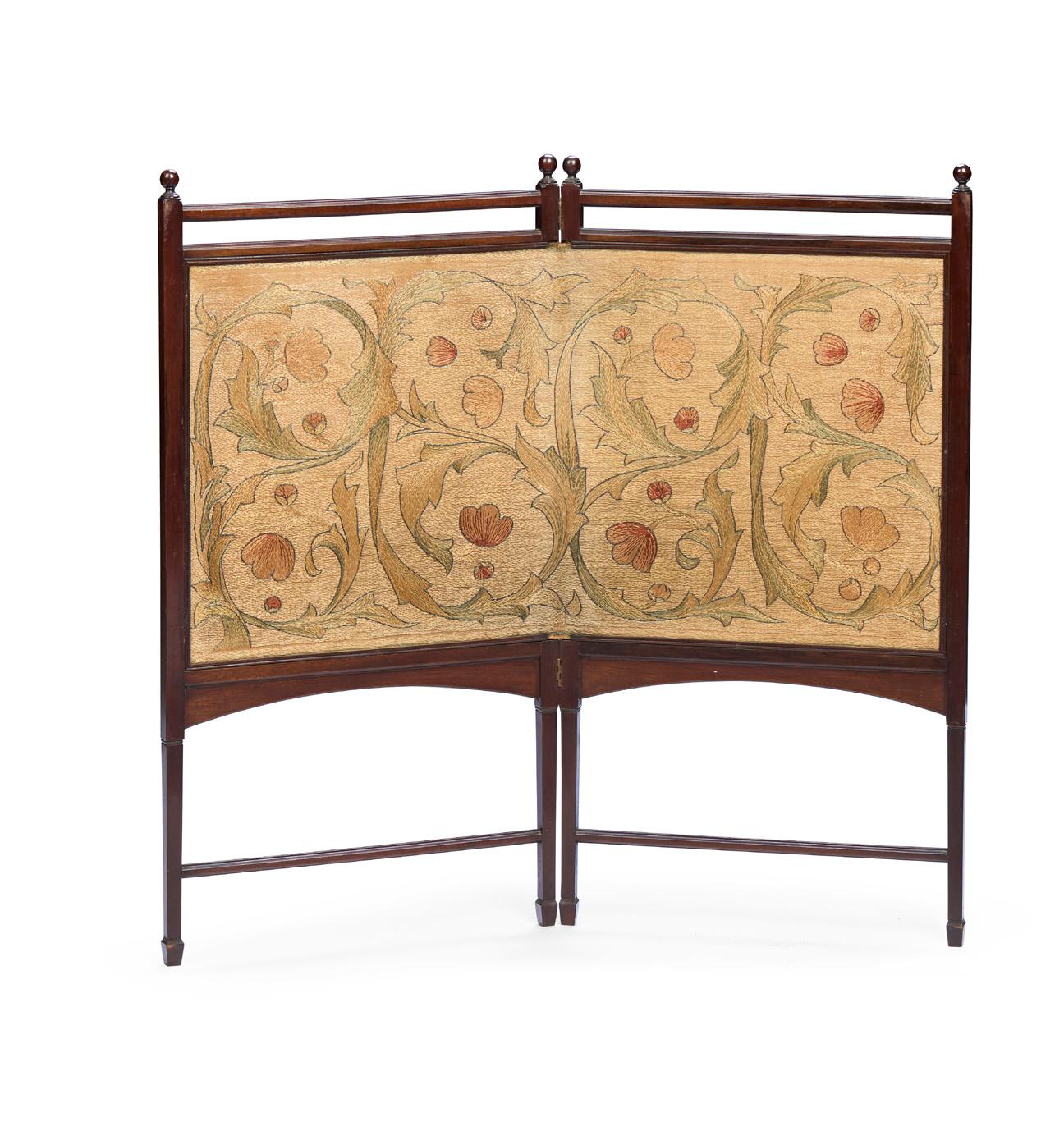
‘WESTWARD HO’ TWO-FOLD EMBROIDERED SCREEN, CIRCA 1885
coloured silks, reserved on an unbleached linen ground, mahogany frame each fold 47.5cm wide, 92cm high
See William Morris Society collection accession no. T117 for a similar example embroidered by Jane Morris (1839–1914)
£600-800
112
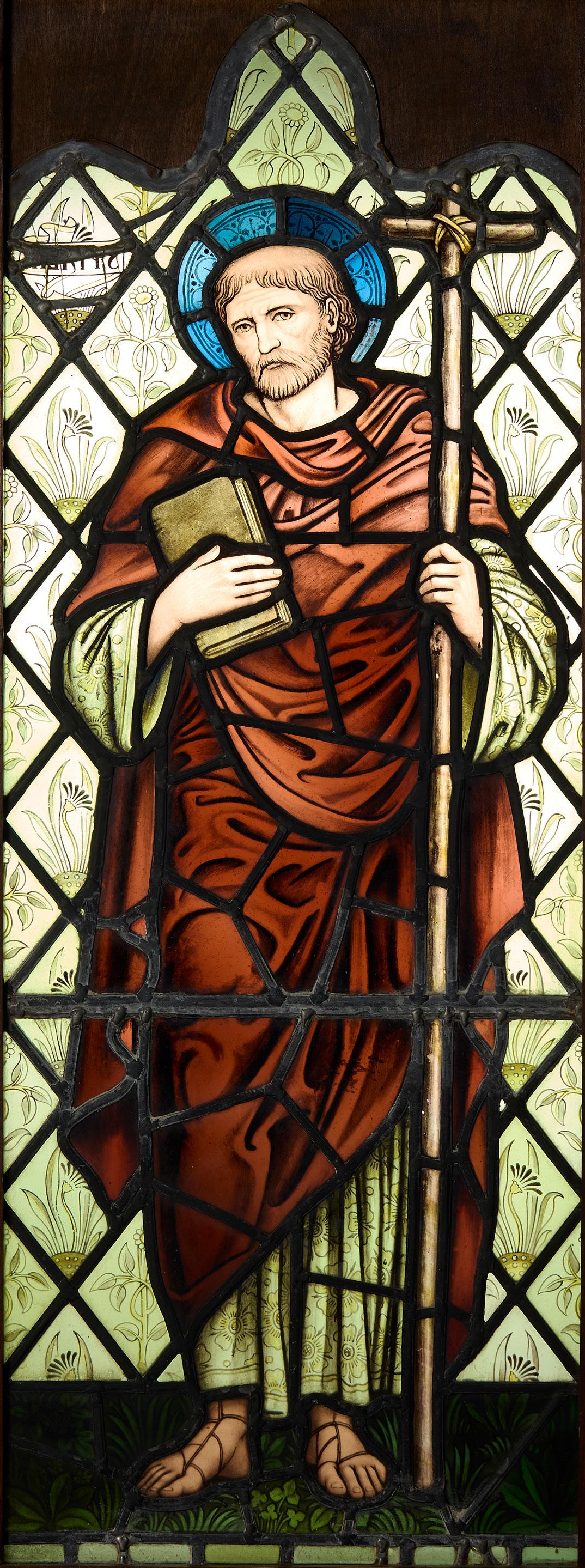
SIR EDWARD BURNE-JONES (1833-1898) FOR MORRIS & COMPANY
‘ST. PETER’ STAINED GLASS PANEL, CIRCA 1890
painted, leaded and stained glass, framed 98.5cm x 37cm (frame size 105cm x 42cm)
Provenance: Gabreal Franklin Collection, California
The original design for St. Peter was made in 1877 for St Mark’s church, New Ferry on the Wirral by Edward Burne-Jones. The version here dates from the late 1890’s and was probably made for St Alban’s church, Streatham Park, Pretoria Road, Lambeth (destroyed by fire 29 December 1947).
£4,000-6,000
113
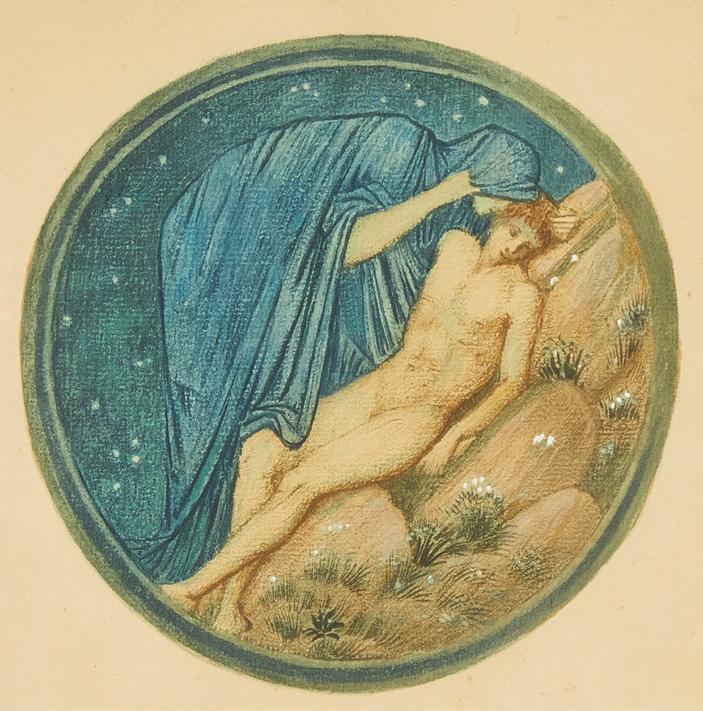
SIR EDWARD BURNE-JONES (1833-1898)
‘DAY AND NIGHT’ FROM THE FLOWER BOOK, CIRCA 1900
lithograph, framed
23.5cm x 19.5cm (frame size 43.5cm x 33cm)
The Flower Book by Edward Burne-Jones (1833-1898) is a series of 38 round watercolours, each about six inches across, painted from 1882 to 1898. They were painted for his private pleasure, many while he was resting at his summer home in Rottingdean and were described by his wife as the “most soothing piece of work that he ever did”. On his death, BurneJones left the album of flower paintings to his wife Georgiana, and she published a facsimile edition of 300 copies in 1905 in cooperation with the Fine Art Society in London.
£250-350
114
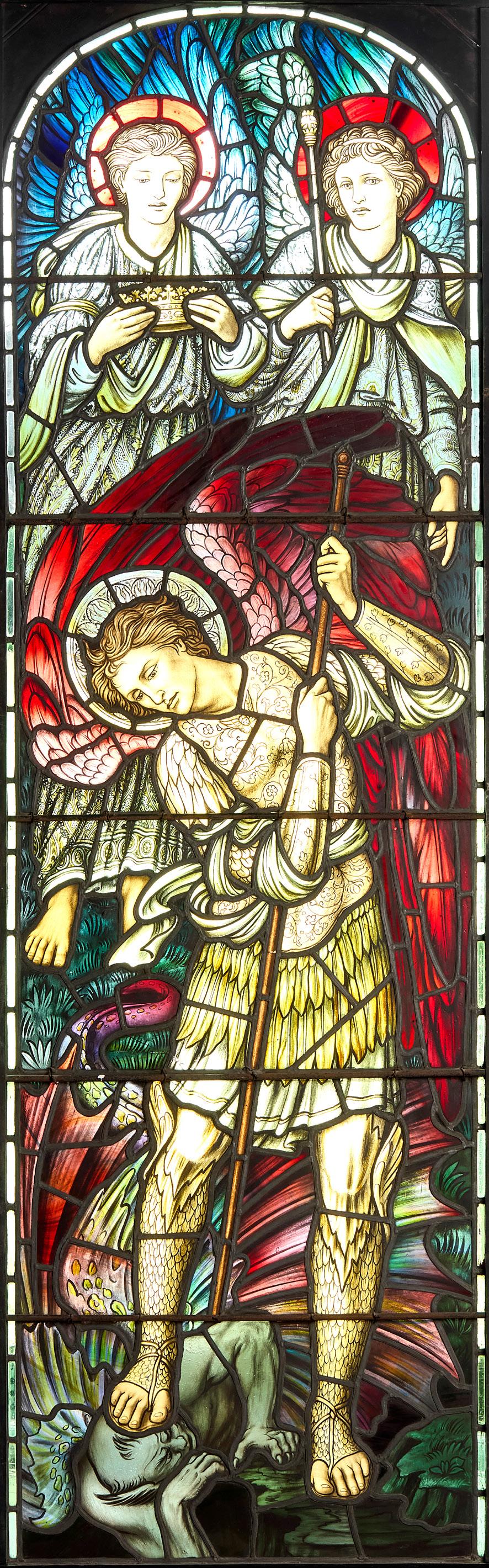
JOHN HENRY DEARLE (1859-1932)
AFTER EDWARD BURNE-JONES FOR MORRIS & COMPANY
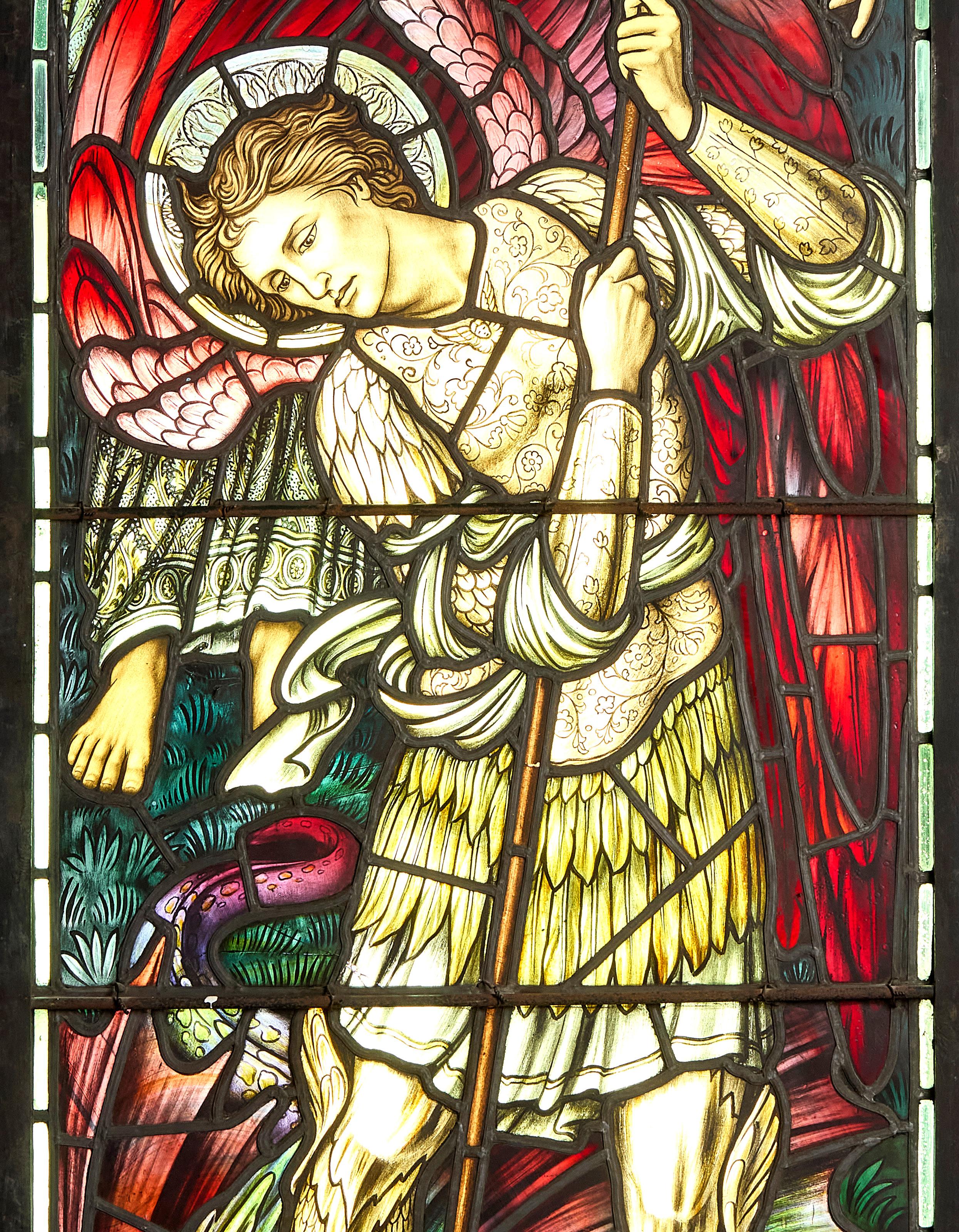
VICTORY: ST MICHAEL THE ARCHANGEL SLAYING THE DEVIL, CIRCA 1920
painted, stained and leaded glass panel, framed 227.5cm x 70cm (frame size 242.5cm x 84cm)
Literature: Sewter A. C. The Stained Glass of William Morris and his Circle (Catalogue), Yale University Press 1974, pp. 204; 306-7
The original drawings for this panel are held in the collections of the Huntington Library, San Marino, California (2000.5.1604 and 2000.5.844 William Morris Collection https://emuseum.huntington.org/ search/victory)
The design for ‘Victory’ was first employed in the scheme for the Church of St Cybi, Holyhead where the single figure of St. Michael was employed as part of a triptych with the side panels having figures by Burne-Jones. The window in its current form was later worked up by Dearle with two attendant angels added and were designed for St Bartholomew’s Church, Wilmslow, Cheshire. Dearle began his life-long work for Morris & Co. in the late 1870s, completing his first design for stained glass in 1884. Since he was also one of the glass painters, Dearle was frequently given the freedom of designing backgrounds for the subjects.
After Burne-Jones’s death in 1898, he became the firm’s principal stained glass designer. In response to the increased demand for memorial windows after World War I, Dearle made a series of designs illustrating the themes of War, Victory, and Peace. The designs demonstrate the continuing influence of Burne-Jones and Morris in the work of the firm into the 20th century.
£15,000-20,000
William Morris began producing hand-knotted Hammersmith rugs in 1878–79. At that time, no other British manufacturer was working at the scale he envisaged. Morris had planned the initiative for many years and had collected historical Eastern carpets since at least the late 1850s. These were used extensively at Red House, designed for him by Philip Webb in 1859, where they covered both floors and walls.
In 1878 Morris established a carpet frame in an attic at Queen Square. With the assistance of a hand weaver from Glasgow, he learned the techniques required for knotting carpets. Additional frames were later installed in the coach house and stable loft at Kelmscott House, where Morris trained workers in the methods he had acquired. By 1880 his intentions were articulated in a circular announcing an exhibition of carpets and rugs. In this document he stated
his aim “to make England independent of the East for carpets which may claim to be considered as independent works of art.” Morris argued that, although appreciation of Eastern design was increasing, the quality of Eastern carpet production was declining. In his view, Western production of handmade carpets would therefore be necessary to maintain high standards. At the same time, he maintained that such carpets should equal Eastern examples in materials and durability but should not imitate Eastern design. Instead, they should express contemporary Western artistic principles.
Carpet weaving was transferred to Merton Abbey Works in 1881, although the term “Hammersmith rugs” continued to be used to distinguish hand-knotted carpets from the firm’s machine-woven products. Carpets produced at Merton during the 1880s and 1890s were among the firm’s largest
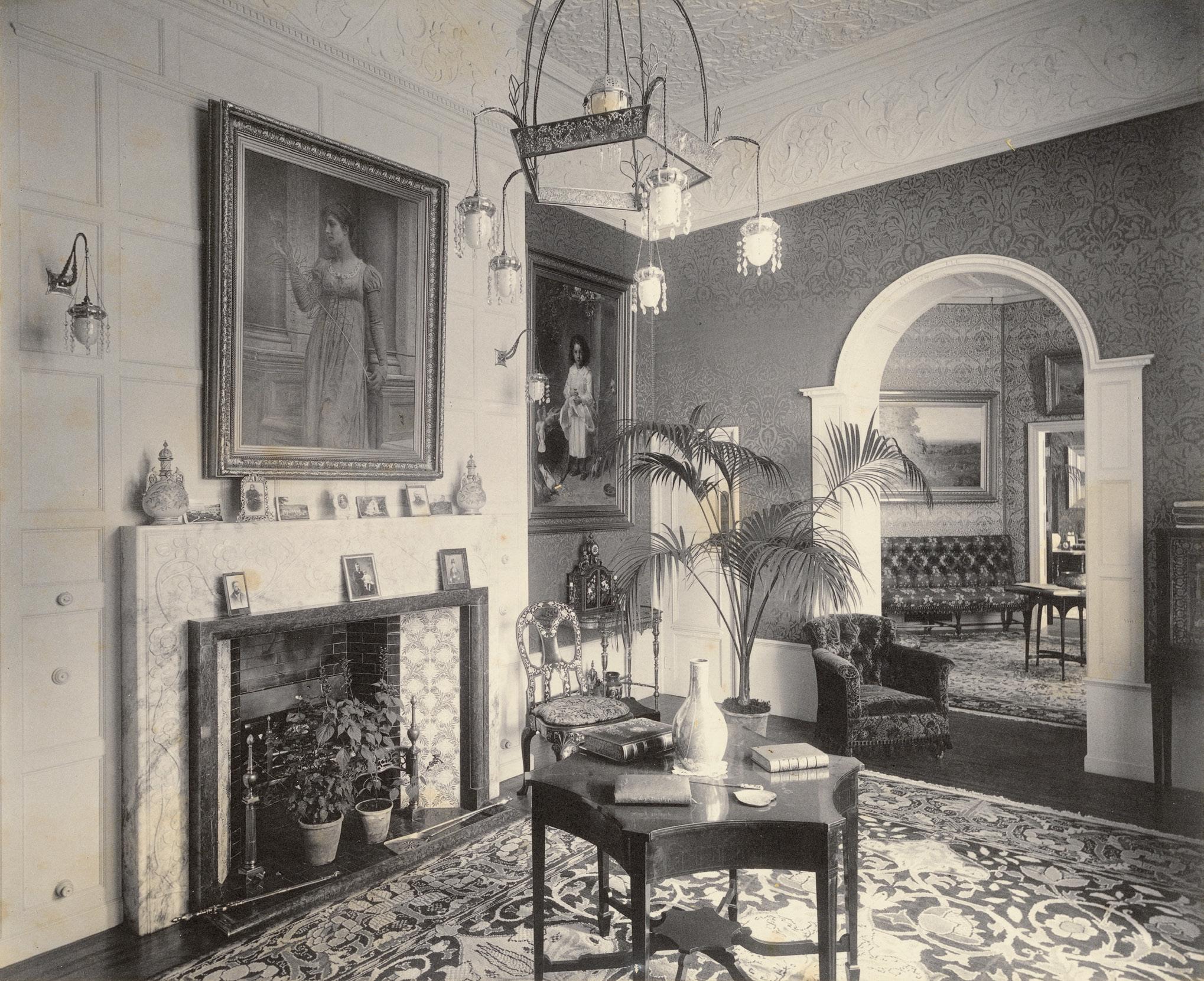
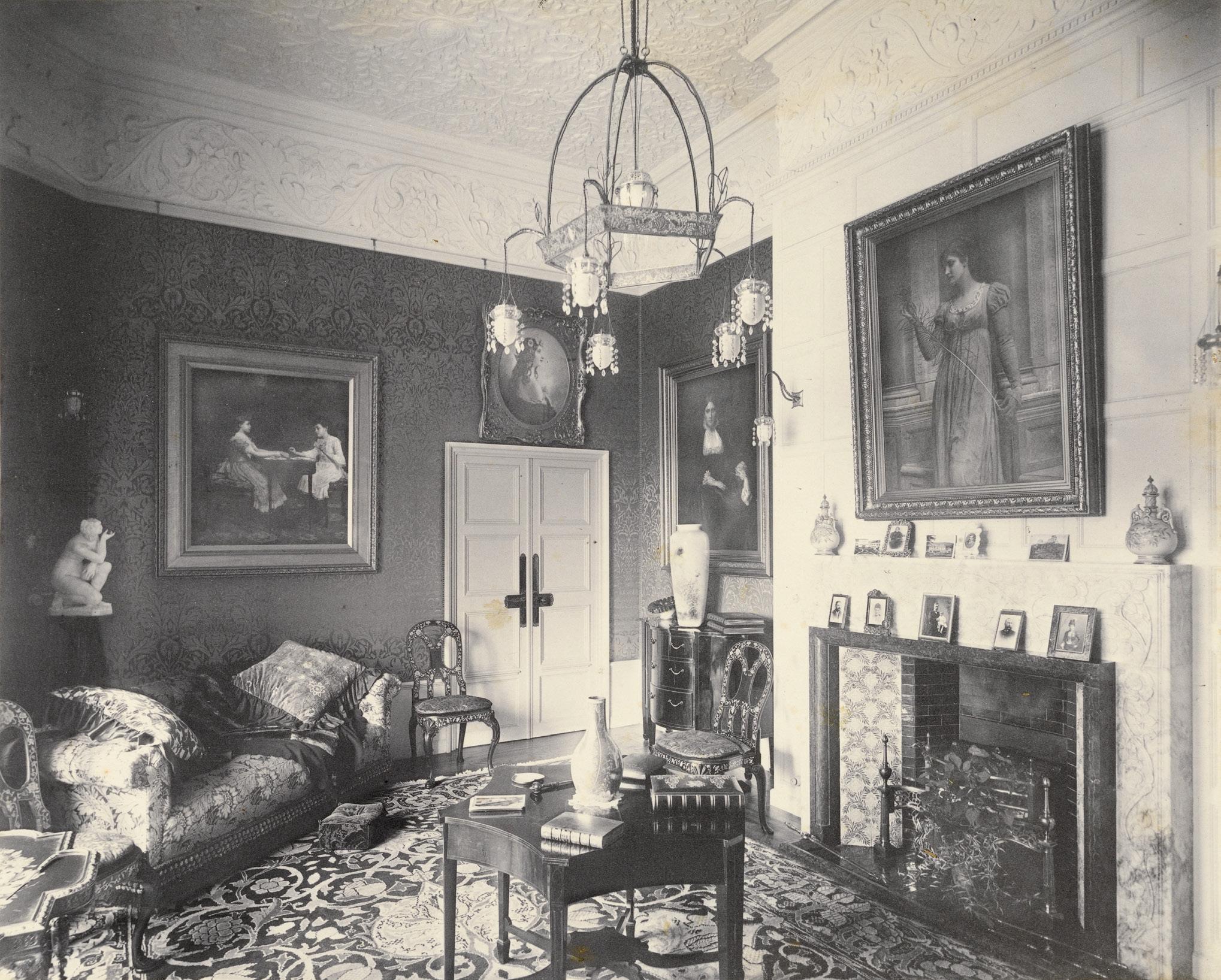
Bedford Lemere & Co. Small drawing room, from the Stanmore Hall, Middlesex album 1892. Gift of Neil Robertson, 1989. Image courtesy National Gallery of Victoria.
and most expensive works, costing approximately £4 per square yard. It took one day to weave 2 inches on a loom and a 16 by 13 feet carpet cost over £100. The high cost meant that they were only made to commission and were not kept as stock items. Together with the firm’s tapestry production, they represented the costliest output of Morris & Co.
Morris outlined his principles of carpet design in his 1883 paper “Textiles.” He described carpet weaving as analogous to tapestry in being “wholly unmechanical,” although its function as a floor covering, particularly in northern climates, diminished its artistic status. Because the technique was relatively coarse, he advised that designs should be simple in form and composed of stylised references to foliage, flowers, and animals. He rejected tonal shading and argued that variation in colour should instead be achieved through the juxtaposition of distinct tints, clearly outlined to maintain legibility. When executed effectively, he suggested, this
method produced strong and coherent patterns in which motifs appeared visually flat and integrated within the overall composition.
Few designs for Hammersmith carpets survive, and the absence of day books makes precise dating difficult. Surviving examples are often identified by the houses for which they were commissioned—such as the “Clouds,” “Hurstbourne,” or “Bullerswood” carpets—or by the names of their patrons, such as the “McCulloch.” Many designs may derive from earlier work. The design and original owner of the carpet discussed here has a field and border which display stylistic affinities with both the “Holland Park” carpet (1883) and the “Clouds” carpet (1887). Linda Parry, the textile expert who curated the V & A’s definitive William Morris exhibition in 1996, describes the Holland Park carpet as “probably Morris’s most original carpet design,” noting that it reflects Morris’s principal influences: medieval art, naturalistic floral
Bedford Lemere & Co. Small drawing room, from the Stanmore Hall, Middlesex album 1892. Gift of Neil Robertson, 1989. Image courtesy National Gallery of Victoria.
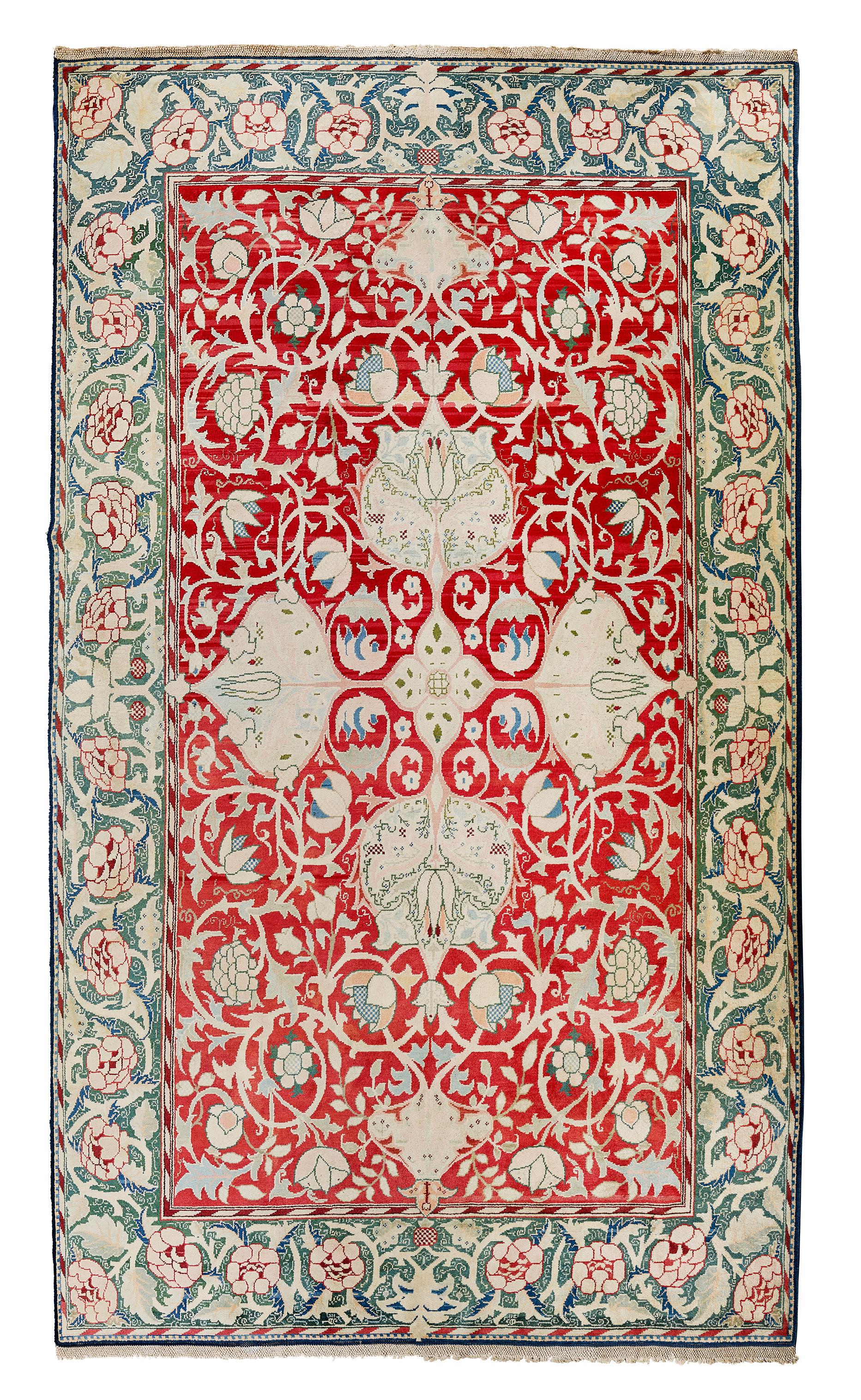
WILLIAM MORRIS (1834-1896) AND JOHN HENRY DEARLE (1859-1932) FOR MORRIS & COMPANY
LARGE ARTS & CRAFTS ‘HAMMERSMITH’ CARPET, CIRCA 1890-95 hand-tufted wool on a linen and wool warp, with ‘Soumak’ knotted fringe
508cm x 335cm (without fringe), 520cm x 335cm (including fringe)
Provenance: Probably made for Stanmore Hall, Middlesex
Robert Kime, Dene House, Lockeridge, Marlborough
Private collection, London
Literature: Parry L. Hammersmith Carpets, HALI, October/December 1985, p. 17 and p. 16, pl. 8 where the Bullerswood version of this design is illustrated.
Kirkham P. The Firm: Morris & Company, within Diane Waggoner D. (ed.), The Beauty of Life, William Morris & the Art of Design, (ex. cat.), New York, 2003, p. 54
Parry L. William Morris Textiles, V&A 2013, p. 114
£30,000-50,000
study, and Eastern design conventions. Between 1883 and approximately 1889 Morris often adopted a more classical and symmetrical compositional approach, frequently using quartered layouts with a central medallion, as seen in this example.
The design of the present lot was first used at Bullerswood House near Chislehurst in Kent in 1889. It was designed as part of the interior decoration which Morris & Co. carried out for their client Algernon Newton and was one of three new designs for carpets produced for this scheme. The interior decoration constituted an important commission for the firm and was likely the final decorative scheme personally supervised by William Morris.
The composition features four large palmettes radiating from a central rosette which was a suitable design for its placement in the Hall. These elements demonstrate a clear influence from sixteenth- and seventeenth-century Mughal and Safavid carpets, which Morris both collected and would have studied at the South Kensington Museum. When combined with floral motifs characteristic of Morris’s own design vocabulary, these elements create a carpet distinguished by visual harmony, balance, and aesthetic refinement.
The same carpet design was subsequently reused for another significant commission: the interior decoration of Stanmore Hall, Middlesex, undertaken between 1890 and 1896. A contemporary photograph of the Small Drawing Room at Stanmore Hall, one of a series of photographs taken of the house by Bedford Lemere Ltd., shows this carpet in situ. No other version of this design is known to exist or has been documented.
Stanmore Hall was originally built in 1847 by John Macduff Derick in the Victorian Tudor-Gothic style. In 1888 the house was purchased by the mining entrepreneur William Knox D’Arcy, who had accumulated his wealth during the Australian gold rush. D’Arcy commissioned the architect Brightwen Binyon to renovate the house and engaged Morris & Co. to furnish and decorate the interiors.
Although Morris expressed reservations about the house, its architect, and its owner, he nevertheless contributed to what became one of the firm’s most substantial commissions. The work carried out by Morris & Co. at Stanmore Hall included textiles, wallpapers, carpets, furniture, mosaic flooring, the Holy Grail tapestries (1890–95) designed by Edward BurneJones with Morris and John Henry Dearle, and the Stanmore Hall piano (1891–94), decorated by Kate Faulkner, Philip Webb, and Morris himself.
117
116
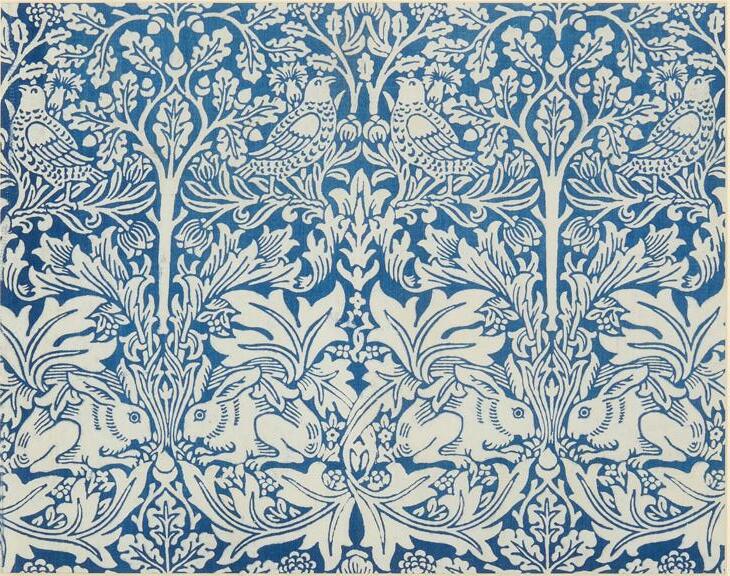
WILLIAM MORRIS (1834-1896) FOR MORRIS & CO. ‘BRER RABBIT’ PANEL, CIRCA 1882
printed cotton
33.5cm x 43cm (frame size 50.5cm x 70.5cm)
Literature: Parry L. William Morris Textiles, V&A 2013, p. 229, pl. 45
Note: This pattern was named after a character in ‘Uncle Remus, His Songs and His Sayings’, published in 1882, by J. C. Harris, which was being read to Jenny and May Morris at the time.
£300-500
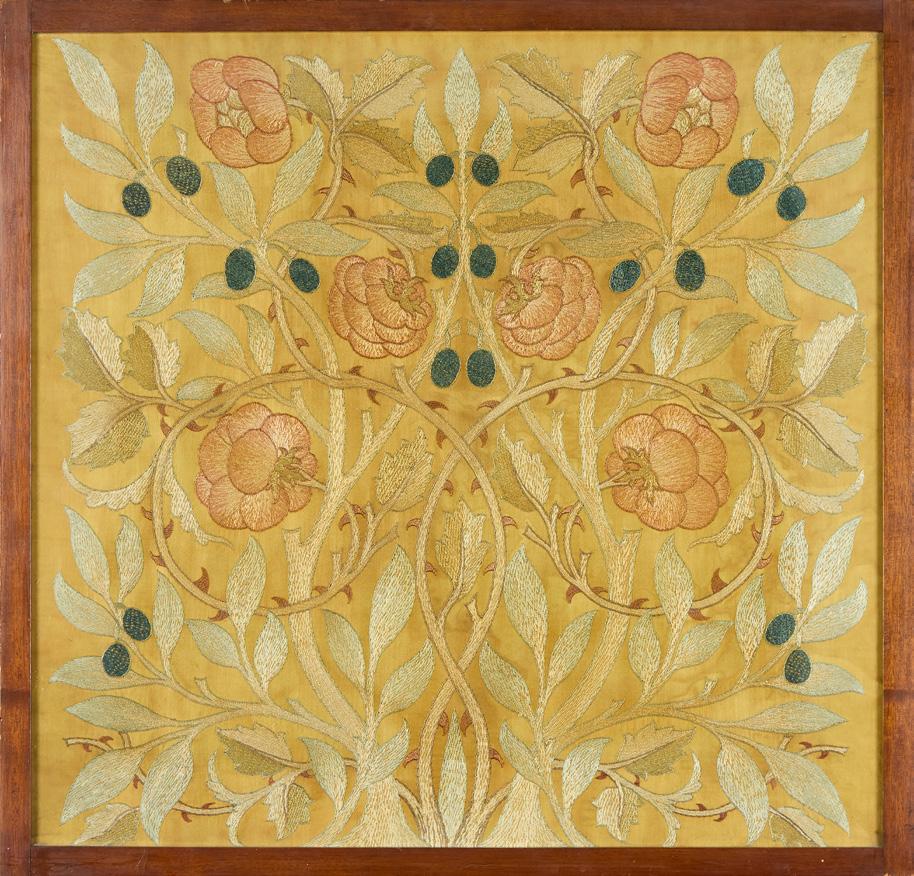
WILLIAM MORRIS (1834-1896) FOR MORRIS & CO. ‘OLIVE AND ROSE’ EMBROIDERED PANEL, CIRCA 1880
coloured silks
56cm square (frame size 58cm square)
Literature: Mason, A. (et al.), May Morris: Arts and Crafts Designer, Thames & Hudson, 2017, p.72-73, pl. 57-58 illus.
£600-800
118
ENGLISH SCHOOL
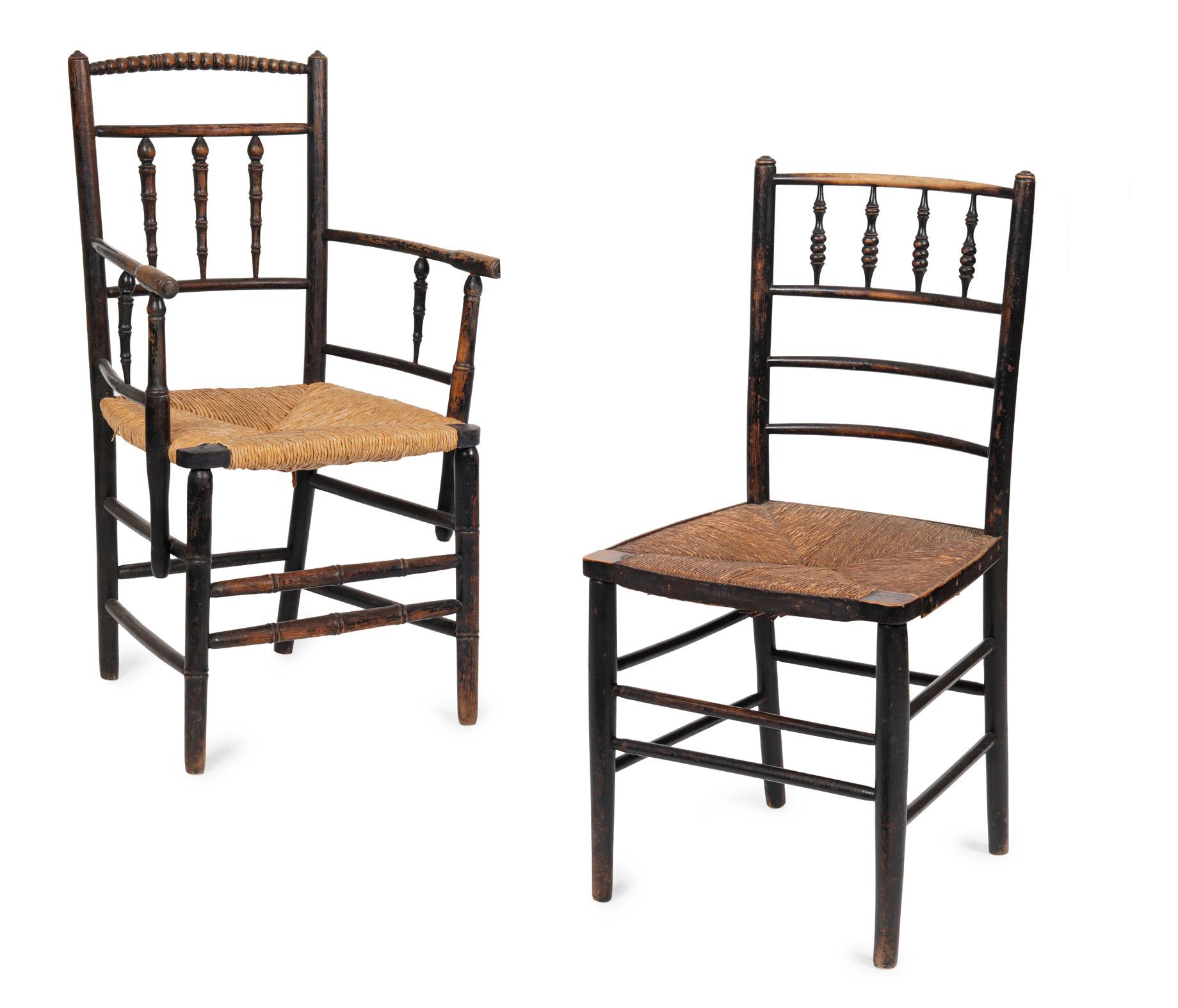
ARTS & CRAFTS EBONISED BEECH ‘SUSSEX’ CHAIR, CIRCA 1890 with spindle-filled back and rush seat, 55.5cm wide, 94.5cm high, 44cm deep; and a MORRIS & CO. ‘SUSSEX’ SIDE CHAIR, ebonised beech, with original rush seat, 42.5cm wide, 87cm high, 38.5cm deep (2)
£200-300
119
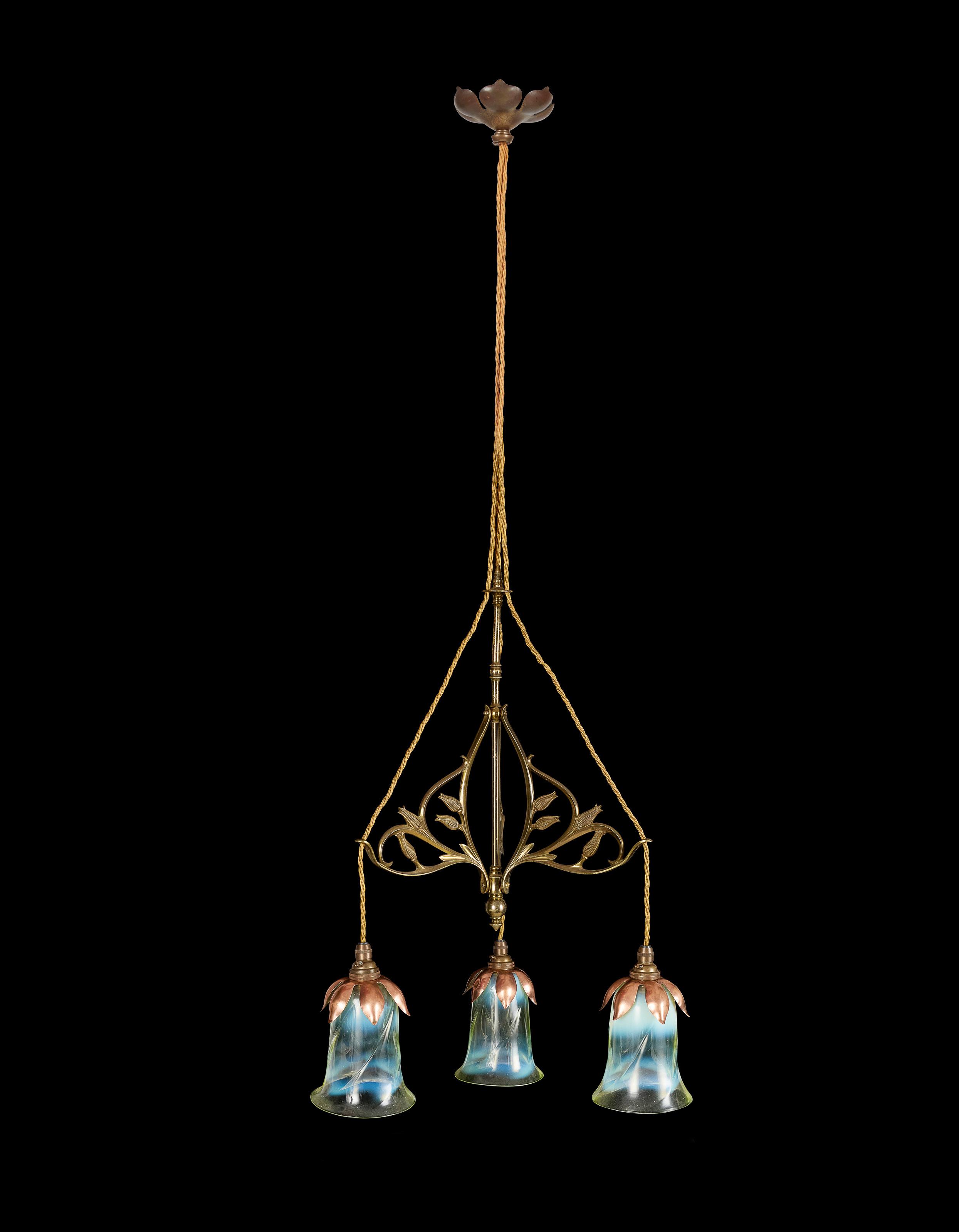
W.A.S. BENSON (1854-1924)
ARTS & CRAFTS CEILING LIGHT, CIRCA 1900 model 1093, brass and copper, stamped W.A.S. BENSON, with period opalescent glass shades 107cm high, 41cm wide
Literature: Hamerton I. (ed.) W. A. S. Benson: Arts and Crafts Luminary and Pioneer of Modern Design, ACC, 2005, Appendix 1B, p. 257, pl. 3 where the design for this light is illustrated (no. 1093)
£4,000-6,000
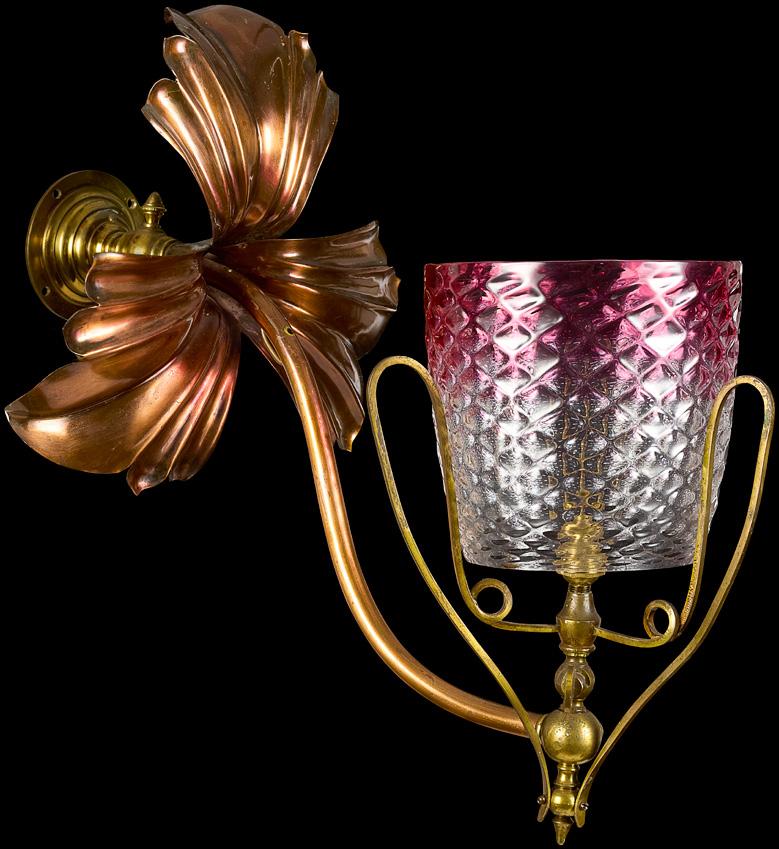
120
W.A.S. BENSON (1854-1924)
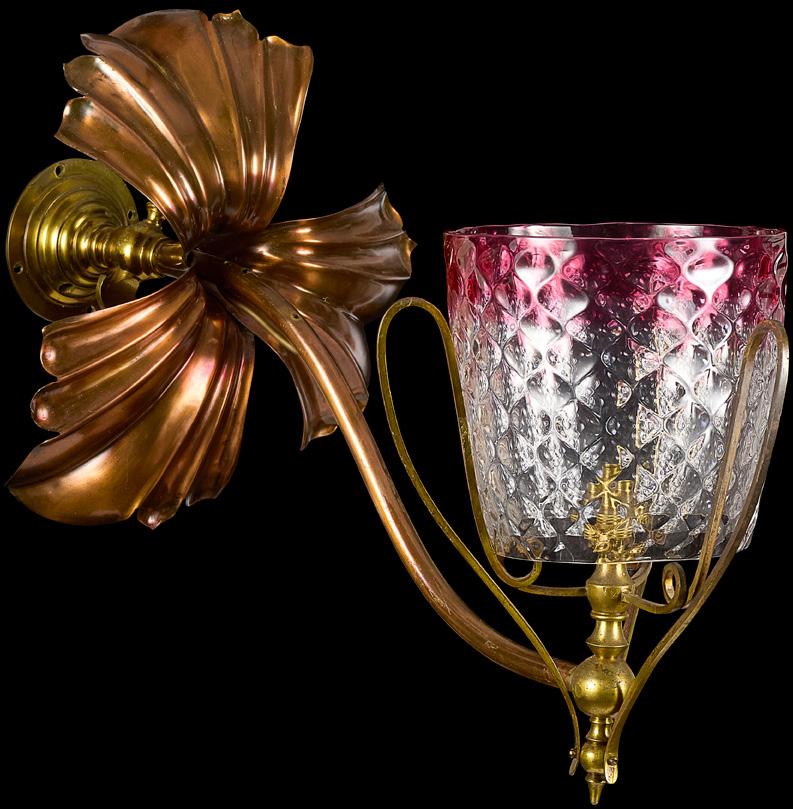
PAIR OF WALL SCONCES, CIRCA 1900 copper, brass, with textured glass shades (2)
50cm deep, 35cm high
Literature: Hamerton I. (ed.) W. A. S. Benson: Arts and Crafts Luminary and Pioneer of Modern Design, Woodbridge, 2005, p. 253, pl. 21 where the design for these lights is illustrated (No. 242/s).
£1,000-1,500
121
W.A.S. BENSON (1854-1924)
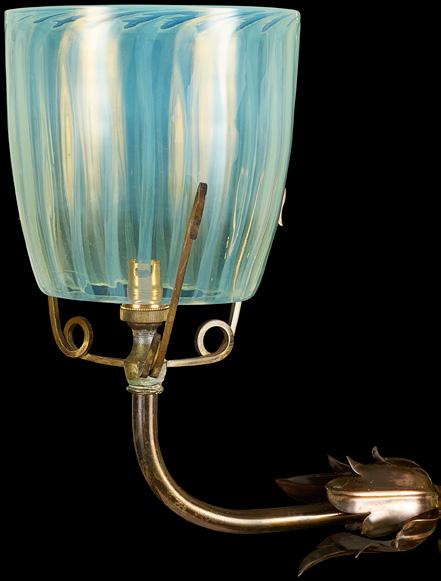
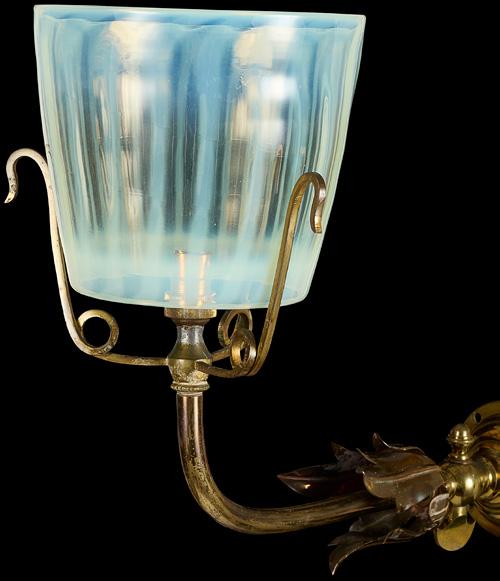
PAIR OF WALL SCONCES, CIRCA 1900 brass, copper, opalescent glass, stamped W.A.S. BENSON (2)
30cm deep, 30cm high
Literature: Hamerton I. (ed.) W. A. S. Benson: Arts and Crafts Luminary and Pioneer of Modern Design, Woodbridge, 2005, p. 253, pl. 21 where the design for these lights is illustrated (No. 248/s).
£1,000-1,500
122
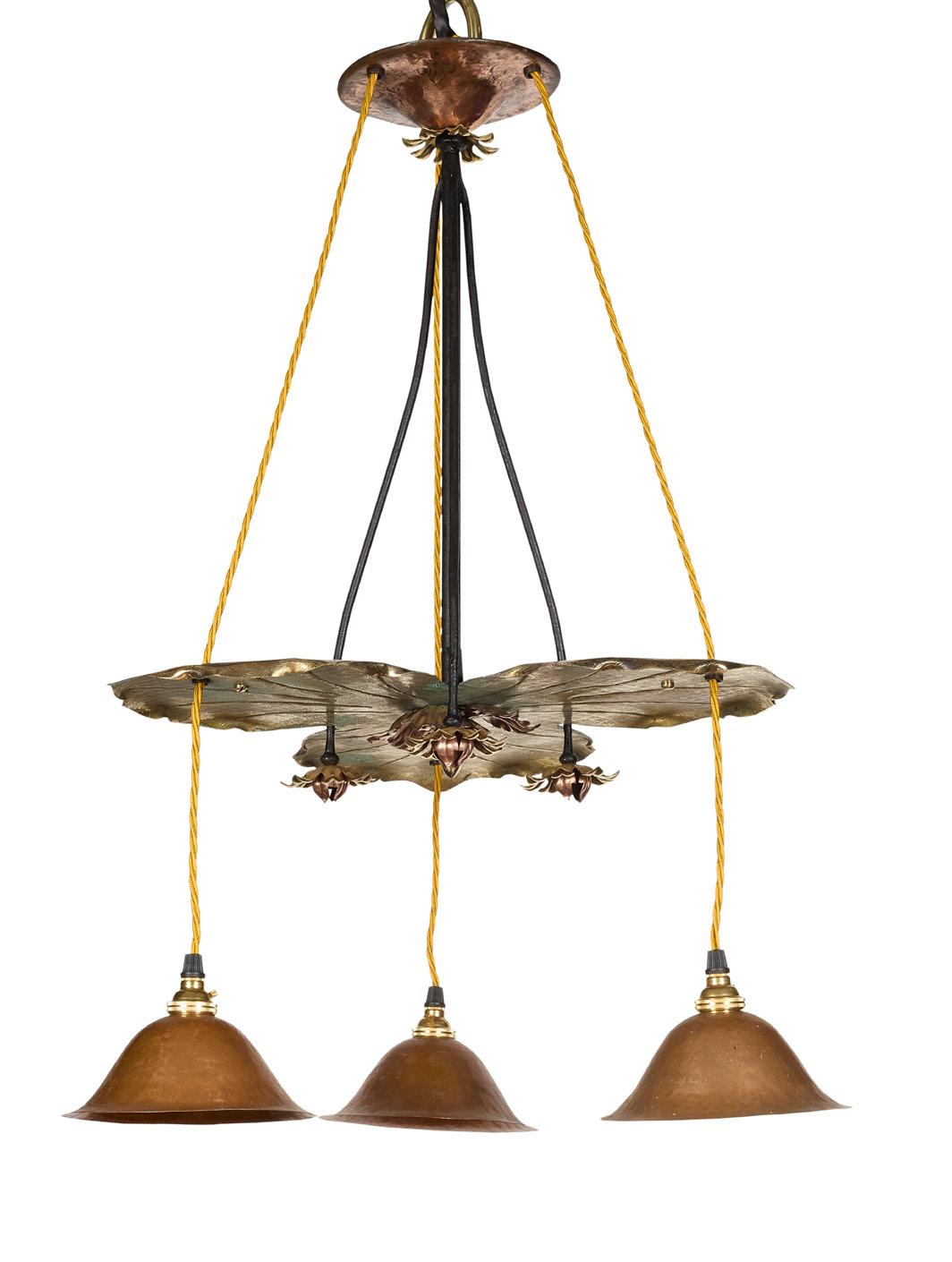
TOWNSHEND & CO., BIRMINGHAM
AESTHETIC MOVEMENT CHANDELIER, CIRCA 1895
copper, brass, patinated iron
77cm high, 48cm diameter
£800-1,200
124
MANNER OF W. R. LETHABY
PAIR OF ARTS & CRAFTS FIREDOGS, CIRCA 1910
chromed steel, wrought iron (2)
15cm wide, 54.5cm high, 22cm deep
£300-500
123
ENGLISH
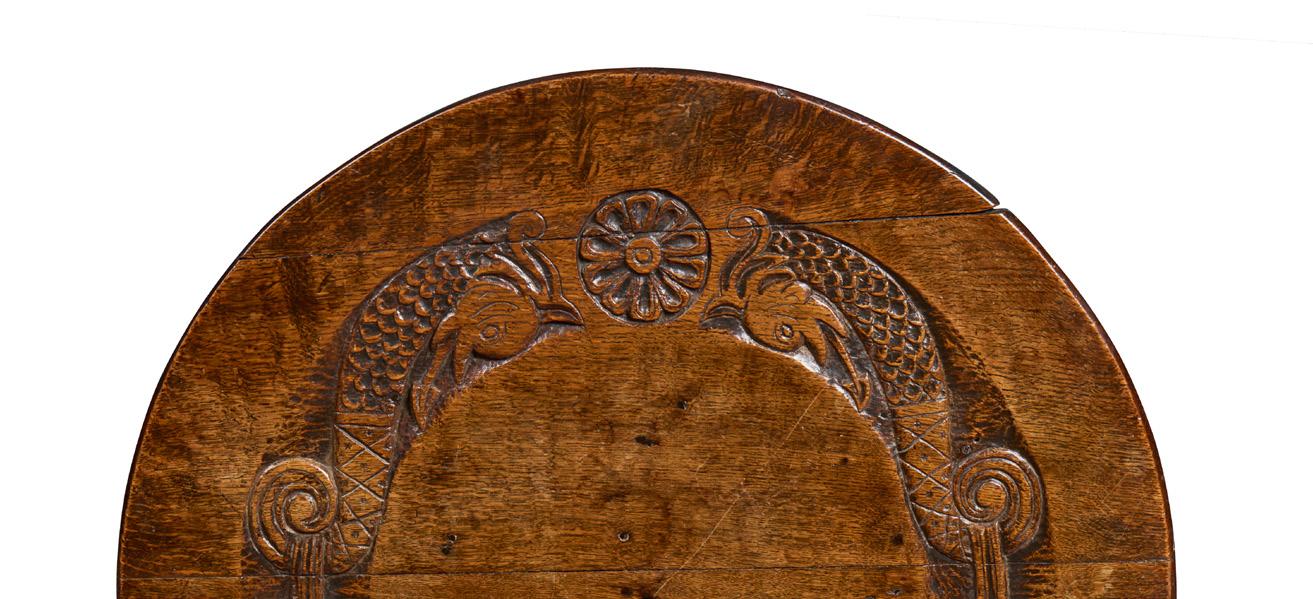
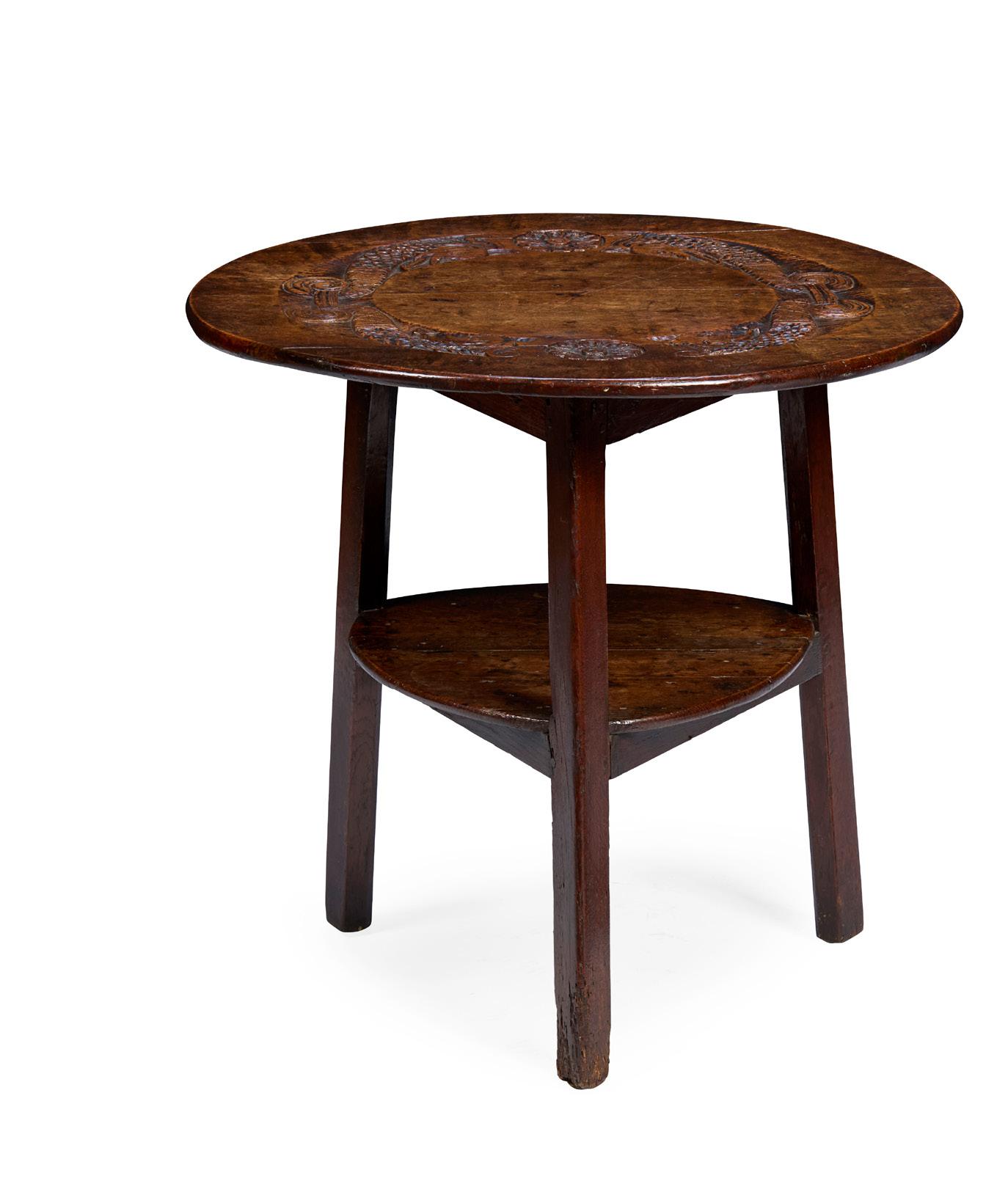
ARTS & CRAFTS ‘CRICKET’ TABLE, CIRCA 1900 carved oak
69cm diameter, 66cm high
£400-600
128
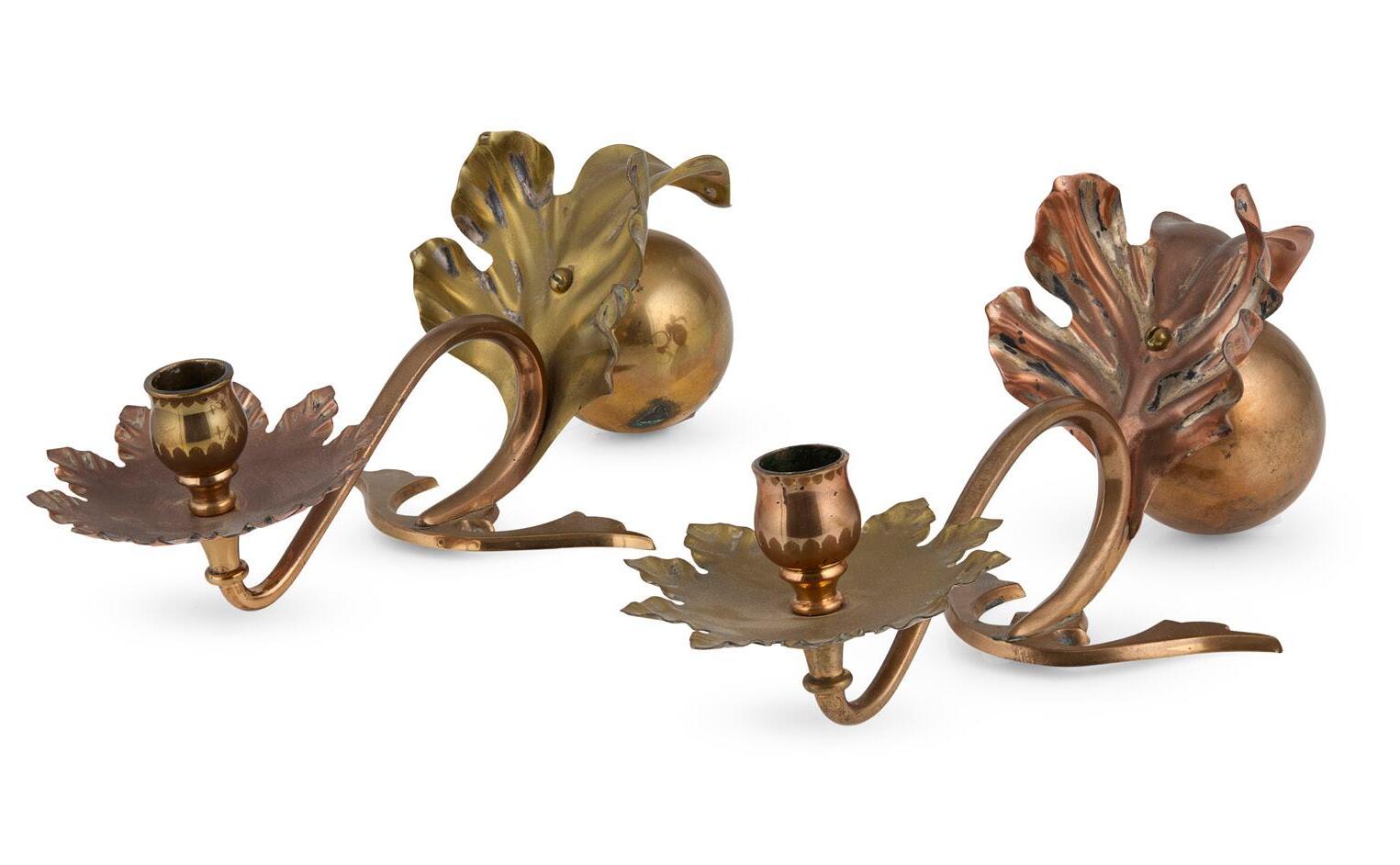
W. A. S. BENSON (1854-1924)
MATCHED PAIR OF CANDLESTICKS, CIRCA 1900
brass and copper, one stamped 304(?) (2)
28cm long
Provenance: Private collection, London
Literature: Hamerton I. (ed.) W. A. S. Benson: Arts and Crafts Luminary and Pioneer of Modern Design, ACC 2005, p.253, pl.23 where this design is illustrated (204).
£400-600
125
MAW & CO.
TWO TILE PANEL, CIRCA 1900 glazed earthenware, each tile 15cm square (frame size 32.5cm x 17cm); together with a THOMAS BOOTE & SON TWO TILE PANEL, dust pressed clay, each tile 15cm square (frame size 17.5cm x 33cm); an ART NOUVEAU THREE TILE PANEL, dust pressed clay, each tile 15cm square (frame size 18cm x 48cm); and a further TWO TILE PANEL, 20cm square, on Minton blanks, artist’s monogram verso JBP (frame size 44cm x 23.5cm) (4)
£300-500
126
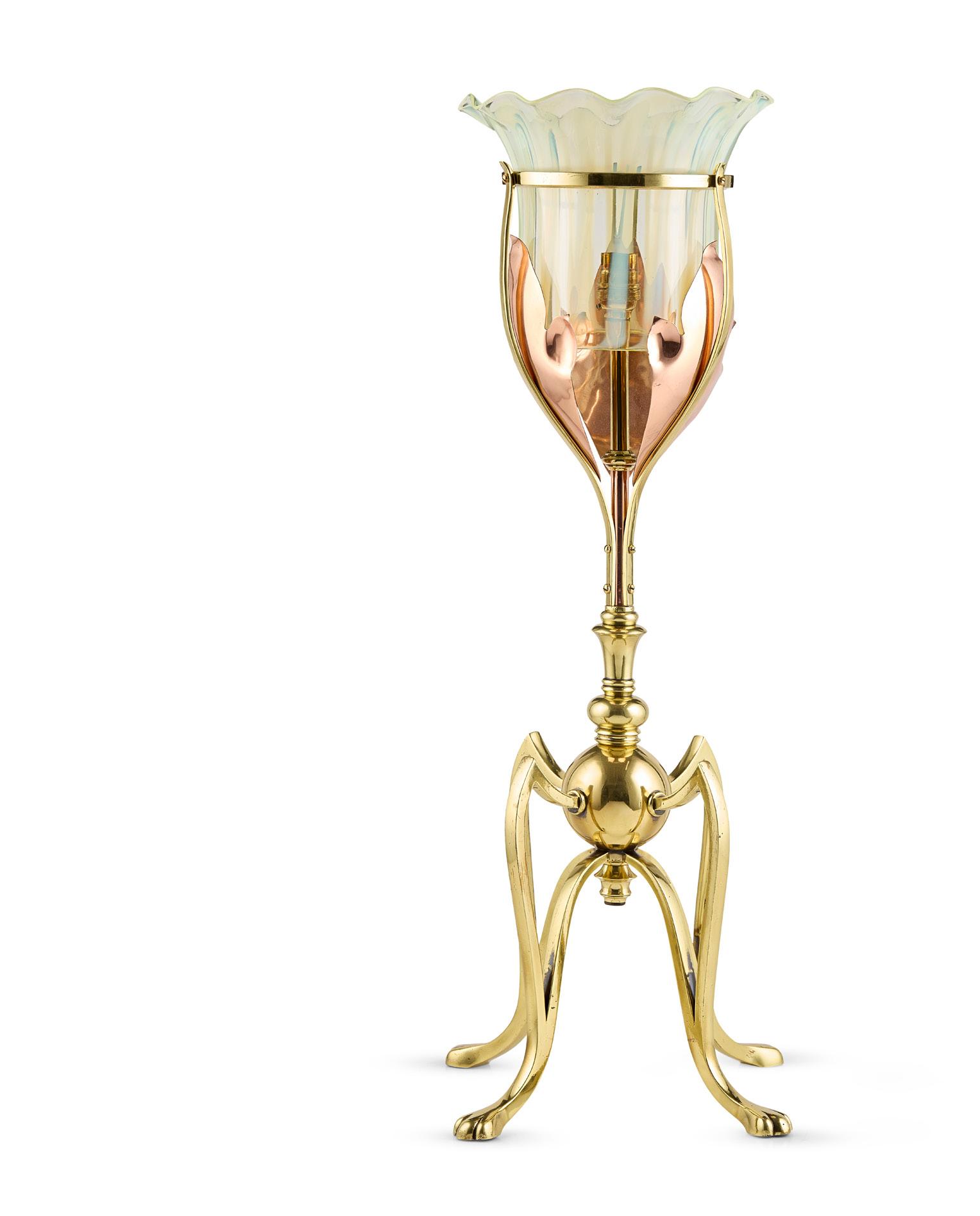
W. A. S. BENSON (1854-1924)
ARTS & CRAFTS TABLE LAMP, CIRCA 1900 copper, brass, with opalescent glass shade, stamped maker’s mark
69.5cm high
Literature: Hamerton I. (ed.) W. A. S. Benson: Arts and Crafts Luminary and Pioneer of Modern Design, ACC 2005, p. 248, pl. 2, where this design is illustrated (116)
£600-800
127
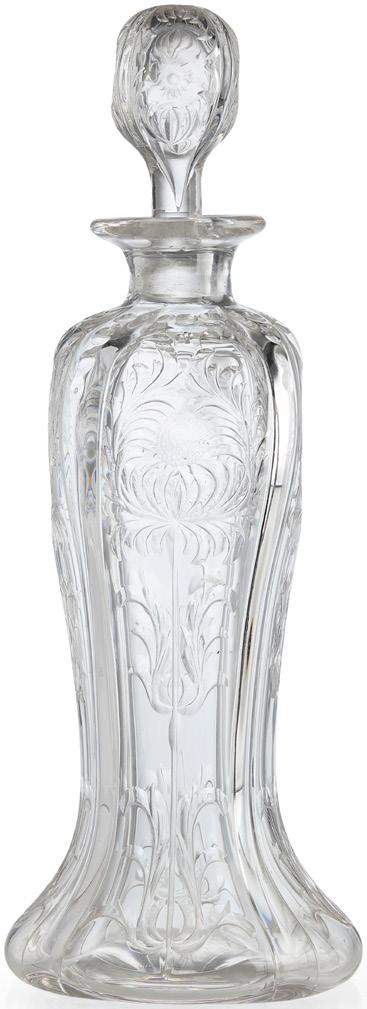
ATTRIBUTED TO STEVENS & WILLIAMS, STOURBRIDGE
ART NOUVEAU DECANTER, CIRCA 1910
cut-glass
32cm high
£300-500
129
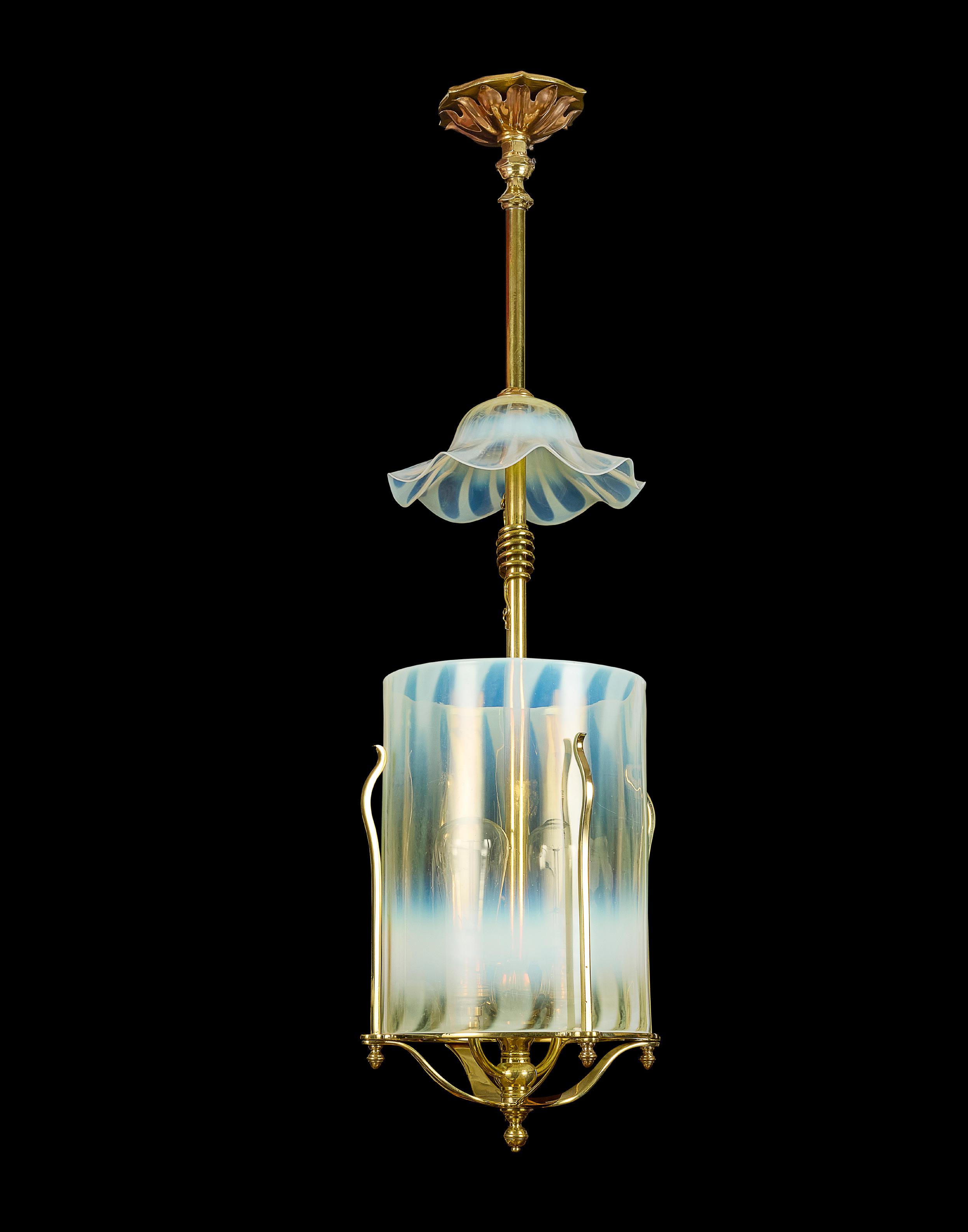
W.A.S. BENSON (1854-1924)
ARTS & CRAFTS LANTERN, CIRCA 1900 brass, copper, opalescent glass
97cm high, 29cm diameter
Literature: Hamerton I. (ed.) W. A. S. Benson: Arts and Crafts Luminary and Pioneer of Modern Design, Woodbridge, 2005, p. 252, pl. 19 where the design for this light is illustrated (No. 105).
£4,000-6,000
130
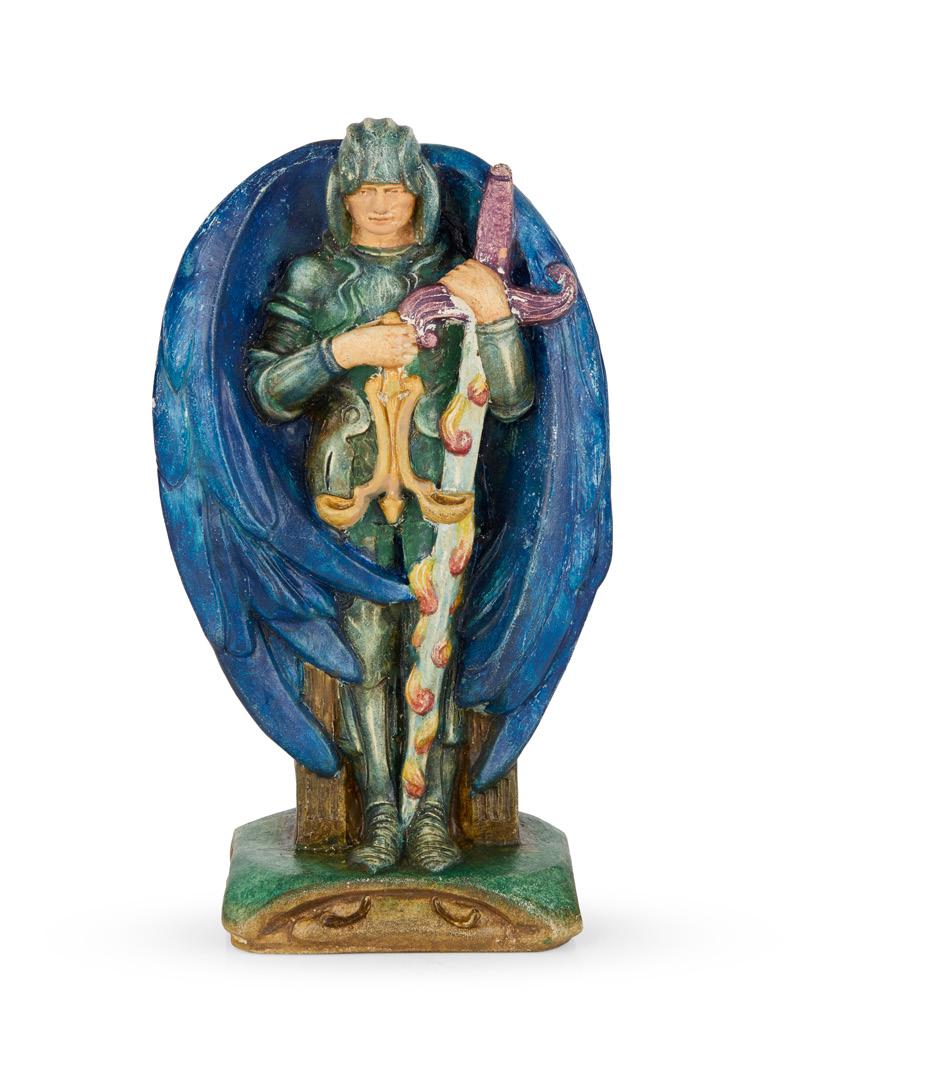
MARY SETON WATTS (1849-1938) FOR COMPTON POTTER’S GUILD
FIGURE OF ST MICHAEL, CIRCA 1900 tempera-glazed pottery
19cm high
Literature: Calvert H. & Boreham L. Mary Seton Watts and the Compton Pottery, London, 2019, p. 208, where a similar figure is illustrated.
£300-500
131
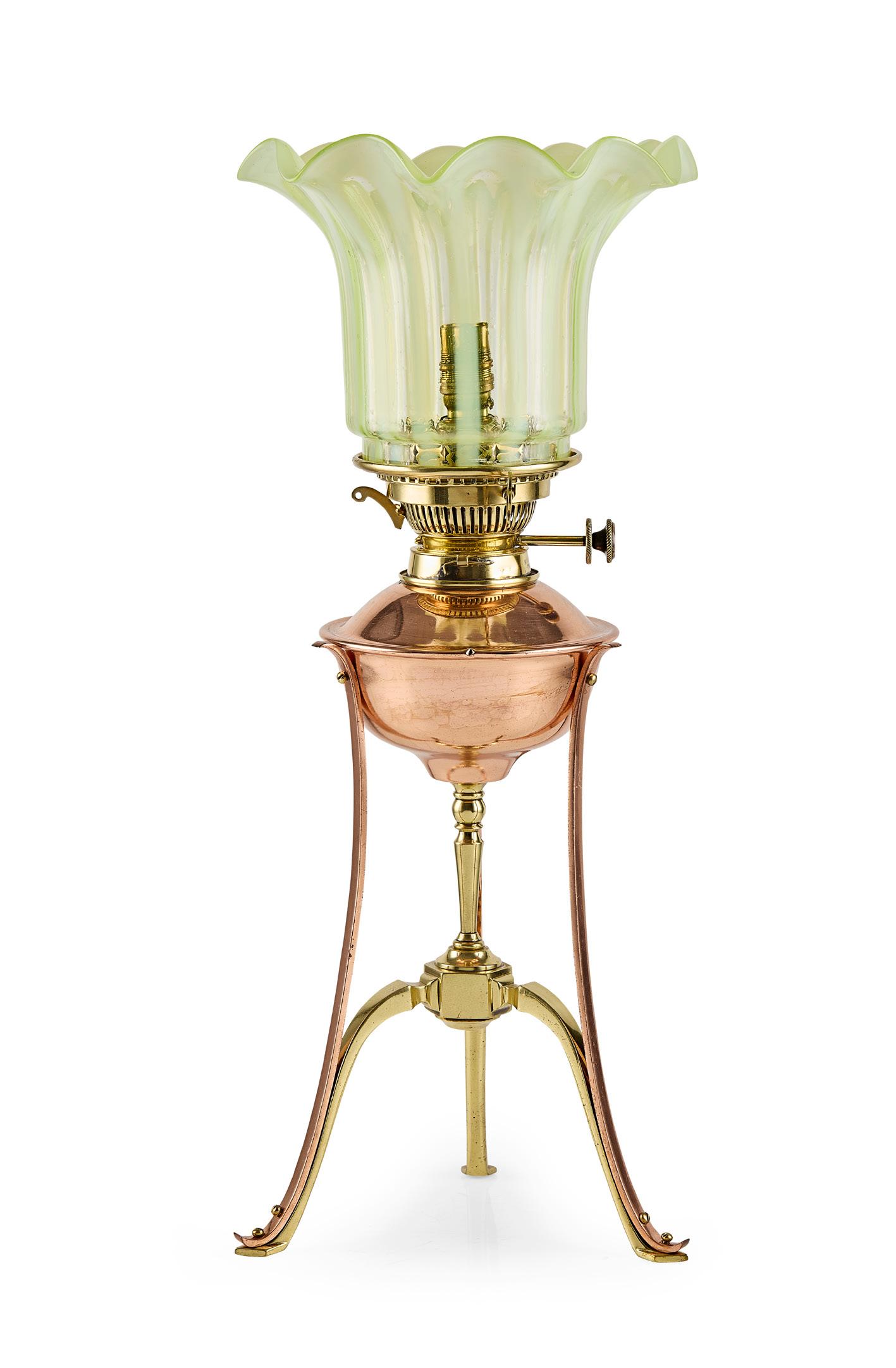
W. A. S. BENSON (1854-1924)
ARTS AND CRAFTS OIL LAMP, CIRCA 1890
copper, brass, with opalescent glass shade, stamped maker’s mark, Hinks & Son reservoir registration no. 65891, later converted to electricity
52.5cm high
Literature: Hamerton I. (ed.) W. A. S. Benson: Arts and Crafts Luminary and Pioneer of Modern Design, ACC 2005, p. 248, pl. 3, where this design is illustrated (156).
£400-600
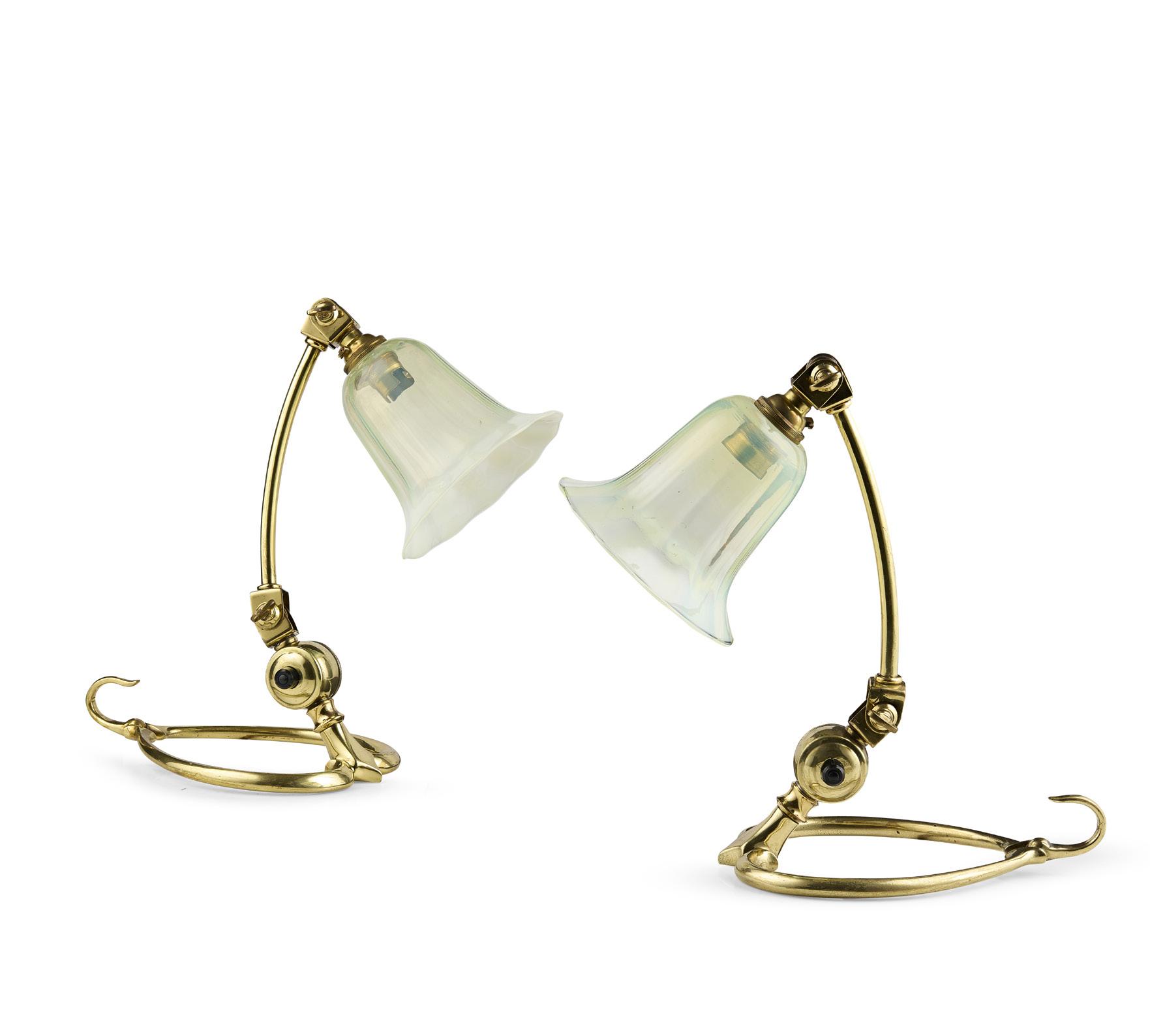
132
W. A. S. BENSON (1854-1924)
PAIR OF ARTS & CRAFTS ADJUSTABLE TABLE LAMPS, CIRCA 1910 brass, with opalescent glass shades, stamped maker’s marks, MN (2) 27cm high
Literature: Hamerton I. (ed.) W.A.S. Benson: Arts & Crafts Luminary and Pioneer of Modern Design, ACC 2005, p.151, pl. 132, where a similar example is illustrated.
£500-700
133
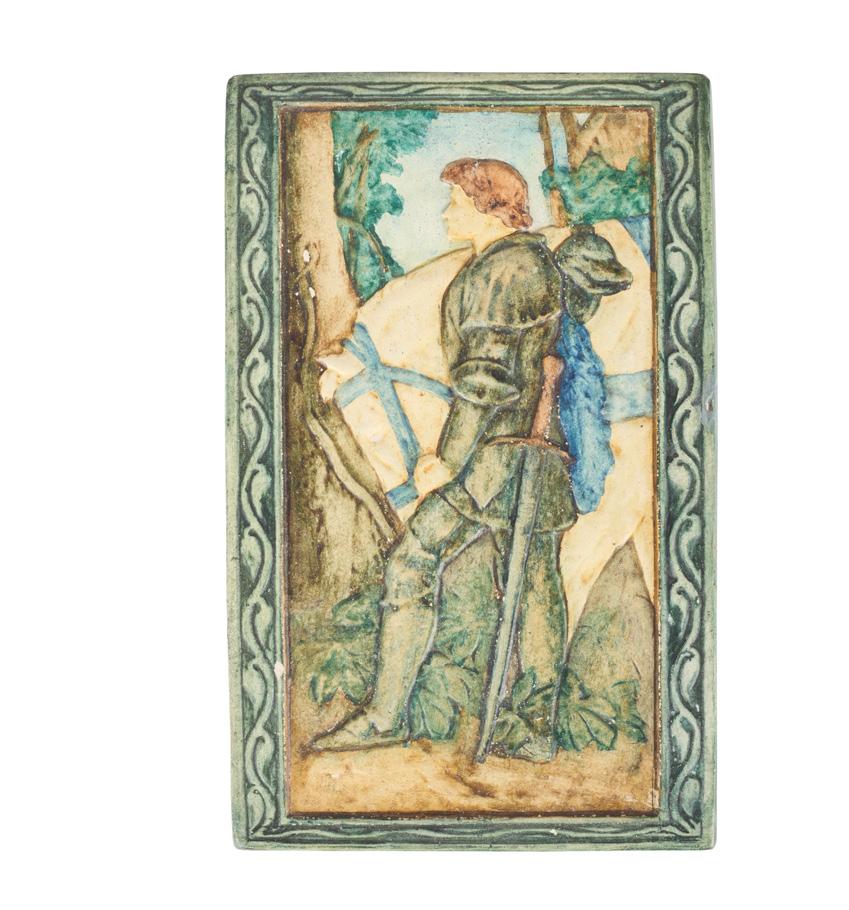
MARY SETON WATTS (1849-1938) FOR COMPTON POTTER’S GUILD
PLAQUE OF SIR GALAHAD, CIRCA 1920
tempera-painted pottery, impressed maker’s mark
18.5cm x 11cm
Literature: Calvert H. & Boreham L. Mary Seton Watts and the Compton Pottery, London, 2019, p. 213, where a similar plaque is illustrated.
£200-300
135
JOHN PEARSON (1859-1930)
ARTS & CRAFTS CHARGER, 1902
repoussé-decorated copper, signed and dated J.P. 1902
34.5cm diameter
£300-500
134
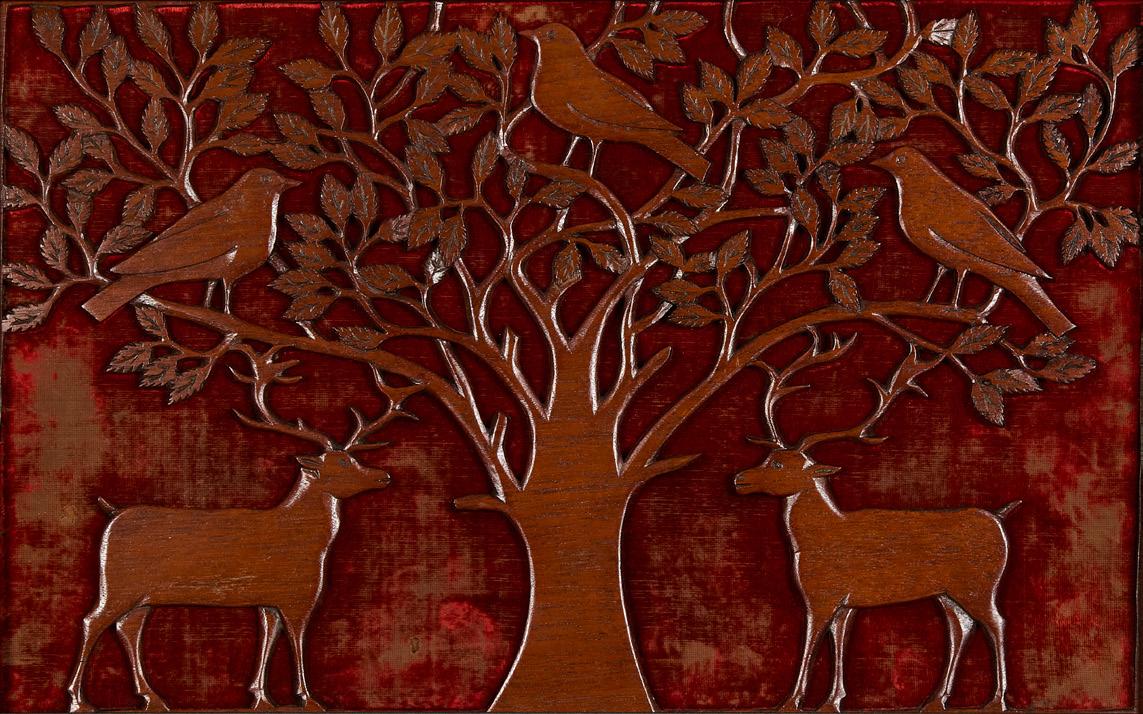
MANNER OF C.F.A. VOYSEY
FILIGREE PANEL, CIRCA 1900
carved and pierced wood reserved on a velvet ground, later framed 29cm x 45cm (frame size 37.5cm x 53.5cm)
£400-600
136
C.F.A. VOYSEY (1857-1941) FOR THOMAS ELSLEY AND CO. PAIR OF ARTS & CRAFTS FIREDOGS, CIRCA 1900 brass, one stamped (twice) 15, the other stamped (twice) 21 (2)
17cm wide, 30.5cm high, 18cm deep
Literature: Livingstone K., Donnelly M., and Parry L C.F.A. Voysey, Arts & Crafts Designer, V&A 2016, p. 259, pl. 334 where similar examples are illustrated.
£1,000-1,500
138
137
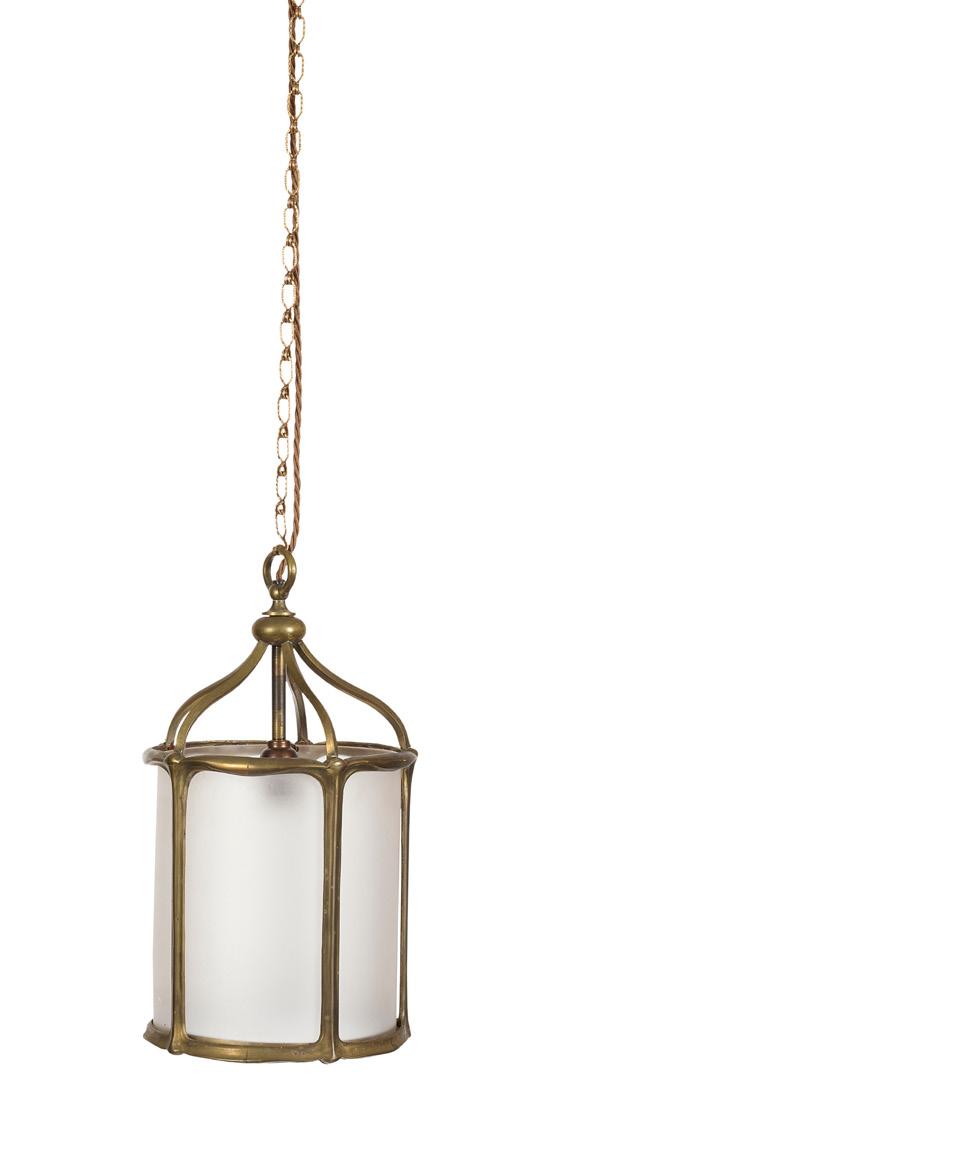
ATTRIBUTED TO BEST & LLOYD, BIRMINGHAM
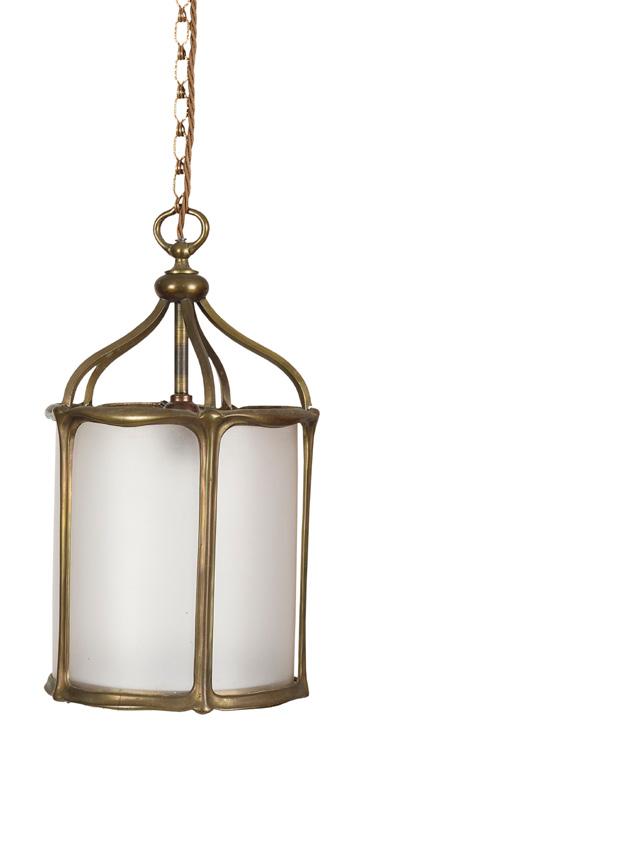
PAIR OF ARTS & CRAFTS LANTERNS, CIRCA 1900 brass, frosted glass, each with ceiling rose (2)
19cm diameter, 33cm high
£400-600
ENGLISH, MANNER OF H.M. BAILLIE-SCOTT
ART NOUVEAU OVERMANTEL
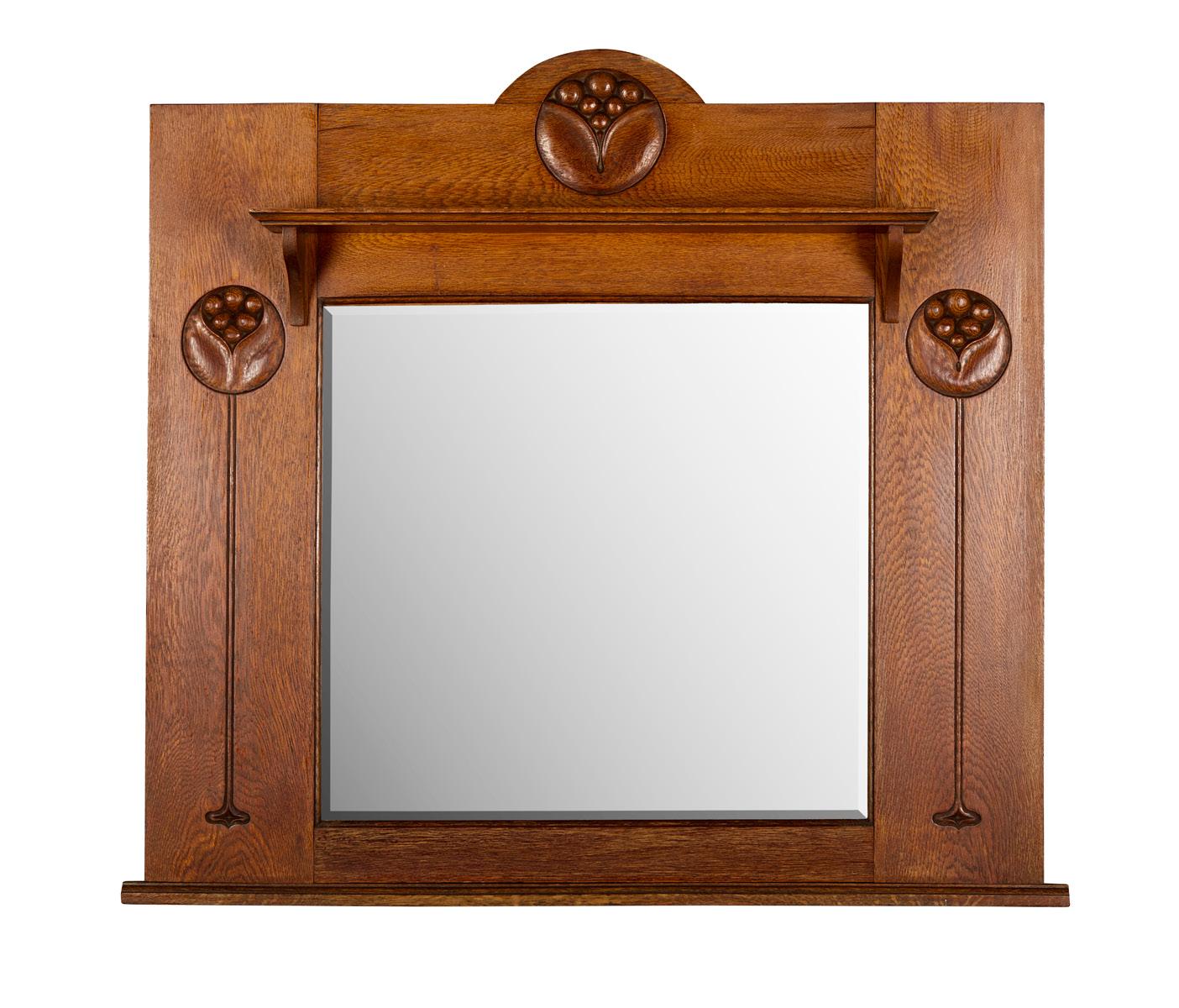
MIRROR, CIRCA 1900
oak, with bevelled mirror plate
92.5cm wide, 83.5cm high
£300-500
139
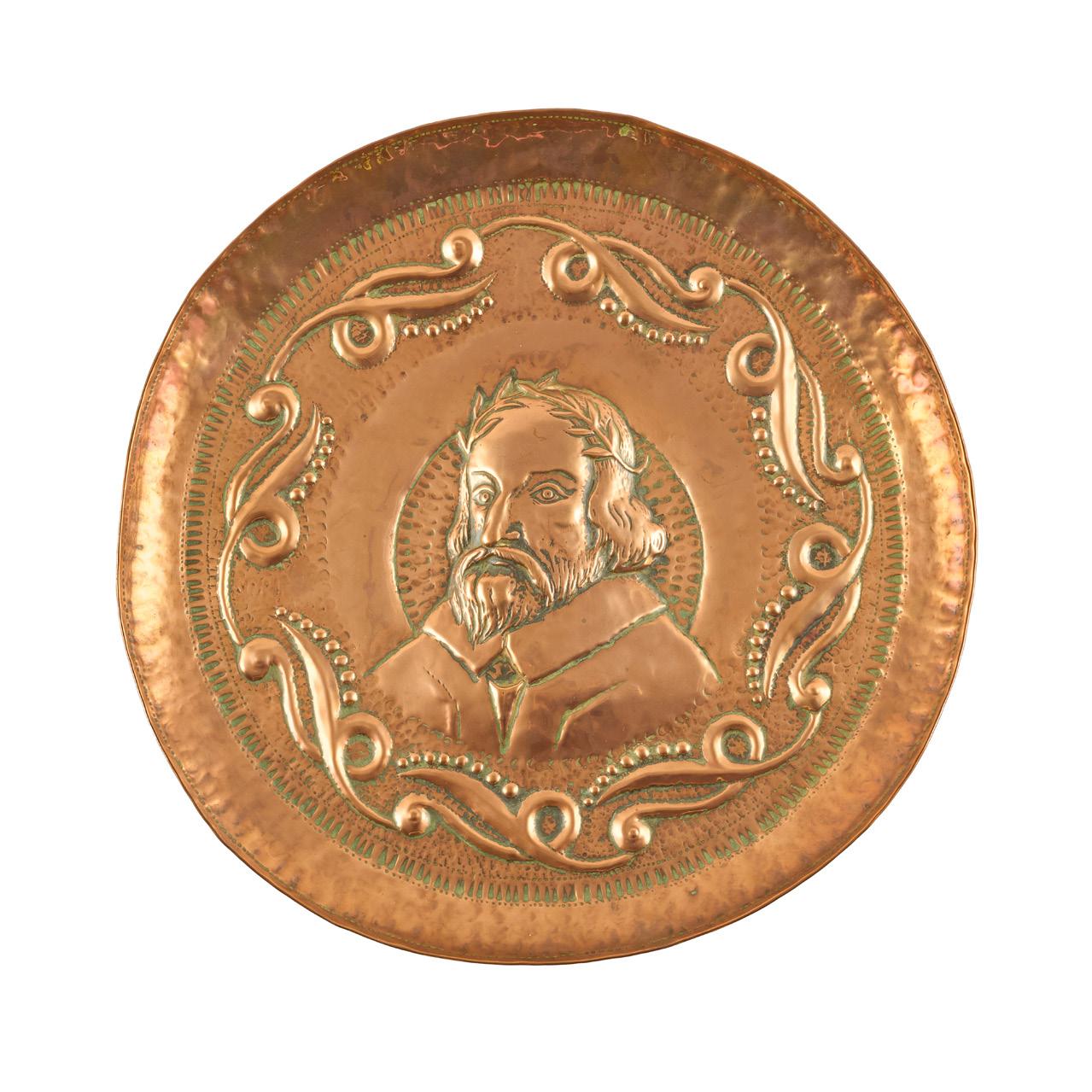
ATTRIBUTED TO THE GUILD OF HANDICRAFT LTD.
ARTS & CRAFTS CHARGER, CIRCA 1900
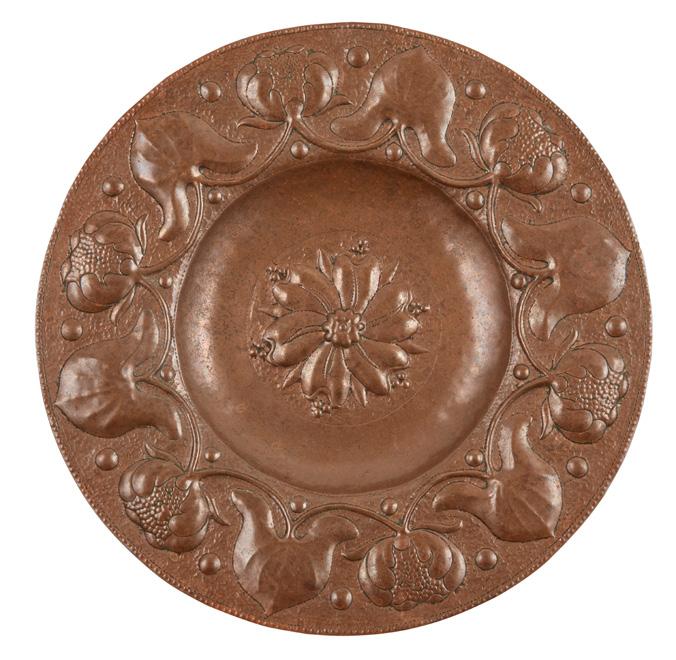
repoussé-decorated copper
41cm diameter
£400-600
140
LEEK EMBROIDERY SOCIETY
ARTS & CRAFTS EMBROIDERED PANEL, CIRCA 1880
coloured silks and gold thread reserved on an unbleached linen ground, within a glazed and carved oak firescreen frame 79cm wide, 86cm high
The Leek Embroidery Society was founded in 1879 by Elizabeth Wardle, wife of (later Sir) Thomas Wardle, the textile printer who was a friend and collaborator of Morris. Leek Embroidery Society work was sold in the Morris & Co. shop in Oxford Street, and similar firescreens are illustrated in Morris & Co. catalogues.
£400-600
141
MANNER OF W. A. S. BENSON
ARTS & CRAFTS CEILING LIGHT, CIRCA 1900
copper, brass, with copper ceiling rose
44.5cm diameter, 31cm high (excluding later chain)
£400-600
142
RICHARD LLEWELLYN RATHBONE (1864-1939)
ARTS & CRAFTS DINING ROOM CABINET, CIRCA 1890
fruitwood, with bronze fittings
170cm wide, 176.5cm high, 53.5cm deep
£800-1,200
143
MANNER OF C. F. A. VOYSEY ARTS & CRAFTS PORTIÈRE, CIRCA 1900
woven linen, with later linen lining, brocade edging to two sides and hanging rings
249cm x 130cm
£300-500
144
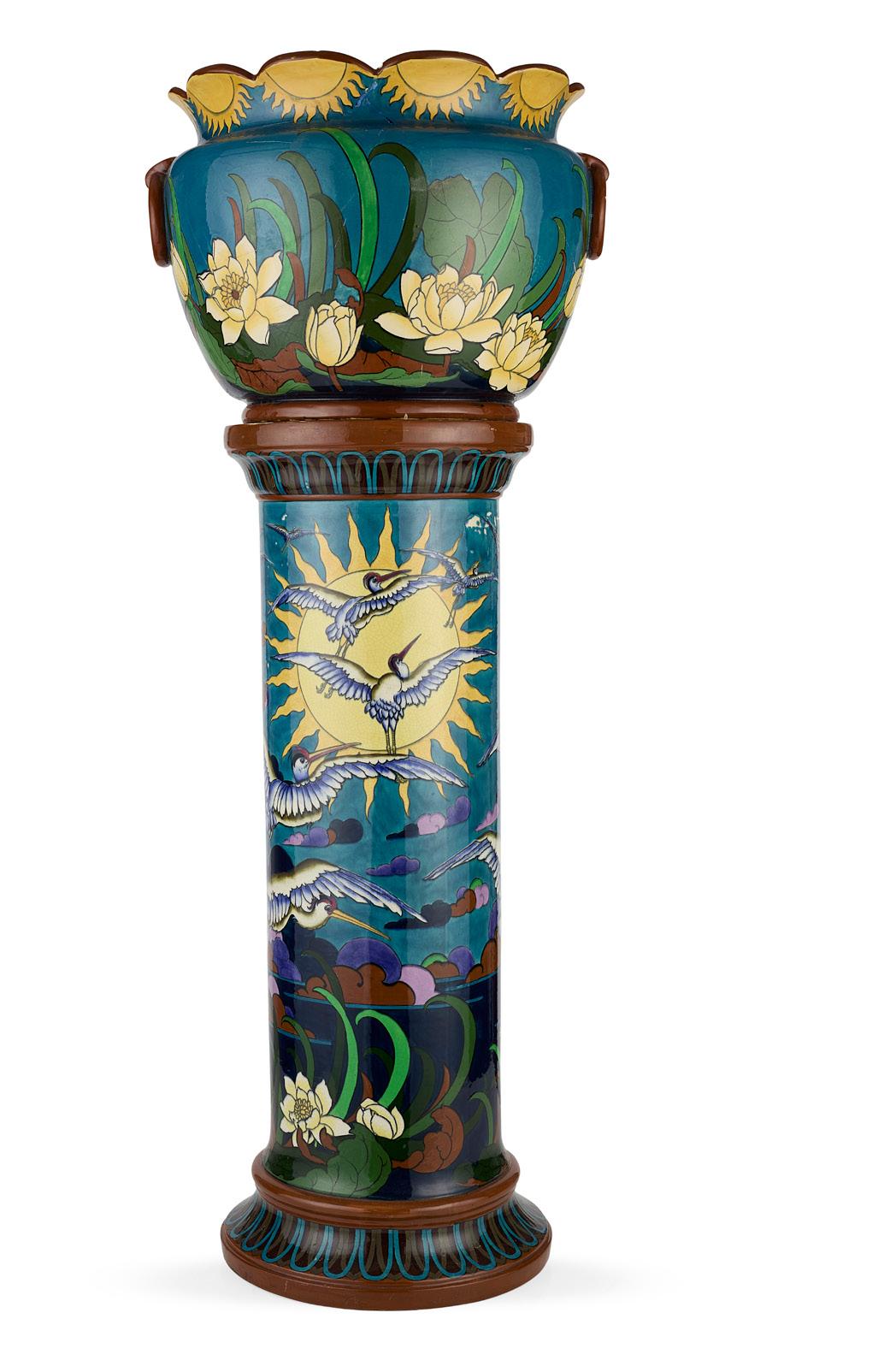
FREDERICK RHEAD (1880–1942) FOR WILEMAN & CO ‘INTARSIO’ JARDINIÈRE ON STAND, CIRCA 1900 glazed, stamped maker’s mark and registration number 330299
35cm wide, 100cm high
£400-600
145
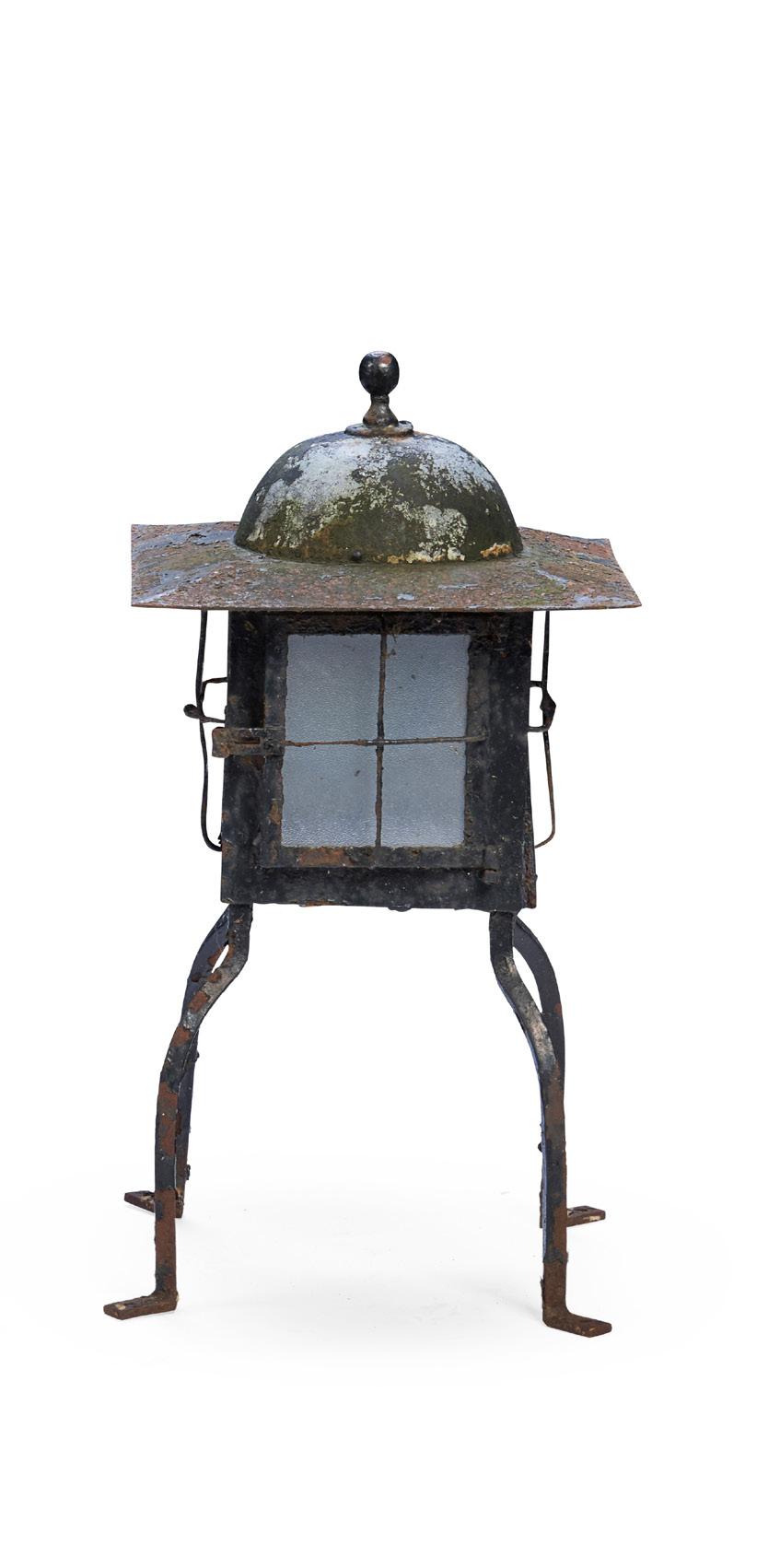
ENGLISH PAIR OF ARTS & CRAFTS GATEPOST LANTERNS, CIRCA 1900
painted cast and wrought iron, with frosted glass (2)
37.5cm square, 73cm high
£600-800
148 Y
MANNER OF KENTON & CO.
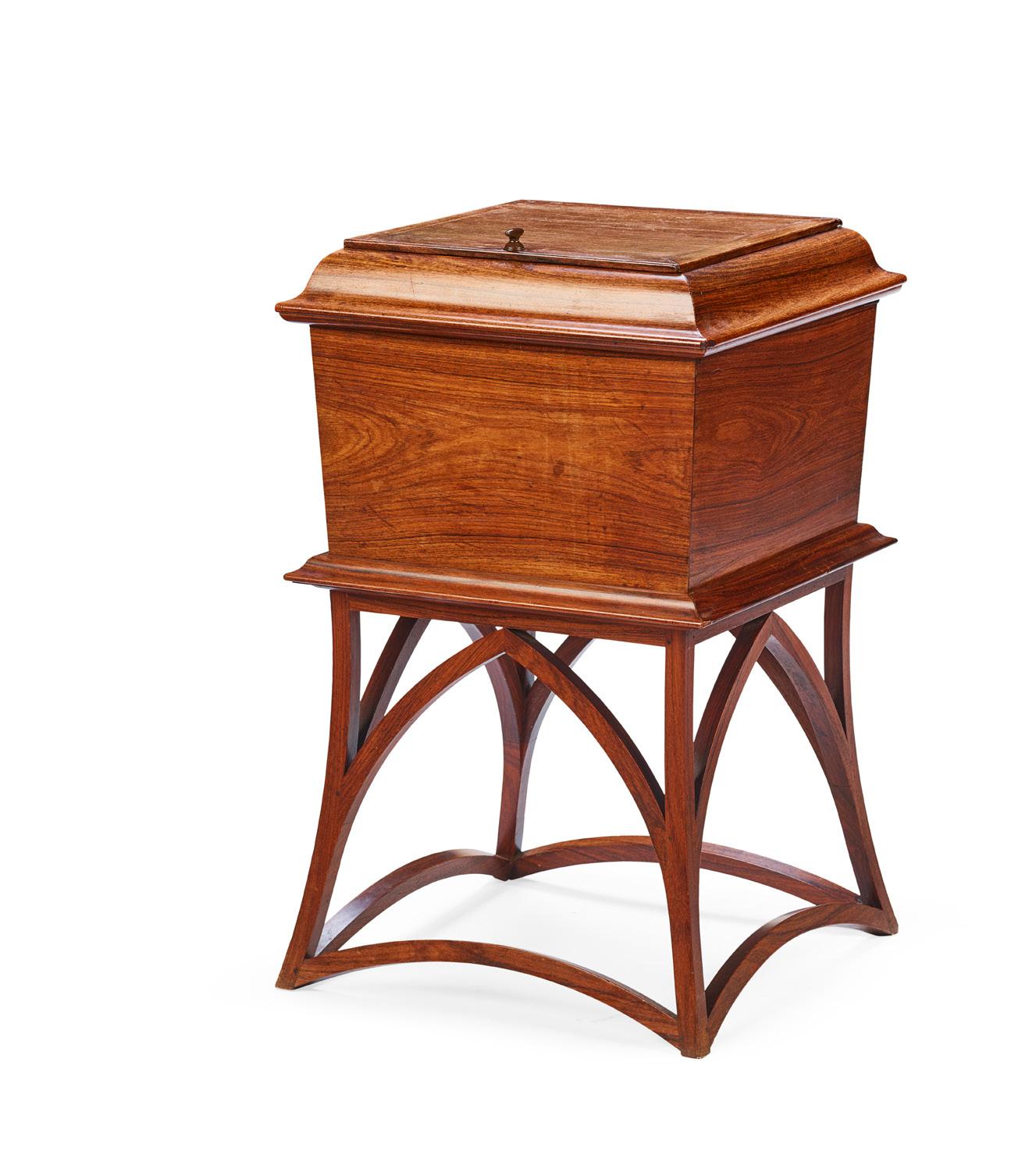
WORK BOX ON STAND, LATE 19TH CENTURY
rosewood, with patinated brass fitting, the hinged lid enclosing a fitted interior, with further void below 41.2cm wide, 67cm high, 41.2cm deep
Provenance: Private collection, London
Although unmarked, this small and unusual workbox and stand demonstrates similarities to furniture made by the short-lived firm Kenton and Co. in the early 1890s. The firm was made up of a partnership of designers and architects, including Mervyn Macartney, Sidney Barnsley, Reginald Blomfield, William Lethaby, Ernest Gimson, Stephen Webb and Colonel Harold Esdaile Malet (a sleeping partner who ‘had taste and knew people’). It was formed in 1890 ‘with the object of designing, making and supplying furniture of excellent quality’.
£500-700
146
ENGLISH
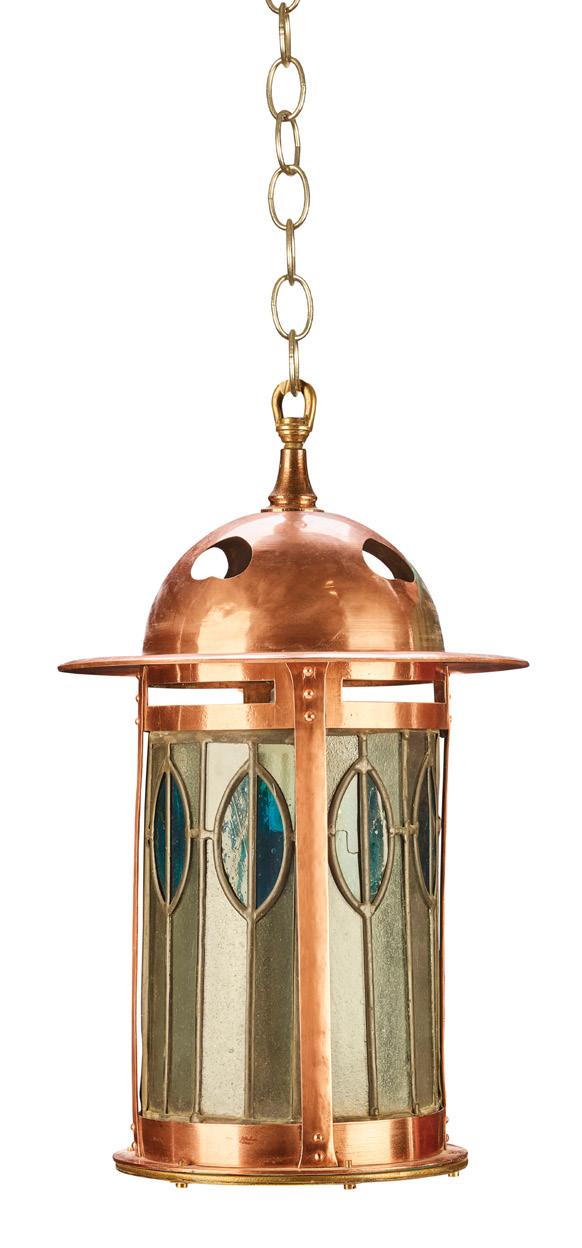
ARTS & CRAFTS HALL LANTERN, CIRCA 1900
copper, with stained and leaded glass panels
35cm diameter, 55cm high
Provenance: Private collection, London
£400-600
147
ENGLISH
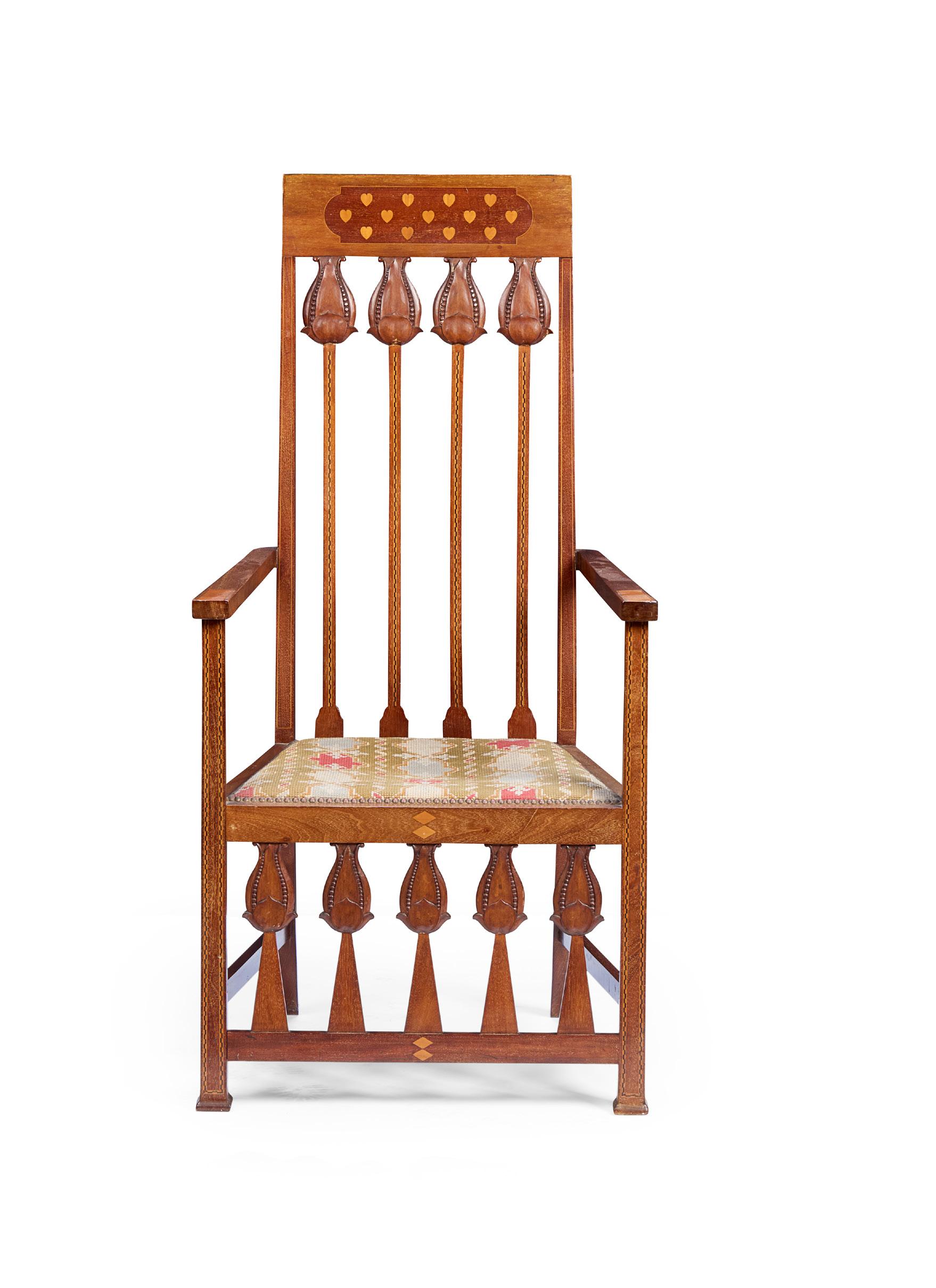
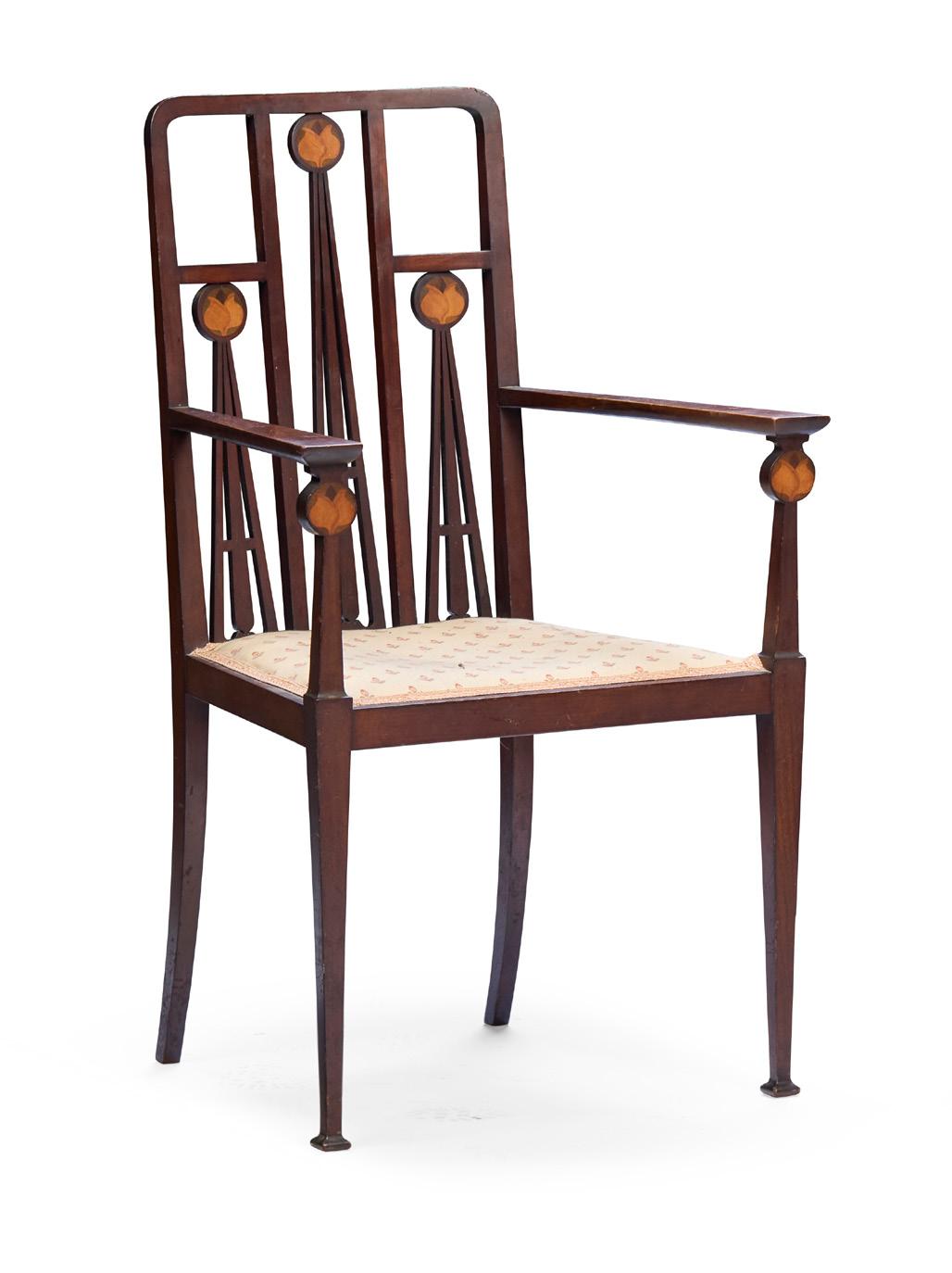
ART NOUVEAU ARMCHAIR, CIRCA 1910
inlaid mahogany, with close-nailed tapestry seat
57.5cm wide, 120cm high, 48.5cm deep
£400-600
149
ENGLISH
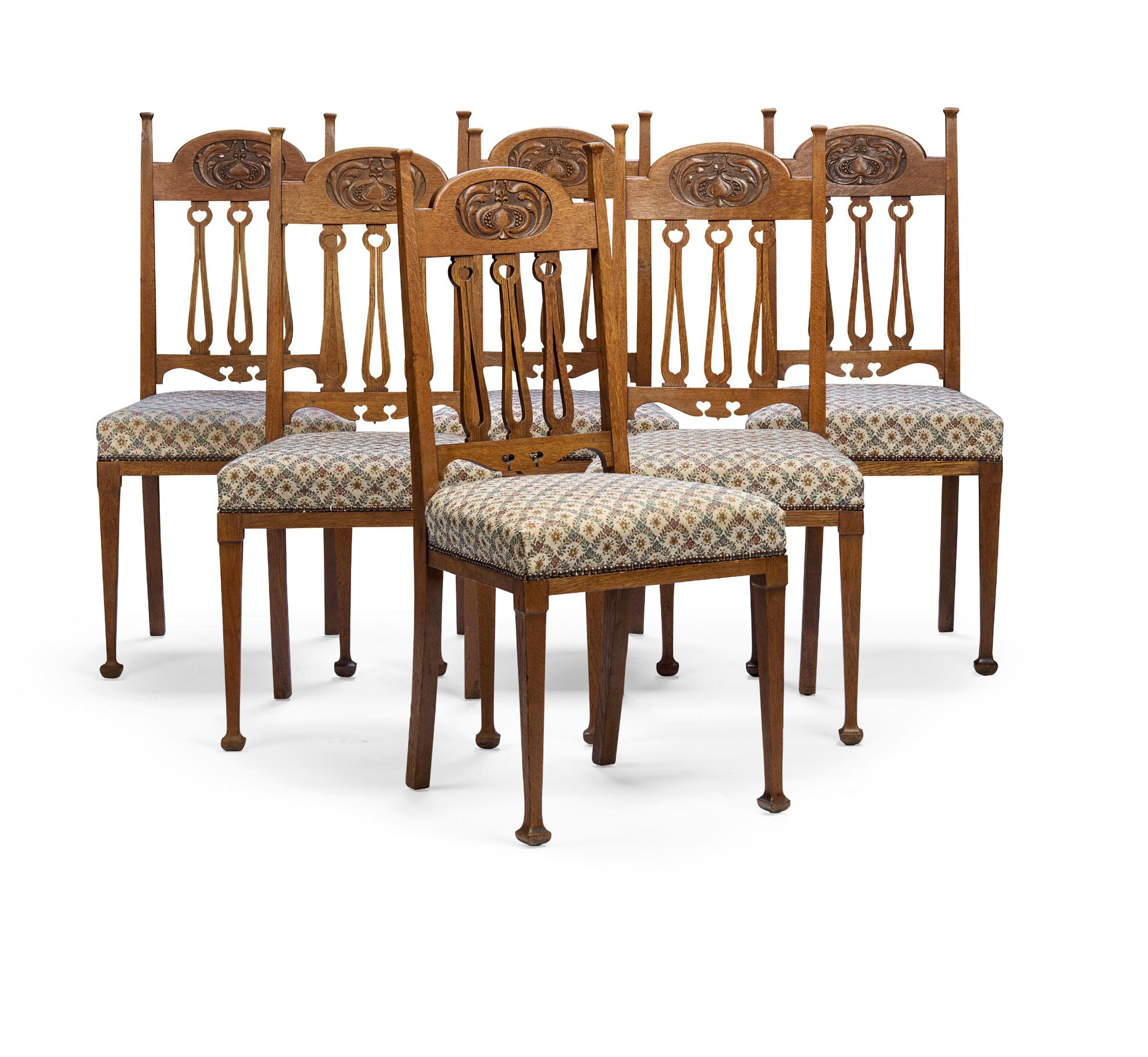
SET OF SIX ART NOUVEAU DINING CHAIRS, CIRCA 1900
oak and upholstery (6)
47cm wide, 103cm high, 46cm deep
£400-600
150
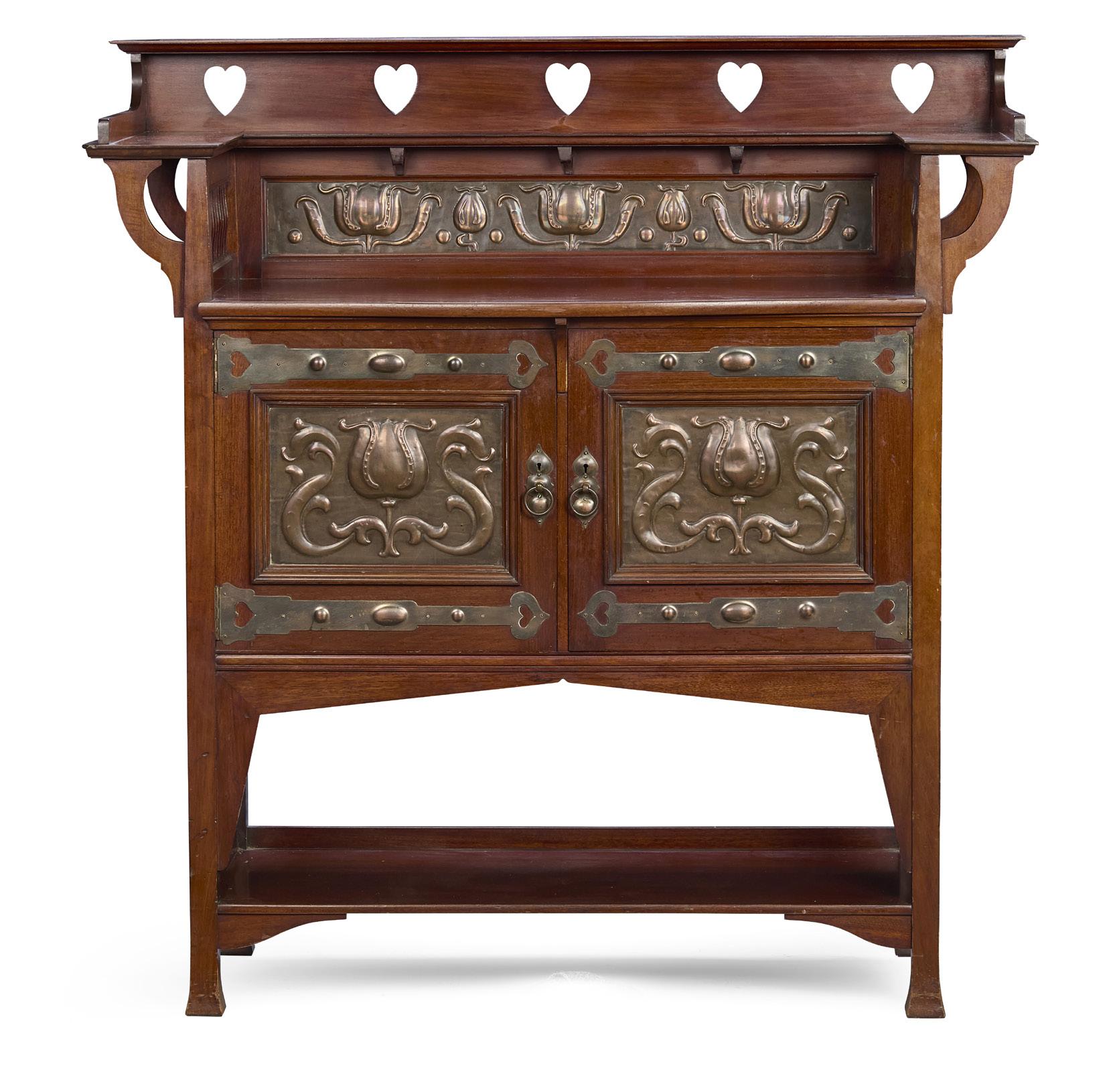
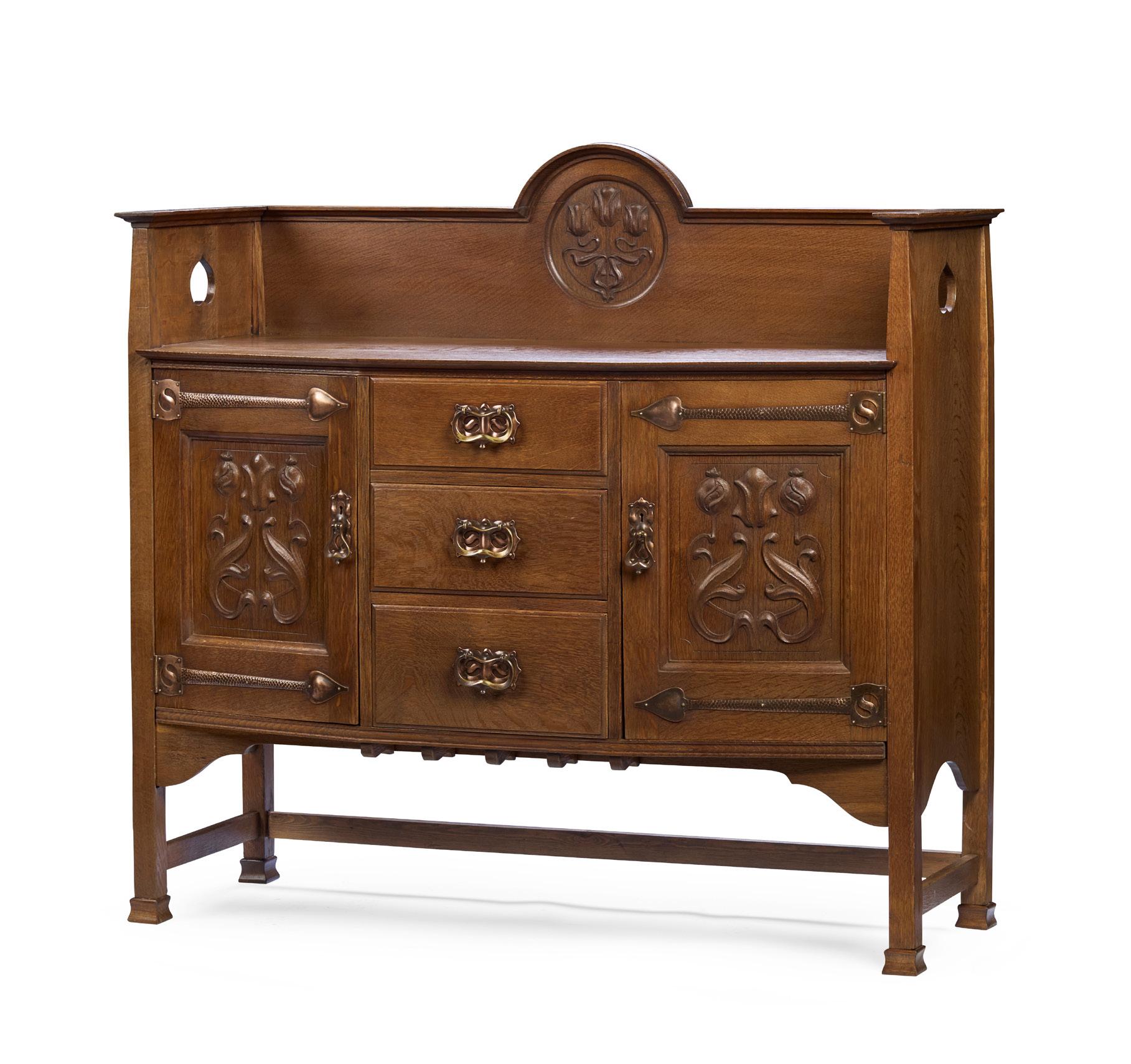
SHAPLAND AND PETTER, BARNSTAPLE SIDEBOARD, CIRCA 1900
mahogany, with embossed copper panels and fittings, stamped to locks S & P/ B
135.5cm wide, 139cm high, 54cm deep
Literature: Bennett D. Shapland & Petter Ltd. of Barnstaple: Arts & Crafts Furniture, Museum of Barnstaple 2005, p. 3, fig. 1.4, where this model (no.2125) is illustrated.
£400-600
151
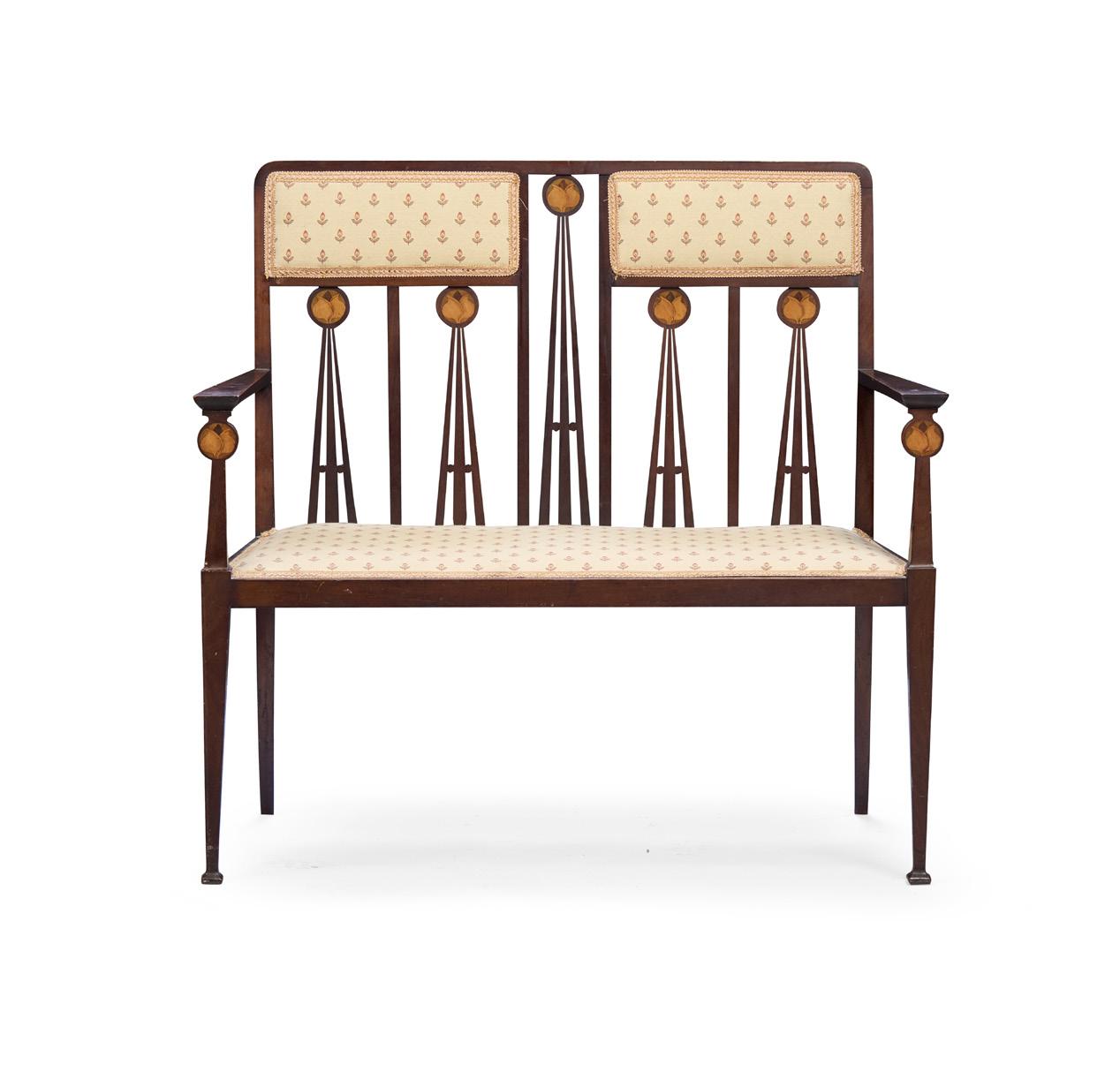
ATTRIBUTED TO GEORGE WALTON (1867-1933) FOR J. S. HENRY, LONDON THREE-PIECE PARLOUR SUITE, CIRCA 1910
inlaid mahogany, with close-nailed upholstery, comprising; a SETTEE, 104cm wide, 98cm high, 49cm deep; and TWO ARMCHAIRS, 58cm wide, 99cm high, 47cm deep (3)
Literature: Cooper, J., Victorian & Edwardian Furniture & Interiors, Thames & Hudson, London, 1987, p. 233, pls. 634 and 635
Walton designed the 1903 Arts & Crafts Exhibition Society stand for J.S. Henry, and, it is thought, this parlour suite.
£2,500-4,000
152
SHAPLAND & PETTER, BARNSTAPLE
ARTS & CRAFTS SIDEBOARD, CIRCA 1900
oak, with brass and copper fittings, stamped to back R2144 141cm wide, 133cm high, 59cm deep
£500-800
154
ENGLISH
153
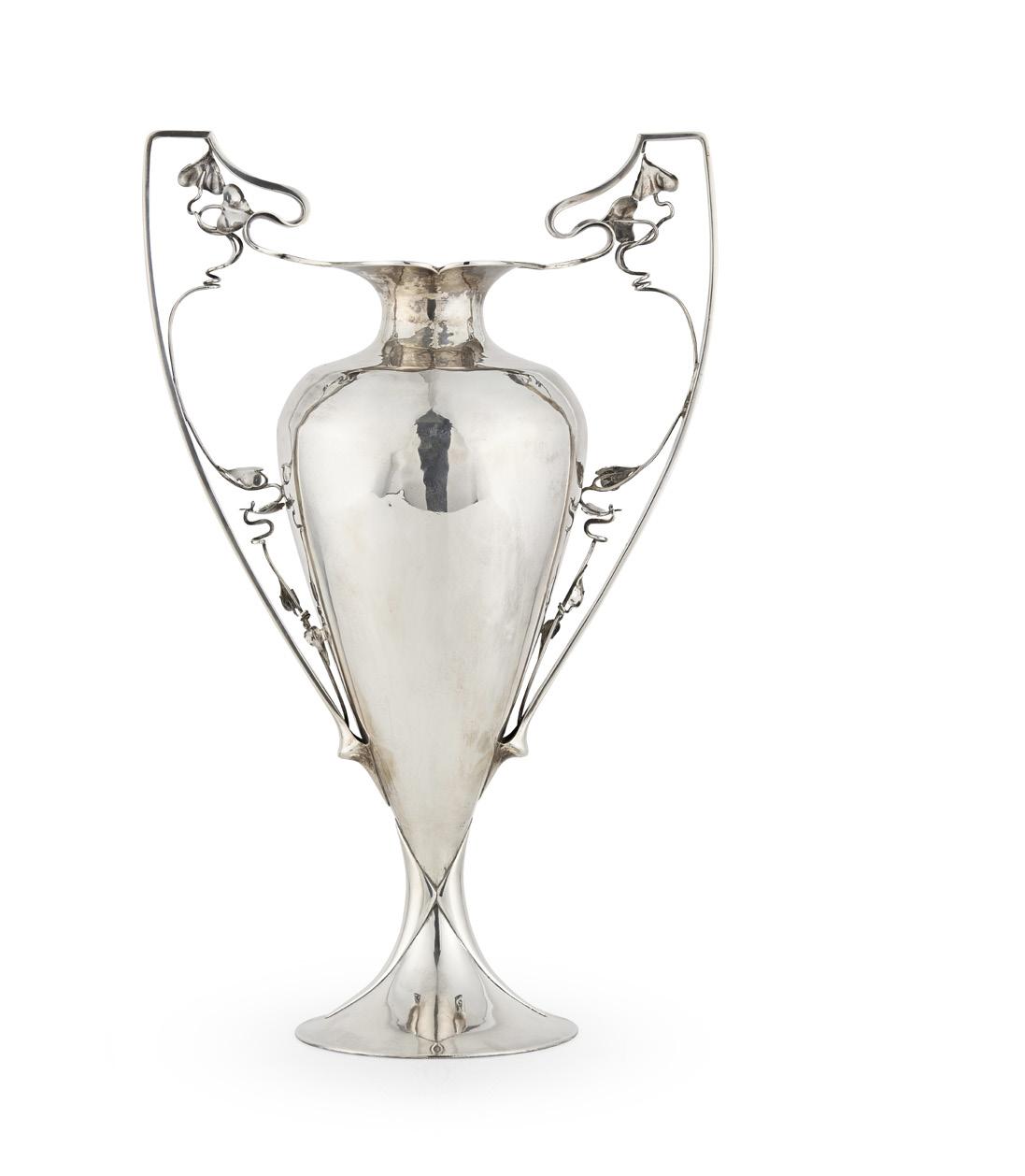
KATE HARRIS (1878-1949) FOR G.L. CONNELL LTD.
LARGE TWIN-HANDLED VASE, 1901
silver, stamped maker’s mark, hallmarked London 1901, 1527g
29cm wide, 46cm high
£2,500-3,000
ARTS NOUVEAU SIDEBOARD, CIRCA 1910
mahogany, inlaid with specimen woods and copper, with glazed doors and iron fittings
105cm wide, 198cm high, 44cm deep
£600-800
155
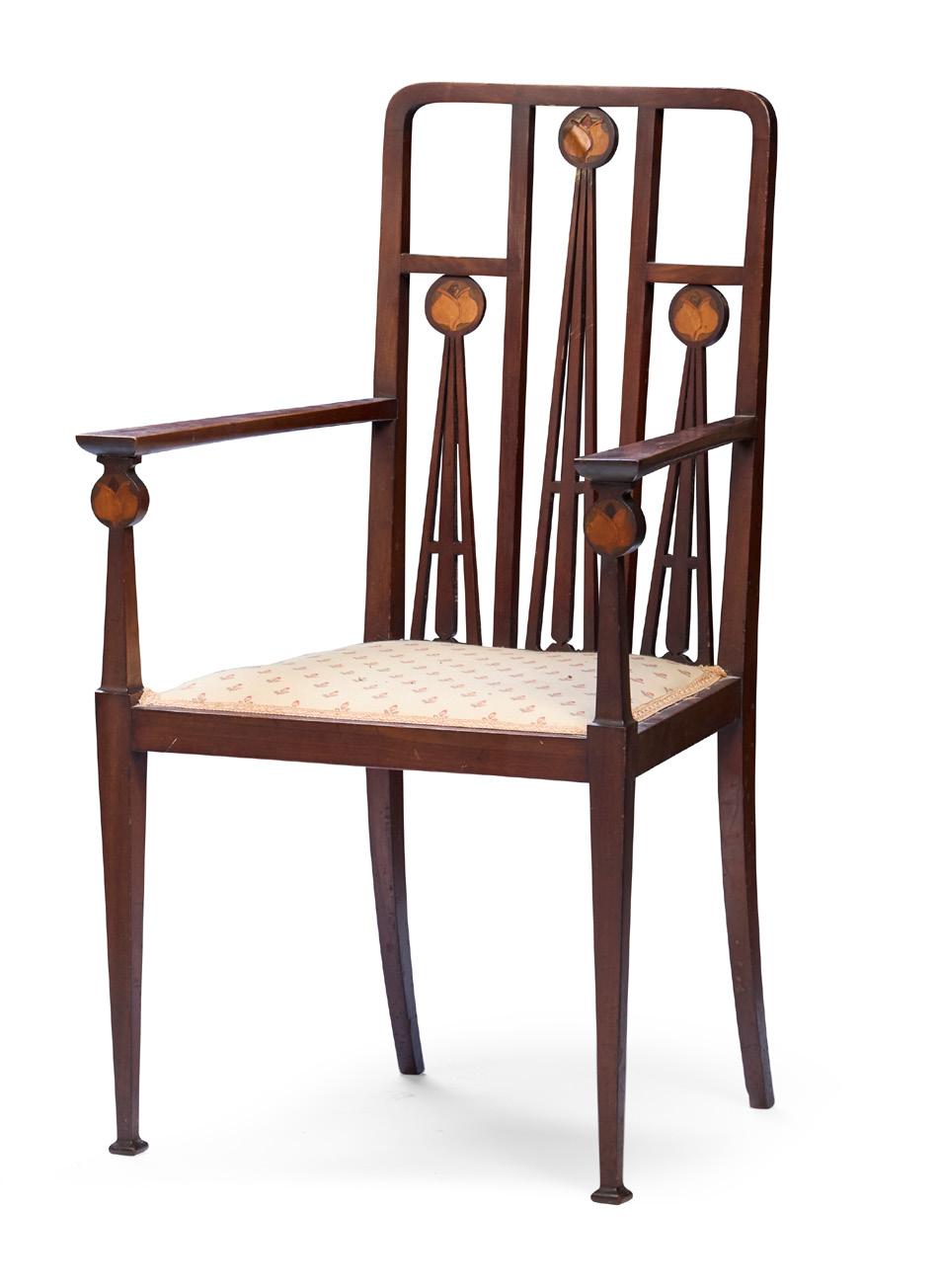
ENGLISH
ART NOUVEAU ARMCHAIR, CIRCA 1900
mahogany, with inlaid specimen woods and upholstered seat
54.5cm wide, 100cm high, 48cm deep
£300-500
156
KATE HARRIS (1878-1949) FOR WILLIAM HUTTON & SONS LTD.
ARTS & CRAFTS BOX, 1902
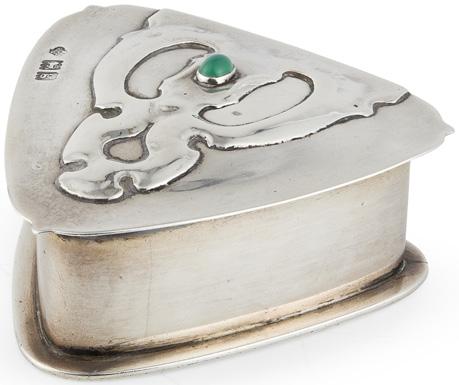
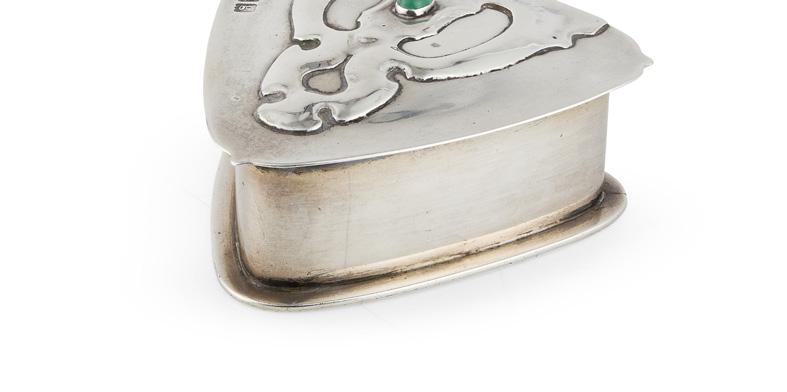
silver set with chrysoprase cabochons, cedar lining, stamped maker’s mark, hallmarked London 1902, 16.5cm wide, total weight 595g; together with KATE HARRIS (1878-1949) FOR WILLIAM HUTTON & SONS LTD., ARTS & CRAFTS
TRINKET BOX, 1902, silver, set with chrysoprase cabochon, stamped maker’s marks, hallmarked London 1902, 7cm across, total weight 102g (2)
£1,200-1,800
157
KATE HARRIS (1878-1949) FOR WILLIAM HUTTON & SONS LTD.
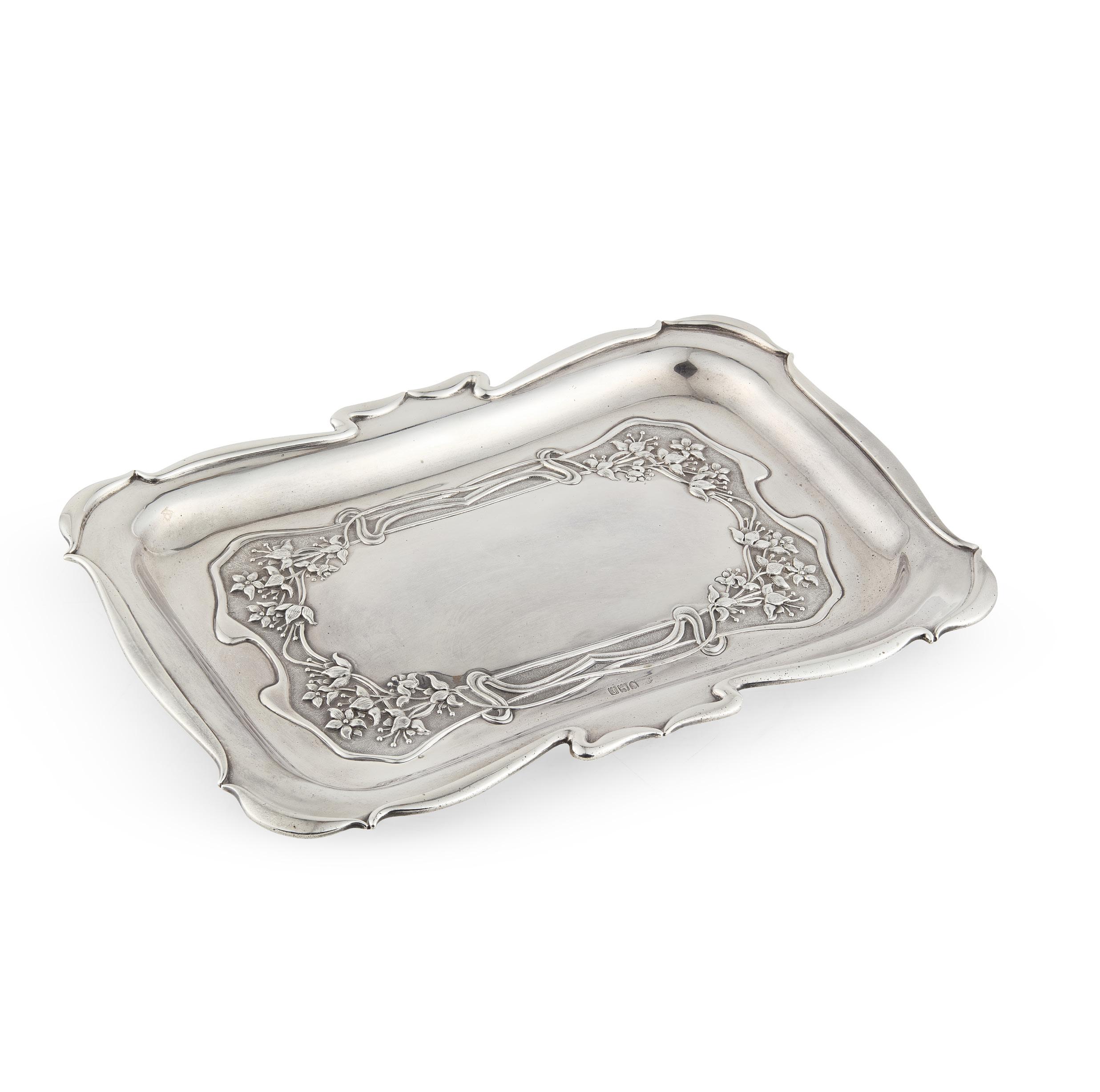
ARTS & CRAFTS TRAY, 1901
silver, stamped maker’s mark, hallmarked London 1901, 762g
32cm wide
£600-800
158
KATE HARRIS (1878-1949) FOR WILLIAM HUTTON & SONS LTD.
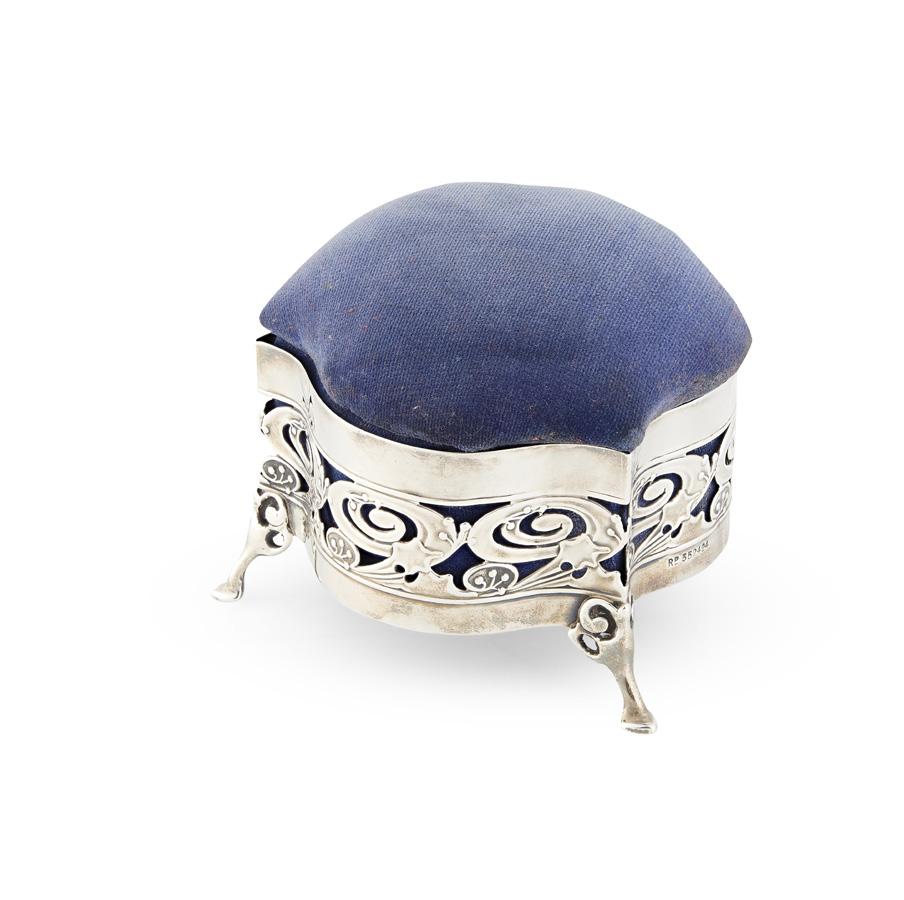
ARTS & CRAFTS PIN CUSHION BOX, 1903
silver and velvet, stamped maker’s marks, hallmarked Birmingham 1903
10cm diameter, 8cm high
£250-350
160
159
KATE HARRIS (1878-1949) FOR WILLIAM HUTTON & SONS LTD.
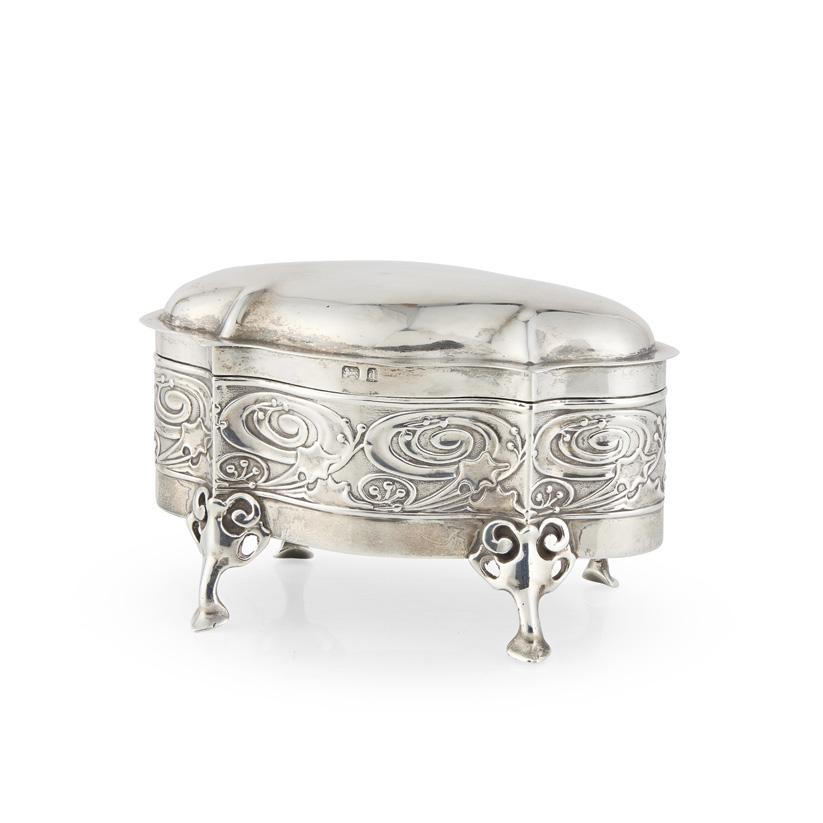
ARTS & CRAFTS TRINKET BOX & COVER, 1903
silver, silver silt, stamped maker’s mark, hallmarked Birmingham 1903, 145g 11.5cm wide
£300-500
KATE HARRIS (1878-1949) FOR WILLIAM HUTTON & SONS LTD.
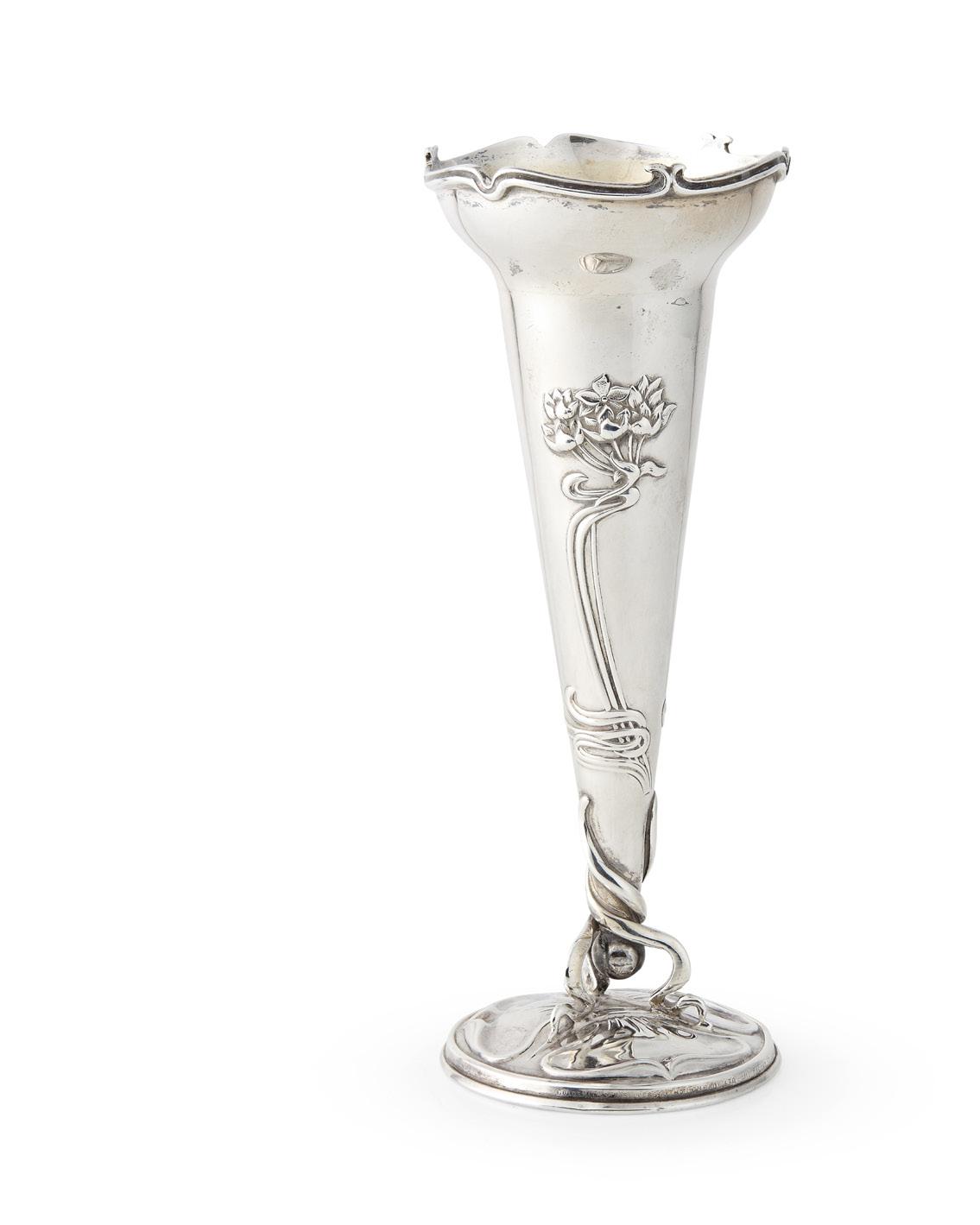
ARTS & CRAFTS VASE, 1901
silver, silver gilt, stamped maker’s mark, hallmarked London 1901, 160g 21cm high
£250-350
161
KATE HARRIS (1878-1949) FOR WILLIAM HUTTON & SONS LTD.
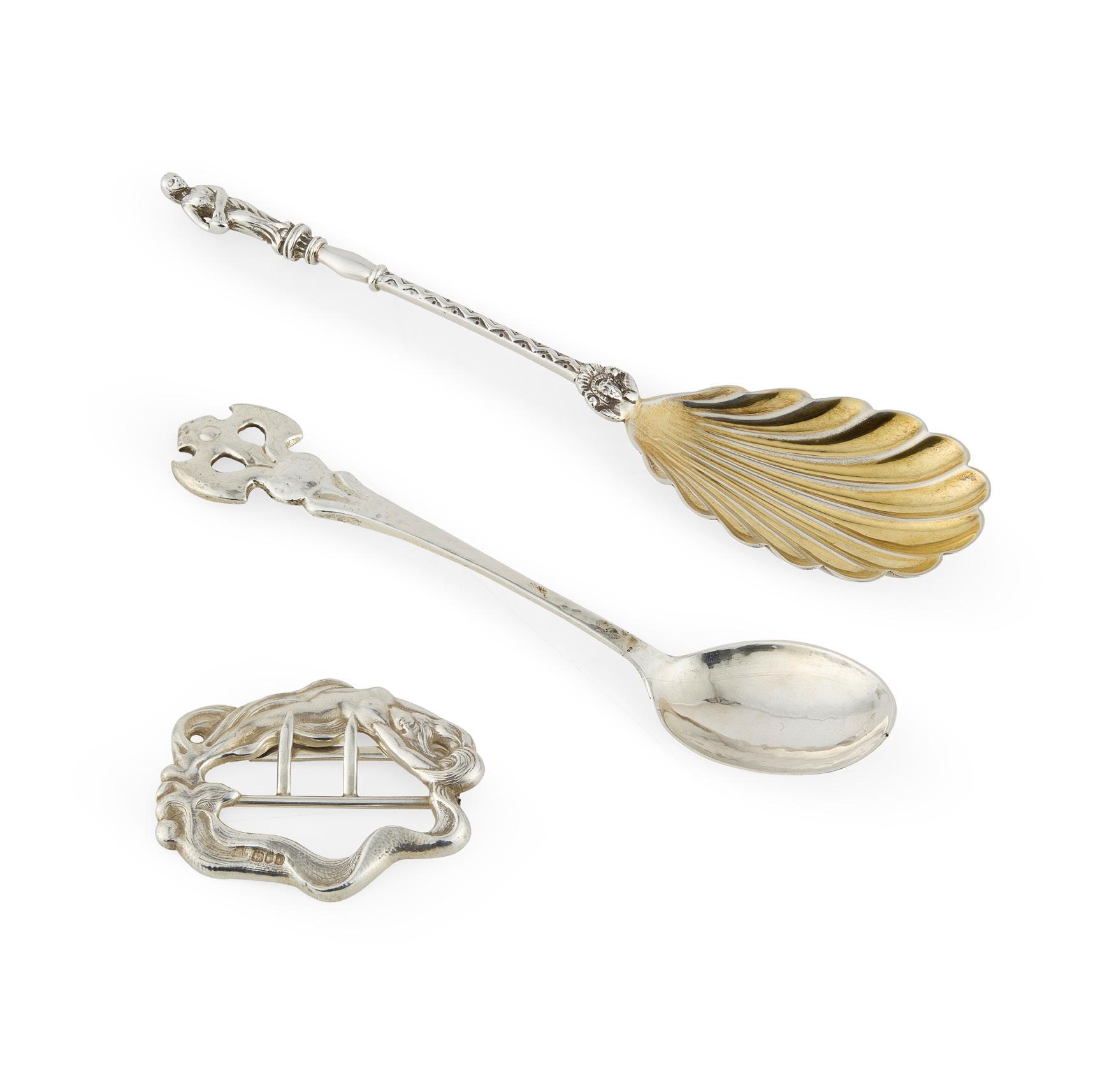
ARTS & CRAFTS BERRY SPOON, 1902
silver, stamped maker’s mark, hallmarked London 1902, 35g; together with a SEAL SPOON BY WILLIAM HUTTON & SONS LTD., 1900, silver and silver gilt, stamped maker’s mark, hallmarked London 1900, 49g, 19.2cm long; and a BELT BUCKLE BY WILLIAM HUTTON & SONS LTD., 1900, stamped maker’s mark, hallmarked London 1900, 27g, 6cm long (3)
£250-350
162
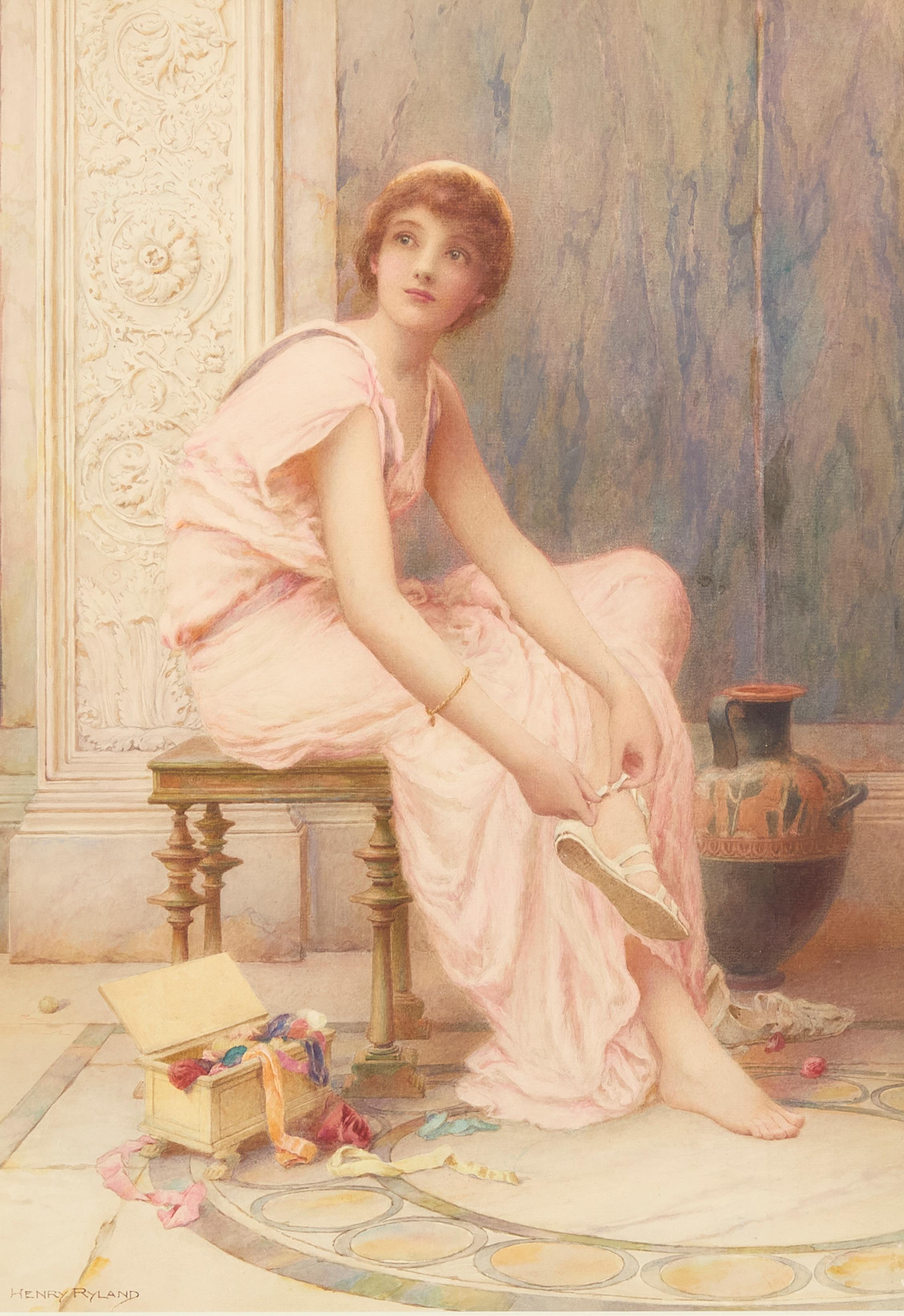
HENRY RYLAND (1856-1924)
‘A PLEASANT SURPRISE’ watercolour, signed lower left HENRY RYLAND
55cm x 39cm (frame size 85cm x 68cm)
£3,000-5,000
163
ATTRIBUTED TO KATE ALLEN FOR WILLIAM HUTTON & SONS LIMITED
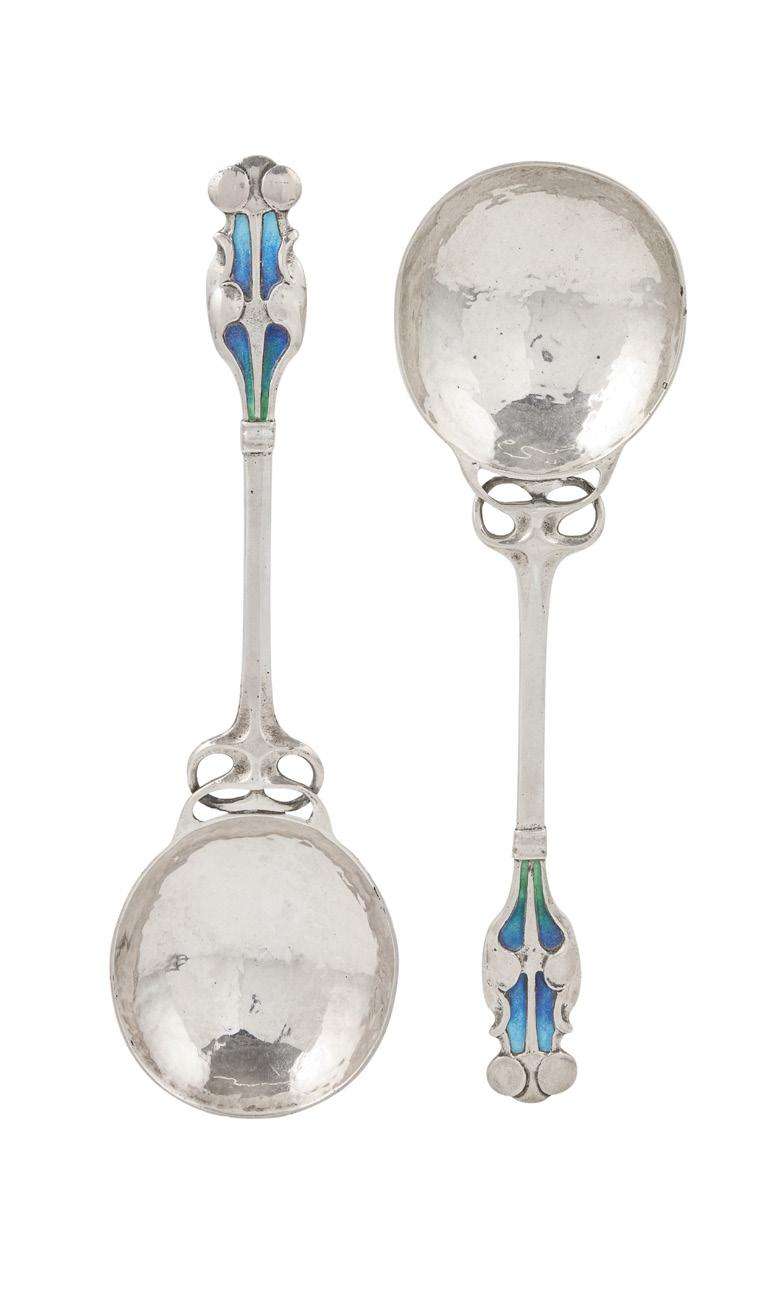
CASED PAIR OF SPOONS, 1903
silver, enamel, stamped maker’s marks, hallmarked London 1903, in Mappin & Webb case (2) spoons 18.3cm long
Literature: Moore S. Artists’ Spoons & Related Table Cutlery, FastPrint 2017, pp. 198-9 where related examples of spoons by Kate Allen are illustrated.
Kate Allen was a freelance jeweller and buckle maker often subcontracted by Hutton’s. She studied at Goldsmiths’ College, New Cross, London and was mentioned in The Studio magazine of 1899 in an article about The National Competition where she won a silver medal for her “dainty clasps and buckles”.
£800-1,200
164
ATTRIBUTED TO KATE ALLEN FOR WILLIAM HUTTON & SONS LIMITED
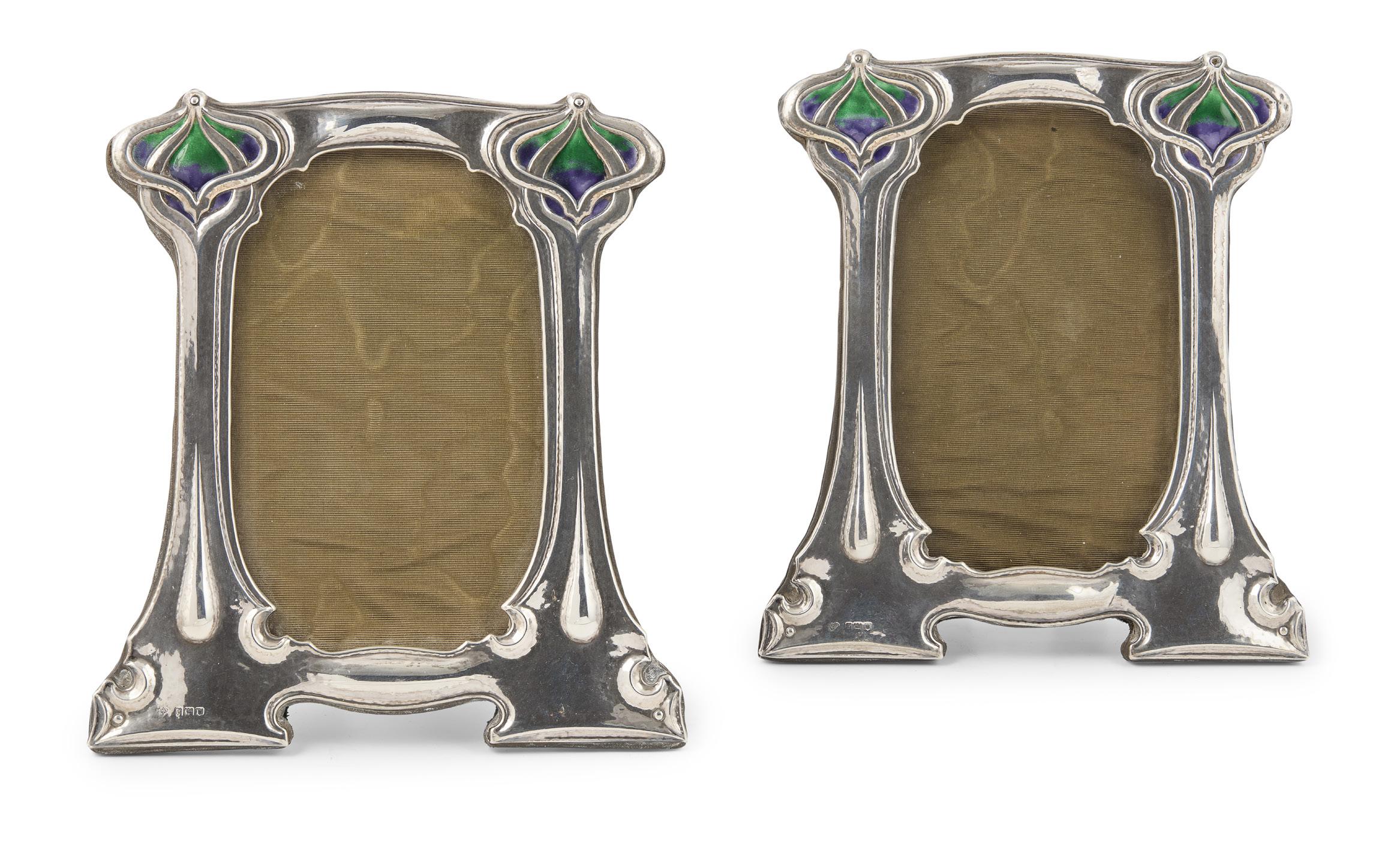
PAIR OF ART NOUVEAU PHOTO FRAMES, 1902
silver, enamel, glass, stamped maker’s mark, hallmarked London 1902 (2)
20 cm x 17.5cm (aperture 15cm x 9.5cm)
£1,000-1,500
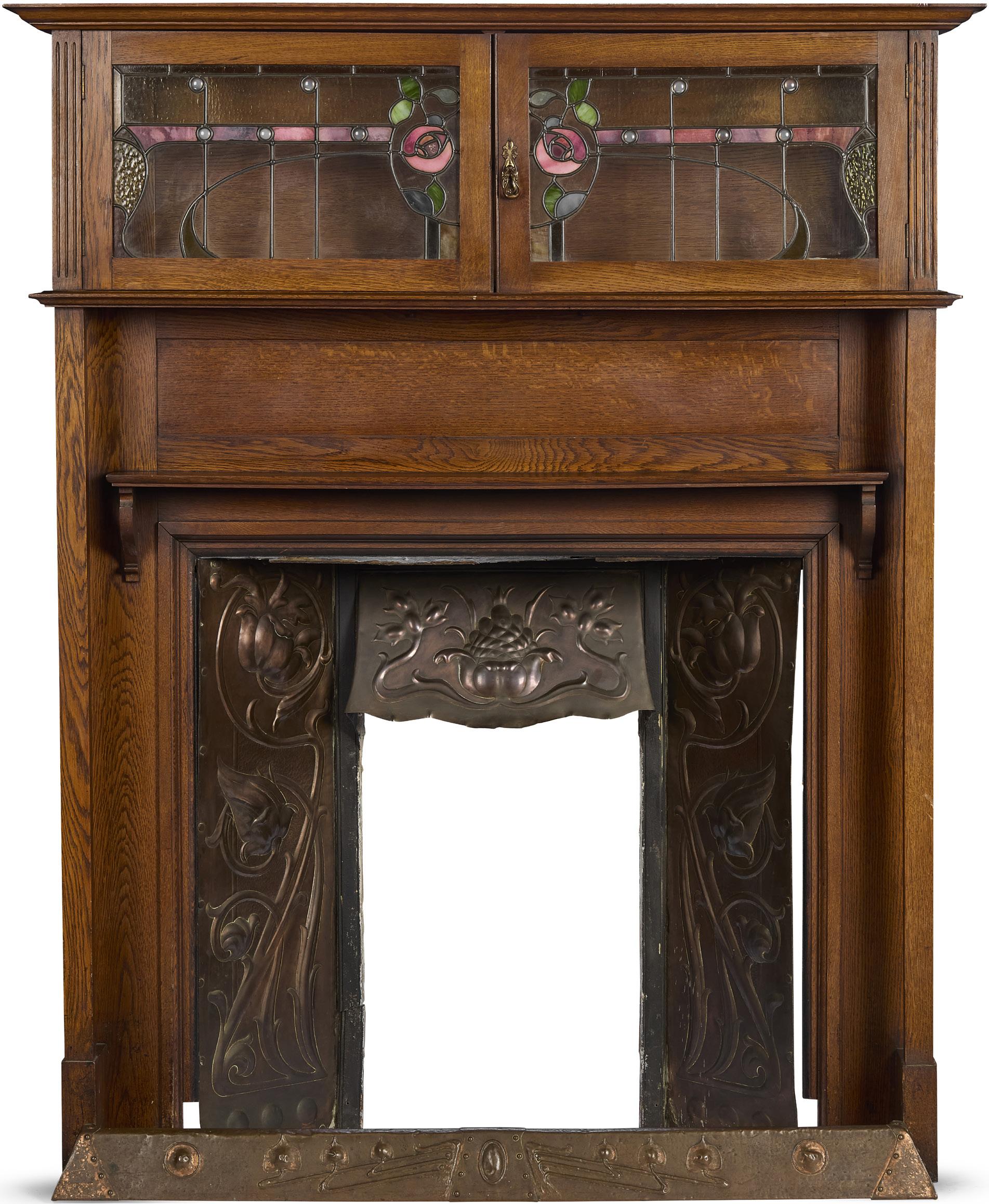
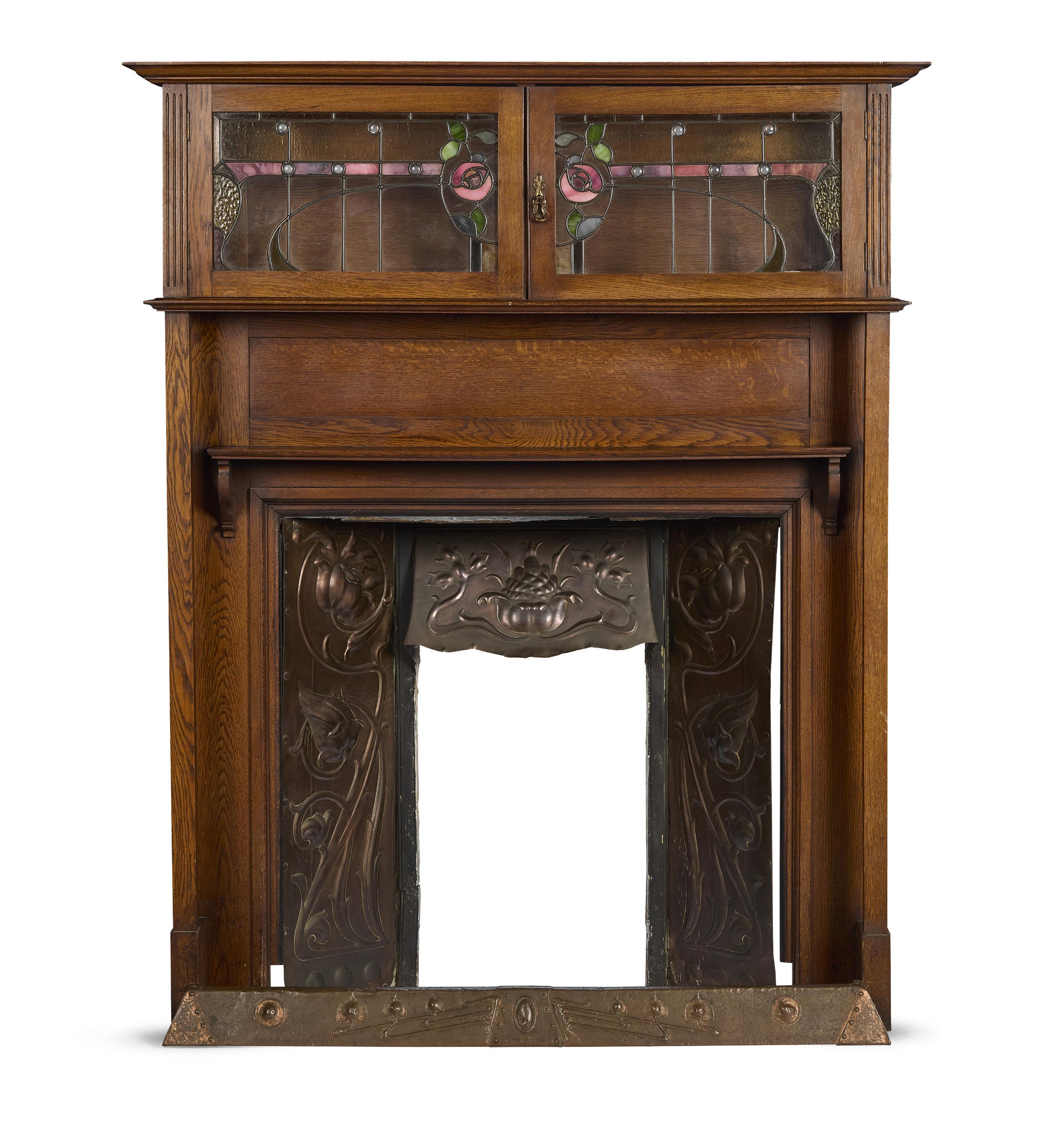
ENGLISH ARTS & CRAFTS FIRE SURROUND, CIRCA 1900 oak, with coloured glass doors, repoussé-decorated copper, cast and wrought iron, with ASSOCIATED FENDER, oak and repoussé-decorated copper 149cm wide, 182.5cm high, 28cm deep, inside measurement 97cm x 95.5cm, fender 135cm wide, 10cm deep £1,000-1,500
166
EDWARD SPENCER (1872-1938) FOR THE ARTIFICERS’ GUILD
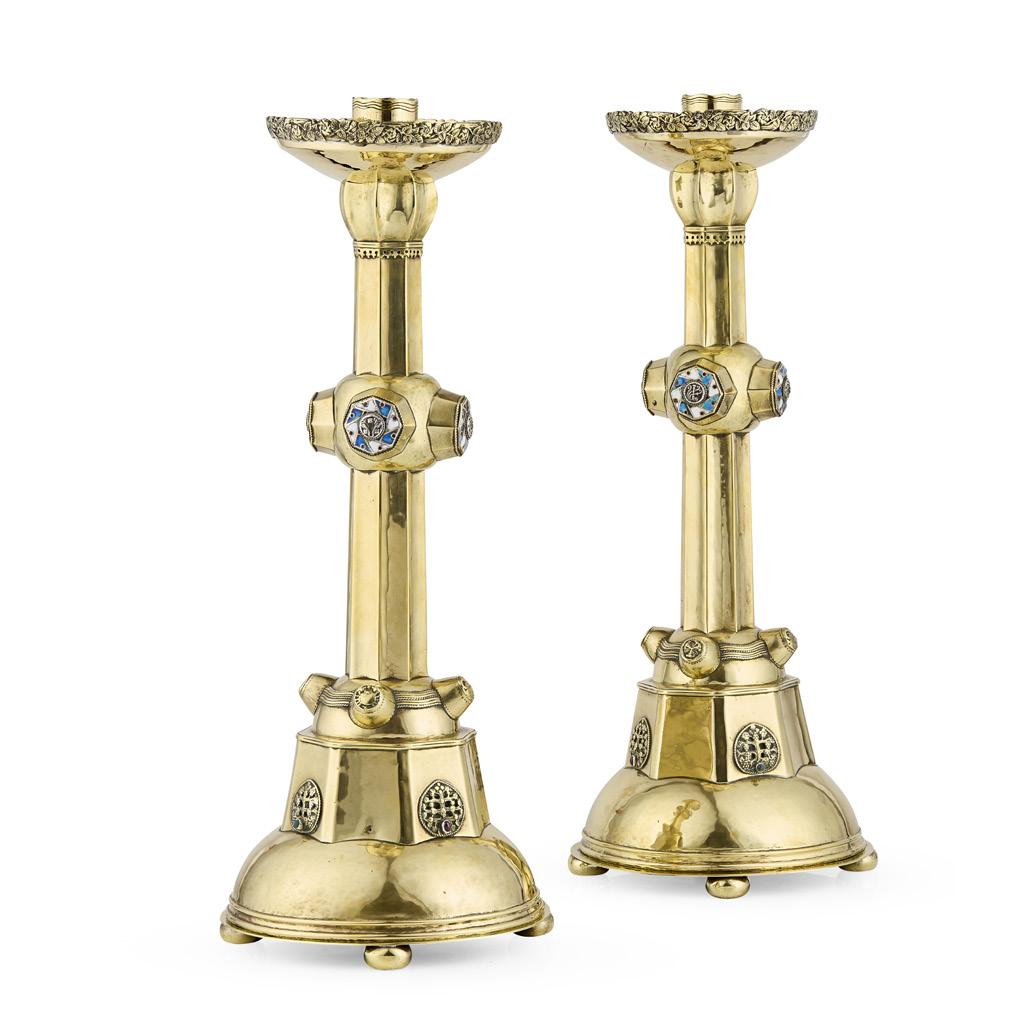
PAIR OF ALTAR CANDLESTICKS, CIRCA 1920
brass, with silvered brass and enamel roundels and inset hardstone cabochons, one inscribed to the underside THE GIFT OF ARTHUR LEAVER, IN MEMORY OF MARJORIE MARY HIS DAUGHTER AND SARAH GRACE HIS WIFE GRANT THEM O LORD ETERNAL REST/ S. ANNE’S DAY 1920 (2)
48.5cm high
£1,500-2,000
167
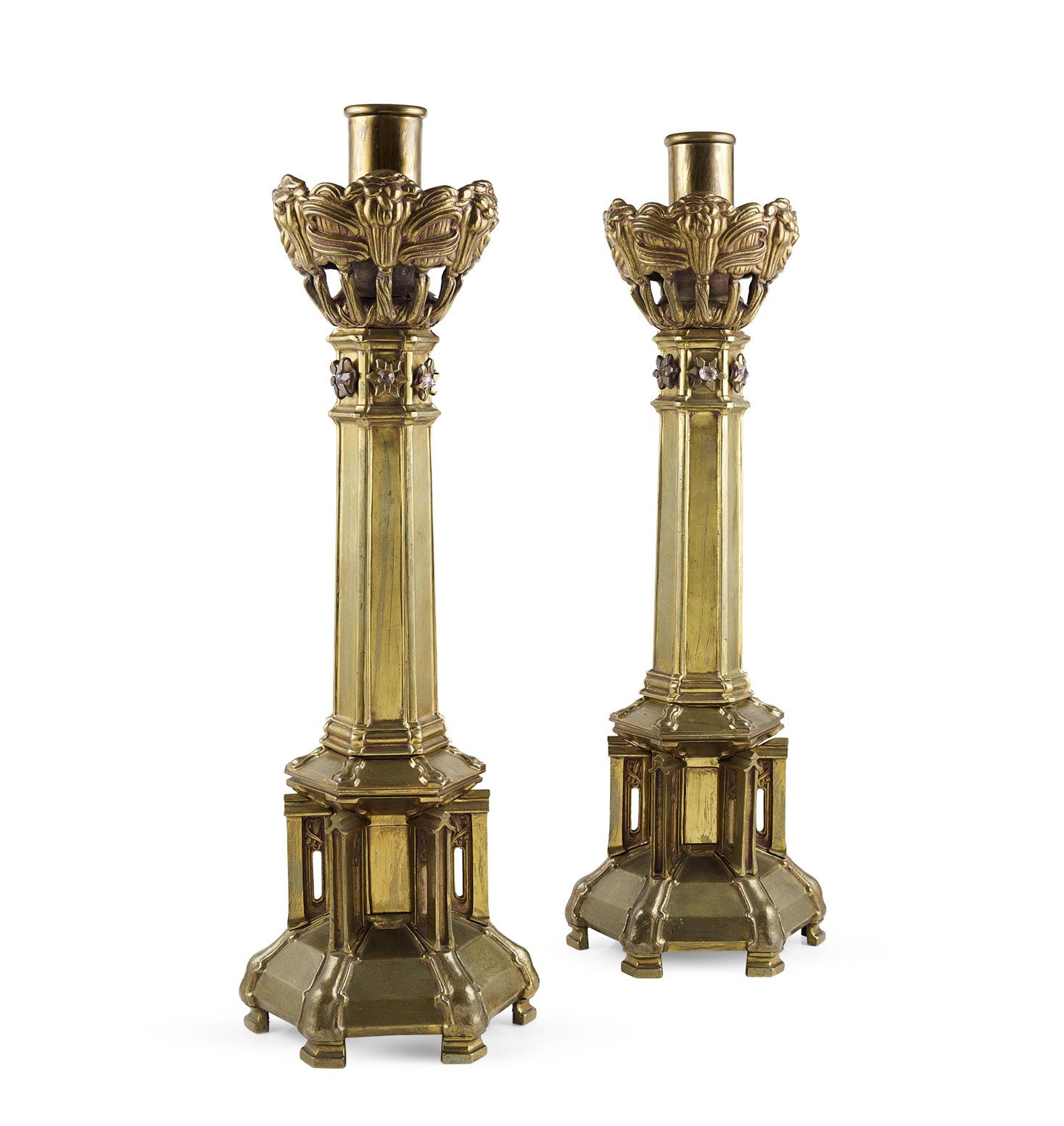
ATTRIBUTED TO HENRY WILSON (1864-1934)
PAIR OF ALTAR CANDLESTICKS, CIRCA 1900 lacquered brass, with applied faceted hardstones (2)
73cm high
£1,000-1,500
168
ENGLISH PAIR OF CELTIC REVIVAL FIRE IRONS, CIRCA 1900 brass and steel, comprising; a PAIR OF COAL NIPPERS, 91cm long, and an ASH SHOVEL, 90cm long (2)
£400-600
170
ENGLISH
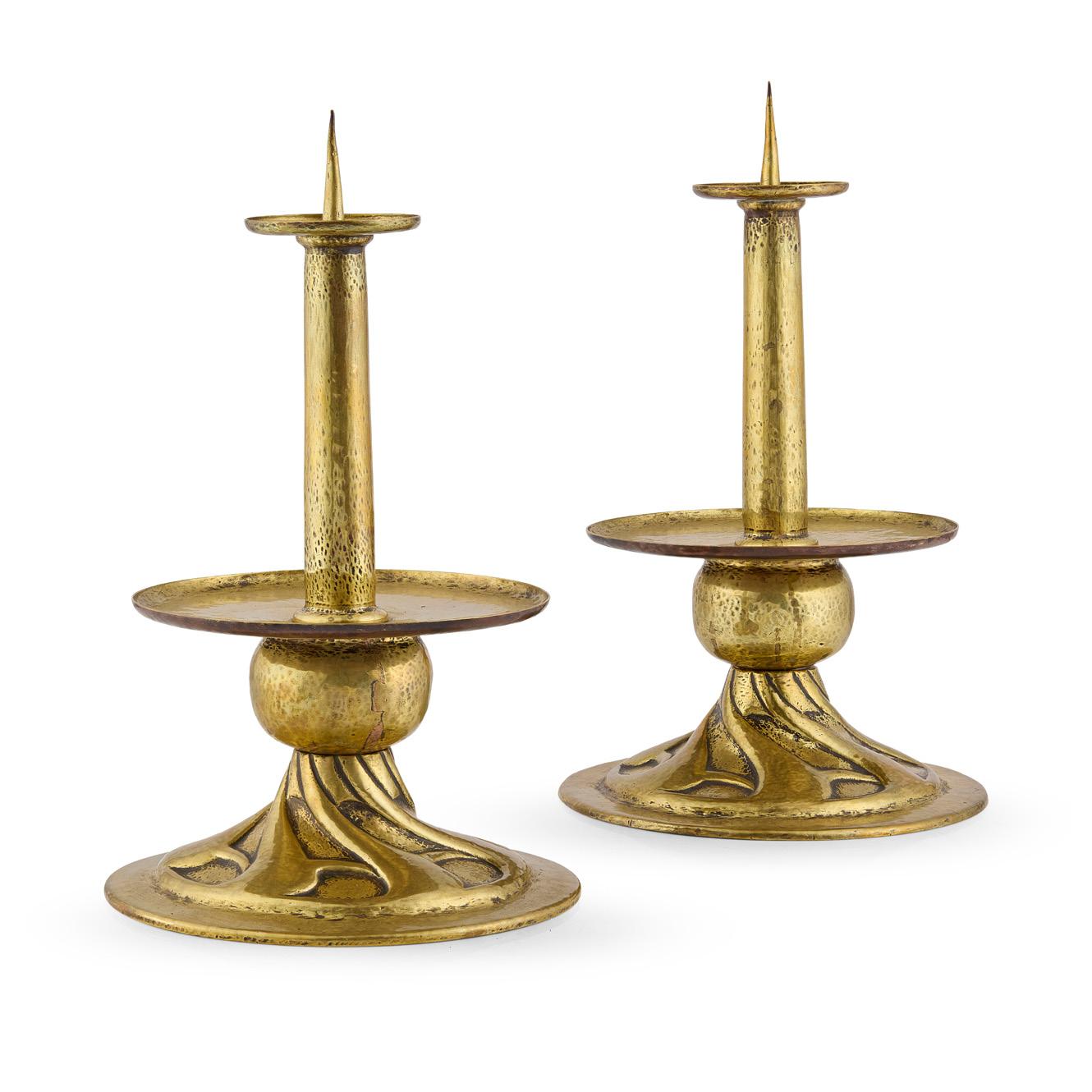
PAIR OF ARTS & CRAFTS PRICKET CANDLESTICKS, CIRCA 1910
repoussé-decorated brass (2)
33.5cm high
These candlesticks are made in the form of English ‘trumpet’ candlesticks of the mid-17th century, embellished with stylised foliate motifs of the Arts & Crafts idiom.
£400-600
169
WILLIAM JAMES NEATBY (1860-1910)
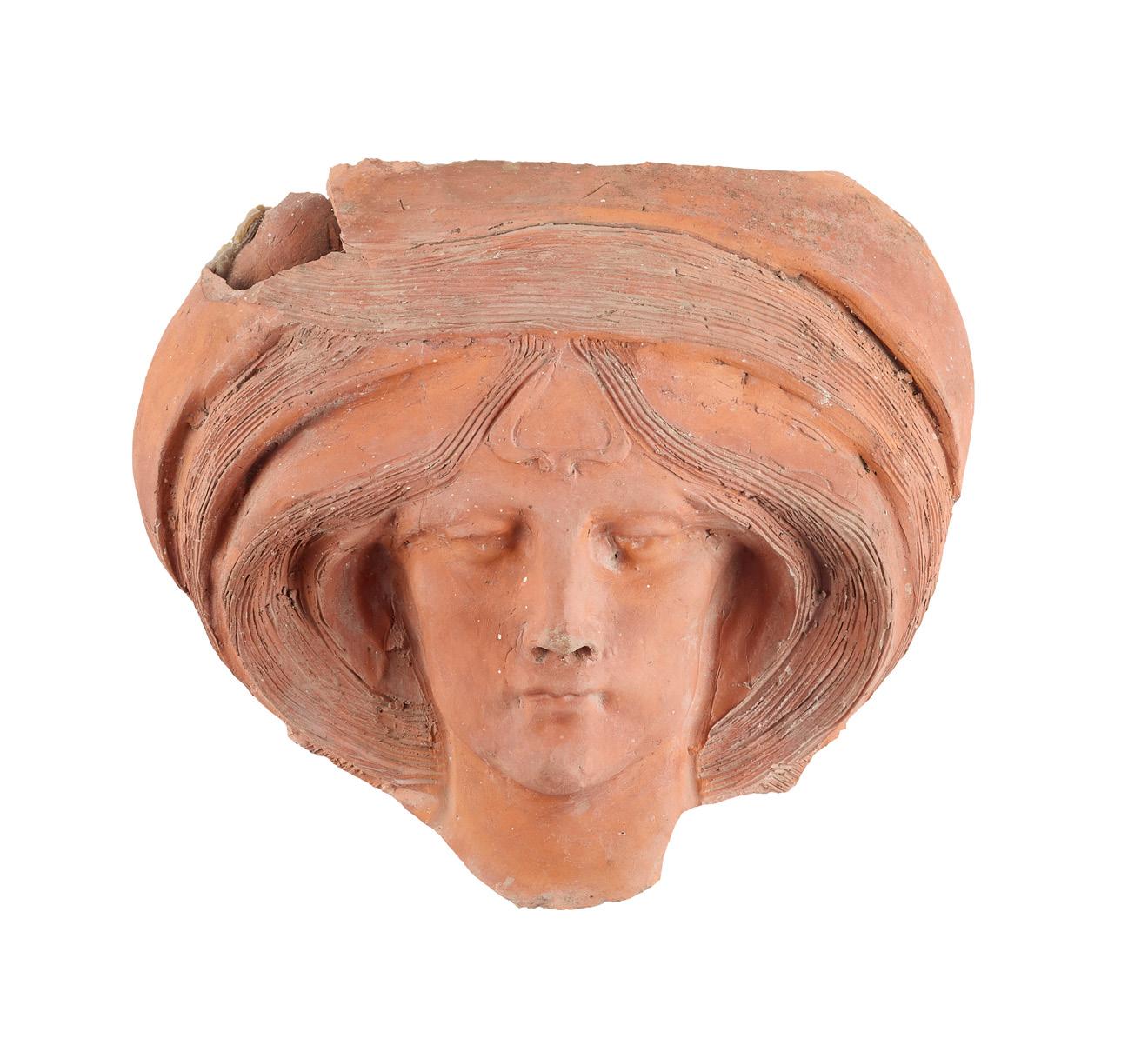
ART NOUVEAU ARCHITECTURAL MASK, CIRCA 1900
terracotta
30cm high x 34cm wide
A similar terracotta ‘angel’ figure was designed by William James Neatby in 1898 for the former Manchester School of Art, Higher Ormond Street; and another for the New Arcade, Birmingham in 1900-1. After working as a designer at Burmantofts Pottery, Leeds, from 1884-1890, Neatby was chief architectural designer at the mural ceramics department at Doulton’s pottery from 1890-1901.
£300-500
172
ENGLISH
171
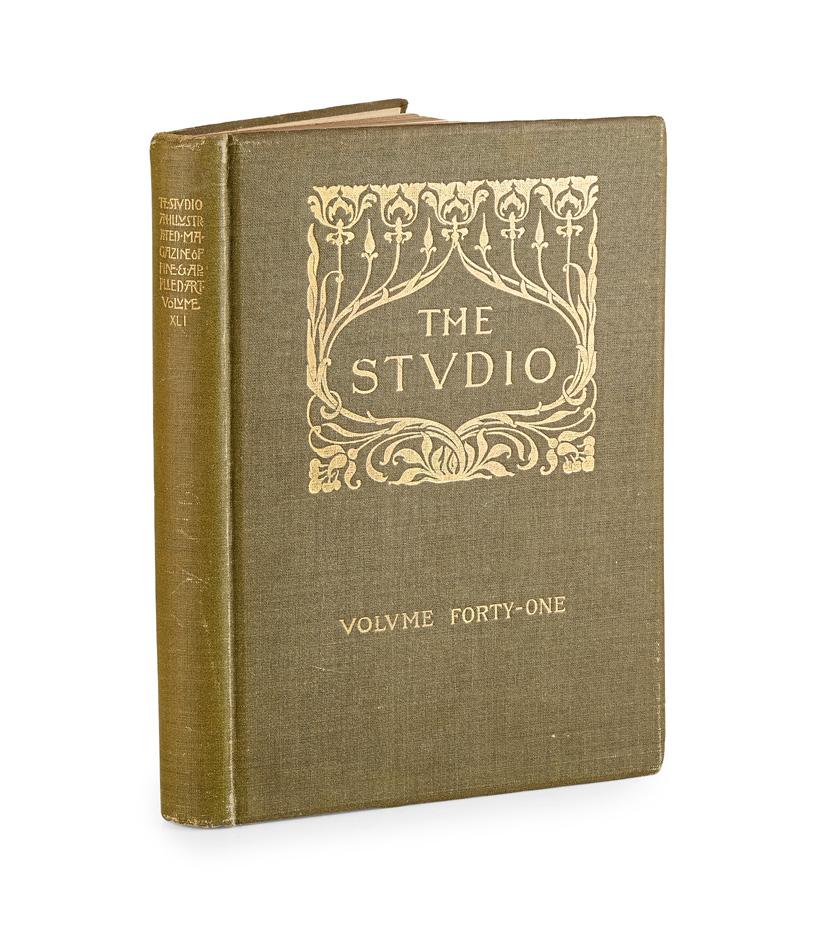
THE STUDIO MAGAZINE
RUN OF HARDBACK CLOTH VOLUMES, FROM 1893
volumes 1-47; volumes 50; 52; 99; 95 and 1918 yearbook, various bindings, mainly green cloth hardback with gilt tooling (52)
Sold with all faults and omissions, not subject to return
£400-600
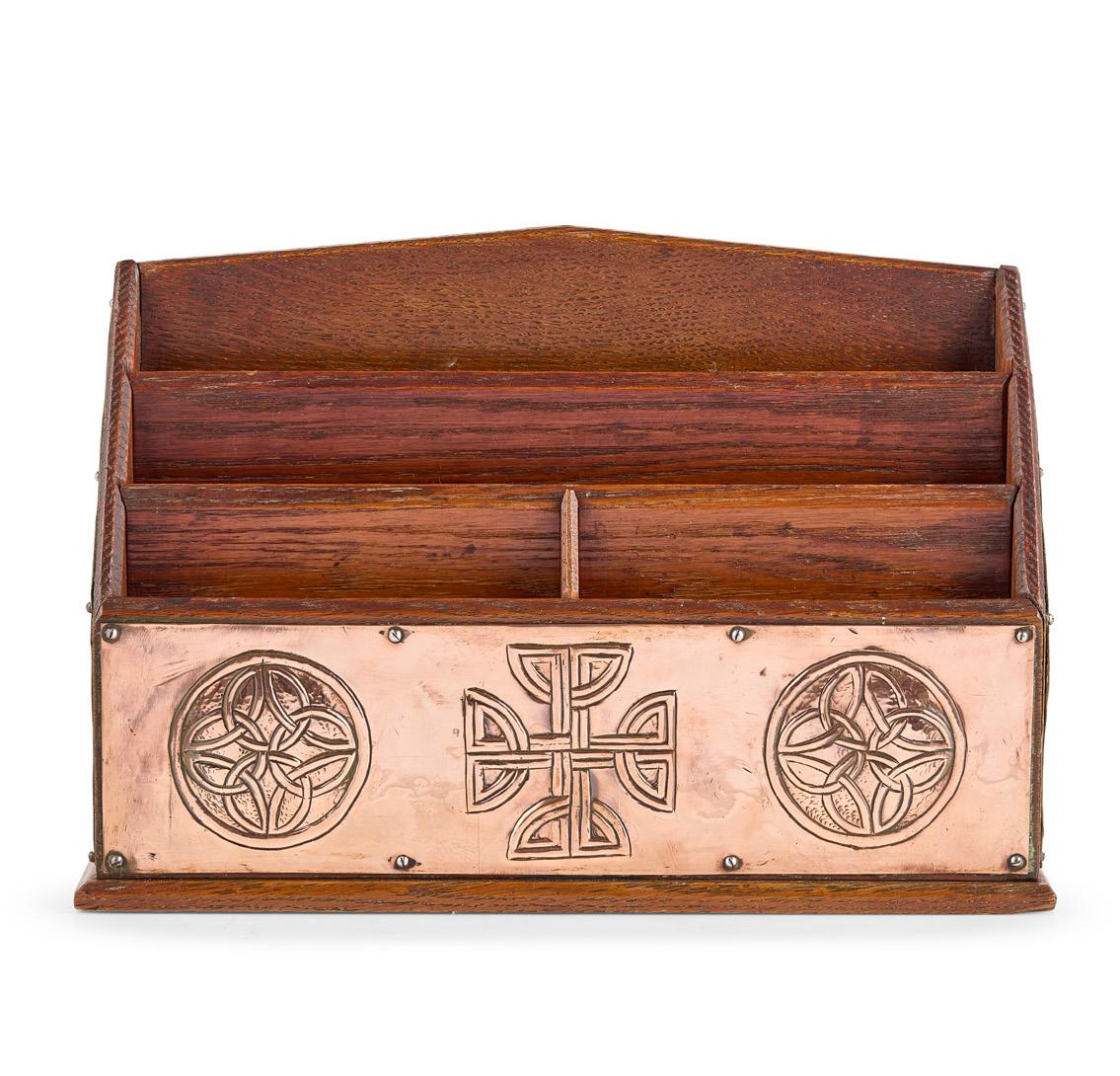
CELTIC REVIVAL LETTER RACK, CIRCA 1910
repoussé-decorated copper, oak
32cm wide, 20cm high, 11cm deep
£250-350
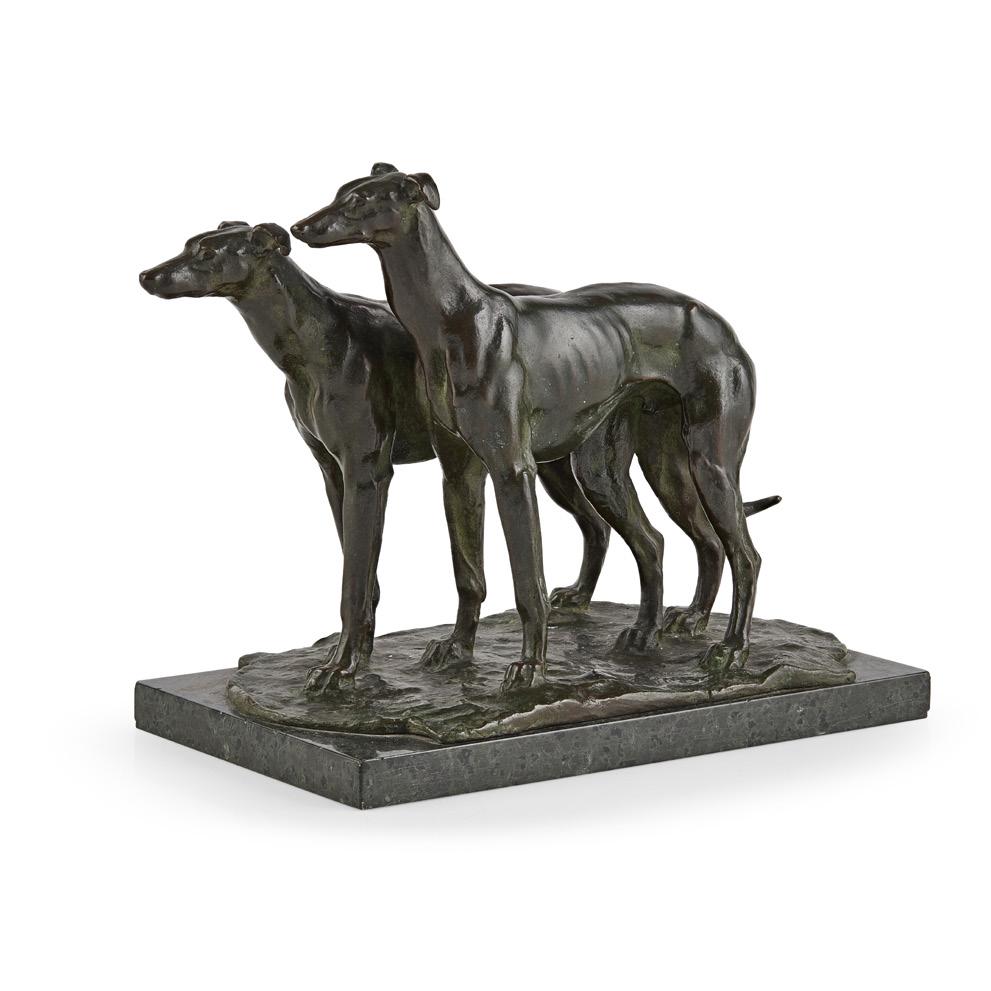
WILLIAM REID DICK (1879-1961)
‘TWO GREYHOUNDS’, 1927
bronze, on marble base, signed REID DICK in the bronze 20cm wide,15cm high
£1,200-1,800
The Handicrafts Company of Newcastle originated from the Art Department of the Durham College of Science in Newcastle upon Tyne. Its formation followed debate within the Art Committee about whether designers needed hands-on experience with the materials they worked with. Charles William Mitchell, who became Chairman in 1896 after succeeding his father, played a key role. Trained as an artist in Paris, Mitchell had exhibited widely before business responsibilities in his family’s shipbuilding firm curtailed his artistic career. Nevertheless, he remained an influential patron within Newcastle’s artistic community.
Mitchell worked closely with Richard George Hatton, the school’s headmaster, a decorative artist who shared his vision of supporting the
174
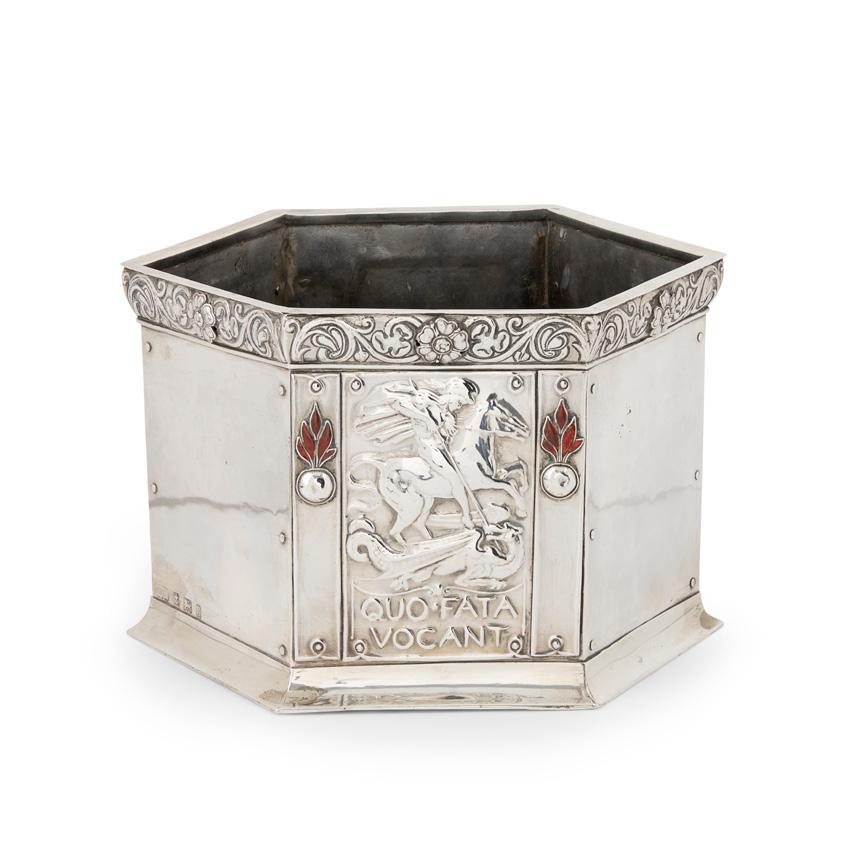
NEWCASTLE HANDICRAFTS COMPANY
CACHE POT, 1906
silver and enamel, inscribed QUO FATA VOCANT, stamped maker’s mark NHCo, hallmarked Birmingham 1906, 611g 12cm high, 19cm wide
£800-1,200
arts. Both men recognised a divide between producing “art wares” in an academic setting and the practical challenge of earning a living through craft. To address this, Mitchell funded the establishment of the Handicrafts Company in 1899 at 37 Orchard Street, under Hatton’s supervision. Its purpose was to support students in practising the “Lesser Arts” and help them generate income from their work.
The Company produced notable works, including silver and enamel presentation caskets now held in major museum collections. After Mitchell’s sudden death in 1903, financial provisions allowed operations to continue briefly. Hatton remained involved until 1906, and the Company persisted until 1912, though it was not formally dissolved until 1932.
175
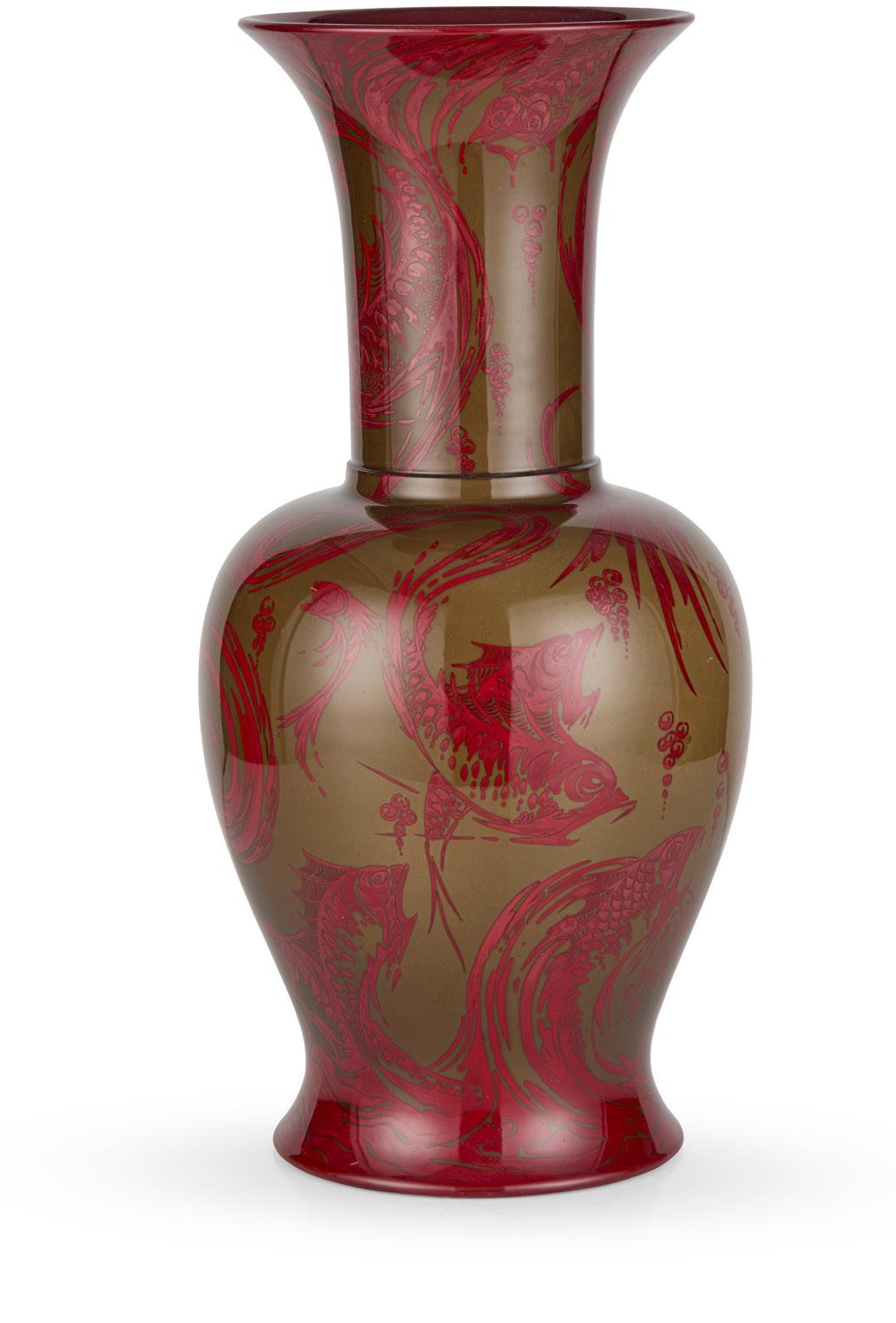
CICELY JACKSON FOR BERNARD MOORE (1850-1935) LARGE FLAMBÉ BALUSTER VASE, CIRCA 1905
flambé-glazed earthenware, signed to base BERNARD MOORE, with artist’s monogram
44.3cm high
£800-1,200
176
ENGLISH
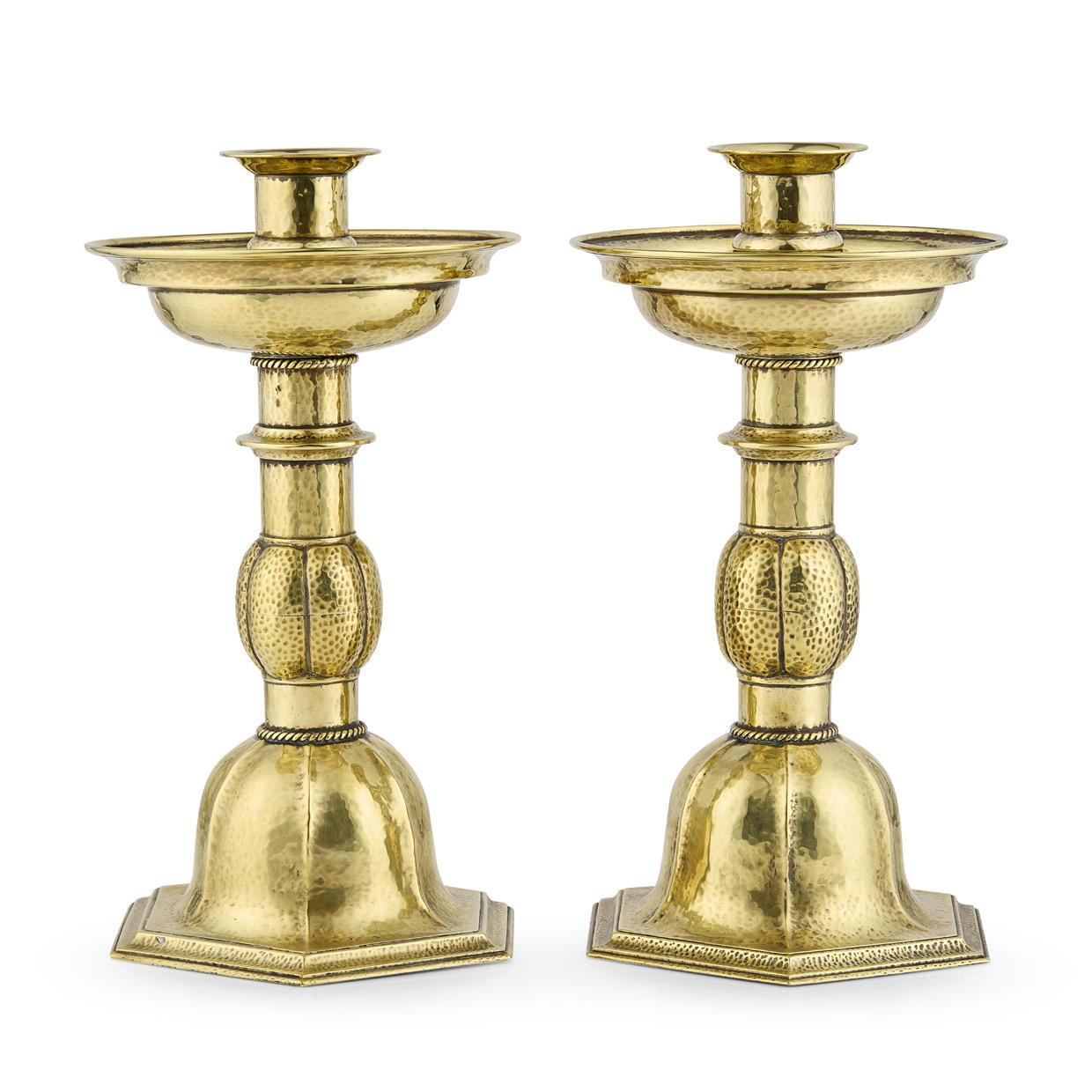
PAIR OF ARTS & CRAFTS CANDLESTICKS, CIRCA 1920
hand-wrought brass (2)
29.5cm high
£400-600
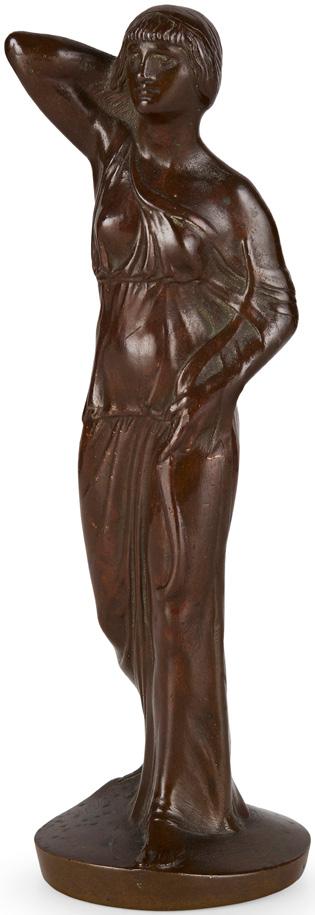
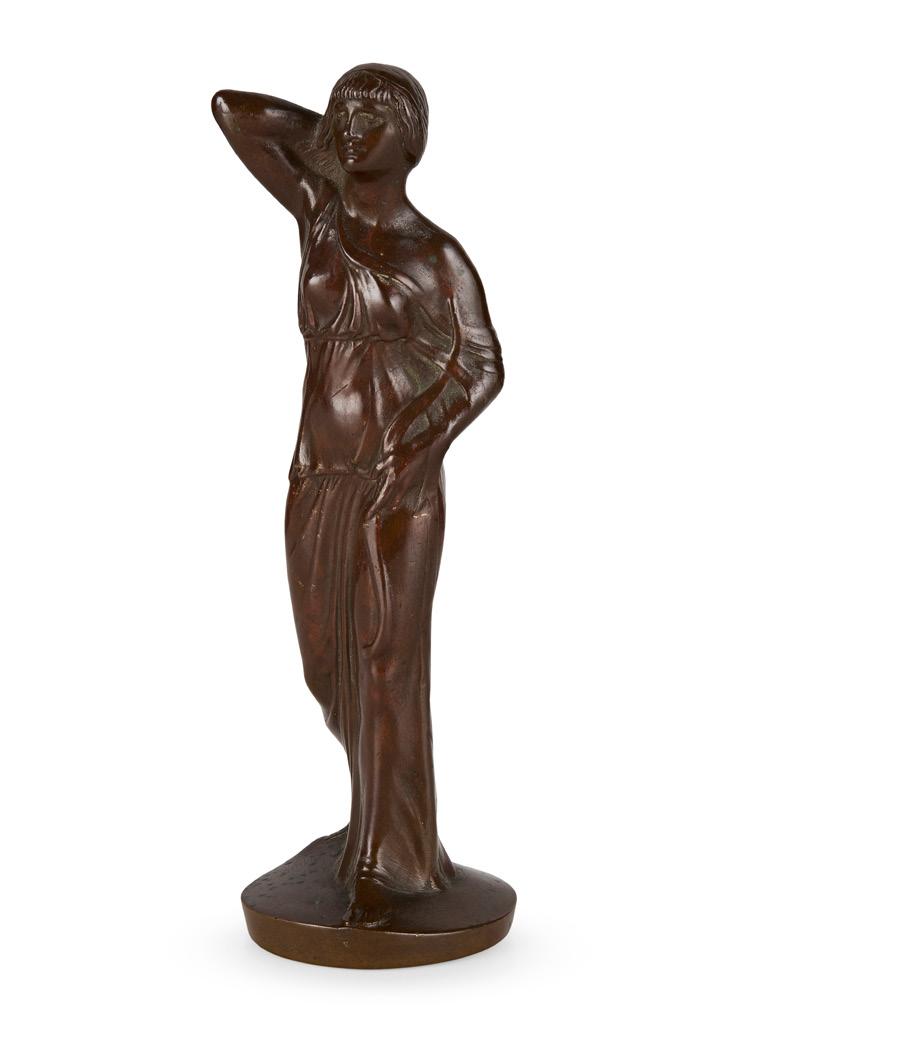
177 §
EDWARD CARTER PRESTON (1885-1965)
CABINET FIGURE OF A CLASSICAL MAIDEN bronze, cast to base ECP
Provenance: 13.5cm high
£200-300
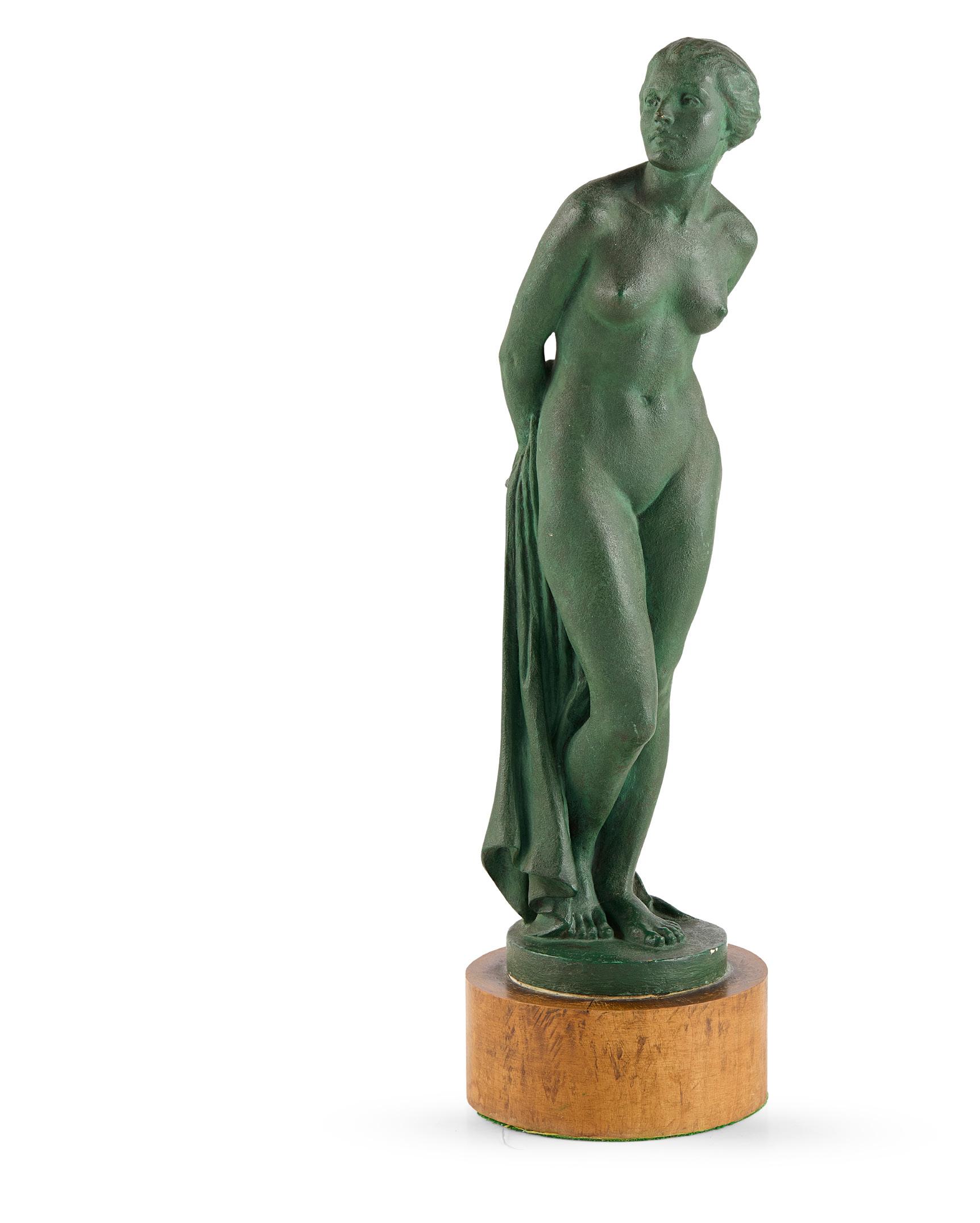
178
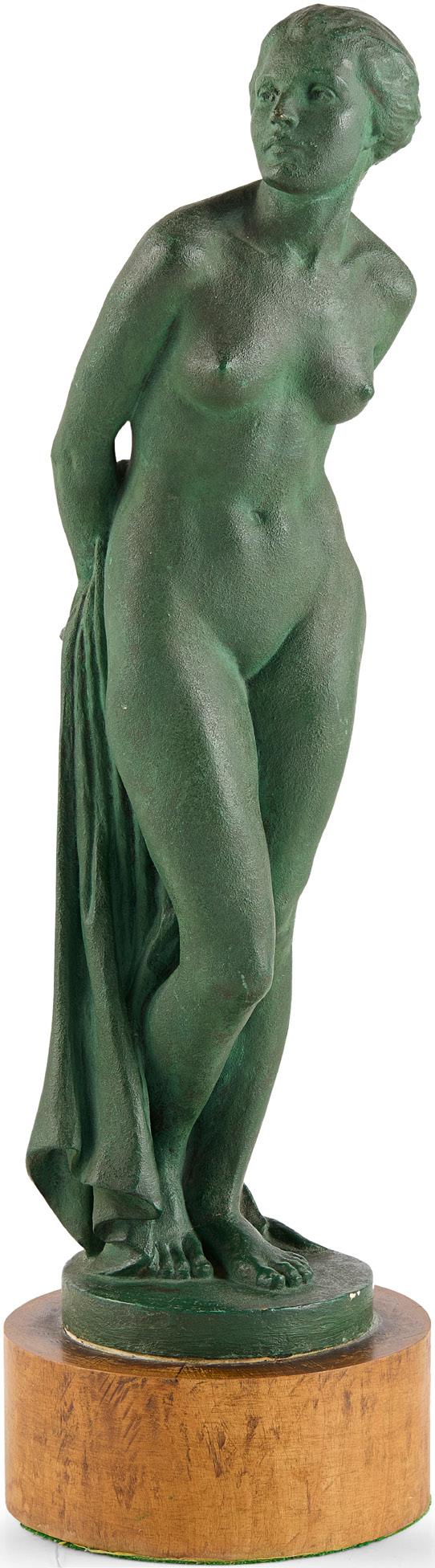
§
STANLEY MACE FOSTER (1884-1967)
NUDE STUDY, 1952
patinated plaster, on wooden base, signed and dated in the plaster 43cm high (including base)
£250-350
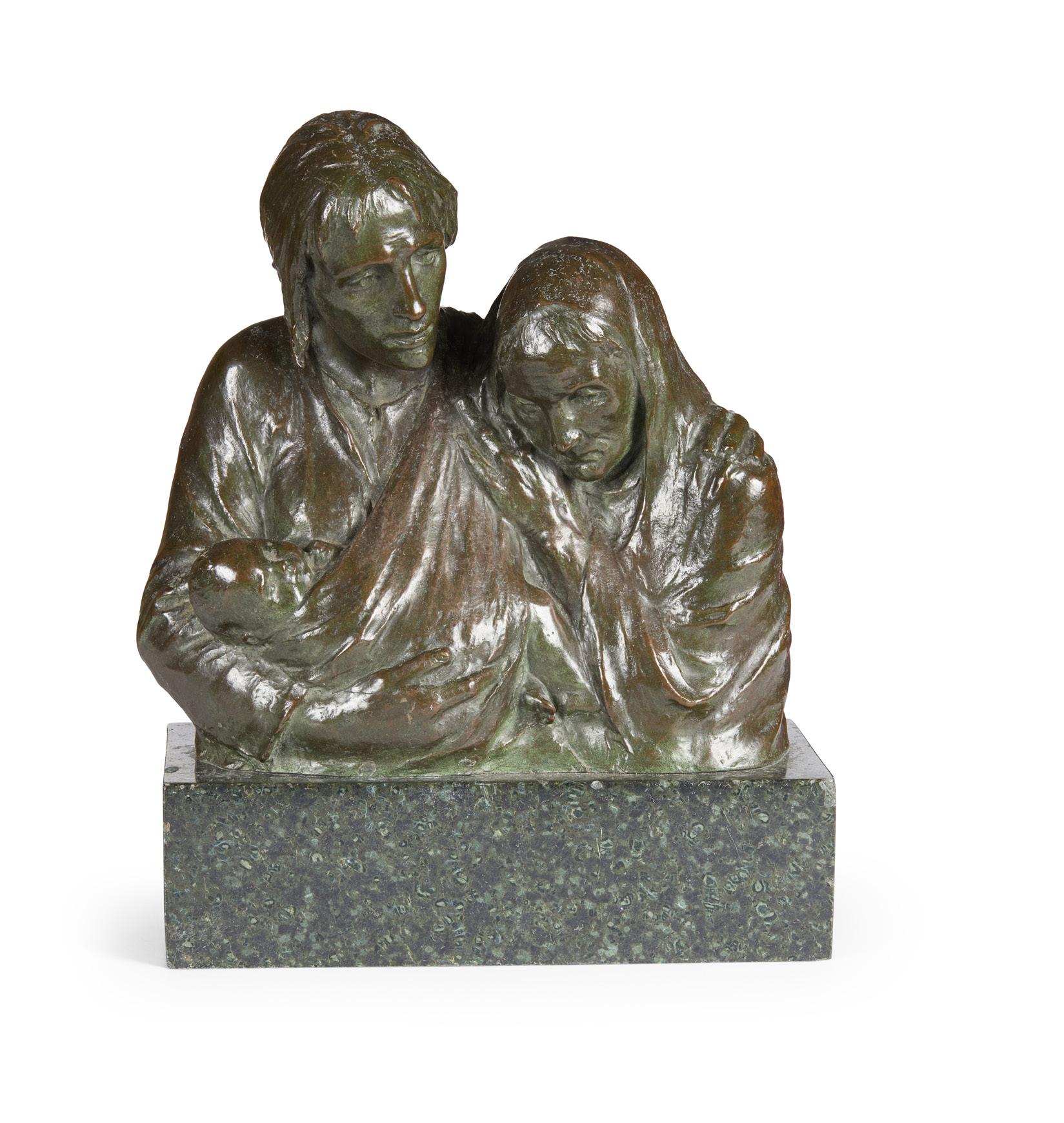
179
CHARLES LEONARD HARTWELL (1873-
FAMILY GROUP
patinated bronze on marble base, signed C. L.
1951)
HARTWELL F.A., 22.5cm high, 24cm wide, 29cm high, 24.5cm wide (including base)
Provenance: The Collection of Gillian Raffles.
£300-500
180
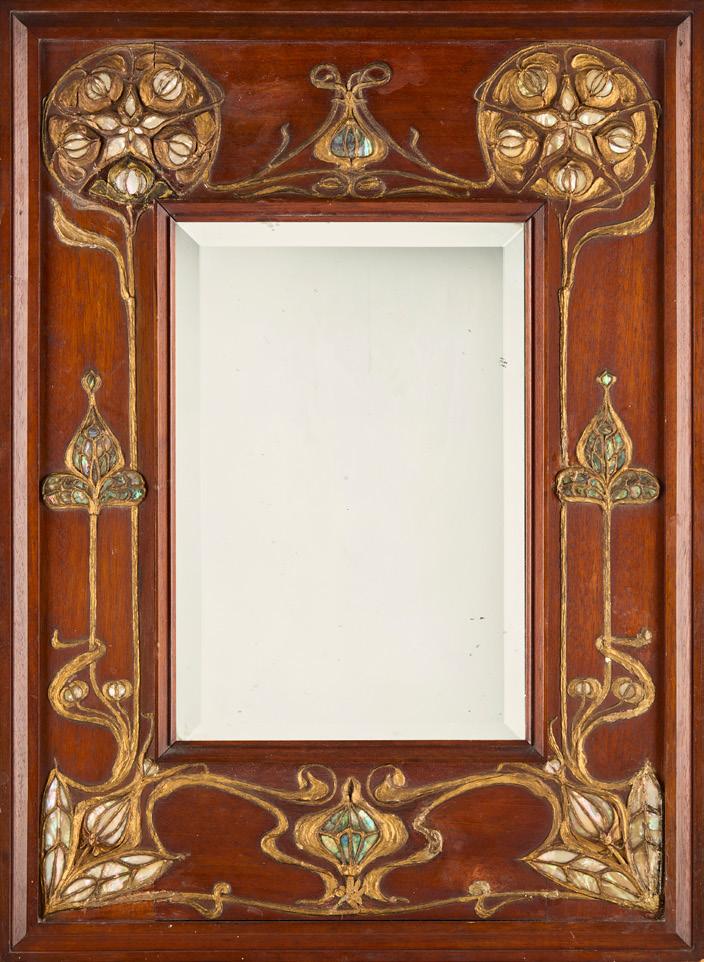
ENGLISH
ARTS & CRAFTS WALL MIRROR, CIRCA 1900
mahogany, gesso, abalone and mirrored glass
61.5cm x 45.5cm
£700-900
181
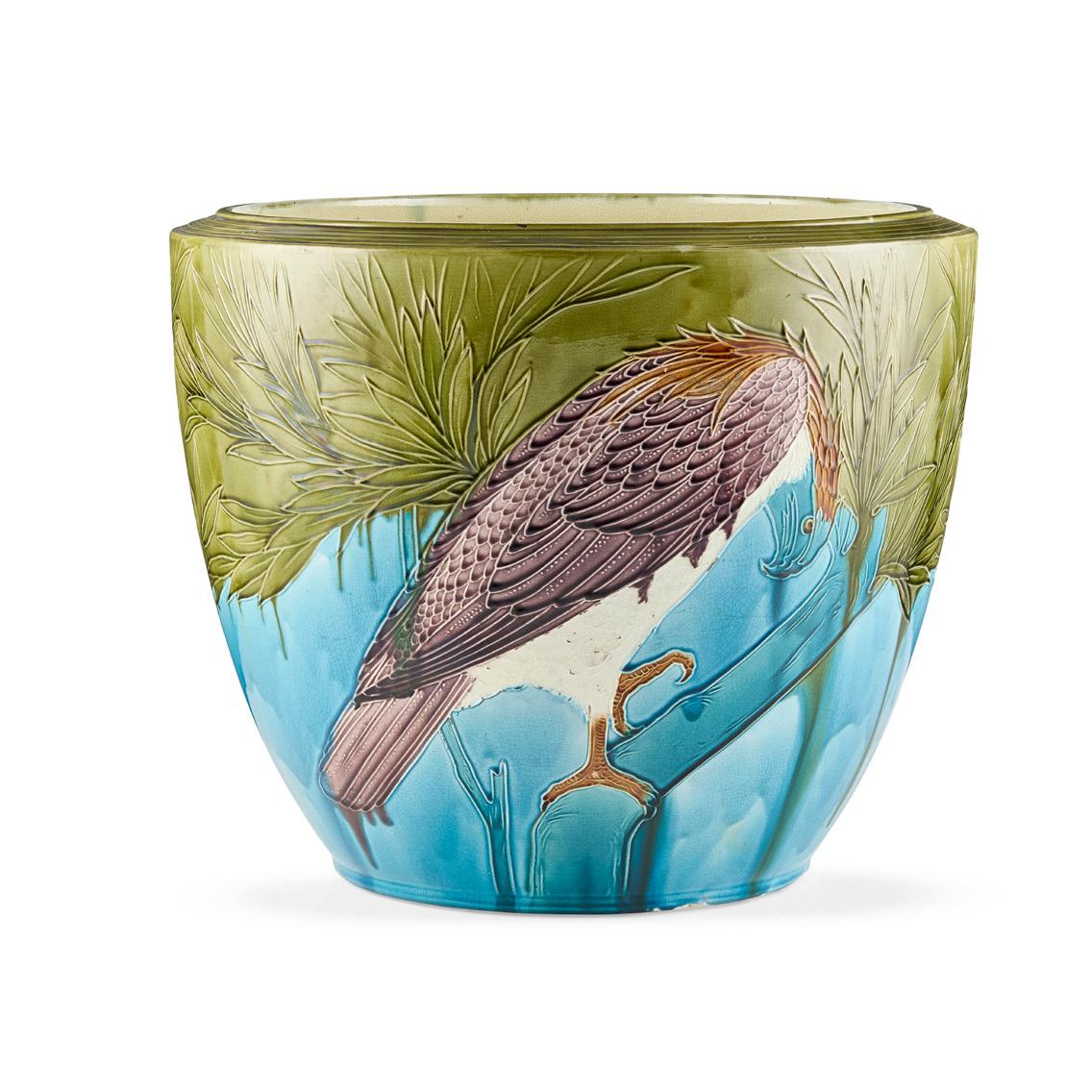
MINTONS
SECESSIONIST JARDINIÈRE, 1910
tube-lined and glazed earthenware, stamped maker’s and date marks
36.5cm high
£500-700
182
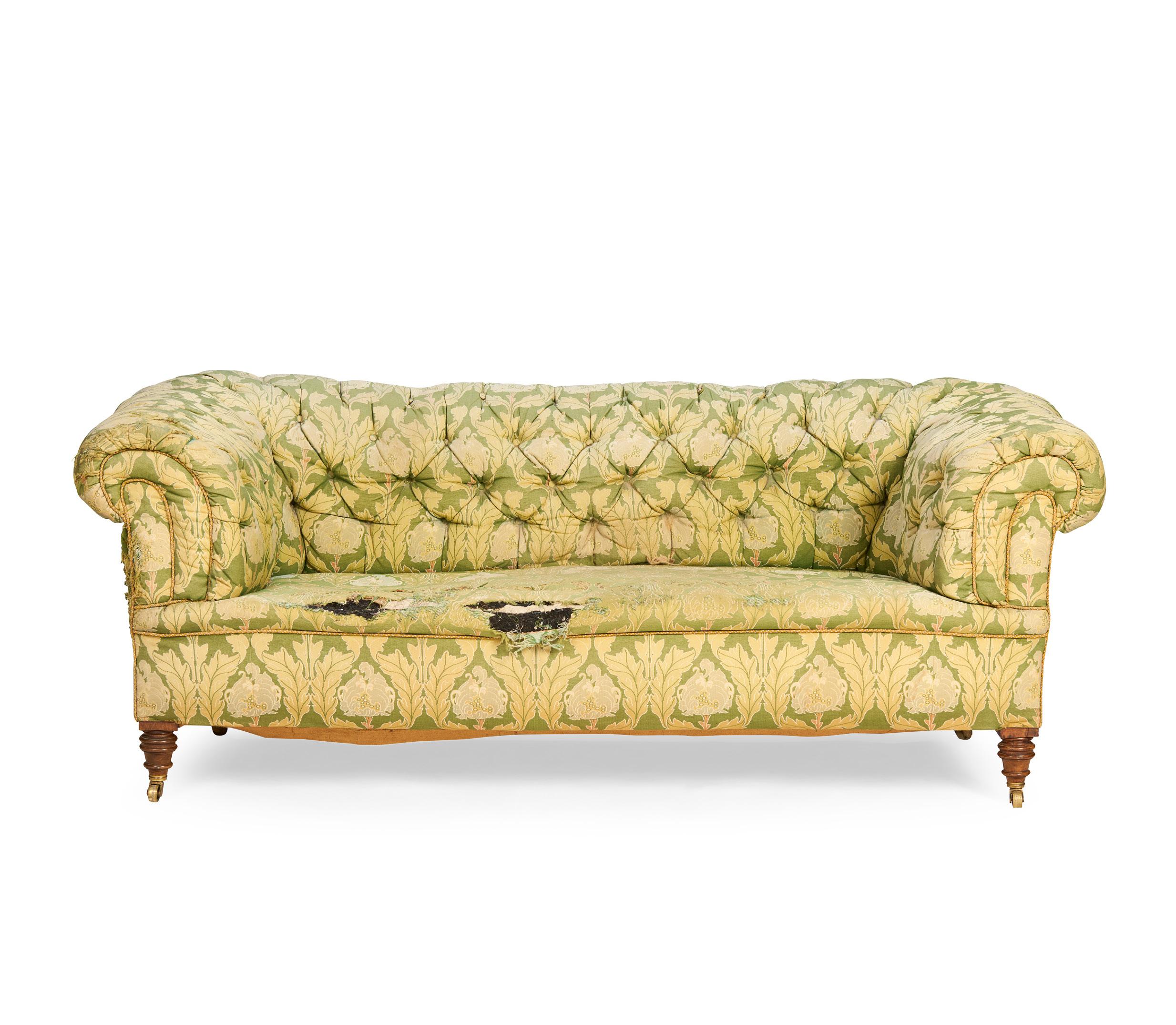
ENGLISH
VICTORIAN CHESTERFIELD SETTEE, CIRCA 1860
buttoned Art Nouveau upholstery, with walnut turned front legs and brass castors
200cm wide, 75cm high, 88cm deep
£1,000-1,500
183
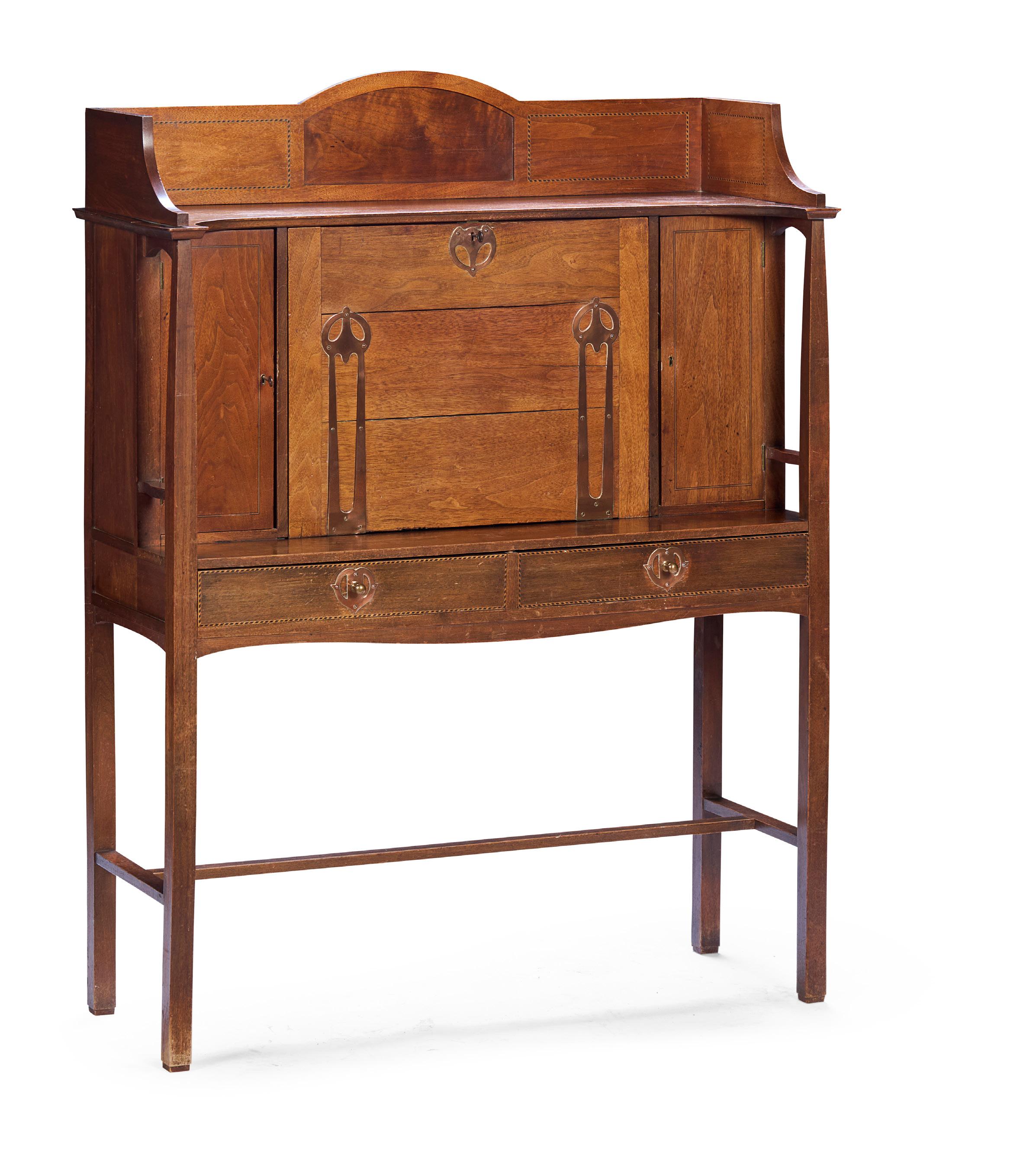
J S HENRY, LONDON SECRETAIRE, CIRCA 1900
inlaid walnut, with copper fittings
106cm wide, 141.5cm high, 38.5cm deep
£800-1,200
184
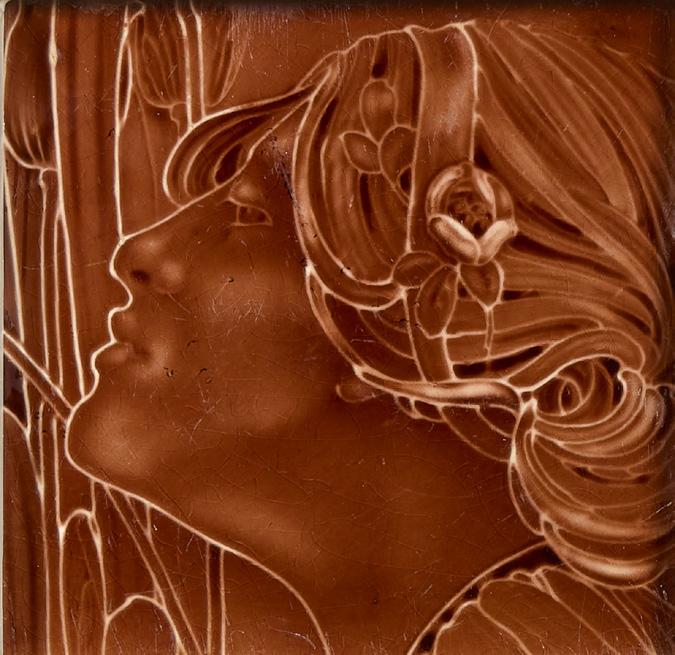
ELEANOR FORTESCUE-BRICKDALE (1872-1945) FOR J. & W. WADE & CO.
ART NOUVEAU FRAMED TILE, CIRCA 1900
dust-pressed clay
15cm square (frame size 30cm square)
£250-350
What most clearly distinguishes Ruskin Pottery is its development of innovative glazes including souffle, crystalline, sang de bœuf and ‘high-fired’ techniques. The latter was achieved through the use of copper and iron oxides, producing rich and unpredictable surface effects as in the present example. Ruskin Pottery was founded in 1898 by Edward R. Taylor and later continued by his son, William Howson Taylor (1876–1935). The pottery was based in Smethwick, Staffordshire. Historically, Ruskin Pottery can be understood within a broader European revival of interest in ceramics, inspired by Chinese glazes and East Asian forms. During this period, potters were increasingly concerned with developing new and experimental glaze effects. From around 1903, William Howson Taylor focused in particular on the development of flambé glazes, and over the following three decades he continued to refine and experiment with these techniques.
185
RUSKIN POTTERY
TWIN-HANDLED ‘HIGH-FIRED’ VASE, 1913 stoneware, with fissured sang de boeuf and lavender glaze over ivory, impressed RUSKIN/ 1913 35.5cm high
Provenance: Christie’s, London, 3 December 1993, lot 242 £1,500-2,000
The works he produced invite comparison with those of French contemporaries such as Ernest Chaplet, Auguste Delaherche, and Clément Massier Dalpayrat. Because no glaze result could be precisely repeated, each object produced at Ruskin Pottery may be regarded as unique.
At its height, the pottery employed around twenty workers and operated five lustre kilns alongside a single high-firing kiln. Despite its success and innovation, Ruskin Pottery ceased production in 1933.
186
RUSKIN POTTERY
TWO HIGH-FIRED VASES, 1933
glazed earthenware, stamped maker’s and date marks (2) 10cm and 11cm high
£500-700
187
RUSKIN POTTERY
FOUR VASES, EARLY 20TH CENTURY
glazed earthenware, stamped maker’s marks, comprising; a GREEN VASE, signed W HOWSON TAYLOR, 22.5cm high; a CRYSTALLINE VASE, 1931, 15cm high; a BOTTLE VASE, 1910, 21.5cm; a further PIERCED VASE, 31cm high (4)
£400-600
188
DAISY MAKEIG-JONES (1881-1945) FOR WEDGWOOD
WILLOW ‘FAIRYLAND
LUSTRE’ VASE, CIRCA 1930
lustre-glazed earthenware, printed factory marks to base, painted Z5360/ Z P, incised 2034/ P
22cm high
£1,000-1,500
189
DAISY MAKEIG-JONES (1881-1945) FOR WEDGWOOD
CASTLE ON A ROAD ‘FAIRYLAND
LUSTRE’ PUNCH BOWL, CIRCA 1920
lustre-glazed earthenware, printed factory marks to base, painted Z5125 23cm diameter
£600-800
190
DAISY MAKEIG-JONES (1881-1945) FOR WEDGWOOD
CASTLE ON A ROAD ‘FAIRYLAND LUSTRE’ BOWL, CIRCA 1920
lustre-glazed earthenware, printed factory marks to base, painted Z5125/ 1 6cm high
£300-500
191
HENRY GEORGE MURPHY (1884-1939)
ARTS & CRAFTS CADDY SPOON, 1929 silver, stamped maker’s mark HGM, Falcon Studios mark and hallmarked London 1929 10cm long
£300-500
193
A. E. JONES (1878-1954)
CRUET SET, 1932
silver, with blue glass liners, comprising a SALT & PEPPER POT, each 6cm high; a MUSTARD POT, 5cm high; and a PAIR OF SALTS, 5.2cm diameter, each with stamped maker’s marks A.E.J., hallmarked Birmingham 1932; together with a MATCHED CRUET SET, silver, with blue glass liners, comprising a lidded MUSTARD POT, hallmarked Birmingham 1922, 7cm diameter; a PEPPER POT, hallmarked Birmingham 1919, 6cm high; and a SALT, hallmarked Birmingham 1921, 7cm diameter, 382g; together with a CASED SET OF THIRTEEN APOSTLE SPOONS, 1977, silver, each inscribed with the name of apostle and with cast figural terminals, stamped maker’s marks A.E.J. hallmarked Birmingham 1977, 15cm long, 450g; together with a CASED SET OF SIX TEASPOONS, silver, stamped maker’s marks A.E.J. hallmarked Birmingham 1917, 73g (27)
Provenance: A. E. Jones and by family descent
£500-700
192
A. E. JONES (1878-1954)
MAZER, 1987
silver and turned wood, stamped maker’s mark A.E.J., hallmarked Birmingham 1987, 14.5cm diameter; a LOBED DISH, silver, stamped maker’s mark A.E.J., hallmarked Birmingham 1992, 17cm diameter, 287g (dish); a TEA CADDY, 1918, silver, with stamped maker’s mark A.E.J., hallmarked Birmingham 1918, 12cm high; and a TABLE LIGHTER, silver, with stamped maker’s mark A.E.J., hallmarked Birmingham 1928, 8.5cm high, 257g (4)
Provenance: A. E. Jones and by family descent
£400-600
194
STEWART DAWSON & CO., LTD.
ARTS & CRAFTS TWIN-HANDLED BOWL, 1909 silver, stamped maker’s mark S.D.LD, hallmarked Glasgow 1909, 1187g 34cm across handles, 10cm high
£1,000-1,500
195
FREDERICK RHEAD (1880–1942)
GROUP OF SIX DESIGNS FOR WILEMAN & CO., CIRCA 1900 watercolour, bodycolour and pencil, comprising TRYING TO CATCH A TRAIN, study for a vase, dated lower right APRIL 1901, 34cm x 24cm (frame size 45cm x 35cm); MISSING THEIR TRAIN, study for a vase, dated lower right APRIL 1901, 34.5cm x 26.5cm (frame size 45cm x 34.5cm); STUDY FOR A MOONFLASK, 35.5cm x 28.5cm (frame size 45.5cm x 38.5cm; STUDY FOR A PAIR OF VASES, dated lower right NOV 1900, 24cm x 31cm (frame size 34.5cm x 40.5cm); STUDY FOR A CLOCK CASE, 35cm x 24.5cm (frame size 45cm x 34.5cm); and a STUDY FOR A VASE, with pencil calculations lower right, 18.5cm x 15cm (frame size 25cm x 21cm) (6)
£1,000-1,500
196
ENGLISH
ARTS & CRAFTS WALL PANEL, CIRCA 1900 carved hardwood 125cm wide, 35cm high, 3.5cm deep
£250-350
198
ARTHUR SIMPSON OF KENDAL (1857-1922)
OCCASIONAL TABLE, CIRCA 1920
oak, inset maker’s label to base ARTHUR W. SIMPSON, THE HANDICRAFTS, KENDAL, stamped 8782
50cm square, 64cm high
£400-600
199
ARTHUR SIMPSON OF KENDAL (1857-1922)
TWO-FOLD EMBROIDERED FIRE SCREEN, CIRCA 1920
coloured threads and satinised fabric on an unbleached linen ground, set in a carved oak and glass frame each fold 37cm wide, 90cm high
£300-500
197
MANNER OF MARY IRELAND
HISTORICAL EMBROIDERED PANEL, CIRCA 1920
appliqué work, embroidered wool and metal threads, and painted fabric, with applied beads. sequins and ‘jewels’, reserved on an unbleached linen ground, enclosed within a frame, depicting Queen Elizabeth I and her courtiers 47cm x 136cm (frame size 60cm x 149cm)
£300-500
201
ARTHUR SIMPSON OF KENDAL (1857-1922)
ARTS & CRAFTS BOOK TROUGH, CIRCA 1900
carved oak, stamped to base 4059
40.5cm wide, 17cm high, 31cm deep
£300-500
200
ARTHUR SIMPSON OF KENDAL (1857-1922)
ARTS & CRAFTS WRITER’S CABINET, CIRCA 1900
carved oak
38cm wide, 34.5cm high, 18.5cm deep
£250-350
202
ARTHUR SIMPSON OF KENDAL (1857-1922)
SMALL ARTS & CRAFTS CHEST, CIRCA 1910
carved oak, with brass escutcheon
61cm wide, 45cm high, 38.5cm deep
£400-600
JEANNE ANTIONETTE LABROUSSE (1891-?)
‘FRIENDSHIP IS A FLOWER THAT MAKETH FAIR IN THE GARDEN OF LIFE’
pen, ink, watercolour, with gilt decoration, signed J.A. LABROUSSE
30cm x 19cm (frame size 34cm x 22.5cm)
£800-1,200
204
ATTRIBUTED TO REGINALD HALLWARD (1858-1948)
FOUR ILLUSTRATED VERSES FROM ‘IDYLLS OF THE KING’ BY ALFRED TENNYSON, CIRCA 1910
watercolour, comprising; ‘O sun that wakenest all to bliss’; ‘O morning star that smilest in the blue’; ‘O birds that warble to the morning sky’; ‘O trefoil sparkling on the dewy plain’ (4) 16.5cm x 13.5cm (frame size 32cm x 23cm)
These illustrated verses come from Gareth and Lynette, one of Tennyson’s twelve poem cycle based on the life of King Arthur, composed between 1859 and 1885.
£300-500
206
ENGLISH
THREE ARTS & CRAFTS CREWELWORK
CUSHIONS, CIRCA 1920
coloured wool and metal threads on a linen ground, later made up (3)
35cm square
£200-300
208
205
ENGLISH
PAIR OF ARTS & CRAFTS
CREWELWORK CUSHIONS, CIRCA 1920
coloured wool and metal threads on a linen ground, later made up (2)
43cm square
£300-500
207
GORDON RUSSELL (1892-1980)
COTSWOLD SCHOOL STOOL, CIRCA 1930
oak, with woven leather seat, bears metal maker’s label
32.5cm square, 31cm high
£250-350
EDWARD BARNSLEY (1900-1987)
PIANO STOOL
walnut, with needlework upholstered top
56cm wide, 54cm high, 38cm deep
£400-600
209
ALFRED DOUGLAS ROBINSON (1888-1963) FOR TOMKINS, HOMER & LEY ARCHITECTS
PROSPECT OF BUDLEIGH HOUSE, ARCHITECTURAL DRAWING, 1912
watercolour, pen and ink, signed and dated, 28cm x 34.5cm (frame size 50.5cm x 56cm); together with ‘HOUSE AT WATFORD’, architectural plans, pen and ink, signed, 41.5cm x 54.5cm (frame size 50.5cm x 70.5cm) (2)
£250-350
210 §
THOMAS MILLWOOD WILSON (1879-1957)
‘HOUSE IN THE HAMPSTEAD GARDEN SUBURB’, ARCHITECTURAL DRAWING
watercolour, pen and ink, signed T M WILSON ARCHT. 24cm x 32.5cm (frame size 50.5cm x 70.5cm)
£300-500
The Arts & Crafts architect Charles Spooner (1862-1938) was highly regarded by his contemporaries, including C. R. Ashbee and Ambrose Heal. But his self-effacing character and disinclination towards publicity meant he was easily overlooked in the years after his death. He was at his best as a church architect – a discipline no longer central to architecture by the start of the 20th century.
In 2002 a portfolio of his designs, for both ecclesiastical and domestic commissions, was re-discovered by art historian Alec Hamilton, who used them as the basis first for his 2009 MA dissertation on Spooner, then his 2012 monograph Charles Spooner (1862-1938) – Arts & Crafts Architect, the first dedicated account of Spooner’s life and work. It is the contents of this portfolio, the principal primary source for Spooner’s practice, which is now offered for sale by Lyon & Turnbull.
Spooner trained as an architect in London under Arthur Blomfield before entering the Royal Academy Schools in 1886. The following year he was elected to the Art Workers Guild. In 1890 exhibited at the Arts & Crafts Exhibition Society, later exhibiting at every subsequent ACES show until 1928. In 1892 he moved to Chiswick, where his neighbours were other leading lights of the Arts & Crafts: Emery Walker, May Morris, Nelson and Edith Dawson amongst others. Spooner was elected fellow of the Royal Institute of British Architects in 1907 and did important work as a long-time member of the consulting architects committee of the Incorporated Church Building Society. Spooner himself built in total seven churches, all in the east or south-east of England, and extended, repaired and furnished many more. His domestic commissions were focused on the Home Counties, but also took him to Suffolk and Dorset. As the de facto estate architect at Westmill, Hertfordshire, he is largely responsible for the picturesque aspect of the village as it appears today. Spooner combined his architectural work with a career teaching and lecturing in furniture design and
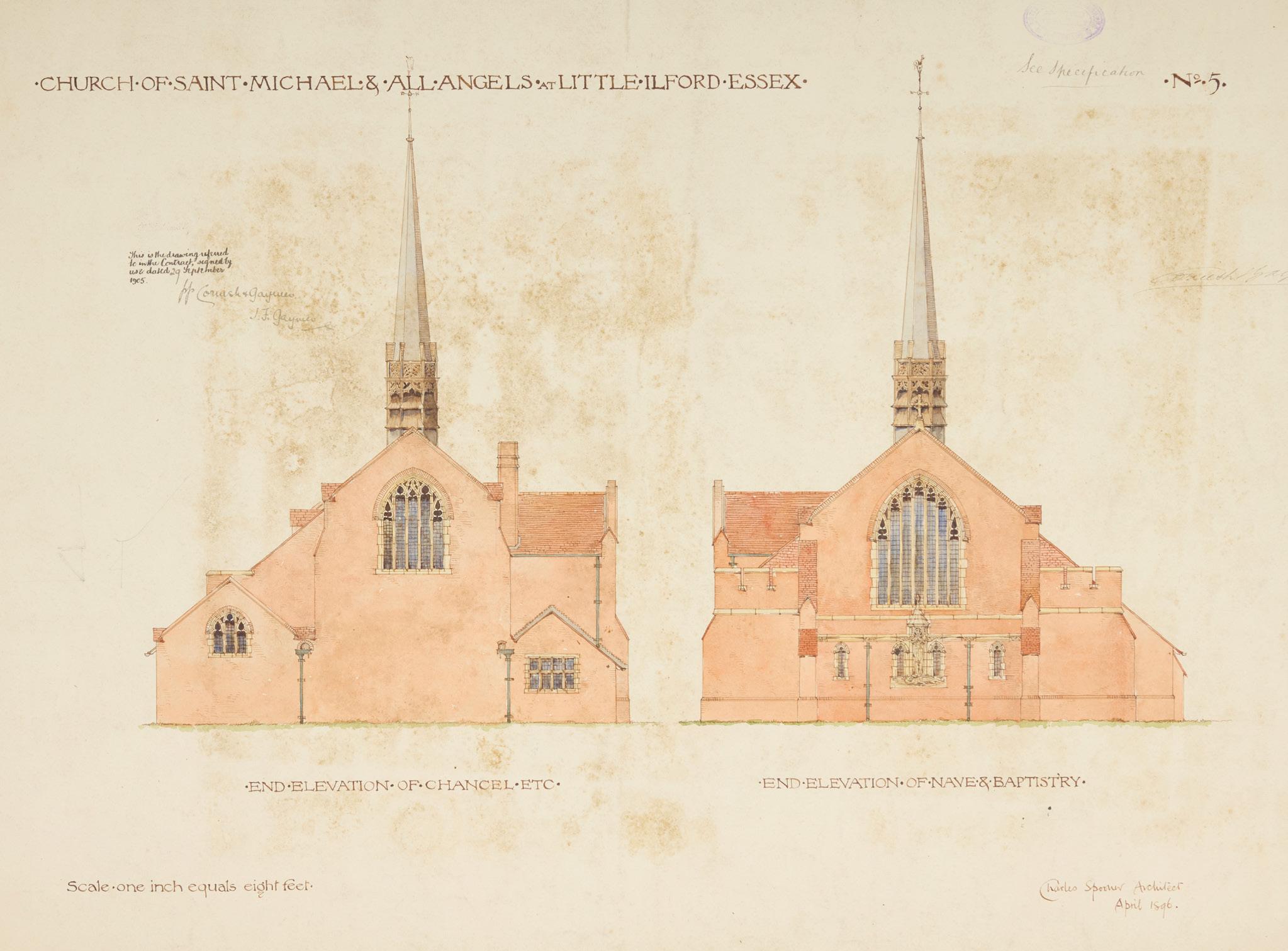
211
CHARLES SPOONER (1862-1938)
metalwork at the Central School of Arts and Crafts and also taught at Ashbee’s School of Handicraft. Assessing Spooner’s place in the Arts and Crafts movement, Alec Hamilton observed:
‘Spooner was spurred on not by ambition but by service … His models were usually medieval – especially in his church woodwork. But when Modernism presented new ideas and challenge, he did not draw back … His work, as expressed in his churches and surviving architectural drawings, strives to be true to Morris’s call to put the human before the machine, usefulness and beauty before decoration and artifice … He was out of step with the lordly attitude towards individuals and society … that came to dominate architectural thought and theory after the Second World War … If all these are commendably – and characteristically – “Arts & Crafts” traits in Spooner, there is an even greater, and more significant one: [he] found his greatest delight in designing for craftsmen, working as a partner in the technical process’ (Charles Spooner, pp. 246-8).
ARCHITECTURAL DESIGNS FOR THE CHURCH OF ST MICHAEL AND ALL ANGELS, LITTLE ILFORD, LONDON, 1896
pen and ink, watercolour and graphite, 7 in total (numbered 2-7: including a duplicate of no. 4), all signed and dated ‘Charles Spooner, Architect, April 1896’ lower right, approval stamps of the Church Building Society (dated 1896), annotations of Cornish & Gaymer (ecclesiastical wood carvers, Norfolk), variable spotting and dust-soiling, nicks to edges, 2 plans with a few pencilled calculations
56cm x 78cm
Provenance: From the collection of Dr Alec Hamilton, author of Charles Spooner (1862-1938): Arts and Crafts Architect (Donington, 2012).
Illustrated: Hamilton, pp. 62-4 (plan numbers 6, 2 and 4).
£700-900
The cornerstone of St Michael and All Angels, then in Essex, now in the London Borough of Newham, was laid in 1897, and building was completed by 1906. Sir Nikolaus Pevsner in the Buildings of England series remarked on its ‘noble proportions [and] tall giant wall-arcading’ (Essex, 1965, p. 166). It was demolished in 1990, to be replaced by a community centre. St Michael’s was Spooner’s first London church and ‘a confident demonstration of [his] ability to meet the practical needs of a poor parish … On 1 May 1896 Spooner submitted 11 sheets of drawings … Six [sic] drawings survive, all but one dated April 1896, and numbered 2-7. They all appear to be presentation drawings. The drawings are beautiful watercolours, with meticulous attention to the detailed tints and textures of roots and tracery. Drainpipe fixings and the louvres of the fleche are precise and elegant’ (Hamilton, p. 62).
212
CHARLES SPOONER (1862-1938)
ARCHITECTURAL DESIGNS FOR COTTAGES IN SUSSEX, HERTFORDSHIRE, BUCKINGHAMSHIRE & DORSET
DESIGN FOR A COTTAGE AT WESTDOWN, BURWASH WEALD IN SUSSEX and DESIGN FOR ADDITIONS TO A TIMBER BUILT COTTAGE AT WESTDOWN, BURWASH WEALD, SUSSEX, 2 sheets, both in pen and black ink on glassine, signed lower right, one dated 1937, 37.5cm x 57cm; DESIGN FOR A COTTAGE AT WESTMILL HERTS FOR MRS M. GREG, 2 sheets, both in pen and ink with traces of pencil, 37.5cm, x 54cm; WESTMILL, HERTFORDSHIRE, DESIGN FOR SOME ALTERATIONS TO THE SHOP FOR T. T. GREG ESQR., graphite and watercolour, signed and dated lower right, 39cm x 56.5cm; THE CHURCH OF ST MARY AT WESTMILL NEAR BUNTINGFORD IN HERTFORDSHIRE, pen and ink and watercolour, 39.5cm x 57cm, small burn-hole to foot; FARM HOUSE AT STEEPLE CLAYDON, BUCKINGHAMSHIRE, FOR HENRY ARTHUR JONES ESQUIRE, 3 sheets, numbered 1-3, comprising a block plan, floor plans, and sections, pen and ink and watercolour, each signed and dated 1893 lower right, 57cm x 39.5cm, dustsoiling to right-hand edges of 1-2, a few spots; A COTTAGE AT WORBARROW, DORSET, FOR WARWICK DRAPER ESQUIRE, 3 sheets numbered 1-3, 1-2 in pen and ink and watercolour, 3 in graphite and watercolour, each signed lower right, 56cm x 38.5cm
Provenance: From the collection of Dr Alec Hamilton, author of Charles Spooner (1862-1938): Arts and Crafts Architect (Donington, 2012).
The lot sold with related manuscript material and correspondence, including: ‘Specification Notes for some additions and alterations to a timber built cottage at Westdown, Burwash Weald, Sussex, for Mr E. Triggs of Beckenham, Kent, June 1937’ (Charles Spooner holograph manuscript, 7 leaves of ruled foolscap paper written on rectos only, rust-damage from paperclip); [Report on the proposed installation of a chimney in Westmill church] and ‘Report on Heating & Lighting St Mary’s
Church at Westmill in Hertford-Shire’, May and November 1933 (Charles Spooner holograph manuscript, 2 and 3 leaves of ruled foolscap paper each written on one side only); approx. 10 letters to or from Charles Spooner relating to works at Westmill; and an additional pencilled plan apparently of Westmill church (28cm x 19cm).
Henry Arthur Jones (1851-1929), Spooner’s customer for these designs for a Buckinghamshire farmhouse, was one of the leading playwrights of his day, though now largely unknown, and the subject of a disobliging quip by Oscar Wilde.
Illustrated: Hamilton, Charles Spooner, pp. 176 (‘Westmill … Design for Some Alterations to the Shop …’), 185 (‘Design for Additions to a Timber Built Cottage at Westdown …’), 224 (‘Farm House at Steeple Claydon …’), 239 (‘A Cottage at Worbarrow … No. 2’).
£500-700
CHARLES SPOONER (1862-1938)
ARCHITECTURAL DESIGNS, SUFFOLK AND ELSEWHERE SKETCH FOR PROPOSED KEEPER’S COTTAGE AT BAWDSEY MANOR, SUFFOLK, FOR W. CUTHBERT QUILTER ESQUIRE M.P., pen and brown ink with graphite, signed and dated 1893, 24.5cm x 39cm; GAME-KEEPER’S COTTAGE, BAWDSEY MANOR, SUFFOLK, 2 designs, watercolour and graphite, each signed lower right, 56.5cm x 77cm, toned and partially spotted, each closed marginal tear to foot, one with small area of marginal loss to upper right; SUFFOLK TYPE, pen and ink, comprising elevations and a floorplan, signed in pencil, typescript memorandum pinned to upper left corner, 78 x 56cm.
With: 6 designs titled DESIGN FOR A PROPOSED NEW MISSION CHURCH, MELTON CONSTABLE, watercolour and graphite, numbered 1-6, each 49 x 61cm, with unidentified circled monogram ‘M’, otherwise unsigned, possibly by Spooner (see below), spotted; and 2 others (drawings of unidentified houses)
Provenance: From the collection of Dr Alec Hamilton, author of Charles Spooner (1862-1938): Arts and Crafts Architect (Donington, 2012).
The suite of six designs for a church at Melton Constable in Norfolk, although carrying the unidentified monogram ‘M’ rather than Spooner’s signature, were acquired by Dr Alec Hamilton as part of the ‘Cruickshank Portfolio’ of Spooner’s designs, which formed the basis of his monograph on Spooner and is the source of the majority of the Spooner designs now offered for sale by Lyon & Turnbull (see Charles Spooner, pp. 7 and 279).
Illustrated: Hamilton, Charles Spooner, pp. 220 (‘Sketch for Proposed Keeper’s Cottage …’), 221 (one of the designs titled ‘Game-Keeper’s Cottage …’), 241 (the two unidentified houses).
£300-500
214
CHARLES SPOONER (1862-1938)
ASSORTED ARCHITECTURAL DESIGNS INCLUDING EARLY WORKS [4 DESIGNS SUBMITTED TO THE BUILDING NEWS DESIGNING CLUB UNDER HIS PSEUDONYM ‘GHOST’, CIRCA 1888:] DESIGN FOR A PARISH HALL & MARKET, DESIGN FOR A GIRLS’ SCHOOL FOR A COUNTRY TOWN, DESIGN FOR A GARDNER’S [SIC] COTTAGE TO BE USED AS A LODGE’, DESIGN FOR A DAIRY FARM, pen and ink, each signed Charles S. Spooner with his address (2 Girdlers Road, Brook Green) on verso, 56cm x 37.5cm or reverse, 3 with possible editorial annotations in pencil dated 88, each (apart from DAIRY FARM) annotated ‘Placed First’ at head; NURSES HOME, MILDMAY PARK, watercolour and graphite on glassine, very browned, small tear to foot, 42.5cm x 25cm; DESIGN FOR A BRIDGE OVER A WATERWAY, 3 designs, mixed media, pin-holes to corners, each with pencilled signature (or attribution) ‘C Spooner’ on versos, annotated ‘£25 premium’ or similar upper right, 54cm x 73.5cm; WHITBY ABBEY ELEVATION OF EAST END, ink, signed on verso ‘Charles S. Spooner’, 55 x 36cm. With: 3 further designs, unsigned but possibly by Charles Spooner: PROPOSED LIBRARY AND ART GALLERY, MANCHESTER, graphite and watercolour, 56.5cm x 78.5cm old folds, small marginal tears
AGECROFT CEMETERY, DESIGN FOR OFFICES & LODGE, ENTRANCE GATES & BOUNDARY WALL, pen and ink, watercolour and graphite, 53.5cm x 75cm, discoloured, rumpled and with shallow tear along top edge; DESIGN FOR A SMALL HOUSE AT MOOR PARK, pen and ink and grisaille watercolour, on paper folded over board (not laid down), 51.5cm x 74.5cm. And: 2 designs signed by one R. H. Leach, BAY WINDOW FROM A HOUSE AT WAREHAM IN DORSET, and PORCH FROM A HOUSE AT WAREHAM IN DORSET, both pen and ink, 74 x 55cm; and a plan by A. J. Penty for a large cottage (‘Longridge’) at Ditchling (apparently a photolithographic facsimile)
Provenance: From the collection of Dr Alec Hamilton, author of Charles Spooner (1862-1938): Arts and Crafts Architect (Donington, 2012).
These four designs submitted by Spooner to the Building News Designing Club in 1888 under his non-de-plume ‘Ghost’, while still a student at the Royal Academy Schools, are a snapshot of his precocious talent, three of them being marked ‘first prize’. ‘That year [Spooner] dominated the [Build News] competitions. Between January and July there were eight: Spooner entered six of them, and was placed first every time. At the end of the year he was awarded the first prize: 10 guineas … The Girls’ School plan suggests a gently revolutionary spirit, preferring asymmetry to regularity … The Gardener’s Cottage shows some of the vernacular feel and simplicity of plan Sooner was later to employ’ (Hamilton, p. 22). The nurses’ home at Mildmay Park was built, but is ‘long since demolished’ (ibid., p. 243).
Illustrated: Hamilton, Charles Spooner, pp. 17 (‘Whitby Abbey’), 20 (‘Design for a Girls School’ and ‘Design for a Gardner’s Cottage’), 243 (‘Agecroft CemetEry’), 244 (‘Nurses’ Home, Mildmay Park’).
£500-700
CHARLES SPOONER (1862-1938)
ARCHITECTURAL DESIGNS FOR TWO CHURCHES IN EAST HAM, LONDON, 1925 & 1933
ST PAUL’S:
CHURCH OF SAINT PAUL, EAST HAM IN ESSEX, AS AT PRESENT DECEMBER A.D. 1925, pen and ink with monochrome watercolour, 56cm x 77cm, Ecclesiastical Commissioner approval stamp; RECONSTRUCTION, CHURCH OF ST PAUL, EAST HAM, graphite on thick card, an oblique street-level view with inset plan, signed twice, 51cm x 72cm, spotted; CHURCH OF SAINT PAUL, EAST HAM, ENLARGEMENT, 2 designs, pen and ink and watercolour, containing various plans and sections, each signed lower right ‘Charles Spooner F.R.I.B.A., Architect’, 56cm x 77cm, Ecclesiastical Commissioner and Church Building Society approval stamps, somewhat spotted and toned; ST PAUL’S CHURCH EAST HAM, pen and ink and graphite, showing various cross-sections, 46cm x 58cm; ST PAUL’S CHURCH EAST HAM, PLAN OF SITE, pen and ink with watercolour on thick glassine, signed lower right, 33cm x 52.5cm; [ELEVATION DRAWING FOR SOUTH CHAPEL SCREEN], pen and ink with watercolour on thick glassine, pencil annotations, torn with loss; [VERY LARGE ROUGH SKETCH OF THE INTERIOR OF ST PAUL’S, EAST HAM], graphite on thick glassine, central fold, chips and tears to edges and fold, 78cm x 109cm.
ST ALBAN’S:
DESIGN FOR COMPLETION OF CHURCH AND THE VICARAGE, 8 designs, pen and ink, watercolour and graphite, 4 on linen, all signed and dated lower right ‘Charles Spooner F.R.I.B.A June [or] August 1933’, all approx. 44.5cm x 56cm, numbered, annotations and ink-stamps of the Church Building Society and Ecclesiastical Commissioner, 4 with amended sections on hinge-mounted slips, the plans on linen spotted; DETAIL OF CHAPEL, graphite with traces of pen and ink, 46cm x 58cm, rough designs on verso; THE KITCHEN, ST ALBANS VICARAGE, watercolour and graphite, signed and dated 1934, 22.5cm x 22cm
Provenance: From the collection of Dr Alec Hamilton, author of Charles Spooner (1862-1938): Arts and Crafts Architect (Donington, 2012).
St Paul’s, Spooner’s last complete church, was finished in 1933 and still stands today, on Burges Road in what is now the London Borough of Newham. Spooner himself considered it his best work, and it is given special mention in the introduction to the revised edition of the London: East volume of Pevsner’s Buildings of England (2005): ‘The search for alternatives to Gothic is demonstrated by … St Paul, East Ham … in a simple round-arched style but with the novelty of a colonnade instead of an arcade, and innovative also for its use of concrete for beams and columns’ (p. 84); the building’s individual listing contrasts its ‘exuberantly Edwardian’ hall with the more sober design of the church itself (p. 271). St Alban’s received bomb damage in 1940 and was eventually demolished in 1968. Illustrated: Hamilton, Charles Spooner, pp. 167 (St Paul’s, [Elevation Drawing for South Chapel Screen]), 169 (St Alban’s, ‘Design for Completion of Church and the Vicarage, No. 1’), 170 (ibid., No. 4).
£700-900
217
CHARLES SPOONER (1862-1938)
ECCLESIASTICAL AND OTHER DESIGNS
CHURCH OF SAINT BARTHOLOMEW, IPSWICH, pen and ink, watercolour and graphite, signed ‘Charles Spooner Architect’, with approval stamp of the Church Building Society, marginal losses, nicks and repairs, 57cm x 78.5cm; [TWO VIEWS OF THE CHURCH OF SAINT BARTHOLOMEW, IPSWICH], one in pen and ink, signed ‘Charles Spooner Architect’, 56.5cm x 74.5cm, one in graphite, 52.5cm x 68cm, signed C. Spooner Archt’, spotted, both 68.5cm x 52.5cm, mounted on card; SKETCH DESIGN FOR A CATHEDRAL CHURCH, 4 designs, graphite, each signed lower right ‘Charles Spooner F.R.I.B.A.’, one signature partly obscured by tape residue, 57cm x 78cm; [TWO DESIGNS FOR PREFABRICATED WOODEN CHURCHES FOR BELGIAN FIRST WORLD WAR REFUGEES], ink, one on glassine, one on paper, 78cm x 57cm; THREE SKETCHES FOR AN ALTAR CROSS TO BE MADE OF OAK WITH BRASS PLATES, on comprising 3 designs on one sheet, pencil, watercolour and white bodycolour, signed ‘Charles Spooner Architect’, 18.5cm x 39cm, spotted; DESIGN FOR A MEMORIAL TABLET FOR BURTON CHURCH, pencil, ink and watercolour, signed ‘Charles Spooner F.R.I.B.A.’, tissue-guard tipped to top edge (partly detached), approval ink-stamp of Chester consistory court (dated 1936), discolouration and dust-soiling, 28cm x 25cm; [DESIGN FOR A CRUCIFIX], pencil, watercolour and white bodycolour on glassine mounted on card, signed ‘C. Spooner Architect, Jan. 1919’), tissue-guard tipped along top edge, glassine browned, mount soiled, 41cm x 21cm; DESIGN FOR AN ENTRANCE GATEWAY TO A COLLEGIATE BUILDING, WITH ROOMS ATTACHED, graphite, 55.5cm x 76cm
Provenance: From the collection of Dr Alec Hamilton, author of Charles Spooner (1862-1938): Arts and Crafts Architect (Donington, 2012).
The Church of Saint Bartholomew, Ipswich, was built between 1896 and 1908. ‘For the first time, Spooner had a commission that demanded a response not merely artistic or historical, but liturgical. The client was Anne Frances Spooner (1830-1907), second wife of Spooner’s uncle, the rector of Hadleigh. Mrs Spooner was born a Cobbold, of the wealthy Suffolk brewing family - a woman of some strength of character. She was “of convinced ‘High Church’ views … St Bartholomew’s would be an Anglo-Catholic presence in a traditionally protestant and Nonconformist town”’ (Hamilton, p. 46).
The church still stands today and remains a centre of the Anglo-Catholic movement. Sold with the lot is an original platinum print photograph of the church’s baptismal font (mounted on card).
Illustrated: Hamilton, Charles Spooner, pp. 19 (‘Design for … a Collegiate Building’), 45 (‘Church of Saint Bartholomew’, plan), 54-5 (‘Church of Saint Bartholomew’, the two views), 146-7 (the two designs for prefabricated wooden churches for Belgian refugees);
£600-800
CHARLES SPOONER (1862-1938)
ARCHITECTURAL DESIGNS FOR BUILDINGS IN SURREY AND BEDFORDSHIRE
PROPERTY OF AUDLEY MACKWORTH, TILFORD: COTTAGE AT TILFORD, SURREY, FOR AUDLEY MACKWORTH ESQR, DETAILS, watercolour and graphite, signed and dated 1893, 50.5cm x 68.5cm; ADDITIONS TO MR. MACKWORTH’S HOUSE AT TILFORD, SURREY, 2 designs, pen and ink, watercolour and graphite, 55cm, x 76.5cm; PROPOSED ADDITIONS TO MR. MACKWORTH’S BUNGALO [SIC] AT TILFORD, pen and ink, watercolour and graphite, 36.5cm x 56cm; PROPOSED ADDITION TO MR. MACKWORTH’S BUNGALO [SIC] AT TILFORD, brown ink on glassine, 32cm x 46cm; and 1 similar (in brown ink on glassine, untitled).
VILLAGE HALL, WORPLESDON: 4 designs, pen and ink, watercolour and graphite, 3 on linen (these annotated ‘This is one of the drawings referred to in a contract between Sir L. E. Halsey K.B.E. and Messrs Tribe & Robinson, dated 16 December 1921’), discolouration, the design on paper with nicks and tears to edges, 56.5cm x 77cm.
NEW CHURCH DEDICATED TO S CHRISTOPHER AT HASLEMERE IN SURREY, graphite, signed ‘Charles Spooner architect’, 68 x 52cm, spotted.
Together with 2 further sheets of designs (THE COTTAGE, LEIGHTON BUZZARD, ALTERATIONS AND ADDITIONS FOR AUDLEY MACKWORTH, ESQ., and THE COTTAGE, LEIGHTON BUZZARD, ALTERATIONS AND ADDITIONS, apparently the same building, both pen and ink and watercolour with traces of graphite, 68cm x 51cm)
Provenance: From the collection of Dr Alec Hamilton, author of Charles Spooner (1862-1938): Arts and Crafts Architect (Donington, 2012).
Audley Mackworth (1866-1914), an artist, was elected as a member of the Arts and Crafts Exhibition Society in 1889.
Illustrated: Hamilton, Charles Spooner, pp. 77 (‘New Church … at Haslemere’), 227 (‘Cottage at Tilford … Details’), 228 (‘Proposed Addition to Mr. Mackworth’s Bungalo at TIlford, Surrey’, brown ink on glassine drawing), 229 (‘Proposed additions to Mr Mackworth’s Bungalo at Tilford’ and ‘Additions to Mr Mackworth’s House at Tilford …’).
£500-700
218
SIDNEY METEYARD (1868-1947)
LIMOGES PANEL DESIGN watercolour, body colour, gold 31cm x 17.5cm (frame size 49cm x 34cm)
Exhibited: Birmingham, City Museum and Art Gallery Masterly Art 15th November 1986 - 25th January 1987
£600-800
This property comes from Arthur Halcrow Verstage, an architect who spent much of his career in the public sector. He was a student at the Royal Academy School of Architecture in the 1900s and was elected as an Associate of the Royal Institute of British Architects in 1902. By 1903 he was a student and assistant at the Central School of Arts and Crafts (later known as the Central School of Art and Design) in London where William Lethaby was principal and a great influence on him. He then oversaw the design of the new school in Southampton Row from 1905-8. From here he became an architect for London County Council and was involved with many London societies, and as a founding member of the Kelmscott Fellowship, a forerunner to The William Morris Society. His large and varied collection, amassed from 1902 to 1972, reflected his wide interest in the arts. His archive was purchased by The William Morris Society in 2005.
219
ALFRED, LORD TENNYSON (1809-1892)
‘LYRIC POEMS’
John Lane, New York, 1900; together with, ‘THE BIRTH OF CHRIST’, 78/370, Golden Cockerel Press, 1925; TWO EDITIONS OF ‘HOBBY HORSE’, THE CENTURY GUILD, October 1889 and January 1892, Chiswick Press; EXHIBITION OF THE WORKS OF SIR EDWARD BURNEJONES, The New Gallery, 1898-99 (4)
Provenance: From the collection of Arthur Halcrow Verstage (1875-1969)
£200-300
220
EDWARD BARNSLEY (1900-1987)
DRESSER, CIRCA 1935
oak and walnut, with patinated brass handles, probably by Alfred or Norman Bucknell
141cm high, 164.5cm wide, 54cm deep
Provenance: Herbert and Molly Simon, and by descent With The Fine Art Society, London
John Minoprio
Lyon & Turnbull, Edinburgh ‘The Minoprio Collection’, 11 January 2022, lot 24
Hugo Burge Collection
Literature: Carruthers, A. Edward Barnsley and his Workshop, 1992, p.43, fig. 16 where a similar Cotswold-style dresser of 1924 is illustrated. Herbert Simon (1898-1974) was a friend to many artists, an industrial archaeologist and rail enthusiast who turned the Kynoch Press, Birmingham into one of Britain’s leading fine printing houses.
This dresser is being sold to support the Hugo Burge Foundation.
£6,000-8,000
The oak leaf decoration on these fire dogs was a familiar motif, used by Cotswold designers such as Ernest Gimson and Gordon Russell, and reflects the inspiration designers found in nature and the English countryside.
221
ERNEST GIMSON (1864-1919) SET OF FOUR LADDER BACK CHAIRS, CIRCA 1910
oak, with rush seats (4)
47cm wide, 107cm high, 40cm deep
£500-800
222
COTSWOLD SCHOOL PAIR OF FIRE DOGS, EARLY 20TH CENTURY
wrought iron and polished steel (2)
42.5cm high, 42cm deep (16 ¾in high, 16 ½in deep)
Provenance: Bonham’s London, 30 May 2007, lot 11
Hugo Burge Collection, being sold to support the Hugo Burge Foundation
Literature: Lethaby, W. R., Powell, Alfred H., Griggs, F.L. Ernest Gimson; His Life & Work, London 1924, pl. 43
Leigh, R and Chinn, T. Drawn to Design: The work of Sir Gordon Russell, The Gordon Russell Trust 2013, pp. 36 and 37
£400-600
223
ERNEST GIMSON (1864-1919)
SINGLE BED, CIRCA 1910
oak with original side boards, later pine base and mattress
92cm wide, 107cm high, 206cm long (mattress 197cm long)
Literature: Comino M. (Ed.) Gimson and the Barnsleys: Wonderful Furniture of a Commonplace Kind, Evans Brothers Ltd 1980 p.168, fig. 129.
Carruthers A., Greensted M., Roscoe B. Ernest Gimson: Arts & Crafts Designer and Architect, Yale 2019, p.220, pl. 202 where a drawing for a similar bed is illustrated.
£400-600
224
ATTRIBUTED TO JOHN ILLINGWORTH KAY (1870–1950) FOR THE SILVER STUDIO
PAIR OF ‘TULIPS’ ARTS & CRAFTS CURTAINS, CIRCA 1900
printed velveteen, lined (2)
each 180cm x 111cm
A close friend of Harry Napper, John Kay worked at the Silver Studio from 1892 to 1900, producing book covers, textiles and wallpaper designs. He then joined Essex & Co, wallpaper manufacturers, but may also have been working for Baker, Morton Sundour, Grafton’s, and Liberty. After leaving Essex & Co. in 1922 Kay went to teach at the Central School of Arts & Crafts.
£200-300
225 ENGLISH
TWO PAIRS OF ARTS & CRAFTS CURTAINS, CIRCA 1910
woven cotton, lined (4)
each 228cm x 121cm
£300-500
226
ENGLISH
PAIR OF ARTS & CRAFTS BED HANGINGS
printed and woven cotton (2)
each approx. 306cm x 354cm wide
£300-500
227
LOUIS JOHN RHEAD (1857-1926)
‘HELD ON TIL HIS FOOT TOUCHED THE LADDER’, ILLUSTRATION FROM ‘THE ICE MAIDEN’ CHAPTER VII
pen and ink
48.5cm x 33cm (frame size 73cm x 53cm)
£400-600
229
GEORGE WOOLISCROFT RHEAD (1854-1920)
ILLUSTRATION FOR ‘THE STORY OF VIVIAN’ FROM ALFRED TENNYSON’S ‘IDYLLS OF THE KINGS’
pen and ink
47cm x 34.5cm (frame size 70.5cm x 50.5cm)
£400-600
228
PAINTED FABRICS LTD., SHEFFIELD
SAINT GEORGE AND THE DRAGON PANEL, CIRCA 1930 stencilled and painted rayon, framed 178cm x 110.5cm (frame size 193cm x 125.5cm)
£1,500-2,000
Painted Fabrics Ltd was established in Sheffield in 1923 by Annie Bindon Carter, following her voluntary work during the First World War at Wharncliffe War Hospital. While assisting the rehabilitation of injured soldiers, many of whom had lost limbs, Carter introduced stencilling as a therapeutic activity. She later developed a method that enabled amputees to paint and stencil fabrics, which formed the basis of a commercial enterprise. The company adopted the principle “Work Not Charity,” providing paid employment to severely disabled ex-servicemen.
Operations were based at a former army camp at Norton Woodseats, where workshops were created for screen printing, block printing, and hand-painted textiles. Designs were produced by artists associated with the Sheffield School of Art. Painted Fabrics manufactured a range of decorative and clothing textiles that were sold through exhibitions and major retailers in Britain, including London department stores. Production ceased during the Second World War, briefly resumed in 1950, and ended in 1958 as demand declined. Carter was awarded an MBE in 1926 for her work supporting disabled veterans. END OF DAY ONE
INTRODUCTION
The late owner of this distinguished silver collection took considerable pride in assembling it over several decades of careful and deliberate acquisition. His aim was to create a collection of both depth and breadth, representing the major silversmiths of the twentieth century; individual works were selected judiciously to advance this objective.
The collection is predominantly British in focus, beginning with Christopher Dresser in the 1880s and extending into the Arts and Crafts Movement through figures such as Alexander Fisher, Gilbert Marks, and Omar Ramsden. A broader European dimension is introduced through works by the Danish firm Georg Jensen. Chronologically, the collection returns to Britain with examples of Art Deco and early modernist design, including pieces by H. G. Murphy, Charles Boyton, and the comparatively rare Reginald Hill, concluding in the 1970s with the work of Christopher Lawrence.
Silversmithing in the late nineteenth and early twentieth centuries was shaped by the tensions between industrialisation and a renewed commitment to craftsmanship. The growth of mechanised production in the Victorian period made silver more accessible yet raised concerns about the loss of individuality in mass-produced wares. Designers such as Dresser engaged constructively with industrial methods while advocating design reform,
whereas proponents of the Arts and Crafts ethos, guided by the principles of William Morris, emphasised the primacy of handwork and the moral value of skilled labour. Workshops including the Guild of Handicraft and the Birmingham Guild of Handicraft fostered collaborative practices inspired by medieval guild traditions, integrating design and execution within a unified process.
Setting Dresser aside, the collector’s interest lay not in mass-produced silverware but in the work of individual designers and the human dimension of craftsmanship. This is evident in the visible marks of making and the emphasis on material integrity throughout the collection. Medievalist tendencies appear in the work of Omar Ramsden and Alwyn Carr, while Archibald Knox drew upon early Celtic sources. In later works, shifts in social practice and taste are reflected in object types such as sugar casters and cigarette boxes of the 1920s, alongside a stylistic transition towards smoother, more linear, and abstract forms associated with Art Deco and emerging modernism.
Taken as a whole, the collection offers a coherent narrative of a period in which silversmithing negotiated between tradition and innovation, articulated through the medium of silver and exemplified by works of exceptional quality.
Christopher Dressser
Born in Glasgow in 1834, visionary designer Christopher Dresser played a fundamental and often under-recognised role in the history of modern design. Dresser famously summarised his ethos as ‘In Pursuit of Truth, Beauty and Power’; he sought to produce affordable, functional and welldesigned objects. He abstracted ornament from nature and was inspired by Japanese decorative art, as well as educating public taste in a manner that created an enduring market for his innovative designs.
CHRISTOPHER DRESSER (1834-1904) FOR HUKIN & HEATH
SUGAR BOWL WITH SCOOP, CIRCA 1880 silver plate and ebonised wood, stamped maker’s mark H&H, no. 2372 (2)
bowl 16.8cm long, scoop 13.5cm long £400-600
Born in 1861 to a middle-class family living in Croydon, Gilbert Leigh Marks attended Whitgift Grammar School before working as a clerk for silversmiths Holland, Aldwinckle and Slater in the City of London. Marks came from a creative family, including his artist uncle Henry Stacey Marks and silversmith and goldsmith grandfather W H Walker. From 1885 however, Marks pursued a career apart from craft, as a manager at wool-brokers Masurel et Fils. Despite his white-collar profession, he continued honing his craft in his free time with the help of two assistants. In 1895 he finally registered two GM marks at Goldsmith’s Hall in 1895, all work prior to this period having been inscribed with his signature and the date. In the same year he exhibited a collection of his Arts & Crafts silver with Johnson, Walker and Tolhurst, a firm with whom he had shows until 1901. This debut exhibition was positively received, the Studio magazine noting, ‘The surfaces of the objects were not over-
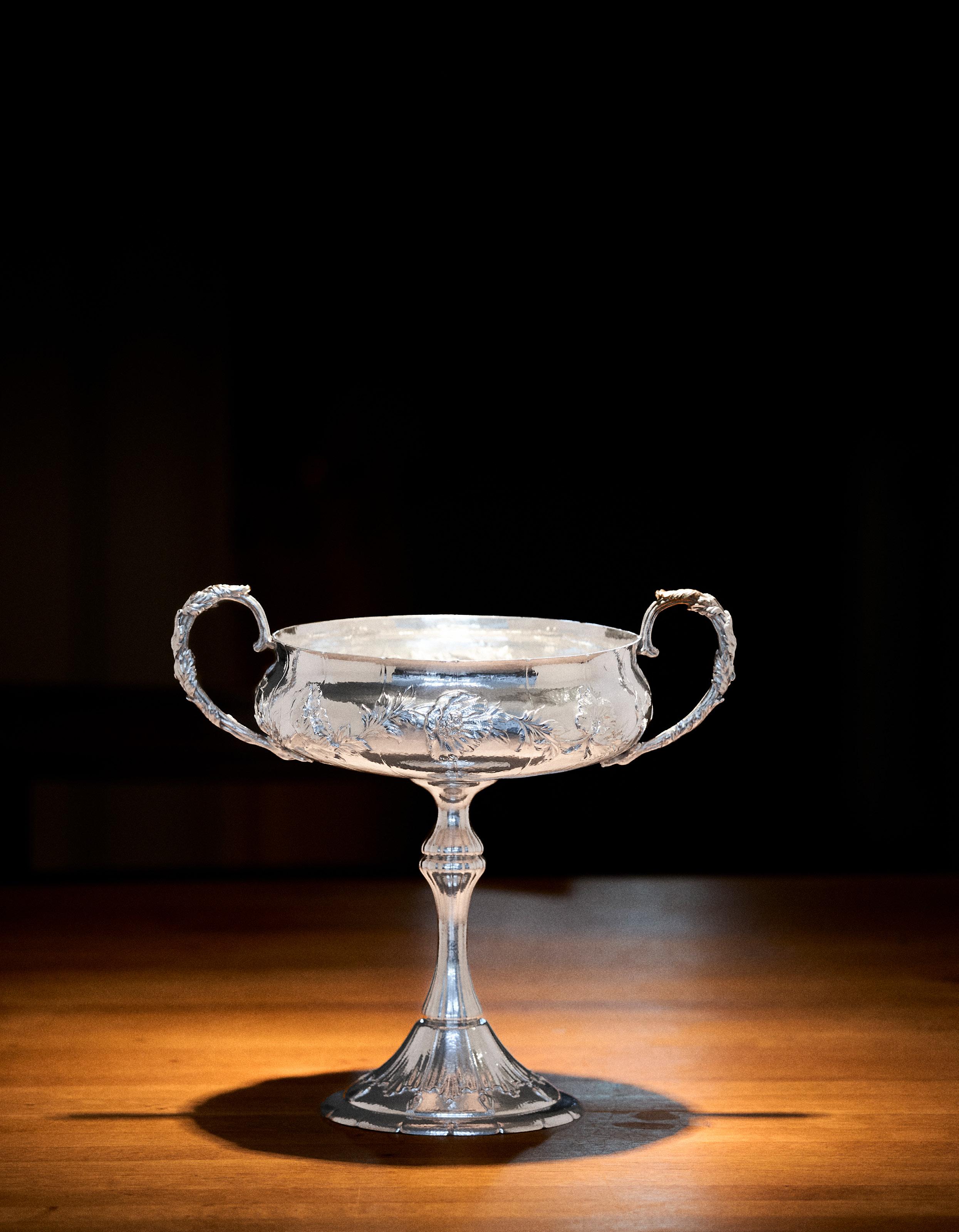
ornamented, pleasant plain spaces being left which served to accentuate the beauty of the designs’. The pieces were typical of Marks’s output, domestic wares featuring naturalistic motifs of flora and fauna, executed in the repoussé method. A fantastic example of this is lot 234, the dish of 1899, with its fish leaping out of foamy waves, encircled by an outer ring of luscious greenery.
That Marks was a devotee of the Arts & Crafts Movement is in no doubt, and it has been proposed that the proximity of his studio to William Morris’s Merton Abbey factory would have furthered this aesthetic. Marks’s practice was highly traditional as he completed all his work himself, by hand and never produced a duplicate. The naturalism of his designs was further enhanced by the sparingly polished patina of the silver, commended by critics as ‘dull yet exquisite grey’. The fabulous twin handled stemmed bowl of 1899 ( lot 231) is typical of Marks, the flowers enwrapping the body of the bowl, the handles seemingly constructed of foliage tendrils.
Gilbert Marks
His success continued in 1899 with a Fine Art Society Exhibition, and his later appearances at the Royal Academy and the Glasgow Institute of Fine Art. In recognition of his exhibition acclaim he received multiple commissions as diverse as a mace for Croydon Council and a bowl for the Cowes Regatta Committee, presented by the then Prince of Wales. What distinguishes Marks’s work is his attention to detail, for example the trout and Tudor Rose on the Croydon mace, referencing the local river and the friendship between Archbishop Whitgift and Elizabeth I (Elizabeth Tudor) respectively.
Failing health brought Marks’ career to a premature conclusion in 1902 and he died in Holloway Sanitorium in 1905 at the age of just forty-four. An obituary in Burlington Magazine eulogised him as ‘an artist of delicate grace and charm, whose name will probably take high rank in the estimation of the collector and connoisseur’.
231
GILBERT MARKS (1861-1905)
TWIN-HANDLED STEMMED BOWL, 1899
silver, stamped maker’s mark GM, signed to base GILBERT MARKS 1899, hallmarked London 1899, weight 1600g 34cm across handles, 32cm high
£5,000-7,000
233
GILBERT MARKS (1861-1905)
VASE, 1897, BRITANNIA STANDARD
232
GILBERT MARKS (1861-1905)
ARTS & CRAFTS VASE, 1902
silver, stamped maker’s mark GM, signed to foot rim GILBERT MARKS 1902, hallmarked London 1902, weight 940g 34cm high
£800-1,200
silver, stamped maker’s mark GM, signed to foot rim GILBERT MARKS
1898, hallmarked London 1897, weight 814g
31.5cm high
Provenance: Sotheby’s, New York, 30 November 1993, lot 218
£1,000-1,500
234
GILBERT MARKS (1861-1905)
ARTS & CRAFTS DISH, 1899
silver, stamped maker’s mark GM, signed to rim GILBERT MARKS 97, hallmarked London 1899, weight 403g
23.5cm diameter
£1,000-1,500
235
GILBERT MARKS (1861-1905)
PAIR OF BON-BON DISHES, 1896 silver, stamped maker’s mark GM, hallmark London 1896, each engraved to foot rim GILBERT MARKS ‘97, weight 495g (2) each 14cm diameter, 9.5cm high
£1,000-1,500
GILBERT MARKS (1861-1905)
CHARGER, 1899
silver, stamped maker’s mark GM, signed and dated to rim
GILBERT MARKS 1899, hallmarked London 1899, weight 1626g
42cm diameter
£2,000-3,000
237 Y
ALEXANDER FISHER (1864-1936)
ICE BUCKET, 1907
silver, enamel and ivory, stamped maker’s mark AF, hallmarked London 1907, total weight 968g
15cm diameter, 24.5cm high to top of handle
Sold in compliance with UK Government and APHA regulations, with (non-transferable) exemption registration reference T9G2FFRL
£1,000-1,500
Alexander Fisher was immersed in a creative environment from an early age, his father working as an enameller and painter on ceramics. Initially Fisher focused on silversmithing and painting before discovering his penchant for enamelling. A well-respected and influential figure in his lifetime, particularly in the medium of enamelling, he taught key individuals in the Arts & Crafts Movement and reached a wider audience with his regular features in The Studio Magazine and other seminal art journals.
Having graduated from the South Kensington School of Design, during the 1890s he taught himself the art of enamelling, gleaning information from old books and then trial and error. He progressed from enamelling on pottery to enamelling on metal, as is the method on this ice bucket. Through his teaching he met architect and metalworker Henry Wilson, with whom he later entered into partnership. Fisher’s influence and enthusiasm encouraged many including Arthur and Georgie Gaskin and Nelson Dawson to introduce enamelling into their practice.
Alexander Fisher
238
BIRMINGHAM GUILD OF HANDICRAFTS
CHRISTENING MUG, 1900
silver, inscribed ALASTAIR HAMILTON PATERSON XX OCTOBER MCM, stamped maker’s mark BGHLD, hallmarked Birmingham 1900, weight 156g 9cm high
Provenance: Christie’s, Glasgow, 23 September 1998, lot 144 £200-300
Kate Harris
Kate (or Katie) Harris, is broadly considered one of the most important designers for the Londonbased firm, William Hutton & Sons. From 1899 to around 1905, she produced exquisite nature-inspired designs for artistic silver. Often featured in The Studio magazine, her work received much critical acclaim, but the standard commercial practice for designs to be attributed to the firm itself, and not the individual designer saw her remain largely anonymous, making forging a prosperous artistic career a challenge.
Birmingham Guild of Handicrafts
Founded in 1890 the Birmingham Guild of Handicraft worked to preserve traditional craftsmanship in the face of industrialisation and mass production methods. It grew out of the 1880 founded Birmingham Kyrle Society, which sought to provide working people with character improving leisure activities. Victorian ideals of cultural philanthropy sat at the heart of the Guild, with C.R. Ashbee’s Guild of Handicraft and its Arts & Crafts ideals providing the blueprint. The Guild supported several crafts, but was most recognised for and prolific in metalwork, which included silver, copper and brass designs; a status in keeping with its motto ‘By Hammer and Hand’.
239
KATE HARRIS (1878-1949) FOR W G CONNELL
BOX AND COVER, LONDON, 1900
silver, stamped retailer’s mark WGC, inscribed W. G. CONNELL/ 83 CHEAPSIDE, LONDON, hallmarked London 1900, weight 194g 10cm wide
£500-700
240
WALKER AND TOLHURST
STEMMED BOWL, 1902
silver, stamped maker’s mark WWBT, signed to bowl MARGARET PARSONS, hallmarked London 1902, weight 1583g
34.8cm across handles, 32.5cm high
£1,200-1,800
241
JAMES DIXON AND SONS
CHAMBER CANDLESTICK, 1904
silver, stamped maker’s mark JD & S, hallmarked Sheffield 1904, weight 181g 11.7cm square
£600-800
242
WILLIAM HUTTON AND SONS
CIGAR BOX, 1902
silver, with copper, mother-of-pearl and enamel panel, set with hardstone cabochons, wooden lined, stamped maker’s mark
WH&SS LD, hallmarked London 1902
25.3cm wide, 14cm high, 15.2cm deep
Provenance: Christie’s, London, 31 January 1990, lot 18
£2,000-3,000
In 1888 C. R. Ashbee, inspired by the ideas of John Ruskin and William Morris, founded the Guild and School of Handicraft in London’s East End. Conceived as a cooperative venture, it aimed both to raise standards of craftsmanship and to restore dignity and status to the craftsman. Ashbee sought to strike a balance between the isolated independence of the artist and the commercial workshop, where craftsmen often had little stake in their work beyond a weekly wage. In this way the Guild combined craft production with the social ideals of the Arts and Crafts movement.
By the turn of the twentieth century the movement had encouraged creativity across many fields, including silversmithing, jewellery and enamelling, stained glass, bookbinding, furniture making and printing. The Guild became particularly known for its metalwork—producing jewellery, enamels, and hand-wrought copper and ironwork— while also employing stonemasons, woodworkers and glass artists.
C.R. Ashbee & The Guild of Handicraft
In 1902 Ashbee moved the Guild from London to Chipping Campden in the Cotswolds, hoping to offer his craftsmen a healthier and more harmonious way of life. That May he and several Guild members travelled by train to Moreton-in-Marsh and cycled the final miles to the town. Over the summer around fifty craftsmen and their families followed from London, bringing their tools and establishing workshops in the former silk mill on Sheep Street.
Initially the venture prospered, but by about 1904 sales began to decline. The Guild’s cooperative structure, which had worked more effectively in the city, struggled to adapt to the rural setting, and financial pressures led to its dissolution in 1907. Nevertheless, several craftsmen remained in Campden and continued working independently, ensuring the silk mill remained a centre for craft production.
The Guild’s brief presence thus marked both the end of Ashbee’s communal experiment and the beginning of Chipping Campden’s lasting association with craftsmanship and design. Ashbee himself remained in the town until 1919.
243
C. R. ASHBEE (1863-1942) FOR THE GUILD OF HANDICRAFT LTD. ARTS & CRAFTS COMPORT, 1904
silver and enamel, stamped maker’s mark G OF H LTD, hallmarked London 1904, total weight 904g 23cm high, 26.6cm diameter
Provenance: Christie’s, London, 13 February 1998, lot 605
Literature: Crawford A. C.R. Ashbee; Architect, Designer & Romantic Socialist, Yale University Press 1985, p. 333 where a related comport is illustrated.
£5,000-7,000
244 Y THE GUILD OF HANDICRAFT
ROSE BOWL AND COVER, LONDON, 1935
silver and ivory, stamped maker’s mark G OF H, hallmarked London 1935, total weight 2684g
37cm diameter across handles
£3,000-5,000
ARCHIBALD KNOX (1864-1933) FOR LIBERTY AND CO.
‘CYMRIC’ JAM POT, COVER AND SPOON, 1905
silver, glass and enamel, stamped retailer’s mark L & CO, CYMRIC 2263, hallmarked Birmingham 1905, spoon hallmarked Birmingham 1906
8cm high to rim, 10.2cm diameter
£1,200-1,800
Archibald Knox
Born to Scottish parents on the Isle of Man, Knox developed a keen interest in Celtic lore and design whilst still at school. He moved to London at the end of the 1890’s where he taught in Art Schools and worked for both the Silver Studio and Liberty & Co. Liberty’s launched their Cymric’ (silver) and ‘Tudric’ (pewter) ranges in response to increased interest in Celtic design motifs. Knox was the lead designer but the Liberty tendency to not name designers resulted in limited contemporary recognition. His association with Liberty’s ended in 1912 but Knox is now regarded as a key figure in defining the aesthetic of the early twentieth century.
Charles Horner
Charles Horner was a jeweller based in Halifax, but upon his death the business passed into the hands of his sons James and Charles, who produced silver wares.
246
ATTRIBUTED TO CHARLES HORNER
LIDDED BOX, BIRMINGHAM, 1902
silver, with silver gilt interior, stamped maker’s mark C.H, hallmarked Birmingham 1902, retailer’s mark Dunthorne/ 13 Lord St./ Liverpool, registered number 397123, weight 248g
8.3cm high
£300-500
247
EDWARD SPENCER (1872-1938) FOR THE ARTIFICERS’ GUILD
ARTS & CRAFTS BON BON STAND, 1925
silver, set with chrysoprase cabochons, stamped artist’s mark EDWARD SPENCER
DEL, stamped maker’s mark
AS.GD.LD, hallmarked London 1925, total weight 200g 13.5cm across handle, 11.4cm high
£1,500-2,000
Edward Spencer
Edward Spencer founded the Artificer’s Guild in 1901 with Nelson Dawson. Born in Blackheath in south-east London, he trained under Henry Wilsonn the architect and goldsmith. The Guild was sold to Montagu Fordham in 1903, but he resigned in 1906, and Spencer then became a director until his death. They were based in Conduit Street in London and had a showroom in Cambridge.
Spencer was very much influenced by William Morris and looked to a medieval guild system valuing craftsmanship. He was regarded for his draughtsmanship and often incorporated other materials into his work as decorative embellishments, such as ivory, shagreen, enamel, abalone and semi-precious stones.
Omar Ramsden
Born in Sheffield in 1873, Omar Ramsden graduated from the Sheffield School of Art in 1897. During his evening classes there he met Alwyn Carr, and both won four-year scholarships, initially causing a rivalry, the result of which was fantastic creativity. Following completion of their studies, and now good friends, they travelled to Europe, being exposed to and acquiring artistic inspiration in the process.
In February 1898, now back in London, they established a partnership and registered their mark at Goldsmith’s Hall. In their first year they won a prestigious open design competition to create a mace for the city of Sheffield, the proceeds from which enabled the opening of their Stamford Bridge Studios premises in Chelsea. In 1901 they moved to Albert Studios in Battersea before opening St Dunstan’s Studios in Fulham in 1905, the name taken from the patron saint of silversmiths.
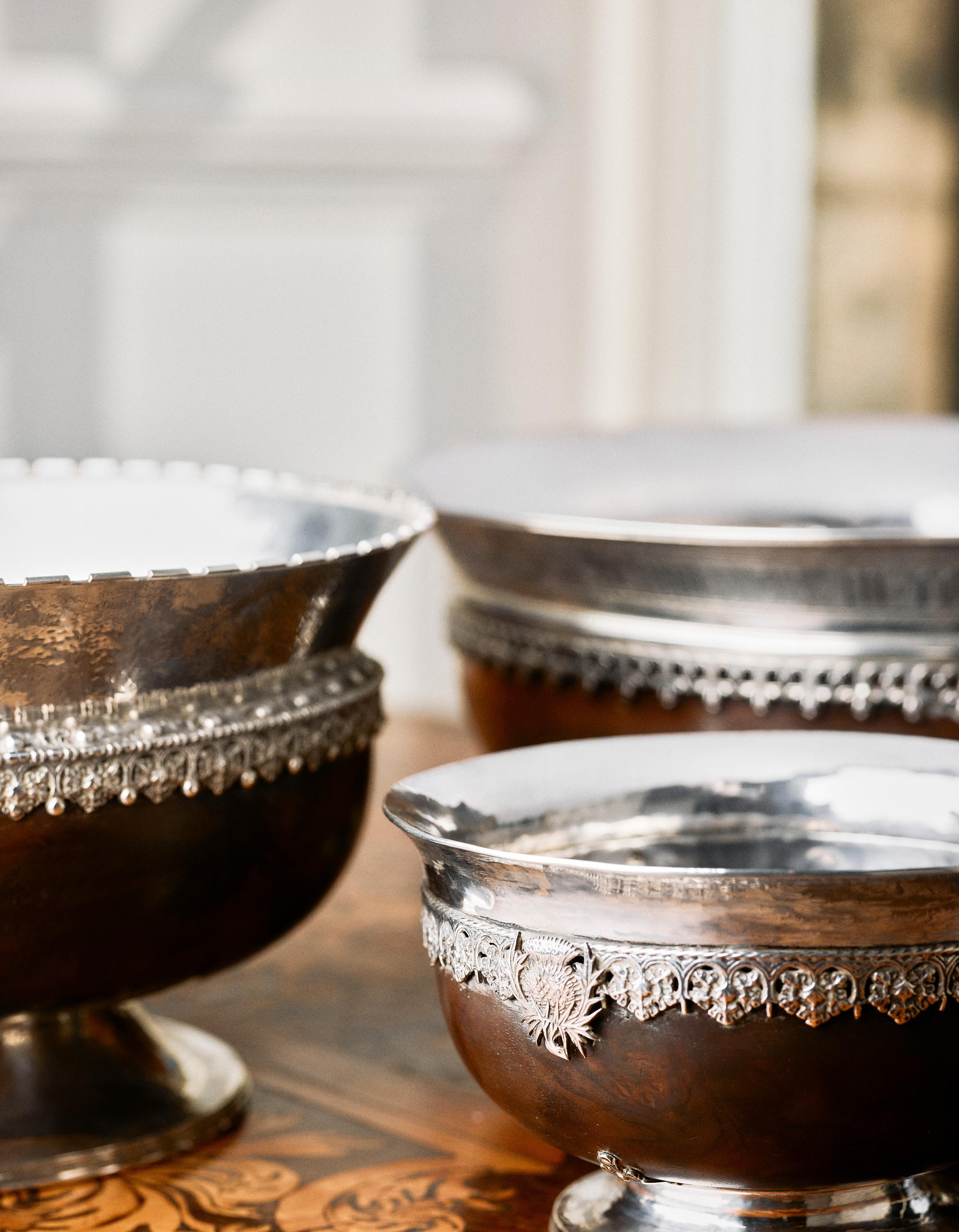
Producing Arts & Crafts silver which incorporated Celtic and medieval inspiration, their work marked a departure from the conservative designs of the Victorian era. The pair were at the forefront of design and marketing whilst the metalwork was carried out by workshop assistants. Such was their renown that the St Dunstan’s workshop became a fashionable location for London’s social elite to come and commission bespoke pieces from the sought-after designers and has even been compared to a salon in its convivial atmosphere.
The partnership was dissolved in 1919, but the pair remained lifelong friends. Ramsden carried on the running of the workshop whilst Carr continued in silver design and branched out into wrought iron. Ramsden continued working in his signature style, playfully signing many of his pieces ‘Omar Ramsden me fecit’, ‘Omar Ramsden made me’, just as medieval and renaissance artists had done before him.
OMAR RAMSDEN (1873–1939)
MAZER BOWL, 1938
silver and walnut, stamped maker’s mark OR, inscribed OMAR RAMSDEN ME FECIT, hallmarked London 1938, engraved to the rim with inscribed verse and translation under the foot rim
31cm diameter, 15cm high
The translation of the inscription reads “The true value of a benefit lies in the spirit in which it is done or given”
£3,000-5,000
249
OMAR RAMSDEN (1873-1939)
MAZER BOWL, LONDON 1926
silver and walnut, stamped maker’s mark OR, inscribed OMAR RAMSDEN ME
FECIT, hallmarked London 1926
17.1cm diameter, 10cm high
£1,500-2,000
250
OMAR RAMSDEN (1873–1939)
MAZER BOWL, 1936
silver and walnut, stamped maker’s mark OR, inscribed OMAR RAMSDEN ME FECIT, hallmarked London 1936
26cm diameter, 15.5cm high
£2,000-3,000
251
OMAR RAMSDEN (1873-1939)
MATCHBOX COVER, 1927
silver and enamel. stamped maker’s mark OR, hallmarked London 1927, total weight 73g 6cm long
£400-600
252
OMAR RAMSDEN (1873-1939)
MATCHBOX COVER, 1936
silver and enamel. stamped maker’s mark OR, inscribed OMAR
RAMSDEN ME FECIT, hallmarked London 1936, total weight 79g
6cm long
£400-600
253
OMAR RAMSDEN (1873-1939)
TRAY, LONDON, 1922
mahogany with silver mount, bears engraved coat of arms with motto FESTINA LENTE, stamped maker’s mark OR, hallmarked London 1922
59.5cm long, 46.5cm deep
Provenance: Christie’s, London, 27 October 1998, lot 18
£1,500-2,000
254
OMAR RAMSDEN (1873-1939)
SMOKER’S COMPANION, 1926 silver, stamped maker’s mark OR, inscribed OMAR RAMSDEN ME FECIT, engraved proverb FIAT LUX LAETUS SORTE MEA (Let there be light; I am happy with my lot), weight 174g 16.8cm long
Provenance: Christie’s, Glasgow, 13 May 1993, lot 633
£600-800
255
OMAR RAMSDEN (1873-1939) WALL SCONCE, 1930
silver, stamped maker’s mark OR, inscribed OMAR RAMSDEN ME FECIT, hallmarked London 1930, weight 974g
16.5cm wide, 26.9cm high, 10cm deep
£1,800-2,200
256
OMAR RAMSDEN (1873-1939)
CIGARETTE BOX, 1930
silver and oak, stamped maker’s mark OR, inscribed OMAR RAMSDEN ME FECIT, hallmarked London 1930
20.2cm wide, 7.2cm high, 12.5cm deep
£1,500-2,000
257
OMAR RAMSDEN (1873-1939)
INKSTAND, 1931
silver, oak, with clear glass liners, stamped maker’s mark OR, inscribed OMAR RAMSDEN ME FECIT, with engraved dedication, hallmarked London 1931, total weight 2445g
24cm wide, 13cm high, 14cm deep
Inscription reads ‘I was wrought for Harold Mayhew as a mark of esteem and friendship by command of A.W. Dickinson AD MCMXXXIII’
£3,000-5,000
258
OMAR RAMSDEN (1873-1939)
INKSTAND, 1920
silver, with green glass liner, stamped maker’s mark OR, hallmarked London 1920, loaded 7cm high
Provenance: Possibly Christie’s, London, 24 May 1989, lot 103 £600-800
259
OMAR RAMSDEN (1873-1939)
ARTS & CRAFTS DISH, 1937 silver and enamel, stamped maker’s mark OR, inscribed OMAR RAMSDEN ME FECIT, hallmarked London 1937, total weight 125g
12.3cm diameter
£600-800
260
OMAR RAMSDEN (1873-1939)
ARTS & CRAFTS DISH, 1933
silver and enamel, stamped maker’s mark OR, inscribed OMAR RAMSDEN ME FECIT, hallmarked London 1933, total weight 272g
16.7cm diameter
£800-1,200
OMAR RAMSDEN (1873–1939)
ARTS & CRAFTS CUP & COVER, 1930
silver with carnelian cabochons, oak plinth, stamped maker’s marks OR, hallmarked London 1930, inscribed OMAR RAMSDEN ME FECIT, weight 233g excluding plinth (3)
24cm high
Provenance: Sotheby’s, London, 5 April 2006, lot 33
£2,000-3,000
OMAR RAMSDEN (1873–1939)
ARTS & CRAFTS GOBLET, 1923
silver, with later blue glass liner, engraved beneath the rim with Latin inscription dated 1927 commemorating the 70th birthday of Augustus Hartmann. stamped maker’s mark OR, hallmarked London 1927, inscribed OMAR RAMSDEN ME FECIT, weight 550g without liner
25.4cm high
£1,500-2,000
263
OMAR RAMSDEN (1873-1939)
CIRCULAR SALVER, 1938
silver, stamped maker’s mark OR, inscribed OMAR RAMSDEN ME FECIT, hallmarked London 1938, 519g
21.5cm diameter
£600-800
264
OMAR RAMSDEN (1873-1939)
SUGAR CASTER, 1938
silver, stamped maker’s mark OR, inscribed OMAR RAMSDEN ME FECIT, hallmarked London 1938, weight 321g
16.5cm high
£500-700
265
OMAR RAMSDEN (1873-1939)
CHRISTENING MUG, 1934
silver, stamped maker’s mark OR, inscribed OMAR RAMSDEN ME FECIT, hallmarked London 1934, inscribed under the foot rim JANET LEIGH
ILLINGWORTH APRIL 1936, base with cast proverb, ANIMUS LAETUS
BENE AFFICIT VULTUM (A merry heart maketh a cheerful countenance), weight 252g
8.3cm high
£1,000-1,500
266
OMAR RAMSDEN (1873-1939)
BOWL, 1935
silver, stamped maker’s mark OR, inscribed OMAR RAMSDEN ME FECIT, hallmarked London 1935, weight 1325g
24cm diameter
£800-1,200
267
OMAR RAMSDEN (1873-1939)
SUGAR CASTER, 1936
silver, stamped maker’s mark OR, inscribed OMAR
RAMSDEN ME FECIT, hallmarked London 1936, weight 302g
16cm high
£500-700
268
OMAR RAMSDEN (1873-1939)
SWEETMEAT DISH, 1931
silver, stamped maker’s mark OR, inscribed OMAR
RAMSDEN ME FECIT, hallmarked London 1931, weight 192g
24.5cm wide
Provenance: Christie’s, Glasgow, 13 May 1993, lot 636
£1,500-2,000
269 Y
OMAR RAMSDEN (1873-1939)
BOWL AND COVER, 1925
silver and ivory, stamped maker’s mark OR, inscribed OMAR RAMSDEN ME FECIT, hallmarked London 1925, total weight 818g
14cm high
Sold in compliance with UK Government and APHA regulations, with (nontransferable) exemption registration reference 51R5VQK7
£1,500-2,000
OMAR RAMSDEN (1873-1939)
SWEETMEAT DISH, 1939
silver, stamped maker’s mark OR, inscribed OMAR
RAMSDEN ME FECIT, hallmarked London 1939, weight 697g
13.5cm high
£1,500-2,000
OMAR RAMSDEN (1873-1939)
BOWL, 1938
silver, stamped maker’s mark OR, inscribed OMAR RAMSDEN
ME FECIT, hallmarked London 1938, weight 1322g 22.5cm diameter
£4,000-6,000
272
OMAR RAMSDEN (1879-1939)
AND ALWYN CARR (1872-1940)
TOILET JAR, 1897
silver, glass and enamel, stamped maker’s mark RM & CR, hallmarked London 1897
9cm high
£400-600
273
ALWYN CARR (1872-1940)
ARTS & CRAFTS CASED CRUET SET, 1925
silver, stamped maker’s mark AC, hallmarked London 1925, comprising; a PAIR OF LIDDED MUSTARD POTS, each with glass liner, 11cm high; a PAIR OF PEPPERS, 8.5cm high; a PAIR OF SALTS, each with green glass liner, 6.9cm high including liner; together with a PAIR OF SALT SPOONS, 7.5cm long; a PAIR OF MUSTARD SPOONS, 8.4cm long; with two spare green glass mustard pot liners and one spare salt liner, total weight 723g (13) £1,200-1,800
RAMSDEN (1873-1939) AND ALWYN CARR (1872-1940)
PAIR OF ARTS & CRAFTS CANDLESTICKS, 1900
silver, stamped maker’s mark RM. CR., hallmarked London 1900, weight 422g (2)
18.5cm high
Provenance: Christie’s, Glasgow, 13 May 1993, lot 634
£2,000-3,000
OMAR
Henry George Murphy
Born in Kent in 1884, Henry George Murphy, known as Harry, had an early first encounter with design and craftsmanship. Aged 10 he walked past an exhibition of the Arts and Crafts Society of London and, showing curiosity, was introduced to jeweller and silversmith Henry Wilson, illustrator Walter Crane and founder of the Arts & Crafts movement William Morris. Murphy became Wilson’s protegee, from the age of fifteen undertaking a six-year apprenticeship at his Kensington workshop, an education complimented by enrolling at the Central School of Arts and Crafts. On completion of his studies, Murphy continued teaching at this institution and at the Royal College of Art. Further, he honed his skills as a craftsman in Wilson’s workshop, focusing on goldsmithing, enamel and jewellery. Murphy’s interest in Gothic and Renaissance style and use of enamel and niello mirrored Wilson’s, leading to his designs often being misattributed to his mentor.
In 1910 Murphy left Wilson’s studio and in 1912 travelled to Berlin where he was foreman in the workshop of Emil Lettré. This partnership was short lived due to Murphy’s homesickness and the recalcitrant nature of his employer. The following year, Murphy founded his west London workshop and married his fiancée of four years, Jessie Church. World War I meant a hiatus in his typical output, as he initially produced metal and enamel service badges for the military, before enlisting and shutting his workshop in 1915.
Following the conclusion of the war, Murphy recommenced teaching at the Central School of Arts and Crafts alongside other piecemeal studio work. In 1924 he produced the Crown Jewels for Queen Mary’s Doll’s House, including the Imperial State Crown at just 3cm high! It was also during this period that he received the most high-profile commission of his career, a tiara for the Princess Royal. This impressive piece was described at the 1966 auction of Princess Mary’s jewellery as ‘A Gem, Enamel and Gold Head Ornament, composed of five graduated gold and enamel Gothic arches supported on similarly decorated pillars each enclosing a stylized tree set with sapphires and small diamond collets.” The stylised trees were representations of the ‘Tree of Jesse’, a metaphor for the ancestors of Christ. This was a recurrent motif in Murphy’s work, and a nod to his wife Jessie.
It was in this vein that in 1928 he named his new workshop Falcon Studios (a jess being the strap attached to the leg of a falcon). The stamped Falcon mark can be found on much of Murphy’s work from this period and recognises the instrumental role Jessie played in supervising the Studios’ shop and office. Opening on Marylebone High Street in an old chemist’s shop, Murphy’s enterprise flourished. Falcon Studios’ initial success was unfortunately hampered by the 1929 Wall Street Crash, the negative effect of which impacted both the business’s fortunes and Murphy’s health. Despite illness, Murphy never lost his enthusiasm for his work or his verve for teaching. By 1932 however financial circumstances had improved and Murphy was also awarded Head of Silversmithing at the Central School of Arts and Crafts.
Murphy’s hitherto Renaissance and Gothic style began to include Art Deco, Egyptian and Oriental elements from the late 1920’s. This is manifest in his clean, geometric lines and zig-zag patterns, for instance the sugar sifter of 1933 (lot 278). Murphy also admired Nordic makers like Georg Jensen, as is evidenced by his inclusion of cabochons, such as on his rosebowl and cover of 1936 (lot 277). The development of his style cannot be called linear however, as the porringer of 1937 (lot 267) clearly owes more to the Gothic tradition than Movements contemporary to its making.
The conclusion of the decade saw Murphy declared a Freeman of the City of London and the Art Workers Guild, called to the Court of Assistants of the Goldsmiths’ Company and a recipient of the Diploma of Royal Designer of Industry, a highly regarded figure at the pinnacle of his profession. In 1939 however, Murphy’s health worsened significantly and he died on 10th July.
Passing away on the eve of the Second World War, the aesthetic of his work unfashionable at its close, H. G. Murphy languished almost entirely forgotten in the canon of design history. In 2005 however, admirers Paul Atterbury and John Benjamin organised an exhibition at Goldsmith’s Hall in London, presenting his work alongside an array of archival material and original designs. It is from their work that most of the writing on Murphy in subsequent years draws. Their exhibition, At the Sign of the Falcon: H.G. Murphy – Art Deco Silversmith and Jeweller, initiated renewed interest in Murphy and began to redress the neglect of the previous century.
275
HENRY GEORGE MURPHY (1884-1939)
ARTS & CRAFTS CHALICE, 1933
silver and silver gilt, set with moonstone cabochons, inscribed to the bowl
BENEDICTA/ SANCTA/ TRINITAS, stamped maker’s mark HGM, stamped Falcon Studio mark, hallmarked London 1933, total weight 546g 18.5cm high
£2,000-3,000
276
HENRY GEORGE MURPHY (1884-1939) PORRINGER, 1937
silver, stamped maker’s mark HGM, hallmarked London 1937, stamped Falcon Studio mark, weight 139g
length including handle 14.8cm
£500-700
277 Y
ROSEBOWL AND COVER, 1936
silver, with ivory finial set with garnet cabochon, stamped maker’s mark HGM, with Falcon studio mark, hallmarked London 1936, total weight 1117g 17.5cm high, 19cm diameter
Sold in compliance with UK Government and APHA regulations, with (nontransferable) exemption registration reference T2LY51Z1
£2,000-3,000
HENRY GEORGE MURPHY (1884-1939)
278
HENRY GEORGE MURPHY (1884-1939)
SUGAR CASTER, 1933
silver, stamped maker’s mark, hallmarked London 1933, stamped Falcon Studio mark, weight 181g 12.5cm high
£1,000-1,500
279
HENRY GEORGE MURPHY (1884-1939)
PAIR OF TOAST RACKS, 1934
silver, stamped maker’s mark HGM, hallmarked London 1934, with Falcon Studio mark, weight 368g (2) 9.7cm long, 11cm high
£800-1,200
281
HENRY GEORGE MURPHY (1884-1939)
BOX AND COVER, LONDON, 1930
silver and silver gilt, with boxing putti finial, stamped maker’s mark HGM, hallmarked London 1930, weight including handle 836g 17cm high
£1,000-1,500
282
HENRY GEORGE MURPHY (1873-1939)
BOWL AND COVER, 1929
silver, stamped maker’s mark HGM, hallmarked London 1929, stamped Falcon Studio mark, weight 218g
8.5cm high
£500-700
CHARLES BOYTON (1885-1958)
ART DECO COCKTAIL TRAY, 1938 silver, stamped maker’s mark CB, with facsimile signature CHARLES BOYTON, hallmarked London 1938, weight 883g 34.4cm across handles £600-800
Charles Boyton
Charles Boyton was a fourth-generation silversmith working in London, his great-grandfather, also Charles, having registered his first mark in 1825. In 1934 Boyton left the family firm and set up his own business in Marylebone Lane. It was from these premises that Boyton produced pieces stamped with his mark CB and engraved with a facsimile signature, as included on the cocktail tray of 1938 (lot 283).
Between 1934 and the beginning of the First World War Boyton produced mostly Art Deco designs and had some success in straightened financial times. Indeed, Boyton is remarkable for having one of the few workshops to operate in Britain between the wars producing high-quality silver in the modern style. When war was declared in 1939 Boyton was forced to close his workshop. In 1946 Boyton revived his business, retailing his silver exclusively at The Royal Copenhagen Porcelain Company, 6 Old Bond Street, London. Once again however the challenging financial conditions saw him cease trading in 1948.
CHARLES BOYTON (1885-1958)
DESSERT STAND, 1939
silver, stamped maker’s mark CB, signed and dated under rim CHARLES BOYTON/ LONDON/ 1939, hallmarked London 1939, weight 1013g
29.5cm diameter
£800-1,200
285
C. S. HARRIS & SONS LTD
ART DECO SUGAR CASTER, 1928
silver, stamped maker’s mark C.S & H, hallmarked London 1928, weight 246g 16.5cm high
£500-700
C.S. HARRIS
Originally known as Charles Stuart Harris, a London-based silver makers, it became CS Harris & Sons in 1897 and then in 1933 it merged with I. Freeman & Sons.
286
TURNER & SIMPSON LTD, BIRMINGHAM
CASED ART DECO FRUIT SERVICE, 1933
silver gilt, enamel and stainless steel, stamped maker’s mark T&S, hallmarked Birmingham 1933; comprising twelves knives and twelve forks (24)
forks 14.5cm long, knives 15.7cm long
£800-1,200
MAPPIN AND WEBB, LONDON
ART DECO TABLE CLOCK, 1935
silver, with enamel discs depicting signs of the Zodiac, with wooden back and Bakelite cased ‘Genalex’ electric movement, stamped retailer’s mark M&W, inscribed MAPPIN & WEBB and cast with dates 1913/ 1938 (roman numerals), hallmarked London 1935
27.9cm high
Provenance: A. E. Dowse and Son, Sheffield, 12 March 2005, lot 117 Sotheby’s, London, 4 May 2006, lot 72
£6,000-8,000
GEORG JENSEN (1866-1935)
TEA SERVICE, MODEL 159, 1925-1932
silver and ebony, stamped maker’s mark GEORG JENSEN, DENMARK, STERLING, GI/ 925/ S/ 159, comprising; a TEAPOT, 22cm high; a SUGAR BOWL, 20cm wide across handles; and a MILK JUG, 13cm high, total combined weight 1525g (3)
£2,000-3,000
Georg Jensen
In 1904, the Danish silversmith Georg Jensen founded his own silversmith, Georg Jensen A/S, at 36 Bredgade in Copenhagen. Employing the sculptural skill that he developed at the Royal Danish Academy of Fine Arts, Jensen was able to combine this with the production of applied arts and revive the role of the skilled artist craftsman. The company achieved great success, despite wartime troubles acquiring silver, and won numerous prizes such as the grand Prix at the 1915 Panama-Pacific International Exposition in San Francisco. In the post-war years, the company began to employ numerous prominent artists to develop new styles that remained in touch with the founder’s focus on high quality silver and jewellery. The success of Georg Jensen was down to innovative design, high-quality craftsmanship and the ability to attract some of the most inventive designers to the firm, which allowed the name of the firm to become synonymous with quality which explains its timelessness, and ongoing and growing appeal to new collectors in the 21st Century.
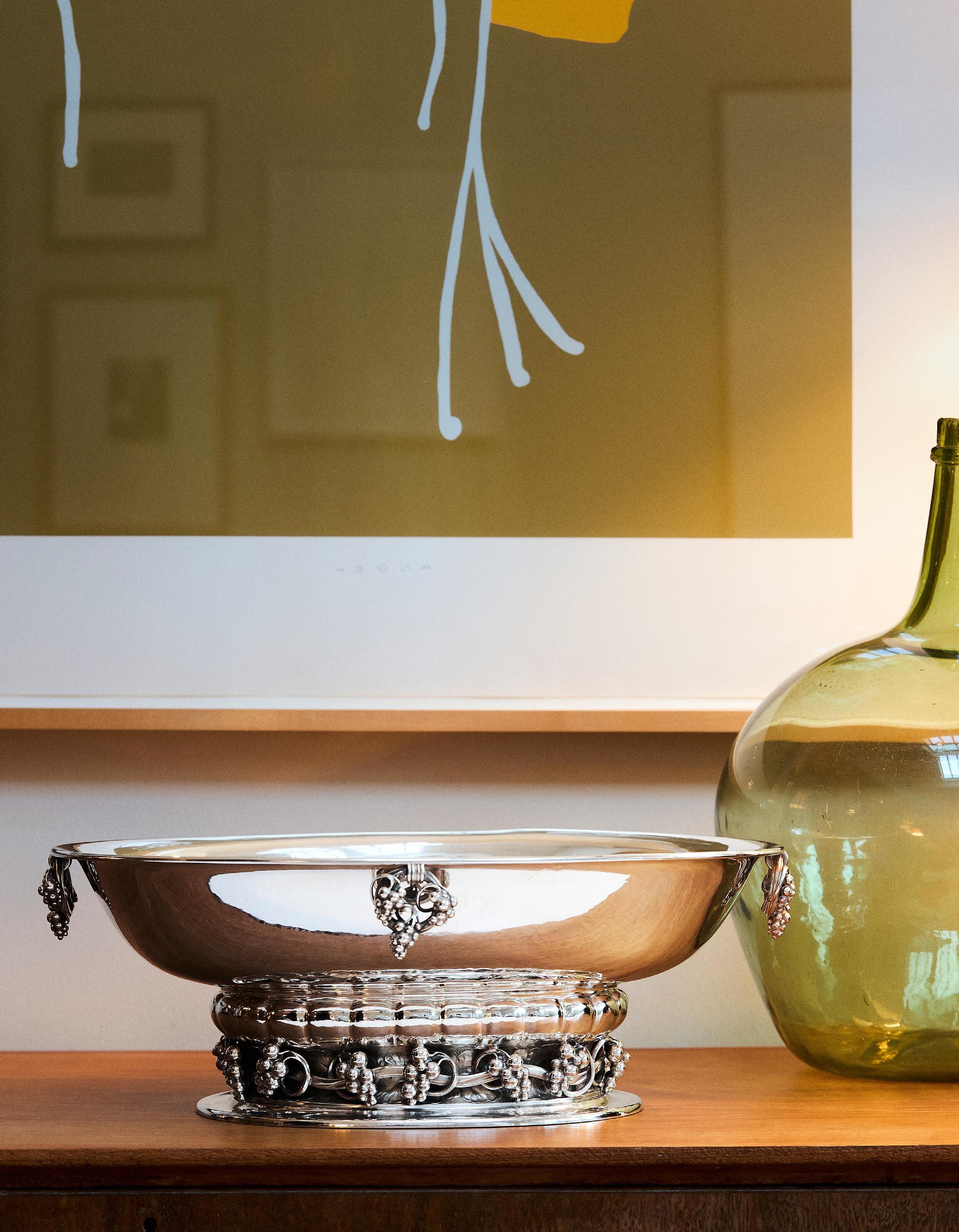
289
GEORG JENSEN (1866-1935)
CENTREPIECE BOWL, POST 1945
silver, stamped maker’s mark GEORG JENSEN STERLING DENMARK 296, weight 1983g
37.5cm wide, 13cm high
£4,000-6,000
290
GEORG JENSEN (1866-1935)
SUGAR SIFTER, MODEL 91, 1933-1944
silver, stamped maker’s marks GEORG JENSEN STERLING DENMARK
91/ GJ/ 925/S, weight 126g
11cm high
£500-700
293
GEORG JENSEN (1866-1935)
DISH AND COVER, CIRCA 1937
silver, stamped maker’s mark
GEORG JENSEN, DENMARK, STERLING, 925S/ 228, engraved to the underside PETRONITA
ELISA HERRERA DE TEDIN
URIBURU - 1937, weight 1119g
27cm diameter
£1,000-1,500
291
JØRGEN JENSEN (1895–1966) FOR GEORG JENSEN
CIGARETTE BOX, MODEL 867, 1932-1944
silver, stamped designer initials JJ, stamped maker’s mark
GEORG JENSEN DENMARK STERLING 867, with Dutch import marks, weight 519g
14.1cm wide
£600-800
292
JOHAN ROHDE (1856-1935) FOR GEORG JENSEN
BOWL, MODEL 642, CIRCA 1949
silver, stamped designer’s cypher JR, stamped maker’s mark GEORG JENSEN SILVERSMITHS LIMITED, DENMARK STERLING 642, import marks for London 1949, weight 227g
17.5cm diameter
£400-600
294
GEORG JENSEN (1866-1935)
SALT CELLAR, MODEL 97, 1920
830 standard silver, stamped maker’s mark GEORG JENSEN, GJ
296
830 S, 97, stamped Dutch import marks for 1920, weight 94g
7cm diameter, 4.9cm high
£400-600
295
GEORG JENSEN
CANISTER AND COVER, MODEL 15, CIRCA 1920
830 standard silver, stamped maker’s mark GEORG JENSEN, GJ 830S, 15, stamped Dutch import marks 1920, weight 423g
19cm high
£1,000-1,500
GEORG JENSEN (1866-1935)
‘LOUVRE’ BOWL AND COVER, MODEL 180C, 1925-1933
silver, stamped maker’s mark GEORG JENSEN, DENMARK, STERLING, GJ/ 925/ S, 180C, import marks for George Stockwell London 1931, weight 465g
17.5cm high
£1,500-2,000
297
GEORG JENSEN (1866-1935)
CASKET, MODEL 83, 1925-32
silver, set with chrysoprase cabochons, various stamped maker’s marks
GEORG JENSEN COPENHAGEN 83, weight including handle 466g 16cm wide
£1,500-2,000
299
GEORG JENSEN (1866-1935)
TEA AND COFFEE SERVICE, MODEL NO 179 silver, stamped maker’s mark GEORG JENSEN DENMARK STERLING 179 (the set) and 159 (the tray), comprising; a COFFEE POT, 23.5cm high; a TEAPOT, 14.5cm high; a SPIRIT KETTLE, STAND AND BURNER, the kettle 24.5cm high, total height 35cm; a SUGAR BOWL, 17.8cm wide across handles; a MILK JUG, 12.4cm high; together with an associated SERVING TRAY, 86.5cm wide, 53.5cm deep, weight 10,799 g (6)
£4,000-6,000
298
GEORG JENSEN (1866-1935)
WATER PITCHER, MODEL 385, CIRCA 1969 silver with ebonised wood handle, stamped GEORG JENSEN DENMARK STERLING 385, import marks G. J LD., London 1969, total weight 630g 17cm high
£800-1,200
300 Y GEORG JENSEN (1866-1935)
‘BLOSSOM’/ ‘MAGNOLIA’ COFFEE SERVICE, CIRCA 1945 silver and ivory, stamped maker’s mark GEORG JENSEN DENMARK STERLING 925 S, comprising; a COFFEE POT, 12.5cm high, a SUGAR BOWL, 5.8cm diameter; a CREAM JUG, 3.6cm high, each stamped 2H; and a TRAY, stamped 2P, 26.4cm long; total weight 757g (4)
Sold in compliance with UK Government and APHA regulations, with (nontransferable) exemption registration reference ZL58YS5R
£3,000-5,000
301
REGINALD
H. HILL (1914-1975)
CIGARETTE JAR AND COVER, 1948
silver and ebony, stamped maker’s mark RHH, engraved mark REGINALD. HILL, hallmarked London 1948, weight including handle, 360g 12.5cm high
£1,000-1,500
Christopher Lawrence
Reginald Hill
Reginald Hill was initially apprenticed to a silversmith, before discovering his flare for silver design as a student at the Central School of Arts and Crafts. In 1939, still at the beginning of his career, such was the high regard in which Hill’s designs were held, that he was commissioned to design the Ascot Gold Cup for Elkington. After WWII Hill combined teaching at the Central School of Arts and Crafts with his own Design work, notable commissions including an 18-carat gold communion set, commissioned in 1958 by the Duke of Edinburgh as a gift to the Archbishop of Canterbury following the coronation of Elizabeth II.
Student testimonies illustrate the warm regard and respect in which Hill, or ‘Reggie’ was held, described by one as ‘a brilliant educationalist, a fantastic designer, a gentleman and a gem of a man’. His most renowned pupil was Christopher Lawrence, then an apprentice at C J Vanders Silversmith. Lawrence lauded him as ‘the leading designer from the late 1940s, the 1950s and to some degree the 1960s’. He is therefore considered as having bridged the gap between more traditional and contemporary silver design.
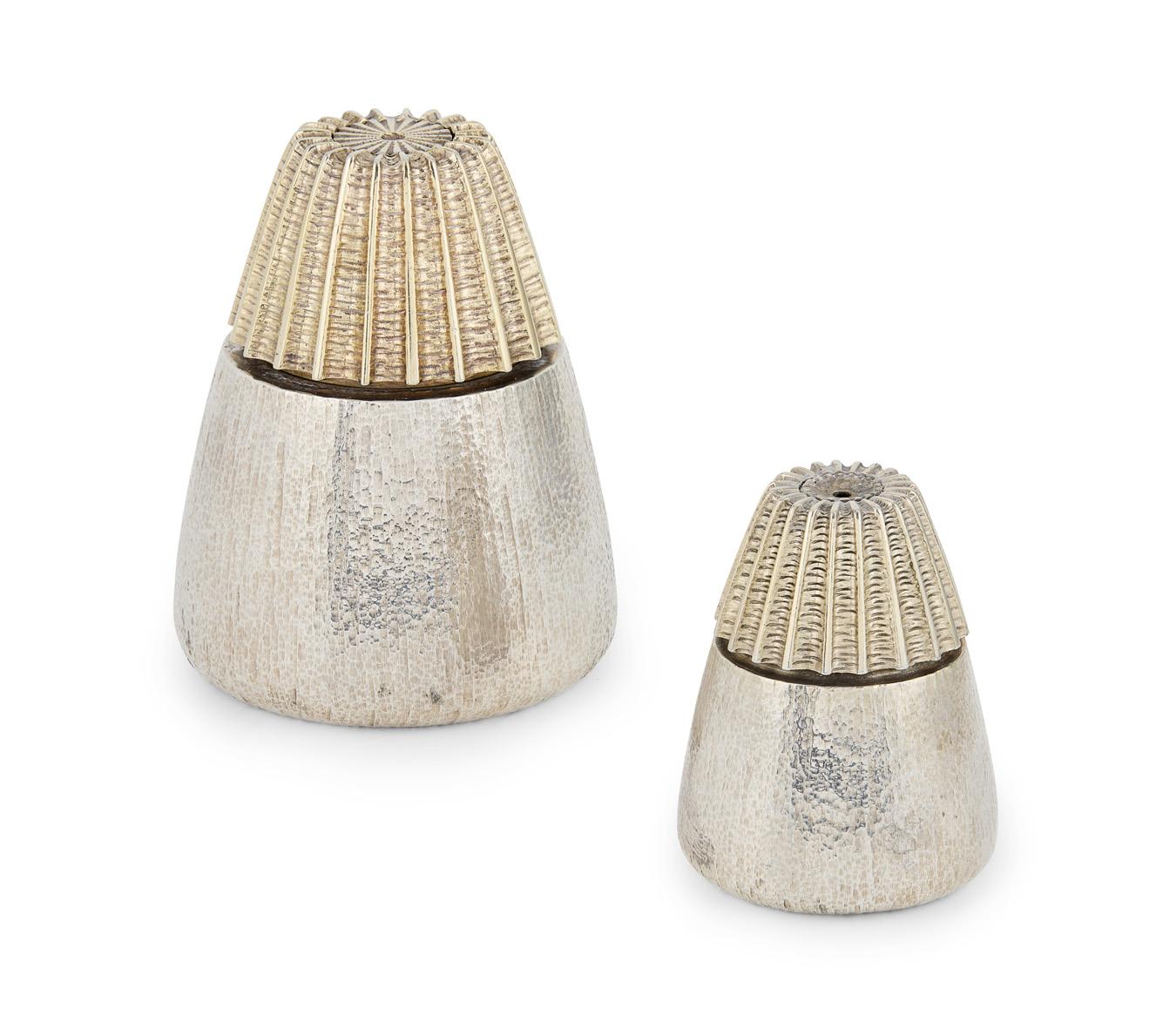
Christopher Lawrence began his silversmithing career at a young age, following a practical training route rather than a traditional art school path. After excelling in school metalwork classes, he was employed by C J Vander at just 15, while also studying part-time at the Central School of Arts and Crafts. Although he gained experience with several firms, he sought greater creative freedom. In 1968, he established his own workshop, quickly achieving commercial success and attracting international commissions. His work proved especially popular with Middle Eastern clients, producing highly elaborate pieces such as a vast dinner service and monumental ceremonial objects.
Lawrence later founded House of Lawrain, expanding into retail, wholesale, and design services, alongside creating collectible botanical silver works. Over his career, he received the Jacques Cartier Award three times. Remaining active into the 21st century, he collaborated with Fred Rich on notable works, including a celebrated 2008 bowl and ewer.
302
SALT AND PEPPER GRINDER, 1973
silver and silver gilt, steel, stamped maker’s mark CML, hallmarked London, 1973, total weight 586g (2) pepper 10.5cm high, salt 7cm high
£300-500
CHRISTOPHER LAWRENCE (B.1936)
Robert Goodden
Born in Dorset on 7 May 1909, Robert Goodden studied at Harrow School and trained in architecture at the Architectural Association (1926–32). Although he aspired to be a painter, he first explored silversmithing during this time. Due to limited opportunities in private practice, he moved into industrial design, contributing to naval camouflage in World War II. After the war, he worked on the Utility Furniture Committee alongside Gordon Russell, supporting postwar housing initiatives. He also contributed to exhibitions including Britain Can Make It (1946) and the Festival of Britain. Appointed a Royal Designer for Industry in 1947, he later created commissions such as coronation textiles for Queen Elizabeth II. From 1948, he taught at the Royal College of Art, influencing a generation of designers and promoting innovation in British design.
303
ROBERT YORKE GOODDEN (1909-2002) FOR WAKELY AND WHEELER CONDIMENT SET, CIRCA 1962 silver, the sifter inscribed R Y GOODDEN, stamped maker’s mark WW, comprising; a SUGAR SIFTER, 19.2cm high; a PAIR OF PEPPERS, 10.1cm high; a PAIR OF SALTS, 13.8cm wide; a PAIR OF LIDDED MUSTARD DISHES, 12cm long; FOUR ASSOCIATED SPOONS, with silver gilt bowls, total weight 1021g (11)
£700-900
Born in 1873, Frances Macdonald’s early life is intertwined with that of her sister, Margaret. Following a move to Glasgow they studied at the School of Art from 1890-94, and in the early years often collaborated artistically. During their studies the Macdonald sisters met Charles Rennie Mackintosh and Herbert Macnair, collectively known as ‘The Four’ or ‘The Spook School’. It is argued that despite Mackintosh having the most radical and enduring influence on the history of design, at the genesis of the group, it was the women who were the ‘main perpetrators’, producing progressive Symbolist works, which later became known as the ‘Glasgow Style’; a Scottish branch of the Continental Art Nouveau movement.
This watercolour dates from 1898, just prior to Frances’s marriage to Herbert Macnair and is atypical of her surviving work. Just two years prior, she had produced ‘Eve’ in the symbolist style and rejecting the traditional iconography associated with the biblical figure. Indeed, her early poster work with Margaret provided radical re-imaginings of female subjects; women depicted by women redefining their visual identity at the turn of the century. By comparison therefore, ‘A Blue Vase’ is a departure, with its traditional subject matter and relatively naturalistic execution. The work is none the less skillfully executed, the azaleas sitting with a spontaneous
304
FRANCES MACDONALD (1874-1921)
A BLUE VASE, 1898
watercolour, signed and dated lower right FRANCES E. MACDONALD 1898
22.5cm x 18cm (frame size 46cm x 41cm)
Provenance: The Fine Art Society, London 1983
Private Collection, Switzerland
Literature: Burkhauser, J. Glasgow Girls: Women in Art and Design 1880-1920, Edinburgh 1990, pp. 122-7
Billcliffe R. Charles Rennie Mackintosh and the Art of the Four, Quatro 2017
£8,000-12,000
feel to their arrangement, the eye being drawn to the singular red flower, whose colour is taken up in the rusty hues of the neighbouring foreground blooms. The title of the work puts the focus on the vase, rather than the flowers it contains, and the reflections across the glass surface give hints of the room beyond.
Married the following year, Frances moved to join her husband in Liverpool, bringing an end to exciting collaborations with Margaret. Further, the birth of the couple’s only child Sylvan prevented travel to Vienna in 1900 with the Mackintoshes to the ‘Vienna Secession Exhibition’. Whilst Frances did still exhibit, one can only speculate the effect that two months immersed in the world of Klimt and Secessionist Vienna could have had on the young artist. Despite high profile exhibition opportunities including Turin in 1902, London in 1911, and publication in The Studio, Macdonald was largely forgotten in the wider world.
Married life did not go smoothly due to financial insecurity and Macnair’s increasing dependence on alcohol. In 1908 the family returned to Glasgow but further marital unhappiness and the declining market for Glasgow style designs worsened their situation. Frances died in 1921, aged just forty-seven. Macnair destroyed most of her work and a large portion of his own, meaning little of her oeuvre survives. It is therefore possible that she produced more works similar to ‘The Blue Vase’, but they are not extant.
305
CHARLES RENNIE MACKINTOSH (1868-1928)
EASEL FOR THE GLASGOW SCHOOL OF ART, CIRCA 1910 stained pine, wrought steel
76cm wide, 238cm high, 73cm deep
Literature: Billcliffe R. Charles Rennie Mackintosh, The Complete Furniture, Furniture Drawings and Interior Designs, Moffatt 2009, pp. 258-9, 1910.10 illus.
£1,500-2,000
306
CHARLES RENNIE MACKINTOSH (1868-1928) FOR THE GLASGOW ARCHITECTURAL ASSOCIATION ‘CONVERSAZIONE PROGRAMME’ 1894
lithograph in black and green, on blue paper, presented in a later mount, designed for the Glasgow Architectural Association, held at Queen’s Rooms, 114 W Campbell Street, Glasgow, February 22, 1894, facsimile signature ‘CHAS. R. MACKINTOSH.’; printed by Carter & Pratt, 133 West Campbell Street, Glasgow 13.5cm x 39cm (mount size 18.7cm x 44.5cm)
Literature: Howarth T. Charles Rennie Mackintosh and The Modern Movement. Routledge and Kegan Paul 1952, pp. 17-18, fig. 3 illus.
Neat T. Part Seen, Part Imagined: Meaning and Symbolism in the Work of Charles Rennie Mackintosh and Margaret Macdonald, Canongate 1994, illus. p. 37
For a similar work at auction see Christies, London, The Dr Thomas Howarth Collection: Important works by Charles Rennie Mackintosh, Margaret and Frances Macdonald and Herbert MacNair, 17th February 1994, lot 85
£1,500-2,000
Mackintosh seems to have been closely involved with the Glasgow Architectural Association during the early 1890s when he gave several lectures to its members. This programme is one of the earliest documented ‘Spook School’ designs. At the centre, the sun rises above a flattened horizon, with tall, stylised plants growing before it, while birds appear to emerge from the base, linking natural motifs to a sense of movement and vitality whilst spindly, skull-like
forms on the edge of the work contrast with the central imagery. The precise meaning of these motifs remains open to interpretation, allowing the programme to function both as a decorative object and a vehicle for symbolic expression. The work demonstrates Mackintosh’s early interest in combining natural forms, formal balance, and artistic principles, and seems to convey his view of nature as a vital source of inspiration for architecture and design.
307
ATTRIBUTED TO GEORGE WALTON (1867-1933)
GLASGOW SCHOOL CHANDELIER, CIRCA 1890
copper, brass, wrought iron
65cm diameter, 48cm high to chain, chain length 132cm
Literature: V&A accession no.s CIRC.125-1959 and CIRC.124A-1959
£2,000-3,000
This chandelier relates closely to the metalwork designs of George Walton, particularly his lighting and decorative metalwork executed in steel and copper. Comparable examples of Walton’s work are held in the collection of the Victoria and Albert Museum, where his designs are characterised by a restrained use of materials and a distinctive geometric language. The combination of metals, together with the arrangement of interlocking circular and oval planes, reflects Walton’s interpretation of the Arts and Crafts style: simple materials organised into rhythmic, layered forms that convey a refined and distinctly urban sophistication.
308
GLASGOW SCHOOL
HIGH-BACKED SIDE CHAIR, CIRCA 1910
stained wood, brass, with leather upholstery and inset roundel
40.5cm wide, 136.5cm high, 42cm deep
Literature: Larner G. and C. The Glasgow Style, Paul Harris Publishing 1979 pl. 9 where a similar chair is illustrated
£1,000-1,500
309
ATTRIBUTED TO GEORGE WALTON (1867-1933) FOR GOODYERS, LONDON
ARTS & CRAFTS MANTEL CLOCK, CIRCA 1900
copper and enamel, stamped maker’s mark to rear GOODYERS/ REGENT STREET/ LONDON W 41cm wide, 24.5cm high
£2,000-3,000
310
ATTRIBUTED TO GEORGE WALTON (1867-1933) FOR LIBERTY & CO., LONDON GLASGOW SCHOOL OPEN
ARMCHAIR, CIRCA 1900
oak, with close-nailed upholstery
69cm wide, 85cm high, 60cm deep
£800-1,200
311 §
ANNIE FRENCH (1872-1965)
CAROL SINGERS
pen and ink, watercolour and bodycolour, signed lower right ANNIE FRENCH
26cm x 17cm (frame size 46.5cm x 36cm)
£1,000-1,500
56cm wide, 92cm high, 48.5cm deep
Literature: Moon K. George Walton: Designer and Architect, Oxford 1993, page 47-48, illus. no. 54
These chairs were made for John Rowntree’s cafe in Scarborough where Walton developed a new style of furniture based on the French 17th century ‘caquetoire’ style. This French renaissance style was popular in Scotland in the 16th century and the strong links between the two countries ensured the style flourished well into the 17th century. These chairs would still have been seen in the more aristocratic homes in Scotland in the late 19th century and Walton here has taken the basic form and adapted it with the use of rushing to lighten the effect of the construction.
£800-1,200
313
MANNER OF GEORGE WALTON
GLASGOW SCHOOL STAINED GLASS PANEL, CIRCA 1900
painted, stained and leaded glass, later pine frame
55cm x 80cm (frame size 61cm x 86cm)
£400-600
314
ATTRIBUTED TO GEORGE WALTON (1867-1933) FOR GOODYERS, LONDON
ARTS & CRAFTS MANTEL CLOCK, CIRCA 1900
copper and enamel, enclosing a white enamel and painted dial
33.5cm wide, 21cm high
£2,000-3,000
315
JESSIE MARION KING (1875-1949)
‘FOUR CORNERS TO MY BED..’
pen, ink and watercolour, signed lower right
JESSIE M. KING, inscribed FOUR CORNERS TO MY BED/ FOUR ANGELS ROUND MY HEAD/ AND TWELVE APOSTLES GUARD THE DOORS
28cm x 22cm (frame size 48.5cm x 42.5cm)
£4,000-6,000
316
JESSIE MARION KING (1875-1949)
WALK THROUGH THE WOOD
pen, ink and watercolour, signed lower right
JESSIE M. KING
23cm x 31cm
(frame size 52cm x 60cm)
£5,000-7,000
317
SCOTTISH SCHOOL
FRAMED EMBROIDERED PANEL, 1909
silk threads, with embroidered initials MAH and dated 1909, framed, bears label verso inscribed ‘S. W. R. I. National Exhibition of Needlework / Miss M Howden / 10 Moray Place Edinburgh’ 56.5cm high, 86cm wide
£400-600
319
JESSIE MARION KING (1875-1949)
ALBUM VON BERLIN, 1899
318
JESSIE MARION KING (1875-1949)
CHERRY TREE IN CORRIE
pen and ink, watercolour, bodycolour, signed lower left JESSIE M. KING 28cm x 32cm (frame size 40cm x 49cm)
£400-600
Berlin: Globus Verlag, 1899. First edition, oblong folio, 55 photographic plates, upper cover with coloured figurative design by J.M. King; together with ALBUM VON DRESDEN, Berlin: Globus Verlag, 1899. First edition, oblong folio, 47 photographic plates, upper cover with coloured figurative design by J.M. King; two further copies of ALBUM VON BERLIN, 1901 edition, 51 photographic plates and 1903 edition with 49 photographic plates, each oblong folio with upper covers with coloured armorial design by J.M. King; ALBUM VON FRANKFURT, Berlin: Globus Verlag, oblong folio, 23 photographic plates; and a copy of THE GERMAN COVER DESIGNS OF JESSIE M KING by A.D. Portno, privately printed 2003, no.2 in an edition of 20 and including corrected proofs for a later 2008 edition (6)
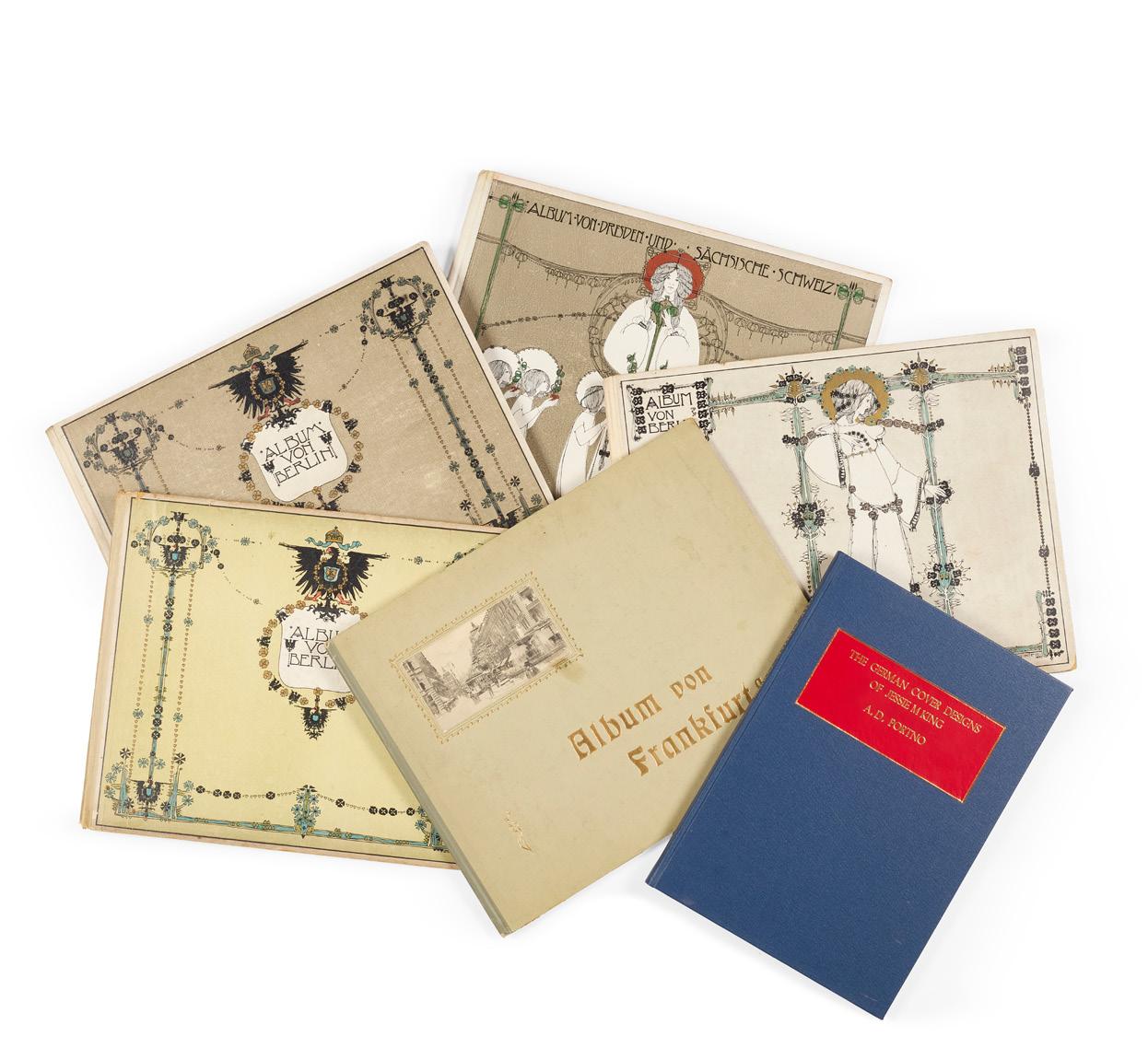
The Album Von Berlin was King’s first commission for a book cover. One of these examples shows the rarer figurative design for the publication, which contains photographs of Berlin; her second was pattern-based. This first version was withdrawn from sale when a complaint was received from ‘an influential person, possibly the Kaiser (who was known to dislike Art Nouveau)’ suggesting that the cover was inappropriate for a book of photographs of the German capital. £400-600
321
E. A. TAYLOR (1874-1951)
GALLOWAY ROAD
watercolour, signed E A TAYLOR 14.5cm x 17cm (frame size 33.5cm x 34.5cm)
Provenance: Merle Taylor; Dorothy Johnston
Exhibited: ‘E. A. Taylor & J. M. King’, Forrest McKay, August 1991
£300-500
320
E. A. TAYLOR (1874-1951)
THE PATH OVER THE RIVER watercolour, signed E. A. TAYLOR, 23cm x 33cm (frame size 43.5cm x 51.5cm); together with another work by the same hand, LANDSCAPE WITH CHURCH, watercolour, 15cm x 21cm (frame size 30cm x 36.5cm) (2)
£400-600
322
ATTRIBUTED TO E. A. TAYLOR FOR WYLIE & LOCHHEAD, GLASGOW
PAIR OF SIDE CHAIRS, CIRCA 1900
oak, with rush seats (2) 41cm wide, 98.5cm high, 40cm deep
£200-300
323
CECILE WALTON (1891-1956)
PAS DE DEUX
lithograph, signed in the print CECILE WALTON
23.5cm x 17.5cm (frame size 42cm x 35.5cm)
£400-600
324
ATTRIBUTED TO GEORGE WALTON (1867-1933) FOR GOODYER’S, LONDON
MANTEL CLOCK, CIRCA 1910
hammered metal and enamel, later plated and enclosing a white enamel and painted dial
33.5cm wide, 21cm high
Literature: Larner C. and G. The Glasgow Style, Edinburgh, 1979 pl. 87, where a similar example is illustrated £2,000-3,000
325
CECILE WALTON (1891-1956)
LYCOPHON AND LYRICS
lithograph, signed in the print CECILE WALTON, with pencil inscription LYCOPHON AND LYRICS/ BY LILIAN M. WORTHINGTON
each 24cm x 18cm (frame size
43.5cm x 57.5cm)
£400-600
MANNER OF ANNE MACBETH
GLASGOW SCHOOL EMBROIDERED PANEL, CIRCA 1900
coloured silks on a satin ground, framed 32cm x 19.5cm (frame size 39.5cm x 26.5cm)
£500-800
327
ANN MACBETH (1875-1948) AND THE GLASGOW SCHOOL
GROUP OF EMBROIDERIES, CIRCA 1900
to include; an EMBROIDERED CASE BY ANN MACBETH, 31.5cm x 24cm; a TEA COSY, 26.5cm x 38cm; a BLOTTER, 30cm x 24cm (closed); a BLACK SATEEN PANEL, 55cm x 58cm; a TABLE
RUNNER, 75cm x 44.5cm; a WHITEWORK PANEL, 68cm x 103cm; a COLLAR AND CUFF, collar 36cm x 48cm; TWO FURTHER EMBROIDERIES, the larger 24cm x 35cm; TWO CUSHION COVERS, one with motto RESTE AFTER TOYLE PORTE AFTER STORMIE SEAS, 37cm square; TWO BAGS, the larger 33cm x 26cm; a machine embroidered COLLAR AND PAIR OF CUFFS; a BEDSPREAD, applique and needlework on linen, 249cm x 176cm; a RUNNER, silk threads on a silk ground with satin border, 111.5cm x 37.5cm; SCRAP OF ART NOUVEAU FABRIC, printed cotton, 36cm x 27cm; a TEA COSY, cotton threads on linen, 28cm x 45cm; a PANEL, wool threads on linen, 247cm long, 21cm wide; together with TWO BOOKS, Margaret Swanson and Ann Macbeth, ‘Educational Needlecraft’, Longmans Green & Co., 1911; Anne Knox Arthur, ’An Embroidery Book’, A. & C. Black Ltd., 1920 (19)
£800-1,200
328
SCOTTISH SCHOOL
ARTS & CRAFTS PAINTED AND EMBROIDERED DEVOTIONAL PANEL, CIRCA 1900
depicting the Virgin & Child with attendant angels, with illuminated inscription AVE REGINA COELORUM....ET PRO NOBIS CHRISTUM EXORS, within gilt painted case and stand with twin doors panel 28.5cm x 21cm, case 44cm x 35cm
£400-600
329
ATTRIBUTED TO TEMPLETON’S, GLASGOW GLASGOW SCHOOL RUG, CIRCA 1920 machine-woven wool
131cm x 68cm
£400-600
330
ATTRIBUTED TO WYLIE & LOCHHEAD, GLASGOW ARTS & CRAFTS DISPLAY CABINET, CIRCA 1910 mahogany, with glazed doors and steel fittings
161cm wide, 185cm high, 48cm deep
£600-800
331
GLASGOW SCHOOL
AESTHETIC MOVEMENT TRIVET, 1921
repoussé-decorated copper, brass, signed AJW 1921
42cm wide, 12cm high, 19.5cm deep
£200-300
333
GLASGOW STYLE
MUSIC CABINET, CIRCA 1900
mahogany, with painted doors, set with enamel roundels, bearing initials EG and MG, copper handles, bears retailer’s label P. E. GANE LIMITED, BRISTOL
80cm wide, 143cm high, 42cm deep
£600-800
332
MANNER OF SIR ROBERT LORIMER
TWO ARTS & CRAFTS OCCASIONAL TABLES, CIRCA 1920
limed oak, one 60cm wide, 53cm high, 35cm deep, the other 35cm wide, 33cm high, 33cm deep (2)
£400-600
334
ATTRIBUTED TO SIR ROBERT LORIMER (1864-1929)
ARTS & CRAFTS FIREPLACE INSERT, CIRCA 1900
cast bronze
95.5cm wide, 108cm high, internal measurement 73cm high, 38cm wide
Provenance: Argaty House, Doune, Stirlingshire
The present Argaty House dates from the 19th century, with additions in the 1860’s and the early 20th century by Sir Robert Lorimer, though parts of it are thought to have dated back to the 17th century. The house was largely destroyed by fire in April 2011, with all the floors and roof now lost.
£800-1,200
337
NORAH CRESWICK (1883-1976)
TWO ARTS & CRAFTS BROOCHES, CIRCA 1950 one white metal, set with moss agate cabochons, within branded box inscribed NORAH CRESWICK/ ARTIST JEWELLER/ 20, HARRISON ROAD/ EDINBURGH, 9cm across; and a BAR BROOCH, white metal set with moss agate, 8cm diameter (2)
Literature: Hackett, Lianne, ‘Inspired by Nature: The Life and Work of the Silversmith Norah Creswick’, The Decorative Arts Society: 1850 to the Present, Journal 46 – 2022, p.144, fig. 11, where one of these brooches is illustrated
£300-500
JEWELLER/ 20, HARRISON ROAD/ EDINBURGH (2)
Literature: Hackett, Lianne, ‘Inspired by Nature; The Life and Work of the Silversmith Norah Creswick’, The Decorative Arts Society: 1850 to the Present, Journal 46 – 2022, p.142, fig. 8, p. 144, fig. 11 where these brooches are illustrated
£300-500
338
ALEXANDER RITCHIE (1856-1941)
CASED SET OF MATCHED SCOTTISH PROVINCIAL SPOONS
silver, comprising a sugar spoon, maker’s mark A.R. IONA, hallmarked Glasgow 1932; one spoon marked A.R. IONA and three others with full hallmarks, all with various terminals of nautical and Celtic design (6) 90g (combined)
£300-500
339
FRENCH, MANNER OF VIOLLET LE DUC TAPESTRY PANEL, CIRCA 1870 cotton and metal threads
278cm x 136cm
£600-800
340
MANNER OF J. & L. LOBMEYR
LARGE IZNIK STYLE VASE, CIRCA 1900 glass, with polychrome and gilt enamelled decoration and applied facetted ‘jewels’
32cm high
£300-500
341
THÉODORE DECK (1823-1891)
‘PERSIAN BLUE’ VASE, CIRCA 1875
tin-glazed earthenware, signed TH DECK
23cm high
£400-600
342
ATELIER PRIMAVERA FOR LONGWY ART DECO CHARGER, CIRCA 1920 glazed earthenware, stamped maker’s mark PRIMAVERA/ LONGWY FRANCE
37cm diameter
£250-350
343
AFTER JOSEF HOFFMAN
ART DECO HH1 TABLE LAMP, DESIGNED 1900
brassed steel
50cm high
£400-600
344
PAIR OF ART DECO TUB CHAIRS, CIRCA 1930
ebonised wood with upholstery (2)
71cm wide, 90cm high, 62cm deep
£400-600
FRENCH
345
CONSTANT AMBROISE ROUX (1865-1942)
LA COLÈRE D’ACHILLE
bronze, on a marble base, signed in the bronze CONSTANT ROUX, stamped and incised foundry marks
38cm wide, 44cm high, 15.5cm deep
£2,000-3,000
EDOUARD-MARCEL SANDOZ (1881-1971) FOR CHRISTOFLE BOXED SET OF TWELVE FOR ORFÉVRERIE GALLIA ‘ANIMAL AND BIRD’ KNIFE RESTS, CIRCA 1935
silver plate, each stamped GALLIA OC (12) each knife rest approximately 10cm wide
£500-700
ITALIAN
130cm x 55cm (frame size 145cm x 70cm)
£800-1,200
347
PAIR OF BROCADED FABRIC PANELS, CIRCA 1880
woven silk, chenille and metal threads, framed (2)
348
DEMÉTRE CHIPARUS (1886-1947)
FEMME ORIENTALE E L’ENFANT
bronze, on a marble plinth, signed in the bronze D. H. CHIPARUS
89cm high
£5,000-7,000
350
CONTINENTAL
ART NOUVEAU PENDANT NECKLACE, CIRCA 1900
silver gilt, plique-à-jour enamel, baroque pearls, stamped 900/ DEPOSE with maker’s mark TH chain 41cm long, pendant 3.5cm wide
£500-800
349
HERMANN & SPECK
JUGENDSTIL NECKLACE, CIRCA 1900
silver gilt, plique-à-jour enamel, baroque pearls and turquoise ceramic cabochons, stamped maker’s mark 42cm long including chain
£1,000-1,500
351
MANNER OF HEINRICH LEVINGER
ART NOUVEAU BROOCH, CIRCA 1900
silver, plique-à-jour enamel, blister pearl, garnet and amethyst, stamped verso STERLING 4cm tall
£300-500
352
HEINRICH LEVINGER, PFORZHEIM BROOCH, CIRCA 1900
silver, enamel, opal cabochons, stamped 900, cast maker’s mark
3.2cm wide
£400-600
353
VILLEROY & BOCH
‘METTLACH’ CHARGER, CIRCA 1900
glazed stoneware, stamped maker’s marks, design number 1365, 28, 96 43cm diameter
£200-300
355
ROZENBURG, HOLLAND
BALUSTER VASE, CIRCA 1900
glazed earthenware, with painted mice decoration, painted maker’s marks
ROZENBURG/ DEN HAAG, 942, with bee and window pane marks, incised W1807
50cm high
£600-800
354
HERMANN BÖHM (ACTIVE 1866-1922) RENAISSANCE REVIVAL NECKLACE, CIRCA 1890
enamel, paste, blister and baroque pearls, stamped maker’s mark chain 41cm long, pendant 8cm drop
£600-800
ATTRIBUTED TO SUSI SINGER (1891-1955) FOR WIENER WERKSTÄTTE
CANDELABRUM, CIRCA 1925
painted and glazed terracotta, impressed WW/ MADE IN AUSTRIA/ 87
31.5cm high
Exhibited: London, Fischer Fine Art, Vienna Turn of the Century, Art and Design, November 1979-January 1980
£600-800
Almost from the inception of the Vienna Secession, Charles Ashbee and his Guild of Handicraft was a designer greatly admired and sought after by the key figures of the movement. In 1899 the architect Josef Hoffman is documented stating that to include such works in a Kunstgewerbeschule exhibition would ‘hit the museum hard’. The Guild exhibited with the Secession in 1900, 1902, 1905 and 1906, in the first instance being the second largest exhibitor with fifty-three items. It is possible that when Hoffman and head of the Kunstgewerbeschule Felicien von Myrbach visited
357
AUSTRIAN
SECESSIONIST CLOCK, CIRCA 1910
copper, brass, glass, M & Sohn movement
29cm high
£600-800
the UK is 1902 they not only met Mackintosh, but also Ashbee; other continental designers and critics certainly made the pilgrimage.
The presence of Ashbee’s work in Vienna spilled over into the principles and designs of his continental contemporaries. For instance the thesis of the Wiener Werkstätte demonstrates alignment with Ashbee’s beliefs, ‘a silver brooch can have as much intrinsic worth as a jewel made of gold… The merit of craftsmanship…must be recognised once more’. It has further been noted that motifs found in Ashbee’s work, coloured
358
J. PFAFFENMAIER, VIENNA
SECESSIONIST CLOCK, CIRCA 1930
copper, brass, silvered brass, the dial with inscription WETTLAUF DER ZEIT, on a marble base, stamped J. PFAFFENMAIER/ WIEN
18.5cm wide, 48.5cm high
£300-500
stones, intentionally left hammer marks, found their way into Wiener Werkstätte works.
Such was the regard in which Ashbee was held that he was made an honorary member of the Vienna Secession, had his work purchased by museums in Vienna and Zurich and in 1906 was awarded the Diplôme d’ honneur at the Esposizione Internazionale in Milan. Ashbee’s 1911 list of progressive Arts & Crafts architects, both English and European, included Hoffman and Moser, demonstrating the admiration was not one-sided. When this is considered in tandem with Ashbee’s desirability and renown, there is certainly potential for cross-channel collaboration.
ATTRIBUTED TO C.R. ASHBEE (1863-1942) FOR GEBRUEDER FRANK, VIENNA JUGENDSTIL CLARET JUG, CIRCA 1905
silver plated metal, glass, polished wood, stamped maker’s marks 29.7cm high
Literature: Ashbee C.R. Modern English Silverwork Essex House Press, 1909, pl. 39A where a mustard pot of similar design is illustrated. Crawford A. C.R. Ashbee: Designer & Romantic Socialist, Yale University Press 1985, p. 318, pp. 411-416
See opposite page for note on this lot
£3,000-4,000
360
AUSTRIAN SECESSIONIST CABINET, CIRCA 1905
oak with brass fittings and faceted glazing
129cm wide, 197cm high, 61cm deep
£1,000-1,500
363
JUGEND
361
DAS PLAKAT
THREE VOLUMES
1921 and 1920 (3)
Das Plakat (The Poster) was a design and art magazine published from 1910 to 1922 in Berlin, Weimar, Germany. It was one of the early and influential publications on the art of posters and commercial art.
£800-1,200
BOUND MAGAZINES 1897-8 (2)
£300-500
362
‘DEUTSCHE KUNST UND DEKORATION’ FIFTY-SEVEN VOLUMES
gilt embossed and blue cloth-bound, comprising; volumes 12-68 and 71; together with DIE KUNST, gilt embossed and red cloth-bound, volumes 1906-7, 1907-8, 1914-15, 1916-17, 1920-21, 1923-24, 1924-25, 1925-26, 1927-28, two copies of 1931-32, and a paper-bound monthly issue 1st October 1933 (69)
£400-600
364
HERMANN MUTHESIUS (1861-1927)
DIE ENGLISCHE BAUKUNST DER GEGENWART, 1900
volumes I-IV, folio, Cosmos, Verlag für Kunst und Wissenschaft, Leipzig und Berlin
Plate 17: Glasgow Herald Building by John Honeyman & Keppie
Plate 48: Athenaeum, Glasgow by John James Burnet & John Archibald Campbell
£300-500
FRIEDRICH GOLDSCHEIDER (1845–1897)
FIGURE OF A SEATED BOY, CIRCA 1900 polychrome-decorated terracotta, on a painted ebonised and giltwood chair with rush seat
366 ATTRIBUTED TO JOHANN HEINRICH VOGELER (1872-1942)
OCCASIONAL TABLE, CIRCA 1900 mahogany
45cm square, 71cm high
£250-350
CARLO BUGATTI (1856-1940)
CHAIR, CIRCA 1908
carved and ebonised wood, Italian walnut, pewter and bone inlay, vellum, copper and rope
33cm wide, 91cm high, 40cm deep
Literature: Dejean P. Carlo-Rembrandt-EttoreJean Bugatti, Automobilia, 1982, pp. 37, 87
£3,000-5,000
EUGÈNE LEFÈBVRE (1849-1907)
ART NOUVEAU PENDANT, CIRCA 1900
bronze, each signed, stamped foundry mark, one numbered 72 and the other numbered F68 (2) 14cm high and 15.2cm high
Provenance: The Collection of Gillian Raffles.
£300-500
370 AFTER LOUIS LEROLLE
ART NOUVEAU FIGURE OF A LADY, CIRCA 1900
bronze, on marble base 30cm high (including base)
£250-350
CONTINENTAL SCHOOL
STANDING BULL, EARLY 20TH CENTURY
cast bronze, unsigned 15cm high
£250-350
372
GEORG JENSEN (1866-1935)
NECKLACE, CIRCA 1950
silver, stamped maker’s mark, STERLING/ 42B, hallmarked London 1955, 40.5cm long; together with a GEORGE JENSEN
MATCHED PAIR OF EARCLIPS, silver, stamped maker’s marks, STERLING/ DENMARK/ 67, 1.5cm diameter (3)
£800-1,200
373
GEORG JENSEN (1866-1935)
‘BLOSSOM’ SUGAR SPOON, CIRCA 1920
silver, stamped maker’s mark GEORG JENSEN, DENMARK, STERLING, G.J. LD/ 925, import marks for London 1923, 14cm long, weight 23g; together with A. E. JONES (1878-1954), silver, with coral knop, stamped maker’s mark, hallmarked Birmingham1902, 5.7cm long, total weight 32g (2)
£200-300
374
GEORGE JENSEN (1866-1835)
COLLECTION OF JEWELLERY
silver, stamped maker’s marks, comprising; a RING, stamped 925.S/ STERLING/ DENMARK/ 1, 2cm diameter; a ‘DOVE’ BROOCH, stamped STERLING/ DENMARK/ 111, 3cm wide; a ‘TULIP’ BROOCH, stamped STERLING/ DENMARK/ 100/ C, hallmarks for 1960, 4.7cm wide; together with a TONE VIGLAND (1938-2024) PAIR OF ‘SLING’ EARRINGS, designed 1958, silver, stamped maker’s marks, 4.5cm long (5)
£400-600
375
GEORG JENSEN (1866-1935)
INKWELL, MODEL 59, CIRCA 1915-30
830 standard silver, with glass liner, stamped maker’s mark GEORG JENSEN/ COPENHAGEN/ GJ/ 830/ S, 59
8.5cm high
£400-600
376
WILLLIAM MOORCROFT (1872-1945) FOR JAMES MACINTYRE CO. LTD.
FLORIAN WARE VASE, CIRCA 1900
glazed earthenware, signed W. MOORCROFT, printed maker’s mark 28cm high
£400-600
377
WILLIAM MOORCROFT (1872-1945)
FOR JAMES MACINTYRE CO. LTD.
RARE FLORIAN WARE VASE, CIRCA 1898
glazed and gilded earthenware, signed W. M./ DES., printed maker’s mark and registration number 404017, painted pattern number M 2217/ N 30cm high
£800-1,200
378
WILLIAM MOORCROFT (1872-1945)
FOR JAMES MACINTYRE CO. LTD.
FLORIAN WARE VASE, CIRCA 1898
glazed earthenware, signed W. MOORCROFT, DES., printed maker’s mark and registration number 326468
29.5cm high
£300-500
379
WILLIAM MOORCROFT (1872-1945) FOR JAMES MACINTYRE & CO. NEAR PAIR OF ‘PEACOCK’ FLORIAN WARE VASES, CIRCA 1900
glazed earthenware, signed W. MOORCROFT/ DES., printed registration number 347807 (2)
25.5cm high
£3,000-5,000
380
WILLIAM MOORCROFT (1872-1945)
FOR JAMES MACINTYRE & CO. FLORIAN WARE TWIN-HANDLED VASE, CIRCA 1902
glazed earthenware, signed W. MOORCROFT/ DES., printed registration number 360574
25.5cm high
£400-600
381
WILLIAM MOORCROFT (1872-1945) FOR JAMES MACINTYRE & CO. LARGE ‘POPPY’ FLORIAN WARE JARDINIÈRE, CIRCA 1900
glazed earthenware, signed W. MOORCROFT/ DES., printed maker’s mark and registration number 326471
30cm high
£600-800
383
WILLIAM MOORCROFT (1872-1945) FOR JAMES MACINTYRE & CO.
‘BUTTERFLY’ FLORIAN WARE TWIN-HANDLED VASE, CIRCA 1900
glazed earthenware, signed W. MOORCROFT DES., printed maker’s mark and registration number 326688 21cm high
£600-800
382
WILLIAM MOORCROFT (1872-1945) FOR JAMES MACINTYRE CO. LTD.
FLORIAN WARE VASE, CIRCA 1902
signed W. M./ DES., printed maker’s mark
16cm high
£250-350
384
WILLIAM MOORCROFT (1872-1945) FOR JAMES MACINTYRE & CO. HESPERIAN ‘LILAC’ FLORIAN WARE EWER, CIRCA 1902
glazed earthenware, signed W. MOORCROFT/ DES., printed maker’s mark 29.5cm high
£500-800
385
WILLIAM MOORCROFT (1872-1945) FOR JAMES MACINTYRE & CO.
‘IRIS’ EARLY FLORIAN WARE VASE, CIRCA 1899
glazed earthenware, signed W. MOORCROFT, printed maker’s mark, painted pattern number M. 1059 41cm high
£1,000-1,500
386
WILLIAM MOORCROFT (1872-1945) FOR JAMES MACINTYRE CO. LTD.
‘WISTERIA’ VASE, 1913
glazed earthenware, signed and dated W. MOORCROFT, printed maker’s mark
25.5cm high
£600-800
387
WILLIAM MOORCROFT (1872-1945) FOR JAMES MACINTYRE & CO. ‘PEACOCK’ FLORIAN WARE VASE, CIRCA 1900
glazed earthenware, signed W. MOORCROFT/ DES., traces of printed registration number, drilled
36.5cm high
£400-600
388
WILLIAM MOORCROFT (1872-1945) FOR LIBERTY & CO., LONDON
FLORIAN WARE BOWL, CIRCA 1902
glazed earthenware, signed W. MOORCROFT/ DES., printed registration number 360570 and retailer’s mark
24cm diameter
£400-600
389
LIBERTY & CO., LONDON
‘THEBES’ STOOL, CIRCA 1900 mahogany
390
LIBERTY & CO., LONDON
ARTS & CRAFTS SPINDLE ARMCHAIR, CIRCA 1890
42cm wide, 37.5cm high, 34cm deep
walnut, with original Liberty fabric cover, bears enamel label LIBERTY & Co.
58.5cm wide, 84cm high, 56cm deep
£400-600
391
MANNER OF ARCHIBALD KNOX FOR LIBERTY & CO., LONDON
CELTIC REVIVAL FIRESCREEN, CIRCA 1900 repoussé-decorated brass and patinated
wrought iron
49cm wide, 77cm high
£300-500
392
LIBERTY & CO., LONDON
‘THEBES’ STOOL, CIRCA 1900 beech, ebonised beech, ivorine and with later vinyl webbing to the seat
35.5cm square, 39cm high
£1,000-1,500
393
LIBERTY & CO., LONDON
ARTS & CRAFTS NECKLACE, CIRCA 1910
silver, gold, heart-shaped amethysts, baroque pearl, within original Liberty & Co. box, clasp stamped 9C 41cm long, largest pendant 3.2cm wide
£1,000-1,500
394
LIBERTY & CO., LONDON BRACELET, CIRCA 1940
silver, stamped LIBERTY/ STERLING 19.5cm long
Literature: Arwas, Victor Liberty Style, Parco 1983, p. 78, where a similar bracelet is illustrated, J.34
£300-500
396
ARCHIBALD KNOX (1899-1933) FOR LIBERTY & CO., LONDON PAIR OF ‘CYRMIC’ VASES, 1906
silver, enamel, stamped retailer’s mark L & CO, 2242, RD 467167, hallmarked Birmingham 1906 and 1907 (2) 17.2cm high
Literature: Martin S. Archibald Knox, Second Edition 2001, p. 182
£1,500-2,500
395
ARCHIBALD KNOX (1899-1933) FOR LIBERTY & CO., LONDON
‘CYRMIC’ CORONATION SPOON, 1901
silver, enamel, inscribed ANNO/ CORON:/ ER VII, stamped retailer’s mark L & CO, CYRMIC, RD391477, hallmarked Birmingham 1901
16cm long
Literature: Martin S. Archibald Knox, Second Edition 2001, p. 212, Model 355
£600-800
397
ARCHIBALD KNOX (1899-1933) FOR LIBERTY & CO., LONDON PAIR OF ‘CYRMIC’ VASES, 1905
silver, enamel, stamped retailer’s mark L & CO, 2243, RD 467112, hallmarked Birmingham 1905 (2) 19.5cm high
Literature: Martin S. Archibald Knox, Second Edition 2001, p.183, Model 2243
£2,000-3,000
399
398
LIBERTY & CO., LONDON ‘TUDRIC’ MANTEL CLOCK, CIRCA 1910
pewter, enamel, stamped mark 0367
16.5cm high
£1,200-1,800
ARCHIBALD KNOX (1899-1933) FOR LIBERTY & CO., LONDON ‘CYMRIC’ VASE, 1902 silver, turquoise, stamped retailer’s mark L & CO, CYRMIC, 2126, hallmarked Birmingham 1902 19cm high
Literature: Martin S. Archibald Knox, Second Edition 2001, p.185, Model 63/0
£1,000-1,500
400
ATTRIBUTED TO LIBERTY & CO., LONDON
ART NOUVEAU MANTEL CLOCK, CIRCA 1910 inlaid mahogany
24.5cm high
£500-700
401
LIBERTY & CO., LONDON, AFTER C.F.A. VOYSEY
SET OF EIGHT CHAIRS, CIRCA 1905 including two carvers, oak, with leather upholstery (8)
49cm wide, 97cm high, 44cm deep Literature: Bennett D. Liberty’s Furniture, ACC 2012 p. 259, pl. 7.33 where similar examples from the catalogue of ‘Inexpensive Furniture’ 1907 is illustrated.
£3,000-5,000
402
LIBERTY & CO., LONDON MATCHED PAIR OF ARTS & CRAFTS LAMP TABLES, CIRCA 1910 inlaid oak (2)
59.5 and 60cm diameter, 69.5cm high
£1,500-2,000
A
ATTRIBUTED TO LIBERTY & CO., LONDON
ANGLO-MORESQUE SIDE CHAIR, CIRCA 1880
ebonised and gilded wood, with later upholstered seat
42cm wide, 88cm high, 40.5cm deep
£300-500
404
LIBERTY & CO., LONDON (RETAILER) KIMONO, EARLY 20TH CENTURY
embroidered silk, lined, brass buttons, together with a copy of the original receipt from Liberty’s dated August 1919
£400-600
405
LIBERTY & CO., LONDON DRAWING ROOM CABINET, CIRCA 1904
satinwood, with patinated brass handles, glazed doors enclosing silk-lined interior
167.5cm wide, 183.5cm high, 39.5cm deep
Literature: Bennett D. Liberty’s Furniture, Woodbridge 2012, p. 277, pl. 7.72 where a related cabinet is illustrated.
£600-800
406
LIBERTY & CO., LONDON NECKLACE, CIRCA 1900
41cm long
£800-1,200
407
LIBERTY & CO., LONDON
ARTS & CRAFTS PENDANT NECKLACE, CIRCA 1905
silver, enamel, seed pearl insets, stamped L&Co/ 925 chain 40cm long, pendant 3.4cm wide
£500-700
gold, enamel, baroque pearl, in Liberty & Co. box
408
ARCHIBALD KNOX (1864-1933) FOR LIBERTY & CO. RARE RING, 1901
18ct. gold, opal cabochon, seed pearls, stamped maker’s mark L&Co, hallmarked Birmingham 1901, within Liberty & Co. fitted ring box, ring size N/O
Literature: Martin S. Archibald Knox, Second Edition 2001, p. 67, for illustrations of similar rings designed by Knox
£2,000-3,000
409
ARCHIBALD KNOX (1899-1933) BROOCH, CIRCA 1905
silver, enamel, stamped CYMRIC/ STERLING 3cm wide
Literature: Martin, S. Archibald Knox, Art Media Press, 2001, p.265, where the design is illustrated Model No. 1186E
£500-700
410
WILLIAM MOORCROFT (1872-1945) FOR MOORCROFT POTTERY
‘CLAREMONT’ TEA SERVICE FOR SHREVE & CO., SAN FRANCISCO, CIRCA 1905
glazed earthenware, silver overlaid, signed W. MOORCROFT, SHREVE & COMPANY/ SAN FRANCISCO, printed registration number 420081, comprising; a TEAPOT, 20cm high; a MILK JUG, 11cm high; a SUGAR BOWL, 13cm high (3)
£6,000-8,000
411
WILLIAM MOORCROFT (1872-1945) FOR MOORCROFT POTTERY
‘SPANISH’ TEA SERVICE, CIRCA 1913
glazed earthenware, signed W. MOORCROFT, comprising; a TEAPOT, 16cm high; a MILK JUG, 6.5cm high; a LIDDED SUGAR BOWL, 8cm high (3)
£2,500-3,500
412
WILLIAM MOORCROFT (1872-1945) FOR MOORCROFT POTTERY
FLAMBÉ ‘PERSIAN’ VASE, CIRCA 1916
lustre-glazed earthenware, impressed maker’s mark, 348
15.5cm high
£400-600
413
WILLIAM MOORCROFT (1872-1945) FOR MOORCROFT POTTERY
‘BIG POPPY’ VASE, CIRCA 1925 glazed earthenware, signed W MOORCROFT, impressed maker’s marks 26cm high
£400-600
414
WILLIAM MOORCROFT (1872-1945) FOR MOORCROFT POTTERY
‘SPANISH’ VASE, CIRCA 1915
glazed earthenware, signed W. MOORCROFT, impressed maker’s mark, 73 22.5cm high
£800-1,200
415
WILLIAM MOORCROFT (1872-1945) FOR MOORCROFT POTTERY
‘CORNFLOWER’ PATTERN VASE, CIRCA 1914
glazed earthenware, signed W. MOORCROFT, printed maker’s mark, impressed 348
19.5cm high
£500-800
416
WILLIAM MOORCROFT (1872-1945) FOR MOORCROFT POTTERY
‘PERSIAN’ JARDINIÈRE, CIRCA 1916
glazed earthenware, signed W. MOORCROFT, impressed maker’s mark
17cm high
£1,500-2,000
417
WILLIAM MOORCROFT (1872-1945) FOR MOORCROFT POTTERY
FLORIAN WARE JARDINIÈRE, 1918
glazed earthenware, signed W. MOORCROFT, and dated, impressed maker’s marks
30.5cm high
£300-500
418
WILLIAM MOORCROFT (1872-1945) FOR MOORCROFT POTTERY FLAMBÉ ‘CLAREMONT’ TWIN-HANDLED VASE, CIRCA 1930
flambé-glazed earthenware, blue painted signature, stamped W. MOORCROFT/ POTTER TO H.M. THE QUEEN/ MADE IN ENGLAND
20.5cm high
£1,000-2,000
420
OMAR RAMSDEN (1873–1939) AND ALWYN CARR (1872-1940)
ARTS & CRAFTS ‘COMEDY AND TRAGEDY’ SALT, 1916
repoussé-decorated silver, stamped inscription OMAR
RAMSDEN ET ALWYN CARR ME FECERUNT, maker’s mark and hallmarks for London 1916, etched mark 2/ 9/ 6227 and 03. 16. 135
8.5cm high
£800-1,200
419
WILLIAM MOORCROFT (1872-1945) FOR MOORCROFT POTTERY RARE VASE, CIRCA 1930
glazed earthenware, signed W. MOORCROFT, impressed maker’s marks
30.5cm high
Provenance: Moorcroft Museum Collection
£800-1,200
421
ATTRIBUTED TO CHARLES FLEETWOOD VARLEY (1874-1959) FOR LIBERTY & CO., LONDON NECKLACE, CIRCA 1900
silver, enamel
chain length 39cm, roundel
2.5cm diameter
£600-800
422 NEWLYN SCHOOL PENDANT, CIRCA 1910
silver, enamel, blister pearl
6.5cm high
£600-800
424
GEORGE EDWARD HUNT (1892-1960) BROOCH, 1920
silver, enamel, gilt, signed and dated G. Hunt 1920
4.4cm wide
£400-600
425
427
MANNER OF JESSIE M. KING
ENGLISH
ARTS & CRAFTS PENDANT, CIRCA 1910 white metal, enamel, blister and seed pearls, sapphire and ruby cut stones
8cm high
£400-600
426
ATTRIBUTED TO RICHARD LLEWELLYN RATHBONE (1864-1939)
ARTS & CRAFTS NECKLACE, CIRCA 1900
silver, opal cabochons, opal doublets, baroque pearls, stamped 925
chain 45cm long, 5cm drop
£1,000-1,500
ARTS & CRAFTS PENDANT NECKLACE, CIRCA 1905
silver, moonstone cabochons
chain 41cm long, pendant 5cm
£300-500
428
SIBYL DUNLOP (1889-1968) BROOCH, CIRCA 1960
quartz crystal, silver, gold, stamped maker’s mark SD, indistinct London hallmarks, within original box inscribed SIBYL DUNLOP LTD./ KENSINGTON CHURCH STREET/ LONDON.W.8.
3.7cm wide
£500-700
Elyse Ashe Lord
Born Elise Müller in 1885, Elyse Ashe Lord’s early life is so poorly documented that her date of birth is widely incorrectly reproduced. Growing anti-German sentiment caused her to anglicise her first name when she married Reverend Thomas Ashe Lord around 1908. Her artistic training was at Heatherley’s School of Art in Chelsea, one of the few British institutions that focused on portraiture, figurative painting, printmaking and illustration.
Until 1921 Lord focused on the medium of watercolour, yet it is for her coloured etchings that she is best known. Lord developed her technique, using drypoint etching for the line and combining it with woodblock printing, using the latter to build up layers of colour. Contemporary accounts praise Lord’s fastidious practice, always present to supervise ‘all of her own printing’ and keeping the first ten impressions for herself. Her estate thus contained progressions of the same print, illustrating the building up of colour, or multiples complete with pencil annotations suggesting edits.
Lord’s subject matter is largely Asian, despite her having never travelled to the region. The original source of her interest is unclear, but the 1914 British Museum exhibition of Chinese paintings has been proposed as a possible catalyst. Lord herself commented on the role of Arthur Waley’s translations of Chinese poetry in allowing her access to Eastern culture. The influence of ceramics, textiles and scrolls from Persia, India, Japan and other countries within the region also shine through in her designs. The Studio journalist Georg Bröchner congratulates Lord as having ‘through sheer artistic intuition…sensed…the spirit and visioned the peculiar beauty…of the Orient’, which whilst a Europe-centric perspective, demonstrates the high regard in which her work was held as imitative reception of Asian art.
429 §
ELYSE ASHE LORD (1900-1971) ‘PUPPETS OF THE MOON’ ink, watercolour and bodycolour, signed lower right, framed 37.5cm x 26cm (frame size 62.5cm x 47cm)
£800-1,200
Her first exhibition took place in 1919, but it was not until her Brook Street Gallery showing of seventy drawings in 1921 that her work was critically recognised. In the following year the Studio features Lord, describing her submissions to the Liverpool Autumn Exhibition as ‘charming small works’. A 1924 article in the same publication is devoted to Lord’s etchings, praising the quality of her work as ‘rich in true merit and great charm’. Her ascendancy within artistic circles continued throughout the 1920’s, as she was elected a member of the Royal Institute of Painters in Water Colours in 1922 and in 1927 the Lefevre Gallery held a large exhibition of 33 watercolours on silk and 54 prints.
She exhibited at the Paris Salon, at which she won a silver medal, and at the Chicago Society of Etchers, her renown now stretching far beyond Britain. In less than a decade Lord had graduated from a little-known artist to a figure with ‘a singularly ready appreciation on both sides of the Atlantic’.
Much like her early years, outside of her professional output, Lord leaves little paper trail in later life. Exhibition labels for the 1920’s and through the mid 1930’s place her at various addresses in northwest Kent. At some point, however, they relocated to Boars Hill near Oxford where, in 1943, her husband died. Lord survived him for another nearly thirty years and was reputedly a reclusive widow of considerable financial means. Whether she continued working after WWII is not known, her output was none the less prolific. Attributing a date and a title to an Elyse Ashe Lord etching is a challenge given the regular lack of both details, a situation confounded by the absence of a catalogue raisonné. Nonetheless Lord’s total output numbers at least 350 unique designs.
Following her death in 1971 Lord left her estate to her then publisher H. C. Dickens and it is likely that he added the pencil annotations ‘Print by Elyse Lord’ or similar. The current owner acquired the works offered here directly from Lord’s publisher.
430 §
ELYSE ASHE LORD (1900-1971)
‘KITE FLYER’
pencil and mixed media on stained wood, framed, 27cm x 15cm (frame size 38.5cm x 26cm); together with two further works in this medium by the same hand ‘MUSICIAN’, 16.5cm x 12.5cm (frame size 28cm x 24cm); and ‘PERFORMERS’, 23cm x 26cm (frame size 34cm x 37cm) (3)
£400-600
431 §
ELYSE ASHE LORD (1900-1971)
‘FROM AN INDIAN PAINTING’
hand-etching, signed (twice) and inscribed, framed 17cm x 14cm (frame size 37cm x 32cm); together with ‘THE MUSICIAN’, hand-coloured etching, inscribed PRINT BY ELYSE LORD, framed, 28cm x 25cm (frame size 58.5cm x 47cm) (2)
£300-500
432 §
ELYSE ASHE LORD (1900-1971)
GROUP OF FIVE ETCHINGS
to include ‘SCHEHERAZADE’, signed in the plate, 15cm x 24cm (frame size 30cm x 39cm); ‘THE MAGIC CARPET (ARABIAN NIGHTS), signed and inscribed, laid down, unframed, 26cm x 37cm; ‘BALAAM’S ASS’, signed and inscribed, laid down, unframed, 15.5cm x 24.5cm; together with ‘RICCIARDO DI CHINZICA (DECAMERON), signed and inscribed, unframed, 9cm x 9.5cm; and DIVINE COUPLE, monogram in the plate, 15cm x 24cm (5)
£300-500
433 §
ELYSE ASHE LORD (1900-1971)
‘NEWSPAPER DANCE’
hand-coloured etching, signed and inscribed, unframed, 31cm x 30cm; together with three further hand-coloured and unframed etchings ‘ARMAMENTS RACE’, laid down, signed and inscribed, 28cm x 50.5cm; ‘FALLING FIGURES’, 33.5cm x 25cm; and ‘HOBBY HORSE’, signed and titled, 22.5cm x 17.5cm (4)
£300-500
435 §
ELYSE ASHE LORD (1900-1971)
‘EN ROUTE’
hand-coloured etching, signed and editioned 5/75, unframed, 33.5cm x 41cm; together with three further unframed and hand-coloured etchings to include ‘LYDIA’, signed and inscribed 37.5cm x 29.5cm; ‘THE MARCHIONESS OF MONFERRAT’, signed and inscribed, 37.5cm x 30cm; and ‘THE POEM’, signed, titled and editioned 1/75, 40cm x 33.5cm (4)
£300-500
434 §
ELYSE ASHE LORD (1900-1971)
THREE FRAMED ETCHINGS
each hand-coloured and including ‘THREE FLORISTS’, 22cm x 33cm (frame size 44cm x 53cm); ‘ENTERTAINERS’, 22cm x 30cm (frame size 43cm x 53cm) and SEATED FIGURE, 26cm x 17.5cm (frame size 55.5cm x 46cm) (3)
£300-500
436 §
ELYSE ASHE LORD (1900-1971) ‘JOY RIDE TIGER’
hand coloured etching, signed ELYSE LORD, 29.5cm x 24.5cm (frame size 58.5cm x 47cm); ORIENTAL VASE, hand coloured etching, 33cm x 24cm (frame size 58.5cm x 45cm); together with ‘TULIPS’, hand coloured etching, signed ELYSE LORD, pencil annotations, unframed, 39cm x 42cm (3)
£300-500
437 §
ELYSE ASHE LORD (1900-1971) ‘CYMBALS’
hand-coloured etching, inscribed, unframed, 48cm x 38cm; together with three further unframed hand-coloured etchings including ‘FLUTE, signed and titled in the plate, 48cm x 38cm; TWO FAWNS, signed, 30cm x 30cm; and ’THE NEW HARP’, signed, titled and editioned 22/75, 26cm x 35cm (4)
£300-500
438 §
ELYSE ASHE LORD (1900-1971)
‘GREECE’
hand-coloured etching, signed, inscribed and editioned 12/75, unframed, 37cm x 32cm; together with four further hand-coloured etchings to include ‘INDIAN DANCE’, signed, inscribed and editioned 1/75, 35.5cm x 30.5cm; ‘THE FAMILY’, signed, inscribed and editioned 740.5cm x 32.5cm; ‘DRAGON DANCE’, signed, 37cm x 32cm; and ‘FIGURE DANCE’, signed, 26cm x 34cm (5)
£300-500
439 §
ELYSE ASHE LORD (1900-1971)
‘ORGAN LESSON’
hand-coloured and gilded etching, signed and inscribed, 35cm x 45cm; together with four further unframed hand-coloured etchings including ‘JASS’, signed, inscribed and editioned 15/75, 31cm x 43cm; ‘SAROD PLAYER’, inscribed PRINT BY ELYSE LORD, 29cm x 25cm; ‘THE GUZHENG’, inscribed PRINT BY ELYSE LORD, 29cm x 25cm; and ‘INDIAN DILRUBA’, 24.5cm x 19cm (5)
£300-500
440 §
ELYSE ASHE LORD (1900-1971)
‘OPPOSED BIRDS’
etching, hand-coloured with pastel, signed lower right with initials, 45cm x 56cm; together with THREE FURTHER ETCHINGS, two hand-coloured with pastels and signed with initials, 38cm x 25cm and 34.5cm x 21cm, the other uncoloured, 34.5cm x 21cm (4)
£300-500
441
TRUDA ADAMS (1890-1958)
FOR CARTER STABLER ADAMS LTD., POOLE LARGE VASE, CIRCA 1927
glazed earthenware, impressed factory mark, painted and incised JC/ 947
29.5cm high
Literature: Atterbury P. (ed.) Poole Pottery: Carter and Co. and Their Successors, 18731995, Richard Dennis 1995, p. 48 where a similar vase is illustrated
£400-600
442
JOHN MONCRIEFF LTD., PERTH FOUR ‘MONART’ VESSELS, CIRCA 1930 glass, green colourway, variously with black, orange, white and aventurine inclusions; together with a conical footed bowl in pink and blue glass, bears maker’s paper label (3)
18.5cm and 17.7cm high, plate 22.5cm diameter, small bowl 10.5cm diameter
£300-500
443
JOHN MONCRIEFF LTD., PERTH THREE ‘MONART’ VASES, CIRCA 1930 green and blue glass, variously with black, orange and aventurine inclusions (3)
36.5cm; 16.5cm; 11cm high
£300-500
444
HEAL & SON, LONDON
SET OF SIX ‘TILDEN’ CHAIRS, 1920’S limed oak, with seats, includes two carvers, each bears inset ivorine maker’s label HEAL & SON
LONDON LIMITED
LONDON W (6)
Carver 58cm wide, 93cm high, 48cm deep, side chair 54.5cm wide, 89cm high, 40cm deep
£1,200-1,500
445
HEAL & SON, LONDON ‘LETCHWORTH’ REFECTORY TABLE, 1920’S oak
167.8cm long, 75.5cm high, 75.5cm deep
£600-800
446
ERIC RAVILIOUS (1903-1942) FOR WEDGWOOD ‘PERSEPHONE’ PART DINNER SERVICE, 1930’S transfer-printed earthenware, printed maker’s marks, impressed maker’s mark and shape number, comprising; FOUR TUREENS & COVERS, 12cm high; TWELVE DINNER PLATES, 25.5cm diameter; SIX SOUP BOWLS AND UNDER DISHES, bowls 17cm across handles; TWO GRAVY BOATS, 12cm high, one with UNDER DISH; SIX PLATES, 23.5cm diameter; TWELVE SANDWICH PLATES, 15.5cm diameter; SIX SIDE PLATES, 18cm diameter; ONE SANDWICH SERVING PLATE, 24cm diameter; FIVE DESSERT DISHES, 21cm diameter; FOUR HACHETTES, the largest 37cm long (65)
£250-350
447
HEAL & SON, LONDON
DRAW-LEAF DINING TABLE, CIRCA 1920
limed oak, 122cm long closed, 183.4cm long open, 76cm high, 76cm deep
£500-800
448
HEAL & SON, LONDON
ARTS & CRAFTS COFFER, CIRCA 1930
oak, with cedar lining
108.7cm wide, 51cm high, 56.5cm deep
£400-600
449
451
HEAL & SON, LONDON
ARTS & CRAFTS CHEST OF DRAWERS, CIRCA 1925
limed oak, bears inset ivorine label to drawer HEAL’S TOTTENHAM COURT ROAD LONDON W1
91.2cm wide, 105.5cm high, 47.5cm deep
HEAL & SON, LONDON
TABLE CABINET, CIRCA 1930
oak
56cm wide, 20cm high, 26.5cm deep
£300-500
450
HEAL & SON, LONDON
SIDE CABINET, CIRCA 1920
oak, bears inset ivorine label to drawers HEAL’S TOTTENHAM COURT ROAD LONDON W1
137cm wide, 94cm high, 49cm deep
£1,500-2,000
452
HEAL & SON, LONDON (RETAILER)
BOLT OF FABRIC, CIRCA 1950
printed linen, original Heal & Son label attached 13m long, 91.5cm wide
£600-800
453
HEAL & SON, LONDON
RECLINING READING CHAIR, CIRCA 1930
oak, with steel fittings and later upholstered cushions
62.2cm wide, 80cm high, 74.5cm deep (not reclined), 113cm deep (reclined)
£800-1,200
454
HEAL & SON, LONDON
ARTS & CRAFTS COFFER, CIRCA 1895 oak, with hammered wrought steel hinges 144cm wide, 60cm high, 56.5cm deep
£1,200-1,800
455
GRAHAM ORWELL FOR BESWICK POTTERY
RARE ‘DUCHESS (WITH FLOWERS)’, BEATRIX POTTER
FIGURINE, 1955-1967
glazed porcelain, gilt backstamps
9.5cm high
£800-1,200
456
CHARLES LEIGHFIELD DOMAN (1884-1944)
MOTHERHOOD FIGURE
glazed earthenware, on later ebonised base, impressed to figure C.L. DOMAN
figure 30cm high, with base 33.5cm high
£300-500
457
CLARICE CLIFF (1899-1972)
RARE ‘MAY AVENUE’ PATTERN ‘BIZARRE’ VASE, CIRCA 1933
glazed and painted earthenware, shape no. 265, printed factory marks
15.3cm high
£1,200-1,800
458
HEAL & SON, LONDON
‘930’ BEDROOM SUITE, CIRCA 1930 limed oak, comprising; a WARDROBE, bears ivorine maker’s label, 88cm wide, 185cm high, 50cm deep; a DRESSING CHEST, bears ivorine maker’s label and adjustable mirror plate, 91.5cm wide, 138cm high, 49cm deep; a WALL MIRROR, 117cm x 40.5cm; a TWO-TIER BEDSIDE TABLE, 38cm square, 74cm high; and a SIDECHAIR, with rush seat, 40cm wide, 87cm high, 42cm deep (5)
Literature: Heal O. Sir Ambrose Heal and the Heal Cabinet Factory 1897-1939, Unicorn 2014, p. 242 where this suite is illustrated
£600-800
152cm long, 74cm high, 84.5cm wide
£3,000-5,000
461
BRITISH
THREE HANGING
LIGHTS, CIRCA 1930
chromed metal and frosted glass (3)
largest 56.5cm high, 35.5cm diameter
£300-500
462
JACQMAR, LONDON
SIX WWII PROPAGANDA SCARVES, 1940’S
silk, comprising; ‘London Wall’, 114cm x 44cm; ‘Presenting’, 1942, 88cm x 88cm; ‘We Three’, 104cm x 46cm; ‘Every man must do his duty’, 120cm x 55cm; ‘Dig for Victory’, 104cm x 45cm; ‘French Resistance’, 1942, 93cm x 71cm; TWO FURTHER JACQMAR
SCARVES; ‘Royal Ballet School’, 90cm x 101cm; ‘Hommage aux grands
maîtres’, 90cm x 90cm; TWO PRINGLE OF SCOTLAND SCARVES, 90cm x 90cm each; and a FURTHER SCARF, ‘Je Mai London’, 88cm x 88cm (11)
£400-600
463 § JOHN PIPER (1903-1992) FOR SANDERSON PAIR OF ‘ARUNDEL’ CURTAINS, CIRCA 1960
printed ‘Sanderlin’ fabric (satinised cotton), lined, marked to selvedge ‘ARUNDEL/ AN ORIGINAL SCREEN PRINT BY SANDERSON’ (2)
206cm x 236cm
£400-600
464
ENGLISH
PAIR OF ART DECO STANDARD UPLIGHTERS, CIRCA 1930
patinated aluminium, with glass rods, 178cm high; together a matching CEILING LIGHT, patinated aluminium, 56cm diameter, 63cm high (3)
£400-600
465 § DAVID MEREDITH (B. 1973)
RIVER PLAY
bronze, signed and numbered to base, 30/50 38cm high
£800-1,200
466
ENGLISH ART DECO PORTIÈRE, CIRCA 1930
printed cotton velour with velour lining 233cm x 118cm
£300-500
467 §
JOHN BURNINGHAM (1936-2019)
‘TRUBLOFF’: THEY FORMED A LITTLE BAND ink, tissue paper and paint, signed on label verso
50.5cm x 81cm
Provenance: Property of the artist Lyon & Turnbull, Edinburgh Illustrated & Animated; The Collections of Burningham & Blundall, 28th February 2018, lot 37
The original illustration for ‘Trubloff: The Mouse Who Wanted to Play the Balalaika’, first published by Jonathan Cape in 1964.
John Burningham was an English author and illustrator of children’s books. Burningham won the 1963 and 1970 Kate Greenaway Medals for British children’s book illustration, and he and his wife Helen Oxenbury become the first duo to win BookTrust’s Lifetime Achievement Award in 2018.
£3,000-5,000
468
MANNER OF TIRZAH GARWOOD CARVED WALL PANEL, CIRCA 1930
oak
51.5cm x 52cm
£300-500
469
BRITISH SCHOOL
STAINED GLASS PANEL, CIRCA 1950
painted, stained and leaded glass, bears inscription GOLDEN SANDS AND CHRISTALL BROOKS WITH SILKEN LINES AND SILVER HOOKS, within an oak frame
71cm x 44cm (frame size 78.7cm x 52.5cm)
£400-600
470
ENGLISH ARTS & CRAFTS DEVOTIONAL ALTAR PIECE, 1940
inlaid and carved oak, label verso ‘Wishing Father Dyfrig a happy feast from the brothers 16.11.40’
50cm wide, 102cm high, 22cm deep
£400-600
471 HANS WEGNER (1914-2007) FOR GETAMA
MODEL GE290A ARMCHAIR, DESIGNED 1953
oak, with leather upholstery
75.5cm wide, 89cm high, 75cm deep
£400-600
472
LARGE BOOKCASE, CONTEMPORARY
inlaid and carved sycamore with marquetry inlay, with keys
217.5cm wide, 305cm high, 54cm deep
£3,000-5,000
DAVID LINLEY, LONDON
473 §
JILLI BLACKWOOD (B. 1965)
‘CIRCLES OF LIFE’, 2000
embroidered applique hanging, coloured silks, silk threads, lined 85cm x 148cm
Jilli Blackwood was born in Glasgow and attended the Glasgow School of Art, specialising in embroidered and woven textiles. She has been awarded the McCreadie Award several times, and won a Bursary from the Weavers Association. She has works of art in several permanent collections internationally. Blackwood created her ‘slash and show’ technique whilst a student at Glasgow School of Art and has been refining and developing it ever since. She combines texture, colour and design, different textiles adapting to dye, cut and fray and light in a different manner.
£800-1,200
474 §
MO FARQUHARSON (1953-2018)
‘BRITANNIA’ PLAQUE
bronze, signed lower left MF 1/10, with foundry mark, inscribed BRITANNIA
40cm x 31.5cm (frame size 73.5cm x 61cm)
Commissioned by Tindall Riley
£500-700
475 §
WILLIAM PLUMPTRE (B. 1959)
LARGE VESSEL, CIRCA 1990 glazed stoneware, signed to base WP 33.2cm high
William Plumptre works in the Anglo-Japanese tradition founded in the early twentieth century by Shoji Hamada and Bernard Leach.
£600-800
ALISON KINNAIRD (B. 1949)
FOUR ‘MIDSUMMER NIGHT’S DREAM’ GLASSES, 1973 acid-etched glass, each signed ALISON KINNAIRD (4) 16cm high
Provenance: These were commissioned directly from Alison Kinnaird by the vendor for her 21st birthday in 1973.
£300-500
477
RICHARD STEVENS AND PETER RODD FOR ATLAS LIGHTING LTD.
‘CHELSEA’ RANGE PENDANT LIGHT, CIRCA 1960
patinated metal with hand-blown glass shades by James Powell & Sons
90cm high, 25cm diameter
Literature: Fine Art Society Austerity to Affluence: British Art and Design 1945-1962, Merrell Holberton 1997, p. 2, frontispiece image where a similar example illustrated.
V&A accession no. CIRC.382 to F-1963
Winning the Design Centre Award in 1960, the Chelsea lighting fitting was seen as a new kind of decorative light due to the stark relationship between the sharp black metal and the thick coloured glass made by James Powell & Sons. The Design Journal described the light as “attractive whether the lamps are alight or not, and the effect is rich when the specially designed bulb throws light downwards into the hand-blown crystal glass, which can be clear, amber, pale rose or pale blue”.
£500-800
478
ARLON BAYLISS (B. 1957)
SCULPTURE, CIRCA 1985
etched and polished glass
31.5cm high
£200-300
479 §
LORNA GRAVES (1947-2006)
‘DISC AND LABYRINTH’, 1988
moulded and impressed clay, ebonised wood
18cm square
£300-500
480
BRUCE MCLEAN (B. 1944) FOR FULHAM POTTERY
LARGE PLATTER, CIRCA 1990
glazed earthenware, stamped maker’s marks and painted artist’s signature
66.5cm long, 25cm deep
£300-500
481 §
ALEXANDER GOUDIE (1933-2004) FOR LA MUSÉE DE LA FAÏENCE, QUIMPER ‘LE MARIN’, 1996
glazed ceramic, painted artist’s monogram, limited edition 24/100, inscribed on the underside GOUDIE/ POUR LA MUSÉE DE LA FAÏENCE
50cm high
£700-1,000
482
SCOTTISH SCHOOL
THREE-FOLD SCREEN, 20TH CENTURY
painted with views of Gardenstown
153cm x 164cm overall, each fold 54cm wide, 153.5cm high
£500-700
ETTORE SOTTSASS (ITALIAN 1917–2007) FOR
‘CARLTON’ BOOKCASE, DESIGNED 1981
£8,000-12,000 + fees
AUCTION 30 APRIL 2026
LIVE FROM MALL GALLERIES LONDON & ONLINE
RENÉ LALIQUE (1860-1945)
LIBELLULES BOX, DESIGNED 1905-7 designed 1905-7 enamelled stamped LALIQUE
6.3cm high, 17cm wide, 7.7cm deep
£60,000-80,000 + fees
JOSEPH MORELL