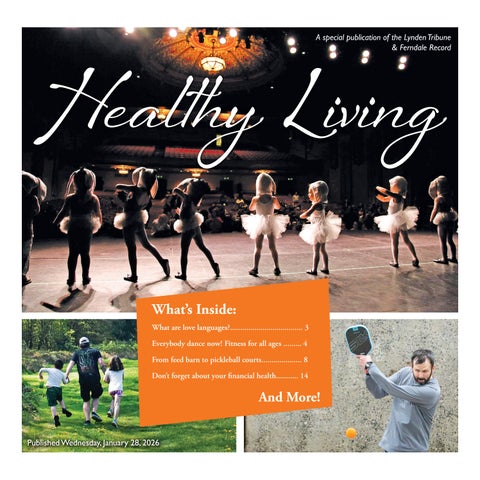
Healthy Living 2026

Page 1


pe acehe alth.org/priority-c are

EMOTIONAL HEALTH

Affirmation, service, gifts, time, touch

Love Languages: A 1990s revival for Valentines Day

In the spirit of Valentine’s Day 2025 I have a question for you: How do you like to be shown love?

If there was a lighthearted way in which you could find this out for yourself, would you seek it out?

If so, travel back to the bookstore of the 1990s and its display of national best seller, “Love Languages,” by Gary Chapman.

The late 1980s market was flooded with self-help books, TV shows and

experts creating spiritual personas.

However, at the delta of this river in 1992, a true gem was born the publication of “Love Languages.” Chapman was an anthropologist turned pastor.

His book is based on five simple types of ways to be shown love and you simply had to rate your favorites.

Instead of making the reader ingest a large sweeping hypothesis, or new age way of thinking about partnership, he offered an almost childish disarming of identities.

Love Languages

His five love languages fit in a space which resembled the magazine quiz.

Readers essentially rate the following about yourself in order of importance:

• Words of Affirmation: This love language emphasizes the power of

verbal appreciation, compliments and encouraging words to express love and build emotional connections.

• Acts of Service: For individuals with this love language, actions speak louder than words.

Performing helpful tasks, acts of kindness, and doing things to ease the burden of the other person are deeply meaningful expressions of love.

• Receiving Gifts: Gift giving is a powerful way to express love for those who have this love language.

It’s not about materialism, but rather the thoughtfulness and effort behind the gift that conveys love and affection.

• Quality Time: Quality time is about undivided attention, meaningful conversation, shared experiences

See Love Languages on 7

Dance for happiness and health

Studies show that not only is dance great as an exercise, but it is also great for the brain as it helps to reduce stress, increase levels of serotonin and develop new neural connections. Char Lenn of Lynden Line Dancers said the movement helps to keep her feeling young. Although she is in her late 70s, Lenn is still able to keep up with those in their 30s and 40s. (Racquel Muncy/Lynden Tribune)

All-ages activity provides benefits for the brain and the body

WHATCOM — Studies show that not only is dance great as an exercise, but it is also great for the brain as it helps to reduce stress, increase levels of serotonin and develop new neural connections.

According to an article by Harvard Medical School titled, “Dancing and the Brain,” dance requires complex mental coordination. When paired with music, it is doubly beneficial as music “stimulates the brain’s reward centers, while dance activates its sensory and motor circuits.”

Another research article posted in the New England Journal of Medicine states that dancing for four hours per week can reduce the risk of Alzheimer’s by 76%.

In the last decade, dance has begun to be used to help treat people with Parkinson’s due to these beneficial impacts, however the benefits are good for all abilities, age groups and situations.

In previous reporting, Char Lenn of Lynden Line Dancers said the movement helps to keep her feeling young. Although she is in her late 70s, Lenn is still able to keep up with those in their 30s and 40s.

Dancing with Joy instructors Amanda Schroer and Sarah Lewis say they see these impacts, and more, with the young children that they teach. Schroer said on top of the obvious health benefits dance is also a space where people are able to leave their cares at the door and not worry about outside stressors.

“For myself that has been key,” she said, adding that the ritual and routine of dance allows her to turn her brain off and give it some much needed rest.

Lewis added that the social interaction is also key, especially for the younger dancers. Many children come in as toddlers barely able to say their own name or follow directions and within a few months they are talking and standing in a line ready for the next pose.

“They’re learning dance steps, but they’re also learning how to share and how to work together, to support each other,” Schroer said.

The growth in confidence is also evident, particularly with the teenage dancers. Many start very nervous or self-critical and by the end of the year they are shining in their roles.

“By the end of the year they are seeing the growth and the changes,” Lewis said.

Schroer added that they are also learning that it is OK to be disappointed. It is OK to voice that you wanted a role or to perfect a dance move and it didn’t happen.

According to an article by Harvard Medical School titled, “Dancing and the Brain,” dance requires complex mental coordination. When paired with music, it is doubly beneficial as music “stimulates the brain’s reward centers, while dance activates its sensory and motor circuits.”

(Photo courtesy Dancing for Joy)

Lewis went on to say that dance can be difficult as you’re in a room full of mirrors and at Dancing for Joy they make a point to encourage people to be themselves as dance is made for all ages and all body types.

“I want to show up and celebrate that I’m unique,” she said. “We want people to have an opportunity to have a healthy relationship with their body.”

She added that dance has also given her awareness of what is going on in her body, as well as increased flexibility and balance.

“Dance is for everyone, every body,” Lewis said.

Schroer said the great thing about dance is that it is able to accommodate any age, body type, needs and wants. People can join a class with a friend to have fun and stay motivated, or they can enjoy a free Zumba video on YouTube from their living room. It could be a morning happy dance to start the day off on the right foot.

Lewis said jumping into dance could be the step that truly makes an impact in on someone’s life.

“Today could be the first day that you enjoy for years,” she said, adding that it is also a no pressure environment.

Schroer agreed.

“What have you got to lose,” she said.

-- Contact Racquel Muncy at racquel@lyndentribune.com.

Support for Women and Children

Dance can be difficult as you’re in a room full of mirrors and at Dancing for Joy they make a point to encourage people to be themselves as dance is made for all ages and all body types.

(Racquel Muncy/Lynden Tribune)

Love Languages: Affirmation, service, gifts, time, touch

Continued from 3 and simply being present with the person to nurture the relationship.

• Physical Touch: Physical touch such as hugs, kisses, holding hands and other forms of touch is the primary way individuals with this love language feel connected and cared for.

Preferred love language

In a 2018 article in Couple and Family Psychology: Research and Proactive an academic article was written on Chapman’s Love Languages (Bland/McQueen 2018) the analysis states that the multivariable approach of the Five Love Languages is unique to Chapman’s work. Meaning, rather than identifying with only with one of the love languages and classi-

fying oneself as a type, Chapman instead invites the reader to choose their preference.

This preference over type approach empowered the reader and encourages tuningin to themselves and their partner.

All variants are tiered in order of importance with one or two being most important but according to Chapman, but none to be excluded.

As quaint as it may seem now to just read a book about communicating with your partner this book is an important contribution to American culture.

In the late 1980s and early 1990s the American businesswoman entered the national spotlight changing the fiscal structure of many young relationships.

Counter cultures’ Woody Allen movies gave us an enter-

Are You Ready to Look and Feel Your Best?

taining but chilling portrait of the new American couple of the ‘90s.

Prime time MTV Pat Benatar cried out that love was a battlefield, while quietly from the bookstore Chapman answered us all by saying, “no, not really … you’ll all be OK.”

His research serving as a family therapist doesn’t dominate the book with case studies but extracts the commonalities of his subjects concisely.

Chapman is modest in keeping his writing in service of the reader. His series of nine books on the subject of Love Languages (listed below) made a lot of couples and families happy in very confusing times.

We listened to his advice because Chapman’s work has sold more than 12 million copies worldwide and has been translated into 50 languages.

This February, turn down

the noise and cuddle up to take a quiz from the ‘90s with your valentine.

Love Languages series

• The 5 Love Languages of Children, 1997

• The 5 Love Languages of Teenagers, 2001

• The 5 Love Languages for Singles, 2004

• The 5 Languages of Apology: How to Experience Healing in All Your Relationships (co-authored with Jennifer Thomas), 2006

• The 5 Love Languages: Military Edition, 2010

• The 5 Love Languages: The Secret to Love that Lasts (20th anniversary edition), 2012

• The 5 Love Languages: The Secret to Love that Lasts (Updated Edition), 2015

• The 5 Love Languages: The Secret to Love that Lasts (Illustrated Edition), 2018

Plastic Surgery Bellingham can help make it happen. We offer an array of cosmetic and reconstructive procedures tailored to meet your unique needs, whether you want to enhance your body style or improve function and correct abnormalities. Plastic Surgery Bellingham specializes in providing you with excellent care and personal attention, from initial consultation to final follow-up. Our attached surgical suite allows us to provide you with a surgical experience that is both personal and private. Our experienced surgical staff provide our patients with a comfortable and safe surgical environment.

JAMES H. BLACKBURN II, M.D. PS

Dr. Blackburn received his medical degree from Louisiana State University School of Medicine and completed a surgical Residency in Plastic and Reconstructive surgery.

Dr. Blackburn is a Board Certified Plastic Surgeon, a Fellow of the American College of Surgeons, and has a subspecialty in hand and micro surgery. He introduced ultrasonic liposuction to this area in 1999 and continues to utilize new technologies in his work. He moved to Bellingham from Louisville, Kentucky after completing his fellowship at The Christine M. Klienert Institute of hand and microsurgery. He has been in surgical practice over 25 years.

TIMOTHY M. WHITNEY, M.D. PS

Dr. Whitney graduated cum laude from the University of Pittsburgh School of Medicine and completed a surgical Residency in Plastic and Reconstructive surgery. He is a Board Certified Plastic Surgeon and has been Certified in Hand Surgery and General Surgery He has a subspecialty in hand and micro surgery and is also a Fellow of the American College of Surgeons He was an instructor of surgery at Harvard, and has been the recipient of numerous awards and appointments throughout his career. He relocated from Boston to Bellingham in 2003 He has been in surgical practice for over 25 years

Pickleball barn reclaims a Lynden legacy

Members of a local pickleball group gather at the Van Dyk barn in Lynden. What began as a way to stay active in a rugged feed barn has evolved into a tight-knit brotherhood, proving that the 100-year-old homestead still has plenty of stories left to tell (Zen Hill/Lynden Tribune)

Transformation of 100-year-old feed barn to pickleball sanctuary

LYNDEN — For more than a century, the Van Dyk farm was home to a family-owned dairy cow farm. But since 2020 when the family business shut down, a new kind of energy has emerged under the roof of one of the farm’s barns. On Monday nights, Landon Van Dyk and his friends come together to play pickleball and share a brotherhood.

The Van Dyk dairy farm

spanned four generations. The heartbreaking end to the family business opened a new door to a healthy way for a group of friends to stay active while repurposing the barn.

“That building served one purpose for a long time,” Van Dyk said. “To see it get used for things that I’m excited about has been pretty cool. I remember playing PE at Lynden Christian and one of my favorite activities was pickleball.”

Van Dyk initially started play-

ing pickleball again with a group of friends at his house, but the space was quickly outgrown and that’s when the move to the barn began.

When the group first started playing in the barn in 2021, the uneven concrete sent balls careening on unpredictable trajectories.

“We called them barn bounces,” said Keith Mader, one of the first couple of players to serve up at the barn.

Hay and farm equipment filled

the barn and a large open section would allow wind, rain and snow to messy the courts. But yearround this group of friends would continue to play whether it was cold or hot.

“My family in Gig Harbor has a nice facility they play pickleball at,” said Adam Dow, who’s been playing at the barn since the early days. “I told them ‘you got to come here if you need that eye of the tiger.’”

The transformation was a community effort. Landon’s vi-

sion was supported by friends like Chuck Peoples, a concrete refinisher who loaned the project a $30,000 grinder and spent hours helping to smooth the surface for free.

“We realized if we shared some of the cost, we could actually do some improvements,” Dow said. “Landon’s a visionary, he makes things happen.”

Today, the barn bounces are gone, replaced by three qual-

Pickleball on next page

ity courts. But while the playing surface has been modernized, the heart of the operation remains on the sidelines. There the competition takes a backseat to connection.

“It’s kind of a built-in gathering time for guys to show up and play,” Van Dyk said. “We play, we compete, but you just enjoy some time to connect and share. I began to see it as more than just an activity.”

Throughout the years, the group of guys who show up on Mondays has grown on word of mouth. There’s usually enough players to fill all three courts, but the genuine community has grown due to the noncompetitive interactions.

“You might be better off doing something else in the gym for exercise,” Van Dyk said. “But this is a lot more fun and has other benefits to it too.”

As the Monday night games begin, the group observes one final tradition — the Bainbridge rule. In a nod to the sport’s 1965 origins on Bainbridge Island, the team on the court closest to the island gets the first serve. It’s a small detail, but in a barn defined by legacy, knowing your roots matters just as much as the next point on the scoreboard.

-- Contact Zen Hill at sports@lyndentribune.com

Since the family stopped dairying in 2020, Landon Van Dyk and a dedicated group of friends have repurposed a barn to foster community and competition. The Van Dyk family barn now serves as a private year-round pickleball facility, hosting friends and family under its historic rafters. (Zen Hill/Lynden Tribune)

South Fork Park: Two miles of peace and quiet

ACME — South Fork Park outside Acme features a glimpse into what the area looked like before the Foothills homesteaders.

Since the 1960s there has been a desire for a park along the South Fork of the Nooksack River outside of Acme.

The 603-acre park was acquired in 1993 and in 2007 planning efforts started in earnest, according to the county website.

Visitors to the park can take a trip through a forested area before being led along an open, active agricultural field, which makes up the two-mile Galbraith Farm Trail.

Galbraith Farm was one of the first pieces of land purchased in the area back in 1886 and the homestead is commemorated with a plaque along the route as little else remains of the homestead.

There is a separate trailhead for equestrian use that joins the trail at the open field.

During the early morning or after dusk, visitors may come across elk, deer or even a bear foraging in the native shrubs along the route.

Eagles can often be seen going after the steelhead, bull trout and salmon that call the nearby Nooksack River its home.

Bunnies, squirrels and other small critters are a common sight during the easy walk, as are others enjoying the day or taking their dog for a walk.

Whatcom County, the Whatcom Land Trust and Lummi Nation have worked to enhance the wildlife habitat or f the area by building instream structures and replanting native vegetation along the riparian areas, according to the county website.

The two-mile loop trail is easy-going with relatively no elevation changes, making it the excursion for someone looking to meander and enjoy the views with little difficulty.

Future plans for the park include building a connecting trail to the nearby Overby Farm and Nesset Farm and homestead, according to the

county website.

The Nesset family bought the 106-acre parcel in 1906 and spent the next 20 years removing old-growth stumps before transitioning to a successful dairy operation.

Long-term restoration efforts of the Nesset home have been underway for many years and the home will be featured along the route once the trail is connected.

The Overby Farm resides along the east bank of the Nooksack River between Acme and Saxon.

There is an asphalt parking lot for hikers and bicyclists, as well as a second gravel lot for equestrian parking. There is a vault bathroom on-site in the asphalt parking lot.

More information about South Fork Park can be found at whatcomcounty.us/3706/SouthFork-Park.

The park is at 1530 Mosquito Lake Road and is open from 8 a.m. to dusk daily.

-- Contact Racquel Muncy at racquel@lyndentribune.com

Brielle and Jacob Muncy see if they can fit down a small animal trail and make guesses on what made it. South Fork Park is at 1530 Mosquito Lake Road and is open from 8 a.m. to dusk daily. (Racquel Muncy/Lynden Tribune)

Jeremy and Jacob Muncy, from left, run to get a glimpse of a bunny they saw cross the path ahead at South Fork Park, outside Acme. Visitors to the park can take a trip through a forested area before being led along an open, active agricultural field, which makes up the two-mile Galbraith Farm Trail. (Racquel Muncy/Lynden Tribune)

Making your New Year’s financial resolutions stick

As the calendar flips to a new year, millions of Americans pledge to improve their financial lives. But without a concrete plan, those well-intentioned resolutions often fade quickly.

Financial goals consistently top the list of New Year’s resolutions. A 2025 CFP Board study shows that financial resolutions are prominent, with saving more money (45%) and reducing debt (32%) ranking among the top three goals.

Unfortunately, most resolutions don’t last. A 2023 Forbes Health poll found that over half of people give up on resolutions by the four-month mark and only 1% make it the full year.

The challenge isn’t a lack of desire for change. People may set the same resolution year after year, revealing a disconnect between intentions and action.

Or it may be that they try to tackle too many goals at once, or aim higher than is realistic, setting themselves up for disappointment.

Set smart financial goals

Before crafting your action plan, consider which financial priorities matter most to you. If you need ideas, here are some areas where you may want focus in 2026:

• Regularly review your financial goals and track

progress toward meeting them

• Increase your 401(k) contributions or max out your IRA and/or HSA contributions

• Pay down debt strategically and negotiate lower interest payments

• Build an emergency savings fund of six to 12 months

• Save more consistently

Be specific

• Vague resolutions such as “save more money” rarely succeed.

Instead, it can help to make goals specific and measurable.

• For example, rather than making a resolution to “start an emergency fund,” commit to a specific goal, such as, “I will put $100 a month into an emergency fund.”

• This shift from general to specific transforms wishful thinking into actionable steps. When goals are attainable, it’s easier to track progress and stay motivated.

Find an accountability partner

• Don’t go it alone. Having someone to check in with can help you stay on track. This could be a spouse, friend or family member who shares similar goals.

• Consider working with a financial advisor who can help you create a realistic plan, monitor your progress and adjust strategies as needed.

A professional can provide expertise and accountability, making it easier to stay on track throughout the year.

Start small and build momentum

• Rather than overhauling your entire financial life all at once, focus on one or two priority areas.

Identify where the largest gap exists between your current situation and where you want to be, then concentrate your energy there

• Breaking larger goals into smaller, manageable actions makes them less overwhelming and more achievable.

Each small win builds confidence and momentum for tackling the next challenge.

• The new year offers a fresh start and renewed motivation to improve your financial health. With specific goals, a solid action plan and the right support system, this could be the year your financial resolutions finally stick.

-- This article was written by Edward Jones for use by your local Edward Jones Financial Advisor, Terrell V Goertz. Edward Jones, Member SIPC. Goertz’s office is at 8115 Birch Bay Square St., Suite 118, Blaine. Call 360-738-3454 or visit edwardjones.com/terrell-goertz.

Terrell V Goertz

Northwest Gastroenterology & Endoscopy

Providing comprehensive digestive healthcare. Visit our state-of-the-art facility in Barkley Village at 3111 Woburn Street.

What We Do

At Northwest Gastroenterology and Endoscopy, we provide cutting edge, expert care in screening, prevention and management of diseases of the digestive tract. Some of the most common illnesses we treat are irritable bowel syndrome (IBS), gastroesophageal re ux disease (GERD), Barrett’s esophagus, celiac disease, Crohn’s disease, ulcerative colitis and chronic liver disease As a practice, we consistently buck the trend of the “one-size- ts-all” approach to medicine. We are cognizant of a patient’s desire for individualized care and are committed to providing high quality services within this framework.

The Vital Role of Colonoscopy in Colorectal Cancer Screening

When detected early, colorectal cancer is one of the most preventable and treatable cancers The cornerstone of early detection is colonoscopy

• What is a colonoscopy?

A minimally invasive procedure in which a gastroenterologist uses a exible tube with a tiny camera to examine the entire colon. This comprehensive examination allows for the detection and removal of polyps, which are precancerous growths that can lead to colorectal cancer.

• When should you get a colonoscopy?

Colorectal cancer screening guidelines recommend that individuals at average risk should begin colonoscopy screenings at the age of 45. Earlier screening is suggested if there are risk factors. Your gastroenterologist will help determine the appropriate timing for your screenings based on your personal and family history

• What is the screening process like? The procedure typically takes approximately 30 minutes and is performed on an outpatient basis. You will be sedated to ensure your comfort throughout the process.

• What are the benefits of a colonoscopy?

A colonoscopy is not only a powerful screening tool but also a preventive one. If polyps are discovered during the procedure, they can be removed on the spot, signi cantly reducing the risk of colorectal cancer.

• Should I consider a stool test instead? Generally, we do not recommend them, as we do not feel they are an adequate means of PREVENTING colon cancer With colon cancer being the #2 most common cancer for non-smokers, behind breast and prostate cancer, we would de nitely prefer to head off trouble early by removing pre-cancerous polyps, well before they become bigger problems that bleed or shed concerning DNA Newer stool-based colorectal cancer screening methods (MT-sDNA testing) are covered by most insurance plans and are available for select average risk patients. They are signi cantly less effective at detecting medium to large colon polyps (advanced adenomas and those with high grade dysplasia, which means it is nearly colon cancer), less cost effective, and have a high false positive rate which can lead to unwarranted anxiety as patients await further evaluation. Despite these advancements in stool and blood screening modalities, Colonoscopy remains the gold standard (best test) for colon cancer detection and prevention.

Why Choose Us?

Northwest Gastroenterology was founded in 1979 and is the largest gastroenterology group in Whatcom County, with 10 physicians and 3 advanced practitioners (ARNP, PA-C) We offer in-person clinic visits, telehealth appointments, a physician managed infusion suite and an ef cient private endoscopy center, all located at our new state-of-the-art facility in Barkley Village We also maintain privileges at PeaceHealth St Joseph Medical Center. To ensure clinical excellence, we have incorporated arti cial intelligence algorithms for polyp detection, and we participate in the GIQuiC national registry - a program dedicated to continuous improvement in GI healthcare performance. Our staff of over 100 people are fully dedicated to ensuring your digestive health

PHYSICIANS

Jash Bansal, MD

Alison Freeman, MD

Donald Gullickson, MD

Kelly McCullough, MD

Gregory Munson, MD, MPH

Kristina Ross, MD

Benjamin Siemanowski, MD

Dylan Stanfield, MD

Rinad Tabbalat, MD

Todd Witte, MD

ADVANCED PRACTITIONERS

Megan Britson, PA-C

Kristin Page, ARNP

Elizabeth Waltman, PA-C

Northwest Gastroenterology & Endoscopy

New address: 3111 Woburn St., Bellingham 360.734.1420, nwgastroendo.com

The Suggested Frequencies and Benefits of Clean Bedding

• Comforters/pillows- 4 times a year • Sheets/covers/cases- Weekly Clean bedding improves sleep while also reducing allergies, acnes and other skin agitations by removing particulates and gunk such as hair, skin oil, skin, pet dandruff and more. Cleaning more often keeps your family healthier.

Pickup & Delivery Laundry Services Available!

Specializing in: Dry cleaning, laundry, elderly laundry services, pickup & delivery We pick-up dirty laundry/cleaning at your door or front counter and return it clean & fresh! Did you know: On average you spend 52 hours per year doing laundry for just 1 person. That’s over 200 hours for a family of 4! Get some of your free time back today & Brio will pickup your order right from your front door! Sign up online @ www.briolaundry.com

Self Service

Brio has the newest and best wash cycles for getting your laundry clean. From hot 145F water for bright laundry to very large machines with precise programming, we guarantee that your comforters and laundry will come out fresh. We bet you’ll be able to feel the difference!

7 Days a Week, 7am-9pm!

Turn static files into dynamic content formats.

Create a flipbook
Issuu converts static files into: digital portfolios, online yearbooks, online catalogs, digital photo albums and more. Sign up and create your flipbook.