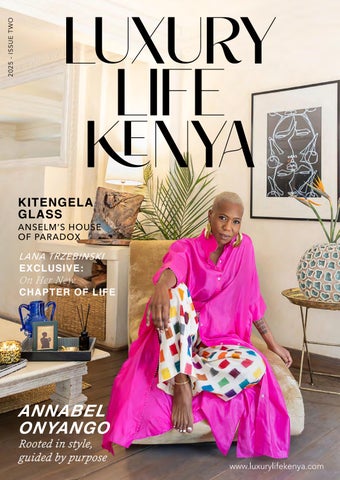
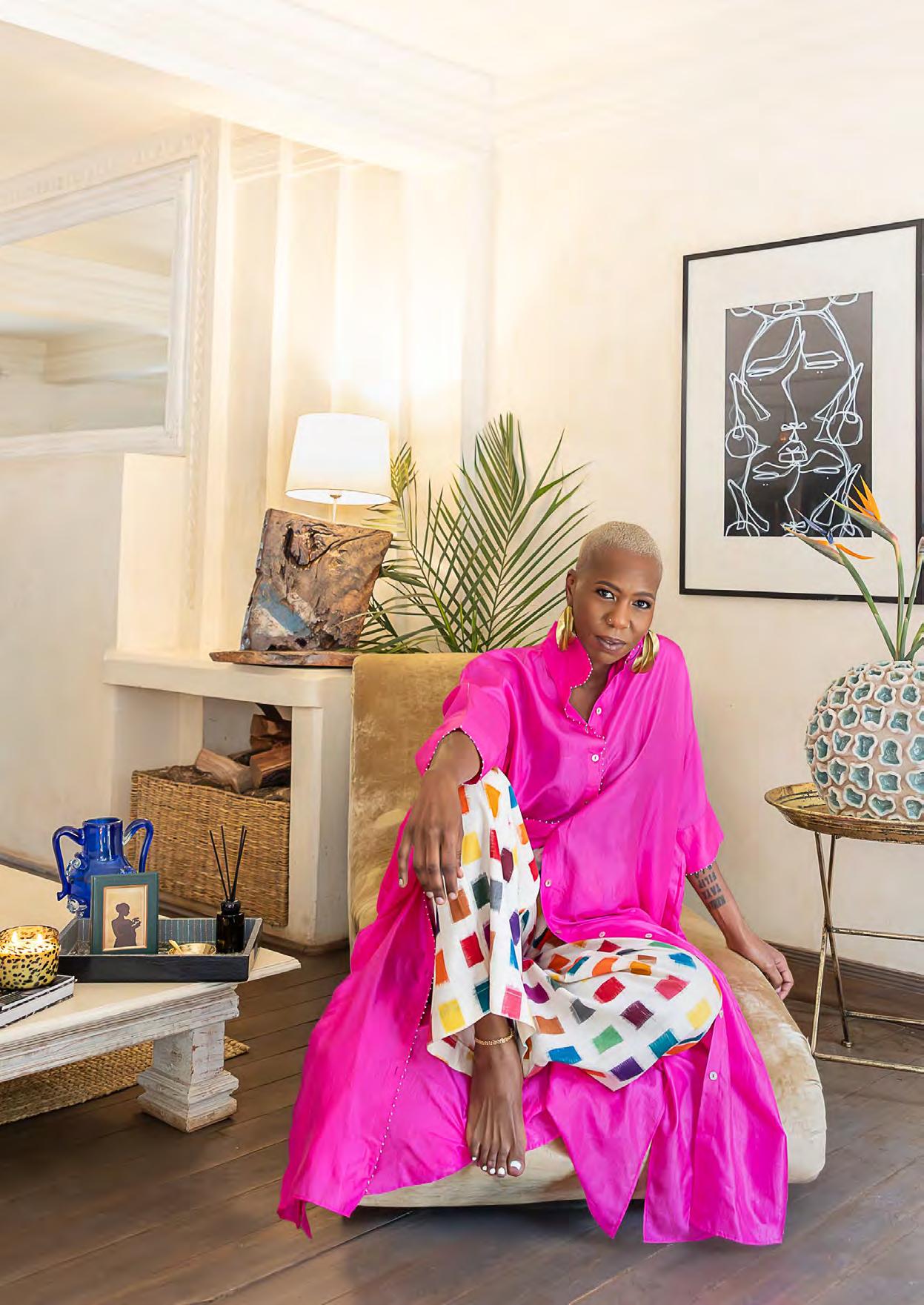
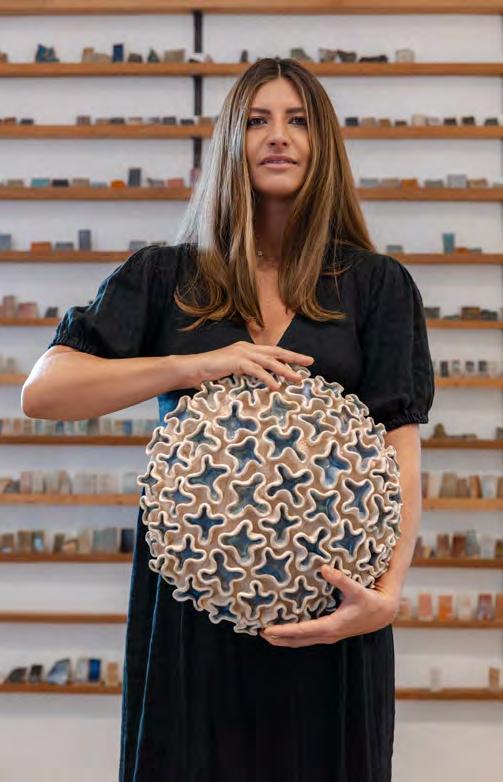
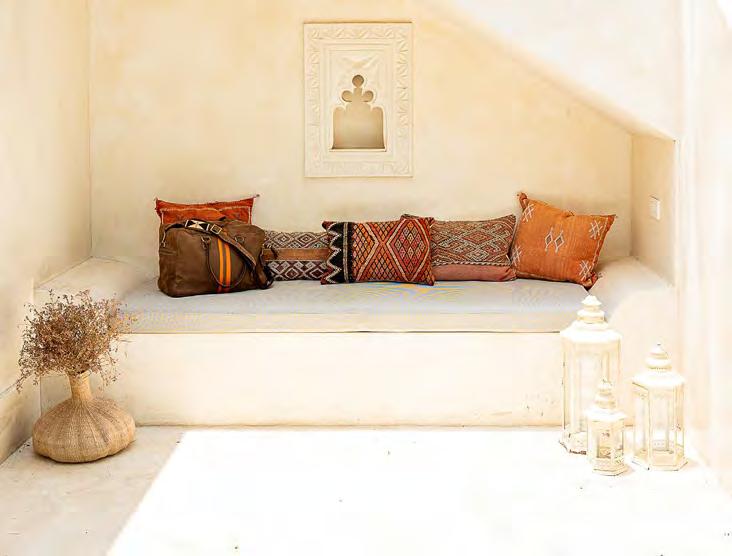
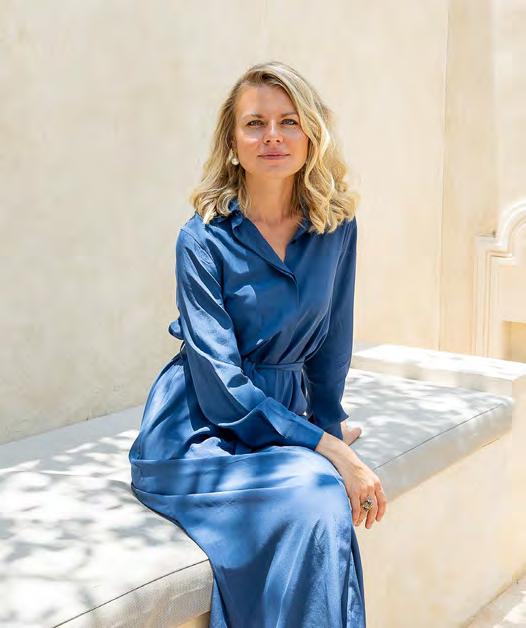
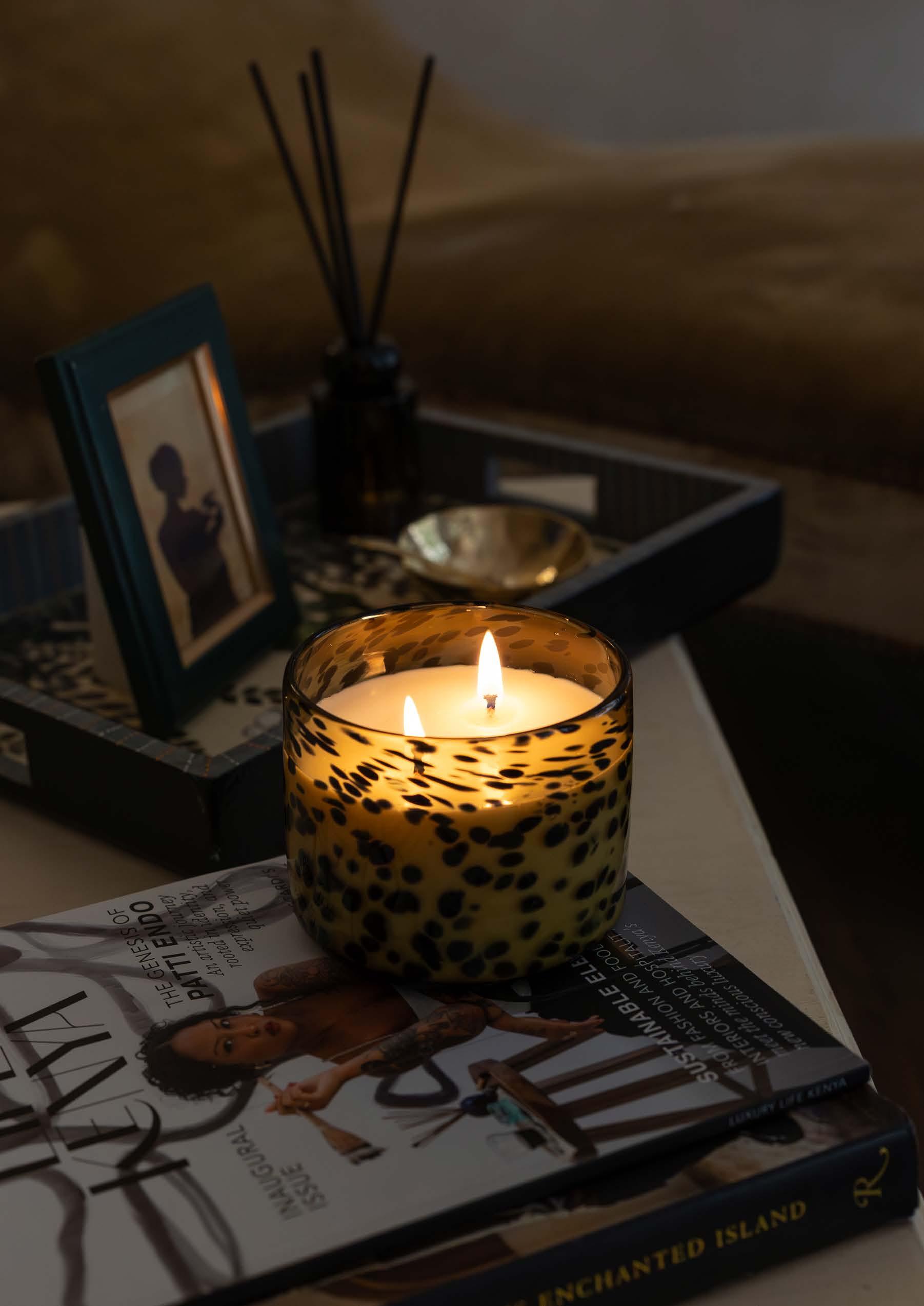
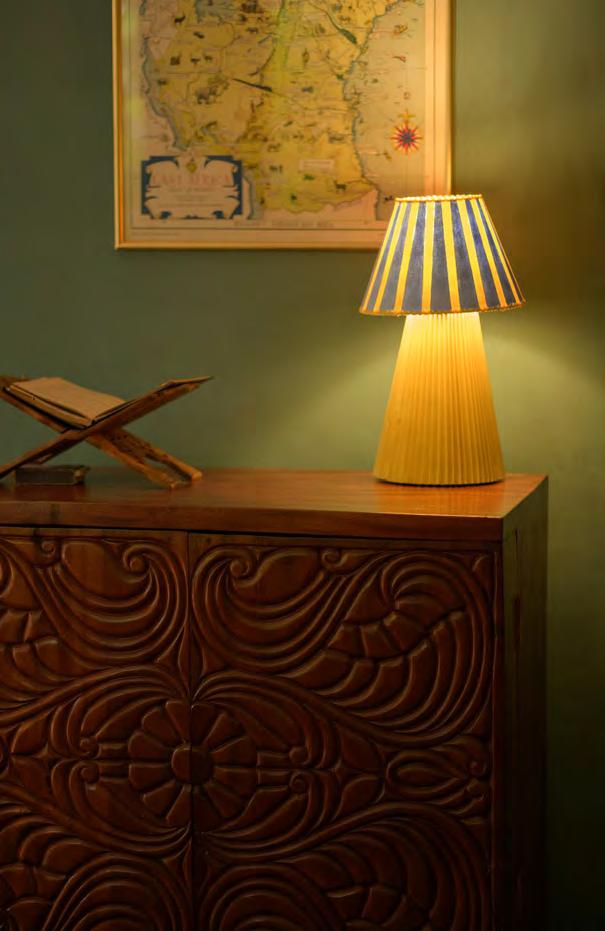
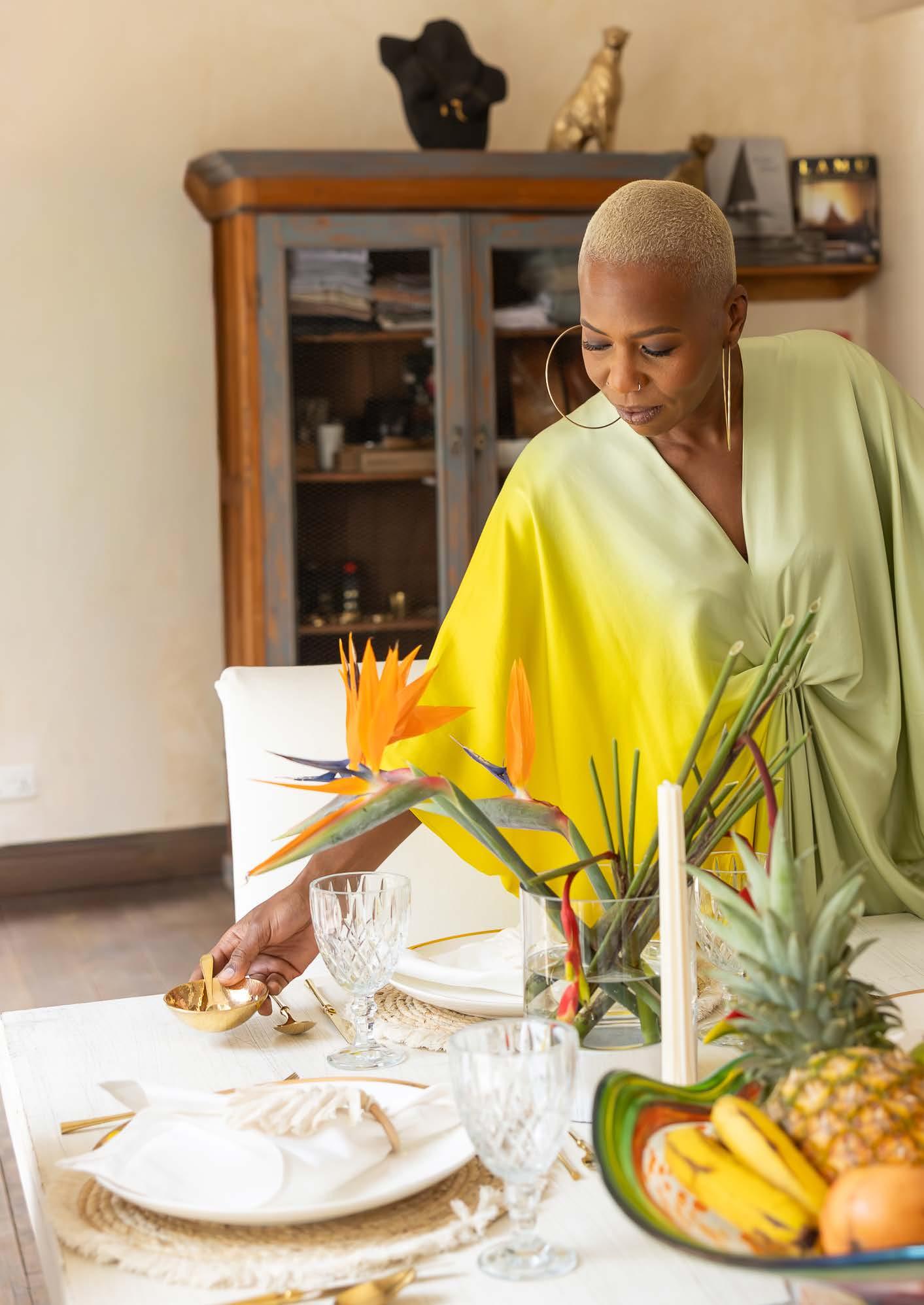
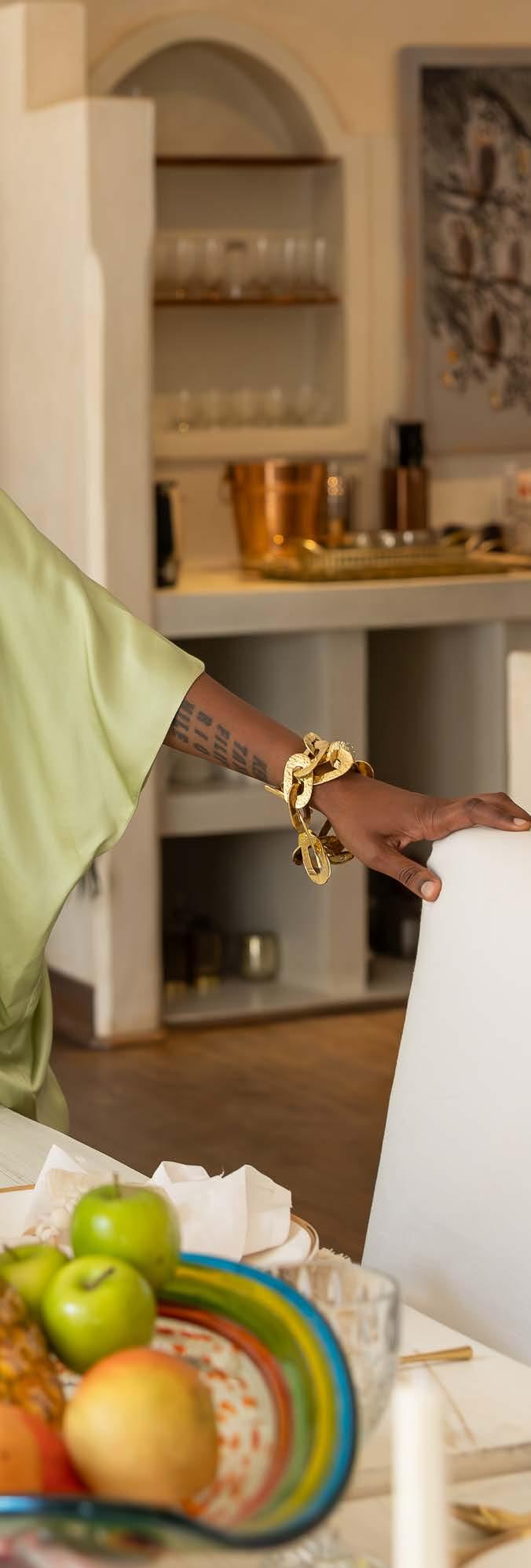
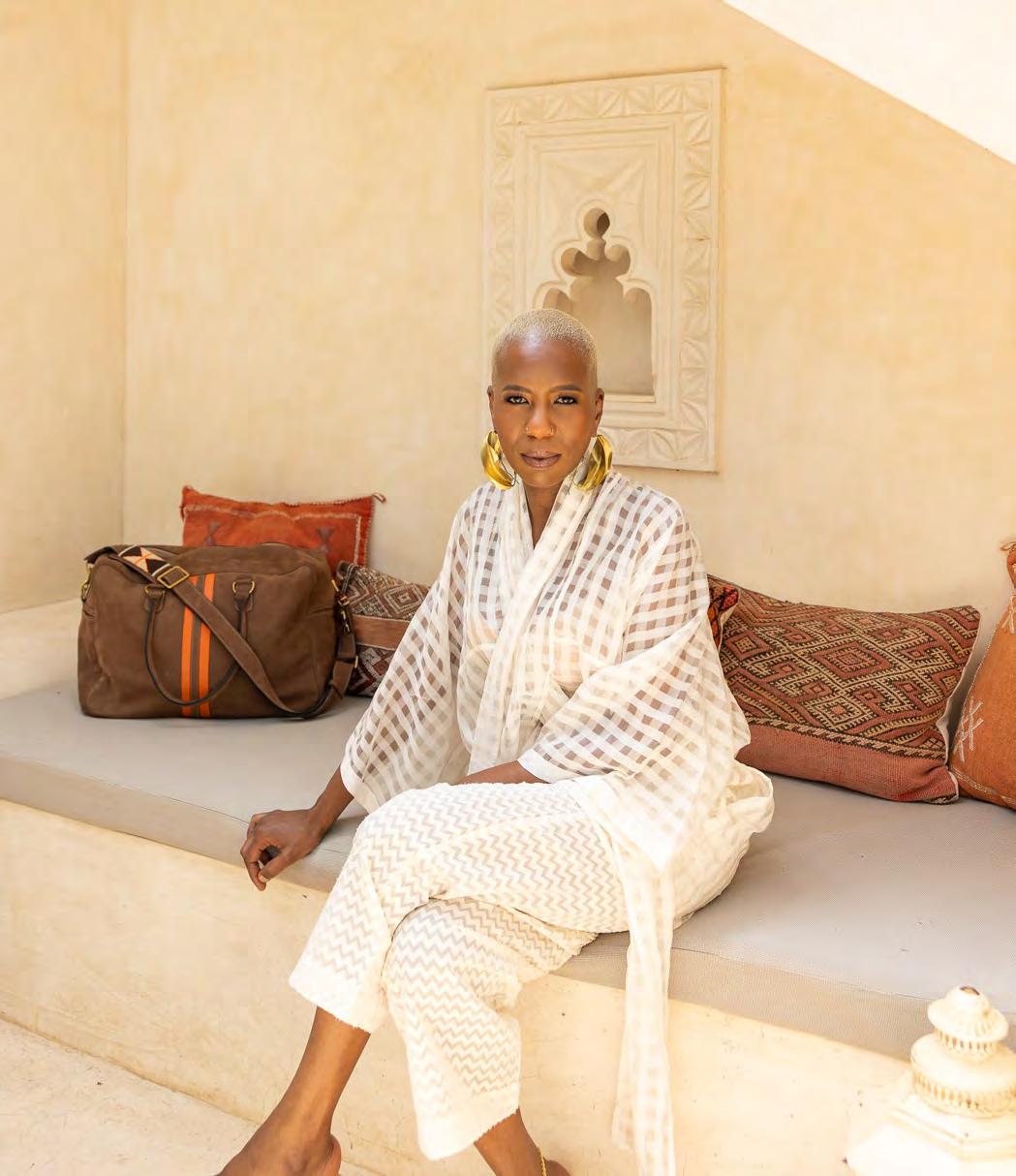
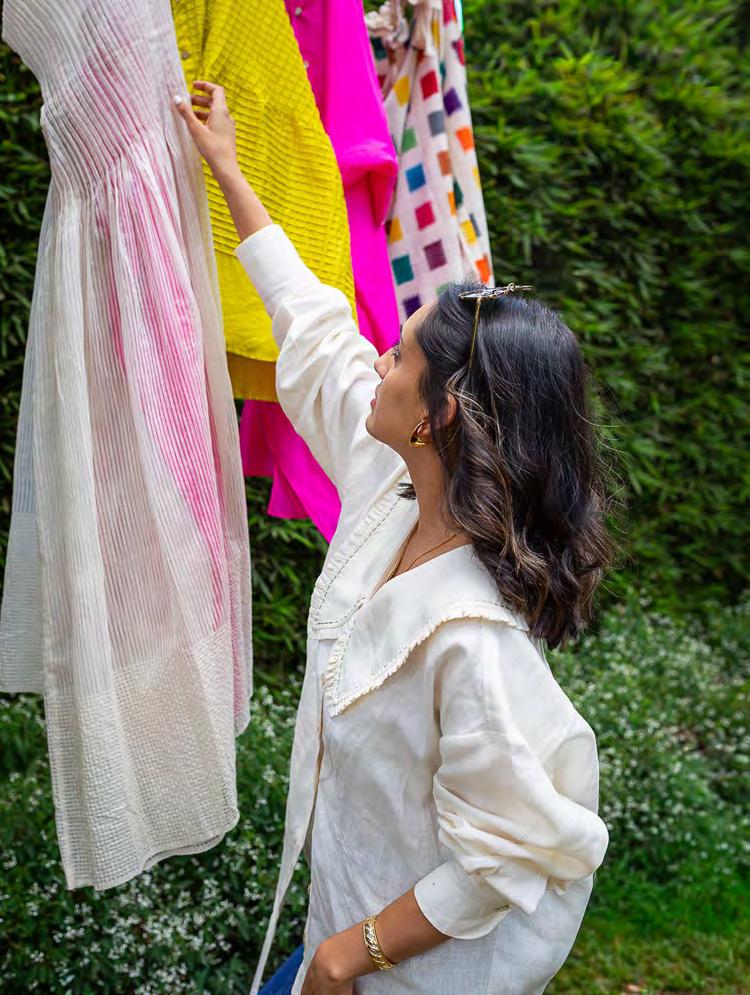
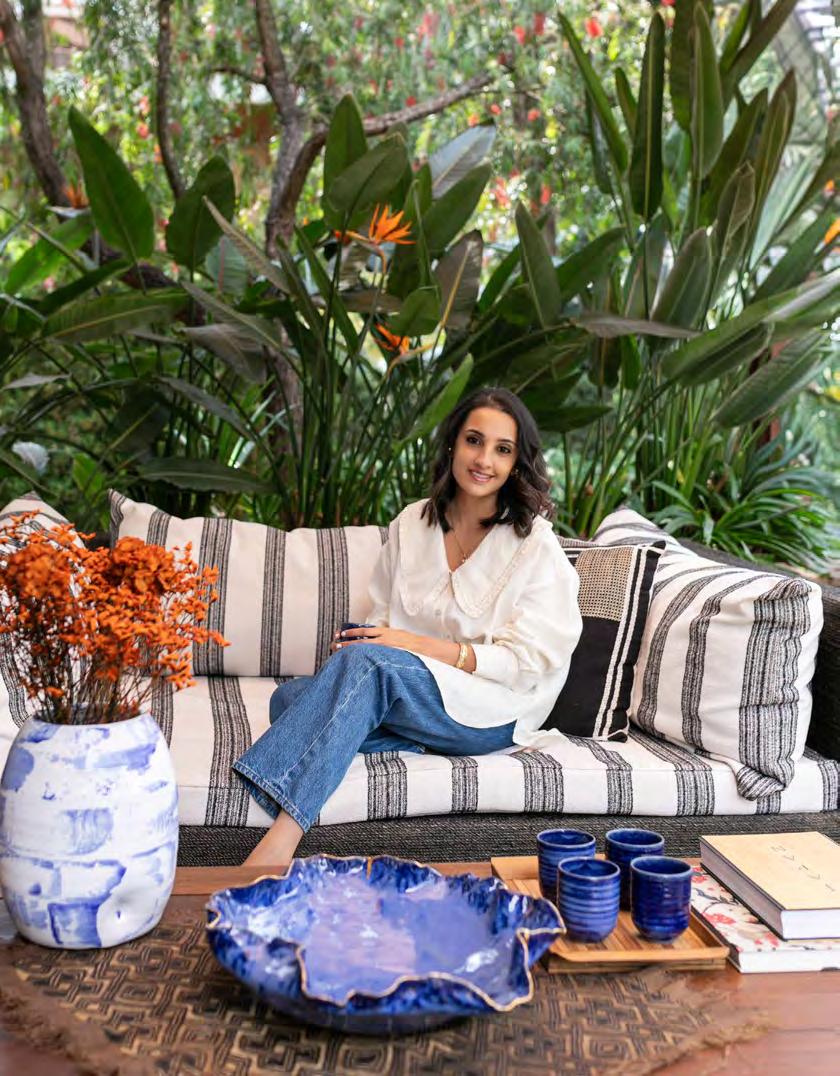
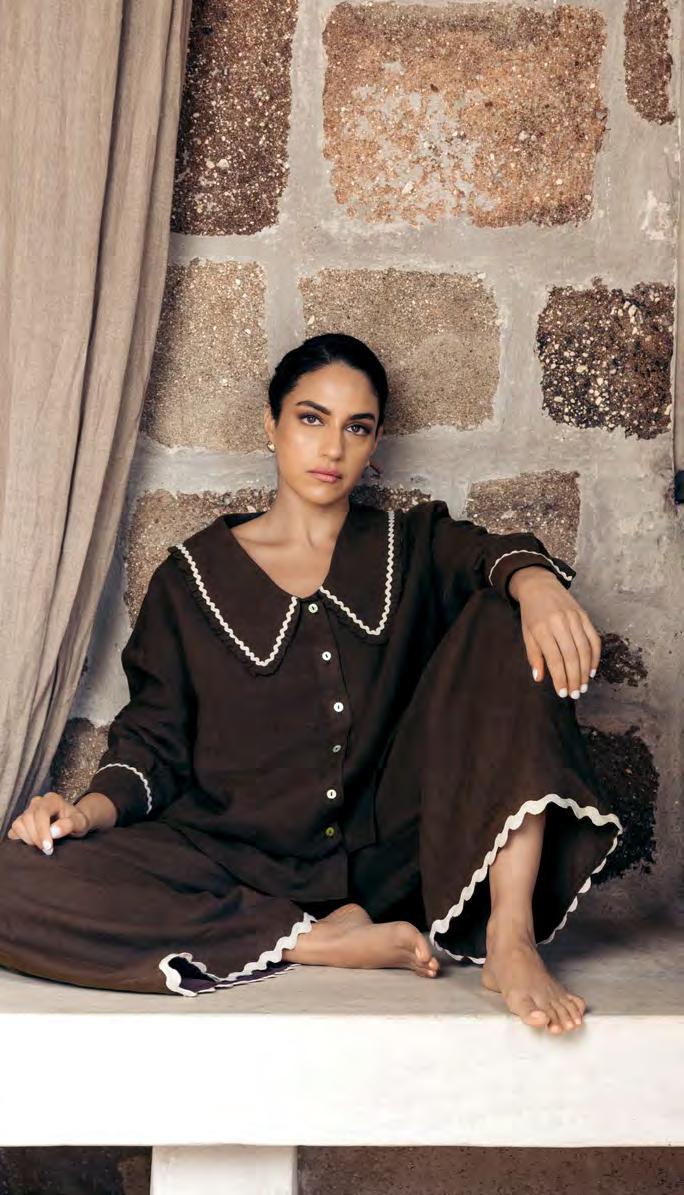
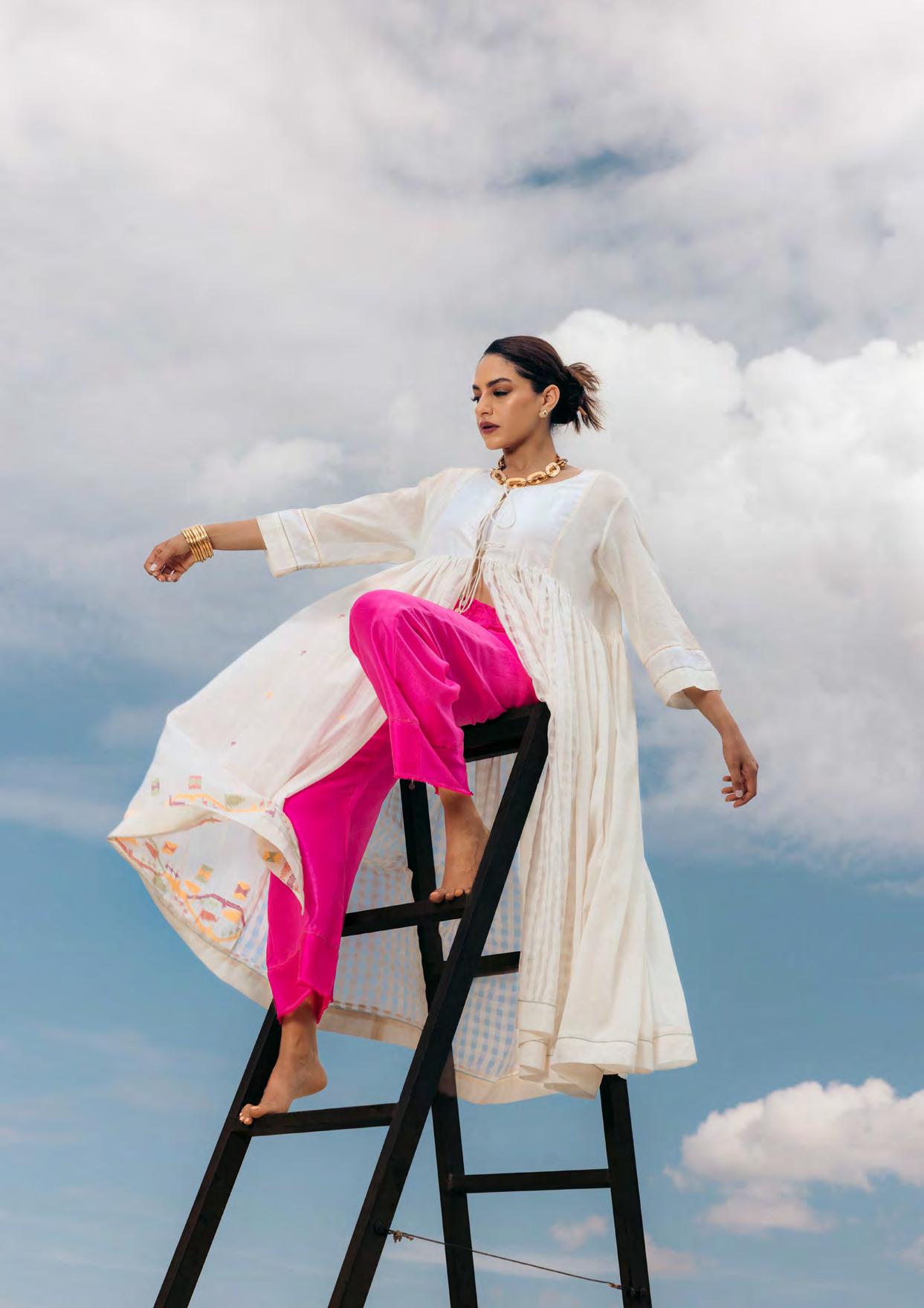
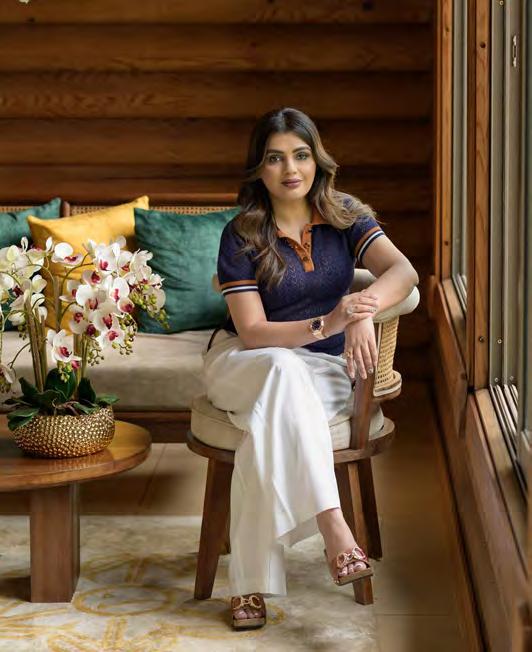
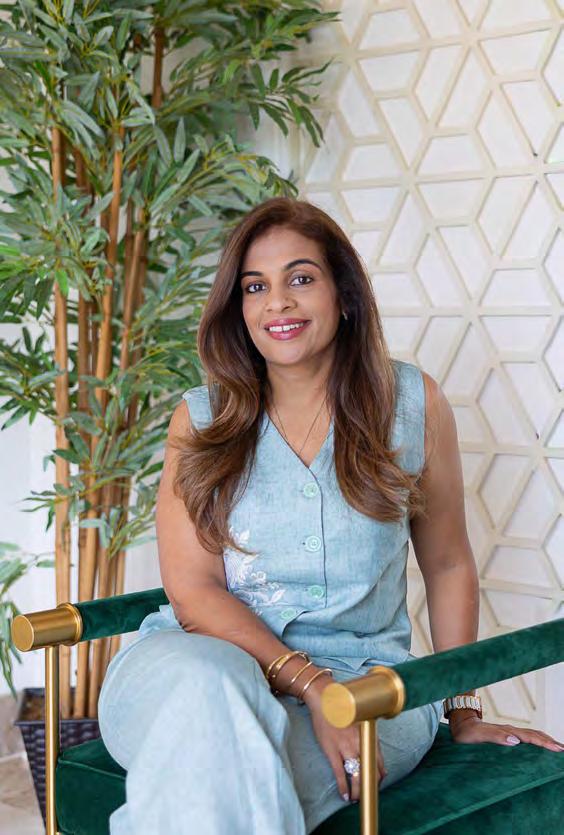
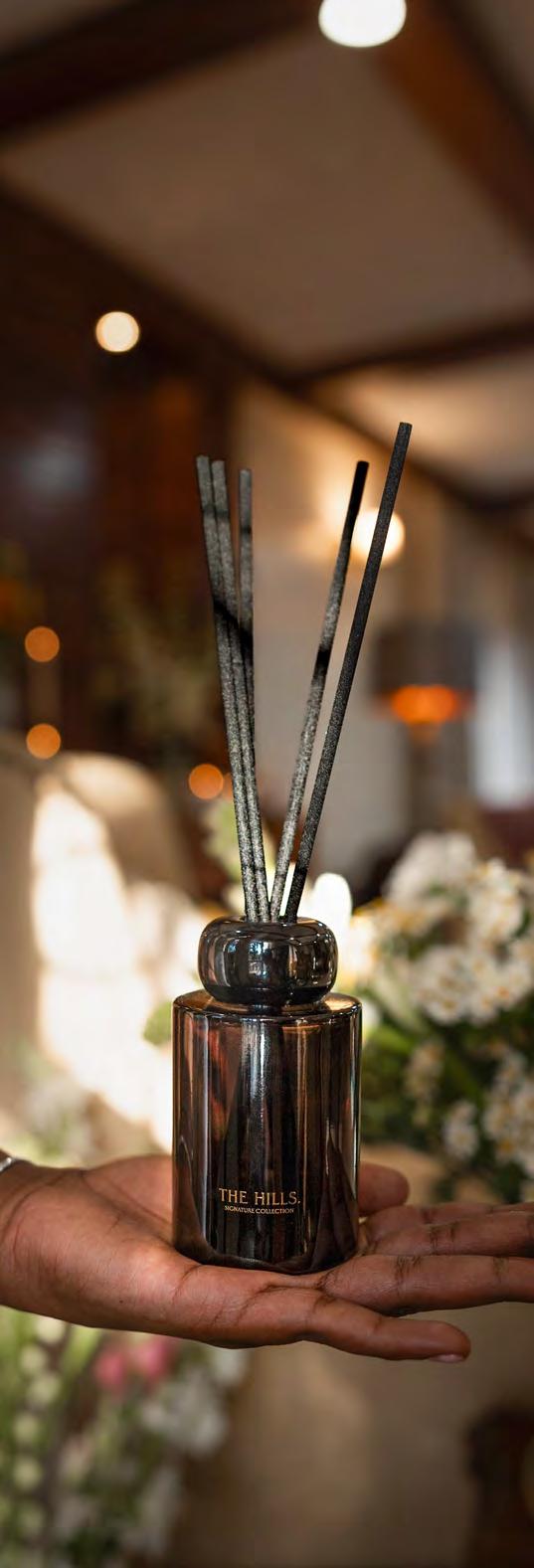
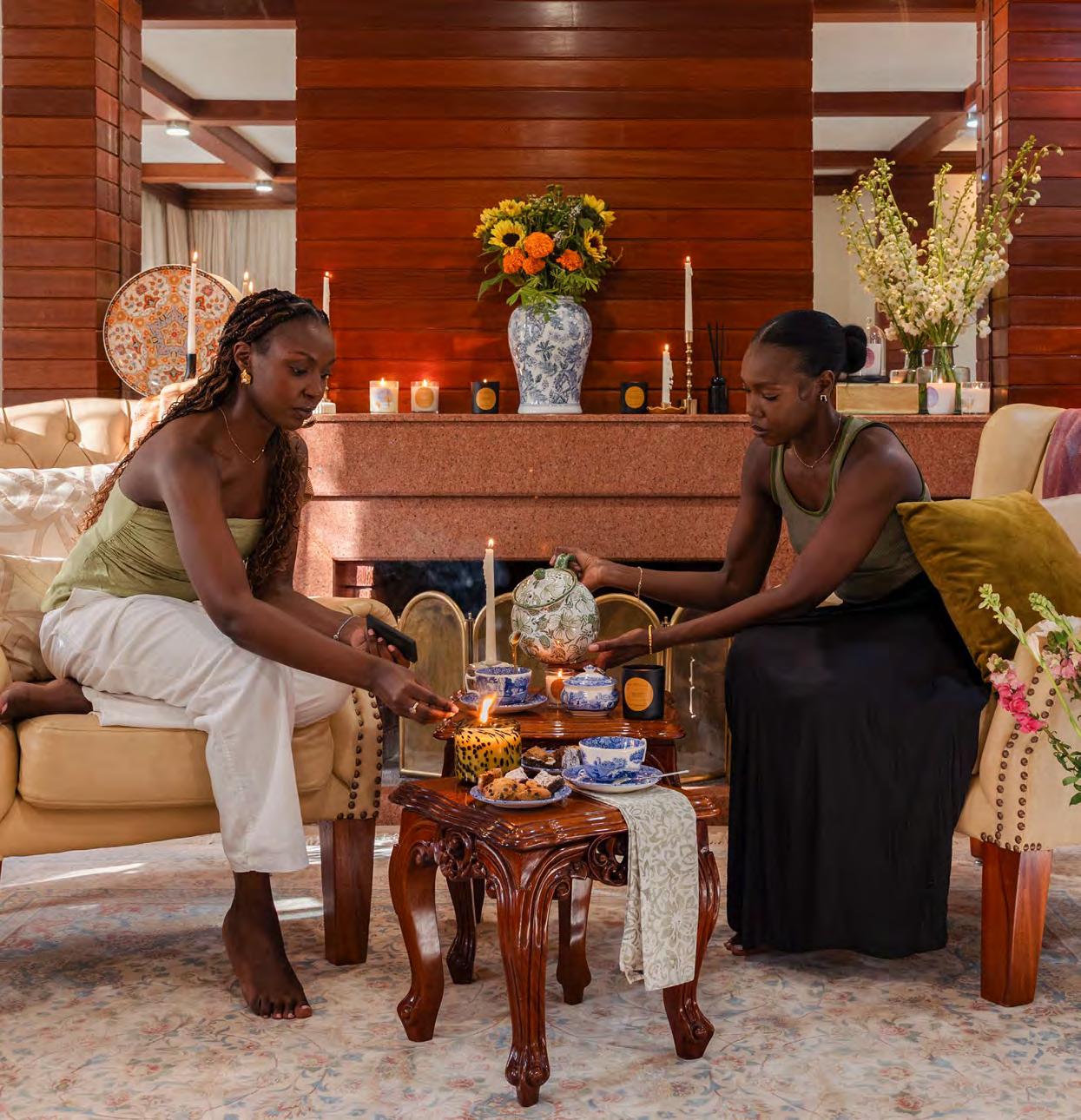
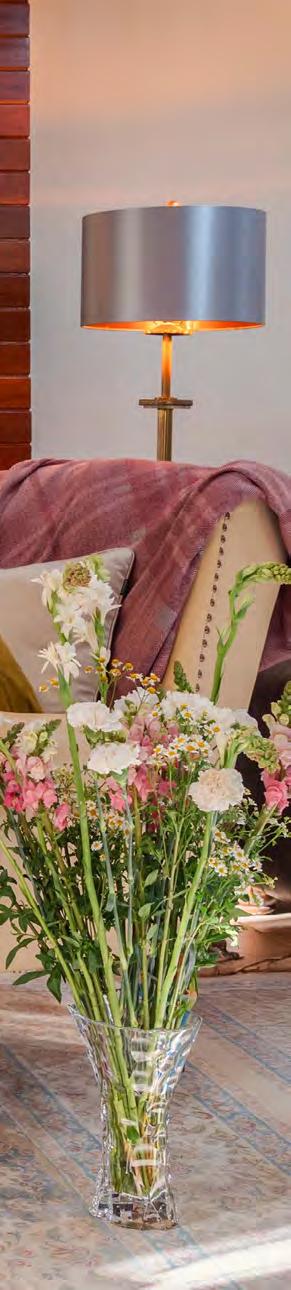
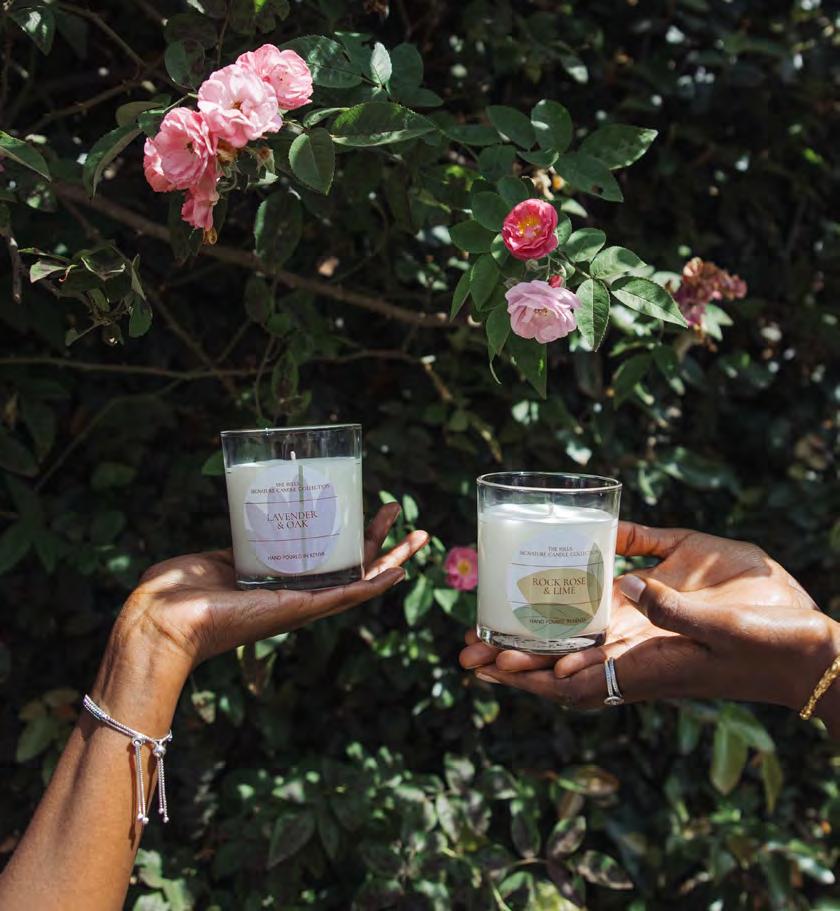
Renowned fashion stylist and creative visionary, Annabel Onyango, embodies effortless elegance in a handcrafted dress and jewellery by Ra by Rushina, captured through the refined lens of Ashton Allert, with photography assistance by Prisscila Baxter. Makeup by Valary Mdeizi. The space is styled by Aura by Fatema Bhaiji, featuring a drawing by Patti Endo, Macho Vase by Kitengela for Endo Squared Essentials, Fractal 63 by Lana Trzebinski Ceramics, a sculptural lamp by Swahili Chic, and a painting by Phoebe Ouma, with accessories and details curated from Ra by Rushina’s collection. The scene is infused with the soft glow of the Ndoto candle — created by Luxury Life Kenya in collaboration with Kitengela and The Hills Signature Collection — and the delicate fragrance of The Hills diffuser, evoking warmth and serenity.
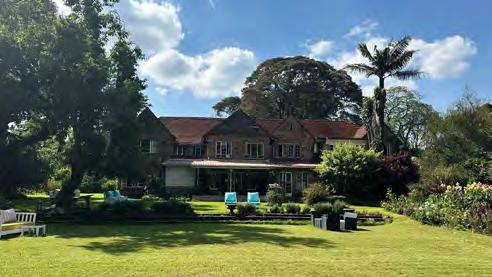
Shot at the breathtaking Manzili House — a luxury boutique home that’s part of the Manzili Collection, championing local artisans and culture while blending Swahili charm with contemporary design. This cover celebrates Kenyan artistry, craftsmanship, and timeless style.
EDITOR’S NOTE
FFor the Dreamers
There was a time when Luxury Life Kenya existed only as a whisper, a vision I carried across cities and continents, unsure of how or where it would take shape. I imagined a magazine that would celebrate not just luxury, but the courage to dream, to build, to create, to reimagine.
As children, we dream with abandon. We see ourselves painting skies, opening cafés, designing worlds. But then life happens, and those wild, luminous dreams begin to fade.
Yet Kenya has a way of calling them back.
There is a rare alchemy in this country, a rhythm that stirs something deep within you, a freedom that reminds you of who you once wanted to be. Many of the people we’ve met in this issue have felt that pull. They travelled the world, gathered experiences, and then brought their
dreams to life here. Whether it’s Chep and Chebet from The Hills, Ritesh from Spring Valley Coffee, Fatema from Aura, Rushina from Ra by Rushina, or so many others, they all had a dream and a clear vision. They believed deeply in what they were creating, and that is what makes their stories so powerful.
That is also how Luxury Life Kenya was born, from a dream that refused to sleep, and from the conviction that Kenya is a place where the extraordinary can still be created from imagination and will.
So this issue is for the dreamers, the ones who dare, who return, who rebuild, who believe. Because here in Kenya, dreams don’t fade. They come home.
Valeria Torner Petaeva Editor-in-Chief
WHEN Dreams TAKE SHAPE
The story of three creative forces who turned craftsmanship, scent, and design into something truly poetic — the Ndoto Collection.
IIt began with a phone call. One morning, the iconic Kitengela Hot Glass reached out to us after discovering themselves on the cover of our first LLK issue. It was one of those unexpected moments that make you pause and realise you’ve done something right.
Soon after, our team set out for a field trip to the Kitengela studio just outside Nairobi. For some, it was the first visit; others hadn’t been back in years. But none of us had ever seen it through the eyes of Anselm Croze, the visionary founder and glass artist behind Kitengela. The experience was nothing short of inspiring — an immersion into creativity, craftsmanship, hard work, and raw beauty.
That day, the idea of creating something together was inevitable.
A few days later, during one of our creative meetings, the concept of a collaboration began to take shape. But it wouldn’t be LLK if we didn’t take it a step further. We wanted to craft something beautiful, functional, and meaningful. That’s when The Hills
Signature Collection came to mind — a Kenyan, women-owned brand creating luxury scents that speak of elegance and intention. We had admired their work for some time and knew they would understand our vision perfectly.
And so, the Kitengela x The Hills x LLK collaboration was born — and with it, The Ndoto Collection.
In Swahili, ndoto means “dream,” and that’s exactly what this collection represents: a dream of creativity, collaboration, and craftsmanship brought to life. Kitengela brought the artistry, transforming molten glass through hand and imagination. The Hills added their mastery of scent, subtle and refined yet unmistakably Kenyan. And LLK, staying true to its creative DNA, wove it all together through design and storytelling.
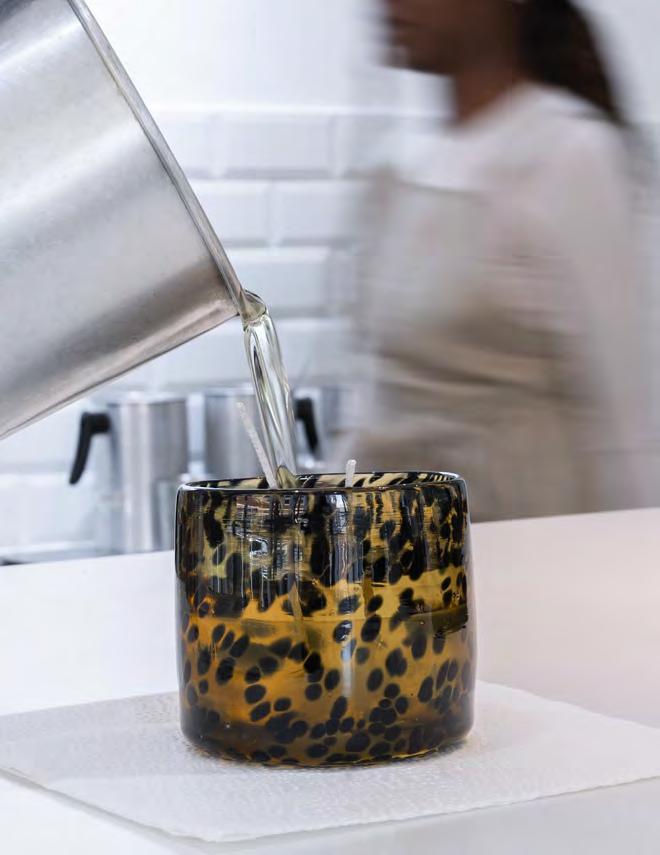
From selecting the scent and designing the glass cups with Kitengela, to experimenting with colours, crafting the packaging, and finally having The Hills fill each one with their signature fragrance, every detail was imagined and made with love.
The Ndoto Collection is a celebration of artistry, design, and imagination — a reminder that the most beautiful creations often begin with a shared dream.
Where can you find one, you ask? It’s a limited edition — for now. But who knows… perhaps this is just the beginning.
Love,
The LLK Team
CARVING A FUTURE FOR Swahili CRAFTSMANSHIP
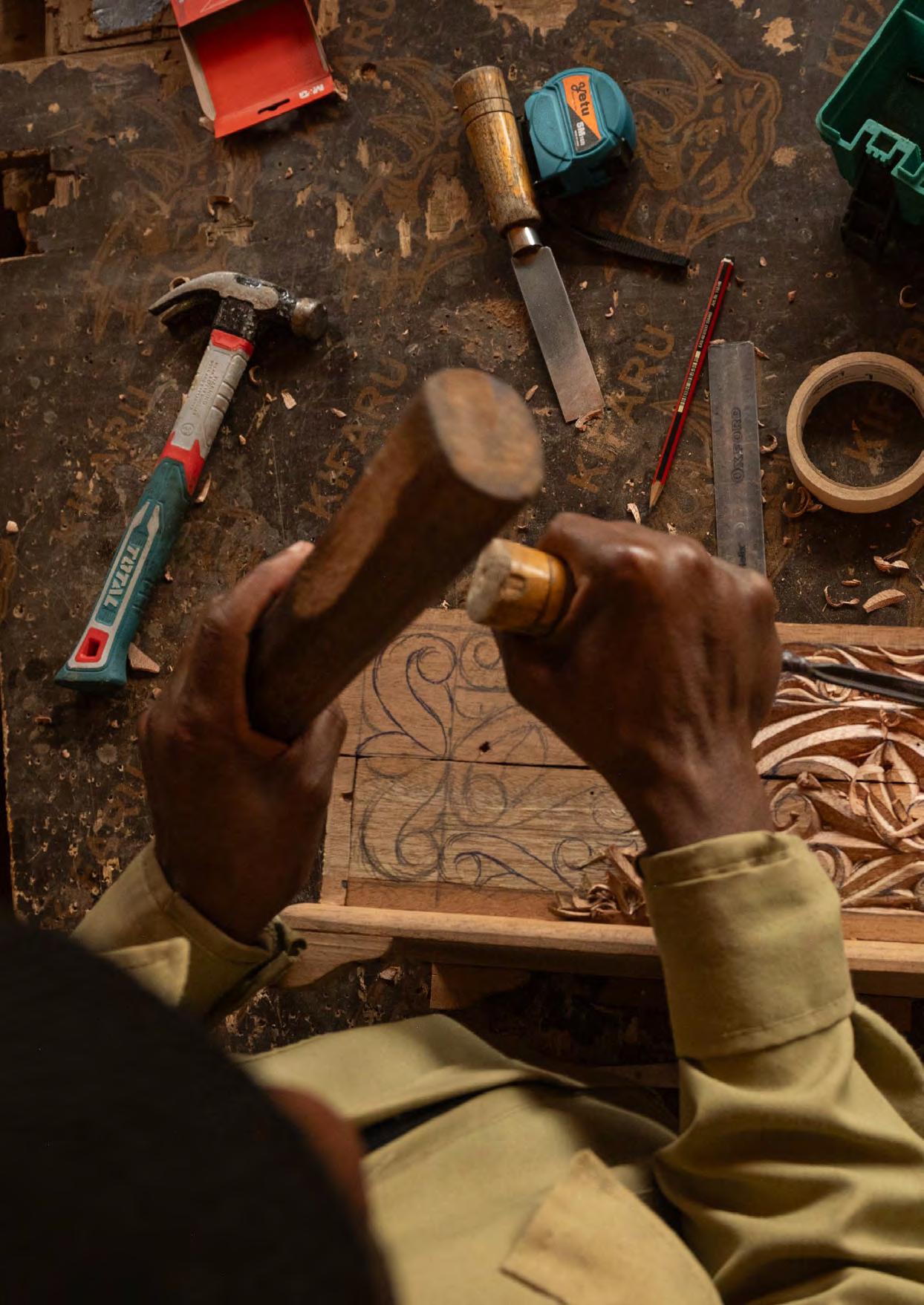
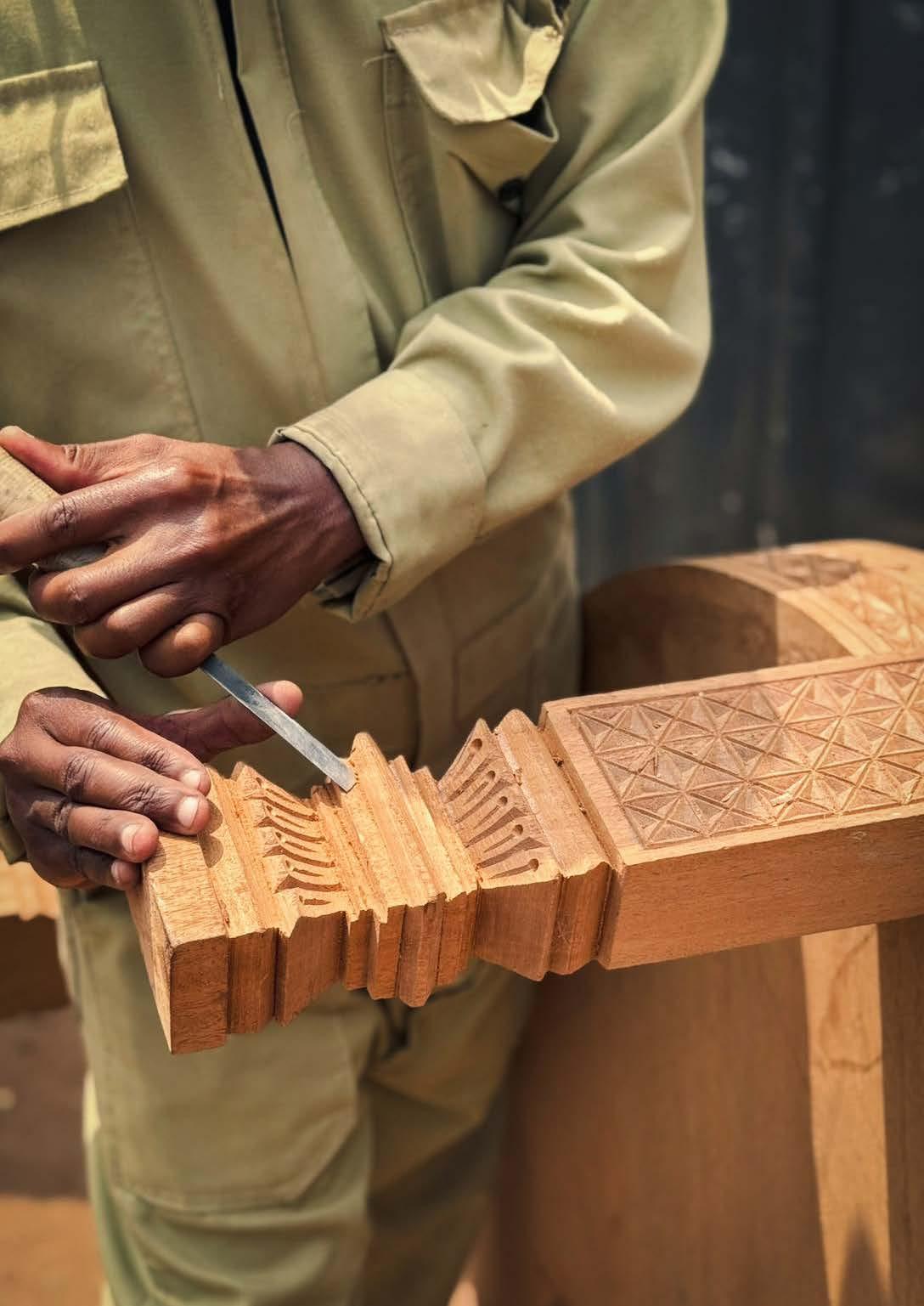
Roky Gambo grew up on Kenya’s coast, surrounded by weathered fishing dhows, canoes, and Swahili architecture.
Today, together with his wife Sonia, he anchors those same vessels – no longer at sea, but in homes around the world as beautifully restored furniture through their company, Swahili Chic Interiors.
WRITTEN BY SOPHIE CARREL PHOTOGRAPHY BY PRISSCILA BAXTER & MATTHEW STANLEY
Founded in 2015, the brand’s storytelling transcends elevated style and exceptional quality. By drawing inspiration from Kenya’s rich and diverse cultural heritage and from Roky’s own personal upbringing on the coast, their design and craftsmanship evoke a dialogue between past and present, resulting in timeless pieces built to stand the test of time. “Handmade items carry a lasting worth,” reflects Sonia. “They may take longer, but that’s how true craftsmanship endures, beyond automation.”
‘Swahili style’ is a commonly referenced term when it comes to interior décor, but it’s important to recognise its deeply rooted history. The intricate and ornate carvings that accompany Swahili-inspired furniture carry rich storytelling from the centuries-old influence of African, Arab, and Indian cultures that journeyed along the East African coast as part of historical trade routes.
It’s believed that wooden carvings on doors and windows first appeared on Kenya’s coast during the 17th century, and by the 18th and 19th centuries they had become synonymous with traditional Swahili homes. Domestic furniture pieces such as chairs, beds, and tables were also adorned with these design elements, which today are ubiquitous in the region.
Roky and Sonia met in Old Town, Mombasa – a Swahili cultural centre in Kenya. So it’s no wonder that their shared love and appreciation for the rich visual narratives that surrounded them made the decision to turn their passion into a business an easy one.
The pair later moved to Nairobi, where Roky furthered his carpentry skills, learning from fellow craftsmen who were also coastal transplants reigniting their cultural roots in the city. Soon, his work spoke for itself, and demand for his authentic designs and meticulous construction grew, allowing him to open his own workshop, where Swahili Chic was born.
Roky acknowledges that nobody “owns” Swahili style given its centuries-old lineage, but what really defines their presence in the space is their dedication to quality and their skilled ability to
create pieces that both echo tradition and combine contemporary influences. “We wanted to do something different from what others were already doing. We thought, what can we create that is a spin on something else, while still preserving the essence of Swahili style?” And while Roky and his team of carpenters are the ones getting their hands dirty in the workshop, the creative direction is very much a team effort between the couple.
“Part of what we love working on together is brainstorming and developing new ideas that allow us to colour outside the lines and really expand on that expression,” shares Sonia, who, in addition to her work with Swahili Chic, offers strategic narrative design and communications services for businesses and individuals.
The Maridadi Bar Cabinet — a modern design featuring traditional Swahili carving.
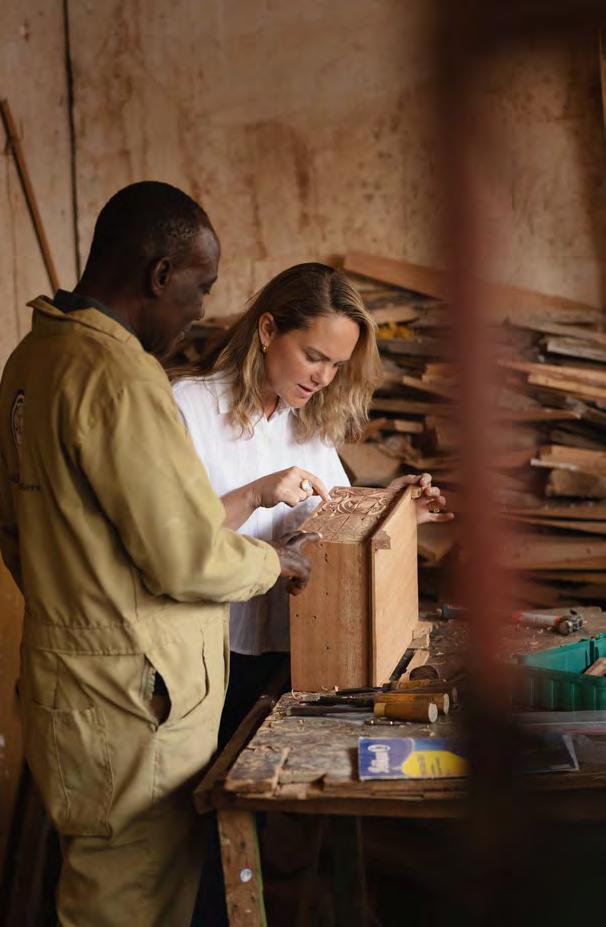
Roky and Sonia refining a new design at the Swahili Chic workshop.
The process of making dhow furniture is laborious from start to finish. Before the stylistic work commences, the dhow must first be sourced and disassembled, which can often take up to two weeks depending on its size. The wood then travels first by boat, often from far-flung islands, and then by lorry to the workshop in Nairobi. With his trained eye, Roky is able to visually deconstruct the artefact before physically doing so, which dictates what items can be made from the vessel’s bones – often just left for firewood. “If I want to make a dining table, I know I have to find a flat piece,” he says. “The ribs of the dhow I can use for the legs. But no matter what I end up making, no piece of wood is ever wasted.”
names or the colours that were originally painted on the wood. We save them. Some even have the registration number of the boat, which is really special.”
“ Mapi style is the inspiration for our Swahili Chic logo. ”
Perhaps one of the most unique features that can be found on a Swahili Chic piece, if you’re lucky, is the dhow’s original paint, name, or registration. “We always look for the names of the boats,” Roky says, when asked about his criteria for picking which one to reconstruct. “Even when we’re finishing the piece, we don’t sand the
But their mission doesn’t stop with sea-worn structures. Beds, doors, and other domestic items that are discarded in front of houses throughout coastal towns are also given a second chance at life. Most of the pieces are custom-made, which allows clients to have their own creative input. While it’s important for the brand’s integrity to remain rooted in cultural authenticity, the couple is always happy to find ways to incorporate their craftsmanship into new designs, ensuring that the traditional style is ever-evolving.
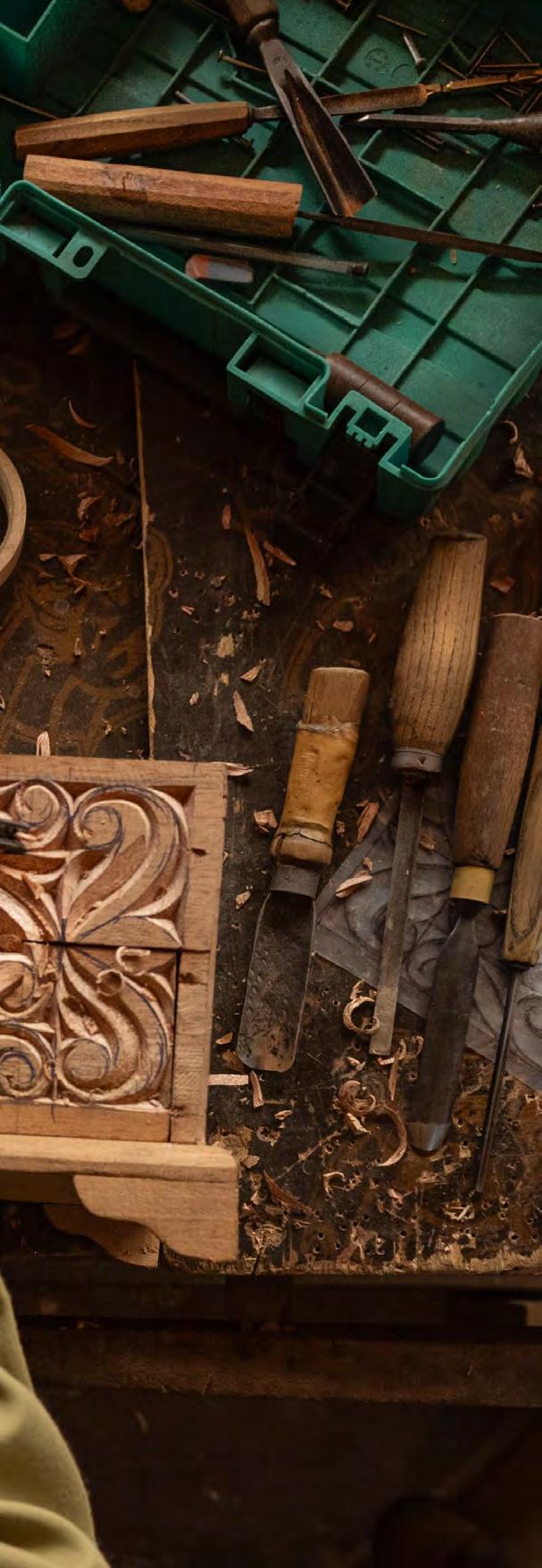
While the weathered wood carries stories from past times and tides, the hand-carved embellishments that accompany the creations really capture the cultural melting pot that inspired their designs. “Every style of carving originates from somewhere,” Sonia shares. “I love tight florals, so Mapi is my favourite.
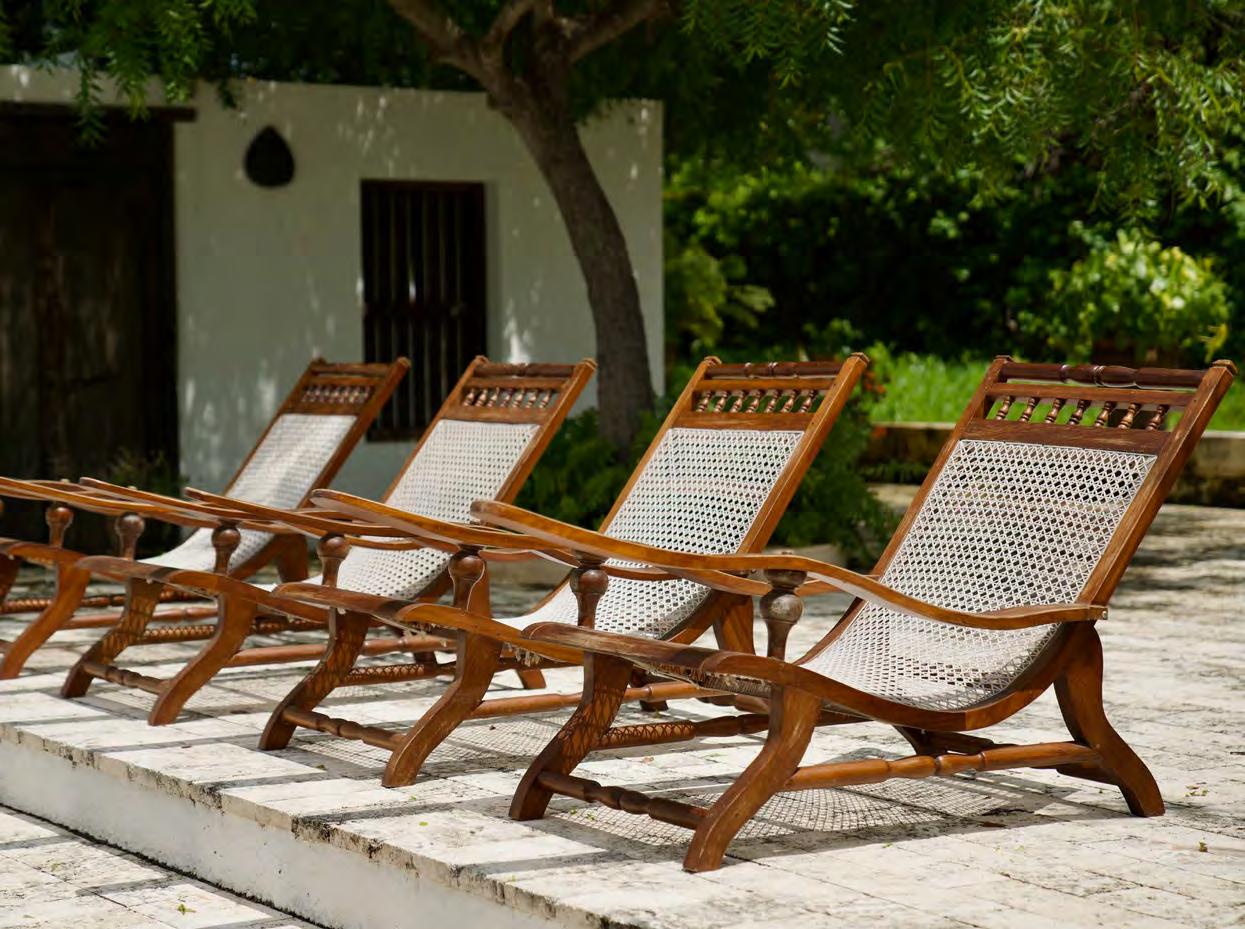
Ultra Lounge Chairs in a Swahili Chic–furnished home in Watamu.
“For us, luxury is not about excess or opulence, it’s about meaning. It’s the story behind every piece, the hands that crafted it, and the centuries-old traditions that live on in the details. Luxury is found in the quiet elegance of craftsmanship, in pieces that are made to last, and in the connection to history and place. True luxury is when your home reflects who you are and what you value most. That is what makes it timeless.”
Roky selecting a retired dhow in Lamu, bound for new life as furniture
It’s also the inspiration for our Swahili Chic logo.” Mapi style was created by Maalim Ali Swabu, originating from Lamu, a small archipelago island off Kenya’s coast and one of the oldest Swahili settlements in Africa, where even today, elaborate doors and windows bear the soul of the region’s history.
Roky’s favourite is Vigango, a pattern derived from Bajuni style dating back to the 11th century. The geometric carving is achieved by chipping and cutting the wood to create circles and straight lines. They both go on to explain the many other styles that they incorporate into their pieces, such as Gujarati, Zanzibar, Siu, and Omani, and how they all tell their own, textured story.
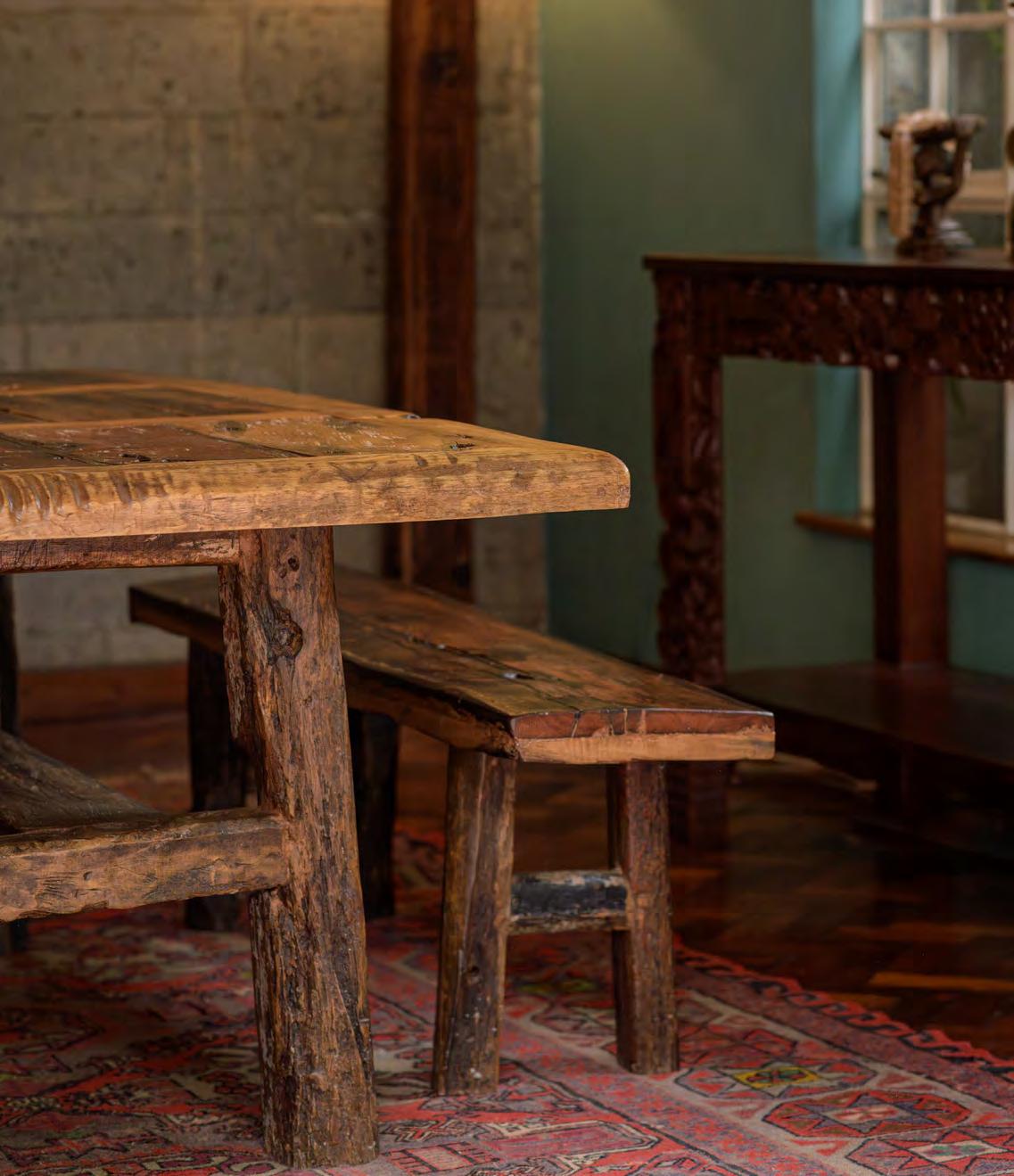
In the foreground, a dining set crafted from reclaimed dhow wood; behind it, a console fashioned from the carved centerpiece of an antique Lamu door.
What’s most important to the couple is that their creations of functional artefacts bring joy into the homes of their new owners. When hosting a dinner party, the dining table becomes a conversation piece, or while taking a nap on the Maridadi bed you’re drawn into another world.
On whether the couple has a favourite piece they worked on together, well, how do you pick a favourite child? Many are on display in their thoughtfully designed home, but one they both enthusiastically reflect on is a console that was once an old Lamu door with intricate centrepiece carvings that they simply couldn’t resist.
After learning about the positive impacts their business has on an extended network of people, it’s clear Swahili Chic’s legacy expands far beyond the forgotten fragments they reclaim. From the locals scouting the shores for abandoned treasures, the crew of helpers transporting the pieces to Nairobi, and the team of craftsmen in the workshop who are paid a stable salary – many financial opportunities are created, and local communities are reminded of the richness of their heritage and skills.
Roky reflects on how full-circle his journey has been. From his days as a fisherman and seeing the decaying relics scattered along the sands, to now breathing new life into the very same remnants and supporting his community on the coast. “I still feel like I’m there,” he smiles. It’s not just about honouring his own cultural identity in the pieces he makes, but also preserving tradition and creating longevity so the stories can continue to be told.
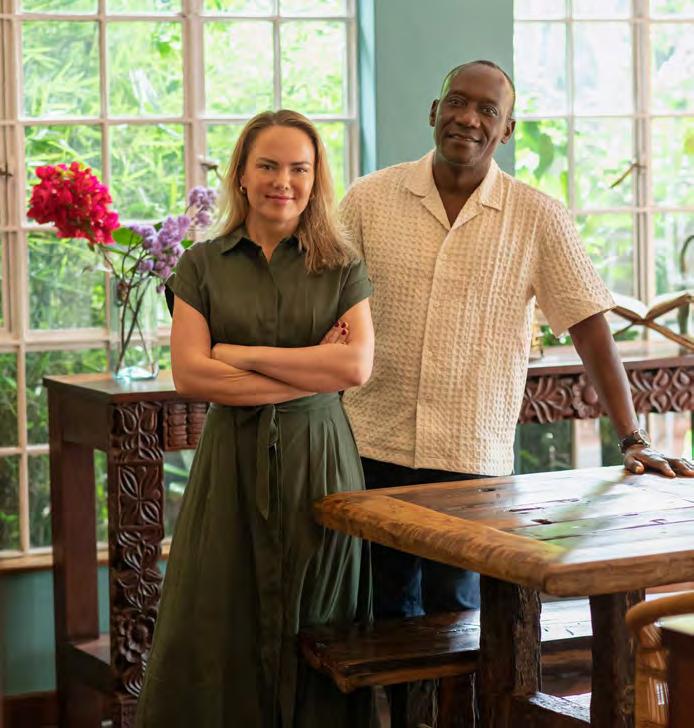
Sonia and Roky at their Nairobi home, surrounded by Swahili Chic pieces.
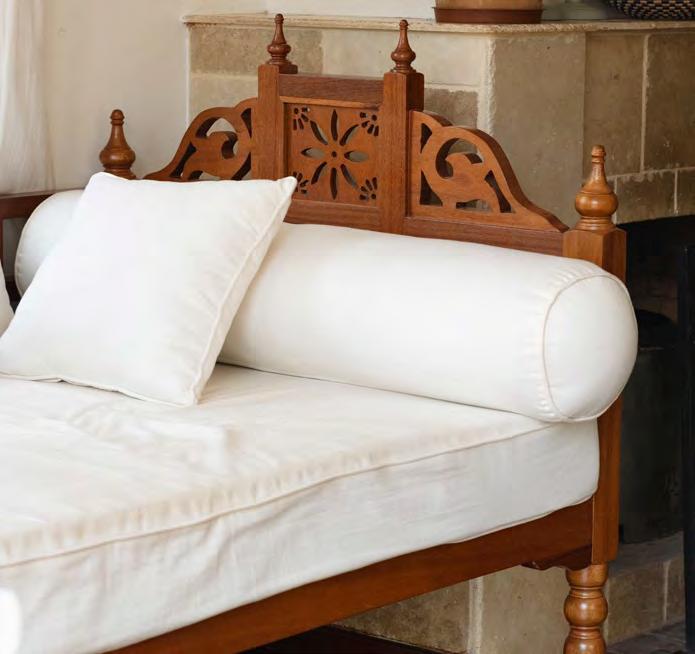
The Kibokoni Day Bed — a contemporary adaptation of a traditional Swahili bed.
Quick Fire Questions:
Lamu sunset or Nairobi skyline?
Lamu sunset
Wood you feel most connected to?
Mvuli
One word clients use most about your work?
Maridadi
Dream home for your furniture?
The European mountains
Favourite Kiswahili word?
Salama
Intricate carving work on the legs of a Swahili Chic coffee table.
ANNABEL ONYANGO
INTERVIEWED BY VALERIA
PHOTOGRAPHY BY ASHTON
TORNER
ALLERT
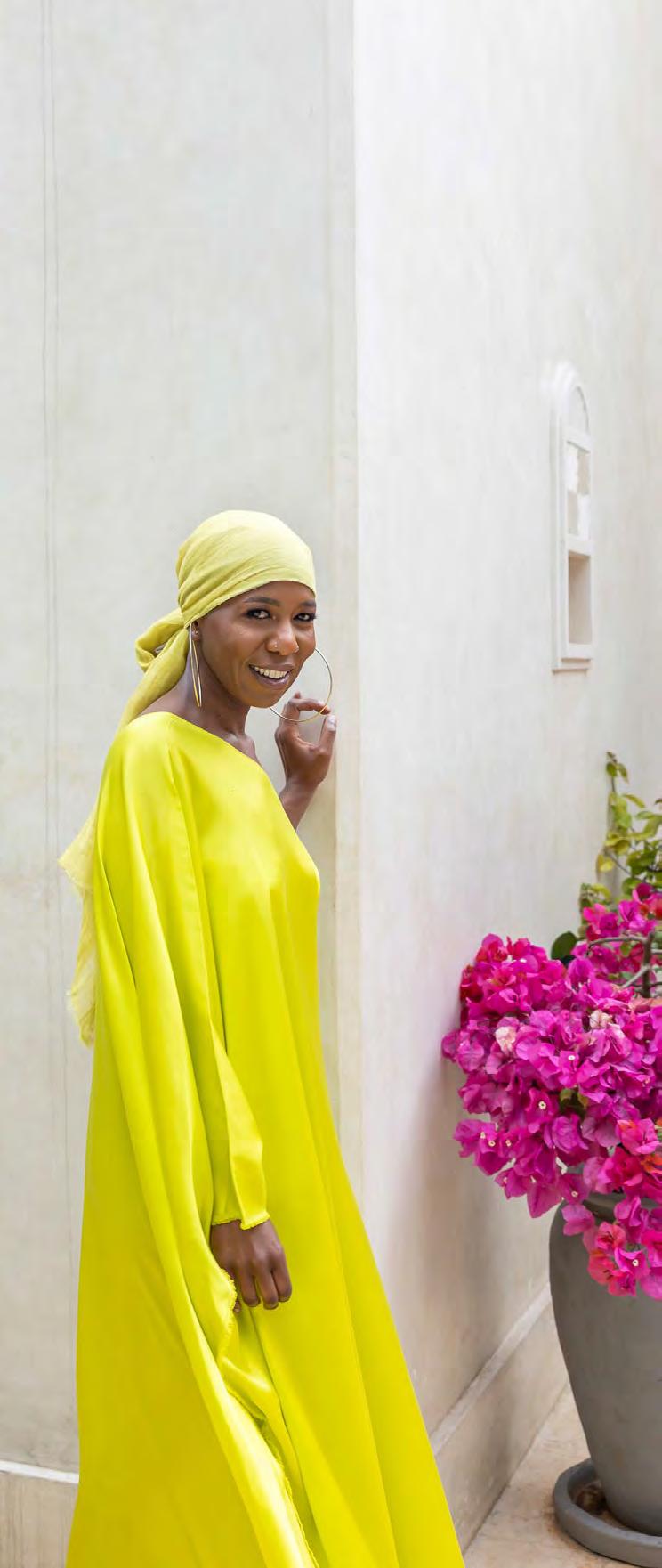
Annabel wears Ra by Rushina, Aurelia Kaftan, hand dyed ombré satin.
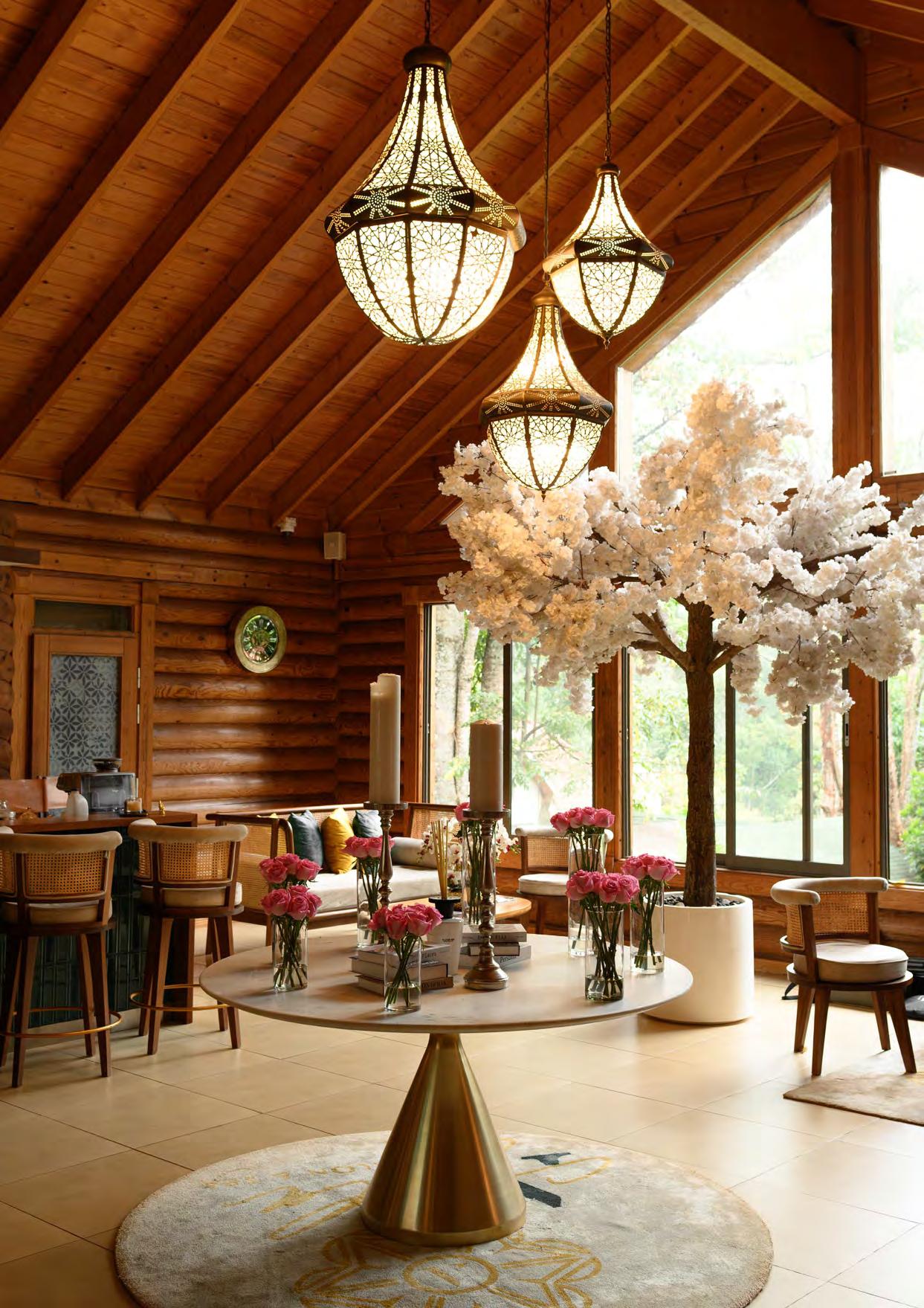
When I met Annabel Onyango at Manzili House in Karen, it immediately felt like the right setting for her story. Manzili describes itself as a luxury boutique home away from home, and that’s exactly what it is — calm, elegant, and full of quiet character.
Surrounded by soft light, handcrafted details, and the stillness of nature, our conversation unfolded in that effortless way that happens when someone is completely at ease. Annabel spoke about her journey from environmental studies to fashion and interiors, her love for craftsmanship, and her celebration of Kenyan-owned brands and the rich artistry of African heritage.
What struck me most was her sense of purpose. She doesn’t just style spaces or clothes — she curates meaning, connection, and identity. Speaking to her felt like stepping into her world: thoughtful, grounded, and beautifully intentional.
Background & Personal Journey
You started with degrees in Environmental Studies and English Literature, then transitioned fully into fashion and interiors. What sparked that “pivot,” and how do those fields still inform your approach to styling today?
Yes, I landed in Nairobi in 2006, thinking I would become an environmental journalist. Instead the opportunities presented to me were in fashion and lifestyle journalism, and I happily stuck to that. As my creative career developed, I leaned exclusively into the Made-In-Kenya space, which is generally more ethical and environmentally sustainable. So in the end I very much apply the principles of my academic degrees and critical thinking skills.
It’s important for me to support and champion fashion and lifestyle products that aren’t mass-produced, but instead handcrafted in limited-batch quantities within a slow model of consumption. It’s also important for consumers to have a connection with the Makers of the things they buy, giving those products more meaning, substance, and depth. I find a great deal of professional and personal fulfilment in this.
Being born in Côte d’Ivoire, having lived in multiple countries, and now based in Nairobi — how have those different geographies shaped your aesthetic and your sense of home?
I’m very much a pan-African. I love living in Nairobi of course, but I still have a lot of nostalgia for my West African roots. Culturally East and West are very different, and it’s always interesting to be able to embody both those sides of me.
Ivorian/West African fashion is the blueprint to me. They have a very strong sense of heritage, and it comes through very explicitly in their fashion. I love how West Africans interpret traditional costumes into contemporary luxury and streetwear. I also love how young East Africans are spearheading a burgeoning arts and culture scene that is so unique to this part of the world and amplifies local talent. It’s the collective energy from all sides that keeps Africa vibrant and culturally interesting from a global perspective.
Can you recall an early moment — maybe a project or challenge — that made you realise that styling was not just a job for you, but a calling?
I knew I was deep into the styling thing when I became the Group Fashion Editor at a lifestyle company called East Africa Magazines. It was a period when I was able to really deep-dive into the Kenyan fashion industry and foster relationships which I use to this day.
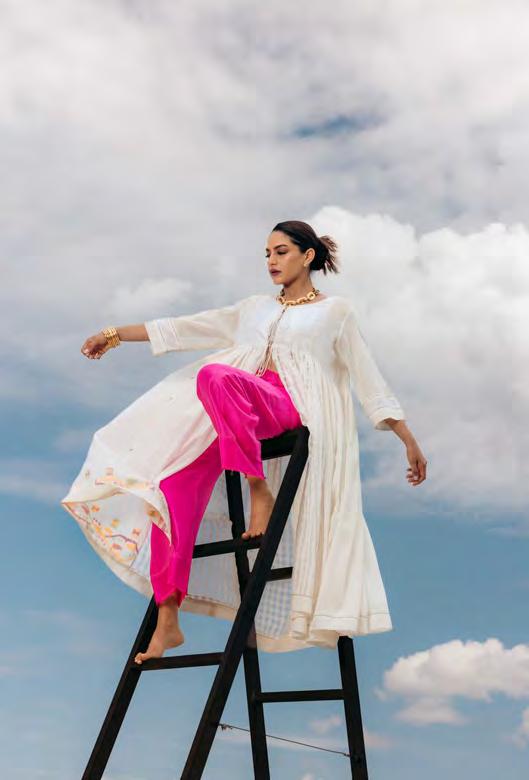
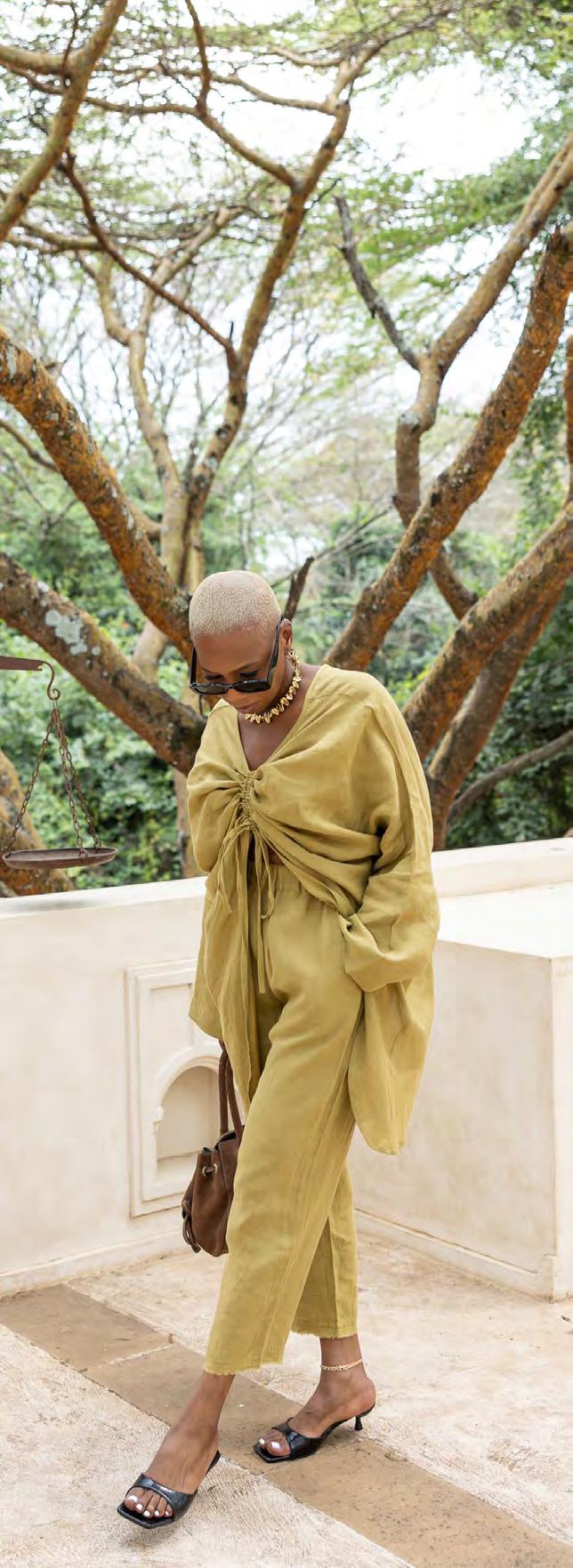
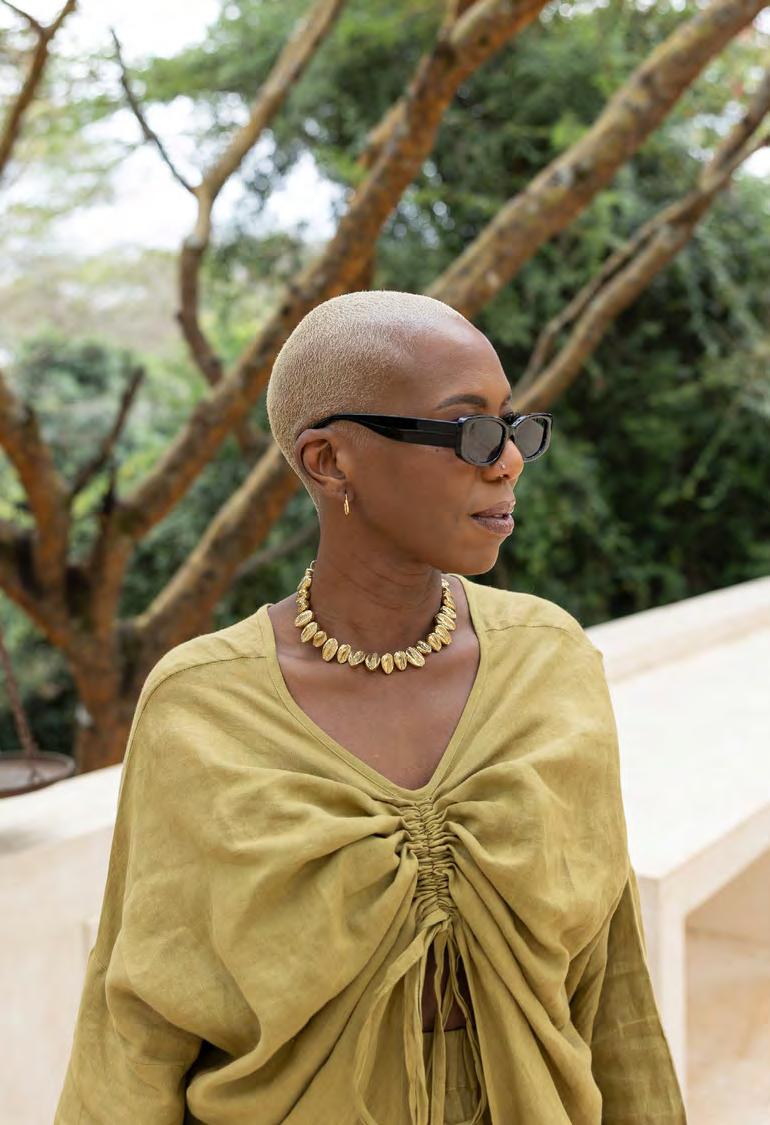
Annabel wears Ra by Rushina Butterfly Top and Frey Pants in olive, made from GOTS-certified linen, with hand stitch detailing. Brass necklace Ra by Rushina. Urban Ranch Twiga Tassel in dark brown; urbanranchkenya.com
The Craft & Philosophy
You speak about wanting to express an authentic African identity in your work. What does “authentic Africanness” mean to you in terms of colour, texture, silhouette, or space? How do you avoid clichés while still rooting your work in locality?
Being “African” is such a subjective thing. Africa is so diverse and Africans are not a monolith.
On a personal level my own African-ness is drawn from so many different influences – being born in CÔte d’Ivoire to Kenyan parents, growing up internationally, having a colourful education from elementary school to university, and eventually settling in Nairobi into an ethnically-mixed community. All these experiences inform my version of what being an ‘authentic’ African is.
My creative perspective is the sum of all my exposure and experiences, while still holding on to my core as a child of Luo heritage.
Annabel wears Ra by Rushina Lumina Overlay and Tilt Pants, handloom cotton with silk detailing at the seams. Notting Hill Weekend Bag by Urban Ranch in brown; urbanranchkenya.com
When styling interiors vs fashion, what are the common threads in your process? Are there principles or rituals you follow that bridge both disciplines?
For me, styling fashion and interiors always requires the following principles:
• Use NATURE as a reference: The world God created is perfect in every way; just borrow its colours and textures and apply them in everything you do.
• Automatically apply CONTRAST: Soft and hard, smooth and textured, light and dark, bold and subtle, wide and thin.
• Build a STRONG FOUNDATION first: Once you’ve created a solid plan and established a strong base, layering everything else on top becomes easier to do.
• Have a LESS-IS-MORE approach: Good design shows maturity when it’s a little restrained and permits itself to say “enough”.
How do you choose your collaborators — whether designers, artisans, makers — and what do you look for in terms of values or methods in those collaborators?
It depends. People or brands will either approach me, or I’ll discover work that I’m drawn to and make a connection with the Makers. My general requirements for a partnership are that the product they make or the service they provide be something I would genuinely use in my own life. The more I authentically like something (aesthetically and ideologically), the more likely I’m going to go hard on a collaboration.
Once I understand their production processes and we’re aligned on our professional philosophy – good quality handmade products, sustainable production models, and compelling storytelling. The way I see it, people don’t just buy a product, they also buy into a story attached to that product. Once that mission is clear, I’m happy to work!
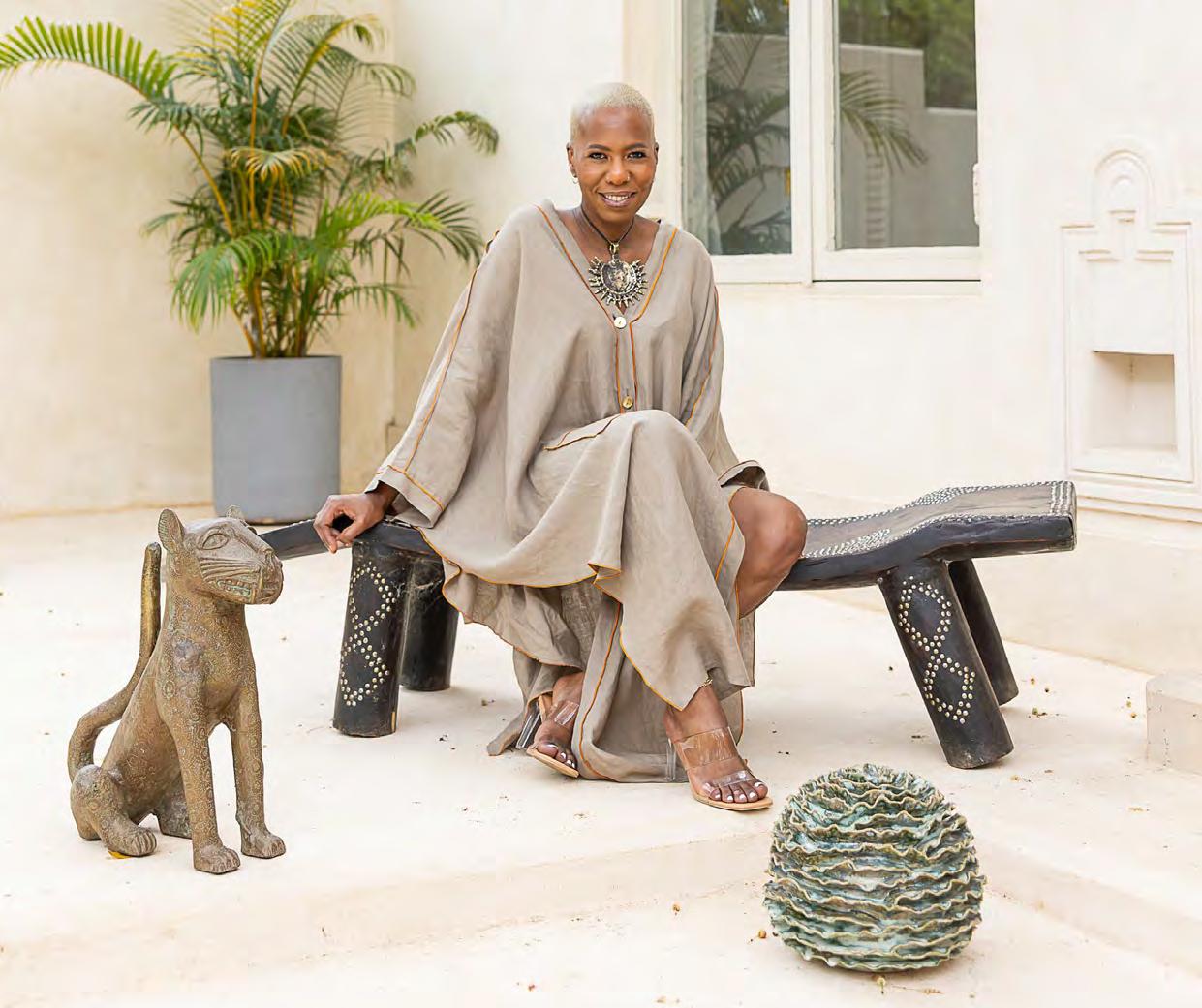
Annabel wears Ra by Rushina Breeze Kaftan, GOTS-certified linen in donkey with sienna thread detailing and hand-cast brass buttons. Pendant by Ra by Rushina. Fractal 4 by Lana Trzebinski.
Challenges & Growth
What have been some of the biggest misconceptions people have about being a stylist, especially in Kenya / Africa, and how have you had to push against those?
Haaaa! The biggest misconception about being a Stylist in Kenya is that it’s always glamorous. That it’s only about going to parties and events and wearing cute outfits. At some point in my career after getting established, I stopped going to events or doing press-related things altogether. I now understand that you can work and be good at this without needing constant exposure. The same thing applies to social media. Outgrowing the need to ‘be seen’ or validated by strangers is liberating and allows you to channel that energy into more productive things like serving the industry.
The fashion world globally is grappling with issues like sustainability, fast fashion, and ethical sourcing. Where do you see Kenya (and African fashion/interior design more broadly) in that conversation, and what role are you playing?
Yeah I think the COVID-19 era awakened the global consciousness about the ethics of fashion production, distribution, and waste management. But post-pandemic the global systems and players have largely remained unchanged; in fact things seem to be getting worse. It’s easier for people to maintain the status quo than face the reality of their impact on far-off communities and the planet.
Identity, Influence & Culture
In many ways I’m happy to live in an economy that generally exists outside of the mass production model. I’m glad that as a developing country Kenya isn’t so deep into the system that the sustainability conversation can still be had and heard.
Kenya/Africa is still very much a burgeoning source of creative talent and inspiration for the world, and the potential to monetize our talents within alternative systems of production and distribution is high. It’s an exciting time to be a Kenyan Creative.
How do gender, motherhood, or your roles beyond styling (e.g. as a public figure) shape decisions in your work — in looks, in messaging, in the stories you want to tell?
My kids have definitely absorbed my lifestyle without me having to explicitly spell it out to them. They understand the concept of “handmade” (clothes and objects) and are very much maturing into their own personal style and understanding that how you look on the exterior is a reflection of how you feel internally and what your belief system is.
I consider myself less a public figure and more a stable and unwavering influence on my kids and on the followers for whom these things matter.
What cultural narratives or stories do you feel are under-told or misunderstood about Africa or the Kenyan style, that you want to bring to the forefront through your work?
One disheartening aspect of the Kenyan style is the lack of a strong heritage story that unites us. People are lost in a sea of mitumba (second-hand) clothing and generic big box furniture stores. Somewhere along the way generational artisanry and skilled craftsmanship have been replaced with bland westernization.
Much credit is due to the Kenyan Designers and Handmakers who continue to supply their products to a niche customer base that really appreciates the richness in quality and design. I think of myself as one of the voices that amplify this local talent everywhere I can.
What influences outside of fashion and interiors feed your creativity (literature, music, travel, environment, etc.)? Can you share an example of when a non-fashion influence unexpectedly shifted how you styled something?
Travel is an obvious influencing factor in the way I see clothes and style. Sure, I’m constantly online studying global trends, but nothing provides inspiration quite like experiencing different people and cultures IRL (in real life). One thing on my bucket list for the coming seasons of my life (as my kids become more independent) is to see more of this continent and beyond.
Fine art is another way I find inspiration. I’m very specific about the style of art I’m drawn to (typically African portraiture) which somehow mirrors my professional mission.
A contemporary African art scene is currently exploding in Nairobi, creating opportunities for Creatives to converge around art while layering in fashion, music, interior design, literature, performative arts, gastronomy, etc. Art spaces are ripe ground for collaboration.
Vision & Legacy
Looking ahead, what is the legacy or impact you hope to leave? What do you hope people feel or think when they see your work five or ten years from now?
I’ve never been one to keep doing one specific thing for long. I hope to keep evolving in the Made-In-Kenya space. I hope to be able to keep helping local artisanal businesses scale, continue creating access to markets, and export opportunities, all in a sustainable way.
Beyond being known for wearing cool clothes, I want to be a valuable voice in the Made-In-Kenya handmade industry that helps it develop and evolve to become more mainstream within Kenya itself, and later beyond.
What is “luxury” to you — both in fashion/ interior terms, and in terms of living a meaningful life — and how do you embody or redefine that in your work?
Luxury to me is less about how much things cost, and more about how they make you FEEL. Luxury is an experience that transports you, or a pair of shoes that makes you feel like the best version of yourself.
I always say that I feel most MYSELF when I wear Made-In-Africa. Putting on and surrounding myself at home with products that are locally handmade and that I have consciously handpicked, this is luxury to me. Doing work that I believe in and that drives my purpose every day – this makes me feel like I have a luxurious life.
The magic of Made-In-Africa fashion and interiors is that, when done right, they’re rooted in design heritage, compelling storytelling, care for community, and sustainable materiality, giving them the substance and quality that equates to luxury.
Quick Fire Questions
A piece you can’t live without in your wardrobe?
I can’t live without my @TUG. Kenya oversized blazer that I wear all the time, and when people invariably stop me to ask where it’s from, I proudly tell them - Kibera.
What is your favourite city in the world, and how does it show up in your style?
I love Dakar. It’s such a culturally dense city. Senegalese people have so much national and personal pride, it’s apparent in every aspect of that place – fashion, interiors, food, clothes, language, etc. I envy their collective level of selfassuredness.
Bubu is my favourite style of clothing; everyone there wears them so elegantly. The contemporary interpretation of the Bubu and other traditional styles by a new generation of Senegalese is something to behold.
What’s a mistake you made earlier in your career that you now consider an important lesson?
Mistake? I probably made many, but they led me to where I am now. So actually, nothing is a mistake. I’m very grateful for this journey.
Annabel wears Ra by Rushina Celeste Off The Shoulder Dress, hand dyed satin. Photographed at Manzili House. www.manzilicollection.com
STORYTELLING with Textiles and Tradition
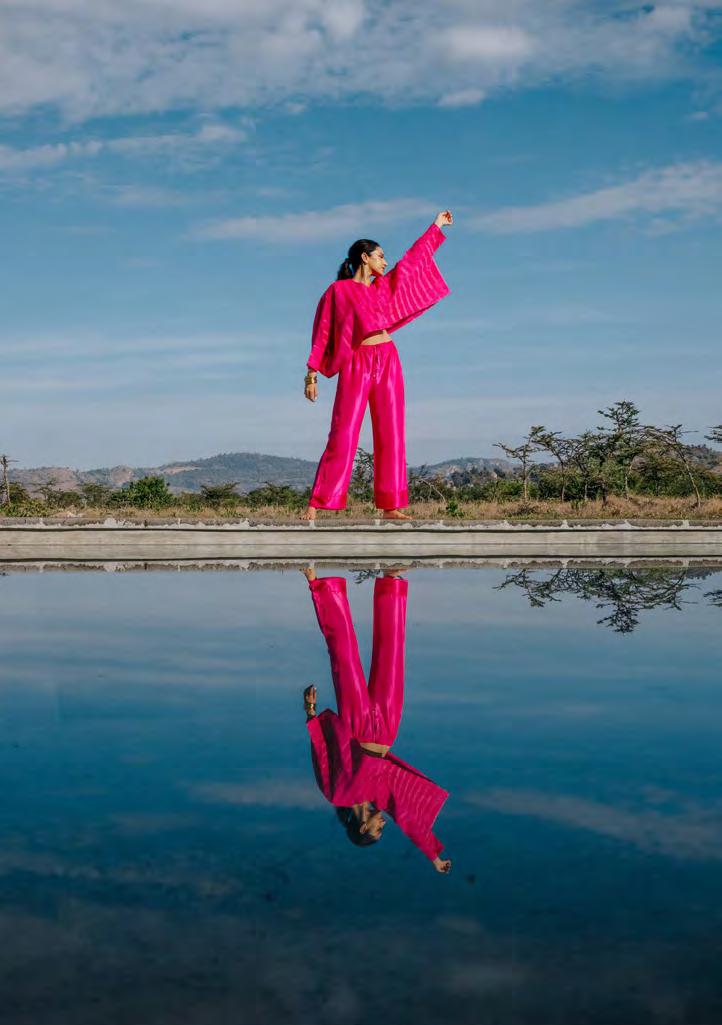
Fusing modern edge with ancient energy, Ra by Rushina is inspired by the timeless power of the sun god Ra. A fashion label at its core, the brand creates clothing, hardware, and ceramics that honour the hands and histories behind them.
WRITTEN
BY
SOPHIE CARREL PHOTOGRAPHY BY ASHTON ALLERT & TALISA LANOE
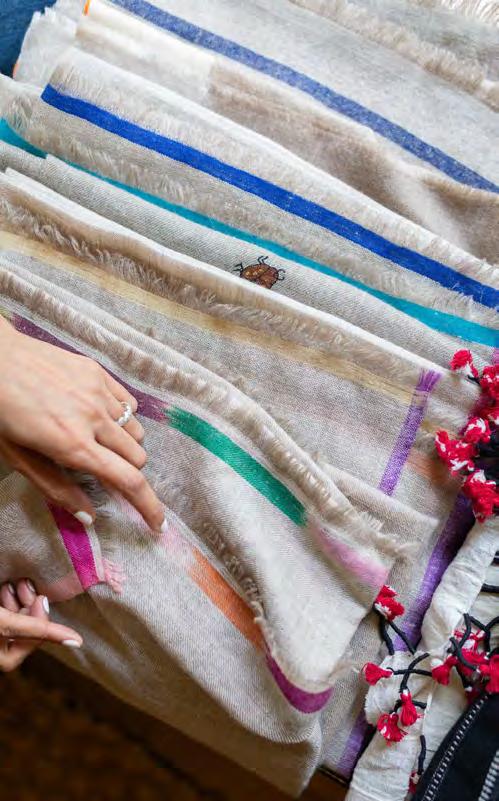
II n a sunlit, neutral-toned studio tucked into a leafy Nairobi suburb, an oversized, iridescent fuchsia shirt catches my eye. As designer Rushina Behal runs her hands over rows of silks and cottons, she welcomes me into her creative haven — a space where tradition, texture, and storytelling intertwine.
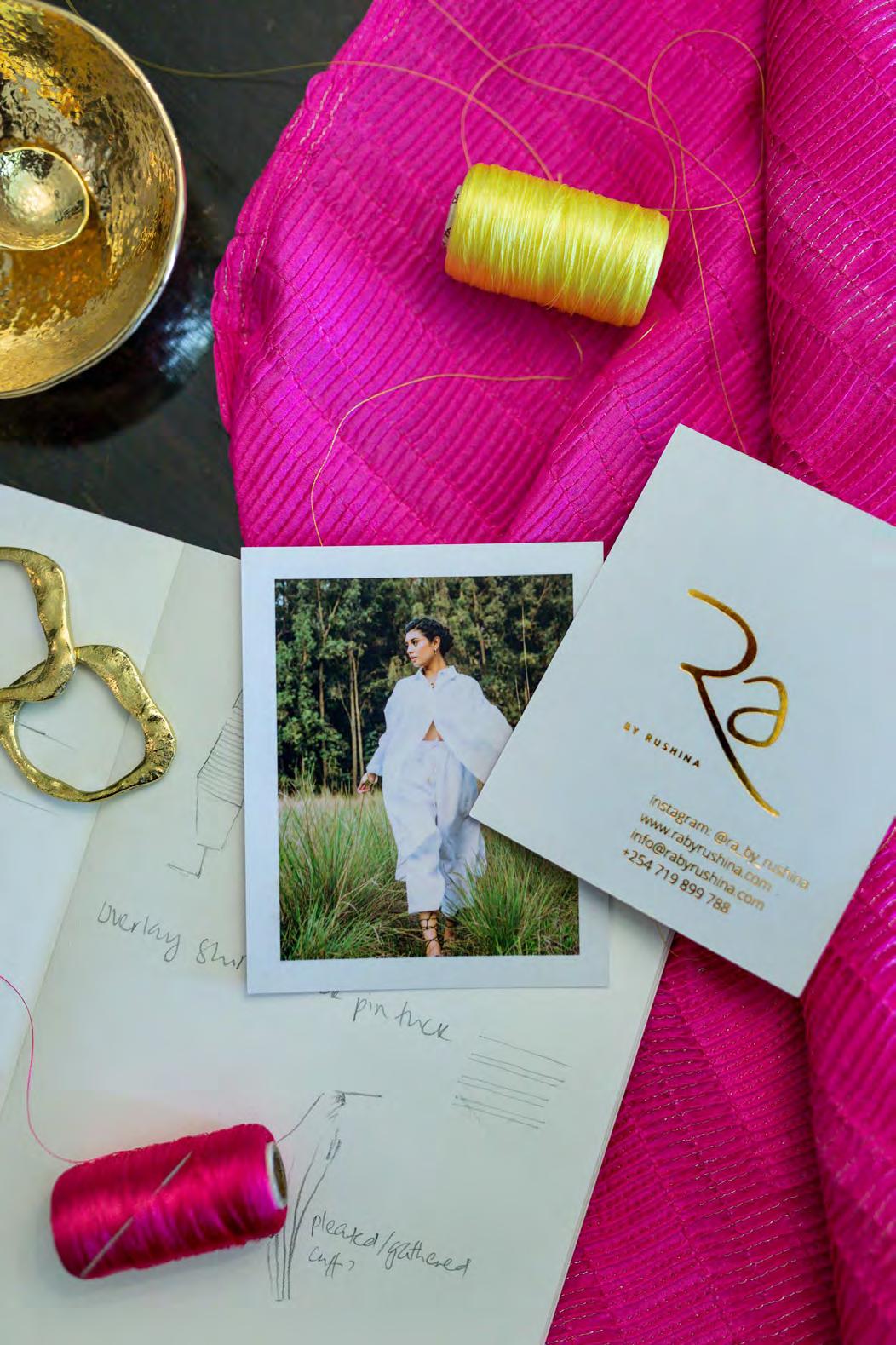
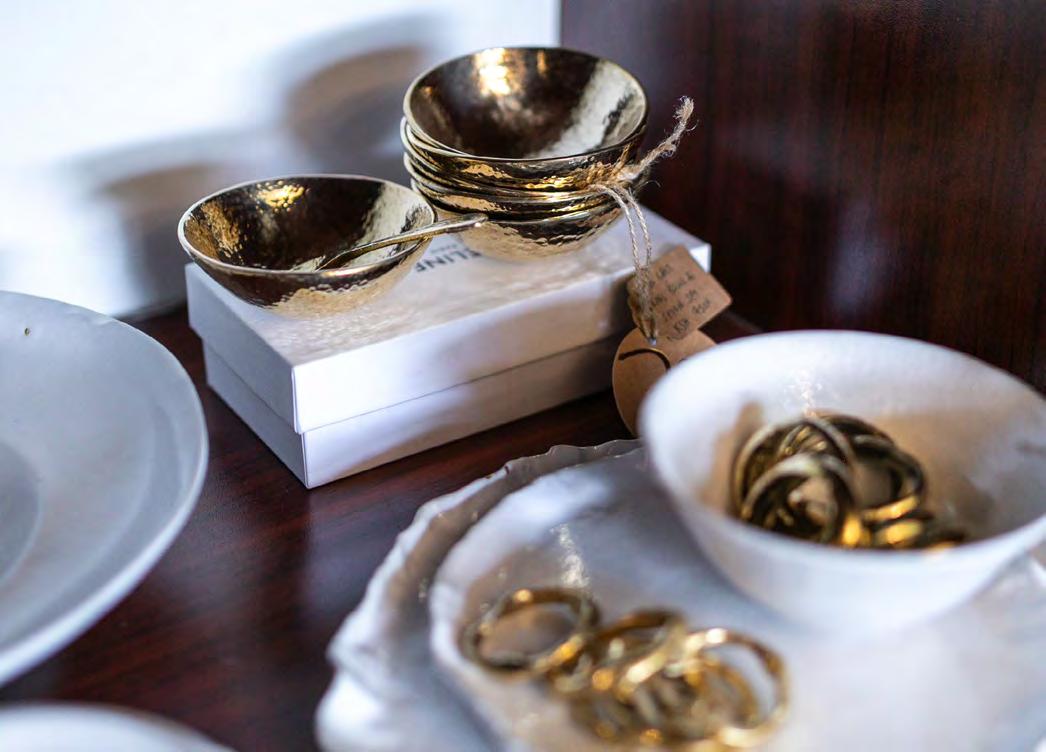
Celebrating heritage techniques such as handspinning, hand-loom weaving, and hand-casting, Ra also remains attuned to the present by producing small-batch, slow-made pieces that are composed with care for both the craft and the environment. “The same design gestures flow between homeware and clothing: a respect for material and an embrace of handcraft,” shares Rushina. “In clothing, that might be a handpleated fold or a generous drape. In homeware, it might be the curve of a vessel or the texture of the brass. Both are about creating pieces that live with you – tactile, timeless, and rooted in process.”
Ra’s story began not as a brand but as a curiosity to explore different art mediums, methods, and techniques. Rushina’s first collection was a passion project, nearly 15 years ago, inspired by bumblebees and the geometric shapes of honeycomb. Working with local artisans in Nairobi’s Kibera, she developed a jewellery line using recycled brass, horn, wood, thread, and precious stones. To this day it’s one of her most treasured collections, with elements preserved in her box of archives. Little did she know that this project was laying the groundwork for Ra, and that those same artisans would become an integral part of her brand’s craftsmanship and storytelling.
Years later, after completing her degree in knitwear and gaining experience in the industry — learning from independent designers in New York and global retailers in London — Kenya was calling her home. As the stillness of the pandemic set in and local artisans struggled to find work, she turned to her hands for movement and began creating again. First, by reigniting her love for pottery and making pieces for her home and friends, before revisiting her early jewellery designs and collaborating with her local brass-makers. The experimentation with methods and textures led her to design her own clothing line, which was inspired by her final collection at university –a full circle moment. With the support of Tribal Gallery and local artisanal pop ups, Ra came to life.
Designer Rushina Behal in her Nairobi home
“In clothing, that might be a hand-pleated fold or a generous drape. In homeware, it might be the curve of a vessel or the texture of the brass. Both are about creating pieces that live with you – tactile, timeless, and rooted in process.”
The brand became known for its thoughtfully designed linen pieces, and today its classic collection grounds Ra in everyday elegance and wearability. Sourced from a carbon-neutral, fifth-generation family weaving mill in Belgium that grows the flax, spins the yarn, and dyes the fabric, the stitching and finishing are all then handcrafted in Kenya. And the hardware? You guessed it – the same brass-makers from Kibera. The classic collection lends itself well to Kenya’s environment and weather, and speaks to pieces that span all seasons. While linen will remain a staple in the collection, and colours and styles will continue to evolve, Rushina is also focused on experimenting with different textures and textiles. “For me, it’s less about one fabric and more about the endless possibilities.”
Recently she’s been playing with hand-loom cottons and hand-dyed silks, exploring new weaves and stitching processes for her elevated and expressive capsule collection. Her current obsession is a hand-pleating technique known as pintucking. “The possibilities are endless”, she reveals with excitement. “From structure and volume to texture and movement, it transforms fabric in unexpected ways.”
Produced in India, the capsule collection is Rushina’s creative outlet for experimentation and self-expression. Through her use of bold colours and intricate textures, she’s able to invite the client into her world. With new designs released only once a year in small, considered runs, each piece feels more like a collector’s item than a seasonal trend.
Terrae Set, GOTS certified linen with a natural squiggle accent. Discover more at rabyrushina.com.
When it comes to the design process, the fabric always comes first. Since the pieces are textile-led, the process often dictates the outcome – allowing the collection to organically take shape as it’s being made. In the current capsule collection, a silk cape is finished with a brass detail at the hem — a once-unintentional feature that emerged when Rushina removed her earring and added it to the sample to give the fabric the weight it needed.
Handmade design is always a dialogue between maker and material. And at Ra, even the gentle imperfections of that dialogue are embraced. “The feeling that no two garments are ever quite the same – each one carrying the quiet signature of the hands that made it – is what makes each piece alive and unique.”
The process of making a single Ra piece is far-ranging, passing through many different artisans’ hands. Right now, the current batch of silk to be hand-dyed has been put on hold for three weeks due to Delhi’s heavy rainfall. “I could move to a faster, more factory-led dyeing process, but there’s intention in doing it this way — letting the sun set the pace,” Rushina says. From fibre to finish – whether a linen shirt, a brass necklace, or a silk dress – each piece carries a lineage of care, community, and sustainability.
Living consciously and in harmony with nature is at the core of Ra’s mission. It’s why Rushina chooses to let the weather – not machinery – dictate when her silks are ready to dye, and why every offcut is reimagined as part of a new story.
Plisse Overlay with Solis Pants, hand dyed and pintucked by hand. Discover more at rabyrushina.com
With her brand so deeply rooted in tradition, preserving the skill sets of the artisans she collaborates with is incredibly important. “The method is what fascinates me the most. The method of making textiles.” And the same goes for future collaborations. She muses that whether it’s master craftspeople keeping a technique alive, or contemporary makers reinterpreting traditions – heritage and experimentation must be at the heart of it.
That same spirit of care and continuity shapes how Rushina approaches the world beyond design. It’s important to her that the values behind her brand reflect substance as much as style. Tumaini Trust, founded by Talitha Puri Negri, provides education and training to children in Korogocho, one of Kenya’s most vulnerable communities. The brand currently sponsors a first-year university student pursuing a Bachelor of Medicine and
Quick Fire Questions:
Morning uniform in three words? Lounge, Layer, Repeat.
Fabric you’d rescue from a studio fire?
The One With a Story - The vintage Thai checkered silk I’ve been saving for years.
A micro-ritual before you ship a finished piece?
Right before packaging, I do a final quality check with the same quiet focus I had at the start – it’s like closing a loop.
Bachelor of Surgery degree. “Supporting Tumaini Trust is a way of aligning my creative journey with something larger — helping to shape lives and futures,” she shares. “I believe every child deserves the chance to learn, grow, and dream beyond their circumstances — and education is the foundation for that.”
Born from a deep love of curiosity and creation, Ra is a space where heritage, sustainability, and design seamlessly meet. Through her work, Rushina weaves together the stories of her ancestors, the communities that shaped her, and her own artistic expression — inviting us to slow down and find beauty in the journey. “When you honour the process, the community, and the meaning behind the technique, the work naturally transcends the trend.”
“For me, luxury is time. The time it takes for a fabric to be handwoven, for pleats to be shaped patiently by hand, and for traditions to live on through craft. It is care, intention, and the ability to create pieces that are cherished, not consumed.”
Solis pants, crafted from hand dyed silk and accented with satin details, featuring hand-cast brass hardware. Lumen Overlay, an ensemble of handwoven cotton with silk detailing, finished with delicate hand-stitch accents. Discover more at rabyrushina.com.
BEYOND THE SPA:
THE Story and Soul OF AZELA
Golden light streamed through the wide wooden beams, landing softly on polished stone and linen. The scent of lavender and lemongrass hung in the air, mingling with the faint sound of water trickling nearby.
It was one of those rare Nairobi mornings when the city felt a world away, and in that quiet stillness, I understood why so many call Azela an oasis.
WRITTEN BY VALERIA TORNER PHOTOGRAPHY BY PRISSCILA BAXTER
The spa sits tucked in Lower Kabete, a part of the city that feels both untouched and elevated, the kind of neighborhood where time slows down and trees seem to exhale. I had come to meet Azmina Pattni, the woman behind this sanctuary whose journey mirrors the spa’s own rhythm: measured, graceful, and deeply intentional.
As Azmina led me through the space, I was struck by the architecture, a log house built with natural textures and open lines. It felt uncannily familiar. Perhaps it was the way the wood held the light, or the scent of the oils carried through the corridor, but it reminded me of the wooden houses of Northern and Eastern Europe where I grew up, spaces designed for stillness, warmth, and silence. Those same principles live within Azela: a grounding calm, the embrace of nature, and the quiet luxury of simplicity. Azmina’s inspiration, I learned, was born in Thailand. “It’s my favourite country,” she said, smiling. “I’ve been going there since I was twenty-two, and their approach to wellness — the scents, the touch, the balance between body and spirit — is something I’ve always wanted to bring home.”
Azmina Pattni, founder and owner of Azela Spa
Her life had followed a different tempo for years. As the Chief Business Officer at Victoria Commercial Bank, she had little time for stillness. Motherhood, she confessed, forced a pause, and in that pause, the seed of Azela took root. “There was a gap for a truly bespoke, high-end spa in Nairobi,” she explained. “The two years of COVID-19 gave me the space to bring that quiet thought to life.”
Everything at Azela reflects that philosophy. Before the first guest arrives, the team prepares the space like a stage: soft lighting, fresh linens, curated scents, music tuned just low enough to become breath. It is, as she puts it, “an unseen choreography,” a harmony of movement, scent, and silence.
The treatments, too, carry stories. Her favourite remains the Thai massage, not just for its precision but for its power to reconnect the body and spirit. “It’s the moment when you feel lighter, as if the soul and skin have finally caught up with each other.” What struck me most was her tenderness toward her team. “A therapist’s touch is only as healing as the heart behind it,” she told me. “We look after them as we do our guests, with gratitude, with calm, with care.” And guests feel it. Azmina described how people often arrive carrying invisible weight, shoulders tight, breath shallow, and leave transformed. “When I see their smiles, I think, this is why we do it.”
“Stay rooted like a tree. Storms may come, but if the roots are deep, the calm always returns.”
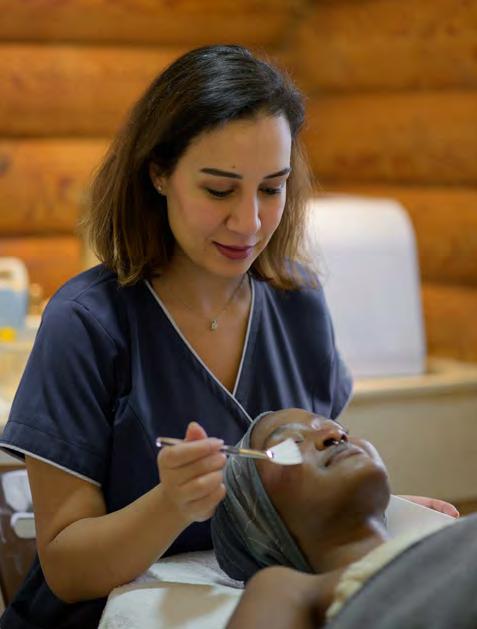
Rasha Makki, Medical Aesthetician and Beauty Expert at Azela Spa. Originally from Lebanon, she is known for her meticulous attention to detail.
As our conversation unfolded, the sunlight shifted to that soft amber glow I’ve always loved, golden hour, her favourite time at Azela. I understood why. The light touched the wooden walls the way it does in the old log houses of my childhood, warm, living, alive.
Before I left, Azmina shared her mantra: “Stay rooted like a tree. Storms may come, but if the roots are deep, the calm always returns.”
In that moment, surrounded by wood, water, and the faint trace of lavender, I felt it too, that rooted calm, that quiet beauty. Azela isn’t just a spa. It’s a reminder that in the art of slowing down, we often find our way home.
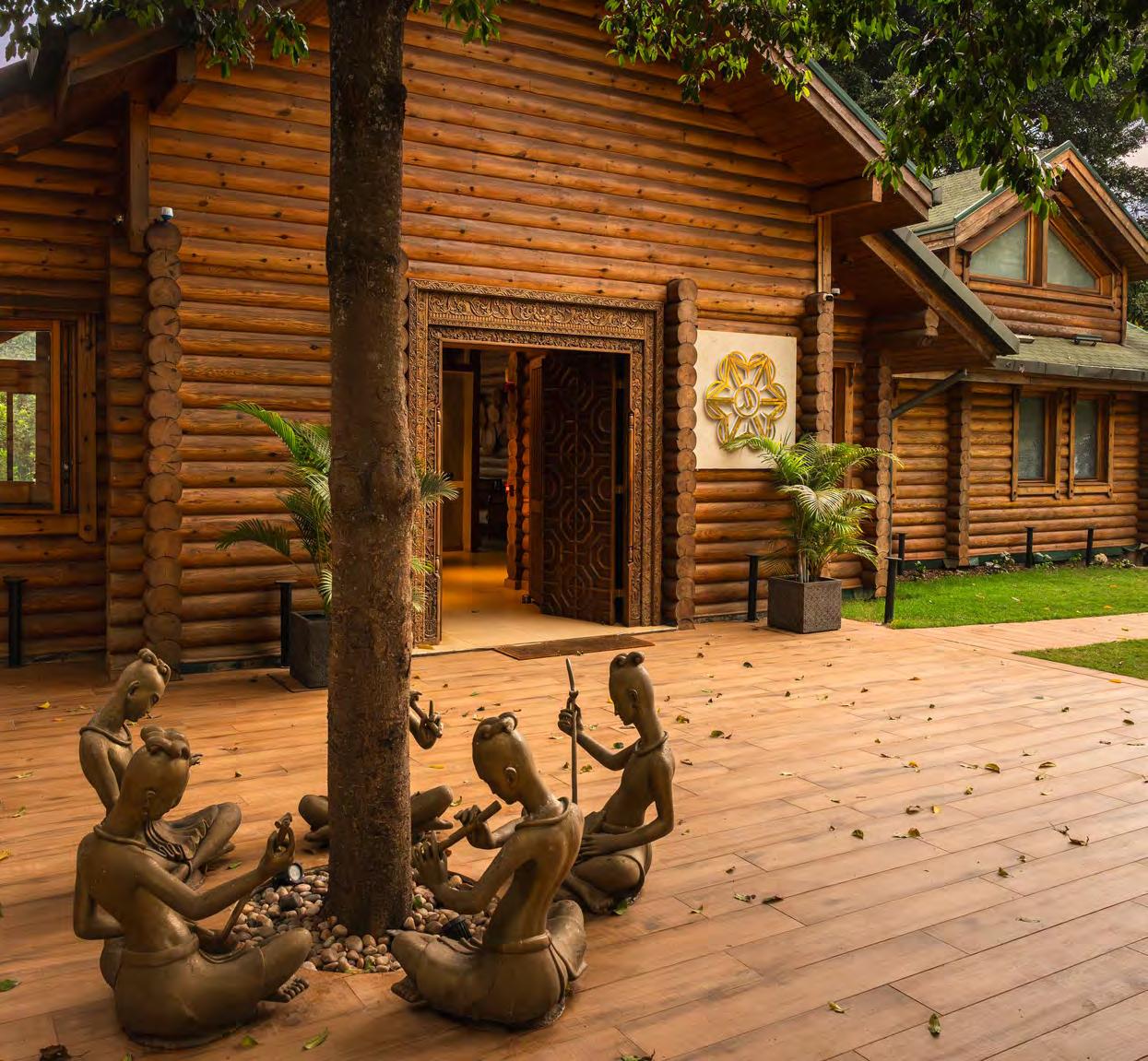
Azela Spa, located in Lower Kabete, Nairobi.
FOR AURA, THE ULTIMATE LUXURY IS time.
WRITTEN BY FRED ALBERT ONYANGO
Over the past decade, Fatema Bhaiji has established herself as the region’s go-to event planner. Along the way, she has discovered the essential ingredient that makes a wedding truly memorable — transforming personal stories into unforgettable occasions. She also shares the common mistakes couples make when planning their big day, and her vision for what Aura could become by 2030.
Fatema Bhaiji discovered the craft of wedding planning in 2013. Her ambition was never to appear in Vogue, Brides, or on Kenya’s coveted lists of top wedding planners — all accolades that Aura now proudly holds. It began, quite simply, with a good eye. At first, she channelled it into make-up artistry. Within two years, she was curating wedding stationery.
“Then one day, a client told me her planner had backed out at the last minute,” Fatema recalls. “She said, ‘I feel like you have a keen eye — you’re going to plan this wedding, and you’re going to do everything.’” Fatema never looked back. Even she, renowned for her meticulous touch, admits that she ultimately had to yield to the greatest planner of all: fate.
Her first attempt was a success — one that not only gave her the confidence to pursue this new calling but also provided the crucial references she needed to build upon it. In 2014, she decided to register for the Samantha Bridal Fair, where her ideas simply could not be ignored in the
open market. From the very start, she secured a full year’s worth of bookings.
These days, Aura can even secure the popular Indian band Twin Strings for a wedding in Dar es Salaam — the very one that went on to feature in Vogue India. It’s not that Aura can move mountains, exactly; it’s that the team cares deeply about each couple’s story — whether the groom prefers a particular sound or the bride favours a certain floral arrangement. At Aura, the guiding philosophy is simple: everything begins with the first meeting. “There are two ways to do a wedding,” Fatema explains keenly. “One is the client’s way — you deliver what they want. The other is the family way — where someone becomes part of our Aura family. When that happens, we can go beyond what they want and uncover what they truly need.”
Fatema recalls one occasion when she planned a wedding at the Fairmont, which proved to be among the grandest events Aura has ever handled. At first, though, the location
was far from certain. With her clients by her side, she travelled from India to Zanzibar in search of the perfect setting. In the end, the couple achieved the international feel they had envisioned — right here in Kenya — complete with musicians, vendors, photographers and all the intricate details that make a celebration unforgettable. As demanding as that sounds, I asked Fatema what drives her to take on such work time and again. She smiled and said simply, “Just the gratitude we get from our clients.”
When you step into the Aura offices, the first thing you notice is the pearl-white interior and a conference room whose walls are lined with certificates and awards. Fatema believes that how you greet a client matters. From the moment they walk in, she wants them to feel as though they are experiencing luxury.
For Fatema, her work is all about creating a sense of specialness. “Aura will listen to you, rather than you listening to Aura,” she says. Her starting point is always the client’s vision — and from there, she finds a way to fall in love with their ideas. Once a client signs on, the team immediately begins preparing a mock set-up, refining and adjusting every detail right up until the very last day, if necessary.
One instance of last-minute adaptation came when a couple from the United States organised a wedding at Giraffe Manor. Frequent Aura collaborator Himanshu Patel of Epic Stories — who recently shot the Ambani wedding — flew in. The stage was set. But the unpredictability of August weather had other plans: sunshine was expected, yet the day brought gloom and drizzle. Everything had to be moved indoors.
Hali Oduor & Nathan Mixon’s intimate coastal celebration in Malindi, Kenya. Photographed by Svenja Krüger, decor by AURA by Fatema Bhaiji.
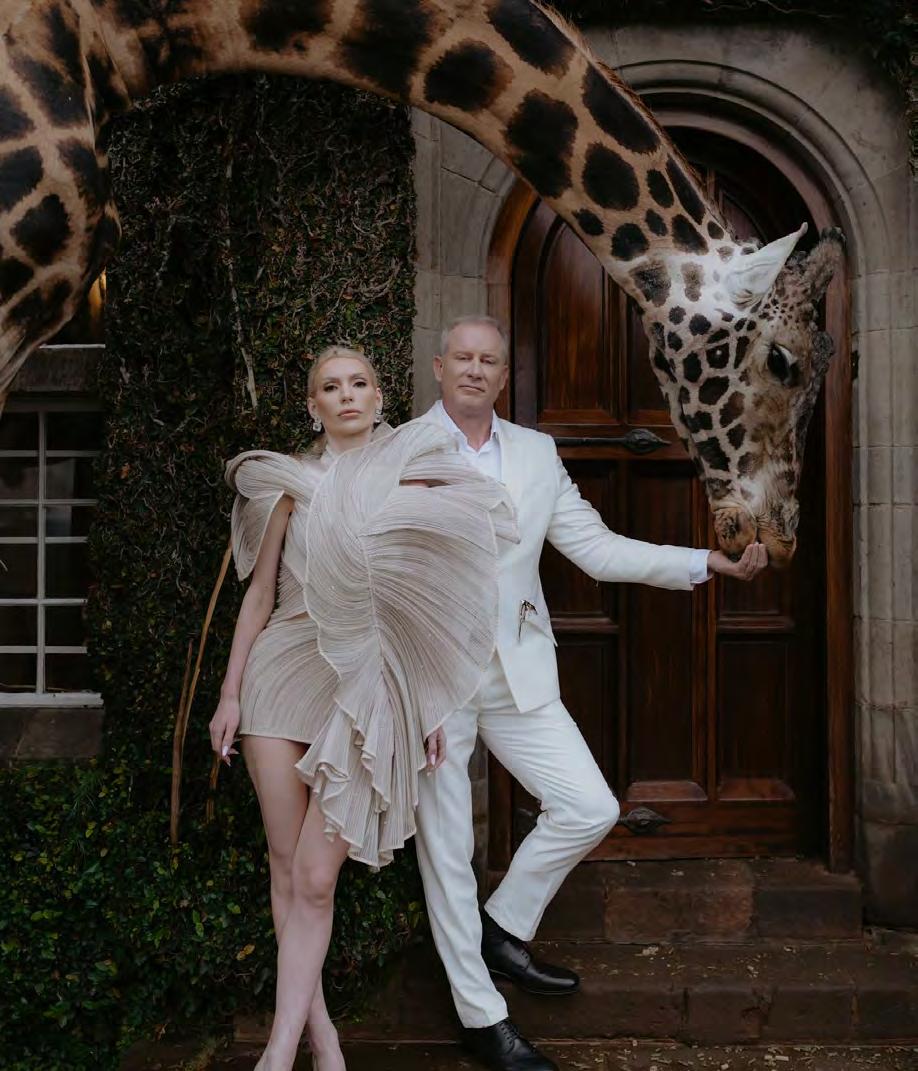
A whimsical pre-wedding shoot at the iconic Giraffe Manor in Nairobi. Photographed by Epic Stories and planned by AURA by Fatema Bhaiji.
Aura took over the largest room and created a floral arrangement that became the wedding’s defining feature. To achieve the exact look, the team went through six different iterations — and even the final choice wasn’t believed to be the right choice until the very day of the wedding.
Fatema wants the bride and groom to arrive on the day feeling relaxed, focused on nothing but each other. And that, she believes, requires an unwavering sense of availability. Aura’s distinguished clientele value, above all, the assurance that the team is always within reach. “Personally, I believe luxury is simply time,” Fatema says. “That’s what I ultimately want — and what my clients want too.”
It’s About Your Story
Weddings, Fatema says, exist within a Venn diagram of three circles: scale, story and emotion. The goal, naturally,
is to hit the sweet spot at the centre. When I asked which circle Aura explores first as it listens to a couple’s wishes, Fatema answered thoughtfully: “It has to be story.”
Aura aims to understand what truly matters to its clients — where they met, what they share, even the dreams they held as children about their wedding day. Then comes the delicate question of emotion. Weddings are rarely private affairs, but some couples still crave a moment that feels entirely their own, however small.
In recent years, Aura has hosted high-profile weddings featuring political families, where the scale can be immense. I asked Fatema whether those couples ever get a moment alone. She explained that Aura always carves out time — a brief photoshoot, a rehearsal dinner, a quiet bachelorette — whatever pockets of stillness can be found. The most reliable method, she adds, is ensuring that at key points, discussions are held with the couple alone.
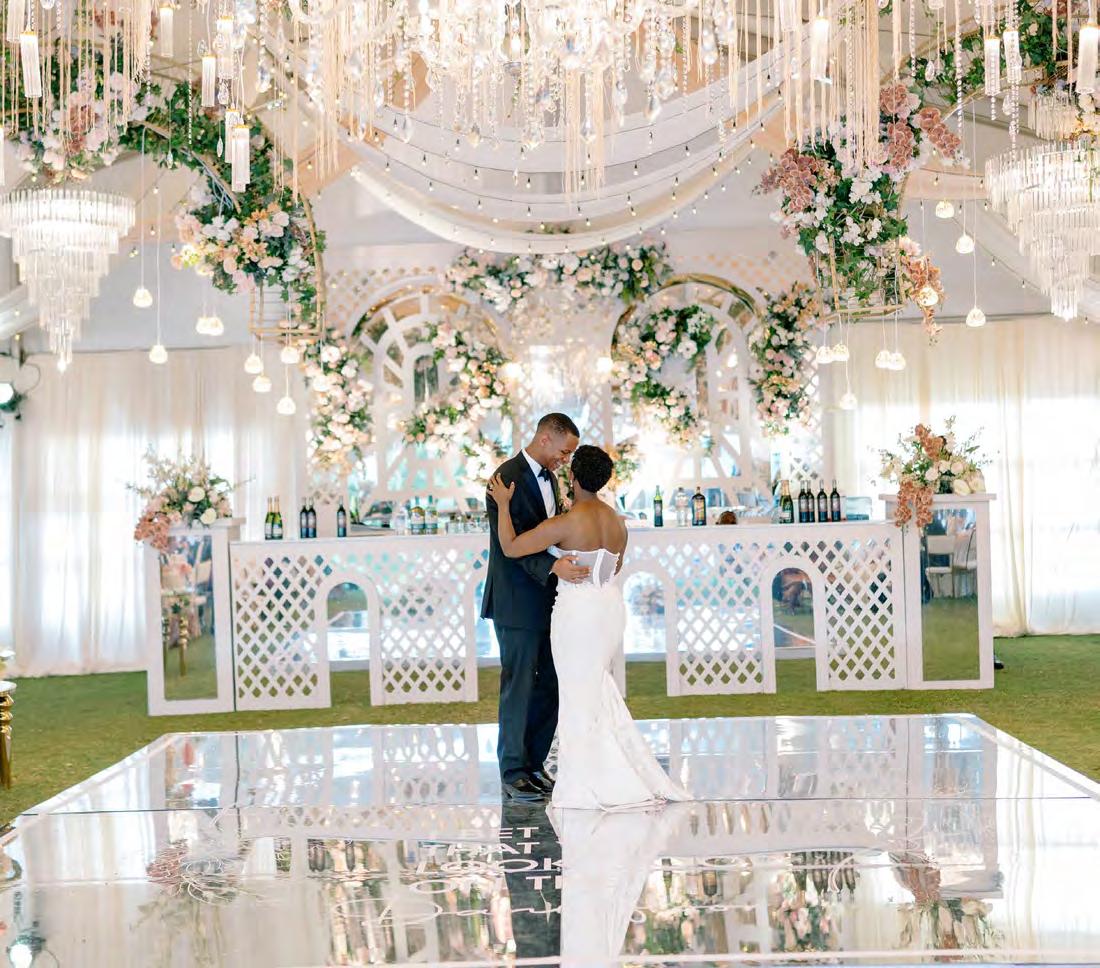
Robert & Makena’s enchanting wedding reception at Windsor Golf Hotel, Nairobi.
Photographed by Ciku Nyawira, decor by AURA by Fatema Bhaiji.
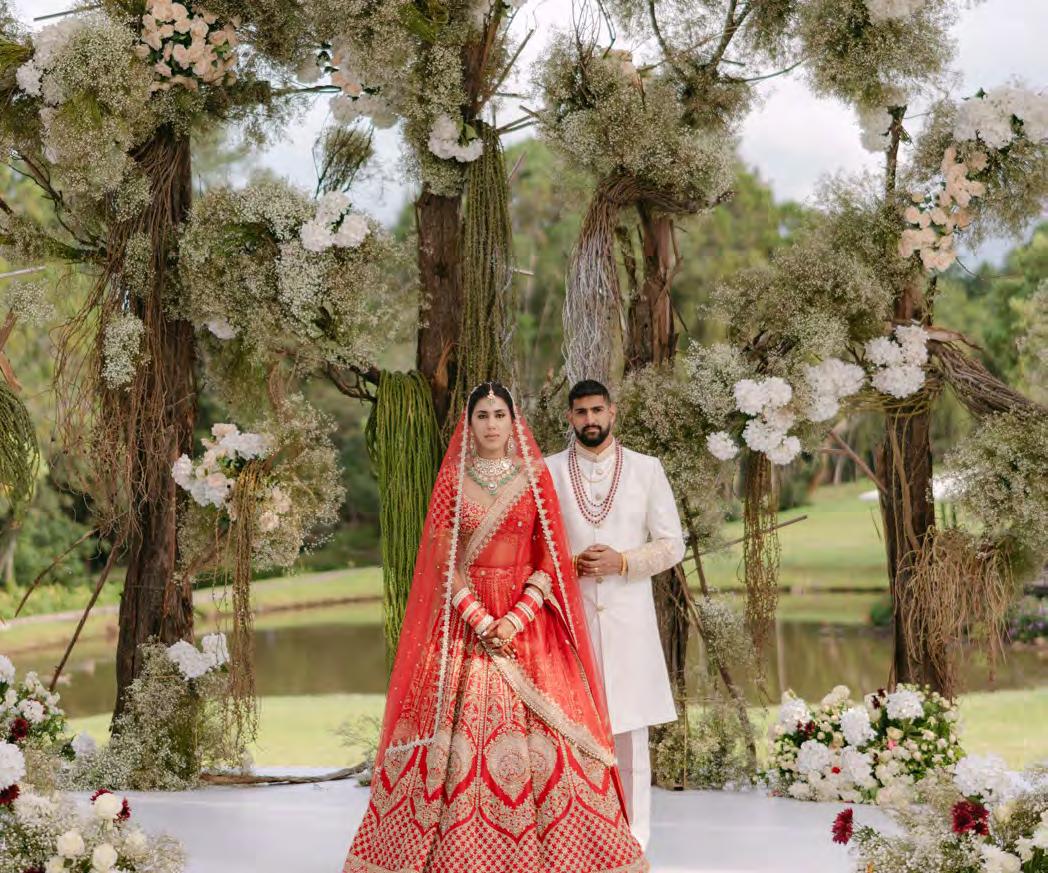
Reana & Karan’s traditional Indian wedding at Fairmont Mount Kenya Safari Club in Nanyuki.
Photographed by Feisal Sumra. Planning and decor by AURA by Fatema Bhaiji.
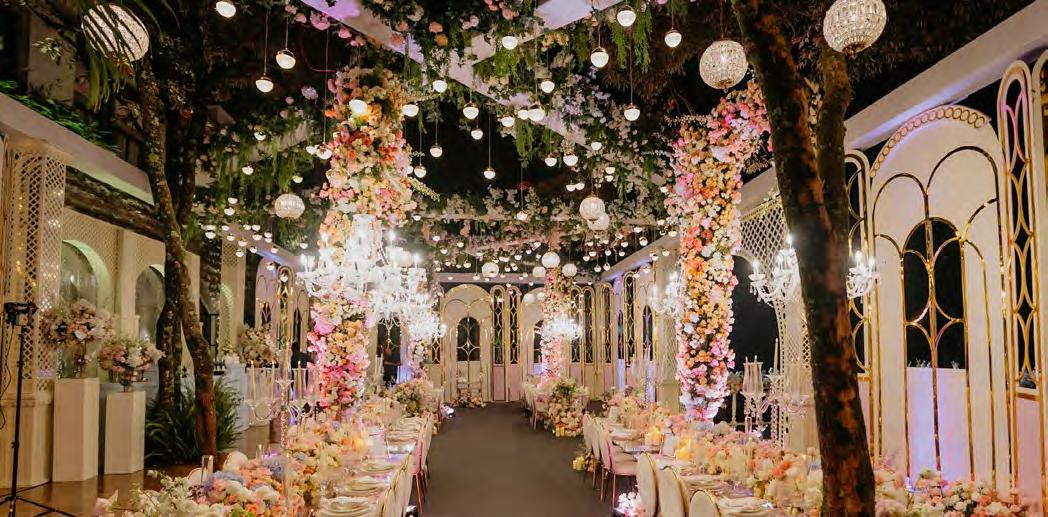
Reception décor at Giraffe Manor, a dreamy celebration beneath the Nairobi sky.
Photographed by Epic Stories. Planning and decor by AURA by Fatema Bhaiji.
Authenticity Is the Most Reliable Curator
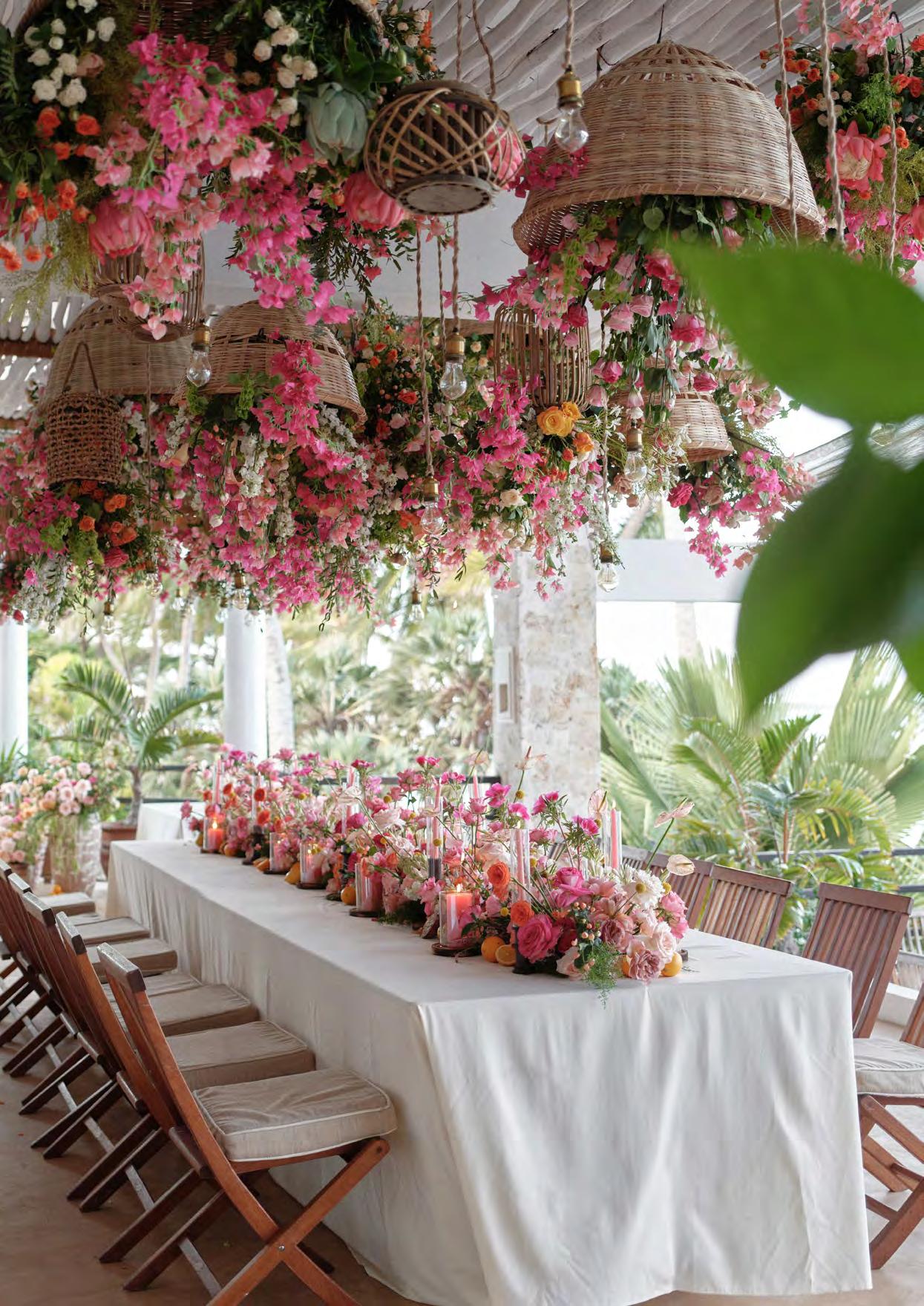
Listening closely to clients’ wishes is what enabled Aura to bring to life the wedding of famed destination photographer Valorie Darling and Brian Jones in Lamu, fulfilling every detail to her exacting standards. Valorie, a highly regarded figure in wedding planning circles, knew precisely what she wanted — and, serendipitously, it aligned perfectly with Aura’s eco-conscious ethos. Her wedding used only materials naturally available in Lamu, avoiding plastic entirely. The décor featured bamboo, sisal chandeliers and an altar framed by a traditional Lamu door. Kenya, already one of the world’s leading flower sources, provided the blooms — and Aura transformed Peponi Hotel’s private rooftop into a bougainvillea garden. Fatema smiles: “Floral arrangements have become a high-level sport. People expect a garden that tells a story.”
Valorie wanted an authentic Kenyan wedding — and she got one. But sometimes authenticity isn’t a look; it’s a dynamic. Hali Oduor’s wedding to Nathan Mixon was a perfect example — an intimate affair that somehow captured the world’s attention. Updates about why the couple chose such a small ceremony spread across social media, reaching nearly every corner of the internet. It marked a new chapter for Aura, establishing it as a major international player while proving that intimacy and scale are not opposites. Fatema hopes to host more of these weddings — something Kenyan couples, she notes, are increasingly beginning to embrace.
Food Is Non-Negotiable
When Fatema is at work, she’s the listener. But when it was her turn to talk, I asked what advice she would give couples planning their wedding. Her reply was immediate: “Budget.” Fatema explains that Aura has no hierarchy among its clients — every couple receives the same premier treatment. Yet she’s noticed a common pattern: clients arrive full of excitement and ideas, only to have an unplanned budget pull them back to earth. Aura provides a list of what can be compromised — and what cannot. Food, entertainment and décor are non-negotiable. What about fancy venues? I ask. Fatema
smiles. “If we come on board, we can even make a garage look like a ballroom.”
The Future
Fatema has a three-pronged vision for Aura’s future. First, she hopes to host weddings outside of Africa. Then, she aims to expand the brand, with distinct leadership teams in different regions. And finally, her dream project: a collection of boutique hotels offering clients high-end experiences in food and hospitality. “When you look at our textiles, our jewellery, our fashion — everything in Kenya is one of a kind,” she says. “We’re among the top five globally when it comes to what we offer culturally, and I see a place for Aura in that equation.” When I asked if that’s how she envisions Aura offering luxury weddings on a global scale, she nodded. “Luxury is no longer about money,” Fatema says. “Luxury is about experience.”
Fatema Bhaiji — Event Planner, Decorator & Founder of AURA.
Bougainvillea reception décor at Peponi Hotel Rooftop in Lamu.
Photographed by Brandon Kidd., and codecorated by AURA by Fatema Bhaiji.
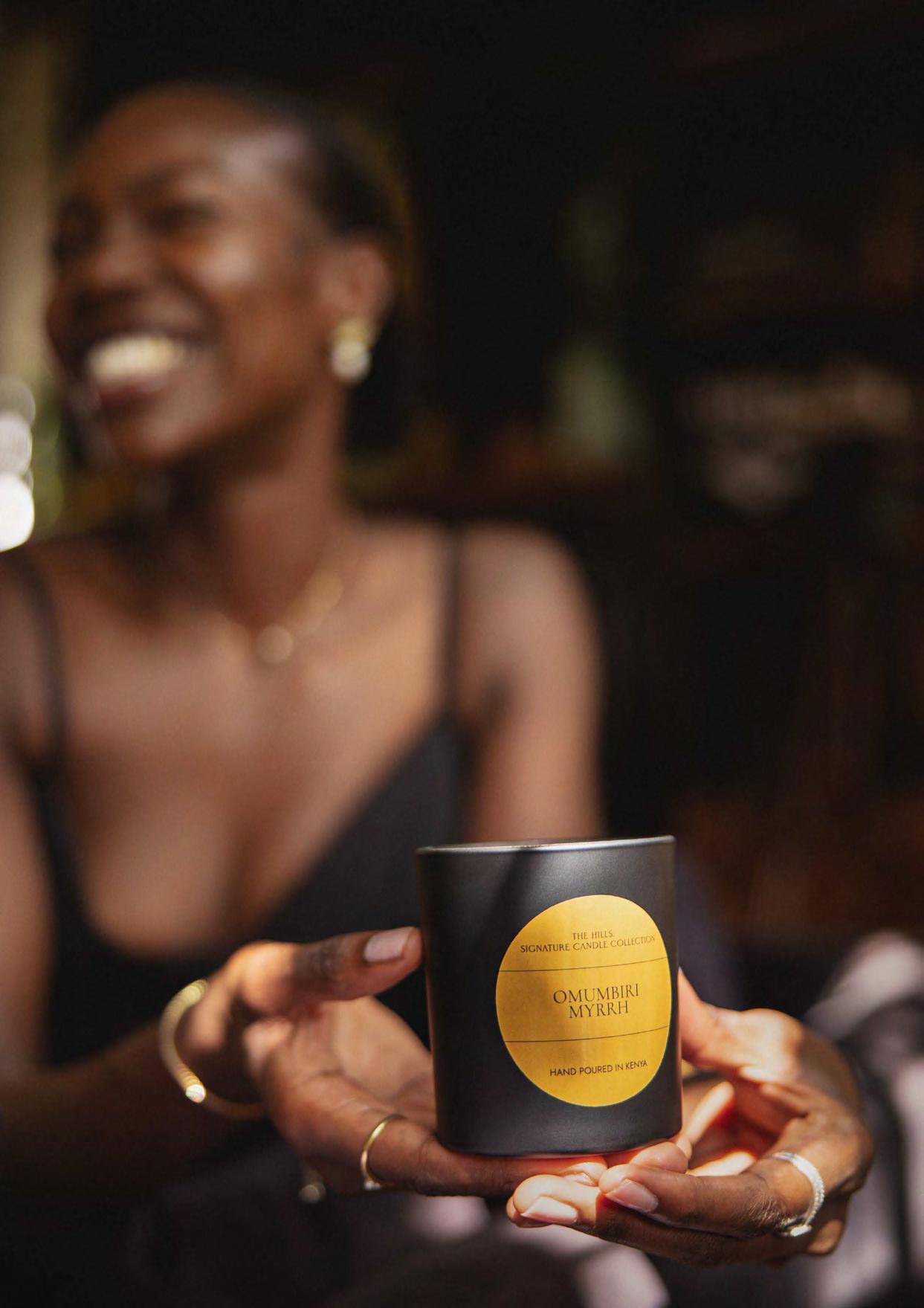
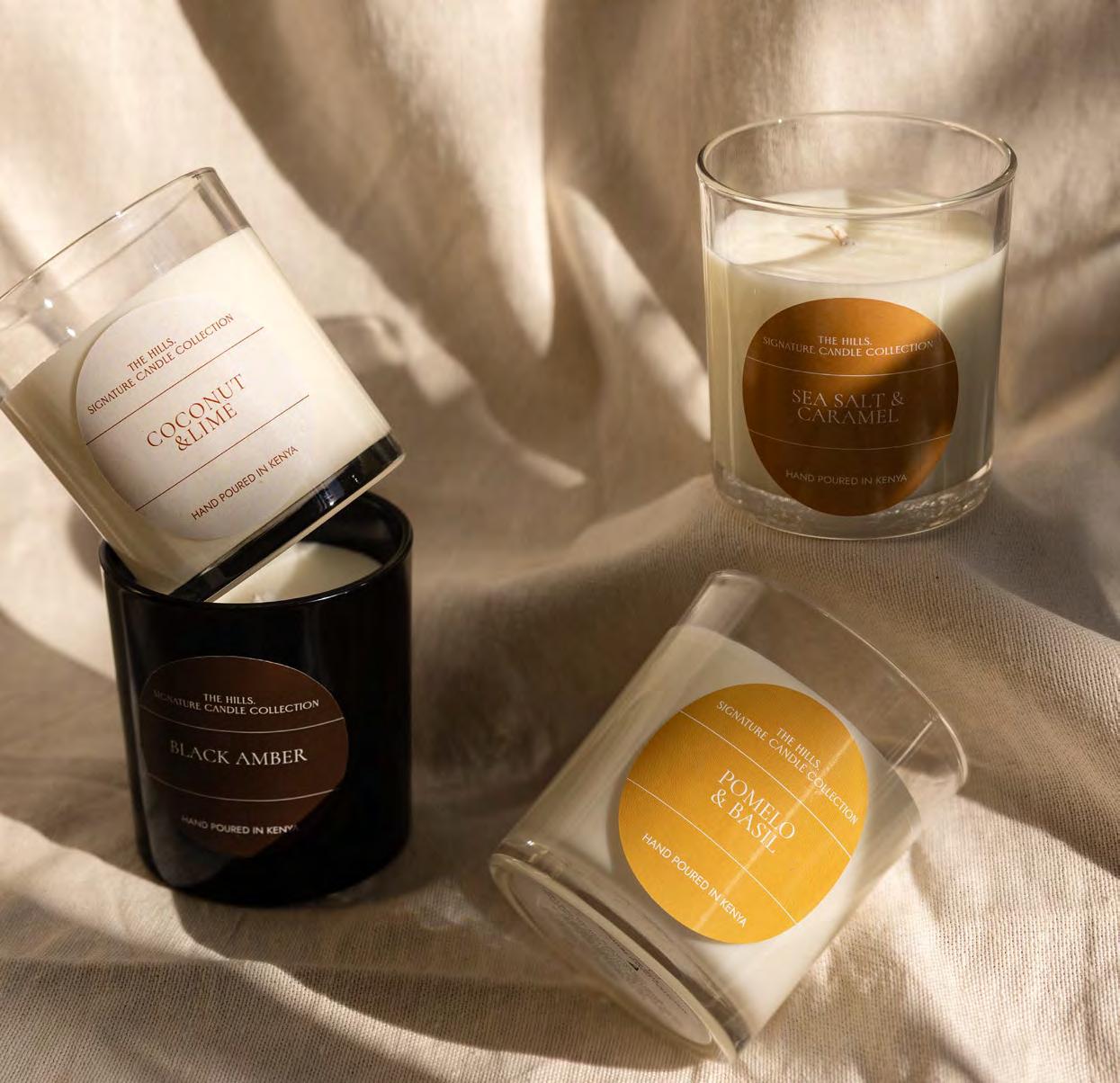
THE HILLS
Signature Collection IS DOING SO MUCH MORE THAN MAKING CANDLES
Sisters Chep and Chebet Chirchir, founders of The Hills Signature Collection, at their new studio in Westlands, Nairobi.
I sat down with founders Cheptoo and Chebet Chirchir for a discussion on the ethos of the company, building scent profiles and why The Hills is so much more than a candle company.
WRITTEN BY KUI MWAI
PHOTOGRAPHY BY ANASTASIA NANE
On a picturesque Saturday morning at Artcaffé in Westgate, I was settling into a quiet corner when two statuesque women approached me. I knew who they were instantly: sisters Cheptoo (Chep) and Chebet Chirchir, founders of The Hills Signature Collection, a candle company with scents as effortlessly chic as its shepherds. In a brown sweater with a scalloped hem and pink Ralph Lauren button down respectively, Chebet and Chep are warm and inviting over cappuccinos and Aquamist sparkling water. They’re a little nervous too.
I quickly dismiss Chep and Chebet’s concerns that there won’t be room for both of their perspectives in our interview—not out of any belief that my skills rival Oprah’s (though, if someone else said that, I wouldn’t object…), but because the connection between these two women is as natural as the blood that bonds them. That connection is the heartbeat of The Hills and why the brand has quickly become a staple of Kenya’s burgeoning artisan industry.
Like many passion projects that have morphed into beloved businesses, they founded The Hills during the pandemic, though the company’s roots stretch far before we all knew what COVID-19 was.
“I think the genesis could have been from our days in university,” Chep explained. Both sisters studied abroad in the UK. After a period of homesickness, a feeling that is deeply tied to The Hills’ ethos, Chep came back to Kenya in 2018 and Chebet returned the following year. They pursued their own careers until the pandemic hit and both were laid off.
“We were all bored and stuck at home,” Chep remembered, “and during that period, it was all about self care and being okay mentally while at home all day.” Cabin fever pushed Chebet and Chep to come up with ways to “make the house more interesting to be in, since we were there full time” and one day, while on a shopping trip to spruce up their parents’ home to make it feel like theirs again, inspiration struck.
“We wanted candles and we didn’t really find anything we wanted or saw any brands that were familiar to us,” Chep explained. “All we came across were candles in jars that had no branding and you couldn’t really relate to them. We thought to ourselves, ‘if we like it today and burn it today, will we come back in two months and find the same exact candle?’”
Probably not. Kenyan retailers are notoriously inconsistent with their inventory and that lit a fire under Chebet and Chep “We were like, ‘let’s make our own candle at home with our favorite fragrances,” Chep said, “let’s figure out how we’ll melt paraffin wax, pour a bit of our favorite fragrances into it and make a candle.” The sisters laugh as they recount learning that “perfume is flammable, so that actually can’t go into a candle,” but their newfound passion persisted.
“We kept on researching,” Chep started before Chebet added, “and making candles for ourselves, based on the things we liked.”
“Jump in. Don’t be scared. Take the risk and start it as a business.”
But candles weren’t the only thing they were experimenting with. Chebet shared they also founded a “thrifting business” around that time. “We were just trying to be innovative and find ways to clear our space filled with clothes we don’t wear,” she explained before Chep added that the “over consumerism in the West” led them to acquire a ton of clothes they would wear “once or twice” before they’d disappeared into their overflowing closets.
Chebet thinks it was all a part of their efforts to reacclimate to Kenyan life. “We had just moved back, we didn’t feel like a piece of us was there because we had been away for six years.” They wanted to feel connected to Kenya again and mass manufactured candles were not going to cut it. “There was no connection,” Chebet explained. “There was no story behind the brand. It was just a brand on the shelf.” So Chep and Chebet prioritized candlemaking and during our chat, they shared it was their parents who encouraged them to take it seriously. “They were like, ‘why didn’t you do it a bit larger scale?’” Chebet remembered. She told me their mum told them to, “Jump in. Don’t be scared. Take the risk and start it as a business.”
And that’s what they did.
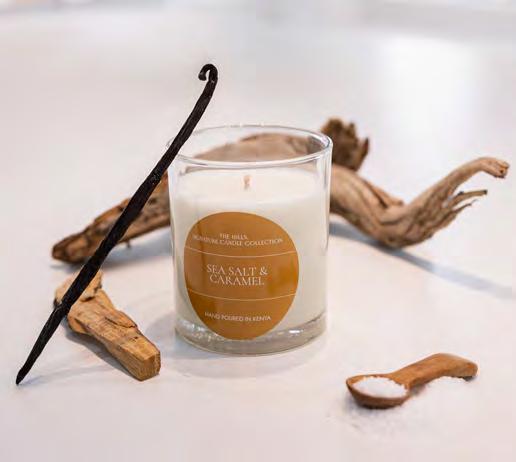
Ndoto Collection Candle by Luxury Life Kenya, in collaboration with Kitengela Glass and The Hills Signature Collection.
“What we noticed is you only like a scent if you’ve been exposed to it or you have a memory of that scent”
The sisters spent the next year envisioning every aspect of the company, from branding to signature scents to the customer experience. Every step of the way, their parents kept urging them to “go bigger.” Soon, they had an athome workshop with hundreds of jars filled with scents loved by them and their close knit supporters. And The Hills was born.
While experimenting with scents, Chep and Chebet discovered there are emotional ties to what aromas people gravitate towards, which was a turning point for their business. “What we noticed is you only like a scent if you’ve been exposed to it or you have a memory of that scent,” Chebet explained. With that in mind, the sisters
decided to start with a “simple” collection of everyday scents for a wide range of buyers.
But it hasn’t been all smooth sailing for the sisters, who, like all entrepreneurs, have had their fair share of challenges. Like trying to reach their customers during the pandemic, which Chep said was no easy task. “Everybody was still kind of indoors and selling a sensory product that people can’t smell before buying was difficult,” she told me. Chebet said they “overcame” that by drafting vivid descriptions of their scents and the feelings they evoke. “Even using our photos on Instagram and making people aware of the different candles and when to light them helped,” she added.
Candles by The Hills Signature Collection. Discover more at thehillscollection.coke.
Another obstacle, which I point out to them, is the most blatant: running a business with a family member. Though they’re symbiotic in so many ways, they are two very different women, as their scent preferences indicate (Chep prefers muskier, more calming scents, while “wild” and “adventurous” Chebet gravitates towards “sweet [and] fresh” scents). Conflict is inevitable, but Chep told me they’ve mastered how to navigate disagreements. “When we disagree, just like you would as siblings, get away for some time, give each other space and come back as if nothing happened,” she explained. “Then when we do we’re like, ‘So are we doing this or not?’ Then we make a decision and keep it moving.”
It’s a good system which, beyond Chep and Chebet’s sisterly bond, is a direct result of the intentionality and forward thinking behind The Hills. Every aspect of the company has been meticulously thought out, from the quality of their jars to the delivery experience, all to sustain an unforgettable (and consistent) experience for their customers. And for the sisters, that’s the ultimate definition of luxury.
“Luxury can be defined by anyone,” Chebet explained. “It’s subjective. For us, it means being aspirational and accessible. [The Hills] is both for someone who has an unlimited budget or someone who has saved for the whole month to buy one of our products.”
The sisters have also made a point to share the behind-the-scenes process to creating their candles, a system that’s crafted in love and, according to Chep and Chebet, also inherently luxurious. “We want our buyers to know everything is done by hand so they understand the quality of our products,” Chebet explained.
Their efforts represent bigger shifts in consumerism in Kenya. The 2010s saw an initial wave of “for us, by us” spending habits amongst Nairobians. Now, halfway through a new decade, a second wave has hit and it’s propping up the artisan market in Kenya.
“I think people have started to celebrate and appreciate the artisanal market and that’s why spaces have started to open,” Chebet said, referring to the boom of flea markets in the Nairobi area, many of which The Hills has participated in.
“We want to breathe life into the fragrance market here. We’re a homegrown Kenyan brand, but we also want to be global, authentically African, and even more accessible.”
Those flea markets and “word of mouth” reviews have helped The Hills soar. And the future of the brand is bright. As our conversation comes to a close, Chebet and Chep gush over where they’re going after this: their new office. But that’s just the beginning of the vision the sisters have for the brand. “We want to breathe life into the fragrance market here,” Chebet shared. “We’re a homegrown Kenyan brand, but we also want to be global, authentically African, and even more accessible.”
They’re already on their way to The Hills being in homes around the world, with products currently stocked in South Sudan. In the meantime, Chep added that they want to continue to build their customer base at home.
“I want every Kenyan to experience The Hills,” Chep added. “So many still haven’t.” They don’t just want people to buy their products, they want their products to become an intimate part of their customers’ lives.
“Whether it’s a birthday or Valentine’s [Day], we’ve always said that we want The Hills to be a part of special moments,” Chebet shared.
They want to be a part of the small moments too, like when you’re getting ready for work or coming home after a tough day at school. The Hills wants to offer so much more than products that make your home smell great. They want to be your home. And I’m sure in time they will.
KITENGELA GLASS IS A HOUSE OF Paradox
Anselm Croze is a businessman who aims to feed the soul through glassware. In his quest to cement Kitengela Glass in the region as a steward of the craft, he creates everything from scratch — even his competition.
Simply because he believes it’s good business.
WRITTEN
BY
FRED ALBERT ONYANGO
PHOTOGRAPHY BY ASHTON ALLERT
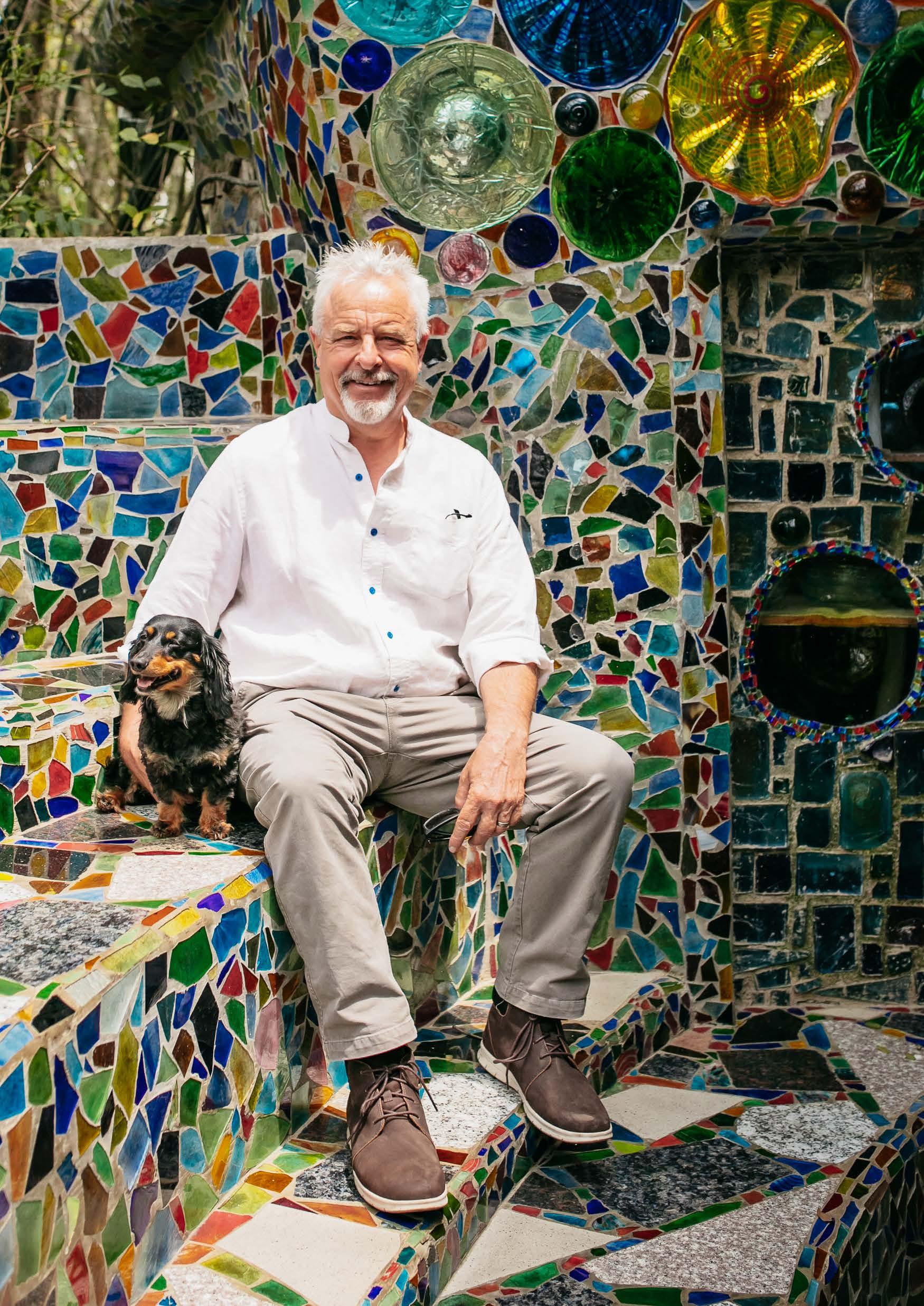
Anselm Croze at the Kitengela Glass Studio with his dog, Luna.
Amid-morning stroll through Kitengela Glass studio is an adventure in itself. Tucked away in the dusty plains of Ongata Rongai — just beyond Nazarene University — lies a studio alive with innumerable pursuits. Over the years, it has evolved into a must-see stopover, its famed ‘mirror house’ etched into pop culture after featuring in Bien and Bensoul’s music video for their hit Extra Pressure. For Anselm, though, it all began with an artistic upbringing that instilled in him a profound appreciation for art’s place in society.
The word Anselm reaches for when describing his background is “chequered.” We sit in a gallery at the heart of the studio: an all-white space furnished with the works of his celebrated mother, the artist Nani Croze. While the gallery brims with Nani’s art, it is also
punctuated by pieces from other artists who have mentored, inspired or influenced Anselm along the way. There is a subtle thread running through it all, a theme that only becomes clear as our conversation unfolds.
Anselm turns pensive when reflecting on his childhood. What comes to mind first isn’t art, but animal behaviour — a connection he traces back to his father, Harvey Croze. His parents met while working with the Nobel Prize-winning ethologist Konrad Lorenz, who famously discovered that goslings imprint on any living creature they encounter within the first two days of life.
“The whole sustainability thing came from my mother. One of her narratives was that of a war child.”
“When I raised birds, I loved their elegance, their lightness, and their decorative qualities,” Anselm recalls. “Much of what birds do can seem completely arcane to us — until you break it down through behaviour: this is why they’re decorated in such a specific way.” As he speaks, he has just finished sculpting a crested crane’s head in glass. It suddenly strikes him that his ability to create it so intuitively comes from a childhood spent in close company with birds.
Another significant part of Anselm’s childhood was spent mirroring his mother. Today, Kitengela Glass sources all of its material from recycled glass — meaning 100% of what they produce once existed in another form. “The whole sustainability thing came from my mother. One of her narratives was that of a war child.”
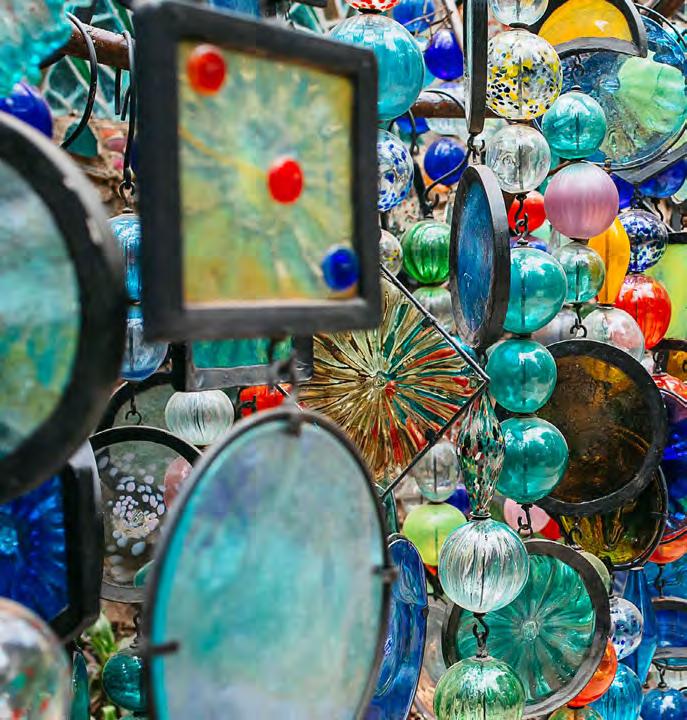
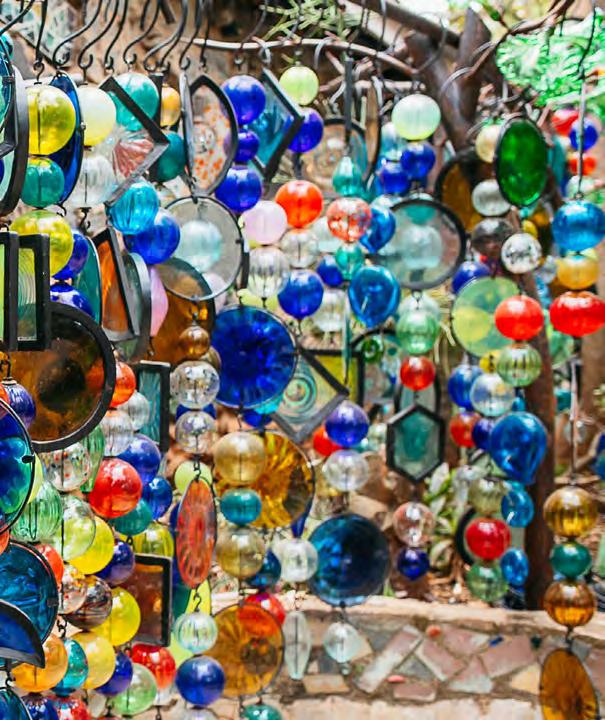
Garden jewellery — Anselm’s viral product — created for exterior adornment.
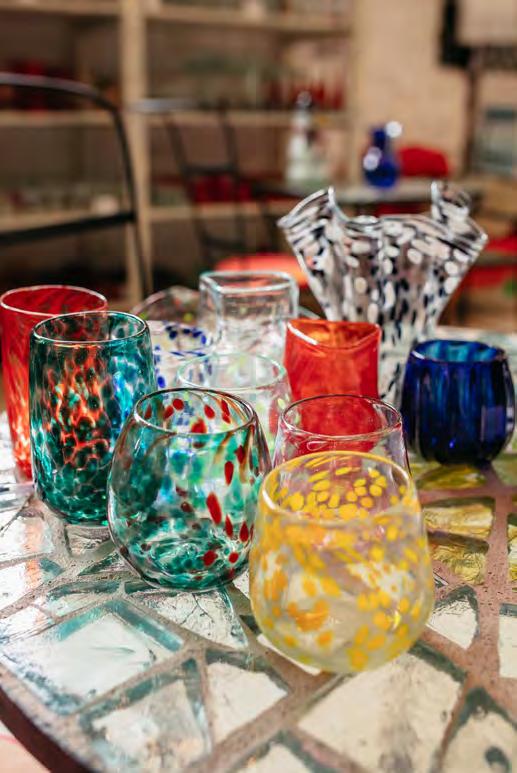
Classic Kitengela tableware: recycled window and bottle glass. Many pieces found in homes today are over 30 years old — still colourful, still strong, still loved.
At this point in our conversation, Anselm leans back for he first time. He explains how his mother never threw anything away because she was a war child. That selfdescription, he says, loomed large over his upbringing. To him, it was something of a broken record — yet he absorbed the essence of it, carrying the lesson well into adulthood. The paradox isn’t lost on me: Anselm recalls the mantra of “don’t waste stuff” with a hint of reproach, and yet it has become the defining ethos of Kitengela Glass.
There was also his mother’s artistic influence. Art runs deep in the family. Anselm is the third generation to pursue it, and each has embraced working with whatever is available. Nani herself was steeped in a particular cultural moment, one shaped in part by Rainbow magazine, which ran locally from 1976 to 1995. Founded by Hilary and Fleur Ng’weno, the magazine was conceived as a way to encourage Kenyan children to explore their creative sides — filling a gap in the school curriculum of the era.
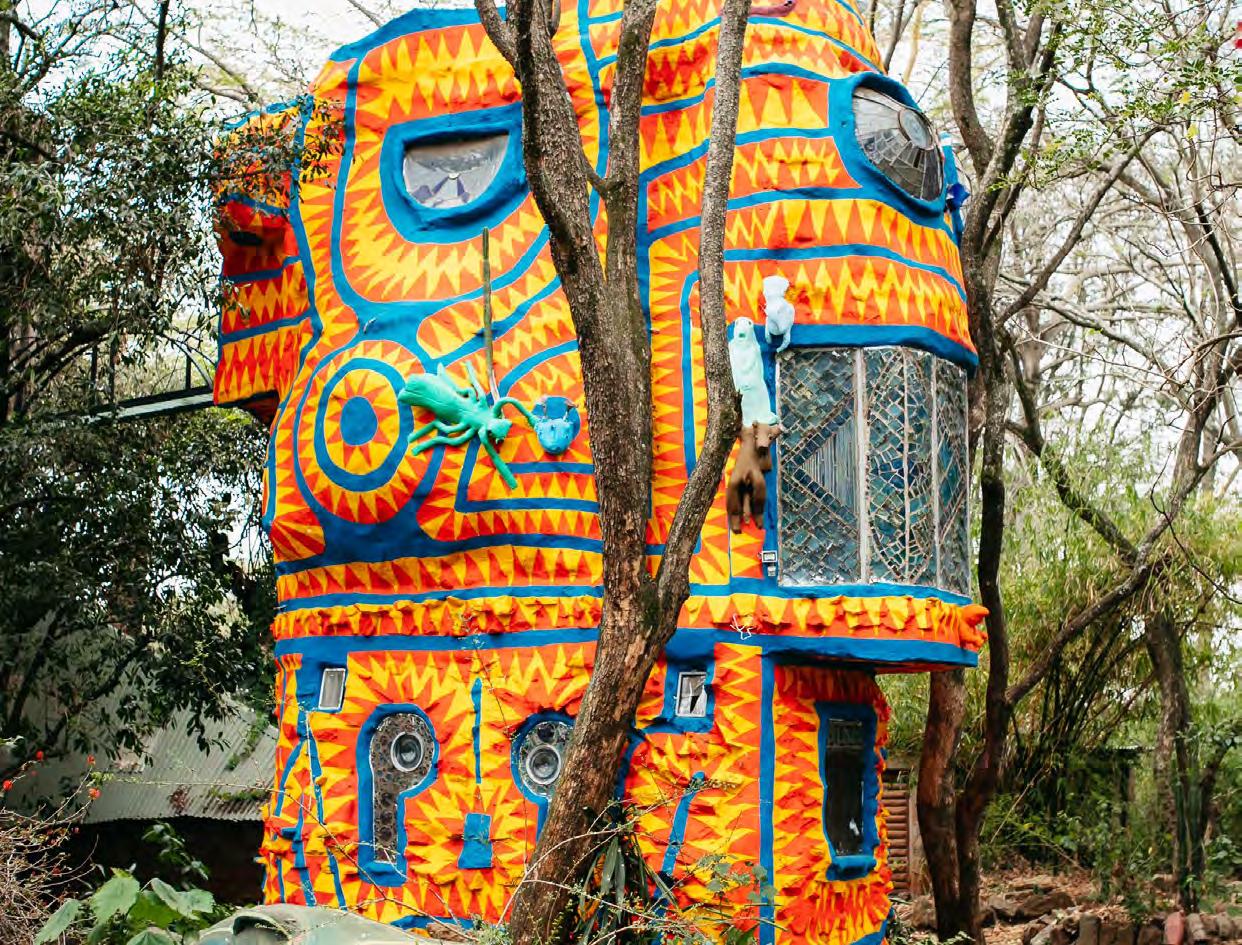
Anselm’s upgrade of his mother’s old office-bedroom began outside. With a nod to Ndebele and a hint of Mexico, the Ferro building suddenly takes on a life of its own.
The battle between art and commerce is a familiar one to anyone who makes a living from their craft. During his childhood, Nani was illustrating for Rainbow, and she would occasionally hand some of her drawings to Anselm and his siblings. That, he recalls, was the beginning of his artistic pursuits. He remains grateful for that specificity in his upbringing. “I’m glad I could apply art practically in life,” he says, “because it’s been marginalised as a luxury in the modern education system — which I have a problem with.”
I pressed Anselm on this worldview, as every artist has their own distinct way of marrying business and craft. “The education system feels broken as more and more unfolds in the information age,” he said, arguing that it has been designed to churn out cogs for a capitalist machine. Art, he believes, doesn’t fit into that pigeonhole: it makes you think differently and brings real satisfaction, while capitalism’s sole aim is growth.
During COVID-19, Anselm — like so many of us — entered a period of re-examination, asking himself what Kitengela Glass truly sells. “It’s not just the glass object,” he insisted. What they actually offer, he
considers “dangerous” — another paradox, if you will. For what Kitengela Glass sells, he believes, is happiness: nourishment for the soul. Something “the machine” cannot replicate. Above all, Kitengela Glass seeks to give its base a genuine sense of satisfaction.
Anselm went on to say that paradox rules his orbit. “Actually there’s multiple paradoxes in glassmaking,” He explained, “It’s one of the things that attracted me to it. Mental. Physical. Categorizational: is it art or is it a craft? It’s both actually.” And while he waxes lyrical about his artistic pursuits, I make the mistake of assuming he no longer produces the same glassware twice. He quickly corrects me — they do. The businessman in Anselm surfaces as he explains, “We’ve blurred this fine line.” Kitengela Glass does sell repeat products, not only because our families must be fed but because that’s actually what consumers also want. Yet, as every piece is handmade by craftsmen working to their own rhythm, even a set of twelve tumblers will reveal, to a keen eye, that no two glasses are ever quite the same.
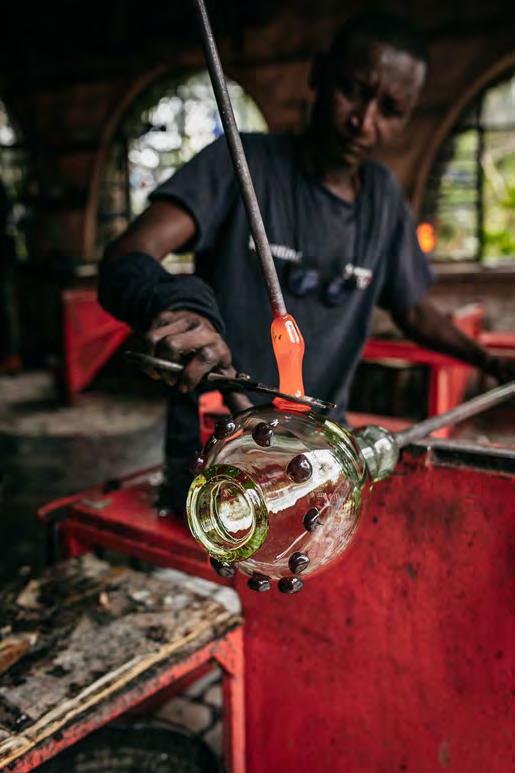
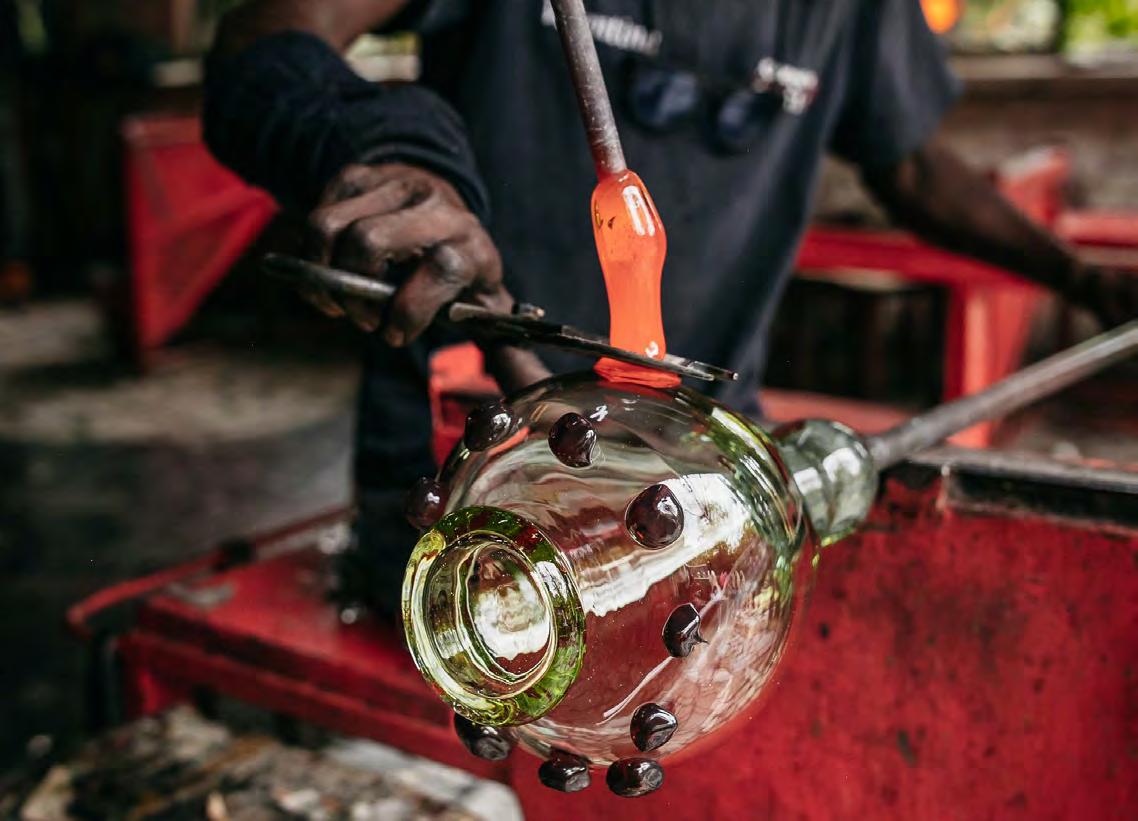
Skills built over many years, and refined into a particularly recognisable working style. The technique has adapted to the unforgiving recycled material — which was not originally designed for handwork.
Design of the Kitengela Dome
In the early 1990s, Anselm envisioned a dedicated home for their glassmaking: a dome inspired by the Red House Cone, which still stands as a museum celebrating the rich heritage of 18thcentury glassmaking in Stourbridge. “When I started, I had to research encyclopedias and books about colouring,” Anselm recalls. “These English glass factories were built in the shape of a cone, with a raised furnace at the centre because they did a lot of mould work. That technique is still also used in the Czech Republic today.” Everything was meticulously planned and thought through — but first came the challenge of raising the funds.
So Kitengela Glass began with a smaller studio — one that, Anselm notes, has now returned to its original purpose. In hindsight, he admits they may have overbuilt the dome. By the time it was nearing completion, enough years had passed that he’d traded encyclopaedias for a laptop. One day, standing inside the dome, he looked up and realised the furnace was perfectly shaped for a planetarium. True to form, he went straight back to researching.
When Anselm stumbled across SkyGlobe — a Microsoft astronomy programme capable of simulating some 3,000 stars — he felt technology was finally catching up with his imagination. He printed an illustration of a night of perfect planetary alignment and, with the help of his fundis, laid the entire thing across the ceiling. The result is what he describes, with characteristic understatement, as a jua kali planetarium — still very much a work in progress, but one that gleams with possibility.
Of course, the dome also had to be functional, and that raised the issue of energy. When Kitengela Glass first started, there was no electricity on site. They began with diesel, only to abandon it when the costs proved untenable. The team then shifted to recycling used oil, before moving to a customised combustion system built by innovator Mikko Merikalio. “He uses the box itself to generate steam, which atomises and then injects whichever hydrocarbon you may have — which for us just so happened to be used oil,” Anselm explains with a grin. Forward-thinking comes with challenges. Their steam-injection technology struggled to push past 1,200°C, and the furnaces have since been upgraded, leaving the old system relegated to powering annealing ovens. Still, Kitengela Glass has become a poster child for NEMA: proof that you can recycle while industrialising. Yet Anselm points out the paradox — there are gaps in regulation, holes NEMA itself needs to patch if companies like Kitengela Glass are to scale sustainably.
They’re now eyeing a transition to solar power, but when I ask what’s holding things up, Anselm offers a single word — “Money.” To fully cut ties with KPLC, he notes, would cost around $30,000. He hopes they can take on that project next year, once they’ve dealt with the other financial obligations already on their laps. Anselm believes the cyclical nature of annealing makes it especially well-suited to a complete solar shift.
Legacy
Anselm describes himself as a perpetual pupil — a disposition that, in a sense, fuels his trepidation as a teacher. Master craftsmen from across the region have passed through his studio, learning either from his established system or directly from him, yet that is not where his pride lies. When it comes to glassblowing, he explains his hesitation at the role of mentor: “I struggle with being the expert of a thing. I have a little bit of imposter syndrome, and positions where I might know something more than the other person — I avoid those. I prefer being in the position of knowing nothing, and learning alongside everyone else.” In fact, when Anselm reflects on his proudest moment as a mentor, it had little to do with glass. A venture capitalist friend had sent his daughter to Kenya from the US to visit her grandmother in 2012, and asked Anselm if he might take her on as a summer intern. Anselm agreed. His daughter was given a few tasks around the studio — the sort of mundane, often overlooked work that interns are handed, but which quietly instils patience and discipline. She brought along a friend, and together they took on those duties.
Quick Fire Questions:
Glass or fire — which do you trust more?
Fire. Glass is a capricious mistress. Fire is predictable, controllable.
If Kitengela Glass were a cocktail, what would be in the glass?
A Red Dot Procera gin, twists of burnt lemon, cayenne pepper, and just a touch of orange juice.
What piece of yours would you steal back if you could?
A multipart Venetian-style goblet, ten inches high, beautifully complex. The stem was a long dog. All those pieces came together to create a master glass. A friend of mine bought it — but I’ve no idea where he is now.
One day, Anselm encouraged the two young women to visit the nearby Oloosirko Primary School — to step outside the familiar and see something far removed from their lives in the States. “I just wanted them to gain a little objectivity in their lives,” he explains. They returned with a story of their own, but it was Sara Wroblewski, the friend, who came back brimming with inspiration. The government school was chronically underfunded, and Sara was determined to do whatever she could to help.
That was when Sara came up with the idea: Anselm would make glass beads, which she planned to sell for $10 each — the price of a coffee and a doughnut back in the States. She would then send the proceeds to Anselm so he could fence the school, the one thing the school had asked for. Anselm and his team made Sara about a hundred beads, which she carried back with her. Her goal was to raise $6,000. In the end, the funds came in far higher than either of them had expected — and that was how the Onebead project was born.
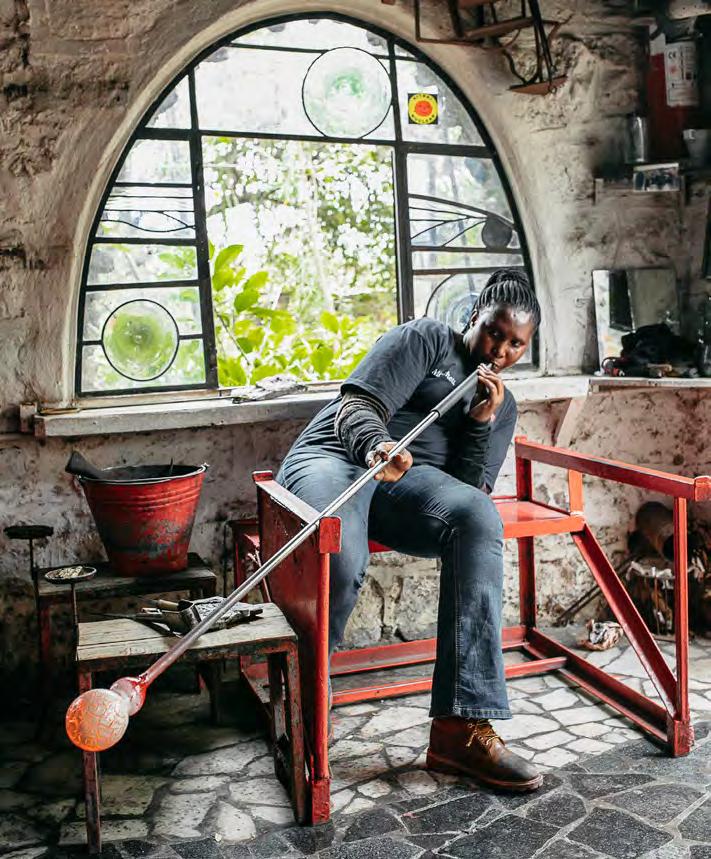
Mishael — one of two female glassblowers at Kitengela Glass. She began as a storekeeper before deciding to become a glass artist. Today, she stands at the furnace, crafting her own work.
Today, Onebead exists in the US as a non-profit that works with younger students, offering career advice, with Sara as its Founder and CEO. To this day, the organisation’s about page still names Anselm as a mentor. He still recalls being flown in by Sara’s non-profit to speak about her story — one of the rare occasions when Anselm admits he even surprised himself.
Growing Pains
Anselm explains that in the 35 years since its founding, Kitengela Glass has seen people pass through its doors only to go on to work in — or establish — studios across Kenya, Uganda and Tanzania. “We’ve essentially built our own competition,” he remarks, matter-of-factly, mid-conversation. Yet his deeper motivation lies in rooting the craft of molten glass on the continent. There’s an egalitarian undercurrent to his thinking. He is, of course, a businessman, pragmatic about the realities that role demands, but he also insists that one cannot be the best in an industry that scarcely exists. “A rising tide raises all boats, don’t you think?” he asks, eyebrows arched.
Now, Kitengela Glass is setting its sights on the wider African continent. His first step? Setting up shop in Cape Town, perhaps? Not quite. Instead, Anselm has become one of the founding members of the Glassmakers’ Guild of Africa. When I ask if he considers his company the ‘parents of the craft’, he shakes his head. No — stewards, he says. His hope is that one day glass sculpture will become an accessible art form, something anyone can encounter and engage with.
For now, though, Kitengela Glass remains a luxury product. It’s another paradox Anselm has had to make peace with: a studio tucked away in the remote countryside of Ongata Rongai producing pieces destined for a largely metropolitan clientele, concentrated in Nairobi’s western and southern quarters.
His strategy for reaching that market was straightforward — ride the wave of Nairobi’s mall construction boom. His first shop opened at Adams Arcade, but it soon proved too small. He set his sights on the then off-plan Junction Mall, and since 2004 Kitengela Glass has been a loyal tenant there. At one point it was even the company’s highest-performing outlet. There have been highs, of course, but the inevitable lows as well.
One of those lows came when Junction Mall’s anchor tenant, Nakumatt, began winding down — an episode Anselm now bluntly calls a “disgraceful exit.” In Kenyan malls, supermarkets are the engines of foot traffic: shoppers come for their groceries and, on the way out, pass by other stores — Kitengela Glass included, conveniently positioned right at the door of Junction Mall. But Nakumatt lingered so long in decline that foot traffic inevitably thinned. At the same time, the mall’s demographic shifted.
“True luxury, for me, is time and space to create without pressure, surrounded by beauty and authenticity. It’s not about excess, but about freedom, craft, and experiences that feel rare, meaningful, and deeply human.”
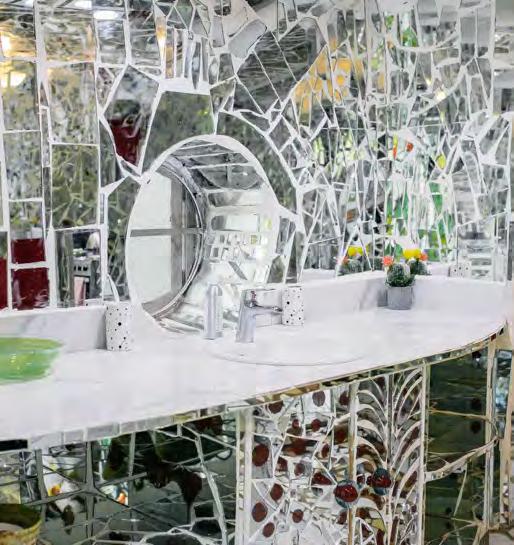
Mirror House — originally a dark little dungeon, now transformed by mosaic into a glittering experience. Available for private stays and rentals.
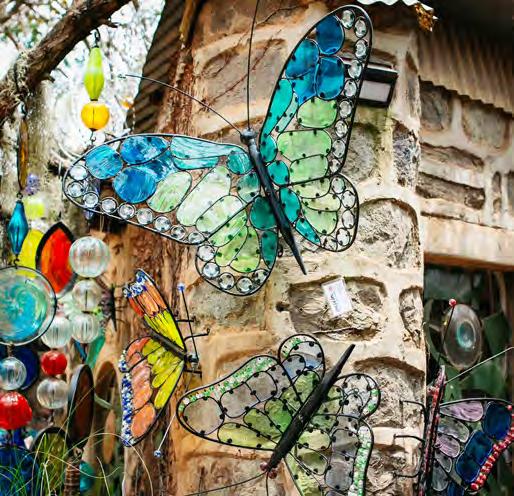
The Kitengela proprietary technique — “funky fencing” (Afro-Tiffany ) applied here to create these butterflies.
The surrounding townhouses that once housed families gave way to apartment blocks filled largely with younger, single people. Before long, Junction Mall had slipped behind the Village Market outlet in performance.
Among the achievements Anselm holds closest to his chest are Kitengela Glass’s ongoing collaboration with the Jane Goodall Institute in Arusha, and the gallery where we conducted much of our interview — a space that immortalises his family’s work. Looking around at the artwork, he admits they haven’t always been on the best of terms. But the pieces themselves, he says, tell a story that words could never quite capture when it comes to explaining his family’s legacy.
When I ask which achievement was the hardest to realise, Anselm points to finally bringing women into the studio. Glassmaking is gruelling, blue-collar work, and too often people simply assume it’s something women cannot do. Anselm vehemently disagrees — yet he also admits it took him three decades to prove the point.
When we finally got to his own glass blowing, Anselm admits it's been a while since he did it. Back then his studio mood music was Mambo Rap, which has since outgrown and moved on to Watch Me Dance by the Architect. Anselm says the next time he’ll make glass it’ll be “something fluid and very flamboyant.”
As we draw the sit-down to a close, I notice Anselm’s dachshund, Pinky, has barely left our side — as if standing guard. He tells me she’s his constant studio companion, and while he treasures the honesty of all his dogs, Pinky might just be his muse. The story of how he adopted her — from a family moving abroad — echoes the goose imprinting he’d spoken of earlier. From the moment he first held her, she’s never really left his side.
On the Kitengela Glass ‘about’ page, there’s a photograph of a young Anselm walking alongside a zebra; today, wiser and greyer, he walks alongside Pinky. The more things change, the more they stay the same.
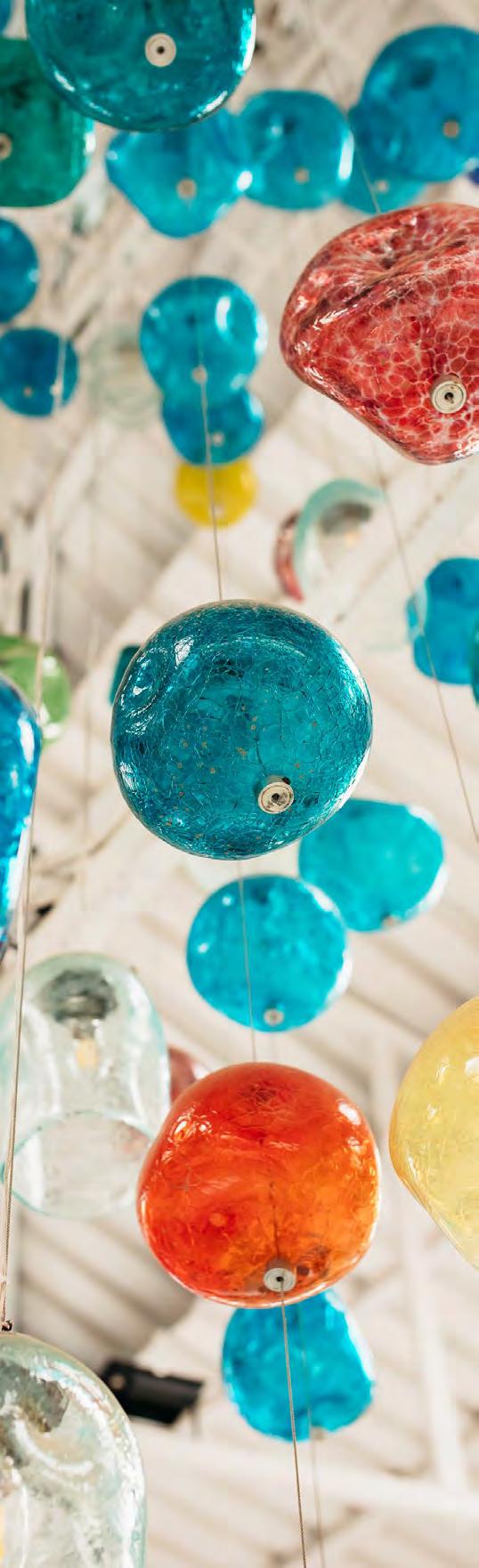
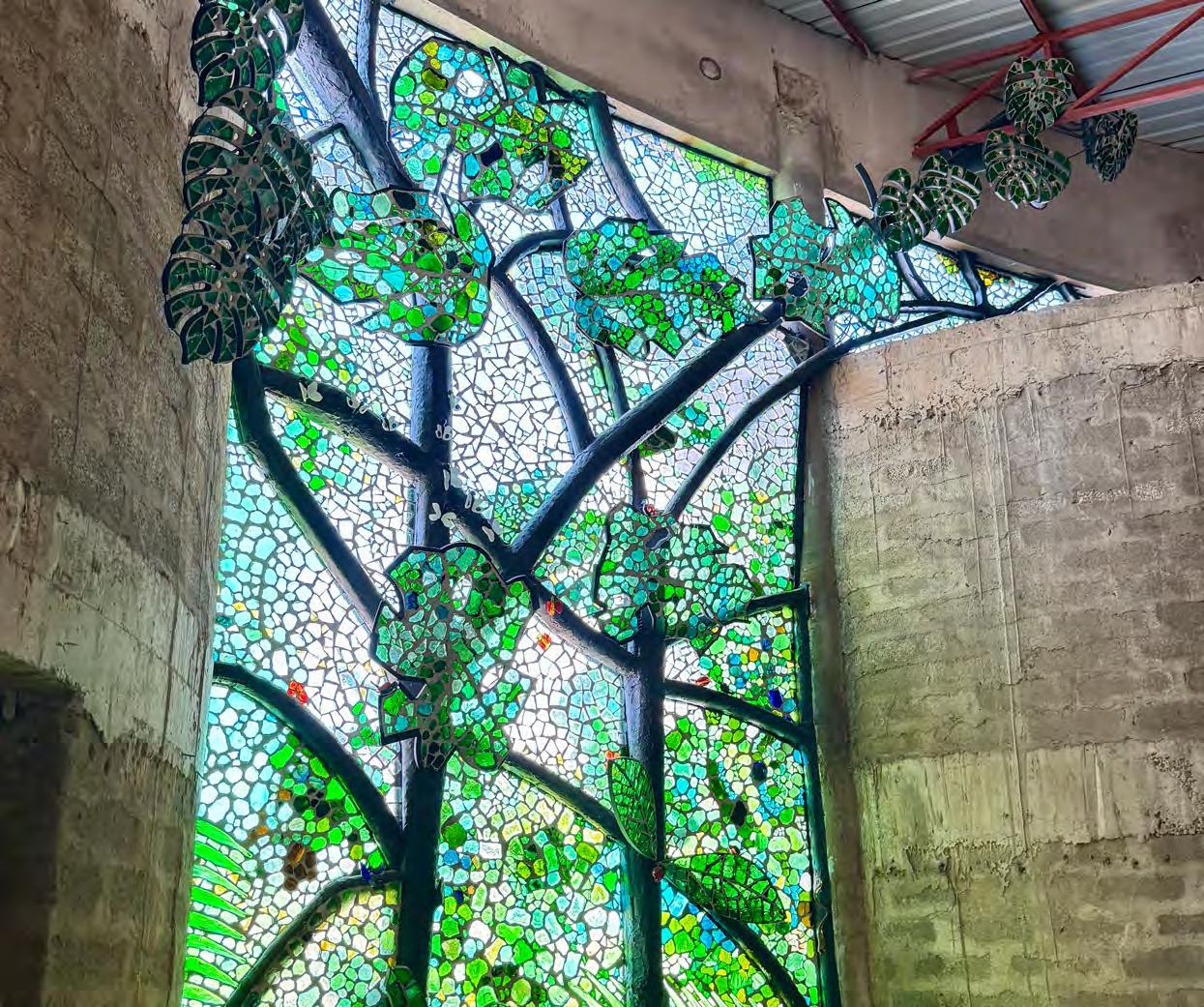
Dr. Jane Goodall’s Dream is a new immersive cultural experience in Arusha honouring the late Jane Goodall’s 65 years in Gombe. Kitengela Hot Glass contributed a forest built entirely from recycled glass, crafted in dalle de verre as a luminous tribute to her.
The installation now stands at the Arusha Cultural Heritage Center — a fusion of African artistry, memory, and environmental devotion.
BY ANASTASIA NANE
Art & culture LUXURY LIFE KENYA
“That’s what the arts are – beauty that carries deep truth.”
Wandia Njoya
PHOTOGRAPH
Trzebinski
THE ART OF BALANCE:
CRAFTING NATURE IN CLAY
WRITTEN BY SOPHIE CARREL PHOTOGRAPHY BY ANASTASIA NANE
For ceramic artist Lana Trzebinski, childhood memories are the emotional clay that shapes her work. As she enters motherhood — a new chapter of creation — she finds solace in the unpredictable, moulding peace from imperfection and acceptance from process.
“I’ve recorded over 800 different glazing combinations, some from scratch, some adapted – but even with this much precision, it’s always a surprise when I open the kiln.”
Abroken-in sketchbook, its spine frayed and pages smudged thin, its cover adorned with faded stickers of colourful bugs, is one of Lana’s most unassuming tools. Part sacred text, part scientific manual – equal parts intuition and experimentation.
Born in Mombasa, Kenya’s coastal hub, and raised on the edge of Nairobi’s Giraffe Center Conservancy in Eden Residency, now a Hemingway’s boutique hotel, Lana grew up surrounded by nature and artists. Her father,
Tonio Trzebinski, was a painter; her mother, Anna Trzebinski, is a renowned fashion designer; her brother, Stas, a bronze sculptor; and her grandmother, Dodo, an interior designer. Creativity was the family language. “Working with my hands very much comes from my childhood, being in my dad’s studio painting or helping him sculpt,” she recalls. “I remember playing with mud, and seeing warthogs and monkeys amongst the garden. There’s a rawness in such an unfiltered environment. My pieces are inspired by the forms in nature – a leaf, an antelope horn –scaled or textured until they become my own interpretations.”
Her Lang’ata studio mirrors that rawness, balancing industrial cement interiors with lush green exteriors. On one wall, hundreds of colourful tiles line the shelves; many more spill across the centre tables. They look like miniature artworks, soft gradients of rainbow hues – each a record in her vast archive of glazing experiments.
Lana admits she rarely begins with a fixed vision for colour. Some pieces have sat on her shelf for three years as she waits for the right combination to reveal itself. “Nobody is rushing me,” she says. “I go to these works when it feels right.” Yet even with her meticulous cataloguing, the kiln always has the final say. The clay’s mineral mix, the time it was sourced, even a slight shift in temperature, can all impact the final colour.
Glazing is one of the final stages in making a ceramic piece, but it’s not the only fragile process. Lana sources her clay from Nyeri, a town in Kenya’s central highlands, where potters have been harvesting it for generations. Its natural impurities make it both beautiful and temperamental. Drying can take months, and kiln firings often end in cracks. “A lot of the time, the unexpected happens,” she says. “But I’ve learned to embrace the imperfections – either by highlighting them, or turning them into something else,” she says. One of thesemishaps-turned masterpieces was from a large set of bar stools that cracked in the kiln. She decided to chip away at them, and in doing so was inspired to repurpose them into a mosaic canvas, now a signature in her collection.
Unlike other ceramicists, Lana avoids the precision of the wheel. She begins with bases made by a local artisan, building them upward and outward by hand while the clay is still wet. The tension between fragility and strength – in form, weight, and texture – mirrors nature’s own balance. A self-proclaimed perfectionist, she finds that her studio is one of the few places where she can surrender control, and simply trust the process.
While ceramics remain her anchor, Lana’s creative expression also extends to fashion. Watching her mother design and build her brand inspired Lana to do the same. Resembling a style of sculptural minimalism, her pieces blend functionality with fashion, and allow for a lightness when it comes to creating. “Ceramics are such a personal reflection of my craft, and there are moments where I feel stuck creatively,” she admits. “But the fashion line allows me to be a bit more playful, less serious,” she smiles.
Ceramics have taught Lana patience – a lesson that’s deepened as she prepares for motherhood. “Pregnancy is a journey of acceptance,” she says. “It takes you to corners of yourself you didn’t know existed.” She’s begun transforming her studio into a shoppable showroom for
clients while on maternity leave. For now, her clay rests –and her best creation is yet to come.
Quick Fire Questions:
Form you find yourself returning to and why?
All of my works have a circular base. To me it represents community – a natural coming together.
Colour you crave right now?
I always love the combination of pink and orange, but I’m inspired by all colours.
Sound, poem or music piece that lingers while you sculpt?
I listen to a lot of podcasts whilst I’m sculpting, but I can’t listen to anything when I’m glazing – it’s too scientific!
A mantra or phrase you whisper to yourself mid-glazing?
Trust the universe for the outcome.
“I’m really drawn to hand crafted pieces made by artisans from all over the world. Anything handmade with a story feels like a little piece of luxury to me.”
PHOEBE OUMA:
ILLUSTRATING
KENYA’S SOUL IN Whimsy AND ELEGANCE
INTERVIEWED BY VALERIA TORNER
WRITTEN BY NEMO KIMANI
The afternoon light slants through wide windows in Phoebe Ouma’s Nairobi studio, falling across jars of watercolours, silk swatches, and vintage maps pinned to mood boards.
The room hums with quiet, the scratch of graphite, the whisper of brush on paper.
Before we dive deeper, I ask Phoebe what luxury means to her. She pauses, then smiles: “Luxury means rest. To immerse yourself in something beautiful without thinking too much about it. To feel taken care of, fully present, away from the busyness of life.”
From pencils to possibility
Phoebe grew up in Iowa, a shy child who often struggled to fit in. Her escape was her sketchbook. “Drawing was my way to connect with people,” she recalls. “If someone saw my sketch, suddenly we had something to talk about.” By third grade, one of her designs had been chosen as her school’s official bookmark. A small moment, but for Phoebe, it was proof: this wasn’t just pastime, it was possibility.
Returning to Kenya, she pursued fashion design despite raised eyebrows from family who wished for medicine or law. “I knew this was how I wanted to tell stories,” she says.
Centering new faces
At first, her illustrations mirrored the magazines she’d consumed as a child: light-skinned women, polished but distant. Until someone asked why. “It was such a jarring moment,” she says. “I realized I wasn’t drawing women who looked like me.” From then on, her women became unapologetically Kenyan, deep-skinned, natural curls, gowns trailing beneath acacias. “Representation means showing people in every light they could exist in,” Phoebe explains. “Not as a monolith, but in fullness.”
Maps as heirlooms
Though fashion drew her in, it is Phoebe’s hand-drawn maps that made her signature. Layered with rivers, animals, and cultural details, they are less cartography than portraits of place, whimsical yet precise, nostalgic yet alive.
Her patience shows: brands like Air Kenya, Fairmont, and Ritz-Carlton have commissioned them, yet each map retains her personal stamp of elegance.
What remains
Now, Phoebe looks to the future, a stationery brand, Sincerely Phoebe, and a coffee table book on Kenya’s national parks. Both projects deepen her mission: to create art as heirloom, art as inheritance, art as experience.
“When people encounter my work,” she says, “I want them to feel nostalgic. Like they’re holding a piece of the past, something beautiful, timeless. Something worth keeping forever.”
“I always want my work to feel a little nostalgic, like something you could pass down, like an heirloom. Something timeless, elegant, but also whimsical. Where anything is possible, even a giraffe serving as your butler.”
ADAM MASAVA
Beauty FROM THE CORRUGATED STREETS
Raised in Nairobi’s Mukuru slums, Adam Masava has turned the textures of his upbringing into the textures of his art. A self-taught painter, Adam works with corrugated iron sheets — a material that once defined the walls around him — transforming them into striking, tactile canvases that tell stories of hope, resilience, and everyday life.
From his balcony studio at the Mukuru Art Collective, which he founded to empower and mentor at-risk youth, Adam paints scenes that shift perspectives — quite literally. His signature aerial compositions invite viewers to see Mukuru from above, reimagining a place often associated with struggle as one filled with rhythm, community, and quiet dignity.
Over the years, his art has found admirers far beyond Nairobi, with exhibitions in Germany, the Netherlands,
and the United States, alongside notable shows in Kenya’s leading galleries, including One Off Gallery, Circle Art Gallery, and Polka Dot Gallery. Yet despite his international recognition, Adam remains deeply connected to his roots.
Through his work, he not only documents his environment but also redefines it — turning fragments of tin and memory into powerful symbols of transformation.
CONTINUING THE LEGACY:
MOHAMED AMIN & THE STORY OF Kenya’s Wildlife
In our previous issue, we began a series honouring the extraordinary life and impact of Mohamed Amin — the legendary photo-journalist who showed Africa to the world with honesty, depth and compassion. In this issue, we continue that journey by turning to another side of his work: his powerful documentation of Kenya’s wildlife.
Mo did not view wildlife as scenery. Through his lens, elephants, lions, flamingos and rhinos were nations of their own — full of intelligence, vulnerability and grace. His photographs remind us that the natural world is not
separate from our lives, but woven into the identity of this land.
Today, Kenya remains one of the world’s most important wildlife sanctuaries — but its survival depends on constant care. From community-run conservancies to pioneering anti-poaching initiatives, conservation here is no longer just protection: it is collaboration, culture and continuity.
As we feature Mo’s images in this issue, we do so not only as a tribute, but as a reminder of responsibility. To see beauty is to care for it. To inherit a legacy is to protect it.
In this photograph 1966 Safari Rally – Car No. 52: Joginder Singh and Bharat Bhardwaj pose with their Volvo 122S during a pre-event photo opportunity at Nairobi National Park. In this striking moment, the rally duo cruises past a lion, a fitting symbol of Kenya’s untamed spirit and the daring nature of the East African Safari Rally. The image captures not just the thrill of motorsport in its golden era, but also the seamless blend of adventure, wildlife, and national pride that defined Kenya’s motoring heritage in the 1960s.
Two White Rhinos: Two white rhinos lock horns in Meru National Park, Kenya. Despite their name, white rhinos aren’t actually white, the name comes from a mistranslation of the Afrikaans word “wyd”, meaning ‘wide’, referring to their broad square lips adapted for grazing. White rhinos are the second-largest land mammals after elephants, and today Meru remains one of the protected spaces where efforts continue to keep these gentle grazers safe from poaching.
Walking with Sam, 1987
In this powerful image, Kenyan conservationist Michael Werikhe, known worldwide as “The Rhino Man,” walks alongside a young rhino named Sam during one of his epic awareness treks. At a time when poaching was decimating rhino populations, Werikhe embarked on extraordinary solo walks across Africa, Europe, and the U.S. — carrying only a backpack and an unshakable resolve. Each step was a global call to save the species from extinction. His quiet courage inspired a movement, proving how one person’s conviction can stir the world to act.
Hope in a Bottle, 1975: Sam Ng’ethe tenderly feeds Kioko, an orphaned rhino calf, with a bottle of milk — a powerful image of compassion and dedication. During this period, many young rhinos lost their mothers to poaching and could only survive through the tireless care of conservationists.
Daphne bottle-feeding Rufus, an orphaned baby rhino, at Tsavo National Park, Kenya, in May 1989, she is watched by a young elephant calf, also an orphan of Tsavo. Together, they embody a tender moment that highlights Sheldrick’s pioneering dedication to caring for orphaned wildlife.
Prime Minister Jomo Kenyatta at Tsavo, 15th September 1963: Prime Minister Jomo Kenyatta gazes over a herd of elephants during his visit to Kilaguni Lodge in Tsavo National Park, a few months before Kenya’s independence. The moment captures more than a leader on safari - it reflects the dawn of a nation reclaiming its heritage and natural treasures. Tsavo, one of Kenya’s earliest National Parks, symbolized the new government’s vision of conservation and pride in the country’s rich wildlife
LUXURY LIFE KENYA
The LLK List
Life in Nairobi comes with its own simple pleasures, the little things that so many of us love. There’s a rhythm to it that’s hard to put into words, familiar routines that somehow feel like everyone’s favourites. Here are ours...
BY
PHOTOGRAPH
JANKI SAVLA
LLK LOVES NAIROBI
VALERIA LOVES
Matcha latte at Heather’s Kitchen, Village Market
Dubai Chocolate - Inspired Dessert at Dawn, The Promenade
Saturday pop-ups at Tribal Gallery, Loresho
ASHTON LOVES
Flat white from Hikuri Coffee, Lavington with a Passion fruit doughnut from The Good Grain
SONIA LOVES
Morning runs at Karura Forest & a Blueberry Matcha from Canopy Café, Gigiri
Cozy date night spot at atė, Kyuna. With Steak au Poivre and a good red wine.
Bizarre Bazaar Pop-ups, Gigiri
JANKI LOVES SOPHIE LOVES
Padel sessions at Networks Padel, Gigiri
Jacaranda Season
A slow Sunday at Serenity Spa Tigoni, and thereafter roadside maize topped with chilli and lemon on the way back home.
French 75 cocktail at The General, General Mathenge Drive
Weekend getaway to Ololo Lodge in the National Park
Thursday night dinner and drinks at Bamba, Lavington
Homeware from Tope Creations
Zen Style Tofu from Zen Garden, Lower Kabete
SPRING VALLEY IN LONDON A KENYAN STORY FINDS ITS Second Home
From Nairobi’s red soil to London’s cobblestones, Spring Valley Coffee brings its philosophy of presence and provenance to the heart of Islington.
WRITTEN BY VALERIA TORNER
On a crisp October afternoon, the cobblestones of Camden Passage glisten under a thin London sun. Antique sellers set out their wares; the scent of espresso mingles with rain in the air. It was here, among the hum of chatter and footsteps, that Spring Valley Coffee — one of Nairobi’s most beloved names — quietly opened its doors.
For Ritesh Doshi, the brand’s founder, the decision was instinctive. “Our cafés are never about perfection; they’re about presence,” he says. “Camden Passage already had that energy — authentic, lived-in, unpolished. The kind of place people come to discover something real.” The location carries a sense of continuity. Ritesh’s wife lived in Islington two decades ago, and the couple would often walk these very streets. “It feels like coming full circle,” he adds.
Inside, the space feels both London and Nairobi — a conversation between continents. Designed by London-based architect Mir Jetha, who shares Kenyan roots, the café blends old and new, rough
and refined. The original red brick, exposed during renovation, glows warmly beneath soft light. Oak floors echo the trees that shade Kenya’s highlands, while metal detailing nods to the tools of coffee craft. “We didn’t want to recreate Nairobi,” Ritesh explains. “We wanted to translate it — the same warmth, expressed in a new accent.”
Art anchors the space. Works by Kenyan creatives Patti Endo, Nzilani Simu, and Mwadzame Omar adorn the walls, offering colour and familiarity. The soundtrack moves fluidly between Soulection and Sauti Sol, Tom Misch and Nyege Nyege — a rhythm that bridges time zones. The result, Ritesh says, is global familiarity: “You don’t need to know where it’s from to feel at home in it.”
At the counter, the pour-over bar is a small theatre of ritual. Water, movement, steam. “One of our regulars said, ‘I didn’t realise a café could feel like meditation,’” Ritesh recalls. In London, where pace defines the day, Spring Valley’s deliberate slowness feels quietly radical.
Photograph by Talisa Lanoe
The drinks, too, reflect dialogue. The Zanzibari Latte carries Nairobi’s warmth — spiced, sunlit, unmistakably East African. The Oat Flat White offers comfort in familiar tones, soft and balanced. Both are roasted at origin in Kenya and served with the ease of global hospitality.
What grounds the café most, though, are the people. The morning crowd has already found its rhythm: the Antipodean entrepreneur who never misses a day, the couple who hold meetings over filter coffee, the sketch artist who’s captured the room in fine black lines. A Kenyan-British journalist once told Ritesh the coffee “tastes like home, but sharper.”
And then there are the moments that still catch him off guard. “A woman walked in one Saturday and asked, ‘Is this really Spring Valley Coffee from Kenya?’” he says. “She came back later with her family, saying, ‘This is
the best coffee in the world — and it’s from back home.’ Another couple, sheltering from the rain, sat by the window and whispered, “This smells like Kenya.” Ritesh pauses before adding, “Those are the moments that stay with you.”
For all its design and detail, Spring Valley London is, at heart, a neighbourhood café. “We’re just a local spot,” he says, “but with deep roots and a story that travels.”
Asked when he’ll know the London venture has truly arrived, Ritesh smiles. “When someone says, ‘Let’s meet at Spring Valley,’ without needing to explain it’s a Kenyan brand,” he says. “That’s when we’ll know we’re part of London’s rhythm.”
Outside, the late afternoon light begins to fade. The coffee machines hum. The scent of roasted beans spills into the street, mingling with the cool air — a trace of Nairobi carried across continents.
Photograph by Another Muse Photography
Photograph by Wambugi
A NIGHT AT THE Chameleon Lounge
WRITTEN BY VALERIA TORNER
PHOTOGRAPHY BY PRISSCILA BAXTER
When our LLK editor was invited to spend an evening at The Chameleon Lounge, the newest addition to Crafty Chameleon Brewhouse & Restaurant, she expected a wellcrafted drink or two — but not the quiet magic of what she found behind the Victorian doors in Lavington.
Housed within the original mansion that gives Crafty Chameleon its charm, the Lounge feels more like a secret salon than a bar. It was created for whiskey and cigar enthusiasts who appreciate quality over noise, refinement over rush. The air carries the warmth of polished wood and faint cigar smoke, the lighting is low and golden, and the atmosphere is one of calm conversation and effortless style.
Since opening in December 2022, Crafty Chameleon has become one of Nairobi’s favourite destinations for its house-brewed beers, welcoming beer garden, and relaxed dining. The Lounge, however, offers a more private and mature experience — a natural evolution of the brand’s attention to detail and authenticity.
Inside, the original wooden floors and fireplace have been carefully preserved, complemented by custom furniture designed and produced in-house from locally sourced leather and wood. Each piece, handcrafted by Kenyan artisans, embodies the brand’s devotion to local craftsmanship and sustainable design. The bar offers a distinguished selection of whiskies and hand-picked cigars from international houses, served with quiet confidence. There’s a no-phone policy — a bold move that instantly elevates the experience. Conversations linger longer, music plays softly in the background, and the world outside fades away. Regulars even have private bottle lockers, adding a discreetly personal touch.
LLK Tip: Arrive just before sunset and order your favourite dram by the fire. As the last light filters through the tall windows, The Chameleon Lounge feels less like a bar and more like a beautiful secret you’ve stumbled upon.
LLK RECIPES
Heather Cuthbert, nutritional therapist and founder of Heather’s Kitchen at Village Market, shares her wholesome twist on a classic favourite — homemade ice cream bars that are as nourishing as they are delicious.
Known for her vibrant, health-conscious approach to food, Heather transforms simple ingredients into naturally flavourful creations that celebrate balance and creativity in the kitchen.
HEATHER’S ICE CREAM BARS
Ingredients
3 large bananas · 12 pitted dates · 6 tsp almond butter · 200g dark chocolate (cacao 70% or 85%) · ¼ cup finely chopped almonds
Prep time: 15 mins · Freezing time: 1 hr · Total time: 1 hr 15 mins
Method
Line a tray with greaseproof paper. Halve the bananas and trim a thin slice off the bottom so they sit flat. Top each banana with a teaspoon of almond butter then flatten two dates on top. Leave in the freezer on the lined tray for an hour.
Melt the chocolate using a bain-marie, then dip each frozen banana in to coat. Return to the tray, sprinkle with almonds, and enjoy immediately — or keep frozen for later. When serving, leave out for 10 minutes to soften slightly.
5 LLK READS
ABOUT KENYA, BY KENYANS OR INSPIRED BY KENYA
From lyrical memoirs and fearless fiction to a breathtaking visual journey, these five books capture Kenya’s soul — its rhythm, resilience, and extraordinary beauty.
1. One Day I Will Write About This Place - Binyavanga Wainaina
A lyrical memoir of identity and imagination.
Through vivid memories and electric language, Binyavanga Wainaina paints a portrait of a restless mind growing up in Kenya. His storytelling is both deeply personal and universally resonant — funny, raw, and full of wonder.
Why read it: A masterclass in voice and self-discovery — bold, lyrical, and unmistakably Kenyan.
2. Circling the SunPaula McLain
A vivid portrait of courage, longing, and a life lived entirely on one’s own terms.
Set in 1920s Kenya, Circling the Sun reimagines the life of Beryl Markham — aviator, horse trainer, and unapologetically independent woman. McLain traces her journey from an unconventional childhood to her place among the early pioneers of East Africa, capturing both the wild beauty of the landscape and the emotional intensity of her relationships.
3. Nairobi Noir - Edited by Peter Kimani
The city, unmasked
A collection of short stories that transforms Nairobi into a literary map of secrets and contradictions. From its glittering suburbs to its unlit alleys, the city emerges as a character in its own right — seductive, dangerous, and alive.
Why read it: Nairobi has never been written about with such cinematic grit and humanity.
4. Confessions of Nairobi Women - Joan Thatiah Real voices. Real lives.
Why read it: For the way it captures Kenya’s early decades with both grit and poetry — familiar landscapes seen through a life lived boldly.
Joan Thatiah gathers the stories of women whose lives mirror the city itself — ambitious, complex, and resilient. The result is a raw, intimate, and profoundly contemporary portrait of womanhood in Nairobi today.
Why read it: A modern, fearless lens on Kenyan society — told with heart and unflinching honesty.
5. Kenya Authentique: People & Wildlife - Alexandre & Chloé Bé
A visual ode to Kenya’s living legacy
This elegant photobook captures Kenya in all its vivid textures — sweeping landscapes, intimate wildlife portraits, and glimpses of daily life woven into nature. Its pages are an immersive journey through the country’s ecological and cultural identity.
Why read it: Some stories are best told through images — and this one honours Kenya’s spirit with grace and precision.