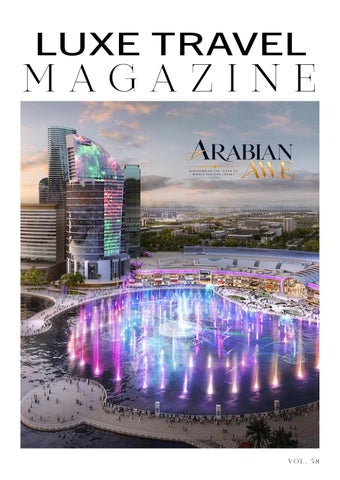
LUXE TRAVEL
MAGAZINE
VOL. 58
CONTENTS
04
16
THE POWER REGION: HOW THE MIDDLE EAST REDEFINED MODERN LUXURY
10 TRAVEL ETIQUETTE TIPS FOR THE GULF REGION
2 l SEPTEMBER 2026 l Vol.58
THE HUMAN SIDE OF LUXURY: MR BABAR KHANYARI ON REDEFINING HOSPITALITY AT TUMBI DUBAI
44 28 22
IN THE NEXT EDITION...
BEYOND THE STAY: WHERE LUXURY HOTELS BECOME PART OF THE DESTINATION
BEYOND THE PLATE: THE NEW LANGUAGE OF LUXURY DINING IN THE MIDDLE EAST
Vol. 58 l SEPTEMBER 2026 l 3
4 l SEPTEMBER 2026 l Vol.58
THE POWER REGION: HOW THE MIDDLE EAST REDEFINED MODERN LUXURY
L
uxury has always evolved in response to power; economic, cultural, and creative. Yet in recent years, the axis of that power has shifted decisively. No longer defined by the historic capitals of Europe or the established glamour of island escapes, modern luxury is increasingly being shaped by a region that understands not only how to
build, but how to envision. The Middle East has not simply entered the global luxury conversation, it has rewritten it. What distinguishes the region is not scale alone, though its skylines and ambitious developments are impossible to ignore. Rather, it is the clarity of vision behind them. Governments and private entities alike are
investing not just in infrastructure, but in experience, creating destinations that function as cohesive ecosystems rather than isolated properties. In this model, luxury is no longer confined to a hotel lobby or a suite; it extends across an entire district, seamlessly connecting hospitality, retail, dining, and leisure into one continuous narrative.
Vol. 58 l SEPTEMBER 2026 l 5
Nowhere is this more evident than along the historic shores of Dubai Creek, where InterContinental Dubai Festival City rises as both landmark and anchor. Positioned just minutes from Dubai International Airport, the property reflects a balance that defines the region: accessibility paired with refinement. Its 508 rooms and suites, many offering sweeping views of the Burj Khalifa and the calm waters of the creek, are designed not simply as places to stay, but as vantage points from which to experience the city itself. The architecture, with its sail-inspired façade, speaks to a deeper narrative—one that honours place while projecting forward. Yet the true significance of this destination lies beyond a single property. The surrounding district demonstrates how luxury in the Middle East has evolved into something more layered and interconnected. Within this ecosystem, InterContinental Residence Suites Dubai Festival City redefines what it means to stay longer, and stay well. Offering 341 residence suites,
6 l SEPTEMBER 2026 l Vol.58
the property blends the privacy of a personal residence with the services of a world-class hotel. With views across Dubai Creek and toward the Burj Khalifa, alongside access to indoor and outdoor pools, a gym, and a network of dining venues, it reflects a growing demand for flexibility in luxury—where travel is no longer transient, but integrated into daily life. This shift toward extended,
experience-led stays is further reinforced by the seamless connectivity within the destination itself. Residents and guests move effortlessly between spaces, supported by services such as complimentary transport links and access to a curated collection of restaurants across the wider complex. The result is a lifestyle offering that feels both expansive and intuitive—one where convenience becomes a form of luxury in its own right.
At the same time, the region has demonstrated a unique ability to democratise aspects of luxury without diminishing its value. Holiday Inn & Suites Dubai Festival City embodies this philosophy with quiet confidence. Located at the heart of the district and directly connected to Dubai Festival City Mall, the hotel offers 496 rooms and suites designed for both comfort and practicality, making it equally suited to business travellers, families, and those seeking a relaxed urban escape. Dining concepts range from international buffet experiences at Sirocco to casual, social spaces like Joe’s Backyard, where the atmosphere is as important as the cuisine. This layering of experiences— premium, residential, and accessible—within a single, cohesive destination signals a broader transformation in how luxury is conceived. It is no longer
about exclusivity for its own sake, but about choice, fluidity, and relevance to the modern traveller. The Middle East has recognised that today’s guest may move between roles within a single trip: business traveller, leisure seeker, cultural explorer. The environments being created are designed to accommodate that complexity effortlessly. Equally important is the region’s ability to balance innovation with identity. While the architecture is bold and the pace of development rapid, there remains a strong connection to heritage and context. Whether through design references, hospitality traditions, or the simple act of welcoming a guest, the experience is grounded in a cultural framework that values generosity, attentiveness, and presence.
influence extends far beyond its borders. It is setting new expectations—not just for what luxury looks like, but for how it feels. Seamlessness has become standard. Personalisation is assumed. Integration, rather than isolation, is the new benchmark. The result is a redefinition of luxury that is both expansive and deeply considered. It is found not only in the height of a skyline or the detail of a suite, but in the ease with which a journey unfolds. In destinations where every element is designed to connect, support, and elevate, luxury becomes less about the individual moment and more about the continuity of experience. In the Middle East, that continuity is no longer aspirational. It is already the standard.
In this way, the Middle East’s Vol. 58 l SEPTEMBER 2026 l 7
8 l SEPTEMBER 2026 l Vol.58
Vol. 58 l SEPTEMBER 2026 l 9
10 l SEPTEMBER 2026 l Vol.58
TRAVEL ETIQUETTE TIPS FOR THE GULF REGION GRACE, RESPECT, AND THE ART OF CULTURAL AWARENESS
L
uxury travel in the Gulf is defined not only by architectural grandeur and impeccable service, but by a deep-rooted cultural framework that shapes every interaction. Across destinations such as Dubai, Doha, and Abu Dhabi, hospitality is not simply a service standard, it is a cultural cornerstone, woven into centuries of tradition. For the discerning traveller, understanding and respecting local etiquette elevates the journey from a luxurious stay to a meaningful cultural experience. While the region is globally connected and increasingly cosmopolitan, particularly within its major cities, the Gulf maintains a strong sense of identity rooted in Islamic values and regional customs. Visitors are not expected to know every nuance, but an awareness of key social norms signals respect, and is often met with exceptional warmth in return. DRESS WITH CULTURAL SENSITIVITY Style in the Gulf is elegant and considered, often balancing contemporary fashion with modesty. While international dress is widely accepted in hotels, resorts, and private venues, public spaces such as malls, souks, and cultural landmarks call for a more conservative approach. Clothing that covers shoulders and knees is generally appropriate for both men and women.
In religious settings, such as mosques, dress codes are more strictly observed. Women are typically required to wear a headscarf, and loose-fitting garments like an abaya are often provided for visitors. Men should avoid sleeveless tops and opt for long trousers. These guidelines are not about restriction, but about respect, particularly in spaces of spiritual significance. THE NUANCE OF GREETINGS AND SOCIAL ETIQUETTE First impressions matter deeply in Gulf culture, where courtesy and formality underpin social interaction. Greetings are often unhurried, accompanied by inquiries about one’s wellbeing, and should never feel rushed. When meeting someone, it is customary to greet the most senior person first as a sign of respect. A handshake is the most common form of greeting, though it may be lighter and longer than in Western contexts. When interacting with someone of the opposite gender, it is best to wait and see if a hand is extended first. If not, a polite nod or verbal greeting is entirely appropriate. Titles and honorifics are also valued, particularly in professional or formal settings. The use of the right hand is an important cultural norm, whether shaking hands, offering a business card, or sharing a meal. The left hand is traditionally considered impolite for these interactions, a detail that, while
Vol. 58 l SEPTEMBER 2026 l 11
small, carries cultural significance. RESPECTING RELIGION IN DAILY LIFE Islam plays a central and visible role in daily life across the Gulf, shaping everything from architecture to daily schedules. The call to prayer, heard five times a day, is a defining feature of the region’s rhythm. While it rarely disrupts travel plans, it is worth being aware that some smaller businesses may pause briefly during prayer times. The holy month of Ramadan is a particularly important period. During this time, Muslims fast from sunrise to sunset, refraining from food, drink, and smoking in public. Visitors are expected to observe this in shared public spaces, though most hotels and designated areas provide discreet dining options during daylight hours. Far from being a limitation, Ramadan offers a unique cultural
window. Evenings come alive with iftar (the breaking of the fast) where families and communities gather to share meals. Many luxury hotels host elaborate iftar experiences, allowing travellers to engage with this deeply meaningful tradition in an authentic yet accessible way. PUBLIC BEHAVIOUR AND CULTURAL AWARENESS The Gulf places a strong emphasis on dignity and discretion in public life. Behaviour that may be considered casual elsewhere; such as loud conversations, overt displays of affection, or confrontational gestures, is generally discouraged. Maintaining a composed and respectful demeanour is key. Public displays of affection should be minimal, particularly outside of resort environments. Similarly, gestures such as pointing or raising one’s voice are best
avoided. These expectations are not rigidly enforced in every setting, but awareness helps ensure a smoother and more respectful experience. Photography is another area where sensitivity is essential. While capturing architecture and landscapes is widely accepted, photographing people, especially local women, without permission is considered inappropriate. Government buildings, military sites, and certain cultural institutions may also have restrictions. DINING ETIQUETTE AND THE CULTURE OF GENEROSITY Dining in the Gulf is as much about hospitality as it is about cuisine. Meals are often generous, social, and reflective of the region’s deep-rooted culture of welcoming guests. If invited to dine, it is considered polite to accept, as hospitality is offered with genuine intent. When dining in traditional settings, meals may be shared from communal dishes. Using the right hand is customary, particularly in more traditional environments. In formal restaurants and hotels, international dining etiquette applies, though the underlying spirit of attentiveness and generosity remains distinctly regional. Tipping practices vary slightly by destination, but in most Gulf countries, it is appreciated rather
12 l SEPTEMBER 2026 l Vol.58
Vol. 58 l SEPTEMBER 2026 l 13
than obligatory. In high-end establishments, a service charge is often included; however, leaving an additional 10–15% for exceptional service is a thoughtful gesture.
alive, with dining, shopping, and socialising extending well into the night. Adapting to this rhythm allows travellers to experience the destination as locals do.
UNDERSTANDING THE RHYTHM OF THE REGION
A MORE MEANINGFUL WAY TO TRAVEL
Perhaps the most understated aspect of Gulf etiquette is the pace at which life unfolds. While cities like Dubai and Doha are known for their dynamism, there remains an underlying appreciation for time, conversation, and presence.
Ultimately, etiquette in the Gulf is not about rigid rules, but about awareness, respect, and openness. The region’s luxury lies not only in its world-class hotels and architectural icons, but in its ability to make guests feel genuinely welcomed.
Meetings may begin with extended pleasantries, and social interactions are rarely transactional. Taking the time to engage, whether over Arabic coffee, in a majlis setting, or during a quiet moment of conversation, reflects an understanding of the region’s values.
By embracing local customs, whether through mindful dress, respectful interaction, or participation in cultural traditions, travellers unlock a deeper, more authentic layer of the experience. In a region where hospitality is both heritage and pride, even the smallest gestures of respect are returned with remarkable generosity.
Late evenings are also a defining feature of Gulf life. As temperatures cool, cities come
14 l SEPTEMBER 2026 l Vol.58
Vol. 58 l SEPTEMBER 2026 l 15
INTERVIEW
THE HUMAN SIDE OF LUXURY: MR BABAR KHANYARI ON REDEFINING HOSPITALITY AT TUMBI DUBAI
I
n an industry often defined by exceptional spaces, meticulous service, and ever-evolving guest expectations, Babar Khanyari believes that the true heart of hospitality has always remained the same: people.
As General Manager of TUMBI Hotel Dubai The Palm, Tapestry Collection by Hilton—the UAE’s first Tapestry Collection by Hilton property—Khanyari brings a wealth of international luxury hospitality experience shaped by some of the world’s most respected brands, including The Ritz-Carlton, Aman Resorts, Taj Hotels & Resorts, and Kempinski. With a leadership philosophy rooted in human connection, personal growth, and wellbeing, he is helping shape a new interpretation of modern luxury—one that moves beyond grand spaces and traditional service to focus on how a guest truly feels. We spoke to Babar Khanyari about his journey through the hospitality industry, the lessons that have shaped his leadership style, and his vision for creating a more mindful and meaningful guest experience at TUMBI Hotel Dubai The Palm.
What first inspired your journey into hospitality, and what pivotal moments have shaped your career leading up to your role at TUMBI Hotel Dubai The Palm? Hospitality has always been more than a career for me; it has been a way of life. Growing up surrounded by the world of hotels, I developed an early appreciation for the power of human connection and the impact a genuine welcome can have on someone’s experience. My formal journey was strengthened through my education at the Glion Institute of Higher Education and the University
of Wales, which provided me with the foundation to understand hospitality from both a global and strategic perspective. Over the years, my experiences with iconic luxury brands such as The Ritz-Carlton, Aman Resorts, Taj Hotels & Resorts, and Kempinski have shaped my approach to service, leadership, and creating memorable guest experiences. Each chapter of my career has taught me that while standards and systems are important, it is ultimately people who create the soul of hospitality. This belief continues to guide me today at TUMBI Hotel Dubai The Palm.
Vol. 58 l SEPTEMBER 2026 l 17
How would you describe your leadership style, and how has it evolved through your experience in the luxury hospitality sector?
Looking back, is there a particular challenge or milestone in your career that significantly influenced how you approach hospitality today?
My leadership style is rooted in a human-centric approach. I strongly believe that while the guest always comes first, the team is the foundation that makes exceptional experiences possible. When our colleagues feel valued, supported, and empowered, they naturally deliver better service.
One of the most defining milestones in my career was leading a hotel that achieved revenue and occupancy breakeven within the first seven months of operations. This experience reinforced the importance of having the right strategy, the right people, and a strong service culture from the very beginning.
Throughout my career in luxury hospitality, I have learned that leadership is not only about achieving operational goals; it is also about building trust, inspiring teams, and creating a culture where people feel that they belong.
However, beyond financial achievements, some of the greatest lessons came through challenges—learning how to adapt, motivate teams, and maintain consistency during periods of change. Hospitality is a people-driven industry, and challenges often reveal the true strength of a team.
Over time, my leadership style has evolved from focusing primarily on processes and performance to placing greater emphasis on wellness, personal growth, and meaningful connections. A successful hotel is not measured solely by its facilities or numbers, but also by the happiness and passion of the people behind it.
Today, I approach hospitality with the belief that success comes from balancing operational excellence with genuine care for both guests and colleagues. TUMBI is the UAE’s first Tapestry Collection by Hilton property. How do you balance Hilton’s global standards with the hotel’s boutique, locally inspired identity? Being the UAE’s first Tapestry Collection by Hilton property is both a privilege and a responsibility. Hilton brings world-class systems, consistency, and trust, while TUMBI allows us to express individuality, creativity, and a strong sense of place. Our approach is to embrace Hilton’s global standards while creating experiences that feel authentic to Dubai. From our wellness-driven philosophy and alcohol-free lifestyle concept to our locally inspired dining and personalised service, we aim
to offer guests something truly distinctive. The beauty of the Tapestry Collection is that every property has its own story. At TUMBI, our story is centred around living well—through mind, body, and soul. Located on Palm West Beach, the hotel is part of one of Dubai’s most dynamic lifestyle destinations. How does the location influence the overall guest experience and positioning of the property? Palm West Beach provides the perfect environment for TUMBI’s vision. It combines Dubai’s vibrant lifestyle with a sense of relaxation, well-being, and connection to the sea. Our location allows guests to enjoy a unique balance, whether they are looking for a peaceful wellness escape, a beachside experience, or a modern urban getaway. The surroundings naturally complement our philosophy of healthy living and mindful experiences. Being located on Palm Jumeirah also positions TUMBI as a destination where guests can slow down, reconnect, and experience Dubai from a fresh perspective. In your view, how is the definition of luxury evolving for today’s traveller, and how is TUMBI adapting to meet these changing expectations? Luxury today is no longer defined solely by luxurious materials, grand spaces, or traditional concepts of service. Modern travellers are looking for authenticity, personalisation, wellness, and meaningful experiences. Guests increasingly value how a
Vol. 58 l SEPTEMBER 2026 l 19
hotel makes them feel. They are seeking genuine connections, healthier choices, and experiences that align with their lifestyles. At TUMBI, we are embracing this evolution through our wellnessfocused approach, including our health-conscious dining concept, dEATox Café, our spa and fitness offerings, and our commitment to creating a more mindful hospitality experience. The Middle East is often recognised for its high standards of service. What do you believe sets the region apart, and how does your team bring that philosophy to life at TUMBI?
At TUMBI, we invest in our people through recognition programmes such as Star Performers, team activities, wellness initiatives, and opportunities for personal development. We believe that a happy and engaged team naturally creates happy guests. Excellence should never feel forced; it should come from a genuine passion for hospitality and a shared commitment to creating meaningful experiences. Looking ahead, what is your vision for TUMBI Hotel Dubai The Palm, and what can guests expect from the property in the coming years?
The Middle East has a unique culture of generosity, warmth, and hospitality. The region understands the importance of making people feel welcomed and valued, and this is deeply connected to our industry.
My vision for TUMBI is to establish it as one of Dubai’s leading wellness-driven lifestyle hotels—where guests experience not only exceptional hospitality but also a renewed sense of balance and well-being.
At TUMBI, we bring this philosophy to life by encouraging our team to go beyond service expectations and focus on genuine human interactions. A smile, a thoughtful gesture, or simply taking the time to understand a guest’s needs can create lasting memories.
We will continue to innovate through our dining concepts, wellness experiences, sustainability initiatives, and personalised guest journeys. Our goal is to create a place where people do not simply stay, but where they truly feel connected.
We believe technology can support hospitality, but it can never replace the human touch that defines exceptional service. Behind every great hotel is a strong team. How do you cultivate a service culture that consistently delivers excellence while maintaining authenticity? A strong service culture begins from within. We focus on creating an environment where our colleagues feel respected, recognised, and connected to the purpose behind what we do.
balance between operational excellence and genuine human connection. It is a philosophy reflected not only in his approach to leadership, but also in the evolving identity of TUMBI Hotel Dubai The Palm. With its focus on wellness, mindful living, and personalised experiences, TUMBI represents a new generation of luxury hospitality—one where global standards meet individual character, and where the most memorable experiences are ultimately created by people. As the property continues to grow, one thing remains clear: at the heart of Babar Khanyari’s vision is a simple but powerful belief—that true hospitality is not just about providing a place to stay, but creating a place where people feel genuinely welcomed, valued, and connected.
As we continue to grow, guests can expect TUMBI to remain authentic, innovative, and committed to delivering hospitality that is both thoughtful and deeply human. As luxury travel continues to evolve, the meaning of an exceptional hotel experience is shifting. For today’s traveller, it is no longer simply about where they stay, but how that stay makes them feel. For Babar Khanyari, the future of hospitality lies in finding the Vol. 58 l SEPTEMBER 2026 l 21
BEYOND THE PLATE: THE NEW LANGUAGE OF LUXURY DINING IN THE MIDDLE EAST Luxury dining in the Middle East is evolving. While exceptional cuisine will always be at its heart, today’s most memorable dining experiences are increasingly about much more than what arrives on the plate. They are about place, atmosphere, culture, connection and story. They might begin with ingredients grown close to home, unfold within a historic railway station, bring people together over live sport, connect international culinary influences with local heritage, or simply offer a quiet moment overlooking one of the world’s most meaningful landmarks. Across the region, dining is becoming an experience in its own right, one that reflects the changing face of modern luxury. From Makkah to Abu Dhabi and AlUla, these five destinations demonstrate just how differently that experience can be interpreted.
22 l SEPTEMBER 2026 l Vol.58
FOOD AS CONNECTION: ALFORNO In the heart of Makkah, AlForno takes the modern bistro concept and gives it a distinctly regional and cultural dimension. Inspired by the growth of contemporary bistros around the world, AlForno combines culinary traditions with creativity and innovation, while honouring the rich heritage of Saudi Arabia. Its approach reflects a growing appetite for dining experiences that can embrace global influences without losing their connection to their surroundings. Seasonal, locally sourced ingredients form an important part of the experience, with dishes designed to celebrate vibrant flavours while telling stories of both tradition and creativity. But AlForno’s appeal extends beyond the food itself. Positioned in a holy city, the restaurant brings pilgrims and travellers together in a warm and inviting environment where food becomes a point of connection. Guests are encouraged to share stories, discover new tastes and create memories around the table. It is a fitting example of how modern luxury can be rooted in something timeless: the ability of food to bring people together.
LUXURY, GROWN LOCALLY: MARKET KITCHEN
centres on quality ingredients, natural flavours and thoughtful preparation.
In Abu Dhabi, Market Kitchen presents another side of the evolving luxury dining landscape, one where freshness, simplicity and sustainability take centre stage.
Seasonal produce is celebrated through modern culinary techniques, creating dishes that are both refined and approachable. The result is a dining experience where sophistication does not have to come at the expense of simplicity.
Inspired by the vibrant energy of local markets and the philosophy of farm-to-table dining, Market Kitchen focuses on carefully selected ingredients sourced from trusted local suppliers, complemented by produce from the hotel’s own hydroponic farm. That emphasis on provenance gives the restaurant a particularly contemporary interpretation of refinement. Rather than relying on excess, its philosophy
The restaurant’s warm and stylish setting also allows it to adapt to different occasions, from business lunches and relaxed dinners to social gatherings. It is a reminder that sustainability and luxury no longer need to exist at opposite ends of the dining spectrum. Increasingly, knowing where something comes from, and treating those ingredients with care, is itself part of the luxury.
served. Its culinary offering combines Mediterranean and continental influences with locally sourced ingredients and regional flavours, but it is the atmosphere that truly distinguishes the experience.
THE LUXURY OF BELONGING: PJ O’REILLY’S Luxury can also be about something less tangible: atmosphere. At PJ O’Reilly’s, Abu Dhabi’s first Irish pub, the experience is built around the warmth, informality and social energy associated with traditional Irish hospitality. Set within a relaxed poolside environment, the venue offers a very different interpretation of what a memorable hospitality experience can be. Classic pub favourites and hearty comfort food sit alongside an atmosphere designed for gathering, conversation and entertainment. Its identity is unmistakably social. Guests can meet for after-work drinks, enjoy weekend gatherings, watch live sport or simply unwind with friends. One of the venue’s defining features is the city’s largest outdoor screen, creating an energetic open-air setting for live matches, tournaments and major sporting events. The poolside environment adds another dimension, while features such as the beer garden brunch further reinforce its role as a place for people to come together. PJ O’Reilly’s demonstrates
that modern luxury does not always have to be formal. Sometimes, the most valuable experience is simply feeling comfortable, welcome and part of something. DINING THROUGH TIME: PRIMA CLASSE Few dining experiences have a sense of place quite like Prima Classe at The Chedi Hegra. Set within the beautifully restored historic Hegra Railway Station, the restaurant draws inspiration from the romance and glamour of luxury train travel, creating a setting where the story begins long before the first dish is
By day, Prima Classe operates as an elegant all-day dining venue and café. As evening approaches, it transforms into the Golden Hour Lounge, offering guests the opportunity to unwind as the day fades. The restaurant’s inspiration reaches back to the golden age of exploration, evoking legendary routes stretching from Paris and Venice to Cairo and Tangier. Original artwork, opulent décor, attentive service and a communal spirit complete the experience. Here, dining becomes a form of storytelling. Prima Classe illustrates an increasingly important element of luxury travel: the desire for experiences that could not simply be recreated anywhere else. The setting, history and narrative are inseparable from the meal itself.
Vol. 58 l SEPTEMBER 2026 l 25
THE LUXURY OF PAUSE: THE CREAMERY In Makkah, The Creamery offers perhaps the simplest interpretation of luxury, and one of the most powerful. Overlooking the Holy Mosque and the Haram, the destination combines gourmet treats with a tranquil setting designed for quiet reflection, casual gatherings and familyfriendly enjoyment. Guests can settle into the comfortable indoor lounge or embrace the open-air serenity of the terrace while enjoying handcrafted desserts, gourmet ice creams and freshly brewed beverages. There is no need for elaborate ceremony. Instead, the experience is built around comfort, views and the simple pleasure of taking a moment. In a destination where the surroundings carry profound significance, The Creamery offers an opportunity to pause and take them in. It is a gentle reminder that luxury can be measured not only by extravagance, but by the quality of a moment—the ability to sit somewhere beautiful, enjoy something thoughtfully prepared and simply be present. A NEW DEFINITION OF DINING Together, these five restaurants reveal just how broad the definition of
luxury dining has become across the Middle East. At AlForno, it is about culture and connection. At Market Kitchen, it is freshness, provenance and a more conscious approach to dining. At PJ O’Reilly’s, it is community and authentic hospitality. At Prima Classe, it is heritage, storytelling and a sense of journey. And at The Creamery, it is tranquillity, indulgence and the luxury of taking a moment. None of these experiences relies on a single formula. That may be the most compelling story of all. The new language of luxury dining is not necessarily about making experiences bigger, grander or more elaborate. Instead, it is about making them more meaningful. It is about creating a sense of place, giving guests something to remember and understanding that hospitality extends well beyond the food itself. Across the Middle East, the table is becoming a meeting point between culture and creativity, heritage and innovation, sustainability and indulgence. And perhaps that is where the future of luxury dining lies, not simply in what we eat, but in where we are, who we share it with, and how the experience makes us feel.
26 l SEPTEMBER 2026 l Vol.58
Vol. 58 l SEPTEMBER 2026 l 27
BEYOND THE STAY: WHERE LUXURY HOTELS BECOME PART OF THE DESTINATION Luxury hospitality has never been defined by a single formula. A spectacular suite may be the starting point, but increasingly, the most compelling hotels are those that understand their surroundings, and allow the destination itself to become part of the experience. That might mean waking to views of the Holy Haram in Makkah, moving from a private beach to the desert dunes of Qatar, looking across the Arabian Gulf from a city-centre hotel, or stepping into a landscape where ancient heritage and contemporary hospitality exist side by side.
28 l SEPTEMBER 2026 l Vol.58
For LUXE Global, that connection between place and experience sits naturally within the wider conversation around luxury. Among the hotels featured across our portfolio are properties that demonstrate just how differently luxury can be interpreted across the Middle East. Together, they reveal a more nuanced picture of the modern luxury stay: one shaped not only by what happens inside the hotel, but by the reason a traveller has chosen to be there in the first place.
MAKKAH: WHEN LUXURY SERVES A GREATER PURPOSE Few destinations demonstrate this more clearly than Makkah. Here, hospitality exists alongside a deeply significant spiritual experience, and the hotels closest to the Holy Haram have developed their offering around comfort, accessibility and a sense of calm. At Raffles Makkah Palace, the experience begins with its setting beside the Holy Kaaba. The property has 214 suites, each offering uninterrupted views of the Haram, while Islamic artistry is combined with contemporary elegance. Particularly thoughtful is the inclusion of a dedicated prayer room within each suite, creating a private space for reflection. The hotel’s approach to service is equally tailored to its setting. Personal butlers are described as attuning their service to each guest’s spiritual journey, from arranging prayer times to curating intimate dining experiences. At Al Qasr, Arabian and international flavours come together, while Al Majlis offers Levantine fine dining and a terrace overlooking the Kaaba. At Anjum Hotel Makkah, the emphasis is similarly placed on making the pilgrimage experience as seamless as possible. With 1,717 rooms and suites offering Haram or city views, the hotel combines modern sophistication with subtle Andalusian influences. Its private escalators provide direct access to the Holy Mosque, reinforcing a simple but important principle: in Makkah, convenience can itself be an expression of luxury. The same sense of purposeful Vol. 58 l SEPTEMBER 2026 l 29
hospitality can be found at Jabal Omar Hyatt Regency Makkah. The hotel spans 19 floors and includes 656 rooms, 25 suites, 18 villas and two penthouses. Its rooms are described as being thoughtfully designed to support guests in fulfilling their religious duties, while its restaurants provide Asian and international cuisine alongside drinks and refreshments. Meanwhile, Makkah Hotel & Towers places proximity at the very heart of its proposition. With 1,437 rooms and suites, the property is positioned directly over the Haram Piazza, offering Holy Haram and Kaaba views. Seven panoramic elevators, five restaurants, prayer rooms, a business centre, executive lounge and kids’ club add layers of convenience to a location where access is arguably the defining luxury. Across these properties, the idea of luxury becomes less about excess and more about ease. The finest details are those that remove friction, create space for reflection and allow guests to concentrate on the purpose of their journey.
Vol. 58 l SEPTEMBER 2026 l 31
32 l SEPTEMBER 2026 l Vol.58
QATAR: FROM DESERT ADVENTURE TO COASTAL CALM If Makkah demonstrates purposeful hospitality, Qatar offers another perspective: luxury shaped by contrasts. The country brings together desert landscapes, Arabian Gulf beaches, modern urban districts and distinctive cultural experiences, and its hotels reflect that variety. Few properties illustrate the relationship between landscape and hospitality quite like Sealine Beach, A Murwab Resort. A landmark in Qatari tourism for more than three decades, the resort is described as the nation’s first luxury destination property. Operated by the Murwab Group under Katara Hospitality, it sits where beachfront serenity meets the desert, close to the dunes leading towards Khor Al Adaid, or the Inland Sea. Its 95 keys range from Standard Rooms and
Murwab Suites to Two-Bedroom Chalets and Ocean-View Villas, including signature villas with private plunge pools. Four dining venues offer further variety, from international and Qatari cuisine at Al Odaid to Italian cuisine at La Merenda, casual beachfront dining at Reef & Burger and the refined seaside setting of The Edge. With watersports, swimming pools, desert safaris and dune bashing also available, the property offers a version of luxury that is inherently active.
Vol. 58 l SEPTEMBER 2026 l 33
At Tio Sea Resort, the mood is quieter. Located directly on Al Khor Beach near the marina, the resort is designed around the coast, with rooms and suites offering uninterrupted Arabian Gulf views. A gym, spa, swimming pool and event and meeting facilities complement the seaside setting. Retaj Baywalk Residence offers yet another interpretation of coastal living. Located in the Viva Bahriya district of The PearlQatar, its 199 apartments range from one- to three-bedroom configurations. Residents have direct access to the beach, promenade and boulevard, while views extend across the marina, Arabian Gulf and city skyline. Here, luxury is expressed through space, residential comfort and the ability to move easily between urban life and the coast. For a more secluded experience, Retaj Salwa Resort & Spa presents a tranquil oasis of greenery just minutes from Doha. Its 168 rooms, suites and villas are individually designed in a contemporary style, balancing the warmth of home with upscale amenities. Spa, dining, meetings and children’s entertainment allow the resort to cater to different types of stays, while its setting is particularly suited to those seeking a quieter retreat. 34 l SEPTEMBER 2026 l Vol.58
Vol. 58 l SEPTEMBER 2026 l 35
DOHA: WHERE LOCAL IDENTITY MEETS CONTEMPORARY HOSPITALITY Qatar’s urban hotels tell a different story — one where luxury is intertwined with access to the city’s cultural, commercial and social life. Alwadi Hotel Doha-MGallery Collection is particularly well positioned within that narrative. Located in Msheireb Downtown, the five-star boutique hotel is close to Souq Waqif, museums, the Corniche and metro connections. The property describes itself as the first MGallery boutique hotel in Qatar, with its concept of art de recevoir embracing authentic local experiences. Its location allows the hotel to become a natural starting point for exploring Doha rather than
36 l SEPTEMBER 2026 l Vol.58
an isolated retreat. Guests can experience the character of Souq Waqif and the surrounding city while returning to a property designed around a distinctly Qatari ambience. For business travellers, Retaj Al Rayyan Hotel offers a more commercially focused expression of Doha hospitality. Located in the Al Dafna business district, the 19-storey hotel has 340 rooms, suites and studios, with views of the Arabian Gulf and West Bay skyline. Its position places guests close to corporate offices, embassies and commercial hubs, while attractions including Souq Waqif, Katara Cultural Village and The Pearl-Qatar are within convenient reach. The property also incorporates an indoor swimming pool, fitness centre, Sahab Restaurant and Café Zone, alongside meeting and conference rooms.
Vol. 58 l SEPTEMBER 2026 l 37
West Walk Retaj Hotel, meanwhile, reflects Doha’s contemporary lifestyle. Situated within West Walk in Al Waab, the hotel provides direct access to shops, restaurants and entertainment venues, while Aspire Zone and Villaggio Mall are nearby. Its positioning makes it particularly suited to travellers seeking a modern urban base that combines business and leisure. Further along the coast, Retaj Inn Al Wakrah provides another perspective on contemporary Qatari hospitality. Overlooking the Arabian Gulf and positioned
38 l SEPTEMBER 2026 l Vol.58
across from Al Wakrah Public Beach, its 56 rooms and suites combine traditional Qatari architectural influences with modern interiors. A restaurant, Café Zone, gym and events hall complete the offering. And then there is the Sheraton Grand Doha Resort & Convention Hotel, a property with a longstanding place in the city’s hospitality landscape. Since 1982, the hotel has occupied a position on the crescent bay of Doha’s Corniche. Its guest rooms and suites feature balconies with views of the Arabian Gulf or Doha skyline, while its 400-metre
private sand beach and 70acre coastal setting create an unusually expansive city resort environment. The property also offers a broad collection of dining venues, including a Michelinstarred dining experience, alongside one of the biggest convention centres in the Middle East. Together, these Doha properties demonstrate that urban luxury need not mean sacrificing a sense of place. In different ways, they connect guests to the city’s business districts, coastline, markets, cultural attractions and evolving lifestyle scene.
Vol. 58 l SEPTEMBER 2026 l 39
THE GULF’S COSMOPOLITAN SIDE Across the water in the UAE, the relationship between business and leisure takes centre stage. Crowne Plaza Dubai Festival City is designed around the needs of today’s blended traveller, with 316 rooms and suites overlooking Dubai Creek and a location close to Dubai International Airport. Its facilities include a business centre, gym, pool, steam and sauna, while the hotel also offers access to Dubai Festival City Mall’s retail, dining and entertainment options.
40 l SEPTEMBER 2026 l Vol.58
Its scale is particularly evident in its events offering, with more than 15,000 square metres of versatile event space, including the Event Centre and the 7,200-square-metre Festival Arena. In Abu Dhabi, Le Royal Méridien Abu Dhabi offers a more classic expression of fivestar city hospitality. Located in the capital’s cosmopolitan business district and moments from Corniche Beach, the hotel combines contemporary Mid-century Modern design with 278 rooms and suites.
Seven on-site restaurants, the Le Royal Club Lounge, a temperature-controlled outdoor pool, fitness centre and spa give the property a strong leisure dimension, while meeting and event spaces with panoramic sea views make it equally relevant for business and social occasions. Then the landscape changes again in Ras Al Khaimah. At InterContinental Ras Al Khaimah Mina Al Arab Resort & Spa, the setting is defined by Hayat Island, the Arabian Gulf, terracotta desert and mountains. Located approximately 45 minutes from Dubai, the resort is centred
around an oversized infinity pool and offers three distinct accommodation experiences, including romantic havens, private pool villas and the Club InterContinental experience. Six dining venues span different cuisines and moods, while the spa, events, meetings and weddings facilities broaden the resort’s appeal. Here, luxury becomes less about proximity to a city and more about the ability to step away from it.
Vol. 58 l SEPTEMBER 2026 l 41
ALULA: LUXURY AS A GATEWAY TO HERITAGE Perhaps nowhere in this collection makes the relationship between hotel and destination more intriguing than The Chedi Hegra. Set within the desert landscape of AlUla, the 35-room resort is positioned within Saudi Arabia’s first UNESCO World Heritage Site. Its concept brings modern luxury into dialogue with the region’s history and cultural heritage. The experience extends beyond the resort itself. Guests can access wildlife reserves, take bespoke tours of AlUla’s historic marvels and experience personalised service designed around discovery. It is an increasingly compelling definition of luxury: not simply having the most elaborate accommodation, but being given an exceptional way into a place that could not be replicated elsewhere. A QUIETER KIND OF ESCAPE Finally, at Radisson Blu Hotel & Resort, Sohar, the focus shifts towards the waterfront. Set on the Gulf of Oman, the resort offers city and ocean views and 179 superior rooms and suites. Dining ranges from local specialities to international cuisine, with buffet and à la carte options, indoor settings, poolside experiences and panoramic sea views. A fitness centre, spa and three outdoor swimming pools provide space for relaxation, while a water park featuring slides, a lazy river and a children’s splash pad adds a more playful dimension. It is a reminder that luxury does not always need to be dramatic. Sometimes, it is simply the combination of water, space, comfort and time. 42 l SEPTEMBER 2026 l Vol.58
LUXURY, RECONSIDERED From the sacred proximity of Makkah to Qatar’s meeting point of desert and sea, from Doha’s evolving urban identity to the cosmopolitan Gulf and the ancient landscapes of AlUla, these hotels demonstrate that luxury hospitality is becoming increasingly place-conscious. The most memorable stay is not necessarily the one with the longest list of facilities or the grandest lobby. It is the one that understands why its guests have come, and creates an experience that could only exist there. That might mean a private prayer room overlooking the Haram. It might mean stepping from a beachfront resort into the desert. It might mean exploring a historic market from a boutique hotel in the heart of Doha, watching the Arabian Gulf from an Abu Dhabi city retreat, or discovering AlUla through a property immersed in its extraordinary landscape. In the end, the strongest luxury hotels do more than provide somewhere beautiful to stay. They give the destination another dimension, and the traveller a more meaningful way to experience it.
Vol. 58 l SEPTEMBER 2026 l 43
v
IN THE NEXT
EDITION... THE WINNER EDITION
I
n our next edition of LUXE Travel Magazine, discover the standout stories, biggest wins and exceptional properties crowned at the 2026 LUXE Global Awards. Celebrating the names shaping the future of luxury hospitality worldwide.
44 l SEPTEMBER 2026 l Vol.58
TO OUR COLLABORATORS
Vol. 58 l SEPTEMBER 2026 l 45
LUXE Travel Magazine - Vol.58 Arabian Awe CAPE TOWN SOUTH AFRICA www.luxeglobalawards.com info@luxeglobalawards.com