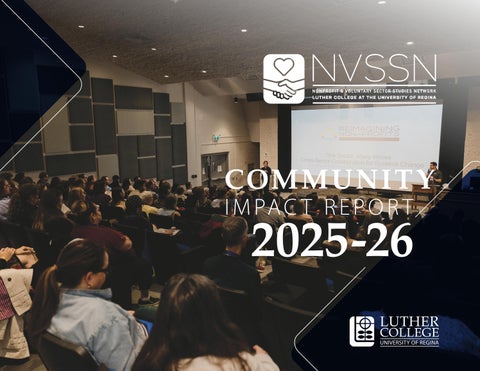
COMM UNI T Y I M PA C T R E P O R T
2025-26
C O M M U N I T Y I M PA C T R E P O R T Nonprofit and Voluntary Sector Studies Network
P R E PA R E D BY: Colleen Strauch, NVSSN Director July 2026 2
COMMUNITY IMPACT REPORT · July 2026
NVSSN Intro
4
NSLI Certificate
5
Student Testimonials
TABLE of CON T EN TS
6
Community Service -Learning Partnerships
7
Work-Integrated Learning with CEWIL
9
Growing Nonprofits Series: Sector Capacity Building
10
Reimagining Nonprofits Conference
12
Participation and Reach
12
Key Outcomes
12
Conference Testimonials
13
Community Engagement Events
15
Generating Momentum Conference
15
Strategic Positioning Workshop
15
Panel Discussions
16
Faculty Research Collaborations
19
Sponsor Acknowledgements
20
Grants & Scholarships
21
Conference Sponsors
22
List of Abbreviations CEWIL Canada – Cooperative Education and Work Integrated Learning Canada NSLI – Nonprofit Sector Leadership and Innovation Certificate NVSSN – Nonprofit and Voluntary Sector Studies Network
N VSSN:
Strengthening the Nonprofit Sector Through Connected Learning The Nonprofit Voluntary Sector Studies Network (NVSSN) strengthens Saskatchewan’s nonprofit and voluntary sector through student and community learning, cross-sector partnerships, and capacity building. Our work is grounded in the belief that stronger connections between higher education and community organizations create shared learning, stronger institutions, and more resilient communities.
Mission:
Our Impact
NVSSN strengthens Saskatchewan’s nonprofit and voluntary sector through student and community learning, cross-sector partnerships, and capacity building.
NVSSN equips students with meaningful, real-world learning through community-engaged courses and applied projects. At the same time, we strengthen the nonprofit and voluntary sector through professional development, collaborative research, and partnership development.
Vision: A thriving nonprofit and voluntary sector empowered by learning, research, and collaboration with higher education and communities to build a more just and sustainable Saskatchewan.
This work creates a cycle of shared impact between higher education and society. Students gain practical experience and sector-relevant skills, while nonprofit and community organizations benefit from new ideas, research insights, and collaborative capacity. Together, these connections contribute to stronger organizations and healthier communities.
Who We Serve:
How We Strengthen the Sector
NVSSN serves students, nonprofit professionals, community groups, volunteers, and higher education partners across Saskatchewan. Our network brings these groups together to learn from one another, strengthen practice, and support collective impact.
NVSSN acts as a trusted connector between higher education and community organizations. We strengthen the nonprofit and voluntary sector by facilitating cross-sector partnerships that connect students with community-based knowledge and practice. We offer responsive, community-driven learning opportunities that support innovation, resilience, and collaboration across the sector. We also mobilize research and applied knowledge that responds to the sector’s strengths, challenges, and opportunities. Through events, workshops, and network-building activities, we create inclusive spaces for learning, dialogue, and shared action.
Shared Impact Between Higher Education and Society At the heart of NVSSN’s work is the belief that when students, educators, and community organizations learn together, everyone benefits. Our model strengthens both student learning and sector capacity, contributing to a more connected, just, and sustainable Saskatchewan.
4
COMMUNITY IMPACT REPORT · July 2026
NON PROFI T SEC TOR LE ADER SH I P A N D IN NOVAT ION C ERT I FIC AT E Student Learning and Community Impact Through NSLI In 2025/2026, students in the Nonprofit Sector Leadership and Innovation (NSLI) program continued to strengthen Saskatchewan’s nonprofit sector through applied learning and community partnerships. Through experiential learning opportunities, students collaborated with a range of community organizations to support meaningful initiatives while gaining valuable hands-on experience in the nonprofit and voluntary sector. NSLI students partnered with organizations including Youth Climate Lab, Disability Income Support Coalition Saskatchewan, Big Brothers Big Sisters of Saskatoon and Big Brothers and Big Sisters of Regina, the Reimagining Nonprofits Conference, Street Culture Project, ALS Society of Saskatchewan, Regina Sexual Assault Centre, and TLC Pantry. These collaborations addressed a wide range of community priorities, including climate action, disability advocacy, mentorship, food security, community wellbeing, and nonprofit sector development.
Throughout the year, students participated in a range of courses designed to build nonprofit sector knowledge and applied leadership skills, including: • • • • • •
NSLI 100: Foundations of the Nonprofit Sector NSLI 220: Nonprofit Sector Advocacy and Community Development NSLI 240: Community-Based Research in the Nonprofit Sector NSLI 350: Nonprofit Financial Management NSLI 370: Nonprofit Fund Development NSLI 390: Capstone Internship
Through these courses and community-engaged learning experiences, students developed practical skills in leadership, advocacy, governance, communications, program planning, and fund development. By working directly with nonprofit and community organizations, students strengthened their understanding of the sector while contributing to initiatives that create meaningful impact across Saskatchewan.
The NSLI program continued to grow in 2025, with 124 students enrolled in NSLI courses throughout the year. In addition, 41 students formally declared the NSLI Certificate, demonstrating sustained student interest in nonprofit leadership, community engagement, and social impact learning opportunities.
July 2026 · COMMUNITY IMPACT REPORT
5
STUDENT TESTIMONIALS “The NSLI program was an incredibly enriching and engaging experience. The professors were highly involved and supportive, which fostered a strong sense of connection and collaboration. This was one of the aspects I appreciated most. The program offered a hands-on approach to learning, along with opportunities to engage with various community organizations. I particularly enjoyed the community-based research component, as it allowed me to apply academic knowledge in a meaningful, real-world setting while also contributing to the community. Overall, I would highly recommend this program to anyone interested in community-based initiatives.“ – Ashley, Bachelor of Arts and CERT NSLI “As a community builder and non-profit professional, the NSLI Certificate provided me with a wealth of knowledge and an expansive network to help advance my career. The program’s applied learning approach, particularly the internship, equipped me with practical skills I use daily and offered an unforgettable, fulfilling experience. Serving on the RNP Conference team honed my marketing skills while allowing me to contribute to a deeply meaningful cause. Overall, earning this certificate was an incredible journey, and I highly recommend it to anyone currently working in or looking to enter the non-profit sector.” – Kairo, Bachelor of Business Administration and CERT NSLI
“The experience of NSLI390 internship gave me an opportunity to apply research and data skills that I have learned over the course of my degree. It gave me a chance to practice in a meaningful way what I would like to do someday in my career. It allowed me to step out of my comfort zone to take on a challenging but rewarding project in a supportive environment. I really value what I learned, the conversations I had, and the relationships I built through this internship that further connected me to my wider Regina community.” – Gabriella, Bachelor of Arts and CERT NSLI “My experience with the NSLI internship was the first of its kind for me. I was able to use skills I have learnt in classes and put them to practice with the project we were working on. Not only that, but it also gave me the opportunity to network with organizations in the community. I learnt a-lot in the internship, and I am thankful I was given the opportunity to participate.“ – Benita, CERT NSLI
6
COMMUNITY IMPACT REPORT · July 2026
COM M U N I T Y SERV IC E -LE A R N ING NSLI PACRT ERT N ER I FIC SHAT I PS E In 2025/2026, the Nonprofit Voluntary Sector Studies Network (NVSSN) continued to expand opportunities for community-engaged learning through partnerships developed across NSLI courses and related initiatives. These collaborations created meaningful opportunities for students to apply their knowledge and skills while supporting the important work of nonprofit and community organizations throughout Saskatchewan.
Through these experiences, students engaged directly with real-world community challenges while building practical skills in nonprofit leadership, advocacy, communications, research, and collaboration. The partnerships also strengthened connections between higher education and the nonprofit sector, creating opportunities for shared learning and community impact.
NVSSN remains committed to fostering reciprocal partnerships that benefit both students and community organizations. By connecting classroom learning with applied community work, these initiatives continue to strengthen Saskatchewan’s nonprofit and voluntary sector while preparing students to become engaged and effective leaders.
We at TLC Pantry are deeply grateful for our partnership with NVSSN - we have had countless opportunities to work with them, and have found many of their information sessions, workshops and conferences vital to our work here. As a newly forming non-profit we are finding so much useful and helpful information with everything offered. As we read through all the NSLI 100 course projects we are finding that there is a lot of work for us to do, but the students there have offered many suggestions and ideas that we will be implementing. We are happy with the work they have done and look forward to anything else we can collaborate on. – TLC Pantry
July 2026 · COMMUNITY IMPACT REPORT
7
Working with the student research team from the Nonprofit Sector Leadership and Innovation Certificate program at Luther College was an extremely positive experience. The students and their faculty supervisor were professional, responsive, and easy to work with throughout the project. The process required minimal time commitment from our organization while delivering significant value in return. The final report provided meaningful insights and evidence-based recommendations that directly informed critical decisions as we redesigned our youth program to better meet the needs of participants. The students were thoughtful in their analysis and demonstrated the confidence to offer constructive recommendations and identify opportunities for improvement. In addition to the report, they developed a practical staff handbook that will continue to support program implementation and staff onboarding. – Big Brothers and Big Sisters of Saskatoon
Regina Sexual Assault Centre has been pleased to support the Non-Profit Sector Leadership and Innovation program by serving as a community partner for student projects. These collaborations provide hands-on learning experiences for students while giving organizations like ours the opportunity to share knowledge, explore new ideas, and build relationships with emerging professionals. The program strengthens connections between the classroom and the community, which is so beneficial for all partners. As someone who has also completed the certificate program courses, I have seen firsthand the value of its learning opportunities and have been inspired by the concepts and conversations it fosters. Thank You! – Lisa Miller, Regina Sexual Assault Centre
8
COMMUNITY IMPACT REPORT · July 2026
E X PA N DING INC LUSI V E WOR K-IN T EGR AT ED LE A R N ING OPPORT U N I T I ES W I T H C EW I L C A NADA In 2025/2026, NVSSN continued to strengthen community-engaged and work-integrated learning opportunities through support from Cooperative Education and Work Integrated Learning (CEWIL) Canada iHUB. This funding supported innovative approaches to experiential learning that advanced equity, accessibility, and inclusive participation for students engaged in nonprofit sector projects.
Financial accessibility was strengthened through student stipends, which reduced barriers to participation and enabled students to engage more fully in their placements and projects. This support allowed students to dedicate sustained time to community-based work, deepen their engagement with nonprofit partners, and contribute high-quality research and project outcomes.
The initiative made a measurable contribution to CEWIL iHUB priorities by expanding access to work-integrated learning (WIL) opportunities for students from a broad range of underrepresented and equity-deserving groups. Student selfidentification data demonstrated participation from LGBTQ+ students, mature students, students from rural and remote communities, students from low-income backgrounds, Indigenous students, Black Canadian and other racialized students, newcomers, refugee students, and students with disabilities. Many participants identified across multiple categories, highlighting the intersectional barriers students often navigate in accessing experiential learning opportunities.
Technology also played an important role in increasing accessibility and participation. Tools such as Zoom, Qualtrics and Excel, enabled flexible participation, strengthened digital and data literacy skills, and reduced geographic, logistical, and physical barriers for students and community partners alike.
Through this initiative, NVSSN helped pilot an equity-centred model of curricular workintegrated learning that embedded students as junior research consultants within communitybased nonprofit and advocacy initiatives. This flexible and technology-enabled approach expanded access for students who may not be able to participate in traditional placements, strengthened nonprofit sector partnerships, and demonstrated a scalable model for inclusive and impactful experiential learning in Saskatchewan’s nonprofit and voluntary sector. A special thank to NSLI Instructor, Dr. Lynn Gidluck, for her support for, and contributions to a meaningful student experience.
July 2026 · COMMUNITY IMPACT REPORT
9
GROW ING NON PROF I T SE R I ES: SEC TOR C A PAC I T Y BU I LDING
The Growing Nonprofits Series, delivered through a partnership between NVSSN and the Saskatchewan Community Foundation, provides a province-wide platform for nonprofit sector learning, collaboration, and capacity building. Across fall 2025 and winter 2026 programming, the series brought together nonprofit professionals, community leaders, and students to strengthen organizational practice and support sector-wide innovation. Fall sessions focused on strengthening core nonprofit capacities, including governance, operational funding, strategic performance management, and systems thinking. Participants engaged in practical workshops on board effectiveness, sustainable funding models, values-based performance systems, and collaborative governance approaches. Additional sessions introduced digital tools and SDG-aligned resources to support data-informed decisionmaking and cross-sector collaboration. Winter programming built on these foundations with a focus on leadership, communications, and emerging tools. Workshops included Gentle Teaching, social media analytics, missionaligned HR systems, AI applications for nonprofit
10
COMMUNITY IMPACT REPORT · July 2026
work, crisis communications, and strategies for managing communications in resourceconstrained organizations. Across sessions, participants gained practical tools to strengthen organizational resilience, leadership capacity, and service delivery. The series engaged 73 unique organizations and delivered six workshops in Winter 2026. A key feature was the integration of 18 NSLI 230 students, who participated alongside nonprofit professionals in shared learning environments that strengthened connections between higher education and sector practice.
Together, the Growing Nonprofits Series fosters reciprocal learning between students and practitioners, strengthening governance, innovation, and sector capacity while reinforcing NVSSN’s role as a partner and a connector between community organizations and higher education in Saskatchewan.
Shared Learning and Sector Impact A defining feature of the Growing Nonprofits Series is its role as a convening space for shared learning between students and nonprofit professionals. By bringing these groups together, the program strengthens reciprocal learning, where practitioners gain access to emerging perspectives and students develop a grounded understanding of real-world nonprofit challenges. The success of the Growing Nonprofits Series reflects the strength of ongoing collaboration between NVSSN and the Saskatchewan Community Foundation. Together, these partners continue to build a responsive and accessible learning platform that strengthens nonprofit capacity while fostering meaningful connections between higher education and community practice. This work contributes to a more connected, skilled, and resilient nonprofit sector in Saskatchewan, grounded in shared learning and collective impact.
Participant voices from the Growing Nonprofit Series:
•
I really appreciate these learning and networking opportunities. They have helped a great deal in my role.
•
[The series] covers relevant topics, offer a good learning opportunity and I appreciate the opportunity to network with other nonprofit leaders. It is always helpful to share ideas and solutions.
•
The series supports my work by providing information on key aspects of non-profit organizational operation. Interaction with local organizations and participants is also valuable.
•
This series expands my knowledge as a volunteer and future nonprofit leader.
July 2026 · COMMUNITY IMPACT REPORT
11
REI M AGIN ING NON PROF I TS CON F E RENC E:
2025 Cross-Sector Collaboration for Systems Change Reimagining Nonprofits 2026 brought together nonprofit professionals, community leaders, students, researchers, funders, and sector partners from across Saskatchewan for a two-day convening focused on cross-sector collaboration and systems change.The conference was designed to strengthen nonprofit sector capacity through knowledge sharing, relationship building, and applied learning grounded in real-world community challenges. Delivered through a partnership between the Nonprofit and Voluntary Sector Studies Network, the Community Engagement and Research Centre, and the Centre for Experiential and Service Learning, with strategic guidance from the Saskatchewan Nonprofit Partnership and Ivy & Dean Consulting, the conference was supported by a wide network of sponsors spanning philanthropy, post-secondary education, government, and private sector organizations. This collaborative model reflects a strong and interconnected provincial ecosystem committed to community impact and nonprofit sector development.
Participation and Reach The conference convened approximately 80 organizations representing nonprofit, public, academic, Indigenous, arts and culture, funding, consulting, and private sectors. Participants came from across Saskatchewan, including urban and rural communities, demonstrating strong provincial reach and broad sector engagement. Representation included service providers, advocacy organizations, Indigenous and equity-focused groups, postsecondary institutions, and funding bodies.
12
COMMUNITY IMPACT REPORT · July 2026
Key Outcomes Evaluation data and participant feedback indicate strong outcomes across four primary areas: •
Knowledge and learning: 97% of respondents reported increased knowledge or exposure to new ideas relevant to nonprofit practice and leadership.
•
Networking and relationship building: Participants emphasized meaningful opportunities to connect across sectors and strengthen professional relationships.
•
Collaboration: Attendees identified emerging partnerships and opportunities for cross-sector alignment and joint initiatives.
•
Capacity building: The conference supported professional growth, organizational learning, and strengthened leadership capacity across the sector.
The conference also served as a knowledge mobilization platform linking academic research, community practice, and policy-relevant insights to support evidence-informed decision-making in the nonprofit sector. Thank you to all the sponsors, partners, and participants who helped to make this event possible. The keynote speaker, Vu Le, was a standout of the event, bringing humor, honesty, and inspiration to participants.
CONFERENCE TESTIMONIALS Being only two years into my E.D. role, this conference was exactly what I needed. It pushed me to look beyond the status quo, introduced me to stronger best practices, and reassured me that thinking differently is the right direction. It also gave me the courage to be more proactive with donors, funders, and government. – Conference participant
As a first‑time attendee of a Nonprofit Leadership Conference, I found that it met my expectations and, in some respects, surpassed them. – Conference participant
Vu Le made me cry - but in a transformative way. – Conference participant
July 2026 · COMMUNITY IMPACT REPORT
13
Impact Quotes: Community Engagement
As the Executive Director of SCEP CENTRE Early Intervention & Training Services, I am incredibly grateful for the partnership and support we have received through the Nonprofit and Volunteer Sector Studies Network (NVSSN) at Luther College. NVSSN has created meaningful opportunities for Executive Directors and non-profit leaders across our community to connect, collaborate, learn, and grow together. The relationships and conversations fostered through this network strengthen not only individual organizations, but the non-profit sector. The ongoing education and professional development opportunities offered through initiatives such as the Growing Non-Profits Series and the Reimagining Non-Profits Conference have been invaluable in supporting leadership growth, innovation, and sustainability within our sector. I have a deep appreciation for Colleen and her team for the dedication, passion, and vision they bring to the non-profit community and to their students at Luther College. Their work continues to inspire collaboration, strengthen community connections, and empower organizations to better serve children, families and communities across Saskatchewan. – Shauna Forbes, SCEP Center Early Intervention and Training Services
14
COMMUNITY IMPACT REPORT · July 2026
COM M U N I T Y PA RT N E R A N D ENGAGEM EN T EV EN TS SCIC Partnership Events Relational Leadership at the Generating Momentum Conference, 2026: Relational Leadership: Centering Community in Your Work engaged participants of the Youth Generating Momentum Conference in exploring communitycentered approaches to leadership grounded in Indigenous teachings of kinship, reciprocity, and collective responsibility. Co-facilitated by Dr. Elder Lorna Standingready and Colleen Strauch, the session encouraged participants to reflect on their relationships, responsibilities, and approaches to leadership through a Two-Eyed Seeing framework that brought together Indigenous and Western perspectives. Through dialogue and interactive activities, participants strengthened their understanding of relational accountability and gained practical insights for fostering more ethical, collaborative, and communityrooted leadership practices in their organizations and communities. Strategic Positioning Workshop: In partnership with the Saskatchewan Council for International Cooperation (SCIC), the Nonprofit & Voluntary Sector Studies Network (NVSSN) offered an interactive workshop focused on strategic positioning for nonprofit organizations. The session supported participants in clarifying their organization’s purpose, understanding their unique value within the sector, and identifying opportunities to increase impact and sustainability. Through discussion and practical exercises, participants explored how strategic positioning can strengthen decision-making, stakeholder engagement, and long-term organizational effectiveness. The workshop provided nonprofit leaders with tools and frameworks to better align their work with community needs and organizational goals.
July 2026 · COMMUNITY IMPACT REPORT
15
Community Panel Discussions Charity PD Day, hosted annually by the South Saskatchewan Community Foundation (SSCF), provides professional development and networking opportunities for nonprofit and charitable sector leaders across Saskatchewan. As part of the 2025 event, Colleen Strauch moderated a panel on youth engagement in the nonprofit sector featuring students from the Nonprofit Sector Leadership and Innovation (NSLI) Certificate program. The panel provided students with an opportunity to share their experiences,
16
COMMUNITY IMPACT REPORT · July 2026
perspectives, and insights on meaningful youth engagement in nonprofit organizations, while highlighting the value of experiential learning and student leadership development. The discussion contributed to broader sector conversations about engaging the next generation of nonprofit leaders and creating pathways for youth participation in community and organizational leadership.
Innovation Challenge 2026, hosted by the Hill Levene School of Business at the University of Regina in partnership with the Graduate Advanced Training and Entrepreneurship (GATE) Centre, brought together 30 students to explore how entrepreneurship, technology, and placemaking can support downtown Regina revitalization. Held at the Hill Centre Towers, the event engaged students, entrepreneurs, and community leaders in developing innovative ideas for strengthening the city’s core.
As part of the program, Colleen Strauch moderated a panel on downtown revitalization, contributing to dialogue on community-led approaches, entrepreneurship, and place-based development. The event highlighted the value of experiential learning and cross-sector collaboration in supporting student innovation and generating practical ideas for urban revitalization and community development.
July 2026 · COMMUNITY IMPACT REPORT
17
Town Hall with Councillor Flores The Community Champions Town Hall brought together nonprofit and community-based organizations to discuss the potential impacts of the City of Regina’s 2026 budget proposals on the sector. Hosted by Councillor Victoria Flores, the event provided an opportunity for organizations receiving Community Investment Grant funding to learn about proposed changes, including the possible elimination of the Community Investment Grant Program and reductions to facility funding. Participants engaged in dialogue
18
COMMUNITY IMPACT REPORT · July 2026
about the implications for community organizations, explored strategies for effective advocacy, and gained information on how to participate in upcoming City Council budget discussions. The event supported nonprofit sector awareness, civic engagement, and collective action around issues affecting the sustainability and capacity of community organizations in Regina.
Faculty Research Collaborations Saskatchewan Health Research Fund The Wastewater-Based Monitoring (WBM) research initiative is led by Dr. Nicole Hansmeier and Dr. Tzu-Chiao Chao, whose expertise in wastewater-based health monitoring, public health surveillance, and applied research provides the scientific foundation for the project. Their work focuses on advancing wastewaterbased monitoring as an innovative tool for understanding and responding to population health trends while addressing the scientific, ethical, and policy considerations associated with its implementation. As co-Principal Investigator, Colleen Strauch supports the research team by leading the project’s community engagement and knowledge mobilization activities through the Nonprofit and Voluntary Sector Studies Network (NVSSN). In this role, she works alongside the Principal Investigators, along with Dr. Akram Mahani, to design and facilitate inclusive engagement processes that connect the research team with community organizations, Indigenous communities, equity-deserving groups, nonprofit organizations, and public sector partners. These activities are intended to ensure that community perspectives are heard, understood, and thoughtfully incorporated throughout the research process. Together, this collaborative approach combines scientific excellence with meaningful public engagement, strengthening the project’s transparency, responsiveness, and public trust while supporting the development of evidence-informed recommendations that are both scientifically rigorous and socially responsive. Shared Equipment Repository The Autonomous Equipment Repository (AER) project at Luther College is an applied research initiative led by Dr. Roger Petry, focused on advancing sustainable consumption and production (SDG 12) through the structured sharing of equipment and resources across the campus community. The project brings together interdisciplinary collaborators, including Tim Maciag, Software Systems Engineering (University of Regina), Carla Flengeris, Library Coordinator at Luther College, as well as several students and team members from the college. The NVSSN contributes in a collaborative and supportive capacity to the leadership of Dr. Petry. Colleen Strauch’s role focuses on bringing a community-engaged and sector-informed perspective to the project. Mâmawi-itohtêwak Committee This work is guided by the thoughtful and humble leadership of Dr. Elder Lorna Standingready and Dr. Brenda Anderson whose teachings and relational approach have been central to shaping how these initiatives come together in practice. Through this partnership, NVSSN supports the integration of Indigenous ways of knowing and the principles of walking together in good relations across nonprofit sector learning, community-based research, and student engagement. Working alongside the Elder-in-Residence and community partners, NVSSN helps create spaces where nonprofit organizations can learn with and from one another in ways that prioritize respect, reciprocity, and long-term relationship-building. This collaboration also strengthens experiential learning and community engagement while contributing to Luther College’s broader commitment to reconciliation and community wellbeing.
July 2026 · COMMUNITY IMPACT REPORT
19
SPONSOR AC K NOW LEDGEM EN TS
We are deeply grateful to our sponsors and funding partners whose generous support makes it possible to deliver impactful programming, strengthen the nonprofit sector, and support meaningful learning opportunities for students and community organizations. Their contributions enable us to host conferences, professional development events, and workshops while fostering collaboration across Saskatchewan’s nonprofit ecosystem.
CEWIL We also thank the Cooperative and Work Integrated Learning Canada (CEWIL) for their support in advancing work-integrated and service-learning that connect students with organizations working to strengthen our communities and provide meaningful opportunities and access for our students.
Sask Community Foundation We extend sincere appreciation to the Saskatchewan Community Foundation for their continued partnership in the Growing Nonprofits Series, which provides nonprofit professionals with access to relevant, high-quality learning opportunities.
RPIRG We extend sincere appreciation to the Regina Public Interest Research Group (RPIRG) for their continued support of community-engaged learning at Luther College and the University of Regina. RPIRG provides funding that supports student participation in community-based learning opportunities and also helps compensate community partners who contribute their time, expertise, and lived experience to course-based projects. This support helps reduce financial barriers for students while ensuring community organizations are appropriately recognized and compensated for their contributions, strengthening reciprocity and ethical engagement in community-university
20
COMMUNITY IMPACT REPORT · July 2026
partnerships. Through this work, RPIRG plays an important role in fostering meaningful, reciprocal relationships between post-secondary institutions and community organizations and in supporting the development of students as engaged and community-minded leaders.
GR A N TS & SC HOL A R SH I PS
July 2026 · COMMUNITY IMPACT REPORT
21
Reimagining Nonprofits Conference Sponsors We recognize our collaborators and sector partners for their continued leadership in strengthening nonprofit capacity, advancing collaboration, and supporting sector-wide learning. Specifically, the Community Engagement and Research Centre and the Centre for Experiential and Service Learning at the University of Regina. Your support makes a lasting difference, helping equip nonprofit professionals, students, and community partners with the skills, knowledge, and relationships needed to support positive and sustainable change across Saskatchewan. We also recognize Ivy & Dean Consulting and the Saskatchewan Nonprofit Partnership, who provide strategic guidance for the conference. Your support makes a lasting difference, helping equip nonprofit professionals, students, and community partners with the skills, knowledge, and relationships needed to support positive and sustainable change across Saskatchewan.
22
COMMUNITY IMPACT REPORT · July 2026
CON F E RENC E SPONSOR S
GOLD SPONSORS
SILVER SPONSORS
BRONZE SPONSORS
COFFEE SPONSORS
WORKSHOP SPONSOR AMERICAN SIGN LANGUAGE INTERPRETER SPONSOR & TRAVEL FUND SPONSOR
GRANT IN SUPPORT OF THE 2026 CONFERENCE
July 2026 · COMMUNITY IMPACT REPORT
23
Luther College, University of Regina 3829 Lee Gren Avenue Regina, Saskatchewan S4S 0A2