Agora
Luther College IN Conversation
Spring 2013
Luther College, Decorah, Iowa
LUTHER COLLEGE IN CONVERSATION
Peter A. Scholl, editor
SPRING 2013 VOLUME 25 NUMBER 2
Judy K. Boese, production editor
Agora, an interdisciplinary journal grounded in the humanities, is a project of the Luther College Paideia Program. Paideia consists of many other activities and opportunities, including a three-course interdisciplinary core curriculum; performances and events, including an annual lecture series; library acquisitions; student writing services; networked computer classrooms; and a faculty development program that includes sabbatical grants and summer workshops. All these activities receive final support from the Paideia Endowment, originally established through National Endowment for the Humanities grants matched by friends of Luther College. To see the current issue and archival issues on-line, go to <http://www.luther.edu/paideia/agora>. The primary Agora contributors are Luther College faculty; writing is also solicited from other college community members and, occasionally, from outside writers. The journal was established in 1988 by then Paideia Director Wilfred F. Bunge, Professor of Religion and Classics. Mark Z. Muggli, Professor of English, was the editor from 1998-2004. Agora is distributed to five hundred on-campus faculty and administrators and to another five hundred off-campus friends of the college. Anyone wishing to be included on the mailing list should contact the editor. phone: (563) 387-1599 e-mail: schollpe@luther.edu
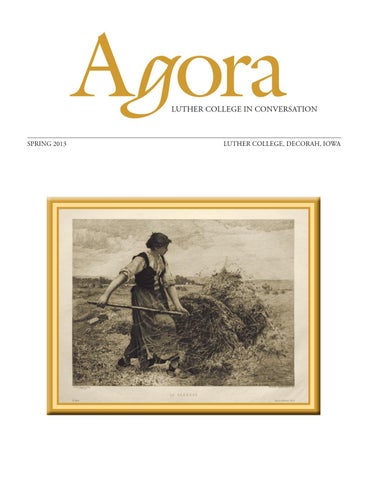
Contents Cover: La Faneuse by Mathilde Teyssonnières, etching, 1880, after a painting by Julien Dupré. Luther Fine Arts Collection #2012.09.94.
Essays and Occasions Recovering Lay Writing in Divinity Kate Narveson........................................................................4 Embracing Mystery Robert F. Shedinger.................................................................9 Enter the Noise: A Midwesterner in China Hannah Lund......................................................................12 Reindeer, the 1918 Flu, and the Brevig Mission John Tjostem and Russell Rulon............................................15 The Etching Renaissance in France: 1850-1880 Gabriel P. Weisberg................................................................23
2012-13 Paideia Texts and Issues Lecture Series: Can We Talk? Politics, Democracy, and the First Amendment John L. Moeller.....................................................................30
Don’t Just Say Something: Sit There: How Contemplative Practice Can Reshape Our Communication and Our Communities Sandhya Purohit Caton, Amy Zalk Larson, and Sheila Radford-Hill..............................................................37
Chapel Vulnerability: A Key to Life (November 14, 2012) Weston Noble........................................................................42 Are You Ready? (February 4, 2013) Corey Landstrom..................................................................44 Jesus Rejected by His Own Hometown (February 22, 2013) Michael Blair........................................................................46 Mary: Pragmatism and Vision (February 25, 2013) Keley Smith-Keller................................................................48 All Are Welcome (March 20, 2013) Richard L. Torgerson.............................................................50
Incised Ivory; Inupiaq, Alaska. Donated by T.L. Brevig. The Reverend Tollef L. Brevig Collection of Inupiaq Material Culture, Luther College Anthropology Ethnographic Collections, Object Catalog Number, E660.
Introduction
T
he depiction of a vigorous young woman on our cover—a peasant forking up hay—is an 1880 etching by Mathilde Teyssonnières that reproduces a painting by Julien Dupré (1851-1910), a French Realist who produced many such rural scenes. In an era before photography and printing technology were ready to displace them, etchings like this brought famous paintings to a wider audience than could have ever seen the originals themselves. Yet as Gabriel Weisberg, professor of art history at the University of Minnesota, explains in this issue, etchings of the Baribizon School in nineteenth century France not only widened the appreciation for fine art by producing collectible prints, but their works were esteemed by connoisseurs and by the makers as works of art in their own right. They believed that this subtle and intimate medium could “demonstrate that works on paper were equal to all the other arts” (see “The Etching Renaissance In France: 1850-1880”). Weisberg’s article, based on his 2013 Gerhard Marcks Art History Lecture at Luther College, complemented the recent on-campus exhibition of 160 prints titled “The Barbizon School: An Invented France,” curated by students of art history professor Kate Elliot. The exhibit and Weisberg’s lecture also served to highlight and celebrate the donation of these etchings which are from the Alexander Platt Collection of Prints and Drawings, given to the College in 2012 in honor of Jerilyn Jenson Smith (Luther ‘71). Platt is music director of the La Crosse, Wisconsin, Symphony Orchestra and several other Midwest musical organizations. He began collecting the prints while an undergraduate at Yale University, and said he was moved to make the gift because Luther’s musical traditions resonate with his own education and career, which began with an apprentice conductorship with the Minnesota Orchestra. I found the image on our contents page—an incised bone or ivory object— when I was searching for illustrations for John Tjostem and Russ Rulon’s article on “Reindeer, the 1918 Flu, and the Brevig Mission.” This is an Iñupiaq (or Iñupiat) artifact that Alaskan missionary Tollef L. Brevig (Luther class of 1877) collected and originally donated to Vesterheim sometime between 1894 and 1914. It is a double-sided piece, and I chose the side that shows dogs, sleds, boats, people, and a bird (perhaps a raven) carrying a reindeer or caribou. The other side shows a whale, a drummer, six geese carrying a person, and a bird carrying a whale. I imagine there may be a legend that links to these depictions and if we knew it, the story might explain why a bird could carry such large creatures. While the documentation in the Luther anthropology museum’s Brevig Collection of Iñupiaq Material Culture cannot explain these mysteries, Tjostem and Rulon tell the historical tale of how T.L. Brevig’s mission was allied to a remarkable effort in the late nineteenth century to bring non-indigenous reindeer and some Norwegian-speaking Sámi reindeer herders to help sustain the native peoples of Alaska, whose own hunting and gathering way of life had been devastated by the inroads of commercial hunting and fishing. Transporting the domesticated reindeer from Norway to the Seward Peninsula, in Tjostem’s account—though not as miraculous as flying them by ravens—is fascinating though entirely factual. And the story of how that mission community suffered from the 1918 influenza epidemic, as told primarily by Rulon, is both devastating and close to miraculous, since the sudden death of so many Iñupiaqs in 1918 helped scientists decipher the complete genetic code of that deadly flu virus some eighty years later. 2
Agora/Spring 2013
I am very pleased to have received permission from publishers Wipf and Stock and also Ashgate who are allowing Agora to reprint excerpts from religion professor Robert Shedinger’s Radically Open: Transcending Religious Identity in an Age of Anxiety (2012) and English professor Kate Narveson’s Bible Readers and Lay Writers in Early Modern England… (2012). I hope that some of you will want to read their books after sampling these excellent selections. The theme of the 2012-13 Paideia Texts and Issues Lecture Series was “Can We Talk?”, and it encouraged pieces that considered “what makes civil communication possible, desirable, difficult.” Political science professor John Moeller answered the call with a timely, expert, and even personal exploration titled “Politics, Democracy, and the First Amendment,” in which he considers the reasons why even protests at military funerals by members of the Westboro Baptist Church in Kansas have been ruled to be protected expression by the U.S. Supreme Court. This series also included the spring 2013 three-person medley lecture by Amy Zalk Larson, Campus Pastor; Sheila Radford-Hill, Executive Director of Diversity Center; Sandhya Purohit Caton, Interfaith Coordinator. Their presentation builds on what they experienced and learned as they have collaborated for the past four years on the Journey Conversations Project and it is titled “Don’t Just Say Something, Sit There: How Contemplative Practices Can Reshape Our Communication and Our Communities.” Knowing she was a wonderful writer, I asked my former student, Hannah Lund, if she would contribute a piece focused on her ongoing experience teaching English in China. It’s gratifying to read her take on places I have been and things I’ve done myself, though at a much later stage of life. Her essay will appear about the time the Luther Board of Regents considers a proposal to launch an Asian studies minor in the Luther curriculum. I was a member of the committee that drafted this proposal that I hope will function to bring more students to become as interested as Hannah in the languages and cultures of Asia. Among the chapel talks is one that will be Rick Togerson’s last as President of the College; he and I are both retiring in spring 2013. I’m sure we will continue to hear from Rick from time to time. Readers will continue to hear from me as well, since though I will not be teaching, I have agreed to continue editing Agora at least through spring 2014.
Peter A. Scholl Editor
Spring 2013/Agora
3
Essays and Occasions
Recovering Lay Writing in Divinity
Note: This essay is reprinted by permission of the Publishers from “Introduction,” in Bible Readers and Lay Writers in Early Modern England: Gender and Self-Definition in an Emergent Writing Culture (Material Readings in Early Modern Culture), by Kate Narveson (Farnham: Ashgate, 2012), pp. 1—11. Copyright © 2011.
From scripture reading to devotional writing: the rise of a lay discursive culture n 1620, in rural Northamptonshire, Lady Grace Mildmay left a manuscript containing over 900 pages of devotional meditations as her most precious bequest to her daughter. And that remarkable output is surpassed in bulk by the obsessive writings of a London commoner, Nehemiah Wallington, who by mid-century had filled over fifty notebooks with a wide variety of devotional writings. This odd couple represents a striking literary turn of events, the emergence of an ordinary people’s writing culture. Before the rise of the blog, even before the epistolary culture of the eighteenth century, there developed in England a lively culture of lay people’s writing “in divinity.” Non-professionals, lacking specialist training in their subject, writing their views on matters of public concern and finding an inexhaustible subject in the examination of their own experience, these ordinary people embraced writing as an important part of their engagement with the world. They wrote not for professional ends, not for print, but because writing was a key part of the way they had been taught to digest the Bible and apply it to their own lives. An unintended consequence of the Reformation push to teach layfolk to read Scripture, this culture of lay writing spread throughout early modern England, from the aristocracy through London artisans. We see the connection between Scripture reading and the practice of writing in a manuscript poem from the middle of
I
by
KATE NARVESON
4
Associate Professor Kate Narveson joined the Luther English department in 2000. An M.Phil in history from London’s Warburg Institute and a Ph.D. from the U of Chicago in Renaissance lit—she loves introducing students to medieval and Renaissance literature. Her impressive record of scholarship on seventeenth-century devotional poets such as John Donne and George Herbert, as well as her work on the history of reading and writing, is now augmented by the publication Bible Readers and Lay Writers in Early Modern England (2012), part of which comprises her essay here.
Agora/Spring 2013
the seventeenth-century. Jane Cavendish imagines a “Lady” who “with Bible great upon her Table layd/ Yett with her pen and Inke expresses made,” desiring that God “would her comfort give/ That by his resurrection she might live.”1 This lady is a reader of the Bible and she is a devotional writer. Further, the connection is causal. It was because they were taught to read the Bible, and because of the reading practices their pastors prescribed, that layfolk became writers as well as readers. Writing “in Scripture phrase” involved the laity in much of the work that had been the special preserve of the clergy, ultimately demystifying religious discourse and enabling the independence and voluntarism that distinguished lay piety in early modern England. Above all, it opened to women a powerful source of authority over self and household. This study, then, explores what it meant for ordinary layfolk to read the Bible. The story of the translation of the Bible into the vernacular is well-known and has received a number of recent re-tellings. These narratives focus on translators and printers, monarchs and government agents, on ideals and anxieties. Remarkably, however, they do not include the response of the lay readers for whose benefit the Bible was translated. Some work has been done on lay Bible readers as “textual communities,” readers “whose group identity as Protestant was founded on their respect for the Bible, whose interpretation of the Bible often took place collectively, at sermons or private conferences, and who read the Bible in recognizably similar printed texts.”2 Andrew Cambers picks up on the idea of reading as a communal practice, but he examines primarily the second, more religiously polarized half of the seventeenth century and looks at reading as part of puritan cultural formation, a “strategy of alienation.”3 Yet Bible reading was widespread, and not only among puritans. These recent studies still leave unexamined the reading process and how individuals interacted with and derived personal meaning from Scripture. As Justin Champion points out, despite “attention to the relationship between print and Protestantism, the number of studies devoted to exploring exactly how early modern men and women (and even children) read the Bible, and what they thought they were doing when they did, is relatively few.” In his magisterial Print and Protestantism in Early Modern England, Ian Green acknowledges his reluctant but “deliberate omission” of attention to “the ways the Bible was actually read.”4
In part, this is a matter of scarce sources for sixteenthcentury practice. The same few anecdotes are repeated—Anne Askew reading in the church, an imprisoned Catholic priest witnessing layfolk gathered to read and debate Scripture. By the early seventeenth century, however, we have fuller evidence both in manuscript and print of how layfolk used Scripture. I begin, therefore, in the later years of Elizabeth’s reign. By that time, the seeds sown in mid century were bearing fruit: a voluntaristic lay devotion was taking shape around Bible reading. The very first of the 1547 Certayne sermons or homilies published by the government for use in parish churches was the “Homily on the Reading of Scripture,” subtitled “A fruitfull exhortation to the reading and knowledge of holy Scripture.” It instructed parishioners that “there is nothing that so much strengtheneth our faith and trust in GOD, that so much keepeth up innocency and purenesse of the heart, and also of out-ward godly life and conversation, as continuall reading and recording of GODS word.” From the start, reading was paired with recording. By the middle of Elizabeth’s reign, it was taken for granted that daily devotion was to include reading, meditation and prayer. Directions for lay Scripture reading quickly began to appear. Such guides gave instructions for noting places of value and for dividing the Bible so that it could be read through once, twice, or more times in a year, with daily chapters from the Old Testament, Gospels, Epistles, and Psalms. Increasingly as the new century got underway, people of the middling sort and even laborers joined the gentry and aristocracy in the ranks of the literate and were able to follow directions to read, to take notes, to compare place with place, and to apply the Word to their own lives. In doing so, they expected to gain self-understanding. As the homily declared, “In these books we may learne to know our selues.” The practice of reading with pen in hand led to the practice of writing in “Scripture phrase.” Readers developed the habit of marking correspondences between widely separated passages, of excerpting verses that spoke to a particular occasion, and of seeing the resonances between stories in Scripture and events in their own lives. Their notes expanded into prayers and meditations, miniature homilies preached to themselves, doctrinal excurses, letters of admonition and encouragement, and accounts of passages in their lives. Many of these devotions survive in manuscript notebooks and miscellanies; some were passed from parents to children in carefully produced manuscript books. The practice spread during the early Stuart period: where there are only scattered examples of such manuscripts from the last years of Elizabeth’s reign, by the second half of the seventeenth-century examples are relatively common. The focus of this book is on the period in which the practice developed, roughly 1580-1660, a period before conventions were well-established, when lay people were still inventing for themselves the spaces and material forms of devotional writing, and when the impact of lay writing was only gradually being felt. While most surviving manuscripts originated in the households of the gentry and aristocracy, enough manuscripts remain by those of lower rank to indicate how widespread was the practice of reading Scripture and practicing devotion with pen in hand. Resisting too clear a division between elite
and popular religious culture, as well as between puritan and conformist piety, the ubiquity of the practices I will describe bears out the claim that by the reign of James I, England possessed a broad-based religious culture. What I recover in this study was a devotional writing culture of the gentry and middling sort, embracing something close to the elusive “common reader” of the period. Participants included artisans, minor government officials, country gentlewomen, and the daughters of merchants and ministers. In rank they ranged from countesses to tradesmen, but all of the participants in this culture were well-versed in doctrine, were readers of godly books, and were conversant in the standard practices used in reading Scripture. Marked by a strong piety, they included both puritans and those committed to the established church. Layfolk writing in “Scripture phrase” were everywhere, from the country house to the London closet. Many of these layfolk were women, for through Scripture reading, women came to share a common writing culture with men who were not Latin literate. From the beginning of the Reformation, gentry and aristocratic women’s engagement with Scripture is witnessed in their writing style. Elaine Beilin observes that sixteenth-century women writers “think Biblically,” and “their writing modulates, often imperceptibly, between Biblical quotations or references and their own words.”5 Lady Margaret Hoby engaged in twice daily private devotions that included Scripture reading and note-taking, as well as household devotions with yet more Bible reading. Lady Grace Mildmay’s mother passed on her Scriptural meditations, while Elizabeth Hastings, Countess of Huntington, left a collection of devotions that included a range of Scripturebased meditations and prayers. By the seventeenth century, these practices extended down the social scale, adopted by a country gentlewoman such as Elizabeth Isham and a London merchant’s daughter such as Anne Venn. By this point, men of the middling sort as well were writing in Scripture phrase. The pewterer, John Frethorne, the London guildsmen who petitioned for reformed weights and measures, and the simple wood turner, Nehemiah Wallington, all left biblically-based religious writings in manuscript. Arguably, this lay culture of Bible-centered reading and writing was the most widespread culture of the book in early modern England. Ian Green has documented how many of the century’s best sellers and steady sellers concerned religion. Writing on colonial New England, Matthew Brown reminds us that those books remained in circulation for years after their publication. He points out that if we conceive of literary culture as the culture involving the books that were most in people’s hands, then we need to recognize not only that “religious literature dominated the market,” but that devotional reading was the most popular and widespread reading culture. Brown observes that this literary culture has “been overlooked by cultural critics and wholly neglected by literary scholars,” and even current work on the history of reading “scants attention to devotional literary culture.”6 The dominance of religious material is especially true of women’s writing, a great quantity of which was loosely devotional. Yet while the recent Cambridge Companion to Early Modern Women’s Writing devotes nine chapters to representative Spring 2013/Agora
5
6
Agora/Spring 2013
THE BRITISH MUSEUM, VIA WIKIMEDIA COMMONS
genres, “polemics and prophecy” is the only explicitly religious genre, and there is no chapter on devotional writing. Such writing is to some extent covered in chapters on poetry, journals, and life-writing; nonetheless, the organization obscures the centrality of devotion and divinity in women’s writings. And more generally, any survey of how people engaged with books and writing in the seventeenth century is incomplete without attention to layfolk and their myriad forms of commerce with the Bible. This unofficial lay writing culture existed in uneasy relation to the official culture that was both its inspiration and its rival. Elizabeth’s reign saw the start of a professionalization of the clergy, who based their claims to expertise and respect on their learning in the tools needed to proclaim the Word: biblical languages, knowledge of the Church Fathers and contemporary theologians, logic and dialectic. This professionalization, though, caught the clergy in a powerful tension between their commitment to put Scripture in lay hands and their sense that their particular professional skills were essential to understanding the Bible. Clerical directions for lay reading oscillated between idealistic calls for the ploughman at his plough and the woman at her distaff to read Scripture, and patronizing admonitions that lay readers should consult their pastors when encountering dark passages. Was the clergy’s anxiety justified? Despite clerical fears that unbridled Scripture reading would lead to error, the laity largely tended to imitate the clergy both in their doctrinal attitudes and their modes of writing. At the same time, though, initiation into these skills demystified Scriptural exegesis. Certainly, the fact that gentlemen shared much the same education as the clergy allowed them to assume their right and competence to write works of Scripture meditation and explication. Less obviously, ordinary people as well, by mid-century, no longer regarded the application of Scripture to circumstances as a specialized clerical skill. Even as the clergy were fighting for prestige as a professional class, the laity were extending the scope of their extra-congregational religious activity as they shaped their own spiritual narratives, confidently rooted in Scripture, and exercised their writerly skills in both the domestic and the public spheres. An advantage to looking at reading and writing practices together is the light it casts on the literacy of the relatively unschooled. It becomes clear that scripture reading paved a smooth path to writing. Not only was lack of formal instruction in composition no bar, but the very fact of immersion in a reading culture created the impulse to write. Bible reading and the writing that it inspired particularly drew people because they granted women and ordinary men a new mode of selfexpression and self-fashioning. Susan Felch has used Bakhtin’s concept of heteroglossia as “selective assimilation” of discourse to describe the ways in which sixteenth-century women used techniques of Psalm collage and paraphrase to create prayers in which “the author’s own creativity, imagination, and literary skill are called forth.”7 And beyond literary creativity, devotion allowed imaginative control of one’s self-understanding. It called people to apply their reading to their own circumstances and trace its effects on their lives, and the writing that accompanied Bible reading was above all the arena in which people
A congregation of readers; detail from title page of Foxe’s “Acts and Monuments” (Book of Martyrs), second vol. Ed.,1631.
practiced this application to self, taking the measure of their lives and the world around them. Kari Boyd McBride and John Ulreich have noted the “freedom with which [Amelia Lanyer and John Milton] appropriate Biblical passages to their own interpretive designs” and their “spontaneous ability to reproduce the language of Scripture.”8 This freedom and spontaneity were not only characteristic of well-known writers like Lanyer and Milton. Writing biblically-based devotion gave ordinary people a sense of purpose and a creative idiom. Their writing exists at what Michel de Certeau has identified as a transition point in the Western relation to the “scriptural.” In one sense, layfolk still expect to conform themselves to the Word. They bring Scripture into their writing as that which grounds it, to which all that they say of the world or themselves must conform. At the same time, though, by the very act of writing, they transform materials into a product that aims at social efficacy. De Certeau sees writing as one of the constitutive practices of modernity: in writing, “the things that go in are the indexes of a certain “passivity” of the subject with respect to a tradition; those that come out, the marks of his power of fabricating objects.” Writing, therefore, “is capitalist and conquering.”9 Without necessarily intending to claim power and ownership, layfolk are doing just that. In their transformation of received material, their texts become writs of ownership over their identity. Scripture reading thus placed a key tool for self-understanding and even self-determination in the hands of lay people. Recent work has demonstrated how multiform and pervasive “self-writing” became during the seventeenthcentury; I would argue that lay scripture literacy was a major cause.10 Importantly, it was not simply solitary reading and writing that made the difference but the life of that reading and writing beyond the prayer closet. As Cambers demonstrates, devotional reading entailed “a fusion of individual and communal experiences,” and a family’s communal reading might include works written by a member of the household as part of his or her individual devotion exercise.11 When we recognize the myriad purposes and readerships that devotional writing engaged, we can also grasp how the self-understanding that lay people gained through their interactions with scripture
allowed them to establish an identity and assert authority in their family circle and even the wider community. Take, for instance, the case of Elizabeth Richardson. Throughout her married life, from her early social prominence through loss of husband and fortune through recuperation of status, Richardson wrote and revised a prayer book for household use, a collection that after the Book of Common Prayer was banned could serve as a substitute in her family’s devotional life. Richardson credits to God’s providence the remarkable restoration of her fortunes, her remarriage, and her children’s good marriages. Modern scholars might instead credit the patronage of the Duke and Duchess of Buckingham, but we should also consider the possibility that her devotional activities contributed to her recovery of position, granting her a moral authority that commanded the wills of those around her. This devotional activity was grounded on Richardson’s Scripture reading, since Richardson drew heavily on the Bible in composing her first manuscript of prayers, now in the Folger Shakespeare Library. Reading Scripture provided the foundation for her writing, and her writing was a significant means by which she established her influence in her extended family. Or take the case of Nehemiah Wallington. In August of 1642, Wallington wrote a letter to Abraham Colfe, the absentee rector of St. Leonards in Lewisham. In it, he quotes Ezekiel 3: 17-19, which adjures the “watchman” to rebuke the wicked and warns him that if “thou givest him not warning… the same wicked man will die in his iniquity but his blood will I require at thine hand.” Wallington chastises Colfe: “if you had privatly and publikly tolde your people plainely of their wicked wayes as heare the Lord commands you…then shurely there would not have bine so many ignorant, Drunken, swearers, Mockers, and profaineers of the Lords day at Lusume [Lewisham] as now there be.” Instead, evil abounds “to your discredit.”12 Wallington was merely a London wood turner who ran a small, not particularly profitable shop. Yet he felt licensed to rebuke a clergyman. While we have come to take for granted the puritan fervor that led commoners to speak back to their betters, two preconditions that lie behind Wallington’s act deserve special attention: he was a Scripture reader, and he was a writer. We know of Wallington’s letter because he copied it into one of his fifty plus manuscript books. As these two examples show, it was not simply the spread of Scripture literacy, it was the application of that literacy in writing that created the conditions whereby ordinary layfolk, both men and women, gained a new form of influence. Through writing, the identity formed in the process of scriptural devotion took on solid contours and weight in a person’s contacts beyond the prayer closet. The standard distinction between public and private devotion obscures the varied and often communal nature of private devotional practices. Public devotion referred to congregational worship, private devotion to all other practices, which regularly took place in the company of others or using texts written by family or acquaintances. People read, prayed, and conferred with others. When they wrote, it was within the context of the networks of kin, congregation, or friendship that shaped their piety and determined the motives for setting pen to page. Further, even if they wrote for individual meditation or prayer, they assumed
that their devotions were applicable to others. W.S.R. translated prayers and meditations by Luther because the work had helped others and “the like comfort hath it by the goodness of God effected in me, which moved me to undertake the publishing hereof for the good of every Christian,” a sentiment repeated in countless prayer collections.13 But while Reformed clergy endorsed lay Scripture literacy, nowhere did they invite the laity to become writers. As is now well established, reading and writing were separate skills, and while even women and servants might be instructed in how to read the Bible, little or no provision was made to teach them how to write. Even if they were taught to form letters, people from the lower social orders certainly were not taught how to compose their own texts, a skill reserved for the gentlemen who went to grammar school. How, then, did ordinary men and women come to think that they too might write “in divinity”? A writing culture requires skills, from the ability to gather and assess ideas to the ability to structure those ideas into recognizable forms. Further, there is a less tangible precondition: the laity needed to conceive that the act of writing was not only possible but desirable and even called for, and not just for scholars but for people like themselves. Part 1 of this study describes the attitudinal changes and the acquisition of skills that were the foundation of lay writing in divinity. Part 2 examines the imprint of gender on women’s writing practices. We have reached a point in the study of women writers where it has become clear that to study women in isolation carries methodological risks. Men and women alike participated in the culture of biblically-based devotional writing, and by detailing the main features of this shared culture in Part 1, I establish a basis for my subsequent assessment of where, in fact, gender registers. By situating women within the shared culture of bible-based devotion, I also underline the power of self-definition it offered them. In early research on women’s writing, the standard assumption was that women wrote religious works because of patriarchal constraints, and that, given the choice, women would have dropped their Bibles and written lyric poetry or drama. Yet plenty of men, unconstrained, wrote prayers, meditations, and treatises on religious matters. Clearly, devotional writing provided rewards to early modern English writers, both men and women. Debora Shuger has demonstrated that writing about the Bible drew the learned into profound and troubling questions of anthropology and psychology. Even for ordinary layfolk, devotional writing carried similar weight. Devotion patterned personal and social agency, and was a discourse that people chose not simply faux de mieux but because it offered tangible benefits. It is true that the bulk of women’s religious writing seems to repeat conventional pieties in conventional phrases. In fact, it could just as well have been written by men. In dedicatory epistles and prefaces, gender influences the strategies an author uses to establish authority, but what is there to say about the body of most meditations and prayers? Does it make a difference whether they were written by a man or a woman? Can such texts reveal anything about how women negotiated the terms in which they lived their lives? I will argue that gender does matter, but only as one influence, and, further, any assessment of gender must be made in conjunction with Spring 2013/Agora
7
attention to other formative influences. Clearly, such texts engage a social context; they are not utterances that express a pre-existent, already gendered subject position. When a London tradesman or a country squire’s daughter takes up the pen, they are conscious of a gendered identity within a social nexus, and their skills, degree of literacy, and sense of authority may well reflect gender, but they will also reflect social position and familial or community piety. The man and the woman’s subject positions in relation to the divine might be remarkably similar as they envision themselves according to the same theological categories, devotional psychology, and discursive practices, a fact in itself worth noting, for devotion was a significant solvent of the period’s rigid gender inequalities. In placing men and women’s works side by side, I attempt to strike a balance between the historian’s urges to lump and to split. I attend to situational differences while at the same time arguing that in the role devotional writing played in their lives, there are telling similarities between men and women outside the ranks of the Latin-literate elites. Their textual remains reveal the remarkable consequence of teaching lay people to read. Devotional writing disciplined self-understanding, but it also enabled an individual selfconstrual that gave people a sense of self-possession, independent of institutional authority. Devotional writing might be usefully paralleled with the modern blog: little of what is written is original or indicative of independent thought. The sameness of devotional writing can sometimes make it dull reading for a modern; the sameness of the reported trivia and opinionating on blogs will likely strike a reader four hundred years from now as equally tedious. Yet there was a powerful appetite for devotional writing in early modern England, just as there are millions of hits on “Dooce” and similar sites, as women, apparently, find an affirming resonance with their own experience in the remodeling or parenting trials of Heather Armstrong. Both for women and for non-elite men, devotion offered opportunities for the discovery and rehearsal of one’s own particular rendition of shared patterns, and therefore a new control over one’s narrative of self. Further, writing gave commoners the power to fix their narratives on the page. The book was central to this dynamic. For the practitioners, the book first was Scripture. This fact is worth stressing: because it was in order to read the Bible that people were taught to read, they were thereby provided as their focal text a source of authority that allowed them to feel a sturdy confidence in their ideas and in the merit of the writing they undertook. From our perspective, of course, the books of central interest were those written by these lay people: manuscript volumes filled during hours of private devotion, copied out for family members and as legacies for one’s heirs. Occasionally fair copies, but as often working volumes with emendations carefully entered, these volumes emerge as a kind of Protestant icon, precious because they gave material form to the piety of the writer. They gesture beyond themselves, enjoining and directing the writer’s children and grandchildren to enact the devotion that they record, and
8
Agora/Spring 2013
they gesture toward themselves as the tangible product not only of a parent’s hand, but of a parent’s commanding devotion. They represent a sacralization of the study and the household, a spreading of piety and religious authority beyond the church and its clergy in a movement that, even while energetically reinforcing the impetus of the Reformation, also marked a new lay independence of the clergy. Notes 1. Quoted in Helen Wilcox, “‘My Hart Is Full, My Soul Dos Ouer Flow’: Women’s Devotional Poetry in Seventeenth-Century England,” The Huntington Library Quarterly, 63 (2000), 448. For reasons of space, in this Agora version I have removed all notes other than direct citations; anyone interested in methodological issues and discussion of the state of the field of book history should consult the full text in my book. 2. Patrick Collinson, Arnold Hunt, and Alexandra Walsham, “Religious publishing in England 1557-1640,” in The Cambridge History of the Book in Britain, vol. 4, ed. John Barnard and D.F. McKenzie with the assistance of Maureen Bell (Cambridge: Cambridge University Press, 2002), 66.
3. Cambers, Godly reading: print, manuscript, and Puritanism in England, 1580-1720 (Cambridge: Cambridge University Press, 2011.
4. See Champion, “‘Directions for the Profitable Reading of the Holy Scriptures’: Biblical Criticism, Clerical Learning and Lay Readers, c. 1650-1720,” in Scripture and Scholarship in early Modern England, ed. Ariel Hessayon and Nicholas Keene (Aldershot: Ashgate Press, 2006), 208-9, and Green, Print and Protestantism in Early Modern England (Oxford: Oxford University Press, 2000), 108. 5. Elaine Beilin, Redeeming Eve: Women Writers of the English Renaissance (Princeton: Princeton University Press, 1987), 51. 6. Brown, The Pilgrim and the Bee: Reading Rituals and Book Culture in Early New England (Philadelphia: University of Pennsylvania Press, 2007), 8-11.
7. Felch, “‘Halff a Scripture Woman’: Heteroglossia and Female Authorial Agency in Prayers by Lady Elizabeth Tyrwhit, Anne Lock, and Anne Wheathill,” in English Women, Religion, and Textual Production, 1500-1625, ed. Micheline White (Aldershot: Ashgate, 2011): 159-60. 8. McBride and Ulreich, “Answerable Styles: Biblical Poetics and Biblical Politics in the Poetry of Lanyer and Milton.” Journal of England and Germanic Philology 100 (2001): 333, 335. 9. De Certeau, The Practice of Everyday Life, trans. Steven Rendall (Berkeley: University of California Press, 1984), 135.
10. I speak, of course, of those who learned to write, a group that, though small, embraced many who, in previous generations, would have been unlikely to achieve literacy; see Cressy, Literacy and the Social Order: Reading and Writing in Tudor and Stuart England (Cambridge: Cambridge University Press, 2006). 11. Cambers, Godly Reading, 53; see also 103, and Chapter 2 below. 12. Wallington, The Notebooks of Nehemiah Wallington, 16181654, ed. David Booy (Burlington, VT: Ashgate, 2007), 248. 13. W.S.R., Every Dayes Sacrifice (London, 1607).
Embracing Mystery
Excerpted from Radically Open: Transcending Religious Identity in an Age of Anxiety (Wipf and Stock Publishers, 2012).
I live my life in ever-widening circles that stretch out across the things of the world.1
Like the expanding ripples of a stone thrown into a pond, our awareness of the largeness of life should keep expanding outward over the course of a lifetime. But in too many cases this fails to occur, and instead we become imprisoned in an artificially narrow and constricted worldview. For ecopsychologist Anita Barrows, this imprisonment results in part from late twentieth-century theories of psychological development having arisen primarily in urban contexts where the social interaction between humans is the only thing considered important. Barrows wants to expand the boundaries of this ever-widening circle beyond the social world of human relationships to the world of nature and our interrelatedness to the more-than-human world. Any theory of psychological development “must take into consideration that the infant is born into not only a social but an ecological context.”2 I thoroughly agree, but we cannot stop at the boundaries of our ecological contexts. The contours of our awareness must keep expanding until they become as large as the universe itself. It is really quite astonishing how little time most people spend contemplating the unimaginable grandeur of the uni-
Robert is an associate professor of religion at Luther where he has taught since earning his PhD at by Temple in 2000. He teaches a variety of ROBERT F. Bible-focused courses as well as courses on SHEDINGER Islam and on science and religion. In addition to many academic conference presentations and professional journal articles, he is the author or co-author of four books, including Radically Open: Transcending Religious Identity in an Age of Anxiety (Wipf and Stock, 2012), from which this piece is excerpted. Agora published an excerpt from Shedinger’s Was Jesus a Muslim? Questioning Categories in the Study of Religion (Fortress Press) in winter 2009.
verse that forms the real context for the human adventure. How easily we ignore our participation in a fourteen-billion-yearold cosmic narrative whose stor y line we barely know and can only sketch in its broadest outline. Do we really think that the vagaries of our mundane, routine lives fully circumscribe the boundaries of our existence? Sadly, many of us do. Yet the truth is entirely contrary. Many of us undoubtedly engage the largeness of the universe intellectually—we may look up at the night sky and recite Cover design for Radically Open. the names of the various constellations, identifying the Big Dipper or Orion’s belt. But do we open ourselves to the full emotional impact of the dizzying incomprehensibility of it all? Generally, we don’t, and I suspect the reason is similar to our reticence to engage our own psychic depths—fear of mysterious powers we do not control. A couple of years ago, I was trying to help my daughter understand the scale of the solar system she was learning about in school. I thought that perhaps we could build a scale model by shrinking the sun down to the size of a basketball. The futility of such an attempt soon became apparent when my back-of-the-envelope calculations revealed that our model earth would be represented by a pea placed nearly one hundred feet away, with the outer reaches of the solar system two-thirds of a mile down the road! Even with a sun the size of a basketball, the nearest star would be twenty-four million miles away! I gave up even trying to calculate the distance to the farthest galaxies or quasars. Our lives are embedded within a cosmic story of effectively infinite magnitude, one that we are privileged to participate in just by virtue of being born. The universe is not a mere static backdrop against which our more important human affairs play out; our human journey is intimately intertwined with a larger cosmic narrative of which we are not the author. As the late Carl Sagan so famously put it, “We are star stuff.” Though we often treat
WIPF AND STOCK PUBLISHERS, 2012
T
he move to radically expand our perspective on life and connect to the larger story of the universe is well captured by the early twentieth-century Austrian poet Rainer Maria Rilke in this oft-repeated line:
Spring 2013/Agora
9
Sagan’s saying as a cliché, it is not. The very atoms that make up your body and mine were cooked up in the nucleus of a faraway star that no longer exists. We truly embody the very universe that created us. We should remember that the narrative arc of scientific discovery has entailed a systematic decentering of the human ego and opening up of larger fields of vision. In the ancient world, the earth was at the center of a rather small universe, but Copernicus and Galileo expanded our view and moved the earth away from its privileged position. Later discoveries transformed our sun into just an ordinary star among billions of others in an ordinary galaxy, which itself is just one among billions of other galaxies. The framework of our awareness has never stopped expanding along with a universe that, ironically, itself is expanding. For a while we could maintain our belief in the human being as a unique creation of God, but then Darwin took even that away. Now that we know that the evolution of planetary systems around stars is a regular process of the universe, and given the vast size and scope of the universe, the odds are good that life exists elsewhere; it is not unique to earth. The scale of the true cosmic context of our lives is so much bigger than we normally acknowledge—if we can just radically open ourselves to it. Contemplating the vastness and richness of the universe need not leave us feeling alienated or alone, for this larger cosmic process is truly our home. Brian Swimme and Mary Evelyn Tucker conclude their book Journey of the Universe with a triumphant note of hope: If the creative energies in the heart of the universe succeeded so brilliantly in the past, we have reason to hope that such creativity will inspire us and guide us into the future. In this way, our own generativity becomes woven into the vibrant communities that constitute the vast symphony of the universe.3 Ample evidence is mounting that the universe is not a sterile, impersonal morass of purposeless matter and energy. The universe rather demonstrates a penchant for ceaseless creativity, as Stuart A. Kauffman so fascinatingly demonstrates in Reinventing the Sacred. Some would even go so far as to see a cosmic mind at work. We may not understand it all, but we are nevertheless participants in this truly grand narrative, a privilege bestowed on every one of us without our even asking. Connecting to this larger story will require a willingness to embrace mystery and abandon the fruitless search for certainty so characteristic of our age. The famous evangelist Billy Graham repeatedly asked the throngs of people who flocked to his crusades, “If you die tonight, are you certain that you will go to heaven?” Playing on people’s doubt, Graham then invited the crowds to certainty through a public acceptance of Jesus Christ. But this type of certainty is an illusion. No one really knows what happens when we die. Recall that Jung referred to life as “a luminous pause standing between two mysteries which as yet are one.”4 Our births are enshrouded in mystery; not one of us had anything to do with our being here. We just arrive in this world helpless and completely ignorant of 10
Agora/Spring 2013
why we are here or what it all means. And death is the great existential mystery about which we know very little. But in between, we have the privilege of participating in the grand process of the universe. Note that Jung calls life a luminous pause. We are lights in the cosmic narrative. Embracing mystery will entail resisting the temptation—all too human—to demystify God or the gods and to reconstruct God as an anthropomorphized superhuman being. All constructions of God are human creations and cannot be taken as absolute representations of who God really is or what God really wants from us. Likewise, strong atheistic affirmations of the nonexistence of God or the gods are just as much a human metaphysical construction that goes well beyond what any of us can claim to know. Perhaps the only intellectually honest position regarding the existence of God is agnosticism—the affirmation that we cannot know whether God exists or not. I realize agnosticism has a negative connotation in the contemporary world, but it need not be construed in such negative terms. Agnosticism is simply an honest act of epistemological humility, allowing us to stand in faith in the presence of a mystery we do not understand. False certainty is the true enemy of faith, but doubt is its prerequisite. There is no reason why someone cannot be a faithful agnostic in the best sense of the term. I find it quite surprising how reticent we are to embrace mystery. After all, mystery is the prerequisite for excitement (this is why people love to read a good mystery). How boring life would be if we knew what it was all about, if there was nothing new to discover. Clearly our tendency to deceive ourselves into a false certainty has led to boredom, depression, and anxiety. I am reminded of the pessimism of physicist Steven Weinberg’s well-known dictum, “The more we understand about the universe the more pointless it seems.” Weinberg seems to lose sight of the fact that we really don’t know very much. More importantly, we can’t know how much we don’t know, so some epistemological humility is certainly in order. We truly live in the presence of mystery, and this is a good thing because a world of mystery will constantly surprise us with the novel, the unexpected, rendering life an exciting adventure. Besides, it is hard to be depressed or anxious while simultaneously feeling excitement! The two don’t go together. Embracing the mystery of the cosmic narrative that frames our lives will lead to a sense of re-enchantment of the world and an enlargement of our perspective that will go a long way toward diminishing anxiety. This call for spiritually re-enchanting the world, I realize, is not without controversy. Some thinkers have begun advocating for what they call secular re-enchantment, which entails accepting the secular premise of the materiality of all existence but finding enchantment in the magnificent processes of this material world. For example, George Levine’s Darwin Loves You: Natural Selection and the Re-enchantment of the World argues that we can find the enchantment we so desperately seek within a completely Darwinian understanding of the story of life, without appeal to any transcendent or spiritual reality. Levine has also edited an anthology titled The Joy of Secularism that contains essays similarly advocating for a secular re-enchantment. I must admit that I find the idea of
secular re-enchantment to be rather curious and something of an oxymoron. Levine and his colleagues clearly understand the damage done by secular disenchantment, and they recognize the need to resist the movement toward disenchantment. But at least on the theory of secularism I have borrowed from Charles Taylor, secularism itself is characterized by an attempt to understand all processes from within the parameters of the material world, and this attempt leads to disenchantment as we are cut off from a connection with non-material forces of enchantment. Calling for a secular re-enchantment, then, seems to miss the point that secularism, almost by definition, is a disenchanting process. I wonder why it is so difficult for Levine and his colleagues to engage the possibility of a spiritual animating force at work in the cosmic story, even if we can’t fully understand what it is or how it works. Have we really been so cowed into submission by the scientistic forces demanding that we accept as real only what is empirically verifiable? After all, even Darwin did not think his theory of natural selection necessarily undermined a religious worldview; toward the end of On the Origin of Species, he comments, “I see no reason why the views given in this volume should shock the religious feelings of any one.” The real lesson here is one of humility—developing the humility necessary to accept our ignorance and to openly engage mystery as mystery rather than trying to demystify it. We must practice islam—that is, submission to what James Hollis calls “the greater wisdom of the process.” Of course, our egos will rail against the very idea that we are limited creatures, but seeking to transcend limits may be the fastest way to a life of meaninglessness. Some years ago at a conference held at Middlebury College, Ismar Schorsch, then the chancellor of the Jewish Theological Seminary in New York, challenged his audience with the striking statement, “Meaning is found in limits.” If we came to a place where we could have an unlimited supply of anything we wanted, says Schorsch, nothing would mean anything. To see how right he is, consider the human quest for immortality. Contemplate what it would mean if we successfully conquered death. Close your eyes and try to visualize your life streaming off into the future as an unending succession of days! The prospect is mindnumbing. Without an end, life would cease to take the shape of a story; it would lose its narrative arc and devolve into a state of numbing meaninglessness. It is only because we are finite, because we cannot have all that we desire, because our choices matter, that our lives gain meaning. We must submit to our limited nature and accede to the larger wisdom of the process in order to truly find life. Our true identity as human beings will be found in our enlarged role as co-participants in the cosmic drama of the universe. It will not be found within the narrow limits of the provisional identities we cling to so tightly. Among these provisional identities stand our claims to religious identity. But if my argument is at all cogent, these religious identities prove to be superficial; they serve to cut us off from our
psychic depths where we might find our connection to the larger cosmic story—and this leaves us vulnerable to anxiety and depression. We need to become radically open by transcending those religious identities to become truly alive and fully human. Please don’t misunderstand me. I am not suggesting that we abandon church, mosque, synagogue, or temple, but rather that we resist the temptation to cling to an exclusive adherence to a single tradition as defining who we really are. I remain today a member of a church whose services I attend regularly. I serve on this church’s missions committee, teach an occasional Sunday school class, and even preach now and then when the minister is out of town. But I also attend and actively participate in a Friday prayer service started by Luther College’s Muslim Student Association, and I remain very interested in aspects of Buddhist meditation. What is my religious identity? It doesn’t matter. Religion is not an identity to me. I am a child of the universe, and the various religious traditions are important to me only insofar as they contain resources that might guide and direct me toward that larger understanding of my identity—and one finds that all of them do contain such resources, if only one allows them to speak. Back when I claimed a strong religious identity for myself, I was essentially a functional atheist. Now that I don’t claim a particular religious identity, I have become a faithful agnostic. My sense of the existence of spiritual reality is much stronger now that I have transcended a provisional religious identity and radically opened myself to the greater mystery. I recently saw the following bumper sticker: Trust those who seek truth; doubt those who claim to have found it. What profound wisdom! I think it sums up everything I have tried to say in this book. I am trying every day to live a radically open life in willing submission to a larger mystery that I neither understand nor control. Engaging with mystery is at times unsettling, but opening up to its creative possibilities is also exciting and can at times be downright exhilarating. And I find that I am a whole lot less anxious. Do I still miss my mother? Of course, and I suspect I always will. But this is offset by the recognition that I live now in service to a reality much larger than myself; all I can do is willingly surrender in faith and trust to this reality. This is what it means to live radically open, to be full participants in the cosmic journey of the universe. Notes 1. My own translation from the German text cited in Hutchinson, Book of Hours, 2. 2. Barrows, “Ecopsychology of Child Development,” 103. 3. Swimme and Tucker, Journey of the Universe, 118. 4. Jung, Letters, 483.
Spring 2013/Agora
11
Enter the Noise: A Midwesterner in China
Hannah came to Luther from Lakeville, Minnesota, graduating in spring 2012 with an English major (Writing Emphasis) and religion minor. At Luther she also played the violin in the orchestra, wrote for Chips, and studied Chinese. Since September 2012, she has been teaching English as a second language at the Xicheng Campus of Zhejiang Sci-Tech University, in the Xiasha district of Hangzhou, by China. You can find her blog by Googling throughthedragongate. HANNAH
LUND
12
Agora/Spring 2013
Hannah Lund dancing in a park, Xiasha district of Hangzhou, China.
Why? I’m not really sure, actually. Maybe it has something to do with the fact that my understanding of China is rooted in noise. People pointing to me and saying “laowai!” (foreigner) or hearing the “Hello?” as I pass, or the outbursts of random activity like the pop music that old ladies dance to in the park. It’s China’s soundtrack to daily life, which has now become the backdrop to my own drama in this new world.
China: an exclamation point of sound As I write this, fireworks pop somewhere in Xiasha, Hangzhou—the district of the Chinese city in Zhejiang province where I live. It’s not a special holiday. In fact, it’s precisely 3:10 in the afternoon on a Monday. Should I be worried? Definitely not. Afternoon fireworks are actually pretty common over here. Billows of smoke rising from the sidewalks are now warning signals prompting me to locate the showers of reds, greens, and golds disappearing in the sunny sky. Once I asked my students when and why they would shoot off fireworks. Their answers: weddings, funerals, festivals, new store opening, big sales starting, school year beginning, school year
HANNAH LUND
E
very night the noodle-shop owner serenades me from his shop on the ground floor. Sometimes it’s at nine pm, when business is starting to peter out, and sometimes we’re the ghouls of the night together, pushing one a.m. as I listen in on his daily dramas from my sixthfloor apartment. “What are you doing? Come back!” his wife shrieks as she stands perhaps four feet from him outside the shop. “I have to get the bowl over here! Wait!” “Faster! What are you doing?” “Getting the bowl!”” “Well get it faster and then come back!” I’ve long decided that each conversation is an elaborate play about an intense love decagon. One night, it’s the shopowner’s wife trying to rekindle lost passion between trips to the kitchen to mix sauces. Another, it’s the woman down the street revealing her long-hidden lust for the convenience store owner’s son. Is the steamed bun vendor nursing plots for revenge? Will the honking bus driver make it to the next stop in time without involving crime? Tune in for tomorrow night’s installment to find out! I suppose one of these days, I could walk down the stairs and search for them, ask them in my broken Chinese what they’re doing. But I feel it would be akin to breaking the fourth wall in a fascinating Town of Make-Believe materializing when the sun sets and China starts to tuck itself in for the night. Who wants to find out that this whole time, they’ve just been doing laundry? And so, I let them carry on, and every night their words pierce through the rumble of passing cars and pedestrians, like some hyperactive news report. They annoyed me to no end when I first arrived on September first, back when a walk down the street to buy a bottle of water was still an adventure. Everything was dazzling, new, and distinctly Not American. Still, I often sympathized with the Grinch as I deplored high-tech noise-makers down in my own Whoville every time the shop-owner and his wife started up. But, after six months over here, it’s almost comforting.
The China Anthem: Into the noise If I had any second impressions of China, it was exactly the opposite: quiet. It’s not like the noise ever really disappears, and I haven’t gone deaf in my time adjusting to it. It’s just that there are different kinds of noises, noises I never noticed before coming here. Superficially, yes: China is a giant firecracker of noise and celebration. That’s one kind of noise. But then there’s the other kind—the hum of things you’re not hearing, the negative spaces like in photographs. And that, I think, is at the heart of Chinese culture. I would not say that the Chinese have noisy personalities. I think many that I have met are in fact quite shy. One of my students gave me the analogy of a steamed bun, called baozi. He said that the baozi perfectly represented China because, unlike the brash and in-your-face pizza, the baozi kept its meat and vegetable fillings completely hidden on the inside. This steamed bun, a collection of dough completely occluding its insides with a spiral of shaped bread, cups a small collection of greens at the top, where the dough pinches together. They’re kept warm in bamboo bread-holders, round baskets that have rows upon rows of them. Baozi (steamed dumplings) still in Identical pockets of the steamer. stuffed bread. The inside, the true essence is a mystery to all but the maker. It’s classic Chinese stoicism. Keeping troubles hidden and muscling through the difficult times with a good attitude, which is all summed up in the national flower, the Chinese Plum (prunus mume). While all other flowers fade and die in the winter, the Chinese Plum keeps blooming, proving once and for all the power of either inner strength, or stubbornness against the sting of opposition. Either way, it’s floral evidence of everything China strives to be—a baozi with the best flavors, only available once you bite through the bun. I’ve thought about that baozi mentality a lot since my student mentioned it. At first, I wanted to call him out and say, “You’re wrong!” because it takes a fair amount of pride to brag about being humble. But every time I come into the classroom and greet my students, and every time I ask them to tell me how they’re doing, they smile to their feet and wait for the person bold enough to respond. They tell me that China is the greatest place to live in the world, but then they’ll quietly ask what it’s like in other places, proof that even national pride can’t undo what a lifetime of saying, “Oh, but not as good as you,” has cultivated. I’d forgotten about this surging undercurrent until I showed a video parody of “Gangnam Style” using foreigners in China, and had them draw what a foreigner looked
HANNAH LUND
ending—basically, any time a Chinese person feels moved to make noise, to rap on heaven’s window to show that he or she cares about something. Of course fireworks to me now mean the resulting wave of electric bike alarms wailing and bleeping from the aftershocks of explosives—the warzone in the sky. I tell people back home about the fireworks, and their reactions range from “Awesome!” to “What a waste!” American pyrotechnics are regulated occasions twice a year. Chinese fireworks are spasms of celebration that break out with the intensity of a strobe light. The colors? The designs? The 1812 Overture in the background? That’s not what it’s about. Here, it’s all about the noise. Noise that erupts everywhere I look in China. I sit back in my rickety office chair and try to imagine the purely Chinese Noises that have become ambience for me: shouts, honking horns, bike alarms, firecrackers, thumping music from passing e-bikes, children screaming from the nearby park, sizzling woks. Noise is a way of life, down to the light-up toys sold right before bedtime on trains and the street-cleaning machines playing “It’s a Small World” as they shoot high-powered jets of water onto the pavement. Adjusting to the noise took some time. For one, those aforementioned street cleaning machines sound exactly like ice-cream trucks, so I got a rude awakening the day I started to follow one. But more fundamentally, growing up in the Midwest has given me a very different interaction with noise. In orchestra concerts growing up, if a person coughed or made any noise during a movement rather than waiting for the page-turns, they were met with a wave of disapproving looks and scornful concertmasters. Likewise, if one talked too boisterously in a restaurant, it was an affront to peaceful living. And I can bet that if someone lit off firecrackers at 3:10 in the afternoon, they would be pulled aside and checked for some kind of mental ailment. “If you have nothing nice to say, then don’t say anything” is the mantra of Minnesota Nice. (Which some, it’s true, may interpret as “Just don’t make too much noise, and we’ll call you over for a pot-luck sometime.”) In the Midwest, conversations never reach a timbre capable of causing ripples, let alone shockwaves of sound. Jump cut to China; I’m on a bus and there’s a woman on her cell phone, shouting at what I could consider a “youshould-get-your-ears-checked-after-this” level. All she’s saying (from what I understand) is “Okay, okay, uh-huh, fine, talk to you later, mm-hmm, bye-bye.” I want to shout “Quiet down, will you!” but don’t. The calm conversations over passing dinner plates to each other for holiday feasts are not what I’ve experienced with Chinese families. Chopsticks randomly dart forward to grab from the communal bowls in the middle of the table. Relatives wander in and out. Everyone speaks at full volume at the same time. It’s a flurry of clinks and shouts of “gan bei!” in toasts to each other. And as these noises spiral around me, there I am, lost in a sea of words. Always so many words to convey ideas and desires, and yet never enough to match the lines raveling and unraveling in my wake. If I had any strong first impressions of China, it was exactly that: loud.
Spring 2013/Agora
13
like. When they were presenting their drawings, we were all smiling and laughing, because their imaginations are hilarious—jiggling women next to big-lipped men, basketballs, and even Michael Jackson screaming into a microphone. I asked them to tell me what a foreigner was like, and here are some of their responses: “The foreigner always has a packpack [sic] and likes to travel.” “Foreigners don’t understand China. The man in the video has a China fetish.” “I want to make friends with the foreigner.” “Chinese people like the foreigner. Maybe they don’t like it when we call them foreigner.” It was only when I collected their drawings afterward (which was 100% for my own amusement) that I re-encountered the baozi effect. There was so much inside of them, so much that they’d gladly written down but had not dared to say. One comment that stuck out to me: “The foreigner dares to express his emotions.” For the record, a baozi does have some of the filling on the outside. But it’s just a tiny piece of green, a single leaf stem if anything at all. I used to think it was an accident, but it’s very intentional diversity—a way of being sure that the maker grabs the right one. My students have the filling; I know they do, and every time I see an outburst or a flicker of surprise in their eyes, it’s like finding out what flavor they are on the inside. Maybe a laugh, or an unstopped “No!” I’m constantly walking the line between encouraging self-expression, and trampling all over their culture with the things I like. It’s not like my education at Luther, where professors encouraged students to speak out by whatever means necessary. Sometimes I allow myself to scroll through the comments in a news article (always a mistake, I’ll add) and have come to appreciate the distinctly American rabble of people saying their “according to me,” even if it’s already been said by someone else. “Let your voice be heard” is the American anthem. Students here have an anthem, too. But it’s not one shaking down the barriers of self-doubt and worry. It’s one encouraging the long march to success, always striving despite obstacles, feet moving forward. And inside all of the blaring and beeping noise, is the anthem—simple, persistent, understated.
14
Agora/Spring 2013
Harmonizing The nightly drama with the noodle-shop owner continues, and so do my lessons, which range from high-energy romps to general confusion as I try to foster group discussion. Inside, a piece of my Midwestern self still clamors for the spaces beyond the ruckus, those elusive pockets of silence, like kitetails disappearing in the wind. When I find them, my ears try to memorize the sound before it whispers away. Noise in China used to lilt with the tragedy of a pavane every time it crashed all around me. Because it was not so much the presence of something as always the absence of something greater I’d loved growing up—the sound of nothing. But this is China, where people live in the sky. This is the place where cornrows of apartment complexes are the surrounding hills, and where noise isn’t so much a crude thing as a necessary thing. In a country of baozi, or at least people trying to be baozi, I don’t expect to hear people shouting the great “I am” to the world, or shouting any Whitmanian yawps any time soon. Instead, I am in the company of car horns. There’s actually something fascinating about car horns, believe it or not, which one of my fellow teachers told me about as I first adjusted to crossing the street. Cars over here don’t honk to tell pedestrians to move out of the way, or even to warn them of other dangers on the road. They honk as a way of saying “Hello! I’m here!” before passing and disappearing down the pavement. It’s a noise so simple, that I now take it for granted, toeing my line along the sidewalk as an e-bike zooms past. “Hello, you’re here, too.” But there it is, simple as stones in a river: I exist. Perhaps the great secret to Chinese noisemaking, perhaps not. I exist. I care about something. I prove this by making some sort of noise. The more I make, the louder the negative space of it sounds. In America, it’s all about the noise of opinion and being proud of who every person is and is becoming. But in China, it’s about the noise of living and how it both contradicts and harmonizes with everything else living at the same time. Whether garish, silly, or simple, the noise is everywhere here, and it’s no more a tragedy than are the people making it. And my contribution? Well, I think I’ll have to invest in some firecrackers if I, too, want to enter the noise.
Reindeer, the 1918 Flu, and the Brevig Mission
by
JOHN TJOSTEM
John Tjostem is a Concordia graduate and earned his MS in microbiology and PhD in botany with a focus on plant physiology from North Dakota State. He taught his first classes at Luther in 1962 and became professor emeritus of biology in 2000. John regularly taught microbiology, cell biology, and immunology and conducted research on well water contamination and on cellulosic ethanol production from alfalfa.
LUTHER SEMINARY ARCHIVES, ST. PAUL, MN
T
he following is one story with two storytellers. Russ Rulon researched all aspects covered this essay, including many Luther College and Iowa to the connections with Brevig Mission. Russ was working on a draft for an essay about Brevig Mission and the 1918 flu, also known as the Spanish flu, when Alzheimer’s disease intervened. It seemed like a good idea for John to step in and complete the work. Over the years Russ and John have shared a common interest in the Brevig Mission story and each of us has included this story in presentations to a variety of local audiences. John, a microbiologist, presents the first part of the essay that reveals the devastating toll that infectious diseases took on geographically isolated indigenous people. Russ wrote the section in this story that tells about an amazing scientific breakthrough in 1918 flu virus research and its connection to the Eskimo village associated with Brevig Mission in Alaska. As this story begins, its focus is on the Brevig Mission and the heroic work of Tollef Larson Brevig (1857-1935). This tale concerns how church and state came to the aid of Eskimos (Iñupiat and Yu’Pik) who were struggling with disease and famine brought to them by invading colonizers, and it weaves in accounts of reindeer and reindeer herders that came to Alaska from Norway. Two twentieth century epidemics, measles in 1900 and the Spanish flu in1918, brought catastrophic loss of life to the Alaskan Eskimo population. Prior to non-native colonization the entire Eskimo population for generations had been spared the infectious diseases that circulated among people of more moderate climates. The famine that beset Alaskan natives near the end of the nineteenth century was partly due to slaughter of fur-bearing animals and marine mammals during the eighteenth and nineteenth century by Russian and American commercial trappers,
T.L. Brevig and his wife Julia and daughter Dagny in Alaska. sealers, and whalers.1 This activity reduced the game populations which Eskimos depended upon for food. Dr. Sheldon Jackson was a Presbyterian minister who came to Alaska as by
RUSSELL RULON
Russell Ross Rulon graduated from Luther College in 1958 and he earned a PhD in physiology at the University of Iowa and joined the biology faculty at Luther College in 1963. For thirty-seven years (1963-2000) Russ focused his teaching on physiology, pathophysiology, endocrinology, and general biology. In 1989 Russ served as a visiting professor at the Institute of Arctic Biology at the University of Alaska (1989). The Russell R. Rulon Chair in Biology is funded in recognition of his lifelong service to education and to Luther College.
Spring 2013/Agora
15
an early missionary in 1877, just ten years after the United States purchased Alaska from Russia. He became concerned about famine among native Alaskans. An interesting side note is that before coming to Alaska, Jackson did missionary work (1869-1877) among Native Americans in Wisconsin and Iowa, including Winneshiek and Allamakee counties. Since the commercial harvesting of fur bearing animals was threatening the survival of Iñupiat and Yu’Pik living on the Seward Peninsula, Jackson sought an alternative food source.2 He thought that domesticated reindeer could replace scarce game. He wanted to import reindeer. Unlike native caribou, domesticated reindeer could be herded, milked, and used to pull sleds. They were a source of meat, milk, and cheese for food as well as leather and fur for clothing and footwear. Jackson lobbied the US Government to fund a “Reindeer Project” with the goal of introducing reindeer and reindeer herding into Alaska. He wanted to recruit Sámi (Laplander) reindeer herders from Norway to teach reindeer husbandry to Eskimos in Alaska. In 1894, funds appropriated by Congress became available for The Reindeer Project. The Sámi herders were willing to come to Alaska on the condition that a Norwegian speaking Lutheran minister could be provided.3 Rasmus B. Anderson, a State Department agent, sought to find a qualified Norwegian speaking minster. He arranged State Department contacts with Herman Preus, President of the Norwegian Lutheran Synod, and Laur. Larson, President of Luther College. Synod President Preus supplied the name of Tollef L. Brevig, as a candidate for a US Government paid position of minister to the Sámi reindeer herders. Let’s digress a moment to look into Rasmus Anderson’s interesting background. A member of Luther College’s first graduating class, he was the only one in the class of eight not to become an ordained pastor. In fact, he was expelled from Luther College without a degree in 1865 because he led a student rebellion against the classical curriculum. Twentyfive years later in 1890, after he had gained recognition as a scholar, author, and diplomat, Luther College belatedly granted Rasmus Anderson his Luther BA degree. By then Anderson had already been a professor at the University of Wisconsin–Madison. There he was the founding head of the Department of Scandinavian Studies, the oldest such department in an American university. He authored several books in the field of Scandinavian studies. One of Anderson’s books with the catchy title—America Not Discovered by Columbus (1874)—helped popularize the idea that Vikings were the first Europeans in the New World. Anderson was also the originator of the Leif Erikson Day movement. More recently, he had served the US State Department as ambassador to Denmark.4 T. L. Brevig (Luther 1872-74 and 1875-77) was serving in the parish ministry at Crookston, Minnesota, when Rasmus Anderson’s query to Luther President Preus resulted in his being offered a commission by the US Government to serve as a pastor to Sámi reindeer herders at Teller, Alaska. Brevig and his family accepted this challenging call to go the North Country. The first group of reindeer herders, seventeen Sámi men, women, and children, left Norway on April 10, 1894, arriving in New York City May 12. They boarded a train for a trans16
Agora/Spring 2013
continental ride to San Francisco. Arrangements were made for Tollef Brevig, his wife Julia, and their nine-month-old son Carl to board the train carrying the Norwegian reindeer herders. They caught the San Francisco train at St. Paul on May 19. The Alaska-bound group set off from San Francisco on a three-masted whaling vessel, but were blown so far off course in violent seas that the first land sighted was Hawaii. They finally reached Teller Reindeer Station, north of Nome on the Seward Peninsula (later renamed Brevig Mission) on July 29, 1894. The journey for the herders from Norway to Alaska took three and a half months.5 One hundred seventy-one reindeer previously imported from Siberia awaited them. The Sámi reindeer herders were given three year government contracts for $27.50 a month plus tobacco, food, and housing. Their assignment was to teach the Iñupiat how to raise reindeer and associated skills. They were good teachers and got along well with the Iñupiat apprentices. The reindeer project was highly successful and by 1910, reindeer numbers had grown to 27,000 reindeer; six hundred Iñupiat and Yup’ik apprentices had signed up to become herders. Many of the Sámi liked Alaska so much that after their contracts were up they decided to stay there. Some continued with their own reindeer herds. Some followed the turn of the century rush for gold, and some Sámi married Alaskan natives.6 The Manitoba Expedition, a larger group of Sámi and reindeer, set sail from Norway, February 4, 1898 sailing on the vessel Manitoban. After twenty-three days at sea, including a frightening nine-day storm, they reached New York. The now empty Manitoban started its return trip to Norway only to sink in New York harbor. One hundred twenty six Sámi reindeer herders and their families and five hundred plus reindeer continued on the long journey to Alaska. The herders and reindeer were transported by train from New York to Seattle. During a layover at Seattle, reindeer started to die from starvation. Reindeer require a diet of reindeer moss and cannot digest grass or hay.7 Leaving the majority of the party at Fort Townsend, Washington, a group of herders and the entire reindeer herd sailed on to Haines, Alaska. The majority of the reindeer herd was too weak to climb up the mountains to the reindeer moss meadows. Fifteen herders started up the Chilkoot trail with only 140 surviving reindeer. Fifteen herders, now suffering from scurvy, and a small group of scrawny reindeer reached the Klondike. After placing the reindeer with the army, the herders returned to Fort Townsend to wait out the winter. The Manitoba Expedition minus reindeer boarded three ships headed for their new home. After five weeks at sea they arrived at their destination, Teller Reindeer Station, on July 27, 1898. Their journey had taken nearly five months. The reindeer were herded from southeastern Alaska up to the Seward peninsula.8 Dr. Sheldon Jackson had been appointed Minister of Education for the Territory of Alaska by the US Government in 1885. Jackson set about establishing mission schools and by 1909 the US government had established seventy-seven schools for Eskimos in the territory of Alaska.9 Jackson began his work by dividing up the mission activity among church denominations and assigned each denomination a specific
U.S. NATIONAL PARK SERVICE
Location of Brevig Mission on the Seward Peninsula, Alaska.
area of Alaska to serve. Lutherans did not receive an assignment until T.L. Brevig arrived and took charge of the Seward Peninsula in 1894. In addition to serving as pastor to the Norwegian reindeer herders, Brevig managed the reindeer herds, was postmaster, school teacher, and missionary to Eskimos. He established churches on the Seward Peninsula of Alaska in Teller, Shishmaref, Wales, and Nome.10 The Brevigs helped Eskimos cope with the devastating effects of the 1900 measles epidemic. It was estimated that between twenty-five and fifty percent of Alaska¹s Eskimo population perished. At the Teller reindeer station, over half the Eskimo population died. Pastor Brevig buried twenty-two people in one day. The tragedy led to widespread disorder and helplessness. Adults who survived the measles were so weakened that they were unable to store away winter provisions. Brevig later wrote, “During the epidemic for several weeks we had as many as 72 to care for.” 11 Sheldon Jackson was the government administrator of the reindeer project and Brevig was Jackson’s appointee to run the Teller reindeer station. Jackson included Brevig’s need request letters in his annual report to the U.S. Senate for the year 1900 where they were preserved in the Congressional Record.12 Brevig’s letters include pleas for food and clothing; he even requested that an appeal be sent to the old Lutheran patriarch, Rev. U.V. Koren of Decorah, Iowa. In a letter to Jackson in Nome, Brevig wrote on July 19, 1900: “The condition among the natives is getting worse. Measles has now appeared among them, and I am afraid that many orphans will be left. I would take as many as possible here, but cannot get help to take care of them, as they all seem panic-stricken. If food is not brought in from the outside starvation will follow for the survivors.” Three days later he added: I now have both the small log huts and a large tent full of sick natives, and I also care for people in three tents on the beach that have asked for help. All are fed by me and the food carried to them prepared. The tents are about 2 miles apart. Mrs.
Woodstock and her only living son came in a boat to-night so sick that she had to be carried on a stretcher from the boat. Her oldest boy and girl died Friday. One of the herders came in sick. The herd is cared for by a Lapp and two natives. To-day Howick and I buried a young man and his child that died this morning. A coffin was made for the man. None of the family could get out of the tent. I have 30 people to look after, and am about tired out. We came in the nick of time to help and also save the herd. It would have been scattered by now if the natives had been left to themselves. My wife needs help, but we are not able to pay salary this coming winter to a competent person, we must try without. Five orphans asked to be taken into the station to-night. Two were sick. They are here now. Some of the worst cases appear to be getting better. Try to stir up influential people, so some assistance in the shape of food and clothing can be sent in before the season closes. If Mrs. Woodstock dies, I will keep the surviving boy at the station, and take charge of the reindeer for him. A word from you to Rev. V. Koren, Decorah, Iowa in regard to our work in general, and also our present situation, would carry great weight in regard to future assistance. After the 1900 epidemic, the Brevig mission expanded its operations and became an orphanage. The mission had thirtysix children at the orphanage in 1905. Brevig constructed a new building in 1907. Tragedy also visited the Brevig family. In 1896 their son Carl died. And then in 1907, a whooping cough epidemic invaded the orphanage in; twenty-two children came down with the disease and six died, including two year old Borghild Brevig. Sorrow again returned when the children’s mother, Julia Brevig, died on March 10, 1908 at the age of thirty-four. The telegraph, which had recently come to the Seward Peninsula, carried news of her passing to Decorah. At nine p.m. the same day the following message was received back from President
Brevig Mission and Orphanage, Main Building. From J. Walter Johnshoy, Apaurak in Alaska: Social Pioneering Among the Eskimos...1894-1917 (Dorrance & Co., 1944). Spring 2013/Agora
17
I am old and I cannot read or write the Whiteman’s language. I must rely upon what others tell me. Therefore, I will hold fast to Apaurak, my old and first teacher and to what he says. He came to us long before anyone else even thought of us. He came and helped us when we were sick, and gave us food when we had nothing to eat, even while we were contrary to the God of whom he taught. He has never told us anything else than that which is found in the Book which does not lie. And every time when I am in trouble, or ask what is right to do in this or that instance, he shows me from the Book what is right, and I have always found that what he said was true. Therefore I will stay by those teachings which I know and have experienced to be true. I will not go along with anything new which I do not know, no matter whence it comes or whither it leads.17 From 1894 to 1908 and from 1913 to 1917, T. L. Brevig served as a pastor and teacher at the first government school in what is now called Brevig Mission. Dagny, their oldest surviving child, became a US Government teacher for Eskimo children. 18
Agora/Spring 2013
THE ALASKA HISTORICAL COLLECTIONS, THE LIBRARY OF CONGRESS
Koren: “She died at her station. Rev. 14:13: ‘Blessed are the dead that die in the Lord-and their deeds shall follow them.’” Julia was laid to rest beside her children in the cemetery that overlooks Brevig Mission. By all accounts Julia Brevig was a delightful person. The Eskimos adored her; she was their nurse, she spoke their language, she had a special way with Eskimo orphans; somehow she was able to make unaccustomed duties seem like fun. An excerpt from her eulogy says: [I]n remembrance of Mrs. T.L. Brevig, a woman who has devoted her whole life to the interest and welfare of the Eskimo, a mother to little Eskimo children, and a friend to everyone she came in contact with ….13 Her husband noted that “As there was no other Protestant pastor available I, had to preach the funeral sermon and perform the committal. In spite of the bitter cold, virtually all the people from Teller attended.”14 A warm relationship existed between missionary T.L. Brevig and the Eskimos at the three missions on the Seward Peninsula—Teller, Shishmaref, and Brevig Mission. A government official said to Brevig the last year he was in Alaska, “No one has the influence amongst the natives that you have.” The Iñupiat people adopted Brevig and gave him an Iñupiaq name, “Apaurak,” which means “Father of All.” Twenty men came to Brevig’s door wearing painted masks and grunting like the walrus. The leader said, “Do not fear. We come to make you Eskimo.”15 This must have occurred early on, as Mrs. Brevig, who observed the ceremony from an adjacent room, was frightened by the masked men grunting and jumping around. She thought that they both were going to be killed. Of this ceremony T.L. Brevig said, “I know of only one similar instance of Eskimo initiation. But to me it gave prestige among the Eskimos, and thus was of great help and importance in my missionary and social work.”16 The following is testimony to Brevig and his work is from an Eskimo named Atkutouk:
Eskimos with reindeer, photographed by the Lomen brothers of Nome.
Like her parents, she was fluent in the native Eskimo language. T. L. Brevig and his daughter Dagny left Alaska about a year before the 1918 Spanish Flu pandemic. They were spared the trauma of having to deal with the ravages of the flu on the native Eskimo population.
The 1918 Influenza Epidemic The mailman brought the 1918 flu to the remote Eskimo village. According to available records, influenza spread through Brevig Mission in five days, November 15-20, killing 72 of its 80 inhabitants.18 The lack of prior exposure by the Eskimo population to flu epidemics resulted in a devastating mortality rate of 90%. By way of comparison the worldwide mortality was in the range of 2.5% to 5% for those infected with the Spanish flu. Too few were left at Brevig Mission to bury the dead. Frozen bodies were stacked like cordwood. The territorial government contracted with local gold miners who used their mining technology to pump steam in pipes to thaw ground to 6 feet. They dug a 25 by 12 by 6 foot deep pit to accommodate the 72 bodies, so that proper burial could occur. Years later Brevig Mission contributed to a great leap in our understanding of the fatal Spanish Flu virus. It is a story of the capture of the killer flu virus from the mass grave at Brevig Mission eighty years after the flu epidemic struck down 90% of its inhabitants. In 1950 Johan Hultin, a twenty-five year old visiting graduate student from Sweden, was doing microbiological research at the University of Iowa Medical School. In the words of Gina Kolata, “Hultin was on his way to becoming the Leif Erickson of the 1918 flu.”18 He had taken advantage of a special program at the Uppsala University Medical School allowing students to pursue special projects and return to Sweden without loss of their rank in the school. He had good practical skills—he had worked unloading shipping, in a factory, and he enjoyed the outdoors—and had an avid interest in science supported by his stepfather (Carl Naslund) who was Chair of the Nobel Committee awarding the Nobel Prize in Biology and Medicine. Hultin looked up from his Bunsen burner in the lab at Iowa one bright morning in 1950 to see Dr. Roger Porter, Chair of Microbiology showing Dr. William Hale, eminent virologist at Brookhaven National Laboratory, around the microbiology department at Iowa. After a casual, brief conversation, Dr. Hale stated, “The only thing that remains is
Dr. Johan Hultin and his team open a mass grave at Brevig Mission in 1951. John Hultin got permission to open the grave from Otis Lee (an ELC Missionary) and village elders. He slept in the mission house with the Lees. The fact that he was a friend of Otto Geist (archeologist and anthropologist at University of Alaska-Fairbanks) made the natives very receptive. By burning driftwood over the surface he was able to scrape two inches of thawed soil at a time, trying to delve down to the six foot level. The process took four days. The first body he found was that of a little girl in a dark gray dress, from six to ten years old, and with black braided hair and bright red ribbons—and looking much like she must have looked in 1918. Hultin immediately notified Geist, Layton, and McGee at the University of Alaska and they set out at once for Brevig Mission. They got many samples, recovered the grave, re-set the crosses, and then all three set off for Iowa City. Back at Iowa, Hultin was unable to grow the virus in eggs or ferrets. (This was probably a fortunate failure since at that time researchers were not tuned into Level 4 Biohazard technology that is used today to deal with things like Ebola.) Apparently the virus had fractured and was not able to reproduce. Because of this Alaskan adventure, Hultin achieved great respect at the University and was granted special permission to enter the medical school, which normally did not accept foreign students. He earned his MD, specialized in pathology, went to San Francisco, had an active life and retired to work on a project in the mountains where he was building, a 13,00-square-foot replica of a fourteenth century Norwegian cabin. During the 1957 and the 1967 major flu epidemics, Spring 2013/Agora
19
U.S. NATIONAL PARK SERVICE
for someone to go to the northern part of the world and find bodies in the permafrost that are well preserved and that just might contain the influenza virus.”19 Hale’s remark immediately intrigued Hultin. In 1949 this adventurous Swedish student had visited the US before starting his studies, and he decided to travel with his wife as far north as there might be roads. They drove in a borrowed 1940s Studebaker (with the bullet nose) to Dawson Creek, British Columbia. The Al-Can Highway had been opened to civilian traffic just two days before their arrival. Theirs was the tenth vehicle to drive the pioneer gravel road 1500 miles to Fairbanks, Alaska. They survived in part by camping and eating fish caught along the way. Hard up for money, they found a vacant room at the University of Alaska for fifty cents a night. They ran into Otto Geist, famous anthropologist/archeologist at the University of Alaska and he offered Hultin and his wife summer jobs doing archeological digs in the Arctic. This experience honed his archeology skills and he loved the work. Now sitting in his laboratory in 1950, he began to dream—of digging graves in Alaskan sites devastated by the 1918 flu virus to discover its unique virulent characteristics. It is possible that Dr. Jack Layton (LC ‘39 ) suggested the Brevig graves as a possible site for his Swedish student. He may have been aware of Brevig Mission because in 1939, the year he graduated from Luther, the student body’s mission appeal was re-named the Braanstadt-Brevig Mission project and it focused on the Brevig Mission as one of two missions receiving their support. Dr. Layton grew up in Cresco, Iowa, and became a physician, researcher, and teacher in pathology at the University of Iowa Medical School. He later was head of the Deptartment of Pathology at the University of Arizona College of Medicine. In 1951, he accompanied Hultin in the first attempt to exhume bodies from Brevig Mission to find the 1918 Flu Virus. In preparation, Johan Hultin wrote Otto Geist for his opinion and received enthusiastic support and a promise of introductions to the appropriate people. Hultin contacted Dr. McKee (a University of lowa virologist), Dr. Porter (head of the University of lowa Microbiology Department) and Dr. Jack Layton (University of Iowa Pathologist) asking them about the idea of writing a grant to National Institutes of Health. They were excited and it was submitted; there was no response for months. Porter then contacted his brother who was in Congress. The government had become so excited about the idea that it was turned over to the US Army, which began gearing up for a massive dig of graves in the arctic Alaska tundra. They literally stole the idea! When Dr. Porter realized what had happened, he took the idea to the University of Iowa’s administration and they granted $10,000 from an in-house research fund to allow the project proposed by the three to proceed. The three Iowans traveled to Fairbanks, rented rooms at the University of Alaska, and sent Hultin ahead as an advance man. Hultin discovered that the Nome cemetery and the Wales cemetery were both unsuitable due to erosion and thawing. However, at Brevig Mission the mass grave was in permafrost. Two wooden crosses marked the mass grave.
20
Agora/Spring 2013
ARMED FORCES INSTITUTE OF PATHOLOGY
dreams of his Alaska adventure to Brevig Mission were vivid in Hultin’s memory. In 1997 Jeffrey Taubenberger and Anne Reid working in the Armed Forces Institute of Pathology in Washington, DC, were laboring to characterize the 1917-18 flu virus. They were examining small, paraffin-imbedded lung tissue from a couple of World War I soldiers who died of the disease. They were using Ploymerase Chain Reaction (PCR), an advanced molecular biology technology, but their samples contained insufficient material to decode the complete virus RNA genome. Kristi Duncan, geographer-anthropologist, was intrigued by her studies of worldwide pandemics, especially the 1918 flu. She mounted a well-financed program and media campaign funded by numerous grants to dig graves in the arctic to find the flu virus. She was used to Level 4 Biohazard technology, high level technology, and knew top scientists from many disciplines. The hunt for the live flu virus had evolved into a horrendously expensive operation! Learning of Duncan’s plans for an expedition, Taubenberger and Reid decided to get their early work published and put a short article in Science. Guess who read the article? Johan Hultin, the seventy-three year old retired pathologist who in 1951 dug into the Brevig Mission mass grave. Hultin wrote Taubenerger, choosing his words carefully to convince him that “he was not a kook.” He offered to return to Brevig Mission to open the permafrost grave a second time.20 Taubenberger was excited by Hultin’s offer since this would solve their problem of the lack of specimen availability but he, too, answered Hultin’s letter in a similarly cool professional manner. He asked Hultin what sort of timeframe he had in mind for a visit to the gravesite. When Hultin replied by telephone, he said that he could not go the current week, but he could go the following. He did not mention that he could not leave immediately because he was making finishing touches on his mountain cabin construction project. Taubenberger, knowing the massive planning that had already consumed four years for the Spitzbergen project, could not imagine such short notice would be possible. Hultin wanted no media coverage. He did not want red tape since he was familiar with government regulations after a long medical practice and if things got sticky, he did not want to get others in trouble. Before traveling to Alaska, he called the town clerk in Brevig Mission, who back in 1997 answered the phone for the 240 people living in Brevig Mission, and asked just two questions: “Has anyone been digging in the mass grave? And where could he sleep?” The clerk said the graves had been undisturbed since his 1951 visit and that there were “four air mattresses in the high school and a kitchen where he could sleep. Upon his arrival at Brevig Mission, Hultin contacted Pastor Brian Crockett who introduced him to Rita Olanna, matriarch of Brevig, and member of the village council. Hultin said: “I showed her my pictures, prints from my previous visits, copies of letters written by Otis Lee, the missionary from the 1951 visit, and copies of mission letters from 1918.”21 Rita Olanna discovered that she had relatives buried in that mass grave of 1918. Hultin described why they wished to dig the grave. The village council met and gave them permission and
Jeffrey Taubenberger, Chief of Molecular Pathology at the Armed Forces Institute of Pathology (left), and Dr. Johan Hultin.
one of the elders volunteered four young boys to assist with the dig. Meanwhile, Taubenberger and Reid eagerly awaited news. Finally, Taubenberger found this fax on his desk: “Sleeping on air mattress in school house, local man sold me salmon for $2 so I have no hunger. Got permission. Opened grave. Found skeletons. Found Lucy. August 23, 1997.”22 Lucy was the name he gave to the thirty year old obese female (after the famous hominid fossil discovery); her fat had insulated her organs from periodic thawing and freezing for nearly 80 years since her burial. Hultin extracted two beautifully preserved lungs and felt his mission, started in 1950 was near completion. Hultin wanted to pay costs himself ($3200 plus $900 to pay helpers at the grave. He also spent some money for a plaque to be mounted on a cross at the site after the dig). Hultin went to the school shop, built two crosses like the ones he had remembered in 1951 and put them on the grave, flew home with his precious cargo, and mailed it off to Washington, DC, in four separate parcels. He got the names of all seventy-two people buried in the mass grave from Seward Peninsula Lutheran Mission in Nome and had a beautiful bronze plaque prepared with all of their names engraved on it. He awaited a reply from Taunberger and Reid. In one week the news arrived. They found the virus; it was fragmented and not infective (good); however, there was such a rich supply of virus RNA that they were well on their way to deciphering the complete genetic code of this most deadly virus that had initiated the pandemic of 1918. The revelation of Hultin’s successful find of the flu virus RNA in premafrost preserved lungs was devastating to Kristi Duncan. Kristi Duncan, who had plans to dig up a grave in Spitzsbergen, decided to continue her project and media coverage even after being briefed by Taubenberger. A year later, in August of 1998, she took her big media show to Spitzsbergen where eight Norwegian miners had died of the Flu. Ground penetrating radar had been employed to determine if the bodies were buried in permafrost. Under the cameras of the media, the opening of the grave commenced. It was quickly
evident that the bodies were in a shallow grave above the permafrost. Only skeletons and a small amount of deteriorated soft tissue were to be found. While she had failed to find the virus, Duncan had aided in the rediscovery of the virus by her public pursuit. It was her announcement of plans to dig into graves in the arctic that caused Taubenberger and Reid to publish their early finding, which in turn spurred Hultin into again seeking to recover the 1918 flu virus from bodies in the Alaskan permafrost.23 Ann Reid, Taubenberger’s, colleague, visited Brevig Mission in September of 1998, a year after Hultin’s second visit, accompanied by Johan Hultin. Dr. Reid was the molecular biologist who reconstructed the Spanish flu virus genetic code from fragmented virus present in lung tissue collected at the mass grave. She stated, Those of us at the Armed Forces Institute of Pathology felt it was very important for one of us to extend our thanks personally to the people there. I will never forget the time I spent with the teachers, students and parents at the Brevig Mission School. While the surface of our lives may seem completely different, I felt we were united in a common effort to understand the 1918 virus and prevent any such outbreak in the future. When I stood at the gravesite as the plaque bearing the names of the victims was dedicated, I felt a bond with the people who died. I cannot help but feel that they would be glad that they were not only not forgotten, but were still contributing to the purpose of understanding that terrible disease. I feel a similar bond to the scientists for the future. The secrets of the 1918 virus may not be understood in our lifetimes, but I hope that the work we are doing on the virus will someday make it possible for virulence to be explained and its recurrence prevented.24 In the January 2005 issue of Scientific American there is an account of how Taubenberger, Reid, and Fanning succeeded in generating recreated the1918 flu virus. The genetic code most closely matched the genetic material of bird flu strains; this was as strong evidence that this virus originated as a bird flu virus and mutated to become infectious to humans. The 1918 flu virus exists now in research labs with high level of containment.25 Results reported in recent research papers demonstrate that finding the flu virus RNA at Brevig Mission is continuing to reap rewards. In a 2012 research paper, Taubenberger’s research team presented novel insights into influenza virus biology and pathogenesis. They also provided important information about how to prevent and control future pandemics. 26 A 2007 research paper in the journal Nature reported that research on monkeys shows that the resurrected 1918 flu killed by turning the body against itself. Monkeys infected with the recreated flu virus strain exhibited classic symptoms of the 1918 flu. The virus produced an overreaction of the immune system causing the lungs to fill with fluid (pneumonia). This may explain why the 1918 flu had its surprising deadly effect on younger, healthier people, ages 20 to 40, as persons with
stronger immune systems would potentially have stronger overreactions.27 In a December 2008 paper, researchers at the University of Wisconsin linked the presence of three specific genes and a nucleoprotein derived from 1918 flu samples to the ability of the flu virus to invade the lungs and cause pneumonia. The combination triggered similar symptoms in animal testing.28 In June 2010, a team at the Mount Sinai School of Medicine reported the 2009 flu pandemic vaccine provided cross-protection against the 1918 flu pandemic strain. Mice immunized with the 2009 flu vaccine could not be infected with the recreated 1918 flu virus.29 Having a highly virulent Spanish flu virus in the research lab is a great asset for testing the efficacy of potential vaccines in animal studies. It is also useful when evaluating the effectiveness of ant-viral agents in the treatment of virulent virus infections. The importance of such research is forcefully summed up by John Oxford, who was not a part of the research team. Professor Oxford, a world-renowned authority on the 1918 flu virus, said: “This [reconstruction of the 1918 flu virus] is huge, huge, huge,” said John Oxford to The New York Times. Oxford, a professor of virology at St. Bartholomew’s and the Royal London Hospital, continued, saying “It’s a huge breakthrough to be able to put a searchlight on a virus that killed 50 million people. I can’t think of anything bigger that’s happened in virology for many years.”30 In conclusion, our story began with a focus on extremely high mortality rates for measles and the Spanish flu epidemics in the Eskimo Village of Brevig Mission, Alaska. Let’s conclude by asking the question, will future epidemics continue to cause high mortality rates among native Alaskans in places like Brevig Mission? The answer is no. Due to globalization, the immune systems of nearly all populations are now primed from exposure to germs from a wide range of locals around the world. This type of exposure is termed “herd immunity.” Small inoculums stimulate an active immune response without actually causing disease. Herd immunity prevents or reduces the severity of diseases acquired by exposure to a large dose of germs. Also, Public Health promotes immunization for all US citizens. And finally, the story of the 1918 flu virus recovery from the mass grave at Brevig Mission and its subsequent reconstruction reminds us that progress is being made against disease epidemics through both prevention and treatment.
Addendum: Iowa Connections To Brevig Mission, Alaska
J. G. Lomen (LC 1867-73). Lawyer and District Judge in Nome, Alaska (1890s into 1920s) grew up in Ridgeway and Decorah, Iowa. He and his sons bought out the reindeer herds from the government and missions and tried to develop an industry using Eskimo and Sámi herders. (1914-1930s). In 1937 Lomen Bros. were also forced to sell their herd when the US passed he Reindeer Act, which mandated that all reindeer be transferred to the Bureau of Indian Affairs. The Lomens had to sell their herd and most of the rest escaped and became wild and interbred with the native caribou to the dismay of Alaskan wildlife biologists. [ J.G. Lomen’s sons started a photography business in Nome, and one of their photographs illustrates this article.] Spring 2013/Agora
21
John Victor Halverson (LC 1943). Seminary Professor, Pastor and Visitation Pastor, Decorah Lutheran Church, Decorah, IA. In the1960s he used a report written by his grandfather, Johannas Halverson, on the work of T.L. Brevig at Brevig Mission to point out that the Lutheran Church was an early comer into developing ministries. Helen Frost (1896-1986). Grew up in Spring Grove, Minnesota where her father was a minister. Her brother was Gerhard Frost, Luther College religion professor and professor at Luther Seminary in St. Paul. Helen’s father had wanted to serve in the Alaska mission and Helen fulfilled his dream by serving as a missionary to the Eskimo people from 1926-1961. Helen served the Teller Orphanage (Brevig Mission) as a nurse. Dr. Jack Layton (LC 1939). Grew up in Cresco, Iowa and became a physician, researcher, and teacher. In 1951, he accompanied Hultin in the first attempt to exhume bodies from Brevig Mission to find the 1918 Flu Virus. He gave a Hoslett Memorial Lecture here at Luther College in 1974 and spoke of his experiences in Alaska at Brevig Mission at the luncheon following the lecture. Susan Tjornehoj (LC 1976). Did her internship at Brevig mission. She told Russ Rulon that she was doing research on a book about the “Women of Brevig Mission.” Jason Noeldner (LC 1999). The son of Pastor Rich Noeldner who served Brevig Mission in the late 1970s and early 1980s. Jason was born in Brevig Mission. Anne Jacobson. Daughter of Lois Jacobson and former LC Prof. Bob Jacobson. She is the wife of Pastor Lars Clausen who set the Guinness World Record for pedaling a Unicycle across the U.S. and covering 50 states while raising awareness for the Seward Peninsula ministry of the ELCA and develop an endowment which will allow these native congregations to continue to function. He is a former minister at Our Savior’s Lutheran Church in Nome. Dr. David Preus (LC 1943). Decorah native, dedicated the Centennial Monument (1994) at Brevig Mission, Alaska while presiding as Bishop of the ALC. Notes 1. Faith Fjeld, “The Alaska Sámi: A Reindeer Story,” Vesterheim 8, no. 1 (2010): 19. 2. Ann Dixon, “A Zoologist, a Presbyterian and Reindeer,” The Lutheran, December 2004.
3. David Moe, “Reindeer People of Alaska,” Western Viking, February 24, 2006.
22
Agora/Spring 2013
4. “Luther Graduates First Class in 1866,” Luther Alumni Magazine 39, no. 2 (2006): 80.
5. Tollef Larson Brevig and J. Walter Johnshoy, Apaurak in Alaska: Social Pioneering Among the Eskimos / Translated and Compiled from the Records of T. L. Brevig, Pioneer Missionary to the Eskimos of Alaska, from 1894-1917, (Philadelphia: Dorrance & Co., 1944), 26-37. 6. Fjeld. 21.
7. Fjeld, 18-21 8. Moe.
9. Johannes Halverson, “Description of that far north country, its inhabitants and their mode of living.” Report to the Norwegian Lutheran Synod (1909). Halverson was an appointed representative to visit Brevig Mission to investigate rumors critical of T. L. Brevig. He found no grounds for the rumors. 10. Brevig and Johnshoy, 157.
11. Sheldon Jackson, “Introduction of Alaskan Reindeer into Alaska,” 1900, in Tenth Annual Report: US Senate (Washington, DC, 1901). Online. 12. Brevig and Johnshoy, 243. 13. Brevig and Johnshoy, 243. 14. Brevig and Johnshoy, 242.
15. Brevig and Johnshoy, 69-70. 16. Brevig and Johnshoy, 70. 107.
17. Kolata, Gina. 1999. Flu (New York, Simon & Shuster, 2001), 18. Kolata, 85. 19. Kolata, 89.
20. Kolata, 256. 21. Kolata, 261. 22. Kolata, 264. 23. Kolata, 274.
24. Copy of a report by Dr. Ann Reid; personal communication to Russ Rulon from Ross Hidy. 25. J. Taubenberger, Reid A. Fanning, G. “Capturing a Killer Flu Virus,” Sci. Amer. 292 (1): Jan. 2005: 62-71.
26. J. Taubenberger, et al. “Reconstruction of the 1918 influenza virus: unexpected rewards from the past.” mBio, vol. 3, no. 5 (Sept. 2012): e00201-12 27. D. Kobasa, S.M. Jones, K. Shinya, et al, “Aberrant innate immune response in lethal infection of macaques with the 1918 influenza virus,” Nature 445 (7125): January 2007. 319–323.
28. Yoshihiro Kawaoka and Tokiko Watanabe. “Scientists isolate genes that made 1918 flu lethal.” 2008. Online.
29. Rafael A. Medina, et al. “Pandemic 2009 H1N1 vaccine protects against 1918 Spanish influenza virus. Nature Communications. June 2010. Online. 30. Gina Kolata, “Experts Unlock Clues to Spread of 1918 Flu Virus,” New York Times (6 Oct. 2005). Online.
The Etching Renaissance in France: 1850-1880
LFAC #2012.09.03 LFAC #2012.09.06
Dr. Weisberg is a Professor of Art History at the University of Minnesota. Since the late 1960s he has published numerous articles, exhibition catalogues, and books on nineteenth century European visual art and culture including studies on realism, naturalism, Japonisme (the influence by of Japan on western art), graphic art, and GABRIEL P. Art Nouveau. He is currently working on an WEISBERG exhibition titled “‘The Resonance of Japan’: Japonisme in Scandinavia, 1875-1918” at the Ateneum (National Museum of Finland, fall 2015), prior to an extensive Scandinavian tour. In 2012 Professor Weisberg received the Distinguished Teaching of Art History Award from the College Art Association. He recently presented a version of this essay as the 2013 Gerhard Marcks Art History Lecture at Luther College.
etchings of the 1860s also summed up the romantic tendencies of the era. Cardart’s publication of etching portfolios sold through his Parisian shop encouraged both the popularization of the medium and the development of serious Fig. 1 Adolphe Appian, Entrance to collectors.1 Significantly, some the village of Artemare (Ain), Etchof the key figures in the ing, Luther College Collection French etching revival during the 1860s and ‘70s were the printmaker Félix Bracquemond and the art critic Philippe Burty. Both were staunch advocates of Impressionist innovation, with Bracquemond exhibiting at the Impressionist group shows and Burty (Fig. 5) supporting the Impressionists in his newspaper reviews beginning with their first group exhibition in 1874. Some of Brac- Fig. 2 Auguste Barry after Jean-François quemond’s prints show Millet’s painting, Going to Work, a study of atmosphere, Etching, Luther College Collection and seasonal changes, revealing approaches that he shared with his Impressionist colleagues. One early etching reinforces his dedication to nature as a subject while another suggests that Bracquemond knew of Charles Daubigny’s boat travels on Fig. 3 Edmond Pierre Hedouin after the rivers of France Jean-François Millet’s painting, Death in search of new view- and the Woodcutter, Etching, Luther points and changing College Collection
LFAC #2012.10.21
E
tching, as a revival or renaissance, during the latter half of the nineteenth century, enjoyed a vibrant period of creativity. The reasons for this renewed interest are not difficult to find as etchings fulfilled two basic functions: first, some etchings were completed as independent, original reminders linked to scenes of the city or the countryside (Fig. 1) as in the prints and drawings of Adolphe Appian, an artist from the regional city of Lyons. Second, other etchings were completed for the purpose of advancing appreciation of a well-known oil painting through the availability of a collectible print that was widely distributed. In the second case, etchings of well-known paintings, such as those by Jean-François Millet (Figs. 2, 3), could be reproduced in widely available art magazines, such as the periodical L’Art, that would heighten the fame of the painting by making the image accessible in France or abroad. These were the kind of images that first introduced artists such as Millet to America. In either instance, etchers found an increasingly interested number of art promoters including, Alfred Cadart, (Fig. 4) a Parisian art dealer who championed etching as an original art medium through the Société des Aquafortistes (Society of Etchers) beginning in 1862; this was the first professional organization to promote etchers and provide a venue where their works could be seen and purchased. It was through Cadart’s sponsorship of yearly portfolios of prints that etchings were recognized as significant harbingers of the most modern tendencies in creativity, such as the eventual innovations and experiments of the Impressionists in the study of light during the early 1860s. Some
Spring 2013/Agora
23
24
Agora/Spring 2013
COLLECTION OF THE AUTHOR
COLLECTION OF THE AUTHOR
become closer to God. Another, exceedingly well-known Barbizon artist—two of whose prints are in the Luther collection—is Théodore Rousseau (Fig. 11, 12). Rousseau believed in the same ideas held by Jacque and Daubigny. In order to understand how the etching revival took place it is essential to reconstruct the role of several key individuals. 2 The one figure that towers above the rest in creating the Société des Aquafortistes (a group to which all Fig. 4. Photograph of Alfred Cadart etchers belonged at the time) was Alfred Cadart. He first began his career as a print publisher in 1859 when he immediately displayed an aversion to any artwork that was inspired by the academic tradition. He hated the rules by which many artists had been trained at the École des Beaux-Arts; he was staunchly against the use of mythological stories, as he wanted artists to look around them and find themes Fig. 5 Photograph of Philippe Burty to etch in the reality of the world in which they lived. By the early 1860s, Cadart became a specialist in etching, although his earliest interests also displayed an appreciation for photography, a medium that was then in its infancy. By 1861, he established ties with artists linked to the realist tradition when he published a series of etchings by François Bonvin (Figs. 13,14) who soon became a non-participating member of the Société, as he wanted to Fig. 6 Philippe Burty, Japanese remain more reclusive as objects, Etching
COLLECTION OF THE AUTHOR
light effects. Even Burty, who was avidly committed to the support of independent printmaking freed from copying works in another medium, realized that etching allowed an artist to record subtle nuances with very sensitive renderings of the environment. While Burty’s own etchings were often based on Japanese objects (Fig. 6) drawn from his own collection, he also collected the etchings of other artists, always seeking the freshest impressions of prints. Burty’s etching collection became the envy of many in France, eventually becoming so large that it overwhelmed his apartment in Paris. During the late 1870s, however, Burty was forced to sell the majority of his etchings in order to raise the funds to pursue what had become his primary passion−collecting and sponsoring the art of Japan under the name of Japonisme, a term that he invented in 1872 to cover the widespread obsession with anything Japanese, either cultural or artistic. In a discussion of etching, as part of a burgeoning renaissance of appreciation and creativity, we must realize that without the galvanizing energies of Alfred Cadart, the patron of etching, much of what we now see as the etching renaissance would not have coalesced. Printmakers such as Charles Méryon (Fig. 7) or Bracquemond would not have been integrated with other printmakers of the time. Cadart’s role was to unite various tendencies in etching at a time when many artists were engaging with the medium and when this passion was spreading widely. His call to bring all types of etching together was crucial in providing etchers with an opportunity to believe in what they were doing and in their seeing that their prints could be increasingly appreciated, even valued, as being equal to an oil painting exhibited at the yearly public Salons in Paris. Part of the renewed involvement in etching was also brought about by the active role that a number of the members of the Barbizon group exerted. Living near the small village of Barbizon in the Fontainebleau forest from the early 1840s onward, several members of the group expanded their artistic repertoire by turning toward printmaking. Charles Jacque, well represented in the Luther College collection (Figs. 8, 9) and later Charles Daubigny (Fig. 10), helped anchor the tradition of the painter-etcher that flourished throughout the latter part of the century. Jacque, who loved farmyard scenes, was committed to painting sheep and chickens (often those that he raised himself ) and occasionally horses. His etchings demonstrate this interest as well as his interest in the villagers’ activities; he was also involved in recording atmospheric and climatic effects as in his well-known print of A Storm from the 1860s. Charles Daubigny, who was linked to both the Barbizon group and was a friend of the Impressionists, was also extremely fond of painting spontaneous atmospheric effects. These qualities were also maintained in some of Daubigny’s etchings of farmyard scenes or of the French countryside. In their prints, both Jacque and Daubigny advocated for the purity of nature, and a countryside that remained unmarked by rapid industrialization. It was at Barbizon, and other sites in France, that both artists were able to find a nature that, to them, was pristine. When they turned to the activities of those who worked on farms or who did daily work in a village, they also believed that the honesty of hard labor, made these people
Fig. 8 Charles Jacque, The Knife Grinder, 1850, Etching, Luther College Collection
LFAC #2019.09.61
LFAC #2012.09.60
Fig. 7 Charles Méryon, The Stryge (The Vampire), 1853, Etching, The Minneapolis Institute of Arts, The William M. Ladd Collection, Gift of Herschel V. Jones, 1916, P3.007
a personality than as someone who might garner attention from the appearance of his works in the public arena. Prior to the formation of the Society of Etchers in 1861, Cadart singled out the work of Bonvin who had been enjoying significant recognition for his down-to-earth realist themes. Some of Bonvin’s paintings, completed in the late 1850s including one of a Woman Ironing (Philadelphia Museum of Art) or that of a Woman Embroidering (Holland) not only suggest a direction that will be pursued by certain members of the Impressionist group such as Edgar Degas in his scenes of ironers, but demonstrate that artists were responding to the importance of using everyday themes, albeit influenced by seventeenth and eighteenth century masters. Bonvin captured the same quality in his etchings as
Fig. 9 Léon Jacque after Charles Émile Jacque, The Sheepfold, Etching, Luther College Collection
in his paintings, whether it was an image of a man sitting in a chair playing a mandolin in a casual pose or a printmaker busily at work in the quiet of his home. These prints revealed that Bonvin was using what he had learned in painting by enlarging the range of what could be represented in etchings. Since the painters Henri Fantin-Latour and James McNeill Whistler had exhibited in Bonvin’s studio in 1859, when they were continually being rejected by the official Salon juries, Cadart’s interest in Bonvin, and his friends, shows that he hoped to find artists who represented tendencies in painting and prints that were not being supported by the traditional artistic establishment of Paris. Bonvin’s etchings, often of paintings he had completed, document an important phase of Cadart’s enlightened patronage. Since none of Bonvin’s etchings appeared in the folios that were published by the Société during the 1860s, this interest reflects a curious aspect of Cadart’s support. Although he recognized Bonvin’s talent as a printmaker prior to the formation of the Société, it was not until after 1871, when Bonvin completed a larger series of etchings, that Cadart again saw fit to publish his works. This time it was a suite of ten etchings including the very sensitive landscape Rue du Champs de l’Alouette (Fig.15), a print that is very close to what the Impressionists would produce in their paintings in the early 1870s. By 1862-63, the Society of Etchers was launched, their first folio was in production, and the organization was housed in the center of Paris on the rue de Richelieu; this site was etched by A.P. Martial. The organization sold prints while also exhibiting paintings, as shown in one print of well-dressed individuals peering in the windows of the store looking at prints, a fanciful image perhaps as the audience for prints remained rather low at the time. An appreciation of etching remained an activity reserved for select connoisseurs. However, Cadart was quite successful in another way: he was able to obtain the support of some specialized collectors and critics including the soon to be famous poet Charles Baudelaire, the critic in the popular press Philippe Burty, and other writers such as Théophile Gautier, W. Bürger (Th. Thoré), and the art critic Jules Antoine Castagnary. All these men commented in the press on the general tendency of the etching renaissance; some wrote prefaces for the yearly folios. W. Bürger (who had returned to Paris from exile in the low countries) noted in his introduction to Cadart’s 1865 folio that “ …. Etching, almost abandoned since the 18th century, has returned as one of the expressions of French art.” Propaganda value aside, Cadart’s advocacy of individualism, a quality underscored by the range of styles he published in the Aquafortistes folios, was apparent to those who were most involved with the evolving appreciation of etching in the 1860s. The yearly folios, published between 1862-67, relied on the following themes: landscape (the subject which became the most dominant), genre, portraits, and historical subjects. After 1867, when Cadart added another business partner, his new print publication used the name of L’Illustration Nouvelle. By this time, and again after the Franco-Prussian War of 1870-71, Cadart had become the only sponsor in the world to ardently champion etching. He aided in the spread Spring 2013/Agora
25
26
Agora/Spring 2013
LFAC #2012.10.04 LFAC #2012.09.10
Fig. 10 Charles Daubigny, The Ford, 1866, Etching, Luther College Collection
Fig. 11 Félix Bracquemond after Théodore Rousseau, Small Farm near the Oise River, Etching, Luther College Collection
Fig. 12 Gustave Greux after Théodore Rousseau, The Pond, Etching, Luther College Collection
LFAC #2012.09.47
of etching to the United States as he traveled to America in 1866 to assist the formation of etching clubs in a series of major cities; these clubs exerted a strong role in encouraging American artists to take up etching. Félix Bracquemond, in the frontispiece for L’Illustration Nouvelle (Fig. 16), in 1867, portrayed Cadart as a heroic figure planting the banner of the Society in the sand upon his arrival in America, thus visually demonstrating a potential beachhead in a new country. While the wind vigorously beats around him and a small ship appears to have run aground in the foreground, Cadart’s gigantic size metaphorically underscores his role as a man of action. One aspect frequently overlooked in a discussion of the Société was Cadart’s close relationship with members of the press. Critics such as Paul de St. Victor helped generate favorable reviews by stressing individual prints that caught a reviewer’s eye. In the Parisian newspaper La Presse (April 27, 1863) St. Victor identified the range of the etching movement by seeing it as “ …. A renaissance of an art that had been half lost.” In examining the etchings for the first folio, including one work by the realist painter Théodule Ribot, La Prière (Fig. 17), St. Victor commented “ … little girls are kneeling in three ranks in the mysterious light of the chapel. They are praying with a fervent and naïve piety. We feel as if we were with the God of the poor.” This type of investment of the poor with definite spiritual qualities was also found in some of Ribot’s paintings of the period. Cadart selected Ribot just as he had chosen Bonvin in 186l, because this artist revealed realist tendencies that Cadart wanted to see well differentiated from other creators. Cadart also wanted to be sympathetic to those etchers who were either not known as painters or who had never painted in oils. For this reason he selected a younger printmaker, Maxime Lalanne (Fig. 18), who showed a strong interest in the prints of the eccentric Charles Méryon, another artist who was never a painter and only worked in black and white. Lalanne came from a well to do background; his family owned property near the city of Bordeaux, a location to which Lalanne could escape and which he frequently drew in large-scale charcoal drawings. When Lalanne saw Méryon’s prints of the city of Paris, especially the haunted old medieval buildings or the modern desecration of the older core section of the city, he realized that he, too, had to become part of efforts through which etchers could call attention to what was being torn down. Paul de St. Victor, in his review of the first folio of the Société, noted that the Rue des Marmousets by Lalanne spiritually “captured this old street” with its steeply inclined building facades. Other Lalanne prints revealed a city in transition, with old sections being torn down to make way for new broad boulevards. As a pure etcher, Lalanne had no other inclinations; his prints served as the final image and not as a preparation for a painting that would be done at a later moment. These are views that revealed his sense of independence and originality during the 1860s. Cadart also advocated the work of two other etchers: Adolphe Appian, and Francis Seymour-Haden, the brotherin-law of James McNeill Whistler. Appian was another of the painter-etchers whose best-known work was in the
Fig. 14 François Bonvin, The Mandolin Player, 1861, Etching
Fig. 15 François Bonvin, Champs de l’Alouette Street, 1861, Etching
COLLECTION OF THE AUTHOR
COLLECTION OF THE AUTHOR COLLECTION OF THE AUTHOR
Fig. 13 François Bonvin, The Etcher, 1861, Etching
area of landscape. Appian came from the city of Lyon; he was strongly dedicated to the swamps and marshlands in the region near this city, although early on he went to Paris to study the paintings of Camille Corot and Charles Daubigny. He also produced prints, in conjunction with others, of paintings that he exhibited at the annual Salons. His painting of Bords du ruisseau à Rossillon was loosely painted in the manner of Gustave Courbet; this work, among others, was also etched to allow more people to learn about the painting’s existence, similar to the way in which a photograph or an image on the Internet would allow a painting to be reproduced today. The second of the printmakers devoted to landscape as his basic theme was the English printmaker Francis S eymourHaden. Philippe Bur-
ty, an advocate of Seymour-Haden and a vigorous personal collector of etchings, first made Haden well-known in France in 1864 by publishing articles on his prints in the well-known periodical Gazette des Beaux-Arts, a journal that remained in existence for over one-hundred and fifty years. Cadart was also a fervent supporter of Seymour-Haden, publishing one of his prints in the 1862 folio of the group. Both found SeymourHaden an inventive etcher: he did not merely copy nature as he wanted to personally interpret landscapes. Working directly from nature, Haden occasionally etched outside; he also did a series of superb watercolors that helped him reconstruct the landscape scene, from memory, in the tranquility of his studio. Burty, writing in 1859, commented on Haden: “For me … I was lingering a long time in front of those masses of trees skillfully opposed against a pale sky and expressing without effort the freshness of the shadows which border upon the heat during the summer….”3 Burty’s ability to see Pre-Impressionist qualities in the etchings of Seymour-Haden is very insightful (Fig.19). Haden’s ability to create suggestive, spontaneous qualities in his prints was quite forward looking for the era as he concentrated on very specific settings where he could convey the changing light effects of the seasons or capture the movement of water in the streams or rivers of England. By 1865, Cadart’s approach was summed up in one of Félix Bracquemond’s most symbolic frontispiece etchings for the Society of Etchers. As the most complex of the frontispiece images, the print reveals the motivations of the Société. In Art and Nature Bracquemond placed a gigantic nude woman within the confines of a small Greek temple. The building, situated within a rich landscape, has a frieze on which are found the names of some of the leading French artists: Ingres, Delacroix, Corot and Courbet. Placing the famous names at the top of the temple reinforced the idea that there was no single way to paint, no specific direction to achieve the perfection of the classical past. The seated nude personifies Art, as she holds a mirror in her hand, by which it was possible to see all the possibilities that art could offer. It is a revelatory image, which uses two guardian dogs in front—one realistic, the other an Asian porcelain figure—to further underscore the directions of art that would also influence the ways in which creativity would be developed. Of all the etchers active in the period, one printmaker stands out from the rest, the American James McNeill Whistler. An active member of the Société from 1865 onward, Whistler’s etchings reflect the most progressive tendencies. In prints such as The Unsafe Tenement or The Kitchen of 1858, he revealed a deep understanding of seventeenth century printmakers, especially Rembrandt, while demonstrating that a printmaker could develop an intense interest in light while working in black and white. His prints helped advance the cause of etching in a dramatic way, providing evidence that etching can be seen as a medium not only for independence but as an area where originality was deeply valued. In retrospect, we can certainly see the entire etching revival in light of many other nineteenth century examinations of the past, as the printmakers of the Société examined previous etchers from their own century (such as Goya) and earlier times. Bracquemond’s print of Art and Nature nicely Spring 2013/Agora
27
28
Agora/Spring 2013
COLLECTION OF THE AUTHOR
Fig. 16 Félix Bracquemond, frontispiece for l’Illustration Nouvelle, 1867, Etching
Fig. 17 Théodule Ribot, The Prayer, 1862, Etching
COLLECTION OF THE AUTHOR
Postscript While we have praised the importance of “pure” etchings, original works in their own right, it is not to say that etchings after famous painted works or reproductions of original etchings reproduced in magazines of the period are not important to the history of nineteenth century art. This type of etching is immensely deserving of attention as it illuminates the manner in which art in the nineteenth century was disseminated among a public that would not have been able to collect paintings, but wished to own images of well-known artworks. In many homes in Europe and the United States etching fulfilled a basic educational goal of helping to disseminate images of famous works of art before this direction was replaced by the utilization of photography.
COLLECTION OF THE AUTHOR
sums up the search for roots, efforts that the artists of the Société were making in order to oppose art that was rigid or strictly academic. Similar to the revivals that were taking place in the decorative arts, at almost the same moment in time, and which involved a number of the same individuals, the atmosphere of the 1860s, and beyond, was one of concerned creative revitalization. Etchers were locked into a battle with photography and reproductive engraving. They were determined to see their medium move away from these limiting aspects, which frequently saw etchings being used to reproduce well-known paintings of the era by artists such as Jules Breton (Fig. 20). Even when some of these etchings were reproduced in quality magazines, such as the elegant periodical L’Art, etchers such as Lalanne or Whistler refused to become part of this direction, seeing etching as an intimate medium where their own personal reflections would be recorded in prints that were quite spontaneous and free. Reproducing the work of others (or even of themselves) in etching was not something that they wanted to see happen. It is strange that this interest in etching, in a medium that had been quiescent for a number of years prior to the 1850s, happened during the reign of Emperor Napoleon III when the outer shell of French society was beginning to show signs of wear and decay. At the same time, etching is an aristocratic medium, frequently attracting individuals who had some financial means, which allowed them to practice the art of printmaking, such as Maxime Lalanne or Seymour-Haden, without having to worry about making a living from their artwork. But no matter the background of all the etchers, the concerted effort of so many artists coming together at one time under the sponsorship of Alfred Cadart continued to bear fruit. Etching prospered; other printmakers stepped up a bit later in the century, such as Félix Buhot, to create imaginative prints that moved etching beyond a literal transcription of reality toward more symbolist, personal, even dream-like qualities. The work of the Société was transformative as it helped bring etching back into the mainstream of creativity by demonstrating that works on paper were equal to all the other arts—one of the major goals of the unity of the arts stressed throughout the later part of the nineteenth century—a position that has helped etching to maintain a role in artistic creativity even today.
Fig. 18 Maxime Lalanne, Demolitions for the Cutting of the Rue des Ecoles, 1866, Etching
Fig. 19 Francis-Seymour Haden, Egham Lock, 1859, Etching Notes
2. Literature on the importance of Alfred Cadart, and the etching revival in general, is not extensive. For further early reference see Kovler Gallery, Forgotten Printmakers of the 19th Century, Chicago, 1967. The Kovler Gallery, under the direction of Ivo Kirschen, was in the forefront of helping to reactivate an interest in many of the printmakers in the Luther College collection. For further reference to the etching revival see Gabriel P. Weisberg, The Etching Renaissance in France, 1850-1880, ex. cat., Utah Museum of Fine Arts, University of Utah, 1971. Examination of the Société des Aquafortistes is found in Janine Bailly-Herzberg, L’Eau-Forte de Peintre au Dix-Neuvième Siècle, Paris: Léonce Laget, 1972. Interest in many of the printmakers was maintained in Rediscovered Printmakers of the 19th Century, Chicago: Merrill-Chase Galleries, 1978 (see essay by Gabriel P. Weisberg). 3. On the relationship between Burty and Seymour-Haden see Gabriel P. Weisberg, The Independent Critic, Philippe Burty and the Visual Arts of Mid-Nineteenth Century France, Peter Lang: New York and Bern, 1993. Burty’s comments were originally published in Gazette des Beaux-Arts in 1859. Also see Elizabeth Helsinger, The "Writing" of Modern Life. The Etching Revival in France, Britain, and the US., 1850-1940 Chicago: Smart Museum of Art—The University of Chicago Press, 2009.
LFAC #2012.09.76
1. A version of this essay was presented at Luther College in conjunction with the exhibition The Barbizon School-An Invented France at the Kristin Wigley–Fleming Fine Arts Gallery. The author graciously acknowledges the assistance of Dr. Kate Elliot in asking him to deliver the Gerhard Marcks lecture at Luther coinciding with
COLLECTION OF THE AUTHOR
the exhibition and the extensive work done by a number of students from Luther College in preparing the exhibition.
Fig. 20 Adolphe Marial-Potémont after Jules Breton’s painting The Gleaner, c. 1877, Etching, Luther College Collection
Spring 2013/Agora
29
The 2012-13 Texts and Issues Lecture Series: Can We Talk?
Politics, Democracy, and the First Amendment
The author presented a version of this on 9 October as a Paideia Texts and Issues lecture. Moeller has taught political science at Luther since 1981 and is currently the chair of that department. He regularly teaches courses in by law, including Constitutional Law and Civil JOHN L. Rights and Liberties; political theory; and MOELLER environmental politics. Moeller’s research and writing has focused on the role of the Supreme Court in the American political system, political themes in the popular Western, the ideas of Alexander Bickel, and the jurisprudence of Justice John M. Harlan II. John was honored as the Jones Distinguished Teaching Professor for 1994-95 and was the first director of the Center for Ethics and Public Life, serving 2006-2012.
30
Agora/Spring 2013
The inscription of the First Amendment in front of Independence Hall in Philadelphia, PA. its way to the U.S. Reports, Justice Black had written carefully reasoned opinions for both sides of the dispute. In his second opinion, which refuted the first, Black emphasized the role of speech in a democracy: “Freedom to distribute information to every citizen wherever he desires to receive it is so clearly vital to the preservation of a free society that, putting aside reasonable police and health regulations of time and manner of distribution, it must be fully preserved” (Martin v. City Of Struthers, Ohio, 1943). Justice Murphy agreed with the holding but wrote a separate opinion in which he emphasized religious freedom, also protected by the First Amendment; he added, citing an earlier case,: “[T]he people of this nation have ordained, in the light of history, that, in spite of the probability of excesses and abuses, these [religious] liberties are, in the long view, essential to enlightened opinion and right conduct on the part of the citizens of a democracy” (originally from Cantwell v. State of Connecticut, 1940). Justice Reed dissented. He thought the ordinance a trivial police regulation. It did not limit anyone’s right to speak but simply declared you “can’t call a householder to the door of his house to receive summoner’s message.” Justice Jackson also dissented. The resolution and opinions in this case lead to three initial observations about the First Amendment. First, few clauses in the Constitution have an objective meaning waiting to be discovered. That one has to be thirty-five years old to be President is not open to interpretation, but one cannot apply broad phrases like “unreasonable searches,” “cruel and unusual
ROBIN KLEIN VIA WIKIMEDIA COMMONS
W
hen the mills in Struthers, Ohio, a small town a few miles east of Youngstown, were operating twenty-four hours a day in the early 1940s, the city council passed an ordinance aimed at protecting those laborers who slept during the day. The law forbade “any person distributing handbills, circulars or other advertisements to ring the door bell, sound the door knocker, or otherwise summon the inmate or inmates of any residence to the door for the purpose of receiving such handbills, circulars or other advertisements they or any person with them may be distributing.” One of the persons who chose to ignore the law was a Jehovah’s Witness named Martin. For knocking on doors and distributing leaflets advertising a religious meeting, she was arrested and fined ten dollars. Martin challenged her conviction and was lucky enough to have the nine Justices of the Supreme Court of the United States hear her case on March 11, 1943. After listening to the oral arguments, the Justices met in conference, discussed the merits, and voted 5-4 to uphold the ordinance. Justice Black, as the senior Justice in the majority, assigned the opinion to himself. He wrote and then circulated a draft opinion for the Court. “And then on further reflection and with the passage of time,” William Douglas told Walter Murphy years later, “he changed his vote.” Changing one’s vote after reading a persuasive draft is not remarkable, but what was rare about this shift is that the Chief Justice then assigned the new majority opinion to Black. Thus, by the time the Court’s opinion found
WIKISPACES
punishment,” or even “commerce among the several states” disobey Minnesota law by refusing to place bright reflectors without engaging in interpretation. And, more often than not, on their buggies. Most of the time, though, I can withdraw there will be multiple, competfrom the state and practice ing interpretations. my religious beliefs solely in The First Amendment is the private sphere. no exception. The language is Speech, by definition, concise and simple enough— imposes itself on others. I “Congress shall make no law can think whatever I want, … abridging the freedom of but sometimes I choose speech”—but as soon as one to leave the comfort of applies the words to a particumy home and speak my lar controversy, it gets messy. thoughts in public because What exactly is speech, after I want others to hear them. all? Is it limited to words that Maybe I simply feel a need are spoken? Or is it possible to express myself or maybe that expressive conduct— I want to persuade others to burning an American flag at change their views. Somea Republican national con- Mary Beth and John Tinker of Tinker v. Des Moines, 1969 times my words may go unvention or on the steps of the noticed, but occasionally, if U.S. Capitol—is a form of speech? If the reason for the First I am lucky, they will strike a nerve and cause the community Amendment is to protect the right to convey ideas, why limit to listen to me. Although Black and Jackson disagreed on it to spoken words? Sometimes one feels the need to act—to the holding, both regarded Martin v. Struthers as a dispute burn a draft card or wear a black armband to school to protest between the individual speaker and the larger community. a war in Southeast Asia—because words alone cannot demBlack put it this way: onstrate the intensity one wants to express. Furthermore, can the First Amendment really mean “no We are faced in the instant case with the neceslaw”? Surely, Justice Holmes concluded, no matter what the sity of weighing the conflicting interests of the text says, it cannot mean there is a right to “falsely shout fire appellant in the civil rights she claims, as well as in a theater and cause a panic.” the right of the individual householder to deterTaking a trip to the past, assuming the framers and mine whether he is willing to receive her message, ratifiers of the First Amendment had a clear goal in mind, is against the interest of the community which by not helpful. If you attended Stanford Law School Professor this ordinance offers to protect the interests of all Pamela Karlan’s Phi Beta Kappa lecture, “Keeping Faith with of its citizens….The ordinance does not control the Constitution,” in March 2012 you know why trying to anything but the distribution of literature, and find an original intent is fraught with difficulty. In fact, the in that respect it substitutes the judgment of the men who drafted and ratified the Bill of Rights did not say community for the judgment of the individual much about why they wanted to protect speech, and the first householder. serious conversations about speech by the founding generation did not appear until 1798 when Congress passed the Alien Justice Jackson, in dissent, identified the same tension: and Sedition Acts. “Doubtless there exist fellow spirits who welcome these callBecause there is no repository where one can go to find ers, but the issue here is what are the rights of those who do not, the right meaning of the First Amendment, it should not and what is the right of the community to protect them in the be surprising that Justices can propose opposite but equally exercise of their own faith in peace.” persuasive interpretations. Consequently, it makes no sense to Sometimes the speech does more than raise the ire of the think of the First Amendment—or any constitutional clause community but actually threatens the public order. Between for that matter—as a technical, legal concept only trained 1919 and the early 1950s, the Supreme Court handed down a judges can decipher. number of national security decisions that upheld the criminal Second, Martin v. Struthers reminds us that speech convictions of speakers whose words and actions posed a “clear never exists in a vacuum but always involves others. In that and present danger” or some variation thereof. Even Justice regard, it is different from religious belief, also protected by Black, a First Amendment absolutist, worried about expresthe First Amendment. I can believe whatever I want without sive behavior that goes too far. When five black men declared my belief interfering with others. Most of the time I can join their opposition to Louisiana segregation laws by refusing to with others in a place of worship, which we can think of as leave a library, he objected: a garden walled off from the wilderness that is the public sphere. True, sometimes my beliefs will require action that Governments like ours were formed to substitute brings me into conflict with others. Martin’s religious beliefs the rule of law for the rule of force. Illustrations included witnessing, just as the Amish in Fillmore County, may be given where crowds have gathered together Minnesota, some years ago believed they had no choice but to peaceably by reason of extraordinarily good disSpring 2013/Agora
31
cipline reinforced by vigilant officers…. But I say once more that the crowd moved by noble ideals today can become the mob ruled by hate and passion and greed and violence tomorrow. If we ever doubted that, we know it now. The peaceful songs of love can become as stirring and provocative as the Marseillaise did in the days when a noble revolution gave way to rule by successive mobs until chaos set in. (Henry Brown et al., Petitioners, v. State Of Louisiana, 1966) More recently, Justice Roberts rejected the free speech claim of Joseph Frederick, a high school senior who used the occasion of the Olympic Torch Relay in Juneau, Alaska, to unfurl a fourteen-foot banner with the words “BONG HITS 4 JESUS.” Roberts argued that public schools have a legitimate interest in maintaining order, as defined by school officials. Although infrequently used, justices frequently refer to the “fighting words” test, which makes a similar point: There are certain well-defined and narrowly limited classes of speech, the prevention and punishment of which have never been thought to raise any constitutional problem. These include the lewd and obscene, the profane, the libelous, and the insulting or “fighting” words—those which by their very utterance inflict injury or tend to incite an immediate breach of the peace. It has been well observed that such utterances are no essential part of any exposition of ideas, and are of such slight social value as a step to truth that any benefit that may be derived from them is clearly outweighed by the social interest in order and morality. (Chaplinsky v. New Hampshire, 1942) Not only can public speech threaten the social interest in order and morality, it also can harm individuals when the words are defamatory, libelous or cause emotional distress. Jerry Falwell, for example, sued Larry Flynt and Hustler Magazine for running a parody of the Campari liqueur ads, which suggested that Falwell’s first sexual encounter was with his mother in an outhouse; the ad quotes Falwell as declaring he was so drunk on the Campari that “Mom looked better than a Baptist whore with a $100 donation.” Although the trial jury awarded Falwell $150,000 in damages, which the Appellate Court upheld, the Supreme Court found this to be a violation of the First Amendment because Falwell was a public figure and because “in the world of debate about public affairs, many things done with motives that are less than admirable are protected by the First Amendment.” In a similar vein, in 1977 thirty members of the Nazi Party of America declared their intent to march through Skokie, Illinois, a community where, according to some estimates, 5,000 of its 70,000 citizens were Holocaust survivors. Displaying the swastika, opponents of the march argued, would promote “hatred against persons of Jewish faith or ancestry” and would cause emotional harm to the 40,000 Jewish citizens who lived in Skokie. 32
Agora/Spring 2013
Lee Bollinger, writing about the Skokie case, suggests a third lesson one can draw from Martin v. Struthers: “What we think we see in the controversy often turns out on further reflection to be quite different, or far more complex.” As Robert Jackson’s dissent demonstrates, deciding the case on abstract principles misses much that matters. Jackson’s opinion in a compulsory flag salute case, also brought by Jehovah’s Witnesses and argued the same day as Martin v. Struthers, eloquently and memorably defended free speech: “If there is any fixed star in our constitutional constellation, it is that no official, high or petty, can prescribe what shall be orthodox in politics, nationalism, religion, or other matters of opinion….” The speech here, though, was different and, consequently, so was his response. Jackson’s dissent appeared as part of his opinion in a similar dispute between Jehovah’s Witnesses and the town of Jeannette, Pennsylvania. If you look more carefully at what happened there, he explains, it becomes apparent none of these cases involve oppressive communities limiting the rights of beleaguered individuals fighting to keep their faith alive. The Jehovah’s Witness campaign in Jeannette had been going on for some time and the mayor had asked the Jehovah’s Witnesses to limit their activities to the street and to stop pressuring people to buy their literature. He also urged the “zone servant” of the campaign to stop until appeals in court cases had been resolved. The “zone servant” responded by threatening to “bring more people than the Mayor’s police force could cope with.” And then, Jackson continued, On Palm Sunday of 1939, the threat was made good. Over 100 of the Witnesses appeared. They were strangers to the city, and arrived in upwards of twenty-five automobiles. The automobiles were parked outside the city limits, and headquarters were set up in a gasoline station with telephone facilities through which the director of the campaign could be notified when trouble occurred. He furnished bonds for the Witnesses as they were arrested.
This was different than a teacher causing school children to feel like outsiders for refusing to salute the American flag, an act that ran contrary to their religious beliefs. This was institutional religion using the First Amendment as a cover to impose its views on others. Jackson minces no words: “Civil government cannot let any group ride rough-shod over others simply because their ‘consciences’ tell them to do so…. Neither can I think it an essential part of freedom that religious differences be aired in language that is obscene, abusive, or inciting to retaliation.” Today he probably would call this bullying. And thus, Martin v. Struthers teaches that as important as speech is, it might not be absolute. But that is hard to know for certain since neither the text nor the history of the clause provides a definitive answer. The only way to determine whether, first, speech ought to be protected absolutely, and second, if not, where one ought draw the line between protected and unprotected speech is to go beyond the text and beyond history in search of an underlying theory of speech. Let me try a few.
AVI LOUD VIA CREATIVE COMMONS
Autonomy Some commentators advocate nearly absolute free speech because the expression of ideas, like the holding of religious beliefs, is central to one’s definition of self. Any attempt to limit what one can say, like any attempt to limit what one can believe, denies the essential humanness of autonomous persons. The most prominent defender of this position argues that “expression is an integral part of the development of ideas, of mental exploration and of the affirmation of self.” Another proponent relies on the “Kantian commitment to the equal dignity of persons to be governed by their own sense of reason…. [T]he First Amendment regards all ideas as equal because all ideas equally reflect the autonomy of their speakers, and because this autonomy deserves equal respect.” In Cohen v. California, Justice John Harlan included an autonomy argument in defending Paul Cohen’s right to wear a jacket “bearing the words ‘Fuck the Draft’” in the Los Angeles County Courthouse. Harlan thought it essential to put “the decision as to what views shall be voiced largely into the hands of each of us … in the belief that no other approach would comport with the premise of individual dignity and choice upon which our political system rests.” I see two problems with this defense. At the most general level, it enhances the rights talk that contributes to the lack of civility in our conversations. That is, if I have a right to say whatever I want to say because my autonomy depends on it, I am not likely to care whether my words and ensuing actions affect others. Although based on religious belief, this was the attitude Jackson saw in the conflict between the Jehovah’s Witnesses and the Jeannette, Pennsylvania, mayor. When asked to modify their behavior, the zone servant responded that they had a right to do what they were doing and nobody could stop them. There is a more specific problem, though, which becomes apparent when one looks at the recent dispute between the members of the Westboro Baptist Church and the father of Matthew Snyder, a soldier who was killed in Iraq. Westoboro parishioners routinely travel around the country demonstrating at public events. In this case, the pastor, two of his children, and four of his grandchildren, staged a demonstration at Snyder’s funeral. Among the signs they carried were ones stating “God Hates the USA/Thank God for 9/11,” “Thank God for IEDs,” “God Hates Fags,” and “You’re Going to Hell.” This suggests the obvious problem with the autonomy defense for speech: Pastor Phelps’ autonomy, in this instance, denied the autonomy and human dignity of Matthew Snyder’s father. When the speaker’s autonomy claims is in tension with the autonomy claims of persons affected by the speech, there is no way to sort out such conflicts without appealing to some other set of values. One might decide in particular cases that the harm is not great enough to limit the right of the speaker to express herself, but one can do that only by comparing values: autonomy and the right not to be defamed or autonomy and the right not to suffer emotional distress, to give two examples. As Jeffrey Schumann, who addressed some of these issues in a talk at Luther last year, writes, “It is always bad business when rights collide. In the pantheon of rights, freedom of speech may have a preferred position, but
Westboro Baptist Church protest signs. no license to disregard the rights of others.” Equally important, he continues, is the state’s “substantial interest in protecting our right to be let alone.” And the state cannot resolve that conflict without moving beyond the autonomy claim.
The Marketplace of Ideas The marketplace of ideas is one of many ways of using truth to justify free speech. In all fairness, John Stuart Mill’s argument in On Liberty is more persuasive. Recall that he offers three reasons why it is wrong to interfere with unorthodox viewpoints: first, the dissenting opinion might be right; second, even if the predominant view is correct it will be stronger and more deeply felt when forced to defend itself; and third, most of the time both opinions will have an element of truth, so let them do battle with each other because the resulting synthesis will get us closer to the truth. But the marketplace of ideas, especially as articulated by Oliver Wendell Holmes in 1919, finds considerably more references in Supreme Court opinions. Here is what Holmes wrote: [W]hen men have realized that time has upset many fighting faiths, they may come to believe even more than they believe the very foundations of their own conduct that the ultimate good desired is better reached by free trade in ideas—that the best test of truth is the power of the thought to get itself accepted in the competition of the market, and that truth is the only grounds on upon which their wishes safely can be carried out. (Abrams v. United States) Eight years later, Justice Brandeis built on the marketplace idea to make an even more eloquent argument for free speech: Those who won our independence believed that … freedom to think as you will and to speak as you think are indispensable to the discovery and spread of political truth; … that it is hazardous to Spring 2013/Agora
33
discourage thought, hope and imagination; that fear breeds repression; that repression breeds hate; that hate menaces stable government; that the path of safety lies in the opportunity to discuss freely supposed grievances and proposed remedies, and that the fitting remedy for evil counsels is good ones. Believing in the power of reason as applied through public discussion, they eschewed silence coerced by law…. If there be time to expose through discussion the falsehood and fallacies, to avert the evil by the processes of education, the remedy to be applied is more speech, not enforced silence. (Whitney v. California, 1927) Despite Brandeis’ inspiring evocation for “political discussion,” history teaches that the marketplace does not always work. There is no evidence an enlightened citizenry always will be present and ready to counter irrational arguments with rational ones. And even when enlightened leaders are present, there is no guarantee they will be able to dissuade the citizenry from following arguments that appeal to passions and emotions. Indeed, the marketplace of ideas raises the great paradox of free speech in a democracy: the process must be open because it is the only way we can get at truth and establish the consent necessary for a democratic society, and yet there is the danger that unregulated speech might lead to actions that allow the process to destroy itself. Furthermore, why should some abstract search for truth, which may not even be attainable, justify speech that destroys the quality of real discourse and harms identifiable individuals? Why should we, for example, allow pornography or hate speech to assault women and racial minorities? And even if we accept the idea of a marketplace of ideas, isn’t Alexander Bickel correct that a “marketplace without rules of civil discourse is no marketplace of ideas, but a bullring”? Responding to a St. Paul, Minnesota ordinance criminalizing hate speech, the NAACP, much like Jackson’s opinion in Struthers, makes the distinction between abstract theory and real harm: [the defendant] intones principles of freedom of speech with which, in the abstract, no one will disagree. But the State of Minnesota was not indulging in theory when it charged [him] with a violation [in this case burning a crudely made cross on the yard of a black family] of the ordinance in controversy. It was dealing with what can only fairly be described as an act of terrorism. This conduct cannot rationally be viewed as protected by the First Amendment. (R.A.V. v. City of St. Paul, 1992) William Rehnquist rejected as naïve the idea that burning an American flag adds much to our public discourse, labeling it as little more than “inarticulate grunt.” If you really are confident that the marketplace of ideas will lead to higher truths, I recommend Jill Lepore’s recent New Yorker article, “On the Campaign Trail” (Sept. 19, 2012), about the origin and growth of campaign consultants in which she persuasively describes 34
Agora/Spring 2013
their ability to direct public opinion. And if you do not have time to read that article, you could turn on your television and watch an evening of campaign commercials.
Democracy When one recalls the reasons the Supreme Court has given over the years for defending unpopular speech, the most prevalent argument relates to the contribution speech makes to a healthy democracy. I cannot begin to do justice to the range of arguments but they include the following two. First, good information is essential to making good democratic choices, and that information is possible only when speech, especially by those who hold a minority position, is vibrant and uninhibited. As Justice Kennedy writes, Speech is an essential mechanism of democracy, for it is the means to hold officials accountable to the people. The right of citizens to inquire, to hear, to speak, and to use information to reach consensus is a precondition to enlightened self-government and a necessary means to protect it. (Citizens United v. Federal Election Commission, 2010) A second theory of democracy focuses less on the information necessary to make efficacious decisions and more on the idea of self-government. The reason for protecting speech according to this theory is that in a democracy every person ought to have the “opportunity … to participate in the speech by which public opinion is formed.” When one’s speech is silenced, “any decision taken as a result of that discussion would, as to such an excluded citizen, lack legitimacy.” As Justice Brandeis proposed, “the greatest menace to freedom is an inert people; that public discussion is a political duty, and that this should be a fundamental principle of the American government” (Whitney v. California, 1927). There is an unintended consequence of drawing a line between speech that contributes to public discourse and private speech. That is, democratic theory might suggest that not all speech is valuable, but only that which contributes to the making of democratic decisions. That, in turn, makes it easier to regulate speech that contributes to incivility. Speech that degrades the public discourse—hate speech or libel, for example—might not receive First Amendment protection. In the first obscenity cases, for example, the Court upheld laws, which regulated publications that were “utterly without redeeming social value” (Miller v. California, 1973). There are problems with that approach. First, drawing the line between public and private discourse is not easy. Second, even if one rejects autonomy or truth seeking as core values of the First Amendment, there is much speech that does not contribute directly to democratic decision-making but that seems too important to place beyond the reach of the First Amendment. Third, civil discourse is an important goal but there is something about “enforced civility” that does not seem right. That is, if the only way to guarantee civil exchange in the public arena is for the heavy arm of the state to censor what is being said, it is hard to think that we have brought about genuinely civil behavior and open dialogue.
Politics What if we move a step beyond democracy and look to the idea of politics? I don’t mean politics as a morality play the interrogators on television’s 60 Minutes have delighted in demonstrating for the past forty-five years. Nor do I have in mind the politics of electing government officials or the politics of passing laws and making regulations. Rather, I have in mind something like Aristotle’s idea that politics is the activity by which the citizens of the body politic collectively deliberate about the ends and means most conducive to a good society. Or as a contemporary thinker puts it, in a slightly different context, “citizens in public discourse are … committed to the process of deciding the nature and future of their collective fate.” What I have in mind may become clearer if I identify four components of politics. Recall, first, that Aristotle praised politics as the master science because it was the one activity that did not make a substantive claim about how best to organize society. Were economics the master science, for example, deliberation would emphasize some measure of efficiency. Were science the master science, decisions would depend solely on scientific knowledge. Were religion the master science, public choices would reflect prevailing theological truths. Politics, to the contrary, makes no particular claim but instead encompasses all of those voices in deciding what kind of a society we want to be and what kinds of policies we want to institute. Not only, therefore, is no voice silenced in the name of a substantive external standard, there is a tolerance and openness toward all points of view that checks the tendency to be judgmental and harsh towards the views of others. A second characteristic of politics—the multiplicity of goods—follows naturally. That is, although the goal of politics, as Aristotle explained it, is to attain happiness, he also understood that there is no single good but rather many goods. We see this all of the time in politics. Were we to go back to Martin v. Struthers we would find that one reason the case was so peculiar was because most of the justices on both sides were great proponents of liberty. The difference was that the majority advocated the liberty that comes with speech while the minority advocated the liberty that comes with privacy. I suspect most of us would agree that both are goods worthy of advancing in a free society. The Westboro Baptist case (Snyder v. Phelps, 2011) also illustrates this multiplicity of goods. As Deanna Pollard Sacks explains, “[b]oth free speech and tort liability seek to further individual autonomy and self-determination by encouraging individuals to exercise and protect their liberty interests through accessible democratic processes that avert oppression, fear, and hate.” One cannot deny that robust public speech is a good, nor can one deny the value in laws that protect citizens from bullying. Believe it or not, Citizens United, the case decided in 2011 that continued the treating of campaign contributions as speech and treated corporate bodies as if they are individuals with rights, also illustrates the multiplicity of goods. I am fairly certain most of you are convinced this is one of those instances where there is a right answer, but former Stanford Law School Dean Kathleen Sullivan persuasively
demonstrates that the opinions on both sides are defensible, principled, and grounded in an idea of the good. On the one side are the conservatives who equate free speech with liberty; as an aside, this is a curious turnabout because usually it is the liberal wing that advocates speech without any limitations. The conservative justices are nervous about any interference with speech because they believe democracy will flourish only when information is abundant and ideas are left to the give and take of a “freely competitive ideological market.” The other view, articulated by Justice Stevens, is more intent on guaranteeing equal free speech. It is a tradition that protects the outliers and “ideological minorities,” and it recognizes the particularly dangerous inequality that comes with corporate involvement in elections. Stevens pulls no punches when he writes “corporations have no consciences, no beliefs, no feelings, no thoughts, no desires. Corporations … are not themselves members of ‘We the People’ by whom and for whom our Constitution was established.” And why does this matter? When there is general acceptance of the multiplicity of goods there will be a greater willingness to accommodate with one’s political opponents. And the more one accommodates with one’s political opponents, the more one learns what Judith Shklar once referred to as “rational empathy.” hat is, not only do you come to appreciate the arguments of your opponents, you come to understand what it is like to be on the losing side in a negotiation. The result is even more tolerance toward one’s opponents and a greater willingness to be civil, even when the political disagreements are intense. Third, politics is empirical. Henry Fairlie, the British commentator who wrote for The New Republic for many years, was fond of arguing that politics is and must be empirical. Imagine, he wrote, an orchestra conductor who comes to a concert only to find key players missing, or a potter who is asked to make a series of celebratory pots even though the only available clay is of inferior quality. It would do no good for the conductor to explain to the audience prior to the performance what sound she could produce were all the players present or for the potter to describe with pride how well he could work good clay into perfect pots. Both the orchestra director and the potter have no choice but to do the best they can with the material they have. Politics, Fairlie explained, is works the same way. In an imperfect world there never are enough resources to satisfy every wish; the slate never is clean; people do not behave according to models of rational action; and the making of public policies is not like the chemistry lab where one can repeat the experiment over and over until it comes out right. Perhaps most importantly, politics knows utopias really are no place. One of the consequences of this irreducible empirical nature of politics, when it comes to speech, is that it encourages a more realistic understanding of what a vibrant, robust polity might look like. Indeed, it may be that sometimes we are too sensitive and squeamish about our political give and take. The empiricist knows that not every speaker is going to make sense. The empiricist also knows that while ideas drive some persons, passions and feelings drive others. John Harlan, in the case involving the jacket obscenity, offers a realistic picture of a world where free speech reigns. Spring 2013/Agora
35
To many, the immediate consequence of this freedom may often appear to be only verbal tumult, discord, and even offensive utterance. These are, however, … necessary side effects of the broader enduring values which the process of open debate permits us to achieve. That the air may at times seem filled with verbal cacophony is not a sign of weakness but of strength. We cannot lose sight of the fact that, in what otherwise might seem a trifling and annoying instance of individual distasteful abuse of a privilege, these fundamental societal values are truly implicated. That is why … so long as the means are peaceful, the communication need not meet standards of acceptability. Finally, politics presumes an ongoing colloquy. Empirically, the idea of an ongoing conversation more accurately captures how policies get made than does the emphasis on elections and the presidential signing of laws, which is how we tend to think of democracy. Elections are occasional whereas “the bulk of the political process is below” and continuous. Consider, for example, the 1964 Civil Rights Act. That act began at least as early as Hubert Humphrey’s participation in the 1948 Democratic National Convention and wandered through numerous filibusters in the Senate, Rules Committee delays in the House, litigation in front of the Supreme Court, protests by the citizenry—both violent and peaceful, by both blacks and white, in favor and against—and endless other activities. It was a drawn-out process of bearing the idea, incubating it, rearing it, and finally maturing it. The final law was a good law that reflected the tensions of many sides and the activity of politics in all of its glory and all of its despair. As important as that single act was, it was but one frame in the motion picture of politics. What makes this conversation especially important is that over time it becomes both a means to policy change and an end in itself. Because it is ongoing, the past and present are connected. And that means, especially in smaller political units, the participants gradually develop relations with each other. Historically, the reason legislative bodies like the U.S. Congress worked was because a sense of trust and understanding developed among the congresspersons. When conversations are one-time affairs, there is no reason to avoid deception or to speak degradingly to one’s opponents. When one knows one will encounter those persons again and again, there is greater reason to demonstrate openness and to treat the opposition with respect. In time, this is not only a strategic choice but actually reflects a growing sense of respect and even fondness for one’s political adversaries. But, alas, Hamilton’s vision of an extended commercial republic has prevailed and Jefferson’s agrarian democracy is relegated to the history books. It, therefore, is hard to imagine the citizens of the United States as a political community, engaged in public discourse about our collective goals. And yet, I see possibilities for this in at least three ways. First, it is not necessary to persuade every citizen to think politically, and it might be enough if our political leaders could 36
Agora/Spring 2013
get off their high ideological horses and become more political in the ways I have described. Perhaps they could learn a lesson from Aung San Suu Kyi and, before her, Nelson Mandela and Vaclav Havel. All three were persons who challenged dictatorships and then, instead of standing on the sideline, keeping their hands clean while adhering to the principles that helped them topple oppressive regimes, entered the political fray where they forgave those who had held them down, opened themselves to accommodation, acted on the reality of their respective situations, and conversed. Were our leaders to be political in that way, it would be a good first step toward civilizing our public discourse. President Obama, honoring those persons who had been murdered in Tucson nearly two years ago, imagined the possibility of genuine national discourse when he declared, “if … their deaths help usher in more civility in our public discourse, let’s remember that is not because a simple lack of civility caused this tragedy, but that rather because only a more civil and honest public discourse can help us face up to our challenges as a nation.” Second, I am certain this kind of politics, marked by robust but civil conversation, can exist at the local level in communities like Decorah. It is not always easy—the battles over Walmart and the East Side School were anything but civil—but it is easier to talk with one’s opponents when they also are one’s neighbors, one’s customers, one’s teachers, and so forth. Especially where there is strong leadership and a sense of civic mindedness, communities like Decorah may offer the greatest promise for a revived politics. Third, and I am not sure how far I want to push this, but I don’t see why Justices couldn’t use a variation of this theory of politics when they resolve disputes growing out of the First Amendment. Indeed, I think the judiciary could make more sense of campaign financing and what it ought to entail by replacing the liberty and equality arguments with an analysis of politics. A theory of politics could do a much better job of attempting to resolve the “paradox that democracy requires both speech free from governmental interference and government regulation of political resources—for the sake of democratic equality.” I suspect all of this sounds hopelessly naïve, the inevitable outcome of one who grew up in a political family and who reads both political novels and an older group of political theorists. So why not end with Thomas Jefferson’s thoughts about politics in a letter he wrote on April 11, 1823 to John Adams? After sharing thoughts about the afterlife, Jefferson ended the letter with a vision of what a blissful eternity might look like: “May we meet there again, in Congress with our ancient Colleagues, and receive with them the seal of approbation ‘well done, good and faithful servants.’” Nearing the end of his life, Jefferson could imagine nothing more blissful than an eternal life of doing politics. As Hannah Arendt has observed, “Here, behind the irony, we have the candid admission that life in Congress, the joys of discourse, of legislation, of transacting business, of persuading and being persuaded, were to Jefferson … a foretaste of an eternal bliss to come. A bliss, I would add, marked by civility, good will, and the ability for political adversaries to be good friends.
Don’t Just Say Something: Sit There: How Contemplative Practice Can Reshape Our Communication and Our Communities
O
ur lecture tonight is a collaboration between Sandhya Purohit Caton, Luther College’s Interfaith Coordinator; Sheila Radford-Hill, the Executive Director of the Luther College Diversity Center; and Campus Pastor, Amy Zalk Larson. We three have been working together closely for the last four years as founding partners of the Journey Conversations Project (developed by Dr. Diane Millis) and as the team that leads the project here at Luther College. Journey Conversations at Luther invites students, faculty, staff, and community members into contemplative practices and contemplative conversations about their spiritual journeys. The project is part of the Interfaith Initiative sponsored by College Ministries and the Diversity Center. The Journey Conversations Project has been shared in congregations and colleges throughout the country. The Luther College team has also shared the project with a number of
groups and organizations including national youth leadership events, the Nobel Peace Prize Forum, Lutheran Volunteer Corps, and the Northeast Iowa Peace and Justice Center in Decorah. Currently Amy Zalk Larson is on a sabbatical doing a study on contemplative practices and contemplative living entitled “Beyond Busy: Be Still, Behold.” Tonight our team will share what we have learned about how contemplative practices can shape our conversations, our approach to learning, and our engagement with the suffering of the world. This article is shared with the readers of Agora as a kind of conversation, with each of our voices clearly indicated. While preserving our unique voices and views, the team presents our shared perceptions about the value of this important work. RADFORD-HILL: In the poem “Sometimes,” poet David Whyte reflects on how, sometimes, when you move quietly through a forest, you come to a place that works to trouble you through requests and questions:
Sheila Radford-Hill, Sandhya Purohit Caton, and Amy Zalk Larson on 11 February 2013. by
SANDHYA PUROHIT CATON AMY ZALK LARSON SHEILA RADFORDHILL
PETER SCHOLL
questions that can make or unmake a life, questions that have patiently waited for you, questions that have no right to go away.1 (At the lecture, Radford-Hill read the full text of the poem found here: <http://www.panhala.net/Archive/Sometimes. html>.) LARSON: Whyte reflects that these “questions / that have no right to go away” are those that have to do with the person
The authors presented a version of this article on 11 February 2013 as one of the Paideia Texts and Issues lectures on the theme Can We Talk? Together they make up the Journey Conversations Leadership Team at Luther College: Amy Zalk Larson, Campus Pastor; Sandhya Purohit Caton, Interfaith Coordinator; Sheila Radford-Hill, Executive Director of the Luther Diversity Center. Amy, Sandhya and Sheila are founding partners of the Journey Conversations Project developed by Dr. Diane Millis. Together they brought the project to Luther. Amy invites students into contemplative conversations related to interfaith understanding and vocational discernment. She is co-author of the Journey Conversations Facilitator Guide and is currently doing a sabbatical project on contemplative living entitled “Beyond Busy: Be Still, Behold.” Sandhya is the lead facilitator of Journey Conversations at Luther and mentors other faculty, staff and students facilitators. Sheila is a Journey Conversations facilitator and a partner in sustaining the project at Luther. As a faculty associate, Sheila teaches Paideia 450 courses and a course in Africana Studies and Women Studies. Spring 2013/Agora
37
CATON: Do I know how to have real conversation? What is a real conversation? “Conversation: the oral exchange of sentiments, observations, opinions, or ideas”—this is a dictionary definition. By this definition, do we know how to have a conversation? Can we talk? Yes, here we are—college students, faculty, staff, and community members who braved the cold weather to attend an evening lecture—of course we know how to do this type of oral exchange. We can talk and share ideas when we meet; we speak over phone lines and through cellphone towers. We are quite good at sending and receiving messages to relay our sentiments and feelings: “I’m thinking of you”; “I love you”; “I had a tough day.” We reciprocate with an emoticon or a hug to acknowledge that we’ve received the message. We post thoughts and opinions for all of our Facebook friends or the “whole world” of online commentators; our capacity to express ourselves and send messages has never been greater. Yet, a real conversation involves more than the exchange of messages or information. David Whyte suggests that real conversation always contains an invitation. There are two layers to this invitation: to be vulnerable and present with one another; and, thereby, to be open to the possibility of discovering something new as we seek to understand the other and become more aware of what is within us. So what makes real conversation possible? How can we claim space for real conversation in this technology-infused world in which we are expected to be always connected, always 38
Agora/Spring 2013
responding, always available for interruption? And further, how can we find space within us to be present to others in the midst of all our inner chatter? In Journey Conversations we are discovering that real conversations are more possible when we claim space and quiet ourselves, when we stop reacting, when we stop continually sending messages, when we don’t just say something but sit there. LARSON: Can I be quiet—even inside? What might I discover if I quiet myself ? What we’re learning in Journey Conversations, what I’m finding in my sabbatical year of deeply entering silence, and what the world’s religious, spiritual and wisdom traditions teach is that when we quiet ourselves we discover something powerful, something that I experience and describe as an inner spaciousness. The various traditions have lots of names and descriptions for this spaciousness and its origin within us. One term that many use, one I use, is heart; and heart here doesn’t mean feelings and emotions, but the place within that allows us to see, know, and live in an open, aware, compassionate way. The heart allows us to be present and open to real conversation. It incorporates and goes beyond the rational knowing of the mind.
Can We Talk? The 2012–13 Paideia Texts and Issues Lecture Series
I Have Nothing to Say and I Am Saying It: John Cage and the Musical Poetics of Noncommunication Tuesday, September 4, 2012 CFL Recital Hall; reception in Qualley Lounge Brooke Joyce, associate professor of music and composer-in-residence, Luther College
The Most Trusted Stranger in America Tuesday, September 25, 2012 CFL Main Hall; reception in CFL lobby Frank Warren (invited Distinguished Lecturer), Founder, PostSecret Project
All lectures begin at 7 p.m. in the Center for Faith and Life; a reception will follow each presentation.
Politics, Democracy, and the First Amendment Tuesday, October 9, 2012 CFL Recital Hall; reception in Qualley Lounge John Moeller, professor of political science, Luther College
Don’t Just Say Something, Sit There: How Contemplative Practice Can Reshape Our Communication and Our Communities Tuesday, February 19, 2013 CFL Recital Hall; reception in Qualley Lounge Amy Zalk Larson, campus pastor; Sheila Radford-Hill, executive director of Diversity Center; Sundhya Purohit Caton, interfaith coordinator, all of Luther College
Beauty is in the Ear of the Listener Tuesday, April 9, 2013 CFL Recital Hall; reception in Qualley Lounge Laurie Zaring, associate professor of linguistics and French, Luther College
DESIGN BYMIACHEL BARTELS
we are about to become; they are conversations that will happen with or without our conscious participation. They almost always have something to do with how we might be more generous, more courageous, more present, more dedicated.”2 Whyte names several such powerful questions. We’ll consider two of them tonight as we explore how just sitting there in silence—as well as other contemplative practices—can change our communication and our communities. One of Whyte’s questions is, ”Do I know how to have real conversation?” This question, of course, invites the more open, contemplative questions: What is real conversation? What makes it possible? Another of his questions is, “Can I be quiet—even inside?” What might I discover if I quiet myself ? What keeps me from quiet? What helps me to be quiet within? These are questions that the three of us have been exploring through four years of developing and leading the Journey Conversations Project here at Luther College. The project was initially designed to facilitate interfaith dialogue, but what we’ve found, and what our participants have reported, is that the contemplative practices and patterns of Journey Conversations are helping us all to quiet ourselves and have more meaningful encounters in all areas of our lives. Professor Kent Simmonds, one of our project partners, first put words to what we hope happens in a Journey Conversation: we help each other to “listen well, speak truth, and be peace.” This is now happening not only in our intentional conversation gatherings but also in all the ways we engage with loved ones and strangers, the ways we teach and learn, and the ways we work for justice and peace in the world. So tonight we hope to share with you how just sitting there—being silent—can change the way we speak, learn, work, and live.
As we dwell in this spaciousness, in our heart, we discover capacities within that we did not know we possessed in such fullness, capacities that allow us to:
EMILY VOSS '13
•Be still and calm within, no matter the outer circumstance. For instance, while the campaign, “It gets better,” offers an important message to GLBTQ young people, another message I hope we can share is that it is better within us and that experiencing this inner calm can help us face outer difficulties with strength and courage.
•Remain in the present moment. Instead of just living for the academic break, the “someday” when everything will be right, we are present to the gift of each moment. •Expand our awareness beyond the surface. •Welcome and accept what is.
•Respond with compassion rather than reacting. Rather than spending energy in fight-or-flight mode, we accept even painful things, we sit with them. Then we are more able to choose a compassionate, engaged, non-violent response. This is the path taught by Jesus, Gandhi, King, Thich Nhat Hanh and others, the path of change through the strength and power of love rather than fear and hatred. Now this sounds great, but, really, how often do we experience this spaciousness and these inner capacities when we are silent? Often silence can feel frightening, boring, a waste of time, deafeningly full of inner chatter, chaotic, and overwhelming. That’s why the ancient traditions and many modern disciplines teach what some call contemplative practices and others call meditation or mindfulness practices, because these practices provide maps to help us enter the silence and to discover this spaciousness and these heart capacities. The Center for Contemplative Mind in Society uses the image of a tree to convey the wide variety of contemplative practices. (This image can be found by going to their website <www.contemplativemind.org>. The full link is <http://www. contemplativemind.org/practices/tree>.) Some practices involve sitting there, as our lecture title implies; others are more active; some are done solo; some are group practices; but all of them offer a map for the inner journey and seek to cultivate these heart capacities. And now modern neuroscience is exploring this same territory and discovering what traditions and practitioners have known for centuries: contemplative practices give us access to and help us develop these capacities that otherwise are less available to us. In studying the brains of long term meditators like the Dalai Lama, other Buddhist monks and Christian nuns, as well as the brains of people who have just begun contemplative practice, scientists are discovering that “contemplative practices strengthen a specific neurological circuit that generates peacefulness, social awareness and compassion for others and suppresses the brain’s ability to react with anger or fear. They can also enhance cognition, communication, creativity, and can change our neurological perceptions of reality itself.”3
Discussion session at a Journey Conversations retreat 2012.
In Journey Conversations we begin to experience the spaciousness of our hearts and our inner capacities. And these discoveries are having a profound effect on how we speak, learn, work, and live. RADFORD-HILL: Now that you’ve heard a little about contemplative practice, we’d like to let you experience a short version of two of the practices we use in Journey Conversations: centering on the breath and lectio divina—a close reading of wisdom literature. (If you would like to learn more about the practices we offered, please email interfaith@luther.edu.) CATON: Every Journey Conversation begins with this shared centering and shared reading. We use these contemplative practices to help us quiet ourselves, to allow ourselves to let go of our daily joys and burdens for a short while, and to bring our attention to the present moment. We really do just sit there, listening within, and this attentiveness creates a space where trust is formed. We choose a short piece of wisdom literature—prose, scripture, poem, lyric—and we engage with it, sharing our individual responses without judgment, simply listening to what we each have to say. Trust grows and then we are ready to talk, to share our Journey Stories with each other. Those of us who are listening, are asked not to interrupt the speaker, to wait until he or she is done, and then, to respond by offering a contemplative question, one which invites the speaker to reflect more deeply on what she or he has shared. In essence, we offer what David Whyte describes as questions that have no right to go away. Here is a brief outline of a Journey Conversation gathering: •QUIET through Centering Practice and Silence.
•LISTEN to Wisdom Literature and to Journey Stories shared by others. •SPEAK our own Journey Stories.
•RESPOND using Contemplative Questions that invite the speaker to reflect more deeply on what s/he has shared. QUIET, LISTEN—just sit there, don’t say anything; we challenge our participants to just sit there, to say nothing. Spring 2013/Agora
39
Then, once we have cultivated attentiveness, only then do we SPEAK and RESPOND. We practice this with patience and compassion in Journey Conversation retreats and in small groups which meet over the course of a semester. And though we have developed a specific format for Journey Conversations, we can all draw on contemplative practices to help us approach all conversations with the same attentiveness and intention, to: •QUIET ourselves so that we can be still within and we can come into the present moment. •LISTEN within and to others with welcome and acceptance. •SPEAK from a place of deeper awareness.
•RESPOND with compassion, rather than reacting. These patterns can guide our encounters with loved ones and strangers, with what we teach and learn, and with the problems of our world today. RADFORD-HILL: How does real conversation change pedagogy? Pedagogy is the art and science of teaching and learning. In our classrooms, we see ourselves as helping students to recognize foundational concepts in our discipline and student success is defined, in part, by how well they develop and apply relevant frameworks for research and problem solving. Because our training in specific content areas is strengthened through research and writing, we want our classrooms to be places where students intellectually engage. Yet enhancing our pedagogy with contemplative practice shapes a different understanding of the classroom. When conversation is central to our teaching and learning, we begin to think of our classrooms as spaces where knowledge is redefined as we connect with students by inviting their experiences to become an integral part of the learning process. In my classes, I increasingly use close readings of texts to engage students in conversations that encourage them to share who they are, what they believe, and what’s important to them. Along with the typical direct questions, I ask other kinds that encourage students to share their lived experiences. I invite us to think together about those experiences and intentionally build community as together we grapple with how what we are learning applies to our contemporary world. In class discussions, we can have conversations about poverty that begin with having students reflect on themselves as single parents with a child in public school. They earn $30,000 a year. We reflect and then share the experience. I ask them, for example, to describe their children, to explain their hopes as parents, to share with us why their income is what it is, etc. I might ask them to write a letter to one of the authors we are reading, a letter asking for help or encouragement. In short, we engage our hearts as well as our minds. In asking students to imagine situations, I encourage them to express their authentic feelings and to think creatively while speaking their truth to each other and to me. I’m using the situations and the silences we create in order to imagine, to bring students closer to the heart of the course, and to give students new eyes to see the problems and possibilities of our world. 40
Agora/Spring 2013
Contemplative practices calm me so that my teaching is nimble and connected to the dynamic of the day. I am more mindful of students and open to engaging them beyond concepts by connecting to meaning and purpose through conversation. LARSON: In addition to changing our conversations and our teaching and learning, contemplative practices can change how we work for justice and peace in the world. We sometimes think that contemplation is the opposite of active engagement, that it’s just about sitting there and not ever saying or doing anything. But one of my favorite parts of my sabbatical is reading the stories of Christian contemplatives who have changed the world in big ways and in small ways. I’ve noticed that these people are able to make a difference through those heart capacities we looked at, the capacities that help us to: •QUIET ourselves. That calm within allows us to enter and remain present and engaged in very difficult circumstances.
•LISTEN within and to others and welcome and accept what we hear. As we welcome inner tensions and contradictions we are more able to accept, hold and disarm the tensions and conflicts we face in the world. •SPEAK: issues must be named, questions must be asked, but we do this with expanded awareness and compassion.
•RESPOND rather than react. As contemplative Richard Rohr points out, the opposite of contemplation is not action, it is reaction. Contemplative Practices really do help us live out the Journey Conversation Intentions to listen well, speak truth and be peace. CATON: We struggled with how to share with you the cumulative results of four years of Journey Conversations at Luther College. We have evaluation forms, charts, video interviews, and many stories from participants about the impact contemplative practice and intentional conversation has had on their lives, their studies, and their relationships. In the end, Amy was inspired to create this word cloud from some of the words that Journey Conversations participants have offered to describe their experiences (view it in color at <http://worditout.com/word-cloud/160319>). The best testimony I can give for Journey Conversations is to tell you that I hear regularly from graduates after they leave Decorah who share anecdotes of how they apply contemplative skills in their post-college lives. I also witness, here on campus, how Journey Conversations has helped current participants grapple with those questions that cannot be avoided, the questions that must be asked: What am I doing? How am I doing? And, what should I major in? We could have spent our entire hour here tonight sharing individual testimony, stories about the first-year student who grew deeper in her faith identity, or about the young man who at first was bewildered by the role of silence in conversation,
LARSON: There are a variety of ways to engage in contemplative practice at Luther College. Here are a few offered through College Ministries and the Interfaith Initiative, a collaborative effort of College Ministries and the Diversity Center: •JOURNEY CONVERSATIONS: New groups form after an opening retreat which is also a powerful stand alone experience. Email interfaith@luther.edu for more information.
AMY ZALK LARSON
•T.R.E.C. Time to Reflect and Explore Call: contemplative conversations about vocation email ministry@luther.edu.
Wordcloud created by Amy Zalk Larson.
but keeps returning to Journey Conversations because the silence and the sharing help keep him centered as he moves towards graduation. One woman shared a story of deep trauma first with us, a circle of relative strangers, and thus began the process of healing. Participants wary about people from another faith tradition tell us they are now more comfortable in interfaith settings, and we have brought agnostics, atheists, and people of intense religious convictions together into dialogue where understanding deepens and respect grows. We have trained student, faculty, and staff volunteers to serve as discussion leaders and co-facilitators. Our student participants have greater appreciation of their college years, and our staff and faculty participants report renewed commitment to the calling to shape young lives while being attentive to our own individual needs and journeys.
•SILENT MEDITATION: Tuesdays 5:15 pm in CFL 205, the Melanchthon Interfaith Room.
•WEDNESDAY EUCHARIST: 9:30pm in CFL Main Hall. •BE STILL: Thursdays 10:30 am in the CFL prayer chapel (back of CFL in hallway across from Valders).
We hope tonight we’ve helped you reflect on how just sitting there can change the way we speak, learn, work and live, and we hope you’ll join us in the journey into these new ways of being. Notes 1. David Whyte. “Sometimes.” River Flow: New and Selected Poems (Langley, Washington: Many Rivers Press, 2007), 52.
2. Whyte shares his work with broad audiences in many corporate settings. He posted his ten questions that have no right to go away at: <http://www.oprah.com/oprahs-lifeclass/Poet-David-WhytesQuestions-That-Have-No-Right-to-Go-Away_1>. 3. Andrew Newberg and Mark Robert Waldman. How God Changes Your Brain (New York: Ballantine Books, 2009), 7-11.
Spring 2013/Agora
41
Chapel
Vulnerability: A Key to Life Text: Psalm 103:1-5
I
Praise the LORD, O my soul! With all that is within me, praise his holy name! Praise the LORD, O my soul! Do not forget all his kind deeds! He is the one who forgives all your sins, who heals all your diseases, who delivers your life from the Pit, who crowns you with his loyal love and compassion, who satisfies your life with good things, so your youth is renewed like an eagle’s.
hope that many of you who attended the recent concert of the Luther Symphony Orchestra experienced moments of transformation. You may have gone with great expectations and left with a feeling of elation and awe. Others may have attended feeling “out of synch” with the world, not at peace with themselves—but lo and behold—they left with peace and a degree of joy within. Still others may have wondered when the concert would be over, relieving them from boredom. I know since a young man in front of me slept through the first half, read a book through the second half, and was only transformed when he met his girlfriend who had been playing in the orchestra! I left with a feeling of great pride, wondering if I had ever heard such professional low brass at Luther, or any other college for that matter, watching the fingers of the string players Weston came to Luther in 1939 at age sixteen majoring in music education and history, and graduating early to serve in World War II. By 1948, he was back at the by College teaching—and he continued working WESTON here, with some interruptions for graduate NOBLE study, for something like 57 years—until his retirement in 2005. His service as director of the concert band (until 1973) and the Nordic Choir, his annual Messiah performances, his inspirational presence and national reputation are legendary. Weston’s chapel talk was followed by the Nordic Choir conducted by Alan Hightower singing “When I Survey the Wondrous Cross.”
42
Agora/Spring 2013
November 14, 2012 dancing almost magically, and seeing the depth of involvement of every student on stage. Something deeply within me changed—it just felt wonderful! I have spent much of the last forty years of my life trying to analyze the aesthetics of such feelings. I, as many of you, have experienced tears, goose bumps, joy rushes, or whatever you might call it. My first such experience happened at 8:20 a.m., May 5, l935, when a shiver went down my backbone. It lasted only a flash, yet the memory remains with me this very moment. In years past, the Messiah performance was the center of Luther’s celebration of Christmas. Any student, faculty member, or alum was eligible to sing in the chorus, and it was not uncommon for the participants to number over 800. One year the captain of the football team dared to sing, even though his attendance at rehearsals was minimal because of the conflict with team practices. At the end of the Sunday performance, he rushed down off the risers, grabbed me with those muscular arms, and shouted in my ear, “Mr. Noble, please tell me what happened to me during the “Hallelujah Chorus” and “Worthy is the Lamb? It felt as if I were not standing on the risers! Please tell me!” When one experiences something wonderful and attempts to describe it but vainly searches for words—that individual had entered his or her spirit nature. My spirit nature responded in 1935 to the timbre of the brass entrance, as I was helplessly struggling with sixteenth notes on my metal clarinet with a number two reed! From the early 1920s to 2004, Luther students had a spiritual experience like none other. What a blessing! In my youth I wanted nothing more than an opportunity to teach and bring about such an experience. I soon sensed the deep personal satisfaction seeing such an event happen to a student in a rehearsal or in concert. I wanted to open up new worlds to those students! Not many years ago, while being interviewed for a forthcoming CD, my interviewer, with a smile, posed this question: “What is the chief characteristic of an outstanding choral director?” I poked here and I poked there, searching for an answer. With a smile, he said: “Are you trying to say vulnerability?” Not knowing exactly why, but experiencing again that chill from the top of my head to the bottom of my feet, I vowed I must search to know why this is so. I knew that eventually I had to write a lecture on the importance of vulnerability. And so the search began. I was at the University of Arizona as guest clinician. My intuition led me to believe my first lecture was to center on the topic of vulnerability,
ZACHARY S. STOTTLER, LC PHOTO BUREAU
but what was I going to say? I went to bed with this issue not though he was in the form of God, did not regard equality with resolved and I awakened during the night with new thoughts God as something to be exploited, emptied himself, taking in my mind. Not wanting to disrupt the flow, I didn’t turn the form of a slave, being born in human likeness.” Here is the on the lights, but instead grabbed a pen and started writing epitome of vulnerability! I now say the chief characteristic of a down ideas. When I awakened the next morning, I took up human being, period, is vulnerability! We have the outstanding that pen again and began to connect those thoughts, and in model of all history in these wonderful words he “emptied one-half hour my lecture was finished. I encountered many himself.” Emptied himself for you and me! graduate and undergraduate students the next morning with But it does not end there. Vulnerability cannot grow by all the confidence of an old pro! Some day in my lecture file, I itself. Vulnerability only prospers in the Garden of Trust! One hope to find this priceless piece of paper. I would give anything cannot empty oneself without the hopeful assurance the recipito know what I said! ent of this trust will respond accordingly. What is faith? Can But this I do know: I had to attempt to define the word one fill in the answer by one’s self without my stating such? vulnerability. The first word that Of course, it is trust—trust that came to mind was the freedom Christ will respond accordof openness—of sharing the ingly! Listen to these words of freedom to cry in front of a Christ: “Confess your faults to choir if so moved; the freedom one another, and pray for one to speak honestly and directly; another, that ye may be healed!” the freedom to have unbiased How well I know! My first acceptance of all students in step of true vulnerability was a front of me (I am still working fearfully courageous one. After on that one); the freedom to sharing this “dark secret” for show compassion equally to all, about twenty minutes with a to share not only joy but even very close friend of mine, what suffering and pain. But the one a wonderful sense of relief came word that says it all for me is over me to have my friend resensitivity, in all of its connotaspond with a smile, “I have the tions—sensitivity to my own Homecoming Concert, October 2012, the Luther College same feelings. I am the same strengths and weaknesses and Symphony Orchestra. as you!” I literally flew home! the sense not to hide them (how Christ will often lead me in the important this is!); sensitivity to the texts and notes in the Garden of Trust to the perfect person who has the words of scores; and sensitivity to the students in front of me. The word affirmation I desperately need to hear. This can be a vital step openness can be daunting, fraught with pitfalls and stumbling in the process of inner healing. The word trust takes on a new blocks, yet openness affords opportunities of indescribable joy depth of meaning: freedom. Now I have come full circle, for to the point of tears. the first word I used to describe vulnerability was freedom! Next to my faith, I am a devotee of Carl Jung, the ChrisNow the last step—how wonderful to realize beauty flows tian psychiatrist who broke with Freud. He lists four areas out of trust. There are no words to describe the freedom of or functions in which we find ourselves each day: sensation, vulnerability, the trust that this Garden provides, and the intuition, thinking, and feeling; the latter function has to do beauty that floods our center. with our innate ability to respond to beauty and pain—to the Nordic, please stand. The Nordic Choir has gone through beauty of words, of actions, of love. Yet does not love carry with these stages unknowingly. They have been open to Dr. Allen it the potential of great pain? Here enters my favorite word, Hightower day after day, vulnerable to his instructions, selfsensitivity—Jung’s “feeling function” in one word. emptying to make room for trust, faith in what he tells them Now let us go one degree deeper in the exploration of to do. As they sing, search their faces and find those faces vulnerability. Enter the discovery of the Greek word kenosis, or that reflect such freedom of vulnerability. Notice that they self-emptying. When one is in the act of self-emptying love, now hold hands before starting to sing. Is that nothing but he or she is kenotic. One goes to the place that is loving, caring, the exquisite beauty of the Garden Of Trust, the assurance selfless—and again that most important word self-emptying. A each one passes on to the next that “all is well”? The result: prerequisite to any interpretation is a person’s ability to love BEAUTY! “Ponder anew what the almighty can do, if with others, to care for others, and to have the ability to be at all his love he befriend thee!”2 times humble and selfless—especially during the rehearsal process and the performance.1 This is self-emptying, over and over. A true person, or the soul of a person, cannot be maniNotes fested to others until he or she totally gives of his or herself 1. James Jordon. The Musician’s Soul: A Journey Examining Spiritualto others. You become less so that the choir becomes more. ity for Performers, Teachers, Composers, Conductors, and Music Educators. I have delayed mentioning a scripture verse in connection Chicago: GIA Publications, 1999. with this concept of self-emptying from Philippians 2:5-7: 2. The final words of the hymn, “Praise to the Lord” by F. Melius “Let the same mind be in you that was in Christ Jesus, who, Christiansen. Spring 2013/Agora
43
Are You Ready? Text: Luke 5:33-39 Then they said to him, “John’s disciples, like the disciples of the Pharisees, frequently fast and pray, but your disciples eat and drink.” Jesus said to them, “You cannot make wedding guests fast while the bridegroom is with them, can you? The days will come when the bridegroom will be taken away from them, and then they will fast in those days.” He also told them a parable: “No one tears a piece from a new garment and sews it on an old garment; otherwise the new will be torn, and the piece from the new will not match the old. And no one puts new wine into old wineskins; otherwise the new wine will burst the skins and will be spilled, and the skins will be destroyed. But new wine must be put into fresh wineskins. And no one after drinking old wine desires new wine, but says, ‘The old is good.’ ”
Reflect. Refresh. Renew. Replenish. Curiosity. Exploration. Discovery. Presence. Calling. ow do we ensure we are prepared so that we do not miss the promise of the new kingdom? I would submit that paying close attention to what surrounds you, listening deeply and welcoming what is in the present is a good place to begin. By doing so we just might be ready for the future. The speed of things in our contemporary present can make our cerebral and spiritual awareness and readiness difficult, if we allow it. I have often engaged in conversation with friends and colleagues about technology and the amazing advances it has
H
by
COREY LANDSTROM
44
Vice President and Dean for Student Life Corey Landstrom came to Luther in the summer of 2013 after serving at Colgate University since 2003. He was joined by his wife Ann and daughter Sydney. Corey is a native Midwesterner, raised in Duluth and going to graduate school Mankato State University, where he first met Ann. Since that time they have traversed the country twice having lived in upstate New York twice with a venture out to Oregon in between.
Agora/Spring 2013
February 4, 2013 brought to our lives and societies. In the nineteen years that I have been working in higher education I have witnessed profound shifts not only in my work environment and how I work, but also with how we live. At times it is dizzying. There are countless many to mention today but rest assured what we know and use today will advance in ways unimaginable to us and in a short time.
When I have moved to a new location I have allowed myself to get lost intentionally. Here’s a small example. Perhaps the simplest and most common complaint that arises when people are traveling together, by car for instance, is when the destination has been difficult to find. One of the travelers might suggest—“Stop and ask for directions.” The other (usually me) might suggest, “Let’s keep trying—and as in Star Wars, use the force.” Nowadays, though, it’s a simple act of plugging in the directions on a maps app on a phone or GPS and voilà—we get to the destination, efficiently and, successfully. While this makes the process of getting from point A to point B timely, it can come also at a cost. What did we miss by not getting lost? Whose path might we have crossed? What scenic vista or great little café went undetected? Do you ever notice that when you are lost you are looking more closely, trying to find your way? When I have moved to a new location I have allowed myself to get lost intentionally. This allows me to be more tuned into the area. If you are lost—in many ways you are in the present; you are ready to find your destination. Yet technology can bring challenges that strike at the core of our identities. Are we much more tuned in to each other with technology—or, are we drawn to that text or alert, the fanciful post or latest meme, the breaking “news” posts or tweets that grab our attention? This constant access to information has so infiltrated our actions that it can be disruptive and even dangerous: texting during class; phones illuminating the dark in a theater; phones ringing during lectures or meetings. Texting while driving. I am sure you have your own examples. Please don’t misunderstand—I embrace technology. I have been referred to as the personal geek squad for several friends and colleagues. I love receiving breaking news on my phone, discovering interesting things, and simply seeing what’s new. I get excited when thinking about ways in which technology can lead to needed innovations that help us reach our goals and address needs. At the same time, it can be distracting and a challenge to me to be present. To be ready.
The old and the new What is happening here? Are we too “wired” to disconnect from our assorted devices and connect to one another? Do we eschew direct, personal connections in lieu of a digitized relationship? If so, are we capturing new ideas, renewing our spirit and seeking our call? And, what is the true measure of connectedness? How many friends you have on Facebook? How many followers on Twitter? Luther is an amazing and wonderful place. It was about one year ago that my relationship with Luther College was beginning. I researched Luther as much as I could from afar. I used technology to learn about the college, its history, and its people. But what was most helpful to me was connecting with the alumni I knew and asking them about their relationships with Luther, their experiences as students. Those conversations provided the direct evidence to support my research. When I had the opportunity to visit campus for my interview I watched, listened, and studied everything. I breathed in this place. I experienced a wonderful Chapel homily that caused me to reflect. I prepared myself to be ready should my journey bring me here. But that work did not and does not stop—I work to continue that path of listening, learning and discovery so that I am ready and present. It is a challenge. In October, my wife was diagnosed with breast cancer. She had her biopsy on my birthday and will have her last chemo treatment this Wednesday, our daughter’s birthday. It’s an interesting synchronicity. On my birthday, I was blessed with (no surprise here) the wonderful harmonies of the Luther College staff who sang happy birthday to me at the October staff meeting. I shared my journey to Luther, my vision for Student Life and my impressions of Luther to that point. Knowing that Ann was undergoing her biopsy that day was clearly on my mind, but so was being present and appreciating the moment of the meeting. That has been the balancing act for me since October. Appreciating the new: new position, new community and home,
and an unexpected and new family circumstance. At the same time, appreciating the old was necessary. The relationships we developed and the outreach from old friends mixed with the new. We reflect on how we have changed as our lives have moved forward. We live today to carry on the legacies and honor those in our family who have passed. We have received the warmth and grace that this community promises. The hope of the promise is still here to be fulfilled. How do we respond to difficult circumstances—to those situations that make us pine for what was or has been? If we live in the past and do not free ourselves to seek renewal, to replenish our souls, we are at risk of being blinded to the present. Do we deny advances that may help or improve our situations? Do we simplify and find the appropriate balance in our lives?
The new and the promise For students, these four years will move quickly (as second semester seniors will acknowledge). As each year passes, it will seem that it has gone faster than the previous one. I believe this to also be true for those of you who have been here for some time. Before we know it, 5, 9, or 14 years (and more) have whisked by. Were we ready for the new that arose? Are we ready today for what’s to come? Does the old hold us back from moving forward? Do we stand still or do we explore ways to make changes that do not cost us our integrity, our history, our mission? That is, some of the old is good. My wish for students is that you embrace all the possibilities this place, Luther College, promises. Seek opportunities that deepen you personally. A liberal arts education is a gift. It will challenge you to reflect. It will prepare you to refresh, renew. And replenish. You will learn to be continually curious, to explore and discover. Your vocational call may reveal itself... if you are ready. For us all—be present with what’s before you now. Take a look around, listen, and breathe. Are you ready?
Spring 2013/Agora
45
Jesus Rejected by His Own Hometown
February 22, 2013
And he rolled up the scroll, gave it back to the attendant, and sat down. The eyes of all in the synagogue were fixed on him. Then he began to say to them, “Today this scripture has been fulfilled in your hearing.” All spoke well of him and were amazed at the gracious words that came from his mouth. They said, “Is not this Joseph’s son?” He said to them, “Doubtless you will quote to me this proverb, ‘Doctor, cure yourself !’ And you will say, ‘Do here also in your hometown the things that we have heard you did at Capernaum.’” And he said, “Truly I tell you, no prophet is accepted in the prophet’s hometown. But the truth is, there were many widows in Israel in the time of Elijah, when the heaven was shut up three years and six months, and there was a severe famine over all the land; yet Elijah was sent to none of them except to a widow at Zarephath in Sidon. There were also many lepers in Israel in the time of the prophet Elisha, and none of them was cleansed except Naaman the Syrian.” When they heard this, all in the synagogue were filled with rage. They got up, drove him out of the town, and led him to the brow of the hill on which their town was built, so that they might hurl him off the cliff. But he passed through the midst of them and went on his way.
G
iven our present context at Luther with a presidential search process underway, we might hear this text as a cautionary tale about a search process gone bad. We by
Mike's homily was one in the chapel’s Lenten
MICHAEL series, “Leading from Within.” Mike is the BLAIR Campus Pastor and has served at Luther
since 1991. Previously he was campus pastor at Augustana College, Rock Island and associate pastor at First Lutheran Church, Freeport, IL. He is married to Susan Blair. Some of Mike’s favorite activities include Habitat for Humanity trips and student groups and sharing his musical gifts with students through his guitar and his love for blues music.
46
Agora/Spring 2013
ILLUSTRATIONS OF GOSPEL STORIES FROM JEROME NADAL, S.J.
Text: Luke 4:20-30
Jesus is rejected in his hometown. Marten de Vos (1532-1603) From Evangelicae Historiae Imagines (1595). can take heart that even with many questions turning in our life together, no one is talking about throwing anyone over a cliff or under the proverbial bus. This morning I’m inviting you to look at ways that Scripture can be both a mirror and a lens for us. A few more background notes on our story: Jesus has just returned from an intensive forty-day practicum on wilderness, fasting and prayer. This was preceded by his baptism in the river Jordan as a part of a movement led by a Jewish hippie named John the Baptist. In his baptism, the Holy Spirit descends in the form of a dove, and Jesus hears the words of profound affirmation, “You are my Son, the Beloved; with you I am well pleased.” When Jesus goes out to the wilderness and when he returns, he is described as being full of the Spirit. The prophet Isaiah describes the Spirit of the Lord as “the spirit of wisdom and understanding, the spirit of counsel and might, the spirit of knowledge and the fear of the LORD. (Isaiah 11:2) Meanwhile, back in Nazareth, can you imagine how all this is playing out? They get these reports about the local boy turned traveling rabbi. Word on the street is this kid is making
a scene. Brian Stoffregen notes in his commentary on this text: If any city needed some good preaching, it was Nazareth. If anyone could turn the city around, it was Jesus. He knew of all the troubles in the city. There were heathens all around. Phoenicians lived to the west and north, Samaritans to the south, Greeks to the west. They were far away from the good influence of Jerusalem and surrounded by pagan influences. It was hard to be a faithful Jew in the city of Nazareth. It’s no wonder that Nathaniel said in the Gospel of John, “Can anything good come out of Nazareth.” Nazareth was a tough place for a Jewish boy to grow up.1
So here comes Jesus to preach his first hometown sermon. The kid who stumped the Rabbis in the temple is now an adult with his own Rabbi tour—all this from a carpenter’s son born out of wedlock? The plot thickens. At the synagogue Jesus reads from the prophet Isaiah. The prophetic words Jesus reads echo the song of his mother, Mary, who proclaimed God’s greatness singing of the hungry being filled and the lowly being lifted up—the world about to turn. I recall my first hometown sermon at Gloria Dei Lutheran Church in Rockford, Illinois. It’s one thing to give a sermon as a high school student on youth Sunday. You could say something as basic as “God loves you; deal with it! AMEN!” Back in the seventies that could have been considered deep! It’s another thing to come back as an adult with training and preparation and presume to offer insight or understanding on Scripture to family and friends who know your history, your flaws, your gifts and wounds. It’s a different kind of challenge to preach with your people. That’s one of the great gifts of this community. We dare preach and listen to one another and reflect on Scriptures together in community. The time called chapel is given to a rich communal conversation about faith and learning. In a culture marked by over-programmed and over-booked schedules, chapel offers a place where we can practice a counter-narrative of listening. Back to the story. Jesus sermon starts out great. The people “spoke well of him and were amazed at the gracious words that came from his mouth.” They said, “Is not this Joseph’s son?” The reference to Jesus as Joseph’s son is a double-edged sword. It carries the praise for a local boy made good and it carries an expectation that Jesus will favor the hometown, that he will look out for his people. The people in Nazareth are loving the vibe of Jesus’ sermon. They like how well spoken he is, his very presence. Jesus could have ended it there and left them wanting more. He could have told the old crowd pleaser about the priest and the rabbi who walk into a bar mitzvah. Jesus is working from a different compass than the feedback on the crowd—this is not a movement governed by the latest polls. Jesus doesn’t run with their script. The prophetic strains of Mary’s song, his study of the Scriptures, his unusual baptism followed by forty days prayer and fasting in the wilderness have all confirmed his vocation as a prophet, called to speak
and live out God’s word of justice and mercy. It is a Word that deconstructs before it brings consolation. If Jesus wanted to please the crowd, he could have continued in that text from Isaiah and read the parts of the chapter that tell of God vanquishing enemies. He could have reinforced their parochial world. Instead, Jesus draws deeply from the spirit of wisdom and understanding and goes big time Biblical. He tells that them their deepest conflicts are not with the Phoenecians, Samaritans, or Greeks—he tells them they are a people in conflict with their own Scriptures. To make his point he reminds them of the one who is considered the greatest of the prophets, Elijah. Elijah was sent to a widow in enemy territory, Sidon, hometown of Canaanite culture and religion. Then to rub it in, he tells of Namaan the Syrian, commander of a conquering army back in the day, who was healed of his leprosy. These stories are given to proclaim that God’s grace extends well beyond the boundaries of Nazareth, Jerusalem, and Israel as we heard in chapel last Friday spoken so well by Sean Burke. The crowd that loved Jesus a minute ago doesn’t take well to Jesus’ deconstructive, prophetic word. To their thinking, Nazareth doesn’t need critique—it needs affirmation! Jesus sees firsthand that a prophet is not well received in his hometown. In a puzzling twist, Jesus somehow manages to pull off the old “escape through the crowd while they’re trying to throw you off a cliff ” trick. There are several ways this text can be a mirror for us. It helps us see healthy and unhealthy mentoring. In his book From Wild Man to Wise Man, Fr. Richard Rohr writes that a healthy mentor gives the apprentice a mirror that helps them see their own gifts and possibilities. An unhealthy mentor needs the younger one to be their mirror so they can see themselves on their own terms. Jesus refuses to be that second kind of unhealthy mirror for the congregation at the synagogue. Instead, he uses Scripture to help us see ourselves whole—the things we are ready to embrace and the things we’d rather avoid: our pettiness and privilege, our capacity for illusions and blindness. Can we see ourselves as those in need of the Gospel word of good news to the poor and the poor in spirit, of the sight to the blind and liberty to the captives? Can we see in ourselves all manner of pettiness, prejudice, privilege that jade our vision and make us resist the world turning grace of God? Do we resist honest self-examination, and deep awareness of the contradictions we carry? How are our lives at odds with the Lenten call to prayer, fasting and giving alms? Are we more eager to sing of God’s love than to sacrifice for those in need or for the common good? This text helps us to see ourselves as both the needy souls and resistant flock. The extreme reactions of the crowd who love Jesus one minute and take up pitchfork and torch the next are a mirror for us in this Lenten season to see ourselves whole. The good news is that even with our contradictions, we also receive the word of affirmation from God: “You are my beloved, with you I am well pleased.” This is God’s unconditional call to each of us by name. The irony of the Gospel is that even though the crowd resists Jesus, he still comes in love. Our resistance does not deter the Gospel. Spring 2013/Agora
47
The challenge of this text is the lens. Jesus is neither wooed by the affirmation of the crowd, nor discouraged by the anger of the mob. Jesus sees himself and his people first through the lens of God’s heart—the God who is gracious and merciful, slow to anger and abounding in steadfast love. This lens gives Jesus clarity in the midst of deep confusion, intense reactions, mixed messages, and dire threats. He keeps doing justice, loving kindness, and walking humbly. How might this Gospel lens alter our vision of ourselves, our community, our times, and our world?
In this season of Lent, in this time of waiting and discerning, in these days of fasting and feasting, Scripture gives us lens and mirror to help us shed illusions and see ourselves and our world anew in the light of God’s unsettling grace. Amen. Notes 1. Brian Stoffregren, “Exegetical Notes.” Crossmarks Christian Resources. http://www.crossmarks.com/brian/luke4x21.htm.
Mary: Pragmatism and Vision Text: Luke 1:26-37 In the sixth month the angel Gabriel was sent by God to a town in Galilee called Nazareth, to a virgin engaged to a man whose name was Joseph, of the house of David. The virgin’s name was Mary. And he came to her and said, “Greetings, favoured one! The Lord is with you.” But she was much perplexed by his words and pondered what sort of greeting this might be. The angel said to her, “Do not be afraid, Mary, for you have found favour with God. And now, you will conceive in your womb and bear a son, and you will name him Jesus. He will be great, and will be called the Son of the Most High, and the Lord God will give to him the throne of his ancestor David. He will reign over the house of Jacob forever, and of his kingdom there will be no end.” Smith-Keller has served as the director of Luther’s Career Center since 2011. An English major at Iowa State, she earned a masters in Counseling and by Education in Psychology and a doctorate in KELEY Educational Administration. She has worked SMITH- in a range of careers, including newspaper KELLER editor and reporter; but she spent many years counseling a variety of populations, including prison inmates, executives, persons with disabilities, college students, and Native Americans. She has extensive experience in career and workforce development. She often takes the pulpit at the Northeast Iowa Unitarian Universalist Fellowship and has been a member of the worship committee for the Unitarian Universalist Churches.
48
Agora/Spring 2013
I
February 25, 2013 Mary said to the angel, “How can this be, since I am a virgin?” The angel said to her, “The Holy Spirit will come upon you, and the power of the Most High will overshadow you; therefore the child to be born will be holy; he will be called Son of God. And now, your relative Elizabeth in her old age has also conceived a son; and this is the sixth month for her who was said to be barren. For nothing will be impossible with God.” Then Mary said, “Here am I, the servant of the Lord; let it be with me according to your word.” Then the angel departed from her.
t is in this season of Lent that God becomes known in the story we celebrate in these weeks; and this story is rooted in what Civil Rights activist John Perkins calls “The Three R’s of Religion,” of the spiritual life. Perkins, of the Christian Community Development Association, says the Three R’s are 1. Relocation. 2. Redistribution. 3. Reconciliation. 1 Perkins says this about today’s Gospel story: God relocates in the Incarnation into the womb of a single oppressed Jewish young woman named Miriam. God relocates into the village of Nazareth from whence it is said no good can come. God relocates to the powerless along the road to Bethlehem. God relocates into the life of the endangered one, the one abandoned by all except those who have been abandoned themselves. Through such relocation, God redistributes justice and love and wisdom, all that comes through the life and ministry of Jesus and those who follow in his radical way teaching. God’s love is also redistributed through acts of compassion especially, toward those who don’t act compassionately toward us. Through relocation and redistribution we open the way
<HTTP://WWWTHEWORDS.COM/HOME.HTM>
toward reconciliation among us and between peoples who Will Joseph leave me? If he does, how will I survive? have been divided—and between God and us. Mary’s visionary side—the side that could form connecI love that analogy. It inspires my imagination and it tions between seemingly disparate ideas and events—saw this varies from traditional interpretations of this reading that event as (pardon the pun) one pregnant with possibilities. She focus on submission as a key takeaway from the passage. As may have even thought: a modern woman, that interpretation has always troubled me. This baby really will be important? Will do important There is a risk that this text reinforces an unhealthy submissive things. How can I say no to this? stereotype for women. When I worked as a counselor helpVisionary thinkers are also willing to take risks and I’d ing victims of sexual assault and domestic say Mary was willing to take a pretty violence, I saw that too often religion served big risk. as a cover or justification for all manner of The complexities of motherhood abuse, verbal and otherwise. There are other, are manifested in a Divine Mother equally good analogies for this story that image—an image where paradox is speak to other interpretations, and I want embraced: pragmatic issues—self-care, to share them with you. May one of them baby-care, economic realities—ingive you something to consider. terwoven with visionary issues, such In looking at a second analogy for as: Who will this baby be? How will this reading, it seems fitting to remember he change the world? And he DID the time between fertilization and birth, change the world, that we certainly because preparation is a big part of the do know… story of Lent—for giving our hearts time to It can take a lot of guts to say yes prepare for what is to come and for giving to a calling. It means being willing to our minds time to open in to the miracle take a risk—to trust that we have the of resurrection and rebirth, for letting these resources—divine or earthly—that will ideas gestate. get us through wherever and whatever Just as seeds need the cold of winter Rembrandt. The Annunciation of the the call brings us. It means taking a leap to properly germinate, our bodies and Angel Gabriel to Mary (1635 ). Besan- of faith and having the faith to leap. our spirits need a period of darkness, the con, Musee des Beaux-Arts. I want to end with some final Lenten period, before we can fully embrace thoughts about Perkins’ analogy and the light of possibility. I would argue that a time of emptiwhat it can say to you as students. Perkin’s Three R’s speak ness is always necessary to make space for something new to directly to you: begin. Eggs must incubate before they are hatched, and every Relocation: you move from home, move to sumbaby needs a period of gestation before it is born. mer jobs, camps, and move back home again. I never worry about the literal sense of this story: over whether Mary could have been a pregnant virgin, for example; Redistribution: your college education requires a or over how Jesus could be a descendant of the house of David great deal of redistribution of resources—finances, if Joseph was not biologically his father. The message of this wisdom, social capital, faith, and so on—from you story speaks to me about possibilities. and your families. You have mentors, professors, Despite her fear, Mary remains open to the possibilifriends, all of whom require you to redistribute ties. When Gabriel tells her she will bear a son, Mary doesn’t your time to make time for them. All of this imsay, “This can’t be so because I am not married”—which might plies the long-term goal of playing a more active have ended things right there. Instead she says, “How can this role in the world in the redistribution of resources, be since I have no husband?” Instead of responding with an giving back, and mentoring others. automatic “No!”, Mary stays open to the possibility. Perhaps even in ways she had not yet imagined. And finally, How many times do we think of all the reasons something can’t happen instead of holding tight to the faith that, Reconciliation: may you consider the deeper call despite all the obstacles, maybe it can? How many times do of your education beyond getting a job and being we narrow our focus instead of being open to possibilities, a cog in someone’s economic engine. even seemingly impossible ones? The third analogy for this reading is about holding onto Use your gifts to contribute to the reconciling work of God a paradox. In this comparison, we look at Mary as the Divine in the world and, like Mary, say yes! Mother, a compassionate Madonna who can accept and consider the realities of being an unwed mother in the Middle East more than 2000 years ago, while at the same time, hold Notes a vision of hope and blessing for the child she will carry and 1. John Perkins, With Justice for All. Ventura, CA: Regal Books, nurture into adulthood. I’m certain the pragmatic side of Mary 1982. asked these reality-based questions: Spring 2013/Agora
49
All Are Welcome Text: Luke 14:15-23
I
After Jesus had finished speaking one of the guests said to him, “Blessed is he who shall eat bread in the kingdom of God!” But Jesus said to him, “A man once gave a great banquet, and invited many; and at the time for the banquet he sent his servant to say to those who had been invited, ‘Come; for all is now ready.’ But they all alike began to make excuses. The first said to him, ‘I have bought a field and must go out and see it; I pray you have me excused.’ And another said, ‘I have bought five yoke of oxen, and I go to examine them; I pray you, have me excused.’ And another said, ‘I have married a wife, and therefore I cannot come.’ So the servant came and reported this to his master. Then the householder in anger said to his servant, ‘Go out quickly to the streets and lanes of the city, and bring in the poor and maimed and blind and lame.’ And the servant said, ‘Sir, what you commanded has been done, and still there is room.’ And the master said to the servant, ‘Go out to the highways and hedges, and compel people to come in, that my house may be filled.’”
n today’s parable a wealthy and generous householder extends invitations to many to attend a huge banquet he was giving. “Come, for everything is ready,” he says. But the excuses start rolling in. The first man turns down the invitation to go look at his field. Another has to examine his oxen.
Richard L. Torgerson came to Luther to serve as the ninth president of the College in 1999. Raised on by a wheat farm in Saskatoon, Saskatchewan, RICHARD L. Rick attended Concordia College in MoorTORGERSON head, Minnesota, majoring in biology and physical education. He completed his PhD in entomology and zoology in 1969. Prior to coming to Luther, his last position during thirty-five years of teaching and administrative work with six church-affiliated liberal arts colleges, all but one of which was affiliated with the ELCA. His term of service as President ends in summer 2013.
50
Agora/Spring 2013
March 20, 2013 A third blames being married. So the householder decides to send his servant out to look high and low to find other guests who would be more appreciative of his fine invitation.
I know that my leadership of this college has been sustained and nurtured because I haven’t had to live a divided life: I can work on this campus and attend to faith because each informs and enlivens the other. Those who heard this parable would recognize that the householder is God and the servant is Jesus. God sent Jesus to earth to tell those who had been invited to the feast, “Come, for everything is ready.” The original guests in the story represent the respectable, law abiding Jews, God’s chosen people, who turned a deaf ear to Jesus. The subsequent guests being invited to the banquet are Jewish outcasts, such as the tax collectors and sinners whom the Pharisees regarded with contempt. When they don’t fill the banquet hall, God sends Jesus out again to the highways and hedges, undoubtedly to invite the Gentiles. What I find so powerful in this story is that God keeps inviting, and encouraging, and welcoming people to the table. The invitation becomes larger, not narrower as people begin to make excuses and show a lack of interest. I like to think that this same vision of “expanding the invitation” guides Luther College as it seeks to live out its vocation as a college of the church, that it shapes our vision of being a faithful, ecumenical, and hospitable community. We are faithful to this calling when all feel valued and at home here. Our mission states that we embrace diversity and challenge one another to live in community. We embrace diversity—religious diversity, progressive and conservative; racial and ethnic diversity; and those who think differently about a whole host of ideas—because it is part of Luther College’s living faith tradition. We respond to all persons with hospitality and grace because that is how God has treated us. God, the generous householder, through his servant Jesus, invites all to his banquet. God clearly wants a full house, a sell-out. We were not God’s chosen people; the Israelites were. We were not the first invited to the banquet, but God seeks us. We have been called in baptism, washed clean of our sin, and sealed with the Holy Spirit. We have the invitation and we are to share that invitation with others. This parable is yet another example of God taking the initiative, coming to us where we are. This was the break-
•Cots will be placed in the narthex for those who say, “Sunday is my only day to sleep in.” •There will be 100 microwave dinners for those who cannot both go to church and cook Sunday dinner.
Parable of the Great Banquet, by C.E. Illustration from Kercken Postilla, dat ys, Vthlegginge der Epistelen vnd Euangelien.…by Martin Luther, 1563.
DIGITAL IMAGE ARCHIVE, PITTS. THEOLOGY LIBRARY, CANDLER SCHOOL OF THEOLOGY, EMORY UNIVERSITY
through for Martin Luther—grace then faith. Theologian Darrel Jodock would say this puts Lutherans at odds with the “decision theology” that is so pervasively present in American Christianity: “You need to have faith, and then you will be saved.” For Martin Luther the grace through faith insight puts relationships ahead of beliefs. What builds or repairs a relationship is unconditional, steadfast love. This chapel series focuses on leadership from within and I know that my leadership of this college has been sustained and nurtured because I haven’t had to live a divided life: I can work on this campus and attend to faith because each informs and enlivens the other. If I could change one thing about this community, it would be that more people would take time for chapel. I don’t mean this as a scold. I say it as a zealot! Taking time to worship with members of the community has been an absolute joy for Judy and me. It’s one of the things we will miss most. I am sure our campus pastors feel like the householder in the parable, inviting, encouraging, welcoming, and inviting again. And there are so many excuses! But in our terribly overloaded lives, we need moments of grace and grounding. Spending twenty minutes worshipping with the people of this community has provided that for me. This has meant much to me. It requires making it a discipline. Every church struggles with this same question. They know the rich banquet they offer. Why won’t more participate? I love the story of the pastor who prepared a list for the monthly church newsletter that would make it possible for all to attend church on Sunday. The list was titled and designed to pave the way for a “No Excuse Sunday.” The list said:
•We will be a seasonal church—we will have “Camouflage Sunday” during hunting season and “Team Jersey Sunday” during football season for those that say church cuts into their enjoying the “seasons.” •For those who are “spiritual but not religious,” we will have small “Believing but Not Belonging” focus groups. •Finally, the sanctuary will be decorated with both poinsettias and Easter lilies for those who have never seen church without them. In the end, people will respond to God’s ever-expanding invitation to the banquet because they recognize their hunger. They know Jesus is the Bread of Life and that God’s kingdom is all about inclusivity and hospitality, not judgment. The banquet is planned, the invitation is extended, the table is set. Come, let us eat. Amen.
Spring 2013/Agora
51
Find the current issue and back issues of Agora online
Y
ou can read the current issue of Agora online and you can also find and search all back issues by first going to our webpage: search “Agora” on the Luther College homepage. The current issue can be viewed right on that page. For back issues, click on the link that takes you to the webpage titled “Luther College Publications Archive.” Enter and then “select publication,” to search either Agora or The College Chips—the complete files of both Agora and the campus newspaper are available. You can search using names, words or phrases, and dates. You can read online or download as a PDF.
Changing your address? Want to stop receiving Agora? If you do, please email or write us. Contact Agora, c/o boesejud@luther. edu, or write Agora, Main 126, Luther College, 700 College Dr., Decorah, IA 52101. The image above illustrated early issues of Agora. The journal was established by the Paideia Program, and paideia translates as education. The image shows a teacher with his tablet on his lap and stylus in his hand.