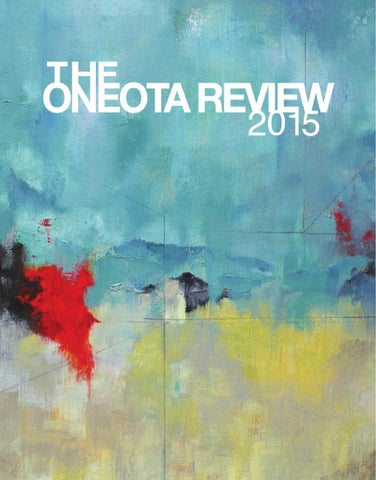
The Oneota Review Volume Forty-Three Spring 2015 Co-editors
Laura Hayes & Margaret Yapp Editorial Board
Emma Cassabaum Paige Harne Matt Helm Aaron Larson Sarah Rickertson Britany Thorpe
Emily Crowe Robbie Helgason Sarah King Jamie Linert Hayley Ryan
Faculty advisor
David Faldet
Published for Luther College by Johnson Publishing of Rochester, MN
Table of Contents Cover: “Color Study in Blue” by Hanna Knutson
Driving in Hvar Hannah Garry
6
Origin of Living Water Savannah Horn 31
River Dream Nick Shaw
7
Herdwick on a Hill Eleanore Sell
32
Maple Days Peter Jarzyna
8
payne’s Carly Ellefsen
33
June Nick Shaw
8
Anus No. 1 Jacob Clausen
34
cornhusks Sam Milligan
9
Axilla Jacob Clausen
35
Building Character Sam Gathje
10
An Afternoon Treat Claire Firary
36
Going to the Roman Pantheon With Mom Matt Helm
13
Temesgen Annie Zylstra
37
For Now Emma Cassabaum
14
Nude No. 5 Seth VanderHorst
38
Snow Angels Kasi Misseldine
16
A recipe from Cape Town Emma Cassabaum
39
Love Poem Sam Milligan
17
Eleanor Emily Tope
40
Love Dipped in Gold Leaf Matt Helm
18
Judas Zora Hurst
41
February Lamb Emma Cassabaum
19
44
The Auger Hannah Garry
20
Old Men in Enviable Jumpers Emma Cassabaum
Dawn Laura Hayes
21
Raisin Bran Sun™ Matt Helm
45
roche limit Sam Milligan
23
The Forest Katie Nelson
47
Wide Sam Raiche
24
Ophelia Paige Harne
48
Man Walking Seth VanderHorst
25
Painting Milk Sarah Rickertsen
49
Women’s Market (Woman Sitting) Seth VanderHorst
26
Fuck Wednesdays Linnea Peterson
52
The Cave Lucia Holte
53
Hissy Fit Makeda Barkley
27
Post Katie Nelson
54
On the Lion’s Head Casey DeLima
28
E.D. Matt Helm
54
Edna’s Green Box Kristin Anderson
29
Hospital Sam Milligan
55
Congratulations! Kassondra Johnson
30
Rebirth Hannah Garry
58
Envelop Kassondra Johnson
30
Driving in Hvar Hannah Garry Following a road that hugs the cliffs, Ringing the ocean below. A breeze blows salty air, hints of rosemary, Into the backseat. On the water, blue islands float Like the backs of massive animals. The tall, white mountains of the mainland, You can tell just by looking− Are not like these drifting docile beasts. They emerge from the water, Aware of their own bedrock Stretching for miles below the surface. They are not fond of guardrails here, He tells me from the driver’s seat As we lurch around a bend. They think of this island and the ocean As lovers. Flowing into each other Like two people embracing. They put nothing in between Themselves and the sea.
6
River Dream Nick Shaw The blue mountains are constantly walking. -Dōgen 4am sighs and midnight coffee twice brewed — we’re sitting on banks of the Upper Iowa whose waters howled with us through post-rain streets the night before and are now strolling past our feet through lazy frigid air — It is July and you will soon go west while I will sit in Kameoka where — past stone garden and narrow road — a home will warmly light, cracking black haze, jolt me out of morning-meditation and illuminate blue mountains shambling — I will break posture — Hozumi will scold and I will return, to my familiar West — And soon enough we will meet again, in the far west — we will overlook the Pacific whose waters will be our waters, cedar and oak will warm our hearth, Picasso will leave his hiding spot mew softly and finally eat from our hands, blue mountains will still be walking and we will not doubt them, following right alongside — 7
Maple Days Peter Jarzyna See how seeds take flight and fall— gather crisp propellers from porch beams: mildewed, rain-filmed seasons -ago,
drop
dervish
-whirling;
lostafter noon.
June Nick Shaw Some nights it rains when I go off-air and I sit in my carport or on my deck and listen to it fall, two a.m. on a pounding drive
8
cornhusks Sam Milligan how hilarious how tumultuous these two decades have been for us.
for escaping pancake-flat iowa. not enough people, not enough noise, too many cornhusks.
i’m sure you hated it, my infantile presence, a small devilish deposit of idiotic fuzz and snot.
but do you remember how those fields whispered? we would sit on the grass outside the sanctuary,
i kept coveting your things. i spoiled your birthday cake – sorry about that.
and listen to those dry leaves rattle off sermons that we’ll never understand and when i hear them now
i used to hate as well, hate your old oppressive power, an example
i know you hear them, too.
of perfection i can’t live up to sitting in the shadow of your wild success but now you’re gone and most of the states are between us but i can’t blame you
9
Building Character Sam Gathje I am awoken from my still slumber to a once black sweatshirt, stained by glue and paint, landing with a thud on my face. Opening weary eyes I stared dazed at the silhouette of my father framed by the door. The brilliant shine from the hallway was the only source of light aside from my alarm clock, which read 5:03 A.M. “Time to get up,” his voice beckoned from the hallway, “we’ve got to go to work.” I climbed the sand pile of my slumber to sit up slowly. “But it’s summer,” I say, “And my friends don’t have to work.” Confident in my derailing of his plan, I fall back onto gray and white striped pillows and closed my eyes. “You don’t have time for friends, you have to go to work,” my father tells me as he turns on the light in my room. I sit back up to argue again, but he is no longer there. All that’s left is a frame of light from the hallway where he once stood, and the receding “Thud, thud. Thud, thud. Thud, thud.” His footsteps climbing the old wooden staircase to the kitchen. I sat in the silence, trying to think of some way to deny my father this satisfaction of putting me to work. I was mad, but I had no voice against that, because he is my father. I pulled the blankets off and slung myself out of the bed. Twelve year old feet touching adulthood, somewhere between my sheets and the ground. My first job was in the beautiful river valley of Lanesboro Minnesota. We drove forty five minutes in my fathers red tool truck. Red because that it is my father’s favorite color. Red because the rust wouldn’t show as much. The truck is loud. Still, I try to curl up in my seat and fall asleep. Over the next ten years I would learn to sleep in that seat as if it were my bed. I have slept the length of highway 52 from Rochester to Pine Island thousands of times. We travel in silence, my father at the wheel. In my dreams I map the world. On gravel road, a dust storm at our heels, we rolled slowly up the last climb to my first experiences as a carpenter. The house was skeletal in the early morning haze. It would be noon before the mist from the valley saw enough sun to dissipate. I shifted in my seat. I wanted to go home. I wanted to sleep. Blanketed in mist, the bone dry timbers loomed overhead like the great jaw of some creature come to swallow me whole. I was nervous. The silence of the valley, cloaked in grey, was deafening. I sat in his truck as my father started the gas generator, casting yellow halogen light that cut through the mist like a fresh blade through drywall. “You can sweep the basement while I layout these walls.” He handed me a broom and pointed to the only part of the house with no light. 10
That day, and many days afterward I would defy my father in subtle ways. I would go to sweep the basement, but climb out a window and play in the sand instead. Another time he told me to fetch some lumber, so I went for a walk around the house a few times. My growth from boy to man, at least within the framework of a trade skill, began that summer, when my father gave me a twelve pound hammer. It was red, like his, and came with my own cloth tool apron. I hated it. The apron pulled at my waist and the hammer had a hooked claw, not a straight claw like my father’s twenty pound hammer. It was a sign of servitude, akin to a ball and chain. I was marked by the weight at my hip, no longer free to swim in streams and play games with my friends. Work was an unfamiliar isolation, and the difference between myself and those friends would only become more apparent. Entering the construction business at the age of twelve created an uncomfortable distance between myself and my peers. In the earlier years it was less noticeable. I spent many weekends writing or drawing rather than hanging out with my friends. It felt like I had to be doing more, not wasting time on games or TV. Though I had a social life, it was always different after that first summer of separation. Struggling in my attempts to glue myself back to them, to join my old friends again, I was aware of just how distant we were. I was a splinter at the edge of the board. The reality of this distance set in all too swiftly as school began again. I spent many weekends with my father and grandfather during the school year, making tables for my legos, or wooden swords for my friends and I to hit each other with, escaping school and adulthood for a few hours in the thick forest, playing knight and breaking up dragon shaped branches. However, just like the roar of cars from the highway was always present in the woods, so was the truth that my friends and I were growing apart. It’s hard to ignore the sound. They stopped over less and less. I turned to my talents, embracing every ink stroke and every slash of the saw to turn out new projects. * Heat seemed to drip from the blue openings in the clouds, sticking to my body. The day was suffocating. 2011 was the hottest and longest summer I have experienced. I stood in the haze leaning against a shovel that was older than I was. Digging the trench for a retaining wall, I grasped the shovel loosely. Slipping slowly into a coma due to lack of sleep. My father noticed me fading in and out of consciousness. My eyelids were taped to anvils. Wordlessly he walked over to me and tore the shovel 11
from my hands. He began to dig for me, furiously and swiftly. My father is a patient man, but I had pushed even his limits that summer. “Hey!” I said, snapping out of the trance. The sun still sticking to my sweat soaked shirt. My father ignored me, his red leathered back to me, years of sun had toned his body a deaf brown. It glistened with sweat, muscles working as each clump of dirt fell to a rhythm. “Cherrt” as the shovel was pushed through rocky soil, “eerk” the wooden handle squealed under new found stress, “hufft” as the dirt was tossed into a pile a few feet from the hole. “This is my job!” I say exasperated and dehydrated. He responds with a “cherrt, eerk, hufft. cherrt, eerk, hufft.” Another minute of this rhythm, I begin to lose control of my eyelids again. My father drops the shovel into the dirt pile and grabs some retaining wall block. “Less talk, more work,” He tells me striding by. “You are not going to fall asleep.” I wasn’t so sure. It is a tough thing to balance who I want to be, and who I am. * Nine years after that first trip to the river valley in Lanesboro I returned to work there once more. My father and I were ripping off and re-shingling a roof across the valley from the house that had broken me. In my memory, it was an ominously large house. A dark and skeletal house. Now, looking down from the rooftop across the valley, it was the size of a doll house. Like myself, it had grown calm and content with age. When we arrived it was still dark. It was hot. The three days it took to finish the roof never dropped below ninety degrees. My own twenty pound hammer in hand, the ‘thok, thok, thok” of nails being driven into the timbers helped keep time. By the end of the day, the soles of my feet were burnt through the bottom of my shoes, but I was satisfied. “Finished,” I said with a sweaty smile, glistening in the sun. My father nodded. “Looks like it,” he said, grey flecked mustache shifting with the words. He glanced towards the dark root river, and then toward the pale blue sky raining white heat on his shoulders. “Want to go for a swim?” He asked looking my way. Caught off guard, I stutter, “I... Um… sure?” My uncertain answer, was met by a swift but brief smile. It shone beneath his mustache for a moment. I saw it more so from the creased skin around his eyes. “Come on then,” my dad called as he hiked down the hill, away from the rusty red truck and the black heat of the shingles. I followed him into that cool limbo between childhood and adulthood, which snaked its way along, sculpting my life as time passed.
12
Going to the Roman Pantheon with Mom Matt Helm To a six year old the mall might as well be the Roman Pantheon— grand pillars at the entrance and a vaulted glass ceiling, elaborate fountains that smell of chlorine and pennies, what I called “mall smell.” You would buy off my silence with an action figure, which meant I wasn’t allowed to complain as I followed you from Ann Taylor Loft to JC Penney. Sometimes I’d get distracted and lose track of you— with a panic like my heart rushing out of my butthole— But I’d find you, breathless, teary, happy to hug you, smell you. And you would say: “Any kidnapper would give you right back because you’re so damn ornery.” I remember that time we used farting silly putty to convince the old ladies at Talbots that they had finally lost bowel control. And if I forgot my action figure inside that nest of bras I made in Macy’s you would always help me look for it. So if you’re wondering why I always ask you if you want to go to the mall when I’m back at home It’s partly because I need new skinny jeans and partly because I miss going to the Roman Pantheon with mom.
13
For Now Emma Cassabaum I have always thought that my Grandma Cass looks like a combination of Lucille Ball and Julie Andrews she has repeatedly disagreed with that fact baring her teeth when she laughs and shrugging it off even when her wedding photos look like they belong on the silver screen I had never seen her entire wedding album actually until a few weeks ago when we were digging around in the basement We do that a lot now looking for something familiar for the both of us in the unfamiliar concrete room where all of the warm things from their home ended up Spare mugs I recognize pictures of the family and an afghan she thinks her mom may have made but isn’t sure When we’re down there she tells me about the time when she was little and her cat had kittens and carried them inside to the coat closet while she and her mom and sister watched with amusement I’ve heard it before but listen like it’s the first telling pretending to have only the slightest recollection of hearing it every time we see each other which is a lot these days I wrestle my emotions back into submission when her eyes water because her baby sister is long gone We talk about the others that have followed her Annie mostly about him The story of how they met and she just knew I never pretend to forget that one because it’s the most important story she still knows And I hope that if she knows we both know it in every detail then maybe sometimes she’ll feel better about him being gone She calls him her sweetie It used to be two of them and ice cream pies winters in the warm and him driving everywhere taking care of the traditional just grandparents, tenderhearts people you know nothing about really Now I’m grown and know better and after years of being told I’m just like him I’m putting it to use 14
I try to make her laugh like he did and tell her she looks like a movie star We’ll sit and chat about their friends most of which I have never met and eat coffee ice cream with chocolate syrup which is our shared favorite The real adults in the family the ones with balanced checkbooks and careers her children parents and aunts and uncles to me get too concerned and involved they don’t eat ice cream and tell stories or dig in the basement looking for lost memories they argue and worry and push prescriptions and plan ahead forgetting that for now she’s just a woman who forgets So while they pick and plan I pick her up and take her home I remember to check the backseat for her things and remind her who’s birthday is coming up. She takes notes while we have a lesson on how to use her phone or computer or television We water her flowers before we leave the house and wave at her neighbors even though she doesn’t really know them because she doesn’t often socialize It’s hard meeting people alone when you used to be an us She frets and forgets and gets frustrated Worries about me driving home in the dark pleads with me to stay you never really think about how much words can hurt you when she asks me to stay the night but I can’t nothing has ever hurt worse She frets and forgets and gets frustrated so I remind and remember and reiterate and we go on just daytrips and errands and talking coffee ice cream and chocolate syrup because for now she’s just a woman who forgets and I can’t forget about her 15
Snow Angels Kasi Misseldine December 11, 2000 The waterproof polyester of my snowsuit whispers through the glaring white ground as I anchor my legs into the snow. A purple mitten, pebbled with ice, grasps gently onto Sugar Bear’s haunch, pulling me to sit up in my freshly carved snow angel’s wings. Only a rectangle of my eight-year-old face is exposed to the camera and abrasive wind. Round pink cheeks and bridge of nose peek over a red-checkered scarf. I smile for the picture, but my eyelashes dip under the heavy brightness of the sunbathed yard. Sugar Bear looks directly at the camera. She’s been burrowing, drilling holes with her snout and licking up mouthfuls of sweet earthy snow like frosting on a cake. Wet black nose dusted with white powder, eyes blurred by steadily falling flakes dissolved in a yellow flash to shadows of polka dots. Sugar Bear’s coat is made for the winter, equipped with a wooly under layer for insulation. Feathery blond fur sweeps in waves across her body. Snow packs in around us, a blanket spread over the brittle grass, protective. Summer Brushing In the summers I brush her hair, following the meandering whims of a restless dog up and down the slanted front yard with a fine-toothed comb. I tug smooth metal teeth through thick, sticky snags until Sugar Bear’s golden coat glistens, freed from the excess layer that she won’t need until the next winter. Wisps of cotton-candy-puffs cling to the dewy grass. I gather them into paper bags labeled “Sugar Bear Hair” with permanent marker. I want to spin it all into yarn and knit a blanket. But I don’t know how to spin, and I don’t know how to knit yet. Crumpled bags accumulate over the years in the junk drawer of my dresser, in the dining room buffet. My parents find them when we’re cleaning the house. “Are you sure you want to keep these?” they ask me. November, 2014 This fall, Sugar Bear’s coat is airy and thin. There are no snarls to comb out. I run my fingers through delicate feathers, over ripples of frail rib cage. Her tired, watery eyes gleam into mine. This silky jacket, softer than it’s ever been, isn’t enough to keep her warm through the impending months. Her fifteen-year-old body knows she won’t make it through another winter of subzero days and slippery front steps. 16
December 1, 2014 Today when I walk in the woods behind the prairie, I bundle up with my wool scarf wrapped around my face three times. Up to my ears, covering my nose. The few inches of snow from last week melted into scattered clumps over the 45-degree weekend, but now it’s 5 degrees, and they’ve frozen over again amid patches of glossy oak leaves, slick and crunchy under my boots. I follow a dog’s paw prints through the trail out into the sun-washed prairie, listening to squirrels arguing and birds warning each other of a nearby hawk. I lay down in the snow, packed too densely for angels. My polyester coat swishes against the frosty ground, but leaves no impression. Airplanes corkscrew across the sky, and a feathery cloud wraps its protective wing around the bright blue afternoon.
Love Poem Sam Milligan All I want to do is leap and bound and click my heels together threeatatime! I bet I could control the cuter wildlife if I stepped out onto my fresh cut grass. Bluejays and cardinals and redbreasts and puffball rabbits and gloss-eyed does and the tall white oaks and black walnuts would swing down and give me high fives and sing songs about how well I am. Lying in a twin-sized bed curled around your leg all I can do is think “Hell yes!” and try to hold on to the warm little center that sits in the space between us and damn I feel good!
17
Love Dipped in Gold Leaf Matt Helm I am fascinated by the way your mouth moves. Deft darts of the tongue to provide moisture, a smile, a bit too wide, that tears at the edges of your pink lips and rwips at flakes of dead skin. Strands of spittle, a liquid currency that isn't gold, with a metallic aftertaste, like iron-blood. I am less fascinated by the words that come out of it. We are shiny baubles for each other to play with, like a baby would do with with any object, exploring, not knowing or caring if what we are sucking on is a precious diamond or a worthless lego brick. This love is dipped in gold leaf, inclined to fray around the edges, a flash in the pan, two-dimensional, decadent and flat.
18
February Lamb Emma Cassabaum You should’ve, would’ve been born outside in the lush pasture sown with clover so soft that when you would have fallen there from your mother you would have bounced. But due to poor planning and the high virility of young rams, you’re here now, being born inside. It’s far too cold for you outside, and so white that you might have blended in so well as to be lost forever. All of the mothers are gathered close. Yours is at the far end, being given her space. She bathes your twin with her strong tongue, pulling his curled hair up, pulling the stickiness of her body from his, and pulling him to his feet. Your shared placenta hangs from her, like a still-beating heart. Your foot is there too, one tiny hoof just outside, like a licked index finger testing the wind, even with no wind here. She lies on her side, so full of you that her feet barely touch the ground, wobbling like a lopsided bowl. She strains against herself, blinking hard and breathing harder. She bleeds and farts and pushes until there, there you are, two hooves and a wedge-shaped face with eyes clenched tight. Your mother stands and your chest slides forward, then halts, pinched in the middle. The pressures of your bodies are working well against one another; here you are as she lies down again, done. Your second pair of hooves rest just inside her still, leaving you to work them out. Ewe breathes. Your first new breaths come fast and whispering, and in just minutes you’ll stand. You should’ve, would’ve been born outside, but then no one would have been there to watch you and marvel, mouth open. 19
The Auger Hannah Garry The ground makes a sound Like the breaking of a seal, As the sharp metal cylinder Sinks from grass realm to root. I twist and push the auger down Gripping the sides of the handle, Wrenching my shoulders with each turn. It groans against my hands as it fills. And the carbon that flexes in my muscles, As I leverage my weight against the ground, Is that not the same carbon packed into The column of soil I pull up? I stand atop An earthen belly swollen with life. A womb of humus and clay That anchors it all, Succulents lined with soothing balms And starchy kernels sprung from Sturdy stalks. It cakes my hands, Pushes itself under my fingernails, Glues together strands of my hair. I rub it between my thumb and Forefinger, forming a soft gray ribbon. Run it over the caps of my teeth, Testing the grain size. Tasting the tangy, metallic Mineral flavor– life on earth.
20
Dawn Laura Hayes When I was eight, I thought the world lived on a sun-soaked stage and tap shoes that sounded like rain drops on the ground. The meaning of my life was forts made out of my grandma’s quilts that smelled like mothballs and memories and potions made in the bathroom sink out of old apple-scented shampoo and loose glitter that stuck to my palms. “What do you want to do with your life?” Nine words that haunt my steps like a specter reminding me of the impending dawn of my Future. Capital “F” because it is not something to be taken lightly even though I was eight and I wanted my future to be making glitter potions and collecting dew at dawn and dancing on a sunlight stage. But I was told that I wanted to be a pediatrician because my grades told me that I was smart and women are supposed to like children, right? Because that stage will fade to darkness and potions can only get you so far and glitter washes off and growing up means that magic is drained from your open palms and imagination becomes a dried oasis that still bears some semblance of what it used to be 21
but doesn’t bring the thirsty relief. “What do you want to do with your life?” The words worm their way into your slumber, whispering the words over and over into your ear like a poisoned lullaby until you can’t tell the difference between the door in front of your eyes and the one that exists when you close them, but they are the same door— the same brass knob that is hot beneath your fingers and prevents you from opening this Door To Your Future and everyone all around opens it with ease and frown with furrowed brows, confused on why you can’t open the door when it’s beneath your very fingers and they don’t see the burns from when you tried to push your way through but were unable to because glitter still stuck to your palms and you still drank potions every morning instead of coffee because it was better to live in fantasy then taste bitter reality. “What do you want to do with your life?” I am twenty-one and these nine words have found me but the door before me remains unopened and the wax from my wings burns the glitter off of my palms as I fall to the dawn.
22
roche limit Sam Milligan -the distance from a planet’s center within which a satellite can neither approach nor reside without being disrupted by tidal forces suspended in black air, i am floating, surrounded by the snow of far-burning stars. tendrils of orange gas carry me, hold me like the womb. i pierce jupiter’s red heart, taking with me a piece of muscle as a souvenir to carry home for loved ones. i could get lost in the field of a giant, a solid body’s pull, and start to turn out of dimensions until my body is pulled apart and my arms bend backwards and i become nothing more than an orbit of flesh and dust. no, there are other rings in my future: fifteen hours of dense german opera the triplet of fantasy novels on my shelf a band of light-bending metal on my left hand a circle of my child’s fist around my finger’s point the orbit of my arms, wrapped around you in space
23
Wide Sam Raiche In my dreams, I can’t remember anymore-wearing his paper-thin spotted hospital gown --what it is I do. And I watch his chest rise and fall, pushing and caving against the weight of a life. But I can still feel-and I watch his eyes --the boundless joy of clouds, the vast, open wisdom in plains. close.
24
Man Walking Seth VanderHorst
25
Women’s Market (Woman Sitting) Seth VanderHorst
26
Hissy Fit
Makeda Barkley
Pen, Chalk Pastels, Collage 27
On the Lion’s Head Casey DeLima
Cape Town, South Africa
28
Edna’s Green Box Kristin Anderson
18”x24” - Ink, Ink Pen, Acrylic
29
Congratulations! Kassondra Johnson
Mixed media photo collage on wood plaque
Envelop
Kassondra Johnson Oil paint and charcoal
30
Origin of Living Water Savannah Horn
Oil and gold leaf on gessoed paper
31
Herdwick on a Hill Eleanore Sell
32
payne’s Carly Ellefsen
33
Anus No.1 Jacob Clausen
34
Axilla Jacob Clausen
35
An Afternoon Treat Claire Firary
36
Temesgen Annie Zylstra
37
Nude No. 5 Seth VanderHorst
38
A Recipe From Cape Town Emma Cassabaum Some recipes make your mouth water just from reading ingredients, just from letting your nose imagine what the kitchen might smell like when it rests cooling on the counter. But some recipes make your eyes water— and not for an abundance of onion. The one hand- embroidered on a tea towel that rests behind glass, reading: Milk Tart. My grandmother’s specialty, a reminder of afternoon tea in District Six.
39
Eleanor Emily Tope We went apple-picking when it was warm, eyes primed for a plump specimen straining to meet our outstretched arms. Like September squirrels we hoarded the fruits, shirt ends folded up to form baskets, half-cradling and half-juggling a half peck— It looks like it's going to rain. You taught me how to search for worms, how to scrutinize the crimson skin and scrub its soft spots with my thumb, the fruit wedged firmly between fingers and palm— It looks like it's going to rain. We never did suspect one could decay from the inside, shielded by smooth skin, undetectable— unless we slice it open and survey its juicy halves: Fibers gnawed and knotted, structure flawed and failing. Sour to both eye and tongue, it can't be saved. But as you flicker and fade before my eyes, I appreciate that memories are more easily preserved than apples. —It looks like it's going to rain. I know, I know, it looks like it's going to rain.
40
Judas Zora Hurst the first time the dream comes, you have had nineteen summers: never having felt particularly holy, you still rise in the morning with an olive pit in your heart you bathe your sister says you have a fine face made sour by scowling (someday a man will take her to live in his house where he will put seeds into her that she cannot bring to harvest) and you don’t disagree i dream a Pivoting at sixteen winters and spit the heart of an apricot into my palm upon waking some Deepenings should be avoided did you ever sleep with your legs tangled together? wishing you could crawl into those secret spaces between his lips, wanting to see the world through eyes like lovesickness? always besotted, the begotten one
brown boys like us don’t know how to love they spit this at our hunched backs we correct them: we don’t know how to love gently
who did he think it was, mending the soles of his shoes, bartering for the soap he loved best? thomas can’t hold a piece of bread without bruising himself and the others aren’t much better if i could quit being this way, i would but only if it meant no one else would ever love you who did he think of with his eyes closed, mouth spilling blue brightness + song? who did he open his arms for when you slept beside him? which dream was it that bared the length of his throat to your faulty hands, your treacherous fingers? 41
he woke slowly, hair clinging to your chest more shy than sleepy, more sad than shy you convinced yourself that he was in love with everyone but you frailty and feebleness are not the same. i find myself weak of body after long days, but only endless nights exhaust this Soul, this hoping beyond hope. someday i will do terrible things and say it was because of this but wasn’t it worth it? to have his shoulders - bony and warm - tucked between your knees the brush whispering what you couldn’t his curls uncoiled themselves to you the way you wanted his heart to: there was your purity squabbling over the price of perfumed oils was how you screamed nothing about me is tender but i could become supple for you and fuck him for having ears that big while never hearing it your eyes are liquid and despite my better judgement i still thirst
everything you are is the only thing that is dear to me and there is nothing else
you muttered these things under your breath as he took you into the forest for the sixth time in as many days: the others don’t look twice no one notices your shortness of breath or your trembling what if he is married? a slender gold band he would tap against the table in a country where he’d forgotten your name what if he is killed? you are still so angry all the time, and sadder with each new moon you hate your heaviness + wish for the Ease of him what if neither of those things is what tears him from you? is it still a nightmare if his arms are pulling you close? 42
if his mouth blooms for you alone?
“what kind of love is this?” he is not handsome like peter, thick-chested and boisterous but exquisite in a different way: the planes of his face fitted together like they were made for your hands the divot beneath his bottom lip a well for the pads of your thumbs foolishness like this can never be claimed by anyone. who would want it? who would want the weight of such decadent ignorance, at a price such as this? you think of jonathan, and the man for whom he drew back his sheets he sits before you in supplication needles of cedar and pine clinging to your knees, perfuming him unlacing you the olive pit sprouts at the split of his mouth and the joining of your fingers he holds your once-fine face the breadth of his hands, his calloused fingers around your ankle, calf, thigh no new groves, but not for lack of trying. it’s just the sun is so much weaker now and at night the air is full of painful utterings, all moonward. there is a new Emptiness revealed by loving and a terrifying fullness in the next room. your teeth leave a mark on his side and part of you wants to make him cry. hard. “what kind of love?”
43
Old Men in Enviable Jumpers Emma Cassabaum Old men in enviable jumpers of various colors and pattern ride the bus to and fro. For what purpose I am not quite certain, other than to wink at young women and to offer kind direction to those of us so obviously tourist. ‘You have beautiful eyes, my dear.’ says one in blue with tiny white crosses, catching my attention from across the aisle. ‘Thank you.’ I smile, assured by his indomitable warmth. ‘You’re quite welcome.’ He grins. I consider turning away and back to my window gazing, but refrain. ‘And I must say, I quite like your jumper.’ I return. ‘Thank ye kindly!’ says a new voice. From behind blue and white crosses peeps a smaller gent in fair isle reds, his glasses sliding down his nose. ‘I made it fer him, this past Christmas.’ he continues. I chuckle, and notice the two men sit with their fingers intertwined. ‘He’s always been a talented knitter, this one.’ beams Blue. ‘Ay, but this one’s an amazing cook.’ Red counters. He’s looking at Blue the way everyone wishes to be looked at, with eyes that just know and don’t really need to say a thing and a smile that curves out of known habit. I blush for my seeing it but don’t look away; this is the sort of look you aren’t often privy to. It’s a gaze to be kept. ‘That sounds just perfect.’ I say, the dumb smile of unexpected joy spread across my face as the bus slows to a stop at Rosscarbery. ‘It certainly is.’ says Red. The doors sigh open and they stand—this is their stop. ‘A good day to you, miss.’ Blue says, tipping his hat as he disembarks. ‘Thank you, and a good day to you as well.’ I reply. Red follows along after him, but just before he exits, he turns and gives me a wink.
44
The Raisin Bran Sun ™ Matt Helm The automatic doors are marked "EXIT ONLY" but that doesn't stop me from going through them because I am on a Very Important Mission. The fluorescent lights sting my eyes which are red around the sclera, framed by heavy lids and watery with giggles. The ancient greeter exhales a hollow "hello" and I swear a bit of sand falls out of his mouth, but I ignore him and grab the closest shopping cart. The clinkclink of a rogue wheel lets me know that I've made the wrong choice, but it's too late to turn back now. I feel myself pulled onward by some Fundamental Force. As I turn down a corridor of the labyrinth I am blocked in on both sides by multicolored boxes that run up to the ceiling. The cart clinkclinks past the faces of familiar brands, characters I've known all my life, who practically raised me, that will outlive me and outlast my longest friendships— and like my friends, they each have their own idiosyncrasies and faults. Trix the Rabbit™ is that one unlucky bastard who can't catch a break, Tony the Tiger™ is your friend's hot (but Republican) dad, The Lucky Charms Leprechaun™ is a homosexual, and the CooCoo for CoCo Puffs Bird™ is a junkie looking for his next fix. Above them all, on the highest shelf, resides the yellow Raisin Bran Sun™. The Raisin Bran Sun™ looks down at me and extends his fiery tendrils towards my shopping cart, plaintively offering two scoopers full to the brim with raisins. The friendly creases around his eyes belie his power and his goofy grin begs the question: Does he even know that he is at the center of our Solar System? That simpering smile can't exist just because he loves raisins. Who likes raisins that fucking much anyways? No. This great Pagan Idol, this Ra, is smiling because he knows if he ever stopped doing his job not only would we not have raisins 45
or summer tans, we'd be dead within the 8 minutes it takes his light to reach the earth. The old dude who lives across the street who mows his lawn in his underwear, with that patch of curly black hair that sprouts from his lower back and climbs up to his fleshy shoulders— Frozen to death. The housewife next door who calls and warns us when she sees black people in our neighborhood who is currently absorbed in an episode of Days of Our Lives while the autistic son she is homeschooling plays on his iPad— Reduced to nothing. Joey from down the block who I used to hang out with when I was a little kid, before he figured out I was too different, who is probably home for summer break just like I am— Snuffed out. And me too, stoned out of my mind and staring at a cereal box in Wal-Mart, made into a human popsicle in an instant. Along with all of the other people I've ever met and never met and will ever meet or never meet— All gone. I grab a box of Lucky Charms™ and leave the store.
46
The Forest Katie Nelson
The forest is dark this time of year, much more than my mother would be comfortable with. I look over my shoulder, spy on the tops of the trees, listen for anything beyond the birds. There’s nothing there, but I still feel uneasy. Mother would be unhappy. The trees bend like sentinels high above me, watching my every move. I pretend to ignore them. The dank room is colder than I remember, and I must keep wiping my nose on the sleeve of my dress. Mother would not approve. The dark man enters and I work more quickly, turning the wheel, turning the wheel, pumping my foot on the treadle and never looking up, never slowing down, barely breathing. “Fine work, my darling,” he said, and exits the room again. I return to my normal pace, allowing myself to breathe again. The spool creaks and those are the only sounds in the room, able to cover my nervous, ragged breaths. I sit under the creaking wheel in this room, as I have this day every year, without my mother’s knowledge, without anyone’s knowledge but the dark man, the hunched man, the man with the crooked nose and darting black eyes and that dark green skin that I should have run from the first time I met him. Instead, I had taken his deal. And now on this day each year, I sit in this room, and run his wheel, spinning my blood into gold. And for what? My tears do not turn to gold.
47
Ophelia Paige Harne Feel the rush of the cold water filling your ears and nostrils, pushing against your eyelids forged shut. Hair, drenched, melded to your molded shoulders, cascading down your exposed spine. Ribs revealed under sculpted dress – your funeral garb, dragging you down under its water-soaked weight. Arms stretched wide inviting the darkness below, embracing that sinking feeling. Icy water burns your throat and fills your lungs. Still and noble, you drown, the tragedy no longer yours to bear.
48
Painting Milk Sarah Rickertsen Ginger lifted the tattoo gun in her hand and sighed. Her customer was young, pale, her gleaming torso trembling under Ginger’s gloved hand. White shirt pulled up past whiter ribs. Virgin skin. Just turned legal. Ceiling lights shook down dust as the one o’clock train passed. All she could think about was the museum guest. Vermeer is back in town! exclaimed bus sides and train depots and scrolling screens. Posted, shouting, for weeks, months. First time in 15 years! September 3-29 ONLY! So Ginger went. A treat—real coffee and different company, people that whispered and looked and stood still, remembering. High art. She made a point of avoiding it. But for Vermeer, she went, though it would hurt later. Ginger didn’t have much time for trips out, but yesterday she had turned her sign to closed, sorry at four and gone downtown to the museum. “Is there something wrong?” came the girl’s tremulous voice. “No, no—just waiting for the train to pass.” What was this design again? Was the quote MLK or Gandhi? Chinese characters that supposedly meant wonderfully Zen feelings, proverbs? Birds, trees, feathers. I refuse to sink—anchors are supposed to sink, dumbass. Focus. Ginger smoothed out the paper sketch. “Please try to relax,” was all she said as pores quivered, nerves anticipating. Ginger sipped her dark roast, sugar-no-cream, and wept by The Girl with the Pearl Earring. The clear contour of her jaw, clean lines of cheeks and neck against crisp darkness, a composition stamped on her child memory banks from when Mum dragged her to museums. It had been so long, and She looked just the same. This had not been her plan, crouching to others’ desires. She pulled out a new needle, five-pointed for the line art. Tattoo had not been—was not—her dream. She settled herself in the chair, flexed her fingers, took up cloth and coil. She was an artist, a tattoo artist, tattoo was art. Mantra of the years. Milk pearl against milk skin, ghosting about the corners of her eyes. Skin stretched pale under her fingers. “Take a deep breath,” said Ginger, and stepped on the pedal. “I’m not paying for stuck-up failures to teach you how to finger-paint,” snapped 49
Mum, again. She scrubbed the kitchen table to a high polish, as if shine could hide dents and chips. Spilled paint still speckled its surface. It was why Mum’s face was flushed, cheekbones splotchy. “I’m not asking you to,” said Ginger, again, twisting orange-and-blue-stained hands under the worn tabletop. Hide the evidence. “You need to do something productive, get a career, a life—” With a sigh, she tossed the rag into the sink, hands angry and eyes sad. “We can’t afford art.” “You said they were beautiful.” “Yes.” Looking at the newest creation, glistening against the wall. “You’re in the wrong time—they won’t sell.” Ginger submitted her college application later that week, in secret, and she always volunteered to get the mail. She painted only in the back alley. The sketch was a tree this time. Simple, coiling branches. Little birds flying past it or perched on the boughs. Ginger ignored the girl’s panting breath. She should have brought a friend, if she wanted someone to talk to. Breathe in, breathe out. Feel the curve of the line in the wrist, fingers steady. This is permanent. The needle blurs, its five sharp points pulling skin and pushing ink, and slowly the lines wind, trunk leaning past navel, limbs reaching for ribs. “This is unacceptable.” Dark eyes, dark lips, both perpetually curved downward. His whole face was all dragged curves, lines stippled a bitter blue-black of stubble and failure. “I asked for Pre-Raphaelite, not this Romantic slop.” Ginger could only stare up from her stool, throat tight, focusing on all the downturned lines in his face and wondering what had put them there. Did his work not sell? “Start over.” But she couldn’t pick up the brush. Her fingers shook too much, and wet vision blurred oils to watercolor dribbles. Long, crouching minutes. Wrists screamed, eyes watered, but Ginger pressed on, agonized fingers still perfectly poised. She did not need to see the design; the needle pointed the way, melded to her fingertips, and together they did all the seeing. Both tears and coffee drained, Ginger repinned her bun and continued the exhibit, ribs empty and relaxed. Reddened eyes began clearing to better observe immaculate brush strokes—sore fingers cautiously practicing the long-abandoned swirl of paint, remembering butterfly touch on canvas. Heartbeat slowing to hear whispers from frames. She walked through the park on her way home, a practice lost years ago. Eyes white and brown and shocked wide open, for Vermeer was everywhere. The sky was freshly poured milk, dark curves of trees suspended in the bowl, their weathered skin painted in short, jagged smears. 50
Vermeer was not just oil. Art was not only in museums. And her fingers still twitched. “That should do it.” Ginger stepped off the pedal, watched the pulsing skin ease to a shiver, let her eyes ease back into focus. But the coiling tree curved sharper, darker, fine oil paint under rapidly blinking eyes. It was not the picture the girl had brought in, and Ginger’s insides began to melt and slide and puddle, heavy, in her shoes. “I—I adapted it, a little—” she began, once again eighteen and staring up the hooked nose of her art professor, watching his long nose hairs tremble in disapproval. The girl twisted to look in the mirror, holding up her pale shirt past white ribs under pink skin. She stared at the tree, still draped with grace but now textured with color, the birds black against her skim-milk skin, and her eyes shimmered as she looked. Ginger readied her fingers for the cash drawer, the complaint file, as the girl sniffed and stared. “How did you know?” And now the girl had turned back and was clutching Ginger’s still-gloved hand, the one not holding the coil, saying “it’s perfect, it’s perfect,” over and over again, and Ginger could only squeeze back and try to smile, because she didn’t know how she knew. The girl left as another train shuddered past. Ginger waved the fading thank yous goodbye and turned the sign to closed, sorry. There were no more appointments today, anyway. It was dangerous to stray from a customer’s design—very, very dangerous. Word got around and people stopped coming. But the girl…the girl loved it. She was an artist, a tattoo artist, tattoo was art. It had always rung empty, still rang empty, but now there was a thread. Trailing off into darkness, the end dangling in pointed obviousness, whispering. Ginger took down the closed sign, scribbled out 7 p.m. and wrote 4 p.m., and put it back on the door. She pulled out her dusty sketchbook, settled in at the desk. Never mind sore fingers. And tomorrow she would visit the Girl again, her milk earring and skim skin, dark blooming behind her.
51
Fuck Wednesdays Linnea Peterson No, seriously, fuck Wednesdays. I had no particular prejudice for or against any of those seven column headings on the calendar until Wednesday, December 10, 2008, when my father hauled me off my school bus to tell me my mother had breast cancer and it was time to say goodbye. Though he only meant “see you later” (“goodbye” was a slip of the tongue) I was right that day to lose my childish conviction in earthly eternity and conclude we were condemned to seek our infinities in a limited number of days from then on. Now you have awoken to news that your father has no more shot at earthly infinities, not even little ones, and you are at college, too old and too far away for anyone to drag you off a school bus and tell you it’s time to say goodbye. It is Wednesday, and fuck that. I wonder if our friends will one day tell the same story about me as they’re currently telling about you. I wonder if it will be a year from now, or two, or ten. I wonder if it will be a Wednesday. 52
The Cave Lucia Holte One day we went to a corn field. It looked like nothing. It looked like a great place to be murdered. A single shed stood in the middle, inside: a long narrow pipe, throat-like, swallowing us, stretching 100 feet below— our portal to the world underground. Around it we were rooted, hoping to discover courage to descend or leave. My knees shaking, hands glued to the rungs as I made my way down. The grinding of steel told us our portal was sealed turn off your lights, our guide told us and so we did, feeling the darkness like a cloud, heavy, eyes frantically figuring out a world that to them no longer existed. Here, closed eyes feel better than open ones though they see the same. I thought about this later as I climbed the grimy rungs back into the light.
53
Post Katie Nelson I received the strangest thing in the mail today. The package was pedestrian and the postage looked fresh, but I did not recognize the return address. I cleaved the tape apart and in the box was the source of my livelihood. I wonder how it got there, my heart, and how the sender took it without my knowing. I held the heart in one hand and held the sender’s note with the other. The unfamiliar script read: Your father has passed today. Our sympathies. The heart in my hand shuddered a second and I pondered over who sent the package. I suppose, I must not know.
E.D. Matt Helm it isn't light hollow bones or avian flight it is bones like lead a tiredness that is as much a part of the body as epithelial tissue sinew and heart it is eyes anchored low skin sallow drooping weighed down by stones pulled below earth under world i ate the pomegranate seeds— promptly puked them and now i wait for spring 54
Hospital Sam Milligan The backseat of a police cruiser is an uncomfortable place. The hard leather smells like cigarettes and bad decisions and there's a big lump in the middle of the seat so you can't really lie down and take a nap like you used to in your mom's sedan on road trips. I try anyway. I am eighteen years old. I'm being driven from one hospital to another, from an Iowa town to an Iowa city. The night is dark and starless. I've been lying in the emergency room for hours, waiting for some verdict from the college I attend. They were debating about whether or not I am sane enough to make my tuition payments worth it. They don't think I am. They demand a proper psychiatric evaluation. I am to go home immediately, wait for several weeks to get an appointment with a clinical psychiatrist, and spend five days in an overcrowded hospital wing under the watchful eye of people who know what a suicidal teenager looks like. This would mean that I am effectively kicked out of the school. I ask if there is any way to streamline the process. They tell me I can get an evaluation at any hospital, as long as there is an open bed. Mason City has open rooms in their psychiatric ward, so I'm going to Mason City. The car stops. I enter through a dark hallway, lined with glass panels and poorly-laid floral carpet. A desk sits at the end of the cold corridor, beside a pair of sickly green double doors. A plump nurse looks at me with pity as the police officer checks me in, making sure I'm going where I'm supposed to. The officer is a nice man – he does not treat me like a criminal, but like the child that I am. Later I will understand that the presence of this officer means that I'm under court order to be held at this hospital, and that I cannot leave. A man dressed in flannel charges down the hallway in a wheelchair pushed by a woman wearing sweatpants and a stained cotton shirt. He clutches his chest with his right hand and cries and shakes. The woman screams that her husband is having a heart attack. He is immediately taken through the green doors by men in white coats. Eventually, I follow him. The doors to the psychiatric ward lock from the outside. On either side of the pale green hallway are reinforced glass windows. To the left is a room with many circular tables and plastic chairs, all facing a television. At the end of the hall, a windowed office holds a group of tired nurses. I turn over my clothes, my shoes, my belt, and get a pair of blue-green scrubs and socks in return. The socks are very thick and warm, and have strips of rubber on the bottom to counteract the slick tile of the hospital. I’m not given any underwear. 55
A large male nurse walks me through another set of locking doors, down another hallway to another room with circular tables. He sits me down and asks me questions about myself. My age, my weight, where I'm from, what I like to do. I ask him what he used to do before he was a nurse. “I was a security guard. Got laid off,” he gruffly replies. I stop asking questions. I go into a bathroom and pee into a cup. The nurse stands behind me and makes sure that I haven’t tried to smuggle in fake urine. I'm assigned an empty bed in a room and fall asleep quickly. When I wake up, I'm not sure where I am or why I’m wearing uncomfortable monochrome pajamas. I remember soon enough. Light pours into the room from a window above my bed. Through the open doorway is a hall of fluorescent lights and green walls. I want a cigarette. I want ten cigarettes. One of the two doors in the opposite wall – both locked – is marked “BATHROOM.” The doorknobs are brushed metal, convex domes designed to prevent me from hanging myself with a strip of my clothing. Everything in this wing is made in a way to prevent tragedies known in the professional world as “Sentinel Events,” unexpected instances of death, physical injury, or psychological trauma. They include infant abduction, drug overdose, wrong-site operations. Patient suicides. I walk out of my room, into the pale green hallway. The people around me are wearing the same blue-green scrubs and non-slip socks. I approach a nurse and ask her what I'm supposed to do. She's wearing actual shoes, so I know she's a nurse. She tells me to walk into the windowed room and to watch television with the rest of the patients. The television room is small and cramped. A sickly blue patterned couch sits against one wall and blends into the stained blue carpet. Above the couch behind a reinforced glass panel sits a list of rules. All of the rules tell me to be nice to the other patients and to avoid any violent outbursts. In the afternoon, patients attend group therapy. The nurses tell us that we only have to go if we want to. Since I'm dedicated to cooperating, I lie and say that I would love to. Over the course of two hours, I listen to people open up about their struggles. Alcoholism. Meth addiction. Abusive boyfriends. Inescapable depression. One of the men tells us that he had been putting away a bottle of vodka every night. His face looks like a wet plastic bag. He's to be released this afternoon, but he doesn't seem too happy about his upcoming freedom. He tells me after the therapy session that he's been here before, and that he'll be back soon enough. On the third day, I'm moved beyond the first locked door into the low security sector. This means I can go to the bathroom anytime that I want. I spend days three and four in the social room, doing puzzles and watching television. For the entirety of the fourth day, there is a marathon of a television program called 1000 Ways to Die. The outer wing also acts as the rehabilitation center for the hospital, full of meth 56
heads and heroin addicts. I bond with them about how much I want a cigarette. I talk to them about pot and booze, about how these light drugs just don't provide enough of an escape for them anymore. They think I'm funny and full of innocence. There's a girl here. She has dark hair, and big eyes, and a frail frame. I think I'm attracted to her, but I could just like her because she talks to me. She’s addicted to methamphetamine. She tells me about her ex-boyfriend, Randy. They made meth together in the backseat of cars. They hunted for crystal together, and mourned when their searches ended unsuccessfully. He put cigarettes out on her arm. She is in rehab for Randy as much as she is for meth. I do not know how to respond to her problems. On the fifth day, I am released. My father comes to pick me up. He brings me my only request, a pack of cigarettes and a lighter. I'm not allowed to have my sweatshirt, my belt, or my shoes back until I'm officially released from the wing. The dark-haired girl is getting out at the same time. She is very excited to be able to put on makeup, a splatter of neon pink and black. All she talks about is how many cigarettes she plans to smoke. I think she'll be back here soon. My father drives me to an exit ramp in silence, where my mom picks me up and takes me back to school. She stays in a hotel with me. I'm still not allowed onto the campus. I come back anyway to say hello to my friends, and to get my computer and some fresh clothes. The next day, I meet with the assistant dean of student life. We argue about my sanity. I tell her that the psychiatrist diagnosed me with mild depression, and told me that I didn't belong in a hospital. I seem to convince her. I come to realize the innocence of my issues. I come to realize the normality of what I feel. I come to realize the injustice which has been done against me, and fire runs through my veins when I think about fluorescent lights burning against green walls. I return to school and pretend that nothing happened.
57
Rebirth Hannah Garry We walk under glistening calcite arches, Through hard ivory drapes stuck to cave walls Like a curtain being pulled aside, The show of inner earth about to start. Stalagmites rise like milky towers of ice, Jets of water frozen in mid-air. Stalactites send down drops of water, Crystalline liquid from a jagged sky. The two remind me of Adam on the ceiling, Reaching for a touch from his creator. Only it’s backwards− The stalagmites must wait until the end of their life To touch their creators, And be reborn as columns of white.
58
T E
2015