Luther magazine feedback, inquiries, and ideas may be sent to the Editor, Luther Magazine, Luther College, 700 College Drive, Decorah, Iowa 521011045; magazine@luther.edu; phone (563) 387-1483
Class Notes submissions, changes of address, and alumni news may be sent to the Advancement Office, Luther College, 700 College Drive, Decorah, Iowa 52101-1045; alumni@ luther.edu; (800) 225-8664; (800) 2 ALUMNI.
Find us online at luther.edu/ magazine.
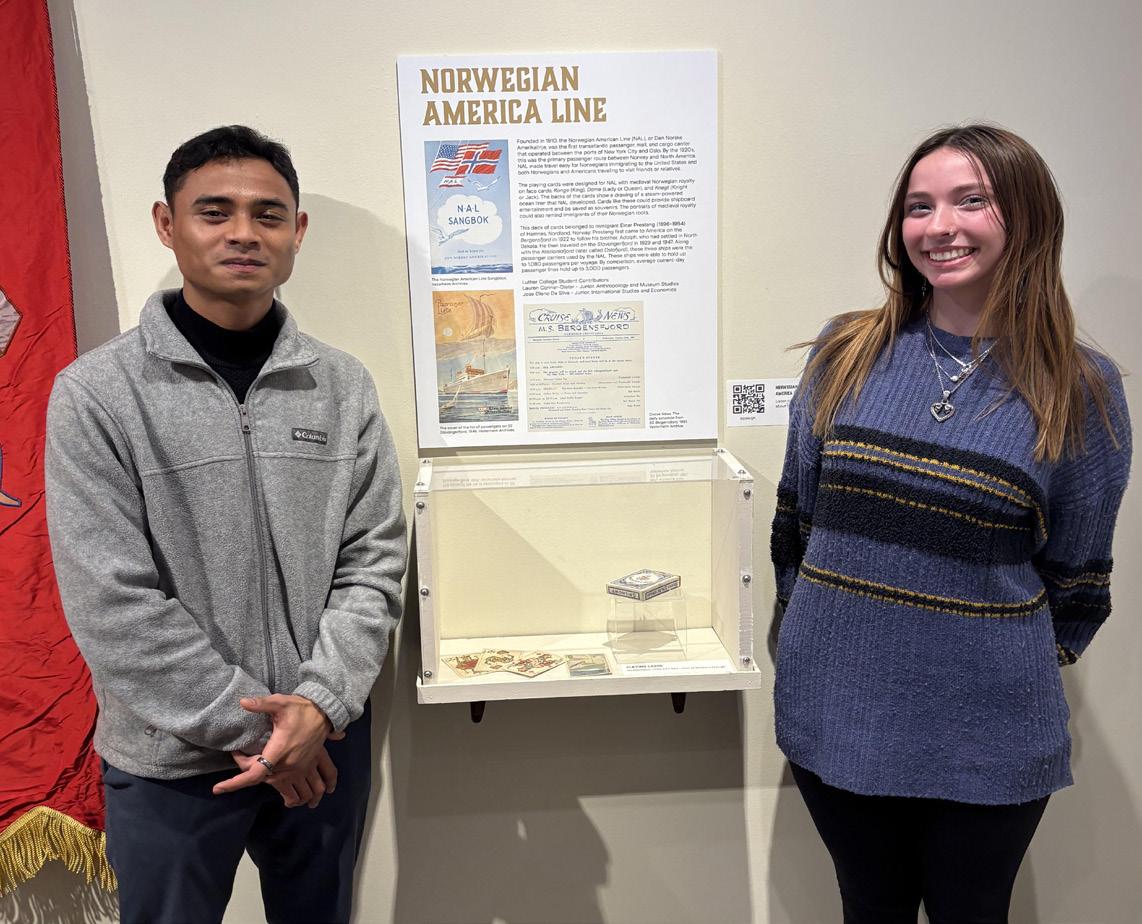
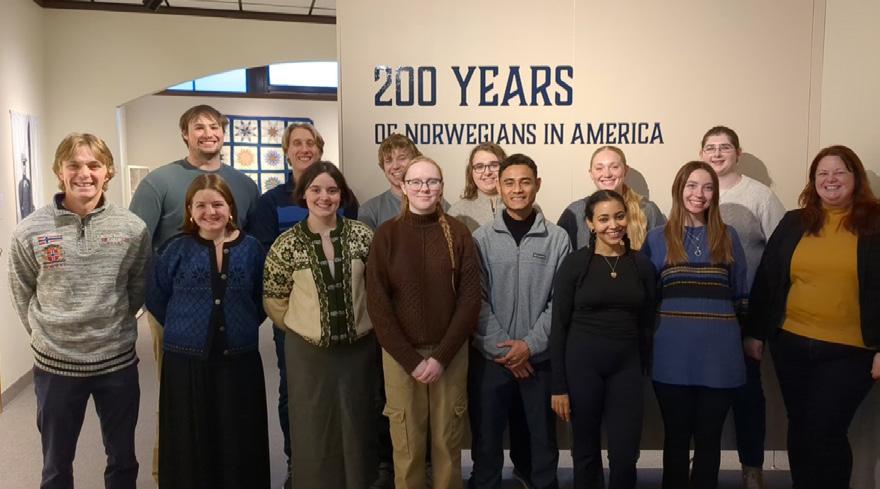
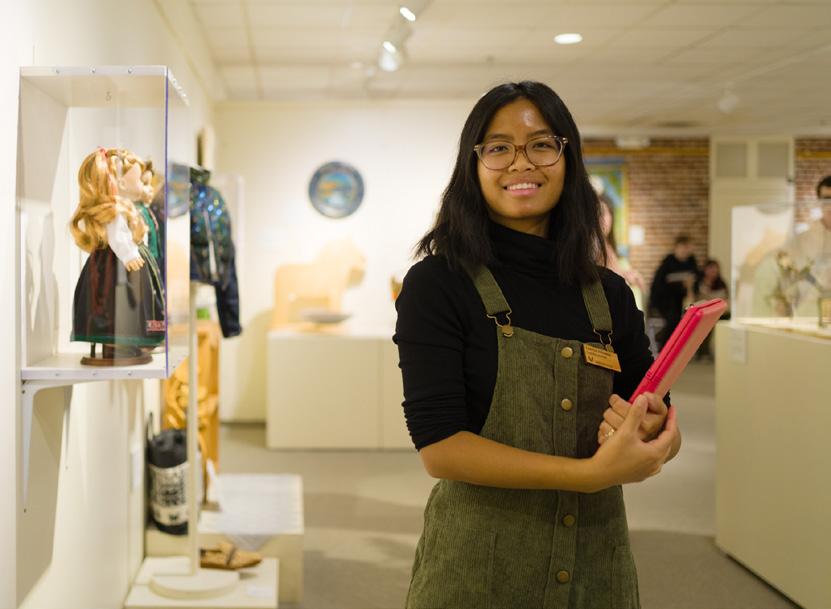
Eliano Da
and Lauren
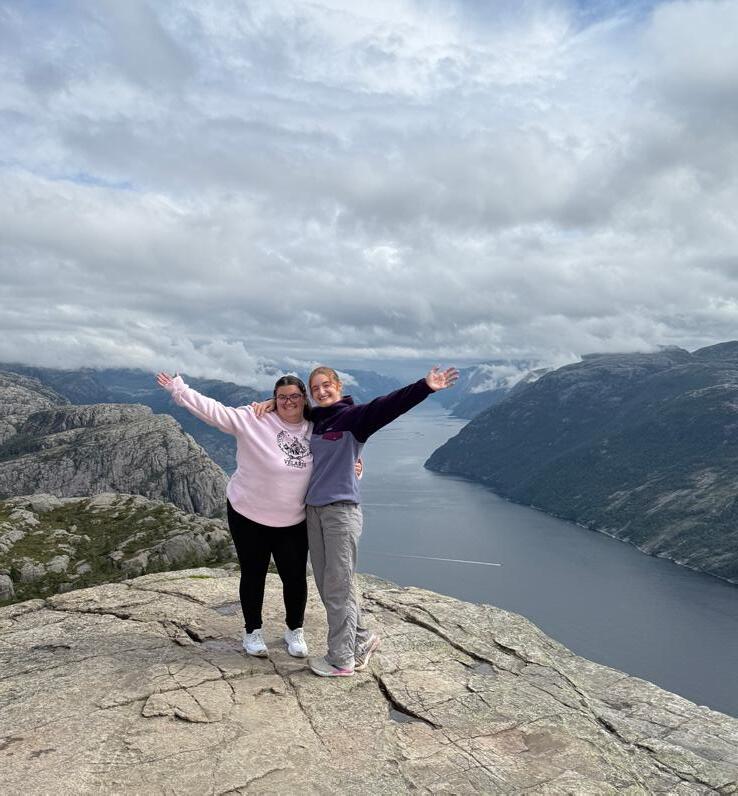
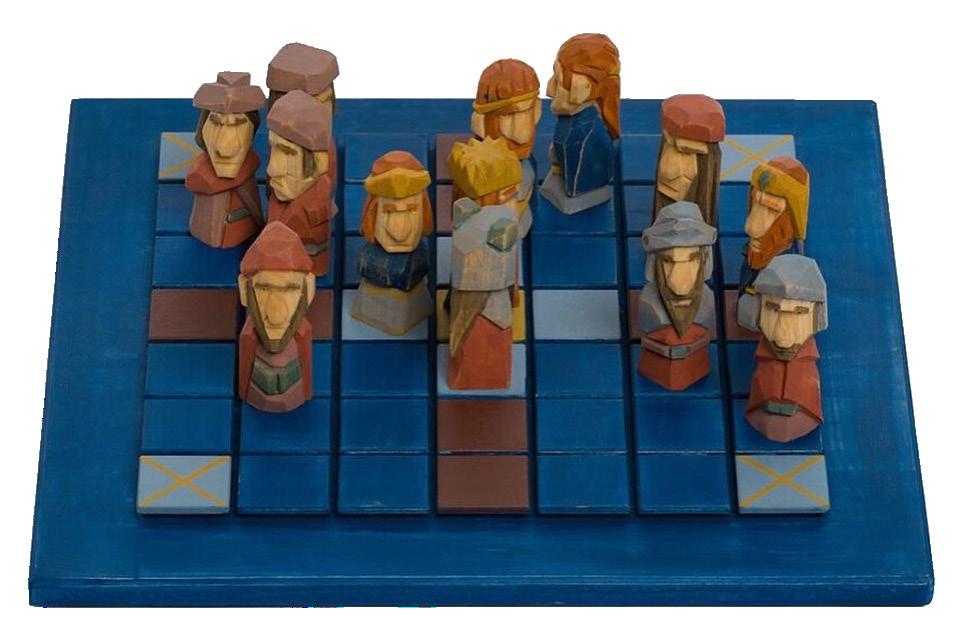
’26 contributed to a Vesterheim Museum exhibit that ran throughout 2025. Read more about the hands-on learning that Luther students do at Vesterheim on page 12.
Shaped by Norwegian Immigrants
Memory Keepers 18
Luther staffers and local scouts create keepsakes on behalf of the college.
Homecoming 20
Growing Together 22
Alumni in Minneapolis work toward accessible food systems.
Channeling Grief into Action 24
Two special alumni navigate a deep loss by helping others.
LET’S STAY IN TOUCH
Update your contact information to hear about class reunions, events in your area, and college and alumni news. You can also update your personal and professional news or submit a birth/adoption or marriage announcement. Scan the code, email alumni@luther.edu , or call 800-225-8664.
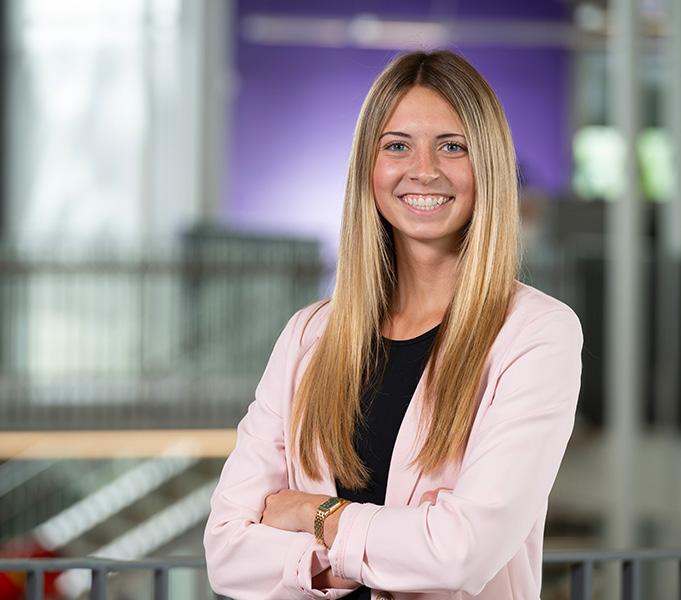
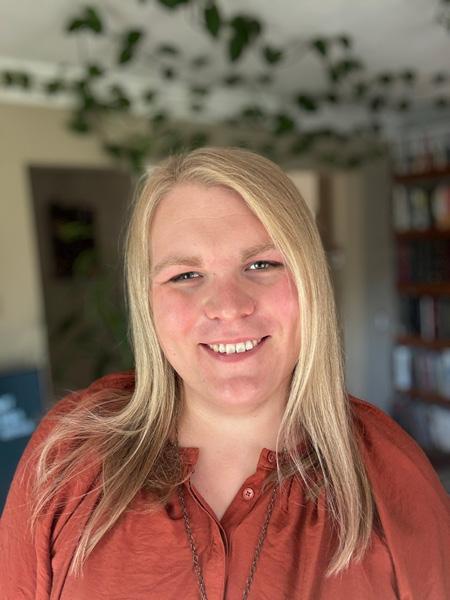
Jose
Silva ’26
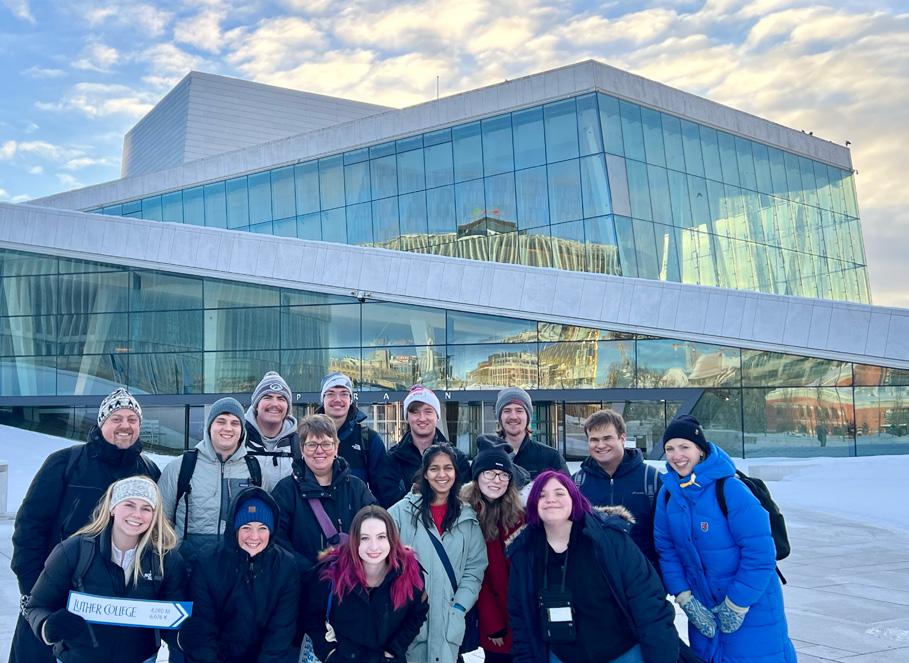
Conner-Dieter
AN OCEAN, SEPARATED BY UNITED BY OUR
Values
Dear Luther Community, Luther College, the Vesterheim Norwegian-American Museum and Folk Art School, and the city of Decorah recently completed a yearlong commemoration of the 200th anniversary of organized emigration from Norway to the United States of America. Working together, we added our voices to the celebration of a story of a people who crossed an ocean to seek a better life. Some of these immigrants found their way to the Midwest region of the United States and founded Luther College.
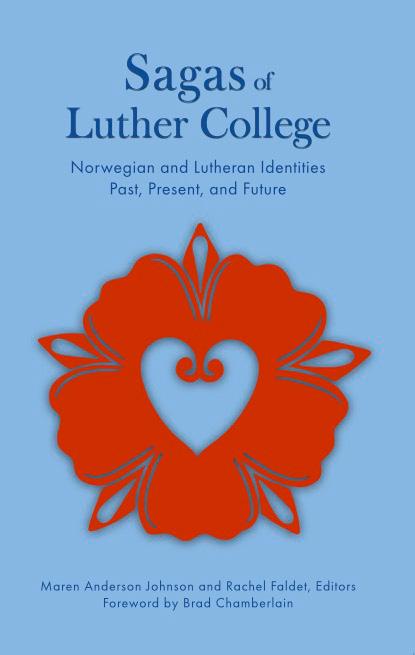
The commemoration began with the release of the anthology Sagas of Luther College: Norwegian and Lutheran Identities Past, Present, and Future, and it culminated in a visit to Decorah and to Luther by His Royal Highness Crown Prince Haakon of Norway. Throughout the commemoration, Luther explored questions like: What does it mean to be a college founded by Norwegian immigrants? What values that our founders held dear continue to shape Luther in the 21st century? How does our history translate to student learning and student opportunities today? What does it mean for our diverse campus community— the majority of whom no longer come from a Norwegian or Lutheran background—to live and learn at a college founded by Norwegian Lutheran immigrants?
This issue of the Luther magazine features articles inspired by the commemoration and its activities.
In reading them, I hope you appreciate the enduring connections between Norway and Luther, as well as the close teaching and learning partnership Luther has with the Vesterheim. I hope you learn more of the story of a people separated by an ocean but united by their values and their collective pursuit of the common good. And I hope you better understand how Luther’s Norwegian heritage and its historic immigrant identity equip it to meet the moment and address the changing needs of students and our global society better than other colleges and universities.
Soli Deo Gloria, Bradley M. Chamberlain President
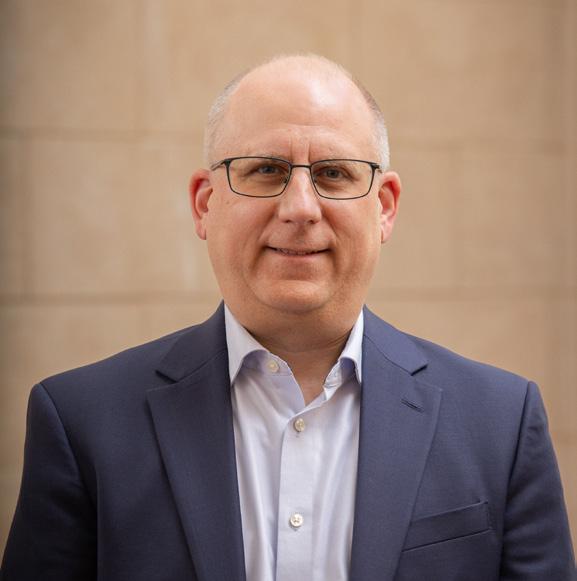
President Brad Chamberlain
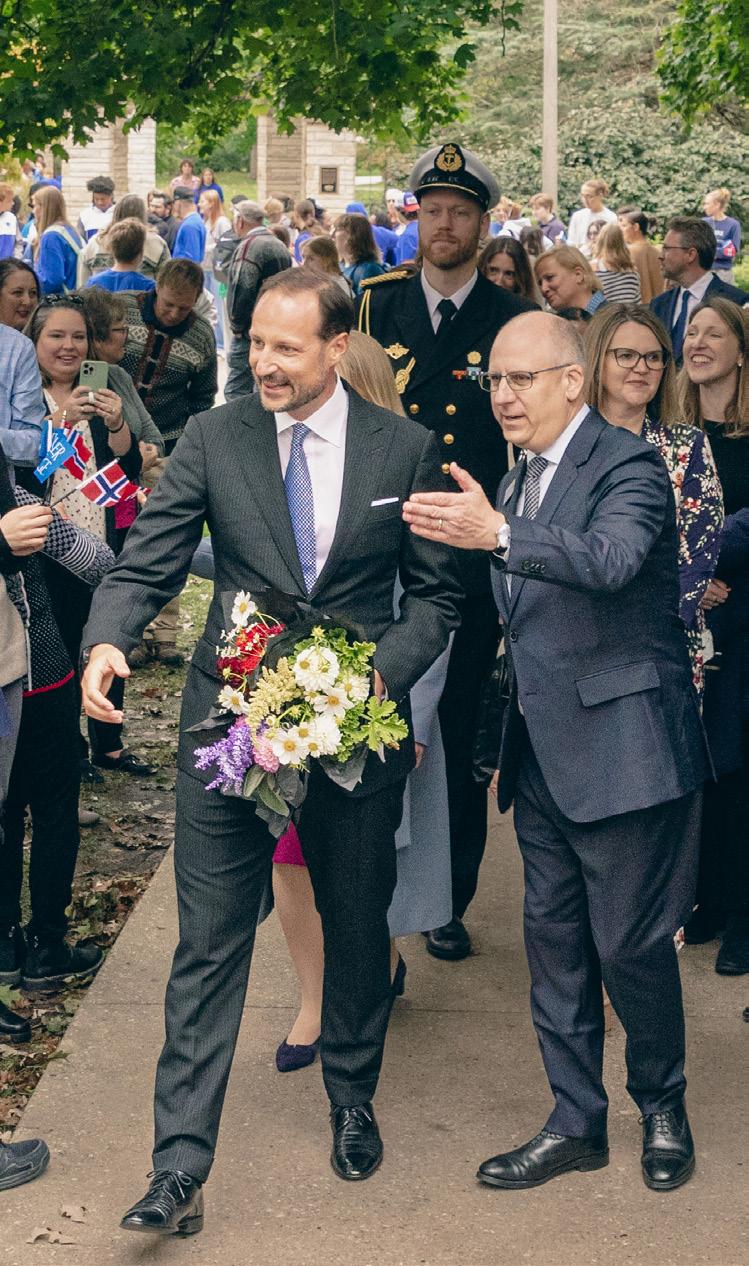
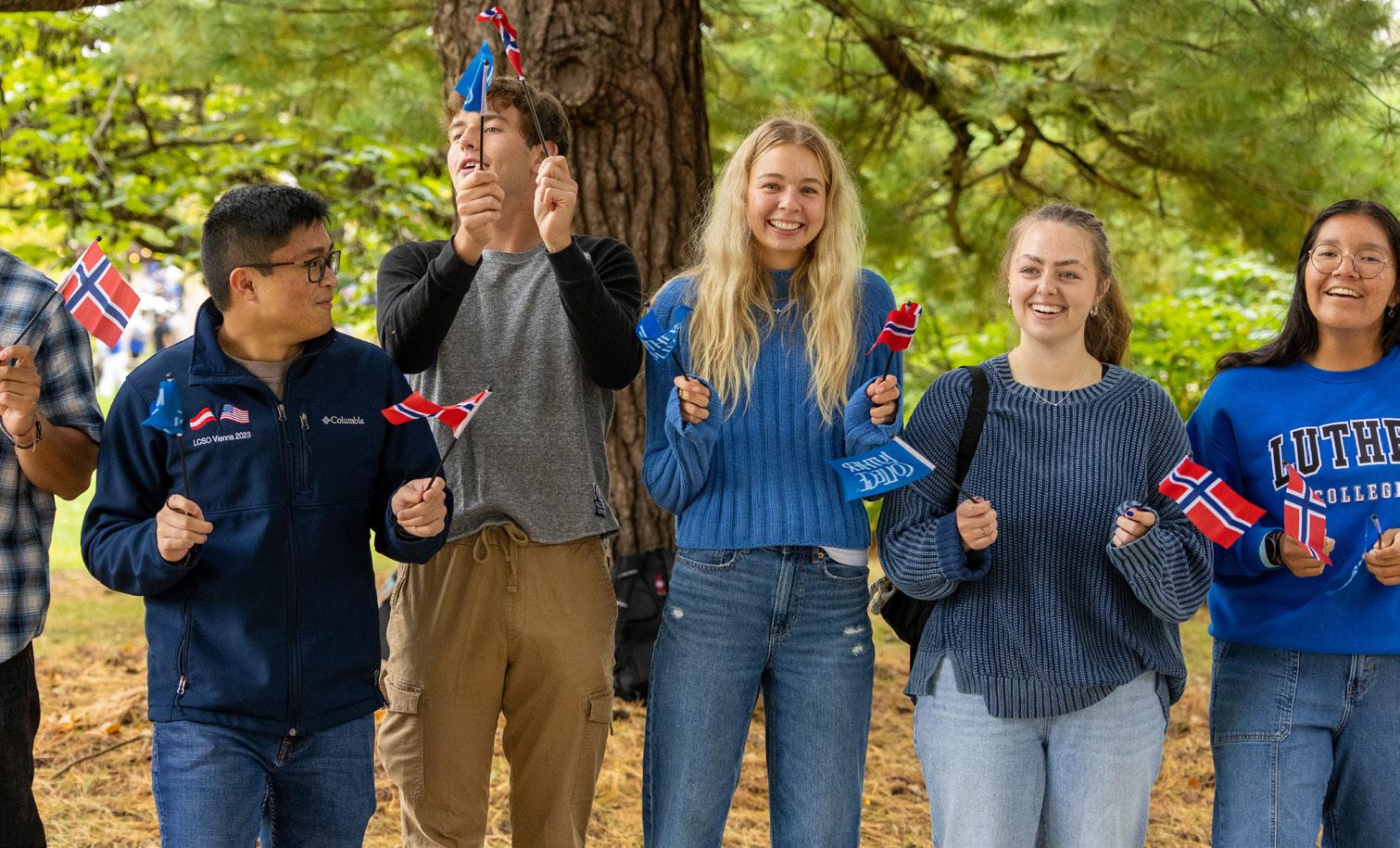
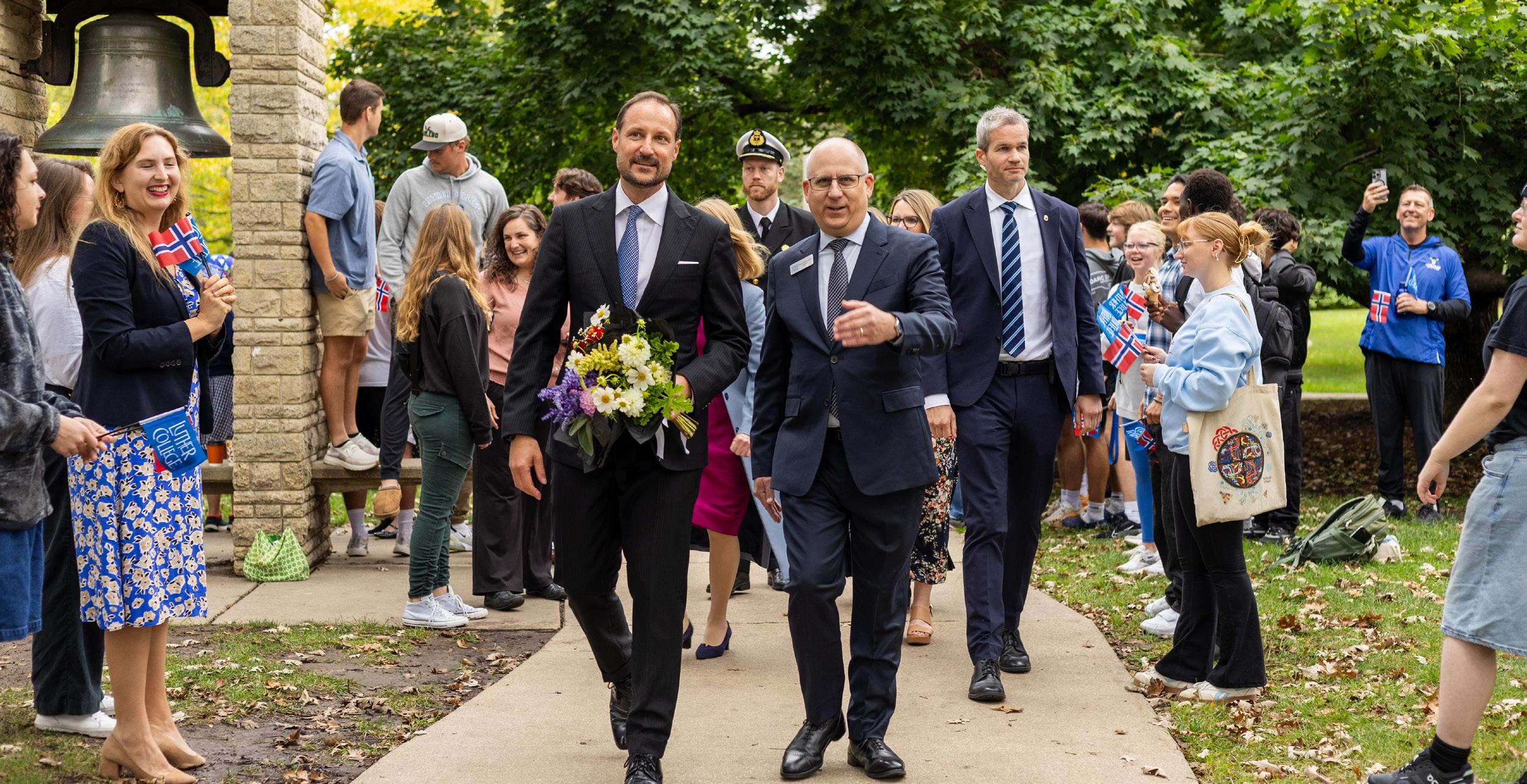
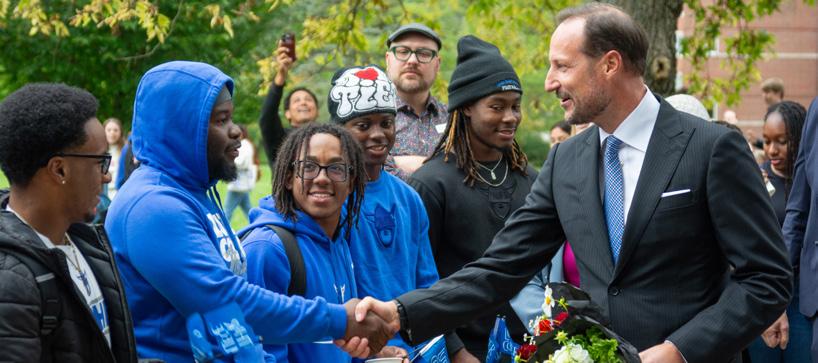
Students celebrated the ties between Luther College and Norway during a visit in October from His Royal Highness Prince Haakon of Norway. Scan the QR code for video highlights.
A HEARTWARMING INAUGURATION
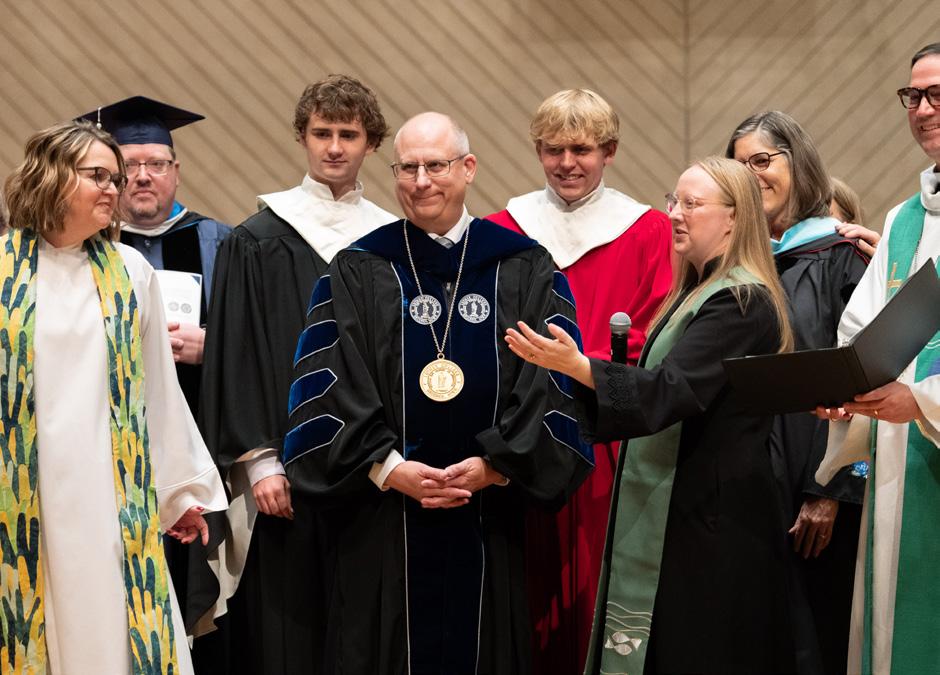
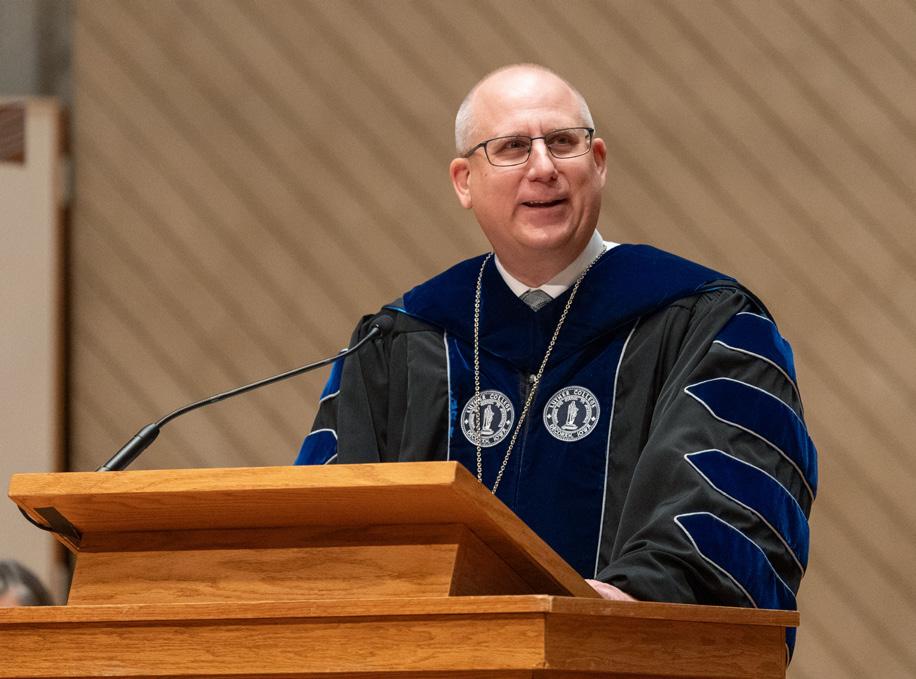
On October 3, Luther officially inaugurated Brad Chamberlain as the college’s 12th president. He’s been serving as president since February 2025, but the campus community—and friends and well-wishers from near and far—embraced the opportunity to officially welcome him to the role.
During a heartwarming ceremony in the Center for Faith and Life, President Chamberlain addressed the Luther community with a hopeful message: “What we need is here. Called by our mission, grounded in our identity, guided by our values, animated by the spirit, and sustained by our community, we have all that we need to catalyze the creation of a more sustainable and just world. We have all that we need to elevate individuals, communities, and society, one graduate at a time.”
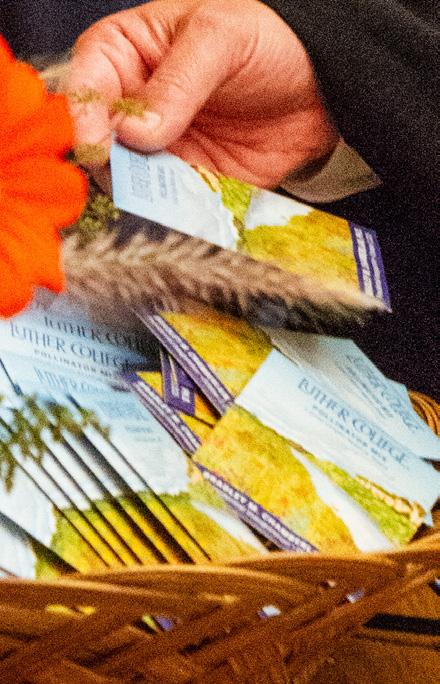
Luther faculty, staff, and alumni collaborated on making a native prairie seed mix to serve as a memento of the event. Mark Udstuen ’97, president of Shooting Star Native Seeds in Spring Grove, Minn., supplied the seed, and Julie (Strom) Hendrickson ’93 illustrated the packaging.
This special event kicked off Homecoming weekend. That evening, Luther celebrated its ties with Decorah through an Inaugural Night on the Town. All were encouraged to head downtown to enjoy Decorah’s restaurants, shops, and special activities.
Scan the QR code to watch President Brad Chamberlain’s inauguration speech.
NEW MISSION STATEMENT
At the start of the fall semester, President Brad Chamberlain announced a new college mission statement. Written by a task force in consultation with the Luther community, the statement was approved by the Board of Regents in July. It reads: Luther College inspires and equips students to courageously serve the common good through a holistic education in the liberal arts. To learn more about the new mission statement, along with supporting identity, vision, and values statements, visit luther.edu/about/mission.
AN IMPACTFUL $2.2 MILLION ESTATE GIFT
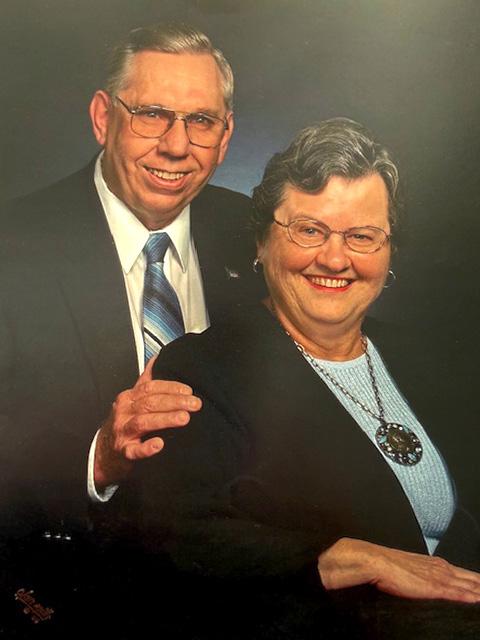
The estate of the late Judith (Lueder) Torson ’62 and Doug Torson recently provided Luther with a gift of $2.2 million. Their incredible generosity will have immediate impact and, says Kelly Sorenson, director of planned giving and major gift operations, “strengthen every corner of campus—from the classroom to programs—and ensure that Luther students continue to experience the kind of education that changes lives.”
PARTNERING WITH DECORAH COMMUNITY SCHOOL DISTRICT
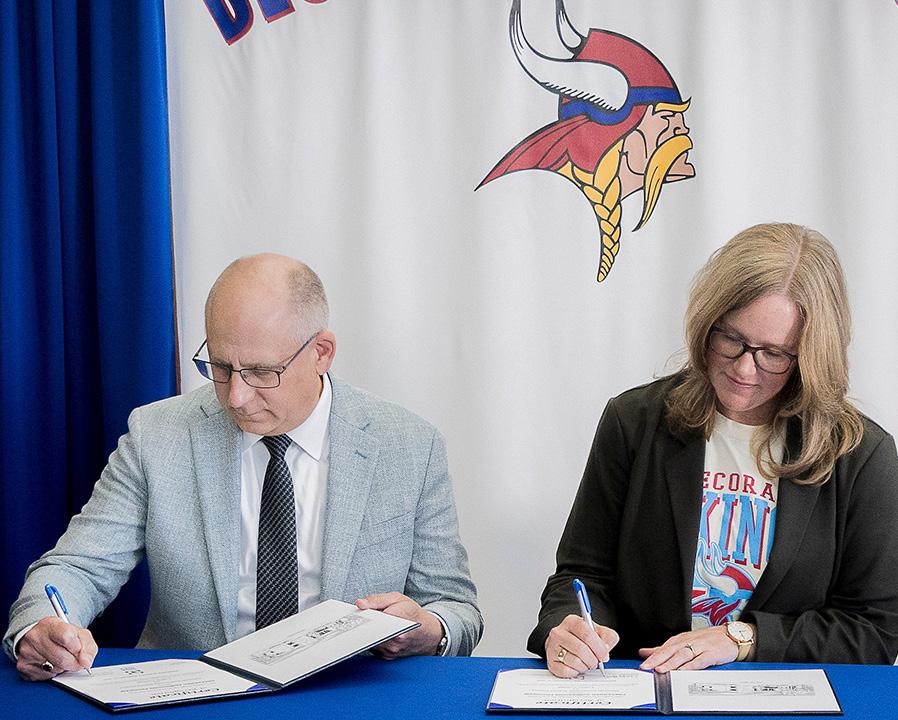
Luther and the Decorah Community School District entered a Preferred Admission Partnership aimed at expanding access to higher education for some of the region’s most accomplished students. Qualifying Decorah High School students will have the opportunity for Preferred Admission to Luther, including a Preferred Admission scholarship. Already, applications from Decorah High School seniors hoping to enroll at Luther in the fall are up roughly 30 percent from last year.
HIGH RANKINGS
U.S. News Best Colleges
Luther ranked highly for undergraduate teaching programs in the 2026 U.S. News Best Colleges rankings. We were listed as one of the nation’s top liberal arts colleges at 111 and remained the second-highest ranked liberal arts college in Iowa. Our score in peer assessment, one of the largest core components of the U.S. News rankings, rose for a third consecutive year.
Forbes
Forbes named Luther to its list of 25 schools with the most generous financial aid packages, part of Forbes’ annual top colleges ranking. The special recognition includes schools that offer “standout scholarship packages” for undergraduates. Luther is among just 20 colleges on the list that offer financial aid to 100 percent of its students.
President Chamberlain and Cindy Goodner, Decorah Community School District Board of Education president, signed a partnership in September.
Princeton Review
Luther once again earned national recognition in the Princeton Review’s Top 50 Green College Rankings, placing 24th in the nation among all institutions. Luther’s overall Green Rating Score was 95 on a 60–99 scale. Notably, Luther is the only Iowa institution included in the top 50 this year. Just 388 colleges received a Green Rating, down from 511 in the previous year.
MODEL UNITED NATIONS TEAM WINS AWARD
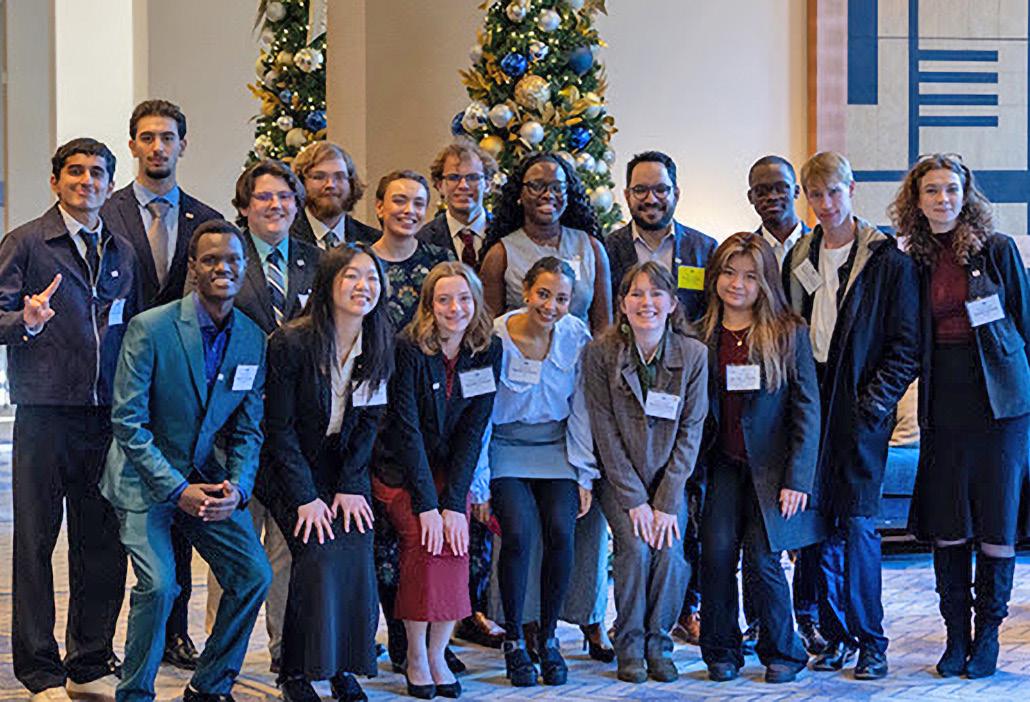
In late November, Luther’s Model United Nations team, supervised by associate professor of political science Orçun Selçuk, traveled to Chicago for the 2025 American Model United Nations Conference. This year, the team represented the Republic of Korea and delivered an exceptional performance throughout the four-day event. The Luther team demonstrated strong preparation, diplomacy, and collaboration, earning recognition for its thoughtful and effective representation. Alex Meeter ’26, Lydia Swarney ’26, Kyle McElroy ’27, Hannah Batterson ’27, Synne Strøm-Fladstad ’29, and Saba Abesadze ’28 earned the Outstanding Delegation Award for exceptional representation in their respective committees.
NURSING ALUM EARNS PRESTIGIOUS MCELROY FELLOWSHIP
Duong Truong ’24 was named one of two recipients of the 42nd annual McElroy Graduate Fellowships, one of the most competitive academic honors in northeast Iowa. The McElroy Graduate Fellowship provides $36,000 over three years to support graduate study. Truong is pursuing a PhD in nursing science at the University of California, Davis.
INAUGURAL PROFESSORSHIPS
Luther has been fortunate to install three new endowed professorships in the 2025–26 academic year.
Orçun Selçuk, associate professor of political science and department head, will serve in the Rev. John and Barbara Melin Professorship in International Studies, which recognizes the critical role that international studies faculty play in a globalized world where international concerns impact almost all areas of our lives.
Robert Christman, professor of history and department head, will serve in the Martin and Mary Hull Mohr Professorship in Renaissance and Reformation Studies, which recognizes the strong tradition in the humanities that has characterized Luther from its beginnings, as well as ways the Renaissance and Reformation continue to shape attempts to define the limits and potentialities of what it is to be human.
Char Kunkel, professor of sociology and department head, will serve in the Wardell Professorship in Sociology, in appreciation of the quality of Luther’s academic program and its dedicated sociology faculty.
TRUE BLUE
Luther recently participated in the National Alumni Career Mobility Survey, an annual national benchmark survey that measures career satisfaction and insights from college and university alumni cohorts—this year, from the classes of 2014 and 2019. Here, we share two high-level findings.
FIRST GAME ON THE BIRKESTRAND FAMILY COURT
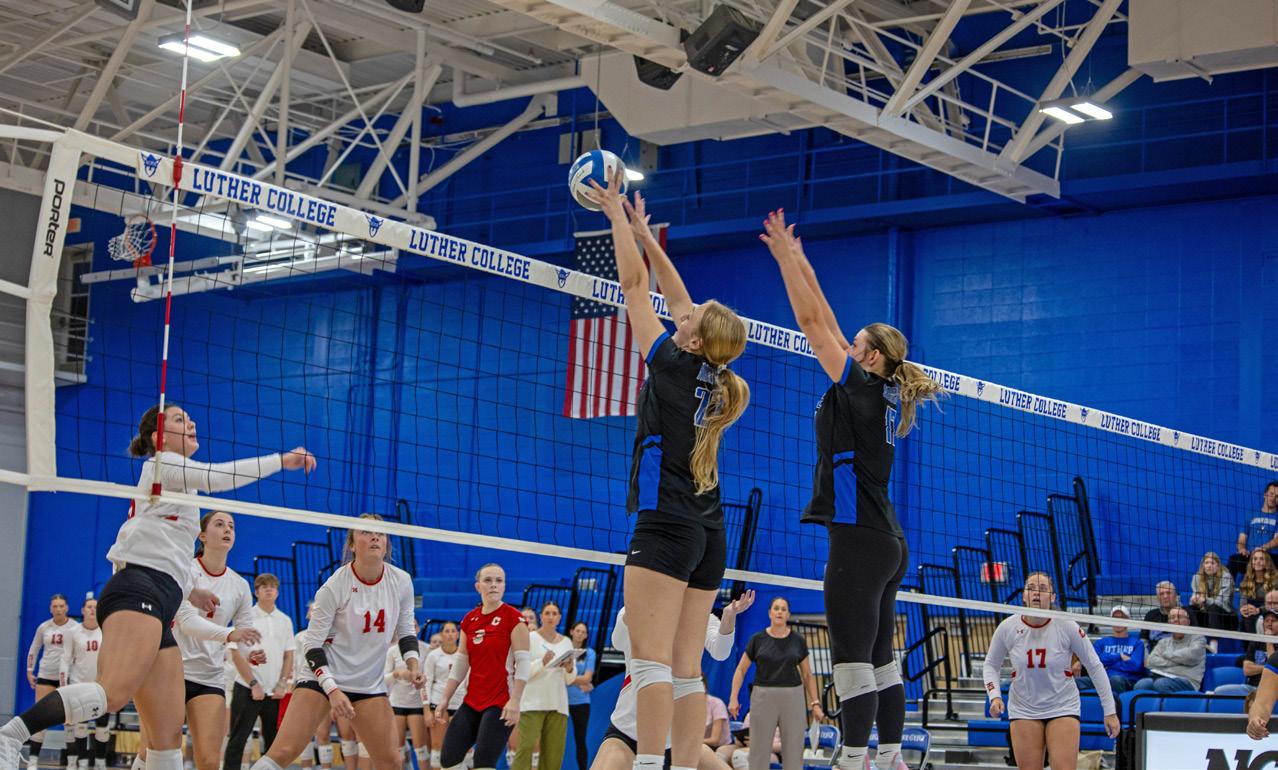
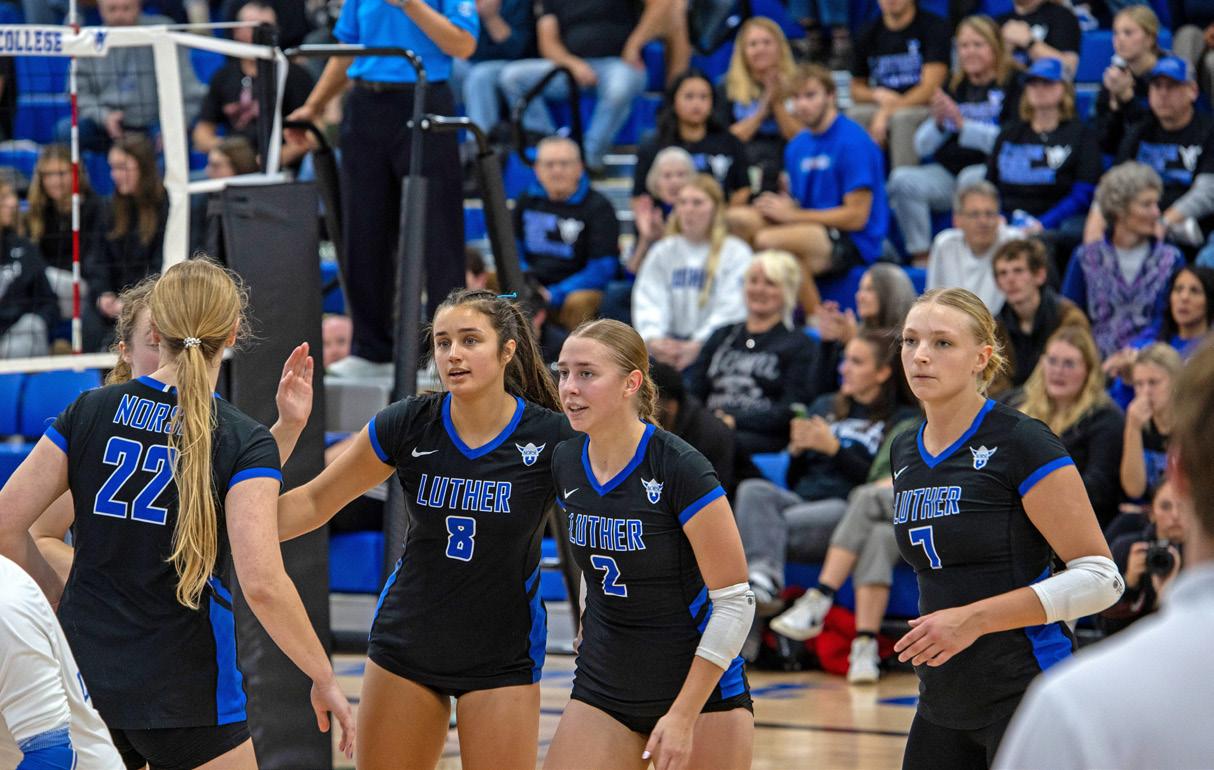
On October 25, Norse volleyball made history as the first team to play on the new Birkestrand Family Court, competing against Central College. Throughout November, men’s and women’s basketball also played on the court. The Birkestrand Family Court is part of the Gerdin Fieldhouse renovation project, which is on schedule to be completed in spring 2026.
CONFERENCE CHAMPS
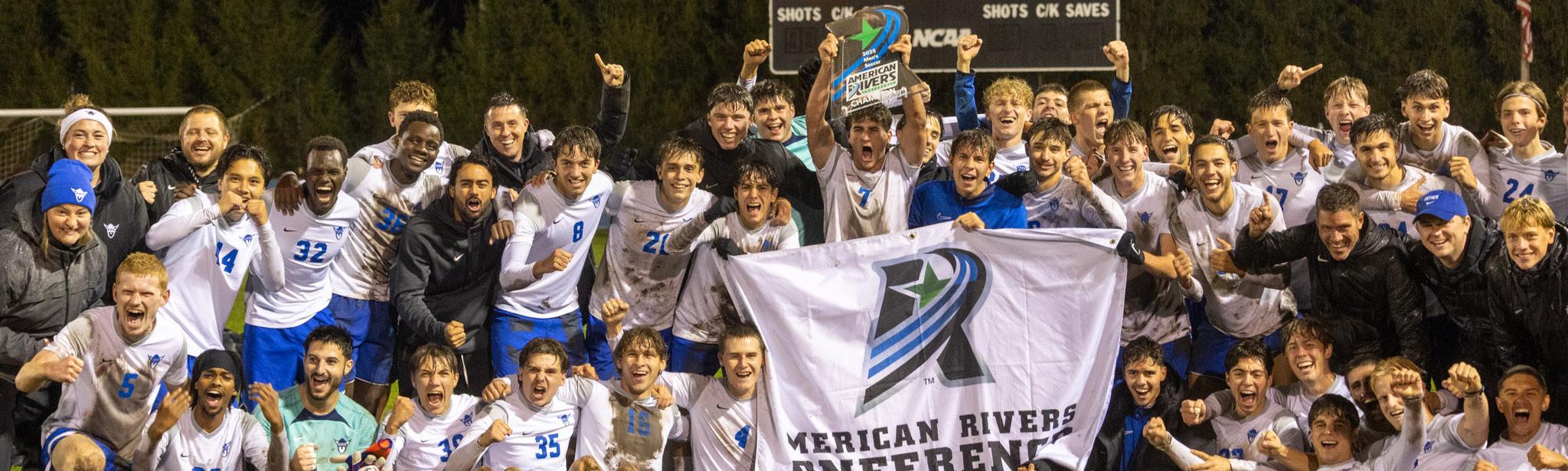
Congratulations to the men’s soccer team, which achieved the rare conference double by sweeping the American Rivers Conference regular season and tournament championships, defeating Wartburg 1-0 for each trophy. The Norse advanced to the NCAA tournament, defeated opening-round opponent Lake Forest 4-1, and closed the season ranked 25th in the final United Soccer Coaches poll. The women’s soccer team also advanced to the A-R-C tournament. Go Norse!
A RECORD-SETTING ONE TEAM DAY
One Team. Two Goals. All In.
This past November, more than 1,200 alumni and friends of the college came together to rally around our teams, raising an incredible $592,631 on Luther’s sixth annual One Team Day, including $372,283 in support of our athletic programs and $220,348 toward the Gerdin Fieldhouse renovation. Together, you made this the most successful One Team Day in Luther’s history!—the most successful one in college history! Thank you from the Luther team!
Shaped BY NORWEGIAN IMMIGRANTS
In 2025, Luther celebrated the 200th anniversary of organized Norwegian emigration to the U.S. In this issue of the magazine, we take
a closer look at what it means to be a college founded by Norwegian immigrants.
by Kate Frentzel
Luther is the very first college founded by Norwegian immigrants in the U.S. Just 36 years after the Restauration sloop set out from Stavanger, Norway, with 52 hopeful people packed into her small belly, there was enough interest, energy, and vision among the Norwegians who settled near Decorah to found the big, enduring project of Luther College.
In Sagas of Luther College, David Faldet ’79, professor emeritus of English, writes, “Luther College exists because emigrant Norwegians wanted their children to become educated leaders. Even if these children had never smelt the lichen-hung forests of Norway and never climbed the mountains on which those forests grew, they would know the language, the literature, and the culture of the place whose memory
To learn more about the college’s Norwegian Lutheran history and identity, check out Sagas of Luther College, a collection of essays and reflections by members of the Luther community. It’s available in the Luther Book Shop.
their fathers and mothers carried tenderly in their hearts.”
But what does it mean to be a college founded by Norwegian immigrants? What does it mean for our diverse campus community—the majority of whom no longer come from a Norwegian or Lutheran background—to live and learn at a college that continues to be shaped by this history?
Values We Carry Forward
Maren Johnson, director of Luther’s Nordic studies program, says that education was vital to Norwegian immigrants: “They saw education as a way to help preserve language, tradition, and religion and also as an important tool for social mobility and social change.”
Johnson points out three values that the Luther College of today carries forward from the Norwegian tradition of the 19th century: community, the common good, and vocation.
“Those are pillars upon which Luther was founded and that we continue to explore not just in the Nordic studies program,” she says. “Those values encompass every academic discipline, every music ensemble, every athletic competition, every co-curricular project."
“Our students in every area are being exposed to questions about common good, vocation, and how they’re going to uplift the communities around them. Those values still shape the institution that Luther is today.”
Room for Diverse Backgrounds and Perspectives
In Sagas, President Brad Chamberlain writes, “Luther’s Norwegian Lutheran identity and heritage enable it to be historically rooted, open to all peoples and perspectives, and vibrantly fulfill its mission among changing student, faculty, and staff demographics.”
Luther was founded on a Norwegian Lutheran tradition that is open-minded and open-hearted to the world around it. According to the Evangelical Lutheran Church of America, “Faith opens a place for engaging others in conversation, for seeking the truth, for asking questions and speaking love in word and deed.” In this way, faith and learning are not adversaries. In fact, faith welcomes inquiry and exploration. It welcomes engagement with our neighbors and the world.
Johnson points out that Luther’s immigrant founders have connected the college to a global community since the college’s founding in 1861.
“This commemoration has been another opportunity for us to invite students to conceive of their communities not just as local but as something much broader,” she says.
We extend that invitation in part through the learning we ask students to do. This year’s Paideia summer read for first-year students was I Talk about It All the Time by Norwegian Gambian author Camara Lundestad Joof. A queer Black woman, Joof questions what it means to be Norwegian and challenges the myth of a nonracist Scandinavia. She spoke to Luther students at Convocation about the transformational power of reading about others:
We are proud of our founding, and we also remember that the land on which Luther College was built was once home to the Iowa, Sac, Fox, and Dakota peoples and later the forcefully displaced Ho-Chunk people. The dispossession of this land was motivated by the interests of settlers like those who founded Luther College and Decorah.
“We all deserve to see ourselves as the hero of the stories we read. Our dreams stretch, they swell when we can imagine ourselves as something other, something bigger, something braver. But it is also a privilege to transform the self by approaching the world from the perspective of the unfamiliar. To celebrate the discovery of the other. If one is unable to conceive someone else—someone other than oneself—as the hero of the tale, if you are unable to envision something completely apart from you as the focal point of a story, it is a crime against your imagination. Then the uniformity of narratives you have been given has stolen something from you.”
The founders of Luther College did imagine “something other, something bigger, something braver.”
They also lived in a tradition that valued encountering the world in a spirit of inquiry, cultural and global exchange, social justice, and uplifting the common good. We are lucky to inherit this legacy, and how we engage in the world will be the measure of how well we uphold it.
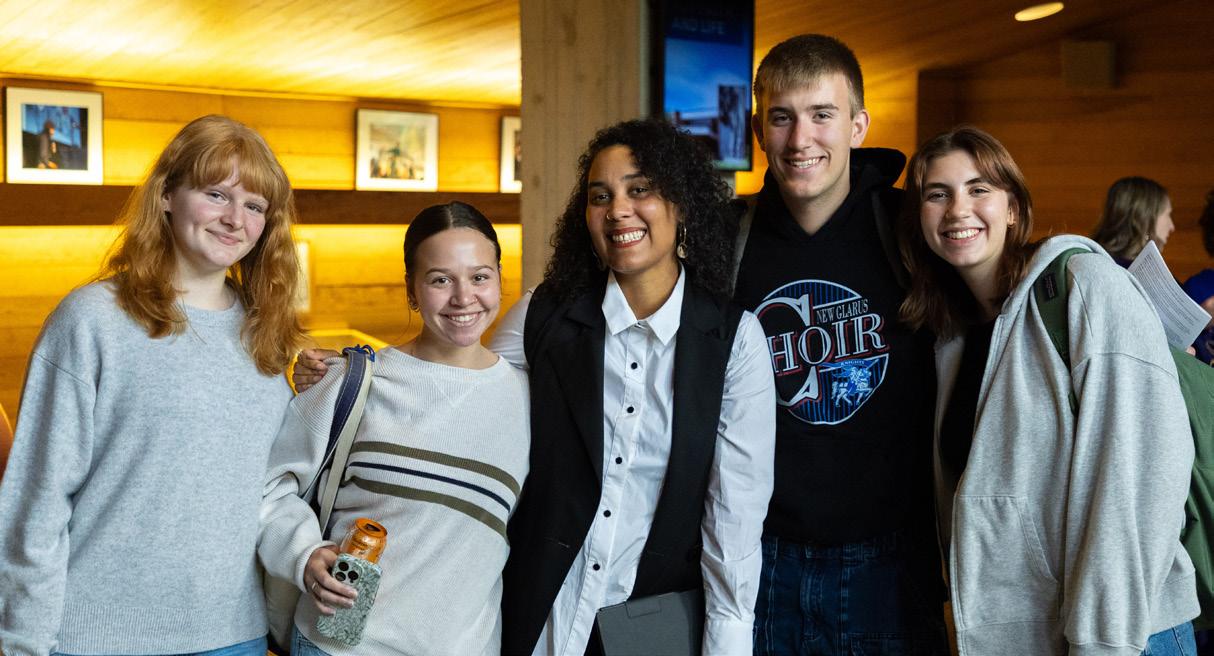
Camara Lundestad Joof (center), author of the 2025 Paideia summer read, spoke at Convocation in the fall, taking time to connect with students afterward.
Nordic studies program director
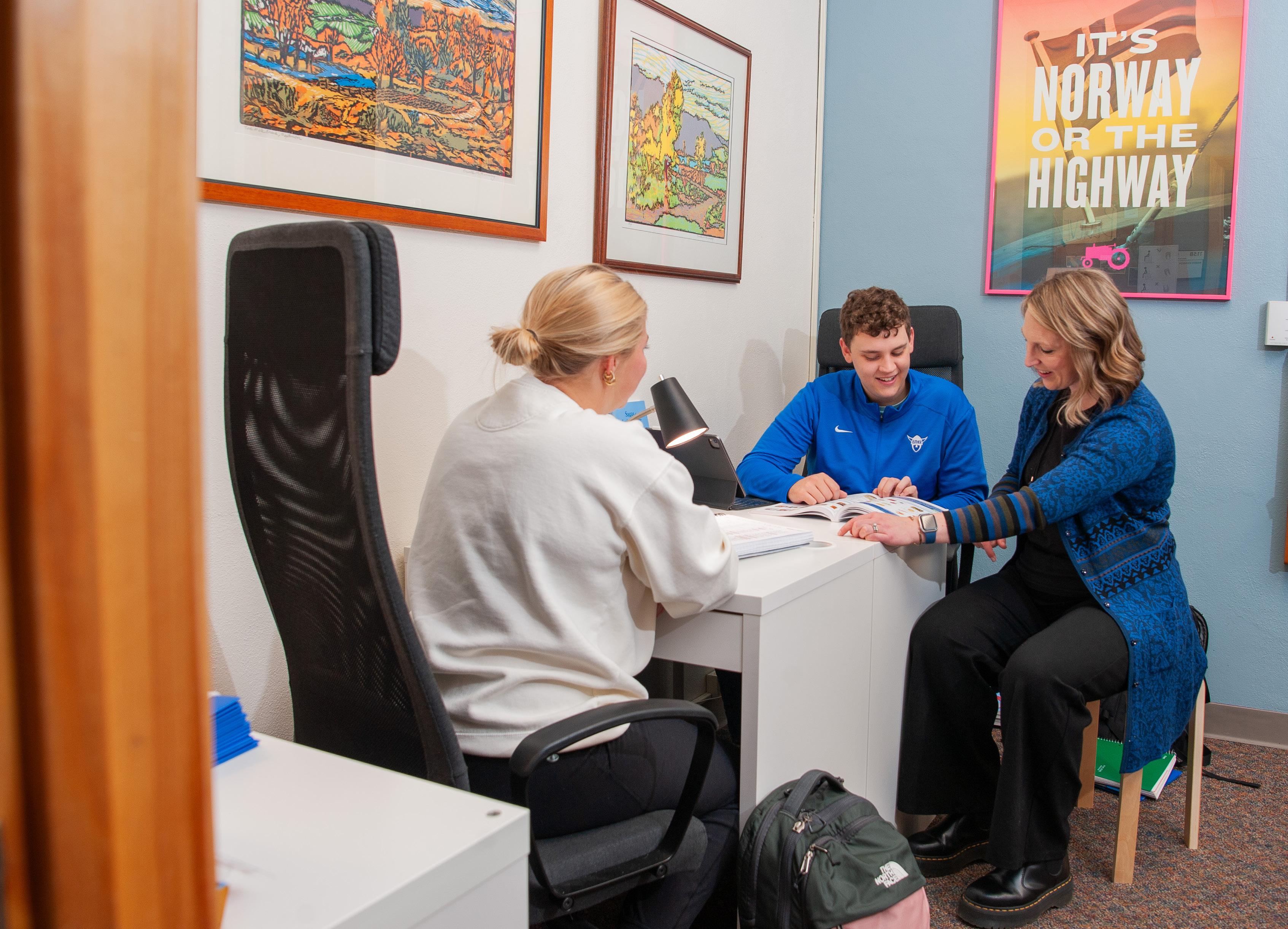
Maren Johnson (right) advises students.
Opens DoorsTO THE WORLD LEARNING THAT
Synergistic partnerships between Luther’s Nordic studies program and other academic departments mean that students bring global learning and experience to their future careers.
by Kate Frentzel
Luther is one of just a handful of places in the country where undergraduates can major in Nordic studies. We’re the only college with an endowed Nordic studies center, the Richard L. and Judith A. Torgerson Center for Nordic Studies.
Our Nordic studies program is rare—and popular. Each semester, about 125 students take a class in Norwegian language or Nordic culture, and the three introductory-level Norwegian language classes are always full. In May 2025, the major graduated its second-largest class, a year behind graduating its largest class ever, in May 2024.
Asked why Nordic studies is so popular, program director Maren Johnson says, “I think the draw for
students these days is thinking about questions that are really pertinent to our community here—questions about sustainability, about social and environmental justice, about immigration. The Nordic model provides an alternative to how things are governed in the United States, and students are curious about how those choices are made and the value structures that inform those choices.”
The program teaches language and culture, and it takes a hard look at social democracy, environmental policy, and entrepreneurship. But at its core, Nordic studies at Luther is about preparing students to be global citizens. It asks them to develop intercultural knowledge and skills, to understand different prac-
tices and perspectives, and to connect with people in the wider world. Luther students are hungry for this.
Synergistic Partnerships
Nordic studies is naturally interdisciplinary. It spans fields like economics, management, education, healthcare, sociology, anthropology, political science, history, environmental studies, and more. All 14 students who graduated from the Nordic studies program last May were double majors, with education and visual communication majors being especially popular complements.
Levi Bird ’21 sums up the appeal of the program: “When I first came to Luther, I had so many different interests and felt pulled in so many directions, especially between the social sciences and the humanities. It really felt like I needed to make this concrete decision between them. But with Nordic studies, there’s the opportunity to explore so many aspects of human expression and society.”
Not only is Nordic studies a natural complement to other fields, but the program also intentionally partners with other academic departments to leverage opportunities for students.
One special partnership it’s developing is with the economics, accounting, and management (EAM) department. Ryan Torkelson ’07, associate professor of accounting, spent the spring 2024 semester cultivating internship sites for EAM and marketing students both in the U.S. and in Norway. He hopes that students will soon be able to find placements in Norway at the American Chamber of Commerce, the Norway-American Foundation, the Oslo Chamber of Commerce, and the Minnesota Brand Agency (yes, in Norway!). Closer to home, he’s eyeing Norway House’s Minneapolis-based Business Accelerator Resource Network (BARN), a first stop for Norwegian companies hoping to launch in U.S. markets. “BARN wants to do more market research,” Torkelson explains. “The data analysis they need would lend itself really well to our new marketing major.”
EAM’s partnerships in Norway are still in their infancy, but there are Luther-Norway partnerships that are already thriving in Luther’s education department.
Learning Outside Comfort Zones
Elliott Johnson, associate professor of education, was eager to leverage the strong relationships that Luther has forged in Norway. By placing student teachers in international schools there, he says, “They get a view of the bigger world. Our schools in the United States
are diverse, but they’re diverse in different ways. The international schools in Norway let them work with students coming from all over the world in one particular classroom. By having that experience, they then are better prepared to work proactively in classrooms here in the United States that may not have as much diversity, but they will have some, and they’ll be better prepared to work with all different types of learners.”
Kristiansand International was Luther’s first partner school when international placements resumed post-COVID, and Johnson has since expanded the program to schools in Trondheim, Asker, and Stjørdal, where Cherise (Storlie) Storlie-Kristoffersen ’97, originally from Mabel, Minn., is principal of Fagerhaug International School.
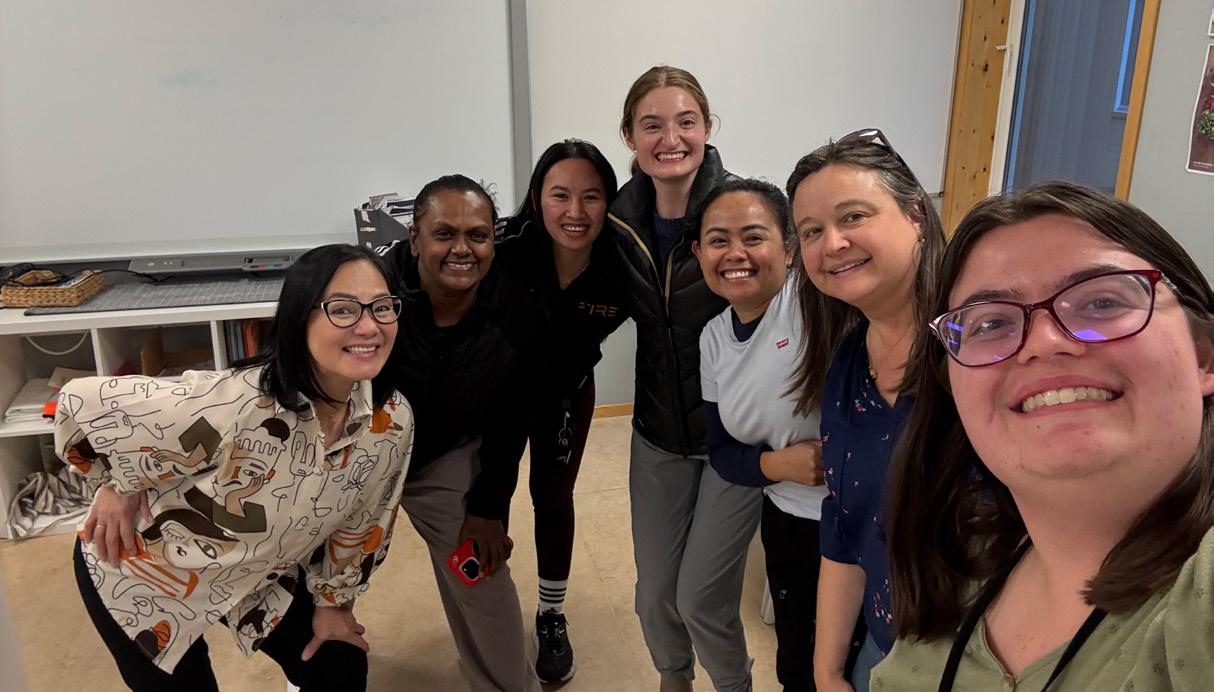
Cherise (Storlie) Storlie-Kristoffersen ’97, principal of Fagerhaug International School, mentored Bella Bamlett ’25 and Elena Conklin ’25 as they did their student teaching at her school last fall. From left: Lani Avila Stav, Christine Padachie, Shiela Estoconing, Elena Conklin, Jonilyn Storseth, Cherise Storlie-Kristoffersen, Bella Bamlett.
“To watch all the small miracles and to guide the ways in which we structure our days and learn together in a small school is a true gift,” Storlie-Kristoffersen says. Last fall, she took on two Luther student teachers, Bella Bamlett ’25 and Elena Conklin ’25
Bamlett was nervous about traveling so far from home, but the International Baccalaureate (IB) program taught at Fagerhaug intrigued her. With an endorsement in special education, she was eager to look outside familiar education systems to learn all she could to help her future students. When she found out that Conklin was also interested, she says, “I knew I was on my way to purchasing my plane tickets!”
Conklin taught in a classroom of 14 students, only
three of whom spoke English. “I especially leaned on nonverbal communication and worked hard to create relationships with students despite our language barriers,” she says. “I learned many strategies for how to teach in a language-immersion environment, which has prepared me to confidently work with English language learners in the future.”
Conklin also plans to incorporate the idea of “outdoor school” (uteskole) that’s common in Norway, as well as the IB curriculum’s emphasis on teaching students how to be global citizens that appreciate and celebrate all cultures.
One thing that Bamlett would like to bring to her next classroom is the idea of developing lifelong learners. She shares, “The IB curriculum includes something called learner profiles. Teachers incorporate these profiles into academic assignments to aid students in developing skills. One example of a learner profile is risk-taking. In order to be a risk-taker, a student has to partake in things they may not be super comfortable with. So a teacher may give a student a task that they know the student is going to struggle with, but the teacher states to the student that they need to be a risk-taker and at least try the problem. By teaching these skills to young learners, I feel it will aid them not only in developing the skills needed for the classroom but also for life after they finish their educational journeys.”
Storlie-Kristoffersen was impressed by what Conklin and Bamlett brought to her school: “Bella and Elena were ready to meet new experiences with a positive attitude, and they were ready to learn and share knowledge. Luther had prepared them to be open-minded, caring, principled, and reflective.”
Since spring 2020, Luther’s education department has placed 10 student teachers in five schools across Norway. “Our students are appreciating these opportunities to see other formats of how to teach that may or may not fit with their own teaching styles,” Johnson says. “They experience things that make them question: How may I make change in what I do in order to best impact students? When they talk about those opportunities of learning and growing, that makes me excited about what we provide them in preparation for going out and being full-time teachers.”
How Cultural Exchange Can Impact a Classroom
Newelle Dalton ’24 taught at Kristiansand International School in fall 2023. She was drawn to teach
in Norway because of the country’s emphasis on student- centered learning and the opportunity, she says, “to bring new perspectives, cultural awareness, and adaptability to my future classroom. In the end it was the best thing I did for myself! It truly led me to believe in myself and my teaching.”
She continues, “So much of the learning that I had the ability to be a part of with my students in Norway felt shared at all times. Students had an incredible amount of agency, self-efficacy, and community involvement regarding their learning. It felt like a mutual learning experience because my students were so independent and creative.”
Now, as a third-grade literacy teacher at Johnsville Elementary in Blaine, Minn., Dalton sometimes feels rushed to fit in assessments and required curriculum. But her time in Norway, she says, “prepared me to be flexible, to support students through questioning instead of lecturing, to connect with students before all, and to use restorative justice practices in the classroom.”
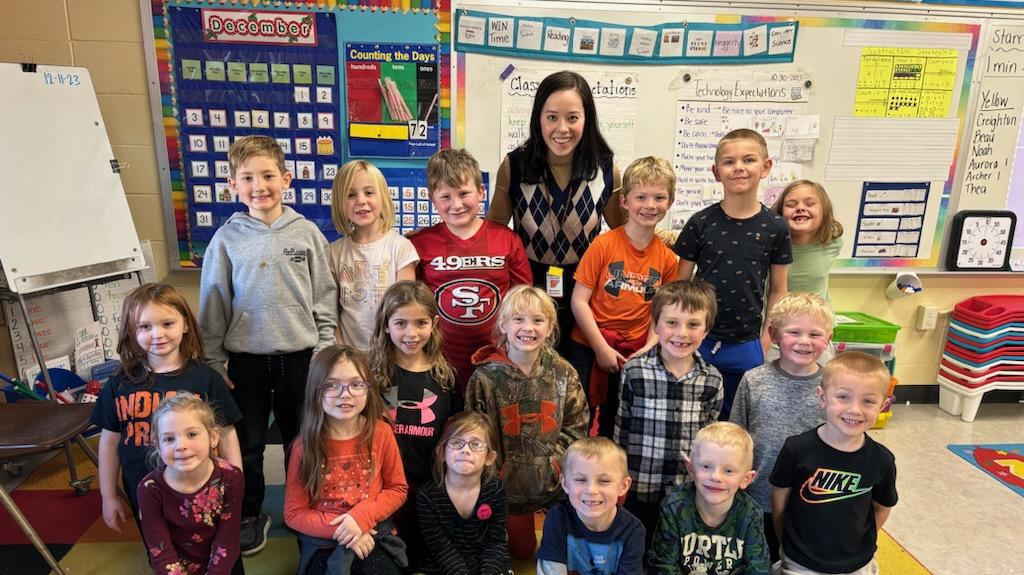
Newelle Dalton ’24 did her student teaching at a school in Kristiansand, Norway, and brings what she learned there to her current work with third graders in Minnesota. “My students are always captivated by my adventures abroad,” she says. “They ask so many inquisitive questions about the culture and country, and we even learn a bit of Norwegian together!”
It also encouraged her to involve the community in her students’ education. She invites community speakers to her classroom, and last year she and her students visited a nursing home, delivered candy bags to local business owners, made cards for veterans, and made placemats for the elderly for Thanksgiving. “These acts of service and hospitality were directly inspired by my time at Kristiansand International School, where teachers were encouraged to integrate community engagement into everyday learning,” she says.
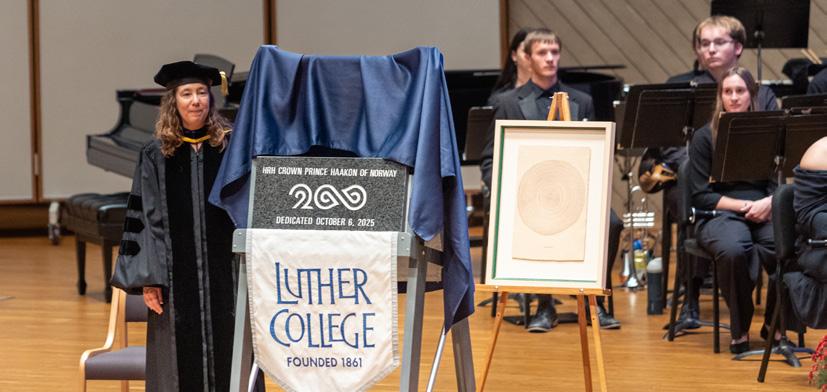
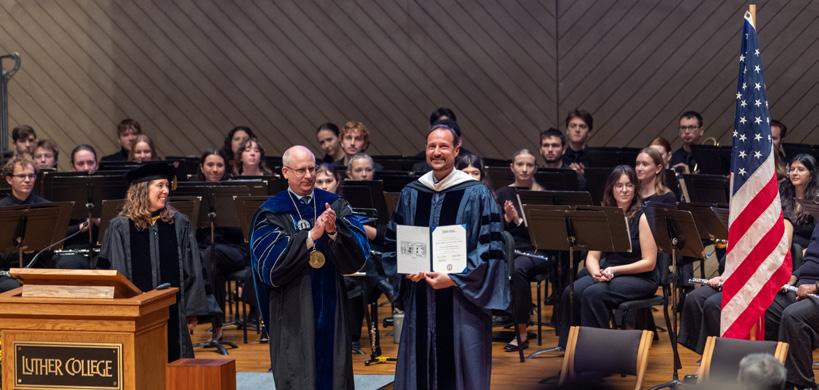
A highlight of the past year was a visit in October from His Royal Highness Crown Prince Haakon of Norway. In recognition of his dedication to human rights, environmental responsibility, and the bonds between Norway and the United States, Luther awarded Crown Prince Haakon an honorary degree.
In his address to the Luther community, Crown Prince Haakon said, “Universities are the sites for the free exchange of ideas. Independent teaching and research is at the heart of a free society. And so, to the students here today: Cherish that freedom. Seek out those that are different from you. Be curious and be generous, because that is how we grow.”
The occasion marked the ninth visit to Luther by members of Norway’s royal family. In 1965, Crown Prince Haakon’s father, King Harald—then the Crown Prince—received an honorary degree from Luther. King Harald’s father, Olav V, also received an honorary degree from Luther in 1939, when he was Crown Prince.
Crown Prince Haakon’s visit marked the official unveiling of site plans for the renovation of Luther’s oldest building, Campus House, to serve as the new home of the Richard L. and Judith A. Torgerson Center for Nordic Studies, the only endowed undergraduate Nordic studies center in the United States. Initial planning is being conducted in collaboration with Snøhetta—the world-famous Norwegian architectural firm that also designed a recent addition to the Vesterheim Museum—to create a welcoming and vibrant space that reflects a Nordic ethos and aesthetic.
The visit and the coming renovation, said Luther President Brad Chamberlain, “inaugurate new energy and a renewed commitment to exchange that honors the history of the founders of Luther College and the enduring connections between Luther College and Norway.”
Scan the QR code to watch Crown Prince Haakon's speech to the Luther community.
Samarbeid
(NORWEGIAN FOR WORKING TOGETHER )
by Kate Frentzel
Luther College and Vesterheim Norwegian-American Museum and Folk Art School are connected by history. They maintain that connection—and partner in teaching and learning—by choice.
In the 1870s, shortly after its founding in 1861, Luther College saw value in preserving immigrant stories and Norwegian artifacts, so it started a collection of objects on campus. In 1933, the collection was moved to its present site. In 1965, Vesterheim became an independent nonprofit museum.
But independent doesn’t mean siloed. Because of our shared history, Luther students have incredible access to an internationally renowned museum— featuring 33,000 artifacts, 12 historic buildings, and a host of experts—and they get to do hands-on learning there.
A Nexus of Learning
Luther faculty across disciplines leverage the national treasure in Luther’s backyard to provide vivid, real-life experiential learning. One towering example of this is history professor Anna Peterson’s Scandinavian Immi-
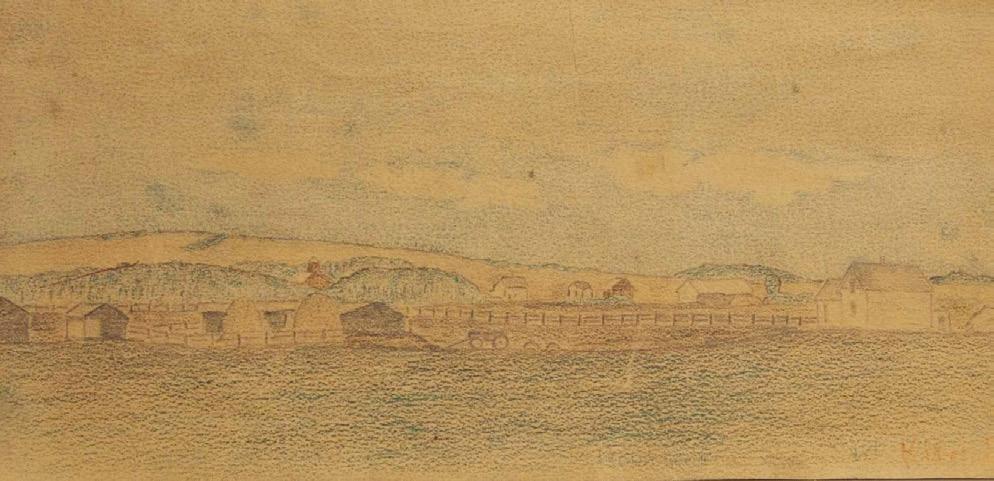
gration History course, which she teaches every other year. In fall 2024, students in the course had the exciting opportunity to help create Veseterheim’s landmark exhibit exploring the 200th anniversary of organized emigration to the U.S. from Norway.
Chief curator Laurann Gilbertson drafted a list of potential objects for students to use. Students worked in pairs to research their chosen object and its significance to the larger history of Norwegian immigration. They wrote the text for the labels that museum visitors encounter, gave public presentations, and recorded podcasts about their objects.
“This was a unique opportunity for students to work with a professional organization,” Peterson says.
“And this wasn’t a student exhibit; it was a normal exhibit that students got to play a role in. Vesterheim trusted me and the students to do good work. That relationship is special.”
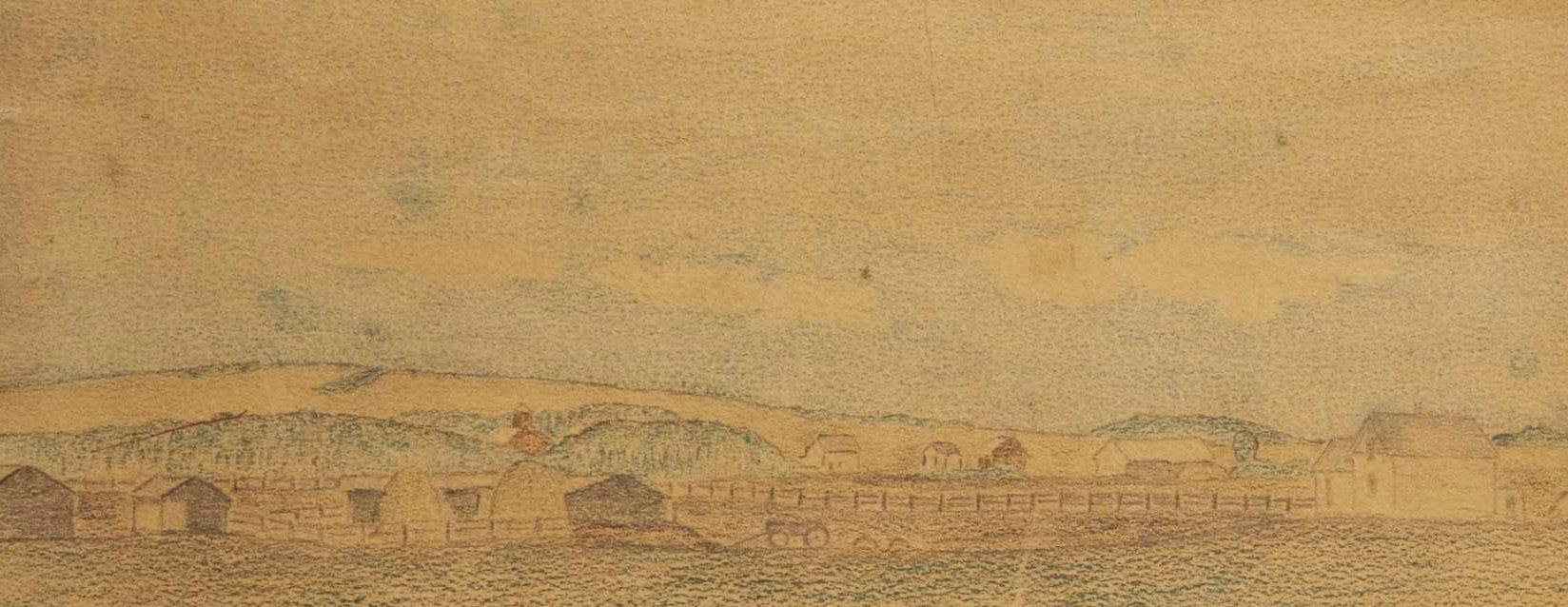
Isaac Roberts ’24, who researched a drawing of a farm for the exhibit, secured an internship at Vesterheim the following semester, working on an exhibit about a magazine called Kvinden og Hjemmet (The
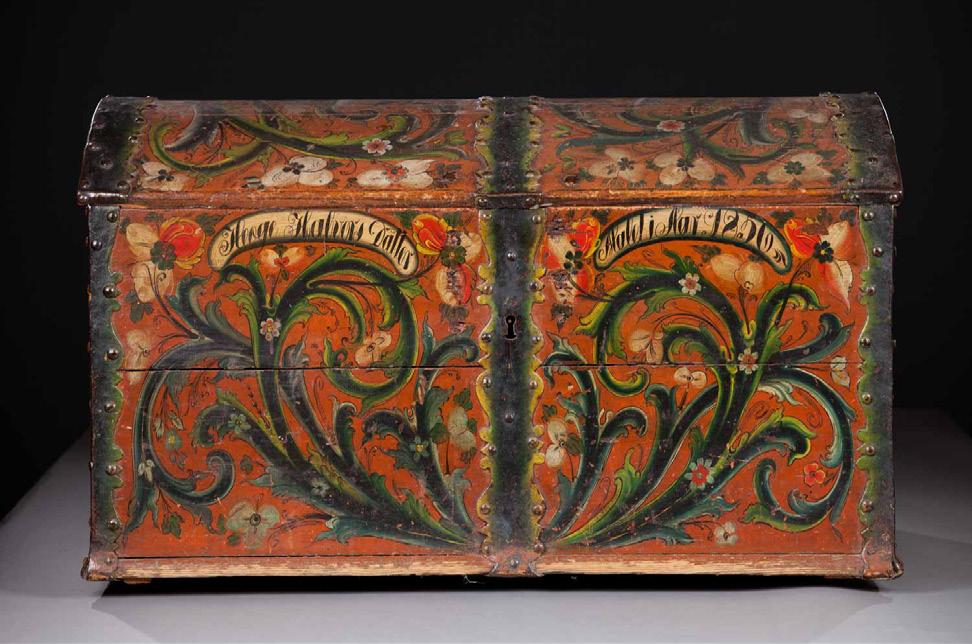
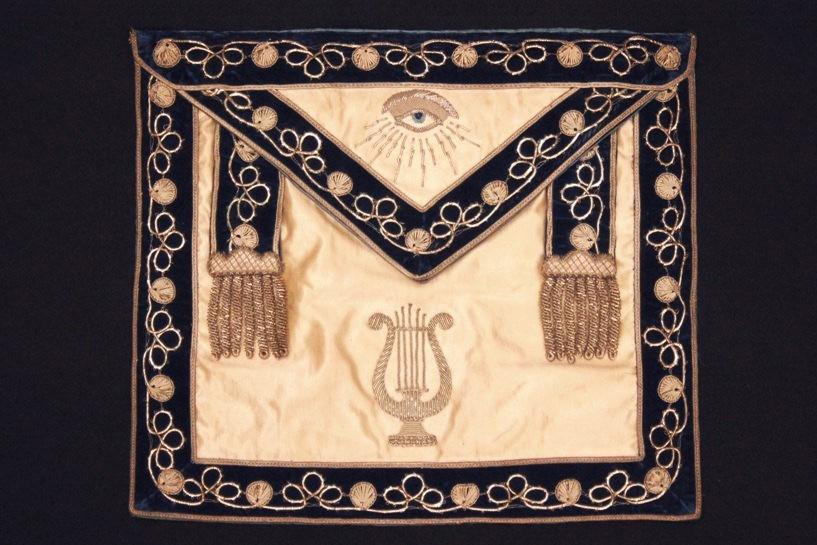
Luther students (pictured with professor Anna Peterson, far right) created podcasts inspired by the objects below from the Vesterheim's collection.
Women and The Home). “The gallery talks that I was able to do both during my internship and the previous semester really stood out to me,” Roberts says. “They were wonderful opportunities to feel like I reached a finishing point in my work and also to meet the public and have other people interested in the work I did!”
Other disciplines, from English to Nordic studies and beyond, also use Vesterheim to augment student learning. Each semester, professor of anthropology Maryna Nading teaches a cultural anthropology course that uses gift-giving as a lens to explore human behavior, culture, identity, and economics. When she takes students to the museum, collection manager Jennifer (Johnston) Kovarik ’95 explains how giftgiving impacted Norwegian Americans at all stages of their lives and lets students handle objects traditionally given from birth to death.
Adrianna Tam, assistant professor of music and director of Aurora, approached Vesterheim twice to create a collaborative program, first centered on the Migrant Quilt Project when it came to Luther, then centered on Vesterheim’s Leading with our Hearts exhibit of Ojibwe, Saami, and Nordic art. Both times, Tam assembled repertoire inspired by the exhibits and co-organized a multidisciplinary event at which Aurora sang.
“I’m the type of person who can spend hours in a museum, so I often look to Vesterheim and other local organizations for sources of inspiration when programming for my ensembles,” Tam says. “When students witnessed the connecting thread between diverse cultures that use quilts to preserve both loving and harrowing memories, the music they were singing became, in a sense, more tangible. Collaborations like these encourage my singers and me to engage in our greater community and continue growing our ever-widening fields of learning.”
An Unmatchable Resource for Museum Studies
For Luther’s museum studies program, Vesterheim is indispensable. Destiny Crider, who directs the program, takes student in her fall-semester class there to learn about how museums handle public-facing projects like exhibit design and communication. In the spring, she takes a class there to learn about behind-the-scenes work like collections management and the ethics and professional care of objects.
“Talking to the people who actually do this work is memorable for students,” Crider says.
“Being able to access professionals who understand Luther and are connected to the college makes it less intimidating.”
“It felt like a partnership rather than receiving knowledge from a higher entity,” says Louis Breimhurst ’27, a museum studies minor who toured a Vesterheim exhibit as part of Crider’s class last fall. Breimhurst found it invaluable to experience exhibit design in person and to learn from the people, like collection assistant Lauryn (Swigart) Johnson ’22, who do that work. From the flow of information in the space to how readable the signage is from a distance, Breimhurst says, “The characteristics of the physical space are nearly impossible to replicate online.”
The museum is also an unparalleled resource for museum studies students completing their required internship. Lydia Gruenwald ’25, a history major and museum studies minor who’s currently teaching abroad through Fulbright Austria, is interested in public history and how historical narratives are shaped. For her internship, she worked with Crider to
Listen to the podcasts on the museum's YouTube channel. Images courtesy Vesterheim.
Jennifer (Johnston) Kovarik ’95, Vesterheim collection manager, uses the collection to teach Luther anthropology students.
Megan Miller ’25 interned with Vesterheim's donor relations team and now works as a benefits consultant at Holmes Murphy in Des Moines, Iowa.
create an exhibit in Luther’s Dahl Centennial Union gallery about painter Herbjørn Gausta. The exhibit featured Gausta paintings from Luther’s collection paired with photographs from Vesterheim’s archive that Gausta used as initial studies. “It was a really impressionable experience,” Gruenwald says, adding that learning through that collaboration “made all the difference.”
High-Impact Local Internships
Luther students intern in several capacities at Vesterheim. Megan Miller ’25, an economics and Nordic studies major, interned with the museum’s donor relations team.
During her internship, Miller learned a lot about how an organization stays visible in a community. “Maintaining momentum around a cause that matters—even the most important of causes—takes more work than most realize,” she says. “I spent a majority of time outreaching to constituents and preparing for events. Doing this allowed me to learn so much about prospecting and sales, laying the groundwork for what I do today.”
Today, Miller is a benefits consultant with Holmes Murphy in Des Moines, Iowa, consulting with companies on the benefits packages they offer to employees.
Her experience at Vesterheim and in the Nordic studies major more generally, she says, “gave me the aptitude to consider new perspectives and understand why different people might be approaching the table. This has served me well—of course in sales, as my job is to understand perspectives and shed light to new perspectives that also sit at the table—but more importantly in life. The ability to genuinely connect with others is differentiated by your decision to
Lauryn (Swigart) Johnson ’22 interned at Vesterheim and now works there as a collection assistant.
merely hear or to genuinely listen. Some of my favorite new connections are with individuals who, on paper, couldn’t be more different from me. But I believe that Luther, Nordic studies, and Vesterheim have better equipped me to approach new situations, people, and perspectives with hope and empathy, paving the way for genuine connections. Productive connections.”
The benefits of student internships are mutual. Gilbertsen says, “It’s been such a blessing for Vesterheim to have such top-notch, top-quality Luther students available to us.”
Relationships beyond Graduation
Roughly one-third of Vesterheim’s employees are Luther grads—including its president, Chris Johnson ’87
.
Sometimes, a Luther student transitions from intern to full-timer, as did Lauryn (Swigart) Johnson ’22. She photographed items from the collection as a Luther student, then received a job offer to work as a collection assistant after graduating. An art major and museum studies minor, Johnson now works with traveling and temporary exhibits as well as with Vesterheim’s National Norwegian-American Folk Art Exhibition, a biannual event showcasing contemporary artists making work rooted in Norwegian traditions.
Andrew Ellingsen ’03 and Maddie Brown ’23 work in Vesterheim’s folk art education department, which Andrew directs. Like Johnson, Brown transitioned from intern to employee, but Ellingsen came to the work differently. After spending two decades as an elementary school music teacher, he took a Vesterheim class learning how to make Saamiinspired bracelets and fell in love. Over the course of the following year, he made an astounding 500–700 bracelets.
When a position opened in Vesterheim’s folk art school, Ellingsen jumped at the chance. This was less than a year into the pandemic, so he was part of the team—with critical help from Luther professor Maren Johnson, who has also taught language classes for Vesterheim and serves on its board—that worked to adapt the folk school’s courses to an online format.
The online format was wildly successful. Pre-COVID, Vesterheim taught only in-person and hosted 600–1,000 students from 30 states each year. In 2025, through online and in-person classes, it taught 5,000 students from all 50 states and 30 countries.
Luther alumni are part of the cohort that teaches these classes. Some—like Berit Skogen ’23, Evelyn Galstad ’20, Nick Rogness ’24, and Lianna (Stewart) Torres ’17 (read more about her on page 17)—teach language classes. Sometimes they also teach unique one-off classes, like Galstad’s free family class on Norwegian songs or Rogness’s class about life north of the Arctic Circle.
Some alumni, like James Miller ’19, who was the museum’s youngest ever gold medalist woodworker, teach folk arts. Sometimes, Vesterheim helps launch an instructor’s folk art career, as it did with Maeve Gathje ’15.
In 2013, Gathje took a J-Term course—Scandinavian Fine Handcrafts—with the late Harley Refsal, renowned woodcarver and Luther professor emeritus. In the course, students explored Vesterheim’s wooden objects, then carved a spoon of their own—and ate ice cream with it. “In many ways, that class changed the trajectory of my entire life,” Gathje says. As a working artist with a diverse practice of her own, she teaches at folk art institutions throughout the Midwest.
In the 10 years since graduation, Gathje has repeatedly visited Vesterheim for inspiration. “Having access to historical objects has been important for me to ground my work in time and place,” she says, adding that “Luther students having Vesterheim essentially at their doorstep is an incredible gift. It’s a place of many horizons and many paths of inquiry to follow. Whether that’s learning about woodcarving, weaving, immigration, culture, or any other number of subjects, it’s a good place to start asking questions.”
Vesterheim’s education branch continues to be an important partner in Luther J-Term courses. Refsal died in 2024, but the course that launched Gathje’s interest is now taught at Vesterheim by Twin Cities–based Fred Livesay. In January 2024, Ellingsen collaborated with Maren Johnson to offer one of Luther’s very first international J-Term courses for first-year students: Nordic Tales and Traditions, in Norway.
Luther alumni also serve as Vesterheim volunteers and board members, including its chair, Brian Rude ’77
Because of our shared history, Luther students, staff, and faculty get free admission to Vesterheim. This can be part of the glue that connects a student to their college town for life. “Having access to Vesterheim not only hooked me into history and museum studies,” says Gruenwald, “but it also made me fall in love with Decorah!”
Continuing to Explore Together
As we move beyond 2025 and the special anniversary it marked, both Luther and Vesterheim will continue to explore the story of immigration, how we tell that story, and what it has to teach us. We’ll do this as entities with a shared history—and also a shared future.
Maeve Gathje '15 got her start learning and teaching folk arts at Vesterheim. She's now a working artist (she made the piece above) who teaches throughout the Midwest.
Andrew Ellingsen '03 (far left), Vesterheim director of folk art education, co-led one of Luther's first J-Term courses for first-year students.
Forward MOVING LUTHER VALUES
Whether a student majors in Nordic studies or not, they carry into the world the values of a college founded by Norwegian Lutheran immigrants. Here, we share two stories of what that can look like.
by Kate Frentzel
Building Cultural Bridges
“Norwegian culture has always been a part of my life,” says Isaac (van Bruggen) Warner ’13. “The foods, the holidays, the sweaters, the emphasis on collective well-being and care. When I went to college at Luther, a lot of those cultural touchpoints remained.” Isaac sang in Norskkor (then Norsemen), Cathedral Choir, and Collegiate Chorale, which further connected him to the Norwegian Lutheran choral tradition he’d grown up with.
Isaac majored in political science and earned a master’s degree in public administration. He now works as a property manager in San Diego, where he and his husband, Nate, moved during the pandemic.
It didn’t take long after moving for Isaac to search out House of Norway, part of the consortium of International Cottages in San Diego’s Balboa Park. Founded as part of an international exposition in 1935, these houses were designed to promote peace among different ethnic groups in the lead-up to World War II. Today, 35 cultures are represented by 35 houses, several of which maintain cottages that people can visit.
Isaac remembers stepping into House of Norway for the first time: “It felt like my grandparents’ living room. Having moved away, I was feeling a little unmoored, and it was like a homecoming.”
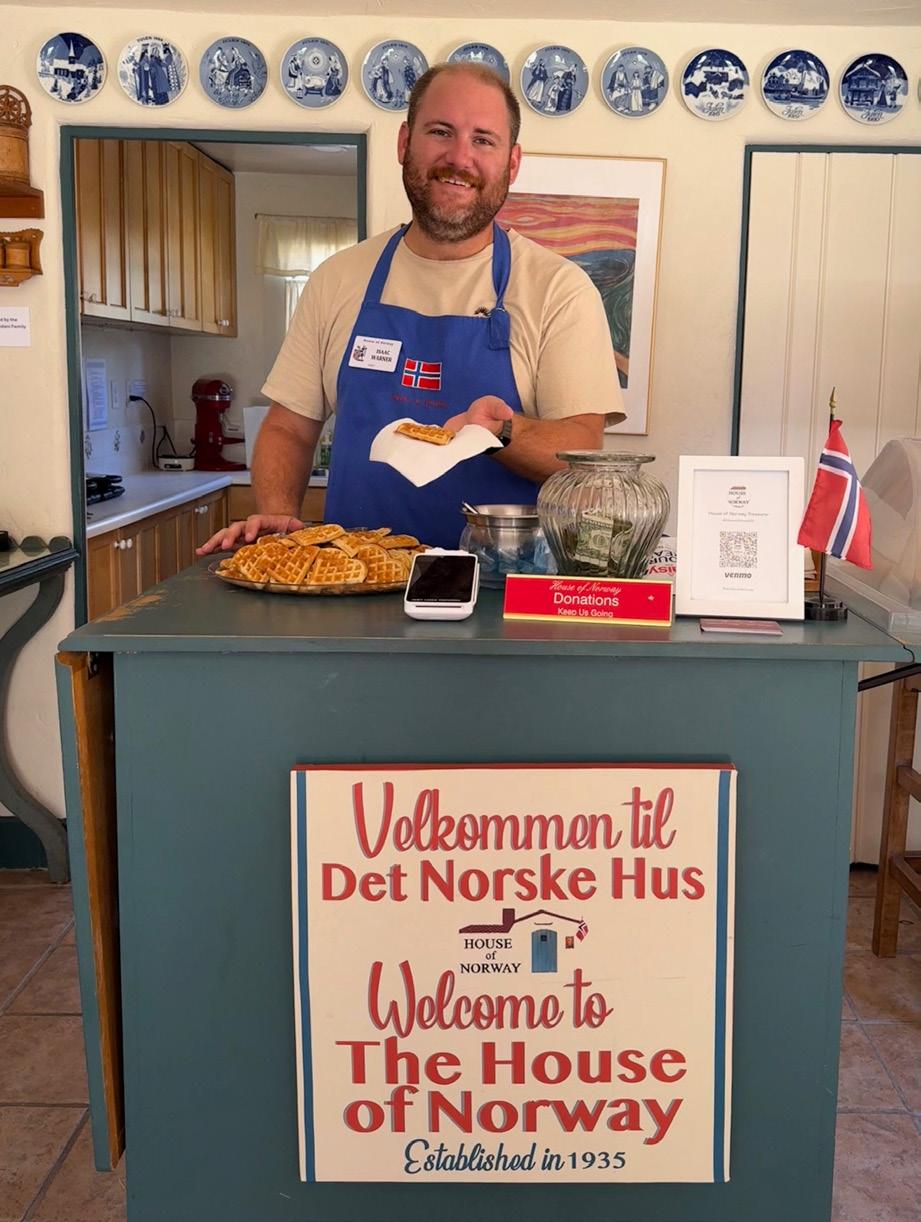
As a regular volunteer who staffs House of Norway about once a month, inviting visitors in and sharing a bit about Norwegian culture, Isaac has loved staying connected with the familiar. He loves talking with people who are new to Norwegian culture and also to
In addition to its Syttende Mai celebration, the House of Norway is famous for its waffles, which volunteer Isaac (van Bruggen) Warner ‘13 gets to share with lucky visitors.
immigrants from Norway, old and new. “Some Norwegian American cultural traditions reflect a snapshot of what Norwegian culture was like some time ago, sometimes romanticized. And of course Norwegian culture has grown and changed, as culture does. So it’s been really interesting to have conversations with people who are recent immigrants from Norway and can speak to that,” he says.
At the heart of Isaac’s volunteer work is cultural exchange, and he sees this as a throughline that started with his grandparents, Fred and Marty (Hovde) Paulson Bergsrud ’64, and continued at Luther: “When you have a huge study-abroad program and international student body at a smaller school like Luther, then it’s clear that an intentional choice is being made—those things are not just byproducts of its size. Luther doesn’t shy away at all from its heritage and its Norwegian-ness, but I think it uses that to really highlight other cultures. And I think that’s inherently Norwegian—a focus on community and civic pride and building relationships and caring for one another despite differences you might perceive. It’s something that I’ve tried to carry on.”
The Never-Ending Learning Loop
Lianna (Stewart) Torres ’17 came to Luther because of the music program, but a Norwegian language class her sophomore year turned everything upside down. “It was thrilling,” Lianna says. “Then I took a literature class on [Norwegian author] Henrik Ibsen, and it changed my life. It felt like magic to me.”
Lianna committed to Nordic studies in a major way. Before her senior year, she attended summer school in Oslo to study the language. At the end of that summer, she passed the Norwegian fluency exam.
“I’ve never been more exhausted and hungry and motivated,” she says. “It was a defining moment for me, because learning a language is really hard and immersing yourself is really challenging, yet by the time I left, I loved it even more. I thought, I can be that challenged and still care about it. That’s been a recurring theme throughout my schooling.”
After graduating from Luther as a Nordic studies major, Lianna earned a master’s degree in Ibsen studies at the University of Oslo in Norway. She’s now pursuing a PhD in Scandinavian studies at the University of Washington, where she’s focused on Norwegian literature and theatre while also sharing her love of Norwegian language as an educator of both private clients and through organizations, including Luther’s Dorian Camps and Vesterheim, the National Norwegian-American Museum and Folk Art School in Decorah.
As a Luther student, Lianna tutored fellow students in Norwegian and also taught language and culture classes for elementary school kids at the Vesterheim.
After graduating, her relationship with Vesterheim deepened. When the museum expanded its online offerings in the wake of COVID, Andrew Ellingsen ’03, who directs the Vesterheim’s education program, reached out to ask if Lianna was interested in teaching intermediate and advanced language classes.
Lianna wants her students to experience the invigorating feedback loop that she feels when diving into a new language: “I want to share with them that learning language is not just conjugating verbs— even though I love that. But language-learning is culture-learning is history-learning. Language is so fun because it’s connected to everything. It opens up an entire world, and that’s what’s so thrilling about it. As you progress, the thrill morphs into so many other things, like being vulnerable as you speak and converse. And before you know it, you have all these new books to read and new songs and podcasts to listen to. The learning is never-ending.”
In 2025, Lianna received a $5,000 grant from Vesterheim to develop a brand-new Norwegian pronunciation course based on research done at the University of Oslo. “It makes me kind of emotional,” she says, tearing up. “It’s a dream. If I can spend my life connecting institutions like the Vesterheim with institutions like the University of Oslo, and develop this connection between Norway and America that I’m so lucky to have, that’s the coolest thing ever.”
She muses for a minute. “If I never took that first Norwegian class at Luther, I don’t know where I’d be. Not this happy.”
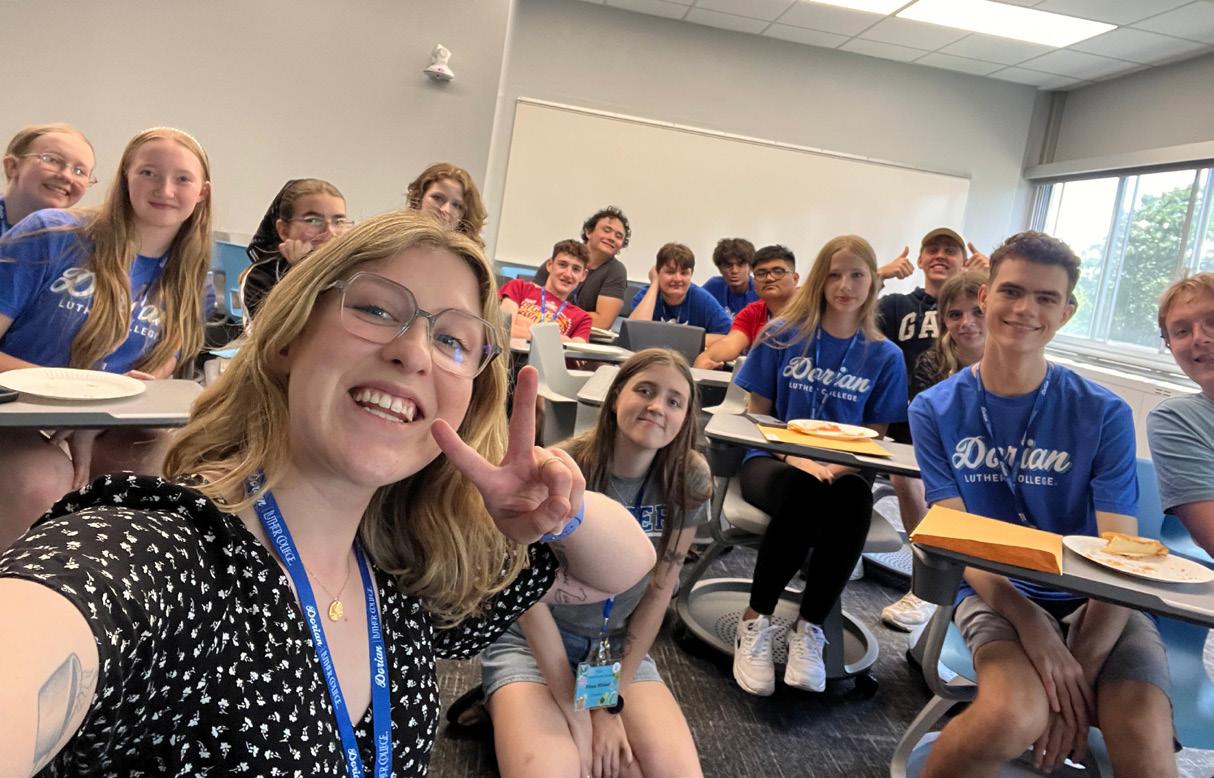
Lianna (Stewart) Torres '17 teaches Norwegian language— including to Dorian Summer Camp students at Luther in June—on her way to earning a PhD in Scandinavian studies.
MEMORY KEEPERS
Luther staff members and local scouts turn wood salvaged from the Regents Center into special keepsakes that celebrate the past and help fund the future of Luther athletic facilities.
by Sara Friedl-Putnam
Over its 62 years, the Regents Center gym held thousands of events showcasing thousands of talented athletes and musicians, drawing in countless enthusiastic spectators.
So when the gym closed its doors for good in February 2025 after more than six decades of hosting everything from Messiah performances and band and choir concerts to basketball, volleyball, and wrestling contests, Luther staff members knew they had to do something to help preserve the many memories the special space had fostered.
Even as college personnel were putting the finishing touches on plans for the new Gerdin Fieldhouse—a
renovation of the Regents Center made possible by a $10 million lead gift from Michael Gerdin ’92 and Nicole Gerdin and the Gerdin Charitable Foundation—they also began researching how best to reclaim and reuse the gym’s maplewood floors and Douglas fir bleachers.
“Connecting alumni to a space in which so many had made memories was our top priority,” says Deanna (Rude) Casterton ’91, Luther Book Shop director, of determining what kind of merchandise to fashion from the wood removed from the gym. “Our second priority was continuing to raise funds for the renovation project.”
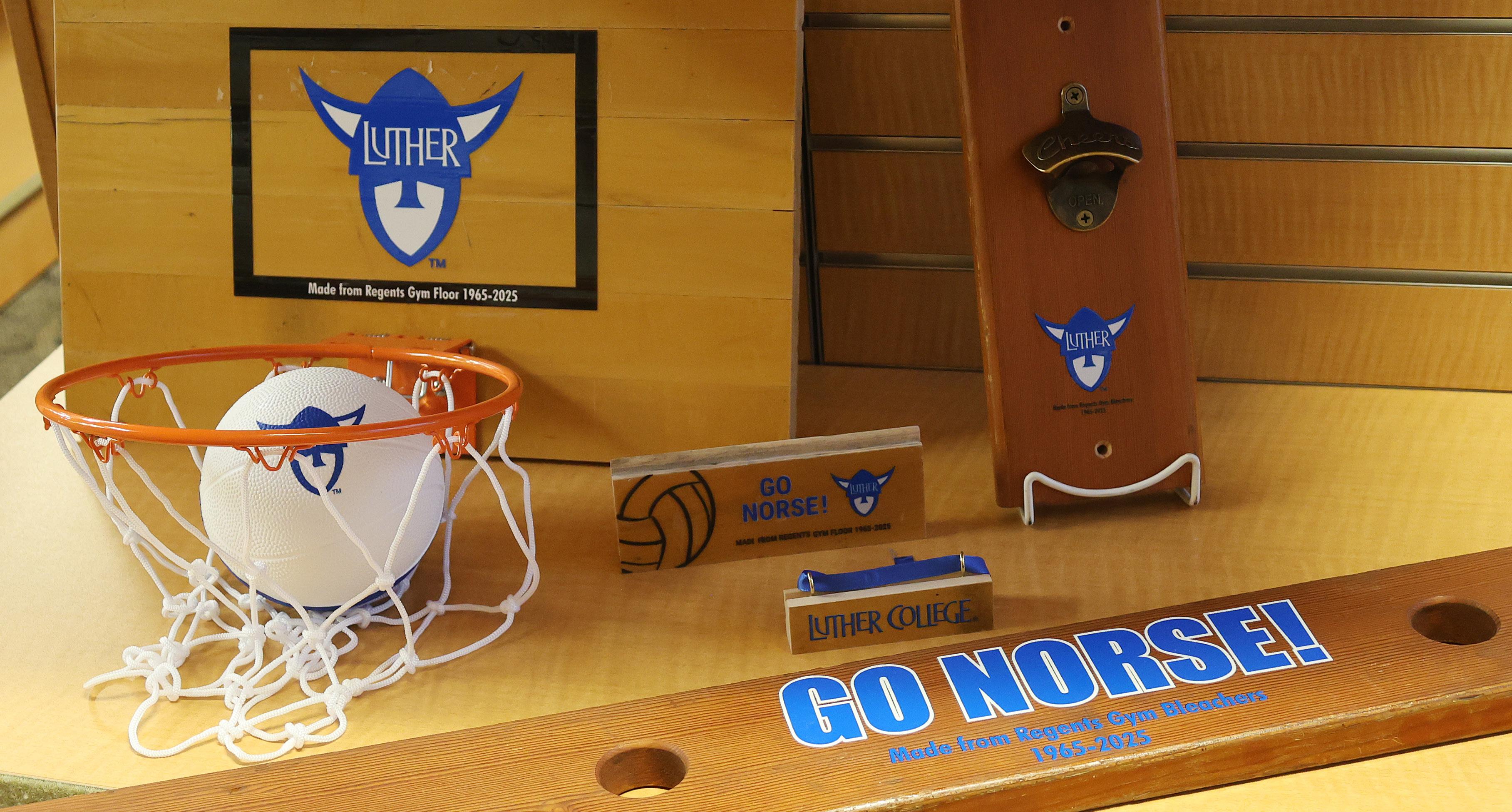
As she combed the internet and visited with others in the Luther community, a few ideas began rising to the top, including ornaments, plaques, backboards (with nets), shotskis, and bottle openers. Once the ideas took shape, all Casterton needed was someone to bring them to life.
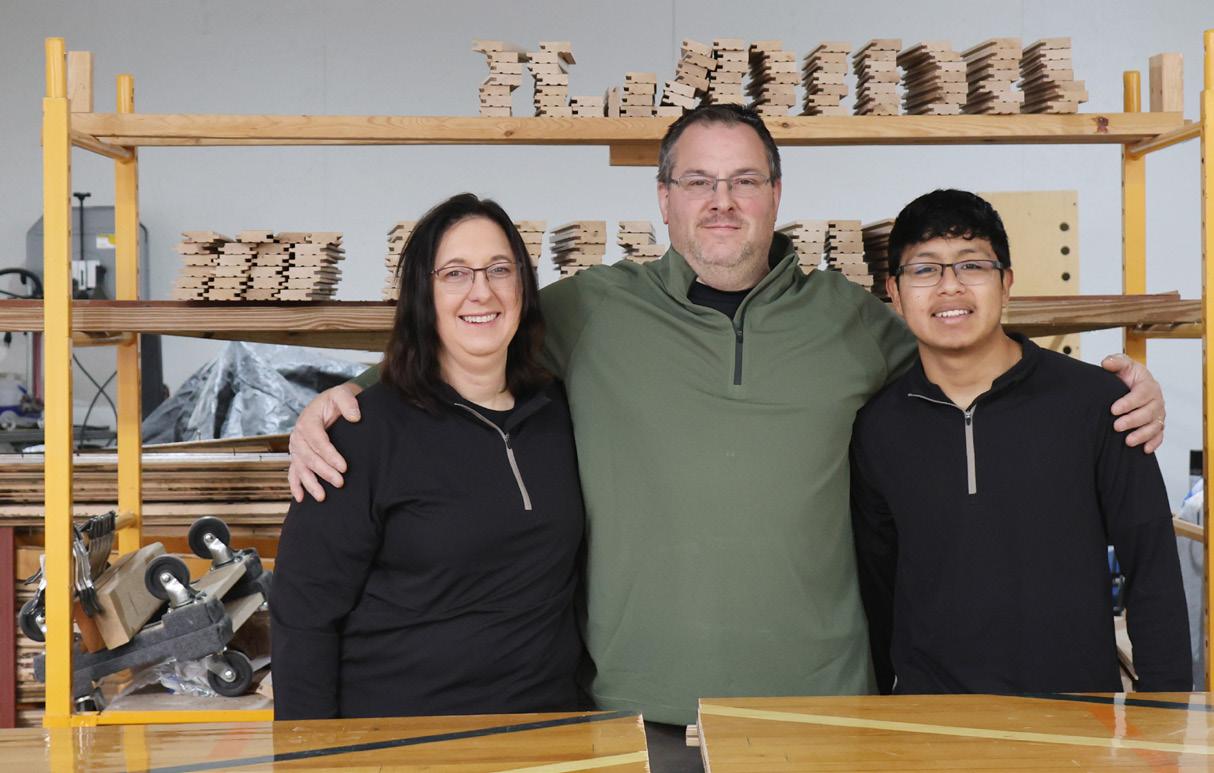
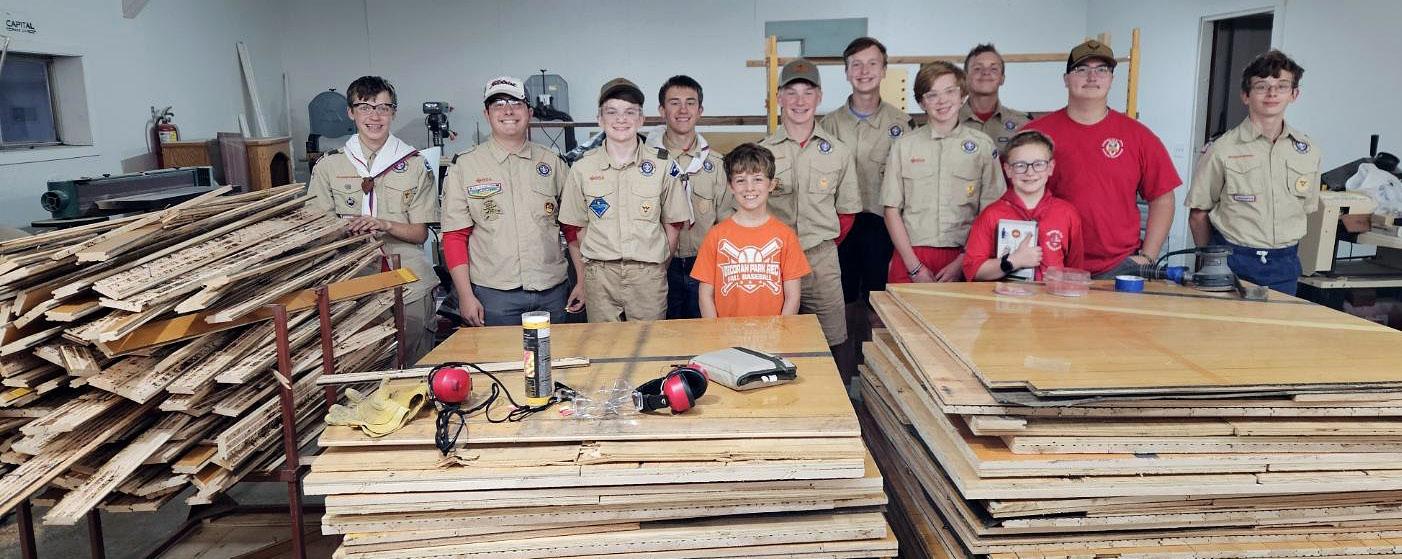
Enter Luther staff members Jeremy Smith and Ann (Bossard) Smith ’98—co-owners of JADE’S Custom Woodworking, LLC—and current members of Scouting America Decorah Boy Scouts Troop 66, which they’ve helped guide since moving to town with their son, Domenik, in 2018. The couple knew immediately that beyond being a good fit for Jeremy, a skilled carpenter and woodworker, the project could provide valuable service and learning opportunities for Troop 66
members, who range in age from 11 to 18.
“It’s an excellent community-service project for them,” says Ann, Luther assistant dean of student success and director of accessibility services. “It’s also a unique chance for them to learn about local history.”
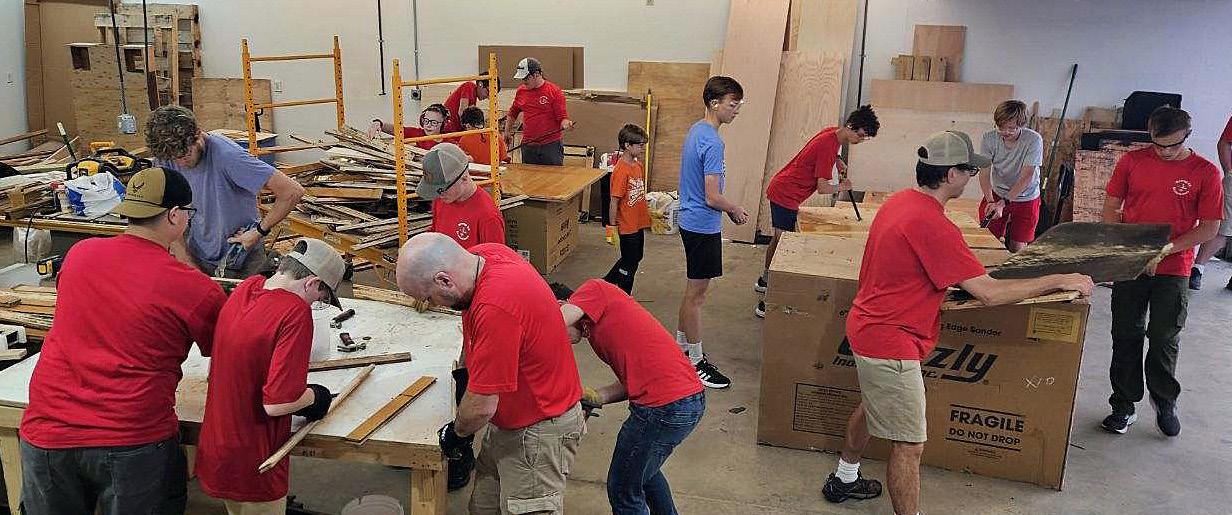
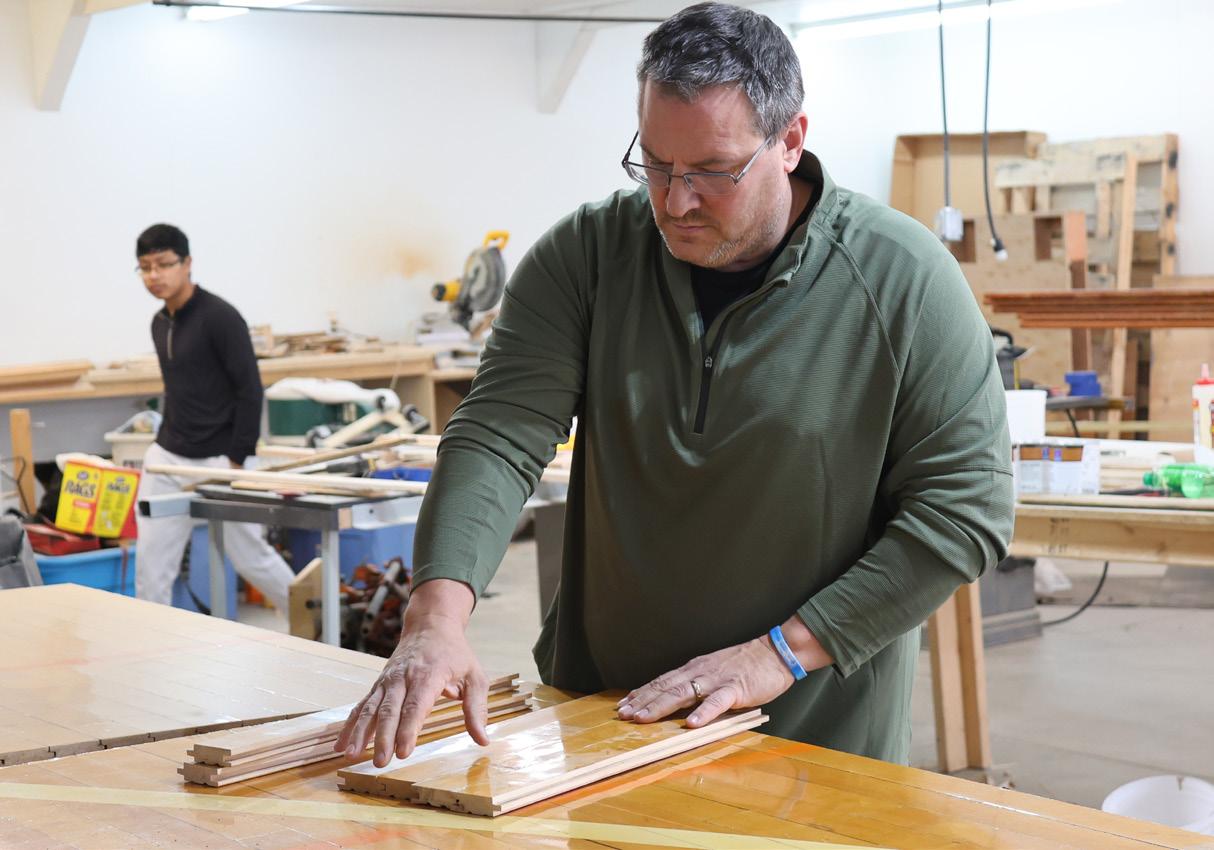
Troop 66 has been instrumental in transforming the maplewood floor into several pieces of the Reclaimed Wood Collection being sold through the Luther Book Shop. In fact, as Jeremy explains, the whole process begins with the scouts using crowbars to pry apart the tongue-andgroove floor planks so that he can restore the wood as closely as possible to its original state. “I have to remove any tar-paper residue, old wax, and dirt before sanding the pieces, reassembling them, and cutting them to size,” he says. “We put a lot of care into making sure we have a high-quality product, and the troop’s contribution is an important part of the process.”
Jeremy and Ann agree that the scouts have enjoyed learning about woodworking through the project. They also point out that the experience counts toward earning the Woodwork Merit Badge, which in turn counts toward the 21 badges required to earn Eagle Scout designation. (Fun fact: Domenik Smith’s Eagle Scout project involved installing bike repair stations along the Trout Run Trail in Decorah.)
It’s a good thing the scouts have liked taking part in this special project because, as Deanna reports, it promises to keep them busy for some time to come.
“We are constantly restocking these items due to how popular they are,” Deanna says. “Many customers have told me they are thrilled to have a piece of the gym because they spent so much time making memories there.”
Items in the Reclaimed Wood Collection can be purchased online through the Luther Book Shop at lutherbookshop.com. All sales support the Gerdin Fieldhouse project. In addition to the items crafted by Jeremy Smith and Troop 66, the collection includes 13x13-inch five-point stars created by Jim Eckblad, professor emeritus of biology, and cornhole board sets made by Joe Raymond of Luther campus security. Both Eckblad and Raymond have donated their time and talents in making these items.
With a donation of $200 or more to the Gerdin Fieldhouse project, you can receive an exclusive piece of the floor handcrafted by Jeremy Smith and Troop 66. Visit luther.edu/ fieldhouse-floor to make a gift today.
Ann (Bossard) ’98 and Jeremy Smith with son Domenik Smith
Jeremy Smith prepares to reassemble pieces of the floor.
Scouts and leaders of Troop 66 Decorah remove flooring from the plywood substrate and pull nails to prepare the floor for reuse.
Homecoming
We had so much to celebrate during Homecoming 2025, including the inauguration of President Brad Chamberlain, a royal visit from Crown Prince Haakon of Norway, and inspiring alumni who’ve made an impact through service, music, and athletics!
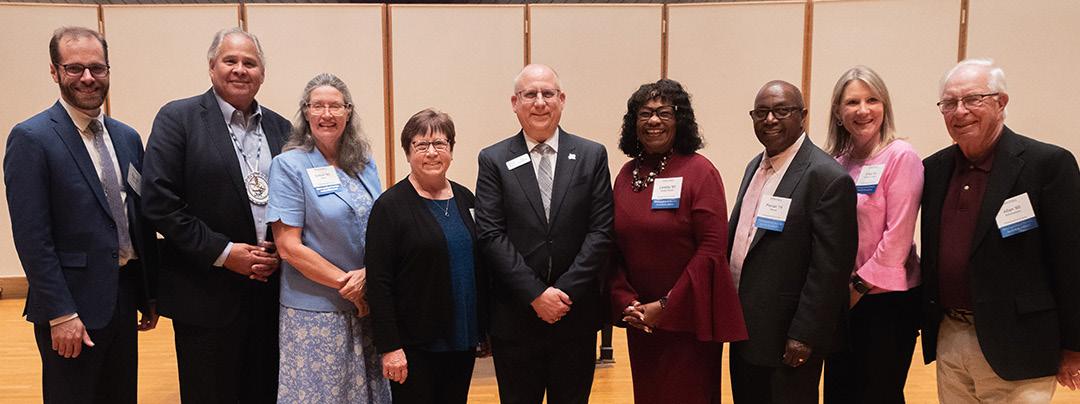
From left: Ryan Nilsestuen ’05, Michael Goze ’75, Esther Menn ’80, Linda (Olson) Bieri ’75, President Brad Chamberlain, Loretta Dooley Wetzel ’80, Perran Wetzel ’79, Erika (Barth) Cottrell ’95, Allan Solomonson ’60.
Distinguished Service Awards
Allan Solomonson ’60 spent 37 years teaching at Wausau (Wis.) West High School, earning recognition for outstanding high school history teaching. As an officer of the Wisconsin Education Association, he helped improve working conditions for educators. He continues to serve through his local Sons of Norway chapter, Habitat for Humanity, the Golden K Kiwanis Club, and the Marathon County Democratic Party.
Linda (Olson) Bieri ’75 is a dentist at Great Lakes Dental Associates in Spirit Lake, Iowa. She earned the Pierre Fauchard Academy’s Outstanding Dentist of the Year Award and has been
honored by the American College of Dentists and the International College of Dentists. Linda volunteers in her community, with sports organizations, and at her church.
Michael Goze ’75, a member of the Ho-Chunk Nation of Wisconsin, was CEO of the American Indian Community Development Corporation for 16 years. He has a long record of service, including for the Federal Reserve Bank 9th District Community Advisory Committee; Little Earth of United Tribes Board of Directors; Neighborhood Development Center of St. Paul, Minn.; Global Market Minneapolis; and the Ho-Chunk Housing and Community Development Agency.
Perran Wetzel ’79 and Loretta Dooley Wetzel ’80 served as the first co-presidents of the Black Alumni Association and co-founded the Luther College Black Alumni Association Scholarship. Loretta is CEO of The Wetzel Group. Perran is CEO of PG Wetzel and Associates and PG Wetzel Consulting.
Esther Menn ’80 is the Ralph W. and Marilyn R. Klein Professor of Old Testament/Hebrew Bible at Lutheran School of Theology at Chicago, where she teaches courses and organizes events in support of Jewish-Christian relations.
Erika (Barth) Cottrell ’95 has a joint appointment as associate professor at Oregon Health and
Science University’s School of Medicine and as senior investigator and director of clinical research networks at OCHIN, a national nonprofit focused on equitable healthcare. Her research
focuses on the nonmedical factors that shape inequalities in health outcomes.
Ryan Nilsestuen ’05 is a judge for the Dane County (Wis.) Circuit Court and presides over the Dane
County OWI Treatment Court. He is a board member of the Ralph K. Morris Foundation and serves as a mentor to law students and former colleagues.
Athletics Awards
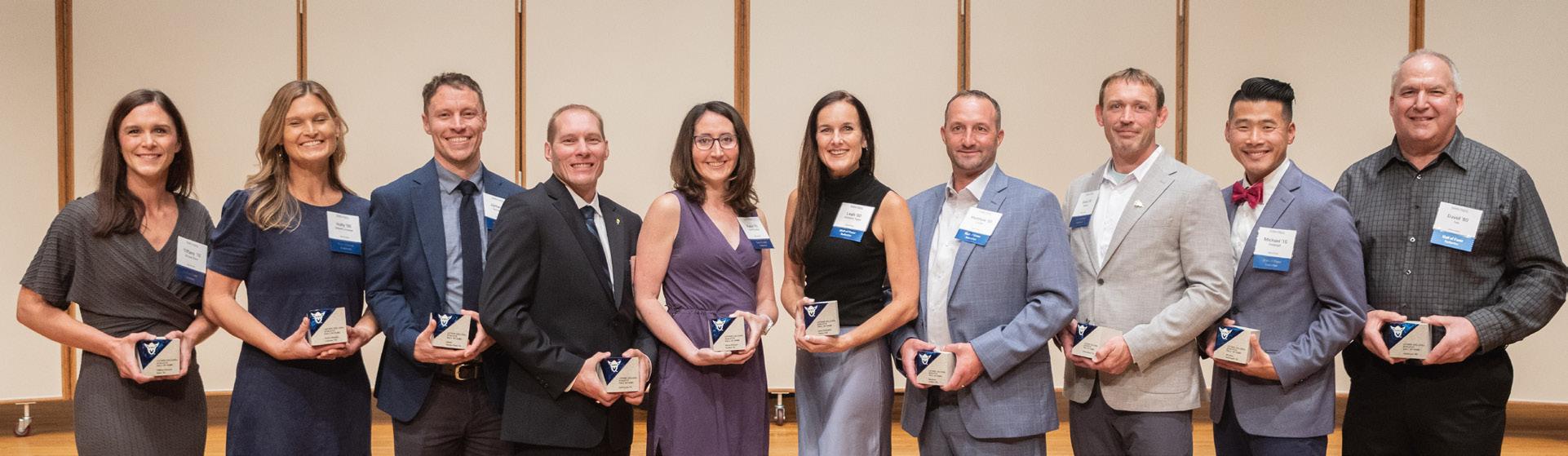
Inductees into Luther’s Athletics Hall of Fame included (from left): Tiffany (Kruse) Rave ’10, softball, volleyball; Holly (Wendt) Crowser ’00, softball; James Garcia-Prats ’14, soccer; Jeff Patzke ’05, wrestling; Katie (Dolan) Gerber ’10, cross country, track and field; Matthew Louder ’00, soccer; Gene Adams ’00, wrestling; Michael Pettengill ’10, swimming and diving; David Lee ’80, football.
Music Awards
Weston Noble Award
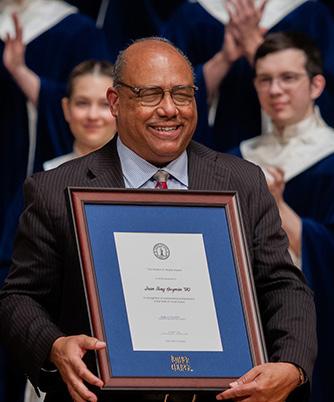
Juan Tony Guzmán ’90 is director of the jazz program and professor of music at Luther College. An active arranger and widely soughtafter conductor who has presented, led clinics, and conducted around the world, Guzmán is among an elite list of people who have earned both the Weston Noble Award and the Carlo A. Sperati Award.
Dr. Carlo A. Sperati Award
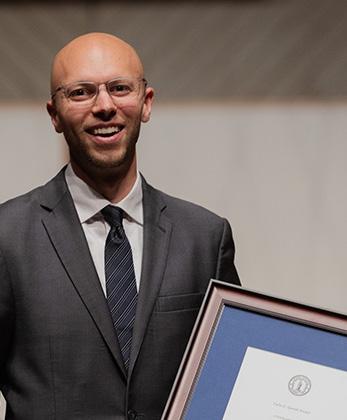
Jon Ailabouni ’10 is director of jazz studies at the University of Wisconsin–La Crosse, where he directs the Jazz Orchestra, Jazz Ensemble, jazz combos, and the Hoefer Brass Quintet. An in-demand trumpeter, educator, guest artist, and clinician, he released a debut album of original music, You Are Not Alone, in 2023.
Richard C. and Joann M. Hemp Family Prize for Orchestral Performance
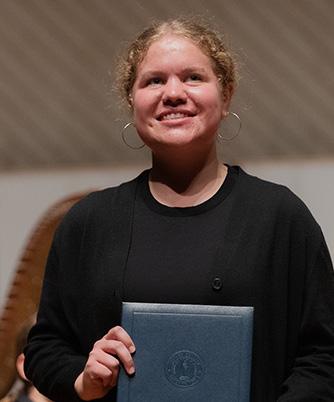
Audrey Zielstra ’26 is principal percussionist of Symphony Orchestra and Concert Band. A history and anthropology major, she is the first percussionist in the scholarship’s history to receive the award.
Growing Together
by John Mai ’19
Alumni
in northeast Minneapolis work together to make food systems more accessible.
Collin Kern ’20, development coordinator with the Institute for Agriculture and Trade Policy (IATP), says, “We need food that people can actually eat, that people can make a living producing, that is going to be available and supportive of the places it’s being grown in.”
Elyssa Eull ’16 has been growing food for over four years at California Street Farm. She farms with her sister, Cory Eull ’21, on the one-third-acre farm in the middle of Minneapolis’ arts district, surrounded by a park, a giant rabbit sculpture, art studios and galleries, and railroad tracks. Produce from the farm is sold
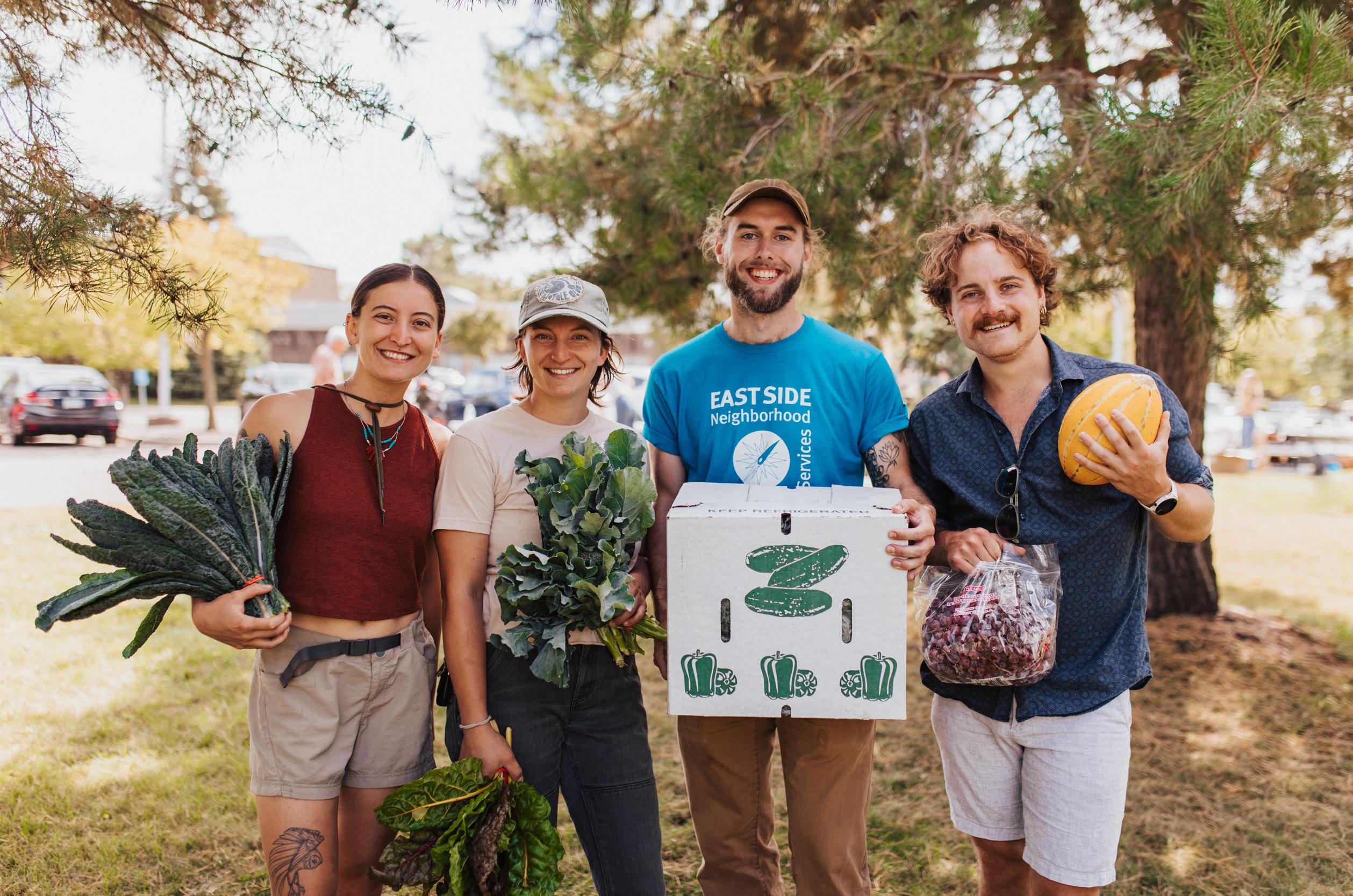
Luther alumni who work in different areas of food access and food systems collaborated at an event last fall that distributed produce to 115 households in northeastern Minneapolis. From left: Cory Eull ’21, Elyssa Eull ’16, John Mai ’19, and Collin Kern ’20.
Photo by Hunter Meyer ’22.
at their weekly farm stand, at farmers markets, to CSA customers, and to local restaurants and nonprofits. “Every element of our business is reliant on the fact that our community is supportive of us being there,” Elyssa says.
California Street Farm accepts EBT at their Monday night farm stand. “That feels like a really important piece of doing this work: making sure it’s accessible to everybody,” Elyssa says.
Just down the street from California Street Farm, John Mai ’19 works hands-on with food insecurity as a program coordinator at East Side Neighborhood Services (ESNS).
“I really love our program, and I really love the people we serve,” John explains. “We’re able to increase access to food in a unique way. We remove barriers like transportation, we focus on language and cultural barriers. Our services are provided at no cost to our participants.” ESNS distributes food to thousands of clients annually through a combination of walk-ins, deliveries, and pop-up produce distributions. In 2024, ESNS distributed more than one million pounds of food.
ESNS holds monthly produce distributions at up to five different sites during the summer and early fall. This September, the work of all four Luther alumni— John, Collin, Elyssa, and Cory—intersected during a produce distribution at ESNS’s main campus in northeast Minneapolis. The northeast produce distribution is located next to a high-traffic pedestrian trail, where runners, bikers, and walkers pass by from sunup to sundown.
“With the COVID era, there was definitely an influx in funds to support food and healthy eating and culturally familiar foods,” says Carolina Elizondo, director of food programs at ESNS. These funds, in part, have made these community distributions possible, keeping accessibility at the forefront. There are no income restrictions, and there is no collection of names or addresses.
For September’s event, ESNS purchased produce from Elyssa’s California Street Farm. Locally grown produce adds value to the community, Carolina believes. “We’re able to provide quality and variety and we’re able to support the local food economy while doing it. So it’s definitely a win-win there.”
Elyssa credits California Street Farm with “providing a super high-quality product” that is “grown fresh and is driven a maximum of five miles away.” For the September event, it had to travel only a few blocks from where it was grown.
To help distribute food at the September event, Collin brought IATP’s staff. They unloaded and organized thousands of pounds of produce and handed it out to a total of 115 households.
Policy work is “not very tangible all the time,” Collin states. “[Volunteering] helps us reconnect to what we’re actually working on.”
Collin dreams of a world where individual growers and consumers, rather than corporations, dictate food systems. But getting there isn’t easy.
Resources like land, capital, and equipment are traditionally available to large-scale, generational farmers. Elyssa believes that urban farms like hers would be more common if land were more accessible. She believes that land trusts, public funds, and cooperative ownership could create avenues for small, profitable farms to serve their urban communities.
Ben Lilliston, IATP’s director of rural strategies and climate change, admires California Street Farm’s work, saying that it’s “an example of how productive you can be on such a small piece of land. The amount of food that they produce is really inspiring.” He agrees that increased access to markets, to physical land, and to technical support would make urban farming more feasible for young people.
IATP has a realistic outlook about how quickly these goals can be actualized. “The winds are against us in Congress,” Ben states, “but pushing as hard as you possibly can in this kind of situation lays the groundwork for when there is more of an opportunity and support within Congress to make these changes.”
Collective action—like the kind that’s happening among northeast Minneapolis Luther alumni—is the key to creating sustainable change. Food production, direct service, and advocacy all have a role to play. “It’s not just one single thing,” Ben concludes. “But you have to sort of think about them together because it is a food system.”
CHANNELING GRIEF INTO ACTION
With deep support from their community, Moran Lonning ’16 and Alex Weber ’16 navigate a devastating loss by helping others.
by Kate Frentzel
TWO STUDENT-ATHLETES FALL IN LOVE
Alex Weber ’16 remembers meeting Moran Lonning ’16 on a sand volleyball court on campus the summer before junior year. “We hit it off right away,” he says. “We’ve just always loved being around each other.”
Alex was a baseball player from Mason City, Iowa, with three older brothers: Shawn, Mark ’10, and Thomas ’13. “I loved visiting Luther when two of my brothers were there,” he says. “When it came time to decide where to go to school, Luther had strong science programs. It had baseball. It was an easy choice for me.”
Moran transferred from the University of Northern Iowa to finish her last two years at Luther, where she played basketball and majored in health promotion. On meeting Alex, she says, “We knew really early on that we want to be together forever.”
LIKE FATHER, LIKE DAUGHTER
Moran grew up in Decorah. Her dad, the late Greg Lonning ’83, was Luther’s director of wellness. Having him as a teacher was impactful, she says: “He really exemplified wellness in all aspects—physical, mental, spiritual, social. He even talked about sexual wellness in his classes. I’ve heard a lot of stories about that from my friends!”
Prior to his 15-year teaching career at Luther, Greg was a wrestling coach at several colleges, winning conference titles twice and placing as high as third in the nation. Moran saw the example her dad set and wanted to follow it.
“Like my dad, I wanted to be in that coaching world of helping build leaders,” she says. “My dad was super passionate about building confidence in women. He would always push me to beat the boys in every pres-
idential test or every game in P.E. I grabbed onto the idea of empowering women from him, and in college sports, you get to do that.”
After Luther, Alex and Moran moved to Des Moines so Alex could earn a pharmacy degree at Drake University (he now works as an ambulatory care pharmacist at Mayo Clinic in La Crosse, Wis.). Moran landed an assistant coaching job at Simpson College, 30 miles south in Indianola, Iowa.
In March 2022, Greg died unexpectedly from a brain aneurysm. Then, in the span of about a year, Moran moved to a head coach position at Central College, Moran and Alex got married, and Moran’s brother Connor Lonning called to tell her about a head coaching job at the University of Wisconsin-La Crosse. Moran submitted her application on her honeymoon and, in 2023, became head coach of the UWL women’s basketball team.
Remarkably, Greg followed the same trajectory, with his first head coaching position at Central before moving to coach at UWL. This is one of many ways the couple continues to feel connected to him. “It seems that my entire life, I’ve done exactly what my dad has,” Moran says. “This felt pretty divine. I think my dad was somehow orchestrating it from heaven.”
A SHORT TIME WITH CHARLIE
In June 2024, Alex and Moran welcomed a son, Charlie—affectionately called Bubba—into their lives. “He was a baby who really loved to be moving, loved to be held, loved things a very particular way and would let us know loudly if things were not that way,” Moran says. “We joked that he had big emotions. Looking back, we feel grateful that he did, because it really forced us to hold him constantly, so we got to completely exhaust his short time here with how
much love we got to give him.”
She continues, “Having a baby together was super magical. I think back to those two weeks when we got to stay home from work as a family. It felt like we were in some sort of heaven. All three of us together, and nothing else really mattered. We’d be laughing and crying, and Alex would be playing different songs that he’d played a million times, but now with Charlie in our arms, they meant something a little bit different. They evolved again once Charlie passed away.”
Charlie died at daycare at three months old from Sudden Unexpected Infant Death. With no clear answers about what caused it, Alex says, “We’ll never really get closure on that end of things. That’s something we’re going to have to grapple with our entire lives, just trusting and understanding that we did everything we could in a safe way, and for whatever reason, Charlie’s life just ended. It’s a piece of our lives that’s really difficult to manage.”
COACHING THROUGH GRIEF
After Charlie died, Alex and Moran were wrapped in a community of support, including from Moran’s team. “When I got to UWL, I really put all my effort into making sure my players knew that I loved them outside of basketball,” Moran says. “Who knew that would come back and be so important for me and Alex and Charlie later on? Not just the players but also their parents completely wrapped us up and lifted us up and engulfed us in love.”
Just weeks after Charlie’s passing, Moran led UWL through a remarkable season, ultimately earning the last at-large NCAA Division III tournament bid, where the team won its first NCAA tournament game in 37 years and narrowly missed the Sweet Sixteen.
Family friend Tony Ayala recalls the heartbreaking
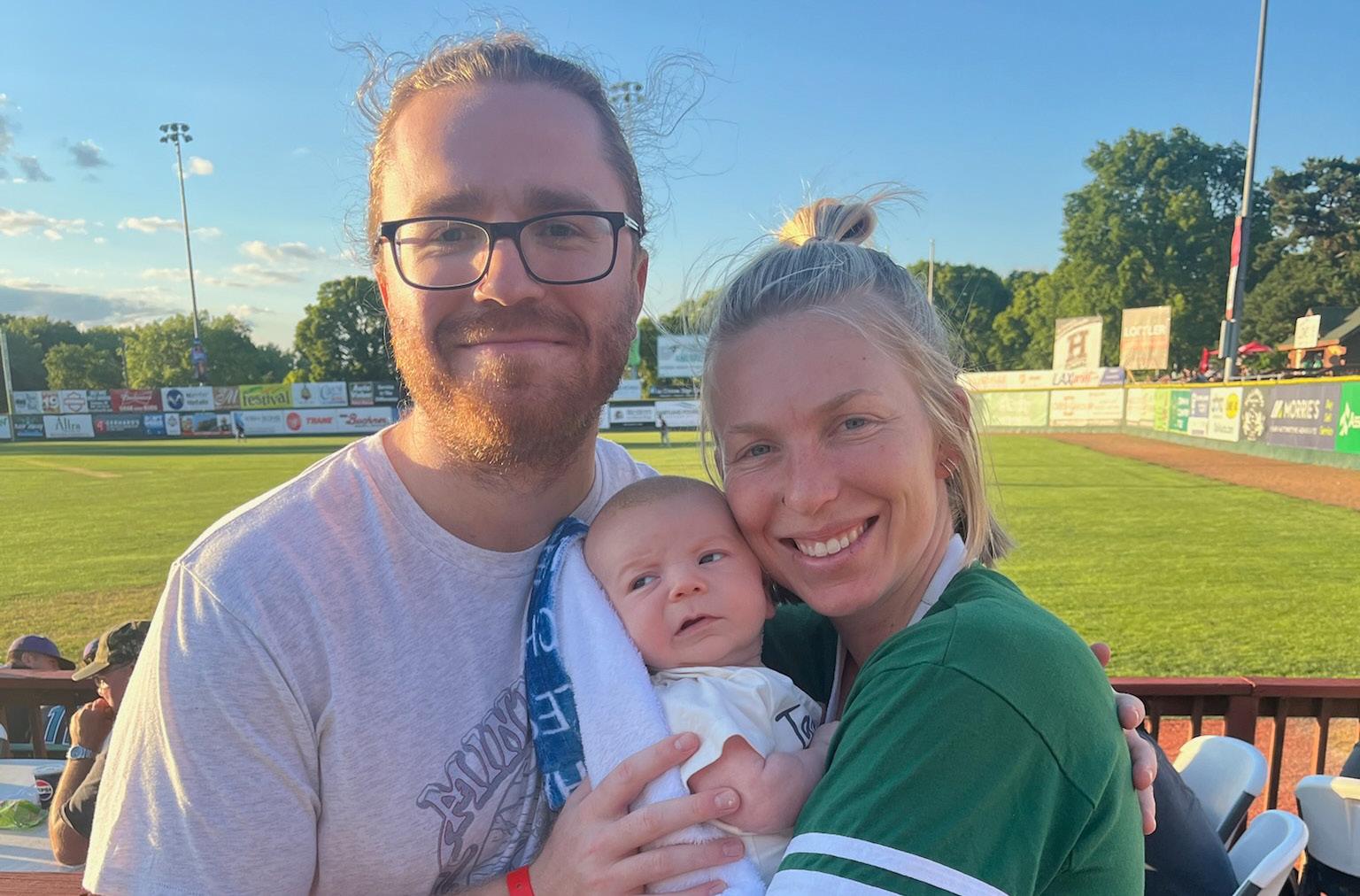
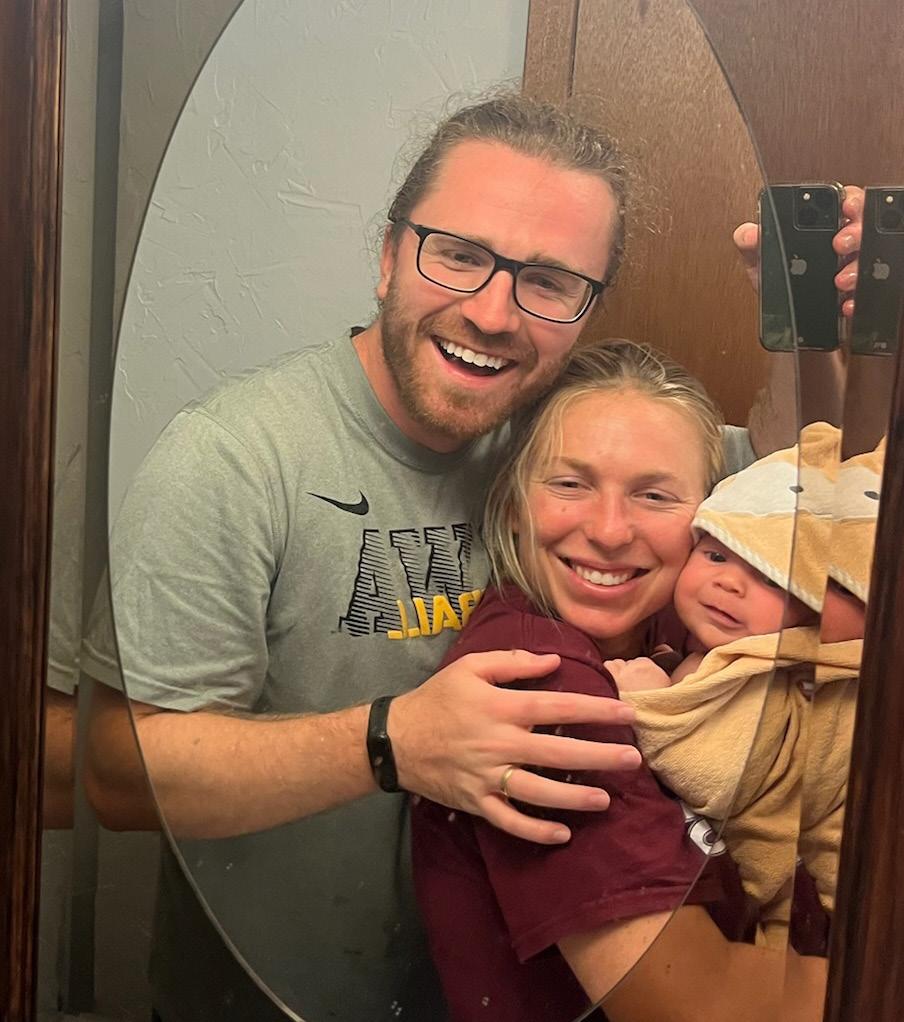
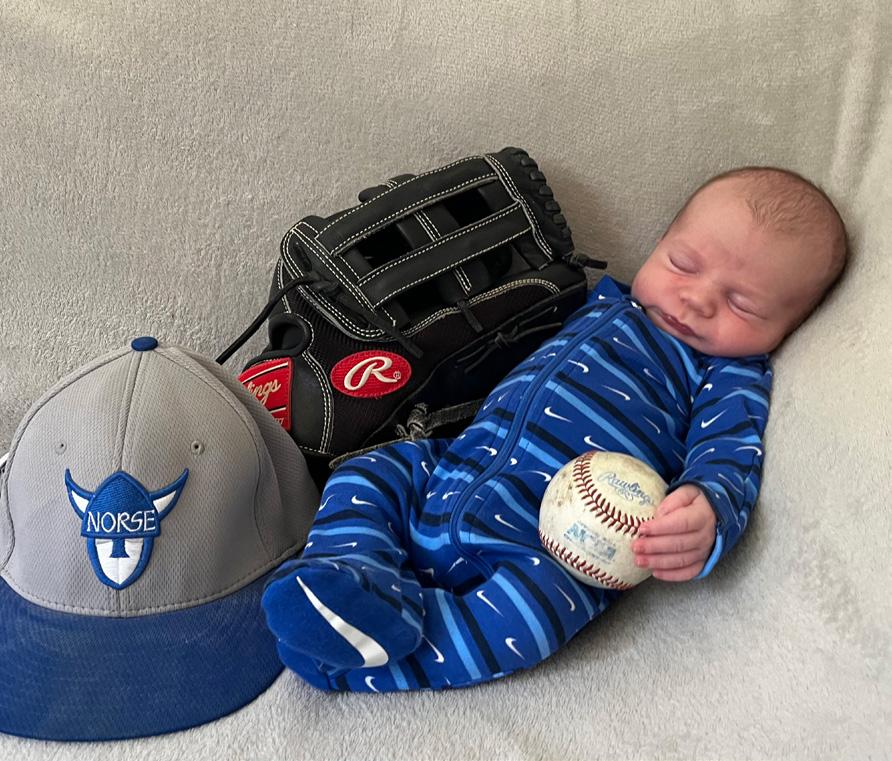
From left: Moran with her dad, Greg Lonning ’83; Alex and Moran with baby Charlie; baby Charlie was an early Norse baseball fan
back and forth during this intense time. “I remember cheering on the team and seeing Coach Mo sitting on the sidelines during warm-ups with her head in her lap, having a moment of breakdown, tears flowing. I asked her brother, who was sitting next to me, ‘Is she okay?’ And he said, ‘This is what grief looks like.’ In a couple of minutes, she’s back at it, standing up, supporting her team, and coaching as a Division III women’s basketball coach would be doing.”
The decision to coach during this time wasn’t easy, but, Moran says, “My players needed me too. They were grieving as well because they would babysit Charlie, and they loved me so much that it was hurting them to see me hurting.”
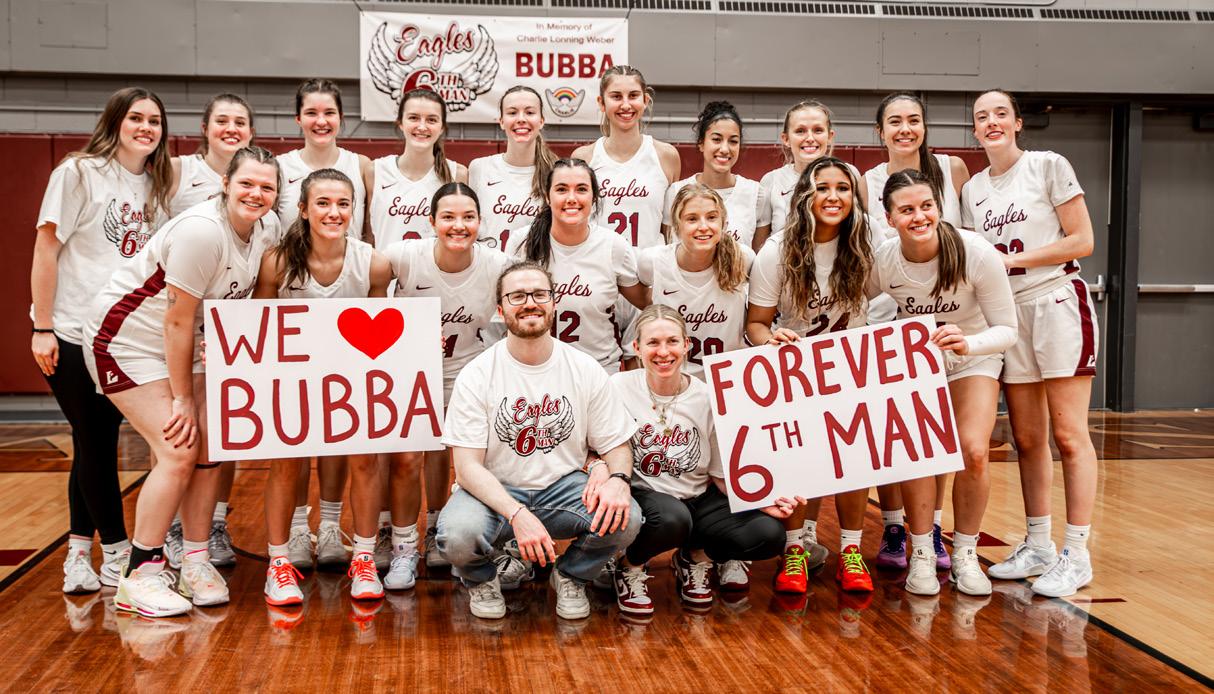
Moran’s players started to call Charlie their sixth man, a basketball term for a player who doesn’t start the game but is essential to the team. “I still feel so supported and loved and seen by my UWL family,”
Moran says. “They keep Charlie’s name alive and continue to validate these difficult times not just on his birthday, not just at the funeral, but on all the days in between that are really, really tough.”
REMEMBERING CHARLIE THROUGH HELPING OTHERS
As Charlie’s community moved through grief, Moran’s brother Connor, friend Tony, and others started brainstorming about ways that Charlie’s short life might leave an even bigger footprint.
As they researched, they learned that while the state of Wisconsin requires every employee at state-licensed childcare centers to be trained in CPR and the use of automated external defibrillators, the state doesn’t require actual AEDs on the premises. They
wanted to bridge that gap.
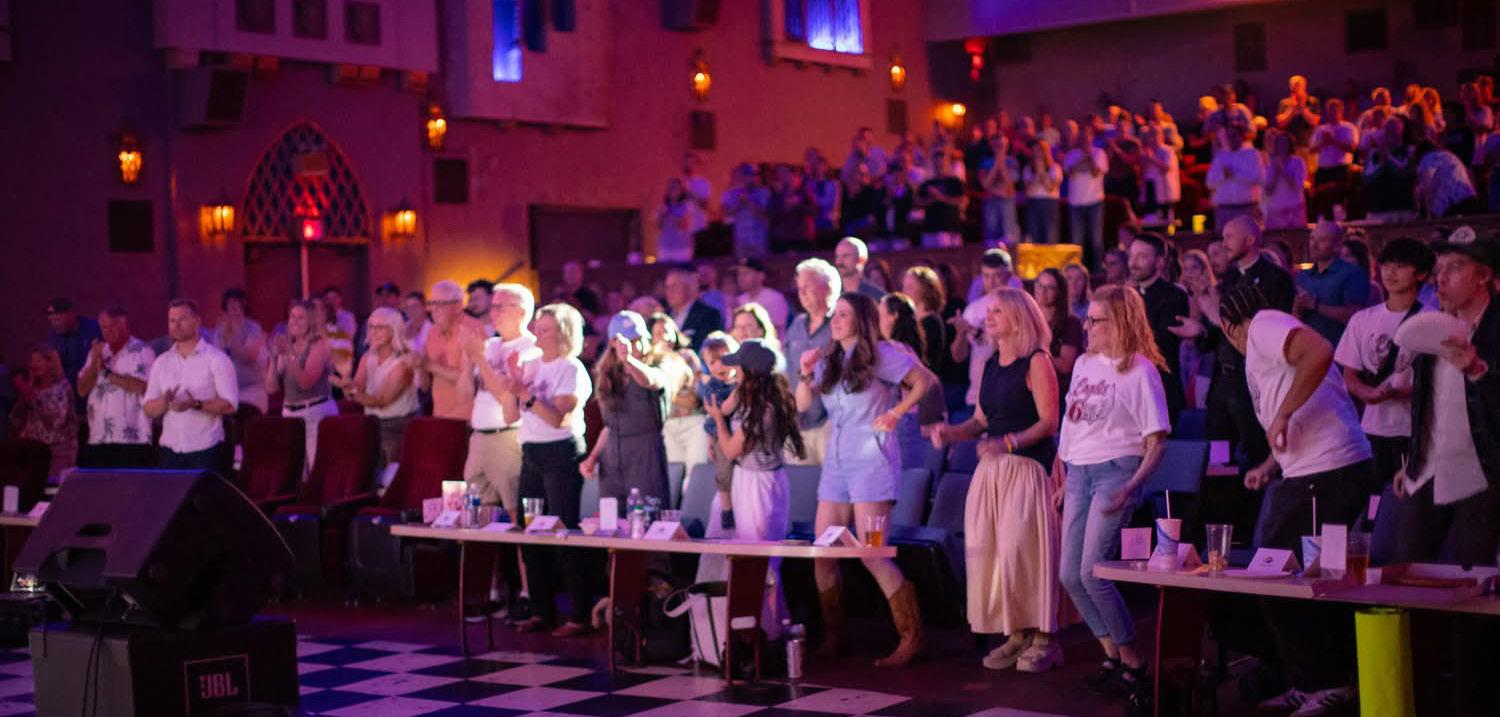
In August, the group hosted a kickoff for Bubba’s Fund, a donor-advised fund under the La Crosse Area Community Foundation. The night included storytelling, films, and music courtesy of the Weber Brothers Band—Alex and his siblings. The goal was to raise $20,000. They raised $60,000. Bubba’s Fund is now working to place AEDs in every state-licensed childcare facility in La Crosse.
“We don’t know if an AED would have saved Charlie’s life if it had been onsite, but we wanted to at least give our community and other families in this area the best chance to avoid something like we experienced,” Alex says.
Bubba’s Fund is also partnering with Wisconsin senator Brad Pfaff to write legislation called Bubba’s Law, which would provide $2 million over a two-year span to cover two-thirds of the cost of any AED equipment or replacement parts for state-licensed childcare centers. When the legislation hits the table, the Bubba’s Fund crew will spend a couple of months lobbying to get it approved.
Meanwhile, they’re expanding their goals. In January, they’ll hold Bubba’s Youth Night to raise funds for Rising Athletes, a La Crosse organization that helps kids from low-income backgrounds overcome barriers to sports participation, like team fees and equipment.
Sports have been foundational in Moran and Alex’s lives, and they want all kids to be able to benefit from playing them.
“I’m so glad our friends and family came forth with ideas of how to support us and honor Charlie. Now we’re seeing the fruits of that,” Alex says. “We’re trying our best every day to forge ahead with Charlie’s life by carrying it in ours.”
IN TUNE WITH A Calling
Composer Pablo Gómez-Estévez ’18 brings Dominican identity, imagination, and heart to the stage.
In May 2025, Pablo Gómez-Estévez ’18 presented the overture “ Too Niche, Too Nietzsche,” a piece from his opera-in-progress, New Cibao, at Carnegie Hall’s popular Nuestros Sonidos (Our Sounds) festival, which celebrates Latin culture in the United States.
It marked an energizing milestone for an artist whose career began by trusting a calling few around him understood.
“My story is one of leaps of faith and serendipity,” says the prolific musician, composer, and educator.
In his early teens, growing up in the Dominican Republic, he filled notebooks with ideas for stories and poems. Then his grandmother gifted him a cellphone, and he began capturing melodies, improvisations, and bits of writing whenever inspiration struck. But this growing creative world often clashed with the more conventional futures others envisioned for him.
“Music is the first controversial decision of my life,” he recalls, noting that his mother was always supportive. “ The idea of studying music was essentially a foreign thing in the DR. They had no idea you could do that. And now I’ve finished my doctorate.”
On a friend’s recommendation (Victor Hernández Sang ’13), Pablo enrolled at Luther, where he majored in composition and piano, minored in philosophy, sang in choirs, and collaborated with the dance and creative writing departments on interdisciplinary projects.
“At Luther, I was able to nurture my curiosity,” he says. “It gave me a strong foundation for what came after and what’s happening now.”
After earning a doctorate from Bowling Green State University, he relocated to New York City, where he became a research
associate and creative fellow at the City University of New York’s Dominican Studies Institute. There, he studied the archives of Dominican composer Rafael Petitón Guzmán (1894–1983) while developing New Cibao, a Dominican sci-fi opera about a society addicted to synthetic dreams, structured as a large-scale TikTok. He hopes to premiere the work in 2026.
Pablo says he’s living this current chapter of his life with adventure and ambition as he continues to learn about himself.
“ The more time I spend in the U.S., the more Dominican I become,” he says. “At the same time, when I go home to Santiago, I need to retranslate myself. I feel like I’m in between.”
Pablo is also the founder of Pineo Media, an interactive music and storytelling platform that promotes emotional literacy in children. The idea originated during his time at Luther, and at Bowling Green, he received seed funding through the Hatch entrepreneurial program to expand the project.
“I connected with a calling through music,” he says, “to dream with my eyes open, to have this big vision, and to do it. God has given me these talents, and I was tasked with finding new ways to develop them and put them into service for others.”
—Amy Carlson Gustafson
MoreTHAN A BOOKSTORE
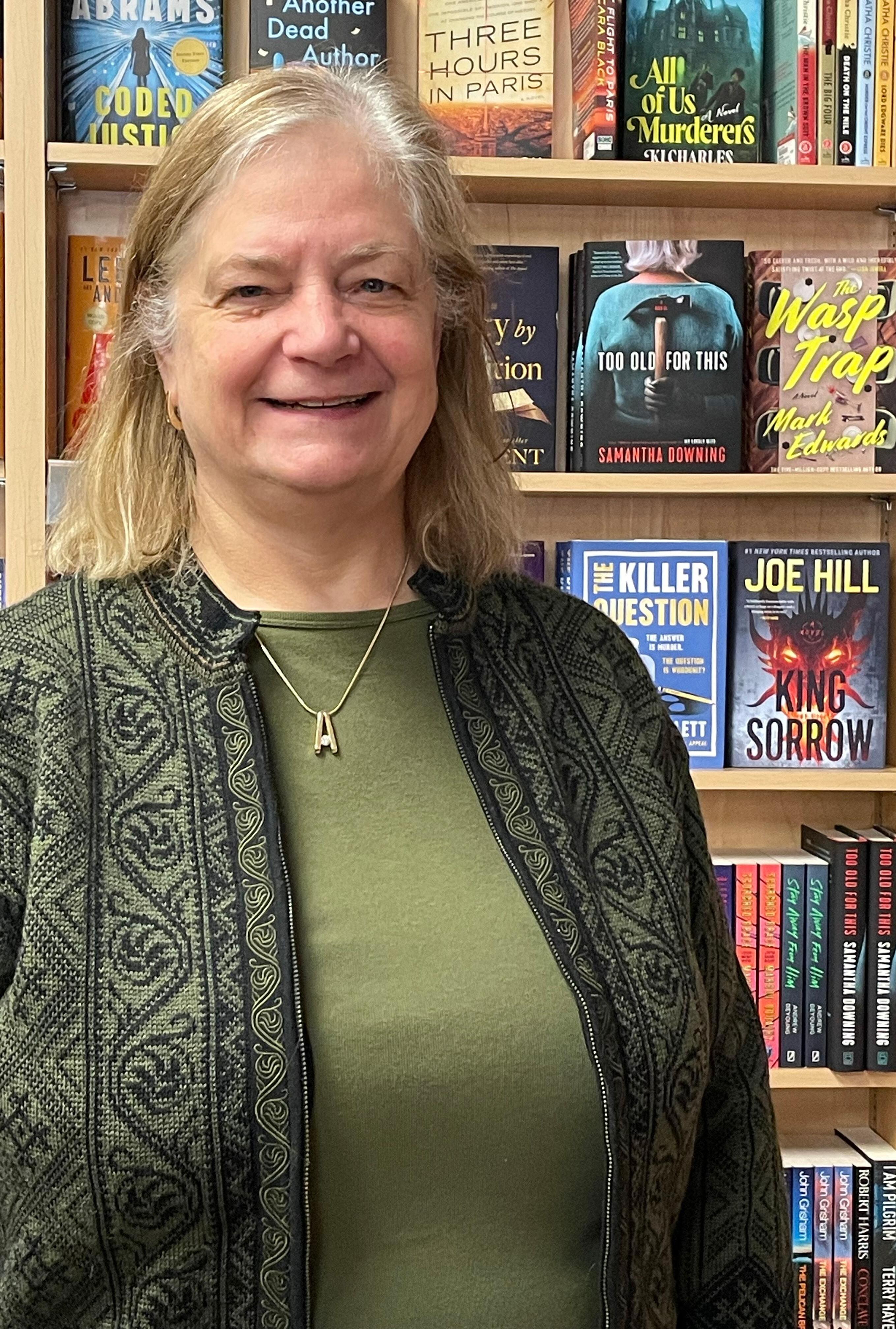
When Kate (Nelson) Rattenborg Scott ’83 opened Dragonfly Books, she gave Decorah more than just a vibrant and inclusive retail space.
Growing up half a block from Luther, Kate (Nelson) Rattenborg Scott’s local bookstore was the one on campus. “I would go there to spend my hardearned money from a paper route or babysitting on paperbacks,” she says.
She graduated from Luther as an English major, and for two decades, she deepened her relationship with the written word through work as an academic librarian.
After the unexpected death of her first husband, Kate returned to Decorah with her two teenaged daughters. In September 2010, working as a financial advisor at Thrivent, she was helping train new financial associates in Cedar Rapids when the question of “Where do you see yourself in five years?” was turned on her.
“I started talking about how I wanted to open a bookstore,” she says. Her whimsical answer took root on the drive home. In February 2011, she officially launched Dragonfly Books in downtown Decorah.
It’s a highly compressed timeline for such a big venture, but Kate drew on skills she’d spent a lifetime developing. Her library work had given her experience in acquisitions, cataloging, collection development, reader interest, and computer systems, while her work with Thrivent helped her understand the financial implications. Plus, she says, “That liberal arts background from Luther gave me a solid foundation to open a business. I had taken some accounting and business courses that really, truly held me in good stead.”
SOMETHING FOR EVERYONE
In stocking the shelves at Dragonfly, Kate says, “We look for what’s important in our community.” In addition to best-sellers, the store emphasizes books on the environment, sustainability, healthy living, intellectual wellbeing, education, and Scandinavian literature in translation. Kate makes an effort to carry a diversity of voices and, she says, “Coming from my library background is a real concern about freedom of speech, freedom to read, and censorship.” So the store also commits to keeping challenged books on the shelves.
Over the years, Kate’s been approached to branch out to other towns. “It’s a compliment,” she says, “but what works about Dragonfly is that I’m a member of this community.” The venture succeeds in part because Kate
knows and loves Decorah. She doesn’t think it would work in a town in which she wasn’t embedded.
She did say yes, though, to acquiring a Christian bookstore in Decorah, also on Water Street, in 2019. Kate sees the Silver Birch (formerly the Master’s Touch) as a good complement to Dragonfly. “Dragonfly probably leans a little left of center, while the Silver Birch leans a bit right,” she says. “That’s intentional. It’s nice to be something for everyone.”
Silver Birch has turned out to be really special in a different way. “It’s a place where you see somebody at important touchpoints of their life,” Kate says. “Whether it’s a baptism, first communion, confirmation, wedding, anniversary, death, or memorial—the products we sell there are from birth to death. My staff there almost do a ministry.”
MORE THAN RETAIL
About five years ago, a private foundation that saw the value of independent bookstores approached Kate about investing in Dragonfly as a place to build community, provide regional education, and support emerging authors through book events. This funding established the Oneota Valley Literary Foundation, which has allowed Kate to turn the apartment above Dragonfly into lodging for visiting authors. In 2025, Kate and her team hosted about 80 author and community events.
The Oneota Valley Literary Foundation also donates books to students through regional schools, public libraries, and museums, through Helping Services for Youth and Families, and through the Decorah Community Food Pantry, among other outlets. In this way, it’s sparking conversations, expanding minds, and building regional readers not just through retail, but through thoughtful programming and philanthropy.
In February, Dragonfly celebrates 15 years of operation, and Kate feels the time is right to pass the torch to her adult daughters, who’ve been working alongside her. They seem very well poised to continue her legacy. When USA Today profiled Dragonfly in July, daughter Sarah Krammen said that when you shop at Dragonfly, “You’re doing more than just buying a book—you’re helping to build a vibrant and connected community.”
—Kate Frentzel
To get his charitable
FINDING VISION
A sudden retinal detachment changed the life of Steve “Dukie” Corson ’79 overnight. What he gained in the process was a renewed sense of purpose and appreciation.
For many, finding the bright side of losing sight in one eye would be impossible. But that’s exactly what Steve “Dukie” Corson ’79 did.
In August 2017, Dukie woke up blind in his right eye. The cause was sudden retinal and macular detachment. After numerous doctor visits and multiple surgeries at the University of Iowa Hospitals and Clinics, the reality set in that his vision in that eye was gone for good.
An eternal optimist, Dukie found perspective during this challenging time in his life. On his medical trips to Iowa City, he often saw children heading into the nearby University of Iowa Stead Family Children’s Hospital.
“God was working in mysterious ways when he said, ‘Dukie, you’re about ready to retire anyway. Why don’t you do this golf tournament and make your heart happy?’” he says. “I thought, Forget about the eye.
There are kids in that hospital dying from cancer. I need to help them out.”
After graduating from Luther, Dukie had attended mortuary school in order to work at the funeral home that his great-grandfather had founded, Kaiser-Corson Funeral Home. “I saw it as a calling,” he says. “I would come home during the summers and work with my dad part-time at the funeral home, helping with visitations and funeral services. I saw that what he was doing was really helping families at the worst time of their lives. I wanted to be part of that.”
When vision loss struck, Dukie retired as president of the funeral home. With the support of his family and friends, he launched Dukie’s One Eye Open, a charitable golf tournament to raise funds for the children’s hospital. Between 2018 and 2025, the event, held in Waverly, Iowa, raised more than $700,000 for the Stead Family Children’s Hospital.
The impact of Dukie’s One Eye Open has been far-reaching. Dukie’s Vision Fund has helped families afford specialized eyewear, iPads, and books, and his fundraising has helped the hospital afford two therapy dogs and support for pediatric brain cancer research.
“It just grabs your heart and says, Wow, we did a good thing, guys,” Dukie says. “Our community has a huge heart. I never imagined it would turn out this way eight years ago. This is one of the coolest things I’ve ever done in my life.”
—Amy Carlson Gustafson
golf event off the ground, Dukie Corson ’79 worked with dear friends from Waverly, Iowa, with big hearts and great nicknames. From left: Mike “Pup” Byl, Jim “Goose” Koch ’79, Doug “Scooter Pie” Benschoter, Steve “Dukie” Corson ’79, Jerry “Kel” Keller. Their fourth and final outing raised $300,000 for the University of Iowa Stead Family Children’s Hospital.
Class Notes
Notices as of October 31, 2025
’67
Terry (Thiele) Rasmussen of Fort Collins, Colo., has run 58 half marathons in all 50 states, D.C., Mexico, and Scotland since 2010. Terry is currently running 5-milers, 4-milers, 5Ks, and 10Ks.
’75 John Bradtke of Palm Coast, Fla., is retired.
Steve Mineck of Elmhurst, Ill., is a volunteer with Project C.U.R.E., a global medical relief organization.
Chuck Storla of Acworth, Ga., wrote his debut novel, a humorous murder mystery titled Murder Two Doors Down
’76 Tom Stark of Madison, Wis., illustrated his wife Kathleen’s recently published children’s book, The Armadillo Family and the Secret Tunnel
’77 Mark Scharff of St. Louis, Mo., stepped down as coordinator of the NACO-Music Project after 15 years of service. Mark also toured Europe with the Myron Heaton Chorale of Las Vegas.
’78 Eric Holey of Lakeville, Minn., is a ceramics instructor at Lakeville Area Arts Center.
Jan (Connell) Lovell of Clear Lake, Iowa, published a book, Our Better Selves: A Journey of Love amid Life’s Storms, available on Amazon.
’81 Tammy Anderson of Morrison, Ill., retired from Bethesda Lutheran Church.
’85 Kris Thomas Dreifuerst of Gallatin, Tenn., is senior associate dean for academics and a professor at Vanderbilt University.
’90 Pete Behrens of Louisville, Colo., published his debut book, Into the Fog: Leadership Stories from the Edge of Uncertainty
Vanessa (Grima Baldacchino) Frazier of New York is special
representative of the secretary-general for children and armed conflict for the United Nations.
Jane (Vaaler) Roets of Wethersfield, Conn., is a clinician at Growing Well Counseling. Jane also serves as a member of the Wethersfield Town Council.
’92
Stephanie Agresta of Little Silver, N.J., is the managing director for Ascendancy Events.
’94
Jon Trouten of Iowa City, Iowa, is a social work navigator with Johnson County and also serves as a dog park attendant for the city.
’95
Kristen Larsen-Schmidt of Decorah is pastor at Good Shepherd Lutheran Church.
’96
Erin (Blagsvedt)
Jorgensen of Taylor Ridge, Ill., is senior director of communications and editor of Rental Management magazine at the American Rental Association in Moline, Ill.
’98
Gayle (Dunkel) Gort of Castle Rock, Colo., is area vice president at NewRocket in Vista, Calif.
’00
Kelly Nye-Lengerman of Dover, N.H., is a research professor at the University of Maryland.
’01
Sarah (Woltjer) Brekke of Homestead, Mont., is an English teacher at Medicine Lake (Mont.) Schools.
Mazhar Hasnani of Potomac, Md., is global strategy and capital advisor at Agrilift.ai.
’03
Melissa (Maas) Richardson of Washington, D.C., is director of middle grade choirs at National Cathedral School.
Janet Tisinger of Lancaster, Pa., is associate director of legal services for the Immigration and Refugee Program.
’04 Andy Meyer of Northfield, Minn., is a visiting assistant professor of Norwegian at St. Olaf College.
Jeff Miller of Eagan, Minn., is senior manager at the Association of International Certified Professional Accountants.
Scott Rheinschmidt of Cedar Rapids, Iowa, is chief financial officer of CRST, a transportation company.
’05
Phil Hoesing of Nampa, Idaho, is itinerant director of bands at Adams, Riverside, Trail Wind, and White Pine elementary schools in Boise, Idaho. Phil is also manager and bass trombonist of the Boise Modern Jazz Orchestra.
Cat (Komornick) Lubinski of Wellesley Hills, Mass., works as corporate relations coordinator, MIT Sloan Masters of Business Analytics.
Martha McCreight of Stratford, Conn., is pastor at St. John’s Lutheran Church in Stamford, Conn.
’07
Jeff Hoden of Oakdale, Minn., is quality engineer at Andersen Windows and Doors in Bayport, Minn.
Blake Nellis of Minneapolis is self-employed as a photographer, dancer, and educator.
Luke Wigle of Justin, Texas, is supervisory emergency management specialist for FEMA in Denton, Texas.
’10
Carson Christen competed in the Ironman 70.3 World Championship Triathlon in New Zealand in December 2024, finishing 13 of 387 participants in the male amateur division, age 35–39. Carson is owner of a professional endurance coaching company, Torden Multisport in Milwaukee, Wis.
Ross Schultz of Ann Arbor, Mich., is chief department administrator of neurosurgery at the University of Michigan.
Mitch Zoelzer of Chicago is assistant principal at Chicago Public Schools.
’11 Brett Epperson of Lodi, Calif., is director of choral
studies at the University of the Pacific Conservatory of Music in Stockton, Calif.
Haley Gibbons of West Des Moines, Iowa, is director of Valley Singers, with whom she performed at the National American Choral Directors Convention. Haley also received the Outstanding Choral Educator Award from the Iowa Choral Directors Association.
Kate (McDonald) Sutherland of North Kingstown, R.I., is head of middle and upper school at Rocky Hill Country Day School in East Greenwich, R.I.
’13
Jordan Burkhart of Auburn, Maine, is director of operations at Correlation One.
Shannon Curtis of Minneapolis is director of bands and music production at Buffalo (Minn.) High School.
’14
Sarah Loberg of Longmont, Colo., earned a master’s degree in physical education from the University of Nebraska–Kearney.
Lilli Petsch-Horvath of Milwaukee earned an MSW from the Helen Bader School of Social Welfare at the University of Wisconsin–Milwaukee and is a psychotherapist at Be The Change Health and Wellness.
Ashley (Brown) Swanson of Cedar Falls, Iowa, is a licensed mental health counselor at A Couple of Therapists.
’15
Aaron Busch of Northfield, Minn., earned a coxswain certification and advanced to E5 (petty officer second class) in the Coast Guard. Aaron also works in field maintenance for the Metropolitan Airports Commission.
Christine (O’Brien) Deignan of La Grange, Ill., is founder and CEO of Middle Kid Musicals.
Katherine (Langston) Houdek of Rochester, Minn., is director of cellular, molecular, and bispecific education at Mayo Clinic.
Josh Swanson of Cedar Falls, Iowa, is a licensed mental health counselor at A Couple of Therapists.
Regent Pete Espinosa ’81 and Kari (Tollefson) Espinosa ’84 received the Outstanding Philanthropists Award from the Upper Mississippi Valley Chapter of the Association of Fundraising Professionals on Nov. 14 in La Crosse, Wis. A group of Luther alumni, staff, and students attended the celebration. From left: Denise Davismckennie ’82; Terry Ramlo ’86; Mary Duvall, vice president for advancement; Parker Lau ’27; Alexander Bodnar ’27; Pete Espinosa ’81; regent Willie Davismckennie ’84; Jeanie Lovell, senior director of foundation and government relations; Julia Da Silva Moreno ’26; and Sherry Alcock ’82, retired executive director of alumni relations. The Espinosas were nominated by Jeanie, a longtime AFP member.
Former Luther roommates Sid Larson ’72, John Strand ’72, and Jim Lantz ’72 recently vacationed with spouses in Italy.
Kate Wyre ’20 (left) and Cassie Michel ’20 (right) both joined a 60-year-old community theatre group in Englewood, Colo., where they sang a duet together in 42nd Street. They’ve also acted together in the group’s productions of Footloose and The Wizard of Oz
On July 19, a group of alumni and friends gathered in Cumberland, Wis., to celebrate the 80th birthday of Gary Johnson ’68. Back row (from left): Jeff Casper ’69, Tom Beyer ’68, Lee Winberg, Jim Winberg ’68, George Kuh ’68, Russ Savre ’68, Paul Shafland ’68, Dick Oltman ’68 Front row: Kay Casper, Susie Beyer, Sue Oltman, Liz Alberg, Gary Johnson ’68, Nelda Shafland, Kay Ellison, Terry Ellison ’68
Thea (Tupy) Morris ‘88 sent in this picture of a chance meeting with Howard Bernatz ‘51 at the Old Rossville Store in Waukon, Iowa, on Howard’s 98th birthday! “We noticed the rings and started chatting,” she says.
A group of family and friends traveled to Interlaken, Switzerland, at the end of August. Among the group of 25 were seven Luther grads. Left to right: Karen (Gesme) Brunssen ’75, Gary Alshouse ’76, Susan (Stavig) Alshouse ’78, Tom Dyrdal ’79, Jeffrey Indrelie ’79, Carol (Kuntz) Swenson ’79, Kell Nielsen Kavanaugh (Martha’s grandson—and hopefully Luther class of 2047!), Martha (Gesme) Nielsen ’79
Matthew Staver ’20 and Sophia Haugland ’20 married on May 31, 2025, in Eden Prairie, Minn. Multiple generations of Luther grads celebrated with them!
Janet (Purmort) Tollund ’73 snapped this photo of her husband, Bob Tollund ’58 (right), chatting with Michael Osterholm ’75 at a book signing for The Big One: How We Must Prepare for Future Deadly Pandemics in October.
Members of the class of 1986 gathered for a weekend of celebrating their sixties and 43 years of friendship. Polly (Anderson) Wiebke ’86 says it was “a pre-party to next fall’s 40th reunion in Decorah!” Left to right: Maree Hampton, Suellen Hanson, Sherry Holton, Carrie (Askew) Noonan, Lauren (Riley) Schroeder, Peg (Braun) Ellefsen, Diane (Korte) Mikelsons, Polly (Anderson) Wiebke
The staff at Mount Calvary Lutheran Church in Excelsior, Minn., is blessed with several Luther alumni! Left to right: Jill (Larson) Cowan ’88, worship coordinator. Ally (Klug) Reitz ’16, intern pastor; Scott Searl ’94, interim pastor; Alexis Olson ’19, bell choir director; Kyle Jackson ’95, lead pastor; Evan Lieber ’20, director of confirmation.
Class of 2008 grads celebrated their long-lasting friendship with a trip to Austin, Texas. Left to right: Mark Schuerman, Casey Chavez, Abby (Oitzman) Chavez, Beth Grev, Alex (Lancaster) Schuerman, Ethan Grev, Haley (Douglass) Downing, Kari (Legreid) Klein, Jana (Smith) Larson, Nick Larson, Corey Downing.
Alumni gathered in full force at Magers & Quinn Booksellers in Minneapolis to hear professor of English Amy Weldon (directly under the “We Buy Books” sign) read from her new novel Creature: A Novel of Mary Shelley and Frankenstein. Amy says, “It was a monstrously joyous gathering!”
Bryson Miller ’24 and Quinn Zeleny ’24 married October 19, 2025, in West St. Paul, Minn., surrounded by lots of Luther love!
Justin Velzke of Owatonna, Minn., is a financial advisor at Ameriprise Financial.
’16
Rachel (Wiebke) Bellrichard of White Bear Lake, Minn., is quality engineer II at Medtronic.
Matthew Gausmann of Cambridge, Wis., is a religious studies teacher at Edgewood High School of the Sacred Heart in Madison, Wis.
Katie (Wolter) Sorenson of Bristol, England, is a flood risk activity permitting officer with the Environment Agency in the United Kingdom.
Emma Tebben of St. Paul, Minn., is a secondary music teacher at George Washington Academy in Casablanca, Morocco.
Laura Thoms of St. Louis, Mo., is a teacher at Intersect Arts Center.
’17
Hank Dickey of Rochester, Minn., is strategic sales advisor at Genograms.com.
Emily Holm of Minneapolis is learning and development manager at Field Nation.
’18
Jamie Herman of Greencastle, Ind., earned a PhD in philosophy of education from
al and professional initiatives at DePauw University’s Janet Prindle Institute for Ethics.
Jeffrey Lackmann of Kaneohe, Hawaii, is a postdoctoral researcher with the Research Corporation of the University of Hawaii.
Samantha Rabang of Burnsville, Minn., is a licensed professional clinical counselor at Affinity Psychological Services in Apple Valley, Minn.
’20
Megan Carmean of Alexandria, Minn., is a registered nurse at Alomere Health.
Claire Honl of Houston, Texas, is a nurse practitioner at MD Anderson.
Madeline (Ajack) Lannon of Minneapolis is director of youth ministries at Westminster Presbyterian Church.
Jena Lisowski of Minneapolis is an attorney at Faegre Drinker Biddle and Reath.
Ozzie Suarez of Des Moines, Iowa, earned an MS in construction management from the University of Texas–El Paso and is field engineer at Foth Infrastructure and Environment in Johnston, Iowa.
director with the Democratic Congressional Campaign Committee.
’21
Piper Wood of Decorah is assistant director of engagement at Luther College.
’23
Ethan Bellendier of Brookfield, Wis., is clinical research coordinator I with the Medical College of Wisconsin.
Katie Bevers of Decorah is an admissions recruiter for Upper Iowa University.
Hallie Johnson of Edinburgh, Scotland, earned an MSC in comparative education and international development from the University of Edinburgh.
’24 Marina Beachy of Wellman, Iowa, is a labor and delivery nurse at the University of Iowa Hospitals and Clinics in Iowa City.
Morgan Coy of Mantorville, Minn., is grades 5–12 band director at Triton Public Schools in Dodge Center, Minn.
Newelle Dalton of Ramsey, Minn., is a third-grade literacy teacher at Anoka Hennepin Schools in Blaine, Minn.
Grace Parrott of Madison, Wis., is an agricultural research technician at the University of Wisconsin–Madison.
Blake Storby of Fairmont, Minn., is a certified personal trainer and assistant director of sports performance at Cutting Edge Fitness of Fairmont.
Kaylee Turney of Adams, Minn., is grades 5–12 band teacher and drumline director at Southland School.
Elise Wilson of Ankeny, Iowa, earned an environmental education graduate certification from Hamline University and is a school groups and summer camp coordinator at The Works Museum.
’25
Ryan Adams of Fairmont, Minn., is an eighth-grade science teacher at Fairmont Area Schools.
Kamden Goering of Rochester, Minn., is a registered nurse at Mayo Clinic.
Megan Miller of Urbandale, Iowa, is a client executive at Holmes Murphy and Associates.
Ricardo Portilla Ruiz of Rochester, Minn., is a patient care assistant at Mayo Clinic.
Judith Zimundi of Rochester, Minn., is a laboratory education support associate at the University of Minnesota–Rochester.
Marriages
’76
Jane Stearns and Steve Burns, Oct. 2025
’91
Karen Jacobson and Dave Danielson, Oct. 2025
’02
Erica Lamm and Alfred Denny, April 2024
’04
Monica Smith and Mark Nicholson, July 2025
’06
Sara Barnes and Mitch Randall, Feb. 2025
Notices as of November 21, 2025
’08
Laura Gorton and Aaron Fagan, Oct. 2025
’11
Steven Thai and Patrick Cox, July 2025
’14
Jessica Larson and Luke Sjordal, Sept. 2025
’16
Emmalyn Stumpf and Zack Giese, Sept. 2025
’17
Kelly Dawson and Tom Egan, March 2025
Erika Finanger and Quintin Abel, Nov. 2024
’18
Mitch Bruggers and Hanna Christopher ’19, May 2025
Samantha Rabang and Pannchna Chao, May 2025
’19
Anna Edel and Kyle Bode ’20, Aug. 2025
’20
Mackenzie Flaherty and Marcos Ceceñas, Oct. 2025
Sophia Haugland and Matthew Staver, May 2025
Connor McBride and Samantha Ranney, Oct. 2024
Susie Wold and Natalia Cadena ’22, June 2025
’21
Peter Stelter and Hannah Cole, Feb. 2024
’22
Sarah Halverson and Luke Pavlat, July 2025
’24
Bryson Miller and Quinn Zeleny, Oct. 2025
Notices as of November 21, 2025
’05
Births & Adoptions ’15
Inge, Sept. 2025, child of Martha McCreight and David Hanssen
’06
Raef, April 2025, child of Sara (Barnes) and Mitch Randall
’10
Helen, April 2025, child of Neal Petersen and Kristin (Porter) Petersen
Thomas, May 2025, child of Joe Putnam and Leslie (Brandt) ’17
’11
Harrison August, Aug. 2025, child of Meghan (McCall) and Michael Caldwell
’13
Albert Benjamin (photo 1), Dec. 2024, child of Devan (Benjamin) and Sam Weinberg ’15
Finn, May 2024, child of Jordan Burkhart and Katie Burkhart
’14
Finn, Sept. 2023, child of Haley Gibbons and Dan Solem ’12
Frances, May 2025, child of Clara (Lind) and Jack Lindwood
Henry, May 2024, child of Madeline (Davidson) and James Didier
Henry, Dec. 2023, child of Katherine (Langston) and Matt Houdek
Reese, Jan. 2025, child of Katie (Mathis) and Josh Woodhouse ’16
Archie, Sept. 2024, child of Rachel (Wiebke) and Brian Bellrichard
Bodie, Aug. 2025, child of Carly (Rusek) and Matthew (Peterson) ’17
Elise Carol, May 2025, child of Matthew Gausmann and Hannah Gausmann
Ruth Alison, June 2025, child of Lauren (Mordini) and Alex Bishop ’17
’17
Aela (photo 2), Oct. 2025, child of Josh Miller and Rachel Miller ’18
Morgan, May 2024, child of Jessica (Morrill) and Joe Andrade
’18
Ada, Sept. 2025, child of Hayes Durbin and Amy Durbin
’20
Jonas (photo 3), May 2025, child of Jessica (Carpenter) and Joel Freeman
In Memoriam
Notices as of November 21, 2025
’50
Audrey (Gaarder) Appel of Oregon, Wis., died October 14, 2025, age 96.
Roger Goulson of Decorah died January 18, 2024, age 97.
Margaret (Michel) Larson of Omaha, Neb., died January 23, 2025, age 96.
Arlene “Beverly” (Otters) Pearson of Canyon Lake, Texas, died March 20, 2023, age 93.
Harold “Bud” Pearson of Canyon Lake, Texas, died August 17, 2025, age 97.
Marilyn (Knudson) Peterson of Decorah died August 6, 2025, age 96.
’51 James “Weldon” Smith of Clifton, Texas, died October 7, 2025, age 95.
’52 Glenna (Peters) Leuenberger of Fort Dodge, Iowa, died September 13, 2025, age 95.
Donald “Don” Oss of Spring Valley, Minn., died September 6, 2025, age 94.
’53
Iver George “I.G.” Eldon Nelson of Portage, Wis., died January 12, 2024, age 95.
Avis (Nelson) Savre of Longville, Minn., died October 28, 2025, age 95.
’54 Hamlet “Ham” Peterson of Rochester, Minn., died August 26, 2025, age 93.
’55 Gerald “Gerry” Johnson of Decorah died September 26, 2025, age 88.
’56 Lois (Karstad) Dellota of Manhattan Beach, Calif., died August 12, 2024, age 94.
Karen (Rem) Mandsager of Mapleton, Minn., died October 14, 2025, age 88.
’57 Sharon (Schulte) Anderson of Ames, Iowa, died April 18, 2025, age 89.
DeVonne (Peterson) Hatch of Clive, Iowa, died September 16, 2025, age 90.
Shirley Liesener of Seward, Neb., died June 17, 2024, age 88.
Anthony “Tony” Norborg of Mishawaka, Ind., died May 17, 2025, age 89.
Margaret “Marge” (Elletson) Orness of Mankato, Minn., died January 17, 2025, age 89.
Roger Redetzke of Waukesha, Wis., died May 18, 2025, age 90.
Mary (Lyndahl) Snyder of Neenah, Wis., died December 4, 2023, age 88.
Elaine (Whipple) Torgeson of Mason City, Iowa, died June 9, 2024, age 89.
’58
Daniel “Dan” Cherwien of Vineland, N.J., died July 28, 2025, age 88.
Gerald “Jerry” Hatch of Clive, Iowa, died August 22, 2025, age 89.
Darrel Lind of Mason City, Iowa, died October 29, 2025, age 89.
Ruth “Bunny” (Rotto) Lyngaas of Waconia, Minn., died April 18, 2025, age 88.
’59
Gerald “Jerry” Anderson of Forest City, Iowa, died December 11, 2023, age 85.
James “Jim” Blodgett of Decorah died September 26, 2025, age 92.
Ingrid (Wennerholm) Emerson of Roseville, Minn., died October 25, 2025, age 87.
Bernhard “Bernie” Gluth of Decorah died October 2, 2025, age 94.
Alvin “Al” Johnson of Seneca, S.C., died August 22, 2025, age 90.
’61
Vern Barlow of Mesa, Ariz., died September 24, 2025, age 90.
’62
Roger Lembke of Fayette, Mo., died August 24, 2025, age 85.
Janice (Peterson) Myers of Allegan, Mich., died November 19, 2025, age 85.
’63
Jon Summers of St. Paul, Minn., died July 24, 2025, age 84.
’64
Ronald “Ron” Dodd of Bettendorf, Iowa, died July 31, 2025, age 84.
Rosemary (Sande) Hilton of Webster City, Iowa, died October 21, 2025, age 83.
Robert “Bob” Schroeder of Rogers, Minn., died July 24, 2025, age 83.
’65
Charles “Chuck” Bonack of Milwaukee, Wis., died July 15, 2025, age 82.
Andrea (Thomte) Phillipson of Fargo, N.D., died October 4, 2025, age 82.
’66
Richard “Dick” Rathjen of Wautoma, Wis., died August 25, 2025, age 81.
’68
Dallas Kothenbeutel of St. Charles, Ill., died November 9, 2025, age 79.
’70
Diane (Miller) Borness of Ankeny, Iowa, died September 2, 2025, age 76.
Dennis Caldwell of Colorado Springs, Colo., died October 13, 2025, age 77.
Terry Gilbertson of Waseca, Minn., died November 5, 2025, age 77.
’71
Fredrik “Fred” Reckling Sr. of Pewaukee, Wis., died August 27, 2025, age 76.
’72
Paul Aasen Jr. of Beloit, Wis., died August 24, 2025, age 75.
Janet (Dettmann) Myers of De Pere, Wis., died October 1, 2025, age 75.
Ronald “Ron” Vick of Prairie du Chien, Wis., died October 26, 2025, age 79.
’78
John Linnell of Viroqua, Wis., died August 6, 2025, age 68.
’79
Eric Drews of Mohawk, N.Y., died August 20, 2025, age 68.
Linda Hanson of Minneapolis died October 9, 2025, age 69.
’80
Douglas “Doug” Teach of Natural Bridge Station, Va., died September 2, 2025, age 69.
’82
Arlyne (Forbes) Seim of Decorah died October 17, 2025, age 93.
’87
Martha (Korsness) Jepsen of Center Point, Iowa, died September 27, 2025, age 61.
’96
Lea (Miller) Schweitz of Oak Park, Ill., died September 24, 2025, age 50.
’98
Jason (Salzgeber) Gotz-Salzgeber of Columbus, Ohio, died July 21, 2025, age 49.
’00
Heidi (Steffen) Mogush of Minneapolis died September 22, 2024, age 46.
’09
Joshua “Josh” Dansdill of Decorah died November 11, 2025, age 38.
Calendar
GIVING DAY
Thursday, March 5, 2026
Luther College
COMMENCEMENT
Sunday, May 24, 2026
Luther College
NORDIC FEST
Thursday, July 23–
Saturday, July 25, 2026
Decorah, Iowa
FAMILY WEEKEND
Friday, September 18–
Sunday, September 20, 2026
Luther College
Your generosity deserves to be celebrated!
HAVE YOU INCLUDED LUTHER COLLEGE IN YOUR ESTATE PLANS? WE’D LOVE TO HEAR FROM YOU!
Your future planned gift—large or small—has the power to enhance the student experience, strengthen academic excellence, and sustain the vibrant community that defines Luther College.
When you share your intentions with us, you help ensure your future gift is put to work exactly as you envision, whether you wish to fund a scholarship, strengthen a program close to your heart, or allow Luther to apply your gift wherever the need is greatest.
You’ll also become a member of Luther’s Heritage Club, joining others who have chosen to invest in the college’s future through thoughtful, lasting generosity.
Let us celebrate your generosity now and ensure your wishes are honored for years to come.
Your legacy matters.
HOMECOMING
Friday, October 2–
Sunday, October 4, 2026
Luther College
For more information and to see all campus events, visit luther.edu/events.
Contact Kelly Sorenson at 563-387-1066 or kelly.sorenson@luther.edu to share your plans and become part of the Heritage Club community.