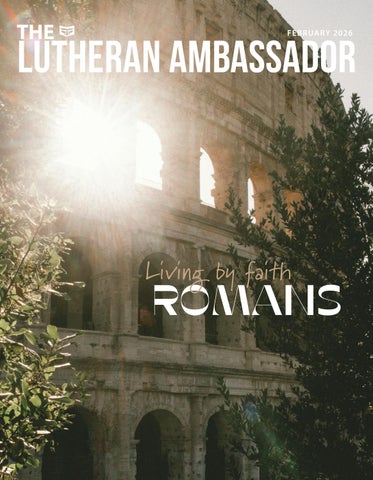

Lutheran AMBASSADOR
omans is a precious and foundational book for our Christian faith. Lutheran commentator R.C.H. Lenski describes it as the “Gibraltar basis” of our doctrine, teaching, and confession.
In this brief letter—you can read it in about an hour—the Holy Spirit teaches us about the universality of sin, our justification by faith alone, our ongoing sanctification, God’s sovereignty over everything, and the practical nature of our life in the body of Christ.
We could devote every issue for a year to the Book of Romans and still only scratch the surface of this epistle’s precious value. In this issue we explore six key passages in Romans and their importance to our lives today.
Pastor Israel Flores opens the issue by taking a close look at the phrase “the righteous shall live by faith.” A citation from the Prophet Habakkuk, this line makes us wonder about the nature of faith in the Old Testament. Though separated from us on an historic timeline, the innumerable saints who lived and died before Christ were saved by faith in the same promises as us.
Heidi Mundfrom continues the theme with an article on the “righteousness of God” in Romans 1:17. This phrase troubled Martin Luther for much of his early life, but when he understood it correctly, in light of the gospel, it transformed his fear of a judging God into a joyful assurance of salvation. This so-called “tower experience” was the spark that lit the Protestant Reformation.
Many of us can easily relate to Paul’s internal struggle with sin, captured in Romans’ seventh chapter. He writes, “For I do not do the good I want, but the evil I do not want is what I keep on doing” (v. 19). Pastor Michael Onstad writes to encourage believers grappling with their sin nature.
Pastor David Johnson offers an article that focuses on several of the beautiful gospel statements in Romans 8. We who believe the promises have received a spirit of adoption. With this Spirit-given power we can truly live!
Paul also explores election and predestination in chapters seven through nine of his letter to the Romans, and Pastor Brett Boe helps us understand these often-confusing doctrines. Though we can sometimes be left with more questions than answers, Boe writes, “The doctrine of predestination, both here in Romans and elsewhere in Scripture, is intended to be a comforting doctrine.” We have a merciful, loving God.
Finally, Pastor Eric Rasmussen closes this issue on Romans by writing about the “weaker brother” passage in chapter 14. How do we reconcile the freedom we have in Christ with our duty to love our neighbor?
These are just a few of the foundational topics we find in the Book of Romans. Spend some time reading Romans this month! Try reading longer passages, and don’t be afraid to read the same verses several days in a row. What else will God teach you through the Book of Romans?
—Pastor Andrew Kneeland
THE LUTHERAN AMBASSADOR
FEBRUARY 2026
Editor
Pastor Andrew Kneeland laeditor@aflc.org
Managing Editor
Ruth Gunderson ruthg@aflc.org
Circulation
Liz McCarlson lasubscriptions@aflc.org
Editorial Board
Monica Coyle
Pastor Jerry Moan
Pastor Craig Johnson
The Lutheran Ambassador (ISSN 0746-3413) (USPS 588-620) is published monthly by the Association of Free Lutheran Congregations, 3110 E. Medicine Lake Blvd., Plymouth, MN 55441
Phone (763) 545-5631
Periodicals postage paid at St. Paul, MN and additional mailing offices.
Postmaster send address changes to
The Lutheran Ambassador, 3110 E. Medicine Lake Blvd., Plymouth, MN 55441.
subscriptions & giving
The Lutheran Ambassador is a free publication of the AFLC. Our non-profit ministry is supported by readers’ gifts. To subscribe and give online, visit our website aflc.org/lutheran-ambassador
Checks may be mailed to 3110 E. Medicine Lake Blvd., Plymouth, MN 55441
Email inquiries can be sent to lasubscriptions@aflc.org
All roads in the Bible lead to Romans, and all views afforded by the Bible are seen most clearly from Romans, and when the message of Romans gets into a person’s heart there is no telling what may happen. [J.I. Packer]
Human beings can be saved from the ancient wound of the serpent in no other way than by believing in him who, when he was raised up from the earth on the tree of martyrdom in the likeness of sinful flesh, drew all things to himself and gave life to the dead. [Irenaeus]
I think that the Epistle to the Romans is the most profound work in existence.
[Samuel Taylor Coleridge]
“For I am not ashamed of the gospel, for it is the power of God for salvation to everyone who believes, to the Jew first and also to the Greek. For in it the righteousness of God is revealed from faith for faith, as it is written, “The righteous shall live by faith.” [Romans 1:16–17]
God does not want to redeem us through our own, but through external, righteousness and wisdom; not through one that comes from us and grows in us, but through one that comes to us from the outside; not through one that originates here on earth, but through one that comes from heaven. [Martin Luther]

By Pastor Israel Flores
HABAKKUK 2:4
“Behold, his soul is puffed up; it is not upright within him, but the righteous shall live by his faith.”
he righteous shall live by faith” (Habakkuk 2:4, Romans 1:17) is, for good reasons, a well-known verse from the Scriptures. This famous declaration of life by faith for the righteous has marked history and the historicity of millions who have truly lived by it. Why have these words reached many? Why have they resonated from ancient Jerusalem and Rome to every place they are read? Certainly, because it is God speaking. But more particularly because they have been spoken in times of suffering and pain, of fear and unrest—days in which only a word of assurance can bring about life.
One can only imagine the weight carried by the Prophet Habakkuk, who, aside from living in the midst of a rebellion, was told of the judgment soon to come. Consider, too, the resistance to the gospel that Saint Paul experienced when writing to Rome. These were clouds of deep emotional and pastoral darkness, which only the life-giving light of salvation through the miracle of faith could overcome. This is the uplifting truth for believers of all times: that despite the counter-narrative evidence of mourning and death, there is life for the righteous through faith.
One key element distinguishes the ways the people of God have lived by this truth, and it might not always be easy for today’s Christians to understand. After all, they now have the whole history of salvation. When thinking of believers from the Old Testament, we might immediately note that not only did they have only half of the story, but they also lacked the story’s core actor—Christ! Many believers today are content with their understanding of faith because they rarely have to literally live or die for it. Praise God for a civilization where such a life is possible! But for the vast majority of the Church, past and present, the life that comes through faith of which the prophets wrote encompasses far more than what is commonly considered. Whenever the relationship between faith and life is discussed, the dissertation on the matter in Hebrews 11 is an essential text. There, the author defines faith and provides examples in strong contrast to what Christians encounter in the world. Secular culture constantly pushes an agenda of the immediate. In the absence of eternity, the present is all there is to life; in the absence of a supernatural God, only the natural man provides certainty. But in Hebrews, faith is
neither present nor intrinsic. In a beautiful display of spiritual and historical fidelity to the Hebraic way, the writer affirms that faith transcends the believers themselves—both bodily and temporally. Not only did many of those mentioned not see what they believed in, but what they believed were objective truths—facts that were true regardless of their perception—that provoked a profound aha! moment once understood through faith. If all that matters is what can be presently proven or intrinsically experienced, how can a Christian say he has Christ if what Scripture provides is merely a record of his life?
This is why the connection between the Christian faith and the faith of the ancients lies far beyond coincidence. There is a deeper reason why both the Temple and the Eucharist point to Christ: at the core of true life by true faith, there is a suffering Christ nailed to the cross. In his wounds, believers see the summary of human agony, the failure of all worldly standards to provide certainty, and, ultimately, an excruciating demand to depend on nothing but a blood-covered promise: “By His wounds we are healed” (Isaiah 53:5). This “stumbling block to Jews and folly to Gentiles” (I Corinthians 1:23) reveals that Christian faith does not differ from that of the Hebrews. For when there is nothing else to cling to, once the comforts of present contentment fade along with the strongest of convictions, only the promises of God—the very promises that led the ancients—remain through the valley of the shadow of death. Here human uncertainties are brought back— or forward—to the true source of all faith, life, and righteousness: the Word of God, which creates where there is nothing and dismantles when there is too much of nothing (Isaiah 40:4–6). This is the theology of the cross— the way of faith—of the Hebrews, who depended solely on the promises of God, believed without seeing, conveyed that salvation comes from the One who is seen only from afar (Hebrews 11:13), and rejoiced in the day (John 8:56) of the suffering Christ who would come, has come, and will come again. May the God of the Hebrews give us the faith of the ancients so that we may be certain of his forgiveness despite our feelings and assured of eternity despite the darkness of death, which Christ overcame at the cross.
Flores serves Misión San Pablo Apostal, León, Mexico.
By Heidi Mundfrom
aul’s letter to the Romans is a doctrinally rich book. Martin Luther says it is the very purest gospel, and it can never be pondered too much (Luther’s Commentary on Romans). In the letter, Paul gives much instruction to the church in Rome and lays out the truths of law, gospel, faith, and grace. Understanding what Paul teaches in Romans was a crucial part of Luther’s conversion experience.
In verses 16 and 17 of chapter one, Paul writes, “I’m not ashamed of the gospel, for it is the power of God for salvation to everyone who believes, to the Jew first and also to the Greek. For in it the righteousness of God is revealed from faith to faith, as it is written, ‘The righteous shall live by faith.’”
These are beautiful verses that declare salvation for those who have faith. Living centuries after the Reformation, it is easy for us to read these verses as great comfort. God’s power brings salvation. We receive righteousness when we believe in Jesus. These verses are the gospel, simple and clear. But these verses haven’t always been understood easily; Luther himself struggled to understand “the righteousness of God.”
At first God’s righteousness is daunting. God’s righteousness means his judgment. Romans 3:23 says, “For all have sinned and fall short of the glory of God.” Luther understood that God’s judgment of sin was against everyone. It’s impossible to meet God’s expectation that we obey his rules of right and wrong perfectly. But that’s what perfect righteousness from a perfect God demands. But none of us are perfect. We are all tainted both by original sin and by the sins we commit every day.
Luther constantly saw the sin in his own life. He saw all the ways he wasn’t following God’s law perfectly and worried about his salvation. He knew he deserved eternal punishment but couldn’t understand how God could be so loving and still judge everyone for their sins.
We often aren’t as paralyzed by our sin or the sins in this world as Luther was, but we look at the world around us and see brokenness, heartache, and suffering. We see the same things in our own lives. We bring ourselves pain and suffering by falling short, and we bring pain and suffering into others’ lives by falling short again. It’s clear that we are not righteous. We are far from God’s perfect righteousness. What hope could we have for eternal life in heaven?
Luther meditated on these verses from chapter one in Romans. He started to focus on the context of God’s righteousness, seeing that “the righteous shall live by faith.” Luther wrote, “All at once I felt that I had been born again and entered into paradise itself through open gates” (Preface


to the Latin Collection). The righteousness of God does not condemn those who believe. For our righteousness, God looks to Christ’s perfect life and sacrifice on the cross. Paul wrote in chapter three, “The righteousness of God is through faith in Jesus Christ to all who believe” (v. 22).
Luther came to see that we do have hope for eternal life in heaven. His understanding of salvation by grace alone and faith alone comes from understanding God’s perfect righteousness. According to Luther, “the righteousness of God is our salvation” (Commentary on Romans). God’s law is completely satisfied by Christ’s suffering on the cross in our place. The righteousness of God is not something to be feared. Yet, the righteousness of God is holy and perfect. God is righteous when he looks at Christ’s sacrifice instead of our works.
Romans 5:21 says, “so that, just as sin reigned in death, so also grace will reign through righteousness, resulting in eternal life through Jesus Christ our Lord.” We can rest knowing that we are justified by Christ. We can have hope of eternal life because of God’s righteousness, not in spite of it. Paul continues to write about the salvation found in God’s righteousness throughout his letter. Romans 10:4 says, “For Christ is the end of the law for righteousness to everyone who believes.” Those who believe don’t live under that law anymore. Christ has satisfied it for us—all the way to its very end.
Luther also states, “God’s judgment, however, is different, for according to it, righteousness (justification) precedes works, and good works grow out of it” (Commentary on Romans). The righteousness of God frees us from the burden of earning our salvation, but it doesn’t free us from the command to love others. Our good works don’t save us, but God’s righteousness raises up in us a desire to serve God and serve others.
Let us not be discouraged by how much pain there is in this world. Let us be encouraged that we can do good works for others. We can point them to the salvation we have through God’s righteousness.
Mundfrom is a member of St. Paul’s Free Lutheran, Fargo, N.D.

By Pastor Michael Onstad
ot again. I’ve been angry with my neighbors all week, and now I’ve forgotten to do devotions three days in a row! What’s wrong with me? I know better! What kind of Christian am I if I keep sinning?” These are some of the thoughts I’ve had throughout my life as I’ve fallen into various temptations and sins. Have you ever been there, too? It turns out we’re not the only ones, as the Apostle Paul struggled with sin as well. In Romans 7:13–25, Paul writes about what it’s like for Christians to live with their sinful nature. He describes it as a tension between the sinner and saint within us, and that tension is lived out as a struggle against sin through repentance and faith in Jesus.
Paul begins in verses 13–14 by showing us one of the purposes of the law. That which was meant for our good—the good of guiding us in how to live rightly—now also exposes just how sinful we are and how far we fall short of God’s glory. It reveals to us that we are not spiritually alive but spiritually dead, sold under sin, and enslaved to it. We are sinners! That’s a bleak picture, but it’s only one side of the tension. Christ has set us free from our sin, making us saints who desire to do good and struggle against our sin. While it can be tricky to keep track of Paul in verses 15–20, the main thing to notice is that he talks like a believer, a saint. He wants to do good and live according to the law, as a saint would want to do. However, he doesn’t understand what’s going on with him because he keeps doing the opposite of what he wants to do. When he wants to do good, he keeps on sinning. Even though Paul has been set free from sin by faith in Christ, he finds he still must wrestle against his sins. He continues by reasoning that if he wants to do good, that means he agrees that the law is good. Only a saint, a believer in Jesus whose heart has been transformed by the gospel, would say that the law of God is good. Because he has this desire to do good, and because he agrees that the law is good, he concludes that it must not be the saint in him who is sinning; rather, it is the
sinner. It is the sinful nature dwelling in him that makes him sin.
ROMANS 7:25
Because of this, in verses 21–23, Paul says he finds it to be a rule that when he wants to do good, sin lies close at hand to taint and corrupt his deeds. He delights in the law of God in his inner being (saint), but he sees another law waging war against the law of God and making him captive to sin (sinner). That is the saint-and-sinner tension and struggle within all of us. As saints, we don’t want to sin! We want to live according to the Word of our Savior, Jesus, not run back into the sin he has set us free from. And yet, the sinner in us still wants to act out its desires. And we give in to its desires far more than we’d like to. Which brings us to the shame I mentioned earlier. Paul cries out in verse 24, “Wretched man that I am! Who will deliver me from this body of death?” Sound familiar?
“So then, I myself in my mind am a slave to God’s law, but in my sinful nature a slave to the law of sin.”
Paul does not stay in that shame, though. He knows it is Jesus who has delivered him. “Thanks be to God through Jesus Christ our Lord,” he says in verse 25. Jesus has taken your sins upon himself, including the ones you commit after becoming a Christian, and paid for them in full with his holy and precious blood. Through his death and resurrection, you are forgiven, redeemed, and set free from your sins. They have been defeated by Christ, and they will be done away with completely when you rise again from the dead with your new, restored body on the day of his return. So daily repent of your sins and believe this good news because it is still true for you, even when you fall back into sins out of weakness. Do not wallow in shame and guilt as you struggle with your sins, but turn and cling to Jesus’ Word of promise that all your sins have been paid in full by him. Because they have. Remember that you are, indeed, a sinner who cannot help but sin, but you are also a saint, one made and declared forgiven and holy by God through faith in Jesus Christ.
Onstad serves St. Paul’s Free Lutheran, Fargo, N.D.

hen I was a child, I dreamt of flying. Not in a plane, but like a bird under my own power. Sadly, the dream would end.
ROMANS
8:2
“For the law of the Spirit of life in Christ Jesus has set you free from the law of sin and of death.”
that plane with my pilot friend; no amount of flapping my own arms would change that no matter how hard I tried.
Years later, I was invited to join a pilot friend of mine in his plane. It wasn’t a large aircraft, but it was a plane. I was ecstatic—and a bit nervous. His offer to let me fly the plane didn’t help my anxiety any.
Since then, I’ve thought about how similar that experience was to Paul’s writing in Romans 8. He states, “For the law of the Spirit of life in Christ Jesus has set you free from the law of sin and of death. For what the Law could not do, weak as it was through the flesh, God did: sending His own Son in the likeness of sinful flesh and as an offering for sin, He condemned sin in the flesh” (vv. 2–3).
I can’t live a fulfilling life by following the law any more than I can fly under my own power. I can’t simply pull myself up by my own bootstraps. My life must be free from sin and death through the power of the Spirit of Christ. I could only be freed from the bondage of earth by flying in
Paul goes on, “However, you are not in the flesh but in the Spirit, if indeed the Spirit of God dwells in you. But if anyone does not have the Spirit of Christ, he does not belong to Him. If Christ is in you, though the body is dead because of sin, yet the spirit is alive because of righteousness. But if the Spirit of Him who raised Jesus from the dead dwells in you, He who raised Christ Jesus from the dead will also give life to your mortal bodies through His Spirit who dwells in you” (vv. 9–11).
When I stepped into that plane, all earthly bonds were broken. I could now accomplish what my heart had longed to achieve, not in my own power but in the skill of my pilot friend and in the power of his airplane. I wasn’t a man trying to prove I could fly; I could fly because I was surrounded and supported by a power that surpassed my own. And as long as I remained buckled into that seat, I could go wherever that plane took me. My body could have been
By Pastor David Johnson

dead, and I would still have traveled wherever that plane took me. I was part of the plane. And without the plane, I would be shackled by the natural laws of earth. But with the plane—like the Spirit who raised Christ Jesus from the dead—I could soar to incomprehensible heights.
What kind of freedom does life with the Spirit offer us? Paul writes, “So then, brethren, we are under obligation, not to the flesh, to live according to the flesh—for if you are living according to the flesh, you must die; but if by the Spirit you are putting to death the deeds of the body, you will live. For all who are being led by the Spirit of God, these are sons of God” (vv. 12–14).
At one point, my friend asked if I wanted to fly the plane, and I did. But I had to follow the rules of flying. I couldn’t do as I pleased. I had to deny my own desires, or die trying. I had to “put to death the deeds of my own body” to live. Living seemed like a good idea at the time, so I followed the instructions of the pilot (i.e., the Spirit), and I stayed aloft—and lived.
What of life’s struggles? Paul has something to say here, too. “For you have not received a spirit of slavery leading to fear again, but you have received a spirit of adoption as
sons by which we cry out, ‘Abba! Father!’ The Spirit Himself testifies with our spirit that we are children of God, and if children, heirs also, heirs of God and fellow heirs with Christ, if indeed we suffer with Him so that we may also be glorified with Him” (vv. 15–17).
My pilot friend was capable and seasoned. And as long as he was in charge, I had nothing to fear. I also knew that the instruction he gave me would keep me alive. But if I ever struggled, I had every confidence that he would get me home. I was happy to submit to him, and I never felt coerced.
Paul wanted Roman believers to understand that Jesus, and the Spirit of God working in him, could (and would) take them to new heights: places the law could never take them. But this would only happen if they died to their own self-centered independence and were made alive by Christ. Only then could they live without eternal fear and belong to a heavenly Father who would take them to new heights.
Johnson serves Living Faith Free Lutheran, Larimore, N.D., and Middle Grove and Ness Free Lutheran churches, Mekinock, N.D.
By Pastor Brett Boe
y teenage daughter recently asked me out of the blue, “Dad, what do you think about predestination?” I was surprised to hear this question from her. As a pastor, I have fielded this question a handful of times throughout the years, but I didn’t expect that question from my daughter. She continued to explain that predestination was chosen (no pun intended) by her Classical Conversations class as the topic of Socratic discussion for the upcoming week. She had a basic understanding and conviction but was looking for Scriptures and clarifications. It was hard for me not to geek out and dump a whole set of theological truths on her. And, truth be told, I probably still did that anyway. How could I explain this doctrine with simplicity and Scriptural accuracy, flavored with a fatherly heart?
I emphasized a few key truths. The doctrine of predestination, or election, is the idea that God has chosen the elect, the group of people who will be saved. This teaching has caused much consternation. Questions that are rooted in doubt tend to arise in our minds when considering this doctrine. “Am I one of the elect?” The Formula of Concord provides this excellent disclaimer as we approach this discussion: “If we want to think or speak correctly and usefully about eternal election, or the predestination or preordination of God’s children to eternal life, we should make it our custom to avoid speculating about God’s bare, secret, concealed, mysterious foreknowledge.”
One can survey the landscape of various Christian denominations to see the variety of beliefs surrounding predestination. Our friends, the Calvinists, believe in double predestination, the belief that God chooses from eternity those who will be saved and those who will be lost. To them, God’s choice for the lost is the logical conclusion of predestination, while many of us believe that this idea goes beyond what the Scriptures teach. Other friends believe in a teaching called intuitu fidei (Latin for “in view of faith”). This is the view that God predestines those who will be saved in light of his omniscience—he sees someone’s future faith. But that teaching emphasizes mankind’s role in salvation over God’s role. As you can see, it is a discussion fraught with pitfalls.
The Apostle Paul discusses the doctrine of predestination in Romans 9–11 as he considers his people, the Jews. A good starting point is Romans 9:14–16: “What shall we say then? Is there injustice on God’s part? By no means! For he says to Moses, ‘I will have mercy on whom
I have mercy, and I will have compassion on whom I have compassion.’ So then it depends not on human will or exertion, but on God, who has mercy” (ESV). One can tell that Paul anticipated the questions about injustice, but he is interested in emphasizing God’s mercy.
Paul continues in Romans 9:20 by introducing an illustration of a potter working with clay. The potter gets to work, shaping the clay. The goal of the potter is not to use every piece of clay. The goal is to make a creation that is beautifully hand-crafted. When it comes to our predestination or election in Christ, the word “beforehand” in Romans 9:23 makes all the difference. The vessels of wrath are “prepared for destruction.” The vessels of mercy are “prepared beforehand for mercy.” Were it not for God’s mercy, all of us would be part of that lump of clay that is “prepared for destruction.” But God has seen fit to choose us in Christ. The Jews, on the other hand, did not believe in the promises of God. They were pursuing righteousness by way of the law.
The doctrine of predestination, both here in Romans and elsewhere in Scripture, is intended to be a comforting doctrine. The Apostle Paul writes in Ephesians 1:4 that God “chose us in him before the foundation of the world.” Johann Gerhard, in his devotional book Sacred Meditations, writes, “God hath chosen us before the foundation of the world (Ephesians 1:4), but that choice was made in Christ; if therefore thou art in Christ by faith, doubt not that this election of grace pertains to thee also; if thou art clinging to Christ with firm and assured confidence of heart, let no doubts distress thee as to thy being included in the number of the elect.” Paul emphasizes this truth in Romans as well. In Romans 10:13 he writes, “For ‘everyone who calls on the name of the Lord will be saved.’”
“So, how did the discussion go with your class?” I asked my daughter. It was enjoyable to listen to her share about the debate between her classmates. Some came from the Calvinistic perspective. Others introduced great questions about the nature of faith. I was proud of the humility and maturity with which my daughter approached the conversation. As far as I can tell, no one changed his or her mind in that conversation. This is a doctrine that can’t satisfy human reason in any way. But what’s left when we see clearly the biblical truths is that the Lord intends to encourage our hearts by this teaching.
Boe serves Solid Rock Free Lutheran, Anoka, Minn.

ROMANS 9–11

By Pastor Eric Rasmussen
grew up, as I know others of you did, in a family where certain things just were not done. One side of the family played games with a regular deck of playing cards, and the other side didn’t allow playing cards in the house. No one gambled, smoked, drank alcohol, or danced at my grandparents’ houses on either side. Sure, some family members did some of those things … but we didn’t mention or discuss any of these “misdeeds.”
Today, I feel embarrassed about my thoughts and beliefs about these things. I certainly didn’t understand the concept of freedom in Christ, and I was completely ignorant of certain related aspects of my actions and beliefs. The fault here does not belong to my parents, my church, or other teachers in my life. The fault was mine. I was utterly and pridefully legalistic. Many Christians can and do have good reasons to avoid some or all the deeds mentioned above, but that wasn’t me.
I was certainly familiar with Romans 14 and the call to be mindful of the “weaker brother.” In fact, as a young man, I memorized and was determined to follow verse 13, “... rather decide never to put a stumbling block or hindrance
in the way of a brother” (ESV). But I was justifying my own legalism. I certainly never saw ministry opportunities sprout up from my refusal to ingest any amount of alcohol or my other acts of legalism.
Romans 14 has always been a hard chapter for me. I do not believe that our main takeaway from this section should be a discussion on adiaphora—that lovely big word referring to things that are indifferent. These are matters that are neither commanded nor forbidden in Scripture. I have a different, more practical definition: things that separate people. If these things aren’t dividing and distracting Christians, then no one cares or notices.
The main point of the text is love and care for your neighbor. The context of chapter 13 makes this point. We are not to gratify ourselves in any way; instead, we are to love our neighbor and “do no wrong to a neighbor.” Verse 10 concludes, “Therefore, love is the fulfilling of the law.”
That love is further extended in chapter 14 as we are reminded by Paul to be cautious as we deal with our neighbors. We are cautioned against quarreling (v. 2), despising those with other opinions (vv. 3, 10), judging

others (vv. 4, 10), and causing others to stumble (v. 13). For me, the high point of the chapter comes in verse 19, “So then let us pursue what makes for peace and for mutual upbuilding.”
We don’t throw out personal convictions or our freedom in Christ. This is a passage of balance between caution and love. Other Pauline texts bear out this balance. Titus 3 tells us to have nothing to do with the one who stirs up divisions over “quarrels about the law” (v. 9). Then in I Corinthians 10:23, we read Paul’s assertion that “‘All things are lawful,’ but not all things are helpful.”
God’s law is an integral part of our walk as Christians. We acknowledge that the most critical use of the law is to show us that we need Jesus and his forgiveness. But we also recognize that the creator and designer of the universe has shown us in his Word how things work best in this world. Our relationships with others, our marriages, our jobs, our churches, and every other aspect of life work better when we follow God’s Word—both law and gospel! The law is a wonderful gift.
At the same time, Christians are free from the burden of
ROMANS 14:13
“Therefore let us not pass judgment on one another any longer, but rather decide never to put a stumbling block or hindrance in the way of a brother.”
the law. “So if the Son sets you free, you will be free indeed” (John 8:36). Galatians 5 tells us that we have this freedom, but that it should be used in love and service to one another. Our freedom is a great gift both for ourselves and for our neighbors.
We tend to fall to either one side of the scale or the other. I recognize that I have a tendency toward legalism. Other brothers and sisters in Christ tend towards the opposite, which Martin Luther called “antinomianism.”
This term is often defined as the rejection of the law or, elsewhere, as freedom from the law. Both antinomianism and legalism are problematic and cheapen God’s grace. I like how author Sinclair Ferguson described it: “Antinomianism and legalism are not so much antithetical to each other as they are both antithetical to grace. This is why Scripture never prescribes one as the antidote for the other. Rather, grace—God’s grace in Christ in our union with Christ— is the antidote to both” (The Whole Christ: Legalism, Antinomianism, and Gospel Assurance—Why the Marrow Controversy Still Matters). Romans 14 and the whole of the New Testament are a call to balance these two extremes.
I still don’t dance, but that’s because I have absolutely no rhythm. I own playing cards and have enjoyed a few different games using those simple pieces of cardboard. I still don’t drink alcohol, but that’s become a matter of personal conviction, not, by the grace of God, a matter of a prideful, legalistic heart.
Rasmussen serves Calvary Free Lutheran, Fergus Falls, Minn.
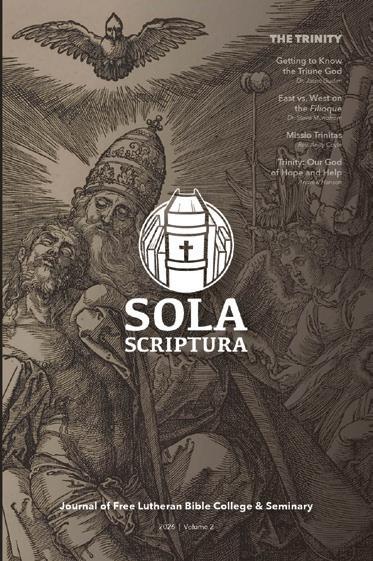
To learn more about FLBCS’ yearly publication, Sola Scriptura, follow the QR code or visit our website:

• flbc.edu/SolaScriptura

BY PASTOR ANDREW KNEELAND
he second volume of Sola Scriptura is now available for purchase. This annual journal, published by the Free Lutheran Bible College & Seminary, features articles from both students and faculty that help readers gain a deeper understanding of the Christian faith and be better equipped to live out their God-given vocations.
The theme of this second volume is “The Trinity.” You certainly don’t need an advanced theological degree to benefit from the rich content within! Rather, this journal will deepen the faith and worship of every believer.
Dr. Jason Gudim writes on how the Trinity is the way God has chosen to reveal himself to humanity. Gudim walks readers through the three articles of the Apostles’ Creed to show how each member of the Godhead has a unique role in planning, accomplishing, and delivering our salvation. He writes, “Through the proclamation of the Gospel and the ministry of the Church, we learn to know God as gracious and merciful, who calls us to repent of our sins and then washes us clean in the blood of his Son Jesus Christ, forgives us all our sins, and delivers us safely into eternity to live with him forever.”
Pastor Andy Coyle, director of Home Missions, writes about the missionary heart of the Triune God. The Trinity is not only foundational to understanding who God is, but it also illuminates what God does. The eternal love and relationship shared among the Trinity reveal the grand mission of God to bring people into a saving relationship with him. And the congregation is where this supernatural mission is carried out!
The volume also includes articles from Dr. Steve Mundfrom, Andrew Hanson, two student papers, a sermon preached by Pastor Mikey Meester, and several book reviews.
The purpose of assembling these articles is not theological grandstanding or pointless abstraction, but to foster a deeper understanding of our God and grow our faith and life as believers in this world.
Course Spotlight: Principles of Congregational Life
• Instructor: Dr. Nathan Olson
One of the first assignments that students have in Principles of Congregational Life is to work through the Fundamental Principles workbook published by AFLC Parish Education. Our goal is to have them process and think through these principles on their own. The workbook serves as a good tool, as it leads students through a series of questions and explanations that keep them from just regurgitating answers but understanding the “why” behind the principles of the AFLC.
One of the learning outcomes for the course is that students would be able to explain the biblical presentation of the local congregation. We believe that this is important for every student, as their personal relationship with Jesus pushes them toward local involvement in the congregation. Consequently, we want them leaving FLBC with a heart of love for the congregation and seeing how they can serve.
Dr. Olson says, “This has easily become my favorite class to teach at the Bible College. Our goal isn’t to have students be white ivory tower theologians, but to prepare them to be actively involved in the local congregation and to serve with their gifts.”
Kneeland is the director of Institutional Effectiveness for the Free Lutheran Bible College and Seminary.

• Through your experience, why would you say it’s important to actually be in a full-time residential program?
How many of us learn as well sitting in front of a computer that’s full of potential distractions compared to being in the room with a teacher and classmates united around a common goal? In this case, the goal is for men to be formed, sharpened, and equipped to be distinctively Lutheran, servanthearted pastors to serve in the AFLC. Perhaps there are some men who can achieve such an experience through an online program, but I am not among them. I need the enfleshed experience—the routine of walking across campus, studying next to my brothers, and a rhythm that the entire family shares to some degree.
• How have you seen your family also prepared for ministry in this community context?
In a significant way, the family has been prepared for ministry by being a part of this focused community. Our kids and my wife have had the opportunity to feel the impact of the call to come to seminary—to feel those sacrifices and to see God demonstrate his faithfulness—alongside other families experiencing similar dynamics. The kids get to grow up alongside other kids who will also someday bear that burden and blessing of being a PK (pastor’s kid), and those are friendships that will last. Being in the trenches of seminary life with other families gives us confidence that we will have both families to pray for and families to pray for us for many years to come, and I wouldn’t have it any other way.
• What’s something you’ve learned that you would share with someone discerning a call to seminary?
The call to come to seminary can be intimidating, and sometimes it’s not even the most clear thing in the world—and that’s okay. Wonderfully, God doesn’t wait for his children to have everything figured out before he blesses and uses them. Here’s something I suspected before coming to seminary that God has resoundingly proved true to me these past 2.5 years: the call to come to seminary is a good call. It’s a call to learn, grow, and invest, and God will use that no matter where he leads you after seminary. In the same way he has been faithful to you where you are, he will be faithful to you here.

• Spotlight on Missions: March 1–2
• Campus Days: April 10–11
• Graduation weekend: May 1–2
Website: flbc.edu/events
An interview with Hans Tanner (pictured at right), class of 2027.


The Women’s Missionary Federation’s 2026 Bible study, “I Believe,” as well as previous year’s studies, are now available to order.
• Author: Joyce Erickson
• Cost: $15
• Order online: aflc.org/women/ resources/bible-studies
• Contact WMF Executive
Secretary: Contact Jenn Thorson by email (wmfcomm@aflc.org) or phone (605-521-3677)
McCarlson, a member of Faith Free Lutheran, Minneapolis, is the second vice president of the WMF Board.
BY LIZ MCCARLSON
aybe you know of or have been a part of a women’s fellowship that is filled with empty smalltalk, or Bible studies that focus solely on our emotions or attitudes—how we can be better women, wives, mothers, and/or the things we need to do to make sure our relationship is right with God. Or maybe you know of women’s groups that focus solely on serving, making, or giving.
Many of these things are not bad; in fact, they can be good for social or service groups. But it is the prayer of the members of the WMF Board that women’s ministries (ministering to women) in our congregations would first choose “… the good portion, which will not be taken away …” (Luke 10:42). We believe women’s ministry should offer, foremost, an opportunity to hear, study, and discuss the Word of God. To that end, the WMF is responsible for creating Bible studies that groups or individuals can use, with the primary audience being women.
The goal of these studies is to strengthen faith in Jesus Christ. God speaks to us in words of law and gospel. When we study God’s Word, there will be times when we are convicted of sin, but we will also be comforted by his promises and find assurance of his grace there. We desire this for all women of the AFLC and pray that the Bible studies we publish will be a means for the Holy Spirit to use the Word of God to cause women to “… grow in the grace and knowledge of our Lord and Savior, Jesus Christ” (II Peter 3:18).
Our 2026 Bible study, “I Believe,” was written by Joyce Erickson. This is what she shares in the introduction to the study:
The theme of this Bible study originates from Mark 9:24b, “Lord, I believe; help my unbelief.” It is a prayer that I have often prayed ... As I mature in my faith, my eyes are being opened to areas in my daily walk that don’t align with truths that I claim to believe. I have been recognizing that many negative things in my life, such as worry, fear, striving, and feelings of anxiety, failure, and hopelessness, may be indicators of unbelief or lies I’m believing. This unbelief can keep me from living as freely, joyfully, and victoriously as I have been granted as his child.
It is my prayer that as we study and get to know who God is, we will believe and walk forward in faith, experiencing greater freedom from the things that keep us from living abundantly and selflessly. May the Lord bless our study together for his glory and our good!
Thank you for praying with us as we continue to select writers and editors for future Bible studies who are “rightly handling the word of truth …” (II Timothy 2:15).

BY RANDY NELSON
cross the country, there are signs that spiritual interest is rising. We are seeing it on college campuses where thousands have gathered for prayer and worship, and in local congregations where young adults— especially young men—are returning to church in growing numbers. People are asking profound questions about truth, purpose, and faith. As this interest becomes more visible, pastors and congregations are increasingly asking, “How do we help our people engage in gospel conversations with those who are seeking?”
Our work in AFLC Evangelism and Discipleship exists precisely to equip believers to pray, build relationships, and speak the gospel with confidence and clarity. Our mission remains “to encourage, equip, and assist our AFLC congregations and pastors in making and equipping disciples who make and equip disciples.” We pursue that mission in three ways: in-person ministry, online ministry, and the development of practical ministry materials.
A significant portion of our work continues to take place face-to-face. We are invited to AFLC congregations to preach, teach, share the gospel, and lead evangelism and discipleship workshops. These visits allow us to meet with pastors, leaders, and laypeople, listen to the specific needs of each congregation, and help them identify ways to build relationships and engage their communities. We recently shared a workshop in Reading, Pa., for the Alsace and Living Faith congregations.
Workshops focus on three actions: praying intentionally for neighbors, organically building relationships, and engaging in spiritual conversations with gentleness and confidence. We are encouraged to see individuals and congregations take these steps seriously, believing that Christ uses believers to reach people who may never walk through the church doors on their own.
Not every congregation is able to host an event or an in-person visit, which is why our online efforts remain essential. Our monthly online prayer meeting, held on the fourth Monday of each month (6 p.m. Central), is a place where participants from across the country gather to pray specifically for evangelism and discipleship. All are welcome, and the access link is available each month through our newsletter.
Our online presence continues through our website, social media, monthly newsletter, workshop recordings, and podcast, “Living as a Disciple,” which will soon enter its next season. Our goal is to make biblical encouragement and practical tools accessible to all, wherever you live.
We also remain committed to developing biblical, Lutheran resources that our congregations can use in ministry. We completed an update of The Discipleship Manual, which provides a framework for walking with others as they follow Jesus. Additional pamphlets, equipping aids, and manuals are currently being planned, written, or revised, all with a simple goal: to help believers share Christ clearly and disciple others faithfully. Our desire is not to create programs but to provide tools that strengthen the ministry of local congregations and empower believers to live out the Great Commission.
• Pray for pastors and lay leaders as they guide their congregations in mission.
• Pray that God strengthens everyday evangelism through his congregations.
• Pray for the development of new evangelism and discipleship materials.
• Pray that our in-person and online ministries continue to build confidence in sharing the good news with others.
An annual equipping event held prior to the AFLC Annual Conference.
• June 9, 2026
• St. Paul’s Lutheran, Fargo, N.D.
• Registration will be online at
• aflc.org/evangelism
Nelson is the director of AFLC Evangelism and Discipleship.
Pastor Keith David Quanbeck, 65, of Maple Plain, Minn., died Jan. 8, 2026, at Haven Homes, Maple Plain.
Born Oct. 24, 1960, in McVille, N.D., he was the son of Lee and Hannah Quanbeck. He grew up in McVille and attended McVille Public School. After graduation, he attended the Free Lutheran Bible College, Moorhead State University, and the Free Lutheran Seminary. He served congregations in California, Iowa, Minnesota, and North Dakota. In addition, he served people as a financial planner with PrimAmerica. He lived for and loved the Lord with joy, remaining faithful to the end. Keith lived at Haven Homes for more than four years. While there, he became a part of the Haven family and was loved well.
Surviving are three siblings: Kathryn (Tim) Winkelman, Minneapolis; Roger (Ruth) Quanbeck, Hallock, Minn.; and Ruth (Paul) Kneeland, Stover, Mo; nine nieces and nephews and nineteen great-nieces and nephews.
Visitation will be from 6 to 7 p.m., followed by a time of sharing at 7 p.m. on Feb. 20 at Emmaus Lutheran Church, Bloomington, Minn. The service will be at 2 p.m. Feb. 21 at Emmaus Lutheran. Burial will be at New Luther Valley Cemetery, McVille, N.D.
In lieu of flowers, memorial gifts may be given to Haven Homes (havenhomesseniorliving. org/donate) or by mail to Haven Homes, Attn: Cassia Foundation, 7171 Ohms Lane, Edina, MN 55439. In addition, a memorial gifts may be given to the Free Lutheran Bible College and Seminary.
PEOPLE & PLACES
Pastor Troy McNear has accepted a call to serve Trinity Bethany Lutheran Church in Harvey, N.D.
Pastor Lynn Kinneberg has resigned from Bethany Lutheran Church in Binford, N.D., and New Luther Valley Lutheran Church in McVille, N.D.
Pastor Paul Kneeland will be installed Feb. 8 at Christ Lutheran Church in Stover, Mo., by Pastor Jason Holt, AFLC presidential ministry associate.
AFLC President Pastor Micah Hjermstad traveled Jan. 7–17 to visit the work in AFLCIndia with World Missions Executive Director Earl Korhonen and his wife, Joan. Members of Calvary Free Lutheran, Everett, Wash., will celebrate the congregation’s 125th anniversary with a lunch and program beginning at 1 p.m. March 15. All are welcome.
LFC (and family) history
Grindal gives readers a peek into a changing landscape in theology departments and church organizational polity
By Pastor Robert Lee
For those of us interested in our AFLC roots with the former Lutheran Free Church (LFC), Gracia Grindal tells the story woven together with her own family history, a unique accomplishment. Her father, Harold K. Grindal, was a son of our Ferndale, Wash., congregation, and his first parish after graduation from Augsburg Seminary was Tioga, N.D. Gracia was born during his years there in the hospital at Powers Lake. It’s fun to read about her mother Jonette’s memories of the Thanksgiving dinners sponsored by the Beaver Creek congregation (p. 340).
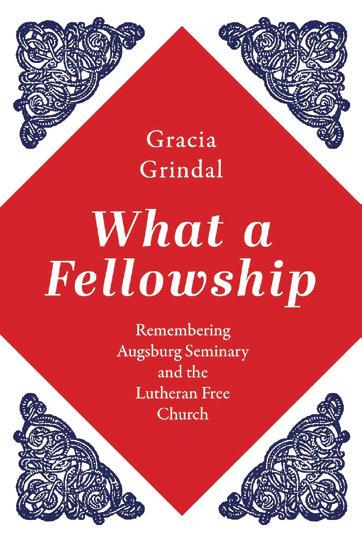
The story unfolds the first LFC merger discussions and how that movement grew after World War II under the leadership of Presidents T.O. Burntvedt and John Stensvaag. It was during the annual meeting in 1947 that Burntvedt redefined the LFC as no longer a movement but a church body (p. 387).
Pastor Grindal’s ministry continued in Rugby, N.D., and Salem, Ore., where Gracia finished high school. She enrolled at Augsburg College in 1961, where we were classmates. She describes the theological slant in the religion department as a “historical-critical” method of interpreting the Bible (p. 485).
The final debates on the merger ended as pastors and laypeople wrote letters or articles to the LFC Lutheran Messenger on one side or the other. The final vote was tallied, with the merger approved by a narrow margin. “Rejoicing broke out among the leadership. God had finally done what they wanted,” she writes (p. 489).
Gracia tells of her graduate studies at the University of Arkansas, where she earned her Master of Fine Arts degree and began teaching at Luther College in Decorah, Iowa. The new religion professors were advocates of the critical method, with which she had grown unhappy. During these years she worked on the committee creating a new Lutheran hymnal, and she was awarded an honorary doctorate for her work. Her final teaching years were at Luther Seminary, St. Paul, Minn.
The conclusion (pp. 509–513) suggests that Georg Sverdrup’s main point was the congregation, not to organize a church body. Congregations are divinely instituted; church bodies are not. The error of most Lutheran mergers is to confuse organizational unity with spiritual unity. She speaks well of the AFLC and the Georg Sverdrup Society.
“The fellowship of believers, the congregation, is where it all happens,” she writes. “No organization of any church body can fulfill its calling without vibrant, living congregations. ... Free and living congregations attract people who want to fully experience the joy of Christians here on earth and in eternity” (p. 513).
Lee, a member of Grace Free Lutheran, Maple Grove, Minn., served as AFLC president from 1992 to 2007.
Pastor Keith Quanbeck
Fortress Press (2025), available from AFLC Ambassador Publications
Seminary Symposium highlights beauty
What role do beauty and aesthetics play in the Christian life?
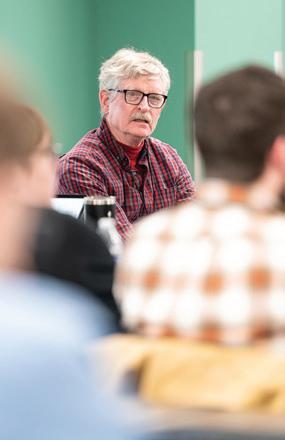
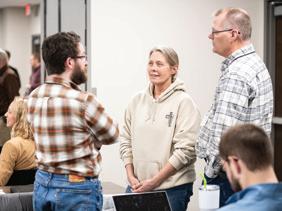
Dr. Mark Mattes (pictured center) was the featured speaker at the Free Lutheran Seminary’s January Symposium. Mattes, who chairs the doctoral studies at American Lutheran Theological Seminary, Fort Wayne, Ind., spoke on “Luther’s Theology of Beauty,” which was the topic of one of his published works. Mattes presented two further lectures on Luther’s views on beauty in music and the visual arts.
“Luther affirmed a role for the visual arts in the service,” said Mattes. “Art is used to portray the image-saturated Word of God.”
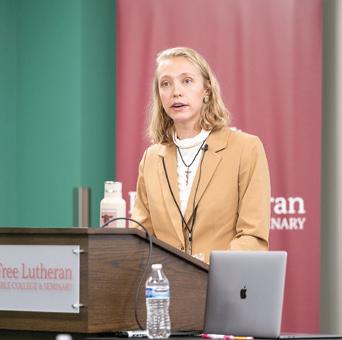
Kirstie Skogerboe (pictured in the right column), the digital communications coordinator for the AFLC, presented a paper titled, “Smitten by God:
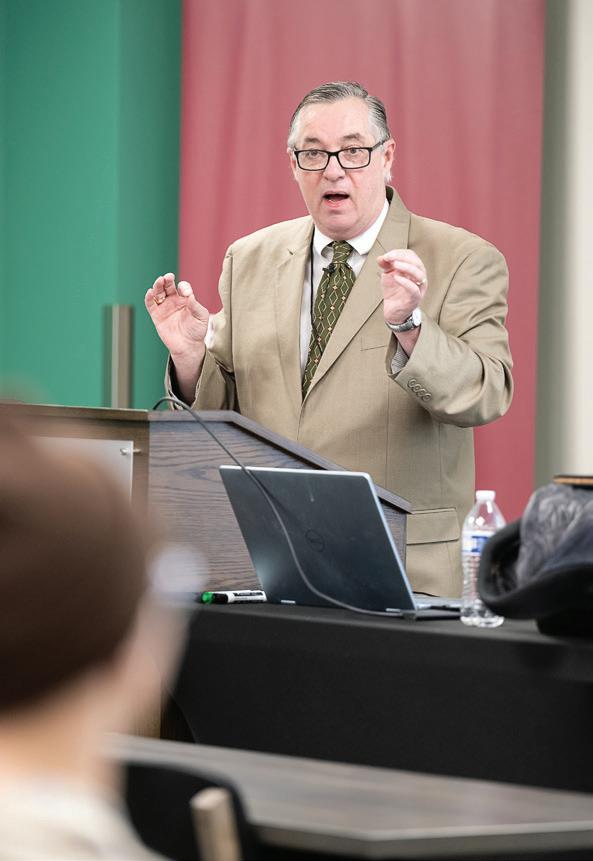
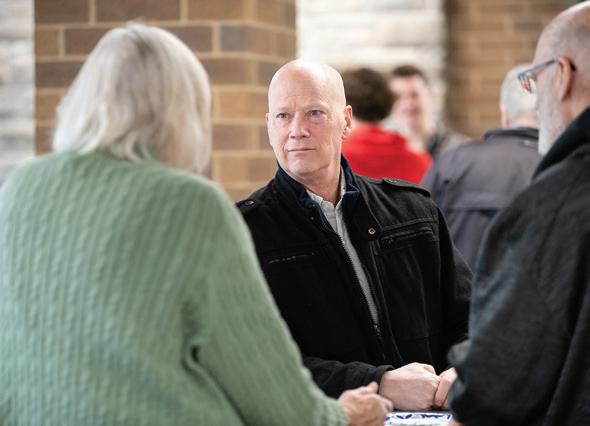
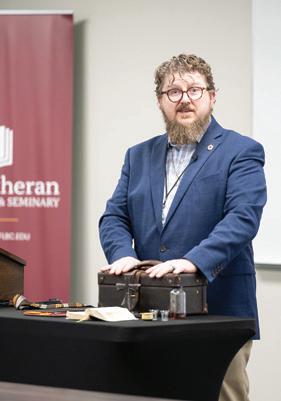
The Violence and Beauty of Repentance.” Pastor Matt Nelson (pictured at right with his portable communion set), discussed the beauty and simplicity of liturgy in

worship. Finally, Dr. Brent Olson presented a reprise of his doctoral thesis on the Exodus pattern and its culmination in the coming of Christ and the certain hope of the restoration of God’s creation. Recordings of these lectures will be published on the website of the Free Lutheran Bible College and Seminary (flbc.edu).
Pastor John Chandler
Pastor John Richard Chandler, 92, of Amarillo, Texas, died Dec. 30, 2025. Born July 28, 1933, in Boulder, Colo., he was the son of John and Thelma (Young) Chandler. He married Dana O’Dell on March 14, 1955. She preceded him in death.
He grew up in El Paso, Texas. He was a veteran of the United States Marine Corps, volunteered for Sea School, and served three years on the USS Yorktown (CV-10). Following his service in the military and after finishing his studies in college, he entered seminary and was ordained in 1962 with the United Lutheran Church in America (ULCA). He served in New Mexico, Oklahoma, Missouri, Colorado, Kansas and Texas until 2006. He was active in the Lutheran Evangelical Movement since 1970. He transfered to the AFLC Fellowship Roser in 1988 and to the Clergy Roster in 2001. He served King of Kings, Lewisville, Texas (2003–2006). In later years, he was a member and chaplain of both the United States Seagoing Marines Association (national chaplain 2002–2013) and the Veterans of Foreign Wars. They retired to Amarillo, where he taught Bible classes at Life Challenge of Amarillo.
Surviving are two children, Timothy (Enid) Chandler, Pleasant Hill, Mo., and Mary (David) Forsberg, Amarillo; nine grandchildren; and fifteen great-grandchildren.
The service was Jan. 2, 2026, at Brooks Chapel, Canyon, Texas, with Pastor Brian Shane officiating. Burial was in St. Paul Lutheran Cemetery, Canyon. Memorials are request to the AFLC or to St. Paul Lutheran Church, Canyon.
DECEMBER MEMORIALS
World Missions
Ruth Claus
Larry Moan
Ardis Twedt
Marlene Caouette
David Ramse
Home Missions
Pastor Erwin & Lorraine Brandt
Pastor John Chandler
Lutheran Ambassador
Pastor Vincent & Eunice Will
Gloria Lee
Parish Education
Helen Knutson
Georg Sverdrup Society hosts forum
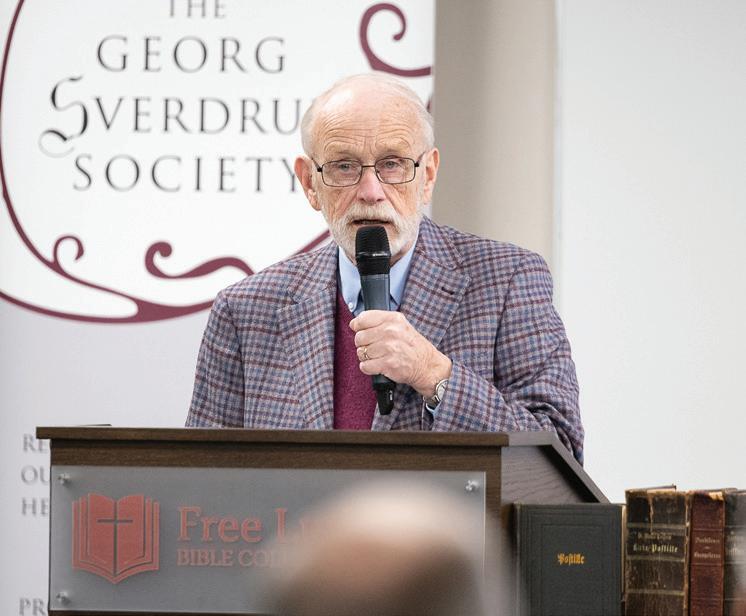
The Georg Sverdrup Society hosted a forum Jan. 16 on the campus of the Free Lutheran Bible College and Seminary. Loiell Dyrud (pictured above) moderated the event. Pastor Brian Lunn, who serves Word of Life Free Lutheran Church, Upsala, Minn., opened the forum with his paper on “The Written Sermon: A Brief History of the Genre in Lutheran Literature.”
Han Tanner, a third-year student at the Free Lutheran Seminary, read a paper written by his brother-in-law Jonathan Anderson titled “The Revival Preaching of Orthodox Pietism.” The final presentation was by Dr. James Molstre, dean of FLS, on his paper, “From Text to Pew: Anchoring Congregational Life Through the Law and Gospel Framework of the Sermons of Sverdrup and Oftedal.”
Pastor Michael Flechsig
Priscilla Dutcher
Pastor Vincent & Eunice Will ... in honor of
Home Missions
Willis Kettelhut
World Missions
Steve & Janene Hawkins
Pastor Paul & Becky Abel

BY PASTOR JOHN BRENNAN
ighly celebrated in music and art is the call of the great Prophet Isaiah, as found in the sixth chapter of his book. The account is filled with some of Scripture’s most vivid and colorful imagery in its depiction of the throne room of God. There are multi-winged angels proclaiming God’s holiness and glory, a magnificent robe filling the temple, and above all, God seated on his throne high and lifted up—it’s an awesome scene!
HBut apart from all the spectacular visuals, there are laid before us some things we dare not miss: insights on God and man, applications of law and gospel, and, most importantly, how we must respond to God’s calling on our lives.
The terrible holiness of God
“Holy, holy, holy is the Lord of hosts,” the seraphim proclaimed in voices loud enough to shake the thresholds. I think it’s worthwhile to note the repetition and powerful volume of the proclamation. God is holy—this is important. We are not holy by nature, so God’s awesome holiness is something we can overlook. Holiness is unimaginable for us. We’ve never been holy in ourselves for a single moment, so God’s holiness is unfathomable.
Through his vision, Isaiah began to comprehend the terrible holiness of God. The Lord’s holiness was terrible because Isaiah realized just how terribly far he was from the holiness God requires of his people. That’s not a good feeling. Sensing the absolute holiness of God brings the crushing weight of your sin crashing down upon you—that’s the law.
The deadly consequence of sin
Isaiah said, “Woe is me! For I am lost; for I am a man of unclean lips!” Yep! He’s exactly right; sinners do not stand before a holy God. But that’s just where Isaiah found himself—standing face-to-face with his glorious Creator—and he was doomed. We will all one day stand in the same spot the great prophet stood: face-to-face with our Maker.
Just like Isaiah, we’ll be in serious trouble unless someone holy acts on our sinful behalf. As Isaiah stood before God, he probably tried to think of why he was worthy to be there. Instead, he
confessed he was a sinner from a long line of sinners. Isaiah knew exactly what he deserved: the wages of his sin was death.
The remedy of mercy and grace
The seraphim said, “Your guilt is taken away, and your sin atoned for.” The flying, flapping, shouting angels already told us that God was holy and glorious, but he is so much more than that! God’s attributes are too numerous to mention here, but in this passage, we clearly see his mercy and grace. That is gospel good news for Isaiah and for us!
God sent the seraphim with the burning coal to take away Isaiah’s guilt and atone for his sin. Undeserved, unwarranted, and even unasked for, by the grace of God, the sinful unclean prophet was made holy in an act of mercy. Hallelujah!
In the same way, a holy Jesus was graciously sent by God to save an undeserving people of unclean lips by taking away our guilt and atoning for our sins in an act of mercy. God’s acts of mercy and grace in Jesus are the antidote to sin and death. Hallelujah! What a Savior!
The response of answering and going
Isaiah heard the voice of the Lord saying, “Whom shall I send, and who will go for us?” Then I said, “Here I am! Send me.” Isaiah had just been bludgeoned with the realization of the absolute filthiness of his own sinfulness and then mercifully cleansed to a God-given spotlessness. And what was his reaction? He showed his willingness to answer God’s call and proclaim the Word of God.
Please don’t think that this passage speaks only to pastors and missionaries who have received a call to ministry. God has put the same call on you and me as he did on Isaiah (just not as dramatically). We too have been convicted of the guiltiness of our sins. We too have been saved from the penalty of our sins. We too have a Word from God that needs to be shared.
Do you hear God asking you, “Whom shall I send?” Will you answer the call? If not you, who will go?
Brennan serves First Lutheran, Oklahoma City, Okla.
SOMETHING TO SHARE
BY KYLEE GREENE
he year was 1446 B.C., and the Lord had just led the people of Israel out of Egypt after more than 400 years of slavery. They had witnessed his deliverance from Pharaoh through the plagues and parting of the Red Sea and were in awe of his mighty hand of salvation on their behalf. The Lord then led them away from the springs of water and palm trees by which they had encamped and into the wilderness toward Mount Sinai and the Promised Land. Shortly after, the people began to grumble against Moses for the lack of food and water, saying it would have been better for them to die in Egypt. The Lord responded by providing manna and water for them, but not without testing their obedience to his Word. Immediately after they complained, they saw the glory of the Lord appear in the wilderness in a cloud, displaying his majesty to them so that they would know he is God.
As I have reflected on the inspired words of Exodus chapters 16 and 17, I have been convicted at the quickly complaining and complacent nature of the Israelites and humbled by the power and patience of God despite it. They had been called away from a place of comfort—from everything they had known. And instead of trusting in the God they had just witnessed split a sea and asking for him to provide, they grumbled and looked back toward the place that still remained captive in their hearts, much like Lot’s wife. Despite their
physical freedom, the people of Israel would need spiritual deliverance from their enslavement to the kingdom of darkness that would only be made possible by the life, death, and resurrection of Jesus Christ many centuries later.
Yet how true are these attitudes of us today? How often are we anxiously focused on meeting our material needs and wants when the Lord is most concerned with delivering us from the spiritual attachment to Egypt that still lives in our hearts? And if he cared so much as to meet our deepest need, how much more will he sustain us until we reach the Land of Promise! He calls us to trust in his unchanging, powerful, loving nature and to follow him in obedience to his Word. And he warns us that there are consequences when we don’t. We are not to grumble or complain but are to remember what he’s faithfully done in the past and let that produce a heart of praise and thanksgiving in the present—and expectantly wait for the future. He will provide the manna for today wherever he calls. He will not abandon his people. Rather, he will call his people out of comfort and into the wilderness so they will gain a greater dependence on him, see his glory, and know without a shadow of doubt that he is the Lord their God.
Greene is the lead dorm assistant at the Free Lutheran Bible College, Plymouth, Minn.