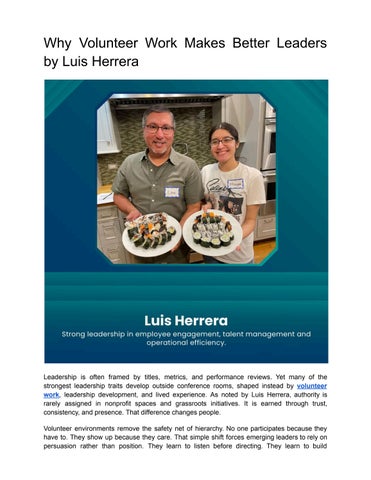
Why Volunteer Work Makes Better Leaders

Page 1


Why Volunteer Work Makes Better Leaders

Leadership is often framed by titles, metrics, and performance reviews. Yet many of the strongest leadership traits develop outside conference rooms, shaped instead by volunteer work, leadership development, and lived experience As noted by Luis Herrera, authority is rarely assigned in nonprofit spaces and grassroots initiatives. It is earned through trust, consistency, and presence That difference changes people

Volunteer environments remove the safety net of hierarchy. No one participates because they have to They show up because they care That simple shift forces emerging leaders to rely on persuasion rather than position They learn to listen before directing They learn to build

consensus rather than issue commands In creative and business settings, these habits lead to stronger collaboration and healthier team dynamics.

Volunteer work also exposes leaders to real human complexity Community projects often operate with limited budgets, diverse stakeholders, and urgent needs. Navigating those realities sharpens adaptability A leader cannot hide behind process when resources are tight They must innovate, prioritize, and motivate with clarity Over time, that constraint-driven thinking strengthens strategic decision-making.

Empathy grows faster in service than in status-driven roles When leaders engage directly with people facing challenges, abstraction disappears. Problems are no longer theoretical. They have names and stories That proximity builds emotional intelligence, a trait often cited but rarely practiced deeply Leaders who develop awareness through service bring a grounded perspective back to their corporate or creative work. They communicate with greater sensitivity and design solutions with real users in mind

Volunteer settings also demand humility. Recognition is inconsistent, and results may take time. Leaders learn to measure impact beyond applause They focus on contribution rather than credit In professional contexts, this mindset reduces ego friction and builds stronger cultures Teams respond positively to leaders who share ownership and highlight collective wins.

Perhaps most importantly, service clarifies purpose Many professionals chase advancement without pausing to ask why they lead. Volunteer work answers that question through action. It reconnects leadership to impact When individuals see the tangible difference their time creates, their motivation shifts from personal gain to shared progress That alignment often fuels resilience during high-pressure business cycles.

Organizations increasingly value leaders who combine competence with conscience Executives shaped by volunteer work leadership development tend to approach strategy with a wider lens. They integrate community-based leadership skills into company culture, stakeholder engagement, and long-term planning The result is leadership that feels credible, not performative.

Ultimately, volunteer work does more than fill gaps in communities It shapes leaders who understand service as a source of strength. That perspective, once formed, influences every room they enter.

Turn static files into dynamic content formats.

Create a flipbook
Why Volunteer Work Makes Better Leaders by Luis Herrera - Issuu