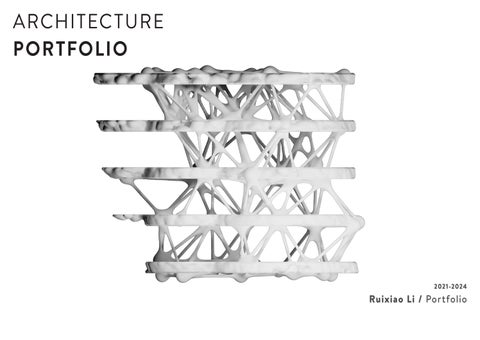
ARCHITECTURE PORTFOLIO

![]()


Address : Anhui, China
Mobile : +86 1590553588
Email : 1372618688@qq.com / Lucy1372618688@outlook.com
Francine Chicard Macau, China
A local Macau aromatherapy brand that collaborated with Macau University of Science and Technology
Designer
Macao University of Science and Technology Macau, China
Bachelor of Arts in Art Design, Major in Interior Design Aug 2021 – Aug 2025
• GPA: 3.46 / 4.0
• Major Coursework: Cultural Space Design, Hotel Interior Design, Jewelry Design, Architectural Design, Lighting Design, Furnishings Design, Model Making, Engineering Drawing, Computer-Aided Design
• Honours/Awards:
• Excellence Award, Design China · Crystal Kylin Award 2024
• Awarded in Macau Brand Story of 2022 Greater Bay Area Brand Design Competition
MUST Design
Macau, China
A design education platform co-founded by Professor Xi Xi Quan from Macau University of Science and Technology and Huarchi Global Design Assistant May 2024 – Aug 2024
• Conducted detailed model restoration for the Fang Suo Commune in The Londoner Macau Shopping Mall
• Conducted in-depth research on similar store designs in the Macau region to identify and implement competitive design ideas
• Collaborated closely with clients to design the entire interior space, ensuring their vision was met
May 2021 – Oct 2022
• Designed innovative packaging for products, incorporating unique textures inspired by Macau’s street signs to reflect local culture
• Conducted market research to identify the target demographic, leading to strategic improvements in packaging design
• Coordinated the design process using Gantt charts and managed client communication, ensuring timely project completion and addressing feedback effectively
Microsoft Learning Student Ambassador Club Macau, China
Vice President & Art Department Head
Apr 2024 – Present
• Co-founded the first self-learning club in Macau, emphasising peer-to-peer learning with a focus on the latest advancements in technology, including AI
• Conducted market research to identify the target demographic, leading to strategic improvements in packaging design
• Spearheaded the club's promotion through innovative posters, layouts, and digital media, significantly increasing membership and engagement
Macao University of Science and Technology Arts Choir Macau, China
Member
Oct 2021 - Mar 2023
• Participated in major events, including the 23rd anniversary of Macau's return to China, enhancing cultural exchange and university representation
• Alto singer in the university choir, contributing to diverse performances
• Languages: English (Fluent), Mandarin (Native)
• Technical Skills: Houdini,MS Office,Gantt,SketchUp,Rhino,DIAlux,AutoCAD,A dobe Photoshop,Adobe Illustrator,Unreal,Blender
• Interests: Dance (Grade 7), Piano (Grade 8)

BASED ON INK EXPERIMENT
Part 1 Experiment and software
The architectural form is obtained through manual experiment and parametric experiment.
• Ink experiment : By dropping ink into water, I found that the different states formed in this state are natural. So that triggered my interest in this form. Then the effect of different parameters of ink droplets into water was studied. So I found that different parameters had different effects on the water. What interested me most was its shape in the water, like jellyfish, whose hole structure had a great sense of space.
• Modeling and analysis with houdini : So I took a few frames of the ink’s fall and extracted them into an electronic model using houdini software. In the process of analyzing the electron model, I found that their structures had certain similarities. I extracted some particles from the electron model and made use of them to form the initial structural form of the building.
• In conjunction with the Mars Colonization Program : Its morphology is similar to that on Mars, and it has similar volcanic cave morphology on Earth. So I came up with the idea of using it as a training base for the Mars Colonization Program, so that buildings could be generated using this structure.
Adding different milliliters of ink to the water will produce different effects, different colors of ink will also produce different effects, and in different containers will also produce different effects.
Therefore, I conducted a series of experiments on ink, recording ing the state of different drops of ink droplets into water. And experiments and records of different colors of ink.


After the above experiments, I want to record and understand the trend of ink flow in water, which I think is the most interesting part in this experiment. Not only that, I hope that the fluidity can be shown by drawing, so as to facilitate subsequent research and use. Through these analyses, I found that his flow state was spreading sideways as well as downward. And it spreads out in a curved way.I use some lines and arrows to express this fluidity, and I understand the flow track of this ink painting in a two-dimensional space.
The movement of ink in water


Based on the preliminary understanding of the motion track of the ink wash, I became more interested in the form of the ink wash in water, so I restored the ink wash through particle form in houdini software, and rendered it into the ideal state of the ink wash in water. It echoes the previous response to the state of different colors of ink in water, but just so, I can not extract the structure of the ink.


After I made the track of ink painting in the experiment two-dimensional through the above process, I wanted to change its track into a three-dimensional state and think about the architectural state it could form. The most intersecting points are represented by two-dimensional ink tracks, and houdini software is used to display his tracks in three dimensions.
With time as the horizontal axis and length as the vertical axis, the falling state of ink painting is studied to determine the approximate state of the building’s form, and the scale of the building is determined by the falling length.


After some processing of the ink form, I was able to solidify the form and have a solid feeling, so I started the preliminary construction of the specific form of the building. Here is my first setup process and the results. By studying the section of this entity, I found that its holes have space and three-dimensional sense. So, I took each of these slices apart and connected them by extracting some of these particles to get the initial shape of the building. I had a certain image of them. Maybe they could be a restaurant or an observation deck.


I splashed a drop of ink on the paper, I extracted the effect he formed, and found that he had a lot of hole structures, and I thought of this hole structure as a three-dimensional small space, maybe there are stairs, gardens, some small rooms, some tables, chairs, benches, or some blue stone floors. After I drew it in this texture map, I wanted to recreate the scene, and I had this effect scene above.
I got the first version of the architectural form through the previous imagination, but I was not very satisfied, because in fact, he did not show the structure of this hole in the facade, I want to make more thorough use of this hole structure, so there is the following way to generate the building. I use cubes of different sizes to cut the ink solid model that has been generated before, so that the hole structure and shape of different states can be obtained. And because the cutting is done in the agreed solid model, these models can be connected to finally form the architectural form shown on the right.


After generating the above architectural model full of holes, I am reminded of the Martian landscape of Lanzarote Island and the “Mars immigration Plan” about Mars. Through the following investigations, I find that the volcanic caves in Lanzarote Island are very similar to the buildings I have generated in terms of hole structure, and I think they are very much in line with my imagination of the use scene of this building. So I think the building should be located in Lanzarote and used as an astronaut training base for the Mars Colonization Program.


Astronauts will practice rock climbing inside, will adapt to narrow passages in various small and large holes, and will train by climbing some ladders. Will carry a variety of maintenance tools in various holes shuttle.


Part 2 Investigation and research
This building is based on the investigation and study of the surrounding environment and its historical context
Through the analysis of the geographical environment and context of the shipyard, it is concluded that the shipyard is near the sea, rainy and windy. And this is an abandoned shipyard. We want to carry out a comprehensive transformation here and transform it into a seaside landscape pavilion.This project is a team cooperation project, and I am mainly responsible for research and shipyard modeling.


1. Be driven by nature. Using rain and wind to drive the flow of the building.
3. Combine old and new. From the “new” feeling of the entrance, to the “old” feeling of the industry, and then embrace nature.
4. Narrative presentation. We invite nature into the pavilion and let people enjoy the beautiful scenery accompanied by plants.
5. Use of traditional lean device. The Intergration, combined with a Japanese water feeding device, is designed as an exterior wall that interacts with rainwater to simulate the effect of ripples.
facilitate subsequent research and use.
Through these analyses, I found that his flow state was spreading sideways as well as downward. And it spreads out in a curved way.I use some lines and arrows to express this fluidity, and I understand the flow track of this ink painting in a two-dimensional space.


BASED ON THE STUDY OF SPATIAL INTERPENETRATION
This deconstructionist building is reproduced without detailed dimensions In the absence of detailed dimensional drawings of the Vitra Museum, it is not easy for us to restore him to his structure. Because it is a deconstructionist architecture, the spatial structure of the building is like building blocks, and the space and spatial views are interspersed with each other and have strong flexibility. Therefore, we restored his plan section and elevation according to some reference plans provided on the website and some interior photos circulated on the network, and on this basis, his model was built. Since the building has various cutting angles, we need to calculate the length of the edge by the Angle of its included Angle. This project is a cooperative project, and I am responsible for the calculation, cutting and assembly of the first floor and roof parts


Based on the drawing of the elevation and section of the plane plan, I made a simple construction with pvc board, and wanted to calculate most parts of the model through the construction of skech model.


Through the draft model established in the above, I calculated the size of the parts in each position and drew it down. I bought some materials such as walnut board and acrylic and cut them with a laser printer. Small grooves are cut out of the floor to build the basement, and the grooves also serve as supports for the walls.


THE BASE DISCUSSION OF INTERACTIVE RELATIONSHIPS
Part4 Model making and creative ideas
About the role of devices in the city for people In the city, although the lights are bright, but I don’t know why it always seems extra noisy. We always have some nostalgia for the past, this interactive device is to make people’s memories along with a frame of forgotten memory fragments picked up, linked into a long string of memories, like a dream.


I made some frames in the video extraction, and then how to connect them together was a problem, so I came up with the idea of using the principle of stopmotion animation to continuously link frames together, but I also wanted this device to be interactive with people, so I made the part of the rotary table can be moved by hand, or the rocker can make it rotate