Trout thriving after recent cold snap, anglers catching both shallow and deep
By Nate Skinner For Lone Star outdoor newS
Despite a few mornings with freezing temperatures, anglers reported the state avoided any major fish kills along the entire Texas coast and anglers are still catching plenty of speckled trout in both shallow and deep water.
Port Aransas area fishing guide
Capt. Cory Russell said speckled trout have remained shallow across the coastal bend, despite the recent dip in water tempera-
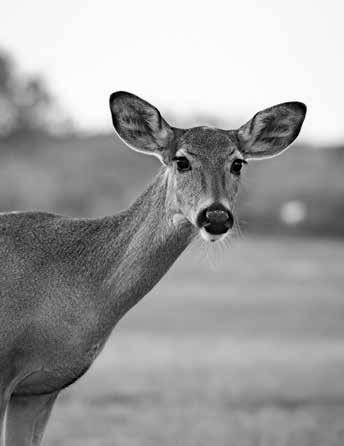
Doe days
Deer hunters use final weeks of MLDP season to harvest does
By Nate Skinner For Lone Star outdoor newS
Deer season on properties under the Texas Parks and Wildlife Managed Lands Deer Program continues through the end of this month, and many hunters
and ranch managers are using the final weeks of the season to fill the remaining tags they have available for antlerless deer.
Many are pursuing does with a management mindset to keep deer numbers in check on the properties where they hunt. Others are simply taking advantage of the opportunities provided by the extended season to add some meat to the freezer because they haven’t had the chance to harvest a deer yet.
Cold coveys
High numbers this season
By Conor Harrison Lone Star outdoor newS
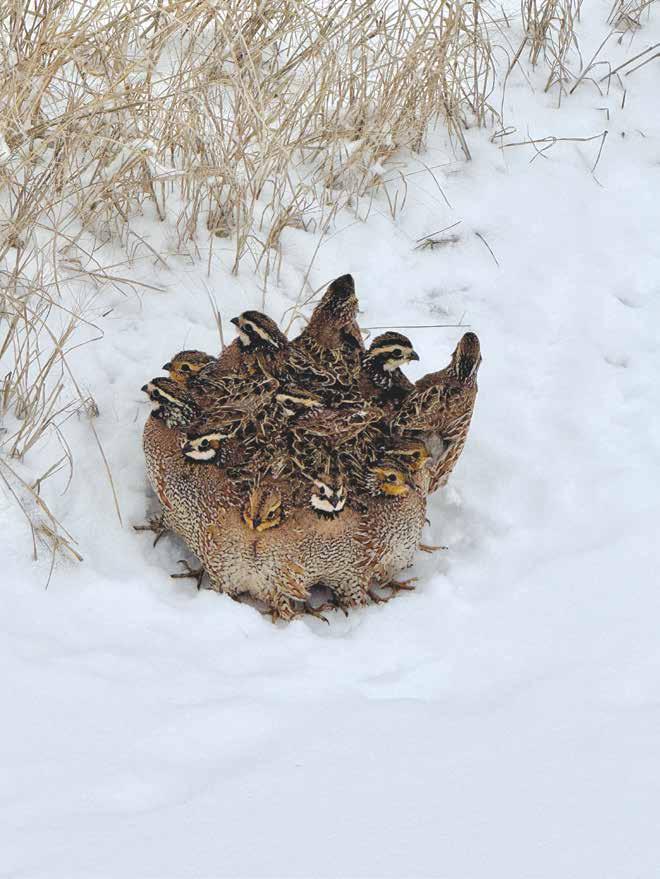
A covey of bobwhite quail huddles in the snow after a recent storm in Stonewall County. Coveys will stand together in a circle to distribute heat during bitter cold. Several quail were found dead on the ranch after the storm had passed, as snow and ice covered food sources for several days. Despite the frigid temperatures, days on either side of the cold snap saw great hunting for both blue and bobwhite quail across many Texas properties. Of course, birds aren’t evenly distributed across the landscape, but more ranches had quail than not this season due to timely spring and early summer moisture. LSON recently hunted with several hunters in West Texas, and the group saw high numbers of wild birds on ranches near Post. Scenting conditions were tough, but the
Too little, too late
Harshest cold front of season hits last weekend
By Nate Skinner Lone Star outdoor newS
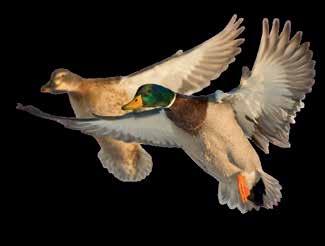
Duck season ended last month with the cold weather most Texas waterfowl fanatics had been waiting for all winter. For some, the season-long struggle to fill straps continued. Others were lucky enough to enjoy decent shoots as a result of more birds coming down with the frigid weather.
According to a hunting guide for Top-Flight
Hunting Preserve, Kody Ressler, their duck season in Colorado County ended much better than it started.
“Our ponds finally loaded up with ducks with the cold weather we had during the last few days of the season,” Ressler said. “The birds were fairly spooky, so we had to be tactful with how we set up to hunt them.” Ressler said green-winged teal, gadwall, pintails, and some random diver ducks were weary of decoy spreads oriented in any sort of distinct pattern.
“Spreading out the decoys in small bunches, here and there, out to about 50 yards away from the blind seemed to do the trick,” Ressler
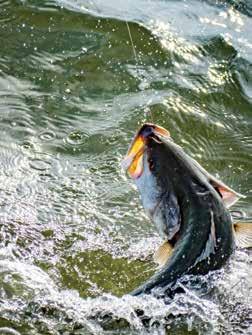
Speckled trout seem to be thriving, despite the freezing temperatures and significant dip in water temperatures that took place a few weeks ago. Photo by Nate Skinner, for Lone Star Outdoor News.
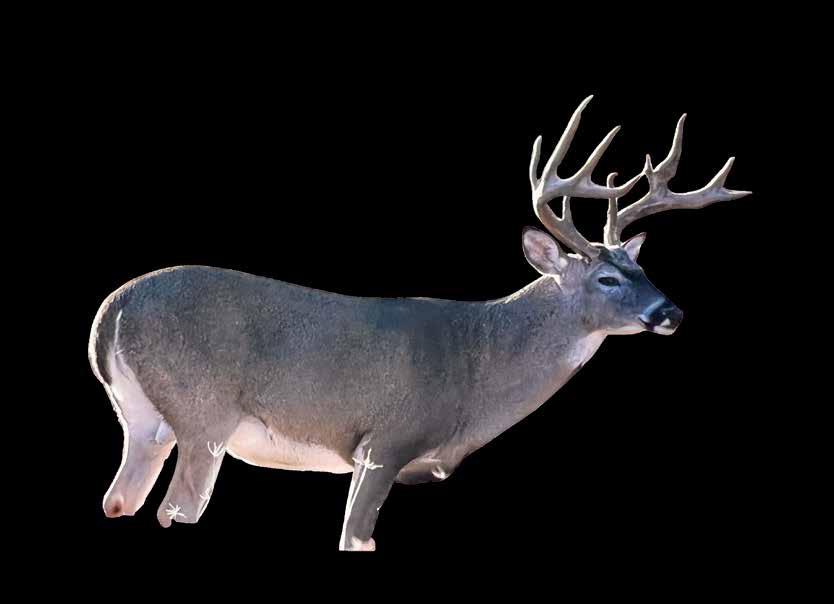
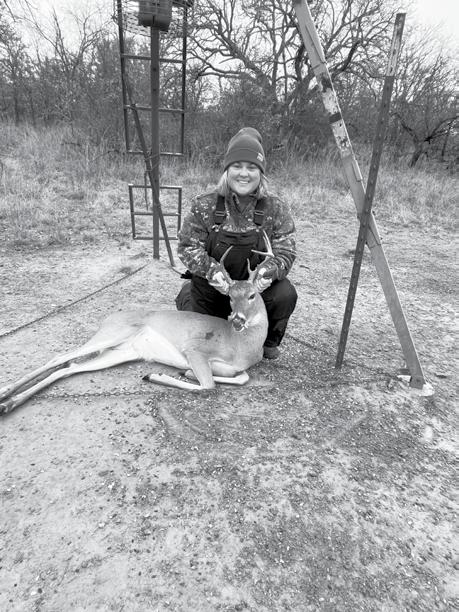
John Moranski harvested this doe on an MLDP property in south central Texas. Photo by Nate Skinner, for Lone Star Outdoor News.
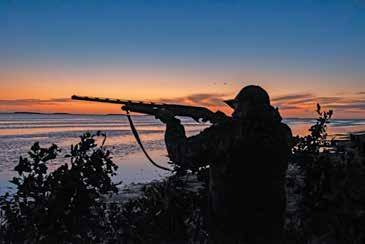
Duck hunters along the lower coast enjoyed good shoots to end duck season. Photo by Nate Skinner, for Lone Star Outdoor News.
Quail coveys stuck together during the recent cold snap, with many birds making it through the storm. Once the weather warmed back up, hunters took advantage and have been reporting solid numbers of birds across much of the state this season. Photo, left, from Bennett Cook. Photo, right, by David J. Sams, Lone Star Outdoor News.
Banded dove challenge
By Cory Byrnes
Texas Dove Hunters Association just finished up their 9th Annual Banded Dove Challenge. The Texas Banded Bird Challenge is a research program to study the movements of the Eurasian collared-dove, an invasive species that was introduced to the United States in the mid-1970s. They have spread rapidly since their discovery in Texas in the early ’90s, and now cover much of the state.
Family tradition
The challenge provides a unique opportunity for hunters to be a part of field research and win some prizes in the process. Since the Banded Dove Challenge’s inception, TDHA has trapped, banded and released approximately 800 birds a year.
“Collectively throughout the years, we have put out around 6,400 birds,” said TDHA President Charlotte Schuster. “This year was a great year. It was our third-highest bands reported.”
Hunters must sign up to participate in the challenge, and they can win with any band from previous years’ releases. Hunters, regardless of participation status, are encouraged to report the band to the TDHA for data collection. When a hunter reports a band, the TDHA uses their database to see how these birds move and behave in the wild.
“We look at directional travel, age, and distance over time. We have built a database in the last nine years that centers around where they were trapped, banded, and released compared to where they are found and harvested. Those are our main data points,” Schuster said. In the first several years of the study, Schuster reported the birds acted almost as homing pigeons and would make their way back to where they were trapped.
“The other pattern that has popped up in more recent years, and is the more prevailing pattern, is that the birds are staying put,” Schuster said.
One bird harvested in 2024 averaged .04 miles a day. That bird holds the record for days afield at 2,260 days. In that time, it only traveled 88 miles.
“They are simply not moving a lot. Which speaks to the characteristics we know of the Eurasian collared-dove: they are kind of a lazier bird,” she said. It is not entirely clear what effect the collared-dove has on the native population of dove. Over the last several years, TPWD has reported increases in native dove species populations.
“They are known to be an invader bird. Wherever they are, if they see a good spot or roost area by a mourning dove or whitewinged dove, they will take over. They are a nuisance in that regard,” Schuster added.
trip to hunt deer
By Nate Skinner For Lone Star outdoor newS
Case Carpenter has been going on a hunting trip with some buddies to a ranch in Goliad County for many years.
About four years ago, he turned that trip into a family outing, and it has become a tradition for he and his wife, Brittany, and their two daughters, Kaylee and Avery, ever since. During their trip last season, Carpenter’s wife and his oldest daughter, Kaylee, each harvested their first deer. Those two were both able to harvest deer again on their annual trip to the ranch this year, and after years of only taking does, Car-
penter and his daughter, Kaylee, went and got settled into a blind overlooking a feeder before sunrise, in hopes of possibly getting a shot at a particular buck.
“My daughter actually spotted the buck first, right at dawn,” Carpenter said. “My guide, Russell, quickly confirmed it was the deer we were after. I got the rifle up and waited for him to turn broadside.”
The buck finally gave Carpenter a good shot opportunity at about 150 yards, and he squeezed the trigger. The deer immediately fell in its tracks.
“So, there I was, on my first morning sit of the trip in a stand, and I harvested my first buck,” Carpenter said. “And he was a fine, heavy antlered deer, at that. Immediately, I couldn’t help but think there
Call back
Quail research ongoing in Pineywoods region
By Cory Byrnes For Lone Star outdoor newS
Quail populations in Texas have decreased by nearly 5% annually, according to estimates from wildlife biologists. In some regions like the Pineywoods of East Texas in Angelina National Forest, that estimate is as high as 10% annually. While Texas has seen a betterthan-average season in 2025 and 2026 due to the mild winters, the number of birds found on public lands continues to decrease.
While TPWD speculates on the possible causes of the declining population, it can be summed up to habitat loss and lack of land management. Quail hunting is now almost exclusively a private landowner’s domain. Those who do not have the same bureaucratic constraints
as TPWD and the US Forest Service that manages our public land are able to, with great success, manage their land for quail.
There are some state-owned Wildlife Management Areas that had an incredible 2025 season. Two WMAs in the state, Gene Howe and Matador, were particularly good for public hunts. But because they are in the rolling plains, their quail populations can be erratic depending on rainfall. Which means public access to wild quail populations in Texas is spotty at best. That doesn’t have to be the end of the story.
In 2024, Tall Timbers, an organization dedicated to restoring wild quail, performed a survey in 144 locations through the Sabine and Angelina National Forests, and in 17 percent of the locations, they found quail were present. In that same time frame, Tall Timbers began working with a local private landowner who had already begun put-
while after Carpenter knocked down his buck, and some does ended up coming out. Kaylee got behind the rifle and was able to take advantage of a broadside shot opportunity from one of the does.
“The deer ran about 20 yards or so before expiring,” Carpenter said. “And then, the celebration began.”
Throughout the duration of the rest of the trip, Carpenter and his wife both harvested does, and Kaylee was able to harvest a second doe and a management buck.
“It was really just a banner trip,” Carpenter said. “The hunt has become something we all look forward to as family.” Carpenter said his younger daughter, Avery, has not started hunting yet, but
For Lone Star outdoor newS
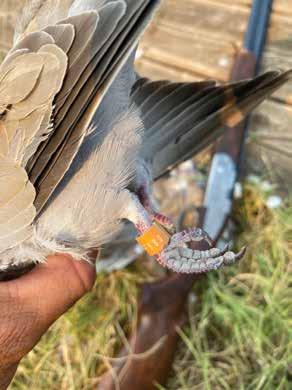
A hunter shows off a banded dove taken earlier this season. Photo from Charlotte Schuster.
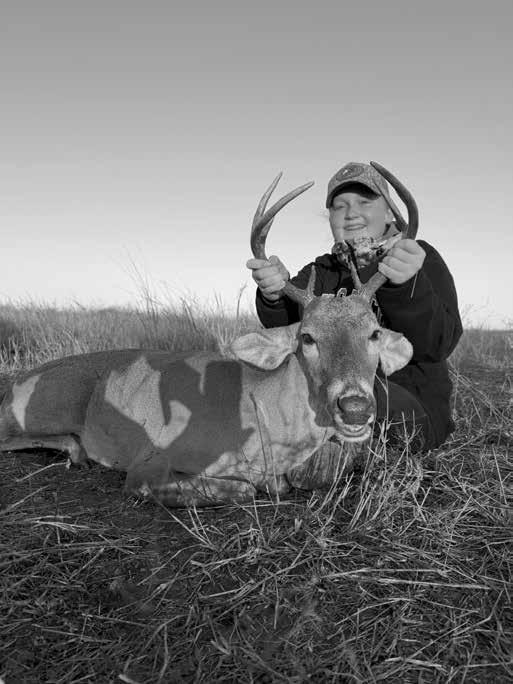
Case Carpenter shows off a mature buck he harvested alongside his daughter, Kaylee, during an annual family hunting trip in Goliad County.
Photo by Russell Ernst.
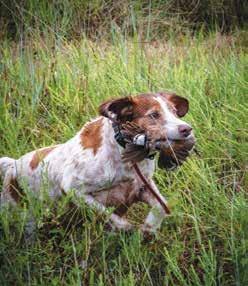
Dogs working to find quail in the Pineywoods have become a rarer and rarer sight the past decade. Groups like Tall Timbers are working to bring it back.
Photo by David J. Sams, Lone Star Outdoor News.
Now open
Los Cazadores opens new location in Granbury
By Nate Skinner
For Lone Star outdoor newS
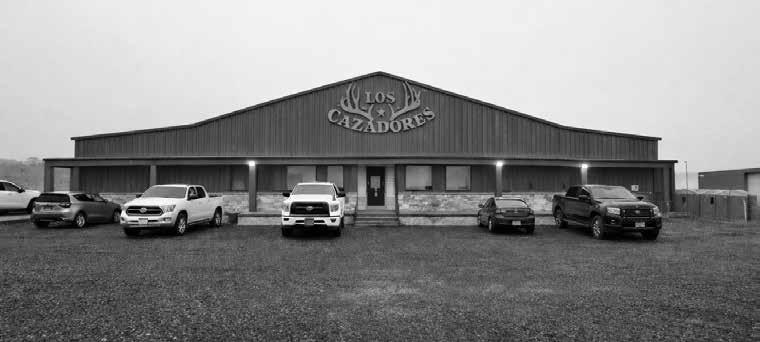
Texas-based outdoor retailer Los Cazadores recently opened its newest retail location in Granbury. The Granbury store became the fourth retail location for the Los Cazadores franchise, with the other existing stores in Pearsall, Stonewall, and Buchanan Dam.
According to the CEO of Los Cazadores, Craig Harrison, the Granbury location brings the same trusted brands, knowledgeable staff, and customer-first approach that outdoor consumers have come to expect from all Los Cazadores stores.
“First and foremost, we want our stores to involve top level people with top level products, to effectively serve their surrounding communities,” Harrison said.
“We are hunters and ranchers servicing hunters and ranchers.”
Harrison said all Los Cazadores store
Please turn to page 16
Nothing to complain about
By Conor Harrison
Star outdoor newS
Dallas Safari Club concluded its three-day Convention in Atlanta on Sunday, Feb. 8, and the show was a success, according to exhibitors and attendees.
It was the first time in the organization’s history that the main convention was only three days, but the new format seemed to work well. The weather, a major disruptor at the 2025 Convention that saw a storm blanket the area with ice and snow, was cooperative this time around.
The doors opened at the Georgia World Congress Center on Friday morning, and crowds were good both Friday and Saturday.
“Almost everyone I’ve spoken with has sold a few hunts or trips,” said one attendee. “The crowds on Friday and Saturday were good — maybe not Dallas good, but enough that it felt crowded at times.”
Even on the final day, exhibitors noticed a bump in attendance from noon until the
Please turn to page 21
DSC a success in second Atlanta show
Lone
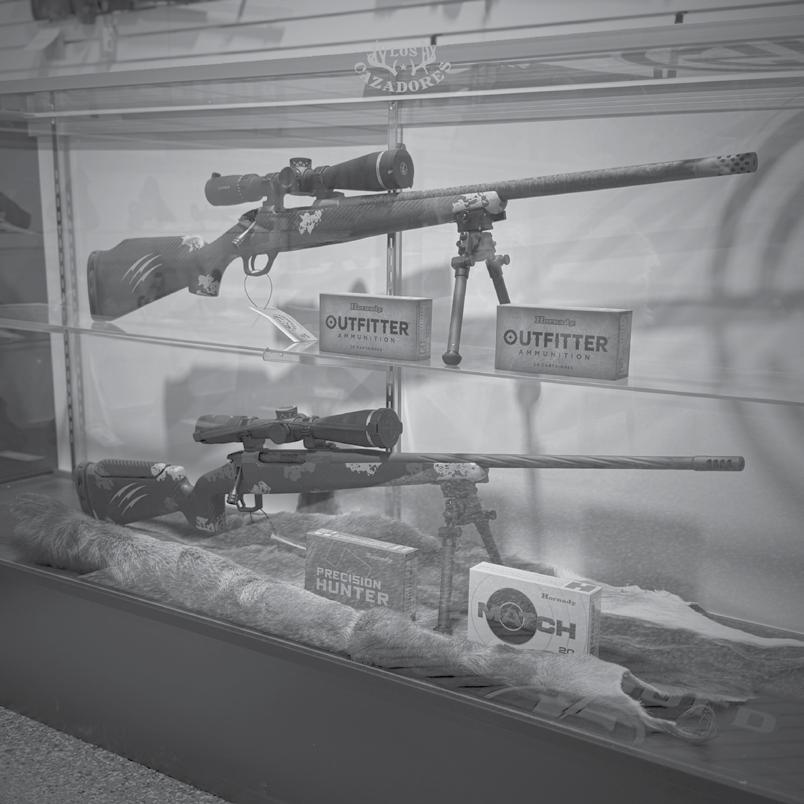
Hunters in the Granbury area can now visit a world class outdoors shop with the opening of Los Cazadores. Photo by Los Cazadores.
DSC Convention goers await to hear their name called by James Jeanes, as raffle winners were announced on the show floor. Photo by David J. Sams, Lone Star Outdoor News.
Perfect shot
Young archer takes public land nilgai
By Tony Vindell
For Lone Star outdoor newS
The hard-to-bring-down nilgai antelope is one of deep South Texas’ hardiest animals, capable of taking multiple shots from big caliber rifles.
Many guides tell tales of nilgai being shot with the popular .30-06 or bigger, only to have the beasts take the punishment and run off, never to be recovered.
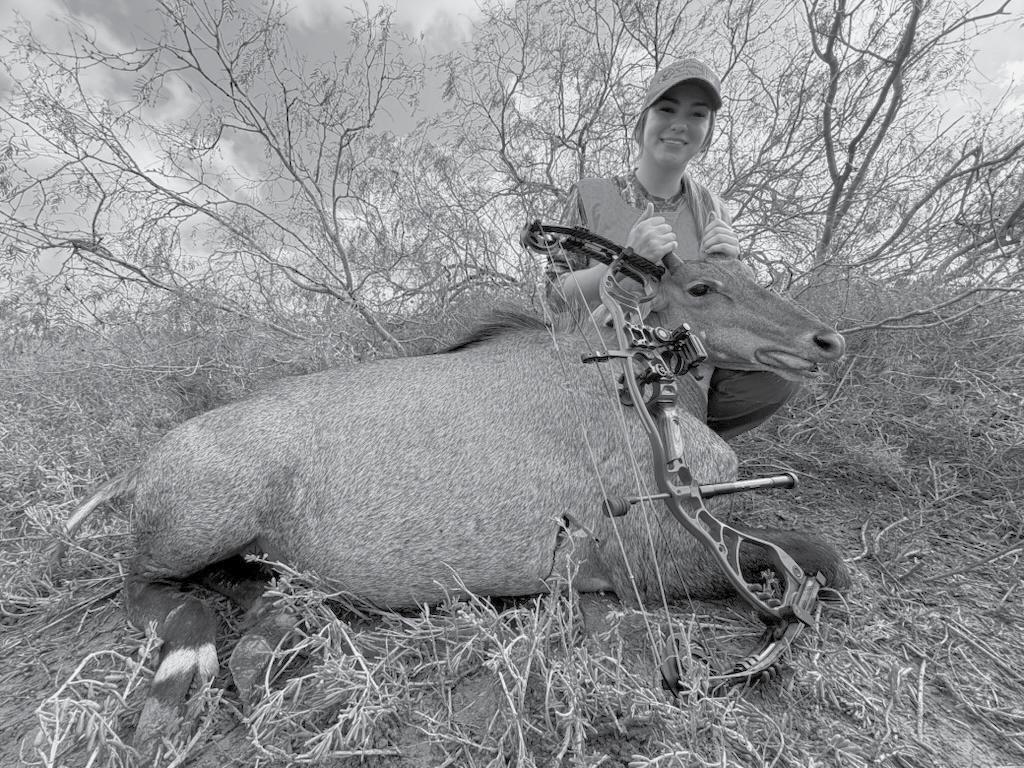
But for 19-year-old Haley Vasquez, it only took one shot with a bow and arrow.
The young huntress from Harlingen harvested her first nilgai while on one of several archery hunts held at the Laguna Atascosa National Wildlife Refuge in eastern Cam-
eron County.
“I am proud of myself,” Vasquez said a week after she harvested the big bull on a public drawn hunt in late December. “It was a perfect shot.”
The arrow penetrated the bull’s thick hide, hitting right in the middle of the heart.
The nilgai ran about 30 yards, stopped and started moving side to side. It then col-
lapsed just a few feet from a dirt road. Vasquez’s father, Sal, said it could not have happened in a better place and at a better time, about 9:30 a.m.
“We did not have to go in the brush to retrieve it,” he said. “It was right here.”
When hunting on a national wildlife refuge, hunters have to make their own arrangements once an animal is down. Some of them quartered the four-legged animals
Please turn to page 20
Haley Vasquez, 19, holds her big bull nilgai she took with a bow on a public land draw hunt late last year.
Photo by Tony Vindell, for Lone Star Outdoor News.
THE LONE STAR OUTDOOR NEWS FOUNDATION CREATES HUNTING AND FISHING OPPORTUNITIES FOR PEOPLE EAGER TO PLUNGE HEADFIRST INTO THE OUTDOORS BUT LACKING THE OPPORTUNITY.
FISHING
Still deep and suspended
Largemouth bass in mid-winter patterns
By Nate Skinner
For Lone Star outdoor newS
Many bass anglers are anxious for the fish to begin to make their move toward shallow water, as their annual spawning season draws near. However, it seems that wintertime patterns cur-
rently remain steady as largemouth bass continue to stage in deeper water along their typical, cold weather haunts across many Texas water bodies.
East Texas bass fishing guide Ryan Pinkston of Southern Waters Guide Service has been spending most of his time recently on Toledo Bend Reservoir, where he and his anglers have been catching fish out of deep water.
“There are a lot of fish to be found roaming out in deep water using Live
Scope or forward-facing sonar right now,” Pinkston said. “Most of these bass are suspended about 10 to 15 feet below the surface in 30 to 50 feet of water near river or creek channels, in areas where there are significant concentrations or balls of shad. Alabama rigs, minnowstyle baits, and hard plastic jerkbaits have been working well to produce strikes in this scenario.”
Pinkston said the key to locating bass roaming out deep has been
Tail end
Pompano run slowing, fish moving to deeper water
The pompano run has been excellent this year but dropping water temperatures have slowly put an end to the once strong bite.
“It just slowed down as of a week and a half ago,” said Sami Khalil with Everyday Beach Life. “They’re still here, but once (the water temperature) goes below 55, then they’ll tend to go back to the deeper water.”
Anglers fishing Padre Island National Seashore, a stretch known for its winter pompano bite, should target the farthest part of the second gut and out into the third gut, past the farthest sandbar. There are other key features
“We try to read the beach. Look for coquina shells on the ground, deeper cuts, and rip currents,” Khalil said. “The rip currents act as a highway for the Khalil recommends keeping mobile if the fishing is slow.
“It depends on the day,” he said. “If I find a coquina bed, I’ll tend to stay because I know they will be passing by. If not, we are just reading the beach, looking for good cuts, and we keep moving.”
Don’t be afraid to move to the next location that has some signs of fish in the area. The most productive for anglers this month has been a pick-and-
“Technically, we are hunting for them, not fishing for them,” Khalil said. To hit those targets further away, he recommends longer rods with the breakaway clip-down pompano rig.
“The reason I use them is when you clip them down, they give you a little more distance,” Khalil said. “I am definitely fishing for quality, not quantity.”
He recommends going up one size on the rigs to something with a 4/0 hook size. The most productive bait for Khalil has been FISHGUM and shrimp.
“Sometimes I am using FISHGUM and shrimp with them tied down with a bit of elastic, that way they stay on the hook,” Khalil said.
Khalil adjusts his fishing by adjusting his expectations and chasing what is in season based on the weather. Going into mid-February and March, the trout will come back into the surf, and he will target them.
“I’ll start targeting different species, but I always take a long rod with me or two and put them out, for the pompano” Khalil said. “They’re not in big
In Freeport, William Yearsin with Hooked On Tackle reports the pompano
Building habitat
Old Christmas trees provide pre-spawn habitat on Fork
By Vivian Leopold one Star outdoor newS
What do you do with used Christmas trees?
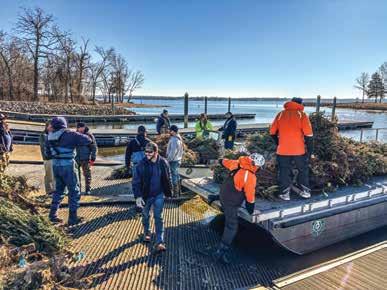
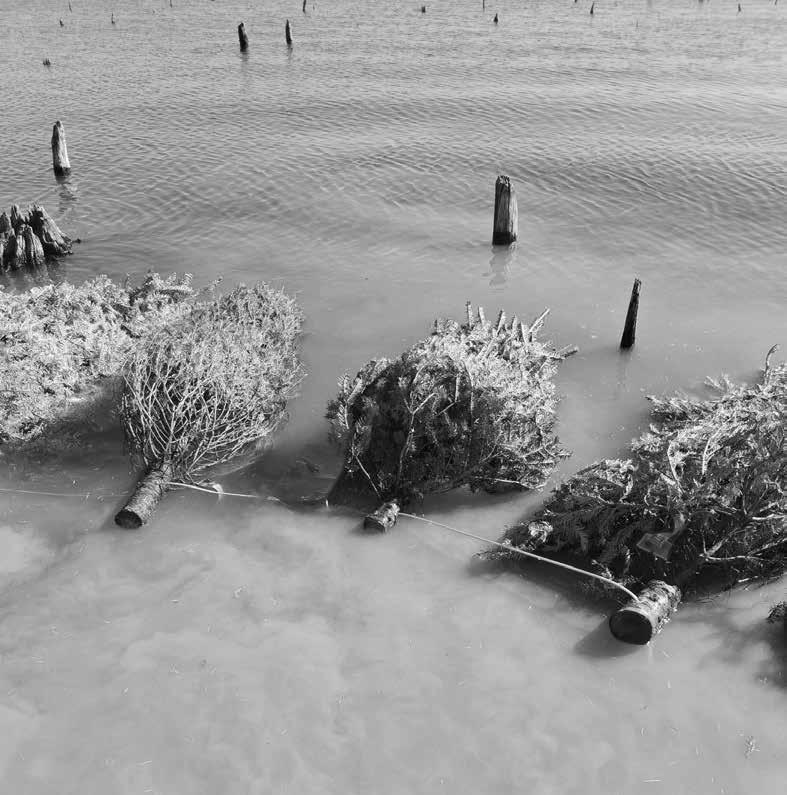
A new project by Texas Parks and Wildlife Department sought to repurpose them to provide structure and refuge for largemouth bass in preparation for the upcoming spawn on Lake Fork.
After the holidays, a request went out for donations of real, undecorated Christmas trees to be collected
at two drop-off points, one in Tyler and the other at the new Caney Point Recreation Area on Lake Fork. Lowe’s dropped off a truckload of trees and Tractor Supply in Sulphur Springs collected and donated a pickup truck and flatbed trailer load of trees for the project. On February 5, eight Texas Parks and Wildlife employees and four more from Sabine River Authority met at the staging point to load 330 trees on two boats running multiple trips. The trees were not put out in piles as would happen to attract crappie. The intent is to provide shallow cover along the shoreline to protect bass fry hatched during the upcoming spawn and, later, when fingerling largemouth bass are stocked into Lake Fork. The
trees were connected together by cable and weighed down by cinder blocks with ground anchors every 30 feet. It was enough to cover about 1,000 feet of shoreline in four 250-foot sections along two coves. If the lake was full (it is 3.07 feet below pool now), the brush would be in up to 4 feet of water.
Biologist Jake Norman, district supervisor for TPWD’s Tyler Region, is responsible for 14 counties and the management of 24 lakes, including Lake Fork. He spoke to Lake Fork Sportsman’s Association last month about the Christmas tree project. While the number of trees collected/donated was a bit less than expected, Norman stressed this is a multi-year process and this first deployment would allow
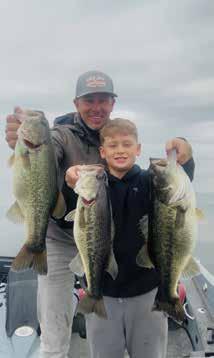
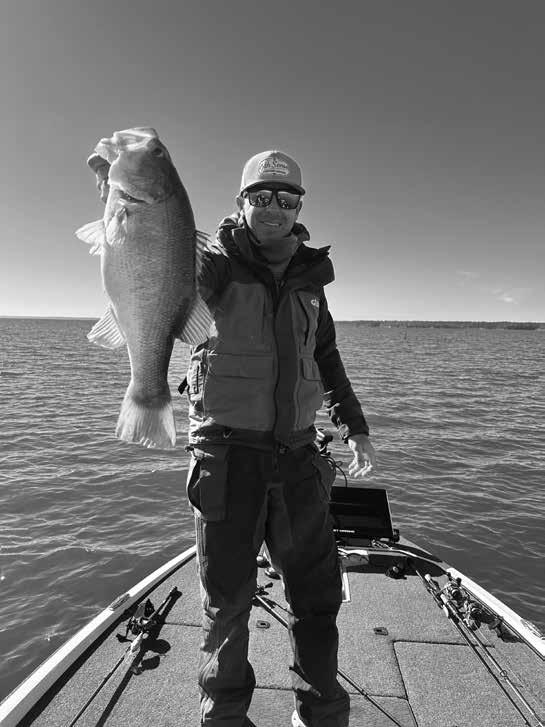
Fishing guide Ryan Pinkston and his son, Greyson, show off some solid bass they caught while using forwardfacing sonar in a stretch of deep water that was loaded with shad on Toledo Bend Reservoir.
Photo from Ryan Pinkston.
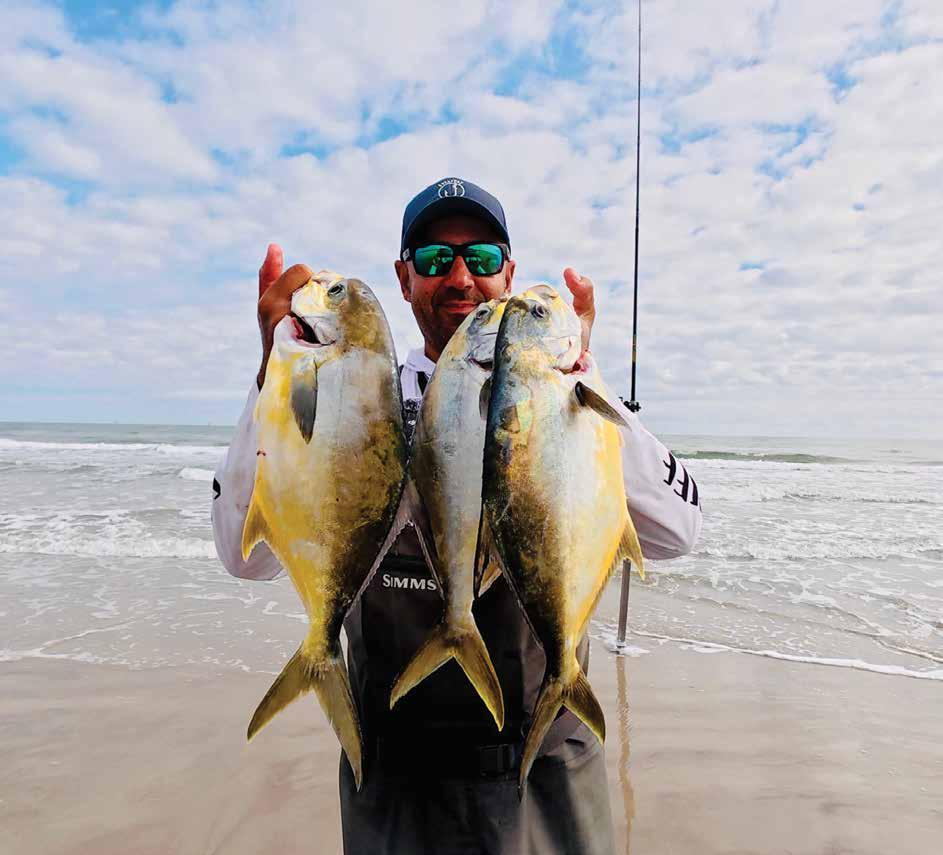
Angler Sami Khalil holds a group of nice pompano taken off the beach. Photo by Sami Khalil.
TPWD volunteers help load trees onto boats to drop them for habitat on Lake Fork. Photo by Vivian Leopold for Lone Star Outdoor News.
Trout time
tures.
“Most of the specks we have been catching have been in about 1- to 1.5-feet of water,” Russell said. “Slow-sinking and suspending mullet-imitation plugs, including various models of Corkies and the PavLures Big Softy, have been producing bites from larger trout.”
Russell said soft plastics are also rendering plenty of strikes; however, most of the trout hitting those presentations have been on the smaller side.
“Trophy-sized trout have really been prefer ring lure presentations with a larger profile,” Russell said. “Focusing on pockets of water that have baitfish has been essential to catch ing fish. If you aren’t in an area with mullet, you’re not going to get bit.”
With the cooler water temperatures, Rus sell said the baitfish have not been very active along the surface. As long as he sees some sort of baitfish activity, he feels confident there will be speckled trout nearby.
“Early in the mornings, the mullet really aren’t moving around much,” Russell said. “They’ve been becoming more active later in the day as the sun rises overhead and things begin to warm up. Sometimes you really have to scour the water to find where the baitfish are concentrated.”
Russell said recently, the mullet have been stacked up in small stretches of water, maybe 20 to 30 yards in size. That’s where he and his anglers have been catching most of their fish. They’ve been catching trout in the keeper, slot-size range, up to 25 inches or more in length.
In East Matagorda Bay, Capt. Chris McKinley said the key to finding good numbers of solid speckled trout has been focusing on areas with streaky-looking water and stretches where clarity is a little bit dirtier than the surrounding water.
“The water across the bay is extremely clear in a lot of places,” McKinley said. “If you can find a stretch that has some sandy streaks mixed in, you’ll likely find a decent concentration of specks.” McKinley and his anglers have been catching most of their fish while wading in waist-deep water or more while casting soft plastics.
“Trout in the 2.5- to 4-pound range have been plentiful,” McKinley said. “There’s been a handful of fish weighing 5 to 7 pounds caught, as well. All of the trout seem to be hanging out well off the shorelines in deeper water.”
Upper coast fishing guide Capt. Devin Williams has been finding good numbers of trout stacked up in lower Galveston Bay and in Offatts Bayou while wade fishing the edges of shell reefs. A lot of the fish have been in the 20- to 23-inch range, with a few measuring 26 inches or more in length.
“Slow-sinking, mullet-imitation lures have been producing most of the larger specks lately,” Williams said. “Soft plastics rigged on a jig head have also been catching trout consistently, but the fish hitting soft plastics have been smaller, on average.”
Williams said the trout have been feeding in thigh- to waist-deep water where small oyster reefs drop off and transition into a muddy bottom.
Same lunker bass, three times
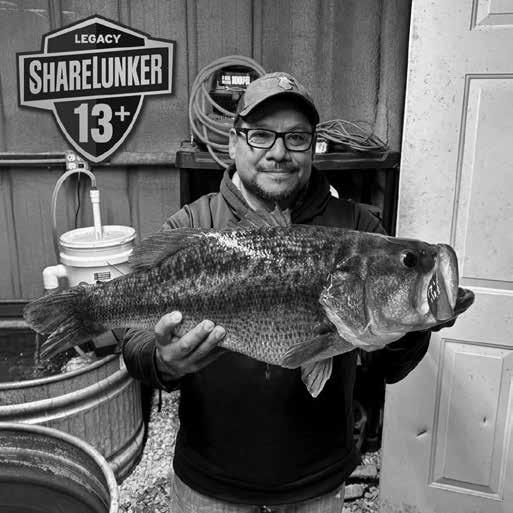
Ross Gomez of Post landed 14.74-pound ShareLunker 685 on Jan. 22 — the exact same Legacy Class fish he had caught on two previous occasions. Gomez brought her in the first time in 2023, then again in 2025 and now in 2026 He caught the bass in the same general location each time.
The story of this fish was a truly remarkable one. Gomez had worked until 3 p.m. that day and wanted to get some fishing in after work. He had thought about taking his kayak out but ultimately decided to go to the dock and see what he could catch.
“I got out to the dock and there was a friend of mine that I’d fished with before and hadn’t seen in about a year,” said Gomez. “I was trying out a new lure that I had bought, and we were just talking about fishing. I threw out the lure and while I was bringing it back, I stopped, looked at it, and out of nowhere I saw her come up from the bottom and smash it. I’m screaming to my friend to get the net, and I finally got her up and realized, this is a huge fish.”
The first thing his friend asked was whether Gomez thought it was the same fish he’d caught twice before. Gomez wasn’t sure; if so, it certainly looked older this time. When he had returned the fish the previous two times, the locations of the return were roughly two miles from the dock. Gomez called the local bait shop to get it on the scale.
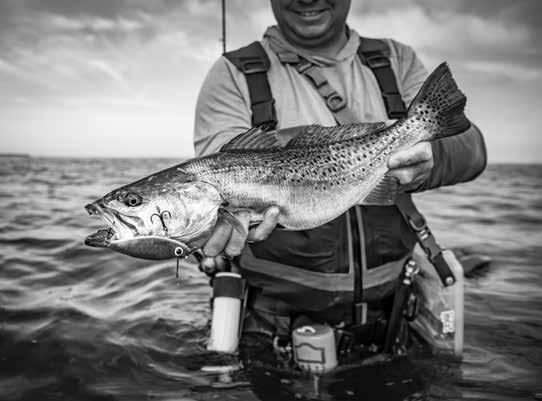
Larger-profiled, mullet-imitation plugs have been producing bites from the largest speckled trout recently, up and down the Texas coast.
Photo by Nate Skinner, for Lone Star Outdoor News.
Photo from TPWD.
TEXAS FRESHWATER FISHING REPORT
ALAN HENRY: 46 degrees; 5.63’ low. Crappie are fair on minnows in 25-35 feet.
AMISTAD: Water stained; 52 degrees; 64.05’ low. Largemouth bass are good on slow-rolled Alabama rigs, soft plastics and football jigs. Target ledges in 25-40 feet of water.
AQUILLA: Water stained; 46 degrees; .94’ low. Largemouth bass are fair on spinnerbaits. Crappie are good on minnows and jigs. Catfish are good on prepared baits. White bass are fair on jigging spoons on main lake humps.
ARLINGTON: Water slightly stained; 43 degrees; 1.65’ low. Largemouth bass are fair on crankbaits in the deepest water anglers can find. Target the hot water discharge areas.
ARROWHEAD: Water stained; 40 degrees; 2.94’ low. Catfish are good on fresh cut shad and prepared bait.
ATHENS: Water stained; 54 degrees; 0.42’ high. Largemouth bass are good on stick baits in shad and bluegill patterns, umbrella rigs, Texasand Carolina-rigged soft plastics. Crappie are good on jigs and minnows.
AUSTIN: Water stained; 51 degrees; 0.50’ low. Largemouth bass are good on spinnerbaits and swimbaits near brushpiles in 10-20 feet of water.
B A STEINHAGEN: Water stained; 50 degrees; 0.19’ low. Largemouth bass are slow on soft plastics over submerged vegetation.
BASTROP: Water stained; 50 degrees. Largemouth bass are fair on Carolina-rigged soft plastics and crankbaits near the hot water discharge.
BELTON: Water stained; 51 degrees; 0.78’ high. White bass and hybrid striped bass are fair on jigheads and soft plastics. Catfish are good on fresh cut bait.
BENBROOK: Water stained; 50 degrees; 2.45’ low. Crappie are good next to structure on live minnows. Hybrids are fair on live bait. Catfish are fair on stink bait and cut bait.
BOB SANDLIN: Water stained; 46 degrees; 1.36’ low. Crappie are slow on minnows and small jigs.
BOIS D’ARC: Water stained; 43 degrees; 2.70’ low. Largemouth bass are slow on Texas rigs and Shaky heads. Crappie are slow.
BRADY: Water stained; 50 degrees; 0.44’ low. Largemouth bass are slow on Carolina rigs, jerkbaits and swimbaits. White bass are slow. Crappie are slow and scattered.
BRAUNIG: Water stained; 72 degrees; Redfish are slow. Catfish and largemouth bass are slow.
BRIDGEPORT: Water clear; 50 degrees; 4.81’ low. Crappie bite is fair on minnows and jigs. Largemouth bass are fair on jigs, Alabama rigs, and swimbaits. White bass and hybrids are fair on slabs and flukes. Catfish are good on cut bait and chicken liver.
BROWNWOOD: Water stained; 45 degrees; 3.10’ low. Largemouth bass are excellent on jigs, shallowrunning crankbaits, and soft plastics. Crappie are slow on minnows and jigs. White bass are slow on slabs. Catfish are slow on minnows and jug lines with cut shad.
BRYAN: Water stained; 50 degrees. Largemouth bass are fair on Texas-rigged craws and creature baits.
BUCHANAN: Water stained; 53 degrees; 2.56’ low. Stripers are good on jigging spoons and deadsticking soft plastics. White bass are good on jigging spoons. Catfish are good on cut shad.
CADDO: Water stained; 41 degrees; water level at 169.05’. Largemouth bass and white bass are slow on Rat-L-Traps, underspin, swimbaits, crankbaits, spoons, and Alabama rigs.
CALAVERAS: Water stained; 65 degrees; Redfish are good on Rat-L-Traps and soft plastics. Catfish are good on punch bait and cheese baits.
CANYON LAKE: Water stained; 50 degrees; 21.03’ low. Largemouth and smallmouth bass are fair on slow-rolled finesse jigs and weightless soft plastic worms. Striped and white bass are good on jigging spoons and heavy underspins.
CEDAR CREEK: Water slightly stained; 46 degrees; 3.85’ low. Hybrid striped bass and white bass are good deadsticking spinnerbaits and slabs. Crappie are fair on small jigs and minnows. Catfish are good on cut gizzard shad.
CISCO: Water stained; 51 degrees; 16.70’ high. Largemouth bass are slow on spinnerbaits and squarebilled crankbaits. Catfish are good on cut shad and punch bait. Crappie are fair on minnows.
COLEMAN: Water stained; 47 degrees; 3.42’ low. Largemouth bass are slow. Crappie are slow. Catfish are fair on shad.
COLETO CREEK: Water stained; 65 degrees; 3.25’ high. Largemouth bass are slow targeting timber and deeper brush piles.
COMANCHE CREEK: 68 degrees; 0.49’ high. Largemouth bass are fair on soft plastics. Catfish are good on prepared baits. Tilapia are good.
CONROE: Water stained; 58.5 degrees; 1.07’ high. Largemouth bass are good on deep-diving crankbaits. Crappie are good on hair jigs and minnows. Hybrids are fair on slabs, spoons, large minnows, and shad. Catfish are good on liver, worms, and punch bait drifting along channel edges.
dropshots. Catfish are fair.
FORK: Water stained; 43 degrees; 3.05’ low. Largemouth bass are slow on Texas rigs and jigs. Crappie are good on minnows and slowly fished jigs near deep timber.
FT PHANTOM HILL: Water stained; 48 degrees; 5.59’ low. Crappie are fair on jigs and minnows. Hybrids are fair on jigs and shad. Catfish are fair on fresh cut shad.
GEORGETOWN: Water stained; 51 degrees; 8.58’ high. Largemouth bass are slow on jigs and soft plastics. White bass are slow on slabs and jigs.
GRAHAM: Water stained; upper 50 degrees; 4.04’ low. Largemouth bass are good on jigs and Texas rigs. Crappie are good on minnows. White bass and hybrids are good on jigs and crankbaits.
GRANBURY: Water stained; 50 degrees; 0.57’ low. Largemouth bass are slow on soft plastics and crankbaits. Striped bass are good on live bait and jigs. Crappie are fair on jigs and minnows. White bass are fair on slabs and spinnerbaits.
GRANGER: Water stained; 48 degrees; 0.13’ high. Largemouth bass are fair on jigs and soft plastics. Crappie are fair in shallow coves. White bass are fair on jigs and spinners. Catfish are good on shad.
GRAPEVINE: Water slightly stained; 47 degrees; 0.40’ low. White bass are good on slabs, jigs and swimbaits.
GREENBELT: Water stained; 39 degrees; 51.41’ low. White bass are good on minnows. Crappie are slow.
HAWKINS: Water slightly stained; 50 degrees. Largemouth bass are fair on small streamers in red and white color.
HOUSTON: Water clear; 59 degrees; 0.01’ high. Largemouth bass are fair on Texas-rigged worms. Crappie are good on jigs and minnows. White bass are good on slabs and crankbaits. Catfish are fair on fresh shad.
HOUSTON COUNTY: Water stained; 49 degrees; 0.19’ high. Largemouth are fair on reaction baits.
HUBBARD
CREEK: Water
Stained; 47 degrees; 14.59’ low. Largemouth bass are slow. Crappie are fair on minnows and jigs. Catfish are fair on cut shad.
White bass are good on slabs, swimbaits, and jigs fished off the dam. Catfish are good on cut bait.
LBJ: Water stained; 50 degrees; 0.28’ low. Largemouth bass are slow on Alabama rigs and minnows near deeper rocky banks. Crappie are fair on minnows and chartreuse jigs. Catfish are fair on shad.
LEWISVILLE: Water stained; 49 degrees; 0.57’ low. Hybrid stripers and white bass are slow in deeper channels.
LIMESTONE: Water clear; 45 degrees; 2.07’ low. Largemouth bass are fair on crawfish-imitation baits, red Rat-L-Traps, and Texas rigs. White bass are fair on slabs. Crappie are fair on minnows. Catfish are fair on cut bait.
LIVINGSTON: Water stained; 55 degrees; 0.22’ high. Largemouth bass are fair on worms, jigs, and soft plastics. White bass and hybrid stripers are fair on slabs, spoons, and live bait. Catfish are good on punch bait, cut bait, and worms. Crappie are fair on minnows and jigs.
MARBLE FALLS: Water stained; 45 degrees; 0.66’ low. Largemouth bass are slow. Crappie are fair on chartreuse jigs and minnows. Catfish are fair.
46 degrees; 19.70’ low. Largemouth bass are fair on deep-diving crankbaits, underspins, swimbaits, and Alabama rigs. White bass are fair on jigging spoons and Alabama rigs. Catfish are fair on shad. Crappie are slow.
OAK CREEK: Water lightly stained; 48 degrees; 22.92’ low. Crappie are fair on jigs and minnows over brush. Largemouth bass are slow on soft plastics.
PALESTINE: Water stained; 48 degrees; 0.11’ low. Largemouth bass are fair on jigs. Crappie are good on minnows and jigs. White bass and hybrids are good on swimbaits. Catfish are good on cut shad.
PALO PINTO: Water stained; 48 degrees; 0.75’ low. Largemouth bass, hybrids and white bass are slow. Catfish are good on shad.
PINKSTON: Water stained; 51 degrees. Largemouth bass are fair on suspended jerkbaits and Carolina rigs. Crappie are good on jigs. Catfish are slow.
POSSUM KINGDOM: Water stained; 50 degrees; 2.71’ low. Largemouth bass are fair in deep water on slow-rolled deepdiving baits. Stripers are slow. White bass are fair on slabs. Catfish are fair on cut and live shad.
n Saltwater reports Page 21
Lampasas River channel. Largemouth bass are fair by snap-jigging slabs.
TAWAKONI: Water lightly stained; 46 degrees; 1.95’ low. Largemouth bass are slow on larger soft plastics, and crankbaits. Hybrid stripers and white bass are good on soft plastics in 20-25 feet of water. Crappie are good on jigs. Catfish are good on fresh cut gizzard shad.
TEXOMA: Water stained; 42 degrees; 0.80’ high. Stripers are good deadsticking jigs in 50-70 feet of water. Crappie are fair on jigs and minnows in 20-30 feet of water. Catfish are good on cut bait.
TOLEDO BEND: 50 degrees; 4.25’ low. Largemouth bass are slow on square-billed crankbaits, lipless crankbaits, swim jigs, Carolina rigs, and spoons all fished slowly.
TRAVIS: Water stained; 57 degrees; 13.81’ low. Largemouth bass are fair on jerkbaits and medium-diving crankbaits in craw color.
COOPER: Water stained; 50 degrees; 4.80’ low. Crappie are slow.
CYPRESS SPRINGS: Water stained; 50 degrees; 0.66’ low. Crappie are slow on jigs and minnows.
DUNLAP: Water stained; 50 degrees. Largemouth bass are slow on soft plastics, Texas rigs and crankbaits. Catfish are fair on stink bait and cut bait. Crappie are good on minnows.
EAGLE MOUNTAIN: Water stained; 47 degrees; 2.36’ low. Largemouth bass are slow on spinnerbaits and jerkbaits. Perch are good on nightcrawlers. Catfish are decent on cut shad and live perch. Crappie are slow on jigs and minnows.
FALCON: Water stained; 55 degrees; 44.49’ low. Catfish are good on cut bait and stink bait.
FAYETTE: Water slightly stained; 65 degrees; full pool. Largemouth bass are fair on Carolina rigs, crankbaits, and
INKS: Water stained; 48 degrees; 0.76’ low. Largemouth bass are fair on crankbaits and drop-shotrigged finesse worms.
JACKSONVILLE: Water stained; 46 degrees; 0.14’ high. Largemouth bass are fair on chatterbaits, spinnerbaits and Rat-L-Traps.
JOE POOL: Water stained; 48 degrees; 0.19’ low. Largemouth bass are slow on soft plastics fished slowly in deeper water.
LAKE O’ THE PINES: Water stained; 48 degrees; 0.16’ high. Largemouth bass are fair on Alabama rigs, crankbaits, and jerkbaits along creek channels. Crappie are slow on jigs and minnows. Catfish are slow.
LAVON: Water stained; 45 degrees; 2.04’ low. Largemouth bass are fair on crankbaits, jigs, jerkbaits, and soft plastic minnows. Crappie are fair on minnows and jigs on main lake humps.
MARTIN CREEK: Water slightly stained; 48 degrees; 1.95’ low. Largemouth bass are good on Alabama rigs, jerkbaits and crankbaits. Crappie are fair on jigs and minnows. White bass are fair. Catfish are good on live and cut bait.
MEREDITH: Water stained; 42 degrees; 44.01’ low. Largemouth bass, smallmouth bass, and white bass are good on top-waters, chatterbaits, and spinnerbaits. Crappie are fair. Bluegill and perch are good on worms and corn. Walleye are good on jigs. Catfish are fair on frozen shad and stink bait.
MILLERS CREEK: Water stained; 45 degrees; 3.95’ low. Largemouth bass are slow on spinnerbaits, crankbaits, and buzzbaits. Crappie are good on minnows.
MURVAUL: Stained; 58 degrees; 0.19’ low. Largemouth bass are slow on medium-diving crankbaits. Crappie are good on white jigs and minnows. Catfish are excellent on live minnows or cut bait.
NACOGDOCHES: Water stained; 49 degrees; 1.33’ low. Largemouth bass are good on suspending jerkbaits and large swimbaits. Crappie are slow on white jigs. Catfish are fair on cut bait and live minnows.
NACONICHE: Water stained; 46 degrees; full pool. Largemouth bass are good on square-billed crankbaits, jerkbaits, glide baits, topwaters, and deep-divers. Crappie are good on jigs and minnows. Catfish are slow.
NASWORTHY: Water slightly stained; 47 degrees; 0.92’ low. Largemouth bass are fair flipping soft plastics. Crappie are fair on chartreuse jigs. Catfish are fair on cut bait and stink bait.
NAVARRO MILLS: 50 degrees; full pool. Crappie are slow on jigs and minnows. Catfish are good on cut shad.
O H IVIE: Water stained;
PROCTOR: Water stained; 49 degrees; 2.89’ low. Largemouth bass are fair on soft plastics. Crappie are fair on minnows and jigs. Hybrids are fair on shad-colored lures. Catfish are fair on cut bait and stink bait under birds.
RAY HUBBARD: Water stained; 48 degrees; 1.64’ low. White bass are fair on slabs on the southern end of the lake. Crappie are fair on jigs and minnows. Catfish are good drifting large baits in 38-42 feet of water.
RAY ROBERTS: Water slightly stained; 38 degrees; 1.07’ low. Largemouth bass are slow on swim jigs. Crappie are slow on jigs and minnows. White bass are fair on live bait and slabs. Catfish are fair on cut bait.
RICHLAND CHAMBERS: Water slightly stained; 47 degrees; 2.08’ low. Largemouth bass are slow on jerkbaits or Alabama rigs around structure. White bass and hybrid bass are fair on slabs. Hybrids are good on flukes in creek channels. Catfish are good on cut bait.
SAM RAYBURN: Water muddy; 51 degrees; 9.46’ low. Largemouth bass are slow on Alabama rigs, Carolina rigs, dropshots, and crankbaits.
SOMERVILLE: Water stained; 49 degrees; 3.02’ low. Largemouth bass are fair on craw jigs and slow-moving soft plastics. Crappie are fair on minnows. Catfish are good on minnows and punch bait. Hybrids are fair on jigs and cut bait.
SPENCE: Water stained; 50 degrees; 51.72’ low. Catfish are fair on punch and cut bait. Crappie are fair on live minnows and jigs.
STAMFORD: Water stained; 50 degrees; 1.63’ high. Crappie are fair on jigs at the crappie house. Catfish are fair on shad and juglines.
STILLHOUSE: Water stained; 54 degrees; 1.63’ high. White bass are good on slabs and jigs near the
TWIN BUTTES: Water stained; 47 degrees; 35.75’ low. Crappie are slow on live minnows and jigs. Catfish are good on punch and cut bait.
TYLER: Water stained; 50 degrees; 0.92’ low. Largemouth bass are slow on spinnerbaits and trick worms. Crappie are slow. Catfish are slow.
WACO: Water stained; 48 degrees; 0.53’ high. Largemouth bass are slow on soft plastics. Crappie are fair in creek channels.
WALTER E LONG: Water stained; 42 degrees. Largemouth bass are slow on jerkbaits, swimbaits, chatterbaits, and lipless crankbaits.
WEATHERFORD: Water stained; 47 degrees; 5.93’ low. Largemouth bass are slow with soft plastics. Crappie are good on minnows and jigs. Catfish are slow in deep water with stinkbait.
WELSH: Water stained. 50 degrees. Crappie are fair on minnows and 1/8-ounce hair jigs fished over top of brush piles.
WHITE RIVER: Water stained; 50 degrees; 19.28’ low. Catfish are good on punch bait under roosting birds.
WHITNEY: Water stained; 48 degrees; 1.53’ low. Largemouth bass are fair on soft plastics. Striped bass are good on live bait and swimbaits. Crappie are fair on jigs and minnows. White bass are slow. Catfish are good on punch bait.
WORTH: Water normal; 50 degrees; 1.74’ low. Largemouth bass are slow. Crappie are good on minnows and jigs. White bass are good on slabs. Catfish are good on cut shad.
WRIGHT PATMAN: Water stained; 50 degrees; 3.10’ high. Crappie are good minnows and jigs migrating up main channels.
—TPWD
Barron with his
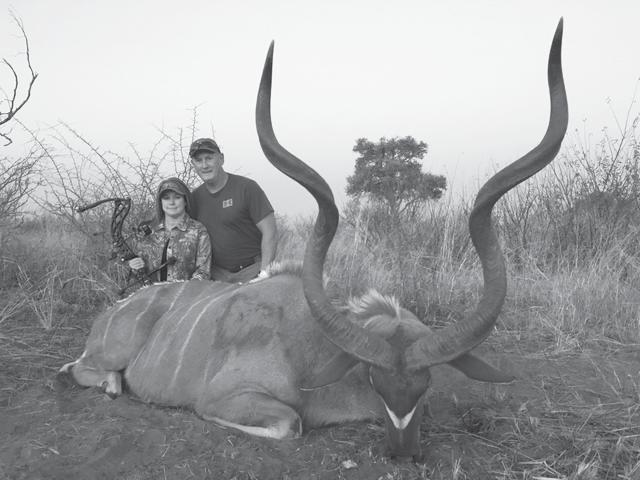
Connie Dent with her 58-inch kudu from the Limpopo Province of South Africa.
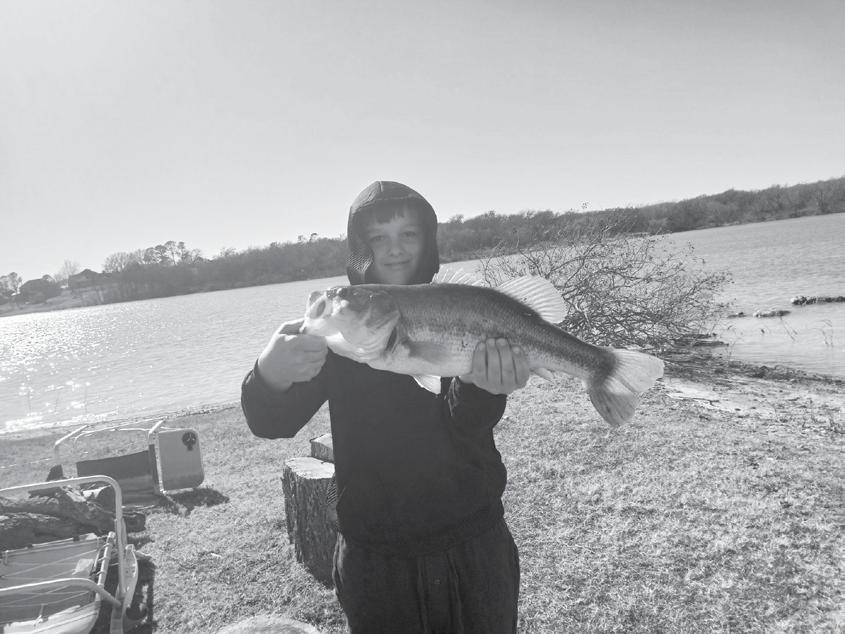
Hudson Marsh, 12, caught this 7-pound big bass using a small chatterbait.
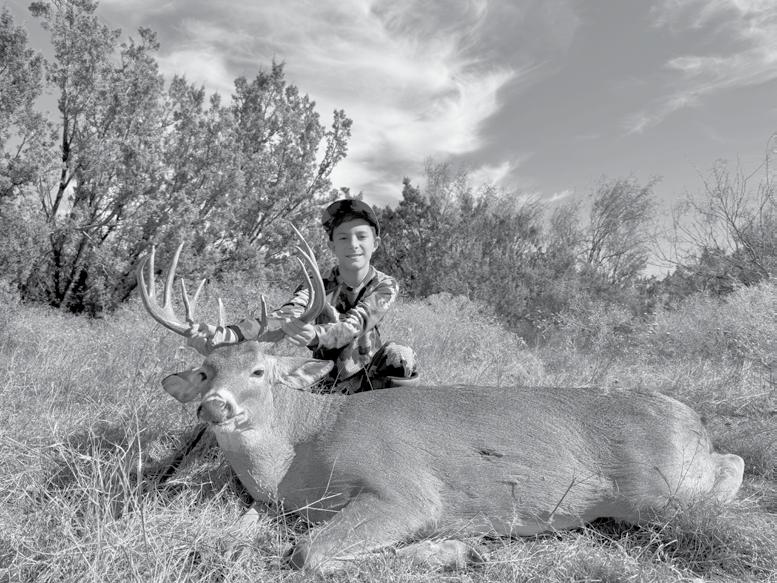
Medley Butterfield shot her first buck on the family ranch while being guided by her father, Bruce
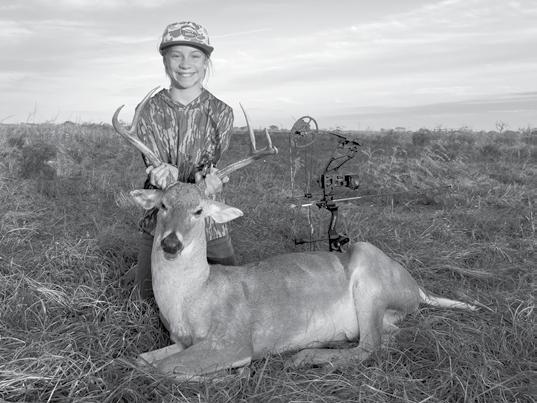
Meritt Dyer, 10, with her first bow-killed deer taken in Calhoun County.
Doe days
Continued from page 1
According to TPWD Wildlife Biologist and Assistant District Leader for district 10, Matt Reidy, in an ideal scenario, harvesting does prior to the rut rather than waiting until after the rut during the tail end of the MLDP season, would be the best management decision.
“Getting extra mouths off of a property early and reducing the competition for food sources and nutrition before the rut takes place can be extremely beneficial to a deer herd,” Reidy said. “Handling doe management before the rut also ensures that does that are bred by quality bucks survive and are not harvested after they have been bred.”
With that being said, Reidy admits the ideal scenario he described above in regards to doe management, isn’t possible or practical for a lot of folks on most properties.
“The truth is, many properties in Texas are managing their deer herds for specific population numbers and certain buck-to-doe ratio goals,” Reidy said. “And to accomplish this, hunters simply just have to harvest does whenever they can, when the opportunity presents itself.”
Reidy said in a lot of areas, especially in the southern portion of the state, the best opportunity to harvest does occurs later in the season. This is often due to warm weather prevailing during the first half of the MLDP hunting season. Hunters don’t start seeing as many deer around feeders from their stands until weather finally begins to cool off and natural food sources become scarce.
“Hunters also tend to focus on targeting bucks during the bulk of hunting season, and don’t switch their focus to pursuing does until they have put a tag on the bucks they are after,” Reidy said. “Others are simply just going hunting when they can, and sometimes this late season period is a better time for them to get out, now that the holidays and other personal obligations have passed.”
Many MLDP properties also conduct their deer surveys during the winter. Reidy said ranch managers often use the final weeks of the MLDP season to complete harvest goals as determined by their winter surveys.
“At the end of the day, a doe is a doe is a doe,” Reidy said. “If you’re managing your property for specific deer numbers, and harvesting does helps you accomplish those goals, it doesn’t necessarily matter when those does are harvested. Ultimately, there are countless variables that will determine when it is best to harvest does on any given property.”
Andrew Howard recently traveled from Missouri to a friend’s ranch in north Texas, to help out with some doe management. Howard made the late season trip to Texas and said it’s something he always looks forward to.
“It gives me an opportunity to put some extra venison in the freezer, and I get to help out my buddy at the same time,” Howard said. “He needs the does harvested to manage the population on his ranch. So, we get to spend time in the outdoors together, all while helping manage and improve the deer herd on his property.”
John Moranski has been taking advantage of the extended MLDP season on his family’s land in south central Texas for the last several years. He said he enjoys getting out late in the season at this time of year because the weather is usually cooler, making his sits in the stand more comfortable.
“I also just personally have more free time during this time of year,” Moranski admitted. “It’s hard for me to get out and go hunting during the holidays, but I can usually make some time near the end of the MLDP season.”
Quail research
Continued from page 4
ting into practice many of the recommendations from Tall Timbers habitat management.
“We have started working with several properties, and one of which we have been working with for five or six years now,” said Dr. Brad Kubecka with Tall Timbers. “They did a lot of habitat management, like I kind of mentioned, timber thinning and prescribed fire, and after that, we translocated quail to those properties.”
These properties have been a proof of concept.
“We were able to compare survival and reproduction, adult survival, nesting rates, nest success, all these things between the source population and the east Texas birds. The birds in East Texas did just as well as the source population in Florida, and in two years, they actually did better with more nests and higher annual survival,” Kubecka reported. “(The population) has been increasing each year.”
The results of the study are promising and show that applying the same habitat management plans Tall Timbers does in the Red Hills of Florida, primarily prescribed burns in focal areas, will be effective in rebounding the native bird population.
“You wouldn’t have to reintroduce birds there (public lands in Pineywoods). The birds are there, and they would respond to habitat management,” Kubecka said.
It is very clear what needs to be done —
thin the timber and perform prescribed fires in focal areas.
“If the Forest Service was to establish, say, a focal area, we would know where to establish it because we know where the birds are most localized in that forest,” he said.
Unfortunately, due to reduced funding and a lack of resources, the Forest Service, while responsive to the habitat studies, the regulatory hoops to jump through make putting these practices in action problematic at best.
“Quail management helps. It checks every single one of those boxes that the Forest Service is trying to meet,” Kubecka said.
“Specifically, quail management (which includes prescribed fire) reduces wildfire risks, increases biodiversity, and recreational activities.”
Tall Timbers has done a lot of the field work to determine how to best apply the practices that will bring back a huntable population of birds to public land.
“We don’t want to be an organization that says we want something; we want to provide solutions,” Kubecka said.
According to Kubecka, it will take the local community getting involved through non-profits by volunteering for surveys, reaching out to TPWD, and promoting them to work with the Forest Service through a stewardship agreement to implement these practices.
Many hunters and ranch managers use the final weeks of the MLDP season to reach their harvest goals for does. Photo by Nate Skinner, for Lone Star Outdoor News.
LONE STAR OUTDOOR PUZZLER
Solution on Page 22
ACROSS
1. Dense South Texas ecosystem
5. Natural fish travel route
6. Wildlife heavily exposed to human activity
9. Maximum legal harvest per day
10. Prime cut of venison
13. Peak breeding period for deer
14. Primary food source for wildlife
16. Boat movement used to cover water
18. Slow, quiet hunting method on foot
19. Excess wildlife causing habitat damage
22. Supplemental feed for young deer or livestock
25. A hen turkey yelp is an example
27. Transition zone between ecosystems
28. Natural environment of wildlife
31. Facility raising fish for stocking
32. Reducing human odor while hunting
33. Locating game before the season
34. When birds suddenly take flight
35. When a big, old doe spots you
36. Wildlife species not legally hunted
37. Releasing fish into public waters
DOWN
2. Rock shoreline structure holding fish
3. Officer enforcing hunting and fishing laws
4. Removal of inferior animals from a herd
6. Studying animal movement before a hunt
7. Man-made pond for livestock and fishing
8. Seasonal travel route of animals
9. Hook style designed to reduce injury
11. Underwater structure attracting fish
12. Fish reproductive period
15. Casting to visible fish
17. Water layer affecting fish location in summer
20. Resting location for deer
21. Shallow coastal fishing areas
23. Survey method used by TPWD biologists
24. Ethical hunting principle
26. Real-time sonar fishing technique
29. Active primarily at night
30. Lowering lake levels for management
Cole Fine Guns hires
Cole Fine Guns and Gunsmithing announced Anne Mauro as director of special events and technical services specialist. Mauro, an NRA Certified Advanced Shotgun Coach Level 3 and 2025 NRA Golden Bullseye Award recipient, brings extensive experience from roles at Syren USA, Caesar Guerini USA, Fabarm USA, and Blaser Jagdwaffen GmbH.
Parris joins RETAY as director of marketing
Lee Parris has been appointed as Director of Marketing for RETAY Firearms under the Banshee Brands Umbrella. Parris brings nearly 20 years of industry experience in leading marketing and sales roles at YETI, Vista Outdoor, Primos, Bushnell, and Winchester Ammunition.
Silencer Central hiring
Silencer Central is hiring for multiple positions including event sales professional, director of marketing, and sr. software development manager due to record business growth and expanded operations in Sioux Falls, South Dakota.
Rhode celebrated
Team Beretta athlete Kim Rhode is the receipt of the 2026 National Shooting Sports Foundation Ken Sedlecky Lifetime Achievement Award, the highest honor from the National Shooting Sports Foundation. Rhode,
an Olympic legend with six medals across six consecutive Games, was recognized for her extraordinary competitive success and advocacy for safe shooting sports participation.
WOOX introduces new line
WOOX, an Italian-American gunstock manufacturer, announced its new “High Grade” line of American Walnut stocks crafted from handselected premium wood with traditional oil finishing. Each piece is unique and available across the Elegante Series, Bravado, Gladiatore, and Superleggera product lines.
Whitetails Unlimited seeks field directors
Whitetails Unlimited Inc. is hiring part-time field directors for territories in Texas, Missouri, Illinois, Kentucky, West Virginia, and Pennsylvania. Candidates should have event planning experience, Microsoft 365 proficiency, and knowledge of hunting and white-tailed deer. Interested applicants should email fieldoperations@whitetailsunlimited.com.
SHOT Show sees record attendance
The 48th annual SHOT Show, owned and operated by NSSF, concluded with more than 53,000 industry professionals attending across 2,744 exhibitors. The event featured leadership forums, educational programs, and highlighted innovations in firearms, hunting,
*email LSON your favorite recipe to editor@lonestaroutdoornews.com.
Whole grilled red snapper
Score each side of the fish by making
3 shallow slices into the meat. Rub the entire fish with olive oil and season thoroughly with salt and pepper. Make sure the cavity gets seasoned and oiled. Stuff the lemon and lime slices and about 3/4 of the herbs into the cavity.
Chinese BBQ wild pork
fresh herbs like dill, cilantro or parsley
Vegetable oil
Preheat your grill over high or if using coals set up a hot zone and a cool zone to create a convection. Brush grill grates with vegetable oil to prevent sticking. Add the fish to the grill and cook until the skin has begun to char, about 4 minutes. Reduce the heat to medium high and close the grill. If using coal, move the fish to the cooler side of the grill. Cook for an additional 7 to 8 minutes to ensure the fish is cooked through.
1/2 cup soy sauce
1/3 cup honey
1/3 cup ketchup
1/3 cup brown sugar
1/4 cup Chinese rice wine
2 Tbsps. hoisin sauce
2 Tbsps. red bean curd (Optional)
1 tsp. Chinese five-spice powder (Optional)
2 (1 pound) wild hog tenderloins
Stir soy sauce, honey, ketchup, brown sugar, rice wine, hoisin sauce, red bean curd, and five-spice powder together in a saucepan over medium-low heat. Cook and stir until just combined and slightly warm, 2 to 3 minutes. Meanwhile, slice each pork tenderloin lengthwise into 1 1/2- to 2-inchthick strips. Place pork strips in a large,
resealable plastic bag. Pour marinade into the bag with the pork. Squeeze air from the bag, seal, and turn the bag a few times until pork is well coated. Marinate in the refrigerator, 2 hours to overnight.
Preheat a charcoal grill for medium-high heat and lightly oil the grate. Remove pork from marinade and shake to remove excess liquid. Set aside the remaining marinade for basting. Cook pork over indirect heat, turning regularly and basting as desired, until an instant-read thermometer inserted into the center reads at least 145 degrees F, 30 minutes or longer.
Whole red snapper, scaled, gutted and fins removed
Olive oil
Kosher salt
Freshly ground black pepper
Lemon, half sliced the rest in wedges
Lime, half sliced the rest in wedges
Small bunch
Puzzle by Conor Harrison, Lone Star Outdoor News
Largemouth bass
finding schools of shad using side-scan and down-scan imag ing in stretches of water covering 200 to 300 yards or more.
“I’m not talking about small ar eas with baitfish,” Pinkston said. “You have to find long stretches of water that are loaded with shad. Once you find the bait, you can drop the trolling motor and start searching for bass to cast to. Sometimes these fish are by themselves, and sometimes they are in small packs with three or four other bass. Most of them have been in the 3- to 5-pound range, with a handful pushing 6 or 7 pounds mixed in.”
According to Pinkston, he’s been finding a more consistent bite from better quality bass over deep structure with deep-diving crankbaits and Carolina-rigged lizards and creature baits. The deep ends of points and ridges that extend way out into the middle of the lake and drop off into 25 or 30 feet of water or more have held fish averaging 6 to 8 pounds or larger.
“These points and ridges are surrounded by deep water, and oftentimes the bass are staging right along the bottom near the drop-offs,” Pinkston said. “There aren’t as many bass in these areas as there are in other places on Toledo, but this pattern is producing the largest fish right now.”
Central Texas bass fishing guide Ander Meine said the fish on Inks Lake are in a full winter pattern right now.
“The most consistent bite has come from fishing crankbaits and drop-shotrigged finesse worms around rocky areas and submerged vegetation in up to about 15 feet of water,” Meine said. “The fish are really grouped up and holding tight to specific areas around these types of structure. Slowing down and thoroughly working over stretches that have produced a fish or two has been key.”
Meine said a lot of the bass he and his anglers have been catching on Inks have been in the 3- to 5-pound range.
Lake Fork fishing guide Marc Mitchell said bass are hitting jigs and Texas-rigged soft plastics over brush in 12 feet of water or more.
“Some fish have been staging up a little shallower in about 8 feet of water near stumps, along the edges of ditches and channels,” Mitchell said. “Slow rolled square-billed crankbaits and spinnerbaits have been the ticket in these shallower areas.”
Trees for habitat
the kinks to be worked out for next year.
The trees along the shoreline will also provide critical habitat and hiding places when Lake Fork is stocked with about 500,000 fingerling bass later this spring. The survival rate of fingerlings is only 5% in a good year. The stocking of the fingerlings is done when they are 1.5 inches in length. Once they reach about 2 inches, they start eating each other.
Quail hunting
Continued from page 1
group managed to find upwards of 20 coveys in one day. The shooting was challenging and rewarding.
Hunters are still out chasing birds through the end of the month, and reports of good shoots are still coming in across the state.
Ryan Pinkston landed this hefty bass on a deep diving crankbait off the end of a deep, main lake point in about 22 feet of water on Toledo Bend Reservoir.
Photo from Ryan Pinkston.
Old Christmas trees are used to make great fish habitat on Lake Fork. Photo by TPWD.
Los Cazadores
Continued from page 5
locations are set up to serve consumers in all aspects of their adventures, including the pre-hunt, hunt, and post-hunt portions.
“The pre-hunt aspect includes managing the wildlife on a property from a feed standpoint, the hunt aspect includes everything else we carry in our stores, and the post-hunt aspect involves the taxidermy and meat processing that we offer,” Harrison said. “Our newest location in Granbury is no different. It will provide the community with all of these services through a team of high-quality people, who are experts in their field or craft.”
Harrison said the Los Cazadores team wants to help all of their customers improve their overall outdoor experiences.
“Our team loves to have our customers return to share their success stories and photos from the field as a result of their successful hunt while using the products they bought from our store,” Harrison said. “We are excited to see this type of relationship take shape in Granbury and its surrounding communities. The new store reflects Los Cazadores’ continued growth across Texas, and its dedication to investing in communities where the outdoor lifestyle thrives.”
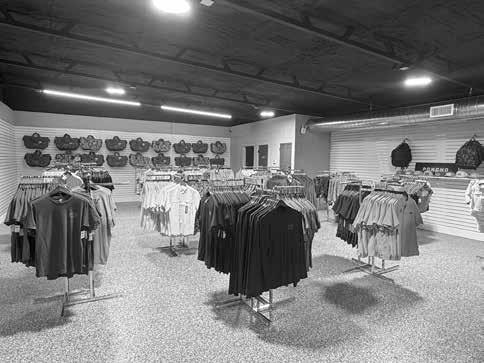
The general manager of the new Granbury location, Whit Terry, said the store offers a full service archery pro shop, indoor archery range, gun room, full line of apparel, fishing gear, feed, feeders, and blinds, as well as a wide range of industry-leading outdoor gear and camping products.
“Los Cazadores is a one stop shop,” Terry said. “We carry brands people want and love, including many Texas-based brands.”
Terry said the entire staff and team at the store is committed to serving the community.
“We are here to be a meaningful outdoor resource,” he said. “The members of our team are passionate about pursuing the outdoors and living an outdoor lifestyle. We want the store to be a place where the community gathers to expand their knowledge, skills, and experiences in the outdoors.”
According to Terry, they are also currently in the process of lining up the wild game and meat processing services, as well as the taxidermy services, they will offer.
“Our plan is to partner with quality, local businesses for those services,” Terry said. “We will have a large game and meat cooler, so folks can drop off their deer or game for processing or for taxidermy. Folks will also be able to pick up their processed meat and trophy mounts from our location, as well.”
The Los Cazadores Granbury location will be holding a grand opening event on March 5 – 8.
“The event will include in-store promotions, many of our vendors will be at the store, and there will be some celebrities from the hunting and country music industries in attendance,” Terry said. “If you’re in the area, you don’t want to miss it.”
Annual crab trap removal starts Feb. 20
From Feb. 20 to March 1, Texas coastal waters will be closed to crabbing with wire mesh crab traps for 10 days to facilitate the annual volunteer crab trap cleanup. Any traps left in bays — including traps tied to docks — will be assumed abandoned and considered “litter” under state law. This allows volunteers to legally remove any crab traps they find.
Volunteers may focus their efforts on Feb. 21 or work at their own pace throughout the closure; traps cannot be removed prior to Feb. 20 or after March 1. Additional opportunities for land-based volunteers are available but limited.
The Coastal Conservation Association Texas, Coastal Bend Bays & Estuaries Program, Galveston Bay Foundation, San Antonio Bay Partnership, Christmas Bay Foundation and the U.S. Fish and Wildlife Service will provide continued support to the 2026 crab trap removal program. In addition, numerous organizations and companies will be volunteering their services.
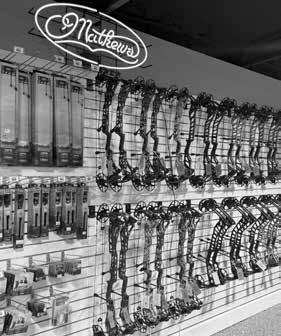
Hunters will find a huge selection of bows and guns at the new Los Cazadores shop in Granbury.
Photo by Los Cazadores.
Late season ducks
Continued from page 1
said. “Conservative calling techniques worked best, as well. The birds responded well to pintail whistles, and soft feed chuckles. They would flare from any loud calls.”
After a tough season, Ressler said it was rewarding to end on a high note with decoying birds and happy hunters.
Hunting guide Abel Gorman spent the last several days of duck season guiding hunters in the Chesterville area.
“We had the most success over stock ponds and cattle tanks, rather than on our typical duck ponds with aquatic vegetation, on the ranch we hunt on,” Gorman said. “Smaller decoy spreads without any motion decoys were the ticket. We also had to go extremely light on the calls in order to get the birds to commit, and having a good, brushed-in hide was key.”
Gorman said green-winged teal showed up in large numbers during the last two weeks of the season, which made for quick limits.
Over in the Winnie area, WINGCHASE & CO. hunting guide Daniel Ruff said they had more birds holding over their marsh ponds than their rice fields to end the season.
“We finally got some cold weather for the last weekend,” Ruff said. “Our hunters had decent shoots to end the season, and then of course, we had thousands more birds show up the very next day after duck season ended.”
Ruff said their hunts during the last few days of the season rendered good numbers of pintail, green-winged teal, and some scattered groups of gadwall.
The south Texas regional director for Delta Waterfowl, Ryan Watson, said the ducks he had been seeing on the ponds he and a buddy were hunting in the brush country around Karnes County seemed to push further south when a strong front brought colder weather to end the season.
“Most of the ponds we were scouting for the last weekend of the season were loaded with ducks about a week prior, before the strong cold front hit,” Watson said. “When the winds switched out of the north, a lot of the ducks left. I’m guessing they went to the coast.”
Watson went ahead and hunted with his buddy on the last two mornings of the season, even though they knew most of the birds they had been scouting were gone. They shot a handful of ducks, including teal, mottled ducks, and a ringneck, on both mornings combined.
Capt. Aaron Cisneros reported limits of ducks for his hunters, consisting of red heads, pintail, gadwall, wigeon, teal, and mottled ducks to end the season on the Lower Laguna Madre. The best action took place along shallow back bays and marshes.
Gulf Council takes action on grouper
The Gulf Council took final action on Reef Fish Amendment 62 which considers increasing red grouper catch limits and eliminating the recreational shallow-water grouper closed season. For red grouper, the council decided to phase in total annual catch limit increases over a 3-year period, establish 68.2% commercial and 31.8% recreational sector allocations, and maintain the current 5% commercial and 9% recreational buffers between their respective annual catch limits and annual catch targets.
The Council also decided to eliminate the February 1 – March 31 recreational shallowwater grouper closure beyond 20 fathoms.
—Gulf Council
HSC names Cotton Mesa Trophy Whitetail Outfitter of Year
Houston Safari Club Foundation announced Cotton Mesa Trophy Whitetail, owned and operated by Robert Gegenheimer and his son Stephen Gegenheimer, as the recipient of the 2026 HSCF Outfitter of the Year Award. The award was presented at the 2026 Houston Safari Club Foundation Worldwide Hunting Expo & Convention.
The Outfitter of the Year Award honors an individual or operation recognized by HSCF members and peers for outstanding professionalism, passion for the hunting profession, and commitment to conservation. Recipients exemplify ethical hunting standards, strong character, and active involvement in the hunting community. Award candidates must also be active HSCF members in good standing.
Cotton Mesa Trophy Whitetail stood out among nominees for its demonstrated enthusiasm for the sport, stewardship of wildlife resources, and reputation for conducting ethical, highquality hunts. Under the stewardship of the Gegenheimers, Cotton Mesa Trophy Whitetail has built a legacy of integrity, personalized service, and a strong conservation ethic that reflects the core values of HSCF.
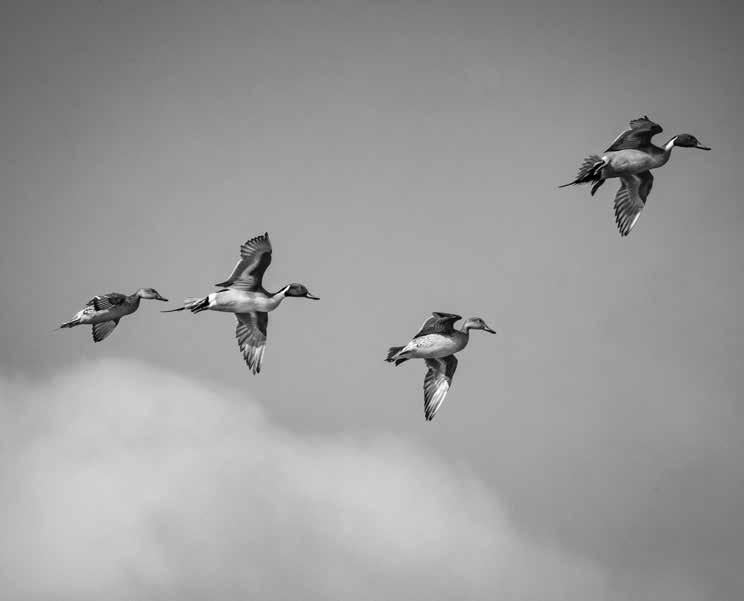
Pintails provided a decoying show to many hunters in the southern portion of the state as duck season came to an end. Photo by Nate Skinner, for Lone Star Outdoor News.
TEXAS SUN, MOON AND TIDES
NATIONAL
OHIO
Deer harvest numbers above average
Ohio hunters checked 232,142 white-tailed deer during the 2025-26 season that concluded on Sunday, Feb. 1, according to the Ohio Department of Natural Resources Division of Wildlife.
The season total includes all deer taken during archery, gun, muzzleloader, and youth seasons since Sept. 13, 2025. This is the seventh highest total on record, topping 200,000 for the fourth consecutive season.
In 2024-25, deer hunters checked 238,137 deer. The three-year average (2022, 2023, and 2024) is 221,013.
—OHDNR
MONTANA SCI names Zinke Legislator of Year
Safari Club International announced Representative Ryan Zinke (R-MT-01) as its 2026 Federal Legislator of the Year in recognition of his leadership and unwavering support for America’s sportsmen and women, conservation efforts, and access to public lands.
According to SCI, as an advocate for hunters in the Treasure State and across the country, Rep. Zinke has consistently advanced policies that support America’s sporting heritage. Throughout his career, he has championed science-based wildlife management and pushed back against efforts that would limit opportunities to hunt.
—SCI
SOUTH DAKOTA
State deregulates suppressors
Both the South Dakota state senate and house of representatives voted unanimously recently to deregulate suppressors. The bill now goes to Gov. Larry Rhoden for signature into law.
“We are all trying to work on complete deregulation of silencers at the Federal level,” said Brandon Maddox, Silencer Central founder and CEO. “We found that 16 states had regulations in place requiring the Federal Stamp for ownership. Now that South Dakota’s government has voted to remove that roadblock, we can focus on getting these laws overturned in the other states.” Maddox continued, “We are excited that we now have some momentum. Last summer, we started this process, working with our representatives, law enforcement, and our lobbyists to get this passed. I was honored to have had the opportunity to testify on behalf of silencer owners across the state and help get everyone on board to make this happen. Now, we are focused on these other states as well as full federal deregulation.”
The South Dakota bill removes suppressors from the state’s definition for “controlled weapons” and eliminates the requirement for a Federal Stamp should the NFA designation or the transfer process continue to change.
—Silencer Central
WYOMING
Shifting policies on sage grouse
Effective Jan. 31, the Wyoming Game and Fish Department retired the Sage-Grouse Local Working Groups, marking a new chapter in conservation efforts that began in 2004.
The LWGs were a direct response to the 2003 Wyoming Greater Sage-Grouse Conservation Plan. The primary role of the groups was to localize sage-grouse conservation strategies focused on improving and maintaining sagegrouse populations and habitats. Providing key local perspectives and insights, the groups were instrumental in implementing crucial sage-grouse conservation plans and funded 377 projects. Through the efforts of these working groups, more than $11 million in sagegrouse focused conservation actions and $68 million in matching funds were secured. Since 2018, the role of the LWGs has evolved. Conservation funding authority has shifted from the legislature to the Wyoming Game and Fish Commission, while policy decisions have moved to the Sage-Grouse
Implementation Team. Game and Fish will continue to allocate funds to department projects specifically benefiting the sagebrush ecosystem, although the LWG project-specific funding is gone.
—WGFD
TENNESSEE
New bass tournament
World Bass Enterprises announced it will bring the top 50 anglers in the world to Nashville in October for “The Champions” tournament, which will serve as the first-ever world bass fishing championship and will feature the largest purse in the sport’s history.
The five-day event, with three days of competition, will be held on Old Hickory Lake at Sanders Ferry Park in Hendersonville, Tenn., from Oct. 28 – Nov. 1 and will include a recordsetting purse of more than $3 million, including a $1.25 million payout to the winning angler — the biggest monetary prize ever awarded to a winner of a bass fishing tournament. Additionally, the second and third place finishers will receive $500,000 and $300,000 payouts, respectively.
“The Champions” tournament field will be comprised of the top 25 anglers from both the Progressive Bassmaster Elite Series and Major League Fishing’s Bass Pro Tour. The tournament will crown a true world champion and award The Champion’s Cup following the first head-to-head competition between the two biggest bass fishing organizations on the planet.
—World Bass Enterprises
DU turns 89
Thursday, Jan. 29, marked the 89th anniversary of Ducks Unlimited, the world’s most extensive wetlands and waterfowl conservation organization.
In 1937, during the height of the Great Depression and one of the worst droughts in history, a small group of waterfowlers, visionaries and community leaders set out to save North America’s waterfowl populations and hunting heritage. Their foresight led to the founding of Ducks Unlimited and an unending mission to conserve the wetlands and other habitats that sustain abundant populations of waterfowl and other wildlife for future generations.
DU’s proud hunting heritage continues to this day, as most members are waterfowlers. Through the support of these dedicated sportsmen and women and the tireless efforts of volunteers, partners and supporters, DU has protected or restored more than 19 million acres of habitat across North America in the areas most important to ducks and geese.
“In Fiscal Year 2025, Team DU delivered more than 1.2 million acres of conservation, marking the second consecutive fiscal year we have delivered more than 1 million acres of improving habitat in marshes, grasslands and coastal areas crucial to the waterfowl we love,” said Ducks Unlimited President Bob Spoerl. “Another million acres means cleaner water, reduced flooding risks for people, more public land access for hunters, and improved biodiversity for all animals that rely on wetlands. This achievement isn’t possible without the tremendous support from our partners and supporters across the continent.”
—DU
NEVADA
WSF hands out awards
At this past Sheep Show, the Wild Sheep Foundation presented several awards for service to conservation and mountain game hunting.
This year’s awards and recipients include:
The Gordon Eastman Grass Roots Award was presented to Jim Travis of the New Mexico Wild Sheep Foundation.
The Wild Sheep Biologist Wall of Fame Award was presented to Brett Wiedmann, the NDGF Department Big Game Management Biologist.
The Caruthers Outstanding Chapter and Affiliate Award was presented to the Texas Bighorn Society.
The 2026 Chair’s Award was presented to James Rinehart and Keith Newlon for the Arizona Desert Bighorn Sheep Society’s Rinehart-Newlon Water Catchment project in Arizona.
WSF
Banded dove
Continued from page 4
Banded Dove winners:
Wes Oliver Polaris Ranger, donated by Hoffpauir Polaris Outdoor Superstore
Wayne Voges Trophy trout fishing trip, donated by Baffin Bay Rod and Gun
Ricky Bomnskie Argentina dove hunt trip, donated by David Denies
David Sagebiel Scimitar Oryx hunt trip, donated by RecordBuck Ranch
Destiney Tucker Prize package including a $500 gift card to Murdoch’s donated by TDHA, a Dove Wrangler and Duck Wrangler donated by 8 Gauge Outdoors, and 2 Poncho shirts donated by Poncho
Kris Shawver The Feed Ball feeder, donated by Forager Outdoor Products
Spiner Burger Prize package donated by Los Cazadores, including Leupold binoculars, Bex sunglasses, and a Turtlebox speaker
Derrick Matlock Exotic game hunt for a Trophy Ram trip, donated by Triple Play Outfitters
Jeff Lewey Texas Dove Hunters Association lifetime membership donated by TDHA, and 2 Poncho shirts donated by Poncho
Cris Crocker Leather prize package donated by Blake Jones Designs, including a custom bird bag, leather shotgun case, and shell holder.
Clayton Wickel Prize package donated by Bird Down Brand, including 3 of their gun rests—the Ultimate Shotgun Rest, Ultimate Rifle Rest, and Waterfowl Gun Rest. Also included is their waxed canvas range bag and a bird bag.
Colt Broyles Spring turkey hunt trip, donated by Landings Ranch
she still loves being on the trip and spending time at the ranch.
“She absolutely loves being out there, and enjoys fishing in the tanks on the property,” Carpenter said. “That’s really what this trip has become for me and my family. It’s a way to get away from the chaos of everyday life and spend quality time together outdoors.”
Carpenter said his daughters both enjoy learning about the habitat and wildlife management practices that are employed on the ranch and being able to bring delicious wild game home for their freezer.
“They’ve learned so much out there, and we’ve made so many great memories together during the trip each year,” Carpenter said. “It’s a tradition we intend to keep for many years to come!”
Harveson named Conservationist of Year by HSCF
The Houston Safari Club Foundation announced Dr. Louis A. Harveson as the recipient of the 2026 HSCF Conservationist of the Year Award, presented during the 2026 Houston Safari Club Foundation Worldwide Hunting Expo & Convention.
This prestigious recognition is reserved for individuals or organizations that exemplify a true servant’s heart for conservation and demonstrate meaningful impact through education, advocacy, policy, legislation, environmental leadership, and the protection and preservation of wildlife and habitat.
Harveson’s career reflects a lifelong commitment to conservation science, education, and applied wildlife management—particularly on private lands across Texas and the U.S.–Mexico borderlands. He currently serves as associate provost of research and development at Sul Ross State University, where he is also the founder and director of the Borderlands Research Institute and holds the Dan Allen Hughes, Jr., Endowed Directorship. Dr. Harveson has been a faculty member at Sul Ross State University since 1998 and previously served seven years as chair of the Department of Natural Resource Management.
Harveson’s research has focused extensively on the Texas–Mexico borderlands, including the Gulf Coast Prairies, South Texas Brush Country, and the Trans-Pecos Mountains and Basins. Throughout his career, he has mentored and graduated more than 70 M.S. and Ph.D. students, secured over $27 million in grants and gifts, and authored more than 75 peer-reviewed scientific manuscripts along with 50-plus popular articles. A consistent theme of his work is the conservation of natural resources on private lands, bridging science with real-world application.
“Dr. Harveson’s career embodies the spirit of the HSCF Conservationist of the Year Award,” said Joe Betar, executive director, Houston Safari Club Foundation. “His dedication to science-based conservation, education, and stewardship of wildlife and habitat has made a lasting impact across Texas and beyond.”
—HSCF
Kaylee Carpenter harvested this buck during an annual family hunting trip in Goliad County. Photo by Alex Meadows.
DSC names Stacy CEO
On the eve of their 2026 Convention, Dallas Safari Club announced the appointment of Russell Stacy as its new chief executive officer. Stacy had been serving as the interim executive director, a role he took over after the departure of former CEO Rob McCanna in 2025.
Stacy is a fourth generation agri-business operator in Natchitoches, Louisiana and owns an outfitting business with his partner and wife, Mary Edith. Hunting has been a tradition in Stacy’s family for his whole life. From whitetails to wildebeest, the Stacys have hunted around the globe.
Stacy steps into the role as DSC temporarily relocates its annual Convention due to the planned demolition and reconstruction of the Kay Bailey Hutchison Convention Center in downtown Dallas. The Convention will be hosted in Atlanta in 2027, before moving to Houston in 2028 and 2029.
“Dallas is—and will always be—home for DSC,” Stacy said. “But these next few years give us an exciting opportunity to showcase DSC, our world class exhibitors, and the incredible volunteers, board members, and staff who bring our mission to life, to a broader audience. While we look forward to returning to Texas, our team is fully prepared to deliver exceptional shows in Atlanta that highlight DSC’s commitment to conservation and the future of our hunting heritage.”
—Staff report
GRIP applications sought
The Texas Parks and Wildlife Department, in partnership with the Oaks and Prairies Joint Venture, Quail Forever and the U.S. Department of Agriculture’s Natural Resources Conservation Service, is now accepting applications for the Grassland Restoration Incentive Program.
Texas has lost much of its native grassland habitat due to brush encroachment from shrubs such as mesquite and juniper, as well as urban development and conversion to nonnative pasture. This loss threatens wildlife species such as bobwhite quail, meadowlarks and horned lizards that depend on healthy native grasslands.
GRIP provides financial assistance to landowners and agricultural producers who voluntarily implement conservation practices to restore these habitats.
Eligible practices include:
Brush management
Prescribed burning and firebreak installation
Herbaceous weed treatment
Planting native grasses and wildlife-friendly plants
Since starting in 2013, GRIP has successfully restored more than 129,000 acres of native grassland in Central Texas.
Landowners and producers in the following counties can apply: Archer, Austin, Baylor, Callahan, Clay, Colorado, Delta, Dewitt, Edwards, Ellis, Fayette, Fannin, Gonzales, Hunt, Karnes, Kinney, Lamar, Lavaca, Montague, Navarro, Real, Red River, Shackelford, Stephens, Throckmorton, Uvalde, Val Verde, Washington, Wilson and Wise.
Application Period:
Feb. 2 – March 4, 2026
Applicants should visit their local USDA Service Center before the March 4 deadline. Existing USDA clients may apply online at farmers.gov.
—TPWD
Nilgai with bow
Continued from page 6
while others carry them on carts and haul them away.
No motorized vehicles are allowed, though e-bikes are welcome.
Vasquez said she has been using a bow and arrow since she was 6 but this was her first nilgai with stick and string.
A year ago, she was selected for a youth hunt and harvested a 700-pound nilgai bull, but with a rifle.
On the day of her latest hunt, she and her father were sitting together to start the hunt, but Sal decided to move about 30 yards away.
Then, a cow with a young calf and the bull showed up some 50-plus yards away by a resaca bed.
All of a sudden, the bull started walking around the edge of the resaca where both hunters were hidden.
Vazquez drew an arrow, picked the perfect spot, touched the release, and hit the bull. The big bull took off but did not go far.
“I was watching her,” Sal said. “I saw the bull going down.”
Haley is a freshman attending Texas A&M University in Kingsville where she plays on the softball team as a pitcher. This past summer, she hurt her shoulder and had surgery, attending physical therapy since the injury. However, that limitation did not slow her down.
“I thought my shoulder was going to be an issue, but it was not,” she said. “I feel good for myself.”
And so she should. Taking a nilgai with a bow on public land is a great accomplishment for any archer.
Pompano
Continued from page 8
fishing has been tough.
“It’s been really tough out and really rough,” Yearsin said. “Today the surf looks pretty nice. It’s a pretty surf today. I would definitely go out and use some pompano floating rigs.”
Yearsin prefers smaller tackle with 2/0 or 3/0 hooks on his pompano rig. He reports the most productive bait has been Fishbites in electric chicken flavor.
“We have really good luck with those on small hooks,” Yearsin added.
Yearsin has been targeting the beach side of the jetties when the surf is clean.
“They (pompano) really like the clean water,” Yearsin said. “If you’re not catching them, then you definitely want to move around and try to locate them.”
Anglers should move up or down the jetty to find which depth the pompano have moved out to. Those on the beach fishing the surf will need to make sure they are past the last sandbar.
TEXAS SALTWATER FISHING REPORT
REDFISH BAY: 55 degrees. Redfish are fair on dead shrimp in 1-3 feet of water. Black drum are fair on dead shrimp.
SAN ANTONIO BAY: 55 degrees. Redfish and speckled trout are fair on slow-sinking soft plastics with a cork body. Trout are good along the jetties.
SABINE LAKE: 58 degrees. Speckled trout and redfish are fair on live shrimp under a popping cork on outgoing tides. Flounder are fair on live shrimp and soft plastics.
BOLIVAR: 55 degrees. Redfish and speckled trout are slow on finger mullet, mud minnows, and soft plastics in the surf, jetties and bayside canals.
TRINITY BAY: 60 degrees. Speckled trout are good on light- and dark-colored flukes, soft plastics and live shrimp. Redfish are good on soft plastics and live shrimp on muddy flats near shell. Black drum and sheepshead are fair on live shrimp under a popping cork near rocks and drop-offs.
EAST GALVESTON BAY: 50 degrees. Redfish are fair on live shrimp, finger mullet, imitation shrimp lures, and soft plastics under popping corks. Speckled trout are good on top-waters, soft plastics, and suspending jerkbaits in guts and channels.
GALVESTON BAY: 55 degrees. Speckled trout are fair on soft plastics and live shrimp. Redfish and black drum are fair on cut bait, mullet, shad, and halved live crab. Bull reds are being caught in the open bay under birds. Sheepshead are good on live shrimp.
WEST GALVESTON BAY: 55 degrees. Speckled trout, redfish, and flounder are fair on soft plastics or live bait.
TEXAS CITY: 55 degrees. Bull redfish, speckled trout, and flounder are fair on live shrimp and finger mullet. Black drum and sheepshead are fair on live shrimp. A few keeper flounder are being caught.
FREEPORT: 58 degrees. Redfish and speckled trout are fair on soft plastics and live shrimp under a popping cork. Black drum and sheepshead are good on live and dead shrimp.
EAST MATAGORDA BAY: 55 degrees. Redfish and speckled trout are fair on soft plastics, top-waters, and slow sinking and
DSC
Continued from page 5
show closed at three.
suspending twitch baits in deeper holes.
WEST MATAGORDA BAY: 55 degrees. Redfish and speckled trout are fair on soft plastics, top-waters, and slow-sinking and suspending twitch baits in deeper holes.
PORT O’CONNOR: 58 degrees. Speckled trout are slow on live shrimp and soft plastics near the jetties. Oversized and slot redfish are slow on blue crab and dead shrimp. Sheepshead are good on shrimp near the jetties.
ROCKPORT: 55 degrees. Speckled trout are good on live shrimp and soft plastics. Redfish are very good on shrimp, mullet, and perch in guts and along channel edges. Black drum are very good on live and dead shrimp.
PORT ARANSAS: 55 degrees. Sheepshead are good on live shrimp. Redfish are good on live shrimp and cut mullet on the north and south jetty. Oversized redfish are good on cut crab and cut mullet. Speckled trout are good on live shrimp. Pompano are fair on live shrimp in the surf. Black drum are good on live shrimp.
CORPUS CHRISTI: 60 degrees. Black drum are fair on shrimp. Redfish and trout are fair on soft plastics near points and guts. Pompano have migrated out.
BAFFIN BAY: 60 degrees. Speckled trout and redfish are fair on soft plastics, top-waters, and slow-sinking and suspending twitch baits. Find them shallow on calm days and deeper on windy days.
PORT MANSFIELD: 50 degrees. Speckled trout and redfish are good on soft plastics, top-waters, and slow-sinking and suspending twitch baits. Colors will depend on sunshine –darker on cloudy days.
SOUTH PADRE: 60 degrees. Black drum are good on cut bait and shrimp. Redfish and speckled trout are fair on soft plastics and swimbaits in grass with potholes.
PORT ISABEL: 60 degrees. Black drum are good on cut bait and shrimp. Redfish and speckled trout are good on soft plastics and swimbaits.
—TPWD
Delta Waterfowl received SCIF grant
Delta Waterfowl and Safari Club International Foundation and Sables are supporting Delta’s University Hunting Program with a $100,000 grant for 2026. This continues the partnership, started in 2024, between the organizations to increase college students’ knowledge and awareness of the importance of hunting.
Safari Club International Foundation’s mission is to ensure the future of wildlife through conservation, education, and humanitarian efforts. SCIF conducts and supports global scientific research to enhance wildlife management and promote sustainable hunting. Additionally, SCIF invests in and offers educational programs that highlight the essential role of hunting in conservation.
“Partnering with The Duck Hunters Organization on the University Hunting Program aligns with SCIF’s mission of expanding outdoor educational opportunities,” said Laird Hamberlin, CEO of Safari Club International. “A generation ago, most habitat managers were also hunters, but that’s not the case anymore. To preserve our hunting heritage, we must welcome more non-hunters into the sport.”
Delta’s UHP is available to wildlife management students at over 140 colleges and universities in the United States and Canada. Students in the program learn about the role hunting plays in wildlife management. They are immersed in the full hunting experience by taking hunters safety, attending a shooting skills day, going on a mentored hunt, learning how to prepare game for the table, and can ask questions during a post-hunt meal.
It’s estimated that only 30 percent of wildlife management students enter college or graduate school with a connection to hunting. So, UHP is also being used as a recruitment tool, encouraging participants to continue hunting and invite family and friends to join.
“Partnerships are essential to conservation,” said John Davis, Delta’s senior vice president of development. “We have seen this program grow every year since it began in 2017 and are on track to enroll 1,000 students this year. Those results would not be possible without the generosity of SCIF and the many seasoned hunters who volunteer their time for mentored hunts.”
DSC testifies before Congress
On Feb. 2, the House Committee on Natural Resources in Washington, D.C. held an oversight hearing titled “America First: U.S. Leadership and National Security in International Conservation.”
Dallas Safari Club was the only sportsmen’s organization invited to testify, and provided vital information to Congress on the importance of hunting to sustainable use and the policies the U.S. can take to promote the survival of species like rhinoceros on the African continent.
“Typically, when you see the people on the forefront of conservation, they are hunters,” said Tom Benavides, assistant vice president for the board of Dallas Safari Club, during the hearing. “What can an America First Administration do? Sadly, the U.S. government has been more of a hinderance than help. From arbitrary red tape that has no basis in statute to permitting delays and requirements that cause undue stress on animals, all I ask is that the US government be helpful rather than antagonistic.”
Benavides was asked multiple questions by Republicans and Democrats alike but ended the hearing by emphasizing that the status quo for rhinos in Africa will result in their extinction. “My hope is that the U.S. will stop their decades-long de facto support of the black market and open avenues for the regulated trade of rhino horn. Nothing less than this will be sufficient to save the rhino.”
“In 1977, trade in rhino horn was banned; importantly, when this ban happened there was no legal framework to regulate horn trade. 85% of the African rhinos alive then were killed. It’s easy to say the ban has failed miserably. The U.S. must support legalizing the regulated trade of rhino horn. In case you don’t know, rhino horn can be removed with no negative impact to the animal — and it grows back.”
Big bass mecca in 2025
A huge year for bass fishing in Texas saw 469 anglers enter a record 1,071 lunker largemouth bass into the TPWD Sharelunker program throughout the year from 93 Texas public waterbodies.
Anglers also submitted 201 DNA samples from their catches in 2025. The samples enable TPWD biologists to evaluate the effectiveness of the program.
In 2025, there were several notable findings from the DNA analysis.
The 14.78-pound bass caught by Ross Gomez at Alan Henry was a recapture from Alan Henry in 2023, also submitted by Ross. This is the first time in program history that the same angler caught the same fish twice in public waters. Gomez has since caught the fish a third time in January 2026.
“Usually, if they aren’t here by noon on Sunday, they aren’t coming,” said one exhibitor LSON spoke with. “That didn’t feel like the case today. After lunch, it felt like there was a surge of people in the hall.”
New DSC CEO Russell Stacy was extremely visible on the floor, speaking with attendees and exhibitors alike. The transition from interim executive director to CEO appeared to be a seamless one, and the First Lady of DSC, Mary Edith Stacy, was also seen around the Convention making sure everyone was having a good time and was taken care of.
The show floor was reduced in size from last year, and the more intimate setting was appreciated by most. The high-end European gun manufacturers had a strong presence, although many American gun companies were not seen at the show. Several outfitters LSON spoke with said they had reduced booth size and numbers of personnel attending the show, but many planned to also attend the DSC summer show in Grapevine, as well.
The auction events, along with raffle sales, were strong. The live auction highlight was a hunting trip with Donald Trump Jr. which sold for $170,000. With Don Jr. in attendance, security was heightened and several banquet attendees reported having pocket knives taken and not retuned.
At one of the evening banquets, the Heartland Chapter of DSC invited every child in attendance to come to the stage, where they were provided with a DSC youth membership. The official Convention program was put together by LSON and emailed to 65,000 potential attendees helping drive local traffic to the event.
“I didn’t hear anyone complain because there was nothing to complain about,” said LSON owner David J. Sams. “It takes time to build a base, and it felt like DSC did that this year. The people in Georgia were so friendly. It was a good show.”
In addition, a 10.20-pound bass caught by Gary Ripkowski at Bois d’Arc Lake is a direct offspring of a fish caught by Josh Jones in 2021 at O.H. Ivie. The fish was spawned at the Texas Freshwater Fisheries Center, so TPWD biologists know the fish from Bois d’Arc Lake is four years old, which demonstrates a tremendous growth rate.
SCI awards Georgia Gov. Kemp
Safari Club International announced that Georgia Governor Brian Kemp has been selected as its 2026 Governor of the Year in recognition of his strong leadership and support for wildlife conservation, sportsmen’s rights, and public access to hunting lands.
Elected in 2018 as Georgia’s 83rd governor and now serving his second term, Kemp has built a record of advancing science-based conservation policy and strengthening outdoor recreation opportunities across the state. His administration has prioritized funding and support for the Georgia Department of Natural Resources, including investments in wildlife habitat, conservation initiatives, state game wardens, and the acquisition of high-value conservation lands.
“Governor Kemp has demonstrated a clear and sustained commitment to conserving Georgia’s natural resources and protecting the rights and traditions of hunters and anglers,” said SCI CEO W. Laird Hamberlin. “His leadership reflects the core principles SCI champions, which includes responsible wildlife management, conservation funding, and ensuring future generations can enjoy the outdoors.”
—Delta Waterfowl
HUNTING BOAT
MOBILE SPORTING CLAYS FOR HIRE!
HUNTING CAMP FOR LEASE
Between Rocksprings and Del Rio
3 Bedroom Cabin
4 blinds
(2) BOAT HULLS FOR FREE to a good home Kurt Hughes design Strip plank epoxy composite Glass in and out 46’ length, 5’6 beam Fast cruiser racer Catamaran Text: (409) 658-6119
TEXANS ARCHERY CLUB
Network of Archery Ranges For One Membership! TEXASARCHERY.INFO
Fundraisers, Corporate, Parties! Sales/Service all Traps! 40+ Years Experience! (817) 999-1395 RIO GRANDE PIPE/ RENO EQUIPMENT
One year lease (612) 723-1323
BIOLOGIST 4 HIRE, LLC.
Fish & Wildlife Habitat Consulting, 1-D-1 Wildlife Agriculture Valuation, Conservation Land Assessment & Management Plans, Drone Mapping Services. Chad E. Simmons USDA NRCS TSP B-19-22936 chad@biologist4hire.com (972) 837-0392
TEXAS TROPHY WHITETAILS Axis, Blackbuck, Hogs Free range whitetail and exotic hunts in Sonora, TX HuntTexasWhitetails.com (717) 512-3582
FEBRUARY 13-15
MISC
FISHING
FLOATING CABIN
Permit for Sale
Tide Gauge Bar Baffin Bay 42’x17’x12’ Serious Inquires Only (713) 254-8166
361 FISHING
Get the Texas saltwater fishing app (iOS) that has it all. Bite times, top 5 spots right now, real-time weather and local intel from guides. Focused on artificial and fly, use the app to determine where to go, when to go and what to throw to increase your fishing success. Free trial to get started.
DATEBOOK
EXOTIC WILDLIFE ASSOCIATION 2026 Annual Membership Meeting Hyatt Hill Country Resort & Spa, San Antonio (830) 315-7761 myewa.org
SAFARI CLUB INTERNATIONAL Convention 2026, Nashville (888) 486-8724 convention.safariclub.org
FEBRUARY 18-22
HOUSTON FISHING SHOW
George R. Brown Convention Center (713) 805-9617 houstonfishingshow.com
FEBRUARY 19
DUCKS UNLIMTED
Texas Tech DU Dinner
National Ranching Heritage Center (940) 366-0900 ducks.org
DUCKS UNLIMTED Hurricane Creek Banquet River Road Venue, Anna (214) 600-3103 ducks.org
FEBRUARY 20
DUCKS UNLIMITED
Brazos Valley Banquet
Brazos Center, Bryan (979) 777-5848 ducks.org
NATIONAL WILD TURKEY FEDERATION
Nacogdoches Banquet April Awol Jrocha81@live.com your.nwtf.org
FEBRUARY 21
ROCKY MOUNTAIN ELK FOUNDATION Hill Country Chapter Big Game Banquet Georgetown Community Center (512) 636-6997 tickets.rmef.org
FEBRUARY 26
SPORTSMEN’S CLUB OF FORT WORTH Wild Game Dinner Dickies Arena (817) 624-8002 sportsmensclub.org
FEBRUARY 28 - MARCH 1
TEXAS GUN & KNIFE SHOW Kerrville Expo Hall (830) 285-0575 texasgunandknifeshows.com
MARCH 5
PARK CITIES QUAIL COALITION
Annual Dinner and Auction SMU Armstrong Fieldhouse (214) 534-4122 parkcitiesquail.org
MARCH 7
ROCKY MOUNTAIN ELK FOUNDATION
Greater Texas Hill Country Big Game Banquet Gillespie County Fairgrounds, Fredericksburg (210) 240-0214 tickets.rmef.org
IS HOT Cash out every Tuesday @10 am Atascosa Livestock Exchange Pleasanton Hauling Available Call (210) 289-7698
For home or office delivery, go to LSONews.com, or call (214) 361-2276, or send a check or money order to the address below. Lone Star Outdoor News, ISSN 2162-8300, a publication of Lone Star Outdoor News, LLC, publishes twice a month. A mailed subscription is $35 for 24 issues. Newsstand copies are $3, in certain markets copies are free, one per person. Copyright 2026 with all rights reserved. Reproduction and/ or use of any photographic or written material without written permission by the publisher is prohibited. Subscribers may send address changes to: Lone Star Outdoor News, P.O. Box 551695, Dallas, TX 75355 or email them to editor@lonestaroutdoornews.com.
Advertising: Call (214) 361-2276 or email editor@lonestaroutdoornews.com to request a media kit. For home delivery subscriptions www.LSONews.com(214) 361-2276
Puzzle solution from Page 18
Bass Pro Tour to visit Whitney, Waco
The Bass Pro Tour will visit two Texas fisheries for Stage 3 of the 2026 season, which will take place on Texas’ Lake Whitney and Lake Waco March 5-8.
Whitney will host the two-day Qualifying Round, while the Knockout and Championship Rounds will be contested just a few miles south on Waco.
According to BPT pro and Waco area native Alton Jones, Waco and Whitney are different than what many bass fishing fans likely picture when they think of Texas tournament waters –hydrilla flats and fields of flooded timber.
Whitney is a highland reservoir, with deep, clear water and steeper contours, while Waco is a shallower, flatter lowland reservoir. Whitney even has some smallmouth
“There are smallmouth in Whitney,” he said. “And there are enough to play – not to where someone is going to go out and fish for exclusively smallmouth, but my prediction would be some of the guys that make the cut are going to have a mixed bag. And there’s some good smallmouths, some 4- and 5-pounders.”
Jones expects the BPT field to find most of Whitney’s bass in the prespawn phase. At Waco, they could be on spawning beds, but that depends on the temperature – the shallower lake is much more impacted by weather.
—Mitchell Forde, Bass Pro Tour
Join us for the largest sportsmen’s banquet in Fort Worth
68th WILD GAME DINNER
Thursday, February 26th, 2026
Dickies Arena, Fort Worth, TX
Presented by: Insurance and Financial Services
Guest Speakers
Taya Kyle
Widow of U.S. Navy SEAL, Chris Kyle, bestselling author, military family activist, and outdoor enthusiast.
Colton Kyle
Son of “American Sniper”, Chris Kyle, entrepreneur, motivational speaker, and avid outdoorsman.
As experienced hunters, we seek the fastest-handling over-and-unders that are easy to carry all day. The ultralight ELOS D2 is the perfect companion. Its sleek action and trim stock will ensure that you have the competitive advantage over the fastest game birds. As savvy consumers we also want good value for our money. The ELOS D2 incorporates Fabarm’s proven TRIBORE HP™ tapered bore and INNER HP™ chokes to ensure lethal performance down range. Elegant engraving of traditional game scenes and scroll work by fine Italian craftsmen round out the package. All backed by an extensive five year warranty and service that is second to none. Visit an Authorized Dealer now to learn more about the ELOS D2 – and our tradition of quality firearms for over 100 years.
Abilene Gun Works Abilene, TX 79601 325-704-5174
Able Sporting, Inc. Huntsville, TX 77320 936-295-5786
Ally Outdoors
Midland, TX 79705 432-203-3661
Alpine Shooting Range Fort Worth, TX 76140 817-478-6613