Marylebone Journal issue 114

Page 1


MARYLEBONE JOURNAL

P.14

MOCO MUSEUM’S MISSION TO OPEN UP THE WORLD OF CONTEMPORARY ART

ISSUE

BROUGHT TO YOU BY THE HOWARD DE WALDEN ESTATE AND THE PORTMAN ESTATE

P.24

TRACEY NEULS, DASHING TWEEDS AND A MARYLEBONE MEETING OF MINDS

P.44

PIP DURELL OF WITH NOTHING UNDERNEATH ON THE ART OF EFFORTLESSNESS

Marylebone Journal marylebonejournal.com

Marylebone Village marylebonevillage.com

Instagram: @marylebonevillage

Twitter: @MaryleboneVllge

Portman Marylebone portmanmarylebone.com

Instagram: @portmanmarylebone

Publisher LSC Publishing lscpublishing.com

Editor Mark Riddaway mark@lscpublishing.com

Advertising sales

Donna Earrey 020 7401 2772 donna@lscpublishing.com

Contributors

Jean-Paul Aubin-Parvu

Lauren Bravo

Ellie Costigan

Clare Finney

Orlando Gili

Viel Richardson

Design and art direction Em-Project Limited mike@em-project.com

Owned and supported by The Howard de Walden Estate 23 Queen Anne Street, W1G 9DL 020 7580 3163 hdwe.co.uk

annette.shiel@hdwe.co.uk

The Portman Estate 4th Floor, One Great Cumberland Place, W1H 7AL 020 7563 1400 portmanestate.co.uk rebecca.eckles@portmanestate.co.uk

MARYLEBONE JOURNAL ISSUE NO.114

BROUGHT TO YOU BY THE HOWARD DE WALDEN ESTATE AND THE PORTMAN ESTATE

Published April 2026

3

HAPPENINGS IN MARYLEBONE

Events, exhibitions, film, music, shopping, talks, theatre and walks

8 Q&A: ANTONIA HARTLAND-LANG

The events coordinator at the RCN Library and Museum on an exhibition exploring the impact of migration on Br itish nursing

14

IN PROFILE: LIONEL LOGCHIES

The co-founder of Moco Museum on removing barriers, trusting audiences, and why art belongs to anyone curious enough to look

24

SOCIAL FABRIC

How a collaboration between Tracey Neuls and Dashing Tweeds resulted in a distinctive new shoe and a very Marylebone meeting of minds

33

THE DIFFERENCE MAKERS

André Pink, artistic director of Dendê Collective

Food, style, home, wellbeing a nd healthcare

Q&A: MELODY ADAMS

The founder of Maset on the historic Occitan region of France and why London is falling back in love with G allic cooking 44

Q&A: PIP DURELL

The founder of With Nothing Underneath on the art of effortlessness and the importance of using natu ral materials 56

ANATOMY OF A DESIGN

Jake Hobson, founder of Niwaki, on a pair of secateurs created in partnership with a family-owned Japanese blacksmiths

HELPING HANDS

Miss Samantha Tross, consultant orthopaedic surgeon at Fortius Clinic, on the benefits of roboticassisted hip surgery

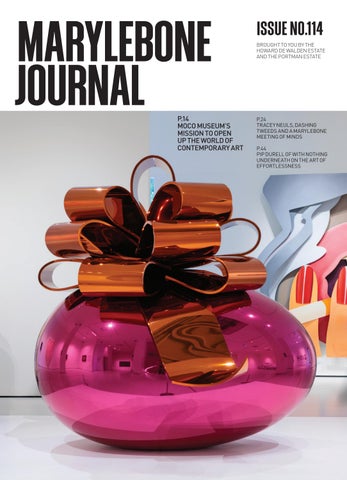
Cover: Jeff Koons’ Smooth Egg with Bow at Moco Museum London by Kit Oakes

19/05/2022 12:07

Home Is a Feeling

Home

Mingzhang Sun, Na Young Lee, and Lei Lei present colorful and dreamlike works that recall colorful youth dreamland and emotional memory, while Xinyi Liu, Xufei Qiao, and Xiangying Chen reflect on the tension between tradition and migration. Yuxin Tang, Chuhan Xiao, and Leixinyi Li explore distance and connection through virtual companionship, perception, and longdistance relationships, in contrast to the more intimate textile works of Jinghan Wang and Huijun Liu, which focus on gentle connections between families.

Nature and environment form another thread in the exhibition. Sicen Kuang, Yaxuan Li, Yimeng Liu, and Lifeng Liao respond to urban expansion and ecological change through depictions of plants, animals, and the use of natural or recycled materials. In the inner room, works by Faithe Yang, Duolan, Evangeline (Hejie) Huang, and Amy Kaluzhny create a quieter, livingroom-like atmosphere, centered on memory, intimacy, and everyday feelings.

The opening included a contemporary dance performance by Evangeline (Hejie) Huang. Generously supported by Cozee Properties, the program continued with a participatory workshop led by artist Qianchun Ma at Woodberry Down by Berkeley Group, extending the exhibition’s reflection on home beyond the gallery space to domestic life.

Words: Yutong Ye

20 – 23 March

HAPPENINGS IN MARYLEBONE EVENTS EXHIBITIONS

FILM MUSIC SHOPPING TALKS THEATRE WALKS

MUSIC

17 APRIL, 7.30pm

ANNA LUCIA RICHTER

Wigmore Hall

36 Wigmore Street, W1U 2BP wigmore-hall.org.uk

Accompanied by pianist Julius Drake and violist Timothy Ridout, mezzo -soprano Anna Lucia Richter presents a programme dedicated to the artistic milieu of Amalie Joachim, one of the most significant song interpreters of the 19th century.

MUSIC

23 APRIL, 7pm

SORAYA MAFI & ROBERT LEWIS

Bechstein Hall

22 Wigmore Street, W1U 2RH bechsteinhall.com

British tenor Robert Lewis and British Iranian soprano Soraya Mafi, accompanied by pianist Anna Tilbrook, perform several newly discovered and restored duets by Gaetano Donizetti, one of the most prolific composers of bel canto opera.

1. A nna Lucia Richter, Wigmore Hall

2. Ensemble Molière, Wigmore Hall

3. V iola Quartet, Royal Academy of Music

4. L ord Elgin and Some Stones of No Value, The Hellenic Centre

MUSIC

25 APRIL, 7pm

BACH’S MASS IN B MINOR

St Marylebone Parish Church 17 Marylebone Road, NW1 5LT stmarylebone.org

Bach’s magnificent mass was one of the last pieces completed by the composer and one of his greatest works. The Choir of St Marylebone Parish Church is joined by soloists and orchestra from Waterperry Opera Festival under the baton of Bertie Baigent to tackle this monumental work.

FILM & TALK

Directed by Christopher Miles and featuring Hugh Grant’s first screen appearance, this newly restored version of the 1986 film Lord Elgin and Some Stones of No Value provides a nuanced exploration of the Parthenon sculptures’ removal from Athens.

23 APRIL, 7pm

LORD ELGIN AND SOME STONES OF NO VALUE

The Hellenic Centre 16-18 Paddington Street, W1U 5AS helleniccentre.org

MUSIC

26 APRIL, 11.30am ENSEMBLE MOLIÈRE Wigmore Hall 36 Wigmore Street, W1U 2BP wigmore-hall.org.uk

Ensemble Molière presents Hidden Gems, a diverse, beautiful and rarely heard collection of 17th- and 18thcentury French Baroque chamber music. It includes an unusual bass duet by Corrette, a boisterous overture from Collin de Blamont and a virtuosic Guilleman quartet.

MUSIC

30 APRIL, 1pm VIOLA QUARTET SIDE-BYSIDE WITH TIMOTHY RIDOUT Royal Academy of Music Marylebone Road, NW1 5HT ram.ac.uk

Academy students perform alongside Timothy Ridout, visiting professor of viola, in a programme of works by British composers, beginning with an arrangement by inspirational viola player Lionel Tertis of Beethoven’s Trio in C Major, Op 87.

1. T he Garden of Eden with the Fall of Man by Peter Paul Rubens and Jan Brueghel the Elder, Myth vs Nature, The Brown Collection

2. Dante Notar, Bechstein Hall

3. Nightscape (2024) by Leiko Ikenmura, Lisson Gallery

4. S ense of Place Composition Festival, Royal Academy of Music

5. Johan Dalene, Wigmore Hall

TALK

Art historian Leslie Primo explores how Low Country painters responded to new ideas in Italian art after the unveiling of the Sistine Chapel frescoes, resulting in the idealised visions of nature and paradise summoned up by the likes of Jan Brueghel the Elder and Peter Paul Rubens.

30 APRIL, 6.30pm

MYTH VS NATURE

The Brown Collection 1 Bentinck Mews, W1U 2AF glenn-brown.co.uk

FILM & TALK

30 APRIL, 7pm

THIRD PERSON (PLURAL)

The Hellenic Centre 16-18 Paddington Street, W1U 5AS helleniccentre.org

Third Person (Plural) is Aikaterini Gegisian’s feminist cinematic essay, built from over 200 postwar US informational films and newsreels. She will be joined by Shoair Mavlian, director of The Photographers’ Gallery, for a discussion and Q&A.

MUSIC

1 MAY, 1pm

EDWARD GARDNER

CONDUCTS THE ACADEMY SYMPHONY ORCHESTRA

Royal Academy of Music Marylebone Road, NW1 5HT ram.ac.uk

Edward Gardner, principal conductor of the London Philharmonic Orchestra, conducts two concertos written in 1924: Stravinsky’s Concerto for Piano and Wind Instruments and Weill’s Concerto for Violin and Wind.

MUSIC

This series of six evening concerts showcases original works and radical reinventions by Academy students and postgraduate composers, with performers including The Hermes Experiment, Chroma Ensemble, New London Chamber Choir and Riot Ensemble.

28 APRIL – 11 MAY SENSE OF PLACE COMPOSITION FESTIVAL

Royal Academy of Music Marylebone Road, NW1 5HT ram.ac.uk

1.
4.

MUSIC

3 MAY, 7.30pm

JOHAN DALENE & JENEBA KANNEH-MASON

Wigmore Hall 36 Wigmore Street, W1U 2BP wigmore-hall.org.uk

Violinist Johan Dalene and pianist Jeneba Kanneh-Mason perform a programme that includes entrancing miniatures by Swedish composer Amanda Röntgen-Maier, and Messiaen’s Theme and Variations, an early work created as a wedding gift to the composer’s first wife.

MUSIC

8 MAY, 7pm

DANTE NOTAR: NEW BORN

Bechstein Hall 22 Wigmore Street, W1U 2RH bechsteinhall.com

Italian pianist and songwriter Dante Notar performs New Born, his ‘narrative piano concert’, which combines improvisation, original compositions and digital soundscapes with spoken storytelling and poetry, with the music functioning as a live soundtrack to the story.

EXHIBITION

UNTIL 9 MAY

SEAN SCULLY: THE NATURE OF ART

Lisson Gallery

67 Lisson Street, NW1 5DA lissongallery.com

This exhibition explores the centrality of the natural world to Sean Scully’s art. It includes his 2005 photographic series from the island of Aran alongside two large-scale paintings and a salon-style array of drawings, watercolours, photos and written works.

EXHIBITION

UNTIL 9 MAY

LEIKO IKEMURA: EL JARDÍN NOCTURNO

Lisson Gallery

67 Lisson Street, NW1 5DA lissongallery.com

Fitting with Lisson Gallery’s seasonal theme of artistic responses to the natural world, Japanese Swiss artist Leiko Ikemura presents a nocturnal garden, El Jardín Nocturno, which brings together a range of sculptures, paintings, works on paper and poems.

OPERA

13 – 15 MAY

THE RAPE OF LUCRETIA

Royal Academy of Music

Marylebone Road, NW1 5HT ram.ac.uk

Composed in the wake of the Second World War, Britten’s first chamber opera confronts the violence and trauma of a Roman myth. This new production sets the story in a more contemporary world, but not everything has changed for the better.

1.

EXHIBITION

29 APRIL – 15 MAY

THREE GREAT SCOTS

Thompson’s Gallery

3 Seymour Place, W1H 5AZ thompsonsgallery.co.uk

This exhibition brings together the works of three distinguished Scottish painters: the serene, evocative paintings of Stuart Buchanan, the expressive landscapes of James Harrigan, and Jonathan Robertson’s vibrant, narrativefilled renderings of coastal communities.

MUSIC

15 MAY, 1pm PERCUSSION SHOWCASE

Royal Academy of Music Marylebone Road, NW1 5HT ram.ac.uk

Neil Percy, the longest-serving principal percussionist of the London Symphony Orchestra, conducts a concert of dazzling contemporary music culminating in Lou Harrison’s homage to the Aztec god Quetzalcoatl, which features indigenous instruments from the Americas.

EXHIBITION

12 – 17 MAY

TIFFANY-ANNABELLE:

100 WAYS SHE BLOOMS

67 York Street Gallery

67 York Street, W1H 1QA 67yorkstreetgallery.com

Following her successful debut at London Art Fair in January, British Nigerian artist Tiffany-Annabelle presents the latest iteration of her acclaimed mixed-media series Women in Bloom, showing 100 small, affordable works in an immersive installation.

EXHIBITION

5 MARCH – 18 MAY

HIKARU FUJII: LINES, GAZES, LANDSCAPES

Daiwa Anglo-Japanese Foundation

13/14 Cornwall Terrace, NW1 4QP dajf.org.uk

Hikaru Fujii is one of Japan’s most prominent contemporary artists, working primarily with film. This exhibition, his first in the UK, examines moments in Japanese history when empire and disaster appeared side by side.

MUSIC

26 MAY, 1pm

JORDI SAVALL & HESPÈRION XXI

Wigmore Hall

36 Wigmore Street, W1U 2BP wigmore-hall.org.uk

Jordi Savall and Hespèrion XXI take works written long ago and make them sound as if they were composed yesterday. This concert pairs instrumental consort pieces from Elizabethan and Jacobean England with compositions from Italy and Germany.

EXHIBITION

30 APRIL – 23 MAY

NO MORE WINTER

Cube Gallery

16 Crawford Street, W1H 1BS cube-gallery.co.uk

Cube Gallery’s first group exhibition of the year features eight talented artists who, through a variety of techniques, from painting, hand-embroidery and markmaking to sculpting, paper folding and collaging, use colour, pattern and positioning to tell their stories.

EXHIBITION

UNTIL 30 MAY

LEGACY OF LIGHT: 200 YEARS OF PHOTOGRAPHY

Atlas Gallery

49 Dorset Street, W1U 7NF atlasgallery.com

Two hundred years have passed since 1826, when Joseph Nicéphore Niépce produced what is widely recognised as the first permanent photograph, View from the Window at Le Gras. Atlas Gallery celebrates this landmark anniversary with an exhibition exploring the birth of this new artform and the extraordinary photographers who pushed it forward in the centuries t hat followed.

THEATRE Set in 1970s Britain during a period of spending cuts, high unemployment and increasing inequality, James Graham’s play follows the hunt for the anarchist group The Angry Brigade by a special police squad, exploring themes of political engagement and the human cost of rebellion.

12 – 16 MAY

THE ANGRY BRIGADE

The Cockpit Gateforth Street, NW8 8EH thecockpit.org.uk

1. T he Rape of Lucretia, Royal Academy of Music

2. The Photojournalist (1951) by Andreas Feininger, Legacy of Light, Atlas Gallery

3. T hrone of Her Own (2025) by TiffanyAnnabelle, 67 York Street Gallery

4. L ight on the Hill by Bethan Harris, No More Winter, Cube Gallery

5. Jordi Savall, Wigmore Hall

6. T he Angry Brigade, The Cockpit

Q&A: ANTONIA HARTLANDLANG

The museum and events coordinator at the Royal College of Nursing (RCN) Library and Museum on a new exhibition exploring the impact of migration on the nursing profession

Interview: Ellie Costigan

Images: RCN/Ju stine Desmond

Q: Tell us about the programme at RCN Librar y and Museum. We always have a busy programme of events, which are linked to our exhibitions. There’s a permanent exhibition space and a more regularly changing space which changes every six months. The exhibitions focus on different areas of nursing and always have a historical angle. We’ve looked at prison nursing, children and young people’s nursing, and at the contribution of nurses during Covid, comparing that to nursing during different pandemics. Our new exhibition, Moved to Care, launched in March. It aims to show that migration has long been at the heart of nursing, for 100-150 years at least.

Q: M igration is a particularly pertinent issue at the moment. Was the exhibition a response to that?

For all our exhibitions, we put a call out to members for suggestions for

themes – more than half a million nursing staff in the UK are members of the RCN and this was definitely something people were keen we talk about. One in four nurses in the UK are international nurses and they make a huge contribution to healthcare today. We’re very conscious of the increasingly hostile environment here, in terms of immigration measures and antimigration rhetoric. The RCN joined with other healthcare providers at the end of 2025 to sign a statement taking a stand against it and to keep our communities safe from racism. We’re really keen to show that migration is and has been essential to nursing for a long time. In the late 19th century, early 20th century, lots of British nurses went out to what were then British colonies. That was a precursor to Windrush, when lots of nurses and other healthcare workers came over from the Caribbean, Africa and elsewhere to help build the NHS, answering the

call of government for support. That has continued and we want to shout about that history. We’re working with nursing staff in creative ways to showcase their experiences.

Q: Tell us about some of the artists you’ve been working with. We’ve worked with an artist called Haleema Aziz, who ran a series of workshops inviting nursing staff with migration experience to co-create an artwork that’s now exhibited in the space. It’s made up of textile squares which depict different aspects of what home means to people, as well as their experiences in the UK. We’ve also worked with a fantastic artist and nurse called John Yayen. We’re featuring some of his work from a project called Embers of Care, which centres on the contribution of migrant healthcare workers.

A nother exciting part of the programme is an Arts Council funded project called A Balikbayan Box for Nursing, which was inspired by one of Haleema’s poems. As part of the project, we’ll have three different writers in residence, one in April, one in May and one in June, each writing within the space for a week: Romalyn Ante, a Filipino nurse; Jennifer Wong, a writer from Hong Kong; and Christie Watson, who has written some well-known memoirs related to nursing. We’re really excited about it. RCN members can book one-to-ones with each writer, but members of the public can also drop in any day of the writer’s week-long residence, 3-4pm, to hear more about their work.

Q: W hat is a Balikbayan Box and what does that strand of the prog ramme entail?

Balikbayan means ‘homecoming’; a Balikbayan Box is a box that Filipino migrant workers traditionally send home to their families back in the Philippines. They can contain anything from everyday items like Fairy Liquid or treats like Cadbury’s

chocolate. They’ll buy bits and pieces to put in the box as and when they get their wages, then send it home – they can be really quite big! Haleema’s artwork as part of the exhibition is a sort of crate structure to represent this.

Haleema’s original poem, Notes on a Balikbayan Box, is a very moving account of the experience of a migrant nurse thinking about home and what she’s going to send back there. That’s been a springboard for the writers in residence programme, who will be hosting a series of workshops centred on that theme. One of the workshops is being run in partnership with the refugee charity Fences and Frontiers, where we’ll work with refugees, then there’ll be a workshop for schools and a workshop for adults.

Q: W hy do you think it’s important to appeal to so many different audiences?

We will all encounter nursing professionals at some point in our lives, either as patients or through our families, yet I think there’s a tendency to misunderstand just how many of those people have come over to support the healthcare service. I also think it’s an opportunity to think more widely about migration – it’s all around us and many of us will have migration backgrounds.

We’re also working with the Migration Museum to collect migration stories and we’ll have a story disc wall in the space to showcase these. We’re inviting visitors to share their migration story to post on the wall, too. It’s a great way to get people thinking about the diversity a ll around us and the rich fabric of nursing.

UNTIL 2 SEPTEMBER

MOVED TO CARE:

STORIES OF NURSING AND MIGRATION

RCN Library and Museum

20 Cavendish Square, W1G 0RN rcn.org.uk

MUSIC

31 MAY, 11.30am

LEONKORO QUARTET

Wigmore Hall 36 Wigmore Street, W1U 2BP wigmore-hall.org.uk

The Berlin-based Leonkoro Quartet is seeking new audiences for the underappreciated Dutch composer Henriëtte Bosmans. Her String Quartet provides an engrossing preface to Robert Schumann’s Op 44 Quintet, with Igor Levit taking on the virtuoso piano part.

THEATRE

2 MAY – 6 JUNE

SHERLOCK HOLMES

Regent’s Park Open Air Theatre Regent’s Park, NW1 4NU openairtheatre.com

Sherlock Holmes is fresh off the success of his first big case, misusing his time, until an unknown woman and a mysterious jewel arrive at 221b Baker Street. Written by Joel Horwood, this new adventure hurtles through the streets of London, with lives on the line.

3.
1. M oved to Care, RCN Library and Museum
2. Leonkoro Quartet, Wigmore Hall
3. Sherlock Holmes, Regent’s Park Open Air Theatre
2.

THEATRE

17 APRIL – 7 JUNE

THE PRICE

Marylebone Theatre 35 Park Road, NW1 6XT marylebonetheatre.com

Jonathan Munby directs Olivier Award-winning actor Henry Goodman in Henry Miller’s searing family drama. On the eve of selling their late father’s possessions, two estranged brothers meet in a cluttered attic for the first time in years, sparking a fierce emotional reckoning.

OPERA

10 – 11 JUNE

IL RITORNO D’ULISSE IN PATRIA

The Cockpit Gateforth Street, NW8 8EH thecockpit.org.uk

Ensemble OrQuesta presents Il ritorno d’Ulisse in patria, Monteverdi’s powerful baroque opera based on Homer’s Odyssey – a story of unwavering love, vengeance and heroic returns – in a new minimalist production by Marcio da Silva.

MUSICAL THEATRE

11 – 14 JUNE

LITTLE WOMEN

Royal Academy of Music Marylebone Road, NW1 5HT ram.ac.uk

This crowdpleasing musical, first performed on Broadway in 2005, is based on Louisa May Alcott’s much-loved novel. It follows the adventures of the four March sisters –Meg, Jo, Beth and Amy – and their beloved Marmee while their father is away serving in the American Civil War.

MUSIC

As part of Wigmore Hall’s 125th Anniversary Festival, South African cellist and vocalist Abel Selaocoe and his Bantu Ensemble weave together rich strands of European classical music, African hymns and songs, jazz and the echoes of ancient ancestral voices to create uplifting improvisations and classical interpretations.

5 JUNE, 7pm

ABEL SELAOCOE & BANTU ENSEMBLE

Wigmore Hall 36 Wigmore Street, W1U 2BP wigmore-hall.org.uk

1. The Price, Marylebone Theatre 2. L ittle Women, Royal Academy of Music 3. Abel Selaocoe, Wigmore Hall 4. A L ife in Four Seasons, Regent’s Park Open Air Theatre 5. S ea: Wave Goodbye Say Hello (Zanzibar) (1999) by Lubaina Himid, Lisson Gallery

Marylebone Summer Festival

EVENT

The much-loved Marylebone Summer Festival returns on Sunday 14th June after a short hiatus, bringing a blend of familiar attractions and exciting new additions. Enjoy a day filled with food and craft stalls, fitness and wellness activities, live music, a festival bar, children’s entertainment and a dog show. There are special offers and activations to be found at many of the local retailers and restaurants throughout the day. The festival is organised by The Howard de Walden Estate and proudly partnered with The Young Westminster Foundation, this year’s chosen charity.

14 JUNE

MARYLEBONE SUMMER FESTIVAL marylebonevillage.com

DANCE

11 – 14 JUNE

A LIFE IN FOUR SEASONS Regent’s Park Open Air Theatre Regent’s Park, NW1 4NU openairtheatre.com

Created by Tinuke Craig with choreography by Alexzandra Sarmiento and a score by award-winning composer DJ Walde, this evening of contemporary dance is set to an electronic re-working of one of the world’s great musical masterpieces, Vivaldi’s Four Seasons.

MUSIC

20 JUNE, 5pm

RACHMANINOV’S VESPERS

St Marylebone Parish Church

17 Marylebone Road, NW1 5LT stmarylebone.org

For the final concert of this year’s St Marylebone Festival, the Choir of St Marylebone Parish Church performs Rachmaninov’s All-Night Vigil, alongside mystical works by Sir John Taverner and Arvo Pärt, conducted by Bertie Baigent and Luke Mitchell.

MUSIC

15 – 21 JUNE

MARYLEBONE MUSIC FESTIVAL

Manchester Square Gardens, W1U 3PL

marylebonemusicfestival.com

Set in Manchester Square Gardens and inspired by Marylebone’s rich history as a home of pleasure gardens and musical performance, this annual festival – returning for its 11th year – features an eclectic programme of classical music, opera, folk and jazz.

EXHIBITION

4 JUNE – 25 JULY

LUBAINA HIMID & MAGDA STAWARSKA

Lisson Gallery

67 Lisson Street, NW1 5DA lissongallery.com

Reflecting on themes of memory and movement, loss and belonging, this immersive mixed-media installation comprises nine diptychs painted by Lubaina Himid between 1999 and 2003, paired with a multilayered libretto composed by Magda Stawarska.

EXHIBITION

This major retrospective of Sir Winston Churchill’s paintings is the first substantial UK exhibition devoted to his art since his death. Bringing together more than 50 works, it casts new light on a world-famous figure who was defined by politics but sustained by a lifelong passion for painting.

23 MAY – 29 NOVEMBER

WINSTON CHURCHILL: THE PAINTER

The Wallace Collection

Manchester Square, W1U 3BN wallacecollection.org

MUSIC

27 JUNE, 3pm

MANDELA TALES

Wigmore Hall

36 Wigmore Street, W1U 2BP wigmore-hall.org.uk

Presented as part of a day of concerts dedicated to the 50th anniversary of the Soweto Uprising, Mandela Tales is a production by composer Shirley J Thompson, inspired by the book Nelson Mandela’s Favourite African Folktales and designed to appeal to families and young people.

2. T he

3. T he Churchill Bar Terrace

4. 2 5 Years of Progress, installation photograph (East Gallery III), The Wallace Collection at War, The Wallace Collection

EXHIBITION

UNTIL 8 AUGUST

HOI POLLOI

The Brown Collection 1 Bentinck Mews, W1U 2AF glenn-brown.co.uk

Curated by Glenn Brown, this exhibition brings together paintings, drawings, prints and sculptures from the 16th century to the present day, including his own distinctive works. It explores how artists through the ages have represented, resisted or reimagined the ordinary man.

FOOD

UNTIL OCTOBER

THE CHURCHILL BAR TERRACE

Hyatt Regency London – The Churchill 30 Portman Square, W1H 7BH hyatt.com

Savour the warmer weather at The Churchill Bar Terrace, a Mediterranean-inflected setting inspired by Winston Churchill’s sun-drenched travels to the south of France. The terrace offers seasonal cocktails, light bites and leisurely lunches.

EXHIBITION

15 APRIL – 25 OCTOBER

THE WALLACE COLLECTION AT WAR

The Wallace Collection Manchester Square, W1U 3BN wallacecollection.org

During World War II, The Wallace Collection staged exhibitions designed to galvanise public opinion and strengthen ties with allies, including the Soviet Union. This free display explores how Hertford House became a forum for cultural diplomacy.

1. T he Goldfish Pool at Chartwell C344, 1932 by Winston Churchill, Winston Churchill: The Painter, The Wallace Collection
Hoi Polloi by Glenn Brown, The Brown Collection

Discover the joy of dance!

Ballet, Musical Theatre, Drama, Tap and more!

Sign up for a free trial class!

MATHEMATICS TUITION

Mathematics Tutor & Chartered Mathematician (CMath)

Qualifications held: PGCE in Post-Compulsory Mathematics

MPhil in Applied Mathematics

MSc in Computational Mathematics with Modelling BSc (Hons) in Mathematics

Levels taught: Pre-GCSE, GCSE, A-Level, Undergraduate and Postgraduate Mobile: 07540 737310

Central London’s leading dance schools for little dancers. Classes are filled with laughter, imagination and the friendships children build as they grow in confidence.

Locations

St John’s Wood | Marylebone | West Hampstead alyssiafleurschoolofdance.co.uk

A Pair of Silk Embroidered Hangings, Uzbekistan, circa 1890

Specialising in antique and decorative rugs, carpets and textiles. Over 30 years experience. Cleaning and restoration services available. Located close to the world famous Alfie’s Antique Market

Aaron Nejad Gallery 4 Church Street Marylebone London NW8 8ED Tel: 07976 826218

Email: anejad@talktalk.net www.aaronnejad.com

IN PROFILE LIONEL LOGCHIES

The co-founder of Moco Museum on removing barriers, trusting audiences, and why art belongs to anyone curious enough to look

Interview: Vi el Richardson images: Kit Oakes, Justin Piperger, Ed Reeve

“Do you have to pay to see this exhibition?” It was a question that, unknown to the asker, would come to reshape the way millions of people experience contemporary art. Behind the question lay an assumption that had been ingrained over decades: that beyond a handful of national museums and galleries, art spaces exist primarily as temples of high culture or commerce, where casual curiosity feels a little like trespassing. The young person wasn’t really asking about admission prices – they were asking for permission to simply come in and look.

Lionel Logchies and wife Kim Prins had been noticing a pattern. Young people were arriving in growing numbers at their Amsterdam art gallery, drawn by a Banksy exhibition in which all of the art was – as usual at a private gallery – primarily there to be sold. These visitors came with genuine excitement, but they weren’t there to buy, they were simply curious. The encounter crystallised in Lionel and Kim something they had been observing throughout their time in the art world. There was a vast appetite for contemporary art outside the established circuit, but structures increasingly tailored to serving wealthy collectors had inadvertently excluded everyone else.

That realisation led to a radical shift. For years, the couple’s galleries had been immersed in the commercial art world’s rhythms. “I loved finding a beautiful piece of art and bringing it to another home where it would be appreciated by new people,” Lionel says. The hunt itself provided satisfaction: discovering works at art fairs, auctions or collectors’ homes. But the young people coming to look at Banksy represented something that commercial model couldn’t capture: pure engagement without a hefty investment.

It was in a bid to fill that space that, in 2016, Lionel and Kim

opened the Modern Contemporary (Moco) Museum on Amsterdam’s Museum Square, positioned between the Rijksmuseum and the Van Gogh Museum. The choice of location was very deliberate, but rather than competing with these cultural giants, Moco Museum was seeking to occupy different territory entirely. The model was simple: show contemporary art, but with the intent that people see it rather than buy it. “Our idea was to take art pieces out of houses where nobody would ever see them, and make them publicly accessible, funded through ticket sales rather than art sales,” Lionel explains.

It was clear from the start that we were talking to a demographic that had felt excluded.
The new Keith Haring exhibition at Moco Museum London

“We had a thousand visitors on our opening day. It was clear from the beginning that we were suddenly talking to a demographic that had felt excluded.”

For Lionel, accessibility means something specific and measurable. “It’s about lowering the barriers that sometimes exist around contemporary art,” he explains. It means showing artists whose work resonates with current social and cultural trends, and doing so with clear storytelling and thoughtful exhibition design, in environments where visitors feel able to explore, reflect and form their own

interpretations. “The difference lies not in the art itself, but in who feels permitted to have an opinion about it,” he continues. The Keith Haring exhibition currently showing at Moco Museum London exemplifies this approach. Rather than simply displaying Haring’s works, they have created an immersive digital environment that allows audiences to engage with the art in a way that goes far beyond passive observation. The same principle guided Moco’s Marina Abramovic´ exhibition, where presence and atmosphere became integral to the experience.

S ome have questioned how Moco can maintain accessibility

while presenting complex work with real depth. Lionel rejects this dichotomy. “I think engagement and depth are not at all mutually exclusive,” he insists. “A deeply thoughtful and well-designed exhibition can be visually engaging while still presenting strong, complex ideas and meaningful artistic narratives. The goal is for visitors to leave with a new idea, a more open mind or simply a great conversation sparked by art. If someone leaves with that, then we have done our job well.”

Moco functions around four pillars that together represent what Lionel describes as “the

Engagement and depth are not at all mutually exclusive. A thoughtful and well-designed exhibition can be visually engaging while still presenting complex ideas and meaningful artistic narratives.

whole art world at once”. Modern masters – some of the most famous artists of the 20th century – provide recognition and entry points. Contemporary masters, such as Banksy and KAWS, offer established voices while addressing current concerns. Upcoming artists introduce emerging perspectives. Digital and immersive experiences explore how art evolves with technology. “The well-known artists act as an entry point,” Lionel explains. “Once visitors are inside, we have the opportunity to introduce them to less well-known artists with new perspectives and emerg ing voices.”

The well-known artists act as an entry point. Once visitors are inside, we have the opportunity to introduce them to new perspectives and emerging voices.

I n a traditional museum model, permanent collections tend to stay fixed, focusing on single themes or periods. Moco’s approach is more restless; constantly rotating, constantly evolving, experimenting with formats and responding to cultural developments. Their openness to technological evolution made Moco the first museum to exhibit NFTs as art rather than curiosity. “It was new and it was digital art,” Lionel recalls. “We always try to be innovative.” The decision was driven by a belief that new movements, however they might be judged in the future, deserve

immediate engagement, rather than waiting for val idation from the arti stic elites.

This flexible approach is where Lionel thinks that Moco’s structure as a private museum is a real advantage, freeing them from the five-to-ten-year planning cycles that govern larger institutional structures. “We can make decisions really fast,” Lionel says. “We can turn around programmes quickly if something excit ing emerges.”

Moco’s three locations –Amsterdam, Barcelona and London – function as both individual venues and a networked system. Exhibitions rotate between cities,

modified to reflect local contexts and opportunities. “It will always be a little bit different,” Lionel explains. Core artists appear across all three museums, but rarely with identical presentations. The system creates what he calls a synergy between the museums – shared programming that remains fresh through variation. They deliberately never show the same artist in temporary exhibitions at multiple locations simultaneously, thus maintaining the ability to respond quickly to emerging movements across the globe. This approach allows Moco to build coherent programming across locations without repetition, creating

different experiences even for visitors who travel between venues.

London – and Marylebone specifically – offered something Moco really wanted to capture as it expanded out of Amsterdam. “London and New York are the biggest cities for art, with London having one of the most dynamic cultural ecosystems in the world. It’s international, creative and constantly evolving.” Within that ecosystem, Marylebone provided the right scale and atmosphere for creating an intimate museum environment while remaining connected to the city’s broader cultural landscape. London’s richness, Lionel believes, comes from its diversity, and Moco contributes to this by offering “a slightly different perspective”, one focused on making contemporary voices feel approachable without sacrificing intellectual rigour.

The selection process behind the art remains intensely personal, despite the institution’s growth, with decisions about what to show still coming primarily from Lionel and Kim. “We never show something we don’t like – never,” Lionel insists. An artist might be saying something important or have a big reputation, but if the work itself doesn’t resonate with at least one of the pair, Moco won’t exhibit it. Those artists, he says, will find spaces elsewhere, but Moco’s programme must always reflect genuine enthusiasm rather than dutiful acknowledgment.

I ncreasingly, though, they’ve been looking to their wider team to help with the discovery of emerging voices, suggesting new artists or new ideas. “They’re younger, they see a different world, so we have to listen to them.” Studio visits allow direct engagement with emerging artists in their working environments. “We visit artists’ studios and sometimes invite them to Moco,” Lionel says of the commissioning process. “These encounters maintain personal

Left: Smooth Egg with Bow by Jeff Koons Far left top: Pulse Interactive immersive exhibition Far left bottom: This is Blanche by Robbie Williams
If I could focus only on the art, I would be a really happy man!

audiences traditional museums are struggling to attract. “I don’t think this is accidental; it comes from our model of using familiar names as entry points to less fa miliar work.”

A mong those visitors have been figures whose attendance carries particular cultural significance. Barack Obama came with Steven Spielberg. Tim Cook, Apple’s CEO, described it as “the most innovating museum for decades”. These aren’t merely celebrity endorsements but validation from people who have an acute understanding of audience engagement and recognise the importance of connecting with demographics that traditional institutions struggle to reach. The compliments matter not for prestige, but for what they confirm: that removing barriers to entry doesn’t dilute art’s power, it amplifies it.

the invisible visible applies to seeking out completely unknown artists. At art fairs, his finely honed instincts allow Lionel to operate at remarkable speed. “I’m rarely there longer than 30 minutes. I move through the exhibitions really quickly because I know what I like and what our audience likes,” Lionel tells me. “My recognition of something interesting is instant rather than analytical. Eighty percent of what I see isn’t for Moco, the other 20 percent I recognise i mmediately.”

connection even as our institution grows, ensuring programming emerges from genuine engagement rather than an abstract curatorial theory.”

Ten years in, the results have validated the pair’s initial insights. More than six million visitors have passed through Moco’s three locations. Most strikingly, 65 percent of these visitors were experiencing an art museum for the first time. “What has surprised me most is how diverse the audience has become,” Lionel reflects. “We see visitors of all ages, genders and backgrounds.” Theirs is a notable young demographic –

Running three museums, with 150 employees across three countries, brings with it significant operational demands. What sustains Lionel through the resulting maelstrom is his enduring passion for the art. “There are many of those,” he admits when I ask about days crowded with HR, financial and logistic responsibilities. “The only thing that keeps me going is that I can be with the art. If I could focus only on the art, I would be a really happy, lucky man!”

H is was a passion that emerged in his twenties. Lionel, who came from a business family, started by trading in art. It was during this time that he discovered the joy of finding rarely seen works and connecting them with new audiences. “Maybe 50 to 75 percent of what Picasso or Basquiat produced has never been seen by the wider community,” Lionel explains. “Finding a piece like this and having the opportunity to bring it to a wider public is a real joy for both Kim and me.”

T he same impulse to make

L ooking to the future, Lionel sees further careful expansion. He has explored spaces in New York, a city he’s done business in since his gallery days, as well as other locations, and a fourth museum will likely open, though he’s cautious about pace. “Expansion only makes sense if we can maintain the quality of the programme and the experience we can provide,” he explains. “We don’t want to grow too fast because the quality has to be maintained.”

T he basic ambition remains unchanged, even as the scale increases. “The core mission –presenting modern, contemporary, digital and immersive art in ways that feel accessible, inspiring and relevant – hasn’t changed since our opening day in Amsterdam,” says Lionel. “What has changed is Moco’s ability to reach new audiences, collaborate with more artists, and demonstrate that institutional barriers to contemporary art engagement aren’t inevitable.”

T hat hesitant inquiry from a young person interested in seeing some Banksy works still drives everything. It represents millions of people who want permission to be curious. Moco’s answer remains unambiguous: the art is here, and you’re very welcome to see it.

MOCO MUSEUM LONDON

1-4 Marble Arch, W1H 7EJ mocomuseum.com

Top: Species by Six N. Five Above: Untitled (Butterfly Heart) by Damien Hirst

SOCIAL FABRIC

How a collaboration between Tracey Neuls and Dashing Tweeds resulted in a distinctive new shoe and a very Marylebone meeting of minds

Words: Lauren Bravo
Portrait: Holly Whittaker

Two design houses, both alike in ethos – in fair Marylebone, where we lay our scene. He was a fabric maverick, she was a shoe designer. It’s a tale as old as time. But, in this case, with very little drama.

“It was a really easy collaboration; I’ve always just adored his fabrics,” says Tracey Neuls, founder of the eponymous footwear brand, on teaming up with Dashing Tweeds to mark her 25th anniversary in the shoemaking business. Guy Hills, the fabric maker in question, is no less effusive. “Like all designers I admire, she’s got her own perspective,” he says. “Tracey has always been a ray of sunshine in her outlook on design.”

It’s an outlook that began to take form at a very early age. As a child growing up in Canada, Tracey would make her own shoes from cereal boxes and loo roll tubes, then parade them up and down the street. “Of course you’d feel every stone on the road,” she laughs. “Cardboard’s not the best material. I was always having to make reinforcements.”

Having transitioned to somewhat sturdier materials, her designs have since been recognised by the Royal Society of Art, the Design Museum and the Museum of Contemporary Art of

Barcelona. In her Marylebone Lane boutique, individual shoes hang from the ceiling on ribbons, to be admired like sculptures. It’s a visual merchandising trick that has since been copied many times on the high street – though she’s gracious towards the plagiarists. Like her creations, Tracey seems to float above the flotsam and jetsam of mass-produced fashion. “I really see us as more akin to art or furniture design, something like that,” she says. Function, though, matters just as much as form. “It’s a big thing, to have a properly fitting pair of shoes,” she says. “Shoemakers have a responsibility there.”

The Geek has been a bestselling design for almost two decades. Her sporty spin on a classic men’s derby, with echoes of jazz shoe and hints of plimsoll, it’s especially beloved by cycling commuters for its sleek, practical yet office-appropriate form, featuring a sturdy rubber sole and a shadow heel that fits perfectly on a pedal. The brand has leaned into this unexpected fanbase over the years, experimenting with light-reflective Geeks in technical materials to keep the wearer safe and chic on the roads. But the new version is something extra special. Crafted in British wool and woven with reflective yarns

It’s about a mindset. People want something different, something timeless, not something they’re going to wear for one event and then chuck out.

that subtly catch the light to give off a rave-ready glow, this is tweed as you’ve likely never seen it before – unless you’re a Dashing Tweeds fan, of course.

Dashing Tweeds was cofounded by Guy and weaver Kirsty McDougall, who met in the early 2000s at the Royal College of Art. “She had this design that looked a bit like a bicycle tyre track, and I thought, ‘Wow!’ It was cool. It was a bit Vivienne Westwoody, a bit fashiony. I’d always had this idea of making urban tweeds for an urban environment, so I asked Kirsty to weave me some fabric. She thought I was a bit nuts, but she s aid, ‘Sure…’”

T hey began by selling their cloth to other designers and makers, attracting coverage from magazines and early fashion blogs while still running the business from a single loom in Kirsty’s Dalston flat. The venture dovetailed nicely with a new breed of hipster, a waxedmoustached vintage shopper who read The Chap magazine and enjoyed cosplaying a down-on-hisluck aristocrat, “having to cook his kippers in his Corby trouser press”. Some of Dashing Tweeds’ earliest clients were participants in the Tweed Run, an annual jolly for the capital’s spivviest cyclists.

Guy himself is a fashion history buff and a font of sartorial legends

– from the exacting standards of Regency dandy Beau Brummell (“people used to say he had five tailors for his gloves, one for each finger”), to tweed’s unlikely history as the first tracksuit. “Tweed was the original sports fabric,” he explains. “All the sports you can imagine were done in it. Hunting, shooting, fishing, early cycling – even mountain climbing, people did it wearing tweeds.” Some still do. Two years ago, adventurer Elise Wortley, aka Woman with Altitude, climbed Mont Blanc in a recreation of the wool dress and bonnet worn by the first woman to scale the mountain in 1838, Henriette d’Angeville. Her cloth of choice? Dashing Tweed s, naturally.

But the brand is far from a hipster novelty or a dusty throwback. Guy is as keen on subverting tradition as he is on preserving it, with rainbow-bright colourways and contemporary cuts that look as at home on a Camden punk as they do on a country gent. “The thing I love about tailoring is it’s constantly evolving,” he says. “You go back to the Georgian times and they’re wearing crazy colourful clothes, really fun things. And the best thing is that men were in charge of their own fashion destiny.” He blames modern readyto-wear fashion for robbing men of

the confidence to stand out. “A lot of what we do at Dashing Tweeds is about helping people express their per sonal style.”

A collaboration with Converse was Dashing Tweeds’ first big coup, and in the years since they’ve worked with Nike, Hudson, Fred Perry and Pharrell Williams’ Billionaire Boys Club, as well as supplying fabrics for myriad TV and film productions. Staying true to tweed’s sporting roots, one of the brand’s most recent partnerships was with Formula One driver Jacques Villeneuve, including a check in pink, blue, yellow, green and red, inspired by the signature colours of his r acing helmet.

And now, the Tracey Neuls anniversary – one of a series of celebratory collabs that also featured events with artists Louisa Tan and Laxmi Hussain, and a special edition DOT trainer with collage artist Morag Myerscough. The two designers, who were first introduced by Guy’s brother Adam, owner of the architectural salvage and design firm Retrouvius, had admired each other’s work for years. “Guy had been in my mind to work with for some time,” says Tracey. “He’s a real expert in what he does –and an original too. He’s just doing his stuff, and it’s fabulous.” Though

outwardly very different in aesthetic, their brands share plenty of DNA. Both embody a certain tactile, sensorial playfulness that feels worlds away from the algorithmic churn of the high street. Tracey still moulds every single one of her designs in plasticine, before they’re crafted in leather at a Portuguese atelier. “Plasticine because of the smell!” she admits. “Even sometimes playdough, which doesn’t really give the right mould, but does give the r ight smell.”

Her shoes often incorporate existing materials and feature vegetable-dyed or chrome-free leather, and they’re all “made to be renewed” – the shop works with favourite cobblers to repair any pairs that end up worse for wear. “People get quite distraught – they come in with a 10-year-old pair of shoes that have finally worn out and they’re like, ‘What do I do? I wear these every day!’ I love them.” Tracey’s slow, sustainable approach has gained a customer base that’s both broad and loyal. “We get mothers and daughters coming in, which I love,” she says. “I don’t think it’s about age, I think it’s about a mindset. They want something different, something timeless, not something they’re going to wear for one event and then chuck out.”

Guy, too, refuses to cut corners.

“It’s uncompromised design, uncompromised quality,” he says. Dashing Tweeds works only with British wool and British mills and Guy is on a personal mission to educate shoppers on the benefits of our national fibre. “Wool is incredibly warm and practical, it’s breathable, it hardly ever needs washing because it’s got amazing self-cleaning abilities,” he says. Then he does his party trick, holding a tweed Geek under the tap to demonstrate the shoe’s waterresistant coating. True to its claim, the water runs off the surface –ideal for rainy days in W1.

Both Guy and Tracey have become part of the local fabric. Guy, a Marylebone original in every sense, moved to the area when he was only six months old. “I’m incredibly parochial,” he jokes. The family lived in a penthouse designed by his architect father on the top of York House on Upper Montagu Street, just round the corner from Dashing Tweeds. As a boy, he cycled to school every day and worked as a bicycle courier in the holidays. “I’ve spent my whole life cycling through Marylebone in one direction or the other,” he says.

I n 2018, when Dashing Tweeds was looking for a new home having outgrown its first space near Savile

Wool is incredibly warm and practical, it’s breathable, it hardly ever needs washing because it’s got amazing self-cleaning abilities.

Row, there was only one postcode that would do. “I did spend about five minutes considering Knightsbridge or Notting Hill or the East End, but my heart was in Marylebone.” Like so many of the area’s independent businesses, Guy and his team have woven themselves into the neighbourhood and found it to be supportive, not competitive. “In Chiltern Street alone there are at least six menswear shops, but each one has a different perspective on menswea r,” he says.

T hese local businesses pride themselves on being places of community as well as commerce. “We’ll pop down the road into other shops and go: ‘How are you guys doing, is everyone alright?’” agrees Tracey, who opened her first boutique on Marylebone Lane back in 2005 before crossing the road to her current space in 2022. “When we were setting up the new store, we had neighbours who would bike past and shout: ‘Congratulations!’ or ‘I love what you’ve done with the windows!’”

Both owners are enthusiastic about the power of bricks-andmortar retail to drive more considered purchases and sell their products in a way that screens never can. “When people come in here, the first thing we do is encourage them to touch the cloth, try things

on, see how it feels and fits,” says Guy. “You can’t do that online.” With incredible serendipity, the bell above the door rings and a customer comes in looking for a pair of socks. She leaves with a £1,250 coat.

Guy enthusiastically shares behind-the-scenes stories from the Scottish mills that weave his cloth, while all of Tracey’s shoes bear the signature of their maker on the sole. “I’m only half of the product,” she says. “I design it, but there’s someone else who’s actually pulling the leather and making the shoe.”

In an age of eerie digital perfection, both want to flag that fashion is still the product of human labour, not spat from a computer fully formed. “I think about children that don’t know where carrots come from, and it feels a little bit the same,” she says. “AI takes an image and makes it so smooth. We’re getting to this stage where everything has to be so perfect; we’re losing those variances and differences, when actually we should be going: ‘Look at that wonderful little scar on the leather, you can tell where it’s come from.’ The signature is a very small thing to remind people of that.”

We can only hope both brands will still be doing their bit for fashion preservation and innovation in another 25 years’

time. But fans hoping to grab the collab had better pedal fast – like most of Tracey’s shoes, the Dashing Tweeds OG Geeks are a limited edition. Fifty pairs have been made, and once they’re gone, t hey’re gone.

“I like working that way,” she says. “It means there’s always a reason to do something new.”

TRACEY NEULS

74-78 Marylebone Lane, W1U 2PW traceyneuls.com

DASHING TWEEDS

47 Dorset Street, W1U 7ND dashingtweeds.co.uk

MUSIC FESTIVAL FOR EVERYONE

Sue Perkins
Rob Rinder Gareth Malone
The Wallace Collection
Manchester Square Gardens

THE DIFFERENCE MAKERS

Introducing the people behind central London’s vital charities and community organisations: André Pink, artistic director of Dendê Collective

Interview: Jean-Paul Aubin-Parvu Images: Orlando Gili

It all started when my mother, who is now 88, suddenly decided to come and live with me in the UK. I’m a theatre director from Brazil. I originally came here to do a two-year specialism in physical theatre, but after that I decided to stay. Years later, I was over in Brazil for a short holiday, and my mum told me to book her a flight, as she was coming back to London with me. Everything happened so quickly. In just two weeks, almost miraculously, we managed to empty her flat, rent it out and sell her car. As soon as we arrived back here, I realised that to carry on doing what I was doing I would need to find a way of bringing my mother to work!

B ack in 2000, we had set up the Dendê Collective theatre company to make Brazilian plays. It became a charity four years later, with the aim of promoting and advancing arts and culture through education and community projects. In 2017, the Improbable theatre company invited me to facilitate a show called Improv for Elders. This involved us working with a group of people aged 60-plus, some of them with cognitive issues, using improvisation. The project took place at the Church Street library, culminating in a show at The Cockpit theatre on Gateforth Street.

I g rew very fond of that group. Then, when my mother came over, she gave me another very good reason to carry on working with the over-60s. Bringing mum along proved very important for her – creating a network of friends, improving her English, keeping her busy, giving her a routine. I began to realise that there was a real need for this in our communities, and I’ve been delivering the work ever since. I call it the Dendê Elder s programme.

We now run weekly drama sessions at the Church Street, Mayfair and Pimlico libraries. These are completely free dropin sessions, and we don’t make people commit. People can come whenever it works for them. Each session runs for two hours.

We usually start with a quick check-in, sitting in a

The Church Street Masquerade has become another annual highlight. I teach the group a bit of mask acting and then we dress them up and head out into the street.

circle, giving everybody a chance to tell the group how they’ve been doing. We then have a physical warm-up, still sitting on chairs, just stretching and feeling good, before moving onto some drama games. We eventually start taking people out of the circle, moving around the space, working in pairs or trios on whatever our current project happens to be.

T here is a different focus every term. It might be a pantomime, for example – we’ve put on a panto for the past two years. We performed Cinderella at Church Street library back in December 2024, and at The Cockpit in 2025. We managed to secure extra funding for that last year, which meant we were able to increase the production values and bring in a stage manager and some professional actors to work with the group. We even had a musical director – some of the songs in the show were specially written for the group. We made it onto both the BBC and ITV news, which meant the theatre was sold out. We had 340 people – an amazing audience. The Church Street area is very diverse, and lots of families came to see the show, which was great –for some of the children, it was their first experience of watching a play.

T he Dendê Elders programme gives so much to this age group. We have so many beautiful case studies, including people who joined us after recovering from a stroke and ended up being i n the panto. We’ve had people dealing with mental health issues who suddenly found a purpose. There’s something about the discipline of having a specif ic reason to leave the house that is really important. There are also the physical benefits of getting up, getting ready, doing your makeup, doing your hair, and then leaving the house – some of the group make a real effort. There’s the exercise side of things. There’s the laughter – the sessions are genuinely fun –and the friendship. Dendê Collective is a very diverse group in terms of age, income, education, ethnic background, nationality and religion. We’re a very broad church.

It’s really important that we keep things consistent and have a proper focus. Many projects for this age group run for a brief period or have no tangible outcome. We usually have some kind of show at the end, even if it’s a very small performance at the library, so there’s always something for the group to slowly build towards. That creates a meaningful experience, and it also creates a memory. We bring along a professional photographer, or we make a short video to put up on YouTube, which our group can watch and show to friends. It’s all about creating a real legacy. No pressure, though. We don’t make anybody

memorise lines or anything like that – it’s as inclusive as can be. My mother played the queen in Cinderella, and because she’s on crutches, she needed to take her time walking out onto the stage. We respected her needs. In fact, the audience celebrated with her, giving her a round of applause when she finally managed to sit down.

The Church Street Masquerade has become another annual highlight. This is an intergenerational project that we’ve been running for the past th ree summers. It forms part of Inside Out, an outdoor a rts festival put on by Westminster City Counci l in August. I specialise in mask acting and mask making, so it’s something I particularly enjoy. We bring in people to help the group make professional-level papier-mache masks. I teach the group a bit of mask acting and then we dress them up and head out into the street on a walkabout performance, interacting with passers-by and just letting the characters be in the space. There are elements of static performance and procession. The carnivals in Recife, a city in the northeast of Brazil, are famous for their giant puppets, and there is an element of that in our Church Street Masquerade.

T he Portman Estate’s support means so much to us. Their generous donation helped us to fund last summer’s masquerade and allowed us to do the project management for the pantomime at The Cockpit. The masquerade and the pantomime are two things that sit outside of the weekly sessions, and we want to make them regular events in the Church Street area. Last year’s masquerade was the first time we’d attempted to make some really big masks, exploring a different process of mask making that we had never tried before. The Estate’s support allowed us to acquire the expertise in making big masks, which might well generate future projects for us.

T here is something very fulfilling about my work with Dendê Collective. It’s about creating something new and exciting while also supporting the wellbeing and mental health of the people we work with. Some of them have been with us since the very beginning, and to see the connections they make with one another, the lasting friendships – that is very meaningful. It’s way more than just doing a job. When you genuinely feel that your work has a positive impact on others, there is nothing more rewarding. And when it makes your mother happy too, that’s even better!

DENDÊ COLLECTIVE dendecollective.org

A CLOSER LOOK

FOOD » 36

STYLE » 44

HOME » 56

WELLBEING » 58

HEALTHCARE » 60

STYLE »44 Q&A

Pip Durell, founder of With Nothing Underneath, on the art of effortlessness and the importance of using natural materials

HOME »56

ANATOMY OF A DESIGN

Jake Hobson of Niwaki on a set of secateurs created in partnership with a Japanese blacksmith

HEALTHCARE »60 HELPING

HANDS

Consultant orthopaedic

surgeon Miss Samantha Tross on robotic - a ssisted hip surgery

Q&A: MELODY ADAMS

The founder of Maset on the historic Occitan region, why London is falling back in love with French food, and how cookery helps keep languages alive

Interview: Clare Finney

Images: Anna Horne, Frankie Payne , Marcos Vila

Q: We know you best for your love of the Basque country in Spain, and the restaurants Donostia and Lurra, which you co-founded 14 and 11 years ago respectively. What drew you from there to the historic Occitan region of sout hern France?

A: My travels in the Basque region had taken me across the border to the lighter, fish and seafood - led cuisine of the south of France. Every time I returned to the UK, I carried with me the smells of the herbs and the freshness of the food. What I loved about the Basque country is that they take their food so seriously, and this was just as true of the area once known as Occitan. If you take somewhere like Sète, near Montpelier, for example; there is a lake of semi-salt water, where they farm the most incredible oysters. There are the unique rice varieties of the Camargue region, where the marshes are perfect for the cultivation of rice and the harvesting of salt. I don’t have a personal connection with Spain or France, but when I find somewhere with a passion for great produce, somewhere that really makes the most of their land, it really resonates with me.

Q: A re there any parallels between Basque and Occitan food?

A: W hen we opened Donostia, the Basque area of Spain was relatively unknown in London, and I think the same is true of the south of France. The food of the Basque country is different to what many people think of as Spanish, and the same is true of the food of Occitan. It’s a specific region, with its own distinct culinary identity –and I think there’s a real appetite for restaurants with that focus in London’s thriving d ining scene.

Q: How is the cuisine of the Occitan distinct from French food we’re fa miliar with?

A: A lthough there are plenty of

French restaurants in London, they often focus on the more traditional heavier tastes, where butter and cream are used in the cooking. In the south of France, olive oil is the dominant cooking fat, and while there are meat dishes, they are often livened up by sauces which are fresh and herby rather than heavy and creamy. Marseille was a trading port, with strong north African influences, so there are spices, like saffron, which make for very distinct dishes to what you’d expect from classic French cuisine. There are influences from Italy, so panisse – made from chickpea flour – is a staple in

certain areas. In Nice, next to the Italian border, you find pasta, with a beautiful fresh pesto. The chefs have recreated that for one of our signature dishes. In Sète, you find a different kind of Italian influence, as it’s also shaped by Spain and north Africa, so there are more spices and stews.

Q: W hy do you think French food in general is havi ng a moment?

A: I t hink for a long time French food has been associated with old-school, Michelin star, classic fine dining, and that went out of fashion. Now there is a revival of

STARS ALIGN

This is a starry time for the restaurants of Marylebone. This year’s Michelin guide is packed with local favourites, with the likes of Cavita, Fischer’s, Donostia, Zoilo and Kudu coming highly recommended and four restaurants maintaining their Michelin stars – an all-time high for the area. Here are those stellar listings.

restauranteurs and chefs wanting to focus on French cuisine in a more modern way; a way that’s not stuffy or formal, but which celebrates French techniques and produce. As part of that, people are discovering that different areas of France have their own unique culina ry identity.

Q: I n your 14 years of running restaurants in Marylebone, you’ve previously stuck to one street: Seymour Place. What drew you to Chiltern Street for Maset?

A: Just as on Seymour Place, there’s a whole community on Chiltern

Clams with samphire

KOL

When Trishna first received its star in 2012, restaurants rooted beyond the classical European repertoire were badly underrepresented, as were settings that favoured approachability over fine-dining formality. With its Indian menu and relaxed vibe, Trishna was a trailblazer in whose path many others have followed. But, overseen by executive chef Sajeev Nair, it continues to set the highest of standards. The Michelin guide noted the impact of last year’s refurbishment in freshening up the look of the restaurant. “But what continues to make it special,” it said, “is the quality of its cuisine.”

Since gaining its first Michelin star last year, Lita has had a change of leadership in the kitchen, with Kostas Papathanasiou arriving as culinary director. There’s been no drop off in its stellar reputation. Kostas, who grew up in Greece before refining his craft in England, Singapore and Sweden, has already made his mark on a menu of fire-cooked, Mediterranean-inspired dishes, while continuing to impress the Michelin judges.

“This is roll-up-your-sleeves sort of food,” the Michelin judges noted, “the type that leaves you licking your lips and planning your return.”

Street. It’s incredibly welcoming, it has its own ecosystem, and even though it’s only a 10-minute walk from Lurra and Donostia, it’s very different in terms of footfall and peak times. It’s very busy over the weekend, too, with shoppers, so we offer brunch, which we’d never thought we’d do.

Q: France doesn’t seem like much of a brunch place…

A: It was a tricky one! We have a general breakfast menu, and serve classic egg dishes, but we’ve added a few classic southern French dishes, like socca: a chickpea pancake that’s very popular in Provence.

Santiago Lastra’s bold combination of Mexican flavours, British ingredients and youthful chutzpah has been impressing critics and awards judges since KOL first opened its doors in those crazy on-again, off-again months of the Covid lockdowns. It has been on the World’s 50 Best Restaurants list since 2023 and continues to get gushing write-ups in the Michelin guide. This year’s entry states: “The kitchen adds creativity and impressive modern technique to hyper-seasonal recipes rooted in tradition, resulting in wonderful flavour contrasts and imagination.”

Q: W hy did you decide to focus on a historic region rather than one defined by the present day?

A: I w anted to do something different – and when I’d visited Marseille I’d been really surprised by the sense of fun and creative energy there; it’s like east London was 20 years ago in terms of its art and food scenes. I started to travel around that area, and I learned about the historic Occitan region; how historically there were two languages spoken in the south of France, one of which was the Occitan language. It’s somewhere between Catalan and Italian, but it’s dying out and only

AngloThai

AngloThai, run by the husband-and-wife team of John and Desiree Chantarasak, had been open for all of about 10 minutes when it received its first Michelin star last year. This was less surprising than it may have seemed. Years of feverishly popular, packed-out pop-up appearances all over London meant the couple’s vibrant, creative approach to both cooking and hospitality was fully honed before landing on Seymour Place. This year, the Michelin judges called AngloThai a “joyfully run restaurant”, which sums it up perfectly.

a few older people still speak it. Unlike Basque or Catalan, it’s not taught in schools.

Yet this language showed a historic connection across subregions of Provence, Languedoc, Roussillon, the Spanish border near Collioure, along to the Piedmonte region of Italy. If you lived in Piedmont or Collioure, you’d understand the Occitan language far more easily than you would French. The Occitan existed at a time before the industrial revolution, when horse and carts and troubadours were the only means of connection, and I think this made the bonds of

Trishna
Lita
Lita KOL

language and food even stronger than they are nowadays, when you can fly whenever you want in the world. This historic region and its shared language gives our chefs a lovely reference point when looking at cuisine, because it’s so big, stretching along the Mediterranean coast and a long way inland – and also west across the north of the Pyrenees towards the Atlantic.

Q: W hat does the word ‘Maset’ mean?

A: M aset is an Occitan word for a small house in the countryside. It is also the Catalan word for

farmhouse. It’s sad that this beautiful language is dying out, but one of the ways to keep some of those dialect words alive is through food; another Occitan word is ‘fougasse’, the orange blossom bread for which the region is renowned.

Q: I n developing your menu, how do you balance modernity and originality with staying true to the cuisine’s traditional re gional roots?

A: It is about understanding the essence of the region and its cuisine. That allows our chefs to be authentic where that is

“When I’d visited Marseille I’d been really surprised by the sense of fun and creative energy there; it’s like east London was 20 years ago.”

Left: Sea bass crudo Below: Melody Adams Right: Aubergine with pangrattato

right, but to adapt where that is right – all while being true to the beating heart of Occitan. In the pâtes au pistou, a kind of spinach linguine, we deliberately kept its simplicity because its beauty lies in that. Contrasting that, we really wanted to showcase Marseille’s most famous dish, the bouillabaisse, but felt that creating a more modern format – a croquette – would be more well-suited to our menu offering. With the panisse, we lightened the anchoïade with capers and softened garlic to create layers of flavour – but without losing the essence of the original.

Q: How much research does establishing a regionally focused restaurant like Maset entail?

A: In short – a lot! Many trips over the course of a number of years to create the food offering, seeking out different places each time. Many discussions with chefs and owners, in food markets, vineyards, oyster farms. It’s important to understand the region, not just to copy it. They are rightly so proud of their heritage and food, that they are happy to share details that matter with you.

MASET

40 Chiltern Street, W1U 7LQ maset.london

Cantoast Bakery

Hong Kong French toast – an addictive collision of east and west, sweet and savoury – is a much-loved staple of Hong Kong’s ‘cha chaan teng’ cafes: a peanut butter sandwich dipped in egg, fried until golden and crispy, then topped with syrup or condensed milk. Marylebone’s new Cantoast Bakery takes things up a level. Looking beyond the usual sugary toppings, its toasts are paired with a more adventurous range of flavourings, from pandan coconut to salted egg, with every element, including the soft, fluffy milk bread, m ade in-house.

C antoast Bakery was founded by Haydon Wong, a baker and chef whose CV includes Bao, Xu Teahouse, Dumpling Shack and Forno Bakery, and Natalie TJ, who left an investment banking career to pursue her passion for pastry, working at prestigious venues in Paris and London. After mastering their craft at short-term residencies and market stalls around London, they’ve secured a six-month popup on Nutford Place, where they’ll be able to showcase their culinary vision free from the constraints of a home kitchen or humble gazebo. Their signature Hong Kong French toasts feature alongside other Asian-inspired bakes on a menu inspired by the duo’s heritage, upbringing and travels.

CANTOAST BAKERY

21-23 Nutford Place, W1H 5YH @cantoastbakery

NEW ARRIVALS

ANATOMY OF A DISH

SPANAKORIZO

Andreas Labridis of OPSO on a traditional Greek dish elevated by some exceptional ingredients

Interview: Clare Finney

Image: Lateef Photography

In a nutshell

Spanakorizo is a very traditional Greek dish: an oven-baked spinach and rice dish, topped with goat’s curd. It really captures Greek flavours: you have the goat’s curd, which works almost like butter, bringing the dish together; you have the classic Greek feta; you have lemon zest, brilliant olive oil – it is Greece on a plate.

The inspiration

As kids, growing up, we hated this dish – but now we love it. We first added it to the menu three or four years ago. Then, it was like a rice pilaf, which we slowly simmered in stock and topped with charred spinach and goat’s curd, then finished with olive oil and lemon. In the last few months, however, we have elevated certain elements of the dish. The olive oil comes from olive trees we planted in Greece, from which we get an oil exclusive to our restaurant. We use barrel-matured feta cheese, aged in wooden barrels just for Opso and Kima, our sister restaurant. The cheese is matured to the point the cheesemaker thinks is right –which depends on the milk, the season, what the sheep and goats are eating – and it really is unique. No two batches are the same. Finally, we use bomba

rice, which is the rice typically used to make paella.

The purpose

This dish is a real all-rounder. It could be a warm starter, it could be a starchy, veggie side for your main course, it could be a light lunch or even a main course in itself. It can either be very healthy, or you can add more cheese, add more butter and olive oil, and really amplify the taste.

The technique

The technique is very simple: from what people have been telling us, it has been one of the most cooked dishes from our cookbook, which came out last year. The trick is to give the rice enough time at a gentle heat to absorb all the juices of the dish but stay al dente. Like a paella, it’s better if you keep it in the oven until the edges burn and you have a crunchy effect.

The secret

It is also key to get the balance between lemon and olive oil right, so the bitterness and sharpness work together, rather than opposite each other.

OPSO

10 Paddington Street, W1U 5QL opso.co.uk

A GLASS APART

Maire Baker of Bayley & Sage on a wine that proves southern Italian reds don’t have to be heavy

Interview: Vi el Richardson

I came across Elé Primitivo on a buying trip to Puglia last year. The Tenute Chiaromonte vineyard was one of our final stops. We sat down with the owner Nicola and, as the Italians love to do, shared a line-up of wines on a table, alongside a spread of delicious food. When I tasted this wine, I immediately thought how lovely it wa s – how easy it w as to enjoy.

T he intense heat of southern Italy gives most of Puglia’s wines a ripe fruity richness, as well as the weightiness that people expect from the region. What makes Elé different is that it’s been made in a lighter, more rounded style. You still get all that generosity of fruit, but without the robustness of the more intense Puglian wines. The winery itself is organic and deeply rooted in traditional culture, with generations of viticulture behind it. This gives Nicola and his team a quiet confidence about how they make their wine.

E lé is very versatile. You can drink it in the middle of a summer afternoon or on a winter’s evening, which can be quite rare for a wine from this region. On the nose

and palate, it’s all fresh red berries with a thread of spice running through. There’s also a roundedness to it that makes it very approachable, but it still has enough structure to keep your attention.

T his is definitely a wine to share. It’s the kind of bottle you open with friends. You can talk about it, pass it around, come back to it and notice how it changes. Have a glass on its own first, then bring in some food: charcuterie, soft cheeses, maybe something creamy like a risotto, and see how the spice in the wine cuts through the creaminess and lifts e verything up.

It works with so much: sea bass, white meats, mozzarella, burrata. It’s just as comfortable on a formal dinner table as it is on a picnic with simple finger food. This wine shows that primitivo can be expressive without being heavy, and generous without being overwhelming – something that works in different settings, with different food and most importantly with other people, because ultimately, that’s when any wine is at its best.

BAYLEY & SAGE

33-34 Marylebone High Street, W1U 4QD

bayley-sage.co.uk

Q&A: PIP DURELL

The founder of With Nothing Underneath on the fundamentals of a good shirt, the art of effortlessness, and the importance of using natural materials

Q: You started your career in journalism. What sparked the transition from writing about fashion to creating it yourself?

A: O ften when people go and work in fashion it’s more the idea of it than anything else. I was the same: I didn’t necessarily know exactly what I wanted to do in the industry, I just knew I wanted to be in it. I grew up in a little village in the countryside, so it was exciting to come to London and work in magazines. I actually never meant to stop working in magazines – I love the creativity and the physicality of them, the excitement of creating a new issue every month. I also loved the storytelling element, which is so much of what makes a brand. Of course, you have to have a great product and functioning e-commerce, but this brand was definitely born out of storytelling.

Q: Why shirts?

A: You can have any style and wear a shirt. It’s such a simple product, but it just wasn’t being done well for women. There was a massive gap. When I think about how I went about it, it’s hilarious really. I genuinely googled ‘factory’ and found some guy in Twickenham and he made a shirt for me, based on old men’s shirts I’d cut up and put together. But I knew it needed to be under £100 and to make a shirt like that in bulk is very difficult in the UK. I ended up finding an agent who went out to Porto – I didn’t know anyone, didn’t have any production contacts or knowledge. All I knew was what makes for quality clothing and how to make images. I just needed to find somebody who could create what I wanted.

Q: W hat was the most challenging part of getting the business of f the ground?

A: T he manufacturing, for sure, as it wasn’t something I had a background in. When you set up a

company, you have to do it all – now I have teams of people who source materials and manufacturers, but in the beginning, it was all me. The first shirts we launched were so bad. Honestly, I feel terrible for my friends and family who bought them! But it was a simpler time: I would make a few shirts, sell a few shirts and slowly get better. I put a bit of money in up front, but other than that the business has funded itself. People really bought into the idea and the branding. Now, the product’s amazing so hopefully they’re glad they st ayed with it!

Q: W hat’s the most important element when it comes to making a quality shirt: the design, the materia ls – or both?

A: You have to start with great material. There’s so much polyester in the market these days – almost every item of clothing is a polyblend and that’s not the clothing I like to wear. It’s not the clothing we should be wearing. And it shouldn’t be that expensive to make a 100 percent cotton shirt. It really doesn’t need to be. We started with our cotton poplin, crisp work shirt, which can take you from bed to beach and everything in between. We then moved into lots of different fabrics, but always using natural fibres. Similarly, the buttons aren’t plastic – most are, but ours are all-natural: shell or corozo or nut. They’re beaut iful things.

A nother key element is the cut. Again, a lot of shirts are badly cut –they have darts or aren’t quite right for people’s busts, or they’re too feminine. I think the masculinity of a shirt is what makes it sexy. We only had one shape for a long time, and it took years to perfect it. It’s all in the details. The collar, the cut, the stitch definition, it all makes a huge difference. There were already shirts like that on the market, but for hundreds of pounds. Back when I was thinking about launching the brand, I was young and working at Vogue, and I

couldn’t afford one of those shirts. It seemed crazy to me that that was the only option.

Q: It can’t be easy balancing quality and price point. How do you make it work?

A: You have to be ready to suffer in your margins. It’s simple: we make a quality item and sell it at a reasonable price, and that means we sell a lot of them. I think that’s been a big part of the success. We also never go on sale – we don’t produce tonnes of products then slash them to half price later in the season; we’re the same price year-round. We know who we are and what we’re worth.

Q: H ave you noticed changes in what women want f rom a shirt?

A: It’s not really to do with trends – it’s more to do with the season. The designs are timeless. In the summer the weekend shape is the most popular, which is slightly boxy and more relaxed. That’s made in hemps, linens and seersuckers. Then in winter it’s all about the brushed cotton. In spring it’s the cotton-linen mix, which is like a weave. The poplins and Tencels sell year-round.

Q: W hat prompted you to branch into other types of clothing? Is there an underlying principle to all your pieces?

A: O ur saying is it’s about the “art of effortless” – that nonchalant British way of dressing. It’s quite thrown on, never too polished. Not New York, not Paris, a bit more chilled. We’ve taken that principle into every other category. The mini dress for example: there are no fastenings, just a simple A-line, chuck-on linen dress. That’s the way people want to dress in summer. We launched it last year and it sold out in six hours. We didn’t know that people would want a dress from us, but I think it worked because it was the same concept. Then with our trouser –

yes, it’s tailored, but it’s not hard to wear. It works with a knit or with a shirt, or a t-shirt and jacket. They’ve flown off the shelves. It’s all about effortless dressing and the way it makes a woman feel. That’s what it comes back to every time.

A s to why we expanded, it was just demand. Every time we shot a campaign, we’d obviously have to put our shirt with someone else’s trousers. Then we’d have people asking where the trousers were from, as they wanted to recreate the whole look. We thought, we should do this ourselves! We went into trousers first, then knitwear. We’re now a fully established womenswear

brand and, luckily for us, it’s been a huge success.

Q: Tell us about the design process. Where do you draw inspiration?

A: I’ve never been the designer – we have a design team. I guide things from a creative director position. Every season I’ll sit down with my lead designer, go through mood boards and inspiration and discuss the creative direction I want the brand to take. From that, her team will sketch up a product, spend a lot of time in libraries and mills gathering fabric swatches, exploring colours

“It’s all about the ‘art of effortless’ – that nonchalant British way of dressing. It’s quite thrown on, never too polished. Not New York, not Paris, a bit more chilled.”

and experimenting with lab dips. They’ll then make a cohesive seasonal collection. It’s an amaz ing process.

Q: You’re also a certified B Corp. What does that mean in practice?

A: T he founding principles of B Corp are that you put profits alongside people and the planet. Being certified is just a starting point for communicating about sustainability – I almost hate using that word, because there’s so much misuse of it in the industry. It’s about ensuring that everyone in your supply chain is paid the correct wages, and that requires

you to know exactly where and how everything is manufactured.

One of the biggest things for me about clothing is its lifespan. Again, all those polycottons out there just don’t hold their shape, or people wear them a handful of times and then throw them away. We want to make things that last a lifetime, and that requires quality materials. Our wool jumpers aren’t blends, they’re 100 percent lambswool and that should last for 20 years. To be sustainable, you have to sell something you know is going to last.

W hen considering your impact on the planet, it starts with the material. Because our shirts are >

made from natural fibres, if you put them into the ground, they will biodegrade – not quickly, of course, but it’s not the same as anything that’s mixed with something manmade. It’s all natural and that’s important to us.

Q: You mentioned the use of Tencel – that seems to be cropping up more and more. What ex actly is it?

A: It’s unbelievable. It’s a material made from wood pulp. It feels great and it really is biodegradable within months. That’s probably our most sustainable fabric. We love it and so do our customers – it feels good, looks good and is great for the planet. It’s a really exciting fabric. Though be careful when you see it on labels to check that it’s not mixed with a poly blend, which defeats the whole point.

Q: T he Marylebone store is your third in London. What drew you here?

A: We’ve had our eye on Marylebone High Street for a while. It’s a very coveted street – arguably the best retail street in London –with fantastic stores, restaurants and coffee shops. I love Daunt Books. We felt very lucky to secure a spot here. For years, we’ve had calls from customers who live nearby asking us to open, and we already

“One of the biggest things for me about clothing is its lifespan. All those polycottons out there just don’t hold their shape, or people wear them a handful of times and then throw them away. We want to make things that last a lifetime, and that requires quality materials.”

have a fantastic customer base around Marylebone – very engaged locals who we love, and who are incredibly loyal. It’s not just a great street; we’ve also got a great spot on it. At this stage, we wouldn’t want a huge unit. We love a small, neat space. It works perfectly for us.

Q: How important to you is the in - store experience?

A: It’s everything. It’s something I’m completely obsessed with. Good customer service is incredibly important to us as a company, as is the feeling you get when you walk into one of our stores. It’s about being approachable and accessible, but also elevated and special. We put a lot of thought into our design, and our interiors feel quite residential – wallpaper in the changing rooms, carefully chosen pieces of art. We want it to be an enjoyable space to spend time in, where you feel comfortable taking your time trying things on, with comfortable chairs for your guests.

It’s about creating a lovely atmosphere so that when someone leaves, not only do they feel they’re walking away with a beautiful product, but that they’ve had a wonderful ex perience too.

WITH NOTHING UNDERNEATH

83 Marylebone High Street, W1U 4QW withnothingunderneath.com

FORMING BONDS

The Riviera Polo was developed in the 1950s by the great-grandson of Sunspel’s founder. Designed for holidays on the French Riviera, it was intended to be the perfect warm - weather polo: lightweight, breathable and effortlessly refined. To achieve this, he created a unique mesh fabric using warp-knit lace machines, a technique for which Nottingham was renowned.

O ver 50 years later, following the casting of Daniel Craig in Casino Royale, costume designer Lindy Hemming was tasked with redefining the highly polished look of James Bond, moving towards something more grounded, authentic and distinctly British. After visiting our factory, she selected the Riviera Polo as a key piece to signal this shift. The design was tailored for Daniel Craig – a slimmer fit and shorter sleeves, resulting in a clean, athletic silhouette.

I love how Bond wears it in the film, with beige chinos and sunglasses hooked over the placket. It works well for his athletic body, but it can also be sized up and worn in a more relaxed way. It works naturally with tailored shorts or lightweight trousers, or, if you want to dress it up slightly, it looks just as good under a jacket.

Twenty years later, the only change we’ve made has been to enhance the fibre, moving to a longer-staple, fully traceable Supima cotton. The fabric is knitted in Portugal on warp-knit machines that date back over 70 years. It continues to sum up what Sunspel does. Everything is considered, but nothing feels overdesigned.

SUNSPEL

13-15 Chiltern Street, W1U 7PG sunspel.com

Supply 91

To be named London’s best barbers by GQ just once would be an achievement. To win that very same accolade from the men’s grooming bible for five years on the trot starts to feel a bit unfair on all the others. But that’s exactly what Supply 91 has managed to accomplish since it first appeared on the London scene back in 2021. Established by experienced barbers Maxwell Oakley and Luke Davies, the brand offers a premium grooming experience in relaxed, understated settings. Its recent arrival in Marylebone, in a typically laid-back but stylish eight-seat salon in the new Loxton Walk development, fits with its pattern of slow, considered expansion, joining Islington, Soho and Shoreditch in a quartet of London’s most desirable neighbourhoods.

SUPPLY 91

1 Loxton Walk, W1U 8AZ supply91.co.uk

THE EDITOR SUNGLASSES BLOOBLOOM, £129 bloobloom.com

SOFT LAMB LEATHER FLORAL JACKET PAUL SMITH, £2,500 paulsmith.com

ARMOR-LUX STRIPED T-SHIRT TRUNK CLOTHIERS, £60 trunkclothiers.com WOVEN BELT LUCA FALONI, £130 lucafaloni.com

SIRPLUS, £255 sirplus.co.uk

COTTON CAP FURSAC, £95 uk.fursac.com

TROUSERS CASELY-HAYFORD, £395 casely-hayford.com

FIDEL LOGANBERRY CORD
PINE GREEN MERINO KNIT GILET

SPRING SHIRTS

No item of clothing can put a spring in your step quite like a shirt. The crisp but lightweight material, the loose fit, the soft shades – all speak of longer, sunnier days and lighter nights. And nowhere in London boasts quite the quality and range of shirts as Marylebone, with its wealth of French and Swedish boutiques and independent ateliers. Pull on your favourite jeans, pack a sharp pair of shades, and button up.

1.

DASH-WEAVE SHIRT POETRY, £125 poetryfashion.co.uk

The soft open-neck collar, delicate cuffs and gentle weave of this shirt epitomise everything that makes a spring shirt special. Woven from hemp and organic cotton, it is butter-soft to the touch, and the short A-line shape makes for a particularly breezy feel. The buttons are crafted from natural corozo, and the pattern and soft aqua shade resemble a fast-running stream.

2.

HELOISE BLOUSE IN SILK TWILL SOEUR , £290 soeur.uk

Like string quartets and flower paintings, shirts can be divided between those designed for background noise and those demanding of more attention. This asymmetrical, colourful number from Souer falls straight into the latter camp. Its melange of grey, pale pink and canary yellow is reminiscent of a carp pond – startling and soothing by turns. Woven from 100 percent silk, its fit is fluid, but straight and sleeveless. Thanks to a subtle button, the high neck can detach seamlessly into a classy V, should the sun emerge.

3.

DOSA PATCHED PEASANT BLOUSE MOUKI MOU, £465 moukimou.com

The official description of this shirt’s shape is ‘boxy’, which sounds far less flattering than it actually is. Dosa’s designer Christina Kim cites handcrafted materials and traditional textile techniques as her inspiration, and this is no exception. Created from fine khadi cotton, the blouse boasts a patchwork design, wide-cropped raglan sleeves and a round neckline gathered in by a thin drawstring. The relaxed fit is as loose and summery as it looks.

TOBISHO SR1 SECATEURS

-Jake Hobson, founder of Niwaki, on a set of secateurs created in partnership with a family-owned Japanese blacksmiths

Interview: Viel Richardson

Requirement

The Tobisho SR1 emerged from fundamental differences in British and Japanese gardening practice. Before the Meiji Restoration of 1858, when Japan opened up after centuries of isolation, their gardeners relied on saws and scissors – tools operating at extremes of scale, with nothing in between. When Japanese gardeners adopted secateurs, they were used almost exclusively to prune the woody stems of trees and shrubs. European gardeners, by contrast, expect secateurs to cut through soft green stems, which, maybe surprisingly, are much harder to cut cleanly. At Niwaki, there was a lot we liked about Japanese secateurs, but they were not quite right for the British gardener. We worked closely with Tobisho, a family-owned company in Yamagata, to develop a tool that could handle delicate work with precision while also possessing the strength required over here. The perfect secateur does not really exist, but we wanted to create

something that could handle a wide variety of tasks without compromising on quality.

Inspiration

The inspiration comes in part from the Japanese philosophy of continual refinement – their belief that any tool can be perfected through patient iteration. The SR1 embodies a synthesis of Japanese continual improvement and Western invention. Japanese secateurs have evolved into two distinct forms: the A-type, with pronounced shoulders on both handles for security when doing tough work in tricky conditions, and the B-type, with handles that are smooth and rounded for comfort. The ‘S’ in SR1 denotes its hybrid nature. The lower handle carries the rounded comfort of the B-type, while the upper features the shouldered grip of the A-type, catching into the hand to prevent slippage. Each advantage is preserved and neither is sacrificed.

Process

The key change we made was to the spring. Getting the spring right is critical, as it governs both the opening action and the tension provided during the cut. Too stiff and it leads to hand fatigue, too soft and the tool is weak, imprecise and prone to failure. The tension we finally arrived at represents a careful balance: sufficient resistance for durability, gentle enough for hours of repetitive motion, and firm enough to provide a decisive cutting action. The blade geometry demanded similar precision. Two elements work in concert: the sharpened cutting blade and the blunt ‘bypass’ beneath it. The bypass’s thickness is crucial. Too substantial and it creates excessive resistance against the branch, too minimal and it doesn’t provide the support necessary for clean cutting. When viewed end-on, these two parts taper to a point. The finer that terminal edge, the sharper the tool – but fineness also brings fragility. We knew what we wanted and it was a case of iterating different geometries within the workshop until we hit the sweet spot.

Materials

Steel exists on a spectrum – some alloys achieve exceptional hardness and sharpness but are brittle, while others favour flexibility and durability but do not retain their edge quite as well. We use Yasugi YCS-3 steel, which takes and holds an edge remarkably well, yet possesses sufficient durability to withstand the challenges of real-world use. We also deliberately limited replaceable components to the spring alone. This reflects a core principle: anything designed for movement will move and anything designed not to, if properly maintained, will not. The spring also serves as a sacrificial element – if the tool encounters resistance beyond its capacity, it will be the spring that breaks rather than the more expensive blade. The Tobisho red and yellow handles have now become somewhat prized by gardeners, and they also make the tool easier to spot in the foliage.

Philosophy

Over the past 25 years, our relationship with Tobisho has moved beyond something simply transactional. When they agreed to stamp our name as well as theirs onto the SR1, it felt like a symbolic handshake, acknowledging the emotional connections we’d built – a fusing of two traditions to create something new. That relationship, we believe, manifests in a way that extends beyond what can be shown on a website or described in specifications. There is so much knowledge embedded in these tools, accumulated over decades of collaboration, and the customer ultimately joins in that relationship. It operates at a level that’s more intuitive than rational, more felt than understood. Yet once that connection is acknowledged, it can become more significant than the tool’s physical properties. It defines not just a product but a shared philosophy.

NIWAKI

27 Chiltern Street, W1U 7PN niwaki.com

BATHING

SAIPUA CORIANDER CITRUS SOAP MOUKI MOU, £24 moukimou.com

MARMALADE HANDBLOWN CANDLE PERFUMER H, £170 perfumerh.com

PAROS TIDES BATH SALTS SPACE NK, £18 spacenk.com

COELHO MICELLAR GENTLE CLEANSING SHAMPOO OH MY CREAM!, £33 ohmycream.co.uk

TERRY TOWELS TEKLA, £16-£100 teklafabrics.com

BENAMÔR ALANTOÍNE SUPREME BODY BUTTER COLOGNE & COTTON, £30 cologneandcotton.com

ZAGARA BATH OIL ORTIGIA, £52 ortigiasicilia.com

HELPING HANDS

Miss Samantha Tross, consultant orthopaedic surgeon at Fortius Clinic, on the benefits of robotic - a ssisted hip surgery, why the surgeon remains central, and the global potential of assisting procedures remotely

Interview: Vi el Richardson

Q: Was there a particular moment during your training when you realised that orthopaedic surgery, and hip replacement in particular, was the field you wanted to pursue?

A: Apparently, at age seven, I declared to my family that I was going to be a surgeon. I have no idea where that came from. At medical school different things caught my interest, but I excelled at anatomy and I knew that surgery was for me. I decided on orthopaedics during my rotations as a junior doctor. The orthopaedic surgeons were the kindest. I know that’s not the reputation they generally have, but I had a very positive experience! I actually thought I’d be a shoulder surgeon, but when I undertook my first hip procedure it felt completely natural and I knew that was what I wanted do.

Q: You were the first woman in Europe to perform Mako robotic hip surgery. That must have felt like a major achievement.

A: I was delighted but not surprised as orthopaedics remains the least diverse surgical speciality and within the subspecialties, hip and knee surgery have the lowest percentage of women. The first female surgeon I ever came across was an orthopaedic surgeon, and just seeing her made me realise it was possible. Role models are so important. I have always had a thirst for knowledge and I think it’s important to keep learning new things. But I am risk-averse where patients are concerned – I must know that a procedure works before I use it.

Q: Hip replacement is one of the most successful procedures in modern medicine. What keeps driving further innovation?

A: It is an excellent operation, and patients generally have very good outcomes. But there’s a small percentage that don’t do well, so we always have to look at how we can improve. The main reason a hip replacement fails is that over

time it becomes loose. Infection is one cause – this can happen during surgery but take a long time to become a problem, or bacteria from elsewhere in the body can infect the site of the prosthesis. The other major factor is wear debris. Where the two components come together, debris is generated, which sets up an inflammatory reaction that can cause loosening. Trying to solve these issues is what drives innovation. We’re looking at integrating silver, which has antibacterial properties, into prostheses. We’re also developing new bearing surfaces to generate less debris. There is research with microchips fitted in the prostheses that can detect changes that happen when there’s an infection, or detect micromovement in the implant before it becomes clinically relevant. There is a lot still to discover.

Q: How does robotic-assisted hip surgery differ from conventional hip replacement?

A: It’s important for patients to understand that with a roboticassisted procedure, you’re going to have the same surgical approach and the same prosthesis. The only change is that the robotic device helps the surgeon become more precise in the placement of the implant. This comes to the fore when the surgeon is facing abnormal anatomy or a particularly complex case. The word ‘assisted’ is key here: the surgeon remains very much in control. However, it’s important to say that robotics are not always necessary. A well-trained and experienced surgeon will be able to put in a prosthesis perfectly well without robotic assistance.

Q: What role does pre-operative planning play in robotic-assisted procedures?

A: It is key for all surgery, but with robotic procedures there are different approaches. Some systems require a CT scan beforehand, which creates a 3D model. You can rotate it, >

look at the joint from all directions and decide the best location to place the prosthesis. Other systems map the joint in real time during surgery. Once these have been done, the implant procedure begins. Both require detailed planning, just at different stages.

However, planning goes far beyond this. You have to ensure the patient is medically fit for surgery. You need to educate them about post-operative instructions such as no excessive bending, no crossing of legs and no excessive twisting, particularly in the first three months while the soft tissue is healing. You have to ensure the theatre environment is ready, with any potential pitfalls anticipated. Time really matters because the longer the wound is open, the higher the infection risk. Everyone has to be working efficiently as a team. It’s rather like an F1 pit crew – precision, coordination and each person knowing their role exactly.

Q: Implant positioning is critical to long-term success. How can robotic technology manifest itself?

A: Studies have shown that robotic devices enable surgeons to place prostheses within a defined zone of safety more consistently. This zone is based on predetermined parameters that we know reduce the risk of dislocation. When surgeons operate conventionally, most get into that safe zone, particularly experienced, high-volume surgeons. But there are outliers, and when that zone shrinks, more placements begin to fall outside it. The zone of safety will vary between patients depending on their anatomy and particularly on the flexibility of their spine. If the spine is stiff, the two parts of the prosthesis can lever against each other, causing a dislocation. Usually, we work within a general zone that suits most patients, but there are people on the edges of those parameters. That’s where robotic assistance becomes particularly valuable.

Q: How do you approach individualising surgery for each patient and has robotic planning changed that process?

A: Preparation starts with a clinical examination. When you’re examining a patient for hip replacement, you examine the spine as part of that, and all the joints that affect mobility. It’s a whole-body assessment and it all feeds into your decision-making. Robotic surgery hasn’t necessarily changed the thinking about individualising a patient’s procedure, but it does help facilitate it. It’s not that surgeons weren’t thinking about these factors before, it’s that achieving precise individualisation is now more consistently possible.

We have to move past ‘one size fits all’, because we know some patients don’t get good outcomes. It could be the implant placement or an immunological response to the metal. I’m part of a national study looking at whether poor outcomes are due to the body’s immune response. If we can confirm that, we can look at ways to modify the response and improve outcomes. The real aim of robotic surgery is ultimately to improve the patient experience and ensure longer implant survival.

Q: How do you see the relationship between the technology and the decision-making of the surgeon?

A: I can’t ever foresee a point where you don’t need surgeons. The data the robotic device works with has to be inputted, and there can be mistakes. Errors can occur, so a surgeon has to recognise when things aren’t going to plan. The stereotactic pins we place in the bones around the joint to show the joint’s orientation may become loose during the procedure and start sending the robot the wrong information. Because as a surgeon you know where the implants are supposed to go, you are constantly double-checking that things are going to plan. If not, you can

change the robot’s parameters during the procedure. The device then guides you according to those new parameters. The surgeon remains very much in control. The technology assists decision-making, but it doesn’t replace it.

Q: You mentioned that robotic systems are not necessary in every case? How do you choose when to use them?

A: It’s a risk-benefit balance for each patient. Robotic procedures create additional wounds where we insert the stereotactic pins. These are very small holes in the bone but can still be sites of potential fracture or infection. There is also the risk of neurovascular injury, or muscle or tendon damage, if a pin is incorrectly placed. For a patient with straightforward joint anatomy, I don’t think robotic assistance is necessary. We have data showing that procedures have lasted over 30 years using standard techniques. If it’s classic anatomy and a routine case, the additional risks may not be justified. Where robotic assistance becomes valuable is with abnormal anatomy or patients on the edges of normal parameters.

Q: Do the implants survive for longer after robot assisted procedures?

A: This is still fairly new technology – it was not around when I trained. It hasn’t been around for long enough to produce data about long-term impacts. Intuitively, you would think they should survive for longer, because robotic systems help surgeons stay within defined safety parameters more reliably, particularly in complex cases or with less experienced surgeons. The question is how that translates over 20 or 30 years, and we don’t have that data yet. We have to be honest about what’s proven versus what we hope to see, but the evidence for more consistently accurate implant placement is certainly there.

“I can’t ever foresee a point where you don’t need surgeons. The surgeon remains very much in control. The technology assists decision-making, but it doesn’t replace it.”

Q: From the patient’s point of view, what differences might they notice with a robotic-assisted hip replacement?

A: Apart from the planning, which involves explaining the procedures and how the technology works, patients will notice the additional small wounds from the stereotactic pins. There may be additional discomfort from those sites, though the pins are quite small relative to the bone. We might consider weight-bearing restrictions, though generally it isn’t necessary. Otherwise, the recovery is very similar to conventional surgery. The patient’s role in recovery is crucial regardless of the surgical approach. They need to follow post-operative precautions strictly, particularly in the first three months. The risk of dislocation never completely disappears, but it drops significantly after that initial period. Patients also need to maintain their overall health and report any concerns immediately.

A good outcome depends on the surgery, but also on how well the patient adheres to the recovery guidelines.

Q: You practise in the Harley Street Health District. What advantages does working in this environment offer both clinicians and patients?

A: There’s no doubt about the historical links to medical excellence in Harley Street carries a certain prestige. You feel that when you tell people where you work. But on a practical level you have a concentrated area of expertise, making it easy to collaborate across different specialties. All aspects of treatment can be taken care of in this small district, from investigations to rehabilitation, which is hugely convenient for patients. We have multidisciplinary meetings where you can share knowledge and bring complex cases to a wider discussion. That’s a definite clinical advantage to being here.

Q: Looking ahead, what developments in robotic orthopaedic surgery are you most excited about?

A: I’m excited about AI and having access to huge databases of procedures. That could transform our procedure-planning capabilities, and informing patients about their treatment. What excites me most, though, is the possibility of assisting with surgeries remotely. There would need to be someone local who could deal with complications, but in areas that don’t have the same expertise, you could assist from anywhere in the world. Global surgery is something I care about deeply. I come from Guyana originally, and these advances matter enormously in places like that, which don’t have access to the same resources we have here.

FORTIUS CLINIC

17 Fitzhardinge Street, W1H 6EQ fortiusclinic.com

HARLEY STREET, MARYLEBONE VILLAGE, LONDON W1G

Rare opportunity to acquire a prime longleasehold Medical / Residential Building on Harley Street with Part Vacant Possession.

Constructed circa 1820 for the Portland Estate, this grand Grade II Listed building is formed over lower ground, ground and four upper floors. The building benefits from impressive period external features, such as channelled stucco ground floor features with double panelled front doors, as well as grand internal features, such as ornate fireplaces and ceiling cornices, and generous room proportions.

Brochure available on request.

Leasehold £7,000,000

NEW CAVENDISH STREET, MARYLEBONE VILLAGE, LONDON W1G

A beautifully redecorated three-bedroom apartment on the first floor of a wellmaintained building with lift, ideally located in the heart of Marylebone Village, moments from Marylebone High Street and Regent’s Park.

New Cavendish Street is perfectly positioned in the heart of Marylebone Village, just moments from the boutiques, cafés and restaurants of Marylebone High Street and within easy reach of the open green spaces of Regent’s Park. Bond Street and Baker Street Underground stations are also nearby, providing excellent transport connections across London.

Unfurnished

£2,000 PER WEEK

Pop into our Marylebone branch or scan the QR code to discover the

*Based on data collected by Rightmove – Carter Jonas Marylebone let 77 out of the 637 properties where a Let was agreed over £1,500 pcm, within the below postcodes between 09/01/25 – 08/01/26. Not including student let properties.

Postcodes – W1H 1, W1H 2, W1H 6, W1U 7, W1U 1, W1U 2, W1U 3, W1U 4, W1U 5, W1U 6, W1U 7, W1U 8, W1W 5, W1W 6, W1W 7, W1W 8, W1G 0, W1G 6, W1G 7, W1G 8, W1G 9, W1T 3, W1B 1, W1B 2, W1B 3, W1C 1, W1C 2

Private Health & Fitness Studio in the heart of Marylebone

Private Health & Fitness Studio in the heart of Marylebone

& Fitness Studio in the heart of Marylebone

Look, feel and perform at your best with science led, coaching based training in a discreet gym environment, minutes from your office or home. Tailored to the schedules of London's busiest professionals.

Look, feel and perform at your best with science led, coaching based training in a discreet gym environment, minutes from your office or home. Tailored to the schedules of London's busiest professionals.

Look, feel and perform at your best with science led, coaching based training in a discreet gym environment, minutes from your office or home. Tailored to the schedules of London's busiest professionals.

Look, feel and perform at your best with science led, coaching based training in a discreet gym environment, minutes from your office or home. Tailored to the schedules of London's busiest professionals.

Look, feel and perform at your best with science led, coaching based training in a discreet gym environment, minutes from your office or home. Tailored to the schedules of London's busiest professionals.

Look, feel and perform at your best with science led, coaching based training in a discreet gym environment, minutes from your office or home. Tailored to the schedules of London's busiest professionals.

Transform Your Body with Personal Training, Yoga & Pilates.

Transform Your Body with Personal Training, Yoga & Pilates.

Transform Your Body with Personal Training, Yoga & Pilates.

Look, feel and perform at your best with science led, coaching based training in a discreet gym environment, minutes from your office or home. Tailored to the schedules of London's busiest professionals.

Transform Your Body with Personal Training, Yoga & Pilates.

Transform Your Body with Personal Training, Yoga & Pilates.

Fix What Hurts with Physio, Osteopathy and our Recovery Zone.

Look, feel and perform at your best with science led, coaching based training in a discreet gym environment, minutes from your office or home. Tailored to the schedules of London's busiest professionals. Transform Your

Fix What Hurts with Physio, Osteopathy and our Recovery Zone.

Transform Your Body with Personal Training, Yoga & Pilates.

Fix What Hurts with Physio, Osteopathy and our Recovery Zone.

Fix What Hurts with Physio, Osteopathy and our Recovery Zone.

Increase Your Energy with Nutrition & Sleep Coaching.

Fix What Hurts with Physio, Osteopathy and our Recovery Zone.

Increase Your Energy with Nutrition & Sleep Coaching.

Fix What Hurts with Physio, Osteopathy and our Recovery Zone.

Increase Your Energy with Nutrition & Sleep Coaching.

Increase Your Energy with Nutrition & Sleep Coaching.

Increase Your Energy with Nutrition & Sleep Coaching.

Support Your Team with a Corporate Membership.

Support Your Team with a Corporate Membership.

Support Your Team with a Corporate Membership.

Increase Your Energy with Nutrition & Sleep Coaching.

Support Your Team with a

Support Your Team with a Corporate Membership.

Support Your Team with a Corporate Membership.

As Featured In

Featured

Turn static files into dynamic content formats.

Create a flipbook
Marylebone Journal issue 114 by lscpublishing - Issuu