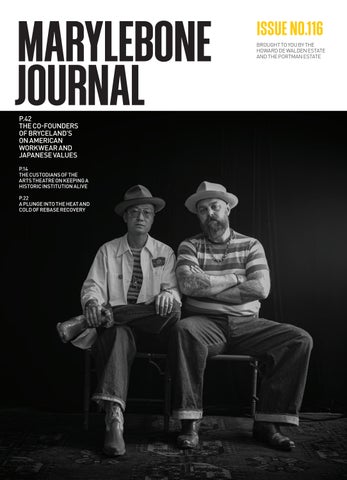
MARYLEBONE JOURNAL P.42 THE CO-FOUNDERS OF BRYCELAND’S ON AMERICAN WORKWEAR AND JAPANESE VALUES
P.14 THE CUSTODIANS OF THE ARTS THEATRE ON KEEPING A HISTORIC INSTITUTION ALIVE P.22 A PLUNGE INTO THE HEAT AND COLD OF REBASE RECOVERY
ISSUE NO.116 BROUGHT TO YOU BY THE HOWARD DE WALDEN ESTATE AND THE PORTMAN ESTATE
Keeping homes and businesses in the heart of London running safely and smoothly
24hr
0207 101 8151
themaryleboneplumbers.uk
Plumbing • Heating • Gas Bathrooms • Shower rooms Boiler installation / Breakdown / Repair Full Central Heating • Underfloor Heating
Cover: Kenji Cheung & Ethan Newton of Bryceland’s by Janet Wong
MARYLEBONE JOURNAL ISSUE NO.116 BROUGHT TO YOU BY THE HOWARD DE WALDEN ESTATE AND THE PORTMAN ESTATE Published September 2026
Marylebone Journal marylebonejournal.com Marylebone Village marylebonevillage.com Instagram: @marylebonevillage Portman Marylebone portmanmarylebone.com Instagram: @portmanmarylebone Publisher LSC Publishing lscpublishing.com Editor Mark Riddaway mark@lscpublishing.com Advertising sales Donna Earrey 020 7401 2772 donna@lscpublishing.com Contributors Jean-Paul Aubin-Parvu Lauren Bravo Ellie Costigan Orlando Gili Christopher L Proctor Viel Richardson Design and art direction Em-Project Limited mike@em-project.com Owned and supported by The Howard de Walden Estate 23 Queen Anne Street, W1G 9DL 020 7580 3163 hdwe.co.uk annette.shiel@hdwe.co.uk The Portman Estate 4th Floor, One Great Cumberland Place, W1H 7AL 020 7563 1400 portmanestate.co.uk rebecca.eckles@portmanestate.co.uk
3 HAPPENINGS IN MARYLEBONE
34 A CLOSER LOOK
8 Q&A: CRISTALLINA FISCHETTI
34 Q&A: SIMON PIOVESAN
Events, exhibitions, film, music, shopping, talks, theatre and walks
The multidisciplinary artist on sacred spaces, Dante Alighieri, and why meaning belongs to the viewer
The owner of 2Veneti on Venetian cuisine, the importance of a good house wine, and the secret to 20 years of success
14 IN PROFILE: LOUIS HARTSHORN & BRIAN HOOK
42 Q&A: KENJI CHEUNG & ETHAN NEWTON
The custodians of the Arts Theatre on the responsibility they feel for keeping a historic institution alive
22 ROAD TO RECOVERY
The Journal plunges into the heat and cold of Rebase Recovery and hears about the many benefits of recovery treatments
31 THE DIFFERENCE MAKERS
Jenny Peters, founding director of Connected Lives
1 — MARYLEBONE JOURNAL / ISSUE NO. 116
Food, style, home, wellbeing and healthcare
The Bryceland’s & Co co-founders on Japanese Americana, keeping their mothers happy, and why the best men’s style is still to come
56 ANATOMY OF A DESIGN
Designer Mattias Ståhlbom of TAF Architects on the Museum side table sold by Monocle
60 OZEMPIC ATHLETES
Exercise scientist Jon Denoris on a programme developed to mitigate the muscle loss caused by GLP‑1s
HAPPENINGS IN MARYLEBONE
HAPPENINGS IN MARYLEBONE EVENTS EXHIBITIONS FILM MUSIC SHOPPING TALKS THEATRE WALKS
1. Passing Weather by Norman Smith, Thompson’s Gallery 2. L inda May Han Oh, Wigmore Hall 3. S econd Law (detail) by Reijiro Wada, Daiwa AngloJapanese Foundation
3.
EXHIBITION
1.
EXHIBITION UNTIL 18 SEPTEMBER NORMAN SMITH Thompson’s Gallery 3 Seymour Place, W1H 5AZ thompsonsgallery.co.uk Norman Smith is an English painter celebrated for his atmospheric landscapes and expressive use of colour. Working primarily in pastel and oil, he captures the shifting moods of the natural world, from coastal light and open skies to quiet, fleeting moments in the countryside. THEATRE UNTIL 19 SEPTEMBER CATS Regent’s Park Open Air Theatre Regent’s Park, NW1 4NU openairtheatre.com This new production of Andrew Lloyd Webber’s megamusical leaps into the open air of Regent’s Park. Based on TS Eliot’s Old Possum’s Book of Practical Cats, its legendary score features Old Deuteronomy, Macavity: The Mystery Cat and the chart‑topping hit Memory. 3 — MARYLEBONE JOURNAL / ISSUE NO. 116
The second law of thermodynamics holds that the universe tends towards disorder. All structures disintegrate and no system can withstand the flow of time. Inspired by this law, Berlin-based Japanese artist Reijiro Wada explores how, despite the chaotic cosmos, life can still give rise to things that are both beautiful and profound. UNTIL 24 SEPTEMBER REIJIRO WADA: SECOND LAW Daiwa Anglo-Japanese Foundation 13/14 Cornwall Terrace, NW1 4QP dajf.org.uk
2.
MUSIC 21 SEPTEMBER, 7.30pm LINDA MAY HAN OH & MELISSA ALDANA Wigmore Hall 36 Wigmore Street, W1U 2BP wigmore-hall.org.uk
OPERA 22 SEPTEMBER, 7pm HELP MUSICIANS: A NIGHT AT THE OPERA Bechstein Hall 22 Wigmore Street, W1U 2RH bechsteinhall.com
Grammy Award-winning Linda May Han Oh, a New York-based Australian jazz bassist and composer, is joined by Chilean-born tenor saxophonist Melissa Aldana, to perform her rhythmically complex, melodically enchanting music.
This fundraising event is in aid of the Help Musicians charity, which supports up-andcoming musicians. Performed by a cast of outstanding singers, including soprano Sophie Bevan, the programme features a rich selection of arias, duets and ensembles.
MUSIC 22 & 23 SEPTEMBER, 7pm ECHO & THE BUNNYMEN Regent’s Park Open Air Theatre Regent’s Park, NW1 4NU openairtheatre.com Post-punk pioneers Echo & The Bunnymen have been creating transcendent pop music since the late-1980s, transitioning from cult heroes to mainstream success and back again. This intimate open‑air performance provides a perfect setting for their timeless tunes.
HAPPENINGS IN MARYLEBONE
MUSIC
Pianist Saskia Giorgini explores the beauty and refinement of Belle Époque Paris in a programme that includes miniatures by Mel Bonis and Lili Boulanger and closes with L’isle joyeuse, Debussy’s evocation of Aegean warmth and colour. 30 SEPTEMBER, 1pm SASKIA GIORGINI Wigmore Hall 36 Wigmore Street, W1U 2BP wigmore-hall.org.uk
1.
MUSIC 24 SEPTEMBER, 7pm JAMES PEARSON: HISTORY OF JAZZ PIANO Bechstein Hall 22 Wigmore Street, W1U 2RH bechsteinhall.com
MUSIC 25 SEPTEMBER, 1pm ACADEMY WIND AND BRASS ENSEMBLE Royal Academy of Music Marylebone Road, NW1 5HT ram.ac.uk
Pianist, composer and Ronnie Scott’s artistic director James Pearson and his trio of worldclass musicians bring to life the music and stories behind the historic evolution of jazz piano, from ragtime and stride to boogie woogie and big band.
International soloist and professor in residence Jeroen Berwaerts presents a programme including Ole Schmidt’s humorous tribute to Igor Stravinsky and Finnish composer Magnus Lindberg’s brooding Gran Duo, a dialogue between woodwind and brass.
4 — MARYLEBONE JOURNAL / ISSUE NO. 116
MUSIC 25 SEPTEMBER, 7pm DOVES Regent’s Park Open Air Theatre Regent’s Park, NW1 4NU openairtheatre.com Doves took off in 2000 with their Mercury-nominated debut, Lost Souls, and followed it with five massive albums in just five years. After a long hiatus they’re back making propulsive, chiming guitar music once again, perfect for a September sunset in Regent’s Park.
2.
HAPPENINGS IN MARYLEBONE
1. Saskia Giorgini, Wigmore Hall 2. James Pearson, Bechstein Hall 3. Thomas Adès, Wigmore Hall 4. Mirrors, The Cockpit 5. Unfurl (2026) by Aliyah Hussain, Mandy Zhang Art
5.
4.
THEATRE
Written as an intimate conversation, this contemporary Greek play by Ada Tsesmeli Edwards explores the inner landscapes of women whose voices have been muted, distorted or dismissed – sometimes by others, sometimes by themselves.
MUSIC 26 SEPTEMBER, 7.30pm THOMAS ADÈS Wigmore Hall 36 Wigmore Street, W1U 2BP wigmore-hall.org.uk The great Thomas Adès kicks off a three-concert Wigmore Hall residency with a programme of music by Bartók, Beethoven, Haydn and more, which explores the art of variation and musical reflection, the latter infused in his own Vesper, dedicated to the memory of Henry Purcell. 5 — MARYLEBONE JOURNAL / ISSUE NO. 116
25 SEPTEMBER, 7pm MIRRORS The Cockpit Gateforth Street, NW8 8EH thecockpit.org.uk
3.
EXHIBITION UNTIL 3 OCTOBER HEYO LEE & ALIYAH HUSSAIN: THE THINGS WE HOLD DEAR Mandy Zhang Art 16 Seymour Place, W1H 7NG mandyzhang.art Paintings by Korean artist Heyo Lee and ceramic sculptures by British artist Aliyah Hussain come together in a thoughtful exploration of the everyday. Through still lifes, botanical forms and imagined landscapes, they celebrate the quiet beauty of familiar objects. MUSIC 4 OCTOBER, 12pm RESOUNDING SHORES: HERE THE DEITIES APPROVE Royal Academy of Music Marylebone Road, NW1 5HT ram.ac.uk Henry Purcell’s sacred works are paired with those of his predecessors Gibbons and Purcell, offering a rich portrait of church music in transition. A striking example of his modern flair is ‘Welcome to all the pleasures’, featuring one of his most extraordinary overtures.
HAPPENINGS IN MARYLEBONE
1.
MUSIC 6 OCTOBER, 7.30pm LEONKORO QUARTET Wigmore Hall 36 Wigmore Street, W1U 2BP wigmore-hall.org.uk The performance by the exciting, Berlin-based Leonkoro Quartet, winners of the first prize at the 2022 Wigmore Hall International String Quartet Competition, includes a new work by Finnish composer Sauli Zinovjev, as well as Schubert’s Rosamunde Quartet. MUSIC 9 OCTOBER, 7.30pm ACADEMY JAZZ ORCHESTRA WITH GARETH LOCKRANE Royal Academy of Music Marylebone Road, NW1 5HT ram.ac.uk The Academy Jazz Orchestra presents a double bill featuring selections from Gareth Lockrane’s recent album Box of Tricks and a celebration of the late composer and arranger Jim McNeely, a deeply creative voice in contemporary music. MUSIC 13 OCTOBER, 7.30pm JAMES NEWBY Wigmore Hall 36 Wigmore Street, W1U 2BP wigmore-hall.org.uk Franz Schubert’s enduring friendship with Austrian baritone Johann Michael Vogl inspired some of the composer’s greatest songs. Accompanied by pianist Joseph Middleton, James Newby presents a programme exploring the enduring legacy of their collaboration. 6 — MARYLEBONE JOURNAL / ISSUE NO. 116
2.
EXHIBITION
JoyBeam Art Collective brings together five UK‑based female artists whose work is united by a shared theme: the flower. Ranging from lyrical landscape interpretations to bold, playful compositions, each artist offers their own distinct visual language shaped by nature, design and lived experience. 2 – 8 OCTOBER JOYBEAM ART COLLECTIVE: FLORAL STORIES 67 York Street Gallery 67A York Street, W1H 1QB 67yorkstreetgallery.com
3.
EXHIBITION UNTIL 25 OCTOBER THE WALLACE COLLECTION AT WAR The Wallace Collection Manchester Square, W1U 3BN wallacecollection.org
MUSIC 28 OCTOBER, 7.30pm RÊVERIE: THE LIFE AND LOVES OF CLAUDE DEBUSSY Wigmore Hall 36 Wigmore Street, W1U 2BP wigmore-hall.org.uk
During World War II, The Wallace Collection staged exhibitions designed to galvanise public opinion and strengthen ties with allies, including the Soviet Union. This free display explores how Hertford House became a forum for cultural diplomacy.
Compiled and scripted by pianist Lucy Parham and narrated by Simon Russell Beale, this intimate portrait of Claude Debussy follows the composer from his initial success in the 1880s to his untimely death in 1918, punctuated by music from his solo piano works.
4.
HAPPENINGS IN MARYLEBONE
THEATRE
Mark Rylance returns to the Marylebone Theatre to star in a new version of Moliere’s classic comedy Tartuffe. Written and directed by Darren Raymond, it is set in a Nigerian‑Jamaican household in modern England and delivered in rhyming couplets, bringing new humour and pathos to the original text. UNTIL 24 OCTOBER TARTUFFE (REMIXED) Marylebone Theatre 35 Park Road, NW1 6XT marylebonetheatre.com
1. Ian Shaw, Bechstein Hall 2. Joybeam Collective, 67 York Street Gallery 3. Tartuffe (Remixed), Marylebone Theatre 4. Leonkoro Quartet, Wigmore Hall 5. 25 Years of Progress exhibition poster, The Wallace Collection
5. 7 — MARYLEBONE JOURNAL / ISSUE NO. 116
MUSIC 29 OCTOBER, 7pm IAN SHAW: ELTON, BOWIE, RANDY, RAY & ME Bechstein Hall 22 Wigmore Street, W1U 2RH bechsteinhall.com
EXHIBITION 9 – 30 OCTOBER ANNIE TREVORAH: THE DWELLING The White Box at Nobu Hotel 22 Portman Square, W1H 7BG nobuhotels.com
Singer, pianist and broadcaster Ian Shaw celebrates his childhood musical heroes. Weaving in tales of growing up with music, discovering London’s Soho and travelling the world, he performs songs by Elton John, David Bowie, Randy Newman and Ray Charles.
Presented by Mandy Zhang Art, this solo exhibition by British artist Annie Trevorah transforms The White Box art space at Nobu Hotel London Portman Square into a dreamlike rainforest, drawing on classical mythology and strange biomorphic forms.
HAPPENINGS IN MARYLEBONE
Q&A: CRISTALLINA FISCHETTI The multidisciplinary artist on sacred spaces, Dante Alighieri, and why meaning belongs to the viewer Interview: Ellie Costigan
Q: You’re exhibiting at St Marylebone Parish Church for the second time. What draws you back to that space? A: I was born and raised in Marylebone and although I now live in the Cotswolds, I’m in Marylebone and Mayfair most days of the week. It still feels like home. Showing work in a church rather than a gallery feels very natural to me. When I was doing my master’s at Chelsea, we were encouraged to explore alternative spaces and different ways of hanging work. My practice deals with both the physical world and the non‑physical, the etheric world. The church is a wonderful environment for that. I also love the community there. You have people from all walks of life passing through. It sits between the GP surgery, the counselling rooms and the chapel, so it becomes this threshold space where people pause, reflect, meditate or simply pass through. Q: What inspired La Divina Commedia? A: I’m Italian and British, with Colombian roots, and I grew up attending Italian school alongside
2.
1.
3. 8 — MARYLEBONE JOURNAL / ISSUE NO. 116
my English education. Dante Alighieri was always present – he’s considered the father of the Italian language. This project is a nod to Italy, to my love of drama and to the three realms Dante explores: Inferno, Purgatory and Paradise. A lot of my work deals with the hero’s journey – transformation, travelling, inner reflection. After my previous major project, Alchemea, which explored alchemy, it felt apt to continue working with themes of transition. My interpretation isn’t literal, it’s not an illustrative retelling of the poems. It’s my own response to each realm. Q: How did you render the realms in a visual form without being too literal? A: I was very careful not to go too deep into the metaphysical aspects of each one. I wanted to honour Dante without becoming consumed by the symbolism. I read multiple versions of the text – Italian, English, even a children’s copy – and I looked at Gustave Doré’s illustrations. I imagined myself stepping briefly into each realm, then swiftly escaping. I also knew from the beginning
HAPPENINGS IN MARYLEBONE
that each realm would have its own metal: bronze for Inferno, silver for Purgatory, gold for Paradise. So I started with colour and material. Q: How much research did you do before you started painting? A: I have a huge vintage copy of The Divine Comedy – it weighs about nine kilos – and I read it at our family home just outside Rome. When I’m researching, everything becomes connected. I’d go to a bar in Rome and see a Dante quote above the counter; I’d visit museums and galleries and find echoes of the themes everywhere. My ancestor, the artist Fedele Fischetti, also dealt with esoteric subjects like ascension, descent and celestial guidance, so I felt very aligned with him during this process. I’m known for my enormous sketchbooks. They’re like portable talismans. They contain drawings, receipts, notes, printouts, anything I witness or collect. Most of the research happened in Italy, and then the work was manifested in my studio in the Cotswolds. Q: Was the process organic, or did you work from a strict plan? A: Both. I set a clear plan: two or three months of research, then two or three months of production. But within that structure there’s space for reflection, tweaking and responding to what emerges. I also leave clues on Instagram before announcing a project. During this one, I was playing Monopoly with my family in Rome and landed on Piazza Dante. I photographed it and posted it. Everything becomes part of the process. Q: Your work mixes abstraction, symbolism and layered materials. How has your style evolved? A: It really developed during the pandemic. I spent the first lockdown in Mexico, thinking a lot about intimacy and the idea of home. When I returned to my London 9 — MARYLEBONE JOURNAL / ISSUE NO. 116
studio, I started experimenting with bed sheets as material – washed, dried, soaked in acrylic, oil, varnish and botanical dyes I made myself. My studio became an alchemical laboratory. I was inspired by artists who used unconventional materials: Carla Accardi, Anselm Kiefer, Sam Gilliam, David Hammons. They elevate the discarded. That resonated with me deeply. Q: How has that translated to La Divina Commedia? A: Inferno is bronze: heavy drapery, flashes of luminosity, glitter, plastic. Imposing but still beautiful – something a collector would want to live with. Purgatory is silver: packaging paper, graphite, gestural marks, circular wiring representing entrapment and the desire to escape. It sits between darkness and light. Paradise is gold: gold leaf, fluorescent colour, blue emulsion, drapery from a second‑hand shop, gold string symbolising fate and free will. There are words from Dante written in graphite beneath the layers. Each realm also has accompanying works on paper, created meditatively on the studio floor. Q: How do you think about the viewer’s experience? A: I’m very respectful of the viewer, whatever their background or understanding. Engagement is important – guided tours, written interpretations. But I never force my intention on anyone. Abstract work allows people to bring their own stories. Some viewers have been moved to tears; others see memories or personal transformations reflected back at them. Once the work is finished, it belongs to the public. Like musicians say: the song becomes the listener’s. 8 – 14 OCTOBER LA DIVINA COMMEDIA St Marylebone Art Space 17 Marylebone Road, NW1 5LT stmarylebone.org
1. Purgatorio I by Cristallina Fischetti, St Marylebone Art Space 2. Cristallina Fischetti 3. Cristallina Fischetti and Paradiso 4. Resounding Shores, A Play of Passion, Royal Academy of Music
4.
THEATRE 22 – 31 OCTOBER SPACE HAMLET The Cockpit Gateforth Street, NW8 8EH thecockpit.org.uk It’s Shakespeare in space, with Muppet-like aliens running amok. In this glam‑rock comedy, featuring eight actors and countless puppets, the Bard’s tragedy gets blasted into orbit, accompanied by Norse gods, gladiator pits, space misfits and a golden robot. MUSIC 1 NOVEMBER, 12pm RESOUNDING SHORES: A PLAY OF PASSION Royal Academy of Music Marylebone Road, NW1 5HT ram.ac.uk The opening of Walter Raleigh’s poem A Hymn (“What is our life? The play of passion. / Our mirth? The music of division.”) provide the inspiration for a programme featuring two English Renaissance composers, Orlando Gibbons and John Dowland.
HAPPENINGS IN MARYLEBONE
EXHIBITION 20 OCTOBER – 6 NOVEMBER JANE PRICE & JAMES TWEEDIE: FIELD DAYS Thompson’s Gallery 3 Seymour Place, W1H 5AZ thompsonsgallery.co.uk
MUSIC 6 NOVEMBER, 6.30pm A JOHN WALLACE CELEBRATION Royal Academy of Music Marylebone Road, NW1 5HT ram.ac.uk
Two acclaimed British painters explore the landscape in distinct but complementary ways. Jane Price’s work is driven by atmosphere and intuitive response to nature, while James Tweedie captures familiar scenes with a subtly imaginative edge.
Academy Symphonic Brass celebrates Scottish trumpeter and composer John Wallace, the Academy’s head of brass from 1992 to 2002. The programme includes The Invisible Symphony, Wallace’s reimagining of Gabrieli’s Canzoni et Sonate (1615).
1. 10 — MARYLEBONE JOURNAL / ISSUE NO. 116
EXHIBITION 8 OCTOBER – 7 NOVEMBER REVISITING: FERNWEH, OR NOSTALGIA FOR UNKNOWN LANDS The Hellenic Centre 16-18 Paddington Street, W1U 5AS helleniccentre.org Borrowing its title from the German word for a longing for distant places – this exhibition gathers 17 artworks, from the 18th to the 21st century, which explore Greece both as a place and an idea.
1. Raise (2024) by Meiro Koizumi, Daiwa Anglo-Japanese Foundation 2. Merry Marylebone Christmas Lights 3. 0 41 (Sea Foam) by Andreas Gefeller, Atlas Gallery 4. Silent Language 13 by Jane Price, Thompson’s Gallery
HAPPENINGS IN MARYLEBONE
MUSIC 10 NOVEMBER, 11.15am AUTUMN PIANO FESTIVAL Royal Academy of Music Marylebone Road, NW1 5HT ram.ac.uk In 1926, Henry Wood invited a 72-year-old Leoš Janáček to visit the Royal Academy of Music. A century later, this day-long festival celebrates the composer’s passionate, utterly original output for pianists, including solo, chamber duo and ensemble pieces.
3.
4.
MUSIC 12 NOVEMBER, 7pm KARIM SAID Bechstein Hall 22 Wigmore Street, W1U 2RH bechsteinhall.com
2.
EXHIBITION
EVENT
In this solo show, Meiro Koizumi, one of Japan’s most prominent contemporary artists and a co-winner of the 2021 Artes Mundi Prize, uses video, sculpture and drawing to explore his idea of the automated human – a person who acts unconsciously, as if deprived of free will.
Marylebone Village’s festive season kicks off with the annual Merry Marylebone Christmas lights switch on. For the afternoon and evening Marylebone High Street and much of the surrounding area will be pedestrianised to make way for live music, food and drink stalls, Santa’s grotto, and charity fundraising for Evelina London Children’s Hospital Charity. Retailers and restaurants will be offering promotions, experiences, gifts and special menus.
1 OCTOBER – 20 NOVEMBER MEIRO KOIZUMI: SPIRIT OF AUTOMATISM Daiwa Anglo-Japanese Foundation 13/14 Cornwall Terrace, NW1 4QP dajf.org.uk
11 — MARYLEBONE JOURNAL / ISSUE NO. 116
11 NOVEMBER, 3-8pm MERRY MARYLEBONE CHRISTMAS LIGHTS & SHOPPING EVENT Marylebone Village marylebonevillage.com
For the intimate performance, internationally acclaimed pianist and conductor Karim Said performs a solo piano programme featuring Schubert’s Four Impromptus, Brahms’ Rhapsody No. 1 in B minor, Op.79 and Liszt’s Après une lecture du Dante: Fantasia quasi Sonata. EXHIBITION 1 OCTOBER – 14 NOVEMBER ANDREAS GEFELLER Atlas Gallery 49 Dorset Street, W1U 7NF atlasgallery.com This exhibition by German photographer Andreas Gefeller, known for capturing urban and manmade spaces in ways that challenge our perceptions, includes new works, as well as a selection of images from his series The Other Side of Light, Supervisions and Aurora Urbanis. EXHIBITION 8 OCTOBER – 14 NOVEMBER MICHAEL GAO: SALT LAND Mandy Zhang Art 16 Seymour Place, W1H 7NG mandyzhang.art This solo exhibition by Chinese artist Michael Gao, known for his depictions of domesticated animals as counterpoints to human tension, presents a new series of paintings in which dogs inhabit the enigmatic world of Salt Land – a fictional landscape in which beauty and danger coexist.
HAPPENINGS IN MARYLEBONE
1. Toward Tor Bay, Summer by Katie Allen, Cube Gallery 2. Giorgos Ioannou, The Hellenic Centre 3. The Revolutionary Corps of Teenage Jesus by Glenn Brown, The Brown Collection
EXHIBITION
Through her paintings, Katie Allen seeks to create idealised landscapes – places of beauty, stillness and serenity, free from human interference. These imaginative landscapes are rooted in real places she has walked through and been moved by. 5 – 21 NOVEMBER KATIE ALLEN: ARCADIA Cube Gallery 16 Crawford Street, W1H 1BS cube-gallery.co.uk
2.
1.
THEATRE 2 – 22 NOVEMBER VOILA! THEATRE FESTIVAL The Cockpit Gateforth Street, NW8 8EH thecockpit.org.uk Returning for its 12th run, the Voila! Theatre festival presents boundary-pushing work from across the continent of Europe, bringing together a rich array of languages, ideas and influences to present a colourful tapestry of theatrical performances over a three‑week period. 12 — MARYLEBONE JOURNAL / ISSUE NO. 116
EXHIBITION 8 OCTOBER – 19 NOVEMBER GIORGOS IOANNOU: A DIFFERENT KIND OF POP The Hellenic Centre 16-18 Paddington Street, W1U 5AS helleniccentre.org Marking the centenary of his birth, this exhibition of work by the Greek painter Giorgos Ioannou focuses on the 1960s and 1970s, exploring the political undercurrents of a period shaped by the country’s military dictatorship.
EXHIBITION 11 – 27 NOVEMBER ROBERT KELSEY Thompson’s Gallery 3 Seymour Place, W1H 5AZ thompsonsgallery.co.uk
EXHIBITION FROM 25 SEPTEMBER FAIL WE MAY, SAIL WE MUST The Brown Collection 1 Bentinck Mews, W1U 2AF the-brown-collection.co.uk
Drawing inspiration from locations such as the Scottish islands, Cornwall and the Mediterranean, Robert Kelsey’s distinctive landscape paintings are widely celebrated for their luminous colour, expansive skies and beautifully observed coastlines.
This new show seeks to create dialogue between historic and contemporary works, spanning five centuries, with paintings, sculpture, drawings and prints from artists including Glenn Brown, Salvador Dalí, George Condo, Anthony Caro, Rebecca Warren, John Stezaker and Fiona Rae.
EXHIBITION UNTIL 29 NOVEMBER WINSTON CHURCHILL: THE PAINTER The Wallace Collection Manchester Square, W1U 3BN wallacecollection.org This retrospective of Churchill’s paintings is the first substantial UK exhibition devoted to his art since his death. Bringing together more than 50 works, it casts new light on a worldfamous figure who was defined by politics but sustained by a lifelong passion for painting.
3.
FOR BEAUTIFUL LIVING
8 8 M A R Y L E B O N E H I G H S T R E E T, L O N D O N W 1 W W W. C O L O G N E A N D C OT TO N . C O M
C&C_Marylebone_Ad(5.22).indd 1
13 — MARYLEBONE JOURNAL / ISSUE NO. 116
19/05/2022 12:07
IN PROFILE: LOUIS HARTSHORN & BRIAN HOOK
IN PROFILE
LOUIS HARTSHORN & BRIAN HOOK The custodians of the Arts Theatre on relocating to a temporary structure on a patch of ground beside Marble Arch, and the responsibility they feel for keeping a historic cultural institution alive Interview: Viel Richardson Images: Christopher L Proctor
14 — MARYLEBONE JOURNAL / ISSUE NO. 116
IN PROFILE: LOUIS HARTSHORN & BRIAN HOOK
Brian Hook (left) and Louis Hartshorn, co-founders of HH Productions
> 15 — MARYLEBONE JOURNAL / ISSUE NO. 116
IN PROFILE: LOUIS HARTSHORN & BRIAN HOOK
The patch of ground at the western end of Oxford Street has spent many years searching for an identity or, to be more precise, having other people search for one on its behalf. In 2017 it held a brief but successful outdoor theatre production of Five Guys Named Moe. In July 2021 it became the Marble Arch Mound, an artificial hill with a view over Hyde Park, the aim of which was to draw shoppers back to Oxford Street after the pandemic. For most of the time since the mound’s dismantling in early 2022, the site has largely been an empty patch of grass. This summer has been different. 16 — MARYLEBONE JOURNAL / ISSUE NO. 116
Very different. The space is now home to a thousand square metres of theatre. The Arts at Marble Arch. From the pavement, it has the settled look of a building that means to stay. However, looks can be deceiving. The whole structure is designed to come apart, be packed onto lorries, and rise again somewhere else: Swansea, if Swansea wants it, or Central Park, if New York can be convinced. It is, in a very literal sense, a touring theatre. Such inventiveness is in the DNA of the institution that built it. The Arts Theatre opened on Great Newport Street in April 1927
as a members-only club, a device that allowed it to stage plays that the Lord Chamberlain’s censors had refused to licence. Now, a century on from its birth, a hotel is being built above and around it, rendering the site unusable for three years. This presented Louis Hartshorn and Brian Hook, chief executive and chief creative officer of HH Productions, with a problem. What worried them most wasn’t the building. They knew the space would eventually be returned to them. It was the people, in whom the energy, experience and culture that makes up an institution lives.
IN PROFILE: LOUIS HARTSHORN & BRIAN HOOK
temporarily, on a curious patch of land right beside one of the capital’s historic landmarks.
They couldn’t accept that this temporary closure would destroy their company: the technicians, box office staff, front of house team, management. That a closeknit group of 50 or 60 people assembled over 16 years could be dispersed overnight. “We wanted to maintain the Arts Theatre’s spirit and the amazing team we’ve been working with for such a long time, and keep that group together,” Louis explains. So, after months of wakeful nights and endless meetings, they went to Westminster City Council with a request. What they wanted was permission to build a new theatre, 17 — MARYLEBONE JOURNAL / ISSUE NO. 116
A brand-new building has a thousand things it hasn’t yet learned about itself, and we didn’t want a brand‑new show discovering its own thousand things at the same time. Brian Hook
In 2010, three years into their working partnership, Louis and Brian had arrived at the Arts Theatre as producers, overseeing a successful run of The Blues Brothers. They followed this with Woody Sez, the Woody Guthrie musical. Things went well enough that they were asked if they wanted to get involved in running the space. They said yes. There was no single moment of revelation. They joined the staff, went on to become partners, and eventually launched what amounted to a management buyout. Two young friends who had turned up to produce a show were now in charge. The pair had known something of the venue’s history, but the full weight of its legacy took a little longer to sink in. The Arts gave London its first sight of Sartre’s existentialist theatre in 1946, with Alec Guinness as Garcin. It staged the English-language premiere of Waiting for Godot in 1955, directed by a 24-year-old Peter Hall, a production many credit with changing the direction of 20thcentury theatre. In 1957 it saw the world premiere of Jean Genet’s The Balcony, directed by Peter Zadeka – a production the author so disliked, he’s said to have showed up at rehearsals one day with a revolver. Harold Pinter’s The Caretaker opened in 1960, setting him on the path to a glittering career. Joe Orton’s Entertaining Mr Sloane arrived in 1964, and the theatre hosted an early experimental London season by Peter Hall’s newly formed Royal Shakespeare Company. It’s an almost matchless pedigree. “You don’t necessarily know all of the history,” Louis says, “but very quickly you learn the gravity of it.” Paired with this glitzy history, the foundations of what they’d > inherited amounted to something
IN PROFILE: LOUIS HARTSHORN & BRIAN HOOK
distinctly unglamorous: 350 seats. “This is a really important number,” Louis explains. “Below around 300 seats, funding a fully professional production stops making sense. The numbers simply don’t add up for investors. Much more and the opposite problem appears – people don’t want to gamble on an unknown work in a large house that has to be filled every night.” The Arts sits in the narrow band between the two. Big enough to produce a show properly, small enough to take chances. Shortly after taking operational control, the pair took the crucial step of opening a 60-seater studio on the first floor. Above the Arts, as it was known, gave the building somewhere a show could be seen before anyone had to decide whether it could, or should, fill 350 seats six nights a week. Brian calls the theatre “a rocket ship” – shows arrive, do their tenure, outgrow the building and leave, and in many ways the leaving is the point. This is a strange thing for a producer to boast about, given that the wisest commercial move is to find a hit and sit on it for years. “Clogging up a theatre with an open-ended run is a particular choice, but not one we are interested in making,” he explains. They want to launch plays, not ground them. The hugely successful Six, a retelling of the lives of the six wives of Henry VIII, is a case in point. It was a student production, then it went to Edinburgh, followed by a fournight trial at the Arts, which was extended to a few weeks. This run took it to the West End and eventually around the world. Similarly, Choir of Man travelled from the Edinburgh Fringe and the cruise-ship circuit through the Arts all the way to a Korean-language production in Seoul. There’s a point here that is easily missed. There are only two independent theatres left in the West End: the Arts and the Criterion. A very small number 18 — MARYLEBONE JOURNAL / ISSUE NO. 116
of people get to decide what a considerable number of people get to see, and for three years one of only two theatres not answerable to the board of a massive entertainment corporation was losing its building. Which is why, when Louis and Brian went to Westminster, they didn’t go simply as a business looking for temporary premises. “We went as a stakeholder in the theatre ecology,” Louis insists. The Society of London Theatre, the Theatres Trust and the council itself were all involved in the search for a site. Permission to build on the Marble Arch land came through in December 2025, and there were workers on site by April 2026. Behind that quick progress lay two years of planning, drawings, applications and meetings with everyone who had a stake in the space: Westminster council, The Portman Estate, the Marble Arch London business improvement district, the Mayor of London and the police. What was hardest part of the build, I ask. The answer is instant: “Power, water, toilets,” Brian says. “Not sexy, but if these aren’t working well you don’t have a functioning theatre.” Creating modern facilities in a place that had none of the essential utilities ready and waiting was always going to be a challenge, which is one of the reasons the pair chose Heathers as their opening show. It was a known quantity: a cult 80s film turned into a musical with a devoted following, a Broadway run behind it and a history of successfully opening in theatres elsewhere in the world. “A brand‑new building has a thousand things it hasn’t yet learned about itself,” Brian says, “and we didn’t want a brand-new show discovering its own thousand things at the same time.” Heathers would, they were sure, sell some tickets. “What we hadn’t allowed for was being sold out
Below around 300 seats, funding a fully professional production stops making sense. Much more and the opposite problem appears – you don’t want to gamble on an unknown work. Louis Hartshorn
WHAT’S ON? UNTIL 6 DECEMBER MILLION DOLLAR QUARTET In 1956, at a Memphis recording studio, Johnny Cash, Jerry Lee Lewis, Carl Perkins and Elvis Presley come together by pure chance for a jam session that will change the world. Featuring hit after hit, this Tony-nominated musical tells a story of friendship, rivalry and rock ’n’ roll. 10 DECEMBER – 14 FEBRUARY CHOIR OF MAN Set inside a pub called The Jungle, Choir of Man follows a group of nine drinkers who spend the night singing, dancing, and speaking about their lives. The show is a celebration of community, set to the music of Queen, Luther Vandross, Sia, Adele, Guns N’ Roses, Katy Perry and many more.
IN PROFILE: LOUIS HARTSHORN & BRIAN HOOK
> 19 — MARYLEBONE JOURNAL / ISSUE NO. 116
IN PROFILE: LOUIS HARTSHORN & BRIAN HOOK
from the first performance,” Brian says, smiling. “So in that sense the plan worked even better than we anticipated. There were no ‘quiet few days’ to see how the bar and ticketing systems worked, how people moved through the foyer or whether the queues for the toilets worked. We opened at full capacity and found out straight away!” While mildly problematic, this success mattered. Both Brian and Louis make the point that HH Productions is not a charity. The shows they produce have to pay back their investors. However, Brian rejects the word ‘commercial’
20 — MARYLEBONE JOURNAL / ISSUE NO. 116
as a description of what they do; he prefers ‘sustainable’. “The shows we choose aren’t only chosen because we love them or think they’ll succeed, but also by how much good we think they’ll put into the world. That is very important to us,” Brian explains. “But the art must pay for itself. We haven’t had a penny in grant money for this. It’s an investment that must be repaid, and I’m confident it will be.” Brian and Louis describe themselves as stakeholders in, rather than tenants of, the space that now hosts them. They believe that having come to somebody else’s patch, they should be expected to earn locals’ trust. “In practice that’s meant lighting and CCTV where there was neither, clearing litter outside the building and just being a positive presence,” Brian says. “Our police liaison has told me crime in the immediate area is down around 90 percent since construction began.” The planning process did bring some objections, with the economics of the project being of keen interest. However, The Arts at Marble Arch is a contributor to the London economy, not a drain on the public purse. Twenty years is a long time to spend working with the same person, and although each is capable of doing the other’s job, the responsibilities of the pair have settled. Brian finds the shows and builds the relationships; Louis works out how to make them happen. “What Louis does isn’t sexy or glamorous, but we simply couldn’t operate without it,” Brian says. “Beyond the legal and financial structure of our operations, he goes to licensing hearings, gives evidence to the mayoral committee, he was even talking with government on how theatre should respond to the pandemic.” Asked what Brian brings, Louis talks instead about how, in the middle of something stressful
and complicated, his friend still remembers to put people first. “You could call it the soft power aspects. Apart from his creative talents, he is wonderful at building relationships. He is a real people person, making sure that everyone we deal with feels seen and valued. It helps create a culture that is invaluable to us, as well as building strong partnerships with the people we work with.” The theatre is scheduled to close in the first half of 2028, but if asked to stay for longer, Brian says, they would agree in a heartbeat. That is a question for the future. What he and Louis have already achieved can be seen simply by looking around the building. Fifty to 60 jobs that would have gone have been saved. The soul of an institution is being maintained. When the time comes, the bolts will be undone and the theatre packed into lorries to be driven to Swansea or Seoul or a park in New York or nowhere at all. The ground will return to being a patch of grass at the end of Oxford Street. Overlooking it all will be Marble Arch itself, which in a pleasing historical echo, did not originate there either. John Nash initially designed it as a gateway to Buckingham Palace, then in 1851 it was dismantled, taken across London and re-erected on the corner it now occupies. Permanence comes in many forms and for many reasons. The Arts at Marble Arch is just the latest chapter in an institution’s storied history. Its permanence, in one way or another, is assured. What its future will look like is in the hands of two friends who arrived as young producers at an esteemed British institution and chose to become the latest leading players in a nearly century-long tale. THE ARTS AT MARBLE ARCH Marble Arch, W1H 7DX artsatmarblearch.com
New Collection
‘In the Garden’ Eight cultivated wallpaper designs inspired by National Trust gardens Order samples and a complimentary colourcard, or find your nearest stockist at littlegreene.com Colour Consultancy service available nationwide and online
Marylebone Showroom | 3 New Cavendish Street, Marylebone, London W1G 8UX T: 020 7935 8844 E: marylebone@thelittlegreene.com
littlegreene.com
ROAD TO RECOVERY
22 — MARYLEBONE JOURNAL / ISSUE NO. 116
ROAD TO RECOVERY
ROAD TO RECOVERY
The Journal plunges into the heat and cold of Rebase Recovery and hears from its co‑founder about the many benefits of building recovery treatments into your routine Words: Ellie Costigan Images: Louis Waite
> 23 — MARYLEBONE JOURNAL / ISSUE NO. 116
ROAD TO RECOVERY
My approach to wellbeing is pretty straightforward: eat ‘proper’ food – lots of plants, mostly cooked from scratch – and move regularly. I’ve used the same cleanser and moisturiser for a decade, and that’s about the extent of my beauty routine. To say I’m not into ‘wellness’ is an understatement. When cold-water swimming became a thing a few years ago and photos of grinning people in swimming costumes, fresh from dunking themselves in a lake at 6am, started appearing on my Instagram feed, my first thought was “sounds hideous” swiftly followed by “how smug”. I’d have stayed in passiveaggressive ignorance if, on a holiday to Copenhagen last year, a friend hadn’t suggested we give the saunafollowed-by-cold-plunge thing a go. I wasn’t exactly buzzing but she was insistent, knowing first-hand the sheer thrill of the experience. We found a last-minute slot at a sauna on the famed Kalvebod Brygge and I forced myself to keep an open mind. Costumes on, we sat in the heat overlooking Copenhagen’s beautiful harbour. The trick, my friend confided, is to let yourself get almost unbearably hot before you face the water. On the verge of passing out, I gingerly descended the steps into the harbour, misjudged the last one – or my ability to tread water – and plunged straight under. It knocked the wind out of me – and,
Most of our clients aren’t recovering from sport. They’re recovering from a working week. From screens, noise, deadlines and the constant low-grade stimulation.
24 — MARYLEBONE JOURNAL / ISSUE NO. 116
once I’d got my breath back, my scepticism. I even posted a smug Instagram picture. But jumping into fresh sea water with friends on holiday is one thing. Recreating that feeling in central London is quite another. Invited to try cryotherapy and the communal contrast baths at Rebase Recovery in Marylebone, I wasn’t entirely convinced the magic would translate. First, cryotherapy. Google’s explanation, involving the words “extremely low temperatures” and “freeze and destroy cells”, did little to alleviate my nerves. The friendly guy who greeted me and took me down for my session did, though, talking me through exactly what to expect, reassuring me that I could simply open the door and leave the chamber at any time and that he’d be there to check in. They even play your choice of music while you’re in. I opted for “something upbeat”, three minutes – the minimum being two, the maximum being five – and got the provided gear on: ear muffs, sports bra, shorts, socks and gloves. After taking my skin temperature (36C), he told me I could do anything I like while I’m in the chamber – dance, jump around. The cubicle is big enough to pace around. I opted to stand there awkwardly, occasionally returning a thumbs up through the glass (my face must’ve betrayed my nerves) while watching the temperature
gauge drop down to a terrifying -110C. That is until it got so cold my elbows and knees went stiff and I had to bend and extend them repeatedly for fear they’d stop moving entirely, forever. At one point it started to snow. Then it was over and I was back out, skin glowing, anxiety banished and feeling more than ready to take on the contrast baths – and anything else the day threw my way. My skin temperature had dropped to 21.5C, fear levels to zero. It’s what’s called, Rebase Recovery’s co-founder Waldo Ramsay explains, “a noradrenaline response – you feel a sharp lift in mood and alertness, alongside the effects on inflammation and perceived soreness.” On to the contrast baths. Remembering my friend’s advice, I headed for the sauna to thoroughly thaw out before the next cold plunge. “Our sauna has a red-light photobiomodulation panel built in,” Waldo tells me. He explains that this red light “drives circulation and the deep, unwinding effect people know from sauna culture.” I certainly felt incredibly at peace, sharing the sauna with one other lady and two men who I deduced from eavesdropping were work friends, and regulars at Rebase. A delightful way to catch up. I thought. Which is exactly the point. “A lot of recovery spaces are either clinical and slightly cold, or they’re a luxury destination you
ROAD TO RECOVERY
> 25 — MARYLEBONE JOURNAL / ISSUE NO. 116
ROAD TO RECOVERY
23-27 SEPTEMBER
MARYLEBONE VILLAGE WELLNESS WEEKENDER
This September, Marylebone Village launches its first Wellness Weekender – a five‑day programme of workshops, talks, fitness events and wellbeing experiences designed to make looking after yourself feel less like a chore and more like a lovely way to spend time locally. The weekend opens with The Metabolism Masterclass (23 September): a discussion centred on the science behind metabolic health and what can be done to optimise it. FT HTSI investigative wellness journalist Rebecca Newman will lead the conversation with Dr Federica Amati (ZOE; Imperial College London), Rhian Stephenson (Artah), Waldo Ramsay (Rebase Recovery) and Steve Mellor (AMP). The closing event, Nervous System Reset (27 September), brings together Dr Louise Newson (hormone health specialist), Nahid de Belgeonne (The Human Method), Clare Walter (Third Space) and Reshma Malde (John Bell & Croyden) to explore how stress, hormonal health, sleep and recovery shape modern wellbeing. Throughout the weekend, across Marylebone Village, many of the area’s gyms, wellness clinics and retailers are offering run clubs, complimentary consultations, yoga and recovery sessions, free trials and exclusive offers. And to fuel your exertions, the likes of Koibird Cafe, Delamina and Festok are serving limited‑edition drinks, dishes and menus alongside sensory‑led experiences. All proceeds from the headline talks support local mental health charity Allkind. Full programme and booking details: marylebonevillage.com
A lot of recovery spaces are either clinical and slightly cold, or they’re a luxury destination you visit twice a year as a treat. Neither is a daily habit.
26 — MARYLEBONE JOURNAL / ISSUE NO. 116
ROAD TO RECOVERY
visit twice a year as a treat. Neither is a daily habit,” says Waldo. Rebase seeks to turn that on its head. “We wanted something design-led – a space you’d want to be in, that was also social,” he continues. “Most wellness isolates you. You put on headphones, you avoid eye contact, you leave. We thought there was something better available: a place where the health thing and the seeing-your-friends thing are the same thing.” That social thread has been a fundaemntal part of Rebase from the start. Waldo and his friend and co-founder Alex Rebeiz began exploring therapies and practices together when Alex went through his own health issues. “That period is the whole origin of the business. It started partly because we were helping Alex rebuild his health and partly because it turned out to be a genuinely good way to spend time with a friend,” says Waldo. “We did everything from breathwork classes, sauna at the gym, cold swimming and ice baths, to hyperbaric oxygen sessions and cryotherapy.” Two things happened: they started to feel the benefits and they caught the buzz. “We realised we loved this as a way to hang out – time together that was away from toxins and temptations, that left us both better off than when we arrived.” Which is what they now want their clients to experience. “We want people to feel more relaxed from
the moment they arrive – their shoulders to drop and the pace of the street to be left behind. We want you to leave feeling better than when you got here. It sounds simple, but it’s what makes people come back – and coming back is where you get the benefits.” Much like most things that are good for you, consistency is key. The therapies, he says, only begin to support long-term wellbeing when they become a habit. “That’s why so much of our thinking went into the bits that don’t look like therapy: the space being somewhere you want to be; the social element, so it competes with going to the pub; being on a high street rather than somewhere you have to plan a journey to.” Education is also important. When you understand the benefits of what you’re doing and how it works, you’re far more likely to stick with it “and far better at judging what’s worth your time”. Part of that education is explaining why recovery is not only for hardcore sportspeople. “The biggest misconception is that recovery is for athletes, which puts off exactly the people who’d benefit most,” Waldo laments. “If you’re not training for something you assume there’s nothing here for you, when the office worker who hasn’t slept well in months has more to gain than the marathon runner.” Indeed, improved sleep is what clients report most often – which, as anyone who’s ever suffered with insomnia (or had
> 27 — MARYLEBONE JOURNAL / ISSUE NO. 116
ROAD TO RECOVERY
a child) knows, has a huge knockon effect on your overall wellbeing. “Improve someone’s sleep and their mood, training, patience and work all improve with it.” The same is true in reverse: chronic stress shows up in the body long before anyone calls it stress – poor recovery from exercise, injuries that linger, illness that keeps coming back. “People arrive at Rebase for a physical complaint far more often than a mental one, yet frequently the two aren’t distinguishable,” says Waldo. “Most of our clients aren’t recovering from sport. They’re recovering from a working week. From screens, noise, deadlines and the constant lowgrade stimulation that metropolitan life places on the central nervous system. That accumulates and if you never deliberately discharge it, it becomes your baseline. Which is why recovery for us is as much about the nervous system as the muscles.” It’s about creating space in the day where you’re not reachable, not scrolling, not producing anything. Whether that time is spent in the hyperbaric therapy chamber – a pressurised environment that causes “oxygen to dissolve directly into your blood plasma at levels high enough to reach tissue that red blood cells alone can struggle to serve” – in the sauna or in the cold baths matters less than the fact that it exists at all. If all of this sounds like a lot to navigate – or you’re after
28 — MARYLEBONE JOURNAL / ISSUE NO. 116
treatment for something specific – practitioners are on hand to offer guidance, as well as therapies like massage, lymphatic drainage, reflexology and osteopathy. It starts with a conversation about what you want to achieve. “We tend to frame it around four things: sleep, energy, focus and recovery,” Waldo explains. “Most people find that one of those matters more to them than the others. Someone might be sleeping badly. Someone else is training hard and wants to boost recovery time. Someone else is fine on paper but foggy by Wednesday afternoon. Once we know the goal, we work to build a protocol that serves it: which treatments, in what order and how often, because consistency matters far more than any single session.” It shouldn’t have to be a reward you’ve earned, or something you only do at breaking point. “People will happily spend an hour in the gym but feel guilty about an hour recovering, which is precisely backwards,” says Waldo. “Recovery gets bundled in with spa treatments and holidays – an indulgence for twice a year. That’s a misconception we’re directly trying to dismantle by buildings clubs in the heart of local communities.” With that in mind, Marylebone was the obvious pick for their first outpost: “It has that rare combination of people who live here, people who work here and a high street that still supports
independents,” he says. “It means it can be somewhere people drop into on the way home rather than plan a trip to.” In the same vein, Waldo and Alex have deliberately made Rebase somewhere you can access everything you need for recovery under one roof. Having tried out “everything London has to offer and a fair bit beyond”, a question surfaced: why isn’t there one place that brings everything together properly, in a space you’d actually want to spend time in? “That’s Rebase. A daily touch point – somewhere you come with friends or on your own to prioritise your mental and physical wellbeing.” Back to the communal contrast suite. Emboldened by the cryotherapy and fully warmed up by the sauna, I headed to my first ice bath. There are 10 in total, five each side of the room, which decrease in temperature – the warmest is 10-12C, the coldest 0-2C. It seemed sensible to start with the warmest and work my way down. With each came that same initial sensation of having the wind knocked out of you, followed by a rush of exhilaration and a strange sense of calm. I ended with what I thought was a rather impressive 60-second stint in the 0-2C. Apparently, I’m a convert. But not smug, I promise. REBASE RECOVERY 1a Vincent Street, W1U 4DA rebaserecovery.com
CELEBRATE THE BEST OF BRITISH SEASONAL DINING AT THE WINTER GAREN RESTAURANT Dine beneath the elegant palms of the iconic atrium, with leisurely lunches, traditional afternoon teas and glamorous dinners accompanied by live piano.
The Landmark London, 222 Marylebone Road, London, NW1 6JQ
THE WALLACE COLLECTION MANCHESTER SQUARE
GRANDIROSA 36 CHILTERN STREET
ANNA + NINA 54 CHILTERN STREET
EAT | DRINK | SHOP | STAY | EXPLORE
THE DIFFERENCE MAKERS
THE DIFFERENCE MAKERS
Introducing the people behind central London’s vital charities and community organisations: Jenny Peters, founding director of Connected Lives Interview: Jean-Paul Aubin-Parvu Images: Orlando Gili
31 — MARYLEBONE JOURNAL / ISSUE NO. 116
I used to be a social worker. As a social worker, you do a lot of good things. The problem is that while you spend a great deal of time supporting families, it all comes rather late on in the process. The longer I did the job, the more I came to believe that if we could provide support at an earlier stage, it would be better for all concerned. My husband is the rector of St Mary’s, Bryanston Square, and back in 2001 he offered us the use of its massive basement as a community space. We started off by launching a drop-in toddler group. Since 2002, we’ve probably seen around 5,000 parents and children go through the process with us. In the years that followed, we began to think about other ways we could provide support to local families, and in 2010 this led to us setting up Circle of Security parenting groups. Circle of Security is a global, evidence-based programme that aims to give parents the space they need to take a step back and think about what their child needs. Everyone wants to be a good parent, but without support it’s hard to conceive of what that even means. Through the use of attachment theory, which is a way of understanding relationships, we offer participants a ‘map’ for seeing and responding to their child’s emotional needs. We eventually started to deliver programmes in other areas of London too. Then, in 2019, we grew up and became a charity in our own right, Connected Lives. Our aim is to offer effective support to parents, partners, children and teens at the earliest possible stage in those key relationships, setting strong foundations that enable families to thrive. Our belief is that the better we equip people to understand their relationships, the easier it is to head off more complex and intractable problems later down the line. We run two parenting courses for parents and carers – those with children aged from zero to 11 are supported through our Circle of Security parenting group, while our Connected Teens programme is for parents and carers of 12 to 18-year-olds. For all parents, one
>
THE DIFFERENCE MAKERS
When people come to us, they’re doing the absolute best they can, but for whatever reason they’re feeling a bit stuck. Working in groups helps reduce the shame and blame.
32 — MARYLEBONE JOURNAL / ISSUE NO. 116
THE DIFFERENCE MAKERS
of the biggest problems is behaviour they find confusing and upsetting. “Why would my child do that? Why are they so demanding? Why are they so naughty? Why are they so needy?” It can be truly perplexing. They might have one child who is relatively straightforward to parent and another with a totally different personality. “The things I did with my first child just don’t work with my second. What do I do?” We see people whose experience of parenting isn’t what they imagined it to be, or are worried that their child is not thriving in the way that they so desperately wanted them to. With the younger age groups, parents worry about why it all feels so difficult, whereas for parents of teens it tends to be more about conflict. Suddenly their child enters adolescence, and they don’t know how to respond to this new person. “Oh my gosh! What has happened to my child? They were this sweet, nice kid who liked to hang out with me. We were having such a great time.” We’ve all seen the statistics for teenage mental health, which I think makes parents more anxious. Perhaps 15 or 20 years ago a parent might have thought, well this is just a phase my teenager is going through. But these days, quite understandably, we do get very worried. When people come to us, they’re doing the absolute best they can, but for whatever reason – and it can be lots of different reasons – they’re feeling a bit stuck. Working in groups helps normalise the struggle: “Okay, it’s not just me. It’s not just my daughter who comes home, slams the door in my face and refuses to talk to me. Claire’s daughter also does it.” Anything we can do to reduce people’s feelings of shame and blame really helps. Then you can start asking the question, “Okay, so what does she need?” rather than being stuck on: “Oh my gosh! What’s wrong with me, or what’s wrong with her?” Connected Lives also supports couples. Our Relationship Foundation course is for people at the beginning of a committed relationship. Topics include communication, conflict, promises and expectations, and sex and intimacy. Then there’s Hold Me Tight, which is for couples who’ve been together longer. For some it’s like a relationship MOT, while others are looking for insights into why they’re feeling a bit stuck. 33 — MARYLEBONE JOURNAL / ISSUE NO. 116
Couples often get trapped in quite unhelpful patterns of response to each other. Essentially, they both want the same thing, which is to stay in a committed, loving relationship, but it can be very difficult to understand and express what that means. The truth is that relationships are complicated, and no two are the same. The Portman Estate has supported us for years, from when we started our first toddler groups, and they’ve recently provided a grant to help us continue our work in the Marylebone area. We still deliver a lot of our groups from the basement of St Mary’s, and we don’t charge Westminster residents anything for our parenting programmes, because we want everyone to be able to access them. The Portman grant means we can carry on running toddler groups and supporting local families. The money is fantastic, but it also gives us confidence in what we do. That feels incredible. What motivates me personally is knowing the difference that our charity makes to people. Part of my role as director is looking at evaluation and impact. We may think that what we’re doing is good, but is it really good? How do we quantify the effect we’re having? Post-course evaluations tell us some of what we need to know. Through our Circle of Security parenting groups, for example, high parental stress reduced from 64 to 18 percent by the end of the course and concern regarding child behaviour dropped from 78 to 22 percent. Parents’ confidence in their ability to see and meet their child’s needs rose from 17 to 97 percent and the proportion who felt they had a positive relationship with their child rose from 56 to 91 percent. You can see the shift. Because we’re a small charity, I still get to do lots of face-to-face work, running groups and working directly with families, so I get to witness first-hand the changes being made. I get to hear a parent say: “I wasn’t getting my kid into school, but now I’m taking charge and I’m doing it in a different way. And you know what? She was in school every day this week.” And ultimately, it’s those personal stories that make you feel that this is worth it. CONNECTED LIVES connectedlives.org.uk
A CLOSER LOOK FOOD
A CLOSER LOOK FOOD » 34 STYLE » 42 HOME » 56 WELLBEING » 58 HEALTHCARE » 60
FOOD »40
ANATOMY OF A DISH
Natalie TJ and Haydon Wong, co-founders of Cantoast Bakery, on a sweet-savoury Asian bake STYLE »42
Q&A
Kenji Cheung and Ethan Newton of Bryceland’s & Co on bringing Japanese Americana to Marylebone HOME »56
ANATOMY OF A DESIGN
Designer Mattias Ståhlbom of TAF Architects on the Museum side table sold by Monocle
34 — MARYLEBONE JOURNAL / ISSUE NO. 116
A CLOSER LOOK FOOD
Q&A: SIMON PIOVESAN The owner of 2Veneti on Venetian cuisine, the importance of a good house wine, and the secret to 20 years of success Interview: Ellie Costigan Images: Steven Joyce
Wigmore Street marks a very clear boundary: on one side, the madness of Oxford Street; on the other, the tranquillity of Marylebone. Standing like sentinels on the border are some age-old institutions: Wigmore Hall, John Bell and Croyden – and 2Veneti, which celebrates its 20th anniversary this year. Stepping into the restaurant transports you from a busy London street to a traditional trattoria: friendly, smartly dressed staff, white tablecloths, music low enough to properly talk over, and tables full of everyone from postwork pasta-and-wine regulars to families celebrating birthdays. It’s the kind of place that offers comfort in every sense – the food, the atmosphere and the reassuring knowledge that it’ll all be exactly as you remember it, every time. Simon Piovesan, owner and ever-generous host, shares the story behind it – the journey, the food and the enduring charm that keeps customers coming back year after year. Q: What’s your link to Italy? A: I’m half English and was born in England, but I grew up in Treviso, in a small town called Asolo on the hills just outside the city. I stayed there until I was about 14, then moved to Milan for school, which wasn’t the best period of my youth – I was much more into bars and nightlife. At 18 I joined the army, which is compulsory in Italy, and that straightened me out. I’ve always thought the old‑fashioned restaurant business is very similar to the military: precision, timing, cleanliness, hierarchy. I worked briefly in fashion because of my family, but I kept doing bar work at weekends. My grandfather was living in London, so I thought I’d spend a summer there, get a small job, get a bit of experience. I never went back – that was 30 years ago.
35 — MARYLEBONE JOURNAL / ISSUE NO. 116
>
A CLOSER LOOK FOOD
THE LIST
LUNCHBREAK LIFTERS
Summer’s over, you’re back at work and your holiday feels like a distant memory. Whether you’re after a bit of a treat to brighten your day, something filling but healthy to keep you fuelled or grabbing something to eat al desko, if you work in Marylebone you’re in luck – the lunchbreak options really couldn’t be better. Post-holiday blues banished on first bite.
Above: Simon Piovesan Right: The 2Veneti dining room
Q: How did you come to open a Venetian restaurant in London? A: Finding work in London wasn’t easy but eventually I landed a job at the Zilli Bar, owned by celebrity chef Aldo Zilli. I worked there for about seven years, starting as a bartender. Two and a half months later, the manager disappeared, and Aldo looked at me – I was only 21 – and said: “You’re the most qualified guy here. Would you like to run the place?” I had arrived six months earlier, and suddenly I was running a popular bar in the centre of town. I spent about five years there, burning the candle at both ends, enjoying the busy Soho lifestyle. 36 — MARYLEBONE JOURNAL / ISSUE NO. 116
Eventually I needed to slow down, so I moved into restaurants, joining Aldo at Zilli Fish. After that I left to run Spiga in Wardour Street – still one of the coolest restaurants, in my mind. Simple food, but done properly, like in Italy – along with the two other Spiga restaurants. After a restructure I moved to run Teca and I really got into wine. Then Stefan Frassoni, one of our suppliers, approached me about buying a struggling restaurant on Wigmore Street. Through credit cards, loan applications and help from family and friends, we managed to take it over. It was
doing badly, but we slowly built it up, from 10 customers a day to 100 by year three. We called it 2Veneti after us, the two Venetians. Q: You’re celebrating your 20th anniversary this year. How has 2Veneti evolved over time? A: I prefer traditional, family‑run Italian restaurants and dislike overly modern concepts, so it hasn’t changed dramatically. Italian food has remained essentially the same for 100 years. I think it should be served with tablecloths, Italian accents and generous portions; a three‑course meal and a bottle of wine. Business culture has
A CLOSER LOOK FOOD
Paul Rothe & Son A true Marylebone institution, Paul Rothe & Son has been in the same spot on Marylebone Lane for over a century. The original Paul Rothe emigrated to London from Germany at the turn of the 20th century, and the business has stayed in the same family ever since. Their made‑to‑order sandwiches remain some of the best you can buy – and they’re famous for their willingness to make just about any combination. If they have the ingredients and it’s what you want, you can have it. The soups are homemade and delicious, too – exactly what you want when the weather turns.
Good Life Eatery If you’ve got a particular dietary requirement and are sick of your options being limited, the menu at Good Life may be the answer. They have gluten-free, dairy-free, vegetarian and vegan options and everything is sugar-free – all while making it their mission to ensure each dish is delicious. Their all-day menu includes hearty breakfast options, big beautiful superfood salads, toasties and wraps, and more substantial ‘warm bowls’ like the ‘Bangkok banger’: Thai green curry with courgette, broccoli, sweet potato, sesame seeds and pickled chilli, with your choice of grain base and protein.
changed, though – people drink less at lunchtime now because they have to go back to work. In the early days, English businessmen would come in, have big meals, drink plenty of wine and settle their business at the table. Those were the great days of London! Q: What defines Venetian food? A: Veneto is a big region – we have the sea, hills, mountains – so dishes range from buttery, cheesy comfort food to simple seafood. Where I come from, in the hilly Prosecco area, we eat a lot of duck and game. One of our signature dishes is bigoli, which we serve two 37 — MARYLEBONE JOURNAL / ISSUE NO. 116
Farmer J Farmer J is one of those places you’d never heard of, then suddenly everyone was talking about – with queues to match. For good reason: the claim to serve ‘proper food’ is proven both in the sourcing and the eating. Everything is cooked on site using fresh produce, high‑welfare meat and responsibly sourced fish. The signature dish is the ‘fieldtray’: choose a base (a grain, salad or veg), a main (think green tahini chicken, charred flank steak or lime leaf tofu) and a side (Greek salad, ponzu sesame broccoli, mac and cheese). You’ll leave full, satisfied and without the need for an afternoon nap.
ways: Venetian style with anchovies, onion and white wine, and the Treviso way with duck and guinea fowl. Duck alone can be too gamey, so we mix it. It’s a slow‑cooked white ragù and one of our best sellers – my daughter’s favourite. Veneto cuisine also has a lot of pork and our menu reflected that at first, but some customers said they didn’t have enough choice, so we adapted. Over the years, though, as people travelled more, they began to understand regional food better, so we began to reintroduce more traditional specialities. You always have to teach your customers, but they are the ones who pay
Souli Food Souli Food is one of Marylebone’s most well-loved lunch spots, favoured for its generous, full‑flavoured sandwiches made fresh each morning – roast chicken with tarragon mayo, slow‑cooked beef brisket, tuna niçoise. There are bright salads like super greens or an excellent niçoise, good soups, and a handful of hot dishes that change with the seasons – beef brisket ciabatta, chicken Milanese, proper tuna melt. The drinks are special, too, with Mariage Frères tea direct from the Paris tea house, coffee from Sant’Eustachio Il Caffè in Rome and freshly squeezed juices made to order.
your wage. Compared to some competitors who say, “This is what we do and that’s it,” we still treat the restaurant as a service. If I can do something you ask for, within reason and while respecting Italian cuisine, I will. I draw the line at pasta with chicken and cream, but I’ll adapt where appropriate. Q: Keeping a restaurant going for 20 years is no mean feat. Have there been challenges? A: We’re a family‑run restaurant, owned by me and run with Giampiero, who leads the front of house, and Stefano, our head chef. Financially, we have to be careful.
>
A CLOSER LOOK FOOD
I’m still here washing glasses, cleaning toilets, serving customers – I’m very hands‑on. I’ve cut down my hours thanks to Giampiero, because being here in the evenings gets me into trouble – too many friends come to see me. Staffing is a major issue, though. Young people don’t understand why we work so hard for relatively little. They ask about days off and pay before anything else. But I think we have a good balance – we close on Sundays, because we want everyone to have at least one guaranteed day off. Most of our staff have been here six, seven, even 10 years. I prefer to keep the team Italian 38 — MARYLEBONE JOURNAL / ISSUE NO. 116
where possible – it helps maintain authenticity. Some restaurants train their staff so much they sound like robots. We prefer people who eat and drink and enjoy themselves. Q: Have you developed a loyal following over the years? A: We have customers who come and eat here three or four times a week. I know 90 percent of them by name, what they like, what they eat. It gets complicated sometimes, because two or three customers all want the same table, and then what do you do? You come up with excuses or give them free drinks. It puts pressure on us, but customers
appreciate that we go the extra mile. We all have our favourite customers and they will often ask after specific staff members. An American couple recently asked if I was new, because they visit once or twice a year and had never met me before! Q: Talk us through the menu – how often does it change and what are the staples? A: We change the menu at least four times a year. Mostly, we change what dishes come with: different vegetables, seasonal touches. We also add heartier dishes in winter, lighter ones in summer. But our iconic dishes stay: baccalà
A CLOSER LOOK FOOD
“Italian food has remained essentially the same for 100 years. I think it should be served with tablecloths, Italian accents and generous portions; a three‑course meal and a bottle of wine.”
39 — MARYLEBONE JOURNAL / ISSUE NO. 116
mantecato – whipped cod, spread on polenta. Sardines in saor, which is butterflied sardine marinated with vinegar, wine, onions, sultanas and pine nuts – it has that Middle Eastern influence that Venice still carries. Fritto misto is another Venetian staple, a mix of shellfish and fish in a light batter. We eat a lot of polenta and although ossobuco isn’t Venetian, we make a very good version. I was one of the first in London to start doing it. Pastas include the Venetian bigoli and tagliolini with crab. We alternate that with bunsera, which is very Venetian: cherry tomatoes, prawns and a rich bisque. All our gnocchi and pastas are homemade, and we change the gnocchi with the seasons: more cheese and truffle in winter, lighter in summer. We’ve become very famous for our liver. Venice is known for fegato alla veneziana, which is strips of liver floured and cooked in butter with onions and marsala. Years ago, I deconstructed it a bit because the traditional version is very rich. It’s our most‑sold main course. Desserts are iconic too. Our tiramisu is Treviso‑style but lighter. We assemble it to order, with biscuits soaked in coffee and a whipped mascarpone cream with plenty of marsala. It’s our most‑sold dessert. Then there’s chocolate salami – a northern Italian classic, like a chocolate ganache with broken biscuits, sliced like a log – and torta della nonna, filled with custard and pine nuts. Q: How important is the sourcing? A: Ingredients are everything. Our fish supplier has been the same for 15 years. They bring options every morning and the chef chooses. Sometimes the fish of the day changes three times because we sell out. We use Irish beef, which is unbeatable in my opinion. We complement everything with Italian products, but some things don’t make sense to import.
Q: Wine is also clearly a huge part of what you do. How do you curate the menu? A: At the beginning we served only wines from Veneto, but people wanted Barolo, Sassicaia, Tuscan wines, so we expanded to northern Italy while keeping a big Veneto influence. Veneto is a huge producer with very different styles depending on the area. My preferred wines – and my wife says I sound like an old man – are the old‑style ones aged in big barrels. Things have been done that way for hundreds of years, so there must be a reason. My importer, a very good friend, only supplies a few restaurants, so the wines I get from him are practically impossible to find elsewhere. I think it’s important that when you come to a restaurant you can drink something you won’t find anywhere else. We have a very good house wine from Verona, a soave. Wine has become expensive but sometimes restaurant pricing is stupid. Some wines here are expensive, of course, but much less so than in other places. I always say: start with a good house wine. If you don’t want anything in particular, drink my house wine. I’ve drunk hectolitres of it! Q: After celebrating 20 years here on Wigmore Street, what’s next for 2Veneti? A: We’ve renewed our lease for another 20 years and my intention is to stay here and look after my customers. A restaurant is forever for me – or at least until the main man pops off. People say, “Take away the tablecloths, modernise,” but we’ve been here two decades. We’re doing something right. So the plan is simple: keep doing what we do, keep our customers happy, stay alive, stay Venetian. 2VENETI 10 Wigmore Street, W1U 2RD 2veneti.com
A CLOSER LOOK FOOD
ANATOMY OF A DISH
CORN CRÈME SALT BREAD
Natalie TJ and Haydon Wong, co-founders of Cantoast Bakery, on a sweet-savoury Asian bake Interview: Ellie Costigan
In a nutshell Think of it like a salty, buttery roll – there’s a little block of butter in the middle and when it bakes, it melts and produces a crispy bottom. This version is filled with corn-infused cream. It sounds savoury, but it’s more on the sweet side. We finish it with a little corn cob on top. The inspiration Not a lot of places in London do salt bread: it originated in Japan and Korea, and we’re very much an Asian-inspired bakery. Corn crème is a very popular flavour in east and southeast Asia – in Hong Kong, where Haydon grew up, and Singapore, where Natalie is from. It’s used in both savoury and sweet dishes: corn soup and corn crème chicken in Hong Kong, corn ice cream in Singapore. A lot of Hong Kong and Singaporean customers have told us it’s very nostalgic. People come specifically for it. The purpose In Asia, especially among older generations, they like things that aren’t too sweet. We want an Asian aunty to come in here, try it and say: “It’s not bad,” which means it’s great! You could have it for breakfast or just as a snack with a coffee. Our corn milk matcha – made with corn, hand-whisked matcha and a little condensed milk – is perfect with it. That’s the best combination. 40 — MARYLEBONE JOURNAL / ISSUE NO. 116
The technique Everything is made on site, in our small kitchen. It starts with the dough, which isn’t your typical salt bread dough. A lot of them are quite simple, but we incorporate a poolish, which is similar to a sourdough starter. It helps with the flavour and the development of the gluten. It’s enriched with milk and we roll butter inside – a little bit like a croissant, although French people might hate me for saying that! Then there’s more butter on top, so it’s very indulgent. Often salt breads are on the crispy side, but we prefer a softer texture, which is characteristic of a lot of Asian breads. The corn crème is essentially a crème patisserie with corn blended in, which gives it a bit of sweetness. We finish it with rock salt, which adds a little kick and rounds out the flavour. It’s topped with some griddled corn for texture. The secret The most important part is understanding the dough. It’s difficult to control the kitchen environment – it gets very hot in summer and cold in winter – but the dough is a live organism and it needs to be kept cold. We use a lot of ice in the actual mix, so you can really control the proofing. That’s key. CANTOAST BAKERY 21–23 Nutford Place, W1H 5YH @cantoastbakery
A CLOSER LOOK FOOD
A GLASS APART
Trevor Gulliver, co-founder of St. JOHN, on the restaurant’s own Boulevard Napoléon Grenache Gris Interview: Viel Richardson
The Languedoc wine region of southern France is bigger than all of the vineyards of New Zealand, Canada, Australia and the UK put together. For most of the last century that scale was the problem: lots of wine was produced here to be blended or fortified into something else. Grenache gris, a grape native to the region, was part of that. Nobody was asking it to stand up on its own. We’ve been buying our own wine for St. JOHN since 1996, all of it French. And for 15 years or so we argued about Languedoc wine because it was obvious there were wonderful opportunities here. Then my friend Benjamin Darnault came back from making wine for Michel Chapoutier in Australia and started talking about us opening a winery. I kept saying no, not until we found the right place. The right place turned out to be a derelict medieval building in a village in the Languedoc, on the Boulevard Napoléon, which is where the wine got its name. In 2011 we made our first vintage. The parcels are old and they sit high. They used to be worked with donkeys, and they can still only be picked by hand. It takes real commitment to make it work. 41 — MARYLEBONE JOURNAL / ISSUE NO. 116
What people notice about this white wine is the salinity, which comes from the proximity to the Mediterranean, and the freshness, which comes from the altitude and the winds that arrive at night. This summer, it has been 45C up on the high hills, dropping to 20C overnight. That big swing is what builds the complexity, the phenolics, the flavour. There is no sweetness in Boulevard Napoléon. There is a citric edge, a hint of lemon. It is 14.5 percent, and that suprises people, which is rather the point. Drink it slightly chilled. It will get your juices going before a meal but it will also carry you through one. Chicken, meat, our tomatoes and courgettes, salads, some waxy potatoes. It will go with them all. Fergus first tried it when we were three vintages in. The wine was still in barrel and barely tasteable, and we hadn’t sold any as yet. Benjamin and I drew some off and stood well back. Fergus sniffed it, downed it in one and said: “Yes, that’s all right, then.” That reaction confirmed that our belief in the Languedoc had been right. ST. JOHN 98 Marylebone Lane, W1U 2QA stjohnrestaurant.com
A CLOSER LOOK STYLE
Kenji Cheung (left) and Ethan Newton, co-founders of Bryceland’s & Co
42 — MARYLEBONE JOURNAL / ISSUE NO. 116
A CLOSER LOOK STYLE
Q&A: KENJI CHEUNG & ETHAN NEWTON The Bryceland’s & Co co-founders on bringing Japanese Americana to Marylebone, keeping their mothers happy, and why the best men’s style is still to come Interview: Lauren Bravo Images: Janet Wong, Alex Natt
Q: Not every friendship can survive going into business together, but you’ve managed it for 10 years. How does your dynamic work? Ethan: Primarily I do everything creative, and Kenji does all the business, logistics and finance. I do all the fun stuff, and he makes sure I can do the fun stuff. But Kenji is also the muse for menswear – I design mostly for him. He has the ideal body shape for dressing, and he trusts me. We’ve done a lot of travelling around the world together, buying vintage, buying tailoring, looking at what’s going on in the market. So it’s a symbiotic relationship. It wouldn’t work if either of us weren’t involved. Q: Kenji, you’re pretty dapper for a numbers guy. Have you always loved getting dressed? Kenji: Growing up in Hong Kong, I really loved fashion and I wanted to study it, but my parents didn’t approve. So I picked very boring subjects and studied civil engineering at university. I still loved fashion, but until I met Ethan, I didn’t really know what suited me. I’d wear anything. Now I understand what I really like. Q: Ethan, how did you develop that eye for style? Ethan: Bryceland was my mother’s maiden name. She loves fashion and always pushed me in this direction. But I grew up in Sydney and I’m a working-class straight man, so there weren’t a lot of places for me in capital-F fashion. Instead, I focused on tailoring and the construction of garments, which is more of a trade, a craft. By chance, when I was 20, I moved to Japan and started working in the denim industry. I worked under Hidehiko Yamane, founder of cult brand Evisu, and became part of the second wave of denim mania in Japan. I got to understand the construction of denim and workwear, and all the history that goes with it. That’s what
43 — MARYLEBONE JOURNAL / ISSUE NO. 116
>
A CLOSER LOOK STYLE
I geek out on. Particularly early American workwear, which was built primarily by eastern-European immigrants who had been tailors in the old world. Everything old becomes new again. Q: Then Bryceland’s was born, with your first store in Tokyo. What do you love about the Japanese approach to fashion? Ethan: What rubbed off on me was the obsession with history, the obsession with details; things that felt a little more substantial than the whimsy of fashion. Our mission statement is a Japanese expression, “sanpo yoshi”, meaning to benefit 44 — MARYLEBONE JOURNAL / ISSUE NO. 116
in three directions. It’s a traditional merchant’s idea, that for an ecosystem to survive, everybody in the chain has to have some benefit – the consumer, the retailer and the manufacturer. Everyone has to be getting value out of what they do. Q: Did you think you could bring something new to the Japanese market? Ethan: I’m not typical Japanese proportions, I’m a big boy – but with the right tailoring, I can look pretty sharp. We wanted to do something with all the quality and the consideration of the Japanese industry, but made to fit the rest
of the world. The biggest shock you can give the average customer is tailoring that actually fits their body well. Q: You started with bespoke and made-to-order pieces before expanding into ready-to-wear. Is the patience to wait for good clothes a dying art? Ethan: You’d be surprised! A lot of my close friends are bespoke makers, and during Covid, even while their wait times went up, pretty much all of them saw business increase. People would come in saying: “It’s four years for a pair of shoes? I’d better order two pairs.”
A CLOSER LOOK STYLE
“Different markets have very different approaches. The Korean and Japanese customers tend to be a lot more knowledgeable about what they want, compared to the average guy in Australia who still thinks that wearing a pink shirt makes him gay.”
45 — MARYLEBONE JOURNAL / ISSUE NO. 116
Those customers tend to be the most difficult to deal with because they’re the most knowledgeable, and the most particular. But they help you become a little bit better at what you do. Q: Does your average customer know what he looks good in, or do they need a little help? Ethan: Different markets have very different approaches. The Korean and Japanese customers tend to be a lot more knowledgeable about what they want, compared to the average guy in Australia who still thinks that wearing a pink shirt makes him gay. There are the guys who say: “I can’t
make a decision until the boss gets here,” meaning their girlfriend or wife. Then there are guys who shop alone because they don’t want the distraction. We cater for them all! Q: Why are so many straight men still afraid of fashion? Is that changing? Ethan: Until the mid-1950s, most men learned how to dress from their father. They got their first jacket from their dad’s tailor, learned when to wear a blue blazer, how to tie a four-in-hand knot, all of that. It was top-down learning. Then youth culture came up and things > flipped, the spoken history of how
A CLOSER LOOK STYLE
46 — MARYLEBONE JOURNAL / ISSUE NO. 116
A CLOSER LOOK STYLE
“We intentionally use our stores as our office. I have a laptop at the counter and that’s where I work – so every customer who comes in, I get to talk to. If you buy into our brand, you become part of the team.”
to dress was severed, and men lost that thread. We’re trying to give the power back to every man, to say: “You can dress well! You don’t need to be afraid of colour or proportion. You can figure it out.” Q: One of your design goals is “creating timelessness without falling into costume”. How do we strike that balance when wearing vintage or vintageinspired clothes? Ethan: Don’t focus too much on any one period. I prefer to look at the archetypes of every era, choose the best in class, then put them together in a way that feels 47 — MARYLEBONE JOURNAL / ISSUE NO. 116
cohesive. You might have a 70s bootcut flare with a 50s t-shirt and a pair of 40s boots. It’s about subverting what you’re doing so that it looks fresh and new. Q: Was there a ‘best’ era for men’s style? Or is that era now? Ethan: I think we’re working towards the best era. We’re overcoming the worst period in clothing, which was the late-70s, 80s and 90s, when everything was about synthetic fibres. Kenji: There’s so much fast fashion now. I think customers need to do a lot of research. They can’t just buy trends. Fast fashion is damaging
the world. So if you know how to wear well, how to buy well, this is a good period. But if you don’t… wow, you’re wasting a lot of money and creating a lot of rubbish. I would rather invest in a good quality garment and wear it forever. Ethan: Every time you buy fast fashion, you’re wearing microplastics on your body that will never age well, will never get any better. Every season you’re becoming someone else instead of becoming more yourself. Creating Bryceland’s was about finding a better way of doing fashion retail. Not the sort of business that’s operating on high churn, instilling fear in the customer that they’re not going to be on-trend next season. We think of ourselves more as an outfitter, a provider of garments. There are a lot of brands that operate in the ‘fashion’ space; we’re trying to create a permanent wardrobe. Q: What do you have against logos? Ethan: After the 60s and 70s, the world got into this idea of style by association. It went from a logo meaning “you can trust this garment” to a logo being more important than the garment. Which makes no sense at all. If you really want to dress well, nobody should know where your clothes come from. Q: Tokyo, Hong Kong, Marylebone. With the world as your oyster, what led you to open your third store on Chiltern Street? Kenji: We did a lot of research. Before we opened the store we did three trunk shows in London, which we really enjoyed, and we could feel that we had acceptance from the market here. We’d been selling to the UK for a long time through our online store, but when you meet the customer in person for the first time, it’s like: “Wow, okay. We have an audience!” So we started looking around and
>
A CLOSER LOOK STYLE
years, and the best retail spaces have had a few things in common. They never went on sale, because sales suck. The teams were fun and interesting and happy, and the people in those teams were passionate about what clothing can mean. And our staff are all extensions of the brand. I think I’m a little too loose with the uniform budget because it makes me excited to see our teams wearing the clothing! And I try to encourage everyone to mess it up, chop off the sleeves, cut the hems or paint something on the front. Do it differently, because I want the perspective of other cool people wearing the clothes I design.
Marylebone was great, especially Chiltern Street, which has a very special vibe. It has class, and it’s about good living. We feel very lucky to have this space. Ethan: To me, Marylebone feels creative, it feels entrepreneurial. It’s full of small brands like us – not the big brands with LVMH backing, but little upstarts. There’s more to receive from that than something that’s perfectly polished and perfectly marketed, which can sometimes feel a bit soulless. Q: What other local hotspots do you head to when you’re in town? Kenji: My favourite shop on Chiltern 48 — MARYLEBONE JOURNAL / ISSUE NO. 116
Street is Niwaki, the Japanese knife and tool shop. It’s fascinating. I love The Ginger Pig, it’s the best butcher, and La Fromagerie is the best cheese shop in town, to my tastes. I love St. John, and Le Relais de Venise for entrecôte, and The Hart on the corner of Chiltern and Blandford Street. It’s so difficult to book a table, but the food is really good. Q: The Bryceland’s boutique is small but perfectly formed (and staffed by incredibly chic people). What do you want your retail experience to be like? Ethan: I’ve worked in retail for 29
Q: Should buying from a good brand feel like joining a community? Ethan: We intentionally use our stores as our office. I have a laptop at the counter and that’s where I work – so every customer who comes in, I get to talk to. If you buy into our brand, you become part of the team. And that’s something that should continue for the life of the garment. If someone has a question or needs an alteration, they should know they can always come back to us. If the garment has our label on it, then it’s our responsibility to do something with it. We made it, and we stand by it. Q: Kenji, how do your parents feel about your job now? Kenji: Oh, my mum wants to take credit! She has great taste, so she thinks this all comes from her genes. She’s very happy now. And so is my dad, who never thought we’d be successful. A few months ago I told him what our revenue was, and he was pretty surprised. We’re still a small business, but he couldn’t imagine that we would have come this far. BRYCELAND’S & CO 48 Chiltern Street, W1U 7QS brycelandsco.co.uk
A CLOSER LOOK STYLE
THE LOOK
QUANTUM LEAP Tania Hindmarch,
co‑founder of O Pioneers, on a skirt suit inspired by Mary Quant Interview: Ellie Costigan
We’d been talking to the Mary Quant team for a while when they approached us about a collaboration. They gave us access to part of the legendary British designer’s archive, which is housed in Japan. We went through everything and pulled out designs that had a real synergy with our style. In her 1960s heyday, Mary Quant was known for simple shapes and colours – the A‑line, the mod dress, block colours – but her archive is much broader than people realise. She worked with puff sleeves, romantic silhouettes and even Liberty prints, which we use for everything. When we found a Liberty print she’d used for a skirt suit worn by Jane Asher in the film Alfie, and realised it was still available, it felt like the perfect starting point. I just love the colours of this print. It’s a mixture of summery and autumnal tones: a dark green 50 — MARYLEBONE JOURNAL / ISSUE NO. 116
background with rich, almost tea‑stained cream, peachy pinks and daisy details. We picked out the pink in the piping and the pocket edges and lined the jacket in the same pink. The jacket itself is a short, boxy suit jacket – very wearable – with puff sleeves supported by a bit of structure in the shoulders to give that slightly exaggerated shape. It looks amazing as a suit with the mini skirt, but equally fab with jeans and a white t‑shirt. The mini skirt is a simple A‑line with patch pockets and the same pink piping. Both pieces are 100 percent cotton, so they’re comfortable and easy. What I like most is how versatile it is as an outfit: you can wear it with bare legs and sandals now, or tights, boots and a thin polo‑neck jumper in winter. It feels like a modern take on that sixties vibe without going full retro. O PIONEERS 76 Marylebone Lane, W1U 2PR opioneers.co.uk
A CLOSER LOOK STYLE
51 — MARYLEBONE JOURNAL / ISSUE NO. 116
A CLOSER LOOK STYLE
SIMPLE LINK BRACELET KASTUR JEWELS, £120 kasturjewels.com
CHECK SUIT JACKET SANDRO, £439 uk.sandro-paris.com
ROMY OVAL SUNGLASSES AGNES B, £195 agnesb.com
52 — MARYLEBONE JOURNAL / ISSUE NO. 116
POINT TOE FLAT ME + EM, £295 meandem.com
LIGHT BLUE SUEDE FLOWER HANDBAG FARM RIO, £354 farmrio.uk
CREW NECK CARDIGAN MARGARET HOWELL, £425 margarethowell.co.uk
RIHANI CREPE DE SOIE SILK TROUSERS JOSEPH, £495 joseph-fashion.com
STEP INTO A NEW ERA OF WELLBEING AT THE LANDMARK LONDON Welcome to an immersive escape that gently realigns, restores, and transforms, complemented by thoughtfully curated facilities and a collection of wellness experiences including: indulgent spa days, bespoke treatments and exclusive membership options.
Spa at The Landmark London | 222 Marylebone Road | London NW1 6JQ +44 (0) 20 7631 8000 | spa@thelandmark.co.uk
A CLOSER LOOK STYLE
THREE OF THE BEST
MEN’S TRANSITIONAL JACKETS Shackets are a solid answer to transitional dressing – smarter than a hoodie, more substantial than an overshirt. The average man’s reliable ‘fashionable’ go‑to, adding interest without much effort. And while we’ve nothing against them – Paul Smith on Marylebone High Street does a particularly good version (obviously) – there’s so much more in the way of men’s outerwear to explore. Here’s our pick of the best jackets for those beautiful but slightly annoying autumn days when it’s chilly in the morning, warm by lunch and you need something you can sling back on for a post‑work pint.
54 — MARYLEBONE JOURNAL / ISSUE NO. 116
1.
2.
3.
SUEDE LEATHER BOMBER JACKET SLOWEAR, £1,440 slowear.com
CULCROSS JAPANESE JACKET TRUNK CLOTHIERS, £465 trunkclothiers.com
APPLE SEERSUCKER CASUAL NEHRU JACKET SIRPLUS, £295 sirplus.co.uk
A suede bomber is the sort of jacket that only really leaves your wardrobe during this in-between season – that brief period of the year when it’s neither too warm nor too wet – but it’ll earn its keep forever. The shape and material never go out of style, and who understands leather better than the Italians, especially Italians who’ve been in the menswear game for decades? Slowear’s suede leather bomber carries that expertise in every detail: beautifully made, completely timeless.
Alongside niche international labels, Trunk Clothiers has its own small but perfectly formed line of wardrobe staples. The Culcross Japanese jacket is one of those pieces you’ll find yourself throwing on with just about everything – over your favourite tee for now, or a knit when the weather turns; dressed up with chinos or dressed down with denim. Made in Italy from Japanese nylon it’s lightweight, showerproof and folds up to slip in your bag easily, too.
Sirplus is known for its nehru jackets – casual tailoring with a neat mandarin collar (a short, stand‑up collar that looks smart but not too formal). This one’s cut in seersucker, so it’s lightweight, easy to wear and ideal for everyday Marylebone wandering. It does come in a dark navy, but we’re choosing to embrace the crisp‑autumn‑morning brightness of this jolly apple colourway. Save the navy for the wool version you’ll inevitably want once winter rolls around.
A CLOSER LOOK HOME
ANATOMY OF A DESIGN
MUSEUM SIDE TABLE Designer Mattias Ståhlbom of TAF Architects on a contemporary Swedish furniture piece sold at The Monocle Shop Interview: Viel Richardson
Requirement The design story began in 2019 with the NM&045 wall shelf we designed for Stockholm’s Nationalmuseum. This shelf was created to display carved busts from the museum’s collection in their restaurant, so it needed to be extremely strong. We also wanted it to be visually supportive of the objects displayed upon it. Later, we were invited by Svenskt Tenn, a high-end furniture company, to design a side table to sit alongside a new sofa they were exhibiting. We really liked the design of our Nationalmuseum wall shelf, so decided to produce a table that belonged to the same family. Structurally expressive, pragmatic and strong. A design that could support whatever was placed on it, both structurally and visually. Inspiration The inspiration came partly from the museum objects the original shelf was designed to
56 — MARYLEBONE JOURNAL / ISSUE NO. 116
A CLOSER LOOK HOME
support, but we also wanted the structure to communicate strength. That led us to look at the language of industrial construction, particularly T-beams and I-beams. These forms exist for a very clear reason: to carry weight. And because they’re so familiar, you intuitively associate them with strength. The I-beam became the central motif. It gave us a way of supporting the surface on a very slender stem. It was an elegant way of allowing the height to be adjusted. And it projected that sense of strength. Process We began by trying the oval top that we’d used for the wall shelf but quickly realised it was not the ideal shape, as placing books on it created awkward areas of unused space. Instead, we moved to a rectangular form. From there the process was very pragmatic. Because the stem sits off-centre, there are weight-bearing forces that are difficult to calculate precisely, so we worked closely with the engineers at String Furniture, making mock-ups, testing different proportions and adjusting the structure until we had the stability we needed. The height-adjustment mechanism also grew naturally from the shape of the I-beam, with a screw that locks the table at the required height. Getting that right took real precision. Even the thickness of the powder coating had to be calculated into the tolerances, because it slightly increases the dimensions of each component. What I particularly like about the finished table is the way it sounds and feels when you adjust it. There is something that makes you want to touch and engage with the object. Materials The main material is aluminium, which we really like because of its recyclability. It can be melted down and re-used repeatedly. It is also strong, lightweight and lends itself to the different manufacturing processes we needed to use. The table has cast and extruded components, which require slightly different 57 — MARYLEBONE JOURNAL / ISSUE NO. 116
aluminium alloys and produce subtly different surfaces. We love raw aluminium, but combining those finishes in a single object can make the components look mismatched, so a powder coating allowed us to bring everything together visually. This coating also has practical advantages. It provides a durable ceramiclike surface, strong enough to withstand the movement of the height-adjustment mechanism without scratching. The base plate is made of steel; because of the off-centre stem, we needed additional weight at the bottom to counterbalance the projecting tabletop. You don’t notice the material difference visually, but that extra mass gives the table the stability it needs. Philosophy We enjoy a pragmatic approach to design, in which the starting point is utility and the ambition is to make something that
will last for a very long time. Aesthetics are incredibly important: the proportions, the radius of a curve, the size of a platform – these are decisions that make an enormous difference, but they should grow from how an object works rather than being applied separately. We also want our designs to feel inclusive. The I-beam is useful in that sense because it is such a familiar form. With the table, you can see how to adjust the height just by looking at it, without somebody having to explain how it works, and its structure gives you confidence that it will support whatever you put on it. Ideally an object should make you feel that you were considered when it was designed – almost as though you’d been part of the design process yourself. THE MONOCLE SHOP 34 Chiltern Street, W1U 7QH monocle.com/shop
DEEP SLEEP
A CLOSER LOOK WELLBEING
GINGHAM EYE MASK THE WHITE COMPANY, £18 thewhitecompany.com
SENSORY POINT SLEEP OIL ANATOME, £28 anatome.co
58 — MARYLEBONE JOURNAL / ISSUE NO. 116
DEEP SLEEP BODY WHIP SPACE NK, £30 spacenk.com
DOSA RECTANGULAR PILLOW MOUKI MOU, £525 moukimou.com
INORA WAS IT ALL A DREAM? LIQUID SLEEP JOHN BELL & CROYDEN, £70 johnbellcroyden.co.uk
MEDALLION BED LINEN COLOGNE & COTTON, FROM £40 cologneandcotton.com
FEUILLE DE LAVANDE CANDLE DIPTYQUE, £37 diptyqueparis.com
A CLOSER LOOK HEALTHCARE
60 — MARYLEBONE JOURNAL / ISSUE NO. 116
A CLOSER LOOK HEALTHCARE
OZEMPIC ATHLETES
Jon Denoris, exercise scientist and founder of Club 51, on a programme developed to mitigate the muscle loss and other fitness problems caused by GLP‑1 prescriptions Interview: Mark Riddaway
Q: In simple terms how do GLP‑1s such as Ozempic and Wegovy actually work? A: They’re a type of peptide, which is one of the buzzwords of the moment but are far from new. Peptides have been used in healthcare for many years – insulin, for example, is a peptide – so this is just the latest application. Essentially, GLP-1s mimic the hormone that tells your brain you’re full. This hormone would normally be released after you’ve had a meal, but some people are not as efficient as others at producing it. GLP‑1s send a message to your brain telling it that you don’t need any more food. They also slow the speed at which food leaves the stomach, which adds to the feeling of fullness. And the third thing they do is help optimise the regulation of insulin. Initially, that’s what this class of peptides was being developed for – helping to control diabetes. Then, almost as a side effect, it was found to result in significant weight loss. 61 — MARYLEBONE JOURNAL / ISSUE NO. 116
The pharmaceutical industry then pivoted the medication towards a population group not initially intended to use the drug. Q: So, where does fitness training fit into the equation? A: The challenge is that the weight loss you experience with these medications isn’t selective. You’re going to lose body fat, yes, but you’re also going to lose the components of lean body mass, including muscle. That’s a big concern. It’s now well established that maintaining muscle mass is essential to our ability to age well and live a healthy, active life. Loss of muscle is one of the major side effects that everyone who’s prescribed these medications needs to be aware of. Inactivity is also a problem. A recent study found that some people actually move less once they start taking GLP-1s. Their step count drops. We don’t know why exactly – it may relate to how these medicines work on the receptor sites in the brain – but for many people the motivation to get up and move seems to be affected. If you’ve got someone who is overweight, losing some of that weight is clearly going to have medical benefits. But if as their bodyweight is coming down so too are their activity levels and muscle mass, that’s a short-term win but also a longer-term health problem waiting to rear its head. Q: What are you doing to help address this problem? A: We’ve developed a 12-week programme for people who’ve been prescribed GLP-1s. Like everything we do here, the programme is highly personalised. We’ll start by speaking to their physician and getting as much background and data from them as possible – things like blood work. We’ll sit down with the client and go through what their longer-term goals are, what comes after the GLPs. We’ll talk to them about their diet and how their
appetite is holding up, as no two people respond in the same way. Once we get started, our focus is on building muscle mass through full-body strength training. What that looks like will vary from person to person, but resistance training is always key. That means we also need to find ways to get enough protein into their diet. Protein is essential for building muscle, but getting enough protein is a challenge if you’ve got no appetite. Sometimes that can be shakes or drinks, alongside proteinrich foods. If we feel it necessary, the client will sit down with our performance nutritionist for more detailed advice. Q: Is energy an issue? Are these clients able to take on enough carbohydrates to train? A: What you have to remember is that the people who are taking these drugs are often coming from a place where they haven’t been doing much movement at all. As a result we’re not too concerned with carbohydrate availability. Longer term, naturally, the client’s goals will change. For example, once the weight has been lost, they may then decide to sign up for a longer endurance event; at this point advice on macronutrients becomes much more important – it’s ‘fuel for the work required’, if you like. Q: To what extent is your work informed by data and imaging? A: It’s vital. With these medicines, body composition can change in quick and unpredictable ways, so it’s important that we’re never just guessing. Using our ultrasound machines, we can see – and, just as importantly, they can see – how much muscle our clients have got at various sites around the body. We can track that over time as we build it up, and we can present it back to their healthcare provider or physician. Allied to that, we also have some clever kit in the studio that can measure strength
>
A CLOSER LOOK HEALTHCARE
levels, so we’re tracking both the size of the muscles and the power they can generate. We’ll also track metabolic health and aerobic fitness. The whole programme is very data driven. Q: Have you seen any notable successes so far? A: We have one client who, over a focused four to five-month period, saw outstanding results across every key metric. Their body fat percentage dropped from 26 percent, which is often classified as obese, to 20 percent – comfortably within the acceptable range. Fat mass accounted for almost three-quarters of their total weight loss, and their bicep size was fully maintained at 32cm – clear evidence of lean muscle preservation. Their waist circumference shrank by 8cm, and they’re now just 4cm away from a healthy waist-to-height ratio. These results show the power of a wellstructured approach. It is possible to combine sustainable fat loss with preserving muscle and improving overall health. Q: What do you do to counter any lack of motivation? A: We’re constantly looking at ways to keep clients moving and motivated. To start with, it can be somehthing as simple as encouraging them to make appointments in advance as a behavioural tool – having something fixed in the diary really helps with that motivation. Structured behaviour change is a big part of the programme: we have regular check-in conversations alongside the training sessions, where we help clients navigate changes in their relationships with food and exercise. When you’re not enjoying food or alcohol anymore, it can have a profound effect on your social life and your everyday sense of joy, so mood really matters. Also, with people who are new to strength training, building 62 — MARYLEBONE JOURNAL / ISSUE NO. 116
“If as your bodyweight is coming down so too are your activity levels and muscle mass, that’s a shortterm win but also a problem waiting to rear its head.”
confidence is important, especially for women, who often feel a bit nervous at the start. Q: Through the programme are you also trying to lay foundations for when people finish their course of medication? A: That’s the whole game, to be honest. We see the medication as the start point, not the destination. We’re looking to build their muscle mass while they’re on it, but we also want to build habits that will survive – working strength training into their regular routine, showing them how and when to up their protein intake, and how to get more movement into their day. One of the things we promote is pairing exercise with social engagement, even if that’s just going for a walk when you’re catching up with friends. Making it sociable means you’re not just reliant on willpower. Q: What’s your relationship with the local healthcare community?
A: Harley Street is there on our doorstep. I’ve been here since 2006, and my previous studio was in the Princess Grace Hospital, so I’ve been part of this community for a long time. We’ve got hospital groups who work with us, as well as individual physicians and GPs. I think they’re starting to understand that the GLP-1 prescription isn’t everything. We’re the second half of the equation. The clinician handles the medicine, and we handle the muscle and the movement. It’s the kind of joined-up care we’ve always wanted to do – the medical and the physical talking to each other. This is a powerful medication, and its presence is only going to grow, so health and fitness professionals need to be in a position to support it. Alongside AI and changes in technology, it’s the big thing that’s coming for health and fitness. Q: Presumably this isn’t for everyone, though? A: We’re at a point with these drugs where we’re finding that they do have benefits in several different areas, not just serious obesity, but for doctors there are very clear guidelines on what makes a patient qualify for GLPs. You’ve got to remember, this a powerful drug. It’s not to be messed with. There are people who are self-medicating, buying GLPs online from online pharmacies. And that’s a concern, as it would be for any medication. If you want to lose a few pounds and you don’t have a metabolic issue or a disease that needs treating, you’re far better off doing the unglamorous things: weight training a few times a week, eating as close to nature as you can, active movement, good quality sleep. For most people, those are the things that work. There’s no injection or pill required. CLUB 51 51 New Cavendish Street, W1G 9TG clubfiftyone.co.uk
MARYLEBONE PROPERTY AGENCY MARYLEBONE PROPERTY AGENCY
E S TA B L I S H E D 1 9 8 1 E S TA B L I S H E D 1 9 8 1
HARLEY STREET, MARYLEBONE VILLAGE, LONDON W1 A bright and well-presented threebedroom apartment situated on the fourth floor of a sought-after portered building on Harley Street. Extending to approximately 1,104 sq ft, the property benefits from a passenger lift, underground parking, communal gardens, and resident porterage. The apartment comprises a spacious reception room, separate fitted kitchen, and three double bedrooms with built-in storage, including a principal bedroom with en suite bathroom. The third bedroom is currently arranged as a dining room, while a separate shower room and air conditioning provide further benefits. Leasehold
£1,950,000
HARLEY STREET, MARYLEBONE VILLAGE, LONDON W1 A beautifully refurbished and fully furnished three-bedroom duplex apartment arranged over the third and fourth floors, finished to an exceptionally high standard. The property features elegant wooden flooring and a stylish contemporary finish throughout. The apartment comprises a reception room, separate kitchen, and double bedroom on the third floor, with two further double bedrooms and two bathrooms upstairs. The principal bedroom benefits from an en suite shower room. The property is ideally situated within easy walking distance of Marylebone High Street. Part Furnished
£1,385 PER WEEK
jeremyjames@jeremy-james.co.uk jeremyjames@jeremy-james.co.uk
020 7486 4111 020 7486 4111
www.jeremy-james.co.uk www.jeremy-james.co.uk
The one who actually got to know us If you’re asking for estate agent recommendations, you might hear our name come up a lot. With 91% of our clients giving us a five-star review, we’re proud to provide a service that people tell their friends and family about.
FREE MARKET APPRAISAL
Thinking of selling or letting? Contact us or scan the QR code to book a free market appraisal. 020 7493 0676 mayfair@carterjonas.co.uk
@carter_jonas_homes
MUSCLE IS THE NEW METRIC. Weight is easy to measure. Muscle is more useful. MARYLEBONE’S SPECIALIST STRENGTH & CONDITIONING STUDIO PRIVATE ONE TO ONE COACHING | CLINICAL-GRADE TESTING ONE COACH. ONE CLIENT.
Strength Testing · One to One Coaching · Physio & Recovery · Corporate Membership
MEASURE WHAT MATTERS. TRAIN WHAT MATTERS. START WITH YOUR STRENGTH → 020 3982 3856 · CLUBFIFTYONE.CO.UK S C A N TO B O O K Y O U R A S S E S S M E N T
In the heart of Marylebone. 51 New Cavendish Street, London W1G 9TG. A S F E AT U R E D I N BBC · FINANCIAL TIMES · THE SUNDAY TIMES · THE TELEGRAPH