














The secret lives of our small mammals Caught on camera


Water voles make a comback return








People power


Thank you for 70 years of volunteering


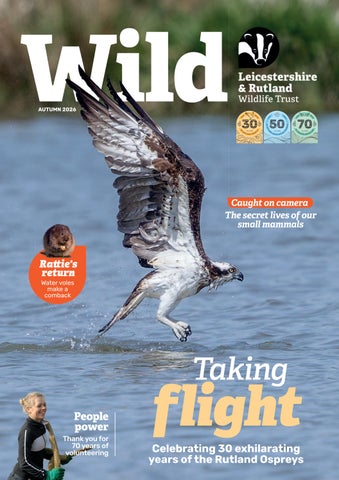
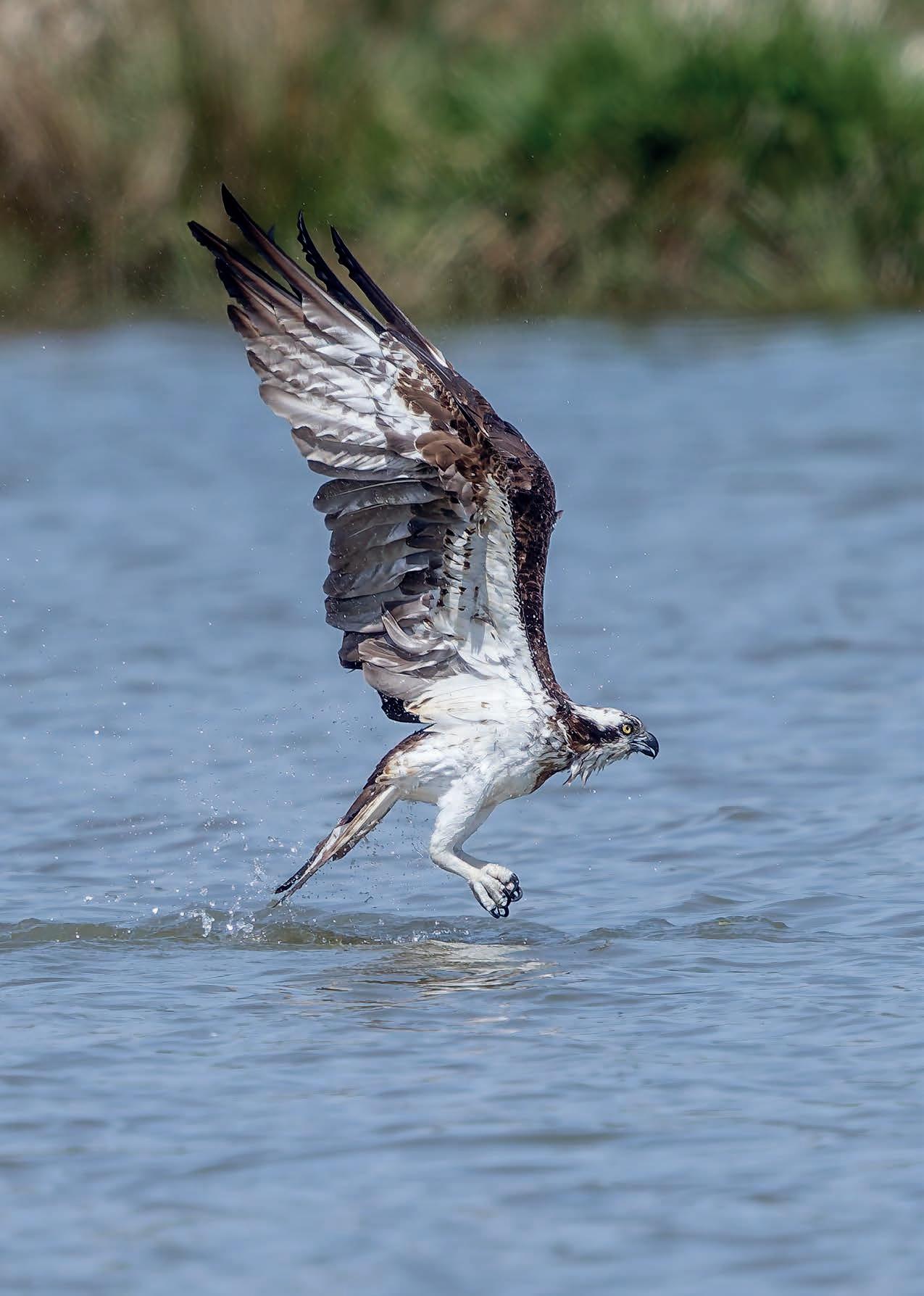
Celebrating 30 exhilarating years of the Rutland Ospreys flight

Mat Carter CEO
It’s been an incredible summer, and now we welcome autumn, bringing golden landscapes, crisp mornings, and stunning seasonal colour. And as the year progresses, we continue to celebrate our remarkable triple anniversary year.
This issue we spotlight one of the region’s greatest conservation success stories – 30 years of the Rutland Ospreys! We pay tribute to Maya, whose extraordinary legacy has captivated thousands and inspired a generation of wildlife enthusiasts. Having fledged more than 40 chicks, she is one of the most successful breeding female ospreys in the UK. We also meet a dedicated osprey volunteer, whose story reflects the passion the ospreys have brought to Rutland and beyond.


We also celebrate 15 years since water voles were reintroduced to Rutland Water, a bold initiative that’s helped secure a brighter future for one of Britain’s most threatened mammals.

We’re not standing still, though. We take a guided walk around our newest nature reserve, exploring what it offers wildlife and people alike… hopefully another success story in years to come.


16 Queen of Manton Bay
As we mark 30 years of the Rutland Ospreys, we celebrate the remarkable legacy of Maya, one of the country’s most successful females.
20 e wild comeback
Why the return of goshawks to local woodlands is outstanding news not just for birdwatchers, but the entire ecosystem.
24 H is for hawk-moth
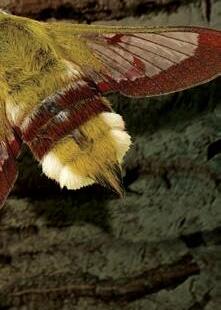
Beautiful and bold hawk-moths are among the largest moths in the country. Discover the cast of characters and where to see them.
26 Ra y’s return
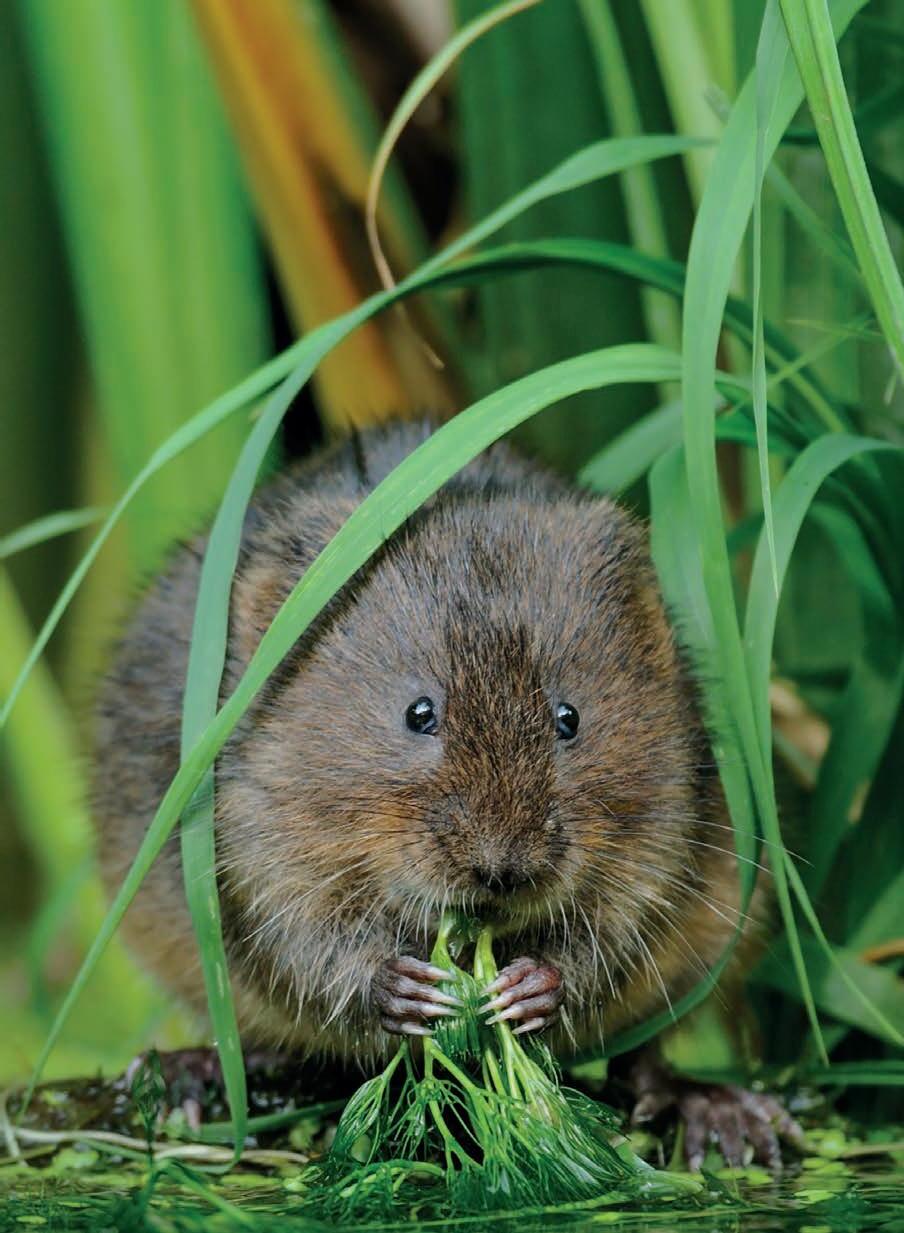
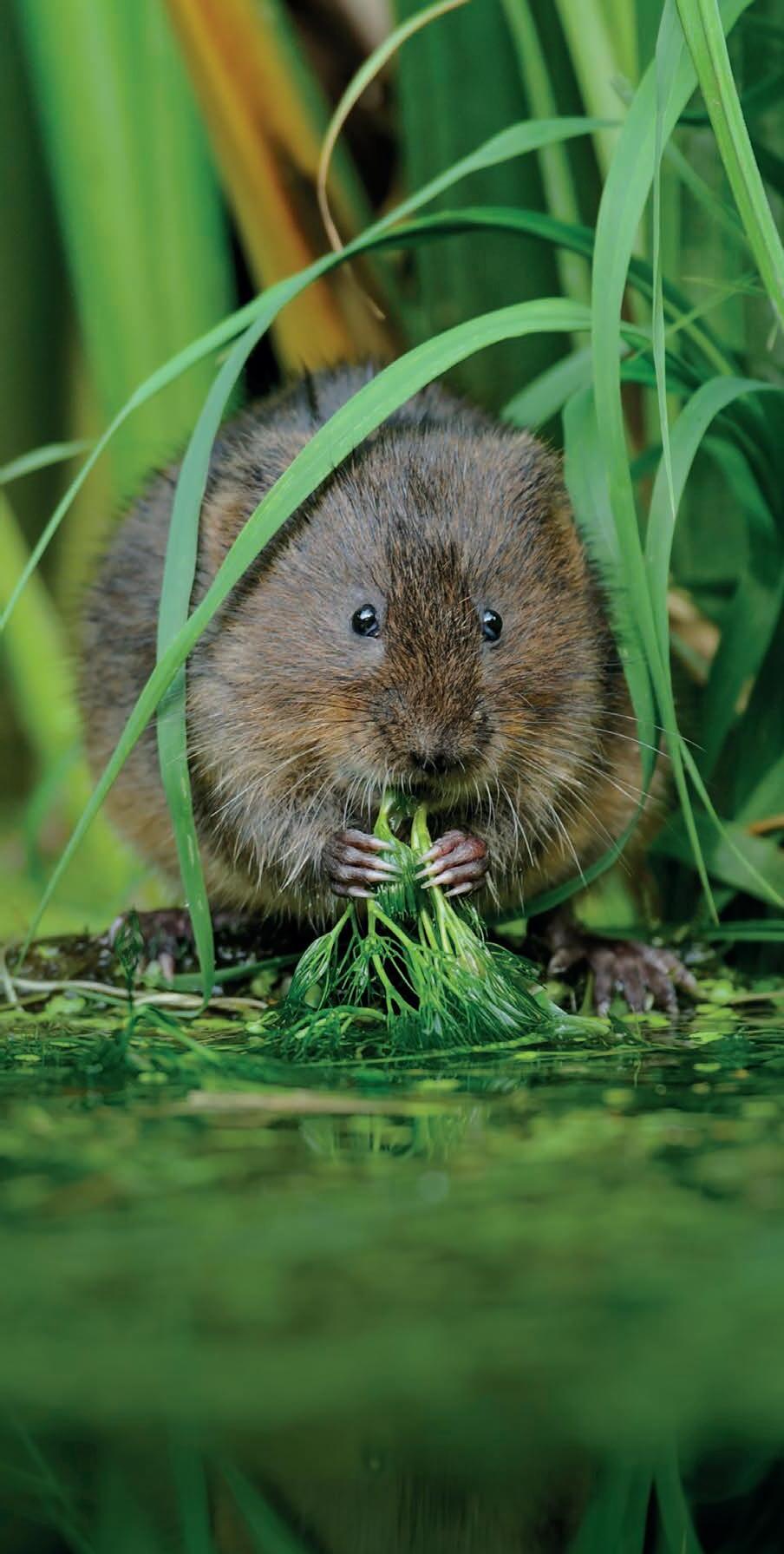
Fifteen years ago, water voles were reintroduced to Rutland Water. Today they thrive in the reserve’s reedbeds and waterways.





Thank you, as always, for being part of our journey.


All the latest from around the Trust and beyond, including an exciting release of dormice, soaring hopes for swifts, and going wild at work.
9 e wild according to… Meet musician, zoologist and new Wildlife Trust ambassador Louis VI. Why are natural sounds so important to him?
12 Wild Autumn
Get up close to the really rather endearing wood mouse. Plus, the magical wildlife pull of evergreen trees and shrubs.
15 Spot the di erence
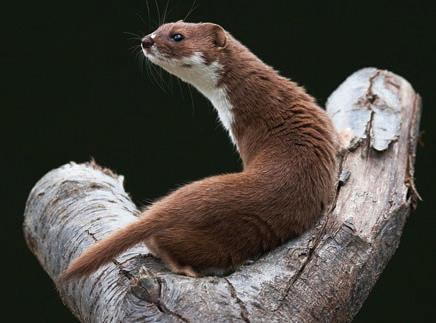
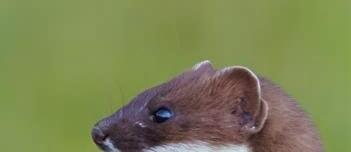
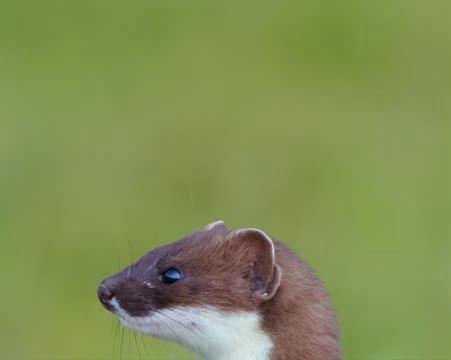
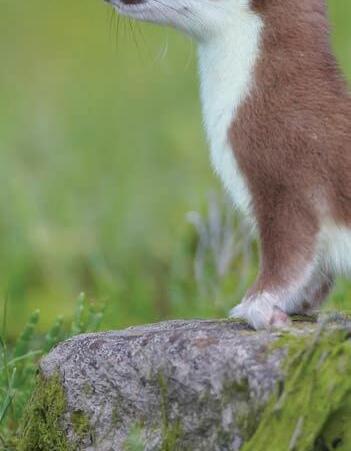
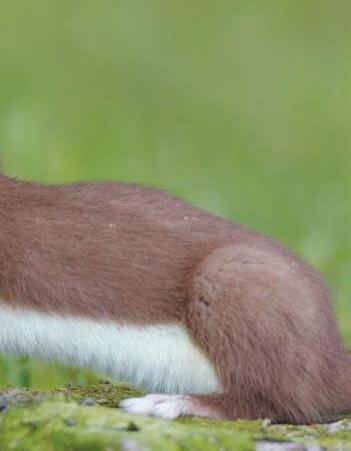
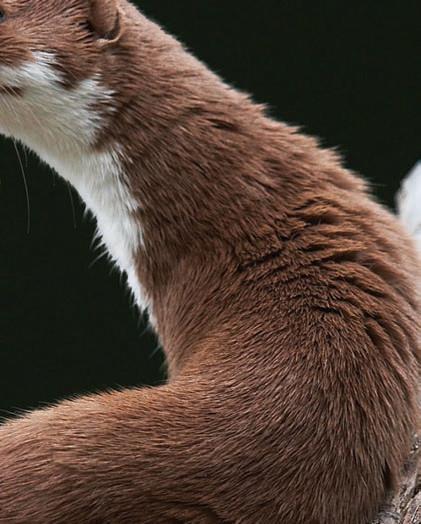
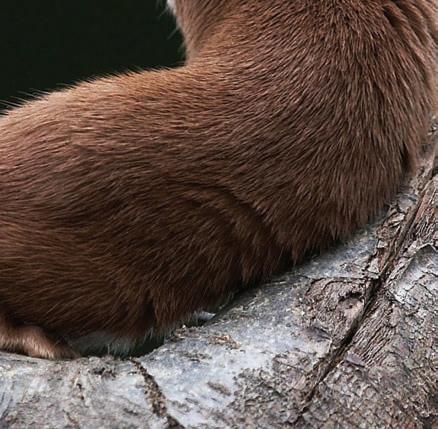
a o e he d ffere e be ee a stoat and a weasel? Meet these mini but mighty mustelids.

22 Nature reserve walk
Stride out onto our very newest nature reserve, the James Adler Reserve – a special place that d a reas red a e o r heart too.
34 What’s on
Join one of our events or activities and feed your wild side. From guided walks to fascinating talks on our most surprising wildlife.

Can you help?
ould you o er your s ills and time to help loo after local wildlife e would love to hear from you lrwt.org.uk/volunteer
Or perhaps you could play an essential role in raising awareness and lobbying on local and national issues lrwt.org.uk/campaign
We protect and enhance the wildlife and wild places of Leicestershire and Rutland and engage people with nature. /leicswildlife /lrwt56 /leiceswildlife /company/leicswildlife lrwt.org.uk info@lrwt.org.uk 0116 262 9968
The Old Mill, 9 Soar Lane, Leicester LE3 5DE
Editor Benedict Vanheems
Design Kate Holt
Chair Ann Tomlinson
Co-Vice Chairs John Atherton Andrew o at
Hon. Secretary Peter Williams
Hon. Treasurer Andy Thorpe
CEO Mat Carter
Head of Reserves Joe Davis
Head of Nature Recovery Ben Devine
Supporter Development Manager Josephine Taylor












Leicester’s swi s have received a welcome helping hand thanks to a new nestbox installation project in the city’s Belgrave neighbourhood.
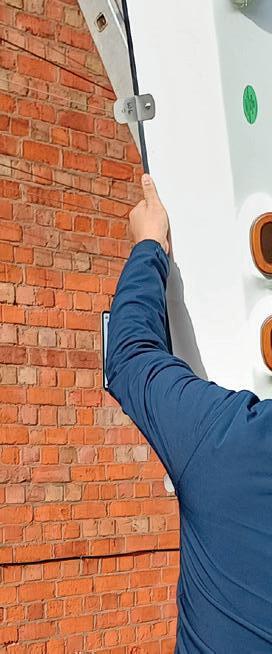
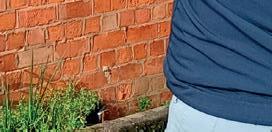
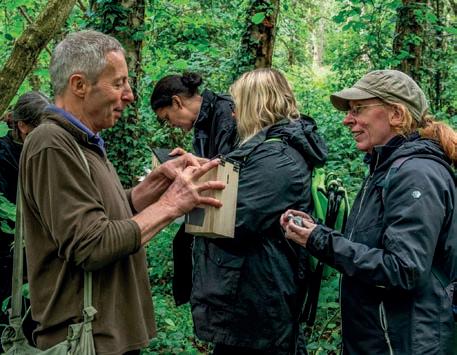
Conservationists from Leicestershire and Rutland Wildlife Trust, Leicester City Council and Pear Tree Ecology teamed up to install a series of specialist swi nestboxes at key community sites, including Belgrave Neighbourhood Centre, Belgrave Library and the Belgrave Co-op. Community Engagement Officer Sally Pearce joined Leicester City Council Nature Conservation Officer Hannah Keys and ecologists Jools and Julie Partridge from Pear Tree Ecology for the installation, which forms part of the wider Restoring the Soar project.
The initiative aims to provide much-needed nesting opportunities for swi s, one of the UK’s most remarkable yet increasingly threatened summer visitors. Spending almost their entire lives on the wing, swi s eat, sleep and even mate while flying. However, modern building renovations and redevelopment have removed many of the gaps and crevices they traditionally use for nesting.





Unlike many garden birds, swi s have very specific nesting requirements. Their nest sites are typically located high under the eaves of buildings, allowing the birds to launch directly into fl ight from the entrance. Purpose-built swi boxes replicate these conditions, giving the birds safe places to breed in urban areas.



Restoring the Soar is a partnership project led by the Trust, working alongside Leicester City Council and the Canal & River Trust. The project is supported by funding from the National Lo ery Heritage Fund and is helping to create be er habitats for wildlife across the River Soar corridor.
With swi populations having declined significantly in recent
Pupils visiting Leicester’s National Space Centre recently received some down-toearth inspiration from our Senior Reserves Officer, Andy Neilson.
Speaking as part of the centre’s Careers Day, Andy gave year seven students an insight into the many pathways into a career in conservation. From education and community engagement to practical reserve
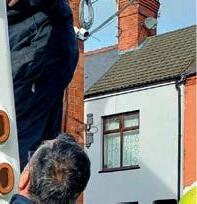

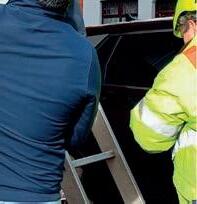
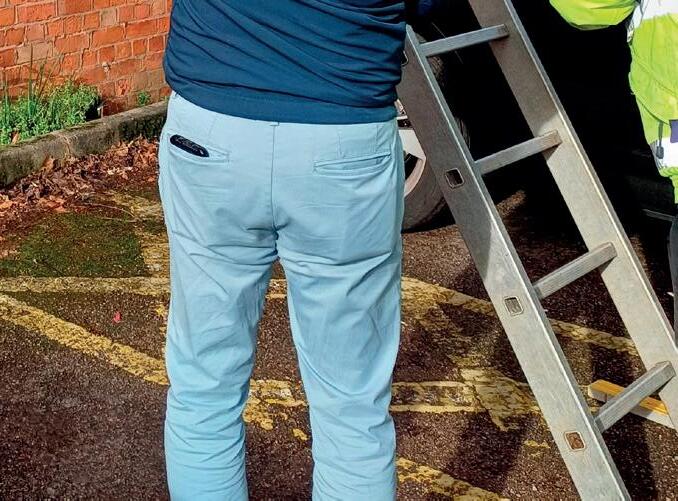
decades, projects such as this provide a vital lifeline. As summer skies fi ll once again with the birds’ distinctive screaming calls, the new nestboxes could help ensure that future generations of swi s continue to fi nd a home in Leicester.
People are turning out for wildlife across Leicester and beyond. Our new City Nature webpage brings together all the incredible people, groups and organisations in the city who are doing their bit to create spaces for nature and better understand how we can all play a part in creating a wilder urban environment. From a new community space for young people to enjoy a re o a arde ro ee o he b er es o a ear more about how nature is being invited into the city at lrwt.org.uk/city-nature
management, he highlighted the wide range of roles that help protect wildlife and wild places across Leicestershire and Rutland, and beyond.
By sharing his own experiences and passion for nature, Andy hopes to inspire the next generation of conservationists, proving that a rewarding career can be found not only among the stars, but right here on Earth!


As we celebrate our 70th anniversary, we’re delighted to welcome another corporate supporter, Label Apeel.
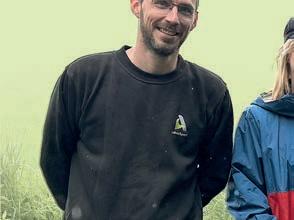
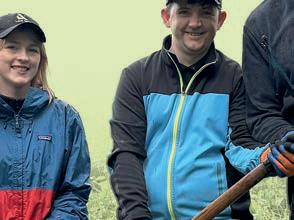
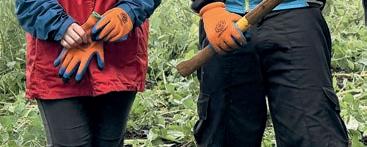
A team from the Leicester-based label manufacturer recently joined us at Ulverscro Nature Reserve for a Wild Work Day, helping to tackle invasive Himalayan balsam while learning about the reserve’s wildlife and habitats. It was a fantastic day of conservation, teamwork and connecting with nature away from the office.
We are incredibly grateful to Label Apeel for their support and look forward to welcoming them back for another Wild Work Day soon.












More than 40 hazel dormice have been released into woodland at Bradgate Park this summer, joining the 21 animals reintroduced last year and boosting the county’s only known dormouse population.


See you soon!
We are excited to share details of our 2026 Members’ Day, which will take place on Saturday 21st November at Trinity Methodist Church in Loughborough. Members will have the opportunity to hear about the Trust’s


achievements and latest developments.
The event will include updates and information from across the Trust, and include our Annual General Meeting, featuring reports from Trustees and the Honorary Treasurer.

documents will be circulated
Full details of the day, including AGM papers and supporting documents will be circulated from the end of October. We look forward to welcoming as many of you as possible!

The release, led by People’s Trust for Endangered Species (PTES) and conservation partners, including Leicestershire and Rutland Wildlife Trust, is already showing signs of success. By autumn 2025, volunteers monitoring nest boxes had recorded 46 dormouse nests, along with several li ers of young – encouraging evidence that the population is thriving. Hazel dormice have suffered dramatic declines due to habitat loss and climate change. Nationally, numbers have fallen more than 70% since 2000, making conservation efforts increasingly important.
Bradgate Park’s success follows years of woodland restoration work to create the dense, connected habitat dormice need. The latest arrivals underwent health checks as part of a release programme designed to give them the best possible start in their new home.
Since PTES launched its dormouse reintroduction programme in 1993, more than 1,100 dormice have been released across the country. Now, thanks to the efforts of conservationists and volunteers, Leicestershire is playing its part in securing a future for these enchanting, mammals. It’s a small animal with a big conservation success story!

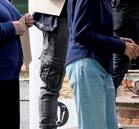
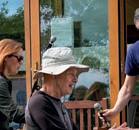

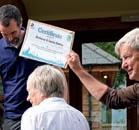
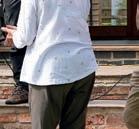
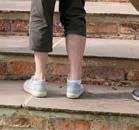
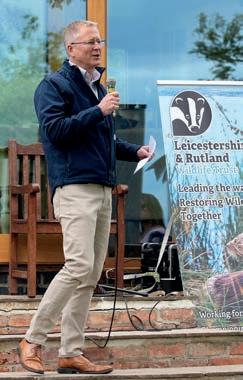



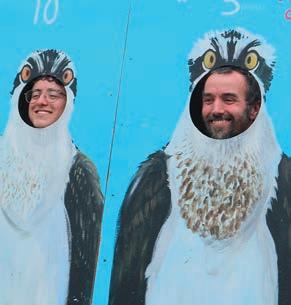

ro d o eers a d s aff a hered a mo dham dm for a o f af er oo of ream ea a ames a d a ard

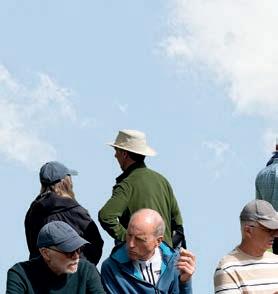

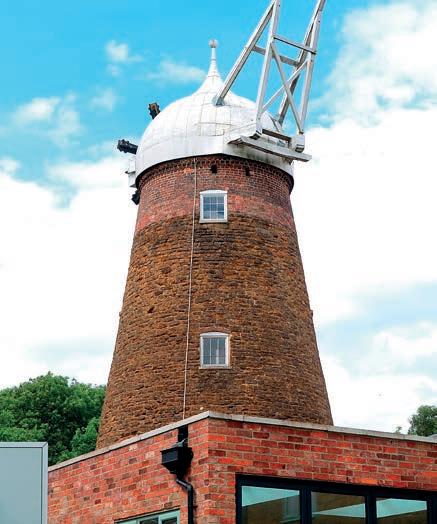
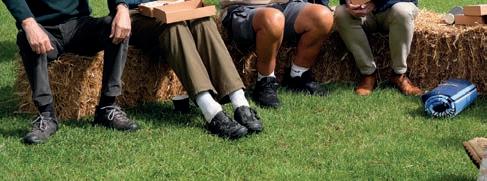
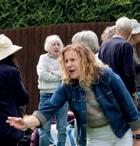
On Friday 5th June, the rural charm of Wymondham Windmill played host to a very special occasion: a thank-you celebration for the volunteers who help make Leicestershire and Rutland Wildlife Trust the organisation it is. Around 120 volunteers and staff from across the two counties gathered for an a ernoon of food, fun and (thoroughly deserved) appreciation.
CEO Mat Carter and Chair of Trustees

highlight of the day: a string of volunteer awards, presented by staff from our East Leicestershire, West Leicestershire and Rutland reserve teams, our visitor centres, the osprey monitoring programme, species and recording, and membership – each standing up to recognise a volunteer who had made them smile.

across the grounds. Then came the
Ann Tomlinson opened proceedings, before guests se led in for a classic cream tea and a go on the lawn games sca ered across the grounds. Then came the
It is no exaggeration to say the Trust simply couldn’t do what it does without its volunteers. From hands-on work parties to welcoming visitors, from monitoring wildlife to quietly keeping the back office running, every hour given is freely given, and it makes a world of difference for nature in Leicestershire and Rutland.

In this, our 70th Anniversary year, we would like to say an especial 'thank you' to every volunteer who works across the Trust. We are so grateful!

































r s ees members s aff a d s e a es s a hered a he ar sda e o e ebra e ears of he r s ears of a d a er a d ears of he a d s re s













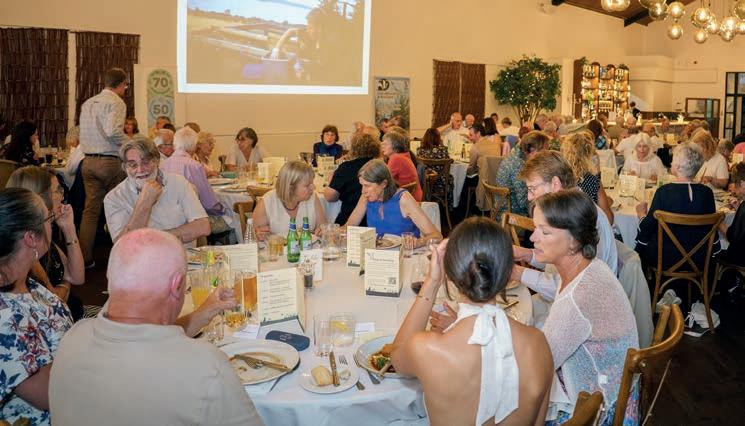
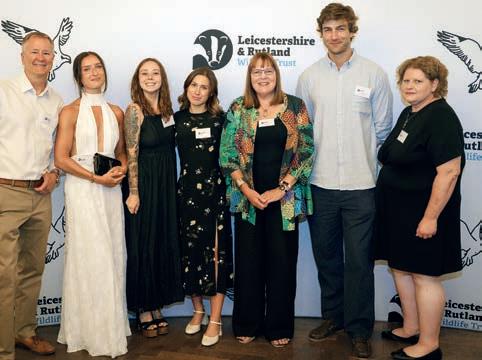
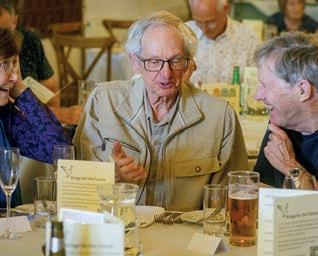
Leicestershire and Rutland Wildlife Trust marked its remarkable triple anniversary on Friday 17th July as supporters gathered at The Barnsdale in Rutland to celebrate 70 years of the Trust, 50 years of Rutland Water Nature Reserve, and 30 years of the Rutland Ospreys.
trustees, members and volunteers gathered for an evening of
Guests including Rutland and Stamford MP Alicia Kearns, founder of the Osprey Leadership Foundation Dr Tim Mackrill, trustees, members and volunteers gathered for an evening of reflection and celebration. CEO Mat Carter and Chair Ann Tomlinson looked back on seven decades of nature recovery, while Senior Species and Recording Officer Tim Sexton and Dr Mackrill spoke about the milestones and future of species monitoring and osprey conservation.


Between the speeches and a delectable three-course meal, guests took part in a raffle that raised an incredible £1,485 for the Trust’s work, with prizes generously donated by local businesses and partners. It was a fi ing way to celebrate seven decades of perseverance, passion and partnership for wildlife – and to look ahead to the work still to come. Here’s to the next 70 years of wild recovery across Leicestershire and Rutland!























From generous community donations to an epic coast-to-coast walk completed against the odds, our supporters show what it means to truly go the extra mile for wildlife.



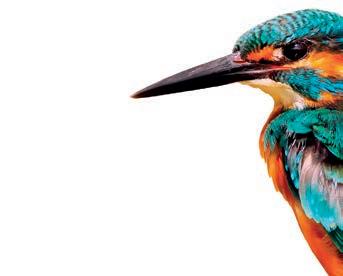
Kelham Bridge Nature Reserve is one of Leicestershire’s true hidden gems – a haven for kingfi shers, o ers, water rail, snipe and sand martins. Yet with wild spaces growing ever more popular, protecting the quietest, most sensitive corners of the reserve from disturbance has become increasingly urgent.


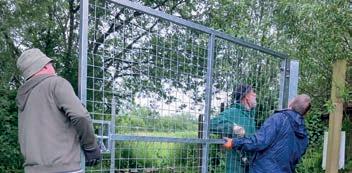
That’s why the Trust launched its Keep Kelham Bridge Wild appeal, with a target of £3,000 to fund new secure metal gates. Now installed, these allow visitors to enjoy and view key wildlife areas without entering them, protecting ground-nesting birds, the precious sand martin bank, resident o ers and the kingfi sher families that breed along the water’s edge.
The response from our community was nothing short of extraordinary. The Rotary Club of Ashby de la Zouch Castle made a magnificent donation of £1,000, while the Trust’s own Charnwood Local Group contributed a fantastic £800. Our Northwest Local Group generously gave £500, and Ibstock Brick kindly added a further £250. The generosity shown by all these supporters has given Kelham Bridge’s wildlife the secure, undisturbed sanctuary it deserves.
Donors to the appeal were also offered something rather special in return: a bespoke guided visit around the reserve and permanent on-site recognition of their support.


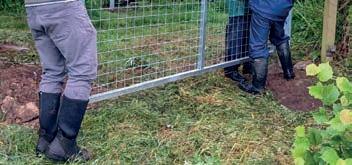
Installing the new gates.
There are many ways you can help raise funds for Leicestershire and Rutland Wildlife Trust. Learn more or download our fundraising pack: lrwt.org.uk/fundraise
Katie Houghton, from The Grange Camping and Caravan Park near Melton Mowbray, had been looking forward to walking the legendary Coast to Coast Walk – from St Bees in Cumbria to North Yorkshire’s Robin Hood’s Bay – as part of an organised event, in aid of the Trust’s Holwell Reserves. Then came an email to say the organising company had ceased trading and the event was cancelled. For many, that might have been the end of it. Not Katie! With the immediate support of her husband John and their dog Bramble she resolved to take on the full 190-mile challenge independently, rerouting logistics, booking campsites and arranging support points from scratch. On 28th March, she stood on the beach at St Bees and set off anyway. By 1st April, she had reached Robin Hood’s Bay. That’s an average of 38 miles a day!
Kate's determination has increased her fundraising total for Holwell Reserves to an extraordinary £4,417. This is a remarkable achievement by any measure and a testament to what sheer willpower and a love of nature can accomplish. A huge thank you to Katie, John and Bramble from everyone at the Trust.

Katie smashing out the miles.



Why are natural sounds so important to you?

Nature has always been my safe place. But it’s only in the last five years I’ve come to understand how sound connects us to nature. We are evolutionarily hardwired to nature’s sonic language. e sounds of birds, frogs and insects all trigger our parasympathetic pathway to make us feel relaxed. But modern life o en drowns this out. Our ancestors survived by listening to nature. Sounds can tell you where to fi nd food, water, safety – but also danger. Silence o en meant a predator was around. By drowning out nature, we’re forcing ourselves to live in that ‘danger silence’ and the evolutionary stress that comes with it.
How has nature influenced your music?
Music likely predated human language, inspired by sounds from nature. So nature has influenced all music, not just mine. Nature is the original artist. at’s why I was honoured to be one of the first musicians to feature nature as an o cial artist in my music, alongside Brian Eno and his charity Earthpercent.
What excites you as a new Wildlife Trust ambassador?
I’m really excited about reframing what ‘nature’ is in the UK. Showing that Nature Ain’t a Luxury (the title of my fi lm with e Wildlife Trusts) but a necessity. I hope it awakens a sleeping herd of young people, particularly from lower economic backgrounds and diasporas, to reconnect to nature. But on a bigger level, I hope we put nature at the heart of our national identity and culture. We can bring nature back, restore our wild places and make nature a source of immense national pride.
What message would you like to send as an ambassador?
Nature is for all of us, no ma er where you live or what you look like. It’s your right because you are an animal that evolved as part of nature. We all need it to be healthy, not just the people that can a ord to get into it. I hope young people see me, a mixed race guy, from a rough part of North London that’s had all the experiences that they have had and yet is a massive nature geek; and see themselves. It doesn’t have to be a massive step, but you need nature and it needs you. Start by listening – even if it’s listening online on headphones fi rst, you can go to my website (natureaintaluxury.com) – there’s loads there, or come to one of my exhibitions if the real thing is hard to hear in your area. But soon I promise you won’t be able to help seeking it out in the real world, and you’ll know it because, guess what, we’re all fluent in nature, it just takes listening a li le again to reignite that fluency.
Hear more from Louis VI in his TED Talk Louis VI: e language you’re fluent in— but forgot how to hear at: wtru.st/Louis-VI-TED-Talk


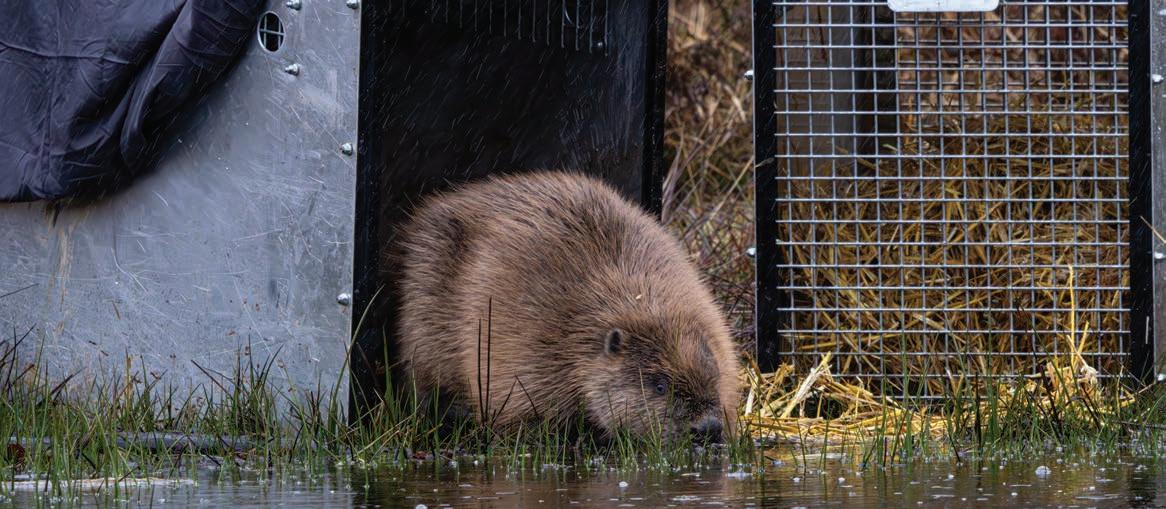
This spring, there were several important moments for Britain’s beavers. In February, Cornwall Wildlife Trust released two pairs of beavers into Cornish river catchments. This was the fi rst wild beaver release in England to go through the formal application process. Wildlife Trusts are involved in over 20 beaver reintroduction programmes and hope to release around 100 beavers in the near future. The south of England is currently the beaver hotspot, with ten more Wildlife Trust projects in Devon, Dorset, the Isle of Wight and Kent given the go ahead by Natural England to apply for wild release licences a er a successful process of Expression of Interest. Many neighbouring Wildlife Trusts have also teamed up to form beaver partnerships, working across catchment areas. This includes groups

for the Severn, Humber, Thames, and East Anglia. This approach will make it possible to release larger numbers of beavers, creating healthier populations with more genetic diversity.
A few weeks later, on the 4th of March, new legislation from the Welsh Government came into force, recognising beavers as a native species and granting them protected status. This is a major milestone for restoring beavers in Wales, bringing legislation in line with the protection afforded to beavers elsewhere in Britain. The beaver was granted protected status in Scotland in 2019 and England in 2022.
Alicia Leow-Dyke, Welsh Beaver Project officer for the Wildlife Trusts in Wales, says: “We have been working towards this goal of legal protection for beavers in Wales for many years, so we are delighted with this brilliant outcome. Beavers play a vital role in our ecosystems and formally recognising
them as a native species is the right thing to do. We thank the Welsh Government for listening to all the evidence and making the right decision.”
Beavers are ecosystem engineers, meaning they alter the landscape in which they live and bring benefits to the wildlife around them. The wetlands they create help to reduce flooding, improve water quality and store carbon. They also provide a home for a wealth of wildlife, including water shrews, water voles, o ers, kingfi shers, dragonfl ies and fi sh. Bringing beavers back to Britain isn’t just the reintroduction of a species, it’s the reintroduction of an entire ecosystem that’s been lost. Their return can help tackle both the nature crisis and the climate crisis.
See the moment beavers were released into Cornish rivers at wtru.st/Cornish-beaver-release
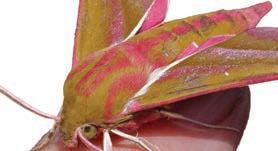
Through the Wild About Gardens partnership, The Wildlife Trusts and the RHS are encouraging gardeners to make space for moths. These incredible insects are important pollinators, a vital link in many food chains and an indicator of healthy environments. wildaboutgardens.org.uk





Actor, ecologist and podcaster David Oakes has stepped up from ambassador to vice president of The Wildlife Trusts, following years of support. The Wildlife Trusts also welcomed two new ambassadors: Inka Cresswell, a marine b o o s a d o ea d fe mma er a d Louis VI, a musician, zoologist and nature activist. tru.st/ambassadors
of

ead of b ffa rs for he Wildlife Trusts, Matthew Browne tells us why the UK Government needs to give nature more respect.
How have environmental protectionscome under threat recently?
The UK Government has been fruitlessly looking for growth amidst a pile of shredded nature protections. Some people in power have fallen for the myth that if nature protections are reduced, growth will follow. Last year’s Planning and Infrastructure Act a empted environmental deregulation and hot on its heels came the Nuclear Regulatory Review. The Review made recommendations to increase nuclear power deployment, including proposals to change the law to make it easier for developers to cause damage to wildlife.
Why was the Nuclear Regulatory Review flawed?
The Review’s nature recommendations stemmed from a flawed case study of the Hinkley C nuclear project. The case study minimised the project’s environmental impact, claiming that only 550 fi sh would be killed per year when the real number was well over 4.5 million, and maximised the costs of the measures needed to avoid these outcomes. These distortions were intended to portray nature protections as an unreasonable burden. In reality, nature protections and the mitigation measures they require typically cost only 0.1% of the budget of a nuclear project.
How did people react to this news?
Nature lovers in their thousands wrote to their MPs to tell them that weakening nature protections would do li le to nothing to boost nuclear deployment, but would risk the current nature crisis turning into a catastrophe. Many MPs listened and acted. Over 120 parliamentarians urged the UK Government not to proceed with the nature recommendations from the review.


Leicestershire and Rutland Wildlife Trust is celebrating 30 years Ospreys and the return of these brilliant England. Turn to page 16 for


250,000 records of squirrels have been collected by Saving Scotland’s Red Squirrels, a partnership project led by the Scottish Wildlife Trust.













ways your support is making a di erence


The UK Government has pulled back on some changes, but is there still cause for concern?







This pressure paid off. In March the UK Government announced that it would not legislate to weaken the laws that protect wildlife. However, it did commit to issuing new guidance on how those laws should be applied. Whilst we have successfully defended the legal core of nature protections, Ministers are still tinkering around the edges.
happens next?
What happens next?










The Wildlife Trusts continue to make it clear to the UK are to warn those in power that diminishing nature protections Rutland birds to more.
Cornwall Wildlife Trust a ed he rs of aro d




The Wildlife Trusts continue to make it clear to the UK Government that nature protections are not blockers to growth, but rather are the guarantors of the wild spaces that we need to maintain and restore if we are to avoid ecosystem collapse. Such collapse threatens unparalleled environmental, social and economic disruption. Thank you for standing with us, as we continue to warn those in power that diminishing nature protections will have disastrous consequences.





28,000 trees on an ambitious project to restore temperate rainforest in south east Cornwall.


ee o da e h rre affa rs from Matt and members of the team at wtru.st ublic A airs







Norfolk Wildlife Trust purchased
336 acres in Wood Norton for one of he mos s a habitat creation projects in their 100-year history.
Explore and enjoy the best of the season's wildlife
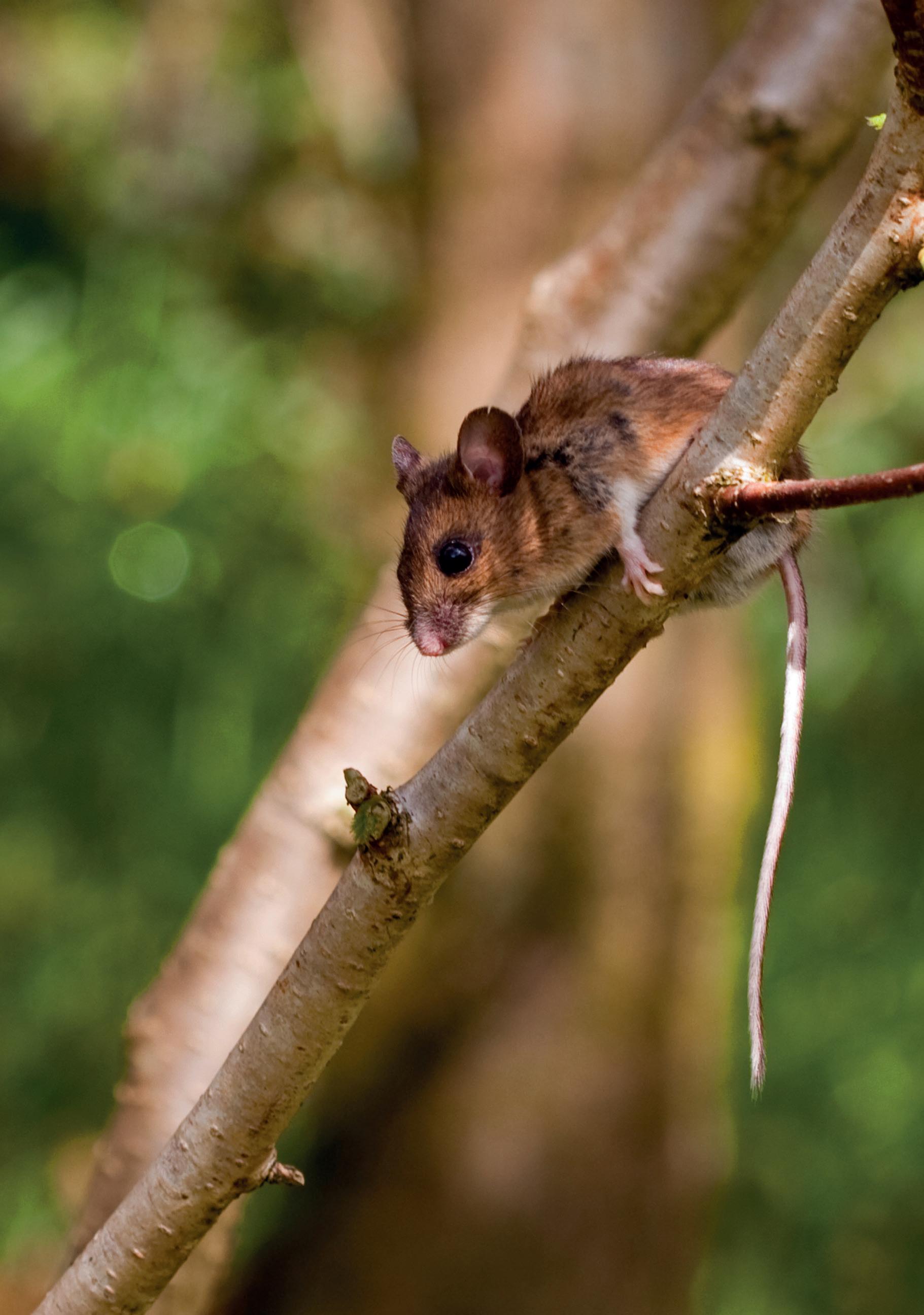
Spot darting movements beneath fallen leaves as wood mice forage for nuts and seeds to bury for the winter.

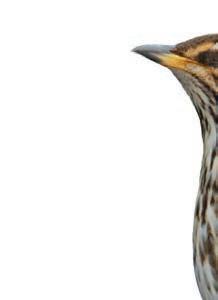
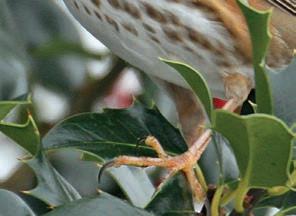
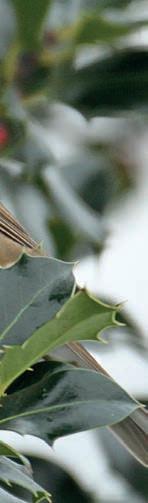
Evergreen trees and shrubs offer a welcome haven for wildlife throughout autumn and winter. Bright-red holly berries herald winter as fieldfares and redwings migrate from Scandinavia to the UK to feast on berry-laden hedgerows. Mistle thrushes are known to guard ‘their’ holly tree by singing at the top of their favourite food source.
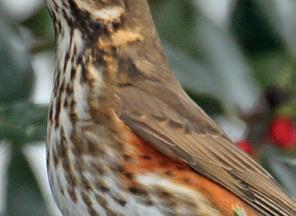
berries herald winter as fieldfares and hedgerows. Mistle thrushes are known to guard ‘their’ holly tree by singing at the top of their favourite food source.
Holly blue bu erfl ies lay their eggs in hollies so their caterpillars can feed on the leaves. Many sightings of holly blues have been recorded this year.

Yew, one of Britain’s ancient trees, also makes a dense garden hedge. Its fleshy red seed coverings, or arils, are prized by blackbirds, squirrels and mice. Yew leaves are a food source for caterpillars of the satin beauty moth. Ivy gets a bad reputation when it climbs up trees and appears to smother them. Yet ivy is a welcome hideaway for peacock and red admiral bu erfl ies that need shelter as they overwinter in a state of torpor.

Did you know?

● Battle of the sexes: Holly trees are dioecious, meaning male and female o ers ro o se ara e a s




● Yew know it: Yew wood is durable and makes attractive furniture. Historically, yew was used to make longbows and arrows for medieval battles.
● All a buzz: First recorded in England in 2001, ivy bees nest in sandy soils, emerging to feed and breed when he de e s o er












Crocuses provide nectar for bumblebees emerging on warm winter days. Plant bulbs now to help them top up their energy stores.





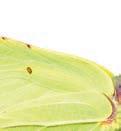
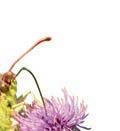





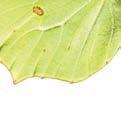
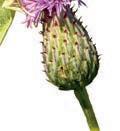
The long-lived adults that emerged in July can still be seen throughout the autumn.

Peacock
ea o b er es o e o autumn then spend winter in sheds and ivy.


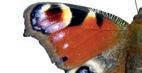
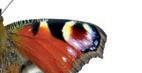






Newly emerged b er es from a second brood seek sugars from rotting fruit.





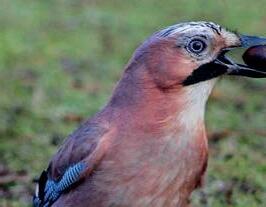
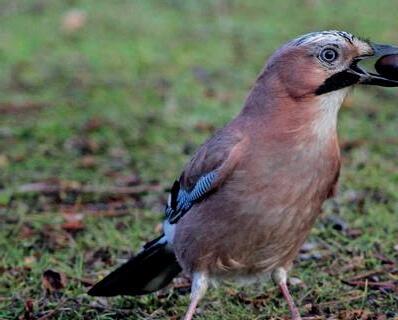
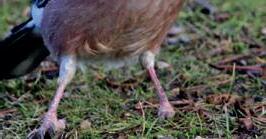
On woodland walks this autumn, listen out for the screech call of a jay and watch them gather acorns beneath mature oak trees. These woodland gardeners fi ll their beaks then cache acorns in deep leaf li er to retrieve later in winter. Many acorns remain uneaten to emerge in spring as tiny oak saplings.
er es ha a ed in summer are seen in a m before he to Africa.


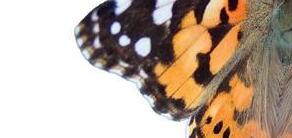
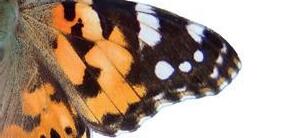


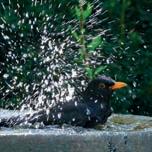
Help birds freshen up by putting out water in a shallow dish. Change water at least once a week to keep it clean.

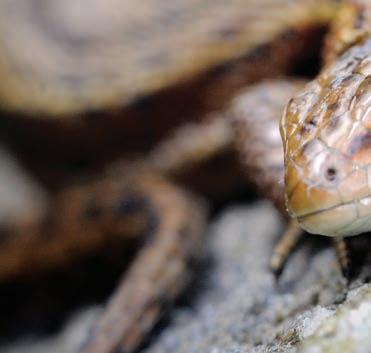
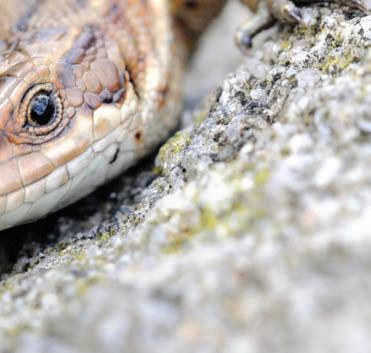
Reptiles aren’t a guarantee in a garden. They’re more likely to move in if you live beside suitable habitat, such as a railway embankment or heathland. But the steps you take for reptiles will benefit many of your other wild neighbours, too.
1
The fi rst step is to make sure reptiles (and other wildlife) can get into your garden. A hedge is a be er garden boundary for wildlife than a fence, providing shelter and le ing small animals pass through. If a hedge isn’t an option, consider cu ing a small hole in the bo om of your fence.
4
Composting is more than just a great way to recycle garden waste. Slowworms will slither through a compost heap in search of slugs. It might even serve as a natural incubator for the eggs of a grass snake, so avoid turning compost from June to late September to avoid damaging them. Place your heap in a sunny spot, ideally by a hedge or long grass.
2
Nothing a racts wildlife like water. Add a pond to your garden, wildlife will come. If you’re lucky, grass snakes might even hunt there, searching for frogs and other amphibians. They’re excellent swimmers, wriggling through the water with ease.
5
Leave an area of lawn to grow wild, providing cover for reptiles. If you need to cut some long grass, walk through it fi rst to give any hiding reptiles the chance to move.

3
Reptiles bask to raise their body temperature. Grass snakes and common lizards like open spots, so a sun-drenched rock or log could be perfect. Slow-worms prefer to warm up under cover. A piece of slate, wooden board or roofing felt could make a great slow-worm sauna. Place it in a southfacing, sunny position, on top of vegetation rather than bare ground.
6
A log pile is the ultimate multi-use facility. It can offer shelter for reptiles to hide away over winter, a ract insects and other wildlife that reptiles feed on, and provide a prominent perch for basking in the sunlight.
Get involved
Help reptiles beyond the garden too. Join the Leicestershire & Rutland Amphibian and Reptile Network: arguk.org/get-involved/local-groups



Coat



length, with a 3-5 cm tail


Tracks Larger footprints with a more irregular heel pad
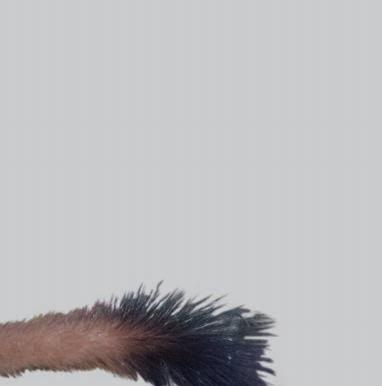


Length Around 24-31 cm body length, with a 9-14 cm tail
Weight 140-445 g (males are around twice as heavy as females)
Tail Long, with a bushy black tip
Movement O en bounds along with a strongly arched back
Diet Mostly eats rabbits, as well as rodents, birds and their eggs, and other food








Length Around 17-22 cm body

Tail Shorter than a stoat’s and completely brown
Movement Usually scurries low to the ground
Diet Specialises in hunting mice and voles, but may also eat small rabbits, birds and their eggs and other food
Tracks Smaller footprints with a more oval heel pad

Weight 55-131 g (males are around twice as heavy as females)












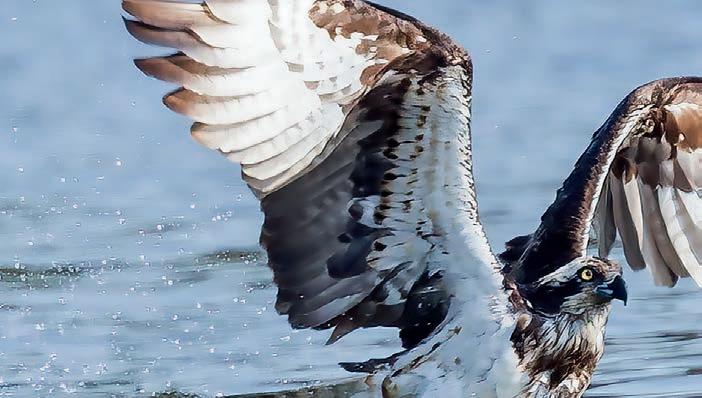
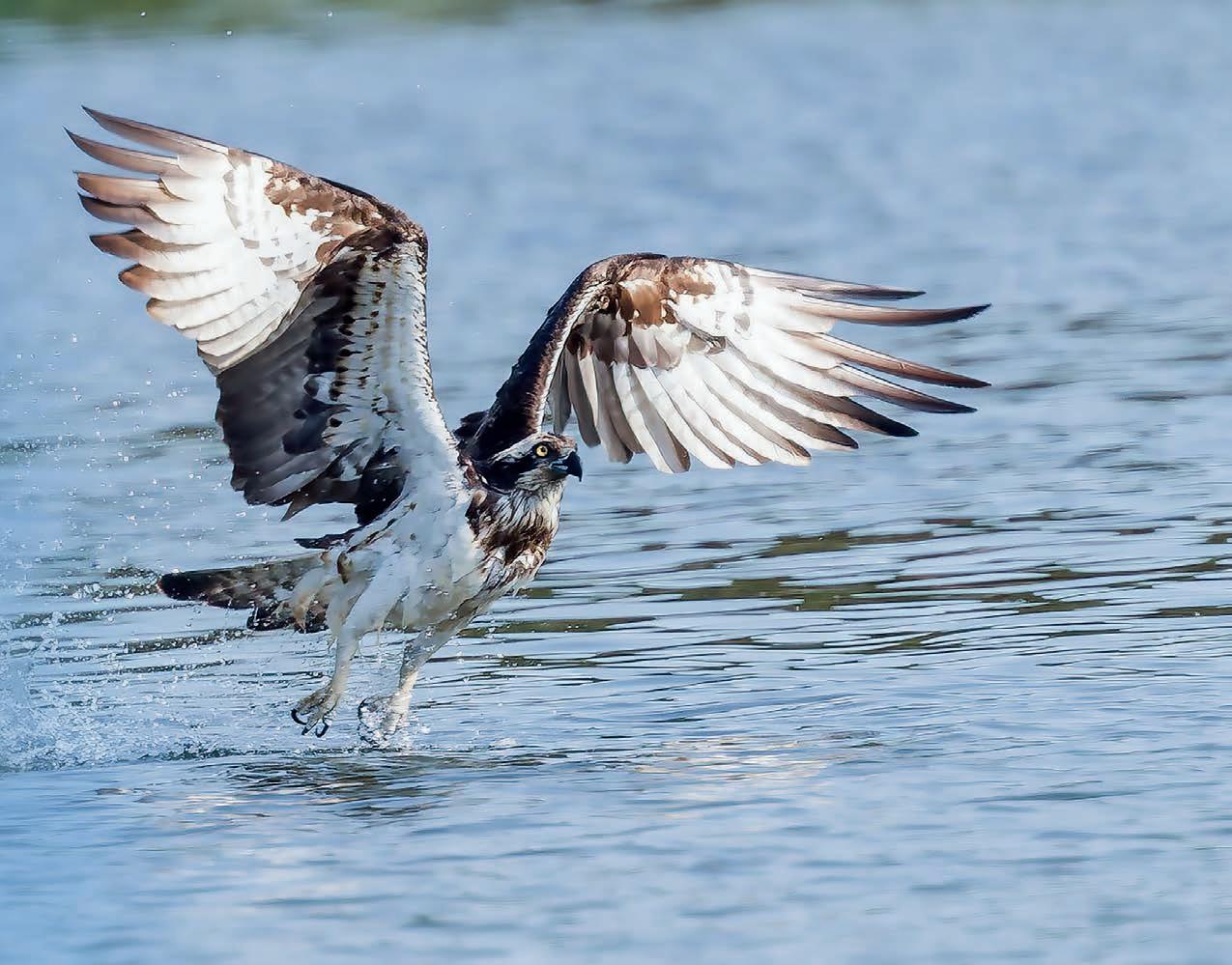
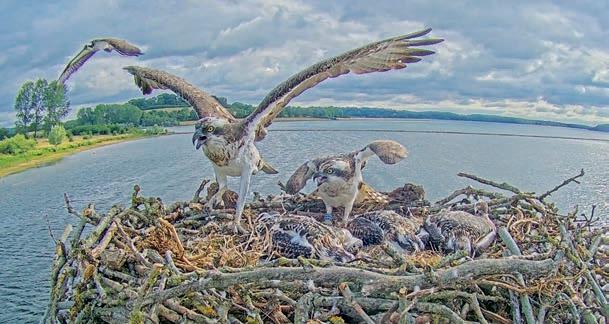
Wide-winged Maya rules the roost at Rutland Water.
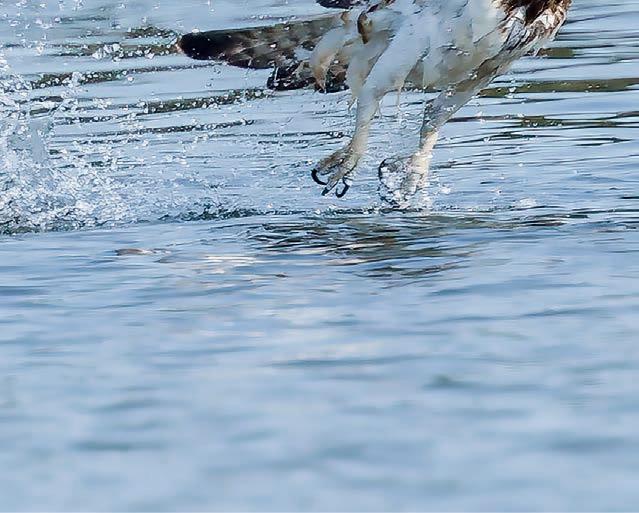
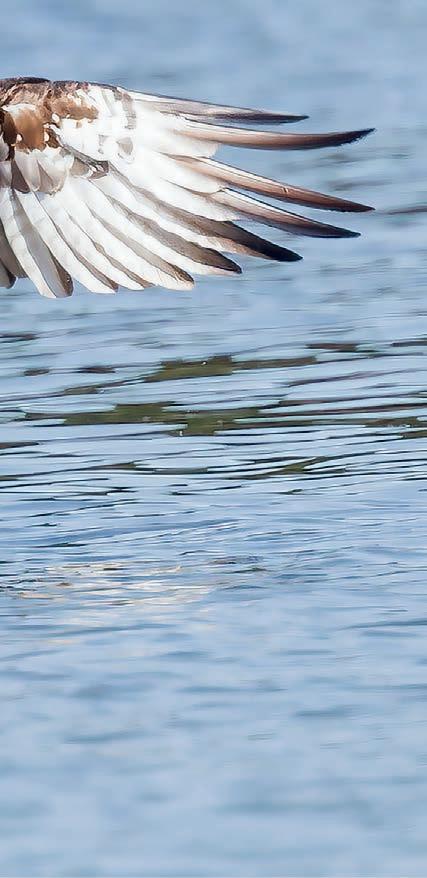
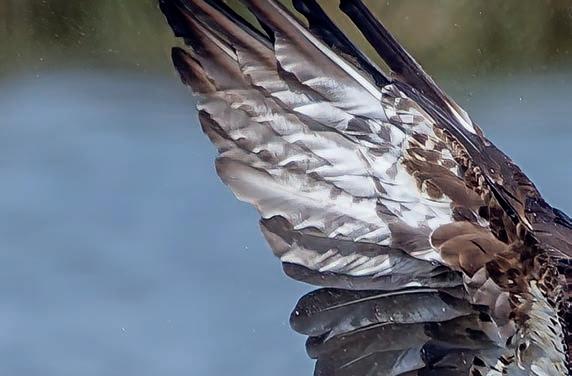
As the Rutland Ospreys celebrate 30 extraordinary years, one bird stands above all o hers r ed ra ed a d er ma e mee a a o e of he mos s essf breed os re s o re ord ea re research by Christian Woolford
She arrived without fanfare. No ring on her leg, no number in a database. Just a wide-winged, wickedly-beaked female osprey dropping out of a summer sky onto a nest at Rutland Water in 2009, as if she had always been there. Nobody knew where she had come from. Nobody knew what she would become. Today, everybody knows Maya.
This year marks 30 years since the fi rst young Sco ish ospreys were brought south to recolonise central England in a bold, pioneering act of conservation that has since inspired translocation projects across Europe. Three hundred chicks have now successfully fledged from the local area since that fi rst thrilling chick back in 2001. It is a legacy to be enormously proud of, and it has a face. That face belongs to Maya.
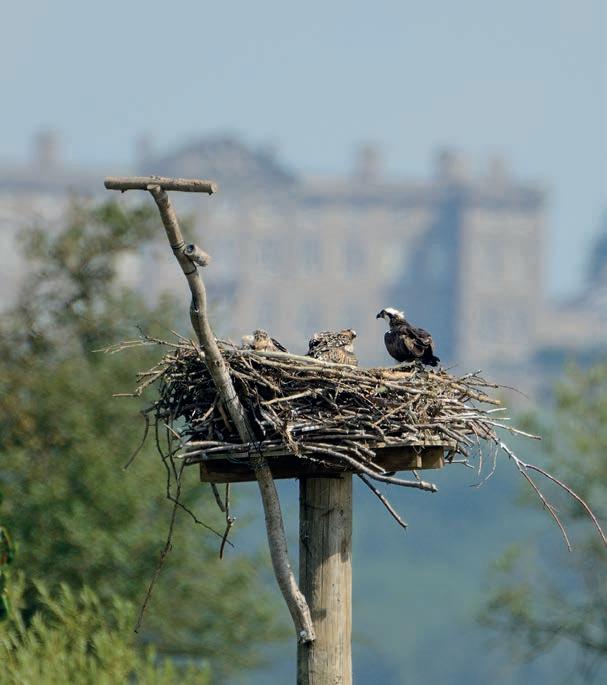
She returned to Rutland Water in 2010, this time to the Manton Bay nest where she paired with the resident male 5R(04) to raise three chicks. And she’s barely paused for breath since! Across 15 breeding seasons, with two different partners and against the full force of what migration, weather, and the sheer drama of wildlife can throw at a bird, Maya has raised more than 40 chicks. She is believed to be around 19 or 20 years old, an extraordinary age for an osprey, and as this issue goes to press, she has three more healthy chicks on the nest. Maya shows absolutely no sign of slowing down. What makes her story even more remarkable is the legacy she has seeded beyond Manton Bay. Nearly 40% of her offspring are known to have successfully returned from migration, which is almost double the average return rate for juvenile ospreys. Her daughter Telyn has been breeding at














Wales since 2018. A son, S2(15), helped establish a breeding pair in The Netherlands. Another daughter, 1H1(22), has already been spo ed in Germany. Maya’s bloodline is threading itself across Europe.
Maya is easy to recognise, if you know where to look: a distinctive cross-shaped marking on the back of her head sets her apart from every other
back of her head sets her apart from every other osprey on the water. But for most of the thousands of visitors who come to the Lyndon
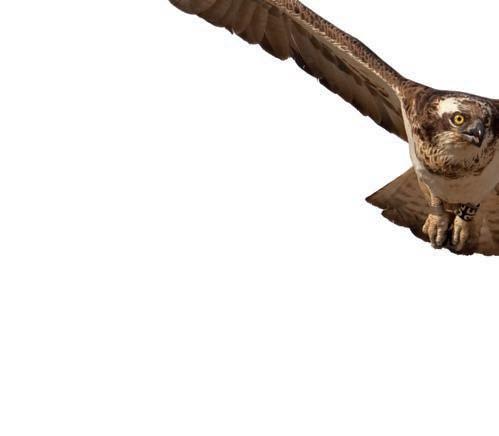
Visitor Centre each year, it is simply her name that draws them in. Ospreys had been numbered, catalogued and tracked for years before anyone thought to name the Manton Bay female. When staff eventually se led on Maya – a contraction of MA-nton B-AY – they could scarcely have chosen be er. In Sanskrit, māyā means magic or illusion; in Greek mythology, Maia was the good mother, goddess of spring; while in Hebrew, the name echoes the word for water. Magic, motherhood, the herald of spring, and a creature of the water. It fits like talons on a trout.

Every spring, when the fi rst osprey of the season appears over Rutland Water, staff, volunteers and visitors hold their breath. Is it Maya? And when she does come back something shi s. The season has properly begun as the queen returns to Manton Bay.
Thirty years ago, breeding ospreys in central England were a dream. Today, thanks to this project and, in no small part, thanks to Maya, they are a dynasty.
Nobody knew where she had come from. Nobody knew what she would become. Today, everybody knows Maya.








Information Assistant Rick Wilson offers a ro d of he rre seaso

This season got off to a slow start as many of the birds delayed their return due to storms off West Africa and the Iberian Peninsula. That all changed on Mother’s Day, 15th March. For the fourth year running it was female 25(10) who got the 2026 season at Manton Bay well and truly underway, if only for a few minutes. She
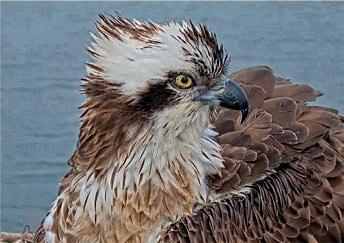

soon moved on to her regular nest, not far away. Other females briefly tried the nest out but then, on 24th March, our resident male osprey, 33(11), returned and, just a few hours later, Maya arrived back.
Eggs were soon laid on the Manton Bay nest, with the fi rst appearing on 5th April, and a further three neatly following at three-day intervals. The fi rst of these hatched on 12th May, then two more followed on 14th and 17th May, although the fourth egg failed to hatch.
On 23rd June, our osprey ringing team retrieved the three chicks from the nest and took them to the shoreline where they were laid out in age order, with the oldest exactly six weeks old on that day. This chick was fi rst to be weighed, measured and ringed. Assigned ring numbers 8R5, 8R6 and 8R7 in age order, the chicks are male, female and male respectively. Whilst pu ing the chicks back on the nest, the unhatched fourth egg was retrieved to conduct some analysis as to why it didn’t hatch – it turned out that the egg hadn’t been fertilised.
The chicks fledged during the fi rst two weeks of July and, at the time of writing, are expected to migrate in late August, bringing another wonderful season at Manton Bay to a close.





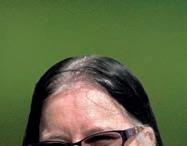




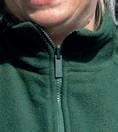
Rutland Ospreys volunteer Anna Douthwaite chats to Wendy Tobitt about her small part in helping these majestic birds – all with the unfolding drama of the Osprey Webcam for company.


“When I get into the hide it’s just me and the ospreys.”
Anna
Douthwaite, Oakham

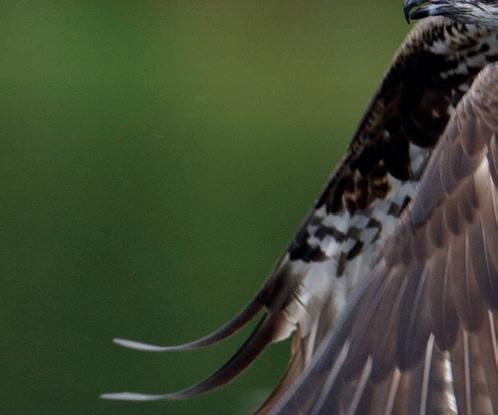
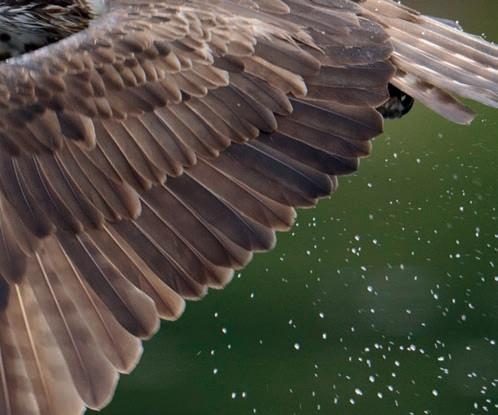

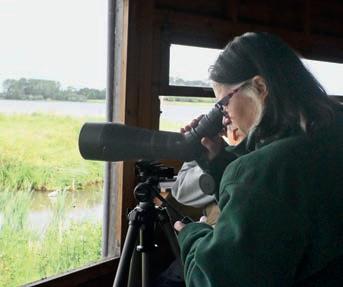
You can see Maya is a bit twitchy as she se les on the li le ones,” explains Anna Douthwaite as we watch the Osprey webcam on Day 38 this year. This is Anna’s 15th season as a volunteer with the Rutland Ospreys. She understands every movement the adult birds make as Maya, a female of 19 or 20 years and 33(11), the male who paired with Maya 11 years ago, step carefully around their three chicks bobbing up and down in the bowlshaped nest.
Anna is among the 150 volunteers in the Osprey Team at Rutland Water between March and October. She begins her Sunday morning shi s at 9am, walking to the hide at Manton Bay, listening to birdsong.
“When I get into the hide it’s just me
and the ospreys.
That’s the time I love because
I’m totally focused on them, watching their behaviours and making notes.” She sets up the ’scopes and prepares for people to come into the hide to see these charismatic birds, close-up.
“Hundreds of people come from all over the world to see the Rutland Water Ospreys. I explain what’s going on in the nest now, and what will happen when the chicks fledge.
The fisherman
“While they’re here at Rutland Water the male bird, 33(11), is the fi sherman; he lives for fi shing. He delivers a fi sh and eats the head before leaving the rest for Maya, the female, to feed herself and tear it into tiny shreds to feed the chicks. The fi sh head has the
most protein and it’s important he keeps up his strength to provide food for his growing family.
“Maya starts fi shing for herself a few weeks before they return to Africa. Maya is supposed to go fi rst, followed by the juveniles and then 33(11), but the Manton Bay pair rarely follow the rules. Over the past few years, the juveniles have gone fi rst, leaving Maya and 33(11) to enjoy an autumn break without the kids! The juveniles fly off from mid to late August, with the adults leaving in early September.
It’s amazing to think they’re navigating by instinct all the way to The Gambia and Senegal.”
Anna is a teaching assistant and Osprey Ambassador in her school.
“Children will continue our fi ght for nature. I’m delighted when families come into the hide, and by the children’s reactions when they see the ospreys, because they are so big.
“I’ve got to know Maya so well, I can see thoughts crossing her face when her partner brings in a stick instead of a fish.”
mornings in the hide at Manton Bay. “I start to feel excited about them. I don’t know when they’ll return, but it’s the best feeling ever when they come back on my shi !”
the day they leave 33(11) has been bringing in all the fi sh. As young adults they may return to Rutland Water the following year or fi nd another favourite spot such as the Dyfi Valley in Wales, where some Rutland Water ospreys now breed.
Spending time with the ospreys is very important for Anna. “In our busy lives we all need space and time to relax. For me it’s being with Maya and 33(11). Yes, it is a healing experience; just being able to sit, watch, look, notice and listen.”

Maya is the only breeding female osprey that Anna has known. “I’ve got to know her so well, I can see thoughts crossing her face when her partner brings in a stick instead of a fi sh. The eggs are laid on separate days and hatch in sequence. They’re cute and fluff y with bobbleheads to start with, then they go through a baby dinosaur stage before they’re cute and fluff y again.”
I’m 5 2in tall and an osprey’s wingspan can be 5 6in.”
A er 15 years watching the ospreys and noting the birds’ behaviours, the dates when they arrive, when the first egg is laid and when the chicks fledge, Anna has become an expert. “I didn’t know anything about ospreys when I started,” Anna explains. “I was a receptionist in the Visitor Centre when I heard about the call for volunteers and thought ‘I fancy doing that’. My husband Mike was in the Army and away a lot, so the ospreys took over my life. I got a pair of binoculars and a good camera because I’ve always been interested in photography. I learnt so much from Tim Mackrill and Paul Stammers, and just watching the birds.”
Heady expectation
Anna prepares for the arrival of the ospreys in March, checking her thermal clothing for chilly spring
The nestlings grow quickly and a er five or six weeks, they are ringed. The juveniles fledge at eight weeks and soon a er they have developed their fl ight feathers and are doing press-ups to get fit for their fi rst fl ight, typically migrating at just 12 to 14 weeks. Young ospreys learn to fi sh for themselves on migration as they fly south. Up until
It’s a birder’s life Anna grew up in Larkhill, with skylarks singing above Salisbury Plain. She watched David A enborough’s nature programmes and had family pets. “Now my life is always interrupted by birds doing something,” says Anna. “I’m studying military history and learning about confl icts and wars; then I look out into the garden, see the blue tits on the feeders and watch bu erfl ies among the flowers.”
Anna’s 11-year-old son William has grown up with his mum’s fascination with ospreys and wildlife. Together they have adventure days at Rutland Water taking their binoculars and notebooks to see what’s around at the time.
In October all the volunteers gather for a fi sh supper in the Volunteer Centre and share their experiences of the birds this season. Find out if the bobble-headed chicks that Maya and 33(11) nurtured have successfully flown off to Africa at lrwt.org.uk/rutlandospreys
Contact us if you or someone you know could feature in a future issue of Wild. We’re looking for inspiring stories from people like you! Email info@lrwt.org.uk



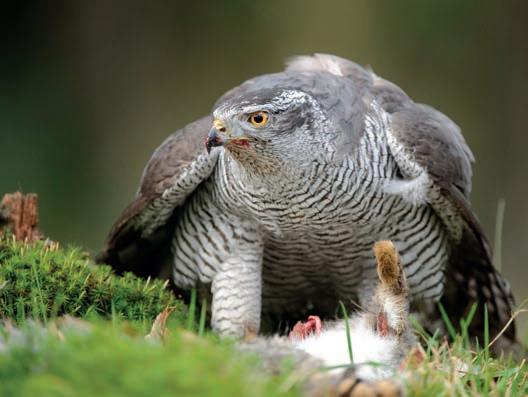
TheSenior Reserve Officer Andy Neilson explores the remarkable return of one of Britain’s most formidable woodland predators, and why the goshawk’s growing presence locally is great news not just for birdwatchers, but the entire ecosystem.




The Eurasian goshawk is a large member of the hawk family, found widely across northern Europe and Asia. A bird of the high forest, they naturally occur pre y much wherever there is woodland, using their agility to hunt a wide variety of prey through forest glades at speeds of up to 25mph. They belong to the same family as sparrowhawks and look similar, though goshawks are much larger, approaching the size of a buzzard.

that goshawks, ‘used to occur not infrequently in our woodlands and forest wilds’ but had become exceedingly rare. This became the status quo for much of the next two centuries, with only a few accepted records.



Fortunes flipped
Like many birds of prey, goshawks suffered hugely due to confl icts with gamekeepers and livestock owners during the pre-Victorian era and were almost entirely wiped out from much of the UK, with only a few strongholds remaining in the most remote parts of the country. Their fate was much the same in Leicestershire and Rutland, and in 1841 Harley wrote

From the 1960s onwards the fortunes of UK goshawks began to improve. Thanks to a combination of escaped falconers’ birds and intentional releases the population of goshawks has slowly began to increase, though they stayed stubbornly rare in Leicestershire and Rutland till recently.
Over the past five years we had more and more sightings of goshawk across our counties, culminating in the discovery of a breeding population in the Charnwood Forest in 2025, with up to seven birds seen from the watchpoint at Bradgate Park. Other enticing reports indicate that populations are establishing in


other locations across Leicestershire and Rutland.
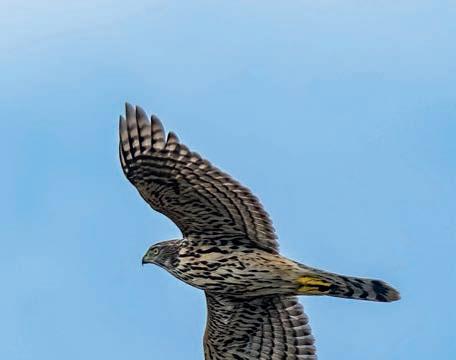
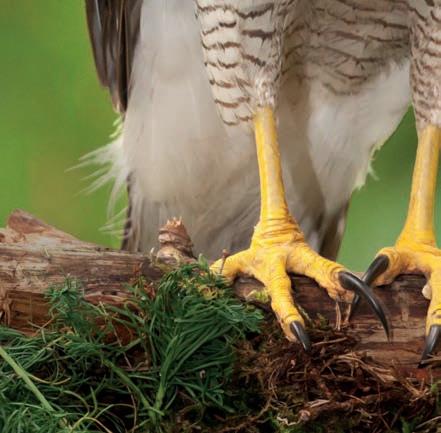
Last year culminated with county bird recorder Carl Baggo documenting the fi rst ever record of goshawks at a nest in Leicestershire, with successful fledging of two chicks. Carl, who has taken remarkable photos of these birds (see above), has a Schedule 1 permit for ringing and nest recording, allowing him close-up access to these incredible birds.


While recovering a lost species to its former range is cause for celebration in itself, goshawks will also help to restore balance to food chains and should have several positive impacts on the wider ecosystem. In fact, they can accurately be described as ‘ecosystem engineers’.
By predating on larger, abundant species like woodpigeons they ensure there is less competition for food for smaller bird species. Corvids, such as crows and magpies, also form a large part of a goshawk’s diet, which in turn should reduce the number of chicks and eggs lost by songbirds to corvid predation. There are even scientific studies that suggest smaller nesting birds gravitate towards goshawk nest sites due to the ‘halo’ effect they offer in deterring smaller predatory species from raiding their nests!
Their ability to control invasive grey squirrel populations also provides valuable services to the forestry industry, saving them millions in damaged trees and pest control solutions each year.
The future really does seem bright for this enigmatic species. With the expected population growth over the next few years, we should see goshawks spreading widely across Leicestershire and Rutland. Of course, their population densities will always be limited by suitable nesting sites and hunting habitat, but there is no reason to suggest that the current populations in the Charnwood Forest will be the limit of their expansion into our two counties.
pairs living within the city so, you never know, goshawks may become a regular feature of our urban wildlife in the coming years. What an exciting thought!

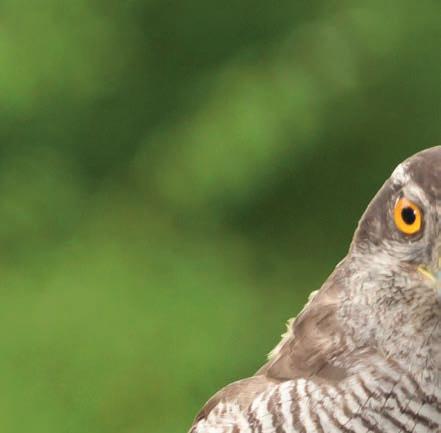
The best place to see goshawks in Leicestershire and Rutland is from the war memorial at Bradgate Park. View the woodlands to the west of the memorial and with enough patience, and a li le luck, birds can be observed soaring over the woodlands. This behaviour is most o en documented in March and April when birds conduct courtship displays over their chosen breeding areas, though it is possible to see them at any time of year.
courtship displays over their chosen see them at any time of year.

GOSHAWK FACTFILE
LIFESPAN
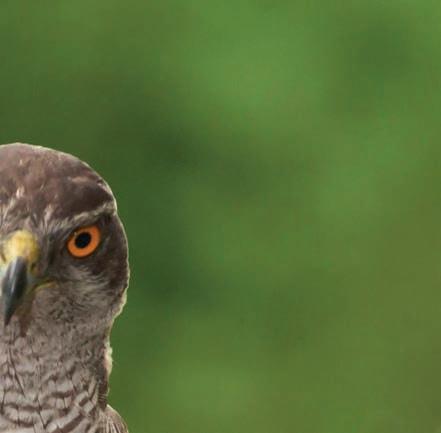
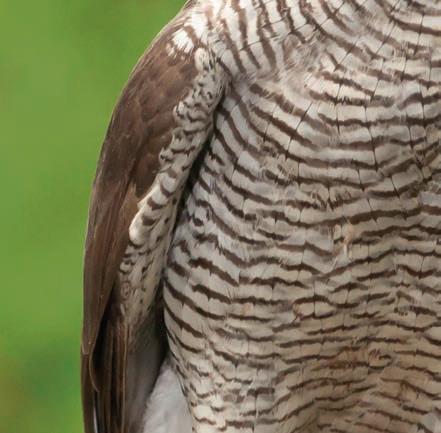
Continental populations of goshawk have shown the ability to colonise urban environments. Berlin, for example, has many
LENGTH
48-64cm
WINGSPAN 165cm up to 7 years
WEIGHT
850g Male Female 1.5kg
HABITAT
Woodland, but also upland, farmland and grassland
DIET Birds, mammals
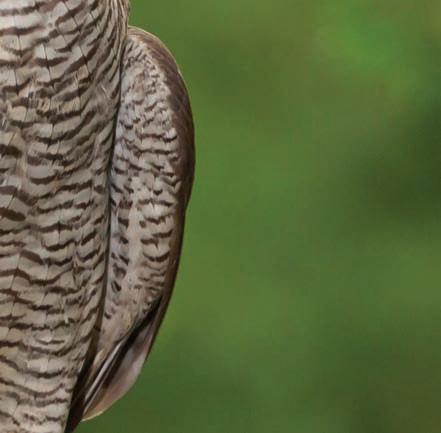
A good pair of binoculars or a telescope is recommended to clearly view the birds and be certain of the identification, as they are easily confused with sparrowhawks and other birds of prey.
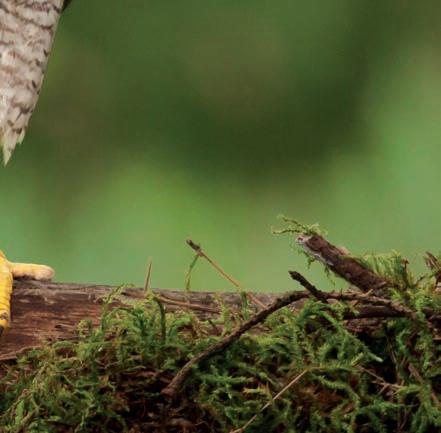
From near extinction to nesting pairs in Charnwood Forest, the goshawk’s story is one of nature’s most promising recoveries, and it’s one that’s only just beginning. Whether you spot one cu ing through a forest glade or soaring above Bradgate Park, an encounter with this magnificent bird is a powerful reminder of the potential of our countryside.
Enjoy a gentle stroll around our newest nature reserve on this easy self-guided walk. Program Leader John Bristow shows us the way.



Join us for a special members-only introductory walk and talk on James Adler Reserve on 14 October. Turn to page 35 for more details.
Sometimes a nature reserve tells a story that goes beyond habitat surveys and species lists. Our newest nature reserve, the James Adler Reserve, nestled in the village of Great Bowden near Market Harborough, is one such place. Knowing its origins only deepens the joy of exploring it.
The land was generously gi ed to the Trust in 2024 by Michael Adler in memory of his son James, who passed away unexpectedly at the age of 42. James had worked as CEO of Ashdown Forest in East Sussex and served as The Wildlife Trusts’ National Land Management Adviser – a man who, in the words of his father, was ‘a natural alliance builder who could communicate a vision and bring together people of the most diverse backgrounds’.
Father and son had walked this very ground together, enjoying the wildlife it holds. Gi ing the land was a profoundly generous act: turning private grief into a public gi and ensuring that James’ love of nature lives on in the landscape he once explored.

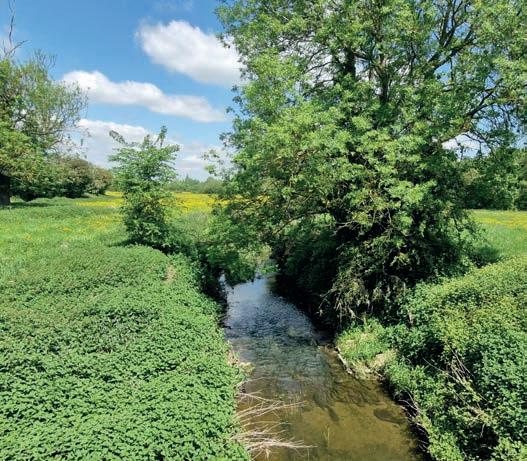
The River Welland runs through.

taking root, forming the beginnings of a wet woodland that one day soon will ring with birdsong and shelter species from beetles to dragonfl ies.
Those trees are just the start. Plans for the reserve include new wetland habitats, shallow pools to a ract amphibians, and improvements to the river and its banks – work that will benefit both wildlife and the wider community by helping to alleviate flooding. The reserve also forms part of the broader Rewilding Harborough project, connecting more than 500 acres of habitat across South Leicestershire.


special. So lace up come see for

The River Welland winds through its lower sections, where work is already underway to realise the site’s
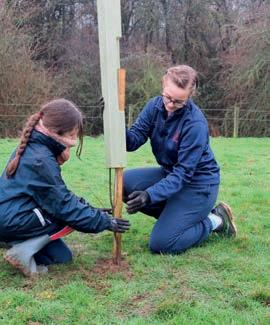
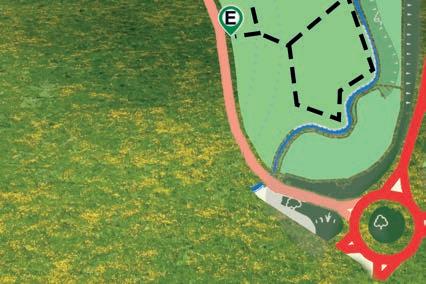
And what a landscape to inherit! The 20-hectare site straddling the A6 encompasses a rich patchwork of grassland, scrub, trees and riverbank. The River Welland winds through its lower sections, where work is already underway to realise the site’s enormous potential. This past winter, students from Leicester Grammar School joined Trust volunteers, trustees and supporters to plant the fi rst of an ambitious 22,000 trees. Willow and alder saplings are already


alder saplings are already
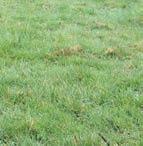


This is exactly why your membership ma ers. New nature reserves like this – created through generosity, community spirit, and the Trust’s quiet, determined work – are proof that together we really are making more space for nature. The James Adler Reserve is still in its early days, but already it feels like somewhere special. So lace up your boots and come see for yourself…


The





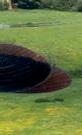



The reserve lies 1km northeast of Market Harborough, southeast of Great Bowden. There is no parking and access is required at all times.
Nearest postcode: LE16 7HF
Map ref: SP 750 884 what3words: sprouts.defenders. photocopy
Parking: Please park in Great Bowden village then walk to the reserve entrance on Dingley Road opposite Great Bowden Cemetery. Size: 10 ha


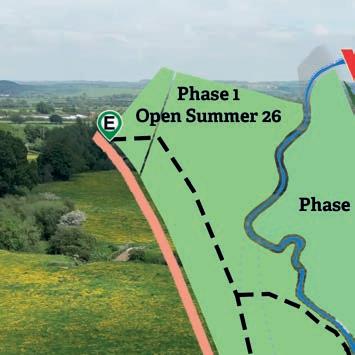
We begin our 20 to 30-minute walk at the entrance on Dingley Road, nearest Great Bowden village, and head east to the fi rst way marker post 1 . Ahead you will see a meadow area extending towards the River Welland. This meadow includes relict ridge and furrow, which could not be planted as part of the wider woodland scheme. The grassland is relatively species poor but an impressive flush of bu ercups in spring makes the meadow buzz with insects.
Take a right turn heading south along the woodland ‘ride’ between the newly planted trees. All tree planting in this fi rst field was carried out by volunteers, community groups and school groups last winter.
Continue along the ride through the gateway 2 into the second field. At the next way marker post you will notice a large bank to the east (on your le ), which forms one side of a flood relief channel.
Constructed in the 1930s, it increases water carrying capacity and speeds flow away from Market Harborough by bypassing the natural river meander. Do NOT a empt to cross the channel when water is flowing through it.
Heading east, cross the flood relief channel 3 following the woodland ‘ride’ towards the river.
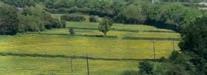
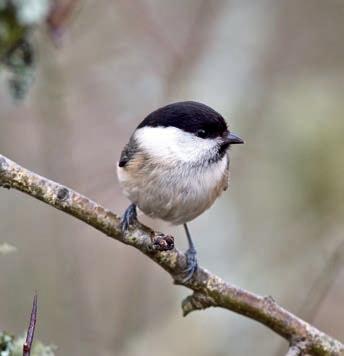
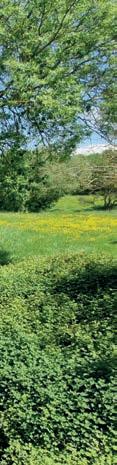
This area has been planted with tree species more suited to we er conditions as this field periodically floods. It is hoped that the developing wet woodland will a ract a range of wildlife as it matures, including the increasingly rare willow tit that relies on this habitat.
At the end of the ride, you will come across a large concrete ramp 4 previously used for agricultural access across the river. You can get a good view of the Welland from the top of the ramp and may be lucky enough to see one of our resident kingfi shers or dragonfl ies fl i ing along the water.
The trail continues southwards alongside the river to your le . The stretch of river flowing through the reserve still retains a natural meander and mature bankside vegetation. Gaps in vegetation offer glimpses of the narrow river, deeply cut into the landscape. The steep banks provide nesting opportunities for the kingfi shers.
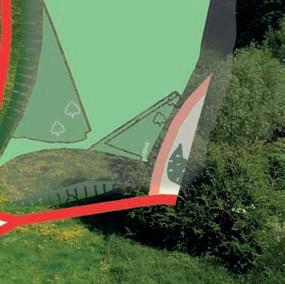
As the path continues to follow the course of the river it eventually turns westwards. To the north, on your right, you will notice an unplanted area 5


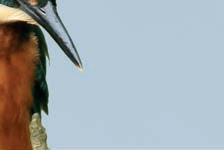
As the surrounding trees mature, this open area will become a woodland glade, providing further habitat within the reserve. There is potential to enhance species richness of the grassland to a ract more wildlife. It is also south-facing, ensuring a warm, sheltered spot for insects to bask in the sun.
Continuing past the glade, the trail turns northwards along another woodland ride 6 Taking a le hand turn when you reach the end of the ride 7 will bring you back across the flood relief channel.
At the next way marker 8 , head northwards, keeping the flood relief channel on your right and follow the trail through the hedge back into the fi rst field 2 . Retrace your steps through the plantation, taking a slight le at the way marker 1 towards the reserve entrance.
For further information, please visit lrwt.org.uk/nature-reserves/ james-adler-reserve
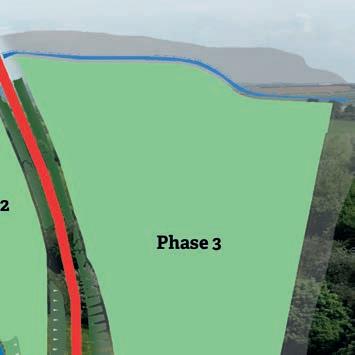




“ e reserve is still in its early days, but already it feels like somewhere special.”












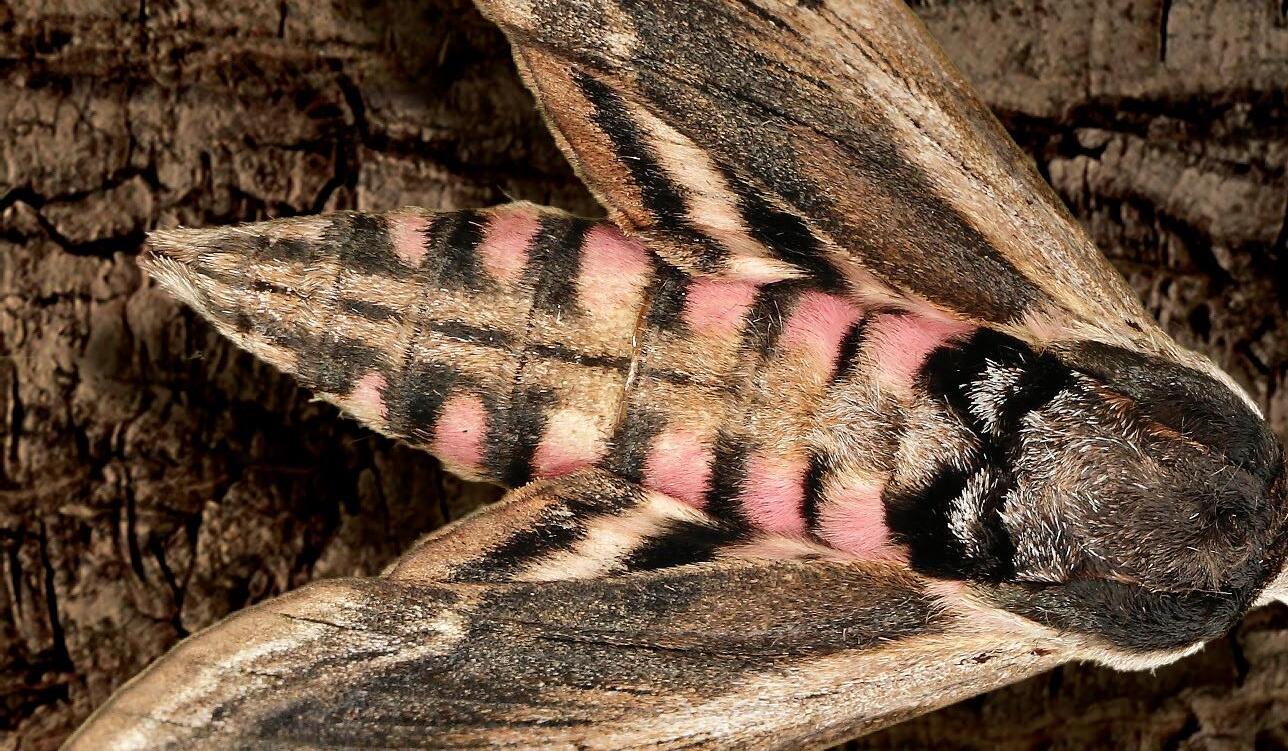































Common in Southern England and South Wales. Caterpillars feed on a variety of woody plants, especially ash and privet.
















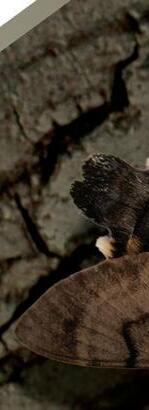




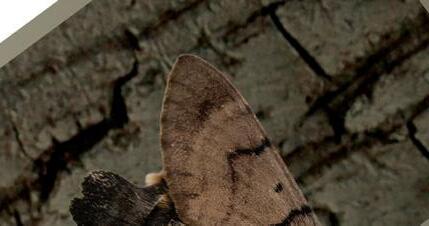
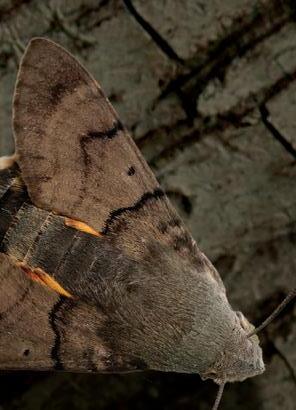

















Migratory, reaching all parts of the UK. re e see e ar a o ers hovering like a hummingbird. Caterpillars feed on bedstraws. of woodland













Scarce and mostly found in southern and eastern parts of England, especially on heathland and woodland rides. Caterpillars feed on honeysuckle.

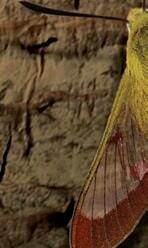
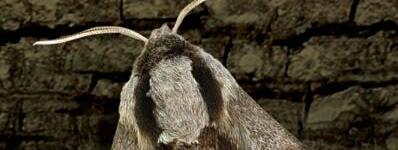


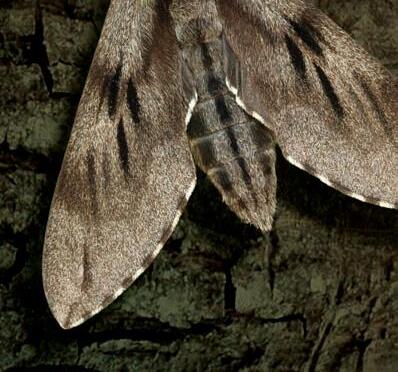













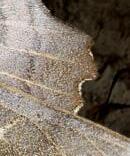
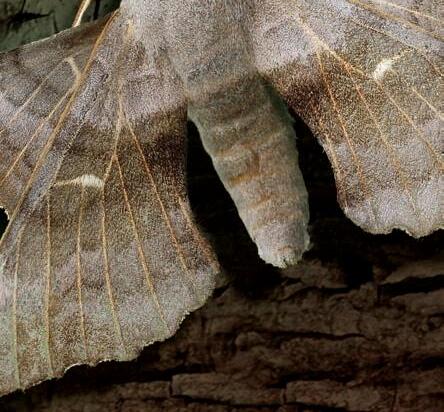

Found in woodland and heathland across England, but away from the far west and north. Caterpillars feed mainly on Scots pine.














Caterpillars feed on poplars and willows.




iscover some magnificent moths with Barry Henwood, co author of Field Guide to the Caterpillars of Great Britain and Ireland and volunteer with evon Wildlife Trust




































Common over much of England and Wales, local in Northern Ireland. Caterpillars feed mainly on willows





































EARLIEST MEMORIES of moths is including and apple.

Common over much of England and parts of Wales. Caterpillars feed mainly on elms and lime, including in urban areas.













Common throughout most of the UK. Most frequently found in gardens as a caterpillar feeding on willowherbs or fuchsias.















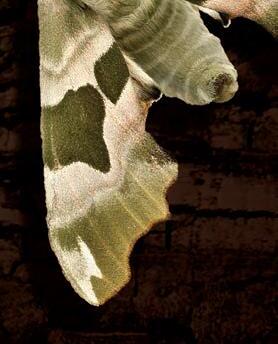
Oastonishment at fi nding a poplar hawk-moth on a fence. This encounter helped spark a life-long interest. The group of moths known as hawk-moths includes the largest species found in the UK. They’re a diverse group, but one characteristic they all share is that the caterpillar has a horn at the end of its abdomen.


We have nine resident species, with a further nine migrating here from Europe. But of these migrants, only the humming-bird hawk-moth is able to survive our winters. Most spectacular is the death’s-head hawk-moth, an uncommon migrant. Its short, stubby tongue is specialised for taking honey from the nests of honey bees. It emits an audible squeak, thought to be a form of communication that helps it cheat the bees.
Some hawk-moths fly by day, such as the two species of bee hawk-moth and






Yorkshire

Wildlife Trust
This peninsula on the Yorkshire coast isn’t just great for migrant birds, but migrant moths too. Following southerly winds, look out for humming-bird hawk-moths or, if you’re really lucky, something much rarer, such as convolvulus or death’shead hawk-moths.


Where: Kilnsea, HU12 0UH
Folly Farm
Avon Wildlife Trust



moth, but the majority fly by night. Some do not feed as adults, but those that do act as pollinators and can distribute the pollen over very long distances.
the humming-bird hawkover



The humming-bird hawk-moth, for example, has the potential for bringing pollen from France.
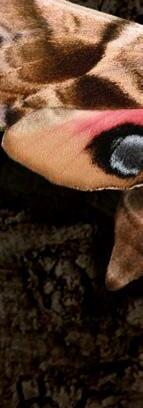
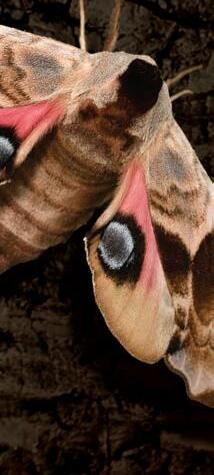
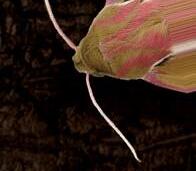
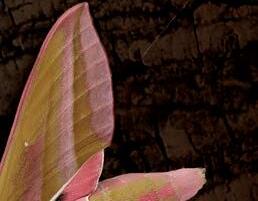
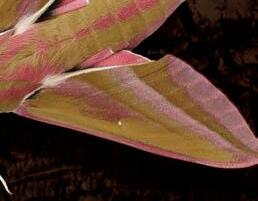
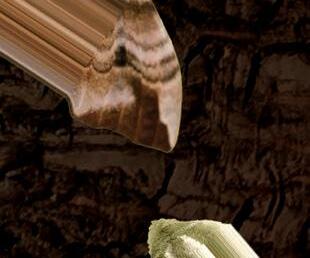
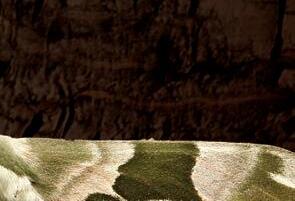
The night-flying adults are a racted by lights, but you may fi nd them resting by day, perhaps on fence posts or trees. They are camoufl aged, but if disturbed by a bird some species fl ash their colourful hindwings. The poplar hawk-moth displays a red patch, whilst the eyed hawk-moth reveals bright colours and eye spots. These serve to startle the bird and make it flee. The elephant hawk-moth is particularly colourful, but more o en its caterpillar is found in gardens. It has a swollen fi rst abdominal segment and large eye spots, giving the illusion of a snake. Caterpillars of other species can be found by searching their foodplants and looking for stripped leaves on branches or their droppings beneath.


The woodland and wild ower meadows are home to lots of moths, including elephant hawk-moths. Adults are regularly attracted to lights during surveys, but you might find a chunky caterpillar crossing a path in late summer.
Where: Bristol, BS39 4DW
Nature Reserve
Leics & Rutland
Wildlife Trust
With more than 750 species of moth recorded on the reserve to date, Rutland Water is a moth mecca. This includes eight species of hawkmoth, including lime, eyed, poplar, privet, pine, humming-bird, elephant and small elephant hawk-moths.
Where: Oakham, LE15 8BT



Fifteen years after water voles were released at Rutland Water, these charismatic mammals are once again thriving in the reserve’s reedbeds and waterways says Linda Biddle, Rutland Mammal Recorder.
Have you ever seen a water vole? If so, you are among a privileged few, and luckier still if you caught a glimpse at Rutland Water Nature Reserve: a small brown animal slipping by silently, perhaps across the channels in front of the Waderscrape Hide. While the local population has come along in leaps and bounds since that fi rst release in 2011, the adorable water vole remains a genuinely rare sight.
It wasn’t always this way. In the 1960s, water voles were a familiar sight on reedy riverbanks and ponds, nibbling shoots and leaves while local gentry rowed the romantic margins of Burley Lakes.
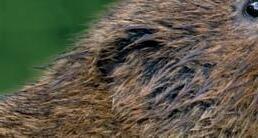

colonise an area surprisingly quickly.
When it became clear in the 2000s that water voles had never appeared on Rutland Water’s species list, a reintroduction plan was hatched. Before any new animals could be released, a thorough survey of the surrounding area was required, along with a trawl of historical records, courtesy of the Rutland Natural History Society to confi rm the species was truly absent.
Luckily a source of voles was found in Devon, captive-bred by wildlife farmer Derek Gow from adults rescued from development-threatened populations. The fi rst animals were released at the reserve in 2011, and two further introductions followed, bringing the total to around 700 individuals. Each one made the long journey north by truck from Devon – quite the adventure for a wild animal!
Sadly, as in many parts of the UK, a slow decline followed as pollution and habitat loss took their toll, while the arrival of American mink made things dramatically worse. By the turn of the millennium, water voles were in serious trouble. Unlike native predators, mink can pursue them underground, leaving the voles with no refuge beyond their burrows.
burrows.
Rutland’s Ra ies


beloved character in in the Willows rivers, streams, ponds and a a small population in
Water voles, o en affectionately referred to as ‘Ra y’ a er the e Wind , are not rats at all, but our largest species of vole. These semi-aquatic mammals make their homes in burrows along the banks of rivers, streams, ponds and reedbeds. Females hold territories of around 30 metres and can breed up to four times a year, meaning a small population in favourable habitat can
Fi een years on, those fi rst releases can be viewed as the beginning of one of Rutland Water’s most successful species reintroduction projects. The continued presence and spread of water voles across the reserve and beyond is testament to the long-term commitment of the staff and volunteers who have monitored the population ever since.
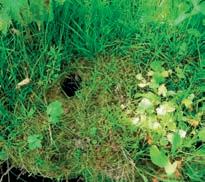
Entirely vegetarian, water voles feed on shoots and leaves, with a particular fondness for reeds. They create food piles, known by Rutland Water volunteers as ‘salads’, which they sometimes arrange with surprising neatness. They do not hibernate and leave a range of tell-tale signs: cropped ‘lawns’, well-worn runs along banks, and droppings at prominent marking spots.


One clever monitoring method involves floating small ra s. When placed around Rutland Water, the voles took to using these as latrines with great enthusiasm, o en
preferring them to natural features like tree stumps. A regular monitoring programme was soon underway.
Larger clay-lined ra s were also deployed to detect mink, luring them to leave their distinctive footprints. Mercifully few were recorded and, over time, those ra s told an encouraging story, with mink numbers declining as o er numbers rose.
Volunteers continue to visit the original monitoring sites in all weathers. Their records reveal which habitats the voles favour, what they are eating, and when they are most active. The voles have largely withdrawn from open banks, retreating into hidden channels and reedbeds where wind, waves and predators are less of a threat. Others surface occasionally to the delight of
visitors in front of the osprey hide at the Lyndon Visitor Centre.
Mink are not the only threat. Water voles have many natural enemies. Birds of prey, herons and egrets take them from above, while o er predation is sometimes confirmed.
Nevertheless, 15 years a er the first water voles were released, they are thriving. As we celebrate these efforts, there is every reason to hope that future generations of visitors will marvel at those fleeting glimpses of ‘Ra y’ among the reeds.
o e o ed h e her hab a or d fe mo or a a d a er or he a d a ra s or o e ease ema s a info@lrwt.org.uk
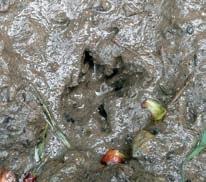
sha ed h e oes s a ed o
Linda Biddle reports on our project using baited tunnels and trail cameras to reveal the secret world of mammals living along Rutland Water’s shoreline.
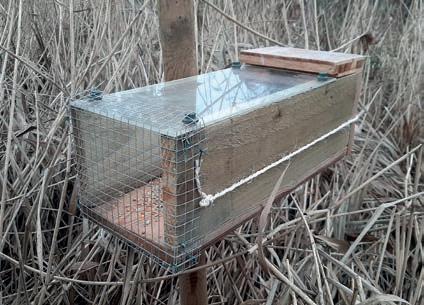
Wooden tunnels with clear plastic tops were fi ed with simple trail cameras, set to take still images, then placed close to the shoreline. Bait was tailored to the audience: birdseed and chopped apple for seed eaters and vegetarian mice and voles, and casters (blowfly pupae) for the carnivorous shrews. Volunteers then retreated, leaving five cameras and boxes in place, returning a week later to top up the bait then again the following week to move the tunnels on to a new position and collect the camera SD cards. The process continued for months, tracking gradually along the reservoir’s shoreline.
Back at home, volunteers faced a different kind of challenge: each card held up to 2,000 images, far more than anyone had anticipated. Small mammals, it turns out, have voracious appetites and with shelter and food on the doorstep, a sort of drive-thru for li le mammals, they returned again and again. Some mice could be seen visibly fi lling out over a fortnight, while rats were particularly persistent, o en cleaning out an entire box’s bait in a single evening!
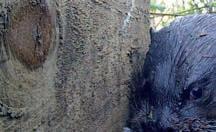

iscovering the secret lives of small mammals has always been a challenge. Small-scale trapping at Rutland Water had offered glimpses over the years, but no one had ever a empted a comprehensive survey. That was until Species and Recording Officer Tim Sexton suggested a different approach: using cameras and baited tunnels instead of traditional small mammal traps. It promised far more detail, without the invasive, time-consuming business of trapping. It was an opportunity too good to resist.
Evidence of water voles was already plentiful from ongoing surveys, and larger mammals were regularly spo ed around the reserve. But what was happening lower down, among the smaller, more elusive species, remained largely a mystery. The hope was that the cameras might also fi nally capture the notoriously secretive water shrew.
The boxes a racted bigger visitors too. Squirrels, o ers, badgers, weasels and even a polecat-ferret were drawn in by the smell of food. Shrews moved so fast they were o en just a blur across the image, while slugs and snails took their time crossing the box floor. Bad weather occasionally interrupted occasionally interrupted proceedings too, with rising water levels caught, quite literally, on camera as the boxes flooded.

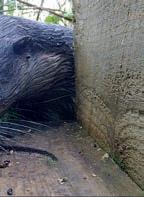
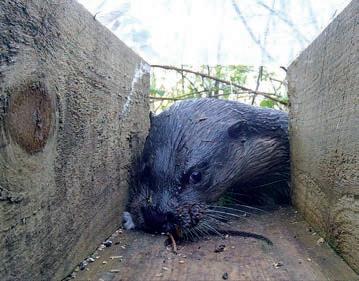

Larger mammals, including otters, also paid visits.
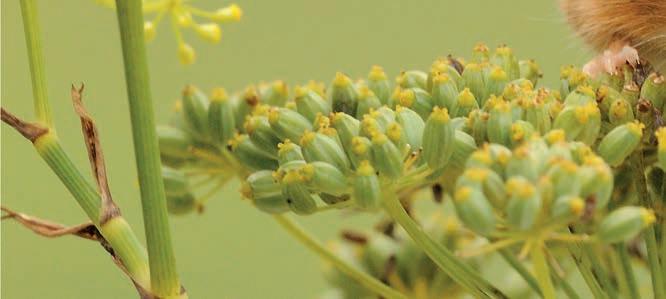
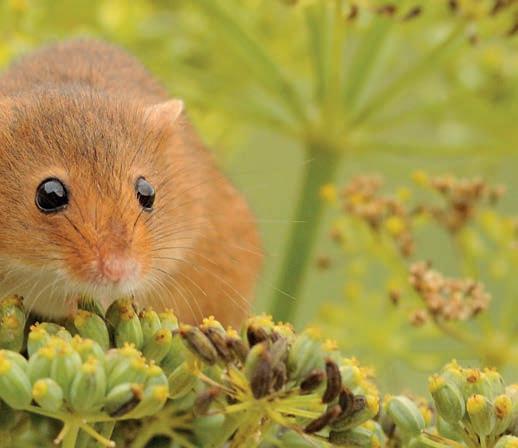


Over a period of 21 months, across 26 locations, the project amassed around 96,000 images. Each one was reviewed and recorded, yielding 7,913 individual records across 15 mammal species.
they were known to be active. Not one appeared on the standard tunnel cameras. The breakthrough came with a floating camera trap, launched on the theory that vulnerable water voles might avoid tunnels already visited by other species. It worked, with the very fi rst image captured being a water vole. The celebration was short-lived, though – a rat soon swam out and cleared the bait, and the voles didn’t return. A wood mouse also braved the two-metre swim to the ra , only to fi nd the cupboard bare.
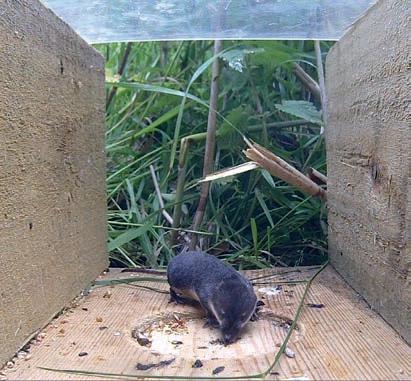

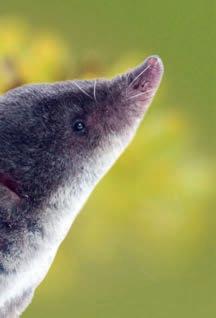
The water shrew – a portly fellow, smartly marked in black and white, and rather more rounded than its cousins – appeared o en along the shoreline, revealing a healthier population than the occasional records of dead animals had previously suggested. Common and pygmy shrews were less widespread, but still turned up in good numbers, though always alone. Wood mice (also known as field mice) bustled in and out, sometimes several at once, while the calmer, less hurried voles took a more leisurely approach.
Water voles themselves, frustratingly, stayed camera-shy even in areas where





96,000 camera trap images reviewed

21 months of surveying 26
locations surveyed around the reserve 15 species recorded


The undisputed star of the project was the harvest mouse. Beyond the occasional tennis-ball-sized nest spo ed in the reedbeds, there had been li le evidence of harvest mice on the reserve, so fi nding three or four visiting one site repeatedly, coming and going from the boxes, was a delightful surprise. But it raised a question: why only there?
The suspicion, as with the water voles, was that timid harvest mice might avoid tunnels already marked by other species’ scent. To test this, tunnel boxes were sited in previously surveyed areas but mounted around a metre up on posts, with their entrances covered in 13mm wire mesh – too small for rats and wood mice, but just right for harvest mice. The mice investigated it almost immediately, enjoying exclusive access to the plentiful seed supply, while fieldmice and rats made determined but unsuccessful efforts to fi nd a way in.


The project has produced a wealth of data, which will feed into an atlas of small mammal distribution along the Rutland Water shoreline. The harvest mouse mystery looks to be solved though other questions remain, not least how to persuade water voles to perform for the camera more readily, and how we might use all the data collected to estimate population sizes. As ever in nature, every answer brings a fresh set of questions.
Find out how you too can record your mammal and wildlife sightings. Visit: lrwt.org.uk/identify-and-record-local-wildlife
Check out local volunteering opportunities at lrwt.org.uk/volunteer-opportunities
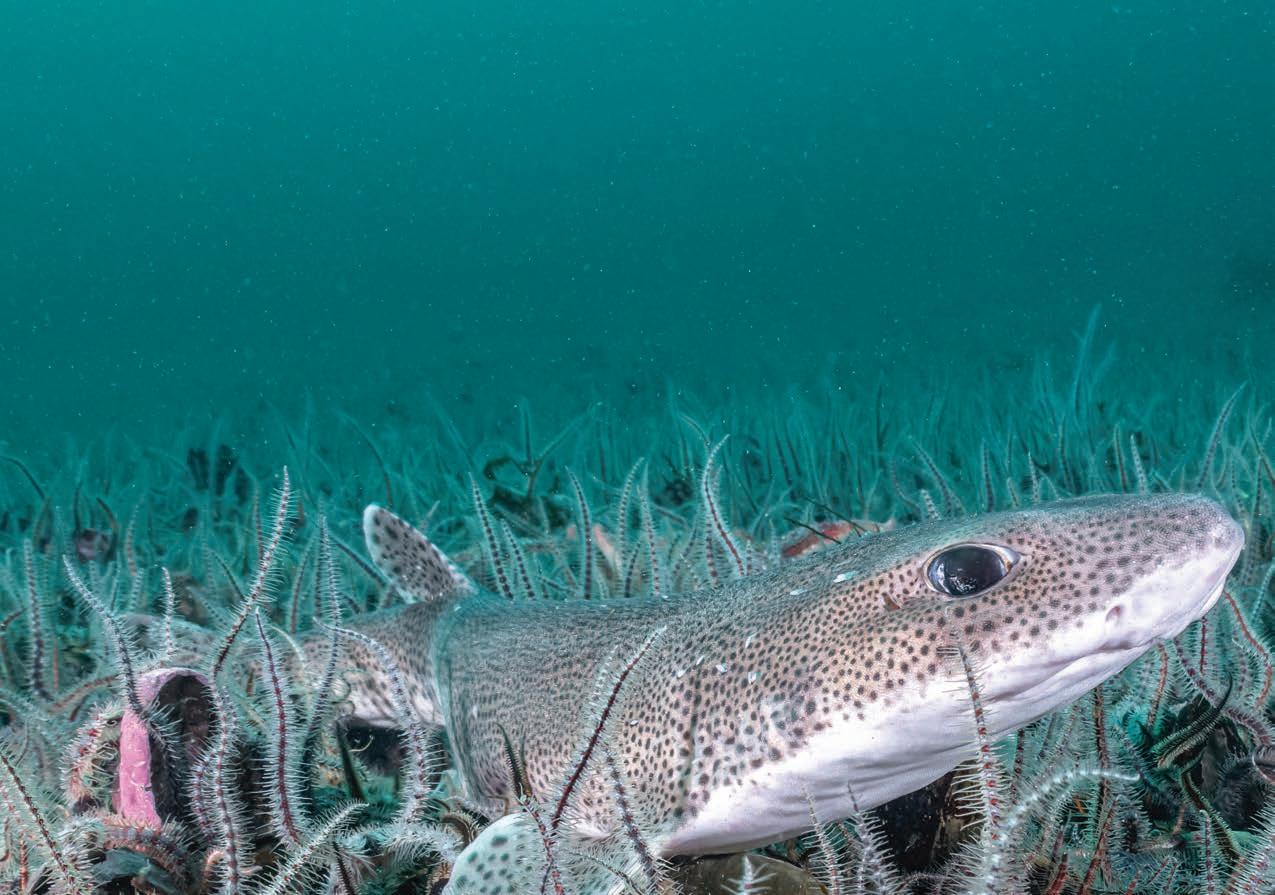




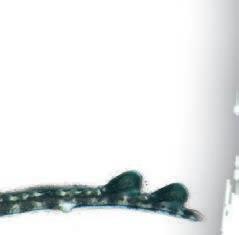
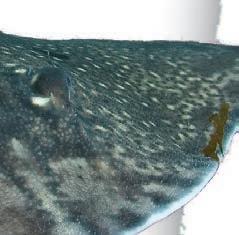
These small sharks are found all around our coasts, sticking close to the seafloor. They are often accidentally caught during bottom trawling. marine





Get to the bottom of bottom trawling with Daniele Clifford, marine conservation officer for The Wildlife Trusts.
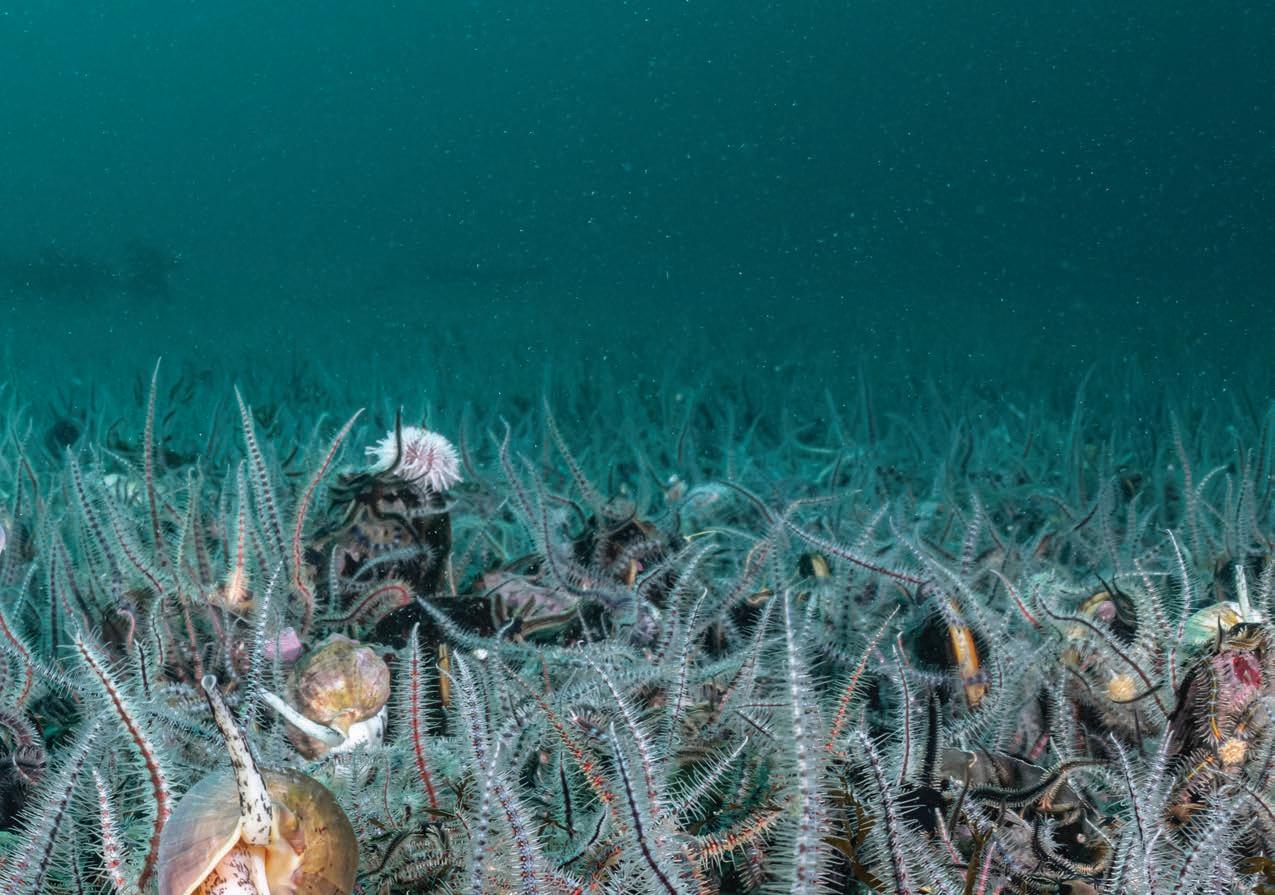
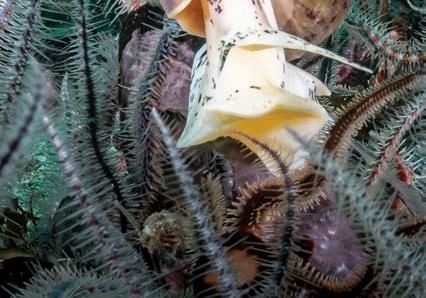

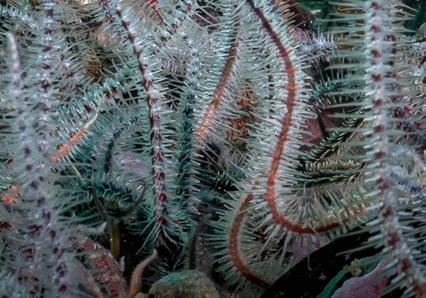
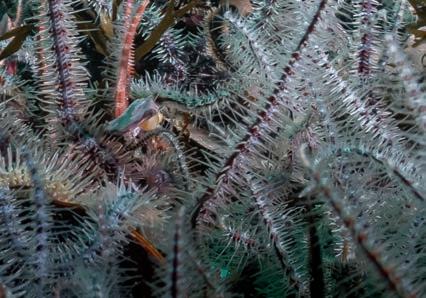

I’ve known about the impacts of bo om trawling for years. But like many others, last year I sat in the cinema watching Ocean with David A enborough, stunned to see the reality of this fishing method on the big screen. The giant net and heavy chains bulldozing the seafloor, stirring up sediment and destroying the burrows of countless creatures in seconds. Fish and other wildlife of all shapes,
sizes and ages swimming for their lives… only to be sucked into the vast yawning net and later discarded, dead, back into the sea.
This incredible footage has stuck with me and millions of others around the world. For too long the impacts of bo om trawling have been out of sight and out of mind. Thankfully the tide is starting to turn, but we still have a long way to go.

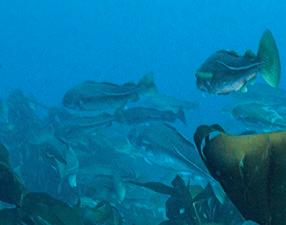
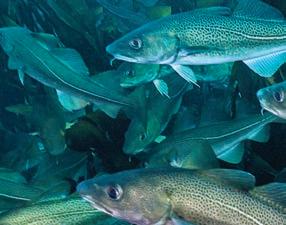
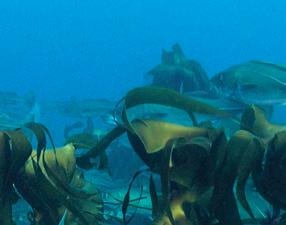
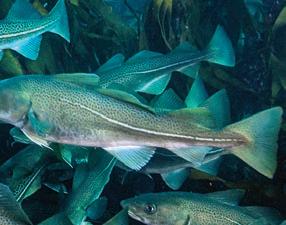
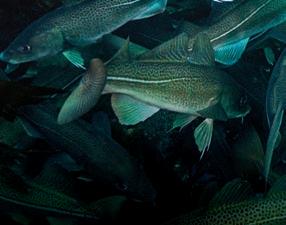
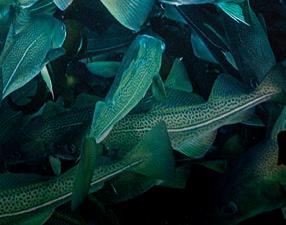
Bottom trawling is often used to target cod, which is one of the UK's most popular commercial fishes.

What is bo om trawling?
Bo om trawling is a method of fi shing that drags heavy nets and chains along the seafloor. It is used to catch fi sh or shellfi sh that live within or just above the seabed. Bo om trawling is largely used as it enables fi shers to catch large amounts of high-value fi sh, including whitefi sh like cod, haddock and hake, and flatfi sh such as halibut and sole. Shellfi sh like nephrops and shrimp are also targeted using this method.
Discards and destruction
Fishers using bo om trawling o en only want to capture one or two fi sh species (the ‘target species’), but the nets catch almost everything within their path. Everything the fi shers don’t want is thrown back into the sea (called ‘discards’). This may be more than three quarters of the catch! These discarded fi sh and other wildlife may be killed, injured or at least extremely stressed by the process.
Intensive trawling also causes damage to the seabed. It reduces the diversity of wildlife, wiping out long-lived species, damaging or removing fragile reef-forming animals and destroying the 3D structures they create. The many surfaces and crevices of a healthy seabed provide key nursery, feeding and refuge areas for wildlife, including commercially important fi sh and shellfi sh. When these are destroyed, entire ecosystems begin to unravel.
There are potential implications for the climate, too. It’s estimated that there are around 240 million tonnes of carbon in the top 10 cm of seabed sediments in the UK and Isle of Man’s seas – mostly in our marvellous marine mud.
Also known as nephrops or Dublin Bay prawns, they live in burrows and are targeted by bottom trawls to make scampi.


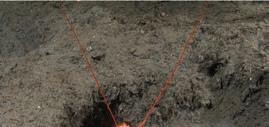
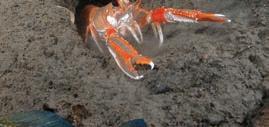






When trawling disturbs sensitive carbon-rich sediments, it risks releasing this carbon.
Our seas are a shared resource. Unsustainable fi shing not only harms wildlife, but also the other people and economies that rely on healthy seas for their livelihoods, cultures and recreation.
Seabed sanctuaries
The UK has 377 Marine Protected Areas (MPAs), created to protect special habitats and wildlife at sea. This is an impressive number, but sadly many still allow damaging activities within them. Some progress has been made, but many MPAs with important seabed habitats are still partially or totally open to bo om trawling. This needs to change.




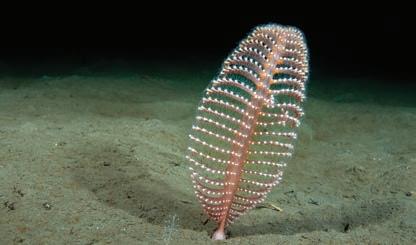

Sea pens are colonial animals that resemble old-fashioned quills. They are highly vulnerable to physical disturbance and impacted by bottom trawling.
Our marine ecosystems can bounce back spectacularly when properly protected. Banning bo om trawling in MPAs would be a strong step in the right direction. There’s a wealth of scientific evidence that shows well managed and enforced MPAs are a vital tool for restoring ocean health. But they are only effective if damaging activities are not allowed within them.

scientific evidence that shows well managed and enforced MPAs are a vital tool for restoring ocean seabed










The Wildlife Trusts have been campaigning for the banning of bo om trawling in seabed MPAs since these special sites were designated, many more than 10 years ago. Recently, we have seen some progress, but we need to keep the pressure up!


many more than 10 years ago. Recently, we have seen some progress, but we need to keep the
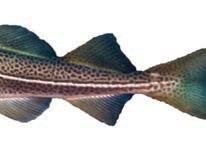
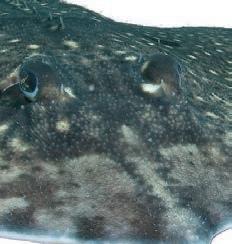
These beautiful rays may be targeted or accidentally caught in bottom trawls.
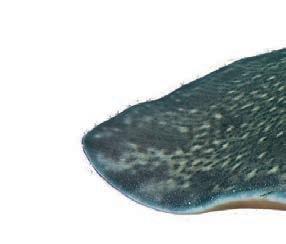

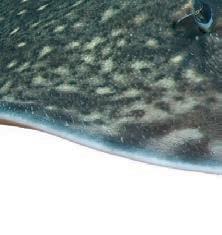





• If you eat fi sh, use The Good Fish Guide (mcsuk.org/ goodfi shguide) to choose more sustainable seafood.

• Write to your MP and ask them to support banning bo om trawling in Marine Protected Areas and a just transition for fi sheries.
• Sign up for our Friends of Marine newsle er to stay up to date with marine news and ways you can help protect our seas: wtru.st/marine-mailing


Some progress has been made for inshore MPAs, but offshore sites remain unprotected.
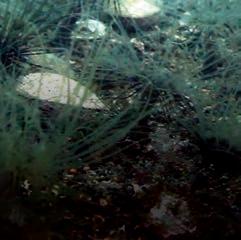
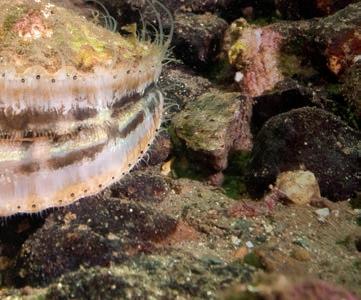
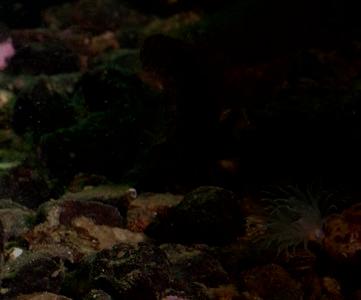
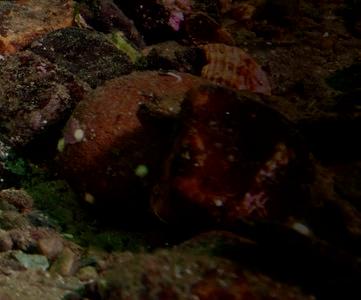
A healthy seabed in its natural state.
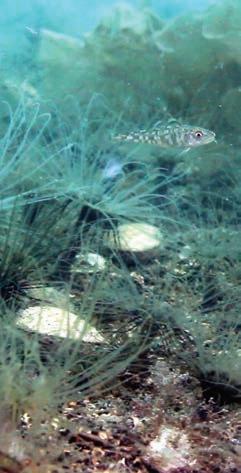
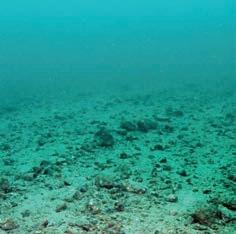






Bottom trawling is only banned from one area, around Skomer Island.

Bottom trawling was banned from certain areas of Scottish offshore MPAs in October 2025. However, gaps remain and there have been delays in implementing bans in inshore MPAs.
Progress is slowly being made for off shore seabed MPAs in England, thanks to the 18,000 people who responded to our call to action in Summer 2025 asking the Government to ban bottom trawling in these sites. Gaps remain in inshore MPAs.



A seabed destroyed by bottom trawling.
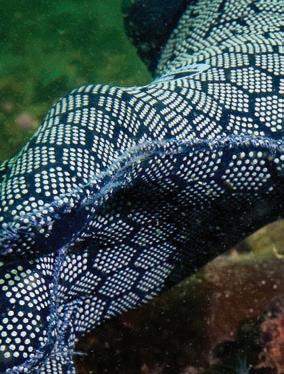
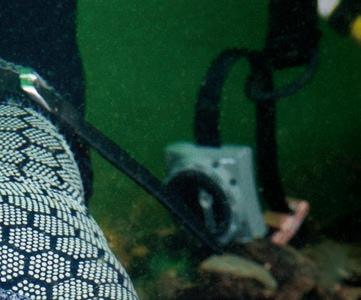

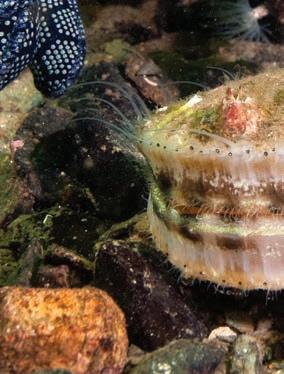

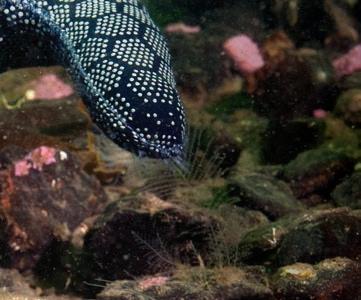
Protecting our seas doesn’t mean leaving fishers behind. We need a just transition where fishing communities, scientists, governments and other stakeholders work together to shape the future of fishing across our wider seas. This includes finding innovative ways to reduce the environmental impact of fishing gears and practices, as well as supporting and incentivising fishers to transition to these more sustainable methods. This is essential, not just for wildlife and carbon, but for the people who depend on our seas.
Our full events programme can be found online. Check there for further details, including how to book, prices, times, and venue. Anyone booked on an event will be notified of any changes. New events are constantly being added, so please check regularly for the latest updates: lrwt.org.uk/events

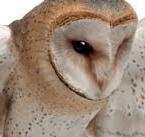
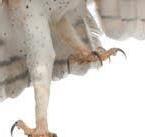



Cossington Meadows
Weds 2 Sept, 7.30-9pm
Barn Owl Walk
Members-only walk led by Chris Hill to search for barn owls as they head out to hunt. £15pp.
Rutland Water Nature
Reserve: Anglian Water Birdwatching Centre
Fri 4 Sept, 9.30am – 12.30pm
Guided Walk with Je
Your guide, Jeff Davies, has a wealth of knowledge which will make your morning’s walk both enjoyable and informative. £10pp (£5 for annual permit holders).
Cossington Meadows
Fri 4 Sept, 7.30-9.30pm
Batty Bats Walk
Join us as we go on the hunt for the flying, squeaking critters of Cossington Meadows. £15pp.
Charnwood Local Group
Weds 9 Sept, 7.30pm
The Making of Springwatch, pt 2 Naturalist and cameraman Jack Baddams is back with more behind-the-scenes tales from the world of Springwatch
Rutland Water Nature Reserve: Anglian Water Birdwatching Centre Fri 18 Sept, 9.30am – 12.30pm
Guided Walk with Je See 4th September for details.


Leicestershire & Rutland Badger Group Mon 28 Sept, 7.30pm Easy Wildlife Photography
Pick up wildlife photography tips to optimise your photos.




North West Local Group Fri 18 Sept, 7.30pm
Rewilding Harborough Programme Lead John Bristow on the new nature recovery project in south Leicestershire. Preceded by the group’s AGM.
Rutland Water Nature Reserve: Anglian Water Birdwatching Centre Fri 11 Sept, 9.30am – 12.30pm
Guided Walk with Terry Come along for a morning stroll
to discover some incredible wildlife. £5pp (£10 nonmembers).
Halstead Hill Farm

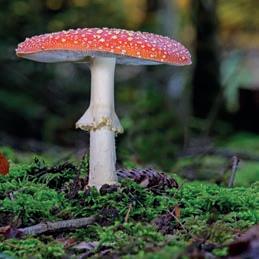
1.30pm Autumnal
Sun 20 Sept, 10am or 1.30pm start Autumnal Fruits
Join funded to agroforestry Prof and farmer
Join a fully funded farm walk to learn about wild fruits and agroforestry with agri-ecologist Prof Chris Stoate and regenerative farmer Dr Miriam Stoate.

Rutland Water Nature Reserve: Volunteer Training Centre
Fri 11 and Sat 12 Sept
Trust update and guided walk
Celebrate the Trust’s anniversary on this special members-only event. Enjoy an update on our work and a guided walk around hidden parts of the nature reserve. Morning and afternoon sessions available. Free to attend.
Rutland Water Nature Reserve: Volunteer Training Centre Sat 12 and Sun 13 Sept, 9.30am – 4pm
Dry Stone Walling
Learn the basic principles of dry stone wall building on this beginners’ course. £105pp.
South Leicestershire Local Group Weds 16 Sept, 7.30pm Managing Bradgate for Wildlife
Sue Graham introduces us to the habitats and wildlife of Bradgate Park.

The Church of St James the Greater Sat 3 Oct, 7.30pm
Special Concert Fundraising concert celebrating Sir David Attenborough’s centennial year. All donations from concert will go to the Trust.
Cossington Meadows Weds 7 Oct, 6-7.30pm
Barn Owl Walk
Wild walk led by Chris Hill to search for barn owls as they head out to hunt. £15pp.









Wildlife Book Club
1st Weds of the month, 10.30-11.30am
Rutland Water Nature Reserve: Lyndon Visitor Centre
Love reading and wildlife? Come along to the Trust’s Wildlife Book Club! We discuss two books every month covering topics from specific species to landscape or environmental themes. It’s free to join and all are welcome. Email for more details: volunteering@lrwt.org.uk
Charnwood Lodge Fri 9 Oct, 10am – 12.30pm Fungi Foray
See the unseen at Charnwood Lodge at this fungtastic time of year. £12pp (£3 children).
Rutland Water Nature Reserve: Volunteer Training Centre Sat 10 Oct, 10am – 12.30pm Fungi Foray
Our species expert, Tim will take you to the places where fabulous fungi can be found. What better way to celebrate National Fungus Day! £12pp (£3 children).
Melton Mowbray
Local Group Mon 12 Oct, 7pm Wild owers and Trees as Herbs Talk by medical herbalist Hannah Sylvester.

James Adler Reserve Weds 14 Oct, 11am – 12pm
Introductory Walk and Talk Members-only introductory walk and talk to the new James Adler Reserve, led by John Bristow, who will also talk about the new rewilding project in Market Harborough. £6pp.
Charnwood Local Group Weds 14 Oct, 7.30pm Rewilding Harborough Talk on this ambitious project that aims to restore nature at landscape scale.
Rutland Water Nature Reserve: Anglian Water Birdwatching Centre Fri 16 Oct, 9.30am – 12.30pm Guided Walk with Terry See 11th September for details.
North West Local Group Fri 16 Oct, 7.30pm Charnwood Forest Geopark Talk on the Geopark, its application to UNESCO and how it works with other organisations.
Rutland Local Group Mon 19 Oct, 7.30pm The Leicester Peregrine Project Discover how the peregrines are thriving in Leicester City Centre.
South Leicestershire Local Group Weds 21 Oct, 7.30pm Honduras: Biodiversity Hotspot Talk on the astoundingly diverse wildlife of Honduras by Kate Moore.
Leicestershire and Rutland Badger Group Mon 26 Oct, 7.30pm
Mammals on Your Doorstep Explore wildlife at home with an expert mammalogist talk.

for the full and latest programme of events

Melton Mowbray
Local Group
Mon 9 Nov, 7pm
The Rutland Dragon
Joe Davis gives a talk on the remarkable Rutland Sea Dragon unearthed at Rutland Water.
Charnwood Local Group
Weds 11 Nov, 7.30pm
Another Year of Conservation Volunteering
Sharon Leahy gives a talk on her year of conservation in South America.
Rutland Local Group
Mon 16 Nov, 7.30pm
Working for Nature’s Recovery
Learn how the Trust is helping nature recover across our two counties.
South Leicestershire
Local Group
Weds 18 Nov, 7.30pm
Call of the King sher
A spectacular musical evening about wildlife and birdsong.
Rutland Water Nature Reserve: Anglian Water
Birdwatching Centre Fri 20 Nov, 9.30am – 12.30pm
Guided Walk with Terry See 11th September for details.
North West Local Group Fri 20 Nov, 7.30pm
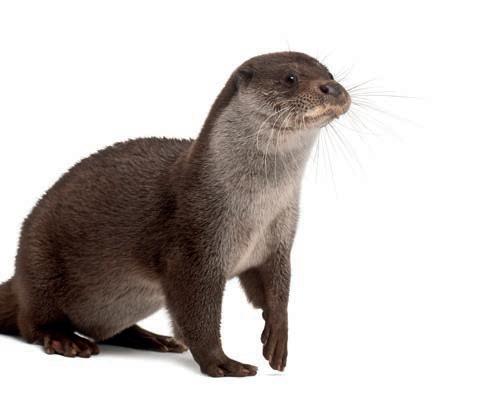
The Remarkable Resurgence of Lichens
Discover the importance of lichens in the ecosystem and the latest threats to their existence.
Members’ Day and AGM
Sat 21 Nov
Trinity Methodist Church, Loughborough
Come and join us for our annual celebration of the Trust.
We can’t wait to meet you! See page 5 for more details.
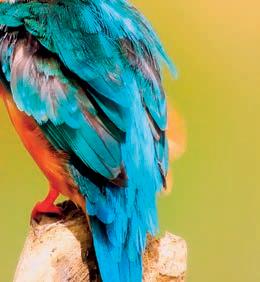


Charnwood Local Group Indoor meetings: Woodhouse Eaves Village Hall, 50A Main St, Woodhouse Eaves, Loughborough, LE12 8RZ. Admission £3 members, £3.50 non-members, children free. Check website for walk events. Contact Kate Moore on 01509 891005, katemoore123@yahoo.co.uk
Charnwood Local Group
Weds 9 Dec, 7.30pm
The Wildlife of Garendon Park
Presentation on the many studies of wildlife in the park that have taken place over the past two years.
Rutland Water Nature Reserve: Anglian Water Birdwatching Centre Fri 11 Dec, 9.30am – 12.30pm
Guided Walk with Terry See 11th September for details.
Melton Mowbray
Local Group
Mon 14 Dec, 7pm
Festive Members’ Evening
Join the group for a fun evening, including a quiz, members’ pictures and festive fun.
North West Local Group Fri 18 Dec, 7.30pm
Birding in Portugal
From salt flats to grassy plains: How environment and habitat in two different regions of Portugal offer a variety of bird sightings.
Rutland Local Group Mon 21 Dec, 7.30pm
The Ketton Redwood Project
Talk about the ecology of redwood trees, the environment they contribute to, and the history of these majestic trees in Rutland.
North West Local Group Fri 1 Jan, 1-2.30pm
New Year’s Day Wildlife Walk
Walk off the Christmas pudding with a gentle ramble led by Simon Cooke around New Lount Nature Reserve within the National Forest.
South Leicestershire Local Group Indoor meetings: The Village Hall, The Green, Great Bowden, LE16 7EU. Admission £4. Contact Bruce White on 07919 935496, bruceywhite@yahoo.co.uk
Melton Mowbray Local Group Indoor meetings: United Reformed Church, 2 Chapel St, Melton Mowbray, LE13 1LZ. Admission £2.50 members, £3 non-members. Contact Peter Dawson on 01664 852119, peter.dawson69@ntlworld.com
North West Local Group Indoor meetings: Ashby Methodist Church, 5 Burton Road, Ashby-de-la-Zouch, LE65 2LF. Admission £4. Contact Roger Collier on 07910 019158, colliereroger@outlook.com
Rutland Local Group Indoor meetings: Volunteer Training Centre, off Oakham Road, Hambleton, LE15 8BP. Admission £2. Contact Becky Howard on 07908 252271
Leicestershire & Rutland
Badger Group
Indoor meetings: The King George V Room, Woodhouse Eaves Village Hall, 50A Main St, Woodhouse Eaves, Loughborough, LE12 8RZ. Admission £3. Contact Dr David Duckett on 0116 259 7231, david.p.duckett@btinternet.com
Leicestershire & Rutland
Bat Group
Walks are free to bat group members and £5 for others. Booking essential. Please email batevents@outlook.com

PLEASE GIVE TODAY
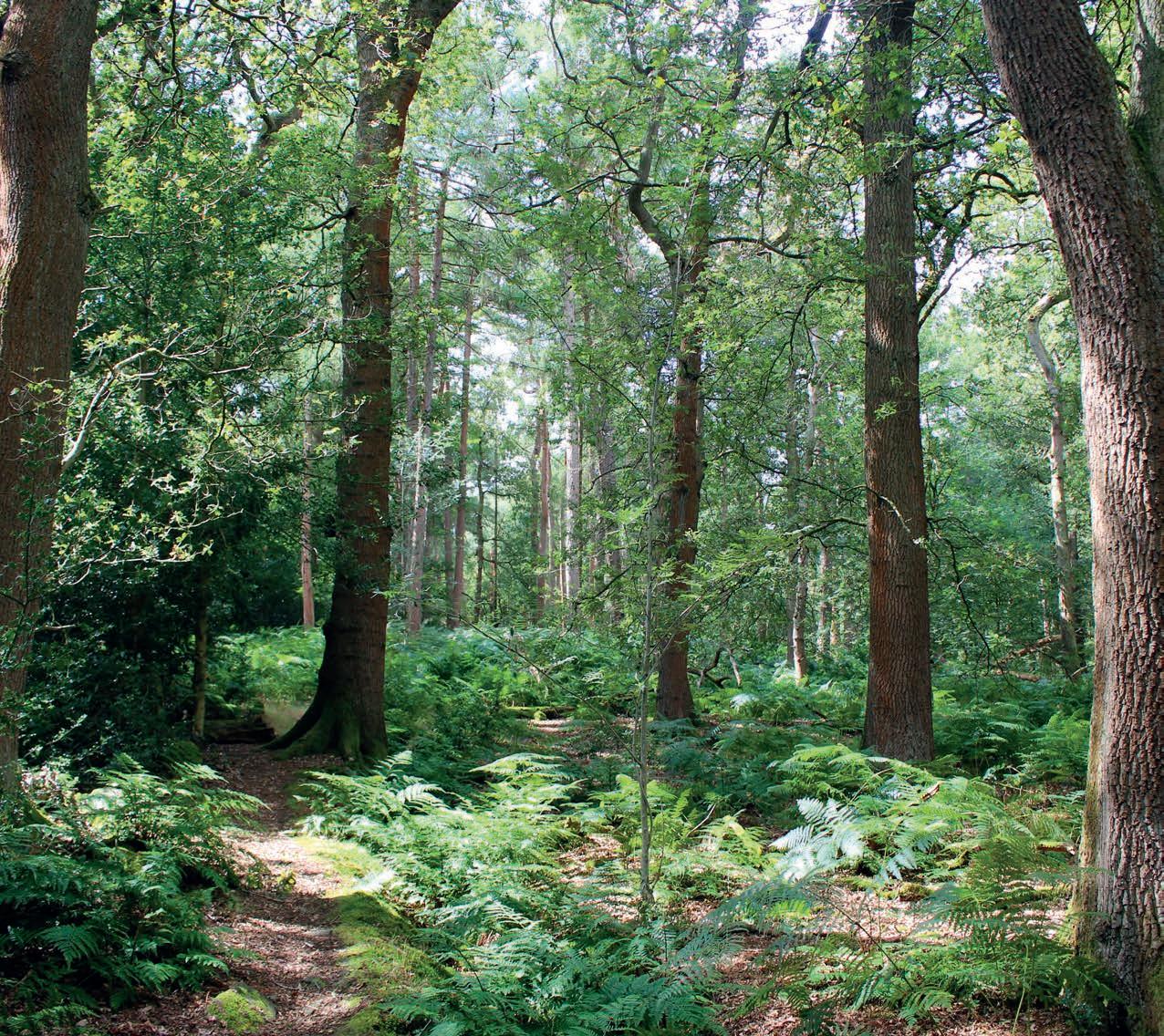









We have an exceptional opportunity to expand our Charley Wood nature reserve, securing an additional 16 hectares of land at the heart of the Charnwood Forest, one of Leicestershire and Rutland’s most precious landscapes.
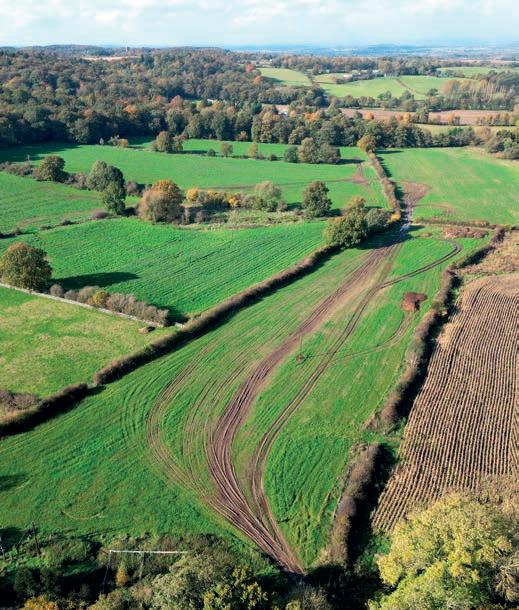
Thank you so much to everyone who has already donated to our appeal to secure this land; we’ve raised just over 25% of our £350,000 target*, which is a fantastic start! But we still need your help.
The great news is that every Gi Aided donation will be doubled, thanks to match funding on the fi rst £100,000
raised, dramatically magnifying the impact of every donation at no cost to you.
With Christmas on the horizon, a donation to the Wilder Charnwood Appeal makes for a truly meaningful gi for anyone who loves nature. Help us give local wildlife the space it needs to thrive, for this generation and the next.