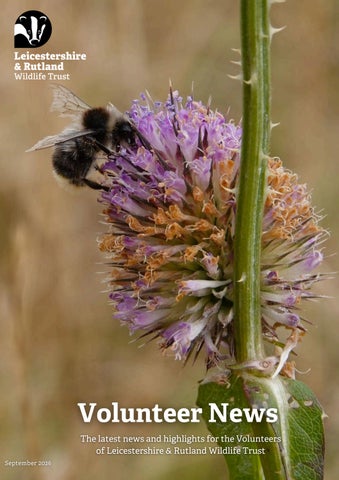
Volunteer News The latest news and highlights for the Volunteers of Leicestershire & Rutland Wildlife Trust September 2026
LRWT VOLUNTEER GALLERY A selection of photographs taken accross Leicestershire and Rutland Wildlife Trust reserves by volunteers
Rutland Water - Alistair Lawrence
Rutland Water - Joan Brady
Rutland Water - Josh Dakin
Kelham Bridge- Josh Dakin
Charnwood Lodge - Brian Vollar
Rutland Water - John Kirkelionis
Charnwood Lodge - Brian Vollar
Rutland Water - John Kirkelionis
LRWT VOLUNTEER GALLERY A selection of photographs taken accross Leicestershire and Rutland Wildlife Trust reserves by volunteers
Ulverscroft - Jan Croft
Charnwood Lodge - Jez Taylor
Loughborough Meadow - Phil Thorne
Cossington Meadows - Jan Croft
Croft Pastures - Vee Kiiski
Ulverscroft - Jan Croft
Cossington Meadow - Phil Thorne
LRWT SPOTLIGHT Being an Information Ranger at RWNR Simon Langley-Evans Since retiring a few years ago, I have been volunteering with the Trust in the Visitor Centre at Egleton. A big part of that role involved welcoming visitors to the reserve, and I always made a point of spending a couple of hours out and about before my shift so that I had a good idea of what was about. I particularly enjoyed chatting with visitors about recent sightings and helping them find species they were hoping to see, whether that was directing them to a kingfisher or suggesting the best place to watch the ospreys fishing. When the new Information Ranger role was advertised, it immediately appealed because it focused on exactly those aspects of volunteering that I enjoyed most. The role is all about being out on the reserve, greeting visitors, answering questions and helping people get the most from their visit. There are practical responsibilities too, such as reporting any issues with hides or paths and dealing with the occasional, rare piece of litter, but the reserve is so well cared for that these have been only a small part of the job so far.
LRWT SPOTLIGHT
Although it is still early days, the role has lived up to my expectations. One of the biggest attractions is its flexibility. Unlike my previous Visitor Centre role, which involved committing to a rota well in advance, Information Rangers can choose shifts to fit around other commitments. That means I can volunteer when it suits me and spend the whole time out enjoying the reserve. Over the past few weeks I've chatted with dozens of visitors, admired the photographs they've taken and pointed them towards the birds, mammals and insects I've seen myself or that has been recorded in the sightings book. Highlights have included directing people to a juvenile cuckoo over at Crake hide, a family of fox cubs on the shore of Lagoon 1 and three hobbies putting on a spectacular display as they hunted common darters over the South Arm shore. For anyone who enjoys wildlife, meeting people and spending time outdoors, being an Information Ranger is a thoroughly enjoyable role. It's a wonderful way to share enthusiasm for the reserve while helping visitors make the most of everything Rutland Water has to offer.
LRWT NEWS & UPDATES Would you like to join our Gardening Group? We have a lovely gardening team, but are currently a little short of members. We are responsible for maintaining the garden area at AWBC, keeping it tidy and presentable. As the garden is seen by all visitors when approaching AWBC, it’s vital to keep it looking as good as possible. The garden was planted with the purpose of attracting wildlife (particularly pollinators) to the area. Tasks include weeding of over-vigorous plants, pruning, and keeping the paths clear for visitors. We leave the previous year’s plant stems standing overwinter, to provide shelter for invertebrates, clearing is done in late winter and early spring. Most of the tasks are fairly light, though we do sometimes have stubborn roots to remove, and there is occasional pruning of overhanging branches to be done. Another part of our work is our involvement in the improvement in the range of plant species in Egleton Meadows: a bed beyond the gate to the south side of the reserve is being used as a stock bed, where we are growing plants to provide seed which we sow in the meadows. Current delight is the plants of Devil’s-bit Scabious which are attracting bees, butterflies, and a Hummingbird Hawk-moth! Our original sources for the plant seed were Sharples Meadow, and collecting trips to Merry’s Meadows. We are a lovely friendly team, and look forward to being joined by a few new members! - Joan Brady
LRWT NEWS & UPDATES Could you be our next Membership Admin Volunteer? Our membership team support over 19,000 members whose contribution is vital in the work we do to support and restore nature in our local area. We are searching for a volunteer who can help support our busy office with general admin tasks. What’s involved: Prepare and make up membership packs Assist in updating membership records Provide administrative support to the membership team Enter data onto databases Prepare documents as required, including typing, printing and copying Help advertise our events on our website and Eventbrite To find out more, pease email volunteering@lrwt.org.uk Membership Caller Volunteers Wanted! Do you enjoy chatting to people? Why not chat to our new and current members at Leicestershire and Rutland Wildlife Trust over the phone at our office in Leicester. What’s involved: Telephoning members from a private office in Leicester to discuss their membership, renewal of membership and do satisfaction surveys Passing on any questions or comments to the relevant members of staff To find out more, please email volunteering@lrwt.org.uk We are still in need for more Door Drop volunteers, could that be you? Looking for a volunteer role that gets you out and about, fits around your schedule, and helps spread the word about an amazing cause? Join us as a Door Drop Volunteer and help raise awareness in your community—one flyer at a time! Whether you’re a fan of a daily stroll, keen to get your steps in, or just love the idea of volunteering on the go, this flexible role is designed to suit you. What’s involved: Distributing leaflets and other marketing materials around your local area Talking positively about Leicestershire and Rutland Wildlife Trust and the activities you are leafleting for Advising our team if you need more materials Keeping an accurate list of streets you have reached To find out more, please email volunteering@lrwt.org.uk
LRWT IN THE MEDIA James Adler Nautre Resevre Opening Our James Adler Nature Resevre is now open to the public. With a mix of woodland, scrub and grassland, the newly acquired James Adler Nature Reserve offers exceptional opportunities to further re-wild and enhance the landscape, while strengthening our presence in the south of the county. You can read the article on the BBC https://www.bbc.co.uk/news/articles/ cn0nx2w5rnpo Harry Stoker
Get Birding Podcast Over the Birdfair weekend the team hosted the Get Birding Podcast at Lyndon Visitor Centre. Tim Sexton and Tim Mackrill took them down to Waderscrape hide to talk all things Ospreys. You can watch the podcast on Youtube https://www.youtube.com/watch?v=voWrQNa9yU
Fable Fund Film We are very proud to be a part of the Fable Fund film. Thank you to the Fable Fund for shining a light on the incredible conservation work, not only happening across the country, but that has made such an impact on Leicestershire and Rutland wildlife. You can watch the short firm on Youtube https://www.youtube.com/watch? v=ZDuCpeftkyQ Fable Fund
LRWT NEWS & UPDATES Has anyone ever asked you what you really want from food? Is our food feeding us or making us ill? Why are so many people living with obesity and diabetes? How is our food contributing to dying ecosystems and worsening climate change? A Food Conversation is a structured workshop run by trained facilitators, looking at every aspect of our dysfunctional food system. The results will be compiled at the end of the session and go back to Leicestershire County Council. Booking essential - email ediblelboro@gmail.com or use the QR code stating clearly which workshop you would like to attend.
Habitat volunteers, have you read the safe working guidance recently? You may remember, but last year we circulated a new safe working document for reserve volunteers. This contains useful health & safety guidance for volunteering on the reserves. Please do read this regularly. It can be found on the volunteer hub under ‘important information’. https://www.lrwt.org.uk/volunteers-hub
Wild LIVE: Powerful voices are saying nature doesn’t matter – how do we fight back? Wild Summit is a place for people across the nature and climate movement to come together. The Wildlife Trusts will be hosting a panel discussion on how to resist efforts from powerful voices to portray nature protections as a blocker to growth. Now more than ever, we need to come together, share ideas and build the movement for nature's recovery. Head to the website to find out more and sign up. https://www.wildlifetrusts.org/events/2026-09-09-wildlive-powerful-voices-are-saying-nature-doesnt-matterhow-do-we-fight-back
LRWT STAFF UPDATES Juliette Colaço-Fournier Previous East Reserve Assistant I cannot quite believe that it’s been just over three years since I joined the Leicestershire & Rutland Wildlife Trust - how time flies when you’re having fun digging holes, grippling and tensioning stock netting, coppicing and mowing, mowing, mowing! When I first joined, the East & West teams did not exist, we still had midweek work parties and frantic boiling of Kelly Kettles twice a day (which of course meant regularly forgetting the milk!). Things have changed a lot, we've planted a new woodland at Holwell (part two coming up…), confirmed Black Hairstreaks at both Prior's Coppice and Launde Park Wood and finally seen Herb Paris on our sites. We've trained you wonderful volunteers in grassland, butterfly and reptile surveys, reinstated grazing at Bloody Oaks Quarry and cleared a transformative amount of scrub at Stonesby Quarry. But as Steve famously said ‘There’s always more to do!’. We’ve dealt with floods, multiple flat tyres, mowing and raking all our sites with only 2 (very old and knackered) brushcutters and scythes and shown time and time again that nothing is too much for the East Team to handle! There are too many memories to mention, from getting stuck to rescuing volunteers who are stuck, from my enthusiastic shouts of ‘Toothwort!’ (or some other exciting nature spot) to poetry recitals and racing around in Lara (the Polaris). The last few work parties were the perfect example of a classic work party day - determination and a good sense of humour required when trying to dig through stone or random bits of metal, things not going quite to plan and taking longer than anticipated, at least one tool that we didn’t have and, of course, enjoying the beautiful reserves we are lucky enough to work on. They say a picture speaks a thousand words and I hope you enjoy some of these moments from the East Team adventures.
LRWT STAFF UPDATES Thank you for your kind and heartfelt messages in my card, generous gifts and an incredibly memorable three years working with, learning from and laughing with you all. Your hard work, dedication and company have kept me smiling, trained me well for my return to the classroom (!) and made running three work parties a week enjoyable. You have always been happy to go the extra mile and often stay late to get the job done. No matter the task or the weather, you show up and work with passion and enthusiasm. Thank you. I know that Sarah has a brilliant team to continue ensuring our nature reserves are flourishing spaces for nature and wonderful places to enjoy and spend time in. I look forward to coming back and visiting our beautiful and unique nature reserves and catching up with you all again in the future. A big thank you to everyone who contirbuted to ehar leaving present. We gave her an original piece of artwork by Jake Sexton – a black hairstreak butterfly – photo attached, two books (Ancient by Luke Barley about UK Woodlands and Naming Nature by T A Barron on the language we use to describe nature). We also bought her a delicious selection of vegan chocolate, some fancy herbal teas and a pair of beloved Osprey socks from Lyndon Visitor Centre! The rest of the money went to her as cash to enjoy as she wished.
LRWT STAFF UPDATES Rick Wilson Information Assistant Having all hatched during mid-May, the three chicks all continued to grow very fast, with male 33(11) providing ample fish deliveries to keep them all happy. With fledging fast approaching, the chicks were weighed, measured and ringed on 23rd June, early in the morning. All three were assessed and deemed to be in good health with, in the order of hatching, a male (ringed as 8R5), a female (8R6) and another male (8R7). The unhatched fourth egg was retrieved from the nest for inspection and it was found that it was unfertilised, so that was a popular question, often asked both in the visitor centre and online, definitively answered. July began at Manton Bay with all three Osprey chicks getting very ‘bouncy’ on the nest and helicoptering to varying degrees. On the 2nd July, the oldest of the three chicks, 8R5, officially fledged at 18:51, leaving the nest aged 51 days. His two younger siblings were not going to be too much longer and, sure enough, 8R7 took off on 7th July at 08:24 (51 days) and then 8R6 completed the hat-trick of fledgings just a couple of hours later, at 10:46, aged 54 days. All three chicks swiftly learnt to really use their wings and were regularly seen flying around Manton Bay, searching out new places to rest, such as the T-perches, the fallen poplar branch or the poplars themselves. Even the fishing limit signs on the stone bund became favourite perches for 8R6 and 8R7. But, when it was time to eat, they were all quick to return to the nest and fight over the latest fish delivery, sometimes with hugely comedic results, such as when 8R5 was so desperate to get 33’s delivery that he grabbed his dad’s talon and got dragged off the nest as 33 flew away! Younger brother, 8R7, got that fish, but 8R5 got his revenge a few days later by pecking 8R7’s head during a fishnapping attempt. Boys will be boys! As all three got more confident, 8R7 caused a bit of concern on 22nd July. Seen leaving the nest just after 6am, he was absent for a large portion of the day, but returned to the nest just after 4pm, having not been seen at any of his usual spots during that time at all.
LRWT STAFF UPDATES It was then 8R5’s turn to disappear, spending extended periods off the nest and then, on 31st July, we saw him for the final time this year, flying off the poplar branch after a large breakfast, off round the back of the poplar trees and away. At the time, he was 80 days old, so rather young for migration, but had proven to be a strong chick during his 29 days since fledging. Hopefully, we’ll see him again in two years. Seemingly inspired by her male siblings, 8R6 then had a period of disappearing from the nest for more than a day at a time but, after a week of this, then stayed around the nest. But then, on the morning of Friday 21st August, both 8R6 (99 days old) and 8R7 (96 days) were seen spiralling up on thermals over Manton Bay, led by 33 a short while after 10am. Neither of the chicks were then seen on or near the nest, so had obviously started to make their way south. It's interesting that they chose to go together. The winds were favourable that day, blowing from the north west, so we hope they both made swift, and safe, progress.
LRWT STAFF UPDATES Meanwhile, over on our previously unoccupied nest this season, at Lagoon 4 on the reserve at Egleton, we suddenly had a regular visitor. We were able to see this close up thanks to the two cameras now installed at the nest. Identified as 9R0, one of the chicks from Site B, she was being visited by her male parent, 359, who would bring fish and sticks. This went on for many days. The sharp-eyed of you might remember the number 359 as he was one of the pair that spent a lot of time at Lagoon 4 last year, but he and 3H9 went their separate ways when they returned this year, taking up spaces on nests where experienced parents didn’t return. 359 took over from 30(10) at Site B, pairing with HJ8, and they had two chicks – 8R9 and 9R0. According to Tim Mackrill, HJ8 looked like she had already migrated and 359 was left feeding the two chicks, with 8R9 staying at Site B and 9R0 moving to Lagoon 4. Interesting behaviour and possibly shedding some light on the off-nest time of our Manton Bay chicks. Last year, 3R7 had a couple of extended periods away from the nest, so perhaps 33 has developed a technique of separating the chicks as part of their training, or maybe even to alleviate any potential conflict between growing siblings.
LRWT STAFF UPDATES In terms of the other nests in the surrounding area that Tim Mackrill monitors, he has confirmed that we have had an amazing total of 24 chicks this year across 12 nests. Also, in addition to the unfertilised egg on the Manton Bay nest, Tim told us that there were a few other nests where unhatched eggs were discovered during the ringing visits. This could have been down to either the weather conditions or some inexperienced parenting, or a bit of both. So, with all three Manton Bay chicks having migrated by the 21st August, that just left Maya and 33 at Manton Bay, where they stayed until the end of the month, weathering the atrociously wet conditions on the 27th, which made for such a contrast to the prolonged hot and dry summer that they had experienced to that point. So that's another exciting and successful season in the books, although we never did get any sightings of the return of 1R0, the solitary Manton Bay chick from 2024. But perhaps next season we will get to see or hear of our 2025 youngsters, 3R5, 3R7 and 3R8. See you all next year, hopefully!
LRWT STAFF UPDATES Beth Fox Rutland Water Species & Recording Assistant Summer is the busiest time of the year within species recording as surveys get into full swing. Our Breeding Bird Surveys start coming to a close in June as the breeding season begins to end, and butterfly surveys are already well underway and will continue right through to the end of summer. Our most exciting ‘survey’ this summer has been our Big 50 Wildlife Recording Event, a non-stop weekend of 50-hours back-to-back recording, celebrating the 50th anniversary of Rutland Water Nature Reserve. Since the reserve was created, 4443 different species had been recorded on the reserve, and this year we have set ourselves the goal of trying to reach 5000 species recorded overall. Over the weekend we, and with the help of other visiting expert recorders, surveyed anything and everything we could find at all hours of the day. Overall, we recorded 937 species! This included 300 species of plant, 272 species of invertebrate, 230 moths and butterflies, and 101 birds. With other recording activities that have already happened this year and new species being found in a variety of different taxa, the current grand total of recorded species stands at 4843 - so still a little way to go!
LRWT STAFF UPDATES
In June we hosted members of the Coleopterists Society, Aquatic Beetle Conservation Trust, and the Balfour-Browne Club who were also celebrating their 50th anniversary. The day was spent entirely focused on searching for water beetles, where we all got our nets into historic ponds in Cherry Wood, on the Wet Meadow, and into Lagoon 8. The highlight of the day was re-finding the rare Macroplea mutica (a reed beetle) which we discovered last year in Lagoon 1, and with fewer than a 100 records of this beetle over the whole of the UK this was a ‘life list tick’ for all in the group, and what had enticed them to travel from far and wide (such as the north of Scotland!) to see. Another exciting find was Hydaticus transversalis (a diving beetle), where the last record was in 1899 in Leicestershire and Rutland. Over the day, 396 species were recorded overall, with 63 new species added to the reserve list. Before all the hay cuts in July, we carried out a grassland survey called Common Standards Monitoring in Egleton Meadows. This helps us to quickly assess their ecological state by looking at the general structure, ratio of grasses to herbs (wildflowers), and looks at consistency and frequency of both meadow indicator and negative species. Over the past couple of years, the Gardening Group have had a focus on growing wildflowers from seed to spread around the meadows to increase the species richness of flora, and green hay strewing took place two summers ago with arisings taken from nearby Merry’s Meadow (a SSSI grassland). Over time we are seeing a gradual improvement in the diversity of wildflowers in the meadows, which historically were used primarily for sheep grazing, with some of the seed starting to take hold. There are also now obvious strips full of Knapweed from the green hay strewing, which prior to this was an uncommon plant on the meadows.
LRWT STAFF UPDATES In between our normal water quality monitoring that takes place each year in early and late summer we have also been carrying out pond surveys. These use the PSYM metric which was developed by the Freshwater Biological Association (FBA) and uses aquatic invertebrates and plants as a measure of the ecological status of the pond. We managed to get around seven ponds this month, and results have now been sent off to the FBA for analysis which will help us gradually build up a picture of the status of the ponds on the reserve. A surprisingly unusual species for the reserve was recorded too – a frog! And finally, the birds! It was the end of the Wetland Bird Survey (WeBS) year in June, which runs from July to June to allow for a full winter to be included as this is the most important time of the year when wintering waterbirds migrate to Rutland Water in their thousands. Over the WeBS year 2025/26, the sum of species maxima (the maximum count for each species, as each species peaks at different times of the year) was 23,589. This was a great figure as the previous two years worryingly had the lowest sum of species maxima in over ten years and fortunately means that the rolling five-year average currently stands at 21,826 – comfortably above the SSSI baseline figure and confirming that Rutland Water is continuing to meet its conservation objectives. Plus, we had an interesting record in Whitwell Creek (pictured) during the WeBS count in June.
LRWT STAFF UPDATES
Last winter with the help of the Survey Volunteers we moved two tern rafts from Lagoon 2 to join two that were already in place on Lagoon 3 (a logistical challenge that all threw themselves into!) as the Lagoon 2 rafts were not being used. This has proven to be a good choice as all rafts were fully occupied this year! Two canoe trips out with buckets meant that a total of 79 Common Tern chicks were metal ringed, of which 45 of these were colour ringed, and a further 8 Black-headed Gull chicks were colour ringed. Colour rings hold the advantage over the usual metal bird ring in that they can be read easily by those watching the birds through binoculars or a scope – so if you do see any bird with a colour ring on its leg, make sure to report the colour and number to Euring to help monitor the birds’ movements. That’s all from surveying and monitoring this summer, many thanks to all those involved!
LRWT STAFF UPDATES Helen Case West Trainee Reserve Officer
☀️
July and August have seen much in the way of grassland surveying and management – with more still to come!
On 13th and 14th July, Richard from Wildscythe ran scything training at Charnwood Lodge, covering both grassland and bracken. The scything training has been put to much good use since! We have been ‘tedding’ cut grass (basically ‘fluffing’ it up in the air) at Cossington Meadows in order to help shake loose the seeds before raking and removing the grass cuttings from the area
LRWT STAFF UPDATES
I have taken far too many photos of flowers during early summer! This is just one beautiful specimen of a Bee Orchid at Herberts Meadow, Ulverscroft. We visited the cows at Rutland and learnt how their electronic collars worked and lastly, I couldn’t not share a cute dormouse photo from their release at a Leicestershire location!
LRWT STAFF UPDATES Chris Hill West Reserve Officer Tom Longs Meadow What better way to start an article than mentioning the good old British weather. Or should that be the ‘New’ British weather! I’m sure you have all noticed that this isn’t the first year we have had so little rain when we really need it. 1976 springs to mind but dry summers seem to be an increasingly regular occurrence. This isn’t the place to go into detail but it’s fair to say that rain plays an important part on all our nature reserves. Without water flowing past Tom Longs Meadow, we would not have any Balsam to bash. Imagine that! Due to the huge flooding episode, we had a couple of years ago, Balsam seeds were transported to new areas of the reserve. Early May and June witnessed 2 visits from our volunteers, tackling the fresh new growth. What an impact they had. Harry Longman even tried to eradicate another alien invasive, the Skunk Cabbage.
LRWT STAFF UPDATES
Wymeswold Meadows Adjacent to Wymeswold Meadows is a poultry unit. You would know this if you lived nearby. One of the downsides of being their neighbour, is the reserve receives water from one of their overflowing balancing ponds. This ‘grey’ water dribbles into a ditch which subsequently overflows and makes its way over West Meadow on it’s way down to the River Mantle. It is supposed to take a different route but for some reason it chooses the nature reserve as its means of escape. Therefore, every few years, the volunteers get their wellies on and attempt to redirect the flow. In the ditch where we have removed the detritus, we will place shuttering to divert the water away from the meadow. After a recent meeting with the unit’s owner, he has agreed to excavate the remaining ditch. This will (hopefully) reduce the volunteers hard work in the future.
LRWT STAFF UPDATES Cossington Meadows The impact of the heavy rain early in the spring was evident when the volunteers got on their hands and knees in Wood Meadow at Cossington. The water had encouraged vigorous growth of the vegetation around the base of the newly planted hedge. Because I am reluctant to use chemicals, it was down to the hard work of the volunteers to carefully remove the vegetation. When you think about it, if you get a lot of rain, the grass grows quickly and can smother the hedge, but if it is too dry, the hedge cannot find enough water. I have noticed how well crap apple does in dry ground. Some of them have shot up and are well away.
LRWT STAFF UPDATES Without trying to put too much emphasis on the lack of rain, the recent conditions have had a negative impact on the wildflower meadow at Cossington. The downpour we had at the start of the season was welcome, but in an ideal world, a meadow performs much better with a little and often approach. Therefore, early season growth gave way to a scorching heatwave that created hard, cracked ground. Normally, I mow the meadow in September as this allows the late flowering devils – bit scabious to flower and set seed, but it was apparent that this species was struggling to survive. Volunteers made a great job of tedding the hay and it was all raked up and the arisings used to create some wonderful habitat for the eggs of grass snakes. Thank you to every volunteer that has made such an effort and it is very much appreciated by me (Chris)
LRWT STAFF UPDATES Robin Smith Legacy Marketing, Partnership and In Memory Assistant Hello everyone, I’ve been in post now just over 6 months, working on our legacy program for the Trust. While we’ve always been in receipt of legacies, this is the first time we’ve had a dedicated role to run events and promote legacies as a way of giving. I’ve had the pleasure of working alongside some of you for our first legacy events of the year, which I will be mentioning shortly. I’ve also had some of you invited along to more of my events as guests. These have been a fantastic opportunity to get to know some of you and share our love and appreciation for nature. Launde Park Wood On the 16th and 17th April 2026, we had our first legacy events of the year. Guiding the walk was Sarah Bedford, our Senior Reserves Officer, who talked through the history of the land and the flora and fauna which make the woods their home. We also had Roxsan Keilty, our Fundraising and Marketing Manager and myself in attendance as well. As we gave a sigh of relief that spring had finally arrived, we saw a magnificent display of Bluebells, Primrose, and the fascinating Toothwort as we strolled through the rides and listened to the cacophony of birdsong. Some of you of course had the Merlin bird app open to see what kinds of birds were about, I recall Willow Warbler and Blackcap being some star guest appearances. An incredible view of Launde Park Wood, with the aforementioned Bluebells and an abundance of Wild Garlic, which smelled fantastic!
Credit: Janina Holubecki
LRWT STAFF UPDATES
The history of the land itself is fascinating. We were granted a diocese with Launde Abbey nearby, where we follow a 300 year plan for the management of the land. I suppose in a way this is a legacy left behind 300 years ago, to which we proudly follow and maintain the woodland, leaving it as a wildlife haven for us to enjoy today. While we had a lovely jaunt in the woods, the event was an excellent way to thank those who had pledged to us already in their Will, and to help those who were curious as to how it all worked and had an interest in leaving a gift with us. Notably, one person on one of the days said to me: “This event serves as a good reminder to update my Will to include the Trust.” As with all legacies, there is never an obligation to include us in your Will, nor do we 'hard-sell'. It is simply another way of giving, with its own benefits for our supporters. Legacies are important not only because they provide lasting support for conservation and help secure the future of the habitats and wildlife we protect, but also because of the stories with these gifts that I think are so important to tell. Gifts left in Wills can make a transformational difference, not only to us as a charity, but for family and friends who have found solace in nature and wildlife, and the memories associated there with their loved ones. To read some of the stories we have started to collect https://www.lrwt.org.uk/inremembrance Thank you to the wonderful volunteers that helped out on those two days, and I look forward to meeting more of you, whether you help me on my events or come along as a guest!
LRWT STAFF UPDATES Sarah Hogarth Rutland Water Trainee Reserve Officer My introduction to nature conservation was volunteering with the East Reserves habitat management team, which I started in March 2025. Having previously studied physics at university, I found myself greatly enjoying the opportunity to do something positive for nature and spend more time outside. I had finished my degree keen to find work related to the environment and the more time I spent volunteering with the Trust, the more certain I became that this was the field for me. Since last summer I have been taking online courses in Field Ecology and I have also been part of a volunteer group working on biodiversity initiatives in my village, aiming to establish several wildflower areas in our churchyard and to expand our local swift colony by installing nest boxes in the church tower and on houses. I’ve really enjoyed the traineeship so far, getting stuck into tractor training, sand martin monitoring, digging lots of holes for gate posts and learning about aquatic invertebrates in the pond assessments. Highlights so far have been seeing a sparrowhawk and a nightingale up close with the CES ringers, my first ever clouded yellow butterfly near Lax Hill, and a fantastic variety of moths in the trap in Cherry Wood. I’m looking forward to improving my bird and plant identification skills over the coming months and learning more about the management of the reserve.
LRWT STAFF UPDATES Jess Callaway Rutland Water Trainee Reserve Officer From 2020 to 2023 I studied Zoology at the University of Lincoln, during which time I developed an interest in dung invertebrates through my dissertation. After graduating, I volunteered with Forestry England alongside working various roles within the hospitality industry. From April 2025 to March 2026, I was a Residential volunteer with the Lincolnshire Wildlife Trust at SaltfleetbyTheddlethorpe Dunes NNR before continuing this role at Gibraltar Point NNR for three months. This was a fantastic experience and a great first step into the conservation sector that helped me develop essential skills and cemented my desire to work in conservation. In my free time I enjoy baking, jigsaw puzzles, and have recently taken up skateboarding. The first six weeks of the Traineeship have flown by, and I have loved every minute (even all the time spent digging holes). I’ve particularly enjoy working with the livestock and carrying out aquatic invertebrate surveys. I am looking forward to continuing this traineeship and making the most of my time at Rutland Water.
LRWT STAFF UPDATES Ryan Melvin Rutland Water Assistant Reserve Officer Work has begun on our complete replacement of Tufted Duck hide at Lyndon, and the hide team have constructed nearly half of the panels already! We are well on our way to opening the new and improved hide this autumn.
LRWT STAFF UPDATES
LRWT STAFF UPDATES Matt Heaver Rutland Water Reserve Officer The Sand Martin breeding season has now come to an end and while I am writing this, the young fledglings are beginning their journey South. By the end of August, many of our breeding colony have already gone. We will still get a few birds passing through into September but otherwise that is it until next year. A huge thank you to all the volunteers who have braved massive spiders, dust, sand martin poop and the never-ending hoard of fleas to help check each nest box every week! It is enjoyable to see the season progress from the first visit in early May when no-one knows what is behind each of the 832 nest box doors and then seeing the eggs laid and chicks hatch and become ready to fledge. When the chicks reach a certain age, they are suitable for ringing under licence. This involves carefully extracting the chicks from the nest into a container for ringing. The nest hole is temporarily blocked up with a foam ball to prevent the parent birds returning to an empty nest and assuming their chicks have been predated. The whole process only takes a few minutes and the chicks are soon returned to their homes. Sometimes they do like to make life tricky and hide at the sides of the tunnel where small hands are required to extract the chicks. Home décor can vary with some nests barely more than a scrape in the gravel whereas some are neat cups lined with feathers. Other birds go overboard and fill the nesting chamber with nesting material and feathers to the point where it is a wonder they can actually fit into it! It always amazes me at the size of feathers that are used to line the nest. I certainly have never seen a sand martin carrying feathers as big as themselves, but they must do so as they end up being used to line the nest.
LRWT STAFF UPDATES
After a few years with lower breeding success, due in part to bird flu and poor weather conditions, it is good to report that this year’s breeding season has been on a par with the best years the colony has had. I haven’t had time to get the final totals yet but it is looking like we will have had around 1200 chicks which is a vast improvement on the c750 last year so things are moving in the right direction. Interestingly, there was only one pair of sand martins that raised 3 broods of chicks this year. Most pairs have one or two broods but normally a handful try a third brood. There were a large number of nests used for first and second broods though which contributed to the high number of chicks. Finally, a big thank you to those dedicated volunteers who have entered the nest record data to the BTO website. This is a timeconsuming task but they have done an excellent job and probably broken some kind of record by getting the nest records submitted by the end of August.
LRWT STAFF UPDATES Andy Neilson West Senior Reserves Officer Where has the summer gone folks!? It does not seem very long ago at all that I last wrote one of these articles, detailing the last of the winter and spring work we’d been up to, telling tales of mighty tussles with unyielding rhododendron stumps and endless repairs to my poor winch. Now, its time to reflect on the summers work with you fine people across the western reserves, specifically the enclave of Charnwood reserves that I spend much of my time managing! In summary it has been……hot! Hotter than I have ever known in 15 years of managing outside spaces – so hot I have seen evergreen shrubs like gorse and rhododendron that are normally so indestructible wilting away and dying back under the fierce glare of this unprecedented dry summer. As I sit and write this in late August, we have had the first proper deluges in weeks and they have been so very welcome, more of the same please! It has been a minor miracle we have not suffered a serious wildfire this year – thanks so much to all of you who are regularly out on the reserves and function as invaluable earlywarning systems to any problems. As is usual with the Charnwood reserves in the summer bracken management has featured very heavily. Whether it be hand pulling it, chopping it with a scythe or slasher, or even flailing it with a tractor, we’ve employed our usual variety of methods with great vigour across the heaths of Charnwood – even the soaring temperatures only got in the way of our mission a little bit! Seriously, thank you so much to everyone that has been involved in the bracken clearance this year; I know it is not the easiest job and can get a wee bit repetitive, but you guys have shown great determination as ever!
LRWT STAFF UPDATES
As is usual with the Charnwood reserves in the summer bracken management has featured very heavily. Whether it be hand pulling it, chopping it with a scythe or slasher, or even flailing it with a tractor, we’ve employed our usual variety of methods with great vigour across the heaths of Charnwood – even the soaring temperatures only got in the way of our mission a little bit! Seriously, thank you so much to everyone that has been involved in the bracken clearance this year; I know it is not the easiest job and can get a wee bit repetitive, but you guys have shown great determination as ever! We were grateful to host two scything courses at the Lodge that had been organised by the Geopark so that was really nice to help out with and added some extra cutting options to the team which was useful as I had particularly bad luck with my tractor this year, only managing two sessions with it until the gearbox decided it didn’t fancy any more bracken this year!
LRWT STAFF UPDATES
Away from the never-ending challenge of removing bracken, we’ve been doing some management to our streams, ditches and culverts, taking advantage of the fact that they are all running dry at the minute and we’ve also ventured out onto the completely dry bed of Colony Reservoir for a quick session removing all of the willow saplings that have been trying to colonise the open water areas. The dry summer also meant the bracken dying off a bit earlier than usual, so we have already managed to fit in a couple of grassland management sessions until Chris Hill maliciously broke the powerscythe recently.
LRWT STAFF UPDATES The wildlife hasn’t seemed unduly affected by the prolonged heatwave (although time will tell), with most of our butterfly species having good years, and there was good evidence of successful breeding at Charnwood Lodge this year with regular sightings of fledged juvenile stonechat and our highest count of singing tree pipits for a few years (5 singing males). Recently a gorgeous passage whinchat was also spotted at CL by one of our cow checkers, which is a great record for the reserve. Some work with the recently formed Leicestershire raptor group has also produced some great records, with two buzzard nests, one sparrowhawk and two raven nests found at Charnwood, and a pair of hobby breeding just off site at Ulverscroft.
Stay up to date with all trust news, follow us on @Leicswildlife The front cover image at Cossington Meadows by Phil Thorne The back cover image at Croft Pastures by Vee Kiiski