Re-authorization of Higher Education Act will affect current seniors awto ma • • 1nanc1a •I • more access1
By Becky Banset
A re-authorization of the Higher Education Act of 1965 has made it easier for lower and middle income students to gain access to higher education. Many modifications have been made so that financial aid is more accessible to students, said Deana Unger, director of the Educational Planning Center (EPC).
Aside from providing better access to financial aid, the Higher Education Act also aims to strengthen the teaching profession, provide better funds for construction and renovation of academic facilities, and encourage international and foreign language study.
Although the bill has been passed by Congress and signed by the President, the new regulations will not go into affect until July 1, 1993, said Unger.
"We are waiting for the Department of Education to authorize the regulations in order for the new changes to be implemented," Unger said.
The changes will, however, affect students who are now
applyring for the 1993 fall semester of college. Lincoln High senio;rs will.benefit from these modifications as they begin the cmllege and financial aid application processes, she said.
In the meantime, EPC employees have been updating computer programs and other materials to best accommodate these changes, she added.
According to Unger, the following modifications have been made to make financial aid more accessible to students:
** the value of a family's home or farm will be eliminated in calculating the amount of aid a student can receive.
** the income allowances made for elementary and junior high school payments as well as medical and dental payments will be eliminated from the application form.
** a portion of student income will be protected. Usually dependent students are required to contribute one half of their income to their college education. Now, $1,750 will be subtracted from a student's income, making the amount they aire required to pay lower.
Sophomores still underrepresented tuco xten • in
Jon Rehn1
Although soph<Dmoresare still underrepresented on Student Council (Stuco) effforts have been made to increase representation on Stuco. Bu1tincreasing representation has been difficult and the results are not always positive.
"We talked about revising the constitution. But, we decided to keep it this way,," Stuco president Jennifer Klein said, , Klein said one reason why the Stuco did not change the constitution to all<Dwfor more sophomore representation was because of the inexperience of sophomore members. She favored the current $ystem of representation.
"They (sophomores) don't know the ropes," Klein said, "They're not quite: sure of what's going on."
However, Stuco1Sponsor, Randy Ernst thought Stuco needed more of a balance between experience and inexperience.
"Student Counciil requires a delicate balance of experienced members and new blood," Ernst said.
In the past, sophtotnores have made positive contributions to Stuco. In the secon1dsemester ofher sophomore year, Klein was External Vice-President, which was the third highest position on Stuco.
** the minimum student contribution of first year students will be eliminated.
** a common financial aid form will be created to make the • application process more consistent and more fair. The application will also oe free of charge. In the past the fee ranged from $6.75 to $9.75.
** the maximum income of families eligible to receive Pell Grants will be raised from $30,000 to $42,000 per year.
* * the size of Pell Grants will be increased by 50 percent, from the current level of$2,300 up to $3,600 in 1992-1993, and by an additional $200 every year of the re-authorization. The minimum Pell Grant will be doubled from $200 to $400.
** subsidized Stafford Loans will now be given whether or not a student demonstrated financial need. In the past, Stafford Loans were only given to those who demonstrated financial need. The government will also pay the interest on the loans only for those students who demonstrate financial need.
"At first I was nell"Vousand I wouldn't speak out. But I did get Jimmy Schmitz makes speech at last Thursdays sophomore involved right away,"Klein said. Stuco elections. Eddie Brown, Angie King, Jamie Johnson,
But, According to Ernst, inexperience is not the problem with Gal Maller, Jerenda Parker and Govinda Tidball were the current Stuco. elected as representatives. Bekka Meyer was elected as an
" I feel we have achieved more cultural diversity than in the Alternate. past. However that does not guarantee that we have diverse However, Klein said, increased representation can hamper the personalities," Ernst said. effectiveness of the Stuco.
Ernst explained certain people tend to get elected as sopho- "We need a small group to work together well," Klein said. mores, and as they progress through high school they have Klein said she was unsure whether Alternates would,c:ontinue to their friends join them on council. However, he said steps have be able to serve. She said Alternates were allowed to take Stuco as been taken to increase representation on Stuco. One example is a class so feelings would not be hurt. the Caucus System. Two years the Stuco changed its constitu- Ernst said he favored more representation, in theory. However, tion to allow the African, Hispanic, Asian, and Native American due to space constraints Ernst did not think the Stuco could expand Caucus' of Rainbow Club to elect members of Stuco from much in the near future. within their respective Caucus'.
"Ifwe had a larger room, I'd go 20-30-40 ,"(20 sophomores, 30
"Many of our most dynamic leaders over the last years have juniors, 40 seniors) Ernst said. been members of the caucus groups," Ernst said. But, Ernst didn't think structure could be blamed for all ofstuco's
Another step that has been taken to increase representation problems. For example, sophomore elections were moved back a has been allowing Alternates to take Stuco as a class as non- week because not enough students signed up to hold an election. voting members. Currently seniors Jason Hutchinson and Sara Whether due to lack of publicity by the Stuco or apathy by sophoPigge and juniors Spencer Peery and Jaime Peterson serve as mores the problem was caused by a failure of people, not a failure Alternates. f 1 -------What's Inside--- 0 -p_e_op_e______________ _
Stuco: Popularity does not equal leadership
Every year representatives are elected to the sftudentcouncil and every year the:se representatives seem to be chosen on the basis of popularity, rath1erthan leadership ability. Whether or not these representatives will!adequately represent the student: body is not taken into account in 1manycases.
• Student Coun1cilrepresentatives ·. . should be elected to voice concerns, promote ideas and confront issues that the student body deems important. Many times when representatives are elected solely on the basis of pojpularity, they are unable to carry o,utthese duties and responsibilities.
It is not to say 1thatthose who are likable and popU1laramong the student population are not capable of completing sucln duties, but there are cases when the abilities of student council members are questionable and do not reflect good leadership and representation. It is in the hands of the voters to change this. Voters have the power to discourage "popular" candidates and encourage the qualified ones. By voting for students who deliver well-written speeches and offer innovative ideas, the student body :can improve the Student Council. More qualifiedstudentsshouldtake Student Council seriously, and not as a joke. When the attitude of the student body changes the leadership and quality of the Student Council will also change. The Student Council will become an organization that· consists of students who are actually qualified and respected. So, it is the student body that must decide if popularity equals leadership. Hopefully, the answer will be "no."
Locked and Loaded
by Jon Rehm
This year Nebraska Wesleyan University stopped using the word freshman and replaced it with "first year student". The change was made because some people thought the word freshman was sexist and it was not inclusive of women. NWU is one of many colleges and universities that· are making this change. The change from freshman to"first year student" is part of a larger trend called political correctness.
In theory political correctness (PC) is a good idea, eliminate racism and sexism by · making language inclusive and non derogatory. For example, Blacks, are AfricanAmericans, Indians are Native Americans'. I don't have a problem with that. But, PC can get real silly. Short people are "vertically challenged" and women are now "womyn".
Sometimes, more often than not, PC goes way too far. All over the nation people are afraid to speak the truth because it might offend a certain group of people. One local example of this is Jana Peterson. Peterson was editor of "The Daily Nebraskan" last LINC()LN llJ(;J1 SCll()()L
The Advocate is published monthly by the LincolnHigh Schooljournalismdepartment. Readersare encouragedto submitstory ideas andcomments.All lettersto the editormustbe signedand maybe editedfor reasonsof space and clarity. Dropoff lettersand correctionsto room31OA.Unsignededitorialsare the opina ion oftheAdvocate.Theviewsexpressedhere do not neccessarilyrepresentthe viewsof the administration.
year. She was the person who decided to run the picture of a naked Scott Baldwin being carried into a police car in chains after he assaulted Gina Simanek Mountain. People were not outraged by Baldwin's behavior, people. were outraged by Peterson's decision to run the picture. Many students found a picture of ;1nAfrican-American male in chains conjured up images of slavery. It was racist. It was politically incorrect. People started making threatening phone calls to Peterson. In fact she was harassed so much for not being PC she is now enrolled at UN0, because she felt so threatened at UNL. Another example of PC going too far was the Applied Economics t-shirt controversy l~~tyear. Former Advocate staff artist Chad Gleason designed a t-shirt for an Applied Economicsclass that supposedlyrepresented LHS. The t-shirt included one jock, two attractive females with ample mammary glands, one African~American, one stereotypical nerd with his fly open and a variety of students in the background.
The PC people immediately jumped on
the t-shirt. According to Mr. Stark, some students of color claimed there were not any students of color in the t-shirt, so it was exclusive and not representative <DfLHS. Others said having sparsely clad females on the t-shirt was sexist and not repres:entative of LHS. So the administration con1fiscated the t-shirts. The conflict was latteir settled when a censored bar was put over the design and the shirts were allowed to be s<Dld. The excesses of PC demonstrate its flaws. In its attempt to rid speech of all racism and sexism PC has actually restricted free expression. What happened to Jana Peterson is a perfect example. By running the picture of a naked Scott Baldwin in chains, she was not trying to be racist, she was trying to report the truth. In the future I doubt any editor of the Daily Nebraskan would do anything ha!fas controversial, even if it was the right thing to do, because they would have to legitimately fear for their safety. The t-shirt incident was an example of outright censorship. Censorship is Un-
American. People who were offended by the t-shirt shouldn't have bought it, or they could have organized a boycott, instead they had the administration censor it. This action sets a dangerous precedent for the future. The only tangible change by the PC movement has been to make people afraid to voice their opinions because they may not be politically correct. People are afraid to talk honestly and candidly. But, honesty and candor is what we need ifwe ever hope to eliminate the twin evils of racism and sexism. Honesty and candor is what PC discourages. How can you have an honest discussion about race when one person talks about "minorities" and then someone corrects them by saying "people of color"? When you're arguing about semantics, how can you get to the substantive issues? Eliminating racism and sexism is a noble goal. One day I hope racism and sexism will be completelyeliminated.But trying to eliminate them with coercion and censorship is dangerous and counterproductive.
Outrage Of The Month: Non-trendiness becomes trend
Bv l-lu<1 h H~1nsen !-, Hot Chili Peppers are alternative,, I just a certain kind of music you are shallow and Personally, l'vealwaysdespisedtrendiness don't buy it. Just how non-mainstream can superficial. So, if you really are alternative, and conformity, but nothing sickens me someone who does Nike commercials be? please don't take offense. But, if you aren't, more than to see a life-style which prizes Let's face it, the size of your Doc Martins and you act like you are then please, by all non-conformity and non-trendiness become has become just as much of a status :symbol means, do take offense. the latest trend. That's right, the "A" word, as how much bass you can drop from the I think what it all comes down to is the it's "alternative." back of your car, and pulling your argyle powers that be want money. They have
When I see an East High cheerleader wear- socks up to your knees is just as trendy as Z. found that "altemativity" can make money, ing a Nirvana shirt, or when I walk into Cavaricchijeans. andnowtheyarecapitalizingonthat. They're Hinky Dinky, and hear "Under the Bridge," I find it ironic that the same people who trying to condense an entire way of life into on Muzak, or whatever else the latest alter- saw these alternative clothes years a;go,and music and clothing, and for the most part, native hit is, I think to myself; "What does yelled "freak," are the same people who they are doing it. the word alternative really mean?" have jumped on the alternative bandwagon, My only hope is that the trend will pass,
To me, it used to mean being different, and now, dress just like that. and I can go back to being alternative withgoing against the mainstream, and not sell- Believe me, I am in no way saying that just out feeling like I am a part of mainstream ing out. When MTV tells me that the Red because you dress a certain way or liistento America.
By Hugh llansen
The completion of Lincoln High South has left students feeling the effects of last year's failed school bond proposal according to Principal Sam Nelson. Students atte1nping to make it to class on time have been experiencing some complications.
Nelson said the problem can be attributed to the failure of last year's school bond proposal which included a 12 room "link" which would have connected the two build-
• I
1ngs.
"The problem is that we have a lot of students moving between t'he main Lincoln High building and Lincoln High South at one entrance and exit, which has caused bottlenecks at the doors," said Vice Principal Barry Stark.
Although tardy JPOlicyis still determined by individual teachers, the administration is addressing the ptroblem by encouraging teachers to be lemient with students .who
come to class late because of prior classes in LHS South, said Stark.
"The teachers are pretty undertanding when you come in to class late," said Senior Sarah Faulkner.
Senior David Nickerson feels the congestion is definitely to his disadvantage. "I can't ever ask my physics teacher, Mr. Dawson, any questions after class because I have to run over to my economics class," said Nickerson.
As a means of alleviating the hallway congestion, the administration considered dismissing classes in LHS South one minute earlier than classes in the main building, said Nelson.
The $54 million dollar bond issue which will come before Lincoln voters in November, includes provisions for several new junior highs and elementary schools for south and east Lincoln. No mention is made of problems at Lincoln High, said Nelson.
Students, Administrators see benefits of Extended Day
Bv Becky Banset
•
•
Better use of existing classroom space and student and staff flexibility were the primary reasons for implementing a new eleven period schedule, said Principal Sam Nelson.
An early period from 7:00 a.m. to 7:50 a.m. and two periods in the late afternoon have been added to the existing daily schedule. The previous night school progratn is still in effect, but is referred to as 11th period, Nelson said.
Nelson believes the change has been beneficial in a number of ways.
"It has created a variety of class offerings and has allowed us to have better utilization of our facilities," he said.
For example, the media center is open from 7 a.m. to 8 p.m., providing more time for students to study and do research. In the future, this program may allow for athletic teams to begin practices earlier and, therefore, ease the crowding of athletic facilities as well, Nelson said.
Junior Shelli Thomas is taking biology first period and enjoys the atmosphere. She cited the new schedule as a benefit to students who are involved in athletics.
"I get out at 2:10 even if I'm taking seven classes, so it is nice with volleyball," she said.
Junior Jason Ables is taking American Literature first period and likes the new schedule. He said there was no specific reason why he chose to take the early class, but said it is nice to finish school early.
"I like getting out at 2:00, but I am still able to have seven full classes," he said.
Ables said there is another advantage.
"Studies say that people are supposed to learn better in the mornings than in the afternoons, so I think it (taking an early class) is good," said Ables.
Sophomore Jennifer Miller also likes the program because it offers more options for students.
"It offers more flexibility for jobs and other things," Miller said.
Miller is taking Geometry first period because she was unable to arrive at school at any other time.
Thomas sees another benefit to the new schedule.
"There are only six people in the class, so if I need extra help it is nice because the teacher has time," said Thomas.
Nelson feels the program is work-
ing as anticipated.
"It is a very positive program for staff and students. But, it has taken a lot of effort, cooperation and support from the students, the parents and the staff," Nelson said.
Once students become familiar with the program, Nelson believes more will take advantage of the opportunity it provides.
Both Ables and Miller agree that the only disadvantage is the strain it puts on students as well as teachers and other staff members. The unique ti1ne schedule is hard to adjust to, they said.
"It is bad when teachers are here all day, but they apparently had enough teachers that wanted to (participate)," Ables said.
Aside from this, Ables feels the program is strong enough to remain in effect, although he said it would depend on the teachers.
According to Nelson, LHS is the first school in Nebraska to have this system. Nelson said other schools will pick up on this idea because it offers better use of the existing facilities.
"It is a real opportunity to work in a school where change has a positive impact on students," said Nelson.
Tami Krejdl
·Denise Kulhanek Thu Le
Clifford Lee
Mckenzie Linn
Robert Loeb
Kristina Loos
Amy Loth
Jeffrey Marston
Dawn Meeske
Travis Meinecke Amy Mitchell Bart Murphy Brad Murphy Mark Nelson Thang Nguyen
Nickerson
Students Qualify as National Merit Semifinalists
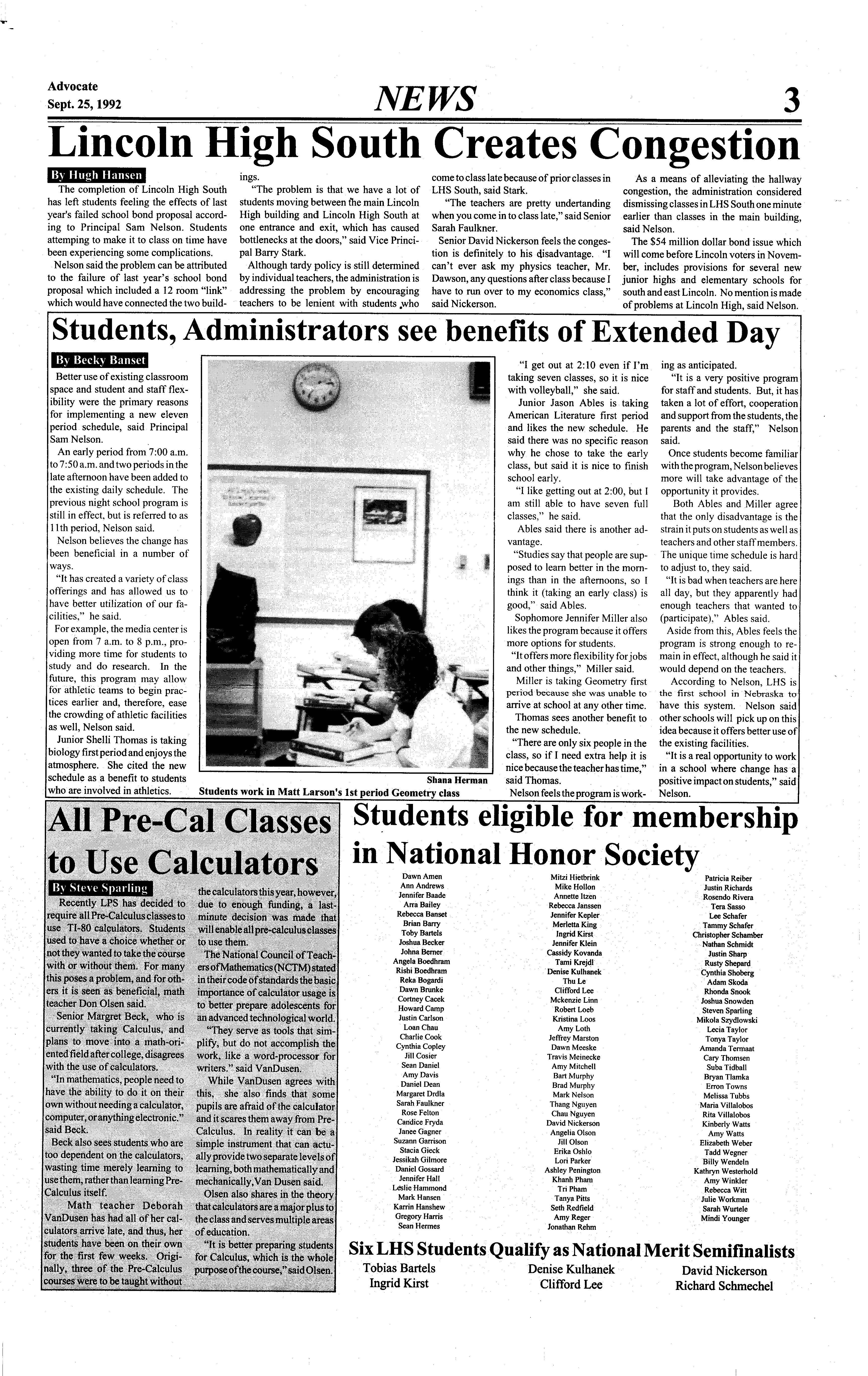
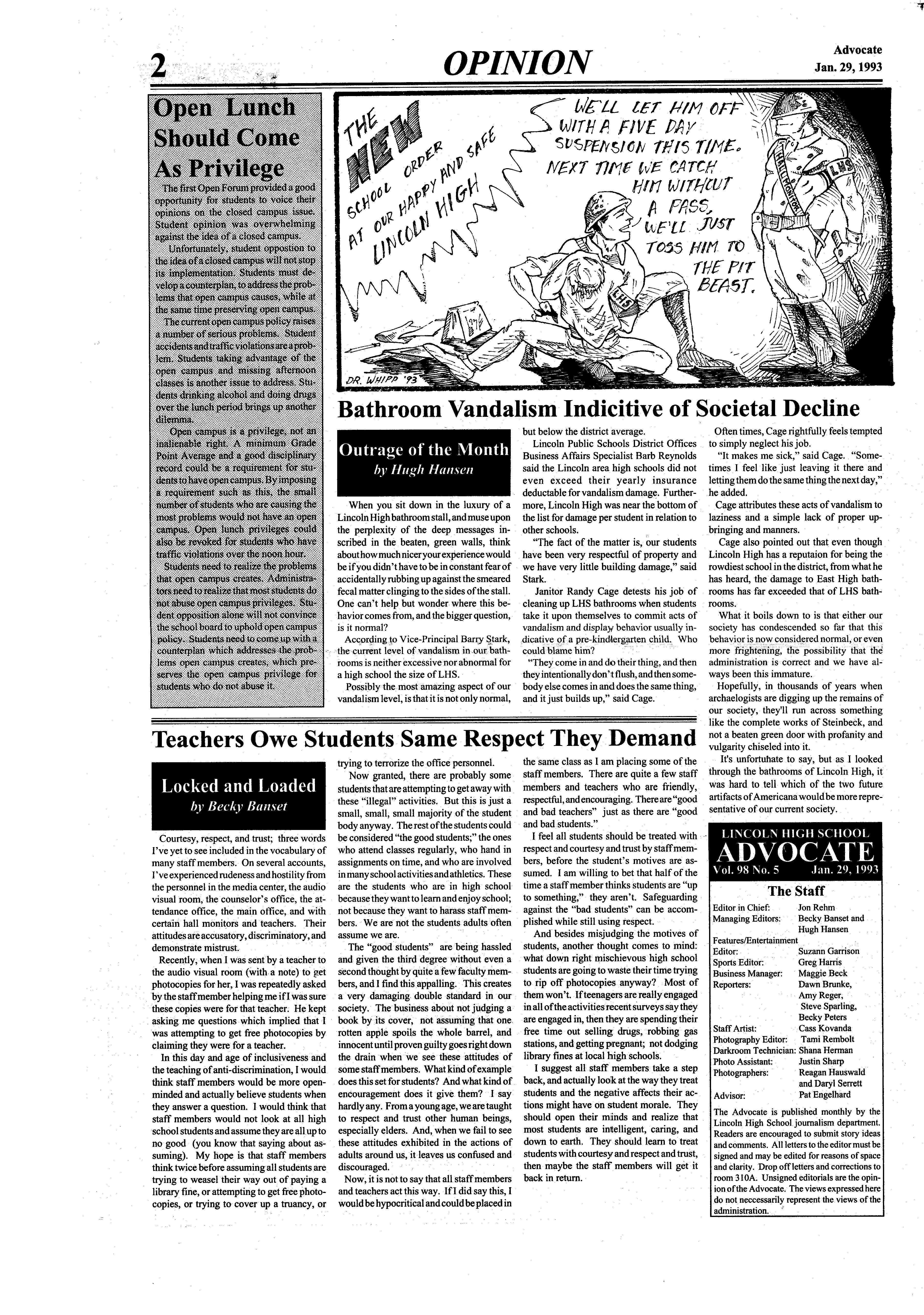
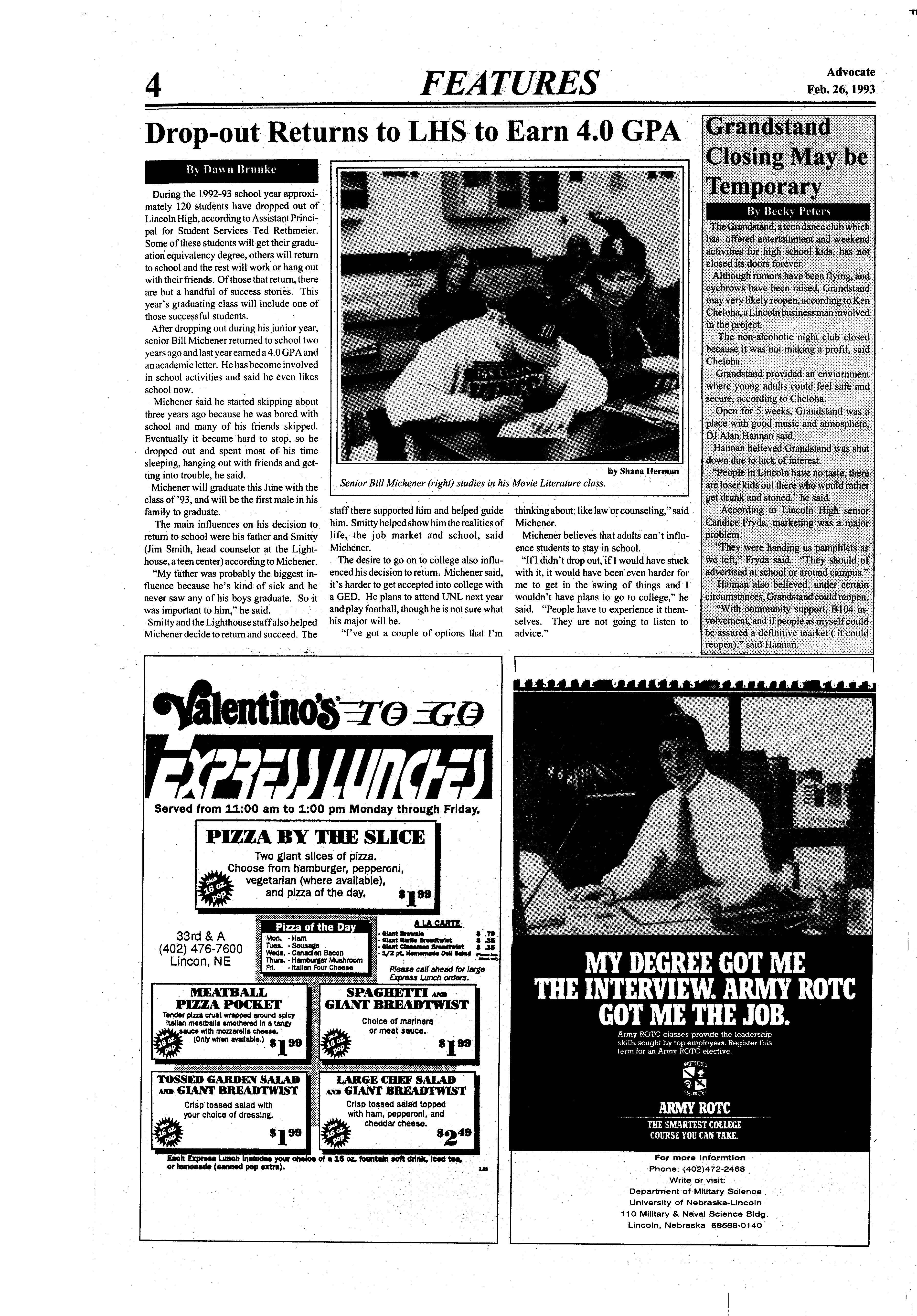
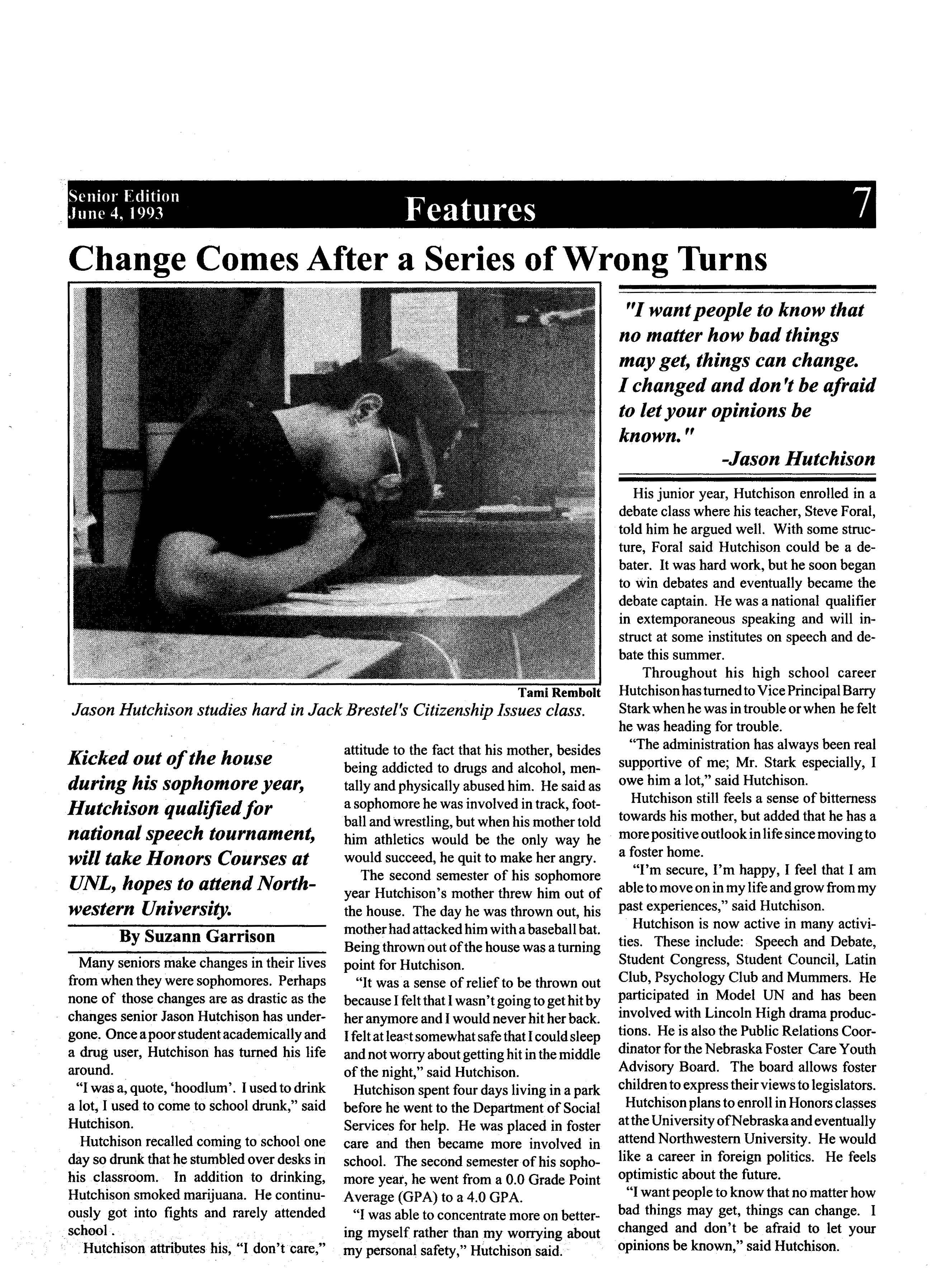
Shana Herman Students work in Matt Larson's 1st period Geometry class
Sept. 25, 1992
B, · ra111i Rentllcllt •
It's.the beginning of the school • • ye :ar ~nd already the term ''senioritis" can be heard throughout the halls.
· This condition refers to seniors who are ready to get their senior year over with and get on to college.
For many LHS students, there are: still uncertainties about what college will be like, LHS alum Julie Haffey gave some suggestions based on her experiences at UNL. She suggested sitting as close as you can to the front of the classroom or lecture hall. She said college professors tend to teach to the front part of the class.
Another helpful thing to do is to introduce yourself to the professor. This way the professor will
take notice of you and could possibly be impressed by your outgoingness, she said.
Haffey also suggested to set up a study schedule for yourself so you can set aside time each day to ensure you get your work done. "A lot of people think high school is easy and that when they get to cqllege they can have all fun and · games," LHS alum Chris Geis said.
High school's main function is to prepare students for college. But inevitably there are always small details that are not thought about until it is too late.
Haffey said that teachers need to prepare students on how to write different types of essays and papers correctly.
Haffey had a couple more useful tips for your arrival at college. Buy used books and a parking tag.
Good academic preparation best advice for ACT/SAT
By 1\n1y Reger
Juniors and seniors may feel overwhelmed when faced with the SAT and ACT. There are some things that can be done to prepare for these tests, according to counselors Sue Cain and Steve Vasa.
Workshops will be offered to better prepare students for the ACT on October 24 and the SAT on November 7. These workshops are held on five different days for a total of thirteen hours at a cost $60 each. Classes in the past have been taught by Lincoln High teachers Sue Johnson, John Matzke and LeEtta Sprackling. Registration packets for either workshop may be picked up from the counselor's office.
These workshops are not designed to teach the material on the tests, but they do eliminate anxiety-arousing surprises on the exams.
"They are for review, and teach test strategies," said Cain. " they are really just to put a student at ease."
The workshops help students become familiar with tests and include sample tests and questions.
After students decide what college they are going to attend, they should take the test that the particular college requires.
"Don't waste money and time taking both tests if you know where you 're going to go,'~ said Cain.
If they are undecided about colleges, they
can take both tests.
Unlike the ACT, the SAT does not test for higher math skills, but its English section and others can determine where a college places a student in classes, according to Cain. The ACT includes science and math reasoning sections as well as a reading section.
In addition to the SAT and ACT, some colleges and universities require students to take one or more Achievement Tests, which test one area of a student's ability. Students can check the College Handbook, available in the counselors' office, to find out if the college they plan to attend requires them, said Vasa. California and East Coast schools often require achievement tests, he said. Each test covers one subject area, and cost the same amount whether you take one or three.
When preparing for tests, students should remember that nothing can substitute for a good academic preparation from kindergarten through twelfth grade. A broad reading background and an organized method of preparation for college entrance exams are also helpful. Cain said it is a good idea for students to test themselvesat home for preparation.
If a student is financially limited, they may be eligible to waive their SAT fee. They may also be eligible to waive the application fee to colleges, said Cain. Students who think
they qualify should come visit with their counselor for more information.
For More Information in JUNIOR ACHIEVE:tvfENT
Each time a student registers for the ACT or SAT, they can list colleges they would like their scores sent to for free (four on the SAT, three on the ACT). If they would like more colleges to receive their scores later, there is a fee. If a student takes a test more than once, colleges wilil recognize the highest scores. Also, if a student is sick or feels they have not done well on a test, they may immediately request that their scores not be reported to any colleges, by informing the test proctor.
The registration deadline for the October ACT is September 25, and for the November SAT is October 7. Students may pick up registration packs in the counselor's office.
(;t\f\J\\J\)S -~\ r l _ ·ouRGER·B,AS\-\ QC1D&-f2.5~ i (.Q:ODi?~ ·tBl,,-1\J\ONT?fdzYVQf;GftaD ~N l
WA,NTED:Student with fresh, new ideas to design an ad for Birkenstock footwear. Must be hard working and creative. No experience necessary. If your ad is j1Udgedthe best, we'll use it
De~dline: October 29, 1992
For rules, guidelines and prize infonnation, visit FOOTLOOSE&FANCY 1219 P St. 476-6119
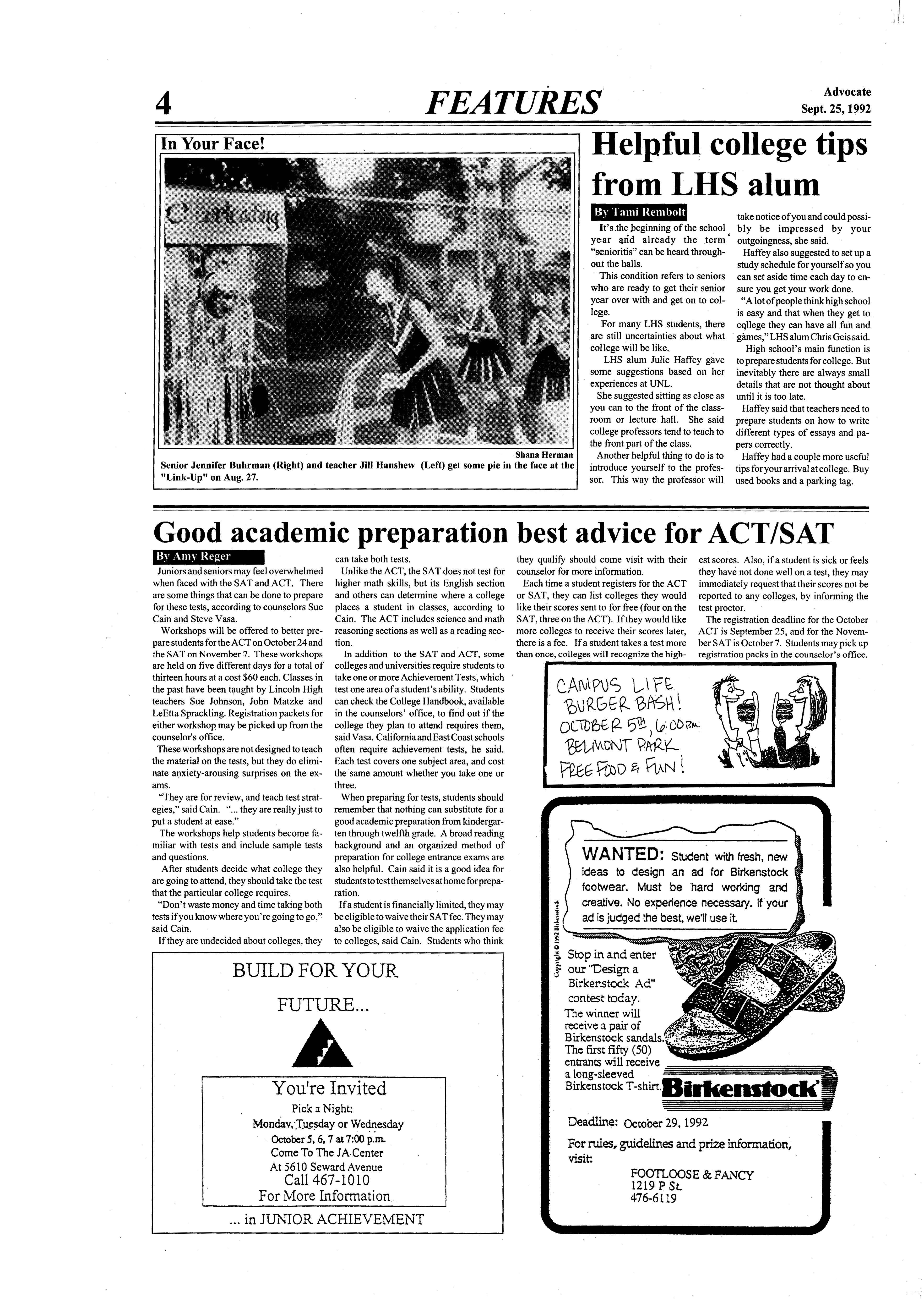
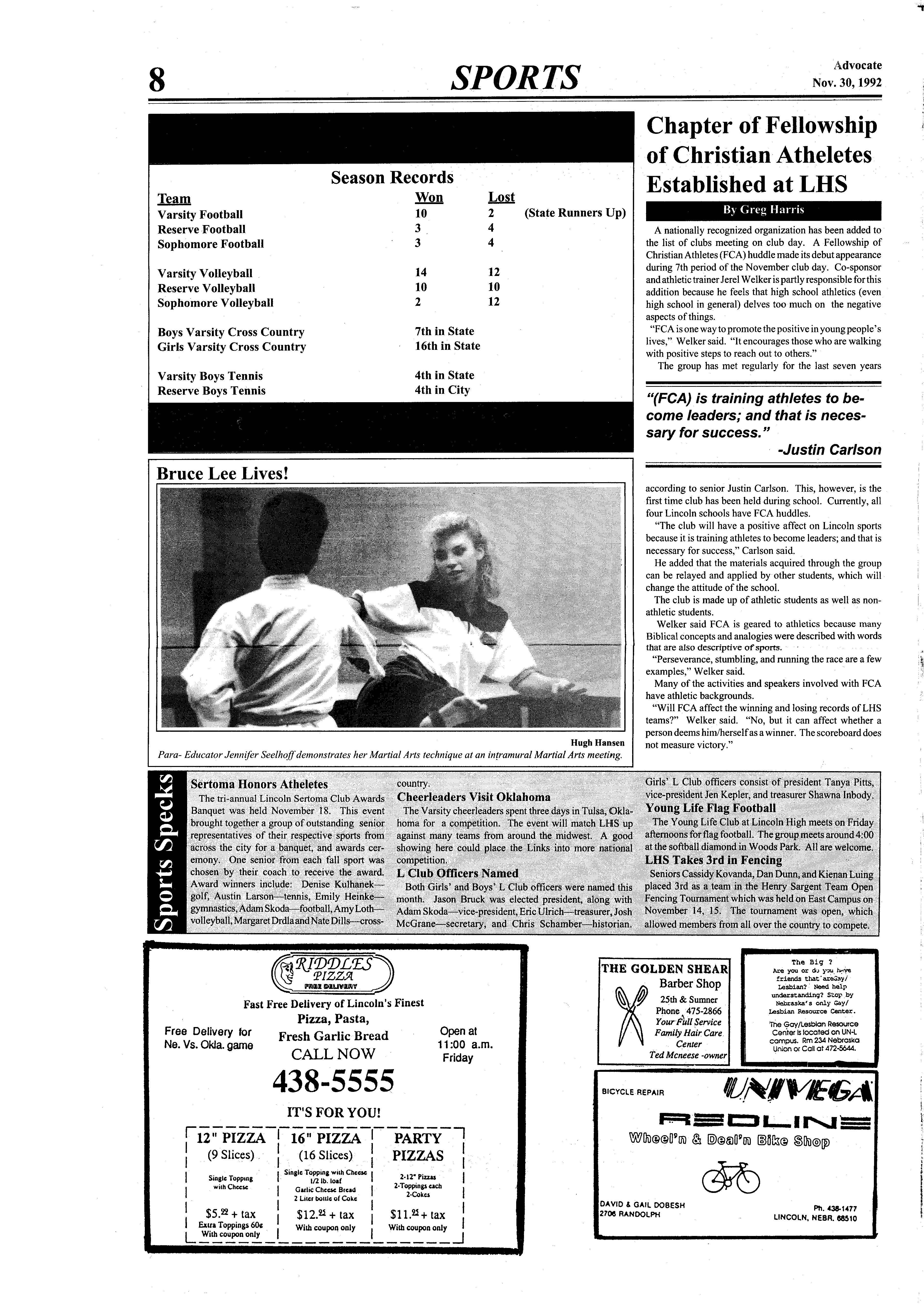
Senior Jennifer Buhrman (Right) and teacher Jill Hanshew "Link-Up" on Aug. 27.
Shana Herman (Left) get some pie in the face at the
ecor • ovies rea
Psycho City Great White's Best
B, , Da,vn Bru11ke
Great White -P&ychoCity (Capitol Records)
The fifth release from hard rock band
Great White promises to be their best yet.
The album starts off with an anonymous suicidal caller who left a message on the band's office answering machine. The message sets the mood for the entire album. Leaving their optimistic, sex-crazed lives of Twice Shy and surpassing the bluesy style of Hooked. Great White has come into their own with Psycho City. The music is a mixture of the bluesy style through years of recording and their hard rock edge that established them in the mid '80's.
The album shows an aggressive, angry side of Great White and is the product of years of frustration, heartache and personal battles. This album is influenced by events that took place recently, the resignation of bass player Tony Montana, personal problems, and the on going fight with their addictions to alcohol and drugs. This album is a clear minded attempt at releasing the anger, and has become a part of their healing process.
Jack Russell has been dubbed the man with the golden voice. Not only does he live up to this reputation, this album proves that vocalists don't have to scream to truly rock. The vocals mystify and delight from the fast
paced "Psycho City" through the bittersweet ballad "Love is A Lie."
The simple but powerful guitar licks personify Mark Kendall's style. Kendall uses musical lines that c:ilon'ttry to fit a million notes into one bar a nd that interact with the other musicians instead of overpowering.
Kendall's solo on ''Maybe Someday" is a perfect example of this, the guitar seems to come from out of nowhere and subtly takes over your attention without shocking you, then disappears back into the lines of the song.
Audie Desbrow :is the backbone of the group, laying down :a steady beat which the songs revolve around. Along with guest bassist Dave Spritz, Desbrow provides the strong pulse, which holds each song together. It's this pulse which first draws one's attention away from other hard rock songs.
Completing the Great White line up is Micheal Lardie who puts the finishing touches on the songs. His added rhythm guitar and keyboards provides the links which combine the various musicians into the tight group that years of touring have made them.
Great White has the perfect mix of solos and accompaniment which is the formula for a successfulband and a hit record. Psycho Qu: is definitely one of !he best albums to be released this year.
Hometown: refreshing change but fails to live up to lyrical potential
By D~1,vnBrunke
The Cages -Hometown (Capitol Records)
The Cages could be considered the folk group of the '90's with their use of acoustical guitar and vocal harmonies. The music is a refreshing change from the loud guitar and screeching vocals, and over done, over sampled sounds that are filling the top 40 charts. Unfortunately, the lyrics themselves did not follow in the tradition of contemporary folk singers. Instead of the meaningful lyrics usually found in folk songs, Hometown's lyrics are senseless fluff. "Too Tired" is a perfect example of this. The song describes four typical blonde bubble heads who think about nothing but sports cars and getting high. The songs that do seem to have some emotion or meaning are all about a lost
love that will be found again someday, such as "Better Live".
Aven's vocals are captivating, making them easy to listen to until one tries to decipher the lyrics. The end of"Lay Your Hand" is a perfect example of this with its vocal melody using only a simple phrase mixed with guitar and saxophone.
Clayton Cages' guitar licks intertwine with the vocals so well it is sometimes hard to distinguish which is :actually the melody. Use of other instruments, such as saxophone and percussive instrutnents add to the songs, making eaclh a unique work.
Hometown is a great album instrumentally, but fails to live up to its lyrical potential.
Shana Herman
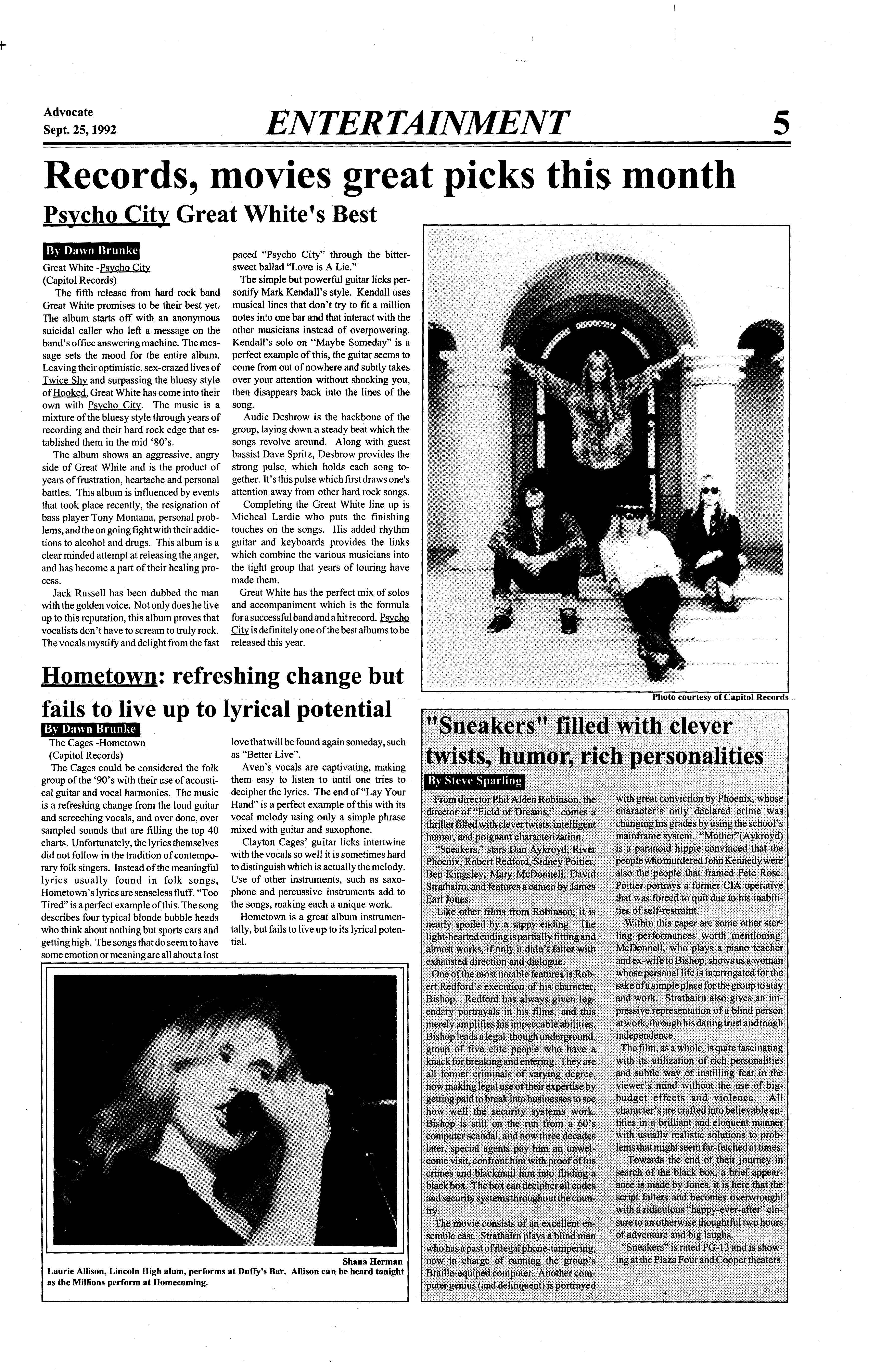
Laurie Allison, Lincoln High alum, performs at Duffy's Bar. Allison can be heard tonight as the Millions perform at Homecoming.
Photo courtesy of Capitol Records
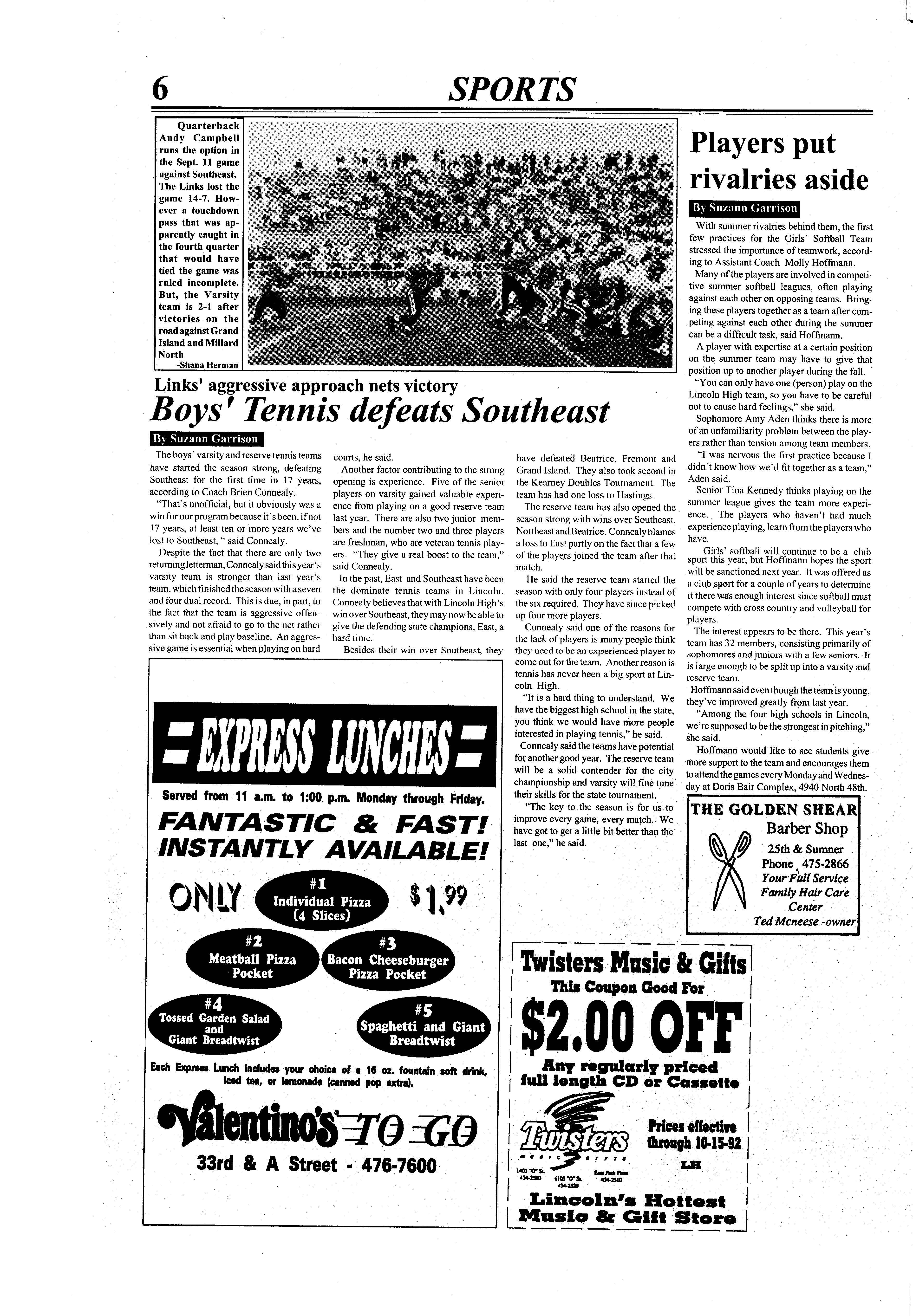
Quarterback
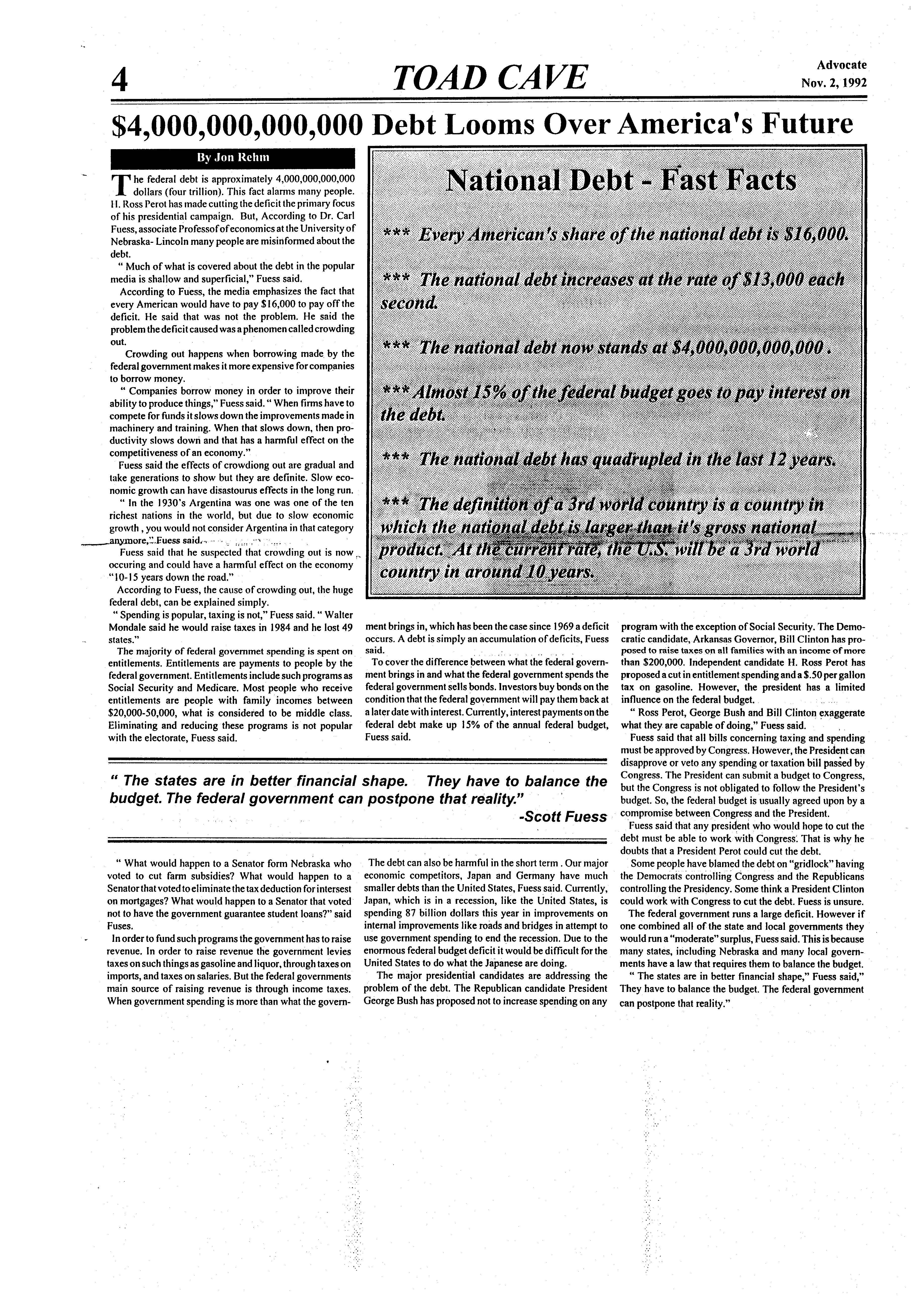
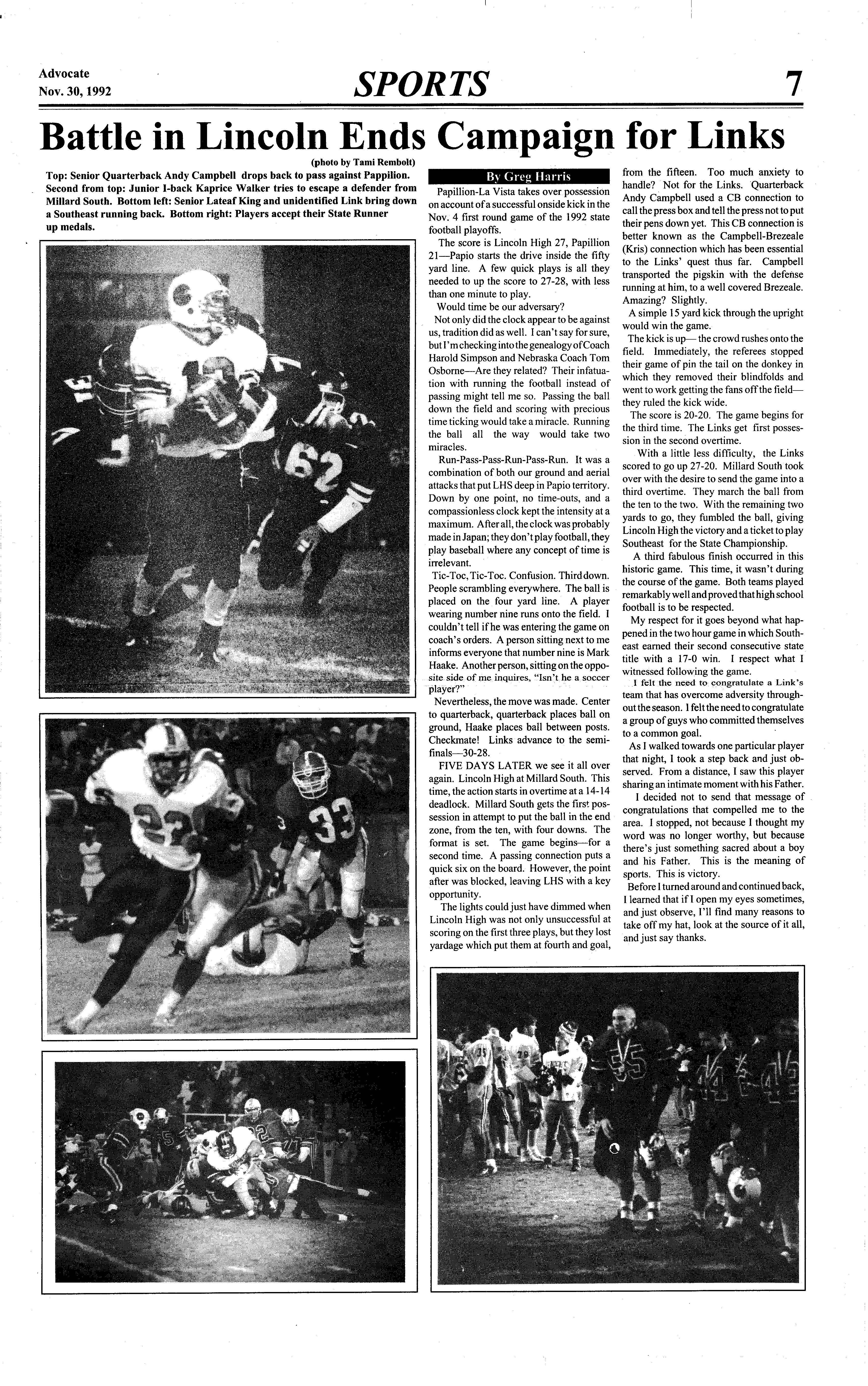
Andy Campbell runs the option in the Sept. 11 game against Southeast.
The Links lost the game 14-7. However a touchdown pass that was apparently caught in the fourth quarter that would have tied the game was ruled incomplete.
But, the Varsity team is 2-1 after victories on the road against Grand Island and Millard North -Shana Herman
The boys' varsity and reserve tennis teams have started the season strong, defeating Southeast for the first time in 17 years, according to Coach Brien Connealy.
"That's unofficial, but it obviously was a win for our program because it's been, if not 17 years, at least ten or more years we've lost to Southeast, " said Connealy.
Despite the fact that there are only two returning letterman, Connealy said this year's varsity team is stronger than last year's team, which finished the season with a seven and tot1r dt1al record. This is due, in part, to the fact that the team is aggressive offensively and not afraid to go to the net rather than sit back and play baseline. An aggressive game is essential when playing on hard
e ·eats out east
courts, he said.
Another factor contributing to the strong opening is experience. Five of the senior players on varsity gained valuable experience from playing on a good reserve team last year. There are also two junior members and the number two and three players are freshman, who are veteran tennis players. "They give a real boost to the team," said Connealy.
In the past, East and Southeast have been the dominate tennis teams in Lincoln. Connealy believes that with Lincoln High' s win over Southeast, they may now be able to give the defending state champions, East, a hard time.
Besides their win over Southeast, they
have defeated Beatrice, Fremont and Grand Island. They also took second in the Kearney Doubles Tournament. The team has had one loss to Hastings. The reserve team has also opened the season strong with wins over Southeast, Northeast and Beatrice. Connealy blames a loss to East partly on the fact that a few of the players joined the team after that match.
He said the reserv 1e team started the season with only four players instead of the six required. They have since picked up four more players.
Connealy said one of the reasons for the lack of players is many people think they need to be an exp>erienced player to come out for the team Another reason is tennis has never been a big sport at Lincoln High.
"It is a hard thing to understand. We have the biggest high school in the state, you think we would have more people interested in playing tennis," he said.
Connealy said the teams have potential for another good year. The reserve team will be a solid contender for the city championship and varsity will fine tune their skills for the stat,e tournament.
"The key to the season is for us to improve every game, every match. We have got to get a little bit better than the last one," he said.
Players put rivalries aside
Bv
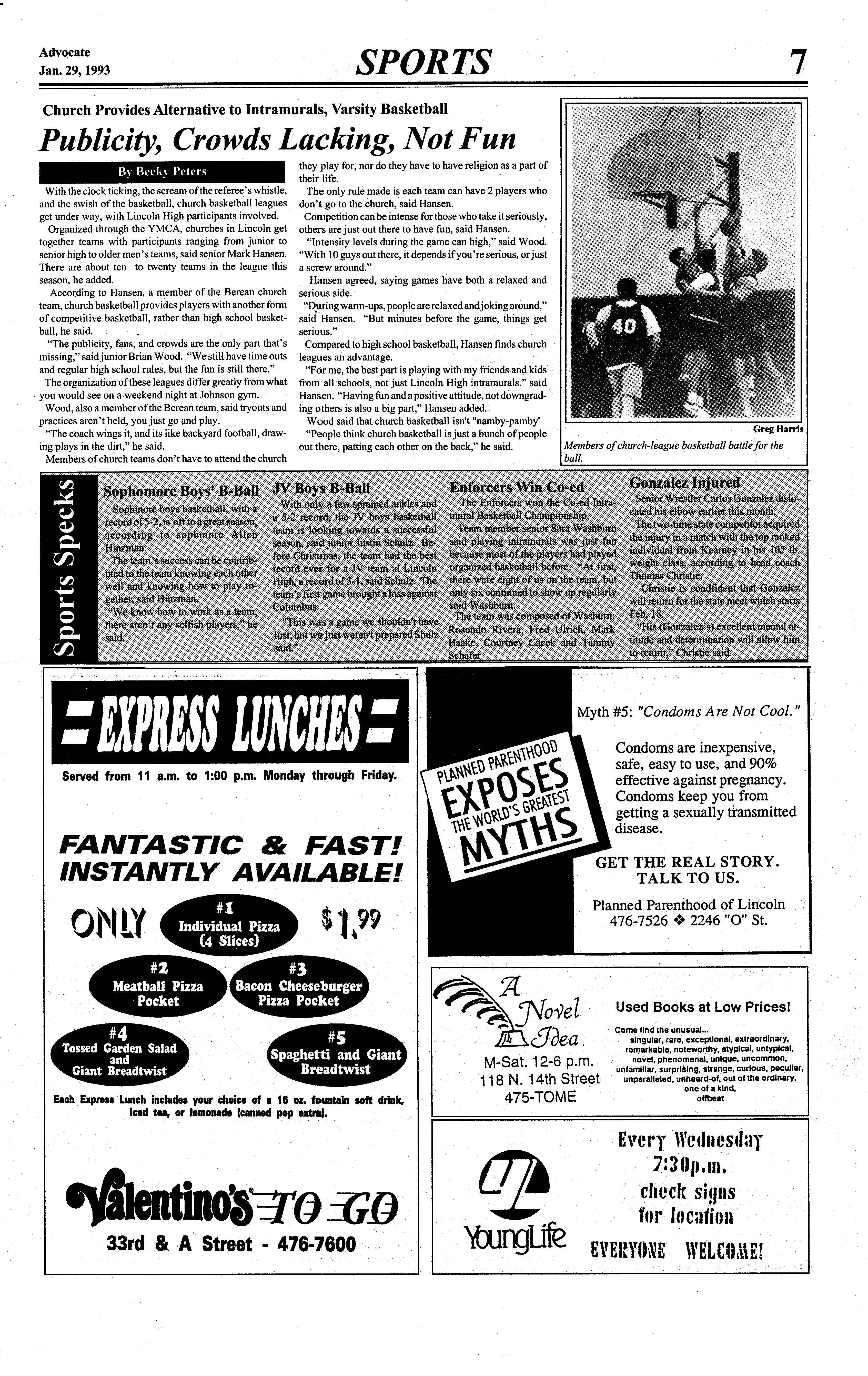
With summer rivalries behind them, the first few practices for the Girls' Softball Team stressed the importance of teamwork, according to Assistant Coach Molly Hoffmann.
Many of the players are involved in competitive summer softball leagues, often playing against each other on opposing teams. Bringing these players together as a team after competing against each other during the summer can be a difficult task, said Hoffmann.
A player with expertise at a certain position on the summer team may have to give that position up to another player during the fall.
"You can only have one (person) play on the Lincoln High team, so you have to be careful not to cause hard feelings," she said.
Sophomore Amy Aden thinks there is more of an unfamiliarity problem between the players rather than tension among team members.
"I was nervous the first practice because I didn't know how we'd fit together as a team," Aden said.
Senior Tina Kennedy thinks playing on the summer league gives the team more experience. The players who haven't had much experience playing, learn from the players who have.
Girls' softball will continue to be a club sport this year, but Hoff1nann hopes the sport will be sanctioned next year. It was offered as a clu.b ,sport for a couple of years to detennine if there was enough interest since softball must compete with cross country and volleyball for players.
The interest appears to be there. This year's team has 32 members, consisting primarily of sophomores and juniors with a few seniors. It is large enough to be split up into a varsity and reserve team.
Hoffmann said even though the tea1n is young, they've improved greatly from last year.
"Among the four high schools in Lincoln, we 're supposed to be the strongest in pitching," she said.
Hoffmann would like to see students give more support to the team and encourages them to attend the games every Monday and Wednesday at Doris Bair Complex, 4940 North 48th.
Shop 25th & Sumner Phone 47S-2866 Your·PhllService Family Hair Care Center Ted Mcneese -owner
Suzann Garrison •
B)' Suzann Garrison
1990 Case allows Bible study on school grounds e es a e a van a e o ens'
Commentary By Greg Har1·is
Athletics give kids the opportunity to experience different analogous situations which can aid them in times of celebration as well as adversity.
Four student-athletes and one teacher meet together regularly in Lincoln High, to discuss this correlation between sports, "real-life", and the Bible.
Senior football player Tadd Wegner said that Paul's teaching to the Apostles, "You can do all things through Christ who strengthens you," not only gives him perspective on the field, but it also provides him with hope that gets him through the day.
violate the Establishment Clause. The Equal Access Act allows public schools to sponsor any club not corresponding to the curriculum.
Junior Jas(DnWestenburg prefers using school class-
''The Bible can make us better people on and off the field,''
-Aaron Bott
Four years ago, two Lincoln High students, approached coach Eric Knoll with an idea to get some people together for a Bible study once a week before school. rooms for their study because it is convenient.
Knoll's group is one of the three at Lincoln High who meet for Christian fellowship. ·
Even though this group is made primarily of athletes, no limitations are set as to who attends.
"The studies are not geared to sports directly," Knoll said. "Our primary focus is to build friendships."
Wo! Hold on, a Bible study in school? What happened to the separation of church and state?
Religious freedom and tolerance had gained much attention by the time the U.S. Constitution was written in 1787.
In fact, it became one of the few individual
liberties protected in the text of the original Constitution.
People still did not trust that the Constitution provided enough protection, so James Madison included the Establishment Clause when he proposed the Bill of Rights to Congress.
In this clause, Madison said that government may not directly support one particular faith. However, the words, "separation from church and state," never actually appeared in the First Amendment.
It wasn't until 1947 in Everson vs. Board of Education when the court set forth a more applicable definition of the Establishment Clause. ·The new definition merely said a state or federal government is prohibited from forcing a person to profess a belief in any way.
''The words seperation from church and state never actually appear in the First Amendment,''
How high should this "wall of separation" be? American money holds the caption, "In God We Tn1st." Military chaplains serve all branches of the military. Church property and contributions to church property are tax exempt. Congress and state legislatures open sessions in prayer. And parochaid, government aid to private religious schools is available.
The school systems around the country have gone back and forth on the issue of religion in public schools. Until 1990, the idea of Bible studies on school grounds was literally laughed at.
But the laughing was hushed recently due to the efforts of Bridget Mergens in Omaha, Nebraska. What started as an idea to get some students together to study the Bible, turned into a Supreme Court case, Westside Community Schools vs. Mergens (1990).
''Meeting on school grounds is logical since school is what we have in common,''
-Jason Westenberg
After a request to meet for a Bible study after school was rejected by the principal of the school, she took the rejection in stride. She took it to court. Five years later, long after Mergens' graduation, the. Supreme Court held that the Equal Access Act did not
Second
"Meeting on school grounds is logical since school is what we have in connmon. That's how we know each other," Westenburg saiid.
"The Bible can make us better people on and off the field," junior Aaron Bott said. Bott then recited James 4: 10, "Humble yours1elfin the presence of God, and He will exalt you."
For Westenbwrg, athletics provide the testing of his faith, which builds character.
''When you'ire in a 'non-preachy' environment, Bible
teachings are better understood," Westenburg said. That is why he enjoys the group so much.
''We're not banging any doors down, but we aren't afraid to share what we believe,''
-Eric Knoll
"We're not banging any doors down, but we aren't afraid to share what we believe," Knoll said.
There is little reason to exclude the Bible from public schools. After all, the schools that existed when our nation's forefathers governed us, included biblical teaching in the curriculum. The Bible is a tool to link you together with yourself. What could possibly be better than opening a book and reading about yourself. That's what the Bible is. Whether you are an atheist, Adventist, a Buddhist, or a Baptist, the Bible can teach you something. Thank you Bridget Mergens-Mayhew for helping break a wall down in education today.
year varsity player began football career in sixth grade
ri iron revea s Bruck's Persona i
By Greg H~1rris
Football: known to some as a way of life
(e.g. 'Da Bears), and to most 011:hers, a silly game that provides a means off socializing on Friday nights. But Jason Bnuck sees the game as an opportunity to reveal his character.
By definition, character is a collection of distinctivetraits, moral strength, ,and/orone's reputation. Jason Bruck describes his character as aggressive, yet likable.. Character, to Bruck, is something every(Dne is born with. It can not be built or improved upon, just revealed. He says footballl has been a tool to bring out his aggressive and likable characteristics.
Bruck began his football career in sixth grade where his interest was sparked by his hometown (Harlan, Iowa) high school football team who were state champions. After moving to Lincoln, he began playing midget football. He went from there to freshman football at LHS. His sophomore year was spent on the JV team. Now, Bruck is on his second year playing varsity.
The premier reason Jason has stuck with football so long is the exhilaration he experiences through tackling and playing in front
FRE.E.KE.YCHAINWITH/
of big crowds.
"Hitting is the big thing for me. I've scored before but it wasn't a big deal compared to a good tackle," Bruck said.
In going from midget football to varsity football, one might say the biggest difference. is the crowd·· one plays in front of. Bruck went from playing in front of just his parents, to playing for a few thousand spectators, and journalists as well.
"I know of few things that are more thrilling than playing football with the band playing and the crowd pumping. That is basically my motivation," Bruck said.
In order to reach this level of excitement, a player must prepare accordingly, Bruck explained. The most important step in preparation for him is to relax and restrain from thinking about the game too much, too early. He starts concentrating on the game one hour or less before the time of kickoff. One part of his preparation is putting on his lucky pair of red underwear before a game.
"If you prepare too much, you psyche yourself out and.waste a lot of energy in the process. Besides, cockiness and arrogance.· enter the.scene when one prepares too much mentally," he said
Bruck believes humility is very important in life. Humility is one of the many qualities that Bruck has accumulated through his involvement in football. In addition to being humble, Bruck said he also believes in exerting one's full potential. On the field, no matter what the score is, he tries to play his hardest. Even if the opponent is not at his same caliber, he said he still needs to walk off the field feeling drained and exhausted.
"The same concept works in real lifechoose a career that you enjoy, give it your all, and even if a less appealing job pays ··more, at least you' re not cheating yourself," Bruck said.
How does one give 100% in football? According to Bruck, one must understand three specific things: That the next play is always the most important, how to distinguish between competitiveness and anger or frustration, and to avoid getting a ''jockey attitude".
Bruck elaborated on these by saying that when a play is over, it is over, save the celebration for later.
''And if you make a bad play, still go on. He advises not to dwell on the past. After all,you can't say, 'Excuse me referee, can we do that play over, I made a mistake'," Bruck said
Number two is to have the ability to draw a line between the will to win and anger and hostility.
''When an opponent gets the best of me, a singular rivalry is produced. ·It is important that you feed off your opponent's intimidation, instead of getting. negative about it. You can't get mad You just need to make up for it on the next play," Bruck said.
Last, Bruck feels it is important to stray from cockiness or what he calls a ''jockee · attitude".
"Everyone has a choice on whether to gloat or not," Bruck said. "You either do or you don't. If you do, you just get your hopes up. And when that happens, the result is often disappointment."
High hopes in general are something that Bruck tries to avoid. He doesn't even pay a lot of attention to college or pro football because he says when he watches it on a Monday night for example, he gets really pumped up but has no way to release this energy. After all, he's got homework to do.
• 1nese
B,, Amv Reoer • • b Celine Robertson, Chinese Language teacher, and nine of her students traveled to another land this summer. From June 15 to June 30, the students called China their home.
This was the first such trip ever taken by Lincoln High students. Becky Banset, Maggie Beck, MaryAnn Bishay, Josh Campbell, Jason Christie, Jenny Christie, Jeena Nelson, Nate Schmidt, and Becky Wallen sold pizza and candy for Chinese Club throughout the school year to help defray the expenses of their trip. Each student received $200 from the club, said Robertson. This money was raised by all Chinese Club members.
The trip was made possible through Educational Tours, a travel agency, Robertson said. A Foreign Language Consultant, Lin Peng, accompanied the group for fourteen days. A local guide accompanied them in each of the cities as well. They visited Shanghai, Beijing, Xian, NanjinG, Wuxi, Suzhou, and Hong Kong.
Schmidt enjoyed visiting the Great Wall.
"I liked it because it was a great experience and a great view!" Schmidt said.
He also loved stopping in Hong Kong, where he and Jason Christie went walking in the streets at 1:30 in the morning. The 15
factories he visited were his least favorite sights. Nelson enjoyed taking walks in the streets at night, visiting the night markets and buying breadsticks 'lt the morning markets in Beijing.
In the future, Jeena would like to work at the United States Embassy in China. She is also interested in returning to see old tombs that are to be opened in the future, because she went to one tomb in China and enjoyed seeing it.
Schmidt was amazed by the number of bicyclists in China. In Wuxi, a city of 5 million people, four million citizens ride bikes This, he added, W'lS very different from American culture.· ·
Shopping there was also a new experience, he explained.
"Shopping in China gives free enterprise a whole new meaning," he said.
"In China, people tum their homes into shops. They even chase after tour buses and go to the windows to sell their goods to people."
Robertson said her students often spoke Chinese when they were shopping and visiting with people. She also said the kids were impressed with their language skills.
"We asked where the bathroom was frequently," she said.
American life contrasts sharply with Germany for exchange student
I~, .JcJn Rl•hrn • German society has some striking contrasts with American society,but has some intresting parallels as well, German exchange student Petra Phieffer said.
Pheiffer, who is from Frankfurt, in Southwestern Germany, says one major· difference is the school system. In Germany students stay in the same class with the same students until the 10th grade, students do not have electives and German students have different classes on different days, unlike American students who have the same classes every day.
Pheiffer said another difference between Germans and Americans is their attitude towards school.
"Germans are more serious about school," Pheiffer said.
Which is not to say that Germans do not
know how to have a good time.
"We also like to party. We can drink when we're 16," Pheiffer said.
However, Germans can not drive uritil they are 18. But, Pheiffer said German teenagers frequently use the public transit · system, walk, bicycle or get rides from thier parents. She said thier were many dance clubs where teenagers could go in Frankfurt.
According to Pheiffer, Germans have a less formal attitude about dating than Americans do.
"If a German girl goes to a movie (with a boy) it doesn't mean anything," Pheiffer said, , "You can have lots of boyfriends without a lot of problems."
Even though German society is differences from American society, its political
climate is similair. Pheiffer has difficulty committing to one p(])litical party and is unsure about the.leadership of her country.
"I don't know who ,else to trust besides him (German Chancellor Helmut Kohl.) I don't know if anyone can make it better or worse than him," Pheifffer said.
German politicians ,are ridiculed by the public, Pheiffer said.
"Helmut Kohl is made fun of a lot. We ·make jokes about him all the time. He really acts stupid," Pheiffer said. "On the other hand he's not worrse than the others."
Currently, both countries are in a. reccession. Both countries have also had outbreaks of racial and ethnic violence. Most of the violence has been in what used to be East Germany, where tlhe economic opportunity is limited. Pfeiffer said the reason why many east Germans have become Neo-
Nazis is because of the lack of economi opportunity. Immigrants or "ausslanders' are resented by the Germans because the feel immigrants take jobs and govemmen benefits away.
"Some east Germans have become. Neo Nazi's because they don't have jobs an housing," Pheiffer said.
Pheiffer also thinks there has been a re surgence in Neo-Nazism and general dis content in east Germany because Helmu Kohl, like George Bush, made promises h could not deliver.
• "Helmut Kohl promised the east Germans too much.That's what I dislike about him," Pheiffer said.
Despite differences in the respective societies, it seems, Americans and Germans have a lot in common.
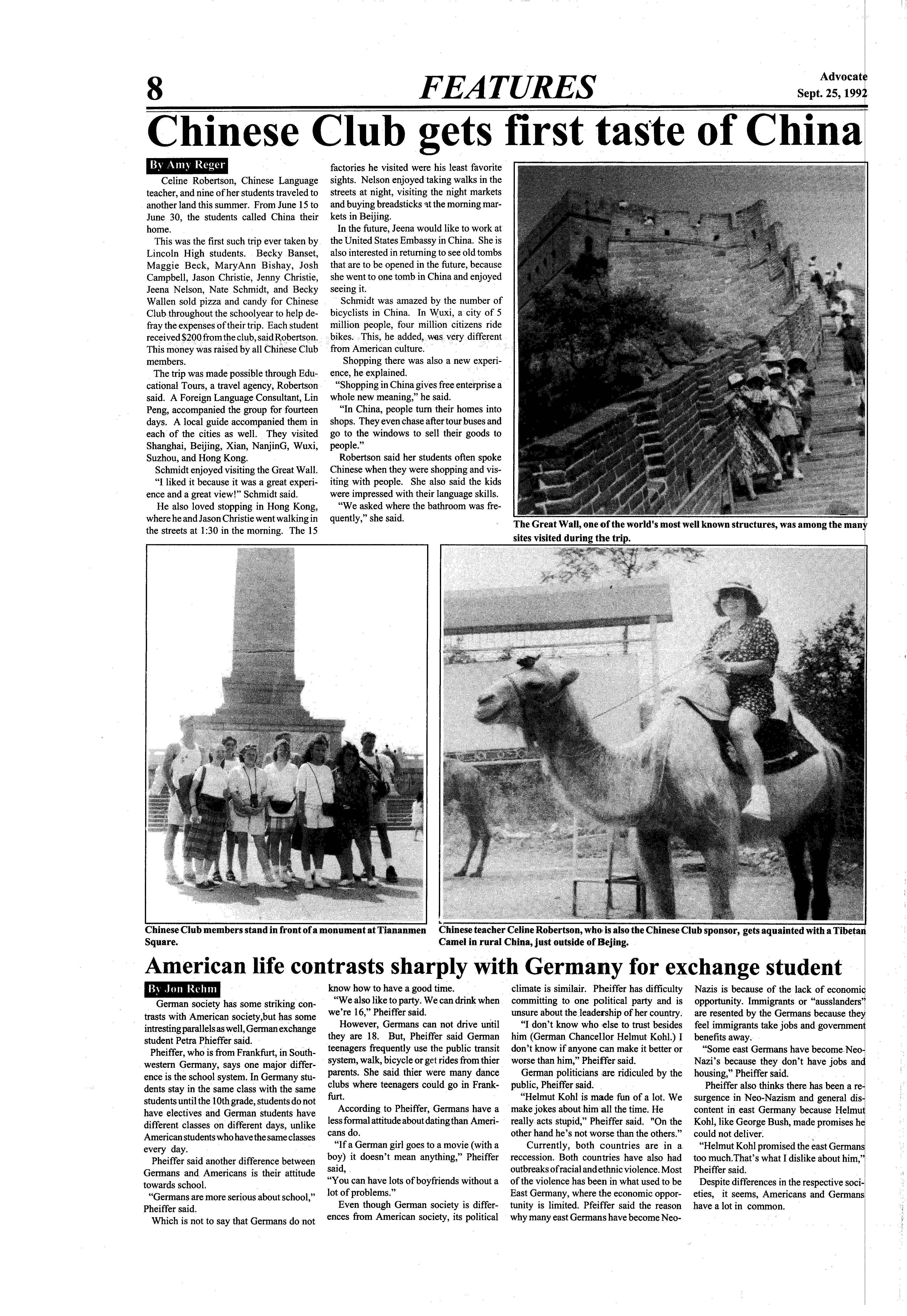
The Great Wall, one mfthe world's most well known structures, was among the man sites visited during tme trip.
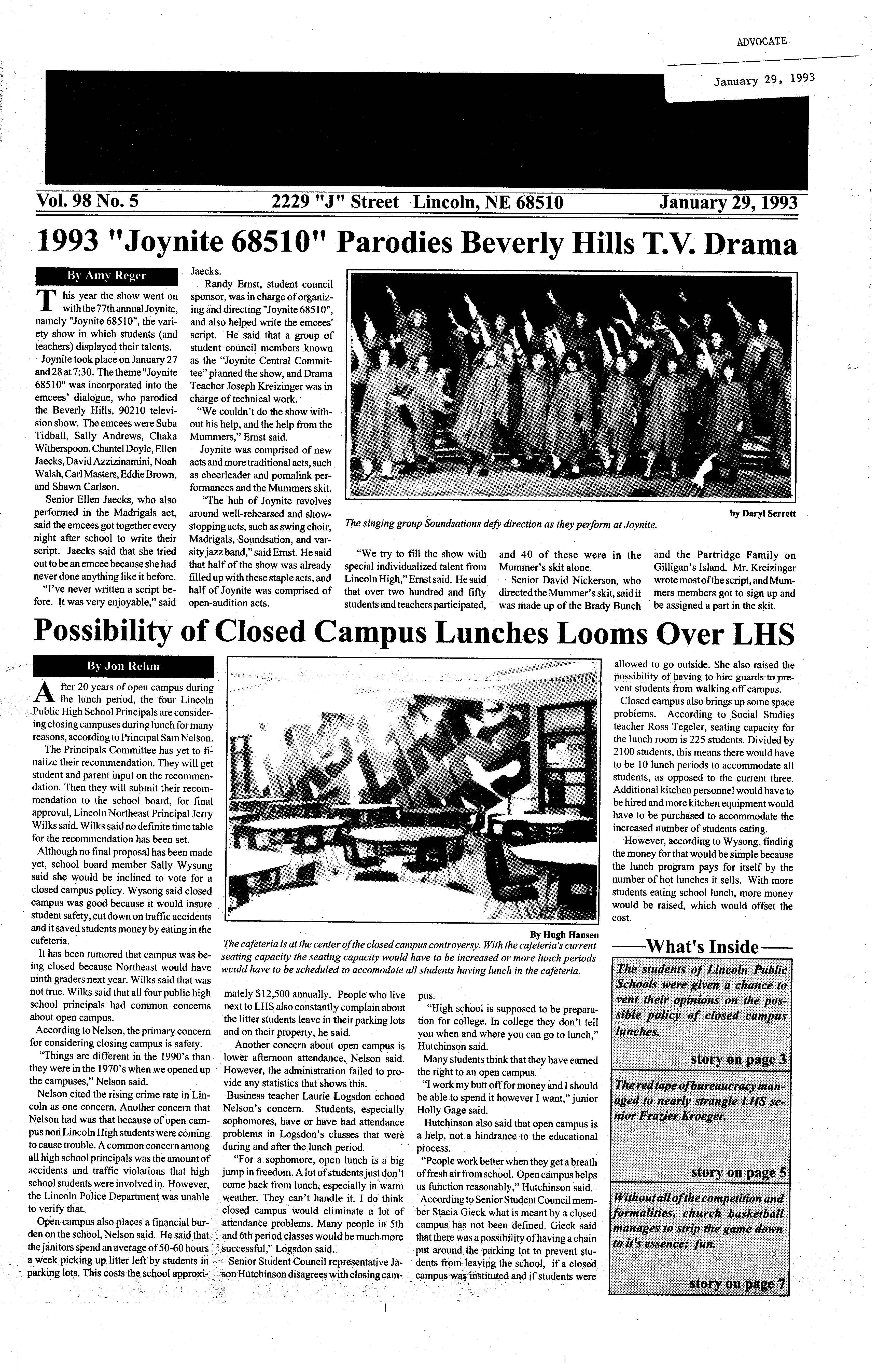
Chinese Club members stand in front of a monument at Tiananmen Square.
Chineseteacher Celine Robertson,who,is also the Chinese Club sponsor, gets aquaintedwith a Tibeta Camel in rural China, Just outside of Bejing.
B}' Amy Reger
0n October 2, the cast of the all-school play, The Martian Chronicles, had the exciting opportunity to talk to Ray Bradbury himself, via speakerphone.
The Martian Chronicles will be performed in the auditorium November 5, 6, and 7 at 7:30. The play, written by Ray Bradbury, features an unusually large and diverse cast. When asked where he got the idea for The Martian Chronicles, Bradbury said that he had grown up with a love of astronomy, and been inspired by drawings he saw of canals on Mars, which suggested that there was life on Mars.
Bradbury said that, contrary to popular belief, the play is not science fiction, it is fantasy. He described hi111selfas a "1nagic realist", writing about myths and fantasies. Bradbury said that of the five hundred books and stories he has written, only eighty of them have been science fiction.
Bradbury compared his Martian society with that of a Far Eastern or Oriental society, one with people " .leaving each other alone". He said that the Martians have a respect for other people's rights, and few laws.
Cast members were very excited to get a chance to hear Ray Bradbury.
· "It was great to get a chance to hear a few
words from the author," said sophomore Jennica Petersen, who plays Dr. Steffans.
She agreed with a ,comment of Bradbury's stating that people should find something they love and work at it every day to get · better.
Petersen thought cast members will work
well together.
"I think that since we're all working towards a common goal, we know it's essential to cooperate, and we do," said Petersen.
That's what the castmembers of Chronicles will be doing.
Student Director, senior Dave Williams, who has several parts, likes the fact that there are no lead roles. I-le said that the play would be a lot of fun for actors, because they have a great deal of freedom to interpret their roles.
_ Junior Noah Walsh, who plays Spender, said that there are many sophomores in this year's fall play.
"We have young talent, fresh blood," commented Walsh.
"Everyone has their own scene, and they work well together even though theydon'tknoweachother,"
he added.
and many cast members features the Second HouseofUsher, which was built by Walsh's character, Spender.
Senior Karrin Hanshew empathized with Spender.
"I like what he stands for, because I can understand his anger over how ruthlessly
humans tend to destroy the unknown beat1ty," she said.
Cast members made a huge time commitment to participate in The Martian Chronicles. They were required to attend rehearsals daily during the entire month of October.
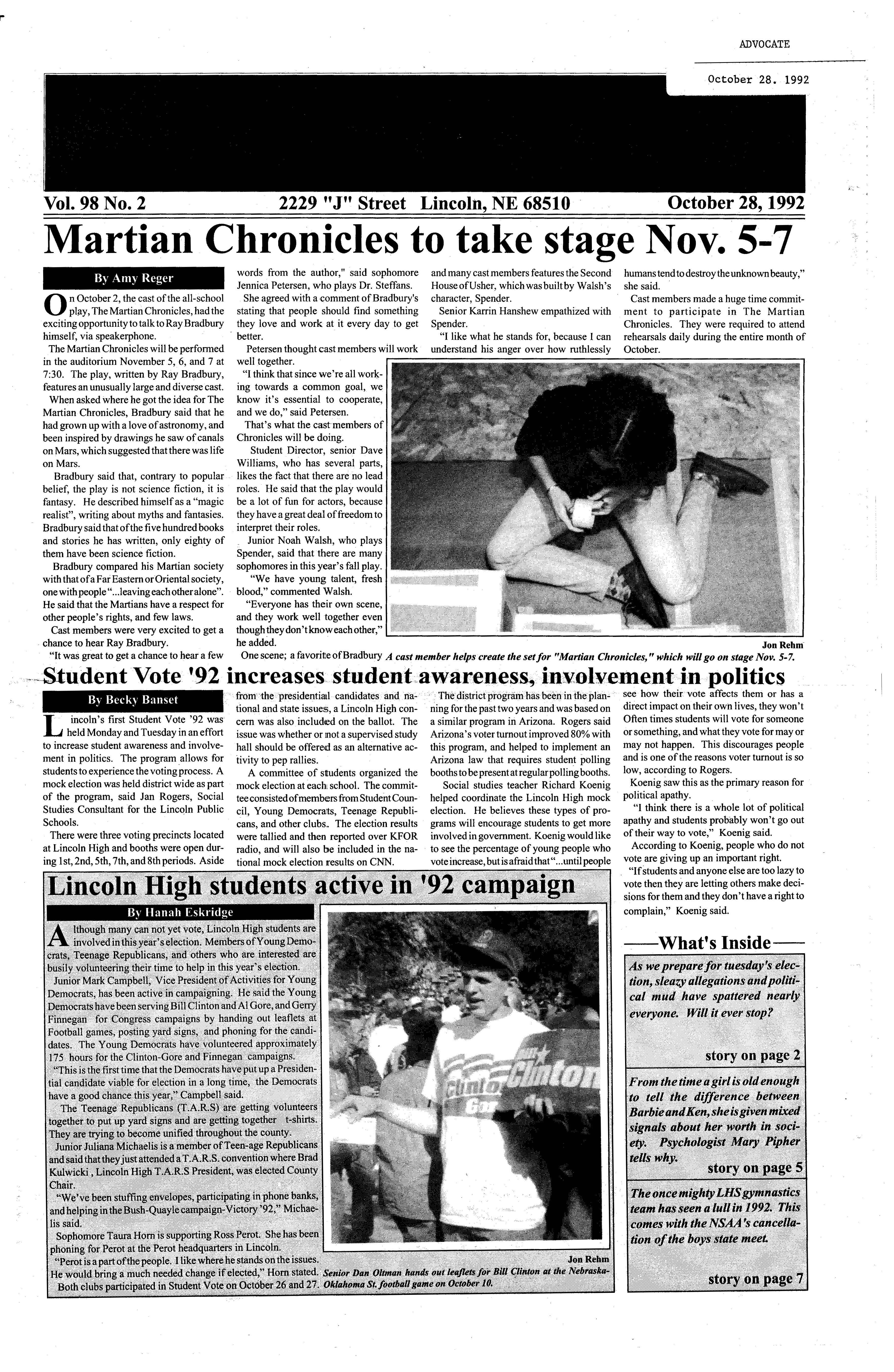
One scene; a favoritte of Bradbury A cast member helps create the set for
,._:Student Vote '92 increases . s :tudent .awareness.,
By Becky Banset
Lincoln's first Student Vote '92 was held Monday and Tuesday in an effort to increase student awareness and involve111entin politics. The program allows for students to experience the voting process. A mock election was held district wide as part of the program, said Jan Rogers, Social Studies Consultant for the Lincoln Public Schools.
There were three voting precincts located at Lincoln High and booths were open during 1st, 2nd, 5th, 7th, and 8th periods. Aside
··froln the presidentiatl candidates and na- · .·The :district program has been in the pla:ntional and state issues, a Lincoln High con~ ning for the past two years and was based on cem was also included on the ballot. The a similar program in Arizona. Rogers said issue was whether or 1nota supervised study Arizona's voter turnout improved 80% with hall should be offered as an alternative ac- this program, and helped to implement an tivity to pep rallies. Arizona law that requires stt1dent polling A committee of sttudents organized the boothstobepresentatregularpollingbooths. mock election at each1school. The co1nmit- Social studies teacher Richard Koenig teeconsistedofmembersfromStudentCoun- helped coordinate the Lincoln High mock cil, Young Democra lts, Teenage Republi- election. He believes these types of procans, and other clubs.. The election results grams will encourage students to get more were tallied and then reported over KFOR involved in government. Koenig would like radio, and will also be included in the na- · to see the percentage of young people who tional mock election results on CNN. voteincrease,butisafraidthat" t1ntilpeople
see how their vote affects them or has a direct impact on their own lives, they won't Often times students will vote for someone or something, and what they vote for may or may not happen. This discourages people and is one of the reasons voter turnout is so low, according to Rogers.
Koenig saw this as the primary reason for political apathy.
"I think there is a whole lot of political apathy and students probably won't go out of their way to vote," Koenig said.
According to Koenig, people who do not vote are giving up an important right.
"If students and anyone else are too lazy to vote then they are letting others make decisions for them and they don't have a right to complain," Koenig said.
Jon Rehm·
Con2ress fails to override veto Bush roadblocks Motor Voter Bill
When our favorite pop stars can be seen telling the country to get out and vote, we should be glad to see that at least someone cares about the fact that our voter tum-out level is deathly low.
These programs have been successful for the most part, but they don't even come close to solving the ever-looming problem of poor voter participation. I seriously question whether or not our leaders actually want us to vote.
Of course, nearly all politicians claim to be in support of voter registration, but how many actually mean it? They have commercials telling people to vote, they have celebrity endorsements, they have all sorts of programs with different methods of getting people to vote.
But, when it came time for them to prove that they mean what say, they choked. President Bush vetoed the Motor Voter Bill, which would have auto1naticallyregistered any eligible person to vote if they have a
Outrage of the Month
drivers license, and Congress failed to override this veto.
· This bill would have been a huge step forward in the fight to increase voter participation. Bill Clinton has said that as president, he would sign this bill, President Bush is Clearly against it, and the people from the Perot for President office, failed to produce any stance what-so-ever on the issue.
If you believe that voter turnout is important in a democratic country, then we urge you to take this into consideration when making your choices in the upcoming election. If you can't vote, then tell your parents or anyorie else who can vote about this important issue. Better yet, write to the president or your representative Doug Bereuter, who is up for re-election this year. Contrary to popular belief, some politicians do read their mail, and take their constituents' opinions to heart. Without people who care, our country is doomed. You can make a difference!
Bush campaign hits rock botto1n in '92
George Bush, 10-12 percentage points· down in most polls, is getting desperate. Bush is not discussing the economy, education or the environment. Instead he is questioning Bill Clinton's patriotism because Clinton protested against the Vietnam war while he was a student in England. Under any conditions questioning someone's patriotism is sleazy. With the economy in the worst conditions since the Depression it is stupid, sleazy and desperate. With a foreign policy record like Bush 's, questioni11g someone's patriotis1n is stupid, sleazy , desperate and hypocritical. Bush is supposedly the foreign policy president. He is credited with defeating Iraq in the Gulf War. But many facts since then have tarnished the luster of the Gulf War victory.
It is a fact the United States knew that Iraq was using a one billion dollar loan from the United States that was allegedly supposed to buy grain to purchase weapons instead. It is also a fact that on July 25, 1990, one week before Iraq invaded Kuwait,the United States Ambassador to Iraq, with orders from the President, told Saddam Hussein the United ·· States would not respond if Iraq invaded ·Kuwait, essentially giving Hussein the green
light to invade Iraq
Recently, Senator David Boren (D-Oklahoma), chairman of the Senate Intelligence committee, revealed that the CIA, FBI and the Justice Depa1tment collaborated to cover up the fact that the United States partially guaranteed a five billion dollar loan made to Iraq by the Italian bank BNL.
It is obvious the Bush- Quayle administration had a major role in building the Iraqi war machine and have made a concerted effort to conceal this fact. Bush and his sleaze merchants say that Bill Clinton is inexperienced in foreign policy. They are right. Bill Clinton does not have any experience building up Saddam Hussien or coddling the butchers of Tiananmen Square. Bush and his hatemongers have questioned Bill Clinton's patriotism. What is more patriotic; protesting a war that one is morally opposed to and not in the. nation's best interest, or spending billions of dollars to build up an Iraqi army that would later kill American soldiers?
Like his campaign, George Bush's foreign policy is bast:d on dishopesty and de: ceit. Hopefully, next<tiies<iay, v9ters will restore decency to the Oval Office.
Locked and Loaded
By Amy l{cgc1·
Editor in Chief: Jon Rehm
Managing Editors: Becky Banset and Hugh Hansen
Features/Entertainment
Editor:
Sports Editor:
·Business Manager: Reporters:.
Staff Artist: Suzann Garrison Greg Harris
Cindy Wortman Dawn Brunke, Amy Reger, Steve Sparling, Tami Rembolt, Christee Steckelberg Cass Kovanda
Photography Editor: Shana Herman Advisor: Pat Engelhard
The Advocate is published monthly by the Lincoln High School journalism· department. Rea.ders are encouraged to submit story ideas and comments. All letters to the editor must be signed and may be edited for reasons of space and clarity. Drop off letters and corrections to room 3 I OA. Unsigned editorials are the opinion oftheAdvocate. The views expressed here do not neccessarily represent the views of the administration.
More than two decades after the feminist movement, we see the epitome of progress made for won1en: Teen Talk Barbie. As if her disgusting plastic body and yellow hair aren't enough to make you hurl, the little blonde bombshell now spouts the words, "Math class is tough." Come on, this is supposed to be the 90's! But does that really mean anything? Are attitudes towards the female segment of the population really any· better than before Gloria Steinem? Maybe on the surface, but I detect a more subtle form of sexism that is alive and well, right here in our little community.
Let's start with those Tim Allen imitations. What is this whole obsession with Home Irnprovement anyway? It seems to me that the show was meant to make fun of traditional male-female roles, and now hordes of testosterone•filled males have turned it into some kind of a macho cult thing. They consider it an affirmation of their superiority rather than a poke at masculine stereotypes. Whatever they think, I a1n tiring quickly of hearing endless "Aarh aarh aarh"s from friends, at school, and from
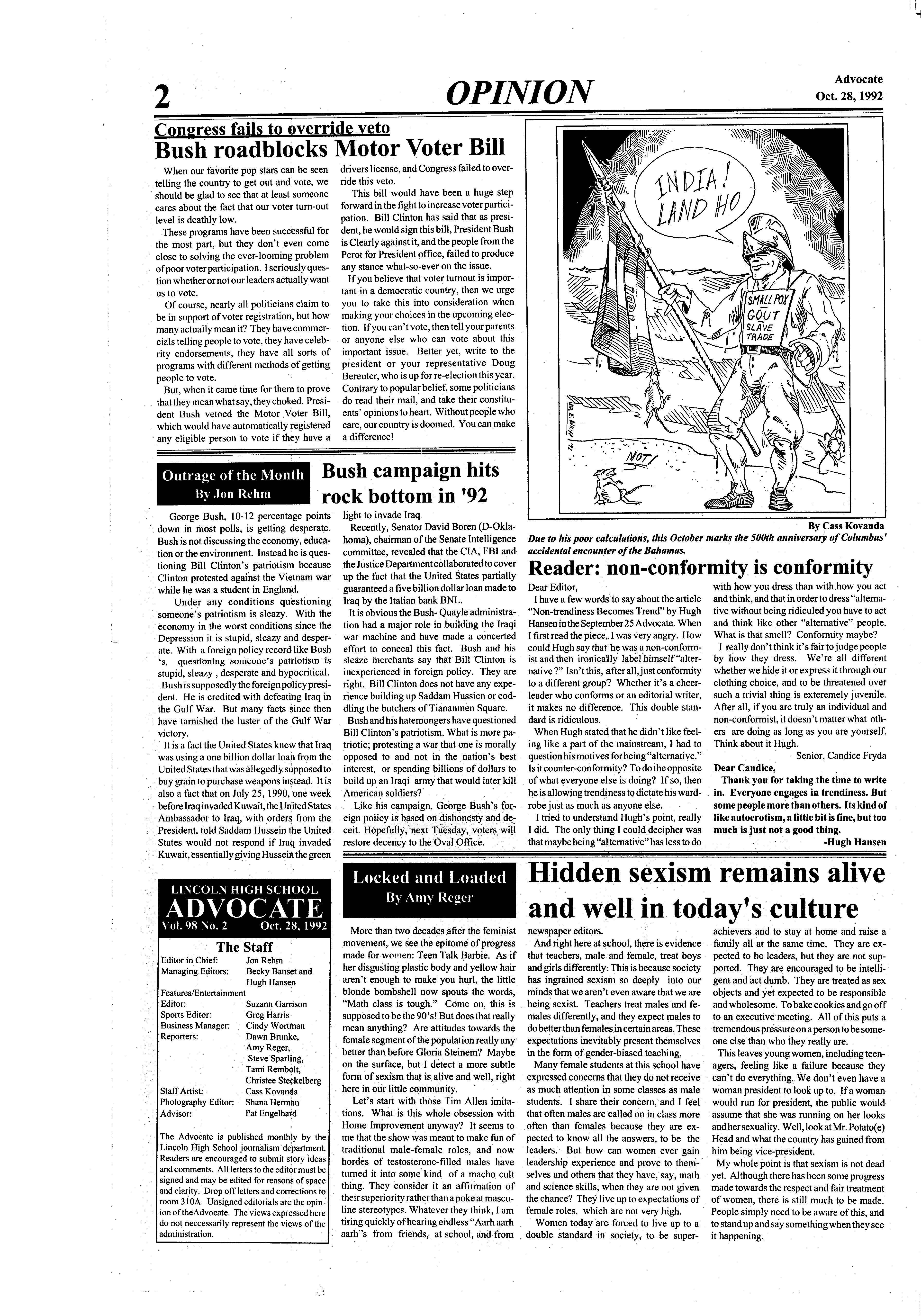
Due to his poor calculations, this October marks the
accidental encounter of the
By Cass Kovanda
Reader: non-conformity is conformity
Dear Editor,
I have a few words to say about the article "Non-trendiness Becomes Trend" by Hugh Hansenin the September25 Advocate. When I first read the piece,. I was very angry. How could Hugh say that he was a non-conformist and then ironicallly label himself"alternative ?" Isn't this, after all,just conformity to a different group'.? Whether it's a cheerleader who conforms or an editorial writer, it makes no difference. This double standard is ridiculous. When Hugh stated that he didn't like feel- · ing like a part of the mainstream, I had to question his motives for being "alternative." Is it counter-conformity? To do the opposite of what everyone else is doing? Ifso, then he is allowing trendiness to dictate his wardrobe just as much as anyone else. I tried to understa1t1dHugh's point, really I did. The only thirngI could decipher was that maybe being "alternative" has less to do
with how you dress than with how you act and think, and that in order to dress "alternative without being ridicul.edyou have to act and think like other "alternative" people. What is that smell? Conformity maybe? I really don't think it's fair to judge people by how they dress. We're all different whether we hide it or express it through our clothing choice, and to be threatened over such a trivial thing is exteremely juvenile. After all, if you are truly an individual and non-conformist, it doesn't 1natterwhat others are doing as long as you are yourself. Think about it Hugh.
Senior, Candice Fryda Dear Candice, Thank you for taking the time to write in. Everyone engages in trendiness. But some people more than others. Its kind of like autoerotism,a little bit is fine, but too much is just not a good thing.
-Hugh Hansen
Hidden sexism remains alive and
well in today's culture
newspaper editors. And right here at school, there is evidence that teachers, male and female, treat boys and girls differently: This is because society has ingrained sexism so deeply into our minds that we aren't even aware that we are being sexist. Teachers treat males and females differently, and they expect males to do better than fe1nalesin certain areas. These expectations inevitably present themselves in the form of gender-biased teaching.
Many female students at this school have · expressed concerns that they do not receive · as much attention in some classes as male students. I share their concern, and I feel that often males are called on in class more often than females because they are expected to know all the answers, to be the leaders. ·· But how can women ever gain leadership experience and prove to themselves and others that they have, say, math and science skills, when they are not given the chance? They live up to expectations of female roles, which are not very high.
· Women today are forced to live up to a double standard in society, to be super-
achievers and to stay at home and raise a family all at the same time. They are expected to be leaders, but they are not supported. They are encouraged to be intelligent and act dumb. They are treated as sex objects and yet expected to be responsible and wholesome. To bake cookies and go off to an executive meeting. All of this puts a tremendous pressure on a person to be someone else than who they really are.
This leaves young women, including teenagers, feeling like a failure because they can't do everything. We don't even have a woman president to look up to. If a woman would run for president, the public would ·assume that she was running on her looks and her sexuality. Well, look at Mr. Potato(e) Head and whatthe country has gained from him being vice-president.
My whole point is that sexism is not dead yet. Although there has been some progress made towards the respect and fair treatment of women, there is still much to be made. People simply need to be aware of this, and to stand up and say something when they see it happening.
Bv Jon Rehm •
500th anniversary of Columbus'
Bahamas.
8) ' Steve Sparling
Although teachers have always used sources from other subject areas to exemplify and help students see how the material they are learning applies to many life situations, it is just recently that cooperative group teaching has taken form. Many Lincoln Public Schools have been using this program, and so far the results sound very rewarding.
Humanities Coordinator Bill Steinke has discovered that teachers with an interest in inter-disciplinary learning are quite satisfied with team-teaching.
"Knowledge isn't separated into its own blocks. The various as- · pects of the humanities have a connection to all subjects. It is important to pull all of this together,"
Steinke said.
dustrial education, and math. · However, the humanities are not "These courses are a collection the only courses offered through of methods used to generate a usetheteam-teachingcurriculum. Lin ful benefit to mankind," Risenhoover, who is curll'ently Risenhoover said. teaching principles oftechnology, Social Studies teacher Ross explained that the concept of inter- Tegeler said he enjoys this new disciplinary teaching has been here · opportunity He said, "We teach many years. It is now, he said, that humanities in a box." Tegeler the "time has come". thinks that perhaps team-teaching His class applies physical sci- is a solution to the problem of · ence concepts to real-life situa- complete distinct separation of tions. He said that theories are · subjects that actually compliment nice, but usually won't serve a one another and improve the qualpurpose in reality. Right now he ity of both teaching and learning. teaches with science teacher Mark Tegeler is team-teaching a course Shearer. The class is only offered entitled "The American Exp seventh period, and students can erience" with English Department earn physical science credit fior the Chair Judy Strand. The class, course. Risenhoover mentioned which brings American History and that in the future, the team-t ,each- Literature into one entity, is availing idea could spawn a class de- able during 5th and 6th as a double signed to incorporate science, in- period class. Due to the fact that it
is a double-period, a student can attain ten hours of both literature · and history credits for taking the course.
It may seem an unlikely mix, but science, social studies, and English are offered in a three-period "chunk" during the day as well.
The team consists of Steve Ferris, Ruth Kupfer, and Joseph Stork. Although team-teaching can be a · challenge, it seems well-received by teachers and students alike.
The class is broken down into periods two, three, and four, with each hour focusing on one subject.
There is still an obvious common thread in the way this team is setting up lectures and class work
Nancy Beck is currently involved with team-teaching Applied Math and explained where the initial idea for the class came from. She said
aPerkinsGrantwasgivensolelyin support of inter-disciplinary classes and the curriculum originated out of Texas. The class involves the use of industrial technology combined with math and meets during seventh period. Beck team teaches with Leander Stachura. Steinke explained the regulations of cooperative teaching in interdisciplinary classes. The requirements state that classes must include a type of thinking that is valuable to both the student body · and faculty. He also mentioned that sometimes it is cumbersome to find an ideal time when students and teachers won't have a major dilemma with scheduling constraints. But, these problems are small and so far everyone seems satisfied with the program, he said.
One can find band members at football games, pep rallies, and basketball games throughout the year, entertaining at school activities, and coinpeting across the state. Last year, the Lincoln High 1narching band, directed by Terry Rttsh, co1npeted in the Harvest of Harmony, the Lincoln Public School (LPS), and the Nebraska State Bandmaster's Association (NSBA) competitions.
One change the band experienced this year was that they did not go to the Harvest ofHarmony competition in Grand Island, like they normally do. The reason was because it was on the same day as the F remont-Linco In High football game. The band would not be able to return in ti1ne to fulfill their home game obligations if they competed in Grand Island, according to Rush. ·
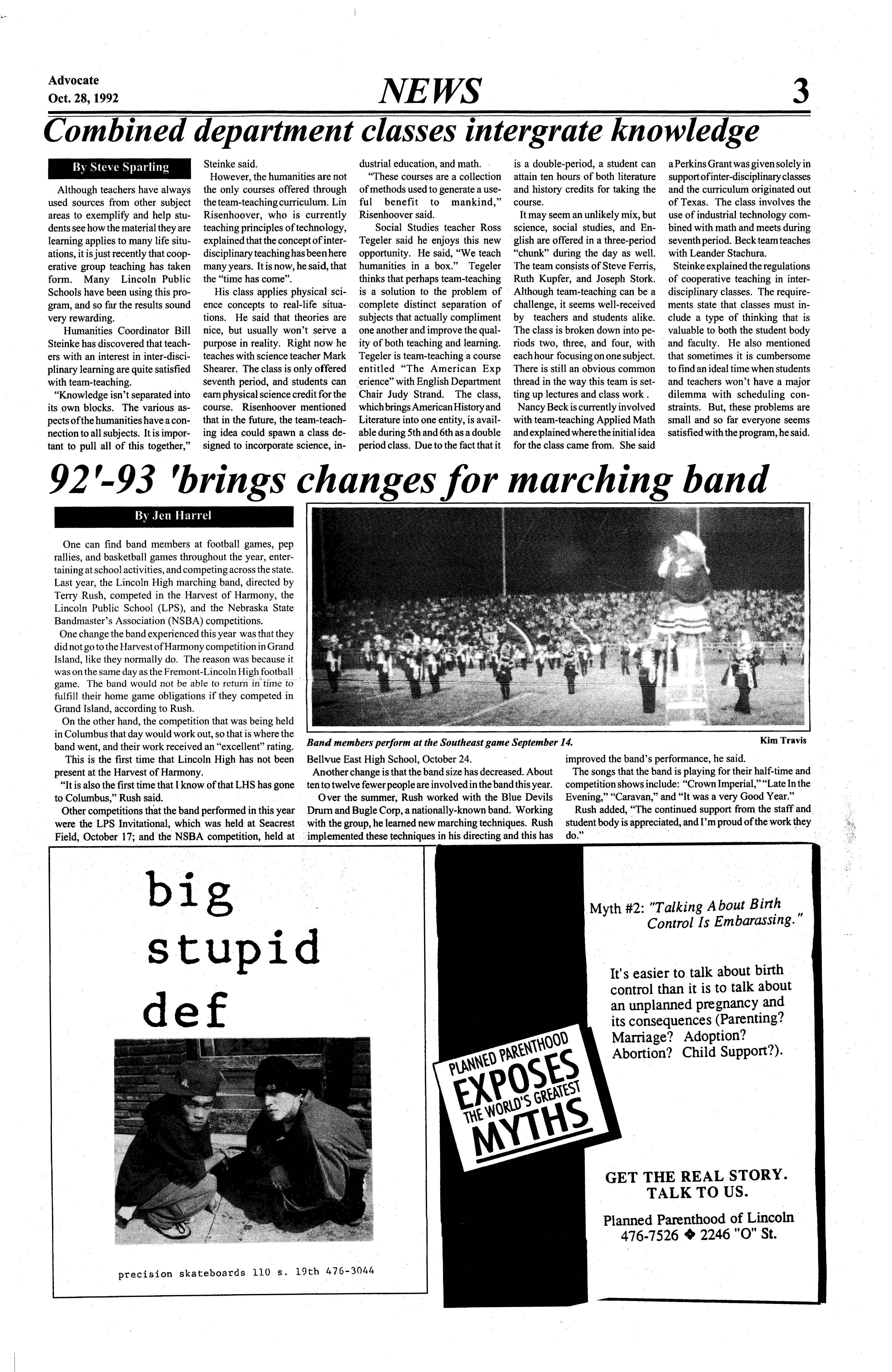
On the other hand, the competition that was being held in Columbus that day would work out, so that is where the band went, and their work received an "excellent" rating. Band members perform at the Southeast game September
This is the first time that Lincoln High has not been Bellvue East High School, October 24.
the band's performance,
present at the Harvest of Harmony. An 1other change is that the band size has decreased. About The songs that the band is playing for their half-time and "It is also the first time that I know of that LHS has gone · ten to twelve fewer people are involved in the band this year. · competition shows include: "Crown Imperial," "Late In the to Columbus," Rush said. · 0 'ver the summer, Rush worked with the Blue Devils Evening," "Caravan," and "It was a very Good Year." .·Other competitions that the band perfonnecl in this year · Drum and Bugle Corp, a nationally-known band. Working Rush added, "The continued support from the staff and · were the ·LPS Invitational, which was held at Seacrest ·.with the group, he learned new marching techniques. Rush · student body is appreciated, and I'm proud of the work i,pey Field, October 17; and the NSBA competition, held at ··•·impl,emented these techniques in his directing and this has do."
Myth #2: ''Talking About Birt~ ,, Control Is Embarassing
It's easier to talk about birth · control than it is to talk about an unplanned pregnancy and its consequences (Parenting? Marriage? Adoption? Abortion? Child Support?).
B, · Je11 Harrel •
14.
Kim Travis
improved
he said.
By Jon Rehm •
The most common last name at Lincoln
High is Nguyen, a Vietnamese last name.
This is the most basic reason why 16 teachers have been taking Vietnamese lessons.
Lincoln High is currently offering Vietnamese classes to teachers for staff development.
According to ESL Department Coordinator Hilde Dale, the classes cover the Vietnamese alphabet, basic conversation and Vietnamese culture. The class also teaches the teachers to empathize with Vietnamese students.
" It makes thetn realize Vietnamese students' difficulties in learning English," Dale said.
The classes are taught by Para-educators N ghia Le and Phuong Bach and by students; senior Tri Pham and by junior Thao Pl1am. Thao has only lived in the United States for 11 months.
" The students did as well as the teachers. One student (Thao) has only been here for · 11 months and she is teaching us in English.
· By Tami Rembolt
Everyone has their own opinion on the hot · debate topic "pro-life vs. pro-choice." But for people who are actually facing this decision it may be a whole different story.
Abortion is still legal in Nebraska, however an Abortion and Parent Notification Law has still been enacted. This law requires women under the age of 18, who want to have an abortion in Nebraska to have one parent or a guardian notified in writing by the woman's doctor that an abortion is scheduled. This procedure is required of women who are residents of a different state who come to Nebraska to have an abortion as well.
Senior Ann Stephens, said that she thinks the law is good.
"I don't think a lot of people under 18 are mature enough to make the decision," she said.
Stephens said that people shouldn't use abortion as birth control
Very few people could do this," assistant principal for student services Ted Rethmeier said.
Dale said that there were many differences between Vietnamese and English. She said Vietnamese is a combination of Chinese and French. The letters, with a few exceptions are the same as they are in English, but there are several accent marks. For example the letter "w'' can be pronounced five different ways. She said the grammar rules of Vietnamese are difficult to learn, but once they are learned. there are no exceptions as in English or the Romance languages.-
Like the English language, the Vietnamese language has many different accents. The course is taught in a southern Vietnamese accent because the teachers and most of the Vietnamese students are from what was formerly South Vietnam, Dale said. In the Vietnam War the United States sided with South Vietnam against Communist North Vietnam. In 1975 the North Vietnamese conquered South Vietnam. She said the families that immigrated to the United States were persecuted by the Communists be-
If notification is sent to a parent or guardian, an abortion may be performed 48 hours after the notification is sent. If the parent or guardian already knows about the abortion the woman can take written notification from her parent or guardian, or be accompanied by her parent or gt1ardianto the doctor. Under these circumstances there is no 48hour waiting period before the abortion can be performed.
If the woman does not want to notify her parents or guardian abot1tthe planned abortion she can file a form to reqt1esta judicial waiver of notification free of charge. These forms are available at any courthouse on public counters to protect confidentiality.
The wo1nanis eligible to receive free legal help. The woman also has the option of representing herself. A judge may appoint someone as her "guardian ad !item" who may advise what they think is best for her.
The judge will meet with and interview her privately, and all other interested parties such as an attorney or a close friend. The
Harms disappearance stuns Lincoln
By Tami Rembolt
The mysterious disappearance of Candice Harms was a shock to tnost people. But to her boyfriend, Todd Sears, it was more than that.
Sears was the last person to see Har1ns· before she disappeared.
"It didn't really hit me (that she was missing) until we filed the police report. All the hope that I had of her being somewhere else ·had disappeared," he said.
"I hate to think about what she's going through if she still is alive. It has to be worse than dying," Sears said.
Sears mentioned that rumors are one thing they have against them. At one point a rumor stated that Candi's body had been found. The media has been straight forward and hasn't distorted anything, according to Sears.
Junior Kim Hillyer, said "I think it's been blown out of proportion with all the rumors."
Search efforts are strong so far. Flyers are "plastered" all over Sears said.
Sears and Harms' father were at a command post at one of the search parties around the field where Harms' car was found. Sears reported over 50 people were there.
"It's amazing how ~"'=,a,,y people have come together. It's sad that it takes something lik; this to brin~ people together," Sears said.
cause they had helped the Americans during the war.
Dale says many students have misconceptions about Vietnamese students.
" Some people think that everyone Asian
Sears talked about teenagers believing they are invincible, Sears himself included at one time. But it is this kind of thinking that can let something like this happen, he said.
These kind of "sick people" count on people being too comfortable, too used to their daily lives that they aren't cautious he. says.
Sears suggested that girls should especially get a mini flashlight for their key - chain, or mace.
Sophomore Lisa Chamberlin said, "I think it's sad that this kidnapping has to happen to get through to people that they have to be cautious and safe."
Too many people think, "it won't happen to me," Sears said. When in reality it can happen to anyone.
Sears says to not be scared at night.
"Being safe doesn't mean being locked inside a house," he said. He suggests going places in groups, not alone.
A UNL sorority started a campus escort service for people who don't want to walk home, or go places alone.
Sears asks that if anyone ever sees anything suspicious, not to hesitate to call the police because any little thing could turn into a larger issue. · · ,r ,111,,t: are any people or student grottps who would like to help put up or distribute posters they should contact the Lincoln Police Department at 471- 7204.
is bad," Dale said." A lot of American students don't realize that they (the Vietnamese) helped the Americans."
Dale said that there will be a class offered for students if there is enough interest in one.
judge will then determine if the woman is mature enough to make this decision without parental notification.
The judge will decide whether to grant her the waiver within a week. She must be determined to be mature and capable of understanding her decision for the abortion.
A waiver may also legally determine that not involving her parent or guardian is in her best interest.
If the judge does n<0tdecide within seven days then the woman may ask the 1'Jebraska Supreme Court to m1akethe judge decide. The Nebraska Supreme Court must issue the
decision within three days.
If the judge does not issue the judicial waiver, then the woman has the right to appeal the decision to the Nebraska Supreme Court. Appeal forms are also available at the court hot1se. The court must then decide on her appeal within seven days after the form is filed.
The entire process of the judicial waiver is confidential. The only· indidviduals who will receive information are the person filing the waiver, her attorney or her court appointed guardian ad !item.
Jon Rehm Nglua Le helps Spanish Teacher Nancy Harding with her Vietnameese.
oca music ont e menu a
By Hugh Hansen
Near 19th and "O" streets, a red neon sign flashes images of a reclining, near naked, female anatomy. Along the same sidewalk, a host of drunken characters can usually be observed swaggering home from an evening of fun at the Foxy Lady. Hidden amidst this uncultured chaos, lies the Red and Black cafe.
The chalk board menu changes from day to day just like the clientele, and your order is contingent upon whe~heror not they have any of what you want left in the kitchen. However, the menu usually has a wide range of entrees, is reasonably priced, and the food is quite good.
The atmosphere is polite, relaxed and quite calm in the afternoon, but if its a peaceful cup of coffee you desire don't roll in after the bands start playing.
The Red and Black provides local bands the opportunity to showcase their talent (or lack thereof) on a usually unscheduled and impromptu basis.
The Red and Black departs from the normal cafe when it comes to 1nanagement. It was founded by a group of political and social idealists with visions ranging from communis1nto anarchy.
_ Although it 1nayappear to be the epitome of a capitalist dream, iitis really the embodiment of communist ideals, such as sharing equally in th1ework as well as in the profit. Furthermore, you won't find any overworked and underpaid teenagers working at the Red and Black. After all, the only people they have to exploit are themselves.
So, if you're in the mood for a bite to eat, a cup of coffee, or even live music,
come on in and enjoy the usually placid ambiance of the Red andl Black. The "Illegitimates" perform at tlie Red and Black.
Girls self esteem built on mixed messages in classroom and at home
By Amy Reger
Psychologist Mary Pipher is currently writing a book on the subject of adolescent change in girls, based upon her work as a therapist and psychological studies.
Pipher, whose daughter Sara Pipher attends Lincoln High, recently led a workshop for Lincoln Public Schools counselors to look at how boys and girls are treated in the classroom. Studies have shown that teachers unconsciously treat males and females differently. Research also shows that when boys don't do well in school, teachers· tell them it's because they didn't work hard enough. When girls don't do well, they are told, "That's okay, you did your best." In other words, teachers tend to attribute failure in boys and girls to very different things. There.fore,boys feel as if they are smart and just haven't been working up to their full potential, while girls think that they tried their hardest and just aren't smart enough.
Pipher said that boys are also called on more often in clas:s than girls, and their names are known more often. Teachers often use only men as examples in situations where women could also be present. Boys tend to give abstract answers to questions in class, while girls respond with yes and no answers.
"The longer they are in school, the worse girls feel about themselves," said Pipher.
Pipher said that several things make adolescent girls lose tlheir assertiveness. As young girls reach ]puberty, their bodies change rapidly, and they are somewhat disorganized and contwsed. When they are 1n sixth grade, they ma1yhave very strong personalities, but then they receive a message fromourculturethatthey have to be a "lady" and act feminine. This message is very ambiguous, but they feel as if they have to fit that image. They change their personalities and peers frequently.
Pipher said that ten-year-old girls who
are mad will yell and show their feelings to people. But when they get into junior high they are taught to act like they aren't mad, and to hide their feelings. They are supposed to be polite, not genuine. Since they don't tell people how they really feel, people often tend to walk all over them.
When girls become teenagers, they are pressured to be attractive, and told the most important thing is to look good. In this way they are reduced to mere sex objects.
"Going into junior high, girls tend to have all kinds of talents," Pipher said. But when they hear society's messages, they tend to suppress their academic ana sports sl<lllsin order to seem feminine.
"Our culture is very ambivalent on sexuality," said Pipher. Their parents and the church say that they are not ready for sex.
"But the movies say that cool peopie are sexual," Pipher said.
Sara Pipher agrees that young girls have · to live with a lot of pressure from society.
"In high school, it seems like girls are valued more on what they look like and who their friends are, rather than on their talents and grades," Pipher's daughter said.
One thing that parents can do to help young girls retain a positive attitude during this difficult period of life is to encourage them to reduce their amount of television viewing, and to avoid reading such magazines as Teen and Seventeen.
"It's a good idea to cut down on the amount of media you consume," said Pipher.
Magazines don't talk about women as competent human beings, and the media p1c:,c1~ts a body image fur girls that they cannot live up to. It gives off 1nany of the mixed messages that are so confusing, and · makes them feel as if they should act like someone other than their true self.
"What helps girls be popular is being nice in junior high," said Pipher. "But if you don't stand up for yourself, who will?"
Automotive classes o er students hands-on experience
By Amber Shavers
When walking through the first floor East hallway, you tnight catch a whiff of gasoline or burning motor oils, or perhaps hear the revving of a mint condition engine coming from the automotive shop.
Stepping into the automotive shop, 1neans stepping into an area where all around you, stt1dentsare busy doing hands-on work. The shop is filled wall to wall with cars. The sounds of power tools can be heard over the intense discussions of automotive students diagnosing car problems.
The automotive classes, taught by Ron St1ingand Lynn Kauf1nann,have existed for some time and there are over 300 students enrolled in the classes. The classes provide non-profit services in car repair and maintenance, according to senior Lisa Arbuck.
"They break it, we'll fix it," said Arbuck. Suing said that by taking the class, students become more dependable. Further-
C\\tc~ o1.1.:l- (
more, many students have an interest in continuing in the automotive field after graduation and the automotive classes prepare them. Arbuck plans on attending Southeast Community College in Milford to continue her automotive training.
The students service faculty cars and their own automobiles. Services are available for anything from cha111ging a flat tire, to a co1npleteengine overhaul. Any student can also bring in their car for work. Customers can be sure of receiving quality work. The instructors supervise the repairs, and make sure that everything is in working order before returning the car to the owner.
A highlight of the class, according to students Jaimie Ivey and Mike Hollon, is the fact that the class offers lots of hands-on experience. In Suin:g's applied automotive double period, one dlay is spent in the classroom, and the remaimingfour days are spent actually working on the cars. Ivey commented by stating, "'You learn more from
experience, than reading it in a book."
One of the latest-additions to the automotive curric11lumis learning how to work on the new modernized cars of the 90's. For this, the automotive department has acquired new high-tech equipment".One of the purchases was an automotive scanner. The scanner allows two-way cotnmunication between the car and the computer. In comparison to other automotive classes of other Lincoln High Schools, the students
are quick to respond that the program at LHS is the best. According to senior John Greenwood, "LHS students have more interest, the shop is bigger than most, and there is more automotive equipment. We have tools that fix tools."
The down sides, according to the students, are very crowded classes. Space is a big problem. Since the interest level is high, sophomore Chris Dublebeiss suggested having a second location.
LAUNCH YOUR CAREER WITH A $70,000 SCHOI,ARSHIP.
Smart high schc,ol seniors applv for the Naval Reserve ()flicers Training (;orps (NROTC) Four-\'ear Scholarship Program to launch their careers. ()ver 60 of the nation's top colleges and universities welcome NROTC students. NROTC four-vear scholarships pa,· full tuiti<>n. fees and texthooks. 'You're even given a n1onthh· $ J00 tax-free allcl\,·ance for up to 40 acade1nic months. It could total up to $70.000. Upon graduation vou"II be comn1issioned a Navv officer readv to take ,111 the cha!lenges of ton1orro"·'s high-tech world. It's a professional career ,·ou can he proud of. Applications f<>rNROT(: scholarships are highlv con1pe1i1ivc. and n1us1 be suhn1itted earlv. \"our S .\ Tor :\(:T test scores n1us1 be released to the :s;av,·if vou apph·. For n1ore information, c.111: N A"lTU ROTCYou and the Na"''· ft\' .1 Full Speed Ahead.
Rose Felton
Punk band creates musical circus
lly Ot1vvnBrunke •
The Dead Milkmen, from Philadelphia, held a concert at the UNL student union that provided a spectacle both on and off stage.
At their October 10 concert, the band created a musical circus of anarchy andhurnor. Sorneoftheir songs provided the listener with original views about the world through the band's interpretation of it. Others were nonsense which show the band's unique sense of humor. This band appeals mostly to the college and high school crowd who provided the off stage entertainment with acrobatic flying, stage jumps, shouts, and the rnosh pit, which took up about the first ten feet and spanned across the stage.
The crowd responded to every lead in by singer and keyboardist Rodney Anonytnous with shouts. From "Tiny Town " to their final encore "Life is " the Dead Milkmen delivered a strong and tight show.
Through old favorites, such as "Punk Rock Girl "and "Watchin' Scottie Die," the crowd sang along with Anonymous and singer/ guitarist Joe Jack Talcum. During ~•RockerShip" Anonymous turned the microphone to pick up the crowd singing along with Talcum, making them more a part of the show.
The highlight for many crowd members was the Rock Report. Anonymous picks an artist and tells how the artist is corrupting youth according to a book published by a Christian group, Freedom Village. Saturday night's artist was Michael Jackson. The Rock Report also serves as the lead in to a crowd favorite. "Bitchin' Carnaro."
Before their encore the Dead Milkmen brought up John Davis, who can be seen playing guitar on 14th and "O". While Davis was playing his second song the crowd started throwing change on stage. As Davis left the stage, Anony-
mous commented, "This is the best person we've ever found on a corner."
Throughout the concert crowd members dove off the stage to be carried and tossed around by the crowd. As long as a band was on stage, some one could be seen flytng.
"Blind
le version o
By 0~1wn Br11nke
Melon"-Blind Melon
Blind Melon, the debut albutn from the group with the same name, is yet another one of the hundreds of alternative bands to enter the music scene in the last year. This album will probably be one that gets lost in the overflow, it offers nothing phenomenal in the way of instrumentation or lyrics. Though this album was produced by Rick Parasher, (Pearl Jam, Temple of the Dog) the band will be lucky to receive as much recognition as their counterparts.
The lyrics are, like most alternative bands' lyrics, hard to understand the meaning of unless they have personal meaning to the listener. Most of the songs sound like phrases that .were put together just because they sound good together, but after the listener can put a personal experience with the song, it becomes a deeper, more interesting piece. For example, the lyrics for "Tones ofHorne" can take on different meanings depending on the person and their experiences.
Pearl Jam
Instrumentally the band is very tight, none of the instruments or vocals overpower, creating a good mix. The 1nelodies and harmonies are interwoven to form a quality · album. Even after n1anylistenings, various instrumental lines and changes can still be found hidden within a song.
The vocals, by Shannon Hoon, are reminiscent of the late '60's. "Time to Go" is an example of this influence with it's melodic vocals and touch of funk, psychedelic overtones. Hoon's vocals are your guide on the mental trip Blind Melon has prepared. They show you places and things you've never seen and allows you to experience them.
Rogers Stevens and Christopher Thom weave a dreamlike reality through their guitars. Glen Graham, drums, provides the foundation and pulse for the songs with the help of bassist Brad Smith.
Blind Melon has reserved a place for you on a mental trip into their world, and it's worth checking out. With some work they could be the '60's style version of Pearl Jam.
Local bands Such Sweet Thunder and the Yardapes opened for th1e Dead Milkmen. Both performed 'high energy sets, which pr,ovided a good atmosphere for the headlining act.
The Dead Milkmen began their Lincoln concert with an acoustical performance and by signing auto-
graphs at Twisters. Their acoustical set included "Bitchin' Carnaro," "War Toys" and their version of "Under the Bridge" by the Red Hot Chili Peppers.
"Don't tell them we did this, they'd beat us up," Anonymous said as they finished their cover.
''US''Combines usical
Innovation, Introspection
By Steve Sparling
"Something in me, dark and sticky. All the time it's gettiing stronger I'1n dig.· · ging i11 tlu:; dirt Lo find the places I got hurt." This is just a sample of the divine ability Peter Gabriel has at combining both song and lytric into a poetic style. It's a level of quality not attained by most contemporary rock-musicians.
The lyrics are from the song "Digging In the Dirt, " on Gabriel's new album "US". The song deals with the other half of Gabriel which he refers to as the "killer" within him, as well as his own personal history. It also is about his recent divorce from hes wife and the frequent fighting tlhathad been going on between them. <Gabriel left· the rock group Genesis in 1975. He had been their lead vocalist for some time. After leaving he began heavy experimentation in the realm of African music, and its very percussive sound.
The most recent of.Gabriel's· findings was the duduk, a double-reed instrument similar to the oboe. He discovered the duduk while making the soundtrack for the motion picture "'The Last Temptation of Christ. " Gabriel also did the soundtrack for the 1984 film ''Birdy ". Gabriel's unique sound is best known from his more popular, mainstream music such as "Garnes Without Frontiers," and "In Your Eyes," a song included in the soundtrack to the film "Say Anything."
It has been six years since Gabriel's magnificent "So" album, and to many it may seem he's been on a little hiatus. From 1986 to the present, Gabriel has been active in many organizations advocating a "world-alert" to demonstrate and explain what's; happening in other cultures. He thinks the world should appreciatethese cultures and respect them enough to fight the injustice infringed upon them. Gabriels' concern is evident in his active roles in organizations such as Amnesty International, his "Human Rights Now!" tour,. and· most recently · his brand new "Witness" program.
The "Human Rights Now!" tot1rwas a 1najor triumph in terms of viewer awareness and fund-raising. It took place four years ago, and included the talents of Bruce Springsteen, Tracy Chapman and Sting. The "Witness" program deals with visual imagery recored on audio tapes and camcorders. Gabriel wants to be able to alert international opinion the very minute abuses of liberty occur in any culture. He sites the tape of the Rodney King beating as a prime example of his concept. These political issues take poetic form in Gabriel's new lyrics, and understanding them enlightens the listener to a higher plane of conscience and sensitivity to his messages. "
"US" is a masterpiece in many ways, and in others parts it is a lackluster attempt to recreate past financial success. "Stearn" for example, is merely a return to the hit "Sledgehammer " and delivers nothing short ofboredorn to the listener. But these faults, although prevalent, are forgiven with such b·eautifulpieces such as "Blood of Eden", and "Corne Talk To Me " both of which include Sinead O' Connor on back-up vocals. The languid perfection achieved through the flaw-
less production of Daniel Lanois, and guest appearances by Bobby Mcferrin and N'Dour, and Brian Eno add icing on the cake. A sample of the albu1n's simplistic, yet exceptionally gorgeous lyrics is exemplified in an excerpt from "Corne Talk To Me."
"The earthly power sucks shadowed milk from sleepy tears undone. From nippled skin as smooth as silk, the bugles blown as one."
The decree Gabriel makes on this album represents his personal anguish, personal aspirations and personal introspection. He is trying to better the relations of other cultures, and atte1nptingto rediscover the sensuality lost in the modem, materialistic society we are living in. It is a corn,nendable attempt he has made, regardless of the occasional uninspired moments; the album is still a masterpiece.
he Dead Milkmen erform an acoustical set at Twisters at 48th and Vandorn. Hugh Hansen
ross
Bv Becky Peters • •
• ID
This year's goals for the boys' and girls' cross-country teams are to finish in the top three at districts and qualify for state, according to coach Jean Hienrichs.
Both teams finished third at the city meet on Oct. 2. According to coach Bob White, Lincoln High is not a possible contender for state this year, but there are a co11pleof runners who could win individual titles. Senior Nate Dills, and juniors Dave Deppe and Chris Van Andel are possible state qualifiers, he said.
"Right now, we're working on getting both teams to qualify for state. We'll have to see how they do at districts, but it's a brand-new season at state," said White.
• ID ear
One strength is some are running to their potential and these runners look good for districts, he adclled.
White also said the team doesn't hold records. In an individual meet with IO teams, the boys have finished no less than third. The girls have placed 5th out of 10 teams.
Both teams have had succes:sful seasons and hopef11llywill do well at districts, said Hienrichs.
Both teams are young, but they have improved their skills by competing weekly against teams that are rated in the top three at state, he said.
"I would encourage runners to join the squad next year. Crosscountry is a life-time sport ithat really improves your physical fitness," said Hienrichs.
Junior Jennifer Bohl r===========----------, thinks it's not impossible for the girls' team to go to state.
"My goals are to keep improving in time, go to state, and beat a Southeast girl," she said.
Senior Nate Dills said his first goal was to get himself and his team to state. His second goal was to finish in the top 15 at state.
"I've hit a lot of personal bests this season, this has probably been my best year," he said.
Right now, the biggest weakness is the girls and boys aren't running to ' their potential,said White.
Adel keeps evcm with a runner from Southeast.
ers
By Becky Peters
The Lincoln High boy's tennis team finished the se~son with a 7-1 dual record, and a fourth place finish at the state meet in Omaha, October 15 and 16.
A fourth place finish was the highest finish for Lincoln High since 1974,said coach Brien Connealy.
"I feel we performed and peaked at the right time; state tournament. This team deserves credit for their hard work, from the very beginning they never lost sight of their goals," said Connealy.
Junior Scott Tridle said his personal goal was to play number one doubles at state, which was accomplished.
"I improved throughout the season by getting my strokes down, so I could hit the ball as hard as I wanted," Tridle said.
Coach Connealy said he saw a great deal of im!'-rn,,P1-n13nt f"rA..-n ton to hAttntn ~<: - thP cP~-<:nn- nrn gressed. The team was much stronger at the end of the season; any of the ten varsity players out on the court could win, he added.
Senior Blake France said his original goal was to make the team, since he hadn't played tennis over the
summer. Later, as the season went on, there .was a bigger concern about preparing the team for state, he concluded.
"Lincoln High is not known as a tennis team " France said. "A fourth place finish in state put Lincoin High on the map."
.Although the team will lose six seniors this year, three of our top four players will be back Connealy said.
'
Returning players are juniors Scott Tridle and Adam Dunn, and freshman Josh Barber and Peter Bogardi. "It's hard to say how we will do at state next year," Conn~aly said. "We have the potential to be a top 10 team, 1tdepends on how hard players work in the offseason. Combined with the junior varsity players, we sho11ldbe very cClmp<::titivenext year.".
H ili~~tp~fi\eJ:'l:a?i.1ciisi1g&fs~&-,i~1411M~1i1rls~r~.,cf Pc Ulrich, and Jeremey Carlson.
Connealy said this year's senior class was a big factor in team success. They really kept the spirit and play of the team in perspective, he said.
Football players progress during season, aim for playoffs
By Greg Harris and Alicia Cariotto
The Lincoln High football team has compiled a record of7wins and I loss which will probably propel them into the state playoffs for the second time in three years according to Lincoln Journal sports writer Ryley Jane ' Hambleton.
"If Lincoln High wins the rest of their games, they appear to be in the driver's seat for the playoffs," Hambleton said.
Junior kicker Mark Haake believes the team has i1nprovedat a constant rate throughout the season, and will be ready to compete against the top teams in the state.
1-laake , along with other players are confident that they l,a.-o th ,. necessary weapons to defeat the more prestigious teams.
"We have tough offensive and defensive lines that have the ability to overpower bigger people," senior running back Brian Tlamka said. He added that the leadership and motivation of senior quarterback Andy Campbell has been a weapon too Lincoln High's playoff possibilities are determined by a point scale, according to Hambleton. Duringtheregularseason, when a team beats someone who is considered a "winning" team, they earn 50 points; beating a "medium" team earn 45 points; and 40 points are given to a team that beats a "losing" team.
On the flip side, when a team ·Joses to a "winning" team, they receive 30 points; losing to a "medium" team gives them 25 points; and 20 points a given for a loss to a "losing" team.
determines the rankings, Hambleton said.
The state is divided into districts and the champions and two wild card teams from each district advance to the playoffs
Currently, the Journal and the Omaha World Herald have LHS is ranked fifth in the state behind top ranked Southeast, second rated Pappillion-La Vista, third rated Millard South and fourth rated Creighton Prep
Rumor has it that the football players plan to shave their heads as a team if they get a strong playoff berth.
Varsity volleyball shoots for state
8) ' Kell) · Platz
The Lincoln High varsity volleyball team beat number one-rated Northeast in late September. With arecordofnineandseven they are now ranked seventh in class A. The LHS players believe they have a good chance at state.
"I honestly didn't know how we would do because there's a lot ofkids on the team this year without varsi11:yexperience, they're going to have to have a lot of playing time, but I think were doing very well. We're surprising a lot of people in the state," stated coach Kristy Nelson-Hitz.
Players are in agreement abol!,t the way the
"The harder we work the better we get," added senior setter Amy Loth.
Sherry Lang says they've improved, and now know what they need to do to win.
"This year team unity has improved, aggressivenessand the blocking has improved," stated senior Dawn Amen.
Last year the team was close, but this year the team is even closer, considering the wide variety of personalities on the team, Nelson-Hitz said.
The players believe they have a very good chance of going to the playoffs, even getting to state.
"Definitely, after we defeated Northeast , it showed us we could play with any team in the state." stated Amy Loth.
Lang and Amen, both outside hitters, feel they have a good chance at state, but there's always room for improvement.
Nelson-Hitz said it's hard to tell because East and Northeast are in the same district as Lincoln High and only one can win districts, but if LHS finishes the second half of the season sti:ongthere's a possibility for a wild card.
Nelson-Hitz said the team's weakness is lack of experience. Most of the players haven't played on varsity before. The strengths are in the passing and the fact that they work hard.
Players that are considered the most valuable are Amy Loth, Sherri Lang, and Dawn Amen. Amy Loth is the top server, top setter, second leading attacker, and all around in leading the team. Sherri Lang is only a sophomore and she's the leading attacker. Dawn Amen and Sherri Lang are doing the best passing wise.
·
"Passing is not one of the most spectacular skills, the fun skill people want to ·see is a 'BOOM' spike, but you can't do anything without a pass," said Nelson-Hitz.
Nelson-Hitz thinks ,the reserve's are doing pretty well, but the sophomores are struggling.
·
Reserv_e' s record is 9 and 8 reserve coach Matt Johnson said.
Sophomore's record is only 1 and 5 said sophomore coach Shelly Novak.
"I ' m happy with the growing interest in Volleyballamong students and faculty. Their support makes a big difference. There was a lot of people at the Northeast game and that really helped us. (There were) a lot of people there to support us and that's one factor in our success," stated Nelson-Hitz.
Tami Rem bolt ·
Juniors Mindi Leupold (3) and Stacey Schuerman (13) compete against Southeast.
Members of the Raserve football team take a water break during their gan,e against Lincoln Southeast · Gretchen Engel
Off the Cuff
By Amy Reger
Do you think the U.S. should have a nationalized health care program?
Chuck Foley, · SO- "Yes, because health care is more important than having a little extra money in your pocket."
Melissa Kuzara, JR- "Yes, because too many people are not getting enough health care because they can't afford it, and that's not fair."
Denise Knotwe/1, TE- "He should propose legislation that encourages environmental research, such as on disposable and biodegradable diapers, incentives for recycling, and a higher gas tax to finance those incentives."
Would you vote for the school bond issue?
Laura Reznicek, SO- "Yes, because the overcrowding in our schools inhibits education, and today's kindergarteners
are tomorrow's business leaders."
too many ethnic and religious problems. I think that we would only make things worse by going over there. Anything less than force should be used."
What is your outlook on job availability for young people today?
Chrisy Pearre, SO- "It looks like· it's going to be harder, that there are going to be less jobs available unless we change something now."
Melissa Stephens, JR- "There are a Sarah Faulkner, SR- "I favor a socialist lot of jobs that they could have, but health care plan funded by a Megan Gardner, JR- "No, because it they're riot that good." progressive - tax. I do not think that does not include Lincoln High, and I doctors should have a fixed salary, but think we need more facilities." Erron Towns, SR- "I think there are that they should continue to be p·aid many jobs available for teenagers according to Whateducation they have Toby Bartels, SR- "Yes. Education is because they're the only group of
Joyce Peterson, TE- "Yes, because it there for $4. 25." will be less expensive in the long run, Hilde Dale, TE- "Definitely yes, • and everyone will be covered." because I feel we need the school bond issue to maintain old school What would you like the next buildings and modernize them, so president to do for the environment? families will want to stay in LPS."
Elizabeth Barajas, SO- "I believe in more legislation to stop greedy industrial monopolism, which is destroying the environment."
Kamron Becwar, JR- "I would like him to legalize hemp, because it is a closer solution to the environment than recycling, which acts like a band-aid and only postpones the inevitable. Hemp can also be regenerated quicker than trees can."
Reka Bogardi, SR- "I would like him to uphold environmental regulations that businesses should follow,· because Bush and Quayle took away these rules."
Should the U.S. intervene in the Bosnian War?
Weston Norton, SO- "Yes, because we went to Iraq, and if we really went over there for the reasons we said we did, then we should be going to Bosnia."
Rachel Pueppke, JR- "No, I think we should concentrate on our own affairs, because wehave enough to deal with without concentrating on other people's problems." ,
Jake Bleed, SR- "No, because it would involve the U.S. in another quagmire war, much like Vietnam."
Jim Barstow, TE- "No, I think there are
Anita Ross, TE- "Idon't think there are very many jobs for teenagers, except for at fast food places. It would be nice if they could have training or apprenticeships for jobs. "
What is your definition of a family?
Krista Brock, SO- '~ family is a group of people who really care abqut each other."
Suzette Schwaderer, JR- ;'My definition of a family is a group of people who are united to love and support one another so that each member of this group is able to have a happy relationship with each other.". _
Maggie Beck, ·SR- "My' defil)itfgn of a famiy is a group of people that may or may not live together or be related to each other, but love and care for each other."
Student Opinions Vary Widely on Abortion Issue
By Becky Bansct
Within the last year or so, abortion has become a hot topic with everyone. Heated discussions about the abortion issue have occurred everywhere, in classrooms and offices, at dinner tables, during political debates, and in the courtrooms. Reports about protests and rallies have filled the newspapers, and discussions as well as confrontations between pro-life and pro-choice activists have nm rampant throughout the nation. Opinions of people differ greatly about this controversial issue, as do those of students at Lincoln High. There are pro-life students and pro-choice students, and some that aren't quite sure how they stand on this controversial issue. While some are unsure of their beliefs on abortion, others are very confident about how they feel.
One such student is junior Jennifer Rupp. Rupp is pro-life and bases her opinions on her religious values.
"From the Catholic point of view, the only exception for having an abortion is if the mother is in danger. There is no exception (in cases of) rape or incest, " Rupp said.
Sophomore and pro-life supporter Nicole Reifschneider said abortion is definitely not a choice.
"No one deserves to die. No one has the right to kill anyone else, born or unborn," Reifschneider said.
Rupp agrees.
"Abortion is not a choice. It is like the bumper sticker, 'It's a child not a choice,"'
Sophomore Travis Amen is pro:lffe, b'uf feels in the caseof rape, incest, or danger t_o the mother that having an abortion isjustifi• able. Amen said that bringing an unwanted baby into the world just to save the baby's life might not be the wisest choice for some people, and therefore, abortion might be the answer.
"It might benefit the child if you don't have an abortion, but it might also have negative emotional affects on the mother (if she gives birth). Every time she sees the child she mightberemindedofit(rapeorincest). The child might feel guilty or rejected, and the guilt is not needed," Amen said.
Reifschneider believes that many people tend to affiliate a person's political party with their views on abortion. Some people tend to believe that if a person is a Democrat they are pro-choice, and if they are a Republican they are pro-life, she said.
"Most Democrats I know are pro-life. It does not have
people trying to inflict their views on others.
"One of the problems I have with the pro-life movement is that it is based extremely on Christianity. There is supposed to be a separation of church and state. They (proIife supporters) are trying to innict their beliefs on women and this goes against my first amendment rights. If the government allows this to hapi;en then we are going backwards not forwards," Fryda said.
control the situation," Harris said. "By doing this, they are taking a right away from people with force, and that is against the law. People need to remember one of the basic ideas this country was founded on; the majority has to be restrained by minority tights. Many have forgotten this," he said.
Junior Jessica Tiwald disagreed and said that people have not gotten carried away with the issue by protesting and
"No one deserves to die. No one has the right to kill anyone else, born or unborn.
-Nicole Reifschneider
Another student who feels strongly about his beliefs on abortion is senior Keith Harris. Harris said that with a controversial issue like abortion, many fail to recognize that a person may have beliefs that lie in the center of the political spectrum. He said many tend to classify people as having extreme views, either on one side or the other. Harris
Pro
identifies himself as pro-choice, but doesn't want to be mistaken as pro-abortion.
"There has been a big misunderstanding that pro-choice means pro-abortion. My personal view is that it is wrong t10 have an abortion, but under the constitution (to outlaw abortion) would be taking away a right a woman should have," said Harris,
rallying.
"If they feel that emotional about it I do not think they are taking it overboard. I can see myself doing things like that for animal rights issues, so I can not say what they are doing is wrong," Tiwald said.
Tiwald said her personal beliefs have caused problems before, among her peers.
"I am not usually outspoken about it. But when I do talk about it, many are surprised about my beliefs (on abortion) because I am really into animal rights," said Tiwald. Tiwald is pro-choice and believes the government shtiuld not regulate abortion.
"I think that it should b6completely the
woman's choice," said Tiwald. Fryda a:lsollgrees with this. She feels that pro-life beliefs are based on religious values
"It should be every one's personal decision, and the government has no right to get involved, " Fryda said.
Rupp and Reifschneider feel that government should have an active role in this issue. According to Rupp, God controls abortion and God controls government, therefore, government should control abortion.
"But, the problem is that not everyone lets God be their leader. If everyone followed God, everyone would be prolife,'' Rupp said
Harris feels government and religion should remain separate.
While arguments still remain about whether or not abortion should be a choice, other arguments surrounding abortion are present too. Some have criticized the media for taking the issue way too far, but others feel the media have been responsible in its coverage of abortion. and therefore have no place in the government.
"They (pro-./ife supporters) are trying to inflict th~ir beliefs onwomen and this goes against my first amendment rights."
-Candice Fryda
anything to do with a person's political party. It is the way they think," Reifschneider said.
Senior Candice Fryda also agrees with this. She said many times she hears people relating Republicans to pro-life views and Democrats to pro-choice views, and disagrees with this relation.
·
"It is really sad because it should not even be a political issue at all," Fryda said.
Fryda is pro-choice and feels abortion should be a personal choice for a woman. She gets angry when she hears
• "It is a pretty hot topic and they (the media) have covered it well," Fryda said.
Harris disagrees with Fryda.
"It has become a whole political circus and every woman should be mad because they (the media) have turned this type of issue into one (political circus)," Harris said.
Harris also feels the public in general has gotten carried away.
"The activists that have protested abortion by blocking the entrances to abortion clinics are extremists and only want to
"I believe government should keep out of it. Politics has nothing to do with the abortion issue. Abortion has to do with morals and religious beliefs. They (government) should be totally out ofit," said Harris.
Another problem concerning the abortion issue is the strain it can put on relationships when people disagree. Many students admit they do have problems and serious arguments with friends and other acqmtintances because they disagree on abortion.
Harris said that he disagrees with his parents on this issue.
"It has basically reached a gridlock," he said. "And we've just stopped talking about it."
"It could affect them(students) in the future, they need to start setting their morals and values now," she said.
Reifschneider also added that men who think they don't need to worry about abortion because it is a "women's issue" need to "wake up."
"They are a part of it. It is their kid too. They don't think it;s their problem, but they don't realize they helped create the problem," Reifschneider said.
CAVE
$4,000,000,000,000
By Jon Rehm
The federal debt is approximately 4,000,000,000,000 dollars (four trillion). This fact alanns many people.
II. Ross Perot has made cutting the deficit the primary focus of his presidential campaign. But, According to Dr. Carl Fuess, associate Professof of economics at the University of Nebraska- Lincoln many people are misinfonned about the debt.
"Much of what is covered about the debt in the popular media is shallow and superficial," Fuess said.
According to Fuess, the media emphasizes the fact that every American would have to pay $16,000 to pay off the deficit. He said that was not the problem. He said the problem the deficit caused was a phenomen called crowding out.
Crowding out happens when borrowing made by the federal government makes it more expensive for comp_anies to borrow money.
" Companies borrow money in order to improve their ability to produce things," Fuess said." When finns have to compete for funds it slows down the improvements made in machinery and training. When that slows down, then productivity slows dowri and that has a hannful effect on the competitiveness of an economy."
Fuess said the effects of crowdiong out are gradual and take generations to show but they are definite. Slow economic growth can have disastourus effects in the long run.
" In the I 930's Argentina was one was one of the ten richest nations in the world, but due to slow economic growth , you would not consider Argentina in that category _anyJnore,::.Fuess said • ., ",,, , Fuess said that he suspected that crowding out is now,occuring and could have a hannful effect on the economy "I 0-15 years down the road."
According to Fuess, the cause of crowding out, the huge federal debt, can be explained simply.
"Spending is popular, taxing is not," Fuess said." Walter Mondale said he would raise taxes in 1984 and he lost 49 states."
The majority of federal governmet spending is spent on entitlements. Entitlements are payments to people by the federal government. Entitlements include such programs as Social Security and Medicare. Most people who receive entitlements are people with family incomes between $20,000-50,000, what is considered to be middle class. Eliminating and reducing these programs is not popular with the electorate, Fuess said.
Debt Looms Over America's Future
ment brings in, which has been the case since 1969 a deficit occurs. A debt is simply an accumulation of deficits, Fuess said. To cover the difference ~etween what the federal government brings in and what the federal government spends the federal government sells bonds. Investors buy bonds on the condition that the federal government will pay them back at a later date with interest. Currently, interest payments on the federal debt make up 15% of the annual federal budget, Fuess said.
" The states are in better financial shape. They have to balance the budget. The federal government can postpone that reality."
-Scott Fuess
program with the exception of Social Security. The Democratic candidate,Arkansas Governor, Bill Clinton has proposed to raise taxes on all families with an income of more than $200,000. Independent candidate H. Ross Perot has proposed a cut in entitlement spending and a $.50 per gallon tax on gasoline. However, the president has a limited influence on the federal budget.
" Ross Perot, George Bush and Bill Clinton ~xaggerate what they are capable of doing," Fuess said.
Fuess said that all bills concerning taxing and spending must be approved by Congress. However, the President can disapprove or veto any spending or taxation bill passed by Congress. The President can submit a budget to Congress, but the Congress is not obligated to follow the President's budget. So, the federal budget is usually agreed upon by a compromise between Congress and the President.
Fuess said that any president who would hope to cut the debt must be able to work~ith Congress: That is why he doubts that a President Perot could cut the debt.
" What would happen to a Senator form Nebraska who voted to cut fann subsidies? What would happen to a Senator that voted to eliminate the tax deduction for intersest on mortgages? What would happen to a Senator that voted not to have the government guarantee student loans?" said Fuses.
In order to fund such programs the government has to raise revenue. In order to raise revenue the government levies taxes on such things as gasoline and liquor, through taxes on imports, and taxes on salaries. But the federal governments main source of raising revenue is through income taxes. When government spending is more than what the govern-
The debt can also be hannful in the short term Our major economic competitors, Japan and Germany have much smaller debts than the United States, Fuess said. Currently, Japan, which is in a recession, like the United States, is spending 87 billion dollars this year in improvements on internal improvements like roads and bridges in attempt to use government spending to end the recession. Due to the enormous federal budget deficit it would be difficult for the United States to do what the Japanese are doing.
The major presidential candidates are addressing the problem of the debt. The Republican candidate President George Bush has proposed not to increase spending on any
Some people have blamed the debt on "gridlock" having the Democrats controlling Congress and the Republicans controlling the Presidency. Some think a President Clinton could work with Congress to cut the debt. Fuess is unsure.
The federal government runs a large deficit. However if one combined all of the state and local governments they would run a "moderate" surplus, Fuess said. This is because many states, including Nebraska and many local governments have a law that requires them to balance the budget.
" The states are in better financial shape," Fuess said," They have to balance the budget. The federal government can postpone that reality."
Where Your Tax Dollars Go
Spending for Interest on the National Debt
Spending on Education
Interest payments on the debt nearly equal spending on education.
*Figures are in Billions of Dollars.
Source: IRS, Federal Reserve Board
By Greg Harris
f s top bickering. Stop blaming each other. Stop posturing for partisan advantage. Stop dodging the hard decisions. There is work to do," presidential candidate Ross Perot said in his 118 page book which he published as a guide to his government proposals should he be elected in November.
Perot is a representative of the newly incorporated United We Stand movement which gears all government action around the economic growth of this country.
"The economy must be the focus of government because everything's related to it~a country that's broke simply can't afford to provide services for t he people," Lincoln bi'r~~ttir of the United We Stand campaign Matt Wickless said.
nomic plans and reforms. The book brings our attention to the debt and how much the United States pays on interest to that debt per year. For example, if this country were to abolish all branches of the armed forces, that still wouldn't save the country enough money to pay the $330 billion needed.
To cure this, Perot and the "United We Stand" movement suggests that alterations begin by cutting discretionary spending. This requires cutting unnecessary and outdated government programs, and across-the-board cuts of all
The United We Stand movement devised these measures because they wanted to work within the two-party system, according to Wickless. But he added that for 200 years, this system has failed and must be reformed.
"Unlike many people believed, (before Perot suspended his campaign) he is not our country's savior," Wickless said. "In ,stead, he's here lo commit himself to getting the issues addlressed "
Tlhe future of the United We Stand movement depends on the upcoming election, Wickless said. It is unknown whether or not the country will see a third party.
"The economy must be the focus of government because everything's related to it-a country that's broke simply can't afford to provide services
for the people. " · ·
According to Wickless, the economy is the primary motive for the development of"United We Stand."
"Our first priority is to balance the budget," Perot said in his book. "Time is not our friend. We must start now to cut the huge budget deficit."
"United We Stand" arose from several meetings in Dallas, Texas. As Ross Perot's brochures and commercials advertise, they aim to reform fiscal responsibility on government officials. They admit this process may be painful, but add that it is necessary to "prevent a long term national hemorrhage." , ,
"Washington has created a go.ver:n,inentthat comes at ·us instead of a government that comes from us/ is his complaint. His solution
Two-thirds of the billionaire's book deals with his eco-
other departments.
"In my business experience, the one overriding lesson is that the longer and enterprise is in existence, the larger the unnecessary overhead," Perot wrote.
"United We Stand" also seeks to enact a line-item veto and a real deficit reduction law.
In addition, Perot said "special favors" must be eliminated.
"We should adopt user fees for many public services that benefit only a portion of the population," Perot wrote.
Other significant changes include "cutting the defense budget to meet its mission," by controlling entitlement costs, and increasing tobacco and gasoline taxes.
"By taking these steps, we can save $754 billion over five years," Perot wrote. In the fifth year, the country will have a budget surplus of S 10 billion
United We Stand is not the only alternative political movement to have a representative on the presidential ticket.
-Matt Wickless The Libertarian Party, who
is represented by over
officials in many areas of · government'atouild the U.S., is now putting forth Andre Marrou and Nancy Lord for the highest offices in this country Marrou was elected in 1984 to the Alaska state legislature and was the rurinirig mate of Libertarian Congressman Ron Paul in the 1988 presidential election Nancy Lord is a businesswoman with degrees in medicine and law who ran for mayor of Washington DC. in 1990.
This duo, and the Libertarian Party, stand for personal freedom and self-responsibility, according to the National Director of the party, D. Nick Dunbar.
"The only just role for the government is to defend us against force and fraud," Dunbar wrote
With Clinton supposedly gaining ground on Bush and Perot, and the Libertarians who are yet to be widely recognized, Perot summed it up best with this quote, "You will have done your part no matter for whom you vote."
Approximately one fourth of America's eligible voters will go to the polls next Tuesday to voice their opinion about major issues that will affect all of our lives. Most high school students are not able to vote, but many are. The question is how many of them will help decide who will run the country.
Since 1972 when 18 year-olds were given the right to vote, their voting record has not been very good, according to Social Studies teacher Jack Brestel. There are many reasons why people in the 18 to 24 age group don't vote.
"Primarily younger people don't vote because for as long as they've been able to speak out, they haven't been listened to," said Brestel.
Many students agree with Brestel but have other ideas about why their peers don't vote.
Senior Brian Stephen is one of those. Students don't take the time to catch up on current issues or they don't care, according
"They
haven't realized that they're eighteen and " theirdecisions are ·going to affect them for the rest of their lives. "
- Brian Stephen
to Stephen.
"They haven't realized that they're eighteen and their decisions are going to affect them for the rest of their life," said Stephen.
Senior Brad Kulwicki believes that students are dissatisfied with their selection of candidates, so they don't bother voting.
Many students feel they can change the world and solve all of its problems, according to Kulwicki, then they realize that the candidates really aren't going to change that much.
There does seem to be hope that society can encourage young adults to vote. Different programs and campaigns have been directed at the youth vote.
"Rock the Votet with -publicity spots on radio stations, MTV, VH I and the special on Fox, has become the most prominent to the 18 to 24 age group in the last year. This group has workedto fight censorship, supported the Motor Voter Bill, and is now encouraging people to vote. Many celebrities have done spots fortheC<Rockthe Vote" campaign including Madonna, Aerosmith and L7.
This movement will help encourage people to vote, any program that exposes candidates will, according lo junior Mark
Rock the Vote and Student Vote helping to increase ,·otcr participation among 18-21 -car olds. But 18-21 year olds arc the most apathetic group of n,tcrs.
Campbell.
Yet, according to Kulwicki, Rock the Vote is geared more toward a particular type or group of youth. They are trying to sway people who are undecided or more liberal to vote, said Kulwicki.
'They (Republicans) are going to exercise their right to vote, that is civic consciousness, civic duty," said Kulwicki.
No matter who this program is directed at,
Stephen. These spots make a person think and also creates a curiosity about why this person, who many people admire, is encouraging youth to vote, he said A person might wonder why it is so important to vote.
Student Vote '92 will bring the election closer to the students and will allow them to become more familiar with the process.
Most people will probably take this seri-
"How many people your age are willing to donate $100 to the Republican party or to a political candidate?"
people do listen. A student who is flipping through the channels of their television is going to pause, at least, if they see their favorite rock star talking, according to
-Jack
Brestel
ously and will think about the issues and the candidates to make the right choices for them, according to Campbell.
"If you could see how one vote can make a
difference, if you could see how your vote actually counts, maybe in that sense," said Kulwicki, "I can see how that will probably encourage people to vote."
Students feel that the candidates are out of touch with them. The three presidential candidates have used different approaches to get the youth vote, yet they have not made enough of an effort, according to Brestel. Bill Clinton and his running mate Al Gore have both made appearances on MTV, answering the questions of 18 to 24 year-olds. George Bush and Ross Perot have declined the satne offer, so have their respective running mates, Dan Quayle and James Stockdale.
Kulwicki is not surprised at the lack of enthusiasm the candidates express about getting in touch with the youth voters.
The 18 to 24 age group looks at what will affect them, they really don't worry about what is best for the country, said Kulwicki. This country's leaders are generally older, and the 18 to 24 age group is not comparatively large1 he said, so naturally politicians
"We need to make a differnce, or else society • '1 "'Wllf'(l'ddt;Wft
-Mark Campbell
are not going to focus much attention on them.
Stephen does not agree with this view. · "I want to voice my opinion," Stephen said. "I'm the one who is goihg to be affected by this (the election)."
Today's young adults have their whole life before them and this election will have more ofan impact on them than it will on the older people in our society, according to Stephen.
Along with other reasons, Brestel Sees economic power coming into play when analyzing why candidates dorr't work at getting the youth vote.
"How many petiple yoHr age lire willing to donate a hundred dollars to the Republican party or to a political candidate?" Brestel asked.··
Even though it is impossible to know all the reasons why people and especially young people do not vote, one thing has become clear, the fact that it is important to vote.
"The greatest power on the earth is the power to elect their own leaders," said Kulwicki.
· Campbell agrees that voting is important and :·the only way ' in which we can tell politicians what we feel that will make them listen.
"We need to make a difference," Campbell said, "otherwise society is going to go down the drain."
Bv
incoln High will have to wait until 1994 to see the positive effects of the passage of the $54.48 million dollar school bond issue, assistant superintendent for busi-
Passage
ing new ones. But, that money will not be available for improvements on high schools until the end of the 1993-1994 school year.
According to Principal Sam Nelson, Lincoln High needs 4.2 million dollars in improvements.
''We have had needs for many years. Why should we put money somewhere else when we have suffered so long?''
-Sam Nelson
ness Clifford Dale said.
According to Dale, the school board has two ways of raising revenue for new buildings and upgrading old ones; a $.14 tax and school bonds. Because the school bond passed, the money raised by the tax will be used for improving current facilities, instead of build-
A two story link between Lincoln High and Lincoln High South that will add 12 math rooms will require 1.9 of the 4.2 million dollars. This addition will raise Lincoln High's student capacity by 10%. One million dollars will go for a new gym and 1.3 1nillion dollars will go for a new swi1nming pool.
Students Participate in Equity Conf ere nee
By Amy Reger
TWhile Nelson says that other high schools have space needs that need to be addressed, he believes that Lincoln High should receive high priority for its needs.
"We have had needs for many years. Why should we put money somewhere else when we have suffered so long?" Nelson said.
Nelson said that it would be in the interest of the school district to invest money in the high schools. He said that in a few years the overcrowding that is plaguing the junior high schools will hit the high schools. He predicted that all four high schools would have at least 2,000 students in three to four years.
"High schools will start to feel the effects of junior high overcrowding by 1995 or 1996. Attention needs to paid to the high schools," Nelson said.
--What's Inside--
pot" syndrome. She said that instead of everyone sticking together in clumps, they
he Students' Equity Leadership Con- should try to get to kmow new people from ference drew over three hundre4Lin- · · o1:her·schools, cultures and backgroltnds. · coin public highschool students of all races "The differences a1nong people have a to the Nebraska Center for Continuing Edu- positive value to sociiety," Guess said. cation on Nove1nber 18. The students had Then the UNL pluralism panel, made up an opportunity to hear and talk about such of six student athletes, of different race and issues as racism, sexism, ageism, and gender, told students that they should stand homophobia. 11pfor their beliefs by acting on them. Their
Sue Cain, who was a speaker on institu- 1nessage was that stu1dents could learn a lot tional racis1n at the conference, said that this from .others who cam1efrom different backis the sixth year there has been such a confer- grounds, and that they shouldn't be afraid to
''They encouraged us to appreciate even those things we disagree with, such as religious differences, women's issues and homosexualiy.''
-Kim Watts
ence for highschool students, and the fifth approach people who were different from year that Lincoln High students have at- them. tended.
After the morning's speakers, students Cain said the purpose of the conference attended small gro11psessions of their interwas to help minorities feel successful, and to est. These included '"Changing Racist Attihelp teachers give better instruction to stu- tudes," "Growing Up Homosexual," and dents. She said that the event helps young "Gender Discriminattion is Sexism." people appreciate differences, eliminate dis- In the 1niddle of the dlay, Juanita McGowan, crimination and prejudices, and learn a lot of a professor from the University of Kansas, things about each other. spoke to students ab0>t1tbeing a winner, and '.'It's an opportunity for the students to about positive attitudes. She talked about unite," Cain said. "Mixing with groups is BAB, or Beliefs, A1ttitude, and Behavior. the only way yot1're ever going to learn Sl1ehadstudentsreciteaself-affirmingpoem, about them." and clap for students who were of different Marcus Moody, who has attended the hilgh nationalities and reli:gions. school equity conference for three ye~rs, At the end of the day, after students comsaid that the purpose of the conference 'Yas pleted a school stereotype activity, they had toteachleadershipskillstoeveryone. Moddy the opportunity to he:ar Olympian track and said that the speakers talked about what it is field star Mark Everett speak. He told stulike to co1ne to high school, and how it is dents to believe in themselves and not listen different fro1n junior high. , to other p.eople's expectations oftht::i;n.
"They talked about getting you ready for "Tum a negative thing into a positive life," he said. spark," Everett said.
The conference opened with an introduc- · He related his 1nessage to his personal ·tion fro1n Radius Guessitt11:1lticulturalcoor- experiences of shaping up academically in
nior Suba Tidball said she learned something valuable.
"I leaned that people are different, and that kids from other schools can eorne together and still be civil," Tidball said.
Senior Kim Watts liked the ideas that were presented at the conference.
"They stressed that cultural diversity is in1portant," Watts said. "l'hey encouraged us to appreciate even those things we disagree with, such as religious differences, JJ.ettetimt!iitoJEveone 'i.,iitcoln women's issues and homosexualiy."
Moody was a speaker for the junior high
conference, which was held on Nov. 19. He has been a speaker at many places, on t(:'pics, such as teen pregnancy, peer pressure, drinking, and st1icide.
Moody hoped that his leadership skills
would further mature at the coriference, and felt that. it was important for him to have sucb a goal.
"If you go there looking for something, you'll leave with something. But if you go looking for nothing, you'll get nothing," he said.
The Agony of Def eat
dinator for LPS, who Ci'IJined ·the goals of · order to get into the University of Florida on· ·. the conference and ask.~participants what atrackscholarship. Hehadbeentoldthathe they wanted to get out!5fthe conference. couldn't niake it ih college, but he believed < :~ ·
She said that students Iitiould respect each in himself and succeeded. ' A member of the Varsity Football Team is comforted after their 17-0 loss in the other's.differences, and avoid the "melting After attending the day's conference, se- championship game against Southeast. •
to escape the cold and rain.
Security easures at Lincoln High Fail to-,--,StopLoc]ker
Outrage Of the Montl1
By Si1za1111Gc1rri~·o11
About three weeks ago, after third period, I found my lock hanging un-locked and inside my locker I discovered the tl1ief(s) had taken my leather jacket, my keys and my wallet. At first I thought that someone had played a joke on me, but then reality sunk in.
I have always thought of school as probably the one place I could be where I could feel absolutely safe. Maybe this idea is naive and idealistic, but it's the way I felt. Crime exists at our school, but for some reason I had the attitude that nothing would happen to me.
I went to Mr. Stark's office to report the incident.
The first question I was asked was, "Did you lock your locker?"
I said yes, but then as I thought abot1tit I couldn't quite re1ne1nberifl had locked it or not. Regardless of whether I locked my locker, I should be able to wear a jacket to school and not have it ripped off. Remember way back in those golden elementary scht1oldays when everybody had their own little hook out in the hallway? There were no lockers or locks, there was no need for this. We were all good little children who knew the difference between right and wrong.
Now I sit in class listening to my fellow peers discussing how great it is to steal things from local stores. They laugh about how easy it is to get away with it. What
happened? Did we over the years, forget that it is wrong to steal, or does growing up mean that we forget the values of right and wrong we were taught as children? If that is the case I fear for the future of this country. What can we do to stop crime at school? · The administration has told us not to keep things of value in our lockers, but what is the point of having a locker ifwe can't keep our things in it during class? I doubt that any-
thing can be done short of hidden security cameras and armed police officers. We have hall monitors, but honestly what do they do? I have nev,er been stopped by one of them when I didn't have a pass. The hall monitor assigned to, my floor wasn't even around when my theft occurred. What exactly are these people being paid for? The fact that I no longer have a leather jacket and I 'm out twenty-five bucks isn't
issue here (I've since gotten my keys and my wallet back). I feel violated and cheated out of my constitutional right to come to school and not get robbed. My idealistic attitude of sec11rityand safety at school is forever gone. I do hope that the thief(s) get good use out of my jacket and I hope that they don't feel the slightest bit guilty about what they have done. Something tells me I won't have to worry about that one.
BoIDophobia as Prejudice Overlooked in Today's Society
Locked and Loaded B.vHug/1 Ha11,4,e11
At Lincoln High, and in society as a whole, we have a frightening double standard. We seem to say through our laws and actions that prejudice against persons of color, wo1nen, different religiot1s groups, handicapped persons, etc., is wrong, but prejudice against homosexuals is okay.
Prejudice in any form is ugly, however it takes on an even worse color when nothing is done to stop it. During almost any trip down a LHS hallway, you can hear the word "fag," screa1nedout by so1neignorant bigot, and I have yet to witness a time when a 1nemberofourfaculty has intervened. However, when a student uses terms of racial prejudice, that student will be up in Mr. Stark's office faster than you can say the word hypocrisy.
The abounding ignorance of people who use the word "fag," as a dericive word for homosexuals, never ceases to amaze me.
The American Heritage Dictionary defines "fag," as either a student in an English public school who is required to perform menial tasks for an t1pperclassmen, or a cigarrette. Not only do these people make themselves look like bigots, they also make themselves look like their IQ' s are not near!y as high as the number of beers they drink in an average night.
Is this Montgomery, Alabama? Have we succumbed to our most base feelings? Why must it be this way?
Homosexuality is not a sickness, it is not an attempt at an "alternative lifestyle," and it is not a choice. Study after study has shown that ho1nosexuality is something people are born with. Blaming a homosexual person for being homosexual, is exactly the same as blaming an African A1nericanperson for being African American.
Most homophobia stems from males feeling the need to repress their own homosexual feelings (which by the way are completely normal for teenage males). Religion teaches this need for the affirmation of male dominance and masculinity, and society re-
inforces it.
Until we stop portraying homosexuality as evil and wrong, males will continue to be aggressive and competitive towards each other in attempts to show that they really are the virile heterosexuals that society wants and demands them to be.
Every time I see a truckload of drunken, frothing, paragons of ignorance cruising down "O" street, desperately looking for some "fags" to beat up, I can't help but think how nice this world might be if they would only release their utncertainty and fear by renting a kickboxin1gmovie or something, instead of trying to prove to themselves that they have the testosterone level of a yearling bull.
President-elect Bill Clinton has already been labeled a wild-eyed radical for his stand on allowing homosexuals in the military. If condemning sexual discrimination is a radical concept, you can call me a wildeyed radical too.
To see that students at LHS have started a gay and lesbian support group is most definitely worthy of praise. Their courage to stand up to society is something we can all
Fight for Multicultural Education Continues
By the year 2020, when students will be their parents age, European-Americans will make up less than 50% of the United States' population. We live in an i11creasingly multicultural society that demands multicultural education
Multicultural education helps make tis sensitive to the perspectives of other cultures. The recent controversy over Columbus Day is an example.
Yes, Columbus' "discovery" of America did have positive results. But it also lead to the near destruction of Native American culture through war, disease and needless cruelty. On the Reservations, Native Ameri-
cans suffer from astronomical rates of unemployment and alcoholism. By looking at the Native Americans perspective on Columbus Day hopefully Americans will un~ derstand what Native Americans have endured and the conditions that they still live with, and maybe Americans will feel compelled to improve these conditions.
Multicultural education also teaches the contributions Non European-Americans havemade in the arts, science, public service and literature. American music would be nothing without the influence of the blues and jazz. America's freedom could have never been preserved without the contribu-
tions of Non- European American soldiers. Martin Luther King was one of three Americans that received the Nobel Peace Prize. The numerous contributions of Non-European-Americans show that they are very much a part of America and share a common heritage with European-Americans. Hopefully, this com1non heritage can unify an increasingly diverse nation.
Unfortunately, this nation seems to be falling apart at the seams from a hatred based on ignorance. Hopefully multicultural education will be one of the threads that will hold this nation together in the future.
look up to and be proud of. I see these students as a much bigger testa1nentto Lincoln High's character than the fact that our football team was able to make it to state. Signs such as these show that we have just now begun to move in the right direction, but signs such as the amount of prejudice that is still left in our schools, Rush Limbaugh, and the failure of gay rights amendments in several states, shows there is still an immense amount of work left to be done.
The Advocate is published monthly by the LincolnHigh Schooljournalismdepartment. Readersare encouragedto submitstory ideas andcomments.All lettersto the editormustbe signedand may be editedfor reasonsof space and clarity. Dropoff lettersand correctionsto room31 OA. Unsignededitorialsare the opinion of the Advocate.The viewsexpressedhere do not neccessarilyrepresentthe viewsof the administration.
Students Required to Contribute Less Money for College
By Becky Banset
Student Leaders
Tackle Discipline Problems Financial Aid Process Consolidated
College. Yes, college, a word many of you don't want to hear right now. You are probably overloaded with college and scholarship applications as well as ho1nework,part time jobs, and other activities. But, as you are atte1nptingto make decisions about your college education, there is one less item you will have to worry about: how to pay for it.
According to counselor Steve Vasa, since the Higher Education Act was re-instated, applying for federal financial aid will be much simpler,and 1nuch more fair.
A law has been enacted that will provide a universal need analysis application form, Vasa said. This form is called the Free Application for Federal Student Aid (FAFSA), and will be provided free of charge to students. This form is the same for every applicant to ensure that every one will be · treated eqt1ally. In the past, there have been 1nanydifferent types of applications, and there has been an application fee for them. This presented some inconsistencies and made financial aid more difficult for some students to receive, said Vasa.
Aside from the change in financial aid forms, the process for receiving Pell Grants will also change. The dollar amount for Pell Grants will range fro1n$400 to $2300, and the basis on which the government awards them will be different. The govem1nent will take the amount of the maxi1num Pell Grant ($2300) and subtract the amount of family contribution (including parents and students). The remaining figure will be the a1nountof the grant. In the past, Pell Grants were based on a Pell Grant Index and the a1nount received varied from college to college. With the new plan less stude11ts1nayreceive Pell Grants, said Vasa. But more grants will be offered nationwide.
Usually dependent students are required to pay half of their income, but now a set amount of $17 50 will be subtracted fro1ntheir inco1ne. This will reduce the amount a student is required to contribute to their college education. Vasa said the new 1nodificationsof financial aid will not affect Lincoln high students to a large degree. Students in the middle income range will get a little more help, but it won't be drastic, he said. Students who do not have money saved for college will not be 1nuchbetter off with these new changes. Vasa cited the increasing costs of edt1cation( 5 to 6% each year) as the main reason. He said the new laws do not provide for growth and will cause problems in the future.
Vasa said that many ti1nes students and parents get discouraged when they do not receive large amounts of
Convocation Tonight
Bv Tami Rembolt
•
This evening, the Honors Convocation will be held at 7:30 p.m. in the Lincoln High School Auditorium.
The ceremony will honor students who were on Honor Roll second semester of last year, those who received an academic letter, and students who will be inducted into the National Honor Society.
Refreshments will be served afterwards.
Originally the convocation was to be held on Nove1nber 9, but was postponed because of the State Playoff football game.
financial aid. But, he said they are overlooking one important ite1n.
"The basic principle behind financial aid is that the parents and students are primarily responsible to pay for school," he said. "Many forget this."
So1ne:Lincoln High counselors attended a conference sponsored by the Association of Financial Aid Officers a couple of weeks ago. They were informed of the changes and plans for i1nple1nentingthe new financial aid laws made last su1nmer. Vasa said the government has been slow in informing students and the general public about the changes because they are unsure about how the changes will be i1nplemented. Vasa said that although the law stated that more mo,ney should be allocated for financial aid, the money is not av'ailable. -- -
"We are only talking about one little part of the budget," said Vas,a. "This satne kind of thing is happening to many other prmgrams too."
AlthOJugha few questions still remain about federal financia[ aid, Vasa said the majority of them have been answere1dand that the financial aid process should run s1noothly this year.
Vasa suggests that students try to be extremely informed, and to keep abreast of the new changes. But, even though people are prepared, things can go wrong.
"Even when you do the right things, you can still run into brick walls," said Vasa.
Vasa wants students to be aware of the changes the University of Nebraska at Lincoln will be making in their financial aid process. Beginning this year, UNL will award campus !basedfinancial aid on a first come first serve basis.
Acco,rding to Vasa, this change will be beneficial to students who are prompt and get applications in early. Vasa agrees with this type of processing because it speeds up the process, and students will receive their financial aid package sooner than in the past.
Foreign Visitors
Bv Jon Rehm •
Recent problems with the hallways, such as locker theft and other disciplinary problems, forced the creation of a group of student leaders to deal with the problem, senior student mediator Kim Watts said.
The group of student leaders was 1nade up of National Honors Society officers, Boys' and Girls' L-Club officers, Rainbow Club officers and student mediators, Watts said. She felt the diversity of the group helped make it effective. She said the stt1dent leaders will try to promote positive behavior.
"Student leaders will take more of an active role in other student's behavior," Watts said.
As an example Watts said that if they saw a student who they thought was skipping class they would ask them if they should be i11class. Another 1nove is the issuing of student photo identification cards.
Student photo identification cards will be issued soon, Principal Sam Nelson said. He said the 1nove has been planned for a long ti1neand has nothing to do with a recent shooting incident near Lincoln High.
Early in November there was a shooting incident near Lincoln High. Nelson became aware of the incident two or three days later. Nelson said there has also been some problems with unauthorized students being in the building.
"We are trying to remain pro-active. We want to keep Lincoln High a school that is conduci,,e to education," Nelson said.
Nelson said that hall monitors and teachers will be able to ask students for the photo ID cards in the l1alls.
llustration courtesey of Centers for Disease Conrto
The Great American Smokeout was Nov. 19. The annual event encourages smokers to kick the habit.
Shana Herman Advocate sta_ffmenzbersdiscuss the differences between Anzerican and Chi11esejournalism with editors and reporters from tlze China Youth Daily.
By Suzann c;arrison •
Education, st1pport for gay and lesbian students, and dealing with homophobia are several of the goals for GLOBE (Gay and Lesbian Organization for the Betterment of Everyone), the first gay and lesbian support group for high school students in the city of Lincoln, according to sponsor John Heine1nan.
The group is currently in the organizational stages, and involved with writing a constitution and developing a mission state- · ment. Heineman said the group will probably begin meeting as a club on club day in the future.
Heineman said gay and lesbian students are at risk. Statistics show gay and lesbian students commit suicide at a rate 33% higher than the national average and over half of homeless teenagers are gay and lesbian.
"The hostile environment we naturally create when we get large groups of people together and not talk about a topic can be really frightening for students," Heineman
said.
The gro11pdiscusses homophobia and how our culture views homosexuality. A large part of what the group wants to accomplish is education, he said.
rou •Foun
thing, every institution at this point in time, besides Queer Nation, is anti-gay," said Borchert.
GLOBE member DS (who asked that a full name not be given) thinks homophobia
''It's very comforting to know the more you talk about it, the more accepted it becomes.''
Elisa Borchert
Senior Elisa Borchert, who is a member of GLOBE, said the club will hopefully educate and bring awareness about people's differences. She likes the relaxing environment of the club.
"It's very comforting to know the more you talk about it, the more accepted it becomes," Borchert said.
She said that Lincoln High, compared to other schools, is more open to homosexuals, but there is homophobia everywhere.
"Overall I would say that everyone, every-
is based on a person's own insecurities.
"Ninety-nine percent of the people who call other people names, like faggot , dike, etcetera, are insecure about their own sexuality," DS said.
DS stressed the need for acceptance.
Borchert agreed saying, "I would like to see everyone who wants to wear a tee-shirt that labels who they are in any way , shape, or form and not have anybody say anything about it whether it's gay, Christian, white, black, whatever."
ed atL
Heineman said the counselors, the administration and most teachers have been very supportive of the group. They understand there is a population at Lincoln High that is in trouble, and in need of help and education in a safe environment. However, some GLOBE members have been reporting that a few teachers will not read announcements in the bulletin concerning GLOBE.
Heineman said it's disappointing because the announcements should be read and he doesn't believe it is the teacher's place to enact that kind of censorship.
GLOBE member Dale Briton wants the group to be made public. He stressed the fact that anyone can be a member.
"You don't have to be gay to go," Briton said.
Shawn Webber, a senior in GLOBE, believes ho1nosexuals are just like any other minority group and deserve the same rights.
"I don't think people should be discriminated based on their sex, age, origin, or sexual orientation," Webber said.
GLOBE meets Mondays in room Sl81.
Students Struggle to Maintain Balance Between Jobs, School
By Ste, 1 e Sparling
Whether it is for financial necessity, or wants, it is a fact that for many students, school takes a backseat to a job. There are many reasons for students to hold jobs while still in school. Some students need money for expenses such as car insurance or extra spending money.
Counselor Richard Patterson said that two of the most common effects a job has on students, is that it dra1natically affects GP As, · · __at>d.o~ lead:o;.to a discovery of monetary want. He said students make so1ne n1oney, and then tl1eywant 1nore, and suddenly they have more hours at work, and find the1nselves spending little time on school.
"It's a trap. Students want stereos and cars, and soon are working too much for these wants," Patterson said.
Patterson has found that students can understand the value of how skills reinforced in school, such as getting along with others and being punctual, is exe1nplified in a job. It is a learning experience, that compliments the essential goals that schools focus on: responsibility, punctuality, and trying yo11r hardest to 1naintain a standard of excellence, he said.
''Many st11dents try very hard and just can't 1nake it in school. But they do, however, make it at a job. For students in this sitt1ation there is Work Study," Patterson said.
Work Study allows a st11dentto work, and also get school credit for the hours they
work by going to a class once a week. They meet with teachers Robert Edwards and Carl Tarlowski, and they can earn up to 20 credits per year for the course.
Senior Katy Steinauer, works an average of 32 hours a week. She has two jobs, one at Shopko a11danother at an alterations studio. She has watched her GPA and self-esteetn drop, and has suffered from exhaustion on several
occasions.
"I have trouble Jon Rehm getting my hotne- Senior Thad Sn1oyerworks at Hinky Di11kyG,·oceryStore at 16th and Sout/1Streets, in additio11to school. work done, b11tI do well on tests," Steinauer Even getting off work for school activities on a week night. said. outside the regular school day poses a prob- Redfield and Steina11er both can get off
I-Ier parents want her to keep working letn, because she is required to find some- work for extra-curricular activities, but because they tl1ink that it teaches responsi- body to work her shift for her, and if she Redfield can give a two weeks notice and bility. They also expect her to pay for her can't, she's out oflt1ck, and must work the they will help hin1 find someone wl1o will own expenses. Katy agrees with their opin- shift regardless of her situation. take care of his shift, whereas Steinauer ion and she values her job, not only for the Senior Seth Redfield, works an average of must do this on her own. 1noney, but because she thinks she does an six to seven hours a week at the Valentino's "Jobs are meaningful to the extent that excellent job at work. To Go at 33rd and A streets. He works on they help the student to know the value of "I stay up late at night and sleep in as 1nuch Saturdays and Fridays only, unless son1eone money, and where it comes from, but school as I can on weekends," said Steinauer. is in dire need of someone to work for the1n always comes first," Patterson said.
Lack of Time, Interest Causing Decline in Club Participation
By Becky Banset
While the number of clubs at Lincoln High is growing, the number of students involved in these· clubs is decreasing. Recently, a few clubs at Lincoln High have decreased in size and some have even been canceled due to the lack of student interest. According to Judy Roderick, social studies teacher and former Mock Trial sponsor, Mock Trial was canceled this year because there was not enough students involved.
Roderick said this is because students have too many options.
"There are so many opportunities for them in the way of activities that it is difficult for involvement to be high in every activity," Roderick said.
Math teacher and Animal Rights Club sponsor Nancy Beck agrees with this assertion.
Beck has witnessed the growth of clubs and organizations at Lincoln High throughout her 12 years here, and feels this has been beneficial because there are a lot of students with many varied interests. But she also mentioned that because of the numerous clubs, students try to participate in too many things. She has experienced this with the Animal Rights Club.
"We will have approximately 20 people attending the 1neetings on club days, but only an average of8 people attend the after school meetings. When this happens it is hard
to get things done," she said. Beck said that because of this reason, the Animal Rights Club chooses one or two things they want to do and get them done.
Right now they are focusing on hunting and trapping. Members have designed posters to promote awareness, as well as putting together various display cases. Animal Rights Club meets during second period on club days and at least once a week after school. There are no dues required to join.
See Nancy Beck in room 205 if' you want to join.
Roderick said it is disappoin1ting to see clubs getting canceled because they provide unique opportunities for students. Mock Trial has opened the. doors for many people, and can even be a 1nentoring situation for some, she said. A student from years past has been working for an attorney that she met while she was involved with Mock Trial. She is also in the top of her law class, said Roderick.
Mock Trial is an organization that creates situations for students to get involved with the profession of law. A team of 8 students receives a case fro1n the State Bar Association which includes basic facts about the case and 6 affidavits. The students then begin to build their position from there. They learn to argue both sides of the case and spend much of tlheir time researching.
"Mock Trial is a good exp1eri-
Members of Animal Rights Club put up their display outside the media center. ence in developing the ability to speak with poise, and in developing the ability to think on your feet and organize your thoughts quickly," said Roderick.
and Mock Trial clubs, other organizations have felt the affects of decreased student interest and ti1ne.
The new Intramural Martial Arts has very few members at the moment due to lack of interest. Future
Aside fro1n the Animal Rights
By Suzann Garrison
Business Leaders of America has also felt the lack of student interest. An FBLA poster read, "The FBLA meeting scheduled for Thursday night has been canceled due to lack of
By Amy Reger
When I went to see Dracula on its opening night, I hoped it would be worth the wait. With all of the excitement revolving around this movie, I had expected to at least be scared five dollars' worth.
New Yardapes Album to be Released Today
By Dawn Brunke
When most people think about diversity in 1nusic they think of various groups or instrumentalists. Rarely will there be a band that inclt1desenough diversity to actually draw attention. The Yardapes have captured that diversity in their music and exhibit it in their personalities.
The band is influenced by billions of people, groups and ideas, said guitarist Glen Smith. They listen to any music including classical, funk, jazz, hard core and heavy metal. This mix of musical influences create the band's sound,
doing, including recording their first album to be released on the Fire Records label.
The albu1nwill contain fifteen tracks, twelve full length songs, three tracks ofbits of songs, riffs and a little bit of1the band talking. Four songs off the "Sonic" c.d. are going to be on the album, only Misery and S.F.L. were cut.
"It is not like they're going to be hearing tl1esame thi1ng, it is way better quality and some of the music is even different," said Kinnan
The extra time spent on the album was used to write two new songs and to fine tune the rest of the album, according
''We've never made a commercial, we've never endorsed a product, we've never changed our musical style just to market a certain way, yet we',ve sold out?''
-Andy Brown
which really can't be classified by one song or type, according to dru111merCasey Kinnan.
"We are trying to make it so that each song has its own personality," said vocalist Andy Brown.
Each band me1nberalso has their own ttnique personality which also contributes to the overall impact of the band and their music. The band hasn't changed because of the increased popularity, said Brown. If something isn't going right or it is a bad day , Brown said he won't pretend dt1ring a show to be the most jovial person in the world ifhe doesn't feel that way.
One of the things the band has had to deal with is run1ors about them. People will say that the band 1ne1nbersare jerks jt1st becattse they don't go out of their way to be sociable, said Brown.
"Mark (Lee, bassist) is the most hilarious guy that has yet been born," Brown said, "but he can be a little bit shy so.not everybody sees that."
Even with the misconceptions and run1ors the band has learned to take it all in stride and even joke about it. They feel it is a small price to pay to be able to do what they are
to Smith.
"We had more time to basically season the 1nusic a little bit this time," he said.
With the release of this albu1nthe band is planning to play more shows and try to expand their audience. The week the album is released there will be a laser light show and an album release party, according to Brown.
They hope to be out on the road touring next summer, planning shows in Texas, Colorado, Iowa, Indiana and Kansas.
Some people have said that the Yardapes sold out beca1use they try to have a business attitude about the band and tlhey are no longer in the underground scene, according to S1nith.
"We've never 1nadea commercial, we've never endor:sed a product, we've never changed our musical style just to market a certain way," said Brown, "yet we've sold 0U1t?"
The band wants to be on a major record label, but feel that they may not be ready. They don't plan to move to a lar;ger city to find a better label. It's just as hard to get a record company to see you in a large town with a lot of bands as it is to get one to come to a smaller town, according to Brown.
ne- ores oca
By Hugh Hansen
Director John Heineman is preparing his one-act cast for their Dec. 5 district competetion. This year's play is "Rabbit", by David Foxton, which deals with life after a nuclear holocaust, said Heineman.
The play is set ten years after the "bomb," in a world run by teenagers whose parents sacrificed the1nselves for their children, according to senior DavidAzizina1nini, who plays the role of Tib, who was "scorched" by the bomb (radiation poisoning.)
"Basically, it examines whether the world will be better or not, and will hu1nannature will finally not make the same mistakes," said Heineman. Foxton argues that even after human nature undergoes a catharsis, such as a nuclear holocaust, it would again
make the sa1nemistakes as before.
"It shows that even in the absence of govem1nent,human nature prevails, in a sense that individuals are greedy. It's a battle for power," said Azizinamini.
'' Basically, it examines wheteher the world will be better or not.''
-John Heineman
Azizinamini described the differences between a one-act and a regular production by comparing itto a speech event. It is perfonned for a panel of judges who view the one-acts from all the competing schools, and evaluate their perfomances; said Azizinamini.
Sadly, although Dracula, directed by Francis Ford Coppola, offered a plethora of stars in its cast, such as · Winona Ryder, Keanu Reeves, Anthony Hopkins, and Cary Elwes, the movie was not very exciting or frightening. Winona Ryder delivered a stunning performance as Meena and Elizabetha, and Gary Oldman, who played Dracula, sent shivers up the spine. The cinematography was excellent, co1nbining just the right eerie mood with flawless special effects. Bttt still, something seemed to be missing.
The movie starts out in Constantinople in the Middle Ages, with Dracula as a Transylvanian knight. His wife, Elizabetha (Ryder), com111itssuicide when sl1e receives reports that Dracula is dead. He returns ho1nefro1nbattle to find Elizabetha dead, spears a holy cross with his sword and vows to be evil forever.
The setting then changes to tum-of-the-century London, where Meena is betrothed to Johnathan (Reeves), who is a rather weak character. Johnathan, after going there on official lawyer business, ends up trapped in Dracula's castle, because Dracula doesn't want him with Meena. Meanwhile Meena's good friend, Lucy, is being attacked repeatedly by a vampire spirit. After a confusing seqt1ence of events in which Meena gets together with a 1nuchyoungerlooking Dracula,·Johnathan escapes frorrrDracula's castle, , Meena and Johnathan get 1narried,Lucy ends up one of the "undead", a vampire herself. In the end, Dr. Van Helsen, (Hopkins), who was Lucy's doctor and who studies "vampyrs", leads an expedition of Englishmen to Dracula's castle to exorcise it of Dracula's evil spirits. Meena endangers her eternal fate when she begins to fall in love with Dracula. The expedition finds Dracula, but he escapes them. The Englishmen, with Meena, and Dracula's party then race each other to Gulatz, on the eastern edge of Europe, where Meena is used as a decoy in an attempt to destroy Dracula. The conclusion of the movie, which was obviously intended to be emotional, is the stuff of a romance story gone bad rather than a horror movie.
The movie's strong point is definitely its supernatural scenery and imagery. There is an abundant use of shadows to symbolize Dracula's feelings in various scenes, but, the effect of the scenery seems to overpower the plot. This version of Dracula seems to follow Bram Stoker's novel closely, but it is not very entertaining. There are a few humorous spots, such as the transition between the scene when a head is chopped off and the following scene shows a big chunk of roast beef sitting on a table.
The characters are very complex, but there just isn't enough hero or villain in anyone to make you root for the good guy or hate the bad guy •
According to Heineman, the one-act play differs from a conventional play in several respects.
"First of all, we are limited to only thirty minutes by the contest rules," said Heineman. "Also, instead of a production for a general audience, we have a very specific audience. It's an actual competition."
Lincoln High will be competing agai11stthe other Lincoln public high schools, Pius X, and Hastings, said Heineman.
Senior Elisa Borchert, who plays the power hungry "Mig," enjoys the different format of the one-act. "It's nice to come out ofa very traditional format," said Borchert. "It's nice to have such a diverse outlook on theater."
The play will be perfonned for the Lincoln High student body, but the date has not yet been set.
Photo Courtesey of the Yardapes
The Yardapes: (from left to right) Casey Kinnan, Mark Lee, Glen Smith a11dAndy Brown
• e ID
(photo by Tami Rembolt)
Top: Senior Quarterback Andy Campbell drops back to pass against Pappilion.
Second from top: Junior I-back Kaprice Walker tries _to es~ape a_defen~er from Millard South. Bottom left: Senior Lateaf King and un1dent1fied Link bring down a Southeast running back. Bottom right: Players accept their State Runner up medals.
• a1
By Greg 1-larris
Papillion-La Vista takes over possession on account of a successful onside kick in the Nov. 4 first round game of the 1992 state football playoffs.
The score is Lincoln High 27, Papillion 21-Papio starts the drive inside the fifty yard line. A few quick plays is all they needed to up the score to 27-28, with less than one minute to play.
Would time be our adversary?
Not only did the clock appear to be against us, tradition did as well. I can't say for sure, but I'm checking into the genealogy of Coach Harold Simpson and Nebraska Coach Tom Osborne-Are they related? Tl1eir infatuation with running the football instead of passing might tell me so. Passing the ball down the field and scoring with precious time ticking would take a miracle. Running the ball all the way would take two miracles.
Run-Pass-Pass-Run-Pass-Run. It was a combination of both our ground and aerial attacks that put LHS deep in Papio territory. Down by one point, no time-outs, and a compassionless clock kept the intensity at a maximum. After all, the clock was probably made in Japan; they don't play football, they play baseball where any concept of time is irrelevant.
Tic-Toe, Tic-Toe. Confusion. Thirddown. People scrambling everywhere. The ball is placed on the four yard line. A player wearing number nine runs onto the field. I couldn't tell ifhe was entering the game on coach's orders. A person sitting next to 1ne informs everyone that number nine is Mark Haake. Another person, sitting on the opposite side of me inquires, "Isn't he a soccer ·player?"
Nevertheless, the move was made. Center to quarterback, quarterback places ball on ground, Haake places ball between post~. Checkinate! Links advance to the semifinals-30-28.
FIVE DAYS LATER we see it all over again. Lincoln High at Millard South. This time the action starts in overtime at a 14-14 ' deadlock. Millard South gets the first possession in attempt to put the ball in the end zone, from the ten, with four downs. The format is set. The game begins for a second time. A passing connection puts a quick six on the board. However, the point after was blocked, leaving LHS with a key opportunity.
The lights could just have dimmed when Lincoln High was not only unsuccessful at scoring on the first tl1ree plays, but they lost yardage which put them at fourth and goal,
• ID
from the fifteen. Too much anxiety to handle? Not for the Links. Quarterback Andy Campbell used a CB connection to call the press box and tell the press not to put their pens down yet. This CB connection is better known as the Campbell-Brezeale (Kris) connection which has been essential to the Links' quest thus far. Campbell transported the pigskin with the defense running at him, to a well covered Brezeale. Amazing? Slightly.
A simple 15 yard kick through the upright would win the game.
The kick is up- the crowd rushes onto the field. Immediately, the referees stopped their game of pin the tail on the donkey in which they removed their blindfolds and went to work getting the fans off the fieldthey ruled the kick wide.
The score is 20-20. The ga1ne begins for the third ti1ne. The Links get first possession in the second overtime.
With a little less difficulty, the Links scored to go up 27-20. Millard South took over with the desire to send the game into a third overtime. They march the ball from the ten to the two. With the remaining two yards to go, they fumbled the ball, giving Lincoln High the victory and a ticket to play Southeast for the State Championship.
A third fabulous finish occurred in this historic game. This time, it wasn't during the course of the game. Both teams played remarkably well and proved that high school football is to be respected.
My respect for it goes beyond what happened in the two hour game in which Southeast earned their second consecutive state title with a 17-0 win. I respect what I witnessed following the game.
I felt the need to congratulate a Link's team that has overcome adversity throughout the season. I felt the need to congratulate a group of guys who com1nitted themselves to a common goal. ·
As I walked towards one particular player that night, I took a step back and just observed. From a distance, I saw this player sharing an intimate moment with his Father. I decided not to send that message of congratulations that compelled me to the area. I stopped, not because I thought my word was no longer worthy, but because there's just something sacred about a boy and his Father. This is the meaning of sports. This is victory.
Before I turned around and continued back, I learned that if I open my eyes sometimes, and just observe, I'll find 1nany reasons to take off my hat, look at the source of it all, and just say thanks.
Chapter of Fellowship of Christian Atheletes Established at LHS
By Greg Harris
A nationally recognized organization has been added to the list of clubs meeting on club day. A Fellowship of Christian Athletes (FCA) huddle made its debut appearance during 7th period of the November club day. Co-sponsor and athletic trainer Jere! Welker is partly responsible for this addition because he feels that high school athletics (even high school in general) delves too much on the negative aspects of things.
"FCA is one way to promote the positive in young people's lives," Welker said. "It encourages those who are walking with positive steps to reach out to others."
The group has met regularly for the last seven years
''(FCA) is training athletes to become leaders; and that is necessary for success.''
· -Justin Carlson
according to senior Justin Carlson. This, however, is the first time club has been held during school. Currently, all four Lincoln schools have FCA huddles.
"The club will have a positive affect on Lincoln sports beca11seit is training athletes to become leaders; and that is necessary for success," Carlson said.
He added that the materials acqttired through the group can be relayed and applied by other students, which will change the attitude of the school.
The club is made up of athletic students as well as nonathletic students.
Welker said FCA is geared to athletics because many Biblical concepts and analogies were described with words that are also descriptive of spurts.
"Perseverance, stumbling, and running the race are a few examples," Welker said.
Many of the activities and speakers involved with FCA have athletic backgrounds.
"Will FCA affect the winning and losing records of LHS teams?" Welker said. "No, but it can affect whether a person deems him/herself as a winner. The scoreboard does not measure victory."
Hugh Han1sen
1993 ''Joynite 68510'' Parodies Beverly Hills T.V. Drama
This year the show went on
·with the 77th annual Joynite, namely "Joynite 68510", the variety show in which students (and teachers) displayed their talents.
Joynite took place on January 27 and28at7:30. Thetheme"Joynite 68510" was incorporated into the emcees' dialogue, who parodied the Beverly Hills, 90210 television show. The emcees were Suba Tidball, Sally Andrews, Chaka Witherspoon, Chantel Doyle, Ellen Jaecks, DavidAzzizinamini, Noah Walsh, Carl Masters, Eddie Brown, and Shawn Carlson.
Senior Ellen Jaecks, who also performed in the Madrigals act, said the emcees got together every night after school to write their script. Jaecks said that she tried out to be an emcee because she had never done anything like it before.
"I've never written a script before. lt was very enjoyable," said
Jaecks.
Randy Ernst, student council sponsor, was in charge of organizing and directing "Joynite 68510", and also helped write the emcees' script. He .said that a group of student council members known as the "Joynite Central Committee" planned the show, and Drama Teacher Joseph Kreizinger was in charge of technical work. ·
"We couldn't do the show without his help, and the help from the Mummers," Ernst said.
Joynite was comprised of new acts and more traditional acts, such as cheerleader and pomalink performances and the Mummers skit.
"The hub of Joynite revolves around well-rehearsed and showstopping acts, such as swing choir, Madrigals, Soundsation, and varsity jazz band," said Ernst. He said that half of the show was already filled up with these staple acts, and half of Joynite was comprised of open-audition acts.
The singing group Soundsations defy direction as they perform at Joynite.
by Daryl Serrett
"We try to fill the show with special individualized talent from Lincoln High," Ernst said. He said that over two hundred and fifty students and teachers participated, and 40 of these were in the Mummer's skit alone. and the Partridge Family on Gilligan's Island. Mr. Kreizinger wrote most of the script, and Mummers members got to sign up and be assigned a part in the skit.
Senior David Nickerson, who directed the Mummer's skit, said it was made up of the Brady Bunch
Possibility of Closed Campus Lunches Looms Over LHS
A:fter 20 years of open campus during ·the lunch period, the ·four Lincoln Public High School Principals are considering closing campuses during lunch for many reasons, according to Principal Sam Nelson.
The Principals Com1nittee has yet to finalize their recommendation. They will get student and parent input on the recommendation. Then they will submit their recommendation to the school board, for final approval, Lincoln Northeast Principal Jerry Wilks said. Wilks said no definite time table for the recommendation has been set.
Although no final proposal has been made yet, school board member Sally Wysong said she would be inclined to vote for a closed campus policy. Wysong said closed campus was good because it would insure student safety, cut down on traffic accidents
and it saved students money by eating in the cafeteria.
The cafeteria is at the center of the closed campus controversy.
It has been rumored that campus was being closed because Northeast would have ninth graders next year. Wilks said that was seating capacity the seating capacity would have to be increased or more lunch periods wculd have to be scheduled to accomodate all students having lunch in the
not tn1e. Wilks said that all four public high mately $12,500 annually. People who live school principals had common concerns next to LHS also constantly complain abo11t about open campus. the litter students leave in their parking lots According to Nelson, the primary concern and on their property, hes-aid. for considering closing campus is safety. Another concern about open campus is "Things are different in the 1990's than. lower afternoon attendance, Nelson said. they were in the 1970 's when we opened up However, the administrati,on failed to prothe campuses," Nelson said. vide any statistics that shows this. Nelson cited the rising crime rate in Lin- Business teacher Laurie Logsdon echoed coin as one concern. Another concern that Nelson's concern. Stud!ents, especially Nelson had was that because of open cam- sophomores, have or have had attendance pus non Lincoln High students were coming problems in Logsdon' s classes that were to cause trouble. A common concern among during and after the lunch period. all high school principals was the amount of "For a sophomore, ope:n lunch is a big accidents and traffic violations that high jump in freedom. A lot of students just don't school students were involved in.. However, come back from lunch, especially in warm the Lincoln Police Department was unable weather. They can't handle it. I do think to verify that. - closed campus would eli1minate a lot· of Open campus also places a financial bur- · attendance problems. Many people in 5th · den on the school, Nelson said. He said thati and 6th period classes would be much more the janitors spend an average of 50-60 hours i successful," Logsdon said,· a week picking up litter left by students in· :, · Senior Student Council representative Ja.-. · parking lots. This costs the school approxi~ :son Hutchinson disagrees with closi11gcam~ ,,•-~:.
pus
"High school is supposed to be preparation for college. In college they don't tell you when and where you can go to lunch," Hutchinson said.
Many students think that they have earned the right to an open campus. ·
"I work my butt off for money and I should be able to spend it however I want," junior Holly Gage said.
Hutchinson also said that open campus is a help, not a hindrance to the educational process.
"People w.ork better when they get a breath of fresh air from school. Open campus helps us function reasonably," Hutchinson said.
According to Senior Student Council member Stacia Gieck what is meant by a closed campus has not been defined. Gieck said that there was a possibility ofhaving a chain put around the. parking lot to prevent students ftpm leaving the school, if a closed campus w~'instituted and if students were
allowed to go outside. She also raised the possibility of having to hire guards to .prevent students from walking off campus.
Closed campus also brings up some space problems. According to Social Studies teacher Ross Tegeler, seating capacity for the lunch room is 225 students. Divided by 2100 students, this means there would have to be 10 lunch periods to accommodate all students, as opposed to the current three.
Additional kitchen personnel would have to be hired and 1nore kitchen equipment would have to be purchased to accommodate the increased number of students eating.
However, according to Wysong, finding the money for that would be simple because the lunch program pays for itself by the number of hot lunches it sells. With more students eating school lunch, more money would be raised, which would offset the cost.
--What's Inside--
By Hugh Hansen
With the cafeteria's current
cafeteria.
WE'LL lEr 11/M OFP ~\; WITHA FIVE PA)/ \ SV~PfJt~/(jJ; 11115T//1Ee1 \ .,;;----· N~X1 r/11£ lv'f:: CATCH Hin WtTHtVf {Ji PltSS., './ tvE1ll Jt/ST 10!>5 HIM TO 1HEPIT /3EA5Tr
Bathroom Vandalism Indicitive of Societal Decline
but below the district average.
Lincoln Public Schools District Offices
Often times, Cage rightfully feels tempted to simply neglect his job.
When you sit down in the luxury of a Lincoln High bathroom stall, and muse upon the perplexity of the deep messages inscribed in the beaten, green walls, think abouthow muchniceryour experiencewould be if you didn't have to be in constant fear of • accidentallyrubbing up against the smeared fecal matter clinging to the sides of the stall. One can't help but wonder where this behavior comes from, and the bigger question,is it normal?
According to Vice-Principal Barcy Stark, the current level of vandalism in our bathrooms is neither excessive nor abnormal for a high school the size of LHS.Possibly the most amazing aspect of our vandalism level, is that it is not only normal,
Business Affairs Specialist Barb Reynolds said the Lincoln area high schools did not even exceed their yearly insurance deductable for vandalism damage. Furthermore, Lincoln High was near the bottom of the list for damage per student in relation to other schools.
"The fact of the matter is, our students have been very respectful of property and we have very little building damage," said Stark.
Janitor Randy Cage detests his job of cleaning up LHS bathrooms when students take it upon themselves to commit acts of vandalism and display behavior usually indicative 9fa pre-kindlergarten child. Who could blame him? -...
"They come in and do their thing, and then they intentionallydon't flush,and then somebody else comes in and does the same thing, and it just builds up," said Cage.
Teachers Owe Students.Same Respect They.Demand
Locked and Loaded h_vBec·ky B,1;1.,·et
Courtesy, respect, and trust; three words I've yet to see included in the vocabulary of many staff members. On several accounts, I've experiencedrudeness and hostility from the personnel in the media center, the audio visual room, the counselor's office, the attendance office, the main otlice, and with certain hall monitors and teachers. Their attitudes are accusatory,discriminatory,and demonstrate mistrust.
Recently, when l was sentby a teacher to the audio visual room (with a note) to get photocopies for her, I was repeatedly asked by the staff member helping me ifl was sure these copies were for that teacher. He kept _asking me questions which implied that I was attempting to get free photocopies by claiming they were for a teacher.
In this day and age of inclusiveness and the teaching of anti-discrimination, I would think staff members would be more openminded and actually believe students when they answer a question. I would think that staff members would not look at all high school students and assume they are all up to no good (you know that saying about assuming). My hope is that staff members think twice before assuming all students are trying to weasel their way out of paying a library fine, or attempting to get free photocopies, or trying to cover up a truancy, or
trying to terrorize the office personnel.
Now granted, there are probably some studentsthat are attempting to get away with these "illegal" activities. But this is just a small, small, small majority of the student body anyway. The rest ofthe students could be considered "the good students;" the ones who attend classes regularly, who hand in assignments on time, and who are involved in many schoolactivitiesandathletics. These are the students who are in high school because they want to learn and enjoy school; not because they want to harass staff members. ··We are not the students adults often assume we are.
The "good students" are being hassled and given the third degree without even a second thought by quite a few faculty members, and I find this appalling. This creates a very damaging double standard in our society.· The business about not judging a book by its cover, not assuming that one rotten apple spoils the whole barrel, and innocent until proven guilty goes right down the drain when we see these attitudes of some staff members. What kind of example does this set for students? And what kind of encouragement does it give them? I say hardly any. From a young age, we are taught to respect and trust other human beings, especially elders. And, when we fail to see these attitudes exhibited in the actions of adults around us, it leaves us confused and discouraged. -
Now, it is not to say that all staff members and teachers act this way. Ifl did say this, I would be hypocriticaland could be placed in
the same class as I am placing some of the staff members. There are quite a few staff members and teachers who are friendly, respectful,and encouraging. There are "good and bad teachers" just as there are "good and bad students."
I feel all students should be treated with respect and courtesy and trust by staff members, before the student's motives are assumed. I am willing to bet that half of the time a staff member thinks students are "up to something," they aren't. Safeguarding· against the "bad students" can be accomplished while still using respect. And besides misjudging the motives of students, another thought co1nes to mind: what down right mischievous high school students are going to waste their time trying to rip off photocopies anyway? Most of them won't. If teenagers are really engaged in all ofthe activities recent surveys say they are engaged in, then they are spending their free time out selling drugs, robbing gas stations, and getting pregnant; not dodging library fines at local high schools. · I suggest all staff members take a step back, and actually loolkat the way they treat students and the negative affects their actions might have on student morale. They should open their miinds and realize that most students are inltelligent, caring, and down to earth. They should learn to treat students with courtesy and respect and trust, then maybe the staff members will get it back in return.
"It makes me sick," said Cage "Sometimes. I feel like just leaving it there and letting them do the same thing the next day," he added.
Cage attributes these acts of vandalism to laziness and a simple lack of proper upbringing and manners.
Cage also pointed out that even though Lincoln High has a reputaion for being the rowdiest school in the district, from what he has heard, the damage to East High bathrooms has far exceeded that of LHS bath~ rooms.
What it boils down to is that either our society has condescended so far that this behavior is now considered normal, or even more ·frighteriirtg,·the possibility that the administration is correct and we have always been this immature.
Hopefully, in thousands of years when archaelogists are digging up the remains of our society, they'll run across something like the complete works of Steinbeck, and not a beaten green door with profanity and vulgarity chiseled into it.
Sports
Business
Staff Artist: •Cass Kovanda
Photography Editor: Tami Rembolt
Photo Assistant: Justin Sharp
Photographers: · Reagan Hauswald
Advisor: and Daryl Serrett Pat Engelhard
By Becky Banset
School lunch has often gotten a bad rap by students, but over the past few years it appears that students don't mind staying in and eating in the cafeteria.
According to senior Annette ltzen, eating in the cafeteria beats rushing out to get a burger and shake and hoping to find a parking place when she gets back.
"In junior high it was really bad. I thought it was going to be worse at high school, but it is really not," said Itzen. School lunch is reasonable, cost and nutrition-wise ac-
• irst • tion ents
as the Jell-0, the lasagna, and the Nebraska burgers (previ- Taylor said he does enjoy eating in the cafeteria, however. ously "Bunzas") are served as leftovers at times, but most "I have a bunch of friends and we all sit at the same table
are made fresh everyday, she added. everyday," •Taylorsaid.
Senior Isaac Waltman said the cafeteria also provides a Cox agrees that the school lunch is more economical than wide variety of food items. most places.
"I can usually find something up there I like," said "You can't go out and buy food for what you can here, for Waltman. a full nutritious meal," said Cox.
There are 8 main dish choices, something's there for According to Edith Zumwalt, director of nutritional sereveryone, everyday. There are vegetarian items; different vices for the district, if closed campus lunch is implemented, types of sandwiches and the salad bar, said Cox. some changes will need to be made in the school lunch
''We try to have one or two vegetarian main dish items a program. week so there is a variety. The problem is that we have so Additional freezers and more mobile food carts would few vegetarians that it hurts us to make a lot of vegetarian need to be added to the Lincoln High lunch program, as well dishes. Sowhatwedomakeisinsmallamounts," saidCox. as more places to sell the food, said Zumwalt. Some ' cording to Itzen.
"When I was bringing my own lunch, I don't think I was getting a good meal. Now I'm getting a better meal," said ltzen.
Phyllis Cox, manager of the Lincoln High School Cafeteria, agrees. She said the nutritional value of school lunches has improved over the years, as well as the quality of the food.
Waltman said that although the food variety is good, the additional staff would also be needed, but it depends on how food quality doesn't match up. long the cafeteria would be open and how many people will
"Sure tthequality leaves a little to be desired, but it's just be serving, she added. because 1theyhave so many to serve in such a short period of "If we do move to a closed campus lunch, everyone will time," said Waltman. be able to find something they like. There will be more Cox do1esn't think many more improvementscan be made options," said Zumwalt.
"We used to make a lot of casseroles, but now the menus have become more student oriented," said Cox. in the lu111ch program.
·A committee of students, basically from the elementary and junior high schools, meet with school lunch managers and make suggestions often. New food items are tested by the students and their input is used in detennining the menus. New items such as the ice cream bar and the salad bar have been supported by these students.
According to Cox, none of the food is fried. It is all baked in the oven, even the French fries, she said. Al1nostall of the food is made fresh the morning it is served. Some items such
The budget will have to be re-worked and adjusted also,
''We are doing all we can, sometimes we are doing too .· said Zumwalt. With more students eating the school lunch, much," she said. "We cook in quantity and it is not like · more money will be generated and put back into the budget
home-co1oking, but I think it is good," said Cox. to pay for the additional food and staff members.
Waltman eats in the cafeteria every day because he said it· The school lunch program is supported by the revenue is a wast1e of gas to go out to lunch all of the time. that is brought in by selling the lunches, and receives no Junior Mark Taylor eats in the cafeteria almost every day funding from the tax roll, she said.
because ittis more economical. He said occasionallyhe goes "We are looking to hold the prices the same, and with the out to lulllch. appropriate staff and equipment we can do that," said "When,everI do have money I always leave. I go over to Zumwalt. Pizzaway," said Taylor.
ent • ssistants to
econ emester
No, that is not an unusually younglooking hall monitor you see, it is a high school student, who will be able to stop you for identification this semester.
Student For.um Successful
Beck,, Banset
Approximately 75 to 80 students, teach~ ers, parents and other concerned citizens attended the first Open Forum which was held in the Lincoln High South conference room· last Thursday. ·The· forum allowed students and others the opportunity to speak about the closed campus lunch option that Lincoln's four high school principals are considering.
According to Jake Bleed, the originator of the Student Forum, the first Open Forum was productive.
Although the forum provided a place for ideas and solutions to be expressed, Bleed said that some people were there for the wrong reasons.
"I think a lot have a tendency to go offhalfcocked, but I think this also makes them listen to other ideas," said Bleed.
It provides an opportunity to pool ideas and find a compromise or a solution to the problem, added Bleed.
According to Daneyelle Podraza, a junior at Southeast High School, the Open Forum was a worthwhile event.
"I think they should have more of them(forums),'' she said. "We need to all be solid on our opinions as a group and show our responsibility; these forums provide
this," said Podraza.
Coordinator of the Open Forum and Student Council member Jason Hutchinson, would like to have seen more representation of students at the forum, but he said it went well.
"I think most will go back to their high schools with pretty good ideas," said Hutchinson.
According to Hutchins,on,another forum will be planned soon.
Senior Shawn Webber disagreed and felt the forum wasn't very pr,oductive. He said he didn't feel students were willing to actually come to a solution, a,nd were just complaining.
"I just thought everyone came to moan and groan," said Webber.
Forensics teacher Steve Fora! was proud of the students who spoke at the forum.
"Most are making moviesto an advanced methodofproductiveproblemsolving," said Fora!.
Other students just ha,d a lot of gas and were there to complain, he said.
Junior Anna Harms said the Open Forum was effective and produc1tive.
"We got the media to come to the forum. Hopefully, the communit:ywill see our side of the story now," said Harms.
These student hall monitors are actually called student assistants. Students who are reliable, responsible, and have good attendance will be selected as student assistants, according to Vice Principal Barry Stark.
"They will not be doing the same things as the paid hall monitors and ad!ninistrative assistants," Stark said. They will be checking students' passes and ID's at the doors to keep hallways closed during classtime. If student assistantsencounter a problem during their period of watch, ·..they will r.eportto Mr. Stark's office or to a staff member.
There will be 4 to 6 student assistants · on the second and third floors, and 6 to 8 on the first floor, where there is usually more hall congestion.
Norma Sturgeon, French teacher, said that she has not seen much of a hall problem on third floor. She feels that when students do create problems in the hall, they just play games with the paid hall monitors,because there are so few of them.
Sturgeon said that the main thing that inspired the new written policy is not really different from the old policy, but it was needed to help eliminate problems.
"We need differentrules to carry through with the different students who cause trouble," said Sturgeon.
Sturgeon saw disrespect for others increase immensely, and thefts from lockers have been committed by students who shouldn't be in the hallways. She thought that the new policy may be more
effective keeping people out of the hallways who shouldn't be there. She said that since students were previously not kicked out of school for being in the halls when they shouldn't be, they were encouraged to cut class, because they enjoyedroaming around the halls, etc. Sturgeon felt that if students were given a choice between leaving the building and staying in class, they might choose class.
She doesn't know what effect the new student assistants will have on hall problems, or how the assistants will be received by their peers.
Senior Dale Britton didn't think they would be any help.
"I don't think they'll be perceived very well, because no one's goi11gto take them seriously," said Britton. He felt that the old hall monitors did fairly .wellat keeping things under control, but saw a big problem with noise pollution in the halls.
Junior Matt Irvin agreed that the noise problem was the'worst, and that vandalism was also a big problem.
Irvin said it was hard to say what effect student hall assistants would have on these problems.
"I think that a lot of students will have trouble accepting it because they're having to take orders form their peers," said Irvin.
Irvin thought that at first the hall assistants would have some problems, but that in the long run, they would have a positive effect on the school. He thought the adult hall monitors helped to some effect, but there was only so much they could do. He said that with the use of student hall monitors, students will feel as if their ideas are being used, and that their · thoughts and ideas are being put into the school, since it won't just be the staff making rules anymore.
by Daryl Serett
Senior Student Council Member Merrleta King addresses questions at last Thursday's Open Forum. Jason Hutchinson looks on in the background.
1ves ID
He has been described as tough and challenging in his teaching style, but Social Studies and Psychology teacher Jeff Bayer does not shy away from those labels.
"I pride myself on being a tough teacher, a challenging teacher, but I believe I'm fair in what I do," said Bayer.
Junior Raquel Barajas said that while Bayer is tough, he is also laid back and tries hard to get students to learn.
"He lectures a lot, but he does it in a way that makes it funny. He'll joke around with it or make some good voice imitations, it's easy to learn in his class," she said.
Danish exchange student Maria TrierMork said her first impression of Bayer was that he was strict, but she now believes he is not as strict as other Lincoln High teachers. Unlike some teachers, she said, Bayer is very honest. Ifhe doesn't know the answer to a question he will simply say he doesn't know.
"I think that's ok, of course he cannot know everything," she said.
Bayer attended the University of Nebraska where he earned a Bachelor of Science Degree in Secondary Education with a Broad Endorsement in Social Studies which allows him to teach seven different subjects ranging from Political Science to History to Psychology and Social Studies.
He began teaching at Lincoln High in 1983 when he started as an on call substitute. When a Psychology teacher quit, Bayer was offered the position'.
Bayer took a break from teaching during the '9 l-'92 school year in order to complete his Master's Degree, which he is a few hours short of. During that time he worked at the UNL Academic Success Center, a tutoring organization which gives speeches and presentations to various groups, residence halls and employees of the University on subjects such as, time management, different ways to study, note taking, etc.
In Bayer's opinion, Lincoln High is the best high school in the state. He attributes this to the cultural diversity of the school and the talented staff in all departments.
"For the size of the school and the cli-
"There's got to be a fundamental change in the way that people think about education, and the value that people put into education, not just teachers and students, but our whole society, " said Bayer.
Bayer has noticed a change in students over the years. They don't have respect for themselves, for education or for persons in authority, which worries Bayer.
"Part of being a society is coming to terms with some rules and regulations and having respect for human beings, the dignity of other people, and I don't see that happening now," he said.
Bayer believes television plays a large part in that lack of respect. He thinks television has been the babysitter of the 60's, 70's and 80's and the sex, violence and, in general, the immoral content of most programs is having a negative effect on students and society.
While Bayer says the disrespect of authority figures is evident in students at Lincoln High, those students do not make up a large section of the school.
"The majority of students at Lincoln
· • High are here because they want to be here.
[1F~ They see the value of an education,· they @Bi ·know it's a stepping stone to something I else," Bayer said.
Bayer's own high school experience
By Shana H~rman
has shaped the way that he teaches. He said
Social Studies teacher Jeff Bayer likes to cook and ride motorcycles in1his spare time. ·• '1.igh school was relatively simple for him
mate with what education is today, I really think Lincoln High has a lot of good things going for it," said Bayer.
Bayer does, however, see some major flaws in the education system that need to be dealt with.
"I think there's a lot of things that need to change in education. What those changes are, I don't know," he said.
Although Bayer isn't definite about the types of changes that need to be made in education, he likes the· idea of inter-disciplinary approach classes. He cited classes such as the English/History/Biology class taught by English teacher Ruth Kupfer, Social Studies teacher Jim Stork and Science teacher Steve Ferris, and the American Experience taught by English Dept. Chair Judy
not particularly because he is incredibly Strand and Social Studies Dept. Chair Ross ·smart, but because he took courses that Tegeler which combines Literature with weren't necessarily challenging. Because History. He believes it is important to make of the ease in which he "slipped" through sure each student's style of learning is met high school, Bayer said he won't let the and a variety of activities of interest to all same thing happen to his students. students are made availalble. Outside of school, Bayer likes to cook "With class sizes the v..vaythey are, funds · ethnic dishes imd.ride and "tinker" with old seemingly drying up for educati()ti;Iaci11.·t motor~yflgs.'ifi~Iso enjoys traveling espeknow how that's going to be done," said cially to the Bay Area of California where Bayer. one of his favorite groups, The Grateful Former President George Bush claimed Dead, often perform. Although he is a big to be the education and en1vironmental presi- · fan, he doesn 'tlabel himself a "Dead Head." dent, but education con1tinues to drop and "The term 'Dead Head' has very negathe environment is even more polluted, said tive connotations and I don't associate myBayer. He hopes the Clin1tonadministration self with that group," Bayer said. can do more, but is skeptiical about whether In the future, Bayer hopes to teach at the one man in an administration of four years college level, but sees himself teaching at can really change the system. Lincoln High for a few more years.
·''Image'' Offers LBS rite rs Chance for Expression
Bv Dawn Brunke
••
During the last week of the school year the student body will have the opportunity to read some of the writings of fellow stt1dents in the creative writing magazine, "Image."
Preparations for "Image" began in October, when sponsors Deborah McGinn and Julia Doerr started reading through applications for potential board members. The application process is relatively si1nple, an interested person fills out an application, then teacher recommendations are collected from the student's English teachers and one teacher fro1n a different subject. A great deal of weight is placed on teacher recommendations, according to Doerr. Out of the 50 applications received about 15 to 20 people were chosen.
Those chosen for the board usually, are interested in creative writing, are able to express opinions, and are honest, open minded and tactful in their reactions to the writing. They also look for some one who is not over involved, according to Doerr.
"We look for somebody that is generally reliable and also available in terms of not having so many other activities that they are just dividing their time between too many things," said Doerr.
The board members for the 1992-1993 school year are: seniors Becky Banset, Elisa
Borchert, Maija Burdic, Candice Fryda, Denise Kulhanek, Tyler Schmid, Melissa Tubbs; juniors Becky Johnson, Julie Paschold, Tim Rye, Stephanie Schroeder, Anil Seth, Nicole Woitaszewski; and sophomores Amy Cox, Judson Griffith and Lindsay Thoene.
These students will read through all creative writing submitted and will decide what will go into "Image." The selection process is secret and confidential. As submissions are received they are number coded by Doerr. She eliminates all names that identify a person's writing
"When the board sees a poem or a story or something that we are judging they don't know who it belongs to," said Doerr.
Board members are instructed not to say anything if they happen ·to know whose piece they are discussing. This keeps everything confidential. Selected students are also told not to tell anyone if their work was accepted or not, according to Doerr.
Because of this confidentiality, board members are not likely to select a work for "Image" only because it was written by a board member. Yet, as many have noticed, a majority of the board members also have their writing published in "Image," according to Doerr.
"I suppose that one of the reasons that board members have a lot of stuff published
By Shana Herman
Senior Melissa Tubbs re1adsover a piece of creative writing for Image. The deadlinefor submissioons to Image i.wthe end of January. is because people who apwly, quite often, are Seth. serious writers with lots of writing experi- The writing is basically judged holistience and interest," Doenr said. cally, by the impression that the piece leaves Board member Anil Seth does not feel with a person. Their is no written criteria, that being on the board imfluences whether according to Doerr, the board looks at each or not a work makes it into the magazine. piece differently. The board is also looking According to him, most p,eople will not vote to include more diversity this year, accord-· for their own piece and don't feel confident ing to board member Candice Fryda. about all of their own writing. "That's one of the big things we want to "In general it's going to be some of the do this year, get more diversity," saidFryda. best writer's that are on the board," said
LHS Senior Returns to School After Battle With Bureaucracy
8)' Steve Sparling
A Lincoln High student will be.returning to school second semester after a bureaucratic nightmare. A close student teacher relationship and persistence on the part of parents and friends rescued senior Frazier Kroeger from an endless array of administrative red tape and legal eaze.
The behavior .that led up to Kroeger's nightmare began with symptoms surfacing at home and at school that clearly indicated the beginnings of manic depression, or BiPolar personality. He was getting into fights at school, doing drugs and was arrested and charged with stealing a bike and leaving a restaurant without paying in Wisconsin.
From February to March, Kroeger was rapidly falling into the manic stage of the illness, he was getting happier and happier in what he called a "natural high." By July he had a feeling of invincibility, and eventually couldn't think straight. This is when Kroeger found himself doing things that he normally wouldn't do, such as fighting, something he's against, he defines his "trueself' as a pacifist. Kroeger's stepmother, June Simpson , saw the change, these were not the characteristicsof the son she' dknown before.
"He got in [more] trouble, he was getting mouthy and difficult," Simpson said.
Over Labor Day, weekend Kroeger got into a fight with his brother over using the phone in his brother's room. During the incident, Kroeger became so
friends and would spend free time together. · Tegeler knew that Kroeger was an intelligent student and a kind person. He also knew about his recent behavioral problems with his family and the law. Tegeler had arranged to make Kroeger's bail so he could return home after being arrested in Wiscon• Sill.
"He (Kroeger) was very good in masking his Bi-Polar condition. It caught me completely by surprise," Tegeler said. Simpson, and her husibandfiled a petition based upon the legality of his custody, and his "inappropriate" commitment to the Regional Center. Kroeger was finally released and at the time of this interview was receiving his treatment at Valley Hope in O'Neil, Nebraska. The group discovered several weaknesses in the Nebraska Health Board System during the course of events and a petition was signed against the Nebraska Health Board in order to ensure the future improvementin the Nebraska HealthBoard's system.
In a recent telephone interview with Kroeger at the Valley I-lope Center, he explained that he's impr1oving significantly since his leave from th,e Lincoln Regional Center.
Inside
angry that he used a knife and an ax in an attempt to get through a door to his brother. Kroeger said he can barely remember what was going through his mind at the time. Family, friends, and teachers became more and more concerned as his condition worsened. His stepmother called 911 in desperation after the ax and knife incident. Kroeger was placed in the care of the Regional Center where he was diagnosed with Bi-Polar condition. This is where the trouble began. He was not transferred to a hospital as planned, but was kept in the Regional Center for weeks. His parents couldn't get. information about their son from the Center without a struggle. When they finally did get the facts, they discovered that he was receiving improper dosages of his medication, and had not had a blood test during his entire stay.
Kroeger's parents visited him at the Regional Center an average of two to three times a week. Simpson could tell something was wrong during visits at the Regional Center because, she said, his eyes "looked funny," and after inquiring about it, she found out that he was getting lithium in low amounts which made his condition even worse. Kroeger's physician beca1ne involved by keeping Kroeger's parents informed about what was, and should be happening for Kroeger medically.
Social Studies Teacher Ross Tegeler was also instrumental in breaking through the red tape and made several calls to the governors' office concerning Kroeger's case and encouraged Kroeger's family to file legal papers regarding Kroeger's custody. Tegeler had built a close bond with Kroeger. Tegeler and Kroeger passed the time together before Kroeger's symptoms had surfaced. TegelerandKroeger's friendship was formed when Kroeger enrolled in two ofTegeler's classes. The two became
In Rememberance ...
"The Regional c:::enter was really <;onservative...during the· first two "veeksI needed to be there until I was s;table,but then I was ·,s;upposedlo go to a
Kroeger goes to a var'iety of meetings at Valley Hope, such as i\lcoholics Anonymous, and therapy. He V'v'ritespoetry to sort out his life and reflect c~nhis past, and his opportunities for the fut11ure.
"It's kind of like soul-1,earching;trying to accept blame for what I've done," Kroeger explained.
He said he missed his; good friends, and the diversity of people hf:re at Lincoln High.
During the weeks thatt Kroeger has gone back and forth from one facility to another, he has had time to think ,;abouthimself, and why he did the things hie did: a chemical imbalance in his brain,, which led to the extreme mood changes a1ndviolent behavior which are common for· a Bi-Polar conditions. Kroeger is taking; lithium (which he refers to as "brain vitami,ns"). He will probably be taking it for the 1restof his life.
"It's more of a reflecti on than a memory. I was at the climax of m1ymanic stage, and that was the straw that broke the camel's back during the severe p:sychosis,"Kroeger said.
Tegeler thinks that Krroegerwill have no problems returning to Li1ncolnHigh in a few days. Tegeler has worl:Cedout a schedule that will fit Kroeger' s net~dsand still provide him the credits necessary td graduate with the class of '93. After graduation, Kroeger plans to attend Nebraska,Wesleyan University.
"He's a good person. He'll do just fine," Tegeler said.
By
Jon Rehm
Social Studies teacher Thomas Christie speaks at a ceremony honoring Dr. Martin Luther King Jr. on Jan. 15.
Photo fTer Rush
Ferguson to Perform at LHS
• Jazz legend Maynard Ferguson will perform in concert in the Lincoln High Auditorium on February 2.
This concert will help the Lincoln High bands participate in an invitation only festival this May.
"The entire proceeds will go to getting the Symphonic and Concert bands to Saint Louis," said band director Terry Rush.
Even without the excitement of the trip, Maynard Ferguson creates an excitement of his own. He began playing violin and piano at the age of four in Montreal, Quebec. By the time he was eleven he was soloing with local orchestras and was the leader ofhis own jazz and dance· band at age 16.
Ferguson is considered one of the greatest jazz musicians of all time and has been a leader in may aspects of the music industry. One of his major accomplishments is that he was the first jazz musi~ ciao to have a song on the pop charts, an accomplishment few have been able to follow.
Ferguson has been nominated for three Grammy awards, two of which were in the category of pop instrumental. He has
eant's
Lin Haire-Sergeanthas written a book that adds "missing chapters" to Emily Bronte's classic, passionate novel, Wuthering Heights. Sergeant's book ascends to a level of storytelling equally as compelling .as Bronte's. Her book, simply titled H.-, does justice to the original dramatic tale, without ever trying to pretentiouslyshadow Bronork.
In the jacket of Sergeant's book H.Heathcliffs Journey Back to Wuthering Heights, Sergeant acknowledgespeople she has conversed with that have helped to make her book the exceptional piece of literature it is.
Every month for five years, Sergeant discussed each chapter of her book as it was created, and over pizza and champagne, got critcal focus from her girlfriends. At poetry class, she recited a chapter at the close of each seminar. This gave her an opportunity to get critical comments from famous poets. Sergeant also attended a class on the three female Bronte writers; Charlotte, Anne, and Emily.
''As she [the professor] lectured through the cool June evenings, three slight female forms, almost obscured by the glare on the glass, seem to hover just outside the class-
Sound from Country, Rock
B, Ste,'e Sp:,1rli11g
• "Come On Come On'" is a remarkable album to come from Mary-Chapin Carpenter, the "country" singer.. But it is also a complete change from hetrformer work, because now she could also be a "rock" singer. No matter what Carpenter is labeled as, this album is straight from the heart.
In the song "I A1nA Town," Carpenter sets a starkly blunt environment of an average small town to portray her life's experiences and many journeys.
"I am peaches in Septem1berand com from a roadside stall. I'm the language of the natives, I'm a cadence and a drawl. I'm the pines behind the gravey:ard and the cool beneath their shade- where the boys have left their beer cans, I am the weeds between the graves."
most of all, passionate kisses. The piece was written by Lucinda Williams and features Shawn Colvin on backup vocals. Colvin is a popular performing artist in her own right, and is not the only famous guest appearance made on "Come On Come On." Carpenter performs a romantic duet with singer Joe Diffie on "Not Too Much To Ask." Other songs include Rosanne Cash, Indigo Girls, and Mark Knopfler.
also received almost every jazz award available.
Through the years Ferguson has recorded over sixty albums and has taken on the role of trumpeter, but also the ·roles of instrumentdesigner, record producer, composer, arranger, symphonic guest artist, film soundtrack artist, band leader and educator. He will share his expertise at a clinic held in room 153 at 3:00 pm Feb. 1.
Ferguson takes a special interest in education and young people. He has raised hundreds of thousands of dollars for educational programs across the country through his concerts and makes time to personally encourage young mus1c1ans.
According to Rush, many students may have heard of Ferguson but may not have heard any of his.music.
"His high energy music will please anyone," said Rush. "He plays fusion, swing, be-bop with such a high energy thateveryone will have a good time."
Tickets are still available and can be purchased in the band room, from Dietze and Palmers music for $12 in advance for General Admission seating. Tickets for the clinic are also still available.
Each verse of"I Am A Town" tells its tale in such a way;·showing a legacy in simple language with nothing but double bass, piano and guitar to quietly accompany her.
Carpenter has been busy with a variety of other projects aside from her recording career. She cannot be labeled "only country," because to do so would be a flaw. An example would be a song she wrote that is on a new album by Joan Baez, who is not a ''country" singer. Usually Baez does more "folkish" songs. Carpenter's "Stones In The Road" is one of the best songs on the album because it is so different than anything Baez has ever done in the past.
who read Wuthering Heights, were
repulsed by its violence and boldly modem style. It was incredibly different from the common romantic novels of the day. Her writing would not have been taken seriously at that time if it were known to have been by a female writer, and thus, she found it necessary to use a male name for this reason. But Sergeant can, and has, respectivelywritten an epic novel as passionate as Bronte's relentlessly brutal work.
roomwindows,and someonedark and brood- Earnshaw's attention and nurturing. · ing to lurk in the shadowed angle behind the 011ce Earnshaw dies, Hindley turns and is as haunting in its hidden brutality. This is Sergeant's first novel, and is quite impressive. It has received excellent reviews so far, unlike Bronte's novel initially did. · door. And when Professor Gezari asked Heathcliffinto a slave as revenge for his hurt what Heathcliff had done in those years he feelings he'd had the day Heathcliff arrived was gone from WutheringHeights,I thought in their home and the unwelcome ··role l knew," Sergeant said in the cover of her Heathclifftook. Regardless of the situation, book. · ·Heathcliffand Catheri.nefall madly in love, Wuthering Heights, published in 1848, is although they mistreat each other through- ·. · the ohly book written by Emily Bronte, the out the novel, in jealous rages and longing. daughter of Patrick Bronte well-known for But soon Edgar Linton,a suitor of Catherine, his picturesque poetry, speech, and imagi- distortsCatherine'sviewsofwhatshewants, nation. She had two sisters, Charlotte and either she can accept Hemthcliff,who she Anne, who also wrote with her at home on describedbysaying"I am Heathcliffs; he's novels of their own. These influences, com- always in my mind," or she 1canaccept Edgar bined with Emily's eccentric desire ofisola- who has great wealth and is a true gentletion, shaped her strange style and genius that man. Heathcliff decides !he can only win is shown in her poetry and her Gothic love- Catherine's love if he bec:omes a wealthy hate classic which revolves around the un- gentleman, and runs away, for three years forgettable characters of Heathcliff and returning a wealthy man.
·Catherine.
What Heathcliff does dU1ringthese three
In Wuthering Heights, Catherine, the yearsareanunexplainedmy,steryinBronte's spoiled and ·ignorant daughter of Mr. nove1, until Lin Haire-Se,rgeant tells her Earnshaw, and Heathcliff, the waif with a version of how these years were spent, H.mysteriously unknown past·that Earnshaw The Story ofHeathcliffs .!JourneyBack to fancies enough to bring home one day upon Wuthering Heights. returning from a town visit, find each other Sergeant's unconventiomalwriting style living together as brother and sister but can't easily sets a similar mood achieved in deny a stronger love they share. Hindley, Bronte's book. Sergeant tells a savage, Earnshaw' s son, is thereafter ignored by his adventuroustale conjuringmoods much like father, while Heathcliff gets all of Bronte's lonely, windy Yorkshire moors,
These are two female writers that weren't, and aren't, afraid to break the rules. I highly recommend both Wuthering Heights, and the new H.- Heathcliffs Journey Back to WutheringHeights,for insight into the eerily surrealistic and starkly beautiful mind of Bronte, and the sublime supplement by Sergeant, overflowingwith influencesand hints of things unique to Emily's book, which often proves to be as exquisitely written and rewarding.
Legend to Perform Concert Feb 2. to Support Jazz Band
"Passionate Kisses" is a romping and soulful song about all the thing;sCarpenter wants
"Come On Come On" is not purely country music to say the very least, it is a Southern-tintedrock album, and is definitelyworth listening to.
J~vocali~tR
Bronte died at age 30 before she could see her book attain ariy success. This was solely due to the fact that peopleofthe nineteenth century,
Church Provides Alternative to lntramurals, Varsity Basketball
Publici Crowds Lacking, otFun
Bv Beck}' Peters • •
With the clock ticking, the scream of the referee's whistle, and the swish of the basketball, church basketball leagues get under way, with Lincoln High participants involved.
Organized through the YMCA, churches in Lincoln get together teams with participants ranging from junior to senior high to older men's teams, said senior Mark Hansen. There are about ten to twenty teams in the league this season, he added.
According to Hansen, a member of the Berean church team, church basketball provides players with another form of competitive basketball, rather than high school basketball, he said.
•
"The publicity, fans, and crowds are the only part that's m1ss1ng," said junior Brian Wood. "We still have time outs and regular high school rules, but the fun is still there."
The organization of these leagues differ greatly from what you would see on a weekend night at Johnson gym.
Wood, also a member of the Berean team, said tryouts and practices aren't held, you just go and play.
"The coach wings it, and its like backyard football, drawing plays in the dirt," he said.
Members .of church teams don't have to attend the church
they play for, nor do they have to have religion as a part of their life.
The only rule made is each team can have 2 players who don't go to the church, said Hansen.
Competition can be intense for those who take it seriously, others are just out there to have fun, said Hansen.
"Intensity levels during the game can high," said Wood. "With 10 guys out there, it depends if you're serious, or just a screw around."
Hansen agreed, saying games have both a relaxed and serious side.
"q,!:lring warm-ups, people are relaxed andjoking around," said Hansen. "But minutes before the game, things get serious."
Compared to high school basketball, Hansen finds church leagues an advantage.
"For me, the best part is playing with my friends and kids from all schools, not just Lincoln High intramurals," said Hansen. "Having fun and a positive attitude, not downgrading others is also a big part," Hansen added.
Wood said that church basketball isn't "namby-pamby'
"People think cht1rch basketball is just a bunch of people out there, patting each other on the back," he said.
Greg Harris
Members of church-league basketball battle for the ball.
AIDS Activist to ake Final Speech in Lincoln
By Hugh Hansen
If you've ever wondered what it would be like to have the iron societal door of isolation and rejection slammed in your face, just ask Richard Carper. ·
From his hospital bed, cracking jokes about how the l.V. tubes coming out of his chest resemble a srtipper's tassles, Carper does not sound like a man with only months to live.
Carper, a national spokesperson for AIDS, is not only an activist, but a victim of the disease as well.
He is in Nebraska at the request of Governor Ben Nelson to organize a special, legislative AIDS committee. The committee is unique in that it will include members from nearly every age, ethnic group, location, race, and sex, in order to assure equal representation in the drafting of Nebraska's AIDS policies.
Carper's awareness efforts have included walking across the entire United States, and a nine-day hunger strike to get then President George Bush to publicly say the word AIDS, (something which according to Carper, his predecessor Ronald Reagon refused to do.) He's been in every state in the Union, and several European countries. He has written two books entitled AIDS: The American Road to Denial, and Through a Dying Man's Eyes, and made appearances on Donahue and 20/20, after he and his ex-wife became the first couple to go public with the disease.
Throughout the course of his battle with AIDS, Carper has seen first hand what the disease can do. He has lost his house, his job, his children, and watched ninety-eight of his friends die from the disease. In addition, he's been shot, threatened, stabbed twice, (once collapsing his lungs) and
has riearly been run over by a car.
On his 1989 walk across the U.S., Carper came througlh Lincoln and attempted to speak here at Lincoln High but the administration turned down his offer out of fear that he might say something "inappropriate." Carper said that im other words, the administration did not believe that education about AIDS and sexual awareness was suitable for a school enviornment. Carper attributes part of the rapid spreading of AIDS to parents and ad1ninistratorswho refuse to com1nunicatewith young people about topics such as sex, which have traditionally been considered moral taboos.
"One of the problems we're running into, is that adults are _ having a difficult time talking about sex to youth," Carper said.
Carper also believes that young people should take responsibility for educating the adults.
"It's going to be the student population who are going to, be the pioneers in the next years trying to educate the adult$ because the adults denial system is so engrained," Carper said. "I think the key is taking the risk to communicate," Carper added.
Carper also offered suggestions on how this communication can be achieved.
"My encouragement (to young people) would be to have patience, and to understand that the adult population is; wrong in this area most of the time, and try to communicate: with them and educate them on how the disease is transmit-• ted and how its not."
Carper believes that overall, his message has not gotten1 through to many of the leaders he has met with.
"I feel like they're trying to pacify tne, to pat me on the:
head and tell me what a wonderful job I'm doing, but I can go home now. It doesn't feel real. It doesn't feel sincere. It doesn't feel like a lot of the leaders today are leaders for all Americans," Carper said.
Carper believes that our leaders have a way of isolating and rejecting those who don't measure up to their socital standards.
"(Our leaders) tell you that if you've got AIDS, you're a social derlict, that you have displayed unwanted behavior. People who may be what they consider social derelicts are citizens of the United States, and they have feelings and they have dreams, and desires just like each and every one of us." He believeslhat unfortunately, there is no end in sight for the AIDS crisis.
"I'm afraid it's going to take more people dying of this disease before people start changing their behavior." Carper said.
"Everyone is going to have to know somebody with the disease before they really see the trials and tribulations we go through," he said.
Carper says he will be giving the "last speech of his life" at a public forum, at the Malone Center on Feb. l, at 7:00 p.m. Shortly after his speech, he will be returning to his home in Oregon.
"I'm going home to die," said Carper.
He strongly encourages anyone who wants more information to come, and bring the family, again reiterating his emphasis on communication between adults and young people.
Wrestlers Can't Pin Down Cbampionsbiip R.~peat
· In pursuit of repeating a ~tate cha1npi~ onship, Lincoln High wrestlers fell short as they placed third at the state meet at the Devaney Sports Center, last ·weekend. 01naha North won the title, with Gering as runner-up. Lincoln High·had 4 wres·-·
tiers bring home honors though. · In first round action, at weight class l 19, · David Charrein was detTeated5-3 in overtime by AndyBishQpof'Kearney. At 130, Ken Yoder was upset ·8-4 by Bellevue East's Shawn Harringtcon. And at 171, Treven Stutheitlost 7-1 ttoMillard South's continued on, page 8
Spring Musical ''Kiss Me Kate'' Set for March 18-20
actors who are putting on a pro-
lly H 11gl1 Ha11sen duction ofthe Shakespeareanclas,p rofessional director Craig sic "Ta1ni11gof the Shrew." Ellingsonwill guide Lincoln Carlson, who plays the part of High thespians in the spring 1nusi- "2nd ,nan," explained the musica1 cal "Kiss Me Kate," by Cole Por- · as a "play within a musical, and a ter, whichwilltakethestageMarch love story within a love story." 18-20. According to Campbell,his char'-
According to Senior Shawn acter, and "Lilly," are divorced!, Carlson, music teacher· Joe but throughout the course of the Skutchan, who had previously di- musical, find that they are still im rected the musicals, decided to hire love Ellingson, in order to give the cast Intertwined throughout the mu•members a chance. to experience sical is the story of"Taming of the working with a different director Shrew," in which Linn's charac•• before leaving high school. ·ter, gradually accepts her forced Both Junior Mark Campbell,who marriage to Campbell's character. plays the lead role of "Fred," and Carlson added, "Basically, its Carlson, as· well as Senior about a woman who is indepenMcKefizieLinn,whoplays "Lilly," dent, and a man who is trying to feel that having Ellingson as a di- tame her." rector is provingto be very benefi- Carlson also saidtherehave been ·· ciiil in developing themselves as · objections·to the musjcal because ·. singers and actors. ·
· of the sexistnature of many of the
·.· "It's a great idea," sftidCampbell. ·· Shakesnearean scenes.
·> "ije clefinitelyhas a professional · · • However, he added that the
Bv Jon Rehm • multicultur~l education.· She said the only people who testified for LB 52 were parents
egislative Bill (LB) 27, a bill that fromMillard,whichisapredominantlywhite would imple1nent last years' suburbofOmaha. Cainsaidthatsomeofthe multicultural education bill (LB 922), was parents said multicultural education was advanced out of the Unicameral's Edttca- inspired by lesbians, communists and even tion Committee last week, Marsha-Babcock, Satan. legal counsel to the Education Committee Babcock thought LB 27 had a good chance
said.
ofpassing:throughthe Unicameral and beLB 27 was introducedby Education Com-. ing signed'intolaw by GovernorBen Nelson n1ijiee C;;;JiairmanSen. Ron Withem of Jhis legislative session. Papillion as a compromise between LB 52 -.···
anit LB 17'2,two bills that would have de-
l~yed or changedtheimplementatibriofLB
922, Babcock said.
LB 179, introduced by Sen. Ernie Cha1nbers of Omaha, who was also the sponsor of LB 922, would have created a permanent multicultural specialist within the State Department of Education. LB 52, introduced by Sen. Kate Wittek of Millard, would have delayed imple1nentationof LB 922 for another year, Babcock said. ·
LB 27 now creates the position of a multicultural specialist in the State Department of Educatioq through the· 1994-95 sc?ool year to help implement LB 922, she
Many opponents of the original Multicultt1ral EducationBill thought the words "authentic assessment" were unclear and meant stu- · dents would only be used to gain statistics, Babcock said.
According to Lincoln High counselor and Rainbow Club co-sponsor Sue Cain, LB 52 was an attempt by Sen. Wittek to completely stop multicultural education in Nebraska. According to Cain, many of Wittek's constituents in Millard strongly oppose
,Cast meinbers of "Kiss
· The Nebraska legislature has introduced a bill that will raise the legal age a high school student can drop out of school, from 16 to 18 years old. The bill comes with the hopes of decreasing the high school drop out rate
Unfortunately, raising the age at which a · student can legally drop out of high school will not keep students in school. 'Students will end up dropping out anyway, no matter what the legal age is
Iflegislators •want to decrease the drop out rate, there are other measures that can be taken to ·encourage students to remain at school. More programs should be implemented that t~ach job training ·skills and other vocational skills, rather than just college preparatory courses. · ·•• · · ,
Although mapy ofthf.lseprograms exist at ~\ v,• th~ prese? ~time, more are needed to cover a. • ·. ...;~ }Vtdervanety of needs and interests. If __, ; ·.· ~tu~ts do nt?t find any programs tbat ap-
peal to them, or find school boring, then they
are likely to drop out and find something
bette,rto do. The legal age they can drop out is not going to change this.
·We suggest legislators actually look at the reasons students dropout, and researchways the school system can be improved if they actually want to improve the problem of high school drop outs. This bill only in, l';reasesthe "lock~down" mentality which clrives many of these students away from high school in the first p1ace.
Sports Editor: Greg Harris
Business Manager: Maggie Beck • Reporters: Dawn Brunke, Amy Reger, Steve Sparling, Becky Peters
Staff Artist: Cass Kovanda
Photography Editor: Tami Rembolt
Darkroom Technician: Shana Herman
Photo Assistant: Justin Sharp Daryl Serrett, Reagan Hauswald, and Amber Sh11vers · Advisor: Pat Engelhard · The Advocate is published monthly by the Lincoln High School journalism department. Readers are encouraged to submit story ideas and comments. All letters to the editor must be signed and may be edited for reasons of s pace and clarity. Drop off letters and corrections to room 31OA. Unsigned editorials are the opinion of the Advocate. The views expressed here do not neccessarily represent the views of the administration;
A smoke filled room crowded with people from wall to wall, music blaring in the
The Staff
Chief:
By Beck,·
enior Toby Bartels gives blood at the Student Council's annual Blood Drive on Feb. 3 Bill would have required students to stay ,in school until .18
by Jon Rehm
LB 100 Shot Down in Unicameral
A new bill, LB 100, was proposed by Senator Byars Senior Jessikah Gilmore saw both sides of the issue. She 8~' 1\rn~· Reger (Beatrice) and Senator Beutler (Lincoln) but failed to ad- felt it was important to keep students in school even if they vance in the state legislature. If passed, it would have are starting their own family. require students to attend school until they were 18 years "Even if they think they can't handle the responsibility, old, unless they graduated or obtained their Graduation they have already taken on the responsibility of going to Equivalency Degree before then. The current minimum· school, and they still.need to stay in school. If they don't, age is 16 years old. they can't support themselves and their child, without an LB 100 would have provided the same consequences education," said Gilmore. under the law as are currently in place. For instance,schools Gilmore said that the school should provide daycare for
implement innovative programs in schools at no cost. Bath · , said this is why LB 100 failed to advance.
may report absent students to the county attorney, who will these students.
report the students to a sheriff, and actions will be taken to Gilmore said LBIOOwould have been positive because it
keep students in school. ·· would lhave forced "juvenile delinquents" to go to school;
Senior Pamir Safi said he thought LB l 00 could have had even th1oughthey might not think of it as an advantage. Sh~
Students Clash over
Lifting Of Gay Ban'
positive-,.results,'8UGh.as encouraging students t0c stay in 'said that'e'veriTfThey taTieo~classes, it was better forthem school longer and continue their education. But he opposed thanjustdropping out of school. Gilmore said the bill would military bound students, GLOBE memthe bill because it provided for no alternative programs. havecmstalotofmoney,butwiththehelpofagoodattitude hers have different views. Because there were no such programs, he said that:students · · from the community, it would have produced more people would not to benefit from school if they didn't want to · with di,plomas. · · continue.
But, ,said Gilmore, some students may not have a stable "If they want to leave, it doesn't matter if they 're 16 or 18/' · family, and they may have no choice but to stay home from · said Safi. school.
Safi said some students could be working for 1noneythey
Teacher Denise Knotwell said before LB 100 could have need instead of being in school. He felt if these students · been instituted, there would need to be more resources and were going to stay in school until they were 18 years old, community support. She said the schools could not tackle they would need job training. difficult societal problems alone.
No alternative programs were provided for students who · She also said that a punishment needs to be devised for would have been staying in school longer than the)fJfrevi~ students who break the law and don't go to school, such as ously would have, according to Marilyn Bath, a spokesper- getting their driver's license revoked. , son from Byar's office. She said that no funds are available Knotwell said the community needs to address the issues for such programs because of budget cuts made in the that prevent students from going to school before they pass legislature this summer, and Governor Nelson wants to a billlike LBlOO.
Student me1nbersof the group Gay and Lesbian.Organization for the Betterment of Everyone (GLOBE) and those. students entering the military have voiced strong opinions about President Clinton's vow to lift the ban on homosexuals in the military.
LHS senior Howie Camp, an Air Force Academy candidate, believes this action is a mistake.
Camp said the military is an organization based on complete trust, and the fear of homosexuals would destroy that trust The suspicion betwee~ soldiers, said Camp, would leave the armed forces ineffective in performing its duties He believes education may resolve the problem.
''People have to be willing to accept a person even if they don't necessarily agree with what that person is doing," Camp said.
GLOBE member Sandi Irvin doesn't.believe lack of trust is a valid argument. She said homosexuals are the same as everyone else and there is no reason to mistrust them.
"I know a lot of gays and lesbians, I trust them completely, and ·I would trust my ·life with them. completely," said sophomore Irvin.
GLOBE member Matt Irvin, a junior, said there are already gays and lesbians in the military and it's a waste of money to attempt to have them all discharged. He said some of the military's best officers are gay and lesbian.
Irvin said many straight soldiers ,have the fear that a homosexual soldier will harass them. He pointed out, however, that homosexuals are not the only people capable of sexual harassment. He cited the recent Tailhook scandal of heterosexual soldiers accused of sexual harassmentas an example.
• "A lot of the arguments I've heard have been based on ignorance of homosexuals," Irvin said.
Irvin added that across the globe, different countriesallow· homosexuals in the armed forces. He believesit's a negative reflectionon the U.S. that this has become a majorissi1e.
·"When you're on the battlefield you're not going to be thinking about who is sleeping with whom," said Irvin.
by Daryl Serre
Senior David Charroin, who will be entering the Air Force Academy, said the military has never been an equal opportunity employer. But he believes that gays and lesbians should have the opportunity to serve their country.
"If they can do the job as well as anyone else,they should be allowed in," said Charroin. ·
The Concert Choir performs at t/1elincol11 Public Schools Vocal Music Contest Feb. 22 at the Lied Center. The Concert Choir received a Superior rating.
·Drop-out Returns to LBS to Earn 4.0 GPA
During the 1992-93 school year approximately 120 students have dropped out of Lincoln High, according to Assistant Princi~ pal for Student Services Ted Rethmeier.
Some of these students will get their graduation equivalency degree, others will return to school and the rest will work or hang out with their friends. Of those that return, there are but a handful of success stories. This year's graduating class will include one of those successful students.
After dropping ot1tduring his junior year, senior Bill Michener returned to school two years ago and last year earned a 4. 0 GPA and an acade1nicletter. He has beco1neinvolved in school activities and said he even likes school now. '
Michener said he started skipping abot1t three years ago because he was bored with school and many of his friends skipped. Eventually it beca1ne hard to stop, so he dropped out and spent most of his time sleeping, hanging out with friends and getting into trouble, he said.
Michener will graduate this June with the class of '93, and will be the first male in his family to graduate.
The main influences on his decision to. return to school were his father and Stnitty (Jim Smith, head counselor at the Lighthouse, a teen center) according to Michener.
"My father was probably the biggest influence because he's kind of sick and he never saw any of his boys graduate. So it was important to him," he said.
Smitty and the Lighthouse staff also helped Michener decide to return and succeed. The
staff there supported him and helped guide him. Smitty helped show him the realities of life, the job market and school, said Michener.
The desire to go on to college also influenced his decision to return. Michener said, it's harder to get accepted into college with a GED. He plans to attend UNL next year and play football, though he is not sure what his major will be.
"I've got a couple of options that I'm
thinking about; like law 10! counseling," said Michener.
Michener believes that adults can't influence students to stay in school.
"lfl didn't drop out, ifl would.have stuck with it, it would have been even harder for me to get in the swing of things and I wouldn't have plans to go to college," he said. "People have to experience it themselves. They are not going to listen to advice."
ll>yShanaHerman
Senior Bill Michener (right) studies in his Movie Literature class.
Trends in Body Art Range From the Expensive and Painful, to the Cheap and Easy
Walking the halls of Lincoln
High you see a wide variety of people. Whether they are of a different creed ·or upbringing, you also notice a lot of similarities and dissimilarities in visual aspects such as tattoos, hair wraps, and body jewelry.
Some people wonder why adolescents do such permanent ornamentation on the1nselves.
Senior Jason Hutchison, who got his zodiac sign, the Ram, tattooed on the left.side of his· chest last year, said that tattoos are interesting, and that everyone has complemented him on
his tatto. After talking to other people with tattoos, he discovered .· that once you have one, you want more.
"It's like an addiction" ' Hutchison explained.
The tattoo took two and a half hours to get on, which he had done at Ray's Tattooing shop located at 610 Calvert. Usually tattoo shops charge about $50 an hour, but ·Hutchison only had to pay $100.
He said it hurt for an hour afterward,and whilegettingit imprinted on his left pectoral, he said it was very painful.
"It's like getting your finger prickedover-and-over,"Hutchison said.
The turquoise, black, and white Ram could bother Hutchison in years to come, and he said that when he gets older, he'll probably have laser surgery to have it removed.
Another fashion trend for many girls right now are hair-wraps, when a small portion ·of hair is woven into a number of colored threads. Senior Holly Robinson has a hair-wrap which she said had orange, blue, green, purple, and ·. just about every other color imaginable.
About a third of her friends have them, she explained. Her friends putthehair-wrapinherhair, which ·· took about a half hour. It wasn't
something she really prepared for because it isn't a very permanent thing.
·
"It was kind of a spur of the moment thing," Robinson said.
Jewelry is easily defined as the most wide-spread form of accessorizing in men and women alike. Senior Sally Andrews has a· nose-ring. She didn't do any plan~ ning or preparation for getting one.
"I had a spare $IO, so I thought, 'Hey, I think I'll get a nose-ring!'" Andrews said.
Andrews isn't concerned with whether she'll still want the nosering in the future because she can alwayshave the hole close up, simply by not wearing it.
Man students have made a trend
· Winter D.epression one of Many Mental Disorders Related to Climate
· out of fake nose-rings, because they don't want a hole in their nose, or can't stand the pain.
Senior Ellen Jaecks has a fake nose-ring, and she will occasionally showcase a fake tattoo.· Jaecks doesn't want the realthing becauseshe fearsthe permanence and pain of getting real tattoos and nose-rings.
"I'm afraid of pain, and I'm not sure if I'd want it in 20 years," Jaecks explained.
Whether it's tattoos, jewelry, or hair-wraps, you'll see it all at Lincoln High. Body art is to the 90's, ·what crew-cl1tsand bee- · hives were to the 50's, by defining a generation through body , decoration.
SeasonalAffective Disorders Put Some Under eather
Bv Jon Rehm •
Do you seem moody and lethargic during winter? If you do, you could be suffering· fr.om Winter Depression a seasonal affective disorder.
According to University of Nebraska-Lincoln psychology professor Deborah Hope, people who suffer from winter depression have the following symptoms during winter : degression , loss of interest in favorite activities, radical changes in appetite and sleep patterns, trouble concentrating , low self-esteem and even thoughts of suicide in extreme cases.
According to Dr. Paulo Barr, director of the Lancaster County Mental Health Center, winter depression is caused by the lack of sunlight due to the shorter days in winter. An old theory about wintt:!rdt:!pressionwas that dark skinned people were less likely to get winter depression. But, Barr said dark skinned people are as likely to get winter depression as light skinned people. The current theory about the cause of winter depression is the lack of light in winter affects the hypothalamus gland which controls such physical characteristics as pulse and appetite.
Barr said this is just a theory. While experts are still. unclear about the exact cause of winter depression, the treatment is simple and inexpensive.
"Go to the hardware store," Barr said, "For under $3.00 you can buy a lamp of2500 lumens power. Sitting under that lamp for
day."
Another way to help treat winter depression is to not eat a lot of sugary foods. Barr said eating sugary foods helps depress people.
Seasonal affective disorders, such as winter depression a-ffectdifferent people to varying degrees. For people who suffer from depression, disorders like winter depression· further aggravate their condition. ·For people who are otherw.isenormal winter depression causes moodiness and a loss of energy, Barr said. _ Barr said winter depression gets worse the farther north of the equator one goes. For example, Norway a country
near the Arctic Circle has the highest incidenceof suicidein the world.
" There is a direct correlation between the distance from the equator and instances of depression and suicide," Barr said.
There are other seasonal affective disorders besides winter depression. According to Barr, many people also suffer from "Summertime Blues". Also, he said for some unapparent reason suicide rates are highest throughoutthe northern hemisphere during April.
A lot of people say they are "under the weather" when tl1ey are feeling bad. That statement may have a lot more truth to it than we recognize.
Myth #6: "Birth Control is HER Responsibility. 11 ·
NO WAY! Taking responsibility for birth control belongs to both parties~ Don't assume she ·will automatically take responsibility. Talk about what birth control method to use and be sure you are·safe. GET THE REAL STORY. TALK TO US.
Sleepawqy Among.the
Best o the B- • ovies
By Steve Sparling
For years 8-movies have had their special place in our lives: Whether we were up at midnight looking for one, or simply because there was nothing else· • on television.
B~moviesare famous for their cheap thrills, humorous effects, and cheesy dialogue. They define the teenage culture well; an overt fascination with the cinematic usage of violence, sex, excessive foul language, and a perverse sense of humor.
Among the better-known films of this campy genre are "Attack of the Killer Tomatoes," and the chilling "Hell Night." _Thesetwo late-night gems are availableon video, but those really worth renting are few ;ind far between. ''Hell Night" is a wonderful scream, starring Linda Blair, best-known for her portrayal as the possessed twelve-year-old · in the terrifying ''Exorcist."
One of the B-movies l-'1nmost partial to is an extremely trashy trilogy; ''Sleepaway Camp, Parts I, II and Ill," all of which include the basic formula devised for a successful B-movie: cussing, excessive gore, et cetera. The "SleepawayCamp" collection is packed with witty dialogue overflowing with enough puns and paradoxes torflake the "Friday the 13th" sequels seem boring.
The trilogy is similar to the grotesque magnitude of the "Prom Night" films, in that it features surprising plot-twists, demented characters, and a bizarre hardrock soundtrack blaring incessantly in altnost every scene. "Prom Night" includes the ghost of the murderous homecoming queen Mary Lou, who closely resembles "Sleepaway Camp's" main character, Angela. Both appear kind and sensitive to their prey just before they kill.
Pamela Springsteen,Bruce Springsteen's sister, portrays Angela, an "unofficial" camp counselor at Camp Rolling Hills. Her values and morals differ from those of her rotten campers, and she teaches thetn all a very permanent lesson on proper behavior and etiquette.
"Never, I would rather die first," ;is spoken with youthful charm by an unruly, insubordinate camper in Part I I of the "Sleepaway Camp" trilogy, This unhappy female camper had just been to the other side ofcamp where the boys are, and had exposed her breasts. Angela caught her in the act, and threatens to take her home early, she pauses in the car while driving her hotne anqtells the ·'· "dirty" camper: "I'm giving you one last chance just say you'.re sorry."
The girl refuses, so Angela's only alternative disciplinary action is tokill the unfortunate "nature-loving" teenager with a drill.
So the next time you're bored, or in the mood for a trashy horror show that doesn't require abundant amounts of brain activity, you can either wait until USA Up All Night comes on with a slasher-flick, or take an alternative approach, and visit your local video store and go "camping" with Angela. She's an excellent counselor, who believes that if you, "Keep your morals strong, you'll never go wrong!"
/
Red Rock-o -Rama was held
promote the undergrounf
"I'm an a---, and I'm proud of it."
That statement is a succinct summary of the philosophy comedian Denis Leary espouses in his new album No Cure forCAAMost know Leary from his 30 second routines on MTV and his appearances.with Bo Jackson and Deion Sanders on Nike commercials. No Cure for Cancer is a fairly successful attempt to extend the fury of his 30 second tirades into a 45 minute routine.
The album begins with the hilarious song _ "A.---". The song establishes Leary.as · an tnsensitive, politically incorrect and earth unfriendly type of guy and establishes the tone ofthe album.
The first part of the album is focused on drug use. "Drugs, I did my share, I did his
' share, I did your share, I did a lot." Leary does not glamorizedrug use, he deglamorizes it by making fun of it.. For example, he explained the popularity of bell bottoms in the 1970' s was due to the rampant drug use of the times.
From drug use the routine shifts into taking shots at whiny celebrities. Then he broadens his assault to all whiny people in general. He introduces a new form of therapy he calls "Shut the f- up."
From what Leary calls ''whining maggots" he progresses to cut down popular musicians. In the space of 3 minutes Leary unleashes his wicked sense of humor -on Yoko Ono, REM, D<on Henley, Keith Richards, Barry Manillow, Elvis-, Motley Crue and Jon Bon Jovi.
On the second side of the album Leary
takes potshots at animal rights activists and vegetarians. In my opinion, the funniest bit of comedy on the album has to do with Leary ~pening his own restaurant where the only thing served would be ''raw red meat right on the bone."
After Leary addresses the subject of meat, the album runs out of comic gas so to speak. Leary unsuccessfully attempts to conclude the album by being deep and philosophical. The album ends with the songs "Everything is Horrible," ''Traditional Irish Folk Song" and "Voices in my Head".
"No Cure for Cancer'' is a snarling, rude and hilarious social commentary, with. the exception of the last 10 minute of the albu1n If you like Denis Leary's routines on MTV and are not offended easily you should get No Cure for Cancer.
Utah Saints make ''Something Good''
B~ Stt·\t: S11~trlir1g
Techno-music has become the new dance rave in recent years with the help of bands such as Front 242 and the new fechno-band Utah Saints with their latest album entitled "Something Good." The Utah Saints weave a creative blend of synthesizer into sampled vocal effects into the albutn to produce an atmosphere that is sure to interest the ears of those who have always enjoyed techno1nusic and those who aren't familiar with what techno is.
Dance clubs are the most common place to find techno music, not on the radio, with exception to KRNU, a radio station known to play music that is not as popular or wellknown. KRNU hosts an entire show devoted to techno. We can now plan on hearing techno on more popular stations because of the accessibility of Utah Saints, _ and the trend they have begun.
Utah Saints "Something Good" is ·groundbreaking in its techniques at maintaining a beautifully industrial sound. Yelling, banging stea1, and even grand piano, can be heard in a factory-like montage of sound. Unlike most techno bands, their songs aren't tedious and repetitive, and sa1nples of other artists are used in perfect moderation.
The seven selections on the album "Something Good," can be enjoyed without <lane-· ing, because of their substantial musical wo1th, which entails more than just throb• bing drums and thumping, almost painful, bass.
The title song, and "What Can You do For Me," feature small excerpts of singers Annie Lennox and Kate Bush and R. Guthrie. These samples are manipulated into perfect icing on an already succulent cake. Another
stellar offering is the hypnotic "Trance Atlantic Flight." There are also re-mixes of some of the better pieces.
Utah Saints have shown accelerating levels of evolution in the realm oftechno music. Their_brilliant musicianship, mixed with sampled highlights, establish Utah Saints as trend-setters in the fate of techno
music They have evolved from the primitive level of stiffly monotonous, over-eccentric, stoic-sounding computer-driven "music" which is commonplace for many groups
This album is highly recommended. Whether you're a dancer or a listener, the Utah Saints are quite impressive.
by Reagan Hauswald
Big
Feb. 18-20 at the East Campus Student Union. The three day event was started last year to
music scene in Lincoln. Bands that included Lincoln High students were: Hour Slave, Plastik Trumpet, lllegitamtes and Tadpole Paddywhack. ·
'in· Classroom
Co1nment~1rv llv (;re~ Httrris
When President Bill Cli~tonconfronted education during . his State of the Union Acldresson Feb, 17, he said in order to ensure future prosperity among youth, the public schools of the United States need to require more than just more funding for schools, rather, a reform in the methods and · fundamentals of learning l agree with this statement and though I continue to support the vitality of high school ·· ·· athletics, I extend my concern with many rumors facing sports in Lincoln, and their potential interference with such · learning fundamentals.
It ·is possible that ·a small percentage of high school athletes are being excessively assisted with their academics, in order to avoid losing athletic eligibility.· If this is true, what's going to happen to these students twenty years from now? ,
Athletes being ·carried through high school qould be attributed to the constantly increasing competitiveness of high school athletics and vanity of professional sports.·It is easy to allow the intensity of competition and childhood · ·.·· dteams ofbecoming a professional athlete.toblind students froin the 'reality of academiqs·and their importance to ·.·
society.
I believe such behavior in high school carries on into college ·
· Keith Zi1nmer Academic Advisorofthe Athletic Depart- · ' ment at the University of Nebraska, s'aid that with a few · exceptions, most high school student athletes are well- ··· prepared academically for college. ' ' ,·. ' '
''Less than ·10% of incoming student athletes h ave a bad
mentality towards academics as a priority," Z:imtilersaid: Senior Lauren Colliersplays defe~se against LiitcolnEast
<Zimmetisoneofm'anyiridividualswhomakeup'.theUNL
letic Depart1nentprov1 es services to s u en a e es,sue ·•·.·
Burrow concluded by saying the Omaha Ce~tral c6\Jrseinstruction, tutors, mentors, career programs, and
, game did however, bring t,he team closer together. personal counseling. Such programs were devisedtb act oh Aiseasunlacking team unity provedto be the detrimentfo~the · This was the first time all season the team really a philosophy of integration for student athletes. ,.. bqyrs' v~rsity bas~etball t~am, which ~ndedthe season w th a • wantf!dto play a full game, he said; · · NU freshman I-back Calvin Jones appreciates'theifieritor recmd 'of 6-13. • .,
"'The team has been optimistic in every game, said coach , dedicated, and want to improve," said Zuspan. "I
· ''To be a basketball player now, you have to be totally and tutorial services.
Changing from high school to college requires many BilllZuspan. "They've played tough 011e-halfto t:hr¢e'-fourths didn't see any improv~ment,basketball takes 8 or 9 changes, according to Jones. quarters of e~ery game, but they have not played hard the full people working together." .- , ·
"All students haveto cope with the absence offamily and game," h~ sa!d·.
· · · Despite having team confidence, senior forward the accoµntabilitythat comes with that," Jones said'. "Time According to Junior center Mark Cai:npb_ell,the sea_sontum- · Adam Skoda said the team dido 't ha,ve growth in terms management is important, and with all the extra time needed ·· out was due to lack of team play, mot1vat1onand attitudes. of getting ·.better in basketball, b~t had growth in for sports, the assistance ( of the support center) is nice.'' _ ''We ~epended on one player all ~~as?n'.an_dwhen that one friendships. .• · ·-NU athletes are required to attend nightly two-hour study · player d1dn't come through, we fell, · said JUDtor ·guard Toney ·· ·"Oepending on one player in a key situation narrows sessions during the practice season. Burrow. ''But as the season went on, we all learned to the choices of where to go and what to do," said Skoda.
Student satisfaction and the enforcement of Proposition improve." · · .Zuspansaid the tearn had some close games.·A loss 48 which sets concrete guidelines for athletes and their · Burrow saw this as a disadvantage to the team. · by 1 to Witicha Falls, and a loss by 2 to East. · ac~demic careers, caused the student support center to ·· ''At the start of the game, we all watched him (Daniel Shouse) · "Shouse had balanced games, Holiday was our leadexpand, according to Zimmer. To be academically eligible shoot and depended on him to take over," said Burrow. "We · ing rebounder, but basketball requires 32 minutes of for collegiate sports under Proposition 48, one must main~ we:retentative and scared to shoot." effort," zuspan said. tain a 2.00 GPA or better, and resume 24 credit hours per year. There are no exceptions to these requirements and any excursions of them result in three semestrrs of probation, ·said Zimmer.
Similar demands are applied to high school athletes as well. The Nebraska School Activities Association (NSAA) Handbook states an athlete needs to be passing all current classes along with those of the previous semester. · I respect these requirements, but still feel I speak for many when I say suspicion is inevitable regarding the enforcement of these rules.
I also respect the fact that UNL is composed- of more Academic-All Americans than any other Big0 Eight school. However, the problem lies with the very few suspicious ones. When you picture one or ·two student ,athletes who receive preferential treatment from every high school or college in the nation, you end up with a decent sized population of people who could run into trouble down the road.
·The development of the UNL Academic Support Center is a good step in curbing potential risks, as long as similar ·services are available for all students at the university. A similarprogram shouldbe implementedwithin high schools. To improve the relationshipbetween academics and sports, I suggest the publishing of the academic records of athletes. This could develop accountability for the athletes, as well as eliminate the spread of unnecessary rumors.
If athletes want recognition through the game, they should · not be opposed to receiving recognition for their grades.
Staff
Staff Photo
Junior Jason Sawatski and other swim team members lo,ok on during the District meet. The State meet started toaay and will continue through Saturday. ···
'
ers
13vBeck, Pctt,rs '
(Continued from •page 1)
· Shane Peterser;i.
The quarterfinals brought a loss to Carlos Gonzales by Simon Doninguez of Scottsbluff, 2-1 in overtime. At 152, Jared · Ponce lost to Sean Tracey 11-3 of Alliance.
Bart Murphy and Tadd Wegner fell in the semifinals, as did Gonzales, Stutheit, Yoder, and Charroin in second round consolations.
The final day of the meet brought Adrian Martinez in contention for first at 135, Brad Murphy for first at 145, Bart Murphy for 3rd at 140, Derrick Fannin for 6th at 160, and Tadd Wegner for 3rd at 189.
Although Fannin lost 7-3 to Papillion LaVista, Tadd Wegner held on for a close 6-5 victory against Omaha South. In the first period, his opponent jumped out to a 2-0 lead on a takedown , but Wegner 1nade an escape to end the first period 2-1. In the 2nd period, his opponent set ·upfor a throw, but Wegner countered the throw with a takedown for 2 points. Wegner.held on through the 3rd period to win 6-5.
Wegner described his win as wonderful and satisfying.
"In the beginning it was hard for me to stay out for wrestling, my heart wasn't in it," Wegner said. "But as the season went on, it got better."
·
Adrian Martinez, the reigning champion at 135, took on an opponent from Gering.
"My competition was a little less than I expected," said Martinez. "I was in better shape so it was an easier victory."
Martinez scored the first 2 points on a takedown, adding 1. escape and another · takedown for a 5-1 lead. Martinez survived
Intramural Basketball .
Rankings
1: Z- Cuts (7-0)
2. Faculty (4-1)
3. Gaffiin' (4-1)
4. Blakey Jake and the Dunken Bunch (3-1).
5. Turn This Mutha Out (5-1)
6. The Masonry Crew (5-1)
7. People Eaters (3-2)
8. Faculty Leftovers (3-3)
9. We Ain't Got A Name Yet (3-2)
10. Raw Deal (3-2) ·
* Thefinal tournament will begin next w.eek
·a series of esapes from his opponent and added another takedown for a 7-5 win.
Feeling like he was "on top of the world,". Martinez said the hard workinside the practice room paid off.
"The mental work was harder this year," Martinez said. "Everyone was after me because I was the champion."
Brad Murphy, at 140, came away with a short, but sweet victory. Murphy pinned his opponent with 1:22 remaining in the first period.
"I knew I'd pin him, I just didn't know when," said Murphy. "It was good it came in the first period."
According to Martinez, the individual title means more because you put out the extra work.
"Our team was a close group, we've been together since we were sophomores,"· Martinez said. 'It was unfortunate we didn't take the team title."
by Amber Shavers
Bart Murphy battles to keep his opponent in a head-lock.
by Amber Shavers
Tadd Wegner struggles against his opponent.
roce
By Suzann Garrison
Lincoln High students and staff may have to say good-bye to the operator of the concession stand, Anne Baker, this spring due to restrictions placed on the concession stand by Lincoln Public Schools.
·An audit of .Lincoln High last spring showed the accounting procedures of the concession stand and school bank were, according to principal Sam Nelson, incorrect accounting procedures. The procedures that should have been in place included: holding daily receipts, keeping track of cash in and cash out, money deposited daily, no credit, no cashing of checks for staff members, and no money held over in the school because of the potential for theft.
"The procedures that they have recom1nended are basically good accounting pro-
I
that way very well for fifteen years. After the auditor was here, th1eywanted to change the way all the money is handled which has caused many problems and much difficulty for me," said Baker.
Baker explained that she buys the food for the concession stand herself. Before the changes were implemented, that money came out of one source. Now that money has to come out of a petty cash fund which also supplies concessions for basketball games. The problem, she said, is the money spent on groceries takes about a week to replenish, leaving little, if any, money for basketball games.
Baker said she also has to get her change from a city bank instead of the school bank as she was before. She is required to make daily deposits in the school bank instead of the weekly deposit she was making before, despite the fact that she is equipped with a safe similar to the safe at the school bank.
Nelson said he plans to have the auditor return to Lincoln High to discuss the new procedures and possibly make some changes.
''I understand Mrs. Baker is concerned, · and I want to work with her and I want to work with the system to see what we can do
Pop and other snacks will still be available although
to make it easier but still have the accountability that we do need," said Nelson.
Baker said she hopes after talking with the auditor the procedures will return to the way · they were in the past. If they do not, Baker said she will resign this spring.
"I'm confident that we can find a satisfactory resolution, still meet the guidelines that the district has, and still provide the service for students and staff," said Nelson.
Student Lounge ay be in Future for LHS
By
Suzann Garrison said Sawatzki. Sophomore Tyler Waller doesn't believe
If everything goes as planned, Lincoln there is a need for a student lounge.
High will be the only high school in Lincoln "No matter how hard Student Council to reopen a student lounge next year. Lin- tries, school will never be a place to hang out coin High had a student lounge from 1956- for students. Inevitably, the lounge will be 197 5, but it was closed to make room for the a waste of resources. Save the tree and get media center built in 1977. rid of Student Council,'" said Waller.
"Students don't have anywhere to go if Sawatzki said he began working on the theydon'twanttostudy,"saidStudentCoun- project last semester when he headed an. cil Representative Jason Sawatzki, a junior. investigative committee to research the posJunior Suzette Schwaderer said she hopes sibilities of a student lolllnge. The commitstudents will support the establishment of a tee looked into severa1l locations for the lounge and follow the rules once it is in lounge before deciding on the courtyard place. outside the cafeteria as the future sight.
"Itwouldbereallyneatifeverybodywould Because the 40 by 50 feet courtyard will work towards the goal and work with the be enclosed, Sawatzki said one tree will rules," she said. have to be removed. Tlhere has been some Sawatzki sighted reasons a student lounge concern voiced about tthe removal of the is needed. He said it's harsh to make stu- tree, but he said, addittional trees can be dents go outside if they are waiting after planted. school for a ride or for sports to begin. He Some students object to enclosing the said students can go to the lounge where courtyard for a student llounge. there will be a juke box, a circular couch; .· "It's a really unique p1lace we can go to," and possibly a school store. said senior Melissa Tubbs.
"The purpose ofthis would be just a relax- Tubbs said the outside courtyard would be ing atmosphere where you can hangout," ;. especially important to students if there is
closed campus next year because it would allow them to go outside during lunch.
"I think it's a good idea (the lounge) because it gives people a place to go, but I think we should still be able to go otitside," said junior Gina Emery.
According to Sawatzki, before the lounge can be approved he must complete plans of the project. A surveyor will then be brought in to check the plans, and a contractor will estimate the cost of the project. Money must then be raised for the project.
"It's a bureacratic process to get any sort of funds for this. We are looking into getting, hopefully, a lot of it donated," said Sawatzki.
Sawatzki hopes alumni will help with the funds. Additional funds will come from fundraisers such as a brick drive (donaters will have their name imprinted on a brick to be used in construction) and from clubs.
Plans for the student lounge have not been finalized and the space may have to be used for cafeteria space if there.is closed campus next year. If approved, he expected ground breaking to take place by the middle to end of the '93-94 school year.
by Shana Herman
Anne Baker may be leaving.
Extracurricular Academics
Deserve Same Credit as Athletics
It is only fair.
Athletes receive academic credit for participating in interscholastic and intramural athletics. Students receive academic credit working at their jobs through the work study program. So, it's only fair that students participating in academic extracurricular activities receive academic credit.
The main argumen1tagainst giving academic credit to studemts involved in academic extracurricular activities are good students. So, they don't need the credit. That argument is weak. Do athletes receive credit for sports because they are bad students? No, many athletes are good, even outstanding students.
Athletes receive 2.5 physical. education credits for playing sports because they commit a lot of time to their sport. Students involved in speech, delbateand the One-Act Play commit as much time to their activities as athletes do to their sports. Speech and
Debate season lasts from November to April. It involves weekends and late nights. However, a student who has played in a few intramural basketball games will receive more academic credit.
What students learn doing activities like speech and debate is at least equally valuable to what a student learns playing basketball or working at a part time job. But under current policy, sports and part time jobs are more valuable than academic activities. Finally, by granting academic credit for participation in academic activities the administration can at least officially make academic activities as important as athletic activities. speech, debate and the One-Act play are NSAA sanctioned activities like football, basketball and track. The administration ought to treat academic activities like other NSAA activities and grant academic credit for the time they put in.
·America: here Ignorance is a First Amendment
Locked and Loaded by H11gl1Ha11,,,e11
It was Mark Twain who said, "To refrain from looking ignorant, is the surest way of remaining so."
Unfortunately, Twain hit the proverbial nail on the head, and his words ring frighteningly true today.
As a society, we have finally come to an era where the problem of cultural ignorance is beginning to be confronted by the general public.
However, the way in which we're going about coping with this cultural ignorance would make Twain roll over in his grave.
Across America's schools, new trends of open-mindednessand tolerance dubbed "political correctness" and "multiculturalism," have emerged.
Political correctness has diverted attention away from the real problems of prejudice, and focused it on superficial, and unresolvable issues such as whether we should call someone gravitationally challenged or just fat.
In the spirit which I've seen multiculturalism operate so far, it reminds me vaguely of some kind of cultural inquisition, seeking out those considered to be prejudiced, and making them pay.
Instead of eliminating prejudice, we're learning to repress ourselves and simply give the outward appearance ofbelieving in equality.
Starting with good! intentions, political correctness and multiculturalism have become euphemisms for a perpetually evolving code of proper cu:ltural etiquette complete with consequences for anyone breaking the code. Consequences which can range anywhere from public humiliation to suspension or expulsion from school.
Even here at LHS, students using racially or ethnically derogatc,ry terms can now be suspended for days at a time.
It's perfectly obvious that only a moronic, ignorant bigot woulcl intentionally use a derogatory or prejudiced term. However, because of the First Aimendment,there's no law against being a mc,ronic,ignorant bigot.
1 love the First Arnendment enough to speak out and disagree with what I view as wrong. I also love it enough to allow others
to do the same, regardless of whether or not I think what they're saying is complete garbage.
When anyone is so convinced of being right, multiculturalists and Klan members alike, that they're willling to punish others for disagreeing, the ability to think clearly and objectively is des1troyed.
In other words, in its attempts to create a hate free world, poli1ticalcorrectness and multiculturalism are on their way to becoming as intolerant of free speech and thought as the negative aspects of society they're trying to qyercome. , _ The goal of eliminatting prejudice should come about by learniing to relate to other people on the basis of having common groundthat nearly everyone as humans share, and not by differences in culture.
In other words, ba$e your judgments of other people on who tlhey are and not which culture they represent. The more I learn about Western Civilization, and my German heritage, the more I don't want to be judged as a lederhosenwearin1g,anal retentive, Nazi.
There are many wlno argue that the purpose of multiculturalism is to dispel exactly such myths. Unfortunately,multiculturalism
can erves as • exist
Posse feels.
Outrage
Month
I'm a fairly typical teenage male. I like sports, action films, explicit rap music and generally being crude and rude. Like many other teenage males sometimes I get annoyed when women complain about sexism. But, when I read about the Spur Posse in the March 21 Journal-Star I was reminded that women's complaints about sexism are legitimate.
The Spur Posse was a group of 14 male students at Lakewood (California) High School who had a competition to see who could have sex with the most girls. Posse members received points for their conquests.
"If somebody has 60 points, somebody else wants to catch up. But it ain't rape. You'd even count your girlfriend as a point," one member of the posse said (Lincoln Journal-Star, March 21, 1993) But, often times the Spur Posse used rape
to score points. Nine posse members were arrested for rape. The age of the girls didn't matter much either. Allegedly, one posse member had sex with.an 11 year old.
Predictably, the p<)sseand their friends deny any wrong doin~i-It was the girls' fault they say. Posse members say girls are crying rape because the girls did not want their parents to know they were sexually active.
"I know the girls d<)it willingly. That's a fact. I think people are blowing this out of proportion," another Spur Posse member said. (Lincoln Journal-Star, March21,1993)
Many people who read the article or have heard of the Spur J>osse were outraged. Those people don't have to read my column any further. The remainder of this column is for the rest of you thinking about starting a "Spur Posse" at Lincoln High.
According to Psychologist Christena Baker, one in ten men are sexually victimized once in their lifetime, usually by a. female relative qr another man. Put yourself in that mans' postion and you might be able to understand how a victim of the Spur
Although, an organized group like the Spur Posse might be ll'are,it's antics aren't. It is believed that up to 1 in 4 women are sexually assaulted in their lifetimes.
How and when is that going to stop? First, it will stop when pe1ople,especially guys who like rap, contact sports and Steven Seagal movies, stop aJPprovingof the behavior of people like the members of the Spur · Posse. The attitude that a woman who sleeps around is a slut but, a guy who sleeps around · is a stud has to stop.
That's not going to happen until a lot of men recognize their own sexism for what it is and try to change those attitudes. Things like Women's History Month show the important contributions women have made and hopefully will change mens' attitudes towards women. The Spur Posse incident is a clear example that men need to stop denying our sexism and see the results of our sexism when it is taken to the extreme.
so far, has taught the edification of culture, and not the basic need for humanity. It seems to have made culture and race even more divisive issues than they already were.
I don't think activities reminiscent of last year's bulletin sent to all 5th period classes, which my teacher read aloud explaining why "Vietnamese people smell differently," and why "they sometimes travel in large groups," explain anything about how we can learn to get along better.
I'll be the first to admit that the question of how to get rid of prejudices still looms over us. However, the belief that education di-
rectly
a gross over'simplification of an enormously complex issue. There are no easy or absolute answers to this problem, and I question anyone who claims to have one.
After all, we 're all ignorant in our thinking to some degree. When given the opportu~ nity, some will refuse to accept new ideas, and choose to remain ignorant. However, most will choose to enlighten themselves eventually and make a difference for the better.
Photographers: Reagan Hauswald Tami Rembolt
Amber Shavers Advisor: Pat Engelhard The Advocate is published monthly by the Lincoln High School journalism department. Readers are encouraged to submit story ideas and comments. All letters to the editor must be signed and may be edited for reasons of space and clarity. Drop off letters and corrections to room 31OA. Unsigned ~ditorials are the opinion of the Advocate. The views expressed here do not neccessarily represent the views of the administration.
LINCOLN HIGII SCHOOL
rou
By Becky Banset
Concerns about teacher burnout has led to the organization of a teacher discussion group to talk about job burnout and the stress of teaching, according to Dr. Kathy Raymer, assistant principal for instruction.
Raymer said many teachers have shared concerns about burnout, and she decided to form a discussion group as a way for them to cope.
"I have a concern because the demands of the job are definitely extensive. It is like having to be at your best every day for seven and a half hours a day," said Raymer.
Raymer said research has shown that job burnout has been around for years, and teaching is at the top of the list of stressful jobs,
s Teachers
but she said it has gotten worse in recent years. She said because the population of Lincoln High is changing, and because LHS is becoming more and more of a bilingual school, an additional stress and responsibility is placed on the teacchers.
"There has always been stress, there will always be stress. The way we handle it is important," Raymer said.
The group of approximately 25 teachers meets once a week to learn more information about stress and suggestions for dealing with it. Raymer said that this discussion group will not be the cwre all for everyone's stress and job burnout,, but it has provided teachers a chance to ta:Jk about it, which is always healthy.
Raymer said there are many sources of
_lassroom tress
stress, but said when personal factors combine with the work setting, burnout can occ.ur.
"There are as many causes as there are different people. What might be stressful to one, might not be to another," Raymer said.
Although Raymer said there are various factors that contribute to stress, student behavior does take a toll on teachers, especially when teachers have to deal with it on a day to day basis.
"Students need to know that their behavior and attitudes affect others, not just teachs ers but other students as well. It carries-over to those around you," Raymer said.
Raymer also said the same kind of courtesy and understanding students lend to their family members and friends when they ex-
perience stress needs to be extended to teachers and the classroom.
"Students need to realize teachers are people too. They have emotions. They have good days and they have bad days," said Raymer.
Raymer noted that additional measures are being taken to deal with stress and job burnout. She said department chairs have been thinking about ways LHS can be made a healthier place for staff to work.
"We all want students to know we care about them and want them to be successful, but we also need to do things that make staff feel we care and want them to be successful," said Raymer.
Athl etes Receive Academic Credit, Speech and Debate Participants don't
By Amy Reger
teams.·
Schupbach said debate is not a "real sport", according to
Students who participate in interscholastic athletics re- some people. She felt it is an academic sport, because it ceive 2.5 physical education credits, and students in intra- takes an effort with your mind. Schupbach said the debaters, mural sports receive one P. E. credit, students who partici- many of whom spent seven days a week on debate, did
pate in extracurricular activities such as speech and debate
research, held discussions, read philosophy, analyzed and
Jf receive mo academic credit. wrote cases, and affirmed and negated resolutions. She
Se:11ior·speech team member Serena Reeves thinks this is thought there needed to be more awareness and recognition
unfair. lR.eevesfeels they should receive English credit that of debate.
would count towards graduation, and that it would relieve "Th fi tb II t h · 'bl b t b d e oo a earn as a very v1s1 e presence, u no o y
som,e of the pressure that people on these teams feel. knows debate even exists," said Schupbach.
Reeves said the Speech and Debate teams practices from Junior Evan Kileen, who has competed successfully on the
November to March, and competes in tournaments almost debate team and also has been on the track and cross country
every weekend. She said they put in a lot of time developing t d h d d b
earns, agree speec an e a ers s ou receive ere t
;; speeches, researching topics, and memorizing speeches. "They stay after school much longer," Kileen said. "If the
Si11cestudents in athletics, intramurals and cheerleading f d' · 1 · · · 1
purpose o ere tt 1s to get peop e to Join extracurr1cu ar
ff; get c:redit for their work, Reeves said that it would only be things, there is no reason they shouldn't get credit."
,i fj) fair for tlhe speech people to get credit.
Dr. Kathy Raymer, assistant principal for instruction, said
~:%~ci~r:cii~ssibility academic teams could receive aca-
/) She saidl the added bonus of credit, and not just trophies, "The situation isn't that they shouldn't receive credit, it is ffi woulderncouragemorepeopletobecomeinvolvedinspeech just that 00 one ever asked," said Raymer. :{:, and debate.
R 'd · d t t t · d't th h '{/ aymer sa1 10 or er o ry o receive ere t , e speec
')!: "They should at least be consistent," said Reeves. and debaters must make a proposal to the administration for S Sophomore Sarah Schupbach, debate team member, said approval.
···· f.~.? she dislikes the fact they receive no credit, because debate R 'd · I · · · J bl · h aymer sat extracurr1cu ar act1v1t1eswere va ua e wtt:J)([(()()(j)(i{[([((((j)j)()([(!:f()(J(j(((fj)j)(J([([f{{if.j,{JtJJJ.jj)iJ.JJ:jjjlJt::iJl is an intense academic activity. out outsi'de rewards and cred1't. Internal mot1·vat1·onand :;:::=;:~·=:·:;"::/:::::·:::::":=:::::":-::.=:=:=.=::::::;::.-::::.-:;:::::":.=::::.=::':=:"::·:::::":=::.=:;":=::;::;:;:::::":=:::":::=::.:::::.~·:·:::=;':=:::":•u~.:::~.,:~:•i==.u~."'~-"'=_,· ~: ffJ§iijfifJ.MiJifijj(fiiiiiiif!fiJi.jlfjfjfjf/iJ!i{fiiif__Jf.Jfiif.lifffifiiJ.fi)fjft!& "It's not fair. We spend as much or more time as those who
fi)i/iifiiJ.i2iJiiifjjfiJjfjifji£fiiif!iJJ!if.Jiffifbi&ijf.iJ.JjiJiifjfMjjf participate in sports," Schupbach said.
i/:{::/}':'::}(}j::"(ji/:)iffAifii:.i{J:::;{:',},:::::;=/a¾N.Jf::::(fjJJjJf::,f:=},/jj':!fjJJ'i'i::/{},;'; Debate coach Steve Fora! said it 1·sdocumented that
;::::mae.n:1(.F_e.:j_~1:\".~=w..1=?1:.tt:J;,.~=t1-8!f.!!P.1:=.f7-.f_-F«:.iB_::~,--~J;J.S.:.=.-w.i=:t:::i:u:::.:.-::::=:·=.=:.-::_.:::. fJ!i}fi!Jljj;jfjli§Wfifiiifiiffj/i_tJi&iifiJ.iiif;liiif£"'":'/{:fjjfJiif!fJJ111f. debate tieams nationally spend more time than athletic
E, 1 cr1T\\'e•l11estl4J)T j: 3f)fJ,Ill, cl•eclcsi1111s fr,r ltJC«11i(JII
FormoreinfonnationcallyourlocalNebraska ArmyNationalGuardRecruiter.TollFree 1-800-334-5082, in Lincoln473-1588
DOUG DELANCEY 473-1586 NEBRASKA
ScreenPrinting · Embroidery· Sewn-on
Customdesignedsportswearfor: Individuals Groups Teams
• !
By Suzann Garrison •
The Spanish language is what unites members of Alianza Latina, not birthplace, which is why the culturally diverse club changed its name from Hispanic Caucus to Alianza Latina.
The club started when Rainbow Club divided into caucuses to give different ethnic groups a chance to explore their own heritage and experiences, according to English as a Second Language teacher Christy Hargesheimer, sponsor of Alianza Latina.
Members of the club decided to change the name from Hispanic Caucus to Alianza Latina because Hispanic is a term imposed on them by the U.S. Census Bureau and doesn't accurately reflect who they are.
Many want to refer to themselves as Mexican American, Chicano, from El Salvador, etc.
"They want to maintain their individual identity because each of those have a distinct and different culture, their common bond is the language," said Hargeshei1ner.
Hargesheimer said the term Latino is now the preferred term because it refers to the language that unites, whereas Hispanic makes it appear as if they are all from the same country, which may not be the case. However, many of the stt1dents would still like to use the term Hispanic or Chicano.
"We're never going to be able to solve that issue because throughout the United States people are arguing about this everyday," Hargesheimer added.
The club has planned many activities from a field trip to Joslyn Art Museum in Omaha to attending a ballet at the Lied Center. The tnembers recently gave a presentation about the Latino culture to the Rainbow Club.
Alianza Latina hopes to establish a language table in the lunchroom for those students interested in learning Spanish over lunch. They are also in the process of reviewing books about Latin American coun-
•
irt ace, _,,nites 1anza atina
tries in the media center to determine how current the LHS collection is. Despite all the activities planned, Hargesheimer said few members regularly participate.
Alianza Latina
President Maria Villalovos, was born in Mexico and has lived in the U.S. for two years.
Villalovos said society often overlooks the Latino culture.
Villalovos sighted the Alianza Latina presentation to Rainbow Club as one way Latinos are trying to get their culture recognized.
Hargesheimer is
''We, as Latinos, need to do something to show how racist our society
fluent in Spanish and close to the culture, but regrets that there are no Latino teachers at Lincoln High. .is.''
-Maria Villalovos.
"We, as Latinos, need to do something to show how racist our society is," said Villalovos
"There's nobody here; there hasn't been anybody here for years who can
serve as a role model for these students, which is another issue that we need to exam-
ine," said Hargesheimer.
Former Alianza Latina President Bobby Torres said that with so many students of the Latino culture at Lincoln High, there should also be a teacher of Latino background here. Torres suggested that a role model might help to motivate Latino students who are having problems.
"I feel a lot of Hispanic students are making really bad choices, they're not attending class, they're dropping out and causing trouble. Maybe there is a certain percentage that does care, I belong in that percentage, butoverallit'stremendoushowmanypeople are dropping out," said Torres.
by Tami Rembolt
Four Year Journey From Vietnam Ends In Lincoln
LHS Senior Came to America for Better Life, Education
By Becky Banset
Nineteen year old Chau Nguyen is not much different from any other high school senior. He has his own car, likes to play soccer, and is anxious to graduate. But, there is one aspect ofNgt1yen's life that sets him apart from most. He has only been in the United States for about three years.
Nguyen came to America for a better life.
Nguyen said that since Commt1nism took over, Vietnam's economy has gone bad.
"There are a lot of poor people in Vietnam. They have no education, no job. We had a good life in Vietnam before 1975," he said.
Nguyen came here to join his other relatives who have been in America for about twenty years.
"I came for freedom and for my future. I needed an education," said Nguyen.
At the age of twelve, Nguyen left his home in Saigon, Vietnam in 1986 and began his long journey to America. After a four day boat trip, Nguyen reached an island off the coast ofThailand, and Iived for two weeks in a house he built by himself. Nguyen was then moved to a camp in mainland Thailand, which was similar to a refugee camp. Nguy en lived in camps such as this one for three years along with others who had escaped Vietnam. According to Nguyen he was forced to remain in Thailand until he passed a series of interviews which included questions about his family and his reasons for -leaving his home country.
While in Thailand, though, Nguyen attended school and began learning English.
He said it was a hard life in Thailand.
"There was no food there, there was nothing there. I will never forget it. I try to forget it, but right now I can't," Nguyen admitted.
Finally Nguyen was able to leave Thailand, and flew to the Philippines where he met his great uncle.
They then began their journey to Lincoln together; stopping in Korea, Denver, Colorado, and Omaha before arriving here to settle with Nguyen's aunt and uncle and their family. It took Nguyen four long years but he finally arrived in Lincoln in the summer of 1990.
When Nguyen first arrjved in the United States, the biggest societal or cultural difference he noticed was the language difference. Knowing only a little English, Nguyen was basically in the dark when he entered the Culler Junior High English as a Second Language (ESL) Program, but he learned English quickly.
"It was easy to learn," Nguyen admitted confidently, dispelling previous claims that the English language is the most difficult to learn.
AfterayearofinstructionatCuller,Nguyen came to Lincoln High School and entered
the ESL program. Ngtllyen left the program last year after passing Level four.
Right now Nguyen is taking five classes, two of them are matlh classes. Nguyen enjoys math, and is considering majoring in engineering at the University of Nebraska.
Nguyen also enjoys hiis Multicultural Literature class and has c0>nsidered continuing these studies at college as well.
Nguyen is involved in many activities at LHS. He's amemberoftheESL Friends Clt1band the Asian American Caucus. Last year he was the President of Asian American Caucus and was also involved with the Computer Club.
Nguyen also played Lincoln High soccer last year as a junior. N:guyen said he qualified to play on the team, but just didn't get much playing time.
Nguyen enjoys attending Lincoln High, but said one aspect of Lincoln High he dislikes is the racism. He said he has experienced both racism antd discrimination.
"When I walk in the hallway, they laugh and I can't understand it," Nguyen said.
Nguyen acknowledged the fact that there have been arguments among the various racial groups at Lincoln High. Last year there were regular fights among the Asian
and American students, but he feels the situation has improved.
"It is better this year. I hope next year Asian students and American students can get along well," Nguyen said.
As a means of decreasing the stereotypes and discrimination against Asian students at Lincoln High, Nguyen suggested developing more classes like Multicultural Literature, and starting more clubs like Rainbow Club and ESL Friends Club.
"Everyone can join the clubs. I think they are good," Nguyen added.
Although Nguyen has made a life for himself in America, Nguyen's mother, sister, and brother remain in Saigon. He said it is difficult being separated, "but I have to forget about it," he said. Nguyen said he does correspond with them frequently, though.
"We write letters every month," he said.
Although Nguyen is happy living in America, he said his mother has mixed feelings about coming to America. Nguyen said she would be better off staying in Vietnam.
"I don't want her to come here. It is better for her to live in Vietnam, " said Nguyen.
Nguyen said if his mother came to the United States, it would be hard for her to find a job and it would be difficult for her because of the language barrier.
Although Nguyen misses his mother and siblings, he doesn't want to return. "I will stay here for the rest ofmy life," he said.
Alianza Latina President Maria Villalovos (left) and other members of Alianza Latina perform for the Rainbow Club last club day.
omen, Men Unite to Celebrate omens' Contributions
By Amy Reger
This year's Women's History Month Committee, which was formed to heighten awareness of women's contributions and the status of women today, held many activities during February and March, said co-sponsor Ruth Kupfer. Kupfer felt more attention should be drawn to the role of
more accepted into women's lives, and to give them a better reputation than they have now.
"Some men do care," said Serrett.
Junior Amy Policky said she joined the committee because she was proud of being a woman.
"I want to learn about women who have gone before me, and make sure they are recognized," said Policky.
Policky said the purpose of the committee was to edt1cate the school and the city about women who have made an impa,cton our lives today. She was disappointed they could not have the same women's assemblies which took place last year.
"T'hey were one of the most educating experiences for school we've ever had," said Policky. "It's a shame we didn''t have it this year, because it got people thinking."
The assemblies, which involved such things as date rape, women's contributions, and women in the media,just didn't work out this year, said Kupfer. One reason was the cost was too high, and the group didn't have a budget to pay for speakers.
The committee did hold forums, where speakers came in and talked on such issues as women and lookism, racism, homophobia, and date rape. These forums were attended more than in past years, Kupfer said.
Kupfer said she was looking forward to a time when women's lives would be celebrated and normalized, and we wouldn't need a Women's History Month.
"It's a make-up activity, and it should be part of everybody's life on a regular basis," said Kupfer. "Women have their rightful place."
#7: "Guys Have Stronger Sex Drives Than1Girls." NOT A CHANCE! Both sexes have ver)1 powerful sex drives ( which are controllable). Although sexual emotions can be confusing, don't be pressured into having sex before you are ready.
Pictured: Black Stretch Lace Dress, $98.
G performed last night
Auditorium. Kenny G has entered the top 40 pop charts with his Breathless album, the first in four years. He is currently on tour to support this album.
· He became one of the few jazz instrumentalists to cross over into the pop charts successfully with his fourth album Duotones. ·His first hit song "Songbird" became a pop hit and launched his career. During his solo career Kenny G was named Billboard's Jazz Artist of the Decade and The #1 Instrumentalist in Rolling Stone's Reader's Poll.
ecent
Bv Da,vn Brt1nke • a11d Hugl1 Ht1nse11
Living Colour - Stain
With the addition of bass player Doug Wimbish, Living Colour has reformed themselves and are back with their latest release Stain. Their new sound is considerably different from their earlier works such as Times Up, Vivid, and Biscuits. With Vernon Reid's innovative, metal guitar riffs and solos, and their new slap-bass backings, they've evolved from a moretraditionalstyleinto a heavier, almost. Faith No More-esque sound.
They still have the same, socially conscious, Living Colour attitude that sets them apart from other "metal" bands, as displayed in "This Little Pig," a Vernon Reid guitar tribute to Rodney King. You can almost undoubtedly expect to see their most polished products such as "Leave it Alone," "Ignorance is Bliss," and "Postman," in the charts before long. This album is a must for any Living Colour fan, or anyone who likes "heavy" music in general without the usual countless tributes to Satan.
311-Music
After several locally produced releases, Music is the former Omaha band 311 's first CD to be released nation-wide on their new
urns ntertain
Capico,mRecords label, which is a subsidiary of W amer Brothers Recordls.
Musi1cfeatures the uniquely 311 fusion of high-energy rap vocals with any combination of funk, thrash, metal, and reggae backings. 311 mas often been compared to the new sound of the Red Hot Chili Pepp~rs, but have managed to maintaiin a sense of social conscience, where the Chili Peppers have left off lately.
Musiic includes remakes of 311 oldies 1suchas "Unity," "Do You Right,"' "In Your Face," and "Fat Chance," (formerly"F&*@$#*!"), as well as the emergence of a new, more e1nergetic311 sound created by the increased presence of covocalist Ese Martinez, and the overall improved musical skills of each individual band member.
Among the new songs are "FreakOut," and "Hydroponic," which blend 311 's agressive rap vocals, with h:ard-edged distorted guitar lines. Also, there are several songs that arcemore reminiscent of the older, funkier, more melodic 311 such as "Pl~in," and ''My Stoney Baby.'"
311 mowresides in the Los Angeles area, and is currently working on a video for "Do You Right," soon to appear MTV.
Ya Kid K- One World Nation
The debut solo album from Ya
Kid K is going to be one of the most popular dance albums of the year. The mix of pop rap, hip hop and dance rock creates a unique and creative album which will appeal to many.
One World Nation combines fun dance songs with insight into the world today. Songs like "Move This," are good dance mixes with simple lyrics. That, along with · "Question of Why" and its account of real life in her world, are what this album is all about. It's looking at the fun things in life but not ignoringwhat is happeningin one's own backyard.
The album presents very real issues of the times without blaming any one group of people for the problems. The songs ask for solutions to the real questions of life. Ya Kid K deals with racial equality and world peace in "One World Nation.'' While "Break it Down" argues for nonconformity and not following blindly those that are idolized.
Throughout the album there are surprises, without over repetition and exclusiveness. The best example of this is the song "Life" which has a classical feel using strings and a simple instrumental line.
This album is highly recommended to anyone who likes dance pop music although everyone should give it a chance, you may
accepted now through May 3rd for the
tions:
Photo Courtesy of Arista Records Saxophonist Kenny
at Pershing Municipal
By Becky Peters • •
Officially, rugby, according to Vice-Principal Barry Stark is nothing more than playing backyard football with friends, said senior Aaron Rock. But to many others, rugby is considered a sport at Lincoln High.
Senior Fred Ulrich said rugby at Lincoln High is more of an alternative intramural sport, but it's still fun, enjoyable, and not too hard to play, he said.
According to Rock, rugby got off the ground last year when it was a combined sport with Southeast.
"We need to recruit about 20 people to play, last year the majority of the team was seniors, we only have two returning players," Rock said.
According to coach Greg Miler, the team consists of 1517 players this year.
"Only 2-3 people have played before, so the concept and terms are totally new to most people," said Miler. "With only four full practices, this team has grown and developed."
Because rugby is a young sport, and the team is predominately from Southeast, the sport is not very well-known at Lincoln High, said Rock.
"I've had to talk to the Athletic Director and Mr. Stark before establishing anything," Rock commented.
Senior Pete Aguilar agrees with Rock, saying rugby is not well known because it's not sponsored by school.
Rock said there have been problems getting people involved, such as night school, track and baseball, and lack of school announce1nentsand publicity.
Although the Lincoln High team split from Southeast, the two teams still practice together , Ulrich said.
"Anyone can play, the team is guided by two coaches, and we'll mostly be playing Omaha teams," he said.
Ruggers leap for the ball during practice.
The team's first game this season is against Creighton Prep, according to Miler.
"W,eshould do well competing against the Omaha teams," Miller said. "We will have a tournament in Lawrence, Kansas later this year. The teams in Lawrence are much more established than the teams in Lincoln, Lincoln High probably won't be able to compete with them."Miller said.
elsen Pre ers Kicking to Punching
Bv Beck Peters
After coaching women's boxing for 19 years, Randy Nelsen is still partial to coaching soccer. Nelsen comes to Lincoln High this year as the varsity boys' soccer coach.
"It's neat to be able to coach in the largest high school in
Nelsen also said many players h, ·'s coached against on opposing teams in the past, he now finds on his team this seas(Dn.
"I'm super excited, but also nervous about coaching," Nels1ensaid. "These are neat kids with quite a reputation for playiingsoccer. There is an abundance of talent that is super thrilling to work Witl1." the state," he said. · '
Nelsen is not a newcomer to soccer after having coached YMCA and Capital soccer teams, he was also the reserve coach at Northeast last year.
Th1isteam is in a very successful stage, very disciplined, said ·Nelsen. He plans on taking practices one day at a time. "Attack, attack, attack is the plan," according to Nelsen. "Soccer is a thinking sport where kids can 'freewheel' and create moves on their own," Nelsen said. "It's not cut and dry, individual expressions are revealed in playing soccer."
Nelsen claims he's off-the-wall when it comes to coaching. He said he likes to take challenges because kids can take risks.
"I pllan to push kids physically, especially on 'Chain Day' where we work until we drop." •
Nielsen would like nothing more than to see the kids succ1eed. His job is to help kids fulfill their goals, he said. "When a kid comes off the field saying 'I did the best job I can, and feeling good about themselves, that's winning," Nels;en stated.
Ga01bling Puts ore on the Line than Just
By Jon Rehm •
So1newords of advice for those whoplantobetonthisweekend's National Collegiate Athletic Association's (NCAA) Men's Basketball Final Four this weekend: be careful.
The advice comes from "Joe", a gambling addict since the age of eight.
Joe started his gambling habit by making two dollar show bets when he went to the horse races with his dad. He kept winning so he gambled more. By the time he was 12 or 13 years old Joe was losing a lot of money gambling.
" I was losing $20-30 a week.
I was selling baseball cards and using money earned from my paper route to support my gambling habit," Joe said.
As Joe got older his financial situation got worse. When he was 17yearsoldhesold$10,000 worth of baseball cards to support his habit. The day he started going to Gambler's Anonymous, (GA) a support group for gambling addicts, he was going to withdraw money from his $5,000 savings account to support his
addiction. Besides the 1noney loss, J,oe's gamblinghabit was a big time c:om1nitment.
" I spent about 40 hours a week on ga1nbling.It was like having a full time job for ten years," Joe said.
In addition to the losing !time and money, Joe's gambling had emotional effects. Gambling ,consumed his life. He was unab1leto get in touch with his emotions and had difficulty getting clos,e to people. He described himself as a "real a-hole when he was gambling."
Joe's gambling addiction was serious, but it was not incurable. It was Joe's girlfriend at the State Fair Race Track whorecomme:nded he get help for his gambling problem.
"She said I didn't deserve 1tobe around the losers who hung ar1ound the racetrack," Joe said.
Last August Joe started going to GA. At GA Joe listened to the stories of other gambling addicts whose stories were startling :similar to his own. GA helped him come to an important realization.
"I never realized there was more
The NCAA Basketball Tournament is bet on heavily by gamblers. to life than gambling," Joe said.
In GA Joe met an older man who started gambling at age 12. The man is there to support Joe when Joe has a difficult time controlling his gambling addiction.
"I can give him a buzz at anytime and we can get through those tough twenty or thirty minutes," Joe said.
With the NCAA basketball tournament going on right now, Joe said it is difficult for him not to gamble. According to a recent ar' ticle in SportsIllustrated. sports
gambling is at its peak during the NCAA tournament.
"I love to get into four and five dollarpools, but I know what would happen if I did," Joe said.
According to Tom, a counselor at GA , the compulsive gambler i s addicted to the action of gambling.
" The compulsive gambler gets their high from action. They have to havethe action like an alcoholic needs alcohol," Tom said.
Tom said one cause of compulsive gambling is compulsive gam- _ oney
by Hugh Hansen
biers try to create a false image for themselves by gambling.
" I want to have an image. I dress ·up in a shirt and tie to look like something I am not," Joe said.
Joe thinks athletes are especially at-risk of becoming compulsive gambling. He said gambling gives people the image of being macho. He said that was the image many athletes wanted to uphold.
(Joe and Tom were only identified by their first names in the story to maintain their aponymity)
Staff photo
By Jon Rehm
At home parents teach their children a variety of things. Unfortunately, according to School/Co1nmunity Multicultural Specialist Radious Guess, one thing most parents teach is racism.
"When a child enters an educational system they bring cultural baggage. Inside of that suitcase are a lot of racial stereotypes," Guess said.
According to Guess, multicultural education, is above all, anti-racist education. Some forms of multiculturalism have existed for many years, such as celebrating Martin Luther King Day. However, Guess believes that in the past, a "history and heroes" approach has been taken to multicultural education.
According to Guess , the Lincoln Public School's multicultural program is double faceted. · - First, multicultural education is a curriculum reform movement. Often times
_ Teachers Express Feelings about Panel
Teachers would have liked time to respond to stud1entpanelists
B, 1 Suzann Gar1·ison
•
Desp1ite rumors that staff members were unhappy with student opinioms expressed at the Student Panel Faculty Meeting, when interviewred, teachers indicated their disappointment was with how the forum was presented.
"Things were said that are tough to hear, things were said that need to be said, things were said that need to be heard, all those things are true," said science teacher Steve Ferris.
Ferris said it is always important to listen to students' opinions but many teachers felt as if they were being attacked.
"I don't think that people move very fast when they are being hit. I know that I don't move very fast at all when I'm being attacked. If people feel that they are attacked, they get stubborn," said Ferris.
Band teacher Terry Rush agreed that the forum was necessary, and that stu1dent opinion was valid, but thought the questions asked to the students were one sided and unfair.
"Who,ever drew up the questions, the person or persons involved, really owes Lincoln High a big apology. I can't lay blame to the students because I really feel that they wrere being told what to do whethe:r they knew it or not," said Rush.
Rush was surprised no one during the forum mentioned that students h1ave a right to be heard and can tallk with an administrator, counsellor or teacher about their grievarnces. He said there are federal lav.vs and a student can take federal action if they are discriminated a,gainst.
Some: teachers felt the forum focused oin the negative without mentioning any positive accomplishments.
"We need to get on to do some positive things, not just emphasize the negative part of what is per-
.......,auses • • osi ion to
multicultural education 1s separateo rrom the regular curriculum. According to Guess, Lincoln Public Schools wants to integrate multiculturalism into all aspects of the curriculum.
"Students need to be made aware of all the diverse perspectives from which the truth is derived," Guess said.
The second part of the program, according to Guess, is to encourage underrepresented gender and ethnic groups to enter into teaching and administrative positions. She denied LPS was trying to create racial and gender quotas. For, example there would not be any regulation saying that 10% of all teachers had to be African-American.
However, LPS would actively search out underrepresented gender and racial groups for certain positions. She said LPS would actively search out people of color for teaching positions, females for secondary administrative positions and males for elementary administrative positions. She said this would help breakdown racial and gender stereo-
LtJJt:l:i:;tuoents previously held.
Because, the approach LPS is taking to multicultural education is so broad there is c~nfusion over exactly wrhat multicultural e ucation is about, Guess believes the consion surrounding multic1ulturalism causes a lot of the opposition to iit.
'The definition ofmultic:ultural education i constantly changing amd that causes us p oblems," Guess said.
But, defining multicultural education is d/fficult because it takes everyone's input, uess said.
"Parents and classroom teachers are not h ppy because we have not defined niulticultural education. But, if you define itl too quickly you will exclude people," duess said.
ceived by students or the negative part of what may be a reality in Lincoln High," said art teacher Anita Ross.
Ross thought the format of the forum allowed teachers to be criticized without mentioning the good things teachers do.
Business teacher Russ Uhing was bothered that all teachers were negatively grouped. He said, for the most part, teachers are aware of the issues, they are working on them, and they do care.
Another concern of the teachers was the lack of time and opportunity for response from teachers. A meeting was held the day after the forum to give teachers a chance to discuss the forum further. Ross said the meeting was helpful because it gave teachers the opportunity to talk. She suggested that students and staff get together again to talk.
Social Studies teacher Judy Roderick said there are problems that teachers, and society as a whole need to deal with.
"Our society is a racist society, there can be no question about that. The important thing becomes, what individuals do with it once they recognize that that• s the condition," said Roderick.
Ross said it's time for change.
"What I'm going to be working for, and everybody involved is going to be working for, is finding a process and finding a way of changing so1ne behaviors and changing some things that are happening in the classroom by edt1cating the teachers and 1naking them more aware of what's going on," said Ross.
Teachers agreed that the forum, at least, got people talking about Multicultural Education.
"If there's a lot of talk about it that's not a bad thing. You heard people talking about the issue and that was the whole idea. In a lot of ways some positive things came out of it," said Uhing.
Despite opposition to multicultural education Guess, who was hired in 1989, believes there is strong community support for multicultural education. LPS Multicultural Advisory Committee, which is made up of students, teachers and com~unity members, lobbied the School Board to hire a Multicultural Specialist at LPS. Guess was hired in 1989.
"The initiator (of multicultural education in LPS) was the community. The community as a whole was saying that it was important that Lincoln Public Schools be proactive," Guess said
Miscommunication also draws anger towards multicultural education. At the February 23 Lincoln High student panel faculty meeting, Guess believes th1atmany teachers walked away angry because they could not respond or ask questions about the issues that were raised by the students. Contrary to what many believe, Guess tried to include teachers in the panel discussion. Originally five questions were to be asked of the students. She reduced the number to four so that there would be sufficient amount of time for the teachers to respond. Guess also thought that there should have been small group sessions for teachers after the panel to share their feelings.
tu ents' •ell • • IOUS B • e11ets ar e at
B, , Beckv B.1nset
• • According to Maller, young people are quite aware of what their religion is but,
Religion, a word that can be defined in don't actually know how it will affect them many ways, means different things to many until they experience certain things. Maller people. For many students at Lincoln High, cited wars as an example. religion is an important part of their life "If they have no contact with anything while for others it means nothing. then they don't have a sense of their own
· Senior Clifford Lee is a Christian, and religion," said Maller. defines religion as any system ofbeliefs that Lee said a person's religious beliefs are ~ are held by faith and not by scientific truth. not set in stone and are open to change.
"Religion is the way you think about things. "l don't think a person's religious values It means being humble as a person; respect- are setfor life. They have a good sense ofit ing elders and his- being important to tory," said Lee. ''Religion is the way you them, but as they
Senior Rhond_a think about things. It means l~ammoreandha~e Snook defines relt- · · different expertgion as having faith being humble as a person; ences, their beliefs insomethinggreater respecting elders and his- . change," said Lee. than yourself. ,, Snook said many
For some, religion tory. students have a good is just a belief in a -Clifford Lee idea of where they higher spirit, or in a are headed reliperson that is important in their life, according to Snook.
"Some have religion within themselves, their self-esteem, even if they don't believe in a higher spirit," Snook added.
Religion is important to Snook.
"I am a steadfast, practicing Christian. My religious beliefs influence how I live my life, how I relate to school, and the kinds of friends I have," said Snook. "I use my beliefs to put emphasis on the things I do in life," she added. Snook participates regularly in Young Life, and attends church every week.
"I try to avoid the politics of religion. I go to church to benefit me and my faith, not to make a public statement," said Snook.
Sophomore Gal Maller defines reli-
g1on as an op1n1onor belief that people hold in order to differentiate themselves from others on the basis of views, or to help them find their origin.
giously, but some are still struggling and don't know if religion is the answer for them.
According to Moscu, defining one's religiotts beliefs can be a long process.
"Some people think they have found their religion, but it will take me a while, probably all of my life. I haven't found it yet," said Moscu.
Maller said that religions give people dif- · ferent perspectives from which to look.
"It gives me the ability to compare myself with others. In the United States, Judaisin is a minority, and it makes me more openminded to racism and other things," said Maller.
Maller also added that it makes life more realistic. He said
''It is a collection of stories, · words, and thoughts. Even Atheists are religious in some way, they just don 't believe in a god.''
Maller is Jewish ·and he said religion is very important to him. Although Maller does not go on a regular basis to pray, he is involved in organizations and other activities such as the United Synagogue ofYouth. According to junior Noel Moscu, religion is what a person believes in, and what some live their lives by. Moscu identifies himself as an Agnostic. He doesn't consider himself a believer of any type of god or higher being.
"I can't really believe in anything that is a higher power than me when I don't know who I am yet," said Moscu.
Moscu said that some people consider music their religion, and considers music his religion tqo.
''It doesn't change. It is the only thing that I can believe in," said Moscu.
-Gal Maller
religion helps people relate to people and unites them at some point. But, he said, it can also separate different religions too.
"Some religious beliefs go against · each other, and no one ·is going to ·
change their minds," said Maller.
Every type of religion is a state of mind, said Maller.
"It is a collection of stories, words, and thoughts. Even Atheists are religious in sorrie way, they just don't believe in a god," said Maller.
Both Maller and Snook believe that with more religions, it makes the world work better, and that it is better to have more ·· religions because it allows people to have more choices.
"In America, we have the opportunity to practice any religion. We can't be forcedto conform. This is the exciting part about living in the United States," said Snook.
Religion has to do with having an open-
mind. It involves acceptance and not feeling as if you have the right to judge, she said.
Snook said parents help play a part in establishing their children's religious beliefs. ·Parents instill morals in their children and teach them. So, children are most likely to have the same beliefs as their parents, she · said. But, Snook also acknowledged the fact that some students do not have the same religious beliefs as their parents.
"I would not consider it strange. I hope ·that they have researched it enough, though, and are not just making it a rebellion," said Snook.
Maller also agrees with Snook and said that high school students are influenced at an early age by their parents. Parents teach their children their own beliefs and set examples for them. But, Maller said, when children get older they sometimes go on their own.
"I don't think it is odd if some have different religious beliefs than their parents, but I think it all depends on how good of a rela-
tionship they have with each other," said Maller.
Moscu also agreed that it is not ttnusual for some students to have different religious beliefs than their parents.
"Some are totally influenced by their parents' beliefs, others are more independent and believe in something else. It just depends on the individual. It is not odd, but courageous;'' said Moscu. ·
Lee said that to some extent parents do influence children's religious beliefs. But, he said that it was more so in the past than the present. To some extent, religion means tradition, but right now there are more outside factors that influence religious beliefs, said Lee. ·
"Education will be different in the future and so will the world, but religion and the family will be constant. It is important to share with each other and keep an open avenue of communication between the generations," said Lee
3
erent
By Suzann (;arrison •
Islam is a very structured religion practiced by people of all races and nationalities. Yet, a self proclaimed branch of Islam, the Nation ofislatn, only allows African-Americans to join their religion.
Those who follow the Islamic religion are Muslims, meaning one who sub1nits. Muslims worship Allah which is the Arabic term for creator.
According to math teacher Khadijah Abdullah, a practicing Muslim, the basic structure of Islam is outlined in the 5 Pillars of Faith.
The first pillar is the belief in one god (Allah). Allah is a deity not created or born and has no gender. Abdullah said Allah is not like anything the human can imagine.
"We are finite beings and this is something that has no beginning or end, so it's hard to really comprehend," said Abdullah.
The second pillar is pray.er. Musli1ns pray five times a day. Abdullah said prayer cleanses the soul and brings individuals back to the center, to the real purpose in life which is to worship Allah.
_
"When you have the temptation to do things that are wrong and you go back and pray, sometimes it makes you think about that," she said.
The third pillar is charity, helping the less fortunate. Abdullah said charity is not only sharing your wealth, but also sharing your knowledge.
The fourth pillar is fasting. Fasting generally takes place during the month of Rhamadan which occurs once a year. At,dullah said Muslims stop eating and drinking two hours before sunrise until after sunset. This fasting includes chewing gum, taking any drink and, for married cot1ples, abstinence from sex. During this time Muslims read the entire Koran, the holy book.
The fifth pillar is a pilgrimage, called Hajj, to the holy precincts, Mecca. Abdullah said Musli1ns try to take the pilgrimage to Mecca at least once in their lives. She said Hajj is a complete rebirth; a cleansing of your sins Abdullah explained that everything people do is recorded and at the end of life on earth, they are given a final judgment. A person's good deeds count I Otimes more than a person's bad deeds. It is then determined whether you will go to paradise or to the hellfire.
"It's the only time you really get perfect justice. Man is generally incapable of administeringjustice," said Abdullah. One aspect of Islam that Abdullah believes bothers people
actions xist at • IDCOID •I
the most is the dress. In Islam, the women wear loose fitting clothing and cover their hair. This, she said, is for modesty, to draw attention away from the shape of the body.
"Every culture has a philosophy of dress. In Islam, the whole idea is to elevate man, it keeps your mind above the ordinary things that people get bogged down into," said Abdullah. -
Abdullah said in Islam, men and women deal with each other on an intelligent level, not a physical level. Muslims don't believe in dating several people or pre-marital sex. Dating in Islam is with a chaperone and for the purpose of finding a spouse. The couple, with their chaperone, go out to talk and determine if they are going to be able to live together as a family unit.
"The family is very important in Islam. The pre-marital sex and this type of thing, tears down the family," said Abdt1llah.
Abdullah sees many similarities between Islam and other religions such as Christianity and Judaism. Many of the prophets in Islam are also part of the Christian religion such as Noah, Abraham, Adam, Jacob and Jesus.
According to Abdullah, Muslims like Jews, have certain dietary codes. Muslims do not eat pork because they believe it is unclean to eat. Abdullah said there are many parasites indigenous to pigs.
Muslims also do not eat any animal that is a scavenger. The meat they do eat must be slaughtered a certain way called Halal. Halal is comparable to the Jewish term Kosher. Muslims are allowed to eat Kosher foods because Jews have the same diet as Muslims, said Abdullah.
One aspect of western soci~ty that Muslims can not take part.in is the financial system. Muslims can not put money into savings because they do not believe in the practice of interest. Abdullah said Muslims are in the process of trying to set up a separate financial system free of interest. ·
Abdullah said there are so many facets to the Isla1nic faith that one can't possibly know every detail of the religion.
"You can study Islam for your whole life and only touch the surface because there is so much involved," said Abdullah.
The Nation of Isla1n is a branch of Islam with one major difference, the Nation of Islam only admits black people, according to senior Coral Jenkins who is a part of the Nation of Islam.
The Nation of Islam was established by Mr. W.D. Fard Muhammad and his teachings carried on by Elijah Muha1nmad. Today their leader is Minister Louis Farrakhan.
Jenkins said the Nation of Islam only admits African-
Americans because their youth are oppressed. The Nation of Islam, she said, follows the same beliefs as "Orthodox Muslims" but it also teaches pride, self-confidence and selfreliance for black youth.
Jenkins said her religion makes her feel like she's somebody. It makes her want to learn and act upon what she's learned.
"It gives Black people something that nothing else can," said Jenkins.
To become a "registered" Black Muslim, said Jenkins, a person mustfirst conduct research to decide what religion to be. A letter is then written to the main office in Chicago, and then, she said, they send student enrollment and facts about the earth. After memorizing these facts and reciting them to the head officer, the person then receives an "X" which replaces the last name given by their slave masters to African-Americans who were enslaved Some time after that, yot1 receive a holy name explained Jenkins.
"Orthodox Muslims," do not recognize the Nation of Islam. Abdullah said in Islam, their is no color consciousness. The Koran teaches that Allah created all colors beautiful.
"It is un-Islamic to separate on the basis of race or color or a nation," said Abdullah.
Abdullah said Farrakhan does teach African-American history that is valid and can be documented. When it comes to Islam, however, she said his information is not always documented. She said any teaching that veers toward a particular race is not Islamic and cannot be justified.
"I feel sorry for the younger kids who follow that and think this is Islam, but that's not Islam. All they need to do is read the book (the Koran) they can read it for themselves and they don't have to listen to his (Farrakhan) explanation of it," said Abdullah.
Jenkins said it's fine that "Orthodox Muslims" don't officially recognize "Black Muslims" but she said they can not deny that there is indeed a Nation of Islam.
Jenkins said she used to be a strong Christian 4 or 5 years ago, but her beliefs began to fade. She then met someone involved with the Nation of Islam and found it appealing because it focused on black youth
"There wasn't any other organization or anybody else who was able to do that, so that's why I involved myself with them, they met my needs," she said.
Jenkins said black Muslims simply want justice, equality and opportunity.
Bv Jon Rehm •
June 1, 1993
B,, Beckv Peters • ••
The ideas of religion are not addressed daily to students at Lincoln High, nor is the concept of religion clearly defined. But student participation in religious groups such as Young Life, Campus Life, and Fellowship of Christian Athletes (FCA) has brought out open discussions and student perspectives.
According to sophomore Jeremy Woerner, a member of Young Life, religion is not enforced, you are free to be at your own will, he said.
"I believe people have fun, the groups are purposeful, but its brainwashing," said senior Megan Halpern. "Christian religion doesn't teach people for themselves, it teaches them to accept what religion is."
Junior Jason Westenburg, a member of
'' / think religion has shallow appearances, religion needs to be private, not social. These groups do not need a Christian title to make them more important. ''
-Meagan Halpern
By Amy Reger
FCA feels he has benefited in a focused manner.
according to senior Candy Dondlinger. Senior David Azzinamini doesn't believe religious groups teach students everything about religion.
"Backgrounds of religions need to be taught, as with the pro's and con's of religion,"he said. "The teachings are very one-sided- how Christianity came about, where it originated should be taught."
These groups have impacted students in 1nany ways, clearing up confusions and doubts.
"When I was younger, I didn '.t understand what a mystic power God was, nor was I sure how I felt about religion. Campus Life teaches me how to deal with my everyday life and has helped me to develop my own special relationship with God, unlike anyone else's," said senior Stephanie Knittle.
Junior Jennifer Harrel agreed, saying her peers in Young Life have also influenced her.
"Young Life has opened my mind to different things, how God wants me to live my life," she said.
Despite the positive aspects of these gro11ps,there are drawbacks.
According to Young Life leader Damon Lee, groups such as these tend to be very exclusive. •
"Once a certain group of kids start coming, the kids who need help and need to come, won't because they feel the group teaches only to a special type of kids."
Halpern agrees, saying these groups exclude anyone that is not Christian, certain setting certain stereotypes she. said.
Azzinamini sees definite eJ1,clusive drawbacks to these groups.
"As the year progresses, if you do not convert to Christianity, you are inverted from the group and are shunned by friends," he said.
Halpern believes religion has its immportance but disagrees with the social aspect off groups such as Young Life.
"Yes, some kids need religion as a form of security," said Halpern. "But I think religion has shallow appearances, religion needs to be private, not social. These groups do not need a Christian title to make them more important.''
Westenburg said religion plays a major part in developing morals.
"Religion helps base thinking. Kids withoutreligionmake-uptheyes'sandno's," he said.
Azzinamini believes there is social peer pressure for kids because they feel they have to convert to Christianity to continue going.
"The first 45 1ninutes of Young Life is social and fun, most kids attending for the
''When
I was younger, I didn't understand what a mystic power God was ... Campus Life teaches me how to deal with my everyday life, and has helped me to develop my own special relationship with God .. ''
-Stephanie Knittle
social aspect," he said. "But right as the hand strikes 45, barn, there's Jesus. Kids are getting mixed messages here. What is the group's purpose? Social, or to convert?"
Sophomore Toby Oglesby said these groups are sensitive to those who choose not to believe, and you don't have to be a Christian to come, he said.
But others say differently, that kids can be pulled, pushed, bent, and twisted to believe a certain way.
"Kids these days are very impressionable," Oglesby said. "Groups can play off that and be very manipulative."
Groups such as Young Life, Campus Life, and FCA provide differenct perspectives of religion in different ways.
you've thought about detasseling this s11mmer, make sure you get the
opportunity in the fields. No one does as much for detasselers as the 0-Team, the Midwest's #1 detasseling company:
Seniors Melissa Tubbs, Shawn Carlson, Loan Chau, Roberto Torres and Merletta King walk up a hill near Folsom Children Zoo. The photo was taken by Shana Herman.
Table of Contents I
News:
History of LHS: Once a small building in a prarie town, Lincoln High has grown along with the city that bears its name. LHS has a rich architectural history that reflects those changes, page 4.
How Bad are We?: LHS has a reputation around Lincoln as a "rough" school. Although many stereotypes are untrue, LHS has some serious problems with drugs and could possibly have problems with gangs in the future, page 8.
A Legacy of Service: Bob Dawson, Marvin Rader and Shirley Scheer will leave behind years of experience when they retire this spring, page 10.
Senior Awards: page 11.
Job Outlook: Uncertainty over the economy propelled Bill Clinton into the White House. George Bush is gone, but the fear is still there. Some say that fear is justified. Seniors reflect on their job prospects, page 14.
Features:
Jason Hutchison: Kicked out of his house as a sophomore, Jason Hutchison came back to have a distinguished liigh school career, page 7.
A House Divided: A commentary about the many different musical categories that have poped up over the years, page 13.
Not Kids Stuff: The content and technology of cartoons has changed over the years, page 26.
Prom: page 27.
Sports:
Amy Loth: She is one of the most distinguished athletes in LHS history. Sl1e didn't acheive it 011 her own, page 17.
White Men Can't Jump?: This is one of many misconceptions in sports. Although that stereotype is fairly harmless, most aren't and they reflect societal flaws, page 19.
Senior Columns:
68510 much Better than 90210: A Irving Jr. High alum, and soon to be LHS alum, discusses the superiority of his high school experience and offers a few suggestions for his beloved LHS, page 21.
Tired of Daily Additional Announcements: A thanlifully graduating senior looks forward to college, looks back on her 13 years of free education and remembers someone who didn't have the opportunity to reflect, page 22.
The Nerdy Girl: In third grade she was the brainy girl whom the author didn't k,1ow anything about. But as the author matured she grew to know the brainy girl and became close friends with her, page 2 3.
We Need a Lifeguard: In an allegorical tale the author draws a parallel between graduating seniors and trout, page 24.
Nelson Strolls Down Memory Lane of LHS Architecture
· By Steve Sparling
in 1871, there were only about a dozen rooms. But our classrooins are still outdated because of their size, today an average size for
The year 1992-'93 has seen Lincoln High School's campus grow school-rooms is 900 sq. feet, but ours are around 500 sq. feet. to 13.5 acres of architectural history. Principal Sam Nelson reini- Lincoln High was called the "Best high school in the West," in - nisced through his memories and keen knowledge of the many 1871, and still remains the most massive high school in the state. thousands of changes that have taken place at LHS over the past 18 Nelson is excited, and is anticipating an even more effective and years of his career, and the changes prior to that time. resourceful future for LHS. Some of these revisions include a Nelson began his story with an explanation of qualities apparent building that will connect Lincoln High South and Lincoln High. It in the workmanship of Lincoln High's architectural genius, espe- is estimated that it will cost around $5 million to build, and will cially with common renovation hot1se math labs, primarily. The techniques used today as com- building will be two-stories high, pared to those of the past. and will include a connecting
"They couldn't afford to build !l&iM corridor from Lincoln High to beautiful buildings like this to- gm
the South building. This will day. We've tried to maintain meanlesssharingofclassrooms that beauty; some of the origi- between teachers already at Linnality. Now they try to board- coin High, and will make space up, or ·dry-wall everything," for two new math and science Nelson declared, particularly ·teachers for next year. emphasizing the extraordinary
Another modification that costitwouldbetoincludemarble Nelson looks forward to is the that is lining the walls of Lincoln $2.9 million industrial arts addiHigh today. He also explained tion being made to modernize that, "When new rooms are added the department. He thinks that to our building and new doors about $2 million will be spent are cut into the walls, valuable internally on such things as air marble is lost forever." m w conditioning, and windows in
In the early days, Lincoln the media center, and also refurHigh purchased the original bishingoldclassrooms. Another Coke plant and turned it into · major project will be an addiwl_iatis now Beechner field, but tional gymnasium and swimwhat is now Capital Parkway ming pool, which will tum the used to be land used for band and current gym into "aerobics space P.E.classes, Nelson explained. specifically," according to He then spoke of changes he's · Nelson. Nelson is very deseen over the past two decades, amR lighted about these possible and the significant difference changes, but admits that it is they have made, and later men-
Archives d ff fLHS t1one mo 1 1cat1ons t at cou , 1961 d k d
added responsibility on the small d d"fi h Id
L us d h. h a m1n1strat1onsta o t k I h ti D fi 1n , stu ents too a vantage o1 t e 11, courtyar w 1c may "It' «·t d 1 , a e p ace 1n t e uh1re. e 1- s your a 1 u e. t s your nitely the biggest change was soon be deSt royed for more lunch space. vision; once we get those things the $3.5 million renovation cost of what is now Lincoln High South. set I think we're prepared for the next couple of decades. We need Before its student inhabitants, the building had two former titles. In to be more visionary," Nelson said. 1940 it became the Public School Administration Building, and He went on to explain how there is the need for more relevancy prior to that it was Cathedral High School, owned by the Catholic through hands-on experience. He hopes that in the near future diocese of Lincoln. Nelson named it the "forerunner of Pius X,'' but Lincoln High ·will lessen its over-populated student body in a due to the Depression of the I 930's, there was a lack of financial positive way; sending them out into the community to discover how · resources and the building was never completed, with the exception physics, and biology etc. apply to real-life situations. Nelson called of the building's exterior, which explains the crosses that appear on his plan for community-based schools, "(A) reinforcement and a the top edge of the edifice. In addition to this major alteration, there validation of what you've learned that adds more relevance to it." have been a multitude of changes over the past 122 years of the ol' But currently Nelson is quick to admit that he feels weighted down "Red and Black," much of which is unknown to many people of with a ridiculous amount of work, and expresses the need for a today. bigger administration staff. Now Lincoln High has about 85
archives said that "The high school in five years has grown from less than thirty to one hundred seventy. Eight instructors are employed." This growth trend has continued, and will continue, and now with a staff of 200 teachers, not including all of the para-professionals and clerical workers, Nelson explained that LHS requires more administrative members. Right now Lincoln High's administration is no larger than that of the other Lincoln high schools, but LHS is almost twice as big with around 2,400 students, while Nelson recalls it being below 1,400 just ten years ago. Nelson admits that this is an inadequate number of people, and with a current growth rate of almost 7 5 to 100 additional students per year, it is obvious how important such a change is. Nelson emphasizes crucial need for modernization of facilities also because this rapid growth will continue.
"The beautiful thing about it is that we [in the past] had more students wanting to transfer out, and now it's just the opposite; more are transferring in," Nelson acknowledged, thinking that it is particularly because of our excellent standards in every department and our diversity that attracts students.
Nelson pointed to three framed black and white pictures of old aerial views ofLHS on his office wall as he tried to conjure up solid schemes of what he hopes the future will bring for Lincoln High. He proceeded to fabricate ideas of further possibilities for our school.
One is an extension of our minuscule parking capacities that has led to plans for the acquisition of the homes and other property along 22nd street, all of which will be torn down and made into the new lot. Right now many students park in the Muni lot on Capital Parkway, but this is only allowed by the state because Lincoln High agreed to pay for the care of having it scooped in the winter.
Next, Nelson talked about possible teaching techniques of the near future, by sending in teacher's lectures and lessons, by way of satellites and monitors in LHS classrooms.
"Electronic teaching is just around the corner," Nelson explained. Nelson also looks forward to seeing the day-care center, already · a part of Lincoln High South, in use next year. He thinks this will lesson the problem of students with children skipping school or dropping out, merely because they will have somewhere free to put their child while in school.
Further facts are available in Lincoln High's very own book entitled The Lincoln High School Story: 1871-1971, written by Ruth E. Gartner. It was published in celebration of Lincoln High's one hundred year anniversary, and is available in the Lincoln High media center. Lincoln High has seen an incredible journey since its days of horse-and-carriage, and a 78 by 90 foot building, and is inevitably bound to see much more.
1923 LHS May Day celebration.
Se11ior F.clitio11
Jt1ne 4, 1993
Change Comes After a Series of Wrong Turns
''I want people to know that no matter how bad things may get, things can change. I changed and don't be afraid to let your opinions be known.''
-Jason Hutchison
His junior year, Hutchison enrolled in a debate class where his teacher, Steve Foral, ·told him he argued well. With some structure, Foral said Hutchison could be a debater. It was hard work, but he soon began to win debates and eventually became the debate captain. He was a national qualifier in extemporaneous speaking and will instruct at some institutes on speech and debate this summer.
Jason Hutchison studies hard in Jack Brestel's Citizenship
• ·
attitude to the fact that his mother, besides Kicked out of the house being addicted to drugs and alcohol, menduring his sophomore year, tally and physically abused him. He said as Hutchison qualified for a sophomore he was involved in track, football and wrestling, but when his mother told national speech tournament, him athletics would be the only way he will take Honors Courses at would succeed, he quit to make her angry. . . h- The sec~nd semester of his s~phomore UNL, hopes to attend Nort year Hutchison's mother threw him out of western University. the house. The day he was thrown out, his
B S G mother had attacked him with a baseball bat. · y uzann arr1son .
. Being thrown out of the house was a turning Many seniors make changes in their lives point for Hutchison. from when they were sophomores. Perhaps "It was a sense of relief to be thrown out none of those changes are as drastic as the becauselfeltthatlwasn'tgoingtogethitby changes senior Jason Hutchison has under- her anymore and I would never hit her back. gone, Once a poor student academically and I felt at leac;tsomewhat safe that I could sleep a drug user, Hutchison has turned his life and not worry about getting hit in the middle around. of the night," said Hutchison. "I was a, quote, 'hoodlum'. I used to drink Hutchison spent four days living in a park a lot, I used to come to school drunk," said before he went to the Department of Social Hutchison. Services for help. He was placed in foster Hutchison recalled coming to school one care and then became more involved in · day so drunk that he stumbled over desks in school. The second semester of his sophohis classroom. In addition to drinking, more yeat, he went from a 0.0 Grade Point Hutchison smoked marijuana. He continu- Average (GPA) to a 4.0 GPA. ously got into fights and rarely attended "I was able to concentrate more on better· school. · ing myself rather than my worrying about · Hutchison attributes his, "I don't care," .· my personal safety," Hutchison said.
Throughout his high school career Hutchison has turned to Vice Principal Barry Stark when he was in trouble or when he felt he was heading for trouble.
"The administration has always been real supportive of me; Mr. Stark especially, I owe him a lot," said Hutchison.
Hutchison still feels a sense of bitterness towards his mother, but added that he has a . more positive outlook in life since moving to a foster home.
"I'm secure, I'm happy, I feel that I am able to move on in my life and grow from my past experiences," said Hutchison.
· Hutchison is now active in many activities. These include: Speech and Debate, Student Congress, Student Council, Latin Club, Psychology Club and Mummers. He participated in Model UN and has been involved with Lincoln High drama productions. He is also the Public Relations Coordinator for the Nebraska Foster Care Youth Advisory Board. The board allows foster children to express their views to legislators. Hutchison plans to enroll in Honors classes at the University ofNebraska and eventually attend Northwestern University. He would like a career in foreign politics. He feels optimistic about the future.
"I want people to know that no matter how bad things may get, things can change. I changed and don't be afraid to let your opinions be known," said Hutchison.
Tami Rembolt
Issues class.
LHS not a ''ghetto'' school, but additional disciplinary help hired, average of one police call a day.
By Amy Reger
You've all heard the rumors about Lincoln High and its bullet-riddled, marijuana smokefilled atmosphere. You know everyone walks in these school doors afraid to die, and by the time we make it through to graduation , or drop out of school, we have turned into hardened criminals.
We are also the "gang" school; everyone carries a knife and is prepared to defend themselves against rapists and other attackers.
Okay, 1naybe we all know Lincoln High doesn't fit these stereotypes, but just how close a fit is it? Those familiar with Lincoln High feel we do have some problems here, thot1gh we may not be as bad as others • • 1mag1ne us.
Barry Stark,VicePrincipal, said security has increased here in the past few years. In addition to more teachers supervising the halls during their planning periods, police officers have been on surveilance around the • school more often, especially from noon on. The officers are available to help with problems that 1nay occur in and around the build• 1ng.
Captain David Beggs of the Lincoln Police Department has worked with Stark to provide this police surveilance. Beggs said on the average they get one call a day from Lincoln High. He said they received over 36 calls during three weeks in April concerning the area in and around Lincoln High.
Stark said the administration was aware that such gangs as the Crips and the Bloods were at school, but there had not been any discipline problems in school that could be called gang-related. He also said he knewof very few drug-related incidents at school, where a student was either using or in possession of drugs. He said he is aware that drug use in the city has increased and he realized that some students at Lincoln High probably are using drugs, although covertly. Stark said previously reported cases of
drug use were investigated very well, and -appropriate action was taken to deal with them.
Beggs said he had heard nothing of a gang called the Lincoln Knights which has been rumored to have formed at Lincoln High. Thomas Christie, assistant to the vice principal , said he had not heard of the Lincoln Knights either. Christie said they are probably "wanna-he's" who try to emulate gang members in order to get attention. Christie was saddened that young people feel like they have to mess up their school abilities in this way, and that gangs get so much publicity.
Christie, who reduced his classes to three
periods a day in order to assist Mr. Stark with discipline problems, said he got this job because of the cultural diversity at Lincoln High, and because the school is so large. He works at intervention with all students, specifically students of color, at trying to increase attendance and performance.
Christie doesn't think there is more violence here than at other schools.
"I think there is more violence in society in . general," he said.
Christie said the school and the community would be surprised to see how Lincoln High compares with other groups when it comes to vandalism and fights .
"Lincoln High is not always top in vandal,
Cass Kovanda
''We've
been very fortunate at Lincoln High, because a large majority of students come to school to get an education. It's a credit to the majority that there are so few incidents. ''
-Barry Stark
ism," Christie said.
Stark said only 5-8% of the students here are discipline problems that he sees in his office.
••we've been very fortunate at Lincoln High, because a large majority of students come to school to get an education," said Stark. "It's a credit to the majority that there are so few incidents."
Junior Detell Walker said she sees violence, such as fights and arguments, as a big problem at Lincoln High. Walker also said she sees drugs here, such as marijuana and steroids, which, she said, can easily be bought fro1n students. Walker said she has seen students come to class high.
A sophomore student, "Mike", who wished to remain anonymous, said he sees marijuana, alcohol and other drugs at school, and sees people bringing the marijuana to school. "Mike" said drugs are really easy to get around school, and he often sees people co1ne to his classes stoned.
"One kid comes to school every other day stoned. I don't know if the teacher sees it or what," Mike said.
Mike, who used to be in a Chicago gang for three years, said a lot of the people here act like they're in gangs, but it's hard to tell
'' If you 're in the real gang, after awhile you get sick of it. Stay in school, and in your classes. A gang won't do anything for you. It might seem like family, but they turn their back on you fast. '' -''Mike''
which ones really are. He said many people wear gang colors and pretend they are in gangs, which is why it's so hard to pick out the real gang members.
Mike said these people are a big problem.
''They think it's cool to act this way, they think they're tough, and that no one will mess with them," Mike said.
He said a lot of these "gangbangers" walk down the hall trying to look mean, and they try to start fights.
"In Chicago the gangs were real, and here it's just fake," Mike said.
There, he said, when people got in gangs, they'd get shot, but here they just "play." There are no real gangs here in Lincoln, but there are groups who sell drugs and have drug money, Mike said. He said these people probably don't get shot at like the gangs in Chicago.
''I've seen it. To get drugs here, kids just have to make one simple phone call, or one statement, and they 'II have it right here. ''
-Evon Rinke
Mike said more gangs are coming in to Lincoln from Chicago, such as the "Folks," a black gang, and the "Kings," who wear gold and black. It might very well get worse here, he said, because the gangs might recruit more people here and they might decide to form a branch in Lincoln.
"Right now it's not that big, but later on it could get bigger," said Mike.
Mike said he wanted everybody to quit acting like they were in a gang.
"If you're in the real gang, after awhile you get sick of it," said Mike. "Stay in school, and in your classes. A gang won't do anything for you. It might seem like family, but they tum their back on you so fast," he added.
Senior Evon Rinke also said the gangs a t Lincoln High are mostly "wanna-be' s." She is not a part of any gang activities, but has seen what these "gangbangers" can do. Rinke said some gang people may come in the school from the outside, but here at school kids are just running their mouth, and causing problems too big for them to handle.
"People act like they're tough guys, but they're pretty harmless," Rinke said. Rinke said these groups do drugs together, and deal them together, making money illegally.
Rinke said some of these groups can "mess you up pretty good." Outside of school, she said, they single out people, and they may hospitalize victims, or mess up their car, their house, or friends to get attention. Some incidents happen in school, Rinke said, but mostly they occur outside of school, at parties, or in their cars, where they may see a person on the street and jump them.
This kind of criminal activity happens anywhere from every day to once a week, said Rinke.
"People say it changes like the weather," Rinke said of the activity. "When it gets warmer outside, people get more hyper."
According to Rinke, these crimes are not usually reported. When a person gets beat up, they might get in trouble if they tell about it, she said. They may have been dealing drugs, stealing stereos, or something else. The administration knows this kind of thing goes on, said Rinke, but they can't pinpoint it.
"They don't have any names, so they're pretty much helpless," she added.
Ted Rethmeier, assistant principal of instruction, said that people tend to stereotype the problems that go on here, and that even though most kids don't cause trouble, we need to be prepared for it. While drugs, gangs and violence are community issues, we don't have them much here, Rethmeier said. When we do have them, they are generalized, he added.
Rinke sees drugs as a big problem here, and observes more people abusing marijuana than crack, cocaine, or other hard drugs. She said people bring marijuana to school because it's cheaper and easier to get than other drugs.
"I've seen it," said Rinke, though she doesn't do it herself. "To get drugs here, kids just have to make one simple phone call, or one statement, and they'll have it right there."
Although there are differing opinions as to how big these problems are here, students and staff agree that they must be dealt with effectively in order to have a safer school environment. Lincoln High may not live up to its bad image in all respects, but it may be on its way to absorbingthe violence already present in many communities.
Jt111e 4, 1993
Dawson, Rader, Scheer Leave Long Legacy of Service
By Amy Reger
Lincoln High will say goodbye to three teachers this spring: instructional resources teacher Marvin Rader, physics teacher Bob Dawson, and French teacher Shirley Scheer. Together these teachers contributed many decades of teaching here, and their efforts will be missed.
After twenty-eight years of teaching at LHS, mostly in the Instructional Resources Department, Marvin Rader is ready to retire. Rader said although the department has changed names over the years, it still serves the same purpose of providing education, guidance, and instructional experiences for students that relate best to an adapted curriculum schedule.
Teaching since the fall of 1965, Rader has seen many changes take place around Lincoln High. When he started teaching, he was surprised to find most of the instructional resources students being sent home around eleven o'clock each day, with no additional programs for their schedules. After his third · year, the students began to have expanded schedules with job training that followed through, and gave them a wide variety of course work and job training, Rader said. This permitted many of the students to become self-supporting in the community.
Now, Rader explained, the three years his students spend at LHS helps them make the adjustment to successfully maintain jobs.
"I have a great sense of accomplishment from expanding the curriculum, and helping the students become successful in the work force," Rader said. "I sincerely thank other faculty members, some retired and some not with us, for the contributions they have made to the benefit of young people this department serves."
Rader said the job training students now receive enables some of them to hold positions in Lincoln Public Schools food service, at UNL, in retail department stores, firefighting, doing dairy work, and others.
Another change Rader has seen is in the increasing number of students who take little interest in education in public schools. He felt there are too many students who interfere with those who want to learn. If they have a disability and have trouble learning, that's okay, Rader said, but if people just don't achieve, and disrupt class, it's not
Instructional Resources teacher Marvin Radar plans to retire this spring. okay. science and math knowledge to thousands of
Even though the teaching profession has students since 1955. After retiring, he plans advanced, Rader was a little surprised now to continue on with photography, an interest that some of the problems from his first year which he has pursued for eighteen years, and of teaching were still not resolved. travel.
Before teaching at Lincoln High, where Dawson said he always wanted to teach. he only meant to stay for two or three years, He came from a small town, and likes to say Rader taught for three years in Broken Bow, he knew two professions. served as the principal for four years in "A banker and a teacher," he said. ''I Kansas, and was the superintendent of decided to be a teacher. One advantage kids schools in DeWitt. Before teaching, Rader today have is they're aware of a lot more obtained his bachelor's degree at Kearney, professions than before." and his master's degree at Wichita State After serving in the army for two years University, and did graduate work at UNL. duringtheKoreanwar,DawsonstartedteachHe grew up in the Sandhills, in Custer and ing in Greeley, Nebraska, where he taught Blaine Counties. for two years. He then taught at York and Rader always wanted to be a teacher, and Irving Junior High for two years each, and decided to teach because of his coaching has been at Lincoln High for thirty-one years interest. teaching algebra, biology, and physics.
"It seemed a better field than being associ- Dawson said his physicS teaching hasn't ated with any jobs in and around my local changed with new discoveries, because the community," Rader said. basics are the same. He also noted other Rader said ifhe could change anything in things that stayed the same. his career, he might reconsider staying in "I don't know any difference in students one area for so long, and whether or not he (between) now and then," said Dawson. would have spent more time in school ad- Dawson found his teaching career very ministration, and would maybe spend more rewarding. time coaching field athletics, because of his "When you explain something well, and lifetime interest in many sports. students understand what you're talking When he retires, Rader will maintain a about, that's a high of being a teacher," flexible schedule at Southeast Community Dawson said. "That's when you get some of College. He also plans to travel around the the satisfaction from your work." United States, attend sports events, and play That satisfaction is important in a job, golf. Dawson said.
"The days probably won't be long enough "When you have a job, you need to get for what I want to do," laughed Rader. satisfactionoutofit,andteachtogive people Bob Dawson is also retiring from his teach- hope for securing something they enjoy · ingjob here at Lincoln High, after imparting doing," said Dawson.
· Shana-Herman
Srr1i(lr Editior1 ,JLtnr4, 1993
"•,
• b°':,vou wanttoworkfora world-renowned company and be on ttie cutting edge of what America is thinking?
• Do you establish immediate warmth and rapport over the phone with a variety of people?
• Do you wnat to be paid more than otl1ers because you accomplish more?
• Do you take pride in being recognized as a top achiever in a fast-paced environment?
• Are you disciplined and determined? Do you always see projects through to completion?
• Do you build positive friendships with team members? Do you pitch in when needed?
If so, call now to interview for the best part time job you'll euer haue! Gallup offers
• a truly Flexible schedule. Set your own hours, any work combination of nights 5-11 and/or weekends 10-5. You may work 15-40 hours per week.
• pay for performance. Gallup interviews average $5 per hour, our best make $13
• great team of pepole
• interesting, stimulating work
• exclusive, professional work environment at 68th & 0 and downtown location.
Call Becky O'Brien today at 489-8700
Senior Editio11
June 4, 1993
Simplicity Overlooked ith Musical Changes
It's so simple,you don't realize You get those chances only once in your life
Alone and cold, but you keep hangin' on Here's a messageto you my friend Just search,you'll fmd a way••• .•• Don't look, just be strong- now your life is Yourown
Keep on movingon Times they change.•• -''Times They Change,"Slaughter
By Daw11Brunke
Lookingthroughmy drawersof cassettes, compactdiscs and albumsI can see how my musical tastes have changed through the years. I must admit thatI followedthe pop rock trends for years, Debbie Gibson, Madonna and Tiffany. Then I went through a heavy metal phase, Guns n' Roses and Megadeth. Now I've found albums are enteringmycollectionfromalmostallknown categories.
Over the years almost every person's musicaltasteschangeand growto includemore than the music they originally listened to. This change is also evident in the music industryand the amountof record company backing that artists receive. The current trends have seen bands such as Pearl Jam, Boyz II Men, Billy Ray Cyrus and Whitney Houston receive excessive publicity and monetarybacking.
It all boils down to what category the majority classifies the group as. New categories for music have beenbornin rapid successionin past years. Thesecan all fairly easily be divided into the existing major areas,but thissimplicityevadesmostpeople. The general populous needs specifics and thatis what therecordcompanieshavegiven them, specific categories that only a few artistsfit into thena new categoryis created. The most prominentarea and possiblythe largest is rock and roll. Th~ type of music becamepopularin the early 1950's. Today you must specify whether you are talking about top 40, pop rock, classic rock, light rock, alternative,Chrii:tian,funk, hard core, heavy metal, speed metal, death metal and whoknows whatelse has been createdin the
last day or two.
Top 40, the corporaterock of the nineties, is what you hear on at least half of the FM stations. Top 40 consistsof watered down mellow guitars and semi-steadybeats. It's the music that is repeateda milliontimesper day and that is used for Pepsi commercials. Bon Jovi and Madonnaare two of the more famous top 40 artists.
Pop rock is what top 40 becomes after about six months on the charts. This is probably the most inclusive category and includes music from the late eighties and nineties. After about six years as a pop rock song, it retires into another category.
The next, and last level of a corporaterock song, is classic rock. This is when the song is too old for the generalpopulousto want it playedconstantlybut itis memorableenough that we can't get rid of iL Someoneneedsto tell thesepeople thata majorityof the population can only listen to the Monkees so many times before going insane.
The bastard children of top 40 create yet another realm of music; hard rock, heavy metal and their offspring. Hard rock'soriginsare obscuredwithinthe confusionof the seventies, when life was trapped between the opennessof the sixtiesand the stuffiness of the eighties. Now it is lost within the overloadof categoriesthat have blurred the lines betweenit and HeavyMetal,the faster versionof top 40. Speedmetal,deathmetal, black metal and pop metal have becomethe more recent editions to the family.
· The roots for alternative music are unknownreally, many say that it's an adopted child of metal, top 40 and funk. Alternative music basically includes every group that can not be shoved into a category. No one really knowswhatit is, or at leastno one can tell you exactly what categorizesa band as alternative,but it showedup sometimein the last few years to flaunt its attributes. The questionis what is the alternativeto alternative or will musiccease to evolveinto better, or worse, things?
Rap is anotherlargecategorybut it is much newerand has evolvedmuch fasterthan any of the others. Within the last ten to fifteen yearsrap has grownfromundergroundnovelty and ghetto street entertainment to a major force in the music scene. Of courseit
too was unable to escape the over load of categories.
Pop/ Top 40 is again the largest and most receptiveof the categories. This is the stuff that you hear on MTV and KFRX,over and over and over and••. well youge,.thepicture.
A few groups here and there have madeit with minimaltop 40 success and little to no controversy,such as House of Pain. This middlegroup is the harderedge of top40 yet the lighter edge of the hard core rap.
Then you hit the controversial groups, such as Ice-T and 2 Live Crew. All of those hard core groups that people either love or hate. But everyonewith a bass systemplays it full blast driving down ''O" slreet.
Jazz and instrumentalmusic hasalso increased in popularity with artists such a SteveVai,KennyG.andMaynardFerguson leadingthe way. But almostevery artist has jumped on the bandwagon creating an instrumentalsongor goingunplugged.What's next, ac cappella versions of ''Welcome to the Jungle?"
Now for country, those songs that make you want to swing yourpartner,kickup your heals and bawl your eyes out. What else could you ask for? Even with a cynicalview ofit,countrymusicisheretostay,atJeastfor a while. The real money makers,like Garth Brooks and Billy Ray Cyrus, are also the biggest cheese balls .in the business. Their egoscan be comparedto thatof Jim Morrison who took pleas1u-ein exposing himself on stage. If Cyrusand Brooksget to that point I think the populations of monks and nuns will incrf,8segreatly.
There are so many other categories that thereis no earthlyway to discussthemall indepth. In fact betweenthe time this is written and the time it is publishedat Jea~ttwo new categories will have been created. This trend is also likely to continue for at least a few more years at least
Over the next ten years the music scene will have changed so drastically that this article will be worthless except to tell our childrenabout what we listened to whenwe were in high school. And who knowsmaybe the next retro kick will turn things back to 1993, and you will hear your children or grandchildren singing along with ''I Will AlwaysLove You" or even ''Rump Shaker."
Se11ior 1':(tition
June 4, 1993
Flexibility, Adaptability Key Words for Seniors
Good paying jobs right out of high school are increasingly rare. Well rounded education becoming necessary for economic survival in 21st century
''It's estimated that the average person will change careers four or five times in their lifetime. To prepare for this, one must have a wellrounded education with good thinking skills so that they can adapt to many different job demands. ''
-Tom Jundt
By Becky Banset
If you are going to make it in the "real world," there are two words you will need to know: flexibility and adaptability.
These two words are being echoed by teachers and students alike who are confronting the growing problem of a bleak job outlook. And, although economists, newspaper headlines, and current statistics clearly show that youths are facing a tough job market, students still remain optimistic.
Economics and philosophy teacher Tom Jundt isn't as optimistic, and said the growing fear of locating a stable job is not leaving America's young people soon.
"The fear will not go away soon. It will be with us for at least another generation. I think it will always be frightening," said Jundt.
Jundt said in order to cope with the frightening realization of a poor job outlook, students and others can begin to develop skills that will be flexible and adaptable in the changing job market. Jundt emphasized the importance of a balanced education and the development of good thinking skills.
"It is estimated that the average person will change careers four or five times in their lifetime. To prepare for this, one must have a well-rounded education with good thinking skills so that they can adapt to many different job demands," said Jundt.
Jundt explained that schools may not be steering students in the right direction.
"Schools are currently producing students who know how to conform to factory jobs,
but they need to be offering structured courses that will improve students' thinking skills because those factory jobs are disappearing," said Jundt.
Jundt said due to possible future policies such as the North American Free Trade Agreement(NAFT A), people's fears of continued job loss are increasing. NAFT A proposes that there be a free flow of goods among Mexico, the United States, and Canada. It also proposes that all tariffs, or taxes on imports, be eliminated. According to Jundt, corporations today will move to other nations where production and labor costs are lower.
"There is no longer a great deal of corporate patriotism as there was in the past. Corporations today will take their companies anywhere just to get a better deal," said Jundt.
Although many factory jobs are moving to nations like Mexico, Jundt noted that right now in the United States, careers in the health field and computer programming are in high demand. He said, it is probable that there are jobs in our future that we haven't anticipated. According to Jundt, there will be significant advances in the travel and transportation fields within the next 20 years.
"New advancements will be made, and this is why it is so important to be quickly adaptable," said Jundt.
Jundt suggested the United States make itself look attractive to other nations.
"W~need to maintain great skills and great thinking abilities" so that international corporations will want to move here, and so present corporations will not be tempted to leave, he said.
Most economists and political analysts agree, he said.
"This is a fairly well accepted reality among most economists," said Jundt. "But the. solution is not agreed upon "
According to Jundt, the main disagreement is whether or not the government should provide funding in order to improve the job outlook, or to just let the market take care of itself. The government seems to want to get the infrastructure (transportation and communication systems) going and provide more
opportunities for everyone, Jundt said. Labor Secretary Robert Reich wants to put government resources into job training, education, and the infrastructure so that the United States can have the advantage over other developing nations, Jundt said. But, he said, those resources are hard to come by.
Jundt said the University of NebraskaLincoln and other edt1cational institutions are having to make cutbacks.
"It is just the opposite of what we should be doing," said Jundt. "We need to maintain our high ski !ls," he said.
Jundt said compared to other nations, the United States' economy may be somewhat better, but cautioned about being overly confident. The East Asian and Pacific Rim nations are just booming. They are just now gearing up their industries, and in the next 20 years they will be a major power, said Jundt. Jundt also mentioned that although the Western European nations are considered the "sleeping giants," if they become organized, they will also boom in a hurry. Jundt added that the United States does have one thing in common with the other nations around the globe: the competition for jobs has become
''The standard of living will be better. The microwaves will probably cook food more evenly and cars will probably run smoother. People are over reacting when they claim the younger generation will be worse off than their parents.''
-Dave Nickerson
international, he said,
According to Jim Belden, a supervisor at the Job Service Office of Lincoln, it is difficult for college graduates to find jobs right now because there are many college graduates and there are a limited number of jobs.
"There is a lot of competition for high paying jobs. Students need to broaden their
''I think it's going to be tough. The competition is going to be tough. I am afraid there won 't be a job, and it won 't be something that I want to do. I want to have something that I enjoy, not just a job for money. ''
-Shelley Crounse
horizons," said Belden.
Belden said most available jobs require a high school diploma, and do not provide much money. Belden agreed with Jundt in that he believes the health field is one of the stronger growth areas right now, but he cautioned that it almost always requires postsecondary education. Clerical work is often in demand, but a person also need skills and background experience, said Belden.
According to January 1993 Nebraska Labor Depa1t111entfigures, Nebraska had the lowest rate of unemployment in the nation, and according to Belden, this is because there are many people able to work here and there are jobs available here. But Belden also pointed out that many who are working in Nebraska and the Lincoln area are working at substandard jobs or low paying jobs.
''Many, though employed, are under employed," he said.
These statistics and the future outlook have affectedmany Lincoln High seniors. And, while the outlook remains bleak, students maintain a positive outlook.
Senior Dave Nickerson plans to attend Williams College in Massachusetts, and complete a double major in philosophy and math. He said he would probably find a job in the teaching field at the high school level, and is not worried about finding a job after he has completed his post secondary education.
''I will go where I can live. I figure I could live off Ramen Noodles for 40 years. My biggest problem will be deciding what I want to do with my life, not looking for a high payingjob and money," said Nickerson.
Nickerson criticized those who caution that living standards will be worse in the years to come. He said that although the dollar may not have as much value, the
standard of living will be much better.
"The standard of living will be better. The microwaves will probably cook food more evenly and cars will probably run smoother. People are over-reacting when they claim that the younger generation will be worse off than their parents'," said Nickerson.
Nickerson explained that the phenomenon of the rich getting richer and the poor getting poorer is a legitimate problem. But, he said, on the average every one's standard of living • • • 1s 1mprov1ng.
"People's lives are improving," Nickerson stated.
Senior Shelley Crounse agreed with Nickerson. She said with computers and technology growing so rapidly, young people will definitely be better off than their parents.
Crounse plans to attend the University of Nebraska at Lincoln and major in criminal justice. She plans to pursue a career with the Federal Bureau of Investigation in the narcotics field.
"lt(future career) probably won't be where I want it to be, but you don't have a choice," said Crounse.
Crounse admitted that finding a job in her chosen field might be difficult.
"I think it's going to be tough. The com-
petition is going to be tough," said Crounse. "I am afraid that there won't be a job, and it won't be something that I want to do. I want · to have something that I enjoy, not just a job for the money."
Senior Tanya Pitts hopes to attend Kansas State University and major in Pre-medicine. Pitts feels she won't have trouble finding a job because doctors are in demand, she said.
"I'm more scared of college, and getting in, than I am of finding a job," said Pitts. Pitts noted the efforts colleges and universities make to help their students find jobs.
"They have internships that will help you get a job," Pitts said.
Nickerson said that schools themselves can do more to prepare students for the future. He suggested the high schools place more emphasis on writing, science, math, and economics; basic hard core learning. "Lincoln High is doing a pretty good job at preparing students for the future, but there are a lot who leave without any real skills," said Nickerson.
According to Crounse, the high schools are preparing sh!-dents. She said the students have to take the initiative and make something happen.
"If you want it (high school) to help you, you'll get it," said Crounse.
Se11ior Editi1)n
Jt1r1e 4, 1993
UNO Bound Amy Loth Leaves Behind a Trail of School Records in Volleyball, Basketball, Soccer
By Greg Harris
Self-motivation is the fuel for Amy Loth
as she concludes her senior year as one of the most distinguished athletes in Lincoln High' s history. With 17 total career and school records bearing her name, Loth said the best advice ever given to her about sports was when her father said that "you can never be good enough." With this in mind, Loth signed a national letter of intent in April to play basketball for the University of Nebraska-Omaha.
For as long as Loth can remember, she has been compelled to succeed in sports by her own initiative. She believes her competitive edge stems from the time she spent with her older brother, Jason, throughout her childhood; activities as simple as tossing a softball or shooting baskets in the driveway.
Loth has tried almost every sport includ-
''Amy is an outstanding recruit. She is an extremely talented athlete who will have an immediate impact on our program at the point guard position. ''
-Cherri Mankenberg
ing wrestling, tennis, and track. Golf is the only sport she hasn't developed an enjoyment for.
"Every sport he (Jason) did, I did," Loth said. "But I always lost."
The concept of losing was short-lived, however. She began competitive athletics at the age of five through YMCA softball and soccer leagues. Loth said her biggest advantage was starting at such an early age. She denied being a "natural" athlete, and said the skills she acquired through the YMCA were vital .
Loth began her high school athletic career as a freshman when she made the varsity volleyball team. This was her time to apply everything she learned from her dad, brother, and experience with youth sports programs. Loth was somewhat surprised she made the
Amy Loth signs her letter of intent with UNO.
volleyball team because she felt it wasn't her strong sport. Nevertheless, she earned her first of 12 varsity letters and began her historical march through LHS athletics. No other athlete at LHS, male or female, has ever been awarded with 12 varsity letters (volleyball, basketball, and soccer).
Loth is responsible for 16 other school records, most of which come from her favorite sport, basketball. She scored more points in her career than any other female basketball player (927) and more points in a single season as well (3 51). Loth was also unprecedentedly awarded "Outstanding Female Athlete of the Year" three consecutive years.
This year, Loth was named LHS team cocaptain, first team Super State, Class A first team All-State, all-conference, and all-city. She finished her senior season averaging 16.7 points, five assists, and four steals a game, according to a UNO press release.
Loth also qualified for the honors of academic All-State and All-Conference. She is a member of National Honors Society. She ranks 13th of 767 in the senior class and holds a 3.9 GPA.
UNO Women's Basketball Head Coach Cherri Mankenberg is very pleased Loth signed the letter of intent with UNO.
"Amy is an outstanding recruit. She is an
extremely talented athlete who will have an immediate impact on our program at the point guard position," Mankenberg said. Loth is flattered by the amount of attention she has received, and can think of only one word to describe her thoughts about it, "Wow!"
The road to the top has been everything but easy for Loth who has almost forgotten what "free-time" means after four years. Time com1nitment has been the biggest sacrifice for sports Loth has dealt with. With constant practicing during the three seasons, clinics and personal training during the summer, spare-time is unheard of.
The excitement of competition and a greater understanding of people have madethe time worthwhile, according to Loth who sees athletics as a learning experience. She feels sports have aided her in nurturing work ethic which will benefit her throughout life. This work ethic holds her accountable for finishing everything she starts.
"There were times when I could have rolled over and died, but I'd come to far to give up," Loth said. "The minute you give up, is the minute you lose."
Her coaches in high school also had an i1nportant role in keeping Loth involved in athletics. They taught her more than the
Justin Shar
Se11i<)rEdition
,Jt1ne 4, 1993
''I have been blessed with the love God and my family have given me, and the caring friends that I have. They have provided me with opportunities and a tremendous amount of support. Even though my parents aren't the ones being recognized, they deserve all the credit. I hope I have given them as much as they have given me. ''
-Amy Loth
fundamentals of sports, they defined the character of an athlete. Loth gives all her coaches an "A" grade, including her father who is the best coach she ever had. Even though Loth is abot1t to leave LHS, her father/coach (accompanied by mother) will continue to follow and support Amy as she competes at the college level.
Loth wants to be an inspiration for younger athletes at LHS. She wants others to see her as one who accomplished her dreams through hard work.
She also leaves behind fond memories including her most memorable experience in sports during the 1992 State Tournament semifinals when Loth ran around a screen from graduate Jenny Fell, caught an inbound pass, and put up a three-pointer from the comer. The basket was good and Loth carried the Links to a victory over Omaha Marion and a berth in the finals of the tournament.
While playing basketball for UNO, Loth
''There were times when I could have rolled over and died, but I'd come to far to give up. The minute you give up, is the minute you lose. ''
-Amy Loth
Sports
plans to pursue a degree in criminal justice and eventually attend law school. After college, she hopes to try professional basketball in Europe.
She is interested in eventually coaching basketball at the high school level.
Loth is very thankful for the opportunities she has had which enable her to set such high goals.
Top: A young Amy Loth smacks the ball for her YMCA youth softball team, Big Red, as her 'irst coach and father Les Loth looks on. Loth 1credited her experiences in YMCA sports for developing her considerable athletic skills.
••••·Basketball scoring Irecord against Hastings at Johnson Gym this season. Loth holds a variety of athletic ilrecords at LHS. This year Loth was first team .Isuper State in Girls' Basketball.
•(photos courtesy of the Lot/1 family)
"I have been blessed with the love God and my family have given me, and the caring friends that I have," Loth said. "They have provided me with opportunities and a tremendous amount of support. Even though my parents aren't the ones being recognized, they deserve all the credit. I hope I have given the1n as much as they have given me."
Jt1ne 4, 1993
''
Whites need to look above and beyond what they hear in the media. People are deeply embedded about what a Black person is supposed to be and what a White person is supposed to ·be. ''
-Ron Brown
ByJonRehm ·
''White 1nen can't jump is the biggest stereotype in basketball," junior basketball player Ryan Wylie said in reference to last year's hit movie entitled, "White Men Can't Jump," that dealt with stereotypes in athlet• lCS
That stereotype is a source of an a1nusing movie title. But other stereotypes in athletics are harmful and reflect fundamental societal flaws.
"People expect White players to be smarter and Black players to get by on talent," junior basketball player Anthony Burrow said.
According to University ofNebraska football player Eric Stokes, sports announcers reinforce that stereotype by the way they talk about Black and White players. He used the classic match-up between Earvin "Magic" Johnson and Larry Bird as an exa1nple. "Some (announcers) are very biased. Larry
Sports
en
um ?
Bird was using his mental skills to overcome his lack of physical skills. Magic used his physical skills to overcome his mental defects. Guys like Larry Bird and John Stockton (point guard for the Utah Jazz) are called smart players. That doesn't happen often for Black players," Stokes said.
Head football coach Harold Simpson believes that racial attitudes are improving in football , For 1nany years Blacks didn't play quarterback because many coaches falsely thought they weren't smart enough to play the position.
"Back in the late 60's and early 70's they said they ' d never have a Black quarterback at Nebraska. Turner Gill shattered that," Simpson said.
According to University of Nebraska reciever's Coach Ron Brown, the qt1arterback is considered to be a team leader. Brown thinks peoples'unwillingness to accept Black leaders contributed to the fact that Black football players didn't play quarterback and still might not to an extent.
"People have proble1ns with AfricanA1nerican leaders, period," Brown said.
The stereotype of Black athletes getting by on natural talent is a myth according to teacher Mike Ftiltz. Fultz graduated from LHS in 1973 and played college football at the University of Nebraska. Fultz played defensive tackle in the National Football Leagt1e with the New Orleans Saints, the Balti1nore Colts and the Miami Dolphins
from 1976-1984.
"I didn't get to that level solely through my athletic ability," Fultz said. "There were much better athletes than me in high school. I couldn't carry their jockstraps."
Burrow said sometimes the stereotype about Black athletic superiority can be used as a psychological edge over White opponents. Stokes, who played basketball and ·. football for Lincoln East, agreed.
"I had my best ga1nes (in basketball) against Fremont because they were so psyched out about playing against a Black guy," Stokes said.
That stereotype could also work against Stokes, because he was often targeted by the other team because he was Black.
Simpson believes most people think Blacks are better athletes than Whites. People who argue that would point out the predominance of Black athletes in the NFL and the National Basketball Association as proof. Simpson does not attribute Black's seeming athletic superiority to natural talents.
"Maybe Black athletes are a little hungrier than White athletes," Simpson said.
According to Burrow, the reason for the hunger is clear.
"For so1ne, sports is a way out of a barrier we have as being black," Burrow said. " I think some people overemphasize it. They think it's their only option. So, they try to do good at athletics."
Wylie concurred with Burrow.
"Society tells them that athletics is the only thing they are good at," Wylie said.
Brown said there were several reasons why Blacks feel this way. According to Brown, this is the begining of the second generation of Black students who are able to attend the college of their choice. According to Brown, 30 years ago the Governor of Mississippi saidin a speech during the halfti1ne of a footbll game that the University of Mississippi wot1ld never integrate. Hence, 1nany Blacks are still weary about the education system.
"The educational structure is not something that blacks put a lot of trust in," Brown said.
Ironically, desegregation may be another reason why Blacks see1n to overemphasize athletics, Brown said. Back in the l 930's and l 940's Blacks, regardless of income, had to live in the same neighborhoods He said young Blacks could have Black professionals for role models. After desegregation
those professionals moved away and the majority ofBlacks who were still poor didn't have those role models. The only role models many Black youths had left were professional athletes who usually came out of the ghettos to attain stardom.
Fultz feels that students, whether they are Black or White, are misguided if they think they can attain stardom and wealth through athletics. A miniscule percentage of those competing in high school sports will play professionally. Despite high salaries for some athletes, Fultz said few athletes who make it to the professional level attain wealth and fame.
''Very few become independently wealthy
''Whenever someone sees a Black person they assume they play basketball or that they are an athlete. We're never just students. Teachers aren 't aware that Blacks can be anything in the classroom.''
-Anthony Burrow
playing sports," Fultz said.
Job stability isn't high in pro sports either.
"Every year you have to go to training camp to earn your job. There is always someone to replace you," Fultz said.
Fultz, who became a teacher after retiring from football said his education was more important than his athletic accomplishments.
"The advantage I had was a college degree. That degree of mine opens up a lot of doors that athletics never did," Fultz said. "I have never been without a paycheck."
But, Burrow said, getting an education is difficult for a Black athlete.
''Whenever someone sees a Black person they assume they play basketball or that they are an athlete. We're never just students," · Burrow said. "Teachers aren't aware that Blacks can be anything in the classroom."
According to Brown, who received his Bachelor's Degree at Brown University and his Master's Degree at Columbia University, that perception persists because of misinformation.
''African-Americans' great contributions outside of athletics are not portrayed," Brown
Fultz, above, in action
High athletes to play pro football.
said. "Most of my friends went to Harvard Medical School or Yale Law School or were Rhodes Scholar Finalists. That's not the stereotype. Whites need to look above and beyond what they hear in the media. People are deeply embedded about what a Black person is supposed to be and what a White person is supposed to be," Brown said.
Stokes believes that Blacks' success in athletics perpetuates the stereotypeofBlacks being athletes, in part ..
"I was watching the Houston (Rockets)Los Angeles (Clippers) game. No White player got any significant playing ti1ne. Kids see that and adults see that. They see that and they start to assume that Black people are
athletes," Stokes said.
Brown does not believe education will destroy Whites misconceptions about Blacks.
The Governor of Mississippi was an educated man yet he was still a racist, Brown said.
"Education is a tool. It's like a hammer. You can build a beautiful house with it, or you can smack someone upside the head with it," Brown said.
Brown said stopping racism must become a moral issue, rather than a political or eco• nom1c one . "The key is compassion," Brown said. "It is wrong to discriminate against another person because we are all created in the image of God."
Indianapolis Colts
Mike
as a Baltimore Colt. Fultz is one of few former Lincoln
Wi1mers of the 1992-93 JA Cornpany Progr-ain: Acaderra.c Scholarsl1ip Recipients
Er-i:-on Towns, Smi triKl ir,e Beechain Animal Heal t.h l0 1andy West, Lincoln Downtciwn Rotary Club Glel) Evfarestov, Lincoln Jaycees Fotmdation, Lincoln Ja.ycees
Presider;t of trie Year Best Sales Presentation
Erron Towns Err·on Towns
Spea.ker of the Year Runner Up Javier Martinez
Senior Columns
68510 Much Better
Choice Than 90210
By Jon Rehm
Last year a contingent of Southeast student council members visited my U.S. Foreign Relations class on a student council exchange. One member of the group cheerfully commented,
open to everyone in Lincoln. People who were disgruntled during junior high for one reason or another flock here. When they get here they meet other people like them. After being outsiders in junior high, they find a niche at LHS. People are free to do what they want to do at LHS because there are many different kinds of people.
Ironically, those people who preach the virtues of diversity are the ones who are against one type of diversity: diversity of opinion. We've written a lot about ''Political Correctness'' (PC) "Lincoln High reminds me of Irving," (Junior High).
I went to Irving Junior High, it was nothing like Lincoln High.
Anyone who went to Irving and hated it, a percentage of about 90% for Irving alumnus at Lincoln High, can tell you why Irving was hell on earth: snobbery. There were two types of people at Irving; the popular people and everyone else.
At one point or another everyone wanted to be like the popular crowd, but at they same time people despised them. They held most of the leadership positions at Irving. Teachers gave them preferential treatment. They had one table in the lunchroom that no one dared sit at. They even made one person pay to sit with them. Few people spoke out against them. A lot of people spoke with their feet, they transferred to Lincoln High.
Lincoln High has plenty of faults, but it does have one outstanding strength, it's lack of snobbery. Yes, we do have a popular crowd at Lincoln High. But those people get to be popular because in most cases they are nice people. They treat you like a human being instead of a pile of something recently discharged from a canine colon.
The reason why Lincoln High doesn't have one powerful clique and Irving did is Lincoln High 's diversity. After three years at LHS, I groan when I hear that word describing LHS. It is so overused.
But, Lincoln High is diverse, I mean heterogeneous, and it is one of Lincoln High' s strengths. However, no one can really explain why our variety is good.
If you were semi-conscious during American History or Citizenship Issues, you learned about James Madison and The Federalist Papers. The basic tenet of the Federalist Papers is that different factions should counteract each other to preserve liberty for all.
Lincoln Higl1has a lot of factions. Our racial and ethnic differences are just a part of our variety. LHS has always been
this year. PC is really thought control. If you don't say the right words or think the right thoughts you are a mentally challenged, ethnocentric pig.
I haven't let the PC police scare me. I was invited to a television program about multicultural education. I said that we should include more perspectives in our curriculum, but we shouldn't ignore or neglect the common culture that binds us together as Americans. My ideas weren't popular with the panel members.
They weren't popular with some Black students here at LHS either. A few weeks ago a group of Black students confronted me outside of the lunchroom. A lot of my White friends saw what was going on and gave me a look that told me: ''Jon, you're in deeps-."
I might have been, I might have talked my way out of a jam, but I don't think I did. But, for about 20 minutes and I had an informal debate/ discussion about race relations. It was the first time I had talked candidly with a Black student about race relations. No teacher or administrator was there. That's probably why I learned a lot from that experience.
From the looks I received from my White friends, I could tell they weren't ready to be honest with students of color and with themselves. They will continue to keep quiet about race relations or mouth the politically correct words and views out of fear. Then they will brag to their friends at other high schools, how ''diverse'' Lincoln High is.
It's naive to expect that going to Lincoln High for three years will rid you of racism, or anything else. Going to LHS, didn't make me perfect. But my three years here were a lot more valuable than the years I spent at Irving. I'm the better for going here. I hope everyone else graduating is too.
Jon Rehm, the Editor-in-Chief of the Advocate, will attend Northwestern University next fall where he plans to major in journalism and economics.
Senior Columns 22
Hello Late Night Study Sessions, Goodbye Daily · Additional
Announcements
By Suzann Garrison
I have been putting off writing this column. Actually, I have been putting off everything. I guess I have the so called ''senioritis'' disease.
I know that many seniors have this disease because I've heard them talking about it.
''I've had senioritis since the first day of school." ·
''I haven't done any homework for weeks."
''I'm ready to get outta here."
''I have this uncontrollable urge to scream profanities at anyone employed by Lincoln Public Schools."
It's true, high school has outlived its usefulness for me. That may sound rather snobbish but I'm tired of jumping up every time I hear a bell just like Pavlov's drooling dog. I'm tired of carrying a pass with me everywhere I go. (As Mr. Tegeler would say, I should have freedom to peel) I'm tired of hall monitors and vice principals and daily additional announcements.
I'm ready for freedom and increased responsibility. I'm ready for late night study groups and intellectual enlightenment. Most of all I'm ready for a school with no attendance policy.
The end of high school is described by some as a rite of passage. I find this to be true because I've been reflecting on the past and thinking about the future.
I remember learning to read with Buffy, Mack, Fay and th~ fix-it-wagon. I remember hatching chickens in third grade. I remember the tears in my teacher's eyes as she told us of the Challenger tragedy.
One of my shining moments from elementary school was beating Amy Loth in the Basketball Throw in sixth grade. That may seem rather trivial to some but, Amy was my little nemesis in elementary school. She was always first and I was second. I hated it. I've had to deal with much more compe- ·
interested in journalism then, even though our teacher was a flake. She once returned from Texas with a bottle of tinker bell pixie dust she purchased at the Disney Store. This dust she said, as she sprinkled it over us, ''is for inspiration.''
Coming to Lincoln High was an overwhelming and frightening experience at first. I got lost in the hallowed halls of this school several times at first. I once ended up in a Spanish class instead of the journalism class I was supposed to be in. I didn't realize my mistake until the bell rang and the teacher said,"Hola, Como estan Ustedes?''
School wasn't all bad, I believe, for the most part, I have received a well rounded valuable education. I have also become friends with many wonderful interesting people at school. The Lincoln High atmosphere has allowed me to be myself and my experiences here were rich because of the variety of individuals, ideas and back- · grounds that I had the opportunity to encounter. I don't think this opportunity is possible at any of the other high schools in Lincoln.
Through all the memories of recesses, lunch times, textbooks, friends and flaky teachers, my mind always goes back to Josh. Josh was a boy who I went to junior high with. I remember very little about his personality or his background, I didn't know him well. He was quiet. He was in my creative writing class. By the 8th grade his life was over.
He died of Leukemia. I remember clearly the feelings I felt the day I heard of his death. I was shocked and I felt very shaky. I had never known anyone my age who had died before. My grandfather died when I was six, my aunt and great-grandmother died when I was 13, but they were adults. I always thought that I was immortal, at least until the age of about 96. When Josh died I realized that nobody is invincible, not even a 14 year. old boy.
I still think of Josh a lot and I wonder if those who went to Irving when I did do also. I wonder ifhe would have enrolled in journalism.. I wonder if we might have become friends. Most of all I wonder what plans he would be making right now for his future.
I suppose these thoughts are ridiculous because he's dead now. In a way I feel guilty complaining about all the absurd aspects of high school when he never got to experience it.
Of course Josh isn't in my memory every minute of the day, he's someone that my conscience uses to remind me that I should be thankful for what I have. If Josh were still alive today, I'm sure he would be just as anxious to get out of high school as I am, so instead of feeling guilty I will feel lucky. tition since, but I always look back on that moment and laugh.
Junior High wasn't exactly the greatest experience for me, Suzann Garnso~, Entertainment /Features Editor of but I doubt too many people can say it was. I did become the Advocate, will attend UNL next fall where she plans to major injournalisrn
l~diti(ln .J11ne4, 1993
''Nerdy'' Friend Teaches A Life-Long Lesson About Misleading First Impressions
By Becky Banset
She was the weird one in the third grade. The quiet one who sat across the room. She was smart, the class ''nerd'', and she was tl1eone that I was sure practiced her time tables everyday. She was the one I always thought was boring and dull. And, she was the one I didn't want to be friends with because everyone teased her and I was
woken up when I did.
missing out on all of those years I was afraid. I learned I was stupid for not letting myself befriend her earlier. That nerdy little girl in the third grade is now my best friend. We have been good friends all throughout high school, and every day I kick myself for the way I acted back then. I kick myself for being afraid to befriend her, but every day I also think of how lucky I was to have
I see myself as a person who agreed with and went along with the stigma society in general, and the school system, places on students who know the answers and who excel at
In junior high I got to know her better. She wasn't the only smart one anymore. academics.
Some of us had caught up, and I began to feel just as she must have felt in the third grade. I learned how it felt to be teased for getting good grades and for actually doing my homework.
We went to a movie together once. It was in the summer and her mom drove us. The movie was called ''Awakenings," and it was on that hot sunny day while we waited on the comer for her mom to pick us up that I experienced my own awakening. I realized I wasn't afraid of what anyone else would say if they knew I was friends with her. I realized she wasn't a boring person, and I found out that she didn't practice her time tables every minute of the day.
I learned that she had a mean older sister just like I did, that she liked the same television shows as I , and that she was fun. She was humorous, and nice, and generous. I learned to admire the way she treated everyone, it was the way in which she wished to be treated back in the third grade, when everyone teased her for beating out the teacher in the weekly time tests.
On that comer I realized what a wonderful friendship I was
· society. I see myself as a person who agreed with and went along with the stigma society in general, and the school system, places on students who know the answers
and who excel at academics.
This memory has made me ask myself many questions. I find myself asking why I felt that way and why did I care what others thought about me ifbefriended her? I also found myself asking ifl were a bad person? I tend to believe I wasn't a bad person, just one molded by afraidthatpeoplewouldmake. fun of me too ifl even talked to her. My best friend knew her. She lived across the street from her, and occasionally we ·wentovertoherhousetoplay. We had fun, but I was still afraid.
-Becky Banset It is funny because I recently found myself congratulating that same ''nerdy'' girl on her placement in the State Academic Decathlon Competition. I was proud of her accomplishments and I actually admired her talent rather than feared it as I had before.
Isn't it amazing how impressions change? I've realized that as you get older, you begin to look at people and life differently, and childhood preconceptions change. I have learned about the true value of friendships, and the importance of not judging a book by its cover, so to speak.
I worry about admitting how I felt when I first met her in the third grade. I am ashamed of how I felt and how I acted. But, this has taught me a lot. It has taught me to not be afraid of ''different'' people because they are probably more like me than they are different from me. This has taught me to tliink before I judge or label someone because although my friend was quiet and ''nerdy'', she was and is so much more than that. Becky Banset, Managing Editor of the Advocate, will study Chinese in Taipei, Taiwan this summer. She will then attend the University of Nebraska where she will major injournalism.
Senior Columns
Drop the Swimming Lessons, We Need a Lifeguard
By Greg Harris
Once upon a distant time, when time was not and rivers had no names, there was a trot1t.
Each morning, waking amidst the harbors of fallen logs, the trout witnesses the sun lift the shadowy curtain of night. It was a daily invitation to dance in the clean waters.
Once night arrives , tranquillity overcomes the trout as he tries putting perspective on his life situation. This young fish, not content to know so little, kept his eyes open where others closed theirs. He asked, "What is the source of this stream? Where does it go? Why is it here? Why am I here?" He ponders the questions others never ask, and he listens intently for the answers.
Then one night, he heard the roar. The trout, awake with his thoughts, recognized for the first time, a familiar noise "Who is the Maker of this sound? " He demanded to know. He swam nonstop all night, driven by his need to know. The roar grew louder. Its thunder both frightened and compelled the trout. When he could swim no more, weariness overca1ne curiosity, and he stopped to sleep.
Not long after , the trout awoke remembering his pilgrimage. He heard the roar everso near. He opened his eyes, and there it was. A wall of white foam. Water tu1nbling, then falling, then crashing. It was like nothing he'd ever seen. "I will climb it and see it!"
He swam to where the water crashed into the river. He attempted to swim upwards against the current. He wanted to ascend the falls by brute force, but the onrush of the water was too strong. Undaunted, he swam until he could swim no more. Then he slept.
He tried again and again.
Then he slept, and in his sleep, he dreamed a dream of basking in the glory of these vibrant falls.
When he awoke, the moon was high. Discouraged and realizing that his dream was not yet reality, he wondered if all this effort was worth it. He wondered if those who never sought to know were happier than he. Exhausted and forlorn, he considered returning; the current would take him home.
"I've lived with the roar for so long without really hearing it, I could simply not hear it again," the trout thought.
But how do you not hear the yearning of your heart? How do you turn away fro1n discovery? How can you be satisfied with simple existence once you've lived with purpose?
As graduates, we resemble this trout entering a rough world of dominating forces working against us. And we have a vision similar
to that of the fish. A roar, providing direction to the peak of our greatest aspiration. These aspirations are going to be different for all people: some will see it as a career goal, many will use it as a motivator to acquire some universal form of success, and others may never acknowledge the call at all. Before you decide which idea is best, stray for a mo1nent, from the common ideas of success through material wealth and power.
Charlemagne, the former Holy Roman emperor, found the pole of power to be greasy. Before his death, legend has it that he asked to be entombed with an open book in his lap.
That was 814 AD. Nearly two hundred years later, Emperor Othello sent a team of men to make a report on the details of this book placed on Charlemagne's lap. Open faced on his skeletal thighs was the Bible, with one bony finger pointing to Matthew 16:26: ''What good will it be for a man ifhe gains the whole world, yet forfeits his soul?"
Where does this leave us as we begin a journey with a less-than tentative itinerary? It merely says we are in search of the roar raging from the cliff top, but need to take caution of detrimental factors which could interfere with our ultimate enjoyment of the prize waiting for us at the top. Factors such as: selfishness, arrogance, lack of compassion, legalism, laziness, and a hunger for power can and will destroy an individual's momentum as he/she strives forth. According to author Max Lucado, "the quest for excellence is a mark · of maturity and the quest for power is childish."
How do we avoid such obstacles? How do we maintain a straigh 't path in a chaotic environment keeping in mind the fish and his innate desire to quench a pest called curiosity?
We need to choose an example to follow who has already accomplished the same goal that we, as individuals, have set. The critical step to bridging our current location at the bottom of the falls with our destined apex, is the choice of which hero we will follow.
"Heroes mirror a society. Study a nation's heroes and understand the nation," Lucado said. Let's not limit our views ofheroes to star athletes or respected politicians; think realistically.
My message is simple. People with a dream are in dire need for the current of the falling river to reverse its direction and actually be propelled to his/her ideal destination. ·
For me, the testimonies and teachings of Jesus Christ provide the guidance necessary for my productivity. He gives me a foundation of tolerance, humility, morality, and love.
Recognize the roar. Your need to know the origin and the Creator of the roar will nourish you, so swim constantly, ·stopping only to replenish the dream.
Remember that your pilgrimage will be futile without a guide. Not just any guide will do. Look for one who stands undaunted by the rushing waters. One who is strong where you are weak. And one who understands that courage is an outgrowth of who we are and what we have created from within.
Last, once you've arrived at your aspired location, refurbish your focus on sharing what you have learned with others.
Greg Harris, the Sports Editor of the Advocate, will attend Nebraska Wesleyen University next fall where he plans to major in Biology.
4,
Help finance your education through a variety of loan programs, including:
•Stafford Student Loans (formerly GSL)
•Supplemental Loans for Students (SLS)
• Parent Loans (PL US)
•Consolidation Loans
& TRUST COMPANY
Cartoon Content, Technology Change Over Years
By Steve Sparling
From Mickey Mouse's Steamboat Willie in 1928 to Ren and Stimpy in 1993, cartoons have evolved into the multimilliondollar business they are today.
Seniors Rhonda Snook and Ken Yoder thought back to the days of childhood cartoons, and compared them to cartoons of today, and mentioned changes they've seen happen to the world of animation. Robert Tieman , an assistant archivist at Walt Disney studios in California, also spoke of improvements he's seen in the field of animation.
Tieman described the first cartoons, from 1920, as 10-second advertisements by Walt Disney, shown during the intermissions of silent movies. They were expensive, but were nothing compared to animation costs now. Recent Disney movies, usually about 1 1/2 hours long, cost about $20 million, and take . 4 to 5 years to make, whereas television animation is a few thousand dollars per episode with less people.
Computer generated graphics have taken a giant role in the creation of moving pictures. But Tieman said that computers are not for animation only, but general purposes.
''If the Arabian pattern on the carpet in Aladdin had been done by hand, they would still be working on it now," Tieman said, "whereas the computers could keep track of every twist and tum of the carpet, making it quicker T.V. animation is traditionally done on assembly lines 'by hand, but are still quicker than movies, because of their cheaper quality."
Tieman said that Snow White took around 400 people to make, and that current movies require about 500 people, exemplifying
(S)
how modem techniques mean more people. He said that one second of a movie is composed of24 frames, each of which must be individually drawn and painted, as it's been for over a hundred years. First the voices are recorded and then the animators begin.
"Animators consider themselves actors. The voice is interpreted into a character, and so it's a collaborative effort," Tieman stated.
"There's a lot more violence, and a lot more scientific, technological garb," Snook observed, using the Teenage Mutant Ninja Turtles as an example. Snook also explained that cartoons are not "cute," nor funny like they used to be, calling them 'meaningless", and "violent." Yoder disagrees with Snook's view. "(Cartoons) are better now, they're funnier," Yoder said.
Cass Kovanda
"Themes aren't of an innocent quality today, but they do retain old-fashioned themes updated to the '90's," Tieman explained, adding that video stores across America want classic cartoons on video by consumer demand.
Both Yoder and Snook agree that the cartoons shown on television today are designed specifically for an older viewing audience, an example being Ren and Stimpy, a cartoon aired on the Nickelodeon and MTV networks which Snook finds rather ridiculous.
"I've only seen Ren and Stimpy a couple of times. Its entertainment value is for adults; (it's) funny 'cause it's stupid. It's really crass and has no educational value," Snook stated.
"Kids (ages 5 to IO) always look for (action), funny characters, the color and movement of it all. Aladdin won't be under-
stood by young children, but will be by high school students. However, certain elements, like the Ed Sullivan impersonation that Robin Williams does, won't be understood by high school students even though they may know who Ed Sullivan is," said Tieman.
Snook gave examples of how cartoons have shown a dramatic twist in their purpose and motives. Snook noted that in GI Joe there was a moral at the end, it said that "Knowing is only half the battle."
"It doesn't change anything," Snook complained, "25 minutes of violence, and a thirty-second snippet of some moral lesson doesn't work."
However, Yoder is aware that not all cartoons are designed to appeal to all individuals, nor do they have the intention of giving a moral lesson.
"They're blunt. They tell it like it is- funny," Yoder added, using Ren and Stimpy, and Liquid Television, both an obnoxious blend of disgusting visuals and bizarre storylines as an example.
Tieman described how the audiences have changed over the years. He said that Beauty and the Beast was "light years" beyond The Little Mermaid, calling it a "date movie" for college and high school students, and Aladdin was even more for adults. He claims that it is not a matter of change in age groups, but merely a "wider spectrum of people."
"Theonlyreasonanadultwould go to one in the '60's and '70's was to take their children," Tieman added. •
Students asquerade at the American Bandstand
Senior Brendan Bethune is the mack in his 70's pimp outfit.
Students enjoy Post Prom activities.
The Prom Royalty e11joytheir customary coronation dance.
Prom Prince and Princess Matt Irvin and Jessica Tiwald.
an ou,ra '' ·a a uKes''
We've had a very good year. A lot of our accomplishments are due to your advice, help, willingness to buy us food and especially your willingness to stay late so we could meet our deadlines.
-The Advocate Staff
Results of 1993 Nebraska High School Press Association Competition
News:
Jon Rehm, 3rd place
Editorial Cartooning:
Cass Kovanda, 3rd place
Graphic Design:
Cass Kovanda and Hugh Hansen, 3rd place
Sports Feature: Jon Rehm, top 10
Entertainment: Dawn Brunke, top 10
Sports News: Greg Harris, top 10
In Depth News Coverage: Becky Banset, top 10
In Depth News Coverage: Steve Sparling, top 10
Photography: Tami Rembolt, Alternative top ten
'' ADVOQUOTES''
AMBER SHAVERS: "WIIAT ASSIGNMENT?"
REAGAN HAUSWALD: "I THOUGHTI TOOK IT"
BECKY BANSET: "YOU GUYS, WE HAVE TO BE CONSISTENT"
AMY REGER:"TOUCH MY MONKEY,DON'T BE AFRAID!"
GREG HARRIS:"IS THAT AN ABANDONEDPOP? WHOSE CANDY BAR IS THATI"
STEVE SPARLING:"! CAN'T COME IN TODAY, WILL PAT BE MAD?"
HUGH HANSEN:"! CAN'T BE PREGNANT,NOT NOW!!!"
PAT ENGELHARD: "HEY YOU GUYS, WE HAVE TO COMMUNICATE HERE!"
SUZANN GARRISON: "I DO NOT (Fii ,l, IN THE BLANK)!!!"
CASS KOV ANDA: "fM WORKING ON IT !!!
JON REHM: "I DUE SPELCHEK,rusT RIGHT THE DAMN STORY"
MAGGIE BECK:"WHERE ARE MY AD LAYOUTSHUGH?... YEAH ...RIGHT."
BECKY PETERS: "BRRDDTHHRR ss·1·1DDD!!!"
SHANA HERMAN:" I AM NOT A LACKEY!!!"
DAWN BRUNKE: II WlIATEVER"
JUSTIN SHARP: "EXSQUEEZEME!! BAKING.POWDER.. !"
CASS KOV ANDA: "STUNZEED"
"I'M GOING TO MISS YOU Al,l,,.YOU'VE BEEN A GREAT BUNCH OF STAFFERS! THANKS FOR A GIVING IT YOUR BEST NO MA'l"l'ERWHAT IT TOOK!" ''DUKES''