




llllllllllllllllllllllllllllllllllllllllllllllllllllllllllllllllllll@ THE
llllllllllllllllllllllllllllllllllllllllllllllllllllllllllllllllllll@ THE
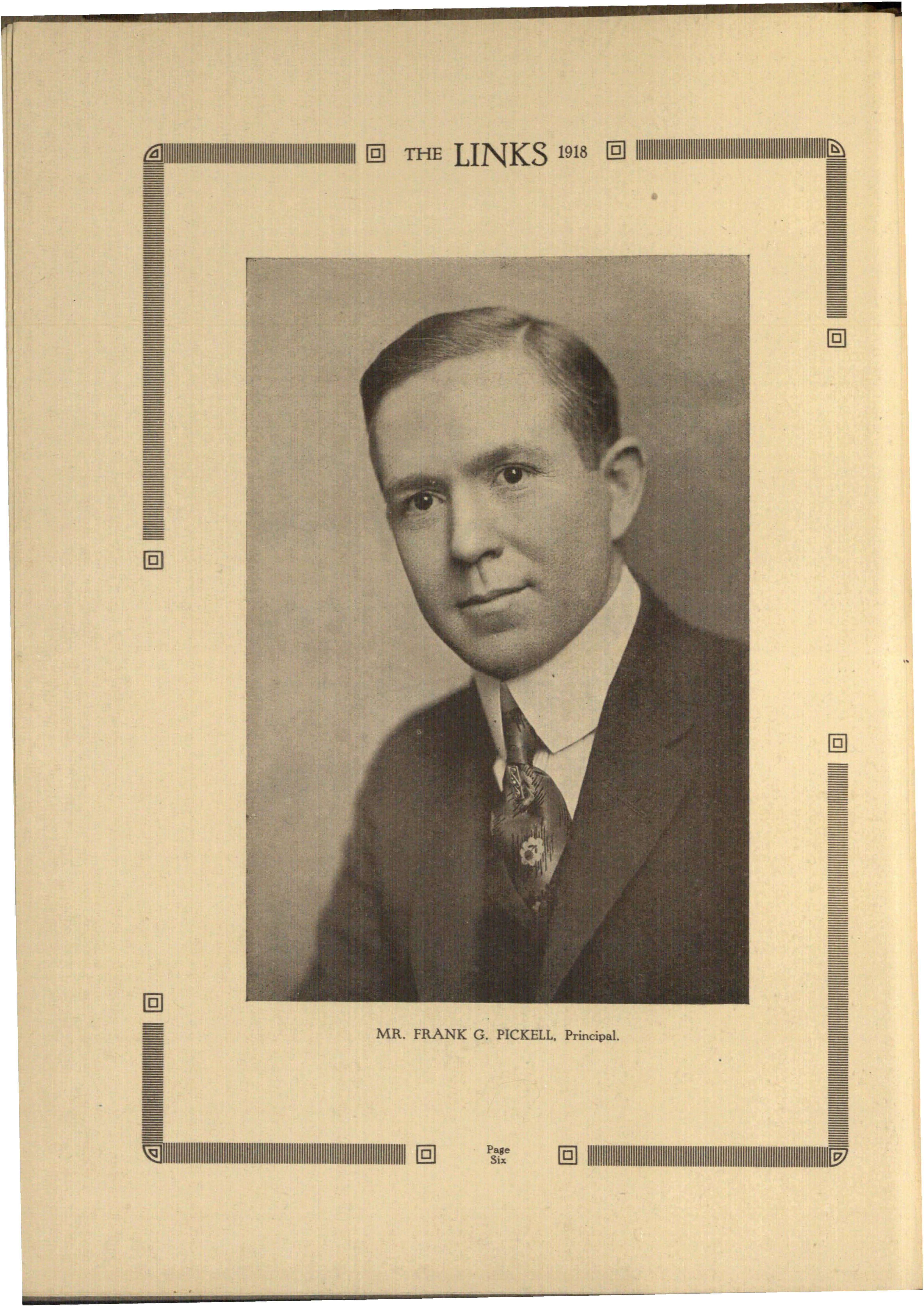
MR. FRANK G. PICKELL, Principal.
the past year, Lincoln High has gained a new and valuable friend.
This friend, Mr. Frank G. Pickell, came to us after four year.; of success..C.. ful executive work as principal of the Richmond, Indiana, High School.
A patriot, a sportsman, and a man of magnetic and genial personality, he ins t antlv won a large place in the hearts of the students. His ready smile and rare good humor make him a leader whom the students gladly follow.
Not only is he a general favorite among the boys and girls of Lin\'.oln High, but he is also an important addition to the ranks of the leading men of the city, for he I.as had wide experience in public affairs. In Indiana, he was chairman of the Indiana Conference on Secondary Education, was a member of the Educational Committee on War Work in Secondary Schools, and was appointed by Governor Goodrich a member of the State Council of Defense. Here in Lincoln, he is a member of the Rotary and Commercial Clubs. While he was principal of the Richmond High !,chool, he was appointed a member of the National Commission on Unit Courses and Curricula, one of the most important commissions in the United States. As a member of that body he is now chairman of the sub-committee to make an intensive study of supervised study and socialized recitation in the high schools of the North Centrai Association. The association comprises about twelve hundred high schools and two to three hundred institutions of higher learning. He is also a member of the Special Committee of the orth Central Association on standards primarily for the training of teachers.
As a principal he is ideal. He has had the best of educational training in the foremost Eastern colleges, having been graduated from Indiana University with A. B. honors and having secured his master's degree at Columbia University Teachers College. His ability as an educator has brought him recognition from the great teachers of the East. He was appointed, by the Board of Trustees of Columbia University, as assistant in the Department of Secondary Education for the summer of I 9 I 7. He is a member of the National Educational Association, the National Association of Secondary School Principals, and of the National Society for the Study of Education.
Although a comparatively young man, he has attained a high mark in the educational world by his ability to work in harmony with other men This fact has made it possible for him to do great good for Lincoln High. It has been largely through his modern ideas of self-government combined with his unbounded zeal and and patriotism that the good work of making our high school the great democratic institution that it is has been carried forward. We are grateful and justly proud to have such a man among us. May we have him whose likeness is here reproduced, as our lrader for many prosperous years to come.
-ALLEN WOLCOTT,
'18.
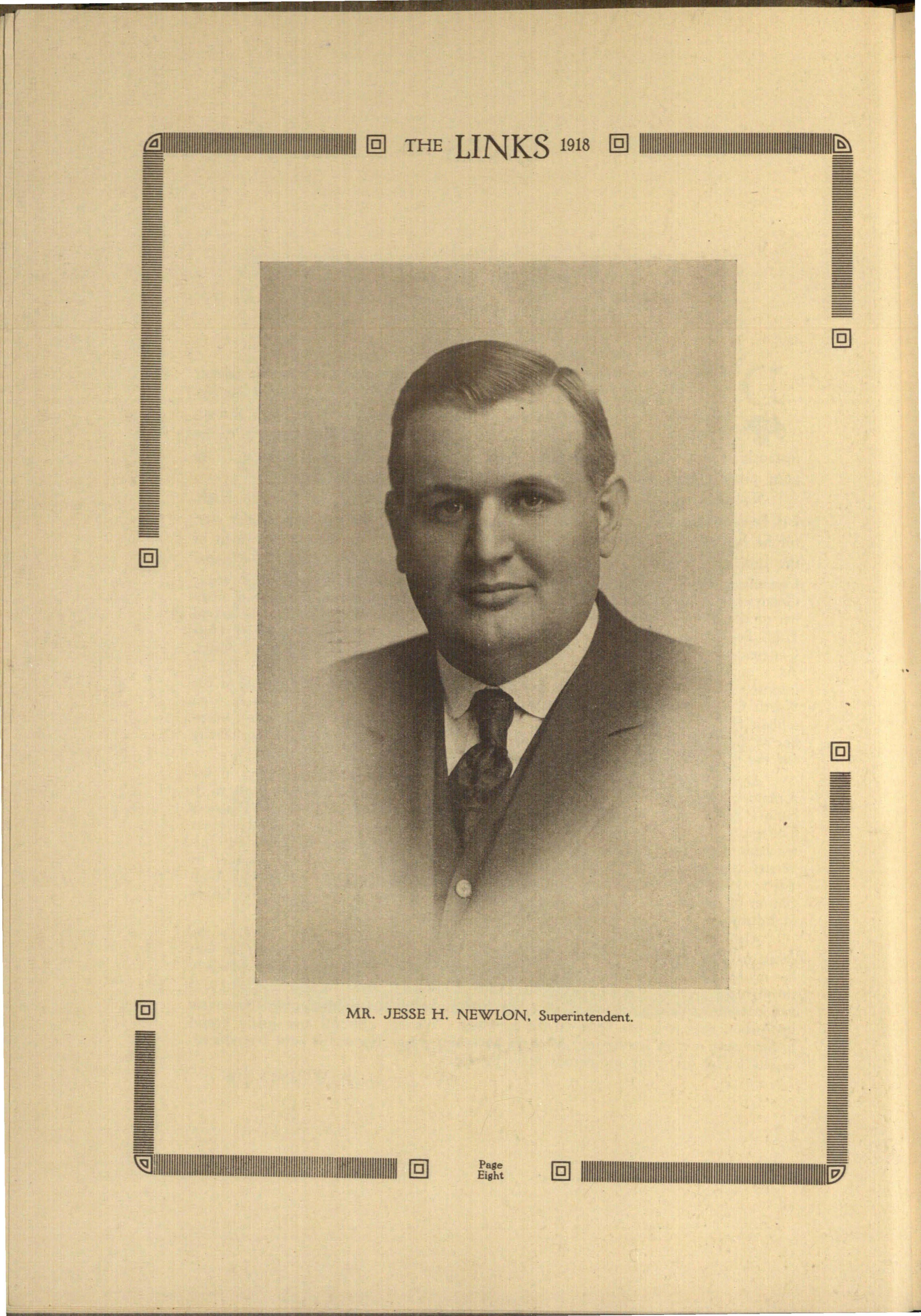
'r""f INCOL is fortunate in having as superintendent of its public schools an ,I.-\ educator of nation-wide reputation, a man who has a thorough understandn<:'<'"r. ing of modern educational problems and a clear vision of the whole system of primary and secondary education. Jesse H. ewlon came to Lincoln from Decatur, Illinois, where he had been connected with the schools for eight years. During one year as the principal of Lincoln High, Mr. Newlon succeeded in making the school more nearly cosmopolitan by revising and modernizing its curriculum and introducing many important movements. The publication of a Lincoln High School annual wa his suggestion. He inaugurated a student government organization, out of which grew a new spirit of fellowship among the students.
At the close of the school year Mr. Newlon was elected to succeed Mr. Hunter as superintendent of the city schools. In response to the many new demands laid upon the public schools by the war, the school board, upon the advice of Mr. Newlon, has this year attempted and carried out stupendous problems. The junior high school system and Junior Civic League have been further developed and a building program worked out. The Junior Civic League under Mr. Newlon ' s supervision has done unique and admirable war work in handling the food administration cards throughout the city and in making a thorough survey of all available garden space in the city, in connection with a canvass of persons willing to garden but without garden space.
Mr. Newlon's training for educational work began in the University of Indiana, from which he received his bachelor's degree. He took his master's degree from Columbia Teachers College. Special scholarship honors were not awarded by the University of Indiana at that time, but he was entitled to them and was given a fellowship in history. He played center on the varsity football team during his senior year and was interested in debating and all school activities. Mr. Newlon coached the New Albany, Illinois, High School football team for two years and was for the three years prior to his coming to Nebraska a member of the Illinois Athletic Association Board of Control, a body which has charge of all high school athletics and tournaments in that state. Mr. ewlon figures prominently on various educational committees. He is a member of the N. E. A. Committee of High School Administration and of the executive committee for the Nebraska State Teachers' Association, 1918-1919. He is also a member of the Nebraska Schoolmaster's Club Committee of Cost Accounting in Public Schools, and is one of the research collaborators for Nebraska in interstate character methods research. At the meeting held in Chicago, March 21st and 22nd, Mr. Newlon was elected Chairman of the Commission on Unit Courses and Curricula of the North Central Association of Colleges and Secondary Schools, of which he had been acting chairman since September. He succeeds Dr. Charles Hughes Johnston, who met with tragic death last September. Mr. Newlon and Dr. Johnston were warm personal and professional friends. It seems entirely fitting that Mr. Newlon should succeed Dr. Johnston in this responsible position.
With such a past record and his best years before him, each one bringing him honors, the heights in the educational world to which Mr. Newlon may rise seem unlimited. Lincoln High School students who have enjoyed the opportunity of association with Mr. Newlon are indeed fortunate, and to see them greet him in the corridors on his visits to the high school is proof enough of their devotion for him.
Page Nine
~ lllllllllllllllllllllllllllllllllllllllllllllllllllllllllllllllllllllllllll@ THE
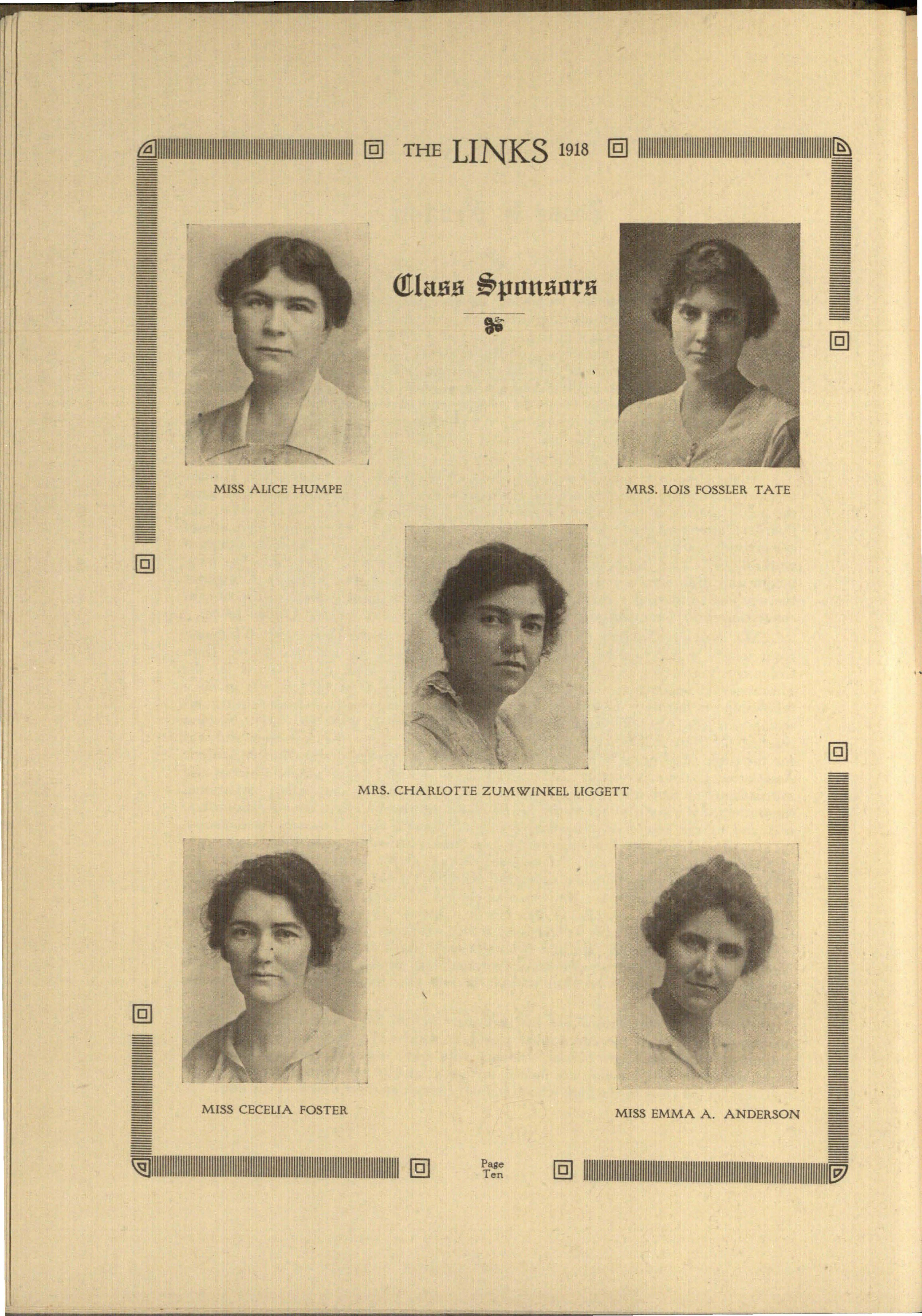
~ IX sponsors, by their help and ad, ice, have guided the class of 1918 through its four years of high school life. Though all will agree that - the present senior class is second to none, yet at four different times has T it been called upon to elect a new sponsor. When the present seniors were but wee freshies, they looked about to find the most charming and gracious ladies pos ible. They selected Miss Sarah T. Muir and Miss Charlotte Zumwinkel, who more than fulfilled their greatest expectations. Upon the resignation of Miss Muir, the class of 1918 elected Miss Alice Humpe. The sophomores were delighted with their new choice, and felt quite secure under the able guidance of Miss Humpe and Miss Zumwinkel. But during the junior year the happy partnership of sponsors was broken when Miss Zumwinkel became Mrs . Liggett. The juniors were so reluctant to let her go that they created a new office, that of honorary sponsor, which she still holds.
Then the juniors asked Miss Emma Anderson to aid in directing their class. When Iiss Anderson left L. H. S. in the fall of 1917, the seniors chose Miss Lois Fossler, who lent her energies to the forwarding of class activities. The class events did not wholly occupy her time, however, because during Christmas vacation Miss Fossler was married to Dr. Tate. So the seniors elected another honorary sponsor.
By the new system of obtaining sponsors, Miss Cecelia Foster became Mrs. Tate's successor. Each senior is delighted with the choice of the student affairs committee.
Although serving but a short time, each sponsor was able to impress upon the class her personality and high ideals of democracy and good fellowship. Thus to those who remained longest the debt is greatest, yet to each the class of 1918 pays its tribute of gratitude and devotion.
-Mary Herzing, '18.
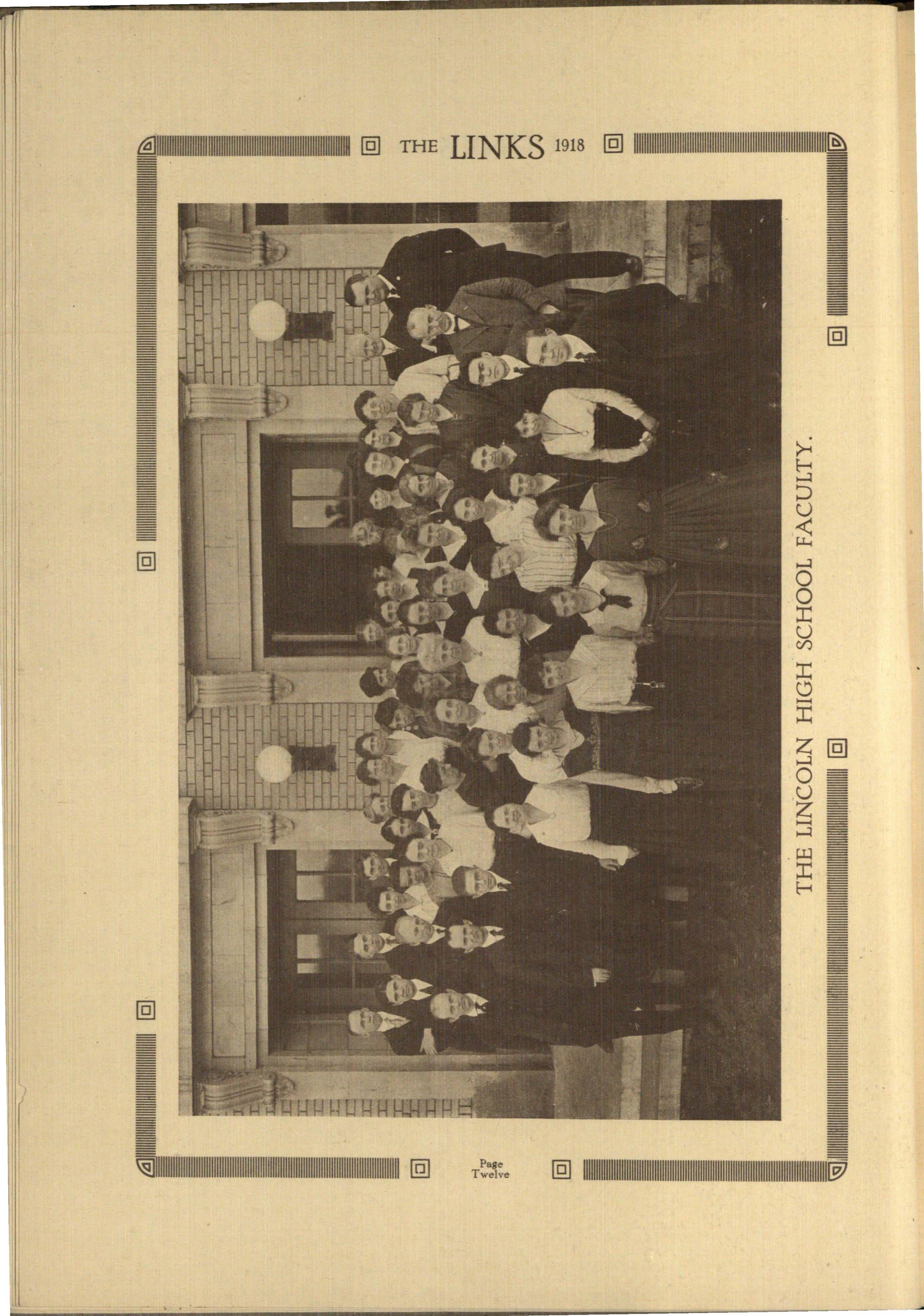
tmlllfillllllllllllllllllllllllllllllllllllllllllllllllllllllllllllllllllllm lQJ THE
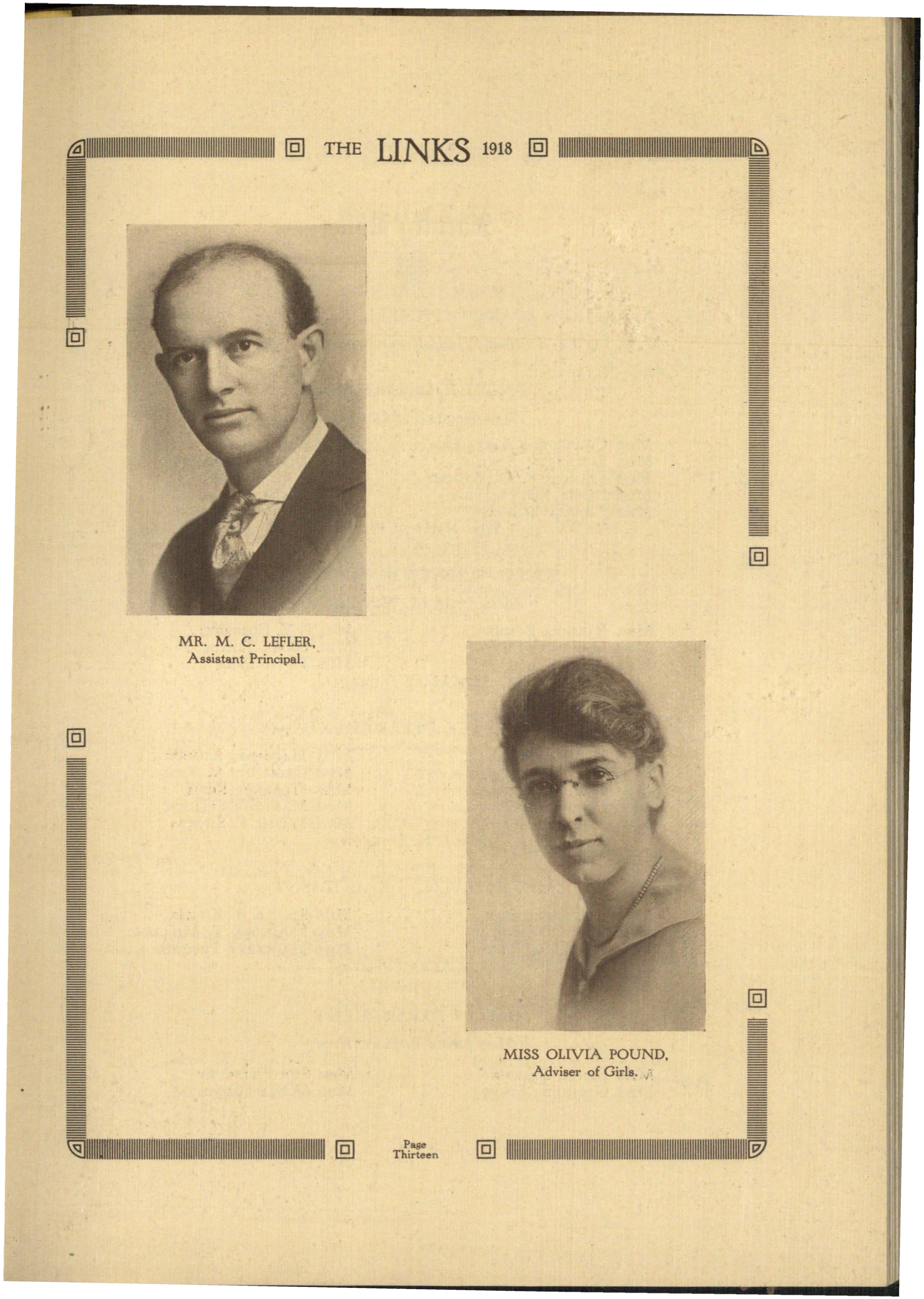
MR. M . C. LEFLER, Assistant Principal .
llllllllllllllllllllllllllllllllllllllllllllllllllllllllllllllllllllllllllll [Q]
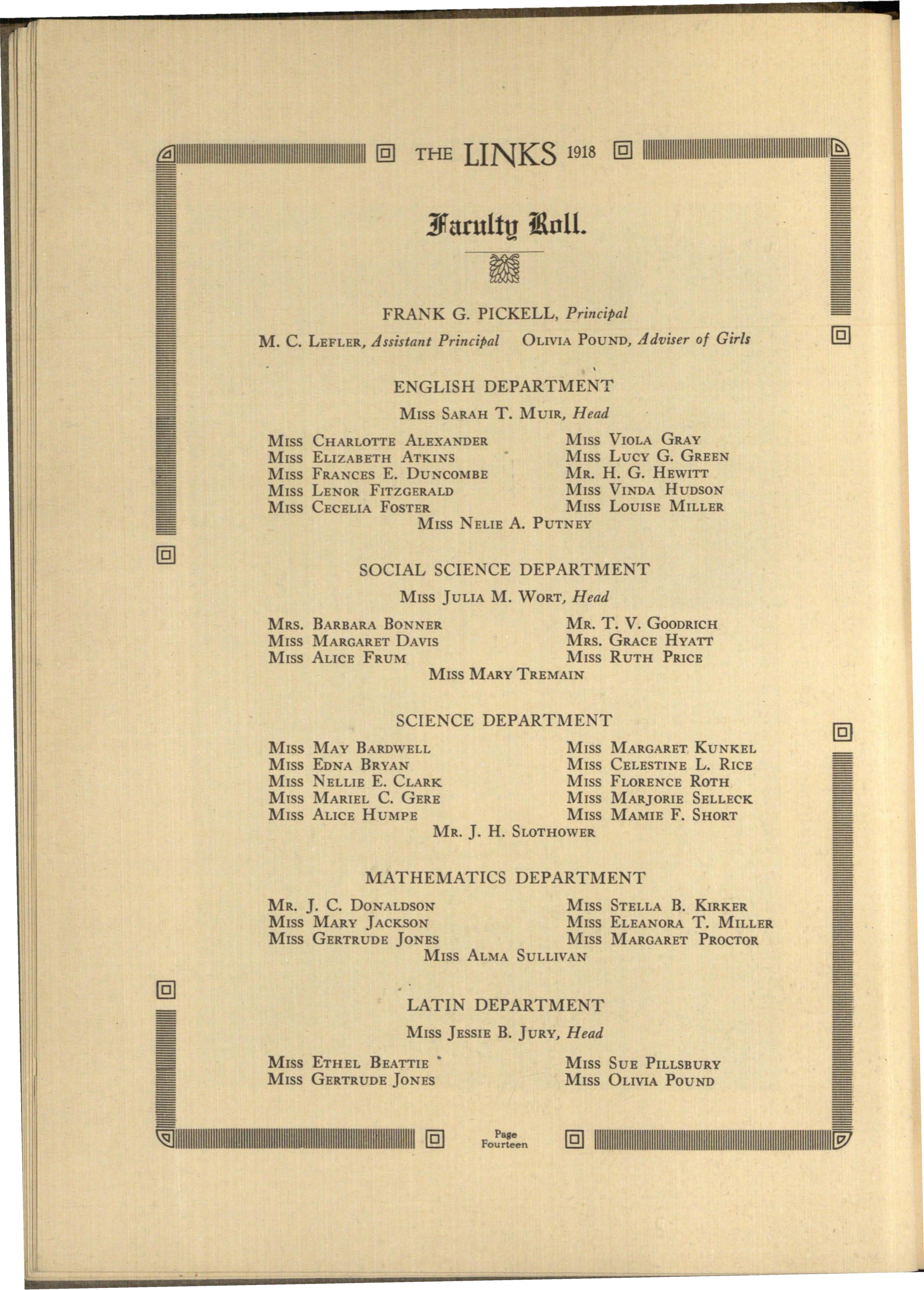
FRA r K G. PICKELL, Principal
M. C. LEFLER, Assistant Principal OLIVIA Pou D, Adviser of Girls
E GLISH DEPARTME T
Miss SARAH T. MurR, Head
Mrss CHARLOTIE ALEXA DER
Miss ELIZABETH ATKINS
Miss FRANCES E. DUNCOMBE
Miss LENOR FITZGERALD
Miss CECELIA FosTER
Mrss VIOLA GRAY
Mrss Lucy G. GREEN
MR. H. G. HEWITT
Mrss VINDA HuDSON
Mrss LoursE MILLER
Miss ELIE A. PUTNEY
SOCIAL SCIE CE DEPARTME T
Miss JULIA M. WORT, Head
MRs. BARBARA Bo ER
Mrss MARGARET DAVIS
Mrss ALICE FRUM
MR. T. V. GOODRICH
MRS. GRACE HYATT
Mrss RUTH PRICE
Miss MARY TREMAIN
SCIE CE DEPARTME T
Mrss MAY BARDWELL
Miss EDNA BRYAN
Miss 1ELLIE E. CLARK
Mrss MARIEL C. GERE
Mrss ALICE H UMPE
Miss MARGARET KUNKEL
Miss CELESTINE L. RICE
Miss FLORE CE ROTH
Mrss MARJORIE SELLECK
Mrss MAMIE F. SHORT
MR. J. H. SLOTHOWER
MATHEMATICS DEPARTME T
MR J. C. Do ALDSON
Miss MARY JACKSON
Mrss GERTRUDE ]ONES
Mrss STELLA B. KIRKER
l\1Iss ELEANORA T. MILLER
Miss MARGARET PROCTOR
Miss ALMA SULLIVAN
LATI DEPARTME T
Miss JESSIE B. JURY, Head
M iss ETHEL BEATTIE •
Miss GERTRUDE ]ONES
Miss SuE PILLSBURY
Miss OLIVIA PouND
&l llllllllllllllllllllllllllllllllllllllllllllllllllllllllllllllllllllllllllll @ THE
GERMAN DEPARTMENT
Miss MARY H ULLHORST
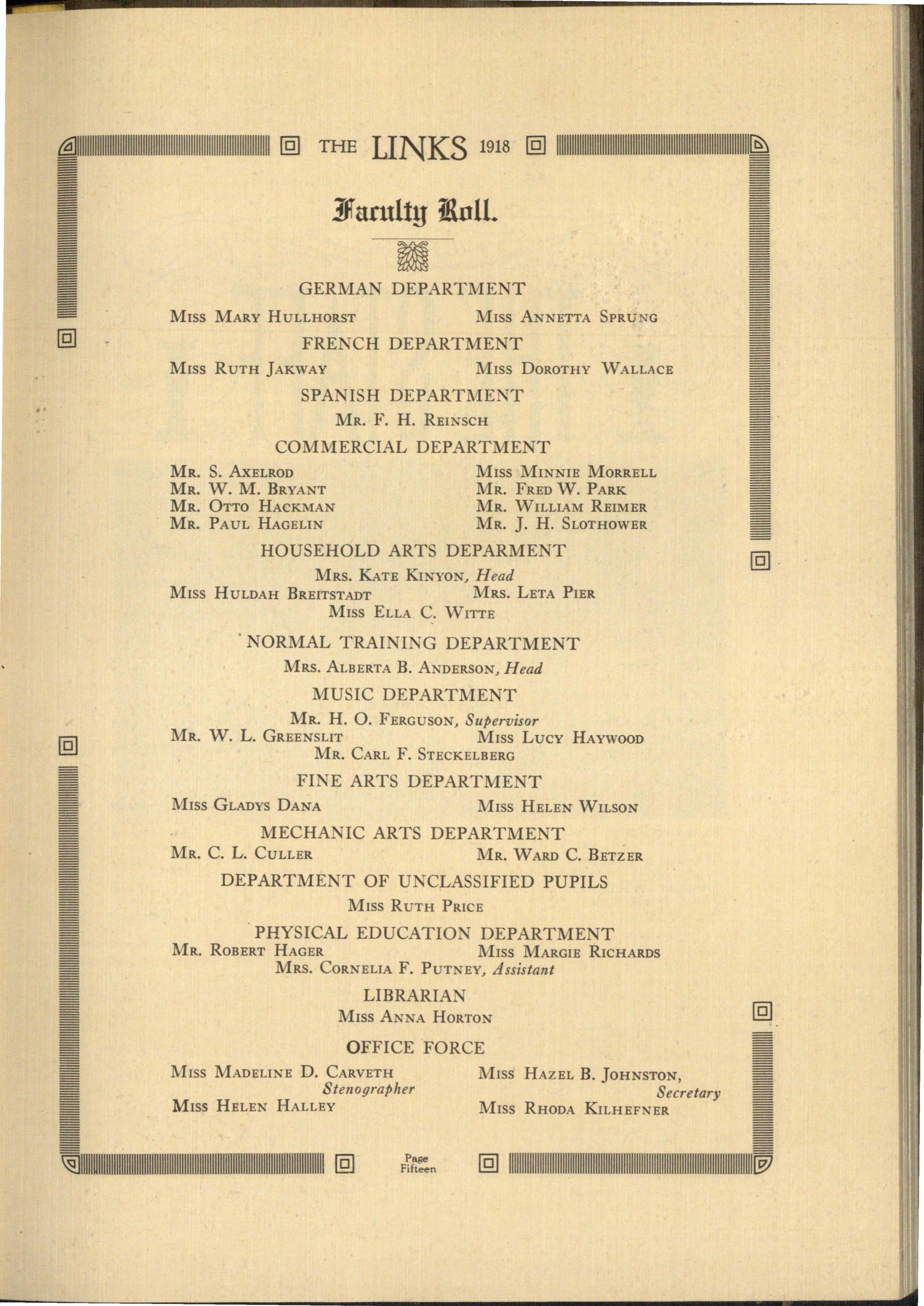
Miss ANNETTA SPRU NG
FRE CH DEPARTMENT
Miss RuTH ]AKWAY
Miss DOROTHY WALLA CE
SPANISH DEPARTMENT
MR. F. H. REINSCH
COMMERCIAL DEPARTMENT
MR. S. AxELROD
MR. w. M. BRYANT
MR. OTTO HACKMAN
MR. p AUL HAG ELIN
Miss MINNIE MoRRELL
MR. FRED w. PARK
MR. WILLIAM REIMER
MR. J. H. SLOTHOWER
HOUSEHOLD ARTS DEPARMENT
lVlRs. KATE KINYON, Head
Miss HuLDAH BREITSTADT
MRs. LETA PIER
Miss ELLA C. WITTE
NORMAL TRAI ING DEPARTMENT
MRS. ALBERTA B. ANDERSON, Head
MUSIC DEPARTME T
MR. H. 0. FERGUSON, Supervisor
MR. W. L. GREENSLIT
Miss Lucy HAYWOOD
MR. CARL F. STECKELBERG
FI E ARTS DEPARTME T
Miss GLADYS DANA
Miss HELEN WILSON
MECHANIC ARTS DEPARTMENT
MR. C. L. CULLER
MR. WARD C. BETZER DEPARTMENT OF UNCLASSIFIED PUPILS
Miss RUTH PRICE
PHYSICAL EDUCATION DEPARTMENT
MR. RoBERT HAGER
Miss MARGIE RICHARDS
MRS. CORNELIA F. PUTNEY, Assistant LIBRARIAN
Miss ANNA HORTON
OFFICE FORCE
Miss MADELINE D. CARVETH Stenographer
Miss HELEN HALLEY
Miss HAZEL B. JOHNSTON, Secretary
Miss RHODA KILHEFNER
FLORE. 'CE Fo\\'LER Editor
HUBERT R. MANN Associate Editor
CHAU. 'CEY REDDISH JJanaging Editor
HARRY \yoss Assistant .J!anaging Editor
BYRON POWERS Advertising 111 anager
IRENE HUTCHISON Circulation ,.l/anager
RuTH BROWN Art Editor
}ACK VIRTUE Army and Nai•y
GERTRUDE TmtSON 1-Var Relief
11oNTE :\1uxx Boys' Athletics
RUTH FICKES Girls' Athletics [g = ;:;;;;
ELEANOR SNELL Society =
ROBERT TROYER Dramatics ;:;;;;
FLORENE REED
Organizations
\VINFIELD EL:\IEX Alumni
DWIGHT \V1LLIA:\IS ]l/ usic
• ED FISH ER Calendr.r
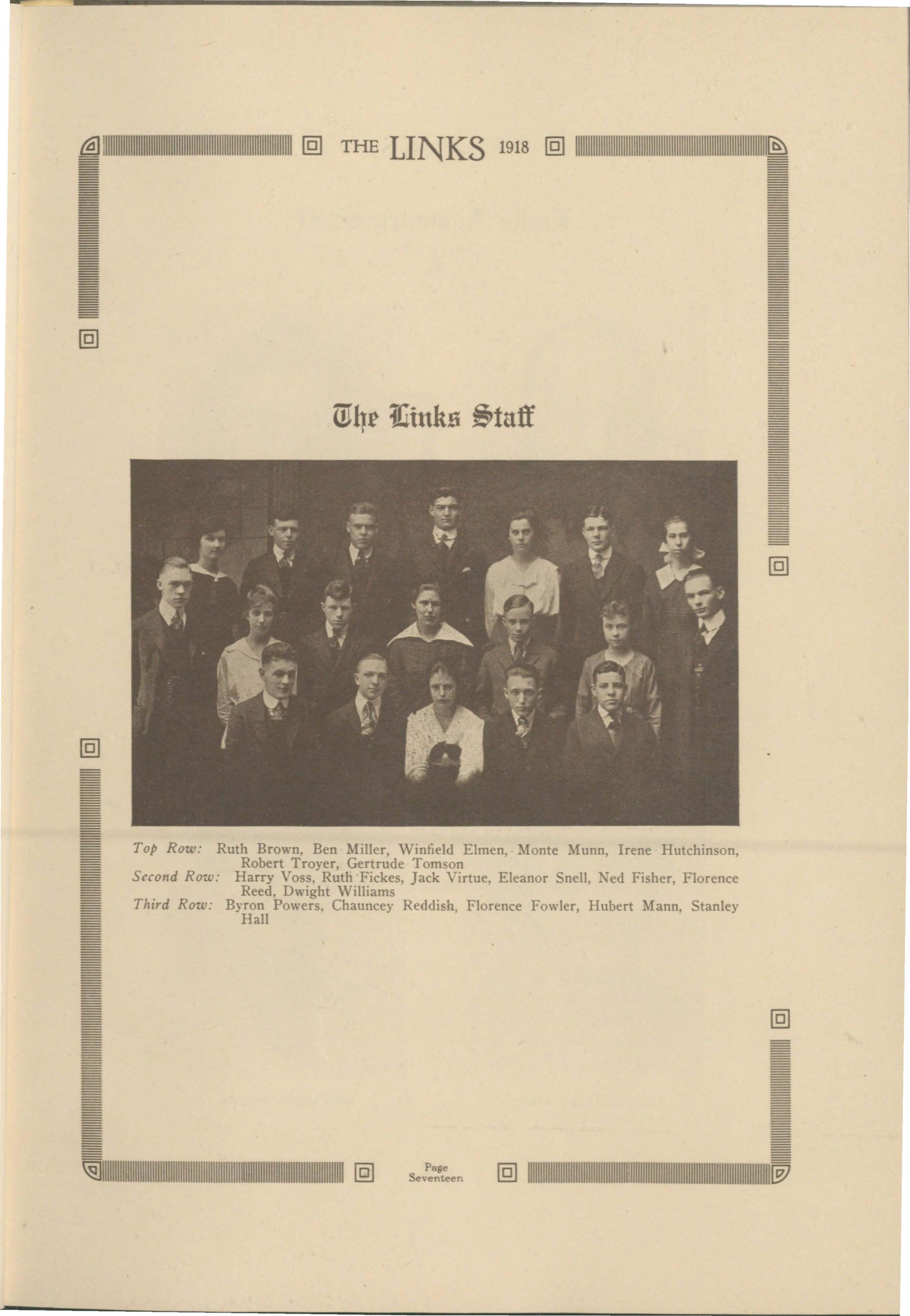
Top Row: Ruth Brown, Ben Miller, \Vinfield Elmen, l\fonte Munn, Irene Hutchinson, Robert Troyer, Gertrude Tomson
Suond Row: Harry Voss, Ruth Fickes, Jack \ irtue, Eleanor Snell, Ked Fisher, Florence Reed, Dwight Williams
Third Row: Byron Powers, Chauncey Reddish , Florence Fowler, Hubert Mann, Stanley Hall
@lllllllllllllllllllllllllllllllllllllllllllllllllllllllllllllllllllllllllOO [Q) rttE LINKS 1918 [Q) llllllll
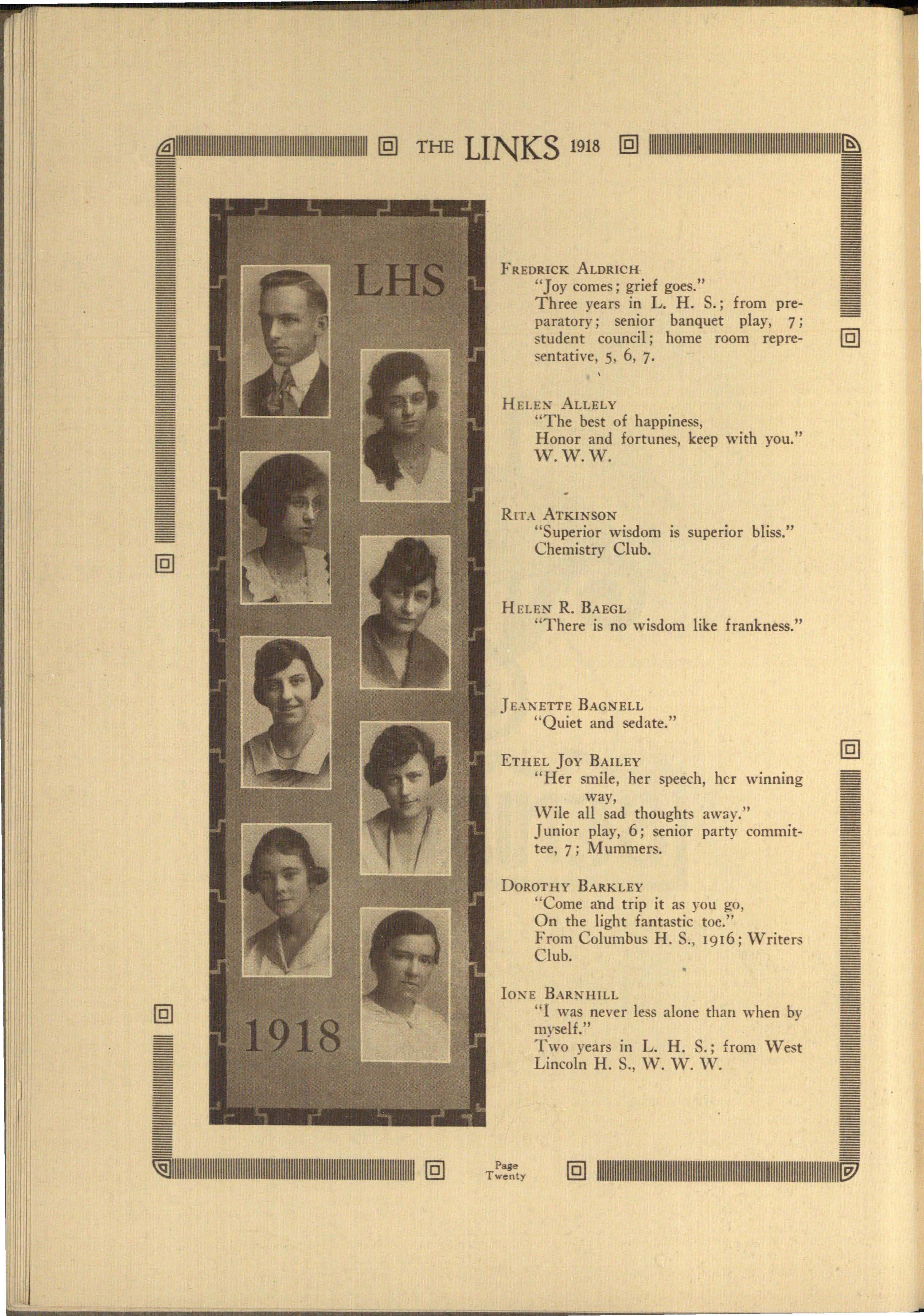
FR EDRICK ALDRICH
"Joy comes; grief goes."
Three years in L. H. S.; from preparatory; senior banquet play, 7; student council; home room represe ntative , 5, 6, 7.
H EL E .• ALLELY
"The best of happiness, Honor and fortunes, keep with you." w.w.w.
RI T A ATKINSON
"Superior wisdom is superior bliss." Chemistry Club.
H ELEX R. BA EGL
"There is no wisdom like frankness."
JE AN'ETT E BAGNELL
"Quiet and sedate."
ETHE L Joy BAILEY
"Her smile, her speech, her winning way, \Vile all sad thought s awa y."
Junior play, 6; senior party committee, 7 ; Mummers.
DOROTHY BARKLEY
"Come and trip it as you go , On the light fantastic toe. "
From Columbus H. S. , 19 16; Writers Club.
lo:s" E BARNHILL
" I was ne ver less alone than when by m, ·self."
T\vo years in L. H. S.; from West Lincoln H. S., W. W. \V .
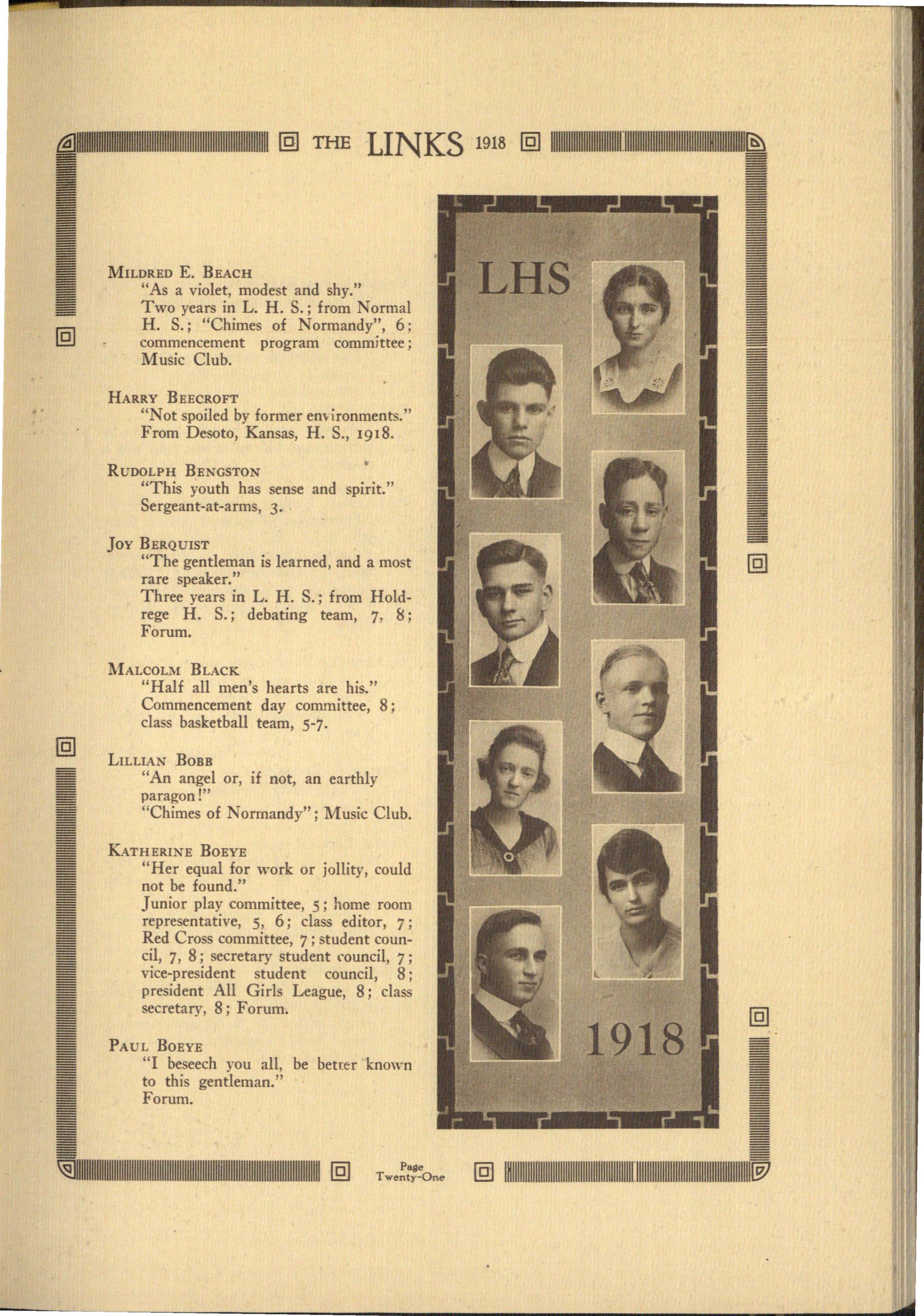
MILDRED E. BEACH
"As a violet, modest and shy."
Two years in L. H. S.; from Normal H. S.; "Chimes of Normandy", 6; commencement program committee; Music Club.
HARRY BEECROFT
"Not spoiled by former environments."
From Desoto, Kansas, H. S., 1918.
RUDOLPH BENGSTON
"This youth has sense and spirit." Sergeant-at-arms, 3.
Jov BERQUIST
"The gentleman is learned, and a most rare speaker."
Three years in L. H. S.; from Holdrege H. S.; debating team, 7, 8; Forum.
MALCOLM BLACK
"Half all men's hearts are his." Commencement day committee, 8 ; class basketball team, 5-7.
LILLIAN BOBB
"An angel or, if not, an earthly paragon!"
"Chimes of Normandy"; Music Club.
K-\THERINE BOEYE
"Her equal for work or jollity, could not be found."
Junior play committee, 5; home room representative, 5, 6; class editor, 7; Red Cross committee, 7 ; student council, 7, 8 ; secretary student rouncil, 7 ; vice-president studmt council, 8; president All Girls League, 8 ; class secretary, 8; Forum.
PAUL BOEYE
"I beseech you all, be betrer known to this gentleman." Forum.
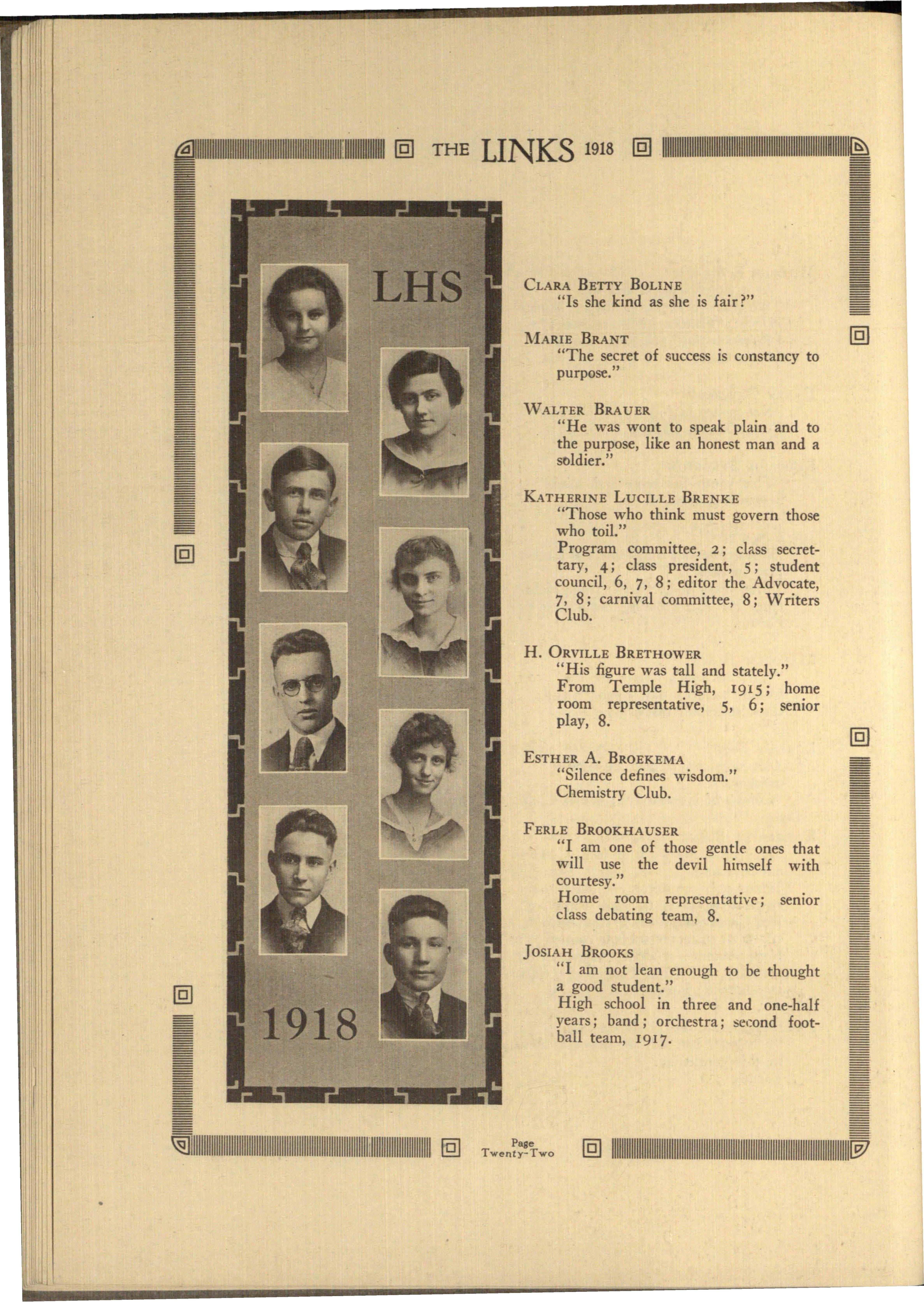
]
CLARA BETIY BOLINE
"Is she kind as she is fair?"
MARIE BRA T
"The secret of success is constancy to purpose."
WALTER BRAUER
"He was wont to speak plain and to the purpose, like an honest man and a soldier."
K.\THERINE LUCILLE BRENKE
"Those who think must govern those who toil."
Program committee, 2; cfass secrettary, 4; class president, 5; student council, 6, 7, 8; editor the Advocate, 7, 8; carnival committee, 8; Writers Club.
H. ORVILLE BRETHOWER
"His figure was tall and stately."
From Temple High, 1915; home room representative, 5, 6; senior play, 8.
ESTHER A. BROEKEMA
"Silence defines wisdom." Chemistry Club.
FERLE BROOKHAUSER
"I am one of those gentle ones that will use the devil himself with courtesy."
Home room representative; class debating team, 8. senior =
0SIAH BROOKS
"I am not lean enough to be thought a good student."
High school in three and one-half years; band ; orchestra; second football team, 1917.
lllllllllllllllllllllllllllllllllllllllllllllllllllllllllllllllllllllllllll @J
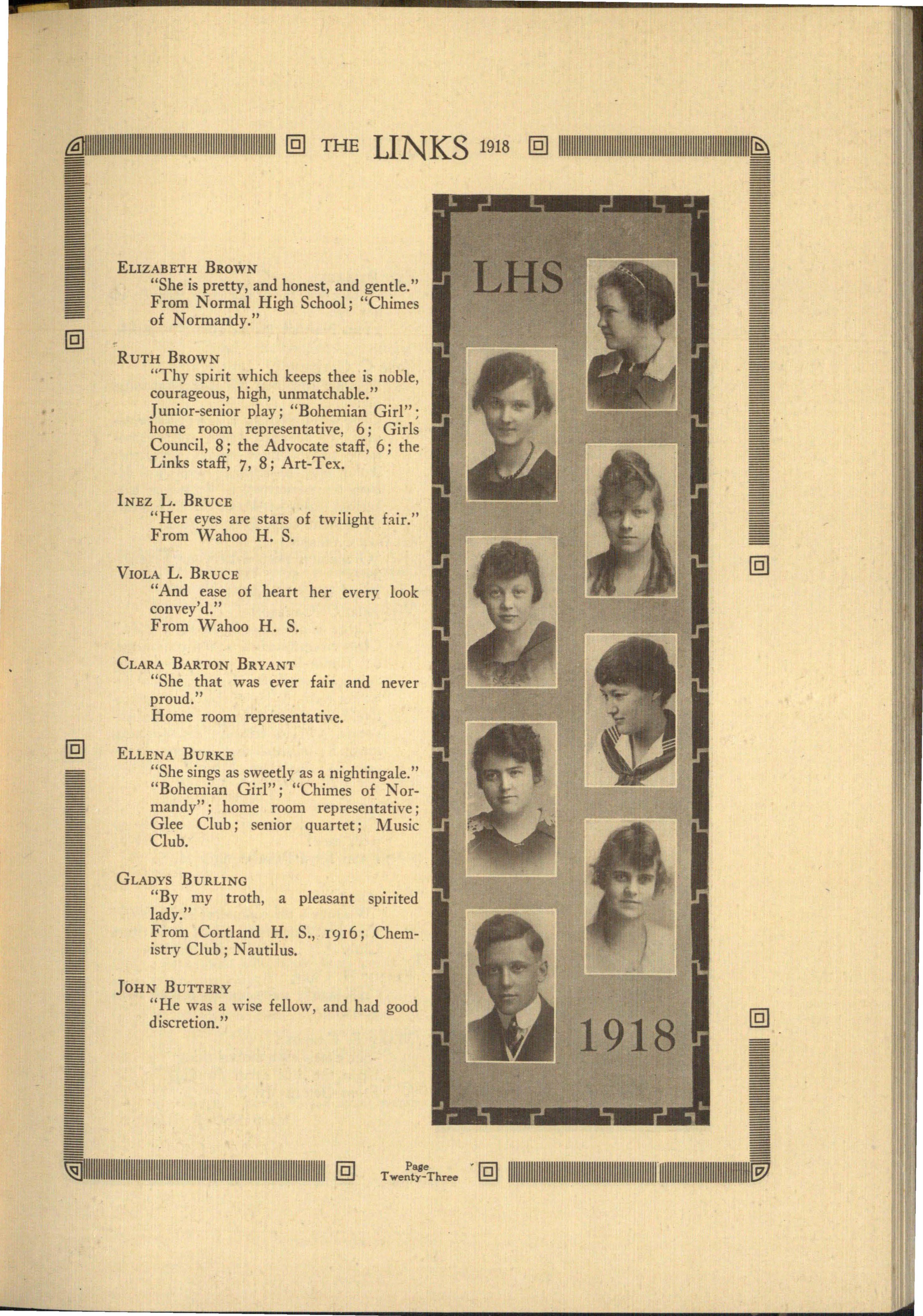
ELIZABETH BROWN
= "She is pretty, and honest, and gentle." = From Normal High School ; "Chimes [g]
RuT= :.::: nd y." ,--.--,-----,
"Thy spirit which keeps thee is noble , courageous, high, unmatchable."
INEZ L. BRUCE
"Her eyes are stars of twilight fair."
From Wahoo H. S.
VIOLA L. BRUCE
"And ease of heart her every look convey 'd."
From Wahoo H. S.
CLARA BARTON BRYANT
"She that was ever fair and never proud."
Home room representative.
ELLENA BURKE
"She sings as sweetly as a nightingale." "Bohemian Girl"; "Chimes of Normand y"; home room representative; Glee Club; senior quartet; Mu sic Club.
GLADYS BURLING
"By my troth , a pleasant spirited lady."
From Cortland H. S., 1916; Chemistry Club; Nautilus.
}OHN BUTTERY
"He was a wise fellow , and had good discretion."
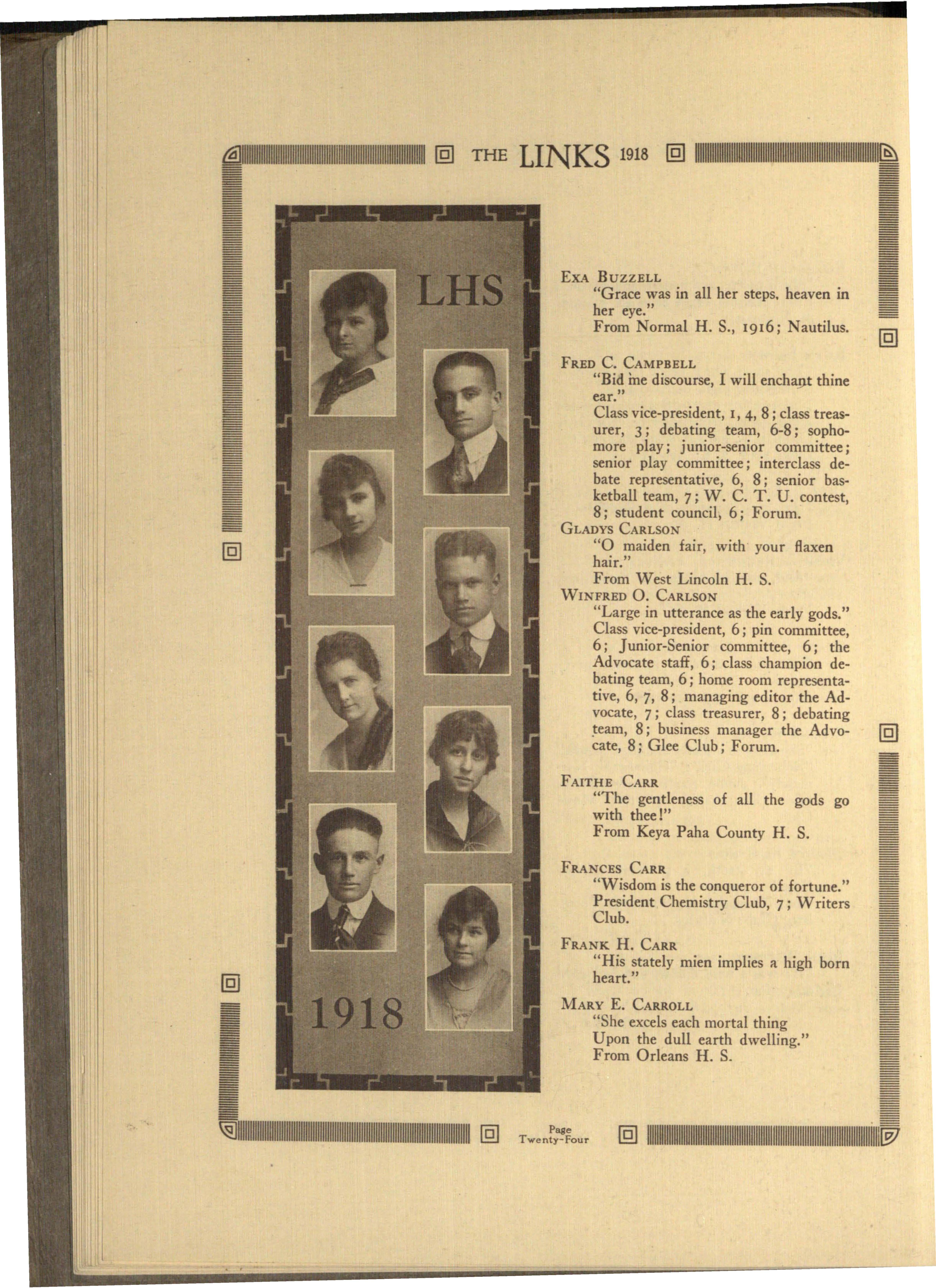
Ex.4. BUZZELL
"Grace was in all her steps, heaven in her eye."
From ormal H. S., 1916; autilus.
FRED C. CAMPBELL
"Bid ine discourse, I will enchavt thine ear."
Cla s vice-president, 1, 4, 8; class treasurer, 3 ; debating team, 6-8 ; sophomore play; junior-senior committee; senior play committee; interclass debate representative, 6, 8; senior basketball team, 7; W. C. T. U. contest, 8; student council, 6; Forum.
GLADYS CARLSO
"O maiden fair, with your flaxen hair."
From Wet Lincoln H. S. WI FRED 0. CARLSON >=z
"Large in utterance as the early gods." Class vice-president, 6; pin committee, 6; Junior-Senior committee, 6; the Advocate staff, 6; class champion debating team, 6; home room representative, 6, 7, 8; managing editor the Advocate, 7 ; class treasurer, 8 ; debating ~earn, 8; business manager the Advo- [QJ cate, 8; Glee Club; Forum.
FAITHE CARR
"The gentleness of all the gods go with thee l"
From Keya Paha County H. S.
FRANCES CARR
"Wisdom is the conqueror of fortune."
President Chemistry Club, 7; Writers Club.
FRANK H. CARR
"His stately mien implies a high born heart."
MARY E. CARROLL
"She excels each mortal thing Upon the dull earth dwelling."
From Orleans H. S.
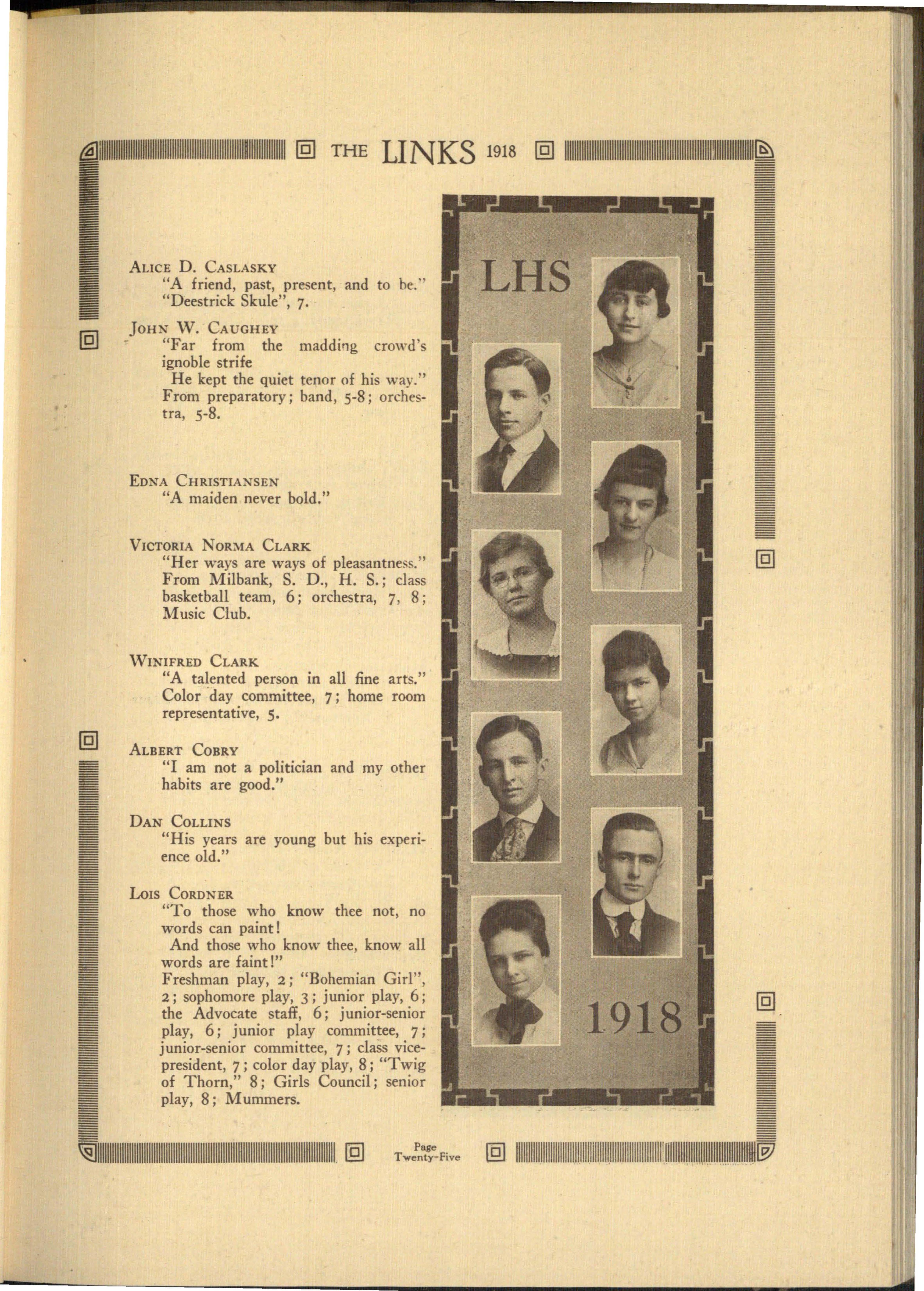
]OH::-1' w. CAUGHEY
"Far from the maddirig crowd's ignoble strife
He kept the quiet tenor of his way." From preparatory; band, 5-8; orchestra, 5-8.
EDNA CHRISTIANSEN
"A maiden never bold."
VICTORIA NORMA CLARK
"Her ways are ways of pleasantness." From Milbank, S. D., H. S.; class basketball team, 6; orchestra, 7, 8; Music Club.
WINIFRED CLARK
"A talented person in all fine arts." Color day committee, 7; home room representative, 5.
ALBERT CoBRY
"I am not a politician and my other habits are good."
DAN COLLINS
"His years are young but his experience old."
Lois CoRDNER
"To those who know thee not, no words can paint! And those who know thee, know all words are faint!" Freshman play, 2; "Bohemian Girl", 2; sophomore play, 3 ; junior play, 6; the Advocate staff, 6; junior-senior play, 6; junior play committee, 7; junior-senior committee, 7; class vicepresident, 7; color day play, 8; "Twig of Thorn," 8; Girls Council; senior play, 8; Mummers.
1.918
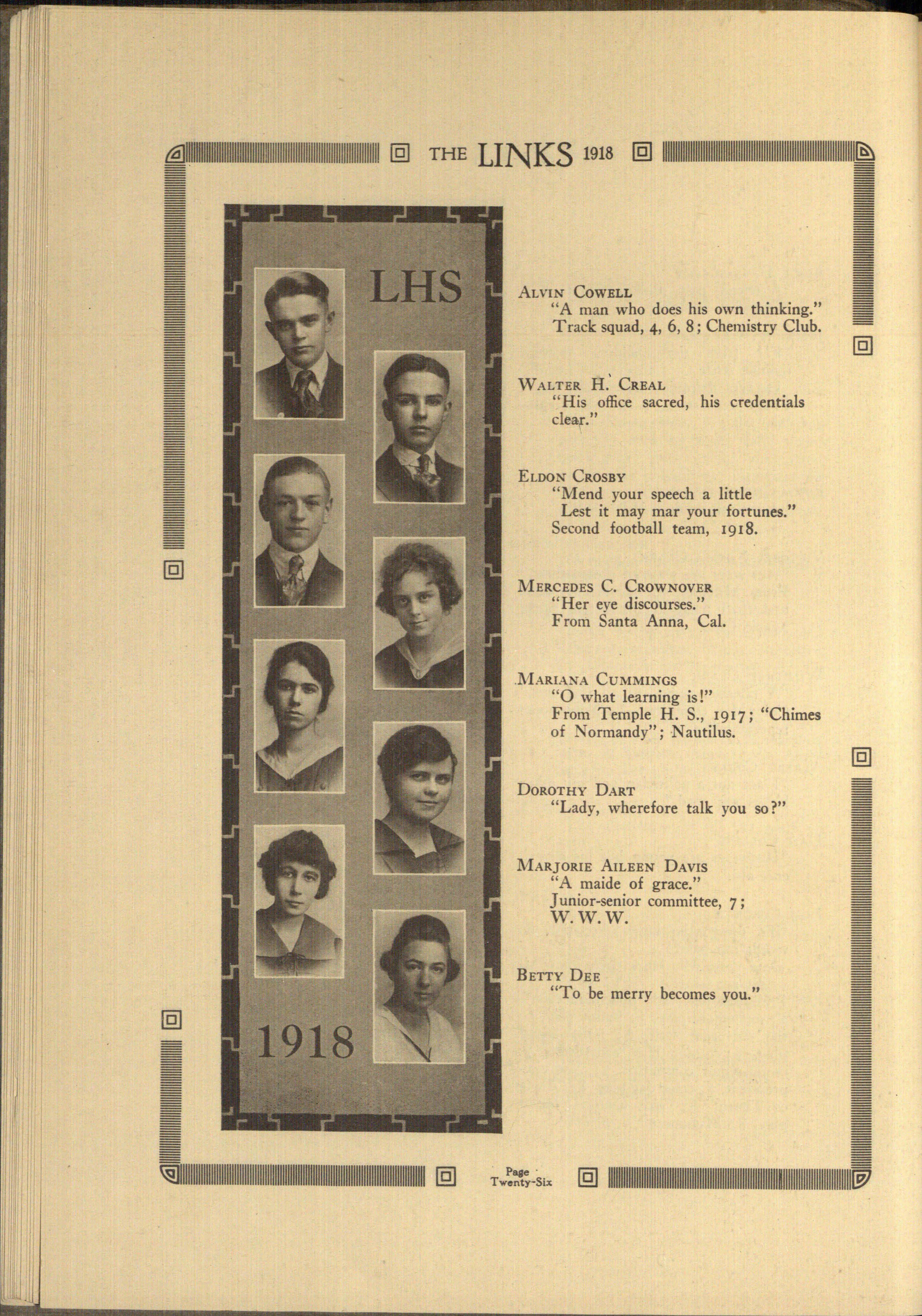
ALVIN COWELL
"A man who does his own thinking." Track squad, 4, 6, 8; Chemistry Club. ==
w
ALTER H.' CREAL
"His office sacred, his credentials clear."
ELDON CROSBY
"Mend your speech a little Lest it may mar your fortunes." Second football team, 1918.
MERCEDES C. CROWNOVER
"Her eye discourses."
From Santa Anna, Cal.
:MARIANA CUMMINGS
"O what learning is!"
From Temple H. S., 1917; "Chimes of Normandy"; Nautilus.
DOROTHY DART
"Lady, wherefore talk you so?"
MARJORIE AILEEN DAVIS
"A maide of grace." Junior-senior committee, 7; w.w.w.
BETTY DEE
"To be merry becomes you."
~l lllllllllllllllllllllllllllllllllllllllllllllllllllllllllllllllllllllllllll [Q] THE LINKS 191s
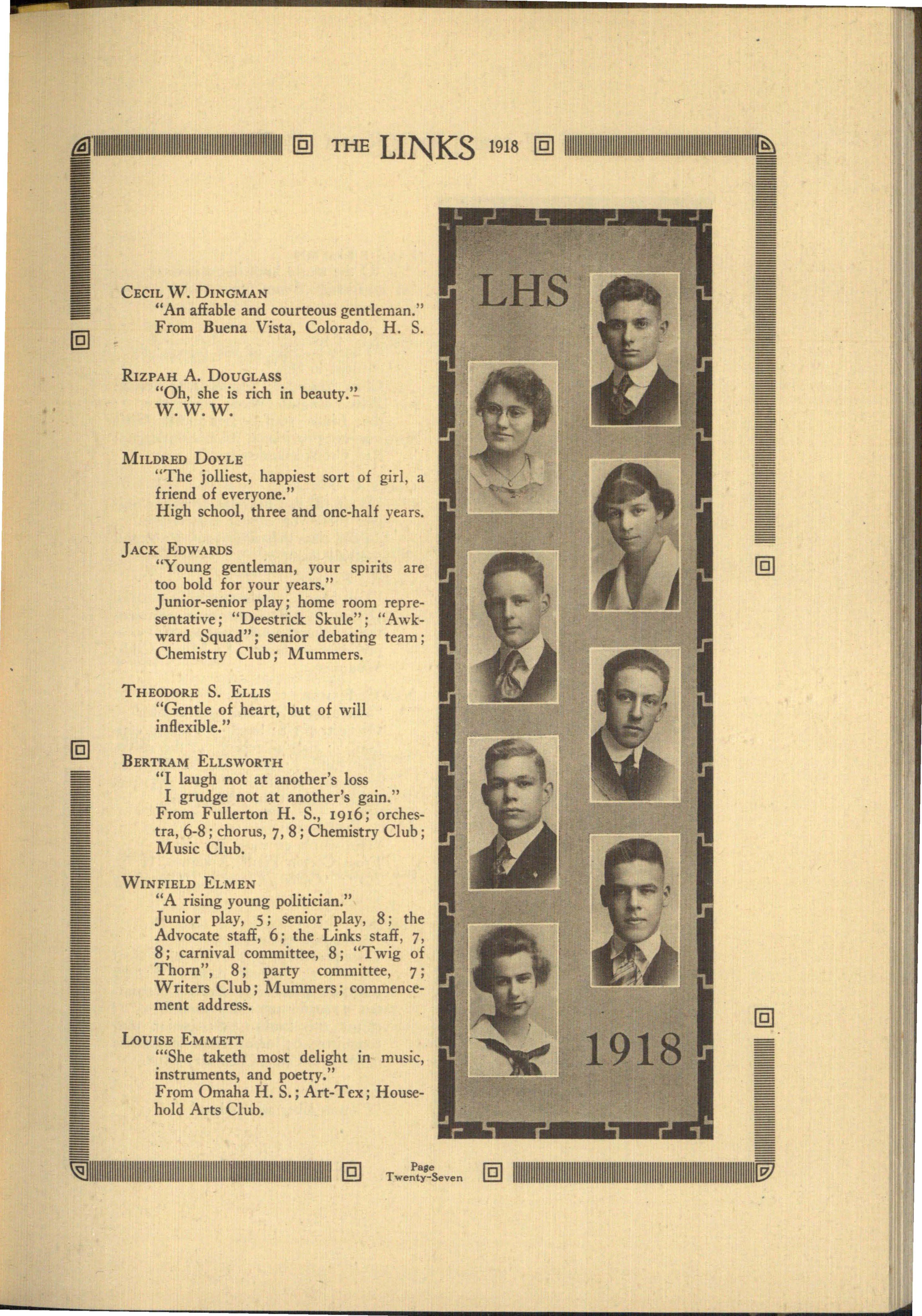
CECIL w. DINGMAN
"An affable and courteous gentleman. "
From Buena Vista, Colorado, H. S.
RIZPAH A. DOUGLASS
"Oh, she is rich in beauty." w.w.w.
MILDRED DOYLE
"The jolliest, happiest sort of girl , a friend of everyone."
High school, three and one-half years
JACK EDWARDS
"Young gentleman, your spirits are too bold for your years."
Junior-senior play; home room representative; "Deestrick Skule " ; "Awkward Squad"; senior debating team; Chemistry Club; Mummers.
THEODORE s. ELLIS
"Gentle of heart, but of will inflexible."
BERTRAM ELLSWORTH
"I laugh not at another's loss I grudge not at another's gain ."
From Fullerton H. S., 1916; orchestra , 6-8; chorus , 7, 8; Chemistry Club; Music Club
WrNFIELD ELMEN
"A rising young politician."
Junior play, 5; senior play, 8 ; the Advocate staff, 6; the Links staff , 7, 8 ; carnival committee, 8 ; "Twig of Thorn", 8; party committee , 7; Writers Club; Mummers; commencement address.
LomsE EMMETT
"'She taketh most delight in music, instruments, and poetry."
From Omaha H. S.; Art-Tex; Household Arts Club.
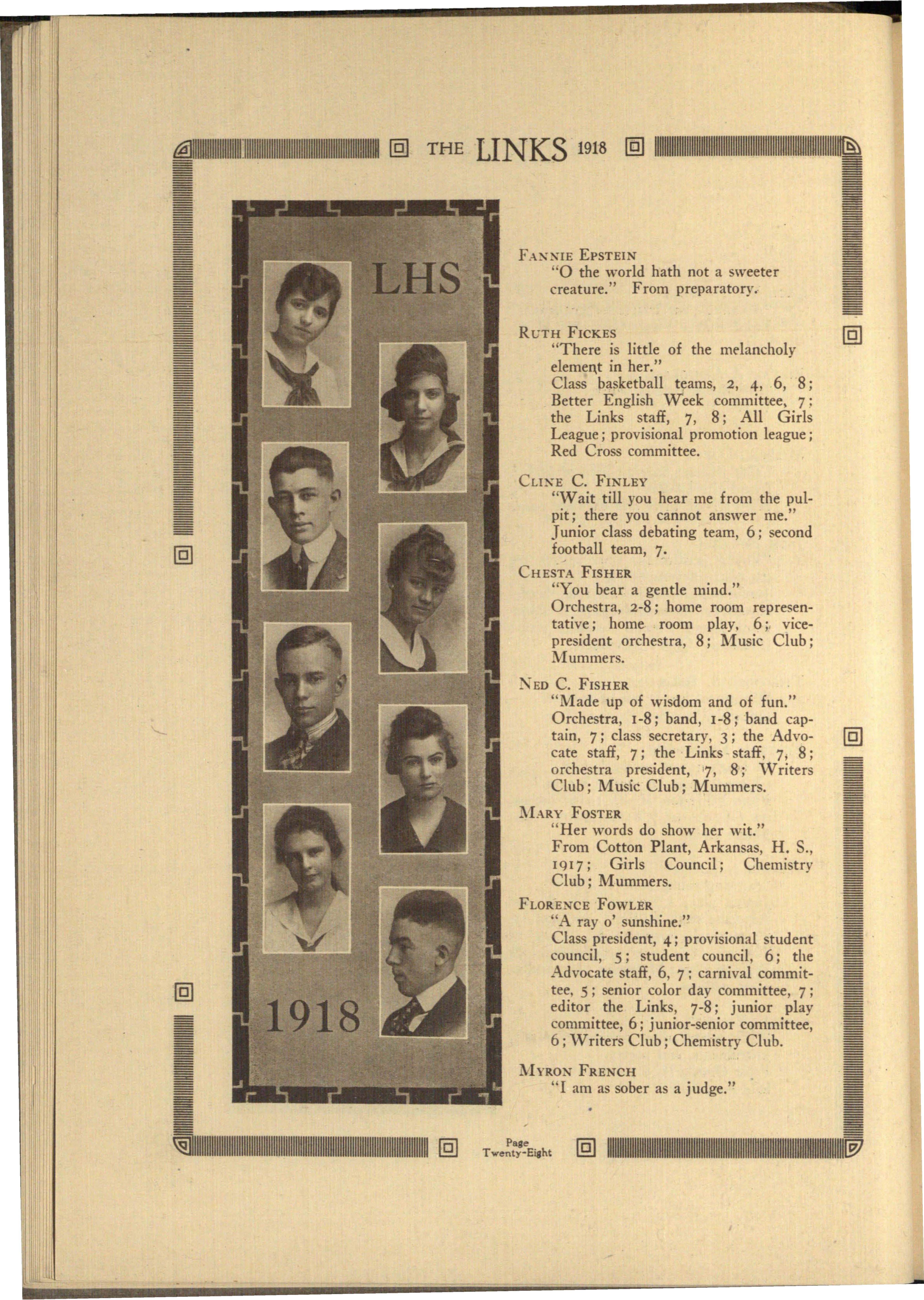
F -\X:\"IE EPSTEIN
"O the world hath not a sweeter creature." From preparatory.
Rt:TH FICKES
"There is little of the melancholy elemeqt in her."
Class basketball teams, 2, 4, 6, 8; Better English Week committee, 7: the Links staff, 7, 8; All Girls League; provisional promotion league; Red Cross committee.
CLIXE C. FINLEY
"\Vait till you hear me from the pulpit; there you cannot answer me."
Junior class debating team, 6; second football team, 7.
CHESTA FISHER
"You bear a gentle mind."
Orchestra, 2-8; home room representative; home room play, 6; vicepresident orchestra, 8; Music Club; Mummers.
ED C. FISHER
"Made up of wisdom and of fun."
Orchestra, 1-8; band, 1-8; band captain, 7; class secretary, 3; the Advocate staff, 7; the Links staff, 7, 8; orchestra president, 7, 8; "' riters Club; Music Club; Mummers.
:\L-\RY FOSTER
"Her words do show her wit."
From Cotton Plant, Arkansas, H. S., 1g17; Girls Council; Chemistry Club; Mummers.
FLORENCE FOWLER
"A ray o' sunshine."
Class president, 4; provisional student council, 5 ; student council, 6; the Advocate staff, 6, 7; carnival committee, 5 ; senior color day committee, 7; editor the Links, 7-8; junior play committee, 6; junior-senior committee, 6; Writers Club; Chemistry Club.
~I YRON FRENCH
"I am as sober as a judge."
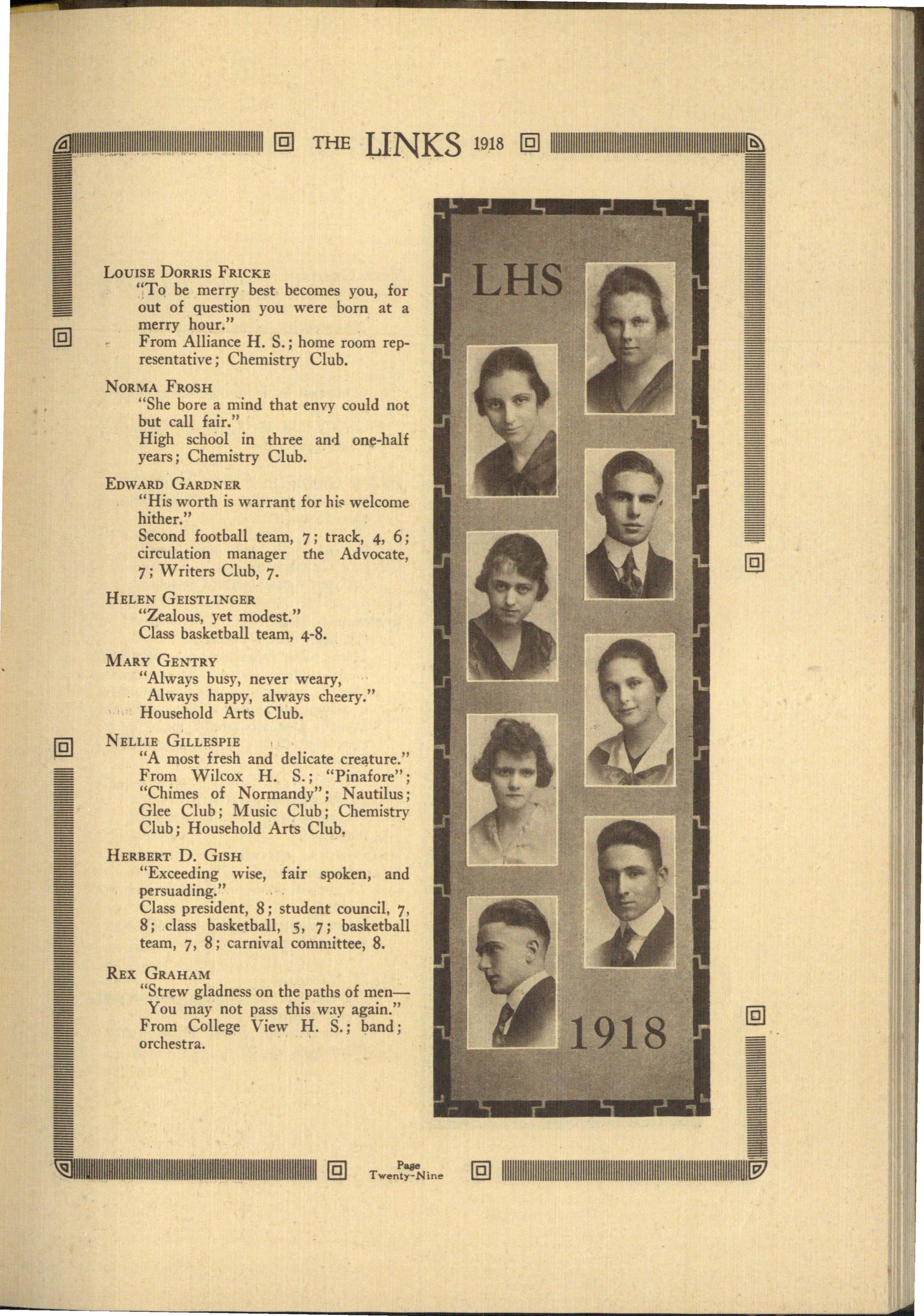
LouISE DoRR1s FRICKE
''.TQ be merry best becomes you, for out of question you were born at a merry hour."
From Alliance H. S.; home room representative; Chemistry Club.
NORMA FROSH
"She bore a mind that envy could not but call fair."
High school in three an,! one-half years; Chemistry Club.
EDWARD GARDNER
"His worth is warrant for hi!' welcome hither."
Second football team, 7 ; track, 4, 6 ; circulation manager the Advocate, 7; Writers Club, 7.
HELEN GEISTLINGER
"Zealous, yet modest."
Class basketball team, 4-8.
MARY GENTRY
"Always busy, never weary, - Always happy, always cheery."
Household Arts Club.
NELLIE GiLLESPIE
"A most fresh and delicate cre,lture."
From Wilcox H. S.; "Pinafore"; "Chimes of Normandy"; Nautilus; Glee Club; Music Club; Chemistry Club; Household Arts Club,
HERBERT D. GISH
"Exceeding wise, fair spoken, and persuading."
Class president, 8; student council, 7, 8; class basketball, 5, 7; basketball team, 7, 8; carnival committee, 8.
REX GRAHAM
"Strew gladness on the paths of menYou may not pass this way again."
From College View H. S.; ~and; orchestra.
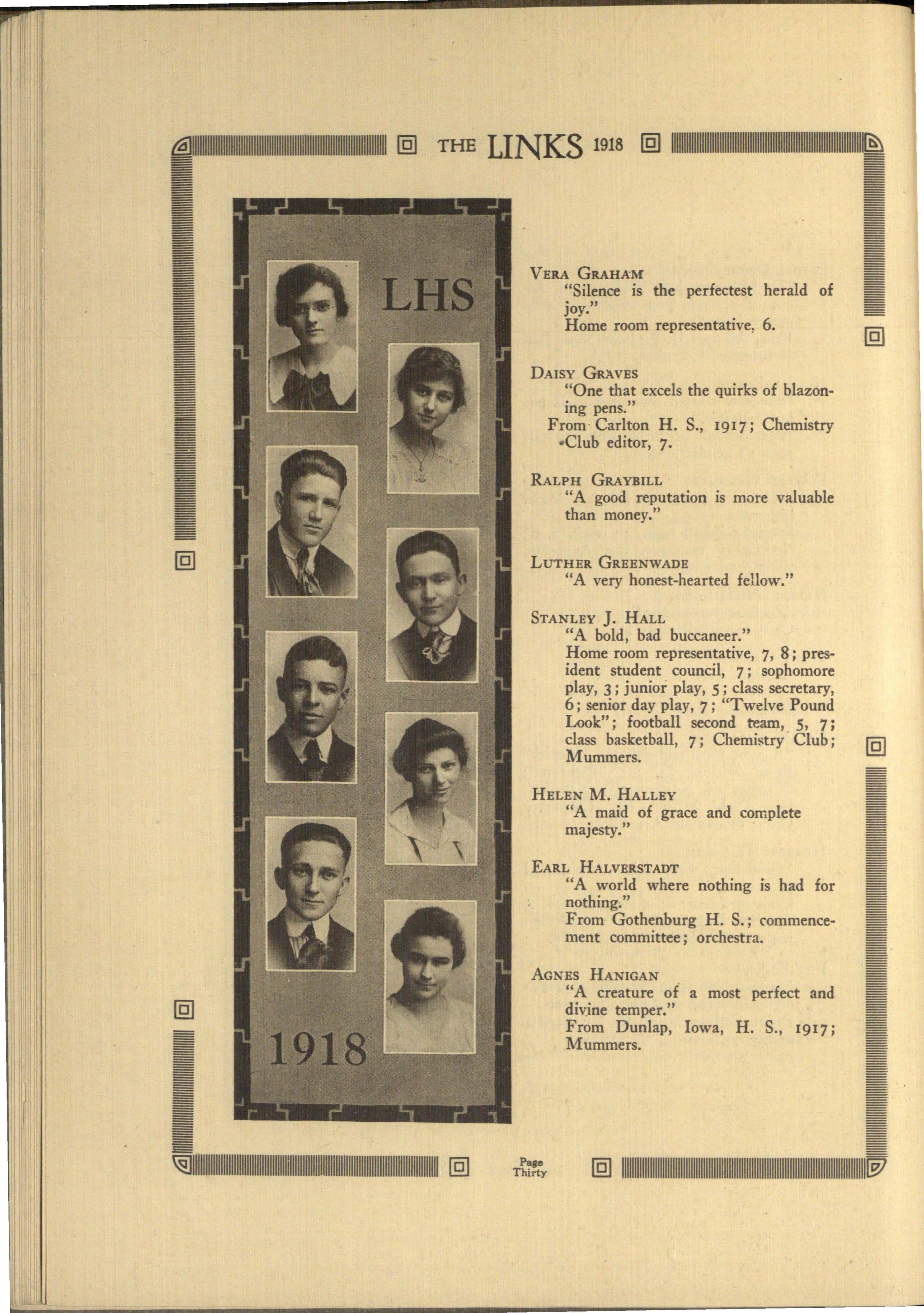
VERA GRAHAM
"Silence is the perfectest herald of joy."
Home room representative, 6.
DAISY GAAVES
"One that excels the quirks of blazon. " mg pens.
From · Carlton H. S., 1917; Chemistry •Club editor, 7.
RALPH GRAYBILL
"A good reputation is more valuable than money."
LUTHER GREENWADE
"A very honest-hearted fellow."
STANLEY J. HALL
"A bold, bad buccaneer."
Home room representative, 7, 8 ; president student council, 7 ; sophomore play, 3; junior play, 5; class secretary, 6; senior day play, 7; "Twelve Pound Look"; football second team, 5, 7;
class basketball, 7 ; Chemistry Club;
Mummers.
HELEN M. HALLEY
"A maid of grace and complete majesty."
EARL HALVERSTADT
"A world where nothing is had for nothing."
From Gothenburg H. S. ; commencement committee; orchestra.
AGNES HANIGAN
"A creature of a most perfect and divine temper."
From Dunlap, Iowa, H. S., 1917; Mummers.
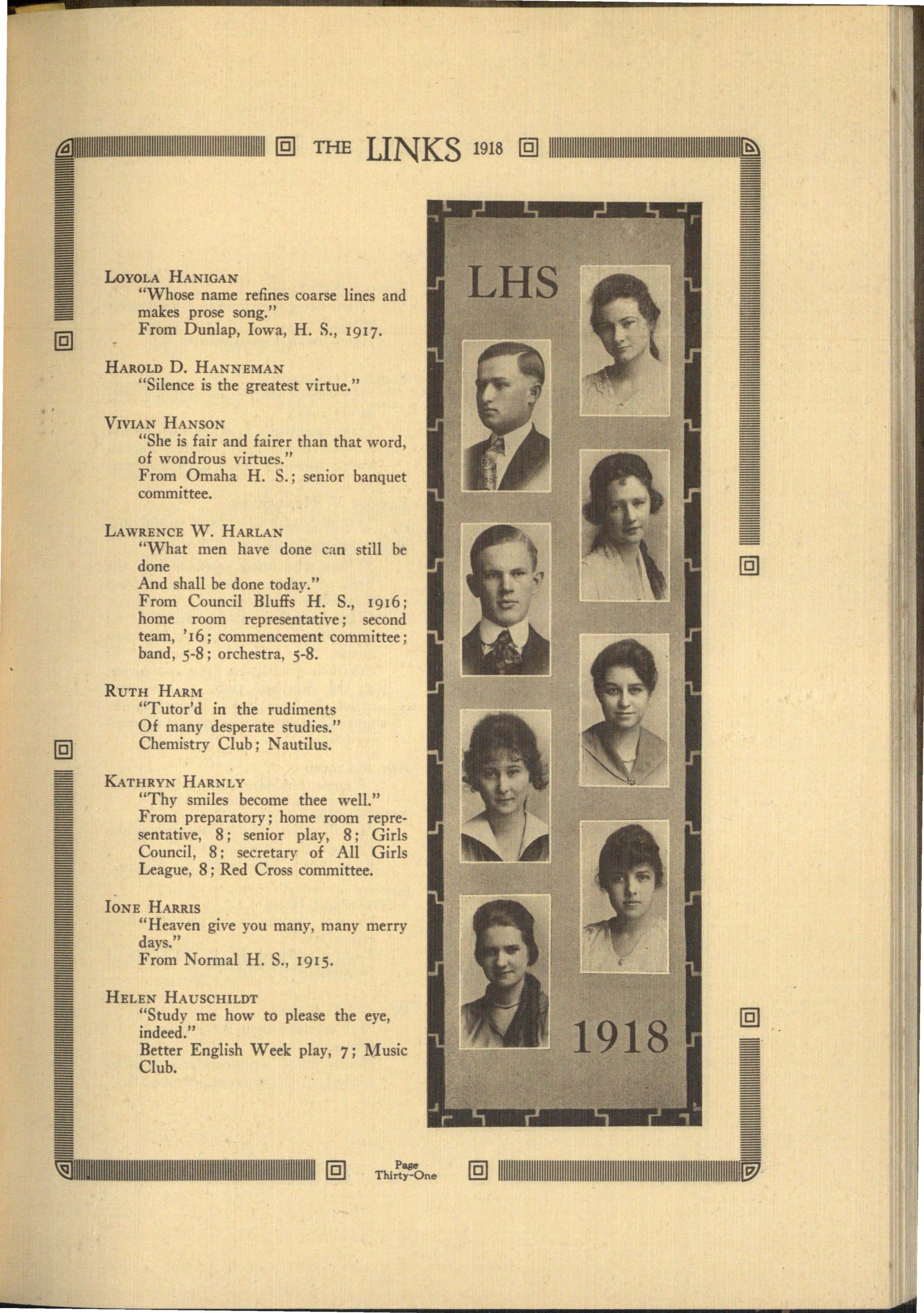
LoYOLA HANIGAN
"Whose name refines coarse lines and makes prose song."
From Dunlap, Iowa, H. S., 1917.
HAROLD D. HANNEMAN
"Silence is the greatest virtue."
VIVIAN HANSON
"She is fair and fairer than that word , of wondrous virtues."
From Omaha H. S.; senior banquet committee.
LAWRENCE w. HARLAN
"What men have done can still be done
And shall be done today."
From Council Bluffs H. S., 1916; home room representative; second team, '16; commencement committee; band, 5-8; orchestra , 5-8.
RUTH HARM
"Tutor' d in the rudiments Of many desperate studies." Chemistry Club; Nautilus.
KATHRYN HARNLY
"Thy smiles become thee well."
From preparatory; home room representative, 8; senior play, 8; Girls Council , 8; secretary of All Girls League , 8; Red Cross committee.
foNE HARRIS
"Heaven give you many, many merry days."
From Normal H. S., 1915.
HELEN HAUSCHILDT
"Study me how to please the eye, indeed."
Better English Week play, 7; Music Club.
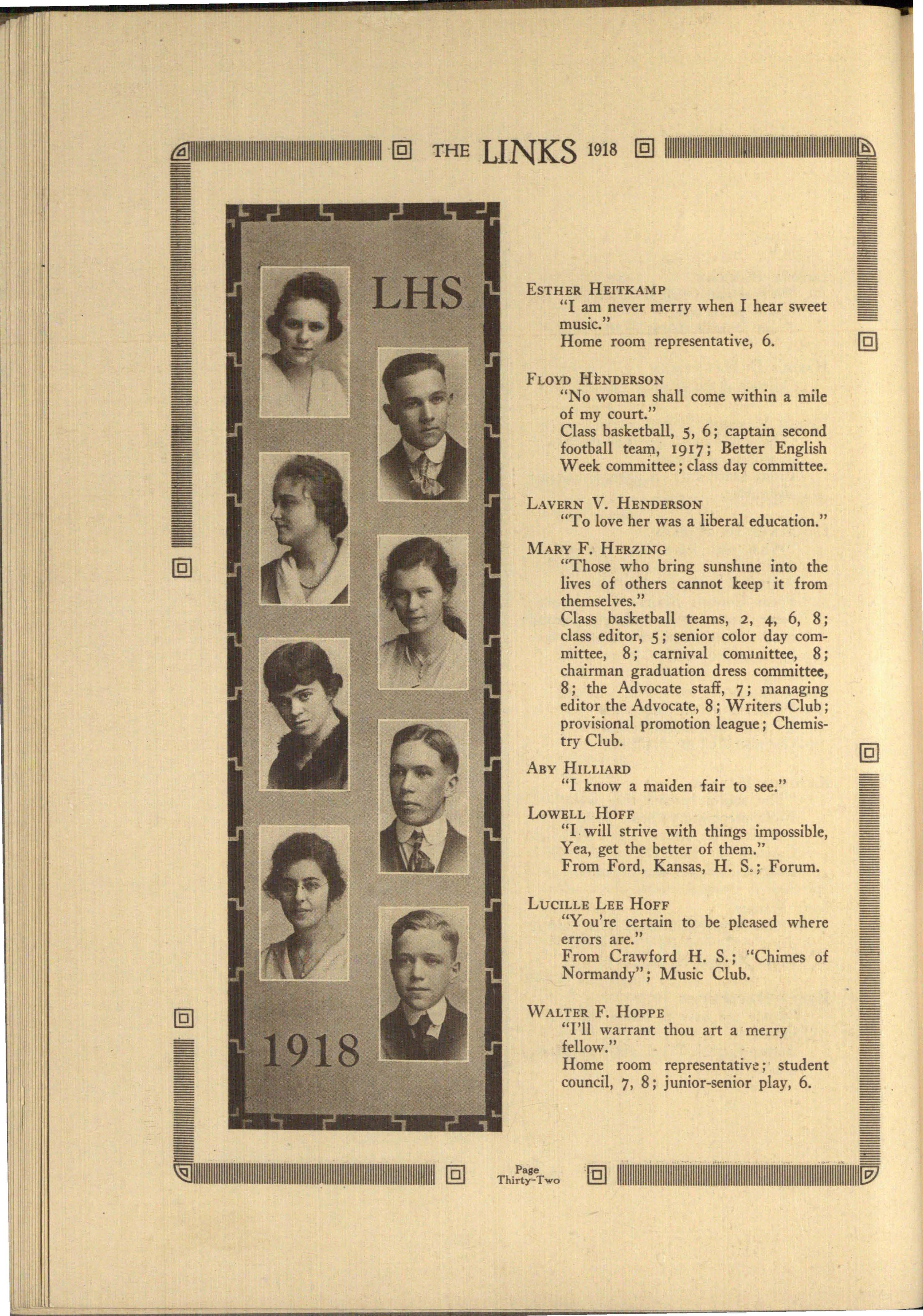
IESTHER HEITKAMP
"I am never merry when I hear sweet music."
Home room representative, 6.
FLOYD HENDERSON
"No woman shall come within a mile of my court."
Class basketball, 5, 6; captain second football team, 1917; Better English Week committee; class day committee.
LAVERN V. HENDERSON
"To love her was a liberal education."
MARY F. HERZING
"Those who bring sunshme into the lives of others cannot keep it from themselves."
Class basketball teams, 2, 4, 6, 8; class editor, 5; senior color day committee, 8; carnival committee, 8; chairman graduation dress committee, 8; the Advocate staff, 7; managing editor the Advocate, 8; Writers Club; provisional promotion league ; Chemistry Club.
IABY HILLIARD
"I know a maiden fair to see."
LowELL HoFF
"I will strive with things impossible, Yea, get the better of them."
From Ford, Kansas, H. S. ; Forum.
LUCILLE LEE HOFF
"You're certain to be pleased where errors are."
From Crawford H. S.; "Chimes of Normandy"; Music Club.
wALTER F. HOPPE
"I'll warrant thou art a merry fellow."
Home room representative; student council, 7, 8; junior-senior play, 6.
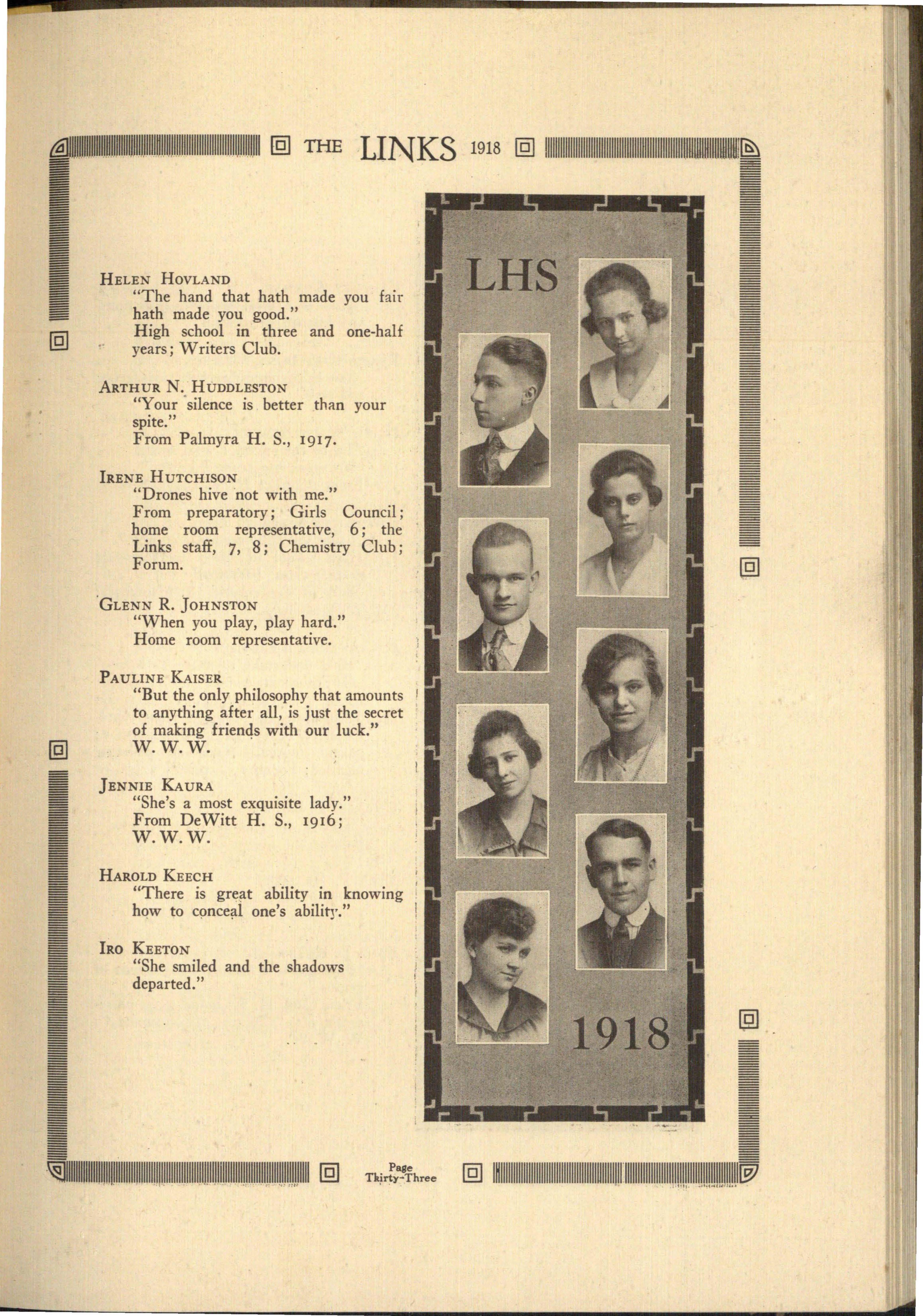
HELEN HOVLAND
"The hand that hath made you fair hath made you good."
High school in three and one-half •• years; Writers Club.
ARTHUR N. HUDDLESTON
"Your ·silence is better than your spite."
From Palmyra H. S., 1917.
IRENE HUTCHISON
"Drones hive not with me."
From preparatory; Girls Council; home room representative, 6 ; the Links staff, 7, 8; Chemistry Club; Forum.
GLENN R. JOHNSTON
"When you play, play hard."
Home room representative.
pA ULINE KAISER
"But the only philosophy that amounts I to anything after all, is just the secret of making frien4s with our luck." [9] w. w. w.
JENNIE KAuRA
"She's a most exquisite lady."
From DeWitt H. S., 1916;
HAR;h;;,~ g,eat ability in lnowing : how to qmce!11 one's abilitr." !
IRO KEETON
"She smiled and the shadows departed."
I•
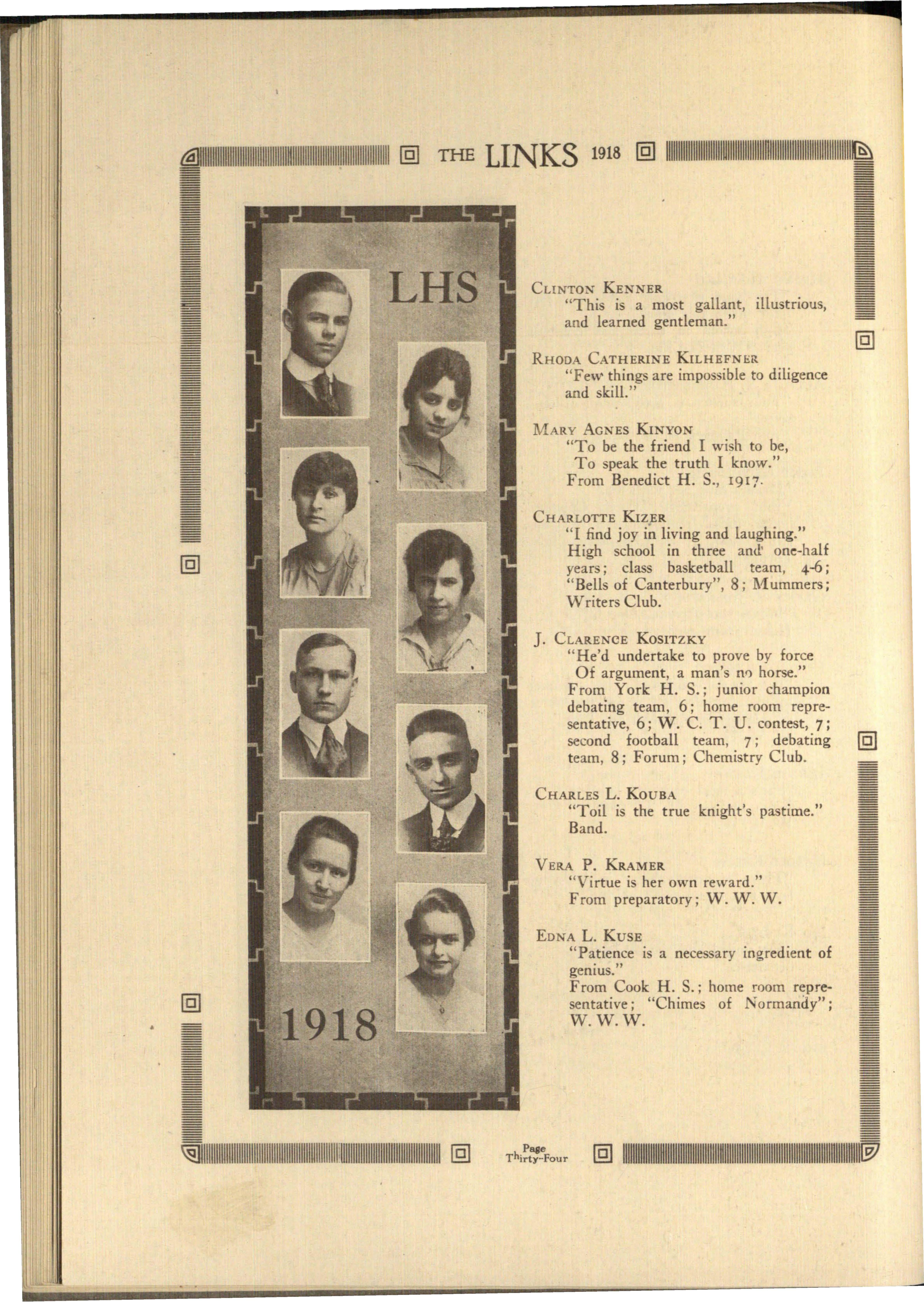
CLINTON" KENNER
"This is a most gallant, illustrious, and learned gentleman."
RHODA CATHERINE KrLHEFNER
"Fe\V things are impos ·ible to diligence and skill."
ARY AGNES Kr YON
"To be the friend I wish to be, To speak the truth I know."
From Benedict H. S., 1917.
CHARLOTTE KIZER
"I find joy in living and laughing."
High school in three and' one-half years; class basketball team, 4-6; "Bells of Canterbury", 8; :Mummers; Writers Club.
J. CLARENCE KosrTZKY
"He'd undertake to prove by force Of argument, a man's n'l horse."
From York H. S.; junior champion debating team, 6; home room representative, 6; W. C. T. U. contest, 7; second football team, 7 ; debating
team, 8; Forum; Chemistry Club.
CHARLES L. KOUBA
"Toil is the true knight's pastime." Band.
VERA P. KRAMER
"Virtue is her own reward."
From preparatory; W.W. W.
EDNA L. KUSE
"Patience is a necessary ingredient of genius."
From Cook H. S.; home room representative; "Chimes of ·o rmandy"; w.w.w.
t@ llllllllllllllllllllllllllllllllllllllllllllllllllllllllmlllllllllllllllll @J
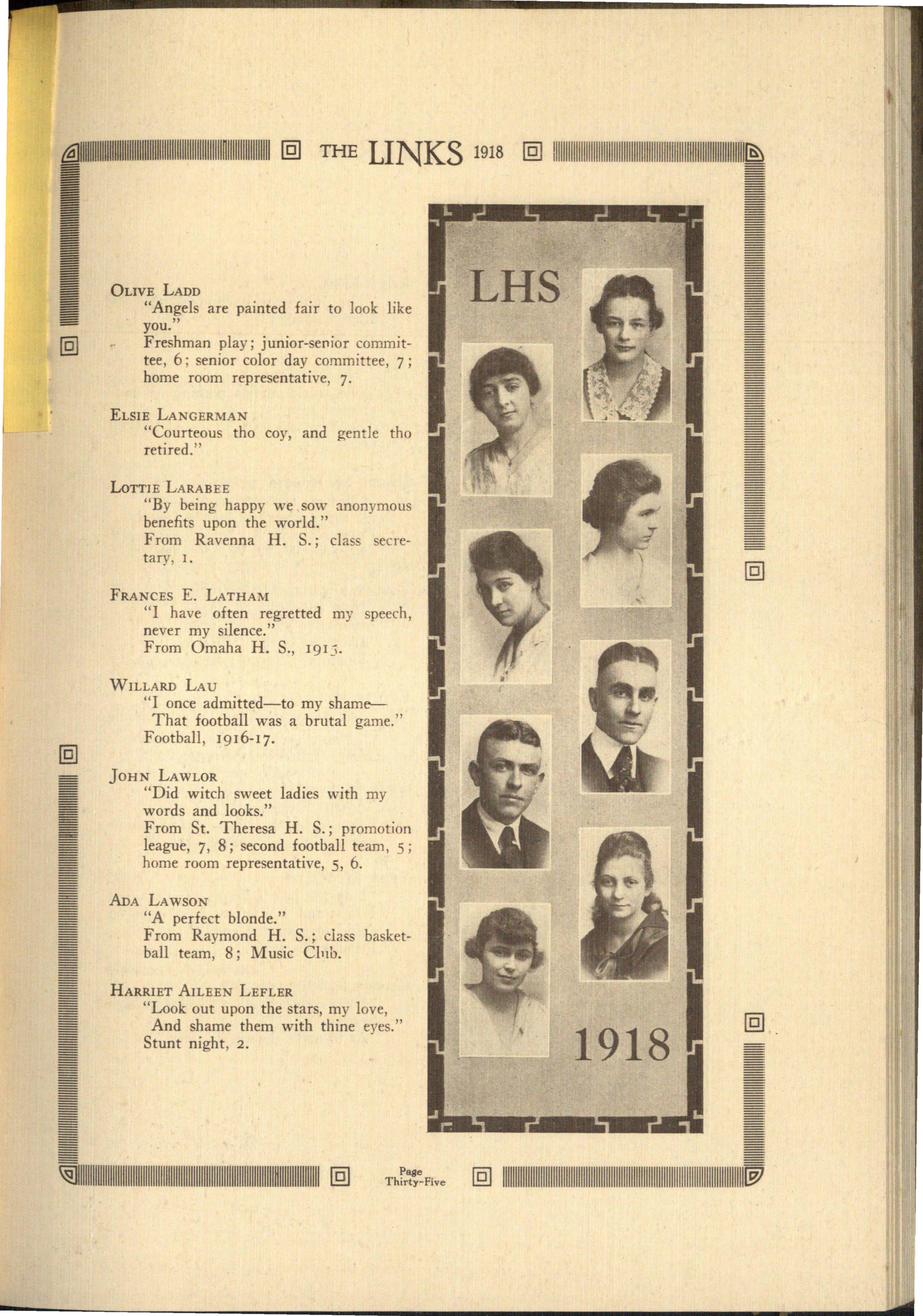
OLIVE LADD
"Angels are painted fair to look like you."
Freshm an play; junior-senior committee, 6; senior color day committee, 7 ; home room representative, 7.
ELSJE LANGERMAN
"Courteous tho coy, and gen le tho retired."
LoTTIE LARABEE
"By being happy we sow anonymous benefits upon the world."
From Ravenna H. S.; class secretary , 1.
FRANCES E. LATHAM
"I have often regretted my speech, never my silence."
From Omaha H. S., 191.3.
WILLARD LAU
"I once admitted-to my shame-That football was a brutal game." Football, 1916-17.
]OHN LAWLOR
"Did witch sweet ladies with my words and looks."
From St. Theresa H. S.; promotion league, 7, 8; second football team, 5; home room representative, 5, 6.
ADA LAWSON
"A perfect blonde."
From Raymond H. S.; class basketball team, 8; Music Cli1b.
HARRIET AILEEN LEFLER
"Look out upon the stars, my love, And shame them with thine eyes."
Stunt night, 2.
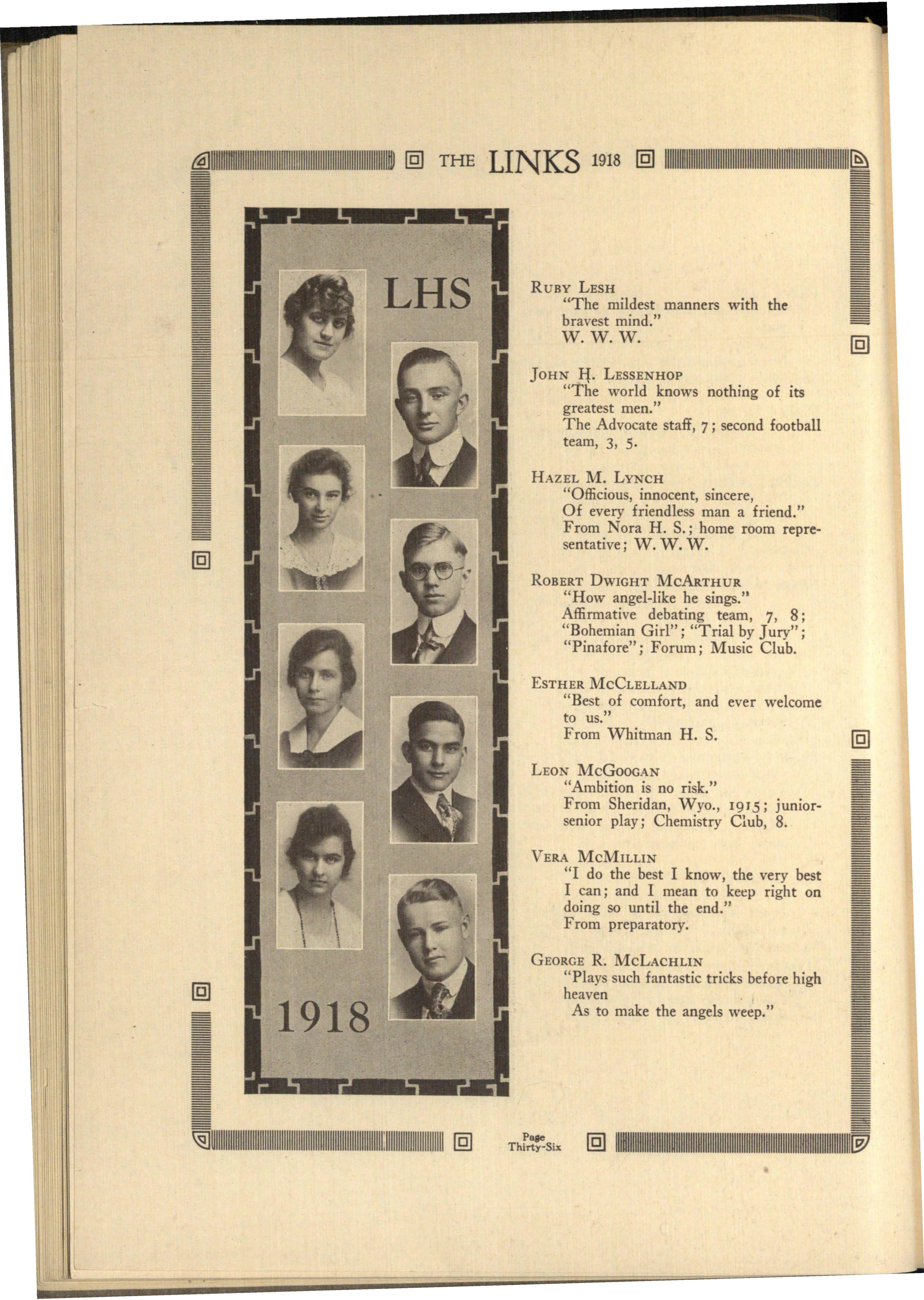
RUBY LESH
"The mildest manners with the bravest mind." w.w.w.
}OH }f. LESSENHOP
"The world knows nothing of its greatest men."
The Advocate staff, 7; second football team, 3, 5.
HAZEL M. LY CH
"Officious, innocent, sincere, Of every friendless man a friend."
From Nora H. S.; home room representative; W. W. W.
ROBERT DWIGHT McARTHUR
"How angel-like he sings."
Affirmative debating team, 7, 8; "Bohemian Girl"; "Trial by Jury"; "Pinafore"; Forum; Music Club.
ESTHER McCLELLAND
"Best of comfort, and ever welcome to us."
From Whitman H. S. @]
LEON McGoocAN
"Ambition is no risk."
From Sheridan, Wyo., 1915; juniorsenior play; Chemistry Club, 8.
VERA McMILLIN
"I do the best I know, the very best I can; and I mean to keep right on doing so until the end."
From preparatory.
GEORGE R. McLACHLIN
"Plays such fantastic tricks before high heaven
As to make the angels weep."
-
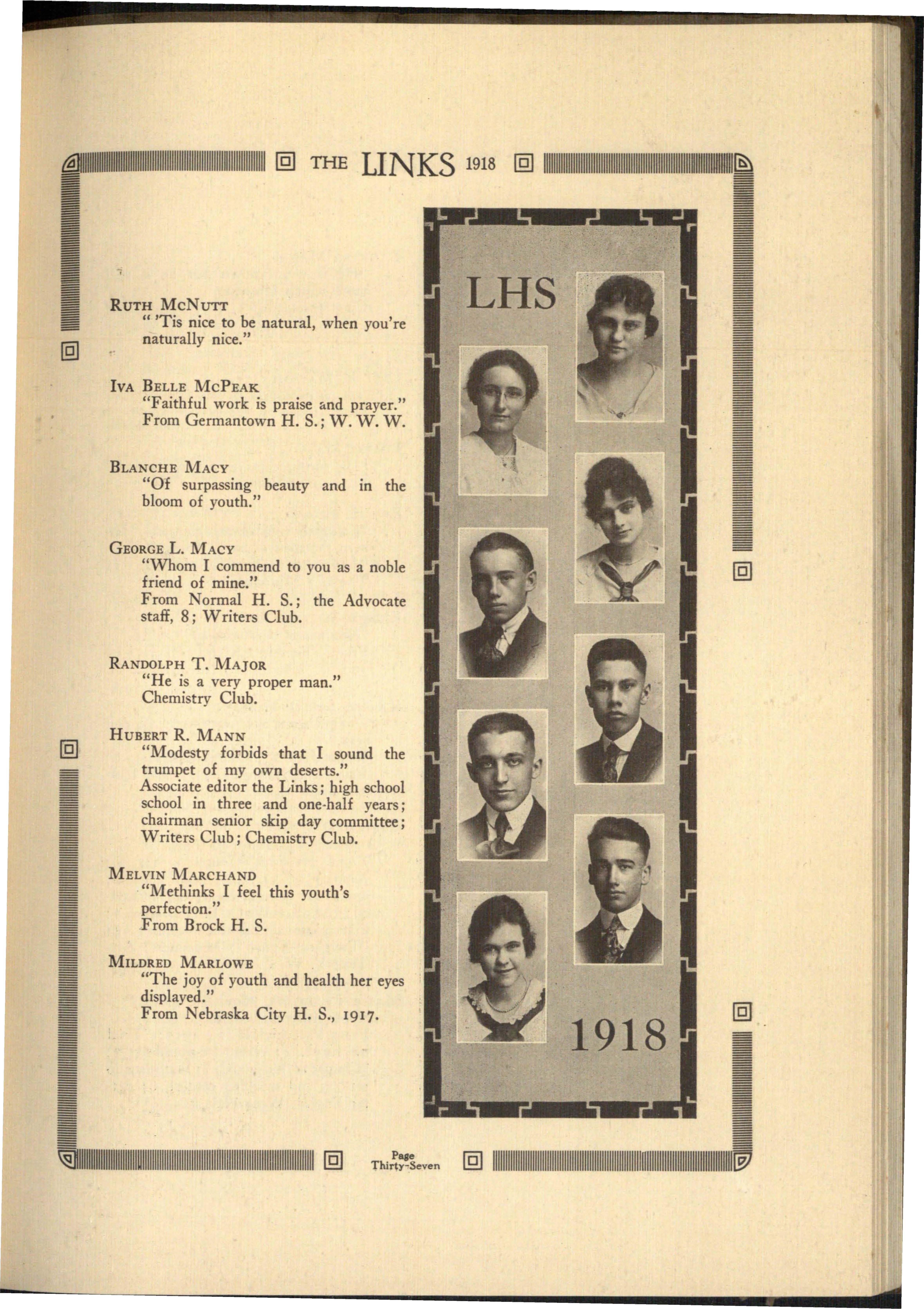
R uTH Mc UTT
" 'Tis nice to be natural, when you're naturally nice."
lvA BELLE McPEAK
"Faithful work is prai
From Germantown H.
B LANCHE MACY
"Of surpassing b bloom of youth."
GEORGE L. MACY
"Whom I commend to you as a nobl friend of mine."
From ormal H. S.; the Advoca staff, 8; Writers Club.
RANDOLPH T. MAJOR
"He is a very proper man." Chemistry Club.
HUBERT R. MANN
"Modesty forbids that I sound the trumpet of my own deserts."
Associate editor the Links; high school school in three and one -half years; chairman senior skip day committee; Writers Club; Chemistry Club.
MELVIN MARCHAND
"Methinks I feel this youth's perfection."
From Brock H. S.
MILDRED MARLOWE
"The joy of youth and health her eyes displayed."
From ebraska City H. S., 1917.
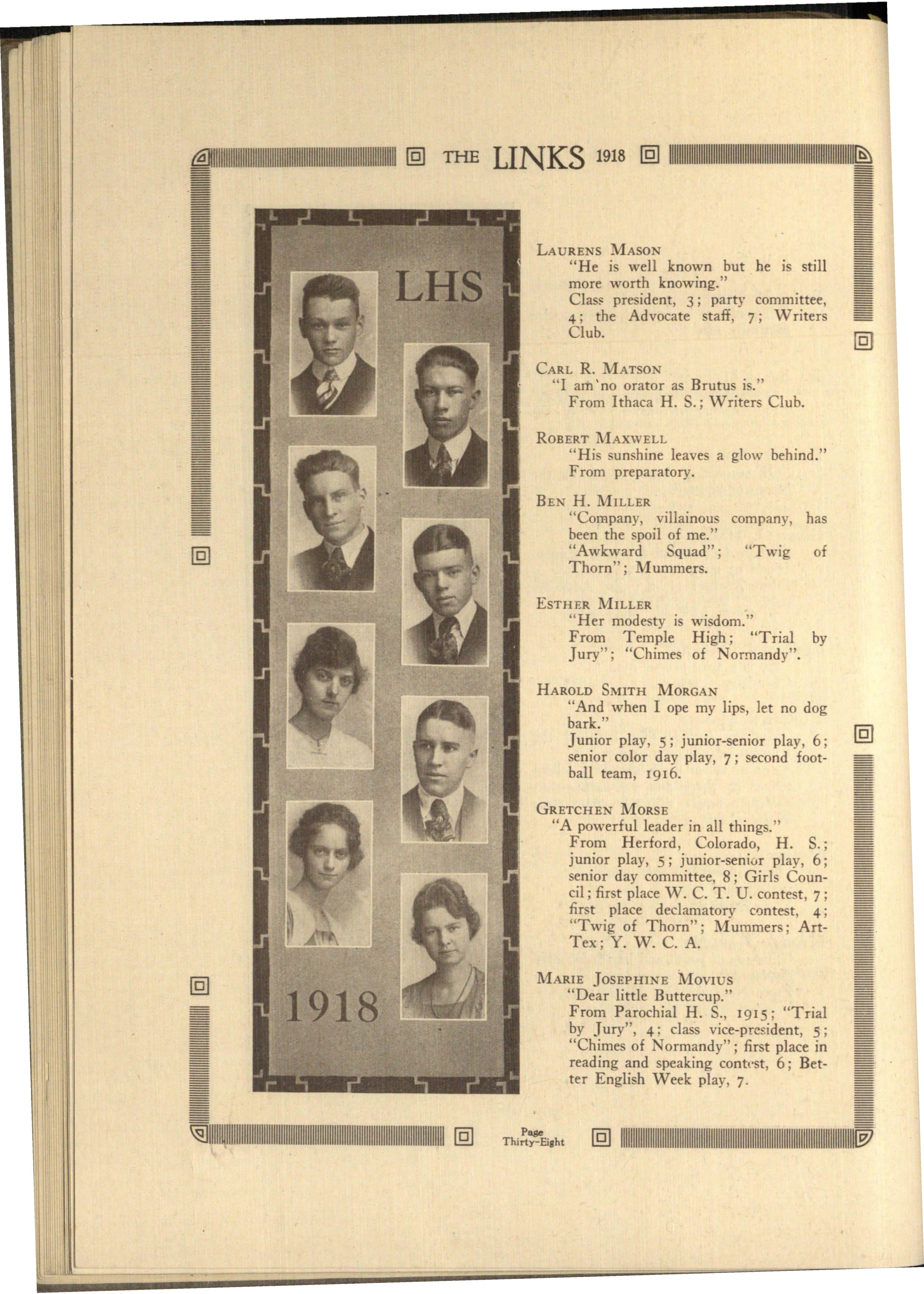
LAU R ENS MASON
"He is well known but he is still more worth knowing."
Clas~ pre ident, 3; party committee, 4; the Advocate staff, 7; Writers Club.
CARL R. MATSO
"I am 'no orator as Brutu i ."
From Ithaca H . . ; Writers Club.
ROBERT MAXWELL
"Hi unshine leave a glow behind." From preparatory.
BEN H. MILLER
"Company, villainou , company, has been the spoil of me."
"Awkward quad"; "Twig of Thorn"; Mummers.
ESTHER MILLER
"Her modesty i wisdom."
From Temple High; "Trial by Jury"; "Chimes of ormandy".
HA ROLD SMITH MORGAN
"And when I ope my lip , let no dog bark."
Junior play, 5; junior-senior play, 6; senior color day play, 7 ; second football team, I g I 6.
GRETCHEN MORSE
"A powerful leader in all thing ."
From Herford, Colorado, H. S.; junior play, 5; junior-seniur play, 6; senior day committee, 8; Girls Council; first place W. C. T. U. conte t, 7; fir t place declamatory contest, 4; "Twig of Thorn"; Mummer ; ArtTex; Y. W. C. A.
MARIE JosEPHI E Movrns
"Dear little Buttercup."
From Parochial H . S., 1915; "Trial by Jury", 4 : class vice-president, 5 ; "Chimes of ormandy"; fir t place in reading and speaking contt-st, 6; B etter English Week play, 7.
@lllllllllmlllmlllllllllllllllllllllllllllllllllllllllllllllllllllllllllll [Q]
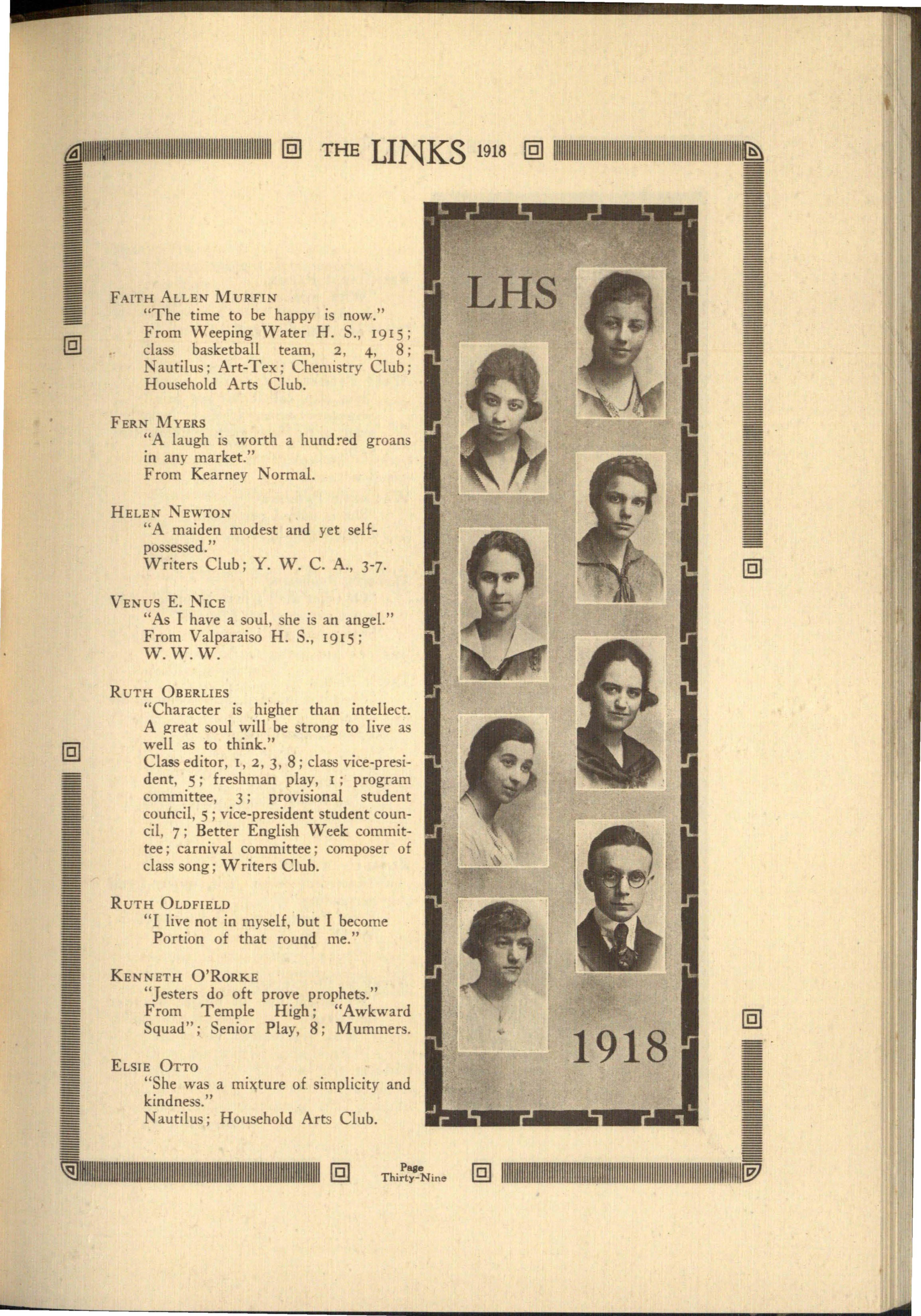
FAITH ALLEN MURFIN
"T he time to be happy is now."
From Weeping Wate r H. S., 1915; class basketball team, 2, 4, 8 ; Nautilus; A r t-Tex; Chemistry Club; Household Arts Club.
FERN MYERS
"A laugh is worth a hund:-ed groans in any market."
From Kearney Normal.
HELEN NEWTON
"A maiden mo d es t an d yet selfpossessed."
Writers Club; Y. W. C. A., 3-7.
V ENUS E. NrcE
"As I have a soul, she is an angel."
From Valparaiso H. S., 1915; w.w.w.
R UTH O BERLIES
"Characte r is higher tha n intellect. A great soul will be stro ng t o live as well as to t hink."
Class ed itor, I, 2, 3, 8; class vice-presid ent, 5; freshman play, I ; program committee, 3 ; provisional stu dent council, 5 ; vice-presi d ent st udent council, 7 ; Be t ter English Wee k committ ee; carnival committe e ; composer of
class song; Write rs Clu b
R uT~\ n myself, but I become
IFrom Temple High; "Awkward Squad"; Senior P lay, 8; Mummers.
E LSIE OTTO
"She was a mixture of simplicity and k ind ness."
Nautilus; Household Arts Club.
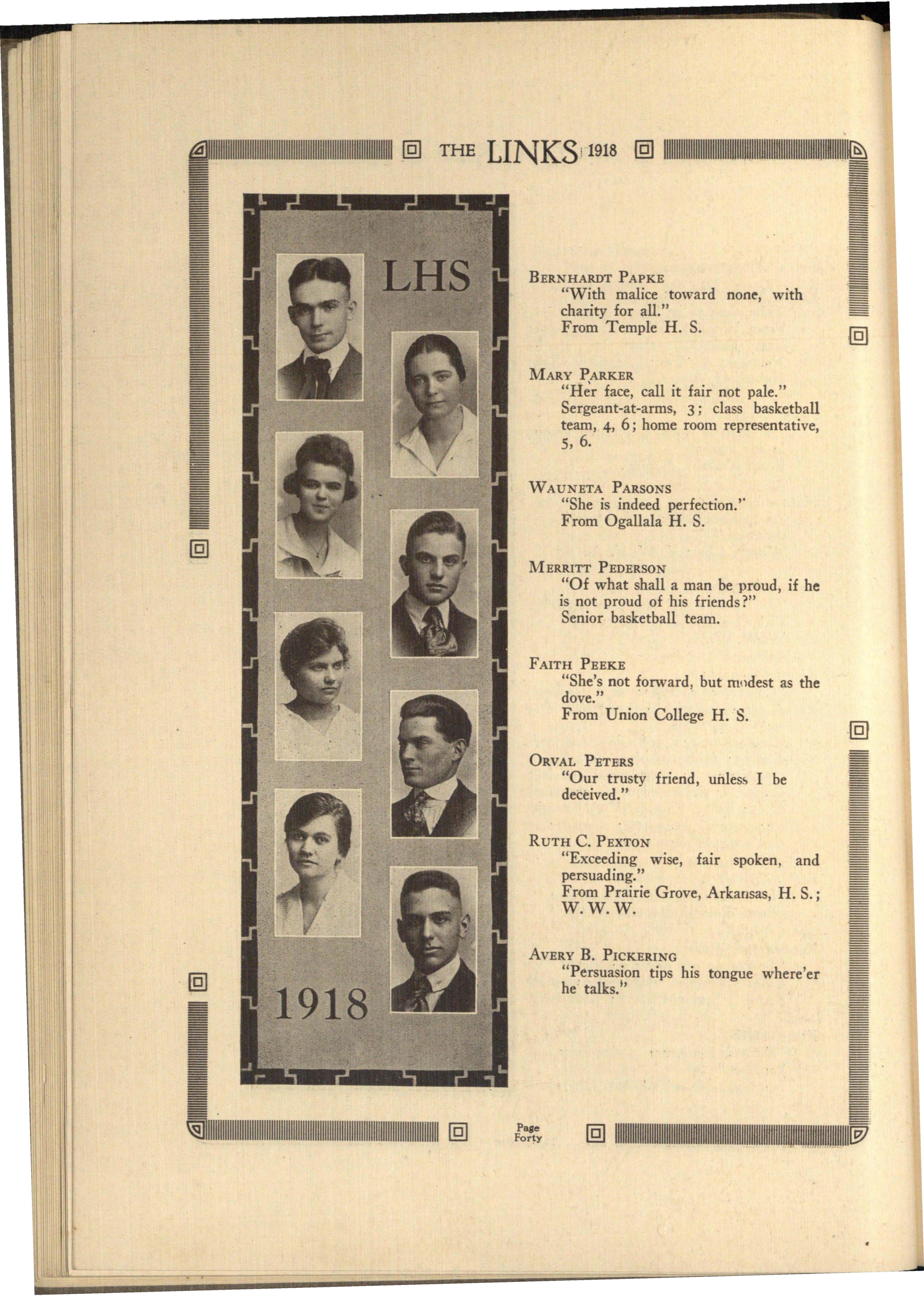
BERNHARDT PAPKE
"With malice toward none, with charity for all."
From Temple H. S.
MARY PARKER
"H~r face, call it fair not pale." Sergeant-at-arms, 3; class basketball team, 4, 6; home room representative, 5, 6.
WAUNETA PARSONS
"She is indeed perfection.•·
From Ogallala H. S.
MERRITT PEDERSON
"Of what shall a man be proud, if he is not proud of his friends?"
Senior basketball team.
FAITH PEEKE
"She's not forward, but modest as the dove." •
From Union College H. S.
ORVAL PETERS
"Our trusty friend, unles1, I be deceived."
RUTH C. PEXTON
"Exceeding wise, fair spoken, and persuading."
From Prairie Grove, Arkansas, H. S.; w.w.w.
AVERY B. PICKERING Page Forty
"Persuasion tips his tongue where'er he talks!'
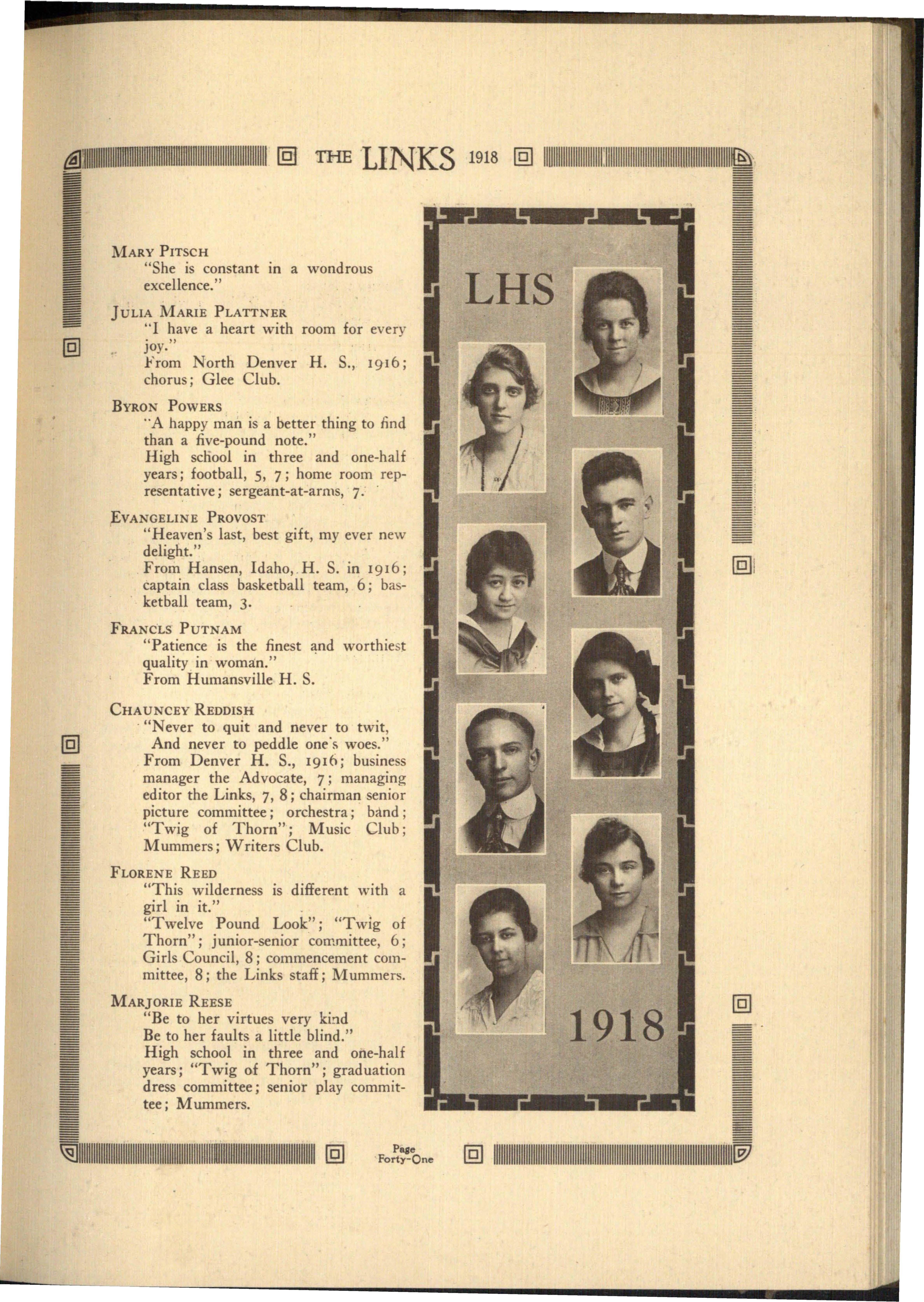
IMARY PITSCH
"She is constant in a wondrous
excellence.''
JULIA iARIE PLATT ER
''I have a heart with room for every joy."
.From orth Denver H. S., 1916; chorus; Glee Club.
BYRON POWERS
.. A happy man is a better thing to find than a five-pound note."
High school in three and one-half years; football, 5, 7 ; home room representative; sergeant-at-arms, 7. •
EVANGELINE PROVOST
"Heaven's last, best gift, my ever new delight."
From Hansen, Idaho, H. S. in 1916; captain class basketball team, 6; ba~ketball team, 3.
FRANCLS PUTNAM
"Patience is the finest and worthie st quality in woman."
•
From Humansville H. S.
CHAUNCEY REDDISH
· " ever to quit and never to twit, And never to peddle one·~ woes."
From Denver H. S., 1916; busine s manager the Advocate, 7; managing editor the Links, 7, 8; chairman senior picture committee; orchestra; band ; "Twig of Thorn"; Music Club; Mummers; Writers Club.
FLORENE REED
"This wilderness is different with a girl in it."
"Twelve Pound Look"; "Twig of Thorn"; junior-senior committee, 6; Girls Council, 8; commencement committee, 8; the Links staff; Mummers.
MARJORIE REESE
"Be to her virtues very ki!1d Be to her faults a little blind."
High school in three and one-half years; "Twig of Thorn"; graduation dress committee; senior play committee ; M urn me rs.
LORENZ RESS
"A fool may t alk, but a wise man speaks."
ESTHER REYNOLDS
"Soft peace she brings."
' LAURA RICHARD
"To keep my health! To do mv work! To live!';
HAROLD L. RICHARDS
"He ha uncommon sen e. 11
Clas · president, 7; High "Y 11 Club president, 7, 8; home room representative , 5, 6; student councii, 6; class editor; the Advocate staff, 6; junior play, ~; Better English Week play, 7; senior color day play, 7; football, 5; Chemi try Club, 5 , 6, 7; Glee Club; Mummers.
WILLIAM M. RICHARDSON
"I never knew so young a body with so old a head "
Cla president, 6; clas secretary, 5; home room representative, 5 ; student council, 6; busines manager of junior play; Mummers; Chemistry Club.
MAR!ON RISSER
"Even her frowns are fair."
Clas treasurer , 3; freshm..m play , I ; junior-senior committee; carnival committee, 8; tudent council, 7 , 8 ; senior cla s day committee; home room representa ti ve; Mummer .
GLEN RosHoN
"I courted fame but as a spur to brave and hone t deeds."
Senior color day play, i; juniorsenior play, 6; enior color day committee, 7; class ba ketball team , 5; "Twig of Thorn"; Mummers; Senior play.
PAUL DALE ROWEN
"A man of few words."
Freshman play; sophomore play; track team, 1912-1914; captain tr ack team, 1914.
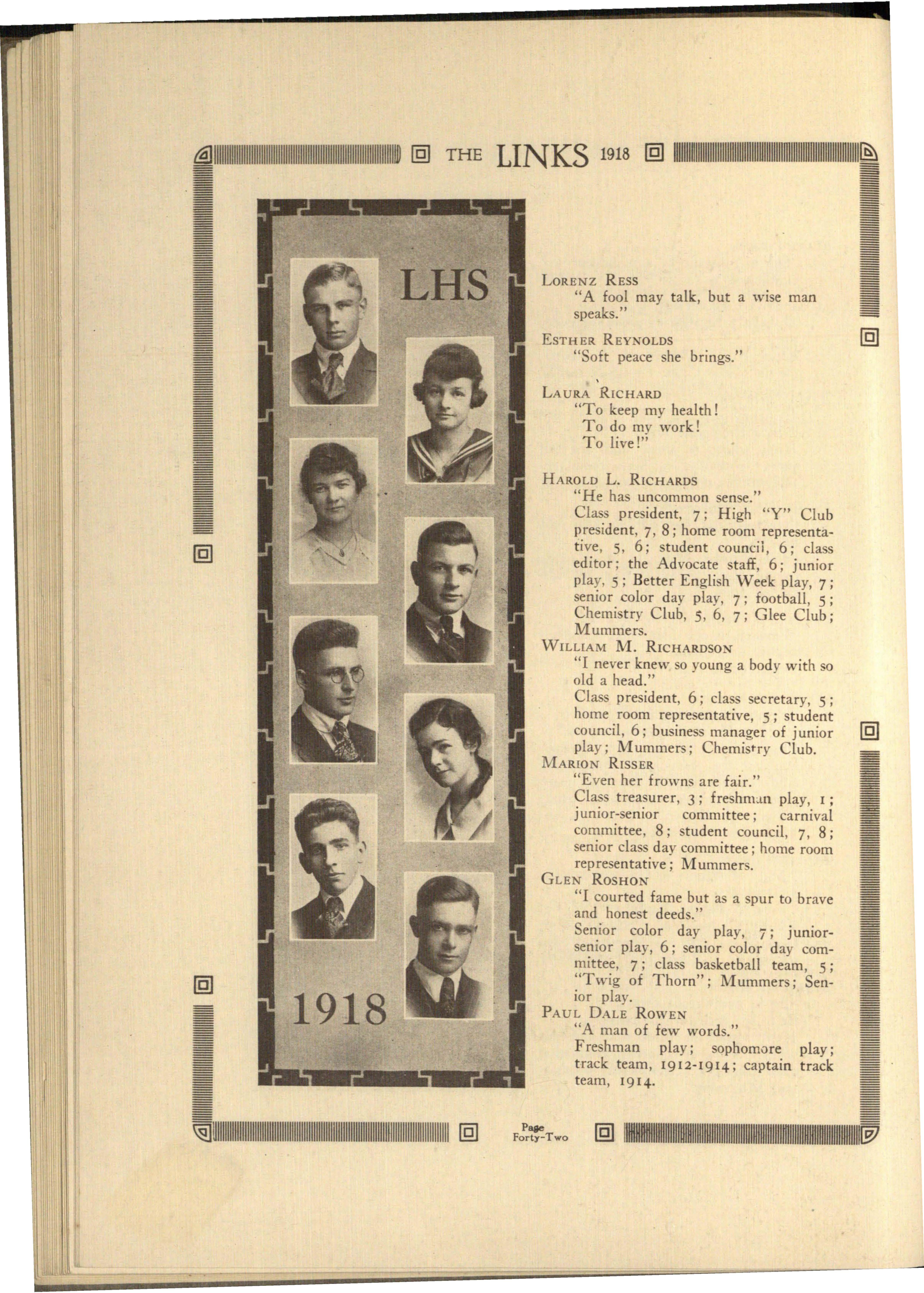
Pa,e Forty-Two
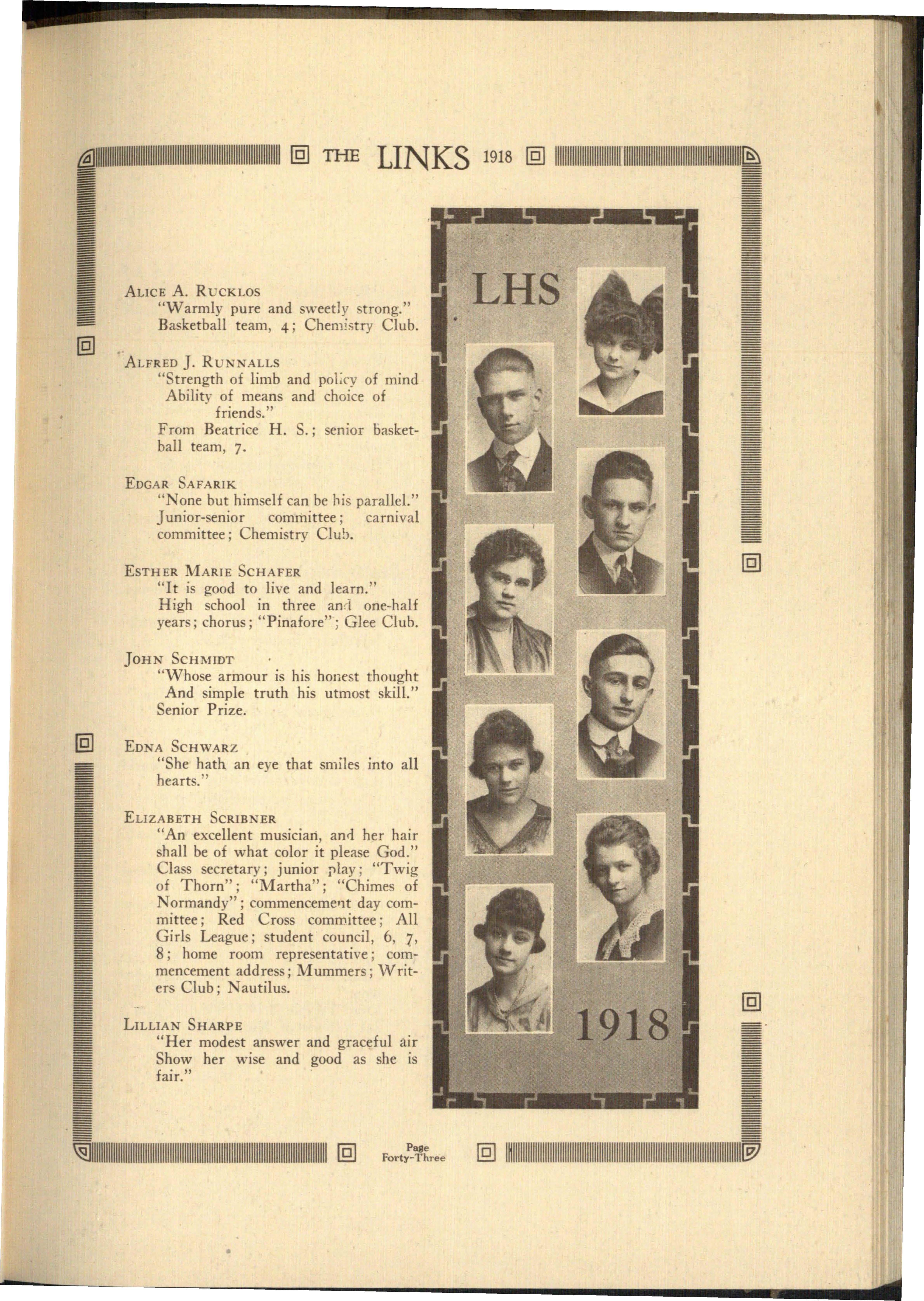
AucE A. RucKLOS
"Warmly pure and weetly trong." Basketball team, 4; Chem i~ try Club.
ALFRED J. Ru • ALLS
" trength of limb and pol: cy of mind Ability of means and choice of friends."
From Beatrice H . S.; enior basketball team , 7.
EDGAR AFARIK
" one but him elf can be his parallel." Junior-senior committee; carnival committee; Chemistry Club.
ESTHER MARIE CHAFER
"It is good to live and learn." High school in three an .i one-half years; chorus; "Pinafore"; Glee Club.
JOHN SCHMIDT
"Whose armour is his honest thought And simple truth his utmost skill." Senior Prize.
EDNA SCHWARZ
"She hath an eye that smiles into all hearts."
ELIZABETH SCRIBNER
"An excellent musician, an<l her hair shall be of what color it please God." Class secretary; junior play ; "Twig of Thorn "; "Martha"; "Chimes of ormandy"; commenceme•1t day committee; Red Cross comJT1ittee; All Girls League; student council, 6, 7, 8; home room representative; commencement address; Mummers ; Writers Club; autilus.
LILLIAN SHARPE
"Her modest answer and graceful air Show her wise and good as she is fai
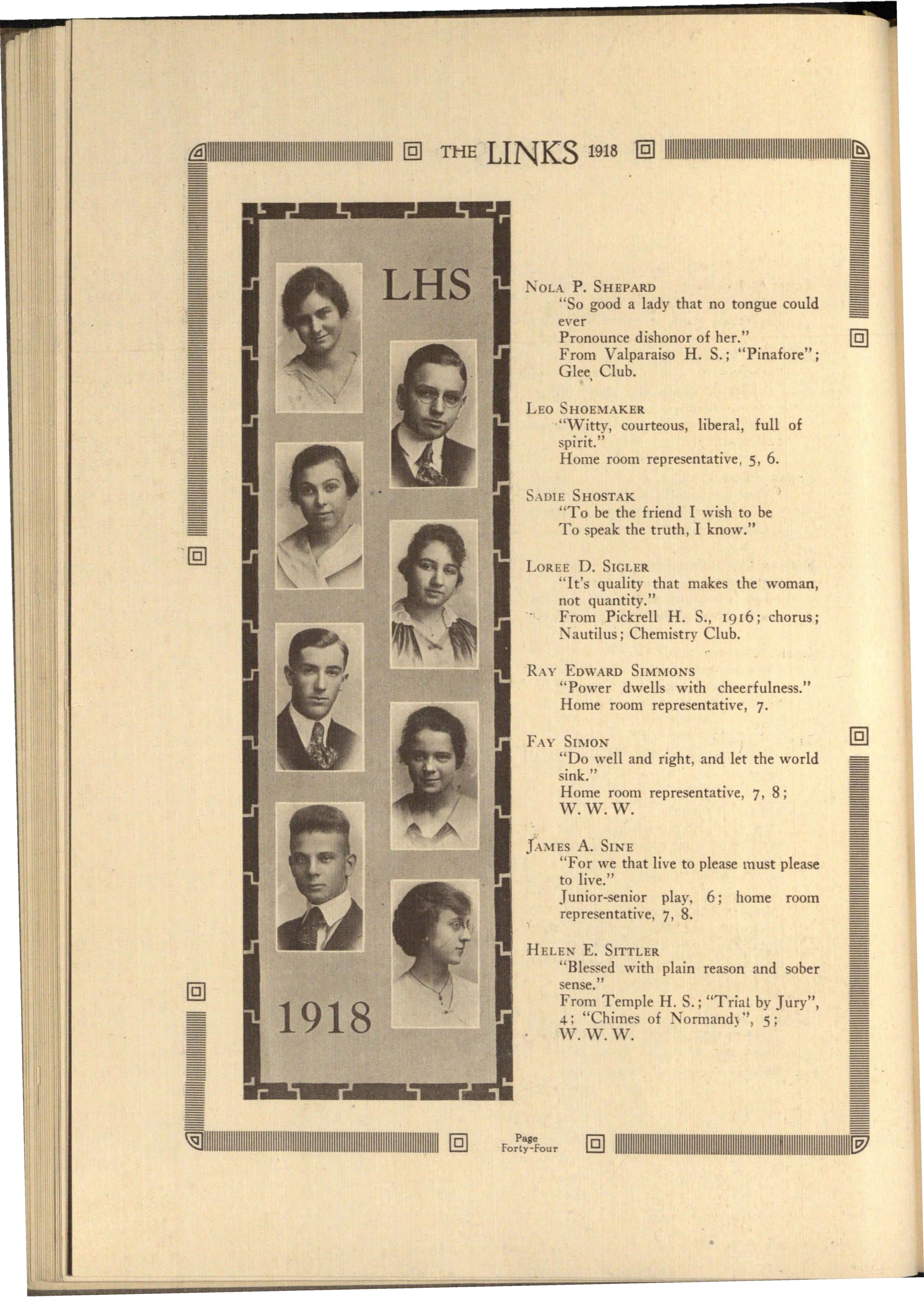
• OLA P. SHEPARD
"So good a lady that no tongue could ever Pronounce dishonor of her."
From Valparaiso H. S.; "Pinafore"; Glee, Club.
LEO HOEMAKER
"Witty, courteous, liberal, full of spirit."
Home room representative , 5, 6.
S .-\DIE SHOSTAK
"To be the friend I wish to be To speak the truth, I know."
LOREE D. SIGLER
"It' quality that makes the woman, not quantity."
From Pickrell H. S., 1916; chorus; • T autilus; Chemistry Club.
RAY EowARD SrMl\ro T s "Power dwells with cheerfulness."
Home room representative, 7.
FAY SIMON
"Do well and right, and let the world sink."
Home room representative, 7, 8; w.w.w .
.(.\MES A. SINE
"For we that live to please must please to live."
Junior-senior play, 6; home room representative, 7, 8.
HELEN E SrTTLER
"Blessed with plain reason and sober sense."
From Temple H. S.; "Triat by Jury", 4; "Chimes of Tormand) '' , 5; w.w.w.
Page Forty-Four
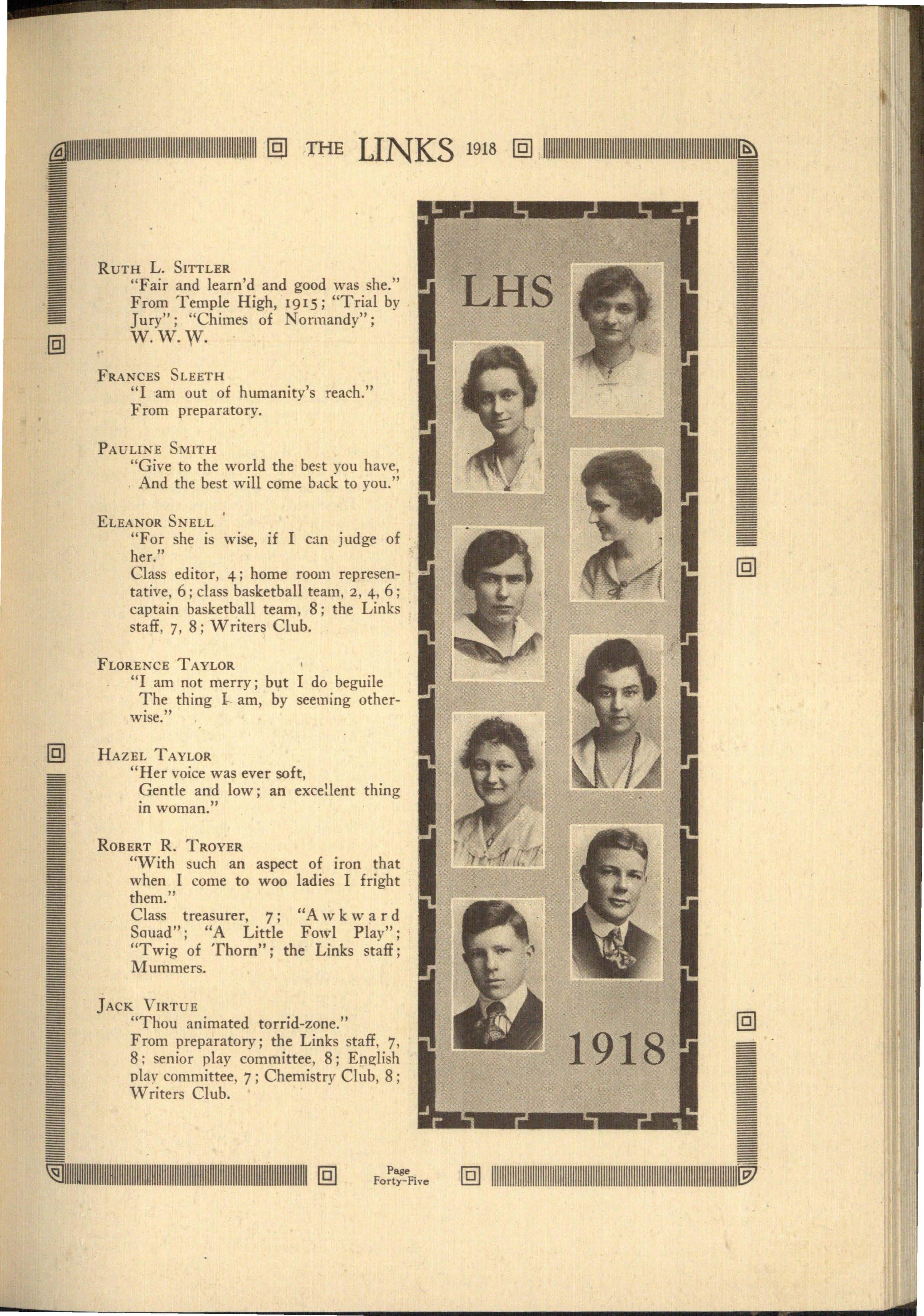
RUTH L. SITTLER
"Fair and learn'd and good was she."
From Temple High, 1915; "Trial by Jury"; "Chimes of N orrnandy"; w.w.w.
FRANCES SLEETH
"I am out of humanity's reach." From preparatory.
PAULINE SMITH
"Give to the world the be st you have , And the best will come b,tck to you."
ELEANOR SNELL •
"For she is wise, if I can judge of her."
IClass editor, 4; home room represen- • tative, 6; class basketball team, 2, 4, 6; captain basketball team, 8; the Links • staff, 7 , 8; Writers Club.
FLORENCE TAYLOR
"I am not merry; but I do beguile The thing I- am, by seeming otherwise."
HAZEL TAYLOR
"Her voice was ever soft, Gentle and low; an excellent thing " m woman.
ROBERT R. TROYER
"With such an aspect of iron that when I come to woo ladies I fright them."
Class treasurer, 7; "Awkward Sauad"; "A Little Fowl Play"; "Twig of Thorn"; the Links staff; Mummers.
]ACK VIRTUE
"Thou animated torrid-zone."
From preparatory; the Links staff, 7, 8 : senior play committee , 8; English olay committee , 7; Chemistry Club , 8; Writers Club.
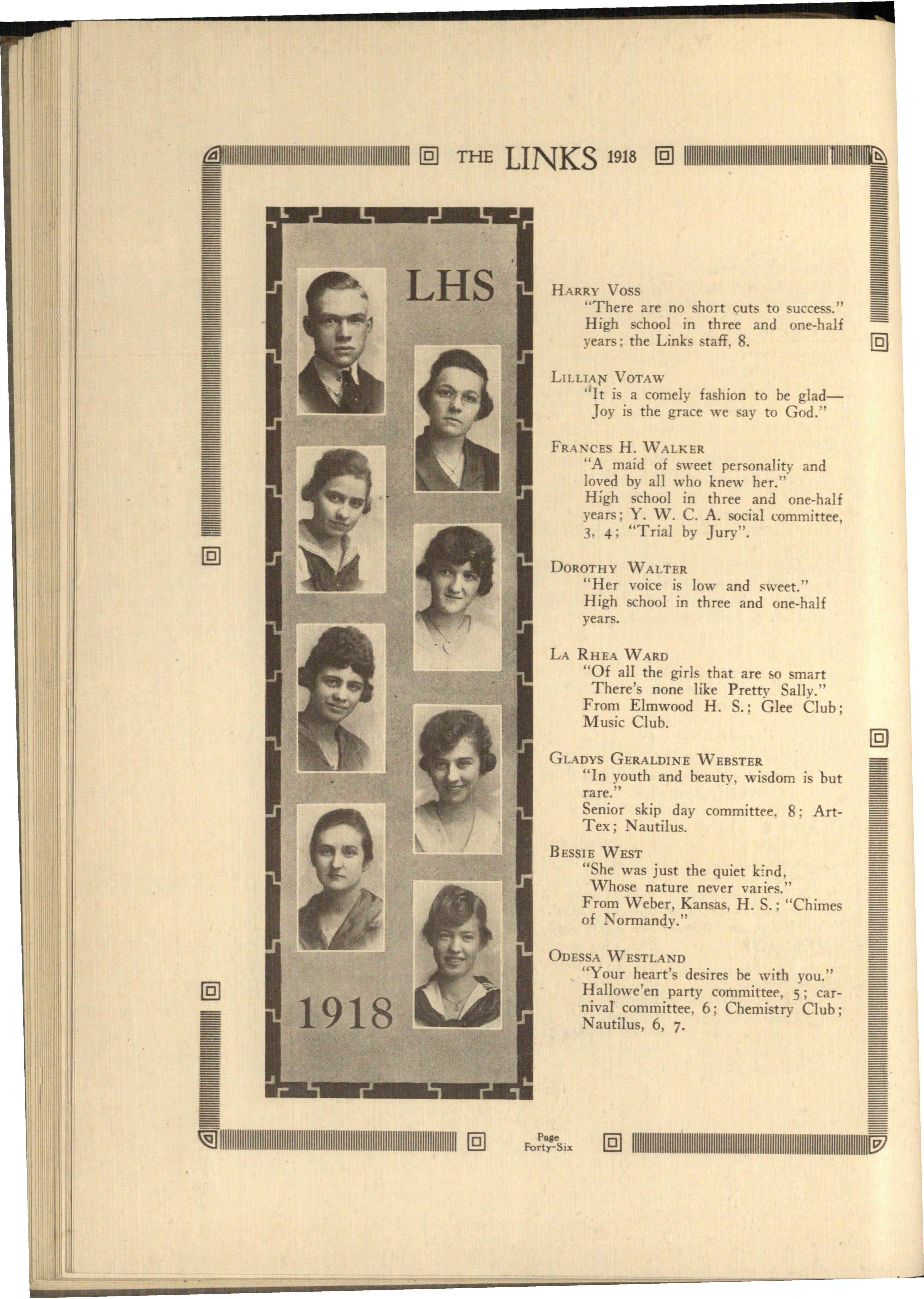
HARRY Voss
"There are no short cuts to ucce s."
High school in three and one-half year ; the Link taff, 8.
LILLIA/" VOTAW
''It is a comely fa hion to be gladJoy i the grace we ay to God."
FRA CES H. WALKER
"A maid of sweet per onality and loved by all who knew her."
High chool in three and one-half years; Y. W. C. A. social <.:ommittee, 3, 4; "Trial by Jury".
DOROTHY WALTER
"Her voice is low and ~weet."
High chool in three and one-half years.
LA RHEA w ARD
"Of all the girl that are !>O smart There's none like Pretty ally."
From Elmwood H. S.; Glee Club; Music Club.
GLADYS GERALDINE WEBSTER
"In youth and beauty, wisdom is but rare."
Senior skip day committ<'e, 8; ArtTex; autilus.
BESSIE WEST
"She was ju t the quiet kind, Whose nature never varies."
From Weber, Kansas, H. ; "Chimes of ormandy."
ODESSA WESTLAND
"Your heart' de ires be with you."
Hallowe'en party committee, 5; carnival committee, 6; Chemi try Club; autilus, 6, 7.
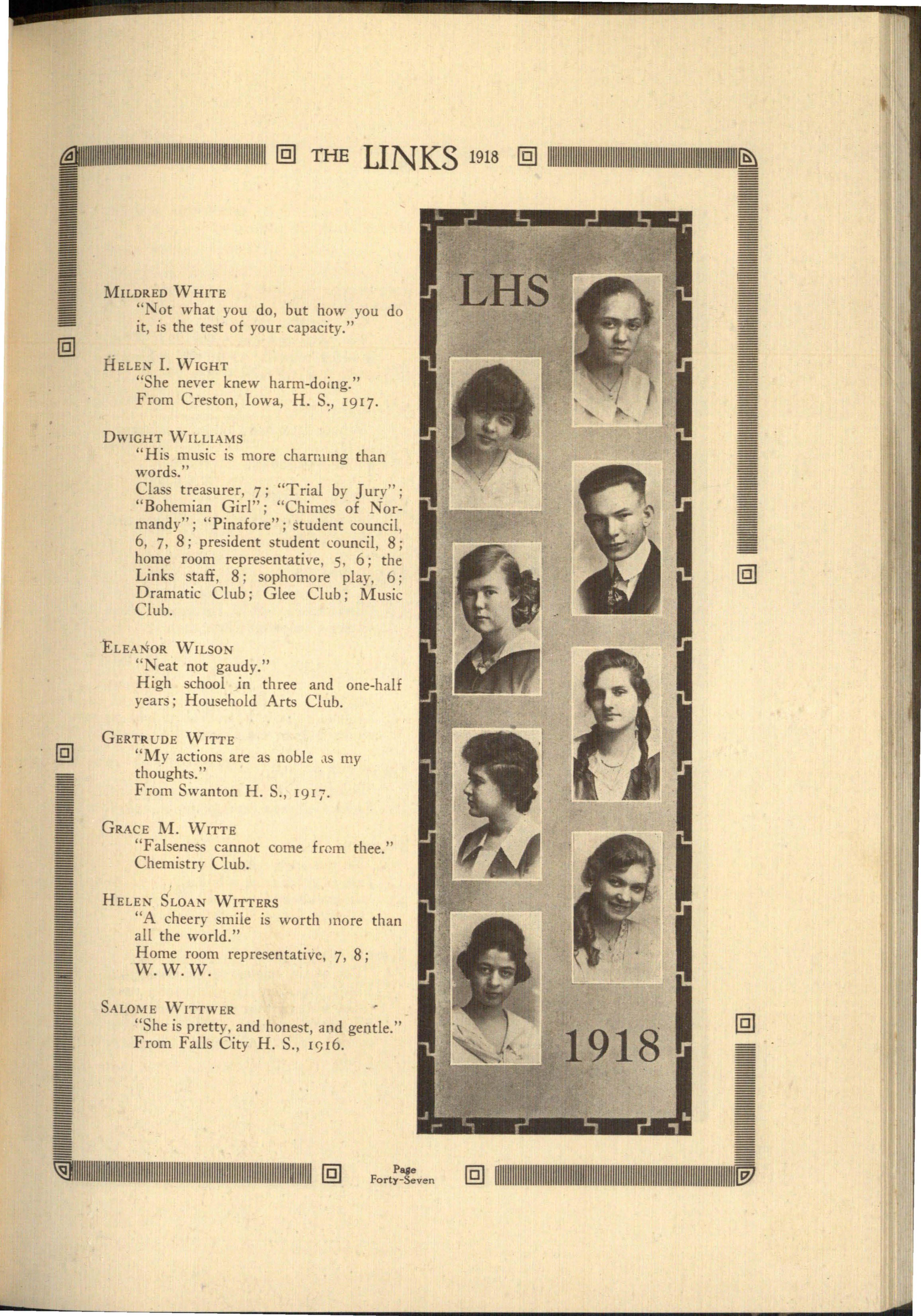
MIL DR ED w HITE
"Not what you do, but how you do it, is the test of your capacity."
HELEN I. "\VrGHT
"She never knew harm -doing."
From Creston, Iowa, H. S:, 1917 .
DWIGHT WILLIAMS
"His music is more charming t han words."
Class t reasurer, 7; "Trial by Jury"; "B ohemian Girl"; "Chimes of ormandy"; "P inafore"; student council, 6, 7, 8; president student muncil, 8; home room representative , 5, 6; the L inks staff, 8; sophomore play, 6; Dramatic Club; Glee Club; Music Club.
ELEANOR WILSON
"Neat not gaudy ."
High school in three and one-half years; Household Arts Club.
GERT RUDE WITTE
"My actions are as noble ,1s my thoughts."
From Swanton H. S . , 1917.
GRA?,}a~~n: 1::~not come from thee."
Hee~:,::::: :~ERS
= "A cheery smile is wor th more than all t he world."
Home room representa t ive, 7, 8; ;;;;;; w.w.w.
SALOME WITTWER
"She is pre tty, and honest, and gentle."
From Falls City H. S., 1<;16.
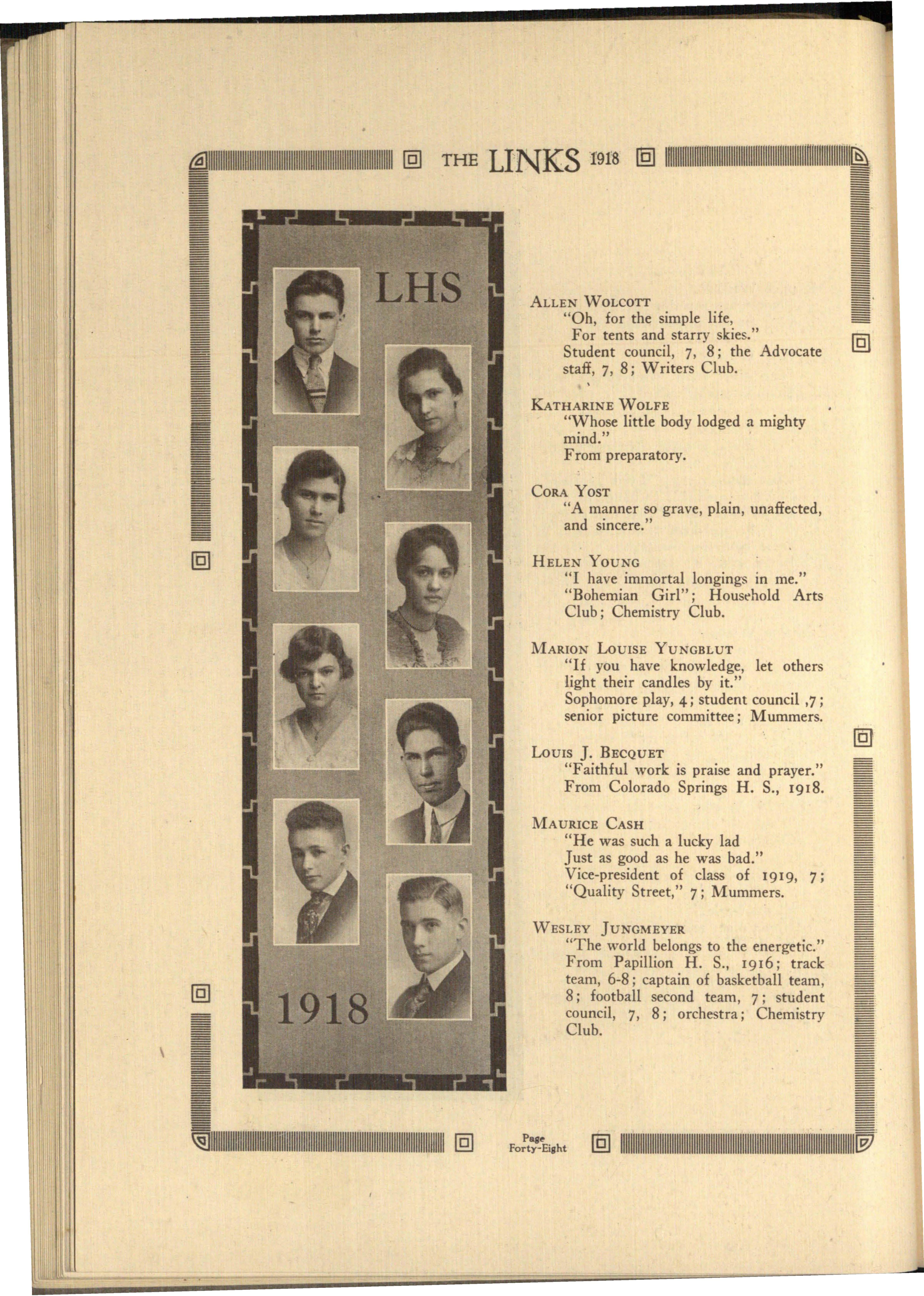
ALLEN WOLCOIT
"Oh, for the simple life, For tents and starry skies."
Student council, 7, 8; the Advocate staff, 7, 8; Writers Club.
KATHARINE WOLFE
"Whose little body lodged a mighty mind."
From preparatory.
CoRA YosT
"A manner so grave, plain, unaffected, and sincere."
HELEN YOUNG
"I have immortal longings in me." "Bohemian Girl"; Houst'hold Arts Club; Chemistry Club.
MARION Lou1sE YuNGBLUT
"If you have knowledge, let others light their candles by it."
Sophomore play, 4; student council ,7; senior picture committee; Mummers.
Lours J. BECQUET
"Faithful work is praise and prayer." From Colorado Springs H. S., 1918.
MAURICE CASH
"He was such a lucky lad Just as good as he was bad."
Vice-president of class of 1919, 7; "Quality Street," 7; Mummers.
WES LEY J UNGMEYER
"The world belongs to the energetic."
From Papillion H. S., 1916; track team, 6-8; captain of basketball team, 8; football second team, 7; student council, 7, 8; orchestra; Chemistry Club. p_,,. fcj1 Forty-Eisht L!:.J
llllllllllllllllllllllllllllllllllllllllllllllllllllllllllllllllllllllllllll @J
WILDA ARTERBURN
GERALD SCHAUPP
''Ah , you flavor everything; you are the " He was a good man , and a just." == vanilla of society. " E S LSA OMMER
MICHAEL BYRNE
" Those about her
"He would not , with peremptory tone , From her hall re ad the perfect ways As ert the nose upon his face his own ." of heaven."
RUB~ AG~:;1~ing woman indeed."
MAR,f~:: r~~:~Emanners , all who saw
From Malta , Montana, H. S. , 19 18 admired."
Better English Week committee; WORTH JOHNSON Writers Club.
" He knew what is what."
H••~!~~:~~.•yyou woit , you will find
Where the four-leaf clovers grow. " GRACE WILCOX
,ff,ction, do not thot w•y
From St. Helena, California; "Bar- " In faith, lady , you have a merry hara Frietche"; Y Vv. C. A., 3, 4. heart. "
V M Sergeant-at-arms , 3 ; junior-senior play, ERNE OORE 6 • "Bohemian Girl"· "Spectre
:•He w~s fresh and full faith th at 'ight"; "Chimes of Normand;"; somethm~ would turn up . freshman play committee; junior play
From El_gm H. S.; football team, 3 , 5 , committee. 7 ; cap tam r 9 I 7 football team.
Lo WELL ROBERTS
"What my tongue speaks, my right drawn sword may prove."
Class basketball , 6, 8; football, 7.
~ HE HISTORY of the world for the year 1914 will record two great events. \_) One is the beginning of the \Vorld \Var; the other is the entrance of the a,. class of '18 into L. H. S.
One day in September, 1914, in a dark room in Science Hall, a group of fresh111en met for the purpose of organizfog a class. The y were the last freshmen to enter the old high school and perhaps for this reason they were exceptionally successful as treshm,e.n. They were not only amazingly fresh, but they had an unheard of amount of class and school spirit. Still the other classes did not at first scetn to appreciate the new comers. Aged seniors remarked, as they have since the time of 1 oah, "They get smaller every year.," and "Cradle~ ought to be •furnished in . the freshie classes." The only ones who took advantage of. freshman freshness, however, were the brutal stale freshies. The time was to come when they would ask the privilege of belonging to this class, but they didn't know it then.
The first official act of this class of '18 was to nominate officers. The different candidates were known by the grade school from which they had come, because most of the rreshmen were acquainted onlv with those who had come from the same - ' ...,.. grade school. Also everrone felt that no grade school except t1te one from which he himself had come could furnish a person great enough to be the president of this class. Ilut in spite of this difficulty, a boy named Richard Hadley , who had a beguiling $mile, was elected. He made a good president, but by taking extra work managed to graduate with the class of '17 instead of '18.
Soon after the election, a pie feed was held to help the freshmen to become better acquainted. This pie feed was the first class event attended by Joy Bailey and Fred Campbell together. The incomparable Joy had formerly been known as Ethel J. Bailey.
Miss Charlotte Zurnwinkel and Miss Muir were elected class sponsors soon after this. Under their management the play, "Our Aunt from California," was given at the freshman assembly. The parts were taken by Lois Cordner, Marion Risser, Olive Ladd, Ruth Oberlies, Ruth Carr, and Helen Wilmeth. The fact that only girls took part in the freshman a sembly was not because there were no boys in the class. fo indeed! It was because the boys possessed the greater amount of that freshman shyness which endeared them to their teachers. Another noticeable thing about this play was that Lois Cordner had a part in it. Since then the class has never considered giving a play without her. About the middle of the year contributions to the Advocate began to appear under the name of Hephzibah, '18. What a thrill that '18 g:ive the freshmen. To think that a freshman was writing for the Advocate! o one knew who Hephzibah was, some even doubted that Hephzibah
lllllllllllllllllllllllllllllllllllllllllllllllllllll
was the author's real name, but not one doubted that she was a member of the class of •1 8.
The great event of the freshman year was the party which was held m the McKinley gymnasium. It was at this party that the members of the class of '18 first sho•Ned •how much they preferred eating to playing games or dancing. Isn't it strange how a freshman will thaw out over a dish, of ice cream? When the dishes were reluctantly returned to those in charge, no one thought of going home. Instead, everyone plunged into the party again. Freshman parties are supposed to be held in the afternoon, but when the principal came at 8 o'clock, he was shocked to flnd the party going full blast. After it had reached its final climax and the tired freshmen were at last going home, the committee and sponsors came upon that great pile of unwashed dishes. From that point there were two stories of what happened. One story is that Miss Muir declared that although she would do a great deal for that class, she absolutely drew the line at washing dishes. The other is that she submitted to fate and helped wash. This is a mystery which should have the attention of Sherlock Holmes at once.
On:! of the things which the members of the class of '18 will remember longest is the half day assembly in celebration of the victorious 1914 football team. Those who have read ancient history may know that this was the year in which "Brick" True wa£ captain of the team which beat Omaha 36 to o. What a glorious celebration it was! When all had cheered themselves hoarse, when each member of rhe team had made a speech unrivaled for wit and rhetoric, and when the miniature train had run over its miniature mountain to the Missouri Valley championship, in illustrating Mulley's "I think I can-I think I can," someone started "Linrnln Will Shine" without a stop at the end of the verses. After the fifteenth verse, the principal raised hi,. hanJ for silence, but the crowd sang on. Finally, when all had lost track of the number of verses, they quieted from sheer lack of wind, and the cheer leader started a "locomotive," ending the mutiny. Was there any freshie at that assembly who did not vow to give his very life , if need be, for his school?
Then at the middle of the year the freshmen ceased to be fresh freshies. Shy no longer, they openly exulted in their boldness. It was about this time that the following article appeared in the Advocate:
"The freshman president spoke to the principal when he met him in the hall yesterday. Congratulations to the principal." Presumably this referred to our newly elected president, Vernon Askine , but if so, it was a rank libel.
In those early days the teachers assigned all seventh periods for disorder or tardiness, to room 103. There, as the days grew warm, the freshmen came in great numbers to get acquainted "·ith one another. It is very probable that the present system of home rooms was evolved from the fact that room 103 became so completeiy freshmanized.
To crown the year, the freshmen decided to give a party for the sophomores to show that different classes might be friendly. The sophomores found that these freshies were almost human, and the freshmen found that the sophomores were not supermen after all but mere human beings, just like or perhaps slightly inferior to themselves. For these reasons everyone had a good time and was satisfied. When it came time for refreshments, chocolate and sandwiches were served. Everyone noticed the unusually fine flavor of the chocolate, but no one seemed to know the reason. For long years the matter remained a mystery, but today the reason is made public. The chocolate was cooked in a wash boiler and stirred with a broom handle. This epoch-making discovery, made by Ruth Oberlies, is given on her authority.
Something happened to the class of '18 between the freshman and the sophomore years. According to the book of Hephzibah, chapter 6, verse 13:
"Yea, verily! Our sophomore year was dead, like unto the mud."
One reason for this state of affairs was that the year was started in the new building. Persons who were used to fighting their way through a mob from one room to another could not stand the loneliness of these immense echoing corridors. Their class spirit just pined away from lack of companionship. They still supported all school events lo yally, but most of them forgot that there was a sophomore class. Another reason was that when the year began, the office announced that the classes would nm without sponsors. Without the guidance of those two valuable sponsors the class was lost.
A small group finally met in mid-October and elected officers. Laurens Mason was the president. When it became clear that the class could not run without a sponsor, they were allowed to re-elect Miss Zumwinkel. Miss Muir had been elected sponsor of another class, so she could not be re-elected. Under Miss Zumwinkel's able management, however , things began to move again. Marion Risser and Edward Gardner were appointed as a program committee, and they furnished interesting and amusing programs until the end of the semester. It is, however , noticeable that when Miss Zumwinkel gave the refreshments for a Hallowe'en party, the attendance was several times as great as at the ordinary class meetings. There was no need of conservation then, but if there had been, the class of '18 would have been remarkably unpopular with Hoover.
At the last meeting of the first semester Miss Humpe was elected for the second sponsor , and Florence Fowler was elected president. Miss Humpe has been with the class longer than an y other sponsor. Also at this time the 10 A's, who had been stale freshmen when the 10 B's were freshmen, made application to be allowed to belong to the regular sophomore class. The 10 B's were willing, and after all the office force had 0. K.'d the request , the necessary permission was granted by the principal. Thus ended the ancient enmity between the two halves of the class , and the 10 A's, whose most prominent member was Harold Morgan , became .in important part of the class of '18.
The sophomores , on account of their extreme youth, were allowed only one evening party in the year , and when it came time for that of the class of '1 S, the committee in charge made a daring decision. The y would give a party without dancing. This party was advertised as danceless. All those who came to parties merely for the dancing were conspicuously present-elsewhere. Yet, strange to relate, the party did not die early in an agony of boredom, and the committee was not forced to eat the refreshments to keep them from spoiling. There was a larger attendance at the danceless party than at any party previously given by the class, ::ind those who came, entered with enthusiasm into the games and the stunts. Is it necessar y to add that when the refreshments appeared , they were quickly captured and treated as they deserved?
In the girls' basketball tournament for the year , the sophomore team upset all the predictions by its speed and teamwork , winning all its games. To this day those red and black sweaters with the ' I 8 on them may sometimes be seen about the halls.
The last important event of the year was the sophomore play given in assembly == just before spring vacation. The play given was an unusually funny comedy called "Uncle Dick's Mistake." For a long time the remark, "I ' ll make a note of that," would cause whole classes to laugh until they were helpless. The faculty said that it wafh:r:P~~~i~:!~t of the junior year of the class of '18 was the junior play, the comedy, "Facing the Music." This preference of the class for comedies had by this
me1nbers of the class of '18 ,vere and are such good natured person that they ,vant everyone else to laugh and be happy. This class is a true example of what Marcus Aurelius meant when he said, " Happy is the people whose anvils are brief." There _ is not a "knocker" in the class and the only anvils that are ever heard are those of the teachers at "U" slip time. 1 ot all the comedy in the junior play went on
with the curtain "raised." Between acts the cast sat in a row behind the curtain and ate apples. Since they sat with their faces toward the orchestra, it might almost be said that they were "facing the music" during the whole evening.
After this successful play, everything was moving smoothly under the leader-
ship of Katherine Brenke when the junior ship of state ran off its course. Miss Zumwinkel, without giving any warning, was married. When the class recovered from this blow, it elected Miss Anderson to fill the vacancy, and the choice proved a wise one. At the same time Mrs. Liggett, for such ,vas Miss Zumwinkel's new name, was elected honorary sponsor.
At the end of the semester William Richardson was elected president. Under his management the junior party was made a great success. If any person at thhat party found time to have a dull moment, he hid the fact well. It is said that t e janitors "vho cleaned the building the next morning did not have any dull moments either.
ot long after, the United States was at last forced into the world war. This changed many things. Some of the bo ys in a burst of patriotism enlisted. Others, persuaded that they ought to finish high chool before taking this step, spent the spring and summer on farms, returning in the fall.
When the day of the Junior-Senior came, the classes were somewhat short as to boys, but when was it necessary for the enjoyment of the girls of L. H. S. to have boys around? ot this time at any rate, for on a beautiful spring day the two classes set out by automobile and street car for Capital Beach. It would hardly be fair to the under-classmen to describe fully a Junior-Senior, but in addition to the usual amusements two plays were given. One was the trial of Mr. Sene I. Yore, charged with dried apples on the brain. The fact that the culprit was found guilty explains why the seniors had such a bad attack of swelled head after the rainy weather in April. The other play was a take-off on Elmer Kostka, Marion Y ungblut, Turner Tefft, Marguerite Smith, and James Collier. It was a very romantic play. Refreshments were served on the green in the Japanese garden , and boating and dancing followed.
The spirit of the class of ' 18 changed again in its senior year. All its class spirit again came to the front under the impulse of the important things that happened. Harold Richards was elected to guide the class through the first semester. He is the only class president who belonged to the part graduated at mid-year. Miss Andenon was called to teach in another school for the period of the war , and Miss Fassler was elected to fill her place as sponsor.
The first event of importance was senior color day. When all the class, except Fred Campbell, arrived at 8 :30, each member was given a purple tie and a white balloon bearing the letters '18. Fred Campbell arrived at 9 o'clock but found hi tie and balloon waiting for him. At a given signal in assembly during the class song, every balloon was loosed at the end of a long string. It was truly an inspiring sight. The halls echoed for the rest of the day, to the sound of popping balloons. In the
evening came the banquet. Every article on the table was made according to Hoover's = rules, except the speeches. They were plentiful and not dry. The honorary sponsor, Mrs. Liggett, made a witty and charming toastmistress. The toasts were made on war terms such as "over the top" and "carry on." The only war term left out
best to remedy the oversight. But the class of '18 appreciated the toasts more than the food, which is the highest possible compliment to the toasts. After the banquet, the different hard times costumes were observed and an original play called "The Deestrick Skule" was given. But those costumes were quite indescribable. Monte Munn's merry childish laughter as he trotted about in pantaloons caused the tears of happy memories to come into the eyes of many a care-burdened senior. Stanley Hall in cowboy chaps and English walking shoes was a thrilling and romantic figure. And he had a real revolver loaded with real blanks that he shot right out loud!
When the class returned from the Christmas holidays it was discovered that Miss Fossler had become Mrs. Tate. It had been less,of a shock for Miss Anderson to go because it was partly a patriotic duty and, since she was not married, she might come back; but wheo a teacher is married, she is irrevocably gone, so Miss Foster was elected to fill the vacant place.
The boys' basketball tournament was closely contested between the seniors and the juniors. In the end, the seniors became the champions of the school. At the end of the semester a party was held in the library to finish things properly. Chauncey Reddish and Laurens Mason were offered honorary membership in the janitor's union because of the masterly way in which they handled brooms on the library floor.
Under the leadership of Miss Sarah T. Muir, the rise of woman suffrage in ew York state has been followed by a similar rise in Lincoln High School. Florence Fowler became editor of the Links for 1918, and Katherine Brenke was editor of the Advocate for both semesters. Katherine was the first editor to hold the position for more than one semester.
Herbert Gish was elected president of the class for the second semester. He was also a member of the basketball team which won the state tournament.
About the middle of the semester , Harold Davison came to school when he had the smallpox. When the school board found this out, they immediately sent him home and put guards at all the doors so that no germs, which might have followed the children to school, could get into the building. They also made it necessary for each student to spend each day at least one-half hour in the open air before entering the building. It is said that the germs get tired of waiting and follow someone else off or go home before the half hour is up. For some time smallpox picni~s on the school grounds were very popular.
We have now reached the place where history ceases and prophecy begins. If the class of '1 8 continues to be as successful while the prophecy is becoming history as it has been in the past, its members will have nothing of which to complain.
-LAURENS MASON '18
'Twas a fair and dewy morning, And the sun was sh i ning brightly On an a r my of adventurers, Setting out on life's excursion, Setting out to win a victory, With their banners proudly flying, Banners of a pu r ple color; This the regiment of seniors, Marching from the Linco ln High Sc h oo l. We ll prepared, these va l iant sold iers, Learned in all grim warfare's sc i ence, Well equipped with good, pure English, And with math and c.bem , and civics, Ready now to face life's battles, After four long years of train ing. What great a im, what true ambition, Spurs them on tQ high endeavor, Urges each to strive his utmost?
They a r e seeking, they are striving, For the best that Ii fe can offer, Honor, wea lth, distinction, glory, And fulfillment of the i r visions.
T h ey will r ight the wro ngs of others, They w ill help democracy.
With what weapons will these sen io r s Wrest from life the homage due them? With what weapons w i ll t h ey conq u er?
T h ese, the ,weapons thf!t they ca rr y, Youth and fa,1 t h and h;igh ambition, Courage fine to face life's battles, Confidence, each in the other.
Service is their cry, their watchword, These good :veapons_ of the war,i:i9 rs, _. 1 , , Were n o t gamed all m a mome nt ; • • Were not purchased , , yere not ba r tere d , 1J But were won by patient st r ivings, ' •: With the help of faithful captains, Guided by thefr friends ;- the.teachers. jl' When in l ater yea r s these so l diers, Froni the wars of life returning, ill • Contemplate the steps that brought th em To success, then they will mentio1,1
T h e good teachers who were fait!H u l
To the youth whose steps were falterin g , On the s u nlit road to knowledge.
Thus they joumeyea fort h that morning, 'Mid the shouting of the ·people, •IJ Friends who came to wish thein God-speed, Friends who came ' to chee r them onward -D id they conque r in the conflict? Did they win the p r ize immortal?
Let the coming years make answe r.
Fut u re years will tell the sto r y, Of the me n who we r e t h e h om e guards, Of t he men who h e ld the t r enches, Of t he m en who ga in ed the -summi t.
Whe n the record is comp l eted,'· • -No t one s lacker will be numbered; ·
In the r anks of a ll t h e army,
Ar m y known to all the nations
As the class of nineteen eighteen. - Mary Herzing, ' 18
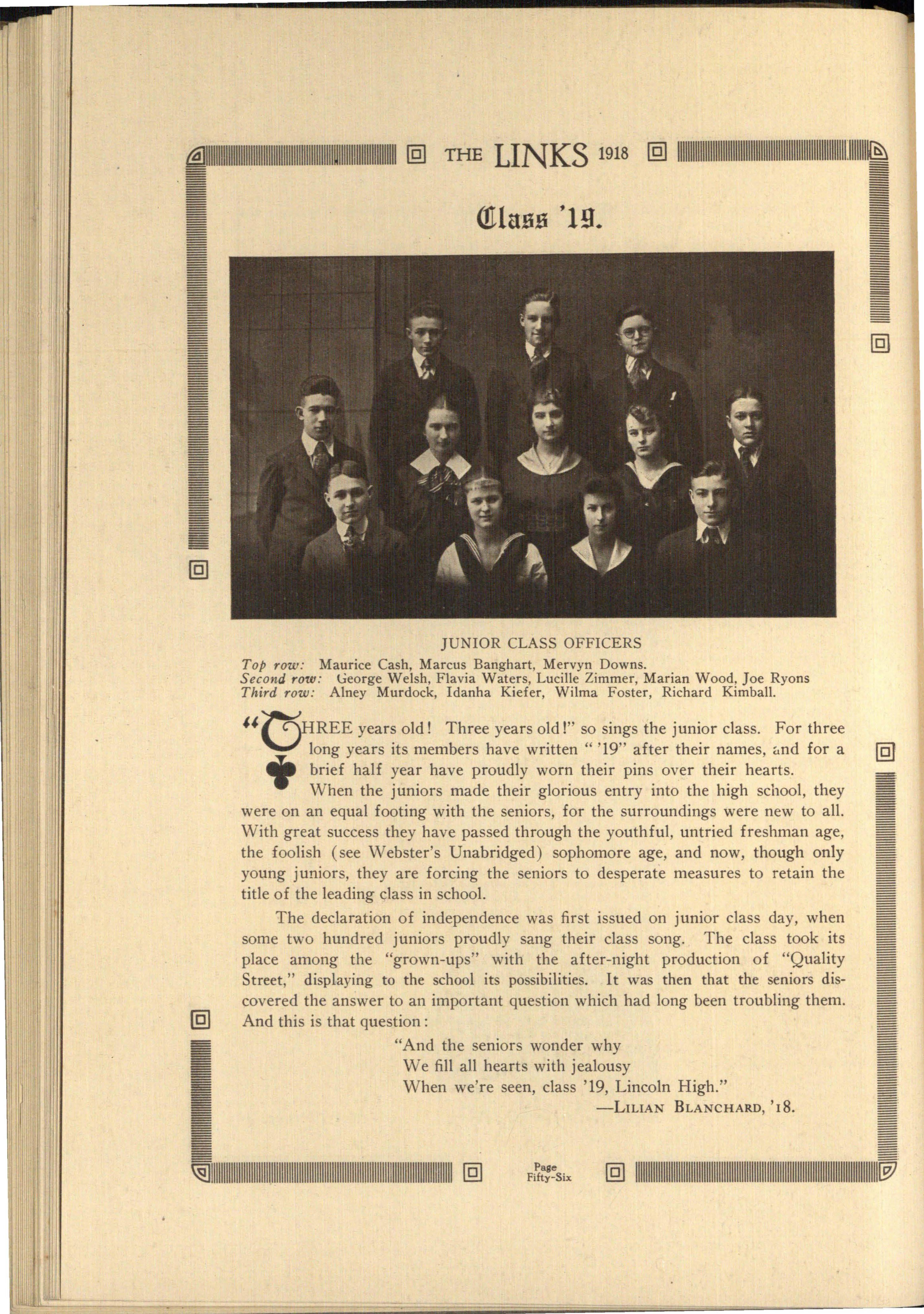
Top row : Maurice Cash, Marcus Banghart , Mervyn Downs. S econd row: George Welsh, Flavia Waters , Lucille Zimmer, Marian Wood, Joe Ryons Third row: Alney Murdock , Idanha Kiefer, Wilma Foster , Richard Kimball.
4' ~HREE years old! Three years old!" so sings the junior class For three \...-(long years its members have written " ' 19 " after their names , and for a • brief half year have proudly worn their pins over their hearts. When the juniors made their glorious entry into the high school, they were on an equal footing with the seniors , for the surroundings were new to all. With great success they have passed through the youthful, untried freshman age, the foolish (see Webster's Unabridged ) sophomore age, and now, though only young juniors, they are forcing the seniors to desperate measures to retain the title of the leading class in school.
The declaration of independence was first issued on junior class day, when some two hundred juniors proudl y sang their class song. The class took its place among the "grown-ups " with the after-night production of "Quality Street," displa ying to the school its possibilities. It was then that the seniors discovered the answer to an important question which had long been troubling them And this is that question
"And the seniors wonder why We fill all hearts with jealousy When we're seen, class '19, Lincoln High."
-LILIAN BLANCHARD , '18.
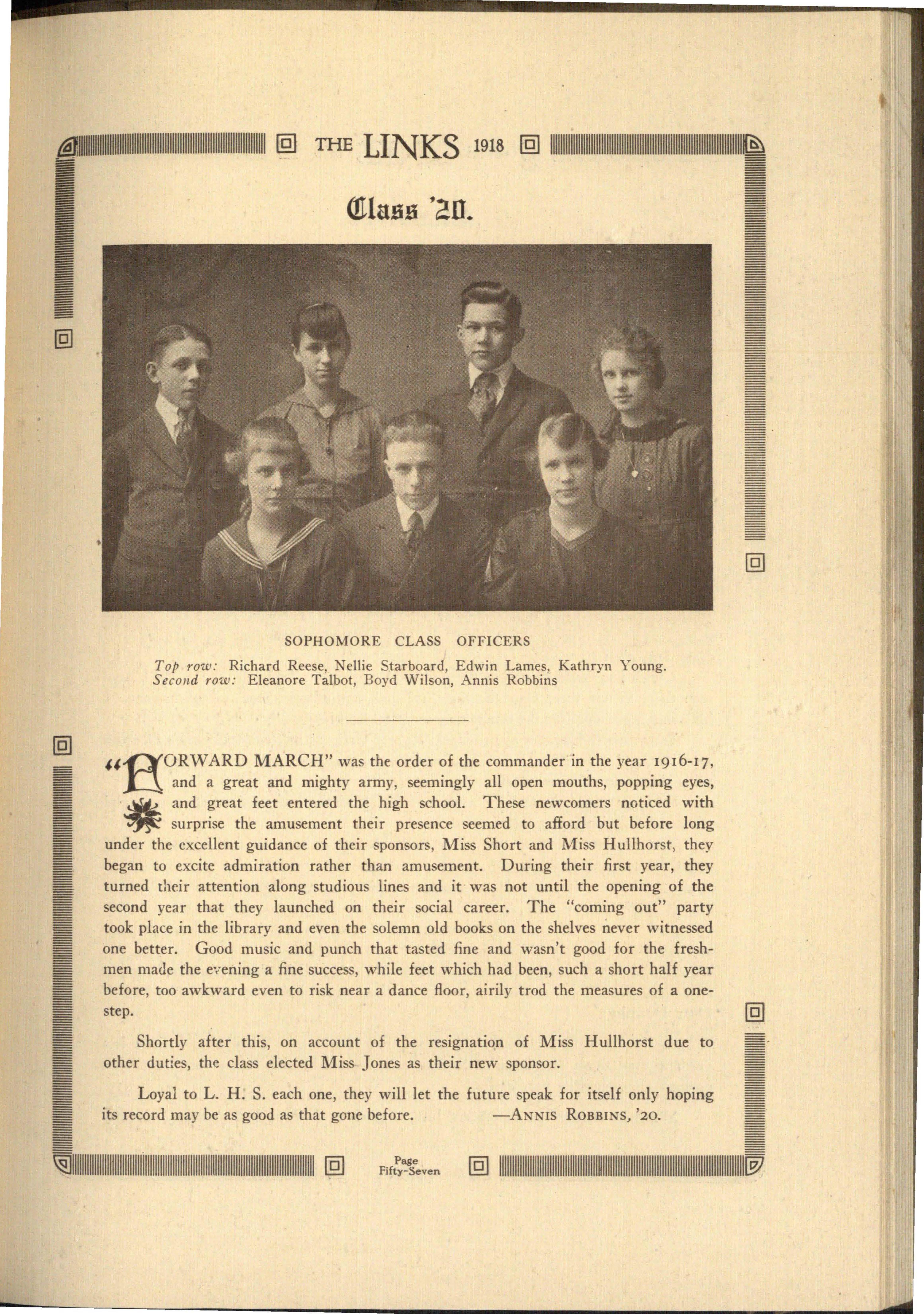
Top row: Richard Reese , Nellie Starboard, Edwin Lames , Kathryn Young. Se cond r ow: Eleanore Talbot, B oyd Wilson, Annis Robbins
"-Q'ORWARD MARCH" was the order of the commander in the year 1916-17, J__\ and a great and mighty army , seemingly all open mou t hs, popping eyes, -~ and great feet entered the high school. These newcomers noticed with surprise the amusement their presence seemed to afford but before long under the excellent guidance of their sponsors, Miss Short and Miss Hullhorst , they began to excite admiration rather than amusement. During their first year, they turned their attention along studious lines and it was not until the opening of the second year that they launched on their social career. The "coming out" party took place in the library and even the solemn old books on the shelves never witnessed one better. Good music and punch that tasted fine and wasn't good for the freshmen made the e-, ening a fine success, while feet which had been, such a short half year before, too awkward even to risk near a dance floor, airily trod the measures of a onestep.
Shortly after this, on account of the resignation of Miss Hullhorst due to other duties, the class elected Miss Jones as their new sponsor .
Loyal to L. H. S. each one, they will let the future speak for itself only hoping its record may be as good as that gone before. -ANNIS ROBBINS, '20.
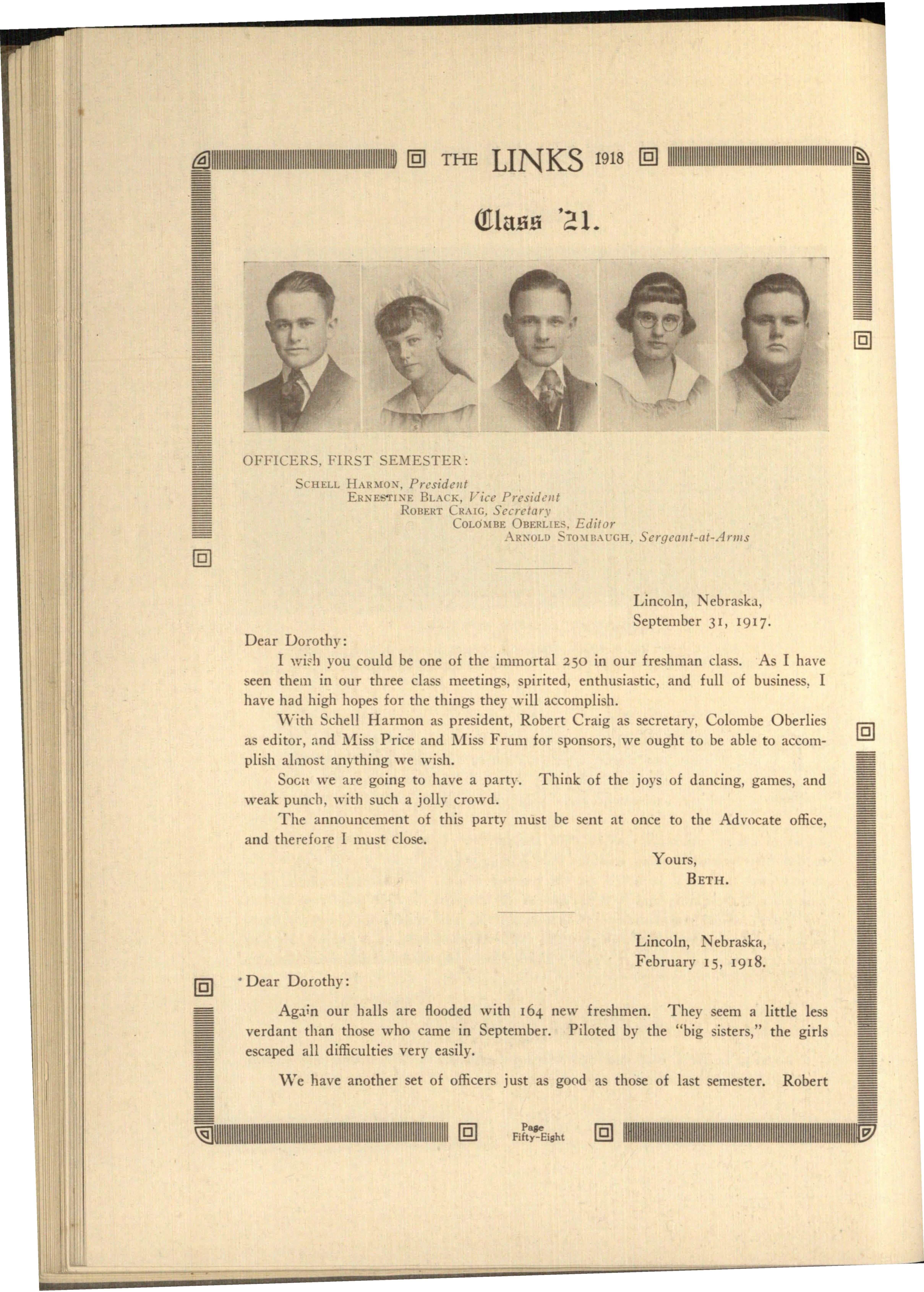
OFFICER FIR T SE MESTER:
C-HUL HAR l fOX, Prcsid1mt
Dear Do ro thy:
ER • • EST JXE BLAC-K, Vice Presidt'11t ROBERT CR.\IG, Secrclar\' CoLO l IBE 0BERLIE~, Editor ARXULD - TO\ ! 11 \l"GH, crgca11/-at-. -J 1'11/S
Linc oln , ebra sk.i , September 3 1, 19 17
I wi :, h you c-ould be one of the immort al 2 -o in our fre hman cla s As I have seen them in our three cla ss meetings , spirited, enthu siasti c, and full of bu iness , I ha ve had high hope for the things the y will accompli sh.
\Vith chell Harmon as president, Robert Craig as secretary, Colombe Oberlie a editor , and i\1i s Price and Mis Frum for sponsors , we ought to be able to accomplish almost anything we wi h.
oc n we are going to ha ve a party. Think of the joys of dancing , games , and weak punch , with such a jolly crowd.
The a nnouncement of this party mu t be sent at once to the Advocate office , and there fore I must close.
Yours, B ETH @J • Dear Dorothy:
Lincoln , ebraska, February 15 , 1918.
Again our halls are flooded with 164 new freshmen. They seem a little less verdant than tho e who came in September. Piloted by the "big sisters, " the girls escaped all difficulties very easily.
\Ve have another set of offi cers just as good as those of last emester R obert
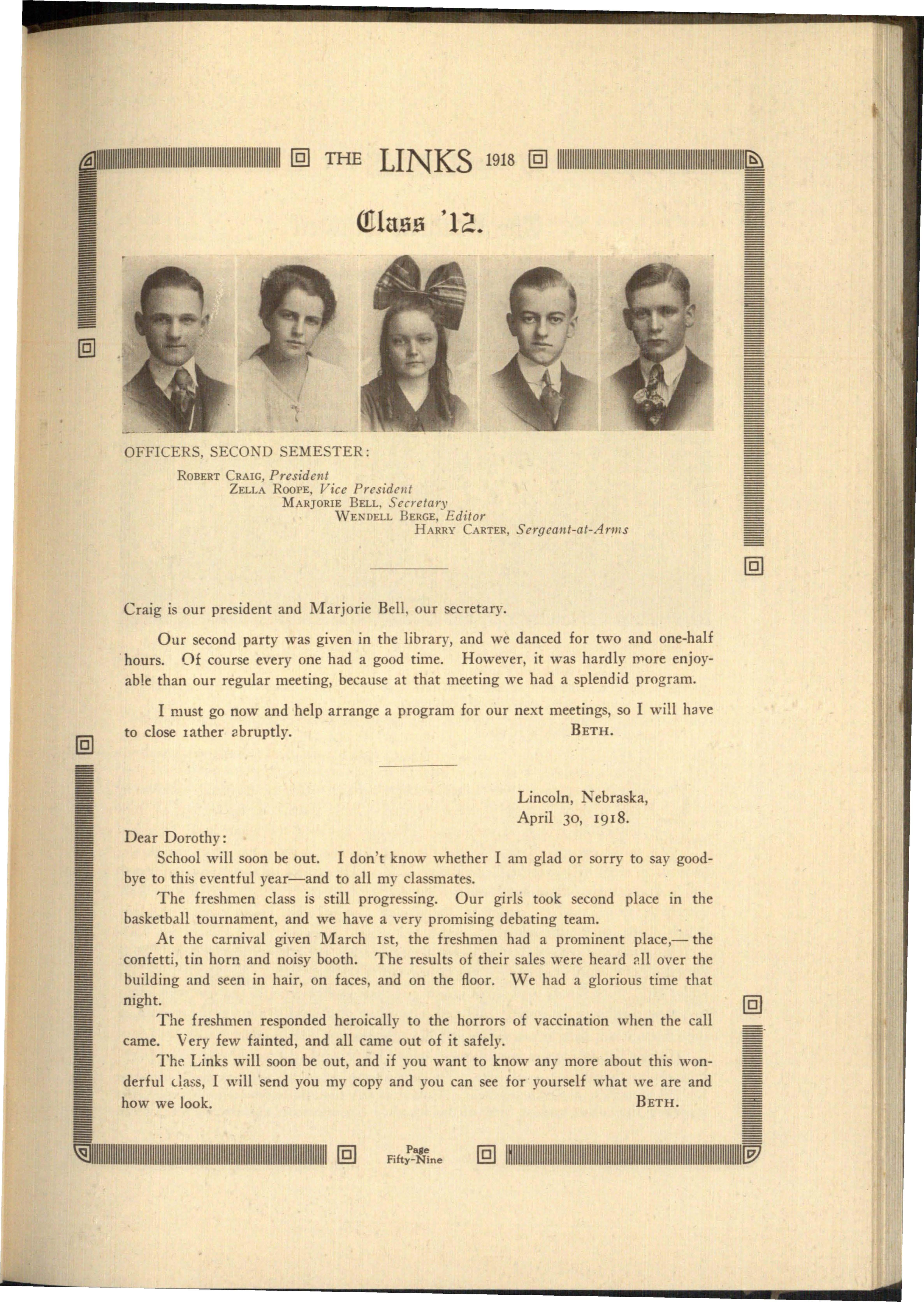
ROBERT CRAIG, President
ZELLA ROOPE, Vice President
MARJORIE BELL, Secretary
WENDELL BERGE, Editor
HARRY CARTER, Sergeant-at-Arms
Craig is our president and Marjorie Bell. our ecretary.
Our second party was given in the library, and we danced for two and one-half hours. Of course every one had a good time. However, it was hardly rr>ore enjoyable than our regular meeting, because at that meeting we had a splendid program.
I must go now and help arrange a program for our next meetings, so I will have to close iather 2bruptly. BETH .
Lincoln, ebraska, April 30, 1918 .
Dear Dorothy:
School will soon be out. I don't know whether I am glad or sorry to say goodbye to this eventful year-and to all my classmates.
The £re hmen class is still progres ing. Our girls took econd place in the basketball tournament, and we have a very promising debating team.
At the carnival given March 1st, the freshmen had a prominent place,- the confetti, tin horn and noi y booth. The resul ts of their sales were heard ;,ll over the building and seen in hair, on faces, and on the floor. We had a glorious time that [Q]
The freshmen responded heroically to the horrors of vaccination when the call = · came. Very few fai n ted, and all came out of it safely.
The Li nks will soon be out, and if you want to know any more about this wonderful d a::;s, I will send you my copy and you can see for yourself what we are and = how we look. B ETH.
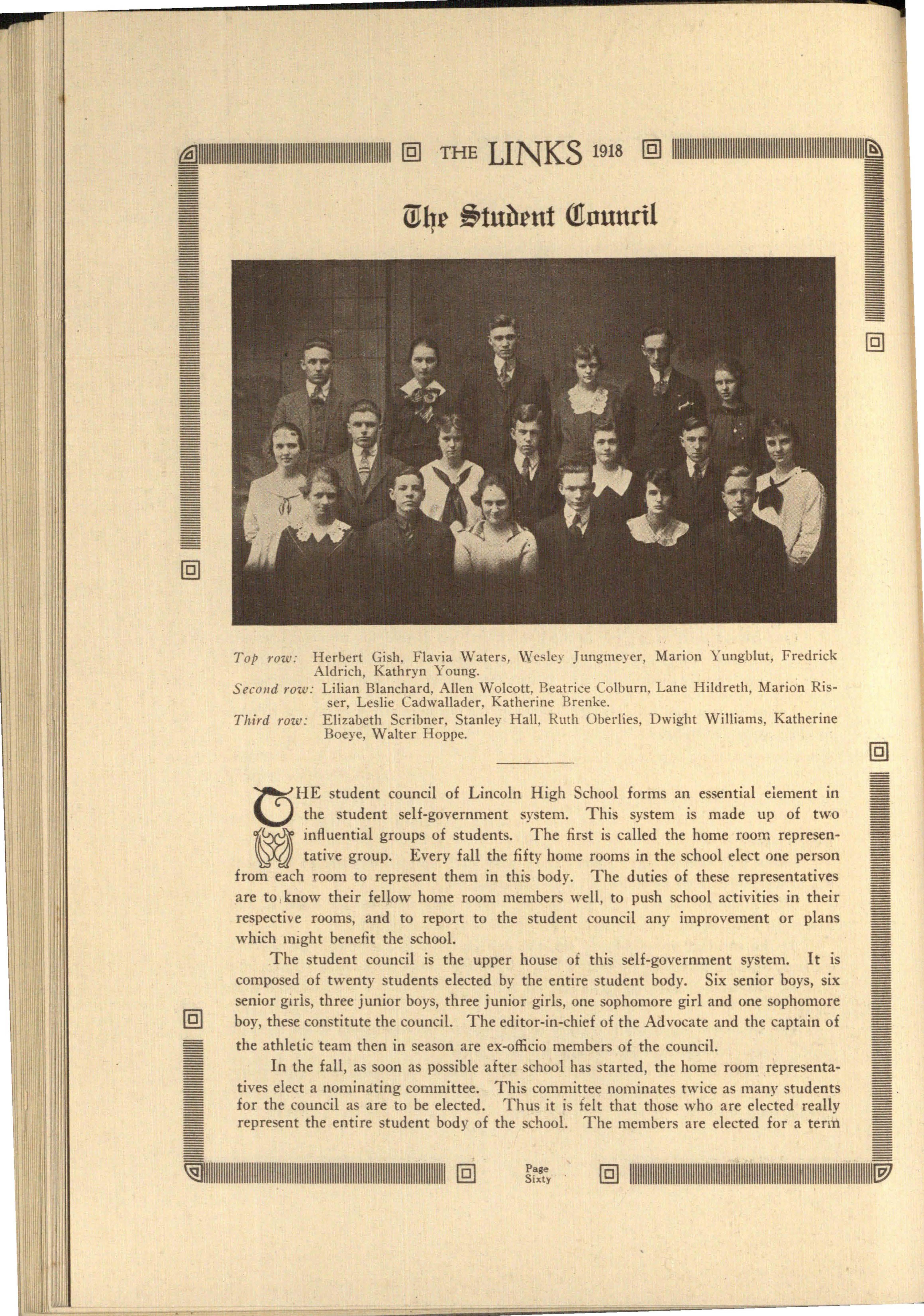
Top row: Herbert Gish, Flavia Waters , V{esley Jungmeyer, Marion Yungblut, Fredrick Aldrich, Kathryn Young.
Seco11d row: Lilian Blanchard, Allen Wolcott , Beatrice Colburn, Lane Hildreth , Marion Risser, Leslie Cadwallader, Katherine Brenke.
Third row: Elizabeth Scribner, Stanley Hall , Ruth Oberlies, Dwight Williams , Katherine Boeye, Walter Hoppe.
J-c=< I-IE student council of Lincoln High School forms an essential eiement in
\...} the student self-government system. This system is made up of two = 7i~ influential groups of students. The first is called the home room represen- =
tative group. Every fall the fifty home rooms in the school elect one person from each room to represent them in this body. The duties of these representatives are to know their fellow home room members well, to push school activities in their respective rooms, and to report to the student council any improvement or plans which might benefit the school. ==
The student council is the upper house of this self-government system. It is
tives elect a nominating committee. This committee nominates twice as many students for the council as are to be elected. Thus it is felt that those who are elected really •
of one year, as are the home room representatives, but offices in the council are held for only one semester.
Last year this form of student government was tested in Lincoln High School for the first time. A provisional student council was in - office for one em ester. In the spring, the first real council was elected, in accordance with the constitution. This body was in office only until the present student council was elected in the fall.
Under the guidance of Stanle y Hall, president for the first semester , 1917-18. the council established an enviable record. Ruth Oberlies was vice-president , and Kathenne Boeye, secretary.
The president for the second semester, Dwight Williams , kept the council members and student body busy in carrying out ideas and plans. Katherine Boeye was vice-president and Elizabeth Scribner, secretary.
If the president of the council is a boy , the vice-president must be a girl, and vice-versa. Both must be seniors. The boy holding the presidency or vice-presidency is president of all the boys in the school, while the girl holding the corresponding office is president of all the girls in the school.
After the establishment of a cafeteria in the school, it had seemed necessary, at first, to post teachers in the lunch room to maintain order. The student council felt that this was a dishonor to the school, and that the students would maintain order themselves if the responsibility were placed upon their shoulders as individuals. Accordingly, the council circulated petitions in every home room , asking each student for a personal pledge of correct conduct in the cafeteria and halls. Ninety-five per cent of the entire student body signed these pledges. Since that time, the teachers on duty in the cafeteria and halls have been removed and the students have lived up to their pledges.
Every year, the faculty of Lincoln High School goes to a teachers ' convention in Omaha. Since this meets on school days we have a two-day vacation every fall. This year, the council considered having the students run school by themselves for one of these days. They did not feel that it should be done, however, unless threefourths of the student body should vote for the proposition. After a thorough discussion in the various classes, the students voted to hold school by a seven-elevenths majority, but since this was not a full three-fourths majority, the plan was not carried out. The faculty, however, sincerely felt that the council had scored a great succes~, as it was generally believed that not one-sixth of the students would voluntarily vote to hold school on a day of vacation. The sentiment that the students are capable of holding school on this day is steadily growing stronger, and it is hoped that in the near future this thing will actually come to pass. This year's council has paved the way, so that future councils may have comparatively smooth sailing in this regard.
The student council has been an important factor in helping Lincoln High School show her loyalty to her country. Since the school did not possess a flag, the council petitioned the school board for one. Their request was granted, and work upon a flag and flag staff was begun immediately. The students felt that the school should possess a service flag, also. They communicated this feeling to the council and immediate!:,, a committee placed mite-boxes in every home room. Each morning the students dropped their pennies into these boxes, and in an amazingly short time more than enough money had been raised to pay for the school service flag.
Dunng the Red Cross membership campaign week , December I 7-24, the student council, in co-operation with a committee from the faculty, carried on an extensive campaign throughout the school. The home room representatives were an important factor in this campaign , since they did the actual work of selling Red Cro ss member-
ships in their respective home rooms. were sold.
Approximatel y one thousand memberships
Realizing that school act1v1t1es should be promoted to the fullest extent, the student council organized a number of students who were not council members , into a promot10n league to sell tickets for every school event. The members were chosen by the council for their ability as salesmen and good workers This league is in constant touch with the council , and works under its direction.
Although the students of the school are urged to elect conscientiously their home room representatives on their good scholarship, their conduct in school and out , and their abiiitr to lead others, three or four representatives failed to live up to the standards. These were quietly notified of the fact and given a month to redeem themselves. vVith only one exception these completely changed their attitude towards the school. In this one case , a new representative was elected from the home room which was not truly being represented. The council is on the constant look-out to see that only reliable, capable students shall hold the office of home room representative. If an y student in the school sees a representative who is not doing the correct thing, it is his duty to report the affair to the council. The matter is investigated fairly and justl:r and is then remedied. The students have exactly the same privilege to report any member of the student council for misdemeanor. Thus the home room representatives and student council members become directly responsible, in all things, to the student body.
On March first , a very successful carnival was held at the school. This was suggested , worked out, and managed by the student council. With the splendid co-operation of the faculty and student body, the council scored a big success for engineering this event.
Through the efforts of Mr. Pickell and the council, Lincoln High now has a financial board of control which keeps tab on the money expended and earned by all the clubs and organizations in the school. It is a central treasury committee and prohibit s all useless expenditure of school money.
The Lincoln High School debating team has never debated with a team from a large school , with the exception of Omaha. Mr. Hewitt , the debating coach, felt that the team would advance more and be benefitted more if teams from larger cities ,vere brought to Lincoln. The members of the council, heartily approving of the plan, took the responsibilit y upon themselves of bringing good teams to Lincoln this year , and pledged themsel v es to promote debating interests more than had ever been done before.
These are some of the things the I g 1 7-1 8 student council of Lincoln High School has accomplished. The council members are in constant touch with the home room representatives; the home room representatives are in constant touch with their fellow home room members. These home room members make up the student body, hence ti1e council is in constant touch with the whole school. With the co-operation of the faculty and the backing of the student body , this self-government ~ystem has accomplished and will accomplish great things for the betterment of Lincoln High -KATHERINE BOEVE, '18.
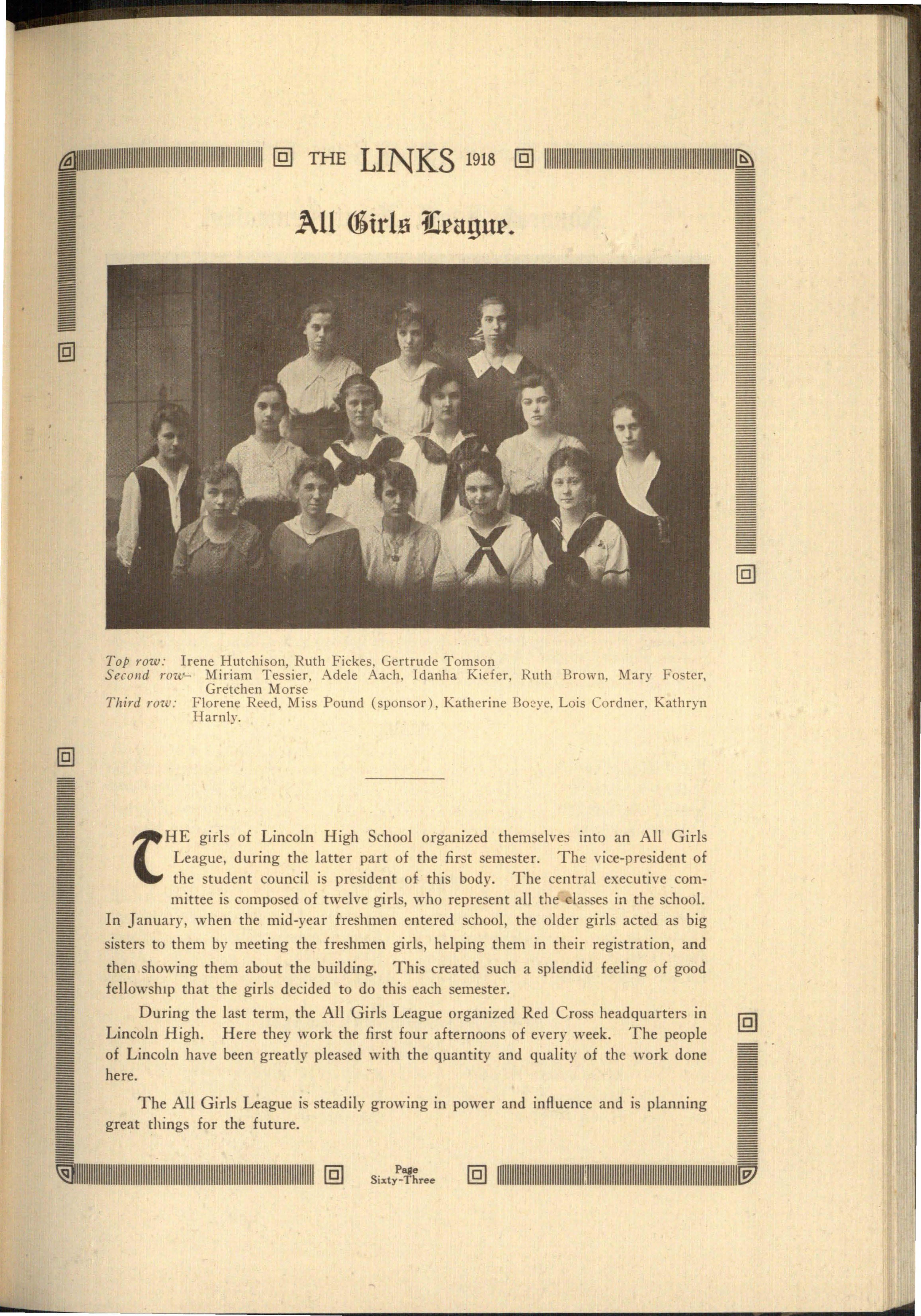
Top row: Irene Hutchison, Ruth Fickes, Gertrude Tomson
Second row- Miriam Tessier, Adele Aach, Idanha Kiefer, Ruth Brown, Mary Foster, Gretchen Morse
Third row: Florene Reed, Miss Pound (sponsor), Katherine Bo~ye. Lois Cordner. Kathryn Harnly.
CHE girls of Lincoln High School organized them se l ves into an All Girl s League, during the latter part of the first semester. Th e vice-presi dent of the student council is president of this body. The ce ntral executive committee is composed of twelve girls, who repre se nt all the classes in the school. In Januar y, when the mid- year freshmen entered school, the older girls acted as big sisters to them by meeting the freshmen girls, helping them in their registration, and then showing them about the building. This created such a splendid feeling of good fellowship th a t the girls decided to do this each semes ter.
During the last term, the All Girls League organized Red Cross headquarters in Lincoln High. Here the y work the first four afternoons of every week. The people of Lincoln h ave been greatly pleased with the quantity and qualit y of the work done here.
The All Girls League is steadily growing in power and influence and is planning great things for the future.
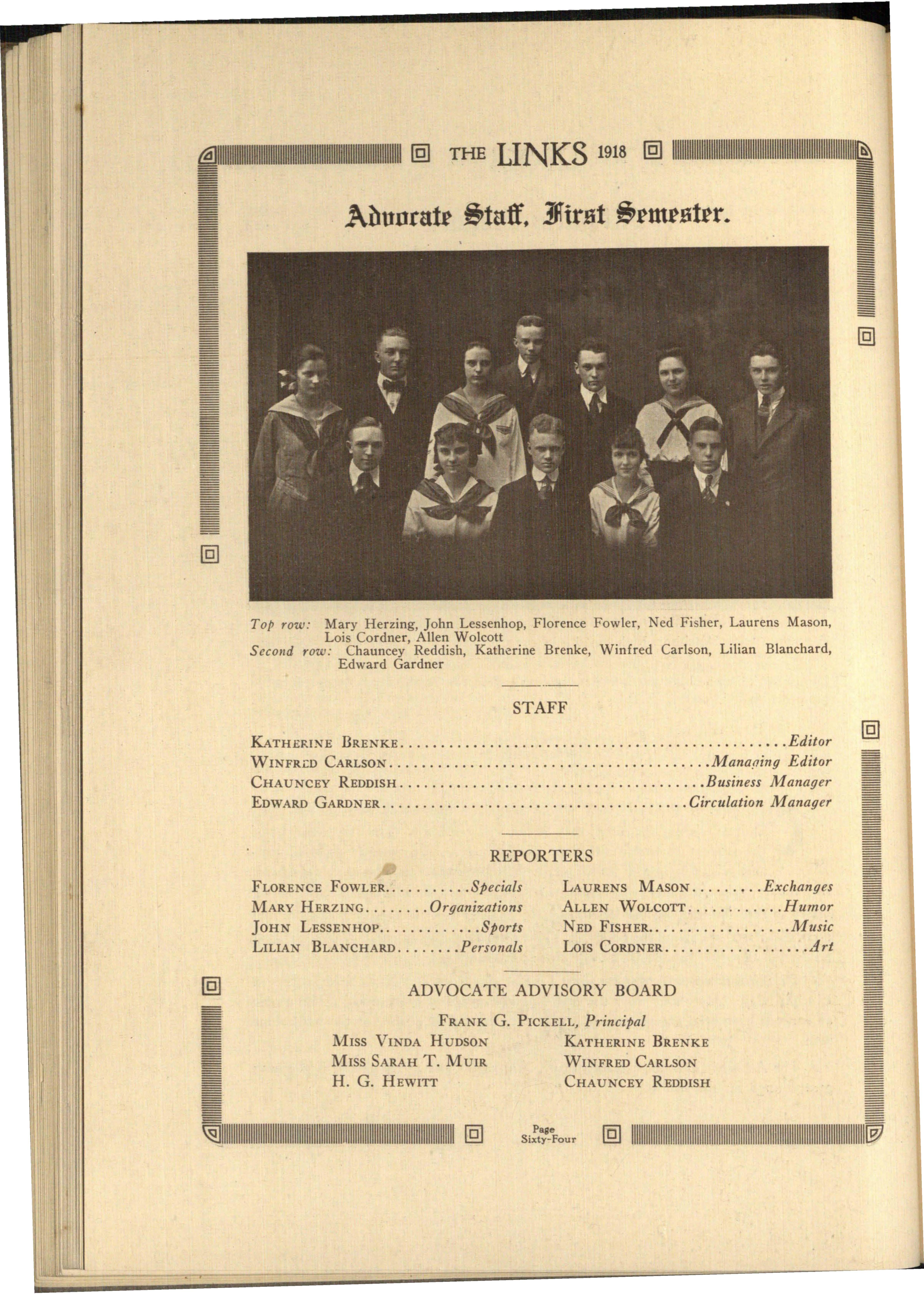
Top row: Mary Herzing, John Lessenhop, Florence Fowler, Ned Fisher, Laurens Mason, Lois Cordner, Allen Wolcott
Second row: Chauncey Reddish, Katherine Brenke, Winfred Carlson, Lilian Blanchard, Edward Gardner
KATHERINE IlRENKE •••••••••••.•................................... Editor
WINFR..::O CARLSO •••••••••••••••........................ Mana,ning Editor ==
CHAUNCEY REDDISH •••••••••••••........................ Business Manager
EDWARD GARDNER •••••••••••••••....................... Circulation Manager
FLORENCE Fowu, Sp,:;~:ORT::~RENS MASON Exdwng"
MARY HERZi G •....... 0 rganizations ALLEN WOLCOTT Humor
]OHN LESSENHOP Sports
LILIAN BLA CHARD Personals
NED F1SHER ••............... Music Lois CORDNER •................. ,1 rt
ADVOCATE ADVISORY B
FRANK G. PICKELL, Principal
Miss VINDA HUDSON KATHERINE
Miss SARAH T. Mu1R WINFRED CA
H. G. HEWITT CHAUNCEY
Top row: Allen Wolcott, Joe Iverson, George Macy
Secon.d row: Belle Farman, Evar Anderson, Helen Burkett, Beatrice Colburn, Carleton Springer, Gladys Schaaf
Third row: Lee Solomon, Katherine Brenke, Winfred Carlson, Mary Herzing, Joyce Boeye
KATHERINE BRENKE Editor
MARY HERZING , Mana!Jing Editor
WINFRrn CARLSON Busineis Manager
JOYCE Bo EYE Assistant Manager
LEE SOLOMON .........•................................ Circulation Manager
BELLE FARMAN • Specials JoE IVERSON Humor
GLADYS SCHAAF Specials ALLEN WOLCOTT Literary
BEATRICE COLBURN Organizations EvAR ANDERSON Debate
HELEN BURKETT Personals
GEORGE MACY Exchanges
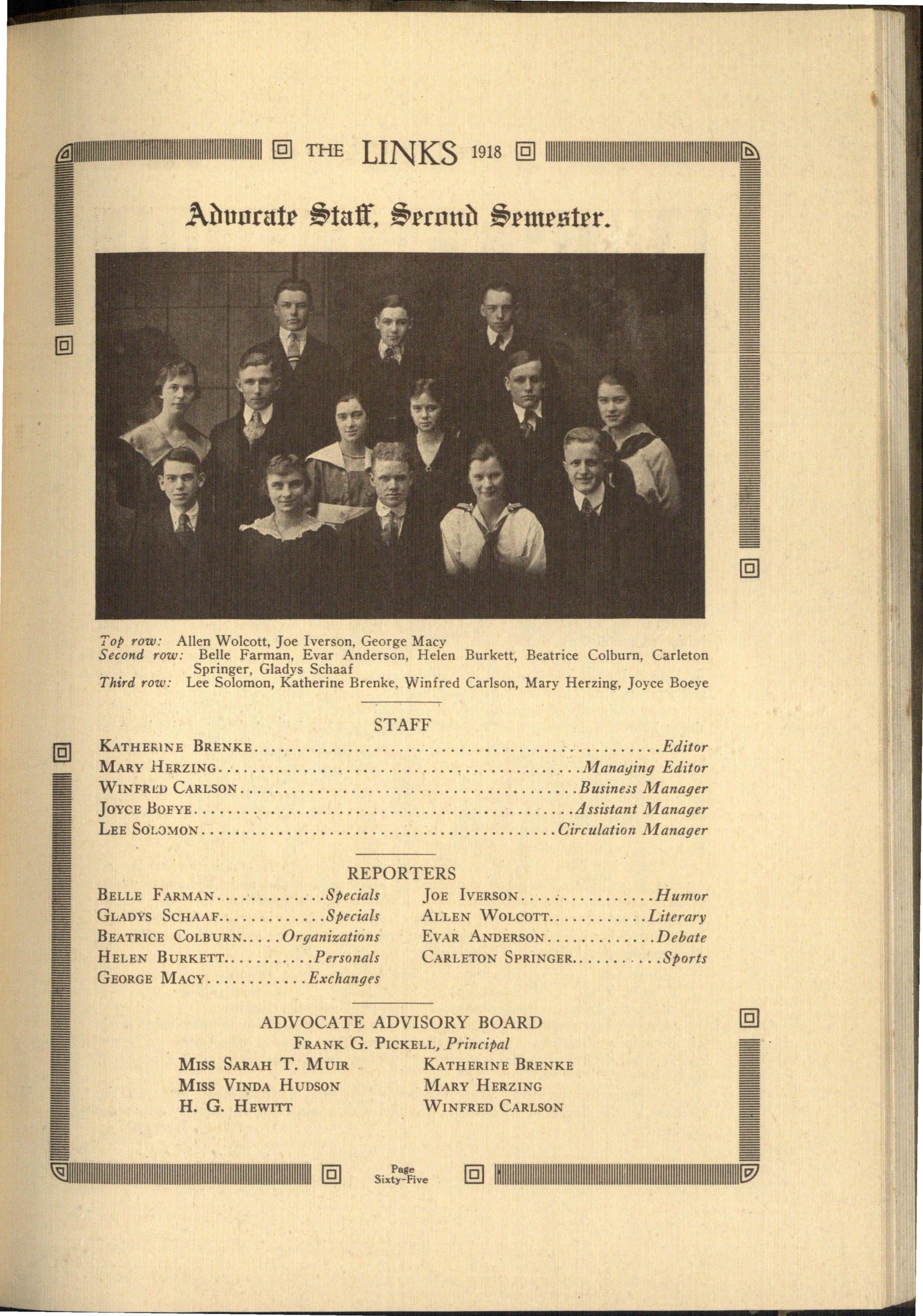
CARLETON SPRINGER Sports
ADVOCATE ADVISORY BOARD
FRANK G. PICKELL, Principal
Miss SARAH T. MUIR
Miss VINDA HUDSON
H. G. HEWITT
KATHERINE BREN KE
MARY HERZING
WINFRED CARLSON
~
IG TIFICANT and determining force in the American ideal of life and education is its constant adherence to the right of any who will to enjoy the opportunities for more adequate preparation and larger self-improvement, with the belief that individual development, if directed into channels of constructive service, will inure not only to the advantage of self, but also to the social betterment of all. So potent has this ideal become that it is indeed the very essence of our individual and national thinking, making us strive as a people at home to build well those institutions that shall preserve us a democracy, and taking us across the seas to do valiant combat that the world may be privileged to feel and share in this conception.
No longer is it necessary for one to be the subject of external direction if there burns within his breast the fires that would make him free. Education comes to him and bids him make the most of life, and having succeeded in some degree charges him that he shall keep the way open for those who may yet aspire. Individual initiative. application, devotion, and industry are certain to receive their rewards.
From this viewpoint it is apparent that there is no really "finished education." As long as human impulses and human desires are impelling forces in the lives of men and women, they must not be stopped for lack of opportunity and advantage.
The night school is an agency whose fundamental purpose is to meet this worthy aim. Many young men and women, as well as older folk, are among the hosts of the employed during the working day, but personal ambition and desire for knowledge keep them eager for self-improvement.
The evening school as a distinct feature of the Lincoln High School was first organized in 1915 following the completion of the splendid new building. The school has been conducted under the direction of Miss Mattie Allen, supervisor of evening schools, with Mr. Frank G. Pickell, principal of the high school, also principal of the high school evening school.
There has been a good enrollment during the year, the total number for all courses being 387. The school convened on Monday, Tuesday and Wednesday nights of each week, from the hours 7 :30 to 9 :30, during which time three forty-five minute recitations were conducted. The teaching corps was made up largely of the members of the regular day school faculty , with now and then a teacher employed especially for the evening school classes. The following courses were offered:
Shorthand Arithmetic Mathematics Spanish
Typewriting Penmanship G\ mnasium Salesmanship
Business Law Bookkeeping Manual Training English
Every effort possible was put forth to adapt these courses to the particular needs of the pupils attending. Some sought regular high school credit, some university entrance credit , others special commercial training, and still others general educational opportunities.
Expenses for the school have been borne by special appropriations made for the purpose by the Board of Education. In this \\'a)' it has been unnecessary to charge tuition fees. -M. C. LEFLER.
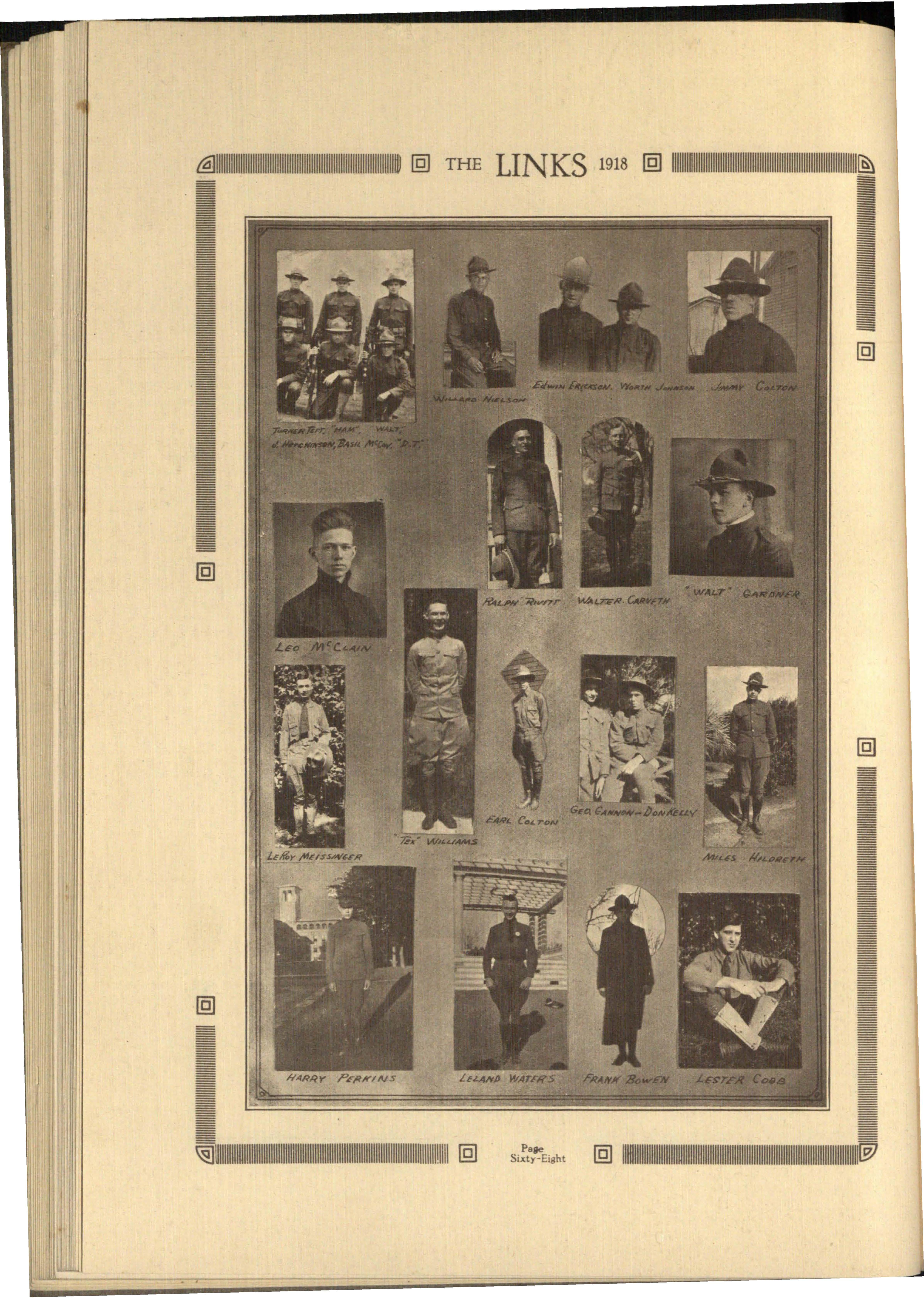
"' HE the call to the colors came, the sons of Lincoln High were not slow \V to hear and respond. ow, on the torn fields of France and Belgium, on the sea , in the air, wherever there is danger, our boys are carrying into the ,. fight for world freedom, the spirit of our school. Often they think of their school, ui us, and wonder if they are forgotten. In these few pages we are attempting to show them that they are remembered; that, wherever duty may call them, the thoughts of their school are following them with a "Good luck and God speed."
[EDITOR' S NoTE -In compiling the following list o f names some may have been omitted. It has proved impossible to reach many alumni wh o ar e d o ubtless in the service.]
Abbott, L. H. Ackerman, Arthur W. Albrecht, Edward G. Alexander, Ambro e Albright, Robert E. Anderson, Paul Andrew, Henry Angle, Everett Arndt, Cornell Arendt, Daniel Ashton, Hutchin on '.Atkinson, Hugh Austin, Verne Ayres, Donald T. Babcock, Blaine Baird, John E. Baker, Irving
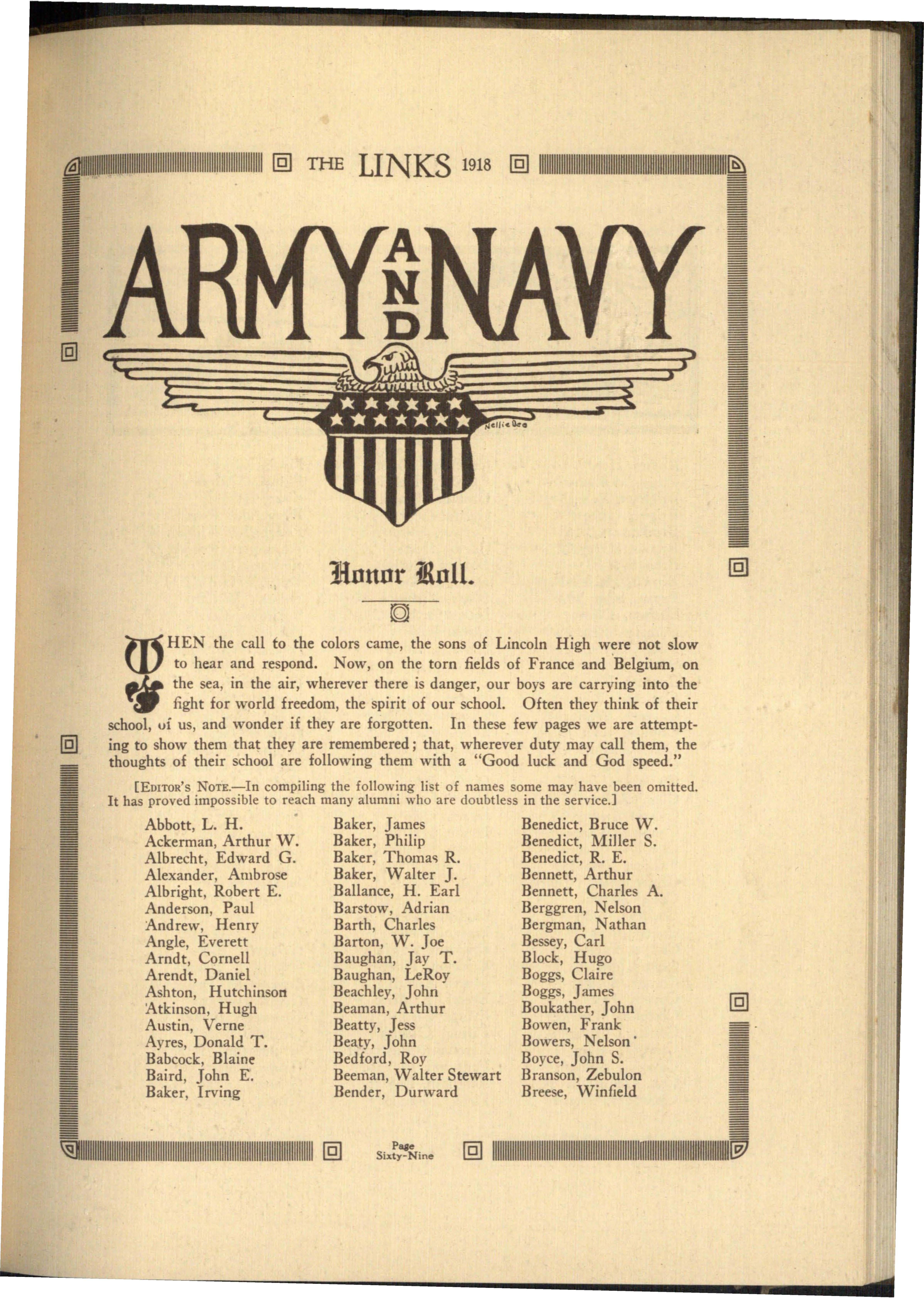
Baker, James Benedict, Bruce W. Baker, Philip Benedict, Miller S. Baker, Thoma<; R. Benedict, R. E. Baker, Walter J. Bennett, Arthur Ballance, H. Earl Bennett, Charles A. Barstow, Adrian Berggren, elson Barth, Charles Bergman, athan Barton, W. Joe Bes ey, Carl Baughan, Jay T. Block, Hugo Baughan, LeRoy Boggs, Claire Beachley, John Boggs, Jame Beaman, Arthur Boukather, John Beatty, Jess Bowen, Frank ==. Beaty, John Bowers, elson • Bedford, Roy Boyce, John S. Beeman, Walter Stewart Branson, Zebulon Bender, Durward Bree e, Winfield ==
Brehm, Henry
Brigg, William Brigham, Rae J. Bright, Gilbert Brinkmann, Fred Brooks, Harry G. Brooks, J. E. Brown, Harley F. Bryan, Silas M. Buffum, Dean Bumstead, Lucius Burge, Clyde A. Burke, Howard Burnett, Harold Cameron, Roy Carveth, Walter W. Cassidy, John J. Jr. Cast, Gotthilf 0. Cather, Jay Chambers, Jess Chapin, Don Chapin, Irving Chapline, Vance Chapline, George • Cline, Earl M. Clinkenbeard, Charles Cobb, Lester Cochran, J oho Cohen, Max Colton, Earle Coltou, James Copsey, Robert Corbin, Jack Costello, Maurice Coulter, Victor Y. Cowgill, Allen Cowgill, William Cox, Oakley R. Crawford, Pierce
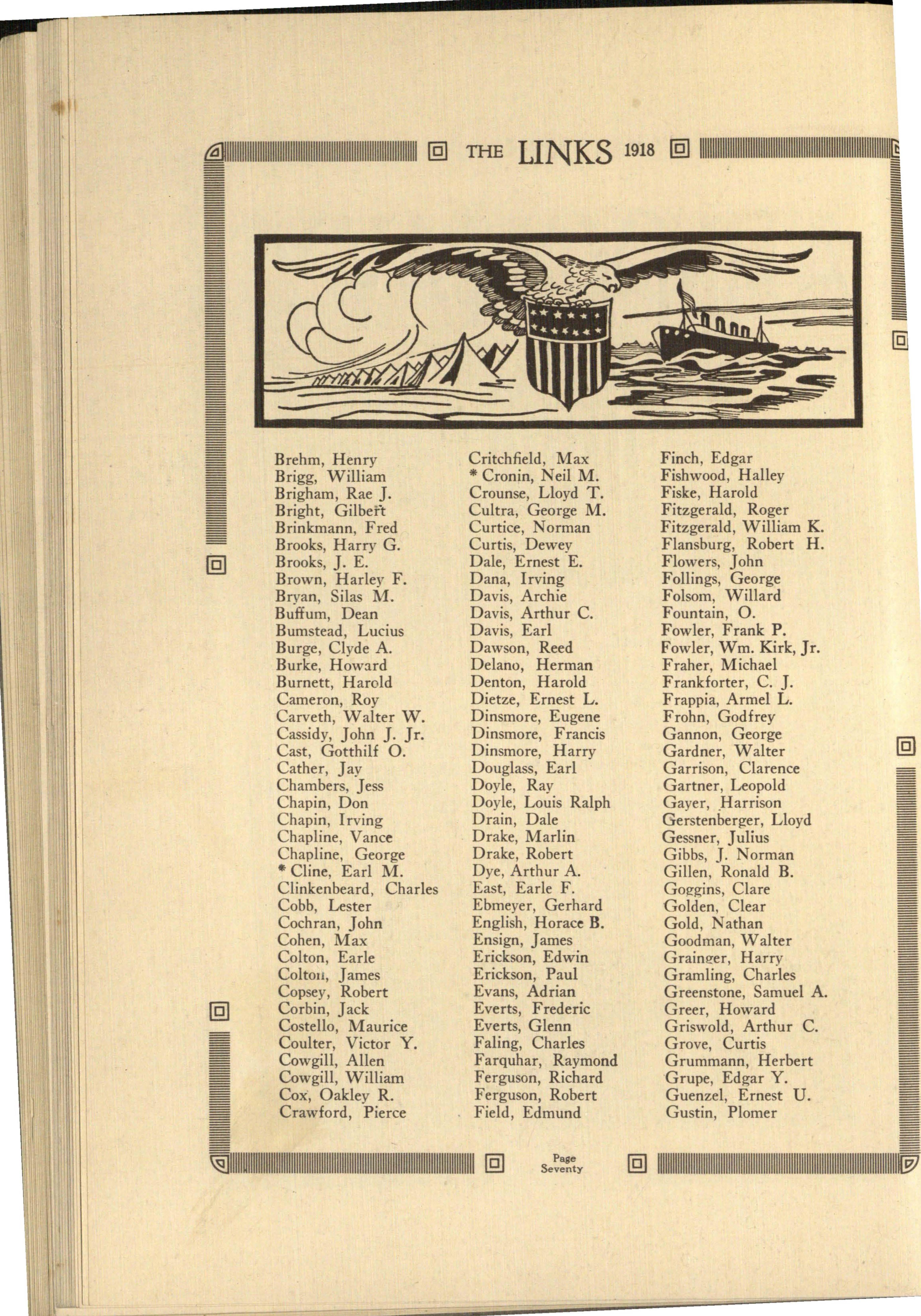
Critchfield, Max * Cronin, eil M. Crounse, Lloyd T. Cultra, George M. Curtice, orman Curtis, Dewey Dale, Ernest E. Dana, Irving Davis, Archie Davis, Arthur C. Davis, Earl Dawson, Reed Delano, Herman Denton, Harold Dietze, Ernest L. Dinsmore, Eugene Dinsmore, Francis Dinsmore, Harry Douglass, Earl Doyle, Ray Doyle, Louis Ralph Drain, Dale Drake, Marlin Drake, Robert Dye, Arthur A. East, Earle F. Ebmeyer, Gerhard English, Horace B. Ensign, James Erickson, Edwin Erickson, Paul Evans, Adrian Everts, Frederic Everts, Glenn Faling, Charles Farquhar, Raymond Ferguson, Richard Ferguson, Robert Field, Edmund
Finch, Edgar Fishwood, Halley Fiske, Harold Fitzgerald, Roger Fitzgerald, William K. Flansburg, Robert H. Flowers, J oho Follings, George Folsom, Willard Fountain, 0. Fowler, Frank P. Fowler, Wm. Kirk, Jr. Fraher, Michael Frankforter, C. J. Frappia, Armel L. Frohn, Godfrey Gannon, George Gardner, Walter Garrison, Clarence Gartner, Leopold Gayer, Harrison Gerstenber~er, Lloyd Gessner, Julius Gibbs, J. orman Gillen, Ronald B. Go!!gins, Clare Golden, Clear Gold, athan Goodman, Walter Grainger, Harry Gramling, Charles Greenstone, Samuel A. Greer, Howard Griswold, Arthur C. Grove, Curtis Grummann, Herbert Grupe, Edgar Y. Guenzel, Ernest U. Gustin, Plomer
Guthrie, Richard Guthrie, Robert Hadley, Howard Hagenow, Charles Hager, Herold
Haggerty, Jennings B. Hahn, Ernest H. Hahn, Royal Halbersleben, Paul Hall, Harold • Hall, James Harvey Hamilton, Herman W. Hamren, Ellsworth Hanna, Ralph Hanneman, Albert E. Hanson, Herbert Harlan , Ira Harley, H. Robertson
Harpham, James Harris, George Hart , Charles Hartman, Charles Harvey, James Haskell , Robert Haskell, Roswell Hebbard, Ralph Hedges, George Heitkotter, Herman Henkle , Elmer Herman, Fred Herrick , Wall ace 'Hildreth, Miles •Hinkle, Harold M. Holts, Walter Hompes , Neal D. Hoppe, Ernest, Jr. Horton, Tanner Howard , Orval Hugg, Edwin Hurst, J. C.
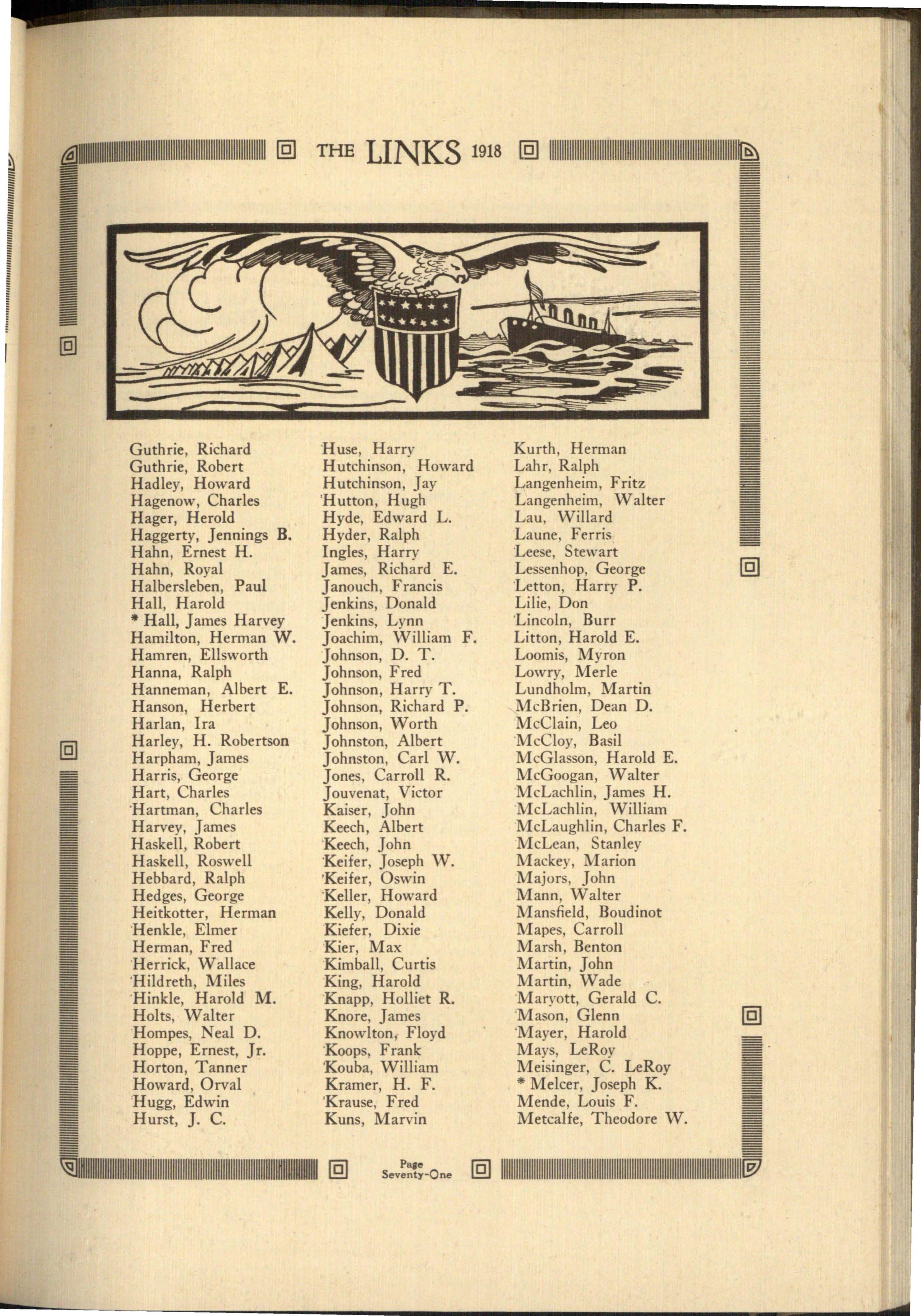
Huse, Harry
Hutchinson,· Howard Hutchinson, Jay 'Hutton, Hugh Hyde, Edward L. Hyder, Ralph Ingles , Harry James, Richard E. Janouch, Francis Jen kins, Donald Jenkins, Lynn
Joachim, William F. Johnson, D. T. Johnson, Fred Johnson, Harry T. Johnson, Richard P. Johnson , Worth Johnston , Albert Johnston , Carl W. Jones, Carroll R. Jouvenat, Victor Kaiser, John Keech, Albert Keech, John Keifer, Joseph W. Keifer, Oswin Keller, Howard Kelly, Donald Kiefer, Dixie Kier, Max Kimball , Curtis King, Harold Knapp, Holliet R. Knore, James
Knowlton, Floyd Koops, Frank
'Kouba , William Kramer, H. F.
'Krause , Fred Kuns, Marvin
Kurth , Herman Lahr , Ralph Langenheim , Fritz Langenheim, Walter Lau, Willard Laune, Ferris
Leese, Stewart
Lessenhop , George Letton, Harry P. Lilie , Don 'Lincoln, Burr
Litton, Harold E. Loomis, Myron Lowry, Merle Lundholm, Martin McBrien, Dean D. McClain, Leo McCloy, Basil McGlasson, Harold E. McGoogan, Walter McLachlin, James H. McLachlin, William McLaughlin, Charles F. McLean, Stanley Mackey, Marion
Majors , John Mann, Walter Mansfield , Boudinot Mapes, Carroll Marsh, Benton
Martin, John Martin, Wade ·Maryott, Gerald C. ·Mason, Glenn
·Mayer, Harold Mays , LeRoy
Meisinger, C. LeRoy
* Melcer, Joseph K. Mende, Louis F. Metcalfe, Theodore W.
(Q]
Metheny, Harry
Miller, Donald
'Miller, Edwin C.
Mills, Leslie
1Mockett, Ralph Montgomery, Wayne Montgomery, Willard
Moore, Albert F.
Moore, Charles G. Moore, Lyle Moore, Verne
Morehead, Edwin
Moreland, Harold
Morey, Claris B. Morris, Thurston 'Mortlock, James Mortlock, Kenneth 'Moseley, Glen
Moseley, Thomas
Moyer , Torrence C. Neal, George Nelson, Enoch
Newton, Harold D.
Nielson, Willard J. Noble , Myron
• orton , Eldon Oldt, Floyd Oldt, Pearl E.
O' eil, Ralph
O'Shea, Edward M. Paige, Francis 'Paddock, Richard Parker, Frank Parker, Howard B.
Parkinson, Lee
Parkinson, Roy Pearce, Douglas C. Perkins, Charles Perkins, Harrie
Perritt, Leonidas Perry, Clayborne G. Perry, Donald Peterson, Carl Phelps, Earl Piper, Julius Polsky, Morris
Pomerene, Joel D. Porter, Earl Poteet, Marcus L. Pound, Harry Pratt, George P. Proudfit, Frank S. Rathbone, Harry Reed, Merril V. • Reese, Herbert Regnier, Edward Richards , Dwight C. Righter, Charles Rivett, W. Ralph Rokahr, Harry 'Rokahr, Herbert Rosenbaum, Leon Roth, Herbert Rouse , Eugene Russell, Edgar 'Russell, Richard Salisbury, Walter Sawyer, Proctor H. Schauss, Walter Schavland, Thomas Schlesinger, Melvin Schlesinger, Sidney 'Schmidt, August C. Schmidt, Herhert Schmieding, Martin Seacrest, Leslie
Sears, Archie K. Selleck, John
Shelton, Harold
Shepherd , Tryon M. Shrank, Emil Sigler, Frank Silsbee, Fred Simon, Joseph Simon, Sam Sipe, Paul R. Slattery, Bert Sloniger, Eyer Smith, Alfred Smith, Harold Smith, James M. Smith, Paul E. Smith, Ray Snapp, Robert Bruce Souders, Glenn Sougey, Leo
Southwick, Philip
Starrett, Robert
Steckley, Edwin G. Steinberg, Isadore Sternberg, George Stewart, Don W. Stoddart, John B. Sweeney, Edward C. Sweeney, Walter Swingle , George Talbot, Robert Taylor, Burke Taylor, Glenn Taylor, Will Tefft , Turner Thomas, George H. Thomas, John Thurber, Alleyne Tice, Francis Tipton, Frank
Trautt, Thomas J.
Tyler, Clair Uhl, Roy S. Upton, Hubert Upton, Milton Van Kleeck, David Van Meter, Garrett E. Wachter, Roland J. Waite, Marshall Waite, Vernon Walder, Leon B. ·w allace, Lucian Waters, Leland Watkins, E. Phil Waugh, Elvin Waugh, Truman Waxham, Ralph Weaver, Otis Webb, Harold '\Vebb, Robert Webster, Calvin Weekes, Dale Weekes, Lee Beams, David Case, Richard Weeks, Paul
Wells, Charles ·Wells, Fred '. Westerveldt, Edgar Westhafer, Cornwell W. Weyant, Romer Wheeler, Mason Whisler, J. Harley Whitcomb, Ralph White, Alva N. White, Fred Whitfield Widener, William Wigert, George Wigg, Harry Wiggins, Leslie Wilcox, Creighton Williams, Homer Williams, Jay Williams, Leon 'Williams, Paul K. 'Wilson, Brice Wilson, Conland Lamb, Roy Marriner, John Wilson, Harry
Wilson, Howard Wilson, Hugh C. Wilson, Leland Wilson, Ralph Wilson, Walter W ohlenberg, Ernest ·wolford, Carl J. Woodruff, Reginald Woods, Henry Woods, Ozro Woods, Thomas Woodward, J.M. Woodward, Warren Workman, Jerry Worthington , Roy Wray, Alex Wright, John C. Yost, Herman Young, Farley Yule, Seneca *Zumwinkle, Otto Stoddard, Paxton Towle, Leland
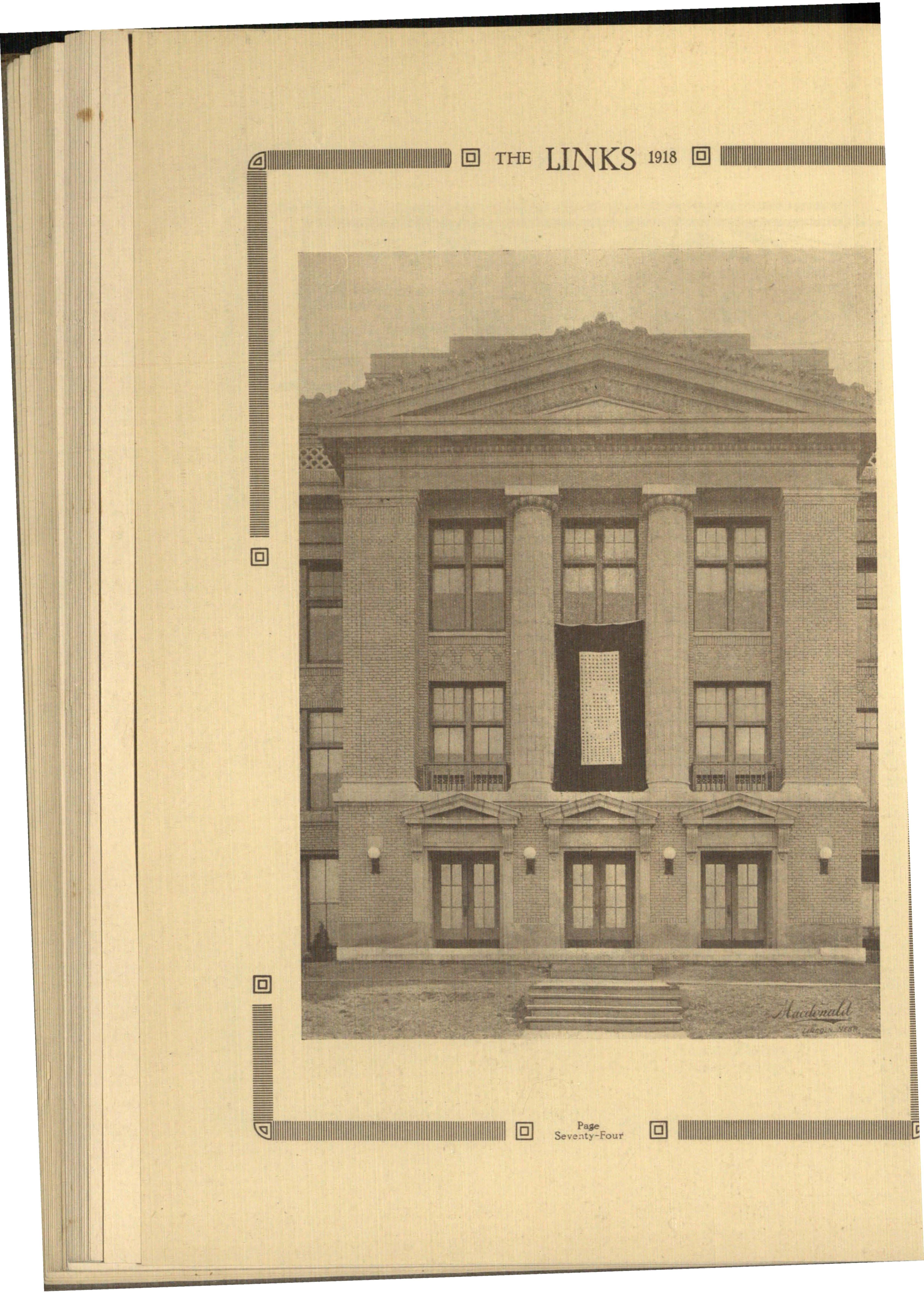
Lincoln High School's silent tribute to her boy under the colors was unfurled on Lincoln's birthday. Each one present will long remembrr the thrill he experienced as the folds of that magnificent banner were loo ed. The huge flag, with is s tar-covered white field, was indeed a stirring sight, one to make hearts quicken with pride for those boys of our school who are ready to lay down their lives in the cause of democracy.
It is hoped that by the end of the school year this flag, with its two hundred and fifty stars, will hang beside another just as large, and that the two will include a star for every son of Lincoln High in the service of his country and the world.
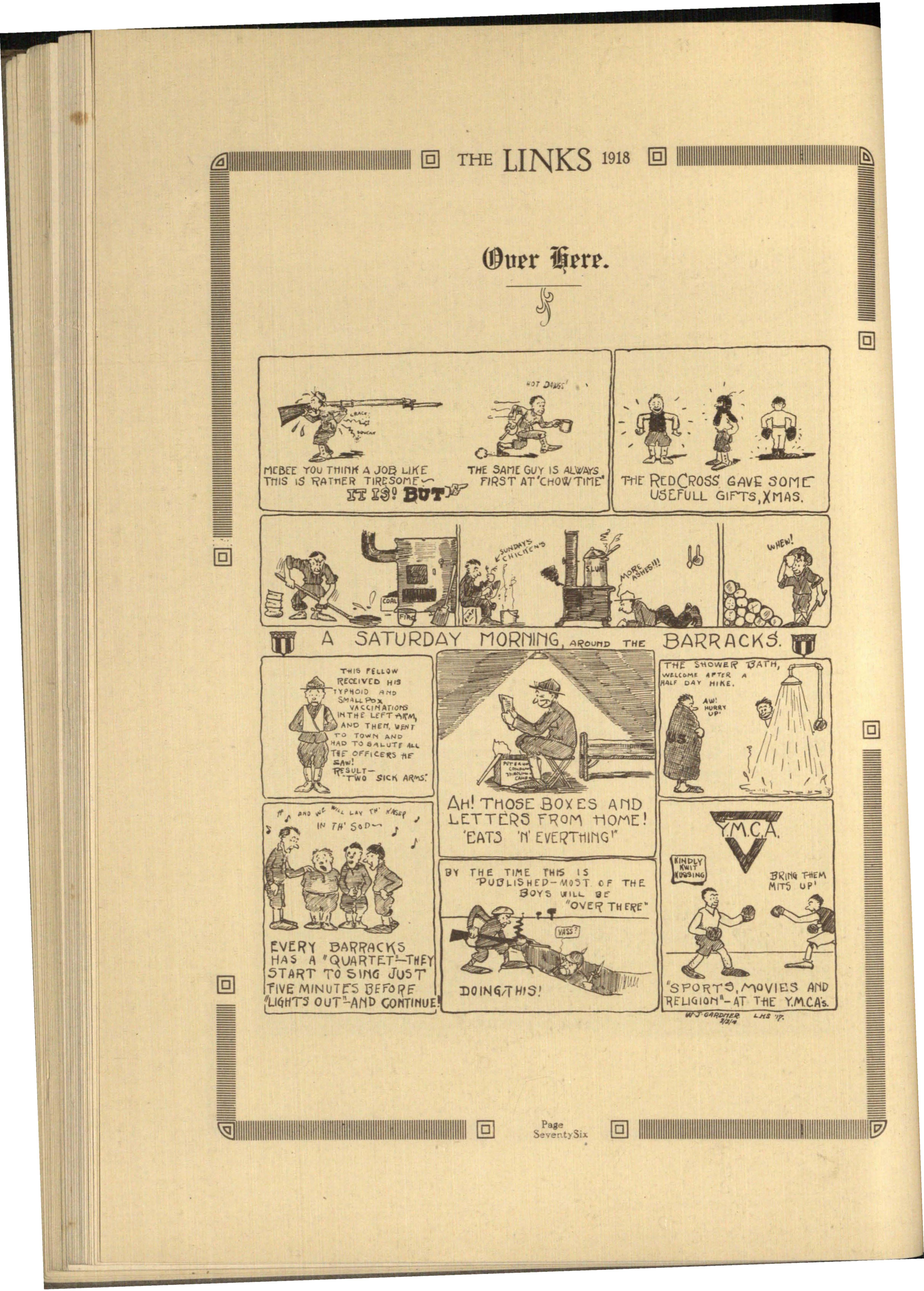
Mr&r YOU Ttlln/f A JO~ LIi([ THE SAM[ GUY IS Al\'t!AYS TNIS 1S li'ATTIER TIRf:SOM[';""' .,,;r,;, FIRST AT'CHOWTIME:' g,; ll~~ Z,11'1'....,. T-tl[ REDCROSS GAV£ SOM L U,5[.fULL Gif'TS,XMAS,
rruow RfctlV(C) H f'rPtto,o ANO ~°''-'- Pbll. VACC.1MATJOl'6 IMTijE LfFT'°',r ANO TH£rt. V~r ., J AH! TH05E BOX £S A ND LE:TTE:R~ 'FROM tiOME ! 'EATJ 'ff [VE"!?Tt11NG 1 •
[EorroR's NOTE: This vivid account of experiences in the French trucking service was written by Seneca Yule, a former member of the Lincoln High School. Mr. Yule ex-1914, enlisted in the spring of 1917 with the American Field Service for duty in France. 'His term of enlistment recently expired, and after a short stay in Lincoln he will enlist with the American Army for service in France.]
E day, last summer, I found my ' elf sailing down the Hudson River on board a French liner, bound for France. Of course I had known long before this that I was going, but the full realization of it did not come over me until I was leaving little old New York and the Statute of Liberty behind. I wanted to laugh and I wanted to cry, both at the same time. I had enlisted in the American Field Service at Chicago and had then gone on to ew York whence I should sail for Paris to finish my enlistment with the French armies. The A. F. S. was a voluntary unit of Americans who had offered their services to France. It was made up of two distinct branches of service, the ambulance service and the camion service. The latter was the transport work, the hauling of ammunition, food, supplies, etc.
The trip over was without excitement except when the wireless aerial broke and fell on the whistle, causing it to blow, which blast was the signal to abandon the boatsubmarines. Just then, there were some mighty fast motions made. I know I didn't linger at all, and I think every one else felt about as I did.
In the danger zone the watch was tripled. In this I helped all I could. I took no chances and had my weather eye peeled for any thing that looked like a U-boat. I think Fritz must have known I was watching for him, because he didn't show up, and we landed safely in Bordeaux, where we were piled on board a third clas5 train and had a night's trip to Paris.
We had a fine reception when we landed, but I was rather disappointed because I had always heard that the French girls met you with open arms and made a big fuss over you. o one met me that way.
In Paris we were all taken straight to headquarters and there sworn in to the French army. Then we chose our different services, ambulance or camion. I cho e the latter for two reasons; namely, because it was what the French needed and wanted, and because that was the service my friend, Norman Curtice, was in. From Paris we were sent out to a training camp about twenty miles from the front. Here we trained for two weeks under the direction of French officers, learning the French drill and a Pierce-Arron· five-ton truck from "soup to nuts."' It was mighty intensive training, too.
Then at last came the dar when our training was finished and we were to start for the front. Excited? Yes! Scared? o ! I will admit I was nervous, though. We were put into trucks and driven over to our cantonment, ten miles back of the lines. There were eight hundred of us American boys in this small town,- many sections having been sent out before ours. From then on the thing became a reality and not a big dream. Things started happening everr day-things that I had had no
conception game."
of, but that soon became an every -day occurrence and "just part of the
We were called out the very next day after our arrival at four o'clock in the morning. It was a load of shells for a place called Cell. I didn't know where that was, but I guessed it was all right, so I piled out from the "downie_s." I should say "scratchies" because army blankets have their drawbacks, especially the French ones. We drove over, eighteen cars in a train, to load at a place called Bazouches. It was the railroad ' s nearest point which ran to the lines five miles away. It was here that we did most of our loading, and our work took us from this place sometimes up to within five hundred yards of the trenches with a working radius of twenty-five miles each way from Bazouches. Understand, this five hundred yard stuff was at night. :Most of our work was done at this time.
On the way over to the loading station that morning, a Boche plane came over on a reconnoitering tour and created a little excitement for us new ones. Antiaircraft guns were shooting at him from all sides, and little white puffs of shrapnel were breaking all around him. This didn't seem to bother him much. He kept circling around uruil one came uncomfortably close. Then he started falling wing over wing, end over end, and every way. I thought he was hit and I was yelling at the top of my voice , but he was only changing his altitude to get out of direct range. He fell about two thousand feet and then righted himself and flew off.
I was all eyes that day. The mightiness of the whole thing impressed me the most The traffic was heavier than in the down town district of Chicago. Artillery trains, infantry, every thing was either moving up to the front or back. Infantrymen were coming out of the trenches, dead tired, wounded, dirty, and unkempt, but with smiles on their faces,-they had escaped this time and were coming out for a fifteen days' rest,-infantry going in, clean, spick and span, but with no smile. It was with a spirit of grim determination and a far away look in their eyes. The French are a wonderful, wonderful people and there is nothing too high that I can say in their praise. When once Americans realize that the French stopped the on-rush of the Germans in 1914 and saved the world, when they can understand the things the French have gone through, when they realize that there is hardly a family in France but has lost some member and sometimes three and four, and then see how bravely they keep at it, then the Americans, too, will think "There never was a people like the French." I didn't mean to preach a sermon, but I am so enthusiastic about the French that I couldn't stop.
vVe were stationed in the northern part of France half way between Soissons and Rheims. It had been a very beautiful country at one time but three and a half years of war had left their mark. Buildings were ruined, the ground was full of shell holes, and everything wore a devastated look. Whole fruit orchards had been cut down by the Germans in their retreat, and left lying.
I'll never forget the first time I was under fire. I don't believe any human being would forget it. I had been out there only a few days when we got orders to go to a place called Soupir. Now I had been hearing about this place. It was just one kilo. from the trenches, five-eights of a mile. The French call it a "tres mauvais" place, meaning very bad, so naturally I didn't have all the nerve in the world when we started out, but I put on a big front and said: "C' est la guerre." We arrived there about twelve o'clock at night and had been in the park but a few minutes when the Boche started shelling it. Orders were to stick with the cars but there was a general scramble around there. I didn't let any dust collect on my
Pase Seve nty-Eisht
Seeing this , we climbed out, unloaded our trucks, and left that place behind. I was in a town called Braine one day when the Germans started shelling it. A big shell came in and hit the building next to the one in which I was, completely destroying it and tearing away part of the roof of the one I was in When I got = through running, Braine was quite a way behind me. The running might sound fonny, but every one else did it and I didn't want to appear different.
On one trip I was leading our train. I passed three or four French camions and @ found myself in the middle of a French section. After unloading at the park I decided to wait for the rest of my bunch so rolled down the road about two hundred yards. The next truck up was a French one carrying six men, five to unload and a driver.. A shell came in and hit this truck. It killed all six of the men and left ==
nothing of the truck. I had stopped to pick up a horseshoe on the road that day and I still say that the horseshoe is all that kept me from being unloaded at that time. By the '\vay these shells \.vhistle, one can tell ,vhen it's time to get his head do\vn. ==
Mail came spasmodically, but when it did come-it ·was the best time of the day. I never realized what a letter could mean, till I was there and didn't get any. I was in France a month and a half before I received a letter. Five thousand miles from home, in a foreign country and no mail. There can be nothing worse. If you know any one who is "over there," write to him and do it often. You don't have to say anything just so long as it's a letter. Nothing cheers one so much as a fol letter from home, and the Lord knows one needs cheering over there.
-SENECA Yur.E, ex-'q..
Down the big and sunlit street
Goes the steady tramp, tramp, tramp; Drafted boys whom we all know Are on their way to training camp.
Their faces bright with eagerness For the new and untried things. Courage, steadfastness, and hope It takes to battle with the kings.
So let us cheer them on their way, The way that looks so long. They're the hope of U. S. A. These boys two million strong.
-MARY LOUISE BRYAN, '20. = = ~
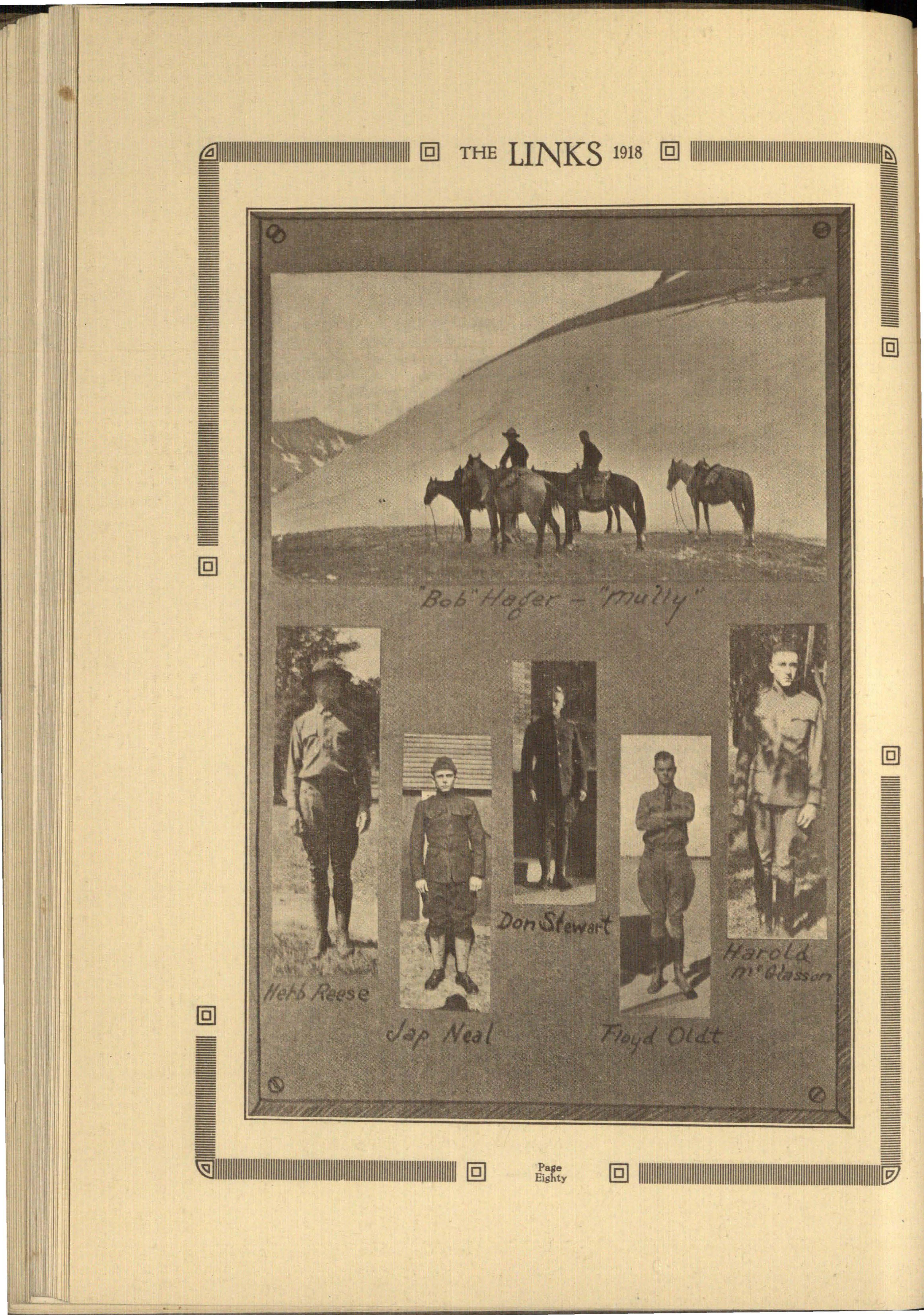
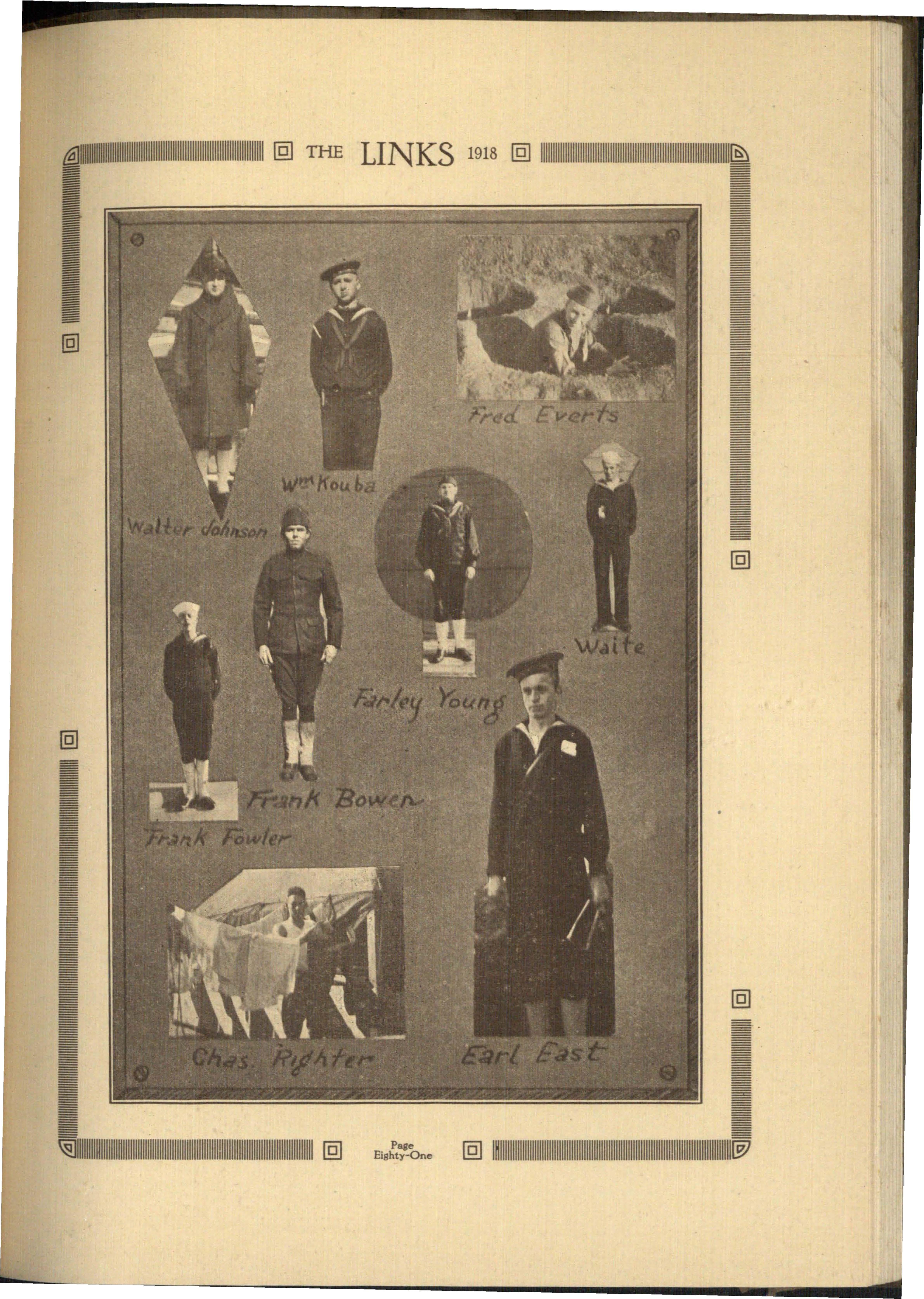
a,AR relief work in Lincoln High School. Do we realize its full extent, and how eagerly the whole student body and faculty have made it mean what it does? •• Of course, we all know about the Red Cross, liberty bonds, and thrift stamps, but do we know about the many other things that L. H. S. students are doing to help Uncle Sam, and to make the world safe for democracy? So well has the student body entered into war activities, and so cheerfully has it given of its time and money, that the result is astonishing to the students themselves. The little war orphans have been made warmer, and given something more to eat; the starving, dying prisoners in Germany and Au tria have been cheered and fed; our soldiers have been warmly clothed with knitted garments; the wounded soldiers in the trenches and hospitals have had immediate relief and care; farmers have had help in raising more wheat and corn for the world ; the boys in camp have been made happier; and Uncle Sam has been helped financially. Surely every one is happier because of all this! Who is happier than those who helped to make the others happy!
Early in the school year, after the stirring plea of Mr. Penningroth, a Y. M. C. A. worker in the prison camps in Austria, ninety-five boys responded by each pledging one dollar a month for ten months, for food packets to be sent to the Serbians in the prison camps. The boys are assisting in a most worthy cause, to relieve conditions which are too dreadful to be described. The money which means comparatively little to Americans in moderate circumstances, means life itself to the prisoners, many of whom are dying or going insane because of the lack of food, and because of the monotony.
Who would have thought that such an insignificant thing as tin foil could help win the war? It can, though. Last fall under the supervision of the Girls Club, a box for tin foil from candy, gum, etc., was placed in the cafeteria. In a day or two it was full! Since then it has been filled several times, and the contents, together with tin foil collected from the grade schools and other places, have been smoothed out and ~orted, then sold to a refiner, and the proceeds used for Red Cross work.
In addition to the Red Cross bandage work, the sewing department has done its bit. Lincoln cleaners offered to clean, free of charge, all garments donated for French children. The sewing classes, in the first semester made 100 of the cleaned
-· ga,ments fa to weac, and a few wm made om ent;,cly. At the beg;nn;ng of the== second semester the girls started twent y- four baby petticoats and continued sewing == for French orphans throughout the year. They are much more enthusiastic about := making warm , little garments for war orphans than about sewing for themselves.
After a report was made to the Rot a ry Club about the sewing for civilian relief done at the high school , Dr. Baile y sent a bolt of new m aterial t o be made into garments "for the kiddies over there. ' ' Mr. Byer of the E yer's Grocery sent to the sewing department a number of flour sacks, which had been washed. These were made into underclothing and aprons for w a r refugee s. Major Cr essy , who has been doing relief work in Serbia , offered t o di stribute some of the clothing among the Serbians by whom it is needed and " ill be appreciated.
The cafeteria is doing its best. It complies with all wheatle ss, me a tless, and porkless days. In addition to thi s, neither ice cream , candy , nor cake is served on certain days. Since the beginning of the yea r no bread made wholl y of wheat has been sold. In the preparation of fo od requirin g flour , from five to fifty per cent of substitutes is alwa ys used. A hundred-pound sack of sugar, which formerly lasted nearly a week, now lasts two weeks , honey and syrups being extensively substituted. Posters in the cafeteria are reminders of Mr. Hoover ' s messages, and the students and faculty cheerfully co-operate with Mrs. Kinyon in the conservation of all food and in keeping the "-less" days.
Although every one had already given to the many war activities and many were buying war savings stamps , the high school students and teachers went deeper into their pockets to buy liberty bonds. Two hundred twelve of the students and most of the teachers have bonds, and many have several. The third liberty loan drive will undoubtedly find many more teachers and students helping Uncle Sam win the war.
The typewriting department , though exceedingly busy with work for different departments of the school, found time for war work. At the request of the county physician many letters and blanks were typed, to be sent to the various physicians of the county. The letters explained the blanks to be filled out for the soldiers who returned home disabled.
For three weeks the boys of the manual training department worked on eighteen bookcases which serve, not only as book shelves, but also, when closed, as packing cases for books. The cases will be filled and sent to France with the next hospital unit leaving Omaha. The cases were planned by Miss Charlotte Templeton , a Lincoln woman, and the diagrams were worked out by Mr. Culler of the manual training department. An Omaha woman paid for the materials used in making the cases and other friends of Miss Templeton furnished the books.
"The everlastin' team work Of every bloomin' soul."
That is what will win the war, and where can be found better team work than in the way Lincoln High School ·students are buying thrift stamps! Nearly every student has his book of little green stamps, each of which represents a quarter saved.
The students are working hard to meet the high school's quota of $30,000. The follo,ving represents the sales up to 1Iarch I 2, 1918:
Despite the fact that ther had lived in the citr all their lives and had done only school work. a large number of boys were eager to work on farms last summer. Of the 13-4- who went, nearly all stayed the full ten weeks, although they had never ·worked so hard nor for such long hours before. A tanned but triumphant group of boys returned to school in the fall. Even cornhusking in October claimed fifteen of the boys.
Before a Red Cross auxiliary was established at the high school, the various girls' societies went to the headquarters in the Scottish Rite Temple. Two hundred nine girls found it an interesting and fascinating work. When the auxiliary was established at high school the girls pledged themselves to work at least one night a week. Only a few of the several hundred girls failed to sign the pledge, and they are girls who work after school, or whose duties at home prevent their staying. On an average, sixty girls a day, for the first four days of the week:, have reported in the cafeteria. Even now they have made quantities of compresses and wipes, but as they grow more skilled in the work they can surpass their early records.
A few girls worked on hospital garments and have already finished several. Considering that the garments take a good while to make, and that the girls have only one day a week to work on them, one feels that they have done especially well. So far as can be learned by inquiry, the Lincoln High School auxiliary is the only high school auxiliary in the United States!
Last fall a request came to the art department to make articles to be sold at a bazaar in Chicago, the proceeds to be given to the Red Cross. Several students enthusiastically helped in making these articles and the results were a knitting bag, book-ends, memorandum pads, book marks, and a tea tile. They were decorated, of course, with original designs worked out by the art students. The amount of money netted at the bazaar by these articles cannot be ascertained, but we know it did its bit for the Red Cross.
Six students and one teacher are supporting Belgian children in their own names and many who felt unable to give enough for the entire support of an orphan have contributed to the fund. Last spring the Girls Club, after pledging twenty-four dollars, enough to support two children, conducted for three days a successful campaign to raise sufficient funds to support seven additional orphans.
Not only are fourteen students and four teachers supporting French orphans, but many others, aided by their families, take care of orphans, and still more have contributed to a fund for French children. Last spring a campaign was carried on at high school and in the grades to sell the French orphan medals. As a result hundreds of persons throughout the city are wearing or have in their possession today these medals.
More than four score soldiers were made glad on Christmas day by the boxes from Lincoln High School. Some of tqese were packed by classes. Fifty-five were packed at high school and contained candy, cookies, and little gifts for the Sammies. Many of the boxes went to France. Individuals packed boxes, too, and many of them. Some were sent to friends and others to distributing headquarters in the east.
At a meeting of the Girls Club last spring plans were discussed for war work: during the summer. All favored the idea of making comfort kits. By meeting every two weeks, approximately 100 khaki kits holding thread, scissors, buttons, darning cottons, needles, and pins were made and sent to training camps. Of these 100, a large per cent was made by one girl, who solicited the money to pay for them.
Although Christmas was close at hand, the members of the high school responded readily to the Red Cross campaign in December. At the end of a week's heated campaign, carried on by home room representatives, Lincoln High School boasted 892 members. Fourteen home rooms had 100 per cent membership, and of the students who entered high school in January, a good many had already joined the Red Cross. After the junior play, the junior class swelled the fund by fifty dollars, and part of the carnival proceeds raised the money to $1 ,ooo.
Despite the fact that no campaign was carried on at high school for the Red Triangle fund oi the Y. M. C. A., 171 pupils and several teachers contributed to it. They considered a fund which provides shelter and refreshment for the boys at the front, and recreation for the boys in camp over here, a good one, and one which is helping unquestionably and splendidly to win the war.
During the fall and winter, knitted garments grew apace under the skillful fingers of both teachers and girls. Knitting bags were everywhere, and the results are astonishing. Sweaters and wristlets seem to be the most popular, but even some socks were attempted. Following is the number of articles knitted:
Scarfs
Sweaters
Helmets
Socks
Wristlets
In addition to this, several blanket squares were knitted.
When the need of the soldiers for books was made known, Lincoln High School students began to ransack their homes for suitable volumes. They found many and brought them in until the number reached into the hundreds. The books include novels, histories, stories of romance, travel, adventure, and works of a more serious nature. For the few moments that each student gave, the soldiers and ,ailors will have hours of pleasure and study.
Uncle Sam has a volunteer army of gardeners nearly 400 strong from Lincoln [Q]
High School. 205 boy and 165 girl , acting upon the suggestion that "food will win the war," are going to have gardens of their own this summer. eYeral more will help in their family gardens.
Lincoln High chool tudents and teacher ha, e not only participated in the e acti ities at chool but have helped in many outside actiYitie everal per on gave to Armenian, yrian, and erbian relief funds on tag days; some gave to thP Knights of Columbus; ,_ ome to the Women's Council of Defense; and other bought thrift and war aving tamp before the high chool campaign started. A few persons bought smileage book for oldier and many ,sent candy, magazine , new book , Victor record , and other gifts to the camp . Two per ons sent Thanksgiving boxe to oldier , and one teacher contributed ten dollars toward an honor tablet for her church. One oldier was adopted. A teacher ,, ho had no time to knit , her elf, furnished yarn for several knitted garment , and another made a pajama suit. Several contributed to the Y. \V. C. A. hoste house fund , and a number of tudents distributed food pledge cards and tagged people as well as coal hovel Still other mi cellaneous funds and activities have been helped by the money of our high school member • In re ponse to the call for clothing for the people of northern France and Belgium, many garments were collected and sent to Red Cros headquarters. So war relief for democracy goe on and on! ®ur 1£ittlr JJrlag.
The little flag at our house
Is floating every day
Beside the great Old Glory, Since brother went away.
This little flag ju t seems to say As the breeze make it dance, "Look up and ee our one blue starWe've got a boy in France."
The little flag at our house
Will wave, and wave, and wave , Until our boy is home again , Or finds in France hi grave.
But if this blue star turns to gold
Because of war's grim chance, The little flag will wave and say, "Thank God, our boys helped France!"
-ALICE MATHIESEN, '20. =
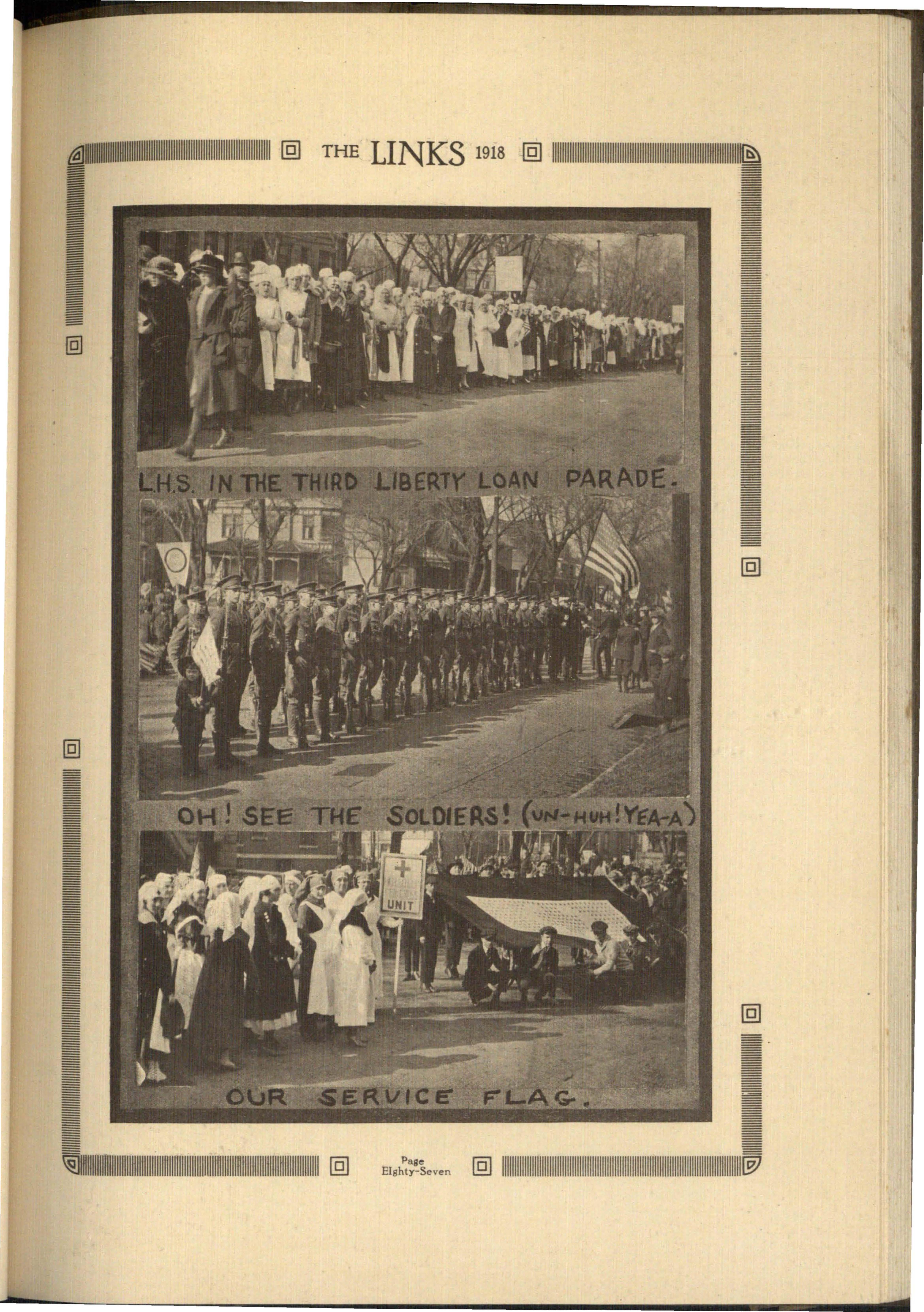
"First in everything!"
To the mere uninformed outsider, Lincoln's slogan may seem at first hopelessly and impossibly sweeping, but anyone who has come in contact with real L. H. S. spirit knows that when this school formulates a watch-word, she makes one worthy of the utmost striving and lives up to its loftiest and best interpretation. In holding fast to her present motto she does not forget to include many matters other than those ordinarily classed as school activities. The treatment of one's freshmen would not ordinarily be termed an activity, but Lincoln High School has set out to be foremost in all things, so early this year she performed the unbelievable, unprecedented act of forgetting, deliberately and completely, to ridicule her first year students! And not content with that alone, she made a special effort to acquaint them rightfully with her mysteries and peculiarities, her traditions, and her student body. They ralled this introduction, the Freshman Party, and truly members of the infant class were right royally and joyously entertained. Sophomores forgot to tease, or to explain that the library was situated on the first floor immediately beneath the swimming pool and that the cafeteria had ceased serving lunches to freshmen because of the increased cost of milk. Juniors, one and all, became most thoughtful and anxious to please. Even seniors ceased ignoring their younger brothers to enter heartily into the spirit of the occasion without a trace of superior dignity or frigid reserve. The older classmen were learning with the new.
First, in the auditorium there came a splendid program of stunts and aesthetic dancing. Then there was a mad rush for the gymnasiums, where old students sought out the newcomers and eagerly escorted them to meet their friends, requested the pleasure of a dance, or dragged them forth upon the floor only to chase wildly after them in turn in some fascinating game of drop-the-handkerchief or three-deep. It was indeed a wonderful day for all, and only the beginning of more wonderful times to follow. Friendships were formed that could not otherwise have materialized, and those who were entering the high school for the first time caught more of the Lincoln spirit and became truer and stauncher backers of the scarlet and black in those few hours than they could ordinarily in a year. By being first to treat her freshmen as equals, Lincoln High has nearly doubled her ability to be "first in everything."
'/""c<. HE building was deserted now, quite desolate of its noisy throng of students, \..) and its halls seemed strangely hu hed and very lonely; only the regular ii_~}i tick of the clock measuring off the long, slmv minutes broke th tillness.
W Then a new sound echoed down the corridor, a rich, low sound as of a man with a wonderfully musical accent speaking, but no, not a man either, but the statue of Apollo at last found voice.
"l wonder," the voice wa musing, "what occasioned all this gayety, \\.·hat caused all this blazing color display and unseemly hilarity? These students always had peculiar ways, but today they acted even more strangely than ever."
"I saw, and question, too," Diana broke in upon him. "How any mortals can desire to deck themselves so fanta ticallv in red and black or be so boi terous is more than I can fathom."
•
"They're always boi terou ," sighed Apollo. "But today the boys were so extremely unmannerly. I could look acros into l\liss Pound's room and see, mark you, practically every young man wearing hi hat,-a little, Turk-like, carlet hat at that,during hi entire class; even girls had those brilliant caps on. These are indeed strange times! "
Sadly Diana gave assent. "Mo t strange," she agreed. "But-this headgear of which you speak. Some frivolou freshman actually had the impudence and insolent daring to place one on my head this morning, on me, Diana, goddess of the hunt-Pah ! It fell off quickly enough but hi mates had seen and laughed! It make me feel almost humiliated!"
"They also tried to tie some ribbon on me, but the bell rang before they had time. Such lack of training!" Apollo gave his head an angry to s. "Why do they so?"
"Perhaps they are preparing for a new sort of battle," volunteered Diana. "The pupils repeatedly said something about having to beat Omaha, and always emphasized their remarks with wild and vicious gestures!"
"You have it!" ejaculated Apollo. "Don't you remember that in their a sembly this morning they kept crying out a jumble of words about 'Give 'em the ax, the ax, the ax, right in the neck' and then roared forth 'Omaha'? They must be planning wholesale slaughter!"
"I do recall it now. Then I couldn't distinguish one phrase from another. And they practiced all their war cries and--"
"Sh-" Apollo warned her. "Here comes a man."
"Thought I heard some one talking," puzzled the janitor. "Gue s not, though. Say, the youngsters must have had a great color-day and football rally here today. Wish I could see that game. 'Tis funny about those voice , though."
In a sea of highly colored po ters depicting with picturesque reality the doom of poor English in the Lincoln High School, Better English Week appeared on 1onday,
• November 19, 1917. With wondering eye stude nt s paraded up and down the = - corridors, marveling at the attrac ti ve exhibition. Here was the clever cartoon labeled ::: "How l\,lany Can You Kill?" in which flie represented slang exprehssions, and there = was the "Poor English Cemetery" with gravestones bearing sue inscriptions as "Our Beloved Sister 'Done'," "Here Lies Beloved Friend 'Seen'," and "In l\1emory of 'I Should ,vorr y'." Gorgeous posters, made by the art department, pict~red the need of good English in the homes, in the factories, in business, and in the trenches. =:
From Monday on, interest in better Engli -h wa,ed stronger each day. Individual = pledges, classroom mottoes, better English dinners, banquets, class playlets,-all kinds [§] of diversions, figured during that memorable week which reached its height in a special assembly on Friday.
,
A pageant and a play were the chief features of the assembly. Flashing across the stage in quick succession, the participants in the pageant irave living demonstrations of the meanings of the most common slang expressions heard in the school.
"Anyman's Journey to Success," the play which was given, was written by a committee of eight students, one from each senior English class. It related the journey of Mr. Anyman on lus way to Success , and the efforts of the Slang Twins to go with him. On the road they met Education, who showed them the path to Success thru a new invention which.he had made. By this device, Mr. Anyman, his followers, = and the Slang Twin ,vere transformed and put on the right track.
At the dose of this Friday assembly, Better English Week in the Lincoln High @) School officially ended, although its influence has remained all during the school year. Its fame has spread to other schools, bringing many letters of inquiry about it. Within the school itself the improvement in written and oral English has been so marked and the students have been so much more alert to mistakes in themselves and others that the Lincoln High School cannot but count its first Better English Week as a success and hope that it may have one as good next year.
-KATHERINE BRENKE, '18.
"One of the few, the imtnortal names That were not born to die."
~ HE class of 1918 has been making this sort of name for itself ever since its first \...) timorous entrance into the old Administration building with its countless 'f~~ pitfalls, its strange intricacies of winding hallways and hidden classrooms.
~'<OJ Never since those trembling moments has the class ceased to be enviably original. In its last year, in accordance with its reputation, it came forth with a color display for senior day that was unique. Friday, December 7, was the date of the occasion , and on that morning every senior boy wore a bow of purple at his collar, every senior girl appeared in a white blouse and flaunted a purple tie, while all bore proudly white balloons with purple ribbons. Sedately midst a ripple of envious sighs, these privileged beings filed to their assembly sea ts and then in a mighty burst of song proclaimed, "We are the seniors of renown," while far above there floated the bobbing, bounding balls of white with their purple streamers. Then came a play, a witty, merry, little suffrage farce in which Stanley Hall and his revolver proved themselves much more efficient in converting "antis" than in "burgling," and Lois Cordner
Page Ninety @
a ppeared as a very convi n ci n g pleader of the woman's cause. \ Ve should hate, howe,·er. to think that Harold Morgan was as stubborn and old-fashioned in his ideas off t he stage as on; and while we knew Glen Roshon's talents \\·ere Yaried, \\·e hadn't realized he could act so effectively in t_he capacity of darky butler. But Brick Richards as a n Irish policeman afforded not the least surprise \Ve had alway~ rather suspected th at red thatch of his as belying his descent, and certainly we had expected to find him some manner of officer. Following the pla) let, the senior quartet gave several good selections, and the program for senior color day. so far as the underclas~men were co n cerned, was over.
That evening the seniors themselve made merry at a sort of masquerade, hardt imes banquet, with additional stunts and dancing. in the cafeteria. Every one ,,as t here, from fair ladies to beggarmen, and from a wild cowboy to the old devil himself, and all enjoyed a madcap, rollicking good time . But then that celebration was for seniors, and seniors only .
All t hrough the school day, however, in class room or in corridor, the white and purple bobbed aloft as reminders of the occa , ion, while faculty and students alike looked up to those soari n g colors with awe and reverence. and the name and fame of that class of 1q18 soared wi t h their bounding bubbles.
"For S-E-N-I-0-R -S Spells the class th at's won success."
t=l'"
S SOO as the school term was \,, ell on its way, people began to ask oc,--1 casionally of one another whether or not there was to be anothrr carnival '{{~~ such as was held in the preceding year, and as the semester progressed, queries became more and more insistent. Was there going to be one? Would it, could it, be as good? Who would be in charge? \Vhen ,rnuld it take place? \Vho " ·ould participate? Faculty as ,veil as students puzzled and wondered about these possibilities, but each question met repeatedly with the same hopelessly unsatisfactory response : "I don't know." At last, when everybody had almost decided that none could shed the faintest ray of enlightenment concerning such a festival, that perhaps there never was to be quite such a time again, the carnival committee and date were ,mnounced, and hope, in accordance with its reputation, rose higher than ever in the hearts of all. The carnival was not only to be as good as before, but it ,,·as to surpass ·an) like event ever given in a high school, and its proceeds \\ ere to be used in patriotic purposes,-the swelling of the Red Cross membership and the purchasing of thrift st amps.
March 1st, so eagerly awaited by all, finally rolled 'round, and if it forgot to bluster in, Lincoln High School 's carnival must have made up for all the din and gay confusion the month lacked. It started off in a grand parade with a very fantastically dressed band leading and all manner of other we irdly costumed figures following,cowboys, minstrels, sturdy soldier lads, Spaniards, grin n ing clowns, demure Red Cross girls, gypsies,- every conceivable type of character. Then the big performa n ce in t he auditorium started while various and sundry side shows sent out efficient "barkers" to draw crowds t o their different stunts Every one wa merry, was thoroughly enjoying h imself. Horns blared, tenders of refreshment booths cried out their wares, and every-
where fell generou- showers of confetti a· the throng surged good naturedly through the halls or frequented the numerous attraction Later in the evening dancing, too, came into prominence and added greatlr to the general good time At IO :30 the carnival broke up, but there was no one who attended but agreed that its aim to draw a vast number of people together and to make them thoroughly enjoy them elves wa more than achie\·ed.
In a stirring, never-to-be forgotten a semblr held in commemoration of Lincoln's birthday, the mammoth sen-ice flag of the Lincoln High chool, with its three hundred twenty-three ignificant star, was unfurled before the school. Clarence Cypreanson spoke a few earnest words in presentation, and as he talked, members of the tudrnt council flag committee tepped up to pull the cords that let unfold the great banner. Mr. Pickell then read the war me sage of Pre ident \Vilson, following which the Reverend Dr. Gratz gave an especially appealing, patriotic address. As a closing number the entire a sembly, lead by Ir. Ferguson, ang the "Star Spangled Banner, " with all the fen ·or that even uch an occasion could hope to command.
Any mystery en hrouding the conduct of Lincoln' gridiron warriors on their various trips to foreign field was entirely cleared up in the final football assembly of the sea on. Different player vividly recounted their games , describing also numerous casual occurrences with frequent revelation of individual enterpri e and behavior. By the time the last incident had been related the audience was firmly convinced it had been Ii tening to humori ts as well as to athlete ·.
"L's" ,vere then awarded bv Mr. Pickell to the first team members and "R' " • .f • " " h • d I Cl I d d h "L" s, s1gm ymg re , erve to t e econ r. eve an was presente wit an bhnket in token of a chool ' appreciation of con tant, willing aid, and valued encouragement.
Dr. Stewart, as speaker of the morning, urged the neces ity for co-operation betwren the univer ·ity and the high school. Lincoln High means to recognize uch a need and fulfill, if possible , all of its requirements. ia .a krthall
March thirteenth held no vague and superstitiou · terrors for Lincoln High this year. Quite the rever e wa true. It wa - a time of celebration, celebration for a
season's long string of victories, marred only by a single defeat, and that twice avenged, celebration for the possession of state championship basketball honors. The day's assembly opened with a selection by the band, after which team members related how it all occurred in brief reviews of their games. Mr. Ferguson very aptly demonstrated both his musical and oratorical abilities. As proof of the first , the glee club sang one of his compositions, "That Lincoln Melody," while he himself convinced all of the second by speaking on the great seriousness and solemnity of the occasion. this occasion of death, death of the basketball season. Mr. Pickell then awarded "L's" to the players who had helped make it possible for such a season to live gloriously in Lincoln.
Dr. Stewart, of the state university, presented the school through its basketball captain, Wesley Jungmeyer, with a handsome loving cup, the trophy annually provid ed for the class A tourney winner by the Armstrong Clothing Company.
The second part of the program was featured by tableaux. Coach "Bob" Hager announced that he had discovered that aside from their single ability to humble opponents in the game of basket tossing, the talents of the team varied widely. Each player was then shown at his particular specialty which ranged from a grin of broad dimensions to a studious inclination towards mathematics and from an oratorical gift to an ability as a cartoonist.
Omaha was next pictured, at first, fondly, confidently dreaming of victory, later reaching hopelessly up in vain endeavor to wrest the coveted laurels from Lincoln's secure grasp.
It may be that Omaha is still cherishing bitter and not vague thoughts on the thirteenth.
The sidewalks glisten, The robins listen, And watch for juicy worms.
The ice has melted, The world has belted Herself "·ith fairy ferns.
The brooklets chatter, And green banks splatter With dainty silv'ry spray.
The brownies scamper
With flowerets tamper
Tinting the petals gay.
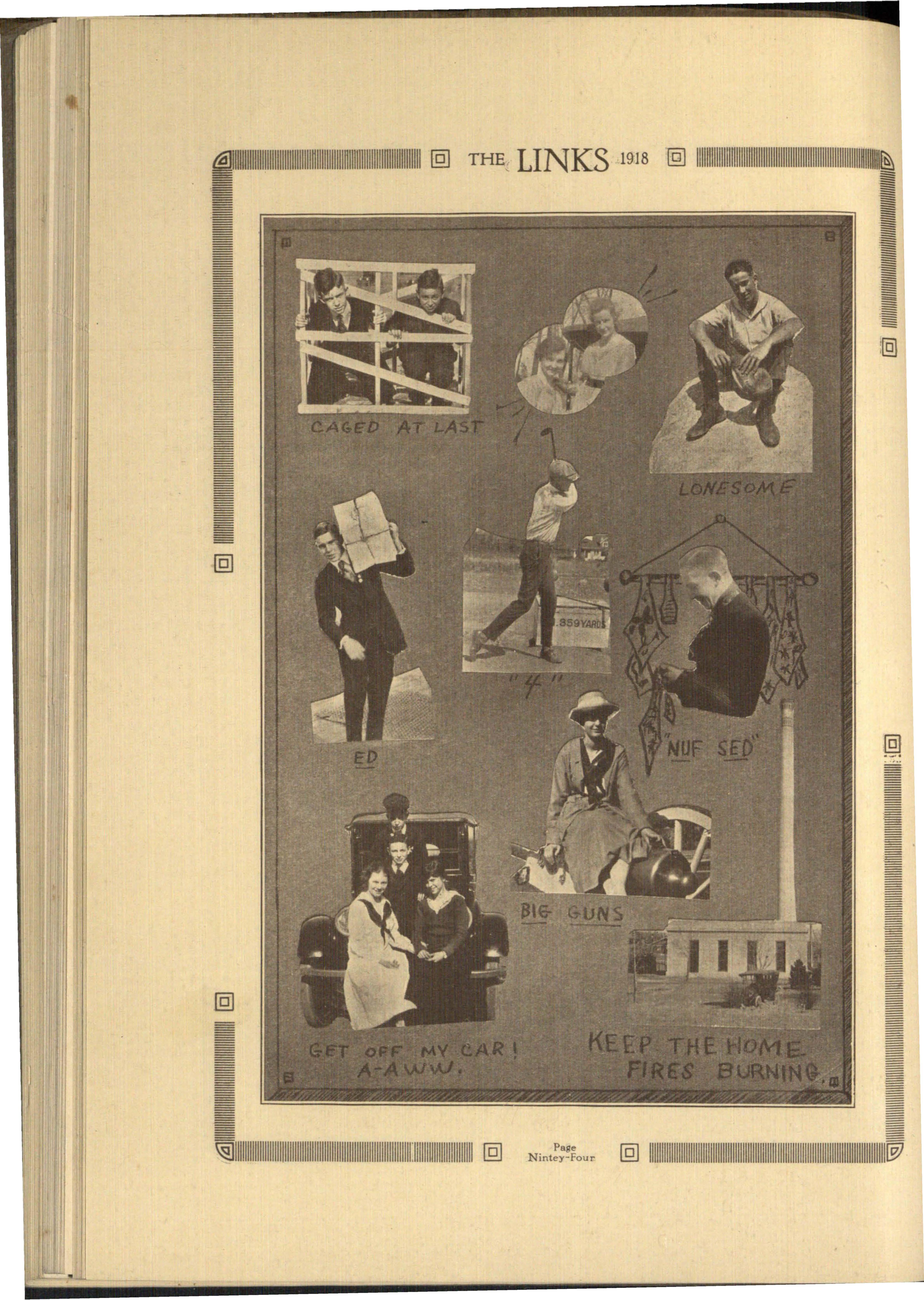
OH YES I E:NJOY STUDYING GREATLY
6 e C, • l a n
[Q]
[Q] =
A molten, burning ball, he sinks to rest, Dips slowly down into a glowing sea, A sea of rose whose wavelets' tiny crests Are capped with gold, whose billows rolling free, Blaze iridescent fire, the opal's Jlame, And over all, a great, gray smoking bank, A blurred, low fog, that settling soon must tame The waves' wild riot, hovers, murky, dark.
How many mortals ere their little barks Have dipped their mastheads 'neath Life's breaker's swirl, And Time's slow vapors dimmed their wanton sparks Of worthiness, have kindled these to hurl A burst of glory o'er a leaden sky, A tint of rainbow warmth flung far and high?
-ELEANOR SNELL, '18.
A c.hicken is a two-legged bird with an enormous appetite. Chickens are domestic fowls which lay eggs. Eggs are fifty-four cents a dozen. I suppose whole libraries of books have been written about the immense profits in keeping chickens for laying purposes. Many men and women, according to these books, have made fortunes keeping chickens. "There is money in chickens" is a well known saying. I know there is money in chickens because I put some there myself. Getting money out of chickens is what is hard to do. I say this from bitter experience. A year or two ago my parents got me some chickens and told me I was to keep a strict account of all my expenses and returns and they told me I could have all the profit I made at the end of a year, if I bought the feed.
Oh princely offer, Oh kind parents! They had been reading one of these vile, yellow-covered pamphlets telling of men and women who had made fortunes with chickens Of course, the men all started out when they were boys and now they are millionaires, as usual. They made all their money out of chickens Undoubtedly there is money in chickens. As I said before, it is likely to stay there, too.
I got some white hens from a poultry dealer and a more hopeless set of fowls
I never saw . They were old, Yery old. They had scales on their iegs and they had lice, I found. I believe they had every bad habit a hen ever had. They pulled feathers, they ate feathers, fought and did everything but lay. A few days after the man brought them, it rained and then I found \\·hy I ought not to have bought white hens. The pen was full of soft dirt and they got scandalously dirty. Their feathers got all spiky and stuck out all over them. When it stopped raining, the mud dried on them and their feathers stayed spiky for a long time. They got their feet all covered with mud and when they walked, they walked like a man with snow shoes. It was interesting as well as comical to see them plod laboriously around the pen lifting a chunk of mud as large as one's hand with every step.
Finally the hens started to lay. Even if they weren't much for looks, they certainly could lay. They laid quite a few eggs. Then they stopped and rested. They laid spasmodically all summer. When they took a notion, they laid furiously for a few days and then quit altogether. I was told that this was because they were so old. I was assured that they would set beyond a doubt , but they could not be counted on for laying. This was the truth. They could set. They waited until the hottest part of July came and then they all set at once. I couldn't get eggs enough to go around so they took turns setting. This was all right for a day or so, but then two hens got their schedules mixed and a fight followed in which several eggs were broken. Eggs for hatching cost a dollar and a half per hatch. I was trying to get a good breed of chickens so I got some State Farm eggs and settled the dispute between the hens by putting up some more nests. Things went along better then and three weeks later we had a swarm of little fuzzy fellows. However it was very hot and the hens had waited too long to set, I guess, and most of these little fellows died from the heat or cats.
When the chicks were about a month old, their mothers deserted them and the n the mothers loafed . Pretty soon they actually went to setting again. I read all I could find about making a hen quit setting, but it was no use. I ducked them in a pail of water twice a day. I locked them out of the coop and they proceeded to set in the corners of the pen. This was too much for me and I got an ax and cut their heads off. Then I sold them at the butcher's shop . I fattened the little chickens and sold them as soon as they were big enough.
I shall try it again some time, I tell myself. If I do, I will get some younger hens. I think that is where I made my mistake. Young hens give their attention to laying, I am told, while old hens always want to set. I don't believe chickens pay even then. I was deeply in debt. My expense column made the opposite column seem insignificant by comparison. I think chickens are all right in their place, on a farm. Everything in its place, every man to his work. I don't think I am cut out to make a fortune in chickens.
- TED FISHER, '18.
If there be anything living which I envy it is that compact, little bit of walking
which would put the finest cambric needle to shame for sharpness, fears no living denizen of the forest. He walks with as much assurance and confidence under the nose of the fiercest panther, as he would under ·the nose of the jutting rock, and he goes unharmed, for no matter how fierce may be the desire of the great cat to smash that insulting speck with one blo-w of his great armed paw, he curbs that desire with an iron will, for he knows that should even one of tho-se pale white needles get started in his flesh and begin creeping slowly in, he would be lucky if he escaped with his life. Many are the great bears , who have tried to bite Kahk and who have died, their mouths and tongues so swollen that they could not eat. Many are the wolves, hunger overpowering prudence, who have attacked Kahk and who have died miserable, their vitals pierced in countless places by those tiny barbs which sink until they reach the death spot. Always the Kahk escapes unharmed and rattles his quills nonchalantly at the top of some tall poplar where he calmly strips the tender under bark and laughs at the hunger of the ,valves. He is never hungry. His food cannot run away, and it abounds, well anchored, on eve:-y side for miles around, for Kahk is the child of the Manitou.
Old Baldy loomed up green and shimmering in the drowsy summer heat. ot a cloud flecked the blue, not a breath moved the drooping pines on the rocky slopes of Baldy, and the whole valley seemed to nod and sleep in the afternoon sun. Old John Morrison, at work in his patch of beans on the other side of the ridge, would have termed it "a reg'lar fu'nace of a day", had you asked him; but to a certain soft ball of brown fur in a remote and sunny nook on Baldy's slope, it was a perfect afternoon.
Right in the middle of a patch of blue berries this furry ball lay, nor did it mind the intense heat of the mid-afternoon sun. Presently, however, a wandering mosquito, a straggler from the last rain storm, came buzzing along and, after sundry and prospective descents and ascents upon the little figure, elected to stake a claim on a certain moist, bare spot and commenced operations. It happened however that the claim was already occupied and the owner, in the shape of a chubby little bear cub, proceeded to eject the claim jumper, by brushing his nose with a sweep of a pudgy paw .
At this point all would have gone well, if a wandering puff of wind had not come shambling along the mountain side and met him. As in most cases there was something in the wind, a something that made the little cub sniff vigorously and then to clamber to his feet and drink in deep draughts of air. ever had the little bear smelt anything so good. Surely, he thought, if the ·wind holds its scent, something else must hold it, and he resolved to find the cause of it.
He glanced furtively over at his mother. She lay some few paces away, stretched out at full length in the sun on an ant-hill sound asleep. Somewhat reassured but still holding back from the memory of several painful cuffs he had received for running away in the past, he paused irresolute as to whether he should be a good little cub
or whether he should go and find that wonderful smell. But ju t then a dying puff reached his nostrils and decided for him, and off he trotted into the woods.
On and on he went, and stronger and stronger grew the smell. The cub strained every muscle in his feeble attempts to augment his speed and his fat little body seemed fairly to roll along. Over the ridge he went and crashed through the brush at the foot of an oak so suddenly that a tiny chipmunk let out a despairing squeak and tumbled right over backwards into her hole and lay panting from fright in the remotest corner of her burrow. Even a drowsing hare was startled into giving a few wild leaps for safety until he noticed the cause of all the commotion and then he stopped, and, as if to make up for his lack of courage at first, ran after the cub for a few yards. But the cub heeded them not at all. His hopes and prospects of a good meal floated on the ever-strengthening scent.
Suddenly the scent stopped, and so did the cub. He was dismayed. To have a delicious smell like that, snatched away along with its promise of a feast was robbery of the first water, but, following his instincts he resolutely set out in a circle to refind it, and presently he did. Again he followed it to where it ended, and then looked around. He was in an open glade. A weatherbeaten and decaying old stump rose from its center and from a jagged hole near its top a ceaseless stream of bees came and went. The cub had never had much experience with bees, and, except for the fact that he had once been stung by one which he had attempted to eat along with a mouthful of berries, he knew nothing about them. When he saw the hole, however, whether from an instinct derived from a long line of bee-tree-robbing ancestors, or whether from the fact that a golden stream of something that looked very appetizing stretched half way down the trunk, he had a premonition that there was the prize for which he had come.
He scrambled to the foot of the tree and looked up, his little eyes gleaming, his slim, red tongue lolling out of his half-opened jaws, and his fuzzy round ears cocked forward. For a full minute he surveyed the hordes of laden bees and then deliberately began the ascent. Half way up he climbed and then stopped to lick at a few sugared splatches of sweet that had overflowed from the Eldorado above. At the first taste his stomach seemed very empty indeed, for never had he tasted anything so good. Licking vigorously, he worked up that narrow course like a flame up an oil soaked string, and presently neared the hole.
Up to this time the bees had paid no attention to the cub, but now they began to buzz menacingly around his head, and a few even alighted on his silky coat, but forbore to punish just yet. The cub, however, was too engrossed in his feast to notice them and he steadily neared the hole. The bees, on the other hand, did notice and their wrath increased, until just as the eager little bear reached the mouth of the hole with its overrunning stores of honey, they descended upon him in an angrily, buzzing storm. Afterwards the cub could not remember whether his head or his hind legs were stung first, but at any rate, at the first dart he let out a startled yelp, he lost all interest in the feast, and for the next few minutes was entirely taken up with these new claim jumpers. At first he hung on stubbornly, but as the bees began to get in their work on his tender baby hide, he lost his head and let go. Head over heels he tumbled and landed yelping and crying on a hazel thicket, and then staggering blindly to his legs he ran squalling and crashing through the brush.
After five minutes of these tactics the swarm of bees on his silky brown coat had decidedly decreased, but on the other hand, his voice had steadily grown in volume until when he suddenly hit a soft, heavy body his yelpings rang along the mountain side in a continuous roar of anguish. His mother, hearing the cries of her child, had come crashing to his aid and it had been she whom he had suddenly run into. Very carefully
she brushed off the bees and then proceeded t o chastize him for running away. Cuff = after cuff she administered to both sides o f his head until he lay on his back with his = brown soles waving in the air and squalled in earnest . Then his mother picked him up , set him on his feet and drove him off before her. Do\vn to the river bank she sent him, and after an hour's rolling him in the mud to take out the poison from the stings , she led him off up the mountain side. Just as the sun dipped below the horizon, the old = bear lay do\vn and the cub ,vent to sleep , vvhimpering pitifully, against his mother's side. =
-ALLEN \,\T OLCOTT, '18.
A gleam of silver throu!!h a rift of black, A beacon lighting up a gloomy way, The moon gleams through broken clouds storm wracked; To give a darksome world a brightening day; And all the place beneath in glistening sheen, Yet white and softened in that shimmering light, Spreads out illumined where before 'twould seem That naught had been sa\ e blackness of the night.
Oh would that I might be that wondrous light To free the earth from bondage of the dark, Or but to aid in some small way to right Its wrongs and sufferings, its mistakes, to mark An age where naught obscurity has hidden, '.Vhere all thing stand forth clear, and light is bidden.
-ELEANOR SNELL, '18.
When time hangs heavy on my hands , I often recall the trials of my boyhood days. 1f I remember clearly, and I am sure I do, for it seems as if it were yesterday, the heaviest burdens were those thrust upon me by my parents. From the beginning, I was a weakling, according to my aunt. Ir health, I was led to believe, was entirely missing from my list of good qualities. Being a '\reakling" did not trouble me in the
least until my grand entry into the first grade of the nearby school. I became aware of my misfortune not in the gradual , natural way, but in a harsh and abrupt fashion. It all happened one morning in about the third week of my school life.
I lay in bed on this morning, in a peevish mood , listening to the patter of rain on the window at the foot of the bed. Now and then thunder could be heard, growing in volume as it drew near and then slowly dying away. A loud crash followed by a violent rumbling raised me from my bed. I lighted squarel y in the middle of the floor and immediately set about to investigate the mysteries of dressing myself. I had attempted the thing before, but had not yet carried it through to a successful close. Now a determined first-grader gains his goal in the same way that a politician gains his and I completed the work to my own satisfaction, although I did ha\ e the trousers on wrong side to the front and my left shoe on my right foot. Upon appearing before the supreme critic, my mother, I was severely scolded and more severely re-dressed, much against my will.
Breakfast proceeded in the regular manner and I was made ready for school. Wearing my oldest cap, lest the rain hould spoil my newer one, and my older sister's raincoat, too small for her but not for me (it reached the floor in front, and dragged like the train of a bride behind) I felt myself more than ready to go. A new surprise awaited me, however. My wardrobe was to have an addition. a pair of overshoes! Worse than overshoes, these were. They had four buckles, all of shiny black enamel and soles of heavy rubber about an inch thick , I believe. They were a present from my aunt who, in her usual way , had taken the precaution to get them plenty large. They stuck out fully two inches past the end of my shoes and curved up slightly in a wooden shoe effect, verr graceful to be sure. Being of the "warm," four-buckle variety they were extremely high, reaching almost to my knees. Walking in them was interesting and difficult. I managed to master the trick to my satisfaction and announced emphatically and with finality that I would not wP.ar themany time or any place. At this point I was told plainly that I had to wear them or take a severe whipping and wear them besides. "Weaklings ," my mother explained "catch cold easil~ , and sometimes die." I was not o sure of this statement, in fact I remember I did not believe it at all. I rebelled.
Crying , screaming, and beating a tattoo on the door brought no results. I thought of jumping up and down and yelling at the top of my lungs. This action had brought favorable results before, why not now? I could not do this sa~isfactorily at all because of my overshoes. They stopped the jumping in a disastrous way by catching together at the buckles. I fell in a heap, my head underneath. Picking myself up I lumbered away. I must have made a dismal picture against the dismal background. My sister's raincoat-I will never forgive her for suggesting that I ·wear it-dragged on the wet sidewalk. lvly overshoe , which I could not quite control, as yet, persisted in intercepting the coat at every step. The result was, r,s you can guess, heart-breaking. My progress was slow, interrupted now and then by a stumble, ending in the usual manner. These spills were accompanied by loud applause from the older school fellows.
ow I was taught , "from the start" my uncle used to say, to "love , honor and obey" my father and mother. To disobey them meant sure death or disgrace, sometimes both. I was not sure of the punishment for this sin and was thinking it over as I fell to school this wet morning. \Vhatever the punishment was, I decided to risk the death, if there was any. Sitting immediately down on the sidewalk, taking the precaution, however, to select a spot co\ ered with as little water as possible, I proceeded to withdraw the despised overshoe s. The working of the buckles baffied me and my progress was checked until I discovered that a good pull would take them
off, regardless of the fastened buckles. I inwardly thanked my aunt for getting them so large. .
Released from these degrading and ugly pieces of clothing, I felt better. Sticking them beneath the nearest crossing, out of sight, I ran merrily to school. My conscience did not bother me in the least until afternoon. I began to feel troubled and longed for a peep beneath the crossing to see if the shoes still remained unharmed. It was at this point in my thoughts that I realized a mistake I had made. I had not looked around to see under what crossing I was hiding my enemies. The best thing to do, I figured, was to examine the under part of every crossing on my way [QI home. This is what I started out to do. Every crossing I was sure must be the right one, but the overshoes evidently thought differently. They would not be there .
About dusk I arrived home, no overshoes about my person or on my feet. A very tired, dirty, scared, and sorry weakling I was. My parents were waiting anxiously. Mother-she cried over me, sister scolded me, and father-well, he spanked me, I suppose. This part I don 't seem to remember very clearly. I confessed my crime, told of my loss and received another spanking. From that eventful day to this I have never worn a pair of overshoes.
-CHAUNCEY REDDISH, '18.
Of the work of the individual debaters much of praise can be said. Professor Venner of the ebraska Wesleyan, after judging one of the early contests, said: "They debate like veterans. They excel many a college team I have seen." Unquestionably, it is true that in the amount and use of evidence, in presentation and in rebuttal our teams compared well with any on the entire schedule. In industry, in faithfulness, in devotion to their task:, and in clean and fair debate sportsman -hip, their worth and their merit cannot be too highly estimated They "fought a good fight" in this year of debate change and debate growth.
lfut rr-O!la 11.s iehatr.
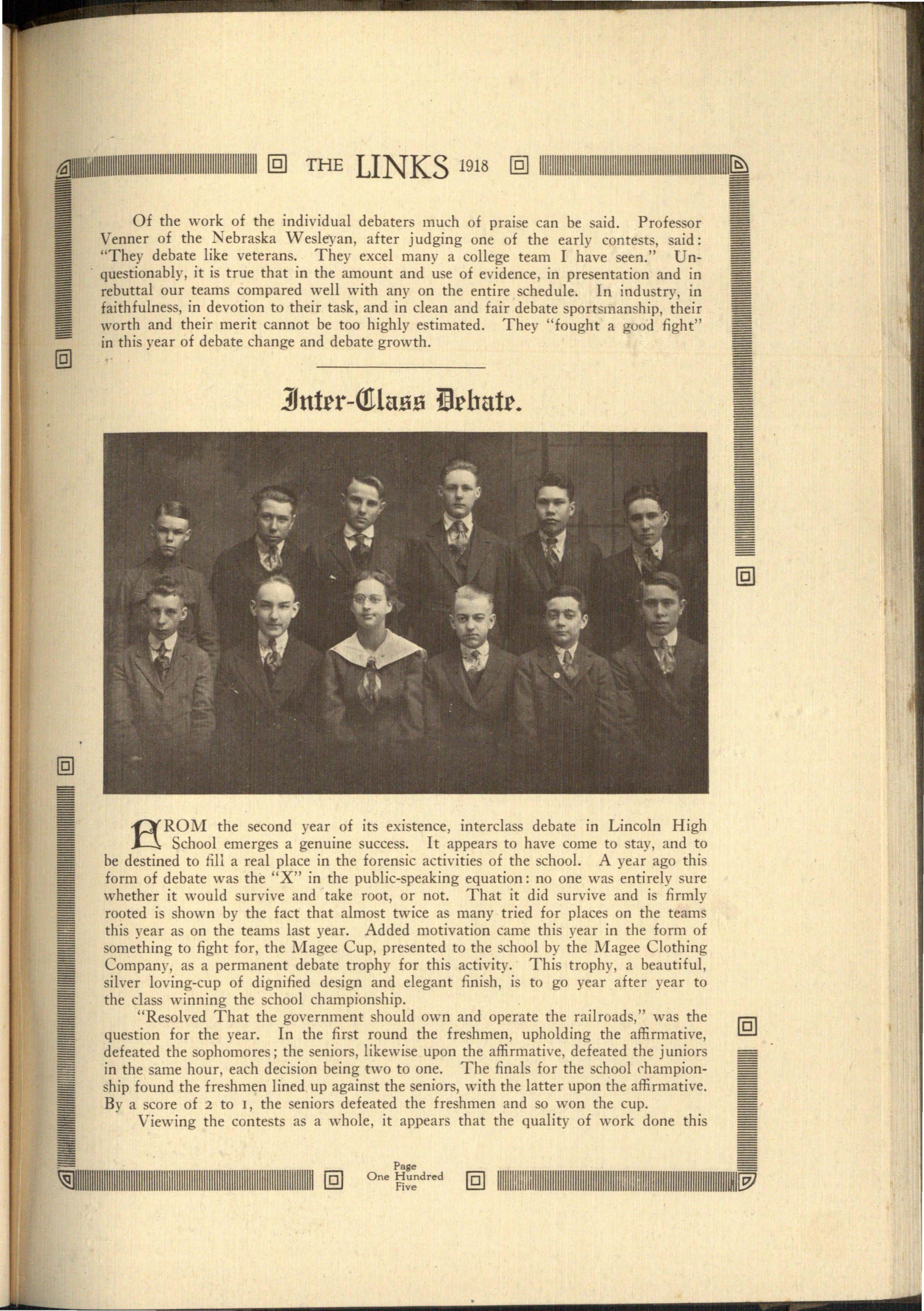
-Q' ROM the second year of its existence, interclass debate in Lincoln High W School emerges a genuine success. It appears to have come to stay, and to be destined to fill a real place in the forensic activities of the school. A year ago this form of debate was the "X" in the public-speaking equation : no one was entirely sure whether it would survive and take root, or not. That it did survive and is firmly rooted is shown by the fact that almost twice as many tried for places on the teams this year as on the teams last year. Added motivation came this year in the form of something to fight for, the Magee Cup, presented to the school by the Magee Clothing Company, as a permanent debate trophy for this activity. This trophy, a beautiful, silver loving-cup of dignified design and elegant finish, is to go year after year to the class winning the school championship.
"Resolved That the government should own and operate the railroads," was the question for the year. In the first round the freshmen, upholding the affirmative, defeated the sophomores; the seniors, likewise upon the affirmative, defeated the juniors in the same hour, each decision being two to one. The finals for the school rhampionship found the freshmen lined up against the seniors, with the latter upon the affirmative. By a score of 2 to 1, the seniors defeated the freshmen and so won the cup.
Viewing the contests as a whole, it appears that the quality of work done this
year excels that of last. In the handling of evidence, in presentation, and in the possession of a _systematic plan of attack in rebuttal, the work of the y<:'ar shows improvement.
Does interclass debate pay? Yes. It benefits first the individuals; second, the classes; and, third, the school. To the first, it gives training and seasoning for the "big show," the school teams; to the second, it furnishes a new center of rivalry; to the third, it gives one more avenue of expression, one more opportunity to enjor the clash of words and the battle of minds.
The aim of the annual staff in publishing this 1918 annual has been threefold; to compile a complete record of the important school events of the year 19171918, to publish an annual worthy of the title of The Links and to show in a measure the appreciation of Lincoln High School students to those sons of L. H. S. who have gone to serve their country.
To all who have in any way contributed to the Links, the staff extends its thanks. The members of the Advisory staff have spent much time and effort in its interest and their assistance and kind advice have been invaluable. Students in the art department have been most generous in contributing art work for the book. Herbert Johnson used valuable time to draw for us, and Dorothy Farmer, Oswald Black and Walter Gardner, all of the class of 191 7, responded to requests for drawings with appreciated willingness. Gladys Webster, Earl Chesney, Myron Reddish, and Park Berry have also contributed cartoons and drawings. The staff is especially indebted to Miss Lucy Green for assistance in compiling the honor roll and to Miss Bryan, Miss Hullhorst, Miss Humpe, Miss Jackson, M -iss Pillsbury, Miss Proctor, Miss Tremain and Miss Wort for careful revision of the same, to Miss Louise Miller and Miss Atkins for suggestions and criticisms and to Vera McMillin for typewritten copy. Although it was deemed best after careful consideration to exclude from the snap-shot pages the names of the persons who took the various pictures, the staff is grateful to all those who submitted snap-shots and especially to Miss Eleanora Miller, who on several occasions took pictures for the Links.
If the 1918 Links becomes to the students and faculty a pleasant reminder of the school year 1917-1918 and assures the L. H. S. boys in khaki and blue that we are proud of them, it will then have accomplished its purpo e.
Lois E. Cordner is the winner of the 1918 Links cover design contest. Her design, ,vhich appears on the cover of this annual, \vas chosen from seven, because of its appropriateness, the upper part being a facsimile of the senior class pin. The
judges were ignorant of the names of the contestants. Careful scrutiny will show == that Lois's art work is not wholly on the outside of the 1918 Links, since The Staff, =
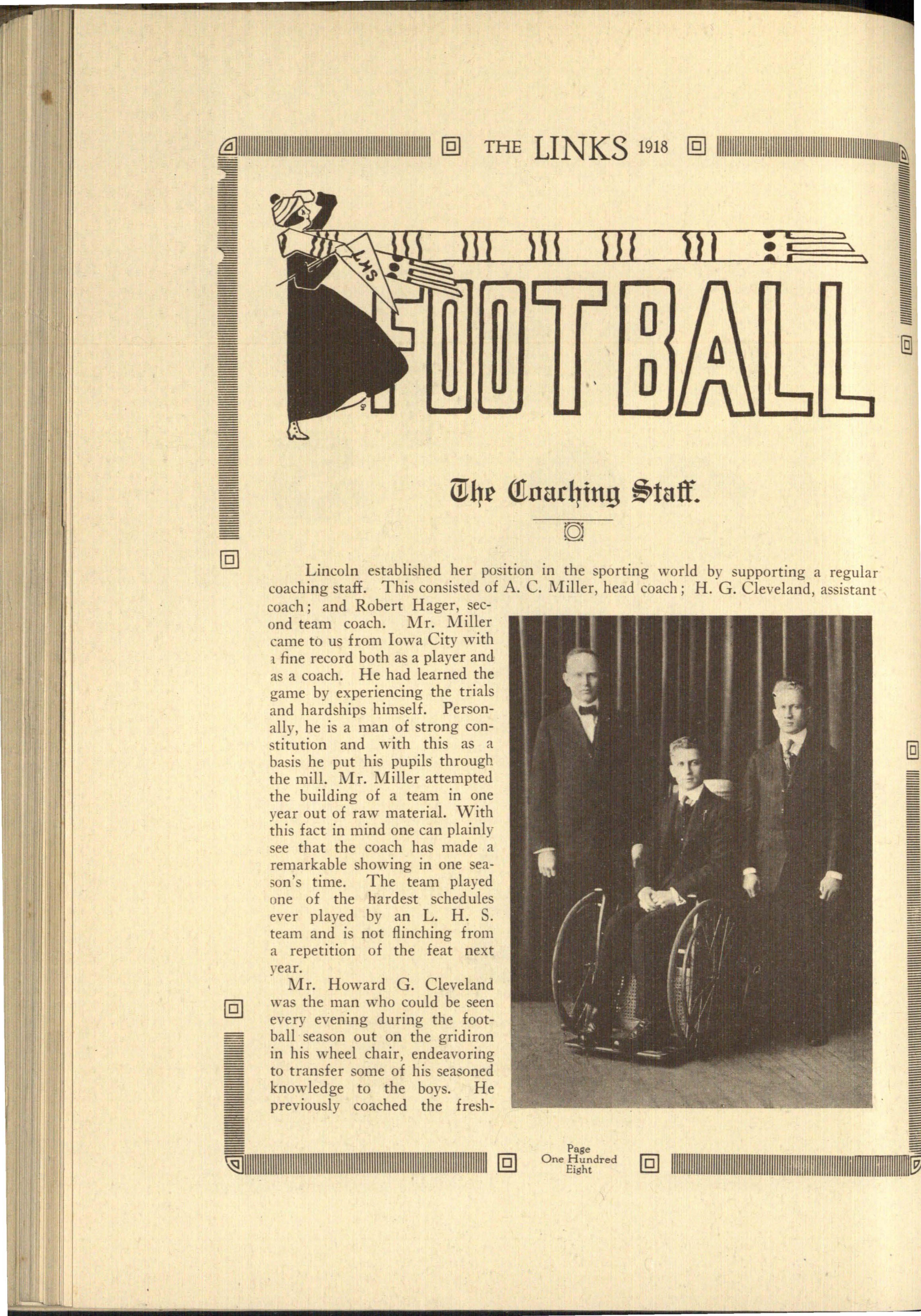
Lincoln established her position in the sporting world by supporting a regular coaching staff. This consisted of A. C. Miller, head coach; H. G. Cleveland, assist ant coach; and Robert Hager, second team coach. Mr. Miller came to us from Iowa City with 1 fine record both as a player an<l as a coach. He had learned the game by experiencing the trials and hardships himself. Personall y, he is a man of strong constitution and with this as a bas is he put his pupils through the mill. Mr. Miller attempted the building of a team in one year out of raw material. With this fact in mind one can plainl y see that the coach has made a remarkable showing in one season 's time. The team played one o f the hardest schedules ever pla yed by an L. H. S. team and is not flinching from a repetition of the feat next year.
Mr. Howard G. Cleveland was the man who could be seen every evening during the football sea son out on the gridiron in his wheel chair , endeavoring to transfer ome of his seasoned knowledge to the boys. He previously coached the fresh-
men of the University of California. Mr. Cleveland was not a hired coach but because of his interest in the team and in the Lincoln High School as a whole, he worked this seaso n without recompense. He was liked and respected by every member of the high school. He was keenly interested in the girls' tennis tournament. As a token of appreciatio n fo r his valuable services to the team, the students presented 1\1 r. Cleveland with an ''L" blanket.
l\t1r. Hager, the gymnasium instructor , coached the second team and gave calisthenic drills to the squad. By unceasing labor , unity and perseverance, this staff turned out a winning team from very unpromising material. We hope they will all be with us again next year to continue their good work.
At the beginning of the season the prospects for a team were very di couraging, as the coaches and players were strangers and very few of the '16 players had returned. Old men back from the previous year were Captain Moore , Lau, and Cypreanson.
The coaches first gained the confidence and good will of the players. and then put them through a grilling program of drills, tumbling, running, tackling, etc. First squad men were not selected until the week previous to the Grand Island game. These were the same that played all season.
Lincoln High inaugurated its 1917 football season on October fifth in Lincoln by defeating Grand Island 25-0. In this game Lincoln's old players showed up well because of previous coaching and experience , and Verne Moore first showed his real value as a captain.
On October twelfth the following week, the team took its first trip away , when they journeyed westward to orth Platte. Here they encountered a hard problem, as the westerners had a good team and enthusiastic rooters. Just as the game was going against Lincoln, Munn fell heir to a fumble and scored a touchdown Lincoln rallied and emerged victorious by a 25-7 score. In this game Captain Moore was injured in the neck and "Brick" Richards suffered a broken shoulder which kept him from the game the remainder of the season. Lewellen then came into prominence by heroically taking Captain Moore's position as punter.
On October nineteenth , Lincoln fought another battle royal at York. York had the best team they had had in years and endeavored to make history, as they never have beaten Lincoln. The features of the game were a fifty-yard pass from Munn to Lamb and the interception of a pass by Girard for a touch-down in the last few minutes of play, which made the score 12-0.
The following week on October twenty-seventh, the Lincoln followers gathered at the university field to root and cheer their team to a I 2-0 victory over ' orfolk. In this game Roberts did some sensational tackling.
On Tovember third, East Des Moines, champions of Iowa, ventured out to
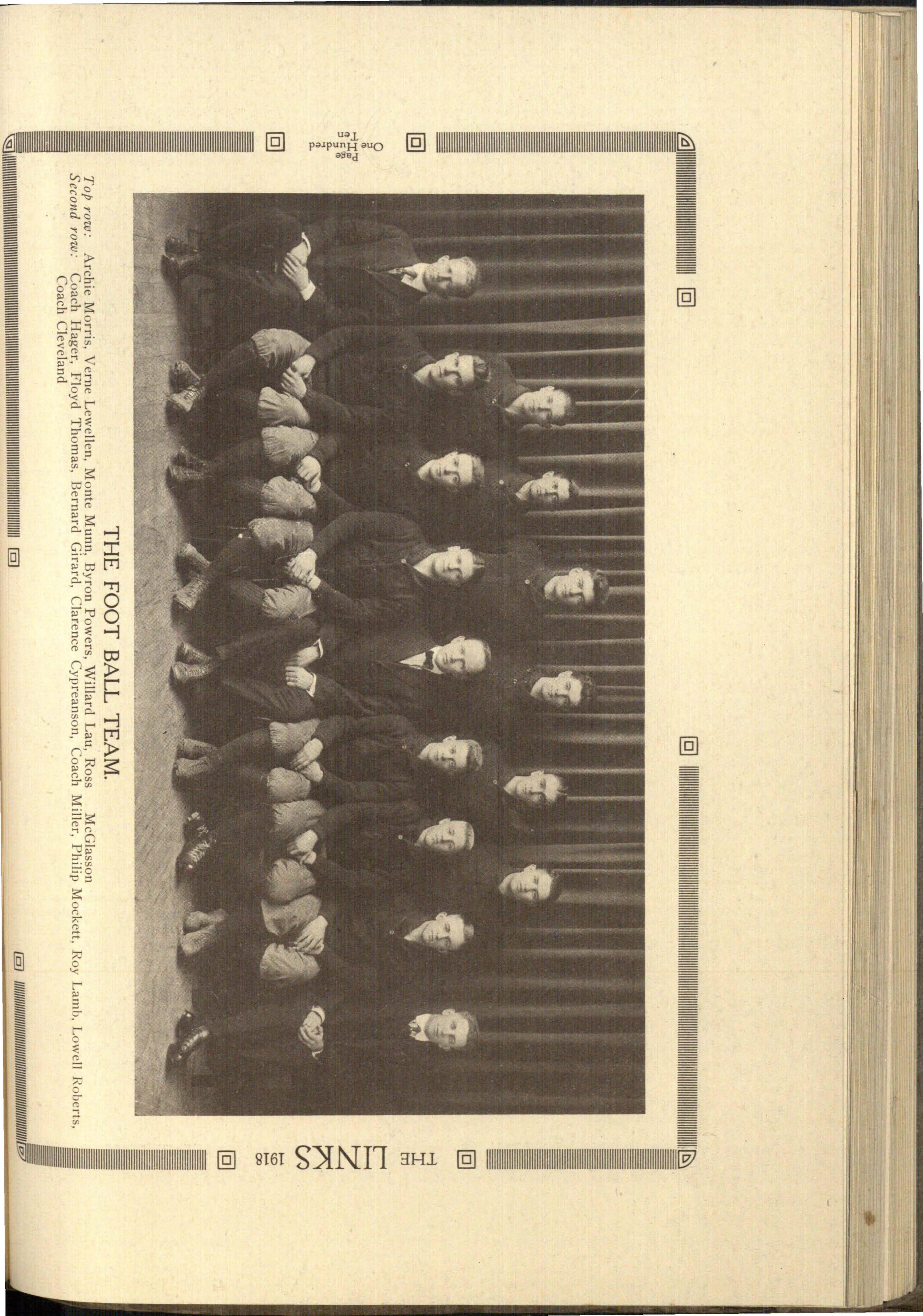
1 ebra ka's capital city with a small but well-coa ched team. As many of Lincoln's players were suffering from previous injurie the team was in poor ph ys ical condition. Des Moines scored first; Lincoln countered with a tou ch-do"·n. The visi to rs stacked up a total of 28 points. Lincoln failed to score again until Captain Moore returned to the game in the third quarter. Time was soon called , leaving Lincoln with the short end of a 28-13 score.
This was the red and black's first taste of defeat, but the second sip came the following week on ovember ninth when the old rivals met in the gam e of all games. As in the previous game, Lincoln was not back to par in condition. Regardless of the existing conditions the capital cit y boys battled the boys from the metropolis every minute of the game. Omaha scored 1 3 points the first half , but failed to score in the last periods. As this was a championship game a large crowd witnessed it in spite of a steady rain •
r ovember sixteenth Lincoln defeated Beatrice 28-3. From this game on, the team began to prepare for the big drive to be staged in 1918.
On ovember twenty-fourth , the wearers of the red and black clashed with the State Farm wearers of the scarlet and cream. In three minutes the Aggies scored the first touchdown. Owing to their pugilistic performance , the Links had no pity for them, and romped awa y from them w i th a 54 point margin. Moore and Cypreanson played like demons , as this wa their last gridiron exhibition in the name of the red and black. Lamb pla yed the best game of the season, making many sensational runs. Powers broke through their line at will. Lau played hard as this was also his last game for the old L. H. S.
This game finished the eason for the red and black , and a grand season it was, from the standpoint not of championships but of victories. Lincoln cannot be accused of picking up an easy schedule , or of refusing to play anyone. Seven of the " Big 1 ine" high school teams of ebraska, and the strongest team in Iowa were played.
Although the season was begun with new coaches and practically all new players, Lincoln finished with one of the strongest, best organized teams in the state , and with a squad of fift y boys in school showing a ten per cent improvement in health and physique. Championships are not all there is to be gained in football. It is conceded by good authorit y that higher morals, greater courage, team work and a better body are more valuable than all the titles in the world. These are the elen,ent the Lincoln High School boys have derived from the past season.
VERNE MOORE, Capt. 1917.
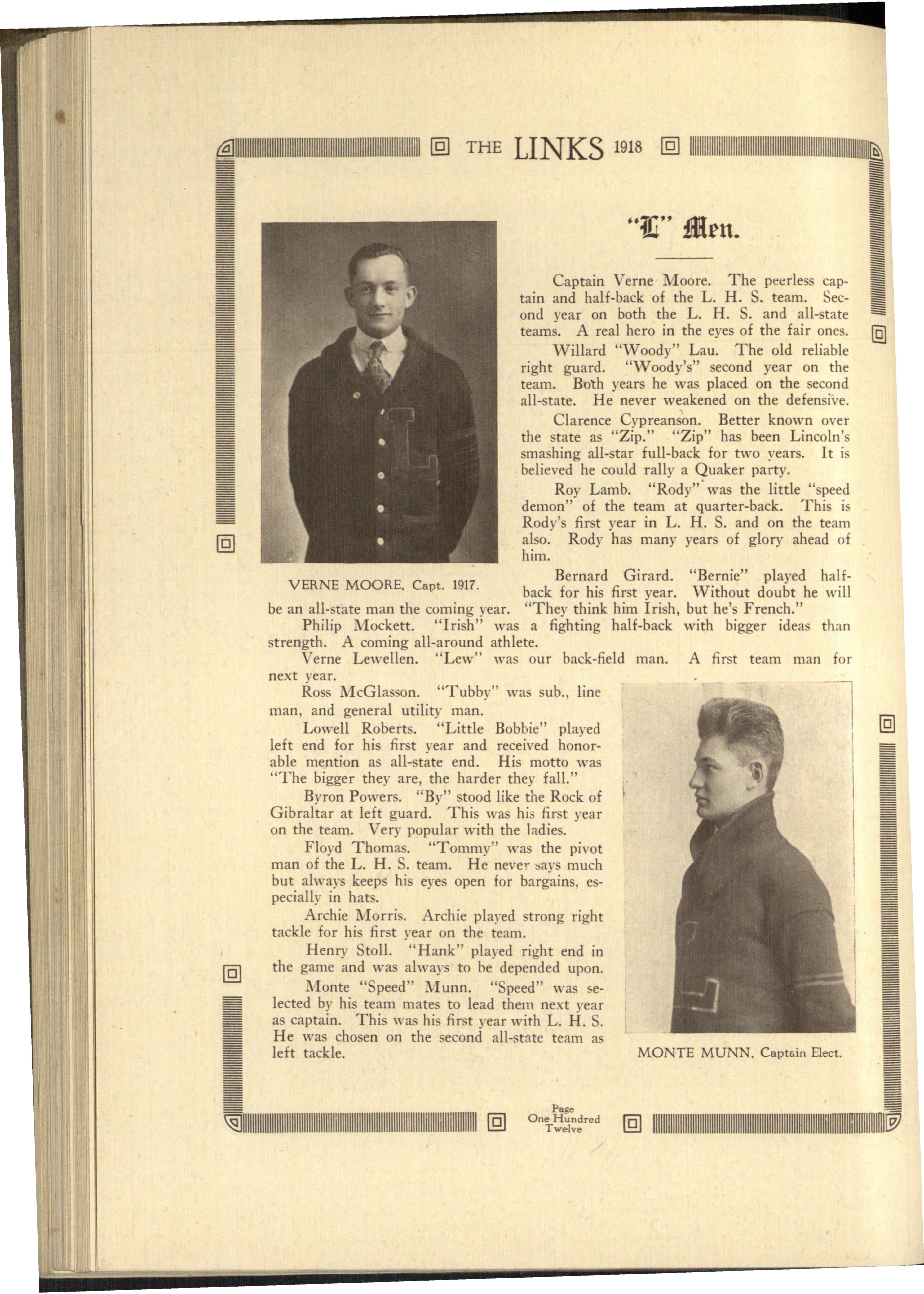
Captain Verne Moore. The peerless captain and half-back of the L. H. S. team. Second year on both the L. H. S. and all-state teams. A real hero in the eyes of the fair ones. Willard "Woody" Lau. The old reliable right guard. "Woody's" second year on the team. Both years he was placed on the second all-state. He never weakened on the defensi ve Clarence Cypreanson. Better known over the state as "Zip." "Zip" has been Lincoln ' smashing all-star full-back for two years It is believed he could rally a Quaker party.
Roy Lamb. "Rody" · wa the little "speed demon" of the team at quarter-back. This is Rody's first year in L. H. S. and on the team also. Rody has many years of glory ahead of him.
Bernard Girard. "Bernie" played halfback for his first year. Without doubt he will be an all-state man the coming year. "They think him Irish, but he's French."
Philip Mockett. "Irish" was a fighting half-back with bigger ideas than strength. A coming all-around athlete.
Verne Lewellen. "Lew" was our back-field man. A fir t team man for next year.
Ros McGlasson. "Tubby" was sub . , line man, and general utility man.
Lowell Roberts. "Little Bobbie" plared left end for his first year and received ho~orable mention a all-state end. Hi motto was "The bigger they are, the harder they fall."
Byron Powers. "By" tood like the Rock of Gibraltar at left guard. This wa hi 3 first rear on the team. Very popular with the lndie.
Floyd Thomas. "Tommy" was the pivot man of the L. H. . team. He never ~ays much but always keeps his eyes open for bargains, epecially in hats.
Archie Morri . Archie played strong right tackle for his fir t year on the team.
Henry Stoll. "Hank" played right end in the game and was always to be depended upon.
Monte "Speed" Munn. "Speed" wa selected by his team mates to lead them next year as captain. This wa his first year with L. H. . He was chosen on the second all-state team as left tackle.
At the time the "L's" were pre ented to the fir t team men of this year, ' R's" were presented to some twenty boy "R" tands for reserve or, at face value, first team me n ready for service, but held in reserve for emergencie Very rarely does the seco nd t eam receive full credit for the work it perform . They act as targets for t he fir t team in practice; they mu t keep fit and constantlr in condition, for they may be needed at any time for a minute. The reserve oldier is just as heroic as the man at the front, because he t akes that man' place whe n he i gone. It is the same wi th the re erve players: they defend the red and black when the first t eam man graduates. o let u do the boys ju tice and pay the "R" due honor and respect.
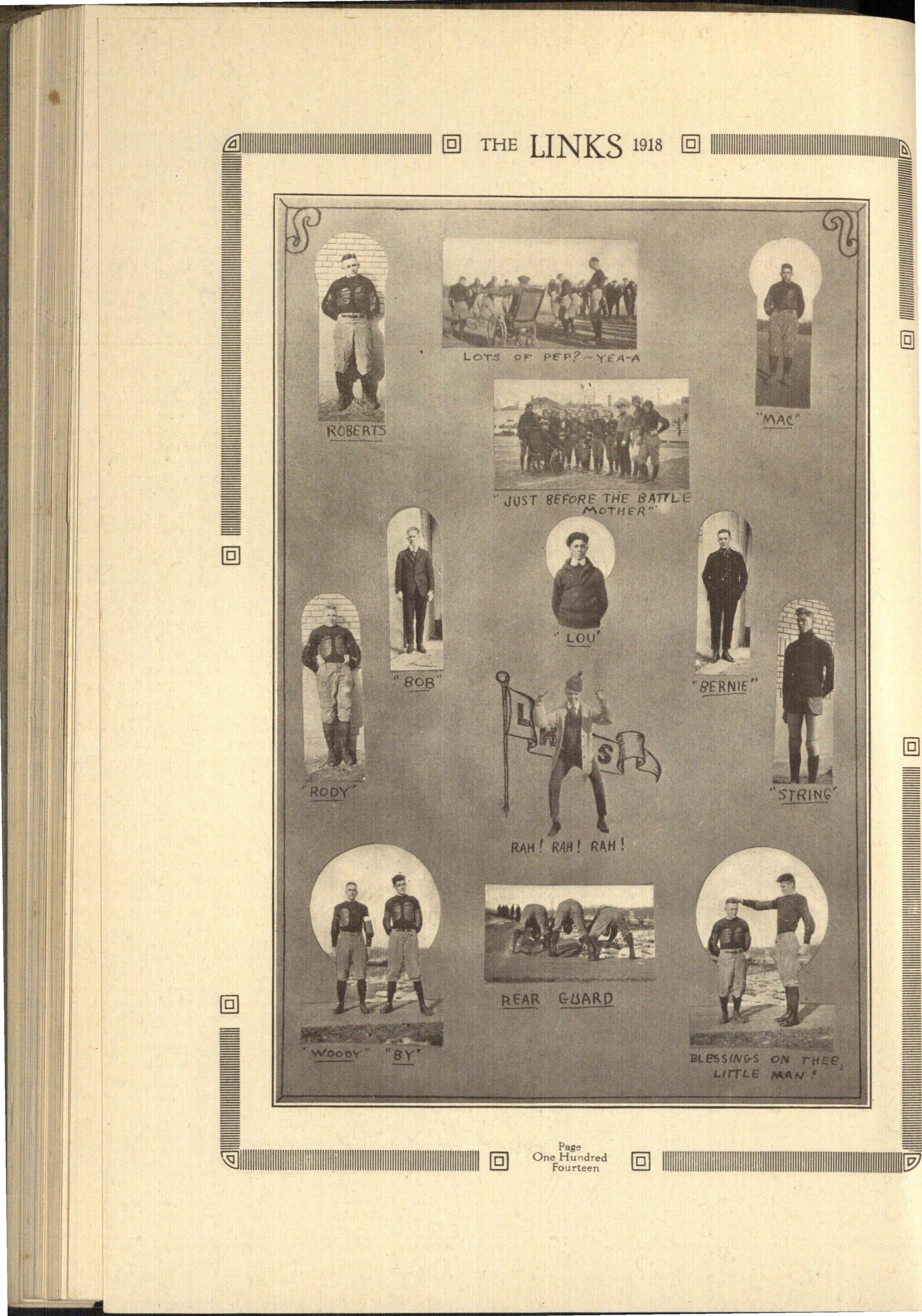
OUR COACH, Mr. Hager, came to us from the Omaha Y. M. C. A. He is a graduate of both Lincoln High chool and the Univer ity of ebraska. "Bob" was a prominent athlete during his entire career as a student and has figured prominently on many all-star teams since that time.
It was conceded by good athletic authority that "Bob" is the best basketball coach in ebraska this year. He has proved him elf worthy of thi praise by taking a group of untrained, inexperienced boys and by coaching them into a championship team. His coaching was o thorough that they pla) rd a cla s of basketball eldom exhibited in high school. The coach's team was constantly broken up. First he lost Richards and Roberts by graduation. Then "Zip" retired from school. Each time he had to coach a new man for theBposhi~ion.
d f 1 y 1s perseverance an ear e~,;; courage, "Bob" ha won the re pect and friendship of his players and of all who know him. It is a gratification to every boy connected with athletics that "Bob" is to be with us again next year, as all-year coach.
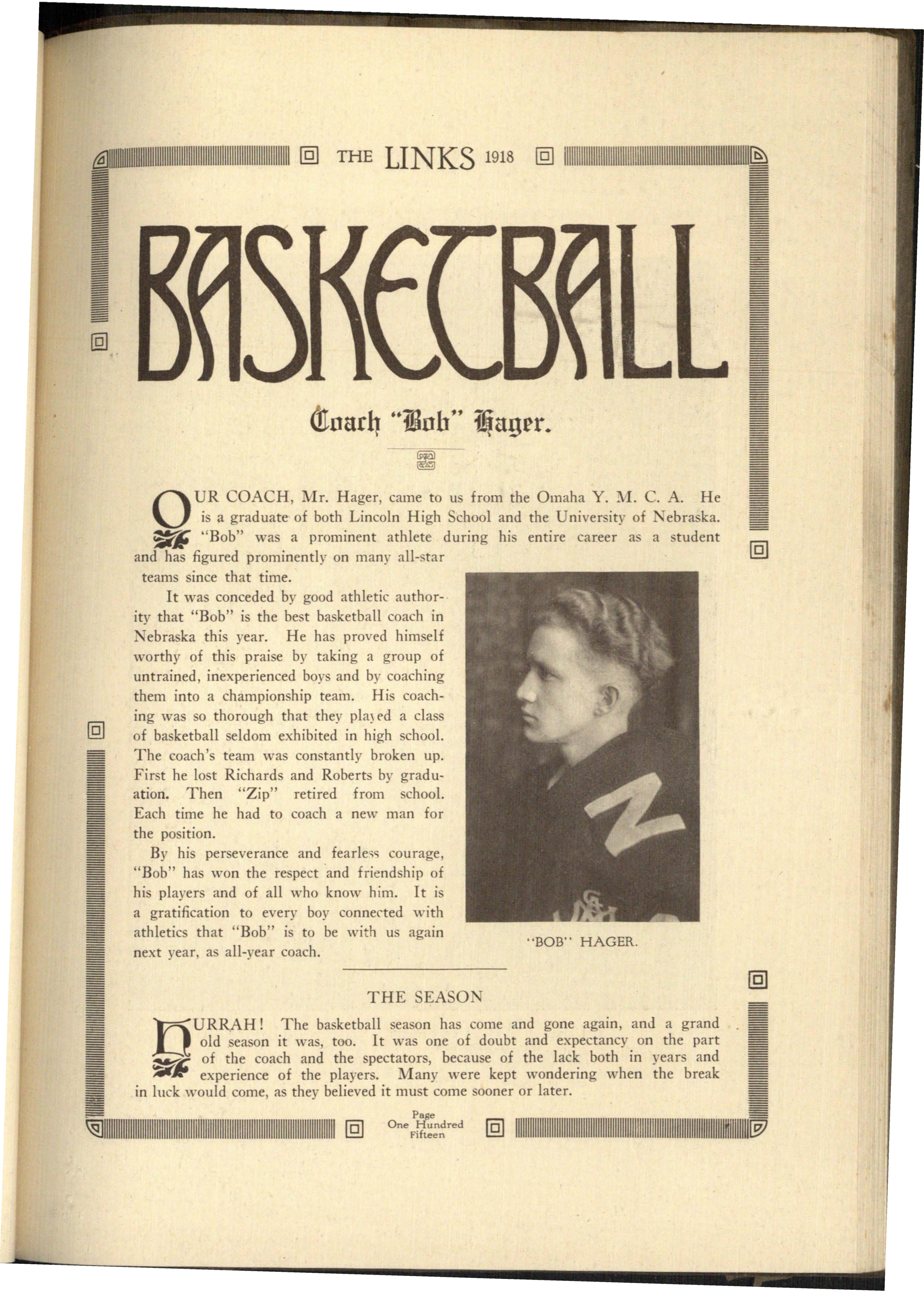
n
URRAH ! The basketball sea on has come and gone again, anJ a grand old eason it was, too. It was one of doubt and expectancy on the part ~L of the coach and the spectator , because of the lack both in years and 'fiK~ experience of the players. Many were kept wondering when the break in luck would come, as they believed it must come sooner or later.
Paie
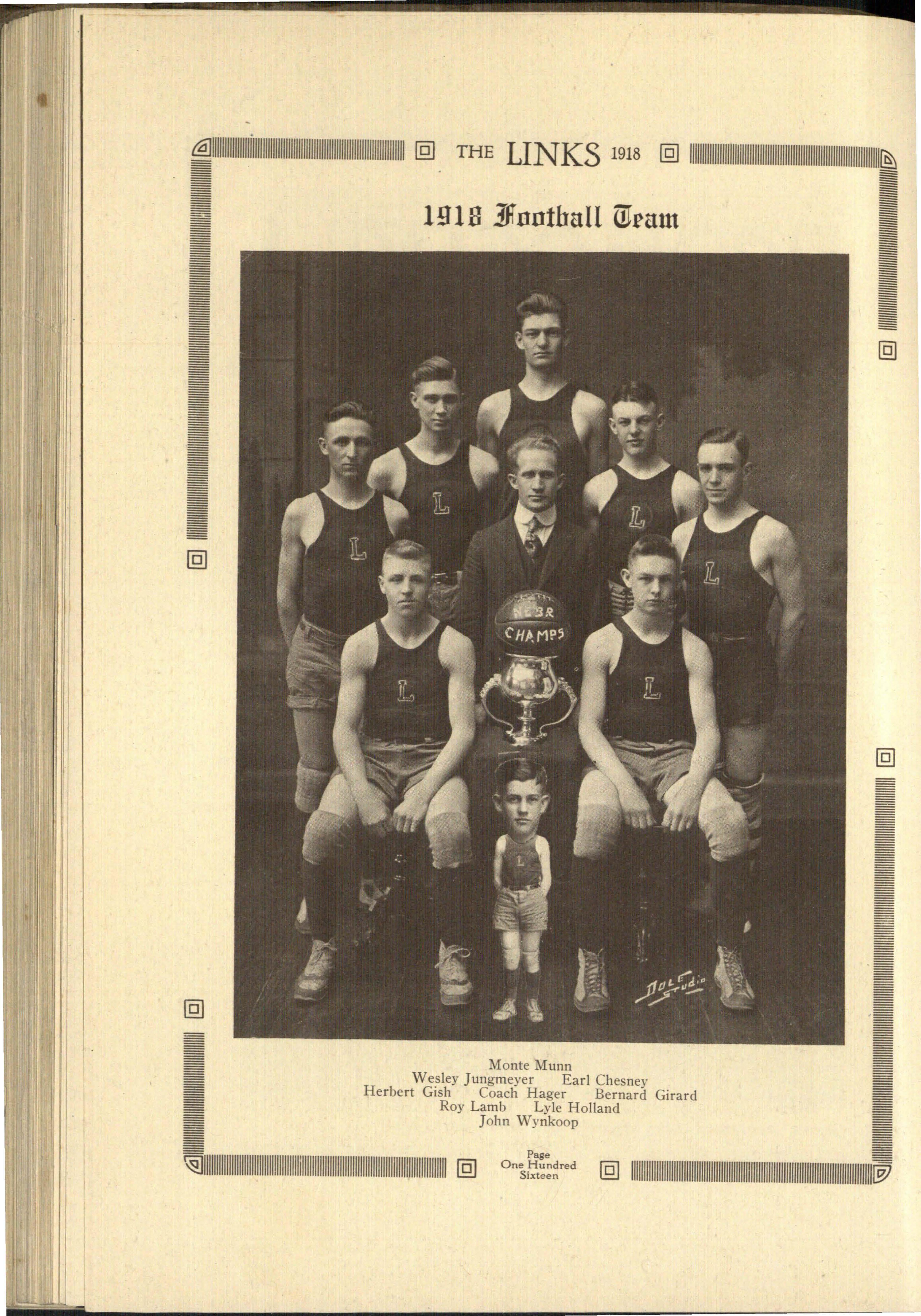
The tirst game of the ea on wa with outh Omaha on January 1 r. A blizzard was raging outside the hall, and the mercury wa 18 degree below. The final score wa - 2 1- 1 3 for Lincoln.
•ext came University Place, January 1 7. Everyone was un ertain of the ou t come of this game, as University Place had all her men from the previous ea on and they were hungry for revenge The real fighting spirit of Lincoln's new team was hown by the score, 27-11 Lincoln.
On January 26, Omaha' team of veteran took the red and black warriors by surprise by taking the long end of a 21-17 core.
ioux City fell under the Lincoln six-foot aggregation to the tune of 19-9 on February 15.
On the following night Platt mouth succumbed likewise by a 37-10 margin.
Beatrice came to us with the reputation of being a strong contender for the state championship, but was beaten with surprising ease, core 62-1 r.
In the State Farm game Lincoln played brilliant basketball, holding her opponent to a no-field-goal core of 29-2.
Agam on February 22, the old rivals met, Omaha with one victory to her credit and Lincoln sore to the heart over that one big blot on an otherwise clean page. With the experience of many games since the former clash, Lincoln High flashed a uperior brand of basketball on her opponents and defeated them 21-18, one point less than the earlier Omaha victory, an encouraging prospect for the finals Thi wa the first game with Captain Cypreanson absent from the line-up.
Next on the program came University Place again. They were just as anxious to patch o\·er the score made by the defeat Lincoln had previously inflicted, a Lincoln had been to mend the one Omaha had inflicted on her. Well, they tried hard but the red and black warriors held them to one field goal, the final score standing 10-3.
On February 18, Lincoln journeyed to Hastings. In the fir t half Hastings wa - ahead 6-5, but because "Lincoln fights," the final core stood 23-8
On March 11, came the St. Joe game. This team was heralded as a "world beater," a it had previously defeated Omaha by a large margin, but it proved a disappointment as Lincoln won 39-16
This was the last game before the big tournament and with such a fine victory, it left the team in fine condition both mentally and physically for the big annu'.li. rxhibition.
ON MARCH 6-9, the world's largest basketball tournament wa played in Lincoln. Every Lincoln High tudent i proud to ay that the red and ~L black aggregation won the title of grand champion • 'fiifl:' Of all the one hundred twenty-two teams entered in the tournament, Lincoln High battled her way to supremacy over them all in the following order. On Wednesday afternoon Lincoln defeated Auburn 3-1-·3, Auburn failing to score a single field goal. It wa clearly proved that Auburn was out of her class. This wa the first cla s A game of the tournament, and it was plain that Lincoln was one of the favorites of the many fan following the tournament. The next team to go down under the mighty Lincolnites wa the Stanton team. It failed to show the endurance and coaching that the Lincoln team fla3hed upon
is
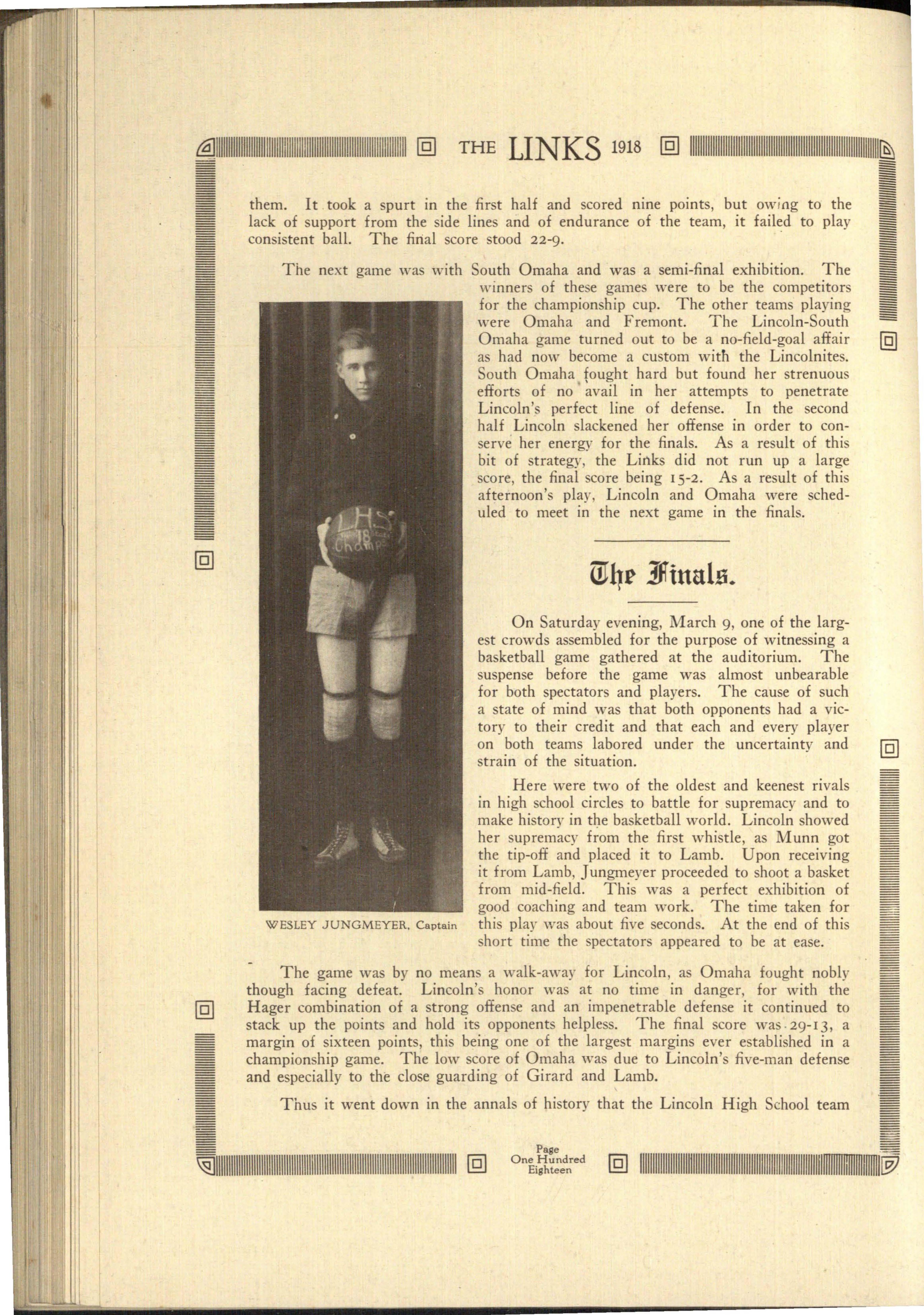
them. It took a spurt in the first half and scored nine points, but owing to the lack of support from the side lines and of endurance of the team, it failed to play consistent ball. The final score stood 22-9. •
The next game ,Yas with South Omaha and was a semi-final exhibition. The winners of these games were to be the competitors for the championship cup. The other teams playing were Omaha and Fremont The Lincoln-South Omaha game turned out to be a no-field-goal affair as had now become a custom with the Lincolnites. South Omaha fought hard but found her strenuous efforts of no avail in her attempts to penetrate Lincoln's perfect line of defense. In the second half Lincoln slackened her offense in order to conserve her energy for the finals As a result of this bit of strategy, the Links did not run up a large score, the final score being I j-2. As a result of this afternoon's play , Lincoln and Omaha were scheduled to meet in the next game in the finals.
On Saturday evening, March 9, one of the largest crowds assembled for the purpose of witnessing a basketball game gathered at the auditorium. The suspense before the game was almost unbearable for both spectators and players. The cause of such a state of mind was that both opponents had a victory to their credit and that each and every player
on both teams labored under the uncertainty and
strain of the situation.
Here were two of the oldest and keenest rivals in high school circles to battle for supremacy and to make historv in the basketball world. Lincoln showed her suprem;cy f~om the first whistle, as Munn got the tip-off and placed it to Lamb. Upon receiving it from Lamb, Jungmeyer proceeded to shoot a basket from mid-field. This was a perfect exhibition of good coaching and team work. The time taken for this play was about five seconds. At the end of this short time the spectators appeared to be at ease.
The game was by no means a walk-away for Lincoln, as Omaha fought nobly though facing defeat. Lincoln's honor was at no time in danger, for with the Hager combination of a strong offense and an impenetrable defense it continued to stack up the points and hold its opponents helpless. The final score was 29- 13, a margin of sixteen points, this being one of the largest margins ever established in a championship game. The low score of Omaha was due to Lincoln's five-man defense and especially to the close guarding of Girard and Lamb.
Thus it went down in the annals of history that the Lincoln High School team
with th e aid of the loyal student body and teachers won the championship of the eighth annual basketball tournament.
Sc01e s during the sea on:
Lincoln 304; Opponents 122.
Scores during tournament:
Lincoln 100; Opponent 27.
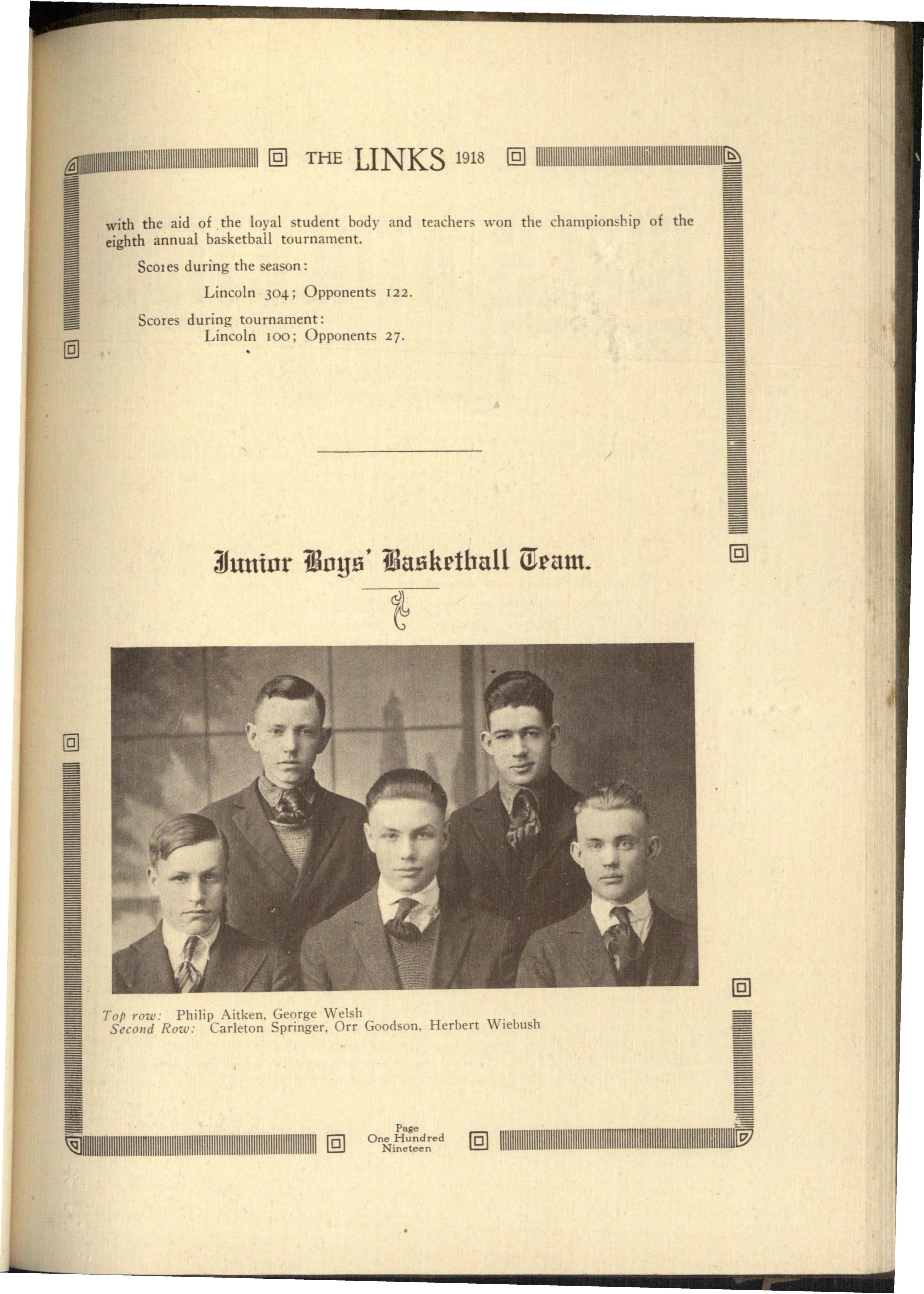
3Juninr iinya iiaakrthall ID ram.
HE 1918 girls' basketball tournament was one of the best and moH succesU ful ever held in Lincoln High School. The gymnasium seemed alive with f(<. new enthusia m and interest from the very first announcement that the tournament would be played off in an entirely new way. Tht'n , after a few week of busy practice, came the amazing rumors that the freshmen had high hopes of winning the championship, and that the sophomores, although admitted to be a handful for any team, were not regarded as future champions. Who had ever heard of a tournament where the sophomores weren't booked to win long before the curtain arose on the opening games? ot for ome years had such a thing happened. La t, but not least, the seniors had begun to show the earmarks of an high grade team that might have something to ay about what would be carved on the cup for 1918.
The first day of the tournament found the gymnasium alive with loyal rooter and eag"r, anxious-eyed players. All came with the slogan, "Fight to the finish and into the finals," and if into the final , "over the top." Mindful of the e aims the teams entered the first game with a grim determination to win. But all could not triumph, and at the end of the first day' fray the core board announced that the eniors had defeated the junior 30-6 and that the freshmen had defeated the sophomore 12-IO The second day once more found the senior and freshmen holding the long ends of the scores, the ophomores having lost to the eniors, r6-6 , and the freshmen having trounced the juniors, 19-16. On the third day the juniors came out of their slump and beat the sophomore , 18-12, while the eniors had to fight fo1 their Jives to give the fre hmen the small end of a I 2-7 s ore.
To the noisy crowd that waited in the gymnasium on the last day, it seemed that the freshmen surely would "come back" and how the seniors what a real basketball game should be and that the cup would go out decked in the lavender and ro e. When the opening whistle blew, each enior and each fre -hman was in her
place, ready to play the game well and play it to the end. The seniors s..:ored after a few seconds of play and won a lead that the freshmen threatened to overcome at every turn of the game, but could not. In vain the freshmen backers called out words of encouragement and hope. The score grew on the senior side until when the final whistle blew, it read seniors 18, freshmen 7, and the senior had once more brought first honors to the class of 1918. As sophomores this same class had won the championship and the last sweaters given an L. H. S. girls' athletic team.
The freshmen had a fast team that will bear watching in the future as a contender for the cup. Too much credit can not be given to Mrs. Putney, the coach, who worked so hard and faithfully to make the tournament the big success it was. The following are the playing averages of the different teams: Seniors
t:=J IDED by ideal summer weather, the girls' annual tennis tournament turned ,--1 out to be a big success from every standpoint. The entrance list far exceeded a:iaJ that of last year and included many beginners, as well as veteran players.
0 0 During the three weeks of the tournament, games were played off at almost all hours of the day, beginning early and quite often ceasing only when darkness made it impossible to continue. In many cases the competition was very keen and the rivalry extended not only to the participants but to a faithful crowd of spectators that lined the courts each night. Not a few of the scores turned out to be big surprises to everyone and the end of the tournament found two entirely new players, Helen Weese and Dorothy Teal, competing for the championship.
The night of the finals called out a small but enthusiastic crowd , which was about evenly divided for the two contestants and gave many noisy demonstrations of its support. As the players changed courts the two groups swung from one end to the other, like the pendulum of a great clock. The first set was won by Helen Weese 6-1. Her opponent seemed to be unable to get into the game and quite plainly showed that she was playing under a strain. However, in the second set she overcame her nervousness and won the set 6-3. The third set, and the one that decided the championship, was the most exciting in all the tournament. Time after time the games were deuce and only after many fiercely contested plays could one player get the two or three points in succession that would give her the game. The set ended 6-1 in favor of Dorothy Teal.
Dorothy is a sophomore but has never attended Lincoln High before, having come from "prep" chool. She had had some tennis experience previous to playing in the tournament and her faithful practicing improved her game wonderfully. She won first honors on pure merit. Helen vVeese also took part in the tournament this year for the first time and promises to become a star player. She played good consistent tennis and would be a worthy opponent for anyone. Red and black tennis emblems, the first of their kind to be awarded, were given to both of the final contestants.
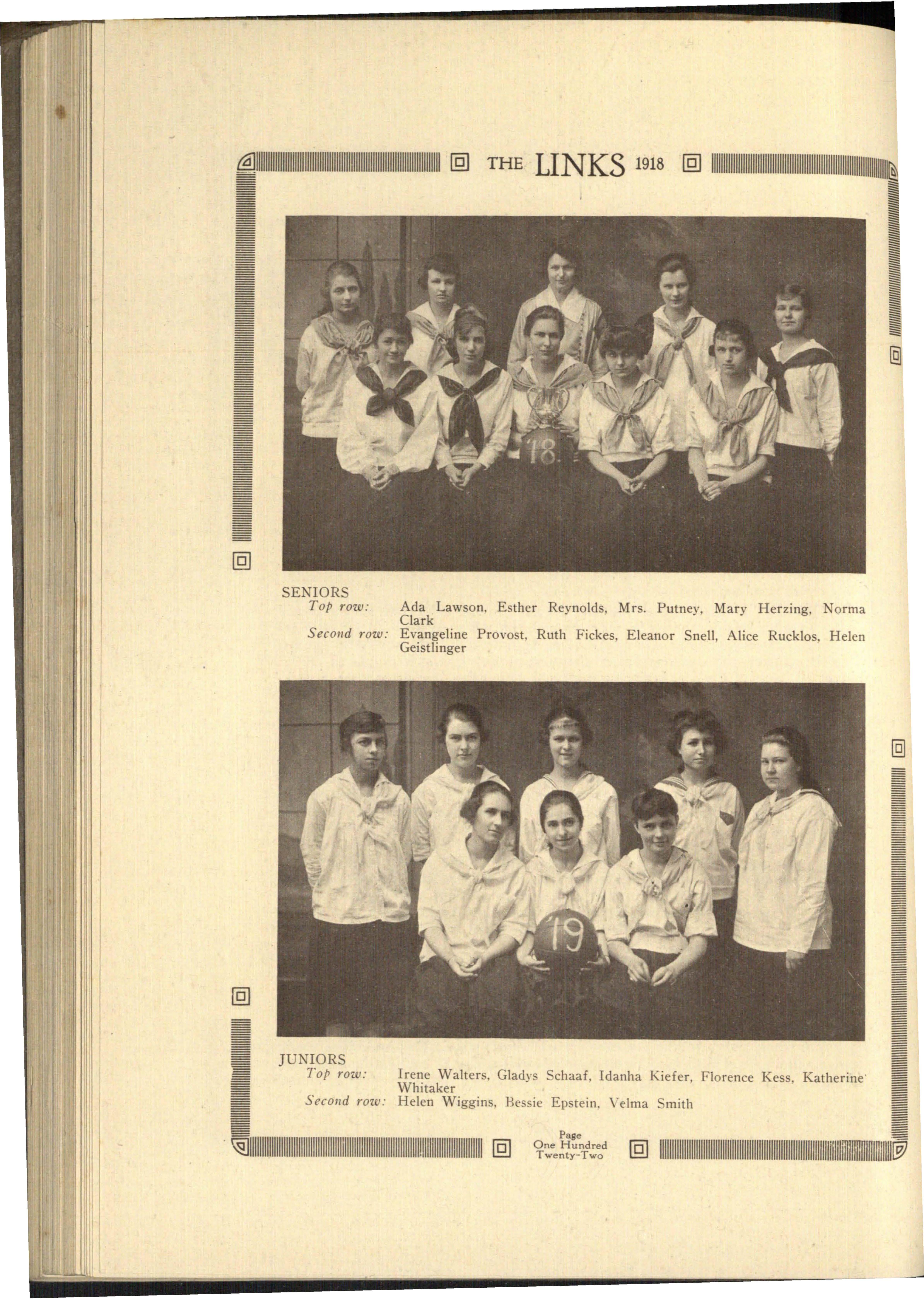
Top row: Ada L a wso n , Est h e r Reynolds, Mrs. P u tney. Ma r y Herzing, orma Clark
Seco11d row: Evange li ne Pro\'Ost. Ruth Fickes, Eleanor Snell, A lice Rucklos, Helen Ge istlinger
JUNIORS
Top row: ==
SOPHOMORES
Top
Second
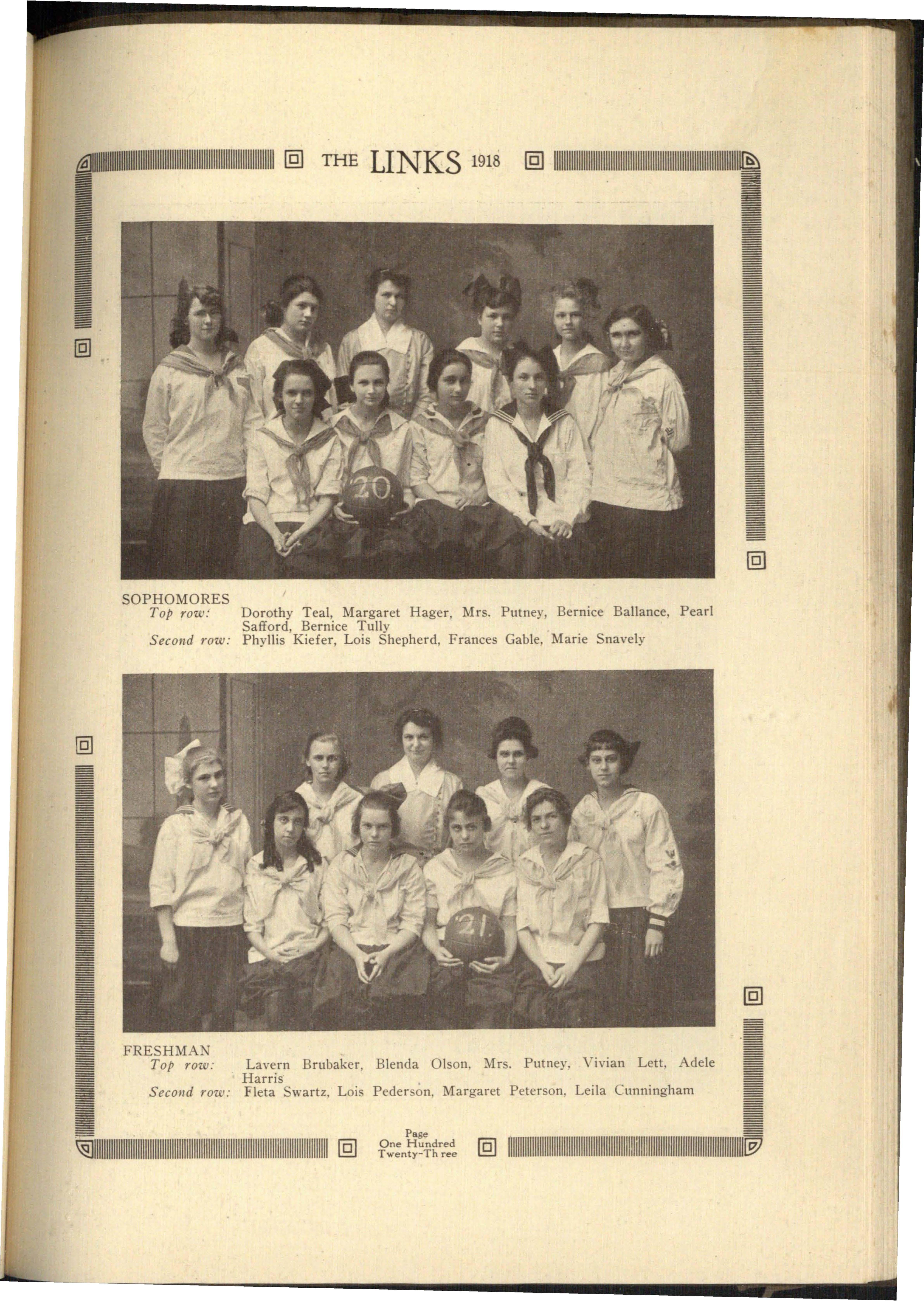
Top row:
Second row:
Safford,
Harris
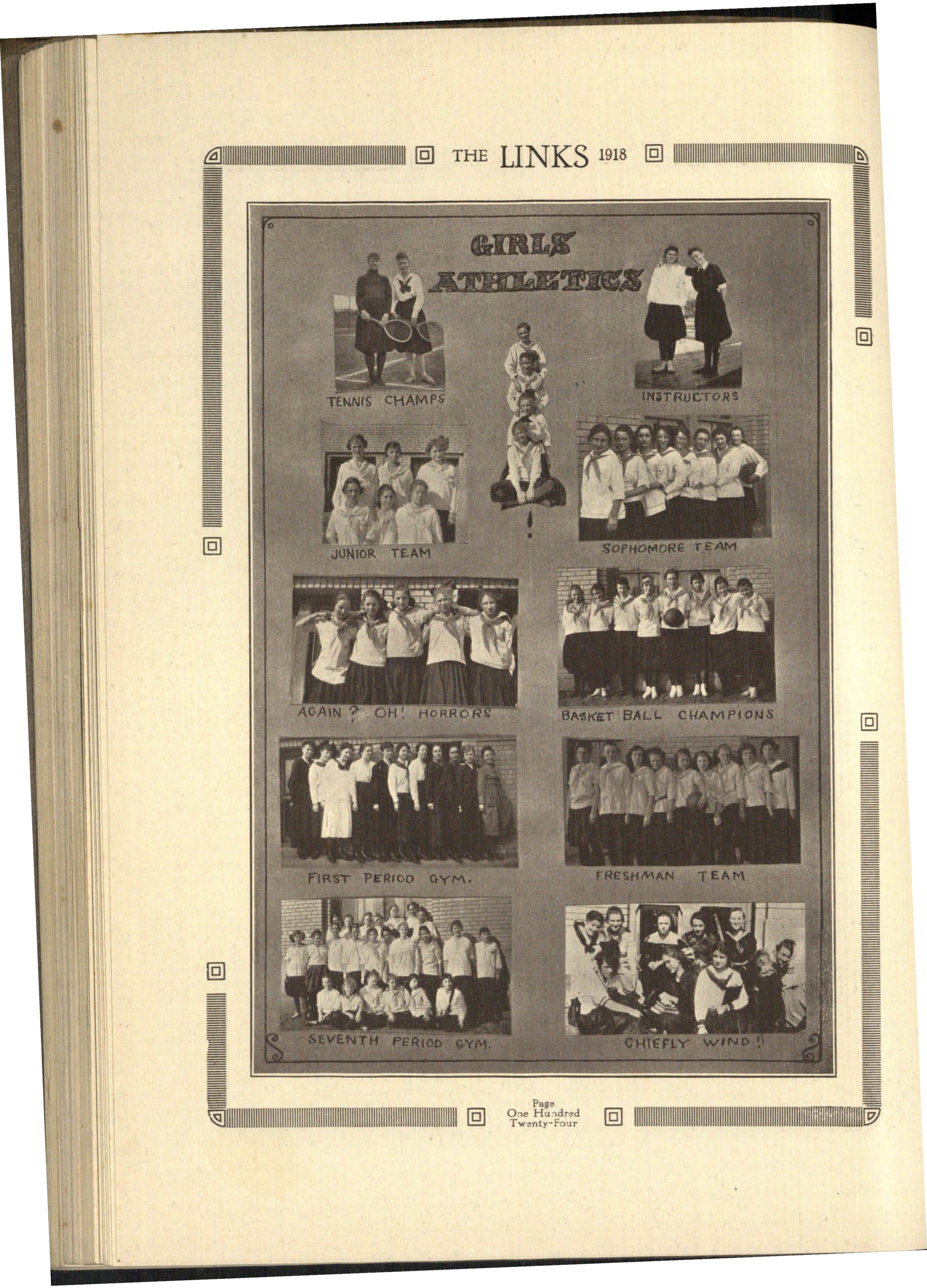
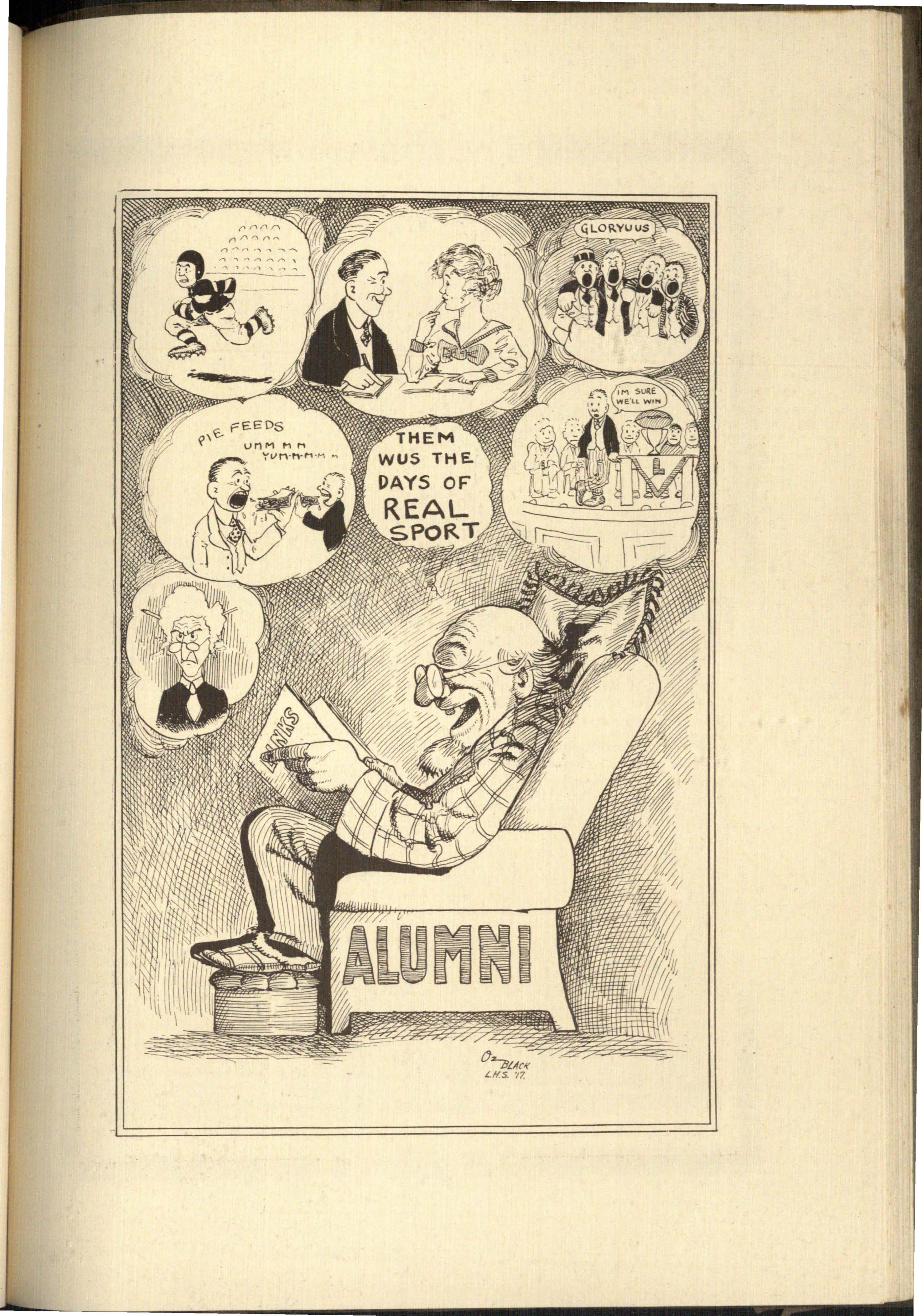
cO GLEAN material for the alumni section of the Link , the editors have turned to the early pages of high school history. We have interested our(~ ~elves particularly in the graduate of a generation ago--in truth of the first <?i) generation-hoping thus to bring into the present omething of the high chool . pirit of the past. Also we have desired to pay tribute to thee pioneers whose tnthusiasm and love for L. H. S. have survived through the year . To us who are hou ed in this complete building it is difficult to conceive of the Lincoln High School ;is having occupied an unplastered room in a store building on O street, yet from such sm:111 beginnings we took our growth.
By way ot linking the past generation to the present, we are presenting picture group of former high school students and their children, the latter memhrrs of the cla s of 1918; also, we are publishing messages from alumni who graduated, most of them, more than a quarter of a century ago. That these bu r men and women, who were active in high school affairs a generation ago, have taken t~e time to write to us demonstrates their love for the school and i a matter of deep gratification to us.
@l THE LINKS 191s @ llllllllllll!!lllll!lllllllllllllllllllllllllllllllll Ma Keesler fi her - 18'3G -
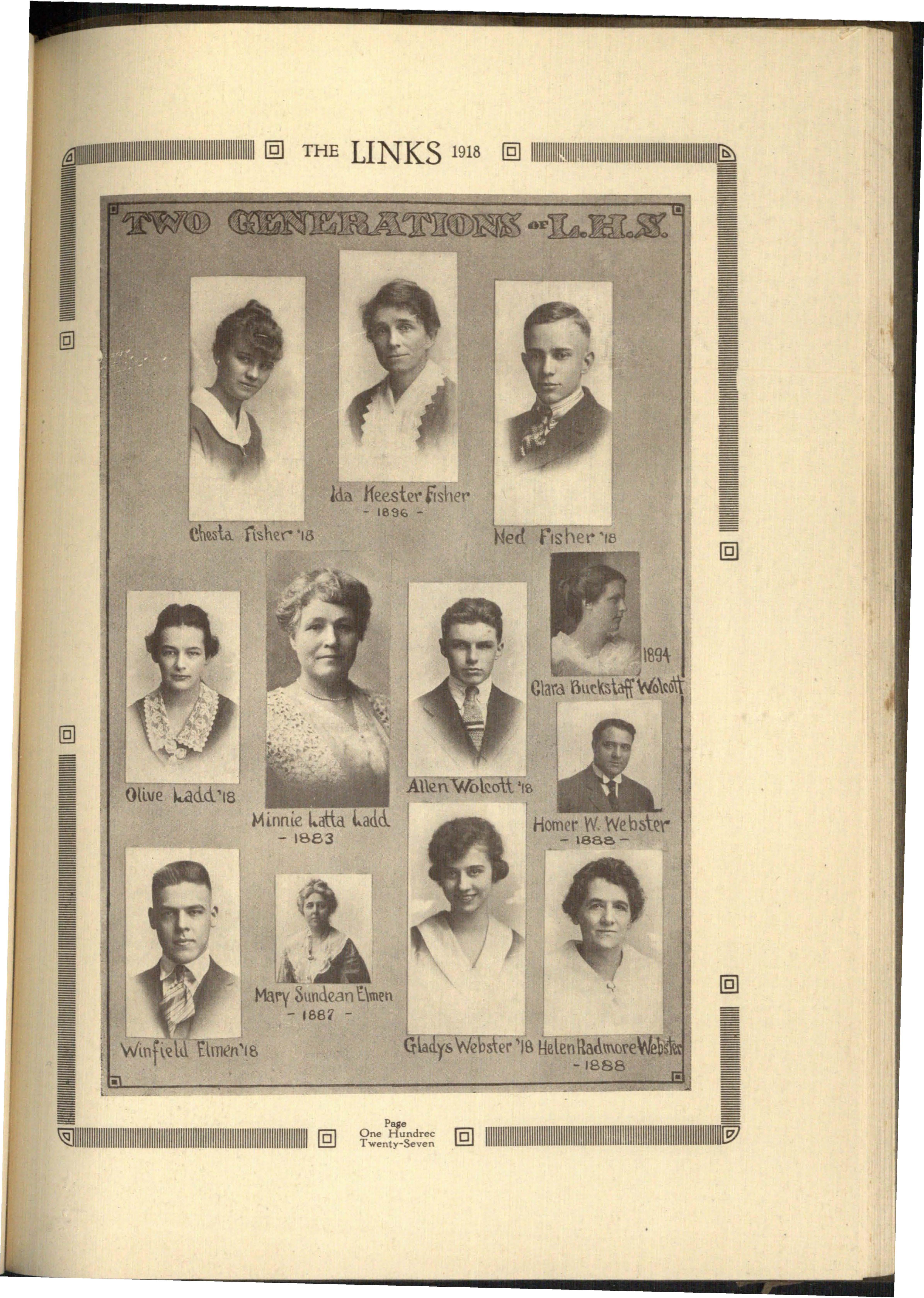
Oli.ve ka<i.d. '18
Minnie kat\.a lad.d.
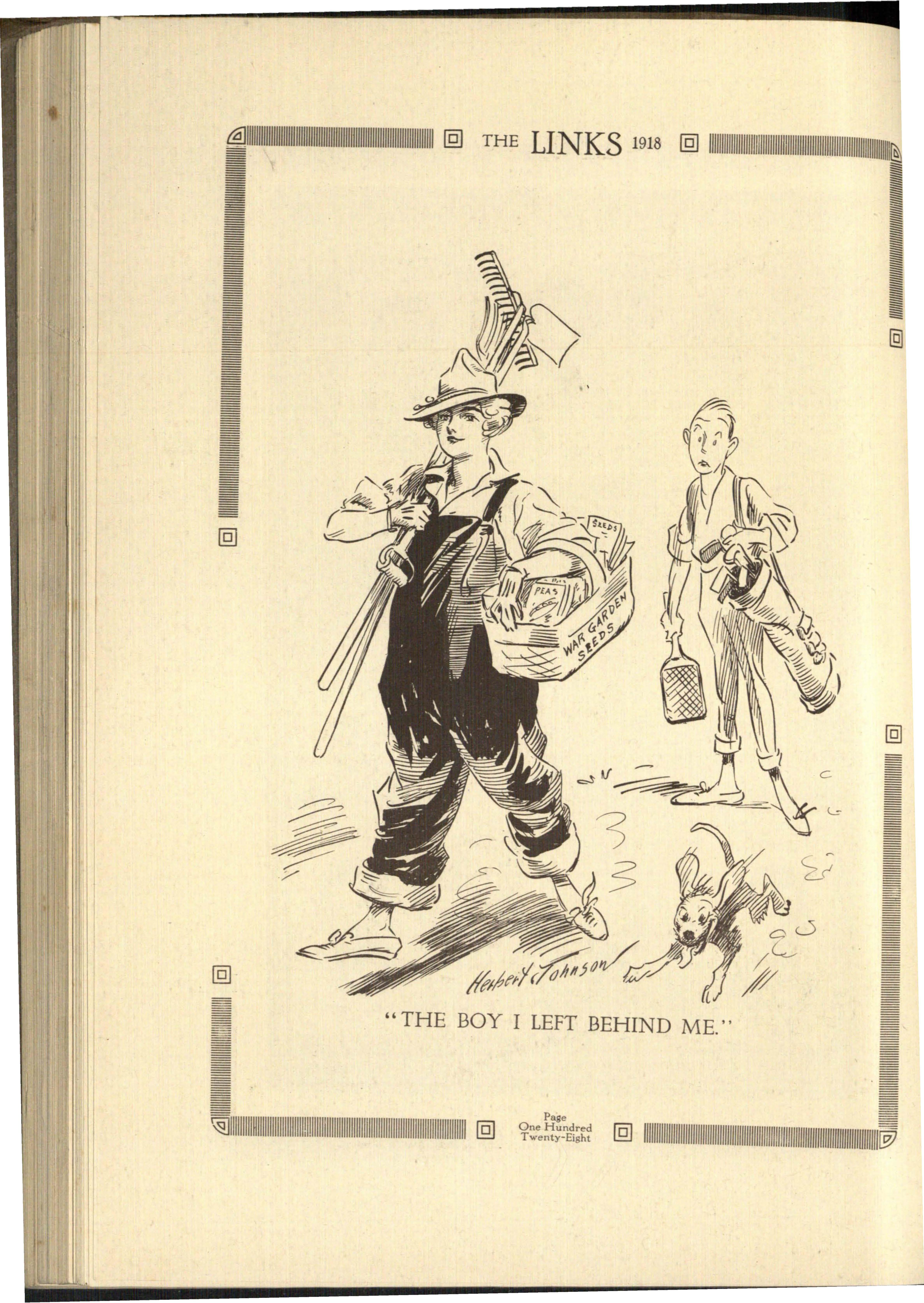
" THE BOY I LEFT BEHIND ME."
XAM asked to write a few words for this publication just becau e, forsooth, I may justly claim t o be the only, truly , ho n est-to-goodness first boy graduate of the Li n coln High School!
C(J~ As I sit here meditating, my mind skips back to the time when I was a freshman How we freshmen swelled with pride as we exhibited our Harkness's " In troductory Lessons i n Latin," and how lovingly "i\mas, amat" flowed from our lips! Our first hall of learning consisted of a single room, unlathed, unplastered, an d upstairs over a rather tumble-down frame store building located on the north side of O street, between Eleventh and Twelfth. Our recreation grounds were the ce nter of the said O street, where we successfully dodged the farmers' hayracks, and t he two horse drays that semi -occasionally passed our way. The instructing force consis t ed of a superintendent, a principal, a teacher, and a janitor, all embodied in the person of one Miss Emma Rockwood.
I recall how t he new high school building on M street was completed a year l a t er, and the school, now boasting of two classes, took possession of the small southeas t room on the top floor . How proud we were! What dignity we possessed! We had a full-fledged superintendent of schools, Professor Cassell, who occasionally visited u s, and a full corps of teachers. As the advance class of the whole city, we indeed felt our importance, for were not we of the best heralded school system anywhere west of t he great father of waters? Was not our building the most up-to-date? In deed, I think we were more proud of that monument erected to further the cause of education, than you of today are of the million dollar palace located in Antelope Valley.
Our class was originally composed of eight, but four from one cause or another fell by the wayside so that thr ee bright, lovely, young ladies, and one poor, red-headed, freckle-faced, bashful boy were left to receive the high honors of diplomas. As a befitting token to the greatness of the graduating class, the school board hired the Academy of Music, a large room on the third floor of what is now the Rudge and Guenzel establishment on O and Eleventh. 'Twas a gala event for the city. Business was suspended, stores closed, the citizens, old and young, big and little, turned out en masse to see, hear, and be instructed! Lincoln was proud of us, and we were proud of our city, and ourselves .
As I look back over the long years, as I recall the small beginnings, the vast sums expended, the many improvements made, and the facilities for aiding the learner to grasp the golden suggets of knowledge, I wonder, do the boys and girls of today appreciate all that is being done for them? Ah, young America, here's to you! Heaven bless you and in the trite, obsolete expression of the old addresses to the graduates , I reiterate, "Your life boat is about to enter upon troubled seas." Glory be, let her sail on and on! You'll do just as you please, anyway, regardless of what I or any other antiquated, out-of-date person may say.
SAM s. ENGLISH, '74
With the Schwarz Paper Co. of Lincoln.
Memories of high school life surely are pleasant to the most of us. In 1873 the two classes which entered the new high school building were comfortablr seated in
[g] -
the small room on the third floor, in its southeast corner. Several boys were then in school, but only one finished the course in the first class. Our class, of r 87 5, the second, numbered seven girls, as did the one the year following. As other classes came from the grammar rooms, we moved into the large north room using the smaller rooms for class rooms. Our instructors were Miss Emma Rockwood, principal, and Prof. W. W. W. Jones, superintendent .
LILLIAN PECK HYDE, '75
My years in the Lincoln High School were in the days of its comparative beginning. "1 ulla Vestigia Retrorsum" was our class motto. How it must sound to the ears of the sophisticated senior of the present! Even then one of our class of six-the brightest in the bunch, and a girl of course-smiled a little at its grandiloquence and purposely chose for her graduation theme , half in jest, and half in protest, "The Force of Circumstances." evertheless she wrote me, scarcely a year ago, when the new building was opened, that circumstances of effort seemed to be the outstanding thing in our years together in the old school.
This expresses in short words what the Lincoln High School meant to us in the seventies of the past century. Doubtless, such experience is more or less universal. For in our high school years, whether in one century or another, we are standing on ground where the girl takes on the graces of womanhood, and where the boy feels his strength come upon him as he approaches the stature of the man. In no small sense such ground is holy ground.
FRED SHEPHERD, '82, Judge of the Lancaster District Court
I value the Lincoln High School beyond all measure. I was a boy of fourteen when a chum of mine asked me to attend the high school commencement. I had never heard of such a thing and wondered what sort of performance it might be. There in the old opera house, now the Funk Block, I saw flowers, heard music, and the various essays and orations of the great class of 1882. The whole scene was like a fairy land. That night my soul took fire with ambition to be a graduate of the Lincoln High School. Several times I was compelled to leave school for a few months at a time, but I always came back, making up studies as best I could; and mainly by the help and patience of an elect lady of Lincoln, Mrs. A. J. Sawyer, in 1886 I had the privilege of graduating, one of a class of twelve. The Irving Society and its association, the group of four instructors of those days, S. P. Barrett, Mary Tremain, Marian Kingsley, now Mrs. 0. J. King, and Lawrence Fassler, and the fine pioneer life of Lincoln were among the most powerful and helpful influences of my life. I have lived and ministered in four capital cities. Lincoln has a place all its own as my boyhood home. Last but not least, I am indebted to the Lincoln High School because there I first saw and met the girl who became my wife, Georgia Taylor.
ORIN w. FIFER, '86 Pastor of Central Ave. Methodist Episcopal Church of Indianapolis.
The cla s of '87-who were they? A k Mrs. King, Miss Tremain, and Professor Fossler. They will tell you. Never a finer crowd pas ed through L. H. • We had no class colors, no class yell, no secret societie , but we did have class pirit in plenty, proper re pect for our instructors, and pride in our school. There was just one big literary ociety. We all belonged to it. We were all friends, happy boys and girls together. I know that times have changed, that new condition and methods of instruction are now in exi tence; but may ·we not hope that co -operation between parents teacher, and pupil will again bring about more ideal conditions in the Lincoln High chool?
PAULINE FRIE 1'D, '87
I am glad I have been a ked to send a word of greeting from '87, that is from 1887. I intend to write it in full hereafter since an experience I had recently. I was talking with a charming co-ed member of the L. H. S. class of '21, and mentioned being a member myself of the class of '87 A puzzled look came into her lovely eyes. "Eighteen eighty-seven?" she asked o now to avoid confusion I intend to specify the century lest others also wonder whether it be seventeen or eighteen. But though 1887 is a long time ago, the survivors of that class do not forget the school and what it did for them.
E. P. BROWN, '87 r,:;i
Regent of Univer ity of 1 ebraska. L9J
We unfortunates who graduated in prehistoric ages from the high school appreciate more than any others the advantages our children enjoy in the new building.
GRACE NELLING HOLYOKE.
Greetings from an alumnus to the class of 1918. My class of twenty-two girls and eleven boys wa the large t ever graduated at that time. We had a principal and three teachers. Compared with your class of two hundred and twenty-five , with your magnificent equipment, we were insignificant, but I trust you are full of hope as we were. I was an optimist then, and I am an optimist now, and my mes age to you is that to be an optimist pays. Fortified with optimism, and modern high school training, you are on the threshold of finer opportunitie for real service than have ever been known.
A. R. EDMISTON,
'87
Union Central Life Insurance Co.
The request for a per onal message to the Links came as a shock, reminding me of the flight of time and of the fact that my high school days, although fresh and pleasant in memory, now date back a number of years. I can say without any mental reservation whatsoever that those days were full of joy and promise and till hold naught but joy and satisfaction as they pass before me in reminiscence. Even after these intervening years, in all contests wherein Lincoln High School is a participant, somethi ng within cau es me to rejoice in her victories and grieve at her defeats. Many things might be said here, but I would emphasize this thought: that the experiences of our high school days determine the course of our after lives. As never before, the world is searching for those who can be trusted in all the tasks of life , and only those can qualify who have laid the foundation trong and true.
J. DEAN RINGER ,
'99
Omaha Attorney.
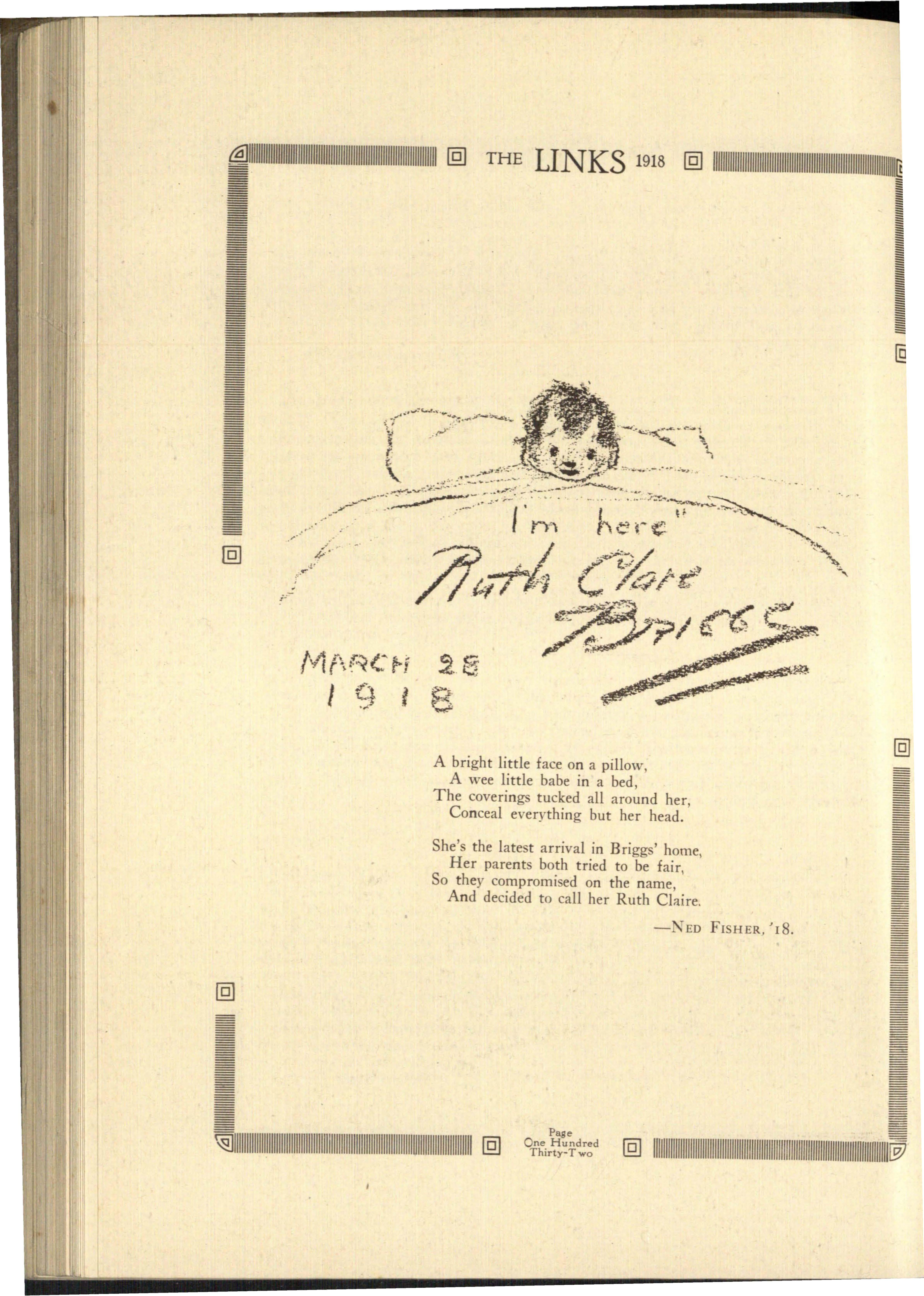
A bright little face on a pillow, A wee little babe in a bed , The coverings tucked all around her , Conceal every thing but her head.
She 's the late t arrival in Brigg ' home , Her parents both tried to be fair , So they compromi sed on the name, And de cided to call her Ruth Claire
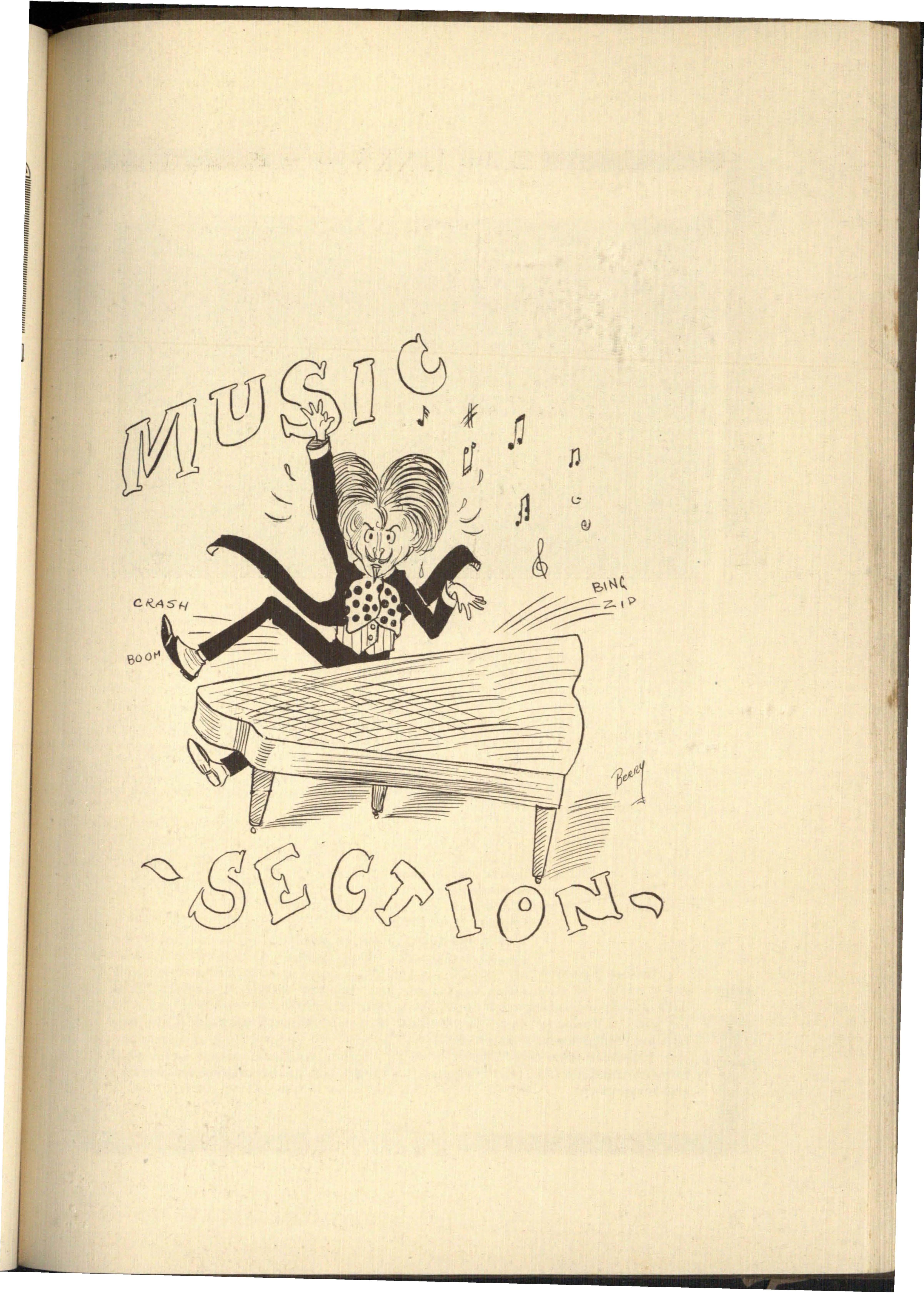
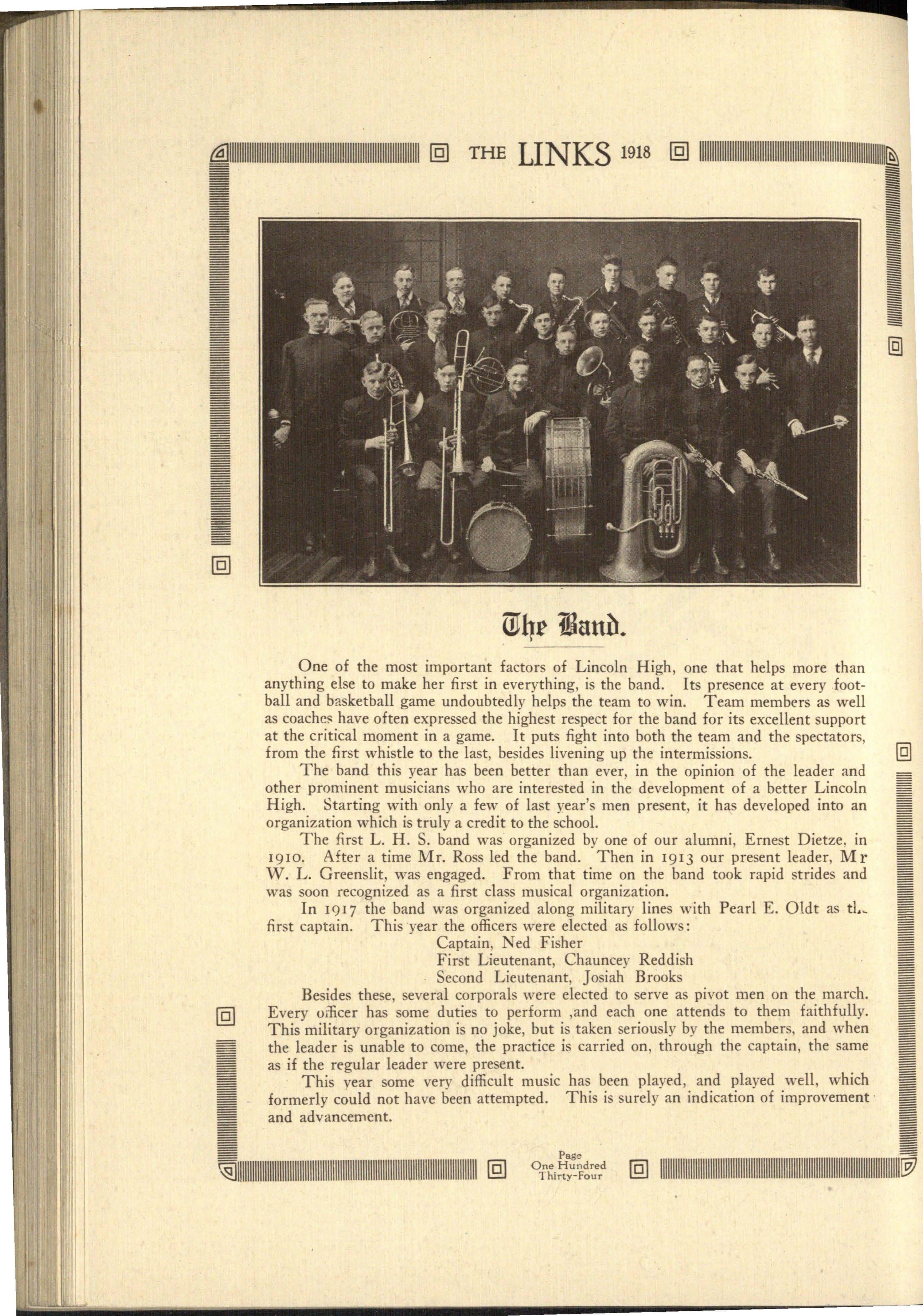
One of the most important factors of Lincoln High , one that helps more than anything else to make her first in everything, is the band. Its presence at every football and b asketball game undoubtedly helps the team to win. Team members as well as coachc~ have often expressed the highest respect for the band for its excellent support at the critical moment in a game. It puts fight into both the team and the spectators, from the first whistle to the last , besides livening up the intermissions.
The band this year has been better than ever, in the opinion of the leader and other prominent musicians who are interested in the development of a better Lincoln High. Starting with only a few of last year ' s men present, it has developed into an organization which is truly a credit to the school.
The first L. H. S. band was organized by one of our alumni , Ernest Dietze, in 1910 After a time Mr. Ross led the band. Then in 1913 our present leader, Mr W. L. Greenslit, was engaged. From that time on the band took rapid strides and was soon recognized as a first class musical organization
In 1917 the band was organized along military lines with Pearl E. Oldt as tl,~ fir st captain This year the officers were elected as follows:
~f~~atie~:~a~:shC~aunce y Reddish
Second Lieutenant , Josiah Brooks =
Besides these, several corporals were elected to serve as pivot men on the march.
Every omcer has some duties to perform ,and each one attends to them faithfully. This military organization is no joke , but is taken seriously by the members, and when the leader is unable to come, the practice is carried on, through the captain, the same as if the regular leader were present. -
This year some very difficult music has been played, and played well, which
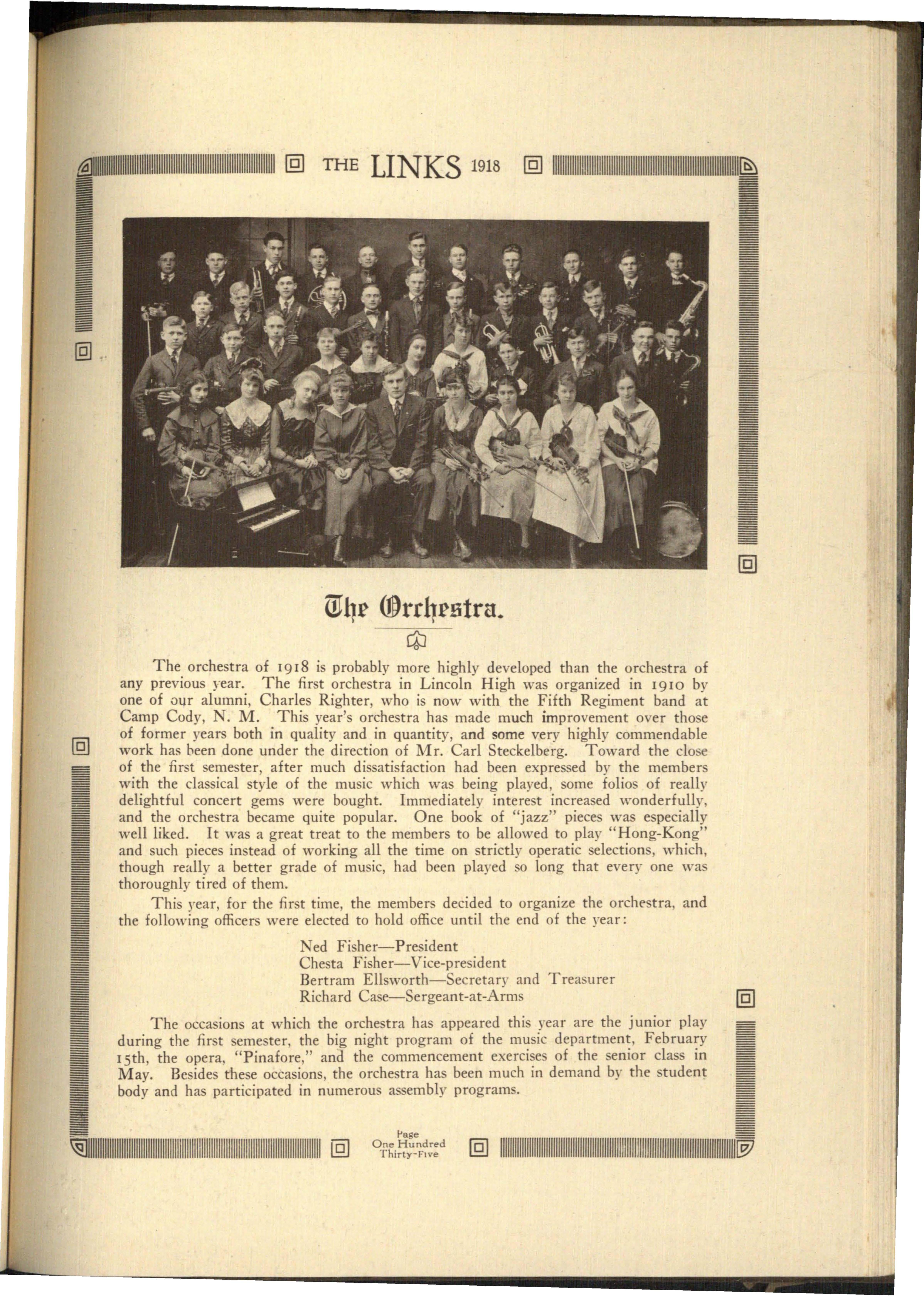
The orchestra of 1918 is probably more highly developed than the orchestra of a ny previous year. The first orchestra in Lincoln High was organized in 1910 by one of our alumni, Charles Righter, who is now with the Fifth Regiment band at Camp Cody, . M. This year's orchestra has made much improvement over tho e of former year both in quality and in quantity, and some very highly commendable work has been done under the direction of Mr Carl Steckelberg Toward the close of the first semester, after much dissatisfaction had been expressed by the members with the classical style of the music which was being played, some folios of really delightful concert gems were bought. Immediately intere t increased wonderfully, and the orche tra became quite popular. One book of "jazz" pieces was especially well liked. It wa a great treat to the members to be allowed to play "Hong-Kong" and such pieces instead of working all the time on strictly operatic selections which, though really a better grade of music, had been played so long that every one wa thoroughly tired of them.
This year, for the first time, the members decided to organize the orchestra, and the following officers were elected to hold office until the end of the year:
red Fisher-President
Chesta Fisher-Vice-pre ident
Bertram Ellsworth- ecretarr and Treasurer
Richard Ca e- ergeant-at-Arms
The occasions at which the orchestra ha appeared thi year are the junior play = during the first seme ter, the big night program of the music department, February = 15th, the opera, "Pinafore," and the commencement exercise of the enior class in May. Besides these occasions, the orchestra has been much in demand by the tudent body and has participated in numerou assembly programs.
l'age
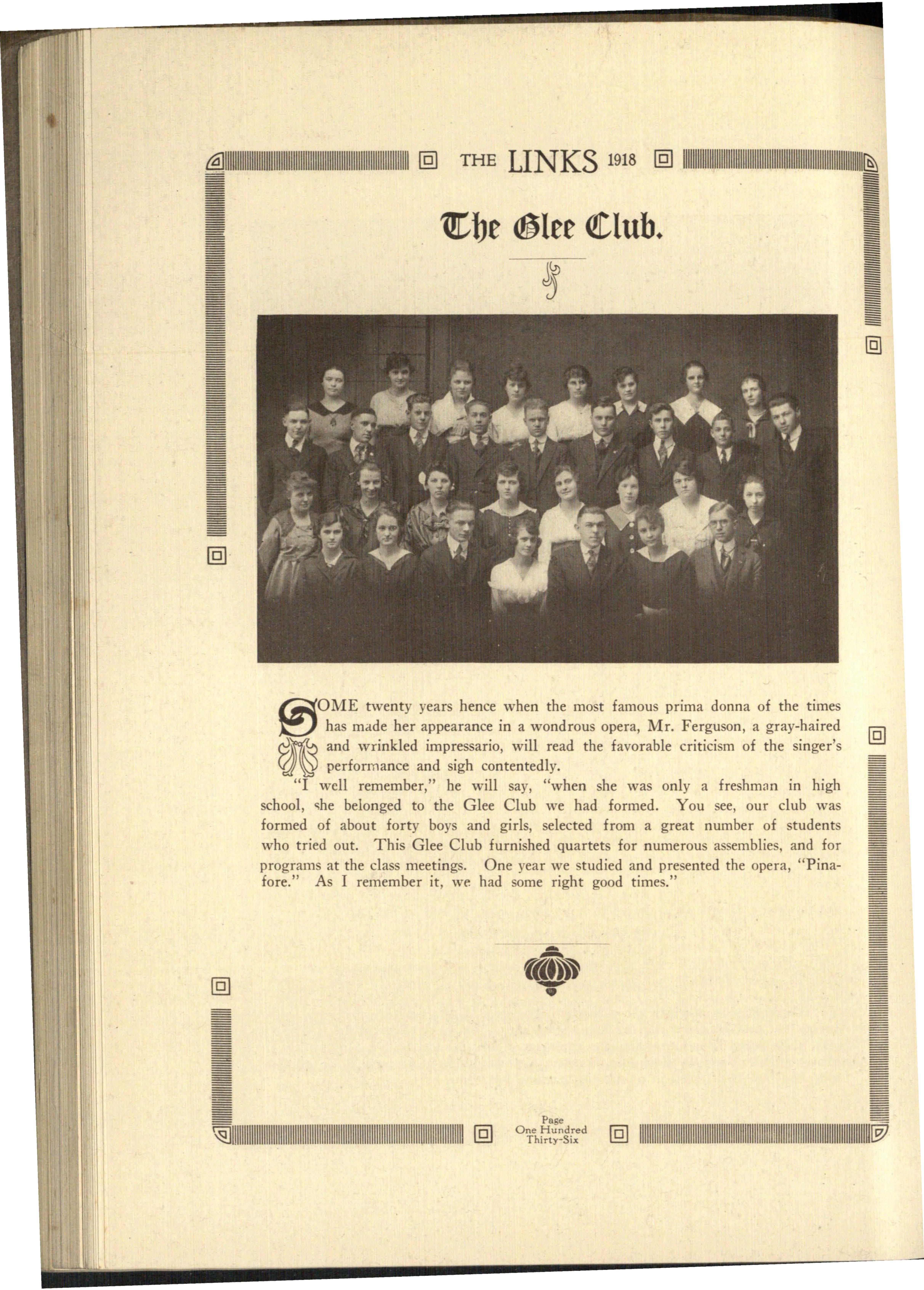
~ OME twenty years hence when the most famou prima donna of the times ha m&de her appearance in a wondrous opera, Mr. Ferguson, a gray-haired c)~ and wrinkled impres ario, will read the favorable criticism of the singer's ((//ty performance and sigh contentedly.
"I well remember," he will say, "when she was only a freshm:in in high school, c;he belonged to the Glee Club we had formed. You see, our club was formed of about forty boys and girls, selected from a great number of students who tried out. This Glee Club furnished quartet for numerous as emblies, and for programs at the cla s meeting One year we tudied and presented the opera, "Pinafore." As I remember it, we had ome right good time."
CHE originality of the chorus is never ending, for manr of the bes t known songs in the school were introduced by its member " Lincoln , We 'r e Strong (~ for You" made its debut in an assembly when the members of the chorus thronged down the aisles singing it as the y went.
Chorus is an elective subject with classes held twice a week,-two forty-seven minute periods of growing knowledge of the best in the world of music. Grand opera, light opera, old-time favorites, and modern compositions are learned and presented, in due time, to an admiring audience. 1any operas and musical programs have been given since the chorus was instituted, and many more will, in all probability, be given before the history of the school shall have been completed. The following program featuring Jordan 's patriotic cantata, " B arbara Frietche," was given February 15, 1917.
March- "Sta r s and Stripes" Sousa
Selecti on-"Apple Blossoms"
Roberts
HIGH SCHOOL BAND
W. L. GREENSLIT, Conducting
Baritone Solo-"A Song of France" Treharne DWIGHT WILLIAMS
Brass Quartet
First Cornet ...... .
Second Cornet
Horn
Baritone
Violin Solo-"Air Varie"
Selection-"Dainty Daffodils"
FLORENCE GREISER , Accompanist
Chau ncey Reddish
John Marriner
John Caughey
Richard Chatburn
Leonard LELAND WooD
Miles
Chorus-"Unfold Ye Portals"
HIGH SCHOOL ORCHESTRA
C. F. STECKELBERG, Conducting
HIGH SCHOOL CHORUS
H. 0. FERGUSON, Co nducting
Gounod
Solo and Chorus-"My Heart at Thy Dear Voice" Saint-Saens ALTINAS TULLIS AND HIGH SCHOOL CHORUS
PA TRIO TIC CANT AT A-"BARBARA FRIETCHE" .... ... ................ .. . .. . Jordon
HIGH SCHOOL CHORUS AND ORCHESTRA
Soloists:
Altinas Tullis, Soprano
Dwight William s, Baritone Mildred Beach , Accompanist
Pa,e One Hundred Thirty-Seven @
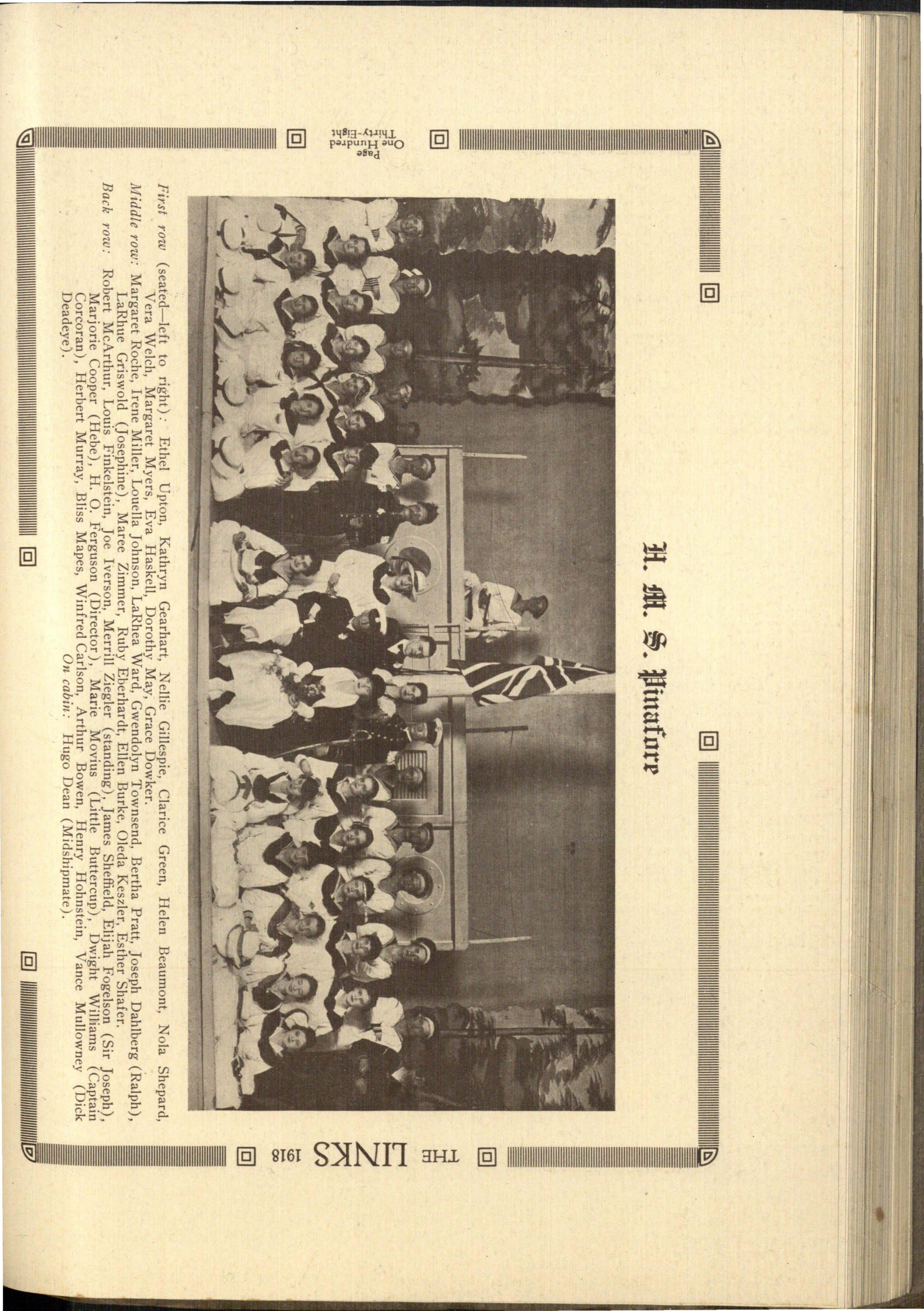
First row (seated-left to right): Ethel Upton, Kathryn Gearhart, Nellie Gillespie, Clarice Green, Helen Beaumont, Nola Shepard, Vera Welch, Margaret Myers, Eva Haskell, Dorothy May, Grace Dowker. ,
Middle row: Margaret Roche, Irene Miller, Louella Johnson, LaRhea Ward, Gwendolyn Townsend, Bertha Pratt, Joseph Dahlberg (Ralph),
LaRhue Griswold (Josephine), Maree Zimmer, Ruby Eberhardt, Ellen Burke, Oieda Keszler, Esther Shafer.
Back row: Robert McArthur, Louis Finkelstein, Joe Iverson, Merrill Ziegler (standing), James Sheffield, Elijah Fogelson (Sir Joseph), Marjorie Cooper (Hebe), H. 0. Ferguson (Director), Marie Movius (Little Buttercup), Dwight Williams (Captain Corcoran), Herbert Murray, Bliss Mapes, Winfred Carlson, Arthur Bowen, Henry Hohnstein, Vance Mullowney (Dick Deadeye).
On cab£11: Hugo Dean (Midshipmate).
iffl" HE TWIG OF THOR1 ·" given by the 1Iummers transported us to "1,;' the Emerald Isle of long ago, to the land of fairies and uperstitions. The .\~ play is based on the belief that if the blo soms of the thorn tree be picked, j a curse will be sent by the fairie upon the house and country of the person committing the act.
The pretty, vivacious Oonah goes into the countn- to live with her grandmother , Tessa Tieg. To her misfortune, she breaks off a twig of the blosso111ing thorn tree, bringing a cur e upon herself. Of her two lovers, she chooses Aengus. a poor country lad, while Aileel, the "greatest poet in Ireland," take Oonah's curse upon himself and leaves her happy.
Marjorie Ree e portrayed the Irish colleen to perfection, in fact, so well, that many of the spectators thought that Oonah' part was written especially for her.
A the boastful, eloquent Aileel, Chauncey Reddi h ,rn superb. A favorite line of his, to be remembered, is, "vVho is Aengus Araan, that he may speak to me now?"Although Bryson Loughridge, a Aengus, could not make a poem, he made a very compelling lover.
The properties were as carefully selected as the characters. The costumes, and the Irish harp used by Aileel, were secured in the East. A great deal of time was spent in working out the tedious-to-learn but pretty-when-learned Irish folk dance • The da:nty fairies also lent a distincti,·e air to the play.
The proceeds of the performance were used to buy the scenery and to finance the nun1erous plays given by the l\lummers in assembly. The scenery has since been donated to the school.
Oonah ....................•..•••••••• Marjorie Reese
Aengus, a Jover
Aileel, a poet lover
Nessa Tieg, Oonah's grandmother
Maurya, a neighbor
Father Bhian, a priest
Neighbors:
Sheamus
Kathleen
Shiela
Martin
Anne
Michall
Finula
Tum
Faery Child
Bryson Loughridge
Chauncey Reddish
Lois Cordner
Gretchen Morse
Robert R. Troyer
Lane Hildreth
Florence Zimmerman
Florene Reed
Miller
Mary Richardson
Edminton
Gertrude Tomson
Glen Rosh
Helen Burkett
Fairies Flavia Waters and Elizabeth Scribner
Produced by Miss Celestine Rice.
Dances coached by Miss Margie Richards.
This bit of high comedy, with a woman's desire for financial independence as a theme, was the first of the Mummers' plays given in assembly.
Sir Harry, about to be knighted , engages a stenographer t o answer in advance his letters of congratulation. Upon her arrival, he finds her to be Kate, his former wife, who had left him fourteen years before.' Marion Risser, the pretty vivacious Kate, calmly informs him that she had simply earned twelve pounds to buy a typewriter and then had eloped with it, not with a man, as he suspected. She startles Sir Harry with the news that he is worth to a ,rnman, only twelve pounds, the cost of her t ypewriter, and cautions him not to let his present wife acquire the twelve pou n d look.
Stanley Hall portrayed most successfully the egotistica l , self-satisfied Englishman , Sir Harry Sims Florene Reed, his drab, lifeless, obedie n t wife, who surely had the twelve-pound look, pricked the bubble of his conceit by t imidly letting him know that she was wondering about the cost of a typewriter
t:=f FTER an interesting week of extraordinary events calling our attention to the ,--1 same perplexities, troublesome equally, to the bright a n d shining freshmen and eloquent seniors, "Anyman's Journey to Success," brought Better English
Week to a fitting close in a unique manner. Ins t ead of being told by some discouraged member of the faculty for the forty -ninth time not to say "I seen," "I ain't got," and "Where's she at?" the Slang Twins, with all their co-workers , showed us how greatly they hindered our progress.
This brief but impressive sketch was arranged by a comm ittee from t he senior English classes. A synopsis of the sketch is as follows :
Anyman, in the person of Dwight Williams, receives a summons from Opportunity; but is hindered and delayed in his journey to success by a company of dilapidated, grammatical errors. His ,vorst troubles, however, are the mischievous Slang Twins, who, by their ludicrous antics, trip him, and hinder him in every possible way.
The followers of the now allJlost distracted Anrman are put through Education's machine, which proves to be a marvel. It transforms them into neat personalities representing good, sound, English expressions, worthy of recommendation by Education ~:~:l::11 all comedy had an underlying meaning that called for really serious
"1t:1Je a\nk\narb ~quab.
Y FOLLOWING Lincoln High's awkwardest quad, who wrre disguised in ~i l it ary-like unif?rms and who pranced about the corridors, tho~e in t eres t ed m t he really amusmg features of t he carnival were led to a typical employme n t L½JL¾J office of Uncle Sam.
H ere, recruits of all shapes and sizes presented themselves for enli tmcnt. After t he most amusing examinations the rookies retired to a tent, soon returning a very mi l it ary ·appear ing squad, save for the "powerful stra in" on Ben Miller's trousers a n d the absence of about five sizes from Bob Hiatt's coat.
,All of the members of t he cast, ,vere members of the Mummers. This farce, "The Awkward Squad," met with such success tha t it was repeated for the entert a in ment of t he visitors during the baske t ball tournament.
"joint e\nners, in ~pain."
This t rue-to-life comedy, picturing an old ladies' home, was very successfully p resented by four members of the Mummers in assembly. The feature was the di vid ing of a dually-occupied room, with a cha l k line, by a member inclined to be q u arrelsome. Never before did we know that Verene Anderson could be such a disagreeable old lady or show so much hatred as she did toward Gertrude Tomson, the sickly Mrs. Dwyer.
"auaUtp ~tr.eet."
We all know that the art of camouflage does wonders to every-day things
Camouflage changed Idanha Kiefer from a modern girl to Miss Phoebe Throssel of Quality Street, a maiden with lightly tripping feet and swaying hoop- @] skir t s, with dainty curls and gentle ways, who presided at her tea table most charmingly in her dainty blue and white ribbon. And here camouflage had had its way, = also, for the pale blue-tinted walls were once the much worn scenery which had lost its beauty and freshness through long years of service. In the blue and ,vhite
@Jllllllllllllllllllllllllllllllllllllllllllllllllllllllllllllllllllllmlllll [Q] THE LINKS
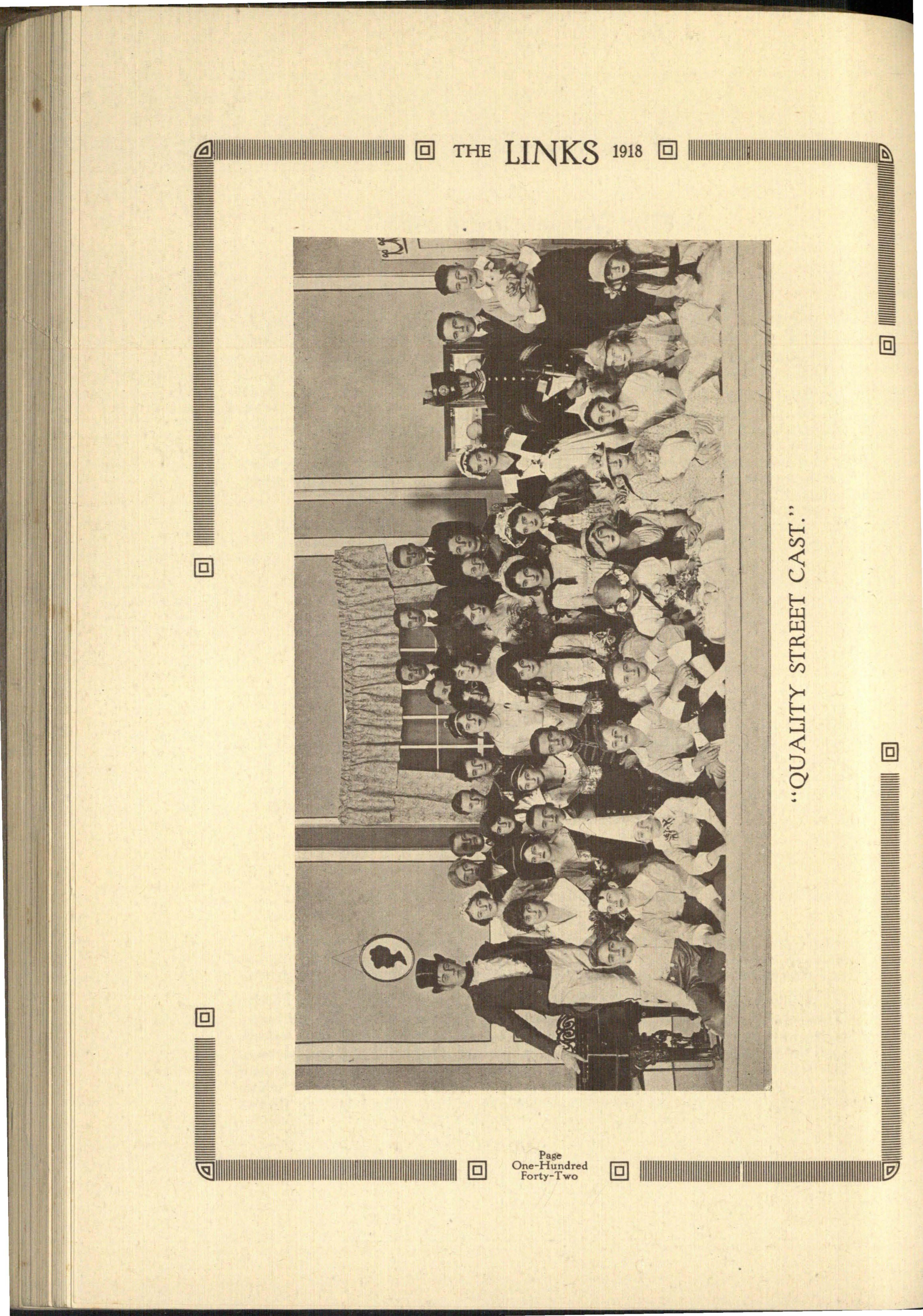
r l~~::~::~::00~:::rn::::,~ad:ho
For certain hours every day active boys and girls received instruction in the gentlearts, such as dancing. ometimes even a captain, or a ergeant, entered Mi, Phoebe's
@ in its junior year. It wa pre ented on December fourteenth, in the high school = audit~i:;·story of the play took place during the apoleonic Wars, and this atmosphere was created by the military co tumes of the men, and the quaint gowns of the ladies. A spinet, kindly loaned by Mrs. Beaumont, a quaint tea table and chairs, gave their note to the atmosphere. =
Brave Captain Brown, played by Melvin He selberg, while fighting hi5 country's battles, ldo dt a ha1n1d, but this did dnot d~ther hhi~1 1~n1. ,~innhing ~l iss Phofebe'~, love. The story en e , as a true romances o, wit t eu 1vmg appt y ever a ter.
In Order of Their Appearance: Miss Fanny Willoughby ..........................................•..•..•••• Flavia Water
Miss Mary Willoughby .•.•.••• ••• Lucille Zimmer
Miss Susan Throssel. : .......................•••••••••••••••• Ada Bemis
Miss Henrietta Turnbull .•...•. •••• •Verene Anderson
Miss Phoebe Throssel. ..............................................••••••• Idanha Kiefer
Patty ......................................................•..••.•.. Florence Zimmerman
The Recruiting Sergeant. ......................•.•••••••••• Lane Hildreth
Mr. Valentine Brown ...........................................•.•••••• Melvin Hesselberg
School Children
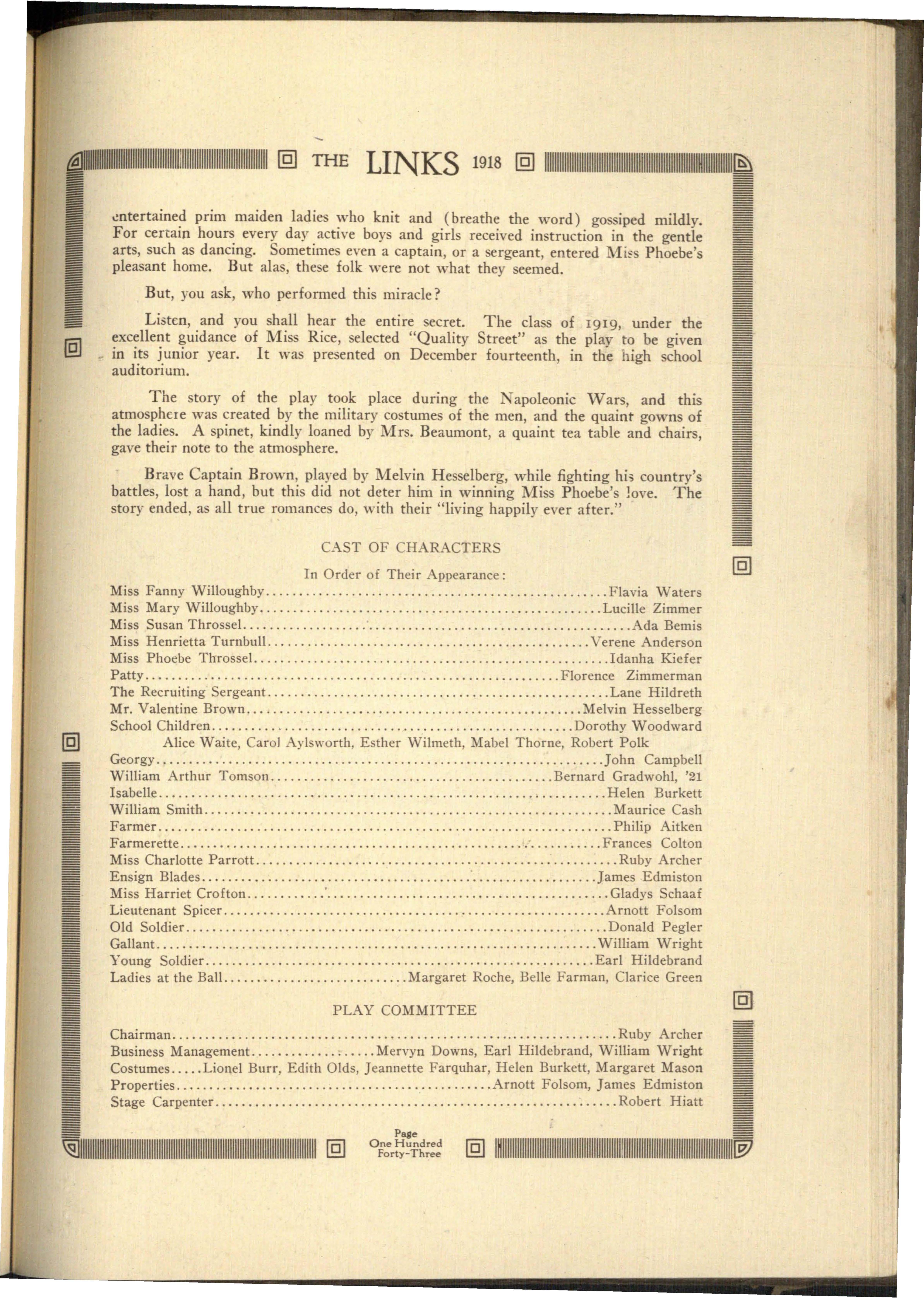
Dorothy Woodward
Alice Waite , Carol Aylsworth, Esther Wilmeth , Mabel Thorne, Robert Polk
Georgy .....................................................•.•..•••••••••• John Campbell
William Arthur Tomson ...... .... .... ............. . . .. .... ... ..••• Bernard Gradwohl, '21
Isabelle ...................
Helen Burkett
William Smith ...................................................••••••••••• Maurice Cash
Farmer
Farmerette
Miss Charlotte Parrott
Philip Aitken
Frances Colton
• •••••••• Ruby Archer
Ensign Blades ..................................................••.••••••• James Edmiston
Miss Harriet Crofton .' ..........................•..••.••••••••••• Gladys Schaaf
Lieutenant Spicer .............................................••••••••••••• Arnott Folsom
Old Soldier ...................................................••••••••••••• Donald Pegler
Gallant .......................................................•••.•••••••• William \Vright
Young Soldier ...............................................•.•••••••••• Earl Hildebrand
Ladies at the Ball
Margaret Roche, Belle Farman, Clarice Gree!l
Chairman Ruby Archer
Business Management. Mervyn Downs, Earl Hildebrand, William Wright
Costumes Lionel Burr, Edith Olds, Jeannette Farquhar, Helen Burkett, Margaret Mason
Properties .............................................••• Arnott Folsom, James Edmiston
Stage Carpenter ............................................••••••••••••••••• Robert Hiatt
Pase One Hundred Forty-Three @ l~llllllllllllllllllllllllllllllllllllllllllllllll!llllllllllllllllllllllllllllllllllllllllllll&J
Top row: Miss Humpe, Miss Foster, Monte Munn, Cline Finley, Jack Edwards, Harold Richards, Marjorie Reese, Glen Roshon, Kenneth O'Rorke, William Richardson, Laurens Mason, Robert Troyer.
Second row: John Lawlor, Florene Reed, Edward Gardner, Kathryn Hamley, Orville Brethower, Lois Cordner, Winfield Elmen.
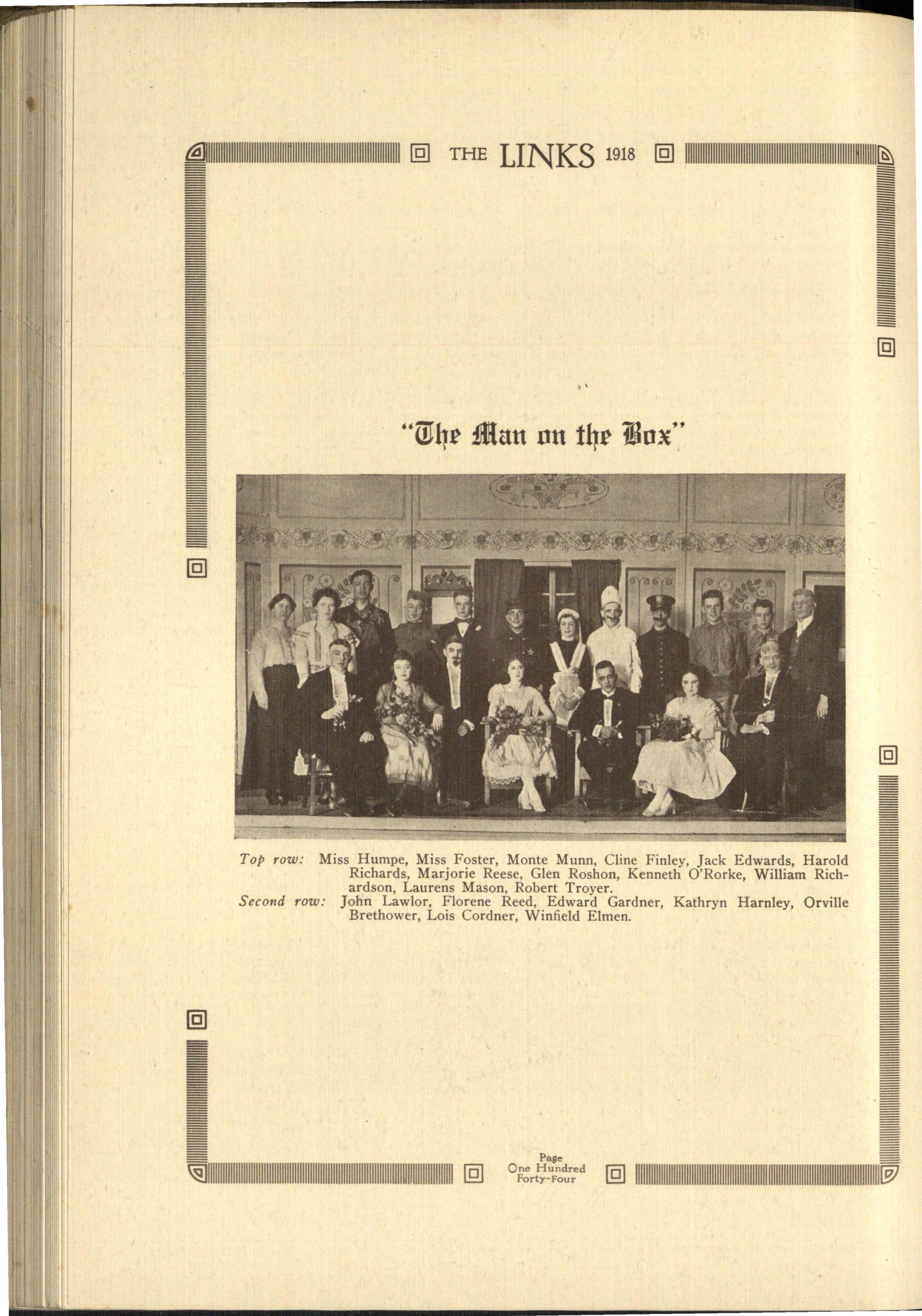
One Hu n dred Forty-Four
"t:fJr folan c@n tf)e l>ox."
If comedy is to amuse, "The Man on the Box," the final dramatic presentation of the class of 1918, was very successful in its purpose, for the audience was amused , as well as interested and excited.
Orville Brethower, as Bob Worburton, proved himself worthy of being a gentleman or of shampooing the cows. But all this was for the be a utiful Betty Annesley , played by Kathryn H a rnly, who helped him out of a police court scrape growing out of a joke. Then she hired the man on the box for her own groom. The part of Worburton's chum, good old Charlie Henderson, who was always rea dy to assist or advise Bob was taken by John Lawlor. Of course Nanc y, Bob ' s flattering sister, broadened and improved Betty's opinion of Bob. [Q1
As no story is complete without a villain, Edward Gardner was introduced as Count Karloff, who tried to make Colonel Annesley a traitor by buying from him the plans of a government irrigation project. Karloff was defeated, onl y when Robert Worburton, alias James Osburne, took a hand.
The success of this play was attained with a coach , Miss Cecelia Foster, not before known to Lincoln High School. Many plays have been good, many, better; but "The Man on the Box, " may be considered one of the best.
Lieutenant Robert Worburton, lately resigned
Mr. Charles Henderson, his chum
Col. George Annesley, a retired army officer
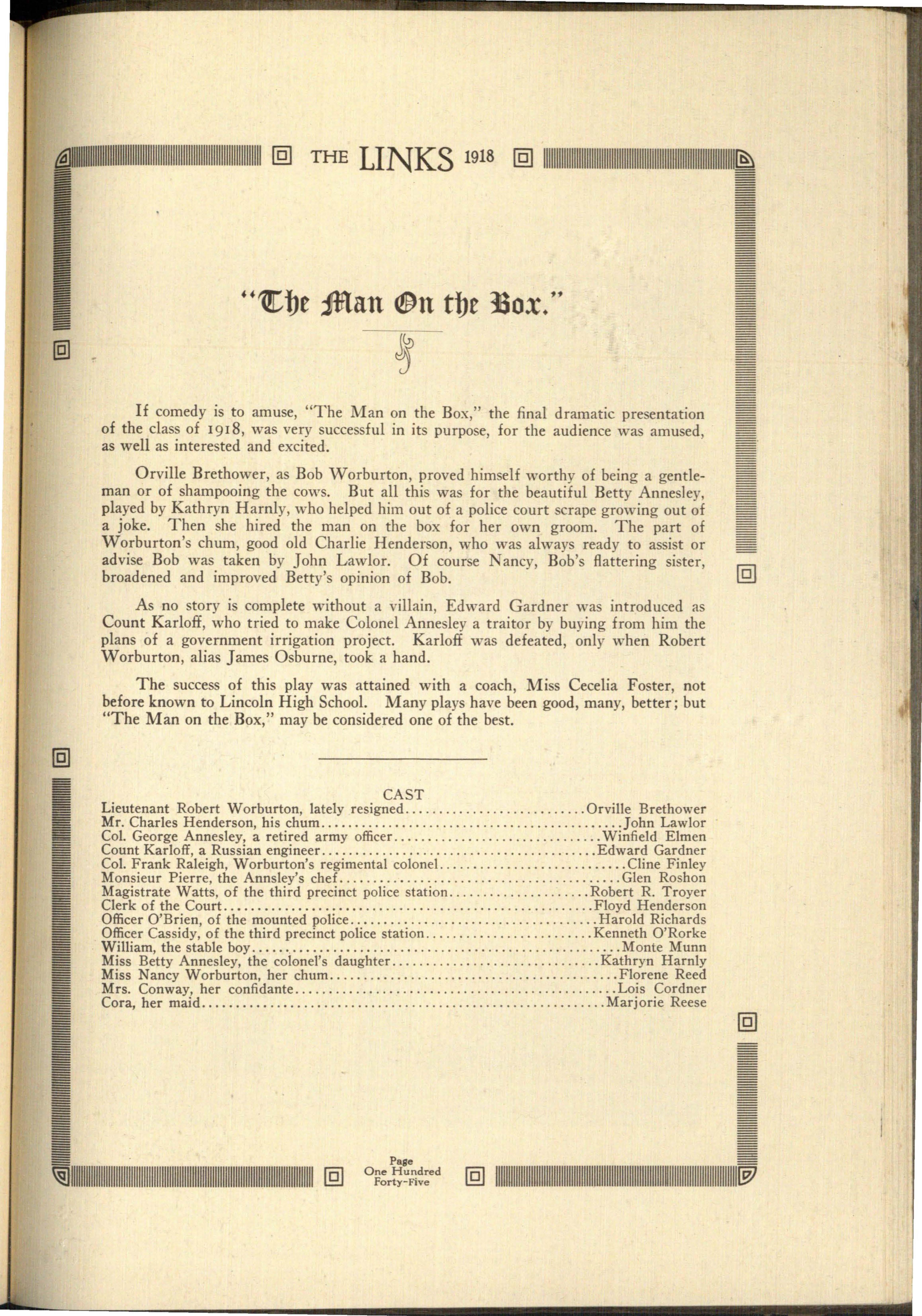
Orville Breth ow er
John Lawlor
Winfield Elmen Count Karloff, a Russian engineer
Edward Gardner Col. Frank Raleigh, Worburton's regimental colonel Cline Finley
Monsieur Pierre, the Annsley ' s chef
Magistrate Watts, of the third precinct police station
Glen Ro shon
Robert R. Troyer Clerk of the Court
Floyd Henderson Officer O'Brien, of the mounted police
Harold Richards Officer Cassidy , of the third precinct police station
Kenneth O'Rorke William , the stable boy
Miss Betty Annesley, the colonel's daughter
Monte Munn
Kathryn Harnly Miss Nancy Worburton, her chum Florene Reed Mrs. Conway, her confidante Lois Cordner Cora, her maid
Marjorie Reese
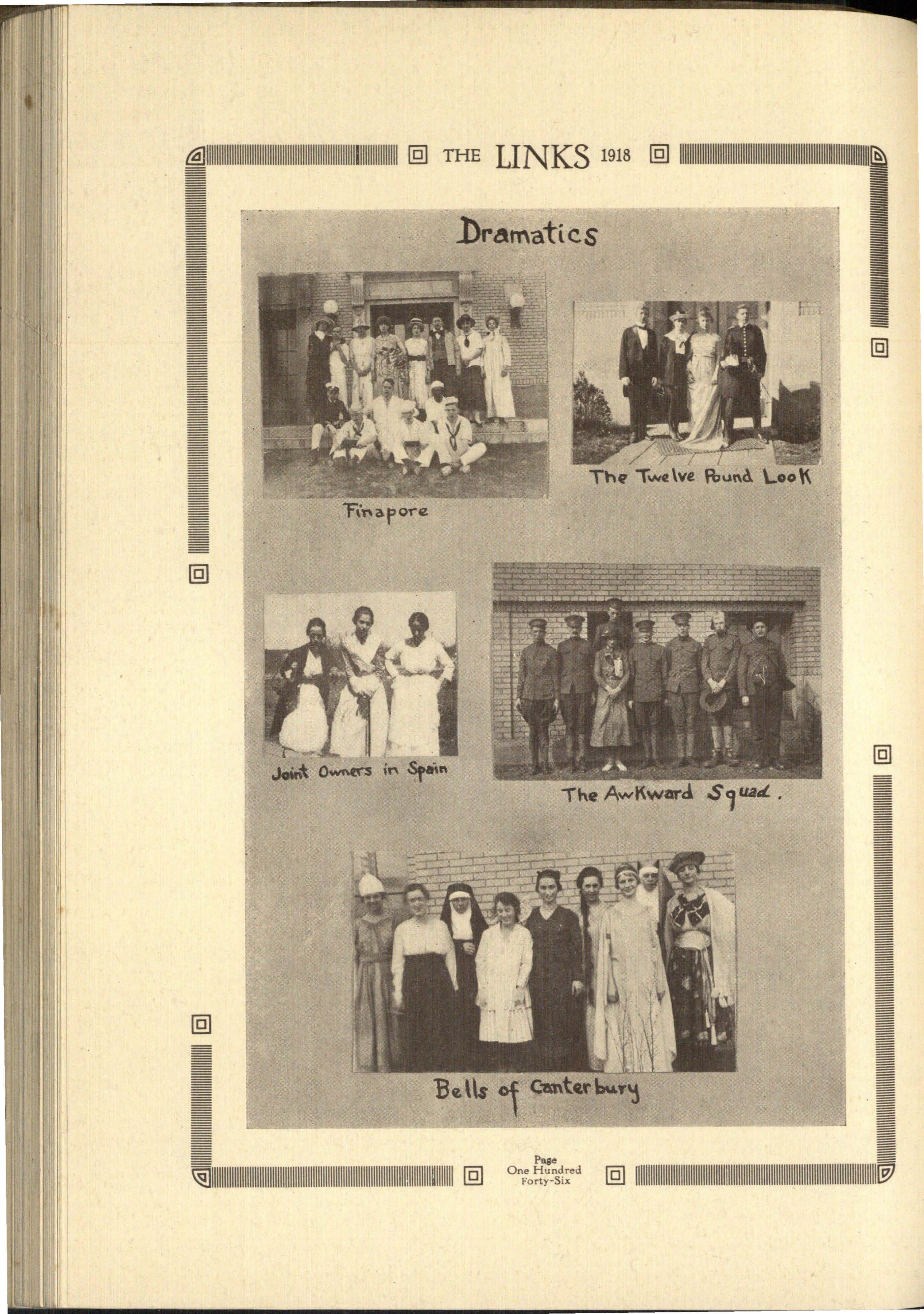
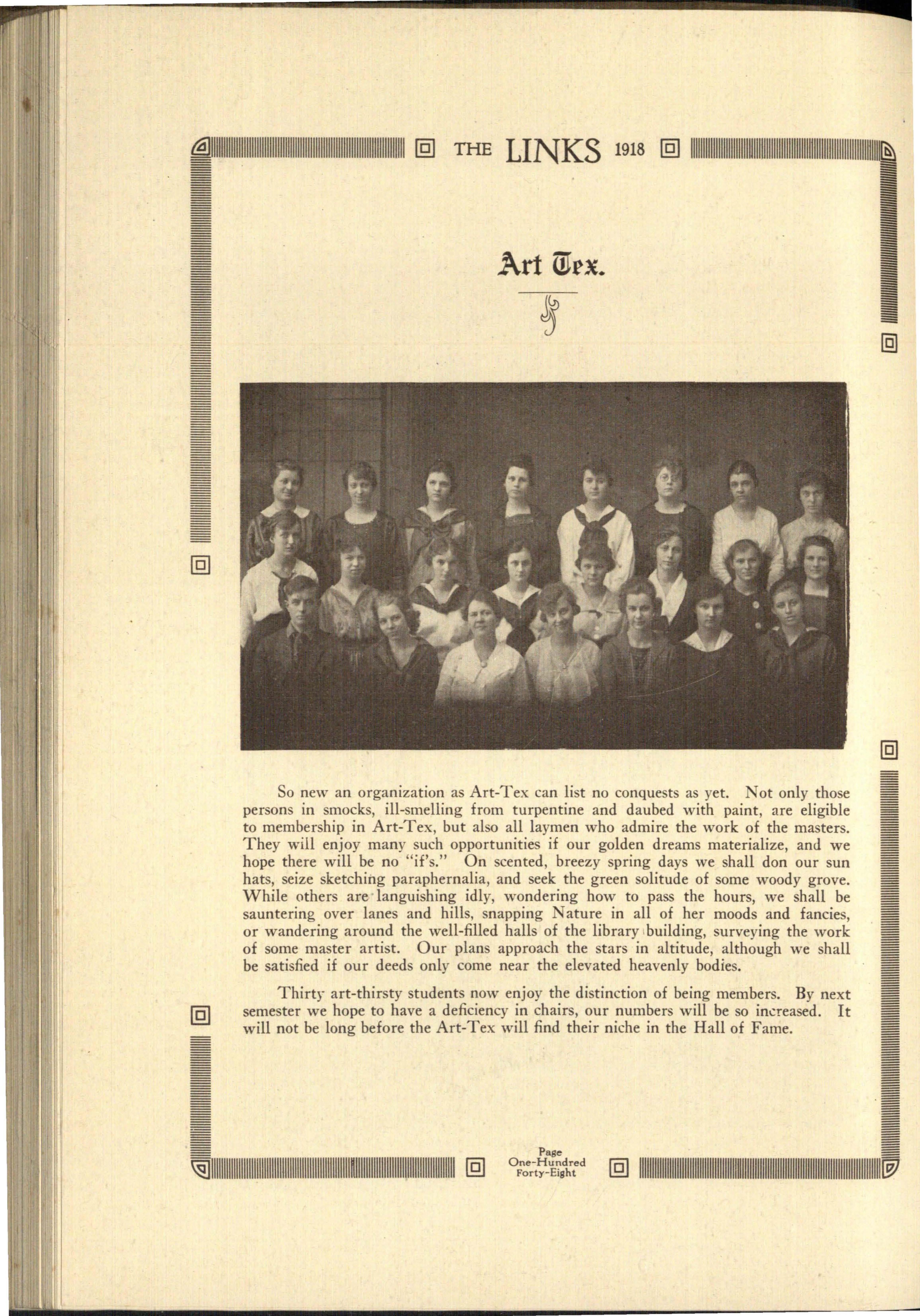
So new an organization as Art-Tex can list no conquests as yet . Not only those persons in smocks, ill-smelling from turpentine and daubed with paint, are eligible to membership in Art-Tex, but also all laymen who admire the work of the masters. They will enjoy many such opportunities if our golden dreams materialize, and we hope there will be no "if's." On scented, breezy spring days we shall don our sun hats, seize sketching paraphernalia, and seek the green solitude of some woody grove. While others are languishing idly, wondering how to pass the hours, we shall be sauntering over lanes and hills, snapping Nature in all of her moods and fancies, or wandering around the well-filled halls of the library building, surveying the work of some master artist. Our plans approach the stars in altitude, although we shall be satisfied if our deeds only come near the elevated heavenly bodies.
Thirty art-thirsty students now enjoy the distinction of being members. By next semester we hope to have a deficiency in chairs, our numbers will be so increased. It will not be long before the Art-Tex will find their niche in the Hall of Fame.
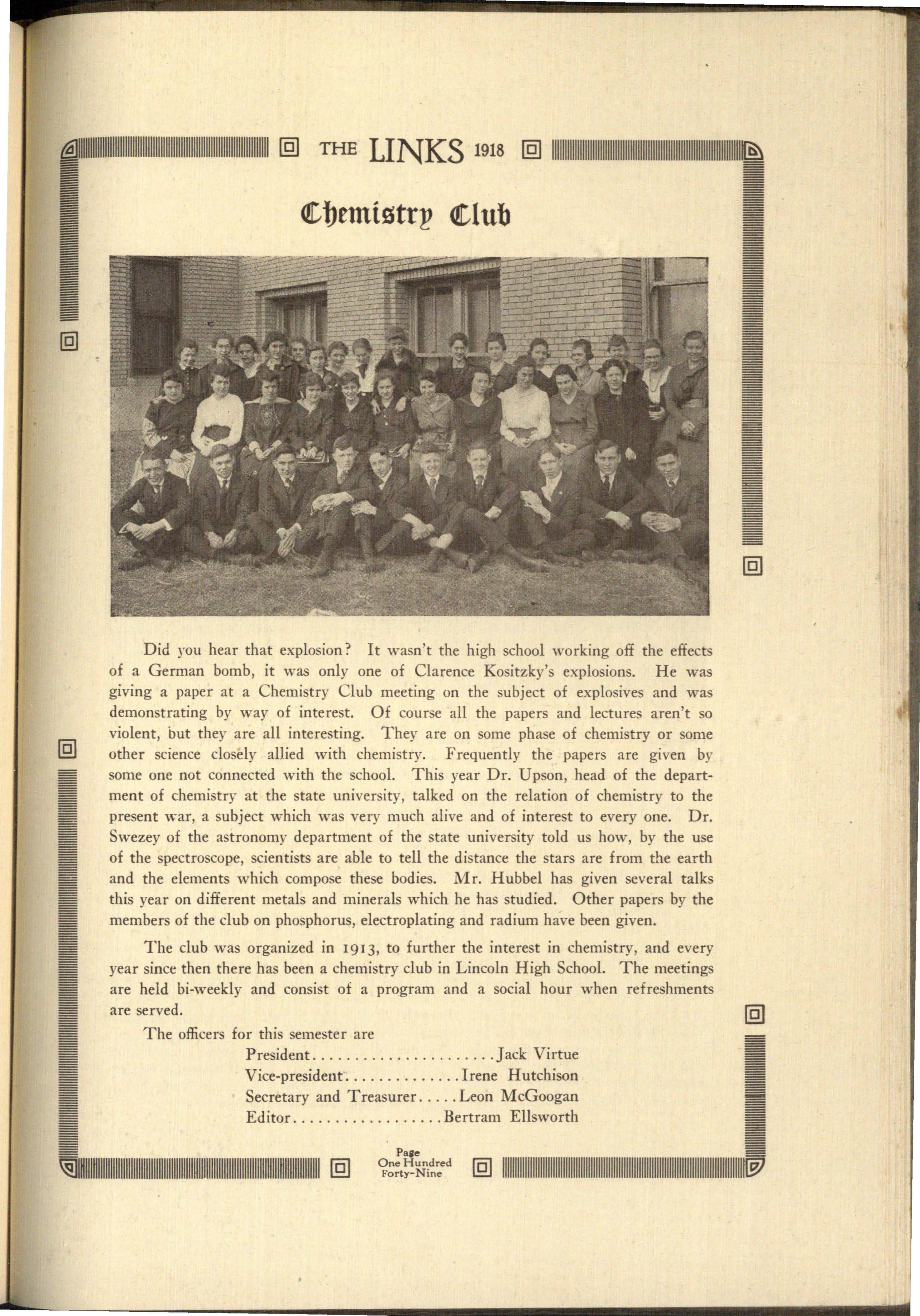
Did you hear that explosion? It wasn't the high school working off the effects of a German bomb, it was only one of Clarence Kositzky's explosions. He was giving a paper at a Chemistry Club meeting on the subject of explosives and was demonstrating by way of interest. Of course all the papers and lectures aren't so violent, but they are all interesting. They are on some phase of chemistry or some other science closely allied with chemistry. Frequently the papers are given by some one not connected with the school. This year Dr. Upson, head of the department of chemistry at the state university, talked on the relation of chemistry to the present war, a subject which was very much alive and of interest to every one. Dr. Swezey of the astronomy department of the state university told us how, by the use of the spectroscope, scientists are able to tell the distance the stars are from the earth and the elements which compose these bodies. Mr. Hubbel has given several talks this year on different metals and minerals which he has studied. Other papers by the members of the club on phosphorus, electroplating and radium have been given.
The club was organized in 1913, to further the interest in chemistry, and every year since then there has been a chemistry club in Lincoln High School. The meetings are held bi-weekly and consist of a program and a social hour when refreshments are served.
The officers for this semester are President. ..... . ............... Jack Virtue Vice-president .............. Irene Hutchison Secretary and Treasurer Leon McGoogan Editor Bertram Ellsworth
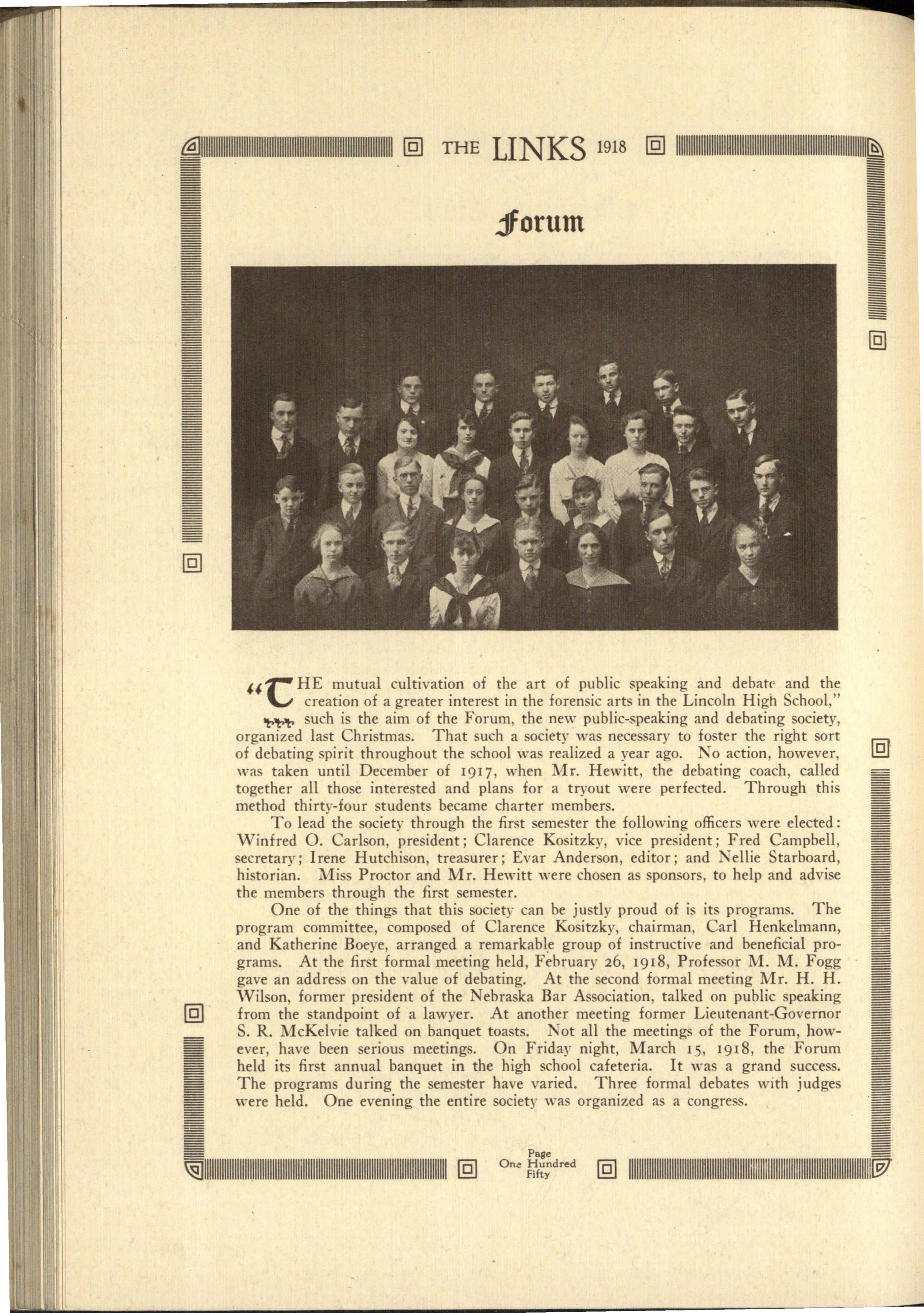
"CHE mutual cultivation of the art of public speaking and debat<' and the creation of a greater interest in the forensic arts in the Lincoln High School ," 't--"t>'t> such is the aim of the Forum , the new public-speaking and debating society, organized last Christmas. That such a society was necessar y to foster the right sort of debating spirit throughout the school was realized a year ago. No action , however , wa s taken until December of 1917 , when lVIr. Hewitt , the debating coach , called together all those interested and plans for a tr yout were perfected. Through this method thirt y-four students became charter members.
To lead the societ y through the first semester the following officers were elected: Winfred 0. Carlson , president; Clarence Kositzk y, vice president; Fred Campbell , secretary; Irene Hutchison , treasurer; Evar Anderson, editor; and Nellie Starboard, historian. Miss Proctor and Mr. Hewitt were chosen as sponsors, to help and advise the members through the first semester.
One of the things that this society can be justl y proud of is its programs. The program committee, composed of Clarence Kositzky , chairman , Carl Henkelmann, and Katherine Boe ye , arranged a remarkabl e group of instructive and beneficial program s. At the first formal meeting held, Februar y 26, 1918 , Professor M. M. Fogg gave an address on the value of debating. At the second formal meeting Mr. H. H. Wilson , former president of the Nebraska Bar Association, talked on public speaking from the standpoint of a lawyer. At another meeting former Lieutenant-Governor S. R. McKelvie talked on banquet toasts. Iot all the meetings of the Forum, however , have been serious meetings. On Friday night, March 15, 1918 , the Forum held its first annual banquet in the high school cafeteria. It was a grand success. The programs during the semester have varied. Three formal debates with judges were held. One evening the entire societ y was organized as a congress.
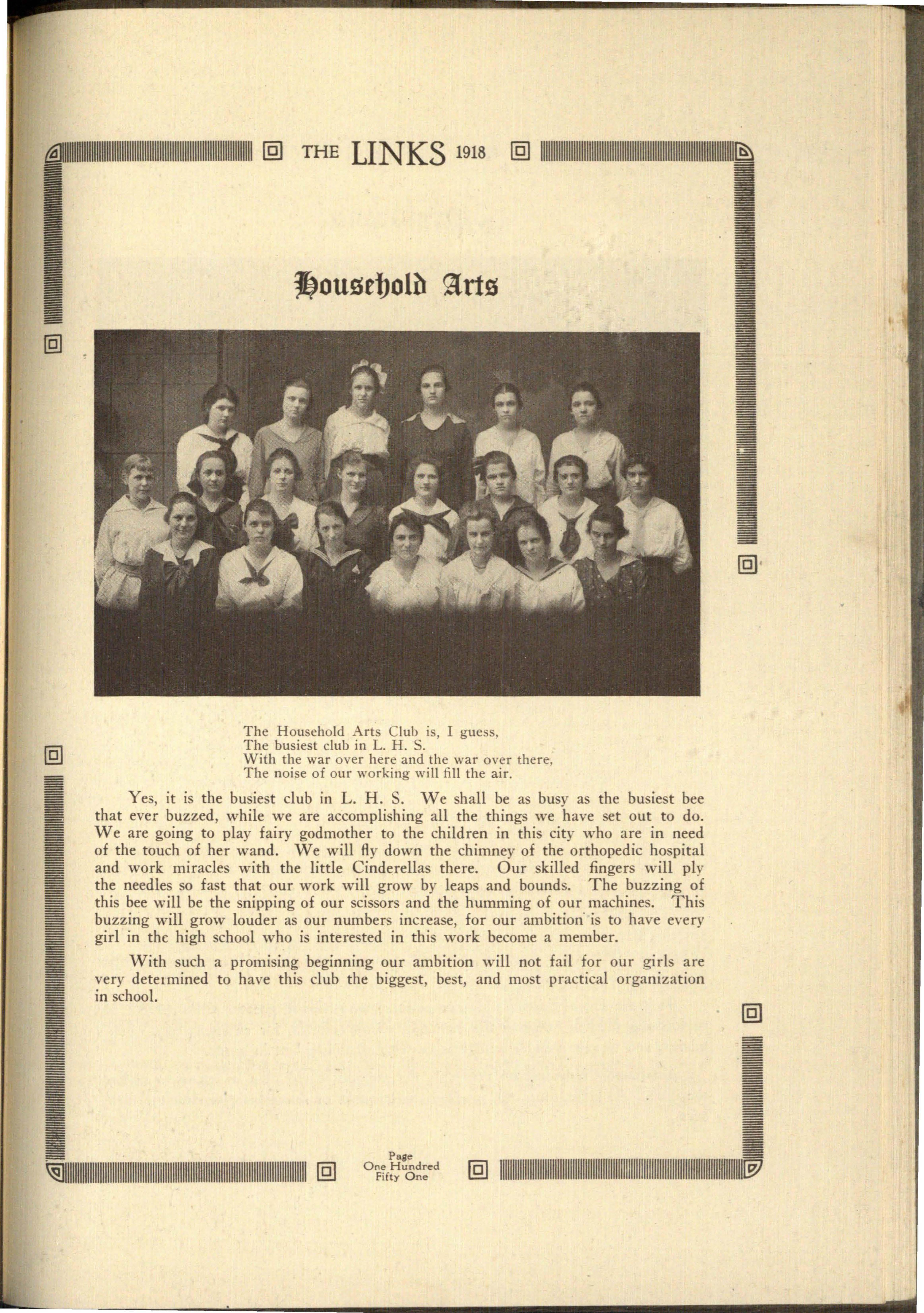
The Household Arts C lub is, I guess, The busiest club in L. H. S.
With the war over here and the war over there, The noise of our working will fi ll the air .
Yes, it is the busiest club in L. H. S. We shall be as busy as the busiest bee that ever buzzed, while we are accomplishing all the things we have set out to do. We are going to play fairy godmother to the children in this city who are in need of the touch of her wand. We will fly down the chimney of the orthopedic hospital and work miracles with the little Cinderellas there. Our skilled fingers will ply the needles so fast that our work will grow by leaps and bounds. The buzzing of this bee will be the snippi ng of our scissors and the humming of our machines. This buzzing will grow louder as our numbers increase , for our ambition· is to have every girl in the high school who is interested in this work become a member.
With such a promising beginning our ambition will not fail for our girls are very dete1mined to have this club the biggest , best, and most practical organization in school.
P r es ide nt
V ice- Presid ent.
S ec r etar y ...
Tr eas urer
Editor and Cha i rman o f Pro g ram
Co mmitte e
H is t o rian
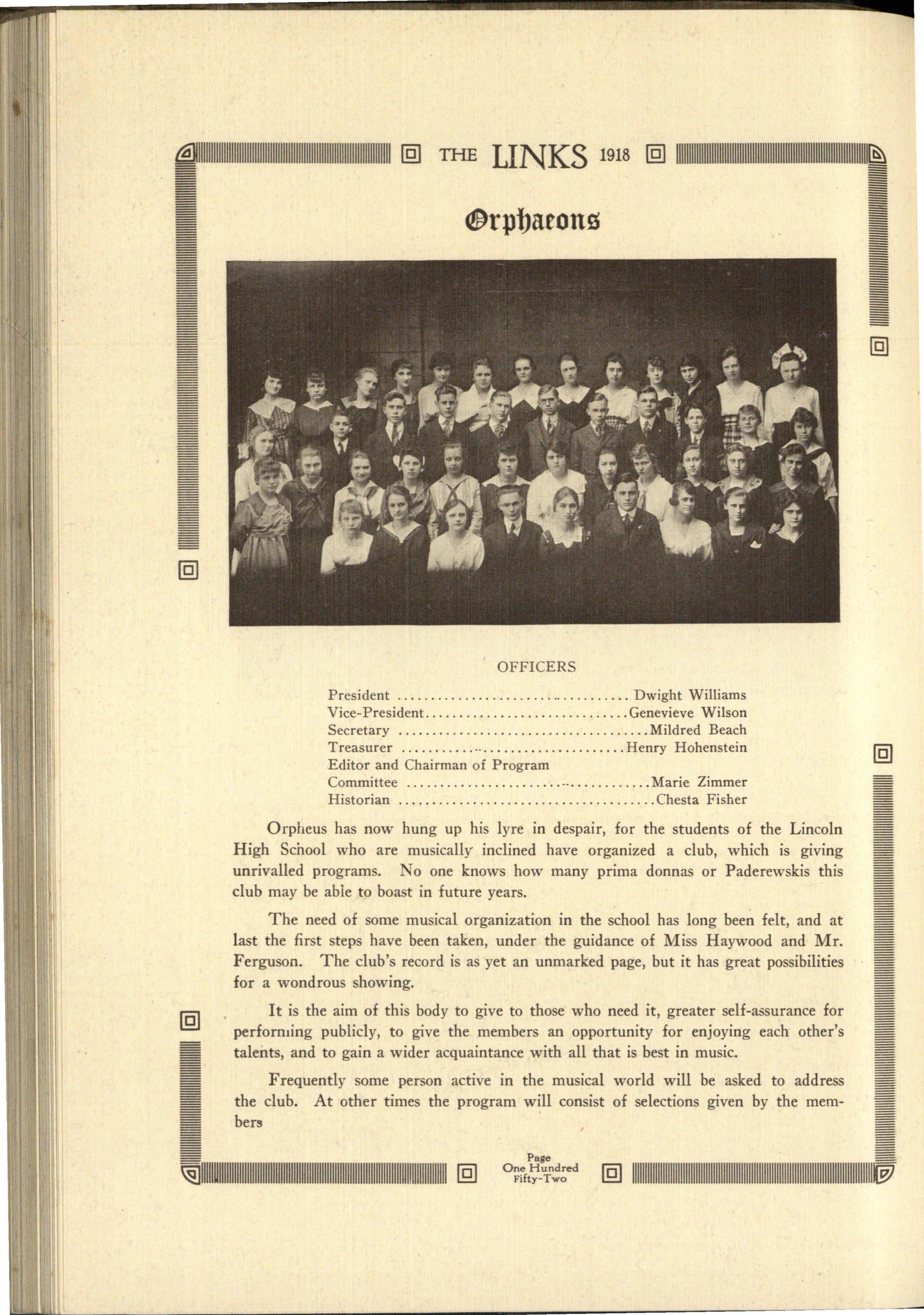
Dw ight Williams
Genevieve Wils o n
. Mildred Beach
Henr y H o he n s tein
Marie Zimmer
Chesta Fisher
Orpheus has now hung up his lyre in despair, for the students of the Lincoln High School who are musicall y inclined have organized a club, which is giving unrivalled programs. No one knows how many prima donnas or Paderewskis this club may be able to boast in future years.
The need of some musical organization in the school has long been felt, and at last the first steps have been taken, under the guidance of Mi ss Haywood and Mr. Ferguson. The club's record is as yet an unmarked page, but it has g r eat possibili t ies for a wondrous showing.
[g] It is the aim of this bod y to give to those who need it, greater self-assurance for a performing publicly, to give the members an opportunity for enjoying each other ' s tbaelresnts, and to gain a wider acquaintance with all that is best in music.
Frequently some person acti ve in the musica l world will be asked to address the club. At other times the program will consist of selections given by the mem-
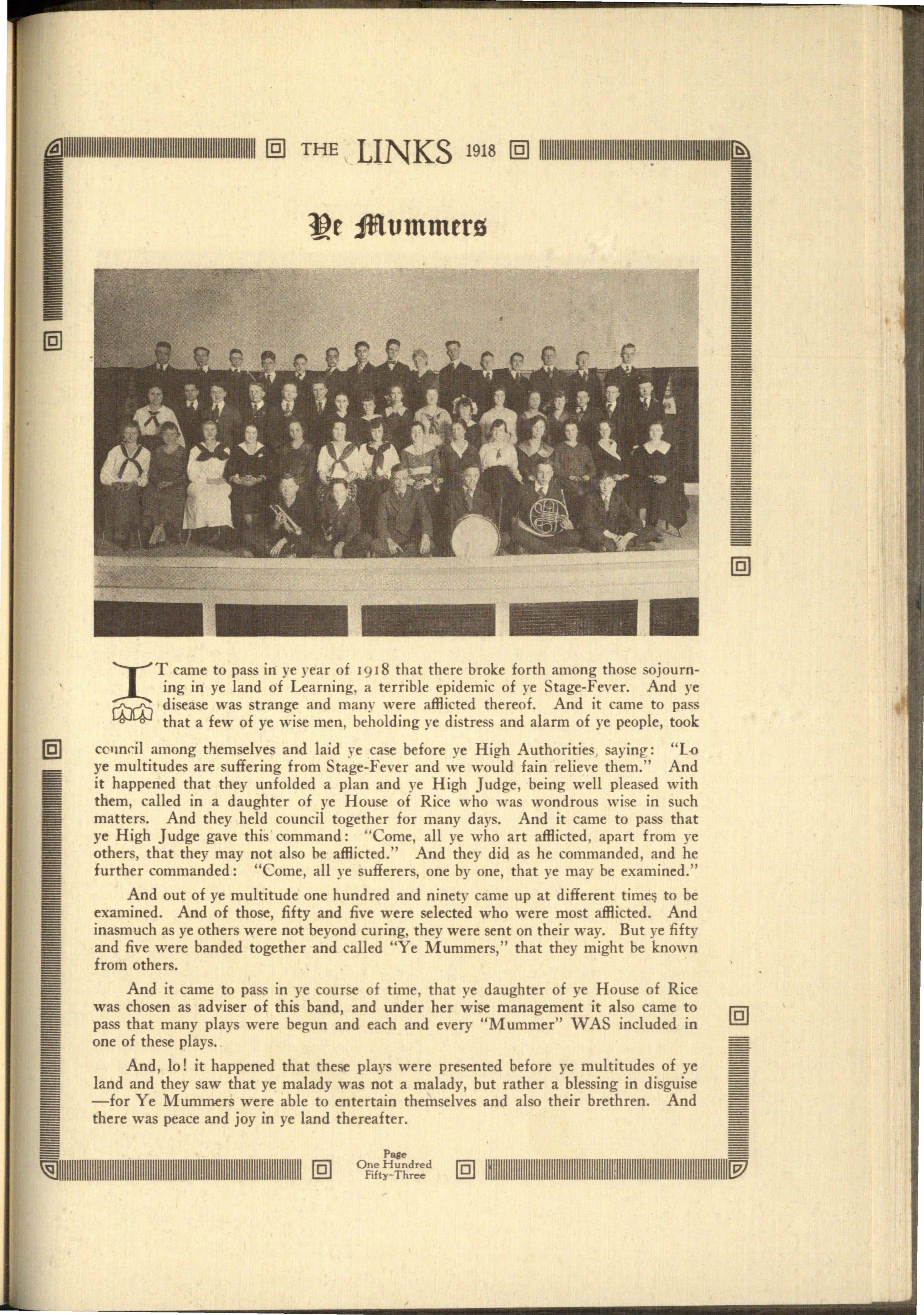
XT came to pass in ye year of 1918 that there broke forth among those sojourning in ye land of Learning, a terrible epidemic of ye Stage-Fever. And ye disease was strange and many were afflicted thereof. And it came to pass 4l-'4l-' that a few of ye wise men, beholding ye distress and alarm of ye people, took co,mril among themselves and laid ye case before ye High Authorities , saying: "Lo ye multitudes are suffering from Stage-Fever and we would fain relieve them." And it happened that they unfolded a plan and ye High Judge, being well pleased with them, called in a daughter of ye House of Rice who was wondrous wise in such matters. And they held council together for many days. And it came to pass that ye High Judge gave this command: "Come, all ye who art afflicted, apart from ye others , that they may not also be afflicted." And they did as he commanded, and he further commanded: "Come, all ye sufferers, one by one, that ye may be examined."
And out of ye multitude one hundred and ninety came up at different time~ to be examined. And of those, fifty and five were selected who were most afflicted. And inasmuch as ye others were not beyond curing, they were sent on their way. But ye fifty and five were banded together and called "Ye Mummers," that they might be known from others.
And it came to pass in ye course of time, that ye daughter of ye House of Rice was chosen as adviser of this band, and under her wise management it also came to pass that many plays were begun and each and every "Mummer" WAS included in one of these plays . .
And, lo! it happened that these plays were presented before ye multitudes of ye := land and they saw that ye malady was not a malady, but rather a blessing in disguise -for Ye Mummers were able to entertain themselves and also their brethren. And
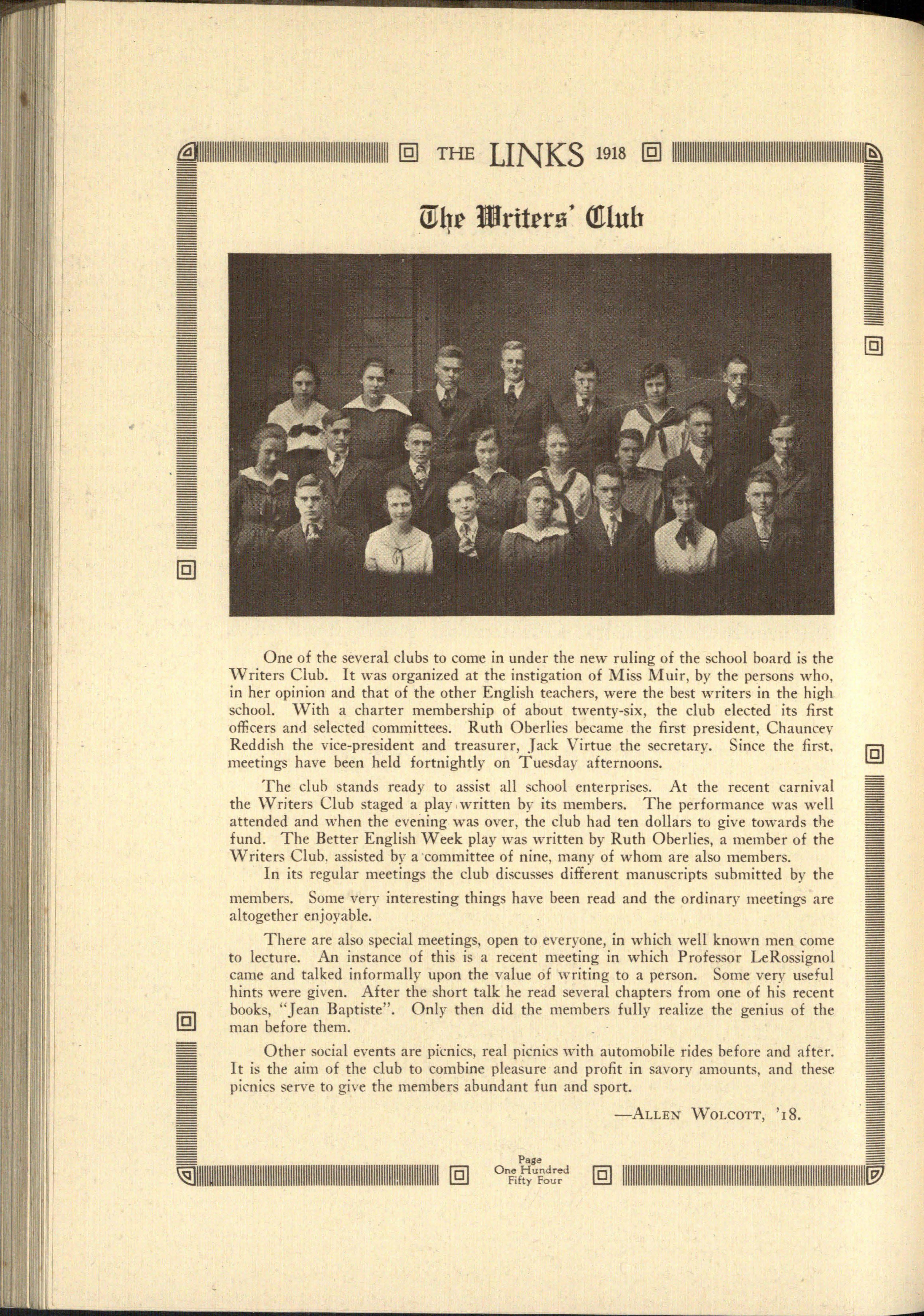
One of the several clubs to come in under the new ruling of the school board is the Writers Club. It ,vas organized at the instigation of Miss Muir, by the persons who, in her opinion and that of the other English teachers, were the best writers in the high school. With a charter membership of about twenty-six, the club elected its first officers and selected committees. Ruth Oberlies became the first president, Chauncey Reddish the vice-president and treasurer, Jack Virtue the secretary. Since the first, 'i:i1 meetings have been held fortnightly on Tuesday afternoons.
The club stands ready to assist all school enterprises. At the recent carnival the \Vriters Club staged a play ,written hr its members. The performance was well attended and when the evening was over, the club had ten dollars to give towards the fund. The Better English Week play was written by Ruth Oberlies, a member of the Writers Club, assisted by a committee of nine, many of whom are also members.
In its regular meetings the club discusses different manuscripts submitted by the members. Some very interesting things have been read and the ordinary meetings are altogether enjoyable.
There are also special meetings, open to everyone, in which well known men come to lecture. An instance of this is a recent meeting in which Professor LeRossignol came and talked informally upon the value of writing to a person. Some very useful hints were given. After the short talk he read several chapters from one of his recent books, "Jean Baptiste". Only then did the members fully realize the genius of the man before them.
Other social events are picnics, real picnics ,vith automobile rides before and after. It is the aim of the club to combine pleasure and profit in savory amounts, and these picnics serve to give the members abundant fun and sport.
-ALLEN
WOLCOTT, '18.
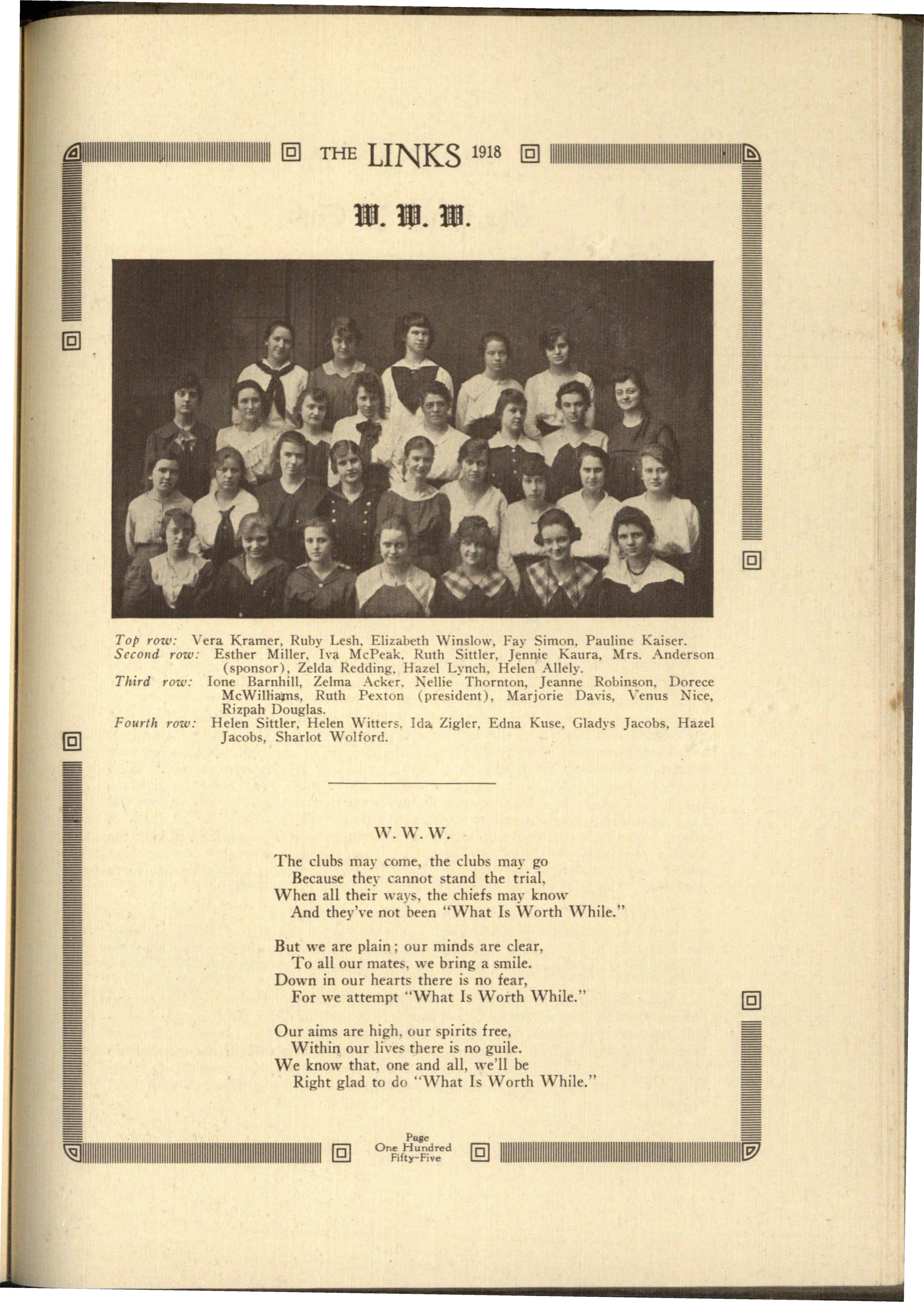
Top row: \"era K;ramer, Ruby Lesh. Elizabeth \Vinsl ow, Fay Simon Pauline Kaiser.
Second raw: Esther Miller. Iva McPeak. Ruth Sittler, Jennie Kaura, Mrs. Anderson (sponsor), Zelda Redding. Hazel Lynch, Helen Allely.
Third row: Ione BarnhiJI, Zelma Acker, Nellie Thornton, Jeanne Robinson, Dorece McWiJli;ims, Ruth Pexton (preside nt), Marjorie Davis, \ ·enus ice, Rizpah Douglas.
Fourth raw: Helen Sittler, Helen \Vitter s, Ida. Zigler, Edna Kuse, Gladys Jacobs, Hazel (Q] Jacobs, Sharlot W olford.
w.w.w.
The clubs may come, the clubs may go Becau se they cannot stand the trial , When all their ways, the chiefs may know And they'n not been "What Is Worth While."
But we are plain; our minds are clear, To all our mate , we bring a smile. Down in our hearts there is no fear, For we attempt "What Is Worth While."
Our aims are high , our spirits free, Within our live there is no guile. We know that, one and all, we'll be Right glad to do "W hat Is Worth While."
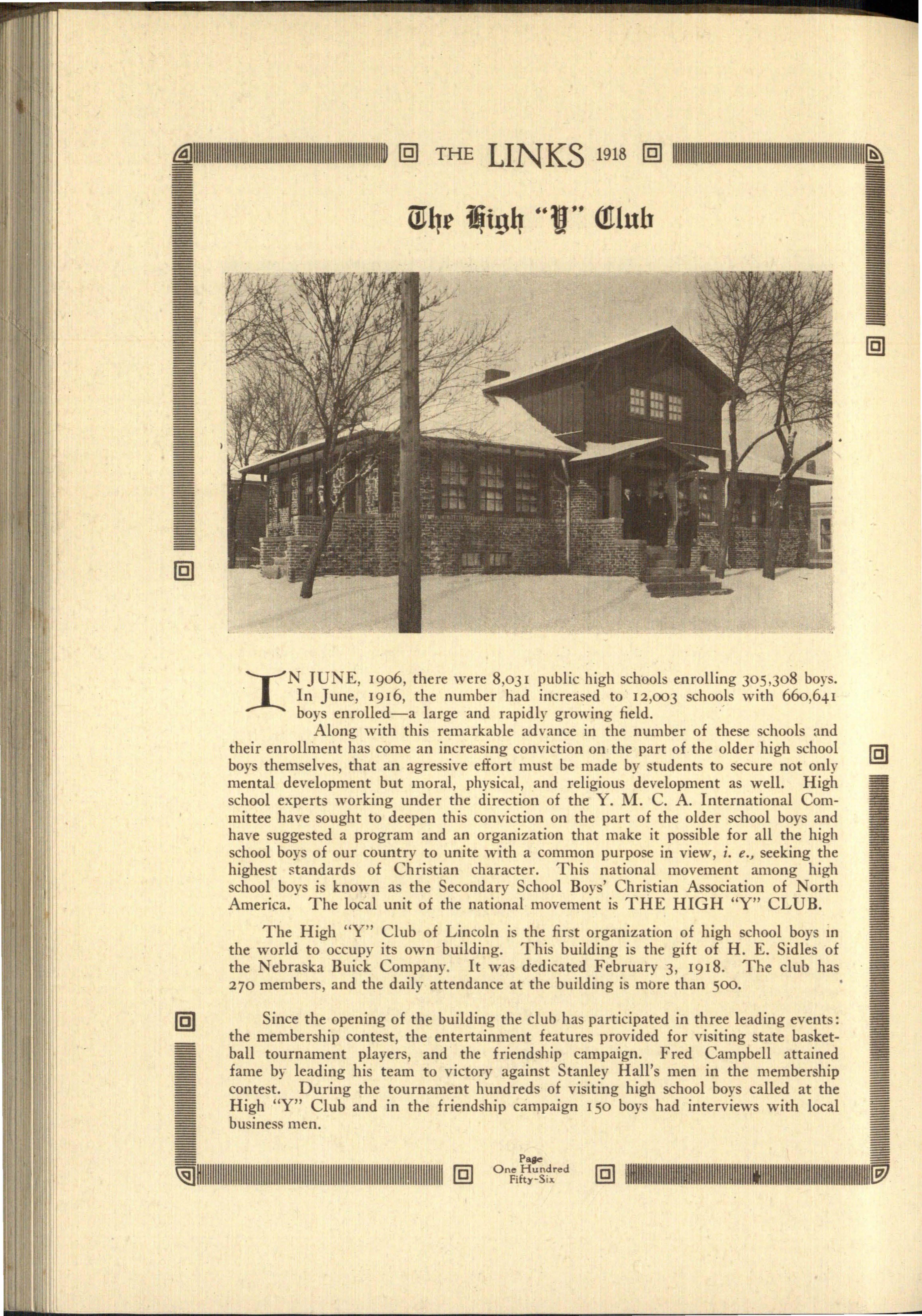
·XN JUNE, 19o6, there were 8,031 public high schools enrolling 305,308 boys. In June, 1916, the number had increased to 12,003 schools with 66o,6.p boys enrolled-a large and rapidly growing field. , Along with this remarkable advance in the number of these schools and their enrollment has come an increasing conviction on the part of the older high school boys themselves, that an agressive effort must be made by students to secure not only mental development but moral, physical, and religious development as well. High school experts working under the direction of the Y. M. C. A. International Committee have sought to deepen this conviction on the part of the older school boys and have suggested a program and an organization that make it possible for all the high school boys of our country to unite with a common purpose in view, i. e., seeking the highest ~tandards of Christian character. This national movement among high school boys is known as the Secondary School Boys' Christian Association of orth America. The local unit of the national movement is THE HIGH "Y" CLUB.
The High "Y" Club of Lincoln is the first organization of high school boys in the world to occupy its own building. This building is the gift of H. E. Sidles of the Nebraska Buick Company It was dedicated February 3, 1918. The club has 270 members, and the daily attendance at the building is more than 500.
Since the opening of the building the club has participated in three leading events: the membership contest, the entertainment features provided for visiting state basketball tournament players, and the friendship campaign. Fred Campbell attained fame by leading his team to victory against Stanley Hall's men in the membership contest. During the tournament hundreds of visiting high school boys called at the High "Y" Club and in the friendship campaign 150 boys had interviews with local
IO-School opened with another new principal. Much speculation and curiosity.
I6-Advocate staff was chosen. Katherine Brenke , editor.
I8-Mr. Pickell appeared in assembly for the first time and was rated sweet instead of dill. His hair is red!
2I-Athletic assembly. We were getting lonesome for Verne Moore. Mr. Penningroth spoke of the prison camps of Europe. Freshie party in afternoon.
25-Eighty boys pledged a dollar a month for ten months to help the men in the Austrian prison camps. Advocate day. Mr. Hewitt mentioned "de feet" . of C. Reddish.
I-First day of football tag week.
3-Home room representatives met to nominate candidates for the student council.
5-Football rally featuring Pat and Mike. "Aint it a Grand Island glorious feeling" when the score is 25 to get-some for Lincoln.
II-Herbert Schmidt (Pitzie 's big brother) gave a piano recital in assembly. He looks just like Pitzie.
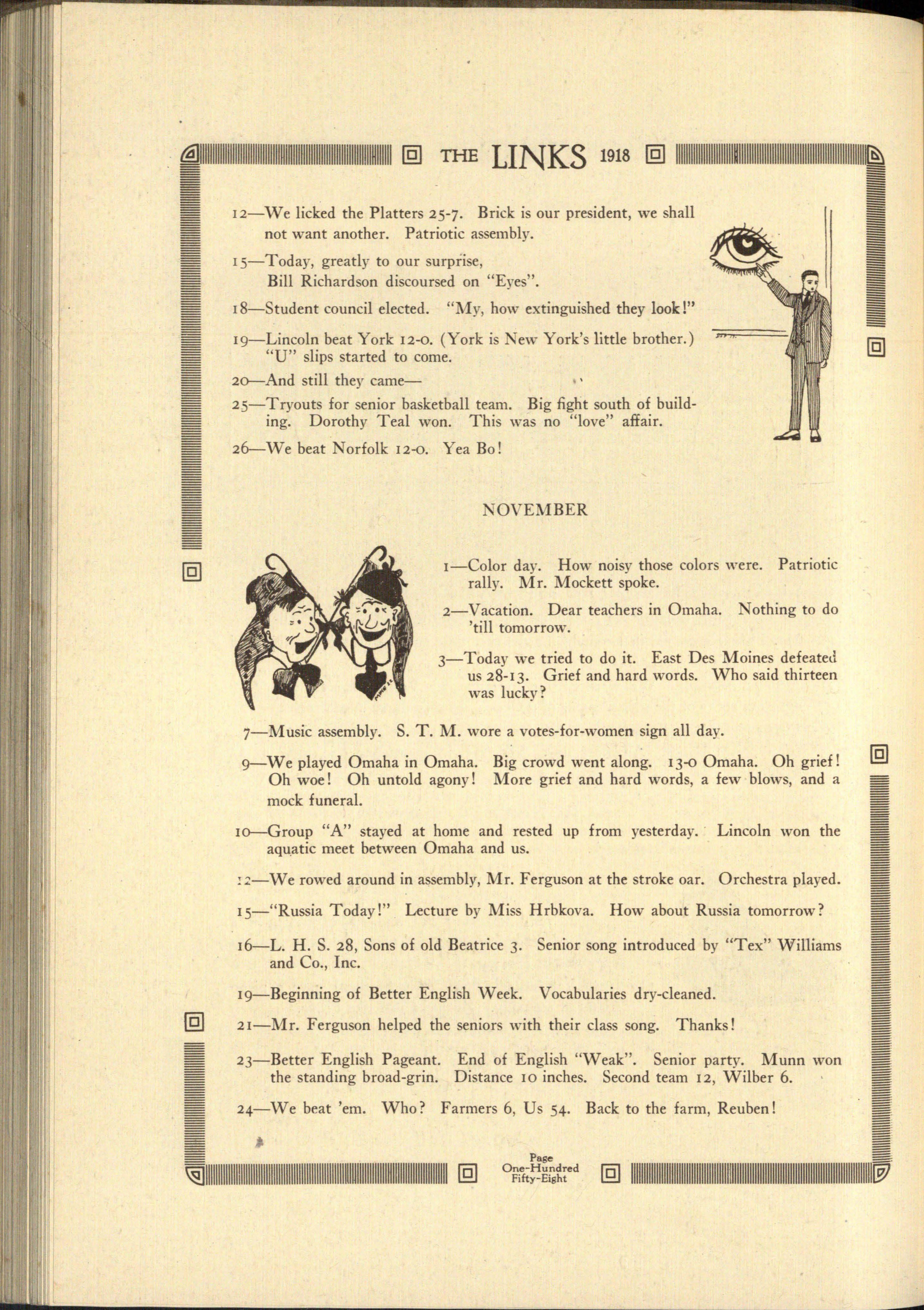
12-We licked the Platters 25-7. Brick is our president, we shall not want another. Patriotic assembly.
15-Today, greatly to our surprise, Bill Richardson discoursed on "Eyes".
18-Student council elected. "My, how extinguished they look!"
19-Lincoln beat York 12-0. (York is New York's little brother.) "U" slips started to come.
20-And still they came-
25- Tryouts for senior basketball team. Big fight south of building. Dorothy Teal won. This was no "love" affair.
26----We beat Norfolk I 2-0. Yea Bo!
1-Color day. How noisy those colors were. Patriotic rally. Mr. Mockett spoke.
2-Vacation. Dear teachers in Omaha. Nothing to do 'till tomorrow.
3-Today we tried to do it. East Des Moines defeated us 28-13. Grief and hard words. Who said thirteen was lucky?
7-Music assembly. S. T. M. wore a votes-for-women sign all day.
9-We played Omaha in Omaha. Big crowd went along. 13-0 Omaha. Oh grief! Oh woe! Oh untold agony! More grief and hard words, a few blows, and a mock funeral.
10-Group "A" stayed at home and rested up from yesterday. • Lincoln won the aqu atic meet between Omaha and us.
!2-We rowed around in assembly, Mr. Ferguson at the stroke oar. Orchestra played.
15-"Russia Today!" Lecture by Miss Hrbkova. How about Russia tomorrow?
16-L. H. S. 28, Sons of old Beatrice 3. Senior song introduced by "Tex" Williams and Co., Inc.
19-Beginning of Better English Week. Vocabularies dry-cleaned.
21-Mr. Ferguson helped the seniors with their class song. Thanks!
23-Better English Pageant. End of English "Weak". Senior party. Munn won the standing broad-grin. Distance IO inches. Second team 12, Wilber 6.
24-We beat 'em. Who? Farmers 6, Us 54. Back to the farm, Reuben!
29-30-Thanksgiving recess. Robert Hiatt said: "One day during vacation I didn't have anything to eat for two days."
3-"School as, usual". Only it wasn't usual to have lessons.
j-Pay all your dues, oh, ye seniors, to Dwight X. Y. Z. Williams.
6-
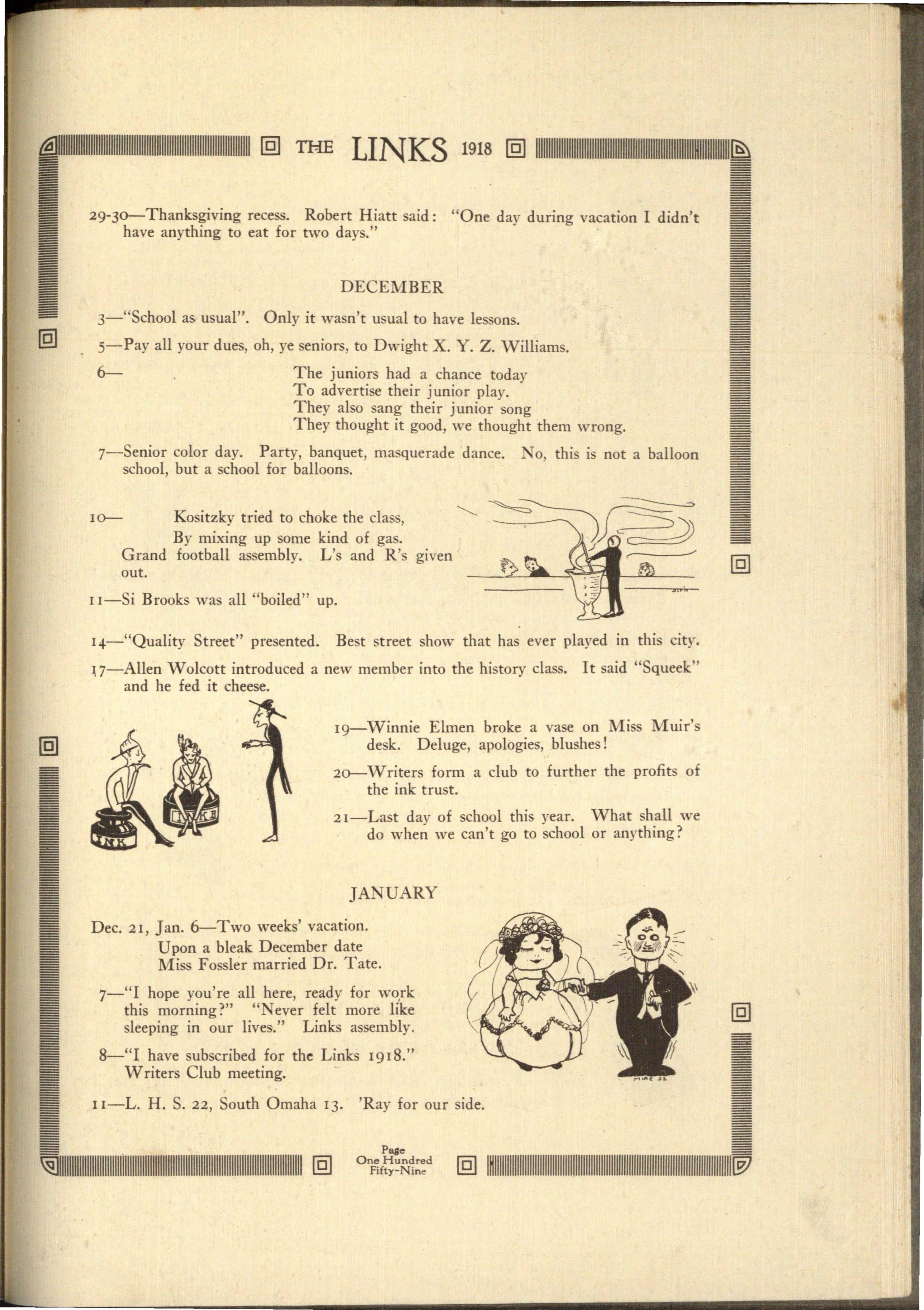
The juniors had a chance today To advertise their junior play. They also sang their junior song They thought it good, we thought them wrong.
7-Senior color day. Party, banquet, masquerade dance. o, this is not a balloon school, but a school for balloons.
IO- Kositzky tried to choke the class, '---By mixing up some kind of gas. ....,-- ")1)).n'~.___--=--~ Grand football assembly. L's and R's given ,,1 out.
I 1-Si Brooks was all "boiled" up.
14-"Quality Street" presented. Best street show that has ever played in this city.
o-Allen Wolcott introduced a new member into the history class. It said "Squeek" and he fed it cheese.
19-Winnie Elmen broke a vase on Miss Muir's desk. Deluge, apologies, blushes!
20-Writers form a club to further the profits of the ink trust.
21-Last day of school this year. What shall we do when we can't go to school or anything?
Dec. 21, Jan. 6-Two weeks' vacation.
Upon a bleak December date Miss Fossler married Dr. Tate.
7-"I hope you're all here, ready for wo,rk t his morning?" " ever felt more like sleeping in our lives." Links assembly.
8-"I have subscribed for the Links 1918." Writers Club meeting.
= I 1-L. H. S. 22, South Omaha 13.
'Ray for our side.
g--Suffrage passed the house by a two-thirds majority.
10--Thrift stamp assembly and campaign. Poor old Kaiser, he got a lot of licks.
I 1-L. H. S. 22, South Omaha 13. 'Ray for Lincoln I
14-Carl Greenstone froze his ears. We considered electing a new cheer leader.
15-Fred Campbell got up early. He was seen to yawn twice during the day. '
16--Register for next semester. Campbell got up early again.
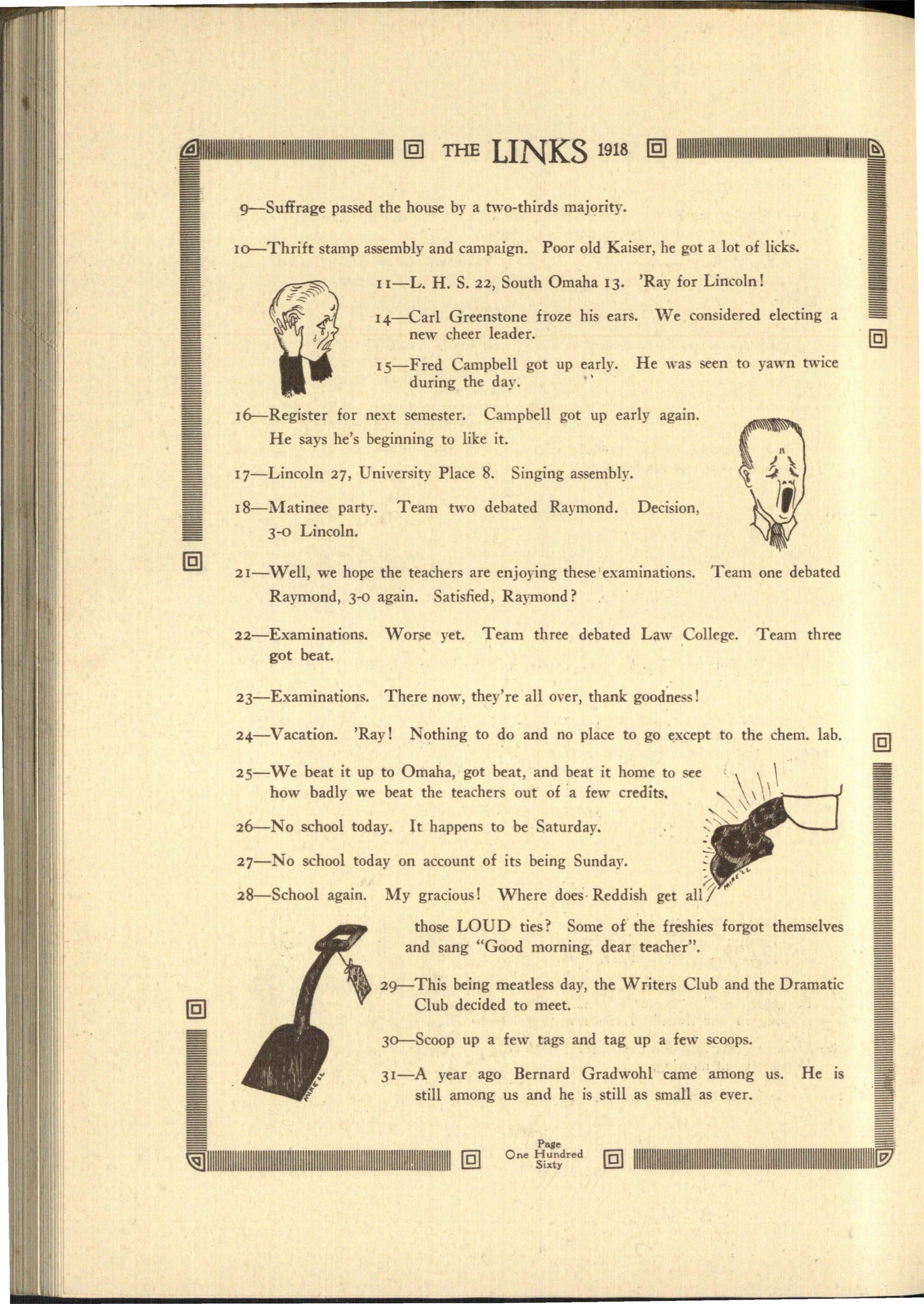
Decision ,
3-0 Lincoln.
21-Well, we hope the teachers are enjoying these 1examinations. Team one debated Raymond, 3-0 again. Satisfied, Raymond?
22-Examinations. Worse yet. Team three debated Law College. Team three got beat.
23-Examinations. There now, they ' re all over, thank good~ess !
24-Vacation. 'Rayl N~thing to do and no pl~ce to go except to the chem. lab.
25-We beat it up to Omaha, got beat, and ?eat it home to see \ \ \ how badly we beat the teachers out of a few credits. ,\ \ \ __..., "\.
26--No school today. It happens to be Saturday. ~"
27-No school today on account of its being Sunday. ,~ /
28-School again. My gracious! Where does · Reddish get all 1
those LOUD ties? Some of the freshies forgot themselves and sang "Good morning, dear teacher".
29--This being meatless day, the Write.rs Club and the Dramatic Club decided to meet.
I-Music Club held first meeting. Remember that last De s 1Io ines football game? Well, does this sound, look, or feel any better? Lincoln 19, De Moines 8.
2-Today (tonight), de gang st oppe d in Plattsmouth and Plattsmou th got beat.
3-Today was Sunday. The High "Y" club w as dedicated.
4- othing happened today.
5-
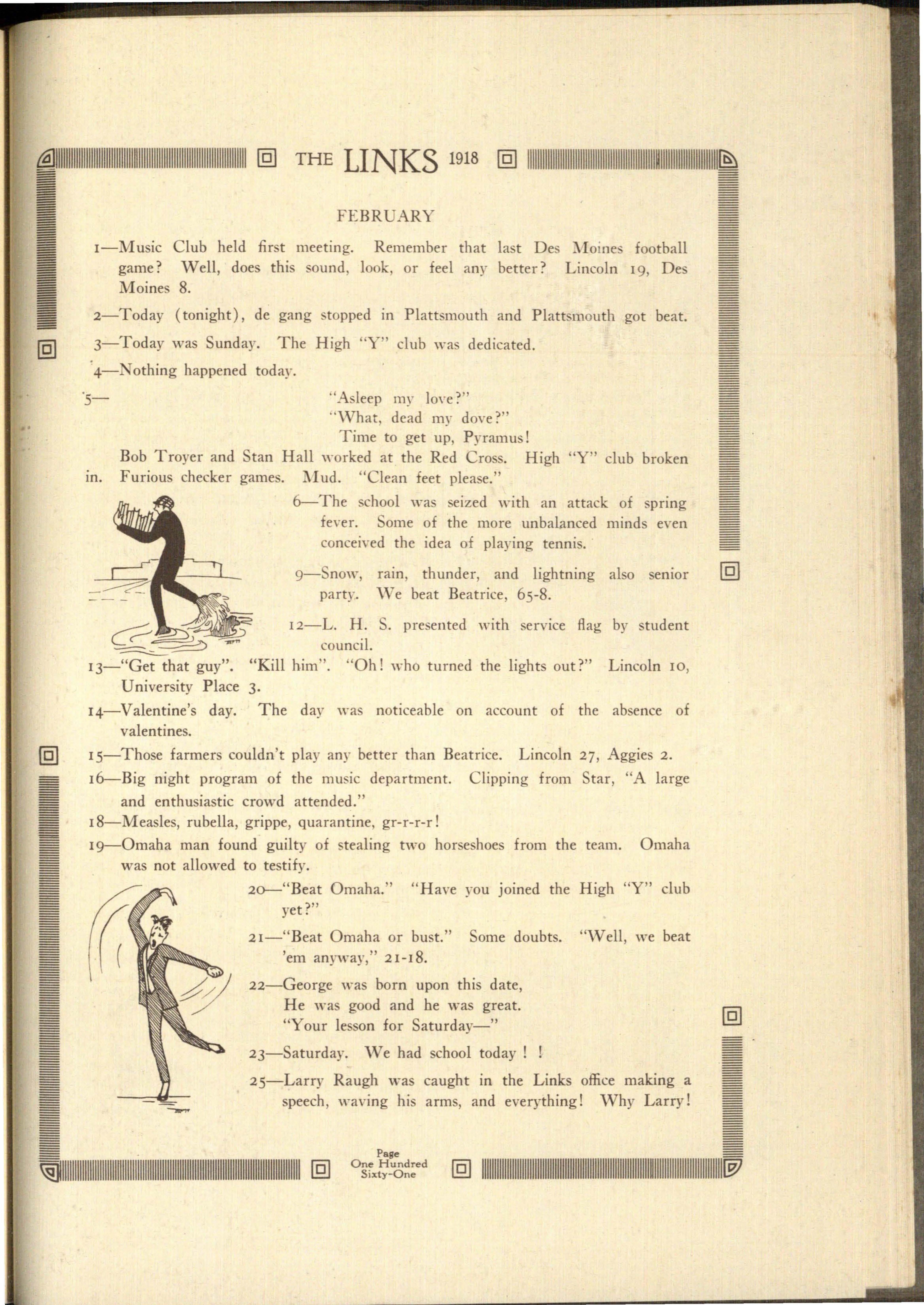
" Asleep my Joye?"
··\Vhat, dead my dove?"
Time to get up, P yramus ! Bob Troyer and Stan Hall worked at the Red Cros High "Y" club broken m. Furious checker games. l\1ud. "Clean feet please."
6-The school was seized "·ith an attack of spring feyer. Some of the more unbalanced minds enn conceived the idea of playing tennis.
9-Snow, rain, thunder, and lightning also senior [g] - party. \Ve beat Beatrice , 65-8.
12-L. H. S. presented with service flag by student ·1_, counc1.
13-"Get that guy". "Kill him". "Oh! ,\'ho turned the lights out?" Lincoln 10, University Place 3.
14-Valentine's day. The day was noticeable on account of the absence of valentines.
15-Those farmers couldn't pla y any better than Beatrice. Lincoln 27, Aggies 2. 16--Big night program of the music department. Clipping from Star, "A large and enthusiastic crowd attended."
I 8-Measles, rubella, grippe, quarantine, gr-r-r-r !
19-Omaha man found guilty of stealing two horseshoes from the team. Omaha was not allowed to testify.
20--"Beat Omaha." "Have you joined the High " Y" club yet?"
21-"Beat Omaha or bust." Some doubts. "\V ell, we beat 'em anpl'ay," 21-18.
22-George was born upon this date, He was good and he was great. "Your lesson for Saturday-"
23-Saturday. We had school today !
25-Larry Raugh was caught in the Links office making a speech, waving his arms, and everything! \Vhy Larry!
26-Initiation of Hall 's team at the High " Y " Club. The initiation was featured by the total absence of initiates.
27-We had a Roosevelt big assembly ( see Greenslit's dictionary), featuring a new bandmaster.
28-Today is the last day of vacation. Practicing stunts for the carnival became frenzied. Ha ve plenty of nickels and dimes.
I-Tum te tum. " See the wild man!" Dada da-da-da. "See Belen Hurkett, the Hula Hula!" Ba-a-a "See little Bo-Peep." "And in the next cage we have a Rocky Mountain goat, the only one in captivit y." (Well it isn ' t our goat.)
4-Winfield Elmen became Windshield Elmen. Certain members of the orchestra created a sensation by parading down "J" street playing an Indian melody.
5-Pictures at Dole's for the Links. l\1r. Dole was almost crazy after the band and orchestra left. First game of the tournament. Auburn got only 3 to our 34.
6-Another victory! Lincoln 22, Stanton 9 Where is Stanton anyway?
7-Question in the minds of many as to the probability of Omaha's praying for us to " in the tournament. We started in to clean up Omaha, beginning with South Omaha.
9-Question an swered. Omaha was not praying for us to win. They did their "derndest" to beat us. Score , 28-13. Who do you think?
12-Red Cross assembly. Oh, that white hats! Oh, those arm band.
I 3-Basketball grand assembly. We find that Chesney often carries as much as fifteen cents ( 15c) at one time. University freshies beat us one point.
q-Reddish got a new uniform and now he can't wear those boisterous neckties anymore.
15-Uniforms very much in evidence on the persons of some of our boys. said: "Some one made men out of a lot of these guys over night."
Brown spoke on "The Brighter Aspects of the \iVar."
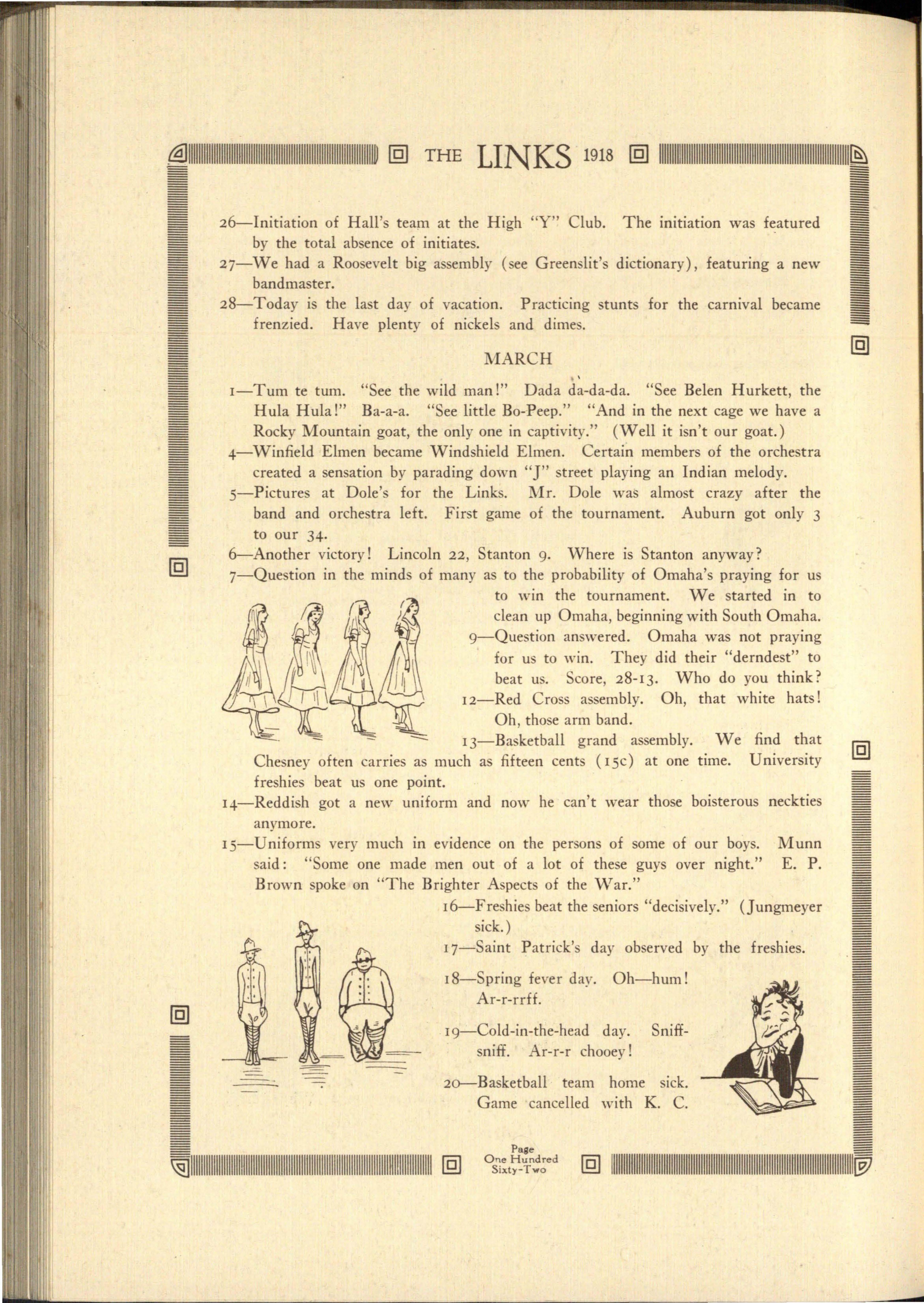
E. P.
I 6-Freshies beat the seniors "decisively." (J ungmeyer sick.)
I 7-Saint Patrick' s day observed by the freshies.
I 8-Spring fever da y Oh-hum! Ar-r-rrff.
19-Cold-in-the-head day. sniff. Ar-r-r chooey ! Sniff-
20--Basketball team home sick. Game cancelled with K. C.
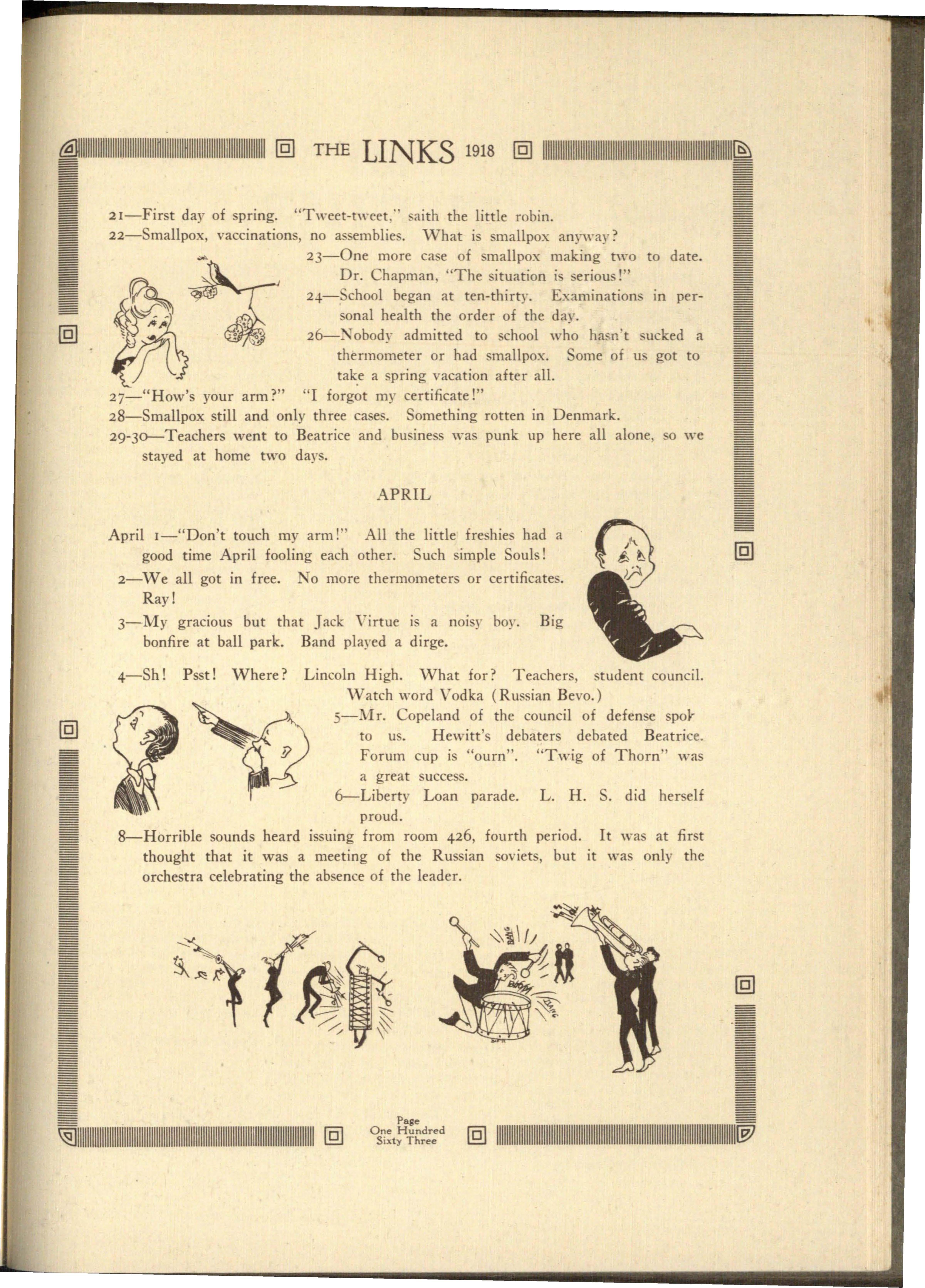
21-Fir t day of spring. "Tweet-t\\·eet."" aith the little robin. 22- mallpox, vaccination , no as emblie ,vhat is mallpox anyway? ..- 23-0ne more case of mallpox making two to date. Dr. Chapman, "The ituation i serious!"
<?J • • 2+- chool began at ten-thirty. Examination in personal health the order of the day.
11 0 4 . 26-- Tobody admitted to school who ha.n ' t ucked a thermometer or had mallpox. ome of m, got to tak e a spring vacation after all.
27-"How's your arm?" "I forgot my certificate!"
28-Smallpox still and only three ca e omething rotten in Denmark.
29-30--Teachers went to Beatrice and busine was punk up here all alone , o we stayed at home two days.
April 1-"Don't touch my arm!'' All the little freshies had a good time April fooling each other. uch simple Souls!
2-We all got in free. o more thermometer or certificates. Ray!
3-My gracious but that Jack "\'irtue is a noisy boy. Big bonfire at ball park. Band played a dirge.
Psst! Where? Lincoln High. What for? Teachers, student council. ,Vatch word Vodka ( Russian Bevo.) --1\Ir. Copeland of the council of defen e spo~ ' to u . Hewitt's debaters debated Beatrice. !J Forum cup i " ourn". "T"·ig of Thorn " wa a great ucce s.
6-Liberty Loan parade. L. H. S. did her elf proud.
8-Horrible sounds heard issuing from room 426, fourth period It was at first thought that it was a meeting of the Ru sian soviets, but it was only the orchestra celebrating the absence of the leader.
• 9-Sw<t cod,. B.mcs detectives. N,kc,d,hlrnetfaeotbb. What can it be? Crud
Tccum eh, 2-L lnte,cl,ss debates. S,nio~
I I-The Links motto, "Reliability, not good nature."
I2-Debate against Fairbury. Puzzle soked. Norfolk debate. Be there, April 9.
I7-Forum picnic or picnic for um.
I 8-Advertising of senior play. -orfolk debate.
Ig-On account of the rain the track did not meet'. Seem phoney concert.
2,t.-Sensational movies in assembly. Thanks, Lionel!
25-Picnics are getting to be a craze. Writers Club picnic south of Jamaica.
26--Senior play. The original class of L. H. S. pulled off the best play ever staged in Lincoln High.
29-Today the seniors had a picnic at Electric park. The juniors got jealous because they couldn't come, so they acted very childishly.
30--L. H. S. defeated in debate by our old enemy, Omaha. "Pinafore" or "Finapore" in assembly.
I-Interclass debate. Seniors ,rnn.
3-All-star production of the opera "Pinafore."
4-State track meet. Lincoln "·on. •
Io--Junior-Senior.
From now on the seniors are a privileged race of human beings. They are neither restricted by the teachers nor by Mr. Pickell. They are free. Wishing them a long and happy lifetime we shall leave them, or rather they will leave us, to enjoy it. FINIS
DATES WILL WIN THE WAR
DON'T WASTE THEM
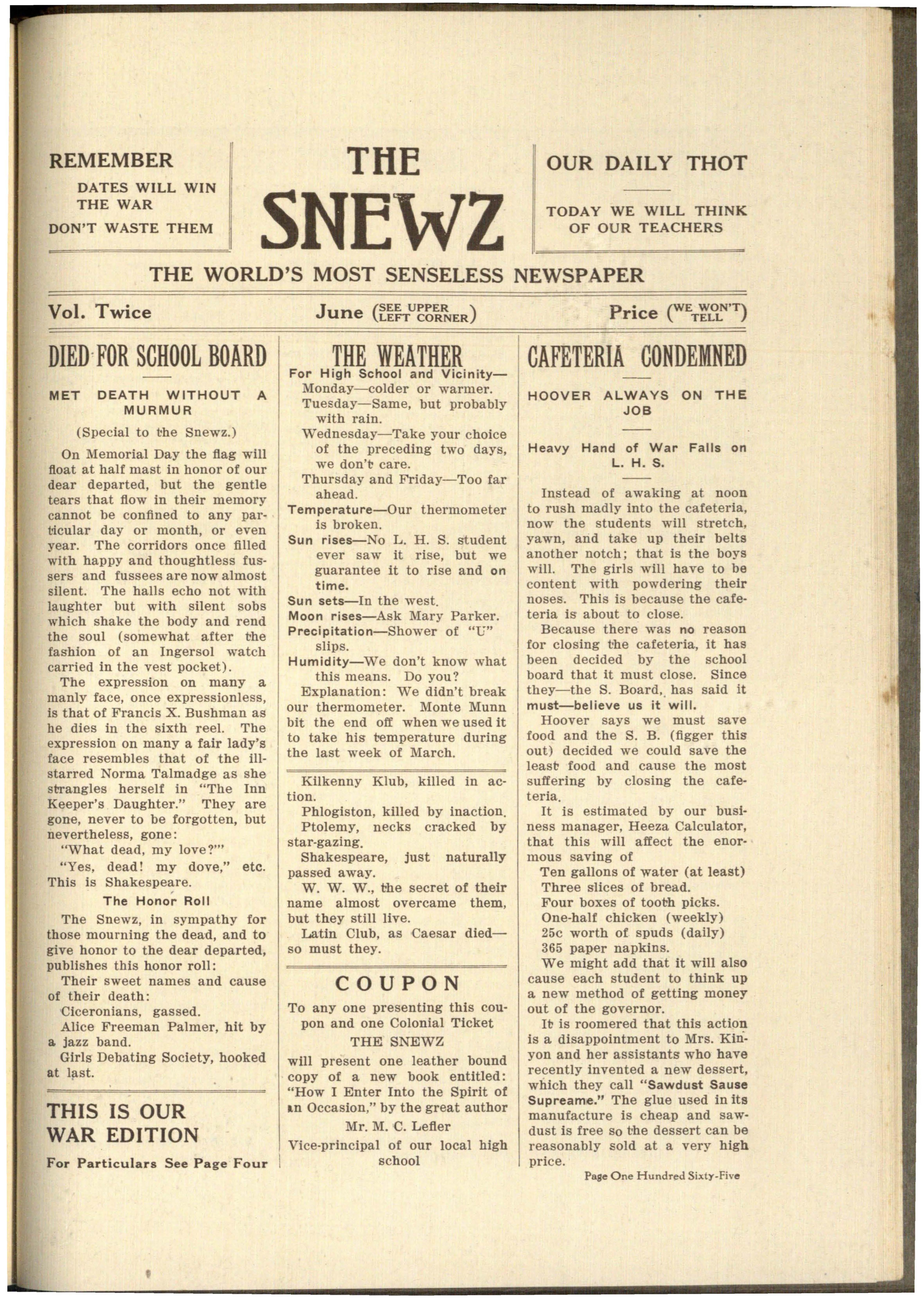
TODAY WE WILL THINK OF OUR TEACHERS
Vol. Twice
MET DEATH WITHOUT A MURMUR
(Special to t:he Snewz . )
On Memorial Day the flag will float at half mast in honor of our dear departed, but the gentle tears that flow in their memory cannot be confined to any particular day or month, or even year. The corridors once filled with happy and thoughtless fussers and fussees are now almost silent. The halls echo not with laughter but with silent sobs which shake the body and rend the soul (somewhat after the fashion of an Ingersol watch carried in the vest pocket).
The expression on many a manly face, once expressionless , is that of Francis X. Bushman as he dies in the sixth reel. The expression on many a fair lady's face resembles that of the illstarred Norma Talmadge as she strangles herself in "The Inn Keeper's Daughter." They are gone, never to be forgotten, but nevertheless, gone:
"What dead, my love?"'
"Yes, dead! my dove," etc. This Is Shakespeare.
The Hono~ Roll
The Snewz, in sympathy for those mourning the dead, and to give honor to the dear departed, publishes this honor roll:
Their sweet names and cause of their death:
Ciceronians, gassed.
Alice Freeman Palmer, hit by a. jazz band.
Girls Debating Society, hooked at last.
For Particulars See Page Four
For High School and VicinityMonday-colder or warmer.
Tuesday-Same, but probably with rain.
Wednesday-Take your choice of the preceding two days, we don't care.
Thursday and Friday-Too far ahead.
Temperature-Our thermometer is broken.
Sun rises-No L. H. S. student ever saw it rise, but we guarantee it to rise and on time.
Sun sets-In the west.
Moon rises-Ask Mary Parker. Precipitation-Shower of "li" slips.
Humidity-We don't know what this means. Do you?
Explanation: We didn't break our thermometer. Monte Munn bit the end off when we used it to take his temperature during the last week of March.
Kilkenny Klub, killed in action.
Phlogiston, killed by inaction. Ptolemy, necks cracked by star-gazing.
Shakespeare, just naturally passed away.
W. W. W., the secret of their name almost overcame them, but they still live.
Latin Club, as Caesar diedso must they
To any one presenting this coupon and one Colonial Ticket THE SNEWZ will present one leather bound copy of a new book entitled: "How I Enter Into the Spirit of ln Occasion," by the great author
Mr . M. C. Lefler
Vice-principal of our local high school
HOOVER ALWAYS ON THE JOB
Heavy Hand of War Falls on L. H. S.
Instead of awaking at noon to rush madly into the cafeteria , now the students will stretch, yawn, and take up their belts another notch; that is the boys will. The girls will have to be content with powdering their noses This is because the cafe• teria is about to close.
Because there was no reason for closing t-he cafeteria, it has been decided by the school board that it must close. Since they-the S. Board , has said it must-believe us it · will.
Hoover says we must save food and the S. B. (figger this out) decided we could save the least food and cause the most suffering by closing the cafeteria.
It is estimated by our business manager, Heeza Calculator, that this will affect the enor• mous saving of Ten gallons of water (at least)
Three slices of bread.
Four boxes of tooth picks.
One-half chicken (weekly)
25c worth of spuds (daily)
365 paper napkins.
We might add that it will also cause each student to think up a new method of getting money out of the governor.
n is roomered that this action is a disappointment to Mrs. Kinyon and her assistants who have recently invented a new dessert, which they call "Sawdust Sause Supreame." The glue used in its manufacture is cheap and sawdust is free so t:he dessert can be reasonably sold at a very high price.
Pase One Hundred Sixty-Five
Published in spite of the Lincoln High School
Member of the Havelock Press Association
We don't need a leased wirewe own one.
Nothing to stop us in our downward course.
Our watchword: "Last and worse than Least."
OUR EDITORIAL STAFF
lg. Nor Ant Editor-in-Chief
Amy A. Bull Associated Editor Stick E. Fingers Business Mgr. Loose Change ............... . Controller of the Treasury May 0. Naise Society Editor "Ty" Priter ...... .. Sport Editor A. Train Special • Aw. Full Lazy House Physician
Wrun M. Down Reporter
Bill Collector .. Assistant Business Manager Peggy Late.Circulation Manager Hubert Hooperup Food Adminisvrator
Refused entrance a-s any matter at all at every decent postoffice.
This is an Editorial. It is useless. All editorials are. We have more brains than any other editorial writer, therefore we st-op.
P. S. Editorial by Ivan Aufulltch, our elevator boy and janitor.
Dear friend reader:
(This ls worse than the first, short, snappy, and nothing in it)
The school has gone to the bad. What shall we do? Oh, what shall we do?
IVAN.
Answer to t·he above by I. M. Busted of the High "Y" Club. Readers of the Snewz:
Show the old time spirit! Hammer all you can; tell how good the school used to be in past years. Talk fast, say nothing and knock, knock, knock I. M. BUSTED.
Don't take your 11roubles to Agony-she has enough of her own.
Dearest Agony:
I am beautiful, I am popular, I dance divinely, sing sweetly, and draw exquisitely. Tennis is the sport in which I excel but I play the piano like Rudolph Ganz, the violin like Eddy Brown; and proposals to me are very common. There is one and only one discord in tnls wonderful symphonic harmony, but one blemish to t·he almost perfect, but one flaw that keeps me human. My nose is always shiny. What shall I do?
Lovingly, JOY BAILEY.
Answer
Dear Joy:
Have some one wake you up.
Dear Agony:
I do want to go to war so badly. I long to die for my country, but fear that if I enlist, I will get shot. If I can help my country one bit, I am willing to suffer all the horrors of war, all the deprivations of war, but dear Agony, does the government provide the soldiers with rubbers? I simply can't get my feet wet.
Inquisitively, JACKIE EDWARDS
Answer
Dear Jack:
Your feet may get soaked if you go to war, but you will if you stay here.
My dear Agony:
(1) How can I clean white shoes?
(2) Is it proper to blow one's nose in the midst of a wedding ceremony?
Yours truly, RUTH OBERLIES. Answer
Dear Ruthie:
1. Three in One oil is a good cleaner, so is "Gets It."
2. Try the midst of your handkerchief.
Dear Agony:
Please answer:
1. Do you know of any one who wants a kitten?
2. I have some old clothes, do you want them?
3. Is it proper to talk to a boy in the halls of the school building? (He owns a Packard). Yours _ anxiously, "BOOTS" YUNGBLUT.
Answer
Dear "Boots":
1. Yes; Mr. Ferguson.
2. Thank you, dear.
3. Quite proper, providing you are in the south L',1.lls but dear child, beware ot • .1e north ones. Packards aren't allowed there.
Dear Agony:
(1) Why am I so cunning? I hate to be so.
(2) Don't you think bangs make a girl look cunning? (Say they do.)
Lovingly, LILIAN BLANCHARD.
Answer
Dear Lilian :
1. This question can't be answered.
2. Yes, dear; I certainly do.
Dear Agony: I am tough, belong to a tough gang; carry matches and talk loudly. I am really very, very, tough. Give me a cure. Dejectedly, JACK VIRTUE.
Dear Jack:
Answer
Try Polarine, O'Cedar Oil and: Sulphuric acid. If they don't work separately, try all together. It's sure to soften you up.
Dear Agony: Is General Pershing really red headed?
Anxiously, BRICK RICHARDS.
Answer
Dear Harold (Brick): I have referred your inquiry to the kaiser and expect an. early reply.
Dear Agony: What is a "Y" club? Ignorantly, FRED CAMPBELL. Answer
Dear Fred:
Ask Fred Sidles. His fathermakes them.
Fred Aldrich spent: Saturday night at home with his parents. This is the first time, but he says he will continue to make these visits regularly.
L. Mason and Lotta Graves Monument:s
Remember Tex Williams, the undertaker , when you are about to die.
The Advocate office is becoming a loafing place for undesirable persons. It is a disgrace to the community and should be done away with.
Insist on getting a Links with your copy of "The Snewz". They go hand in hand.
It: is of interest to our patrons to note that we have inquired into the matter and know positively that Chauncey Reddish presses his own ties. •( )
This blank is for your name. The printer will fill it in for you. Here is a chance oo see your name in print.
If in doubt, ask Florence Fowler. If still in doubt read Agony's column.
Modesty forbids the editor of this paper to advertise his name. If you really want to know, ask him, he's willing to admit it:. (Deep blush.)
"BEES, BEARS, AND HONEY"
Unnatural History by Allen Wolcott For Sale At High "Y" Club
HERZING FISH & OYSTER CO.
Dealers in Fish of all Kinds Shrimps Our Specialty
See our - ad in the Sunday Journal
Monte Munn , thie noted burglar was arrested last night. The police suspect him of stealing the State Capit:ol which was missed Saturday night and has not been found since. Mont will be remembered by our readers as the villian who stole the First National Bank building and foiled the police by camouflaging it as the high school power house.
Brick Richards was arrested as a vagrant. The police claim that he has no visible means of support and spends all his time at that notorious resort, the High "Y" Club. When searched at tile station he had only $6.82 in pennies on his person. If any one can be found who will admit that he is related to Richards, he will be turned over to him with the chief's blessing.
Robert Troyer was arrested last night at: 13th and O streets for obstructing traffic. He refused to drive faster than 45 miles per hour and greatly checked the progress of the crowds going to the senior play at the high school. The police believe that this young man is almost as bad as LaurensMason, who last night , when angry, stuck his head through the windshield of a passing car and bit off the steering wheel , greatly injurying the owner's feelings
Madagascar , April 1st: (Special to the Snewz).-The local firm of Steellit & Wrunn received from the school board at Lincoln, Nebraska, U S. A., an order this morning for one .square yard of their new side walk material. This material is rapidly gaining a reputation as the rott<enest in the world. The Lincoln school board intend to give their sample ten years' trial
ELMEN AND GISH
Money Borrowers
We never repay. The only interest we have is our own in getting the money. We have no motto
THE NEW LILY THEATER
Seven ancient Acts. You can stay as long as you can stand it.
Our orchestra is directed by hand. Our seats are harder on you than the music. Once you come and never again! Haecker and Folsom, props. Everything that is antique in vaudeville.
"Music t:hat will drive you crazy."
Ned Fisher's Society Band
SHOEMAKER BROS
DEPARTMENTAL STORES
Everything you don't want and nothing that you do Poorest elevator service in town.
If our elevators don't kill you, the revolving doors will.
Your wishes make us laugh. Our Motto
"We need t·he money worse than you do."
After May 24th the Links office; hot air and janitor service furnish; party without noisy office boys preferred.
Just Out
"THE LINKS"
Get a Copy
and if it lives up to its reputation, they will install permanentwalks made of it around their new high school.
Dear Agony: Do you know everything?
Jealously, CHAUNCEY REDDISH.
Answer Dear Chauncey: Absolutely! I should say so!
Dear Agony:
Are you a man or woman? Are your eyes blue or brown? Are you married? How old are you? Where do you live? How much salary do you get? Do you get it regularly? What is your mother ' s maiden name? Do you like dogs? Are you democratic?
Bashfully, HERBERT GISH.
Answer
Dear Herb: Why of course, you simpleton!
Dear Agony: Please tell me:
(1) What the birth stone for June is and, (2) How old George Washington was on his wife ' s 32nd birthday?
Hastily, BILL RICHARDSON.
Answer
Dear Bill:
(1) Can you show a certificate of vaccination? We have to be cautious you know. (2) Guess
Kenny O'Rorke has a remarkable constitution. This is his excuse record according to Mr. Slothower. He has contracted and successfully recovered from the following diseases: malaria, measles, scarlet fever, rubella, mumps, pink eye, acute conjunctivitis, small-
EDITOR'S REMARKS
It is rumored that the managers of the basketball tournament refuse to let t he high school band play at the games next year. They say that the losing teams suffer enough as it is and they will not allow any one to add t-o their misery .
Among the recent organizations of our local high school is the Woman Hater's Club. ,v Elmen and L. Mason are charter members and will take turns being president if they decide to adopt Robert's "Rules of Order."
LABORATORY RULES
Lab Motto: "Break, break, break upon the hard stone floor , everything you see "
Rule 1. Search your pockets before leaving the room to see if there Isn't something else in the laboratory you might need.
Rule 2. Don't! inhale the gas. On account of the fuel shortage the students must be content with their own hot air
Rule 3. Don't whisper. Talk out loud so t·hose around you can get a fair share of the excitement of the evening before.
Rule 4. Always return your neighbor's notes . He may want to return them to the highbrow he borrowed !:hem from.
Rule 5. When throwing erasers about the room, don't show your awkwardness by hitting the teacher first. Throw at a classmate near her so that it will hit! the teacher on the bounce. This is much more effective, and the other fellow gets the blamegenerally.
Rule 6. If you don't agree with t•he teacher, don't fail to call her a liar; she will appreciate this evidence of your interest i n her work .
Rule 7. If you follow all these rules faithfully, we guarantee you will never be bothered by receiving any credits and will get thrown out of "lab." at least once every day.
pox and the hook worm He has been successfully vaccinated twice, taken a severe cold six times, and la grippe three times and tow-maine poisoning four times. The rest of the time he has been absolutely well and able to attend his classes.
LAWLOR AND O ' RORKE Crepe Hangers
Four years' experience in L. H S. Our Motto
"We were born to hang"
" NEVER SLIP " HAND GRIP se this on your Ford and it will not fly from your hand when cranking.
BEN MILLER , Agent
THE STEW IC 6 and HENRY TWIN 2
Pleasure cars that run like Trucks
F re d S i dles and Bob Wolfe
OUR PORTRAITS
Kever look like you and cost like Gasoline
I. Hutchinson and C. Kizer Photographers
PROFESSOR J. CLARENCE KOSITZKY
Manufacturer of Smells and Explosives
Our Motto: St. Peter frighteneth us not in the least. Yea Bo!
MORE OR LESS PERSONALMOSTLY MORE
Changing from woolens to B. V. D.'s is dangerous in March, but changing them in March is not half so dangerous as changing your paper in Miss Proctor's. math. class.
Since the clocks have been. moved up an hour, Avery Pickering gets to school an hour lat-er. Chauncey Reddish has decided to conserve on neckties by getting a new one every week. This prevents the old ones from wearing out.
Dick Chatburn said he saw the "Twig of Thorn" practice fiftysix times and never paid a cent-. Well of course children under five are admitted free . Claude Campbell believes the only way to work some math. problems is after dark. He admits though they are harder to check.
Pag , One Hundred Sixty -Eight
[The following wit is submitted with charity for none and apologies towari all the various sources whence it came. We do not hesitate to use "w it" in the previous sentence because D. \,Vebster defines wit as "Something said or done for the sake of a laugh." Our intentions are good n o matter what the results .-Editor.]
"To avoid criticism say nothing, do nothing , hence be nothing."-Avery Pickering.
Time hangs heavy on the hands of those who wear a wrist watch.
F-u sing L---yric
U-nnecessary quizzes -odding
K-nockers Give us " U" slips.
Ben Miller-I haven't got it.
Mary Parker-I forgot it .
Lloyd Carson-I never did have it.
Mrs. Hyatt-:Kow in this test plr:i.se write so even I, the teacher, can comprehend it.
Did you know that Kenneth O ' Rorke will soo n publish a book of blank pages on "What I Know About Cheer Leading?"
Freshman (to Joy Berquist)-How did you become such a wonderful speaker? Joy Berqui st (clearing his voice)-! began by addressing envelopes.
Remember the day that " ·e started to High, Jim, vVith knees all aquake, and with souls full of dread; We tried to look bold, but we " ished we dared cry, Jim, With hands in our pockets, " ·e scowled hard instead.
Remember how clumsy our hands and our feet, Jim , How ready our blushes , how tamm'ring our tongues, A girl's smile and dimple meant hasty retreat, Jim , But say, once outside, boy, ho"· lusty our lungs!
Four autumns have mocked at our efforts since then, Jim, The paper ·wad days are almost at a close; Our boyhood 's behind-why , we're actually men, Jim, ~o more languid dre:am~ in that study-room doze.
Each life holds a promise that 's dear to us both, Jim, Few the regrets of these short high school days; Life's a young sapling that's just in its growth, Jim, vVe\ ·e come, my old pal, t o the parting of ways!
-HEPHZIBAH, '18.
mtere ~orirty iratth Q1lotl7rs are Sold
For every occasion the clothes that will start you ahead and keep you ahead. In Business, Society, Everywhere, "Society Brand Clothes" smack with an air of distinction-characteristic of "The Style Store Ahead."
Suits Cases · Overcoats Furnishings
Nebraska's Finest Woman's Wear Department Bags Hats Caps Footwear Trunks
,@llllllllllllllllllllllllllllllllllllllllllllllllllllllllllll[llllllllllllm [g] THE LIN KS 1918 [g] 111111mlllllllllllllllllllllllllllllllllllllllllllllllllllllllllllllllllll!fu
L\IPRESSIO~ -s LEFT BY THE DIFFERE~T l\IUSICAL ORGA~IZATIO rs OCCUPYI~G ROOM .p6 O~ Or E \VHO I U~PREJUDICED
Sometimes I like to listen
From a respectful distance
To the sounds issuing From room four twenty- ix, But I prefer a boiler factorr, To the room next to four twent~ -six, As a regular thing. When the chorus sings in it I am reminded of the time hortly after Lamb th re"· That wonderful basket in the game Between Lincoln and Omaha At the basketball finals. The noise made by the rooters Sounded just like the chorus. vVhen I think of the orchestra
I al o think of the bad ward Out south of town. \Vhen I hear The heart-sick "·ail of a cat Complaining on the back fence At three twemv-nine in the morning, I think of the ;iolins In the orchestra
On the odd dars of the " ·eek. But the band ( Oh the band!
Mere words fail utterlv
To de cribe the fearfui sounds \V rought up by the band \Vhen it is in action . Occasionally it sounds good, But that is probably \Vhen the bass drummer has the small-pox, Or the cornet section is all absent . \Vhen the band is playing It is really a much better band. There is less noise Than when ther are not. \Vhen they are ·not pla~ ·ing It sounds like mob violence, But when they are really playing It sounds like
An organized attempt To destroy Sleep.'
Two minutes before lunch. The cafeteria lies in peace and quiet, each shining, immaculate table in place, each chair in its proper position. One minute before lunch. Somewhere a bell rings. The air in the cafeteria seems to grow tense. The very tables and chairs seem to brace themselves for the coming onslaught. Lunch hour. The bell rings again. The quiet of the building is disturbed by the scurry of feet. The sounds, looks, and actions are those of an army in disorderly attack. Everyone, it seems, is dashing madly for the cafeteria, looking out only for himself and not caring
how many others-all feeling exactly the same way, of course-he displaces or up-sets, on the way. Through the three doors stream noisJ,, chattering, pushing, laughing boys and girls. They appear to be starving, so ravenous and voracious are they. Are they mistreated and starved at home? Surely they must be, to feel this way about getting to lunch. By this time the tables and chairs have been moved and displaced enough to give the room a homelike air, and every table is crowded with boys and girls, itill ravenous and devoting themselves almost entirely to their meals, taking time only occasionally to shriek something to someone at the other end of the room. Why such excitement over one little meal of the three during the day? Such is life, I suppose.
Jones skidded on the icy sidewalk and gracefully did ten yards on his ear. A freshy coming up hurriedly asked, What's that, a new dance?
Jones-Yes, that's the cement walk.
Learning by study must be ,rnn, 'Twas never entailed from sire to son.
D. W.-I'm sorry I was late , I feel like choking myself. M. Z.-Why don't you save that pleasure for someone else?
Gipsy fortune-teller to Munn ( seriously )-Let me warn you, Maxwell 1s going to cross your path.
Munn-Don't you think you'd better warn him?
"What is a hypocrite?"
"Why, he's a boy that comes into physics with a smile on his face."
Coach Hager arriving at a hotel with his basketball squad inquired about the prices. The clerk replied, "Two dollars up to twelve." After thinking a moment, the coach ventured to ask, "How much until 9 :30 ?"
Spring has come, The snow has went. This was not did by accident. The birds have flew, As you have saw, This was did by nature's law.
Page One-Hundred Seventy-Four
LOST-A bunch of keys belonging to Speir and Simon , one of ,rhich is a skeleton. FoR SALE-An auditorium seat, close in, near exit , modern except air, nice and roomy Owner leaving first period. '
LosT-Our scalp in the basketball tournament. Omaha.
°\V ANTED--A tried and sure method of reducing flesh and encouraging height. °\Vill par well. "String" J ungmeyer.
LosT-Basketball championship by the fre hmen. Finder please return hr next year.
W ANTED--Someone to get lessons every day of the week except Sunday. The Faculty.
Teacher (to Ben Miller)-Yes, you have had 100 every day for the last three weeks.
Bernard Girard-I especiallv ask that mu all sta,· away from the Omaha-Lincoln game. We find that a large cro,~d makes ~s nervous: I a1~ sure we can play a much better game if we play to empty bleachers.
A Randolph car coming on time when you ' re \Yaiting for it.
Mr. Lefler (to Young Man in Office)-You are too young to realize your wrongs. The teacher must apologize.
There is too much danger of L. H. S. students ' missing their car. We shall run one to the high school every five minutes. Traction Company.
Teacher-Schell Harmon, are you prepared? Schell-Yes, ma ' am.
Abe efsky-May I stay seventh tonight and work?
Ahr Hilliard wants to be a red, cross nurse.
Boys waiting for second bell at lunch time.
Football players knowing what to do with their hands on the stage.
Father-Here's ten dollars, son; you haven't been spending much lately.
Miriam Tessier-Getting her German translated. == Dwight Williams-Meeting Marie.
Carita Herzog-Talking.
was very unfortunate for us in many ways, but i t is an ill wind, indeed, that blows no one good, and this spring finds us back in our old location, but in a new fire-proof building, and n1uch better equipped in every department than we were before the fire.
We have a very large stock of these in such a variety of sizes and prices that can find just what you want.
You will always find on hand a large, fresh stock of both the Dependable you Autographic and Non-Curling film.
is equipped throughout with the most modern appliances for DEVELOPING, PRINTING and ENLARGING your films, and is in the hands of skilled workmen with years of experience, who will obtain for you the best possible results. Our finishing prices are very reasonable; any roll of film developed for 10c; prints from 3c up, according to size.
The brilliant sophomore class came to Lincoln High to stay; To show the seniors how to work , and the freshmen how to play; To shoo the juniors off their perch, to study French and Math. To memorize their history and tread the learned path. And when they give a party, and all the sophs are there, When laughter and good music are sounding in the air, Then raise a song for Lincoln , Nor leave the old sophs out, For they will surely pass you If you Don't Watch Out!
-DOROTHY TEAL, '20.
Ah! some folks may say it's the time for spring showers, For tender green buds, daffodils and new grass; I say it's the time for new symptoms of small-pox.
I tremble with fear when I look in the glass.
I say it's the time for adhesives and caution, My new vaccination it worries me sore. With doctor's certificate, looks of suspicion,
Your heart will be filled with regret, or with rejoicing, just in proportion as you have rejected or accepted the opportunities that are before you. -W- e invite you to investigate our courses, and pledge you our best . service.
Corner O and 14th Streets
Lincoln, Nebraska
WHILE outwardly this Institution appears immense , inwardly it is small , for its organization is made up of men and women who are merchandise specialists. Highly trained in their -particular lines, they are instilled with the highest ideals of what young men and young women desire in reliable style-worthy merchandise.
THE YOU G LADY ACRO 'S THE AISLE SAYS
That Charles X confiscated in flavor of his grandson. The government must have fat so she is going to reduce. She fell down and broke the lineaments in her ankle. It's a serious preposition our men being killed by your boats. The doctor thought she might have information of the brain. Her sister is going to Seattle this summer to see Mount Ranier, but as for her, she prefers to admire Mont Munn.
14iurnlu
Fully Accredited by the :J{ational Association of .J/ccredited Commercial Schools ENTER ANY MONDAY 14 th and P Sts . B6774 OVER-\VORKED EXPRESSIONS
Let me see your math.
I ha ve a seventh.
Has the bell rung yet?
Have the "U" slips been mailed yet?
Do you think I'll get m y credit?
I've been doing better for the last t\\·o " ·eeks, h·aven't I?
Did your vaccination take?
Lincoln , Nebr .
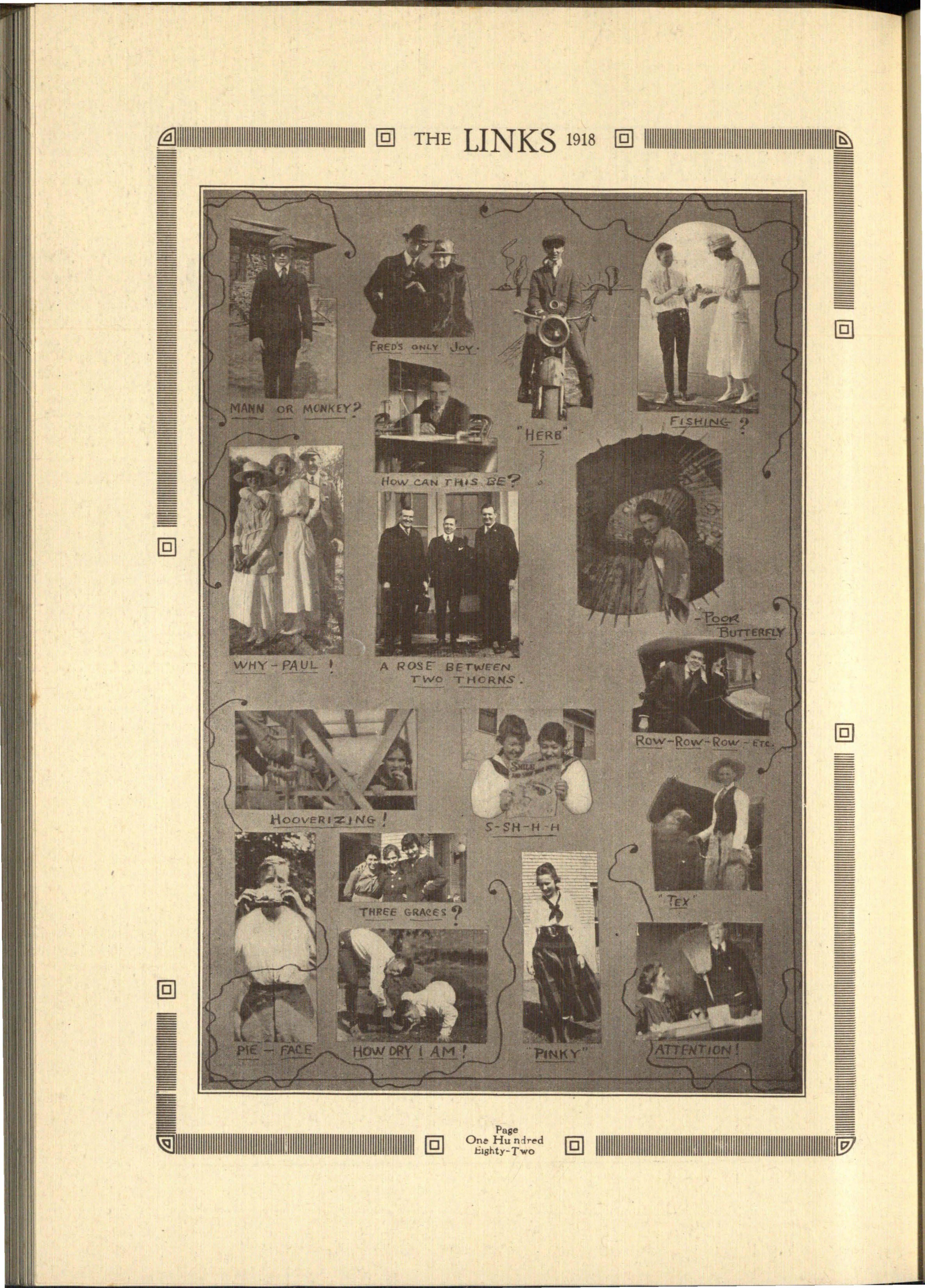
!:JIIIIIIIIIIIIIIIIIIIIIIIIIIIIIIIIIIIIIIIIIIIIIIIIIIIIIIIIIIIIIIIIIIIIIIIIIIIIIIIHIIIIIIIIIIIIIIIIIIIIIIIIIIIIIIIIIIIIIIIIIIIIIIIIIIIIIIIIIIIIIIIIIIIIIIIIIIIIIIIIIIIIIIIIIIIIIIIIIIIIIIIIIIIIIIIIIIIIIIIIIIIIIIIIIIIIIIIIIIIIIIIIIIIIIIIIIIIIIS
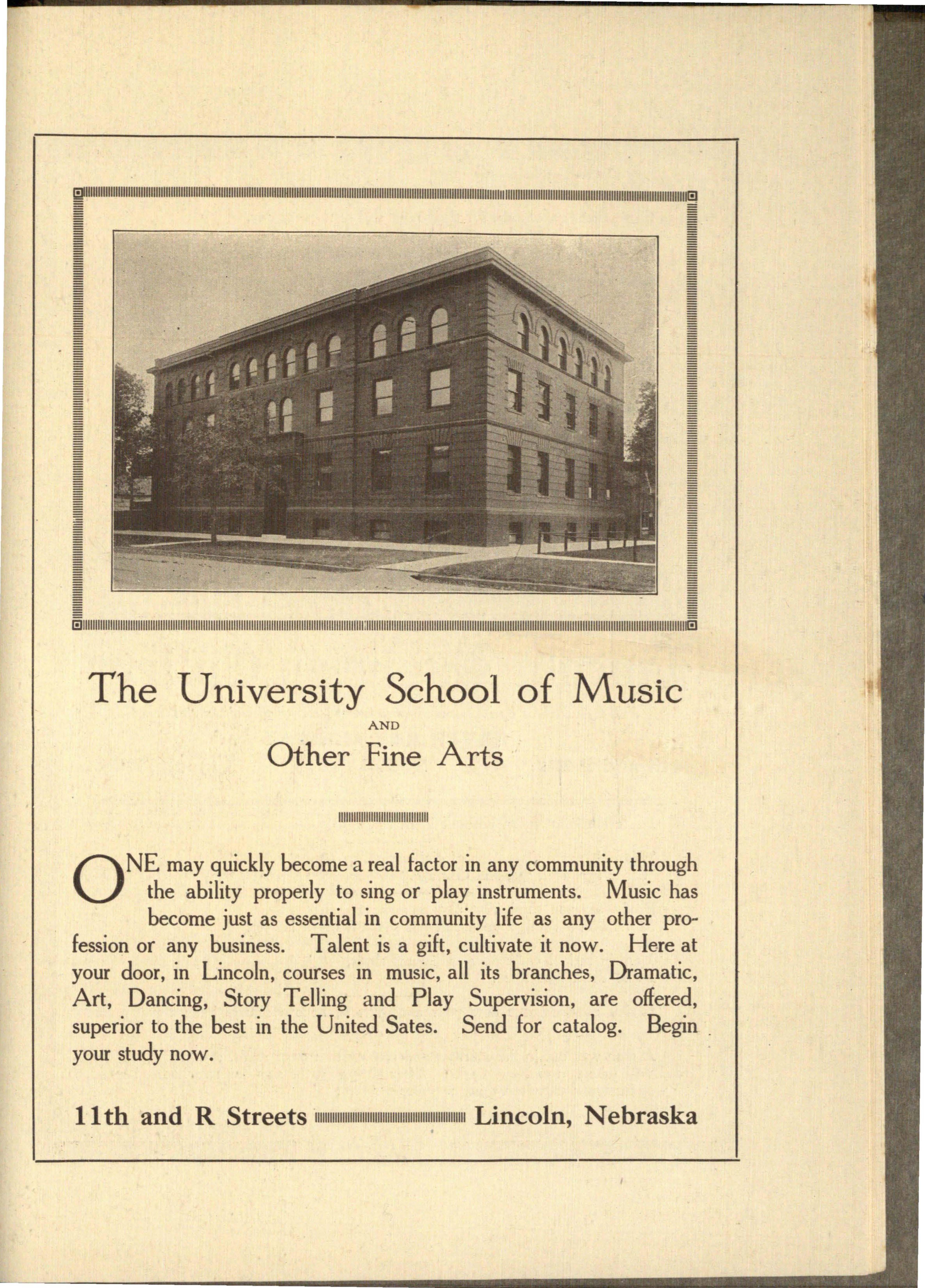
ONE may quickly become a real factor in any community through the ability properly to sing or play instruments. Music has become just as essential in community life as any other profession or any business. Talent is a gift, cultivate it now. Here at your door, in Lincoln, courses in music, all its branches, Dramatic, Art, Dancing, Story Tel ling and Play Supervision, are offered, superior to the best in the United Sates. Send for catalog. Begin your study now. 11th and R
Blacksmiths are rascals, for they forge and steel every day.
It's never too late to learn; but if you know it all, that settles it.
Uneasy lies the head that eats toasted bread in bed. =
Egotism is an incurable disease of the eyes.
Where there is a will, there is a way to conte~t it.
John L.-I wish this history would repeat itself.
Verne Lewellen: •1~:i{~~:~~h)~2;•i:s;[~!tis name
Would be to kirk a goal.
Thisisthewayhespedalong @] Atfortymilesanhour.
This is the way he walked back home When busted was his power.
Lincoln, Nebr.
Flirtation is attention without intention.
"Harold, name three ages of civilization." "Stone age, Iron age, and Gar age."
Fred-Do you think that clothes make a man?
Mr. Parks-Well, a good suit has made many a lawyer.
"I am in luck, I came near selling my shoes, I had them half soled."
Makes no difference how poor a convict is, he can always have a watch and chain.
A man was out in the country, and coming to a cross roads, saw a sign: "This road will take you to New York." After sitting on the sign for two hours, he said, "I wonder when this darn thing is going to start?"
HEN in need of a graduation Dress, a Suit, Coat, Skirt, or Blouse give us a call. You will always find dependanle merchandise. Quality, Style, and Service predominate at
Carry
Do not forget the same economies can be worked through the proper preservation of your garments that are worked in the preservation of food, and these economies are just as necessary. Our Quality Cleansing Service is the thing you need.
Recruits-Freshmen.
Pas spo rt-Vaccination certificate . Sent in el-Student Council.
ReYe ille- " U" Slips ( you must wake up) .
Tap s-Mi ss Gray in home room. Mess-C. Kositzk y' s experiments. Mess Hall-Chemistn· laboratorv.
Censor-Miss Muir. • •
Over the Top-To the High "Y'~ Club. Guard House-The office.
Charge Bayonets-Cafeteria rush l\llanual of Arms-Berquist's debating.
Court Martial-An "interview " with Mr. Lefler.
Decoration for Braverv-An "A" from Miss Hudson.
Liberty Bell-End o{ 6th period.
Sheep are the most dissipated of animals because the y gamble all their lives , spend most of their time on the turf , many of them are black legs , and are all fleeced at the end.
Mr. Donald son-No, Miss Proctor , we are not destroying Rubella ' s books.
Full]} Accredited by :J,{ational Association of Accredited Commercial Schools
and P Sts.
NEW BOOKS BY THE LATEST AUTHORS
" Looking 'O ver the Top '," b, , l\llonte l\1unn.
"How to R ema in Seriou s," Larr y R a ugh.
"How to Sta y in With the In structors ," F r ed Campbell. " Skinn y Pe o ple I Ha v e Met , " Arnold Stombaugh.
"Eat and Grow Thin ," Ele a nor Talbot.
"How I Ne a rly W o n the High 'Y' Contest ," Stanley Hall.
"The Latest Dance s, " Arnott Folsom.
"How to Make the Football Team ," Bernard Gradwohl.
"How to Become a Book Worm ," Thomas Rabbett.
"Retaining a Beautiful Complexion ," Carita Herzog.
"Sheep Raising ," Roy Lamb.
"The Great Pacifist ," Senn Breuer.
"Oh~ It's a Photo by Dole"
First Senior-How do you know Chaucer dictated to a stenographer?
Second Senior-Look at the spelling!
Herbert Brownell-My father has a fine cedar chest.
\Villiam Richardson-'Snothing , my father is a veteran and has a hickory leg.
One day an old colored lady went to the gra, e of her husband who had recently died. Standing over his grave sorrowfully she shook her head and said, as a big tear rolled dm, n her cheek, "Poor ole Rastus, ah hopes you is wheah ah 'spects you ain't."
Lockers are queer things; not in themselves, but in their vanous uses. Some times, but not frequently, they are used as wardrobes where students hang their coats, hats, and rubbers, and deposit all so-called necessary books. Sometimes they are used as catch-alls containing everything from tennis raquets to pillow cases. Other times ther are used as mouse traps and beauty parlors and sometimes they are left empty. , The locker is as good as a mirror to reflect the owner's private habits. One glimpse, and the character may be read, generally.
The locker containing a coat carefully hung and a hat carefully placed and a very neat ro\\· of books on the top shelf usually denotes a "prude," who always has her le sso ns, rain or shine.
The locker with a coat hung up by one arm-hole or dropped on the lower shelf a nd given a kick in order to make the door close, shows either carelessness or a · hurried departure , caused by a hurried bell.
The catch-all locker reflects various types , according to what is caught. The tennis raquet shows an athletic girl, the s,Yimming suit left to boil, a girl who is not altogether obedient; old papers , a heedless girl; and a pillow case might mean lazine ss or studiousness , depending on the time of its use. If it is used only between classes, one could im agine only a pure case of hookworm.
A mouse-trap locker is a constant source of terror to the owner; for just fancy coming innocently to your locker some morning, and having a gigantic mouse jump out at you; or imagine having one run do\\ n your coat sleeve when you put it on , alone some " nth" period.
The beauty-parlor lockers are a delight to all the girls in that locker room, and the time spe nt before that tin y mirror hung on the door is unbelieveable. These convenient mirrors see many a dab of powder put on "crooked" in a mad rush from third floor to first, or vice-versa. They also. you might say, help in the allimportant test , for how can a girl write, much le s think, when she isn't sure whether or not her hair is just right?
When a locker is empty, one might call to mind a girl who cares more for her morning's beauty sleep than her "seventh" for tardiness, it might be a "slip," or, perhaps, a poor little freshie going around, nearly smothered in hat and coat, and staggering under a great pile of books, all because she has heard terrible rumors of theft in the locker rooms.
Such are the uses and misuses of a queer. tall, green, steel box , set on end, called a locker.
CARR, '18.
This Store should be the answer. If it's new and right, you will find it here first.
The Home of Young JI/en's Clothes
for residents of Lincoln to go away to receive a dental education. As a local school, the Lincoln Dental College has one of the highest ratings of any dental college in the United States. Most of the work is taken at the State University. The facilities there together with those at the Infirmary, 13th and P Sts., are of the very best. We have 52 enlisted men with us this season who are preparing themselves for Army Dental Surgery. Write for the Annual Announcement, address
Lincoln Dental College, Lincoln, Nebraska
Manufacturers of Jewelry of All Kinds
Medals, Trophies, Class Pins. Fraternity Pins. Rings, and Emblematic Jewelr'y. The most appropriate awards for merit or proficiency are emblematic prizes of quality, Quality because the prizes will be more highly treasured in later years. The cost of the best is little more than for inferior grades
Manufacturing Jewelers and Opticians
Eleven Twenty-three O Street
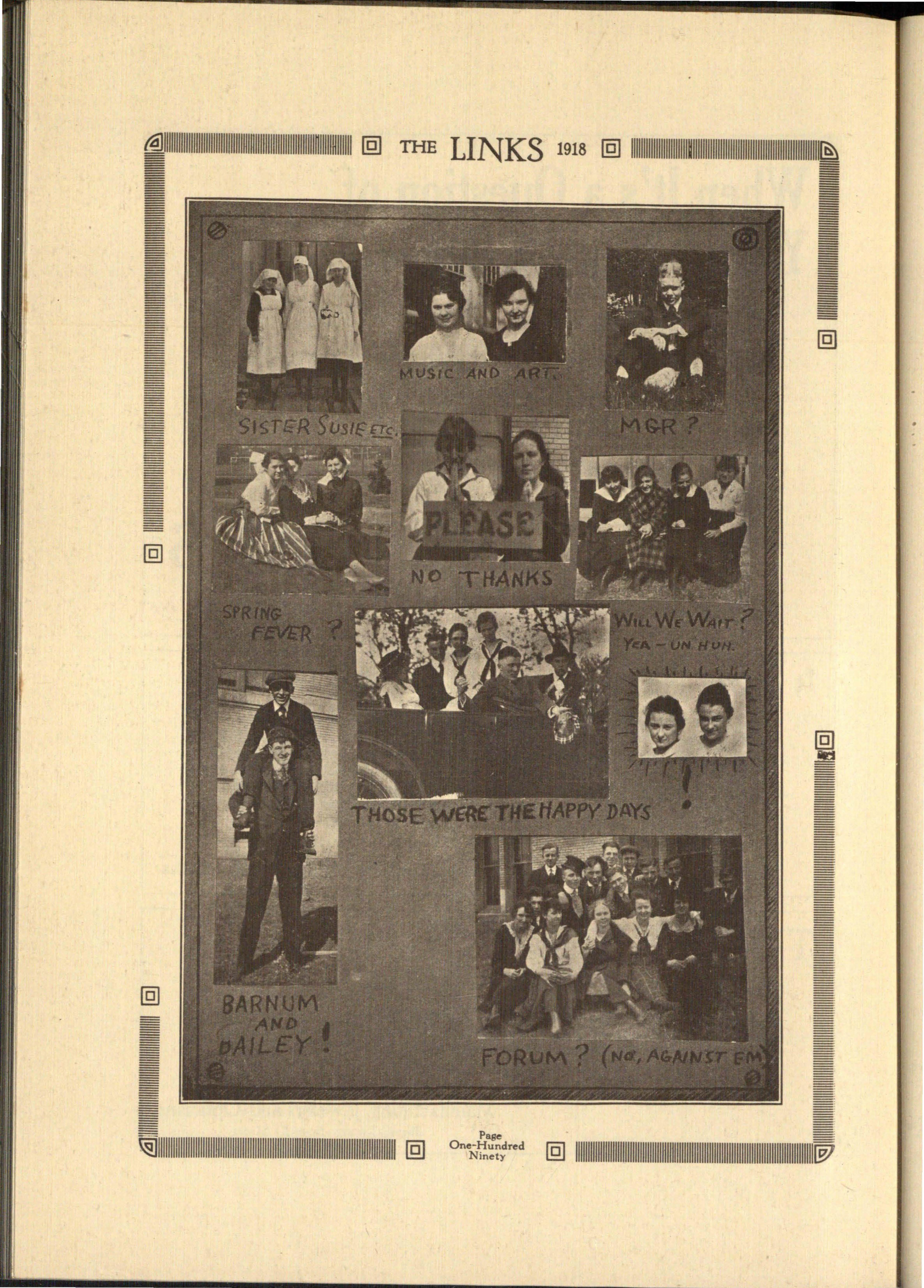
I. NATHAN & CO . 11 34 -11 38 0 S T. LIN CO L N
Ready to Wear Apparel , Shoes and Dry Goods, lor Women and Misses. Furnishings for Men Women and Childr en THE STORE THAT YOU WILL L I KE BEST SERVICE BUT LOWEST PRICES
Should be articles that they will treasure all their lives, and that will be a pleasant reminder of the last of the happy school days.
For t he Boys - Watches, Watch Chains, Cuff Linhs. Scarf Pins, Belts with gold or silver buchles, Rings_ For the Clr l s -Bracelet Watches, Diamond Rings. Brooch Pins, Lavallieres, Pearl Beads, Toilet Articles
132 3 0 STREE T
1st. Come to "THE SUGAR BOWL," 1552 0 St. , for School Supplies, Pure Candies , Newspapers and Magazines.
2nd. Come to the Camera Exchange, 1552 0 St., for Cameras , Films, Albums, Cyko Paper, and the BEST PHOTO FINISHING and ENLARGING. Lowest prices and best work. Open Sundays and nights.
HoTw manyk nighEt h1~ hJ ?lY left o wor on ng I even.
When asked a question, does Loui e napp?
A ODE TO THE S 1ALL-POX LI rE
I woke up in the morning The clock said half-pa t eight! My heart jumped within me in horror For I thought I hould be late.
I sprang from my bed in a hurry And started to throw on my clothe , While visions of a frown and a eventh Before my dull mind aro e.
I puffed and I ran for the la t block, But alas it was almo t nine, Then my heart jumped with joy and relief, For I saw the mall-pox line.
I miled a I stood near the tail-end And watched them slowly file in, While visions of no frown and no eventh Made my smile turn into a grin.
-RUTH FICKES, '18.
Mrs. Hyatt-,Vho has any bones he can bring for our tunt in the carnival?
John Campbell-I can.
Mrs. Hyatt-Will you bring them?
John Campbell-0, maybe.
Mrs. Hyatt-To everything I ask, it's "maybe," or "I'll see," or omething.
John Campbell-I know a bone head.
Mrs. Hyatt-So do I.
Captain to Private Frank Parker-Why are you wearing those stars on your shoulders?
Private-Oh, I just saw a fellow wearing them this morning and I thought they looked pretty nifty, so I got some, too.
Hager- ow ome of you fellow with meat on come out for practice tonight. J ungmeyer, you come out.
Lincoln had a little Lamb Who e record was like snow, And every game that Rody played,
Some Jolks always have Townsend make their photographs, Others most always, and Everybody some time.
Studio 226 South 11th Street
"Preserve the present for the future.'
tbe strong kinba
We are Exclusive Lincoln Agents for
All sizes, for furnace, baseburner, or water heater. Help win the war-place your order now. GEORGE W. VOSS CO. B-6778 2001 Pounds to the Ton
Class Pins Military W ate hes Jewelry of the very best grades 1528 0 St. 1311 0 Street. Remember, 1311 0. Street
RELIABLE JEWELER AND OPTICIAN 1311 0 Street
B-1637
Conserve is the watchword. You may as well save a Thrift Stamp a week on your laundry as not. Do it now. Collars 3c.
When shall we meet again, The class of nineteen eighteen?
We are scattered over the world Blown by the breath of the war god; "Somewhere in France," on the Atlantic , In the cantonments are the boys, Drilling all day, Preparing to fight and to conquer. Some will fall But they shall live In our hearts forever, Their courage, suffering, and hardships Never forgotten. When shall we meet again? Please God, it be soon!
-LILIA~ BLANCHARD.