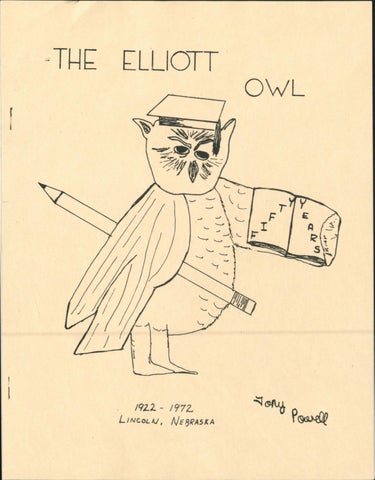
OWL
I
/92-2 - 1972 LJNCOLA./,
NEBRASJf.A
THE ELLIOTT OWL
Glimpses from the Fifty Years
at
Elliott School
225 South 25th
treet
1922 - 1972
•
Lincoln, Nebraska
**..., ELLIOTT PRINCIPALS 1921-1941 1941-1961 1961-1964 1964-1967 1967-19?2 -
•
it-tt**
Miss Sadie Baird Miss Eunice Preston Mr. Allen Hansen Mr. Sanford Nelson Mr. Gerald Oehring
Past Presidents of Mothers Club and Elliott P. T. A. January - 1913 to December - 1913 -
Mrs. Chatburn - Temporary President (The club was organized at a meeting in her home.) Mrs. Elizabeth Oldfield wa.s the first duly elected president.
1914 Mrs. c. F. Way 1915 Mrs. c. F. Way 1916 - June - :Mrs. U. G. Powell The club decided to elect officers in September, and have the office run for the school year. 1916-1917 Mrs. u. G. Powell 1917-1918 Mrs. u. G. Powell (Resigned December, 1917) Mrs. R.H. Graham, vice-president, finished the term. 1918-1919 Mrs. R. H. Graham (Resigned, November 1918) Mrs. L. J. Waldo was elected in December to fill out the term. There is no record from January 1919 until closing term of June 1920. Elliott School Mothers Club was reorganized in May 1920.
1920-1921 1921-1922 -
Mrs. Lloyd Winship Mrs. Lloyd Winship -
(Resigned in November 1921)
October 7, 1921 Meeting recorded as Elliott PTA November 1921 Mrs. David Hilton 1922-1923 Mrs. J. s. Mendenhall December 8, 1922 First PTA m@Ating hAln jn the ~i·esent E1liott building. 1923-1924 - Mrs. J. s. Mendenhall 1924-1925 - Mrs. Carl Wiebusch 1925-1926 - Mrs. Ralph Johnston 1926-1927 - Mrs. 'RAlpb Johnston 1927-1928 - Mrs. Mrs. C. M. Duff 1928-1929 - Mrs. E. R. Leverton l?29-1930 - Mrs. E. R. Leverton 1930-1931 - Mrs. K. L. Bonebright 1931-1932 - Mrs. K. L. Bonebright 1932-1933 - Mrs. Fred Lingenfelder 1933-1934 - Mrs. Fred Lingenfelder 191/,.- )91', -
Mrn. '1">u rg
na,-.1-tngton
•
1935-1936 1936-1937 1937-1938 1938-1939 1939-1940 1940-1941 1941-1942 1942-1943 1943-191+4 1944-1945 1945-1946 1946-1947 1947-194}3 1949-1950 1950-1952 1952-1953 1953-1954 1954-1955 1955-1956 1956-1957 1957-1958 1958-1959 1959-1961 1961-1962 1962-1963 1963-1965 1965-1967 1967-1969 1969-1971 1971-1972 -
Mrs. Charles Saal Mrs. Charles Saal Mrs. Harry Turner Mrs. Frank Gartner Mrs. Frank Gartner Mrs. R. B. (Dorothy) Owens Mrs. Charles ICI.ine Mrs. Charles Kline· Mrs. Edw. Munson Mrs. J. M. Millstead Mrs. Alden s. Metca.1£ Mrs. Roy Brendle Mrs. J. Edwin Gable Mrs. Carleton G. Flynn Mr. Homer Wright Mr. & Mrs. H. L. Arnold Mr. & Mrs. Phillip Kelly Mr. & Mrs. Phillip Kelly
Mrs. R. T. Abernethy Capt. R. Teasdale Mrs. Perry Douthit Mrs. William Amen Mrs. Roy Ripley Mrs. George Sorensen Mrs. Joseph Adams Mrs. David Howard: Mrs. Joe Inbody ¥.tr s. Dale Oberle Mrs. Dale Van Dusen Mr • .rasper D. Skinner
**** TUE ELLOITT ECHO
****
In old Elliott, the pupils compiled, edited and printed a booklet of poems, essays, and stories. The children, some as young as kindergart.ners, illustrated the booklets. Miss Preston has two of the printed oo~~•: one for 1913 and one for the spring of 1916. Some of the contributors and printers have gained national prominence. One of the printers, for instance, is Sam Brownell. In the 1913 Elliott Echo, is a survey made by twenty-six pupils in the seventh grade class, concerning the use of tobaceo. All twenty-six pupils opposed tobacco because "tobacco affects the heart, is distasteful to others, retards the growth, is poisonous, is uncleanly, and a wasteful habit." School gardens between "M1' and 11 1" on 25th street were considered as practical applications of as many phases of school work as possible. Dividing lots into • plots, figuring the ·amount of string needed, and estimating the amount of needed fencing, posts, and seeds, plus comput·ng cost and marketing the vegetables taught practical arithmet1. Elliott's colors were purple and gold.
The Elliott cheer was "Who arel Who
·1110 are we I 11 le 're the Elliotts. Don't you see? Boom! 11 Bahl 11 l Elliott Grammar School Rahl Rahl Rahl 11 • "Work and Win".
ar-el 1
Elliott, Elliott, Zipl I Elliott's motto was
The Mothers Club The Mothers Club was not orginally open to all patrons, and not even the principal was eligible for membership. The club met in homes of members and was quite social. Programs of speakers and music were common, but some time was given to needlework. Sometimes clubs met in the Y. W. c. A. There were originally a Southside and a Central club. Elliott belonged to the Central club. In 1913, the Cons itution of the club was amended to read that all mothers be eligible to membersffip to the Mothers club of Lincoln, upon an affirmative vote of a majority of members present. There was no provision for faculty. In 1915, the rules of the club were suspended and Miss Sadie Baird, the principal, was unanimously elected to membership. In February 1916, the East Lincoln Mothers club began having meetings at Elliott school.
Elliott Graduate Miss Meredith Thoms was promoted from Elliott in 1921. She was extremely talentea in music, especially violin, but she did not continue in the field of music. Meredith became the first girl to earn Bachelor's and ~.aster's degrees in Civil Eng:ineering at the University of Nebraska. She became an engineer at Boeing in the days of the old 314 China Clipper Ships. After Boeing, Meredith became a United States government hydrologist on the Columbia River project. As such, she was the first person to chart the snow covered area of Y10ntana and the Canadian Rockies. After working as a hydrologist for 29 yeare, . for the United States Corps of Engjneers, she retired. She spends half of each y~._..r traveling throughout the vorld. She has visited more than fifty different countries.
**** OID ELLIOTT-NEW ELLIOTT **** Elliott was built at 26th and 11 0 11 Streets in 1888. It was named in honor of Miss Phebe Elliott. In 1914-15 Miss Sadie Baird was principal. The School included a kindergarten, a woodworking shop, a cooking laboratory, and a print shop. There were grades 1-8; 18 class anrl At.tidy roamR, and 712 pupils. There were 19 teR~hers and one ldndP1"'gar ten l'r-1.clat. In 19,2, El .li.ol,t. was built on 25th and "N" Streets.
A committee was asked to
survey the Elliott district in regard to the renaming of the "old Elliott" at 26th and "0" Streets. It was suggested it be called Mary McKinnon School. The building was a school until 1935 when it was torn down. 'l.he cornarstone of the
11
new Elliott" school was laid February 9, 1922.
In 1925-26, there was Open Air school rooms to be used for undernourished and underweight pupils. The temperature was kept at 60 degrees. Cots, blankets, and l t ~~cI'-e s were furnished all the pupils.
**** THE NEW ELLIOTT **** by
Courtney Anderson In Lincoln, the early '20's saw a ereat surge forYard in modernizing and ~rn -• proving the city's educational system. New elp1naut.n.ry sch ">J s t..'t:re p) anu J ti uu. districts re-aJined. f'r~s ~o Lt . ElP.me.nto1-y s..~1• x .l hn<l l~'> •.-~u bni.J t an,i r.ho pro-sent F,lJi_ ,TU. School was the next to be con~tr110red.
New Elli.ott. School, at 25th and "N" Streets, was declared by Bickel Constructto be ready for oc,.mpancy at the beginning of the fall term. of school in Sept mher 1922. This was less than Jl months from the [!l"Ottnd breaking. School began in a bni l<line ~:u- f'l•om lmplf' t.;..-m. Many wind ws wera stjll to be placed as well as blReklx a:n.lf'J7 \•o'f..1.~k v.qrp Ung in the clflft.S.CQOIDS, te1-ra.za in the halls and til.e :in t-.he bat.hr·ooms. These thiD.3s came many months later. ~<..-r, r, ,,m!'trny
The first year at new Elliott was a year of adjustment for faculty and stu-..dents. Sadie Baird, an upper grade tMcher from Prescott, new in this position,· was to be principal. The teaching staff was drawn from many of the Lincoln elementary schools.
I
r ecnll six came from Whittier (then an elementary school. Whittier Elementary was torn down the next year and Whittier Junior Hizh was built on the same site), one f r om ~!Ki.n_l,"'Y· .'::! .1&,.,,)1 . ( p. ,·n rnhi n At .j n eJ emP-ntary and high school located at
15th and "N" Streets - now the site of Pershing Auditorium), one teacher from Hayward, Another first grade teacher from Prescott. The student body came from the newly defined Elliott District which took in parts of several other districts. There were many children from old Randolph School (Randolph was then at 26th and Randolph Streets. This site is now a children's park and playground), McKinely and Bryant Schools. This fusing of the new student and faculty group added to the new uncompleted physical plant made for the best effort from each individual. A school rride was developed that was remarkable and unequaled. With more t han a thousand children, and, the fact Elliott was located in a new area, made it quite a show place. \.Jhen we had fire drills (then as now - required a month) cars and ped P~-t.rj tJnSl raaa i.ng would stop to watch the orderly a"\': odus of so m:my chi 1dren em .1·Jing 1 m ea h d r .1 i njng the walks and parts of the • •
0
P LJ1 Yt..~' ·• •-.t ]-,., , ,.,.., tJ- ,
I,
.,.~
..,
Tt. U ci:J .rually a t.hrilli n; ~.i g ht.
Other spectaculars of these early years were groups of five- or six hundred children from the intermediate or primary grades in a combined exhibition of intricat~ drills of calisthentics. These playground fetes took place in the spring and were called variously "Health Day", ":May Day", or "Physical :Education Day!. Primary grade indulged in delightful drills, Maypole dances, and Circle Games. The orderly marching on and off the playground. of so many children in grade groups was in itself a picture. While such performances took limitless effort on both the children and teachers there was much satisfaction in entertainment well done for the school patrons. ffMemories About the New Building" The building during the first year and for a number of years after as well, an equipped manual. training room with workbenches, tools, many shelf compartments for storage of materials or unfinished work. The Assembly Room was the northwest basement room. The stage was at the north end of the room - the audience section had a seating capacity of about 250-300. The seats were folding chairs which when moved slightly on the cement floor created almost enought confusion to stop the pro3Tam. The west basement room south of the center stairs was called the Play Room and often for overflow crowda for meetings and programs. This meant two separate entertainments must be prepared or name must be staggered. The southeast basement room was the double doors and ramp from the south was planned for the bicycle room. At first, children brought their bicycles to this room. Soon it involved so much teacher-custodian supervision and last minute rush for placing their bikes before the tardy bell, that bicycles were parked outside on the terrace under the office windows. On the north half of the playground, below the terrace, a.bout one-third of the wlal' to the west from the building was located one of the city wells which had eeen abandoned. It was the source of concern for safety. The ground here was depressed and damp no matter how of'ten 5.t was :f:illed in. Now, after many years of filling in, it isn 1 1'. di.scernahle..
**** 1st Year Statistic **** Experience of Teachers No, of Years
1 2
No, of Teachers
2
3 4 5 6-9 5 1
2
5
10-14 15-19 20
Total
6
25
3
1
TraininP of Teachers: Years Training Above HilYh School
1
2
3
4
3
13 1
4
5
Total
Norm Grads
Have A. B. or B, Sc,
Have A.M.
No Data
2
23
9
6
O
2
**** PTA MINUTES **** The first meeting of the PTA of Elliott School was held November 3, 1922. Mrs. Wentz, State PTA president, brought greetings from both the city and state PTA organizations. Miss Sadie Baird, principal, asked for the cooperation of parents and teachers in regard to the organization of a new district. Mrs. Mendenhall wlecomed new and old teachers to the new building.
On December 8, 1922, :Mrs. Carl Wiebusch was elected as the first representative from the new Elliott to the City PTA Council. Teachers 11.ad been assigned as "traffic cops" on "O" Street. It was voted that teachers be released from traffic duty, and parents assume safety reponsibility by cautioninJ children. Dues were twenty-five cents and expenses for such things as refreshments were by 11 free-will 11 offerings. On January 5, 1923, the organization voted to send a telegram, unanimously of any Arbuckle movie film in the city of Lincoln.
{~PP-<-•d nz t.he showing
Miss Baird report,ed that 31 pupils received free milk daily, and 21 pupils paid 15¢ each. The milk fund was low so a silver offering was taken. Instead of :ref're~h.rnAnts> the money was given to the milk fund. February 2, 1923, the formal opening of the new Elliott School was discussed. The date and proeram would be arranged by the Board of :Education and the teachers. "Free-will" offerings at two PTA meetings would defray the expense of the formal opening, Elli..uLt ::w.h0nl harl thQ J:;.irg~ct, .lihrt:lry P-ir"ulA.t,i.rm -
school in the city.
12.44 books -
of any
On larch 2, 1923, the first night eeting of the PTA wa 9 held in the new building. An overflow crowd of 300 was present to hear Judge ~orning speak. The orchestra of the old Elliott School played commendably. The president announced the formal openins of the new Elliott School building, and appointed the following as Committee Cnarimen: :Mrs. Porter Putnam, Mrs. Floyd Wolcott, Mrs. Den Hunt, Mrs. Carl Wiebusch, Nrs. w. L. Shedd, Mrs. J. s. Mendenhall, and Miss Sadie Baird. September 13, 1923, Mrs. J. s. Mendenhall was president of the PTA. Miss Baird, priPcipal of Elliott stressed that the ~eat thing today is the teaching of our childr$1 to be law-a.biding citizens, commencing before school age.
PTA membership and attendance was increased by awarding a plant to the grade having the largest attendance at the monthly meetings. On October 12, 1923, it was announced that free Smith-Hughes classes in eight branches of work would be held in different schools. The night classes would be open to anyone over 16 years of age not attending resUlar school. The program consisted of well lmown early civic leaders, O. J. Fee, W. J. Kirkbride, and M. L. Palmer (member of the Board of Education) along with boys from the Y. M. c. A. and the Boy Scouts. November 10, 1923, Miss Baird talked about the nutrition classes for those pupils who were 7% underweight. The organization heard a report on the Juvenile Court, and appointed Mrs. s. L. Kier and Mrs. w. L. Shedd to attend a session of the court. Pl'A.
Mrs. E. L. Forney of Elliott PTA composed a son5 for the Nebraska Conr; ress of Dorothy Mercer and Mar 5aret Hyde were talented music students who played.
January 1923
.....
Elliott PTA had 203 members •
February 20, 1925, Miss Courtney Anderson's third grade room was awarded a picture, as a prize, for sec'..lrinJ the largest number of PTA members. The children in her room secured forty five of the school's two hundred five members.
In 1925, with Yll's. Ralph Johnston as president, the school had a father-son night.
Five hundred persons attended.
One hundred pies were baked for the affair.
Nay 12, 1926, Prizes were viven to pupils havinJ the most complete and neatest on fire prevention.
answera to fllAS~ionnR res 0
January 6, 1927, 75 people had paid for their memberships. After a bill for on the father-son banquet, the treasury balance was $3,09.
j.1.0 .. ~8 was paid,
October 1927, Yl!'s C. M. Duff, president, told about Elliott School's plans to take part in the Armistice Parade. Miss Merle Beattie explained the new elementary report cards and the new illethod of grading pupils. December 1927, l'iiss Baird, principal, re_orted to the PTA that bleachers to increase t he capacity of tne a s f! 0mhly J.'' ~·<-,nl ci o st 50.00. The PTA members agreed to 1>11r •h.c:u~n t hn l 11 Pn h ~rs. 1
April 1929, ~rrs. Forney, president, reported the new stage curtains were ready. The members paid the bill of J43.10 for the curtains. The final treasurer's re .. ort showed a balance of $7.14.
Phillip Brownell-Attorney-at-Law Phillip Brownell was one of seven children. Six of the Brownell children graduated from the University of Nebraska, Cum laude. Three brothers attended Yale, and studied law. Phillip, the brother of former United States Attorney General Herbert Brownell, who served under President Eisenhower is now practicing law in Ashville, i orth Carolina. He has a sister still livins in Lincoln at Milder Manor.
April 1929, Mrs . Forney, president, reported the new stage curtains were ready. The members paid the bill of ~43 .10 for the curtains. The final treasurer's re~ort showed a balance of $7 .14.
Phillip Brownell-Attorney-at-Law Phillip Brownell was one of seven children. Six of the Brownell children graduated from the University of Nebraska, Cum laude. Three brothers attended Yale, and studied law. Phillip, the brother of former United States Attorney General Herbert Brownell, who served under President Eisenhower is now practicing law in Ashville, forth Carolina. He has a sister still livine in Lincoln at Milder Manor •
•
** ******* * ******* ********** ** **** * ****** ** SPEAKS LEFLER MR •
** * *************************************** 1.
Will you tell us something about yourself, where you were born and raised, and about your education2 Well, I'm Nebraska born and have lived in Nebraska all m:, life. I was born over here in Sarw Cowity. The post office was Sprin6field 1 Nebraska. I was born on a farm. That farm is 41 miles from here. Practically all my life I have been able to go back there in the course of an hour or two, especially since we have had automobiles you know. So I am Nebraska born. Hav~ lived here all my life and have done all my work in Nebraska. That lays the background - farmer you see. And I might say that I lived on the farm until I was 12 years old. I would say that many of the things I know I learned from contact with with them. We had lots of trees and I knew all the trees. We had all kinds of birds, and I learned all the birds. We had all kinds of animals, I knew lots of animals. I didn't get all that out of books I got it from experiences you see, just movinz arowid. I lmew the fish in the rivers and the streams. I have fished all my life as a matter of fun. I had an old dog, his name was Sooner and for those 12 years that old dog was ~Seoner'! with. . roe tban:-any plnce else. He just liked to be there. Well that gives you an idea of where I was born. ~- !S
2.
How long were you Superintendent of Schools in Lincoln? I Ca.II8 to Lincoln in 1917. First came into Lincoln High School as Assistant Principal for one year. Then I went down to the central office, the Superintendent's office, Jessie Newland was superintendent then and he took me down there and I became Assistant Superintendent for two years. At the end of that time Mr. Newland was elected Superintendent of Schools in Denver, Colorado and I succeeded him as Superintendent in 1920. I served as City Supertintendent of Schools for 28 years. I retired in 1948, that was 24 years ago. It doesn't seem that long, but it is quite a little time now. That gives you an idea of my work in the schools. What was Lincoln like when you first started teaching?
•
When I first crune here of course Lincoln was not as large as it is now. It 1 s about 150 1 000 now,I think it was 54,000 then. All of these streets were what you mi 6ht call ordinary streets - they were not widened. We didn't have the automobiles, we didn't have the traffic. It was a big town we might say. A very nice place though. Lincoln was a fine place to live. It had lots of churches, it was proud of its schools. When I came here, it had very few 6ood school buildings. So that was one of the things we had to give special attention to. Practically all of the new buildin:~s have been built since that date about 1920-24-25 we began to build the se new buildings.
4. What special events do you remember while you were teaching or Superintendent? Well there were lots of events. All kinds of things going on in the schools and in the city. The things I remember particularly was the rapid growth. In 1929-30 as a matter of fact, we had what was called the Great Depression. I think that is the only one I will call your attention to. People were out of jobs. They did not have any work to do. We lost 5,000 pupils out of the Lincoln Schools then. Their parents moved away. We had a drought at the same time. That means that we didn't have crops and the people in Lincoln jumped in old jalopies and cars and they went where ever they could go to find work and a place where they could really live. That was one event I could remember when all the teachers had to take reductions in their pay. They were happy then to have a job because many people had no job you see. They just had to walk the streets without them. Now since that time we haven't had what I call a ca.t astrophy that did vhat it did to the ~ople of Lincoln in 1929 and the early 1 30 1s. So that Lincoln now has made great progress, and it has alwvs been and even in those hard times a very good place to live.
5. What are your special interests since you have retired? Well, when I finished the work I was doing in 1948, I had made up my mind that was when I was going to retire you see, I would go into retirement with my eyes open; prepared for it. I did do a lot or things. I was very active in taking pictures - photography. I had a dark room in my house, I made lots of pictures. It took a good deal of time and I liked it. I like to "tramp" the fields and hunt. I like to fish. Twenty-five years ago I still did a good deal of that kind of thing. In the year that I retired, I had an invitation through the United States Office of Education to go to Japan as part of a commission to reorganize the Japanese schools. The war had just finished then and one of the conditions was that the Japanese people IIDlst reorganize their country so that it would be somewhat democractic in its makeup. I had the pleasure and the opportunity to go there. I spent some time there. That was very interesting. I don't have time here to describe everything that was there, but Japan is quite a country. Not a very big country. It does not have any more cultivable land that's half the state of Iowa, yet they have 100 million people there. It isn't any bjgger than the state of California. We have only 200 million in all this country right now you see. Their country is made up of volcanic soil. There are lets of mountains and a good deal of timber. Toe result was that they did not have the resources, but they had the skill. They were a very skillful people. They could use their hands. They could adapt themselves quickly. While I was there I had the misfortune of getting a detached retina in one of my eyes and I had to come home. I lost the sight in my left eye. I don 1t see out of that eye. I had to come home and have that operated on and take the hurt out or it. I see very well out of the other eye. The only difficulty is that I am a slow reader. I wish I were a rapid reader as this is a thing I used to do Pn .much. Now it takes me quite a little time to read. Since these later years, I have been fortunate in coming into a place like t.nis home here, The Ea.stmont Manner. It is
not a nursing home. We have a. nursing home on top of it. We ha,-,1a an infirms.ry that truces ca.re of the people who a.re ill. They have 50 beds up there and if anything should happen to me and I needed be taken care of I would go from this apartment up there. The nurses are always on hand. I live here then without any great responsibility. For example, today a cleaning lady ca.me in and cleaned this whole place for me. They do my laundry, the sheets, pillow cases, towels and flat things. We have a bus out there that goes to town three times a day and back. If you like games there is a pool table down here. I go down and play pool with some of the other men. I like that. I get acquainted of course with a.lot of people. There a.re about 180 people here in these two buildings. We all eat together at 5:30 in the big diningroom. That gives us an opportunity to meet each other and we have very nice food there. We have down here a lounge in which special meetings are held. We have motion pictures every now and then. We have people that come in to sp€ak to us. On Thursday we have a chapel exercise at 10:30 in the morning. We have a chapel service on Sunday afternoon at 4:30. I don't have any time on my hands. I don 1 t have quite enough time to get done things I have to do. I really don't have to do anything, but I don't have time enough to do it you see. I am getting along fine. Fortunately, I have fairly good health and I enjoy it very much.
6.
•
How many yea.rs did you teach and where? I began my teaching right out of high school. I had what is called a Normal Training Certificate. You used to be able to teach right out of high school. You didn 1 t have to have degrees and so forth. I began in a rural school out in Cass County, Nebraska down here about 35 miles east of here. A rural district called Tipton. I had 17 pupils. One kindergarten up to one in the eighth grade. That eighth grade boy was big as a door practically. About six feet tall. His name was Leonard. I remember Leonard had cut his hair short and it stuck straight up and he was a boy that was inclined to be a little frightful. He didn 1t just know all the time you know. When I said Leonard, it seemed his hair stuck right up a little taller, he was just frightened. A little close jacket you know - so I will never forget Leonard in that school. I enjoyed that very much. I was there a year. Then I went into the town schools at Elmwood and down to Weeping Water - I spent a year down there. That was one of the interesting places I was. I went down there where things weren't too good and when I came away I came away in the evening at the end of the school year. I went down to the depot to take the train as there was 10 to 15 miles to go between Elmwood and Weeping Water you see. I went down there and every pupil who was in my school was down there to see me off. That's the only time I rememher the pupils seemed to be glad to follow me a little way. Any rate I had a nice time down there. Then I came back to Elmwood and went into the high school R.nd became principal. I finally became Superintendent. From F_J_mwood I went to the State TeacherR 1 College at Peru. I went there cs a st ~dent in the first place and graduated from that collage. I became a teacher in what they cn.lled their ~raining school and was finA]ly vromoted in their Associate Director of the training school. I left there in 1917 and came to Lin oln. I have been around about 50 years in school bu~inAss. I enj0yed it very much.
7. Why did you want to be a teacher? I don't know that I just decided that delibe'!"ately. You know many of us go into the things that seem to be open to us. I had a principal who was a very fine man, he was a graduate of Wesleyan and he liked teaching. He was teaching in the schools where I went. He said to me I ought to be a teacher and he said he would help me get a school if I can. He helped me get this rural school I have talked about. So I would say the reason I wanted to be a teacher is because somebody had confidence in me that I would be a good teacher. He liked to have me do this you see. I might say to you that during all my years until rather recently (that man was a Lincoln man) that man was one of my closest advisors and friends. I counted him one of my patron saints you see. 8.
What were the schools like? They were quite different than they are now. We had a limited number of courses not nearly so many pupils. I can't tell you just off hand how many there were, but probably half of what we have got now, and not that many probably. Also the buildings were old buildings. They were eight room buildings. They had four rooms on the down floor and up to four rooms on the upstairs. All over the system the elementary schools were housed in that type of building. Now the schools were not 6-3-3 schools as they are now - six grades in the elementary, three in junior high, and three in high school. They were what they called 8-4 schools. Eight in the elementary school and four in the high school. That's the way they were then. The change over took place after I became Supertintendent of Schools. That was one of the first major things I helped to implement taking the Lincoln Schools from what we called the old 8-4 plan to the present 6-3-3 or junior high plan. The courses were quite limited. The emphasis and I still think there is a great need for this emphasis was almost entirely on reading, writing and arithmetic. There wasn't too wide attention to social things you see. It was a limited curriculum. Discipline waa rigid. Children went from class to class in marching order. The whole idea of teaching was that in one school at a certain hour you would find the same thing going on in another school. What I am trying to show you is that it was a rigid discipline. That had been the kind of school. They had to loosen that up and that takes quite a while to loosen up that thing so that they can put the responsibility on the boys and girls to do the right thing in lmowing how to walk through a hall where you've got alot of people and do it in an orderly way without having to be, I would say, in somewhat military fashion.
9 ..
If you had to teach and be Superintendent all over again, would you; and if y-« •ll
WO U
1 rl , 'Why?
Well as I think back over it, I have been very happy with what I did. I aan•t think of anything else I would rather have done. I think it gave me as great an opportunity as I could r osfl·hly have and if I knew I could have as good or etter conni~ions thEU1 I had then, I certainly would do it over agA.·n. I might say this that I don't think of" anything now I
would rather do than the thi.n~ I , 4 q . ! t .1 ~~ =·· • . I believe I had one of the best 50 years of school wor. tnat has existed in this country. It seems to me that the schools are much more difficult now. The boys and girls seem to be so widely differentiated in their thinking and in their habits. A good many of t l~em in their conduct. I have a great belief that the boys and girls of America represent strength and I think most boys and girls are wise enough to do the right thing, but we have a tremendous emphasis on a small ntlnority that are constantly doing the wrong thing. That seems to get such wide publicity that we sometimes loose track of the fine people who are really the salt of the whole situation. What I am trying to say is - the 50 years that I had, as I think of it, was perhaps an easier 50 years for me; I don•t mean easy - we don't expect easy times, that isn 1t the point, we want times in which we can accomplish things, you see, and get problems solved. I rather feel that I had more a successful 50 years than I would have had if I were superintending now under conditions that are imposed on the people. That is not only true in the schools it is true all over the country. It isn't just a school situation in fact the schools always create a community and the community makes the schools and the wide variations in the communities are a good deal wider and different than they were in the days when I was teaching. Since 25 years ago when I retired, in a way I belong to what you call a senior population, but I hope I have kept a little understanding of how boys and girls live and what their desires are and I certainly have a great regard for what I think they are achieving. ·!_~
10.
::-1
What do you think about the schools today?
I have effectively covered that haven't I. I think they are harder to handle. They have much wider background. There objectives are slipping away from this idea of just mere information over to the point of view of getting boys and girls to assume responsibility for themselves. To become independent thinkers, to be students of things, to investi~ gate things, to actually go and experience things. I am reminded right now, here you are sitting here, I suppose this is part of your school work, but the school that we had was down in the school house. You see those days you didn't go out and hunt up things, you took them out of the books and you took what people would tell you and all that sort of thing. That has value of course, but here you are today doing something and I take it since you have a recording machine that when you get through you will try to intrepet your experience with the people you have back in your school. You see that's a different thing. There's a change that has taken place, the social good. Another thing 1 ~ h 1 you make a living. You are giving more attention as to how use~ is this thing you are going to have. How are you going to apply it? What is going to be your vocation and you have got to experiment in that. You take in the junior high school for example, that's not just a question of what you learn that you like in that si:!hool, it is just as important to find out what you don't \..Ullt to do. It is important to see that you don't get into the wrong notch. That you really get into something that is rewarding all the time. I am one of those people who believes that the person who hRs real recreation is one who is recreating all the time; does not go out to find something to do outside of his work. I think h nPe<ls to find his real recreation in his work its lf. HP unuln rat.hPr no t.h,it. t.hAn anything else he thinks of. 0
~
*._.. FUN NIGHT **** Fun Night, an annual event at EJ.J.iott School, is one of the biggest events of the school year. Sponsored by the PTA, it is a time for fun, food, and entertainment. Entertainment through the years has included the talents of students, teachers, parents and community residents.
The
Inglis Family
The four Inglis boys, Ervine Peter, Richard, Alan, and Donald, attended Elliott in the late twenties and early thirties. The family left Lincoln in 1934 for Greeley, Colorado and moved to Missouri four years later. The boys finished high school in Missouri after which Peter and Richard went on to Grinnell College in Iowa. Peter returned to Missouri to receive his M.D. at Washington University in St. Louis. Dr. Peter Inglis practices medicine now in Marietta, Georgia. After college, Richard became a teacher and is now teaching science in Denver, Colorado. The third Inglis son Alan, and the fourth, Donald, attended Earlham College in Indiana and then seminaries in the East. Alan went to Yale Divinity School. Both Alan and Donald entered the United Church of Christ ministry. During World War- II, Alan was a conscientious objector serving in a hospital with veterans who had emotional problems. He was awarded a Presidential Citation for saving the life of a doctor. Rev. Alan Inglis is now a counselor of young men on the draft in the area of Earlham College. Rev. Donald Inglis is serving a United Church of Christ Church in Ellington, Connecticut.
Items From PTA Minutes On November 17, 1936, under Mrs. Chas. Saal, president, the PTA members voted to "allow 19.80 from our treasury for 150 plates and 100 cups. This will eliminate the necessity for borrowing dishes from other schools." Pupils from Miss Bowen's r m PJ.'esented a play entitled "The essage" • 00
On May 18, 1937, the PTA in partnership with the teachers, voted to purchase a set of wicker furniture, to be used on the platform. Several of the grades gave a HPalt.h Day Pr-ogram. "Miss Bourke conducted a group of sixty-seven sixth graders in four songs. These pupils will sing with a chorus of six hundred voices at the Musi~ Festival." On October 19, 1937, the organization set the "annual luncheon" date as Nov9. The Father-Son Party was moved to the first semester. Miss Baird explainoi thP n""' n .iit.1-- ,:d,,ui :l~a vo.rlc Rnrl gave inf rro.~tion on onroll.ment. In 1936, El.loitt emh r
had 880 pupils, and "to date in 1937" Elliott had 858 pupils. There were 23 teachers, making an average of 37 pupils to each room. Miss Baird introduced the new teachers, Mrs. Long, Miss Brehm, and l'ldss Christiensen. (No first names given.) Ten Lincoln schools were awarded a PTA "Certificate of Award" for efficiency in the previous year's work. \ On ovember 16, 1937, Mrs. Murphy, the Recreation Chairman, proposed sponsoring a Camp Fire group at Elliott, and finding a suitable guardian. Mrs. Maynard Cook, the general chairman for the Father-Son Party, announced that the party would take place December 3. Mrs. Forrest Gibbs, the garden chairman, presented garden certificates and gave prizes to the ctildren having the four best gardens.
Miss Christensen's kindergarten sang Mother Goose songs. a Thanksgiving song.
Miss Sam's toom sang
On January 18, 1938, there were 230 PTA members. Mrs. F. Gibbs made a banner to be given each month to the room having the largest number of parents present at the PTA meetings. Miss Quimby 1 s room won the pennant.
April 19, 1938, Mrs. Turner reported that plans were almost perfected to begin a supervised playground for young children in Elliott's uptown area. The playground activities would take place from 6:00 to 8:00 in the evening on the south half of the grounds of old McKinley School. On May 17, 1938, Mrs. Gibbs, the garden chairman, reported that there were 54 Elliott School gardens.
Miss Baird announced May 19 at 10:00 A.M. as the time set for the May Day Program. These May Day Programs, which were presented at Old Elliott, as well, were beautiful spring affairs. They would make interesting copies for the students who are doing research. Miss c. Anderson or Mrs. Nielsen {Miss Huffer) probably remember them. At Old Elliott there was a May Pole. City-wide Fun Day for school children would be held at Capitol Beach, June 9. Then mother volunteers were needed to work at the concessions. This would be another interesting activity for children's research. June 1 was set as the date for the Mother-Daughter Party, the price of tickets to be two forlS¢. It was voted, in connection \dth the Teachers• Activity Fund, that the PTA purchase a projector for the school. October 21, 1938, the PTA held a money-ma.king "jittney luncheon" and cleared ' 60.77. On January 17, 1939, the Board of Education purchased a projector with a vitaphone, and 11 hoped the PTA would sponsor a show to help pay for it."
A candy-popcorn sale netted 11 close to 5.OO."
*..._ DON'T EAT TOO MUCH-J.9/,l **** During World War II many items had to be rationed, such tnings as coffee, sugar, canned fruit, nylon hose, cleansing tissue and gasoline. In order to be sure each person got his share, stan:p books were issued. The issuing of these books was assigned to the schools. At Elliott a big center for giving out the stamp books was established. All the teachers from Lincoln High, Whittier Junior High, and Elliott helped with this work. Over 100 patrons also worked.
The Day Care Center During World War II needy children were being taken care of by a Day Care Center at Elliott School. This was a program for those children who had working mothers. The daily routine included eating, rest, and play. Sometimes they would have stories read to the.lJl, short trips and entertainment. The program also included health care, check-ups, and immunization. This Day Care Center was a very fine part of the services, of the school, to the community.
Elliott and Japan Exchange After World War II, Captqin Urban, a friend of Elliott, was in 6ccupation Force in Japan. His work was to build cooperation, understanding, and good will in the schools, under his jurisdiction. The children of Japan and Elliott School had a mutual exchange of pictures and school activities. They sent Elliott a beautiful boo~ anti we ~ent them one.
++++++++++++++++++++++++++++++++++++++++++ AN INTERVIE"w ~I'l :: i:!,u1 :::...J -: :: . ~-_,._ _ ~:
++++++++++++++++++++++++++++++++++++++++++ Please tell us about yourself - where you were bcrn and raisetl, and your education. I was born inOklahoma but I only lived there six weeks, so I don 1t remember much about it. But I actually grew up on a farm in northeast Nebraska. My family were pioneers in Nebraska, and had gone to Oklahoma for just a short time. My father always said I cost him an oil well because I was born on a lake of oil in Oklahoma, but I got sick and so my mother and dad brought us back to Nebraska to our farm up northeast. My grandparents were pioneers. Some of the things you see around you were brought to this country in covered wagon and the rocking chair which is right there beside you was made by my grandfather following the Civil War. When he got back he used all kinds of wood which he could find. He was a cabinet maker, but didn't have much to work with. The chair, the one you are sitting in, is about 200 years old. It came out here in a covered wagon. I have three of those. I went to a country school, which is a wonderful experience I think. Then I graduated from high school and I had two years at Wayne State Teachers College, and I graduated from Nebraska Wesleyan and a masters degree from the University of Southern California. I went to many colleges because my mother was ill a great deal and we went to different towns to take care of her so I went to school and matriculated in alot of them. Tell us about your teaching; How many years and where. That's a long story too. It is about 43 years. I first began to teach in my home school in the country. Then when I graduated from Wayne State Teachers College, I taught in the lorfolk, Nebraska schools and then one year in Wisconsin. Caine to Lincoln and taught here most of the time since then, except for, one year in Colorado. I was at Whittier Junior High first, next I was at orthest High, then at Hawthorne Elementary School and 19 years at Elliott. What was country school teaching like? I think country schools is an ideal spot because everybody can go at his own speed and go just as fast as he wants to and the older people help the younger ones. I have always said that there is a school in Hawaii right now that is being run on that basis. It is a large elementary school and they are putting about four grades in a room, like a country sc,hool. When were you Principal at Elliott and what were your special events? I think it would be rather hard to tell all the special events because it was 19 years and if you want,figure backward from 1961 when I retired then you can figure the 19 years when I went there. Oh there are so many things that stand out. I suppose the things you remember best are the things that you get all excited about. I think that is the way with
They used to com;3 tc see me n~ te~_:,_ ~c --""nu + +,:.:e square dance club which 'W'as a : ~ ✓ .! ont o ·' •.- ~ 1 that to get acquainted with the sixth graders. We used to have about 60 to 80 sixth graders who came at eight o'clock in the morning and d8.Ilced. . Equal niLr-iber of boy s and girls. The boys liked it just as well as the girls. I remember one day when five or six boys came in and said to me we want a lesson on the polka and outside they were playing baseball. I said you mean to say you want to give up baseball game to learn the polka and they said yes we got to learn it - we don't know it. So they had a lesson in polka. Well what are some of the other events. I i.a-ote up oomo nf them and sent them over to you. I don I t know as if I can tell you too many O"L!l~J. 0 v .. ~ -- one in particular because we had such marvelous parents always an~ they came to school so faithfully and to so many events and ?ne.tl.Ille when I was celebrating my birthday, and one of the tea~hers invited me to her home and I was vuJ.-y su.q.>rised as to what was going on around school. It seemed to me there were so many things going on I didn't ,-u,, 1 -=-tn~'- ~-hn.t, day, but I didn't think anything about it. So we were to go out to dinner and go to a show. She came for me and she said I had to stop over to sehl ol And when I got to school we stopped the car and the whole building was lit up. I said what on earth is going on here, I didn't give any permission to have this building open. She said well let go in and find out, and when we went in there were 54 people with a great big dinner set up in the cafGteria. They cooked it at home and brought it over and they had every table decorated. I shall never forget t~is because some lady in the neighborhood (I don't know whether she is still here or not) had made decorations for every month in the- year which- i~ a- very-interesting-thing-.- They... \<lt:il:..tLJ.ax.go with dolls and all sorts of things in them and cvorylx u.y had to sit at their own birthday table. It was a beautiful affair and it shows what the parents do at Elliott. That's one of the things. Of course they used to come in mass to help enroll people in the fall and we would have 25 or 30 of them there helping with the registration. I think of the things that ought to be put into the Elliott history and that is that we actually had the first primary school in Lincoln. I don't think the schools are primary schools now I am sorry to say because they say Primary 1, Primary 2. We simply had rooms with no labels. Just Miss Reynolds room, Mrs. Carlson's room and others. I think that was one of the highlights of the whole thing when we did that I also sent you a good many things I thought were highlights.
boys and girls.
1
b
::
.....__O
-
1• -
-·
•••
••
. :,_,,. • _..,_
..::, -
•
-
-
•
•
-:
-
~ ,
\.4.
_
.
-
......
We had ::m c,u+.~t aniiing safety program. We began that at Hawthorne School and we worked with the safety council. So I had sort of a running start on that. We had a safety council made up of one or two y~ungaters from each clasoroorn who met once a week. They were something like a student council but it seemed to us that a main purpose like SA.fat.y was more jmportant t.h:rn j 11~+ a. p,t=mcrRl rnJ ing of the school. ThP.y r ..--o 11y rHd ho;:i11t.H",tl +.hings. I t hink that there are
some other thines that happened too that were hiJhlights for me, and I don't know whether boys and Girls remember or not. We found alot of children not obeying school rules so with the cooperation with all the teachers one mornin3 (now you siJ~th p-aders will understand this) I simply made an announcement that we had no rules in Elliott School. Every rule was abolished and that they were to make up their own. Each room was to make up a set of rules that they thought would fit the school and they could make them up and send them down and we would get together and decide which rules we Wl:.Ilted . It was very interesting. I suppose you 1mow what happened. Many of the rules were much stricter than mine. •iany of them had real severe rules about the school you know, because the teachers were instructed not to make the rules themselves, the children were to do it. It was an interesting thing and when we t;Ot through about a week and a half later, we mimeographed those rules and sent them home to the parents talling what the school had adopted . They \!ere all sent back and voted on and sent back and forth and amended just like you do with the constitution. That Wc3.S a highlight for me too. Are the schools
ifferent today than when you were tee.chin'.;?
Yes and no. They still have children and they still have teachers. Still have books. I think perhaps you have more things to work with then we did. I can remember one time in the depression which was the years when we had no money at all 1.-1hen were ~iven instructions that each youngster could have one sheet of paper a d~y. That's &11 you could have for everythinJ. -..J e would fold the paper and do arithmetic on a little-8:kete-h and 1e used- the- bh:rc~board alot an we-ta-lked-alotinstead of writin;, and it was amazing how well you could do. So ·etimes we had just one little space like this to fill up for art work. But we didn't have money. i-Ie didn't have any money to do it with. It was just one of those thins s, and I think that sometimes we are wasteful now and we weren't then. I believe mrcybe we h&d a little more freedom now, but I doubt it. I think freedom is not liscense. In other words I do not believe you are free when you just do as you please. I think you have to remember the old thing that Dr. Filler at the University · used to say "Your freedom ends where my nose begins." What are your special interests since you retired? -/ell I have written a book of poetry and have had it published for one thin]. I have another one ready to be published in September. But among other thin~s, I am especially interested in helping people who are ioing to retire, understand how important it is to plan for about a third of your life. Just the way you people are planning now how you a.re zoin::, to JO to college and what you a.re oinJ to do. I thin..l{ people have to 1Jlan what they are -;oing to :lo when they retire, because there are years and years of retirement. I was interested in our national ri1eetin1 which I just attended. There ,1-3.s a man who tal1~ed to us who had spent many years in r.ussia and he siid the feelin ~ toward older ~.eople in Russia is quite different :f'::"J .1 tns country. Th t older people are considered very dse and very mu.ch a part of society . Their opinions are souGht after and th~t they live 1
in the families which we used to do in pioneer days you lmow. They are about in that age now, the Russians are. And he said that grandparents have a job because the parents both work usually and the 7andparents are babysitters, they do the shoppin1, they do the coo'.1:ing, the cleaning, they are part of the family, which is a J ood thing. He also said that in every school book that he looked at there were at least two lessons on how you should respect older- people which I thought was sort of interesting. He s aid that in the f actories there are bis signs and placecards up that say remember the older people are wiser then you, they have been through it. You know sorae of those things I t hink we going to have to learn. Our country is pretty young yet you know. There are alot of things about Russia. I have visited Russia. I went over there and spent two weeks. I learned a few things and one is that we just don •t ~mow much about it. They are a long ways behind us , maybe as much as 30 or 40 years. If you would go back 30 or 40 years and live in the time I did, then you would understand what Russia is ; oing throuish now. They do not have many ref ris erQtors, but they have lots of televisions. They use that to kee~J their people happy. They have lots of transportation, perfectly marvelous subways, just beautiful with art work in them, and all that; because they need to t 2ke people from pl ace to place. There are very few cars. What else have I done since I retired? I have worked with the retired teachers. I have been president of the Retired Teachers Association. ~~ e started alot of interest groups and we entertain people who a.re goin;;; t o retire next year, we have meetin:.,, s every month, we do alot of good work in the world, helping in hospitals, work at Halone Center, all kinds of thin; s. Busy as I can be. I run goin::: to a Cha par el Poets i ieetin6 . We have a state Chaparral Poets Or ganization that are meeting in Lincoln out at the barian Sister's _ Retr_eat_J{Qus_e_ ~n mile_s_ .east and we_~ L there_~Eriday:_night _until _ __ ~unday night and have a wonderful time ex chani ing ideas and ~etting inspirations etc. 1
New Clubs In 1946, the school was urged to sponsor clubs for children, as part of the recreation proeram. Niss Preston volunteered to sponsor the Camp Fire Girls. The PTA was a "clearinJ house" for the clubs which included Bluebirds, Camp Fire, Brownies, Jirl Scouts, Beacon Club, Cub Scouts, and Pilot Club. The kinder ~arten had a rhythm band and there were music groups. Approximately 198 pupils participated in the program.
Awards of Achievement In 1947, sixth grade pupils, to be :, )romoted, were ~iven achievement awards for the following: hi 6h O ades, perfect attendance, citizenship, reading, art, and composition, service to the school, sportsmanship, and leadership.
Alan iiurd
Alan Hurd attended Zlliott school from 1947 to 1953. He was one of the first two enJ ineers to get his Ph.D. degree in Lechanical En:;ineering , at the University of r ebraska. He is now a research engineer at the Dupont Company in \nlmington, Delaware. Alan is married-to-
±neer, who wa s th secondvromarr to-earn-Bachelor I s and i-Iaster s de~ees in Civil Engineering at the University of ifobraska woman e
I
**** 25th ANNIVERSARY CELEBRATION **** On March 16, 1948 a trifold celebration was observed. State Day; PTA Founders Day, and the 25th birthday of the new Elliott school buildin6 , The opening of the building occurred exactly 25 years before, on Narch 16, 1923. The evening 's entertainment included square dancin~ by the sixth grade class and musical numbers by former Elliott pupils. Guest speakers were Miss Sadie Baird, who served us principal of both the old and new Elliott School, and fr. M. C. Lefler, who was superintendent of schools. The children were entertained in another part of the buildin~ with a special movie.
Hrs. Rose Flynn s . Rose Flynn was president of Elliott PTA rrom 1948-1950. Two of her three children attended Elliott. Carleton Flynn, Jr., promoted in 1953, is now ried
and living in Greeley, Colorado. Robert, promoted in 1955, lives in Lincoln. daughter, a junior at Nebraska Wesleyan, is majoring in voice.
A
:tvirs. Flynn, a Spencerian calligraphist, is known for her handwriting. She says it is a gift of God. She copies documents for the United States Library of Congress. President Nixon discovered lirs. Flynn I s talent seven years ago at a fund raising dinner, for which she made the place cards. For nineteen years, Mrs. Flynn wrote the students' names on the ninth zrade diplomas for all the Lincoln junior high schools. But three years ago she stopped doing this because the number grew to be over 2,000.
Clark Metcalf Clark lvietcalf is one of three brothers who attended Elliott school, kindergarten through sixth grade. He also attended llhittier Junior High, Lincoln High, and the University of Nebraska. Clark plaved the piano and flute in the Whittier and Lincoln High ore hestras. \-Jhile in the Navy, stationed at Port Hueneneme, California, he became interested in the guitar and taught himself to play. When he returned to Lincoln he went to the Dietz iusic Gom~,any to take guitar lessons, but they felt he played so well they a sked him to teach others instead. He has been to Spain twice, to study guitar. For three years he toured, playing at school assemblies, working from an agency in Omaha. Clark now has a studio with Thompson r•.usic Company, in University Place, where he teaches the guitar. He also plays for programs and weddings. He was recently re-elected president of the Lincoln Guitar Society.
**** SAFETY WAS IMPORT IT 1949-1951 **** The elementary Safety Corps came into use by 1950. The Safety Corps watched Elliott School children cross the street. They did not direct any traffic, but served as reminders to the kids so they would not get hurt by carelessness. There was a parade, J:·Jarchinr~ Toward Safety, and Iiss Robberts first grade class displayed banners which ss.id, "We r''eed Careful Grown-up Drivers."
Gary Hansen - Graduate
Gary Hansen started Elliott in 1944 and was a student of ~iiss Roberts who is presently teaching at Elliott. He finished through sixth grade at Elliott, and went to Irving Junior High where he started machanical drawing. He was very interested and decided then to be an architect. He went to Llncoln High and when he graduated he was in the top ten per cent of his class. Then he went to the University of i~ebraska Achitectual College which is a five year course. Durin~ the summer months he went to Fountam Bleau Art School near Paris, where he worked as an architectural student. He went to Spain and did the same thing. ~Jhen he en.me back, he went to Berkley, California to graduate school and now works at and is head of the Architectural Department with the firm of Rossi and •ieuse in San Francisco, California. He is married and has a four year old daughter.
Phillip H. Coffman Phillip H. Coffman, son of llr. & Mrs. R. F. Coffman, was promoted from Elliott in 1950. Continuine his education until he finished at the University of Nebraska in Ju.ne 1958. While at the University, he was a l'-'rusic ma.jor, specializing in timpani drums. He was president of the University band in his senior year. Phillip received his !,esters degree in music from the University of Idaho and his Ph.D. in administration frou the University of Ohio in 1971. He now leads the School of Vusic at the University of Iinnesota at Duluth, where he lives with his family.
Carolyn Jo Coffman Carolyn Jo Coffli1an, daughter of ,r . and - s. R. F. Coffman, entered Elliott kinderJarten in 1945. After Elliott she continued her education in Lincoln until aduatinJ from the University of , ebraska, in the Schoo:J_ of husic. Her last year sh.J 1.,as senior soloist in piano. Carolyn lives in Osceola with her husband, who is a farmer, and three sons.
She has taught music in the schools and teaches private piano lessons. Carolyn played piano for some of the square dancing groups while she attended Elliott.
5th Graders Perform On l ovember 2, 1951 the fifth graders of Elliott school performed for t heir parents. This performance was based on a presentation of modern education which included an explanation of each planet and the major stars. They all enjoyed a dinner, partially prepared by the students, saw a film on space. The students shared thins s they had learned about space in verse, songs, and speeches.
Bobby Williams Plays Ball A:fter completin3 school at Elliott and Jhittier, Bobby Williams attended Lincoln High School where he became one of the school's star football players. Bobby continued his schoolin~ by attending a institution of hi ~her education in the South. He played professional football for the St. Louis Cardinals. He is curently playing defensive back, on the speciality team, for the Detroit Lions.
Fifth Graders Write A Code For Their CoJ.J dC Book Dealers In December 1954, Mrs. Henry i•i. Cox, a fifth srade teacher,and her class studied comic books for social studies. From this study the fifth ::;T ade class made ten rules for Good comic books. Some of t he rules were:
1,. 2.
J.
Comics should be chosen from an acceptable list, La.ng1.1age should be proper, with little slang, Stories that disturb peace of mind are not ~cod.
Nineteen Lincoln businessmen received letters with t he list to jud~e good comic books.
Graduate Becomes Princical In 1954, Gerald E. Oehring 1raduated from Elliott only to return 23 years l ater as Principal. After lfcvinJ Elliott, Jerry attended Irving Junior High, Lincoln High School, and gr aduated from the University of Eebraska in Phys ical iliucation in 1954. After servin1 i n the Axmy as an 1. P. in Germany, he returned to the University to earn his Laster' s DeJree. In 1956 Jerr y began his teaching career in t he Lincoln ublic Schools in phy ~ical education a t Bet hany and ve-
lock. During this time he served as Assistant Gymnastic coach and Reserve Football coach at Northeast High School. He took over as Assistant Principal at Bethany for one year before coming to Elliott as Principal in 1967. Jerry is married and the £ather on one son and three daughters.
Wayne King Wayne King attended Elliott in 1955. He completed his schooling in Lincoln and then attended John F. Kennedy College. He was employed by Soil Conservation as a Wild Life illustrator specializing in pictures cm birds, animals and various wild life and nature subjects.
Seek To Help Children More After taking a standard test, a youngster is placed in a class room, not only according to grade level, but with reference to the teacher and the rest of the class, according to Miss Preston, Elliott's principal. From diagnostic reading tests, it is possible to tell where a child is weak and where he is strong. Whenever possible, children on the same reading level are grouped together.
A 5th grade class and their teacher, Mrs. Henry M. Cox, gave a Hawaiian Luau in May 1958. A cadet teacher, Miss Myrtle Lindemood, a student at Nebraska Wesleyan invited Vdss Carol Yoshnda of Oahu T. H. Miss Yoshnda and her mother had orchids sent from Hawaii for each pupil. Ea.ch child had fruit, flowers and leis. Songs and dances were given for entertainment.
Operetta Presented March 28, 1958 an operetta, The Magic Flight was presented. was scrip-writer, composer and director.
V1rs. Burt Hunt
John Thompson, Betty Louise Hunt, Roger Woods and Jimmy Brophy served in the following capacities respectively: Assistant Director, Choreography, Stage Manager, and Property Manager. Douglas McAdams, a former student, wrote the words of the chorus, 11 0n the Planets". Bill Hunt wrote the words to "The Song of the Martians", and Judy Farnham wrote the words to "Let's Take A Trip in a Rocket Ship". The characters for the operetta included Karen Stephens, Galen Ullstrom, Billy Amen, Pamela Lester, George Snider, Cheryl Johannes, Sharon Rance, Larry Johns,
Betty Ramsey, Lydia Kushulinski, Charles Hauptman, Gary Engle, Webster Fowler, Kenneth Hiatt, Keith Kimbrough, James Jackson, and C. J. Hanner. The dancers were: uloria Roof , Kathy Taylor, Zola Linta, Pamela Mewes, Mary Sibels, Julie Taylor, Patricia Jackson, and Hollie Rustermier.
Fire At Donley Dort 1959 In the sprin~ of 1959, there was a major fire at Donley-Dort, 24th and 11 0 11 Streets. This presented a safety problem for Elliott students going North and \Jest at dismissal time. The students, walkini; in the street, were escourted by the police to avoid the fire.
,i.Jcth Graders 0quare Dance For more than ten years the sixth :P -aders at Elliott had a chance to join a square dance club which met other than school hours. For a few years the group met at ei 6ht o 1 clock in the mornint,. Between thirty and sixty boys and girls joined this club, and they learned different round and square dances. The activity was ,_;reat fun for the parent~. The group once danced on the mall between 12th and 13th on 11 0 11 Street, durins Lincoln 1 s Centennial celebration in 196o. Their colorful costumes and their Jood dancing received many favorable comments.
School lothere Chec~r For Fire Hazards
In 1959, the mothers of Elliott sciool came to inspect the building for fire hazards. Thirty mothers split into three 6roups to tour the school. Part of the inspection was a fire drill. It took te 700 children, attending the three story building, l½ minutes to leave after the ~ire alarm was sounded. The sixth ~Tade students helped the little ones by holdbg the doors. 4
The stairways are made of tile, cemen.., and iron; all of the walls are solid brick and ceilings are made of plaster, ce~ent and iron. The auditorium, seper ted from the class~oom buildin~, is equally safe, accordin~ to hiss Preston.
****
LIGHTNI NG STUC { ELLIOTT
****
In September 1960, classes at Elliott began late due to the dama3e done when lightnin6 struck the school 1 s 65 foot brick chimney. The chimney, split by the lightning, had to be dismantled. The hazard of falling bricks was too great to allow school to begin on schedule. After a week 1 s delay, the top half of the chimney wa s dismantled and the school was allowed to open on a half day schedule, using the southern portion of the building.
1961 An Elliott fifth .~ ader, honica Lewis, commemorated George \.Jashington I s 229th birthday unni versary with a school paper interpretinl her idea of the11 i'a ther of Our Country". Her letter was published on the front page of the Lincoln Evening Journal.
Thanks Captain Gage Captain Bob Jage was a fireman for the Lincoln Fire Department. He was one of many firemen who helped the children of Elliott School, for nearly 25 years, cross 11 0 11 Street. They celebrated this work, February 12, 1962, by giving the firemen valentines u.nd cookies.
Science Experiment - 1963 The fifth grade room of ¥1rs. Dorothy Hansen launched six balloons, for a science project, on October 7, 1963. One balloon was recovered, October 30th , close to Shakopee, tdnnesota by Philip G. Pond, a farmer. The room then received a letter from fft r. Pond saying his children had taken the burst balloon, the plastic envelope which enclosed the class address, and a post card to their school for show and tell. i•lr. Pond told the class to pay attention and study hard. He suggested they look in the Hinnesota history section of their encyclopedia for his J reat grandfather, Gideon Pond, and early Indian Nissionary, and invited class members and their families to look him up if vacationing in Minnesota.
The Ravens
In 1963, a Gray Y club, called the Ravens, wa$ the first Gray Y sponsored club to receive a trophy for the most outstanding candy sales in the Y. \J . C. A. World Jervice program. The l eader, of t he 18 member 0Toup, was Er. Jerry Dominquiz. They sold 555 boxes of candy. The prof its were contributed to Y. M. C. A. work oversea s.
Meeting Special Education Needs Prior to 1960, there was but one class of EMH hildren at Elliott School. The teacher was Esther Yung and her classroom was located where the library is today.
In September 1960, Mrs. Fahrlander and her class were transfered from Clinton to Elliott. They occupied room 119, a very cheerful, pleasant room. It was from there that we watched workmen dismantle the beautiful old Jensen Mansion, a historical land mark at 25th and 11 N11 Streets. It must have been a lovely home in earlier years, vith ballroom, salarium, marble bath fixtures, several fireplaces, and carriage house. As it disappeared we watched the construction of the Cadco Apartments. In September 1962 or 1 63, we had a bad electrical storm and the tall brick chimney was struck by lightening. While waiting for the engineers to decide the extent of damage, all classes were shifted to the south end of the building. In time, the chimney was dismantled and a metal one was mounted in its place. As our enrollment increased a third teacher was added, Mrs. Monica Ershine. She took over Room 119 and Mrs. Fahrlander and her children moved to Bl08, where the custodian now has his office. A fourth grade class was soon added which was the extent of our largest en~ollment, approximately 45. Other teachers were Janice Bruce, Eulalia Johnson, M~ine Sorenson, Glenda Ma.hagen, Sharon Norbeck, Ann Lueders, ~nd Maggie Reruns remain at Elliott at the present time.
Head Start and Follow Through by
Ann Major In 1966, the Lincoln Public Schools began a full day Head Start program at several school locations in the city, including Elliott. Head Start is a federally funded program for children of families of limited income. This child development program provides activities which contribute to each child's growth and learning. Each class is taught by a fully qualified teacher, assisted by a teacher aide who is chosen from the community. They a.re assisted by supportive staff in the area of social service, health and parent involvement. Like Head Start, Follow Through is a federally funded research and development program designed for children from Kindergarten through third grade. Follow Through began at Elliott in 1969 at the Kindergarten and will extend through third grade in 1972. The Lincoln Public Schools choose the Tucson Early Education Model for the instructional component of the program. This model provides for small group instruction and individualized learned. This is accomplished in several ways:
l.
Organization of the classroom - chilc!ren work in smaJ.l groups called committees.
2.
Additional classroom personnel - each teacher has an aide who comes from the corrmnmity.
J.
Parents and other volunteers - parents are encouraged to take part in classroom activities to provide individual help for children.
Follow Through provides supportive services to the child and his parents in the areas of health, psychological services, and parent involvement.
Development of the Open Class Rooms at Elliott In 1967-1968, the national Tri-University project began at three universities: The University of Washington, New York University, and the University of Nebraska in Lincoln. This teacher training project brought together experienced teachers and past doctoral fellows to discuss and study the arts and crafts of teaching. Because children are the major concern of such an attempt, there dev►1 .::.,,:;:, -,. the need for practicum classrooms so the participants could maintain a b~:.r.1!~~ sf theory and practical applications. Through the cooperation of the Linc c:r.1 r .l~)lic Schools and the University of Nebraska, Elliott School was chosen for the site for these practicum classrooms. Fra.n Reinehr and Delores Mather were the first two teachers for the school year 1968-69. The following year, Mary Ann Krueger, Carole Miller, Charles and Christine Frisby from England were added to the practicum staff at Elliott. The year 19701971 brough new members again: Pat Kurtenbach, Susan Miller and Carole Hodfield. During these years, Tri-University Project was absorbed by the TTT r,ro j ect which again is a teacher training project but the fo ~u:1 i:3 < -~~1. .· .~-:::· 2 ?. , h '3:r:-q. t'l
~J : ·
• ..
The classrooms at Elliott are modeled on the :J:-<·"_ ;!-_ ~r_~-i_,~~~ -~ :.:-:: ~•·-::; -~.!•~:.: r __.,_, ;:d on the theories and teachings of Jean Poget, a 8 .!J r.:,,:; :- ~-" c~.1c<~0L i.s:,, P ~:::·-.•·t, ~.s8~rts that children move through definite stages of 1 6-:. "'::-- •: . .: ,.,. f,:,cf.'l a :C:"."3• •.:p-=n:: U";:i.r-1.J. stage (about age 5-7) to a logical stage ( ah1 t:.~ . ':::-!:~.c~.f ~r---~ lt. J.r. 1·;;::3.r;0nable to try to work with children through c , :- r _...·.:.-::_ •·::P.:!.pv.lc.: . t i " (3 r.1ai":01:.:.~.:.c c.i d , through a process rather than a product a fi ·- · .>,. ~:--.l 1
1
~ -,
· , ·_: -
These classrooms are arranged to provide Je~~ning resource centers: readi ng/ language arts; math/science; arts/crafts 'Ihe ba sic arrangements of time c:.i:.1d space are determined by each teacher and, particular, group of children, but essentially the days allow a wide range of options for children along with requirements. One of the mahor goals of this sor t of classroom is to provide childr8n with opportunities to make choices and t hen t o develop these choices with r e~onsibility.
**** 1970 18 **** The current history of Elliott (1971-72) was written by five students; Kathy Whigham, Belva Phillips, Mike Hampton, Ralph McWilliams, and Steven Smith. These students accomplished their goal by interviewing people who came in contact with a large number of Elliott pupils. The first to be interviewed was Mrs. Puderbaugh, the office secretary. Mrs. Puderbaugh stated that she thinks the most :important things is seeing the children grow a year older and seeing them enjoy school. She thinks it is fun to see them grow up and become sixth graders and then go into junior high school. She loved her work this year. Her best experience was sharing Christmas with all of us. She would have liked to take up knitting for hobby day. The nurse and her aides are an important !)art of the office staff. Mrs. Helen Krieger says the most important thing for her was getting to lmow the Elliott children and their parents. She really enjoyed her work this year. Her past experience working with kids was immunization trips to the clinic. She wanted to take ceramics for Hobby Day. She likes her job and would not want another. The most important thing for Karen Redemer, the nurses aide, was learning. She said she would have like more contact with the children. The best experience was hearing about some of the people being able to help the children. Karen says if she would have been one of the children, she would have changed everything for Hobby Day.· She says she would do other work in the classroom than be a nurse's aide. Karen said she works two jobs now.
Mr. Fletcher, assistant principal, has been working at Elliott for seven years. He has solved quite a few fights. Tha reason he took this job was because he likes school work. He likes certain things in TTT like art and science. Mr. Ohering, principal, has been at Elliott five years and will be continuing. Elliott school has 25 t00:chers, and need more theacher aides. There are 387 stuat Elliott. If Mr. Ohering was not the principal he would be a physical education teacher or a coach. He thinks E].liott does not need any more equipment, but better use and care of what it has. To improve Elliott, he would put in a gymnasium and larger rooms, with running water, and a larger library. He loves Elliott. This is the place to be. Some things he liked this year about Elliott were Hobby Day and the Chili Feed. He has never given a thought working at another school. On to the Library - - - Mrs. Gottula, librarian, took this job because she likes working with grade school pupils and also because the junior and senior high kids are getting too tall. She likes her job very much. Mrs. Gilmer's room is her best class. This year was a hard year for her because the students did not cooperate very well.
Mr. Benash, the custodian, is an essential part of our school. He has worked here for over four years. The cleanest room on his floor is the physical education room and he said he did not have much work to do. He added that his first year was the best. Without the lunch room staff, we literally would not survive ••......•.•.••• Mrs. Woodward, the chief cook, said the most important thing for her was when her daughter had a baby. She really enjoyed her work this year. Her best experi-
ence this yeax was having all the . kids tell her when they really liked the food. If she would have been one of the kids on Hobby Day, she would have taken bowling. She likes her job. Two Lunchroom helpers also gave thir opinions ................ . The most important thing to Irma Hartshorn, is working. She enjoyed all of her work this year. Her best experience with the kids is sewing for them. If she had been choosing for Hobby Day, she would have seen them eat right. She said she enjoys her job this yea:r.
r
Mna. Walker said she did enjoy her work this yeax. Her best experience working with the kids this year was realizing that they were thoughtful. If she would have been one of the kids for Hobby Day she would havs chosen sight seeing. She likes her job. Mrs. Kluck, music teacher, works hard too ........• I think Elliott School is an exciting place to work. Some days the kids are great, and some days I must scold them. The Christmas Program was the best thing the music people have done this year, and everyone sang. This year more grades in school are enjoying music. ~!rs. Ann Majure works with the Follow Through Teachers ••.•..•...........• She says the most important thing for her this year is getting to work in many of the different rooms. Mrs. Majure says that sometimes she likes her job and sometimes not. She e nj:)ys working with the teachers, the kids and their pa.rents, and when Mrs. Onstad has her night school. Mrs. Majure says that if she would have been one of the children during Hobby Day she would have taken bead work. Mrs. Majure would like to have a classroom to work in full time as a teacher. She says that one job would be enough. To get more insight into this year, we interviewed selected upper and lower grade teachers. Miss Roberts, a kindergarten teacher, thinks the most important thing is ma.king new friends such as children and teachers and parents, and renewing old friendships. She said that her work this yea:r was a lot of ·run. When she bad her best experience with children this year she helped them make a grocery store. Miss Robert likes her job. Mrs. Kraft is also a kindergarten teacher. She felt her most important thing was a trip to the Village Inn Pancake House. She also agreed she had a lot of fun in her school year. Mrs. Hansen, is a fifth grade teacher. To her, seeing the growth of some pupils in their reading and ma.th ability was most important. Her best experience with kids was working on a unit about Mexico and studying about a Mexican Christmas. With this, we have given you a glimpse of school year 1971-72 at Elliott School.
•
* * * * * * * * * * * * * * * * * * * * * * * * * * * * * * M E s s A G E F R 0 M • A * • • • • * ** GERALD OEBRING, PRINCIPAL * * * * * * * * * * * * * * * * * * * * * * * * * * * * * * * * *
•
This yee:r has been an exciting and eventful yee:r at Elliott School. It would be impossible to list all of the puppet shows, plays, parties, demonstrations, tree , plantings, etc. each classroom has had with their students, parents, and teachers. However, some memorable events do illustrate the activity that has taken place this yea:r.
Our exciting year began even before the students arrived. Follow Through classrooms were expanded into the second yea:r of the Primary. Two Head Start classes came to Elliott this year, and the pre-school social for parents once again demonstrated the interest and dedication of the parents of the Elliott community. The Parent Room moved from first floor to second floor, and now resides in Room 210 and is there for the comfort and convenience of the parents wishing to rest, chat, share experiences, babysitting, or small meetings. The Christmas walk-through returned to a more traditional pattern each class singing and performing for their parents. Two days were taken to perform this one for Primary and one for the Intermediate grades. Sixth graders took on even greater responsibility than they have in the past, as they provided game leadership, modeling, and just plain love for their Primary classmates. Students experienced two Hobby Days where they had the opportunity to explore a wide variety of activities ranging from rock painting, sewing and knitting, to gymnastics, clay, rhythms, drama, and many many others. The cent Play Day was very successful due to the planning and organization of the entire school faculty and the cooperation, good sportsmanship of the students, as well as the treats provided by the PTA. Parents have been extremely active at Elliott this year. Our Open House was redesigned so that all participating parents could experience a Primary school day. Mrs. Onstad, a second grade teacher, has had several night classes where they parent and their child participated in school activities. This kes been very popular with working parents due to their difficulty in visiting school during the usual school hours. Twelve parents have volunteered their ti.me to be trained in the OrtonGillingham Sti]Jroan reading method so they might tutor on a regular basis some of our students experiencing reading difficulty. These volunteers are being organized by another parent, Mrs. Juanita McWilliams. Several parents have volunteered to help in the library. Parents also have shared their hospitality as over 237 teacher visits have been made in parents homes. The faculty has been busy in many activities besides teaching. Fourteen teachers have given of their o~-n time to be in-serviced in the Orton-Gillingham • Stillman reading method. Seven have taken special inservice in the nev A.AAS Science Program. They completely planned the mid-semester in-service days at which time they shared their expertise, experiences and training to improve their fellow pro' fessionals competency and teaching of children. And for the second year, in a row the faculty gave an inspired perfonnance on Fun Night. The faculties imagination and inspiration have lead to many other items such as the Wednesday reading period
when all activity stops - visitors, custodial staff, secretarial staff, teachers, and students alike - read for a 15 minute period. They are in the process of developing a science, sewing, cooking, resource center. The Developmental Learning Program under the leadership of Mrs. Lueders and Mrs. Norbeck made the newspapers with a fine spread on the use of the video tape televation in their class. A never to be forgotten event of this year has been the faculty -PTA cooperative effort when the entire Elliott community was offered the opportunity to fellowship at a Chili Dinner on Founders Day night. Between 250 and 275 Elliott friends participated in this activity. The year is not yet over and still to come is Sixth Grade Recognition and the beginning of next years 50th year celebration school year. We hope that it kicks ' off a year more exciting, imaginative, and profitable to the Elliott community as a whole, students, parents, teachers, and friends. 1