Presented by Dr. Michael Frank and Pat Snyder (deceased) Recital in Thursday, July 30, 2026 | 7:30 PM Gartner Auditorium, Cleveland Museum of Art
Classical piano luminary and living legend, Jean-Yves Thibaudet returns to Cleveland for a rare solo recital of Debussy’s Préludes.
Jean-Yves Thibaudet
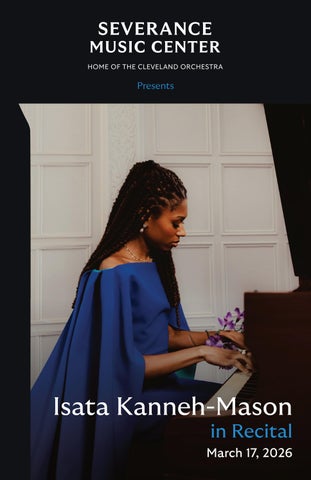
Isata Kanneh-Mason, piano
Jack, Joseph and Morton Mandel Concert Hall at Severance Music Center Tuesday, March 17, 2026, at 7:30 PM
LUDWIG VAN BEETHOVEN (1770–1827)
MAURICE RAVEL (1875–1937)
DOBRINKA TABAKOVA (B. 1980)
DOBRINKA TABAKOVA
Piano Sonata No. 14 in C-sharp minor, Op. 27, No. 2, “Moonlight”
I. Adagio sostenuto —
II. Allegretto
III. Presto agitato
Gaspard de la nuit
I. Ondine
II. Le Gibet
III. Scarbo
INTERMISSION
Nocturne
Halo
I. From Darkness —
II. To Blinding Sunshine —
III. Calm and Settled Glow
LUDWIG VAN BEETHOVEN
Piano Sonata No. 21 in C major, Op. 53, “Waldstein”
I. Allegro con brio
II. Introduzione. Adagio molto —
III. Rondo. Allegretto moderato — Prestissimo
The performance lasts about 1 hour 40 minutes. Generous support for the 2025–26 Recital Series provided by the Art of Beauty Company, Inc.
A LITTLE NIGHT MUSIC . . .
Music, it seems, has always been associated with the night. We imagine the earliest human groups singing stories in cave dwellings to ward off fear of the encroaching dark. In our own earliest memories, loving parents calm us to sleep with favorite lullabies. Later in life, pubs and nightclubs offer a different kind of nocturnal music, unless, of course, we prefer to attend evening performances of opera, ballet, or orchestral music.
The musical nocturne, popularized by composer-pianist Frédéric Chopin , began as music intended to accompany evening gatherings in the 18th century. Mozart ’s Serenade No. 13 for strings, Eine kleine Nachtmusik , is perhaps the most famous instance of this multi-movement instrumental genre. In the hands of Chopin and his Romantic contemporaries, however, the nocturne became a genre of single-movement piano works characterized by lyrical melodies and sweeping arpeggiated accompaniment — conjuring sensuous moonlit scenes.
Drawing from much more than just nocturnes, this evening’s program tells the musical story of an evening, from the first glimmers of moonlight to the pink hues of dawn.
Written in 1802, Ludwig van Beethoven’s Piano Sonata No. 14 was given the enduring nickname “Moonlight” three decades later by the German critic Ludwig Rellstab, who saw in the remarkable opening movement “a boat passing the wild scenery of Lake Lucerne in the moonlight.” The second movement offers respite from the inky depths of the moonlit lake, but the placid evening turns stormy in the finale, as Beethoven unleashes a furious torrent of unrestrained passion.
Whether peaceful or stormy, the evening’s concealing shadows are a favorite disguise for impish tricksters. Maurice Ravel’s Gaspard de la nuit (1908) musically depicts three stories from Aloysius Bertrand’s eponymous book. The first movement, Ondine, tells the story of a nymph luring strangers to their watery deaths in her lake-bottom home. In the poem — and the music — a man refuses Ondine, churning her into spiteful outbursts. The second movement, Le Gibet, depicts a corpse hanging on a gibbet (or gallows) in the desert. The eerie scene is punctuated by the sound of insects completing the circle of life. The slippery third movement, Scarbo, follows a nocturnal goblin who enters houses and vanishes just as suddenly, without a trace.
Contemporary composer-pianist Dobrinka Tabakova offers a much more reverent view of nighttime. Her music often seeks to capture light, even amid darkness.
Ludwig van Beethoven
Maurice Ravel
Tabakova’s Nocturne (2008) is a refreshing nod to Chopin’s genre. Undulating and repetitive, it builds out in concentric circles from a familiar musical cell. The fi rst sense of a melody comes not in the right hand as expected, but from the lower left hand playing a syncopated tune below the still-pulsating chords. The mesmerizing piece fades to nothing almost before it has a chance to get started.
A much earlier work, Halo (1999) was written when the composer was only 18. Tabakova explains:
The inspiration for this suite came from a beautiful halo which had formed around the moon one summer’s night. Exploring a range of techniques for achieving harmonics on the piano, the piece describes a hypothetical life of a halo. The fi rst movement sees its birth from darkness, in the second the full strength of light is evoked through rapid repetitive fi gures, and the extreme registers of the piano; and the fi nal movement portrays a mature and settled halo.
The program closes as it opened, with a Beethovenian depiction of light. Often called the “Waldstein” Sonata for its dedicatee, Count Ferdinand Ernst Gabriel von Waldstein , Piano Sonata No. 21 (1804) also bears the nickname “L’Aurora” (The Dawn). After the pulsating, energetic fi rst movement, the open sonorities that begin the second movement conjure daybreak in much the same way as Rossini’s Overture to William Tell or Richard Strauss ’s Also sprach Zarathustra . And thus, our musical evening closes with the promise of a new day.
— Ellen Sauer Tanyeri
Ellen Sauer Tanyeri is The Cleveland Orchestra’s Archives & Editorial Assistant and is a PhD candidate in musicology at Case Western Reserve University.
Dobrinka Tabakova
Named
Mark Kosower + Frank Rosenwein, oboe
Richard Weiss + Gareth Thomas, bassoon
Martha Baldwin + Katherine Bormann, violin
Ralph Curry + Mary Kay Fink, flute
Tanya Ell + Charles Paul, bass
Dane Johansen + Jason Yu, violin
Brian Thornton + Eliesha Nelson, viola
Brian Thornton + William Bender, viola
Bryan Dumm, Artistic Director
SEVERANCE in Recital KANTOROW
in recital
APR 16 | THU 7:30 PM
Alexandre Kantorow, piano
Works by J.S. Bach, Medtner, Chopin, Alkan, Scriabin, and Beethoven
HAMELIN
in recital
MAY 5 | TUE 7:30 PM
Marc-André Hamelin, piano
Works by Haydn, Beethoven, Weinberg, and Rachmaninoff
Generous support for the 2025–26 Recital Series provided by the Art of Beauty Company, Inc.
Marc-André Hamelin’s performance is generously sponsored by Dr. Michael Frank and Patricia A.* Snyder.
*In Memoriam
ISATA KANNEH-MASON
Piano
Pianist Isata Kanneh-Mason offers eclectic and stimulating recital programs with repertoire encompassing Haydn and Mozart , Fanny Mendelssohn Hensel and Clara Schumann , Chopin and Brahms , Gershwin , and beyond.
Kanneh-Mason is in high demand worldwide. In July 2024, she performed at the First Night of the BBC Proms at Royal Albert Hall with the BBC Symphony Orchestra and Elim Chan , recieving stellar reviews. Kanneh-Mason then went on to appear as concerto soloist with the European Union Youth Orchestra and Iván Fischer in summer 2024, performing Dohnányi’s Variations on a Nursery Tune at Carnegie Hall.
Highlights of the 2025–26 season include Rachmaninoff ’s Third Piano Concerto with Bar Avni and the Netherlands Radio Philharmonic Orchestra, and with Petr Popelka with the Prague Radio Symphony Orchestra. Kanneh-Mason makes further debuts with the Naples Philharmonic and Seattle Symphony, and returns to the City of Birmingham Symphony Orchestra, BBC Scottish Symphony Orchestra, Detroit Symphony Orchestra, and National Arts Centre Orchestra in Ottawa.
Kanneh-Mason also appears in solo recital and in chamber music performances at Wigmore Hall, with further recital appearances at the Isabella Stewart Gardner Museum in Boston, the Brucknerhaus in Linz, the Norwegian National Opera in Oslo, and the Philadelphia Chamber Music Society, among others.
Kanneh-Mason is a Decca Classics artist and has recorded four solo albums — Romance (2019), Summertime (2021), Childhood Tales (2023), and Mendelssohn (2024). Her most recent release presents music from two Mendelssohn siblings, including the glittering First Piano Concerto by Felix and the long-lost Easter Sonata by Fanny.
Kanneh-Mason has received many awards, including the coveted Leonard Bernstein Award from the Schleswig-Holstein Festival and an Opus Klassik award for Best Young Artist. She also enjoys composing and arranging, and, in 2023, released two albums of her favorite works for intermediate and advanced piano students through ABRSM Publishing.
BY
PHOTO
KAROLINA WIELOCHA
LATE SEATING
As a courtesy to audience members and musicians, late-arriving patrons are asked to wait quietly until the fi rst convenient break in the program. These seating breaks are at the discretion of the House Manager in consultation with the performing artists.
CELL PHONES, WATCHES & OTHER DEVICES
To ensure a quiet and respectful listening environment, please silence all electronic devices.
PHOTOGRAPHY, VIDEOGRAPHY & RECORDING
Audio recording, photography, and videography are not allowed during performances at Severance. Photographs can only be taken when the performance is not in progress.
THE NEW CLEVELAND ORCHESTRA APP
Explore upcoming concerts, purchase and access your tickets, receive performance updates, and more. Available for iOS and Android on Google Play and at the Apple App Store. More information is at clevelandorchestra.com/tcoapp
IN THE EVENT OF AN EMERGENCY
Contact an usher or a member of house staff if you require medical assistance. Emergency exits are clearly marked throughout the building. Ushers and house staff will provide instructions in the event of an emergency.
HEARING AIDS & OTHER HEALTH-ASSISTIVE DEVICES
In consideration of others, please reduce the volume on hearing aids and other healthassistive devices that may produce noise. For Infrared Assistive-Listening Devices, please see an usher. To request one in advance, email info@clevelandorchestra.com.
AGE GUIDELINES
Regardless of age, each person must have a ticket and be able to sit quietly in a seat throughout the performance. Classical Season subscription concerts are not recommended for children under 8. However, there are several age-appropriate series designed specifically for children and youth, including Music Explorers (for 3 to 6 years old) and Family Concerts (for ages 7 and older).
Editorial: Kevin McBrien, Editorial & Publications Manager (kmcbrien@clevelandorchestra.com)
Ellen Sauer Tanyeri, Archives & Editorial Assistant
Design: Melissa Leone (melissa@melissaleone.com)
Program books for Cleveland Orchestra concerts are produced by The Cleveland Orchestra and are distributed free to attending audience members.
The Cleveland Orchestra is proud to have its home, Severance Music Center, located on the campus of Case Western Reserve University, with whom it has a long history of collaboration and partnership.