Presented by Dr. Michael Frank and Pat Snyder (deceased) Recital in Thursday, July 30, 2026 | 7:30 PM Gartner Auditorium, Cleveland Museum of Art
Classical piano luminary and living legend, Jean-Yves Thibaudet returns to Cleveland for a rare solo recital of Debussy’s Préludes.
Jean-Yves Thibaudet
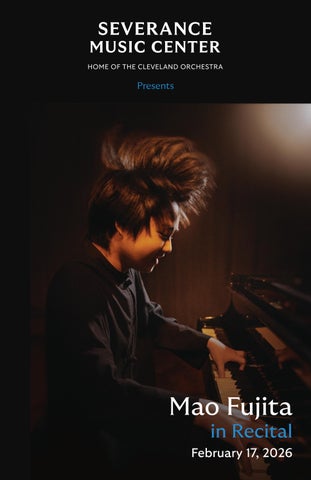
Mao Fujita, piano
Jack, Joseph and Morton Mandel Concert Hall at Severance Music Center Tuesday, February 17, 2026, at 7:30 PM
LUDWIG VAN BEETHOVEN (1770–1827)
RICHARD WAGNER (1813–1883)
ALBAN BERG (1885–1935)
FELIX MENDELSSOHN (1809–1847)
JOHANNES BRAHMS (1833–1897)
RICHARD WAGNER
Piano Sonata No. 1 in F minor, Op. 2, No. 1
I. Allegro
II. Adagio
III. Menuetto: Allegretto
IV. Prestissimo
Ein Albumblatt
Twelve Variations on an Original Theme
Variations sérieuses, Op. 54
INTERMISSION
Piano Sonata No. 1 in C major, Op. 1
I. Allegro
II. Andante
III. Scherzo: Allegro molto e con fuoco — Più mosso
IV. Finale: Allegro con fuoco
Liebestod from Tristan und Isolde (trans. Franz Liszt)
This program will last about 1 hour and 40 minutes. Generous support for the 2025–26 Recital Series provided by the Art of Beauty Company, Inc. Mao Fujita’s performance is generously sponsored by Dr. Hiroyuki and Mrs. Mikiko Fujita
THE PIANO: A COMING-OF-AGE STORY
The long-19th century was an age of expansion, industrialization, and increasing global connectivity. Old systems of government were challenged and overturned throughout European spheres of influence, and innovations in electricity and printing technology created, for the first time, a sense of mass culture. The invention and astonishing rise of one machine in particular perfectly encapsulates this era of mind-boggling change: the piano.
The earliest pianos were modified harpsichords in which the strings (made from thin wires) were struck with a small hammer instead of plucked by a quill. These obscure instruments sounded more like a lute or guitar than a modern piano and never gained significant traction. By the latter half of the 18th century, a collection of devoted instrument builders in Vienna had made great progress in perfecting earlier prototypes. Mozart composed and performed on these Viennese instruments — somewhere between harpsichords and modern pianos — with leather hammers, damper and moderator pedals, and even small bells for sound effects.
Around the time Ludwig van Beethoven was composing his First Piano Sonata in 1795, piano building was undergoing another wave of radical change. Dedicated to his teacher, Haydn , this piece is not a keyboard sonata (equally suited to the piano or harpsichord) like those of earlier composers. Instead, it was expressly written for the evolving piano, with all of its lyric flexibility. The brooding first movement is marked piano, with interrupting sforzandos (sudden accents) throughout. In later movements, Beethoven’s dynamic markings span from pianissimo to fortissimo — a range unimaginable on earlier keyboards.
As pianos made it possible to play with a more powerful, sustained sound, composers like Beethoven responded with works that demanded instrument builders to take their innovations still further.
Beethoven’s development as a composer kept pace with advances in piano technology, but Romantic pianist-composers like Chopin , Robert and Clara Schumann , and Felix Mendelssohn came of age with much larger, more powerful keyboards. Mendelssohn’s Variations sérieuses, written in 1841, takes advantage of the full range of the ever-expanding length of the keyboard (from five octaves in Beethoven’s day to seven by 1820) and another technological advancement of piano building: double escapement action (a series of counterbalances allowing performers to rapidly repeat notes).
Ludwig van Beethoven
Felix Mendelssohn
FALL
NOV 28 – 30
Johannes Brahms
YUJA WANG PLAYS RAVEL
Petr Popelka, conductor
Yuja Wang, piano
RAVEL Piano Concerto for the Left Hand
25 / 26 SEASON
The next generation of Romantic composers, including Johannes Brahms , inherited pianos that now included castiron frames for higher string tension, allowing performers to play louder and more powerfully. Meanwhile, makers were experimenting with positioning the strings (now made of stronger combinations of wrapped wire) at varying angles to achieve equal volume across all registers of the instrument.
CALENDAR
FEB 5 – 7
HADELICH PLAYS
MENDELSSOHN
Antonello Manacorda, conductor
Augustin Hadelich, violin
MENDELSSOHN Violin Concerto
SCHOENBERG Chamber
Symphony No. 2
SCHUBERT Symphony No. 8, “Unfinished”
MAR 5, 7 & 8
BRAHMS’S THIRD SYMPHONY
Brahms’s comfort at this new-and-improved keyboard is apparent in his First Piano Sonata . Almost the same length as Beethoven’s fi rst attempt at the genre, Brahms’s sonata nevertheless feels worlds away. He writes much denser chords, packing as many notes and as much sound into the piano as possible. Each movement contains its own full range of characters, calling for effects and articulations far beyond the scope of Beethoven or even Mendelssohn.
LIGETI Concerto for Piano and Orchestra
MUSSORGSKY/RAVEL Pictures at an Exhibition
DEC 4 – 6
HANDEL’S MESSIAH
Bernard Labadie, conductor
Liv Redpath, soprano
Tim Mead, countertenor
Andrew Haji, tenor
Philippe Sly, bass-baritone
The Cleveland Orchestra Chorus HANDEL Messiah
WINTER
FEB 12 & 14
HANNIGAN CONDUCTS
GERSHWIN
Barbara Hannigan, conductor
Johanna Wallroth, soprano
CRUMB A Haunted Landscape
RUGGLES Sun-Treader
BARBER Knoxville: Summer of 1915
GERSHWIN Porgy and Bess: A Symphonic Picture (arr. Bennett)
RECITAL
FEB 17
MAO FUJITA IN RECITAL
Mao Fujita, piano
Jakub Hrůša, conductor
BRAHMS Symphony No. 3
MARTINŮ Symphony No. 3
KAPRÁLOVÁ Military Sinfonietta
MAR 12 – 15
BEETHOVEN’S FATEFUL FIFTH
Elim Chan, conductor
A virtuoso composer-performer like Brahms, Franz Liszt took full advantage of the expressive potential of these instruments. He was foremost among a collection of international virtuosos who succeeded in part because of their appeal to female audiences. In addition to Liszt’s devilishly good looks, the growing ubiquity of pianos in drawing rooms contributed to his sensational fame. Mass production meant that pianos were more available and affordable than ever, and they quickly became essential markers of female gentility in Europe and America — for far more than just the upper classes. (This trend was also reflected in much of the period’s visual art, such as in the painting Young Woman at the Piano by the Belgian artist Agapit Stevens , seen on page 4.)
JAN 8 – 10
Works by Beethoven, Wagner, Berg, Mendelssohn, and Brahms
Michael Sachs, trumpet
STRAVINSKY Suite from Pulcinella
HAYDN Trumpet Concerto
BEETHOVEN Symphony No. 5
RECITAL
MAR 17
THE KANNEH-MASONS IN RECITAL
Sheku Kanneh-Mason, cello
Isata Kanneh-Mason, piano
Works by Mendelssohn, N. Boulanger, R. Schumann, and Clarke
MAR 19 – 21
CHAN CONDUCTS
MOZART’S JUPITER SYMPHONY
Franz Welser-Möst, conductor
MOZART Symphony No. 41, “Jupiter”
SHOSTAKOVICH Symphony No. 11, “The Year 1905”
JAN 15, 17 & 18
VERDI’S REQUIEM
Franz Welser-Möst, conductor
Asmik Grigorian, soprano
FEB 19 – 21
FRENZIED TANGO
John Adams, conductor
Aaron Diehl, piano
IVES From Greenland’s Icy Mountains*
TIMO ANDRES Made of Tunes
JOHN ADAMS Frenzy: a short symphony
PIAZZOLLA La Mufa (arr. Adams)*
PIAZZOLLA Oblivion (arr. Adams)*
PIAZZOLLA Libertango (arr. Adams)
BARTÓK
Elim Chan, conductor
Patricia Kopatchinskaja, violin
DANIEL KIDANE Sun Poem*
BARTÓK Violin Concerto No. 1
BARTÓK Dance Suite*
SCRIABIN The Poem of Ecstasy
SPRING
Deniz Uzun, mezzo-soprano
Richard Wagner
Joshua Guerrero, tenor
Tareq Nazmi, bass
The Cleveland Orchestra Chorus
VERDI Requiem
Liszt’s arrangements of opera melodies and other familiar tunes were reproduced as sheet music and sold by the thousands to this market. His transcription of Richard Wagner ’s Liebestod from Tristan und Isolde honors the original quite closely. At the beginning of the century, pianos were not equipped to mimic the pulsating swells and tantalizing sustains of a full string section and Wagnerian soprano; that Liszt’s pianos could so evocatively capture this sound world was enough of a feat, without any of the fl ashy embellishment for which he was so well known.
FEB 26 – 28
STRAUSS’S DON JUAN
Alain Altinoglu, conductor
Alisa Weilerstein, cello
UNSUK CHIN Cello Concerto
R. STRAUSS Till Eulenspiegel’s
Merry Pranks
R. STRAUSS Don Juan
APR 2 – 4
DEBUSSY’S LA MER
Daniele Rustioni, conductor
Paul Jacobs, organ
FAURÉ Suite from Pelléas et Mélisande
POULENC Concerto for Organ, Strings, and Timpani
CASELLA Italia
DEBUSSY La mer
The women who drove the piano boom of the late-19th century also fueled the sheet music boom to which Liszt contributed, and often assembled individual songs and pieces into personalized leather-bound volumes. These treasured collections contain intimate inscriptions, meaningful newspaper clippings, pressed flowers, and even locks of hair. It is perhaps to this practice that Wagner was referring in his piano piece Ein Albumblatt (An Album Page), evoking sentimentality to guarantee the preservation of his piece in just such collections.
Franz Liszt
By the turn of the 20th century, the piano had arrived at a form more or less recognizable today. In 1908, in other words, young Alban Berg was working with the same basic instrument that composers in 2026 encounter. While his Twelve Variations on an Original Theme pays homage to his Romantic forebears like Mendelssohn and Brahms, he was already looking to new horizons of musical possibility.
APR 9 – 11
SCHUBERT & SHOSTAKOVICH
Santtu-Matias Rouvali, conductor
Sol Gabetta, cello
SHOSTAKOVICH Cello Concerto No. 2
SCHUBERT Symphony No. 9, “The Great”
RECITAL
APR 16
clevelandorchestra.com
APR 30 & MAY 2
MENDELSSOHN’S REFORMATION SYMPHONY
Jörg Widmann, conductor
JÖRG WIDMANN Fanfare for Ten Brass Instruments
JÖRG WIDMANN Con brio
JÖRG WIDMANN Danse macabre
MAY 16, 21 & 24
ALEXANDRE KANTOROW IN RECITAL
Alexandre Kantorow, piano
MENDELSSOHN Symphony No. 5, “Reformation”
RECITAL
MAY 5
Works by J.S. Bach, Medtner, Chopin, Scriabin, and Beethoven
— Ellen Sauer Tanyeri
APR 23, 25 & 26
BRITTEN’S WAR REQUIEM
BEETHOVEN’S FIDELIO
Franz Welser-Möst, conductor
Malin Byström, soprano (Leonore)
Alban Berg
David Butt Philip, tenor (Florestan)
Tomasz Konieczny, bass-baritone (Don Pizarro)
Martin Summer, bass (Rocco)
Dashon Burton, bass-baritone (Don Fernando)
With the mechanization and standardization of the piano had come a new system of tuning that equally spaced the pitches on the keyboard. For centuries, tuning had been based on adjusting intervals in a given major or minor key to sound purer (which resulted in unevenly spaced half-steps). Equal temperament, on the other hand, brought the opportunity to step away from major and minor scales altogether and reimagine a musical system where all 12 notes could hold equal importance.
Ashley Emerson, soprano (Marzelline)
Along with Arnold Schoenberg and Anton Webern , Berg was a member of the socalled Second Viennese School of composers, who led the charge for this 12-tone system. Together, they helped set the stage for a new century of even more unprecedented innovation and upheaval.
MARC-ANDRÉ HAMELIN & MARIA JOÃO PIRES IN RECITAL
Marc-André Hamelin, piano
Maria João Pires, piano Program to be announced
Owen McCausland, tenor (Jaquino)
The Cleveland Orchestra Chorus
BEETHOVEN Fidelio
Opera presentation sung in German with projected supertitles
MAY 22
HERO’S SONG
Ellen Sauer Tanyeri is The Cleveland Orchestra’s Archives & Editorial Assistant and is a PhD candidate in musicology at Case Western Reserve University.
Daniel Harding, conductor
Tamara Wilson, soprano
Andrew Staples, tenor
Ludwig Mittelhammer, baritone
The Cleveland Orchestra Chorus
The Cleveland Orchestra Children’s Chorus
BRITTEN War Requiem
MAY 7 – 9
WAGNER’S GÖTTERDÄMMERUNG
Franz Welser-Möst, conductor
Jörg Widmann, clarinet
PROKOFIEV Symphony No. 1, “Classical”
OLGA NEUWIRTH Zones of Blue* WAGNER Excerpts from Götterdämmerung
Franz Welser-Möst, conductor
Leila Josefowicz, violin
Trina Struble, harp
ADOLPHUS HAILSTORK
Epitaph for a Man Who Dreamed BACEWICZ Symphony No. 4
JÜRI REINVERE Concerto for Violin, Harp, and Orchestra
DVOŘÁK Hero’s Song
* Not performed on the Friday matinee concert Generous support for the 2025 – 26 Recital Series provided by the Art of Beauty Company, Inc.
SEVERANCE in Recital
THE KANNEH-MASONS in recital
MAR 17 | TUE 7:30 PM
Sheku Kanneh-Mason, cello Isata Kanneh-Mason, piano
Works by Mendelssohn, N. Boulanger, R. Schumann, and Clarke
KANTOROW
in recital
APR 16 | THU 7:30 PM
Alexandre Kantorow, piano
Works by J.S. Bach, Medtner, Chopin, Scriabin, and Beethoven HAMELIN in recital
MAY 5 | TUE 7:30 PM
Marc-André Hamelin, piano
Works by Haydn, Beethoven, Weinberg, and Rachmaninoff
Generous support for the 2025–26 Recital Series provided by the Art of Beauty Company, Inc.
Marc-André Hamelin’s performance is generously sponsored by Dr. Michael Frank and Patricia A.* Snyder.
*In Memoriam
MAO FUJITA
Piano
With an innate musical sensitivity and natural artistry, pianist Mao Fujita is equally at home in Mozart as the major Romantic repertoire. Following his 2023 Carnegie Hall debut, The New York Times wrote, “As soon as his fi ngers touched the keys, waves of airy fi ligree, beautifully shaped and accomplished, emerged in almost continuous streams.”
Born in Tokyo, Fujita won his fi rst international prize at the 2010 World Classic in Taiwan and became a laureate of numerous national and international competitions. Fujita was studying at the Tokyo College of Music in 2017 when he took First Prize at the prestigious Concours International de Piano Clara Haskil in Switzerland, along with the Audience Award, Prix Modern Times, and the Prix Coup de Coeur, which fi rst brought him to the attention of the international music community. He was also the Silver Medalist at the 2019 Tchaikovsky Competition in Moscow.
Fujita has worked with many of the leading conductors of our time, including Semyon Bychkov, Riccardo Chailly, Elim Chan , Andris Nelsons, Petr Popelka , and Kazuki Yamada . Previous orchestral debuts include the Royal Concertgebouw Orchestra, Lucerne Festival Orchestra, Los Angeles Philharmonic, and Tokyo Metropolitan Symphony Orchestra. A sought-after chamber musician, Fujita has worked with Emanuel Ax , Kirill Gerstein , Antoine Tamestit , and the Hagen Quartett, among others.
In the 2025–26 season, Fujita appears at major festivals and orchestras across Europe, the US, and Asia, including the Salzburg Festival, Royal Philharmonic Orchestra, Gewandhausorchester, and Boston Symphony Orchestra. He also embarks on a recital tour across North America with performances in New York, Cleveland, Boston, St. Paul, San Francisco, Vancouver, and San Diego.
Fujita is an exclusive Sony Classical International artist. In October 2022, his eagerly anticipated debut album, a studio recording of Mozart’s complete piano sonatas, was released to unanimous acclaim. His second album, an ambitious set entitled 72 Preludes, was released in fall 2024.
As a courtesy to audience members and musicians, late-arriving patrons are asked to wait quietly until the fi rst convenient break in the program. These seating breaks are at the discretion of the House Manager in consultation with the performing artists.
CELL PHONES, WATCHES & OTHER DEVICES
To ensure a quiet and respectful listening environment, please silence all electronic devices.
PHOTOGRAPHY, VIDEOGRAPHY & RECORDING
Audio recording, photography, and videography are not allowed during performances at Severance. Photographs can only be taken when the performance is not in progress.
THE NEW CLEVELAND ORCHESTRA APP
Explore upcoming concerts, purchase and access your tickets, receive performance updates, and more. Available for iOS and Android on Google Play and at the Apple App Store. More information is at clevelandorchestra.com/tcoapp
IN THE EVENT OF AN EMERGENCY
Contact an usher or a member of house staff if you require medical assistance. Emergency exits are clearly marked throughout the building. Ushers and house staff will provide instructions in the event of an emergency.
HEARING AIDS & OTHER HEALTH-ASSISTIVE DEVICES
In consideration of others, please reduce the volume on hearing aids and other healthassistive devices that may produce noise. For Infrared Assistive-Listening Devices, please see an usher. To request one in advance, email info@clevelandorchestra.com.
AGE GUIDELINES
Regardless of age, each person must have a ticket and be able to sit quietly in a seat throughout the performance. Classical Season subscription concerts are not recommended for children under 8. However, there are several age-appropriate series designed specifically for children and youth, including Music Explorers (for 3 to 6 years old) and Family Concerts (for ages 7 and older).
Program books for Cleveland Orchestra concerts are produced by The Cleveland Orchestra and are distributed free to attending audience members.
The Cleveland Orchestra is proud to have its home, Severance Music Center, located on the campus of Case Western Reserve University, with whom it has a long history of collaboration and partnership.