
Severance Music Center April 16 Recital

Page 1


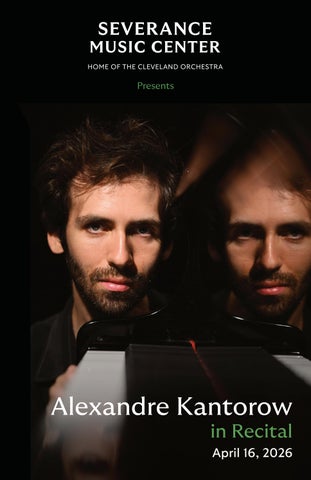
Alexandre Kantorow, piano

Jack, Joseph and Morton Mandel Concert Hall at Severance Music Center Thursday, April 16, 2026, at 7:30 PM

J.S. BACH/ FRANZ LISZT (1685–1750/1811–1886)

NIKOLAI MEDTNER (1880–1951)

FRÉDÉRIC CHOPIN (1810–1849)

CHARLES-VALENTIN ALKAN (1813–1888)

ALEXANDER SCRIABIN (1872–1915)

LUDWIG VAN  BEETHOVEN (1770–1827)

Variations on Weinen, Klagen, Sorgen, Zagen, S. 180

Piano Sonata in F minor, Op. 5

I. Allegro

II. Intermezzo: Allegro

III. Largo divoto —

IV. Finale: Allegro risoluto

INTERMISSION

Prelude in C-sharp minor, Op. 45

Prelude No. 8 in A-flat minor, Op. 31 (Chanson de la folle au bord de mer)

Vers la flamme, Op. 72

Piano Sonata No. 32 in C minor, Op. 111

I. Maestoso — Allegro con brio ed appassionata

II. Arietta: Adagio molto semplice e cantabile

The performance lasts about 2 hours

Generous support for the 2025–26 Recital Series provided by the Art of Beauty Company, Inc.

VARIATIONS ON WEINEN, KLAGEN, SORGEN, ZAGEN , S. 180

Composed: 1862

Duration: about 20 minutes

Beyond his role as one of the most important virtuoso pianists of the 19th century, Franz Liszt did much to shape modern music culture, using his recitals — he was the first to use that term to describe a solo musical performance — to introduce audiences to works not normally heard on virtuoso concerts: transcriptions of Beethoven symphonies and Schubert songs, Beethoven piano sonatas (which had never been heard in a public setting), and music of “ancient” composers such has Handel and J.S. Bach

(1811–1886)

He wrote several works based on Bach’s music, and among the most significant was his Variations on Weinen, Klagen, Sorgen, Zagen (Weeping, Lamenting, Worrying, Wavering), the popular title of Bach’s Cantata No. 12. The famous opening movement suggests that these states, along with anguish and distress, are the burden that must be borne by all Christians. This message is conveyed by Bach through highly dissonant contrapuntal writing and, most distinctively, by a descending chromatic bass line. (Bach reused this music in the Crucifixus movement of his Mass in B minor.)

Liszt was especially attracted to this aspect of Bach’s compositional style, once writing in a letter that, while he enjoyed Handel’s “common chords,” he “long[ed] for the precious dissonances of ... Bach’s polyphonic wares.” Liszt may also have been particularly drawn to Bach’s themes of anguish as he wrote his variations following the death of his daughter Blandine in 1862.

After a brief but ominous introduction, Liszt presents a powerful version of Bach’s ground bass in octaves before recreating the quiet sadness of the cantata’s opening phrases. The variations that follow build to an intense climax before the energy quickly dissipates, leading to a long, slow recitative marked lagrimoso (tearful) that is followed by further variations of increasing intensity. But then we hear a simple four-part setting of the chorale that closes Bach’s cantata: “What God does is done well — I will abide by this.” Buoyed by the peace that comes with this sentiment, the work ends in major with a mood of hopeful resolve.

— Michael Strasser

Michael Strasser is professor emeritus of musicology at Baldwin Wallace University. He has published numerous articles and reviews and presented papers at international conferences on fin-de-siècle France, Arnold Schoenberg, and colonial music in British North America and Mexico.

PIANO SONATA IN F MINOR, OP. 5

Composed: 1903

Duration: about 30 minutes

The piano sonata, principal genre for solo piano music during the Classical period, declined in popularity during the 19th century, replaced by the more expressive onemovement character piece. In the early 20th century, the sonata enjoyed a revival of interest in Russia, with multiple examples by Rachmaninoff, Scriabin , Prokofiev, and Nikolai Medtner

Medtner was born in Moscow to parents of German lineage, and he was raised to value German culture as much as that of his native land. An outstanding pianist, he eschewed a performance career in favor of composition, inspired greatly by the last quartets and sonatas of Beethoven .

Medtner wrote 14 piano sonatas and his first, a four-movement work completed in 1903, exhibits a rare early maturity that drew praise from his contemporaries and elders alike. The four movements are linked by common motives and themes, making it a fine example of the cyclic form that was so common in Western music in the late 19th century.

The F-minor opening movement features a first theme built around a distinctive rhythmic motive and a darkly lyrical second theme in C minor. Medtner’s skill in manipulating these disparate themes, finally bringing them together in the coda, would become a hallmark of his music. The short march-like second movement is in rondo form, with the distinctive refrain always appearing in minor while the interrupting episodes are always in major.

The emotional heart of the sonata is the slow, meditative third movement. In a loose sonata form, its first theme recalls ideas from the opening movement while an ethereal second theme suggests a quasi-religious sentiment. The ending incorporates material from the second movement.

The first theme of the brilliant finale also borrows motivic ideas from previous movements, while the second theme is a chorale-like, major-key transformation of the dark lyrical theme from the first movement. A fugato section in the development demonstrates Medtner’s contrapuntal skills, and the work ends triumphantly in F major. — Michael Strasser

PRELUDE IN C-SHARP MINOR, OP. 45

Composed: 1841

Duration: about 5 minutes

Frédéric Chopin was the fi rst major composer to write almost exclusively for the piano. Although he composed three piano sonatas, the vast majority of his solo piano works took the form of character pieces, short onemovement works. While his contemporary Robert Schumann appended titles to his character pieces and published them in sets arranged by narrative or topical connections, Chopin’s received only a generic title (Nocturne, Ballade, etc.) and were intended to be independent.

The Prelude in C-sharp minor, Op. 45, composed in 1841, is not to be confused with the 24 Preludes of Op. 28, which were inspired by the example of J.S. Bach’s The Well-Tempered Clavier. Like etudes, preludes were considered teaching pieces in the 19th century, with each focusing on a particular technique essential to the development of a pianist’s skills. Chopin wrote 24 etudes in two sets of 12, and the Prelude in C-sharp minor belongs to the same pedagogical tradition while incorporating the feeling of improvisation that has always been an important characteristic of the genre.

SEVERANCE in Recital

HAMELIN in recital MAY 5 | TUE 7:30 PM

Marc-André Hamelin, piano Works by Haydn, Beethoven, Weinberg, and Rachmaninoff

PRELUDE NO. 8 IN A-FLAT MINOR, OP. 31 ( CHANSON DE LA FOLLE AU BORD DE MER )

Composed: 1844

Duration: about 10 minutes

Charles-Valentin Alkan , born in Paris to Jewish parents, was another composer who wrote almost exclusively for piano. A musical prodigy, he was admitted to the Paris Conservatoire before his sixth birthday. He quickly rose to fame as a virtuoso performer, but his career stalled in the late 1830s. Frustrated by his lack of recognition, he virtually disappeared for some 20 years before reappearing in the early 1870s to present a series of annual “Petits Concerts” that revived interest in both his playing and his compositions.

Alkan’s music varies in difficulty and in scale, and much of it is highly inventive. His incorporation of Jewish melodies was rare among his contemporaries, and he was probably the fi rst to attempt to depict the sound of a locomotive (in 1844). He employed tone clusters, progressive tonality (ending a work in a different key than the one in which the work began), and unusual keys such as E-sharp major.

His 25 Preludes, Op. 31 (for piano or organ) were composed in 1844 and published three years later. Like Chopin’s Op. 28 Preludes, there is one in each major and minor key, with an additional piece in C major to conclude the collection. Some of these short pieces are labeled only with a tempo indication, but others have descriptive titles, including Prelude No. 8 in A-fl at minor: Chanson de la folle au bord de la mer (Song of the Madwoman on the Seashore). This evocative piece is built around repeated chords near the bottom of the piano’s range and a simple melody separated from these chords by several octaves. The haunting mood of the opening gives way to a more animated section before concluding with the calm but unsettling music with which the piece began.

VERS LA FLAMME , OP. 72

Composed: 1914

Duration: about 5 minutes

Alexander Scriabin was a classmate of Rachmaninoff at the Moscow Conservatory, but these two Russian composers could not have been any more different in temperament or musical style. Initially influenced by Chopin and late-Romantic music, Scriabin became one of the early 20th-century composers to explore alternatives to the tonal system that had served as the foundation for Western music over some three centuries.

Although Scriabin composed significant works for orchestra, most of his music was written for piano. Like Medtner, he helped revive the sonata as an important piano genre, writing 10 over the course of his brief career. The first five of these are tonal, but the last five dispense with key signatures and, instead of being based on a tonic, they are organized around a foundational chord — often made up of notes from an octatonic scale (an eight-tone scale with alternating whole and half steps).

Scriabin’s musical explorations were greatly influenced by his philosophical pursuits. He was interested in theosophy (a mystical philosophical-religious movement that maintained that knowledge of God could be sought through spiritual ecstasy or direct intuition) and believed that symbolic images and indirect suggestion could express mystical ideas and emotions.

It is in this context that we should view Vers la flamme (Toward the Flame), one of Scriabin’s most popular, and difficult, works for piano. It begins quietly in the lower register with a series of mysterious chords. Eventually, a repeated descending minorsecond figure appears above the chords. The music gradually increases in volume and energy while continually moving higher in range. New thematic elements, including an ever-ascending series of repeated eighth-note chords, are introduced as the music climbs ecstatically into the heights, moving ever closer to the “flame” of ultimate enlightenment or, if you will, God.

PIANO SONATA NO. 32

IN C MINOR, OP. 111

Composed: 1822

Duration: about 30 minutes

The works of Ludwig van Beethoven’s last years were more reflective, ambitious, and complex than those of his earlier career. Two hallmarks of his late style were his preoccupations with the fugue and variation forms, and many of the late works, including the Piano Sonata No 32. in C minor, Op. 111, contain elements of both.

The last of a series of three sonatas that Beethoven composed from 1820 to 1822, Op. 111 was also the last sonata he ever composed. The first of the work’s two movements combines sonata form with fugal techniques. With the jarring sounds of diminished chords, it begins with a dramatic Maestoso introduction before launching into a stormy Allegro for its distinctive first theme. The exposition ends improbably in A-flat major before the development section offers a full-blown fugal episode based on that first theme. The recapitulation moves eventually to C major, thus setting the stage for the second movement.

The Adagio second movement is a set of variations on a simple theme in C major. While Beethoven had written variation sets throughout his career, musicologist Maynard Solomon observes that in his late works, “he imbued the form with a ‘transfigured,’ almost ecstatic content and a profundity of expression, which indicated that he had found in this basic musical form a new vehicle for his most imaginative musical thoughts.” After the theme is presented, each of the four variations that follow carries the music further afield, exploring the limits of both the technical possibilities of the piano and the expressive potential of the theme, with the last ending up in the distant key of E-flat major. After the suspenseful but brief transition back into C major, a fifth variation is followed by a coda that ends reverently, serving as a fittingly quiet farewell to the sonata.

These two movements have often been characterized as contrasts between minor and major, dark and light, even earth and heaven, with all that comparison implies. In this last sonata, we enjoy the transcendent, almost otherworldly character of the music Beethoven composed in the twilight of his life.

— Michael Strasser

ALEXANDRE KANTOROW

Piano

Alexandre Kantorow is in demand at the highest level across the globe, performing in the world’s fi nest halls both in recital and with the most renowned orchestras and conductors. In 2019, at age 22, he became the fi rst French pianist to win the Gold Medal at the International Tchaikovsky Competition, along with the rarely awarded Grand Prix, granted only three times in the competition’s history. In 2024, Kantorow was recognized once again when he received the esteemed Gilmore Artist Award, solidifying his place as one of the world’s leading pianists.

Highlights of Kantorow’s 2025–26 season include a tour of Japan with the Concertgebouw Orchestra and Klaus Mäkelä , European tours with the Filarmonica della Scala and Riccardo Chailly and the London Philharmonic Orchestra and Paavo Järvi , a tour of Asia with the Orchestre Philharmonique de Radio France and Jaap van Zweden , and a tour to the US with the Philharmonia Orchestra and Marin Alsop, which includes a performance at Carnegie Hall. He will also embark on a major recital tour of North America, make his debut with the San Francisco Symphony, and return to the Rotterdam Philharmonic Orchestra and Bavarian Radio Symphony Orchestra.

Kantorow performs in recital regularly across the globe, in venues such as Carnegie Hall, Concertgebouw Amsterdam, Vienna Konzerthaus, London’s Wigmore Hall, Philharmonie de Paris, Tokyo Suntory Hall, and at festivals such as Edinburgh, Salzburg, Verbier, and Klavierfest Ruhr. Chamber music is one of his great pleasures and he performs regularly with artists such as Janine Jansen , Renaud Capuçon , Gautier Capuçon , and Matthias Goerne. With Liya Petrova and Aurélien Pascal he is co-artistic director of the Musikfest and “Rencontres Musicales de Nîmes” and the Pianopolis festival in Angers.

Kantorow records exclusively for BIS. His recordings have received critical acclaim worldwide, and most recently, he was awarded the Gramophone Award in the Piano category for his Brahms and Schubert recording. In 2024, he was awarded the title of Chevalier of the National Order of Merit by the French President of the Republic, having previously been made a Chevalier of the Order of Arts and Letters by the Minister of Culture. In July 2024, Kantorow performed Ravel’s Jeux d’eau at the Olympic Opening Ceremony in Paris.

BY

PHOTO
SASHA GUSOV

LATE SEATING

As a courtesy to audience members and musicians, late-arriving patrons are asked to wait quietly until the fi rst convenient break in the program. These seating breaks are at the discretion of the House Manager in consultation with the performing artists.

CELL PHONES, WATCHES & OTHER DEVICES

To ensure a quiet and respectful listening environment, please silence all electronic devices.

PHOTOGRAPHY, VIDEOGRAPHY & RECORDING

Audio recording, photography, and videography are not allowed during performances at Severance. Photographs can only be taken when the performance is not in progress.

THE NEW CLEVELAND ORCHESTRA APP

Explore upcoming concerts, purchase and access your tickets, receive performance updates, and more. Available for iOS and Android on Google Play and at the Apple App Store. More information is at clevelandorchestra.com/tcoapp

IN THE EVENT OF AN EMERGENCY

Contact an usher or a member of house staff if you require medical assistance. Emergency exits are clearly marked throughout the building. Ushers and house staff will provide instructions in the event of an emergency.

HEARING AIDS & OTHER HEALTH-ASSISTIVE DEVICES

In consideration of others, please reduce the volume on hearing aids and other healthassistive devices that may produce noise. For Infrared Assistive-Listening Devices, please see an usher. To request one in advance, email info@clevelandorchestra.com.

AGE GUIDELINES

Regardless of age, each person must have a ticket and be able to sit quietly in a seat throughout the performance. Classical Season subscription concerts are not recommended for children under 8. However, there are several age-appropriate series designed specifically for children and youth, including Music Explorers (for 3 to 6 years old) and Family Concerts (for ages 7 and older).

Copyright © 2026 by The Cleveland Orchestra and Musical Arts Association

Editorial: Kevin McBrien, Editorial & Publications Manager (kmcbrien@clevelandorchestra.com)

Ellen Sauer Tanyeri, Archives & Editorial Assistant

Design: Melissa Leone (melissa@melissaleone.com)

Program books for Cleveland Orchestra concerts are produced by The Cleveland Orchestra and are distributed free to attending audience members.

The Cleveland Orchestra is proud to have its home, Severance Music Center, located on the campus of Case Western Reserve University, with whom it has a long history of collaboration and partnership.

Turn static files into dynamic content formats.
Create a flipbook
Severance Music Center April 16 Recital by Live Publishing - Issuu