2026
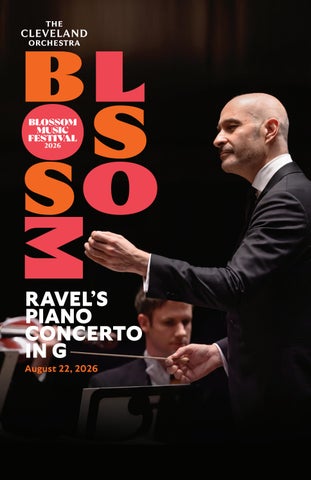
RAVEL’S PIANO CONCERTO IN G August 22, 2026
RAVEL’S PIANO CONCERTO IN G Saturday, August 22, 2026, at 7 PM 2026
The Cleveland Orchestra Antonello Manacorda, conductor
CLAUDE DEBUSSY (1862–1918)
Prelude to the Afternoon of a Faun
10 minutes
MAURICE RAVEL (1875–1937)
Piano Concerto in G major I. Allegramente II. Adagio assai III. Presto Nelson Goerner, piano
25 minutes
PRESENTED BY
I N T E R M I S S I O N | 20 minutes SEASON PARTNER
CLAUDE DEBUSSY
Nocturnes I. Nuages II. Fêtes III. Sirènes The Cleveland Orchestra Youth Chorus
MAURICE RAVEL
15 minutes Suite from Mother Goose I. Pavane of the Sleeping Beauty II. Tom Thumb III. Laideronnette, Empress of the Pagodas IV. Conversations of Beauty and the Beast V. The Enchanted Garden
MOVIE NIGHT PRESENTER
FAMILY ENGAGEMENT PARTNER
25 minutes
Total approximate running time: 1 hour 35 minutes
COVER PHOTO BY YEVHEN GULENKO
Tonight’s concert is sponsored by Buyers Products Company.
clevelandorchestra.com
3
MORE ROOM FOR WHAT MATTERS
©2026 California Closet Company, Inc. Each California Closets® franchised location is independently owned and operated. Local contractor licenses available at californiaclosets.com.
™
SCHEDULE YOUR COMPLIMENTARY DESIGN CONSULTATION 216.741.9000 | CALIFORNIACLOSETS.COM
CUSTOMXCLOSETS
ENTRYWAY
PANTRY
Brooklyn Heights 1100 Resource Dr Woodmere 28000 Chagrin Blvd
HOMEXOFFICE
INTRODUCTION
B
oth Claude Debussy and Maurice Ravel despised the term “impressionist” when others used it to describe their music. “Impressionism does not seem to have any precise meaning outside the domain of painting,” Ravel once remarked. Debussy
put it more bluntly in a 1908 letter: “What the imbeciles call ‘Impressionism’ is a term which is as poorly used as possible, particularly by art critics.” Regardless, the label stuck and many have come to hear the composers’ works as an auditory counterpart to the paintings of Monet, Degas, Morisot, and their compatriots. While much of Debussy’s and Ravel’s writing can aptly be described in impressionistic
terms, their music is remarkably diverse in sound and scope. Tonight’s program pairs four works — two each — from these musical pathbreakers, giving us a taste of the innovative flavors of French music at the turn of the 20th century. The evening opens with Debussy’s Prelude to the Afternoon of a Faun, which conjures a languid, mythical landscape through blurry harmonies and a vibrant orchestral palette. The work’s impetus came from a poem by Stéphane Mallarmé, a member of the French Symbolist movement, with whom Debussy considered himself more closely aligned than with the impressionists. We are then whisked into a Parisian dance hall courtesy of Ravel’s Piano Concerto in G major. It’s not difficult to hear the immense degree of talent required to tackle this sparkling piece — one minute, the soloist’s fingers are stretched to the limit in music reminiscent of a ragtag jazz combo; the next, they’re poised with the delicate touch of a Mozart sonata. After intermission, we return to Debussy’s sonic dreamscapes through his Nocturnes before closing with Ravel’s beloved Suite from Mother Goose. Originally written for four-hands piano, this music bursts to new life through Ravel’s ingenious orchestration. One can vividly hear the birds devouring Tom Thumb’s breadcrumbs, the jingling of the tiny pagodas, and the by-turns-tender-and-gruff conversation of Beauty and the Beast. Whatever “impressions” we gain from these, one thing’s for certain: it is impossible to hear this music without being transported. — Kevin McBrien Kevin McBrien is The Cleveland Orchestra’s Editorial & Publications Manager.
clevelandorchestra.com
5
THE M U S I C
Prelude to the Afternoon of a Faun by Claude Debussy BORN: August 22, 1862, in St. Germain-en-Laye, France DIED: March 25, 1918, in Paris COMPOSED: 1892–94 WORLD PREMIERE: December 22, 1894, by the Société Nationale de Musique in Paris,
conducted by Gustave Doret CLEVELAND ORCHESTRA PREMIERE: October 23, 1919, led by Music Director
Nikolai Sokoloff ORCHESTRATION: 3 flutes, 2 oboes, English horn, 2 clarinets, 2 bassoons, 4 horns,
2 harps, antique cymbals, and strings DURATION: about 10 minutes
PRELUDE TO THE AFTERNOON OF A FAUN was Claude Debussy’s first masterpiece and, in many ways, can be seen as the first masterpiece of 20th-century music — even though it predates the new century by six years. It is at times difficult to comprehend how a mere 10 minutes of music for small orchestra can serve as a cornerstone for so much that came after. But whenever we hear this music, its magic is immediately apparent, as it was indeed to its first audience in 1894. It is even harder to realize that these few pages, with their mysteriously improvisatory air, took Debussy two years of patient toil to put together. He was still relatively unknown in Paris and had not written anything close to the visionary step into the unknown that the Prelude represents. In a sense, Debussy was simply PHOTO: ATELIER NADAR, C. 1900 | PUBLIC DOMAIN
writing a symphonic poem on a literary text. But Stéphane Mallarmé’s L’après-midi d’un faune (The Afternoon of a Faun) was no conventional narrative poem, and it left no scope for the direct matching of music and words. In the note given out at the first performance, Debussy explained: CLAUDE DEBUSSY
6
BLOSSOM MUSIC FESTIVAL 2026
“The music of the Prelude is a very free
illustration of ... Mallarmé’s fine poem. It is not meant to be a synthesis of it but rather a series of settings across which pass the desires and dreams of the faun in the heat of the afternoon.” Many symphonic poems merely evoke a tableau or a mood, but Debussy allowed his music to develop freely, avoiding any precision of character or action. From the very first bar, the music evolves without clear-cut notions of thematic balance or tonal grounding. The famous opening flute solo sounds like an improvisation, not a theme, and its musical key is far from clear. Each time this melody comes back, its shape and its harmonic background are different, like a continuous variation. Once the flute solo has run its course, the clarinet, over a sharp horn chord, moves into a different atmosphere, laden with the whole-tone scales that Debussy had already marked as his own. When the oboe takes melodic charge, the warmth of the music grows from within. The middle section, over oscillating string chords, betrays the faun’s unmistakable passion, and the flute returns, transfigured for the creature’s languid intoxication in the forest heat, interrupted by impulsive little movements and sudden charges of feeling. The closing pages have an epic dimension, as if the curtain is closing on this world of poetic mystery. The orchestration throughout is extraordinarily delicate, with divided strings (Debussy’s preferred string sound), solo violin and solo cello for added sweetness, and two harps. No heavy brass is needed, nor timpani. The only percussion is a pair of small antique cymbals, whose spare notes sparkle like light in the forest. — Hugh Macdonald Hugh Macdonald is Avis H. Blewett Professor Emeritus of Music at Washington University in St. Louis. He has written books on Beethoven, Berlioz, Bizet, and Scriabin, as well as Music in 1853: The Biography of a Year.
clevelandorchestra.com
7
THE M U S I C
Piano Concerto in G major by Maurice Ravel BORN: March 7, 1875, in Ciboure, Basses-Pyrénées (now Pyrénées-Atlantiques), France DIED: December 28, 1937, in Paris COMPOSED: 1929–31 WORLD PREMIERE: January 14, 1932, with the composer conducting the Lamoureux
Orchestra and soloist Marguerite Long CLEVELAND ORCHESTRA PREMIERE: March 17, 1955, with Music Director George Szell
conducting and Grant Johannesen as soloist ORCHESTRATION: flute, piccolo, oboe, English horn, B-flat clarinet, E-flat clarinet,
2 bassoons, 2 horns, trumpet, trombone, timpani, percussion (bass drum, cymbals, snare drum, tam-tam, triangle, whip, woodblock), harp, and strings, plus solo piano DURATION: about 25 minutes
IN THE 1920S, FRENCH COMPOSER MAURICE RAVEL set out to write a piano concerto for himself. For many years, he had preferred to play relatively easy pieces in his public appearances as a concert pianist, since he was all too conscious that his playing technique was not up to the challenge of the more demanding works he’d created. But, as he began creating the new work for piano and orchestra, he was inspired to compose a concerto of proper difficulty. And he convinced himself that he could develop the required technique with diligent practice. Thus, his long composition hours were interspersed with hours devoted to practicing scales and études by Czerny and Chopin in what was ultimately a fruitless attempt, at the age of 55, to perfect his piano skills. It was only once the G-major Concerto was finished, late in 1931, with a premiere barely weeks away, that Ravel abandoned his soloist’s aspirations and turned to Marguerite Long, who had premiered his Le Tombeau de Couperin in 1917, to give the first performance. The composer instead resigned himself to the conductor’s baton. But from where did the musical ideas for Ravel’s concerto come? Writer and composer Gustave Samazeuilh recounted that, in 1911, he and Ravel spent a holiday in the Basque region of Spain (where both had roots) and that Ravel sketched a “Basque Concerto” for piano and orchestra. Without the right idea for a central linking movement, Ravel abandoned the work only to bring parts of it back to life 20 years later with the G-major Concerto. Meanwhile, livelier themes emerged from Ravel’s
8
BLOSSOM MUSIC FESTIVAL 2026
preoccupation with the brilliant percussive qualities of the piano itself and languorous PHOTO: BIBLIOTHÈQUE NATIONALE DE FRANCE, C. 1925 | PUBLIC DOMAIN
melodies emerge from his admiration for the new language of jazz. The sound of this concerto bears striking differences from that of its sibling, the Piano Concerto for the Left Hand, well beyond the doubling of fingers on the keyboard. In the G-major Concerto, Ravel concentrated the soloistic activity to the upper reaches of the keyboard. He also utilized a smaller orchestra — more an ensemble of soloists than the grand tutti of a full orchestra — which may account
MAURICE RAVEL
for Ravel’s assertion that he composed the G-major Concerto in the spirit of Mozart and Saint-Saëns, two composers of impeccably Classical pedigree. The three movements are accordingly laid out in a Classical plan, with two fast movements embracing a slow middle one. The first movement offers both quick and slow sections, the latter being the occasion for some virtuosic melodic flights for solo instruments — notably the bassoon, harp, and horn — while the piano is often required to be sweet in one hand and more directed in the other at the same time. (The blues scales often associated with the music of Gershwin, whom Ravel had met in 1924, are much in evidence.) Ravel cryptically spoke of writing the slow middle movement “one bar at a time.” He also referred to Mozart’s Clarinet Quintet as a basis (which is scarcely less mysterious, aside from the fact that melody-with-accompaniment is prominent in both works). The music itself is pure, both in the simplicity of the piano style and the absence of chromaticism. There is also a constant suggestion of “wrong” notes (in the manner of Satie), the wrongness in Ravel’s case being supremely calculated and proving to be exactly right. Simplicity gives way to complexity, and the melody returns in the English horn as the piano’s exquisite tracery continues to the end. The last movement is an unstoppable cascade, with the orchestra tested to the limit, not just the soloist. The movement is neatly framed, with its opening clustered discords returning as a signing-off at the end. — Hugh Macdonald
clevelandorchestra.com
9
THE M U S I C
Nocturnes by Claude Debussy COMPOSED: 1894–99 WORLD PREMIERE: The first two movements were premiered on December 9, 1900,
with Camille Chevillard conducting the Lamoureux Orchestra. The same performers premiered the complete work on October 27, 1901. CLEVELAND ORCHESTRA PREMIERE: April 27, 1920, led by Music Director
Nikolai Sokoloff ORCHESTRATION: 3 flutes (3rd doubling piccolo), 2 oboes, English horn, 2 clarinets,
3 bassoons, 4 horns, 3 trumpets, 3 trombones, tuba, timpani, percussion (cymbals, field drum), 2 harps, and strings, plus soprano and alto chorus DURATION: about 25 minutes
CLAUDE DEBUSSY OPENED THE DOOR TO A NEW CENTURY of innovation with his nuanced approach to musical texture in works such as his breakout Prelude to the Afternoon of a Faun and the subsequent three-part Nocturnes. The “nocturnal” aspect indicated by the title derives from Debussy’s inspiration by the French Symbolist poet Henri de Régnier — in particular, from his collection Trois Scènes au Crépuscule (Three Twilight Scenes). At first, Debussy thought about writing the pieces as a sort of violin concerto, which he had sketched out by 1894, for the eminent virtuoso Eugène Ysaÿe. However, before the music reached the public, Debussy recast Nocturnes, omitting the solo violin and, for the final panel, adding a wordless soprano and alto chorus. Debussy famously bristled at the comparisons routinely made between his style and that of the Impressionist painters. He particularly objected to the one-size-fits-all application of the term by critics to all manner of artists. Yet Debussy was deeply sensitive to the visual arts. Describing his Nocturnes to Ysaÿe, he said, “It is an experiment with the various combinations of texture that can be made from one color — like a study in grays in the realm of painting.” In the preface to his score, Debussy elaborated: “The title Nocturnes is to be interpreted here in a general and, more particularly, in a decorative sense. Therefore it is not meant to designate the usual form of a nocturne, but rather all the various impressions and the special effects of light that the word suggests.” Indeed, each movement of Debussy’s three-part work pursues a distinctive form and characteristic tone color. The first, Nuages (Clouds), presents “the slow motion of the clouds” in
10
BLOSSOM MUSIC FESTIVAL 2026
pastel shadings that drift against a plaintive figure from the English horn. Toward the end, flute and harp float amidst an atmosphere of languid lyricism. Of the contrastingly extroverted Fêtes (Festivals), the composer wrote that this movement began as an impression of a village fair at night, through which passes a unit of the Garde Républicaine, on horseback and with a regimental band, lit by torchlight. Debussy further writes that the music “gives us the vibrating, dancing rhythm of the atmosphere with sudden flashes of light. There is also the episode of the procession (a dazzling fantastic vision), which passes through the festive scene and becomes merged in it. But the background remains resistantly the same: the festival with its blending of music and luminous dust participating in the cosmic rhythm.” In the third movement, Sirènes (Sirens), Debussy returns to the ambiguously floating sensibility of Nuages. The title refers to the mythic creatures of Homer’s Odyssey, the island nymphs whose beautiful singing — evoked by the wordless chorus — is fatal to passing sailors, causing them to cast themselves into the sea. — Thomas May Thomas May is a writer, critic, educator, and translator. A regular contributor to The New York Times, The Seattle Times, Gramophone, and Strings magazine, he is the
IMAGE: FÉLIX ZIEM, C. 1850 |
PUBLIC DOMAIN, WIKIMEDIA COMMONS
English-language editor for the Lucerne Festival.
FÉLIX ZIEM, THE CALL OF THE SIRENS
French artist Félix Ziem painted this shimmering image of the Sirens around 1850, several decades before Debussy’s musical depiction.
clevelandorchestra.com
11
THE M U S I C
Suite from Mother Goose by Maurice Ravel COMPOSED: piano duet, 1908–10; orchestrated, 1911 WORLD PREMIERE: The orchestral version — staged as a ballet — was first presented
on January 29, 1912, conducted by Gabriel Grovlez. CLEVELAND ORCHESTRA PREMIERE: January 6, 1921, led by Music Director
Nikolai Sokoloff ORCHESTRATION: 2 flutes (2nd doubling piccolo), 2 oboes (2nd doubling English
horn), 2 clarinets, 2 bassoons (2nd doubling contrabassoon), 2 horns, timpani, percussion (bass drum, cymbals, glockenspiel, tam-tam, triangle, xylophone), celesta, harp, and strings DURATION: about 15 minutes
MAURICE RAVEL POSSESSED A PARTICULAR GIFT for evoking what he called “the poetry of childhood.” Much as dance is a guiding thread through several of his most important compositions, themes involving childlike fantasy also recur consistently across his works. Both aspects — childhood and dance — converge in his composition inspired by fairy tales from Ma Mère l’Oye (Mother Goose). Ravel initially conceived this music as a piano duet for siblings Mimi and Jean Godebski. (Their parents, a Polish couple who held salons that attracted a remarkable array of Parisian artists, provided a kind of second home for the composer.) This version of Mother Goose emanates a beguiling intimacy and ravishing sense of color quite independent of the later orchestral version. Though written for the talented Godebski children, the kids weren’t up to the task of giving the work’s first public performance — they complained it would require too much practice — so it was premiered in 1910 by another pair of prodigies. The following year, Ravel orchestrated these pieces, first as a suite, and later as the score for a ballet — with an altered order, added interludes, and a new opening sequence. For this, he concocted a scenario linking the famous fairy-tale stories drawn from Charles Perrault’s 1697 anthology as well versions by Baroness d’Aulnoy and Jeanne-Marie Le Prince de Beaumont. The orchestral work is more often performed, following the order of the piano duet’s five movements. The suite opens with Pavane of the Sleeping Beauty, which ushers us along with the princess into a dream state with its brief, stately processional and meltingly beautiful writing for woodwinds. At the same time, the Pavane’s sustained wistfulness
12
BLOSSOM MUSIC FESTIVAL 2026
IMAGE: WALTER CRANE, C. 1874 | PUBLIC DOMAIN
Throughout his prolific career, English artist Walter Crane contributed illustrations for numerous children’s books. This image from an 1874 edition of Beauty and the Beast shows the unlikely couple conversing in a lavish sitting room.
hints at the ambivalence of Ravel’s summoning of childhood — a poignant past recaptured by the knowing adult’s memory. Tom Thumb recounts the episode in which the poor woodcutter’s son tries to plan a way out of the woods by dropping breadcrumbs, only to discover (like Hansel and Gretel) that birds have eaten them. Little Tom (portrayed by the oboe) wanders in confusion, trying to find the path, while Ravel’s vivid depiction of the birds near the end shows off his facility for conjuring nature. Miniature people also figure in Laideronnette, Empress of the Pagodas. Here, a princess has been made the ugliest woman in the world by a witch’s spell (“laid” in French means ugly). She finds herself transported into a magical kingdom where her miniature subjects, robed in gems, serenade her with an orchestra whose instruments (the “pagodas” in Ravel’s sense) are made of nutshells. Nuanced touches from the percussion enhance Ravel’s enchanting use of pentatonic scales, characteristic of the orientalist exoticism that was in vogue in France. In Conversations of Beauty and the Beast, Ravel details this unlikely love story in three parts: the appearance of Beauty (played by the clarinet) in a Satie-like waltz, the gruff pleas of the Beast (contrabassoon), and the mixture of both in a duet. A glissando from the harp signals the Beast’s transformation into a handsome prince (now represented by violin). The concluding tale, The Enchanted Garden, does not seem to be based on any particular story. It is a celebration of the splendor of a miraculous garden, where the sun never goes down and everyone lives a blessed and happy life. The music is a single crescendo, from soft and low string sonorities to a much louder feast of sound, resplendent with harp, celesta, and glockenspiel. The suite ends with the triumphant sounds of happily-ever-after. — adapted from a note by Thomas May clevelandorchestra.com
13
THE ARTI S T S
ANTONELLO MANACORDA conductor
An Italian with a strong affinity for the German repertoire, Antonello Manacorda is a true orchestral practitioner whose artistic creativity is combined with a collaborative approach to music-making. Born in Turin to an Italian-French family, educated in Amsterdam, and now living in Berlin, Manacorda was a founding member and long-time concertmaster of the Mahler Chamber PHOTO BY THOMAS RABSCH
Orchestra before studying conducting with the legendary Finnish teacher Jorma Panula. Since summer 2025, Manacorda is honorary conductor of the Kammerakademie Potsdam, which he led as artistic director and principal conductor since 2010. Starting with the 2027–28 season he has been appointed music and artistic director of Les Siècles, one of Europe’s leading ensembles for historically informed performance practice. In recent seasons, Manacorda has worked with The Cleveland Orchestra, Orchestra dell’Accademia Nazionale di Santa Cecilia, Bavarian Radio Symphony Orchestra, Berlin Philharmonic, and Leipzig Gewandhaus Orchestra, among other ensembles. He also celebrated great successes at The Metropolitan Opera, Royal Opera House, Deutsche Oper Berlin, and Bavarian State Opera. One highlight, acclaimed by audiences and press alike, was his operatic debut at the 2025 Salzburg Festival conducting the Vienna Philharmonic in a new production of Donizetti’s Maria Stuarda. Upcoming highlights of the 2026–27 season include Idomeneo with the Opéra National de Paris and subscription weeks with the Toronto Symphony Orchestra, NHK Symphony Orchestra, and San Francisco Symphony. With the Kammerakademie Potsdam, Manacorda has recorded Mendelssohn and Schubert cycles for Sony Classical, the latter of which received the Orchestra of the Year prize at the 2015 ECHO Klassik Awards. In October 2022, Manacorda and Potsdam received the OPUS Klassik Award in the same category for their recording of Mozart’s final symphonies. A recording of Beethoven’s complete symphonies was released in May 2024; the recording of his Fifth and Sixth symphonies, previously released in October 2023, was awarded the OPUS Klassik in the Best Symphonic Recording category.
clevelandorchestra.com
15
THE ARTI S T S
NELSON GOERNER piano
One of the world’s eminent classical pianists, Nelson Goerner is praised for his performances of the highest level and his exhilarating, masterful conviction. As a recitalist, Goerner regularly performs on the world’s most respected stages, including the Théâtre des Champs-Elysées, London’s PHOTO BY MARCO BORGGREVE
Wigmore Hall, the Festival International Piano aux Jacobins, and The Phillips Collection in Washington, DC. Major orchestra appearances include the Royal Concertgebouw Orchestra, Los Angeles Philharmonic, and Philharmonia Orchestra, among many others. Recent highlights include an appearance at the George Enescu Festival with the Orchestre Philharmonique de Monte Carlo, performances with the City of Birmingham Symphony Orchestra, Utah Symphony, and São Paulo Symphony Orchestra, and a return to the Teatro Colón with the Filarmónica de Buenos Aires. He also toured Europe as a trio with Ning Feng and Edgar Moreau and embarked on duo tour through Spain and France with Martha Argerich. Goerner records predominantly for Alpha Classics and his discography includes works by Ravel, Liszt, Albéniz, Chopin, Beethoven, Brahms, and Debussy. He has a strong relationship with the Mozarteum Argentino in Buenos Aires and enjoys a long association with the Chopin Institute in Warsaw, with whom he released several award-winning albums on the Institute’s own record label. Most recently, he received the prestigious Diapason d’Or award for a 2019 release that features works by Godowsky and Paderewski. Goerner was born in San Pedro, Argentina. After studying with Jorge Garrubba, Juan Carlos Arabían, and Carmen Scalcione, he was awarded First Prize in the 1986 Franz Liszt Competition in Buenos Aires. This led to a scholarship to work with Maria Tipo at the Geneva Conservatoire, and, in 1990, First Prize at the Geneva Competition. Goerner has also been awarded the “Gloria Artis” Award — the foremost cultural distinction in Poland — and the Konex Platinum Prize in Buenos Aires in 2019. Goerner lives in Switzerland with his wife and son. He is a proud and active supporter of the humanitarian organization, Ammala. 16
BLOSSOM MUSIC FESTIVAL 2026
The Cleveland Orchestra rehearses under the baton of Karina Canellakis during a donor-exclusive open rehearsal.
Your Best. BLOSSOM. Ever! • Invitations to rehearsals and recitals • Sweet ticket and retail discounts • Private concessions, restrooms, and more! Learn more at clevelandorchestra.com/benefits
T W E N T Y-FIV E YEAR S
Don’t miss a moment! Subscribe to the 2026 –27 Season When you subscribe, you provide vital support to your Cleveland Orchestra.
S
E
N
Scan the QR code to learn more A S O
2026-27 SEASON Subscriptions and single-concert tickets on sale now!
Sphinx Virtuosi with mezzo-soprano
J’Nai Bridges
October 20 7:30 p.m.
American Brass Quintet February 9 7:30 p.m.
at EJ Thomas Hall
James (Zijian) Wei, piano
A Chanticleer Christmas
November 17 7:30 p.m.
November 28 3 p.m.
Audra McDonald
Itzhak Perlman and friends
April 17 7:30 p.m.
330-761-3460
May 4 7:30 p.m.
tuesdaymusical.org
Save on the Highest Quality Furniture in Northeast Ohio.
Now that Should be Music to Your Ears! Choose Choosefrom fromthe thearea’s area’slargest largestand andbest bestselection selectionof ofhigh-quality high-qualityin-stock in-stockand and custom customorders ordersin inthe thelatest lateststyles. styles.Find Findthe thebest bestselection selectionand andsavings savingson onbedrooms, bedrooms,dining, dining, living livingroom, room,entertainment, entertainment,and andoutdoor outdoorfurniture. furniture.
Extraordinary ExtraordinaryFurnishings Furnishingsfor forExtraordinary ExtraordinaryHomes Homes SedlakInteriors.com SedlakInteriors.com At At Sedlak’s Sedlak’s you’ll you’ll find find Furniture, Furniture, Accessories, Accessories, Dining, Dining, Home Home Entertainment, Entertainment, Home Home Office, Office, Mattresses, Mattresses, Recliners, Recliners, Clocks, Clocks, Carpeting Carpeting && More. More.
Complimentary Complimentary Delivery Delivery and and Set-Up Set-Up Within Within 60 60 Miles. Miles. 34300 34300 Solon Solon Road Road || Solon, Solon, OH OH || 440-248-2424 440-248-2424 || 800-260-2949 800-260-2949 10-8 10-8 M/Th M/Th || 10-5:30 10-5:30 Tu/W/F/Sa Tu/W/F/Sa
2026 PRESENTED BY
SEASON PARTNER
MOVIE NIGHT PRESENTER
AUG 23 COLE PORTER: LET’S MISBEHAVE Steven Reineke, conductor Tony DeSare, vocals and piano Aubrey Logan, trombone and vocals John Manzari, tap dancer and vocals
AUG 29 SUMMER IN VIENNA Franz Welser-Möst, conductor
FAMILY ENGAGEMENT PARTNER
SEP 4–6 THE MUSIC OF JOHN WILLIAMS Sarah Hicks, conductor
When it comes to senior living, one size does not fit all. Call 330.867.2150 or scan the code to find your perfect fit at Ohio Living Rockynol! INDEPENDENT LIVING ASSISTED LIVING MEMORY CARE SHORT-TERM REHAB LONG-TERM NURSING CARE 1150 West Market Street | Akron, Ohio 44313 | 330.867.2150 | ohioliving.org
THE PL AC E FOR FAN S OF TH E C LEVEL AN D ORC HESTR A
JOIN NOW
EARN POINTS • Attend concerts • Watch videos • Take quizzes • Give feedback
GET REWARDS • Exclusive content • FREE season of Adella with 3000 Rewards points • VIP experiences, seat upgrades & more
CLEVELANDORCHESTR A .COM/REWARDS
S UMMER SU MMER S @ S EV ER AN C E
Thursday evenings at Severance with music, food, cocktails & more!
WELSER-MÖST CONDUCTS STRAUSS AUGUST 27 | 7 PM Presenting Sponsor
CLEVELANDORCHESTRA .COM/SUMMERSATSEVER ANCE
THE CLEVELAND ORCHESTRA Franz Welser-Möst Music Director KELVIN SMITH FAMILY CHAIR FIRST VIOLINS
VIOLAS
PICCOLO
TROMBONES
Joel Link
Wesley Collins*
Mary Kay Fink
Brian Wendel*
Blossom-Lee Chair
Gareth Zehngut1^
OBOES
Richard Stout
Stanley Konopka Mark Jackobs
Frank Rosenwein* Edith S. Taplin Chair
Shachar Israel2
Corbin Stair
BASS TROMBONE
CONCERTMASTER
Elizabeth Fayette FIRST ASSOCIATE CONCERTMASTER Virginia M. Lindseth, PhD, Chair
Philip Marten ASSOCIATE CONCERTMASTER Gretchen D. and Ward Smith Chair
Zhan Shu
Chaillé H. and Richard B. Tullis Chair Charles M. and Janet G.Kimball Chair 2
Jean Wall Bennett Chair
Anne M. and M. Roger Clapp Chair
Sharon and Yoash Wiener Chair
Lisa Boyko
Richard and Nancy Sneed Chair
Jeffrey Rathbun2
Everett D. and Eugenia S. McCurdy Chair
Richard Waugh Lembi Veskimets
Robert Walters
The Morgan Sisters Chair
ENGLISH HORN
Eliesha Nelson^
Robert Walters
Dr. Ronald H. Krasney Chair
Anthony and Diane Wynshaw-Boris Chair
Samuel C. and Bernette K. Jaffe Chair
Wei-Fang Gu
William Bender
CLARINETS
ASSISTANT CONCERTMASTER Clara G. and George P. Bickford Chair
Stephen Tavani ASSISTANT CONCERTMASTER
Drs. Paul M. and Renate H. Duchesneau Chair
Thomas Lauria and Christopher Lauria Chair
Kim Gomez
Sean Juhl CELLOS
Elizabeth and Leslie Kondorossy Chair
Chul-In Park
Harriet T. and David L. Simon Chair
Richard Stout TUBA
Yasuhito Sugiyama* Nathalie C. Spence and Nathalie S. Boswell Chair
TIMPANI
Peter Nichols2
Victoire G. and Alfred M. Rankin, Jr. Chair
Mr. and Mrs. Richard K. Smucker Chair
Mark Kosower*
Daniel McKelway2
PERCUSSION
Richard Weiss1
Amy Zoloto
Jeanne Preucil Rose
The GAR Foundation Chair
Alicia Koelz
Helen Weil Ross Chair
Yu Yuan
Muriel and Noah Butkin Chair
Isabel Trautwein
Thomas J. and Judith Fay Gruber Chair
Patty and John Collinson Chair
EUPHONIUM & BASS TRUMPET
Robert Woolfrey
Robert R. and Vilma L. Kohn Chair
Oswald and Phyllis Lerner Gilroy Chair
Luke Sieve
Robert Marcellus Chair
Louis D. Beaumont Chair
Larry J.B. and Barbara S. Robinson Chair
Alexander and Marianna C. McAfee Chair
Afendi Yusuf*
Miho Hashizume
Theodore Rautenberg Chair
Gilbert W. and Louise I. Humphrey Chair
Charles Bernard
2
E-FLAT CLARINET
Daniel McKelway
Stanley L. and Eloise M. Morgan Chair
Bryan Dumm Tanya Ell
BASS CLARINET
Amy Zoloto
Marc Damoulakis* Margaret Allen Ireland Chair
Thomas Sherwood Tanner Tanyeri Peter Nichols KEYBOARD INSTRUMENTS
Myrna and James Spira Chair
Carolyn Gadiel Warner
Ralph Curry Brian Thornton
BASSOONS
Marjory and Marc L. Swartzbaugh Chair
John Clouser*
Louise Harkness Ingalls Chair
LIBRARIAN
William P. Blair III Chair
David Alan Harrell Martha Baldwin Dane Johansen
Gareth Thomas Catherine Van Handel2
Marguerite and James Rigby Chair
Jonathan Sherwin
Alfred M. and Clara T. Rankin Chair
Paul Kushious
CONTRABASSOON
Eli Matthews
BASSES
Jonathan Sherwin
Maximilian Dimoff*
HORNS
Trevor and Jennie Jones Chair
Katherine Bormann Paul and Lucille Jones Chair
Analise Handke Gladys B. Goetz Chair
Genevieve Smelser SECOND VIOLINS
Stephen Rose* 1
Patricia M. Kozerefski and Richard J. Bogomolny Chair
Jason Yu2
James and Donna Reid Chair
Sonja Braaten Molloy Carolyn Gadiel Warner Elayna Duitman Ioana Missits Jeffrey Zehngut^ Kathleen Collins Beth Woodside Emma Shook Dr. Jeanette Grasselli Brown and Dr. Glenn R. Brown Chair
Yun-Ting Lee
Deborah L. Neale Chair
Jiah Chung Chapdelaine Liyuan Xie Gawon Kim Dustin Wilkes-Kim
Clarence T. Reinberger Chair
Charles Paul1
Sandra L. Haslinger Chair
Nathaniel Silberschlag* George Szell Memorial Chair
Mary E. and F. Joseph Callahan Chair
Derek Zadinsky Mark Atherton Thomas Sperl Henry Peyrebrune 2
Charles Barr Memorial Chair
Charles Carleton Scott Dixon Brandon Mason
Michael Mayhew§ Knight Foundation Chair
Jesse McCormick-Stepp Robert B. Benyo Chair
Hans Clebsch Richard King Meghan Guegold Hege^ Gay Cull Addicott and Robert R. Cull Chair
TRUMPETS
HARP
Michael Sachs*
Trina Struble*
Jack Sutte Lyle Steelman2^
Alice Chalifoux Chair
FLUTES
Joshua Smith*
Elizabeth M. and William C. Treuhaft Chair
Saeran St. Christopher Jessica Sindell2^ Austin B. and Ellen W. Chinn Chair
Mary Kay Fink
Robert and Eunice Podis Weiskopf Chair
James P. and Dolores D. Storer Chair
Michael Miller CORNETS
Michael Sachs*
Mary Elizabeth and G. Robert Klein Chair
Michael Miller
With sincere gratitude to the musicians of The Cleveland Orchestra for their in-kind contributions supporting community programs and securing funding opportunities.
22
BLOSSOM MUSIC FESTIVAL 2026
Michael Ferraguto* Joe and Marlene Toot Chair
ENDOWED CHAIRS CURRENTLY UNOCCUPIED Sunshine Chair Otto G. and Corinne T. Voss Chair Rudolf Serkin Chair
CONDUCTORS
Christoph von Dohnányi † MUSIC DIRECTOR LAUREATE
Taichi Fukumura ASSISTANT CONDUCTOR Elizabeth Ring and William Gwinn Mather Chair
James Feddeck PRINCIPAL CONDUCTOR & MUSICAL ADVISOR OF THE CLEVELAND ORCHESTRA YOUTH ORCHESTRA Sidney and Doris Dworkin Chair
Lisa Wong DIRECTOR OF CHORUSES Frances P. and Chester C. Bolton Chair * Principal §
Associate Principal
1
First Assistant Principal
2
Assistant Principal
^ Alum of The Cleveland Orchestra Youth Orchestra †
In Memoriam
This roster lists full-time members of The Cleveland Orchestra. The number and seating of musicians on stage varies depending on the piece being performed. Seating within the string sections rotates on a periodic basis.
THE CLEVELAND ORCHESTRA YOUTH CHORUS Daniel J. Singer Director
The Cleveland Orchestra Youth Chorus was founded in 1991 to raise interest in choral music within the schools of Northeast Ohio, and to encourage more students to continue their choral activities through college and into adulthood. The Youth Chorus comprises approximately 80 members in grades 9 through 12 and represents almost 40 schools and communities. On average, the Youth Chorus presents five concerts each season and collaborates with other musical ensembles such as The Cleveland Orchestra, The Cleveland Orchestra Youth Orchestra, and The Cleveland Orchestra Chorus. In addition to performances at Severance Music Center, their activities include concerts and community engagement programs throughout the greater Cleveland area, as well as workshops and masterclass opportunities with highly regarded choral directors and clinicians. Visit coyc.cochorus.com for more information about the Youth Chorus and auditions. SOPRANOS
Katherine Bohlen Zaria Boyd Brooke Carlson Calvin Carmean Emma Carroll Madeleine Park Colman Ligaya Coolbear Alice Corcoran Nadia Corso Lucia Cortes Layla Farah Ellis Freer Bryn Gordon Chloe Iafigliola Kennae Jacoby Michayla King Rhea Kumar
Madison Livingston Abby O’Callaghan Gianna Paternite Sophia Petrovic Hollie Pullen Corrina Schriver Maren Scott Creek Smith Viola Strom August Sumlin Sherie Sun Sophia Torgerson Beatrice Watkins Magdalene Whitaker Emma White Kadence Young
ALTOS
Rose Brittan-Wille Macey Caraballo Britelynn Conway Nevaeh Cummings Mary Kate Hever Makayla Howard May Trapp Hunsaker Gregory Karulin Haven Kinsley Dimitri Kosteas Adalyn Kropinak Carolyn Lauritsen Lena Malik Pooja Narayanan Isabella Nelson Maggie Nicholson Isabelle Nicol
Elizabeth Parashchak Sophie Polter Eric Robinson Hannah Schauer Olivia Skillman Alyssa Smith Matilyn Webster Iskandar Williams
Devon Steve Assistant Director
Daniel Overly Collaborative Pianist
Taylor Logan Mills Youth Chorus Manager
clevelandorchestra.com
23
The best classrooms have no walls. Learning happens differently when students extend their studies beyond the classroom and into the natural world.
Preschool to Grade 8 | OldTrail.org
OCT. 1–4, 2026 Join us at Stan Hywet Hall & Gardens for Ohio Mart, a four-day autumn festival featuring 150 juried artisans! Shop unique handcrafted treasures, enjoy local food vendors, and explore the popular Textile Arts & Artisan Show. | stanhywet.org
DISCOVER. SHOP. SAVOR.
Summer Means BLOSSOM! Your nonprofit Blossom Music Festival relies on support from great friends like YOU.
Be a champion for Blossom with your donation! Scan QR to visit clevelandorchestra.com/blossomfund Text GIVE to 844-955-4377
YOUR VISIT LATE SEATING
SMOKING
Guests with Pavilion seats who arrive after the start of the concert may be asked to wait outside the Pavilion until the first convenient pause in the music, after which our ushers will help you to your seats.
All Blossom Music Festival events are presented in a smoke-free environment. Smoking or vaping are not allowed anywhere on the grounds or in buildings once you have entered through the ticket gates. A smoking area is available outside the gates in a designated area of Parking Lot A.
LAWN SEATING Guests on the Lawn may bring their own chairs, but guests with high-backed chairs that obstruct others’ views may be asked to relocate to the rear of the Lawn. Rental chairs are available for a fee of $10 per evening. Tents, flags, balloons, or other structures that might obstruct views or present a hazard are not allowed. Open flames are also prohibited.
PHOTOGRAPHY, VIDEOGRAPHY & RECORDING Audio recording, photography, and videography are not allowed during performances at Blossom. Photographs and videos can only be taken when the performance is not in progress. As a courtesy to others, please silence all electronic devices prior to the start of the concert.
WEATHER INFORMATION In the event of severe weather, a coordinated campus-wide alert will be issued. Guests and staff will be directed to safety by venue staff and the public address system. Download The Cleveland Orchestra app or visit clevelandorchestra.com/weather for weather updates and more information.
FREE TRAM & ADA VAN SERVICE Free tram service between the parking lots and Smith Plaza and the Pavilion is available on a continuous basis before and after each concert. The ADA Van Service can pick up at the Main Gate with service to the Tram Circle.
QUESTIONS? Visit our Information Center, hosted by the Blossom Friends of The Cleveland Orchestra, inside the Main Gate on Smith Plaza.
WANT TO LEARN MORE ABOUT THE CLEVELAND ORCHESTRA? Scan the QR code below to explore the Orchestra’s history, meet the musicians, and discover upcoming performances at Severance Music Center and Blossom. Follow us on social media at: @ClevelandOrchestra @cleveorch
The Cleveland Orchestra is grateful to these organizations for their ongoing generous support of The Cleveland Orchestra: National Endowment for the Arts, the State of Ohio and Ohio Arts Council, and to the residents of Cuyahoga County through Cuyahoga Arts and Culture.
© 2026 The Cleveland Orchestra and the Musical Arts Association Program books for Cleveland Orchestra concerts are produced by The Cleveland Orchestra and are distributed free to attending audience members. EDITORIAL Kevin McBrien, Editorial & Publications Manager, The Cleveland Orchestra kmcbrien@clevelandorchestra.com Ellen Sauer Tanyeri, Archives & Editorial Assistant, The Cleveland Orchestra
@CleveOrchestra
DESIGN Judy Barabas, Red Swing Creative
@clevelandorchestra
ADVERTISING Live Publishing Company, 216-721-1800 PLEASE RECYCLE
26
BLOSSOM MUSIC FESTIVAL 2026
PUT IN THE THESEASON SEASON PUTAALITTLE LITTLE CIRQUE CIRQUE IN
LIVE IN AKRON LIVE IN AKRON DECEMBER 9, 2026 DECEMBER 9, 2026
TICKETS ON SALE NOW! TICKETS ON SALE NOW!
ejlive.com ejlive.com
wealth mission
Let’s talk vision
investments legacy
Every so often you reach a moment that demands an important conversation. When it arrives, Glenmede is ready with sophisticated wealth and investment management solutions delivered with the personalized service you deserve. glenmede.com