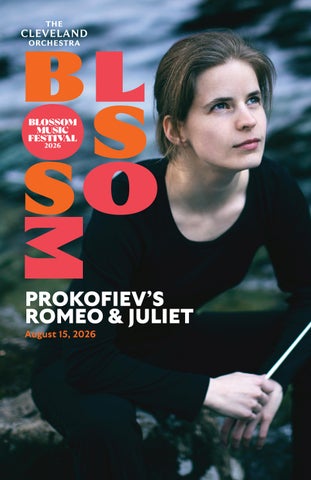
2026
PROKOFIEV’S ROMEO & JULIET August 15, 2026
PROKOFIEV’S ROMEO & JULIET 2026
Saturday, August 15, 2026, at 7 PM The Cleveland Orchestra Tabita Berglund, conductor JEAN SIBELIUS (1865–1957)
Finlandia, Op. 26
10 minutes
JEAN SIBELIUS
Violin Concerto in D minor, Op. 47 I. Allegro moderato II. Adagio di molto III. Allegro, ma non tanto Simone Lamsma, violin
30 minutes
PRESENTED BY
SEASON PARTNER
MOVIE NIGHT PRESENTER
FAMILY ENGAGEMENT PARTNER
I N T E R M I S S I O N | 20 minutes SERGEI PROKOFIEV (1891–1953)
Suite No. 2 from 30 minutes Romeo and Juliet, Op. 64b I. Montagues and Capulets II. Juliet, the Young Girl III. Friar Laurence IV. Dance V. Romeo and Juliet Before Parting VI. Dance of the Maids from the Antilles VII. Romeo at Juliet’s Grave
Total approximate running time: 1 hour 30 minutes Tonight’s concert is sponsored by Acme Fresh Markets.
COVER PHOTO BY NIKOLAJ LUND
Tonight’s performance is dedicated to R. Thomas & Meg Harris Stanton and Irad & Rebecca Carmi in recognition of their generous support of music.
clevelandorchestra.com
3
MORE ROOM FOR WHAT MATTERS
©2026 California Closet Company, Inc. Each California Closets® franchised location is independently owned and operated. Local contractor licenses available at californiaclosets.com.
™
SCHEDULE YOUR COMPLIMENTARY DESIGN CONSULTATION 216.741.9000 | CALIFORNIACLOSETS.COM
CUSTOMXCLOSETS
ENTRYWAY
PANTRY
Brooklyn Heights 1100 Resource Dr Woodmere 28000 Chagrin Blvd
HOMEXOFFICE
INTRODUCTION
S
ummer — hot and humid days, sunshine, ice cream — a time of love, a time where passions run high. Tonight’s program is all about capturing the intensity that is so emblematic of the season.
And what story better captures love, passion, and tragedy than the story of Romeo
and Juliet? Sergei Prokofiev’s ballet holds the same dramatic weight as the original text by Shakespeare, and his Second Suite showcases some of its most iconic moments. From the dark and foreboding confrontation between the Montagues and Capulets to the deep sorrow Romeo experiences at Juliet’s tomb, each movement carries us along in a sea of emotions. This is also true of the first two works on the program, both written by Finnish composer Jean Sibelius. Whereas Prokofiev’s focus is on the passion and doomed love between Romeo and Juliet, Sibelius channeled his passion into patriotism. At the time of Sibelius’s birth in 1865, Finland was an autonomous state within the Russian Empire. Despite its initial integration into the Empire as a nominally self-governing duchy in 1809, by 1899, the Russian crown had enacted a policy of Russification, attempting to limit Finnish home rule, and fully absorb it into the Empire. Naturally, political and cultural leaders within Finland chafed against this, with Sibelius championing national liberation through music. Sibelius’s short tone poem Finlandia is the final movement of a suite for the Finnish Press Pension Celebration — a covert rally for the support of further press freedoms in Finland in the face of Russian censorship. While Sibelius’s Violin Concerto — performed this evening by Simone Lamsma — has less overt nationalistic sentiment, the thematic material is undeniably inspired by the ethos of Finland and its stark beauty. As you bask in the summer’s warmth, allow yourself to be swept into the emotions emanating from the stage, carried along by stories of star-crossed lovers and the Finnish wilderness, all while nestled in the quiet beauty of the Cuyahoga Valley. — Patrick O’Brien Patrick O’Brien is a Development Officer with The Cleveland Orchestra.
clevelandorchestra.com
5
THE THE M MU USSIICC
Finlandia, Finlandia, Op. Op. 26 26 by by Jean JeanSibelius Sibelius
om Romeo and Juliet, Op. 64b BORN: BORN: December December 8, 8,1865, 1865, in inHämeenlinna, Hämeenlinna, Finland Finland
ev
DIED: DIED: September September20, 20,1957, 1957,in inJärvenpää, Järvenpää,Finland Finland
, in Sontsovka, Ukraine COMPOSED: COMPOSED:1899; 1899;revised revised1900 1900 in Moscow WORLD WORLDPREMIERE: PREMIERE:July July2, 2,1900, 1900,with withRobert RobertKajanus Kajanusconducting conductingthe theHelsinki Helsinki
Philharmonic PhilharmonicSociety Society
–35
CLEVELAND CLEVELAND ORCHESTRA ORCHESTRA PREMIERE: PREMIERE: Apri Apri1,1, 1919, 1919, led led by byMusic MusicDirector Director E: This suite was first performed in Leningrad on April 15, 1937, with
Nikolai Sokoloff Sokoloff nducting. TheNikolai full ballet premiered in Brno on December 30, 1938.
ORCHESTRATION: ORCHESTRATION: 22flutes, flutes, oboes, oboes, 22clarinets, clarinets,22bassoons, bassoons,44horns, horns,33trumpets, trumpets, HESTRA PREMIERE: March 30, 1946, led by22Music Director
33trombones, trombones,tuba, tuba,timpani, timpani,percussion percussion(bass (bassdrum, drum,cymbals, cymbals,triangle), triangle),and andstrings strings
DURATION: DURATION: about about 10 10minutes minutes : 2 flutes, piccolo, 2 oboes, English horn, 2 clarinets, bass clarinet, e, 2 bassoons, contrabassoon, 4 horns, 2 trumpets, cornet, ba, timpani, percussion (bass drum, bells, cymbals, glockenspiel, WHEN WHEN JEAN JEAN SIBELIUS SIBELIUS COMPOSED COMPOSEDFINLANDIA FINLANDIAin in1899, 1899,his hishomeland homelandwas wasembroiled embroiled rum), harp, piano, celesta, and strings
in inaanational nationalidentity identitycrisis. crisis.The TheGrand GrandDuchy Duchyof ofFinland, Finland,established established90 90years yearsearlier earlier t 30 minutes as asan anautonomous autonomousstate statewithin withinthe theRussian RussianEmpire, Empire,had hadbeen beenstruggling strugglingwith withan an
increase increasein inRussian Russianinfluence, influence,especially especiallyafter afterTsar TsarNicholas NicholasIIIIassumed assumedpower powerin in1894. 1894. WAY FROM RUSSIA, spent mostly in France and the United Nicholas’s Nicholas’sinfamous infamousFebruary FebruaryManifesto Manifestoof of1899 1899essentially essentiallystripped strippedaway awayany any fiev felt a complicated urge to return to his homeland in the remaining remainingsemblance semblanceof ofFinnish Finnishautonomy autonomy— —aamove movethat, that,to toFinns, Finns,amounted amountedto toaa much he really understood the Soviet system that had replaced the coup coupd’état d’étatand andaaviolation violationof oftheir theirconstitutional constitutionalrights. rights.Not Notsurprisingly, surprisingly,this this e had grown up in is a vexed question. Even if he knew that the sparked sparkedoutrage outrageamong amongthe theFinnish Finnishpopulation, population,and andultimately ultimatelygalvanized galvanizedcitizens citizensto to on attitude toward the arts had diminished, he could not be blamed reclaim reclaimtheir theirpolitical politicalfreedom freedomand andassert assertan anindependent independentnational nationalidentity. identity. the horrors of Stalin’s dictatorship. By 1936, when Prokofiev’s One Onesigns such suchof effort effort took place place in inNovember November 1899inwith with thePress PressCelebrations, Celebrations,aa in Moscow, the harshtook times ahead were clear, 1899 but 1933the three-day three-day pageant pageant and andthinly thinly veiled veiledpolitical political protest protest masked maskedas asaapension pensionfundraiser fundraiser he was still accepting commissions from his homefor forcensored censored Finnish Finnish journalists. journalists. The festivalfeatured featuredspeeches, speeches,historical historicaltableaux, tableaux, land, with good prospectsThe forfestival more. and andmusic musicto toinspire inspirenational nationalunity unityand andrally rallyfor forFinnish Finnishsovereignty. sovereignty.One Oneof ofthe the The Kirov Theater in Leningrad wanted a new highlights highlightscame camefrom fromSibelius, Sibelius,who whowas wascommissioned commissionedto towrite writeincidental incidentalmusic musicfor for ballet from Prokofiev, recognizing the success of six sixtableaux tableauxdepicting depictingFinnish Finnishhistory historyand andmythology. mythology.The Thelast lastof ofthese thesetableaux, tableaux,aa his Paris ballets The Steel Step, The Prodigal Son, and tone tonepoem poementitled entitledFinland FinlandAwakes, Awakes,covertly covertlyportrayed portrayedthe theFinnish Finnishstruggle struggleagainst against On the Dnieper. Prokofiev suggested Shakespeare’s oppression oppressionand andwas waseventually eventuallyrenamed renamedFinlandia. Finlandia. Romeo and Juliet as the new ballet’s storyline. The Heard Heard in inwas this thiscontext, context,Finlandia Finlandia comesalive alive as aavivid vividnarrative narrativeof ofFinland’s Finland’sstruggle struggle Kirov unhappy with the comes proposal, soas Prokofiev for forindependence. independence. The Theaopening opening notes notes are dark, dark,tense, tense, and andoppressive, oppressive,hovering hoveringin inthe the instead signed contract withare Moscow’s Bolshoi lower lowerregisters registers of the theorchestra, orchestra, depicting depicting aaFinland Finlandwith crushed crushedunder underthe thesuffocating suffocating Theater.of Moscow also had some difficulties presence presence of ofNicholas’s Nicholas’s tsarist tsarist state. state.These These opening measures measures offeronly onlypassing passingglimmers glimmers details, thinking it improbable thatopening the dying lovers offer of ofrelief. relief. Joining Joining in in the the search search for for peace, peace, a a pleading pleading melody melody in in the the high high woodwinds woodwinds gives gives could be seen dancing at the ballet’s conclusion. A us usthe thefirst first vague vague notion notion of hope, hope, predicting the thewith serenity serenity andstability stabilitythat thatisisto tocome. come. happy ending wasof the firstpredicting solution, and thisand 66
unlikely dénouement, BLOSSOM BLOSSOM MUSIC MUSIC FESTIVAL FESTIVAL2026 2026the score was completed in
The rest of orchestra soon elaborates on the folklike melody, as if Finland itself is finding its voice from under the shadows. Before fulfillment can come, however, a storm overtakes the orchestra. Churning violins and violas, low string tremolos, and tight punctuations from the brass roil together in a dramatic scene that upends any sense of forward momentum. But soon the storm breaks, and the orchestra is unified in a rousing military-style march, exemplifying solidarity in the fight for Finnish independence. The stormy brass punctuations now form the rhythmic basis of the march — along with the percussion — with the strings and woodwinds taking up the melodic call to action. The storm briefly reemerges, threatening to dominate the orchestra, before the entire scene gives way to reprieve. The earlier upper-woodwind plea is now answered in the emotional climax of the work. This serene melody, now recognized as the “Finlandia hymn,” comes across much like a folk tune, and is often mistaken for one. The tune resonated deeply with the Finnish people and many variations of sung text have been appended to it retroactively (including the Christian hymn “Be Still, My Soul”). There have even been campaigns over the years to formally recognize the Finlandia hymn as Finland’s national anthem. Regardless of its official standing, the hymn section of the work sends a clear message: Finland is indeed awake, and there is hope on the horizon. This sentiment is solidified as the march returns, now triumphant in the context of the preceding hymn section — a definitive statement that Finland has a voice of its own and will someday be free. Of course, when Finlandia premiered at the Press Celebrations, the true implications of the work were hidden, like those of the festival itself. Beneath the surface, Finlandia was a testament to the strength, resilience, and optimism of the Finnish people under Russian rule, even if it could not be stated as such in 1899. But these efforts ultimately paid off as Nicholas II repealed the February Manifesto in 1905, and when Finland declared its independence from Russia in 1917. Peace did not come immediately, though, and the struggle for stability persisted through the Finnish Civil War and World War I. Yet over time, the nation was able to unify and eventually became a stable, prosperous, sovereign state with its own rich cultural voice. In the decades following, thanks to the impact of his music on Finland’s fight for freedom, Sibelius became a symbol of Finland’s culture and identity — an icon of Finnish resilience and spirit. — Kevin Whitman Kevin Whitman is The Cleveland Orchestra’s Marketing Operations Manager. clevelandorchestra.com
7
THE M U S I C
Violin Concerto in D minor, Op. 47 by Jean Sibelius COMPOSED: 1903; revised 1905 WORLD PREMIERE: February 8, 1904, with Victor Nováček as soloist and the
composer conducting CLEVELAND ORCHESTRA PREMIERE: January 5, 1922, featuring violinist Ferenc Vecsey
and led by Music Director Nikolai Sokoloff ORCHESTRATION: 2 flutes, 2 oboes, 2 clarinets, 2 bassoons, 4 horns, 2 trumpets,
3 trombones, timpani, and strings, plus solo violin DURATION: about 30 minutes
“I’VE GOT SOME LOVELY THEMES FOR A VIOLIN CONCERTO,” Jean Sibelius wrote to his wife, Aino, in September 1902. The Finnish composer, already a national figure and the recipient of an annual pension from the Finnish government at 37, had been asked by the celebrated German violinist Willy Burmester to write a concerto. Despite the “lovely themes” Sibelius had in mind, the concerto wasn’t coming along as expected. The difficulties had mostly to do with the composer’s alcoholism, which around this time began to alarm his family. It was a year before Sibelius sent the piano score to Burmester, who responded enthusiastically: “I can only say one thing: Wonderful! Masterly! Only once before have I spoken in such terms of a composer, and that was when Tchaikovsky showed me his concerto.” But plans did not unfold as anticipated. Burmester was expecting to play the world premiere of the new work in spring 1904, but Sibelius, for financial reasons, pushed for an earlier date even though Burmester wasn’t available (and the orchestration of the concerto wasn’t finished). Sibelius completed the concerto before the end of 1903 and gave it to a local violin teacher, Victor Nováček, to perform. By all accounts, Nováček was hardly more than a mediocre player. Leading Sibelius biographer Erik Tawaststjerna writes that at the Helsinki premiere, “A red-faced and perspiring Nováček fought a losing battle with a solo part that bristled with even greater difficulties in this first version than it does in the definitive score.” The poor first performance aside, Sibelius was still dissatisfied with the work and decided to revise it entirely. The definitive version premiered with Karl Halíř as soloist, but the work was ultimately dedicated to an exceptionally gifted 17-year-old Hungarian named Ferenc Vecsey, who would become the work’s first champion, performing it internationally, including its first presentations in Cleveland.
8
BLOSSOM MUSIC FESTIVAL 2026
Written in the first years of the 20th century, Sibelius’s concerto looks back to the great Romantic concertos of the 19th. The opening of the first movement, with the PHOTO BY DANIEL NYBLIN, C. 1898–1900 | PUBLIC DOMAIN
orchestral violins playing tremolos as the soloist plays a wistful melody above, is unabashedly old-fashioned. The only unconventional features are the repeated leaps, which create harsher sonorities, and the irregular phrase structure of the theme, which makes it difficult to predict how the melody is going to evolve. Simple and songlike at first, the violin part gradually becomes more and more agitated. The
JEAN SIBELIUS
orchestra eventually introduces a second idea, which the violin soon takes over. This is followed by a third, purely orchestral section, lively and energetic. There is no traditional development section in the first movement; its place is taken by a cadenza, which occurs in the middle of the movement rather than at the more customary position near the end. The second movement is based on the combination of two themes, one played by the two clarinets at the beginning, the other by the solo violin a few measures later. The violin melody is, according to the composer, “sonorous and expressive.” The clarinet theme later grows into an impassioned middle section whose dynamism carries over into the recapitulation of the violin melody. Only at the very end does the melody find its initial peace and tranquility again. Speaking about the third-movement finale, it is impossible to resist quoting Donald Francis Tovey’s characterization as a “polonaise for polar bears.” Tovey’s words capture the singular combination of elegant dance rhythms and a certain heavy-footedness felt at the beginning of this movement. Again, there are two themes, one in a polonaise rhythm and one based on the alternation of 6/8 and 3/4 time. “With this,” Tovey concludes, “we can safely leave the finale to dance the listener into Finland, or what-ever Fairyland Sibelius will have us attain.” — adapted from a note by Peter Laki Peter Laki is a musicologist and frequent lecturer on classical music. He is a visiting associate professor of music, emeritus, at Bard College and was The Cleveland Orchestra’s program annotator from 1990 to 2007.
clevelandorchestra.com
9
THE M U S I C
Suite No. 2 from Romeo and Juliet, Op. 64b by Sergei Prokofiev BORN: April 23, 1891, in Sontsovka, Ukraine DIED: March 5, 1953, in Moscow COMPOSED: 1934–35 WORLD PREMIERE: This suite was first performed in Leningrad on April 15, 1937, with
the composer conducting. The full ballet premiered in Brno on December 30, 1938. CLEVELAND ORCHESTRA PREMIERE: March 30, 1946, led by Music Director
Erich Leinsdorf ORCHESTRATION: 2 flutes, piccolo, 2 oboes, English horn, 2 clarinets, bass clarinet,
tenor saxophone, 2 bassoons, contrabassoon, 4 horns, 2 trumpets, cornet, 3 trombones, tuba, timpani, percussion (bass drum, bells, cymbals, glockenspiel, maracas, snare drum), harp, piano, celesta, and strings DURATION: about 30 minutes
AFTER 15 YEARS AWAY FROM RUSSIA, spent mostly in France and the United States, Sergei Prokofiev felt a complicated urge to return to his homeland in the mid-1930s. Just how much he really understood the Soviet system that had replaced the Russian monarchy he had grown up in is a vexed question. Even if he knew that the liberal, post-Revolution attitude toward the arts had diminished, he could not be blamed for failing to foresee the horrors of Stalin’s dictatorship. By 1936, when Prokofiev’s family finally settled in Moscow, the signs of harsh times ahead were clear, but in 1933 he was still accepting commissions from his homeland, with good prospects for more. The Kirov Theater in Leningrad wanted a new ballet from Prokofiev, recognizing the success of his Paris ballets The Steel Step, The Prodigal Son, and On the Dnieper. Prokofiev suggested Shakespeare’s Romeo and Juliet as the new ballet’s storyline. The Kirov was unhappy with the proposal, so Prokofiev PORTRAIT BY ROBERT KASTOR, C. 1937
instead signed a contract with Moscow’s Bolshoi Theater. Moscow also had some difficulties with details, thinking it improbable that the dying lovers could be seen dancing at the ballet’s conclusion. A happy ending was the first solution, and with this SERGEI PROKOFIEV
10
BLOSSOM MUSIC FESTIVAL 2026
unlikely dénouement, the score was completed in
the summer of 1935. However, this product was ultimately rejected by the Moscow theater, too. With no immediate prospect of a staged performance, Prokofiev revised the work and made two seven-movement orchestral suites and a 10-movement piano suite from the ballet’s 52 numbers. The ballet was eventually staged for the first time in Brno in 1938 and quickly became a triumph around the world. Though covering only a portion of the plot, Suite No. 2 from Prokofiev’s full ballet score can be enjoyed purely in musical terms, setting the scene for the Shakespearean drama that is to unfold. The suite opens in the hustle and bustle of the Capulets’ ball, where the swaggering, proud knights and gentler ladies can be heard in “Montagues and Capulets.” Meanwhile, Juliet is upstairs, teasing her nurse. But this coquettish character has a tender side, as other melodies in “Juliet, the Young Girl” reveal. Clerical and dignified, “Friar Laurence” provides a welcome reprieve from the sweaty dance hall, offering a particularly notable role for the bassoon. We are then suddenly thrust out onto the street, where a lively “Dance” — filled with Prokofiev’s roguish melodic and harmonic tricks — is in full swing. The scene shifts yet again to focus on the intimate world of the star-crossed lovers. The longest movement of the suite, “Romeo and Juliet Before Parting” contains some of the ballet’s most heart-rending music, as the two share a tender moment together before bidding farewell — for the final time. The suite, as the play, closes on an interior note: “Dance of the Maids from the Antilles” offers a gentle reprieve before the poignance of penultimate scene, where Romeo, thinking Juliet dead, dances with her immobile body, mere moments before the lovers’ tragic fate is sealed. — adapted from a note by Hugh Macdonald Hugh Macdonald is Avis H. Blewett Professor Emeritus of Music at Washington University in St. Louis. He has written books on Beethoven, Berlioz, Bizet, and Scriabin, as well as Music in 1853: The Biography of a Year.
clevelandorchestra.com
11
When it comes to senior living, one size does not fit all. Call 330.867.2150 or scan the code to find your perfect fit at Ohio Living Rockynol! INDEPENDENT LIVING ASSISTED LIVING MEMORY CARE SHORT-TERM REHAB LONG-TERM NURSING CARE 1150 West Market Street | Akron, Ohio 44313 | 330.867.2150 | ohioliving.org The Hudson Society of Artists
44 Annual Art On The Green th
Saturday & Sunday: 10AM - 5PM LOCATED ON THE DOWNTOWN HUDSON GREENS
Over 150 Exhibitors Selling a Variety of Fine Arts & Crafts
FINE ART • FOOD • RAFFLE TENT FREE ADMISSION
August 29-30, 2026
Scan the QR code for event updates!
THE PL ACE FOR FANS OF THE CLEVEL AN D ORCHESTR A
JOIN NOW
EARN POINTS • Attend concerts • Watch videos • Take quizzes • Give feedback
GET REWARDS • Exclusive content • FREE season of Adella with 3000 Rewards points • VIP experiences, seat upgrades & more
CLEVELANDORCHESTR A .COM/REWARDS
THE A RTI S T S
TABITA BERGLUND conductor
Tabita Berglund has established herself as one of the most in-demand conductors of her generation. With a charismatic style that combines elegance, verve, and precision, she collaborates with leading orchestras worldwide. Berglund assumes the title of chief conducPHOTO BY MARCO BORGGREVE
tor of the Bergen Philharmonic Orchestra in August 2027 and begins her official tenure in August 2026 as chief conductor designate. She is currently principal guest conductor of both the Detroit Symphony Orchestra and Dresdner Philharmonie. Highlights of Berglund’s 2025–26 season included the Dresdner Philharmonie’s season-opening concerts, debut appearances with the Deutsches Symphonie-Orchester Berlin, Cincinnati Symphony Orchestra, St. Louis Symphony Orchestra, NDR Elbphilharmonie Orchester, and Sydney Symphony, returns to the Dallas Symphony Orchestra, Gothenburg Symphony, and Bergen Philharmonic Orchestra, and a specially curated, two-week “Northern Lights Festival” in Detroit. Berglund regularly collaborates with leading international soloists, including Jean-Yves Thibaudet, Hélène Grimaud, Leila Josefowicz, Augustin Hadelich, Håkan Hardenberger, and Camilla Tilling. Her programming reflects her breadth of repertoire interests, from Mozart and Schubert to Mahler, Schoenberg, Bartók, Lutosławski, and Nordic compatriots such as Sibelius, Irgens-Jensen, and Anna Thorvaldsdottir. Among Berglund’s past festival appearances are the Festival Internacional de Música y Danza de Granada and Grafenegg Festival, while recent opera and ballet productions include The Marriage of Figaro (Garsington Opera, 2024) and The Nutcracker (Norwegian National Opera and Ballet, 2024). In summer 2024, Berglund chaired the jury for the grand finale of the Eurovision Young Musicians competition, broadcast live on television throughout Europe via the major networks. Berglund studied at the Norwegian Academy of Music, first as a cellist with Truls Mørk and later orchestral conducting with Ole Kristian Ruud. She played regularly with the Oslo and Bergen philharmonics as well as the Trondheim Soloists before conducting became her main focus. Her first titled position was as principal guest conductor of the Kristiansand Symphony Orchestra (2021–24). Her debut CD, with the Oslo Philharmonic and violinist Sonoko Miriam Welde, was released in 2021 (LAWO) and nominated for a Norwegian Grammy (Spellemann) in the 2022 Classical Music category. clevelandorchestra.com
15
THE A RTI S T S
SIMONE LAMSMA violin
Dutch violinist Simone Lamsma is respected by critics, peers, and audiences as one of classical music’s most striking and captivating musical personalities. With an extensive repertoire, Lamsma has been the guest of many of the world’s leading orchestras such PHOTO BY OTTO VAN DEN TOORN
as the New York Philharmonic, Chicago Symphony Orchestra, Royal Concertgebouw Orchestra, Orchestra dell’Accademia Nazionale di Santa Cecilia, Les Siécles, Cincinnati Symphony Orchestra, Seoul Philharmonic Orchestra, City of Birmingham Symphony Orchestra, and Sydney Symphony, among others. She performs with eminent conductors such as Yannick Nézet-Séguin, Rafael Payare, Karina Canellakis, Kazuki Yamada, Stéphane Denève, Simone Young, and Petr Popelka. In the 2025–26 season, Lamsma returned to the Orchestre symphonique de Montréal, Rotterdam Philharmonic Orchestra, Baltimore Symphony Orchestra, and BBC Philharmonic Orchestra, and debuted with the Singapore Symphony Orchestra, Seattle Symphony, and Orchestra della Svizzera Italiana. She also played recitals with pianist Jonathan Fournel at the Concertgebouw Amsterdam, Wigmore Hall, and Heidelberger Frühling Festival. In 2025, Lamsma premiered a work by leading Dutch composer Joey Roukens at the Tivoli Vredenbrug Utrecht as well as a piece by Thomas Agerfeldt Olesen. Recent recordings include the world premiere of Agerfeldt Olesen’s Violin Concerto with the Danish National Symphony Orchestra and Otto Tausk on Dacapo. A 2022 Ondine release with the Malmö Symphony Orchestra under Robert Treviño features works by Rautavaara. Other releases include Sibelius with the Orchestre National d’Île-de-France and Case Scaglione, Pärt über Bach with the Amsterdam Sinfonietta and Candida Thompson, and Shostakovich’s First Violin Concerto paired with Gubaidulina’s In tempus praesens with the Netherlands Radio Philharmonic Orchestra under Reinbert de Leeuw and James Gaffigan. A recital album with pianist Robert Kulek on the same label features works by Mendelssohn, Janáček, and R. Schumann. In 2019, Lamsma was made a Fellow of the Royal Academy of Music in London, an honor limited to 300 former Academy students, and awarded to those musicians who have distinguished themselves within the profession. Lamsma plays the 1703 “Aurora ex-Foulis” Stradivarius, on generous loan to her by a benefactor. 16
BLOSSOM MUSIC FESTIVAL 2026
Our nonprofit Blossom Music Festival relies on support from great friends like you. Show your love for Blossom with your donation today, and see your name on the big screen at intermission! Every gift makes a difference. Make your gift TODAY! clevelandorchestra.com/givingday Text GIVE to 844-955-4377
Witness Something
Legendary Every four years, the most dedicated violinists from around the world come together to compete at the International Violin Competition of Indianapolis. Regarded as one of the world’s most respected music competitions, The Indianapolis celebrates the majesty of live performance.
Tickets on sale now.
THE INDIANAPOLIS 12TH QUADRENNIAL INTERNATIONAL VIOLIN COMPETITION
September 17 – October 4 SEPTEMBER 17 - OCTOBER 4, 2026
Simone Lamsma
2006 Silver Medalist
violin.org
Choose from Our Vast Collection of Stunning Furniture and Accessories.
You’ll Receive a Standing Ovation! Choose Choosefrom fromthe thearea’s area’slargest largestand andbest bestselection selectionof ofhigh-quality high-qualityin-stock in-stockand and custom customorders ordersin inthe thelatest lateststyles. styles.Find Findthe thebest bestselection selectionand andsavings savingson onbedrooms, bedrooms,dining, dining, living livingroom, room,entertainment, entertainment,and andoutdoor outdoorfurniture. furniture.
Extraordinary ExtraordinaryFurnishings Furnishingsfor forExtraordinary ExtraordinaryHomes Homes SedlakInteriors.com SedlakInteriors.com At At Sedlak’s Sedlak’s you’ll you’ll find find Furniture, Furniture, Accessories, Accessories, Dining, Dining, Home Home Entertainment, Entertainment, Home Home Office, Office, Mattresses, Mattresses, Recliners, Recliners, Clocks, Clocks, Carpeting Carpeting && More. More.
Complimentary Complimentary Delivery Delivery and and Set-Up Set-Up Within Within 60 60 Miles. Miles. 34300 34300 Solon Solon Road Road || Solon, Solon, OH OH || 440-248-2424 440-248-2424 || 800-260-2949 800-260-2949 10-8 10-8 M/Th M/Th || 10-5:30 10-5:30 Tu/W/F/Sa Tu/W/F/Sa
THE CLEVELAND ORCHESTRA Franz Welser-Möst Music Director KELVIN SMITH FAMILY CHAIR FIRST VIOLINS
VIOLAS
PICCOLO
TROMBONES
Joel Link
Wesley Collins*
Mary Kay Fink
Brian Wendel*
Blossom-Lee Chair
Gareth Zehngut1^
OBOES
Richard Stout
Stanley Konopka Mark Jackobs
Frank Rosenwein* Edith S. Taplin Chair
Shachar Israel2
Corbin Stair
BASS TROMBONE
CONCERTMASTER
Elizabeth Fayette FIRST ASSOCIATE CONCERTMASTER Virginia M. Lindseth, PhD, Chair
Zhan Shu ASSISTANT CONCERTMASTER Clara G. and George P. Bickford Chair
Stephen Tavani ASSISTANT CONCERTMASTER Dr. Ronald H. Krasney Chair
Wei-Fang Gu
Drs. Paul M. and Renate H. Duchesneau Chair
Kim Gomez
Elizabeth and Leslie Kondorossy Chair
Chul-In Park
Harriet T. and David L. Simon Chair
Miho Hashizume
Theodore Rautenberg Chair
Jeanne Preucil Rose
Larry J.B. and Barbara S. Robinson Chair
Alicia Koelz
Oswald and Phyllis Lerner Gilroy Chair
Yu Yuan
Patty and John Collinson Chair
Isabel Trautwein
Trevor and Jennie Jones Chair
Katherine Bormann Paul and Lucille Jones Chair
Analise Handke Gladys B. Goetz Chair
Genevieve Smelser
Chaillé H. and Richard B. Tullis Chair Charles M. and Janet G.Kimball Chair 2
Jean Wall Bennett Chair
Lisa Boyko
Richard and Nancy Sneed Chair
Anne M. and M. Roger Clapp Chair
Sharon and Yoash Wiener Chair
Jeffrey Rathbun2
Everett D. and Eugenia S. McCurdy Chair
Richard Waugh Lembi Veskimets
Robert Walters
The Morgan Sisters Chair
ENGLISH HORN
Eliesha Nelson^
Robert Walters
Anthony and Diane Wynshaw-Boris Chair
Samuel C. and Bernette K. Jaffe Chair
William Bender
CLARINETS
Thomas Lauria and Christopher Lauria Chair
CELLOS
Mark Kosower*
Louis D. Beaumont Chair
Richard Weiss
1
The GAR Foundation Chair
Charles Bernard2
William P. Blair III Chair
Yasuhito Sugiyama* Nathalie C. Spence and Nathalie S. Boswell Chair
Robert Marcellus Chair
TIMPANI
Robert Woolfrey
Peter Nichols2
Victoire G. and Alfred M. Rankin, Jr. Chair
Mr. and Mrs. Richard K. Smucker Chair
Daniel McKelway2
PERCUSSION
Robert R. and Vilma L. Kohn Chair
Amy Zoloto
Marc Damoulakis* Margaret Allen Ireland Chair
Daniel McKelway
Ralph Curry Brian Thornton
EUPHONIUM & BASS TRUMPET
Afendi Yusuf*
Bryan Dumm
Thomas J. and Judith Fay Gruber Chair
Luke Sieve
TUBA
E-FLAT CLARINET
Tanya Ell
Alexander and Marianna C. McAfee Chair
Richard Stout
Helen Weil Ross Chair
Muriel and Noah Butkin Chair
Gilbert W. and Louise I. Humphrey Chair
Stanley L. and Eloise M. Morgan Chair
BASS CLARINET
Thomas Sherwood Tanner Tanyeri Peter Nichols KEYBOARD INSTRUMENTS
Amy Zoloto
Myrna and James Spira Chair
Carolyn Gadiel Warner
BASSOONS
Marjory and Marc L. Swartzbaugh Chair
John Clouser*
LIBRARIAN
Stephen Rose*
David Alan Harrell Martha Baldwin Dane Johansen
Marguerite and James Rigby Chair
Sandra L. Haslinger Chair
Eli Matthews1
Paul Kushious
Jonathan Sherwin
BASSES
CONTRABASSOON
Maximilian Dimoff*
Jonathan Sherwin
Gretchen D. and Ward Smith Chair Sunshine Chair Otto G. and Corinne T. Voss Chair Rudolf Serkin Chair
HORNS
CONDUCTORS
SECOND VIOLINS Alfred M. and Clara T. Rankin Chair Patricia M. Kozerefski and Richard J. Bogomolny Chair
Jason Yu
2
James and Donna Reid Chair
Sonja Braaten Molloy Carolyn Gadiel Warner Elayna Duitman Ioana Missits Jeffrey Zehngut^ Kathleen Collins Beth Woodside Emma Shook Dr. Jeanette Grasselli Brown and Dr. Glenn R. Brown Chair
Yun-Ting Lee
Clarence T. Reinberger Chair
Charles Paul1
Mary E. and F. Joseph Callahan Chair
Derek Zadinsky 2 Mark Atherton Thomas Sperl Henry Peyrebrune Charles Barr Memorial Chair
Charles Carleton Scott Dixon Brandon Mason
Deborah L. Neale Chair
HARP
Jiah Chung Chapdelaine Liyuan Xie Gawon Kim Dustin Wilkes-Kim
Trina Struble* Alice Chalifoux Chair
FLUTES
Joshua Smith*
Elizabeth M. and William C. Treuhaft Chair
Saeran St. Christopher Jessica Sindell2^ Austin B. and Ellen W. Chinn Chair
Mary Kay Fink
Louise Harkness Ingalls Chair
Gareth Thomas Catherine Van Handel2
Nathaniel Silberschlag* George Szell Memorial Chair
Michael Mayhew
§
Knight Foundation Chair
BLOSSOM MUSIC FESTIVAL 2026
Joe and Marlene Toot Chair
ENDOWED CHAIRS CURRENTLY UNOCCUPIED
Christoph von Dohnányi † MUSIC DIRECTOR LAUREATE
Taichi Fukumura ASSISTANT CONDUCTOR
Jesse McCormick-Stepp
Elizabeth Ring and William Gwinn Mather Chair
Hans Clebsch Richard King Meghan Guegold Hege^
James Feddeck
Gay Cull Addicott and Robert R. Cull Chair
Sidney and Doris Dworkin Chair
Robert B. Benyo Chair
PRINCIPAL CONDUCTOR & MUSICAL ADVISOR OF THE CLEVELAND ORCHESTRA YOUTH ORCHESTRA
TRUMPETS
Lisa Wong
Michael Sachs*
Frances P. and Chester C. Bolton Chair
Robert and Eunice Podis Weiskopf Chair
Jack Sutte Lyle Steelman2^
James P. and Dolores D. Storer Chair
Michael Miller
DIRECTOR OF CHORUSES * Principal §
Michael Sachs*
Mary Elizabeth and G. Robert Klein Chair
Michael Miller
Associate Principal
1
First Assistant Principal
2
Assistant Principal
^ Alum of The Cleveland Orchestra Youth Orchestra †
CORNETS
With sincere gratitude to the musicians of The Cleveland Orchestra for their in-kind contributions supporting community programs and securing funding opportunities.
20
Michael Ferraguto*
In Memoriam
This roster lists full-time members of The Cleveland Orchestra. The number and seating of musicians on stage varies depending on the piece being performed. Seating within the string sections rotates on a periodic basis.
T
he Cleveland Orchestra, under the leadership of Music Director Franz Welser-Möst since 2002, is widely recognized as one of
the world’s leading ensembles. Praised by The New York Times as “America’s Finest,” the Orchestra is renowned for its virtuosity, elegance of sound, and chamber-like musical flexibility. In his 25th
and final season as Music Director, Welser-Möst concludes a transformative partnership that has been marked by exceptional artistic ambition, growing international recognition, and deep community connection. During his tenure, the Orchestra has achieved major institutional milestones, including groundbreaking residencies at the Musikverein in Vienna — the first by an American orchestra — and at the Adrienne Arsht Center in Miami. In 2023, The Cleveland Orchestra launched the annual Jack, Joseph and Morton Mandel Opera & Humanities Festival, presenting acclaimed opera productions alongside art exhibits, community events, and civic conversations. Through concerts, broadcasts, recordings, tours, and digital initiatives, The Cleveland Orchestra reaches an ever-growing audience around the world. Its in-house recording label and streaming platform, Adella.live, capture and share performances from the Welser-Möst era while introducing new generations of fans to the Orchestra’s artistry. Founded by Adella Prentiss Hughes, The Cleveland Orchestra gave its inaugural concert in December 1918. Over more than a century, it has grown into a treasured community institution, enriching lives through music, education, and a deep commitment to Northeast Ohio. Today, more than 400,000 people attend Cleveland Orchestra concerts each year. From its year-round home at Severance Music Center to its summer season at Blossom Music Center in Cuyahoga Valley National Park, the Orchestra continues to serve audiences across the region. Seven Music Directors — Nikolai Sokoloff, Artur Rodziński, Erich Leinsdorf, George Szell, Lorin Maazel, Christoph von Dohnányi, and Franz Welser-Möst — have shaped the
PHOTO BY YE VHEN GULENKO
ensemble’s distinctive musical identity and celebrated “Cleveland sound.” Welser-Möst’s tenure as the longest-serving Music Director in Cleveland Orchestra history stands as a defining chapter in that evolution.
@ClevelandOrchestra
@cleveorch
@CleveOrchestra
@clevelandorchestra
clevelandorchestra.com
21
The best classrooms have no walls. Learning happens differently when students extend their studies beyond the classroom and into the natural world.
Preschool to Grade 8 | OldTrail.org
Plan your visit to the historic 70-acre estate of Goodyear Tire & Rubber Company co-founder F.A. Seiberling. From the 65-room Tudor Revival Manor House to our signature events, there’s always something new to discover. | stanhywet.org
The Cleveland Orchestra rehearses under the baton of Karina Canellakis during a donor-exclusive open rehearsal.
Your Best. BLOSSOM. Ever! • Invitations to rehearsals and recitals • Sweet ticket and retail discounts • Private concessions, restrooms, and more! Learn more at clevelandorchestra.com/benefits
TICKETS ON SALE NOW!
JAN 5–24, 2027
FEB 2–21, 2027
MAR 2–21, 2027
APR 14–MAY 9, 2027
JUL 27–AUG 15, 2027
AUG 24–SEPT 12, 2027
Jordan Lee Gilbert and Isaiah Bailey in THE PHANTOM OF THE OPERA North American Tour- Photo by Matthew Murphy & Evan Zimmerman
AUG 20 JON BATISTE WITH THE CLEVELAND ORCHESTRA Jonathan Taylor Rush, conductor Jon Batiste, vocals and piano
AUG 22 RAVEL’S PIANO CONCERTO IN G Antonello Manacorda, conductor Nelson Goerner, piano The Cleveland Orchestra Youth Chorus
2026 PRESENTED BY
AUG 23 COLE PORTER: LET’S MISBEHAVE SEASON PARTNER
Steven Reineke, conductor Tony DeSare, vocals and piano Aubrey Logan, trombone and vocals John Manzari, tap dancer and vocals
AUG 29 SUMMER IN VIENNA
MOVIE NIGHT PRESENTER
Franz Welser-Möst, conductor FAMILY ENGAGEMENT PARTNER
SEP 4–6 THE MUSIC OF JOHN WILLIAMS Sarah Hicks, conductor
2026-27 SEASON Full Season and Subscriptions on sale now! Single-Concert Tickets on sale August 18
Sphinx Virtuosi with mezzo-soprano
J’Nai Bridges
October 20 7:30 p.m.
American Brass Quintet February 9 7:30 p.m.
at EJ Thomas Hall
James (Zijian) Wei, piano
A Chanticleer Christmas
November 17 7:30 p.m.
November 28 3 p.m.
Audra McDonald
Itzhak Perlman and friends
April 17 7:30 p.m.
330-761-3460
May 4 7:30 p.m.
tuesdaymusical.org
YOUR VISIT LATE SEATING
SMOKING
Guests with Pavilion seats who arrive after the start of the concert may be asked to wait outside the Pavilion until the first convenient pause in the music, after which our ushers will help you to your seats.
All Blossom Music Festival events are presented in a smoke-free environment. Smoking or vaping are not allowed anywhere on the grounds or in buildings once you have entered through the ticket gates. A smoking area is available outside the gates in a designated area of Parking Lot A.
LAWN SEATING Guests on the Lawn may bring their own chairs, but guests with high-backed chairs that obstruct others’ views may be asked to relocate to the rear of the Lawn. Rental chairs are available for a fee of $10 per evening. Tents, flags, balloons, or other structures that might obstruct views or present a hazard are not allowed. Open flames are also prohibited.
PHOTOGRAPHY, VIDEOGRAPHY & RECORDING Audio recording, photography, and videography are not allowed during performances at Blossom. Photographs and videos can only be taken when the performance is not in progress. As a courtesy to others, please silence all electronic devices prior to the start of the concert.
WEATHER INFORMATION In the event of severe weather, a coordinated campus-wide alert will be issued. Guests and staff will be directed to safety by venue staff and the public address system. Download The Cleveland Orchestra app or visit clevelandorchestra.com/weather for weather updates and more information.
FREE TRAM & ADA VAN SERVICE Free tram service between the parking lots and Smith Plaza and the Pavilion is available on a continuous basis before and after each concert. The ADA Van Service can pick up at the Main Gate with service to the Tram Circle.
QUESTIONS? Visit our Information Center, hosted by the Blossom Friends of The Cleveland Orchestra, inside the Main Gate on Smith Plaza.
THE CLEVELAND ORCHESTRA APP
The Cleveland Orchestra is grateful to these organizations for their ongoing generous support of The Cleveland Orchestra: National Endowment for the Arts, the State of Ohio and Ohio Arts Council, and to the residents of Cuyahoga County through Cuyahoga Arts and Culture.
Official Mobile App of TCO Explore upcoming concerts, purchase and access your tickets, receive performance updates, and more. For more information and direct links to download, visit
clevelandorchestra.com/visit/ tco-app or scan the QR code with your smartphone camera. Available for iOS and Android on Google Play and at the Apple App Store.
© 2026 The Cleveland Orchestra and the Musical Arts Association Program books for Cleveland Orchestra concerts are produced by The Cleveland Orchestra and are distributed free to attending audience members. EDITORIAL Kevin McBrien, Editorial & Publications Manager, The Cleveland Orchestra kmcbrien@clevelandorchestra.com Ellen Sauer Tanyeri, Archives & Editorial Assistant, The Cleveland Orchestra DESIGN Judy Barabas, Red Swing Creative ADVERTISING Live Publishing Company, 216-721-1800 PLEASE RECYCLE
26
BLOSSOM MUSIC FESTIVAL 2026
PUT IN THE THESEASON SEASON PUTAALITTLE LITTLE CIRQUE CIRQUE IN
LIVE IN AKRON LIVE IN AKRON DECEMBER 9, 2026 DECEMBER 9, 2026
TICKETS ON SALE NOW! TICKETS ON SALE NOW!
ejlive.com ejlive.com
wealth mission
Let’s talk vision
investments legacy
Every so often you reach a moment that demands an important conversation. When it arrives, Glenmede is ready with sophisticated wealth and investment management solutions delivered with the personalized service you deserve. glenmede.com