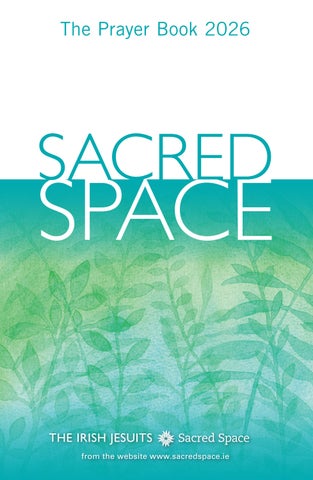
The Prayer Book 2026
Ignatian Spirituality / Prayer
Enter a Sacred Space Wherever You Are
P
rayer is the raising of our hearts and minds to God. It is a holy and sacred experience open to everyone. Sacred Space: The Prayer Book can lead us into a life of prayer and, in doing so, inspire new expressions and depths of faith.
SACRED
The Scripture, prayers, and reflections in this year’s edition of the beloved series will inspire you to a richer daily spiritual experience throughout the liturgical year and invite you to develop a closer relationship with God. Each day of Sacred Space: The Prayer Book includes a daily Scripture reading and points of reflection, as well as weekly topics enhanced by six steps of prayer and contemplation: The Presence of God, Freedom, Consciousness, The Word, Conversation, and Conclusion. Designed to help you stay faithful to your intention to deepen your spiritual journey, Sacred Space: The Prayer Book is the perfect gift for your parish, campus ministry program, a small group, friend, family member, or yourself.
2026
THE IRISH PROVINCE OF THE SOCIETY OF JESUS (the Irish Jesuits), founders of www.sacredspace.ie, has provided a trusted online prayer guide since 1999. Their website serves millions of spiritual pilgrims of many faiths around the world.
ISBN: 978-0-8294-6003-2
$19.99 U.S.
THE IRISH JESUITS from the website www.sacredspace.ie
c_6003_SacredSpacePrayerBook2026.indd All Pages
7/18/25 11:11 AM
SACRED SPACE
i_6003_PrayerBook2026.indd 1
7/30/25 10:47 AM
i_6003_PrayerBook2026.indd 2
7/30/25 10:47 AM
SACRED SPACE The Prayer Book 2026
from the website www.sacredspace.ie
Prayer from the Irish Jesuits
i_6003_PrayerBook2026.indd 3
7/30/25 10:47 AM
Copyright © by The Irish Jesuits 2025 This edition of Sacred Space Prayer Book is published by arrangement with Messenger Publications, 37 Lower Leeson Street, Dublin D02 W938, Ireland. Scripture quotations are from the New Revised Standard Version Bible: Anglicised Catholic Edition, copyright © 1989, 1993 National Council of the Churches of Christ in the United States of America. Used by permission. All rights reserved. Please note: Some Scripture readings and feast day observances in this devotional may differ from the Liturgical Calendar for the Dioceses of the United States. Where applicable, Scripture passages and liturgical commemorations are drawn from the General Roman Calendar or the Liturgical Calendar for Ireland, in keeping with the devotional’s Jesuit, international Catholic heritage. Loyola Press in Chicago thanks the Irish Jesuits and Messenger Press for preparing this book for publication. Cover art credit: Yifei Fang/Moment/Getty Images ISBN: 978-0-8294-6003-2 Published in Chicago, IL Printed in Canada 25 26 27 28 29 30 31 32 33 34 MQS 10 9 8 7 6 5 4 3 2 1
i_6003_PrayerBook2026.indd 4
7/30/25 10:47 AM
Contents Sacred Space Prayer
vii
Preface
viii
Introduction to Sacred Space 2026
ix
November 2025
3
December 2025
3
January 2026
37
February 2026
70
March 2026
101
April 2026
139
May 2026
174
June 2026
206
July 2026
235
August 2026
265
September 2026
299
October 2026
328
November 2026
361
i_6003_PrayerBook2026.indd 5
7/30/25 10:47 AM
i_6003_PrayerBook2026.indd 6
7/30/25 10:47 AM
Sacred Space Prayer Bless all who worship you, almighty God, from the rising of the sun to its setting: from your goodness enrich us, by your love inspire us, by your Spirit guide us, by your power protect us, in your mercy receive us, now and always.
vii
i_6003_PrayerBook2026.indd 7
7/30/25 10:47 AM
Preface In 1999 an Irish Jesuit named Alan McGuckian had the simple—but at the time radical—idea of bringing daily prayer to the Internet. No one imagined that his experimental project would grow into a global community with volunteers translating the prayer experience into seventeen different languages. Millions of people, from numerous Christian traditions, visit the Sacred Space website at www.sacredspace.ie each year and find an invitation to step away from their busy routines for a few minutes a day to concentrate on what is really important in their lives. Sacred Space offers its visitors the opportunity to grow in prayerful awareness of their friendship with God. Besides the daily prayer experience, Sacred Space also offers Living Space, with commentaries on the Scripture readings for each day’s Catholic Mass. The Chapel of Intentions allows people to add their own prayers, while Pray with the Pope joins the community to the international Apostleship of Prayer. In addition, Sacred Space provides Lenten and Advent retreats, often in partnership with Pray as You Go, and audio prayer service from the British Jesuits. The contents of this printed edition, first produced in 2004, are taken directly from our Internet site. Despite the increased use of Sacred Space on mobile devices, many people want a book they can hold and carry, and this book has proven especially helpful for prayer groups. In 2014 the Irish Jesuits entered into an apostolic agreement with the Chicago-Detroit Jesuits, and Sacred Space now operates in partnership with Loyola Press. I am delighted to bring you the Sacred Space book, and I pray that your prayer life will flourish with its help. Yours in Christ, Paul Campbell SJ
viii
i_6003_PrayerBook2026.indd 8
7/30/25 10:47 AM
Introduction to Sacred Space 2026 St Ignatius Loyola (1491–1556), one of the founders of the Jesuits, wrote a famous book titled the Spiritual Exercises. Right at the beginning of this book, Ignatius tells us what he means by ‘spiritual exercises’. He tells us that he means every form of praying—meditating, contemplating, praying vocally or mentally, examining one’s conscience and so on. This may seem somewhat of a mouthful but, as we’ll see, Ignatius gives us a great deal of freedom about how we might pray. The Jesuits still have about seven thousand of Ignatius’s letters. Not all these letters were spiritual, far from it! However, a glance at one or two of his letters will give us some insight into Ignatius the spiritual director. In a letter dated 7 May 1547 to the Jesuit students for the priesthood (‘scholastics’) in Coimbra, Portugal, Ignatius writes, ‘Your study does not allow you much time to engage in long prayer. However, such time can be made up for by the desires of the person who turns all his actions into a continual prayer, by undertaking them for the service of God.’ In another letter, addressed to the Jesuit Antonio Brandão, 1 June 1551, Ignatius writes, ‘The scholastics can exercise themselves in seeking the presence of God our Lord in all things—for example, in conversing with one another, in walking, looking, hearing, thinking and in everything they do.’ Look at the marvellous freedom Ignatius gives to Jesuit scholastics as regards the form of prayer they might use. Ignatius knows that he is writing to busy people. He knows that it’s next to impossible for full-time students to engage in long meditations or contemplations. So, almost anything they do, think, desire or feel can potentially be a prayer acceptable to God! Even a chat you’ve had with someone can, on reflection, be a source of prayer. Sacred Space is designed for busy people, like yourself. Sacred Space offers you a Scripture passage, usually taken from the Gospel of the day at Mass. It invites you to reflect, meditate, contemplate, ‘taste’ a passage each day for the length of time that is possible, workable for you.
ix
i_6003_PrayerBook2026.indd 9
7/30/25 10:47 AM
x
Introduction
A few suggestions for your time of prayer might help. Select a time and place (a room at home, taking a walk, in the office, in a church) where you are less likely to be disturbed. Decide on how long you will spend in trying to pray (five, ten, fifteen, twenty minutes or more). Rest with the Scripture passage for that time. Try not to cut short the time that you have decided on. Decide which ‘method’ of prayer you will use. Remember, the ‘method’ is only a scaffolding to help you enter into prayer. If you find that one method doesn’t ‘work’ for you, let it go and try another. ‘Pray as you can, not as you can’t’, as a wise Benedictine monk once wrote. Now, let’s have a look at some of these ‘methods’ of prayer. There’s Lectio Divina (Holy Reading), sometimes called ‘the Benedictine Method’ of prayer, although it existed long before the Benedictines came on the scene in the sixth century. This method of prayer was used in early Christian times, when most people, including the monks, couldn’t read. Lectio, although it means ‘reading’, originally meant listening—listening with an open heart to the words of Scripture being read aloud. Simply put, Lectio Divina suggests that you read the Scripture passage slowly; reread it slowly a few times; meditate, ruminate on it, ‘chew’ it over in your mind. Is there a word or a phrase that catches your attention, that speaks to you, to your life situation today? Can you speak to the Lord about this? What you say may be very simple—don’t judge your spontaneous conversation with the Lord. Then, rest with the Lord and shut up and listen, listen . . . What might the Lord be saying to you today through that word or phrase? Don’t worry if nothing comes to mind or if the time has been full of distractions. It doesn’t really matter what you think or feel. What matters is your desire to spend this time with the Lord. In your desire is your prayer. In Ignatian contemplation we let the words of the Gospel passage touch our imaginations, much as poetry or a novel would. Say, you’re contemplating the parable of the prodigal son. Can you imagine the scene? Ignatius would encourage you to see the characters in the scene, to listen to what they might be saying, to consider what they might be doing. Can you make yourself present to this scene? Who would you be in this scene? Would you just be an onlooker? Would you find yourself intimately involved? Could you speak to one of the characters in the story? Can you speak to the Lord about what went on for you, in your deeper self, in response to this story/parable?
i_6003_PrayerBook2026.indd 10
7/30/25 10:47 AM
Introduction xi
Some people have a very strong visual imagination. Scenes come alive vividly for them. They can see things in technicolour. Others have a strong auditory imagination. They can imagine conversations, even how somebody said something. They may have lively conversations with some of the characters in the Gospel scene. Others are different again: they neither see nor hear much, but they feel the story and the characters. What way does your imagination work for you? Some people find imaginary contemplation difficult. If you are one of these, again, don’t worry. Pray as you can! You may prefer the Lectio Divina method, and that’s fine. Don’t be a slave to one way of praying. Choose the one you find most fruitful, and try some other method when the one you are using becomes more a hindrance than a help. If you have constant distractions, again, don’t worry! Turn the distraction into a prayer. If you’re thinking about that argument you had with John or Ann yesterday, then pray for John or Ann—that’s a Christian thing to do and a very good prayer! I began by saying that when Ignatius was telling us what he meant by ‘spiritual exercises’, he also mentioned ‘examination of conscience’. Many people are not too comfortable with that phrase—they fear that their voice of conscience might lead to feelings of guilt or shame. It is more helpful to suggest that what Ignatius was really speaking about was ‘examination of consciousness’, or what in Ignatian language we call the Examen. Ignatius thought that the prayer of the Examen was of great importance in helping people find God in everything, in their everyday. He would have you begin the Examen with a moment of asking the Holy Spirit to help you to look back on your day through God’s eyes. Ignatius thought that ingratitude was the greatest of all sins, and so he asks that you get in touch with gratitude for the day just spent as a gift from God. You may have had a very difficult day, but there is usually something in the day that is sheer gift. It might have been an email from a friend, a smile from a colleague, a tasty lunch. Then you’re asked to look back on your day and see where the Lord has been leading you. You will often be surprised by all the things you did, people you met, feelings you had. Where have you been led in this day? What gave you life? What drained you of life? A great Ignatian insight is that God is very much present in our affect, our feelings. Now, you might admit to yourself gently the mistakes you made during the day and ask pardon of the Lord. Ask the Lord to help you live tomorrow in a more generous spirit.
i_6003_PrayerBook2026.indd 11
7/30/25 10:47 AM
xii Introduction
Don’t feel that you have to go through all these stages of the Examen. You might just want to stay with gratitude or sorrow, and that’s fine. As the first Jesuit I ever knew once wrote, ‘The smallness of each day is the theatre of our transformation.’ The famous twentieth-century Jesuit theologian Karl Rahner is also helpful here when he writes, ‘To let ourselves be educated through the everyday to kindness, patience, peace and understanding, to forgiveness and endurance, to selfless loyalty, then the everyday is no longer the everyday; then it is prayer!’ Just to close, I might add that if the Lord’s presence is not sensed in the ordinary events of each day, then the odds are that God will not be sensed in the celebration of the sacraments either! But remember, Jesus Christ is waiting to meet you in your everyday. As the poet Patrick Kavanagh wrote, ‘God is in the bits and pieces of Everyday.’ So, be of good courage and begin your journey of prayer in 2026. Do not be afraid! Brendan Comerford SJ
i_6003_PrayerBook2026.indd 12
7/30/25 10:47 AM
First Week of Advent
30 November–6 December 2025 Something to think and pray about each day this week: For us, in this Advent season, we are being called to realise that the tidy soul, like the tidy house, has to be worked at. It doesn’t just happen. If we truly want the Lord to come and stay a while, we have to prepare the way. It’s about putting the house in order—the soul in order. Somewhere and somehow we need to hear the centurion’s words again and realise his words are ours too, ‘Lord, I am not worthy to have you under my roof’. For that, we need a plan of action, a road map of sorts, to guide us on the journey. The Sacrament of Reconciliation supplies some of that road map. Its coordinates are already there for us, and the initial movement might be found in ‘Bless me Father, for I have sinned’. Vincent Sherlock, Let Advent Be Advent
1
i_6003_PrayerBook2026.indd 1
7/30/25 10:47 AM
2
November 2025
The Presence of God ‘I am standing at the door, knocking,’ says the Lord. What a wonderful privilege that the Lord of all creation desires to come to me. I welcome his presence. Freedom Leave me here freely all alone, / In cell where never sunlight shone. / Should no one ever speak to me, / This golden silence makes me free! —St Titus Brandsma, while a prisoner at Dachau concentration camp Consciousness How am I really feeling? Lighthearted? Heavyhearted? I may be very much at peace, happy to be here. Equally, I may be frustrated, worried or angry. I acknowledge how I really am. It is the real me whom the Lord loves. The Word I take my time to read the word of God slowly a few times, allowing myself to dwell on anything that strikes me. (Please turn to the Scripture on the following pages. Inspiration points are there, should you need them. When you are ready, return here to continue.)
Conversation Do I notice myself reacting as I pray with the word of God? Do I feel challenged, comforted, angry? Imagining Jesus sitting or standing by me, I speak out my feelings, as one trusted friend to another. Conclusion Glory be to the Father, and to the Son, and to the Holy Spirit, As it was in the beginning, is now and ever shall be, World without end. Amen.
i_6003_PrayerBook2026.indd 2
7/30/25 10:47 AM
December 2025 3
Sunday 30 November First Sunday of Advent Matthew 24:37–44 Jesus said to his disciples: ‘For as the days of Noah were, so will be the coming of the Son of Man. For as in those days before the flood they were eating and drinking, marrying and giving in marriage, until the day Noah entered the ark, and they knew nothing until the flood came and swept them all away, so too will be the coming of the Son of Man. Then two will be in the field; one will be taken and one will be left. Two women will be grinding meal together; one will be taken and one will be left. Keep awake therefore, for you do not know on what day your Lord is coming. But understand this: if the owner of the house had known in what part of the night the thief was coming, he would have stayed awake and would not have let his house be broken into. Therefore you also must be ready, for the Son of Man is coming at an unexpected hour.’ • These early Gospel readings of Advent encourage us to stay awake and alert. In reality for me this might mean that I will try to notice anything that has struck me in my daily living for the past few days. I may recall a conversation with a friend, or an event that—if I stay with it—may have something to say to me. Could this possibly be God speaking to me? How else would I expect the Lord to interact with me?
Monday 1 December Matthew 8:5–11 When he entered Capernaum, a centurion came to him, appealing to him and saying, ‘Lord, my servant is lying at home paralysed, in terrible distress.’ And he said to him, ‘I will come and cure him.’ The centurion answered, ‘Lord, I am not worthy to have you come under my roof; but only speak the word, and my servant will be healed. For I also am a man under authority, with soldiers under me; and I say to one, “Go”, and he goes, and to another, “Come”, and he comes, and to my slave, “Do this”, and the slave does it.’ When Jesus heard him, he was amazed and said to those who followed him, ‘Truly I tell you, in no one in Israel have I found such faith. I tell you, many will come from east and west and will eat with Abraham and Isaac and Jacob in the kingdom of heaven.’
i_6003_PrayerBook2026.indd 3
7/30/25 10:47 AM
4
December 2025
• In today’s Scripture we try to take courage from the figure of the centurion who takes his courage in his hands and asks Jesus for faith and energy as he seeks relief and assistance in his attempts to help his servant escape from his terrible distress. We hope that we might have some of the same zeal as we set out on our Advent faith odyssey.
Tuesday 2 December Luke 10:21–24 At that same hour Jesus rejoiced in the Holy Spirit and said, ‘I thank you, Father, Lord of heaven and earth, because you have hidden these things from the wise and the intelligent and have revealed them to infants; yes, Father, for such was your gracious will. All things have been handed over to me by my Father; and no one knows who the Son is except the Father, or who the Father is except the Son and anyone to whom the Son chooses to reveal him.’ Then turning to the disciples, Jesus said to them privately, ‘Blessed are the eyes that see what you see! For I tell you that many prophets and kings desired to see what you see, but did not see it, and to hear what you hear, but did not hear it.’ • Jesus himself seemed to be very conscious of the near presence of the Spirit in his life. We’re told that the Spirit is sent to us at Confirmation, but are we at all aware of the Spirit gifting us with insights? Could I take a few minutes out and ask the Holy Spirit to come to my aid, sharpening my ability to notice how the presence and the influence of the Spirit affects me?
Wednesday 3 December Matthew 15:29–37 After Jesus had left that place, he passed along the Sea of Galilee, and he went up the mountain, where he sat down. Great crowds came to him, bringing with them the lame, the maimed, the blind, the mute, and many others. They put them at his feet, and he cured them, so that the crowd was amazed when they saw the mute speaking, the maimed whole, the lame walking, and the blind seeing. And they praised the God of Israel. Then Jesus called his disciples to him and said, ‘I have compassion for the crowd, because they have been with me now for three days and have nothing to eat; and I do not want to send them away hungry, for
i_6003_PrayerBook2026.indd 4
7/30/25 10:47 AM
December 2025 5
they might faint on the way.’ The disciples said to him, ‘Where are we to get enough bread in the desert to feed so great a crowd?’ Jesus asked them, ‘How many loaves have you?’ They said, ‘Seven, and a few small fish.’ Then ordering the crowd to sit down on the ground, he took the seven loaves and the fish; and after giving thanks he broke them and gave them to the disciples, and the disciples gave them to the crowds. And all of them ate and were filled; and they took up the broken pieces left over, seven baskets full. • The disciples seem to lose heart very easily when things are not working for them as they might wish. They can only spot the downside of today’s scene. Jesus takes a completely different approach. He notes that the onlookers today must be tired and hungry. • Jesus’ question to his own disciples is ‘What might we to do to encourage and inspire?’, rather than ‘What elements of the situation are likely to defeat us?’
Thursday 4 December Matthew 7:21, 24–27 Jesus said to his disciples, ‘Not everyone who says to me, “Lord, Lord”, will enter the kingdom of heaven, but only one who does the will of my Father in heaven. . . . Everyone then who hears these words of mine and acts on them will be like a wise man who built his house on rock. The rain fell, the floods came, and the winds blew and beat on that house, but it did not fall, because it had been founded on rock. And everyone who hears these words of mine and does not act on them will be like a foolish man who built his house on sand. The rain fell, and the floods came, and the winds blew and beat against that house, and it fell—and great was its fall!’ • Jesus makes a distinction between two different types of listening—a listening that produces action and something positive, and a listening that brings forth nothing really constructive. He encourages us to make sure our listening brings forth something really worthwhile. Listening actively will help us understand what God has in mind for us and will shape our way of life.
i_6003_PrayerBook2026.indd 5
7/30/25 10:47 AM
6
December 2025
• Are my eyes and ears continually open and alert and picking up moments and occasions when Jesus himself may be very close at hand? As the old motto goes, ‘If you miss it . . . you miss it.’
Friday 5 December Matthew 9:27–31 As Jesus went on from there, two blind men followed him, crying loudly, ‘Have mercy on us, Son of David!’ When he entered the house, the blind men came to him; and Jesus said to them, ‘Do you believe that I am able to do this?’ They said to him, ‘Yes, Lord.’ Then he touched their eyes and said, ‘According to your faith let it be done to you.’ And their eyes were opened. Then Jesus sternly ordered them, ‘See that no one knows of this.’ But they went away and spread the news about him throughout that district. • Two blind men have followed Jesus, and they make their intentions fairly plain, even though—being blind—they must have found it hard to keep in close contact. We ourselves cannot see Jesus with our physical eyes, yet we follow him. As often seems to be the case, the men’s belief that Jesus in his goodness would do something worthwhile for them seems fairly clear, but Jesus gets them to spell out their trust and faith. When we make some request ourselves, is our sense of belief equally evident?
Saturday 6 December Matthew 9:35–10:1, 5–8 Then Jesus went about all the cities and villages, teaching in their synagogues, and proclaiming the good news of the kingdom, and curing every disease and every sickness. When he saw the crowds, he had compassion for them, because they were harassed and helpless, like sheep without a shepherd. Then he said to his disciples, ‘The harvest is plentiful, but the labourers are few; therefore ask the Lord of the harvest to send out labourers into his harvest.’ Then Jesus summoned his twelve disciples and gave them authority over unclean spirits, to cast them out, and to cure every disease and every sickness. . . . These twelve Jesus sent out with
i_6003_PrayerBook2026.indd 6
7/30/25 10:47 AM
December 2025 7
the following instructions: ‘Go nowhere among the Gentiles, and enter no town of the Samaritans, but go rather to the lost sheep of the house of Israel. As you go, proclaim the good news, “The kingdom of heaven has come near.” Cure the sick, raise the dead, cleanse the lepers, cast out demons. You received without payment; give without payment.’ • I try to get a sense of what it must have been like to move around with Jesus on a daily basis. He must have been encouraged as he noticed the crowds getting bigger and more enthusiastic. He didn’t spare himself. Perhaps I could strive to be similarly selfless as I go about my day.
i_6003_PrayerBook2026.indd 7
7/30/25 10:47 AM
Second Week of Advent
7–13 December 2025 Something to think and pray about each day this week: Over time, our images of Mary have become rather sanitised, partly due to cultural perceptions of the role of women but also due to the longstanding correlation in Church tradition between ‘holiness’ and ‘purity’ for women. We return to Mary’s roots, to her early appearance as the brave, decisive, breathless, excited young woman who rushed to Elizabeth’s house, pregnant with God’s promise, pregnant with joy, carrying the Word of God, passing it on. Many of us have a particular devotion to Mary. Advent is an ideal time to reflect on what Mary can teach us about being a disciple and ‘God-bearer’ (Theotokos). God asks each of us to be bearers of his love and his Word. Our challenge is to create a space for God in all of our human experience, in our joy and our brokenness. Let us follow in the footsteps of the first evangelist, Mary. Let us also listen to the experiences of the women in our Church and society who, through their strength and enthusiasm, continue the task of carrying Christ in and to the world. Tríona Doherty and Jane Mellett, The Deep End: A Journey with the Sunday Gospels in the Year of Luke
8
i_6003_PrayerBook2026.indd 8
7/30/25 10:47 AM
December 2025 9
The Presence of God ‘Be still, and know that I am God!’ Lord, may your spirit guide me to seek your loving presence more and more, for it is there I find rest and refreshment from this busy world. Freedom By God’s grace I was born to live in freedom. Free to enjoy the pleasures he created for me. Dear Lord, grant that I may live as you intended, with complete confidence in your loving care. Consciousness How am I today? Where am I with God? With others? Do I have something to be grateful for? Then I give thanks. Is there something I am sorry for? Then I ask forgiveness. The Word God speaks to each of us individually. I need to listen, to hear what he is saying to me. Read the text a few times, then listen. (Please turn to the Scripture on the following pages. Inspiration points are there, should you need them. When you are ready, return here to continue.)
Conversation How has God’s word moved me? Has it left me cold? Has it consoled me or moved me to act in a new way? I imagine Jesus standing or sitting beside me. I turn and share my feelings with him. Conclusion I thank God for these moments we have spent together and for any insights I have been given concerning the text.
i_6003_PrayerBook2026.indd 9
7/30/25 10:47 AM
10
December 2025
Sunday 7 December Second Sunday of Advent Matthew 3:1–12 In those days John the Baptist appeared in the wilderness of Judea, proclaiming, ‘Repent, for the kingdom of heaven has come near.’ This is the one of whom the prophet Isaiah spoke when he said, ‘The voice of one crying out in the wilderness: “Prepare the way of the Lord, make his paths straight.” ’ Now John wore clothing of camel’s hair with a leather belt around his waist, and his food was locusts and wild honey. Then the people of Jerusalem and all Judea were going out to him, and all the region along the Jordan, and they were baptised by him in the river Jordan, confessing their sins. But when he saw many Pharisees and Sadducees coming for baptism, he said to them, ‘You brood of vipers! Who warned you to flee from the wrath to come? Bear fruit worthy of repentance. Do not presume to say to yourselves, “We have Abraham as our ancestor”; for I tell you, God is able from these stones to raise up children to Abraham. Even now the axe is lying at the root of the trees; every tree therefore that does not bear good fruit is cut down and thrown into the fire. ‘I baptise you with water for repentance, but one who is more powerful than I is coming after me; I am not worthy to carry his sandals. He will baptise you with the Holy Spirit and fire. His winnowing-fork is in his hand, and he will clear his threshing-floor and will gather his wheat into the granary; but the chaff he will burn with unquenchable fire.’ • Today we find John the Baptist playing a central role in the scene we’re contemplating. He has appeared in the wilderness, and clearly people are beginning both to hear about him and to be very struck by what he has to say. His message today might be summed up in just one of his sentences—‘Prepare the way of the Lord’. • To proclaim and make clear this point, John constantly turned the light away from himself. You might be struck by his selfless behaviour and the fact that he wasn’t prepared to sugar-coat what he felt he had
i_6003_PrayerBook2026.indd 10
7/30/25 10:47 AM
The Prayer Book 2026
Ignatian Spirituality / Prayer
Enter a Sacred Space Wherever You Are
P
rayer is the raising of our hearts and minds to God. It is a holy and sacred experience open to everyone. Sacred Space: The Prayer Book can lead us into a life of prayer and, in doing so, inspire new expressions and depths of faith.
SACRED
The Scripture, prayers, and reflections in this year’s edition of the beloved series will inspire you to a richer daily spiritual experience throughout the liturgical year and invite you to develop a closer relationship with God. Each day of Sacred Space: The Prayer Book includes a daily Scripture reading and points of reflection, as well as weekly topics enhanced by six steps of prayer and contemplation: The Presence of God, Freedom, Consciousness, The Word, Conversation, and Conclusion. Designed to help you stay faithful to your intention to deepen your spiritual journey, Sacred Space: The Prayer Book is the perfect gift for your parish, campus ministry program, a small group, friend, family member, or yourself.
2026
THE IRISH PROVINCE OF THE SOCIETY OF JESUS (the Irish Jesuits), founders of www.sacredspace.ie, has provided a trusted online prayer guide since 1999. Their website serves millions of spiritual pilgrims of many faiths around the world.
ISBN: 978-0-8294-6003-2
$19.99 U.S.
THE IRISH JESUITS from the website www.sacredspace.ie
c_6003_SacredSpacePrayerBook2026.indd All Pages
7/18/25 11:11 AM