Two campaigns are currently running for Loyola’s Student Government Association president and vice president positions: the Merritt-Jones S.T.R.O.N.G.E.R. campaign and the CARE campaign. e S.T.R.O.N.G.E.R. campaign stands for Safety, Transparency, Resources, Optimized, Nutrition, Growth, Engagement, and Relationships. e CARE campaign stands for Community, Access, Results, and Empowerment.
Juniors Kiyah Merritt, a political science major and business administration minor, and Kamrin Jones, an economics and nance major, are the voices behind the Merritt-Jones STRONGER campaign.
Merritt, who is running for SGA president, is pushing for a more e cient SGA and striving to leave Loyola in a better place than before.
“It is the best way for me to build Student Government and Loyola as a whole,” Merritt said. “I have dedicated my entire Loyola career to SGA and plan to continue doing so. I also recognize there are areas where SGA can improve, and I believe those changes need to come from leadership.”
Alongside Merritt, Jones is running for SGA vice president. His vision aims for a more responsive, streamlined SGA that creates tangible results for students.
“I’ve worked within SGA and closely with student organizations, so I understand how it operates and where things can be improved,” Jones said. “I also think my strengths in organization, communication, and execution balance well with Kiyah’s leadership and vision. Together, we want to build an SGA that’s more transparent, accessible, and actually works for students.”
Each year, students at Loyola University New Orleans get the opportunity to bring their talents beyond the classroom and into one of the most iconic stages in the city, Tipitina’s. e Uptown reauxdown is a relatively new tradition beginning in 2021, and has quickly become one of the most anticipated showcases of student talent at Loyola. e showcase blends education, performance, and New Orleans music culture and history into one sold out show.
Campaigning begins for Student Government Association
Merritt and Jones relayed how they have been facilitating their campaign so far.
“Our campaign has been very student-centered so far. We’ve been tabling, hosting events, and, most importantly, just having real conversations with students across campus. A big part of our approach has been meeting people where they are and actually listening to what they want to see improved,” Merritt and Jones said.
Merritt and Jones have been intentional in their communication process for their campaign. rough endorsements and their social media platform, they have been uplifting student organizations and shedding light to the work they do.
“ at’s something we really value and want to keep doing. If elected, our focus will stay the same. We want to keep building those relationships and make sure SGA feels present and accessible in students’ everyday lives,” said Merritt and Jones.
In expressing their hopes for their campaign, Merritt and Jones also re ected on what their biggest challenges will be if elected.
“One of the biggest challenges will be balancing the di erent needs of a very diverse student body while making sure no group feels overlooked. Loyola has students with a wide range of priorities, and it’s important that everyone feels represented,” they said.
Another challenge concerns student engagement with SGA, and making sure “students continue to feel connected to SGA and aware of what it’s doing.”
e pair plan to be consistent and intentional about ensuring the established system.
ey said, “Another challenge will be
maintaining strong engagement and making sure students continue to feel connected to SGA and aware of what it’s doing. We also understand that making changes within an established system takes time, so being consistent and intentional about following through will be important.”
Outside of SGA, Merritt serves as Treasurer of Mock Trial, Secretary of the Pre-Law Association, and Secretary of the Finance and Investments Association. Additionally, she is a member of
Omicron Delta Kappa, the Disabled Student Association, and Pi Sigma Alpha, while also being an Admissions Ambassador, a former Krewe Leader, current Krewe Involvement Mentor, and future Krewe Leader Director.
Jones is the Founder and President of the Finance and Investments Association, Marketing Director of the Economics Club, and an O ce Assistant for the Women’s Leadership Academy. He serves as a Krewe Leader and future Krewe Leader Director. Additionally, he
has engaged in nance internships, an M&A project, and is currently serving as a Senator for the College of Business. Merritt and Jones shared their goals for the next school year. Merritt hopes to improve e ciency within SGA, specically in regard to allocations and internal and also wants to strengthen communication between SGA and students.
Brandon Grier (Azure Skyz) performs at the Uptown Threauxdown event at Tipitina’s on April 8, 2026. Uptown Threauxdown is an annual event for Loyola music students to showcase their work. Sophia Renzi/ The Maroon. see THREAUXDOWN
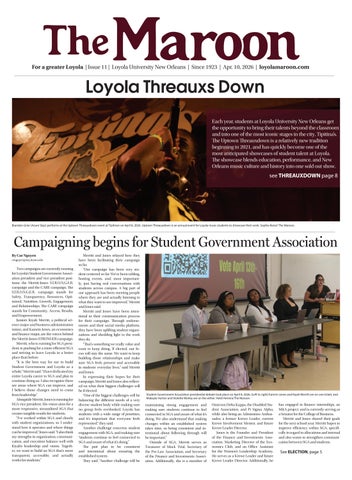
Student Government Association presidential debate took place on April 8, 2026. (Left to right) Kamrin Jones and Kiyah Merritt are on one ticket, and Makayla Horton and Violette Worley are on the either. Heidi Herrera/The Maroon
Loyola community remembers Mark Fernandez
By Lily Bordelon lmbordel@my.loyno.edu
Mark Fernandez’s daughter-in-law, Christina Fernandez, described Fernandez in a way students found perfect when reading the eulogy at his funeral. Above everything else, the words Christina believed suited him best were “really cool.”
Nha Nguyen, an alum who graduated in 2024, couldn’t agree more.
“That's just what he is. He was just the coolest guy, the coolest professor,” Nguyen said.
Fernandez was a professor at Loyola for over 30 years, serving as Patricia Carlin O'Keefe Distinguished Professor of History and role model for both students majoring in history and students in various different majors.
Nguyen was a history major who had Fernandez as her major advisor, and while at Loyola, she experienced unconditional support from Fernandez.
“He helped me a lot throughout my time at Loyola, because I had a really personal tough time during my undergrad, and he was always encouraging me and always telling me to keep going,” she said.
With this support, Nguyen was awarded Best History Student her sophomore year, which Fernandez emailed her about directly.
“I remember crying… He was telling me how much I deserved it and that he recognized my work,” she said.
Nguyen explained how she worked with Fernandez closely throughout her time at Loyola, and while doing so, she experienced his passion for teaching, as well as how much he cared for his students. According to Nguyen, she was in one of the last personal classes he taught before being diagnosed with brain cancer, but despite the obstacles, Fernandez continued to teach, even if some of his
classes had to turn virtual.
“I think the fact that he still kept wanting to teach even after his diagnosis is so amazing to me,” Nguyen said. “You can just tell he was so passionate about wanting to teach students, and that was what he was the most happy about.”
Nguyen explained how Fernandez would help every student he could, including those in different disciplines, and would touch the hearts of countless individuals. His Instagram posts were all pictures of his students and classes, commemorating his joy in the classroom.
“It really was not just about his teaching but his personality,” Nguyen said.
Students were not the only ones who recognized his dedication to Loyola. History department chair and professor Justin Nystrom, who worked alongside Fernandez, recounted the lifelong impact that Fernandez had on his students because of his care and passion for what and whom he taught.
“Mark cared the world for his students,” Nystrom said. “I don't know how many times Mark and I would be out, you know, having drinks or something, and there would be somebody who comes up, you know, from age 40 to 30 or, you know, older even, and they'd come over and they'd be like, ‘Mark!’ [because] he was their professor.”
Fernandez not only had deep relationships with his students, but he also forged irreplaceable bonds with his colleagues.
Nystrom explained how he saw Fernandez as some kind of mentor who helped him serve the University the right way.
“He treated me like family, you know, and he and I were very close friends … making sure our interests were served, making sure we did what we needed to do to get tenure, to do all that kind of stuff, and, uh, teaching us, in turn, also how to be good citizens of the universi-
ty,” Nystrom said.
Through his work as a professor, Fernandez also constantly fought for social justice on campus. According to Nystrom, he would constantly speak out at senate meetings and ensure that the University was kept “on the ramps.”
Despite falling ill, Fernandez still brought up pressing social justice issues in his classes, including recent issues of immigration.
“Particularly thinking about the migrants…people from Latin America crossing on foot, coming to the United States and working here… resonated very strongly with his scholarship,” Nystrom said.
Both Nguyen and Nystrom acknowledged his love for Woody Guthrie, a Depression-era folk musician and American icon. He would speak about Guthrie constantly in his classes not only because of his musical skill but also because of the musician’s outspoken concern for migrant communities.
“He was also a big fan… his research was a lot about Woody Guthrie… his absolute favorite musician. He would talk about it all the time in class,” Nguyen said.
Nguyen recounted a story where she took a picture of Guthrie’s guitar at the Museum of Pop Culture and sent it to Fernandez, and he posted it all over his socials.
“I sent it to him personally, and he was so happy. I didn't know this, but he posted the picture on all the social media accounts and then he showed it to other professors I was really close with,” Nguyen said. “I did not know it made him that happy. And I was really emotional just hearing about that.”
Fernandez was named the Seventh Annual Woody Guthrie Fellow by the Woody Guthrie Foundation and BMI Music Publisher in 2012, which his obituary said “spoke to the breadth of his cu-
riosity and passion for American culture and folk traditions."
His obituary noted that he also received the Dux Academicus award, Loyola’s highest distinction, alongside his title of Patricia Carlin O'Keefe Distinguished Professor of History. He additionally received the Louisiana Historical Association's Garney McGinty Lifetime Service Award in 2023, and he earned the Louisiana Literary Award from the Louisiana Library Association for his scholarship, specifically because of his book “From Chaos to Continuity: Evolution of Louisiana's Judicial System, 1712-1862.”
Aside from his scholarship, Fernandez also enjoyed playing the guitar and played for multiple venues across the
city.
“For those who knew Mark, seeing him on that stage was seeing him in his element,” the obituary said.
Fernandez’s funeral was filled with friends and family who appreciated his passion and ambition, especially when it came to Loyola.
“The whole funeral, the pews, [were] all filled up. Everyone was there to say their farewell to him, but it was just amazing. You just saw alumni, students, all sorts of people coming to say goodbye,” Nguyen said.
Planting the seed of Bloom Fest: Kendall Daigle's legacy at Loyola
By Lily Bordelom lmbordel@my.loyno.edu
Kendall Daigle wanted to make a difference through her work. According to Michelle Daigle, Kendall’s mother, Kendall wanted her suffering with addiction to mean something, so she wrote about her experience in a way that her mother described as raw and unfiltered.
Michelle believes that through Bloomfest, Kendall is achieving her goals even after her passing.
“For me to be able to witness as a mom, people reading her work and possibly being helped by reading it, it's like they have a companion in her, you know, because she was very raw with her writing…” she said. “She did not mince words about what it was like to go through mental illness, depression, or addiction, so it's kind of like people aren't alone, and they get some comfort by reading her work… it’s a comfort to me.”
The Daigle family planted the seed of bloomfest by making a donation and implementing an endowment fund for Loyola students.
“They have many great events. They do… visiting authors and many other events, like study abroad programs,” Michelle said.
From there, they planned to com-
memorate Kendall by putting her picture in the English Lounge, but Michelle explained that it didn’t “sound like Kendall.” Instead, they decided to work with the design department, who came up with the idea to create the Kendall Collective. After creating the tree that now sits in front of Monroe, the department decided the next year that they wanted to hold a festival.
“After that, things kept growing, and a lot of the other head department heads, who are also extremely creative, all work together, and now this is a collaborative event among all the departments, especially like the design department, the film department, film and music, and, of course, the English department and many of the other departments,” Michelle said.
Bloomfest’s creation began because Kendall’s family knew it resembled her ambitions and chose to nourish her memory through an event that represented her artistic disposition. Now, the festival has made an impact on Loyola’s community, especially for students who experience or witness substance abuse.
Ana Beatriz-Paz, a sophomore environmental science major, attended this year’s Bloomfest, which took place March 30. She expressed the impor-
tance of this event because of how addiction is still an ongoing issue in college environments.
“Addiction hasn't just magically disappeared since this happened, and even though she was a student 10 years ago, she still was a part of this community,” Paz said. “She changed a lot of people's lives, and i think it's really important to honor that… it really brings awareness to the issue because it could really happen to any of us, especially us college students.”
Not only is it an event that spreads awareness on substance abuse, but Bloom Fest also provides opportunities for Loyola students to showcase their talents, like writing and music, according to Paz.
“[I loved] the community and getting to see how different loyalist students and faculty came together to showcase their talents but also do really cool events and little tablings that get the student body excited and learning about new things,” she said.
Students and faculty enjoy Bloom fest outside Monroe Hall. The Bloom Festival took place on Monday, March 30, 2026, inviting students and members of the Loyola community to come together to experience creativity. Elyssa Willis/ The Maroon.
Mark Fernandez smiles while sitting at a table. Dr. Fernandez passed away on March 31, 2026, and his funeral was held on April 8, 2026. Courtesy of Nha Nguyen for the Maroon.
Student volunteers Jade Slater and Maximilian Campbell serve freshly baked cookies for festival goers to enjoy. Ekyssa Willis/The Maroon
PUZZLES
Across 1. "One last thing ... " 8. Gadget for a seafood chef
14. Chewy bits in some oatmeal cookies
15. Estrogen, e.g.
16. Noisy insects that emerge in summer 17. Small crustaceans
18. Luge, for one
Get stu ready for vacation 21. Series of reps in the gym
22. Empty spaces
24. Sponged (o )
26. "__-ching!"
28. "Bohemian Rhapsody" Oscar winner Malek
30. "O Sole __"
31. Target
32. Sch. that hosts the Sun Bowl
33. To-do list trip
37. Fuss at the mirror
39. "Euphoria" cable network
41. Chocolate source
42. Made a cozy home
44. Not written down, as a contract
46. O cial who calls balls and strikes
47. Laudatory poem
48. Ready, willing, and __
49. Driver's seat?
50. Snack brand named for a Roman moon goddess
53. Dept. of Labor div.
55. Equinox mo.
56. Fool around (with)
58. Kimono sashes
61. Consider anew
63. Seasonal qua s
65. Awakens
66. Take revenge
67. Electronic keyboards, informally
68. Appetizer-size burgers Down
1. Rainbow shapes
2. Get just right
3. Yahtzee, craps, et al.
4. Carne __ tacos: steak dish
5. Tupperware top
6. Gets short with
7. Mount of Greek myth
8. O ender's de ant challenge
9. Mysterious designs in elds
10. Concert device
11. Start to change?
12. Came to a stop
13. Sit for a spell
15. Long walk
20. Portable writing surface
23. Fruit- lled breakfast treat
25. Jewish wedding dance
26. Crunch's rank in the cereal
aisle
27. Fill a job opening
29. "It's alright, I suppose"
34. On the next level, or what 3-, 9-, 20-, and 23-Down literally have
35. First entry on many a form
36. Suss (out), informally
38. School attended by many English statesmen
40. Poetic sphere
43. Fillets, as a ounder
45. Soothing balm for a sunburn
50. Suspicious (of)
51. " e Jungle" writer Sinclair
52. NASA go-aheads
54. Made sharper
55. Sp. titles
57. Staying power
59. Disney CEO before D'Amaro
60. Hyphenated personal IDs
62. Crude dwelling
64. VW hatchback
For weekly puzzle answers, visit our Website via the QR code:
STAFF LIST
Editorial Board
Editor in Chief - Eloise Pickering
Managing Editor - Mary Ella Hastings
Pre-Content Director - Alana Frank
Post-Content Director - Callie
Honeycutt
News Editor - Lily Bordelon
News Editor- Stella Perdue
Worldview Editor - Pablo Piñeiro
Life & Times Editor - Elise Beck
Asst. Life & Times Editor - Olivia Sanyal
Sports Editor - Keri Smith
Opinion/Editorial Editor - Imad
Siddiqui
Breaking News Editor - Natalie omas
Copy Editor - Mark Michel
Senior Sta Writer - Dominique
Campbell
News Consultant - Mark Michel
e Wolf Director - Laura Welles
Senior Sta Photographer - Sophia Renzi
Photo Editor - Ashlyn Bobb Collins
Asst. Photo Editor - Pharrell Every
Social Coordinators - Carlos Andrade, Maria Touzard
Assistant Student Media Adviser: Gabriella Killett Vargas
CONTACT
US
Main O ce - (504) 865 - 3535
Business O ce - (504) 865 - 3536
Adviser’s O ce - (504) 865 - 3295
Correspondence - maroon@loyno.edu
Letters to the Editor - letter@loyno.edu
Advertising - ads@loyno.edu
Website - www.loyolamaroon.com
Twitter - @loyola_maroon
Facebook - e Maroon
Instagram - @loyola_maroon
Our o ce is in the Communications/ Music Complex, Room 328.
Send mail to: e Maroon, Loyola University, Campus Box 64, 6363 St. Charles Ave., New Orleans, LA 70118
e Maroon is published every Friday. Unless otherwise noted, all content is copyrighted by e Maroon. All rights reserved. First copy free to students, faculty, and sta . Every additional copy is $1.00.
e Maroon is printed on 30 percent post-consumer recycled content.
CAMPUS
ELECTION: SGA begins campaign period Candidates pitch policies at SGA debate
Continued from Front
“Overall, I want to make SGA more accessible and more responsive to student needs,” Merritt said.
Jones hopes to improve processes within the business and music schools.
“I care about… pushing for more flexibility within business portfolio requirements so students can better align what they’re doing with their actual career goals. Outside of that, I really want to increase student engagement with SGA,” Jones said. “I’ve met a lot of students through this process who said they’ve never really interacted with SGA before, and I want to keep building on that. I also want to help get more student work out there through event promotion, small business support, and highlighting our art students.”
Additionally, Merritt and Jones reflected on what legacy they want to leave behind at Loyola.
“I want to be remembered as someone students felt comfortable going to, whether they had a question, needed help, or just wanted to be heard. I want to leave behind an SGA that feels more approachable and more connected to the student body,” Merritt said.
“I really just want the people around me to accomplish their goals. If something I worked on, whether that’s a policy or a bill or anything like that, helped even one person reach their goals, that would honestly mean everything to me. That’s the kind of impact I want to have,” Jones said.
They expressed what they are most
excited about if their campaign wins.
“If we win, we’re really excited to bring a lot of the events we’ve been planning into SGA and actually see them happen on campus,” said the pair. “Overall, we’re just excited to take everything we’ve been talking about and actually make it real for students.”
Alongside Merritt and Jones, Violette Worley and Makayla Horton are also campaigning for SGA president and vice president. Worley, an international business and music industry studies major, and Horton, a finance and economics major, are the voices behind the CARE campaign.
“We chose to run in this year’s SGA elections to give back to the Loyola community that has given so much to us. Through our experiences in student government, we have seen firsthand the impact that strong, intentional leadership can have on the student body,” Worley and Horton said.
They shared how they have been facilitating their campaign so far.
“So far, the CARE Campaign has been centered around intentional outreach and meaningful engagement with students. We have prioritized connecting with diverse student organizations, attending meetings, and listening directly to student concerns and ideas,” said Worley and Horton. “More than anything, we want students to understand what it truly means to CARE.”
“If elected, our campaign will focus on our core pillars: Affordability, Identity, and Campus Connection, alongside our broader mission of Community, Access,
Results, and Empowerment. Through these pillars, we aim to create a more inclusive, transparent, and student-centered experience at Loyola,” they said.
“Through this campaign, we hope to create a more connected, responsive, and accessible student government,” Worley and Horton said. “We want students to feel that their voices are not only heard but acted upon. This includes expanding access to resources and opportunities, increasing financial support through grants and scholarships, and creating more inclusive and engaging campus programming. Ultimately, we want every student, regardless of background or involvement, to feel represented, supported, and valued.”
Worley and Horton shared their thoughts on what they believe their biggest challenge is going to be if they come into this position.
“We recognize that one of the biggest challenges in this position will be navigating unforeseen obstacles. However, as President and Vice President, we are committed to working closely with our cabinet, remaining adaptable, and leading with collaboration to effectively address any challenges that arise,” Worley and Horton said.
Outside of SGA, Worley acts as a Krewe Leader Coordinator, President of Delta Sigma Pi Business Fraternity, and is a member of Alpha Kappa Alpha Sorority, Inc. Additionally, she has previously served as a Senator and is now Chief of Staff.
Additionally, Horton is a Resident Assistant, a member of Alpha Kappa Alpha
Sorority, Inc., Vice President of Chapter Operations for Delta Sigma Pi Business Fraternity, and is involved in the University Honors Association.
They relayed their goals for the next school year.
“Our goals include increasing emergency grants and scholarships, establishing volunteer partnerships with service organizations in New Orleans, collaborating with Tulane to provide discounted football tickets, creating a syllabus bank, and hosting a homecoming concert,” said Worley and Horton. Overall, we aim to balance meaningful academic support with engaging campus life.”
Worley and Horton want to leave behind a memorable legacy at Loyola. In wanting students to feel empowered and supported, they strive for strengthening existing school systems, opening up more opportunities, and fostering community on campus.
Worley and Horton expressed what they are most excited about if their campaign wins.
“If elected, we are most excited to begin implementing our initiatives and turning the ideas we’ve heard from students into real, tangible change,” Worley and Horton said. “We are passionate about creating an impact that students can feel in their everyday experience at Loyola.”
Students will be able to vote in the SGA elections between April 13 and April 16.
Meet John Klee: Buddig Hall's Community Director
By Alyvia Pierson atpierso@my.loyno.edu
Hailing from Lake Orion, Michigan, John Klee is the community director for Buddig Hall, a first-year residence hall at Loyola University New Orleans. Unknown to many, Klee has many interests that have fueled his journey in life. Growing up in the heart of Motown, music has always been influential to Klee.
“I wouldn't be who I am without music. I was always dancing around the house, and [dancing while] shoveling snow or entertaining my sisters. The first song I remember is ‘My Girl’ and ‘Build Me Up Buttercup’; I'm very proud of [the culture] in Michigan,” Klee said.
Klee began kindergarten at four years old, as the youngest in his cohort. Initially struggling in his early years, Klee was developmentally younger. In third grade, Klee was taught in a split classroom where half the space was shared with fourth graders. He performed very well academically, finishing assignments before his classmates. His teacher sug-
gested that he move to the fourth-grade side of the classroom. As a natural social butterfly, moving ahead was never an issue for Klee.
His music journey began with piano lessons. In the fifth grade, Klee explored variations of the saxophone and played the tenor saxophone in his high school marching band. His senior year, he received the special honor of being a part of the U.S. Army All-American Marching Band before graduating in 2018 at 16 years old.
In 2022, Klee obtained his bachelor’s degree in music education on a scholarship from the University of Southern Mississippi through the nation’s sixth oldest honors college. His freshman year, he marched tenor saxophone and prepped to become a band director.
“As a band director, you have to be able to be competent and capable of teaching students on all instruments. And we get like one semester [each] to learn how to play brass, learn how to play percussion, and how to play strings,” Klee said.
By junior year, he was section leader and by senior year, he played the euphonium, mastering two instruments before graduation. While many criticized his parents for allowing Klee to begin college at 16, Klee was formidable and never let his age affect his relationships.
“For me, doing [college] so young, it felt like the normal thing to do. Whether by necessity or subconsciously, I've always had to mature a little bit quicker or be able to respond socially better in those situations, because I'm always the
youngest of the group. So, I didn't know anything different,” Klee said.
Returning home, Klee went on to obtain his master’s degree in K-12 educational administration from Michigan State University, the number one education program in the country. Klee has always had a passion for education, especially growing up with administrative parents.
“I've always seen that knowledge is power. I [hoped to] give back what I've learned and the experiences I've gotten and the information I have to others. The more I can help students learn, the better, so that they can achieve their dreams,” Klee said.
He hoped to help kids grow to become better people. Klee remembers a quote his former band director would say:
“Good is the enemy of great. Like good enough is neither good nor enough. I carry [this] with me, and I really wanted to give that back to my students. And I'm proud that in the three years that I was teaching, people felt welcome, and they felt like they had a place to be,” Klee said.
While working on his master’s degree, Klee was an elementary and middle school music teacher and a high school band director. In May 2025, Klee graduated before moving to New Orleans. Today, at 24 years old, Klee is pursuing his Ph.D. in Educational Administration with a concentration in Higher Education from the University of New Orleans, while also working as a community director in Buddig Hall. The decision to pursue a Ph.D. was never a question to
By Stella Perdue swperdue@my.loyno.edu
Student government candidates both agreed on increasing communication between the Student Government Association and the student body during their potential terms next fall, but had different opinions on how to do so.
At a debate on Wednesday night, presidential candidate Kiyah Merritt said she aims to focus on relationship building between SGA and organizations as well as safety across Loyola. Fellow presidential candidate Violette Worley said she wants to focus on three pillars: campus connection, affordability, and identity.
Merritt and her running mate Kamrin Jones said that if elected, they’d be focusing on looking inward at Loyola. That would mean creating initiatives such as free drink testing cards, holding open office hours in the hub for organizations, and providing resources to pre-professional students. Their goals overall are to be open with students about what’s going on in SGA as well as on campus.
When asked about the debate, Jones said their “emphasis on getting students out there, like with their small businesses and music” is something Merritt and himself want to work on. “SGA should be a vessel for students who want to work on their careers,” he said.
Klee, especially growing up with parents who had one.
As a community director, Klee interacts daily with residents within a 400-plus occupancy residence hall and with residential professional staff. This requires him to be personable, conversational, and available. The job includes a variety of requirements such as managing day-to-day operations of Buddig, curating learning-based community programming, and much more. Beyond this, Klee manages and supports the resident assistants of Buddig Hall.
“Whenever we have our one-on-one meetings, he keeps [record] of important things during our conversations. He also checks in with whatever you’re going through, and he'll ask how he can support you with that,” said Jake Mullis, a Buddig Hall RA.
Additionally, Klee is very intentional and persistent with getting to know residents beyond their names. During the workday, he leaves his office open to greet students, allowing them to speak to him if needed.
“I met with [John] when I was dealing with roommate drama. I was supposed to move in with someone this semester, but he made it where I didn’t have to,” said Ellen Clark, Loyola freshman and Buddig Hall resident.
Klee shares how being a community director has helped him professionally.
“I wanted to be a CD for the same reasons I want to be an administrator: to be a leader and to help people. I’m thankful for this job and I’ve really enjoyed it,” Klee said.
Presidential candidate Worley and her running mate Makayla Horton, on the other hand, are looking outward: they want to increase outreach in New Orleans, making Loyola’s presence known city-wide. On a student body level, they want to enact tangible change by creating syllabus banks or removing the $15 dollar charge for student IDs. They also argued for better emphasis on marketing SGA events in order to improve information retention for students, such as interactive social media polls.
“I want students to hear from us first hand,” Worley said. “Of course we have more initiatives than the ones we talked about tonight. A bigger one would be pushing for students to actually perform, or do the things that they’re good at… how can we get them to perform at halftime during basketball games?” she said.
Worley also said that outsourcing marketing for SGA by approaching different creative students for help with flyers or other promotional material is something she wants to do.
Though they have different views on how to specifically carry out their potential terms, both candidates strongly highlighted their individual desires to make the student body feel seen and included. Merritt and Worley expressed willingness to collaborate with the SGA Senate to accomplish this.
John Klee poses with Havoc. Courtesy of John Klee
WORLDVIEW
Louisiana ranks third in high school vaping, global study says
By Dominique Campbell ddcampbe@my.loyno.edu
According to a global study, the United States is ranked 53 out of 55 countries for vaping reduction. Louisiana is ranked third in high school vaping, with more than a quarter of Louisiana high school students having reported using electronic vapor products in the last 30 days.
According to data from the Center for Disease Control and Compare the Market, 25.3% of high school students within Louisiana admitted to using vape products at least once in the last month. That is the third highest rate in the nation.
Steven Spicer, general manager of health at Compare the Market, talked about how the United States’ response to vaping compares to other countries, such as Australia.
“The data shows a stark divide in how nations handle the vaping crisis,” Spicer said. "While countries like Australia use strict prescription-only models and high taxes to deter use, the U.S. remains one of the most accessible markets for e-cigarettes in the world".
Loyola Assistant Professor and Family Nurse Practitioner Program Director Melissa Lebrun talked about the effects of vaping on the brain, more specifically brains that are still developing.
“The adolescent brain continues maturing well into the mid-twenties, making it uniquely vulnerable to the neurotoxic effects of nicotine delivered through vaping.” Lebrun said. “Adolescence is a critical developmental window during which major expe-
rience-dependent plasticity occurs in executive control and decision-making regions (in the brain),particularly the prefrontal cortex, and chronic nicotine exposure during this period has long-term consequences on cognitive behavior, including diminished attention span in adulthood.”
Lebrun goes on to say, “studies have found that teens who vape on more than five days per month had significantly higher odds of developing persistent bronchitis symptoms such as chronic cough and shortness of breath, and current e-cigarette users had approximately 39% higher odds of self-reported asthma than non-users.”
Lebrun cites a study from Sciencedirect.com that states that “research consistently points to two overlapping areas of promise for decreasing vaping at the state level: social-emotional skill development and peer-led delivery. Social-emotional skills curricula and school-based peer leader programming showed promise for preventing e-cigarette initiation.”
When it comes to why teens vape, there can be a few reasons available.
A few Loyola students break it down to just a few main reasons. It could be because of social groups, affordability or just personal preference. Loyola students weigh in on the recent uptick.
Loyola junior psychology major Ashley Pailet said, “I think the thing that compels high school students to start vaping is seeing their friends do it.”
Pailet added that she believes the flavors of electronic cigarettes to also be contributing to this. “I think it’s especially appealing to high school students because it smells and tastes good,” Pailet said.
“Vaping can also be a more accessible way (practically and legally) to unjust tobacco or marijuana than other typical means of smoking.” Pailet said.
Personally, her views on vaping aren’t positive. Palait said, “I feel like vaping smells less gross than regular cigarettes but it is still super harmful. It’s not cool and it’s not something that people should be trying.”
Pailet offered her thoughts on state regulations when it comes to teen vaping. She provided points that would perhaps curb the usage.
“There should definitely be regulations applied to vaping. There’s harmful health effects associated with it that can be so severe leading to death. Regulations are in place to protect people and this is a major detriment to adolescent and young adult health,” Palait said.
Senior Ryan Fisher offered another, more personal take on teen vaping.
“I think high school students start vaping because they see their older peers do it and have heard about it since they were little,” Fisher said. “I’m not gonna lie, I myself was kind of a bad kid and used to hit vapes in high school. I’m not necessarily proud of it but it is something I used to do. I think that high schoolers vaping is kinda sad but it unfortunately will keep on happening until all vapes are banned or discontinued.”
When it came to whether vapes should be banned, Fisher said, “I think that there should be a ban on fruity or “fun” flavored vapes all over the country. I also think that brands like “Lost Mary” and other brands like it should also be banned.”
Unauthorized drones spotted over Louisiana base, raising students' concerns
By Angelica Pineda acpineda@my.loyno.edu
Unauthorized drones were recently spotted flying over Louisiana’s Barksdale Air Force Base in Bossier City, causing concern among students as well as a retired veteran from the Barksdale Base.
The sightings took place in early March and resulted in a shelter in place at the base as a safety precaution, considering it could be a possible enemy or threat.
A Barksdale Air Force base spokesperson commented on the matter.
“Barksdale Air Force base detected multiple unauthorized drones operating in our airspace during the week of March 9. Flying a drone over a military installation is not only a safety issue, it is a criminal offense under federal law,” the spokesperson wrote. “We are working closely with federal and local law enforcement agencies to investigate these incursions. The security of our installation and the safety of our people are top priorities, and we will continue to vigilantly monitor our airspace.”
After hearing their comment on the matter there were still students concerned about the shelter in place and what that means for the safety of the Barksdale Air Force base.
A Loyola psychology student, Jayden Jones, voiced his unease.
“You don’t know what's really going on and then they had to shelter in
place. That could make somebody really scared,” Jones said.
Technical Sergeant and Aircraft Systems Craftsman Jamie Smith served for 20 years and was then stationed at Barksdale for the last five years of his service. Smith explained that shelter in place procedures are precautionary protocols.
“The shelter in place is just a precautionary step and standard operating procedure to defend against the unknown threats. Until the threat is identified and eliminated or determined not to be a threat the shelter in place is enacted,” Smith said.
Smith compared it to the safety drills students often face.
“Have you ever been in a school lockdown drill or actual school lockdown? Think of a shelter in place like a school lockdown procedure,” Smith said.
Smith also gave more insight on the Barksdale AFB as a whole and why it would be a possible target for drone surveillance.
“I know that those aircrafts on the base are able to fly with nuclear weapons. Not sure if they do but it would be a strategic target by our enemies. Also by seeing how many aircrafts are on the base can give you an idea of any possible operational significance there is. I thought it was odd that drones were flying around the base,” Smith said.
The fear of a possible enemy was a common sentiment among students.
“I feel like it may lead people to think different things. I feel like you could potentially think we’re getting attacked by somebody from a foreign country or something,” Jones said. “We don’t know why the drones are here. This could be some technological warfare type of thing or like they could just be recording all of us, taking information. It’s like there’s so many possibilities and it just makes the mind run.”
Angelina Campos, a Loyola criminology major, also voiced her opinion.
“I feel like that's a little bit scary for the simple fact that we’re not being told things,” Campos said. “As people of America we should at least have some type of understanding of what's going on in our world instead of turning a blind eye to it.”
Photo illustration of a person using vape. Gabby Conway/The Maroon
Graphic of drones over landscape. Makayla Parker/The Maroon
Students threaux down: The annual tradition returns with emerging talent
By Morgan Parker mparke2@my.loyno.edu
This year's event starts strong with high-energy performances from the Hip Hop and R&B ensembles. As described on Loyola's website, “The night ignites with explosive sets from the Hip Hop and RnB Ensembles, bringing fresh beats, sharp lyricism, and an undeniable groove to the stage right out of the gate.”
This momentum will continue with six of Loyola’s popular and commercial music ensembles who will close out the show.
“These groups will debut newly recorded and soon-to-be-released music, spanning a vibrant spectrum of artistry—from Soul, Funk, and 90’s RnB to Dance, Disco/Boogie, and throwback Pop stylings.”
Loyola Professor and Music Business Studies Chair Jonathan McHugh stated, “It is an amazing thing that they get to feel, to be on a stage where so many legends have performed. You couldn't ask for a better spot to perform and show what kind of game they have. They have
the opportunity to perform in ensembles where they can work off of each other, use the band, and the band utilizes the artist to take their performance to the next level.”
Tipitinas is approaching its 50th anniversary in 2027, which makes this experience even more significant and noteworthy.
Students themselves describe the performance as both exciting and meaningful. Jayden Nelson (JAYSINGS), a sophomore in the Hip Hop and R&B Ensemble, reflected on the impact of performing on Tipitina's stage.
“Performing at Tipitinas is really exciting, especially when you get all the adrenaline from the crowd and the atmosphere,” Nelson said.
For instance, when I performed last semester, I was singing a challenging song but I felt encouraged by the crowd and their response when they saw me on stage, and after that I felt really proud of myself.”
For Nelson and many other students, the experience goes beyond the moment.
“Performing at Tipitinas is important to me because I feel I get to showcase what I've been working on all semester and I also get to practice my craft at an important venue that has given New Orleans so much history,” Nelson said. For other students, Uptown Threauxdown marks both an ending and a celebration of growth.
Vienna Notarianni, a junior Popular & Commercial Music major who has performed at the Uptown Threauxdown every year, sees this year's show as especially meaningful.
“Since I am finished with my ensemble credits, and this is my last Tipitinas, it feels great to show my peers and teachers all the hard work I’ve been putting in. It’s extra special this semester because we’re performing all original music,” Notarianni said.
Notarianni also expresses how the experience has pushed her to be better as a musician.
“The disco ensemble was a particularly challenging experience for me, playing double keys with synth for the first time. It feels gratifying to stretch out
of my comfort zone.”
Her reflection highlights one of the most important parts of the event. Not just to perform, but to grow as an artist.
Beyond performance, Uptown Threauxdown serves as a bridge between Loyola and the New Orleans music community. McHugh explained that this event is a great way to identify emerging talent.
“I see it almost like an A&R opportunity,” McHugh said. “It's like going into a mini music festival - you get to see who is who and what type of game people have. I want to see what type of music people are making so that I can recommend them for the Studio A music library or for Howl Booking.
It helps us support them, connect them, and even recommend them for future opportunities.”
The show features students of different ensembles, styles of music, and genres all coming together to make one cohesive show, just like a mini festival.
The connection to the real world is a big part of what makes this event important. In a city like New Orleans where mu-
sic is a part of everyday life, students are constantly surrounded by opportunities to perform.
Uptown Threauxdown helps encourage students to take that step. This event gives students the opportunity to get their name out into the city, network, showcase their talent, and more. Uptown Threauxdown shows the music community what Loyola offers.
Students, faculty, parents, and the New Orleans community all come together to support Loyola artists.
Uptown Threauxdown is a celebration of student performance, hard work of the music community at Loyola, and of the music and culture that define New Orleans. It gives students the chance to showcase their talent and step in the spotlight, and for one night at Tipitinas, they get to do just that.
Azure Skyz performs alongside U-P Thomas at the Uptown Threauxdown at Tipitinas on Wed, April 8, 2026. Sophia Renzi/the Maroon.
Breezly, Ja Fearce, and Azure Skyz at the Uptown Threauxdown at Tipitina's on Wed, April 8, 2026. Sophia Renzi/the Maroon.
LIFE AND TIMES
French Film festival at Prytania brings workshops, screenings
By Olivia Sanyal ossanyal@my.loyno.edu
e New Orleans French Film Festival hosted its 29th annual screening of lms and events this year. e festival is one of the longest-running international language festivals in the U.S, that spread across the city of New Orleans, with lms shown at the Prytania eatre Uptown, showcasing classic and contemporary lms from French speaking countries.
I think cinema is so important because it brings people together to experience creativity and expression that is built on diverse perspectives and languages to celebrate the art of storytelling.
is year I attended events and screenings on Sunday, March 22 that opened my eyes to the world of French cinema.
Starting the day o , I headed to Cafe and Croissants, a beloved festival tradition hosted by L’Union Francaise.
Film lovers chatted over french pastries, co ee, and live music from Grammy-nominated Cajun troubadours Michael and Cameron Dupuy setting the tone for the day.
is sunny Sunday was a perfect transition into the matinee screening of “Leave One Day” presented by L’Union Francaise (which was in the opening night selection of the Cannes Film Festival) at the historic Prytania eatre Uptown with classic interior and an old timey feel.
“Leave One Day” is a French musical comedy that showed us a deep dive into the life of a rising chef who has to return to her hometown from Paris to tend to a family emergency, being ooded with memories that resurface that she has to face.
Sitting through the lm, I did not expect the characters to start singing, which I thought was a fun and exciting twist. “Leave One Day” did a good job of showing what it's like to combat past memories.
e second lm I went to see was “Peak Everything,” which is a tender
romantic comedy where two strangers form a bond through a late night customer support line sharing their fears, dreams, and vulnerabilities presented by the Consulate General of Canada. is lm opened my eyes to how quickly the environment is changing with the impact of climate change.
I feel like it highlights the emotional and human impact that follows behind our footsteps . It reminded me of the movie “Leave the World,” which has the same ‘end of the world’ aspect.
“Leave One Day" was followed by a Q & A with the director, Anne Emond, where she shared her process and inspirations for the lm.
Getting able to hear what makes people inspired to do these lms is so inspiring and pushes people to know that their dreams can become reality.
Although this was my last lm at the Prytania, Loyola's campus hosted events going into the week for the festival as well.
On Monday, March 23, I attended a solopreneurship workshop by Film Lousisana led by Jason Waggenspack, the president of Film Louisiana, the workshop aimed to empower emerging lmmakers through educating them about the business side of the industry.
We split into small groups with di erent lmmakers to guide us into the di erent sections needed to succeed in the lm industry from business, pitching, logistics, and more.
Ending my time at the French Film Festival with the Stay REEL Soiree presented by MUBI in the Music and Media building, which was an event that blended contemporary Senegalese pop with New Orleans bounce, being played at a DJ booth, with the opportunity to chat with students and faculty.
e New Orleans French Film Festival opened my eyes to the world of French cinema and expression, which truly gave me a deeper appreciation and love for lm and the craft of storytelling.
Loyola grad Diane Mack retires after 35 years working in public radio
By Nicholas Parrella nrparrel@my.loyno.edu
Diane Mack, host of the Morning Edition at 88.9 WWNO, has retired after 35 years at the station.
Mack has always aimed to stay grounded in her work. When asked how it felt to know her name was known across the country, she laughed, saying she “would have been very overwhelmed” if she had thought about all the people listening to her every morning. Nonetheless, she is grateful for all who listened to her over the years.
Mack got her start at Loyola University New Orleans where she earned a Bachelor in Arts in Mass Communications.
“Loyola gave me a wonderful education,” she said.
After graduation she brie y worked at KATC-TV in Lafayette and then moved back home to New Orleans where she worked at WDSU-TV. It was after this, in 1993, that she nally found her home at WWNO. Here, she became most known for hosting Louisiana Considered and Morning Edition.
“To work in your hometown, and to do the thing you love… I can’t think of anything better than that. It’s the cherry on top,” Mack said of her career.
do anything better than that. It’s the cherry on top,” Mack said of her career. Much has happened in these 35 reported events history.
35 years, and Mack has reported on signi cant events in recent history.
She recalled a situation during Hurricane Katrina where her
Namely, the attack on Sept. 11, Hurricane Katrina, and COVID-19. She recalled a situation during Hurricane Katrina where her and many other WWNO sta members were separated. Some went to Georgia while Mack went to Lafayette. ey reported from these places and “made do.” ese experiences and situations Mack had to report on directly a ected people and their lives.
stories that bring up a lot of grief for the people involved.
“You want to approach them with kindness and understanding. You want to nd out who the person is at their core. at’s the story you want to tell,” she said.
Mack’s advice for sustaining a career for 35 years is simple and rm.
to Lafayette. ey
do.” ese their lives.
Mack emphasized the importance of empathy when telling
“You've got to show up, you've got to care, and you got to want to be there.”
—Diane Mack
Former WWNO morning show host
“You’ve got to show up, you’ve got to care, and you’ve got to want to be there.” She explained. “You’ve got to be hungry for it.”
Mack’s advice to future storytellers is that to be successful, you have to listen.
“When you listen, you understand,
and you learn,” she said.
Retirement means many things to many people. Some nd it exciting, others nd it scary. Mack's attitude around retirement is neither. She simply knew it was time. Mack is excited about bird watching, travelling, and exploring this new chapter of her life. However, she also remains cautious of the future of media with the rise of AI.
“If it’s being used in a constructive way, that’s di erent,” she said. What concerns her is arti cial intelligence's ability to "deceive… especially when it’s your own likeness.”
Regardless of this fear, she expressed such excitement for the future media professionals of the world stating that many are doing “incredible things”.
Partir un Jour poster, courtesy of IMDB
Peak Everything poster, courtesy of IMDB
Olivia Sanyal holds the program for the 29th French Film Festival. Olivia Sanyal/the Maroon.
Senior’s 32 wins mark a career defined by consistency
By Keri Smith klsmith1@my.loyno.edu
The number 32 might look simple on paper, but for one senior tennis player, it represents years of growth, resilience, and transformation.
Hippolyte De Preville is a senior majoring in marketing and entrepreneurship, he didn’t arrive at college chasing records or recognition. When he first stepped onto the court as a freshman, his mindset was straightforward.
“I just played the way I wanted, tried my hardest, and tried to be the best teammate I could.” De Preville said
Tennis had always been an individual sport in his life, so joining a college program introduced something entirely new, a team dynamic that would ultimately shape not only his game but also who he became.
Now, with 32 career singles wins behind him, he sees the milestone not as the goal, but as a reflection of consistency and dedication.
“It’s always nice to have awards, but it’s definitely not something I’m playing for. It just shows that I’ve been pretty consistent over the four years,” he said.
To him, the record is simply evidence of showing up every day and putting in the work.
His journey wasn’t just about skill, though. One of the biggest factors in his success was something less visible: staying healthy.
During his first two years, he avoided major injuries, which helped him build momentum. Later, when minor setbacks came, he learned how important it was to take care of his body.
“Trying to take care of your body as much as you can, that's the first thing,” he said.
But more than anything, he credits the people around him.
When he first joined the team, the culture wasn’t what it is today. There
were divisions and a lack of unity. Over time, however, that changed as new players came in and helped reshape the environment.
“Being surrounded by people that are on the same page, that have the same passion, that's something anyone would be looking for,” De Preville said.
That shift made a major difference in his performance.
“I felt like I was way more confident on the court. My level got way better and I improved a lot,” he explained.
Trust and connection with his teammates allowed him to play more freely and confidently.
That confidence also shows in how he approaches matches. Without the ability to warm up against opponents beforehand, he has learned to adapt
quickly.
“Most of the time I just play my game. At the beginning of the match, I analyze how they play and change things if it doesn’t work,” he said
He pays close attention to movement and weaknesses, knowing that strategy can make all the difference.
As the years went on, his biggest transformation wasn’t physical; it was mental.That growth came with maturity.
“Maturity in tennis is about making good choices on and off the court,” he explained.
From shot selection to mindset, he’s developed a deeper understanding of the game.
Leadership became another defining part of his journey.
“I’ve always wanted to be a leader
Scoreboard
on this team,” he said.
From day one, he aimed to be someone others could rely on.
“I wanted to be someone that younger players could look at, trust, and come talk to, I didn’t want to be like some of the older guys when I got here,” De Preville said. “I wanted to be better for the team.”
Off the court, his support system played a huge role in his success. His girlfriend, who is also on the tennis team, has been a constant source of encouragement.
“We share everything; wins, losses, injuries, everything. No matter what, she’s always supporting me,” he said.
He also credits his coaches for believing in him from the beginning.
“They always knew my potential on the court and as a leader,” he said.
Their ability to recruit the right players and build a strong culture helped transform the program.
“It’s not just about knowing tennis, it’s about creating a great team,” he added.
As his college career comes to an end, he isn’t focused on the record books. Instead, he’s thinking about the legacy he’ll leave behind.
“Keeping that culture is the most important thing for me,” he said.
He’s proud of how far the team has come and hopes it continues after he and the other seniors leave.
“We all hope this team’s culture stays the same as long as possible.”
The 32 wins will always be a symbol of his consistency and effort. But even he knows that’s not the most important part.
“This award is great, and I’m very grateful,” he said. “But, my experience over these four years goes way above these records.”
Beach Volleyball
Baseball
Hippolye De Preville playing tennis. De Preville has recently recieved 32 single career
for the men's tennis team during his senior year. Courtesy of Abigail Smith
Clearing barriers: the unexpected rise of a steeplechase record holder
By Keri Smith klsmith1@my.loyno.edu
At Loyola University New Orleans, one senior athlete turned a last minute decision into a record breaking moment, proving that sometimes the best opportunities come from simply taking a chance.
For Conner Meigs, steeplechase wasn’t always part of his plan. In fact, it started as a joke.
“I actually didn’t do it until last year,” he said. “I’d done track for two years before trying that event.”
Like many runners, he stuck to more traditional races, focusing on distance and endurance. But throughout the season, something caught his attention.That curiosity eventually turned into action - but not in a serious way at first.
“At the very end of the season before a conference meet, I asked my coach kind of as a joke, ‘What if I did the steeplechase?’ And he was like, ‘You know, you could,’” Meigs said.
With little preparation, he was suddenly in a race that is widely considered one of the most physically and technically demanding events in track and field. Despite the short turnaround, he exceeded expectations with only a couple weeks to practice.
“It actually went okay. I think I got fifth at that meet,” he said.
But more importantly, Meigs found something he didn’t expect: a genuine love for the event.
“It was really fun. It was very different.”
That difference is what made the steeplechase stand out. Unlike other races that rely purely on speed and endurance, this event combines distance running with barriers and water jumps, forcing athletes to think as well as run.
“Every other event is just like you
run as hard as you can until you’re done,” he explained. “But there’s actually a level where you feel like you can get better at it without just having to run.”
After that first experience, he knew he wanted more. Coming into his senior season, he approached the steeplechase with a new mindset.
That commitment required months of preparation far beyond what most people see on race day.
Physically, the work starts long before the track season begins.
“It kind of starts all the way back in the summer,” Meigs said. “You’re building up your aerobic base and
constantly increasing mileage.”
The work you do over the summer, cross country in the fall, and indoor track it all compounds,” he explained.
But while the physical preparation is intense, the mental challenge may be even greater.
“It’s hard. It really is just hard,” he said. “There’s so many points in a race where it just hurts bad and you’re just like, ‘This sucks.’”
Still, he has learned to push through those moments. That mindset didn’t come overnight; it developed over years of competing.
“I’ve been racing for eight years now. I had to adapt certain mindsets
and outlooks over time,” Meigs said.
When it comes to the most difficult part of the steeplechase, his answer is immediate: the water jump. Part of the challenge is the lack of proper practice facilities. Without access to a real water jump on campus, the team has to get creative.
“We use a barrier next to a sand pit that lets us practice form,” he explained. “But landing in sand and landing in water are pretty different.”
Even with that limitation, he has embraced the technical aspects of the event, especially the hurdles.
“That part is fun to me,” he said. “There’s always a purpose to every
Upcoming matches and games
Apr. 10 at Webber International Sarasota, Fla. at 11:30 am Beach Volleyball
Apr. 11
jump. If I mess one up, I want the next one to be better.”
Behind his success is a strong support system that has helped him grow both as an athlete and as a person. He credits his coach for giving him the initial opportunity.
“He didn’t have to put me in this, but he gave me a chance,” he said. Meigs teammates have also played a major role, especially fellow runner Jace Lukowski.
“He’s a monster,” he said. “No matter how hard the race is, he just gives it everything. It’s super inspiring.”
That sense of shared effort defines the team culture.
“Nobody wants to be up at 6 a.m. running, but everyone shows up; we’re all suffering together. That’s what makes it worth it.”
Family has also been a constant source of motivation. His father, a former cross country coach, introduced him to running, while his mother helps him stay mentally prepared before races.
“She talks to me through stress and nerves,” Meigs said.
And now, after years of hard work, he’s reached a new level, one he’s proud to share. “My brother used to ask after every meet, ‘Did you win?’” he said with a laugh. “Now I can say, ‘Yeah I actually did.’”
From a last minute decision to a record breaking performance, his journey proves that sometimes the best opportunities come from taking a chance and sticking with it.
Baseball
Apr. 10
Apr. 13
Men's Golf Campionship Greenville, Ala.
William Carey Segnette Field at 5:00 pm Apr. 11
Apr. 11
Mar.
14
Connor Megis running on the Tad Gromley Stadium track in city park as part of practice on Friday March 28 at 8 am. Sophia Renzi/ The Maroon
Are water main breaks now apart of everyday life?
By Nikolai Huilgol nrhuilgo@my.loyno.edu
Since the year began, water main breaks have increasingly become an all-too-common occurrence throughout the city of New Orleans. While infrastructure problems are not new to our city, the frequency and scale of these recent incidents raise an important question: Are we beginning to accept something that should not be normal?
Much of the city’s water infrastructure dates back to the 1870s and early 1910s. These pipes, some over a cen-
tury old, were never designed to withstand the demands of a modern city, let alone the added stress of unusual weather events. Recent freezes have exposed just how fragile this system has become, with cracks forming in aging pipes, leading to a surge in water main breaks across the city.
The numbers tell part of the story. According to the Sewage and Water Board, 2025 saw just one major 30inch pipe break. In contrast, just a few months into 2026, there have been six significant breaks documented, involving both 30-inch and 48-inch pipes. While infrastructure failures
What’s in a name?
By Fin Jones ffjones@my.loyno.edu
The internet moves fast. Nowhere is this more evident than in its use of slang. It seems every month there is a new word dripping from the lips of those in the know. But where do these words originate, and how do they come to inhabit the mercurial world of Gen-Z slang?
To understand some of today’s slang, we must first look at the idea of nicheness. Something ‘niche’ is anything that exists within a specific group and would be largely unknown to those outside it. Niche things will almost always escape their bubble, however. Everyone will know about them and eventually, everyone will forget their original meaning or provenance.
This can be seen in various current slang terms. The examples I will use are two words: ‘overstimulated’ and ‘vocal stim’. Various corners of the internet have long served as safe spaces for neurodivergent individuals as places to learn about their conditions and how to manage them, among other things.
Both of these words originate from those spaces. ‘Overstimulation’ is typically associated with ADHD and/or autism, and is described by therapist. com as “when your senses receive more information than you’re able to process, leading to discomfort.”
A ‘vocal stim’ is common among those with autism.
“It refers to repetitive sounds or vocalizations that support sensory regulation, emotional expression, or focus.”, according to neurosparkhealth. com.
The greater internet, in adopting these two words and turning them into slang, has stripped them of their
have occurred in the past, this recent spike suggests a growing pattern rather than isolated incidents.
City officials have acknowledged the scale of the problem. Estimates to fully address the issue reach upwards of $2 billion, with some repairs costing as much as $20 million per mile of damaged pipe. These figures, cited by the director of the Sewage and Water Board, highlight a difficult reality. The city does not currently have the finances to fix this system. Officials have previously warned about the likelihood of increased pipe failures and continue to repair breaks as they occur, but the approach has largely remained reactive—repairing breaks after they occur rather than proactively preventing them. With a future in news, I’m left wondering whether the lack of funding tells the full story, or if long-standing decisions at the local level have played a role in allowing these issues to persist.
As a reporter at Loyola, I’ve personally been at the scene of several of these breaks. Before the S&WB makes a plan to address the break, residents have to endure flood damage, among other key problems. New Orleans has sadly become used to the city not helping as much as it needs to when these issues arise. That doesn’t mean we need to continue the vicious cycle of ignoring a festering problem until it blows up. We need action from our city’s leaders, and we need to allocate
funds in consideration of what matters most to our city at this current time. For instance, why not reallocate funds away from other city projects that could take the back burner? That would allow us to get a jump on these breaks.
For residents, this reactive cycle is becoming increasingly frustrating.
Bilijio Dolton, a New Orleans resident who was affected by a recent break near South Carrollton and Panola, noted that she “foresees these breaks being an issue throughout the city, as every time one gets repaired, there's going to be a weaker spot.”
Her observation captures a broader concern that each fix may be solving an immediate problem, but it may also place additional strain on an already fragile system. In fact, when I spoke to Bilijio, she was so heartbroken by the break because it severely impacted her, and she could barely pay her rent that month due to the flood damage. Thankfully, her friends chipped in, but that’s not something we should applaud. Instead, we should applaud our city for addressing these breaks before they reach this level of severity—but we have not yet been able to do so.
A useful way I’ve come to understand this issue is through the analogy of dominoes. When one pipe fails and is repaired, pressure and stress may shift elsewhere in the system, increasing the likelihood of another failure. Without a detailed strategy to proac-
tively address the pipe issues, the cycle will continue, with one break after another.
For Loyola students, the impact is felt most directly through repeated boil-water advisories. While these advisories are precautionary, they disrupt daily routines and raise concerns about water safety, highlighting the public health risks tied to these failures. Beyond campus, other effects— such as street flooding, road closures, and the high cost of repeated repairs— emphasize the broader economic strain and quality-of-life impact felt throughout the city.
This is not simply a student issue or even a neighborhood issue; it is a citywide challenge. And while the financial and logistical hurdles are significant, the current pattern suggests that waiting to act until after each break may not be sustainable in the long term.
New Orleans has long been defined by its ability to adapt and endure. However, resilience should not mean accepting preventable problems as part of everyday life. Without significant investment, the situation is likely to remain unchanged. As water main breaks become more frequent, the question is no longer just about when the next one will happen, but whether the city can find a solution that addresses the problem at its source rather than continuing to address these issues after they occur.
The gap between starting and growing a business
nuance and medical meaning.
A person with autism may develop a tune they hum to regulate themselves; they may also rock back and forth with the melody–all of this being part of their complex experience navigating life. Alternatively, a neurotypical individual may see a popular meme and begin repeating it over and over for comedic effect, then gleefully proclaim it as their new ‘vocal stim’.
A neurodivergent person who is sensitive to noise may enter a public space and become deeply uncomfortable with their environment–their anxiety might spike and they could enter a state of near fight-or-flight.
A neurotypical person might realize they have an assignment due and upon becoming a little stressed, they might tell their friend they are feeling ‘overstimulated’. You get the picture.
There is a clear life cycle of the slang word that we can see here: a word with a complex and specific meaning within a group is adopted by the broader youth culture and used in a comedic light–in this case, the comedy originally lay in a level of hyperbole; but as these words continued to be used, even that nuance was no longer maintained.
There is essentially no way to prevent this life cycle. In this age of the internet, characterized by speed, these words will run their course. They will or won’t receive backlash, which we have seen with ‘overstimulation’ and ‘vocal stim’, but either way, they are liable to die out.
If these ever-changing slang terms are part of the ‘zeitgeist’, it’s worth breaking that word down: ‘geist’ (spirit) finds a cognate in the word ‘gust’, a brief rush of wind. Just as the zeitgeist is the spirit of the age, so too is it a gust of wind, whipping through our moment until it trails off into entropy.
Makayla Parker /The Maroon
By Lonniesha Carrol llcarrol@my.loyno.edu
Starting a business is often seen as a major milestone; one that represents independence, ambition, and success. In today’s digital age, launching a brand or service has become more accessible than ever. Social media, online tools, and digital platforms have made it possible for almost anyone to turn an idea into a business. However, while many celebrate the beginning, far fewer talk about what it takes to sustain and grow a business over time.
The reality is that there is a significant gap between starting a business and building one that lasts. Many entrepreneurs enter the space with motivation and ideas, but struggle to maintain consistency, structure, and long-term direction. Starting is visible and exciting, but growth requires discipline, planning, and the ability to adapt,with qualities that are often underestimated.
Several factors contribute to this gap. Access to funding and capital remains one of the biggest barriers, especially for small and minority-owned businesses. Without financial sup-
port, it becomes difficult to invest in the marketing, tools, and resources needed to scale. In addition, the lack of mentorship and strong business networks leaves many entrepreneurs navigating challenges alone, without guidance or proven strategies to follow. Economic conditions, particularly in cities like New Orleans, add another layer of complexity. Local businesses often face high competition, limited access to capital, and community-specific challenges that make long-term sustainability difficult.
At the same time, some of the challenges are internal. Many small businesses struggle with consistency in their marketing efforts, unclear branding, and a lack of strategic direction. Posting on social media without a clear plan or offering services without understanding a target audience, often leads to limited growth. Visibility alone is not enough, as businesses must also provide value, clarity, and trust through their communication.
In some cases, even organizations with clear intentions struggle to sustain growth. For example, my experience working with a local organization
revealed how a lack of consistency and communication can make it nearly impossible to build momentum, maintain quality, or deliver results. To prevent these issues, organizations should establish clear expectations upfront, ensure leadership provides necessary materials on time, create a simple weekly or monthly plan, and commit to using one structured system for communication and follow-through. These foundational practices not only support the people doing the work, but also strengthen the overall impact of the organization. Despite having ideas and a desire to grow, delays in providing content, limited resources, and unclear direction made it difficult to maintain a steady presence. This reflects a broader issue many small businesses face not a lack of vision, but a lack of structure and execution. For minority and first-generation entrepreneurs, these challenges can be even more complex. Limited access to resources, generational knowledge gaps, and systemic barriers can create additional pressure when trying to establish and grow a business. While entrepreneurship is often encouraged, the support systems needed to sustain it are not always equally accessible.
As someone building within this space, I've found that growth requires more than just starting. It requires intentional action, continuous learning, and a commitment to doing the work behind the scenes. The difference between businesses that remain stagnant and those that grow often comes down to consistency, strategy, and access to the right support. While starting a business may open the door, long-term success depends on what happens after that first step. Without structure and sustained effort, many businesses will continue to start, but far fewer will truly grow.
Claiborne Avenue after a water main broke, causing flooding and a boil water advisory for Uptown New Orleans on Feb. 23, 2026. Eloise Pickering/The Maroon.
Every year, Loyola students scroll past Student Government Association election posts, ignore voting emails, and treat the entire process like background noise. It blends into the noise of noti cations, club announcements, and campus yers. Easy to skip. Easy to forget. And every year, participation re ects that same level of indi erence.
But here’s the reality: when students choose not to engage, they’re not just opting out of an election, they’re opting out of having a say in the decisions that shape their daily lives on campus.
SGA elections are often dismissed as insigni cant. Something that exists, but doesn’t really matter. But that assumption misses the point entirely. SGA is one of the few direct lines students have to in uence real, tangible decisions at Loyola, everything from how student organizations are funded, to what events are supported, to how student concerns are communicated to administration.
Whether students realize it or not, SGA plays a role in shaping what campus life actually looks like. And yet, participation remains extremely inconsistent.
Recent election data shows just how much turnout uctuates: 425 voters in 2020–21, 337 in 2022–23, a sharp drop to 92 in 2023–24, then a rebound to 292 in 2024–25, followed by 241 this year. ese numbers don’t point to a steady level of engagement, they point to unpredictability. While there are moments of recovery, turnout has not returned to its earlier peak. e issue isn’t just how
many students vote, it’s the lack of sustained, consistent participation across the student body.
So why does this keep happening?
Part of the issue is awareness. Many students simply don’t know when elections are happening or don’t feel informed enough about candidates to make a decision. But awareness alone doesn’t explain everything. ere’s also a deeper disconnect between students and what SGA represents. When students don’t clearly see how SGA a ects their experience, participation starts to feel optional, something extra, rather than something essential.
SGA serves as the primary bridge between students and university administration. It allocates funding to student organizations, supports campus programming, and advocates for improvements to student resources and services. e events students attend, the clubs that receive funding, and even certain policy changes often pass through SGA in some form. Its impact might not always be obvious, but it is constant.
Still, many students fall into the habit of assuming their participation won’t really make a di erence. at mindset is exactly what keeps engagement inconsistent. When turnout varies this much, elections are often decided by a relatively small group of students. Instead of reecting the broader Loyola community, outcomes end up shaped by whoever happened to show up. Over time, this creates a gap between student leadership and the student body itself, not be-
cause SGA lacks in uence, but because participation is limited and that gap has consequences.
A campus where only a fraction of students participate in elections sends a message. It suggests that student voices are disengaged, that input is limited, and that broader student opinion is harder to measure. When that perception takes hold, it becomes more di cult to push for changes, advocate for new initiatives, or hold leadership accountable. SGA leadership is aware of this challenge and has taken steps to increase engagement. Outreach e orts like social media campaigns and tabling aim to make elections more visible. ere’s a push to simplify the voting process, encourage more students to run for o ce, and create more competitive races that generate interest. As current SGA president Nicolas Keen said this year, there’s also been a focus on incentives tied to the student experience, including larger campus events like Craw sh in the Quad, along with quicker turnaround on election results to keep students engaged.
ese e orts matter, but they can only go so far. At some point, participation has to come from students themselves.
“For students who believe their vote does not matter, the reality is quite the opposite,” Keen said.
He added that turnout is relatively low and how each individual vote carries even more weight.
“Elections can be decided by small margins, meaning that a single vote can have a meaningful impact. Choosing not
to vote ultimately leaves decisions in the hands of a small portion of the student body, while participating ensures that a broader range of voices is represented,” he said.
Voting in SGA elections isn’t just about selecting candidates. It’s about deciding whether you want a role, however small, in shaping your college experience. It requires engagement. It requires showing up. Whether students participate or not, decisions are still being made. e only question is who those decisions represent and if they want to be part of that.
If students want better dining options, more funding for organizations, improved campus policies, or stronger advocacy on issues that matter to them, those demands have to be backed by participation. Voting is one of the simplest, most accessible ways to make that happen.
At the end of the day, SGA will continue to operate, allocate funding, and represent student interests.
e question is whether that representation re ects the student body, or just the portion of it that chose to engage. So vote. Not because it’s required, not because it’s convenient, but because it’s one of the clearest ways to make sure your perspective is part of the conversation.
And if students continue to treat it like background noise, they shouldn’t be surprised when their voices fade into the background.
Angelica Pineda
Life and Times Editor
Elise Beck
Assistant Life and Times Editor
Olivia Sanyal
Sports Editor
Kerieyaunta Smith
Opinion and Editorial Editor
Imadnisa Siddiqui
Breaking News Editor
Natalie omas
e Wolf Editor
Laura Welles
Senior Sta Photographer
Sophia Renzi
Assistant Photo Editor
Pharrell Every
Design Chief
Makayla Parker
Social Media Manager
Carlos Andrade
Social Media Manager
Maria Touzard
Copy Editor
Mark Michel
Newscast Editor
Christopher Nesbit
Lead Anchor
Dessadra Tezeno
EDITORIAL POLICY
The editorial on this page represents the majority opinions of The Maroon’s editorial board and does not necessarily re ect the opinions of Loyola University.
Letters and columns re ect the opinions of the authors and not necessarily those of The Maroon’s editorial board.
The Maroon does not represent the opinion of administration, sta and/or faculty members of Loyola.
Letters are subject to editing for length, grammar and style. Please limit submissions to 400 words. Submissions are due no later than 4 p.m. the Sunday before publication. Please send all submissions — The Maroon, 6363 St. Charles Ave., Box 64, New Orleans, LA 70118. Email us your letters — letter@ loyno.edu.
Submissions may also be made online at www.loyolamaroon.com.
Endless possibilities —just down the street.
The same personalized support. The same hands-on learning experience. All new possibilities for your career.
Explore versatile programs at Loyola College of Law.
Juris Doctor – full time, part time, and evening programs