Laci Burrow is inagurated on Sept. 1, 2023. The cabinet inauguration is an annual event held in the Holy Name of Jesus Church.
Student government inaugurated
By Kloe Witt kgwitt@my.loyno.eduLoyola’s Student Government Association held an inauguration ceremony to swear in the Cabinet and Senate into their new positions.
The ceremony was an open to the public event at Holy Name of Jesus Church on Sept 1st.
SGA President Makayla Hawkins said the ceremony was a success this year and stood true to the purpose of swearing in members as well as getting them excited for their new position.
Although this is the main purpose, Hawkins said she felt as though this year held other successes.
“It’s also a way for us to celebrate them. They work really really hard throughout the semester so it’s good to just have one day where it’s like congratulations and soak in what you’re taking before they actually start working,” Hawkins said.
This event, according to Hawkins, also allowed each member the opportunity to have a moment to shine while also bringing them together.
“It’s honestly just a big welcome to SGA so we can all feel like a big family,” she said.
Criminology and English junior Mia Vitello was sworn in as Chief of Staff. She said she believes everyone had a great time but this ceremony was especially special for her.
“Personally, it was a really great moment for me because I got to have a very nice moment where my boss was able to swear me in and she means a lot to me,” she said. “I was very happy with that moment.”
The entire cabinet was able to attend, although not just in the traditional face to face way. Dixon Diamond, new Director of Finance, had to get sworn in on video call through an iPad due to being too sick to attend.
Krewe du Fool celebrates first mermaid parade
Law students provide legal support to those in need
By Mark Michel mamichel@my.loyno.edu
The Gillis Long Poverty Law Center has been a hallmark institution of social justice on Loyola’s law campus for more than 30 years.
Created through a congressional endowment to Loyola named in the wake of representative Gillis Long’s passing, the Gillis Long Poverty Law Center has been fulfilling the social justice mission of Loyola for decades by providing free legal services to those for the New Orleans community who are most in need.
The center has also successfully provided real world experience for law students who seek to make a difference in others lives, such as third year law student Alex Barrow.
“I was drawn to the mission of the clinic, which is basically to give access to justice to members of the community who otherwise would be foreclosed from accessing justice because they don’t have funds,” Bellow said.
Director of the center Davida Finger described part of the work they do as providing law students with funding to
work with local civil legal services.
“This past summer, we funded and paid 40 law students to work with legal services organizations, primarily around the state,” Finger said.
Bellow received funding to work with the Jefferson Parish Public Defenders Office, and the work he did confirmed that this was something he wanted to do in his professional career.
“[The job] allowed me to see the inner workings of how to offer effective assistance of counsel to indigent defendants. That was critical for me because that’s my goal- that’s the work that I want to do when I graduate next year,” Bellow said.
Bellow wasn’t the only one who praised the program and its benefits.
Recent Loyola Law graduate Jessi Dominique enjoyed the community built around the program and how it encouraged her in her career.
“It put me where I needed to be. It was so beneficial to be able to meet the people that I needed to meet,” Dominique said.
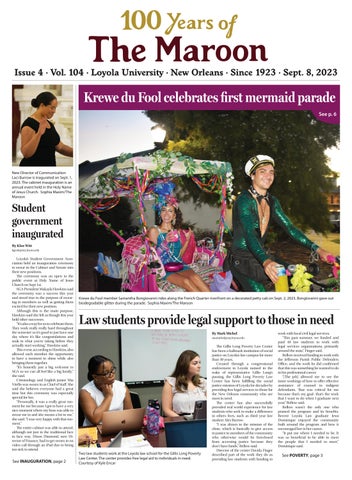
Krewe du Fool member Samantha Bongiovanni rides along the French Quarter riverfront on a decorated petty cab on Sept. 2, 2023. Bongiovanni gave out biodegradable glitter during the parade. Sophia Maxim/The Maroon New Director of Communication Sophia Maxim/The MaroonColumn: An explanation of how SGA operates
MAKAYLA HAWKINS
SGA President
mdhawkins@my.loyno.edu
During my time at Loyola University New Orleans I have grown to cherish the Student Government Association deeply through my participation for four years.
I began my time in SGA as a part of the First Year Council, which is a committee within the executive branch dedicated to explaining the complexities of the student government to the rst year students. I met my rst friends on campus and gained mentors who would go on to show me how to be an e ective leader and enact meaningful change.
From that point on, I continued in SGA, joining the Equity and Inclusion Committee, then Senate, Chief of Sta , and ultimately becoming the SGA President.
Although my participation in SGA began early, I didn’t immediately feel as though this organization was something that I would enjoy. However, I soon realized that there were plenty of things in SGA to get involved with.
is realization allowed me to explore all the di erent avenues for me in SGA and encourage others to as well. Even though there are a lot of ways for students to join, a lack of knowledge on how SGA operates creates a hindering environment and deters students from participating.
is is something that I hope to alleviate through providing some insight on SGA’s structure and student involvement.
SGA consists of three branches: the executive branch, the legislative branch and the judicial branch. Each of these branches has their own committees, programs and projects that help to advocate for the betterment of the student experience here at Loyola.
e executive branch consists of the Homecoming committee, the Equity and Inclusion committee, the Finance committee, the University Programming Board, the Communications committee and First Year Council.
Each of these committees are overseen by their own directors which make up the President’s Executive Cabinet. ese committees are also responsible for a majority of the student facing programming that the student body enjoys.
All of these committees also provide opportunities for participation from students from all majors and interests.
For instance, those who are interested in large scale event planning and execution may nd their home within the University Programming Board. ey are in charge of coordinating Wolf Pack Wednesday, all ird Fridays events, and traditional events such as SNEAUX and Stu a Wolf!
Another avenue for students who enjoy programming would be the Homecoming committee that puts on a week full of exciting events and games for the entire campus to enjoy.
See SGA, page 3
Volleyball team wins big
By Matthew Richards mlricha2@my.loyno.edue Loyola volleyball team has started strong this season, carrying a 9-3 record into conference play, highlighted by a seven game winning streak and an upset victory of three sets to one over the previously top ranked team in the National Association of Intercollegiate Athletics polls, Jamestown, N.D.
“I think we are better than we have ever been at this point of the year,” said
head coach Jesse Zabal. “We were ready to prove ourselves because we hadn’t played great in our previous match that morning. We wanted to come out and prove that what we showed that morning was not the level we’re capable of playing at, and we showed that against the No. 1 team in the nation.”
For her e orts in the upset victory, freshman nursing major Alexa Palmer received the rst Southern States Athletic Conference Defensive Player of the Week award for the season. Although Palmer said she felt
honored for receiving this title, working as a team was even more rewarding.
“My performance, in addition to our team’s performance as a whole in the game, was most rewarding because it set the standard for our abilities as individuals and as a team. We were making plays from every position on the court very e ciently the entire game, which has helped us to be successful so far this year,” Palmer said. But the Wolf Pack is not letting their early success distract them as conference play begins in the coming weeks.
Senior middle blocker and psychology science major Amaya Bazemore said even with the big win, the team is still working hard for the high intensity during conference games.
“Like any team, we’ll have our ups and downs, but using our downs as lessons and building blocks for the future will allow us to quickly adapt, grow, and move forward with high hopes of proceeding success. Our win over Jamestown was a major milestone for the program and proved that we are here to make some noise and come out stronger than ever,” Bazemore said.
e team is keeping a one game at a time mindset, according to Zabal, meaning they enter practice after each game working just as hard as they would if they lost.
“As long as we’re training hard in practice and competing well in our games, we know positive outcomes are close by,” Zabal said.
e Wolf Pack will have their home conference opener at the Den on Sept. 15 against Blue Mountain Christian and will look to continue their winning play.
“I believe that we will set some new records and make volleyball history here at Loyola,” Bazemore said. “I can’t wait to see where this season takes us!”
Inauguration: SGA prepares for new year
Sodexo hosts clean up event
Loyola’s dining team, Sodexo, is hosting a volunteer program for World Cleanup Day at e Fly.
e social action program, World Cleanup Day, is an annual event with an end goal of cleaning up solid and marine waste. To help this cause, Loyola’s Sodexo is providing trash bags, gloves, litter grabbers, and lunch to those who volunteer.
is event will take place on Saturday, September 16 from 11 a.m. to 1 p.m.. Sodexo urges volunteers to wear comfortable clothing and closed toed shoes, have a reusable water bottle, and bring a positive attitude.
Internship and job fair next week
Local companies and opportunities will be visiting Loyola’s campus for an internship and part-time job fair. is fair is an valuable opportunity for students to explore opportunities in their eld, boost their resume, or dive into their passion. All majors and all years are welcome to attend to learn more about internships and part-time jobs.. e Internship and Part-Time job fair will take place on Sept. 12 from 12 p.m. to 3 p.m. in the St. Charles room on the rst oor of the Dana Center. e full list of employers who will be attending is available on the Handshake website.
Death penalty awareness week at Loyola
Death Penalty Education and Advocacy Week At Loyola is taking place Sept. 7 through 14. roughout the week, Loyola will be hosting numerous events and speakers to raise awareness on the importance of abolishing the death penalty within Louisiana.
A few events include:
Sept. 7
• Dead Man Walking Film Screening - Bobet Hall, Room 332, 6 p.m.
Sept. 12
• Faith, Work, and Ethics Luncheon - Miller Hall 112, 12:15-1:20 p.m.
• Catholic Studies Night - Holy Name of Jesus Parish Hall, 5:307:30 p.m.
• Guest Speaker: Sr. Helen Prejean
Sept. 14
Continued from page 1
Being able to have everyone there, even virtually like Dixon, was something Junior public relations student and current Director of Communications Laci Barrow was happy to see.
“I was so happy to see the entire cabinet there,” Barrow said, “ ey’re so dedicated.”
Now that every member is o cially sworn in, SGA is o cially ready to “hit the ground running,” according to Hawkins.
In her new position, Vitello hopes to use her role as chief of sta , who she said
is there as the president's “right hand man,” to help the cabinet in whatever they need.
“I’m looking forward to being able to implement more aspects of cabinet care into my position. I really want to focus my position in on the cabinet rather than being all over the place in a bunch of di erent areas in SGA. I really want to focus in on how I can help the cabinet achieve what they need to achieve,” Vitello said.
Barrow plans to use her role to help expand SGA and to improve the
organization for students who are considering joining.
“My plan with SGA is to make it a really positive environment for students that want to get involved and bring positivity through everything I do,” Barrow said.
With the cabinet and senate inaugurated, Hawkins said she is excited for this next year in SGA.
“I feel really really good,” she said.
“I’m excited for us to start our cabinet meetings and just be able to start the work we ran on for the student body.”
• Catholicism Class SpeakerCommunication & Music Room 302, 9:30-10:45 a.m.
• Guest Speaker: Death Row exoneree Shareef Cousin
• Catholicism Class Speaker in Miller Hall, Room 204, 11 am12:15 p.m.
• Guest Speaker: Death Row exoneree Shareef Cousin
• Panel Discussion - Room 111 at Law School, 12:30-1:30 p.m. e JSRI’s Instagram pro le @ jsri_justsouth, holds the detailed information of times and locations for each event.
POVERTY: Law center aims to empower students
Continued from page 1
Dominique credited the people who advised her in the program with their assistance in helping her discern where she wanted to work.
“The people who are over it are just amazing,” she said. “They put you where you need to be and that part is what’s so beneficial to your community because people that are placing you are listening to you, and they know that you care, and
they want you to be placed somewhere where you care.”
In a report to their advisory board, the Gillis Long Poverty Law Center funded 40 civil positions in 2023. Since 1991, they have funded over 1,100 positions, totaling more than 4.2 million dollars.
During its time, other programs have emerged from the center. Most recently, the March with Gillis program launched last spring, which provided a month of social justice programming to the law
For weekly puzzle answers, download The Loyola Maroon Mobile App
school.
According to Finger, each program in the center remains true to its mission of helping people and educating law students who want to do good in the world.
“It really provides them with a glimpse into the world of social justice lawyering, and so many of our students want to do that as a career,” Finger said. “It’s a huge benefit and a way to really engage with experiential learning.”
SGA: President aims to "demystify"organization
Continued from page 2
Students that lean more toward graphic design, marketing or photography would feel more at home within the Communications committee. This committee was also the ones responsible for designing and distributing the Loyola SGA sweatshirts and tote bags that many students enjoyed last year.
Those who are more financially savvy may enjoy participating in the Finance committee approving allocations for students and student organizations.
able to collaborate with like-minded students in order to improve the campus for everyone.
There are a multitude of committees for students to engage within this branch as well such as: Facilities and services, Advocacy and Outreach, Student Involvement, Disability and Accessibility, Assembly for Sexual Assault Prevention, Sustainability and Arts and Cultures.
“I hope I was able to demystify some parts of SGA for you and that you choose to join us and use your talents to better the campus we all call home.”
If none of these interest you then you may be interested in advocating and creating programming for underrepresented communities on campus through the Equity and Inclusion committee. This committee is responsible for things such as Aids Awareness tabling, the Loyola Drag Show, and a multitude of other awareness events.
The Legislative Branch is home to the Senate, which is the student representative body that produces written legislation to advocate for small and university-wide changes.
Some of the legislation from this branch has created things such as the Loyno Flea Market, the Pursuit of Excellence Textbook Scholarship and purchased a majority of the tables students utilize within the Peace Quad.
Students interested in advocacy and researching policy changes would be
The Judicial Branch, led by the Chief Justice, is responsible for social justice programming and events. Along with this they also mediate student organizational conflicts and interbranchial disputes within the Student Government Association. They can most commonly be seen hosting the voter registration drives and constitution day events. Additionally, they are responsible for ensuring SGA upholds their responsibilities in the constitution and branch bylaws.
Those interested in any of these committees or branches can join through applying on HowlConnect or by connecting with the executive cabinet or senators at large during their office hours in the SGA Hub.
The SGA Hub is located in the basement of the Danna Center and is a space with a plethora of resources for students to use.
I hope I was able to demystify some parts of SGA for you and that you choose to join us and use your talents to better the campus we all call home.
Loyola beats the heat
Campus community reacts to heat wave
By Brice Gutter bjgutter@my.loyno.eduIt is no secret that the summer heat has been in full swing this year. In fact, this summer has actually tied the record for New Orleans’ all-time high-temperature record, reaching 102 degrees Fahrenheit on Aug. 23, according to NOLA. com.
It is essential to know how to deal with this heat wave, especially for students from out of state who may have never had to deal with high temperatures like these before.
Madison Davis, a freshman student from Washington D.C. said these are the highest temperatures she’s ever experienced.
“The hottest it gets [in Washington] is about 90-93 degrees,” Davis said.
Fogger trucks bring potential harm
By Eloise Pickering ewpicker@my.loyno.eduLouisiana’s hot and humid summers create the perfect breeding ground for disease-carrying mosquitoes, which are not just nuisances but can be deadly.
Mosquitoes can carry serious viruses such as Zika, West Nile, and Chikungunya, as well as diseases like dengue and malaria, according to the CDC. Several of these diseases were considered to be eradicated in the US, but have recently resurged due to rising temperatures, according to the National Geographic. In Louisiana, West Nile is the most reported of these illnesses.
The City of New Orleans closely monitors the amount of mosquitos in the area and remains alert to service requests from the public. Through a variety of methods, such as egg/larvae trapping and risk assessments, the city plans routes for fogger trucks, a type of vehicle used to spray the affected area with
insecticides, which kill mosquitos by preventing their nervous systems from working, according to the New Orleans Mosquito, Termite and Rodent Control Board.
However, in New Orleans’ quest to get rid of the insects, they brought an additional, potentially deadly element to the area: organophosphates.
Insecticides are the class of bug killer that contain organophosphates that have been used since the 1940s to rid regions of mosquitoes. However, they have recently been found to pose possible harm to humans.
The New York Times published an article regarding the harmful effects of mosquito spraying workers of these trucks had experienced, in spite of being told the insecticides used were completely safe to humans.
Since the spraying began last year, the State Department of Health has received 14 reports from doctors who believe their patients may have suffered
sickness as a result of pesticides,” according to The New York Times. “The men's symptoms included dizziness, difficulty in breathing, headaches, diarrhea, joint pain and shakiness.”
The affected patients were all exposed to the organophosphates in the insecticides used.
According to the Illinois Department of Public Health, “these chemicals stop a key enzyme in the nervous system … from working, and this can make people ill.”
The organization, Beyond Pesticides, said on their website that “Organophosphates are a class of insecticides known to have adverse effects on the nervous system, having the same mode of action as nerve agents for chemical warfare.”
Furthermore, organophosphates are potential contributors to both adolescent and adulthood cancer.
According to the CDC, “some studies in adults and children have linked organophosphate exposure to lymphoma
and leukemia.”
Despite the growing research on their harmful effects, organophosphate insecticides are used routinely in New Orleans, according to the Louisiana Mosquito Control Handbook. There are numerous methods that people can use to prevent mosquitoes from multiplying without using harmful insecticides, such as preventing areas of standing water that could be found in dirty bird baths, buckets, or recycling bins.
To protect yourself from bites, it is helpful to use mosquito repellent and ensure your house has tight fitting windows and secure screens. When it comes to lowering the amount of mosquitoes and bites, it is possible without organophosphate insecticide fogger trucks.
The Louisiana Department of Health writes that “protecting yourself is very simple, and it could spare you from getting [sick].”
While it is only a few degrees hotter in New Orleans, the humidity levels make the real difference. On average, Louisiana reaches a humidity percentage of 74%, according to Forbes. Meanwhile the states surrounding D.C. only reach an average of 68% humidity.
However, even locals have a hard time dealing with this oppressive heat.
Tez Falghou, a native New Orleanian student, gave his advice on how he deals with the excessive temperatures.
“I drink a lot of water,” Falghou said. “Loyola could have cold water stations to help with the heat. By cold water stations, I mean places where there’s free water bottles in coolers.”
“Our elected officials must recognize that climate change is real and the science is solid. We need to elect an enlightened leader who will create a federal agency whose total responsibility is to address climate change at all levels of government,” Robert Thomas, an environmental professor here at Loyola, said. “Humans are resilient, but this is a global threat and will require federal guidance and assistance.”
Thomas also warns that although weather systems are complex and seem cyclical, he feels extreme heat may be with us for some time.
Shuttered EPA investigation could’ve brought 'meaningful reform' in Cancer Alley
By Halle Parket AP News, WWNO, New Orleans Public RadioAs industrial plants have overtaken historic Black communities and burdened neighborhoods with toxic air pollution, environmental advocates and residents of Louisiana's chemical corridor have spent decades calling for change.
So when the country's top environmental regulator opened a high-profile civil rights investigation into Louisiana's Department of Environmental Quality last year, it felt like a watershed moment.
For the first time, the Environmental Protection Agency stepped in to exercise its oversight and evaluate whether LDEQ has granted permits for companies to build and pollute in a way that has caused disproportionate harm to Black communities. Ultimately, they found signs that it has.
After pledging to clean up Cancer Alley — the nickname for the heavily industrialized, 85-mile stretch of the Mississippi River between Baton Rouge and New Orleans — the EPA issued a letter in October 2022 detailing preliminary evi-
dence of racial discrimination and noncompliance by the state.
Advocates like Lisa Jordan, who leads the Tulane Environmental Law Clinic, and the clients she represents were cautiously optimistic.
"We dared to hope," said Jordan, who filed one of the complaints that led to EPA's civil rights investigation.
The EPA's findings brought LDEQ to the negotiating table. Documents and emails show that staff from the two agencies spent months negotiating a 43-page agreement that would have fundamentally changed Louisiana's air pollution permitting program so that state regulators would have no longer allowed toxic emissions to disproportionately impact certain communities.
While the EPA's civil rights investigation could have led to a consent decree that forced LDEQ to change, this voluntary agreement offered a path to reform without punishment.
But, in late June, it all came to a grinding halt.
The EPA abruptly closed the case and ended discussions with the LDEQ, stopping its investigation without coming to
a resolution or releasing its findings. The decision blindsided the River Parish residents who took part in the complaints.
"We'd been out here fighting so hard for so long, it felt good to have someone shouldering the burden with us, and it felt good to not be gaslit," said Joy Banner, a St. John the Baptist Parish resident and cofounder of the Descendants Project, in the weeks after. "After all of that fighting, they just abandoned us."
Emails exchanged between LDEQ and the EPA show negotiations began to falter after the federal staff sent a version of the draft agreement back to LDEQ on May 18.
Days after the draft was sent, Louisiana Attorney General Jeff Landry sued the EPA, the Department of Justice and the Biden administration over the civil rights investigation on May 24 in the U.S. District Court for the Western District of Louisiana. The Attorney General office didn’t respond to a request for comment.
Environmental justice experts and advocates fear that the breakdown could mark the beginning of a major attack on a core aspect of the Civil Rights Act.
Krewe du Fool mermaids, mermen, and musicians march along the French Quarter riverfront on Sept. 2. The krewe raised funds for the Audubon Nature Institute's education department and newly opened aquarium. Sophia Maxim/The Maroon.
Krewe Du Fool celebrates first mermaid parade
By Ava Acharya and Sophia Maxim aaachary@my.loyno.edu svmaxim@my.loyno.eduThis past weekend, Krewe du Fool rolled their inaugural mermaid parade. Parade goers donned aquatic-themed outfits and marched along the French Quarter riverfront.
Beyond fun and celebration, the parade acted as a fundraiser for the Audubon Nature Institute and their newly
opened aquarium, according to Dnald Levy, an organizer with Krewe Du Fool.
Levy said the fundraising mainly went to the Audubon Nature Institue’s education department, which centers on conservation efforts, according to the institute’s website.
Krewe Du Fool is most well known for their April Fools’ parade, which rolls yearly beginning in Marigny. The Mermaid Parade introduces a new theme and route for the krewe.
Levy added that the Audubon Nature Institute’s new aquarium, located in the French Quarter, acted as partial inspiration behind the “mermaid” parade.
The parade was open to all ages and hosted a wide variety of marine related costumes, from sea creatures to sailors to the titular mermaids.
Krewe member Samantha Bongiovanni, who attended dressed as a glittery mermaid, highlighted the contrast with the exclusive “politics and red tape”
typical of parades and krewes.
Levy wanted the event to be open to all, and anyone could walk in the parade for $15, according to Krewe du Fool’s website.
And, community members embraced this opportunity. Loyola students Mary Justice and Mae Babin attended the parade, dressed as undersea creatures, as part of Babin’s birthday celebration.
“It was really great,” Babin said.
Both Levy and Bongiovanni were in-
credibly pleased with the parade's overall success and turnout.
“It was so exciting,” Bongiovanni said. “There were just so many people there. It was perfect.”
Levy added that he is very confident the Mermaid Parade will continue to roll, as they have already begun organizing next years’ parade.
“I think this is going to become a tradition for New Orleans, and I’m looking forward to it,” Levy said.
Are you a Buddig buddy or a Biever believer?
Second-year student weighs in on freshman dorm halls
By Kloe Witt kgwitt@my.loyno.eduAs freshmen prepare to enter their first year at Loyola, there are two options for their new on campus home: Biever or Buddig Hall.
Both of these have pros and cons but as I’m entering my sophomore year now having experience living in both, I believe I can fully say which is the better freshman dorm.
Biever tends to get the short end of the stick when it comes to which dorm a freshman wants to stay in. Communal bathrooms and the risk of being in a triple rather than a double tends to scare
people away.
Although both of these aren’t ideal, Biever still has plenty to offer. The wide window space that allows sunlight to spill into the room was something I loved during my time there.
The brick walls that gave more of a rustic feel that you could decorate with chalk made for a more homesick feel.
The AC, even if you couldn’t set it to exactly the temperature you wanted, still got much colder than Buddig. Biever also has a kitchen on every floor, whereas Buddig only has one on the 12th floor.
Even the downsides of Biever are things I found ways to enjoy during my time there. Communal bathrooms, no
matter how gross they can be, lead to a sense of community. It was a commonality we had among the floor. It forced more interactions and let us get to know each other better - something that was much needed as a freshman moving away from home for the first time.
On the other hand, Buddig is the choice most freshmen would make. Mostly due to the appeal of the suite style living with no communal bathroom. Although that is a huge bonus, it may well be the only positive thing about living in Buddig.
The windows in this building are smaller and offer far less natural light, which would only be a plus for people
who don’t enjoy vitamin D.
There is less freedom to decorate the rooms in Buddig, as students aren’t able to move the desk and there isn’t room to move the beds from the original position either. In some rooms, there isn’t even an option for moving the beds as they are bolted into the ground.
The suite bathrooms, although nice in the sense you only share with three other people instead of an entire hall, are small and can be hard to get through.
The two elevators in Buddig also have a history of being bad, and are well known for breaking down or having long lines due to so many people living in the hall.
The air conditioning is also an issue in the Buddig. Unlike Biever where you have more control of the temperature, Buddig rooms only stick to a 72 degrees lowest temperature. For some, this is really hot and can be uncomfortable.
One huge plus in Buddig, however, is the sink in each room. This allows way more storage and one never has to think about walking down the hall at night to brush your teeth.
As someone who has now lived in both residence buildings, I would give Biever a 7/10 dorm living experience and Buddig a 4/10.
colors
By James Salinas asjones@my.loyno.eduEditor’s note: This review contains spoilers for spoilers for “Spider-Man: Across the Spider-Verse."
Before the trivial “Barbenheimer” weekend, the summer box office kicked off with the widely anticipated “Spider-Man: Across the Spider-Verse.” The magnificent Miles Morales made a return with more spun up chaos than ever.
One of the hallmarks that made its precursor, Into the Spider-Verse, so popularly acclaimed was its excellence in animation. Unlike other Disney or Pixar animation films, the “Spider-Verse” finds a way to lean into an overpowering, glorious hodgepodge of styles, making the experience overwhelming in the best way and keeping audiences on the edge of their seats. They also don’t do it solely for the extravagance of the animation, they find a way to intertwine it with the emotional world of Miles and other characters, particularly Gwen’s.
While there are numerous things worthy of highlighting that others are enthusiastic about, my personal favorite part of all of the animation was that of Gwen’s world. Beautiful pastel watercolors blending into one another, melting
and ever changing and morphing together with Gwen’s consistently conflicting emotional world. When Gwen returns to her world and her father finally accepts her as Spider-Woman, the subtle geometric shapes and the encapsulation of pink still makes my hair stand to think about. She is treated with such affection that it is hard for any fan to not love her. Of course, it would be impossible to discuss this stunning visual art without touching on Miles’ world.
Having the backdrop of New York, Miles’ world looks significantly different than that of Gwen’s. Full of black and Latino influences, his world dances vibrantly on the silver screen. While it is full of classic animation to the original character of Spider-Man himself, Miles is always distracted and this is reflected in the setting around him. He struggles with balancing school, his family, his yearning for Gwen, and his superhero responsibilities. The animation chooses to show his world upside down and for everything he encounters to be maximalist and in your face. It allows the audience to empathize with him and his constantly insistent world. Some other clever choices the film made were the use of small comic book notes, such as references from the comic. Stylized well, it adored fans with easter eggs and helped other, more casual viewers
stay informed without taking time nor attention from the narrative.
Another thing cherished by fans of the first film is its excellent, hip-hop laden soundtrack. It featured now famous songs such as, “Sunflower,” by Post Malone and Swae Lee along with others. This sequel once again does not hold the punches, with instant classics like Metro Boomin’s tracks, “Am I Dreaming,” “Annihilate,” and the original score’s theme for Miguel O’Hara, becoming a popular sound on TikTok. Another fun easter egg for music fans is in Spider-Society, as Miguel O’Hara shows the young Spider-Man around, a live action Donald Glover appears as the Prowler from his universe, now serving time in the society. Its tongue-in-cheek nature comes not only from Glover’s appearance as the villain in 2017's Spider-Man:Homecoming, but also from a scene when a younger Glover was in the hit comedy show, “Community,” as Troy Barnes. In one particular episode, Glover wore Spider-Man pajamas, inspiring the creation of the black hero on screen now.
At the end of the film, Miles believes that he has found his way home to his world. Much to the youth’s surprise, he accidentally goes back to the wrong world, one where his Uncle Aaron (“Into the Spider-Verse”’s the Prowler) has sur-
vived and his father has already died. Much more to the audience’s dismay, another version of Miles survives, although in this one, he himself is the Prowler. Viewers are then shocked by the ambitious cliffhanger ending, to be continued with the third installment. While this franchise does not directly correlate nor fall in line with the rest of the MCU’s current canon, some sneaky easter eggs make nerds like myself curious as to what this could mean for the future of Marvel. Although we were anticipating some answers for Morales next year, the Writer’s Guild Association strike along with SAG-AFTRA has led to this project (like many others) being postponed until an agreement is reached. While writers and actors await liveable wages and basic benefits, Spidey lovers at home will eagerly await the next installment of animation’s greatest heroes.
“Spider-Man: Across the Spider-Verse” is available on Prime Video.
Rating: 9/10
“Spider-Man: Across the Spider-Verse” review: Spidey swings onto screens with flying
We must protect the Gulf from industrialization
MARIANNE CUFONE Director, Environmental Law Program mcufone@loyno.eduNew Orleans relies on a thriving Gulf of Mexico ecosystem. We must protect it from industrialization.
As an environmental attorney in New Orleans, I work closely with shing communities, coastal residents and scienti c experts to continually ght for a clean and healthy Gulf. We not only value the environment, we also understand that shing families, related businesses, and the restaurants and markets they supply depend on wild sh for a strong local economy. Our whole community feels the impacts when our Gulf ecosystem su ers – and increasingly, sh and other marine life in the Gulf are at risk from a variety of threats.
We’re constantly grappling with an onslaught of challenges, from hurricanes fueled by extreme temperatures, to persistent toxic algal blooms that contribute to the “Dead Zone,” where little can survive. Now, to add to these existing con-
cerns, big corporations are scoping out the Gulf as a site for development of industrial-scale sh farms that would pollute the surrounding waters and wildlife. Surprisingly, the very government agency tasked with conserving and managing our ocean resources is not only supporting this, it is leading the charge!
e National Oceanic and Atmospheric Administration (NOAA) has identi ed nine sites in the Gulf of Mexico for the construction of o shore n sh aquaculture facilities, two of which are actually in the dead zone. ese oating factory farms can release pesticides, untreated sh waste and other chemicals into the Gulf. We’ve seen many cases in other regions where this style of massive net pen facility creates a high risk of sh escaping and spreading diseases and other infestations, as well as pollution contributing to “red tides” and further threatening endangered marine mammals.
Despite the known hazards, one such facility is already poised for construction in the Gulf. e Velella Epsilon project will be closest to Sarasota, Florida where local residents are overwhelmingly opposed to the development, but many here in Louisiana don’t yet know about how this threat to the Gulf could impact us too.
Pollution circulates in the Gulf regardless of state lines, and if this rstof-its-kind facility moves forward, it will only be the beginning of construction across the Gulf. So I’m working with Florida advocates to challenge this facility, as well as with people all across the country to push back on NOAA’s nationwide plans to carve up the ocean for private development.
If aquaculture corporations continue to push forward unchecked, they will pollute our waters, squeeze family businesses out of the market, and jeopardize our state’s economy. ese corporations stand to gain millions of dollars, but the pro ts won’t be invested in our local communities, they’ll go toward lining the pockets of executives and investors all around the world, leaving us with the mess and little else. ose of us who live with and love our Gulf, understand how to sustainably use natural resources and protect our communities’ well-being. We’ll keep exploring legal options to challenge this new industry, but we can’t rely on the courts alone to protect our ecosystem and local economies. We Louisianans can join nation-wide e orts and demand that our government block corporate greed from further polluting our Gulf.
Louisiana is rst in line to become "the next Florida"
ELOISE PICKERING Mass Communication, freshman ewpicker@my.loyno.edu
“Make America Florida” is a new expression that has swept the nation as Florida’s governor Ron DeSantis has gained national attention in his run for the 2024 presidential election. DeSantis has come to stand for modern far-right ideals and has intentionally fueled Florida’s culture war.
DeSantis’ policies in Florida are strict, especially his laws regarding gender expression and education. e Floridian governor has greatly impacted school systems, infringing on students’ gender expression and controlling language used to teach historical race issues, speci cally slavery. According to NPR, DeSantis signed a law which bans gender-a rming care for minors, restrictions on the discussion and use of "preferred pronouns" in schools and restrictions on using bathrooms that don't match one's assigned sex at birth. is law further led to unresolved rumblings of banning the popular AP psychology course due to the fact that
the curriculum explores issues of gender and sexuality.
e Associated Press News reports that the public school curriculum is forced to become increasingly “antiwoke.” Woke ideologies pertain to the systemic inequalities in American society, such as racism and homophobia. Conversely, anti-woke ideologies push the notion that systemic social issues are not relevant enough to be taught in schools.
In July, the Department of Education passed new curriculum standards requiring middle school teachers to teach their students that enslaved people “developed skills which, in some instances, could be applied for their personal bene t.”
Since 2000, Louisiana has consistently chosen Republican candidates in presidential primaries. DeSantis has become a dominating voice in culture wars, or the Anti-Civil Rights Movement era, and his message of anti-woke education seems to be resonating with Louisiana voters and representatives. In March of 2022, Louisiana representative Dodie Horton proposed a bill coined “Don’t Say Anything,” following Florida’s “Don’t Say Gay” bill, Rep. Horton told Forbes. If enacted, the proposed bill would e ectively silence all discussion of gender and sexuality in order to prevent the “indoctrination”
of young children. is bill has been disguised to not appear to target the LGBTQ+ community. However, the word ‘indoctrination’ relates directly to the Republican idea that queer and speci cally trans individuals are known
Opinions/Letters to the editor
The Maroon actively promotes the inclusion of a wide range of perspectives and opinions within our letters section.
Opinions should preferably be around 500 words
Letters should preferably be 150-200 words
Letters should refer to an article that has appeared within the last two weeks.
Opinions/letters must include the writer's name and major.
Submissions are due no later than 4 p.m. the Sunday before publication.
Email us your letters — letter@ loyno.edu.
Submissions may also be made online at www.loyolamaroon.com.
to groom children; an accusation that is yet to be supported by fact.
In May of 2023, to much relief, the Louisiana’s democratic governor John Bel Edwards vetoed not only the “Don’t Say Anything” bill but also two others
that targeted the LGBTQ+ community: one that would ban gender-a rming healthcare to minors and another that would restrict children from using preferred names and pronouns in school. Louisiana voters who support the LGBTQ+ community are fearful that existing protections may not prove permanent in the predominantly conservative voting state. Additionally, Florida banned the discussion of critical race theory in public schools in June of 2021, with the language revolving around slavery o cially changed in July of 2023. is past April, Louisiania Republican o cials requested lawmakers to ban the study of racism at universities, claiming that the “inglorious aspects” of American history were too divisive, according to Nola.com. e bill was later killed in Congress.
In order to keep the fanatical “Florida man” and all his discrimination out of Louisiana, it is vital to vote inclusive representatives into o ce who accurately re ect the needs of everyone.
Furthermore, it is important to educate oneself on topics that are heavily under debate, such as critical race theory, gender-a rming care, and the realities and legacies of slavery, in order to remain open-minded and conscious of others' experiences, even if our ‘representatives’ are not.
Quote of the week
- Psychology science senior Amaya Bazemore on the volleyball team's winning streak
"I believe that we will set some new records and make volleyball history here at Loyola"
LETTER: Loyola needs to "ban the box"
By Mina Leffler mpleffle@my.loyno.eduTo the Editor,
Imagine reliving the lowest point of your life while filling out a college application. Previously incarcerated students are put through this when asked to describe their criminal past. College is said to be the best four years of a person’s life. What about the people who don’t get that chance?
Between 70 to 100 million people in the United States have a criminal history. That is a lot of people who often don’t feel welcome on college campuses. All the public colleges and universities in Louisiana no longer ask about criminal history on initial applications. Why hasn't Loyola?
When a person is released from prison, they should be allowed to have a better life. Louisiana has one of the highest incarceration rates in the world. Because Loyola is in Louisiana and has great Jesuit values, we should be first in line to help people lay the foundation for a better life through education.
“Research shows that when you ask about criminal history, about two-thirds of people with criminal history don’t finish the application,” said Dr. Annie Phoenix, Executive Director of the Jesuit Social Research Institute. “Having the question creates an environment where people feel unwelcome. The ask from ‘ban the box’ is to remove the question from the initial application and move it later in the process.”
“Ban the Box” is a part of the civil rights movement aimed to remove the criminal history question from initial applications to reduce racial disparities in the application process.
While Loyola has yet to ban the box, they have added a prison education program at Rayburn with the help of the JSRI. This program has given dozens of incarcerated people a second chance at life.
“This program gives us, people incarcerated, a sense of hope, accomplishment, something to strive for, and something to look forward to,” said Terry, one of the incarcerated students.
Another student, James, said, "This program is going to change lives and hopefully positively impact society as a whole, by producing educated ex-felons and releasing better, well-rounded people back into the public.”
The Loyola community was very supportive of this program. Maybe this program is a stepping stone to being able to “ban the box” on Loyola’s campus.
“From every level, everyone has been asking me how to support these students and make them feel welcome,” said Dr. Annie Phoenix. “I think this is a tangible way that we can show our students, who are already Loyola students, that they are welcome on this campus. There are many other people out there like them who are also welcome on Loyola’s campus.”
Since Loyola’s core Jesuit values align with helping the oppressed, why not help the most marginally disadvantaged group of people and ban the box?
Sincerely,
Mina Leffler mpleffle@my.loyno.eduJustice for all
For more than three decades, Loyola has been home to an institution that embodies the Jesuit ideals of charity, community empowerment, and engagement in a way that has profoundly affected the lives of the less fortunate.
Nestled in the Loyola College of Law stands the Gillis Long Poverty Law Center, standing as a testament to our institution's commitment to social justice and the alleviation of poverty. In 1985 the center was established with a noble mission: to provide legal representation to low-income individuals and vulnerable communities who would otherwise be left voiceless in the labyrinth of the legal system.
The Gillis Long Poverty Law Center is a remarkable organization and our support is essential.
For those countless people facing daunting legal challenges without the means to secure adequate legal representation, the center has been a beacon of hope. The many students of Loyola’s law school who work at the center have helped bridge the gap between privilege and poverty, making justice accessible to all.
Having been taught through our Jesuit ideals, Loyola’s law school has a long tradition of nurturing future generations of compassionate lawyers. The center allows Loyola’s law students an opportunity to gain practical skills through their service in social justice – doing legal research and practice while serving
HOWLS & GROWLS
HOWL to embodying Jesuit values
GROWL to the bad Landry
HOWL to having morals
GROWL to texting while driving
HOWL to doing your page design on press night
GROWL to Florida
HOWL to protecting the Gulf coast
GROWL to spineless voters
HOWL to tenure
EDITORIAL BOARD
Patrick Hamilton Editor-in-Chief
Maleigh Crespo Managing Editor for Print
Addison Laird Managing Editor for Digital
Daniela Martínez Maroon Broadcast
Executive Producer
Maria DiFelice Maroon Broadcast
Operation Manager
Sophia Maxim Design Chief
Anna Hummel Photo Editor
Kloe Witt News Editor
those in need. This service has in turn created a sense of responsibility that students will carry with them into their professional legal careers to use their legal expertise for the betterment of their communities.
As marginalized communities in Louisiana continue to face injustices and the criminalization of poverty persists, the center plays a critical role in challenging the status quo. The Gillis Long Poverty Law Center stands as a fortress in our community against systemic inequalities, they stand as a defender of civil liberties, and a glimmer of hope for those who’ve too often been overlooked and forgotten.
Loyola offers students a unique opportunity for law students to learn from real-life issues
Loyola’s commitment to the mission and service of the center over self-promotion and publicity is a testament to our university's integrity and dedication to our Jesuit values. Many of our readers and most of our students don’t know about the important work that is done for our community here at Loyola law. Prioritizing the welfare of the less fortunate over their desire for recognition underscores Loyola’s fidelity to making a genuine difference in this world.
As a community we can support the essential work that is being done by:
Sharing the stories and successes of the center on social media, in your classes, and within your social circles. The
more people know about their work, the more support they can garner.
Engage in advocacy efforts to address systemic issues contributing to poverty and inequality. Support policies that promote equal access to justice for all.
Attend the center's events, lectures, and workshops to stay informed about the challenges faced by marginalized communities. Knowledge is a powerful tool for change.
And if you have legal expertise, consider volunteering your time and skills to provide legal assistance to those who need it most. Your expertise can be a lifeline for someone seeking justice.
By supporting the Gillis Long Poverty Law Center we uphold the most sacred Jesuit ideal of serving those who have less.
As members of this academic community, we have a responsibility to ensure that justice is not a privilege but a fundamental right accessible to all. Supporting this mission honors Loyola's commitment to creating a more just and equitable society, leaving a lasting legacy of compassion and empathy for those in need.
“It is not possible to be in favor of justice for some people and not be in favor of justice for all people.” — Martin Luther King Jr.
Melody Newsome Breaking News Editor
Natalia Silva Life & Times Editor
Jacob L'Hommedieu Worldview Editor
Sofía Johnson Comics Editor
Athena Marks Chief Visual Artist
Mark Michel Opinion and Editorial Editor
Mia Oliva Reviews Editor
Taylor Falgout Senior Staff Photographer
Ava Acharya Senior Staff Writer
Ecoi Lewis Content Editor
Heather Rabassa Copy Editor
EDITORIAL POLICY
The editorial on this page represents the majority opinions of The Maroon’s editorial board and does not necessarily reflect the opinions of Loyola University.
Letters and columns reflect the opinions of the authors and not necessarily those of The Maroon’s editorial board.
The Maroon does not represent the opinion of administration, staff and/or faculty members of Loyola.
Letters are subject to editing for length, grammar and style. Please limit submissions to 400 words. Submissions are due no later than 4 p.m. the Sunday before publication.
Please send all submissions — The Maroon, 6363 St. Charles Ave., Box 64, New Orleans, LA 70118.
Email us your letters — letter@ loyno.edu.
Submissions may also be made online at www. loyolamaroon.com.