Local writers and actors rally for fair treatment
By Jacob L'Hommedieu jllhomme@my.loyno.edu
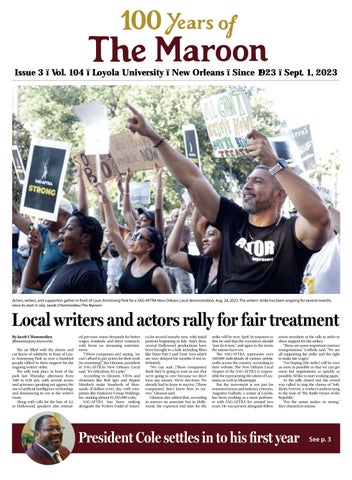
The air filled with the shouts and car horns of solidarity in front of Louis Armstrong Park as over a hundred people rallied to show support for the ongoing writers’ strike.
The rally took place in front of the park last Thursday afternoon from 4:00 to 6:30 pm, with several actors and actresses speaking out against the use of artificial intelligence technology and denouncing its use in the writer’s room.
Along with calls for the ban of A.I. in Hollywood, speakers also reiterat-
ed previous union demands for better wages, residuals, and fairer contracts, with focus on streaming entertainment.
“[These companies are] saying, ‘we can’t afford to pay actors for their work [in streaming]’.” Jim Gleason, president of SAG-AFTRA’s New Orleans Local said. “It’s ridiculous. It’s a joke.”
According to Gleason, CEOs and chairmen like Bob Iger and Rupert Murdoch make hundreds of thousands of dollars every day, with companies like Endeavor Group Holdings, Inc. making almost $1,185,000 a day.
SAG-AFTRA has been striking alongside the Writers Guild of Ameri-
ca for several months now, with initial protests beginning in July. Since then, several Hollywood productions have been brought to a halt, including films like Dune Part 2 and Tron: Ares which are now delayed for months if not indefinitely.
“We can wait. [These companies] think they’re going to wait us out, that we’re going to cave because we don’t have any money. We’re survivors. We already had to learn to survive. [These companies] don’t know how to survive,” Gleason said.
Gleason also added that, according to sources an associate has in Hollywood, the expected end date for the
strike will be next April. In response to this, he said that the executives should “just do it now,” and agree to the terms the unions have set.
The SAG-AFTRA represents over 160,000 individuals of various artistic crafts across the country, according to their website. The New Orleans Local chapter of the SAG-AFTRA is responsible for representing the talent of Louisiana as well as Mississippi.
But the movement is not just for seasoned actors and industry veterans.
Augustus Lodholz, a senior at Loyola, has been working as a stunt performer with SAG-AFTRA for around two years. He was present alongside fellow
union members at the rally in order to show support for the strikes.
“These are some important contract renegotiations,” Lodholz said. “We are all supporting the strike and the right to make fair wages.”
“I’m hoping [the strike] will be over as soon as possible so that we can get some fair negotiations as quickly as possible. I’d like to start working again.”
As the rally closed out, the crowd was called to sing the chorus of ‘Solidarity Forever,’ a worker’s anthem sung to the tune of ‘The Battle Hymn of the Republic.’
“For the union makes us strong,” they chanted in unison.
President Cole settles in to his first year See p. 3
Issue 3 ï Vol. 104 ï Loyola University ï New Orleans ï Since 1923 ï Sept. 1, 2023
Actors, writers, and supporters gather in front of Louis Armstrong Park for a SAG-AFTRA New Orleans Local demonstration, Aug. 24, 2023. The writers' strike has been ongoing for several months since its start in July. Jacob L'Hommedieu/The Maroon
COMICS 2 Sept. 1, 2023 THE MAROON Brewstock Homebrew Supplies presents 2023 SEP 23, 2023 • 1 1AM - 4PM UNIVERSITY OF NEW ORLEANS Alumni Center on Levee Road @ Lakeshore Drive Unlimited Sampling Exclusively Homebrew People’s Choice Comp Best Booth Comp OVER 100 BEERS!! brewstock.com/festival brewstock.com/tickets $40 before Sep 1st ... $50 after Sep 1st STAFF Assistant Editors: Eloise Pickering, Riley Liprie Graphic Designers: Bobbie Green and Jordan Lassiter Associate Producer for Maroon Minute: Jake Hufnagel, Hannah Darcey, Matthew Richards Sta Writers and Photographers: Rodrigo Delgado, Lizzy Hadley Adviser: Michael Giusti CONTACT US Main O ce (504) 865-3535 Business O ce/Advertising (504) 865-3536 Adviser’s O ce (504) 865-3295 Correspondence maroon@loyno.edu Letters to the editor letter@loyno.edu Advertising ads@loyno.edu Website www.loyolamaroon.com Twitter @loyola_maroon Facebook The Maroon Instagram @loyola_maroon Our o ce is in the Communications/Music Complex, Room 328. Send mail to: The Maroon, Loyola University, Campus Box 64, 6363 St. Charles Ave., New Orleans, LA 70118 The Maroon is published every Friday. Unless otherwise noted, all content is copyrighted by The Maroon. All rights reserved. First copy free to students, faculty and sta . Every additional copy is $1.00. The Maroon is printed on 30 percent postconsumer recycled content.
SGA cabinet confirmed over summer
By Lizzy Hadley ehadley@my.loyno.edu
Loyola’s Student Government Association con rmed their president's cabinet in the summer, after originally delaying until September of this year.
SGA president, Makayla Hawkins, stated that cabinet con rmations were moved to the summer due to the annual National Jesuit Student Leadership Conference that executive cabinet members attend yearly.
Hawkins said they did not want to bring an uncon rmed cabinet to this conference, so a senate session was held over the summer to o cially vote in new cabinet members.
e critiques from the last con rmation session were taken into consideration, and each cabinet member prepared presentations on their quali cations, goals for the year, and background. is way the senate was able to get a better understanding of the candidates in which they were voting on, according to Hawkins.
e process of approving cabinet members is always the same, Hawkins said. e names of each of the prospective cabinet members are submitted through legislation to the senate and then voted on. e members of cabinet are present for any questions that the senators may have, and then the senators place their votes. Each of the cabinet members that are submitted to the senate are only submitted after a thorough grade check and interview process by the president, the vice president, and faculty advisors in Student Life and Ministry.
“Last year di ered from previous years due to multiple errors in the senate session that occurred under the previous administration,” Hawkins said.
Cabinet members were present; however, there was no discussion held and there was also no explanation on what was being voted on, according to Hawkins.
Hawkins claimed all of these issues were later remedied in a session that occurred over the summer.
According to Hawkins the rule regarding abstaining that was in place last semester was removed.
e rule was enacted in order to encourage a discussion and dialogue with the candidates prior to voting in order to eliminate personal biases that did not have to do with their positions, which caused discourse among senators. “ e senate session that occurred over the summer had plenty of discussion and deliberation so there was no need for any rules placed on voting," Hawkins said.
No more than 2 people abstained out of a total quorum of 8. ere was only one abstention for each of these positions: Director of Equity and Inclusion, Director of Programming, Chief of Sta , and Chief Justice. Each of these positions failed during the spring conrmation.
Hawkins said she feels very condent in this year's cabinet. She said they were able to do a lot of brainstorming over the summer as well as undergo our annual training.
“Each of them have bright ideas for what they want to accomplish and I am excited for us all to get to work,’ Hawkins said. “We feel very prepared to take on the many tasks that this year has in store for us.”
Loyola adapts to enrollment challenges
By Eloise Pickering ewpicker@my.loyno.edu
As college enrollment decreases nationwide, Loyola has been no exception. With fewer students lling the classrooms, admissions faculty are developing plans to combat this issue.
Enrollment at Loyola for the 2023 year is projected to be 4,103, which is a decrease of about 7.5% from 2022, according to Loyola’s Spokesperson Rachel Hoormann.
Fewer students means less tuition money coming in. In order to prevent current costs from rising and employee salaries decreasing Hoormann said that operating budgets will be reduced.
Loyola designated hunger-free campus
Loyola has been designated a hunger-free campus by the Louisiana Board of Regents.
Enrollment
Additionally, Hoormann said the construction of the new dorm building is still necessary despite the decreased enrollment. Currently, half of undergraduates must nd housing in the o -campus marking due to a signi cant lack of beds.
“Currently there are not enough beds on campus to meet the two-year housing requirement, forcing [some] students to nd housing elsewhere, sometimes into less safe environments,” Hoormann said.
Despite this decrease, the recruitment process will both keep old tactics as well as exploring new opportunities to reach prospective students.
“Enrollment at any university has ups and downs over time,” Hoorrman said. “ e enrollment team is constantly changing tactics based on feedback from prospective students and their families.”
According to Hoormann, recruitment will hold true to their “one student at a time” approach, which assures each student receives the individualized attention they need. Furthermore, new university president Xavier Cole will be visiting various cities nationwide in order to connect with the extended Loyola community and Catholic high schools in order to increase interest and applications.
On-campus recruiting events will continue throughout the year, such as open houses during fall and admitted student days in the spring.
With the decline in traditional college-aged students, Loyola is gearing their e orts towards other opportunities of learning.
“Loyola is also focusing e orts on recruiting non-traditional students - work-
Mimi Ryall/The Maroon
ing adults who are looking for online programs to facilitate a career change or who want to expand their skills in their chosen eld,” Hoormann said.
ese students include transfers and the Loyola Online program, which includes undergraduate, graduate, nursing, and other certicate degrees available online and taught by current Loyola faculty.
In spite of the lowered total enrollment at Loyola, the Wolf Pack is still celebrating some wins.
For the 2023 enrollment period, the online college welcomed 127 new students, exceeding their original goal of 115. e College of Law also surpassed their goal of 190 with 210 rst-year law students. While the incoming undergrad class is lower, 122 new graduate students are enrolled, opposed to 101 in 2022.
“We held steady overall, which is a testament to the ongoing outreach that incoming students get from Enrollment, Student A airs, and faculty,” Hoormann said.
President Cole looks forward to a new year
and returning students and their families.
Cole felt that deeper cleaning was necessary in order to make the very best rst impression possible for both students and families.
A positive and productive environment is essential to Loyola’s ability to achieve its purpose as a Jesuit institution of higher education, Cole said.
But, an environment is more than just surroundings.
“Physical space is important, but not more important than the people,” Cole said. He noted that this is especially true given Loyola’s diverse community.
Community
To be designated as such, a campus must establish a Hunger-Free Task Force, inform students who receive need-based aid of their potential eligibility to receive SNAP bene ts, hold or participate in at least one anti-hunger awareness event per academic year, assess the need to provide access to on-campus food distribution, have an available food pantry on or around campus, and supply certain information related to anti-hunger e orts to the Board of Regents.
Loyola is one of four private schools to be designated as such, as well as neighboring Tulane University.
Loyola launches new app
At the start of this academic year, Loyola o cially launched a new, personalized student app: Wolf Deck. rough this app, students will have access to class schedules and grades, campus resources, IT Help Desk, HowlConnect, and more.
Wolf Deck also helps students stay up to date with Loyola’s event schedules, alerts, and announcements, as well as o ers an easy pathway into Lora Self-Service for nancial information. Wolf Deck can be downloaded through the Apple and Google Play app stores, and can also be found on Single Sign On through the Loyno website.
Annual Mass of Holy Spirit set to happen next week
All classes at 11 am on ursday, Sept. 7 will be canceled for Mass of the Holy Spirit in Holy Name of Jesus church. Mass of the Holy Spirit is an annual celebration of covenant of love between God and God’s people.
By Ava Acharya aaacharya@my.loyno.edu @avallene
If you’re walking across Loyola’s campus, you’re likely to run into the university’s new president, Xavier Cole. And, these meetings are no accident.
“ e goal is to really get to know our people,” Cole said. “ e people are the ones who really make this experience.”
Cole said getting to know the people within the Loyola community gives him a better understanding of their needs. And, by addressing these needs, Cole aims to encourage an environment which truly fosters education and compassion.
Cole’s presence at Loyola marks a noteworthy change, as Cole is the rst Black president of Loyola and the second lay-person to serve in the role.
Learning Environment
Before the semester started Cole put e ort into preparing for students' physical arrival on campus. is included cleaning and maintenance in residential halls.
“Environment matters, whether it's the residence halls or dining halls or classrooms,” Cole said.
After touring the campus, Cole said that he was concerned that the university was unprepared to welcome new
Cole recalled an interaction he recently witnessed on campus. He saw one student wearing pants they had clearly designed themselves, and remembered how this person’s face lit up upon receiving a compliment on said pants.
“It was indicative of the kindness that exists here,” Cole said. “And that is one of the things I really want to amplify.”
Cole said that Loyola is one of the most diverse places he has ever worked, and that he deeply enjoys witnessing the way in which di erent community members positively interact and embrace each other.
“What I have found is that there is such a deep hospitality here at Loyola,” Cole said. Cole added that people have been very warm and welcoming towards both him and his family.
Students are not required to attend; however it is open to everyone and classes are canceled to ensure everyone has the option to attend.
The Maroon in running for 9th pacemaker
e Maroon was announced as analist for the top student newspaper/ newsmagazine pacemaker award by the Associated Collegiate Press.
e pacemaker is the highest award in print student journalism.
ACP announced the 23 nalist on Aug. 28. 12 winners will be announced at the ACP Pacemaker and Individual Awards Ceremony Monday, Oct. 30, at the Fall National College Media Convention in Atlanta.
On top of that, e Maroon was also nominated for online pacemaker, broadcast story of the year, and podcast of the year.
NEWS 3 Sept. 1, 2023 THE MAROON
at Loyola for the 2023 year is projected to be 4,103, which is a decrease of about 7.5% from 2022.
See COLE, page 4
University president Xavier Cole in his o ce. Cole is beginning his rst year in this position. Anna Hummel/The Maroon
Across 1. British Broadcasting Corp. abbr.
4. Leavened bread from Indian
8. Ice Spice’s new album
12. Sauce made from egg yolks, oil, and vinegar.
13. Old Spice rival
14. College of Central Florida town
16. Main port of Yemen
17. Disney sci-fi film from 1982
18. Bite from Pac-Man
19. Turkish leader
20. Young kangaroo
21. Step away from the keyboard
23. “I’m ___ one to boast”
24. New residence hall coming 2025
26. People born between Jul 23rd and Aug 22nd
28. “Breaking Bad” law org.
30. Tempe sch.
32. Taco Bell’s ____ Blast
36. Internet Meme I II II I_
39. President during 9/11
41. J.k. Rowling, by residence
42. Cry from the enlightened
43. Walk in 45. Eastern Standard Time abbr.
46. ____ Dong
48. Language of Pakistan 49. Like a chimney 50. Luke’s mentor 51. Brooding music 52. Busy as a ___ 54. Navigation tool
From Dublin maybe
Ruby or topaz 63. Another name for mountain 65. Popular k-pop band
Sticky stuff 68. Stay clear of
Can-do 72. Alternative spelling to the Greek letter Alpha 73. Spanish Mr 74. Metal currency
75. Gritty film genre
76. Debauched man
77. Influential German idealist philosopher 78. Idiom for perfection: __ _ tee
Down
1. Emblem of membership
3. Scam
4. International organization created in 1949 for the purposes of collective security
5. Jimi Hendrix’s hairdo
6. From _ __ Z
7. Another word for grandma
8. Wrote “life, liberty, and property”
9. I, in German
10. An unstable meson produced as the result of a high-energy particle collision
11. Sesame Street character
12. Proper term for woman
15. Quick to learn
20. Bread for Reubens
22. Common disease
25. Replaced Cassettes
27. Obstetrician abbr.
29. President Honest ___
30. “_____ Boy” (1960s cartoon series)
31. Garden building
34. “Drake and ____” (Nickelodeon tv show)
35. Justice dept. employee
36. Word with “bug” and “finger”
37. Guy Fieri’s hometown state
38.
COLE: Preparing for a great tenure
Continued from page 3
And, Cole views the Loyola community as more than just students and staff. He said that external engagement with Loyola alumni is incredibly important.
Loyola is in a fortunate position, Cole said, to have alumni who hold leadership positions, both in and outside of New Orleans. This opens up greater opportunities for growth and collaboration by supplying students with further resources.
Students continue to have trouble with financial aid
By Ecoi Lewis ealewis@my.loyno.edu
Some Loyola Students are frustrated by ongoing issues with financial aid this semester.
According to Rachel Hoormann, vice president of marketing and communications, the financial office has been dealing with technical issues and short staff since the beginning of August. This has caused some students to have trouble getting their aid packages and receiving their bill.
Originally, the dues were to be paid
by Aug 1, but an extension was given. It is now due in the first week of September.
“We wanted to provide a grace period for students who had been impacted by technical issues,” Hoormann said.
Grace Otte, history pre-law junior, was directly affected by these issues.
“As a student, it was frustrating that it took a long time to receive my financial aid package,” Otte said.
Hoormann said that as of right now, the technical issues have been resolved and they are actively recruiting to fill vacancies to help stop these issues from recurring in the future.
To prevent these issues from recurring, Hoorman said students should fill out their FAFSA by the end of May.
“Students can really help us by communicating with Student Financial Services early and often, giving us a heads up when there is any confusion and playing an active role in managing their cost of attendance,” Hoormann said.
Hoormann said the issues have been resolved to the best of their knowledge. Everything seems to have worked out, but we just have to wait and see. If you still have issues or just have questions, email finaid@loyno.edu.
Cole added that he plans on touring major cities in Louisiana, in order to “really amplify all of the good work that’s being done by our faculty, staff, and students.”
And, these goals surrounding community and support are rooted in Cole’s twenty years of experience as a Jesuit educator.
“Person forward”
As the president of a Jesuit University,
Cole approaches his new role with the intention of acting as a servant leader for the community.
Cole describes this role as a leader who acts as a reflection of their community, a role which requires genuine connection.
Cole said his goal is that students at Loyola will go on to positively impact change in the world around them by developing the compassion to look beyond their own interest. Adding that he embodies care for the community by creating ample opportunities to spend time with, and listen to, students and faculty. And, these interactions and conversations impact his actions and policies.
“It informs how deeply student and person centered I am in my approach,” Cole said. “I care about the students in their experience, but also about our faculty and our staff.”
PUZZLES 4 Sept. 1, 2023 THE MAROON
56.
60.
67.
70.
2. “We’ll play it __ ___”
33. High or low cards
Hourglass contents 40. Word on the dollar bill 44. Polish in a way 47. Joke; choke 49. Fuzzy prefix 51. Learning English as a second language 53. Frozen Wasser 55. Father in Mexican-spanish 57. Snow hut
Actress Vergara
Greyish-white
Phases of matter: Solid, liquid, and ___
Taylor Swift song “We are never ____ getting back together”
“The kissing disease”
A group of wolves
Thin Russian pancake
Essential when camping
Promise to pay 71. Large snake 72. Strong picnic insect 1 2 3 4 5 6 7 8 9 10 11 15 14 13 12 16 19 24 25 20 17 21 22 23 27 26 32 33 34 35 41 45 44 43 39 40 30 31 29 28 38 37 36 42 46 47 50 54 55 63 51 48 52 53 56 57 65 66 64 70 71 74 77 76 73 68 60 61 62 69 72 75 78 67 58 59 18 49
58.
59.
60.
61.
62.
64.
65.
66.
69.
Loyola
Mobile App Apple Store Google Play
For weekly puzzle answers, download The
Maroon
Photo illustration by Jake Hufnagel/The Maroon
Crosswords by Max Schweikarth, Kira Phillips, & Taylor Falgout
“I care about the students in their experience, but also about our faculty and our staff.”
— Xavier Cole Loyola University president
Air quality concerns rise after re
By AP News
Associated Press
GARYVILLE, La. (AP) — Crews were still working to suppress are-ups Saturday as a re at a Louisiana oil re nery burned for a second day along the banks of the Mississippi River, while residents worried about health e ects from the fumes and black smoke. Tests have so far found "non-detect-
able air quality impacts" from Friday's massive re, Marathon Patroleum said in a emailed statement Saturday. e state Department of Environmental Quality and a third-party contractor were conducing the tests.
e company said two people were injured and 10 others evaluated for heat stress. e re damaged two giant storage tanks for naphtha, a component in the production of gasoline and
jet fuels.
On Friday, orange ames belched a column of thick smoke over the facility in Garyville, about 30 miles (48 kilometers) northwest of New Orleans, forcing residents of the mostly rural area to evacuate within a 2-mile (3-kilometer) radius.
"You look outside your house and the sky is black," Hilary Cambre, who lives right next to the re nery, told
Loyola police give safety advice
By Nadir Benslimane nmbensli@my.loyno.edu
As Loyola opens its doors this fall, there are concerns about the safety of both new and returning students.
WWL-TV on Friday. He and other residents said they felt nauseous, dizzy and had headaches.
People with respiratory conditions should avoid going outdoors if they live near the facility, Dr. Rustin Reed with Tulane University's School of Public Health and Tropical Medicine told the television station.
Some schools locked down Friday and two nearby schools served as evac-
uation centers, the station reported. One resident described police o cers driving around with loudspeakers alerting people to the mandatory evacuation.
e cause of the re will be investigated, the company said. People who've been a ected by the re and need assistance can call the company's toll-free hotline at 866-6015880.
concerns
With these concerns in mind, Loyola University Police Department has o ered several tips for staying safe on and o campus.
Patrick J. Martin, an investigator for the LUPD, o ered advice on how to stay safe in these circumstances.
Martin said “New Orleans, like many other cities, has areas with higher crime rates and certain safety challenges. However, it is important to note that perceptions of safety can vary greatly depending on personal experiences and individual circumstances.”
Martin also added that a person's perception of New Orleans as dangerous depends on a variety of factors, like familiarity with the city or a person's overall level of caution.
In short, this means that what could be considered “safe” or “dangerous” when moving through New Orleans is highly dependent on their familiarity with the city so new students should prioritize learning about the city along with connecting with fellow students who understand the local terrain.
highly dependent on their familiarity with the city so new students should prioritize learning about the city along
“Crime rates can vary signi cantly in some areas, so it's crucial to be aware of these di erences and take appropriate precautions. A university environment can in uence property and violent crime because of the addition of an extra law enforcement agency on patrol, as well as community initiatives with high engagement can also impact crime,” Martin said.
also
Martin said that one of the most important habits for new residents to learn is being aware of their surroundings”which he says could be done by “staying vigilant to your environment, knowing your neighborhood, using caution at night, trusting your instincts, staying informed from trusted news sources, and securing your belongings.”
Martin also advises students to travel in groups when going out or in unfamiliar neighborhoods, keep valuables secure, carry only what you need when leaving the residence and learn local emergency contacts and have them pre-programmed into your cell phone.
Claiborne pipes continue construction
By Ava Acharya aaachary@my.loyno.edu
well-being by staying informed, trusting your instincts, and being aware of your surroundings.”
Martin’s nal piece of advice was to “Prioritize your personal safety and well-being by staying informed, trusting your instincts, and being aware of your surroundings.”
Ongoing construction on Claiborne Avenue may be annoying, but it is also necessary.
e project’s main goal is to “modernize” distribution of clean water around the city, according to Grace Birch, the deputy communications director of the Sewage and Water Board of New Orleans.
Birch added that construction projects, such as the one on S Claiborne Avenue, are part of an e ort by the sewage and water board to remain “resilient and reliable.”
Construction debris is expected to be cleared within the next three to ve weeks, and road repavement should be completed in early 2024, Birch said.
“We are continuing our e orts to stabilize our infrastructure,” Birch said.
WORLDVIEW 5 Sept. 1, 2023 THE MAROON
Smoke billows from a tank re at the Marathon Petroleum facility in Garyville, La., Friday, Aug. 25, 2023. Garyville is located about 40 miles up the Mississippi River from New Orleans. Chris Granger/The Times-Picayune/The New Orleans Advocate via AP
Man crosses Claiborne Ave. from Yulman Stadium during rush hour on Aug. 30, 2023. Construction is taking place in order to replace outdated watermanes and more e ciently transfer water throughout New Orleans. Rodrigo Delgado Jr. / The Maroon
So a Johnson/The Maroon
Loyola's best study spots on campus
By Eloise Pickering ewpickerl@loyno.edu
Loyola University is a pleasant campus, with numerous outdoor and indoor locations ideal for reading and studying. Some locations lesser known than others.
e Monroe Library alone holds multiple calm, study spots. e upper levels of the library contain many quiet spaces with great views, especially when sitting at tables near the window.
“It was nice. I had to read like 100 pages of my book and I was able to crank it out in one sitting because of the quiet and peaceful atmosphere in the library,” said Sophie Schnapp, a freshman environmental science major.
e uppermost oor of Monroe Hall is another indoor, tranquil corner of Loyola’s campus greatly suited for classwork or studying. It has no lack of comfy chairs and tables for working, matched with vast windows providing natural light and views of the campus and surrounding area.
Nour Saad, a junior environmental science major who frequents Monroe Hall’s 6th oor said, “I like that it’s next to a big window, that’s the main reason
I study here. I like to be able to see the outside, I don’t like enclosed spots.”
Found down a short passageway between the Monroe Library and Miller Hall, there is a small, outdoor area lled with benches and tables great for studying. Marked by an image of St. Ignatius Loyola and his companions, this secluded spot lacks no solitude for a good book or study session.
e picnic tables towards the front of Loyola’s campus, outside of omas Hall, provide an ideal cross between shade, cover, outdoor views, and fresh air. With a perfect view of ‘Touchdown Jesus’, this outdoor area with internet access is a favorable campus site to get work done.
Once autumn sets in on Loyola’s campus, the Peace Quad will become a perfect spot for quiet study. Located outside of Monroe Library, this grassy area with its abundance of benches, tables, and shady oaks provide numerous spots for reading or homework solely or with a friend. KC Crawfords, a freshman in prelaw and psychology, enjoys completing homework in this space.
“I like the way the sunlight bounces o my computer, and I feel like I am one with nature, ” Crawford said.
Chewbacchus: Midsummer Mardi Gras parade begins
By Natalia Silva nssilva@loyno.edu
e Krewe of Chewbacchus did Midsummer Mardi Gras on Aug. 23, starting on Oak St. with the theme “Blue Moon Rising.”
e Krewe of Chewbacchus is a science- ction themed parade that features many groups like Star Wars freaks, Trekkies, Whovians, mega-geeks, gamers, cosplayers, circuit benders, cryptozoologists, UFO conspiracy theorists, mad scientists, and all super nerds.
e parade started at 6:30, where they toasted the king and queen. Quickly after, the parade began its festivities.
New Orleans locals Candice Henderson and Rob Henderson dressed up as characters from the movie “Dodgeball: A True Underdog Story.”
“ e midsummer parades are a little less formal and people get to be creative with how they want to dress,” Candice Henderson said.
According to the Henderson’s, the midsummer parades bring out the best in New Orleans because, since it is so accessible to the community, everybody joins in this early celebration.
Any and all fandoms are welcome, and members can build almost any contraption to roll in the parade, as long as they can be pushed, pedaled, pulled, or electric-powered.
Amy Jernigan and her son are also locals who have participated in the Chewbacchus parades.
“When you are halfway to Mardi Gras, you start to miss it,” said Jernigan.
According to Jernigan, this is the best part of New Orleans. So, every chance
she gets to participate in a parade, she takes.
Mardi Gras usually takes place during the month of February; however, midsummer Mardi Gras takes place late August and early September, which means the heat takes over.
“It's hot, it’s always hot,” says Jernigan, “I’m glad that Oak St. has many restaurants, bars, and shops that we can go into to refresh ourselves.”
On the streets down the route, there’s food and drinks for sale allowing locals to sit back, relax, and enjoy the parade before all the tourists arrive for the big show in February.
e krewe also has a page with a guide and advice on throwing on costumes.
“Don’t Panic. Just be awesome (and adaptable). e biggest di erence about costuming for a party or a con and a parade is that you have to be able to walk in your costume! We’re a walking krewe,” said the Krewe of Chewbacchus.
LIFE & TIMES 6 Sept. 1, 2023 THE MAROON Film • Arts • Food • Music • Leisure • Nightlife
The Weekend Howl
1: 12th oor lounge of Buddig. 2: Peace Quad. 3: back of Miller Hall. 4: side entrance between Monroe library Miller Hall. 5: picnic table outside Thomas Hall. 6: uppermost oor of Monroe Hall. 7: Courtyard outside music building. Illustration by Grace Knight.
The Krewe of Chewbacchus walks with their unique costumes in the Midsummer Mardi Gras parade. Natalia Silva/The Maroon.
“When you're halfway to Mardi Gras, you start to miss it.”
— Amy Jernigan New Orleans local
“I had to read like 100 pages of my book and I was able to crank it out in one sitting because of the quiet and peaceful atmosphere in the library.”
— Sophie Schnapp Freshman
Serve Fair Thursday, Aug. 31 Danna Student Center St. Charles Room 12:00 PM - 2:00 PM Howl Fair Thursday, Sept. 14 Danna Student Center St. Charles Room 12:30 PM - 2:30 PM IFC Recruitment Sept. 22 - Sept. 24 Danna Student Center 2nd floor Internship & Job Fair Tuesday, Sept. 12 Danna Student Center St. Charles Room 12:00 PM - 3:00 PM Sorority Recruitment Sept. 14 - Sept. 18 Danna Student Center St. Charles Room
7 Sept. 1 2023 THE MAROON
Why I Howl: A love letter to Loyola and the Wolf Pack
A freshman's first impressions
By Grace Cavalier gacavali@my.loyno.edu
When you enter any residence hall on campus, you're most likely to hear students playing guitars while sitting in the common area, conversations fading in and out as people rush to each room, and perhaps even extremely loud laughter as residents return from experiencing New Orleans' vibrant nightlife.
The first thing that caught my attention during Welcome Week at Loyola was the impressive diversity of perspectives among the incoming student body. Well, in all honesty, that isn't the very first thing. Initially I observed how exhausted everyone was after those long orientation modules. Eventually, through the fog of information overload that settled over me, I discovered that our incoming class is a beautiful mix of artists, athletes, and analysts.
Despite the student body's striking individuality, one characteristic stands out: everyone, without exception, smiles and waves at other classmates in the hallways, cracks witty jokes to fellow travelers about the missing tiles in the elevator, or eagerly engages in conversation about how Havoc is just a silly fursuit wearing a jersey.
The atmosphere at Loyola is one of sincere interest, light amusement, and care for the differing thoughts and opinions of others. There are no strangers here, only possible friends to be made. I have already found a small community that I’m sure will grow as the months go on.
My first week of classes made it clear why this school fosters so many different types of students. Loyola stresses the utmost importance of developing into a compassionate and ethical adult, no matter where you come from or where you are headed. Even as a non-religious individual, I can appreciate the themes and values at this institution, and I can see them being reflected in the professors, their coursework, and students alike.
Teachers get to know what makes everybody in their class tick. All students’ educational journeys are respected and students are guided by many encouraging hands towards their specific career goals. Here, the small class sizes allow for individualized instruction, and the harsh fluorescent lighting in Bobet allows for a headache.
Going to school here is like second nature. There's nothing intimidating about the staff or student body, which made the transition incredibly easy for a more introverted person like me. I went from nervously debating leaving my room to opening my door and inviting people to keep me company.
My acclimation period was so comfortable I barely noticed it happening. It's a breath of fresh air being surrounded not only by a beautiful campus but also by the equally beautifully built minds of this intelligent and creative student body. Everyone should be proud of their decision to come to Loyola University New Orleans. All jokes aside, I am infinitely grateful to be here.
"Red, White & Royal Blue" is your new favorite corny rom-com
By Addison Laird allaird@my.loyno.edu
“Red, White & Royal Blue,” new to Amazon Prime and based on the best-selling novel of the same name, is one of the few rom-coms in recent years that fully encapsulates everything that a rom-com should be. The leads are charming and lovable, the jokes are funny, and every second is overflowing with love and romance. However, does this mean that the film can be categorized as “good”?
No, not really. But here’s why that doesn’t matter. The film follows Alex Claremont-Diaz, the son of the United States president, and Prince Henry, the grandson of the king of England, as they navigate a tumultuous friendship turned scandalous love affair. Because of their status as public figures, they must work to hide their budding romance from both their families and the world.
Even with such an intriguing premise, the plot and its many characters do tend to feel a bit hollow. The two leads’ acting styles are noticeably different, with Nicholas Galitzine (Henry) being more serious and dramatic, and Taylor Zakhar Perez (Alex) acting in a more cartoony, even cringe-worthy manner. Because “Red, White & Royal Blue” was originally a novel, even though I’ve never read it myself, it is painfully obvious that many plot lines and characters were either left underdeveloped or just left out completely. This makes the film feel weak, and it honestly made me want to check out the book to get the full story.
By no definition is “Red, White & Royal Blue” a spectacular display of cinema and screenwriting, but despite its weaknesses, the film still manages to be a fairly good time. Of course, if you’re a fan of the book, you probably won’t be entirely happy with this adaptation. But I am simply a fan of rom-coms. And “Red, White & Royal Blue,” by every definition, is a romantic comedy.
When the first looks of the film were released online, many were quick to say that the two leads had little to no chemistry on screen. This, with the film being a romance and all, is extremely important. For me, there were several scenes throughout the film in which the chemistry between Alex and Henry is crystal clear. Their good-natured banter is natural, their pining is believable, and the romantic tension can’t be missed. While other characters feel a bit undercooked, Alex and Henry feel fully realized and complete. And this is hugely important for a rom-com! If the audience isn’t invested in the two leads falling in love, then there’s no point to the film. And I fully believe that the relationship be-
tween Henry and Alex makes up for the less than well-rounded supporting cast. Their actors put a lot of sincere heart into their performances and it pays off in a big way.
The many jokes throughout the film also consistently landed for me. But Of course, comedy is subjective. If you go into the film with low enough expectations, then I can assure you that you’ll be thoroughly entertained. Most of the comedy falls into a “too bad to be legitimately funny, but so bad that it's actually hilarious” category, as well as some humor being found in scenes that obviously weren't meant to be humorous. And, of course, this is all very important for a romantic comedy. And with both the
romantic and comedic aspects of “Red, White & Royal Blue” working together to out shine its flaws, I can safely say that the film is quite enjoyable.
If hard to hear “gen-z”-esque jokes and enough corny flirting to make you want to vomit sounds like a good time, then I highly recommend “Red, White & Royal Blue.” The film certainly isn’t perfect, but another cute, cheesy rom-com never hurt anyone. And, although I hear it’s a less than satisfactory adaptation, I hope that book fans can still find comfort in the fact that the film is undoubtedly charming, heartfelt, and fun.
Rating: 6/10
"Gran Turismo" review: Kid becomes a racer through sheer will and gaming
By Arianna D'Antonio asdanton@my.loyno.edu
College student grinds on racing games and is offered the opportunity to race professionally in real life - films based on true stories rarely look like this, right?
While the writing may have been lackluster within the first 30 minutes, the intense nature of “Gran Turismo” will drive any person to see it through to the end. Will Jann gain a spot in the racing industry? Will he ever prove to his family that his dreams were worthwhile? Just a normal kid gaming in his bedroom, Jann is suddenly thrust into a world of power, nepotism and physical risk.
Stunt-wise, the film is what you'd expect from a racing movie - shots of the cars on the track, shots from the racer’s point of view inside the car, etc.
However, a few shots throughout the film feature something different for a typical racing movie - a projected schematic of the car, its parts and how it is all put together. Every car that Jann is seen driving is shown in this way, and it aids the audience in envisioning the structure of the car in the way
that Jann does.
Nonetheless, the crash sequences are all incredibly detailed and intense (Fun fact: the stunt driver for Archie Madekwe – the actor portraying Jann – was none other than the real Jann Mardenborough himself!). This crash, which resulted in the death of an audience member, turns the whole story on its axis as Jann grapples with the guilt of these unfortunate circumstances. Jann’s father continually made the point that racing was too dangerous for his son, and here we see how it is not only dangerous for his son Jann but for anyone involved.
Since Jann Mardenborough is a real person, we as an audience are capable of researching and finding out his outcome. Yet, this film draws us to follow Jann’s experiences in his point of view as he applies them to his racing, through Archie Madekwe’s portrayal.
Overall, this film makes a warm-hearted and thrilling watch for any age, and tells a motivational true story that anyone is capable of tackling their dreams with hard work and determination.
Rating: 9/10
REVIEWS 8 SEPT. 1 , 2023 THE MAROON
Courtesy of Prime Video
Watch This Weekend All Fun & Games Disenchantment: S5 The Good Mother
Courtesy of Sony Pictures
DEAR LOYOLA,
Taylor Falgout/The Maroon
THE WORKS
Submit
Mother’s Plea
By Lizzy Hadley
A daughter, a nurtured soul, love so full. I missed so much of your life. Wishing to not be my own mother. Sadly, I became her. I left you. My daughter, you were everything to me. Without her. I am lost. Endlessly picking up the pieces I broke. She won’t even pick up my call. Furious ames embody my soul. I lost a love created. Sending another text in hope of connection. Will we ever speak again?
LizzyHadleyisajuniorEnglishmajorwithaconcentrationin lmanddigitalmedia.Sheloveswritinggut-wrenchingpiecesaboutpersonalexperiences, sometimeswithadi erentperspectiveonthem.
Audubon
By Morgan Love
as your nose inhales the natural chemicals emitting from the air,
your eyes take in the green brush strokes on the maple leaves, their bers glistening from algae-colored liquid.
you notice the water, every crease and wrinkle perfectly drawn
to match the intensity of the furious fountain living in its belly,
a picture of the reality of human inventions---invaders making things impure.
the grass was a eld of green dreams waiting to be picked and prodded by art enthusiasts; each blade of grass slowly becomes sculpted just to end its life crushed and at.
the omniscient painter created this picture with the reality of true beauty;
tales of beautiful talent gone to waste day by day, night by night.
MorganLoveisajuniorpsychologymajorwithaminorinEnglishwithacreative writingconcentration.Morganhasbeenwritingpoetryforaslongasshecanrememberandwillcontinuetodosoforaslongasshecan!
9 Sept. 1, 2023 THE MAROON
to be featured
to maroon@my.loyno.edu
Submit your best captions to Loyola_Maroon maroon@loyno.edu The Crime Map has moved online to loyolamaroon.com.
The culture and secrets behind graffiti art
VIOLET BUCARO Mass communication, junior vabucaro@my.loyno.edu
Stigma is painted to graffiti. Why is this? Graffiti is seen as delinquency, troublemakers who disrespect their city and people. But graffiti is, in fact, the opposite.
Street art has the capability to illustrate societal, socioeconomic, political, cultural issues, and create communities.
Over the summer, I went on the Loyola Study Abroad Program in Ireland. Graffiti was the first characteristic I noticed entering Northern Ireland. In Belfast, graffiti art is a manifesto of political and religious division.
The Peace Wall separates a Protestant neighborhood from the majority Catholic community. It is smothered in graffiti and quotes, charged with peace and justice, from people all over the world.
“I came from a land down under,”
“One world, one people,”
“To the world we dream about and the one we live in now.”
In addition, I noticed a wall with a large red, white, and blue British flag with “U.V.F” (Ulster Volunteer Force) painted in large black letters, supporting the loyalists, British forces. There were anti-fascist pieces that stated, “Not only just books/weapons against fascism.” There was pro-communist art posted on poles, “Are YOU a communist?”
A huge mural with, “There can never be peace in Ireland until the foreign, oppressive British presence is removed, leaving all the Irish people as a unit” stood out from the entire brick neighborhood.
Art is an outlet for citizens to express their political identities, their heritage and pasts, and their desires. Though it is “illegal” Irish police do not enforce punishment, due to the huge importance graffiti holds. They could not stop it if they tried.
In my experience, New Orleans graf-
fiti is a symbol of cultural expression, and artistic release and also a political motif as in Ireland. According to Country Roads Magazine, “In New Orleans during the early 1980s, graffiti writers emerged, and created a style and influence that would continue to evolve during the ensuing decades. Often the subject of controversy, graffiti draws attention to urban blight and gentrification, the line between creation and destruction, and the social conditions that allow and encourage this subversive lifestyle.”
An anonymous New Orleans artist told me the story surrounding their graffiti journey.
They started graffiti two years ago. Today their hope is to be “seen by some and noticed by few.”
“To be a graffiti writer means you really want to spread a message for the public to see and are willing to take risks,” they said. “Graffiti is a sign of the time to see what people are thinking.” They said there is a lot of work in the French Quarter that relates to financial heartache.
They said it is vital to contribute positivity for this reason.
While their mother was sick, they decided to do a piece in homage to her of her name. Lettering is a part of their graffiti portfolio, so names, real or fictional, are sprayed often. They sent her a picture and she loved it and encouraged them to continue.
Fonts and lettering are ways for an artist to express their signature style or their “tag.” A standard tag is bold and in capital letters, often seen as the skeleton of more detailed pieces. Straight letters are intentionally, extremely legible and large.
A hollow style suggests a bubbly-shape, on a wider scale without coloring. A throw-up is a level above a tag with shading, multiple colors, and deep dimensions, but is not considered an entire piece. A wildstyle is a full piece with intricate lettering, biomechanic elements, and lots of pigment.
In April, when the interview took place, they had completed over 160 pieces.
They said “graffiti is the only holy art form that is not based on monetary, capitalistic, transactional dependency.” They
see graffiti as the purest art form, despite the stigma surrounding it.
“Graffiti is the life force of metropolitan cities,” they said. “I want people to relate to it”
Exploring with tools to improve their art, wire cutters, gloves, and towels, which are important to get over barbed wire, and a lot of gear is crucial to be successful in graffiti, they said. “I do this for fun, for free, and to brighten up your day.”
Graffiti is a part of the culture, a creative outlet, a fellowship, and a time capsule.
Seeing graffiti has opened their eyes to the insight of “untouchable individuals” and the social conditions New Orleans endures.
They are inspired by the late Freya’s “lady face”, an honorable artist from New Orleans with hundreds of pieces around the city. Her signature lady faces had hair swaying to the left, gauged ears, and long eyelashes, which you’ve probably seen around New Orleans before.
“Pretty sure the graffiti community will make sure those [Freya] faces stay riding,” said an anonymous graffiti lover.
My interviewee learned how to combat fear at the beginning of their graffiti journey.
“The beginning teaches you the fear factor of graffiti because when you don’t wanna get caught you have to be extra cautious,” they said.
Graffiti is not all about vandalism or attention-seeking behavior, it is an art form that showcases the social climate around our city. But not everyone does graffiti for the same reason. The graffiti community uses the word “toy” to describe someone who doesn't take graffiti seriously, or is doing it for the wrong reasons, they said. By being a toy themselves, in the beginning, they’ve consequently developed a new sense of identity through art.
It is mysterious and anonymous, where you can be yourself. It is a way to create, spread messages, be vulnerable, and share positivity. It is a way to embrace, process, and change the world we live in.
The famous Banksy is an inspiration for many New Orleans artists. My interviewee said they know artists who work with him. There is word on the street that
Banksy may have thrown up a new piece near the PoorBoys bar in the Bywater.
Take a look around the city and observe what you see from street art. Ask yourself questions like, “What is this insinuating?” “Have I seen this before?”
“How does this make me feel?” “What is
the meaning?”
And you will discover new ways of thinking about the city. You will start to notice similarities, signatures, and styles. Perhaps you will even get inspired to make your own.
Music cannot be reviewed like movies
point, just call it what it is: a musical summary for those who have better than a base level knowledge of musical knowhow.
For this opinion, I had several flowery and incredibly prosey introductions I had up in my noggin’. Most of them were going off on the philosophy of music, relating it to how important it has been as one of our historical constants. Then I thought about it and said, ‘screw that’, and decided to drop the semantics.
Reviewing music is a bunch of bunk and a huge load.
At least, reviewing it in the sense of judging whether it is a ‘good’ or ‘bad’ piece of music. That’s almost, if not completely, impossible.
Even with that stipulation in mind, I wouldn’t even call music reviews ‘reviews’ if they just examine and describe their composition and mixing. At that
It feels like I’m sitting in an auditorium watching a bunch of people shaking each other’s hands in a big ol’ circle reading a piece like that. Yes, good, you have broken down every piece of this song and have the critical thinking skills to acknowledge that the lyrics are probably not directly about what the singer is singing about. Good for you.
But while these kinds of reviews irk me in the sense that it reminds me of a bunch of snobbish pricks patting each other on the back while sipping tea out of dixie cups, nothing annoys me more than music reviews that claim certain music is good or bad.
Now, a person might claim that, as a piece of media, music can be judged just like any television show, movie, or literature. However, they could not be more wrong.
Take for instance, Indiana Jones and the Kingdom of the Crystal Skull. Universally, it is considered a bad movie, with bad CGI, and a sub-par ending. Despite
these facts, I find the movie enjoyable and love rewatching it on occasion. My enjoyment of the movie, however, does not negate or get rid of those bad traits, they are still present. Even in movies where bad traits are either intentional or ‘intentional’, they are still used in consideration for their overall metric as a movie, usually leading to worse reviews.
Music, on the other hand, has a bit more leeway in that sense. The bar for making enjoyable sounding music is fairly low, as music made to be purposefully poor can both better fit with what the artist was going for while also being enjoyable.
One good example of this is the Joker’s theme from The Dark Knight. In composing the mad clown’s theme, ‘Why So Serious?’ Hans Zimmer chose to use a razor blade on string instruments to produce terrifying notes and a sound that seems to scratch at your brain.
Another good example of this is the E-Rank music from Sonic: Unleashed. If you’ve never listened to it, do yourself a favor and do that right now.
Another reason that judging music
to be good or bad is that everyone’s music taste is already overly subjective. If someone doesn’t like the sound of the acoustic guitar or banjo, then of course they’re going to think country sounds like butt. If you don’t like hearing any reverb put over a person’s voice or effects, really, then a lot of modern music is going to be a slog to get through.
Really, all this comes down to is that
music is so much harder to fit into a mold than any piece of media. It can be anything you really want it to be, and that’s okay. What’s not okay is to judge others for liking one piece of music over another or not liking the same type of music as you. Or acting like you’re better than everyone else for knowing the difference between a melody and a microphone.
OPINION 10 Sept. 1, 2023 THE MAROON
JACOB L'HOMMEDIEU Political science, senior jllhomme@my.loyno.edu
Cameron Adams writes, "Run to the rescue with love, and peace will follow" by River Phoenix on the Peace Wall in Belfast, Northern Ireland while on the Loyola Summer Abroad Trip, July 2023. Violet Bucaro/The Maroon
Nadir Benslimane/The Maroon
LETTER:
The Maroon's coverage of Loyola's chapel construction
By Chris Wiseman cwiseman@loyno.edu
To the Editor:
I send congratulations and best wishes to The Maroon leadership and staff as we begin the 2023-24 academic year. Days before classes started, it was wonderful to see the first edition of the new year in news racks around campus.
Kudos also should go to your cartoonists and the editorial staff for the technically excellent cartoons on the inside cover of the new issue. They are visually complex, interesting, and amusing— Loyola and The Maroon at their best.
However, I feel compelled to question your treatment of the construction of the Chapel of St. Ignatius and Gayle & Tom Benson Jesuit Center. The cartoon distorts the actual situation inside the fences, and your lead article states wrongly that “little progress has been made.”
Your assessment from the sideline would come as a surprise to the contractors and dozens of construction workers who have sweated out the hottest summer in the history of our city doing the work of building the first intentionally designed student-focused worship space in Loyola’s history. I’ve been here all summer watching their steady, arduous labor.
The early work on any new building is the most important and least gratifying of all the work that goes into a project. Pile driving, foundation work, and plumbing aren’t sexy. The most exciting times in building the chapel are just ahead.
The workers whose labors you casually dismiss have made great strides while campus was less populated this summer, and the construction timeline remains on track with the schedule envisioned earlier this year. Their work now will change the lives of students, faculty, staff, and the surrounding community for decades to come.
I value the hard questions The Maroon reporters ask Loyola’s leadership and faculty on a regular basis. In this case, however, starting with some level of appreciation for the vision, planning, and hard work going into this project might have served everyone a little better.
Sincerely,
Chris Wiseman ‘88
Vice President of University Advancement
Quote of the week
“We can wait. [These companies] think they’re going to wait us out, that we’re going to cave because we don’t have any money. We’re survivors. We already had to learn to survive. [These companies] don’t know how to survive,”
- Jim Gleason, on the writers strike
Get into good trouble
As students of a Jesuit university, protests hold an important place in our history. And, it is a tradition that needs to continue in order to ensure that our voices are heard.
Protests provide a platform to express concerns and opinions in a way that makes our voices heard. It empowers students, teaching us the importance of civic responsibility, and it allows us to take activism into our own hands. Protesting gives us a means to participate in the democratic process in a way that is seldom taught nowadays. In order to truly hold institutions accountable, it’s important to make our voices heard.
Raising awareness about social, political, and environmental issues is imperative because it forces our leadership – from university administrations to political leaders – to remember that they represent us and our problems. And, that their primary duty is to serve us, the people.
Protests encourage students to educate themselves and the people around them about the important issues that affect them at school, in their local communities, and on a national scale.
Protests foster open dialogue, allowing students from diverse backgrounds to come together, exchange ideas, and challenge the status quo in pursuit of a more inclusive and equitable society. Universities are centers of intellectual growth, a place people come to learn and to develop and research ideas. Protests on campuses support the free exchange of ideas, promote critical thinking among students and even affect the wider local community.
And as one of our last lines of defense in holding institutions accountable, protests serve as a check and balance to those in leadership positions especially when they deliberately ignore the voices of the students.
Throughout Loyola’s history student protest has played a pivotal role in initiating and accelerating positive change in society by pushing for reforms and challenging unjust policies.
Student protest in New Orleans has played a major role in fostering change in regards to events such as the desegregation of schools in the 1960s. Student protest was instrumental in the fight for
HOWLS & GROWLS
HOWL to trans rights
GROWL to gerontocracy
HOWL to marriage equality
GROWL to ideologies replacing faith
HOWL to term limits
GROWL to oligarchs
HOWL to protecting wildlife
GROWL to corporate interests
civil rights during the 1950s and 1960s, as some of the first places in the South to desegregate schools were in New Orleans. These particular protests led to the overturning of discriminatory educational policies and paved the way for more inclusivity in the school system in the decades following.
As part of the nationwide anti-war movements, there were widespread protests coordinated by Tulane and Loyola students against the Vietnam War, as well as protests against the 2003 War in Iraq. During this time, both professors and students participated in city-wide protests in the Central Business District.
After Hurricane Katrina, students began protesting the inadequate education reforms, and in these protests demanded quality education for everyone. Whether as part of a national effort and mission or part of a local one, student protests in New Orleans have been catalysts for change in regards to issues that affect our communities.
The most recent protest that occurred here at Loyola was in regards to Dr. Heath’s unjust dismissal from his position. Student leaders organized a demonstration in response to this injustice. However, the administration did not change their decision.
In this example where student voices were overruled by administrative decisions it is still important to understand that we, the students, did not fail. We raised awareness about the issue, we created a dialogue about the lack of diversity in our faculty, we built momentum for this cause, we influenced public opinion on the issue, we put pressure on Loyola to do better, we documented history at The Maroon, and we empowered Dr. Heath at a time of great distress and stood by him in solidarity. The symbolic impact should not be overlooked either — it has momentous impact on our student unity and resilience. And it has inspired hope that we will do better.
Embracing protest means doing things such as calling for rallies, marches, and awareness campaigns in order to foster positive change. As protest is a form of activism that educates and begins open dialogue, participation in open discussions in regards to social justice issues is critical to understanding
the issues that people protest for.
Education is one of the most important aspects of a successful protest.
People must be educated on the need for protest, and the mission of a protest, and must also be able to educate others on the goal of the protest.
Collaboration is a key aspect of sparking dialogue and pushing for change. Working with students, faculty, and community members to amplify your voices. It is imperative to Collect stories from those directly affected by the issues you're advocating for. Sharing personal narratives humanizes the cause and can evoke empathy and understanding.
The key to success in pushing for change is to stay informed. Continuously educating yourself about current events, policies, and social matters to form well-informed opinions and meaningful contribution to discussions is the responsibility of all of us in order to be able to fight for the change that we want.
As we continue to educate ourselves and push for change, we must remember that the more we communicate and collaborate with each other the greater our understanding becomes of the issues that affect us and our community. And it is up to us to affect change in meaningful ways.
We must educate ourselves, not just in classrooms, but through meaningful dialogue and in listening to the needs of the members of our community.
Beyond protests, other ways to foster meaningful change include engaging in student organizations, supporting local grassroots organization, and utilizing social media to spread awareness of these issues, and engaging in the legislative process through voting and other methods; these are immensely important to the fight of any movement.
"When you see something that is not right, you must say something. You must do something. Democracy is not a state. It is an act, and each generation must do its part to help build what we called the Beloved Community, a nation and world society at peace with itself."
- John Lewis, civil rights leader and congressman
HOWL to Alans everywhere
EDITORIAL BOARD
Patrick Hamilton Editor-in-Chief
Maleigh Crespo Managing Editor for Print
Addison Laird Managing Editor for Digital
Ayana Thomas Diversity, Equity officer
Daniela Martínez Maroon Broadcast Executive Producer
Maria DiFelice Maroon Broadcast
Operation Manager
Sophia Maxim Design Chief
Anna Hummel Photo Editor
Kloe Witt News Editor
Melody Newsome Breaking News Editor
Natalia Silva Life & Times Editor
Jacob L'Hommedieu Worldview Editor
Sofía Johnson Comics Editor
Athena Marks Chief Visual Artist
Mark Michel Opinion and Editorial Editor
Taylor Falgout Senior Staff Photographer
Ava Acharya Senior Staff Writer and Copy Editor
EDITORIAL POLICY
The editorial on this page represents the majority opinions of The Maroon’s editorial board and does not necessarily reflect the opinions of Loyola University.
Letters and columns reflect the opinions of the authors and not necessarily those of The Maroon’s editorial board.
The Maroon does not represent the opinion of administration, staff and/or faculty members of Loyola.
Letters are subject to editing for length, grammar and style. Please limit submissions to 400 words. Submissions are due no later than 4 p.m. the Sunday before publication.
Please send all submissions — The Maroon, 6363 St. Charles Ave., Box 64, New Orleans, LA 70118.
Email us your letters — letter@ loyno.edu.
Submissions may also be made online at www. loyolamaroon.com.
EDITORIAL Sept. 1, 2023 THE MAROON 11
Athena Marks/The Maroon
The culture and secrets behind graffiti art
VIOLET BUCARO Mass communication, junior vabucaro@my.loyno.edu
Stigma is painted to graffiti. Why is this? Graffiti is seen as delinquency, troublemakers who disrespect their city and people. But graffiti is, in fact, the opposite.
Street art has the capability to illustrate societal, socioeconomic, political, cultural issues, and create communities.
Over the summer, I went on the Loyola Study Abroad Program in Ireland. Graffiti was the first characteristic I noticed entering Northern Ireland. In Belfast, graffiti art is a manifesto of political and religious division.
The Peace Wall separates a Protestant neighborhood from the majority Catholic community. It is smothered in graffiti and quotes, charged with peace and justice, from people all over the world.
“I came from a land down under,”
“One world, one people,”
“To the world we dream about and the one we live in now.”
In addition, I noticed a wall with a large red, white, and blue British flag with “U.V.F” (Ulster Volunteer Force) painted in large black letters, supporting the loyalists, British forces. There were anti-fascist pieces that stated, “Not only just books/weapons against fascism.” There was pro-communist art posted on poles, “Are YOU a communist?”
A huge mural with, “There can never be peace in Ireland until the foreign, oppressive British presence is removed, leaving all the Irish people as a unit” stood out from the entire brick neighborhood.
Art is an outlet for citizens to express their political identities, their heritage and pasts, and their desires. Though it is “illegal” Irish police do not enforce punishment, due to the huge importance graffiti holds. They could not stop it if they tried.
In my experience, New Orleans graf-
fiti is a symbol of cultural expression, and artistic release and also a political motif as in Ireland. According to Country Roads Magazine, “In New Orleans during the early 1980s, graffiti writers emerged, and created a style and influence that would continue to evolve during the ensuing decades. Often the subject of controversy, graffiti draws attention to urban blight and gentrification, the line between creation and destruction, and the social conditions that allow and encourage this subversive lifestyle.”
An anonymous New Orleans artist told me the story surrounding their graffiti journey.
They started graffiti two years ago. Today their hope is to be “seen by some and noticed by few.”
“To be a graffiti writer means you really want to spread a message for the public to see and are willing to take risks,” they said. “Graffiti is a sign of the time to see what people are thinking.” They said there is a lot of work in the French Quarter that relates to financial heartache.
They said it is vital to contribute positivity for this reason.
While their mother was sick, they decided to do a piece in homage to her of her name. Lettering is a part of their graffiti portfolio, so names, real or fictional, are sprayed often. They sent her a picture and she loved it and encouraged them to continue.
Fonts and lettering are ways for an artist to express their signature style or their “tag.” A standard tag is bold and in capital letters, often seen as the skeleton of more detailed pieces. Straight letters are intentionally, extremely legible and large.
A hollow style suggests a bubbly-shape, on a wider scale without coloring. A throw-up is a level above a tag with shading, multiple colors, and deep dimensions, but is not considered an entire piece. A wildstyle is a full piece with intricate lettering, biomechanic elements, and lots of pigment.
In April, when the interview took place, they had completed over 160 pieces.
They said “graffiti is the only holy art form that is not based on monetary, capitalistic, transactional dependency.” They
see graffiti as the purest art form, despite the stigma surrounding it.
“Graffiti is the life force of metropolitan cities,” they said. “I want people to relate to it”
Exploring with tools to improve their art, wire cutters, gloves, and towels, which are important to get over barbed wire, and a lot of gear is crucial to be successful in graffiti, they said. “I do this for fun, for free, and to brighten up your day.”
Graffiti is a part of the culture, a creative outlet, a fellowship, and a time capsule.
Seeing graffiti has opened their eyes to the insight of “untouchable individuals” and the social conditions New Orleans endures.
They are inspired by the late Freya’s “lady face”, an honorable artist from New Orleans with hundreds of pieces around the city. Her signature lady faces had hair swaying to the left, gauged ears, and long eyelashes, which you’ve probably seen around New Orleans before.
“Pretty sure the graffiti community will make sure those [Freya] faces stay riding,” said an anonymous graffiti lover.
My interviewee learned how to combat fear at the beginning of their graffiti journey.
“The beginning teaches you the fear factor of graffiti because when you don’t wanna get caught you have to be extra cautious,” they said.
Graffiti is not all about vandalism or attention-seeking behavior, it is an art form that showcases the social climate around our city. But not everyone does graffiti for the same reason. The graffiti community uses the word “toy” to describe someone who doesn't take graffiti seriously, or is doing it for the wrong reasons, they said. By being a toy themselves, in the beginning, they’ve consequently developed a new sense of identity through art.
It is mysterious and anonymous, where you can be yourself. It is a way to create, spread messages, be vulnerable, and share positivity. It is a way to embrace, process, and change the world we live in.
The famous Banksy is an inspiration for many New Orleans artists. My interviewee said they know artists who work with him. There is word on the street that
Banksy may have thrown up a new piece near the PoorBoys bar in the Bywater.
Take a look around the city and observe what you see from street art. Ask yourself questions like, “What is this insinuating?” “Have I seen this before?”
“How does this make me feel?” “What is
the meaning?”
And you will discover new ways of thinking about the city. You will start to notice similarities, signatures, and styles. Perhaps you will even get inspired to make your own.
Music cannot be reviewed like movies
point, just call it what it is: a musical summary for those who have better than a base level knowledge of musical knowhow.
For this opinion, I had several flowery and incredibly prosey introductions I had up in my noggin’. Most of them were going off on the philosophy of music, relating it to how important it has been as one of our historical constants. Then I thought about it and said, ‘screw that’, and decided to drop the semantics.
Reviewing music is a bunch of bunk and a huge load.
At least, reviewing it in the sense of judging whether it is a ‘good’ or ‘bad’ piece of music. That’s almost, if not completely, impossible.
Even with that stipulation in mind, I wouldn’t even call music reviews ‘reviews’ if they just examine and describe their composition and mixing. At that
It feels like I’m sitting in an auditorium watching a bunch of people shaking each other’s hands in a big ol’ circle reading a piece like that. Yes, good, you have broken down every piece of this song and have the critical thinking skills to acknowledge that the lyrics are probably not directly about what the singer is singing about. Good for you.
But while these kinds of reviews irk me in the sense that it reminds me of a bunch of snobbish pricks patting each other on the back while sipping tea out of dixie cups, nothing annoys me more than music reviews that claim certain music is good or bad.
Now, a person might claim that, as a piece of media, music can be judged just like any television show, movie, or literature. However, they could not be more wrong.
Take for instance, Indiana Jones and the Kingdom of the Crystal Skull. Universally, it is considered a bad movie, with bad CGI, and a sub-par ending. Despite
these facts, I find the movie enjoyable and love rewatching it on occasion. My enjoyment of the movie, however, does not negate or get rid of those bad traits, they are still present. Even in movies where bad traits are either intentional or ‘intentional’, they are still used in consideration for their overall metric as a movie, usually leading to worse reviews.
Music, on the other hand, has a bit more leeway in that sense. The bar for making enjoyable sounding music is fairly low, as music made to be purposefully poor can both better fit with what the artist was going for while also being enjoyable.
One good example of this is the Joker’s theme from The Dark Knight. In composing the mad clown’s theme, ‘Why So Serious?’ Hans Zimmer chose to use a razor blade on string instruments to produce terrifying notes and a sound that seems to scratch at your brain.
Another good example of this is the E-Rank music from Sonic: Unleashed. If you’ve never listened to it, do yourself a favor and do that right now.
Another reason that judging music
to be good or bad is that everyone’s music taste is already overly subjective. If someone doesn’t like the sound of the acoustic guitar or banjo, then of course they’re going to think country sounds like butt. If you don’t like hearing any reverb put over a person’s voice or effects, really, then a lot of modern music is going to be a slog to get through.
Really, all this comes down to is that
music is so much harder to fit into a mold than any piece of media. It can be anything you really want it to be, and that’s okay. What’s not okay is to judge others for liking one piece of music over another or not liking the same type of music as you. Or acting like you’re better than everyone else for knowing the difference between a melody and a microphone.
OPINION 10 Sept. 1, 2023 THE MAROON
JACOB L'HOMMEDIEU Political science, senior jllhomme@my.loyno.edu
Cameron Adams writes, "Run to the rescue with love, and peace will follow" by River Phoenix on the Peace Wall in Belfast, Northern Ireland while on the Loyola Summer Abroad Trip, July 2023. Violet Bucaro/The Maroon
Nadir Benslimane/The Maroon
12 Sept. 1 2023 THE MAROON