
Class of 2026 reflects on postgraduate plans
By Angelica Pineda acpineda@my.loyno.edu
Graduation is approaching for Loyola’s Class of 2026, calling for seniors to re ect on their postgraduate plans. ese plans may involve attending graduate school, searching for internships and jobs, moving out-of-state, or even taking a gap period.
A Psychology and English double major, Jane Andrews, also known as Cicada, is pursuing a career in clinical psychology. ey also have hopes of pursuing authorship, which stems from their love and appreciation for storytelling and creating art.
“My current plans for graduation are to primarily focus on nding psychology research opportunities for the next two years so I have a better chance at applying to clinical psych PhD track programs,” said Andrews. “In addition to this I plan to nd a job if I cannot nd research fast enough, while working on my creative pursuits as well.”
Environmental studies senior, Chris Maldonado wants to pursue a career in community organizing after graduation.
“My whole reason for majoring in Environmental Studies was to combine social concern with environmental consciousness so I could more [e ectively] address community issues and di erent social ailments,” said Maldonado.
He plans to focus on community organizing and nding a job before considering graduate school.
“I might consider [graduate] school at some point but if I do, it’ll be a lot farther down the road,” said Maldonado. “Focusing on work, organizing, and experienc-

ing ‘non-academic’ life are de nitely my main priorities for post-graduation life.”
Another graduating senior is Christine Pham, a public health major and biology minor, who wants to pursue a career in occupational therapy.
“I’ve always been really drawn to working directly with people and helping them build independence and condence in their daily lives, so OT feels like the perfect t for me,” said Pham.
She plans to get into occupational therapy programs after graduation, along with continuing her work as a behavior technician.
learning so much that the idea of leaving the academic setting makes me rather sad, but I would be lying if I said I wasn’t excited to begin my career.”
Maldonado re ects on his thoughts about seeking employment in the current economy.
“I think the future is always fairly uncertain especially with factors such as how unstable the economy is right now, growing political contradictions and high levels of unemployment,” said Maldonado. “With my degree, nding a form of stable [employment, especially federally,] is going to be di cult under this
“I am both absolutely terri ed and also rather excited by graduation”
— Jane Andrews (Cicada) Psychology and English Senior
“I’m really excited [to continue as a behavior technician] because it’s given me such valuable hands-on experience working with clients and has helped shape my interest in this eld,” said Pham.
e prospects of graduation and postgraduate plans can evoke mixed feelings for graduating seniors. While some may experience excitement for where their career will take them, others may feel apprehension about the change graduation brings.
“In all honesty I am both absolutely terri ed and also rather excited by graduation,” said Andrews. “I genuinely love
current administration.”
Pham shares how graduating brings her a mix of emotions.
“I’m de nitely excited because I’ve been working toward this for so long, but it’s also a little nerve-wracking stepping into such a big transition,” said Pham. “At the same time, I feel really motivated and ready for what’s next, even if everything isn’t completely gured out yet.”
e seniors also re ected on how their time at Loyola has in uenced their career path and plans after graduation.
“My time at Loyola has been fantastic, I have found that every time I felt lost in

some form or way there was a professor or other person who was able to act as a guiding light,” said Andrews.
“While I have grown very independent in terms of planning my course of action after graduation without the help of Loyola, they have o ered information to help guide, and I certainly needed that guidance earlier on during my time here,”
ey said.
Maldonado shared how Loyola gave him the space to become the person he has always wanted to be.
“By being able to meet and befriend all these amazing people I’ve really been able to expand my mind and develop myself into a person actually equipped to face something as daunting as graduation and what post graduation life could mean,” said Maldonado. “As for other graduation plans, I think my time at Loyola has really helped me put into perspective what’s more important to me and what I want to focus on going forwards.”
Pham relayed how her time at Loyola has been a meaningful experience for her, helping her grow academically and personally.
“ e Student Success Center, Career Center, and my academic advisors have all played such a big role in helping me feel prepared for life after graduation,” said Pham. “Whether that was through academic support, career guidance, or just helping me gure out my next steps… [My professors] challenged me, supported me, and genuinely cared about my goals, which has helped me build both con dence and a strong foundation for graduate school and my future career.”

Lorde brought authenticity and con dence to her 2026 Jazzfest
set

Lorde performs at Jazzfest on the Gentilly stage on Friday, April 24, 2026. Elise Beck/the Maroon By Elise Beck erbeck@my.loyno.edu
Lorde delivered a passionate, energetic performance at the New Orleans Jazz & Heritage Festival on the Gentilly Stage during the event’s rst weekend. She blended elements of her past and more recent albums in a concise 75-minute set.
In her third studio album, “Solar Power,” Lorde sang about her love for the earth, the sun, and all things beachy. In music videos, she’d dance barefoot around sandy beaches, singing about throwing her phone in the ocean. Her fourth and most recent album, “Virgin,” shifted to a colder metallic tone, its album cover a sterile blue x-ray photo of her IUD. Songs discussed her eating disorder, her breakup, her fears, and her indulgences. Lorde’s performance at Jazzfest seemed to combine these two eras.
e fairgrounds baked in the sun, and the audience was bathed in the haze that results from springtime pollen + disturbed racetrack sand (very “Solar Power”). e audience had a high density of Gen Z women dressed in the Jazzfest uniform-boho-cowboy attire (very “Solar Power”), yet the crowd was pretty quiet during the Solar Power songs, joining in to sing for bigger hits like “Royals” and “Green Light.” Lorde’s lack of set pieces or background dancers, while pretty standard for most artists’ festival performances, was very “Virgin.” e band, dressed mostly in blacks and whites and clad in sunglasses, was locked in on their instruments, not playing up to the
See LORDE, page 9
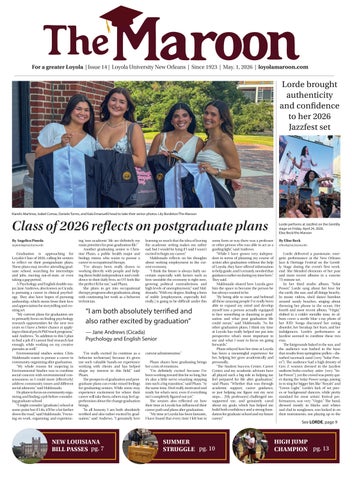
Kiarelis Martinez, Isabel Comas, Daniela Torres, and Kala Emanuelli head to take their senior photos. Lily Bordelon/The Maroon

Loyola looks to expand transfer pathways

By Alana Frank anfrank@my.loyno.edu
Loyola University New Orleans is expanding opportunities for transfer students through a new partnership with Mississippi Gulf Coast Community College.
The agreement, formalized April 27, is designed to create clearer academic pathways for students across the Gulf South, particularly those looking to complete bachelor’s degrees after community college. Loyola President Xavier A. Cole and Mississippi Gulf Coast Community College President Mary S. Graham both met on Loyola’s campus to sign a Memorandum of Understanding outlining the partnership.
The deal allows graduates from Mississippi Gulf Coast Community College to transfer directly into Loyola University New Orleans’s online Bachelor of Applied Science program. Students who
complete their associate degree will be able to transfer all 60 credits and enter Loyola as first-semester juniors.
University officials said the move is aimed at increasing access for working adults and nontraditional students, especially those who need flexible, online options to complete their degrees.
“As someone who grew up in Biloxi, I have seen firsthand the importance of strong educational pathways across the Gulf South,” Cole said. “At Loyola, we are committed to creating opportunities that meet students where they are and help them move forward with purpose.”
The partnership also focuses on strengthening academic collaboration between the two schools and aligning programs with regional workforce needs, according to the release.
Graham said the agreement will help students transition more smoothly into four-year programs.
“This agreement creates meaningful
opportunities for our students to continue their education in a seamless and supportive way,” Graham said.
The partnership is part of Loyola’s broader effort to expand its presence across the Southeast. The university has recently developed similar agreements with institutions including Delgado Community College and Baton Rouge Community College.
University officials said the goal is to create more accessible and efficient pathways for students while addressing workforce demands in the region.
Career Center offers advice on finding summer internships
By Eloise Pickering ewpicker@my.loyno.edu
With summer break around the corner, students are experiencing the dreaded ‘hurry up and wait’ period as some internships are doing final rounds of selection.
The waiting leaves on-campus students in challenging positions, as they navigate planning for summer as the May 8 deadline to be out of the dorms approaches. Additionally, others are left wondering if they should be searching for part-time jobs, or hold on to hope for that “Congratulations!” email to hit their inbox.
Sunny Bedford, a junior marketing and film double major, has had internships for her marketing major, but continues to struggle with finding an internship related to film.
Her marketing internships came from connections.
“Every internship I’ve held, it’s because I knew someone that personally recommended me, which was great for those isolated circumstances,” Bedford said.
This summer, Bedford is looking for an internship in film or script writing,
but she has trouble finding connections and hearing back from companies.
“Now that I’m looking for another internship, the search has been so difficult because I'm fully reliant on my resume,” Bedford said.
Fallon Chiasson, a career coach with the Career Development Center, acknowledged how challenging the process is.
“For students who may be struggling to find summer internships, I think it’s important to first acknowledge how frustrating the process can feel,” Chiasson said.
Bedford is feeling that frustration. She said that relying on her resume is discouraging, as it feels more like she’ll be selected by chance rather than based on the quality of her application.
“It’s like my talent or experience doesn't matter. It’s a touch entry barrier that feels like it relies on luck,” Bedford said.
According to Chiasson, students often have more experience than they realize.
“Class projects, extracurricular involvement, volunteer work, and service-learning experiences all build transferable skills that can and should
be highlighted when applying,” she said. Chiasson also encourages students to be strategic when applying to internships, and to shift away from a “quantity over quality” approach. She advises that students focus less on applying to as many internships as possible, but rather hone in on internships that are more valuable.
“Focus on opportunities that align with your interests and experiences, tailor your materials, and spend time networking,” Chiasson said.
Sometimes, the formal internship doesn’t come through, but according to Chiasson, students can create their own experience. These could be personal projects, building a portfolio, or conducting information interviews. Additionally, Chiasson said that part-time jobs are still important for a resume.
“Part-time jobs, including roles like working in a coffee shop or retail, are still incredibly valuable. These experiences build skills like communication, teamwork, time management, and problem-solving—some of the top traits employers look for,” she said.
Chiasson highlighted the availability of Loyola’s career coaches, and that they’re available throughout the sum-

mer as well as up to one year after graduation.
“Stay confident and committed to your goals—you don’t have to navigate this process alone!” Chiasson said.
CAREER: class of '26 reflects on time at Loyola

Maldonado reflects on his thoughts about seeking employment in the current economy.
“I think the future is always fairly uncertain, especially with factors such as how unstable the economy is right now, growing political contradictions and high levels of unemployment,” said Maldonado. “With my degree, finding a form of stable [employment, especially federally,] is going to be difficult under this current administration.”
Pham shares how graduating brings her a mix of emotions.
“I’m definitely excited because I’ve been working toward this for so long, but it’s also a little nerve-wracking stepping into such a big transition,” said Pham. “At the same time, I feel really motivated and ready for what’s next, even if everything isn’t completely figured out yet.”
The seniors also reflected on how their time at Loyola has influenced their
career path and plans after graduation.
“My time at Loyola has been fantastic, I have found that every time I felt lost in some form or way there was a professor or other person who was able to act as a guiding light,” said Andrews.
“While I have grown very independent in terms of planning my course of action after graduation without the help of Loyola, they have offered information to help guide, and I certainly needed that guidance earlier on during my time here,” They said.
Maldonado shared how Loyola gave him the space to become the person he has always wanted to be.
“By being able to meet and befriend all these amazing people I’ve really been able to expand my mind and develop myself into a person actually equipped to face something as daunting as graduation and what post-graduation life could mean,” said Maldonado. “As for
other graduation plans, I think my time at Loyola has really helped me put into perspective what’s more important to me and what I want to focus on going forwards.”
Pham relayed how her time at Loyola has been a meaningful experience for her, helping her grow academically and personally.
“The Student Success Center, Career Center, and my academic advisors have all played such a big role in helping me feel prepared for life after graduation,” said Pham. “Whether that was through academic support, career guidance, or just helping me figure out my next steps… [My professors] challenged me, supported me, and genuinely cared about my goals, which has helped me build both confidence and a strong foundation for graduate school and my future career.”
Xavi Lacayo, a Loyola career coach, sitting at a check-in desk at the Career Development Center’s Wolf Pack Power Hour event on March 24, 2026. This event was held to connect students with Loyola alumni to aid students in finding jobs and internships after college. Eloise Pickering/The Maroon
Presidents Xavier Cole of Loyola University and Mary Graham of Mississippi Gulf Coast Community College shake hands to formalize the schools' partnership on Loyola's campus on April 27, 2026. Courtesy of Kyle Encar for the Maroon
An honors medal sits on top of a graduation cap. The honors medal is awarded once students in the program graduate from Loyola. Daniel Shwalm/The Maroon
NIGHT NIGHT SENIOR SENIOR
Dat Dog 5030 Freret Friday May 1st 7 - 10pm
LIVE MUSIC - DRINK SPECIALS - GOOD TIMES
“The
best night of the rest of your life.”
CAMPUS
SIA celebrates International Soiree
Loyola’s Center for International Education hosted their annual international soiree on April 29. The focus of this year’s soiree was Indian culture, with flags, decorations, and artwork on display through- out the Audubon Room. Guests were invited to eat and mingle with each other, enjoy the music, and walk through the exhibit full of art and historical facts.


Professors look back on the '25-'26 academic year

vides various recipes that include invasive species in Louisiana, promoting individuals to eat more foods with those species to help with their population control.
Additionally, Del Bianco is excited to see how next year turns out, as it is the 100th anniversary of the Great Mississippi Flood of 1927, which was the most destructive river flood in the history of the country.
“I look forward to reflecting on how that event shaped New Orleans' relationship with water to this day,” said Del Bianco.
“I think we've had a really good year"
— Robert Thomas Professor and Director of the Center for Environmental Communications
and I think our new leader has done an exceptional job,” said Thomas.
SCD’s new director is Shaniece Bickham, who Thomas believes is making an amazing impact on the college.
“She came in and kind of took the bull by the horns and started riding in the rodeo,” he said.
According to Thomas, all three departments in the college went through an intense re-evaluation, and after putting the results in motion last year, the college was able to thrive this school year.
Thomas also praises the student engagement he saw this year, as he noted that these students are “very serious about what they’re doing.” The last few years he’s been teaching, he realized that students now simply have a different learning style than the generations before.
“We've been coming to terms with Gen Z's learning style, and I think my Gen Z students are coming to terms with their learning style,” he said.
textbook-type course.”
Biology-wise, he loved teaching Delta Ecology, which focused on ecosystems in and around marshes. However, his favorite part wasn’t the biology but the introduction of other studies into the course. According to Thomas, he introduced physics, religion, criminology, and more to educate students on the other factors important to helping the environment.
“You've got to understand how social systems affect citizens. And why do some people fight for things that are good and other people are saying that the answer to the environmental problems?" Thomas said.
Although Thomas is going to retire next school year, he still plans on being involved in the Loyola community and his research, updating his website continuously and providing lectures for students from time to time.
By Lily Bordelon lmbordel@my.loyno.edu
With the 2025-2026 school year coming to an end, professors are reflecting on the changes they’ve witnessed within their classes, departments, and schoolwide.
“There were days when the class was locked in and engaged in debate as well as creative projects like the Invasive Species Cookbook,” she said.
The Invasive Species Cookbook pro-
Veronica Del Bianco, professor and instructor for the Environment Program, taught multiple classes this year, including one of her favorites, Foundations of Environmental Studies.
Another professor, Robert Thomas, who is also a director of the Center for Environmental Communication, is retiring next year and has seen significant changes to the university throughout his time at Loyola.
Looking back at this year, he believes that the school is going in the right direction.
“I think we've had a really good year,
One of Thomas’s favorite classes was Environmental Communications because of how it’s a “thought class” that promotes discussion on certain environmental cases, where companies went wrong, and where it went right.
“It's about how your brain works and how you approach information and how you grasp mainstream thinking and things like that,” he said. “So it's not a
“People say, ‘what are you gonna do when you retire?’ and I say, ‘the same thing I've always done, but I won't be grading papers,” he said.
Thomas then reflected on the additional faculty at Loyola who have made it the space it is today.
“I think we've got really good professors right now helping the students,” Thomas said.
People talking and eating at the international soiree in the Audubon Room. April 29th, 2026. Qu'myne Barnes/The Maroon
Students Natalia Iglesias and Kayleigh Jean attend the international soiree. April 29th, 2026. Qemyne Barnes/The Maroon
Artwork from Indian culture on display at the International Soiree. April 29th, 2026. Qu'myne Barnes/The Maroon
Students table at the Earth Day Sustainability Fair and promote their Louisiana Invasive Species Cookbooks. Professor Veronica Del Bianco reflects on her time teaching her Foundations of Environmental Studies class, where students participated in projects like making this cookbook. Courtesy of Veronica Del Bianco for the Maroon.
PUZZLES
Recipe amount
Hard candies with blue raspberry and green apple avors. 38 Tibet's continent
Brand of heavy-duty trash
48 One who may have a platonic partner, for short
Flesh and blood
began their Arirang World Tour in 2026
__ to: before
of the
Hypersensitivity that may be diagnosed with scratch test
Actress Streep 8 Irish county next to Mayo 9 Like a library book one has to pay for
O -limits move
"Quit slouching!"
Supreme Court justice Kagan
Not on time
Tail end
Cry of pain
__ vu: familiar feeling
God with a bow and arrow
Former baseball commissioner Bud
30 Grapefruit serving, often
32 Univ. teacher
34 Singsong syllables
35 Opposite of paleo-
36 Wine stopper
37 Cut-and-dry spot
41 Seized auto
42 Annual festival in Austin, TX
44 Insect that forages in large raids
45 Heisman winner Flutie
46 Italian farewell
47 Put into code
51 Catherine of " e Studio"
52 Made cookies, say 53 Jazz (up)
55 Arms and legs
56 Crème de la crème
58 In need of tissues
60 Actor's accessory
61 Tortilla dough
65 Shrill bark
66 Fellow Stooge of Larry and Curly
67 Hosp. triage areas
For weekly puzzle answers, visit our Website via the QR code:

STAFF LIST
Editorial Board
Editor in Chief - Eloise Pickering
Managing Editor - Mary Ella Hastings
Pre-Content Director - Alana Frank
Post-Content Director - Callie
Honeycutt
News Editor - Lily Bordelon
News Editor- Stella Perdue
Worldview Editor - Pablo Piñeiro
Life & Times Editor - Elise Beck
Asst. Life & Times Editor - Olivia Sanyal
Sports Editor - Keri Smith
Opinion/Editorial Editor - Imad
Siddiqui
Breaking News Editor - Natalie omas
Copy Editor - Mark Michel
Senior Sta Writer - Dominique
Campbell
News Consultant - Mark Michel
e Wolf Director - Laura Welles
Senior Sta Photographer - Sophia Renzi
Photo Editor - Ashlyn Bobb Collins
Asst. Photo Editor - Pharrell Every
Social Coordinators - Carlos Andrade, Maria Touzard
Broadcast Producer - Cecilia Calderín
Lead Anchor - Dessadra Tezeno
Newscast Editor - Christopher Nesbit
Design Chief - Makayla Parker
Newsletter Writer - Rodrigo Delgato
Distribution Manager - Sophia Renzi
Contributors
Alyvia Pierson, Keily Martinez Pereira, Chandler Giallo, Dutch Buckley, Katherine Leslie, Claire Kerr, Alyssa Jones, Cae Nguyen, Nicholas Parrella, Angelica Pineda, Anistin Murray, Sabrina Huynh, Finian Jones, Erin Lovato, Valentina Russell, Claire Schmit, Joshua Fletcher, Lonniesha Carroll, Patricia Boyett, Amari Winchester, Nikolai Huilgol, Maria Touzard, Vaishnav Desabhatla, Xavier BuckleyWilson, James Wyrtzen, Claire Kerr,
Sales Manager: Emily Keller
Sales Representative: Carrie Adams Olsen
Student Media Adviser: Michael Giusti
Assistant Student Media Adviser: Gabriella Killett Vargas
CONTACT US
Main O ce - (504) 865 - 3535
Business O ce - (504) 865 - 3536
Adviser’s O ce - (504) 865 - 3295
Correspondence - maroon@loyno.edu
Letters to the Editor - letter@loyno.edu
Advertising - ads@loyno.edu
Website - www.loyolamaroon.com
Twitter - @loyola_maroon
Facebook - e Maroon
Instagram - @loyola_maroon
Our o ce is in the Communications/ Music Complex, Room 328.
Send mail to: e Maroon, Loyola University, Campus Box 64, 6363 St. Charles Ave., New Orleans, LA 70118
e Maroon is published every Friday. Unless otherwise noted, all content is copyrighted by e Maroon. All rights reserved. First copy free to students, faculty, and sta . Every additional copy is $1.00.
e Maroon is printed on 30 percent post-consumer recycled content.


By Angelica Pineda acpineda@my.loyno.edu
Louisiana lawmakers are pushing a bill that would protect the free speech of college and university professors bynancially penalizing universities for suppressing or retaliating against the speech of its faculty.
House Bill 1008 was sponsored by Louisiana Representative Chuck Owen in an e ort to increase academic free speech without fear of university intervention. is bill would protect the faculty of Louisiana universities and colleges in both academic and nonacademic settings. e bill would go on to protect the speech of whistleblowers within the institutions.
Walter Block, an economics professor at Loyola, has experienced retaliation against his speech during his time at Loyola and felt limited in what he could say. While Block explained he is not an ab-
solutist on free speech, he does think it is important to uphold. However, he said he is skeptical of exercising free speech even if the bill is enacted into law due to past incidents regarding his speech.
“I’ve been penalized in the past for using the word ‘cotton’ innocently, also for the word ‘Oriental.’ I was compelled to endure sensitivity training for using words like ‘cotton’ and ‘Oriental.’ A waste of my precious time. A violation of my free speech. A violation of my academic freedom,” said Block.
Other professors at Loyola are more idealistic about the bill, with hopes of academic exchanges among students and faculty.
Julia Miller, a professor at Loyola with a focus on education, thinks the bill is bene cial to both students and professors who want more dialogue around topics that are considered controversial.
“I have seen a chilling e ect on teachers in the k-12 grades when regulations have gone into place banning discussion
of so-called divisive concepts, and that has caused teachers to pull books o their shelves or feel discomfort with having conversations about gender identity or racism. Or, you know, established parts of history like slavery and the fact that they are bad, has become divisive,” Miller said.
Miller recalled the limited speech during her time teaching k-12 as a warning to what could happen by limiting speech in universities.
“If that creeps into higher education, which I believe it's starting to, that is a really dangerous precedent to set,” Miller said.
Patricia Boyett, former history professor and president of Loyola’s American Association of University Professors chapter, has also been concerned about the restriction on free speech in regard to teaching “divisive concepts” and what it could mean in higher education.
Boyett explains the importance of higher education to America as a dem-
ocratic nation and how limiting universities could create a politically uneducated America.
“Universities serve as one of the great pillars of a representative democracy, as one of their primary purposes is to pursue a deeper and more comprehensive understanding of the human condition, human developments, and human advancements by seeking the facts through research, by contemplating the meaning of the evidence, by engaging in debates over diverse perspectives, and by discerning ideas to form educated opinions,” Boyett said.
According to Boyett, exposure to opinions and “divisive” concepts is essential to keeping America’s democratic system and an informed society.
“All these elements are vital to a representative democracy in which informed citizens engage in their civic duty of investigating and discerning the ideologies and policy plans of candidates and determining which candidate aligns most
with their vision for America. When politicians or other powerful leaders seek to ban books, control curriculums, and deny academic freedom, they are divesting not only students, faculty, and sta access to the knowledge, but they are depriving people across the nation from accessing such knowledge through published works, public talks, scienti c studies, expert witnesses in legal cases, expert contributions to various governing agencies and private think tanks, etc.,” Boyett said.
Boyett believes having the ability to speak freely in an academic context allows for a debatebased democracy rather than a compliant dictatorship.
“Only dictators seek to control access to knowledge and to deny the right to free speech as they aim to force conformity of thought. Diverse views and debate are vital to any healthy democracy,” Boyett added.
New Orleans plans permanent memorial for Bourbon Street attack victims
By Pablo Piñeiro Ramy ppineiro@my.loyno.edu
More than a year after the terrorist attack on Bourbon Street, New Orleans is preparing a permanent memorial for the victims with the help of survivors and victims’ family members.
e attack occurred in the early morning hours on New Year’s Day of 2025. 14 people were killed and over 50 were injured when an army veteran drove a rented pickup truck into crowds that were celebrating the new year.
C.W. Cannon, a professor at the Loyola english department with expertise in New Orleans and urban issues, believes that the attack was caused by more than just a failure to provide ade-
quate security.
“Fourteen people lost their lives in those two blocks, and being in New Orleans is what sealed their doom. It will be easy for people in other places to chalk up their murders to the old ingrained sense that New Orleans has always been a dangerous place where people routinely get killed,” Cannon said.
Cannon said that the memorial should also remind visitors about the killer’s motives, which he believes were ideological.
“ e memorial should remind people that the people who died on that day were targeted because they were Americans, and perhaps secondarily because New Orleans' role as a place for people
to party was particularly o ensive to the murderer's especially puritanical brand of Muslim ideology,” Cannon said.
e memorial will be at Goldring Woldenberg Riverfront Park along the Mississippi River. It will consist of 14 glass inlays, one per victim, and a personal relic of each victim embedded in each.
e proposal document states that designs should create a space for ‘peace and re ection’ and may include features such as QR codes linking to information about the victims. ere is still no set completion date for the project.

Loyola University New Orleans horseshoe by Saint Charles Avenue. Pablo Piñeiro Ramy/The Maroon
The Louisiana National Guard, military police, and Louisiana law enforcement agencies patrol the French Quarter along Bourbon Street and intersecting streets as part of a National Guard deployment for New Year's celebrations in New Orleans, Tuesday, Dec. 30, 2025. AP Photo/Matthew Hinton

Lorde brought authenticity and confidence to her 2026 Jazzfest set
Continued from page 1
By Elise Beck erbeck@my.loyno.edu
Audience for attention. This minimalist, avant-garde attitude? Very “Virgin.”
This casual air defined Lorde’s look at the festival, braless in a baby tee and slouchy white jeans that hung just below her briefs. Her makeup consisted of streaks of silver paint on her fingertips (not just fingernails, of course, but the skin too), as well as across her eyelids. Her accessories were limited to a carabiner of trinkets hung from her belt loop and her signature water bottle, a $170 stainless steel bottle that she’s posted about several times.
At the beginning of her career, Lorde often got into drama for her opinions on the messages in other artists’ music, and she recently faced controversy for her mention of the Pamela Anderson/ Tommy Lee tape in the creation of “Virgin.”
In 2022, videos of her shushing the audience at live shows for a moment of micless acapella vocals on her song “Libaility” went viral. Some felt she was being rude, some thought it was embarrassing for her, and many thought both. Lorde responded to the drama by sending a video to a fan account to post.
“That dramatic ass move was literally for an album called Melodrama, so don’t stress too hard,” Lorde noted in the video, which she recorded in bed with her sleeping mask still on.
There is something refreshing about the fact that Lorde is a celebrity entertainer who doesn’t seem like she’s performing all the time. So many live pop shows are a fine-tuned production with choreography, perfectly coiffed hair, and tailored sequin outfits (a la Sabrinachella or the Eras tour), which, to be fair, are awesome and very fun to watch. However, this show felt like Lorde was communicating to the audience through her art, rather than trying to sell
a character.
The singer didn’t perform many speeches or moments of audience interaction during the set, only a quick quip about loving New Orleans and missing out on a meal at a local restaurant: “Everyone told us Lil Dizzy’s was where it’s at, so we showed up. Only to find out it was closed.” The performer laughed in her Kiwi accent. It wasn’t really a joke, nor a deep message–it felt more like the first thing that popped into her head.
Lorde has spoken about feeling intense anxiety around performing earlier in her career, yet she feels more comfortable in front of audiences at this stage of her life. She even tried to arrange an impromptu concert in Central Park last year, and instead of her fears stopping her, it was the New York City police doing crowd control.
Towards the end of her Jazzfest performance, she pressed herself right up against the barricade, grabbing the hands of fans in the front row. For the final song, “Ribs,” she appeared at a smaller platform, more in the middle of the audience, doing her signature thrashing dance moves just feet from fans.
Mic in hand, dark curls flying, this was the most evolved version of Lorde that audiences have seen yet, still singing about youth and passion, insecurity and love, but with a confidence in her stripped-down self that the culture desperately needs right now. At this moment in time, Ozempic is everywhere, every celebrity has a makeup brand, and no one dares to step on a red carpet or stage without a spray tan, veneers, and My-Little-Pony-level hair extensions. Seeing someone sing about their deepest, darkest feelings, with acne scars on their face and their original teeth in their mouth, and receive so much support from the crowd, showed that authenticity just may be ready for a comeback.


Lorde performs at Jazzfest on the Gentilly stage on Friday, April 24, 2026. Photo courtesy of Lauren Johnson.
Lorde performs at Jazzfest on the Gentilly stage on Friday, April 24, 2026. Elise Beck/ the Maroon
Lorde performs at Jazzfest on the Gentilly stage on Friday, April 24, 2026. Elise Beck/the Maroon
LIFE AND TIMES
‘Twerk heals’: A dance teachers' journey through addiction and dance
By Mary Ella Hastngs mlhastink@my.loyno.edu
Tracy Camp “ "doesn't give a f—-” what people think. at's why she chose to call her dance class “Twerk Church” which starts its new sequence this Sunday.
e dance class anchors a self-love world she’s built with twerking at its center. In her classes, Camp pushes the status quo, combining something taboo with her “ I don’t give a f— energy.” ere, she shows women how to thrust their hips and get low, a practice she says she teaches to empower her students and to protest a society she says sees the dance as overtly sexual.
“It's almost like they think it's for the male gaze when really it's for the female soul,” Camp said.
According to a meta analysis published in Frontiers in Psychology, dance signi cantly improves well-being, and Camp’s students call their visits to Camp’s twerking world healing.
Josie Parks and Linnea DeVange have both taken Camp’s Twerk Church class and have many praises for her.
“It has made me feel so comfortable in my own skin,” Parks said.
She added that Camp makes the class very engaging and her con dence is contagious.
“I gather that she has done a ton of work on herself, and I think that really translates into her teaching,” Park said.
DeVange knew Camp prior to taking her class when they met in a book group centering around the Artist Way, a 12-step program by Julia Cameron designed to help with creativity.
“Tracy is someone who thinks creatively in the same way I do. And I think I've learned a lot about how to practice creativity in a healthy way from her,” DeVange said.
But Camp's journey didn't come without setbacks.
Camp is a Philadelphia native who moved to New Orleans at 17. She attended University of New Orleans for lm and theater, and it was here that she struggled with addiction.
“I went to UNO and honestly the trajectory was I became addicted to drugs. And I was like, okay, I guess I'm just gonna stay in New Orleans and do drugs. And that's what I did,” Camp said.
She graduated in 2013, but said her life really started a few years later when she got sober.
“So it was just lucky by circumstance that I ended up getting dropped here, and then ended up getting trapped here for a little while, and then fell in love with it. Almost like an arranged marriage, ” Camp said.
She recalls dancing her whole life, but not professionally until she was 19. e beginning of Camp's artistic career in New Orleans was in live performances for the corporate party scene.
“New Orleans is a tourist industry. So people will hire me to ounce around and entertain them,” Camp said.
e dancer didn't begin formal dance training until right before COVID-19 when she started taking twerk classes herself.
“I was like, ‘I have this God given talent of shaking ass,” Camp said.
She shared that she became determined to perfect the craft and hone her technique.
“I wanted to be the best. at was my goal. I would spend hours and hours just throwing a– and really like trying to be perfect,” She said.
Camp said what she loves about twerk is that it helps her zoom out of her natural pessimistic self.
“When I'm twerking I can be like, ‘Wait, life is silly, you're hot, you can be stupid, you can shake this all away,” Camp said. “It's really hard to twerk and not be happy.”
While twerking has always made Camp happy, it was a journey getting to
where she is now. Before beginning her classes she taught kids at theater camps through Camp 504 and Community Works in New Orleans.
“ at was the best, it was super rewarding,” she said. “But, it got to the point where I was like, I love teaching kids but now it's time to do what you really want to do, be with the women and just get sexy”
Camp said she has many dreams in her life but this was one of the biggest.
attention,” Camp said. She went on to share that twerking has played many roles in her life but, at this point, she doesn't view it as something sexual.
is a pathway to letting go of unwanted energy in the body and the mind.
“I think of it as moving through fear, moving through doubt, and trusting yourself,” Camp said.
She hopes that all people feel welcome in her class and encourages
By Stella Perdue swperdue@my.loyno.edu
Last year after moving out of my dorm, e ectively graduating from the Biever Hall Blues, I was confronted with a strange emotion: imposter syndrome. I wrote a whole essay on the phenomenon of coming back home for the summer with no prospects; on being surrounded by peers who comparatively are doing much better than I was, who have not regressed back into their ever-indulgent sixteen-year-old bodies.
As a sophomore, these ideas are more pressing to me. I have friends with big girl jobs, some that are taking time o in Paris or Greece, and most of them live by themselves in New Orleans. I constantly check my noti cations on LinkedIn, and Indeed Jobs is a frequent yer in my weekly screentime data since I’m trying my best to scrounge up any internships I can get.
I think some of you might be having the same problem. Every time I speak to anyone about this, I receive one of two responses: a person is doing absolutely everything this summer or they are doing nothing at all.
For my summer break, I’m going to try to reconcile this weird gray space we all seem to be in by trying out the whole
“work hard, play hard” thing. ere is no doubt in my mind that I’m going to be checking my emails twice before I go to sleep at night, but it can also be said that I am a nineteen-year-old that’s allowed to enjoy my youth.
Here are some chic ideas so you can enjoy yours!
If, like me, you’re trying to avoid your parent’s house, go on a road trip with some friends–even if it’s just for the day. When I get so listless and tirelessly bored, my best friend and I drive into Texas and go check out various thrift shops. It beats sitting in the Target parking lot with Wingstop, for one.
e beach can also be done in a day. I mean the beach in a relaxing, sunbathing, Gossip Girl White Party way though: going out in an airy cover-up with a plush towel early in the morning, tanning and reading all day, and then dinner in the evening. Something classic. Although June and July are not particularly reserved for mental stimulation, I enjoy indulging in new media as much as possible. Books, music, essays, lms, podcasts, even magazines. Anything like that can cure imposter syndrome right away. It feels like everyone is opposed to reality television, but a little Love Island (U.K., of course) is something I mainly look
a weekly short class where I did choreography. at
“I really, really wanted to have a weekly short class where I did choreography. at was very important to me to do at some point in my life,” Camp said.
yers, posted them
classes sold out. She against her teaching other women how to twerk saying
Camp found a studio, made yers, posted them on Instagram, and her classes sold out. She said some have pushed against her teaching other women how to twerk saying it's unethical for a white woman to make money o black culture. But Camp thinks through hard work she has earned her right.
“I've spent countless hours perfecting a skill. Who cares that I'm white? I'm like a representative of New Orleans at this point,” Camp said.
take yourself too seriously, and everyone there feels vulnerable together. She says that it's not
Camp wants her class to be a space where you don't have to take yourself too seriously, and everyone there feels vulnerable together. She says that it's not only good for your soul but also your hip health.

“Get what you want from it. I don't care. I look at it as freedom and joy, there's just so many advantages. Like even your hips really need a lot more
community that I've built. It's been a way for me to connect with other women at this stage of my life,” Camp said. Camp shared that to her, twerking
forward to.
Doing everything you said you were going to do is also a choice. For example, selling your clothes online, deepcleaning your closet, or taking that trip you’ve been wanting to take. I’m trying
out this new thing where I say yes to things I normally wouldn’t in order to obtain inspiration.
Summer can be romanticized in such a nuanced way, but it can simultaneously be one of the most aimless experiences.
“If you feel the desire to throw a–, but are afraid to do so, Just f—ing give it a shot, especially if you want to do it in my class and have it be really fun,”
a shot, especially if you want to do it in
Stella and the city: Prioritizing a chic Summer beats imposter syndrome
A universal truth, though, is that we all need rest. No matter if you have a million internships lined up or if you’re succumbing to inevitable bedrot, remember to give yourself a muchneeded break.

Stella Perdue on July 5, 2025 at the beach in Panama City, FL. She writes about how the beach is a fun summer activity in her column. Stella Perdue/The Maroon
Tracy Camp teaches Luna Veronica at an Acro Style dance master class in the Maldives. Courtesy of Tracy Camp.


From doubt to dominance: Landry wins again
By Keri Smith klsmith1@my.loyno.edu
For Tenosh Landry, winning once was proof she belonged. Winning again proved something deeper: that she could trust herself, her training, and the process it takes to stay on top.
The biology pre-health sophomore has quickly established herself as one of the standout competitors in her program, turning hard work and resil-
“So to see that it’s actually paying off just shows that the work I’m doing actually means something.”
— Tenosh Landry High jump repeat champion
ience into back-to-back success in the high jump.
“It means a lot,” Landry said. “I work so hard, and sometimes I get in my head. ” Her path to a repeat title wasn’t without challenges. Just a week before her latest championship performance, Landry found herself struggling mentally during practice.
“A week before, my coach and I hit a wall,” she said. “And it showed in my attitude.”
Instead of letting that moment define her, Landry leaned into the guidance around her. Trusting her coach
and the preparation she had put in became the turning point that led to another championship performance.
“After I won, my coach was like, ‘See, when you just listen to me, it works,’” Landry said. “And I was like, 'yeah'.”
While her first championship marked a breakthrough, the second carried a different kind of satisfaction.
“The first one was like the base,” she said. “Now it just keeps getting greater each time.”
A big part of that growth has come from refining her technique. Early in her career, Landry often relied on instinct, training largely on her own without fully understanding the details that could elevate her performance.
“Last year I was mainly doing it on my own, so I didn’t really know what I was doing wrong,” she said. “Now my coach is helping me fix the small things, and that’s helping me jump higher.”
In an event where precision matters, those adjustments have made a noticeable difference.
Still, Landry emphasizes that high jump is as much a mental challenge as it is physical.
“The smallest thing can mess you up,” she said. “Once you get in your head, it’s like you can’t jump.”
To manage pressure in competition, she relies on a personal routine designed to calm her nerves and center her focus.
“I jitter a bit, move side to side, making small movements to calm myself down,” she said. “I take a deep breath, rock back and forth, and then I just go.”
In those final moments before takeoff, her mindset is simple: trust.
“I just tell myself it’s going to work out,” she said.
That belief didn’t come easily. Between her first and second titles,
“I’m the only girl, but I’ll hold it down”
— Tenosh Landry high jump repeat champion
Landry learned the importance of confidence, especially in a sport where doubt can be the biggest obstacle.
“I had to believe in myself,” she said. “It gets hard, because high jump is so mental. But I’ve done it before. I just have to trust that I can do it.”
Now, with another championship behind her, Landry is focused on what comes next. Her goals extend beyond conference success, with her sights set on competing at the national level.
“I want to go to nationals and take home a medal,” she said. “Conference was one thing, but now we have to go bigger.”
As it stands, Landry is one of a small group of athletes from her team preparing for that stage, and currently the only woman among them.
“It’s just five of us right now,” she said. Her ambitions don’t stop there. Along with competing nationally, Landry is determined to continue raising the bar literally and figuratively.
“I want to get the medal, break the record again, and make everyone proud,” she said.
Off the track, the lessons she’s learned through high jump have shaped her into a more focused and disciplined individual. Balancing athletics with a demanding academic path, she has developed a mindset rooted in commitment and self-belief.
“It’s taught me to stay focused and stay committed,” she said. “I can do anything. That message is one she hopes younger athletes will carry with them as they begin their own journeys.
“If you want something, you have to work for it,” Landry said. “You can’t just expect it to come. You have to believe in yourself and put in the work.”
As for the legacy she hopes to leave, Landry’s vision is both simple and powerful.
“I want to be an inspiration,” she said. “I want to set a record that nobody can beat. I want people to look at it and say they have to jump higher than me.”
Behind her success, Landry is quick to recognize the support system that has helped her along the way.
“My teammates, my coachesand my family are my biggest supporters,” she said. “They believe in me even when I don’t believe in myself.”
That support was especially meaningful during her championship performance, where the presence of her team helped push her forward.
“At the conference, everyone was
“I can do anything I put my mind to, but I have to believe in myself.”
— Tenosh Landry High jump repeat champion
there,” she said. “I love having them there. It helps me the most.”
Even when they aren’t physically present, their encouragement remains a constant source of motivation.
For Landry, success isn’t just about clearing the next height, it's about continuing to grow, trust the process, and rise above the doubts that once held her back.
And with another championship behind her and bigger goals ahead, she’s proving that she’s capable of doing exactly that.
Tenosh Landry completing a high jump. She is a repeat champion in high jump. Courtesy Kyli Baker.
The Final Goodbye Seniors give their last farewell

“ To my team, thank you for everything. Being part of this journey has meant more to me than I can put into words. from the long practices to the moments that tested us and the ones that brought us joy, I will carry all of it with me. our journey to nationals is something that will always stay a core memory for me, and I will truly remember it forever. more than anything, I’m grateful for the people I got to share it with. I’m so proud of this team, and I’ll always be cheering you on, no matter where life takes us next.
And to my coaches, thank you for believing in us and pushing us to level up. I cannot wait to see what is next for this program. ”
— Alexandra Givens (Alle) Senior Dance Team


"When I left France for the U.S. and committed to Loyola, I was very excited about the idea of playing college tennis and discovering a new country, but I never imagined I would find a new family.
The team culture and environment during my first two years were not what they are today. Over time, the most amazing, competitive, and passionate people joined the team, and each of them played a role in shaping what we have become. Every single person has contributed to this culture and to the success of this team, a team that has broken records and made history at Loyola.
I am incredibly grateful to have met such incredible people. Jett, Souche, Marin, Fredo, DP, Martin, Pat, Lucas, Spence, and Mo, the team we’ve built will be remembered not just for the many records we set, but for the culture we’ve created, which will be carried on by those who come after us. No matter what happens in the future, you were a part of the best four years of my life and the main reason I am leaving Loyola with memories I will remember forever.
Love y’all so much, and Geaux Pack!. ”
— Hippolyte De Preville Senior Men's Tennis
“I am thankful for all the memories and the friendships I have made since being at Loyola. It will forever be something I cherish. ”
— Benard Harris
Men's Baseball senior

“ Thank you to everyone that passed through this team over these last 4 years. It has been a rollercoaster, but I will always be proud to say I competed for this school and this team. Thank you Connor Meigs and Kimmy Daniel for sticking it out all four years with me. Without y’all I don’t know if I would have made it all the way! ”
— Richard Magann Men's Track and Field

“ After spending all my college career playing beach volleyball, coming back to indoor this year was a different and meaningful experience for me. It wasn’t always easy stepping into a “new” environment, but I learned a lot along the way. Volleyball has given me so much over the years and I’m grateful for every practice, game, road trip, hard moment and good memory. I’m especially thankful that I got the opportunity to compete again and to finish the season as conference champions! This chapter meant a lot to me, and I’m proud to have been part of it. Thank you to the coaches and everyone who was part of this journey. Wolfpack forever !!! ”
— Ivana De Carvalho Peixe Volleyball Team Senior

“This place will always hold such a special place in my heart. It’s extremely nostalgic to look back at all of the achievements we’ve made since I got here as a freshman. Every year felt like a fresh start - a new family, new goals, and new history to be made. I could not have asked for a better experience, one that will stay with me for a lifetime. Coach Matt, thank you for recruiting such amazing people that I know I can count on forever. This part of my life not only shaped me as an athlete, but also helped me grow into the person I am today.
I wish I could start it all over again, but I know that this chapter of my life has prepared me for what’s next. And hopefully, one day, we’ll all reunite back here as Hall of Famers. Go Pack forever. ”
— Adele Fereres Women's Tennis Senior
“Thank you to all my teammates I’ve been grateful to play alongside for the past four years. I’m lucky to call y’all brothers for life. Thank y’all for the countless hours we’ve spent together, and the memories that will stay with me long after the final game. This program has meant everything to me, and I’m grateful for every moment we’ve shared.”
— Thomas Hakimian Men's Baseball Team
“To the seniors,
It has been a pleasure watching you guys this school year. I cannot wait to see what is to come and I wish you guys nothing but the best. Remeber everything works out for us.”
— Keri Smith Sports Editor
The women's dance team posing with a stuffed animal for a photo Theyhave seniors graduating. Courtesy Alexandra Givens.
Sam Izrael and Hippolyte De Preville pouring ice water on Jett Nguyyen. Sam and Hippolyte are both seniors. Courtesy of Hippolyte De Preville.
Benard Harris celebrating with a teammate in a photo. Harris is a graduating senior this year. Courtesy Benard Harris.
Richard Magann and his teammates posing for a photo. He is graduating this May. Courtesy of Richard Magann.
The women's volleyball team posing for a photo. This team has multiple seniors graduating. Courtesy of Ivana De Carvalho Peixe.
Adele Fereres hugging a teammmate in a photo. She is graduating this May. Courtesy of Adele Fereres.
The men's baseball team posing for photos with awards. They have multiple graduating seniors. Courtesy of Thomas Hakimian.

Lena Dunham wrote another memoir. Why?

By Nicholas Parrella inrparrel@my.loyno.edu
Following her 2014 memoir, “Not That Kind of Girl: A Young Woman Tells You What She’s Learned,” multihyphenate director, writer and author Lena Dunham returns with ‘Famesick,’ a book that Dunham claims shows her as more mature, reflecting on her relationship to fame and to herself.
The memoir mainly takes place in the 2010s, during the time Dunham created her hit HBO show “Girls.”
This sounds like an extremely interesting read providing fans and readers alike with a deeper understanding of Dunham.
However, upon its release, critics and readers have been asking one question: Why did Lena Dunham
write another memoir?
“Girls” acts as a modernized “Sex and the City,” following a group of young women through a modern New York City landscape as they come to grips with the relationships between themselves and each other. The show was praised, discussed widely and applauded for its witty writing.
It’s no secret that Dunham has always been a controversial figure ESPECIALLY during the show's popular five-year run
Viewers took note of its lack of diversity and often limiting views around what it means to be a woman.
Looking back now, these things aren’t just criticisms, they are true, which makes her new memoir “Famesick” even more frustrating.
Fans took note of her lack of ac-
countability, especially surrounding a sexual assault allegation made against one of her writers on “Girls.” At the time, she openly defended him, and later on, when confronted with the controversy again, stated she “didn’t remember" writing it. That is what makes “Famesick” so disappointing, and, quite frankly, unnecessary. Memoirs, especially a followup, should show growth or accountability, but instead, Dunham portrays herself as sickly. The narrative she writes is one of a person stuck in a victim complex, unable to fully acknowledge the error of their ways, and instead tries to self-preserve (something Dunham has done consistently throughout her career).
Senior reflection: from music to law school

By Gracie Cousin gkcousin@my.loyno.edu
Most individuals graduating with a Bachelor of Music don’t gravitate to law school after.
Although my path may be unconventional, I feel pretty equipped to take on this new venture. I initially picked my major due to my lifelong involvement in the New Orleans music scene, with my first performance in the Mahalia Jackson Theater at age 8.
I found creativity, passion, and community in my jazz studies major. Still, I did not find all of myself in my degree.
My major taught me to improvise, critically listen and think, and move soulfully through life.
Yet, I craved the chance to analyze court cases, formulate arguments, and debate topics with others. I now had the academic study of music, but I lacked the academic pursuit of law.
While I initially saw my current degree as the polar opposite of my future pursuit, upon closer look I found various similarities.
My degree taught me to comfortably
speak in front of others and tell a story through song. In litigation, it’s imperative that an attorney can present information in a convincing and confident manner to others.
With jazz education I learned how to improvise and adjust quickly on my feet. This skill is essential in the practice of law as well, as one must be flexible and knowledgeable. Learning that I had a transferable skillset was mind-shifting to me and helped me feel better prepared to transition from one discipline to another. I feel that my major allowed me to take my love of music into an academic study that revealed a skillset with multidisciplinary application.
For those choosing to pursue a jazz studies degree here at Loyola, expect to be pushed and experience true artistic growth. I found that my relationship to my music shifted as the years went by. As my mind matured, so did my voice. My degree encompassed music performance, music history, critical analysis of music, and the music’s compositional elements.
Our professors have a wealth of ex-
perience and seek to engage with students personally. Through private lessons, ensembles, and improvisational study I grew my musicianship over time. Though my primary instrument is vocal, I developed piano skills and learned how to write for instruments other than my own.
One can deeply enjoy playing music, but pursuing an academic study of music requires immense dedication of mind and body.
Even though I am not choosing music performance or teaching as my career, I will truly always feel like an artist at heart.
Why philosophy majors will make more money than you

By William Shepard wcshepar@my.loyno.edu
tens of thousands of dollars to study something which is no longer relevant? Philosophy is treated as an arcane practice; a stagnant discipline which has not developed since the scientific revolution rendered
it unnecessary.
In the common perception, the days of needing to know Socrates and Aristotle are dead. If there is anything to learn, AI Socrates will surely educate them just as well. For a student body obsessed with ROI, the equation seems simple. Philosophy provides none.
But of course, you don’t need to participate in such irrational beliefs. You see through the facade of popular opinion, and understand the value of majoring in critical thought. You are already aware that according to the Association of American Medical Colleges, philosophy majors have the highest acceptance rate to medical school of any major, at 50%. You already know that, according to the University of Clemson, philosophy majors on average score higher on the GRE and LSAT than any other major.
In reality, that philosophy is perhaps the most valuable major one could study in undergrad is a notion only denied by the ignorant. I will say the cliché if only because it’s true: philosophy teaches you how to think. And it does so in a very specific way.
What is the purpose of studying Descartes, Hume, and Kant? Of reading Ki-
erkegaard, Nietzsche, or de Beauvoir?
Firstly, the philosophy major does this because it trains their ability to quickly understand complex information. The practice of analyzing esoteric texts entails them to think in new ways; to reconsider a subject as they had never seen it before. In order to comprehend these conceptual systems and logical dilemmas, the philosophy major must learn to question their own fundamental assumptions and attempt to fully inhabit the mind of another.
Secondly, the philosophy major must learn to turn their newly practiced critical thinking skills into written analysis. That the large writing requirements are perhaps the greatest turn-off for potential philosophy majors is regrettable, for it is undoubtedly its chief asset. In the act of translating reason and critical thought into a written argument, the philosophy major acquires the capability to systemize their beliefs, and accurately communicate them to others. Not only are you taught how to critically interrogate both your own and others' ideas, but how to effectively transmit them to a rational (and hyper-critical… so don’t get it wrong!) audience.
With the knowledge that philosophy majors are heavily trained in methods of critical thinking, and are able to produce succinct and sufficient explanations of complex ideas, it should be no surprise that they often excel in whichever discipline they find themselves in. And indeed, the salary numbers back this up, with the American Philosophical Association reporting that over their career earnings, philosophy majors make more than any other humanities major. Further, according to the Wall Street Journal, philosophy majors will monetarily outperform majors in Finance, International Relations, Marketing, Business Management, Nursing, Biology, and Health Care Administration.
But of course, you already knew this. You already know that what is most important about undergrad is not necessarily the content of your major but the skills it leaves you with.
What skill could be more important than a degree in thinking?
If nothing else, a philosophy degree brings supreme self confidence. Lord knows that I think that I think better than you.
Photo courtesy of Gracie Cousin/ The Maroon
Courtesy of penguin random house/The Maroon
Photo of philosophy books. Taken by Pharrell Every /The Maroon
The Maroon: my home away from home

By Eloise Pickering ewpicker@my.loyno.edu
There’s no way to describe my time as editor in chief without sounding incredibly corny, slapping cliches on the page, and definitely not with dry eyes. But what other way is there to describe such a wonderful experience? An experience that over a hundred people have had before me, and another hundred will after.
There were many iterations of this piece; all were me trying to have a reflection different from the ones before. But then I realized: raw emotions are corny, often riddled with cliches, and don’t usually happen with dry eyes.
Three years at The Maroon and one as editor in chief has taught me many things, but one stands out above the rest: you are not alone. The Maroon has given me some of my dearest friends, fondest memories, and a space where I felt free to be myself while doing what I love. It is so much more than a newspaper. It’s a home away from home, a space where people get to grow as humans, journalists, students. I am beyond fortunate to have been able to call this place, this office, this publication, these people, my home. Every person who has passed through the newsroom has taught me
something, and each has reminded me that The Maroon is a community that supports not just those who work here but our campus and all who involve Loyola.
Nearly every Wednesday for the last three years, I have made the late-night walk back to my dorm with a sense of fulfillment that I, and all the wonderful people I work with, were making a difference. We were capable of giving people a voice, furthering change, and doing what we set out to do: be the mirror and the lamp for Loyola University. I don’t think I could be prouder of the people who have worked so hard with me this last year.
And as my time as EIC, and at The Maroon, comes to a close, I think of the people who brought me this far.
I am forever grateful to Kloe Witt, the person who brought me in and taught me what it meant to be a Marooner. I am grateful to my two advisors, Michael Giusti and Gabby Killett Vargas, who offered me endless guidance both before and during my time as EIC. And I will always be immensely thankful to every person who supported me during my Maroon career: the staff I worked with, my parents for the numerous calls, my roommates for late night debriefs, my
best friends for encouragement, professors for the guidance and grace, everyone I interviewed (or badgered for a statement), the editors I worked under, and every other person that we shared the words, “The Maroon.” You all are what has made my time here so meaningful, and every person taught me something about myself, managing, journalism, and the world around me.
I am very excited to pass the torch, and the special desk chair that is a little different than all the others, to your next editor, Alana Frank. I have had the pleasure of watching her grow as a journalist the last two years, and I feel confident she is going to lead The Maroon into another semester of greatness.
Thank you to everyone who reads, supports, criticizes, and contributes to The Maroon. You make us possible and better. As I face my future without The Maroon, and with a lot more time on my hands, I know that every lesson I learned here will take me far.
I am proud to always, and forever, be a Marooner.
Eloise Pickering Editor in Chief, Aug. 2025 - May 2026
The next chapter for The Maroon
By Alana Frank anfrank@my.loyno.edu
The first time I walked into The Maroon newsroom, I didn’t really know what I was doing. I just knew I liked writing and wanted to be part of something that felt important. I didn’t know that moment would end up shaping so much of who I am today. Now, stepping into the role of editor-in-chief, it feels a little unreal. Not because I ever planned it, but because of how much I’ve grown along the way. From just a writer to Campus News Editor, to Breaking News Editor, and now Pre-Content Director, every step in this newsroom has pushed me to become more confident, more curious and more
intentional about the kind of journalist and leader I want to be.
Over the past two years, The Maroon has become more than just a student organization to me. It’s where I learned how to ask better questions, how to listen, how to walk into a room and talk to people I didn’t know, and how to tell stories that actually matter. It’s where I learned that journalism isn’t just about writing, it’s about people.
And that’s why this role means so much to me.
The Maroon is more than just a newspaper we publish every week. It’s how students stay informed. It’s how voices are heard. It’s how moments on this campus are documented and remem-
bered. And sometimes, it’s how people are held accountable. That responsibility is something I carry with a lot of care.
Going into this next year, my goal is not just to continue what we’ve been doing, but to grow. I want our coverage to feel real, relevant and centered around students. I want us to tell stories that reflect the full experience of Loyola, the good, the complicated and the things that don’t always get talked about. Whether it’s campus policies, student experiences or issues that go beyond our campus but still impact us, our reporting should always feel meaningful.
At the same time, I want to focus on how we work as a newsroom. I want The Maroon to feel more organized, more
collaborative and more supportive. Journalism can be stressful, especially in a student environment, but it should also be something we feel proud of. I want writers, editors, photographers and everyone involved to feel confident in their work and supported in their growth.
Because for me, leadership isn’t just about running a newsroom. It’s about taking care of the people in it.
Another big focus moving forward is making sure our work actually reaches people. Not everyone is picking up a print paper anymore, and that’s okay. We have to meet students where they are, whether that’s online, on social media or through digital storytelling. Our work matters, and it deserves to be seen.
Looking back, I’ve watched this newsroom cover so much, from major campus conversations to everyday student stories that might not seem big at first, but still matter. And every time, it reminds me why student journalism is so important.
It’s not just about reporting news. It’s about building something that represents the people around us. I know there’s a lot of work ahead, but I also know what this team is capable of. I’ve seen it firsthand.
And I’m ready to take that next step, not just as editor-in-chief, but as someone who truly believes in what The Maroon can be.
Met Gala 2026: “Costume Art” set to transform the red carpet

By Callie Honeycutt cbhoneyc@my.loyno.edu
Fashion’s biggest night is here, and it’s returning with one of its most open-ended themes yet. Last year's theme,“Superfine: Tailoring Black Style”, viewers saw suits dominating the carpet, with other pieces having sharp silhouettes and intricate detailing. This Met Gala 2026 will center on “Costume Art,” inviting celebrities to treat clothing not just as fashion but as a form of artitic expression, using their own bodies as the canvas.
Held at the Metropolitan Museum of Art on May 4, the event coincides with the Costume Institute’s spring exhibition, which explores the relationship between clothing, the human body, and visual art.
This year’s dress code, “Fashion Is Art” is intentionally broad, encouraging guests and designers to interpret the theme creatively rather than literally. Although some looks may flop because of this flexibility, others are expected to result in one of the most visually diverse red carpets in recent years. Inspired by classical art and anatomy, looks will range from sculptural couture to designs
centered on the body.
Unlike past themes tied to specific eras or designers, “Costume Art” emphasizes the body as a canvas. Experts predict an increase in avant-garde silhouettes, illusion designs, and garments that blur the line between fashion and performance.
Celebrities known for show-stopping Met Gala looks, such as Doja Cat and Zendaya, are likely to embrace the theme through dramatic, conceptual looks. Meanwhile, Met Gala co-chairs like Beyoncé and Nicole Kidman will be setting the tone for the night, blending high fashion with artistic storytelling. I am looking forward to collaborations between fashion houses and costume designers, further emphasizing the connection between runway and stage. Ultimately, the Met Gala is about more than just what celebrities wear; it’s about how well they and their designers can interpret the theme. With “Costume Art,” this year’s event is poised to push boundaries, turning the red carpet into a space where fashion becomes living, wearable art.
Graphic by An Nguyen/The Maroon
Outgoing editor-in-chief Eloise Pickering and incoming editor-in-chief Alana Frank (respectively) together in the Maroon office. /The Maroon
EDITORIAL
How many students will get priced out of higher education?


An Nguyen /The Maroon
Loyola’s recent email about the federal One Big Beautiful Bill Act (OB3) might read like just another administrative update, something easy to skim or an email to delete.
But this is bigger than that, and treating it like just another email is exactly how issues like this slip by without real attention.
Starting July 1, 2026, federal loan limits will tighten, graduate students will lose access to Grad PLUS loans entirely, and many students will nd themselves hitting borrowing caps sooner than expected.
What looks like a policy change on paper is, in reality, a shift that could determine who gets to stay in school and who doesn’t. is didn’t happen overnight. Over time, the federal government has steadily stepped back from its role in funding higher education, placing more and more of the burden on students and their families.


HOWLS & GROWLS
HOWL to Megan Thee Stallion
GROWL to Klay Thompson
HOWL to Lorde
GROWL to Finals
HOWL to
Last issue of the year
GROWL to Mud
Editorial Board
Editor in Chief
Eloise Pickering
Managing Editor for Print
Mary Ella Hastings
Pre-Content Director
Alana Frank
Post-Content Director
Callie Honeycutt
Campus News Editor
Lily Bordelon
Campus News Editor
Stella Perdue
Worldview Editor
Pablo Pineiro-Ramy
Assistant Worldview Editor
Angelica Pineda
Life and Times Editor
Elise Beck
Assistant Life and Times Editor
Olivia Sanyal
e gap between what college costs and what students can realistically afford is only getting wider, and policies like OB3 don’t close that gap. ey expose it, and in some ways, they deepen it. When that gap widens, it doesn’t hit everyone the same. It never does.
Students pursuing majors that aren’t traditionally labeled as “professional” often feel it rst and hardest. Fields in the humanities, social sciences, and liberal arts, the very elds Loyola prides itself on, don’t always come with immediate high-paying career paths, but they are essential. ese are the elds that produce journalists who hold power accountable, lawyers who advocate for justice, policymakers who shape legislation, and thinkers who challenge the status quo.
“The gap between what college cost and what students can realistially aford is only getting wider and policies like OB3 don't close that gap.”
— The Maroon Editorial Board
At the same time, tuition hasn’t slowed down, and the cost of living continues to rise. Rent, groceries, books, everything adds up.
or planning ahead. is is about a system that is changing in a way that puts more pressure on students while o ering them fewer options. at’s not just a nancial issue. It’s a political one. at is where the midterm elections come in, whether students are paying
ignore policies that limit access to education. at commitment has to mean something in practice. Supporting students means more than sending out emails and linking FAQs.
“A school that emphasizes Jesuit values and a commitment to jstice can't ignore policies that limit acess to education.”
— The Maroon Editorial Board
When access to funding shrinks, it quietly reshapes who can afford to study these disciplines at all. What should be spaces of intellectual exploration start to become spaces ltered by nancial privilege. And that shift doesn’t announce itself loudly. It happens slowly, through policies like this, until one day the question isn’t just what you want to study, but whether you can a ord to study it at all.
So yes, Loyola is right to urge students to review their nancial plans.
Students need to understand their loan limits, talk to nancial aid advisors, and prepare for what these changes mean in real terms. But stopping there misses the bigger picture. is is not just about budgeting better
attention to them or not.
It’s easy to treat midterms as less important than presidential elections, something that can be ignored or pushed aside. But decisions like this don’t come out of nowhere. ey come from the people elected into these positions and the priorities they bring with them. Financial aid policy is not abstract.
It shows up in your tuition bill, your loan limits, and your ability to stay enrolled.
If students are directly impacted by these decisions but don’t show up politically, then there’s very little pressure for those decisions to change.
At the same time, institutions like Loyola cannot simply point to legislation and move on.
If federal support is shrinking, then universities have a responsibility to respond in ways that actually support their students.
A school that emphasizes Jesuit values and a commitment to justice can’t
It means being transparent, expanding support where possible, and recognizing that for many students, this isn’t just about planning, it’s about whether staying here is even nancially possible. What happens next depends on how students respond. is is a moment to pay attention, to ask questions, and to demand more, from both the university and the systems that shape it.
It’s also a moment to recognize that something as personal as paying for college is deeply political.
e decisions made at the federal level don’t stay in Washington. ey show up here, in classrooms, in nancial aid packages, and in whether students can continue their education.
If there is a starting point for change, it is here.
It starts with understanding what is happening and refusing to treat it as normal.
It continues with speaking up, asking harder questions, and pushing for better answers, and it doesn’t stop on campus.
It extends to the ballot box, to the spaces where these decisions are actually made.
Because when policies begin to decide who can a ord an education and who can’t, staying silent isn’t neutral. It’s part of the problem.
Sports Editor
Kerieyaunta Smith
Opinion and Editorial Editor
Imadnisa Siddiqui
Breaking News Editor
Natalie omas
e Wolf Editor
Laura Welles
Senior Sta Photographer
Sophia Renzi
Assistant Photo Editor
Pharrell Every
Design Chief
Makayla Parker
Social Media Manager
Mabel Regalado-Hernandez
Social Media Manager
Carlos Andrade
Social Media Manager
Maria Touzard
Copy Editor
Mark Michel
Newscast Editor
Christopher Nesbit
Lead Anchor
Dessadra Tezeno
EDITORIAL POLICY
The editorial on this page represents the majority opinions of The Maroon’s editorial board and does not necessarily re ect the opinions of Loyola University.
Letters and columns re ect the opinions of the authors and not necessarily those of The Maroon’s editorial board.
The Maroon does not represent the opinion of administration, sta and/or faculty members of Loyola.
Letters are subject to editing for length, grammar and style. Please limit submissions to 400 words. Submissions are due no later than 4 p.m. the Sunday before publication. Please send all submissions — The Maroon, 6363 St. Charles Ave., Box 64, New Orleans, LA 70118.
Email us your letters — letter@ loyno.edu.
Submissions may also be made online at www.loyolamaroon.com.


Endless possibilities —just down the street.
The same personalized support. The same hands-on learning experience. All new possibilities for your career.


Explore versatile programs at Loyola College of Law.


· ·


Juris Doctor – full time, part time, and evening programs


Master of Arts in Environmental Law


Master of Arts in Health Law & Administration ·


Kaitlyn Manning ’22, JD ’27 and Kathryn Manning ’21, JD ’28
BA in Criminology and Justice Graduates Current Evening JD Students