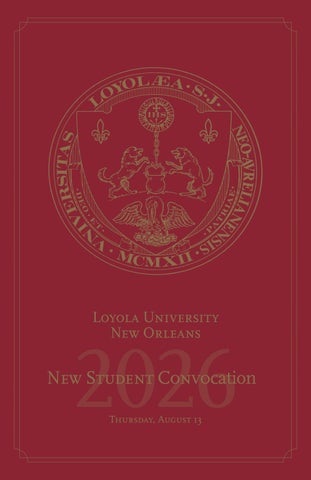
Loyola University New Orleans
2026
New Student Convocation Thursday, August 13
Ceremonial Regalia Arts, Letters, Humanities White Commerce, Accountancy, Business Drab Olive Economics Copper Education Light Blue Fine Arts Brown Journalism Crimson Law Purple Library Science Lemon Medicine Green Music Pink Nursing Apricot Philosophy Dark Blue Public Administration, including Foreign Service Peacock Blue Science Golden Yellow Theology Scarlet
Universities have held ceremonies for the awarding of degrees since the eleventh century. Over these many hundreds of years, considerable tradition has evolved around commencement exercises and the procedure by which degrees are awarded. The Louisiana Legislature granted a charter to Loyola University on July 10, 1912, recognizing the university’s right to grant degrees. Regional associations set standards and after careful examination will recognize an institution through accreditation. Loyola is accredited by the Southern Association of Colleges and Schools Commission on Colleges (SACSCOC) to award associate’s, bachelor’s, master’s, and doctoral degrees. A degree is a title that a college grants an individual upon completion of scholarly work. As proof of that title, a diploma is issued. Those who have completed degree requirements move the tassel on their headpiece from right to left, another symbolic custom. In today’s ceremony, each new student will receive a class bead welcoming them to Loyola. This ceremony marks the official beginning of each student’s journey toward the Commencement Exercises in May of 2030, during which those who have achieved the qualifying standards will be awarded an academic degree from Loyola University New Orleans.
Academic Gowns And Hats Academic gowns and hats are a custom that dates back to the Middle Ages. Since early European and English universities were founded by the church, students and teachers were required to wear distinctive gowns at all times. Although the custom was brought to this country in colonial days, the requirement for students was soon dropped. The custom for professors was confined to special occasions such as graduation exercises and inaugurations of college and university presidents. With the increase in the number of educational institutions and the development of new fields of study, confusion arose about the type of gown and the color to denote various degrees. To introduce uniformity and set up a clearinghouse for new disciplines, a commission representing leading American colleges produced The Intercollegiate Code in 1895. In 1932, a national committee of the American Council on Education revised this code into The Academic Costume Code. It was revised again in 1959. Although not obligatory, most of the educational institutions in the country follow it in awarding their degrees, earned and honorary.
The most significant part of the academic dress is the hood. While there are bachelor’s degree hoods, many institutions reserve the wearing of hoods for graduate degrees. Each successively higher degree carries with it a longer hood. The doctoral hood also has side panels on the back. The color of its velvet border indicates the academic field, and it is lined with the color or colors of the institution granting the degree. Although most doctoral gowns are black, with black velvet bars and panels, in some cases the color of the gown is that of the university conferring the degree— blue for Yale, crimson for Harvard, slate for Columbia. All such gowns have black bars and panels. Academic fields also may be indicated by the color of velvet on the doctoral gowns: three two-inch bars on the sleeves and a five-inch border extending from the back of the neck down the two sides in front. Caps are black. Gowns for bachelor’s and master’s degrees are plain black, but sleeves of the latter are short with trailing “elbows.” Doctoral gowns of European universities are usually very colorful. The caps often are not of the conventional mortarboard shape.
Distinction Cords Undergraduate students graduating with honors wear distinction cords symbolizing the following honors: Gold Cords — Summa Cum Laude (3.9 GPA) Silver Cords — Magna Cum Laude (3.7 GPA) Bronze Cords — Cum Laude (3.5 GPA)
Ceremonial Mace Loyola University’s Ceremonial Mace is an ornamental mace traditionally carried at the head of academic processions as a symbol of educational authority and institutional identity. Its design and appearance typically resemble a metal torch or cross decorated by carvings including the university seal. The Loyola mace was designed in 1995 by then Department of Visual Arts faculty member Erik Johnson. It is carried as a symbol of authority in processions at commencement and other academic ceremonies. During other times of the year, it is on permanent display in Marquette Hall. It was utilized for the first time October 28, 1995, at the inauguration of the Rev. Bernard P. Knoth, S.J., as 15th president of the university. The iconography on the mace is derived from the seal of the university as designed in 1929 and stylized in 1970. The arms of the Loyola family consist of two gray wolves suspending a kettle between them. This is seen as a symbol of generosity because it signifies such abundance that after everyone was fed there was always something left in the pot upon which the wolves could feast. The fleur-de-lis represents the French origins of the state and city. The pelican feeding her young with her own blood affiliates Loyola with the state of Louisiana. The wolves, fleur-de-lis, pelican, and bottom termination are of cast bronze. The kettle, with the facade of Marquette Hall in low relief, is cast iron. Overall length is approximately thirty-three inches. The staff is inscribed with the following significant dates in Loyola University New Orleans history: 2012 — the 100th anniversary of Loyola’s charter; MCMXII — 1912 — chartering of Loyola University; MDCCCXLIX — 1849 — founding of the College of the Immaculate Conception; MDCCCXXXVII — 1837 — founding of St. Charles College; and MDCCXXVI — 1726 — arrival of the Society of Jesus in Louisiana.
Opening Procession University Mace Victoria Vega, Ph.D. Chair, Faculty Senate
Loyola University New Orleans Gonfalon Violette Worley President, Student Government Association
University Staff College of Arts and Sciences............................ Joseph Luu, Gonfalon Bearer Leonard Kahn, DPhil, Dean College of Business.................................... Peyton Bernstein, Gonfalon Bearer Robert A. “Bobby” Savoie, Ph.D., Dean College of Music and Media........................... Taylor Griffin, Gonfalon Bearer Sheryl Kennedy Haydel, Ph.D., Dean College of Nursing and Health......... Jazmine Hernandez, Gonfalon Bearer Michelle “Shelli” Collins, Ph.D., Dean Online and City College............Carly Penn-Harper, Ph.D., Gonfalon Bearer Paul Cesarini, Ph.D., Dean Libraries.......................................................................Trish Nugent, M.S., Dean University Faculty University Administrators Alicia Bourque, Ph.D. Vice President, Student Affairs
Stuart Gay, M.B.A. Vice President, Finance and Chief Financial Officer
Stephanie Hotard ’04, M.B.A. ’10 Vice President, University Advancement
Anthony E. Jones, M.Ed. Vice President, Enrollment
Julien Meyer Deputy General Counsel
The Rev. John Cunningham, S.J., Ph.D. Vice President, Mission and Identity
Thomas A. Chambers, Ph.D. Provost and Senior Vice President, Academic Affairs
Desirée Rodriguez, M.B.A. ’25 Chief of Staff
The Rev. Penn Dawson, S.J., J.D. Visiting Assistant Professor of Law, New Orleans Jesuit Community Rector, and Board of Trustees Secretary/Treasurer
Xavier A. Cole, Ed.D. President
Order of Proceedings Invocation The Rev. John Cunningham, S.J., Ph.D. Vice President, Mission and Identity
Pronouncement of the Mission of the Society of Jesus The Rev. Penn Dawson, S.J., J.D. Visiting Professor of Law, New Orleans Jesuit Community Rector, and Board of Trustees Secretary/Treasurer
Pronouncement of the Mission of Loyola University New Orleans Thomas A. Chambers, Ph.D. Provost and Senior Vice President, Academic Affairs
Introduction of Administrators and Deans, with Deans’ College Charges All new students of each college stand when indicated.
Presidential Address Xavier A. Cole, Ed.D. President
Conferral of Class Beads Alicia Bourque, Ph.D. Vice President, Student Affairs All new students follow the instructions of the ushers, standing when indicated and exiting from the pew into the center aisle to process forward and receive the class bead, then returning to the pew.
Student Government Association Welcome Violette Worley President, Student Government Association
Benediction Tracey Lamont, Ph.D. Director of the Loyola Institute for Ministry
Second-line Recession All new students exit the church via the side doors to the right onto the Marquette Horseshoe for the official Class of 2030 photograph.
Welcome class of 2030
Share your convocation photos today on Instagram using #Loyno30
Loyola University New Orleans Convocation Celebration Thursday, August 13 • Holy Name of Jesus Church