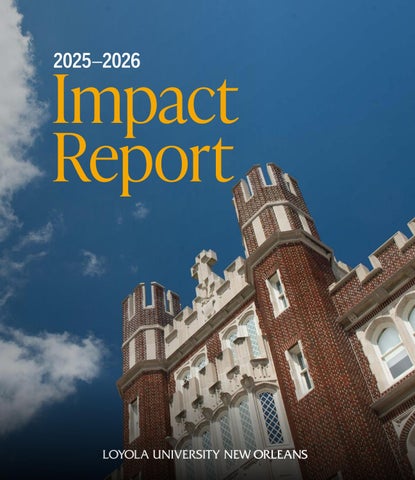
2025–2026
Impact Report
A Letter from the President As we reflect on another remarkable year at Loyola University New Orleans, I am filled with gratitude for the community of supporters who make our mission possible. Your generosity does more than fund programs and scholarships. You create opportunities, strengthen our community, and empower students to discover their purpose. Because of you, students are challenged by dedicated faculty, supported by caring staff, and encouraged to grow as leaders committed to serving others. Your partnership helps Loyola rise to meet the moment. Together, we are expanding access, enriching the student experience, and preparing graduates to make a meaningful impact in our city, our nation, and our world. The philanthropic achievements highlighted in this report reflect what is possible when a community comes together around a shared vision. They are a testament to your belief in our students and in the transformative power of a Loyola education. Thank you for walking alongside us, for investing in our future, and for helping us rise together. I look forward to all we will accomplish in the year ahead as we continue forming men and women who will lead lives with and for others.
Xavier A. Cole, Ed.D. President, Loyola University New Orleans
IN 2025-2026, DONORS COMMITTED
12 MILLION
$
IN NEW GIFTS, PLEDGES, AND PLANNED GIVING COMMITMENTS.
577,894
$
Loyola Fund
3,513,707
$
Capital Gifts
1,303,667
$
People and Professional Excellence
2,988,946
$
Scholarships
Loyola’s endowment provided approximately $12 million in spendable income to meet critical financial needs. Over $4.4 million came from the Unrestricted Endowment to fund university expenses, and more than $7.5 million came from the Restricted Endowment to fund scholarships, professorships, chairs, and other activities. Loyola received more than $2.8 million in new gifts to the endowment this year, providing critical resources for a sustainable future. As of June 30, 2026, the university’s total endowment pool was $277,594,368, $97,558,213 of which was unrestricted.
In the 2025–2026 fiscal year: University Advancement hosted and supported 99 events nationwide with over 3,700 registrants engaged with the university. Alumni volunteers logged approximately 2,100 hours of service to Loyola! These hours represent an investment of more than $75,000* toward the betterment of Loyola University New Orleans. Volunteers make for a richer university culture by sharing expertise in the classroom, mentoring and recruiting students, and serving on boards and committees. *Calculation of investment based on the estimated value of a volunteer hour by the Do Good Institute.
Staff Bonuses
Last fiscal year, the Loyola community came together to support the Faculty and Staff Excellence Fund as part of an initiative led by the Loyola Board of Trustees. The fund serves as an immediate-use resource to provide essential financial support for faculty and staff salaries, including bonuses for our most dedicated and integral community members. Thanks to the generosity of the Loyola community, full-time faculty who served at Loyola for 10 or more years were celebrated and given a bonus as recognition for their commitment to higher education in Louisiana.
This year, over $1 million was raised for the Faculty and Staff Excellence Fund to support and recognize the extraordinary contributions of Loyola staff. Bonuses were awarded to eligible staff with a minimum of 10 years of service as a tangible expression of appreciation for their dedication and impact.
With Gratitude from the Pack.
This direct investment in faculty and staff celebrates the professionals, collaborators, and community builders whose work strengthens our university in countless ways each day. This effort reflects a deep and growing commitment to investing in the people who make Loyola what it is.
“I am so grateful for this and the many opportunities, friendships, and experiences Loyola has given me over the years. It’s been an honor and a privilege to be a part of our wonderful community.”
Thank you to the donors who helped make this milestone possible as we celebrate the dedicated staff who sustain the daily life and mission of our university.
“Thank you for believing in Loyola, for investing in its people, and for all that you have done over the years to help make this wonderful place the home that it has been for me and so many others.”
“Thank you for this generous recognition of my years of service to Loyola. It has been an honor to be part of the Loyola community, contributing to its mission and the success of its students throughout the years. This recognition is truly meaningful to me, and I sincerely appreciate your support.”
Gift Planning Mrs. Dicks moved to New Orleans in 1970 with her husband, John Dicks, where the couple lived on State Street near Loyola’s campus. It was during this time that Mrs. Dicks found her New Orleans Catholic community by attending services at Ignatius Chapel, previously located in Bobet Hall, where she continued to attend in person through her eighties, and then eventually continued her relationship with the chapel by faithfully viewing their livestreamed services. Madge Beavers Dicks, who passed away in June of 2025 at the age of 92, generously included Loyola in her Will with a generous gift to benefit the Chapel of St. Ignatius and Gayle and Tom Benson Jesuit Center at Loyola University New Orleans. Born in Meridian, Mississippi,
Mrs. Dicks was a lifelong lover of music and the arts. She was an art teacher at Dominican High School in New Orleans for many years. After making a donation to Loyola’s music program, Mrs. Dicks even once traveled to New York City to attend a performance by Loyola’s student orchestra at Carnegie Hall.
The generous gift from Mrs. Dicks helps the Chapel of St. Ignatius, now located in the recently constructed Gayle and Tom Benson Jesuit Center, continue to serve as a spiritual home at the heart of campus life. The gift helps facilitate the Chapel’s ability to bring the Loyola and New Orleans Catholic community together for daily masses and milestone celebrations. Mrs. Dicks’ generosity will ensure the Chapel remains beautifully maintained and fully accessible, from the care of its sacred spaces to the resources that make meaningful programming possible.
Learn how you can make a lasting impact through gift planning like Mrs. Dicks at LOYNO.PLANMYLEGACY.ORG.
In March, the generosity of the Wolf Pack helped us surpass our Loyola Loyal Day participation goal of 1,100 donors, unlocking a challenge gift to help raise an incredible $439,645 in funding for scholarships and campus projects. The classes of 1998, 2004, and 1990 topped the leaderboard for class participation, bringing in a total of 63 gifts. Donors showed their Wolf Pack pride from all around the world, representing 40 states, Puerto Rico, Spain, the Netherlands, and the United Kingdom!
THANK YOU FOR BEING LOYOLA LOYAL! SAVE THE DATE for Loyola Loyal Day 2027 on March 17–18, 2027!
SCAN to learn more
Campus Improvements A generous gift from Dr. Roland, M.P.S. ’92, and Mrs. Carol Gisevius Waguespack ’62, M.Ed. ’64, M.P.S. ’92, the daughter and son-inlaw of Mr. Frederick Gisevius, J.D. ’36, H ’77, one of the College of Law’s distinguished alumni, is transforming a formerly private home into a welcoming gathering place for alumni, prospective students, and friends of the law school. The historic mansion known as the Sacred Heart House, located at 7320 St. Charles Avenue and formerly part of the Dominican College Complex, will house Death Penalty Resource offices and provide a stunning gathering space for College of Law alumni. By situating alumni programming, volunteer engagement, and focused advocacy initiatives in a revitalized space, the College of Law can foster an important and dynamic presence on St. Charles Avenue, which is key to our history and also our future. Experienced practitioners, students, and supporters will collaborate on training, policy dialogues, and community outreach. This kind of strategic investment underscores the vital role that community members can play in shaping both the physical and mission-driven landscape of legal education. As respected civic leaders, philanthropists, and dedicated volunteers, Roland and Carol Waguespack understand the importance of creating spaces that bring people together in service of a greater mission, and their gift will have a lasting impact on the life of the College of Law. More profoundly, this gift is a tribute to Carol’s father and to a family whose bond with Loyola and the College of Law has spanned generations. Her father often spoke of the opportunities and support he received from the university—opportunities that helped shape his life and career and inspired a lifelong commitment to giving back. He instilled in his children the belief that gratitude is best expressed through service and generosity to others. Through this remarkable investment, she honors his legacy and ensures that the values he cherished—community, education, and philanthropy—will continue to inspire future generations of Loyola students and alumni. This home will stand as a lasting testament to a family’s enduring love for the university and to the transformative power of giving.
Carol and her late sisters, Joan Gisevius Johnson ’65, M.Ed. ’79, and Jane M. Gisevius ’65, J.D. ’68, each have degrees from Loyola. Their father, the late Frederick J. Gisevius, Jr., earned a Loyola law degree in 1936 and was awarded an honorary degree in 1977. The late Mr. Gisevius was a member of Loyola’s Board of Trustees 1977-82 (then called the Board of Regents), an emeritus member of the Law Visiting Committee, and a member of the President’s Council. He was also a recipient of the university’s St. Ives and Adjutor Hominum awards. Mr. Gisevius taught pro bono for many years at the College of Law. Roland and Carol Waguespack are both current members of the College of Arts and Sciences Visiting Committee. Carol served two terms as president of the Loyola Alumni Association from 1996-98 and as vice president prior to that. She was on the Loyola University Board of Trustees from 2013-2019.
COLLEGE OF BUSINESS In September, the inaugural Michelle Gauthier Prize for Emerging Food Entrepreneurs was awarded at the Wolf Pack LaunchU Final Pitch Competition. The recipient, FreshDripd, was founded by alumna and College of Music and Media faculty member Aimee Alleman ’05 and won praise for its biodegradable, single-serve coffee filters. The award, which celebrates Loyola students, alumni, faculty, or staff who are working to create an entrepreneurial project within the food services industry, was made possible through the generosity of the Gauthier family. The Gauthiers have a long history of making an impact at Loyola. Nearly 18 years ago, they supported a transformational expansion, naming the Wendell H. and Anne B. Gauthier Foundation Wing of the College of Law, ensuring future generations of lawyers could receive a world-class education. They have continued their impact throughout the years in ways both large and small.
In loving memory of Michelle, family and friends worked to establish the Michelle Gauthier Internship for Emerging Food Entrepreneurs in 2025. Michelle was a trained chef and a legendary entertainer, renowned for her hospitality. She established and built Mulberry & Vine, a cleaneating food restaurant that grew to six locations in the late 2010s, prior to the COVID-19 pandemic. She expanded the world of fast casual dining and helped create a support system of restaurateurs in New York. Among other awards, Mulberry & Vine was named a Hot Concept emerging brand by Nation’s Restaurant News in 2019.
Michelle lived in New York with her two boys, JW and Rome Graham, but is from New Orleans, and her family has deep Loyola connections. Her father, Wendell, J.D. ’70, was a proud Loyola Law graduate, and her mother, Anne, has been a generous leader at Loyola as a volunteer, trustee, advocate, and donor. Michelle’s two sisters, Cherie ’16, and Celeste, J.D. ’95, are also Loyola alumnae, volunteers, and dear members of the Loyola community. Through the generosity of the Gauthier family, members of the Wolf Pack will carry on Michelle’s legacy as they build careers and create impact in the culinary world. Thank you to the Gauthier family for their incredible support and to every donor, volunteer, and advocate who ensures our Ignatian tradition lives on.
COLLEGE OF NURSING AND HEALTH For decades, the J. Edgar Monroe Foundation has played a pivotal and lasting role in shaping Loyola University New Orleans. Through sustained generosity and visionary partnership, the foundation has strengthened Loyola’s capacity to educate the whole person by supporting critical capital improvements and technological advancements that enrich every facet of university life. Their enduring commitment reflects the heart of our Jesuit mission: forming compassionate, competent professionals dedicated to service, justice, and the common good. Most recently, the J. Edgar Monroe Foundation extended this legacy of impact and their commitment to help Loyola become the preeminent health program in the state of Louisiana. Their support of the College of Nursing and Health and the College of Arts and Sciences enabled the acquisition of a state-of-the-art Human Patient Simulator (HPS), an Anatomage
Table, and several other additions and upgrades to essential shared infrastructure and instrumentation. This investment represents a profound commitment to excellence in education and to the formation of providers prepared to meet the most complex healthcare challenges with skill, confidence, and compassion.
decision-making and refine lifesaving skills while witnessing true-tolife patient responses within a safe, supervised setting that prioritizes learning and reflection.
These innovative tools are truly game-changers, empowering aspiring healthcare providers to build confidence, competence, and One of only a handful in Louisiana, clinical judgement before entering the HPS offers students immersive professional practice. They also help simulations for respiratory and ensure that Loyola graduates are critical care training. It interfaces not only technically proficient but seamlessly with real clinical monitors also deeply attentive to the dignity and ventilators and dynamically and humanity of every patient they responds to anesthetic gases, serve. This impact is already being oxygen therapy, and medication felt by students. For the 2025-2026 administration. With exceptionally application cycle, Loyola’s pre-health accurate lung mechanics and students had a 68% acceptance realistic drug-interaction scenarios, rate to health-related continuing the technology mirrors the education programs, including complexity of real-world surgical medical school and dental school, and critical care environments. among others. This marked a 4% Additionally, the Anatomage Table increase from last year’s acceptance allows students to understand rates, an impressive increase for a complex anatomic structures and program whose acceptance rate is their related physiology in real time. already around 20% higher than the Students are able to practice clinical national average. We offer our heartfelt gratitude to the J. Edgar Monroe Foundation for this extraordinary gift. On behalf of our students and the countless patients whose lives they will touch, thank you for investing in education that saves lives, advances justice in healthcare, and brings the Jesuit mission to life in powerful and lasting ways.
COLLEGE OF LAW
For Lloyd Frischhertz ’70, J.D. ’73, and Marcelle Frischhertz ’73, Loyola is far more than an alma mater—it is where their shared journey began and where the foundation for their lives together was built. As students, they formed a lifelong partnership, and for Lloyd, the College of Law proved transformational. He often reflects on the confidence the law school placed in him, crediting Loyola with taking a chance on his potential and providing the guidance, opportunities, and support that shaped both his professional success and personal growth. Their connection to Loyola has only deepened over the years. Lloyd has generously given his time and talent to the College of Law as a past president of the College of Law Alumni Association and as a dedicated member of the Law Visiting Committee since 2013.
Together, the Frischhertzes have together and continues to inspire remained steadfast supporters of the their commitment to service, law school and its mission. leadership, and excellence. In gratitude for the profound impact Loyola has had on their lives, the couple established the Lloyd and Marcelle Frischhertz Family Scholarship in the College of Law. The endowed scholarship will support law students in perpetuity, providing opportunities for generations of future attorneys who demonstrate determination, a strong work ethic, and a commitment to the Jesuit ideal of being people with and for others. Through their generosity, the Frischhertzes are ensuring that the transformative education and mentorship that shaped their own lives will continue to open doors for deserving students for years to come. Their gift is both an investment in the future of the legal profession and a lasting tribute to the institution that brought them
Lloyd is the founder and managing partner of Frischhertz & Impastato. He works with his son, Marc, a partner at the firm and a 2004 Loyola College of Law graduate as well as a Loyola undergraduate alumnus. His son, Brad, is an engineer with Lanier & Associates. Frischhertz & Impastato firm partners Dominick and Anthony Impastato are also Loyola College of Law graduates. The Frischhertz family is happy to leave a legacy at Loyola University New Orleans College of Law. Thank you, Lloyd and Marcelle, for your incredible generosity, which will surely impact students for generations to come.
ATHLETICS
WOLF PACK ATHLETICS CONTINUES TO RISE. This academic year saw: • 79 NAIA Scholar-Athletes • 66 Graduating Athletes • 6 All-Americans • 9 Ranked Teams • 4 Conference Championships This success is thanks in large part to the Wolf Pack Athletics Booster Club and to donors who support our teams on and off the field. In October, Loyola inked its firstever rugby scholarships, welcoming players to the newly established program, which will begin competition in Fall 2026. Thanks to the support of several generous donors, the 2025 Loyola Wolf Pack baseball team received their SSAC Championship/NAIA World Series rings in April after winning a school-record 42 games last season and claiming their first SSAC Tournament Championship title in program history. This year’s team continued the legacy, going back-to-back as SSAC champions. In June, the Wolf Pack officially accepted an invitation to join the
Gulf South Conference (GSC), a Division II conference of the NCAA, effective Fall 2027. The move positions Loyola as the only NCAA Division II institution in Louisiana and reflects the University’s continued momentum, growing national profile, and commitment to providing an exceptional studentathlete experience grounded in Jesuit values. “This is a transformative moment for Loyola University New Orleans and for Wolf Pack Athletics,” said Loyola University President Dr. Xavier A. Cole. “This move reflects our institutional growth and the direction we are heading as a university. We are continuing to elevate Loyola on the national stage while deepening our commitment to our students, alumni, and community. Returning to NCAA competition aligns with our mission and our aspirations for the future. We are investing in opportunity, infrastructure, and most importantly, the student experience, ensuring that Loyola remains a destination for students
seeking excellence in academics, athletics, and personal growth.” This move would not have been possible without the consistent support of our Wolf Pack Athletics donors. As we transition into NCAA Division II, there will be new opportunities for support through sponsorships and partnerships. This is especially true as we continue to plan for the $4 million renovation of the University Sports Complex. The current University Sports Complex was originally designed as a recreational facility, not as a modern training and performance center for collegiate athletics. Today, the facility lacks essential resources that student-athletes need to compete at the highest level. To remain competitive nationally and continue attracting outstanding students, coaches, and staff, Loyola must invest in facilities that reflect the excellence of its programs. The reimagined University Sports Complex will serve as a premier training, wellness, and community
COLLEGE OF ARTS AND SCIENCES
hub for Wolf Pack Athletics. Planned improvements include modern locker rooms, an expanded weight room and training facilities, sports medicine and recovery areas, technology integration, enhanced infrastructure, new coaching and administrative offices, and improved shared and game-day spaces. This is a defining moment for Loyola Athletics. The success of Wolf Pack student-athletes has created extraordinary momentum, and with your support, Loyola can build facilities that match their ambition, talent, and dedication. Together, we can create a University Sports Complex that reflects the excellence, opportunity, and mission of Loyola University New Orleans.
In December, the Azby Fund donated a generous gift to the College of Arts and Sciences to renew and maintain the Azby Greenhouse, which was brought to life in 2014.
From outdoor concerts during Loyola’s annual Earth Week celebration to plant giveaways encouraging environmental education, the Azby Greenhouse is as lively as ever.
The 3,000-square-foot greenhouse, which can be found on the roof of Monroe Hall, houses a teaching collection of living plants (over 87 genera in 50 families) and provides growing space for student projects, teaching labs, and independent faculty-student research.
The greenhouse’s coordinator, Mark Tobler, shared, “We are so grateful to the Azby Fund for their continued support of such an important experiential learning facility. This generous funding will provide enhancements and upgrades as well as longterm sustainability that will allow our students greater opportunities to explore diverse questions in botany, ecology, and environmental science, both in laboratory class settings and enhanced faculty-student collaborations.”
For 12 years, the Azby Greenhouse has served as a place of growth, both literally and figuratively, encouraging our students to find God in all things and enhancing academic excellence outside the classroom.
SCAN to watch the NCAA Announcement
To learn more, please contact UNIVERSITY ADVANCEMENT at alumni@loyno.edu or 504.861.5454.
Monroe Hall, Azby Greenhouse
COLLEGE OF MUSIC AND MEDIA Through their generosity, Healthy Blue has helped bring Healing Through Music to life. This oncampus music therapy clinic embodies our Jesuit commitment to faith that does justice, care for the whole person, and accompaniment of those most in need. The program serves children and adolescents in the foster care system, offering them not only therapeutic support but also dignity, hope, and a sense of belonging. We are deeply grateful for Healthy Blue’s partnership, which reflects a shared belief in healing, compassion, and the transformative experience of service learning. Healing Through Music is anchored in three integrated program areas, each thoughtfully designed to meet participants where they are while responding
to their unique developmental and emotional needs. The caregiver and support education program provides ten weeks of individual and group sessions that blend music therapy interventions with caregiver education. These sessions focus on developmental milestones, healthy attachment, and strengthening the childcaregiver relationship. By supporting caregivers alongside children, the program reinforces stability, trust, and connection, key foundations for healing and long-term well-being. The adolescent songwriting program for emotional expression offers an eight-toten-week intervention tailored specifically for youth navigating adolescence within the foster
care system. Through group songwriting experiences paired with individualized music therapy sessions, participants are given a safe and affirming space to tell their stories and develop healthy coping strategies. Music becomes a voice when words feel insufficient, empowering adolescents to process emotions and build resilience. The third initiative, instrument lessons for coping skills, is a twelve-week, student-led music instruction program featuring ukulele and keyboard lessons. Designed to promote confidence, emotional regulation, and selfexpression, these structured lessons help children develop practical coping tools while experiencing the joy and personal achievement of learning a musical instrument.
Collectively, these programs foster emotional regulation, coping skills, and social-emotional growth within a safe and nurturing environment. At the same time, they provide students with invaluable handson experience, forming them as compassionate professionals
who learn through service and reflection. In true Jesuit spirit, Healing Through Music unites education, service, and justice, creating a transformational opportunity for both students and participants.
We extend our sincere gratitude to Healthy Blue for investing in this mission and for making a lasting impact on vulnerable children, their caregivers, and the next generation of serviceoriented leaders.
Scholarship Support years on campus. Even into his 90s, Father Carter continued to inspire students with his wisdom, humor, intellectual curiosity, and enduring love of teaching.
The Father James C. Carter Scholarship Fund was established in 2025 by the Patrick F. Taylor Foundation to fund and award immediate-use scholarships in honor of James C. Carter, S.J., Ph.D., President Emeritus and Loyola’s longest tenured President. In May 2026, Loyola mourned the loss of Father Carter, who passed away at 98 years old after celebrating an extraordinary 81 years as a Jesuit. Father Carter devoted more than six decades of his life to Loyola University New Orleans as a student, professor, priest, administrator, and president. “Father Carter embodied the very best of Loyola University New Orleans,” said President Xavier A. Cole. “His intellect, compassion, humility, and unwavering dedication to Jesuit education shaped generations of students and helped strengthen the foundation of this university for decades to come. His legacy lives on in the countless lives he impacted across Loyola and the broader New Orleans community.”
Father Carter’s academic career was remarkably wide-ranging, with scholarly work spanning nuclear physics, evolution, and religion. Deeply committed to exploring the relationship between faith and science, he became beloved by generations of students for his course “Faith, Science and Religion,” one of Loyola’s most popular classes during his later
The Father James C. Carter Scholarships are designated for academically deserving undergraduate students with financial need who reside in Louisiana and are the first in their families to attend college. Thanks to the Patrick F. Taylor Foundation, Father Carter’s historic legacy will live on not only at Loyola and in those who knew him, but within the students who will be impacted by these scholarships for generations to come. For more than twenty-five years, the foundation has helped grow programs, increase opportunities, and provide scholarships for students at Loyola. Thank you to the Patrick F. Taylor Foundation for your faith in our mission, your steadfast support, and your incredible generosity.
UNIVERSITY ADVANCEMENT 6363 St. Charles Avenue Campus Box 909 New Orleans, LA 70118
NONPROFIT ORG U.S. POSTAGE
PAID
NEW ORLEANS, LA PERMIT NO. 92
loyno.edu/giving
Join us for an elegant evening celebrating the Loyola community and the generosity that continues to shape its future.
The
OCTOBER 1, 2026
THE JOSEPHINE
Formal attire requested; masks will be provided upon arrival. For tickets and more information, scan here or visit LOYNO.EDU/1912.