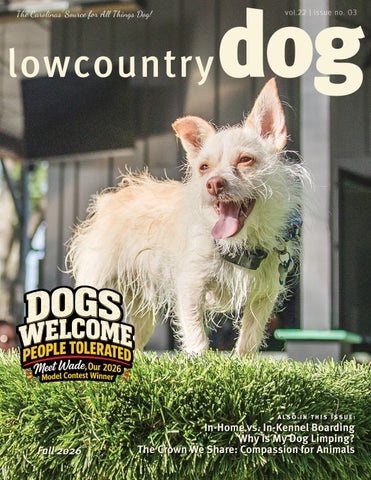
We believe that our dogs are our best friends, and that’s why we need a reliable source to turn to for information on all things “dog” in our community. Our mission is to be the Carolinas’ number one resource for dog owners regarding regional dog-centric and dog-welcoming events, health & wellness information, dog training, trends, and local news. We also strive to be a mouthpiece to the public for various Lowcountrybased pet non-profits, and we promote pet adoption and other responsible pet care practices. Founded in Charleston, South Carolina in 2005 as a print magazine. From 2015 through 2019, we went digital. In 2020, print returned and we have grown to become “The Carolinas’ Source for All Things Dog,” with print distribution throughout the Carolinas, and digital readers worldwide. Every issue of Lowcountry Dog Magazine is dedicated to Peanut, our Chief Canine Officer from 2005 to 2023, and Alyssa Helms, our Media Manager from 2020 to 2024.
Publisher Brian Foster brian@lowcountrydog.com Chief Canine Officer Lovey social@lowcountrydog.com Event Coordinator Allison McCoy Design Consultant Laura Olsen Staff Writers Chelsea Salerno Jeanne Taylor Natalie Garber Photographers Clark & Chateau Jeanne Taylor Photography Contributing Writers Dr. Wesley Cook
For advertising and media inquiries please email contact@lowcountrydog.com
Cover Photo & Above Photo by Clark & Chateau
In this issue
5 8 12 16 22 30 32 36 38
Lovey’s Lowcountry Livin’: Healthy Treats Hiding in Your Grocery Sit, Stay, Behave... In-Home Boarding vs Kennel Boarding HEALTH & WELLNESS: Why is My Dog Limping FEATURE STORY: The Crown We Share: Compassion for Animals
LOCAL DOG EVENTS
IN THE NEWS MEET THE RESCUE: Rescue Paws Curacao GO GREEN: Adopt A Recycled Dog!
F A L L
2 0 2 6
Healthy Treats Hiding in Your Grocery Store Hello, my furry friends and the humans who keep our treat jars full! I’ve got a little secret to share. Some of the best treats for dogs aren’t hiding in the pet aisle at all—they’re waiting in your neighborhood grocery store. That’s right! While I never complain about a tasty dog biscuit, there are plenty of fresh, wholesome foods that can make my tail wag just as fast. The next time your humans head to the grocery store, tell them to steer their cart toward the produce section. That’s where the real treasure hunt begins! One of my all-time favorites is baby carrots. They’re crunchy, naturally sweet, low in calories, and great for keeping my teeth busy. Green beans are another winner, whether they’re fresh, frozen, or canned without added salt. I also love cool cucumber slices on warm lowcountry afternoons. They’re refreshing and full of water, making them a perfect snack after a long walk. If your humans are cooking sweet potatoes, ask them to save you a few plain, cooked pieces. They’re packed with fiber and vitamins, and they taste delicious without any butter, sugar, or marshmallows. Plain pumpkin purée is another fall favorite. Just make sure it’s 100% pumpkin and not pumpkin pie filling, which contains added sugar and spices that aren’t good for us pups. Now let’s wander over to the fruit aisle. Apples are fantastic—as long as the seeds and core are removed. Blueberries may be tiny, but they’re packed with antioxidants and make excellent bite-sized rewards. Strawberries, watermelon
Lovey's lowcountry livin’ without the seeds or rind, and banana slices are all tasty treats when served in moderation. The meat department has some goodies, too. Plain cooked chicken, turkey, salmon, and eggs are excellent sources of protein. Just skip the seasoning, onions, garlic, and rich sauces. We dogs like the simple stuff anyway! Of course, not everything in the grocery store belongs in a dog’s bowl. Chocolate, grapes, raisins, onions, garlic, macadamia nuts, foods containing xylitol, alcohol, and cooked bones should always stay far away from curious noses like mine. When you’re unsure about a food, it’s always best to ask your veterinarian before sharing. So the next time your humans say they’re running to the grocery store, don’t just think about dinner. Think about crunchy carrots, juicy blueberries, sweet pumpkin, and fresh apples. Some of the healthiest treats are hiding in plain sight—you just have to know where to sniff! Until next time, keep those tails wagging, those noses working, and remember that the best adventures sometimes begin with a trip to the grocery store. Happy snacking! ■
www.lowcountrydog.com
5
T R A I N I N G
T R A I N I N G
In-Home Boarding vs. Traditional Kennels: Choosing the Best Fit for Your Dog W R I T T E N BY N ATA L I E G A R B E R
recommend either a highly structured facility or an in-home environment with a skilled caregiver.” Whether you choose an in-home setting or a kennel, the quality of supervision and daily routine often matters more than the type of facility itself.
Staff Writer
One of the questions I hear most often from pet owners is, “Is in-home boarding or a traditional kennel the better option?” The truth is, there isn’t a one-size-fits-all answer. Every dog is different, and factors like personality, age, health, energy level, and past experiences all influence which environment will help them feel safest and most comfortable while you’re away. As the owner of a pet sitting business that specializes in in-home boarding, I’ve seen firsthand how much a dog’s environment affects their overall experience. To add another perspective, I also spoke with Chad Singer of Canine Revolution Dog Training. Chad has worked with my own dog, and I value his expertise in canine behavior, stress management, and helping owners make informed decisions for their pets. The good news is that today’s dog owners have excellent options. The key isn’t finding the “best” type of boarding—it’s finding the best fit for your dog.
Not Every Boarding Experience Is the Same One of the biggest misconceptions about boarding, according to Chad, is that all facilities provide the same level of structure and supervision. “People often assume boarding facilities have more structure than they actually do. Traditional boarding can become chaotic, which can lead to injuries or unwanted behaviors if dogs aren’t properly supervised. That’s why I generally
Why Some Dogs Thrive in an In-Home Environment In-home boarding offers a quieter, more personalized experience that closely resembles life at home. It can be an excellent choice for puppies, senior dogs, dogs with medical needs, or those that are anxious, fearful, or easily overstimulated. Chad explains, “Dogs with anxiety, noise sensitivity, or reactivity toward other dogs generally do better in-home because the environment is calmer and more predictable.” Dogs requiring medications or individualized exercise also often benefit from the closer attention an in-home caregiver can provide. Meals, walks, playtime, and rest can all be tailored to the dog’s individual needs instead of following one schedule for every guest. Perhaps the greatest benefit is consistency. Familiar routines, repeated stays with the same caregiver, and a quieter environment often help dogs settle more quickly while their families are away.
When a Traditional Kennel May Be the Better Choice That doesn’t mean kennels are the wrong choice. Confident, outgoing dogs that genuinely enjoy being around other dogs often do very well in reputable boarding facilities with experienced staff, structured routines, and supervised playgroups.
F A L L
2 0 2 6
www.lowcountrydog.com
9
The deciding factor isn’t whether it’s a kennel or a home—it’s whether the environment matches your dog’s personality and whether the provider offers appropriate supervision and structure.
Questions to Ask Before Booking Before making a reservation, Chad recommends taking an honest look at your dog’s temperament. “Start with your dog’s actual temperament—not what you wish it was.” Then ask detailed questions about the provider’s daily routine. Some of the most important questions include: How many dogs does each caregiver supervise? How are dogs grouped together? What does a typical day actually look like? What happens if my dog becomes anxious or won’t settle? How are medical emergencies handled? If a provider can’t clearly answer those questions, consider it a sign to keep looking. No matter which type of boarding you choose, transparency is essential. Red flags include vague answers, no temperament assessment process, or an inability to explain their daily routine.
Small preparations like these can significantly reduce stress for both dogs and their owners.
Preparing Your Dog Before Boarding
Will Boarding Undo Training?
A successful boarding experience starts well before your trip.
Many owners worry that boarding will erase months of training, but Chad says that’s rarely the case.
Chad recommends maintaining consistent routines at home and, whenever possible, scheduling a short trial stay before a longer boarding visit. “Routine stays help dogs become familiar with the environment instead of making every visit a brandnew experience.” He also encourages owners to keep departures calm and avoid changing food immediately before boarding.
“A few days somewhere else isn’t going to erase months of training. What undoes training is an environment with no structure, where dogs rehearse behaviors you’ve been working to eliminate.” Ask prospective providers how they reinforce basic manners during a stay. Consistency helps prevent unwanted habits from developing while you’re away.
F A L L
2 0 2 6
Special Considerations Puppies, senior dogs, dogs with medical conditions, and dogs with separation anxiety often require additional planning. Short trial stays can help puppies build positive experiences early. Senior dogs may need more individualized care and careful medication management. Dogs with separation anxiety typically benefit from calmer, lower-stimulation environments and should begin building confidence at home before boarding.
Coming Home Most dogs are tired after boarding and may sleep more than usual for a day or two. However, persistent loss of appetite, prolonged stress, limping, injuries, or sudden behavioral changes should prompt a conversation with both your boarding provider and your veterinarian.
Choosing the Best Fit If Chad could leave owners with one piece of advice, it’s this: “Match the environment to your specific dog, not to what looks nicest online.” There is no universally “better” option. Both in-home boarding and traditional kennels can provide safe, enriching experiences when managed well. The most important decision is choosing a provider who understands your dog’s individual needs and offers the structure, supervision, and personalized care that will help them feel safe, comfortable, and well cared for while you’re away.■
www.lowcountrydog.com
11
H E A L T H
&
W E L L N E S S
Why Is My Dog Limping? WRIT TEN BY DR. WESLEY COOK DACVS MS DVM at Lowcountry Veterinar y Surger y
It’s that time of year, when you and your dog are making the most of the outdoors, enjoying the beach, the dog park, or spending time in the backyard playing fetch. It’s a great time for dogs and their families. Until… Without warning, you hear a yelp and your pup runs back to you holding up one of their back legs and is clearly in pain. Suddenly, a fun day outdoors has turned into a stressful situation. Our chief operating officer of Lowcountry Veterinary Surgery just experienced this same event with her dog. Jetty, an 11-year-old Rottweiler mix, was chasing squirrels in the backyard and suddenly became lame on one of her back legs. Fortunately, Jetty’s owner has years of experience in veterinary medicine and could pinpoint the source of the injury based on an exam. If you find yourself in this situation, the best plan of action is to get your pup safely home. Once they are comfortable, contact your regular veterinarian or a local emergency clinic. An early evaluation by a veterinarian is very important so your pet can receive the appropriate treatment as quickly as possible. Unfortunately, ACL tears are very common in canines. Your veterinarian or urgent care doctor will have a fair amount of experience diagnosing torn ligaments and will be able to rule out any other potential causes of the problem. While performing their exam, the doctor will assess the ligament by checking for “anterior drawer.” This is the same technique athletic trainers
and physicians use to evaluate if an athlete has torn their ACL, assessing whether the tibia (the lower leg bone) moves abnormally relative to the femur (the thigh bone). One major difference in diagnosing ligament tears in people versus animals is that human medicine typically requires an MRI. This extensive imaging is rarely performed in veterinary medicine due to the anesthetic requirement for animals, as well as the additional expense. You should expect your veterinarian to X-ray the knee, and they will likely prescribe anti-inflammatories for pain. Once the diagnosis is confirmed, your veterinarian may refer you to an orthopedic veterinary surgeon. That’s right, veterinary medicine has all sorts of specialties, including orthopedics. Just as in human medicine, a surgeon would have completed an internship and a residency in surgery after earning their doctorate. This process usually requires an additional four years of training. Many surgeons (including Dr. Cook) also complete orthopedic fellowships to further their training.
F A L L
2 0 2 6
At your consultation, the orthopedic surgeon will evaluate your pet by performing a physical examination and reviewing X-rays, an appointment that usually takes about 30 minutes. You can expect a thorough explanation of how your pup injured their ACL, the important role this ligament plays in stabilizing the knee, and why surgical repair is often the best treatment option.
commonly performed procedures are the tibial plateau leveling osteotomy (TPLO) and the lateral suture, often referred to as the “fishing line” technique. Dr. Cook has performed more than 10,000 ACL surgeries and is experienced in performing both types. These procedures are designed to restore stability to the knee and prevent abnormal motion caused by the ligament no longer functioning properly.
Most of the time, the ACL tears as a result of a hyperextension injury to the leg. This can occur when a dog plants their foot while running and continues moving forward with the leg extended, putting extreme stress on the ACL causing it to rupture. At Lowcountry Veterinary Surgery, most of the patients we see with ACL tears are between four and eight years of age. However, we have treated patients ranging from puppies to 16 years old. While certain breeds appear more commonly in our practice, including labradors, pit bulls, corgis, and rottweilers, ACL injuries can occur in dogs of all breeds and sizes.
The surgery typically takes about an hour to complete, and your pet will be under general anesthesia throughout the procedure. We use a combination of narcotics and pain blocks to keep your pet comfortable during surgery and throughout the initial recovery period. After surgery, pet owners will typically administer a few medications at home, including antibiotics and anti-inflammatories.
In dogs, the ACL is known as the cranial cruciate ligament (CCL). This important ligament is located inside the knee joint and plays a key role in maintaining stability by connecting the femur to the tibia. You may have also heard of the PCL, or posterior cruciate ligament, which is another ligament within the knee that helps provide stability. The ACL and PCL are called “cruciate” ligaments because they cross over each other inside the knee, forming a structure that resembles a cross. The structure of these ligaments looks like fiber optic cables. Because of this structure, injuries can range from partial tears, where some fibers remain intact, to complete tears, where the entire ligament has ruptured. Unfortunately, 90% of all partial tears progress to complete tears within one year as the ligament does not have the capacity to heal itself. In veterinary medicine, repairing an ACL is a very common and predictable surgery. During your consultation, the surgeon will discuss the different options available and help determine the best technique for your dog. The two most
The biggest challenge pet owners face after surgery is their dog feels too good too soon. It is important to keep your pet on strict exercise restriction for at least eight weeks as their leg heals. This includes minimal leashed walks and deterring any explosive activity at home. No zoomies! We typically follow up with you and your pet two weeks, six to eight weeks, and ten to twelve weeks after surgery. During these visits, Dr. Cook evaluates your pet’s recovery through physical exams and follow-up X-rays to ensure the leg is healing as expected. The majority of patients are released to normal activity twelve weeks after surgery. Studies have shown that dogs generally have better long-term outcomes with surgical stabilization than without. We see significantly more secondary arthritis in patients who are not treated with surgery. Repairing an ACL tear in a dog is not a small undertaking for any family, but the process is often much easier than owners anticipate, and the results are typically excellent. Our goal is to help patients return to the active lifestyle they enjoyed before their injury. For many dogs, surgical repair provides the best opportunity for improved comfort, mobility, and quality of life for years to come. ■
www.lowcountrydog.com
13
H E A L T H
&
W E L L N E S S
F A L L
2 0 2 6
www.lowcountrydog.com
15
F E A T U R E
S T O R Y
The Crown We Share: Compassion for Animals WRIT TEN & PHOTOS BY JEANNE TAYLOR Staff Writer
You may recognize Victoria Vesce as 2026 Miss South Carolina USA, or perhaps from her extensive modeling work. But she is not just a pretty face; Victoria is also an entrepreneur, a law school graduate, a philanthropist, an animal lover and a dog mom. As a longtime friend to Lowcountry Dog Magazine, Victoria visited Dorchester Paws with us recently, where we had the chance to chat while she spent time with some of the adoptable dogs.
1. You have three rescued pets currently. Have you always had a soft spot for dogs? Absolutely. I grew up on a buffalo farm in North Carolina, so I was surrounded by animals from a young age. They were always part of our family. Today I have three rescue dogs: Daisy, Lily, and Luna and they truly are my best friends. They’ve taught me patience, unconditional love, and the importance of giving animals a second chance.
2. What opened your big, beautiful eyes to the importance of adopting pets from shelters? The more I learned about how many incredible animals are waiting in shelters, the more I realized that buying a pet isn’t the only option. Every one of my rescue dogs has their own story, and seeing how grateful and loving they are has completely changed my perspective. Adopting doesn’t just save one life it creates space for another animal to be rescued as well. It’s one of the most rewarding decisions I’ve ever made.
3. You split your time between South Carolina and Florida. What is the biggest difference you notice about animal welfare laws and how animals are treated generally between the two states? I’ve been fortunate to see incredible rescue organizations in both states, and there are amazing people doing this work every day. One thing I’ve noticed is that access to resources can vary depending on the community. Larger cities often have more shelters, funding, and adoption events, while some rural areas still struggle with overcrowding, access to affordable spay and neuter programs, and public awareness. I think both states have made progress, but there’s always room to continue improving education and resources.
F A L L
2 0 2 6
www.lowcountrydog.com
17
F E A T U R E
S T O R Y
4. What part of your pageant platform, if any, addresses animal welfare reform for South Carolina? My platform is centered around wellness and building stronger communities, and I believe animal welfare is part of that conversation. Wellness isn’t just about taking care of ourselves; it’s also about showing compassion for those who can’t speak for themselves. As Miss South Carolina USA, I’d love to use my voice to encourage adoption, support local shelters, promote responsible pet ownership, and partner with rescue organizations to bring more awareness to their incredible work.
5. What would you like to see improved for the animals in South Carolina? I’d love to see greater access to affordable spay and neuter programs, more support for local shelters and rescues, and continued education about responsible pet ownership. I also think we can do more to encourage adoption by helping people understand how rewarding it is to give a rescue animal a forever home. Even small changes in awareness can save countless lives. ___ Thank you, Victoria, for taking the time to give the shelter dogs some love and for sharing your observations. The animals are lucky to have you in their corner. Don’t miss the Miss USA Pageant on August 27th and root for Victoria! ■
F A L L
2 0 2 6
THE CVRC ADVANTAGE In-house state-of-the-art diagnostics
Veterinary technician specialists
Minimally-invasive procedures
24/7/365 emergency/critical care
On-staff clinical pharmacist
Immediate Appointment Availability
Online booking available for specialty services
Mobile Check-In for Emergencies Available!
------ SERVICES -----Blood Bank • Cardiology • Cardiac Cath Lab Critical Care • Emergency Services Diagnostic Imaging • Internal Medicine Neurology & Neurosurgery • Oncology Physical Rehabilitation • Surgery
843.614.8387
charlestonvrc.com 3484 Shelby Ray Court, Charleston, SC 29414
www.lowcountrydog.com
Veterinarians & Technicians:
JOIN OUR EXPANDING TEAM! Contact
careers@charlestonvrc.com 19
VOTED BEST DOGGIE DAYCARE, BEST GROOMER, & BEST PET SITTER! ENRICHMENT DAYCARE | DOG BOARDING | DOG GROOMING AND BATHING | DOG TRAINING | IN-HOME PET SITTING | DOG WALKING | WEDDING NANNY | PET TAXI
because your pet’s health can’t wait. book online | call ahead | walk in
Summerville
Mount Pleasant
143 Berkeley Circle Summerville, SC 29483
966 Houston Northcutt Blvd. Mount Pleasant, SC 29464
843.648.9180
843.625.6690
affordable, emergency-level care in an urgent care setting. acutepeturgentcare.com
scan to learn more!
ALL-DAY PLAY LIVE WEBCAMS CLIMATE-CONTROLLED PLAY YARDS CPR & FIRST AID CERTIFIED TEAM LARGE INDOORS & TURF OUTDOOR PLAY YARDS FLEXIBLE CHECK-IN/OUT BRING THIS COUPON IN FOR
10% off the first day special! 2 CONVENIENT LOCATIONS! campbowwow.com/west-ashley campbowwow.com/charleston
*Offer valid only at West Ashley and Charleston locations. Camper must pass interview and meet entrance requirements. New customers only. Limit one offer per customer. Must present coupon at time of purchase.
C O V E R
S T O R Y
Photos by Clark & Chateau
Photo by Keith Griner
F A L L
2 0 2 6
WRITTEN BY BRIAN FOSTER Publisher
What happens when you get eight of your 2027 Lowcountry Dog Calendar Models together for a photoshoot to celebrate their winning slots in our annual model contest? ‘Chaos’ may be the word that comes to mind, but when we gathered at The Broken Leash on a Tuesday evening, it was anything but that! It was more in line with our theme for this issue: “DOGS WELCOME, PEOPLE TOLERATED.” We had over 15,000 votes cast during the month of June to pick our calendar models for 2027. Wade, a 7-pound scruffy dog, took the top spot with over 900 votes. Wade is pictured on the cover of this issue and hosted our little party, where seven of the other winners joined the fun. Wade has quite the history - following is his story as provided by his mom. _____ “Wade joined our family on May 2, 2025, after we adopted him from Charleston Animal Society. He had been found wandering the streets and was believed to have been hit by a car. When he arrived at the shelter, he had a fractured pelvis that had already begun to heal on its own, and his tail had been broken in two places too. Unfortunately, the tail fractures were not healing properly, and to relieve his pain and give him the best chance at recovery, veterinarians determined that his tail would need to be docked.
We first saw Wade (F/K/A Marvin) in a photo on the shelter’s Facebook page, and we immediately fell in love. The very next day, we went to meet him. The little dog who greeted us was even more endearing than his photo! He was much smaller than we expected, wearing a cone, with patches of missing fur, healing scratches on his face, and a tail still recovering from surgery. Despite everything he had endured, his personality shined through. He was full of spunk, curiosity, and resilience, and we knew he would fit in perfectly with our 11-year-old Chihuahua mix, Oscar. We brought Wade home that day and introduced him to a life filled with love. Today, it’s still hard to believe everything he has overcome! His previous injuries have not slowed him down a bit. He loves going for walks, racing through the house with the zoomies, playing with his toys, and spending time with his family. This spirited little guy has completely captured our hearts, and we are incredibly grateful that he found his way into our lives.”
www.lowcountrydog.com
25
C O V E R
S T O R Y
Joining Wade at The Broken Leash were 7 of the 12 calendar models for 2027. Top Left: Remi and Auggie Doggie. Sansa, the White Swiss Shepherd as well as Emry, Remy, and Bean, pictured above with their corgi friends. Opposite page: Wade and Fritz the Papillon, share a beer and discuss their day.
F A L L
2 0 2 6
Wade is basically a permanent resident at The Broken Leash in North Charleston, with as much time as he spends there! He enjoys time there with his friends Fritz, Remi, and Auggie Doggie, who also won spots in the 2027 calendar, along with Emry, Sansa, Bean, and Remy, other regulars who attended our party! The Broken Leash is a great place to let your dog run and play, while you enjoy a cold drink and your dog enjoys time with friends. They have breed meet ups often and theme nights like foam parties, and more!
Make sure you grab your 2027 Lowcountry Dog Calendar at www.lowcountrydog.com/calendar ■
www.lowcountrydog.com
27
C O V E R
S T O R Y
your visual brand strategists
commercial + brand photography
@clarkandchateau | www.clarkandchateau.com
F A L L
2 0 2 6
www.lowcountrydog.com
29
Local Dog Events 0 9 / 02 / 2 026 Pups at th e P i tch Charleston Batter y 7 p m 0 9 / 1 2 / 2 02 6 SALT Y SNO UT SHOW DOW N w Bam Margera T he Washout 5 p m to 8 p m 0 9 / 2 0/ 2 026 T h e Pawty Sum m er ville Co untr y Club 2 p m to 6 p m 0 9 / 2 6/ 2 026 RES CUE M E Cypress Gard ens 9 am to 4 p m 1 0 /1 6/ 2 02 6 RES CUE R OCKS Cannon Distiller y 6 p m to 9 p m 1 1/ 1 4/ 2 6 Santa Pet Ph o tos at Woof Gang Baker y in M t P l easant DAY O N E Jeanne Taylo r P h o to g ra phy
1 1/ 15/ 2 6 Santa Pet Ph o tos at Woof Gang Baker y in M t P l easant DAY T WO Jeanne Taylo r P h o to g ra phy
1 1/ 2 1 / 2 02 6 THE B I G BAR K HO LIDAY MAR KET F ire fly Distiller y 1 2 to 4 pm
Ch eck out our Events page for eve n mo re local events and ch eck for date chan ges . w ww.lowcountr ydog.com/ events
F A L L
2 0 2 6
www.lowcountrydog.com
31
In The News ‘Heartbreaking’: Over 40 dogs rescued from alleged cruelty case in Berkeley County More than 40 dogs and puppies were rescued this week from a rural Berkeley County property where authorities say animals were living in conditions commonly associated with dogfighting operations. The Berkeley County Sheriff’s Office, assisted by Humane World for Animals and Charleston Animal Society, executed a search and seizure warrant around 7:30 a.m. Aug. 11 at the property. Investigators removed more than 40 dogs, including 15 puppies, from the site.
Colleton County Sheriff’s Office receives new ballistic vest for K9 Dozer A Colleton County Sheriff’s Office K9 will be receiving a bullet and stab protective vest thanks to a donation from non-profit organization Vested Interest in K9s. According to a release from the sheriff’s office, the vest will be embroidered with the message “In honor of K9 Roam, Colorado Springs, CO” recognizing a Colorado Springs Police Department K9 who medically retried after being injured in the line of duty.
South Carolina lawmakers look to crack down on ‘Puppy Mills’
A bill in the South Carolina Senate aims to crack down on so‑called “puppy mills” by creating new licensing, inspection, and care standards for professional dog breeders, a move supporters say would better protect animals and consumers. The proposal, sponsored by Sen. Deon Tedder, D‑Charleston, would establish requirements that currently do not exist in state law, specifically targeting large‑scale breeding operations often linked to inhumane conditions.
Click images above to read the full story. For more top stories, visit www.lowcountrydog.com/top-stories
F A L L
2 0 2 6
www.lowcountrydog.com
33
GO GREEN | ADOPT A RECYCLED DOG
Over 35 Years Experience in the Pet Industry.
One stop shop for food, treats, supplements, grooming, and self serve dog wash Certified in pet allergy and nutrition. Corn and wheat free store. Locally Owned
440 Old Trolley Road, Ste A Summerville, SC 29485 843-871-7977
Mt. Pleasant’s Trusted Pet Resort 3377 S. Morgan Point, Suite 409 or 3369 S Morgan Point, Ste 207 Mt. Pleasant, SC 29466 (843) 388-3422 Pet Boarding • Dog Daycare • Grooming
GO GREEN | ADOPT A RECYCLED DOG
Rescue Paws Curaçao: Giving Island Dogs a Second Chance
WRITTEN BY BRIAN FOSTER Publisher
When most people think of Curaçao, they picture crystal-clear water, colorful Dutch architecture, and white-sand beaches. But beyond the postcardperfect scenery lies another reality: thousands of stray and abandoned dogs struggling to survive. Fortunately, one organization has embraced a mission to change that story. Rescue Paws Curaçao has become a beacon of hope for the island’s dogs, combining rescue, education, and community outreach to create lasting change. This July, I was on vacation in Curaçao and contacted Rescue Paws to schedule a visit. We met up with founder Mirjan Seppenwoolde, to learn more about the mission to help with the overpopulation of street dogs, known as Westpointers, and to tour their facility. A Mission Born from Compassion Rescue Paws Curaçao officially became a nonprofit foundation in October 2014, but its roots were planted years earlier with a small group of dedicated animal lovers providing shelter and care for dogs in need. They soon realized that simply rescuing dogs one at a time wasn’t enough to solve the island’s growing animal welfare crisis. The founders expanded their vision beyond traditional sheltering, creating an organization focused on improving the lives of dogs throughout the entire island. Their mission grew to include sterilization programs, rescue and rehabilitation, adoption services, community outreach, and public education. Tackling the Root Causes One of the greatest challenges facing Curaçao is the overpopulation of unwanted dogs. Rescue Paws believes that long-term solutions require more than
finding homes for rescued animals. They require preventing future suffering. The organization works directly with local residents by offering guidance on responsible pet ownership, promoting spay/neuter, educating families about flea and tick prevention, and explaining the importance of proper nutrition, shelter, and veterinary care. Rather than judging owners, Rescue Paws partners with communities to improve conditions for animals while helping families care for the pets they already have. From Rescue to Recovery In 2018, Rescue Paws opened a dedicated shelter capable of caring for approximately 80 dogs. The facility includes spacious play areas, separate spaces for puppies and adult dogs, and specialized accommodations for animals recovering from illness, injury, or neglect. Whenever possible, dogs are transferred from the shelter into foster homes where they receive individualized care and learn to trust people again. Foster families help prepare dogs for adoption by exposing them to everyday home life, easing the transition into permanent homes. There are typically 200 dogs in their care with half of those being in foster care.
F A L L
2 0 2 6
Finding Forever Homes Around the World Although many adoptions take place within Curaçao, Rescue Paws has developed an international adoption network that has allowed thousands of dogs to find loving families in the Netherlands and many other countries. They adopt out around 400 dogs annually. Each successful adoption represents more than a happy ending—it creates space for another dog in need to be rescued. Through this cycle of rescue, rehabilitation, fostering, and adoption, the organization has transformed countless lives. According to Rescue Paws, the foundation has helped thousands of dogs since its founding through rescue efforts, sterilization programs, and successful adoptions, while continuing to expand its impact every year. A Community Powered by Volunteers Like many successful rescue organizations, Rescue Paws depends heavily on volunteers and foster families. Volunteers help care for dogs, assist with transportation, organize fundraising events, and support adoption efforts. Foster homes provide temporary safe places where rescued dogs can heal physically and emotionally before joining permanent families.
Support also comes from visitors who vacation in Curaçao and are inspired to help after witnessing the island’s stray dog population. Many donate supplies, volunteer during their stay, sponsor dogs, or even adopt and transport rescued dogs back to their home countries. Hope for the Future The work of Rescue Paws Curaçao demonstrates that meaningful change comes from addressing both immediate needs and long-term solutions. Every rescued puppy, every successful adoption, every educational conversation, and every spay or neuter surgery helps reduce suffering for future generations of dogs. While the challenges facing animal welfare on Curaçao remain significant, Rescue Paws continues to prove that compassion, education, and community involvement can create lasting change. Their vision is simple yet powerful: to reduce animal suffering while giving every dog the opportunity to live a safe, healthy, and loved life. For dog lovers everywhere, Rescue Paws Curaçao serves as a reminder that paradise is even more beautiful when every animal has the chance to find a forever home.
Learn and support Rescue rescuepawscuracao.com ■
www.lowcountrydog.com
Paws
at
37
GO GREEN | ADOPT A RECYCLED DOG
PET HELPERS
BER KELEY ANIMAL CENTER
C AROLINA COONHOUND
THESE ADOPTABLE DOGS ARE SPONSORED BY: ADOPTABLE DOGS ARE SPONSORED BY: THESE
F A L L
2 0 2 6
DUST Y TAILS ANIMAL RESCUE
ALL 4 PAWS
www.lowcountrydog.com
OR AN G EBU R G COUNT Y
39
GO GREEN | ADOPT A RECYCLED DOG
COLLETON COUNT Y
WAT ER S EDG E G R EAT DAN E
ST F R AN CES ANIMA L
F A L L
2 0 2 6
BULLIES TO THE RESCUE
BRIDGE BET WEEN RESCUE
C AROLINA POODLE RESCUE
THESE ADOPTABLE DOGS ARE SPONSORED BY:
www.lowcountrydog.com
41
GO GREEN | ADOPT A RECYCLED DOG
LAKESIDE ANIMAL RESCUE
LIBBY AND MACE’S PLACE
THESE ADOPTA BLE DOGS ARE SPONSORED BY:
JOURNEY HOME
F A L L
2 0 2 6
DORCHESTER PAWS
HALLIE HILL
C AROLINA BOXER RESCUE
THESE ADOPTABLE DOGS ARE SPONSORED BY:
www.lowcountrydog.com
43