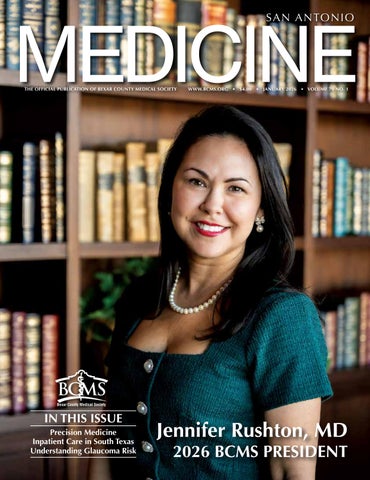
MEDICINE S A N A N TO N I O
THE OFFICIAL PUBLICATION OF BEXAR COUNTY MEDICAL SOCIETY
IN THIS ISSUE Precision Medicine Inpatient Care in South Texas Understanding Glaucoma Risk
WWW.BCMS.ORG • $4.00 • JANUARY 2026 • VOLUME 79 NO. 1
Jennifer Rushton, MD 2026 BCMS PRESIDENT
Ready to experience the TMLT difference? • Email sales@tmlt.org • Call us at 800-580-8658 ext. 5026 • Get a quote at https://www.tmlt.org/join#get-a-quote
SAN ANTONIO
TABLE OF CONTENTS
THE OFFICIAL PUBLICATION OF THE BEXAR COUNTY MEDICAL SOCIETY
VITALITY & LIFE
MEDICINE S A N A N TO N I O
THE OFFICIAL PUBLICATION OF BEXAR COUNTY MEDICAL SOCIETY
WWW.BCMS.ORG • $4.00 • JANUARY 2026 • VOLUME 79 NO. 1
•
WWW.BCMS.ORG
•
$4.00
Precision Health in San Antonio
By Kumar Sharma, MD, and Christiane Meireles, PhD, RD, LD....12
Updates in Hospital Medicine 2025: Evidence shaping inpatient care in South Texas
By Amith Skandhan, MD, SFHM, FACP; Elena Jiménez-Gutiérrez, MD, MSc, FACP; and Jack Badawy, MD, SFHM....................................16
AI in Medicine: The new languages of healing
By Ravi Patel, OMS-III; Phoebe Lay, OMS-II; Colin Wu, OMS-III; and Ramaswamy Sharma, MS, PhD............................................20
Understanding Glaucoma Risk: Lessons every physician should know
By Jake Trinidad, MD....................................................................22
Thyroid Health and the Use of Supplements: Which nutrients are truly essential and what could be affecting our patients?
By Tiffany Purewal, MD...................................................................24
Building Healthier Futures: Preventing birth defects through community action and evidence-based care
IN THIS ISSUE Inpatient Care in South Texas Understanding Glaucoma Risk AI in Medicine
Jennifer Rushton, MD 2026 BCMS PRESIDENT
Healthy Mothers, Healthy Babies: A community approach to birthdefect prevention By Christina Chang, OMS-III; Michael Hueste, OMS-III; Leslie Lopez, OMS-III; and Ramaswamy Sharma, MS, PhD...................................................26 Preventing Neural Tube Defects in South Texas: Closing the gap between evidence and practice By Mabel Idicula, OMS-II, and James Mayberry, MD....................28
Therapeutic Phlebotomy: Improving patient care and access
By South Texas Blood & Tissue.................................................................................................................................30
Food Insecurity in Bexar County: A year-round clinical and public health concern
By Sonia Gonzalez....................................................................................................................................................32 BCMS President’s Message By Jennifer Rushton, MD, President, Bexar County Medical Society...............................8 BCMS Alliance...........................................................................................................................................................10 Perspectives By Sarah Ansbro MD, MBA.................................................................................................................12 Investing in the Next Generation of San Antonio Physicians Through the Patient Institute's WeLEAP 3.0 Mentorship Program By Manaal Salman, OMS III, and Emma Tao, MS II..............................................34 Poetry in Medicine.....................................................................................................................................................35 2026 BCMS Board of Directors.................................................................................................................................36 Meet the Bexar County Medical Society Management Staff.......................................................................................38 Bexar County Medical Society Celebrates the Season...............................................................................................39 BCMS Vendor Directory.............................................................................................................................................40 Are This Year's Cars Just...Boring? By Stephen Schutz, MD....................................................................................44 Recommended Auto Dealers.....................................................................................................................................46
PUBLISHED BY: Traveling Blender, LLC. 10036 Saxet Boerne, TX 78006
ADVERTISING SALES: AUSTIN: Sandy Weatherford sandy@travelingblender.com
PUBLISHER: Louis Doucette louis@travelingblender.com
SAN ANTONIO: Gerry Lair gerrylair@yahoo.com
BUSINESS MANAGER: Vicki Schroder vicki@travelingblender.com GRAPHIC DESIGNER: Jennifer Nelson jennifer@travelingblender.com
4
For more information on advertising in San Antonio Medicine, Call Traveling Blender at 210.410.0014 in San Antonio
SAN ANTONIO MEDICINE • JANUARY 2026
•
JANUARY 2026
•
VOLUME 79 NO. 1
San Antonio Medicine is the official publication of Bexar County Medical Society (BCMS). All expressions of opinions and statements of supposed facts are published on the authority of the writer, and cannot be regarded as expressing the views of BCMS. Advertisements do not imply sponsorship of or endorsement by BCMS. EDITORIAL CORRESPONDENCE: Bexar County Medical Society 4334 N Loop 1604 W, Ste. 200 San Antonio, TX 78249 Email: editor@bcms.org MAGAZINE ADDRESS CHANGES: Call (210) 301-4391 or Email: membership@bcms.org SUBSCRIPTION RATES: $30 per year or $4 per individual issue ADVERTISING CORRESPONDENCE: Louis Doucette, President Traveling Blender, LLC. A Publication Management Firm 10036 Saxet, Boerne, TX 78006 www.travelingblender.com
For advertising rates and information Call (210) 410-0014 Email: louis@travelingblender.com SAN ANTONIO MEDICINE is published by SmithPrint, Inc. (Publisher) on behalf of the Bexar County Medical Society (BCMS). Reproduction in any manner in whole or part is prohibited without the express written consent of Bexar County Medical Society. Material contained herein does not necessarily reflect the opinion of BCMS, its members, or its staff. SAN ANTONIO MEDICINE the Publisher and BCMS reserves the right to edit all material for clarity and space and assumes no responsibility for accuracy, errors or omissions. San Antonio Medicine does not knowingly accept false or misleading advertisements or editorial nor does the Publisher or BCMS assume responsibility should such advertising or editorial appear. Articles and photos are welcome and may be submitted to our office to be used subject to the discretion and review of the Publisher and BCMS. All real estate advertising is subject to the Federal Fair Housing Act of 1968, which makes it illegal to advertise “any preference limitation or discrimination based on race, color, religion, sex, handicap, familial status or national origin, or an intention to make such preference limitation or discrimination.
SmithPrint, Inc. is a family-owned and operated San Antonio-based printing and publishing company that has been in business since 1995. We are specialists in turn-key operations and offer our clients a wide variety of capabilities to ensure their projects are printed and delivered on schedule while consistently exceeding their quality expectations. We bring this work ethic and commitment to customers along with our personal service and attention to our clients’ printing and marketing needs to San Antonio Medicine magazine with each issue.
Copyright © 2026 SmithPrint, Inc. PRINTED IN THE USA
Does Your Disability Policy Check All the Boxes? Most individual policies don’t.
Protecting your income shouldn’t mean piecing together coverage or paying extra for the benefits you actually need. That’s why the TMA Member Long Term Disability Insurance plan, issued by The Prudential Insurance Company of America, offers physicians comprehensive coverage from the beginning.
TMA Member Long Term Disability Plan No Tax Returns Required – Apply for up to $5,000/ month with no income questions, or up to $18,000/ month without providing proof at application Higher Benefits – Up to $18,000/month with simplified underwriting and member pricing Coverage That Grows – Future Increase Coverage without new underwriting Specialty-Specific – Own-Specialty coverage pays if you can’t work in your medical specialty Recovery Support – Partial or Residual Disability benefits if you return part-time while recovering Extra Help for Serious Conditions – Catastrophic Coverage increases benefit by 20% if two or more Activities of Daily Living can’t be performed Student Loan Protection – Up to 25% additional (max $250k) for loan payments Dedicated Claims Support – A staff member personally assists with forms and updates throughout your claim process No Offsets – Benefits paid in full, even if you receive benefits from other sources
Ongoing Savings Credit
Most Individual Policies Proof Required – Tax returns or income documentation often needed Higher Amounts Available – Often with stricter underwriting and higher premiums Requalification – More coverage usually means renewed underwriting Broad Definitions – May only cover total disability, not your specialty All-or-Nothing – Often requires disability; partial may cost extra
total
Not Covered – Usually excluded or costly to add Rarely Included – Typically not offered, or only available as an expensive add-on Limited Assistance – Claim handling is typically left entirely to the insurance company Reduced Payouts – Benefits often reduced by Social Security, employer, or other insurance, with added limits and potential tax implications
Save 25% on Own-Specialty Coverage, exclusive to TMA Members. It’s part of our Insurance For Good promise, providing access to comprehensive benefits that support Texas physicians.
Discover the advantages of TMA Member Disability Insurance.
Visit tmait.org or call 800-880-8181, Monday through Friday, 8:00 AM to 5:00 PM CST.
SCAN TO CALL
TMA Member Long Term Disability Plan is issued by The Prudential Insurance Company of America, Newark, NJ. The Booklet-certificate contains all details, including any policy exclusions, limitations and restrictions, which may apply. CA COA #1179, NAIC #68241. Contract Series 83500. 1088890-00001-00
BCMS BOARD OF DIRECTORS ELECTED OFFICERS
BCMS SENIOR STAFF
DIRECTORS
PUBLICATIONS COMMITTEE
Jennifer Rushton, MD, President Lauren E. Tarbox, MD, Vice President Lubna Naeem, MD, President-Elect Dan Powell, MD, Treasurer Lyssa N. Ochoa, MD, Secretary John Shepherd, MD, Immediate Past President
Heather Aguirre, DO, Member Alexander Arena, MD, Member Woodson “Scott” Jones, MD, Member John Lim, MD, Member Sumeru “Sam” Mehta, MD, Member M. “Hamed” Reza Mizani, MD, Member Priti Mody-Bailey, MD, Member Saqib Z. Syed, MD, Member Nancy Vacca, MD, Member Luis O. Rohena, MD, Military Representative Jayesh Shah, MD, TMA Immediate Past President John Pham, DO, UIW Medical School Representative Lori Kels, MD, UIW Medical School Representative Robert Leverence, MD, UT Health Medical School Representative Cynthia Cantu, DO, UT Health Medical School Representative Ronald Rodriguez, MD, UT Health Medical School Representative Melody Newsom, BCMS CEO/Executive Director George F. "Rick" Evans, Jr., General Counsel
Melody Newsom, CEO/Executive Director Brissa Vela, Chief Membership & Development Officer Yvonne Nino, Controller Betty Fernandez, BCVI Director of Operations Phil Hornbeak, Auto Program Director Al Ortiz, Chief Information Officer Jacob Hernandez, Advocacy and Public Health Specialist Jennifer C. Seger MD, Chair Timothy C. Hlavinka, MD, Member John Robert Holcomb, MD, Member Soma S. S. Jyothula, MD, Member George-Thomas Martin Pugh, MD, Member Adam Ratner, MD, Member Rajam Ramamurthy, MD, Member Patrick Reeves, MD, Member John Joseph Seidenfeld, MD, Member Amith Skandhan, MD, Member Francis Vu Tran, MD, Member Subhashini Valavalkar, MD, Member Louis Doucette, Consultant Brissa Vela, Staff Liaison Gabriella Bradberry, Staff Liaison Trisha Doucette, Editor Ayomide Akinsooto, Student Gabrielle Holliefield, Student Rita Espinoza, DrPH, Volunteer Melissa Rosales, Volunteer Ramaswamy Sharma, MS, PhD, Volunteer Andrea Wazir, Volunteer
See what’s inside
The CostEffective Choice for Your Patients American Health Imaging offers pricing up to 60% less than hospitals and in-network with 99% of health plans with competitive rates to save your patients money – taking the guesswork out of what’s best for you and your patients.
MRI • CT • Ultrasound • X-ray
Standard reports delivered within hours – not days
Same-day and next-day appointments for timely patient care
98%
99%
More than 98% of studies read by subspecialized radiologists
In-network with 99% of health plans—including Aetna®, Blue Cross® and Blue Shield®, Cigna®, UnitedHealthcare® and more
Fast prior authorizations for no-hassle scheduling
Faster scanning MRI technology for a more comfortable imaging experience
American Health Imaging delivers CONFIDENCE for the medical insights you need, and CONVENIENCE that matters for you and your patients, while giving patients COST-EFFECTIVE alternatives to save them time and money. Bottom line: We make it easy for you and easy for your patients.
Easily refer your patients to our 6 convenient locations in San Antonio and New Braunfels www.americanhealthimaging.com ©2025 American Health Imaging, Inc.
Scan for more information on each of our locations
PRESIDENT’S MESSAGE
Empowering Physicians, Defending Medicine, Building Healthier Communities By Jennifer Rushton, MD, President, Bexar County Medical Society
Dear friends and colleagues, Happy New Year! It is with great excitement and enthusiasm that I begin 2026 as the next President of the Bexar County Medical Society (BCMS). It is a privilege and an honor to represent and serve the physicians of this great county. I am humbled by the responsibility of leading this organization and continuing the legacy of my predecessors. I was born and raised in San Antonio and attended Health Careers High School with the dream of becoming a doctor. After spending 10 years in Houston to complete my medical education and training at Baylor College of Medicine, I had the good fortune of returning home to practice. For the last 15 years, I’ve been in private practice with Oculus Pathology in partnership with the Baptist Health System. It has been a true realization of that childhood dream to help care for patients in my beloved hometown. As a pathologist, I derive great satisfaction from generating an accurate diagnosis and providing data to help guide treatment and predict response to therapy and prognosis. Thanks to BCMS, I learned early in my career that I could help many more patients than just those coming through the hospital doors, through the collective power of organized medicine. Through physician advocacy, we can have a voice in discussions that impact the care of our patients and the future of our profession. If physicians are not in the conversation, others will certainly shape decisions for us. I have been a longtime member of the BCMS Legislative and Socioeconomic Committee, where we engage local and state officials. Through our committee work and the work of the delegations to the Texas Medical Association (TMA) and the American Medical Association (AMA), issues affecting individual member physicians can evolve from resolutions adopted at the TMA to state law enacted at the Capitol. Furthermore, our ideas frequently gain the support of physicians across the country. What begins with local physicians voicing the challenges they face in their practice can result in laws that address those problems for all Texas physicians and beyond. As a Delegate to the TMA and the AMA, I pledge to continue to amplify our key priorities at the state and national levels. There are many challenges facing our profession. Regulatory and administrative burdens continue to grow, payment for our work continues to decrease and burnout continues to plague many of our colleagues. Yet we persevere, taking care of our patients with resilience and compassion. Physician wellness will continue to be a high priority during my term along with advocating for structural reforms to create an environment that supports the meaningful practice of medicine. We are living in a moment of rapid transformation, with the integration of new technologies, political pressure being placed on scientific institutions and trust in physicians declining. With the level of 8
SAN ANTONIO MEDICINE • JANUARY 2026
misinformation and disinformation we are seeing in the media, local physician leadership is needed now more than ever. The patients of Bexar County need a trusted voice to help guide them amid conflicting messages. I would like to strengthen our voice within the community and make BCMS the trusted source for our patients as well as local governmental leaders. The participation and leadership of our medical students inspire me to remain optimistic about the future of our profession. There are many opportunities within the Society for students to contribute, and we can benefit from their unique perspectives. We can accomplish so much together, and I will continue to encourage, support, and mentor these young leaders. Last year, BCMS leadership met to revise our mission statement and develop a new strategic plan. Much of my term will be spent further developing and implementing the four pillars of that plan: Influence: Represent physicians and medicine before local and state agencies. Empower: Provide the resources and opportunities that support practice success and engage physicians throughout their careers. Community: Build unity among members through relationships and community outreach. Leadership: Position BCMS leadership and resources to serve physicians, medicine and our communities. All activities will be geared towards our mission of Empowering physicians, protecting the practice of medicine, and serving communities. These core values will guide the Society’s priorities as well as my presidency. Our executive committee, board of directors and especially our committees will be tasked with aligning our work to accomplish these strategic goals. We cannot succeed without the involvement of our members. Please join us in this endeavor! Thank you for placing your trust in me this year and for all you do for our patients and our community. I will do my best to represent each of you while building upon the long tradition of BCMS. Each of our practices and experiences is different. Yet we all share the purpose of taking care of the patients of Bexar County.
"
Never doubt that a small group of thoughtful, committed citizens can change the world; indeed, it’s the only thing that ever has. - Margaret Mead
"
PRESIDENT’S MESSAGE
I invite you to become more involved in the Society this year: join a committee, attend an event, write an article for this magazine, mentor a student, or simply reach out to me to discuss challenges facing your patients and your practice. We are a stronger society and profession when all our members are heard. I welcome your ideas on how we can better support physicians and help improve the health of Bexar County. With gratitude, Jennifer R. Rushton, M.D.
Jennifer Rushton, MD, 2026 President of the Bexar County Medical Society, is a partner at Oculus Pathology and the Medical Director of Pathology and Laboratory Medicine for the Baptist Health System. She is board certified in Anatomic and Clinical Pathology, Hematopathology and Molecular Genetic Pathology. Dr. Rushton currently serves as Chief of Staff for Baptist Medical Center Hospital. She is a long-time member and former chair of the BCMS Legislative Committee, serves on the TMA Council on Healthcare Quality, and is a Texas Delegate to the AMA.
Visit us at www.bcms.org
9
A Joyous Conclusion to 2025! By Victoria Kohler-Webb
The Bexar County Medical Society Alliance kicked off the holiday season in style with a fabulous Holiday Brunch! Special thanks to our hostess, Jenny Shepherd, Past BCMSA President and Immediate Past TMAA President, for opening her beautiful home for this festive event. Past BCMSA President and event chair, Victoria Kohler-Webb, welcomed Alliance members as well as some new faces for a delicious buffet catered by Anne Marie's Events and Catering. In 2025, the Bexar County Medical Alliance awarded $5000 in scholarships for area medical and allied health students. At our Holiday Brunch, the Alliance proudly honored scholarship recipient Patryk Tomaszkiewicz, a May 2026 graduate of the University of the Incarnate Word School of Osteopathic Medicine, who plans to begin a General Surgery residency. The BCMSA would like to send a spe-
cial thank you to the Texas Medical Association Foundation for their generous scholarship match, which allows our Alliance to fulfill our mission and assist Bexar County medical and allied health students to further their career dreams. With optimism and purpose, the Bexar County Medical Society Alliance looks ahead to a shining 2026 filled with service, support and fellowship. Victoria Kohler-Webb, BBA, MS Marketing Statistics, was the 2024 Alliance President. She and Ben, an ENT/Head & Neck Surgeon, are proud Aggies and parents to Luke, 15, and four rescue dogs.
Front, L-R: Monica Bonilla, Neha Shah, Cynthia Curry, Mary Anne Roman Back, L-R: Sue Bernstein, Mary Jo Dotson, Rena Baisden, Danielle Henkes (Past President), Rebecca Waller (Past President), Katrina Theis (Past President), Jenny Shepherd (Past President), Paulina Alvarez Johnson, Virginia Profenna, Victoria Kohler-Webb (Past President), Kayla Ketterer 10
SAN ANTONIO MEDICINE • JANUARY 2026
Victoria Kohler-Webb, Jenny Shepherd and Danielle Henkes
Katrina Theis, Rebecca Waller, Cynthia Comfort
Mary Jo Dotson, Kayla Ketterer, Virginia Profenna
Rena Baisden, Cynthia Curry, Kayla Ketterer
Mary Anne Roman, Rena Baisden, Monica Bonilla, Patryk Tomaszkiewicz, Rebecca Waller and Mary Jo Dotson
BCMSA Steering Committee Members, L-R: Victoria KohlerWebb, Jenny Shepherd, Danielle Henkes, Katrina Theis and Neha Shah, with Scholarship Recipient Patryk Tomaszkiewicz
Sue Bernstein, Cynthia Curry, Jenny Shepherd, Danielle Henkes and Katrina Theis
Visit us at www.bcms.org
11
PERSPECTIVES VITALITY & LIFE December 5, 2025 To Whom It May Concern, It was my honor and pleasure to attend several of the Texas Medical Association First Tuesdays at the Capitol advocacy days in Austin during the spring 2025 Legislative Session. This was my first year, and I was a little nervous about what the day would entail, as I had never spoken to legislators before. I was grateful that the TMA provided in-depth briefings both the night before and the day of the sessions about our key topics to discuss, as well as expert advice on how to interact with legislators and what the TMA needed from us doctors. We were educated on how to bring our expertise by way of our personal testimony from experience. By the time we were given our folders and I joined the Bexar County Medical Society (BCMS) advocacy team, I felt more than prepared. It was quite impressive — hundreds of white coats gathered to make a difference in the Capitol. As one lone voice, I sometimes feel I can’t make a difference. But through the combined efforts of both the TMA and BCMS physicians of Texas, I feel like we were well received and made a powerful presence. Together, we helped spearhead initiatives such as banning the sale of e-cigarettes around schools, protecting childhood vaccinations, expanding protections for pregnant women, and making it easier for physicians to enroll in Medicaid. One of my threads of contribution to the tapestry of medical policy comes from experience of being a private practice owner for almost 10 years. I learned that many legislators are willing to help, if they know what the problem is. Over the past several years, the administrative burden of being a private practice doctor who takes insurance has become incredibly burdensome. Legislators were surprised to discover that almost 30% of revenue is spent on overhead costs related to taking insurance,1 and over 13 administrative hours per week, per provider are spent on prior authorizations alone.2 When insurance companies started using AI to reject prior authorizations recently, that administrative burden increased significantly. This session, we passed SB 815, which prohibits insurers from using AI to deliver adverse determinations on prior authorizations. As a private practice physician, timely access and authorization to use potentially life-saving medications and interventions for conditions is a battle we fight on a daily basis. We had several experts on our teams, and we each were able to bring our own individual expertise in an area or two. Combined, we arrived as a powerful presence in Austin each month, sharing our individual stories, wins and hardships. Most importantly, we created strong connections with our fellow physicians, and with our legislators that will continue throughout the upcoming years. I greatly look forward to continuing to work with the Texas Medical Association and the Bexar County Medical Society on healthcare legislative initiatives in the future. Sinerely, Sarah Ansbro MD, MBA
References: 1. Luna, J.M., Thurman, P.W., Wolfe, M., Yagoda, D., Reed, E., Figg, W.D. Private Practice Administrative Costs Influenced by Insurance Payer Mix. J Oncol Pract. 2009 Nov;5(6):291-297. doi: 10.1200/JOP.091052. Erratum in: J Oncol Pract. 2010 Jan;6(1):53. doi: 10.1200/JOP.091077. PMID: 19949446; PMCID: PMC2775410 2. https://www.ama-assn.org/practice-management/prior-authorization/ai-health-insurance-claims-why-prior-authorization-so
We invite our physician members to share their personal stories and perspectives — your voice enriches our community and strengthens the practice of medicine. To submit an article or request more information, please email Editor@bcms.org. 12
SAN ANTONIO MEDICINE • JANUARY 2026
Physician Wellness Resources The Bexar County Medical Society is committed to helping our members find personal balance and improve general well-being.
BCMS Physician Wellness Program
Physician Support Line (888) 409-0141
Resources and services provided to help BCMS members maintain a healthy and well-balanced lifestyle through confidential counseling, educational resources, local events, webinars and more.
Psychiatrists are available to help physicians and medical students navigate the balance of a personal and professional life. Free, confidential and anonymous. No appointment necessary. Call for any issue, not just a crisis.
Lifebridge
Physician Coach Support
A BCMS provided resource for physician members who seek counseling from Texas-licensed professionals, discretely and confidentially through BetterHelp. Free 30 days counseling.
Free Confidential Physician-to-Physician support line. A group of volunteer physicians using their own personal development skills and life coaching certifications to support other physicians!
Wellness Coaching Webinars & Events
Physician Health & Rehabilitation Program
Nora Vasquez, MD, an Internal Medicine Doctor and Advanced Certified Physician Coach, helps physicians and healthcare professionals overcome burnout so that they can lead with joy and confidence while creating a more harmonious work-life balance that is fulfilling!
Confidential advocacy group of BCMS physicians that identify and facilitate recovery success for physicians with substance use disorder (Alcohol and/or Drugs) and depression, through support and monitoring.
BCMS Find a Doc
Utilize our free Find a Doc service when looking for a new physician. Our members can be found by the specified tabs provided to narrow down your preferred physician.
Please scan QR code for more information and available resources for BCMS Members
VITALITY & LIFE
Precision Health in San Antonio By Kumar Sharma, MD, and Christiane Meireles, PhD, RD, LD
P
recision health is a new holistic approach to improve treatment at the individual and population level. It emphasizes the personalization of healthcare interventions by tailoring prevention and treatment strategies to individual characteristics. This approach encompasses precision medicine, which integrates diverse sources of data from genomics, proteins and metabolite to inform physician-scientists on important biomarkers for individual patients as well as communities. Precision health also includes wearable technologies and electronic health records to inform clinical decision-making by capturing important physiologic data such as heart rate, blood pressure, sleep patterns and routine lab tests. A central focus of precision health is disease prediction, prevention and treatment strategies. Precision health seeks to optimize therapeutic effectiveness by identifying interventions most likely to benefit a given individual, including the selection and dosing of medications as well as targeted lifestyle modifications. This article will discuss approaches at UT Health San Antonio’s Center for Precision Medicine to implement precision health frameworks incorporating both precision medicine and precision nutrition in 2026. New Biomarkers and Therapeutics With the start of 2026, there is an excitement in the air with the advent of Artificial Intelligence pervading every aspect of life and healthcare. As physicians are trying to navigate the mountain of data, the large language models of AI have been developed to provide a powerful assist to the busy clinician to deal with complex disease cases. At the Center for Precision Medicine at UTHSA, we have developed several major breakthroughs that will provide new insights to guide clinical decision making and mark the next era of precision therapeutics. The vision is to choose medications based on individual biomarkers and use evidence-based medicine to validate these decisions. An example is the use of SGLT2 inhibitors for kidney disease. There is clear benefit of using SGLT2 inhibitors to block glucose uptake in the kidney proximal tubule for patients with proteinuria but are they valuable for those without overt proteinuria or macroalbuminuria? A recent study by the CPM with over 1,000 individuals with diabetes using a machine learning approach and AI found that 15 metabolites (out of 6,000) were statistically associated with development of kidney failure. In an independent and orthogonal study, spatial metabolomics was performed on over 40 biopsies from patients with diabetes or from healthy volunteer participants. In both studies, one metabolite named adenine was found to be a robust new biomarker to predict which patients with diabetes will develop kidney failure within 5-10 years and the same metabolite was also found to be associated with fibrosis and inflammation in the diabetic kidney. Adenine produced by the kidney was demonstrated to cause fibrosis and inflammation. Therefore, reducing adenine levels would be beneficial for 14
SAN ANTONIO MEDICINE • JANUARY 2026
those patients with high urine adenine levels. Interestingly, the SGLT2 inhibitor-type medication reduced urine adenine in patients with diabetes. Therefore, the evidence supports prescribing SGLT2 inhibitors specifically for patients with diabetes and high urine adenine levels. A similar role for SGLT2 inhibitors is being developed for cardiovascular disease with diabetes. Until new therapies are being developed to specifically block adenine production, the use of SGLT2 inhibitors could be used in patients with diabetes and high urine adenine levels. This strategy could reduce kidney failure and heart failure, even before clinical evidence of kidney disease and heart disease. Another example is the development of a new marker for proteinuria. Spatial lipidomics identified a lipid metabolite specifically in the cells in the kidney that control leakage of protein from the blood to the urine. This lipid metabolite was found to be increased in patients with proteinuria as well as in animal models with glomerular disease. An ongoing study is being developed to identify this lipid biomarker in patients even before they develop proteinuria. As new treatments are being developed at the CPM and Center for Innovative Drug Discovery at UTHSA, a new class of targeted therapies for specific pathways linked to these biomarkers will enhance chances of arresting kidney disease in patients in early and late stages of disease. These studies were funded by the NIH and Department of Defense. Other ongoing work at CPM are studying human liver disease, cardiovascular disease and neurodegenerative disease using similar multi-omic and spatial approaches with AI tools. By identifying these important molecules at the site of pathology in the tissue, our physicians and scientists can develop new diagnostic tools to identify patients at early stages and find the right treatments for these patients. This will enable providers to truly practice precision medicine guided by pathways that are highly active in individual patients. Precision Nutrition Precision nutrition has emerged as a novel lifestyle intervention approach that uses dietary recommendations tailored to each individual through the integration of demographic information (e.g., age, sex, life stage), lifestyle factors (dietary intake, physical activity, applications to support behavior changes), anthropometric measures, clinical biomarkers of disease risk, genetic testing and multi-omics data, including metabolomics and microbiome. The application of precision nutrition has the potential to mitigate and reduce risk factors for chronic diseases. For example, precision nutrition can be used to predict postprandial glycemic responses. A seminal article published in Cell by Zeevi, et al. demonstrated the prediction of glycemic responses to food using a machine-learning algorithm that included blood tests, microbiome data, anthropometric measurements, questionnaires to collect information about medical, nutrition and lifestyle, and
VITALITY & LIFE food diaries. This research was based on the observation that individuals exhibit distinct post-meal glucose responses. When two individuals consumed identical meals, their postprandial responses differed, indicating that each individual’s metabolism responds to food differently and therefore personalized diets require individual tailoring. The use of machine learning in precision nutrition will help to develop algorithms capable to predict personalized dietary recommendations. For example, machine-learning models can integrate dietary and physical activity data to generate algorithms to tailor nutrition recommendations at the individual level or groups of individuals sharing similar disease conditions. The integration of wearable technologies using dietary intake, physical activity and sleep habits into precision nutrition has already been adopted by consumers through a variety of apps offering diverse features to tailor diets, menu planning, recipes and exercise programs. With widespread smartphone use, consumers are already experiencing early applications of precision nutrition, highlighting its potential to transform the delivery of nutrition advice. New Diet Approach Using Precision Nutrition Precision nutrition can guide the selection of optimal dietary approaches for patients. Through the application of machine learning and omics technologies, there is an improved understanding of how specific dietary patterns may be more effective in the prevention and treatment of particular diseases. Identifying nutritional biomarkers using proteomics, metabolomics, microbiome and nutrigenomics is essential for determining which foods or food groups should be emphasized in individuals with specific chronic conditions. Our group at The Center for Precision of Medicine at UTHSA conducted a pilot clinical trial utilizing digital health technologies and metabolomics, which demonstrated that a ketogenic diet showed potential benefits for glycemic control, blood pressure reduction and weight loss at three months in individuals who were overweight or obese at baseline (?>BMI> X). Digital enhanced technologies, including wearable devices, were used to monitor ketone and glucose levels, weight, food consumption and exercise. These wearable devices were integrated and synchronized with an electronic platform that provided real-time feedback to improve adherence to the diet. Metabolomic analyses indicated that the ketogenic diet led to reductions in certain amino acids and other metabolites without adverse effects, suggesting that these changes were due to the dietary interventions. A recent study using data from the Chronic Renal Insufficiency Cohort (CRIC) study of adults with CKD, examined cross-sectional associations between 4,954 plasma proteins and dietary patterns, including the Health Eating Index-2020, Alternative Healthy Eating Index-2010, Dietary Approaches to Stop Hypertension, and Alternate Mediterranean diet. Using proteomic analyses in adults with chronic kidney disease, the study identified potential protein biomarkers of healthy dietary patterns associated with disease progression and mortality. Dietary patterns and specific diets supported by precision nutrition are likely to improve prognosis of diseases. Additionally, the application of precision nutrition has been associated with positive changes in dietary behaviors improving health outcomes. Personalized nutrition advice using precision nutrition seems to better sustain long-term dietary behavior changes compared with generalized dietary approaches.
Precision nutrition represents a novel approach to dietary intervention by integrating omics, machine learning, digital health tools and individualized data to optimize nutrition recommendations. Continued research, validation in diverse populations and integration into clinical practice will be critical to fully realize its potential to improve health outcomes at both individual and population levels. References: 1. Sharma, K., Zhang, G., Hansen, J., et al. Endogenous adenine mediates kidney injury in diabetic models and predicts diabetic kidney disease in patients. J Clin Invest. 2023;133(20):e170341. Published 2023 Oct 16. doi:10.1172/JCI170341 2. Hansen, J., Sealfon, R., Menon, R., et al. A reference tissue atlas for the human kidney. Sci Adv. 2022;8(23):eabn4965. doi:10.1126/ sciadv.abn4965 3. Kirk, D., Catal, C., Tekinerdogan, B. Precision nutrition: A systematic literature review. Comput Biol Med. 2021;133:104365 4. Mortazavi, B.J., Gutierrez-Osuna, R. A Review of Digital Innovations for Diet Monitoring and Precision Nutrition. J Diabetes Sci Technol. 2023;17(1):217-223 5. Zeevi, D., Korem, T., Zmora, N., et al. Personalized Nutrition by Prediction of Glycemic Responses. Cell. 2015;163(5):1079-1094 6. Petre, M.L., Tsichla, H., Kontouli-Pertesi, A.N., et al. Precision nutrition: Is tailormade dietary intervention a reality yet? (Review). Biomed Rep. 2025;22(5):86 7. Antwi, J. Precision Nutrition to Improve Risk Factors of Obesity and Type 2 Diabetes. Curr Nutr Rep. 2023;12(4):679-694 8. Du, Y., Wang, J., Li, S., et al. Digitally enhanced ketogenic diet versus low-fat diet for cardio-renal-metabolic health in a predominantly Hispanic adult population with overweight or obesity: Pilot randomised clinical trial. Diabetes Obes Metab. 2025;27(11):6154-6166 9. Sullivan, V.K., Chen, J., Appel, L.J., et al. Proteomic Markers of Dietary Patterns, Chronic Kidney Disease Progression, and Mortality in the CRIC study. Clin J Am Soc Nephrol. Published online December 1, 2025 Kumar Sharma, MD, is the Director for The Center for Precision Medicine, UTSA. Dr. Sharma is a highly accomplished translational physician-scientist with a highly-cited publication record in complex diseases (H-index of 98). Dr. Sharma’s research has been consistently funded for >30 years by the NIH (NIDDK, NHLBI), the VA MERIT and Department of Defense. He has been the PI for multiple NIH-funded investigator-initiated clinical trials and his recent work employs cutting-edge spatial multi-omics with AI-tools to implement precision medicine across multiple diseases. (sharmak3@uthscsa.edu) Christiane Meireles, PhD, RD, LD, is a registered dietitian and clinical associate professor at the School of Nursing and Division of Nephrology, Long School of Medicine at UT Health San Antonio with over 35 years of experience in clinical, community and research settings. As a clinical dietitian her work is predominantly on primary care focusing on chronic kidney disease, diabetes and obesity. As a researcher, nutrition in kidney disease, and more recently plant-based diet using precision lifestyle interventions are the center of her studies. (meireles@uthscsa.edu) Visit us at www.bcms.org
15
VITALITY & LIFE
Updates in Hospital Medicine 2025: Evidence shaping inpatient care in South Texas By Amith Skandhan, MD, SFHM, FACP; Elena Jiménez-Gutiérrez, MD, MSc, FACP; and Jack Badawy, MD, SFHM
H
ospital medicine continues to advance rapidly, with new studies emerging every month that challenge long-standing practices, refine diagnostic strategies, and reshape clinical guidelines. At the national level, the Society of Hospital Medicine’s (SHM) annual meeting captures this evolution through its iconic “Updates in Hospital Medicine” session — a fast-paced, interactive and highly anticipated review of the year’s most influential studies. For years, thousands of hospitalists have packed the room for this talk, drawn by its blend of scholarly rigor, clinical relevance and SHM’s signature energy. Inspired by this tradition, the Division of Hospital Medicine at UT Health San Antonio has developed its own regional counterpart: a three-day Updates in Hospital Medicine conference held at the Long School of Medicine. Now in its third year, the conference has grown into one of our region’s most comprehensive educational events, designed to support hospitalists and inpatient clinicians across South Texas. Over three days, faculty experts from UT Health San Antonio and invited partners lead clinically focused sessions spanning the breadth of hospital medicine — including cardiology, neurology, gastroenterology, hepatology, infectious diseases, health system science and artificial intelligence. This year’s conference also featured a hands-on point-of-care ultrasound and procedures workshop, reflecting the expanding procedural role of hospitalists and the importance of bedside diagnostics in modern inpatient care. Supported by University Health and the Society of Hospital Medicine, the conference aims to bring timely, practice-shaping evidence directly to clinicians in a region marked by rapid population growth, high chronic disease burden and unique operational challenges. Among all sessions, the most anticipated event each year is the Updates in Hospital Medicine talk — a dynamic, fast-paced session modeled after SHM’s national tradition. It is consistently well attended and highly regarded, offering hospitalists an opportunity to distill a year’s worth of literature into practical, immediately applicable insights. This year’s presenters — Drs. Amith Skandhan, Elena Jiménez-Gutiérrez and Jack Badawy — devoted months to reviewing hundreds of 16
SAN ANTONIO MEDICINE • JANUARY 2026
newly published studies across hospital medicine, hepatology, infectious diseases, emergency care, geriatrics and health systems science. Their charge was clear: identify rigorous, high-impact studies with direct relevance to frontline care in South Texas. From this extensive review, they curated 14 articles that reflect meaningful advances and practice-changing opportunities for our region’s hospitalists. What follows is a summary of each selected study — why it was chosen, what it found and what clinicians should take away. 1. Early Diagnostic Paracentesis Improves Outcomes in Cirrhosis American Journal of Gastroenterology, 2024 This meta-analysis of 78,744 hospitalized patients with cirrhosis and ascites demonstrated that performing diagnostic paracentesis within 12–24 hours of admission significantly reduced in-hospital mortality, acute kidney injury (AKI) and length of stay. Benefits were greatest when performed within 12 hours. Why this study was chosen: Cirrhosis is highly prevalent in South Texas, and early paracentesis is often delayed due to workflow barriers. This study reinforces the importance of rapid, protocol-driven intervention. Clinical takeaway: Early paracentesis — especially within 12 hours — reduces mortality, AKI and hospital length of stay. 2. Secondary Prophylaxis Increases Spontaneous Bacterial Peritonitis (SBP) Recurrence American Journal of Gastroenterology, 2025 Across two national cohorts totaling more than 11,000 patients, routine secondary SBP prophylaxis was associated with a 63%–68% increased risk of SBP recurrence and significantly higher fluoroquinolone resistance. Why this study was chosen: It challenges a long-standing standard and highlights the shifting risk–benefit balance of prophylactic antibiotics amid rising resistance. Clinical takeaway: Routine secondary SBP prophylaxis may increase recurrence and resistance, supporting a more selective approach.
VITALITY & LIFE
3. Carvedilol vs. Propranolol in Cirrhosis Journal of Hepatology, 2025 This multicenter study of 540 patients showed carvedilol reduced first decompensation in compensated cirrhosis by 39% and reduced further decompensation or death in decompensated cirrhosis by 43%. Why this study was chosen: The evidence strongly supports carvedilol as the preferred non-selective beta-blocker (NSBB), a clinically important consideration in a region with significant liver disease burden. Clinical takeaway: Carvedilol should be preferred over propranolol or nadolol in compensated and decompensated cirrhosis. 4. 2025 IDSA Guidelines Redefine Complicated Urinary Tract Infection (UTI) IDSA Clinical Practice Guideline, 2025 For the first time, uncomplicated vs. complicated UTI (cUTI) is defined based on infection severity, not patient characteristics. Many who were previously labeled as “complicated” — including men and those with diabetes — can now be treated as having uncomplicated cystitis when systemic signs are absent. The guideline also supports 7-day therapy for most cUTIs. Why this study was chosen: These updates fundamentally reshape diagnostic thinking and antibiotic decision-making in a condition hospitalists manage daily. Clinical takeaway: UTI classification now depends on infection extent, enabling narrower antibiotics and shorter (7-day) treatment courses. 5. BALANCE Trial: Seven vs. Fourteen Days for Bloodstream Infections New England Journal of Medicine, 2025 This large randomized trial of 3,608 patients demonstrated that a 7-day antibiotic course is noninferior to 14 days for most bloodstream infections, excluding Staphylococcus aureus and a few specific conditions. Why this study was chosen: Shortening antibiotic duration offers meaningful stewardship, safety and cost benefits without sacrificing clinical outcomes. Clinical takeaway: Most bloodstream infections can be safely treated with a 7-day antibiotic course. 6. Operative vs. Nonoperative Treatment of Acute Cholecystitis in Older Adults JAMA Surgery, 2025 In 32,527 Medicare beneficiaries with multimorbidity, operative management resulted in lower mortality, fewer readmissions, fewer ED visits and long-term cost savings. Why this study was chosen: It challenges the tendency to avoid surgery solely due to age or comorbidity — an especially relevant issue in South Texas’s aging population. Clinical takeaway: Risk-adjusted operative management of acute cholecystitis improves outcomes and reduces long-term costs in older adults.
7. TAP-IT: Thoracentesis in Acute Heart Failure Circulation, 2025 In 135 patients with acute heart failure and sizeable pleural effusion, routine thoracentesis showed no benefit in mortality, functional outcomes or length of stay. Why this study was chosen: Thoracentesis is frequently considered in heart failure admissions; this clarifies that drainage is not routinely needed. Clinical takeaway: Routine thoracentesis in acute heart failure offers no added benefit and should be reserved for specific indications. 8. AI-Based Triage Support in the Emergency Department NEJM AI, 2025 AI-assisted triage in a cohort of 174,648 ED visits improved identification of critically ill patients and shortened ED throughput times. Why this study was chosen: With persistent ED crowding locally, evidence supporting safe augmentation of triage processes is highly valuable. Clinical takeaway: AI-assisted triage improves recognition of highrisk patients and enhances ED throughput when paired with clinician judgment. 9. Preventing Diltiazem-Induced Hypotension with Calcium Pretreatment American Journal of Emergency Medicine, 2025 In 217 patients with atrial fibrillation (AF)/atrial flutter (AFL) with rapid ventricular response (RVR), IV calcium pretreatment prevented hypotension without compromising rate control. Why this study was chosen: This is a simple, actionable intervention for a common inpatient scenario, especially in hemodynamically fragile patients. Clinical takeaway: IV calcium before diltiazem can reduce hypotension risk without compromising rate control. 10. ADA Standards of Care in Diabetes — 2025 Inpatient Guidelines Diabetes Care, 2025 Key updates include threshold-based insulin initiation at ≥180 mg/dL, discouraging sliding scale monotherapy, clarifying ICU vs. non-ICU targets, and refining guidance on sodium–glucose cotransporter 2 (SGLT2) inhibitors and inpatient diabetes technologies. Why this study was chosen: Diabetes is highly prevalent in South Texas, and these guideline updates influence daily management on hospital wards. Clinical takeaway: Updated ADA guidelines reinforce structured insulin regimens, defined glycemic targets, and selective continuation of SGLT2 inhibitors. Visit us at www.bcms.org
17
VITALITY & LIFE
14. Feeding Tube Use in Dementia and Associated Outcomes JAMA Network Open, 2025 Among 143,331 older adults with dementia, those receiving feeding tubes experienced higher in-hospital, 30-day and 90-day mortality, as well as more ED visits and readmissions. Why this study was chosen: Hospitalists frequently guide families through goals-of-care discussions; this evidence reinforces guideline recommendations against tube feeding in dementia. Clinical takeaway: Feeding tube placement in dementia is associated with worse outcomes and should prompt careful goals-of-care discussions.
L-R: Dr. Amith Skandhan, Dr. Elena Jimmenez-Guiterez, Dr. Jack Badawy, Dr. Ankur Segon (Division Chief of Hospital Medicine, UT Health San Antonio), and Dr. Sean Garcia (Chair, Conference Planning Committee).
11. ED Boarding and 90-Day Mortality American Journal of Emergency Medicine, 2025 Among 821,244 ED visits, boarding was linked to a 30% increase in 90-day mortality despite no difference in in-hospital mortality. Why this study was chosen: Boarding is a growing system-wide concern affecting patient flow and outcomes across South Texas hospitals. Clinical takeaway: ED boarding increases 90-day mortality, underscoring the need for improved patient-flow systems. 12. Lung Ultrasound for Pneumonia Diagnosis — American Thoracic Society (ATS) Guideline Update American Thoracic Society, 2025 The ATS now endorses lung ultrasound as an acceptable alternative to chest x-ray for diagnosing community-acquired pneumonia in trained centers. Why this study was chosen: Point-of-care ultrasound (POCUS) capability continues to expand among hospitalists, and this guideline elevates its role in frontline diagnosis. Clinical takeaway: Lung ultrasound is a guideline-supported alternative to chest x-ray for diagnosing pneumonia in centers with POCUS expertise. 13. PREPARE Pilot Trial: Penicillin Allergy De-labeling Before Surgery JAMA Surgery, 2025 This pilot RCT showed that anesthesiologists can safely perform structured penicillin allergy assessments in preoperative clinics using a smartphone-based algorithm, reducing unnecessary use of restricted antibiotics. Why this study was chosen: Penicillin allergy labels are common and consequential; expanding de-labeling capacity can improve surgical prophylaxis. Clinical takeaway: Preoperative penicillin allergy assessment by anesthesiologists is feasible, safe and improves antibiotic prescribing. 18
SAN ANTONIO MEDICINE • JANUARY 2026
Conclusion Across these 14 studies, several themes emerge: the growing importance of stewardship, the value of early and appropriate interventions, the need to reassess long-standing practices, the expanding role of diagnostic technologies and the implications of system-level challenges like boarding. These findings reflect the increasingly complex landscape of hospital medicine — and the responsibility hospitalists carry in delivering evidence-based, patient-centered care. By curating and presenting these studies, the Division of Hospital Medicine at UT Health San Antonio continues to strengthen the region’s academic and clinical infrastructure. Through scholarship, education and collaboration with partners such as University Health and SHM, the division remains committed to advancing the quality of inpatient care across Bexar County and South Texas. Amith Skandhan, MD, SFHM, FACP, is an Associate Professor in the Division of Internal Medicine and Hospital Medicine at UT Health San Antonio, where he focuses on patient care, medical education and health-system quality. His professional interests include systems thinking and the use of emerging health technologies and artificial intelligence to improve access, patient experience and workflow efficiency. He is an active educator and mentor and serves on the Bexar County Medical Society’s Legislative, Publications, and Emergency Preparedness Committees, as well as the Texas Medical Association’s Health Information Technology and Artificial Intelligence Committee. Elena Jiménez-Gutiérrez, MD, MSc, FACP, is an Associate Professor in the Department of Medicine at UT Health San Antonio, Co-Director of the Health Equity Track for Internal Medicine residents, Medical Co-Director of the San Antonio Refugee Health Clinic and Director of the Human Rights and Asylum Medicine elective at the Joe R. and Teresa Lozano Long School of Medicine. Her passions include health equity, care of underserved populations, asylum medicine, medical education, evidence-based practice in low-resource settings and chronic kidney disease of unknown etiology. Jack Badawy, MD, SFHM, is an Associate Professor of Medicine at UT Health San Antonio, where he teaches across the medical education continuum and serves as Co-Director of both the Hospital Medicine Fellowship and the division’s professional development program, as well as the MS4 Clinical Pharmacology course. He leads several key educational initiatives while maintaining an active clinical role as a hospitalist at University Hospital.
VITALITY & LIFE
AI in Medicine: The new languages of healing By Ravi Patel, OMS-III; Phoebe Lay, OMS-II; Colin Wu, OMS-III; and Ramaswamy Sharma, MS, PhD
W
e have come a long way from Alan Turing’s vision of Artificial Intelligence (AI) in the 1950s and its launch as a formal academic discipline at the Dartmouth conference of 1956. Defined primarily as systems that can perform tasks typically requiring human intelligence, their primary strengths include their ability to rapidly process vast amounts of data with accuracy and identify patterns. AI has slowly integrated into all walks of life, and medicine is no different. Several key AI domains contribute to healthcare; these include machine learning, computer vision, natural language processing, generative AI and multimodal AI. Machine Learning Machine learning is a subset of AI, which generates algorithms and statistics to analyze and interpret patterns in data to predict outcomes without specific programming. Traditional machine learning techniques relied on manual definition of features such as tumor shape or size to interpret data. However, modern methods, known as neural networks, automatically identify relevant features. The latter employ multi-layered interconnected networks that incorporate decision nodes called neurons, which typically use non-linear activation functions to learn complex patterns. Machine learning is used for forecasting risk and progression of a disease such as diabetes or heart disease as well as patient readmission; it is also used for optimizing treatment plans. Deep learning is a specialized branch of machine learning that uses neural networks to automatically recognize and model complex patterns within large datasets, making it particularly effective for tasks such as medical image interpretation; it is used for advanced image analysis such as detecting tumors in CT/MRI scans, analyzing ECG/EKG for abnormalities, and others. Reinforcement learning is also a type of machine learning wherein the system learns optimal actions through trial and error that is linked to a reward or penalty scheme; it is used to optimize chemotherapy regimens, manage insulin dosage, enhance robotic surgery, and allocate resources for intensive care units. Computer Vision Computer vision, as the name suggests, enables interpretation and analysis of visual data; thus, it is used for classifying skin lesions, performing retinal image analysis in patients with diabetic retinopathy, 20
SAN ANTONIO MEDICINE • JANUARY 2026
and analyzing X-rays, MRIs and CT scans. It also supports surgical navigation by superimposing anatomical maps or digital guides onto the surgical area, and in remote patient monitoring via analyzing video feeds of patient movements, estimating vital signs from facial videos, and identifying falls or abnormal behaviors in older individuals or high-risk patients. Overall, these applications reduce human error, improve safety, and extend care beyond conventional settings. Natural Language Processing Natural language processing (NLP) enables machines to understand, interpret, generate, and interact using human language; it can help with patient communication and thereby enable rapid triage, automate documentation, summarize literature, extract data from clinical notes to update electronic health records, and, overall, support clinical decisionmaking. A subset of NLP is large language models (LLMs), which use a deep learning approach based on transformer neural networks; LLMs allow simultaneous evaluation of relationships between all words in a sentence rather than sequentially. Compared to rigid, rulebased traditional NLPs, which used task-specific separate pipelines for analyzing sentiment, translation and other modalities, LLMs are more fluid and adaptive, require little or no training data, generate text that is much more human-like in terms of reasoning, and are scalable in terms of data and computing. Examples of LLMs include Generative Pre-Trained Transformer (GPT), Pathways Language Model (PaLM), Large Language Model Meta AI (LLaMA), Gemini, Claude, Mistral and others. Generative AI Generative (Gen) AI helps create new content, such as text or images from learned patterns. In medicine, it can help create or simulate patient data for training models, generate images and other study material for general patient education as well as generate personalized patient education materials. Gen AI can draft polished clinical documentation such as discharge summaries, SOAP notes, radiology reports and others; it can also alleviate administrative burden by drafting documentation that aligns with ICD-10 or CPT codes. Synthetic data sets are particularly helpful in modeling rare diseases for which limited data is available as well as for testing possible scenarios based on a patient’s condition. In terms of drug discovery, it can design and simulate novel molecules
VITALITY & LIFE with desired properties such as solubility or binding affinity, screen interactions between drug and the target virtually based on predicted protein structures, and can help design more efficient clinical trials by predicting drug responses based on simulated patient populations. Multimodal AI Multimodal AI, as the name suggests, simultaneously integrates and processes many types of data including text, images and audio. By doing so, it provides physicians with a holistic profile of the patient that combines electronic health records such as clinical notes, laboratory results, prescriptions, medical history, imaging data such as MRI, CT scans, X-rays, genomic data such as mutation profiles, and sensor data from wearable trackers such as heart rate, sleep patterns, glucose monitors and others. Synthesis of information from these varied sources ultimately results in rapid and more accurate diagnosis, helps standardize care across hospitals by reducing errors, and provides personalized treatment strategies that include proactive interventions based on predictive modeling. Conclusion These domains often work in tandem, creating powerful AI systems that enhance clinical workflows, improve diagnostic accuracy and speed, and support individualized treatment planning. AI facilitates faster delivery of care based on predictive scheduling, and reduces the burden of routine or time-consuming tasks, which not only enhances productivity in clinical settings and resource optimization, but also reduces physical and emotional exhaustion on providers so that they can devote more time and focus to patient interaction. For patients, this results in more accurate treatments, a higher level of engagement via chatbots, virtual assistants and remote monitoring, which together enhance quality of life. As AI continues to advance, its greatest impact will, perhaps, be reflected in its reshaping of physician-patient relationships, allowing technology to handle more of the complex and routine tasks so that physicians can remain focused on empathy, trust and human connection. References: 1. AlNafjan, A., Aljuhani, A., Alshebel, A., Alharbi, A. & Alshehri, A. (2025). Artificial intelligence in predictive healthcare: A systematic review. Journal of Clinical Medicine, 14(19), 6752. https://doi. org/10.3390/jcm14196752 2. Banerji, C.R.S., Shah, A.B. & Bhardwaj, A. (2025). Clinicians must participate in the development of multimodal AI. eClinicalMedicine, 84, 103252. https://doi.org/10.1016/j.eclinm.2025.103252 3. Bhuyan, S.S., Sateesh, V., Mukul, N., Galvankar, A., Mahmood, A., Nauman, M., Rai, A., Bordoloi, K., Basu, U., & Samuel, J. (2025). Generative artificial intelligence use in healthcare: Opportunities for clinical excellence and administrative efficiency. Journal of Medical Systems, 49(10), Article 10. https://doi.org/10.1007/s10916-02402136-1 4. Blease, C., Lewis, M., Riggare, S., Fraile Navarro, D., & Lehman, R. (2025). How generative AI affects patient agency. BMJ, 391, e085323. https://doi.org/10.1136/bmj-2025-085323 5. Buess, L., Keicher, M., Navab, N., Maier, A. & Tayebi Arasteh, S. (2025). From large language models to multimodal AI: A scoping review on the potential of generative AI in medicine. Biomedical Engineering Letters, 15, 845–863. https://doi.org/10.1007/s13534-025-00497-1
6. Feizollah, A., Lin, C.Y., O’Malley, L., Thompson, W., Listl, S. & Byrne, M. (2025). The use of natural language processing to interpret unstructured patient feedback on health services: Scoping review. Journal of Medical Internet Research, 27(1), e72853. https://doi. org/10.2196/72853 7. Friedrich, M.U., Relton, S., Wong, D. et al. (2025). Computer vision in clinical neurology: A review. JAMA Neurology, 82(4), 407–415. https://doi.org/10.1001/jamaneurol.2024.5326 8. Jerfy, A., Selden, O. & Balkrishnan, R. (2024). The growing impact of natural language processing in healthcare and public health. INQUIRY: The Journal of Health Care Organization, Provision, and Financing, 61, 1–10. https://doi.org/10.1177/00469580241290095 9. Kolasa, K., Admassu, B., HołowniaVoloskova, M., Kędzior, K. J., Poirrier, J.E. & Perni, S. (2024). Systematic reviews of machine learning in healthcare: A literature review. Expert Review of Pharmacoeconomics & Outcomes Research, 24(1), 63–115. https://doi.org/10.1080/147 37167.2023.2279107 10. Lindroth, H., Nalaie, K., Raghu, R., Ayala, I.N., Busch, C., Bhattacharyya, A., Moreno Franco, P., Diedrich, D. A., Pickering, B.W. & Herasevich, V. (2025). Applied artificial intelligence in healthcare: A review of computer vision technology application in hospital settings. Journal of Imaging, 10(4), 81. https://doi.org/10.3390/jimaging10040081 11. Rabbani, S.A., ElTanani, M., Sharma, S., Rabbani, S.S., ElTanani, Y., Kumar, R. & Saini, M. (2025). Generative artificial intelligence in healthcare: Applications, implementation challenges, and future directions. BioMedInformatics, 5(3), 37. https://doi.org/10.3390/ biomedinformatics5030037 12. Siam, M.K., Faruk, M.J.H., He, B., Cheng, J.Q. & Gu, H. (2025). Multimodal models in healthcare: Methods, challenges, and future directions for enhanced clinical decision support. Information, 16(11), 971. https://doi.org/10.3390/info16110971
Ravi Patel, OMS-III, is a medical student at the University of the Incarnate Word School of Osteopathic Medicine, Class of 2027. He is interested in emergency medicine and in the application of artificial intelligence in improving multiple clinical aspects of medicine. Phoebe Lay, OMS-II, is a medical student at the University of the Incarnate Word School of Osteopathic Medicine, Class of 2028. She is interested in pursuing a career in pathology. She is passionate about community engagement, public health and pathology, finds joy in mentoring others and in playing pickleball. Colin Wu, OMS-III, is a medical student at the University of the Incarnate Word School of Osteopathic Medicine, Class of 2027. He is currently exploring AI-driven methodologies to enhance diagnostic accuracy and efficiency in radiology. Ramaswamy Sharma, MS, PhD, is a Professor of Histology and Pathology at the University of the Incarnate Word School of Osteopathic Medicine. He is interested in delineating the multiple molecular and cellular roles of melatonin in maintaining our quality of life. Dr. Sharma serves on the BCMS Publications Committee. Visit us at www.bcms.org
21
VITALITY & LIFE
Understanding Glaucoma Risk: Lessons every physician should know By Jake Trinidad, MD
22
SAN ANTONIO MEDICINE • JANUARY 2026
VITALITY & LIFE Glaucoma remains one of the most common causes of irreversible blindness worldwide. For non-ophthalmic physicians, recognizing its risk factors is crucial, because most patients with glaucoma don’t realize they have it until significant vision is lost and much of the loss is preventable if treated early. Over the last three decades, several landmark studies; the Ocular Hypertension Treatment Study (OHTS), Early Manifest Glaucoma Trial (EMGT), Advanced Glaucoma Intervention Study (AGIS), and Collaborative Normal-Tension Glaucoma Study (CNTGS) have defined who’s most at risk, how quickly the disease progresses, and which patients benefit most from treatment. Summary of Trials OHTS: Lesson Learned – Who Converts to Glaucoma? OHTS followed more than 1,600 patients with ocular hypertension (IOP ≥ 24 mmHg but normal visual fields). After five years, only 4.4% of treated patients (IOP reduced by 20% or more) converted to glaucoma versus 9.5% of those observed, a 42% risk reduction from early treatment. EMGT: Lesson Learned – Every Millimeter Matters The EMGT randomized early open angle glaucoma patients to immediate treatment versus observation. Treatment halved progression risk (HR 0.50; 95% CI 0.35–0.71). Mean follow-up IOP was the best predictor of damage, risk rose 12% per 1 mmHg higher pressure (HR 1.12; 95% CI 1.06–1.17). Recurrent disc hemorrhages also predicted faster decline (HR 1.02 per 1% increase). The study proved that it’s average IOP over time, not short-term fluctuations, that determines visual field loss. AGIS: Lesson Learned – Consistency Protects the Nerve In advanced disease, consistency matters most. Patients who maintained IOP < 18 mmHg at every visit over seven years had almost no progression, while those who failed to maintain that control experienced steady visual field loss (p < 0.001). Early mean IOP > 17.5 mmHg predicted faster deterioration. The takeaway: sustained, stable IOP reduction is far more protective than sporadic success. CNTGS: Lesson Learned – Even “Normal” Pressure Can Harm The CNTGS showed that patients with “normal” IOP (≤ 24 mmHg) still benefit from lowering it by at least 30%. Those achieving that reduction progressed much slower. Disc hemorrhages (RR 2.72; 95% CI 1.39–5.32) and migraine (RR 2.58; 95% CI 1.32–5.07) were significant predictors of worsening, highlighting a vascular component. Even with normal readings, some optic nerves are too fragile for the patient’s own perfusion pressure. Additional Risk Factors Multiple population studies show striking differences in glaucoma risk across ancestry groups: • Baltimore Eye Survey: POAG was 4–6× more prevalent in Black Americans than Whites. • Barbados Eye Studies: Incidence in African-descent populations was 7 per 1,000 versus 1–2 per 1,000 in Europeans. • Los Angeles Latino Eye Study (LALES): Latinos showed similar prevalence to African Americans (~4.7%) and much higher than Whites.
These findings underscore that ancestry is both a biological and biomechanical risk factor. In patients of African or Latino heritage, “normal” IOP can still be harmful. Cross-Specialty Takeaways For Primary Care and Endocrinology • Measure and Refer: If you encounter patients on long-term corticosteroids or with diabetes, ensure they receive periodic IOP checks and optic nerve evaluation. • Corneal Thickness Matters: Request pachymetry when referring for “borderline” pressures; thin corneas amplify risk even if pressures seem normal. For Cardiology and Neurology • Vascular Perfusion Affects the Optic Nerve: Nocturnal hypotension, migraine or systemic vascular dysregulation can reduce optic nerve perfusion pressure. Encourage stable nighttime blood pressure and monitor for ischemic optic changes in patients on aggressive antihypertensive therapy. For Geriatrics • Age Magnifies Everything: Older patients have less nerve in reserve. Even mild pressure elevations or perfusion dips can accelerate optic nerve loss. For All Physicians • Be suspicious of patients with unexplained visual complaints, particularly peripheral awareness changes, difficulty with dim lighting or family history of glaucoma. • Refer promptly if optic disc cupping, thin corneas or disc hemorrhages are noted. • Remember that glaucoma is often asymptomatic until late in the disease process and early intervention can significantly slow visual loss. The Bottom Line Across all landmark trials, the lessons are consistent. Glaucoma progression can be slowed with early diagnosis and treatment. 1. Each millimeter of mercury counts and early intervention is crucial. 2. Advanced eyes need relentless stability. 3. Ancestry modifies the entire risk profile. By understanding these relationships, physicians across every specialty can help detect glaucoma sooner, collaborate effectively with ophthalmologists, and protect a patient’s most valued sense before it’s too late. Jake Trinidad, MD, is a board-certified ophthalmic surgeon and clinician. A native of San Antonio, his educational journey took him from Clark High School to Trinity University and UIW, culminating in a medical degree from Indiana University School of Medicine. Following a residency, Dr. Trinidad chose to serve the community of his hometown, where he has practiced for nearly a decade. He is a member of the Bexar County Medical Society. Visit us at www.bcms.org
23
VITALITY & LIFE
Thyroid Health and the Use of Supplements: Which nutrients are truly essential and what could be affecting our patients? By Tiffany Purewal, MD
T
hyroid function depends critically on adequate nutrition, particularly specific micronutrients essential for thyroid hormone synthesis, metabolism and regulation. Patients have increasingly been seeking medical advice regarding dietary and alternative approaches to treat thyroid conditions. While several supplements have been studied for thyroid health, the evidence supporting their use varies considerably, with some showing benefit in specific populations and others lacking proven efficacy. Essential Micronutrients for Thyroid Function Iodine: Iodine is the fundamental nutrient required for thyroid hormone synthesis. Universal salt iodization has successfully prevented severe thyroid disease on national scales, with other sources including dairy products, seafood and breads, to name a few. However, both deficiency and excess can cause thyroid dysfunction. Importantly, iodine supplementation in pharmacologic amounts does not beneficially improve thyroid function in euthyroid individuals, and chronic exposure to excess iodine can induce autoimmune thyroiditis, partly because highly-iodinated thyroglobulin becomes more immunogenic. The recommended daily amount of iodine intake for nonpregnant patients is about 150mcg daily. During pregnancy and lactation however, higher iodine intake is recommended to equate about 220-290mcg daily. There has been no known benefit to overall thyroid health when daily intake exceeds these amounts. Extra caution should be taken when patients are also taking over-the-counter thyroid support supplements, which often contain high amounts of iodine. The American Thyroid Association advises against ingestion 24
SAN ANTONIO MEDICINE • JANUARY 2026
of over 500mcg of iodine daily. Ingestion of more than the tolerable upper limit for iodine equates to about 1,100mcg of iodine per day. This amount is not recommended due to its potential to cause subsequent thyroid dysfunction. Therefore, it is important to inquire about all over-the-counter thyroid support and kelp containing supplements, which can potentially contain iodine in amounts which are thousands of times higher than the tolerable upper limit of iodine. Commercially available thyroid support supplements may also contain measurable amounts of T4 and T3, potentially exposing users to iatrogenic thyrotoxicosis. Selenium: Selenium supplementation shows the most consistent evidence for benefit in thyroid disorders, particularly autoimmune conditions. The thyroid contains the highest selenium concentration per gram of tissue in the body. Selenium is essential for thyroid function through its incorporation into selenoproteins, including iodothyronine deiodinases that convert inactive thyroxine (T4) to active triiodothyronine (T3) and glutathione peroxidases that protect the thyroid from oxidative damage. In Hashimoto thyroiditis, selenium supplementation of about 80-200mcg daily has been shown to reduce thyroid peroxidase antibodies (TPOAb) and thyroglobulin antibodies (TgAb) at three and six months. Selenium has also been found to decrease TSH levels in patients without thyroid hormone replacement therapy, and lower inflammatory markers such as malondialdehyde. There has also been evidence of selenium supplementation and its benefits in Grave’s Disease and subsequent orbitopathy. When combined with Methimazole, selenium may also accelerate remission of hyperthyroidism.
VITALITY & LIFE
However, there has been limited evidence of selenium benefits in other thyroid conditions. Excessive selenium intake carries risks of toxicity (selenosis) and should be approached with caution. Iron: Iron deficiency impairs thyroid metabolism because thyroid peroxidase (TPO) is a heme enzyme that requires iron to become active. Patients with autoimmune thyroid disease are frequently iron-deficient due to co-morbidities such as autoimmune gastritis and celiac disease. In women with persistent hypothyroid symptoms despite appropriate levothyroxine therapy, restoration of serum ferritin above 100 µg/L ameliorated symptoms in two-thirds of cases. Dietary Considerations: Avoidance of gluten and dairy has positive impacts only in patients with concomitant sensitivities to these substances, likely by improving absorption of levothyroxine and reducing overall inflammation. There is insufficient evidence to support a gluten-free diet for all Hashimoto’s patients. Supplements Affecting Absorption Many common supplements affect levothyroxine absorption. Concomitant intake of supplements and other medications should be taken into consideration to maintain therapeutic efficacy. Iron, calcium, phosphate binders and antacids decrease levothyroxine absorption and should be taken at least three to four hours apart from levothyroxine. In addition, biotin-containing supplements pose a laboratory interference by disrupting the biotin-streptavidin assays used, which can lead to a falsely low TSH and falsely high T4 and T3 levels, potentially leading to misdiagnosis of hyperthyroidism or incorrect medication adjustments. Biotin does not, however, affect levothyroxine absorption but should be held at least two days prior to thyroid function tests to avoid incorrect results. An Overall Approach to Thyroid Health Many substances have been utilized as dietary supplements for thyroid conditions, but many lack supporting evidence. Pharmacotherapy, along with appropriate nutrition, supplementation and counseling are important elements of medical care for thyroid patients. Clinicians should educate patients about the evidence for or against benefit, potential harms and gaps in knowledge regarding dietary supplements for thyroid health. Many popular approaches have no proven benefit or have not been well studied, and patients should be counseled accordingly. References: 1. Thyroid, Diet, and Alternative Approaches. Larsen, D., Singh, S., Brito, M. The Journal of Clinical Endocrinology and Metabolism. 2022;107(11):2973-2981. doi:10.1210/clinem/dgac473 2. Nutrition and Thyroid Disease. Duntas LH. Current Opinion in Endocrinology, Diabetes, and Obesity. 2023;30(6):324-329. doi:10.1097/MED.0000000000000831 3. Selenium, Iodine and Iron-Essential Trace Elements for Thyroid Hormone Synthesis and Metabolism. Köhrle, J. International Journal of Molecular Sciences. 2023;24(4):3393. doi:10.3390/ ijms24043393
4. Guidelines for the Treatment of Hypothyroidism: Prepared by the American Thyroid Association Task Force on Thyroid Hormone Replacement. Jonklaas, J., Bianco, A.C., Bauer, A.J., et al. Thyroid : Official Journal of the American Thyroid Association. 2014;24(12):1670-751. doi:10.1089/thy.2014.0028 5. Multiple Nutritional Factors and Thyroid Disease, With Particular Reference to Autoimmune Thyroid Disease. Rayman MP. The Proceedings of the Nutrition Society. 2019;78(1):34-44. doi:10.1017/ S0029665118001192 6. Effects of Different Supplements on Hashimoto's Thyroiditis: A Systematic Review and Network Meta-Analysis. Peng B, Wang W, Gu Q, et al. Frontiers in Endocrinology. 2024;15:1445878. doi:10.3389/fendo.2024.1445878 7. Selenium Status and Supplementation in Thyroid Disorders: A Narrative Review of Current Evidence. Linn, Y.H., Aziz, S., Mok, S.L. Journal of Trace Elements in Medicine and Biology : Organ of the Society for Minerals and Trace Elements (GMS). 2025;92:127799. doi:10.1016/j.jtemb.2025.127799 8. Selenium Supplementation in Patients With Hashimoto Thyroiditis: A Systematic Review and Meta-Analysis of Randomized Clinical Trials. Huwiler, V.V., Maissen-Abgottspon, S., Stanga, Z., et al. Thyroid : Official Journal of the American Thyroid Association. 2024;34(3):295-313. doi:10.1089/thy.2023.0556 9. The Role of Nutrition on Thyroid Function. Shulhai, A.M., Rotondo, R., Petraroli, M., et al. Nutrients. 2024;16(15):2496. doi:10.3390/nu16152496 10. Do Dietary Supplements Affect Inflammation, Oxidative Stress, and Antioxidant Status in Adults With Hypothyroidism or Hashimoto's Disease?-a Systematic Review of Controlled Trials. Kubiak, K., Szmidt, M.K., Kaluza, J., Zylka, A., Sicinska, E. Antioxidants (Basel, Switzerland). 2023;12(10):1798. doi:10.3390/ antiox12101798 11. Nutraceutical Supplements in the Thyroid Setting: Health Benefits Beyond Basic Nutrition. Benvenga, S., Feldt-Rasmussen, U., Bonofiglio, D., Asamoah, E. Nutrients. 2019;11(9):E2214. doi:10.3390/ nu11092214 12. Metabolic Characteristics of Hashimoto's Thyroiditis Patients and the Role of Microelements and Diet in the Disease Management-an Overview. Mikulska, A.A., Karaźniewicz-Łada, M., Filipowicz, D., Ruchała, M., Główka, F.K. International Journal of Molecular Sciences. 2022;23(12):6580. doi:10.3390/ ijms23126580 13. Levothyroxine Sodium. FDA Drug Label. Food and Drug Administration
Tiffany Purewal, MD, is board certified in Internal Medicine and Endocrinology, Diabetes and Metabolism practicing at Diabetes and Glandular Disease Clinic (DGD Clinic) in San Antonio, Texas. She completed her endocrinology fellowship at Rutgers Robert Wood Johnson Medical School. Dr. Purewal is a member of the Bexar County Medical Society. Visit us at www.bcms.org
25
VITALITY & LIFE
JANUARY
BIRTH DEFECTS PREVENTION MONTH
Building Healthier Futures:
Preventing birth defects through community action and evidence-based care Healthy Mothers, Healthy Babies: A community approach to birth defect prevention By Christina Chang, OMS-III; Michael Hueste, OMS-III; Leslie Lopez, OMS-III; and Ramaswamy Sharma, MS, PhD
J
anuary is recognized as the National Birth Defects Awareness and Prevention Month, highlighting the need to inform expecting mothers of the modifiable risk factors during pregnancy and promote strategies that improve maternal and fetal outcomes. Birth defects, or congenital anomalies, are defined as structural or functional abnormalities present at birth. According to the Centers for Disease Control (CDC), birth defects occur in approximately 3% of live births each year in the United States. Data from the Birth Defects Epidemiology and Surveillance Branch of the Texas Department of State Health Services show that the 10 most common birth defects include atrial septal defect, ventricular septal defect, hypospadias in males, patent ductus arteriosus, talipes equinovarus (clubfoot), Down syndrome, pulmonary valve atresia or stenosis, pyloric stenosis, cleft lip/palate, and hydrocephaly without spina bifida. While birth defects can occur in any pregnancy, certain factors can increase risk, including maternal use of common teratogens. Among these, retinoids, alcohol and tobacco have been studied extensively as they can potentially affect the developing fetus. Retinoids in Pregnancy: Understanding Risks, Regulations and Responsibility Excessive vitamin A use has long been found to cause congenital abnormalities, including neural tube defects in babies whose mothers had higher serum levels of vitamin A postpartum. Isotretinoin (13- cis -retinoic acid), a synthetic derivative of vitamin A, has been widely used for treating cystic acne since 1982. In 1983, abnormalities such as microcephaly, microtia and hydrocephalus were reported in fetuses of mothers who had taken isotretinoin during pregnancy. A subsequent study found that there was a high relative risk of major malformations, including cardiac, thymic, craniofacial and central nervous system defects, associated with isotretinoin use in the first trimester. Mechanistically, isotretinoin-mediated disruption of neural crest cell activity may have induced the malformations observed in affected fetuses. Since then, retinoic acid, vitamin A and isotretinoin have been assigned to category X, labeling them as contraindicated during pregnancy. Given the teratogenic risks of retinoids and vitamin A, the Food and Drug Administration (FDA) created the iPLEDGE monitoring system to regulate the dispensing, distribution and prescription of isotretinoin and to ensure that women of childbearing potential 26
SAN ANTONIO MEDICINE • JANUARY 2026
receiving this therapy are fully informed and counseled of the risks of becoming pregnant during treatment or for at least one month after discontinuation of the medication. Patients are required to be registered and required to be on two forms of contraception while on isotretinoin. In addition, women of childbearing potential are required to have a negative pregnancy test no more than seven days before filling their prescription; if not, they are locked out for 23 days before restarting the process. Alcohol as a Teratogen: Preventable Risks to Fetal Development Alcohol is another well-established teratogen, and its prenatal exposure is the leading preventable cause of birth defects and neurodevelopmental disorders in the U.S. Nationally, about 10% of pregnant women continue to drink alcohol despite warnings. Alcohol is processed by the liver in the mother, but alcohol and its toxic metabolite, acetaldehyde, can both freely cross the placenta and enter the fetus’s circulation. Alcohol can lead to long-term cognitive and behavioral impairments, given its neurotoxic effects in the fetus. Specifically, alcohol can disrupt both neuronal differentiation and migration; within the cell, it can lead to mitochondrial dysfunction and programmed cell death. In addition, alcohol can interfere with synaptic activity, leading to imbalances in excitatory and inhibitory responses in the brain. This combination of neurotoxic effects can result in irreversible damage to the developing nervous system of a fetus. Children can present with Fetal Alcohol Spectrum Disorder (FASD), an umbrella term that captures the clinical picture of prenatal alcohol exposure. Fetal Alcohol Syndrome (FAS), the most severe form of FASD, is characterized by distinctive facial dysmorphology, growth below the tenth percentile, and central nervous system abnormalities such as microcephaly or impaired neurodevelopment, leading to cognitive as well as behavioral impairments. Although certain interventions may alleviate some of the neurocognitive challenges associated with FAS, there is no known
VITALITY & LIFE cure to fully undo the damage that occurred during fetal development. No safe level of alcohol use during pregnancy has been identified; even moderate or occasional drinking can cause harm. Thus, alcohol use should be discouraged during pregnancy to prevent possible birth defects and neurodevelopmental delay. Nicotine Exposure in Pregnancy and the Urgent Need for Early Cessation Both active and passive maternal tobacco use at any stage of pregnancy has been shown to have harmful effects on placental development and perfusion. Nicotine in tobacco products induces vasoconstriction of uterine and placental vessels, promoting fetal hypoxia. The resulting oxidative stress and endothelial dysfunction impair placental angiogenesis and organogenesis, which can contribute to congenital anomalies such as orofacial clefts, cardiac malformations, limb reduction defects, gastroschisis and, in some cases, cryptorchidism. Importantly, smoking cessation at any point before or during gestation improves maternal and fetal health, with the greatest benefit observed when cessation occurs before 15 weeks of gestation. In Bexar County, smoking prevalence among women of reproductive age remains a concern, particularly in communities with limited access to cessation resources. The San Antonio Metropolitan Health District tracks maternal health indicators and emphasizes smoking cessation programs to reduce risks. Because early cessation yields the most significant improvements, expanding local outreach efforts is essential to improving maternal and fetal health outcomes in Bexar County. Support Options There are resources available to Bexar County residents who are struggling with substance use. The Center for Health Care Services offers integrated programs that combine mental health and primary care services. Additionally, for residents who experience substance use challenges and need support with family planning, the state-level Pregnant & Parenting Intervention (PPI) program provides targeted support. The National Center on Substance Abuse and Child Welfare (NCSACW) also offers helpful tip sheets and educational materials for families and professionals. Conclusion Many birth defects can be prevented when modifiable risk factors are identified and addressed early in pregnancy. In Bexar County, existing disparities in prenatal care and maternal health outcomes underscore the need for targeted, community-based prevention strategies. Eliminating exposure to teratogenic substances such as isotretinoin, alcohol and tobacco during pregnancy will help lower the risk of both structural and neurodevelopmental abnormalities in infants. Effective prevention requires collaboration between healthcare providers and community organizations to ensure that expectant mothers receive education about these risks and ongoing support throughout their pregnancy. By combining medical guidance with accessible resources, women are empowered to make informed decisions that protect their children’s health. Expanding substance abuse support services further strengthens these efforts, safeguarding the well-being of the next generation. Integrating national research with local data allows Bexar County to enhance its initiatives, reduce birth defects, and promote healthier outcomes for future generations.
References: 1. American College of Obstetricians and Gynecologists. (2020). Tobacco and nicotine cessation during pregnancy: ACOG Committee Opinion Summary, Number 807. Obstetrics & Gynecology, 135 (5), 1244– 1246. https://doi.org/10.1097/AOG.0000000000003825 2. Chung, D.D. et al., (2021). Toxic and teratogenic effects of prenatal alcohol exposure on fetal development, adolescence, and adulthood. International Journal of Molecular Sciences, 22 (16), 8785. https://doi.org/10.3390/ijms22168785 3. De La Cruz, E., Sun, S., Vangvanichyakorn, K. & Desposito, F. (1984). Multiple congenital malformations associated with maternal isotretinoin therapy. Pediatrics, 74 (3), 428–430. 4. Health Data & Statistics. (n.d.). City of San Antonio. https:// www.sa.gov/Directory/Departments/SAMHD/Reports-Statistics/Health-Data-Statistics 5. Institute for Public Health. (2025). Maternal and infant health in Bexar County and Texas. https://www.universityhealth.com/ public-health/-/media/Files/Public-Health/Reports/Fact-Sheets/ Final-Maternal-and-Infant-Health-report.ashx 6. Lammer, E.J., Chen, D.T., Hoar, R.M., Agnish, N.D., Benke, P.J., Braun, J.T. & Sun, S.C. (1985). Retinoic acid embryopathy. The New England Journal of Medicine, 313 (14), 837–841. 7. Morales-Prieto, D.M., Fuentes-Zacarías, P., Murrieta-Coxca, J.M., Gutierrez-Samudio, R.N., Favaro, R.R., Fitzgerald, J.S. & Markert, U.R. (2022). Smoking for two – effects of tobacco consumption on placenta. Molecular Aspects of Medicine, 85, 101023. https:// doi.org/10.1016/j.mam.2021.101023 8. National Institute of Child Health and Human Development. (n.d.). How many are affected by/at risk for congenital anomalies? https://www.nichd.nih.gov/health/topics/congenital-anomalies/ conditioninfo/risk#f 5 9. Popova, S., Dozet, D., Shield, K., Rehm, J. & Burd, L. (2021). Alcohol’s impact on the fetus. Nutrients, 13 (10), 3452. https://doi. org/10.3390/nu13103452 10. Schonfeld, T.L., Amoura, N.J. & Kratochvil, C.J. (2009). iPLEDGE allegiance to the pill: Evaluation of year 1 of a birth-defect prevention and monitoring system. Journal of Law, Medicine & Ethics, 37 (1), 104–110. 11. Texas health data - Birth defects. https://healthdata.dshs.texas.gov/ dashboard/maternal-and-child-health/infant-health/birth-defects
Christina Chang, OMS-III, is a medical student at the University of the Incarnate Word School of Osteopathic Medicine, Class of 2027. Her interests include neurology and internal medicine. Michael Hueste, OMS-III, is a medical student at the University of the Incarnate Word School of Osteopathic Medicine, Class of 2027. His interests include psychiatry and internal medicine. Leslie Lopez, OMS-III, is a medical student at the University of the Incarnate Word School of Osteopathic Medicine, Class of 2027. Her interests include emergency medicine and obstetrics and gynecology. Ramaswamy Sharma, MS, PhD, is a Professor of Histology and Pathology at the University of the Incarnate Word School of Osteopathic Medicine. He is interested in delineating the multiple molecular and cellular roles of melatonin in maintaining our quality of life. Dr. Sharma serves on the BCMS Publications Committee. Visit us at www.bcms.org
27
VITALITY & LIFE
Preventing Neural Tube Defects in South Texas: Closing the gap between evidence and practice By Mabel Idicula, OMS-II, and James Mayberry, MD
The Disproportionate Burden of Preventable Birth Defects in South Texas Neural tube defects (NTDs) disproportionately affect communities along the Texas-Mexico border. Surveillance data from the Texas Neural Tube Defect Project documented baseline rates of 13.4–14.6 per 10,000 live births across 14 border counties — dramatically higher than post fortification national averages of 34–37 per 100,000 live births reported in high income countries. Among affected pregnancies in the border region, approximately 93% occur in Hispanic women, with the highest rates observed among women born in Mexico (15.1 per 10,000), compared with U.S.-born Hispanic women (9.5 per 10,000). These disparities persist despite compelling evidence that up to 70% of neural tube defects are preventable through folic acid–based interventions. This gap between evidence and outcome reflects a striking preventability paradox. Geographic variation exists even within South Texas: El Paso County has demonstrated significantly lower NTD rates (9.8 per 10,000) compared with other border counties, where rates reach as high as 17.1 per 10,000. More recently, enhanced Zika surveillance conducted in Brownsville during 2016–2017 further highlighted the region’s ongoing vulnerability to preventable congenital anomalies. Together, these findings underscore that the burden of birth defects in South Texas is not uniform, but shaped by access, implementation and structural factors that extend beyond biology alone. Beyond neural tube defects, modifiable risk factors for congenital anomalies are highly prevalent among women of reproductive age. National surveillance data indicate that 66.4% of U.S. women have at least one modifiable risk factor, including inadequate folate status (19.5%), obesity (33.8%), diabetes (4.8%) and exceptionally low food security (6.7%). In Texas, healthcare access further compounds these vulnerabilities: Half of women lack health insurance coverage prior to pregnancy, and 46% report unintended pregnancies, limiting opportunities for timely preconception intervention. Together, these patterns reveal that birth defects in South Texas persist not because prevention is unknown, but because evidence-based strategies fail to reach patients early, consistently and equitably. What We Know Works: Evidence-Based Strategies for Prevention Despite these persistent disparities, decades of research have clearly identified interventions that dramatically reduce the risk of neural tube defects. Folic acid interventions remain the cornerstone of neural tube defect prevention. Daily supplementation of 400 to 800mcg for all women of reproductive age reduces NTD risk by 47% to 78%. Professional organizations, including the American Academy of Family Physicians and the American College of Obstetricians and Gynecologists, recommend that all women capable of becoming pregnant take folic acid daily beginning at least one month before conception and continuing through the first trimester. 28
SAN ANTONIO MEDICINE • JANUARY 2026
Certain populations require higher supplementation. Women with a prior NTD affected pregnancy, those taking folate antagonist medications such as carbamazepine, methotrexate or trimethoprim, and individuals with seizure disorders should receive 4mg of folic acid daily starting at least three months before conception. To minimize the risk of vitamin A toxicity, these patients should receive additional folic acid supplements rather than multiple prenatal vitamins. At the population level, large scale mandatory food fortification remains the most successful preventive intervention. Effective fortification requires coordination across government agencies, the food industry, healthcare systems and educational institutions. Despite its proven impact, mandatory fortification currently prevents only an estimated 25% of preventable NTD cases globally due to limited implementation. Strengthening fortification of staple foods commonly consumed in South Texas border communities represents one of the most cost-effective opportunities to reduce regional disparities. Comprehensive preconception care addresses a broader spectrum of modifiable risk factors. For women with diabetes, achieving preconception glycemic control with a hemoglobin A1C below 6.5% significantly reduces congenital anomalies and perinatal mortality. Weight optimization to a body mass index between 18.5 and 24.9 kg/m² before pregnancy lowers the risk of gestational diabetes, hypertensive disorders and stillbirth. Infection prevention through rubella immunization, syphilis screening and management of chronic infections remains essential, as does routine medication review to identify and mitigate teratogenic exposures. Community based educational interventions have demonstrated additional benefit, particularly in underserved populations. Programs addressing antenatal registration, nutritional supplementation, infection prevention and recognition of high-risk pregnancies have been associated with a 13% reduction in neonatal mortality and a 17% reduction in perinatal mortality. Such interventions are especially valuable for addressing cultural and linguistic barriers in Hispanic communities along the Texas-Mexico border. Why Prevention Fails: Gaps in Access, Timing and Systems of Care Yet the persistence of these outcomes raises a critical question: if effective interventions exist, why do preventable neural tube defects continue to occur? Healthcare access barriers represent a major point of failure in prevention. Half of Texas women lack health insurance cover-
VITALITY & LIFE age prior to pregnancy, and almost half report unintended pregnancies, effectively bypassing the preconception window during which many preventive interventions are most effective. Geographic maldistribution of services across the border region further limits access to timely care. Timing presents an additional challenge. Neural tube closure occurs approximately 28 days after conception, a period during which many women are unaware they are pregnant. As a result, prevention efforts must already be in place before pregnancy recognition — highlighting the limitations of strategies that rely solely on early prenatal care. Social and behavioral factors compound these barriers. In Texas, 45% of women report alcohol consumption during the three months prior to pregnancy, with 18% engaging in binge drinking. Food insecurity directly affects nutritional status and folate intake, while cultural and linguistic barriers limit access to effective education and counseling. Knowledge gaps persist although most women have heard of folic acid, fewer than one-third understand its role in preventing birth defects or the need for preconception use. System level failures further undermine prevention. Incomplete implementation of fortification policies, limited integration of surveillance systems and insufficient provider training in preconception counseling and genetic risk assessment contribute to missed opportunities. Fragmented care delivery means that women’s interactions with the healthcare system for unrelated reasons often do not include assessment of reproductive risk. Clinicians as the Last Common Pathway for Prevention In the face of fragmented systems, delayed care and persistent social barriers, clinicians often represent the last meaningful opportunity to prevent avoidable birth defects. Physicians serve as essential champions for prevention, acting as the final common pathway before opportunities are lost. All women of reproductive age should receive folic acid counseling and a recommendation for daily supplementation of 400 to 800mcg, regardless of pregnancy intention. Well-coordinated prenatal care initiated by 10 weeks’ gestation or earlier is associated with improved outcomes and reduced hospital admissions, while primary care clinicians are uniquely positioned to integrate social determinants of health into routine care. Embedding preconception screening into routine primary care visits, well woman exams, and even pediatric follow-up visits for mothers of medically fragile infants, can help overcome access barriers. Programs such as the Texas Healthy Families Initiative demonstrate the value of partnerships among state agencies, academic centers and community organizations in building sustainable prevention infrastructure. Targeted interventions remain critical for high-risk populations. Clinicians should identify and counsel women with diabetes, obesity, prior affected pregnancies or those taking folate antagonist medications regarding high dose supplementation. Medication reviews, family history assessments and referrals for genetic counseling can identify at-risk couples. Universal screening for substance use, intimate partner violence, depression and food insecurity further addresses social determinants that shape pregnancy outcomes. Beyond individual patient care, physicians play a significant role in system-level advocacy. Supporting strengthened fortification policies, enhanced surveillance infrastructure and expanded provider education in preconception counseling and genetic risk assessment can create durable change. Neural tube defects and other congenital anomalies
represent a preventable public health burden in South Texas. With most NTDs preventable and modifiable risk factors widespread, the opportunity for meaningful impact is substantial — and the time for comprehensive implementation is now. References: 1. Centers for Disease Control and Prevention. (2000). Neural tube defect surveillance and folic acid intervention—Texas–Mexico border, 1993–1998. Morbidity and Mortality Weekly Report, 49(1), 1–4 2. Iskandar, B. J., & Finnell, R. H. (2022). Spina bifida. The New England Journal of Medicine, 387(5), 444–450. https://doi. org/10.1056/NEJMra2116032 3. Wang, A., Zauche, L.H., Crider, K.S., et al. (2025). Trends and prevalence of modifiable risk factors for birth defects among U.S. women of reproductive age: National Health and Nutrition Examination Survey, 2007 to March 2020. American Journal of Preventive Medicine. Advance online publication. https://doi. org/10.1016/j.amepre.2025.107947 4. Ramírez, S.I. (2023). Prenatal care: An evidence-based approach. American Academy of Family Physicians 5. Hendricks, K.A., Simpson, J.S. & Larsen, R.D. (1999). Neural tube defects along the Texas–Mexico border, 1993–1995. American Journal of Epidemiology, 149(12), 1119–1127. https://doi. org/10.1093/oxfordjournals.aje.a009766 6. Hall, N.B., Broussard, K., Evert, N. & Canfield, M. (2017). Notes from the field: Zika virus–associated neonatal birth defects surveillance—Texas, January 2016–July 2017. Morbidity and Mortality Weekly Report, 66(31), 835–836. https://doi.org/10.15585/ mmwr.mm6631a5 7. Centers for Disease Control and Prevention. (2012). Preconception health indicators among women—Texas, 2002–2010. Morbidity and Mortality Weekly Report, 61(29), 550–555. 8. Vaivada, T., Lassi, Z.S., Irfan, O., et al. (2022). What can work and how? An overview of evidence-based interventions and delivery strategies to support health and human development from before conception to 20 years. The Lancet, 399(10337), 1810–1829. https://doi.org/10.1016/S0140-6736(21)02725-2 9. Ramírez, S.I. (2023). Prenatal care: An evidence-based approach. American Family Physician, 108(2), 139–150 10. Breitkopf, D. M., & Hill, M. (2019). Pre-pregnancy counseling. American College of Obstetricians and Gynecologists 11. Martinez, H., Benavides-Lara, A., Arynchyna-Smith, A., et al. (2023). Global strategies for the prevention of neural tube defects through the improvement of folate status in women of reproductive age. Child’s Nervous System, 39(7), 1719–1736. https://doi. org/10.1007/s00381-023-05913-4 Mabel Idicula, MS, OMS-II, is a medical student at the University of the Incarnate Word School of Osteopathic Medicine, Class of 2028. Her interests include pediatrics, public health and preventive care, with an emphasis on reducing health disparities through education, early intervention and interdisciplinary collaboration. James Mayberry, MD, is an Assistant Professor in the Clinical Applied Sciences and Education Department at the University of the Incarnate Word School of Osteopathic Medicine. He is board certified in Family Medicine and trained in Clinical Genetics and Genomics. Dr. Mayberry is a member of the Bexar County Medical Society. Visit us at www.bcms.org
29
VITALITY & LIFE
Therapeutic Phlebotomy: Improving patient care and access By South Texas Blood & Tissue
The no-cost therapeutic phlebotomy program from South Texas Blood & Tissue helps patients while solidifying South Texas’ blood supply.
T
herapeutic phlebotomy is one of the oldest and simplest medical interventions in modern practice. In San Antonio, it is now playing a newly significant role in improving individual patient health while also strengthening the community blood supply. South Texas Blood & Tissue, which is a subsidiary of San Antonio nonprofit BioBridge Global, is offering the service at no cost to patients who require regular blood removal as part of their medical
30
SAN ANTONIO MEDICINE • JANUARY 2026
VITALITY & LIFE
treatments. Dr. Samantha Gomez Ngamsuntikul, Medical Director at South Texas Blood & Tissue, oversees clinical aspects of the program and emphasizes its growing importance. “Therapeutic phlebotomy is the removal of blood as part of a treatment. This includes patients with hemochromatosis and patients on testosterone therapy,” she explained, adding, “In hemochromatosis, there is too much iron in the blood. For patients on testosterone, the hormone increases hemoglobin and hematocrit, which makes blood thicker.” Both conditions place patients at risk for severe complications. In hemochromatosis, excess iron may accumulate in organs and lead to liver damage, joint pain, diabetes or heart failure. Routine removal of blood is the standard of care because each unit removes a measurable amount of iron from the body. For patients undergoing testosterone therapy, polycythemia or elevated hemoglobin and hematocrit is a well-recognized side effect that thickens blood. Complications of polycythemia include blood clots, which can lead to heart attack, stroke or pulmonary embolism. “The blood becomes thicker,” Dr. Gomez Ngamsuntikul said, “and this can lead to a stroke in small vessels of the brain because the blood becomes super sluggish.” Regular phlebotomy reduces this risk and restores safer circulation. A Barrier Removed and a Program Transformed Before 2024, patients receiving therapeutic phlebotomy through South Texas Blood & Tissue were charged for the service. This charge existed for a surprising but important reason: patient safety and blood system integrity. Decades ago, patients who needed blood removal as part of treatment could not donate their blood into the community supply. Because the donation was part of their therapy, some individuals may have inaccurately answered donor-screening questions to avoid paying a fee or to ensure they could complete the procedure. The risk of inaccurate disclosures meant that collected units had to be discarded to protect the blood supply. This posed two major problems. First, patients were paying for a medically necessary service that could be financially burdensome. Secondly, valuable blood from potentially eligible patients was being discarded, while South Texas stays chronically blood-insecure. South Texas Blood & Tissue pursued and obtained a variance from the Food and Drug Administration that fundamentally improved the system. “With the variance, we do not charge eligible or ineligible donors,” Dr. Gomez Ngamsuntikul said. This variance also allows the organization to keep and use units from eligible therapeutic phlebotomy donors. For ineligible donors, the service is still free, ensuring patient access. Their units are safely discarded. “The program has been helpful for our inventory because the previously discarded blood can now be moved to a hospital shelf, as long as the donor is eligible otherwise,” Dr. Gomez Ngamsuntikul said. A Win for Patients, Physicians and the Regional Blood Supply The results of change have improved access to care. Patients requiring frequent phlebotomy no longer face a financial barrier to receiving a medically required treatment. This is especially significant for indi-
viduals with hereditary hemochromatosis, who may require weekly or biweekly phlebotomy during the initial phases of treatment, before transitioning to lifelong maintenance therapy. Hormone-therapy patients also benefit substantially. Testosterone-induced erythrocytosis is common among both older men on replacement therapy and younger individuals receiving gender-affirming care. For these patients, access to prompt phlebotomy is critical. These treatments must be carefully monitored, but not all primary-care settings or endocrinology practices have the capacity to perform phlebotomy on-site. By offering the procedure at no cost, BioBridge Global and South Texas Blood & Tissue improves access to care. Given the persistent blood shortages in South Texas, this recovered supply has made a measurable difference. In October 2024, a pilot program had approximately 20 patients enrolled. It went live in February 2025 and has since enrolled 1,181 donors. Of those, 927 are allogenic donors — meaning their donations are used in the regular inventory. An additional 2,374 red blood cell units have been added to the community blood supply since beginning the program. Approximately 44% of the collections are type O, the most common type. Partnering with Physicians for Seamless Patient Care BioBridge Global and South Texas Blood & Tissue encourage physicians across Bexar County to refer patients who qualify for therapeutic phlebotomy. The program is prepared to support: • Hereditary hemochromatosis • Secondary iron overload • Polycythemia due to testosterone therapy • Erythrocytosis of other etiologies, as medically indicated Referrals can be made quickly, and scheduling is designed to minimize delays in patient care. Many patients discover the program through their primary care physician, endocrinologist or hematologist, but BioBridge Global aims to reach every provider who manages conditions requiring blood removal. Expanding Awareness to Improve Community Health BioBridge Global’s mission is to save and enhance lives through the healing power of cells and tissue. Making therapeutic phlebotomy accessible and simultaneously supporting hospitals with more lifesaving blood products is a model example of that mission in action. “This program helps patients and helps our community,” Dr. Gomez Ngamsuntikul said. “It’s an important service, and we want people to know it’s available.” For physicians, increased awareness means better continuity of care. For patients, it means safe, timely and cost-free treatment. For South Texas, it strengthens one of the region’s most vital healthcare resources: the blood supply. To learn more about therapeutic phlebotomy services at South Texas Blood & Tissue, visit SouthTexasBlood.org/ TherapeuticServices. Visit us at www.bcms.org
31
VITALITY & LIFE
32
SAN ANTONIO MEDICINE • JANUARY 2026
VITALITY & LIFE
Food Insecurity in Bexar County: A year-round clinical and public health concern By Sonia Gonzalez
F
ood insecurity remains a persistent determinant of health for many families in Bexar County. For low-income households — particularly those managing chronic illness — the trade-offs between purchasing food and covering rent, utilities, medications or other essentials are daily realities. Following the holiday season, as routine support systems may be disrupted and expenses may rise, these pressures often intensify. Clinical and Public Health Importance • Impact on chronic disease: Food insecurity is associated with higher prevalence and poorer control of diabetes, hypertension, cardiovascular disease and obesity. Clinicians frequently encounter the downstream effects: increased emergency utilization, medication nonadherence and worsened clinical outcomes. • Disproportionate burden: In Bexar County, families with children and residents in historically under-resourced neighborhoods experience the highest rates of food insecurity. School breaks can exacerbate nutritional gaps for children reliant on school meal programs. • Stress and mental health: Food insecurity contributes to toxic stress, depression and anxiety, affecting both adult patients and pediatric populations. • Holiday season considerations: Seasonal financial strain and reduced access to institutional meal supports can lead to temporary but clinically significant increases in need.
How Physicians and Health Systems Can Support Patients • Screen for food insecurity using validated tools such as the two-item Hunger Vital Sign™, integrating it into routine primary care, pediatrics, OB/GYN and chronic disease management workflows. The Hunger Vital Sign™ identifies households as being at risk for food insecurity if they answer that either or both of the following two statements is ‘often true’ or ‘sometimes true’ (vs. ‘never true’): • “Within the past 12 months, we worried whether our food would run out before we got money to buy more.” • “Within the past 12 months, the food we bought just didn’t last and we didn’t have money to get more.” • Provide resource linkage by referring patients to 3-1-1, the San Antonio Food Bank and local food assistance programs. Integrating resource directories into EHR systems can streamline referrals. • Collaborate with community partners to ensure patients have access to medically appropriate foods, especially those managing diabetes, renal disease or other conditions requiring specialized diets.
• Support holiday and year-round efforts by partnering with local organizations on food drives, nutrition education and community-based distribution events. Local Partnerships Addressing Root Causes The City of San Antonio Metropolitan Health District (Metro Health) works with numerous partners to address the structural and social drivers of food insecurity, including income instability and limited access to nutritious foods. Metro Health’s Center for Policy & Health Improvement coordinates the Health Equity Network (HEN) (SA.gov/directory/departments/samhd/about/boards-commissions/health-equity-network) — a coalition of more than 40 organizations focused on improving access to food, housing stability, respectful care and essential services such as prenatal, mental and behavioral healthcare. These partners advance cross-sector collaboration, advocate for policy changes that strengthen economic stability, and support initiatives that expand food and housing assistance across the county. Referral Information If a patient screens positive for food insecurity or expresses concern, clinicians may direct them to: • 3-1-1 for assistance navigation • San Antonio Food Bank for food distribution sites and eligibility information Food insecurity is not only a social challenge — it is a clinical and public health issue that directly affects patient outcomes. Physician awareness and proactive engagement remain critical throughout the year, and especially during seasons when families experience heightened need. City of San Antonio Metropolitan Health District SA.gov/directory/departments/SAMHD
Sonia Gonzales brings more than 20 years of commercial marketing experience of promoting both regional and national brands. She has devoted the past nine years to the City of San Antonio Metropolitan Health District. Sonia excels at designing and executing integrated strategies for both traditional and non-traditional communication campaigns, spanning multiple platforms to support over 50 programs and initiatives within the health department. Her work also encompasses active collaboration with other internal departments, community partners, media outlets and health networks to ensure collective impacts and meaning messaging. Visit us at www.bcms.org
33
SAN ANTONIO MEDICINE
Investing in the Next Generation of San Antonio Physicians Through the Patient Institute’s WeLEAP 3.0 Mentorship Program By Manaal Salman, OMS III, and Emma Tao, MS II
M
entorship has always been a key aspect of medical career development. Through the WeLEAP 3.0 program, the Patient Institute (PI) — a San Antonio–based nonprofit — is inviting physicians across Bexar County to rediscover the joy of mentorship by guiding local medical students as they train to become the compassionate, capable doctors of tomorrow. WeLEAP stands for Wellness, Leadership, Ethics, Applied Economics and Professionalism, and the program embodies such. We joined PI’s WeLEAP 3.0 program seeking a community that offered personal and professional guidance, but what we found was so much more: a supportive network that paired us with local mentors who shared valuable lessons not found in textbooks. What began as guidance on things related to board prep, research, rotations or applications quickly evolved into something more: dynamic conversations about medical innovation, leadership, resilience and the personal side of practicing medicine not taught in classes. Our mentors have shared stories from their training, encouragement and a reminder that no matter how demanding this path can be, it is deeply meaningful and filled with purpose. Through panels, casual chats and individual meetings, we’re learning how to navigate today’s medical field. Our mentors inspired us, challenged us and made the process of becoming a physician feel less overwhelming and more exciting. Whether it was grabbing coffee to talk about managing family and careers, chatting about AI in healthcare, or simply having someone to call before a big interview, our mentors have helped us feel supported and excited to go into the rewarding career of medicine. Sharing their experiences, our mentors became like our coaches, cheering us on from the sidelines while offering guidance on how to improve personally and professionally to become the best versions of ourselves. The program truly embodies its mission to enhance the training of future physicians, all while having fun — a core value of the Patient Institute. Our mentors have invested their time and energy into us, and they inspire us to mentor those who come after us by making them motivated and excited by the journey ahead. Not only do students love it, but mentors love the program, too. It brings energy, joy and a sense of renewal that can be lost in the day-to34
SAN ANTONIO MEDICINE • JANUARY 2026
day of clinical practice. It's a chance to reconnect with the reasons you went into medicine, share your journey, and enjoy the spark of curiosity and ambition that students bring. Whether it is meeting students over lunch, online or through structured programming, a mentorship role can be as flexible as one’s schedule allows. In mentoring, you are not merely teaching; you are investing. In sharing your story, you help students like us write our story — with greater curiosity, confidence and compassion. The Patient Institute engages in a multi-tiered mentorship model — pre-med to medical student, and medical student to physician — to develop students who give back to their community by becoming well-rounded physicians in San Antonio. By cultivating talent within our geographic region, PI helps ensure continuity of care for years to come. If you are a practicing physician in San Antonio or the surrounding region, we encourage you to consider joining the Patient Institute’s mentorship network. You don’t need to be a professor or residency director, just a dedicated clinician with a willingness to share your experiences. Above all, your participation will help ensure that the next generation of physicians is not only clinically competent but also ethically grounded, community-focused and emotionally resilient. To become a mentor or learn more, please contact Dr. Amita Kumar at amita_kumar@hotmail.com or visit our website at https://patientinstitute.org. Manaal Salman, OMS III, is a native to San Antonio and a medical student at the University of the Incarnate Word School of Osteopathic Medicine, Class of 2027. Her interests include neurology and philanthropy, and she assists with the WeLEAP 3.0 mentorship program. Emma Tao MS II, is a native to San Antonio and a medical student at UT Health San Antonio Long School of Medicine, Class of 2028. Her interests include surgery and business in medicine, and she assists with the WeLEAP 3.0 mentorship program.
POETRY IN MEDICINE
The Angels Yesterday, I met an angel Standing near my bed and holding my hand. The sky was bright behind the window. The wind, perhaps, took away my pain. I told the angel I had felt lonely In this emptiness, covered in white silk. Since when? I could not remember My bald head, and people said I was ill. Sometimes, my mama, her tears came down. I’d tell her: Mama, I’d sit with you now. She would smile, while tears would not stop, And hold me as a present that life had bestowed. My friends were all here, my doctors, nurses, Who would cheer me up with tiny rainbows And teach me to hold a pen, while my other hand Held on to a line for this little life to remain. The sun shone through the window. Its warmness in every piece of sun dust showered on me. A kiss on my forehead, Daddy gave to his strongest warrior. Smile, Daddy, I said, like the wind I could be free. Yesterday, I followed an angel Carrying in the pocket my dearest angels and memory.
Linh Nguyen, OMS-II University of the Incarnate Word School Of Osteopathic Medicine
Visit us at www.bcms.org
35
2026 BCMS Board of Directors Executive Board
Jennifer Rushton, MD President
Lauren E. Tarbox, MD Vice President
Lubna Naeem, MD President-Elect
Dan Powell, MD Treasurer
Lyssa N. Ochoa, MD Secretary
John Shepherd, MD Immediate Past President
Board of Directors
Heather Aguirre, DO First Term 2026-2028
Alexander Arena, MD First Term 2025-2027
Sumeru “Sam” Mehta, MD M.“Hamed” Reza Mizani, MD Second Term 2026-2028 First Term 2024-2026
Woodson “Scott” Jones, MD First Term 2024-2026
John Lim, MD First Term 2025-2027
Priti Mody-Bailey, MD Second Term 2026-2028
Saqib Z. Syed, MD First Term 2025-2027
Thank you for your commitment and guidance as you carry forward the mission of the Bexar County Medical Society in 2026.
Nancy Vacca, MD First Term 2024-2026
Luis O. Rohena, MD Military Representative
Jayesh Shah, MD TMA President
John Pham, DO UIW Medical School Representative
Lori Kels, MD UIW Medical School Representative
Robert Leverence, MD UT Health Medical School Representative
Cynthia Cantu, DO UT Health Medical School Representative
Ronald Rodriguez, MD UT Health Medical School Representative
Melody Newsom BCMS CEO/Executive Director
George F. "Rick" Evans, Jr. General Counsel
Board of Ethics, newly elected
John R. Holcomb, MD
Jesse Moss, Jr., MD *Chair in 2028
Leticia Vargas, MD
Meet the Bexar County Medical Society Management Staff The dedicated staff of the Bexar County Medical Society is here to serve you with care and commitment. ADMINISTRATION
MEMBERSHIP
COMPUTER SYSTEMS
Melody Newsom CEO/Executive Director (210) 301-4363 (210) 219-5229 cell Melody.Newsom@bcms.org
Brissa Vela Chief Membership and Development Officer (210) 301-4371 Brissa.Vela@bcms.org
Al Ortiz Chief Information Officer (210) 301-4385 Al.Ortiz@bcms.org ADVOCACY AND PUBLIC HEALTH
Gabriella Bradberry Admin/Communications Specialist (210) 301-4391 Gabriella.Bradberry@bcms.org
Ann Marie Ortiz Administrative Assistant Membership & Corporate Partners (210) 301-4391 AnnMarie.Ortiz@bcms.org
Jacob Hernandez Advocacy and Public Health Specialist (210) 582-6370 Jacob.Hernandez@bcms.org AUTO PROGRAM
FINANCE
Yvonne Nino Controller (210) 582-6343 Yvonne.Nino@bcms.org
Jesika Aleman Member Partner Development Specialist (210) 301-4398 Jesika.Aleman@bcms.org
Phil Hornbeak Auto Program Director (210) 301-4367 (210) 347-0391 cell (210) 301-2155 fax Phil.Hornbeak@bcms.org
BEXAR CREDENTIALS VERIFICATION, INC.
Betty Fernandez Director of Operations (210) 582-6355 Betty.Fernandez@bexarcv.com
Kris King Director of Software Services (210) 301-4394 KKing@bexarcv.com
Cindy Barron Credentialing Specialist (210) 301-4370 Cindy.Barron@bexarcv.com
Jennifer Oliphant Credentialing Specialist (210) 301-4370 Jennifer.Oliphant@bexarcv.com
Victoria Perez Nerio Credentialing Specialist (210) 301-4370 Vicky.Nerio@bexarcv.com
Lori Marie Rose Administrative Assistant (210) 301-4370 Lori.Rose@bexarcv.com
Alexandra Valdez Credentialing Specialist (210) 301-4370 Alexandra.Valdez@bexarcv.com
Bexar County Medical Society Main Number: (210) 301-4391 Fax: (210) 301-2150 BCMS.org
SAN ANTONIO MEDICINE
Bexar County Medical Society Celebrates the Season By Gabriella Bradberry
The Bexar County Medical Society held their Holiday Mixer event on December 4, 2025 at the TSAOG Orthopaedics Ridgewood Event Center to wrap up the year. At this festive event, our membership celebrated
the holiday season, connected with other physicians and friends, and enjoyed great food and drinks. Stay tuned for 2026 BCMS events. We can’t wait to see you there!
Visit us at www.bcms.org
39
Shop Businesses Who Support BCMS BCMS Business Directory
As a BCMS member, you can find exclusive discounts on premium products and services that you and your practice use every day. ACCOUNTING FIRMS
Sol Schwartz & Associates P.C. (HHH Gold Sponsor) Sol Schwartz & Associates is the premier accounting firm for San Antonio-area medical practices and specializes in helping physicians and their management teams maximize their financial effectiveness. Christopher Davis, CPA 210-384-8000, ext. 118 cbd@ssacpa.com www.ssacpa.com “Dedicated to working with physicians and physician groups.” CLA - CliftonLarsonAllen LLP (HH Silver Sponsor) Transform complexity into opportunities. Work with professionals who understand the specific financial, operational, clinical, and strategic needs of physician practices and medical groups. Our team is made up of knowledgeable, accessible, and responsive individuals devoted to the health care industry. Bryan Garcia 210-298-7924 Bryan.Garcia@CLAconnect.com CLAconnect.com "We'll get you there."
ASSET WEALTH MANAGEMENT
Aspect Wealth Management (HHH Gold Sponsor) We believe wealth is more than money, which is why we improve and simplify the lives of our clients, granting them greater satisfaction, confidence and freedom to achieve more in life. Michael Clark President 210-268-1520 MClark@aspectwealth.com www.aspectwealth.com “Your wealth. . .All aspects”
40
Atlas Retirement Strategies LLC (HHH Gold Sponsor) Atlas Retirement Strategies LLC is a comprehensive financial planning firm dedicated to serving the unique needs of the medical community. We offer customized strategies in business planning, retirement planning, risk management, wealth preservation, estate planning, and wealth transfer – empowering healthcare professionals to achieve long-term financial security, clarity, and peace of mind. David M. Webb, Ph.D., MSM, CLF, CLTC, LACP Founder & Principal 210-281-4400 David@atlas-plans.com www.atlas-plans.com
BANKING
Broadway Bank (HHH Gold Sponsor) Healthcare banking experts with a private banking team committed to supporting the medical community. Thomas M. Duran SVP, Private Banking Team Lead 210-283-6640 TDuran@broadway.bank www.broadwaybank.com “We’re here for good.”
Texas Partners Banks (HHH Gold Sponsor) Our private banking team specializes in healthcare banking and will work with you to craft and seamlessly integrate financial solutions for you and your practice, including practice loans, lines of credit and custom local lockbox solutions headquartered in San Antonio. Maria Breen 210-807-5562 Maria.Breen@texaspartners.bank www.texaspartners.bank
SAN ANTONIO MEDICINE • JANUARY 2026
Amegy Bank of Texas (HH Silver Sponsor) We believe that any great relationship starts with five core values: Attention, Accountability, Appreciation, Adaptability and Attainability. We work hard and together with our clients to accomplish great things. Robert Lindley SVP | Private Banking Team Lead 210-343-4526 Robert.Lindley@amegybank.com Denise Smith Vice President | Private Banking 210-343-4502 Denise.C.Smith@amegybank.com Scott Gonzales Assistant Vice President | Private Banking 210-343-4494 Scott.Gonzales@amegybank.com www.amegybank.com “Community banking partnership” Synergy Federal Credit Union (HH Silver Sponsor) Looking for low loan rates for mortgages and vehicles? We've got them for you. We provide a full suite of digital and traditional financial products, designed to help physicians get the banking services they need. Synergy FCU Member Services 210-750-8333 info@synergyfcu.org www.synergyfcu.org “Once a member, always a member. Join today!”
BUILDING Huffman Developments (HH Silver Sponsor) Building spaces that inspire success. Huffman Developments specializes in custom commercial and medical projects from concept to completion. With over 40 years of experience, our team delivers high-quality, long-lasting facilities tailored to each client’s vision and business goals. Steve Huffman President 210-979-2500 x207 (direct) 210-213-2421 (cell) SHuffman@huffmandev.com www.huffmandev.com "Building Excellence One Project at a Time"
CREDENTIALS VERIFICATION ORGANIZATION
Bexar Credentials Verification, Inc. (HHHH 10K Platinum Sponsor) Bexar Credentials Verification Inc. provides primary source verification of credentials data that meets The Joint Commission (TJC) and the National Committee for Quality Assurance (NCQA) standards for healthcare entities. Betty Fernandez Director of Operations 210-582-6355 Betty.Fernandez@bexarcv.com www.bexarcv.com “Proudly serving the medical community since 1998”
FINANCIAL ADVISORS
Avid Wealth Partners (HHH Gold Sponsor) For over 15 years, Avid Wealth Partners has been the trusted financial partner for local physician specialists and practice owners. We specialize in physician-focused financial advising, offering proactive tax planning, customized investment strategies, and comprehensive risk management solutions. Our approach addresses every aspect of your financial life, protecting your hardearned assets and building lasting wealth. With a team of credentialed specialists, we simplify complexity so you can focus on what you do best— caring for patients 210-864-3333 MDWealth@avidwp.com www.avidforphysicians.com
Elizabeth Olney with Edward Jones (HHH Gold Sponsor) We learn your individual needs so we can develop a strategy to help you achieve your financial goals. Join the nearly 7 million investors who know. Contact me to develop an investment strategy that makes sense for you. Elizabeth Olney Financial Advisor 210-858-5880 Elizabeth.Olney@edwardjones.com www.edwardjones.com/elizabeth-olney
FINANCIAL SERVICES
Aspect Wealth Management (HHH Gold Sponsor) We believe wealth is more than money, which is why we improve and simplify the lives of our clients, granting them greater satisfaction, confidence and freedom to achieve more in life. Michael Clark President 210-268-1520 MClark@aspectwealth.com www.aspectwealth.com “Your wealth. . .All aspects” Hancock Whitney (HH Silver Sponsor) Since the late 1800s, Hancock Whitney has embodied core values of Honor & Integrity, Strength & Stability, Commitment to Service, Teamwork and Personal Responsibility. Hancock Whitney offices and financial centers in Mississippi, Alabama, Florida, Louisiana and Texas offer comprehensive financial products and services, including traditional and online banking; commercial, treasury management, and small business banking; private banking; trust; healthcare banking; and mortgage services. John Riquelme San Antonio Market President 210-273-0989 John.Riquelme@hancockwhitney.com Serina Perez San Antonio Business Banking 210-507-9636 Serina.Perez@hancockwhitney.com
GERIATRICS/PRIMARY CARE
UT Health San Antonio MD Anderson Cancer Center (HHH Gold Sponsor) UT Health provides our region with the most comprehensive care through expert, compassionate providers treating patients in more than 140 medical specialties at locations throughout San Antonio and the Hill Country. UT Health San Antonio MD Anderson Mays Cancer Center Laura Kouba Business Development Manager 210-265-7662 NorrisKouba@uthscsa.edu Appointments: 210-450-1000 UT Health San Antonio 7979 Wurzbach Road San Antonio, TX 78229
HOSPITALS/PRACTICE SERVICES
Genuine Health Group (HHH Gold Sponsor) Genuine Health Group partners with primary care providers to help them successfully adopt value-based payment models and demonstrate better health outcomes. Providers choose us for our proven expertise and consistency both for their patients enrolled in Medicare Advantage plans and for their patients with traditional Medicare who can align with one of ACOs. We have a track record of effectively reducing the cost of care while simultaneously improving care quality. 786-878-5500 info@genuinehealthgroup.com www.genuinehealthgroup.com
Golden Billing & Benefits (HHH Gold Sponsor) Golden Billing is owned and operated for over 20 years in Houston, TX. The owner, Marcus Yi, is focused on creating a partnership with clients. We are dedicated to optimizing the small business doctor’s productivity and maximizing practice cash flow by accurate claims coding and timely processing. Call today for a free consultation. If you don’t want to use us at lease maybe we can help you fine tune your decision. Marcus Yi 713-263-0054 MYi@goldenbilling.com www.goldenbilling.com DialOPS (HH Silver Sponsor) Dialops is a trusted U.S.-based medical answering service and virtual receptionist solution designed specifically for healthcare practices. We provide 24/7 live call handling, HIPAA-compliant messaging, appointment scheduling, and reliable after-hours and overflow support. Our medically trained agents answer every call with professionalism and care— just like your in-office staff—ensuring your patients always feel heard and supported. From solo providers to busy clinics, Dialops helps reduce missed calls, ease front desk overload, and improve the patient experience—all at a fraction of the cost of hiring in-house. Rachel Caero Rachel@dialops.net 877-2-DIALOPS/210-699-7198 www.dialops.net
Equality Health (HH Silver Sponsor) Equality Health deploys a wholeperson care model that helps independent practices adopt and deliver value-based care for diverse communities. Our model offers technology, care coordination and hands-on support to optimize practice performance for Medicaid patients in Texas. Cristian Leos Network Development Manager 210-608-4205 CLeos@equalityhealth.com www.equalityhealth.com “Reimagining the New Frontier of Value-Based Care.” SpeedEz’s (HH Silver Sponsor) For over three decades, Speed-E’z has been Bexar County’s truly local partner for answering service, contact center and courier solutions. R.N. owned and family-led, we combine compassionate care with professional expertise. Our HIPAA Certification, SOC 2 Type II Compliance and Woman-Owned HUB status reflect our commitment to integrity and security. Ranked Top Ten nationally in the ATSI Award of Excellence, our team delivers results that stand out – rooted right here in San Antonio! Lauren Garza President 210-615-0964 Lauren@speedez.com https://speedez.com
INSURANCE/MEDICAL MALPRACTICE
Texas Medical Liability Trust (HHHH 10K Platinum Sponsor) With more than 20,000 healthcare professionals in its care, Texas Medical Liability Trust (TMLT) provides malpractice insurance and related products to physicians. Our purpose is to make a positive impact on the quality of healthcare for patients by educating, protecting and defending physicians. Patty Spann Director of Sales and Business Development 512-425-5932 Patty-Spann@tmlt.org www.tmlt.org “Recommended partner of the Bexar County Medical Society” MedPro Group (HH Silver Sponsor) Rated A++ by A.M. Best, MedPro Group has been offering customized insurance, claims and risk solutions to the healthcare community since 1899. Visit MedPro to learn more. Kirsten Baze, RPLU, ARM AVP Market Manager, SW Division 512-658-0262 Fax: 844-293-6355 Kirsten.Baze@medpro.com www.medpro.com
INSURANCE
TMA Insurance Trust (HHHH 10K Platinum Sponsor) TMA Insurance Trust is a full-service insurance agency offering a full line of products – some with exclusive member discounts and staffed by professional advisors with years of experience. Call today for a complimentary insurance review. It will be our privilege to serve you. Wendell England Director of Member Benefits 512-370-1746 Wendell.England@tmait.org 800-880-8181 www.tmait.org “We offer BCMS members a free insurance portfolio review.”
Continued on page 42 Visit us at www.bcms.org
41
BCMS Business Directory MICROPRACTICE SERVICES
EnviroMerica (HHHH 10K Platinum Sponsor) Eliminate all liabilities caused by non-compliance with state and federal regulations and enjoy true peace of mind. Protect your practice by becoming audit proof as a subscriber to our compliance software that’s affordable and guaranteed. We have been protecting physicians for over 27 years and in 2013 were selected as the exclusive vendor of choice for compliance and medical waste by the 2nd largest Medical Association in the nation. Work with certified experts who understand the specific compliance requirements imposed by OSHA, HHS/OCR (HIPAA), Boards, DOT, EPA, DTSC, CMS & many more. Everything we do, say, or develop for is guaranteed against fines and backed by our insurance policy that covers all our clients for up to $2 Million per occurrence. This is true peace of mind that is invaluable. Julian Goduci Founder/CEO 1-888-323-0583 or 650-655-2045 JulianG@enviromerica.com Enviromerica.com "Providing True Peace of Mind."
MEDICAL SUPPLIES AND EQUIPMENT Henry Schein Medical (HH Silver Sponsor) From alcohol pads and bandages to EKGs and ultrasounds, we are the largest worldwide distributor of medical supplies, equipment, vaccines and pharmaceuticals serving officebased practitioners in 20 countries. Recognized as one of the world’s most ethical companies by Ethisphere. Kelly Emmon Field Sales Consultant 210-279-6544 Kelly.Emmon@henryschein.com www.henryschein.com “BCMS members receive GPO discounts of 15 to 50 percent.”
42
SpeedEz’s (HH Silver Sponsor) For over three decades, SpeedE’z has been Bexar County’s truly local partner for answering service, contact center and courier solutions. R.N. owned and family-led, we combine compassionate care with professional expertise. Our HIPAA Certification, SOC 2 Type II Compliance and Woman-Owned HUB status reflect our commitment to integrity and security. Ranked Top Ten nationally in the ATSI Award of Excellence, our team delivers results that stand out – rooted right here in San Antonio! Lauren Garza President 210-615-0964 Lauren@speedez.com https://speedez.com
PHYSICIAN ORGANIZATIONS Methodist Physician Practices (HH Silver Sponsor) Methodist Physician Practices is committed to providing exceptional care for patients in greater San Antonio and South Texas. As part of Methodist Healthcare, we are dedicated to raising the standards of performance excellence while advancing the health and well-being of the communities we serve. Our extensive network of highly-skilled primary care physicians, specialists and surgical care providers ensures patients receive comprehensive, coordinated and compassionate care. As part of the Methodist Healthcare System, our physicians are committed to delivering personalized, high-quality services that meet the diverse needs of our patients. At Methodist Physician Practices, we go beyond healthcare — providing hope, healing and unwavering support for each individual we serve. Erin Fitzgerald Methodist Healthcare I Methodist Physician Practices M:281-673-7350 Erin.Fitzgerald2@hcahealthcare.com methodistphysicianpractices.com
SAN ANTONIO MEDICINE • JANUARY 2026
PROFESSIONAL ORGANIZATIONS The Health Cell (HH Silver Sponsor) “Our Focus is People” Our mission is to support the people who propel the healthcare and bioscience industry in San Antonio. Industry, academia, military, nonprofit, R&D, healthcare delivery, professional services and more! Kevin Barber President 210-308-7907 (Direct) KBarber@bdo.com Valerie Rogler Program Coordinator 210-904-5404 Valerie@thehealthcell.org www.thehealthcell.org “Where San Antonio’s Healthcare Leaders Meet” San Antonio Medical Group Management Association (SAMGMA) (HH Silver Sponsor) SAMGMA is a professional nonprofit association with a mission to provide educational programs and networking opportunities to medical practice managers and support charitable fundraising. Jeannine Ruffner President info4@samgma.org www.samgma.org
STAFFING SERVICES
Favorite Healthcare Staffing (HHHH 10K Platinum Sponsor) Serving the Texas healthcare community since 1981, Favorite Healthcare Staffing is proud to be the exclusive provider of staffing services for the BCMS. In addition to traditional staffing solutions, Favorite offers a comprehensive range of staffing services to help members improve cost control, increase efficiency and protect their revenue cycle. San Antonio Office 210-301-4362 www.favoritestaffing.com “Favorite Healthcare Staffing offers preferred pricing for BCMS members.”
Join Our Circle of Friends Program Reserve your spot in the Physicians Purchasing Directory
Brissa Vela
Chief Membership and Development Officer brissa.vela@bcms.org - (210) 301-4371
AUTO REVIEW
Jaguar XF NOW
Are This Year’s Cars Just … Boring? By Stephen Schutz, MD
Have new cars in 2025 become boring? As a lifelong car enthusiast, I hate to say it, but I think the answer is yes. Here’s what I mean. Many years ago, think the 1960s - 1980s, large comfortable cars were built by American automotive manufacturers, smaller economical cars with good fuel economy were produced by the Japanese, and cars that were well engineered and drove great came from Germany. And they were all interesting. Now, if the badge on the inside of the car were hidden, you’d be hard pressed to drive a Ford, Chevy, Honda, Toyota or even Hyundai and tell one for another. The same goes for Lexus, Mercedes, Cadillac or Genesis on the luxury side. Road manners for vehicles in every market segment are basically the same regardless of brand. I drive many new vehicles every year, and I’m struck by how similarly different branded vehicles, like the Lexus GX and BMW X5 luxury SUVs for example, drive. It didn’t used to be like that. And it’s more of the same when you consider exterior design. When you look at modern cars or light trucks, it’s like every manufacturer farms out their styling work to one styling company that designs sedans, crossovers and SUVs for every car brand, and they give those companies the same vehicle designs with minor exterior changes. Think about it, is there much of a difference between a Honda, Toyota, Chevy, Hyundai, or even Jaguar, midsize crossover SUV? A friend of mine recently sent me a photograph of a Dodge Hornet SUV with the question, “What do you think of our Jaguar rental?” I responded, “That’s a Dodge,” and he told me everyone
else he texted believed it was a Jag. And our esteemed editor, Trisha Doucette, made the same point recently after encountering another Jaguar that didn’t really look like a Jaguar. And who could blame anyone who comes to the same conclusion? While Jaguars back in the day were completely distinctive visually and could be recognized instantly, that’s no longer the case. Jaguars (and Lexuses and Mercedes and BMWs) no longer stand out. And that’s not even taking into account the fact that they're almost monochromatic; new cars are usually sold with silver,
Ford F-150
Honda CRV
44
Toyota Tacoma
SAN ANTONIO MEDICINE • JANUARY 2026
Jaguar THEN
Jeep Wrangler
AUTO REVIEW
Audi Interior NOW gray, white or black paint, which is another thing that I don’t like. Colors have been virtually banished, and that wasn’t the case 30 or 40 years ago when red, yellow, green and blue cars were ubiquitous. I think that this homogenization, and I think that’s the right word, by the way, started with the introduction of the 1990 Lexus LS 400. That car was so transcendently great that every luxury manufacturer decided, as soon as they saw it, that they had to make their cars like that LS. So, since that very iconic car’s introduction, there’s been what I call a, “sprint to the LS,” where every car manufacturer attempts to create a copy of the vehicle that’s considered the benchmark in every market category. Everyone would rather make their version of whatever vehicle is the best in whatever market segment they’re competing in instead of doing their own thing. With that in mind, here are the vehicles that I think are the benchmark in each category: full-size pickup Ford F150, mid-side pickup Toyota Tacoma, small crossover SUV Honda CRV, off-road SUV Jeep Wrangler, small luxury SUV Lexus NX, mid-size luxury SUV Mercedes GLE, and full-size luxury SUV BMW X7. Sedans, even luxury sedans, are mostly irrelevant now, which makes me sad, but the great Mercedes S-class will always be a benchmark. All of those examples are arguable, of course, but you get my point. Any vehicle in any market segment is very similar in both design and powertrain to its competitors. The differentiation that we used to enjoy is mostly gone.
Lexus NX
Mercedes-Benz GLE
Audi Interior THEN Is this the end of the automotive world? No, but it means that the world that we live in is less interesting than it used to be. I miss Jaguars that looked and drove like Jaguars, Chevys that looked and drove like Chevys, Mercedes that looked and drove like Mercedes, and even Lexuses that looked and drove like Lexuses. Today’s cars are “better” than they used to be. But after that soulless and frigid march to excellence, they’ve become mostly boring. Stephen Schutz, MD, is a board-certified Gastroenterologist who lived in San Antonio in the 1990s when he was stationed here in the U.S. Air Force. He has been writing auto reviews for San Antonio Medicine magazine since 1995.
BMW X7
Mercedes-Benz S-Class Visit us at www.bcms.org
45
RECOMMENDED AUTO DEALERS AUTO PROGRAM
GUNN ACURA
• We will locate the vehicle at the best price, right down to the color and equipment. • We will put you in touch with the right person at the dealership to handle your transaction. • We will arrange for a test drive at your home or office. We make the buying process easy! • When you go to the dealership, speak only with the representative indicated by BCMS.
NORTHSIDE CHEVROLET
11911 IH 10 West San Antonio, TX 78230
21105 West IH 10 San Antonio, TX 78257
9400 San Pedro Ave. San Antonio, TX 78216
NORTHSIDE FORD
12300 San Pedro San Antonio, TX 78216
NORTHSIDE HONDA
Coby Allen 210-725-5447
Rick Cavender 888-901-8483
Emilio Gonzalez 210-341-3311
David Starnes 210-319-5684
Daniel Garcia 210-988-9644
of Boerne
of San Antonio
GUNN HONDA
MERCEDES BENZ OF BOERNE 31445 IH 10 West Boerne, TX 78006
MERCEDES BENZ OF SAN ANTONIO
9600 San Pedro San Antonio, TX 78216
PORSCHE OF SAN ANTONIO
9455 IH 10 West San Antonio, TX 78230
CAVENDER TOYOTA
Mark Hennigan 210-941-4556
William Taylor 830-981-6000
James Godkin 210-366-9600
Jordan Trevino 210-738-3499
Spencer Herrera 210-862-9769
14610 IH 10 West San Antonio, TX 78249
AUDI DOMINION
9100 San Pedro Ave. San Antonio, TX 78216
5730 NW Loop 410 San Antonio, TX 78238
Kahlig Auto Group
BLUEBONNET CHRYSLER DODGE RAM
NORTH PARK LEXUS
Don Bartholomew 830-606-3463
547 S. Seguin Ave. New Braunfels, TX 78130
611 Lockhill Selma San Antonio, TX 78216
NORTH PARK LEXUS AT DOMINION
25131 IH 10 W Dominion San Antonio, TX 78257
NORTH PARK LINCOLN
Jose Contreras 210-308-8900
James Cole 210-816-6000
Sandy Small 210-341-8841
NORTH PARK TOYOTA
NORTH PARK SUBARU
NORTH PARK SUBARU AT DOMINION
Justin Boone 833-669-2401
Steven Markham 726-226-0028
Phil Larson 888-718-9510
10703 SW Loop 410 San Antonio, TX 78211
9807 San Pedro San Antonio, TX 78216
21415 IH 10 West San Antonio, TX 78257
Call Phil Hornbeak 210-301-4367 or email phil@bcms.org
9207 San Pedro San Antonio, TX 78216
As of October 9, 2025, our loan rate will be
4.0%
for initial borrowers with approved credit for up to 60 months.
Take free CME courses on your time, 24/7.
Join your peers who have completed more than 1 million free continuing medical education (CME) courses with Texas Health Steps Online Provider Education. Choose from over 50 CME courses developed by Texas experts for experts like you. Topics include Medicaid guidelines, ethics, mental health and more. Quick courses, case studies and resources are also available 24/7.
Learn more at TXHealthSteps.com Content on the Texas Health Steps Online Provider Education website has been accredited by the Texas Medical Association, American Nurses Credentialing Center, National Commission for Health Education Credentialing, Texas State Board of Social Worker Examiners, Accreditation Council for Pharmacy Education, and The University of Texas Health Science Center at San Antonio Dental School Office of Continuing Dental Education. Continuing education for multiple disciplines will be provided for some online content.
SOLUTIONS FOR PHYSICIANS
Sherry Gonzalez
Dedicated to your every need
First Vice President Senior Private Banker
•
Streamlined lending process with all mortgages kept in-house
(m) 210.569.2286 (o) 210.963.3305 sherry.gonzalez@midfirst.com NMLS ID# 642827
•
Construction-to-Permanent loans
•
Jumbo mortgages
•
Concierge-level service
•
Full Service Deposit Solutions