COPYRIGHT © 2017 LOUGHS AGENCY OF THE FOYLE CARLINGFORD AND IRISH LIGHTS COMMISSION
LOUGHS AGENCY OF THE FOYLE CARLINGFORD AND IRISH LIGHTS COMMISSION
A review of Rotary Screw Trap operations on the River Faughan 2003-2016 Monitoring and Conservation Loughs Agency of the Foyle Carlingford and Irish Lights Commission Art Niven & Mark McCauley
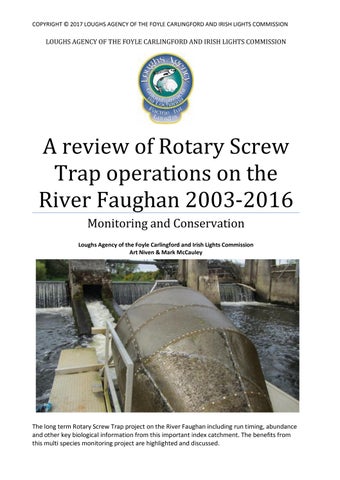
The long term Rotary Screw Trap project on the River Faughan including run timing, abundance and other key biological information from this important index catchment. The benefits from this multi species monitoring project are highlighted and discussed.
COPYRIGHT © 2017 LOUGHS AGENCY OF THE FOYLE CARLINGFORD AND IRISH LIGHTS COMMISSION
Headquarters 22, Victoria Road Derry~Londonderry BT47 2AB Northern Ireland Tel: +44 (0) 28 71 342100 Fax: +44 (0) 28 71 342720 general@loughs-agency.org www.loughs-agency.org
Regional Office Dundalk Street Carlingford Co Louth Republic of Ireland Tel: +353 (0) 42 938 3888 Fax: +353 (0) 42 938 3888 carlingford@loughs-agency.org www.loughs-agency.org
Report Reference LA/RST/01/17 CITATION: Niven, A.J. & McCauley, M. (2017) A review of Rotary Screw Trap operations on the River Faughan 2003-2016: Loughs Agency, 22, Victoria Road, Derry~Londonderry BT47 2AB Page 2 of 25
COPYRIGHT © 2017 LOUGHS AGENCY OF THE FOYLE CARLINGFORD AND IRISH LIGHTS COMMISSION
DOCUMENT CONTROL
Name of Document
A review of Rotary Screw Trap operations on the River Faughan 2003-2016:
Author (s):
Art Niven & Mark McCauley
Authorised Officer:
John McCartney
Description of Content:
Fish Stock Assessments
Approved by:
John Pollock
Date of Approval:
December 2016
Assigned review period:
Annually
Date of next review:
December 2017
Document Code
LA/RST/01/16
This documents comprises
TOC
Text List of tables Table of Figures
X
X
X
No. Appendices
X
Version Control Table Version No. Version 1
Status Draft
Author (s) Art Niven
Reviewed by
Approved by
Date of issue
John McCartney
John Pollock
01/1/2017
Revision 2 Revision 3
Page 3 of 25
COPYRIGHT © 2017 LOUGHS AGENCY OF THE FOYLE CARLINGFORD AND IRISH LIGHTS COMMISSION
TABLE OF CONTENTS
TABLE OF CONTENTS ......................................................................................... 4 ACKNOWLEDGEMENTS ...................................................................................... 6 PROJECT STAFF .................................................................................................. 6 EXECUTIVE SUMMARY ....................................................................................... 7 1.0
INTRODUCTION ........................................................................................ 8
2.0
METHODOLOGY ........................................................................................ 9 Fig 1. RST being hoisted into position at Campsie Barrage ....................... 10
Table 1. RST Operational days and periods by year. ..................................... 10 Fig 2. RST in the non-fishing position with the drum raised...................... 11 3.0
RESULTS .................................................................................................. 12
3.1 ATLANTIC SALMON AND SEA TROUT ................................................... 12 Table 2. Numbers of Salmon and Sea trout smolts caught by year ........... 12 Table 3. Species caught by year................................................................ 12 Table 4. Species caught by year continued ............................................... 12 Fig 3. River Faughan Salmon smolt run timing and abundance 2004–2009 & 2014-2016. ............................................................................................... 13 Fig 4. Maximum number of Salmon smolts caught on each day 2004-2009 & 2014-2016. ........................................................................................... 13 Table 5. Mean Length (cm) and mean weights (g) by year for Salmon smolts caught in the Faughan RST 2004-2009 & 2014-2016 ................................ 14 Fig 5. River Faughan Sea trout smolt run timing and abundance 2004–2009 & 2014-2016. * Note in 2015 2441 salmon smolts were caught on the 29th April, this is marked on the graph above with a break in the line. ............ 14 Fig 6. Maximum number of Sea trout smolts caught on each day 2004-2009 & 2014-2016. ........................................................................................... 15 Fig 7. River Faughan Sea trout length frequency distribution 2006-2009 & 2014-2016 n = 1256 ................................................................................. 15 Page 4 of 25
COPYRIGHT © 2017 LOUGHS AGENCY OF THE FOYLE CARLINGFORD AND IRISH LIGHTS COMMISSION
Fig 8. Cumulative % Salmon smolt catch and 50% attainment dates ........ 16 Fig 9. Cumulative % Sea trout smolt catch and 50% attainment dates ..... 16 Table 6. Mean Length (cm) and mean weights (g) by year for Sea trout smolts caught in the Faughan RST 2014-2016 .......................................... 17 3.2 SALMON SMOLT AGE ........................................................................... 17 Table 7. River Faughan Salmon smolt age ................................................ 17 3.3 SALMON SMOLT PRODUCTION ESTIMATE ........................................... 17 Table 8. Salmon smolt production estimates for the Faughan catchment 2004-2009 & 2014-2016 .......................................................................... 18 Table 9. Faughan catchment estimated wild Atlantic salmon smolt minimum production per 100m2. ............................................................. 18 3.4 CODED WIRED TAGGING (2002 – 2009) ............................................... 19 Table 10. Number of Salmon smolts tagged (CWT) River Finn & Faughan 2002 -2009. .............................................................................................. 20 Table 11. Recovery of coded wire tags from smolts tagged on the River Finn & Faughan 2002 -2009. ............................................................................ 20 3.2
LAMPREY .......................................................................................... 20
Fig 10. Pictures of from top of previous page, female Brook lamprey with eggs visible in abdomen, adult Sea lamprey, adult River lamprey oral disc, Sea lamprey oral disc and River lamprey male with close up of genital papilla. ..................................................................................................... 22 Fig 11. Length frequency of adult River Lamprey caught in the Faughan RST 2014 n = 76, 2015 n = 99 & 2016 n = 42 ................................................... 23 Fig 12. Length frequency of adult Brook Lamprey caught in the Faughan RST 2014 n = 49, 2015 n = 439 & 2016 n = 108 ............................................... 23 5.0 DISCUSSION ............................................................................................... 24 6.0 RECOMMENDATIONS ................................................................................. 24
Page 5 of 25
COPYRIGHT © 2017 LOUGHS AGENCY OF THE FOYLE CARLINGFORD AND IRISH LIGHTS COMMISSION
ACKNOWLEDGEMENTS The Loughs Agency sponsoring departments, board and staff are gratefully acknowledged for the funding, support and assistance provided to conduct fish stock assessments and status reporting in the Foyle and Carlingford areas. The Loughs Agency Eastern crew Davy Robinson, Emmett Carten, David O’Brien (Retired), Roly Wysner, Jason McCartney and Donal Lynch are gratefully acknowledged for their commitment to this long term monitoring project. Northern Ireland Water Ltd is also gratefully acknowledged for permitting access to the Faughan pumping station site. PROJECT STAFF Fisheries Biologist/Project Manager
Art Niven
Assistant Scientific Officer
Mark McCauley
For further information contact art.niven@loughs-agency.org
@ArtNiven
Loughs Agency TV
© LOUGHS AGENCY OF THE FOYLE CARLINGFORD AND IRISH LIGHTS COMMISSION 2017
Page 6 of 25
COPYRIGHT © 2017 LOUGHS AGENCY OF THE FOYLE CARLINGFORD AND IRISH LIGHTS COMMISSION
EXECUTIVE SUMMARY An EG Solutions Inc. 5ft diameter Rotary Screw Trap (RST) has been deployed on the River Faughan from 2003 to 2009 and from 2014 to 2016. The data generated from this long term study has been used for a variety of purposes. The River Faughan RST project is now a well established index/reference site for a number of diadromous and resident fish populations that spend some or all of their life within the Faughan catchment. In the period 2003-2009 the primary reason for deploying the RST was to capture migrating Atlantic salmon smolts for the purpose of Coded Wire Tagging (CWT). The results fed into national and international Coded Wire Tagging programmes. The information obtained from these projects was used for various purposes including to identify the nature of mixed stock interceptory fisheries and to manage these fisheries. No commercial fisheries for Atlantic salmon have operated in the Foyle area since 2009. From 2014 to 2016 the RST on the River Faughan has been deployed to collect run timing, abundance and other key biological information from all fish species caught. The River Faughan RST annual deployment provides an indicative index for migrating Atlantic salmon smolts, Sea trout smolts, River Lamprey and Brook Lamprey and records other species encountered. The key data sets for this period are outlined and a number of recommendations for the conservation and protection of monitored species have been made.
Page 7 of 25
COPYRIGHT © 2017 LOUGHS AGENCY OF THE FOYLE CARLINGFORD AND IRISH LIGHTS COMMISSION
1.0 INTRODUCTION The River Faughan and Tributaries is an Area of Special Scientific Interest (ASSI) and a Special Area of Conservation (SAC). Amongst other habitats and species it is designated for its populations of Atlantic salmon (Salmo salar L.). Since 2003 the Loughs Agency has operated a Rotary Screw Trap at the tidal limit during the spring smolt migration period. The information collected provides an important index for a number of species over time. The River Faughan is an important Atlantic salmon and Sea trout fishery which has the potential to contribute significantly to the local rural economy. The 2015 five year average for returning adult Atlantic salmon as recorded by an electronic fish counter at Campsie Barrage on the lower River Faughan was 1869. The 2015 five year average rod catch for Atlantic salmon was 816 with a 40% rate of catch and release (five year average). The 2015 five year average rod catch for Sea trout was 125 with a 68% rate of catch and release (2015 only). The River Faughan and Tributaries have an annual adult Atlantic salmon Management Target of 800 and a Conservation Limit of 640. The Loughs Agency operates an audit point management system for Atlantic salmon following a life history model with audit points at key life history stages. Catch returns, electronic fish counts, timed catchment wide electrofishing surveys and spawning redd counts are all conducted to inform management decision making. In addition periodic assessments are made of the available in channel spawning, holding and nursery habitat, chemical and biological water quality and smolt migration. This information is available from the Loughs Agency upon request. Summary information is available in the annual Catchment Status Reports https://www.loughs-agency.org/publications/ The River Faughan has a catchment area of approximately 290km2. The Main stem is approximately 31km in length with tributaries accessible to migrating salmon accounting for approximately 20km in channel length giving a total accessible channel length of approximately 51km. Other species are also regularly recorded in the RST. The most notable of these being Sea trout (Salmo trutta L.) smolts, kelts and adults, adult River lamprey (Lampetra fluviatilis) and adult Brook lamprey (Lampetra planeri). Page 8 of 25
COPYRIGHT © 2017 LOUGHS AGENCY OF THE FOYLE CARLINGFORD AND IRISH LIGHTS COMMISSION
The fishing rights are owned by The Honourable The Irish Society and in the tidal river by the Loughs Agency, both areas are currently leased to the River Faughan Anglers Ltd.
2.0 METHODOLOGY A 5ft diameter EG Solutions Inc. Rotary Screw Trap (RST) is deployed annually during the salmonid smolt run. It is positioned immediately downstream of a Denil fish pass located on Campsie Barrage. Campsie barrage is an impounding structure which facilitates the abstraction of raw water from the River Faughan and forms the upstream tidal limit during normal flow conditions. The abstracted water is then pumped to Carnmoney water treatment works. The RST is fixed to a sub aquatic concrete wall by two submerged brackets. The RST is then attached to the brackets by a series of chains. In recent years the RST has been constructed on builders trestles on a hard standing area adjacent to the pumping station and hoisted into position by a crane.
Page 9 of 25
COPYRIGHT © 2017 LOUGHS AGENCY OF THE FOYLE CARLINGFORD AND IRISH LIGHTS COMMISSION
Fig 1. RST being hoisted into position at Campsie Barrage on the River Faughan, RST in fishing position in line with Denil fish pass.
Since monitoring began on the River Faughan in 2003 the earliest the trap was deployed was 24th March in 2015. The latest the trap was removed was 29th May 2015. Table 1 below outlines the operational periods for the Faughan RST. Year 2016 2015 2014 2009 2008 2007 2006 2005 2004
Number of Days Trap Operational 20 25 20 18 24 31 24 35 17
Start Date
End Date
15/04/2016 24/03/2015 10/04/2014 16/04/2009 08/04/2008 03/04/2007 20/04/2006 12/04/2005 28/04/2004
20/05/2016 29/05/2015 02/05/2014 22/05/2009 14/05/2008 18/05/2007 23/05/2006 20/05/2005 26/05/2004
Table 1. RST Operational days and periods by year.
Page 10 of 25
COPYRIGHT © 2017 LOUGHS AGENCY OF THE FOYLE CARLINGFORD AND IRISH LIGHTS COMMISSION
Periods of high flow were anticipated through close monitoring of the weather forecast and the trap was raised into the non-fishing position in advance of any significant flood.
Fig 2. RST in the non-fishing position with the drum raised. Note access gangway and boat used to access the RST.
During normal trapping operations debris build up in the trap holding tank and the RST structure was removed on a daily basis. A mobile sampling station/box trailer has been used in recent years in which fish caught within the RST are sampled. The RST is accessed by a small boat, the RST holding tank is emptied on a daily basis with all species identified and counted. The target species are collected and returned to the mobile sampling station/box trailer where they are anaesthetised using MS222, key biological data including lengths, weights scale and genetic samples are collected before all fish are returned to the river. From 2004-2009 Coded Wire Tagging was conducted on a sub sample of Atlantic salmon smolts as part of national monitoring programmes. The information collected through this study was used to inform key management decision making in relation to the closure of mixed stock interceptory drift net fisheries around the island of Ireland. Page 11 of 25
COPYRIGHT © 2017 LOUGHS AGENCY OF THE FOYLE CARLINGFORD AND IRISH LIGHTS COMMISSION
3.0 RESULTS 3.1
ATLANTIC SALMON AND SEA TROUT
The numbers of Salmon, Sea trout smolts and other life history stages and species captured by year are outlined in Tables 2, 3 & 4 below. Year Number of Salmon Smolts Caught Number of Sea Trout Smolts Caught 2016 2132 93 2015 4011 338 2014 2434 379 2009 820 28 2008 2510 55 2007 2611 279 2006 1079 249 2005 3988 729 2004 2962 194 Table 2. Numbers of Salmon and Sea trout smolts caught by year Year
Eels Lamprey Sea Sp Lamprey 2016 0 N/A 0 2015 4 N/A 1 2014 0 N/A 0 2009 4 45 N/A 2008 4 278 N/A 2007 3 437 3 2006 N/A N/A N/A 2005 14 56 N/A 2004 N/A N/A N/A Table 3. Species caught by year Year
Adult Salmon
River Lamprey 44 103 77 N/A N/A N/A N/A N/A N/A
Adult 3 Spined Roach Sea Stickleback Trout 2016 1 10 364 20 2015 2 3 548 36 2014 N/A 73 1156 43 2009 N/A 3 509 N/A 2008 1 4 N/A 14 2007 N/A 6 927 16 2006 N/A N/A N/A N/A 2005 2 1 275 4 2004 N/A N/A N/A N/A Table 4. Species caught by year continued
Brook Lamprey 113 729 49 N/A N/A N/A N/A N/A N/A
R/B Ammocoetes 3 16 N/A N/A N/A N/A N/A N/A N/A
Salmon Parr 3 129 58 33 17 18 N/A 1 N/A
Trout Parr 12 7 37 8 6 N/A N/A 2 N/A
Flounder Minnow Stone Loach
Perch
3 21 4 N/A 3 2 N/A 7 N/A
11 0 N/A N/A N/A 0 N/A N/A N/A
1 50 3 N/A N/A N/A N/A 10 N/A
1 5 N/A N/A 15 2 N/A 0 N/A
Page 12 of 25
COPYRIGHT © 2017 LOUGHS AGENCY OF THE FOYLE CARLINGFORD AND IRISH LIGHTS COMMISSION 700 2004 2005 600
2006 2007 2008
Number of Salmon Smolts Trapped
500
2009 2014
400
2015 2016 300
200
100
0 24-Mar
31-Mar
07-Apr
14-Apr
21-Apr
28-Apr
05-May
12-May
19-May
26-May
Date
Fig 3. River Faughan Salmon smolt run timing and abundance 2004–2009 & 2014-2016. * Note in 2015 2441 salmon smolts were caught on the 29th April, this is marked on the graph above with a break in the line.
Maximum No of Salmon Smolts Caught
1000 900 800 700 600 500 400 300 200 100 0 24-Mar
31-Mar
07-Apr
14-Apr
21-Apr
28-Apr
Date
05-May
12-May
19-May
26-May
Fig 4. Maximum number of Salmon smolts caught on each day 2004-2009 & 2014-2016. *Note in 2015 2441 salmon smolts were caught on the 29th April.
Page 13 of 25
COPYRIGHT © 2017 LOUGHS AGENCY OF THE FOYLE CARLINGFORD AND IRISH LIGHTS COMMISSION
Year
Salmon Smolts Mean Length (cm) 13.4 No data 13.3 13.5 13.1 13.5 13.5 12.5 13.7
2004 2005 2006 2007 2008 2009 2014 2015 2016
Sample Size Salmon (n) Smolts Mean Weight (g) 1881 24.6 No data No data 1059 25.36 2083 27.09 2482 22.1 771 24.42 314 25.1 11 15.8 16 26.66
Sample Size (n) 73 No data 95 65 50 47 314 11 16
Table 5. Mean Length (cm) and mean weights (g) by year for Salmon smolts caught in the Faughan RST 2004-2009 & 2014-2016 200
2004
190
2005
180
2006
Number of Trout Smolts Trapped
170 160
2007
150
2008
140
2009
130
2014
120
2015
110
2016
100 90 80 70 60 50 40 30 20 10 0 24-Mar
31-Mar
07-Apr
14-Apr
21-Apr
28-Apr Date
05-May 12-May 19-May 26-May
Fig 5. River Faughan Sea trout smolt run timing and abundance 2004–2009 & 2014-2016. * Note in 2015 2441 salmon smolts were caught on the 29th April, this is marked on the graph above with a break in the line.
Page 14 of 25
COPYRIGHT © 2017 LOUGHS AGENCY OF THE FOYLE CARLINGFORD AND IRISH LIGHTS COMMISSION
Maximum Number of Sea Trout Smolts Caught
200 180 160 140 120 100 80 60 40 20 0 24-Mar
31-Mar
07-Apr
14-Apr
21-Apr
28-Apr
05-May
12-May
19-May
26-May
Date
Fig 6. Maximum number of Sea trout smolts caught on each day 2004-2009 & 2014-2016.
210 180
Frequency
150 120 90 60 30
440-449
420-429
400-409
380-389
360-369
340-349
320-329
300-309
280-289
260-269
240-249
220-229
200-209
180-189
160-169
140-149
120-129
100-109
80-89
60-69
40-49
20-29
0-9
0
Length (mm)
Fig 7. River Faughan Sea trout length frequency distribution 2006-2009 & 2014-2016 n = 1256
Page 15 of 25
COPYRIGHT © 2017 LOUGHS AGENCY OF THE FOYLE CARLINGFORD AND IRISH LIGHTS COMMISSION
Figures 8 & 9 outline the cumulative % totals for both salmon and Sea trout smolts caught in the Faughan RST from 2004-2009 & 2014-2016. The 50% attainment line highlights the date on which 50% of the run recorded in each year was achieved. 100 2004 2005 2006 2007 2008 2009 2014 2015 2016 50%
Cumulative % of Salmon Smolt Run
90 80 70 60 50 40 30 20 10
08-Jun
01-Jun
25-May
18-May
11-May
04-May
27-Apr
20-Apr
13-Apr
06-Apr
30-Mar
23-Mar
0
Week Ending
Fig 8. Cumulative % Salmon smolt catch and 50% attainment dates 100 2004 2005 2006 2007 2008 2009 2014 2015 2016 50%
90
Cumulative % of Sea Trout Run
80 70 60 50 40 30 20 10
08-Jun
01-Jun
25-May
18-May
11-May
04-May
27-Apr
20-Apr
13-Apr
06-Apr
30-Mar
23-Mar
0
Week Ending
Fig 9. Cumulative % Sea trout smolt catch and 50% attainment dates
Page 16 of 25
COPYRIGHT © 2017 LOUGHS AGENCY OF THE FOYLE CARLINGFORD AND IRISH LIGHTS COMMISSION
Year
Trout Smolts Mean Length (cm) 19.86 18.30 17.15
2014 2015 2016
Trout Smolts Mean Weight (g) 78.6 63.2 56.2
Sample Size (n) 354 332 86
Table 6. Mean Length (cm) and mean weights (g) by year for Sea trout smolts caught in the Faughan RST 2014-2016
3.2
SALMON SMOLT AGE
In 2004 seventy two sets of Salmon smolt scales were read using a Bell Howell C100 microfiche reader to determine age at smolting. Scale samples were collected in other years and are stored in the Loughs Agency scale archive. It is recommended that additional ageing is conducted on both Salmon and Sea trout smolts to determine if the age at smolting has varied over time. Age Number Percentage %
1 9 13
2 60 83
3 3 4
Table 7. River Faughan Salmon smolt age
3.3
SALMON SMOLT PRODUCTION ESTIMATE
An intensive mark recapture study to estimate the total out migrant Salmon smolt run was conducted in 2004. On a daily basis a proportion of Salmon smolts captured in the RST were marked with a day specific batch code and transported 1.8 km upstream from the capture site and released. The mean recapture rate for marked Salmon smolts in 2004 was 10.5%. Using Darrochs method utilising the DARR model it was possible to estimate that approximately 33,000 +/-5000 Atlantic salmon smolts made a seaward migration in the spring of 2004. Table 8. outlines the 2004 smolt production estimate using the DARR model and also the population estimates for 2004-2009 and 2014-2016 by applying the generic 10.5% capture efficiency rate of the trap as estimated in 2004 to the entire data set. This is a crude estimate of total smolt production over these years. Year
Number of Salmon Smolts Caught in Faughan RST
Total Salmon Smolt Out Migration
Total Salmon Smolt Out Migration Population Estimate Page 17 of 25
COPYRIGHT © 2017 LOUGHS AGENCY OF THE FOYLE CARLINGFORD AND IRISH LIGHTS COMMISSION
2016
2132
Population Estimate by DARR N/A
(10.5% trap efficiency value) 20304
2015
4011
N/A
38200
2014
2434
N/A
23180
2009
820
N/A
7809
2008
2510
N/A
23904
2007
2611
N/A
24866
2006
1079
N/A
10276
2005
3988
N/A
37980
2004
2962
33,000
28209
Mean
2818
26868
Table 8. Salmon smolt production estimates for the Faughan catchment 2004-2009 & 20142016
The approximate wetted area of the Faughan catchment accessible to Atlantic salmon is estimated as 825,466m2. Table 9. Outlines the estimated Salmon smolt production per 100m2 across the survey years. Year
Estimated Atlantic salmon smolt production per 100m2
2016
2.46
2015
4.63
2014
2.81
2009
0.95
2008
2.90
2007
3.01
2006
1.24
2005
4.60
2004
3.42
Table 9. Faughan catchment estimated wild Atlantic salmon smolt minimum production per 100m2.
Page 18 of 25
COPYRIGHT © 2017 LOUGHS AGENCY OF THE FOYLE CARLINGFORD AND IRISH LIGHTS COMMISSION
3.4
CODED WIRED TAGGING (2002 – 2009)
The numbers of salmon that survive to return to the freshwater environment are greatly influenced by conditions in the marine environment. Climate change leading to changes in sea surface temperatures, prey abundance, high seas fishing, marine pollution, sub lethal levels of pollution and predation all have an effect on the Atlantic salmon and indeed other migratory fish species chances of survival. Marine survival trends are monitored on a number of Index Rivers in the North East Atlantic where total trapping facilities are available for both migrating juvenile and adult populations. Total trapping allows for an accurate count of all migrant smolts (total freshwater production) and returning adults to be made and therefore an accurate estimate of marine survival. These projects are facilitated by the use of Coded Wire Tags (CWT). Coded wire tags are small (2-3mm long) micro tags that are injected automatically by a CWT device into the snout cartilage of anaesthetised fish remaining there for the duration of the life of the fish. CWT fish also have their adipose fin (small fin between the dorsal fin and caudal fin (tail fin) removed so that they can be identified in the various fisheries that may intercept them. In 2002 migrating Atlantic salmon smolts were first captured in a smolt trap situated at the fish counter in Killygordon on the River Finn. Trapping and coded wire tagging continued at this site until 2006. In 2003 Salmon smolts were first captured in the rotary screw trap at the tidal barrage on the River Faughan. Trapping and coded wire tagging continued at the Faughan site until 2009. Coded wire tags were inserted into the Salmon smolts before they were released. The information collected contributed towards the coded wired tagging projects in Northern Ireland and the Republic of Ireland. Table 10 below shows the numbers of Salmon smolts tagged at each location. YEAR 2002 2003 2003 2004 2004 2005 2005 2006
RIVER Finn Finn Faughan Finn Faughan Finn Faughan Finn
NUMBER SALMON SMOLTS TAGGED 1035 3005 2113 1030 2500 520 2210 1039 Page 19 of 25
COPYRIGHT © 2017 LOUGHS AGENCY OF THE FOYLE CARLINGFORD AND IRISH LIGHTS COMMISSION
2006 2007 2008 2009
Faughan Faughan Faughan Faughan
1025 2062 2486 748
Table 10. Number of Salmon smolts tagged (CWT) River Finn & Faughan 2002 -2009.
Table 11 below shows the numbers of smolts tagged on the River Finn and Faughan. It also shows the number of coded wire tags recovered and the year in which they were recovered. In 2010 the commercial mixed stock drift net fisheries were closed. This had been the main recapture method for Salmon smolts containing coded wire tags. YEAR
RIVER
No SALMON TAGGED
2002
Finn
1035
2003
2006
Finn Faughan Finn Faughan Finn Faughan Finn
3005 2113 1030 2500 520 2210 1039
2007
Faughan Faughan
1025 2062
2008 2009
Faughan Faughan
2486 748
2004 2005
YEAR RECOVERED 2003 2004 2004 2004 2005 2005 2006 2006 2007 2008 2007 2008 2009 -
NUMBER RECOVERED 10 1 25 12 8 16 1 3 8 1 2 2 1 0 0
Table 11. Recovery of coded wire tags from smolts tagged on the River Finn & Faughan 2002 -2009. 3.2
LAMPREY
From 2014 the RST has been used to capture high resolution data on adult River, Brook and Sea lamprey. It was previously observed that the RST caught significant numbers of adult Lamprey during the annual smolt migration period. From 2014 the RST was deployed earlier to attempt to catch adult Lamprey prior Page 20 of 25
COPYRIGHT © 2017 LOUGHS AGENCY OF THE FOYLE CARLINGFORD AND IRISH LIGHTS COMMISSION
to their annual spawning period. It is assumed that River Lamprey are caught in the RST as they attempt to travel upstream through the Denil fish pass and get washed into the RST during these attempts. It is unknown at present if the adult Brook lamprey are caught for the same reasons. They may alternatively have travelled down river and entered the trap from this direction. The current Denil fish pass may form a barrier to upstream migration for diadromous Lamprey. The River Faughan index site has and will continue to facilitate research into these issues. The Loughs Agency has collaborated with QUB through a recent PhD to investigate Lamprey populations within the Faughan catchment. Detailed analysis of the genetic diversity within and between the River and Brook lamprey populations of the Faughan should enlighten contemporary thinking on future conservation management actions.
Page 21 of 25
COPYRIGHT © 2017 LOUGHS AGENCY OF THE FOYLE CARLINGFORD AND IRISH LIGHTS COMMISSION
Fig 10. Pictures of from top of previous page, female Brook lamprey with eggs visible in abdomen, adult Sea lamprey, adult River lamprey oral disc, Sea lamprey oral disc and River lamprey male with close up of genital papilla.
Page 22 of 25
COPYRIGHT © 2017 LOUGHS AGENCY OF THE FOYLE CARLINGFORD AND IRISH LIGHTS COMMISSION
27 2014
25 23
2015
Number of River Lamprey
21 19
2016
17 15 13 11 9 7 5 3
-1
0-9 10-19 20-29 30-39 40-49 50-59 60-69 70-79 80-89 90-99 100-109 110-119 120-129 130-139 140-149 150-159 160-169 170-179 180-189 190-199 200-209 210-219 220-229 230-239 240-249 250-259 260-269 270-279 280-289 290-299
1
Length (mm)
Fig 11. Length frequency of adult River Lamprey caught in the Faughan RST 2014 n = 76, 2015 n = 99 & 2016 n = 42 2014
150
2015
125
2016
Frequency
100
75
50
25
170-179
160-169
150-159
140-149
130-139
120-129
110-119
100-109
90-99
80-89
70-79
60-69
50-59
40-49
30-39
20-29
10-19
0-9
0
Length (mm)
Fig 12. Length frequency of adult Brook Lamprey caught in the Faughan RST 2014 n = 49, 2015 n = 439 & 2016 n = 108
Page 23 of 25
COPYRIGHT © 2017 LOUGHS AGENCY OF THE FOYLE CARLINGFORD AND IRISH LIGHTS COMMISSION
5.0 DISCUSSION The deployment of the RST at the River Faughan site has been extremely successful. The initial deployment to capture Salmon smolts for the purpose of coded wire tagging from 2003 to 2009 established an important record of where Faughan/Foyle salmon were intercepted and in what fisheries. In addition it established a project which captured other key biological information from a wide variety of species and life history stages. From 2014 the focus of this work has been on continuing the Salmon smolt census, the collection of key biological information including the run timing and abundance of Sea trout smolts and adults, the collection of Lamprey genetic samples and key biological data and the census of all other species. The configuration of the barrage structure has facilitated the long term monitoring project at this site. In addition to having a secure site from which to base trapping operations the fish pass configuration has facilitated the effective and efficient capture of a range of resident and diadromous fish species. This site could be further configured to facilitate more detailed studies on the survival and migration patterns of both Salmon and Sea trout. Northern Ireland Water Ltd are gratefully acknowledged for their continued support in facilitating the long term fisheries monitoring project on the River Faughan at Campsie pumping station. This includes the electronic fish counting facilities used for counting numbers of returning adult Atlantic salmon to the Faughan catchment.
6.0 RECOMMENDATIONS · Investigate the potential for using the smolt production estimates as part of a numerical life history stage model. · Eel and Lamprey passage should be developed at this site. Consideration should first be given to upstream baseline genetic assessments of the Lamprey populations. This should utilise the Loughs Agency juvenile Lamprey baseline assessment conducted in the Faughan catchment in 2012. Page 24 of 25
COPYRIGHT © 2017 LOUGHS AGENCY OF THE FOYLE CARLINGFORD AND IRISH LIGHTS COMMISSION
· A Sea trout specific mark recapture study should be considered to provide a Sea trout specific trap capture efficiency value and out migrant Sea trout smolt population estimate. · Additional resources to be allocated towards scale reading. Contemporary and historical information on the age at smolting for Atlantic salmon and Sea trout within the Faughan catchment would be worthwhile. · Acoustic tagging of out migrant Sea trout smolts and subsequent tracking throughout Lough Foyle and neighbouring areas to ascertain migration pathways and feeding territories. · Expand the trout genetic baseline for the Faughan catchment and conduct a revised Genetic Stock Identification exercise of Sea trout to ascertain a more detailed understanding of the location of Sea trout spawning and nursery areas. · Sea trout adult and kelt floy tagging · Continue RST trapping operations for all species · Investigate the potential for developing trapping facilities for upstream moving fish · Investigate the potential for installing a PIT array on the existing fish pass structure · Investigate alternative fish counting technologies for monitoring upstream moving fish
Page 25 of 25