LIFELINES
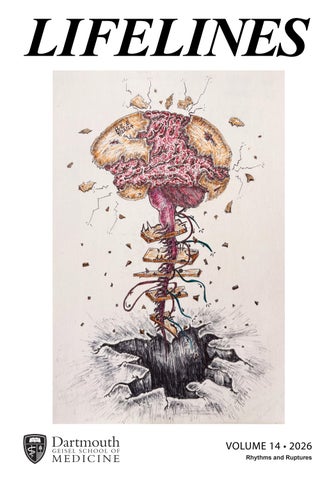
The Literary and Art Magazine of the Geisel School of Medicine at Dartmouth
is a print journal for literature and art in medicine. The journal was founded in 2002 by Sai Li (MED’06) and established with the publication of the first issue in Fall 2004. Subsequently, the journal was published annually. Lifelines has featured work by Guggenheim Fellows, winners of the William Carlos Williams Poetry Competition, physicians, patients, medical students, faculty, and undergraduates, as well as from new authors and artists. For more information, visit: sites.dartmouth.edu/lifelines
Audrey Ruan | Medical Student, Class of 2029, Geisel School of Medicine
Elaina Vitale, MLIS | Research & Education Librarian, Dartmouth Medical & Health Sciences Libraries
Jennifer Baker, PhD | Postdoctoral Research Associate, Department of Microbiology and Immunology at Geisel School of Medicine
Faith Ryu | Medical Student, Class of 2029, Geisel School of Medicine
Andre Armero | MD/PhD student, Class of 2031, Geisel School of Medicine
Andrew Yanik, MD | Nephrology Fellow and Faculty at Dartmouth Hitchcock Medical Center and Geisel School of Medicine
Esha Brahmbhatt | MPH Candidate, Class of 2027, Geisel School of Medicine at Dartmouth
Kennedy Watson | MD Candidate, Class of 2029, Geisel School of Medicine
Gillian Cook, MS | Program Coordinator – Arts & Humanities at Dartmouth Hitchcock Medical Center
Libby LeBlanc | President, Loud Mouse Design, Inc. – Libbyfre@comcast.net – 404-290-5023
Mayra Guardiola, MA | Senior Program Coordinator, DICE Office at Geisel School of Medicine
To the steady rhythms that sustained us and the ruptures that showed us how strong we truly are.
Dear Readers,
Thank you for picking up the 14th volume of Lifelines, featuring written and visual artworks created in the theme of “Rhythms and Ruptures.” These pieces explore the tension between flow and fracture, cadence and chaos, and take the pulse of the tempo of life for patients, healthcare workers and the systems they work and live within.
The Editorial Board hopes this volume captures the full, honest complexity of that relationship: how rhythms may simultaneously sustain us and constrain us, how ruptures can undo us and, paradoxically, free us. For this volume, we are highlighting the voices of patients, caregivers, clinicians, healthcare staff, and everyday people in our Upper Valley community. These are the people who know, from the inside, what it means when the trusted beat falters, and what it costs to find a new one. The works gathered here were created by members of this community and selected by an Editorial Board whose own lives are shaped by the intersection of medicine and meaning. They were chosen for their craft, their originality, and their willingness to ask hard questions without demanding easy answers. Thank you for joining us on this experience.
— The Lifelines Editorial Board
RODERICK BATES
The ProbaTion officer Urges her boss — for MB with love
You can’t give me the sex offender caseload because my boobs are trying to kill me.
Because I have to have chemo every three weeks and it is already making me sick after one dose.
Because I have the same gene that Angelina Jolie has, and women are flooding the labs to see if they have it.
Because sometime this fall they are going to remove one or both of my boobs and some lymph nodes too.
Because without the test results they don’t know if I need both boobs removed or just one.
Because as soon as they do the surgery they are going to begin to give me radiation treatment, every day.
Because I only found out that I have a rotten boob less than a week before my wedding.
Because I won’t be able to lift my arms over my head, and certainly can’t roll around on the floor arresting anyone.
Because they are going to put breast forms under my skin to stretch me and make room for my new boobs.
Because if I can’t lift my arms, someone will have to wash my hair (if I still have hair) and probably do other things for me, too.
Because they may give me silicone boobs, or maybe they will make new ones from my own flesh.
continued on next page
continued from previous page
Because every three weeks they will inject more saline into the forms and stretch me some more.
Because if they use silicone they will put it underneath my pectoral muscles, not on top where my boobs were.
Because the radiation may burn my skin and if it does, then they will not be able to use the silicone implants.
Because if they don’t use silicone I will get a tummy tuck that I don’t really need, to get what they do need to make the boobs.
Because the test results are now taking six months and I am scheduled to have the surgery in three.
Because when I come back I may have dirty hair (if I still have hair) and I may be fragile.
Because they will go into my belly and scoop out some fat and push it up, beneath my skin, to where it will be boobs.
Because I won’t be here next Monday because I threw a major fit and got the consultation scheduled sooner.
Because I already have weird pain from the biopsy, and sometimes it feels like my nipple is being burned off.
Because I may have to have new nipples tattooed onto me which won’t hurt because the nerves will be gone.
Because I’m going to be very unreliable for the next twelve months or so.
So you can’t give me the sex offender caseload, because my boobs are trying to kill me.
ROBYN FLATLEY
KATHRYN PETERSON
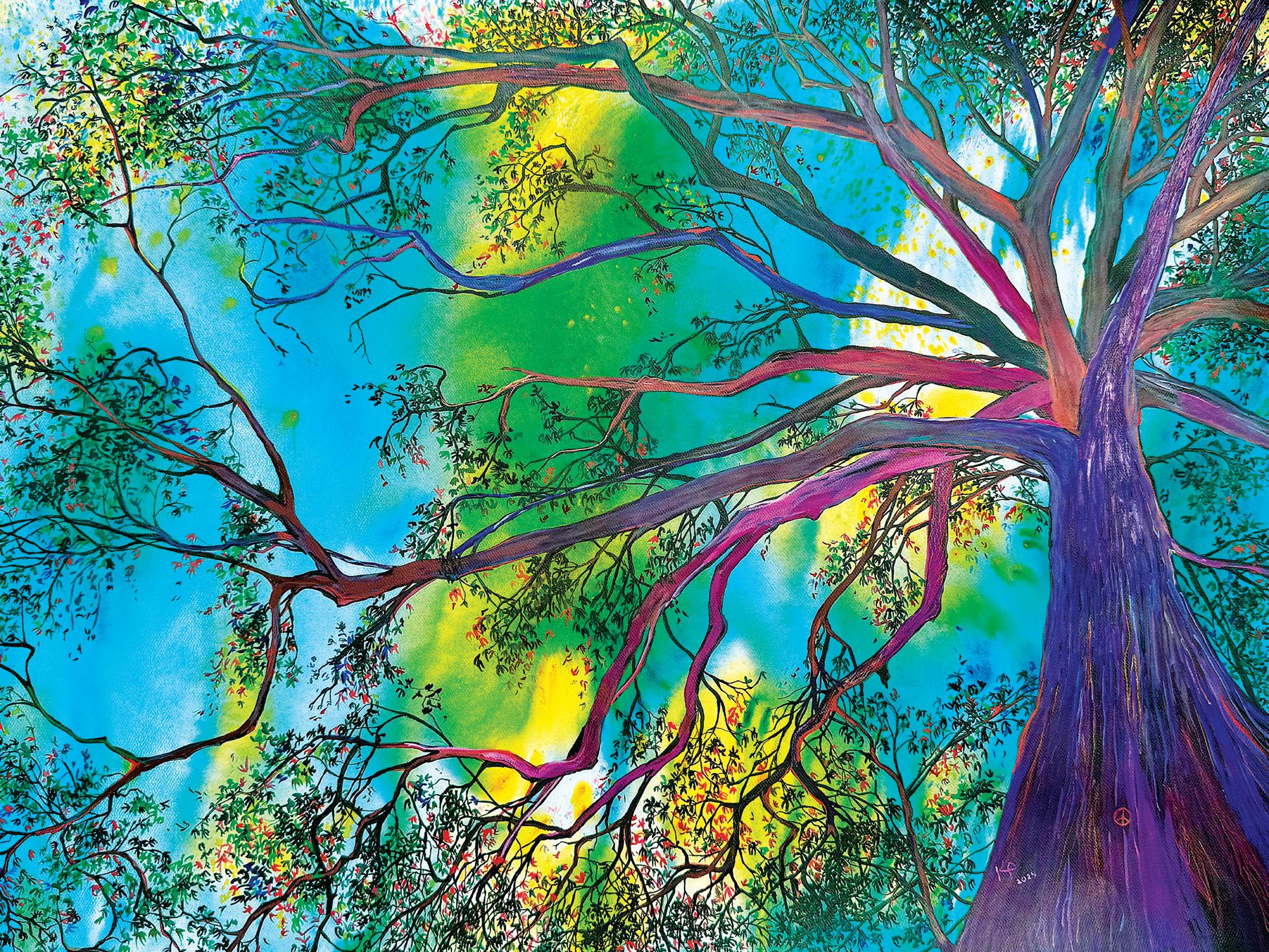
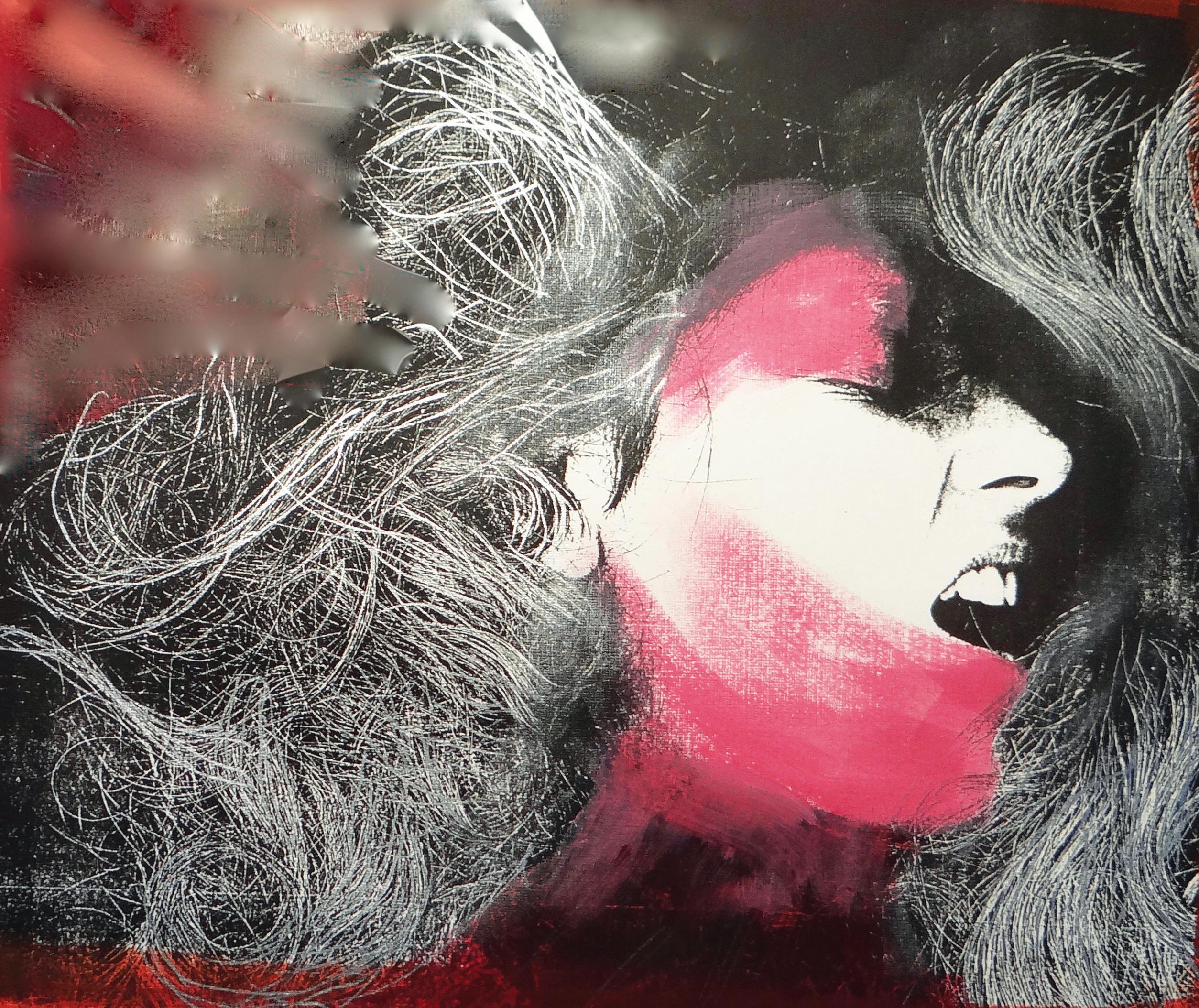
“Forces are all around you.”
22” x 30” | watercolor and ink on paper
lean into the shape they trust — wing to wing. The sky allows what must happen. They leave before the air begins to tilt. Before warning becomes language and urgency presses flat.
Pressure gathers without spectacle. A shift too small for instruments, too early for agreement. Below work slows.
Signals arrive fragmented. Risk is sorted, weighed, revised. Time behaves differently here.
Minutes stretch, divide: time moves forward without us. Impact is no longer abstract. We act within bounds set before the air changed. Response arrives to conditions that no longer exist.
Am I doing the right thing?
I am jealous of the birds.
TRAVIS FENLON
From the outset of my previous life, I found myself in a dilemma when I was acquiring my teaching certification: was I to teach secondary science or elementary school? I eventually decided on the former, and as much as I enjoyed teaching to the most hormonal among us, I always wondered if I would’ve been happier teaching the prepubescent about inside and outside voices. Still, for me, nary is there an experience that can induce as much elation as being around children. So naturally, when our core rotation schedules were released to our third-year medical school class, I fervently opened the Excel file to find where pediatrics fell next to my name. The collegial chatter of that time was driven by asking what rotation one had first, but still I found my answer fitting, “Your guess is as good as mine, but I can tell you I have pediatrics third!”
During my three weeks of outpatient pediatrics, how could the jauntily aura about me not be readily apparent to all passersby? But as those curtains were drawn, I found myself swallowing my smile as there waited for me on the horizon something wholly new: neonatology. The words of one of the pediatricians in the clinic I had just worked at bounced off the corridors of my mind in preparation for the next three weeks: “I hope you’re ready to deal with tiny babies.”
I froze at a bassinet of a 26-week-old premature baby girl. Though her trunk could comfortably be rooted in the palm of my hands, she was far from a meager sapling. I couldn’t shake from my line of sight her heart carrying the whole of her chest with each passing beat. My preceptor handed me a stethoscope with a nickel-sized diaphragm and interrupted my stupor, “you know, you can listen too.” I placed it vaguely on her chest and closed my eyes, and reverberating was the loudest heart I’d ever heard. I felt the stethoscope moving, so I reestablished my sight to see where my preceptor was correcting my positioning, only to find out it was our little girl who had ideas of where the stethoscope should be placed. Feeling I had disturbed her, I whispered, “I’m sorry,” but what I really meant to do was express my thanks; of all the hearts I had ever auscultated, I truly heard none but for hers — this was life.
From discussing the finer parts of German-engineered cars to Greg Maddux’s unhittable sinker, mere hours into that first day a friendship was blossoming, a frightening development because I believed this might have gulled my preceptor into having too much faith in my abilities. I didn’t think he was serious when he told me I’d be performing a circumcision on my second day. But before I even grappled with whether I was morally or even technically up to the task, he handed me the lidocaine to finish doing the nerve block. He walked me through assembly of the Gomco clamp and before I knew it I had a scalpel in my hand. As I ran the blade flush against the base of the clamp and began cutting, that hallmark circumcision scream — fit for an abattoir — which I was anticipating, never came. In the ten minutes that flashed by, the boy was unfazed, but far from unchanged. I stood triumphant, admiring the work I had just done. I got to play a role in shaping this boy with a finishing touch, and I never could’ve imagined the joy that would bring me.
Day three, and there was nothing new: we’d see our patients in the intensive care unit, put in new orders for labs, imaging, and nutrition, and then head on down to the post-partum ward to do newborn exams, sprinkle in a circumcision or two, and then I’d be dismissed after a brief didactic session. I had quickly displayed competence and gained confidence in our routine, but what gave me the most comfort was a sense of tranquility I hadn’t felt in medicine thus far: not once did it cross my mind that any of these babies wouldn’t be going home.
When picking up lunch that day, my preceptor read aloud a text message to me, “27-week placental abruption, we’ve started compressions,” and with empty stomachs we rushed back to the hospital. Known for my long strides and brisk pace, I uncharacteristically struggled to keep up with him as he led me through the anfractuous hallways to the operating room. He rapidly donned himself in personal protective equipment and directed me to join him once I had done the same. For the first time, I waltzed into a chaotic OR, adorned with three shoe covers: two which I had ripped when putting over my shoes, and one atop my head for I was unable to locate the bouffant hats. In one corner of the room, the obstetrics team was wrapping up their Caesarean section, while opposite to them was a huddle around the child who had just been delivered.
A timer showed 12 minutes and counting since cardiopulmonary resuscitation had begun. I divided my attention between the actions of each team member and the monitor. A timeout was called to check the placement of the endotracheal tube, as the pulse ticked down: 36…32…24…16. My naïveté shattered as I laid my eyes on the child for the first time. You think you have an idea of what cyanosis is through images in your textbooks, and then you see a child who is entirely blue. After 22 minutes of CPR, he was pronounced dead. He was the first patient I ever lost.
My preceptor started going through a debriefing protocol with the team, and his words were as audible to me as the adults are in the Peanuts cartoons. I was fixated on the child’s face for a long while before glancing at the rest of him. In a sort of comedic anguish I thought, “You didn’t even give me a chance to circumcise you.” My preceptor went across the hall to inform the father, but before he could speak he was met with a question, “My son didn’t make it, did he?”
With a to-go box in my lap housing untouched, frigid barbecue, I sat in my preceptor’s office as he walked me through navigating these conversations with families, and what grieving looks like for both them and for us. Tears irrigated my face throughout our conversation and on my solemn car ride home. I conversed with classmates throughout the evening, recounting the abstruse events and lamenting how this boy wouldn’t be able to taste coconut shrimp or play catch with his dad, that this boy wasn’t able to create his own purpose. One colleague eventually asked me, “Was his life meaningless then?” My answer was immediate, “Not to me.” A professor later put this more eloquently: “Everyone has a purpose on this Earth, regardless of how long they are here—that boy’s purpose was to be your patient.” Inevitably, one will receive a gift that they feel that they won’t ever be able to repay, and thus the phrase “you shouldn’t have” is uttered. I knew this boy for ten minutes, but he gave me perpetual clarity: I love coconut shrimp, I loved playing catch with my dad, and my purpose in this fallen world is to celebrate the memory of children like him and preserve their dignity in dying.
On day four, my preceptor made it a point to lock eyes with me first thing in the morning before saying, “Travis, you need to know that we are not losing anybody today.” And off we went downstairs to perform a circumcision.
I thought it was a cruel joke. I waited for your name to pop up on my phone for days. Hoping to see a video of your latest dance, but to my surprise “suicide” was written on the coroner’s report.
My blood burns at how cruel the world treated you. I should have seen your suffering but I was blind to it.
You were selfish to leave me here, trapped in this room without you. I was selfish for wanting you to stay, ignoring the peace you must have finally found.
I kept thinking, what if it was just an accident? what would have happened if I had seen the signs earlier? what would’ve happened if I hadn’t gone home that weekend?
God, I promise if you bring her back I will shoulder the weight of humanity’s sins.
My breath is often stolen, emptiness piled in every crevice of my being. Even the brightest mornings muted under a shadow. Until one day, the sunlight peaked in —
I knew it was you.
Still, these shadows catch me off guard in the quietest moments, the loud ones too.
There is no clear path to move on from you –not when I see you in everything, but I keep going one step at a time. Hoping this path leads me back to peace, or at least, to you.
BETH KING
Grief is not linear. It doesn’t wear a watch. It doesn’t know what month it is, what year or even if time has passed.
It arrives uninvited, stays too long, leaves without warning, then returns when your hands are full.
It waits in the body, in the throat, the spine, the belly.
It’s not always visible, but it is always present. It’s not a story with an ending. It is something we carry.
The forest does not grieve. Not like we do.
But it understands loss.
It knows what to do when a branch breaks off a tree or its crown is sheared by the wind. Energy is rerouted.
Life does not pause, it is redirected.
The tree does not stop growing. It thickens the bark around the break. It reaches toward the sun, the light.
What is lost becomes memory of the whole.
A single tree falls, the forest feels it, roots brace, systems strain. Together.
Loss in the forest becomes nourishment. The dead become a place for growth.
Nurse logs lie soft and split, their bodies a place for seeds to sprout and grow roots. They cradle life in their decay, offering shelter, nutrients, and quiet direction toward the light.
continued on next page
Poetry
continued from previous page
Some seeds only open after fire. They’re designed that way, sealed tight.
Until the heat of destruction cracks them open.
It sounds violent, but it’s not.
It’s precise.
It’s ancient.
It’s the forest’s way of saying: this pain is not the end.
It is a beginning, ash, soot, and all.
You, too, may have parts that only grow after the break, after the burning.
The growing stretches us, sometimes to the edge. It makes you real.
The forest never rushes you.
It doesn’t say, “You’re still sad?”
It says, “Sit.”
“Breathe.”
“Listen.”
You can lean against a hemlock and feel something older than language.
The stillness that says:
You don’t have to move yet. You don’t have to fix this. You don’t have to explain.
In that space,
in the care of the nurse log, in the quiet after the fire, in the filtered light shining through the canopy, something begins again. It is life.
Even in grief, green things grow.
BETH KING
At the end of a road and down a long dirt driveway sits a gnome’s rabbit’s garden in the woods, surrounding the house of its mistress and master, towered over by hemlocks. It is a whimsical garden, created by hand with love. It would take an entire lifetime to realize all that is found inside. The world is made more tolerable by such wonder.
You have to look really close, but when you do, you will find tiny frogs lazing about, transported there by caring hands to keep them safe from harm and close to heart, as they are friends. They have tiny swimming pools created for their delight by their mistress, filled with fresh water and carefully collected rocks for lounging. Great thought went into their pools. Nearby, you will find a small house replete with an arched front door and blooming flowers, prepared for their pleasure before their slumber.
There is the snake who comes to visit, as he too is a friend. A friend who has a name we have forgotten, though you know it because you named him. I try to create within myself the love for snakes that you had. I have been unable to thus far, but I think I can feel it coming. I can feel how your loss is starting to soften me. How that can be a resulting effect, in light of the pain I am experiencing, is inexplicable. The pain is intolerable at times and feels resolute in its interminability. An unwavering endlessness. Life without you.
I will go to the garden, if only in my mind, because that is where I will always find you. Among your friends, the flowers, and all the creatures who come to visit, some choosing to stay with you as you toiled to make the world just that much more extraordinary.
So many flowers, some dug up and transported, just like the frogs, only farther still, across multiple state lines, east to west and back again. Defying life at both sea level and mountain top, in dirt and sand and clay. How? Because of the love and care you provided. You did the same for your people.
Your people are wailing in your loss. I have heard them. I have seen them. Waves of pain washing over your people. You touched everyone you knew deeply because you were so giving. You changed lives and made them better. Our only saving grace is knowing you are exactly where you want to be, gardening with your God, replete with the most stunning gossamer wings.
Be at peace, Mom. I love you. I will be back another day to visit the garden you grew out of nothing, only one of your many superpowers. I know it was not all roses and buttercups, but I think overall you danced long and hard and had a good time doing it. We will miss you terribly. I love you, and I cannot wait to see you again in the new garden you are currently creating with love and care.
HABESHA PETROS
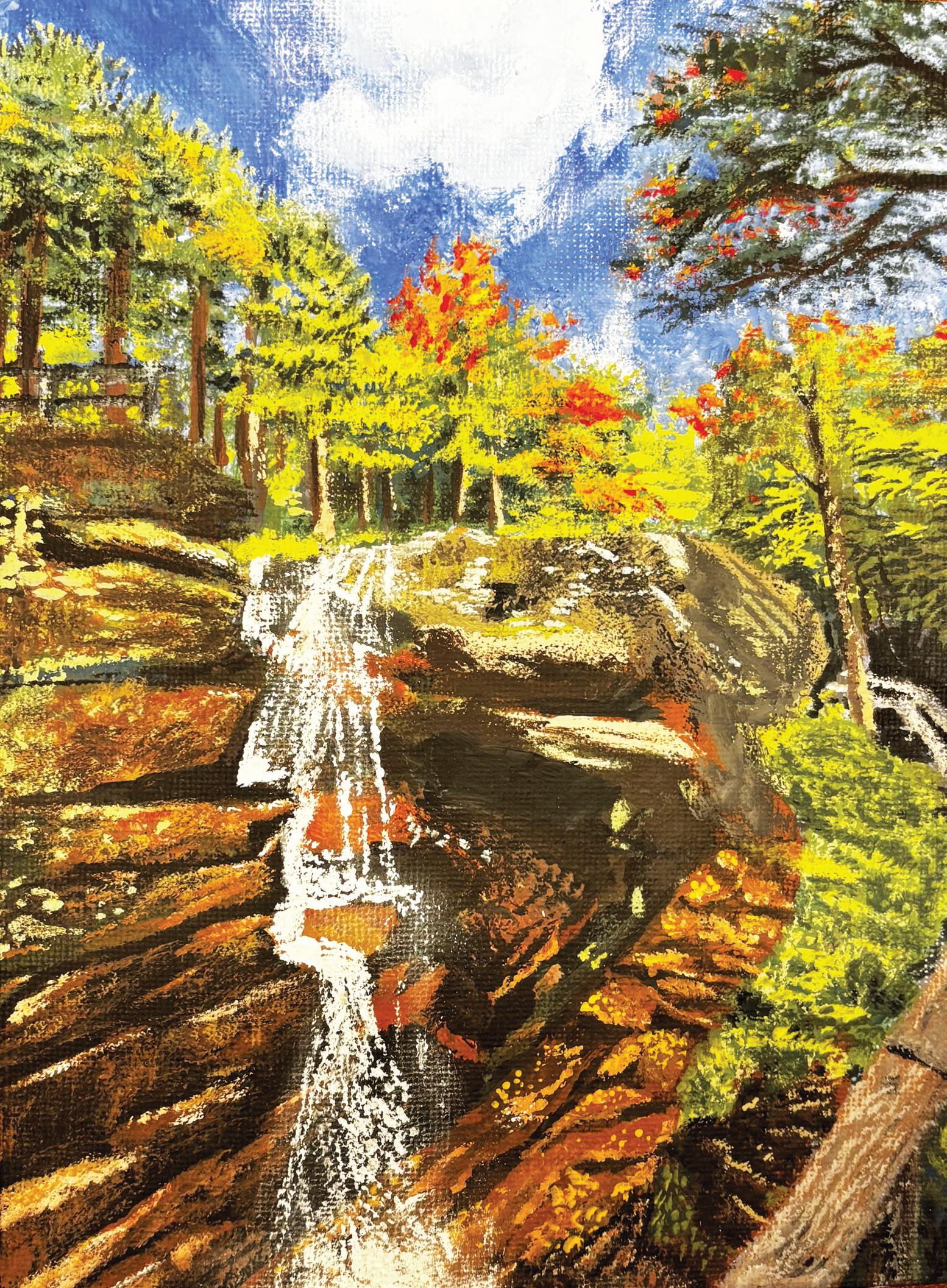
IAN BEALS
The semester wraps up like a Christmas present. Pass Pass Pass, Must Pass, pass, pass.
Don’t forget the bows, the ribbon and the tissue paper.
I stop and realize that I haven’t sat on a bench. Three and a half seasons have passed and I haven’t sat on one.
But, there are benches all around me?
I’ve only observed them.
One lit with divine light by the river, An honorable one by the diner with a commemoration. A youthful romantic one on the green.
I run laps around campus and each time I pass by I fantasize about moments on benches. Moments that I haven’t had, but that others potentially have. I try to name the ache and it shrinks in my mouth — how small it sounds beside real suffering.
I think about a patient saved far far in the future. Sitting on the wooden aged bench by the river. Or taking in the smells of donuts on main street.
But maybe that’s the point of all this passing — I pass exams, I pass checkpoints, I pass by that beautiful picturesque wooden bench by the river without stopping, because a bench needs more opportunities to feel the joy of a person. That moment made up in my head; a compilation of hard work and moments that I arrogantly claim.
I think about a patient with extra breath far far in the future, Sitting unknowingly on a bench. Another moment passed by, a gift that was not promised. The moment is not mine, the bench has not felt my weight. But it will all be worth it.
DAVID SOYBEL
“Can you show us?” my students ask, with a touch of urgency. These are first-year students in their fourth week of medical school. Today, we are learning to assess vital signs: pulse, respirations, and blood pressure. The students are impatient to know how to take a pulse. At this point, they are imagining themselves holding a patient’s wrist and counting the beats. They want to look good doing it.
I include myself among the learners, since it has been over 45 years since I was in their shoes. They need to learn. I need to learn how to teach them. I am not sure who is more anxious, them or me.
The syllabus says:
“In a clinic or hospital setting, most patients will have had their vital signs measured and recorded by a health care assistant (e.g., a nurse) before you have a chance to see them. However, these values are of such great importance that you should get into the habit of repeating them yourself, particularly if you are using these values as the basis for decisions about the management of diseases.”
“Oh my,” I think, “Who feels the pulse anymore? Who knows how it feels and what it means?”
My thoughts travel back to the late 1970s. I was home after my first year of medical school, accompanying my father on his rounds at the community hospital where he had practiced internal medicine for 25 years. We walked into a semi-private room, where a lady in her late seventies sat in bed, a breakfast tray in front. She smiled at us. My father introduced me. With some pride, he told her that I was in medical school, studying to become a doctor. She smiled broadly.
“Are you coming back to practice with your father?” I didn’t know the answer.
“We’ll see,” my dad interjected. “He isn’t ready to make up his mind yet…as long as he doesn’t become a surgeon.” He winked. She smiled.
My dad explained that she had been a long-term smoker and was recovering from the latest in a number of episodes of bronchitis that, this time, had turned into pneumonia. He asked about her appetite. A little better, she responded. The largely unfinished food tray told a different story. He commented that her color seemed a bit better.
“You think so?”
He pulled a chair up to the bed. Seated now, he took her hands in his and said he was going to take her pulse. I saw him pause for a few seconds and realized he was looking at her fingernails before he turned her hands over. She relaxed her bruised forearm and let him hold it. With his fingers, he found the depression in the skin above the wrist. He turned to his wristwatch, an inexpensive Timex. Over the years its leather band had been replaced several times. A child of the Depression, my father rarely bought new if the old worked well enough.
My father concentrated on the movement of the second hand. She watched him. I watched her watching him. We were silent. After a full minute, he looked up, making a note on an index card. He rose to tap on the back of her chest, then took out his stethoscope and listened to her lungs and heart.
“I still hear some unhappy sounds, but it seems better than yesterday,” he said. “How’s your breathing? Are you getting enough air?”
“I think so but it’s hard to tell,” she answered. At the same moment, his pager went off. He excused himself, saying he would be back.
She gazed at me, and said, “I was one of your father’s first patients when he started his practice. He looked so young. He was so serious, but he’s lightened up.” She laughed, then started to cough, bringing up thick mucus which she spit into a tissue. She crumpled the tissue, trying to hide its contents. I could see the blood seeping through. I asked her if I could ask some questions about her symptoms and take her pulse.
“Ask anything,” she said. “It’s wonderful that you can learn from your father. My whole family goes to him.”
I am back with the medical students. I hold up my left hand. I use my right to demonstrate how to locate the radial pulse. It takes a few minutes but everyone finds theirs. Some giggle. All let out notes of surprise and delight as they find it on themselves. It is not hard to tell when they have found it or if they are still looking. I explain that the pulse’s rhythm varies with the breath. Sometimes it skips a beat. Sometimes it is so erratic that the rhythm makes no sense. I tell them they have to be “present” to discern whether the pulse aligns with the patient’s breathing or facial expressions.
I ask my students to feel the power in the upstroke, the occasional second smaller beat, the purity in the downstroke. I say there was an ancient Greek physician named Herophilus who likened the pulse to a kind of music, with upbeats and downbeats.
“You mean like a metronome?”
“Yes,” I answer, “So much like a metronome that he used the principle to construct a water clock to measure time while he counted beats with his fingers. You can’t calculate a rate unless you can count time. Like musicians, physicians have to keep time.”
I go on: “In traditional Chinese medicine, there are 29 pulse variations used for diagnosis, a tradition that goes back over 2000 years. There is more to the pulse than a rate.” The students seem to absorb this.
continued from previous page
In my memory, I go back to my father, who had returned from answering his page. He came to the door and found me taking the patient’s pulse, my third try. I was clumsy, trying to hold her wrist while looking at my watch and practically counting out loud with the movements of the second hand. It was harder than I imagined, but she was patient. Sometimes I captured the pulse in my fingertips but it slipped away easily. And it was fast. I counted over 110 beats per minute, but I wasn’t sure. Amused, she looked up at my father and said, “He reminds me of when you were starting out. So serious.”
My father said something urgent had come up. I would have to wait in his office so he could attend to a patient who was coming to the emergency room. He would be back later to speak with her and her family. We said our goodbyes. As we walked out, she said, “Good luck. And listen to your father. He’ll teach you a lot.”
As we walked back to his office, I said, “Dad, when she coughed there was blood in the Kleenex. It seemed like a lot.” He knew about the blood. I asked what it meant. He said she had a cancer, not small, in her lungs that had spread elsewhere in the body. She was not interested in chemotherapy and was likely not going to live much longer. The conversation later that afternoon was about going home and preparing her family for what was to come.
“She knows about the cancer?”
“Yes.”
“Why doesn’t she want chemotherapy?”
“Chemotherapy makes people sick, especially little old ladies. A lot of my patients would rather be home if they can be with family. Most of the time they know more than we do about what’s right for them.”
—
I am back with my class. Students hold out their hands to their partners, who fumble to find the radial pulse on a strange hand. The talk is intermittent.
“It isn’t so easy, is it?” I say. “You just need practice. See if you can find your partner’s brachial artery. You will need that to take each other’s blood pressure.”
They are having trouble. I show a picture of the arm’s anatomy on the screen and explain how the brachial artery can be located using landmarks. We focus on the anatomic terms and spatial relationships, and how they will know if they are feeling for it in the wrong place. I walk around the room helping them find the structures. Now that the students have found each other’s brachial artery, the chatter is lively again.
We are ready for blood pressure. I take out one of the arm cuffs. Holding it, I ask, “Does anyone want to take my blood pressure, as a demonstration?”
Crickets. “Hmmm…no one wants to try?”
One of the students says, “Could we see you do this?” I pause. We have been warned that the students might ask, and we should be careful not to dominate the exercise. On the other hand, unless they have seen it done once, how will they feel good about trying? I say, yeah, that’s reasonable. I ask for a volunteer. One of the students raises their hand and approaches with the arm cuff. It’s a portable cuff with a detachable pressure meter called an aneroid sphygmomanometer. It’s like the one my father kept in his bag for house calls.
At risk of being discounted as a relic, I describe the ancient Greek roots of the tool’s name. “Sphygmo” means “throb or pulse”. “Manometer” is an amalgam: “manos” means porous and “metron” refers to a verse, or something measured. This device dates back to 1881, but it wasn’t until the next century that Russian physician Nikolai Korotkov reported he could hear the dampening and obliteration of the turbulence in the brachial artery, thereby permitting physicians to measure systolic and diastolic pressures. The aneroid barometer has a dial like those on gas tanks and furnaces. It uses air, not liquids like water or mercury, to measure pressure. “Aneroid” means “without wetness”.
I struggle in front of the students to anchor the barometer to the cuff. Not a good look. But I tell them plainly, “I haven’t done this in a while either, so let’s figure this out together.” We do, and the students are excited to use their stethoscopes to hear the sounds of systole and diastole. I show them how to handle the inflatable cuff, and how to let the pressure out slowly and consistently so they can hear the discrete “Korotkov sounds”. This is what they had imagined medical school would be about: the toys. The chatter in the room is happy.
At the end of the session, the students are energized. I ask them, “Do you feel different?” They are puzzled.
“I mean, are you better than when we started?” They all think so, yes, and the toys are fun. I finish: “Nothing I say here is original. It’s stuff I’ve heard over the years from teachers and colleagues. It’s true, stethoscopes are cool. But what matters is not what’s in your ears, it’s what’s between your ears. You must understand that the words in the syllabus are aspirational. You will find it hard to make time yourselves to feel a pulse or measure blood pressure. You will ask yourselves, why should I do this, when there is a machine that will do it and I can do something more pressing. But when you are taking a pulse, you are touching the patient. They— and their family members—are watching, asking themselves, can I trust this person? I am sure that touch makes a difference.”
After class ends, I go back to my father. We are driving home. I wasn’t there for his conversation with the patient and her family.
“Dad,” I ask, “When she gets home what can you do for her?” I am looking at his doctor’s bag, nestled into the footrest of his Chevy Citation.
“I’ll see her every few days and give her medication for cough and pain if she needs it. Mostly I’ll hold her hand. I’ll take her pulse and measure her blood pressure. Then I’ll tell her she looks a little better.”
ANONYMOUS
We all speak about a moment. My moment was not that October.
It seemed that what bound me to life That day was vulnerable.
Right in the place where hopes are born.
Right in the place one sometimes enters into a deep sleep.
Right in the place where anecdotes are remembered of those who enjoy their final breath.
That October was different for me.
Today I can remember the gaze.
Of those who treated me with gentleness, to give strength to my fragile heartbeat.
Today I am still breathing.
Today my heart is pounding.
Today I want to honor those who gave a moment of their lives.
To save mine.
MIRIAM LEE
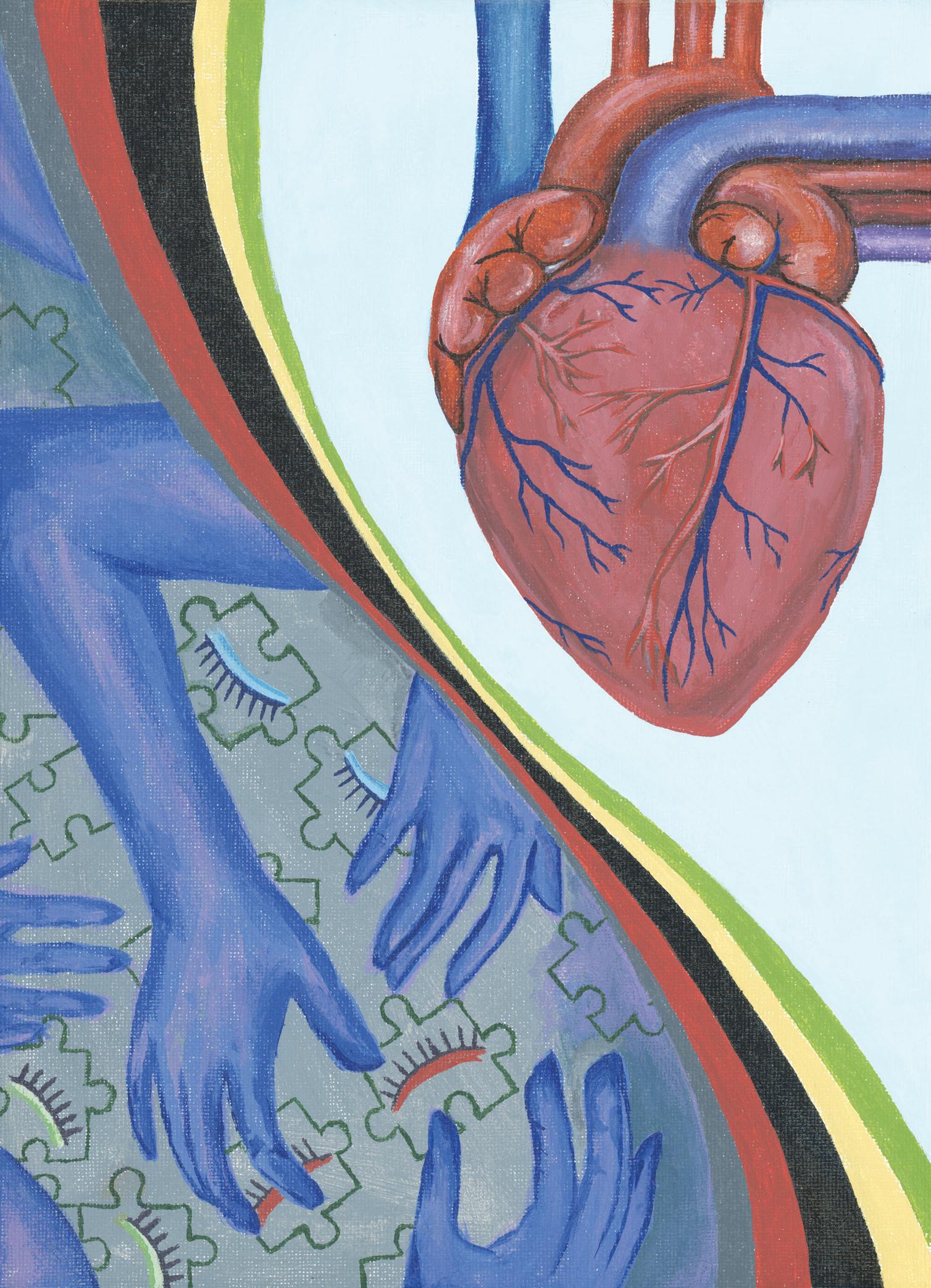
Poetry
DAVID LEE
Monitors keep their private music: three rooms down, a heart deciding whether to stay.
Midnight slides on soft shoes, dark as eyelid undersides. We write vitals like psalms: pulse 84, respirations 18, a systolic whisper.
Snow curves over Mount Support Road, flattening Lebanon into a quiet bowl of light. Inside, everything lifts and falls with tidewater authority: IV drips, ribcages rise, my breath caught in a mask.
2:11. An alarm splits the hallway. Metallic rupture, sharp as ice cracking along the Connecticut. I run, and the night has two tempos: the steady repetition of steps and the wild stutter of possibility.
When rhythm returns, it is altered: fragile, like a song restarted in a different key.
Near dawn, a patient asks if I sleep standing. I tell him the truth: some nights, sleep is a corridor that refuses to open.
He laughs, soft percussion that softens fluorescent edges.
Peeling off gloves, my hands remember 2:11, that bright faultline where constancy leans toward breakage.
KELLI KEHOE
Our lives were simple, our children amazing, We were moving towards the future. Then: Glioblastoma Multiforme Stage 4. The path we knew — gone. Brain surgery scheduled the next day. He opens his eyes. No idea who I am. But remembers his fantasy league password. Gives instructions for his brother to take over. Completely consistent with his obsession with sports. After a few days, a less than kind nurse. My brother-in-law less than impressed, My husband catches his eye.
I Got This, he says. Turns on his side as she works beside the bed — and farts right by her head. There.
The consistency of humor we always approached life with. Our rhythm, syncopated now but still ours. I knew we would be okay on this new path of saying goodbye. We’ve found a different rhythm: measured not in years but in good days, in moments he knows my name, in laughter that lives alongside grief. The path ahead is different but we’re walking it together, finding the beat as we move towards goodbye.
CRAIG AMMERMAN
My brother, sister and I opened the doors under the kitchen counter and were dumbfounded by what we found.
We were breaking up my mother’s house after she was unable to live alone, and we discovered my mother’s secret hoarding obsession — plastic bowls with lids. They were bowls from butter, ice cream, whipped cream, etc.
We really had to chuckle at the sight of stacks and stacks of bowls and lids under the counter.
We had no idea! It was her little secret.
Any time any of us three and others would have a meal at Mom’s house, she always cooked, as she said, “for an army.” There were always leftovers for anyone there.
She would shush everyone out of her kitchen and join us later after we could hear her rustling about in the kitchen.
As we were heading out the door, she would hand over a bag of leftovers from the meal to everyone. There was always enough for an entire meal at each of our respective houses.
She would always say, “don’t worry about the containers, I have plenty.” We didn’t even think about it. We would eat the leftovers and throw away the containers.
As we were finishing up cleaning our the cabinet, we had to laugh now because we saw that she had enough containers for whenever her children had a meal with Mom.
VICTORIA XIN
During my forays into ceramic, I hand built a set of three bowls, three plates, and three cups. Ridged and irregular, I held the intention of glazing them a pastel pink. I was eager to complete a set of dishes that were cohesive in color and style, a task I failed to do prior. Each of my previous bowls were subject to my flights of fancy in choosing clay types, glaze colors, shapes, and sizes. When they stepped foot out of the kiln, they did not look the least bit related. And yet, when we purchase professional dishware, they often come in sets of four, perfectly stackable, perfectly genetically close. I was eager to recreate this cohesion. This time, I meticulously crafted my new set of dishware. The first day, each was slowly hand built using a white clay. Next, they were birthed from the kiln as fraternal twins. They were dip-glazed as such, inside the bucket titled “Western Peach Gloss.” The test tile was a precious, delightful pink, suitable for a baby’s bassinet. I awaited the final step: sealing silicone to bisqueware in the final trip through the kiln. As they arrived together en masse as finished pieces, I was stunned into silence. My ceramic vessels, ridged in their initial formation, were a glossy grey-pink — the color, texture, shape of intestines. Bowls turned to bowels, plates peristaltic, cups to colon. They were cohesively intestinal, stackable. A slinky of submucosa. I became unsure of eating off, drinking from these vessels. A wry smile. Despite the cold, still nature of clay, my creations displayed the challenging unpredictability of life.
HEATHER WISHIK
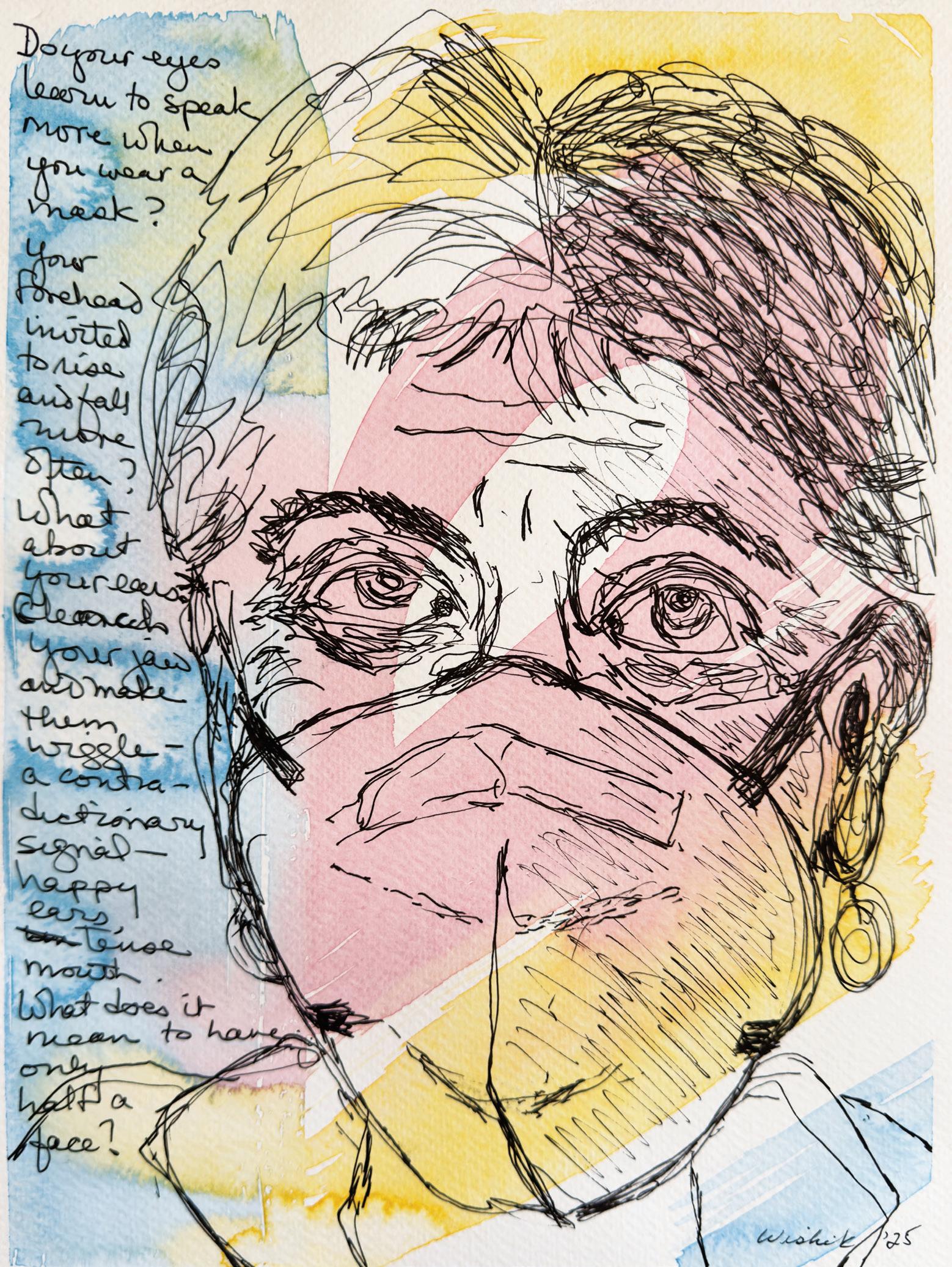
self portrait | 9”x12” watercolor and ink with commentary in ink
LUCAS D. CUSIMANO
Orchestras hum with the wave of a baton
Engines roar with the swift twist of a key
Pagers jolt with a rumble and a scream
Signals of distress to be heard to be felt to be seen
In this moment a man lies slack, bone touches air, a heart quivers, and we take turns to beat his chest
Unsolicited stillness soon slips into the room
Silence shatters with the wails of a ruptured family
But don’t forget that call reports are due by 4pm.
LINDSEY ALDRICH JORDAN
Three years ago, just before going for a college semester abroad in Berlin, I got a Covid infection that led to post-acute Covid (PACS, known as Long Covid) leaving me with severe brain fog, fatigue, and post-exertional malaise (PEM), among other symptoms. In many respects, I’m lucky to have gotten Long Covid so young, because I’ve been able to steadily get better within these last three years, and had for the majority of that time, a lot of hope and drive to be well again. This seems to be what you are meant to aim for when you are sick: to be normal again, and to never give up on that goal. It’s something I’ve worked very hard on. But as time has gone on, I am coming to the realization that I want, really want, to give up. Not give up on getting better, exactly, but give up on the hope of ever being again, not sick.
When I first got sick, I didn’t know how long my illness would last, I didn’t know if it would get any better, or if it might get worse. I had a constant headache, I was rarely able to sleep a full night, fatigue was more common than not, and my symptoms took away the things I loved the most, the things that I had gathered in my early twenties which helped me live well: exercise, reading, writing, traveling. I clung to the hope that I would one day be well again like it was a branch on the side of. If I didn’t hold onto this branch, this hope, I would fall off the cliff, and the consuming despair of being unwell, of the parts of my youth I lost, would be too much, would make being sick, and maybe make life in general, unbearable. Tolstoy renders this feeling perfectly on page 353 of Anna Karenina (a book I recently found myself able to read again): “the situation was painful for all three of them, and not one of them would have been able to live even in day in that situation had they not expected that it would change and that it was only a temporary, grievous difficulty which would pass.”
I committed myself to taking care of my illness, I learned how to rest, how to pace myself, how to give things up and take regimented care of my symptoms in the secret promise that it was temporary. Someday, this hard work and patience would pay off, and I’d be well again. I’d be able to run or spend a whole day climbing a mountain with friends, or not have to worry about whether I could go out somewhere far from home or about whether to hide my illness from my employers. At the beginning, I was willing to accept my illness and that the structure of my life had changed, on this condition: one day, it would end.
That was three years ago. If you count the year before, when I got a less severe case of Long Covid, I’ve been sick for four years; the better part of my twenties. And in that time, I’ve gotten much better. I can read again, fairly clearly most days. I can comprehend what people are saying the majority of the time, and I can sleep full nights. Even if my sleep is still somewhat inconsistent, I no longer have a constant headache or sinus pressure or a cough. I can’t get my heart rate up, but I can do yoga, go for long
walks, and spend time with friends. But even with these improvements, I’m not totally well. Getting much better has still meant being sick. And I’m getting exhausted by this goal, expectation, hope, that one day I will one day be well again, that I will be a healthy young person. It means being upset when I am still sick, when there is something I can’t do, when I have uncomfortable symptoms, all of which I encounter to some degree every day. And the truth is, while I would never say that having Long Covid is pleasant, I’ve gotten used to it. Not only in the sense that it’s no longer novel to me but also that it has become, for me, normal. It has integrated itself into how I live my life, into what my life feels like, and I can’t totally separate what is me versus what is the illness. I am used to having days when I can’t think, days when I need to stay in bed entirely. I’m used to being cautious with my health, and I’m used to finding pleasure in small things, in cultivating and appreciating comforts, in having gratitude for the days when I feel rested. I don’t remember exactly what it was like to not be ill anymore and it’s hard to know what in my life is a condition of my illness and what is just a condition of being human.
This goal, of not being ill, seems at first self-explanatory and simple, but the closer I look at it and what it entails, the murkier it becomes. What would being well look like? Sleeping well every night, not having headaches, not getting fatigued, always being clearheaded, always able to express myself? Even a healthy person can’t expect that all the time. But I’m not sure I remember what a healthy person can expect, and so in my head I picture being well as the elimination of all my symptoms.
Recently I was complaining to a fellow long hauler that a close friend of mine had said didn’t realize sleep was something I struggled with as a result of Long Covid, that she thought my sleep problems were something I’d had before. My sleep has been what is most impacted by the Covid, and I often think of it as having the most impact on how bad my other symptoms are. I expressed frustration to my fellow long hauler that my friend was unaware of the most essential part of what made me ill. My fellow long hauler smiled and said her friends forget sometimes, too; that when they are going out they walk too fast or do too much, forgetting that her asthma could flare up or she could get too exhausted. It’s good, though, she said, that people forget. It means they aren’t seeing you just as a sick person, they are just thinking of you as you. I was struck by this. I’d never thought of it this way. Generally, I want people to remember, and to think, when I have to sit down when everyone is standing or I can’t retrieve words, that it’s because I’m ill. I want them to assume that I have more potential than it seems, that my capacities are buried under a sickness that makes me dumber, slower, and lazier than I truly am. I want them to see my weaknesses and faults and say: oh, well, she’s sick.
But there is still a lot I have been able to do while sick. I finished my degree, returned to Berlin for my last winter break, did an internship at an Archiv in Germany, started teaching, moved to Spain, have written regularly. Yes, I can’t do as much as I could before, when I packed as much as I could into a day, but now, I just have to prioritize what actually matters to me and let the rest go. I have to be ok with gentle exercise and prepare if I travel. I have to let the people around me know where I’m at, even if there continued on next page
is a lot of vulnerability in doing so. But if I’m able to manage my symptoms and live as a sick person rather than a healthy person, my life is not awful. This is not to say there isn’t grief and disappointment and discomfort, and it’s not to say it’s easy, because the world is set up for people who can push themselves past their limit, not for someone who has to be overly aware of their limit and cautiously approach it. But my life is infinitely better when I live it as a sick person rather than try to live it as the healthy person I’m not. When I live as a sick person, it’s just a matter of adapting to those circumstances, which is entirely doable. Being ill actually makes it so I’ve had to listen to myself better, prioritize what is best for myself rather than what others are doing, and only focus on what is really important. Now that I’ve gotten used to being sick, and gotten fairly good at managing it, it’s the having to act healthy that causes the most suffering.
So what am I letting go of when I say I’ve decided to give up? What is it that I am giving up when I say, definitively: I’m sick, I’m not healthy, and while I will continue to get better, sometimes I will also get worse. If I say, there is a good possibility I will live the rest of my life with the caution that illness requires of me, with the effects of the illness on my body and mind.
Before I was ill, I would push myself to do more. I had a hard time doing things half-way, even if it wasn’t necessary to do things perfectly. I was always trying to outrun the feeling of not being good enough, a feeling that always seems to catch up with me, no matter how hard I worked to leave it behind. Maybe, if I did everything as it was meant to be done, if I took hard classes and did every bit of reading assigned, If I stayed on top of each task that needed to get done at work, if I didn’t just run but added strength training on top of it, if I cooked all my meals from scratch, I wouldn’t have failed. To some degree, what I’m giving up is the idea, probably false, that I could potentially, someday, become that person who had done all the things that allow them to avoid “not being enough”.
In a recent meeting of the PACS writing group I attended over Zoom with the Dartmouth Hitchcock Covid clinic, one participant shared a poem about being exhausted. Her mother kept telling her not to give up, to try and get healthy. The daughter repeated in her poem over and over: I’m exhausted, I’m exhausted, listing out that normal day to day things exhausted her, that trying to get better exhausted her. I unmuted myself after she read and said: maybe we can let ourselves give up. This goal of not being sick anymore, while maybe essential, before accepting that the illness might be forever, at some point stops being useful and begins to be demoralizing. It’s been years and I’m still sick, we can say to ourselves. But with Long Covid we don’t know if we will ever be better, totally. And so this goal is not a reliable one. What is reliable, though, is the goal of finding comfort despite our symptoms, of focusing on what is most important to us, of being proud of how we have learned to take care of ourselves, and of accepting ourselves as simply different, not less than in value, because we are ill. continued from previous page
Fatigue is extreme
Brain fog is blurring my vision
Weakness is sitting in the chair for a period of time to recover and restart
Incontinence is a daily battle
Dizziness comes and goes daily
Misfiring of my automatic nervous system
My built in thermostat doesn’t work to full capacity
Sleep disorders
Vision issues
As these symptoms are shared with my doctors each doctor has their own thoughts: some believe in small doses, some will say you can’t have all these issues, some will ask what is my worst symptom
I’m looked at in disbelief mostly I am told I look healthy.
What has looking healthy got to do with listening to what is going on in the inside where you cannot see? My battle feels invisible and it’s hard to fight for what no one can see.
Listening is the key to getting healthy with the assistance of all my Dr.s
Listen, listen, listen I live in this body you do not.
What are the results of not listening to me?
Stress — of whom is going to believe me
Depression — I cannot live feeling this way everyday
Seeking ways to diagnose myself — will I make things worse or will I become my own doctor
Confusion — how do I make the medical world believe me
Distrustful — how can you trust when they don’t trust me
Where is the rhythm in all of this mess it seems more like chaos or rhythm disruption. We all need to advocate for ourselves and others. Speak out everyone.
HEATHER WISHIK
With thanks to Rita Dove
The muffle of a voice behind a mask calling good morning as we pass each other around the far curve of the high school track, fellow walkers –— never closer than six feet.
The clang of pots and pans drummed the way my son, at one, used to bang them seated on the kitchen floor while I prepared supper, only now it is adults, whole families, on balconies, driveways, porches, sidewalks,
in unison, seven in the evening, thank you’s to the doctors, nurses, EMTs, all doing their best to save our lives. Noises of desperation, of community, of attempts to love
while we keep our distance. We are potentially deadly to one another. And, of course, it is exactly at this moment, via phone, my weeping doctor says “You have cancer, and we must kill your immune system to treat it.”
What melody does that have? Staccato in the belly, tenor gasps as my breath catches, obligato low sobs. No one in their right mind would sign up for this lullaby.
ANDREW YANIK
The warmth of a fresh bubble bath.
Cleansing.
Toys! Splash!
Jammies and Go, Dog. Go!
One more book, Daddy?
BEEP. BEEP. BEEP. Call back: Urgent.
The chill of hypoperfused extremities. Decaying.
Code cart. Crash.
Drips and machines
One more try, Doctor?
ALAN SHULMAN
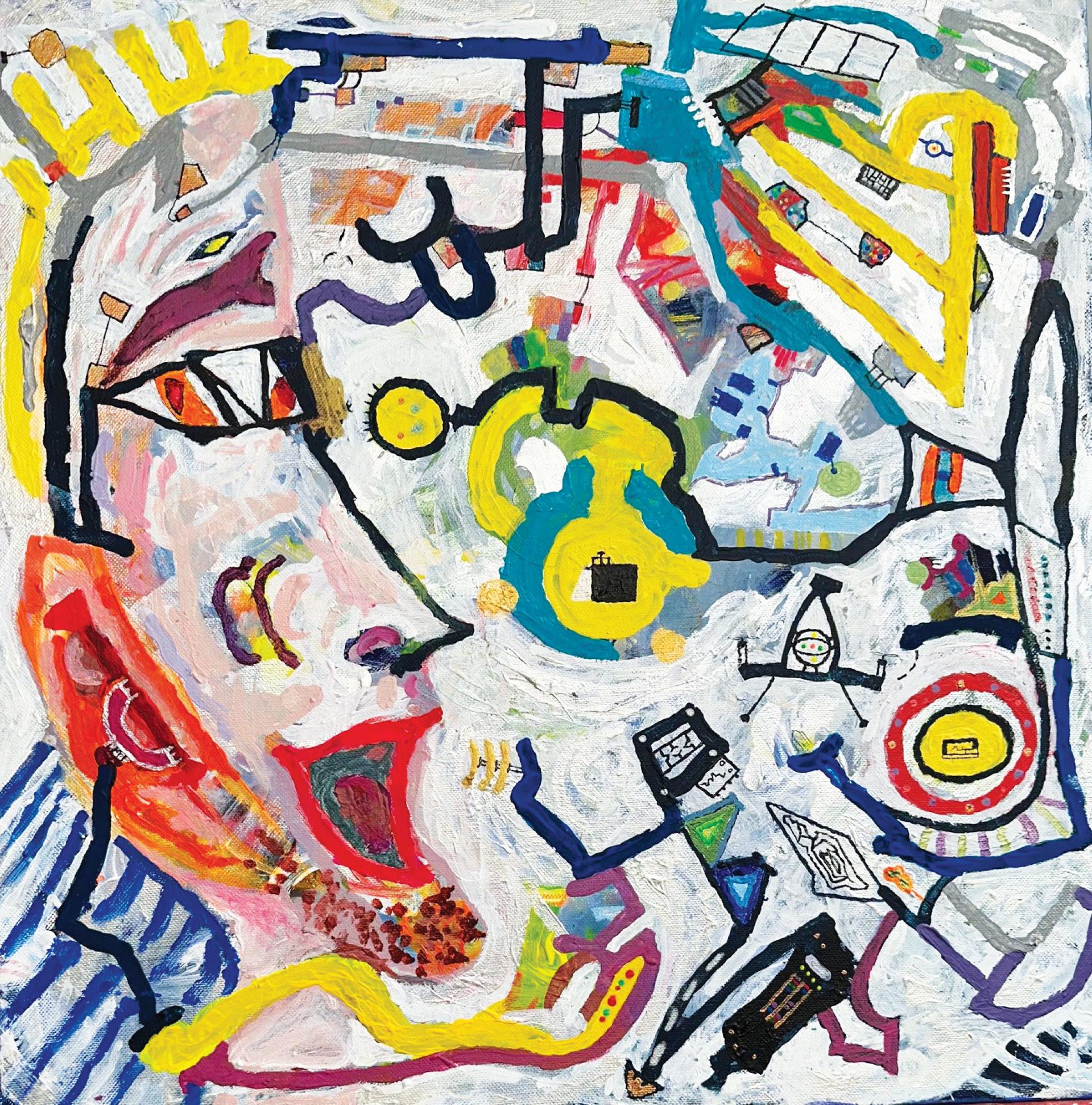
This image depicts the challenges we face in a world of media and chaos. acrylic on canvas
NENIA BALLARD
The bottom drawer of my art box was where crayons went to die. It held the tiny nubs of once beloved colors, the broken halves of frustration, and the pristine points of the whites and other colors I deemed useless.
The bottom drawer of my art box was a waxy wasteland of space I could probably have used for other things, but once I had started throwing the scraps of crayons inside, I couldn’t imagine it as home to anything else.
“These are trash,” my mother said, during one of the many rainy afternoons that had been dubbed for spring cleaning.
She wanted me to organize my art supplies and utilize the valuable space for something practical. I had other supplies that needed to be put away, after all. Things that I could easily store in this drawer if I emptied it of its worthless contents.
But even though I never used the crayons in this drawer, I couldn’t throw them out either. They had once been useful, and it wasn’t their fault that they had ended up in the bottom drawer of my art box. It wasn’t their fault I ground them to within an inch of their lives, or broken them, or just didn’t like them.
It wasn’t their fault.
Sometimes, while I’m lying on my couch feeling colorless and broken, I think of the crayons in the bottom drawer of that art box. I wonder if someone practical and efficient, like my mother, would like to come along and scoop me into their dustpan during spring cleaning. Bundle me away and throw me in the trash to tidy the space and organize the room. I am, after all, usually a mess.
But, like the crayons long ago, it’s not my fault that I ended up here,broken and messy, hanging on for dear life.
It’s not my fault.
SHARON LYKINS
From the time you get the mammogram bad news call
You are on the medical conveyor belt taking you to more and more testing
Ultra sound (You’ve got a “thing”), Biopsy (You have breast cancer), genetic testing, the geneticist (It is in your genes).
Stopping at the cancer center to meet THE surgeon, his nurse, a social worker.
No choice in who they are.
You are now taken care of by a team.
I know they mean well and want to be COMPREHENSIVE but It is really too much for one visit, for one brain, pickling in trauma juice, to comprehend.
Surgeon has planned a lumpectomy
I want a mastectomy
Yes, and reconstruction, he says.
No, just flat.
Back on the conveyor belt to more testing and surgery
Meeting with the surgeon post op
He doesn’t like that I find the scar ugly and hate the dog ears
He gives me a brochure for getting fitted for prosthetic breasts and a bra.
If I was going to be without my breasts
I wanted to be flat
Not twisty and lumpy and ugly with doughy triangular flesh sprouting from my sides.
I don’t want replacement breasts or a stuffed bra
So I fit your social norm.
I wanted to be flat and get tattooed and be me.
Now, I have to step back on the conveyer belt and go to plastic surgery.
Poetry
1. sat in rooms with white lights waiting, waiting, waiting
CHIAMAKA AGALI
2. for a nurse who leaves me out waiting waiting waiting
3. in a room where i sit waiting waiting waiting
4. for a doc who’s left others waiting waiting waiting
5. who sends tests sat in silos waiting waiting waiting
6. not disclosing what to do with all the waiting waiting waiting
7. i go back to the rooms waiting waiting waiting
8. when the pain is done waiting waiting waiting
9. so i bite on my nails waiting waiting waiting
10. for it to go back to waiting waiting waiting
11. they come in leaving others waiting waiting waiting
12. “aren’t you glad to be done” waiting waiting waiting
LAURA TAFE
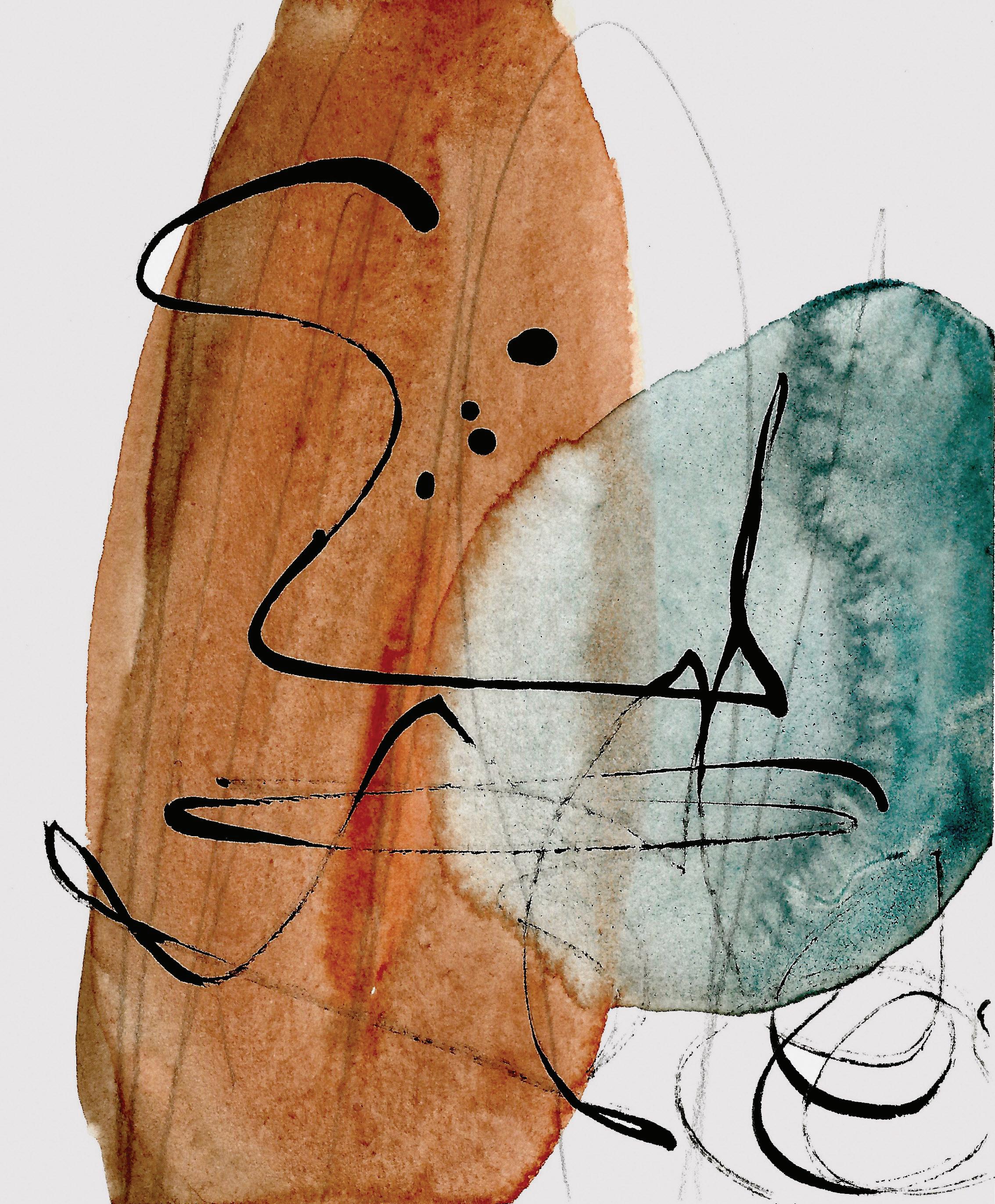
watercolor, pencil and ink | 3 x 5 inches
DAVID LEE
The waiting room gathers people like loose quarters. A child coughs into her coat, a man reshapes fear into magazines, a woman rehearses her own name.
Behind plexiglass, the receptionist stamps dates as steadily as a metronome.
Rhythm in Hanover: boots shuffling snow from Wheelock Street, rustling forms, glances at the clock. Futures shift when a nurse steps out with a clipboard bearing names we hope are not ours, or desperately wish are.
But the story lives in the spaces between: when nothing moves, air holds its breath thin as drum membrane. I watch my reflection: two selves blinking out of sync.
A radio murmurs weather, promising flurries toward White River Junction. Someone prays into a coffee lid. My heartbeat echoes inside the plastic chair, steady as an old engine. Then worry arrives: no louder than a page turning, yet splitting the room into “before” and “after.”
When my name is called, the sound is invitation and incision. I rise, leaving the clock, the chairs, the faint warmth where my hands rested: all small, temporary rhythms that kept me whole while waiting for whatever comes next.
JUDY DORAN
As a school nurse in the teeth of the Pandemic, I once wrote an essay about the before times. To illustrate, I used some examples: hybrid was a kind of car, 6’ was a tall person, personal space had to do with your comfort zone, remote was a far-off place or your chance of winning the lottery, masks came out at Halloween, and so on. You get the point.
A glitch has come up recently and that essay came to mind. It has made me think about context and contours, image, identity, awareness, self, conflict and acceptance. My NP said, “Friend, you need a little acceptance, commitment therapy.” I think that it’s kind of like couples therapy except I AM the couple; the old me and the new one trying to figure out the unfamiliar contours of life in the now.
The glitch appeared as a diagnosis with my name attached. Slow creep, denial, gaslighting, bargaining, avoiding. Why me, why not me? Damnit I’ve got a lot to do, a lot I’d like to do. Why is this firewood so heavy? How is dinner ever going to happen and why won’t a cold water splash on my face rally me a little better? Since when do I sleep in the day? Focus became unreliable. The fog maddening, saddening. Not just a softening of the edges, it can be thick and fickle and isolating. Words shape shift, and poof somewhere somehow before they roll off my tongue. Face in the mirror, ouch might be time to get some makeup pointers. How long can I pull this off when the weight of the dog leash draped over my shoulder feels so heavy?
I set about surviving, going with my gut and my natural and nurse-borne tenacity and advocacy. I mention this because again I wondered how a lay person could possibly navigate the barriers to care including insurance wiliness, loopholes, long holds, dropped calls, portal access issues, referral delays, delays, and more delays. The process is fractured and navigating it requires the kind of dogged determination that is in short supply in a person who is not feeling well.
The diagnosis doesn’t really matter here, what matters is what it means to the bearer,in this case me, and really what that means to all of us as health care workers. When I finally found myself before the pros I felt like I had come home. They got it. They got me. They named it. They nailed it with acknowledgement, respect, compassion, humanity, resources, education, pharmaceuticals and therapy, the part where I’m supposed to square myself with myself.
This brings me to the BIG PICTURE. And I am a big picture kind of gal which runs contrary to the plotting and planning now required to get the best out of any given day. I need to pay attention to what once was automatic, not thinking, everyday minutia…how much yardwork, housework, how far to wander with the dog? And oh yes what about my job, what are we going to do about that??? I need to plot and plan, play my cards right, pace my rhythm, wonder, do this AND that?, no plans after 12 noon, speak up, speak out, preserve, listen, learn, accept. Am I going to exceed my daily quota of mental, emotional, physical, social reserves? What are they anyhow? It’s a different approach to life and it’s taking a while for the “before times” me to get the hang of it. I still mostly look like me, but I’m a little bit different as I go through the process of updating to this new operating system. We all know not all updates are upgrades but never say never re silver linings. The jury is out but I’m open to the idea.
The BIG PICTURE reminds me that the eighty-year-old man before me for a blood pressure has not been an old man for that long. He was a little boy once squishing his small toes in the mud. He may have had a brilliant academic career, he may have had a crushing childhood, he may have had a solid, loving marriage or not. He may have been able to list every bird in the book or knew exactly where to look in the night sky. He may have sailed the seven seas or quietly plugged along in a cubicle or swung a hammer or studied scenes behind a lens. He may have been a vagabond or a cowboy or an author. He may have had ten kids or none. He may remember holding his mom’s hand to walk across the street, he may even remember the soft warmth of that or the bulky mittens separating palms. We don’t know that and can’t know that but we can know that no matter how he presents in this moment, there is a human before us who hasn’t been eighty years old his whole life. Many dimensions to us humans.
The contours are new to me. I do not welcome them. I do not like them much. I am a reluctant adopter (hence the acceptance therapy) but the perspective I’ve gained from navigating them as a nurse has been an eye-opening experience. There is a lot to be learned by walking a mile in somebody else’s shoes. I suspect I’m in very good company in wanting to trade them in for my old sneakers but for now my job is to trust the pros, lace up and forward march. And in the spirit of the big picture and all of our dimensions, I’m going to be sure to check the fit of shoes on the folks I meet as a nurse.
ALAN SHULMAN
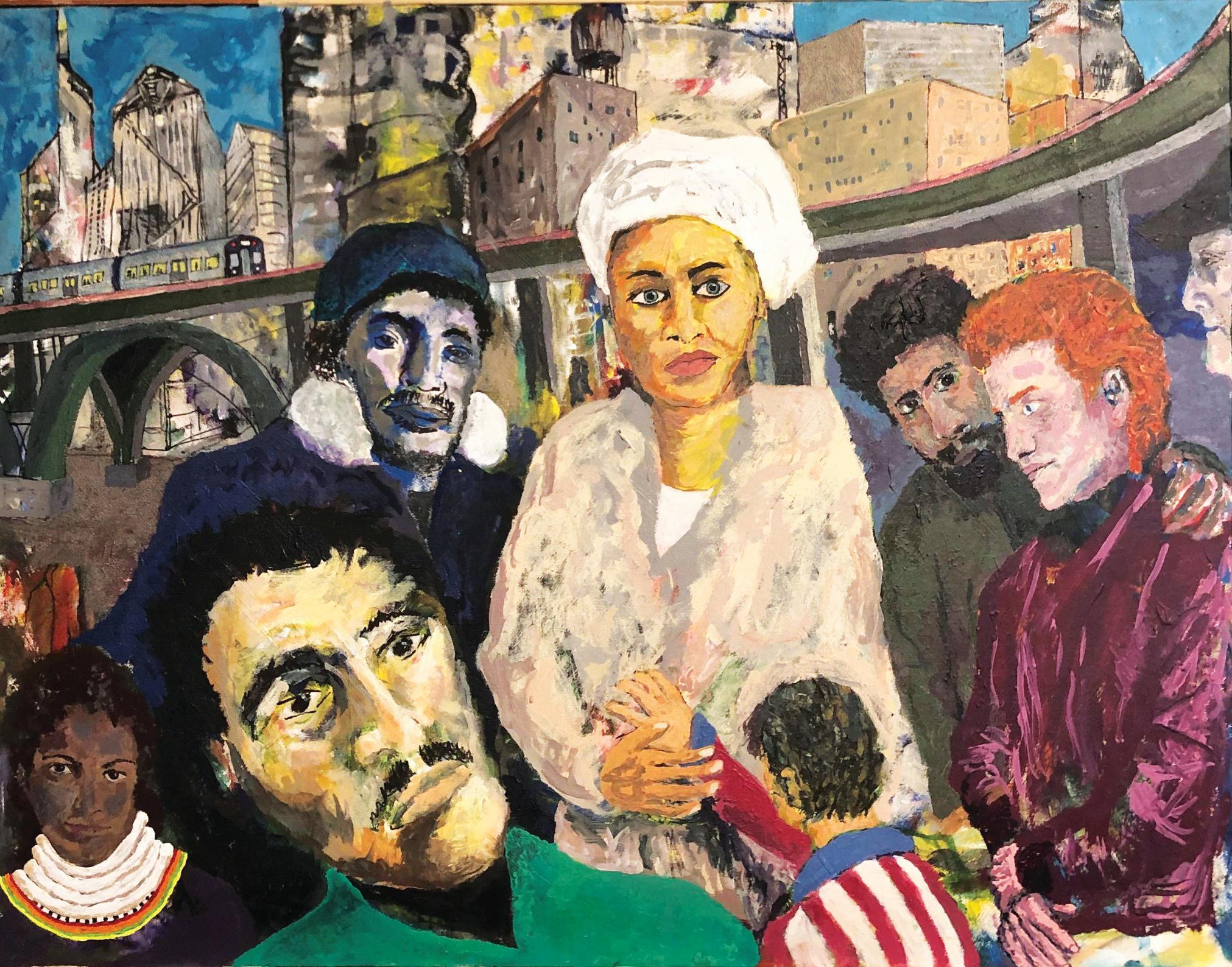
This image reflects his affinity for cities and the diversity that enriches our culture. acrylic on canvas
FORD VON REYN
It was an understandable desire — to find her biologic father before she died. But it would not be easy to locate him in Sweden, and it would not be easy to make the trip.
The first time I saw Annika in my office was two years earlier when she was 40, an age when she should have been looking at a long life ahead. She was a strong Nordic woman, living off the grid in northern Vermont. She had thick, blond Botticellian braids extending to the middle of her back. Her unadorned beauty occasioned comments from everyone on the team.
I soon came to see that it was her kindness, her remarkable kindness, that would be her defining feature. Each visit started with “How are you doing, doctor? It must be so difficult taking care of so many sick AIDS patients.” Kindness, and also acceptance — acceptance of her terminal illness. Acceptance of her mysterious misfortune.
A persistent oral yeast infection led to the positive HIV test. Most of the questions I asked about potential exposures were negative. She was living with one long term partner. But when I asked about earlier sexual partners she told me about her ex-husband. He had taken an engineering position in Zaire and when he returned 5 years ago he convinced her to get back together, an arrangement that lasted only a few months.
I didn’t need to know more. This was where AIDS first emerged — in sub-Saharan Africa. I had been to Zaire twice in the course of my AIDS research, had visited the Mama Yemo Central Hospital in Kinshasa where the flood of men and women dying with AIDS had patients sleeping on the floor or two to a bed. From chimpanzee to human to human. Now that silent southern virus had found its way to northern Vermont.
Her clinical course over the next two years was typical for the era before we had drugs to treat AIDS. We had been taught in medical school how to minister to patients with a terminal illness and how to find ways to be supportive. It could be difficult. But treating Annika was different. It always raised my spirits to see her on the day’s clinic schedule, to look forward to her calm and uncomplaining presence. And to know she actually cared about the person on the inside of the white coat. Selfish, I know, but I knew I was also helping her in return — treating recurrent yeast, zoster, and herpes, and trying to manage her weight loss. After a few visits I had her promise to let me be the first to ask “How are you doing?”
continued on next page
continued from previous page
Annika had never travelled outside the US, but on the first day that she had to be brought to the office in a wheelchair she told me she was determined to see her birth country, Sweden and to meet her father. She was the second of my patients for whom advanced AIDS triggered an intense desire to visit their birth country. Unlike my other patient with relatives still in Italy, Annika didn’t know if she would be able to find family in Sweden. She learned that all Swedish orphans over age 18 had an absolute right to discover the identity of their birth parents. What she had known since childhood was that her biologic father was a prominent industrialist. To avoid damage to his reputation he had insisted that his unmarried lover put their child up for adoption in America. Annika contacted the social service agency in Sweden and learned that her mother had died young. But there was a name and address for her father and he was still alive. She wrote him in English, said she hoped to meet him in Stockholm, and was awaiting his response.
Three weeks later she called our nurse and said she had a hand-written reply in Swedish. Could someone at the hospital translate the letter on her next visit? By the time of that visit Annika had become increasingly frail. There were no more braids. She was very anxious, held out the letter to me, then dropped it, but was too weak to retrieve it. I picked it up and handed it to our Swedish-speaking pediatrician, then ushered the two of them into the exam room for the translation and went back to my charts.
Ten minutes later two women emerged in tears - a healthy Swedish doctor holding up an ailing Swedish woman. The letter had been brief and blunt. “Why are you writing me after all these years? Are you looking for money to treat your AIDS? What a disgrace. No, I won’t see you, and you should not come to Sweden.”
Annika was determined. She didn’t have the money for airfare, but SAS agreed to provide a ticket. She had her week in Sweden. A week when an old man missed the opportunity to meet a remarkable young woman. On the last trip she took.
[Names changed]
ROSA L. SMITH
is it too much to think of the genetic origin of certain diseases? is it possible to re-consider the why of why i came down with multiple myeloma? is there an environmental consideration as well or is it genetic or chemical or familial or some sort of combination?
i was born in Bennington Vermont in 1947 and i lived in Hoosick Falls until the age of 8 months. is it too much to consider that the factories that manufactured and contaminated the water supplies in those locales contributed to both my multiple myeloma and that of my father who was also born there in 1917 and diagnosed around 1985? is it not now a well known fact that Hoosick hosted a factory that made special products for the purpose of coating pots and frying pans with a pre-cancerous finish called teflon containing a toxic ingredient called PFOA
and whose effluent was washed away into the ground and surface waters and well waters of the local bucolic countryside where Vermont and New York meet up and where there has indeed been an epidemic of cancer?
can the outside environment have thus impacted me that i can blame this disease on blatant chemical pollutants that were prominently used in the early or middle or latter part of the last century or from some inherently defective genetic material that i might have inherited from the paternal side of the family?
KATHRYN PETERSON
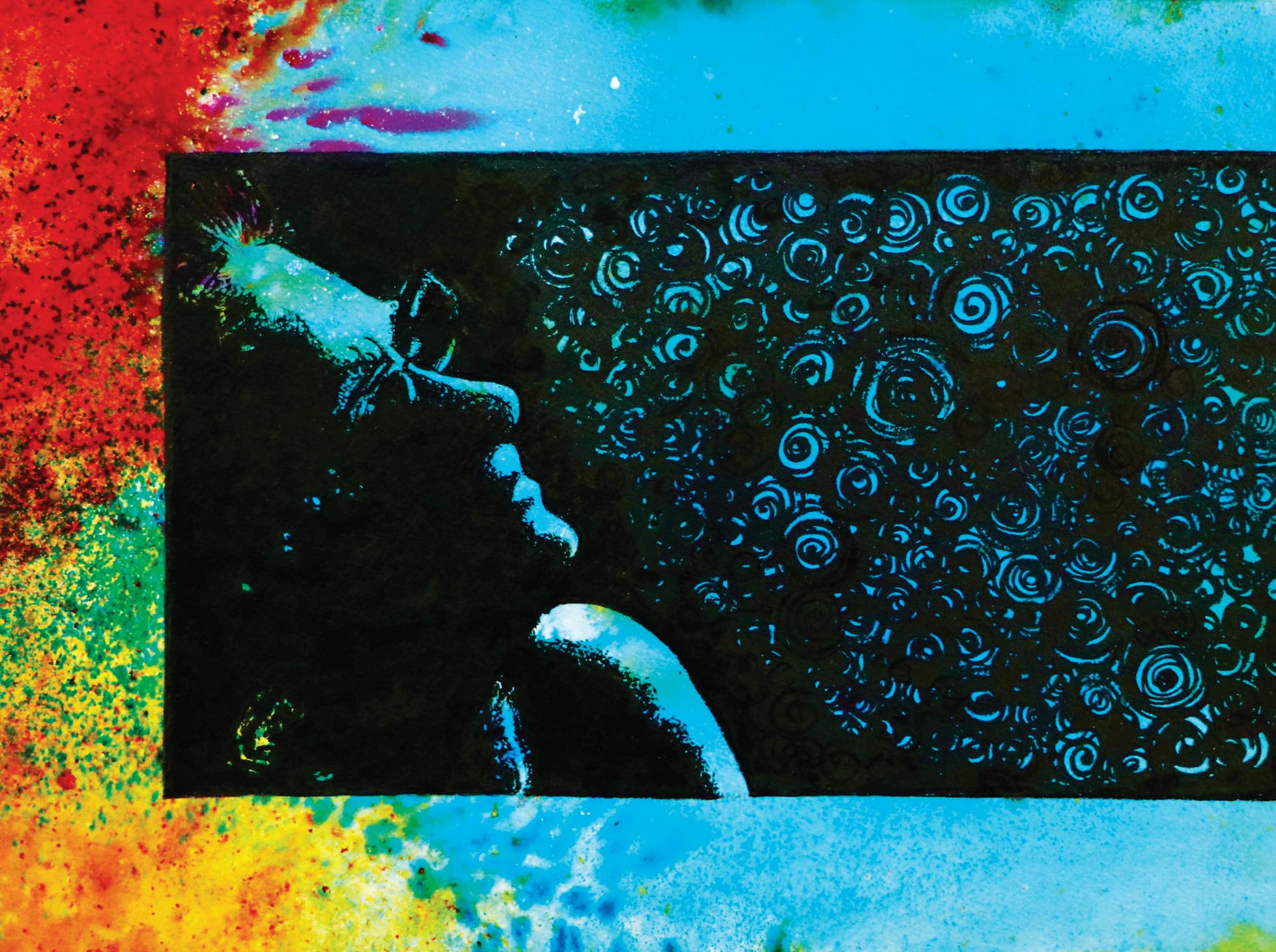
Self-portrait | 14” x 11” ink and watercolor on paper
ROSA L. SMITH
I wonder where I would have gone If I had not gone to bed With cancer
Growing inside my body Swirling around in my blood.
I put on a brave face.
I try not to leave a trace, But a dusting of pollen Lands on my hands When I shake The busily foraging honey bees That enjoy my hydrangea.
Now when I shake the tree I notice again where I planted it. Although the bees can busily pollinate This particular variety it is no longer a bush And I realize I had planted it too close.
Too close. Branches rub Up against old farmhouse clapboard Typical of a time and a place Like me before this torment started. Even so, I pick a bunch. I like it dried For the winter.
I know I’ll need to prune more branches This fall or in the spring Which may help reduce sadness
Mingling with unexpected side effects Of where I went.
NENIA BALLARD
I’ve heard the phrase, “Your body is a temple” more times than I can possibly quantify.
I’ve always thought it was bullshit, This body does not seem like it deserves to be honored or treasured. But recently, I saw a documentary where explorers were traipsing through a derelict temple from some forgotten time. The walls were crumbling, The floors were unstable, Trees grew through what used to serve as windows, The explorers had to be careful of their footing, And it had been a long, long time since anyone had come to worship. Maybe I’m a temple, after all.
GRACE LYNN
We lay on the lawn where her house went up in flames.
Only I had seen the penumbra negative, the CAT scan of her brainstem. She squinted, one eye too reactive to sunrise. Her right hand rested useless on her lap. Hope was all that was left to her, all of her poise.
For her, I reclaimed and renovated this place, built a new house, planted a second elm, the small tree now three stories tall.
In two months, she’ll be gone, such was the avarice of the cells, so unfortified the nervous system.
Here is the lawn, here the mailbox, where one Saturday in July, she’d assembled a quorum to say Kaddish for my father. She loved every living thing; she admired the elm, the button-sized chrysanthemum, the toucan whose pizzicato taps are the punctuation of her memory.
I held her good left hand, still the romantic, “What a wonder this hand is,” she remarked, “thirty years I seldom used it, and now, look what it’s learned to do.” We gazed together at what was left, at what was growing.
LAURA TAFE
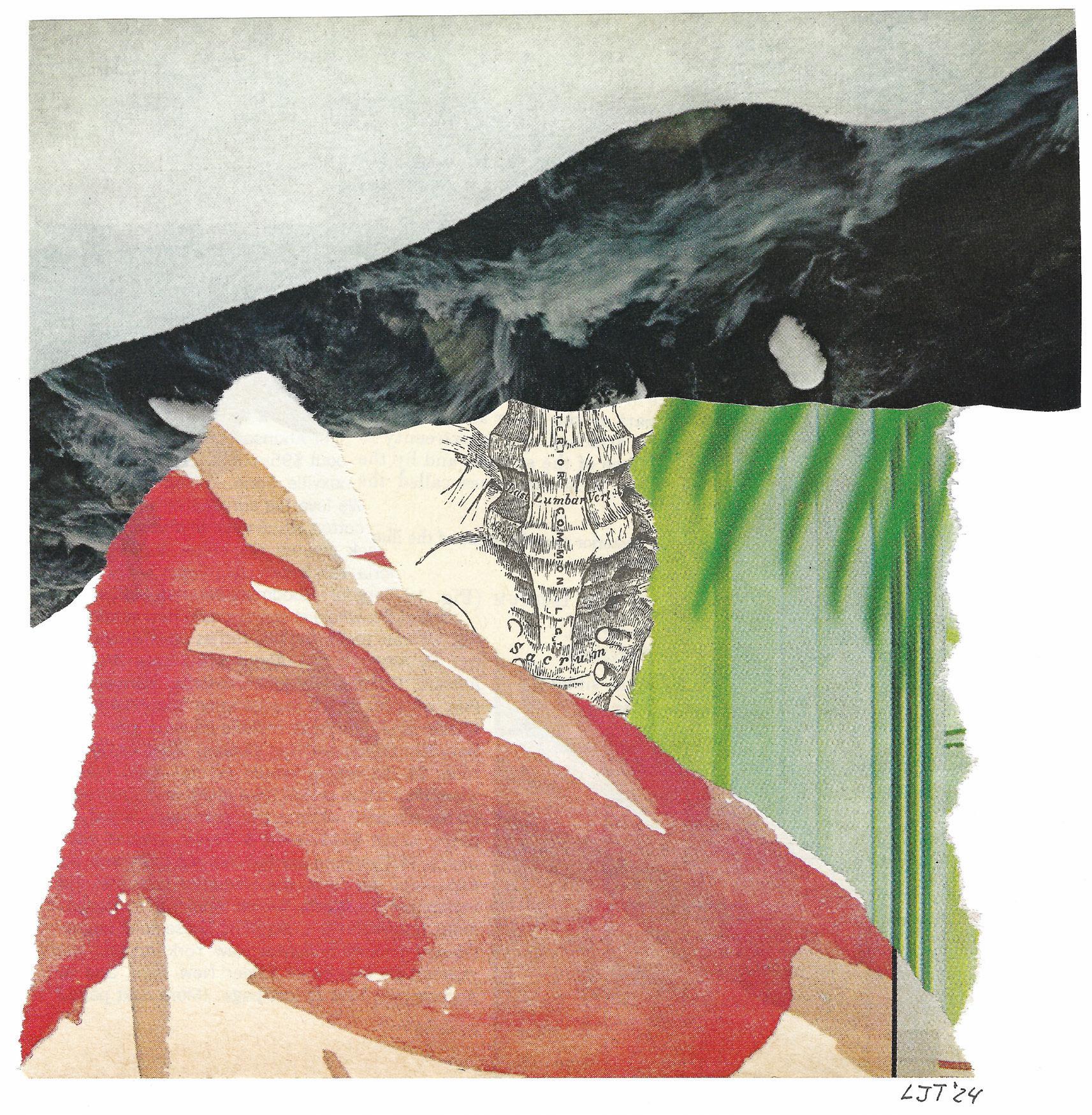
BRETT ANN STANCIU
At the beginning of this cancer journey, I’d refrained from Dr. Googling and asked my daughters to avoid that snakehole, too. I had a few friends who did not desist and pestered me for written materials about my specific lymphoma and treatment and surgery. I ignored these messages. I had zero interest and no energy to explain my decisions to anyone, save my tiny family. When I was admitted for that first stay at Dartmouth-Hitchcock, I was veering towards septic, my belly chockful of cancer. Within hours, my oncologist Dr. G explained the proposed chemotherapy in precise detail and all the wretched possibilities that might befall me: blood transfusions, dialysis, uterine cancer. By then, my choice was live or die. Goddamn, I wanted to live.
I’d returned to Dartmouth’s ED repeated times, and the surgeons had stood around miserable me in the hospital bed under bleached-white blankets so frequently I knew them by face and name. What I could eat had dwindled to crackers and broth. I agreed to surgery not based on reading materials or any checklist of pros and cons, but a gradually accrued understanding that I was dwindling away to wispy nothing. Which looked like death.
Mercifully, no one ever asked me statistics, especially long-term survival numbers. I broke my own internet-ban rules and read these. I kept this knowledge to myself.
In the mire of chemo, I’d looked up an essay by Stephen Jay Gould that I’d read years ago, “The Median Isn’t the Message,” an examination about what Mark Twain called damned statistics. After surgery, now inching day-by-day back to life, I read the essay again about his “holy war on the downgrading of intellect.” I’d begun this cancer journey on the eve of an election that cleaved the nation ideologically and emotionally. People were for or people were against. Implicitly, I immediately grasped that, to survive, I needed to strip away opinions. What were the facts? This was no easy task. Around me, in the vein of utter well-wishing, people questioned my daughters. Maybe the scan had been read incorrectly and the cancer was cysts?
What about turmeric? Milk thistle? St. John’s Wort? Drug companies are greedy evil entities! Carrot juice! Seaweed!
continued on next page
continued from previous page
Gould wrote, “Attitude clearly matters in fighting cancer. We don’t know why… But match people with the same cancer for age, class, health, socioeconomic status, and, in general, those with positive attitudes, with a strong will and purpose for living, with commitment to struggle, with an active response to aiding their own treatment and not just a passive acceptance of anything doctors say, tend to live longer.” Unwittingly, I’d followed this precisely. Commitment to struggle? Will? Action and not passivity? Finally, my years of writing work were revealed as strengths, not mere madness. I also used what my fearsome divorce had taught me. I sized up the lay of the landscape around me. I trusted Dr. G for his knowledge and experience, his kindness to me and my daughters and anyone else who walked into my room, maybe a nurse or phlebotomist. I strove to follow his instructions as precisely as possible. I’d lived long enough to respect that actions mattered more weightily than opinion or belief.
What I refused to relinquish — and this drove my family mad — was my willful obstinacy. For months, I nearly always wore some variation of pajamas: sweatpants and t-shirts, hospital johnnies. I abandoned my hand-knit wool sweaters, the jeans that were now too big for me anyway, my heeled boots. Wispy bald as an aged woman, I lay in that hospital bed with tubes in my arms and sometimes in my nose, or slept on the couch or my mattress that had been moved downstairs. I couldn’t climb the stairs to my bedroom, the second-floor closet with my knitting needles and yarn stash, couldn’t carry in firewood or boil a pot of rice. But relinquish my will? Lie back and let decisions wash over me like a child’s soapy bath?
Feistiness fed my soul’s furnace, clanging and desperately in need of repair. My mother had railed, “You’re so obstinate!” In those endless days and nights on my sickbed, my thoughts often drifted to my dead mother. If she was alive and in good health, would she had come to stay and tend me? Would she have mailed the things that she would have surely known would soothe me: a colorful quilt, warm socks, flowered flannel pajamas? Mercurial, my mother might not have offered empathy. But the stubbornness that, surely at least in part, saved my life, I learned from her.
And the raw truth about statistics? Lymphoma knows no statistics. If cancer was determined to return and inhabit my body again, it would, statistics be damned. I had no illusions.
KAREN RANDLE
My lung cancer diagnosis came in April 2021, and I’ve since had time to think about how to make meaning out of the craziness and chaos of living with what now, five years later, is metastatic stage four lung cancer. Soon after the trauma of diagnosis I wondered, when do we begin “actually dying?” I set out to answer the question of what the difference is between the physiology of dying vis-à-vis dying in the abstract, and by extension, what it means to be alive.
My conclusion is that dying begins with the clinical encounter in which you’re told you have a life limiting (terminal) illness, that catapults you into a universe where there is no longer a firewall between yourself and your mortality. Your mortality firewall — the impenetrable cognitive barrier that holds death at bay — collapses. The information that accompanies a diagnosis, which confers knowledge that your illness is terminal, is at a far remove from the knowledge-backed-up-by-evidence statement “everyone dies” which is by definition abstract because it is not activated by a serious illness diagnosis.
When the mortality firewall comes down, you step over the rubble into an upside-down world, where efforts to not die become the curious work of staying alive. The trauma of a diagnosis of cancer causes a complete rupture of identity, which severs your connection to an assumptive world with its map of the future; only riddles remain of how one’s treatment unfolds in infusion chairs and on radiation tables. One lives in a painful unanswered question.
With a diagnosis of serious illness, or what is sometimes referred to as “life limiting illness”, you’ll quickly find out that everyone knows they are going to die, because that is what people tell you. We may be chastised for worrying about death with reminders that everyone dies. If anyone has said this to you, try to credit them with an insanely inept effort to be empathic. They still have their health and firewalls which sustain the illusion that illness, dying and death cannot happen to them.
As I’ve wrestled with the existential question of whether I am primarily living or dying, I’ve found I am best served by allowing myself to live from a perspective that I am dying. This is a tough sell to family, friends, and your oncology team, even though I am clear that I want to live, joyfully and in appreciation of the abundance of all the gifts being alive bestows. Yet life is the mystery, not death, and that is my starting point for living with advanced lung cancer, with its corollary that survivorship is secondary. We are “dying while living” not the other way around.
continued on next page
continued from previous page
This is a hard concept to grasp; we speak all the time about “living with serious illness” and this is the exact problem with our language, and our culture in which we are unable to express the correct relationship between life and death when the firewall comes down and illness is operationalized. Knowing you will die is conceptual, an abstraction, but dying while you live is “actually dying” and making meaning of this experience is to wrestle with the ultimate existential question.
I have discussed the value of a prognosis with my oncologist, Dr. Keisuke Shirai. He says that in Japan, people will ask “Will I see cherry blossoms?” So, I suppose, what I want is more life- to see the cherry blossoms. When asked what they want, patients with serious illness will say “I want more time.” Yet when we live from the view that we are dying while we are living, we can connect with the major takeaway from thinking we want more time, which is we are already in the more time. And we have been living in the “more time” since birth. The difficulty of touting survivorship is that we leave death out of the discussion; if we begin with the honest discussion that there is an endpoint in death, we can live from the passion and humility of cherishing our lives because we know life is finite.
My firewall came down at diagnosis, but since then, the awe of mortality is fully intrinsic and present when my eyes fly open with each new day. We can live from a place of love and tenderness, with humility and in awe that the very meaning of life is embedded in our willingness to embrace dying as a normal experience. This view enables me to live meaningfully, joyfully and importantly, free of fear.
The National Cancer Institute says survivorship is conferred from the time of diagnosis; I wish they could also acknowledge the underlying truth, that without death, we could not cherish, love, and live our lives, especially when hit with a cancer diagnosis. An honest discussion of disease, dying, and living with serious illness can make a difference between living in fear of the natural outcome of being alive and an informed embrace of life, however much time we have.
January 25, 2026
DAVID LEE
My pulse begins long before I did: a quiet ancestral drumming held in cartilage and memory. Some nights it feels borrowed, a rhythm on loan from someone who survived harsher winters than the Upper Valley remembers.
Diagnosis entered like a wrong note in a familiar song, a sudden rupture making the melody strange. I walked home past frost on Tuck Drive, coat unbuttoned, letting cold wind tune me into a new instrument.
Doctors call it a condition, but I know better: a story with a cracked spine. Pages fall when I bend, footnotes appear where I never wrote them. Still, the plot continues, messy and disobedient.
I learn new measures slowly: a softer tempo in the morning, a rest climbing toward Occom Pond, a full stop when the chest tightens. Old rhythms hover like ghosts, waiting their turn in the chorus.
I begin to understand: rupture isn’t an end but a hinge: the body opening into another chapter.
Tonight, I sit by the window, counting breaths like borrowed coins. The moon keeps time across the snow. My heart answers, uneven but earnest, practicing a song it refuses to forget.
Between beats I hear the truth: every life is syncopated, every story breaks to let the light in.
GRACE LYNN
She is rather patient, my muscular mom with her hands in her lap, sitting and reading; she has not been seen moving, no, not for two hours or longer; the sun pours strictly on her, and over the azaleas, their buds undressing upwards, the downward petals of the cornel by the pool so many scraps of tissue crisping the water, which continues its movable glisten beside my mom who rounds over nonfiction in her swimsuit as if the flesh inside could endure as if her arms could never lie by water, never lie under water or rock.
We meant to save each other from boring lives. Nobody before had noticed we were as rare as ripe peaches in December. We knew it and stayed in our yard; clung to each other in a hammock. But protecting bodies that way is like trying to hold water in the palm of a hand.
Now my hands hold each other and we’ve come to an alien fairy tale where I’m the disease of our apartment. Every part of me throbs. But when our hands touch I remember what we have in common. We loving two. And toaster waffles, the pleasure they brought, is what I want to say most. We left a crack between our doors to whisper through. That’s personal.
A bulb blows as I switch on the lamp and I ask, “Why do you do it?”
We punish each other with love.
KATHLEEN SHULMAN
A greying dad
Pants for breath
Insists on posing his daughter to catch the perfect afternoon shadows
She complies
A tear glistening
She stands
Reaches for his bruised hand
Blinks into the unknown
KATHRYN PETERSON
“Even in a tranquil state danger lurks.” 22” x 30” | mixed media
KAREN RANDLE
Words hidden in a hollow bone found on an ocean dune
In an early evening walk Counting paces on the beach
Eyes sideways she picks up the bone shakes it lightly
A diagnosis spills into her ears a mortality firewall drops
Step over ink and fonts cell and sinew underfoot organs and seaweed in sandy dissolution
Watch the horizon sink feel the sun set on your skin trace love in wet sand the hollow bone belongs to you
Unloosed the words reveal A wave borne secret message ~ We have one hello and one goodbye we are hollow bones
Pay homage to the hollow bone It makes a good trumpet Put dry mouth to the bone blow notes out to the sea
Iter 5 12/27/25
HEATHER WISHIK
From inside each of her bones cells murmur, whisper, resist distortion. A morning pill postpones folds, dents, holes and twists.
Energized, the plasma cells plump, redden, sing for another day, knowing eventually they will slump, the chemical’s effect will fade away.
Until then they breathe deep, vibrate in tune, shimmy and dance. They are the village that keeps her skeleton intact, her days enhanced.
She does not hear them now, but she will notice silence when her failing cellular voices still.
*An elephant’s infrasound can be heard by the herd as far as 20 miles away.
Poetry
ZOE BUTLER
I am tired
Broken
Left for dead
My thoughts wage endless wars against my being.
I am breathing
Healing
I have life
My bones recall sunlight, my veins hum songs of dawn.
I am worn
Lost
Left for dead
The sound of my voice aches, my existence trembles.
I am healing
Blooming
I have life
The rhythm inside me quickens, my cells dance toward rebirth.
I feel heavy
Broken
Left for dead
The touch, my touch unbearable, my presence unforgiven.
I am singing
Golden
I have life
My heart drums wild redemption, my breath creates its rhythm.
I was tired
Butchered
Left for dead
Yet — I am breathing, I still have
Life
ZOE BUTLER
The sea, in all its vast glory, stays confined by sandy shores. Mountains fall short of touching the sky. Every river ends, and even streams run dry.
In the deepest depths of the ocean, in the highest heights of the heavens silence sits. Never sleeping, not even at night.
Take a moment maybe a minute or two in the wake of wailing waves, in the whistling winds of mountains, in the murmurs of the river, the splashing of the stream. Take a moment and listen.
Silence screams, Sit with me.
EFFAT RAHMAN
ALICE ROBERGE
“…may you
Open your eyes to water
Water waving forever And may you in your innocence Sail through this to that.”
Lucille Clifton, blessing the boats
I sort the remains of a life into folders, and pile them high in the old wheelbarrow. Its front wheel teeters on the edge of a sandy ledge, rocks and ocean below. I grip the wooden handles and body brace, I cannot let go to wipe vomit and snot Hair blows in my face.
From the shore he waves and shouts the usual refrain:
“You (still) look good.” The wheelbarrow lurches.
Others trudge ahead and behind on our way to the dock. Boats of all sizes wait bobbing in the chop.
A wooden rowboat with peeling red paint except for the bold black C on the bow for me.
The wheelbarrow is upended into the boat, all a jumble. They hoist me up and plunk me down on the weathered seat.
Each to their own boat, alone. Like kids at an amusement park, waiting for the ride to start. The clunk, rub, squeal of oars against oarlocks. Fasten your seatbelt! The oars row on.
It is of the nature of these boats to sink. Water flows in steady beat by steady beat. Then a cheer from the boats, a flotilla of white coats with stethoscopes plugs, pumps and glue paste! Someone in another boat plays a Sousa march on a strangled tuba. A champagne cork flies, lands in the water, bobbing with hope.
continued on next page
Poetry
continued from previous page
A whitecoat to the rescue, stems the spurting tide. Other holes too small for plugs, I am told, but from his pocket, with a flourish, Elmers white goo applied.
The oars row on.
A halo of water surrounds the split stopper tiny holes sprout hairline fissures. Oars shriek and slap water as they strike. They row on.
Water sloshes back and forth inside. Scalding cold.
We all live in the yellow submarine, ha ha. I will jump; I will! I cannot move.
The oars row on.
I try to hold the faded instruction manual for operating the boat (positive attitude, etc.), addresses, love letters from you, dear heart, family pictures, all blow out to sea except one, a picture of me, and now this stolen with a gust.
The oars row on.
Gone is the clanging bell buoy, the other boats disappeared. There is no day, nor night. Back, turn back. I want more! More! Please deliver us.
The ocean’s barking cough. From evil.
Rattle of oars against loose oarlocks
The oars row on.
Hands in my armpits for warmth Stammering heart stop and come again heart I can’t remember the names only the pain remans. The oars row on.
Water and sky unite still and torpid night. The boat stops.
Another boat, it’s sail billowing, Mother, her back to me stands jauntily holding the mast. What was crippled, now traight and strong. I alight and we sail on.
* * *
A yellow leaf waving in blue sky, chortle of a chickadee, the rattle of a crow on your roof.
Ọgọchukwu Chiamaka Agali is a public health student at Geisel, lover of literature, and lifelong writer. Instagram: @ada.anyi
I am a retired educator from the Cincinnati Ohio area. I recently moved to the New Hampshire area in the past two years. I enjoy theatre arts and creative avenues for expression. I have found the Writing Circle class through DH to be a wonderful outlet.
Nenia Ballard has an MFA in creative writing and an MA in English from Southern New Hampshire University. She’s a freelance editor and writer living in the Upper Valley with her family and 2 dogs, and experiencing the world through the lens of chronic illness and physical disability She uses writing as an outlet to explore her emotions surrounding her lived experiences.
Roderick Bates retired after 36 years with Vermont Corrections, primarily as manager of the Brattleboro Probation and Parole office. His poems appear in The Dark Horse, Stillwater Review, Naugatuck River Review, Asses of Parnassus, fƒìlan, Last Stanza Poetry Journal, and Anti-Heroin Chic, among others. His essays have appeared in Hemmings Motor News, Motorcycle Magazine and Vermont Life, and he co-wrote the parody magazine Vermont Lifer He lives and writes in Weathersfield, Vermont, where he edits the poetry journal Rat’s Ass Review
Ian is a first year medical student at Geisel School of Medicine at Dartmouth College. He grew up in Anchorage, Alaska and attended Hawaii Pacific University in Honolulu. Ian’s greatest passion is running which he draws inspiration from for many different other life passions. He hopes to use creative writing as a reflective tool throughout medical school.
Edith Ben-Eboh is a medical student and artist whose works explores growth, identity, and belonging. Through detailed pen drawings, she reflects on moments of transition and the environments that shape personal transformation. Inspired by both nature and lived experience, her works center on resilience and becoming, inviting viewers to consider the spaces and relationships that allow them to flourish.
Dr. Marvin J. Burns is a self-taught artist based in the Upper Valley. His work spans multiple mediums, moving seamlessly from minimal illustration to hyper-realistic imagery. Inspired by personal experiences, curiosity, and everyday moments, his art captures what resonates most deeply with him. Each piece reflects a sense of authenticity and quiet observation. His work offers viewers an intimate look into his creative perspective.
Instagram: @mjartgalleries
Zoe Butler is a research assistant at Dartmouth Cancer Center and writes poetry that follows the body through rupture into rhythm. “Sitting With Silence” fractures waves, winds, and rivers with quiet that “screams, Sit with me” mirroring medicine’s broken cadences. Amid cancer research and MCAT grind, she hears the pulse in pauses. Her lines invite Upper Valley healthcare voices to embrace syncopation: what lives between beats? Silence becomes life’s vital rupture.
Instagram: @zee_novia
Lucas is reconnecting with writing during his third year of medical school.
RN of four decades, the last chapter of which was as a School RN. Guest writer on The Relentless School Nurse Blog
Travis Blake Fenlon, DO, is a second-year resident physician in anatomic and clinical pathology at Dartmouth-Hitchcock Medical Center in Lebanon, New Hampshire. He has previously held teaching appointments in secondary, undergraduate, graduate, and medical education. His vocational interests include pediatric, perinatal, and placental pathology
Robyn earned a painting B.F.A. in 1981 from the Museum Art School in Portland, Oregon. Her painting thesis, “Womyn & Strength through Aging and Dying‚“ focused on a woman who was over 80 years of age. In 1992 Robyn, who had been born decades ago in Wisconsin, made her way to what would be her chosen home in Brattleboro, Vermont. In 2024 she found a lump which was followed by a diagnosis of breast cancer. In this most recent art work she ties together a xerox self-image from 1981 with the current angst image‚ “Crushed in Pink‚“ to express the incrediblejourney that has taken all of 2025.
Lindsey Aldrich Jordan is from Northern New England. She graduated from Bard College in 2024, where she read for Conjunctions magazine. She is currently working as an English Language Conversation Assistant in Valencia, Spain. Her work will appear in the summer issue of the Southampton Review https://linaldjordan.substack.com/
Mother of 4 and step mother of 3. Widowed in 2014. Remarried in 2024. Figuring out life slowly Live life present.
Beth Pearson King, BSN, RN is a clinical research nurse and writer based in New Hampshire whose work is grounded in a holistic, whole-person approach to care. Her interests include caregiving, life cycles, grief, and the rhythms of repair found in both the human body and the natural world, which she understands as deeply interconnected rather than separate. wildwellandwhole.com | youroutdoorRN@instagram.com
David Anson Lee is a retired physician, philosopher, poet, and patient at Dartmouth Hitchcock Medical Center. He lives seasonally in New Hampshire and Texas, drawing inspiration from both the Upper Valley landscape and the rhythms of life across regions. His work explores the intersection of medicine, human experience, and the tension between continuity and disruption in daily life. He reflects on how illness, healing, and medical systems shape identity, attending closely to the sensory and emotional details of these encounters. Through his writing, he seeks to illuminate both the resilience and fragility inherent in the human condition.
Miriam Lee is a postdoctoral researcher in biochemistry and cell biology at Geisel School of Medicine. She has worked in Henry Higgs’ laboratory since September 2020. Her research focuses on the regulation of the actin cytoskeleton by the formin protein INF2, whose mutation or dysfunction can lead to genetic diseases such as kidney disease and neuropathy. Beyond her scientific work, Miriam is deeply interested in art and music. Painting serves as a way for her to find balance and rhythm in her life. Back to Life explores how illness transforms rather than erases the rhythm of living, depicting life as fragmented yet continuous, where medical care — symbolized by blue and purple hands — helps reconnect scattered pieces into a new, evolving rhythm that ultimately restores the heart in a changed but enduring form.
https://www.facebook.com/profile.php?id=61576732260377
https://www.linkedin.com/in/miriam-lee-841767232/
I am a retired nurse who has breast cancer and am coming to terms with it through art.
Grace Lynn is an emerging painter who lives with a chronic illness. Her work explores the intersections between faith, the natural world, art and the body. In her spare time, Grace enjoys listening to Bob Dylan, reading suspense novels and investigating absurd angles of art history
I write because some moments refuse to stay silent. Some days, poetry is the only place where I am not lost, Poetry is where my past is allowed to cross the border
Hartford, Vermont, based artist Kathryn Peterson briefly studied art and photography at American River and Ventura Colleges in California. Kathryn works in acrylics, graphite, watercolors, inks, mixed media, and photography. Most recently, Kathryn returned from a five-year stay living and working in West Africa. My travels have inspired and influenced my journey as an artist. I love the adventure, sights, sounds, tastes, and vibes traveling gives.” I am a visual storyteller. It’s a connection with the world around me.
Art has been a constant in my life, evolving through painting, sculpting, sketching, and animation. I have used it both to make STEM education more accessible and to process and journal my lived experiences. Through these forms, I explore the intersection of creativity, learning, and care. Art remains a grounding practice that helps me reflect on how I move through medical training and life.
As a medical student, painting offers me a moment of peace amid a demanding schedule. I draw inspiration from landscapes, nature, and flowers, exploring a unique interplay of color to evoke a surreal and reflective atmosphere. “Moonlit Tide” reflects the interplay of rhythm and rupture through the ocean’s steady waves beneath a full moon.
Karen Hewitt Randle is a metastatic stage four lung cancer survivor, diagnosed in April 2021. She is a volunteer and patient advocate at Dartmouth Cancer Center and has an existential drive to find meaning in the experience of serious illness. Through writing and art, she attempts to understand and overcome the fear and isolation of the irreducible experience of exploring end-of-life questions, and to extract the meaning from what illness offers. She lives with her husband, Steve, in Quechee, Vermont.
It was my privilege to care for many remarkable people over the course of my clinical career in Boston, Concord, and at Dartmouth. During the early years of the AIDS epidemic here our team (Betsy Eccles RN, Judy Ptak RN, myself and others) treated many young people with what was then a uniformly fatal disease. This is but one story (names changed) of the many transitions we witnessed as courageous people faced their imminent mortality.
Alice Roberge has been living with metastatic cancer since 2023. She has been cared for by DHMC physicians, and is currently partaking of the Complimentary Care offerings. She lives in Vermont with her husband and many animals, and walks daily with dogs.
Amal Siddiqui was born and raised on Long Island, New York, and is currently an MPH student at the Geisel School of Medicine at Dartmouth. Writing has long been a source of creative expression for her, especially within the often technical and data-driven fields of medicine and public health. She works at the Dartmouth Writing Center, where she enjoys helping others feel more confident and empowered through language. Through poetry, she explores questions of timing, care, and uncertainty that arise in clinical and public health spaces. She believes creative writing offers a way to reflect, process, and stay connected to the human side of scientific work.
Instagram: @amal.siddiqui
Alan paints in heavy body acrylic which remind him of the consistency of his finger paints when he first explored image making. He finds solace in his studio and with other artists and encourages others to find a place for reflection and solace. He is interested in environmental portraiture. His early years in New York City and Chicago have influenced his work.
Kathleen has been a professional writer. She has taught writing to reluctant writers. Currently she is exploring poetry in community with other writers.
Rosa’s work has been published in Take Care: tales, tips and love from women caregivers edited by Elayne Clift, and in several of the Anthologies Telling Our Stories published by the Dartmouth Cancer Center Complementary Care Program. She graduated from Smith College in l969, holds an MSW degree from Simmons College School for Social Work and had a long career in clinical social work in the Bronx, NY prior to retirement. Rosa was diagnosed with bladder cancer in 2019 and multiple myeloma in 2022.
Currently a Professor of Surgery in the Geisel School of Medicine, and teaching medical students in On Doctoring and Problem Based Learning. I recently retired from practice as a General Surgeon and from my administrative role as Chief of Surgery at the VA Medical Center in White River Junction VT. My Shannon and I live in Norwich VT with our two West Highland Terriers, Fiona and MacDuff.
A lymphoma survivor, Brett Ann Stanciu is the author of Call It Madness (Regal House Publishing, 2026), Unstitched: My Journey to Understand Opioid Addiction (Steerforth Press, 2021), and Hidden View (Green Writers Press, 2015). She is a contributing writer and editor for the Vermont Almanac and received a 2024 Fellowship to the Vermont Studio Center for the Arts. Recipient of two Vermont Arts Council Creation Grants and a 2025 Pushcart Prize nomination, her essays and fiction appeared most recently in Under the Sun and MUTHA Magazine Mother of two grown daughters, Stanciu lives in Hardwick, Vermont, in a 100-year-old house built for granite workers and surrounded by lilacs.
Instagram: @brettannstanciu | https://stonysoilvermont.com
Laura Tafe is a physician and artist who works as a pathologist in Lebanon, New Hampshire. Analog collage has been the focus of her creative work since 2019. She uses her art to bridge connections across disciplines of healthcare and humanities. She has previously published analog collages in Intima: A Journal of Narrative Medicine, Lifelines, Geisel School of Medicine at Dartmouth Literary and Art Journal, the PoetryXCollage journal, Phoebe, and Wilder Roam 2, among others. Her work is included in the recently published Artists Remaking Medicine, from Procedure Press. She has exhibited her collages in several group shows at AVA Gallery and Art Center in Lebanon, NH.
Heather Wishik is a Woodstock, VT writer and artist living with multiple myeloma, currently in remission. Her memoir in poems and collages (poellages) titled “The Family Star,” about living with a congenital heart malformation that could not be corrected until she was four and a half, was the subject of two one-woman shows in Vermont in 2024-25. She has studied painting, printmaking self-portraiture and collage at The Fine Arts Work Center and Truro Center for the Arts on Cape Cod, and at Artistree Community Arts Center in Pomfret, VT. Her poetry has been published in literary magazines and anthologies since the 1980s, including most recently in Sprout: An Eco-Urban Poetry Journal (Issue 3: 2023); Dreamers Creative Writing (2024), and earlier in Gay and Lesbian Poetry in Our Time (1988, Larkin and Morse, Eds.).
Victoria Xin is an incoming medical student at the Geisel School of Medicine at Dartmouth. She graduated from Stanford University, where she studied the humanities alongside the biological sciences. She grew up in Maryland.
I am a husband, father, and current nephrologist at Dartmouth Hitchcock Medical Center. I am passionate about emotional vulnerability. Although I have never felt particularly artistic, I enjoy writing letters of gratitude, which is my artistic outlet. Outside of work I enjoy doing anything active: mountain and gravel biking, snowshoeing with my dogs, or building forts with my kids.
We thank the Office of Diversity, Inclusion and Community Engagement at the Geisel School of Medicine for their continued financial support.
is a literary and art journal featuring works of creativity and nonfiction from students, healthcare professionals, current and former patients, and authors and artists. The mission of Lifelines is reflected in its name: to be a thread winding amongst all those who have been touched by the medical experience, and to weave a literary tapestry offering the much-needed creative outlet for doctors, medical professionals, and patients alike.