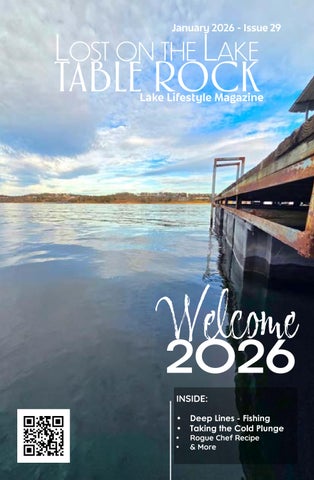
January 2026 - Issue 29
Lost on the Lake TABLE ROCK
Lake Lifestyle Magazine
Welcome 2026 INSIDE: • • • •
Deep Lines - Fishing Taking the Cold Plunge Rogue Chef Recipe & More
1- Lost on the Lake
January settles over Table Rock Lake with a kind of honesty the other seasons can’t match. The crowds are gone, the trees stand bare, and the water reflects exactly what the sky gives it—no shimmer required. It’s a quieter month, but never an empty one. This issue is about noticing what winter reveals. Tracks along the shoreline tell stories left overnight. Bald eagles circle open water with patient confidence. Homes, docks, and boats remind us that lake life doesn’t pause just because the temperature drops. Even wellness takes on a different tone here—less about trends, more about intention, whether that’s a cold plunge at dawn or a slow walk along a frost-bright cove. January is when many of us remember why we chose this place in the first place. Not for the noise or the rush, but for the rhythm. The way the lake asks us to slow down, pay attention, and take care—of our homes, our neighbors, and the land and water that shape our days. As you turn these pages, we hope you feel the same steady calm that settles over Table Rock this time of year. Winter doesn’t take anything away here. It simply strips things down to what matters most. Be Happy,
Myra Thornton 2- Lost on the Lake
CREATIVE EDITOR Myra Thornton CONTRIBUTING WRITERS The Rogue Chef
CONTRIBUTING PHOTOGRAPHERS The Rogue Chef Myra Thornton
(Some Photos contain AI)
ADVERTISING SALES Myra Thornton
Find us on Facebook
Publisher Myra Thornton www.lostonthelake.us
email: hello@lostonthelake.us
Phone: 417-593-1167
3- Lost on the Lake
CREATIVE EDITOR Myra Thornton CONTRIBUTING WRITERS The Rogue Chef Tom Koob
CONTRIBUTING PHOTOGRAPHERS The Rogue Chef Tom Koob
ADVERTISING SALES Myra Thornton
Find us on Facebook
Publisher Myra Thornton www.lostonthelake.us
email: hello@lostonthelake.us
Phone: 417-593-1167
Open Daily! Cave is 63 degrees Year Round
5- Lost on the Lake
Contents
January 2026 - Issue 29
08
DEEP LINES:
JANUARY FISHING Fishing
13
16
TAKING THE COLD PLUNGE
JANUARY AT THE LAKE
Lifestyle
Financial Focus 30 Winterize Your Lake Property 32 6- Lost on the Lake
Nature
20
22
27
THE ROGUE CHEF
WINTER WILDLIFE IN THE OZARKS
ORGANIZE YOUR KITCHEN FOR THE NEW YEAR
JANUARY RECIPE Food
Wildlife
Home
7- Lost on the Lake
DeepLines: January Fishing By the time January settles over southwest Missouri, Table Rock Lake trades summer sparkle for a quieter kind of beauty. The hardwood ridges stand bare, mist curls off cold, clear water at dawn, and the lake belongs to those willing to fish slow, dress warm, and trust the season. For anglers who do, January can deliver some of the most memorable days of the year. 8- Lost on the Lake
FISHING
A Clear, Cold Canvas Table Rock is a deep, highland reservoir with famously clear water, and winter sharpens that clarity. Visibility often stretches several feet, sometimes more, especially on the main lake. Water temperatures hover in the low 40s, which means fish metabolism slows—and so must the angler’s approach. The reward is predictability: fish group up, hold to structure, and respond to pre-
sentations that stay in the strike zone.
The Headliners: Bass, Panfish, and More Largemouth and Smallmouth Bass remain the main draw. In January, both species gravitate toward steep banks, channel swings, and points near deep water. Look for transitions—chunk rock to gravel, or bluff ends that soften into ledges. Suspended cont page 10
9- Lost on the Lake
fish are common, especially on sunny afternoons. Spotted Bass are plentiful and often the most cooperative. They’ll suspend over deep water and chase shad just enough to make things interesting. Crappie anglers find winter schools tight to brush piles, bridge pilings, and creek channel edges. When you locate them, action can be fast despite the cold. Walleye and white bass are bonus catches, particularly near
10- Lost on the Lake
deeper points and along the old river channel, while trout thrive in the cold, oxygen-rich tailwaters below Table Rock Dam.
Tactics That Shine Winter success on Table Rock is about patience and precision. Jerkbaits are a staple for bass. Long pauses—sometimes ten seconds or more—let the bait hover and tempt lethargic fish. Natural shad colors excel in clear water. Finesse jigs and football jigs
dragged slowly along the bottom mimic crawfish and sculpins. Downsize trailers and keep movements subtle. Drop shots and Ned rigs shine when fish are suspended or hugging the bottom. Light line and natural hues make a difference. Vertical presentations — spoons, blade baits, or small jigs — work well when fish stack on steep structure. For crappie, try small jigs or minnows fished vertically over brush, adjusting depth until you find
the school.
Reading Winter Weather January weather on Table Rock can shift quickly. A warming trend after a cold snap often pushes baitfish shallow and triggers short feeding windows. Calm, sunny days are prime for jerkbait fishing, while overcast conditions favor slower bottom presentations. Wind can be your friend, breaking up light penetration and positioning fish along wind-blown banks.
Safety and Solitude Cold-water safety is essential. Wear layers, keep a change of clothes dry, and consider a life jacket at all times. The upside? Fewer boats, quieter coves, and a sense that the lake is yours alone.
The January Payoff Fishing Table Rock Lake in January isn’t about numbers - it’s about moments. A bronze-backed smallmouth thumps a slowly worked jig. A jerkbait stops dead, then loads the rod. Steam rises off the water as the sun clears the hills. In winter, the lake asks for patience, but it gives back clarity, calm, and the kind of connection that keeps anglers coming back, season after season.
11- Lost on the Lake
Nick & Amy Morris
Licensed Insurance Agents
12- Lost on the Lake
LIFESTYLE
Taking The
Cold Plunge “The Polar Bear Plunge” Steam on the Water On a January morning at Table Rock Lake, steam rises where cold air meets darker water. The docks are quiet, the shoreline hushed. Then, briefly, someone steps to the edge, breathes deep, and enters the lake. Cold plunging—intentional immersion in cold water—has found a natural home in lake country. Here, it looks different than viral social media challenges. There are no crowds, no timers shouted over music. Just still water, controlled breaths, and the steady awareness that winter demands respect.
What Is a Cold Plunge, Really? At its core, a cold plunge is shortterm exposure to cold water, usually lasting seconds to a few minutes. Advocates describe benefits
ranging from mental clarity to improved circulation and mood. At the lake, the practice often pairs naturally with sauna use, hot showers, or simply warming back up indoors. Unlike icy tubs or commercial setups, lake plunges change daily. Water temperature, wind, and air conditions all matter—making awareness more important than endurance.
Why Winter Lakes Appeal •
January lakes offer what controlled environments can’t: presence.
•
Natural Stillness: Fewer boats, fewer distractions
•
Mental Reset: Cold sharpens focus immediately cont pg 14
13- Lost on the Lake
“The lake doesn’t dare you—it invites you.” •
Seasonal Rhythm: Engaging winter rather than avoiding it
•
Enter gradually; avoid jumping
For many lake residents, the plunge becomes less about toughness and more about marking the day—like sunrise walks or coffee on the dock.
•
Limit exposure to seconds, not minutes, at first
•
Warm up immediately afterward
Safety First—Always
•
Cold water is powerful. A responsible plunge prioritizes preparation and limits.
Skip plunging if you have heart or circulation concerns
The Mental Side of Cold
Guidelines from Local Wellness Practitioners •
Never plunge alone
14- Lost on the Lake
Many who plunge describe the same result: quiet. The shock of cold clears lingering thoughts, anchoring attention in the pres-
ent moment. On a winter lake, that clarity pairs with expansive views—bare trees, long horizons, and the slow movement of water.
Making It a Lake Ritual For full-time residents, cold plunging often settles into routine. Once or twice a week. Same cove. Same dock. Some follow with a wood stove fire or a hot mug waiting inside.
No—and that’s part of its appeal. Cold plunging asks for honesty. Some choose ankle-deep wades, others a quick waist-deep immersion, and many simply watch. The lake offers all of it without judgment.
A Different Kind of Bravery
For visitors, even a single plunge can mark a trip—an experience remembered long after summer swims fade.
On Table Rock Lake in January, cold plunging isn’t about chasing extremes. It’s about meeting the season where it stands. In a time of quiet water and long mornings, the plunge becomes less a challenge—and more a conversation with winter itself.
Is It for Everyone?
*Always consult a medical professional before attempting cold-water immersion.
“Cold simplifies everything to one breath at a time.” 15- Lost on the Lake
“January doesn’t shout at Table Rock Lake—it invites you to listen.” 16- Lost on the Lake
NATURE
January AT THE
Lake
In January, Table Rock Lake becomes something different. The busy marinas quiet down, the coves empty, and the Ozark hills surrounding the lake settle into a stillness that feels almost timeless. Winter strips the region to its essentials — rock, water, sky — and for those willing to slow down, January reveals Table Rock at its most honest. A Landscape at Rest The Ozarks in winter are subtle rather than showy. Leafless oaks and hickories line the bluffs, their reflections etched sharply into the lake’s clear water. Mornings often begin with a thin veil of fog drifting across the surface, lifting as the sun crests the hills. The air is crisp, the light is clean, and the lake feels wide open. With water levels typically stable and boat traffic light, January offers a sense of space that’s rare during the warmer months. It’s a season for cont pg 18
17- Lost on the Lake
long looks across open water and unhurried days that move at the pace of the cold. Life Beneath the Surface
Wind stirs the lake and adds texture to the water, while calm days offer mirror-like reflections that seem almost unreal.
While the surface appears calm, Table Rock is far from lifeless in winter. Fish concentrate along steep banks, deep points, and channel swings, following schools of shad that move with light and temperature. Anglers who understand winter patterns find consistency even when the bite is slow.
More Than Fishing
Crappie gather in tight schools around submerged timber and brush piles, often suspended over deeper water. Bass—largemouth, smallmouth, and spotted—hold close to structure, feeding selectively but predictably. Below the dam, cold, oxygen-rich flows support healthy trout populations, making the tailwaters a winter destination of their own. The Rhythm of January Days Winter days on the lake have a rhythm all their own. Mornings start slow, with frost on the docks and the sound of water lapping softly against the hull. As the sun climbs, the chill eases and activity—both above and below the surface—picks up. Midday often brings the best conditions, especially after a stretch of cold nights. Weather plays a leading role. A few degrees of warming can change everything, pushing baitfish shallower and drawing predators with them. 18- Lost on the Lake
January at Table Rock isn’t only about fishing. It’s about solitude and perspective. Bald eagles are a common sight, perched in shoreline trees or soaring over open water. Deer step carefully along the banks, and the silence is broken only by the call of geese or the distant hum of a boat motor. For locals and winter visitors alike, this is a season to explore—hike quiet trails, photograph the stark beauty of the bluffs, or simply sit and watch the lake breathe. Respecting the Season Cold water demands caution. Dressing in layers, watching the weather, and respecting the lake’s winter moods are part of the experience. Those who do are rewarded with a deeper connection to a place that often hides beneath summer crowds. The Ozarks at Their Purest January doesn’t ask for attention at Table Rock Lake—it offers it quietly. In the heart of winter, the Ozarks feel grounded and real, reminding visitors that beauty doesn’t always announce itself. Sometimes, it waits in the cold, clear air, on a still lake, for those willing to meet it there.
19- Lost on the Lake
Fresh Recipe The Rogue Chef
Greek Roast Chicken with Lemon-Dill Potatoes Time: 35 Minutes Servings: 4 Servings
Ingredients ● 1 T Extra-Virgin Olive Oil ● 8 Small skin-on,bone-in Chicken Thighs (about 2 1⁄2–3 pounds) ● Kosher Salt and Freshly Ground Black Pepper ● 1⁄2 C Pitted Green Olives, lightly smashed ● 4 Cloves Garlic, roughly chopped ● 1 tsp Dried Oregano ● 1⁄2 C Low-Sodium Chicken Broth ● 1⁄2 tsp Lemon Zest, plus 2 T Fresh Lemon Juice ● 1 lbs New Potatoes, halved if large ● 1⁄4 C Fresh Dill, finely chopped ● 4 oz Feta Cheese, crumbled
Instructions
1. Preheat the oven to 450°F and warm the olive oil in a large ovenproof skillet over medium heat. 2. Season the chicken generously with salt and pepper, then place skin-side down in the hot skillet. 3. Sear the chicken until the skin is deeply golden and crisp, about 8–10 minutes. 4. Transfer the chicken to a plate, skin20- Lost on the Lake
side up, and reserve about 1 tablespoon of the drippings in the skillet. 5. Add the olives, garlic, and oregano to the skillet and cook until fragrant and softened, about 2 minutes. 6. Pour in the chicken broth and 1 tablespoon of the lemon juice, scraping up any browned bits. 7. Return the chicken to the skillet, skin-side up, and roast in the oven until cooked through, 12–15 minutes. 8. Place the potatoes in a saucepan, cover with cold water, salt generously, and bring to a boil. 9. Simmer the potatoes until just tender, about 10–12 minutes, then drain well. 10. Toss the potatoes with the reserved chicken drippings, lemon zest, half of the dill, and a pinch of salt and pepper. 11. Divide the chicken and potatoes among plates. 12. Stir the remaining lemon juice into the skillet juices, then spoon the sauce over the chicken. 13. Finish with the remaining dill and a generous crumble of feta cheese. Go Rogue by swapping the feta for whipped ricotta and adding a drizzle of warm honey infused with lemon peel.
Want Chef Jeff to make this delicious dish for you? Contact him at www.TheRogueChef.com.
21- Lost on the Lake
Winter Wildlife
In The Ozarks
“In January, the lake doesn’t sleep, it listens.”
WILDLIFE
January on Table Rock Lake trades summer’s wake and laughter for a hushed, watchful beauty. Bare hardwood ridges frame steel‑blue water, and cold air sharpens every sound: the whistle of wings overhead, the hollow knock of a woodpecker, the distant bark of a fox at dusk. For wildlife watchers, this is the Ozarks at its most honest—unadorned, intimate, and alive.
The Lake as a Lifeline Even in winter, Table Rock Lake is a ribbon of movement. Below the surface, shad gather in tight schools, drawing predators and birds alike. Above it, open water becomes a refuge when smaller streams glaze with ice. Bald eagles patrol coves and river arms, scanning for an easy meal; loons surface like punctuation marks on the lake’s long sentences.
Feathers Against the Cold Winter Birds to Watch: Bald Eagle – January is prime time. Watch for white heads perched high in sycamores near the Kings River arm. Common Loon – Their winter plumage is subdued, but their presence is unmistakable as they dive and resurface. cont page 24
23- Lost on the Lake
Great Blue Heron – Solitary and statuesque, often found fishing shallow coves. Dark-eyed Junco – Small, social, and busy along wooded shorelines. Tracks in the Frost January reveals what summer hides. With leaves down and grass brittle, the Ozarks read like a ledger of tracks. White‑tailed deer cross muddy banks at dawn. River otters leave looping slides where they’ve entered the water. Raccoon and mink prints stitch the shoreline together, evidence of a busy night shift.
Quiet Mammals of the Shore Coyotes trot frozen paths at first light. Foxes hunt mice in open fields near the water’s edge. Beavers continue their steady work, chewing fresh saplings and maintaining lodges that rise like small islands near protected coves.
Respecting a Winter Wild Winter wildlife lives on narrow margins. Observers can help by keeping distance, minimizing noise, and staying on established paths. What looks calm is often a careful balance of energy saved and spent.
Cold-Blooded, Warm Refuges
The Ozarks, Unmasked
Reptiles and amphibians don’t vanish in winter; they wait. Turtles settle into muddy bottoms. Frogs tuck into leaf litter and seeps that stay just warm enough. On sunny afternoons, you may spot a painted turtle basking briefly on a log before slipping back into the lake.
January strips Table Rock Lake down to essentials: water, stone, feather, and fur. In the absence of crowds, the wildlife steps forward—not boldly, but faithfully—reminding us that the Ozarks are never dormant, only waiting for those willing to slow down and look.
Did You Know?
Bald eagles can spot fish from over 100 feet in the air and reach speeds of 30 mph in level flight. 24- Lost on the Lake
Fast Facts - Table Rock Lake Location: Southwestern Missouri, extending into Arkansas Surface Area: ~43,000 acres Shoreline: Over 800 miles Created: 1958 by the damming of the White River Winter Water Level: Typically lowered to reduce flood risk and protect shoreline habitat
Conservation Note Winter is a critical energy-saving season for wildlife. Disturbance can force animals to burn calories they cannot easily replace.
You Can Help By: Keeping dogs leashed near shorelines Observing wildlife from a distance with binoculars Avoiding repeated approaches to the same animal
25- Lost on the Lake
26- Lost on the Lake
HOME
Organize Your Kitchen
For The New Year Written By: The Rogue Chef www.theroguechef.com
There’s something about the start of a new year that makes us crave a little breathing room. Not just on the calendar—but in our homes, our routines, and especially our kitchens. After months of holiday cooking, extra groceries, and one too many “I’ll deal with that later” moments, the kitchen often ends the year working harder than any
other room in the house. The good news? Getting your kitchen organized for the new year doesn’t mean ripping everything out or buying fancy containers. It means being intentional. As a chef, I’ve learned that an organized kitchen isn’t about perfection - it’s about flow. When your kitchen works with you in27- Lost on the Lake
stead of against you, cooking feels lighter, faster, and far more enjoyable. Here’s how to reset your kitchen for the year ahead, one thoughtful step at a time. Start with a Clean Slate (Yes, Really) Before you organize anything, you must clear the noise. That means pulling everything out drawers, cabinets, pantry shelves - and seeing what you have. Expired spices, duplicate gadgets, half-used ingredients you forgot existed... they all take up space and energy. If you didn’t use it last year, ask yourself why. If it doesn’t serve how you cook now, let it go. A lighter kitchen is an easier kitchen. Design for How You Cook, Not How It Looks One of the biggest mistakes people make is organizing for aesthetics instead of function. Your kitchen should be set up for your habits. Cook often? Keep oils, salt, and go-to spices within arm’s reach of the stove. Bake regularly? Group flours, sugars, and measuring tools to28- Lost on the Lake
gether. Entertain a lot? Make sure serving platters and extra utensils are easy to grab without digging. The goal is fewer steps, fewer interruptions, and fewer moments of frustration when you’re in the middle of a recipe. Edit Your Tools Like a Pro Most home kitchens are overstocked with tools that sound useful but rarely are. As a chef, I rely on surprisingly few essentials: sharp knives, a solid cutting board, dependable pans, and tools I trust. Take a hard look at what you reach for again and again—and what never leaves the drawer. Keep the workhorses. Donate or store the rest elsewhere. An organized kitchen makes room for confidence, not clutter. Rethink the Pantry Pantries tend to become a catchall, especially after the holidays. Start by grouping items by category: grains, canned goods, snacks, baking supplies, oils, and spices. Once everything is visible, you’ll naturally stop overbuying and start cooking more intentionally.
Clear containers are helpful, but not required. Labels help, but consistency matters more. When everything has a “home,” you’ll spend less time searching and more time cooking. Give Your Refrigerator a Reset The refrigerator should support your week, not overwhelm it. Take everything out, wipe it down, and put items back with purpose. Keep ingredients you use daily at eye level. Store leftovers where you’ll see them first. Reserve one shelf or drawer for “use soon” items to reduce waste. A well-organized fridge quietly saves time, money, and mental energy. Create Zones That Make Sense Think of your kitchen in zones: prep, cooking, cleaning, and storage. When tools and ingredients live where they’re used most, everything moves more smoothly. Prep tools near the counter. Cooking tools near the stove.
This small shift alone can transform how your kitchen feels. Leave Room for Real Life An organized kitchen isn’t a showroom. It’s a working space. Leave a little breathing room in your drawers and shelves so the kitchen can flex with real life weeknight dinners, last-minute guests, spontaneous baking. Perfection doesn’t last. Function does. Set Yourself Up for the Year Ahead As the new year begins, an organized kitchen becomes more than a clean space - it becomes an invitation. An invitation to cook more, gather more, and enjoy the process instead of rushing through it. When your kitchen is ready, meals feel easier. Hosting feels lighter. And the everyday moments - the ones that really matter - have room to happen. Because the best kitchens aren’t just organized. They’re welcoming.
Cleaning supplies under the sink. Everyday dishes close to the dishwasher.
Need a Personal Chef? Contact The Rogue Chef www.theroguechef.com 29- Lost on the Lake
Financial FINANCIAL
Focus
NEW TAX LAWS FOR 2026 THAT YOU SHOULD KNOW The new year brings more than resolutions and fresh starts; it also ushers in several tax changes that could affect your wallet. Whether you’re saving for retirement, funding your child’s education or supporting your favorite charity, here’s are a few things you need to know about the tax landscape in 2026. More room to save for retirement and healthcare. There’s good news for savers: Contribution limits for retirement accounts are going up. If you’re under 50, you can now contribute up to $7,500 to an IRA, which is up from $7,000 in 2025. Those 50 and older can contribute an additional $1,000, for a total of $8,600. The limits for 401(k), 403(b) and governmental 457(b) plans are also increasing, with workers younger than 50 able to defer up to $24,500. Visit IRS.gov and search “401k limit increases” for an article outlining the details. Health savings account limits are rising too. In 2026, individual coverage increased to $4,400 and family coverage to $8,750. If you are age 55 or older and are not enrolled in Medicare, you can contribute an additional $1,000 as a catch-up contribution. 30- Lost on the Lake
The start of the year is an ideal time to review your contributions and consider increasing them, even by small amounts which can add up over time. A catch-up rule for high earners. If you’re 50 or older and earned more than $150,000 last year, there’s a new wrinkle in your retirement planning. You can still make catch-up contributions to your workplace retirement plan, but they must now be Roth contributions rather than traditional pre-tax contributions. This includes 401(k), 403(b) and 457(b) plans. While you won’t get an immediate tax break, Roth contributions offer tax-free income in retirement and can provide a tax-free legacy for your heirs. Expanded benefits for 529 education plans. Families using 529 plans to cover K-12 expenses will see the annual federal distribution limit double from $10,000 to $20,000 per student. The definition of qualifying expenses has also expanded to include curriculum, books, certain tutoring expenses and testing fees. This change provides more flexibility for families with overfunded plans and increases options for managing
education costs across multiple children or beneficiaries. New charitable giving provisions. The rules around charitable deductions are shifting in two directions. Taxpayers who take the standard deduction can now deduct up to $1,000 in cash donations ($2,000 for joint filers) to qualified organizations. However, those who itemize deductions face a new threshold: only charitable contributions exceeding 0.5% of adjusted gross income are now deductible. Donors may want to consider bunching strategies or using donor-advised funds to maximize their tax benefits. Getting help. Navigating these tax changes can be challenging, but you don’t have to go it them alone. A qualified financial advisor and tax professional can help you understand how these and other changes affect your specific situation. Together, you can develop strategies to make the most of new opportunities while minimizing your tax burden. This article was written by Edward Jones for use by your local Edward Jones Financial Advisor. Edward Jones, Member SIPC. Edward Jones, its employees and financial advisors cannot provide tax or legal advice. You should consult your attorney or qualified tax advisor regarding your situation.
Edward Jones, Member SIPC Presented by our local Edward Jones Financial Advisor: Grant Beasley 417-739-5575
TTT PPPPPPP PWC TTTTT RRRR LLLL Service • Repair • Performance • Modifications CALL NOW DDDDDDD NNNNNNN
417-616-9896 elite.pwc.trl@gmail.com
31- Lost on the Lake
Winterizing Your
Lake Property Winter Is Not the Off-Season for Maintenance While the lake rests, your property is still working—against cold snaps, fluctuating water levels, and winter storms. January is the time to confirm that preparations made in fall are holding strong and to address what colder weather reveals.
Dock, Boat & Shoreline Check Winter drawdown changes everything. •
Inspect dock cables and winches for slack or wear
•
Secure boats or remove them entirely during extended cold
Start with the Essentials Plumbing & Water Systems
•
Watch for shoreline erosion as water levels drop
•
Roof, Deck & Exterior
Insulate exposed pipes in crawl spaces and garages
January storms test structures.
•
Keep interior temperatures consistent, even when away
•
Clear heavy snow from roofs when safe
•
Shut off and drain outdoor spigots and lines
•
Check decks for ice damage and
32- Lost on the Lake
loose boards •
Trim branches that could fall during ice or wind events
Interior Comfort & Efficiency A quiet lake house should still feel warm and alive. Drain hoses and insulate faucets
•
Reverse ceiling fans to circulate heat
•
Seal drafts around doors and windows
•
Use programmable thermostats to prevent freeze-ups
Wildlife-Proofing Matters Cold pushes animals closer to structures.
Clean gutters of debris
•
Secure crawl space vents
•
Store firewood away from the house
•
Check for signs of nesting before sealing gaps
Peace of Mind Through Preparation
Utilize wood stoves & fireplaces
Winterizing isn’t about bracing for disaster—it’s about confidence. When the wind moves across a quiet January lake, a prepared home stands steady, ready to welcome spring without repairs or regrets. 33- Lost on the Lake
> edwardjones.com | Member SIPC
Want to become a more tax-efficient investor? The right investment strategy could potentially lower next year’s tax bill. Talk to a financial advisor today to learn how.
Grant Beasley
Financial Advisor 1 Lakeshore Drive, Suite 1 PO Box 1373 Kimberling City, MO 65686 417-739-5575 FAP-1942P-A-E-AD EXP 30 NOV 2027 © 2026 AECSPAD 27344088