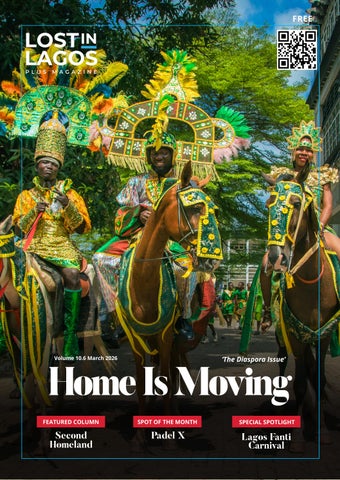
LIL+ Magazine March 2026

Page 1


Elvis Osifo Editor-in-Chief, Lost in Lagos Plus Magazine IG: @edo.wtf

EDITOR’S NOTE

“ATÍ

LO, ATÍ DÉ”

“WE HAVE GONE, WE HAVE RETURNED”

It feels as though for the last couple of months, every one of my notes either contained an update or an announcement of some sort. Well, we can’t help that we are fast expanding and currently experiencing immense growth (wink, wink**). I promise you this isn’t paid PR, but as part of our 9th year anniversary, I am beyond proud to announce three new exciting (news) things that my team and I have been working really hard on.

One, we are launching our community network, a private coterie for readers, culture lovers, creatives, founders, enthusiasts, and city-shapers who want to be closer to what’s happening (the city’s insider), before it happens.

Two, we are expanding our content format into a podcastttt. Long-form audio and visual format that expands the magazine’s themes into lived, human conversations. Think editorially rigorous, culturally grounded, and community-driven. Where the magazine curates, the podcast converses.

Speaking of magazine themes, in this issue, we explored a novel conversation that focused on the evolving culture of Nigerians outside of Nigeria. We carry home with us, build new homes, and send culture back in waves. In these pages, we positioned the diaspora as a living extension of Nigeria, emotionally, creatively, economically, and socially.

LOST IN LAGOS Volume 10.6 March 2026

Chidozie Okonkwo and Tola Alade focus on building new systems: Okonkwo with his investment platform ZINNC to harness diaspora capital, and Alade with DÒDÒ Rum to elevate African ingredients to global luxury, directly challenging the raw-material narrative. This entrepreneurial spirit is echoed in the arts and culture. Tosin Oshinowo and Aji Akokomi both emphasise unlearning Western-centric models to root their work in authentic African narratives while maintaining global excellence. Meanwhile, author Nnedi Okorafor and director Meji Alabi use their ‘in-between’ cultural identity, one as a foundation, the other as a unique perspective, to enrich their work. Finally, The Flygerians and Izunna Dike connect through food, using hospitality and content creation to amplify Nigerian culture and bridge the African and Black diaspora globally.

Don’t forget to check out the top 10 Nigerian-owned brands with global ambitions.

Home is evolving, And I hope you take a piece of it wherever you go.

#DiscoverNigeria

#ExperienceNigeria

#LostinLagosPlus #LostinLagosPlusMagazine

Title: Home Is Moving (The Diaspora Issue) FOUNDER Tannaz Bahnam PUBLISHED BY Knock Knock Lifestyle Solutions Ltd PRINTER Tee Digital Press

EDITOR-IN-CHIEF Elvis Osifo EDITORS Leon Izegbu, Enemona Udile DESIGN Ernest Igbes

CONTRIBUTORS Elvis Osifo, Mona Zutshi Opubor, Leon Izegbu, Ernest Igbes, Enemona Udile, Chidozie David Okonkwo, Olive Nwosu, Meji Alabi, Tosin Oshinowo, Aji Akokomi, Izunna Dike, Kingsley Emeka, Nnedi Okorafor, The Flygerians, Tola Alade, Kiisi Adedipe, Nkesi Ndamati, Aanya Chugani, Hassan Olashile, Akoko Restaurant, Ade Owoseni, Lagos Fanti Carnival, Ayoola Louis Mudasiru, Husseini Abdullahi, Hephzibah Okwelum, Wuraola Bankole COVERS Lagos Fanti Carnival

GOTTA HAVE IT

A bit about the Products of the Month

Every month, three products are selected from businesses in Nigeria and shared with you to appeal to your senses. They range from cool, functional items that become indispensable and intimate items that make for thoughtful gifts, to artefacts you can splurge on, and everything in between. This March, we honour the journey of building new homes and new memories abroad, while carrying heritage and nostalgia in every corner. We’ve curated the best guides to products you can gift your loved ones, or yourself, this month.

Ballantine’s Blended Scotch Whisky Stay True, Wherever You Begin

Leaving home sharpens your senses. Music feels different. Streets and rooms look unfamiliar. Even small routines, what you eat, what you drink, take on new meaning. In these moments, you ask yourself: what stays, and what evolves? Ballantine’s knows that feeling. Renowned for its craftsmanship and character, Ballantine’s has a heartbeat rooted in culture. From Afro House to Amapiano, from underground sets to quiet nights at home, it is a companion wherever you are. For Nigerians abroad or foreigners finding home in Nigeria, staying true is about holding onto your roots while embracing new experiences. A bottle of Ballantine’s is a reminder of home, heritage, and your personal rhythm.

DODO Rum by Marmalade Ventures

Plantain is the Real Sweetness

Few things feel as real as plantain, fried, boiled, or blended into a spirit. Sweet, smoky, playful, it carries the taste of home wherever you go. That is exactly what DODO Rum captures. Born from a cheeky April Fool’s joke, DODO quickly became the world’s first plantain-infused rum, crafted in Scotland with overripe plantains and rich Zambian molasses. The result is a rum that is bold, smooth, and full of personality, perfect for every party, moment, or celebration. No matter where you are, DODO is a reminder of your roots. Raise a glass, smile wide, and let the sweetness, smoke, and playful energy speak for itself. Authentic, fun, and unapologetically Nigerian, this is DODO.

LA BRUME Body Mist by Kremuse

Softness You Can Carry Everywhere

Scents are our quiet markers. They tell the world and the people around us that we are here, and long after we have left, they linger to remind the room that we once were there.

La Brume body mist does more than perfume the skin. It becomes part of how we introduce ourselves to the world. A soft mist that carries warmth, confidence, and the subtle memory of home. Fragrance can say a lot about where we come from. When something smells this good, it makes people curious about the place that shaped you, the stories behind you, and the world you carry with you. In many ways, scent is a kind of currency in our society. It speaks before we do and stays long after we leave. Kremuse makes that currency accessible. All you have to do is wear it.

SECOND HOMELAND

When I met my husband during our first year of university, we appeared to have little in common. He was an All-American football star, confident and aggressive. I was a shy, puny Indian girl. I had been educated in a single-sex school for most of my adolescence, and I was terrified of boys. I tried to make myself as small as possible to survive at an Ivy League college in New York City.

And yet, inexplicably, we shared an understanding. It was as if we had the same frame of reference. We talked about identical TV episodes, films, and musical artists. He was more refined and intellectual than I was, but his dad was a professor, so it was to be expected.

We made the same mental shortcuts. Although raised in the suburbs with little adversity, we felt intimate with the inner-city experience through the episodes of sitcoms we had watched. For example, we took it for granted that people in marginalized neighborhoods ate cat food when forced to, yet they would never serve it to guests. We liked rap and grunge, going to the cinema, discussing real estate and art. We were two halves of a puzzle that snapped together.

I didn’t overthink it. Why would I? He was dreamy. I was in love. One day, my boyfriend told me, casually, “You know, someday I’m going to move back to Nigeria, and I’m going to live my life there.”

“I’ll come with you, baby,” I said, unaware that 20 years later he would expect me to honor this promise as it was a legal contract.

During our first year as boyfriend and girlfriend, we both traveled with our families during our school’s winter break. I went to India to see my grandparents and extended family. He went to Nigeria to spend time with his dad, grandmother, aunts, uncles, and cousins. We reunited in January, and I showed him photos from my holiday, and he showed me his. It was then that it clicked. We had an unspoken bond, in part, because we were members of the diaspora, with a foot in two places. We weren’t accepted as proper Americans by our friends with roots in the USA, yet our families abroad found us strange and different, as well.

My husband and I graduated from college, grew up, got married, and had children. When he was sad, he drifted to familiar things. He would pick up banga soup and semo from a little Nigerian

restaurant in a strip mall. On Sundays, when homesick, he’d drive to the African market, pick up plantains and fish, and cook them while our toddlers played at his feet in the kitchen, sniffing the good smells, excited that papa was making dinner.

I cooked Indian food, and my husband made it work for him. He liked the spinach I made because it reminded him of egusi when he seasoned it just right. He liked rogan josh, a Kashmiri lamb dish with a rich red gravy, because it reminded him of goat and stew.

We moved to Lagos in 2011, and we started a new chapter here. We went from being part of the diaspora to being returnees to making this place our own. We traveled often during holidays. From the customs agent at Heathrow who called us aside just to praise me for being a Nigerwife, to seeing an actor with a Yoruba name playing the titular

role in Hamilton on Broadway, we saw ourselves reflected wherever we went.

Our children grew older, and our daughters left Lagos for university abroad. Now they are part of the next generation of Nigerians living outside of the country. Lagos is their home. It is the place they always long to return to, yet their lives are elsewhere. They fly the flag proudly.

The power of the Nigerian diaspora is enormous, and we have spread to all corners of the globe. Some of us make our way back to the fatherland, but others honor this great nation from afar. I see the talent and potential of Nigerians here and across the world, and I feel grateful that this puny Indian girl gets to be a small part of it.

Mona Zutshi Opubor is an IndianAmerican and Nigerian writer. She holds an MSt in Literature and Arts from the University of Oxford, an MA in Creative Writing from Boston University and a BA in English Literature from Columbia University.

Read more at www.monazutshiopubor. com

SPOT OF THE MONTH

PADEL X

Ithink I speak for a lot of people when I say that active Lagosians now have a strong appetite for experiences that blur the line between sport, leisure, and social life. And while few sports embody that convergence, none do as beautifully as padel. A hybrid of tennis and squash played within a glass-walled court, with a learning curve that is very forgiving for newbies. One does not need years of racket discipline to enjoy it. You and I can just step onto the court and be part of the rhythm almost instantly. And this is precisely why it’s so globally viral, with Padel X being one of the best places to experience it in Lagos.

Calmly tucked in Cooper Road, Ikoyi, Padel X reveals itself not simply as a sports venue in Lagos but as a living community. The idea was born from global travels and a desire to recreate the same spirit of sport and social belonging back home in Nigeria. The result is a smashingly designed space where the courts and culture converge. As you step into the playing area, you are greeted by four L-shaped padel courts, enclosed in glass and framed by clean modern architecture. Big enough to hit a High Lob. The sound of the ball striking the racket would echo in your brains with a satisfying pop.

The experience at Padel X extends beyond the courts. Around the facility, several lifestyle elements come together to complete the ecosystem. There is a golf simulator upstairs where players can perfect their swing regardless of Lagos

weather, a mobility and yoga studio downstairs that hosts stretching and recovery sessions, and a sports shop stocked with rackets, gear, and accessories for both beginners and enthusiasts. For newcomers, the club offers coaching from internationally trained instructors, as well as beginner sessions designed to ease players into the sport. A lively online community connects players of all levels, making it easy to find partners or join a match. Tournaments and social events fill the calendar throughout the year, giving the club an energy that is felt from the early morning rush of players squeezing in a match before work to the electric evenings when the courts are fully booked and friends gather simply to watch, cheer, and linger.

At the end of a beautiful game, eventually, the body asks for a pause. But the experience doesn’t really end there. Outside, an open-sky seating area invites you to catch the evening breeze, offering a perfect place to sink into a chair while the glow of the courts and Lagos night lights flickers in the background. You can enjoy conversations long after matches have ended or share a drink amongst friends from their lively selection of cocktails, mocktails, and wines that lean toward Italian favourites.

For a deeper dining experience, you find a natural flow toward the spot’s restaurant. Fondly known as the Court5. The dining space feels like an extension of the game itself. Indoors,

the atmosphere is cosy and relaxed, with the gentle clink of glasses and the comforting aroma of fresh food drifting from the kitchen. The menu mirrors the international spirit of the community that gathers here. Italian comfort food anchors the offering, with pizzas and pastas. Fragrant with herbs and rich sauces that feel both satisfying and restorative after a game. Yet the kitchen does not stop there. Guests are guaranteed to enjoy wraps, shawarma, and crisp golden wings that are familiar, easy, and deeply satisfying. The service team happily improvises something special even when inspiration strays beyond the printed menu. Whether catching one’s breath after a fierce game or preparing mentally for the next one, Court5 becomes the social anchor of the entire experience.

If you spend enough time here and a pattern emerges. Mornings belong to the disciplined few, players slip in for quick games before work. Evenings, however, are almost

always packed. After four o’clock the courts buzz with activity; rackets swinging, laughter sounding in courts. In many ways, the best advice for anyone curious about padel is wonderfully simple: just show up. The sport invites experimentation, welcomes every skill level, and rewards persistence with the addictive joy of a well-played rally. At Padel X, that first curious visit often becomes a habit. One match leads to another, new partners become friends, and before long the court begins to feel like a familiar gathering ground. Sport may have been the original attraction, but the community is what keeps everyone returning. It’s addictive!

Padel X

23AA Cooper Road, Ikoyi, Lagos

IG: @padelx_ng t: +2349166553070

Tosin Oshinowo

Architect

Beyond Extractive Practices: Tosin Oshinowo’s Vision for African Architecture and ‘The Beauty of Impermanence

Your work often challenges Western models of development. How can the Nigerian diaspora, who are often trained in the West, unlearn these models to better impact the environment back home?

You’re absolutely right, you have to unlearn to relearn. Much of Western education is structured around the imposition of ideals, and in many cases, design schools of thought that are not well-suited to our environment, economic realities, or cultural context. This is not to suggest that everything Western is wrong, far from it.

The problem lies in the assumption that solutions developed for Western contexts can be directly transplanted here without a deep understanding of local conditions. Architecture

does not operate in abstraction; it is shaped by climate, resources, social structures, and informal systems of living and making. Without engaging these realities, imported models risk becoming inefficient at best and extractive at worst.

Unlearning, then, becomes a critical act, not a rejection of knowledge, but a recalibration. It allows us to filter what is useful, discard what is not, and produce architectural responses that are genuinely rooted in place while remaining in dialogue with global ideas.

Through Ilé Ilà (House of Lines), you celebrate Yoruba culture through furniture. How does bringing these physical pieces into homes in the diaspora helps Nigerians “carry home” with them?

Ilé Ilà has been an extraordinary journey not only for the diaspora but also for me personally. It created an opportunity to see my culture celebrated within a contemporary design context, in a way that felt both fitting and affirming. More importantly, it demonstrated that culture and identity can be confidently owned as a serious design position, and I would even say it has helped pave the way for a new generation of designers to claim that space unapologetically.

The response was immediate and, at times, explosive. What was particularly striking was the international interest we began to receive, not only from those seeking bespoke, low-tech design solutions, but from members of the diaspora who were deeply yearning for cultural

Interview
Tosin Oshinowo Architect

connection and recognition. At that moment, Ilé Ilà opened me up to a far wider audience than architecture alone ever could.

It expanded the reach of my work beyond buildings and into everyday life, allowing design to become a more intimate and accessible medium for engaging with questions of identity, heritage, and belonging.

You often speak about “The Beauty of Impermanence.” Do you feel like home is now a place, a community, a feeling, or something else entirely? How do you carry it with you?

The Beauty of Impermanence was the title of the Sharjah Architecture Triennial that I curated in 2023. The exhibition explored under-celebrated design innovations and technologies that emerge from the Global South, often born out of conditions of scarcity. It examined how ingenuity,

adaptability, and restraint become powerful design tools when resources are limited.

The Triennial also addressed the tensions that frequently exist between urban economic development and the extractive practices that accompany it, practices that are often deeply detrimental to our environment. At the same time, it served as a reminder of humanity’s enduring capacity to engage with the natural world in ways that are elegant, sensitive, and deeply intelligent.

For me, home is a centring state, a quiet confidence that comes with the acquisition of

knowledge. I know who I am and where I am from, and that certainty is my sense of home.

Much of my work is ideational and takes place in solitude. I keep a small circle of confidants and friends, and within that simplicity, I have peace.

You founded your studio during a period of significant personal transition. What advice do you have for “hyphenated” Nigerians who are afraid to move back and start a business from scratch?

Greatness is not handed out; it is claimed. It requires a measure of ignorant courage, the willingness to begin without waiting for permission or perfect conditions. Nothing meaningful happens without that initial leap.

The first step is a conscious decision to contribute positively. When your work adds value, intellectually, socially, or materially, you are not only investing in yourself, you are also investing in your country. Progress, whether personal or collective, is cumulative, and it begins with the courage to participate.

Greatness is not handed out; it is claimed. It requires a measure of ignorant courage, the willingness to begin without waiting for permission or perfect conditions. Nothing meaningful happens without that initial leap.
Meet Tosin

Oshinowo, a Lagos-based architect, urban researcher, and curator whose work bridges the gap between local African contexts and global architectural discourse. As the principal of her practice, she has designed landmark projects including the Maryland Mall and West Africa’s first Adidas flagship store. Beyond commercial success, Oshinowo has led critical humanitarian initiatives, notably collaborating with the United Nations Development Programme (UNDP) to design a new settlement for displaced communities in Northern Nigeria. Her multifaceted career also includes prestigious curatorial roles, such as co-curating the Lagos Biennial (2019) and serving as the curator for the Sharjah Architecture Triennial (2023).

Interview Olive Nwosu Filmmaker

We Must give more Back”: Olive Nwosu’s Vision for the Nigerian Creative Diaspora

Meet Olive Nwosu, a Lagos-born, British-Nigerian filmmaker and image-maker. Before film, she studied economics and gained an MSc in Psychology. She is fascinated by people, systems and curious about why humans make the choices that we do. With a deep love and affection for Nigeria, she is invested in thinking about the large questions of our time and interrogating them from a 21st-century African lens.

Olive Nwosu

Your film Egúngún (Masquerade) explores the return home and the shifting nature of memory. How do you personally “carry home” with you in your daily life in London?

I love what you say about the shifting nature of memory, because this is really true. When you ask people to recall a memory, if it is healthy, the way they recall it changes. This is science. Details shift, and sequence is reordered, depending on context and present mood. I say this because it is when a memory is rigid that there is a problem; it means a person isn’t really accessing it, they are unable to, they are stuck. For a long time, my memories of Lagos felt stuck. I would recount the same stories, and many of them I’d forgotten.

It was as if my past was blank. And because of this, I think I fled from home; I felt very little connection to Lagos. These days, thankfully, things are different. These days, home is in the food I make at home, a lot of tomato-based stews; it’s in the conversations I have with my hairdresser, who comes and braids my hair, and we catch up about Nigeria and Ghana; it’s in family time with my brothers, my mother, my father, and with friends. And most of all, home is in my work. All my writing so far has been set in Nigeria. It’s a type of time travel.

No matter where I am, I can open my laptop, and I’m in Lagos or Abuja or Enugu. It’s such a powerful connection, and one I cherish deeply. I’m holding characters that are deeply Nigerian in my psyche all the time.

You’ve mentioned that “home” can be a place of both comfort and trauma. How do you navigate that duality when representing Nigeria to a global audience?

Home is complex. Home is always complex because life is complex, and so are humans. And when you’re Nigerian, you feel this so acutely because our government has failed us; because the world order has failed us. I’m always trying to hold these two truths along with the richness of textures; the vibrance of Nigerian culture; the kindness of our people; our ambition, our struggle, our humour, our resilience and our beauty.

I’m aware of the images that have come before me of our country, and we cannot escape that there is some truth in them. I don’t feel a

need to erase that. I feel a need to expand and deepen the global picture of Nigeria. To make people see our country from the inside, not as Other, but really as insiders. Because I believe that once you invite people into your home, they can no longer be strangers, it’s easy to dismiss strangers. You take away that excuse.

Do you feel a responsibility to “send culture back” by mentoring or collaborating with local crews when filming in Lagos or Enugu?

I do. I feel this deeply. The vision is to be a part of building out the ecosystem that supports filmmakers and storytellers in Nigeria. So that more of us can do this work. The more, the merrier. I take this very seriously and feel that we all have a social responsibility to give as much as we take, at least. So in making films that move between other countries and Nigeria, I hope that as we give the world our culture, they also give back.

In the historical net value of the relationship between Africa and the rest of the world, we are running a massive deficit this is the kind way to put it. So yes, we must send it back.

What is one landmark change you hope to see in the relationship between Nigerians abroad and the creative community back home over the next decade?

I hope for more fluency of language between us; by that I mean more understanding, more shared goals and strategy, and more discourse. Sometimes I feel there are silos between us, and I would expand this even wider, silos between the Black diaspora and silos between the Global South. I see shared history and shared culture amongst us, and the discourse is so crucial.

There is a reason why, for example, Bollywood films and Black American music are so popular in Nigeria. Because the themes, the ideas, the story, and the emotions, they are recognisable to us. And so I think we need to understand that we all have so much in common and that we should not only consume but also make connections, host one another, create funds that bring us more together, and cross-pollinate work. My hope is that we create more together.

I’m aware of the images that have come before me of our country, and we cannot escape that there is some truth in them. I don’t feel a need to erase that. I feel a need to expand and deepen the global picture of Nigeria.

Interview The Flygerians Culture Curators

More Than a Meal: The Flygerians’ Recipe for Radical Hospitality and Nigerian Identity

“As The Flygerians, we don’t see ourselves as observers of culture; we see ourselves as custodians and translators of it.
and a whole lot of love.

In our Diaspora issue, we explore how Nigerians build “new homes.” How does the atmosphere at a Flygerians pop-up recreate the feeling of a Lagos “party” for those who haven’t been back in years?

Our restaurant offers a home away from home. As soon as you walk in, you feel the Lagos vibe, from the decor to the music and the staff members, who embody the joy, light and colourful heart of Nigeria. It’s a secret party where every single person is welcome and invited to dance with us and enjoy our culture.

Your work captures Nigeria with a sensitivity and curiosity that feels both intimate and observant. What do diaspora eyes see that local eyes sometimes overlook?

As British-born Nigerians, it can sometimes be easy to feel lost, but not in Peckham or at our new location at the House of Mobo’s. We embody the best Nigeria has to offer, through lenses that echo the greatness of Black British culture.

This is reflected in our dishes. We have stayed true to the beauty of Nigerian food with traditional classics on our Swallow Sundays, tantalising beef suya, and party-smoky jollof rice, voted the best jollof in the UK by Sadiq Khan, the London Mayor. We also offer Flygerian creations that have only been possible by celebrating the beauty of our dual nationality and offering a new take on greatness, the Flygerian way. This includes dishes such as Naija fish and chips, red bream with cassava fries and our homemade crayfish ketchup.

We have also created Chin’ofee pie, a fun play on the British classic banoffee pie, plantain ice cream and supa dupa fly hot wings. A must-try that will blow your mind.

Diaspora Nigerians are no longer just observers of culture; they are active participants in shaping it. Where do you see your work sitting within that exchange?

As The Flygerians, we don’t see ourselves as observers of culture; we see ourselves as custodians and translators of it. We grew up between worlds, with Lagos’s spirit in our bones, London’s hustle in our stride, and our work lives right in that exchange.

What we do is take the heartbeat of Nigeria, the suya smoke, the jollof debates, the loud auntie laughter, the resilience, the flavour, the faith and plate it in a way that feels at home in places like London while still honouring the soul of Lagos.

We’re not diluting culture to fit in. We’re amplifying it.

Diaspora culture is remix culture. It’s heritage with edge. It’s grandma’s recipes meeting global ambition. Through Flygerian, we’re showing that Nigerian food isn’t just “ethnic cuisine”, it’s luxury, it’s art, it’s storytelling, it’s world-class.

We sit in the exchange as connectors. As daughters of Nigeria, raising the flag high in every room we enter. As proof that you don’t have to water down where you’re from to win where you are.

We’re not watching the culture evolve. We are seasoning it.

What has been the biggest “landmark” moment for you guys where you realised you weren’t just selling food and culture but selling a piece of Nigerian identity?

We have had many beautiful landmark moments, and this is only the beginning. From writing our Flygerian cookbook, which captures the legacy of our grandma and our culture through incredible, authentic dishes and new dream creations, available on Amazon as The Flygerians Cookbook. We have also had the pleasure of touring the country doing food demos for BBC Good Food, the Ideal Home Show and many other greatly respected food festivals.

We have cooked with Sadiq Khan, the Mayor of London, appeared on the TV show Peckham’s Finest and been featured in major publications such as The Guardian, Secret London, Evening Standard and Time Out, to mention a few.

These were the moments we realised this was bigger than us. This was about representing the Nigerian community and placing our food, culture and legacy at the forefront of the British food market. We are creating our own table, demanding space and honouring those who came before us and those yet to come. We do this for future generations and for anyone who has ever felt they were not enough.

We are great. We are mighty. We deserve to be seen and celebrated. We stand tall, and we are stronger united, no matter where in the world we land. We are proud Nigerians with a beautiful culture to share with the world.

Naija no dey carry.

Meet Jess and Jo, the “larger-than-life” sisters better known as The Flygerians, who are on a mission for global culinary domination. For the past eight years, this powerhouse duo has been transporting Londoners straight to the heart of Lagos through the vibrant, soulful flavours of Nigeria, no plane ticket required. Founded in honour of their late grandmother, Mary, who began teaching them the art of cooking at the ages of 9 and 10, the business is a living tribute to her legacy of radical hospitality. Guided by Mary’s wisdom that everyone, regardless of race, gender, or creed, deserves to “chop life before life chops you,” Jess and Jo serve every plate with a side of inclusivity

Interview

The West African Kitchen, Ever Roaming: Aji Akokomi on Identity, Excellence, and the Culinary Map of Home

Aji Akokomi

Meet Aji Akokomi, the visionary founder behind the award-winning London restaurants Akoko and Akara. After retraining at Leiths in 2017, Aji embarked on an extensive culinary pilgrimage across West Africa, immersing himself in the techniques of local markets, bakeries, and communities to ensure his work remained deeply rooted in heritage. From his mother’s bakery in Ibadan to the jollof traditions of Dakar, these experiences formed the foundation for Akoko in Fitzrovia, which earned its first Michelin star in 2024 and a top-25 ranking in the National Restaurant Awards. His second venture, Akara, opened in Borough Yards in 2023 to offer a more relaxed expression of West African cooking, earning a Bib Gourmand in 2026. At the core of Aji’s philosophy is a commitment to “generous hospitality,” creating thoughtful, prestigious spaces where tradition is respected, and every guest feels genuinely welcomed.

You are one of the few Nigerians globally to earn and retain a Michelin star. What does that level of recognition truly demand of you, not just as a chef and restaurateur, but as a person and leader?

It demands consistency, care and humility. Recognition at that level isn’t about a single moment; it’s about showing up every day with the same intention and standards. As a leader, it’s taught me the importance of listening, supporting my team, and creating an environment where people feel valued and steady rather than pressured.

Personally, it’s reinforced that the work has to come from the right place. Awards are meaningful, but they can’t be the focus. If you look after the people, the food and the atmosphere, everything else follows.

Running Michelin-level restaurants demands extreme discipline and consistency. How has that shaped your lifestyle and the way you live day to day?

It made me very intentional. I’ve learned that discipline doesn’t

Fine dining is simply excellence applied to your own narrative. Ours just happens to begin in Nigeria, West Africa and unfold in London

have to feel rigid; it can be quiet and sustainable. Structure is important, but so is balance. You need the space to think clearly, to look after yourself, and to lead with calm rather than urgency. Day to day, I try to live in a way that allows me to be present, for my team, for the food, and for the wider picture. Long-term consistency matters far more than intensity.

You operate in one of the most competitive culinary cities in the world, yet your work is deeply rooted in Nigerian identity. How do you consciously infuse ‘Nigerianness’ into spaces that often expect Eurocentric fine dining?

London is competitive because it rewards clarity of identity. The restaurants that endure aren’t the ones trying to imitate a Eurocentric template; they’re the ones confident enough to stand in their own story. So for me, infusing ‘Nigerianness’ isn’t something I consciously switch on. It’s the starting point.

I’m Nigerian. That lens shapes how I cook, how I host, and how I design a space. The foundation is West African flavour, memory and movement, but I’m not interested in freezing it in time. Some dishes are traditional, some are playful reinterpretations, and others are complete reworks. What matters is that the thread is honest. The values remain intact: generosity, warmth, depth of flavour, respect for spice.

Nigerianness also lives beyond the plate. It’s in the art, the uniforms, the textures of the room. It’s in the quiet ritual of a hand-washing ceremony before a meal. It’s in how we present dishes, layered, intentional, expressive. Sometimes it’s subtle; sometimes it’s bold. But it’s always there.

And then there’s London. I’ve lived here long enough to understand that this city doesn’t dilute identity; it amplifies it. What we create reflects both worlds: the rhythm of West Africa and the precision of modern London dining. That tension is what makes it exciting.

I don’t feel pressure to fit into a Eurocentric idea of fine dining. Fine dining is simply excellence applied to your own narrative. Ours just happens to begin in Nigeria, West Africa and unfold in London.

Does carrying Nigerian identity at the Michelin level come with a different kind of pressure or responsibility? What do you think about representation when excellence is always being judged?

There’s an awareness that representation matters, but I try not to let it become a burden. My responsibility is to cook with integrity and care, and to stay true to the traditions and experiences that inform the food. I don’t feel the need to over-explain or frame Nigerian cuisine through another lens. If the work is thoughtful, generous and consistent, it speaks for itself. Representation is most meaningful when it comes from honesty rather than pressure.

Do you feel like home is now a place, a community, a feeling, or something else entirely? How do you carry it with you?

Home is all of it, but ultimately, it’s a feeling. A place is a location shaped by history. What turns it into a home is belonging, the memories, the people, the community, the ease that allows you to be fully yourself without effort. Once that feeling takes root, it travels with you.

I carry it in how I show up. In hospitality, you try to recreate that same sense of ease and welcome not through spectacle, but through consistency, generosity and care. If someone leaves feeling genuinely understood and looked after, that’s home in another form.

Home changes shape over time, but its essence doesn’t. It’s belonging, wherever you are.

Lagos in the Looking Glass: Director Meji Alabi on Identity, Perspective, and the Power of African Creativity

Meji Alabi

Director

You’ve said, “Filmmaking led me back home.” Was there a specific project or moment where you realised your work was no longer just about having a great career but about reestablishing your own Nigerian identity?

I think re-establishing my Nigerian identity was inevitable. It would’ve happened one way or another, due to the values instilled in me by my parents. But I was lucky enough that this happened at the same time as filmmaking really turned into an With the intense passion of mine, I was able to marry that deep reintroduction of my culture into my life with a drive to learn more and express myself through filmmaking.

With JM Films, you’ve worked to bring UK production standards to Lagos. How do you balance “upgrading” the technical infrastructure without losing the raw, organic Does energy make Nigerian creativity unique?

I feel like our people are capable of anything, which we’ve proved time and time again. I just wanted to achieve what I saw people achieving there, here, in Lagos and in Nigeria, in the parts of Africa I was shooting in. So with JM Films, we tried to bring a little more structure to the game, and I think it’s overall served the industry well. I don’t think we’ll lose our rawness...that’s down

I feel like our people are capable of anything, which we’ve proved time and time again. I just wanted to achieve what I saw people achieving there, here, in Lagos and in Nigeria

Meet Meji Alabi, a father, director, and “lover of life” who finds his purpose in the visual art form of film. A versatile storyteller, his portfolio spans music videos, commercials, documentaries, and narrative projects, unified by a commitment to capturing whatever speaks to his soul in the moment. With a creative philosophy rooted in both gratitude and a deep passion for the craft, Alabi approaches every frame as an opportunity to translate human experience into compelling visual narratives.

to the storytellers but with a better infrastructure, we can serve Directors better.

In what ways has living, working, or engaging outside Nigeria reshaped how you see yourself and how you now show up in Nigerian culture, community, or industry?

I think it’s allowed me to have perspective. A perspective of someone who didn’t grow up in Nigeria, but sees it through this looking glass while still being very familiar with it. It’s given me a sense of curiosity about certain things I would’ve only been exposed to by living there. Being able to see things in the ordinary and in the mundane and find shape and light in them. Everything informs the palate, and what we output is our interpretation. So I think lean into yourself and be authentic, even if your authentic self is made up of more than one part.

Our issue looks at how Nigerians “build new homes.” After years of travelling, where does Meji Alabi feel most “at home” today?

That’s a great question. I feel most at home when I’m close to my babies, Esmé and Godwin Wherever they are, my heart is.

Interview

The Double Life: A Nigerian Scholar on Carrying Culture and Building a Future in the UK

MRepresenting and speaking for my community has taught me that Nigerians can sometimes be perceived quite differently by people from other countries. We are passionate, expressive, and often among the smartest and most hard‑working people in the room

eet Emeka Kingsley Amamchukwu, a legal scholar and aspiring advocate with a foundational background in Sociology and Anthropology from Nnamdi Azikiwe University. Driven by an innate entrepreneurial spirit and a desire for independence, Emeka transitioned to the UK to pursue a career in Law. His professional journey is defined by a commitment to combining business acumen with social impact. Emeka aims to utilise his education and platform to amplify the voices of the unheard, ensuring that his legal practice serves both as a tool for justice and a vehicle for community empowerment.

As president of the Nigerian Students’ Committee, you represented Nigerian students in a foreign environment. How did that role shape your sense of identity and responsibility as a Nigerian abroad?

Becoming president of the Nigerian Students’ Committee was never part of my original plan. By nature, I prefer to stay in the background rather than be the person everyone is looking at. When I first arrived in the UK, a few of us created a WhatsApp group to support one another, and it organically grew into a core Nigerian student community.

When the opportunity to run for president came, my peers encouraged me, saying I was the best person for the role because I was already bringing people together and solving problems quietly behind the scenes. Stepping into that position made me realise how much responsibility comes with representing others: how you speak, how you handle conflict, what you say when people approach you, even how you present yourself. It was a challenging but very beautiful experience that pushed me out of my comfort zone and helped shape my confidence, my identity, and my sense of responsibility as a Nigerian abroad.

How has living and schooling in the UK changed the way you see Nigeria, and also the way you see yourself as a Nigerian?

Living and schooling in the UK has not completely changed how I see Nigeria, but it has sharpened my understanding of the country. Being here has made it clearer how many systems in Nigeria do not function as they should, and how people at home have had to adapt and normalise difficult living conditions just to get by. I am not trying to directly compare life in the UK with life in Nigeria, because they are very different contexts, but

being here constantly reminds me that in Nigeria, what should be a basic standard of living is often out of reach for many. That realisation has deepened both my frustration with the system and my determination to contribute to change in whatever way I can.

In spaces where you may be one of the few Nigerians, what have you learned about representation and speaking for a community, even when you’re just being yourself?

Representing and speaking for my community has taught me that Nigerians can sometimes be perceived quite differently by people from other countries. We are passionate, expressive, and often among the smartest and most hard-working people in the room, and that energy can come across as intense. At the same time, I have learned that people from other cultures communicate and interpret things in ways that are not always the same as ours. Because of that, I try to be more intentional: to listen, to adapt my communication style when needed, and to acknowledge that our differences in culture and perspective are real but can be a strength when we respect them.

Do you feel like home is now a place, a community, a feeling, or something else entirely? How do you carry it with you?

Home, for me now, is both a place and a feeling. After living in the UK for five years, I find that it has started to feel more like home than it did when I first arrived, because my daily life, relationships, and routines are here. At the same time, home is also that feeling of belonging and being understood, the sense that you are accepted as yourself. I carry Nigeria with me in my values, my memories, my food, my music, and my community, even while the UK increasingly feels like the place where I live, grow, and plan my future.

Meet Izunna Dike, a Vancouver-based food content creator on a mission to unite the African diaspora, one recipe at a time. Known for his quirky humour and unapologetic honesty, Izunna pairs high-energy cooking videos with a deep commitment to Pan-African values. Whether he’s fusing Caribbean flavours with traditional African dishes or exploring the technical links between African-American and continental cuisine, his work proves that our cultures are as connected as our history. Above all, Izunna is a believer in the power of joy; he creates food that makes you think, makes you laugh, and most importantly keeps everyone in a “very happy” headspace.

Izunna Dike

How has your Nigerian upbringing shaped the way you see the world and the stories you tell through food today?

My Nigerian upbringing has been very vital to my personality today and how I see the

world. “Life is a pot of beans” lmao! I have experienced practically every region in Nigeria, and that has informed how I view Food. For example, how food can be very different, food can carry the story of survival and history. Nigeria has also framed how I

Life is a Pot of Beans: Izunna Dike on Finding the Recipe for Resilience in the Nigerian Diaspora

see the world in terms of my perseverance and willingness to make things happen regardless of the adversity, and just not taking no for an answer.

Actually, being raised in Nigeria makes you

realise that the world can be in your favour, regardless of the obstacles you face. We can think of half of our superstars today and look at the conditions they were raised in, absolute warriors. Nigeria has been the biggest test of life compared to any other society I have lived in this world. If you pass, you can persevere anywhere.

You’ve built a platform that brings Nigerian flavours to a global audience. What does it mean to represent Nigeria in this way from abroad?

It means a lot. It means an opportunity to make a real impact and showcase the severely underrated cuisine that Nigerian cuisine really is. Living in North America gives me such access to the rest of the world to impact people and showcase what Nigerian flavours really is like, because you have access to the Chinese, Indians, Latinos and even other Black diaspora, there is a real chance to bridge our cuisine to the rest of the world, to showcase the Nigerian cuisine in true fashion. Jollof led the way, thanks to TikTok; Egusi is now following. By the time you make Pho pepper soup or pepper soup Ramen for an Asian audience, you have

introduced that flavour profile to them, so there is such an opportunity, and I am so grateful that I can be part of it.

How does being in the diaspora change the way you see Nigerian arts and culture, compared to how they exist within their local communities?

Living abroad really makes you appreciate what we have. Recently, I was thinking about just the art that Lagbaja is. the embodiment of his name, the title meaning ‘Anonymous’, no one, anyone. It’s his brilliant and artistic use of the drums (bata drums, I believe) of authentic African music, but also appropriate for the era in which he was making it.

I just admire him as a work of art now so much more than I did, and I draw a lot of inspiration from people like him. People don’t know this, but I’m also a visual artist. I paint, and I have tried to make that known as much as I can in recent times, so I’m a very art-savvy person. I love to digest quality art, art with meaning; art of political significance, mostly. Being away from Nigeria also gives you a deep sense of appreciation for our culture and how these things have been

created for us for centuries. Food and celebrations have become such a part of us that when we are away from them, we then start to realise just how much significance they have to our purpose and our existence.

When you think about “home” today, what does it mean to you, and how has that definition changed over time?

Home is still Nigeria to me, though I’m now a permanent resident of Canada, still feels temporary if I’m being honest. But I would add that my original point of departure from Nigeria (Warri) does not feel as much at home to me anymore because every time I return to Nigeria, I return to stay in Lagos, and maybe Port Harcourt later, I mean, quite frankly, I have lived in Lagos.

I served in Lagos, and I got to really fall in love with the city, so my idea of home kind of falls into experiencing Lagos, Lagos Island particularly, Lagos restaurants, the watersides, the lounges, the rooftop, the music: Afrobeats, 3 Step, Amapiano, and lastly, keep this between us, the Nigerian women, goodness gracious! Lagos babes? Chef’s kiss!

Home is still Nigeria to me, though I’m now a permanent resident of Canada, still feels temporary if I’m being honest.

Interview Nnedi Okorafor Author

Beyond Wakanda: How Nnedi Okorafor

Balances Igbo Heritage and Marvel Megabrands

Author Nnedi Okorafor

Meet Nnedi Okorafor is an international literary superstar, a New York Times bestselling author, and the definitive global leader of Africanfuturism. Holding a PhD in Literature, she draws deeply from her Nigerian/Igbo heritage to craft evocative speculative fiction across all ages, ranging from the groundbreaking Binti trilogy and Who Fears Death both optioned for the screen to her work on Marvel’s Black Panther and Shuri. Her recent releases include the critically acclaimed Death of the Author, the graphic novel The Space Cat, and the 2026 conclusion to her She Who Knows trilogy, The Daughter Who Remains. One of the most decorated voices in modern fiction, her numerous honors include the Wole Soyinka Prize and multiple Hugo, Nebula, and World Fantasy Awards.

You’ve said your sci-fi roots actually started with road trips through Nigeria rather than Western media. How does carrying home in your memory influence the high-tech futures you build?

Not just my science fiction, but my roots as a writer, period.

And it’s not just about “memory.” That makes it sound distant, as if Nigeria exists only in the past for me. It doesn’t. Nigeria is always at the forefront of my work because I am Nigerian.

That presence isn’t something I consciously insert. It’s foundational. It’s baked into me physically, spiritually, emotionally, and creatively.

I first started imagining the future standing on the balcony of my parents’ house in Arondizuogu, looking out and wondering what that place would be like in 50 years. I’d never speculated about that kind of

thing in the United States. Why? I dunno, just didn’t. The same went with aliens; I started by imagining how Nigerians would react to them. That’s simply how my mind worked. It wasn’t a strategy or a thesis. It was where my curiosity went.

I was born and raised in the United States, but in Nigeria (particularly Imo State, specifically Arondizuogu and Isiekenesi) has always been where my imagination goes to stretch, ponder and play. The family trips there, the stories told by parents and relatives about their lives in Nigeria, being chased by masquerades in the village, loving the food there, arguing and laughing with cousins there, and constantly negotiating, defending, interrogating my identity as an American, a Nigerian, and an Igbo. All those things are ingredients that make the stew.

So when I grow high-tech futures, they are not “influenced” by home. Home is already there by definition.

You often describe yourself as being in a liminal space between cultures. How Does this in-betweenness act as a creative superpower when writing for a global audience?

Being “in-between” gives me the perspective of both the insider and outsider simultaneously.

As a Nigerian, I carry an embedded understanding of spatiality, cosmology, humour, texture, and rhythm. As someone raised in the United States, I also encounter those same things with a certain freshness. What many Nigerians might take for granted glows for me because I am seeing it with different eyes. They allow me to notice details others overlook, or to obsess over elements that others might not think twice about.

When it comes to Nigerian cosmology and spirituality, being Nigerian means I know the terrain. Being born to and

raised in America by parents who had liberal attitudes about their culture meant I was more insulated from that side of colonialism that labelled so many indigenous spiritual systems as evil, scary or dangerous. Because I’m American-raised, those never fully attached to my psyche. Whether you call it naivety or courage or both, it gives me the freedom to write openly about potent, sensitive, powerful ideas.

It is no coincidence that I am the one who coined the term Africanjujuism, a subcategory of fantasy that acknowledges the seamless blending of existing African spiritualities and cosmologies with the imaginative. To articulate and inhabit that space requires a certain confidence/fearlessness/naivety.

When “Who Fears Death” was published in the West, Nigerian publishers shied away from it because of what it confronted so directly. My directness comes from knowing who I am. I am not insecure about my in-betweenness. I can’t speak Igbo fluently; there are cultural things that I just don’t know, and there are very American parts of me that constantly clash with Igbo culture. I have wrestled with things, been hurt by things, questioned things, and argued with things. I understand things. I’m clear. My confidence is essential.

I am not trying to write from someone else’s vantage point. I write from mine. My strength comes from that clarity. My middle name is Nkemdili, which means “Let mine be mine”; that says it all.

You’ve written for Marvel’s Black Panther and Shuri. How do you balance working within global megabrands" while staying rooted in your specific Igbo heritage?

When I’m working with Marvel, I only agree to projects where I can fully be myself.

If you look at my work with Marvel, from Wakanda Forever to Shuri to Long Live the King to the stories featuring the character of Ngozi, you’ll see that I approach them from an Africanfuturist perspective, not an Afrofuturist one. That distinction matters.

Africanfuturism, as I define it in my essay “Africanfuturism Defined,” centres Africa first.

I only write what comes naturally and organically to me. I don’t shift my core perspective to fit a megastructure. I bring my full self into it. No matter where I go, I am me, and that includes when within the Marvel

Universe.

If your work is a wave sent back to Nigeria, what is the one thing you hope it changes about how young Nigerians on the continent view their own future?

I hope that my work inspires Nigerians from all walks of life (young to old) to be proud of and deeply curious about their own stories. I hope it reminds them to look inward for both the questions and the answers.

To see that their histories, their languages, their cosmologies, their daily realities are not small or secondary. They are expensive. They are worthy of imagination. They are worthy of the spotlight. I want young people to know that they are already powerful. That their future is not something imported or handed down. It is something they can shape and something they should feed. There is work to do, for themselves and for something larger than themselves.

If my work does anything, I hope it plants seeds. Seeds of confidence. Seeds of vision. Seeds that both grow in their own soil and stretch sturdy roots worldwide.

As a Nigerian, I carry an embedded understanding of spatiality, cosmology, humour,

Special Spotlight Lagos Fanti Carnival

LA Spectacular Celebration of the Afro-Brazilian Heritage at the Heart of Lagos Island

agos does not do quiet. It never has. The city has always been a collision of worlds: Yoruba and colonial, indigenous and diasporic, ancient and relentlessly modern. Its streets carry the memory of everything that has ever passed through them: trade routes, migration, reinvention. And nowhere is that memory more alive than on Lagos Island, where every April, the sound of brass bands, the flash of glittering costumes, and the movement of thousands of bodies in procession announce the Fanti Carnival, a street festival honouring Lagos’ Afro-Brazilian heritage.

The Lagos Fanti Carnival is, in every sense, a living inheritance with

influences that would permanently alter the city’s cultural landscape. Their contributions still mark Lagos Island today, from the Brazilianinfluenced architecture of certain buildings to the distinctive food traditions that persist in these communities.

The Fanti Carnival grew out of this encounter. Its name is widely believed to derive from “fantasia,” the Portuguese word for costume or imaginative dress, a fitting origin for a tradition so rooted in the art of self-expression. The celebration draws from Brazil’s Careta tradition, a form of Afro-Catholic street revelry blending costumed performance, satirical commentary, and communal procession. As

roots that stretch back more than 130 years. To understand why it matters, you have to go back to where it all began.

A Journey Across Two Continents

The Lagos Fanti Carnival has its roots in one of history’s more extraordinary chapters of return. From the mid-19th century, formerly enslaved Africans who had been taken to Brazil, Cuba, and other parts of the Americas began making their way back to the West African coast. Many of these returnees known in Lagos as the Aguda, were of Yoruba descent, and they came back to a homeland they had never fully left in spirit, even as they had been changed irrevocably by their years abroad. They settled on Lagos Island, putting down roots in neighbourhoods like Popo Aguda, Brazilian Campos, Lafiaji, and Olowogbowo. Skilled in artisan trades, conversant in Portuguese, and shaped by Catholic feast-day customs and Brazilian street-performance culture, they brought a rich blend of

the Aguda replanted themselves in Lagos, these customs fused with Yoruba music, language, and spirituality, producing a celebration that truly belonged to Lagos Island.

The Communities Behind the Carnival

The Lagos Fanti Carnival is not a top-down production. It is led by the communities of Lagos Island themselves, supported by the Lagos State Ministry of Tourism, Arts and Culture, and operated through formal carnival associations that have maintained this tradition across generations.

At its origin stand two communities: Brazilian Campos and Lafiaji, the historic heartlands of the Aguda returnees on Lagos Island, and the custodians of the Fanti tradition from its earliest days. Over time, as the cultural and social influence of Afro-Brazilian heritage spread across Lagos Island, other neighbourhoods joined the celebration,

Home Is Moving: ‘The Diaspora Issue’ each bringing their own distinct identity to the procession. Today, seven communities participate: Isale-Eko Woro, Olowogbowo, Brazilian Campos, Epetedo, Lafiaji, Okoo-Faji, and Okepopo, a testament to how far that heritage has reached and how deeply it has taken root.

Each group arrives in full regalia: Okoo-Faji in red, white, and blue; Lafiaji in red and white; Campos in yellow and green; Epetedo in white and blue; Olowogbowo in yellow and white. The visual effect of seven distinct troupes converging on a single route is, by every account, extraordinary. What distinguishes the carnival’s community structure is its intergenerational character. Elders and children participate side by side. Costume design, choreography, music, and the narratives carried within each procession are shaped collectively within the community before the first step is taken. Heritage here is not curated for an audience; it is lived.

The 2026 Vision: Growth With Intention

The 2026 edition is projected to welcome more than 50,000 attendees. The venue remains Tafawa Balewa Square and the date is 6 April, but the experience has been substantially expanded, with seven distinct zones designed to give visitors multiple ways into the carnival’s world. The guiding principle is growth with integrity: expanding the carnival’s scale while keeping it grounded in the same community-led, heritagefirst framework that made 2025 work. What changes is the ambition. What stays constant is the spirit. A notable new addition is the AfroBrazilian Economic and Cultural Exchange Summit (ABECES), a high-level forum on business, policy, and the creative economy embedded within carnival week. This signals something important about how the carnival now positions itself: not just as a cultural event, but as a platform for substantive dialogue about the economic and creative future of the communities it celebrates.

What to Expect on 6 April

The heart of everything remains the street carnival parade, which will feature the seven community troupes moving through Lagos Island in full costume with their dancers, drummers, floats, and masquerades. A VIP grandstand offers an elevated vantage point for those who prefer to take it all in with more space and comfort.

The Fanti Heritage Village brings together small business owners, food vendors, craft makers, and community showcases in a vibrant marketplace of culture. The Youth and Children’s Creative Zone offers costume workshops, drumming labs, painting walls, a junior parade, and augmented reality activities, giving the next generation of Lagos Islanders their own entry point into the tradition. A curated historic art exhibition traces the Afro-Brazilian and Fanti story through carnival artefacts, textiles, masks, archival imagery, and immersive digital installations. Brand activations will be woven into the carnival route. The Easter Fiesta Concert, which follows the main carnival day, will bring together African artists, local live bands, and a curated AfroBrazilian playlist, extending the celebration well into the evening.

Impact: More Than a Festival

The carnival’s impact operates on several levels at once. Culturally, it sustains a tradition more than 130 years old by keeping it in active, public practice, not in an archive or in a documentary, but in the streets. For younger participants growing up on Lagos Island, many of whom were previously unaware of the depth of the Aguda legacy or the historical ties between Lagos and cities like Salvador da Bahia, the carnival is an education as much as a celebration.

Economically, it creates direct opportunities for artisans, costume makers, performers, food vendors, and small businesses, generating income within the very communities whose heritage is being celebrated. More broadly, it positions Lagos Island as a destination for cultural tourism, contributing to longer-term goals around repositioning the city as a global cultural hub.

There is also a less quantifiable but equally important dimension: community pride and social cohesion. The carnival brings together seven distinct Lagos Island communities under a single banner, each retaining its own identity, colours, and character, while contributing to something larger than any one of them. That convergence fosters a sense of shared ownership and communal harmony that outlasts the day itself.

Tickets and passes are available at LAGOSFANTI.COM.

Interview

Plantain is deeply West African, deeply everyday, deeply emotional. Why plantain? What does it represent to you beyond flavour?

Plantain is life. It’s the thing that unites a Nigerian, a Ghanaian, a Jamaican and a Colombian at the same table without a single word of explanation. It doesn’t need translating. It arrives, and people smile. Every single time. That’s rare. And I think we’ve underestimated it. Plantain isn’t exotic to us. It’s ordinary in the best possible sense; it’s comfort, it’s home, it’s every celebration. But for the world, it represents something they haven’t quite been able to access before: a gateway into our culture that feels warm, approachable and genuinely delicious.

When we decided to infuse plantain into rum, we weren’t trying to be clever. We were being honest. We were saying, “This is where we come from, this is what we love, and we believe the world is ready to love it too.

For a long time, African ingredients have been exported as raw material, rarely positioned as a luxury. Was Dodo always intended to challenge that narrative?

Not consciously. At least, not at first. DÒDÒ started as an April Fool’s prank in 2024. I posted it as a joke. The response was anything but funny; people wanted it. Desperately. That told me something important was sitting underneath the idea.

It was only when we started building the brand properly that I realised what we were actually doing. We weren’t just making rum. We were making a statement. Africa has spent centuries being the source of raw material, the input, the labour, and rarely the finished luxury good. We grow the cocoa, but rarely own the chocolate brand. We harvest the ingredients, but they rarely appear on the shelf at Selfridges.

DÒDÒ is a direct interruption of that pattern. Plantain, an ingredient grown across West Africa and the Caribbean refined, elevated and bottled as a premium spirit available in the world’s finest venues. And now that I know what we’re doing, I wouldn’t have it any other way. The narrative has always needed to be challenged. DÒDÒ is just one answer, and we intend for it to be a loud one.

You’ve positioned Dodo as refined, elevated, and global. How intentional were you about resisting stereotypical “African” branding?

Completely intentional. There’s a template that gets pulled out whenever someone wants to signal “African brand”, and I understand why it exists, but it’s become a cage. Bold primary colours. Hand-drawn illustrations. It performs Africanness rather than embodying it.

We didn’t want to perform anything. We wanted to be.

DÒDÒ’s visual identity is restrained. Bright. Confident. It doesn’t shout its origins - it lets you discover them. The bottle should feel at home on the shelf next to any premium spirits brand in the world, because that’s exactly where it belongs. When you pick it up and learn the story, the depth has more

impact than if we’d plastered the Africa angle everywhere upfront.

There’s a version of cultural pride that leads with defensiveness, and there’s a version that leads with confidence. The brand says: we know who we are, we know what we’ve made, and we’re not here to convince you we deserve a seat at the table.

There’s a generation of Nigerians abroad building global brands without waiting for validation. Do you feel part of that movement? What do you think has shifted in this era?

Yes. Deeply. What’s shifted is the refusal to wait. My parents’ generation (and even mine, to some extent) were taught that success meant fitting in. Get the degree. Get the job. Earn your credibility through institutions. Seek approval before you move. Something broke open in this generation. I think it’s partly the internet, partly the global recognition of African music, fashion and food over the last decade and partly a kind of exhaustion with shrinking ourselves to fit spaces that were never designed for us.

I left Nigeria at 16 and spent years navigating what it meant to be African in Western culture. To carry a culture that people found interesting but didn’t always take seriously. That experience either breaks you or sharpens you. For a lot of us, the ones you’re seeing build now, it sharpened us. We’re not building African brands. We’re building global brands with African roots. That distinction matters. We’re not asking for a seat at the table. We’re building our own furniture.

Yes, I feel part of that movement, and I’m building DÒDÒ as a permanent reminder that it was always possible.

Years from now, when people talk about Dodo Rum, what do you hope they say it shifted, culturally or commercially?

I hope they say it made people see differently. Commercially, I want DÒDÒ to be the proof point that a brand rooted in African culture can sit at the very top of the premium spirits category, not as a novelty, not as a limited edition cultural moment, but as a permanent fixture. I want it to open a door that can’t be closed again. For every African founder looking at the spirits industry, or the luxury goods space, or any category that’s historically excluded us, I want DÒDÒ to be the evidence they point to.

Culturally, I want it to have done something quieter but deeper. I want it to have shifted how African brands and products are perceived and valued. Plantain is just the beginning. But if DÒDÒ can make the world look at a humble, everyday ingredient and see luxury, elegance and global sophistication, then we’ve moved something.

I also hope people say it was good. Really good. Because ultimately, none of the narrative matters if the rum doesn’t earn it. Craft has to come first. But if I’m dreaming (and I always am), I hope someone, somewhere, pours a glass of DÒDÒ at a moment that matters to them, and feels, for the first time, that their culture was always worth celebrating. That would be enough. That would be everything.

From Plantain to Premium: How DÒDÒ

Rum is Elevating African Culture on the Global Stage

Meet Tola Alade, a three-time founder, brand builder, and the driving force behind Marmalade Ventures, a venture studio dedicated to positioning African culture as a global mainstream powerhouse. Moving from Nigeria to the UK at age 16, Tola’s experience of cultural displacement fueled a lifelong mission to ensure African-rooted businesses are seen, celebrated, and commercially valued. His ecosystem includes DÒDÒ, the world’s first plantain-infused premium rum; Orange by Marmalade, a brand strategy consultancy for culture-led founders; and the Marmalade Collective, a community of over 5,700 individuals passionate about the future of African heritage. To Tola, building is personal; it’s about turning audacious dreams into a tangible, global reality.

I hope someone, somewhere, pours a glass of DÒDÒ at a moment that matters to them, and feels, for the first time, that their culture was always worth celebrating.

Interview Chidozie Okonkwo

Founder, ZINNC

Web: http://www.zinnc.com/

IG: @zinncHQ

Tik Tok: @zinncHQ

X / Twitter: @zinncHQ

The $550 Billion Question: How Chidozie Okonkwo’s ZINNC is Unlocking Africa’s Diaspora Capital

Diaspora capital is one of the most underleveraged forces in Africa’s growth story. According to many estimates, the continent faces an annual financing gap exceeding $550 billion

MChidozie Okonkwo

Founder, ZINNC

eet Chidozie Okonkwo, 3x founder and business leader with over 20 years of experience navigating the complexities of finance and entrepreneurship across Europe and Africa. His journey began as a first-generation Nigerian in London, where an innate drive for business took him from the playground to the high-pressure trading floors of Goldman Sachs and Barclays. After relocating to Nigeria in 2013, he co-founded the health club chain Fitness Central (acquired in 2022) and scaled Bento, an HRTech platform, across four African nations. Following a deliberate three-year sabbatical dedicated to reflection, recalibration, and owning the lessons of his past, he returned with a grounded focus on his most ambitious venture yet: ZINNC. A “trust engine” designed to bridge the gap between diaspora capital and African opportunity, ZINNC represents the culmination of his corporate pedigree and his deep-rooted commitment to building sustainable solutions for the continent.

Many diaspora Nigerians live in a permanent in-between: emotionally rooted, but structurally disconnected. What do you think that in-between space produces, psychologically, creatively, and economically?

I have been that person, so I can speak on this from lived experience. That “in-between” space is where a lot of friction and missed opportunities live. Psychologically, it produces what I call “surfacelevel optimism.” You’re rooting for Nigeria (and the continent more broadly) from afar, but there’s a quiet hesitation because the systems at home feel “too hard”, too opaque, too broken.

Economically, it results in a massive misallocation of capital. We see over $100 billion sent home annually as remittances, but the majority of that is for consumption. This structural disconnection means diaspora capital is sitting in low-yield savings accounts in developed countries, when it could be fueling the next generation of African growth. When you bridge that gap with trust and the right back-end infrastructure, you turn emotional energy into institutional momentum. You move from just “sending money home” to actually

owning a stake in the future you believe in.

What kinds of opportunities do you believe the diaspora is uniquely positioned to see, understand, or unlock that others cannot?

The diaspora has the superpower of a “dual-lens”; we understand the high standards of governance and transparency required by global markets, but we also “get” the cultural nuances and raw potential on the ground. This makes the diaspora the ultimate de-risker. We aren’t just bringing capital; we’re bringing “proprietary deal flow” and networks. We can spot a high-growth SME or a real estate project that a traditional foreign VC might miss because they don’t understand the local context. The diaspora is uniquely positioned to apply global best practices to local opportunities, unlocking value that purely local or foreign players often overlook.

Diaspora engagement often spikes in moments: Detty December, major exits, cultural breakthroughs, but struggles to sustain momentum. How do we move from moments into systems?

We have to stop relying on hype and start building systems. Detty December is a vibe, but vibes do not build economies. Systems do. Moments create emotion. Systems convert emotion into participation. If we want sustained diaspora engagement, we need structures that allow people to invest consistently, transparently and with confidence, not just when there is a cultural spike.

At ZINNC, that means building a real trust infrastructure. We are giving people in the diaspora access to high-quality assets they would not normally be able to access, and doing it fractionally, so the barrier to entry is dramatically lower. Just as importantly, we are addressing the flexibility problem. People hesitate because they fear being locked in, so we are designing mechanisms that improve liquidity and allow for structured secondary participation within the platform.

When investing back home becomes clear, credible and flexible, it shifts from being an emotional decision to a repeatable habit. That is how you move from moments to systems. And once that system is in place, engagement stops being seasonal and starts becoming structural.

Tell us about what you’re doing with ZINNC.

We are building a platform that gives people in the diaspora access to compelling, culturally relevant investments such as gold, private credit, real estate, infrastructure projects, art, and more on a fractional basis. By lowering minimum investment sizes, we open up opportunities that would normally require significant capital or insider networks.

Liquidity is a key focus. Our research shows that people do not want to feel stuck in long-term, illiquid assets. So, beyond fractional access, we are designing mechanisms that allow for greater flexibility, including structured secondary market functionality within our platform.

We use stablecoin infrastructure to move money efficiently across borders. That is the backend. The real value is giving diaspora investors secure, flexible access to high-quality African investment opportunities in a way never seen before.

In many ways, ZINNC is not just an investment platform, but a trust platform. How do you design trust for people who have learned to be cautious?

You don’t ask for trust; you build it into the architecture. Many in the diaspora (including me) have been burnt before, either by so-called “on the ground experts” or by opaque systems. ZINNC solves this by standing between the user and the underlying investment. We act as a trusted intermediary providing diligence, escrow, and curated deal flow that matches pre-assessed risk tolerance. Additionally, by leveraging stablecoin infrastructure on the back-end, every transaction is traceable and secure.

Finally, education and community are at the core of what we do, and our mix of high-quality market briefs, webinars, and community events helps ensure our users are as informed as they are protected.

What role do you think diaspora capital plays in shaping Africa’s next chapter?

Diaspora capital is one of the most underleveraged forces in

Africa’s growth story. According to many estimates, the continent faces an annual financing gap exceeding $550 billion, yet at the same time, the diaspora is expanding, increasingly sophisticated, and eager to contribute in a meaningful way.

If you look at countries like India and China, engaged diaspora communities played a transformational role in accelerating growth, transferring knowledge, attracting global capital and backing strategic industries. We have the same opportunity. The question is whether we build the right channels to harness it.

This is not just about money. Diaspora investment brings patient capital, but it also brings perspective, standards and networks. There is a powerful cross-pollination that happens when people who operate in global markets invest back home. They demand stronger governance and better transparency, which raises the bar for everyone.

If we can redirect even a fraction of diaspora capital away from shortterm consumption and toward productive assets and infrastructure, the long-term impact will be profound, not just economically, but institutionally.

What has living and building on the continent taught you that you could never have learned from afar?

In the words of the great philosopher Mike Tyson, “Everyone has a plan until they get punched in the face”. Like many who move to Nigeria from more developed countries, I arrived with a plan, but Nigeria has a way of figuratively and sometimes literally punching you in the face. It forces you to confront reality quickly. Systems are tougher, capital is scarcer, and nothing moves unless you push it.

Living and building here teaches you what no textbook ever could. From afar, you see headlines and macro risk. On the ground, you see relentless builders creating value against the odds. You learn that grit matters, but grit alone is not enough. Governance matters. Structure matters. The quality of your character and the people you work with matter. Better humans make better leaders, and better leaders build better institutions.

Nigeria sharpens you. It strips away theory and exposes execution. It demands resilience, accountability and long-term thinking. I am more grounded because of it, and more ambitious because of it. I am ready to apply everything Nigeria has taught me over the past decade to build ZINNC into a company that plays a small but meaningful role in Africa’s renaissance.

TOP 10 NIGERIAN-OWNED BRANDS WITH GLOBAL AMBITIONS

For Nigerians, moving to the Diaspora isn’t just relocating; it’s expanding and growing. From bustling creative hubs in Lagos to high-street storefronts in London and New York, a new era of Nigerian enterprise is unfolding. This isn’t just business as usual; it is a movement of visionary founders weaving cultural DNA into world-class craftsmanship. This curated list of 10 Nigerian-owned brands pairs bold innovation with a relentless global drive, proving that the saying “9ja no dey carry last” stands both at home and abroad.

EbonyLife Group

Founded by media mogul Mo Abudu, EbonyLife has transformed from a local broadcaster into a powerhouse of global storytelling. Through strategic partnerships with giants like Netflix, Sony Pictures Television, and AMC, the brand is bringing authentic African narratives to screens in over 190 countries. Their recent expansion includes the launch of “Eb`onyLife Place” in London, a cultural hub designed to export the best of Nigerian film, art, and food. It has 3 main hubs in Lagos, Nigeria, and established international offices in London, UK, and Los Angeles, USA.

Windsor

Windsor Gallery serves as a sophisticated bridge between African contemporary art and the international market. With a presence in Lagos, Abuja, and Abidjan, the gallery has become a critical platform for African artists to gain visibility without having to look solely toward Europe. By participating in major international art fairs like AKAA in Paris, and facilitating cross-continental exhibitions. Their galleries are located in Lagos and Abuja in Nigeria.

Kai Collective, led by Fisayo Longe, is a masterclass in community-driven luxury. The brand gained global fame with its iconic “Gaia” print, which became a viral sensation and a symbol of empowered femininity across social media. Beyond just clothing, Kai Collective has successfully built an international “sisterhood,” shipping to fashionforward women in the UK, US, and beyond. By focusing on inclusive silhouettes and deep storytelling, it has proven that a digital-first Nigerian brand can compete with established Western luxury houses. Their main branch is in London, but they have frequent pop-ups in Lagos, Nigeria

Africana is redefining what modern African luxury looks like for the global gentleman. Known for its impeccable tailoring and mastery of both traditional “Aso-oke” and contemporary leather goods, the brand has moved beyond the borders of Abuja to showcase at major fashion capitals. Africana blends heritage craftsmanship with a sleek, minimalist aesthetic, positioning itself as the go-to brand for those who want to wear their culture with a world-class finish. Located in Lagos and Abuja, the brand also has an international presence in Abidjan, Côte d’Ivoire, and Dakar, Senegal.

Gallery
Kai Collective

Ile Eros

Under the culinary direction of Chef Tolu Eros, Ile Eros is taking West African flavours into the prestigious world of global fine dining. With the successful opening of ILÉ in Los Angeles, Chef Eros is introducing international audiences to “Unity Rice” and “Pepper Soup” through an immersive storytelling lens. By merging authentic Nigerian ingredients with avant-garde cooking techniques, the brand is moving Nigerian cuisine from the “ethnic food” category into the high-end gastronomic spotlight, proving that African flavours belong in the world’s most elite kitchens.

Andela has evolved from its 2014 roots in Lagos as a developer training bootcamp into a premier global “talent cloud” valued at over $1.5 billion. Now a fully remote organisation with a corporate headquarters in New York, the brand operates as a massive marketplace connecting over 150,000 vetted technical experts, more than half of whom are based in Africa, with global giants like GitHub, Mastercard, and Goldman Sachs. In 2026, Andela has expanded its footprint to include talent hubs in over 135 countries across six continents and bolstered its technical capabilities

Founded by Nigerian designer Dumebi Andrea Iyamah at the age of 17, this eponymous brand has become a global powerhouse in luxury resort wear, celebrated for its “wearable art” aesthetic and sculptural silhouettes. While the brand maintains its creative heart in Lagos, it operates a sophisticated international network with a corporate head office in Mississauga, Canada, and a flagship presence in New York City.

Founded in 2014 by designer Kanyinsola Onalaja, Onalaja is a contemporary luxury womenswear label that bridges the gap between Nigerian heritage and European design sensibilities. The brand is celebrated for its “demi-couture” aesthetic, characterised by intricate hand-beading, complex embroidery, and experimental texture clashing that draws from the designer’s Yoruba and Edo roots. With a strong commitment to inclusivity, the label offers a diverse size range from XXS to XXXXL, catering to a global clientele that includes prominent figures like Ciara and Jennifer Hudson. Having its main store in Lagos, but partnering with stockists both locally and internationally

Founded in 2017 by Chef Uche Annie Uzoka, widely known as the “Queen of Banana Bread,” Gourmet Twist is an artisanal bakery and food brand that has become a staple of the Lagos culinary scene. Originally a full-service online restaurant, the brand pivoted during the 2020 lockdown to specialise in handcrafted, “Afro-infused” pastries, most notably its famous banana bread, which comes in over 20 creative variations like Oreo, Baileys-infused, and white chocolate. They operate mainly in Lagos, Nigeria, but also operate internationally with a branch in Houston, Texas, USA and are expanding further within the United States, including the Atlanta (ATL) area.

Founded in 2018 by Jumoke Dada, Taeillo is a pioneering “Afrourban” furniture and lifestyle brand that has revolutionised the African home decor industry through a techforward, direct-to-consumer model. The brand is celebrated for its unique fusion of contemporary minimalist design and traditional African identity, famously incorporating indigenous textiles like Adire and Aso-oke into functional, modern furniture pieces. They mainly operate from Lagos, Nigeria, but also have stores in USA, and Canada

Andela
Andrea Iyamah
Onalaja
Gourmet Twist
Taeillo

Jollof Rice

From the kitchens that celebrate the rich culinary heritage of West Africa, this Jollof Rice recipe from Akoko is a masterclass in the art of the perfect one-pot wonder. Forget the continental Jollof Wars: this is the definitive, intensely smoky, and beautifully spiced rice dish, promising a taste of celebrated fine dining at home. Get ready to elevate your Jollof game with a recipe that is as legendary as the restaurant that inspired it.

Ingredients

50g of yellow onion (finely sliced)

10g of scotch bonnet baste

100g of plum tomatoes

275g of red peppers (deseeded)

200g of Tilda golden basmati rice

30g of tomato paste

120g of red onion (finely sliced)

10g of garlic paste

10g of ginger paste

5g of white peppercorn (ground)

3g of thyme

3g of curry powder

3 bay leaves

10g of unsalted butter

70g of grapeseed oil (or any neutral oil)

400g of chicken stock

10g of fine salt

Reserved jollof Ata base

Instructions

For the Jollof Ata base:

Step 1. Transfer red pepper, plum tomatoes, scotch bonnet and onion to a blender or food processor, and puree until completely smooth.

Step 2. Pour into a wide saucepan and bring to a medium simmer, and allow to cook and reduce untila thick paste.

For the Jollof Rice:

Step 3. Heat the oil in a wide saucepan and add the onions with salt.

Step 4. Sweat the onions on low heat for about 10-15 minutes until soft and translucent.

Step 5. Turn up the heat to medium and add the ginger garlic paste

RESTAURANT BIO

with white peppercorns, curry powder, and allow to cook out for 5 minutes.

Step 6. Add tomato paste and the jollof ata base, and stir very well and cook for another 5 minutes on low heat.

Step 7. Add the chicken stock and bay leaves, stir well and allow to cook for another 5-10 minutes on low heat.

Step 8. Finally, add the rice and stir well, cover with a lid to steam for 10-15 minutes on low heat.

Step 9. Open the lid and stir gently, add the butter, and cover again and cook on low heat for 10 minutes.

Step 10. Remove from heat and allow to rest for 10 minutes.

Biography

Akoko is a Michelin-starred West African fine-dining restaurant in Fitzrovia, founded in 2020 by BritishNigerian restaurateur Aji Akokomi. Created to spotlight the depth and refinement of West African cuisine, Akoko presents a seasonal tasting menu that blends indigenous ingredients, bold spice profiles, and contemporary technique.

Frejon

Serves: 4–6

Prep Time: 4 hours (bean soaking)

Cook Time: 45–55 minutes

Frejon is a coconut-rich bean porridge rooted in the culinary traditions of Lagos, Nigeria, particularly among communities influenced by Afro-Brazilian returnees in the 19th century. The dish later became closely associated with Lenten and Easter celebrations, when beans and coconut were commonly prepared as nourishing meatless meals.

Growing up, I was never the biggest fan of beans, and Frejon was not something we ate at home. I discovered it later through friends from different backgrounds whose kitchens opened me up to new traditions and flavours. Since then, it has become a dish I look forward to making every Easter, usually for a table full of friends who are just as eager to dig in.

For me, Frejon is less about tradition and more about community. It is the kind of dish that quietly gathers people around the table.

Ingredients

1 lb (16 oz / 454 g) pinto beans

1 can (13 oz) full-fat unsweetened coconut milk

½ tablespoon sugar

4 whole cloves, tied in a small muslin or spice bag

Salt, to taste

Water, for cooking

Instructions

Rinse the pinto beans and soak them in water for about 4 hours, or until slightly softened.

Transfer the soaked beans to a pressure pot and add enough water so the beans are just submerged.

Cook over medium to high heat for 30 to 45 minutes, or until the beans are very tender and beginning to break down.

Allow the beans to cool slightly. Add half of the coconut milk and blend using an immersion blender until completely smooth. If using a traditional blender, blend in batches and strain through a fine mesh sieve back into the pot to achieve a smoother texture.

CHEF ADE OWOSENI

Return the pot to low heat and stir in the remaining coconut milk, sugar, cloves, and salt.

Cook gently while stirring frequently to prevent scorching.

Continue cooking until the mixture thickens to your desired consistency.

Remove the cloves before serving.

Serving Suggestion

Serve warm, sprinkled with garri and topped with fried fish stew for a savoury contrast.

Biography

Ade Owoseni is a passionate Nigerian food and recipe content creator currently based in Houston, Texas. With a flair for both developing original recipes and sharing beloved classics, Ade has captured the hearts and taste buds of audiences near and far. Leveraging digital media, a flair for crisp, engaging content, and his love for culinary exploration, he has built a vibrant community of food enthusiasts who eagerly follow along for delicious inspirations and culinary adventures from different parts of the world. Whether experimenting with new ingredients or perfecting timeless dishes, Ade Owoseni continues to make a significant impact on the world of food and recipe creation.

Photo of The Month

Compelling Images from Nigeria

YORUBA DIOR

I titled this photograph “Yoruba Dior” as it captures two Yoruba women, one adorned in a striking yellow Dior shawl, walking through the streets of Peckham, South London. The image explores themes of the Nigerian diaspora and how cultural identity is maintained and celebrated in urban spaces far from home. The juxtaposition of traditional Nigerian attire and luxury fashion against the backdrop of a London street speaks to the beauty of heritage and contemporary life. It’s a snapshot of how the diaspora navigates between worlds, honouring their roots while embracing their present reality in South London, where vibrant African communities thrive, and cultural expression remains unapologetically bold.

ABOUT THE PHOTOGRAPHER

Adisa Olashile is a Nigerian, London-based Visual artist and fine art photographer whose work authentically captures the essence of Nigerian culture and the human experience. His artistic journey seamlessly bridges traditional photography with innovative blockchain technology, creating compelling visual narratives that honour heritage and celebrate everyday life.

IG: @adisaolashile | X (Twitter): @adisaolashile

“I
Brick By Brick

Brick By Brick

Murtala Muhammed Airport hadn’t seen a girl happier than the fourteen-year-old boarding a one-way flight to the country that would soon become her home. I had visited five times previously, but on this visit, I had no clear return date. My brain processed it as a long vacation sprinkled with classes and exams.

In superstitious Nigerian mother fashion, my mum broke the news to my grandma and aunt the night before. I had less than twenty-four hours to say goodbye to my grandma, who uprooted her life from Ibadan to be close when I was born, and my aunt, who told me the harshest truths my mum never would. Two of the most influential women in my life would become voices I hear only on birthdays and holidays. No one prepares you for that tradeoff: your community or your future. Nigeria robbed me of the opportunity to have both.

At least, that was what I believed during my first year in Canada. Moving from my Lagos Mainland school to a smaller one on the Island, and then to my final pre-university stop at a predominantly white school in Ancaster, Ontario, came with a constant temptation to shrink myself to fit in. My school on the Mainland was where I felt most at home, so it’s no surprise that a third of my closest friendships were formed there. We spoke Yoruba with reckless abandon, and when we spoke English, no one cared if you pronounced the ‘H’ in home.

On the island, I felt exposed. I learned the term ‘H-factor’ for the first time there. That was also where I bought my first Davis brow pencil because my sparse eyebrows became a spectacle. By the time I got to Ancaster, I had mastered speaking a certain way to

be heard. I learned to perform the Canadian script, then returned home to watch Jenifa’s Diary, because God forbid I forget who I really am. What struck me most was attending a school full of people with Dutch surnames, yet constantly being asked where I was from. No, where are you from? I still struggle to believe I heard a white student tell a Nigerian boy, ‘You’re the only Black person I actually like.’

As soon as I received my high school diploma, I carried myself to multicultural Toronto, a city that felt like an exhale. I was barely a day on campus when I heard pidgin drift through the hallway. Soon after, I was surrounded by people who talked and looked like me without any deliberate searching. My first on-campus apartment, shared with my Ijaw and Yoruba housemates, resembled my home in Lagos: friends stopping by to borrow poundo yam and running downstairs to open the main door because we overbleached palm oil. By the end of that first semester, my coursemate and I were speaking Yoruba in the library, competing for ‘best in fluency.’

The paradox of migration is that there are days I desire the familiarity of Lagos. while remaining grateful for a system that works. I’ve come to understand that a journey cannot be like home, and that’s okay. Brick by brick, I am building a home different from the one I left behind, but mine nonetheless.

Writer Bio: Kiisi Adedipe is a Nigerian writer based in Canada. She writes fiction and nonfiction that explore identity, faith, and the tensions between who we are and who we are becoming.

LOST IN NIGERIA

Lost in Nigeria? No worries, as we’ve got you covered. Explore the diverse and captivating points of interest scattered across the country, curated just for you. Whether you’re seeking cultural immersion, outdoor escapades or culinary delights, we handpick a selection of upcoming experiences for you to discover and indulge in every month.

As Nigeria continues to strengthen its agricultural value chains, the Palm Oil Summit convenes policymakers, investors, producers, and industry leaders to drive conversations around sustainability, productivity, and economic growth. Focused on unlocking the sector’s full potential, the summit will explore strategies for boosting local production, improving processing standards, and positioning Nigeria competitively within the global palm oil market.

5th March 2026 | Abuja

India Trade Expo

Trade is culture in motion, and the India Trade Expo embodies that exchange. Designed to deepen economic ties between India and West Africa, the expo gathers manufacturers, entrepreneurs, and decision-makers ready to build across borders. It’s a meeting point of industries and ideas, from technology to agriculture, fostering partnerships that stretch beyond transactions into long-term collaboration. In a globally connected Lagos, opportunity speaks many languages, and this expo answers fluently.

5th March 2026 | Lagos

Celebrating the depth and dynamism of contemporary African art, +234 Art Fair returns as a bold platform for emerging and established creatives. The fair creates space for dialogue, discovery, and cultural exchange, connecting artists with collectors, galleries, and enthusiasts. Through exhibitions, installations, and curated showcases, the event continues to amplify Nigeria’s position as a thriving hub for artistic innovation and global cultural influence.

5th – 8th March 2026 | Lagos

Lagos Motor Fair

Movement defines Lagos, and the Lagos Motor Fair explores exactly how we move. Bringing together innovators, dealers, and automotive visionaries, the fair reflects a city constantly in transit, constantly evolving. From sleek new models to cutting-edge auto technology, this is where industry meets ambition. Beyond engines and exhibitions, it’s a glimpse into the mechanics of progress in a nation accelerating toward industrial and commercial growth.

17th – 19th March 2026 | Lagos

The Uncultured Rave

Lagos nightlife takes centre stage at The Uncultured Rave, a high-energy gathering designed for music lovers, party-goers, and the city’s culture shapers. Set to bring together DJs, dancers, and a vibrant crowd, the rave promises an immersive night of sound, movement, and unapologetic expression. Expect electrifying sets, bold fashion moments, and the kind of atmosphere that reminds you why Lagos remains Africa’s party capital.

21st March 2026 | Lagos

Palm Oil Summit
+234 Art Fair

A Child of Diaspora

“Shrewd,” “Gossip,” and “Business” were the selected words I often found associated with the branch we identified with: Sindhis.

I never really thought about my history, my roots, my culture, or my background until I moved away from home. When I started my new school, I observed the response of others to the common question asked when getting to know someone: “Where are you from?” After coming from an international school with over 50 nationalities, I thought it was an easy answer. But over here, they didn’t really do that. My Indian friend told me she was Canadian, and I found myself arguing with her. “Girl, no, you’re not. Look at your last name and look at your background. You’re Indian.” Maybe a little old-fashioned of me? But I was trying to make a point. What was the problem with being Indian? She explained that she had been to India once in her life, didn’t speak the language, and had grandparents who identified as Canadian. It was a valid argument, so I tried applying that to my interaction with others. When people asked me where I was from, I responded with “Nigeria.” The follow-up question was, “Your parents are also both Nigerian?” No. Why were they asking that? I knew it was because I didn’t look Nigerian. In those moments, I didn’t feel like specifying I am coming “from” Nigeria, but I ended up overexplaining myself like I always do.

“My parents are ethnically Indian, I live in Nigeria, and I was born in Canada.” That answer didn’t get any follow-up questions, and that satisfied me for the time being.

I found that as a child, there wasn’t really time or, even more so, the opportunity to understand my background. It was always given and taught; nothing was really a choice.

From what I remember, it was always about going to the temple on Sundays whenever there was an important event, and my parents told us we couldn’t miss it. It was about not being allowed to cook beef in our house and being vegetarian on Mondays and Thursdays,

slowly transitioning to making steak and being non-veg throughout the week because we needed more protein in our diet. It was about cleaning the temple in my room after my grandmother was no longer there to do it with me. It was learning the Hanuman Chalisa (a Hindu prayer), not understanding it, but being told it would protect me whenever I was scared.

Just recently, having to bury my head deep into my history for an AP human geography assignment, I found myself asking my dad about my grandpa and where the term “Sindhi” came from.

He told me, earlier on, when Pakistan became a Muslim country, resulting in many converting to Islam, my Hindu greatgrandfather, along with my 14-year-old grandfather, living in Sindh, fled to Bombay. As the divide between countries and cultures was fixed, many families fled. “Sindhi” originated from “Sindh.” Perhaps between then and now, through traditions and many starting businesses and boasting about lifestyles, those stereotypes persist today. Though I’m still confused. When I’m asked where in India I’m from, my unsure answer remains the same. “The western area, I’m Sindhi, it’s kind of complicated.” I still question my background, my roots, and who among my ancestors I look most like. I want to ask about my traditions, understand my religion, and think of other things besides “Shrewd Gossip” and “Business.” These are stereotypes. I believe there’s so much more beyond these selective, limited, demeaning words. Behind each person lies roots. Whether you like them, don’t understand them, or simply believe they do not exist, they are part of you. You can choose to identify with them or not. I choose to because I believe that there’s beauty in connecting to the past.

I am a child of diaspora. The twisted fibres within me latch onto “Sindh”, Lagos, and now Canada, wind on a spindle still spinning, still becoming.

I have left Nigeria twice. “ “

The first time, I was 17 and moving to Hatfield, Hertfordshire, to study Law. It felt like a natural progression: ambitious, exciting, inevitable even.

About an hour after arriving, I decided to walk to the convenience store for cornflakes and milk. In what I believed was a perfectly reasonable decision, I stepped out in rubber slippers. It was 7 degrees. The five-minute walk from my apartment to the store felt like punishment. I returned not only with breakfast supplies, but with gloves and the abrupt realisation that I was no longer in Port Harcourt. Migration introduced itself to me through cold feet — literally.

It didn’t take long before I found my people. Hertfordshire had a rich Nigerian community, and in that shared displacement, we built something tender and resilient. We grew up together emotionally, intellectually, and often clumsily. Entering adulthood without the immediate anchor of family, we became each other’s emergency contacts, therapists, and co-conspirators.

Living abroad widened my lens and taught me which parts of myself were cultural inheritance and which were chosen. But that refinement came at a cost: the absence of built-in community and the deliberate work of fitting in without losing myself.

The kind of community rooted in family and long history is not easily replaced. I arrived without relatives or a pre-existing support system and learned quickly that good friendships would save me. And they did.

At the time, I did not think of my move as “relocation”. I always planned to return home after my studies. Nigeria was the life I intended to build. So I returned home in 2018, changed in subtle but irreversible ways.

I rebuilt intentionally, reconnecting with relatives, forming new friendships, and creating a community that made me feel

full. By 2022, after nearly five years of living and working across Nigerian cities, I had a life I genuinely loved, an enjoyable career, a soothing romantic relationship, and a routine that finally worked. I was happy.

Then, I left once more, this time for Glasgow.

The second departure was deliberate, and because of that, it was harder. With the Nigerian economy dwindling and quality of life feeling increasingly precarious, a more predictable system felt necessary for the long haul. I remember telling a friend how reluctant I was to move. She responded plainly: “The best time to leave Nigeria is now that you can afford to. Otherwise, the exchange rate might make it even harder when you eventually feel ready.”

The volatility of that truth forced me to choose a potentially stable future over a soothing present. I made myself feel ready. After imagining the new life I wanted to curate, I chose Glasgow for something more picturesque and soulful. Something quieter, saner. I imagined a city with culture and character, and I got that. What I did not anticipate was how migration this time would feel less like an adventure and more like authorship, a deliberate construction of the

life I intended to give myself.

Part of that construction is communal. Now, some of my friends and I choose our homes based on proximity to one another. I recently moved, and one determining factor was that my new place is within walking distance of my closest friend. In diaspora, friendship is no longer casual; it is foundational.

I stay in touch with family and friends scattered across time zones, planning visits and reunions. And still, as a South-South woman from Rivers State, I grieve in small, specific ways, like not having easy access to fresh seafood for the delicacies that raised me. Migration changes many things, but it does not dull the memory of taste.

Leaving twice has taught me that home is not a single geography. It is something I build and rebuild with love, intention, people, and occasionally, with gloves.

Writer’s Bio

Nkesi Ndamati is a 29-year-old Product Manager and Creative Consultant living in Glasgow. She writes about the things she cares about mostly fiction, technology, and the beauty hidden in complex emotions. Nkesi loves exploring creative outlets and has a whimsical artistic eye for the world around her.

Turn static files into dynamic content formats.

Create a flipbook