Discover Habitat 84, a sophisticated development at GMH Avenue, off Richmond Pearl Way. Designed for the elite investor, these 118SQM units are perfect for high-yield hotel apartments.
Lifestyle Hub
On-site cinema, Medplus pharmacy, and premium gym (i-Fitness/Techno)
Modern Tech
Automated gates and 6 high-speed elevators.
Victoria Osomo
Column: Celebrity Travel
10 Boutique Hotels in Africa
of the Month Madras Café
Favour Onyeoziri Varuna by the Good Beach Interview Pitsi Sathekge
Elvis Osifo
Editor-in-Chief, Lost in Lagos Plus Magazine IG: @edo.wtf
EDITOR’S NOTE
TWINKLE TWINKLE, AFRIKA.
How I wonder where we are….going
The yearly travel issue is one of the pillars of the very success we have built this business into. Why? Because travel is a very big part of lifestyle, an industry we lead in our beloved country, Nigeria. When it’s April, the strategy comes correct, the air is tight, and the team locks in, almost too emotionally.
I’m saying all of this for when you begin reading and you notice how resolute and layered our tone for this issue is.
The muse in custody was Africa. And every voice we invited to help grill did so honestly, questioning movement within her as both a cultural and economic need. All our contributors examine the challenges of intra-African travel, the opportunities within a more connected continent, and the largely untapped potential of Nigerian domestic tourism.
In this issue, Precious Ibeh discusses the “passport hierarchy” and systemic vetting, while Ijeoma Egbo highlights how Nigeria’s “giant” status and the language barrier create regional friction. Omolewa Adesuyi proves an 8,000km transcontinental road trip is possible yet “structurally broken”, a sentiment Victoria Osomo echoes by questioning why moving across Africa feels more complex than flying to Europe. Pelu Awofeso argues that understanding history must precede valuing such travel, contrasting with Queen Bethia, who focuses on practical rail
infrastructure as the primary driver for domestic tourism, with Favour Onyeoziri synthesising these by linking personal responsibility to rebuilding the green passport’s integrity.
Don’t forget to check out the top 10 Boutique Hotels in Africa, and all the guides shared by experts to help you rediscover our beloved country by visiting under-explored Nigerian destinations.
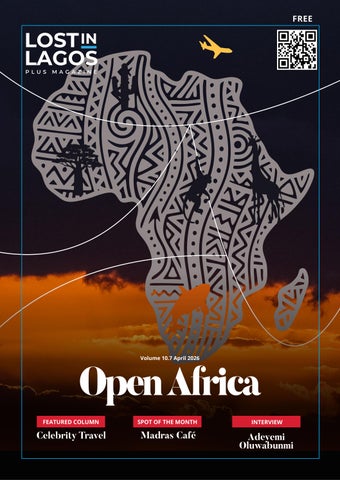
‘Open Africa’ is both an interrogation and a demand. We hope this issue encourages you to love and appreciate your country and continent more, while contributing to broader conversations around tourism development and continental connectivity.
With the voice of one but cries of the 54,
Yours sincerely,
Elvis Dante Osifo Editor-in-Chief, Lost in Lagos Plus Magazine
#DiscoverNigeria
#ExperienceNigeria
#LostinLagosPlus #LostinLagosPlusMagazine
LOST IN LAGOS Volume 10.7 April 2026 Title: Open Africa FOUNDER Tannaz Bahnam PUBLISHED BY Knock Knock Lifestyle Solutions Ltd PRINTER Tee Digital Press EDITOR-IN-CHIEF Elvis Osifo EDITORS Leon Izegbu, Enemona Udile DESIGN Ernest Igbes CONTRIBUTORS Elvis Osifo, Leon Izegbu, Ernest Igbes, Enemona Udile, Mona Zutshi Opubor, Mama Spade, Pitsi Sathekge, Victoria Osomo, Precious Ibeh, Ijeoma Egbo, Queen Bethia, Redlane Travels, Travel with BWW, Favour Onyeoziri, Travel with Ijem, Pelu Awofeso, Karen Augusta, Esther Okorougo, Favour Olusayo, Angel Whyte, Ijeoma Blessing, Aanya Chugani, Aliu Ozozoma, Adeyemi Oluwabunmi, Akpore Oghenemarho, Akoko Restaurant, Chef Stephen, Adaeze Obi Obasi INNER COVER: Adeyemi Oluwabunmi
#GOTTAHAVEIT
A bit about the Products of the Month
Every month, these products are selected from businesses in Nigeria and shared with you to appeal to your senses. They range from cool, functional items that become indispensable and intimate items that make for thoughtful gifts, to artefacts you can splurge on, and everything in between. This April, we celebrate movement. Across Africa or within Nigeria from city breaks to coastal escapes and curated safari experiences, take the best things with you.
Scarves by Silk Sultra Shade, but Make It Beautiful
Photobook from Story Story Book
Don’t Let the Trip Disappear
Travel Charms from Gembar Lagos One Trip, One Charm
The heat in Africa doesn’t play. Not in Nigeria, not across the continent. The sun shows up early, stays long, and sits right on your skin if you let it. The smartest travellers don’t fight it; they work with it. Silk Sultra scarves are that quiet advantage. A soft barrier between you and direct sun, helping your skin breathe while keeping the heat from hitting too hard. The silk glides, not grips; no irritation, no heaviness, just a smooth, cooling layer that lets air move the way it should.
Travel moves fast. One city into another, one experience folding into the next, and before you know it, everything starts to blur at the edges. You remember how it felt, but the details? They slip. Story Story Book slows that down. It gives your travels somewhere to land. Not just photos sitting on your phone, but something you can hold, flip through, and return to. The markets, the architecture, and the still moments in between them all stay intact. Because the truth is simple: if you don’t document it well, you lose parts of it. And some trips deserve to live longer than your memory.
There are different kinds of travellers. But if you’re like me, you collect memories as you go, a coffee sack in Ethiopia, a gold anklet in Ghana, a charm from Gembar Lagos in Nigeria. Gembar Lagos charms are made for that rhythm. One charm per trip. One piece, one memory, one marker of where you’ve been and what it meant to you. Clipped onto your bag or keys, they grow quietly over time. You barely notice it at first, then suddenly, it’s a collection of subtle archives of movement across Africa. Not just places you visited. Places that stayed with you.
I’m a 20-something-year-old living in Nigeria. I probably spend way too much time obsessing over self-care, food, tech, and anything else that makes my life easier. Like most people, I find randomly shopping online at odd hours therapeutic. For example, the fact that you picked up a copy of this magazine makes me like you. *Proceeds to add reader to cart!*
CELEBRITY TRAVEL
Whenever my teenage boyfriend and I travelled, people mistook him for a celebrity. In the early 90s, when we visited Boston, strangers demanded, “Are you Dougie Doug?” That was a flash-in-the-pan actor who starred in a film about the Jamaican bobsled team. Their baseless allegations made me giggle.
In the mid-90s, it morphed into Wesley Snipes, a popular actor with high cheekbones. When my boyfriend and I visited Mackinac Island, the scrawny man steering our horse-drawn carriage kept his neck crooked backwards, gaping. “I can’t believe I’ve met a movie star,” he said. It was harder to dismiss it this time, as I was convinced we would be driven into the lake if he did not face forward.
Later that decade, my husband shaved off his dreads and began to be mistaken for Tiki Barber, a professional American football player. We went on a holiday to Maui, and in the swimming pool, a neurosurgeon from Oklahoma said, “Do you enjoy playing for the Giants?”
My husband shook his head. By now, he was used to the confusion. I was flattered, though. Hugely pregnant, I felt some starlight sprinkle onto me. There was no way I resembled a vertically challenged beachball if my husband was famous. The doctor was practically calling me a supermodel.
The confusion worked in reverse, too. One day, Tiki Barber was broadcasting from an event in Central Park, and my friend Susan flagged him down, screaming my husband’s name. So, who knows how many times Tiki was accused of being Mr. Opubor?
As we travelled further afield, these mix-ups continued, growing especially pronounced when we were near sporting events. When in Japan, at the World Cup in 2002, my husband ducked inside a kiosk. The shopkeeper pointed to his jersey and said, “You are on the Nigerian team? You’re one of the players?”
My husband was perplexed. “You think I’d be buying batteries 90 minutes before the match if I was one of the players?” I laughed, but it began to grate. Why did people insist
on putting my husband into their narrative, even when it was nonsensical?
It was worse in India. While sightseeing, as the Cricket World Cup was being held, strangers kept stopping my husband, asking to take photos with him. “Do you play for the West Indies?” they asked, clicking away with their cameras. There are dozens of photos of my husband with Indian families in albums across Rajasthan. He exists there, in fragments, as someone else entirely.
All of these experiences put me in an anticipatory state when our family travelled to South Africa during the World Cup in 2010. I was expecting comical, madcap moments with my doppelganger husband. During the first match between Argentina and Nigeria, we had great seats. Zinedine Zidane and Luis Figo sat behind us, and we had an excellent view of Diego Maradona exhorting the players on the field, as he coached them. To my surprise, my husband was not mistaken for anybody.
We moved from Johannesburg to Cape Town
Featured Columnist
Mona Zutshi Opubor
to Durban. The South Korean team was staying at our hotel. None of the guests cared as they lined up with us at the breakfast buffet or milled around the lobby. But when the Brazilian team came to the hotel, we were all asked to find new lodgings. They arrived at night with crowds held back by security, and we watched the stars file into the hotel from our balcony. Still, nothing happened.
We needed to stay in South Africa for one more night. However, hotels were booked everywhere by visiting tourists. We ended up driving for two hours to an industrial backwater called Richards Bay, the air tangy and leaden from the ferrous metals plant. We got lost and pulled into a hotel to ask for directions.
Outside the hotel stood the entire Nigerian team.
It was astonishing to encounter our squad in the middle of nowhere. There was no confusion, no projection, no mistaken identity. They were exactly who they were, and I was dazzled. What are the odds that in a vast country, we would bump into the Super Eagles?
Sitting in the car with my family, my heart surged. I realised that for all those years, people had been reaching for something meaningful when they mistook my husband for someone else. I’d been the only one insisting there was nothing to see.
I guess I should have known magic would happen. That’s life when you’re married to a celebrity.
Mona Zutshi Opubor is an IndianAmerican and Nigerian writer. She holds an MSt in Literature and Arts from the University of Oxford, an MA in Creative Writing from Boston University and a BA in English Literature from Columbia University.
Read more at www.monazutshiopubor. com
By Dante Popsicle
SPOT OF THE MONTH
MADRAS CAFÉ
It’s a new year, of course, Lagosians are asking, “What else is there?” Luckily, this city never stops getting exciting…you just gotta love her! For everyone else like me, constantly looking for more global flavours to explore without leaving the continent, Cilantro has the best news. Rooted in centuries of tradition, Madras Café arrives at 141 Ahmadu Bello Way, Victoria Island, Lagos, with the intention, not as an experiment, but as a confident introduction to the depth and soul of South Indian cuisine. Cilantro’s very own love child.
As you arrive at the open complex opposite Silverbird and take a walk upstairs, you are greeted by a lush, garden-style lounge that feels like the outdoor extension of your favourite café, but elevated by a sweeping view of the city. It carries the same cosiness and intimacy, and frankly, a great place to seek inspiration.
The indoor area is a great place to get infused into the southern culture: textured earthy tiles, marigold tones, auspicious murals, brass accents, plush seating; every detail transporting you gently into Chennai and South India. If you are visiting with a laptop and the intention to work, distraction is almost inevitable. The aromas drifting from the kitchen do not simply linger; they beckon. There is a warmth to South Indian cooking that feels almost magnetic, pulling your attention away, again and again.
The menu at Madras is a careful study in balance. Fermentation, spice, and technique come together to create dishes that are both nourishing and indulgent. The Masala Dosa is a perfect example; golden, crisp and impossibly thin. Break into it, and it responds with a gentle crackle, giving way to a soft, fragrant potato filling that carries the warmth of turmeric, mustard seeds, and slow-cooked spice. The Chicken Ghee Roast is richer and more aromatic. The aroma of the chicken in ghee and roasted spices fills the air before the plate even lands. If your taste buds lean towards experiencing more lentils, then you should definitely try the Medhu Vada. Perfectly shaped, golden, and airy within, it carries a light, crisp exterior that gives way to a soft, almost cloud-like centre. And then there is the South Indian Thali, a complete expression of the cuisine. A curated spread of small portions that invites exploration, moving from tangy to spicy, from creamy to earthy, each element distinct yet harmoniously connected.
The drinks follow this same theme of culture. Their Panakam here has the right amount of jaggery and cardamom, a spiced sweetness that both refreshes and gently contrasts the savoury depth of the meal. Their layered fruit punch and chocolate milkshake are rich and comforting, and easy to fall in love with as a sweet-toothed Lagosian.
Service at Madras Café carries an ease that feels both attentive
and assured. There is an understanding that many guests are encountering these flavours for the first time, and so guidance is offered with care, never intrusion. In fact, it’s the entire vibe here: authentic yet welcoming, rooted yet adaptive. Guests can look forward to seasonal menu additions and regional specials, South Indian breakfast experiences and weekend brunches, cultural events, themed food festivals, and chef’s specials, and an expansion of beverage offerings, including specialty coffees and coolers.
There are certain kinds of restaurants that do not simply open; they arrive. Madras Café is here, not just to feed Lagos, but to expand its palate, one dosa at a time. And once you’ve experienced it, the craving does not fade; it lingers, calling you back for just one more bite.
Madras Café
141 Ahmadu Bello Wy, Victoria Island, Lagos 106104, Lagos T: 0904 003 2222
Interview
Pitsi Sathekge Travel agent, Social media creator
On a broader level, limited movement slows down intra-African trade, tourism, and cultural exchange, so the continent doesn’t fully benefit from its own diversity and market potential.
What was the most unexpected or frustrating barrier you faced as an African traveller when planning your trip to Namibia?
One of the most unexpected and frustrating barriers I faced as an African traveller planning a trip to Namibia was how difficult and expensive intra-continental travel within Africa can be. You’d assume that travelling between neighbouring African countries would be simple, quick, and affordable, but that wasn’t the case at all. There were very limited direct flight options.
Another challenge was the lack of integrated regional travel systems and suppliers. Unlike in regions such as Europe, where you can easily move within countries via trains or budget airlines, travelling within Namibia feels fragmented with long drives on Gravel Roads that aren’t yet fully developed. Overall, the biggest frustration was realising that as an African traveller, exploring your own continent can sometimes be more complicated and costly than travelling abroad, which feels like a missed opportunity for regional connectivity and tourism growth.
From your perspective, how does the current state of African travel limit opportunities for Africans to explore, collaborate, or engage culturally across the continent?
From my perspective, the current state of travel across Africa, especially within regions like Southern Africa, creates real barriers that limit how freely Africans can explore, collaborate, and connect culturally, even between neighbouring countries like South Africa and Namibia.
The biggest issue seems to be accessibility. IntraAfrican flights are often expensive, indirect, and infrequent. It’s not uncommon for a short regional trip to cost more than flying to Europe or the Middle East. That immediately excludes a large portion of Africans from being able to travel for leisure, creative work, or collaboration. When movement is restricted by cost, it limits exposure to different cultures, perspectives, and opportunities across the continent.
Why Must African Travelers Be Resilient?
Pitsi Sathekge On Questioning the Systems That Deny Seamless, Stress-Free Continental Exploration
You managed to navigate Namibia successfully, but who do you think benefits from Africa remaining this disconnected, while most Africans can’t move freely between countries?
That’s a tough but important question. The answer isn’t just one group; it’s a mix of systems and stakeholders that, intentionally or not, benefit from the status quo. Firstly, there are structural and policy-related factors within governments and regional systems, aviation policies, visa reforms, and limited investment in cross-border infrastructure, which can unintentionally maintain this disconnection. National carriers and local industries may be protected from competition, resulting in a minority of businesses benefiting the most.
There’s also an economic angle. When movement is restricted, opportunities become concentrated. Those who already have financial means, stronger passports, or corporate backing can still navigate the system, so they gain disproportionate access to travel, collaboration, and continental opportunities. Meanwhile, the majority are priced out or discouraged, which widens existing gaps. On a broader level, limited movement slows down intra-African trade, tourism, and cultural exchange, so the continent doesn’t fully benefit from its own diversity and market potential. In that sense, the “benefit” isn’t always a deliberate strategy by a single group, but rather a byproduct of outdated systems that haven’t been optimised for connection. The reality is, a more connected Africa would likely benefit far more people economically, culturally, and creatively than the current fragmented system does.
You’ve shown it’s possible for Africans to cross borders and explore the continent, but based on your experience, what is standing in the way of most Africans, and what would need to change for movement to be easier?
From my experience travelling to Namibia. It’s clear that while it is possible for Africans to cross borders and explore the continent, there are
still a few major barriers standing in the way for most people, with the biggest one being the cost. Intra-African flights, especially between African countries, are often expensive and inconsistent. For many Africans, the price of just getting there is already out of reach, before even considering accommodation, transport, and daily expenses. Then there’s the issue of connectivity. Limited direct routes, infrequent flights, and poorly integrated transport systems make travel feel unnecessarily complicated. Instead of simple, seamless journeys, you often have to plan extensively and work around what’s available rather than what’s convenient. Within Namibia itself, the lack of public transport means you need access to a car or structured tours, which adds another layer of cost and planning. And beyond the practical barriers, there’s an emotional one. Travel within Africa often requires a level of resilience.
You need patience, flexibility, and the ability to navigate unexpected changes. For the average traveller, that can make the experience feel more stressful than freeing. What needs to change is clear- Travel within Africa needs to become more affordable, connected, and simplified. That means more competitive regional flight pricing, better collaboration between African airlines, improved cross-border transport infrastructure, and more open, consistent visa policies. If movement becomes easier, it would unlock so much in the tourism sector, collaborations, cultural exchange and economic growth across the continent. And the truth is, destinations like Namibia make a strong case for why this matters. The country is incredibly beautiful, raw, vast, and unlike anywhere else. From the dramatic dunes of Sossusvlei to the haunting coastline of Skeleton Coast and the wildlife-rich landscapes of Etosha National Park, it offers a kind of experience that feels both grounding and surreal. It is absolutely worth the journey, but it also highlights the bigger point: more Africans should be able to experience places like this without the current barriers. Because once you’re there, you realise just how much of our own continent remains unexplored and not by lack of desire, but by lack of access.
Meet Pitsi Sathekge, a South African Born Travel agent, group tour host and social media creator. Pitsi hosts group trips for solo female travellers across Africa and globally, with Namibia being one of their favourite destinations to explore and host.
Omolewa Adesuyi on how flights may be faster, but the total travel system, including costs and visas, “needs work”
Meet Omolewa Adesuyi, widely known as MamaSpade, a Nigerian motorcycle adventurer, entrepreneur, and content creator dedicated to championing the power of African travel and identity. In March 2025, she completed a monumental 8,000km expedition from Nigeria to South Africa, traversing Cameroon, the Republic of Congo, DRC, Angola, and Namibia over the course of five weeks. By documenting this gruelling yet beautiful journey, Omolewa aims to inspire Africans and women in particular to explore the continent with courage and confidence, proving that the road is open to those with the grit to follow it.
Flying within Africa can be very expensive as well, and I’ll still need to get visas. So honestly, both road travel and air travel have their own problems. The system as a whole needs work.
At what point in your journey did you realise that travelling across Africa is not just hard, but structurally broken, especially compared to how easily Nigerians can fly to Europe or the US?
Honestly, it hit me from the very first border in Cameroon. I had to wait in the Border Town for 3 days before I could finally cross. The stress, the back-and-forth, the “come back later”, the unclear rules, it was too much. And I kept thinking, “how can it be easier for Nigerians to fly to Europe than to just move within our own continent?” That was when I realised something was fundamentally wrong with how we move across Africa.
Crossing multiple borders by bike, what Nigerian-specific frustrations did you notice in visa processes, immigration, or bureaucracy that make intra-African travel unnecessarily difficult?
A few things stood out on this trip for me as a Nigerian: You’re automatically treated with more suspicion. Getting some visas was a nightmare. The requirements are never straightforward. You can have all your papers and still be asked for extra things. There are too many unofficial charges. In Congo, I was made to pay ridiculous “fines” for Visa and customs papers. Everything depends on who you meet at the border. So even when you’re prepared, you’re still not fully prepared because there’s no standard system.
You spent millions on fuel for this trip. What does that say about the cost of movement for Nigerians and other Africans trying to travel locally, instead of abroad?
It shows that moving within Africa is expensive.
Fuel alone swallowed a huge part of my budget. And if a simple road trip can cost that much, imagine the barrier it creates for regular people trying to explore or move for business.
It’s sad, but sometimes travelling outside Africa is cheaper than travelling inside Africa.
If you had done this journey using flights instead of a bike, would it
have been easier, or is the airline and travel system itself part of the problem?
Flights would have been faster, yes, but easier? Not really. Flying within Africa can be very expensive as well, and I’ll still need to get visas. So honestly, both road travel and air travel have their own problems. The system as a whole needs work.
African governments talk about unity, but from your Nigerian perspective, do policies and systems actually make it easy for people from Nigeria to move freely across the continent?
No, they don’t. The message of African unity is loud, but the practical experience? It doesn’t match. From visas to high travel costs to inconsistent rules, it’s almost like the system is designed to make movement hard. So, as a Nigerian on the road, you feel the gap between what is preached and what actually happens.
You proved that it’s possible to cross Africa on your own. From your experience, what exactly is stopping most Nigerians from doing the same?
It’s not courage. Nigerians are bold. What stops people is: lack of information; A lot of people still tell me it is impossible to travel in Africa by Road even though I’ve done it. Fear of the unknown. Systems that frustrate you before you even start, from getting Visas to worrying about customs. If the structures were better, more Nigerians would explore this continent proudly.
Who do you think benefits from Africa remaining this disconnected?
Definitely not the everyday African. A disconnected Africa benefits: Industries that profit from expensive travel. Governments that gain from bureaucracy. External economies that prefer Africans travelling outward. But ordinary people, the creatives, the riders, the students, the traders, we are the ones who lose the most. A connected Africa would open up opportunities, tourism, culture, and a sense of identity. And that’s why I speak up about it.
Interview
Precious Ibeh Brand Strategist and Travel & Lifestyle Connoisseur
The Passport Hierarchy
Who Is Truly Free to Move in Africa?
Precious Ibeh is a Brand Strategist and Identity Designer who thrives at the intersection of creativity and community. Precious balances a fast-paced career with a passion for travel and lifestyle, recently completing a high-octane expedition across four Egyptian cities. A self-proclaimed “food downloader” and lifestyle connoisseur, Precious believes that if you can navigate Lagos, you can conquer the world.
At what exact moment in Egypt did you feel like being Nigerian changed the way you were treated, and how did you respond in that moment?”
To be fair, right from the airport, we were treated differently because of our green passports. So Egypt is a visa on arrival for Nigerians, which means you would get a sticker visa for about $20-$30 when you land in Egypt, and a pre-approved security clearance, known as an “Ok to Board” before flying. On getting to Egypt, we queued to get the sticker visa, and after getting it, other nationals were allowed to go through immigration, but we, Nigerian passport holders and a few others, had our passports collected and manually vetted. We spent nothing less than 3 hours waiting to get our passports back, and the wait felt like a lifetime. The funny thing is, I met some Nigerians on the plane who had a US passport, and they passed immigration smoothly. In the moment of waiting, we all remained calm, walked around and gisted, which is one of the perks of group travel, you always have fun company around.
On getting to Egypt, we queued to get the sticker visa, and after getting it, other nationals were allowed to go through immigration, but we, Nigerian passport holders and a few others, had our passports collected and manually vetted.
Looking at your experience in Egypt, who does the system actually protect or prioritise, and where does that leave Nigerians?
I can’t say for a fact who the system prioritises because Egypt is a tourist nation, and there is a large influx of tourists entering the country daily. In my experience the Egyptians are warm, interesting, curious and welcoming. I had so much fun with the locals. What I can say for a fact is that they don’t play with their history, culture, artefacts, and attractions. The government is heavily invested in the preservation of Egyptian heritage, and it was beautiful to see. As Nigerians, we need to push for the preservation of our culture, artefacts, natural habitat and history. Egypt is a great example of national tourism done right.
Why do you think Nigerians, in particular, carry a certain reputation across the continent, and who is responsible for shaping that image?
You, I, and everyone reading this magazine are responsible for shaping the Nigerian Image. On my trips, I make it a point of duty to ensure I interact with the locals, party with them, eat with them and share my joy with them. To some of them, I am their first ever contact with Nigeria so I make sure it is one that is fun, remarkable and memorable for them. Yes, there are some false narratives about Nigeria, but it is our collective responsibility to change these narratives, the best we can. At the end of the day, we are not just who we say we are; we are also what people think we are.
After an experience like this, do you believe Africa is truly ready for free movement, or are we avoiding deeper issues of bias and hierarchy?
Yes, we are ready for free movement, but the systems are not ready. In 2025, I visited 5 African countries, and I had to apply for visas for some of them. This doesn’t encourage spontaneous travel. I have friends in Europe who can randomly wake up one morning and take a train ride to a whole new country. This ease of movement is what we need. It’s even funny how some African countries require visas from fellow African countries, but are visa-free for countries in the West. The issues are not very straightforward as they border on International relations and diplomacy, but I believe one day we will have a United Continent where travelling the continent would be seamless.
Beyond visas and flights, what is the real barrier stopping Nigerians from feeling fully accepted across Africa?
I would say it is the preconceived notions and biases. On the continent, we are often seen as loud and imposing, and it would surprise you to know that some locals who have this notion have never interfaced with a Nigerian. This notion fuels pre-emptive behaviours towards us, and it can often lead to discrimination. As Nigerians, we need to travel and see the world, we need to go out of our way and show that we are a nation of beautiful and daring individuals. In one of my viral videos, I mentioned that “Life is too beautiful to die in Okokomaiko”, although the video was comic, the message is clear as day, travel, see the world and make memories, you deserve it. At the end of the day, we only remember the memories we made on trips, not how much the flights cost.
By Aanya Chugani Student
The Things We Share
The songs “Coup du marteau” and “Chop my Money” filled the air as people in complete unison sang and danced together. All of us executed the same dance moves, the same rhythmic clapping, stomping, and swaying of shoulders. We all formed a circle, singing our hearts out as if nothing else mattered in that moment. This all took place on the last day of a West African International School Activities (WAISAL) tournament, where international schools from countries across West Africa competed against one another in various competitions.
The majority of these competitions centred around sports. This social event took place after our football tournament. Schools from Senegal, Nigeria, Cameroon, Ghana, Burkina Faso, Ivory Coast, and more all gathered on the same field to compete. Later, we all gathered under the same roof to sing and dance to the same songs, particularly those of the Afrobeats genre. Aside from the wins and losses of the sport, we were able to come together and enjoy each other’s company. I once heard, “If you have gone to any of these schools or get the ‘West African vibe’, you get along with everyone from any school.” That stuck with me, and that followed me to every WAISAL tournament I attended.
your shared enjoyment of the music without even speaking to each other. You can argue about whether Nigerian, Senegalese, or Ghanaian jollof is tastier. This all comes out of shared exposure within the same continent. Aside from a sports social event or food, artists could connect, writers could connect, and people with the same interests could connect.
Just by living in Nigeria, we can shift our lens inward. “Chaos” is often a word associated with Lagos and a little beyond the area. This chaos defines everyday life. You have the chaos that irritates you, but you also have the chaos that keeps the city alive and vibrant. This stretches to the music festivals, concerts, and restaurants. But there’s more to explore: beach scenes, nightlife, art spaces. Yet, many of us continue to stick to our daily habits, failing to explore new parts of the city and country. We lack the desire to branch out.
Issues arise every day with intra-African travel. But why does our interaction with one another suggest the opposite? Every day, people face issues ranging from denied visas to overpriced tickets when travelling within the same continent. Many are pushed to Europe, North America, and other places outside the African continent. Consequently, the exploration and connection don’t happen.
The continent we live on is so rich with food, culture, and music that it ties us all together. Connection is incredibly important, and if movement were simpler, it could happen more often. People whom you have never met could glance at you across a crowd of people. Both of you could acknowledge
This highlights the wide gap in Nigerian domestic tourism where growing businesses, creatives, and talent have a limited reach. Digging deeper into Nigeria, deeper into Lagos, we uncover newly appreciated moments and opportunities. That is what drives human connection, aspirations, comfort, and joy. Sharing experiences, opportunities, and spaces are all elements that help people across borders connect.
Anyone could appreciate a brief moment with a stranger you are singing the same song with. Even though you don’t know the person personally, you know that you share something in common with them. That “common thing” can go a long way, and that is all buried within interconnectedness and discovery. We are all different, especially in our ethnicities and nationalities, but certain aspects of our backgrounds, like a country or even a continent, can draw us closer. By supporting one another and branching out, we can help each other grow.
The ECOWAS Paradox
Why Unity Is Stronger in Principle Than in Practice
When local industries feel crowded out or overshadowed by Nigerian enterprises, it sometimes translates into protectionist policies or social friction that travellers experience firsthand.
ECOWAS promotes free movement across West Africa. Based on your recent travel experiences, is that a reality or just policy language?
I would say that at the moment it still feels more like policy language than everyday reality. On paper, the Economic Community of West African States promotes free movement across the region. In theory, citizens of member countries should be able to move relatively freely within West Africa. But during my trip, I encountered situations where unofficial payments were requested at certain checkpoints. Sometimes these are described as “facilitation fees,” yet they are not documented, and travellers don’t receive receipts for them.
That creates a gap between what the policy says and what travellers actually experience. That said, I remain hopeful. I believe that the more Africans travel within Africa and talk openly about these experiences, the more awareness will grow around the importance of implementing these policies properly. Greater mobility would benefit tourism, trade, and cultural exchange across the region.
When Nigerians face subtle resistance or difficulty in neighbouring countries, who should be held accountable for that?
When we look at the subtle resistance Nigerians sometimes encounter in neighbouring countries, it’s important to see the bigger picture.
Yes, as citizens travelling abroad, we must behave responsibly and respect the laws and culture of
the country we visit. After all, when in Rome, you understand the principle. How we act directly shapes perceptions. But beyond individual behaviour, there’s also a deeper economic and structural tension at play. Nigeria is often seen as a regional “giant.” Our large population and market influence can unintentionally create unease among neighbours.
When local industries feel crowded out or overshadowed by Nigerian enterprise, it sometimes translates into protectionist policies or social friction that travellers experience firsthand. Another layer is information asymmetry. Because Nigeria’s communication space is largely Englishspeaking, domestic challenges and negative news are often highly visible globally. Meanwhile, similar issues in French-speaking or Lusophone countries can remain localised and less reported. This creates a skewed narrative where Nigerians appear to face more resistance than may actually exist, simply because our challenges travel further online.
So ultimately, accountability is shared. As travellers, we should respect local rules, be mindful of how we present ourselves, and recognise the perceptions we carry as Nigerians. The Nigerian government should actively advocate for fair treatment, using diplomatic and economic leverage to protect its citizens. Neighbouring countries should ensure that economic anxieties or domestic frustrations aren’t unfairly projected onto Nigerian travellers. I believe regional stability and respect will only come when these stereotypes are addressed, and the underlying economic and structural tensions are
Meet Ijeoma Egbo, a pharmacist and public health professional dedicated to bridging the gap in health literacy through impactful health communications. Known online as Ejeomah, she extends her mission of “access to information” beyond the clinic and into the world of travel. Having explored over 11 countries with a deep focus on the African continent, Ijeoma documents the nuanced realities of cross-border movement. Her work highlights the vibrant cultures and logistical landscapes of Africa, aiming to provide an authentic blueprint for regional travel and connectivity.
openly acknowledged and managed.
You were able to move through Abidjan, but who do you think benefits from West Africa feeling more divided in practice than it appears on paper?
When movement is difficult, it tends to limit trade, cultural exchange, tourism, and collaboration between African countries. In many ways, easier mobility benefits ordinary people, entrepreneurs, creatives, students, and travellers. When barriers remain, it slows down the kind of integration that could strengthen the region economically and culturally.
A more connected West Africa would likely create opportunities for far more people.
You spent three days in Abidjan. What is the one truth about West African ‘unity’ that became clear to you that people are not saying out loud?
One thing that became clear to me is that the idea of West African unity is still stronger in principle than in practice. We share food, music, history, and traditions across borders, but when it comes to policies, systems, and mobility, the reality often falls short. The systems that should make it easier for people to move, collaborate, and experience each other’s countries still need improvement. Despite challenges, I remain optimistic. The more Africans travel within Africa, tell these stories, and interact across borders, the closer we move toward making that vision of unity more real.
Interview Ijeoma Egbo Pharmacist and Travel Enthusiast
By Stephen Louis CEO, Redline Travels
In January, I visited my 14th country, Morocco, and my ninth within Africa, flying in from Zambia after experiencing the Devil’s Pool and going white water rafting on the Zambezi River. Getting on a hot air balloon in Marrakech was a personal milestone I had been looking forward to for a long time.
On paper, the journey seemed simple, but in reality, it was far from it.
Although I was travelling between two African countries, I had to route through the Middle East, flying nearly seven hours to Qatar, enduring a nine-hour layover, and then continuing on an eight-hour flight to Morocco. What should have been a regional connection turned into a long-haul detour. Most surprising was that this route, through another continent entirely, was significantly cheaper than flying within Africa. That experience reflects a broader truth
Why Travelling Within Africa Is Still Too Complicated
that travelling across Africa is often more complicated than it should be.
Visa Barriers, The First Wall:
One of the most significant challenges when travelling within Africa is the visa process, and for Nigerian passport holders, this can be particularly limiting. In many cases, visa decisions are influenced by the assumption that applicants may overstay or seek employment illegally. While the realities of the Nigerian economy may contribute to these concerns, using them as a basis for assessment often results in higher rejection rates for Nigerians, even when all required documents are provided.
Beyond policy, there are also personal experiences that reflect this underlying bias. Despite never having a visa denial, I have been pulled aside for additional questioning in multiple countries. In Singapore, the checks were routine, as they needed to verify my
visa and yellow fever vaccination certificate. In Zanzibar, however, I was directly asked how I could afford my trip by the entry clearance officer. In Rwanda, I was asked to physically count the cash I was carrying because I had an onward journey to Qatar. These moments, while they may look routine, often feel inconsistent and subjective.
There are also other requirements that make travel within Africa unnecessarily complex. Travelling to Angola, for instance, requires an invitation letter before a tourist visa application can even be considered. Similarly, Nigerians fall under the “referral visa” category for Tanzania, meaning travellers MUST provide an invitation letter from a host, who can either be a citizen, legal resident, or registered tour company who assumes responsibility for their stay. Without this, applications are automatically rejected, regardless of financial capacity or prior travel history.
What makes this more challenging is the lack of awareness. Many travellers only find out about these requirements after beginning their application process, leading to delays or outright denials. Surprisingly, travellers from most European destinations and even the United States often enjoy visaon-arrival options or multiple-entry access with minimal requirements.
In contrast, the Schengen area, currently made up of 29 member States, issues a unified visa that allows you to visit all countries covered by this agreement. This opens up the region to tourism, with lower visa costs and improved transportation between countries, allowing for easy movement, showing a clear disparity when compared with Africa.
Flight Connectivity & Cost:
If visas are the first barrier, flights are the second. During the Africa Cup of Nations, we worked with clients travelling from the United Kingdom to Morocco, a journey of just about three hours. Depending on the airline and timing, tickets ranged from $250 to $350. At the same time, a direct flight from Lagos to Morocco, roughly four hours, costs between $1,400 and $2,500, representing anywhere between x6 to x10 of the original cost. It’s a difficult conversation to have with clients, explaining why a shorter route within Africa costs significantly more than an international one. In many cases, travellers are forced to connect through the Middle East, adding hours to their journey to access more affordable fares. In some instances, it is even cheaper to fly to destinations like Singapore, with total travel times exceeding 24 hours, than to visit places like Seychelles within Africa. Direct routes between African cities remain limited and subject to high taxes and government-imposed levies, leaving travellers to pay a premium for convenience that should be standard.
Information Gaps:
Another major challenge is access to reliable and up-to-date travel information. For many African destinations, entry requirements are not always clearly communicated, and in some cases, they are misinterpreted, even by airline or airport staff, leading to situations where travellers are denied boarding despite having the correct documentation. Without insurance or compensation, this often results in significant financial losses. As a travel company, we rely on tools like TIMATIC and the IATA Travel Centre to verify entry requirements before every trip. Even then, it is not foolproof. Requirements can change with little notice, and inconsistencies create uncertainty for both travellers and professionals, forcing many travellers to depend heavily on travel experts, not just for convenience, but for accuracy and reassurance.
Infrastructure & Financial Gaps:
Beyond planning, the actual travel experience can present its own challenges, especially when it comes to financial systems. We recently had a client stranded in Egypt after discovering that none of the available ATMs could process her international debit card. To support her, we arranged payments through our travel partners, who then delivered cash to her in person as needed. While the situation was resolved, it points to a broader issue.
Across several destinations, payment systems are not always compatible with international cards, forcing travellers to rely on alternatives like virtual cards. These often come with higher fees and, importantly, do not provide access to physical cash when needed, creating an additional layer of stress in unfamiliar environments.
A Shift in Momentum:
Despite these challenges, there is a noticeable shift taking place. Currently, we are managing 13 clients on a trip. Out of those, nine are either exclusively visiting African countries or have intentionally included an African destination in their itinerary. Countries like Kenya, Rwanda, Egypt, and South Africa are becoming increasingly popular, not only out of convenience but also due to genuine interest, driven by the desire to explore culture, landscapes, and experiences that have often been overlooked.
I see this shift personally as well. In a couple of days, I’m off to Cape Town, one of the few places in the world where you can see penguins in their natural habitat outside of Antarctica. While the visa alone costs almost twice as much as my flights, it’s a reminder of how unique and exciting African travel can be.
Conclusion:
Travelling within Africa is not without its challenges. Visa restrictions, expensive flights, information gaps, and infrastructure limitations all play a role in shaping the experience. But what is equally clear is the growing demand, and despite these barriers, more travellers are choosing to explore the continent. What remains is for systems, policies, and infrastructure to evolve to support this growing interest. Because once the barriers are reduced, Africa won’t just be a destination; it will be one of the most accessible and rewarding regions to explore in the world. Until then, companies like Redlane and many others within the space will continue to bridge that gap and make it easier for travellers to explore the continent with more confidence and clarity.
Interview Victoria Osomo Virtual Assistant, Travel Creator, Documentarian, and YouTuber
Meet Victoria Osomo, known as The African VO, a multi-faceted creator, documentarian, and virtual assistant who explores the African continent with a lens focused on human connection. Victoria’s work is defined by her curiosity for everyday life and her ability to connect with audiences through authentic storytelling. Her recent journey through Benin, Togo, and Ghana highlighted her unique approach to travel: breaking down language barriers and finding kindness in every corner of the continent.
Navigating Togo from Nigeria, when did you realise that even shorthaul West African travel is overly complicated? What made you question why moving across the continent feels harder than flying to Europe?
It started from the planning stage. You would expect that travelling to a neighbouring country like Togo would be simple, but the amount of research, preparation, and uncertainty involved didn’t match the distance at all. I planned routes, understood border processes, and even prepared for things that shouldn’t feel this complicated for such a short journey. At the borders, it became even more obvious that as a solo traveller, I often had to wait for hours because officials prioritised large buses over individuals.
They asked repeated questions at every crossing, like what do you do, where are you going, why are you travelling. Also, things like vaccination requirements, I wasn’t fully aware of. At some point, I had to pay to have my yellow fever card updated on the spot just to be able to cross. Things like this make you pause and wonder why moving within West Africa feels this complex when, in some cases, travelling to Europe can feel more structured and predictable.
As a content creator, your travel depended on mobility and time. What does visa, border, or local transport hurdles disrupting your plans reflect about the system?
As a creator, movement and time are everything, and the systems in place don’t always support that. Even though my trip was mostly smooth, there were moments of waiting and uncertainty that affected how I planned my content. You’re not always in control of your time, and that changes how you move and what you’re able to capture.
There were also restrictions around filming, especially at border points, so parts of the journey couldn’t be documented. At some crossings, particularly between Togo and Ghana, we were pressured for unofficial payments before being allowed to proceed. There were repeated and sometimes unnecessary questions, which made the process feel unpredictable. As young female travellers, it also created moments of discomfort, and we had to handle those situations carefully just to move on. Over time, it starts to feel less like you’re fully experiencing a place and more like you’re navigating everything around it. Moving between cities, planning, and filming can become overwhelming, to the point where you have to step back and rest.
From your lens, how does intra-African travel hinder or shape the stories you can tell about the continent? Could you capture the culture as freely if these barriers didn’t exist?
Barriers shape the story in ways people may not immediately see. They determine where you go, how long you stay, and what you’re able to experience. I wasn’t able to fully explore places like Kpalimé in Togo, which I really wanted to see, simply because of time and movement constraints.
Kind People, Complicated Borders
Victoria Osomo’s Togo Trip Narrates the Inefficiencies in African Travel and Tourism.
At the same time, they also add another layer to the story. I don’t just document culture, I also document what it takes to access that culture. If movement across Africa were easier, I would definitely go deeper. I would spend more time in each place, explore more towns, and tell softer, more detailed stories. But right now, the experience is a mix of culture and navigation.
You experienced Togo firsthand. Who do you think benefits when Nigerians and African creatives like you face unnecessary hurdles when travelling to neighbouring African countries?
It definitely doesn’t benefit us. If anything, it sustains a system where movement across Africa remains unnecessarily restricted, despite ongoing discussions around integration and free movement. Countries that should be easily accessible to one another are still separated by inefficient processes and inconsistent enforcement at borders. From my experience, it reflects gaps in policy implementation and coordination, rather than a system designed with intra-African mobility in mind. The result is that ordinary Africans carry the burden of inefficiencies that should not exist.
You’ve demonstrated that Nigerian creatives can explore Africa if they try, yet so many can’t. Based on your experience in Togo, what’s standing in the way of most Nigerians, and what needs to change?
From my experience, it’s a mix of access, information, and structure. A lot of Nigerians don’t even realise that trips like this are possible, especially within Africa and even by road. There’s a general perception that travelling to another country automatically means high cost and complicated processes, so many people don’t even consider it. Even for those who are interested, there’s limited access to clear and practical information. Planning my trip required a lot of personal research, and not everyone has the time or resources to figure all of that out on their own.
Then there’s the structure itself. Inconsistent border processes, unofficial payments, and currency challenges can make the experience feel more complicated than it should be. It’s not just about getting to a place; it’s about how difficult the process can become along the way. Africans need better access to information, more structured systems, and fewer barriers to movement across African countries.
Things like this make you pause and wonder why moving within West Africa feels this complex when, in some cases, travelling to Europe can feel more structured and predictable.
By Angel Whyte Writer, Singer & Content Creator
IG: @angie_whyte11
YT: @angelwhyte
LPassport to Peace
Why São Tomé & Príncipe Is the Ultimate 2026 Escape for Lagosians
Angel Whyte is a Humanitarian and a Computer Science graduate who swapped the logic of code for the poetry of the arts. Angel is a writer, singer and content creator who is guided by a one of a kind internal compass; a never-ending, cinematic reel of imagery that streams through her mind and inspires all forms of storytelling and creative vision. Adventure takes her to places she never expected to go and she gets her best ideas from the steam off a great meal and the spark of a fine conversation.
iving in Lagos means embracing its unique, persistent energy. It’s the soundscape of ambition, relentless traffic, and the perpetual grind that defines city life. By the time March arrives, though, that vibrant hum can morph into an overwhelming monotony. What we crave isn’t just a vacation but a full sensory reset, something that feels like hitting the “restart” button on life. Enter São Tomé & Príncipe, a haven for tranquillity. Nicknamed “Africa’s Galapagos,” this unspoiled dual-island nation lies right in our backyard, just under a two-hour flight from Lagos. Yet landing here feels like stepping into a different realm. It’s a place where lush, emerald jungles spill dramatically into the ocean, offering an unparalleled retreat for Lagos professionals seeking to swap high-rises for wild horizons.
The Destination: A Slice of Paradise on Príncipe Island
While São Tomé Island has its own array of charms, it’s Príncipe that holds the true allure of untouched beauty. Accessible by a brief hop on a small prop plane, this smaller and wilder sister island will leave you awestruck with its hauntingly majestic panoramas. Príncipe isn’t your average tropical hot spot. As a UNESCO Biosphere Reserve, it stands apart with its devotion to preserving nature’s purity. Here, luxury is defined by what you *don’t* encounter: no throngs of tourists, no disruptive city noise, and no towering buildings obstructing the views. Instead, you’ll find mistclad volcanic peaks and pristine beaches that feel as if they’ve never been touched by human hands.
Where to Stay: Sundy Praia – A Haven of Sustainable Luxury
For an authentic Príncipe experience, Sundy Praia is THE place to be. This eco-luxury retreat redefines what “tented villas” can mean, blending environmental mindfulness with high-end elegance.
• The Design: Every structure is built to blend seamlessly into its vibrant surroundings using reversible construction methods that leave no trace on the forest floor.
• The Rooms: Expect interiors adorned with light-draped four-poster beds, indulgent stone-carved bathtubs, and private plunge pools that invite you to soak while watching grey parrots soar above.
• The Atmosphere: Mornings begin with the soothing crash of Atlantic waves, and nights conclude with the symphony of jungle sounds. It’s a marriage of Portuguese sophistication and West African wilderness,
a balance that feels effortlessly chic yet deeply rooted in nature.
Don’t Miss: Roça Sundy and Einstein’s Legacy
No trip to Príncipe is complete without a trek to Roça Sundy. Once a thriving cocoa plantation, this historic site now stands as a bridge between the past and present. History buffs will also appreciate its connection to one of science’s greatest breakthroughs. In 1919, British astrophysicist Sir Arthur Eddington came here to photograph a solar eclipse in his quest to prove Einstein’s Theory of General Relativity, a discovery that redefined our understanding of the universe. To stand on this same ground while savouring some of the world’s finest organic chocolate is nothing short of transformative.
Foodie
Heaven: Chocolate Dreams and Island Flavors
For anyone who treasures culinary adventures, especially those obsessed with sweets, São Tomé is synonymous with indulgence. Imagine breathing in air that carries the faint scent of fermenting cocoa mingled with wild vanilla blossoms. Chocolate connoisseurs will find masterpiece creations at places like the Paciência farm. With rich, fruity profiles unique to islandgrown beans, their delicacies elevate chocolate to an art form. From desserts infused with local hibiscus to relaxing coffee-bean massages at the spa, every bite and moment here bursts with flavour as vibrant as the island’s landscapes.
Practical Tips for Lagos Travelers
• Getting There: Airlines like ASKY and TAAG Angola offer reliable options for direct flights to São Tomé, ensuring you avoid the exhaustion of long-haul European connections.
• Hassle-Free Entry: Forget about tedious embassy appointments. São Tomé & Príncipe offers a straightforward eVisa system (eVisaST) that simplifies your adventure planning. Just apply online, print your documents, and breeze through Murtala Muhammed International Airport.
• Packing Essentials: Skip the stilettos; linen outfits and comfy loafers are your go-to aesthetic here. Toss in a solid pair of hiking boots for those trail explorations, and bring a journal you never know what inspiration this serene environment might spark.
By Boundless Wander Wave Travel and Lifestyle Brand
The Rise of Group Travel in Africa
How Shared Mobility is Rewriting the Nigerian Travel Experience
Boundless Wander Wave is a global travel and lifestyle company focused on making cross-border living and travel seamless. Combining legal insight, logistical coordination, and curated experiences, BWW enables seamless travel across Africa and beyond, supporting clients with visas, flight bookings, hotel and accommodation arrangements, and end-to-end travel logistics, while also guiding them through international relocation and citizenship pathways.
For many Nigerians, travelling across Africa is often imagined as something that should be simple. A shared continent, regional agreements, and the idea of African unity suggest ease of movement. The reality, however, is far more complicated.
Flights within Africa are expensive and often indirect. Border crossings can be unpredictable. Information is fragmented, and first-time travellers are frequently left
navigating a system that feels inconsistent at best and exclusionary at worst. These barriers have quietly shaped how Nigerians experience the continent, limiting movement not by distance, but by friction.
Yet, in the middle of these challenges, a shift is happening. Increasingly, Nigerians are finding new ways to move across Africa, not alone, but together. Group travel is emerging not just as a convenience, but as a practical response to the structural realities of intra-
African travel.
A System That Was Never Built for Ease. To understand the rise of group travel, it is important to first understand the problem it is solving.
Despite the existence of visa-free or visa-onarrival policies across parts of Africa, access does not always translate into ease. Travellers often face inconsistent enforcement, unclear documentation requirements, and varying
experiences at different borders. What is written in policy does not always reflect what happens in practice. Logistics present another layer of difficulty. Direct flights between African countries are limited, and when available, they are often priced beyond what many travellers consider reasonable. Road travel, while more accessible, comes with its own uncertainties, from multiple checkpoints to unfamiliar border processes.
For many Nigerians, these factors create a psychological barrier as much as a logistical one. The question is no longer just where one can go, but how to get there without unnecessary stress.
The Emergence of Shared Mobility Group travel is stepping into this gap, offering a model that simplifies what has traditionally been complex. Across West Africa, a growing number of travel collectives are coordinating cross-border journeys that prioritise structure and preparedness. These trips are designed with a clear understanding of regional routes, border dynamics, and traveller concerns, allowing participants to move with greater ease than they might independently.
At its core, group travel is about coordination. Instead of individuals navigating multiple systems on their own, the process becomes streamlined. Documentation requirements are clarified in advance. Routes are mapped out with intention, and border crossings are approached with familiarity rather than uncertainty. This collective approach reduces friction in ways that individual travel often cannot. There is a structure to the journey, a rhythm that replaces guesswork. Travellers are not left to interpret policies or navigate unfamiliar systems alone.
More importantly, group travel introduces a level of confidence that has been missing from the intra-African travel experience. For many Nigerians who might otherwise hesitate, it offers a practical entry point into exploring the continent.
Why It Works
The appeal of group travel goes beyond convenience. It addresses several challenges that have long defined movement across Africa.
Clarity is one of the most immediate benefits. Travellers understand what is required before the journey begins, from documentation to expectations at border crossings. Cost efficiency also plays a role. While intra-African travel can be expensive, shared logistics make it more accessible. Transportation, accommodation, and other elements can be optimised in ways that are difficult to achieve individually.
Safety and support are equally important. Travelling in a group creates a sense of reassurance, particularly in unfamiliar environments. Challenges that might feel overwhelming alone become manageable within a collective.
Perhaps most importantly, group travel creates continuity. Instead of fragmented experiences shaped by trial and error, journeys are guided by accumulated
for future travellers.
Beyond Logistics: A Cultural Shift
While the logistical advantages of group travel are clear, its cultural impact is where the experience truly comes alive. In many ways, group travel is reshaping how Nigerians engage with the continent. It is moving travel away from being a solitary, transactional experience and towards something more communal and immersive.
Across West Africa, these journeys are opening up destinations that many Nigerian travellers have long overlooked. From the stilt villages of Ganvié in Benin Republic to the historic slave castles of Cape Coast in Ghana, travellers encounter stories that are both deeply local and continentally shared. In Côte d’Ivoire, the energy of Abidjan blends modern city life with rich cultural heritage, while Senegal offers a reflective journey through Gorée Island and Dakar’s vibrant
arts scene.
Further along the coast, The Gambia presents a quieter but equally compelling experience, with its river landscapes and layered history. These are not just destinations on a map; they are lived experiences that deepen understanding of the region. Travellers are not just passing through destinations. They are experiencing them together. Conversations happen across cultures, and assumptions are challenged in real time. The idea of Africa shifts from an abstract concept to a lived reality.
Within these shared journeys, there is also a growing sense of community. Strangers become travel companions, and in many cases, long-term connections are formed. This social dimension adds meaning that extends beyond the destinations themselves. As more Nigerians travel within Africa and share their experiences, the narrative around intra-African travel begins to change. What once felt inaccessible starts to feel possible. What once seemed complex becomes navigable.
Redefining the Nigerian Travel Experience
For Nigerian travellers, this evolution is particularly significant. Historically, international travel has often been framed around destinations outside the continent.
Europe, the Middle East, and North America have dominated the conversation, largely because they are better structured for travellers. Group travel within Africa is beginning to challenge that dynamic. It is repositioning the continent as a viable and compelling option. Organisations facilitating these journeys are not only moving people across borders, but they are also shaping how those journeys are experienced.
By combining logistical coordination with curated experiences, they are introducing a model of travel that feels both intentional and attainable. More Nigerians are exploring neighbouring countries, discovering shared histories, and engaging with cultures that are both different and familiar. This is not just about tourism. It is about redefining what travel means within an African context.
Looking Ahead
The rise of group travel points to something larger than a trend. It highlights a gap in the current travel ecosystem and offers a glimpse into how that gap can be addressed. As infrastructure improves and policies become more aligned, intra-African travel may eventually become as seamless as it is often imagined to be. Until then, group travel serves as a practical bridge between aspiration and reality. It demonstrates that movement across Africa does not have to be limited by existing constraints. With the right structure and approach, it can be reimagined.
For many Nigerians, the journey across Africa is no longer just about reaching a destination. It is about navigating a system, discovering new perspectives, and doing so in a way that feels supported and intentional. In that sense, group travel is not just changing how people move. It is changing how they experience the continent itself.
knowledge. Each trip builds on the last, making the process smoother
By: Leon Senior Editor, Lost In Lagos Plus Magazine
TOP 10 HOTELSBOUTIQUE IN AFRICA
For the discerning wanderer, Africa’s finest stays are no longer just about the destination; they are about an intimate, sensory-led experience that shifts the soul. From the architectural marvels carved into Moroccan medinas to the “barefoot luxury” of private islands where the Indian Ocean is your only neighbour, a new golden age of African hospitality has arrived. This curated list of 10 boutique gems pairs great design with deep-rooted heritage, offering a bold invitation to global travellers to move beyond the ordinary and discover that the world’s most sophisticated escapes are found right here, in the motherland
The Silo Hotel – Cape Town
A shimmering beacon on the V&A Waterfront, The Silo Hotel is where industrial history meets avant-garde luxury. Perched above the world’s largest contemporary African art museum, its iconic ‘pillowed’ glass windows frame Table Mountain like a living painting, while the eclectic, silk-and-velvet interiors remind you that in Cape Town, soul and style go hand-in-hand.
Ellerman House – Cape Town
Ellerman House feels like the soul of the city. Tucked away in Bantry Bay, this Edwardian icon is a sanctuary for those who seek ‘quiet luxury.’ Home to the continent’s most significant private art collection and a wine gallery that is a work of art in itself, it offers a front-row seat to the Atlantic sunset, wrapped in the warmth of a stately home that refuses to feel like a hotel.
2
Riad Dar Anika – Marrakech
Riad Dar Anika is a masterclass in Moroccan intimacy. It is an architectural love letter to Marrakech, where the scent of orange blossoms meets the soft glow of handbeaten lanterns. With a courtyard pool that feels worlds away from the bustling souks just steps outside, it offers a soulful, ‘home-away-from-home’ experience that defines the magic of North African hospitality. 4
Riad Brummell – Marrakech
Where Barcelona’s design edge meets the soul of the Red City, Riad Brummell Medina is the best execution of ‘Desert Minimalism.’ This 19th-century palace-turned-retreat swaps traditional clutter for clean lines, terracotta tones, and curated local art. With its iconic rooftop plunge pool and ‘quiet luxury’ ethos, it is the ultimate sanctuary for the modern traveller who seeks a stay that is as much an aesthetic statement as it is a place to rest.
Tribe Hotel – Nairobi
A bold departure from the colonial aesthetic, Tribe Hotel is the heartbeat of modern Nairobi. Situated in the city’s diplomatic enclave, it is a sleek, vertical gallery of over 900 African artefacts, where sharp architectural angles meet the warmth of tribal soul. It’s a stay for the ‘connected’ traveller, one who wants the energy of the ‘Silicon Savanna’ by day and the glow of a Moroccan-style rooftop lounge by night.
Segera Retreat – Laikipia
Where the savannah meets the gallery, Segera Retreat is a surrealist dream in the heart of Laikipia. It is a place where you can sleep in a literal ‘Bird Nest’ perched above the wild and wake up to a sculpture garden that rivals the world’s great museums. Owned by the visionary behind the Zeitz MOCAA, Segera proves that ‘Regenerative Luxury’ isn’t just a buzzword, it’s a breathtaking reality where contemporary art and ancient landscapes breathe as one.
The Manor at Ngorongoro – Tanzania
A piece of the Cape Winelands transported to the Tanzanian highlands, The Manor at Ngorongoro is safari living at its most regal. Set amidst a sprawling 1,500-acre coffee estate, this Cape Dutch-style sanctuary replaces canvas tents with whitewashed cottages and Victorian clawfoot tubs. It’s a place where the morning mist smells of Arabica beans and the evenings are spent with brandy by a roaring fire, the perfect, elegant prelude to the wild wonders of the Ngorongoro Crater.
SALT of Palmar – Mauritius
A vibrant change from the traditional luxury resort, SALT of Palmar is a technicolour dream on the Mauritian shore. Designed by Camille Walala, it’s an adult-only playground where bold geometry meets deep-rooted sustainability. With no TVs or buffets, the focus shifts to the soul of the island through ‘Skill Swaps’ with local potters and salt-room therapy proving that the most meaningful travel isn’t just about where you stay, but how you connect.
Lion Sands Ivory Lodge – South Africa
Lion Sands Ivory Lodge is where the luxury of the city meets the pulse of the wild. Positioned on the banks of the Sabie River, its glass-walled villas strip away the barriers between you and the Big Five. Whether you’re soaking in a heated rim-flow pool as elephants pass by or spending a night under the Milky Way in a luxury treehouse, Ivory Lodge is a sensory-led sanctuary that redefines the modern safari.
Azura Benguerra Island – Mozambique
The ultimate castaway fantasy, Azura Benguerra Island is a shimmering sapphire in Mozambique’s Bazaruto Archipelago. This eco-boutique sanctuary, hand-built by the local community, trades city lights for star-studded nights and private infinity pools. Whether you’re arriving by helicopter over neon-blue reefs or enjoying a ‘feet-in-thesand’ seafood feast prepared by your private butler, Azura is a soulful reminder that the world’s greatest luxury is total, uninterrupted peace.
Discover on
THE GARDEN IKOYI
The Garden Ikoyi is an urban sanctuary and premier lifestyle destination that offers a serene escape from the pulse of Lagos. Nestled in the heart of Ikoyi, it seamlessly blends lush, botanical beauty with a refined social atmosphere. Featuring a curated menu of high-end comfort food and signature cocktails, The Garden provides a versatile backdrop from sun-drenched weekend brunches in the greenery to highenergy themed nights in the iconic Glasshouse.
Rhapsody’s is a premier cosmopolitan lounge and dining destination that captures the vibrant “Flavours of Life” across its iconic Lagos locations. With an upscale, urban-chic aesthetic characterised by bold timber accents and warm, ambient lighting, Rhapsody’s offers a seamless transition from sophisticated daytime dining to an electrifying nightlife experience. Renowned for its extensive wine cellar and legendary cocktail artistry.
Ikeja City Mall | 53-55 Sobo Arobiodu St, Ikeja GRA | Circle Mall, Lekki t: 0808 655 1558 (ICM) | 0817 070 7075 (GRA)
Luck By L is a contemporary jewellery house and creative studio that defines the intersection of artisanal charm and effortless luxury. Founded in Lagos, the brand is celebrated for its handcrafted approach, utilising 18k gold plating, semiprecious stones, and delicate beading to create “jewellery with intention.” Each piece is designed as a personal talisman, sparking confidence and bringing a touch of symbolic “luck” to the wearer’s journey.
Available Online & via Exclusive Pop-up Studios in Ikoyi/VI t: 0805 844 0472
THE DEW CENTRE
The DEW Centre is a sanctuary for holistic restoration and “lifestyle design,” offering a sophisticated escape from the relentless pace of Lagos. Located in the heart of Lekki Phase 1, the centre is a masterfully curated space where wellness, aesthetics, and mindfulness converge. Beyond its state-of-the-art Yoga and Pilates studios, DEW features a world-class spa, sensory gardens, and a boutique café designed to nourish both the body and the soul.
Indomie Café is Nigeria’s first dedicated noodle bar, redefining the country’s most beloved comfort food through a lens of global fusion and vibrant creativity. Located in high-traffic hubs across Lagos, from Victoria Island to Lekki, it offers an energetic, casual dining experience where nostalgia meets culinary innovation. From the bold, local spice of the Spicy Native Sauce to the international flair of Asian Beef and Gochujang noodles, every dish is customizable to your preferred heat level.
1 Amodu Ojikutu St, Victoria Island, Lagos 101241 t: 0817 777 9977
THE A STEAKHOUSE
The A Steakhouse is Victoria Island’s premier destination for the discerning carnivore, where the art of the grill meets an atmosphere of understated luxury. Nestled on Karimu Kotun Street, the restaurant offers a masterclass in precision cooking, specialising in premium cuts of Australian Wagyu, Black Angus, and succulent lamb, all prepared to exacting standards. The aesthetic is a seamless blend of contemporary elegance and warm intimacy, featuring a chic indoor dining room and a lush, botanical outdoor terrace.
1 Karimu Kotun St, Victoria Island, Lagos 106104 t: 0903 888 8881
LUCK BY L FASHION JEWELLERY
LOyALTY ON
SPRING TREE CHINESE RESTAURANT
Spring Tree is a premier oriental dining destination that brings the authentic flavours and refined aesthetics of China to the heart of Ikorodu. Known for its stunning interior design, which features a masterful blend of traditional motifs and contemporary elegance, the restaurant offers an immersive “escape” from the city’s bustle. The menu is a comprehensive journey through Asian fusion, celebrated for its generous portions and signature dishes like the Spring Tree Special Pineapple Fried Rice and their renowned Shrimp Mayonnaise Spring Rolls.
Eric Kayser is a premier artisanal French boulangerie and bistro, bringing the timeless elegance of Parisian café culture to the vibrant heart of Lagos. Renowned globally for its commitment to traditional leavening techniques and natural ingredients, the brand offers an exquisite journey through handmade breads, delicate pastries, and gourmet French-inspired cuisine. With its polished, light-filled interiors and a warm, inviting atmosphere.
The Little Big Kid Company is a premier boutiquestyle destination for premium children’s toys, gifts, and lifestyle essentials in Lagos. Specialising in a meticulously curated selection for newborns through to age 16, the brand is celebrated for its commitment to “quality play” and intentional parenting. From sustainable wooden toys and advanced STEM kits to chic nursery furnishings and whimsical gift sets, the company bridges the gap between childhood wonder and sophisticated design.
36 Turnbull Road, Ikoyi | The Clover House, 20B Aare Adedeji Okunubi St, Lekki Phase 1 t: 0810 100 7614
Mom & I Beauty Studio
Mom & I Beauty Studio is an elite wellness and aesthetic retreat situated within the iconic Radisson Blu Anchorage Hotel in Victoria Island. Combining the precision of a medical spa with the luxury of a high-end salon, the studio offers a comprehensive suite of services designed to enhance natural beauty and promote deep relaxation. From masterfully executed hair artistry and intricate nail design to advanced skin treatments and professional makeup.
Radisson Blu Anchorage Hotel, 1A Ozumba Mbadiwe St, Victoria Island, Lagos t: 0805 589 1099
By Akoko
2 Star Michelin Restaurant
Dibi, Jollof Rice and Fried Plantains
Outdoor cooking with fire in most homes is prevalent in West Africa, mainly, of course, due to the climate. It is also not unsurprising that the most popular street foods in West Africa are BBQ dishes, from suya originating from Nigeria, to domedo in Ghana and dibi in Senegal.
The word dibi refers to barbecue in Wolof, Senegal, and it is also a popular dish that is mostly sold by street vendors and in small, minimal eateries called dibiteries. Lamb is marinated, roasted in large wood-fired ovens and served with mustard sauce and marinated roasted onions. Dibi leg of lamb can be enjoyed with jollof rice and fried plantains.
Ingredients
2.5kg of Leg of lamb
200ml of Vegetable oil
40g of Flaked sea salt
1tbsp of Freshly ground black pepper
150g of Dijon mustard
1 Head of garlic (or around 15 cloves) crushed
Instructions
1. Trim the excess fat off the leg of lamb and make criss-cross cuts all over. Salt the lamb and rub with the mustard. Marinate in the fridge for 3 hours and then allow to come to room temperature before you start cooking.
2. Fire up your BBQ and aim for 160 °C. Transfer the lamb to the charcoal grill and cover. Cook for an hour and a half.
10 - 15g of Thyme leaves, chopped 1tbsp of Hot sauce
500ml of Chicken stock
3 Yellow onions, peeled and finely sliced
3. Prepare the marinade - in a bowl, mix the oil, pepper, crushed garlic, hot sauce, chicken stock and thyme. Keep to one side.
4. When the lamb is cooked, transfer to foil, pour over the marinade and sprinkle over the onions. Tightly wrap in several layers of foil and cook for another hour and a half, before resting for 30 mins.
Fried Plantain
Plantains look like large bananas and are also known as cooking bananas. They’re a staple in African, Caribbean and Latin American cuisines. Plantains are very versatile and are always ready for cooking no matter what stage of ripeness they are at - green, yellow or even black. Unripe plantains have a green skin, and these are perfect for plantain crisps. When ripe the skin is yellow and some parts black, and when fully ripe, plantains are black and sweet, perfect for desserts. When just ripe, plantain is great fried. This goes well with dibi and jollof rice.
Ingredients
2 Large medium-ripe plantains (i.e. with yellow skin and only a few black spots)
500ml Vegetable oil for frying, plus a glug for coating the plantain
RESTAURANTS BIO
1tsp Salt
2 large medium-ripe plantains (yellow skin with some black spots)
500ml vegetable oil for frying, plus a glug for coating the plantain
1 tsp salt
Method
1. Peel the plantains and thinly slice them. Coat them in a little oil and add salt.
2. In a deep fat fryer or large saucepan, heat your oil to 180 °C (to test, drop in a slice of plantain: it should sizzle immediately).
3. Fry the plantain slices in batches, for about 15 minutes.
4. Remove with a slotted spoon, drain on a large plate and keep warm in a low oven.
5. Serve hot alongside the dibi and jollof rice.
3 Yellow onions, peeled and finely sliced
Biography
Akoko is a Michelin-starred West African fine-dining restaurant in Fitzrovia, founded in 2020 by BritishNigerian restaurateur Aji Akokomi. Created to spotlight the depth and refinement of West African cuisine, Akoko presents a seasonal tasting menu that blends indigenous ingredients, bold spice profiles, and contemporary technique.
By Stephen Victor Chef
Coconutinfused jollof spaghetti
As a chef, I always want to tell familiar stories differently with my dish. This coconut-infused jollof spaghetti is exactly that. It’s inspired by the deep, smoky classic jollof sauce, but softened and elevated with the subtle sweetness and richness of coconut milk. The result is a dish that feels classic and entirely new.
Ingredients
400g of spaghetti
1 cup of coconut milk
½ cup of coconut cream
¼ cup of coconut oil
2-3 seasoning cubes
1 tsp of thyme
1 tsp of curry
1 tbsp of smoked paprika
1 bay leaf
Salt to taste
A pinch of black pepper
4 large fresh tomatoes
2 scotch bonnets
1 large onion
4 cloves of garlic
1 inch of fresh ginger
4 tablespoons of tomato paste
Instructions
1. Blend your power mix together, which includes: fresh tomatoes, scotch bonnet, onion, garlic, and ginger. Blend to a smooth paste
2. Pour blended mix into a pot and boil on a medium heat to reduce excess water
3. In a separate pot, heat oil and add some diced onion and saute until translucent and add tomato paste. Fry for 3-5 minutes until slightly darker than the previous uncooked colour, and pour in your reduced pepper mix and fry for about 10-15 minutes
4. Add in your thyme, curry, smoked paprika, seasoning cube, bay leaf, salt and black pepper
CHEF STEPHEN
5. Pour in your coconut milk, coconut cream, and any stock of your choice. Stir and taste for adjustment if needed, and let simmer for 3-5 minutes
6. Cook spaghetti separately (70% cooked), then finish in the sauce. Cover and cook in the sauce on low heat. Allow the pasta to absorb the sauce fully while sitting occasionally
7. Remove bay leaf and plate
Tips:
-Do not rush the frying stage of your pepper mix. That’s where the real flavour develops -Use smoked paprika or fire-roasted peppers for depth - serve with any grilled poultry of choice
Stephen Victor, professionally known as Chef Stephen, is a Lagos-based Nigerian chef who expresses his creativity through food. He is passionate about telling stories with his dishes, using flavours inspired by West African cuisine to create meals that feel both familiar and unique. With a simple but thoughtful approach to cooking, Chef Stephen blends tradition with his own style, turning everyday dishes into meaningful experiences.
By Aliu Ozozoma aliuozozoma.medium.com
You live in Paris and decide you want a short vacation in Spain. Nothing elaborate. Just a weekend away to reset, eat good food, maybe take a few pictures. It’s easy.
You book a ticket, pack a small bag, and go. No stress. No overthinking. No anxiety about paperwork. No waiting weeks for approvals. Your passport is enough. Sometimes, even that barely gets a second look. You don’t worry about currency changes disrupting your plans. You don’t worry about being turned back at the border. Movement is fluid. Seamless.
Now, bring that same energy to Africa.
You’re in Nigeria and want to visit Ghana. Not across continents. Not thousands of miles away. Ghana is right next door. Practically your neighbour. And suddenly, what should be simple becomes complicated. You start thinking. Entry requirements. Currency exchange. Border delays. Documentation. And the unspoken question that lingers at the back of your mind: Is it even worth the stress? So, you stay back. Not because you don’t want to explore. Not because you lack curiosity. But because the system makes movement feel like a burden instead of a possibility.
In Europe, movement is the default. Borders exist mostly on maps, not in reallife experiences. You can wake up in one country and have lunch in another without feeling like you’ve crossed into a completely different world.
In Africa, movement is the exception.
The continent is divided into five regions: North, West, East, Central, and Southern Africa. In theory, this should make collaboration and travel easier. In reality, it has created invisible walls.
As a Nigerian, your freedom to move is largely restricted to West Africa. Countries like Ghana, the Benin Republic, and a few others may allow entry without a visa, thanks to regional agreements. But step outside that region, and everything changes. Want to visit South Africa? You need a visa. Kenya? A whole conversation. Morocco? Another process entirely.
The irony is hard to ignore: you can more easily enter countries outside Africa than explore the continent you call home. A Nigerian passport grants access to about 44 countries globally. Meanwhile, many European passports open doors to over 180 countries.
Think about that for a second. Out of 54 African countries, you can only access a fraction without restrictions. The rest require you to apply, wait, and hope. Hope that your application is approved. Hope that your documents are “sufficient.” Hope that you’re deemed worthy of entry. Travel becomes less about discovery and more about permission. And even when you get past the visa hurdle, another challenge appears: cost.
A round trip from Lagos to Nairobi can cost around ₦750,000. Meanwhile, a flight from Lagos to London may cost less, about ₦670,000. It sounds unbelievable,
You Need a Visa to Visit Your Neighbour
but it’s real. Leaving the continent can be cheaper than exploring it. One major reason is infrastructure. There is no direct flight from Lagos to Nairobi. There is, however, a direct flight from Lagos to London. So instead of a direct, efficient route within Africa, you’re forced into a longer, more expensive journey. It’s inconvenient. It’s inefficient. And it discourages travel.
Now imagine a different reality. A road trip from Lagos to Accra. You and your friends are in a car. Music playing. Windows down. Stopping occasionally to buy roadside food, take pictures, and soak in the scenery. Creating content, telling stories, and experiencing the richness of the continent firsthand. It sounds beautiful. It should be normal. But it isn’t. Because beyond the logistics, there’s another layer: safety.
There’s a quiet fear that follows you. Concerns about border security, road safety, and unexpected encounters. Stories you’ve heard. Warnings you’ve been given. That fear shapes decisions. It limits curiosity. It keeps people within familiar spaces, even when there’s a desire to explore more. And because movement is restricted, something deeper is lost. We don’t just lose the opportunity to travel, we lose connection.
We don’t fully experience each other’s cultures. We don’t immerse ourselves in languages, traditions, and ways of life beyond what we already know. We rely on secondhand narratives instead of firsthand experiences. We tell incomplete stories about ourselves. Africa is rich in history, diversity, and culture. Every country has something unique to offer. From food to fashion, music to language, architecture to tradition, there is so much to explore. But exploration requires access. It requires ease. It requires systems that support movement instead of restricting it. This is where change becomes necessary.
Governments across the continent need to prioritise policies that encourage intra-African travel. Visa processes should be simplified or eliminated where possible. Regional agreements should expand beyond borders that currently limit movement. The idea of a more connected Africa is not new. But it needs stronger implementation. Tourism infrastructure also needs attention. Tourist centres should be properly maintained, secured, and promoted. Transportation systems, both air and road, should be improved to make travel more efficient and affordable.
Airlines within Africa should be encouraged to create more direct routes between major cities. Travel shouldn’t require unnecessary detours. Safety must also be addressed, not just through policies, but through real, visible improvements that build trust among travellers. Because when people feel safe, they move. When movement becomes easier, curiosity grows. And when curiosity grows, connection follows. Imagine a continent where it is just as easy to travel from Lagos to Nairobi as it is from Paris to Madrid. Where Africans can explore Africa without barriers. Where stories are told by those who live them, not just by those observing from the outside. That is the vision. Because until movement within Africa becomes easier, we will continue to know more about the world than we know about ourselves. And that, more than anything, is what needs to change.
Photo of The Month
Compelling Images from Nigeria
A TRIP TO KIGALI
I was opportuned to attend a dear friend’s wedding in Kigali. I had heard of the beauty of the city and how well they have done for themselves, regardless of what they went through over 20 years ago. The country has done better than most, and I agree. Armed with my camera, I documented pieces that I could take back home with me. The images were made in 2024.
ABOUT THE PHOTOGRAPHER
Adaeze Obi-Obasi is a Nigerian documentary photographer whose work is rooted in truth-telling, care, and curiosity. Raised between Lagos and Abuja, she is drawn to overlooked narratives and everyday moments that reflect the complexity of Nigerian life. Her practice explores cultural rituals, social realities, and the quiet details that often go unnoticed, using photography as a tool for presence and preservation. Influenced by photographers such as Uche James Iroha and Ed Kashi, her work seeks to provoke empathy, archive memory, and create space for reflection. Beyond photography, she is interested in building platforms for storytelling through education, collaboration, and community.
IG: adaezeoobasi
Volume 10.7 April 2026
Nigeria
From Biafra Bunkers to Bishop Crowther Varuna by the Good Beach Tourism & Economy
By Adeyemi Oluwabunmi Travel Tech Founder & Tourism Documentary Creator
Tourism & Economy
Nigeria Has 400 Tourism Assets. The World Knows Two
A travel-tech founder on institutional blindness, the Lagos-Abuja trap, and why closing the gap between what Nigeria has and what the world sees is the continent’s biggest untapped economic opportunity.
UNESCO SITES/2 Officially recognised in Nigeria
UNTAPPED ASSETS / 400+
Across Nigeria’s 36 states
AFRICA TOURISM MARKET / $50B WTO estimate, 2024
Last year, I sat across from the secretary of a state tourism board somewhere in northern Nigeria. I had travelled there with proposals, camera equipment, and a quiet optimism. I began describing a particular natural landmark, one that cartographers had charted, that locals had grown up around, that every geographic survey of the region had noted. The secretary paused, furrowed his brow, and asked me where exactly this site was. He had never heard of it. It was in his own state.
That moment told me everything I needed to know about why Nigeria’s tourism sector remains so spectacularly underdeveloped, and why I believe it represents one of the most extraordinary economic opportunities on the African continent.
“The problem isn’t that Nigeria lacks tourism assets. The problem is that Nigeria doesn’t know institutionally, commercially, culturally what it actually has.”
THE LAGOS–ABUJA GRAVITY WELL
I work in travel tech. I have watched, product cycle after product cycle, how the adoption of travel and tourism applications in Nigeria collapses into two cities: Lagos and Abuja. The rest of the country, thirty-four other states, hundreds of distinct landscapes, ecosystems, cultural sites, and heritage destinations, exists largely outside the frame of any commercial product, any marketing budget, any investor thesis.
This isn’t entirely the fault of founders or investors. It reflects a deeper structural distortion: when you build for Nigeria, you build for the consumer base you can see, measure, and monetise fastest. Lagos has density. Abuja has purchasing power. Everything else is “phase two”, and phase two rarely arrives. The result is a self-reinforcing cycle. Products don’t reach states outside the commercial corridor, so those destinations don’t generate data, don’t attract investment, don’t develop infrastructure, and so don’t attract products. The tourism assets of Benue, Cross River, Kebbi, Sokoto, Plateau, and other remarkable places, genuinely, remain invisible to the very ecosystem that should be surfacing them.
On the documentary: To break this cycle, I launched a tourism documentary series specifically designed to tell the stories of
Adeyemi Oluwabunmi is a founder and innovator in the travel tech space, and the creator of an ongoing tourism documentary series on Nigeria’s overlooked destinations. Last year, he submitted proposals to tourism boards in seven Nigerian states as part of the project’s research phase.
Sukur Cultural Landscape, Adamawa State, Nigeria
Nigeria’s overlooked destinations, going directly to state tourism boards, local custodians, and on-the-ground communities in states that travel tech has largely ignored. Seven states. Seven proposals. Seven conversations that confirmed the same diagnosis.
TWO SITES. FOUR HUNDRED STORIES.
Nigeria has two UNESCO World Heritage Sites: the Sukur Cultural Landscape in Adamawa State and the Osun-Osogbo Sacred Grove in Osun State. Two. For a country of 220 million people, it has extraordinary ecological diversity, from the rainforests of the south to the savannahs of the north, from volcanic plateaus to ancient river systems, and a civilizational depth that stretches back millennia.
Research suggests Nigeria has over 400 tourism assets that remain effectively unmarked on the global map. Not undiscovered, locals often know them intimately. But undocumented in ways that translate into international visibility, into travel packages, into the infrastructure of global tourism: airports, roads, hospitality, digital presence.
The UNESCO figure is not just a branding problem. It is a proxy for how little institutional energy Nigeria has directed toward curating, certifying, protecting, and promoting its own heritage. The secretary who didn’t know what was in his own state was not an anomaly. He was a symptom.
THE $20 BILLION ARGUMENT
According to the World Tourism Organisation, Africa’s tourism sector was worth approximately $50 billion in 2024. Nigeria’s share of that number is embarrassingly small
The conservative case, not an optimistic projection, a conservative one, is that a properly resourced, institutionally coordinated, and technologically enabled Nigerian tourism sector could generate at least $20 billion annually. That number assumes nothing exotic: no overnight transformation of infrastructure, no sudden influx of European package tourists. It assumes Nigeria begins to capitalise on what it already has. Domestic tourism. Diaspora tourism. Intra-African travel. Cultural and heritage tourism. Eco-tourism in landscapes
that would be internationally celebrated if they existed in any other country.
For context: tourism has been the single largest foreign exchange earner for countries like Kenya, Tanzania, and Rwanda, smaller economies with smaller asset bases. Egypt earns more from tourism than it does from the Suez Canal in many years. Nigeria, with more to offer than most, earns a fraction of what these comparators do.
“Domestic tourism alone, Nigerians travelling within Nigeria, could anchor an entire economy if the products, platforms, and policies existed to support it.”
MOVEMENT AS ECONOMIC POLICY
The broader conversation about intra-African travel is often framed as a visa problem, a diplomatic problem, an infrastructure problem. And it is all of those things. But underneath the policy layer is a more fundamental challenge: people cannot move toward what they cannot see. When Nigerian travel tech only talks about Lagos and Abuja, it isn’t just neglecting other states; it’s telling the rest of Africa that Nigeria’s tourism story ends at Murtala Muhammed Airport and Aso Rock. It makes the country smaller than it is. It exports an impoverished version of a rich place.
The documentary I started is a small intervention in a large problem. But the logic behind it applies at scale: before we can have a connected continent, we need connected countries. Before we can sell Nigeria to the world, we need Nigerians and Nigerian institutions to know what Nigeria actually holds. The 400 are waiting. It’s time the country caught up with itself.
relative to the country’s size, population, and asset base.
Lost in Nigeria? No worries, as we’ve got you covered. Explore the diverse and captivating points of interest scattered across the country, curated just for you. Whether you’re seeking cultural immersion, outdoor escapades or culinary delights, we handpick a selection of upcoming experiences for you to discover and indulge in every month.
Homecoming Festival Lagos
“Easter bunny” That is the vibe for this year’s homecoming festival. Vibrancy, information and celebration of culture, fashion and global creativity. The festival brings together industry leaders, artists and innovators featuring a line up of events, from Hi-Fi to homecoming summit, art tour, a football tournament and the most amazing live show. Prepare to be impressed. Prepare to be blown away, but most importantly prepare those hips to whine.
2nd - 6th April 2026 | Lagos
District 69 1 Year Party
Marking a milestone in the rave scene of Abuja, District 69’s 1 Year Party celebrates a year of music, energy, and community. Known for its vibrant atmosphere, electrifying Afro house music, and bold and exciting dress culture, the event promises an unforgettable night of performances, DJ sets, and immersive experiences that capture the pulse of Lagos after dark.
3rd April 2026 | Abuja
Alte Culture Fest 5.0
Alte culture has gained global recognition. It is bold, vibrant and beautiful, and widely enjoyed by those who understand it. This April, Abuja is set to mark the fifth celebration of the Alte festival, where the real gods and goddesses come to celebrate. Dressed in exciting outfits. This is the party to be different, to be dressed alternately.
4th April,2026 | Abuja.
Jeans Carnival Lagos
Jeans Carnival is a bold expression of youth culture and street style. This April, Lagos transforms denim into a symbol of creativity and self-expression. Bringing together fashion enthusiasts, designers, and music lovers, the event celebrates urban culture through runway showcases, performances, and interactive experiences that reflect Lagos’ dynamic creative scene.
5th April 2026 | Lagos
Abuja Food and Cultural Festival
Celebrating Nigeria’s rich culinary diversity and cultural heritage, the Abuja Food and Cultural Festival brings together food lovers, chefs, artisans, and performers for a vibrant showcase of taste and tradition. From regional delicacies to live music and dance, the festival offers an immersive experience that highlights the intersection of food, identity, and community in Nigeria today.
6th April 2026 | Abuja
Pelu Awofeso Author and Journalist
From Biafra bunkers to Bishop Ajayi Crowther
How
Understanding History is the Prerequisite for Domestic Travel
Meet Pelu Awofeso, a seasoned culture journalist, author, and travel entrepreneur with over two decades of experience documenting the heartbeat of West Africa. From his early days as a freelance writer in Jos to publishing six travel books, his work has consistently bridged the gap between storytelling and tourism. Today, he manages a tour operating firm specialising in curated West African experiences and serves as a Culture Consultant on regional heritage projects. A dedicated environmentalist, he also co-founded Beach Samaritans, an NGO committed to the health of public coastlines.
Your recent work, like “Mission to Osoogun”, focuses on historical figures. How does understanding our history serve as a prerequisite for Nigerians to truly value travelling within their own borders?
“Mission to Ossogun” is an episode in my ongoing documentary project on Bishop Samuel Ajayi
I have come to the conclusion that what governments at all levels in Nigeria need is peer pressure, peer pressure from their counterparts on the continent, especially in the ECOWAS sub-region.
Crowther. The whole idea of that is to draw attention to some of the historical personalities Nigeria has produced and to share lessons we can learn from them, and have that impact on the younger generation. More now than ever, knowing certain details about the past is what we all need to understand what the world is currently experiencing. To bring that analogy back home, understanding the events that shaped what later became Nigeria in the 19th and 20th century, for example, will help the current generation put our lives in contemporary times in better perspective. Let me give a personal example. Almost every Nigerian adult has heard of the Nigeria-Biafra Civil War, because it’s a constant subject being talked about in public spaces and in the media; I started to appreciate that chapter of Nigeria’s evolution after visiting the so-called “Biafra bunkers” in Calabar and Oron, the war museum in Umuahia and other related landmarks in the South-South and SouthEast.
We often blame “bad roads” for poor tourism. But you’ve travelled them for 20 years. Is the lack of infrastructure a bigger problem than our lack of compelling stories about our destinations?
When you’re flush with vision and driven by a cause, there’s nothing you won’t endure just to reach your goals. Yes, the infrastructure was terrible many years ago, but I had psyched myself up to pursue the noble ambition of telling the positive stories that abound across the country, so I had to travel on those bad roads, enduring hours-long road blocks just to get to my destinations. I would not expect travellers and tourists seeking memorable experiences to go through such unpleasant journeys. But there’s no doubt that Nigeria has world-class attractions, cultural and physical. So I’ll agree with the point that, perhaps, we have failed in the storytelling side of things; that said, I will also admit that we are fast catching up on that score, thanks to a new generation of nomads and digital content creators.
You’ve spent decades documenting heritage sites that others overlook. How do we convince the Nigerian government that a 100-year-old building is an economic asset rather than just a “dilapidated structure” taking up space?
At this stage, nothing we do or say as private citizens will change how the government desecrates our historical/ heritage sites; they’ve been deaf and dumb to all the campaigns, past and present. So I have come to the conclusion that what governments
at all levels in Nigeria need is peer pressure, peer pressure from their counterparts on the continent, especially in the ECOWAS sub-region. I will explain what I mean by referring to a recent development: earlier this week, senior officials of the Lagos State Ministry of Tourism, Arts & Culture went on a twoday working visit to Cotonou, the capital of Benin Republic. The trip took them all the way to Ouidah, that country’s equivalent of Badagry, a classic case of decades-long abandonment. For readers of your publication who may not know: Benin Republic has become the shining example of heritage management in West Africa; it has devoted the last decade to restoring and upgrading all historical/ heritage sites to world-class standards and building new, world-class museums. I believe the team from Lagos will be inspired to make appropriate changes after seeing what the Benin Republic is doing with its many tourist sites.
You started your journey during your service year in Jos. Should the NYSC be restructured to act as a formal “Tourism Corps” to jumpstart domestic travel among young Nigerians?
You’re right, my journey started at the NYSC Camp in the very scenic city of Jos. While the service may help corps members have an appreciation for domestic travel, the success of appropriating it in the service of tourism will depend on how seriously the different states take tourism development; from all indications, not too many states in the federation rate tourism highly, and it’s such a shame.
What is your take on Smart Tourism and how it is impacting the travel ecosystem right now?
The world is increasingly embracing a smart lifestyle, and tourism as a leisure pursuit is no exception. If anything, it improves the overall travel experience and is, as such, a welcome boost to the industry.
Looking at the current trends in “Smart Tourism,” where do you see the Nigerian travel industry in ten years? Will we have finally moved past “potential” into a fully realised economic powerhouse?
Stakeholders in the private sector will continue to lead the way where smart tourism is concerned. While I don’t mean to be pessimistic, but, judging from how little has been achieved in the last 25 years in the public sector, we are far from any significant development in tourism as a country.
Interview Favour Onyeoziri Founder and CEO, Happy Orange Limited
You’ve travelled extensively on a Nigerian passport. How can we navigate the current reputation of the Nigerian passport and build its integrity and status back to what it used to be?
The reputation of the Nigerian passport has taken some serious hits over the past decade. To rebuild trust, I believe there’s a two-pronged approach to this, namely Government reforms and personal responsibility. The Nigerian Government, via the Ministry of Foreign Affairs, needs to wake up to its responsibilities. We need more bilateral & multilateral relationships and agreements with other countries. We need stronger diplomatic ties; our foreign policy needs to be more proactive and not just docile as it currently appears to be.
On the personal responsibility side of things, Nigerians as individuals need to do better. We need to carry ourselves as worthy ambassadors of the country. Every time we travel outside the shores of Nigeria, it’s imperative to realise that our
Reclaiming the Green Passport
Happy Orange CEO’s Two-Part Plan to Restore Nigeria’s Global Travel Trust
In ten years, I’d love to see more Nigerians travelling for leisure, not just Japa. While there’s nothing bad about immigration, I’d love to witness an era where most of our people are travelling to explore the world and its beauty
actions will ultimately serve as building blocks for how every one of our fellow compatriots will be perceived. To put it succinctly, we need to be better behaved on an individual traveller level.
Beyond Obudu and Yankari, what is one Nigerian destination you’ve visited that felt like a “best-kept secret” that could rival international spots?
This would be IITA, Ibadan, for me. While it’s not necessarily a hospitality facility, the facility, in fact, has a lot of hospitality to offer. From the expansive, well-manicured lawns to the overall serenity of the place, IITA offers you the luxury of a well-maintained facility, best for anyone looking for a getaway from the bustle of city life.
In your experience, what is the one cultural element (food, music, or tradition) that you’ve found acts as the strongest “bridge” between Nigerians and other Africans?
Nigerian music is by far our biggest cultural export at the moment, seconded only by Nollywood. Our food is also quite popular, but our music is where most of the magic lies right now. As you travel across Africa from Accra to Cape Town, Kigali to Zanzibar, one thing remains constant: Afrobeats. Tunes from Wizkid, Kizz Daniel, Davido, Burna Boy and the likes can be heard not just in clubs but from the speakers of even roadside vendors. Regular everyday people can sing the lyrics to Asake’s songs word for word. It’s truly beautiful to see.
When people look back at the “Wakawaka” movement in ten years, what specific change in Nigerian travel behaviour do you hope to have sparked?
In ten years, I’d love to see more Nigerians travelling for leisure, not just Japa. While there’s nothing bad about immigration, I’d love to witness an era where most of our people are travelling to explore the world and its beauty, not just for the sake of survival.
Meet Favour Onyeoziri, the Founder and CEO of Happy Orange Limited. Happy Orange is a Travel Agency in Lagos, Nigeria, specialising in the curation and execution of the most memorable leisure and vacation travel experiences. We offer both packaged group travel and custom private travel services.
Interview Queen Bethia Traveler
Affordable Adventure
Why Unity Is Stronger in Principle Than in Practice
When we’re able to connect almost every state by rail in Nigeria, tourism will open up massively.
Who do you think is prioritised in domestic travel, and who is left behind?
To be honest, I don’t think local tourism or local travel has gotten to the point in Nigeria where some people are prioritised over others. I think enough attention hasn’t really been given to it yet. I would think it’s only now that local travel and local tourism is opening up more than before. Regardless, I don’t think priority is given to anyone. However, I do find that the younger generation are traveling more now than the older ones did because now we have tools like Instagram where people can see other destinations and then decide to visit. Maybe someone visits, and puts a picture or video, people love it and then decide they want to visit as well. But I don’t think anyone is being marginalised or prioritised over the other as regards local tourism.
As a Nigerian, what would you say about a rail system connecting each state in the country? Would tourism be easier and more enjoyable?
When we’re able to connect almost every state by rail in Nigeria, tourism will open up massively. I’m telling you because of the ease of being able to go to Ibadan by train. The trains are well kept with their air conditioners on; they are so cool and comfortable. You don’t sweat, and snacks and food are served on the train as well. You can also buy some. It’s just very convenient. If we had this kind of real connection between most of the states in Nigeria, it would make tourism so much easier because rail transportation is typically affordable. As I said, for a first class ticket, I paid only 13,800 going from Lagos State. If
I were to charter a car to take me from Lagos to Ibadan, I’d be paying anything between 150,000 and 200,000. It was only 13,800 for a first-class ticket. Business class tickets are more affordable, and a standard coach ticket is also even more affordable. So having a real system connecting the states in Nigeria would be the best thing to happen for tourism.
If Nigeria wanted to make travel fair and efficient, what one thing, if implemented, would have the biggest impact?
I think that a lot of different components will come together to make traveling around Nigeria very fair, efficient, and easier. First thing is if some of those roads that we use when traveling are fixed, such that it reduces travel time and it makes travel easier as opposed to a bumpy ride with bad roads. Fixing our roads would be a good starting point. Also if we made good use of all our waterways and not some of them, transportation will be easier. If we’re able to connect most of these states, it will make transportation less of a hassle, as opposed to traveling by buses, or cars. If a proper rail system is set up around the country connecting states it will make a lot of things efficient, and very affordable at the same time. And these are factors that deter people from local travels. So, having a lot of these things in place would make it easier for people to travel. Also, if we had concierge; one place where you can get information on every single state, what to see when you travel to those states, access to tour guides when you get to the state, where to shop—access to all the basic information—that should make your stay comfortable and adventurous.
Set on a mission to visit every country in the world with her Nigerian passport, Bethia is an avid traveler who has explored 99 countries and 25 states within Nigeria. Demonstrating a deep commitment to both global and localized travel experiences, her recent curiosity led her to visit the International Institute of Tropical Agriculture (IITA), and she was pleasantly surprised by the unexpected beauty she discovered there.
By Sereaugustus Writer and Model Medium: @sere7
IG: @justkaren____
One Africa
Isat staring at my laptop, my tea going cold and getting more annoyed by the minute. I just wanted a flight from Lagos to Morocco for AFCON. On a map, it’s practically a straight line up the coast. Yet, on the booking site, it is a six-hour layover in Qatar. The only direct option I could find cost about as much as a house deposit on the mainland.
This is the exhausting reality for us Africans; the skies that should connect us only seem to pull us apart. When you add up the impossible visa rules, high ticket prices, travelling across Africa feels less like a holiday and more like an extreme sport. Closing that tab, I realised I didn’t even know my own neighbourhood as well as I thought. We often talk about “One Africa,” but the price of a ticket tells a different story. While Europeans can zip across borders with a single passport and no questions asked, for us, the simple act of visiting a neighbour involves a nightmare of paperwork and visa costs that most of us simply cannot afford to pay. Without a common passport or open borders, we remain strangers to our closest neighbours.
It isn’t just the paperwork. The whole system feels rigged, between the lack of competition among airlines and the mountain of taxes piled onto every ticket, the “safe” way to travel is priced way out of reach for the average person. We are a continent of people just trying to make ends meet, so asking someone to blow out a year’s savings on a two-hour flight is frankly insulting.
Don’t even get me started on the roads. If you wanted to drive between our major capitals, you would basically be on a survival mission. Decades of neglect have turned what should be a simple trip
into a nightmare of potholes and checkpoints.
Then there’s the security issue, with the threat of bandits and border instability, the road feels like a gamble most of us aren’t willing to take. It’s a cruel trap: you can’t afford to fly, and you are too scared to drive. We are so focused on the broken borders out there that we often overlook the treasures right in front of us.
Take the Mambilla Plateau in Taraba State as an example. Driving up those winding, misty roads feels like you have left West Africa entirely. At nearly 1,800 metres up, the air is crisp, and you are surrounded by emerald hills and tea estates that look like a film set. People call it the “Switzerland of Nigeria,” and it rivals any highland in East Africa. Yet, it’s almost never on a Nigerian holiday itinerary.
Why do we look outward when such beauty is right here?
The answer, again, is that Mambilla is “locked” behind bad roads and insecurity. Unless you can afford a private security escort, you aren’t going to risk the trip.
The truth is, the dream of a connected Africa has to start at home. If we can’t find a way to safely connect Lagos to the hills of Taraba, how can we hope to connect Nigeria to the rest of the continent?
By exploring our own locale, we put money into local pockets and prove that our country is worth the investment. Our greatest adventures don’t actually need a stamped passport; they just need us to finally decide that our own home is worth discovering and exploring, and work towards protecting what is ours.
Hi, I’m Sere. My name is a promise to keep. I view the world as my own unfolding story, and I write to capture the moments we are often too busy to notice. I’m a keeper of thoughts, a guardian of memories, and a writer dedicated to the stories that make us human.
By Esther Okorougo Travel and Lifestyle Creator IG: @yourtravelbestie_
There’s an activity for every type of traveller in this country. Whether you’re the traveller that loves to relax on trips, an adventurous traveller, a slow traveller, or a mix of all. Why choose one character when you can be all?
Ivory Coast is a French-speaking country, and you may feel discouraged to visit here as an English speaker, but I’d tell you that they have one of the kindest people you’d find. The people are very welcoming and ever ready to help. Once they realise you don’t speak French, it’s like their kindness goes up to 10 thousand.
The country is safe. As a female traveller, one of the top things I prioritize while travelling is my safety, so when I tell you it’s safe, take my word for it. You could be out late at night, and using public transport, and you wouldn’t feel unsafe.
The country is super organised: One of the culture shocks I had was seeing people queue to enter a public bus.
Their transportation system is top tier: Whether you’re entering a bus to drop you home or you’re taking a ride for a 5-hour trip to another city, everything is organised, clean, and well thought through.
There is food, and it’s affordable: If you’re a plantain lover like me, this is the destination to go to.
They have one of the easiest payment systems: All you need to do is get the WAVE app, fund it, and you can pay for anything very fast You get access to quality services for an affordable price: The CFA may currently be higher than naira,
7 Reasons why you should Explore the Ivory Coast
but you can never regret anything you buy or spend your money on in the country. The country officials regulate what gets into their country in order to ensure their citizens, or anyone who visits gets the best.
TOP THINGS TO DO IN THE COUNTRY
VISIT GALERIE CÉCILE FAKHOURY: This is a contemporary art gallery in Cocody. It’s so quiet and peaceful. And when you step into the main gallery, you’d instantly be blown by the details of each art. You can go through each gallery and take pictures, but you’re not allowed to use a tripod. Entrance to the gallery is free.
EAT AT CHEFFERIE DE BLOCKHASS: This location is one of the top relaxation spots for Ivorians. It’s an open, free space with a view of a lagoon with different chefs available. Just ask for Chez Pedro and try out their staple Jollof rice. It costs 4,000 CFA (13,500 Naira) and can serve 3-4 persons. You can also try out Ivorian native food, Atiéké, a meal made from cassava and eaten alongside a very tasty sauce, fish, and lots of fried plantain
VISIT THE LARGEST CHURCH IN THE WORLD: The world’s largest church, The Basilica of Our Lady of Peace of Yamoussoukro, the administrative capital of the Ivory Coast, a city 5 hours away from Abidjan, with very beautiful architecture. Entrance to see inside the church costs 5,000 CFA (16,000 naira). You can board a direct bus with Art Luxury Bus Company in Adjamé for 5,000 CFA (16,000 Naira), and it would drop you at their park, which is the last bus stop. Then take a shared taxi for 1,000 cfa (3,000 Naira) and you’d be dropped in front of the church.
GO ON A DAY TRIP TO GRAND BASSAM: If you’re a beach lover like me, then you need to visit Grand Bassam. This is going to be a day trip, where you do only a beach day out. That’s where most of the beaches are located. The beach in Ivory is out of this world. I didn’t want to leave. Access to the beach costs 10,000 CFA (33,000 naira), and this money can be used to get any food or drink from the restaurant and also covers a time at the pool and a water park. I visited Les Vogues Dorées beach. If you’re travelling with a friend, you can book a ride on Yango, and it will take you directly to the beach of your choice. If you’re on a budget, you can take a shared cab to Gare de Bassam (Bassam bus station) for 1,000 CFA (3,000 naira). Then, from Gare de Bassam, take a bus directly to Bassam for 500 CFA (1,600 naira). When you arrive at Grand Bassam, you can take another shared cab to the beach of your choice for 500 CFA (1,600 naira).
VISIT A BOULANGERIE: Boulangerie is the French word for bakery. Ivory Coast is also known for its good pastries; pick from the many bakeries and try out all their pastries. It’s super affordable. A big-sized baguette costs 200 CFA (500 naira). Whatever you do, try dégué, it’s a yoghurt made with millet and costs 600 CFA (2,000 naira)
A Bonus: Go for Luxury window car shopping; Lots of your favourite car brands have a store in Abidjan, the city centre. And it wouldn’t hurt to see your dream car, feel it, and get a nice picture for your vision board, right? Don’t worry, the staff is receptive, and you’d be assigned an English speaker to communicate easily. Who knows, you may just come back from your vacation with your dream car as the Odogwu that you are.
By Favour Olusayo
A Lagos Girl’s Guide to Exploring Ibadan
Lagos can be fast-paced and overwhelming, so taking short trips to nearby cities like Ibadan is a great way to unwind, explore, and experience a slower, more relaxed environment while still enjoying good food, comfort, and culture.
Getting to Ibadan
One of the easiest and most comfortable ways to travel to Ibadan is by train. I took the train to Ibadan from Mobolaji Johnson Train Station, Ebute-Metta, Yaba, and the experience was smooth and very comfortable. To book, you can visit the official booking website. It’s important to book early (at least a day or two before your trip) because seats tend to sell out quickly. I travelled with a first-class ticket, which cost about ₦6,500. The train has sockets for you to charge your phone and gadgets, it also has a restroom for both male and female, and also free wifi, even though it didn’t really work for me.
Arrival & Transportation in Ibadan
I arrived at Omi Adio train station, and upon arrival, there were cars available to pick up passengers. Ride-hailing services like Bolt or Uber may not be very reliable around the station, so it’s best to: know the location of your hotel in advance, or have someone familiar with the area assist you, use Google Maps and share your location if needed. I
negotiated directly with a driver at the station, told him my destination, and he dropped me off at my hotel.
Where to Stay in Ibadan
I stayed at Capital Inn Hotel, located in Oluyole. It is an affordable, clean, serene environment, comfortable for short stays. Room rates, least room: around ₦50,000 (includes breakfast), I stayed in a N80,000 room (shared by two people). I also negotiated a deal for two nights at ₦150,000 instead of N160,000. Additional highlights: good WiFi connectivity, reliable service, peaceful environment, nice Instagrammable spots for pictures.
Contact: 0802 221 0009
Food & Dining Experiences
During my stay, I had breakfast at the hotel. Later in the day, I ordered Item 7 shawarma, which is quite popular and available across Ibadan. Food delivery platforms like Chowdeck also operate in Ibadan, but it’s important to place orders early, avoid latenight orders, as delivery may not be as fast or reliable as in Lagos.
Places to Visit & Experiences
University of Ibadan Zoo (UI Zoo)
I visited the UI Zoo, and it’s a nice place to explore and relax. Entry is straightforward,
you can walk in and pay at the gate, tour guides are available (optional, though I’m not sure of current rates). A good spot for sightseeing and learning about wildlife. Entry fee was #1,000 per head.
Amala Skye
This is one of the most popular food spots in Ibadan. Known for authentic amala, budgetfriendly, with about ₦2,000 per head, you can have a very filling meal, it’s a go-to spot for both locals and visitors.
Travel Tips for Ibadan
1. Book your train tickets early.
2. Always confirm your hotel location before arrival.
3. Use Google Maps and share your location when necessary.
4. Negotiate transportation fares when needed.
5. Order food early if using delivery services.
6. Consider going with someone familiar with the area if it’s your first visit.
Ibadan is a calm, affordable, and accessible getaway from Lagos. From comfortable train rides to serene hotels and local food experiences, it offers a balanced mix of relaxation and exploration for anyone looking to take a break from the city rush.
By Enemona Udile Food Writer and Editor Instagram: enemona_udile
Varuna by the Good Beach
SPOT REVIEW
I visited Varuna by the Good Beach in Abuja, and I didn’t have a great time.
No, I had the best time.
On a Saturday morning, I packed my bag, tied a scarf around my neck, slipped on my sunglasses, and headed to Varuna, the beach everyone in Abuja has been raving about.
To be fair, I’m not one to follow trends. But I’ve been wanting to swim and go out, and if you live in Abuja and earn the regular Nigerian income, you’ll know it isn’t always financially sensible to do both. Somehow, Varuna proved otherwise.
From the entrance, the towering gates and the bold “Varuna” sign set against a lush green wall signal that you’re stepping into something intentional. And you are. It truly feels like a beach, even though we’re completely inland.
As I arrived, another family was just getting out of their car: a man, his wife, and their many little boys. Their presence immediately made the space feel warm and homely. As a solo visitor, there’s something comforting about watching other people enjoy a place without intruding on your experience. The children’s laughter was infectious, light, carefree, and elating.
I found a free “island”, a white-painted terrace with lovely leather seats and settled in.
My waiter handed me the menu, and I ordered a side of Plantains for ₦2500, water for ₦1560, mini burger sliders for ₦6500 and a pina colada for ₦13,000. He didn’t tell me how long I’d wait, and I generally didn’t mind, nor did I ask.
While waiting, I leaned back and soaked in the sunny vibe of Abuja. We’re currently in the hottest month of the year, but being outdoors in that open, breezy space felt surprisingly pleasant. I plugged in my headphones and surrendered to the ambience: the water rippling gently, a slightly high-tempo Nigerian song playing in the background, and the breeze carrying everything softly across the pool. The designers really committed to the beach illusion. The “islands” sit in the middle of a large, beautiful pool that shimmers quietly under the sun. I had come intending to swim. But when I noticed no one else was in the pool, I hesitated. I was too shy to be the first. Then the little boys jumped in.
They treated the shallow end like it was the best invention on earth, and watching them, stirred something in me. Their joy was unfiltered. I suddenly couldn’t wait to get in myself.
The pool costs 5k to use on weekdays and 10k on the weekends, starting from Friday. Since I went there on saturday i was charged 10k. It is on the high side, but considering the beauty and environment, 10k was very much worth it.
After about 30 minutes, my food finally arrived. The Pina colada first, then the plantains and the mini burgers. The food looked really adorable, the plantains were so sweet, not too soft and not hard at
all. As a chef myself, I’d give anything to get this Chef’s secret to the perfect plantains. The plantains came with a pepper dipping sauce, and they paired well. The only downside? The sauce was a bit too oily and quite spicy. The oil slightly masked the flavours and reduced the overall enjoyment. Still, for ₦2,500, the portion was generous, almost too generous. I ate and at some point wondered if I’d have any space left for the rest of the food I had ordered.
The burgers were a different story. For ₦6500, I was served 2 sexy mini sliders with a beautiful-looking sauce that stayed perfectly still after dripping slightly, giving that perfect burger vibe. It was placed on a beautiful wooden table with the name Varuna boldly written on it. Talk about subtle branding. It really doesn’t get better than this. The burgers came with a side of fries and ketchup, and considering the current state of things, the ambience and service, I would say the price was very much worth it. The sauce tasted very nice, and for once in a long time, I actually liked a burger sauce made in Abuja.
One thing I didn’t like was the meat; it wasn’t as flavourful nor as soft as I’d hoped, and it was cut in a nugget shape, so I really couldn’t bite into it without making a mess. I’ll tell you for free, if you are here on a date, please avoid the burgers. Try the plantains instead. They tasted good, kudos to the chef, the presentation was magnifique, but it wasn’t easy to eat without messing yourself up. The fries, on the other hand, were perfectly crispy, and I ate every bit of them. What I didn’t expect from this setup was how good the Pina Colada would be. It left an impression on me, and I really, really would go back even if for that alone.
Average price for the meal: N15,000
Value for money: 4/5 The size of the meal and quantity are great, but could be better in terms of flavour and ease of eating.
Comfort: 5/5 They were beach terraces and umbrellas that shielded you from the sun, and the pool offers a cooling and relaxing comfort.
Finally, I got in the pool. The water was a perfect contrast to the blazing sun. It was cool, calm and enjoyable. Immediately I got in, I understood what those kids enjoyed. It isn’t a deep pool, as the deepest part was probably 5 feet, though I didn’t see clear signage indicating depth; if there was, it wasn’t very obvious. By the time I got in, more people were joining. Everyone wanted a taste of everything, as everything was good, especially the family that arrived when I did. They were the first in and the last out. Did they leave? Well, not while I was there.
Varuna is the perfect place to have the relaxation you’d get if you were at the beach, but I’ll give this free advice: do not go alone and don’t go there to work, the network isn’t so great. It is perfect for dates, friendship hangouts and picnics, and I heard you could rent the space to have a party if you wanted. The vibe is very Nigerian and very beachy, two words I never imagined would fit, a Nigerian beach vibe. Well, that is what it felt like, and I loved it. My total bill for the food, including VAT and Tax was ₦26,000, but luckily I was given a 20% discount and paid ₦21,150. For the pool, I paid ₦10,000, bringing my total bill to ₦31,150.
Varuna by the Good Beach 1561 Ahmadu Bello Way, opposite Los Angeles Mall, Mabushi, Abuja 0803 353 6667
IG: @Varunabythegoodbeach
Web: https: linktree//varunabythegoodbeach
Service: 4/5 My waiter was very warm and very attentive, and the food didn’t take its time to get to me.
Overall Rating: ��������
Good for: Group dates, Business or office hangouts, Family Outings
By Ijeoma Blessing Photo journalist & documentary filmmaker
@Ese_o_ghene
Abia: What I Found Instead of My Graduation
Some journeys don’t just happen. You choose them, even when it costs you something.
For me, choosing Abia State meant missing my graduation. At the time, it felt like a huge deal, something I wasn’t sure how to explain. But somewhere along the way, I started to understand why I needed to be there. The trip was a risk. I was only eighteen, fresh into my career as a travel content creator, and yet here I was, jumping headfirst into experiences that could easily go wrong. Every decision felt weighted. Every moment felt like a lesson. Abia State is keen on history. For anyone interested in the story of Nigeria, especially the civil war, Abia holds secrets you won’t find anywhere else. The state preserves its past carefully, quietly, but powerfully.
We arrived in Umuahia and headed straight to Ojukwu’s Bunker on Michael Okpara Way. Honestly, I wasn’t prepared for how it would feel. Everything about that place still feels strong. Not loud. Not dramatic. Just heavy in a quiet way, as if the walls remember something you do not. Standing there, knowing that Chukwuemeka Odumegwu Ojukwu once hid there during the Nigerian Civil War made everything feel real, not distant. It was there that I started hearing different versions of the war. Not the clean, polished stories but the kind people tell with emotion.
One part hit me especially hard: I learned that the Igbos lost the war because they were betrayed from within by a very greedy man from Anambra. That betrayal changed everything. It wasn’t just strategy or luck; it was selfishness and personal decisions that shaped the course of history. Standing there, I could almost feel the weight of that betrayal lingering in the air, silent but heavy. It made me pause. History isn’t simple. And it is rarely just one story.
After that, we went to the National War Museum in Umuahia, and somehow, it made everything even deeper. We were told there is an underground road connecting the museum back to the bunker, a hidden path built for survival. What stayed with me was that the museum didn’t just hold stories of war. It also preserved Igbo life before everything changed, before colonisation, before conflict. Seeing that contrast reminded me that people are more than the tragedies they are remembered for.
like Ojukwu’s bunker and the museum, videos weren’t allowed. I just don’t understand that. People don’t know about these places, yet they gatekeep them. It felt frustrating because these stories deserve to be seen, documented, and shared.
Another thing I learned is that for every place we visited, there was an entry fee. At first, it felt like an obstacle, but it makes sense. That fee is used to maintain and preserve these sites, keeping them in shape for future visitors.
It was shock. Disappointment. That feeling of arriving somewhere you’ve imagined, only to find nothing left.
That night, we didn’t do much. We just retired. Quietly. Everyone is carrying their own thoughts from the day. The next morning felt like a reset. We headed straight to Aba to get drone shots of Ariaria International Market. From above, everything looked different. Organised chaos. Movement. Life is happening all at once. It was beautiful in a way that is hard to explain unless you see it yourself.
Tourism isn’t just about seeing. It is about caring.
After that, we made our way to the palace of the Enyi of Aba. And honestly, that access still feels surreal. One of my colleagues turned out to be his grandson, and that connection opened a door we probably wouldn’t have had otherwise. We were welcomed in, and just like that, we found ourselves sitting with royalty. We met the heir. And then the Enyi of Aba himself spoke to us, sharing the history behind the development of Aba, the growth, and the identity of the city. It wasn’t just informative. It was epic. There is something about hearing history directly from someone who carries it. Not from a book. Not from a guide. But face to face. It felt like we weren’t just documenting a place, we were being trusted with its story.
Travelling wasn’t easy. The roads were rough, bumpy, and unpredictable. And in most places,
After leaving the museum, we made our way to Amanchor Cave in Arochukwu. We had heard about a massive tree there. one that could house over twenty people at once. It sounded almost unreal. So we went. Three hours on the road. Anticipation building. But when we got there, everything just dropped. The tree was gone. Burnt. Destroyed. Reduced to ashes. And in that moment, it wasn’t just about the time.
Then came the final trip. The one that actually made me really sick. We visited the Blue River in Abia State, Azummri Blue River. A place that has existed for ages. Calm and almost unreal in its stillness. That was my first time getting into a canoe. And of course, as tourists, the locals wouldn’t let us go in without some form of payment. So we paid 10,000 Naira for a ride to the other side. We didn’t have safety vests. And because I couldn’t swim, I almost drowned. That moment alone made me stop and rethink everything. Was I really ready to continue exploring Nigeria’s tourism sites if this was the risk? It was terrifying. Humbling. Still, even that moment, uncomfortable and frightening as it was, felt like part of the story. Because this trip wasn’t perfect. It was real.And somewhere in all of it, in the history, the betrayal, the disappointment, the access, the gatekeeping, the rough roads, the entry fees, the quiet, the sickness, even the near-drowning, I stopped thinking about what I missed. Because the truth is, I didn’t lose anything. I gained perspective. I understood more deeply why I tell stories. Not for perfect moments, but for real ones. The heavy ones. The unexpected ones. Even the disappointing ones. Because they all matter.
Abia didn’t try to impress me. It just let me feel everything. And somehow, that was enough.
X:
Chibueze Ijeoma Blessing, known as (Eseoghene), is a 21-year-old Nigerian travel content creator, photo journalist & documentary filmmaker. She explores hidden histories and untold stories across Nigeria, and Africa, capturing real, immersive experiences that bring culture, adventure, and heritage to life.
By Oghenemarho Akpore IG: @chinese_with_marho_
X: @chinesemarho
For many young Africans, the dream of travelling across the continent is filled with excitement, new cultures, diverse languages, rich history, and endless opportunities to connect. Yet, for something that should feel natural, intra-African travel often feels unnecessarily difficult. It is easier, in some cases, for an African to travel outside the continent than to move within it.
This reality raises an important question: why is it so hard for Africans to explore Africa?
One of the biggest challenges is the issue of visa restrictions. While regional agreements exist, many African countries still require complex visa processes for fellow Africans. These barriers limit movement, discourage tourism, and reduce opportunities for cultural exchange.
Another major obstacle is cost. Flights within Africa are often expensive, sometimes costing more than international trips to Europe or the Middle East. For young people, especially, this makes travel feel like a luxury rather than an accessible experience. Infrastructure also plays a role. Limited transport options, whether by road, rail, or air, make certain destinations difficult to reach. Even when the desire to explore exists, the means are not always available.
But beyond the challenges lies something even more important: opportunity. Africa is one of the most culturally rich and diverse continents in the world. From the vibrant markets of Lagos to the historical sites of Ghana, the landscapes of East Africa, and the innovation hubs emerging across major cities, there is so much to experience and learn from one another.
Travel within Africa is not just about tourism; it is about connection. It allows young Africans to understand different perspectives, build networks, and discover opportunities beyond their immediate environment. It strengthens a sense of shared identity and opens doors for collaboration across borders.
There is also a strong economic case for improving intra-African travel. Increased movement can boost local businesses, support tourism industries, and create jobs. A more connected Africa means stronger trade, better partnerships, and a more unified continental presence.
Nigeria, in particular, has immense untapped potential in domestic tourism. With its rich culture, entertainment industry, and diverse attractions, it has the capacity to become a major travel destination within Africa. However, this potential can only be realised with improved infrastructure, better policies, and
increased awareness.
As young Africans, we have a role to play in shaping this narrative. We must begin to see Africa not just as a place we live, but as a continent worth exploring. We must tell our stories, share our experiences, and highlight both the challenges and the possibilities. Because change often begins with conversation. The idea of a more connected Africa is not unrealistic; it is necessary. But it requires intentional effort from governments, the private sector, and individuals alike. Until then, the dream of seamless African travel remains a work in progress. But it is a dream worth pursuing.
By Enemona Udile Writer and Editor. IG:
YUnhinged Africa
ou must be wondering why I’d
Rwanda: Did you know Rwanda experienced
enemona_udile
SERENGETI BY EASY TRAVEL TANZANIA
SOUTHERN RIGHT WHALES BY GILTEDGE. TRAVEL
Tanzania: No way I’d inform you about Africa’s beautiful wildlife without mentioning Tanzania.
In my opinion, this country should be named Africa; if Africa were one thing, it’s the Serengeti.
The Serengeti National Park is home to wildebeest, Zebras, Lions, and many others. This is where you experience the great migration. Stand in a cosy hot air balloon and follow the migration as it goes.
Tanzania is also home to Zanzibar, the coolest and most beautiful place on earth. Beautiful beaches, clear waters and aesthetically beautiful architecture.
I told you it snows in Africa, right? At the Top of Mount Kilimanjaro, Africa’s highest mountain, the temperature is so cold that it snows. Climbing to the top is surely something every human should experience before they leave Earth.
Ngorongoro Crater is also another unique location, a massive volcanic caldera packed with wildlife. It’s like a natural safari amphitheatre. All you should bring is your curiosity and experience the rawness and explosive beauty of Africa.
Madagascar: Over 90% of the wildlife found here exists nowhere else in the world. The island country broke off from mainland Africa 88 million years ago, so the species developed differently. Nature truly said hold my glass, let me cook. There are no penguins in Madagascar.
In Madagascar. The Avenue of Baobabs is a stretch of towering ancient baobab trees rising out of dusty roads. At sunset, they don’t just look beautiful, they look ceremonial, like guardians protecting something sacred.
Between July and September, Humpback whales migrate past the island of Nose Be.
The Giant Limestone forest features razorsharp peaks that you cannot walk on, only via a ladder bridge. Talk about the perfect neardeath experience, the perfect thrill.
Namibia: Namibia is often ranked among the most peaceful countries in Africa. The Namib Desert, the world’s oldest desert, stretches dramatically with dunes that look digitally enhanced but are very real. For miles in Namibia, you might not find anyone, only abandoned villages and homes. It is the perfect place to experience ancient deserts and beautiful beaches like Skeleton Coast, Swakopmund and many more. Have you
heard about the Pink Lake in Namibia? Of course not. But do you know what’s most interesting? It is a fact that the same country houses beautiful pink flamingos. Such surreal views.
Lesotho: Did You Know that you could experience freezing cold here in Africa? Canada would have a run for its money. Lesotho is the only country in the world, entirely 1000 meters above sea level. There, you can go skiing and snowboarding, build snow castles, and the possibilities are endless. With resorts like the Afriski Mountain Resort, Lesotho feels like it lost its touch with the narrative of hot Africa. I promise you it isn’t hot everywhere.
South Africa: South Africa is one of the few African countries, cold enough to provide a natural habitat for wild penguins. Hermanus is considered one of the best land-based whale watching spots in the world. Southern right whales migrate there annually. Shark cage diving? Also available.
With these few points of mine, I hope I’ve been able to convince you and not confuse you that travelling within Africa should be the next thing on your agenda.