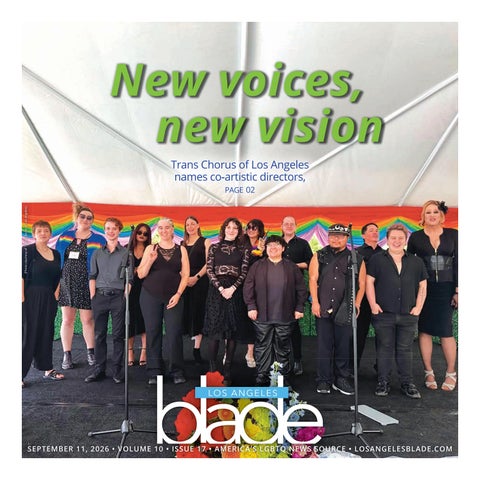
New voices, new vision Trans Chorus of Los Angeles names co-artistic directors, (Photo courtesy of Trans Chorus of Los Angeles)
PAGE 02
SEPTEMBER 11, 2026 • VOLUME 10 • ISSUE 17 • AMERICA’S LGBTQ NEWS SOURCE • LOSANGELESBLADE.COM
LOCAL
New voices, new vision: Trans Chorus of Los Angeles names co-artistic directors for 12th season Two longtime members, Alana Balagot and Corinne Burch, have stepped into the role of co-artistic directors, carrying the organization’s mission forward while shaping a vision of their own By ROSE MONTOYA
The Trans Chorus of Los Angeles has always been about more than music. Since its first rehearsal on October 18, 2015, TCLA has built a space where trans, non-binary, intersex, gender non-conforming, and gender-fluid singers can be seen, heard, and celebrated on their own terms. Now, as the chorus enters its 12th season, it does so under new leadership. Two longtime members, Alana Balagot and Corinne Burch, have stepped into the role of co-artistic directors, carrying the organization’s mission forward while shaping a vision of their own. TCLA’s origin story has an unexpected source. “There was a trans chorus in one of the episodes of Glee,” Alana explained, and the moment stuck with a group of singers who decided to make it real. Alana, a founding member who joined in 2015 after spotting a Facebook ad, had been in choruses her whole life but had not been singing since transitioning. TCLA gave her a space to be both. With support from the Gay Men’s Chorus of Los Angeles, and under the direction of founding artistic director Lindsey Deaton and executive director Lisa Marchbanks, the group held its first rehearsal in a bank conference room. There were no auditions, just people who wanted to sing. Corinne joined years later, in 2021, in the middle of the pandemic, rehearsing over Zoom before the chorus returned in person. He had moved to Los Angeles in 2020 and started testosterone in 2019, a transition that came with an unexpected fear. “When I started taking testosterone, I was worried I was going to lose that part of myself and lose that mode of expression,” Corinne said. Having studied voice and sung in choirs his whole life, he searched for trans choruses and found TCLA first. Both singers stepped into music director roles together in 2022, after longtime musical director Joe Lawrence stepped down, and last year, when artistic director Abdullah Hall left, they stepped up again, this time as co-artistic directors. Alana and Corinne describe their partnership as one built on complementary strengths. Corinne brings a background in music therapy and music education, while Alana brings experience in composing and production. Together, their priority is protecting the professional level of musicianship the chorus has cultivated over the past decade. “That’s something that we think really serves our mission of uplifting the trans community, is showing the world how beautiful our trans voices are,” Corinne said. At the same time, they are building something new. Corinne hopes to expand workshops and training resources for people who want to sing but cannot
02 • SEPTEMBER 11, 2026 • LOSANGELESBLADE.COM
commit to a full rehearsal schedule. “A lot of trans people are turned away from musical spaces in their educational years, and we want to right that wrong,” he said. The new season will also lean further into original work created from within the chorus itself. Composers, arrangers, studio engineers, and directors, all TCLA members, are already shaping the group’s sound. Alana wrote and helped produce a music video last year with her wife Becca directing, recorded in a member’s home studio, with other choristers handling production design, art direction, and choreography. “We want to be intentional about who we’re platforming as well, and making sure we’ve got diverse voices and doing it respectfully,” Alana said. When asked what they wish the public understood about TCLA, both directors pointed to something bigger than the songs themselves. “We’re hoping it changes hearts and minds. We want to show that trans people are artists and musicians and like to sing like everyone else,” Alana said. Corinne pointed to the labor behind the scenes: the volunteers who set up and tear down every show, the board running the organization’s business side, and the funding gap that limits how far the chorus can reach. “The number one thing that stops us from reaching more people is funding,” he said. Grants and a loyal base of recurring donors keep TCLA running, but every dollar matters. His ask to the community is simple. Show up. The chorus has a packed fall ahead. On September 19, TCLA performs as part of a festival with GALA Choruses, the national organization supporting LGBTQ+ choruses. On October 18, the chorus celebrates its anniversary with a birthday concert marking the date of its very first rehearsal in 2015. On November 20, TCLA honors Transgender Day of Remembrance with a full fall show at the Renberg Theater at the Los Angeles LGBT Center. More than a decade after that first rehearsal in a bank conference room, the Trans Chorus of Los Angeles remains proof of what happens when a community insists on being seen. Under Alana and Corinne’s leadership, that mission is expanding rather than settling, reaching further into music education, original composition, and public visibility for trans artists. As the chorus prepares for a fall full of performances, its message stays consistent even as its sound grows. Trans people are musicians, neighbors, and artists, and this season, Los Angeles will have several more chances to listen.
The Prince of Brown A Fictional Memoir By Arthur L. Jenkins
A story of identity, survival, and the courage to become whole. The Prince of Brown: A Fictional Memoir follows Denzel Davis, a Black queer man whose life is shaped by generations of family trauma, systemic oppression, resilience, and hope. His journey moves through childhood, higher education, incarceration, the ballroom community, love, mental illness, and healing toward the realization that reclaiming identity can be an act of courage.
BUY ON AMAZON
“An intriguing character study set in a historically marginalized community.” — Kirkus Indie
FEATURES
Falcon| NakedSword launches new publishing division, Falcon INK The gay adult studio publishes two erotic novels By CHRISTIAN CINTRON
While there’s been an overall movement against LGBTQ people in politics, media, and print, there’s also been a huge gay male erotica boom. Not just Heated Rivalry, but Heartstopper and Red, White and Royal Blue have revealed a huge hunger for erotic male love stories across multiple forms of media. Those books not only found huge fanbases, but drove wildly successful adaptations and launched stars like Connor Storrie and Joe Locke. Ready to enter this landscape is the popular adult film studio, Falcon| NakedSword. The studio has created a new publishing division, Falcon INK. They celebrated this expansion with the release of their first two novels, Hard Ball and Wild Game: Open Season at Book Soup in West Hollywood on August 29th. The guest list included major players from both behind and in front of the camera, including stars Derek Kage, Beau Butler, Trenton Ducati, Tony Genius, and Eddie Burke. Also present were the studio’s President Tim Valenti, Sister of Perpetual Indulgence and Falcon’s Creative Director, Sister Roma, and writer/director and Co-Chief Content Officer and Chief Creative Marketing Officer, Ben Rush. The books in question include Hard Ball, which follows two baseball players whose relationship gets way more than heated. Wild Game: Open Season is a prequel to the multiple award-winning film Wild Game, where Kage plays a man desperate for money who enters a dangerous, high-stakes chase. If caught, his captors could do anything they want. Spoiler alert: it’s triple penetration. The book revealed how Kage’s character got to that level of desperation. This expansion into print media is interesting considering there’s a growing war on queer content in books and adult content. Rigorous age verification laws require viewers to submit a prohibitive amount of personal information to access adult content. Kage is quick to point out, “The written word can be just as intense, just as controversial, if not more provocative than what you see on screen.” He adds, “The part that bugs me is with age verification, the state could decide this is harmful to minors and make people who want to access it have to show an ID. You have states that are banning books that have LGBTQ+ themes and sexual education in the name of it’s harmful to minors. When you lump it all together, not only is it unconstitutional, you’re making it harder for consenting adults who want to access it.” Then he really hits the nail on the head, exclaiming, “People should be able to read what they want to read and consenting adults should be able to view what they want to view.” In addition to print media, Falcon| NakedSword is expanding into safe-for-work content with a thriller microdrama, The Last Guest, and has even partnered with an apparel company for their own line of tie-in underwear. Rush was quick to clarify that this is not a shift from their core business model. Rush shares, “I don’t really see it as a turn away from adult content as much as an expansion of what we can do. We’ve spent years telling stories where sexuality is obviously a ma-
jor component, but, underneath that, you’re still dealing with character, chemistry, fantasy, romance and humor. Those are the things that make people connect with a story.” The studio has gone out of their way to explore countless genres with films ranging from thrillers and horror to romantic comedies. Rush adds, “’Safe-for-work’ content gives us another canvas for that. It allows us to take some of the storytelling instincts we’ve developed and see how far they can go when sex isn’t necessarily the destination.” Now these erotic novels are hardly safe for work but also enter the growing genre of male-on-male sex and romance.
adult content also read books, watch television, fall in love with characters, and want rich stories. We sometimes talk about “adult audiences” as though that’s their entire identity as consumers, and, obviously, it isn’t. The interesting part is seeing where those audiences overlap.” Sister Roma was quick to point out the political importance tied to the success of these stories. She adds, “I think that stories that show queer people in romantic situations are very healthy and important, especially right now, because there are real attempts to take away the right to marry, and there’s so much oppression headed towards our community from every angle. It’s important to show that for people with genuine feelings of love and expression like everybody else, to make people know we’ve always been here; we’re not going away.”
The Future
The Heated Rivalry Connection The runaway success of Heated Rivalry couldn’t be avoided, and Rush was quick to clarify that Falcon INK, while a savvy business move, is not necessarily related to the rise of that hockey romance. In his words, “Their success demonstrates that there’s a huge appetite for queer romance and queer characters, and that the audience extends far beyond what people might traditionally think of as a niche LGBTQIA+ market. But I wouldn’t say we looked at those properties and said, ‘Let’s make our version of that.’ If anything, their success reinforces the idea that queer stories can move between books, television, film, and other media and still find passionate audiences. That’s exciting from a creative perspective.” Derek Kage adds, “Heterosexual cisgendered women are loving gay stories. I find it fascinating. I also find it a little lucrative. I’ve noticed an uptick in my fan sites: heterosexual women who love watching two men have sex with each other.” He also notes that now cis-female performers are actually enjoying filming more with gay men. HIV concerns really limited male-on-male performers, whether they were gay or straight, but now times clearly have changed. Tim Valenti adds that this demographic is growing. He shares, “Sure. It is a different demographic. It’s much younger, and female. I can honestly say we now know about 1213% of our membership is female for our hardcore sites.” While a different demographic, Rush doesn’t believe there’s much of a real difference adding, “ I don’t think the audiences are completely separate. People who consume
04 • SEPTEMBER 11, 2026 • LOSANGELESBLADE.COM
With a budding cinematic universe and cross-platform storytelling, is this the making of a new media empire? Rush jokes, “I’m not sure I’m ready to put ‘media empire’ on my business card. But I do think there’s something exciting about building a creative brand that isn’t restricted to one format.” He continues, “If we have characters or stories that people connect with, why should they only live in one place? A book can become something on screen, and a character can have a life beyond one project. The goal isn’t expansion just for the sake of expansion. It’s to create things people genuinely want more of. If that ultimately looks like an empire, I suppose there are worse problems to have.” Both Kage and Eddie Burke opened up about the unique differences between performing their audiobooks. Whether it’s Burke working on his Southern accent or Kage using his teenage closeted history to get into character and even putting himself in the mindset of the female character, it’s clear these are serious actors who take their art seriously. Kage adds, “We are actually talented performers. Not only are we talented, but we are also educated, and we love what we do. We are authentic in everything we do. If you can put on a performance while taking 3 dicks at once, that is talent.” He jokes, “Meryl could do it. She could do anything.” Jokes aside, Kage confessed to staying in character to deliver some of his more challenging performances, so it’s not surprising this character would live on in print. As to whether Kage and his fellow co-stars could find some of the same breakthrough success as the stars of other male erotic stories he shares, “If Hollywood or a major television show or production company needed my talents, I’d happily accept. If you need a deep-voiced, muscley dude who has a way with men and women and anyone in between. Call me.” The group ended their night at Micky’s supporting their drag show hosted by Ingenue. They shared Falcon| NakedSword prizes, including free copies of the book. If you’d like to get yours, you can purchase Hard Ball or Wild Game: Open Season as a paperback, digital copy, or audiobook.
SU
1 T C O , Y NDA
M A O 3 : O 1 8,
K R A P A D L . O K O L A W Y W L S L D O I H A WEST
LOCAL
How gay nerds will shape the midterm elections HeadCount and NerdsVote are fighting to get LGBTQ+ geeks to the polls! By JOEL MEDINA The nerd community is certainly a fierce fellowship. These are the people completely dedicated to certain franchises, who express their love for these IPs at any given opportunity and are ready to defend them against anyone who can’t fathom their greatness. Whether it’s anime, video games, comic books or more, they know what it means to be a ‘real’ fan today. And, as the thousands of conventions hosted across the U.S. each year show, this community is only growing both in size and in social power every single day. This growth hasn’t come without issue; like any large group, nerds have faced intense struggles with online bullying and in-group harassment over the years. But these folks are united by their geeky love! And, especially when it comes to the many LGBTQ+ individuals who use their fandoms as an escape, most understand that these projects are best when you’re celebrating them with others just as heartfelt as you. Theirs is a beautiful sense of community, one that inspired nonprofits HeadCount and NerdsVote to partner and help nerds rally around one of the best things this country has to offer: the right to vote. Both HeadCount and NerdsVote help individuals flex their right to vote, though in very different ways; HeadCount specializes in hosting voter registration drives at large-scale events, usually concerts and festivals. While NerdsVote also supports
people in the polling box, they focus on digital campaigns with nerd culture’s many celebrities to foster voter registration online. These groups recently announced that they’d be officially partnering to bring their missions into nerdy gatherings across the country, ensuring that any con-goer can leave an event not only with their favorite merch, but the knowledge that they’re ready to vote in any upcoming election. “Our expanded partnership with NerdsVote comes at an exciting time, both as we lead up to the midterm elections but also as the comic-con community is rapidly growing,” said Tappan Vickery, Vice President of Program and Strategy at Headcount. “We are thrilled to bring voter engagement into the space, and look forward to supporting this fan-focused community.” It’s a demographic that is especially important when it comes to voting; despite what early Hollywood will have you believe, nerd communities are some of the most diverse groups that the U.S. has to offer. Gone are the nonstop portrayals of nerds as cisgender, straight, and white, an archetype popularized in movies like Revenge of the Nerds. While those community mem-
bers do exist, today’s fandoms are filled with queer folks and other marginalized identities who finally feel welcomed in these spaces. It’s a promising shift for these groups, and it’s why, now more than ever, it’s important they can vote for policies that support their rights (and against the politicians who see them as political fodder). “From our experience working in games and animation, attending comic cons, the fans and fellow nerds we’ve met tend to be a wildly diverse, empathetic, problem-solving, and creative community,” said JP Karliak, a renowned voice performer (known for their work as Morph in X-Men ‘97) and Co-Founder of NerdsVote. “Who wouldn’t want more of them involved in our democracy?” This partnership will see these groups set up voter registration tables at comic-cons, gaming expos, and any other nerdy festival they can find. It will offer not only vital education to the people in attendance, but a direct civic outreach that these populations don’t often receive. And, in the ultimate mission of this new partnership, it will turn America’s nerd community into the most active group of voters at the upcoming midterm elections. NerdsVote and HeadCount are hitting the ground running with this partnership, already having tables planned for the upcoming Animate! Convention in Philadelphia and Galaxycon in St. Louis. They’ve assured their many supporters that these are only the beginning and are currently organizing for the hundreds of other nerd events 2026 still has in store. It’s hard work, but in the words of Courtenay Taylor, NerdsVote President, “[This] moves us closer to achieving my big dream of having voter registration booths at every Comic-Con in the United States!”
Remembering the life of Ahmaud Arbery with Dr. Alexander Lloyd Blake The Grammy-winning composer discusses how he’s using music to fight for justice By JOEL MEDINA Across his many years as a singer, a conductor, and an activist, Dr. Alexander Lloyd Blake has been driven by one universal truth: music has power. It’s a fact that has guided the man’s entire life; he grew up in Jacksonville, North Carolina, singing in his church’s gospel choir. “I’ve always loved singing with people from the very beginning, and singing gospel music has always meant singing for a purpose,” said Alexander, reminiscing on his early days as a performer. “I always wanted to be a gospel choir director. But, frankly, I knew I was gay for a very long time, and I was like, ‘This is not going to work out because I do not feel like I can really have a peaceful life trying to sing in the church.’” Recognizing that he needed a setting where his queerness didn’t have to be hidden, Blake eventually left Jacksonville to pursue vocal studies, earning his doctorate in Musical Arts before becoming one of the entertainment industry’s top composers today. The past few years have seen him contribute to the music of blockbuster films like The Odyssey and Us, but while he’s proud of these and the many other projects he’s worked on over the years, there’s one that truly summarizes his passion for music: Tonality. The Grammy-winning choral ensemble led by Dr. Blake uses music to fight for social justice today. “Let me think about all the ways I have been made to feel less than, directly or indirectly, in my field, and [how] to combat that,” said Blake, recounting how he initially found the idea of creating an ensemble made solely of marginalized performers. “That was really the beginning. It was a personal question of, ‘Can I create a group where I don’t feel like an outsider?’” Since its formation
more than 10 years ago, Tonality has won two Grammys for its work in film and has created numerous albums centered around the social issues faced by its many members. In the group’s own words, they are “dedicated to the power of music as a vehicle for equity, healing, and community.” And while they’ve made a name for themselves by creating jaw-dropping pieces centered around fighting oppression, their latest album, Running From, Running To: A Musical Reflection on Ahmaud Arbery, is proving to be one of Tonality’s most moving works yet. America still hasn’t recovered from the atrocity that was the murder of Ahmaud Arbery in 2020. At only 25 years old, this young Black man was stalked, attacked, and eventually murdered by three white men in his own neighborhood, all because he decided to go on a jog. The horrendous mishandling of this case by local authorities — with numerous figures having personal relationships with the perpetrators and pushing for lighter sentences — sparked national outrage, as his death highlighted the abuse of Black communities in this country. Ahmaud’s death came only a few months before the murder of George Floyd, with both fueling nationwide protests against the social mechanisms that continue to steal the lives of Black people every single day. “I remember where I was when I read about the Ahmaud Arbery story in 2020, and at the time, it didn’t really seem like a lot of people were talking about it,” described Alexander. “I remember thinking, ‘Okay, there are so many lessons in this story.’ Thinking about what it would be like to be running — something so many people do — and to be gunned down for being different. So, I [went to] the board of Tonality, and I said, ‘I feel like we should
06 • SEPTEMBER 11, 2026 • LOSANGELESBLADE.COM
ALEXANDER LLOYD BLAKE leads Tonality (Photo Credit: Dorian Bonner)
create a piece about Ahmaud Arbery’s story.’” And so, Running From, Running To: A Musical Reflection on Ahmaud Arbery was made, with the album consisting of eight intricate movements that each center the life and death of this young man. Alexander credited this album as one of the most difficult projects of his career, emphasizing that before he could even start working on it with Tonality, he had to first get the blessing of the person who loved Ahmaud most: his mother, Wanda Cooper-Jones. “I got in touch with Ahmaud Arbery’s mother because I didn’t want to be another person who just writes about the death of someone,” the composer explained. “I was able to talk with her, and we had many conversations, and she’s been such a supporter.” CONTINUES AT LOSANGELESBLADE.COM
SUNDAY, OCTOBER 4 ORPHEUM THEATRE
GET TICKETS AT BESTINDRAGSHOW.COM
ALL PROCEEDS BENEFIT
NATIONAL
Gloria Steinem dies at 92 Feminist icon championed LGBTQ rights By MARGARET HETHERMAN
Gloria Steinem, writer, activist, and a leading voice of the feminist movement in the 1970s, died on Wednesday in Manhattan. Her death was announced on Instagram by her official foundation, Gloria’s Foundation, which shared that Steinem “passed away peacefully at her home, surrounded by some of the many who loved her.” She was 92. A leading figure and spokesperson for the second-wave feminist movement, running from the 1960s through the ’80s — the earlier women’s rights suffrage movement being considered the first — Gloria Steinem campaigned for workplace equality, equality in the home and reproductive freedom, seeing those struggles as inseparable from the wider causes of social and racial equality. She also championed LGBTQ rights, supporting lesbian visibility within the larger women’s liberation movement, and standing in opposition to the idea that lesbians posed a “lavender menace” to the cause of feminism. In her vision of the future, marriage equality was a given: “Lesbians or homosexuals will no longer be denied legally binding marriages, complete with mutual-support agreements and inheritance rights.” GLAAD President Sarah Kate Ellis said in a statement following Steinem’s death: “Gloria Steinem was a trailblazing titan of civil rights whose vision for liberation bridged the movements for gender equality, bodily autonomy, and LGBTQ rights. She recognized that feminist progress is incomplete without full inclusion and stood as an ally to transgender people’s fight for equality. Gloria rejected rigid binaries, choosing instead to build bridges of empathy and coalition across all marginalized identities. Gloria’s life was a masterclass in coalition-building, courage, and unconditional empathy.” Among her many trailblazing milestones, Steinem was widely known for co-founding the National Women’s Political Caucus in 1971 alongside foundational feminist figures Bella Abzug, Shirley Chisholm, Betty Friedan, Fannie Lou Hamer, LaDonna Harris, Mildred Jeffrey, and Jill Ruckelshaus. The mandate: get women into political office and positions of power — “women who are committed to the causes of other women — not women who are going to just imitate the male politics as it has been practiced all these years complete with elitism, racism and prejudice against women,” she said, “but women who really care about their sisters and will work for social reform.” “This is no simple reform. It really is a revolution.” Liz Abzug, daughter of Bella Abzug, remembers Steinem as “a lifelong activist and a humanist with lots of love to give,” as well as “a very, very close and dear friend of my mother’s,” as the two “worked side by side to change the American landscape for women.” “It’s hard for me and all of her other supporters and admirers to imagine a world without Gloria leading the charge and fighting for women’s rights and full gender equality,” Abzug shared. Indeed, there was much about that American landscape in need of change. Steinem came up during a time when discrimination against women was the legal and societal norm.
A married woman, for instance, often required her husband’s signature to obtain a credit card, a form of gender discrimination remedied in 1974 with the Equal Credit Opportunity Act. Women were often unable to get jobs. Life turned Steinem down, saying “We don’t want a pretty girl, we want a writer. Get out of here.” If women did land a job, in 1973, they would have likely made 56.6 cents to every dollar that men earned. The law’s failure to support women’s autonomy was especially visible on the matter of reproductive rights. For many women in America, legal abortion remained unavailable until 1973, when Roe v. Wade established a constitutional right to abortion nationwide. Steinem spent years speaking out for women’s safety, and promoted the idea that “decision-making power over our own physical selves” was intertwined with equal regard for women as citizens. “The vast majority of women support safe and legal abortion. My response is if those legislators were half women, this wouldn’t happen,” she said in a 2022 interview with Katie Couric. “If we actually had a democracy, if those legislators looked like the country from a gender, racial, and class perspective, this probably would not be happening…” Gloria Marie Steinem was born on March 25, 1934, in Toledo, Ohio, the daughter of Leo and Ruth (Nuneviller) Steinem. Her father was an antiques salesman; her mother had worked for a newspaper before she got married, but suffered what was called at the time a “nervous breakdown” and spent time in an institution. Following a divorce, her mother was left largely in the care of 11-year-old Gloria Steinem in a house that has been described as infested by vermin. “I didn’t go to school a full year until I was 11 or 12, so I lived in books. I really was an observer of life,” Steinem said in a 2011 interview. After moving to D.C. to live with her older sister, Susanne, Steinem graduated from Western High School in 1952. She followed Susanne to Smith College where she studied government and wrote for the student newspaper, graduating in 1956. Upon moving to New York in 1960, she worked for Help! magazine and wrote freelance for publications that included Life, Esquire, and Glamour. According to Smith College Libraries, she co-founded New York magazine in 1968 and served as political columnist until 1972. In the 1960s and ’70s, Steinem was active in causes that included United Farmworkers, Vietnam War Tax Protest, and Committee for the Legal Defense of Angela Davis. She also participated in the political campaigns of Adlai Stevenson, Robert Kennedy, Shirley Chisholm, and others. Steinem is said to have found her way to the Women’s Movement in 1969, following an abortion “speak-out” meeting of the Redstockings. She was inspired to begin speaking to audiences across the country, alongside activist Dorothy Pitman Hughes, and later Florynce Kennedy and Margaret Sloan. Among Steinem’s most enduring legacies, and still in publication today, is Ms. magazine, which she co-founded. Widely considered the first national American feminist mag-
08 • SEPTEMBER 11, 2026 • LOSANGELESBLADE.COM
GLORIA STEINEM speaks at the 2013 Human Rights Campaign National Dinner in D.C. (Blade file photo by Michael Key)
azine (and owned, operated, and written by women!), it first appeared as a preview insert in New York Magazine in December 1971 with a tagline, “The New Magazine for Women.” Ms. earned status as a full-on publication in July 1972 with a cover image depicting a modern pregnant Hindu goddess Kali holding a clock, skillet, typewriter, rake, mirror, telephone, steering wheel, and an iron. Ms. is credited with raising cultural awareness on policy issues, like the Equal Rights Amendment, taking on taboo topics and putting women’s issues front and center. Steinem’s long list of published work includes the 1983 bestselling book Outrageous Acts and Everyday Rebellions, a collection of her Ms. articles and other pieces. The book includes the feminist’s essay on her undercover exposé of the Playboy Club, for which she donned bunny ears, collar, and bow to covertly report on working conditions for women. In 1986, she published “Marilyn: Norma Jeane,” which explored the life of Marilyn Monroe and the idea of women as vulnerable and at the disposal of society — men in particular. Steinem also wrote “Revolution from Within” (1992); “Moving Beyond Words” (1994); and “Doing Sixty & Seventy” (2006). She was awarded the Presidential Medal of Freedom in 2013 by President Barack Obama. Steinem’s relationships over the years included Ted Sorensen, counselor to President John F. Kennedy; Stanley Pottinger, a Justice Department official; and publisher and real-estate businessman Mort Zuckerman. In 2000, she married South African businessman David Bale, who died in 2003. Steinem was predeceased by her mother and her sister, Susanne Steinem Patch, who died in 2007. On multiple occasions, she spoke of a community that extended beyond birth family — people whom she chose, and who chose her. “[Feminism is] about friends and sisters and community,” Steinem said in an interview with bell hooks. “The good part and the great part is that it’s about chosen family. We have each other’s backs and that is so precious. In announcing Steinem’s passing, her foundation offered this reflection: “Gloria’s greatest gift was her ability to listen to others, to make others feel seen and heard. Her words, actions, and example gave people permission to be their truest selves. Gloria lived true to her independent spirit, always with curiosity and a great sense of humor. “She spent her recent years doing the two things she loved most: being in community with others and writing … Gloria loved the tradition of lighting signal fires on hills to light the way to the other side of the mountain.”
VIEWPOINT
The politics of selective outrage: San Diego repeals bathhouse ban While we celebrate San Diego, it’s worth asking why we can raise our voices for bathhouses while turning a blind eye to the far more urgent suffering unfolding around the world VO L U M E 10 IS S U E 17 PHONE 310-230-5266 E-MAIL arodriguez@losangelesblade.com INTERNET losangelesblade.com PUBLISHED BY Los Angeles Blade, LLC PUBLISHER ALEXANDER RODRIGUEZ arodriguez@losangelesblade.com, 310-230-5266 x 8080 EDITORIAL NATIONAL EDITOR KEVIN NAFF knaff@washblade.com, 202-747-2077 x 8088 CONTRIBUTING WRITER KAREN OCAMB karenocamb@losangelesblade.com CONTRIBUTORS
MICHAEL K. LAVERS, TINASHE CHINGARANDE, JOHN PAUL KING, LOU CHIBBARO JR., SUSAN HORNIK, JOE REBERKENNY, ISAAC AMEND, PETER ROSENSTEIN, TERRI SCHLICHENMEYER, JOE PHILLIPS, ANKUSH KUMAR, ESTEBAN RIOSECO, AJ SLOAN, AYMAN ECKFORD, TOM SITUMO
SALES & ADMINISTRATION SALES EXECUTIVE SHANA WONG SOLARES swong@losangelesblade.com, 808-386-0872 MARKETING DIRECTOR BRIAN PITTS bpitts@washblade.com, 202-747-2077 x 8089 NATIONAL ADVERTISING RIVENDELL MEDIA sales@rivendellmedia.com, 212-242-6863 ADMINISTRATION PHILLIP G. ROCKSTROH prockstroh@washblade.com, 202-747-2077 x 8092 CREATIVE DESIGN/PRODUCTION MEAGHAN JUBA production@azercreative.com DISTRIBUTION CHRISTOPHER JACKSON, 562-826-6602 All material in the Los Angeles Blade is protected by federal copyright law and may not be reproduced without the written consent of the Los Angeles Blade. The sexual orientation of advertisers, photographers, writers and cartoonists published herein is neither inferred nor implied. The appearance of names or pictorial representation does not necessarily indicate the sexual orientation of that person or persons. Although the Los Angeles Blade is supported by many fine advertisers, we cannot accept responsibility for claims made by advertisers. Unsolicited editorial material is accepted by the Los Angeles Blade, but the paper cannot take responsibility for its return. The editors reserve the right to accept, reject or edit any submission. A single copy of the Los Angeles Blade is available from authorized distribution points, to any individual within a 50-mile radius of Los Angeles, CA. Multiple copies are available from the Los Angeles Blade office only. Call for rates. If you cannot reach a convenient free distribution point, you may receive a 26-week mailed subscription for $125 per year or $5.00 per single issue. Checks can be sent to Phil Rockstroh at prockstroh@washblade.com. Or send him an email to request directions to make a payment online. Postmaster: Send address changes to the Los Angeles Blade, PO BOX 60664 Washington, DC 20039. The Los Angeles Blade is published bi-weekly, on Friday, by Los Angeles Blade, LLC. Rates for businesses/institutions are $450 per year. Periodical postage paid at Los Angeles, CA., and additional mailing offices. Editorial positions of the Los Angeles Blade are expressed in editorials and in editors’ notes as determined by the paper’s editors. Other opinions are those of the writers and do not necessarily represent the opinion of the Los Angeles Blade or its staff. To submit a letter or commentary: Letters should be fewer than 400 words; commentaries should be fewer than 750 words. Submissions may be edited for content and length, and must include a name, address and phone number for verification. Send submissions by e-mail to knaff@washblade.com.
2023 GLAAD Media Awards
©2026 LOS ANGELES BLADE, LLC.
By AJ SLOAN I’m no stranger to and am an advocate for a little group release every now and again. That said, I of course am all for San Diego repealing its antiquated bathhouse ordinance. Despite the likely anti-queer motivations of the time, the ordinance also came during a time when, unfortunately, the casual connections that many folks take for granted today came at a potentially deadly cost. This repeal is a small yet significant testament to the early and darkest ties of the HIV/AIDS crisis. This ordinance dates back to 1988 and subjected bathhouses to regulations rooted in their stated concern that bathhouses facilitated sex practices that were a legitimate risk to the plague of HIV/AIDS transmission at the time. Now, almost 40 years later, the City Council of San Diego unanimously decided to repeal it - great move for queer tourism, and can’t wait to see how these spaces flourish as a result. If Black’s Beach wasn’t enough of a reason to go to San Diego… Bathhouses have, historically, been a place that, dare I say therapeutic balance of community and anonymity. At different points in history and in cultures, they have served as a home base of refuge and solidarity as well. When identifying as gay, queer, trans, or any other letter of our god blessed rainbow could cost your reputation, your job, your family, or even your life, these and other queer spaces encompassed the duality of places for both recreation just as much as they were for resistance. Our dearly queer elders quite literally fought to exist openly so that we pole smokers and clam connoisseurs today can eat at our hearts’ content. They were the pioneers who threw bricks and were arrested at Stonewall in order for us to perform fellatio in those very bathrooms today with next to zero concern of, well, anything. The HIV/AIDS crisis was just yesterday for so many of our community. In the US alone, more than 100,000 died from AIDS by 1990. To spare the details ( that I implore every last one of you to look up the next time you’re tempted to doom scroll), eventually the advocacy and outrage paid off (TAKE NOTE!). The implementation of proper medical intervention coupled with sex education in the virus paid tf off. Fast forward to today, treatment can suppress HIV to the point that it is not sexually transmittable. In 2024, over 68% of folks age thirteen and older living with HIV had reached viral suppression. If this isn’t progress, I don’t know what is. At the same time, progress has a way of making folks forget about what it took to get us here. Before receiving this assignment from my publisher, I had already been made aware of the San Diego repeal. A friend’s husband had mentioned it with gusto in the same conversation in which he was deflecting a comment about refugees worldwide. I could not help but find myself taken aback by the juxtaposition between his enthusiasm for the right to simultaneously steam and blow with his dismissal of crises abroad. These are the politics that get you to raise your voice? I had a similar thought the night the Knicks won the World Series or Super Bowl or whichever they do. A friend and I had made the mistake of going to catch a flick that evening - thank you, AMC A-List, thank you, Nicole Kidman. We found ourselves at a theatre around the corner from Madison Square Garden, and what a mistake that was. I won’t go into detail on the chaos we were witness to, as I assume you
have Instagram. At the time, I couldn’t help but think: where was this energy during Black Lives Matter? Where is even a fraction of this uproar when very real people are being displaced, persecuted, starved, and killed? I love New York City, but I love basic human rights even more. Many of us become passionate about injustice once it is at our stoop, then suddenly become preoccupied once it is absent from our immediate line of vision. When it affects our healthcare, our relationships, and our right to raw-dog in a sauna, suddenly we are activists. But when it’s happening to someone whose life looks a little different from our own or who happens to be somewhere else on the planet… blind eye turned. Indifference. Active ignorance. There are queer folks around the world at this very moment whose safety and lives would be at risk if they were to live their true identities openly and authentically. There are so many members of our LGBTQ+ community whose families, communities, governments, and religions would persecute them for doing exactly what many of us consider to be a regular Thursday night. And yet so many of us exist in extraordinary comfort, basking in the rights that queer folks fifty years ago fought, protested, and sometimes died for, while remaining almost entirely disengaged from those who are still waiting for their own liberation. This should upset us. I was reminded about a year ago on a visit to the Metropolitan Museum of Art with a childhood friend. We were making our way through the fairly new and long overdue native American wing, taking in these breathtakingly vibrant patterns and aesthetics. At some point, I turned to him and commented something along the lines of, “Can you imagine how spectacular this country might look like today if these populations had never been displaced and decimated?” His response: a casual and dismissive shrug. “Well, it’s happened thousands of times, so what are we supposed to do about it?” And with that, he walked to the next piece. I have a feeling that I won’t soon forget this response. There is something deeply and dangerously dismissive about becoming so very comfortable inside one’s own worldview that one is unable to imagine another one. Or worse, becomes upset or confrontational when challenged to. We don’t have to agree on everything. We don’t have to care about the same things. But what I know is possible is that we are capable of developing the basic human capacity to recognize suffering outside of our immediate line of vision. So yes, let us celebrate San Diego on repealing the bathhouse ordinance. Let gay men gather. Let consenting adults have consensual sex in consensual places. Let queer spaces exist without the government treating our sexual identities as shameful or dangerous. And let us never forget our queer forefathers and foremothers who fought to make it all possible for us today. But maybe, just maybe, we can redirect some of that queer political vigor to Sudan. To Palestine. To Iran. To Western Sahara. To refugees. To indigenous communities worldwide. To all of the LGBTQ+ folks living under governments where authenticity is straight up dangerous. And don’t get me wrong - I’m not suggesting that we stop caring about d*ck, I am suggesting that we care about more than just d*ck. I challenge everyone who has made it this far to step that much further outside our likely comfortable worldview and embrace getting a little uncomfortable questioning what you think you already know. I do fear, however, that all of you who have made it this far in my article are likely not the folks that most need to hear this. I guess, for all of them, we can always put the world news on in their bathhouses. They can sweat out their toxins as well as their political apathy. And with their mouths likely full, perhaps they’ll finally open their ears.
LOSANGELESBLADE.COM • SEPTEMBER 11, 2026 • 09
ANIMAL LA bridges the gay bar and the queer underground The new Arts District bar is giving underground DJs a permanent home while carving out its own place in Los Angeles queer nightlife By MICHAEL PINCUS In Los Angeles, underground electronic music has largely occupied a separate corner of queer nightlife from the city’s traditional gay bars, existing instead in transient DIY warehouse parties. ANIMAL LA is trying to bridge those two sides of queer nightlife. The new Arts District queer bar, which soft-opened July 25, offers a permanent venue for DJs and crowds from L.A.’s queer underground scene, with attention to detail extending from its music curation to cocktails and design. “Queer folks have historically been our fashion designers, our writers, our musicians, our hairstylists, our interior decorators, all the creatives,” Ashton Correa, one of the partners behind ANIMAL, said. “When we were creating ANIMAL, it was about a place where we would be inspired and enjoy the atmosphere, low lighting, nice decor, a good cocktail, and some interesting music.” Correa opened ANIMAL LA with partners Jim Morrison Hevert, Nick Eskelinen and Tony Kelley, following the group’s first ANIMAL location in Brooklyn, which opened in March 2024. The team aimed to create a bar for queer people that felt refined and considered. “As queer tastemakers, we deserve something nice,” Correa said. “We wanted to be that for the community and for all of the amazing, talented creatives.” That philosophy guides ANIMAL LA’s DJ bookings. The team focuses on local talent, including artists who play the city’s DIY warehouse parties. Correa praised the “robust, vibrant underground warehouse scene” that exists despite California’s 2 a.m. last call, and said ANIMAL LA aims to complement it with the consistency of a legal venue. “We don’t have huge budgets, but if we can supplement an artist’s income by giving them close to a monthly type of gig, then that will hopefully support the nightlife and the artists,” Correa said. DJs including Sindri, ts GO!, Eva Myra May, Ashley Younniä, Terrell Brooke, Munro, Pretty Gay Friendly, DJ Kerry, and Cocteautwinks are among those already returning to the ANIMAL LA decks. Stacy Christine, a longtime DJ in L.A.’s queer underground who has played at both ANIMAL locations, said the bar also gives DJs the freedom to play underground sounds less common at traditional gay bars. “ANIMAL understands underground music,” Christine said. “If you were to play this type of music in another queer bar, someone would come up with a request on their phone for Britney or Bad Bunny. This is not that kind of place.” DJs at ANIMAL LA are encouraged to play groovy electronic music, including house and techno, or, as Correa puts it, “music that people can flirt to, sway their hips to, dance to.” “The bookers and Ashton specifically come from the underground,” Christine said. “They are tapped in, and there’s no compromising.” That refusal to compromise extends beyond the music. ANIMAL LA’s cocktail program uses a draft system to serve drinks quickly without sacrificing care. Bartenders prepare ingredients in-house before batching them, helping to handle crowds while keeping prices accessible. The menu includes a house-brewed maté, three types of Negronis, and a frozen espresso martini. “Whether it’s fashion or aesthetics or architecture, [queer people] consider ourselves to be a cut above, and we’re not wrong,” ANIMAL LA partner Jim Morrison Hevert said. “The only thing is, we’ve never really had that in our bar spaces, and it’s sort of a lightbulb moment, like, ‘Excuse me, why?’”
10 • LOSANGELESBLADE.COM • SEPTEMBER 11, 2026
ANIMAL Friends and Family Night (Photos by Clint Keller)
ANIMAL LA’s indoor-outdoor layout includes a garden patio with its own bar and DJ booth. Inside, a giant disco banana designed by local artist and fabricator Eric Schum hangs over the dance floor, while custom metalwork by William Patchen is visible throughout the venue. The partners initially considered opening in Silver Lake at the site of the former Faultline Bar, a gay leather bar which closed in January 2021. However, once they saw the expansive patio at the former Resident DTLA music venue at 428 S. Hewitt St., they chose the Arts District space instead, placing ANIMAL LA away from existing queer bars. “I walked into this space in the Arts District, and I was like, ‘Holy shit, this is ANIMAL!’” Morrison Hevert said. “Opening the Arts District has panned out to be something that’s more leaning into Los Angeles, rather than just plopping down a Brooklyn ANIMAL between Akbar and the Eagle.” The team was nervous to open outside of the city’s established gay bar corridors, but Correa said they were “excited to not step on anybody’s toes” and “to be able to go into our own little pocket of L.A.” “It was exciting to open a bar in a place that doesn’t have gay bars and to be a little beacon of queerness,” Correa said. ANIMAL LA hopes to introduce programming including kink and fetish community events, flea markets, drag shows, and live music performances, while continuing to spotlight local and international underground DJs. “We’re really grateful that ANIMAL is part of the L.A. queer ecosystem,” Christine said. “We’ve been needing a space like this for so long. ANIMAL has really breathed new life, giving us invigoration. She was right on time.” ANIMAL LA is open Tuesday to Friday from 4 p.m. to 2 a.m. and Saturday and Sunday from 2 p.m. to 2 a.m. at 428 S. Hewitt St. with no cover charge.
FILM
‘Thelma and Louise’ remains landmark of unspoken queer rebellion Celebrating iconic film 35 years after its release By JOHN PAUL KING Hard as it is to believe for those who were around when it happened, “Thelma and Louise” celebrates the 35th anniversary of its release this year. Deeply popular with both critics and audiences at the time, its reputation continues to ride high; it’s a movie that manages to exist within a nexus of intersecting genres – the “buddy picture”, the “crime thriller,” the “action adventure,” the” “western,” the “neonoir” – by blending them seamlessly into a crowd-pleasing wild ride of a story, all while delivering a powerful feminist message of outrage, defiance, and empowerment. And no, “Thelma and Louise” is not a “queer movie” – but it feels like one. That’s partly because It exists within another genre, too: “lesbian noir,” which blossomed in its wake with films like “Bound” (1996) and has re-emerged in recent films like “Love Lies Bleeding” (2024) and “Honey, Don’t” (2025) – but that also stretches back across decades into the days of old Hollywood, when coded queer characters were a regular fixture in the seedy film noir classics of their time, never overtly identified as such but obvious to spot for anyone savvy enough to read the subtext. That’s why “Thelma and Louise” resonated (and continues to resonate) with lesbian and bisexual audiences who see themselves reflected in its two lead characters, even if there is nothing queer about their relationship — on the surface at least.
SUSAN SARANDON and GEENA DAVIS in ‘Thelma & Louise.’ (Image courtesy MGM)
Of course, that can be a sore subject; subtext might seem like a “cop-out” for those who long for more open representation for LGBTQ people on the screen – but it’s everything when it comes to recognizing the queerness of older movies (and a lot of newer ones, too), and just because something is not explicitly stated, that doesn’t mean it’s being hidden. After all, most good stories rely on the transcendent power of nuance, which always relies on subtext to shine through. And if any movie relies upon subtext, “Thelma and Louise” is certainly one of them. In its masterfully crafted narrative of a weekend “girl’s trip” that goes horribly wrong, a lot of the most important information is left unspoken. Take Thelma (Geena Davis), to start with: a naive young housewife whose husband Darryl (Christopher McDonald) treats her like a possession, she blithely ignores his mediocrity and disregards – or at least, pretends to – his repressive tactics to control her, choosing instead to live in a tenuous illusion of “traditional” marriage dynamics; yet when her bestie Louise (Susan Sarandon) offers her a chance to escape for a weekend, she jumps at it – even if she has to skip the part where she asks his permission. Louise (Susan Sarandon), a bit older and a lot more worldly, is a waitress who spends 12 • LOSANGELESBLADE.COM • SEPTEMBER 11, 2026
her days fending off the insults and advances of her male customers at the diner where she works; she sees Thelma’s situation clearly, and hopes that a temporary respite from Darryl will help her recognize the dead-end reality of her marriage. We understand this immediately, even though a direct word is never said about it, and she’s right, of course. They’ve barely even gotten on the road before Thelma’s longing for attention from someone other than her inadequate husband – a honky-tonk Lothario (Timothy Carhart) she meets in a roadhouse where they stop for drinks on the way out of town – leads to an attempted rape that is only prevented when Louise shoots the predator dead in the parking lot. That killing is the catalyst that turns them into fugitives; as Louise rightly understands, there’s no evidence of sexual assault, just a dead body and a pair of runaway women, and the letter of the law is not on their side. But in truth, that fatal shot is fired not to save Thelma, who has already been freed from her would-be rapist’s clutches when it happens, but because Louise has traumatic memories – and a chip on her shoulder – over something that “happened in Texas,” years before. We never find out what it was that happened, and we don’t need to; our imaginations tell us all we need to know, just as we know that the killing, while it may have been cold-blooded murder, is a justifiable homicide all the same. There’s more of that subtextual nuance throughout, from the perversely inspiring motivations of hitchhiking hustler J.D. (Brad Pitt, in the sex-on-a-stick performance that launched him on his trajectory to stardom), who takes advantage of Thelma’s gullibility to rob the heroines even as he teaches her the tactics that will soon launch them on their fateful ride-or-die fugitive adventure; to the self-serving “chivalry” of Louise’s erstwhile boyfriend (Michael Madsen) as he casts himself as the “martyr” in letting her go. And yes, even to the benignly sublimated patriarchal programming that drives police investigator Hal Slocumb (Harvey Keitel in an uncharacteristically empathetic role) to act as the would-be savior of these two “fallen” women, though they want no part of his well-meaning attempts to “rescue” them from the consequences of their choices. And when the two fugitives terrorize a piggish trucker (Marco St. John) before blowing up his big-rig tanker, nobody says – or needs to say – why it feels to them like the right thing to do; it simply IS the right thing, and we, as the audience, know it. What we have seen up to that point has placed us firmly on Thelma and Louise’s side already, and we’re as ready to watch the puerile patriarchy burn as they are. None of this is spoken aloud, nor is it even alluded to, but it comes through, nonetheless. Chalk it up, if you like, to the power of cinema, especially in the hands of a versatile, stylish, and seasoned director like Ridley Scott, to communicate what is inherently beyond the power of words. Thelma and Louise may not be “a couple,” but we can’t help but notice as their clothing evolves from frilly-femme to “butch” utilitarianism along the way, or how their connection to the men in their lives easily dissolves without fanfare. And by the time we reach the movie’s thrilling denouement, when all they have left is their commitment to simply stand up against all the things that have kept them feeling incomplete, unfulfilled, and unacceptable, it’s an achingly familiar feeling for any queer viewer who has experienced the same. We all know what happens, so it’s no spoiler to say that, when they drive off into oblivion in the Grand Canyon, they choose freedom over life itself – and when they head over that cliff, fully embracing their fate as a feminist iteration of the Bonnie and Clyde brand of “noble” outlaws, they seal their fate with a kiss. At that point, no explanation is needed. Their love for each other transcends anything they’ve felt with the inadequate men in their lives; and in that final freeze-frame moment, when they drive off the cliff and sail into oblivion, we like to think that their car – like Danny Zuko’s at the end of “Grease” – simply flies away into the bliss of an endless summer, and you can’t get any queerer than that.
BOOKS
Dolly Parton biography puts her hardships into context ‘Ain’t Nobody’s Fool’ a highly researched tome not to be missed By TERRI SCHLICHENMEYER Not too bright. That’s what people once thought about you. Your language didn’t conform, you had your own sense of style, and you were ignorant about modern things and places and foods. But you were no dummy. You were different, and you had a secret: as in the new biography, “Ain’t Nobody’s Fool: The Life and Times of Dolly Parton” by Martha Ackmann, you knew exactly where you were going. When Avie Lee Owens and Lee Parton first married, they had the very basics: “two knives, two forks, two spoons, a skillet, a butcher knife, and an old iron kettle.” He was 17; she was 15. Babies came quick. The fourth one was named Dolly, after two great-aunts. Almost from the time she could walk, Dolly sang. Before she was old enough to attend school, she wrote poetry, and she’d begun to notice rhythms and beats she could make with her fingers. As a schoolchild, she created her own musical instruments out of scraps, and she was eager to perform whenever anyone asked her – and they asked often, because Dolly Parton was a nice girl, and her sense of humor conveyed a warmth that drew people in. Growing up in the Tennessee mountains, Parton was independent, shunning marriage and child-raising, instead focusing on a dream of being a star. By the time she was in high school, she’d had a regular gig on local television but she recognized that there were few opportunities for fame in the mountains, so she left for Nashville the day after high school graduation, with the snickers of naysayers ringing in her ears. She stayed with an aunt and uncle there, and she beat the streets, dined on grocery store samples to get by, and missed her family and friends. And they worried about her, but they knew nothing would derail her plans. They knew Dolly would be fine. As a friend said, “’She had her head on pretty good.’” Chances are that if you’ve listened to music any time in the last 60 years, you’ve heard Dolly Parton through her words or her music or both. Now you need to learn more about her, and “Ain’t Nobody’s Fool” is where to do it. Here’s a biography that grabs you on the first page with the tiniest bit of family tree, but not so much that you get bored with it. Author Martha Ackmann writes about Dolly Parton’s early life, putting hardships and experiences in context, both personally and historically. There are name-drops, but not overly so, as Ackmann takes you through Parton’s career, her heartbreaks, her marriage, and her years with Porter Wagoner, in detail but not dramatically embellished or outrageously told. It’s a biography that’s just right, sourced well and written with a fresh take that, like its subject, tells a good story. Fans, of course, will want this highly researched book but music lovers of any age or type will eat it up. That means you, so use up that Christmas gift certificate. “Ain’t Nobody’s Fool” just shines.
‘Ain’t Nobody’s Fool: The Life and Times of Dolly Parton’ By Martha Ackmann c.2026, St. Martin’s Press | $30 | 304 pages
14 • LOSANGELESBLADE.COM • SEPTEMBER 11, 2026
America’s #1 HIV Provider Did you know that AIDS Healthcare Foundation (AHF) is the largest provider of HIV medical care in the world? We offer a complete circle of care that includes free HIV testing, expert providers, and specialty pharmacy services, where 96 cents of every dollar made goes back into HIV care. Regardless of ability to pay, we’re committed to providing the most advanced care and treatment available today.
Scan to find HIV testing & care near you.