PRESENTED BY
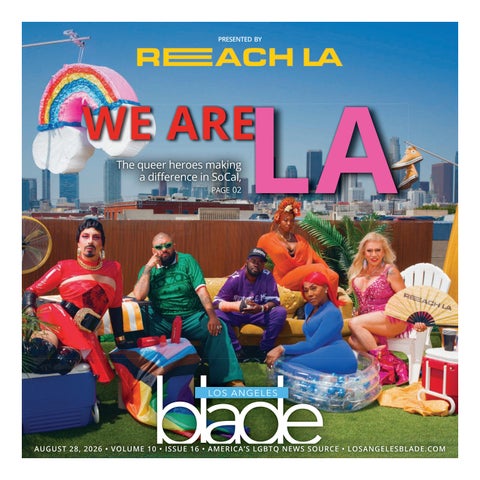
The queer heroes making a difference in SoCal, PAGE 02
AUGUST 28, 2026 • VOLUME 10 • ISSUE 16 • AMERICA’S LGBTQ NEWS SOURCE • LOSANGELESBLADE.COM
FEATURES
REACH LA: Where community, culture, and liberation kiki Three strong voices from REACH LA’s community show us how Ballroom, activism, and collaboration are transforming LGBTQ+ life in LA while also building a more liberated future By AJ SLOAN
For LGBTQ+ folks of color in Los Angeles, community can mean much more than simply having a place to come together. It can mean finding a chosen family, discovering a creative outlet, accessing wellness resources, or simply walking through a door and knowing that you belong. REACH LA has spent years creating spaces where health, creativity, advocacy, culture, and celebration meet. At the heart of that work are the people who show up every day to teach, organize, advocate, perform, mentor, and build connections. In this collective interview, three members of the REACH LA community - multidisciplinary artist and Ballroom icon Packrat Whitfield, advocate and community connector ChiChi Navarro, and Invisible Men founder Luckie Alexander - reflect on what brought them to REACH LA, what the organization means to their respective communities, and why intentionally creating spaces for LGBTQ+ people of color remains so important. Their stories are different, yet they share a common value: the belief that representation matters, community is a form of healing, and the future of LGBTQ+ liberation depends on people continuing to show up for one another.
Packrat Whitfield A multidisciplinary artist whose work spans choreography, movement, artistic direction, production, dance education, DJing, Voguing, activism, and Ballroom culture, Packrat Whitfield has spent more than two decades immersed in the Ballroom community. Their relationship with REACH LA began in 2014, shortly after moving from New Jersey to Los Angeles. “I first showed up at Reach LA in 2014 after moving from New Jersey to LA and being told about Vogue open sessions at the dance studio,” Whitfield shares. After years of attending and supporting REACH LA, they were eventually invited
to join the organization professionally. Today, they teach weekly Vogue classes that are free to attendees, sharing knowledge and skills accumulated throughout their career. For Whitfield, REACH LA’s mission is inseparable from the history of Ballroom itself. “Ballroom was created by Black and Latino LGBTQ+ individuals,” they explain, making REACH LA’s commitment to LGBTQ+ people of color especially meaningful. Having spent more than 20 years in Ballroom, Whitfield sees teaching as an opportunity to give back while helping younger generations carry the culture forward. They have also experienced firsthand the importance of representation. As a queer Black woman participating in Ballroom, Whitfield says they rarely saw someone who reflected their identity. Rather than allowing that absence to define their experience, they decided to become the representation they wished they had. “I really wanted to be the change I wanted to see,” they say. “I really worked hard over the years to be visible, present, and be a role model when I had none.” That commitment extends beyond performance. Whitfield describes REACH LA as a space where creativity can become a pathway toward healing, confidence, and professional development. They have watched young people enter the organization, take classes, develop their artistry, and eventually become prominent performers within Ballroom. “They call me the mother of Reach LA,” Whitfield says, reflecting on the many young people they have helped nurture. For them, teaching isn’t simply about technique. It’s about helping people find their voice and providing tools that can make their journey into entertainment easier. Social justice, too, is woven into Ballroom culture. “The consistent fight for freedom is a form of social justice in its own right,” Whitfield says. Whether that means fighting for the right to occupy space, live authentically, or be recognized and respected, Ballroom has long transformed resistance into art, movement, and community. ChiChi Navarro ChiChi Navarro describes themselves as “a person of many multitudes,” moving between roles as a drag artist, event host, fundraiser, educator, community connector, policy advocate, and organizer. Their advocacy centers LGBTQ+, TGI, Latine, working-class, and poor communities, with an extensive network of involvement throughout Los Angeles. Navarro’s relationship with REACH LA began through participation. “I first fell in love with REACH LA while attending some of their incredible group sessions and Vogue classes!” they recall. While Navarro jokes that attempting a dip would be “the end of me,” those early experiences opened the door to a much deeper relationship with the organization. That relationship eventually expanded into advocacy. Navarro invited REACH LA to participate in a TransLatin@ Coalition Day of Advocacy during the fight for the TGI Well-
02 • AUGUST 28, 2026 • LOSANGELESBLADE.COM
ness and Equity Initiative in Los Angeles County. With support from organizations including REACH LA, the initiative ultimately passed and became TGI RISE. For Navarro, REACH LA’s mission reflects their own belief that liberation must center those who are most marginalized. “True liberation happens when we intentionally empower the most marginalized among us,” they say. They also emphasize the importance of joy. Advocacy can be exhausting, and community members need spaces where they can celebrate as well as organize. REACH LA provides opportunities to recognize frontline activists, honor those who came before them, and build relationships outside the immediate pressures of political work. Navarro’s own journey toward advocacy is deeply personal. Having experienced shame around sexuality and gender expression while growing up, they describe the process of reaching acceptance, and ultimately celebration, as requiring significant interpersonal work. Today, Navarro proudly describes themselves as a queer and gender-expansive Mexican-American Angeleno. That journey has shaped a philosophy grounded in empathy, patience, understanding, and genuine acceptance. When asked about the future, Navarro imagines a world where sexual orientation, gender, and gender expression are never grounds for exclusion. They envision housing, food, healthcare, and vibrant community spaces as fundamental rights rather than privileges. Most importantly, they hope their legacy encourages radical collaboration. “It truly takes a village,” Navarro says. “We are infinitely stronger working together.” And alongside the seriousness of that vision comes a reminder not to lose joy in the struggle: “Have fun and be kind to yourself.” Luckie Alexander Luckie Alexander, CEO and founder of Invisible Men, has dedicated more than two decades to gender and social justice, education, workforce development, advocacy, and community organizing. His work has included leadership with the Los Angeles County HIV Commission, the Brown Boi Project, the West Hollywood Trans Advisory Board, and the historic 2019 National Trans Visibility March. His connection with REACH LA has evolved through collaborative projects, but one particular program has brought him back into closer contact with the organization: T Boy Tuesday’s Game Nights. “Having space created intentionally for Trans men and transmasculine individuals is what continues to bring me back,” Whitfield says. That intentionality is central to what REACH LA represents for him. As a Black trans man, Whitfield recognizes the importance of seeing people who reflect your identity doing the work. “It is great to see folks that look like you doing similar work for the LGBTQ+ community,” he says, particularly when those spaces include demographics that are frequently left out of broader conversations. CONTINUES AT LOSANGELESBLADE.COM
TAKE CONTROL OF YOUR SEXUAL HEALTH PACKRAT
Vogue Icon Dancer/Choreographer
REACHLA.INFO/WEARELA
LOCAL
Fourth annual ‘Queerceañera’ honors local bisexual Latina journalist Suzy Exposito
The Los Angeles LGBT Center’s queer and trans Latine tradition returns as benefit for life-saving programs By VICTORIA IVIE The Los Angeles LGBT Center’s fourth annual Queerceañera — or Queerce for short — returns Sept. 26, the Center announced Thursday, Aug. 20. This year, the event will honor award-winning journalist and culture writer Suzy Exposito for her journalism contributions and “commitment to elevating LGBTQ+ Latine voices.” National Hispanic Heritage Month is celebrated annually from September 15 to October 15. Since its 2023 debut, the Queerce has turned into a beloved Latine Heritage Month tradition, Center leaders said. Growing up the child of Cuban and Belizean parents, Exposito said she felt “supremely lucky” to grow up around out gay relatives, in both her mom and grandmother’s generation. She credits them for providing her a blueprint for living authentically. “To be treated like a star by the LA LGBT Center, it’s such an honor and a privilege,” Exposito told the Los Angeles Blade. “I show up for them, but they’ve also shown up for me.” Exposito has been a long-time supporter and community member of the Center’s spaces, interviewing social media star Bretman Rock during the Center’s 2024 Models of Pride youth summit, attending various events and galas, and moderating panels. She was chosen as an honoree because of her award-winning reporting and editing work for the Los Angeles Times’ De Los Latin-focused culture section. Her other written work appears in Elle magazine, Rolling Stone and Vogue. Exposito has documented Latine communities with “cultural authenticity and approached stories of queer Latine life with the nuance and care that bring greater visibility and understanding to experiences too often overlooked,” according to the press release. She broke history in 2020 by becoming the first Latina to write a cover story for Rolling Stone, with her Bad Bunny interview that discussed gender and sexual fluidity that the artist was navigating in his art. Bad Bunny’s music video for “YO PERREO SOLA” featured the artist in drag, showing appreciation of the LGBTQ+ community and art. Exposito said this was a pivotal moment for her personally as a bisexual Latina woman, as well as an important moment for queer Latine communities. “Being able to talk to someone who soon became a global Latin superstar, to talk to someone who’s so important to our community about gender and sexuality, it represented a pivotal moment for all of us in the culture,” she said. “It was so much more than Bad Bunny painting his nails, like he wanted to show his solidarity with the queer community, and so I spoke about my own experience being queer and Latina in that story.” Oliver DelGado, chief marketing and communications officer at the Los Angeles LGBT Center, said that from the first Queerce, the vision was to “create a space where our community could celebrate who we are, honor where we come from, and recognize the people whose work helps move us forward.” DelGado also founded the Queerceañera event, inspired by the traditional quinceañera. The event aims to reimagine the traditional coming-of-age celebration as an inclusive queer party centered on belonging, community, and cultural pride. “Having had the opportunity to work alongside Suzy through various Center milestone events, I’ve seen firsthand the care and intention she brings to telling our stories,” DelGado said in the press release. “Representation is about more than being seen — it’s about being understood, remembered, and celebrated.” “Honoring Suzy is an opportunity to recognize a community hero who has helped ensure queer Latine stories are told with the authenticity and humanity they deserve,” DelGado added. Previous honorees include: Drag queens Valentina, Miss Benny, Kandy Muse, Lushious Massacr, and KISO Los Angeles Founder Oliver Alpuche. For Exposito, these intersecting identities of queerness and Latin culture have been innate. “I think it’s just been extremely central to my work,” Exposito said. “I’m not just writing as a woman, I’m not just writing as a Latina, I’m also writing as a bisexual person in this society, and all of these things are tied together. They don’t clash with each other. In fact, they’re all in perfect harmony with each other.” 04 • AUGUST 28, 2026 • LOSANGELESBLADE.COM
The celebration will take place at The Village at Ed Gould Plaza in Hollywood. The theme this year is “Siempre Contigo” (Always With You) and is a celebration of queer Latine culture, leadership, community, and heritage, officials said. This year marks the first time the event is moving to a fundraising model, in order to offset nationwide government funding cuts to various diversity, equity and inclusion-focused events and programming. The Trump administration called these initiatives “wasteful” and “radical.” Ticket prices range from $35 for general admission and $100 for a premiere ticket. Proceeds from the event will go toward what the Center calls its “life-saving programs and services” across Los Angeles. Some of these services include mental health resources, housing, healthcare, and gender affirming care for queer and trans community members, serving youth aged 18 all the way to seniors. The Center hopes to bring together artists, performers, community members, and leaders for an “evening of entertainment, hospitality, and shared experiences rooted in queer Latine identity and pride.” “I think that it’s so important for queer Latines to continue amplifying our existence,” Exposito said. “We’re facing a double whammy right now from the government, where they have slashed so much funding to healthcare systems that a lot of people in our community rely on, such as funding for people with HIV, and also trans healthcare.” “But also our community has been targeted acutely by immigration and customs enforcement (ICE) extensively, especially in Los Angeles, and so I think it’s really important for us to be louder and prouder than ever,” she added. A major symbol for this year’s Queerce is the hummingbird, a symbol of “ancestry, resilience, and connection to those who came before us.” “Always in motion and perpetually in flight, the hummingbird reflects a community that continues to evolve, rise, and move forward together,” the Center’s press release said. Further entertainment programming and experiences will be announced in the coming weeks. For more information or to purchase a ticket, visit www.lalgbtcenter.org/Queerce.
NATIONAL
Celebrating 40 years of ‘Being Alive’
The team behind this landmark celebration speaks about HIV Advocacy today By JOEL MEDINA For the past 40 years, the HIV Advocacy group has fought to provide people with the resources, support, and overall care that they need. Theirs is a beautiful mission of uplifting marginalized communities across Los Angeles — that, unfortunately, was borne out of necessity. When it started in 1986, Being Alive was a tool for survival, created by the many LGBTQ+ individuals who’d been abandoned by society while in the midst of the HIV/AIDS crisis. The organization’s current Executive Director, Jamie Baker, explained, “When Being Alive first started, it was sort of out of frustration and desperation. No one was doing anything, and our friends and family were waiting to die. The founders of the organization decided to take action and help people have hope to find a way through this.” What started as a couple of community members hosting small support groups has become one of the leading nonprofits providing wellness services for those living with HIV and AIDS. Whether it be mental health support, prevention education, or the various other services they offer today, Being Alive has become an essential resource for countless people living with HIV in LA — and on Saturday, September 12th, 2026, they’ll be celebrating four decades of hard work at the ‘40 Years of Being Alive’ celebration. Hosted at the Los Angeles Athletic Club, 40 Years of Being Alive is a reception and awards ceremony that will see the organization’s many supporters come together for a moment of community joy. Because along with looking back at the organization’s history and all it’s accomplished, the event is promising some fun; Broadway legends Marissa Jaret Winokur, Kerry Butler, and Laura Bell Bundy will be performing an excerpt from their hit Mama, I’m A Big Girl Now show for everyone in atten-
dance. “I was a kid during the AIDS crisis, but I remember losing colleagues and people I knew,” recounted Butler when discussing how it feels to be a part of such a landmark celebration. “A mission of mine has been to support the LGBTQ community, and help them to know how loved they are…[so] it’s an honor to get to help celebrate this organization that has been doing such amazing work.” And this trio won’t be the only stars in attendance. Along with notable advocates from across Los Angeles, the event will be honoring actress Morgan Fairchild, renowned therapeutic specialist Joseph Leahy, and the legendary comedian Bruce Vilanch for their work supporting people living with HIV. “Being Alive was one of the volunteer-run charities that sprang up in the first few years of the AIDS epidemic,” said Vilanch. “It’s great to know there is still hope with everything that’s going on in our country…it’s been difficult for the smaller AIDS charities to keep up, and I’m happy to be a part of that effort.” Every person involved with the celebration spoke about not only their excitement but also why the LGBTQ+ community needs joyful moments like this right now. Especially because groups like Being Alive are some of our most important resources right now — and, in recent years, they’ve also been the most attacked. “We lost a significant part of a government-funded contract,” explained Baker when describing the stark funding cuts Being Alive has continuously seen over the past two years. “These short-sighted and ill-informed attacks on LGBTQIA+ communities and people living with HIV are appalling and frightening.” This is sadly not an isolated incident; in Los Angeles alone, we’ve seen millions in funding for HIV-related resources be cut by the current administration. And these attacks are spreading world-
wide, with the American government revoking historic funds meant to assist people all across the globe who are struggling with HIV and AIDS today. This has made thousands of people internationally scared for their health, and it’s left our local LGBTQ+ communities fighting to retain the services we’ve spent decades building. It’s this fight, Baker explains, that is at the heart of the 40 Years of Being Alive celebration. Because, yes, the event will be a fun-filled afternoon for connecting with like-minded supporters from across LA. But it will also be a valuable reminder that Being Alive, and the mission it represents, is not going anywhere. “We are celebrating 40 years of resilience and the people who fought for every service and treatment we have available today,” explained the Executive Director. “We honor those we lost, and everything we do is on the foundation built by those who came before us…those who marched, held ‘ die-ins ‘ on the Washington Mall, and those whose voices still resonate. We are still here, and our community of people with HIV has the opportunity to thrive because of those activists and pioneers. That’s the celebration.” 40 Years of Being Alive takes place on Saturday, September 12, 2026, from 2:00 p.m. to 4:00 p.m.at the Los Angeles Athletic Club. You can buy tickets at https://givebutter.com/BA40th.
Hegseth uses transphobic slur while campaigning for Iowa congressman Defense Secretary was speaking in support of Republican Zach Nunn By JOE REBERKENNY Defense Secretary Pete Hegseth on Monday used an anti-transgender slur while campaigning for U.S. Rep. Zach Nunn (R-Iowa), drawing attention to the Trump-Vance administration’s ongoing efforts to restrict trans people from serving in Defense Secretary PETE HEGSETH the military. (Washington Blade photo by Michael Key) “At the Department of War, we do training, not t***nies,” Hegseth said, according to the Iowa Capital Dispatch, which first reported the remarks. Hegseth made the comment at JR’s SouthPork Ranch at the Iowa State Fair, where he joined Nunn for a rally. The remark came as Hegseth discussed his priorities for the military and argued that the department’s focus should be on military readiness rather than issues of race or gender.
In the same speech, Hegseth claimed that the military operates without regard to race or gender. “Training, lethality, accountability, discipline, readiness — the bedrock of what it means to be an American warrior — is the only focus of our department,” Hegseth said. “Colorblind, gender-neutral, merit-based. That’s it.” Hegseth’s remarks come as the Trump-Vance administration continues its efforts to restrict trans people from serving in the military. Since President Donald Trump returned to the White House, his administration has moved to remove trans service members from the military while also taking steps to prevent trans people from joining. Trump signed “Prioritizing Military Excellence and Readiness” in January 2025, which attempts to bars trans individuals from serving or enlisting in the U.S. military, citing “military readiness” as the reason, despite there being no factual basis for the ban. The policy has been challenged by LGBTQ advocates and military service members, who argue there is no evidence that trans service members undermine military readiness.
Earlier this year, Hegseth made headlines again over the administration’s contradictory approach to hormone therapy, as the military moved to restrict gender-affirming hormone treatment for trans service members while encouraging cisgender military members to receive hormone therapy for “low T,” or testosterone. The administration’s policy has faced a series of legal challenges from trans service members and advocacy groups. In June, a federal appeals court panel ruled the administration could not discharge the trans service members who brought one of the lawsuits challenging the ban while their case continues, providing a moment of relief amid the administration’s ongoing efforts to restrict trans military service. The Trump-Vance administration has asked the U.S. Supreme Court to review that ruling and, in the meantime, keep it from taking effect. The Washington Blade reached out to the Pentagon for comment on Hegseth’s use of the slur, but the department did not push back on his choice of words. “We have nothing further to add beyond the secretary’s remarks,” the statement read.
LOSANGELESBLADE.COM • AUGUST 28, 2026 • 05
INTERNATIONAL
Thailand’s first out senator talks marriage equality, more AMSTERDAM — The first openly gay man elected to the Thai Senate says the law that extended marriage rights to same-sex couples in Thailand has positively impacted his country’s global image. “It totally changed how the world perceived Thailand,” Sen. Pornchai Witayalerdpan told the Washington Blade on Aug. 7 during an interview at the World Pride Human Rights Conference in Amsterdam. Thailand on Jan. 23, 2025, became the first country in Southeast Asia to allow same-sex couples to legally marry. The marriage equality bill received final legislative approval in June 2024 when the Senate approved it by a 152130 vote margin. King Maha Vajiralongkorn signed it a few months later. Then-Prime Minister Prime Minister Paetongtarn Shinawatra is among those who supported the law. Witayalerdpan was a freelance interpreter before he took office in July 2024. The independent senator noted Thailand’s marriage equality movement began to gain traction with a lawsuit that the Foundation for Sexual Orientation and Gender Identity Rights and Justice, a Thai advocacy group, filed. The Constitutional Court in 2021 upheld a law that defined marriage as between a man and a woman. MP Tunyawaj Kamolwongwat of the Move Forward Party later introduced the marriage equality bill that became law. “It was a coalition of efforts between the civil society organizations, the LGBTQ organizations, and also the Pride movement in Thailand,” Witayalerdpan told the Blade. Taiwan in 2019 became the first country in Asia to extend marriage rights to same-sex couples. The Nepalese Supreme Court in June issued a landmark ruling that ordered the country’s government to guarantee full marriage rights to same-sex couples. The Japanese Supreme Court in March said it will consider six marriage equality lawsuits that have been filed in the country. The Indian Supreme Court in 2023 ruled against
marriage rights for same-sex couples. South Korea is among the other Asian countries in which marriage equality efforts are gaining momentum. Witayalerdpan said Thailand’s marriage equality law could have a direct impact in Japan, which is the only G7 country that does not legally recognize same-sex couples.
Thai Sen. PORNCHAI WITAYALERDPAN at the World Pride Human Rights Conference in Amsterdam on Aug. 7, 2026. (Blade photo by Michael Key)
“It’s been nothing but a positive effect (in Thailand) after the same-sex marriage law (took effect),” he said. InterPride, the organization that coordinates World Pride events, has announced Bangkok and Barcelona, Spain, are the two finalists to host the biennial event in 2030. (World Pride took place in D.C. in 2025.) Witayalerdpan told the Blade that World Pride in Bangkok would further improve Thailand’s global image. He also said his fellow lawmakers, in turn, should pass LGBTQ rights bills — including proposals that would allow transgender people to legally change their name and gender and enable same-
sex couples to have children via surrogates from in vitro fertilization. Witayalerdpan noted the most important bill to him is one that would strengthen Thailand’s LGBTQ-inclusive nondiscrimination law that took effect in 2015. Witayalerdpan also offered advice to activists in the U.S. and elsewhere around the world. “Keep on pushing forward,” he told the Blade. “I know that it’s hard for activists in Thailand as well.” Witayalerdpan acknowledged the loss of U.S. government funding since the Trump-Vance administration took office — which has forced advocacy groups in Asia and elsewhere around the world to close — has “been very hard.” Witayalerdpan noted the global LGBTQ and intersex rights movement in response to these cuts has turned to the European Union, the U.K., Canada, and the Netherlands to help fill the gap. “It’s very good that these countries are providing more funds to the activists in Asia than before because of the Trump situation,” he told the Blade. “It can increase their soft power as well.” Witayalerdpan said American activists should “wish for a positive result in the mid-term elections.” “Then there is some resistance,” he added. Witayalerdpan specifically highlighted efforts to fight against the Trump-Vance administration’s efforts to restrict gender-affirming healthcare. A federal court in Massachusetts on Aug. 15 struck down a key provision of a U.S. Department of Health and Human Service rule that would have limited access to gender-affirming care under the Affordable Care Act. Maryland and California are two of the 21 states that sued the Trump-Vance administration over the issue. “You have to show more resistance … to show that we are still here and we will push back when we can,” said Witayalerdpan. MICHAEL K. LAVERS
Canada unveils monument to persecuted LGBTQ citizens A monument that pays tribute to LGBTQ Canadians who suffered government-sanctioned persecution and discrimination officially opened in Ottawa on Aug. 21.
Thunderhead, a monument that acknowledges LGBTQ Canadians and the historic discrimination they faced, was officially unveiled in Ottawa, Ontario, on Aug. 21. (Photo by LGBT Purge Fund/Mitchel Raphael)
Former Prime Minister Justin Trudeau, Governor General Louise Arbour, and Women and Gender Equality Minister Rechie Valdez are among those who attended the ceremony. A Canadian government press release notes Thunderhead, which is located on Parliament Hill, “recognizes the historic discrimination faced by 2SLGBTQI+ (two-spirit, lesbian, gay, bisexual, trans, queer, intersex, plus) people in Canada, including during the LGBT (lesbiennes, gaies, bisexuelles, trans) Purge.” (French and English are Canada’s official languages.) Trudeau in 2017 formally apologized to Canadians who suffered persecution and discrimination under the country’s anti-LGBTQ laws — including those convicted of “gross indecency” before Canada decriminalized consensual same-sex sexual relations — and policies. Trudeau also formally apologized to those who were fired from the Royal Canadian Mounted Police and the country’s military and civil service from the 1950s to the mid-1990s because of their sexual orientation or gender identity.
06 • AUGUST 28, 2026 • LOSANGELESBLADE.COM
The Canadian government later settled a class action lawsuit that LGBT Purge victims filed. The settlement funded the monument. The Canadian government’s press release notes an “all Canadian team” from Winnipeg, Manitoba, designed it. The monument is also located on the Anishinabe Algonquin Nation’s traditional territory. “It celebrates the resilience and achievements of those who fought for equality, educates visitors, and inspires the change still needed so that everyone can openly love who they love and express and identify themselves as they choose,” reads the press release. “Thunderhead stands as a tribute to the lives, stories, and contributions of 2SLGBTQI+ people across Canada,” said Prime Minister Mark Carney on Facebook. “It’s reminder of the discrimination too many endured — and honors those who fought to build a country where everyone can live freely, safely, and with dignity.” MICHAEL K. LAVERS
Why we need to protect ‘sacrilegious’ art
VIEWPOINT
Australia sets dangerous precedent for classifying LGBTQ works as offensive By EMMA CIESLIK
VO L U M E 10 IS S U E 16 PHONE 310-230-5266 E-MAIL arodriguez@losangelesblade.com INTERNET losangelesblade.com PUBLISHED BY Los Angeles Blade, LLC PUBLISHER ALEXANDER RODRIGUEZ arodriguez@losangelesblade.com, 310-230-5266 x 8080 EDITORIAL NATIONAL EDITOR KEVIN NAFF knaff@washblade.com, 202-747-2077 x 8088 CONTRIBUTING WRITER KAREN OCAMB karenocamb@losangelesblade.com CONTRIBUTORS
MICHAEL K. LAVERS, TINASHE CHINGARANDE, JOHN PAUL KING, LOU CHIBBARO JR., SUSAN HORNIK, JOE REBERKENNY, ISAAC AMEND, PETER ROSENSTEIN, TERRI SCHLICHENMEYER, JOE PHILLIPS, ANKUSH KUMAR, ESTEBAN RIOSECO, AJ SLOAN, AYMAN ECKFORD, TOM SITUMO
SALES & ADMINISTRATION SALES EXECUTIVE SHANA WONG SOLARES swong@losangelesblade.com, 808-386-0872 MARKETING DIRECTOR BRIAN PITTS bpitts@washblade.com, 202-747-2077 x 8089 NATIONAL ADVERTISING RIVENDELL MEDIA sales@rivendellmedia.com, 212-242-6863 ADMINISTRATION PHILLIP G. ROCKSTROH prockstroh@washblade.com, 202-747-2077 x 8092 CREATIVE DESIGN/PRODUCTION MEAGHAN JUBA production@azercreative.com DISTRIBUTION CHRISTOPHER JACKSON, 562-826-6602 All material in the Los Angeles Blade is protected by federal copyright law and may not be reproduced without the written consent of the Los Angeles Blade. The sexual orientation of advertisers, photographers, writers and cartoonists published herein is neither inferred nor implied. The appearance of names or pictorial representation does not necessarily indicate the sexual orientation of that person or persons. Although the Los Angeles Blade is supported by many fine advertisers, we cannot accept responsibility for claims made by advertisers. Unsolicited editorial material is accepted by the Los Angeles Blade, but the paper cannot take responsibility for its return. The editors reserve the right to accept, reject or edit any submission. A single copy of the Los Angeles Blade is available from authorized distribution points, to any individual within a 50-mile radius of Los Angeles, CA. Multiple copies are available from the Los Angeles Blade office only. Call for rates. If you cannot reach a convenient free distribution point, you may receive a 26-week mailed subscription for $125 per year or $5.00 per single issue. Checks can be sent to Phil Rockstroh at prockstroh@washblade.com. Or send him an email to request directions to make a payment online. Postmaster: Send address changes to the Los Angeles Blade, PO BOX 60664 Washington, DC 20039. The Los Angeles Blade is published bi-weekly, on Friday, by Los Angeles Blade, LLC. Rates for businesses/institutions are $450 per year. Periodical postage paid at Los Angeles, CA., and additional mailing offices. Editorial positions of the Los Angeles Blade are expressed in editorials and in editors’ notes as determined by the paper’s editors. Other opinions are those of the writers and do not necessarily represent the opinion of the Los Angeles Blade or its staff. To submit a letter or commentary: Letters should be fewer than 400 words; commentaries should be fewer than 750 words. Submissions may be edited for content and length, and must include a name, address and phone number for verification. Send submissions by e-mail to knaff@washblade.com.
2023 GLAAD Media Awards
©2026 LOS ANGELES BLADE, LLC.
On July 8, Divine Playhouse opened inside a deconsecrated 158-year-old former church on Kent Street in Sydney, Australia. Although the organizers had a permit and received a $100,000 grant from Create NSW to host events in the previously unused space for a whole year, the organizers were forced to shut down after just three days of operations after receiving a tenant breach notice about “offensive trade” under the 1919 Conveyancing Act. A day after the Divine Playhouse opened, Redevelop, the company leasing out the church (that was deconsecrated almost a century ago) to Heaps Gay Events cited a clause in their contract that prohibits tenants from noisy business. The clause didn’t include any note about political or religious imagery, but even so, Redevelop wrote that Divine Playhouse “insulted and mocked the sincerely held religious beliefs of millions of Christian Australians.” On opening night, members of conservative Christian and Catholic groups including Fit for the Kingdom and Prodigal Sons protested (without proper authorization) the live music, cabaret shows, and performances they argued mocked the Christian faith. Protesters called drag queens dressed as nuns (the legitimate vestments of the Sisters of Perpetual Indulgence) and events like the Sunday Mess, a brunch party that incorporated religious imagery, “equivalent to hate speech” according to the Redevelop landlords and their lawyers. But as reports show, the organizers were aware of concerns from the nearby Christian community and made changes in good faith to address those concerns before opening, including changing the name from Unholy Playhouse to Divine Playhouse. Organizers intentionally changed the name in order to make it more inclusive, rejecting the idea that they were mocking religious beliefs in their performances. But this has not swayed members of conservative Christian groups who, on opening night, shouted at attendees that they “should be ashamed” and were “disgusting.” Redevelop gave the organizers two days to cease operations. As The Guardian reported, volunteers and organizers took down signage and painted over a mural that had all been commissioned for the year-round residency. While the organizers initially explored whether they could sue for discrimination against LGBTQ+ individuals, the organizers decided to cancel all upcoming events and close the space to protect performers, as protesters filmed people entering and leaving the event without their consent on opening night. Along with facing a breach of contract, Meta also shut down all of Divine Playhouse’s social media accounts, along with personal accounts and LGBTQ+ community accounts. This is an increasingly common problem for queer content creators. Now, the LGBTQ+ community is in a justified uproar, and conservative Christians in Australia and beyond are furious about what they are calling “offensive art.” The lease violation sets a dangerous precedent for classifying LGBTQ+ art as offensive, which could lead to laws or local restrictions that could be used by developers to discriminate against people who they deem “offensive,” i.e. LGBTQ+ individuals and organizations. This already exists in the United States, where racial covenants enforcing segregation remain on the books. As theater lecturer Charlotte Farrell wrote, there is a long history of art and performance in church spaces, but Farrell largely cites art in more progressive Christian spaces as opposed to Catholic ones. Queer art in Catholic spaces (including operational and consecrated Catholic churches) do exist, including God is Trans: A Queer Spiritual Journey hosted by the Church of St. Paul the Apostle in New York City in 2023 (although this show also generated controversy). With the risk of empowering conservatives to lobby for laws or restrictions that would allow them to deny renting to “offensive” people or on the grounds that a person’s art is “offensive,” I argue further that there is an urgent need to call out what this situation was--the explic-
(Photo by sqback/Bigstock)
it attempt to equate queer art that challenges religious institutions, trauma, and abuse as inherently “offensive” and to use this to deny an artist and community’s right to exist in a space. Art has historically been a vital way not just to evangelize but also to challenge religious institutions that use their power and influence to not just isolate and abuse LGBTQ+ people and other marginalized communities but to systematically oppose their rights. Take for example Sinead O’Connor’s protest performance on the October 3, 1992 episode of Saturday Night Live. O’Connor, who had experienced severe institutional confinement in a Magdalene Laundry run by the church and had experienced intense physical and emotional abuse by her devout mother, tore up a photo of Pope John Paul II. While she originally planned to hold up a photo of a refugee child, she swapped it with a photo of the pope after singing an a cappella version of Bob’s Marley’s “War” where she changed the lyric to “child abuse.” She looked at the camera and said “fight the real enemy” before throwing the pieces to the ground. At the time, the Irish singer faced intense backlash and a lifetime ban from SNL, but as more information came out about her time in the Laundry, her mother’s emotional abuse, and systemic sexual abuse and people attempting to cover it up in the Catholic Church, people today recognize her protest as the start of a vital conversation. For some people, O’Connor became a secular saint, a prophet exposing systemic sexual abuse before people were willing to confront the lived experiences that survivors were sharing and religious leaders were covering up. Dr. Margaret Kennedy, founder of Ministry and Clergy Sexual Abuse Survivors and author of “The Courage to Tell,” wrote for Premier Christianity that “when she tore apart a picture of the Pope on Saturday Night Live in 1992, she was preaching.” Is O’Connor’s religious liberty to preach through this act of protest not equal to that of her critics? Did O’Connor, like anyone at the Divine Playhouse, threaten any religious person? No, they made a statement about religious institutions and people that continue to abuse people. If that can be targeted so can any other form of protest or acts of resistance that threaten systems of power. Protest art like O’Connor’s is at the bedrock of human rights in any democratic country. When people stop creating art or move out of spaces out of fear of precipitating anti-LGBTQ+ violence, or are forced out because of claims of lease violations, the whole society loses a vital way to challenge and confront abuse and exploitation. There is a need not just to legally protect people creating protest art but also protest artists themselves so that their work cannot be censored or attacked on the grounds of religious liberty. CONTINUES AT LOSANGELESBLADE.COM EMMA CIESLIK is a D.C.-based museum worker and public historian. LOSANGELESBLADE.COM • AUGUST 28, 2026 • 07
Singer Tiffany returns to pop life with new cookbook The 80s icon gabs about everything from cooking to mall life to Gay Pride By CHRISTIAN CINTRON When you think of Tiffany, you might be instantly transported to the 80s and remember the mall girl who made a name for herself with the hit “I Think We’re Alone Now.” Maybe you remember her from her countless reality television appearances or even as Judy Jetson from The Jetsons Movie. She’s really done it all. If you see her now, she retains her rocker spirit and bubbly energy but also has a brassy mom vibe with big Melissa Schemment from Abbot Elementary energy. She’s done it all, from acting to singing, and her run on the Food Network series Rachael vs. Guy: Celebrity Cook-Off helped ignite an excitement for the kitchen. Now she’s got a new cookbook, Pop Life: The Ultimate 80s Kitchen Encore, along with a cooking club called Let’s Food with Tiffany. She also continues to perform and is still touring. She took some time from her busy schedule to chat with us about her past, what inspired her new book, and all things mall culture. Why do you think you have such a big gay following? I’ve always just tried to be real with my life, the good, the bad, honest. I mean, I love a little bit of glamour, but then I’m also very, very real. I’m very down to earth. Sometimes maybe too down to earth. You’ve just got to live who you are, and I’m a little bit of all of it. I think my gay fan base sees that, like they really allow me to be who I am. And I love that, you know? Do you have a message for your LGBTQ fans? I love you guys so much. And thank you for being a part of my world all these years. Thank you for loving my songs. I love the chance to have these meet-and-greets with fans. When people tell me, “Girl, your music means everything to me, it really helped comfort me,” or “It gave me the courage to, or it gave me the strength.” I don’t take it lightly. What do you like about engaging with your LGBTQ fans? I love chit-chatting. I love getting all this fashion scoop as well. Sometimes they’re a little too honest, but I really do love performing at Prides. Everybody comes ready to rock. You know, it’s one of the best, best, best audiences because everybody is present and engaging and just ready to have a good time. Why do you think people resonate so much with your music? I had a very turbulent childhood; I would often go in my bedroom and play Stevie Nicks and just pretend I was someplace else, and that wasn’t happening outside my door. And it would soothe me because I was just a kid and my household could get a little crazy. I think some of my songs, even though the pop songs were pop, there was some grit there. Some of the ballads were deep for a young person to be singing them. Like, what? Songs like “Could Have Been.” The label didn’t want me to record them. They were like, this is too adult for you. And I was like, “Have you ever seen a 14-year-old in love or heartbroken?” You’re never gonna find anybody else; that’s it. That is the one. And if they break your heart, God forbid, you’re never going
Mountain Dew? Oh, no, I mean like my sausage rolls or my pasties or whatever else I’m grabbing on the go. I love my M&S, and I always have my cappuccino…it’s called a cup of personality for me. Like, that’s how we start the day.
to recover, and it’s magnified by a zillion when you’re young. I really fought to have “Could Have Been” on the album, because it showed I could sing, but I disagreed that it was too adult for me. And, you know, it’s on the album, became number one, and it really is an anthem song for me. It’s my favorite song that I sing. Do you sing it on tour? It is the highlight of the show. It’s the one moment we’ve kind of drawn it out a little bit and extended it, so we have the fan moments; everybody sings along. But I think there’s maybe something to the music, and then maybe something to me. Can you tell me a bit about the progression of your music from then to now? Learning to stand up for myself, learning to become a songwriter, you know, in the earlier albums I didn’t write and no one really wanted to help encourage that, or develop that. It was happening anyway, so I took some time and just started working with my band members. I’m a big advocate of if one door closes, there’s another door. If you want something, go and get it. And it doesn’t mean that it will happen on a massive level. Do you have any advice for fans? If you’re happy with what you’re doing and you feel like you’re growing as a person, and you feel like you’re living what you thought would be the design of your life on any level, that to me is great. It’s great for mental health. It’s great for the spirit. That’s kind of what I’ve done in my life. Can you tell me about your life now? I wanted to become a songwriter. I wanted to be a mom. I wanted to move to Nashville and be a hippie dippy doo, you know, and have time off. I live part-time in the UK now. I’m getting really into the culinary world there. I take the train into London; I’ve got my coffee and my dew and all my stuff. But then when I go home to Nashville, I literally kick off my flipflops, hair in a ponytail, and I’m grounded in the earth. I’m planting stuff. I have an orchard. When you said my coffee and my dew, did you mean
08 • LOSANGELESBLADE.COM • AUGUST 28, 2026
Can you tell me a bit more about your love of food? Where did that start? I started traveling when I was so young; I always wanted to go where the locals went. I wanted to shop local. I never took it for granted that I was going to come back to these places because I didn’t know. All of a sudden, I’m in, like, Thailand and India and the UK; I never knew if I was coming back I was like, I want to go eat where the locals are. So I was always dragging my band because I was so young. I had to have people with me, and I’d be like, it’s adventure time. Let’s go. And I think that’s where, you know, I started to kind of talk to my fans about, “Where’s a good place to eat?” It became a dialogue. And so many people, as you travel the world, are really excited about their food and their music. And they light up when you ask them about it, to be honest with you, so it just became something that I did. You have a cooking club; how did that start? During Covid, I had this deep, deep, deep sadness of missing my mom and my grandmother, my dad, and I just started cooking my grandma’s recipes, because it made me happy. I thought, well, I’m gonna show this to my fans, because I think they’re doing the same thing. So that’s when I started a cooking club, Let’s Food with Tiffany. It was just me in the kitchen hanging out, but talking like this. And it became a weekly thing, and I think it was more than just cooking; it really was a friendship. And once COVID kind of went away I started traveling again. I just decided I don’t want to give this up. So after that, I started developing my spice blends: Rockstar Za’atar, Hip Hop Harissa, and Let’s Taco Taco Taco. I want to do what’s called TIFF takeovers, where I go into restaurants from mom and pop places to high-end places. They’re ticketed events. They get an appetizer, maybe an entree, maybe one of my poptails, don’t know, but whatever I work with the venue on their level. And a Q&A. And then we rock it out. We do a little acoustic show. Can you tell me about the book? The cookbook with Chef Alicia [Shevetone]. I met her just as a friend first. A friend connected and said, I think you guys would be girlfriends And sure enough, we were instant girlfriends. And then the creative came. And so many of my records have been like that. So many of my other projects have been like that, where you know you meet people, and you’re like, everybody’s like, oh, you should do something together. I’m not a chef. I’m a foodie. I’m a newbie, and I think that also makes people feel comfortable. It’s like we’re going on this adventure together; let’s see what we get into. And I literally, that’s, I mean, that’s part of my life in the UK. I am now being exposed to the bigger, broader culinary world, which I love. CONTINUES AT LOSANGELESBLADE.COM
FILM
‘Teenage Sex and Death’ has never been more entertaining Come for the jump scares, but stay for the tour-de-force filmmaking By JOHN PAUL KING If any movie title can be said to describe exactly what it is going to show us, “Teenage Sex and Death at Camp Miasma” would have to be it – and yet, it doesn’t communicate anything to prepare us for what we are going to see. For that, you’d have to already be a fan of the creator behind it – transfeminine, non-binary filmmaker Jane Schoenbrun – and the surreal, dysphoric, and meta-formal nature of their previous work. A horror fan since childhood, Schoenbrun spent their teen years frequenting online message boards for popular horror shows, writing fan fiction, and going to see punk bands in basements; a bachelor’s degree in film from Boston University paved their way into the world of “indie” cinema, and their first directorial effort was an online documentary about the phenomenon of “Slender Man” (look it up), which explored the way media and reality can blend together in the cultural imagination. That blending has continued to permeate their films: their first feature, “We’re All Going to the World’s Fair,” about a lonely teen who is drawn into a creepy online challenge, tells its story entirely through video clips she and the other participants share online; their second, “I Saw the TV Glow,” is an eerie and devastating tale of two teen friends who form a bond over their shared obsession with a paranormal television show and drift apart when it is cancelled, only to be drawn together again when buried memories of it begin to infiltrate their “real” lives. Both are driven by themes of gender identity, social isolation, queer awakening, and transformation – the stuff that resonates deeply with queer and trans audiences – and Schoenbrun didn’t bury the subtext in the story; instead, the subtext was the story. With “Camp Miasma,” their third and (thanks to its win of the “Queer Palm” at Cannes) highest profile feature film to date, they carry their creative obsessions forward into a surreal narrative that exists around the border between reality and media-manufactured fantasy, and brings them into the the world of queer adulthood. Even more boldly, perhaps, it’s a comedy (albeit a dark and grisly one), a satire of the movie industry itself – which gives the director plenty of cheekily self-referential opportunities to make this their most “meta” film yet. After all, it’s about a young non-binary director working on a horror film, and you can’t get much more “meta” than that. The onscreen director who serves as Schoenbrun’s semi-autobiographical avatar is Kris Williams (Hannah Einbinder), who has been tasked by a studio with remaking its classic slasher movie from the 1980s (“Camp Miasma”), in hope of generating an updated reboot of the once-lucrative franchise it spawned. Kris, who loves the original film, hopes to coax the actress who starred as its “final girl” – Billy Presley (Gillian Anderson) – into returning to the screen for the new one, though she has been retired from acting and living as a recluse ever since. Managing to get a meeting with her at her secluded home in the Pacific Northwest, Kris arrives in a snowstorm to discover that Billy now lives in the same abandoned campground where “Camp Miasma” was filmed four decades ago. She also has seemingly developed the unsettling eccentricities of an aging once-famous scream queen who has faded into obscurity and spent decades dwelling in memories of the past. Despite some initial misgivings (on both sides), the two hit it off, and Billy agrees to help Kris develop her ideas for the reboot. As they work, their shared obsessions around the original film and its horrifying mythos draws them closer together into a more intimate kind of relationship – even as Billy’s unconvincingly “tongue-in-cheek” insistence that the franchise’s iconic killer is a real entity, waiting to be reawakened for the next massacre, begins to creep into Kris’s own psyche. Ingeniously mixing fan nostalgia for vintage “Friday the 13th”-style slasher films with the Lynchian surrealism of modern horror cinema and the campy-but-transgressive absurdity of a movie that wants us to be “in” on the joke, “Camp Miasma” takes Schoenbrun’s broodingly ironic Gen-Z sensibilities and spins them into something that works on multiple levels. As a horror film, it relies on the familiarity of its tropes and gleefully manipulates our reactions, yet undercuts its own formula to turn it into a blend of parody and homage that somehow elevates the genre by way of its own deconstruction. As a piece of postmodern cinema, it precludes attempts at 10 • LOSANGELESBLADE.COM • AUGUST 28, 2026
analysis by transparently analyzing itself as it goes as part of its own self-aware scenario, turning intellectual interpretation into just another trope of its own. As a queer allegory, it nullifies the standard critical interpretations by wearing them jokingly on its sleeve. As a love-letter to cinema, it brims with callbacks to iconic masterworks like “Sunset Boulevard” and “Psycho.” It uses the irresistible darkness of its milieu as a vehicle through which to express a liberating, sex-positive celebration of queer joy, unencumbered at last by a confrontation with the fear, shame, and insecurity forged by social constructs that are so often used to suppress it. It even works as a romance, turning the age gap between its two leads into a bridge that overpasses any notions of conformity and eliminates false sentiment by framing it as a sexy kind of cross-generational mentoring.
HANNAH EINBINDER and GILLIAN ANDERSON in ‘Teenage Sex and Death.’ (Image courtesy of Mubi)
At the center of it all is the powerhouse pairing of Einbinder and Anderson, whose dynamic together works so well we never bat an eye over it, and who know what is being asked of them and deliver it with a fearlessness that feels a bit like pure glee. These might be the best screen performances of the year so far. There are also some winking cameos, like “Kids in the Hall” alumnus Kevin MacDonald as a local hotel clerk who was once enlisted as a supporting player in the “Camp Miasma” franchise, and veteran character actor Dylan Baker as the facile-minded studio exec who simply wants Kris to create something commercial enough to turn the franchise into a cash cow again. Jack Haven (the trans co-star of “I Saw the TV Glow” opposite Justice Smith) commands our attention as Camp Miasma’s weirdly air-duct-masked slasher – named “Little Death,” a phrase which, translated into the French “La petite morte,” is a euphemism for orgasm, just in case it wasn’t already clear that the movie operates as a psychosexual drama, on top of everything else. Ultimately, though, it’s Shoenbrun who is the real star; much in the way that Alfred Hitchcock turned his own unique milieu into a kind of star power that eclipsed even the draw of the big name actors who populated his films. They come into their own with “Teenage Sex and Death at Camp Miasma, creating one of the best films of the year so far and cementing their reputation as one of the most excitingly visionary filmmakers of the post-Millennial era. In other words, come for the blood, gore, and jump scares, but stay for the sublimely entertaining — and entertainingly original — tour-de-force filmmaking that raises this one to the level of pop culture masterpiece.
We’re getting married but our parents object
ADVICE
Will their disapproval and shortcomings derail our hopes for a happy life? By MICHAEL RADKOWSKY Dear Michael, My girlfriend and I are getting married! We’re really excited, but we’ve got some big concerns as well. All of our parents have had multiple marriages. I think 10 between the four of them. So we don’t have much in the way of role models for a successful marriage. Also, we don’t have any parental support. Except for one of my ex-stepmothers whom I’m close to, none of our parents are happy that their daughter is getting married to another woman. That’s an understatement. Religious objections, moral objections, being angry that we’re “embarrassing them,” these are some of the things we’ve been told. We do have some supportive siblings and step-siblings, which is great, although they’re getting pushback from parents about attending our wedding. Given all this, what suggestions do you have for how we can make a go of our marriage? The divorce rate is over 50 percent for everyone. With all this baggage, we’re worried that we have even less of a chance. Thank you. Michael replies: First, congratulations! Regarding your lack of family support: I’m sorry that you both have to deal with so much criticism, disdain, and judgment. Please don’t let your parents’ negativity influence your own views of yourselves and your relationship. Focus instead on the love and caring you will get from friends, community
and the family who are present on your big day (I hope your siblings are brave enough to make it!). Being the recipients of that support is one of the sweetest parts of getting married. Don’t worry about the high divorce rate. While some couples really shouldn’t stay married, lots of people get divorced because they don’t know what is required to have a good marriage, or don’t put in the effort to do so. That does not have to be your fate. Similarly, your parents’ terrible track record doesn’t mean you have to repeat their marital histories. The skills to have a strong marriage are learnable. To that end, here are the best tips I can offer the two of you: If you want a loving marriage, be a loving partner. Don’t snipe, sulk, or do the silent treatment when you’re mad. Unconditional love is largely a myth. Even our dogs won’t love us if we are mean to them. Don’t spend much time or effort focusing on what your spouse is doing wrong or how she is letting you down. Doing so leads to resentment and feeling like you’re a powerless victim. Instead, ask yourself what your own contribution is to the problem, and what you can do to make things better. You don’t have much power over your partner, but you have a lot of power over yourself. You can certainly ask your spouse for what you’d like from her, but don’t expect to always get it. And don’t base your own wellbeing or good behavior on what your partner does
Our parents are all divorced and they disapprove of gay marriage. What should we do? (Photo via Bigstock/cunaplus)
or doesn’t do. Because any two people are always different in some important ways, there is no way that you both can always want the same things, or think the same way, or have the same priorities. Accept this! There has to be room for each of you to be an individual, not only part of a couple. Be generous as often as you can be, and have a boundary when it’s important for you to have one. When your spouse states that she has a boundary, respect it. Do not push her to back off from something that is important to her. Don’t keep score, including how much more you do or how often you don’t get your way. Instead, work together to have a collaborative marriage where you work together to make decisions and get things done. CONTINUES AT LOSANGELESBLADE.COM
LOSANGELESBLADE.COM • AUGUST 28, 2026 • 11
Wellness Centers Wellness on Western 1811 N Western n8555 78332434
West Adams
2146 W Adams Blvd d8555 78332434
Long Beach
3500 Pacific Coast Hwy y5622 49444983
Free STD Screening & Treatment | HIV Testing & Linkage to HIV Care | PrEP Services