









EQCA shares the local and state political developments that affect LGBTQ+ people across California
Courtesy of Equality California
We’re proud to partner with Los Angeles Blade to launch a new monthly column bringing you the latest updates impacting LGBTQ+ people across California. Each edition will draw from our weekly Equality Brief, with a focused look at the local and state developments that matter most to our community, including policy changes, legal updates, public health news, and opportunities to take action.
With LGBTQ+ people facing coordinated attacks across the country, staying informed is essential. California continues to play a critical role as both a leader and a line of defense, and the decisions made here have a real impact on people’s day-to-day lives.
In this column, we’ll break down what’s happening, what it means, and what comes next so you can stay informed and ready to take action.
To read more stories and sign up for the weekly Equality Brief, visit eqca.org/equalitybrief
Supreme Court Rules ‘Conversion Therapy’ is Protected Speech:
In a 8-1 decision, the Supreme Court held that Colorado’s ‘conversion therapy’ ban is likely an unconstitutional violation of free speech. With this ruling — reframing therapy as protected speech — the Supreme Court weakens the ability of state licensing boards to regulate healthcare or to intervene if clinicians use unproven, misleading, or coercive techniques. Justice Ketanji Brown Jackson was the lone dissenter, emphasizing that not only is conversion therapy ineffective, but former participants report that it causes lasting psychological harm.
In response, Equality California is advancing SB 934 by Senator Scott Wiener, which would extend the statute of limitations so survivors of conversion therapy can pursue civil claims against licensed providers who subjected them to these harmful practices. This timely measure builds on California’s existing protections and expands access to justice for survivors. Read our statement
Nation’s Largest Medical Group Reaffirms Support for Transition-Related Care for Minors:
In its March newsletter, the American Medical Association (AMA) — the largest physician organization in the country — reaffirmed its support for transition-related care for youth, emphasizing that access to care should not be impeded. The AMA is among the nation’s leading medical groups that have
repeatedly stated that transition-related care is not only medically necessary for those who require it, but life-saving.
Glisten (formerly GLSEN) released its 2025 National School Climate Survey this week — a biannual report measuring the experiences of LGBTQ+ youth in K-12 schools — and the results show that hostility toward LGBTQ+ youth has increased, and students feel increasingly unsafe. Among the report’s key findings, 86% of trans students purposely avoid certain areas of their campuses, 62% of LGBTQ+ youth experience harassment due to their sexual orientation, and 68% experience the same due to their gender identity or expression. The report surveyed 2,800 students across the country.
Pentagon Begins Removing Transgender Troops From Service:
According to a new court filing from the U.S. Justice Department, the Pentagon has begun initiating involuntary separation actions against at least two current servicemembers. Cadet Hunter Marquez and First Lieutenant Sean Kersch-Hamer, both members of the Air Force, are challenging the administration’s transgender military ban in the case of Talbott v. United States; the ban is currently in effect pending further legal action.
Federal Judge Strikes Down Anti-Trans ‘Kennedy Declaration’:
On Saturday, April 18, Judge Mustafa T. Kasubhai of the Federal District Court of Oregon summarily invalidated a December declaration from HHS Secretary Robert F. Kennedy, Jr. that sought to severely restrict access to medically-necessary healthcare for transgender youth. In a sweeping and sharply worded rebuke, Judge Kasubhai made clear that the administration’s actions were unlawful and dangerous, directly calling out Kennedy’s “unserious regard for the rule of law” and how such disregard “causes very real harm to very real people.” Following the decision, California Attorney General Rob Bonta issued new guidance for providers and hospitals regarding transition-related care, emphasizing they “can and should continue to provide [care].” Read our statement here.
RFK, Jr. Claims ‘Press 3’ Crisis Line Option Will Be Reinstated:
HHS Secretary Kennedy said in a Senate hearing that specialized services for LGBTQ+ youth through the 988 Suicide Prevention Hotline will be restored after it was abruptly cut last summer. A recent study has found that after the launch of the hotline in 2022, suicide deaths among teens and young adults were about 11% lower than expected, amounting to roughly 4,400 fewer deaths through 2024. It remains to be seen whether RFK, Jr. — who has advanced numerous anti-LGBTQ+ policies — will follow through on that commitment.
Federal Challenge Filed Against Anti-Transgender Idaho Bathroom Ban:
Lambda Legal, the nation’s largest LGBTQ+ civil rights legal organization, and other legal groups filed suit in feder-
al court on Thursday, April 30, on behalf of six transgender Idahoans in a challenge to the recently-passed HB 752. The bill, signed by Governor Brad Little earlier this year, is one of the most severe anti-transgender bathroom bans in the country; a first offense is a misdemeanor with up to a oneyear prison sentence, while a second offense is a felony with up to five years in prison. The bill applies to all government buildings and businesses open to the public; Lambda’s Kell Olson and F. Curt Kirschner, Jr. say the law is “...intended to erase the very existence of Idaho’s transgender community.”
Equality California is advancing a comprehensive 2026 legislative package and budget request focused on protecting access to healthcare, strengthening privacy and safety, and expanding support for LGBTQ+ people across the state. At the center is a $26 million budget proposal to safeguard access to transgender healthcare by creating a state-only Medi-Cal funding pathway and stabilizing the provider network in response to increasing federal attacks.
All of our 2026 priority sponsored bills have successfully passed their initial policy committee hearings, and the majority are now in the Appropriations Committee’s “suspense file,” where they will be considered on May 14 alongside hundreds of other measures.
Our legislation includes efforts to enforce LGBTQ+ inclusive curriculum in schools, restore culturally competent crisis support for LGBTQ+ youth through the 988 suicide lifeline, and strengthen privacy protections for patients and providers as out-of-state attacks on abortion and transgender health care intensify. Additional measures expand access to HIV prevention, support transgender veterans, enhance safety at community events, allow people to challenge convictions rooted in gender bias, extend justice for survivors of conversion therapy, protect sensitive LGBTQ+ data, support LGBTQ+ people in higher education, and recognize chosen family in bereavement leave policies. Together, this package helps ensure LGBTQ+ people in California can live safely, access the care they need, and be treated with dignity.
To view our entire 2026 state legislative package, visit eqca.org/legislation
The 2026 San Diego Equality Awards are happening on Thursday, May 28 from 6:00 PM-10:00 PM. We’ll be back at the spectacular Loews Coronado Bay Resort. Be there as we celebrate San Diego City Councilmember Jennifer Campbell with the Vanguard Leadership Award; more honoree and special guest announcements will be coming soon. Get your tickets today!
Our Pride Parties return this summer as we gather in community and celebrate Pride 2026! Rise Up and join us at an event near you! Tickets are on sale now!
Los Angeles: Wednesday, June 10 @ Hi Tops Los Feliz
San Francisco: Tuesday, June 23 @ El Rio
San Diego: Tuesday, July 14 @ InsideOUT

Scan to find HIV testing & care near you.
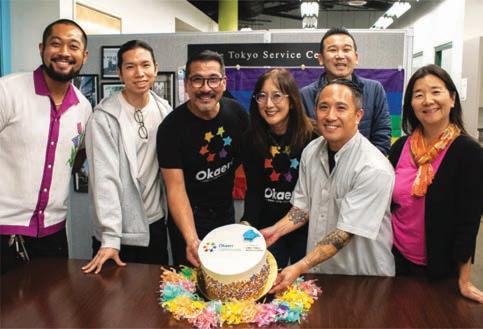
Founded by late activist Marsha Aizumi, Okaeri is a local community program that affirms and pours into the queer Japanese American diaspora
By KRISTIE SONG
In 2012, Eric Arimoto was in his late forties, studying to become a marriage and family therapist, when he encountered something he hadn’t before. At his internship, his cohort gathered to listen to two speakers — an event that was announced at the last minute. In stepped Aiden Aizumi, a young transgender man, and his mother, Marsha.
Eric remembers Marsha tearily apologizing to Aiden for not knowing how to support him when he was first transitioning and struggling with his gender identity. “I was crying so hard,” Arimoto told the Blade. “Because she said the words that I never heard from my own parents. I’m a 61-year-old Japanese American gay man, and my parents loved me to pieces. But, they weren’t advocates, and they didn’t understand what it was like walking in the world as Japanese American and gay, and not feeling a part of any community — like I belonged anywhere.”
This surrogate experience of familial acceptance was pivotal for Arimoto, who began to mend and reckon with his fractured identities. Marsha encouraged him to become a facilitator at PFLAG San Gabriel Valley Asian Pacific Islander, the local Asian American chapter of an organization dedicated to creating safe spaces for LGBTQ+ people, friends and allies to learn from and connect with one another. Marsha was fundamental in developing the group in 2008, and now, in 2013, was ready to create another queer-affirming space: Okaeri.
Okaeri’s origins
The name comes from a Japanese custom — when you return home, you are greeted with, “Okaeri.” Welcome home. The essence of the group lies in this simple phrase, brief but brimming with endearment. Okaeri is dedicated to increasing visibility for Japanese Americans, or Nikkei, who identify as LGBTQ+: creating events, projects, educational initiatives and programs that embrace and affirm who they are.
Since its formation, Okaeri has grown into a diverse, far-reaching connective system that continues to branch out. It’s home to the first U.S. conference focused specifically on LGBTQ+ Japanese Americans, which has been held biannually since the organization s very beginnings. There is also Okaeri Connects: online, monthly discussion groups for queer folks and allies, hosted in both English and Japanese. This April, Okaeri hosted its first Connects group for the trans and gender diverse Nikkei community.
Okaeri also preserves the vast, nuanced stories of their community members in “Okaeri Voices,” an archival oral history project that features interviews and stories shared by queer Nikkei, as well as their family members and friends.
The group’s growth has only continued to gain momentum, and in 2025, it was integrated into Little Tokyo Service Center as a community program. For over a decade, Okaeri has drawn the curiosity of queer Japanese Americans across generations and across the country: reminding them that they are not alone, that queer and trans Japanese Americans have always existed and will continue to exist. Okaeri provides them with metaphorical and physical places to imagine and create their own futures as well as reconnect with their lineage and cultural roots.
This path ahead was forged largely by Marsha, who nur-
tured her community and brought people into her purpose. “She never turned away from difficult topics or discussions,” Arimoto said. “She was here to learn and lean into the discomfort of learning about a different culture. She also played the role of the loving, compassionate, amazing Japanese American mom. She was just the mom for everybody, right? I told Marsha: I don’t need you to be my mom. I have a mom, and I loved my mom. I need you to be Marsha. I need to be you, because you are an amazing advocate and friend.”
Marsha died in late 2025, and her legacy is one that continues to be a light for her friends, family, and fellow community advocates. Marsha illuminated, for them, what is possible.
Aiden’s story
“My mom became my champion,” said Aiden Aizumi, who is now an activist and worker in educational spaces. Growing up, he felt he could only go “so far” when it came to forming connections or finding belonging as a queer kid. He didn’t dress like the girls around him, nor did he fit into the rigid and high-pressure academic environment at school. “There was a disconnect there for me: a gap I just couldn’t ever bridge.”
When Aiden realized he was transgender, it felt like he’d found the one missing piece of a lifelong puzzle. “I think I had picked up these pieces of myself throughout my life…but I still didn’t feel comfortable in who I was. Suddenly, it was like: Oh, that would have solved everything if I had known before.”
At 20, he came out to his parents and remembers his initial frustration around their delay in using his correct pronouns and chosen name. A therapist helped him reframe the situation; she asked how long it had taken him to realize this about himself. Two years, Aiden replied.
“I’m not saying it should take two years,” Aiden remembers her saying, “but you have to think: you gave yourself time. I think you owe them the chance to adjust.” This didn’t take away the pain of their mistakes, but it was enough to soften them for a while. Marsha, specifically, actively tried and was able to come around more quickly. Spaces like Okaeri and their monthly discussion groups are important for this adjustment period: for growing and learning while minimizing the hurt you might, even unintentionally, inflict on your loved ones.
“This is your opportunity to try and practice,” Aiden said. “It’s a muscle, and this is your chance to try it and mess up without your kid here. Try to start working that muscle.”
Okaeri’s future and its blossoming young generation
Okaeri has provided a luminous liminal space for Nikkei allies to practice, “mess up,” and learn about their queer friends and family members. It’s also been the space where young queer folks like Xander Omoto, who is one of the co-facilitators of Okaeri’s latest trans and gender diverse discussion group, got to discover and “test” their true self.
Omoto lives in Oregon and found Okaeri online in 2023, while struggling with his gender and sexual identity. He was closeted to his family, so finding Okaeri was finding a space he could finally feel safe and fully accepted within. “I fell in love with these people that lived so many miles away from me and that I never met before, but they became very much like family,” Omoto told the Blade. “I joke about having these gay uncles who immediately became close friends.”
After being part of an English-speaking Connects group, Omoto remembers logging onto the monthly Zoom one day and finally entering the name he wanted to be called. “[It] wasn t the name everyone knew me by and, immediately, people called me this name that I was always hoping could be mine, and automatically used pronouns I’d never had used for me before.”
It was the beginning of his “fresh start,” where he was being seen for who he was for the very first time. “As I got more and more practice doing that, I felt more and more confident and was able to work up toward showing more of myself to the people that I already knew. It was this really important incubation period where everything was very new and scary, but I had people who had been through it, or people who were just there to accept me as I am.”
Through this Connects group, Omoto befriended another Japanese American trans man, Kai Mita, the co-facilitator of their new trans and gender diverse discussion group. Mita grew up in Illinois, and they both realized they shared similarities in their upbringings and media touchstones. “We really identified with the story in Mulan,” Mita said, laughing.
The two also grew up in predominantly white communities and grew up feeling disjointed from their Japanese American heritage. Okaeri was the bridge that brought them closer to their histories — in a way that also honored their trans identities. Omoto found this “surprising” and had once accepted that his queerness would remain separate from his cultural identity forever. “That’s the really cool thing about Okaeri: I get to be both at once,” Omoto said.
There was also a singular, stark moment that brought him closer to his relatives, who were forcibly relocated and incarcerated during World War II. When President Trump was inaugurated for the second time, Omoto was struck with the violence his ancestors faced, and how that coincided with the violence he was facing in the present-day.
“One of his [Trump’s] policy points was: there are only two genders, male and female. And I just remembered feeling this fear,” Omoto said. “It was the first really political, national scale of fear that I had felt personally, and I realized that my grandparents and great-grandparents had felt the same way during the Second World War.
By KRISTIE SONG
In Quentin Lee’s spirited feature film debut, Shopping for Fangs, viewers are shown shards of stories: pieces of narratives that are spliced and, sometimes, hastily shoved together in a way that inspires whiplash, excitement, and unnerving anticipation. We are thrown into a San Gabriel Valley of the late 90s and shown its darker underbelly: an image that betrays its tranquil real-life reputation.
This is not the San Gabriel Valley I grew up in (but perhaps wish I did). It’s an uncanny, noir version of it that draws inspiration from reality and remixes it with style through Lee’s risque, imaginative lens.
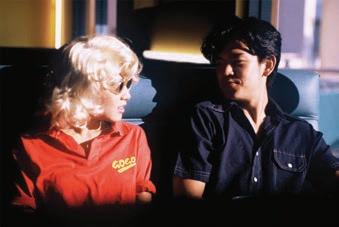
Shopping for Fangs starts at the scene of a crime, where a man has pinned a woman against a wall in the dark. Suddenly, another figure appears, dressed in a sparkly champagne dress, a curly blonde Marilyn Monroe-esque wig, and sunglasses that, we will soon discover, are permanently fixed onto her face. She draws a gun at the man, threatening to “blow his face off,” and her fragment of the film’s story begins.
The 1997 feature weaves together the lives of several Asian American characters and explores their queerness, their yearning to belong, and the ways that these angsts transform into physical and mental affliction. Phil, a bored and indifferent office worker, begins to grow hair at a rapid rate and act out in all-consuming aggression. His storyline, written by the film’s co-director, Justin Lin of Fast & Furious fame, is a werewolf tale that digs into stereotypes around Asian American masculinity and rejects them with energetic rebellion.
Shopping for Fangs marks the beginning of a 30-year legacy for Lee: one in which he has continually explored what it means to be queer, Asian American, and to navigate stigma, racial identities, and sexual longing in an increasingly tech-centered world through the 90s and early 2000s. His films are beasts of their own: hybridizing person and monster, desire and animosity, reality and fantasy to create poignant stories where his untethered characters break from their molds, transform, and find their own forms of catharsis.
Beginning on Friday, May 1, Lee’s films will be screened in a special retrospective at the Laemmle Royal in Los Angeles. The opening night features a viewing of Shopping for Fangs and a Q&A with Lee and Lin.
To celebrate and understand Lee’s journey, the Blade sat down with him to discuss his early years making movies and how his art has helped him understand his own identity more. What films intrigued you when you were young, before you started making movies?
I grew up as a teenager watching a lot of horror films, and then I became really into Brian De Palma and Hitchcock genre thrillers. I remember I was maybe 15 in Hong Kong, and I picked up this Premiere magazine right before we were leaving for Canada. Brian De Palma had all the storyboards of Casualties of War laid out, and I said, ‘Oh my god, this is the kind of filmmaker I want to become.’
I graduated from UC Berkeley, and [there] I started dabbling in experimental filmmaking. So I’d say, as a filmmaker, I really started off with experimental video, video art, and things like that. [Then], I applied to UCLA Film School and didn’t get in. I thought: I’m not going to wait for UCLA before I start making movies. So I made my first short film called “To Ride a Cow.” I
did it with my friend, my then-boyfriend, and also with my best girl friend.
Then, I was traveling to film festivals with my little short film…I think it was 93. It was really a fun year that I got to learn a lot more about storytelling, literature, and literary theory at the same time. I remember I was really young. “To Ride a Cow” won the best student film award at the New England Film Festival. I drove from Yale to Boston for that screening. And the programmer was saying something like: ‘Well, all you need to do is just go to the film festivals and talk to some people, and you’ll be making your next film.’ And the next thing, [I m here] like, 30 years later. [Laughs]
Your first feature, Shopping for Fangs, has been described as the cinematic lovechild of David Lynch and Wong Karwai. In the story, every character is fragmented, and the narrative explores their deep isolation, misbelonging, or unfulfilled desire. What was it like for you to create these characters, and did they reflect underlying themes that you wanted to explore as a young filmmaker?
into Hitchcock influences, so, in the end, I came up with the story of Katherine, and we mashed them together. Then, I applied for a Canada Council for the Arts grant, and they wrote: ‘Here’s $50,000. Go make the movie.’ Then, we made it. We started in the summer of ‘96, and I knew that I had to start a company. I started Margin Films to be the entity that produced it. I didn’t have a status. I wasn’t American, wasn’t even a resident, so I thought: Well, I guess the only entity I could start is a C-corporation — because I needed to make Shopping for Fangs It was such a moment to watch Shopping for Fangs and be like: Oh, I grew up going to this plaza in the San Gabriel Valley, and now I see it as a centerpiece of a film. You imbue it with mystery, and it, in turn, imbues your film with more mystery as well. About finding connection, how did that ethos evolve in the making of your later films like Ethan Mao and The People I’ve Slept With? Visually, they’re more stripped down. Was that intentional?
I realized further down the line, all my films are about someone trying to look for a connection to the world, but they’re not really sure how. And that very much is how, emotionally, I’ve felt most of my life, even till today. I was an immigrant from Hong Kong, moved to Canada, and then moved to America, came out as being queer, and then also found this new kind of Asian American identity.
In the beginning, I wasn’t even sure I was going to stay in America, so I didn’t completely identify with being Asian American. And then eventually, after I graduated, I thought: You know what? That’s actually a really good identity. Shopping for Fangs is about that. It’s about all these really fragmented characters, whether it’s Phil or Katherine or the husband, and even Clarence, who is this queer Singaporean student trying to get a VISA. That’s kind of me. John Cho didn’t know he was playing me. It’s about them finding a place to belong. That became a throughline for most of my movies.
[Before making Shopping for Fangs], I had put a collection of my short films together, and I premiered them as a feature at the Vancouver International Film Festival. I was coming back in [the winter] of ‘95, and I was really good friends with Justin. I said: ‘Why don’t we make a feature together? You can write a story. I can write [one]. It’s like Chungking Express! We spent Christmas writing together. He wrote the story about the werewolf, the Asian American guy.
I wrote this thing about…I was really obsessed with going to Monterey Park and the Alhambra, San Gabriel Valley area. And I thought: Okay, I want to write something about that. I was also
Ethan Mao was about this kid who just came out, and he’s trying to figure out where he really belongs. He runs away from home. In “The People I’ve Slept With,” the main character is semi-inspired by the actress in it. At some point, I was listening to David Lynch, [and he said]: ‘Every story has a different way to do it.’ So, there really is no one way to make a movie. Every movie, what I actually do is try to find out: ‘What is this? How should I approach the aesthetics,’ and with Ethan Mao, I’m playing a lot.
Because of my experimental background, I wanted everything in the house to be like a Greek drama, shot in 35 millimeter film. Everything outside the house, I wanted to be digital video. And the digital video was transferred to film. That became the aesthetics for Ethan Mao and his world. And then with The People I’ve Slept With, it was the beginning of digital film technology, and it was the first time I made a decent-budgeted film with a digital camera. It was very exciting and, at the same time, I was nervous. It’s interesting and reminds me of how technology changes as our culture also changes.
With this upcoming screening series, what do you hope to impart on queer Asian American people who might be seeing your films for the first time?
I hope to have a new generation of audiences take a look at Shopping for Fangs. When it came out, people were like: ‘What is this? It’s not even Asian American. The characters are Asian, but there’s nothing about Asian American identity.’ It was very annoying to hear that, because obviously me and Justin were thinking: ‘We have all this ideology, all these things in it.’ Eventually, years later, more writing on it [has come out], so people started to understand: It actually is about identity.
A message that I want to [tell] new generations of diverse, queer, and all combinations of different audiences, is that they should go out and experiment. Each of my films is very different, and I think people should just go out and make things, and not have to worry so much about what they should be making. They should be making what they want to make. I started my journey doing exactly that, so I guess I’m pretty happy about it.
Kristie Song is a California Local News Fellow placed with the Los Angeles Blade. The California Local News Fellowship is a state-funded initiative to support and strengthen local news reporting. Learn more about it at fellowships.journalism.berkeley.edu/cafellows.
He survived addiction, stigma, and systemic barriers. Now Nolan Ross Samé-Weil is rewriting the rules of recovery just in time for Long Beach Pride
By AJ SLOAN
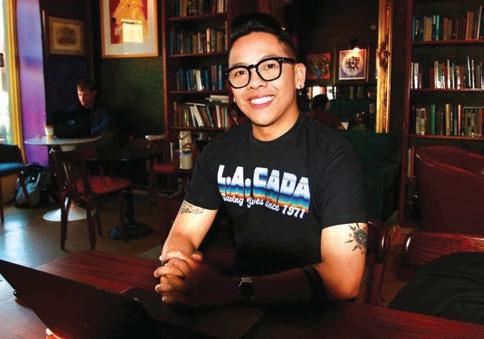
If resilience had a spokesperson with as much determination as they do charisma, they might look a lot like Nolan Ross Samé-Weil. As the Development and Community Outreach Manager for the Los Angeles Centers for Alcohol and Drug Abuse (L.A. CADA), he’s talking about change just as much as he s actually and actively creating it for communities that too often fall through the cracks of society.
But Ross Samé-Weil’s story doesn’t begin in a boardroom or a doctoral seminar. It started in the very systems he now works to transform. As he puts it, “I didn t just find recovery, I found purpose, and now I’m building the systems I once needed to survive.” It’s the kind of full-circle moment that feels less like a coincidence and more like an intention.
On May 17th, Ross Samé-Weil will join his L.A. CADA peers, the Los Angeles Blade, and Latination on a float and meet-ngreet in the Long Beach Pride parade.
In the spirit of Long Pride, Ross Samé-Weil’s work is also a powerful reflection of what it means to live openly, authentically, and in service of one’s community. There’s a grounded clarity in the way Ross Samé-Weil speaks about his own journey. There’s no glossing over the hard parts while at the same time not getting stuck in them. His path from navigating addiction to leading with conviction is marked by an unshakable commitment to showing up for others. “Recovery gave me my life back, but purpose gave it meaning,” he says. “Now, everything I do is about making sure others have a path forward, too.” And that’s exactly what this conversation reveals: not just how far he’s come, but how deliberately he’s using that experience to make sure fewer people have to walk that road alone. Can you share a bit about your background and what led you to the work you’re doing today? How would you describe your journey?
My journey is one of transformation, truth, and purpose. I didn’t arrive at this work through a traditional path; I arrived through lived experience. As someone in long-term recovery and a proud member of the LGBTQIA2S+ community, I’ve navigated spaces where I didn’t always feel seen, safe, or supported. Those experiences shaped me.
What began as a fight for my own life became a commitment to service. Today, I work to build systems that I once needed, spaces rooted in dignity, access, and belonging. My journey has taught me that pain can become our purpose if we’re willing to face it, learn from it, and use it to uplift others. What is one defining moment which stands out that shaped who you are today?
There wasn t one single moment; it was a series of quiet decisions. But the most defining was choosing to believe that my life could look different. That I was worthy of more. That I didn’t have to stay stuck in cycles that were hurting me.
That shift, from survival to intention, changed everything. You’ve spoken about navigating addiction. Can you share a bit on what that period of your life was like for you?
It started when I first came out. Like many others, it was a journey shaped by a lack of acceptance, which eventually contributed to my becoming HIV/AIDS positive and symptomatic.
I experienced severe health complications, including Kaposi sarcoma, Pneumocystis pneumonia, and significant muscle deterioration that affected my strength and mobility.
That time in my life was isolating, chaotic, and, at times, felt hopeless. Addiction didn’t just impact my behavior; it changed how I saw myself. I carried deep shame and a profound sense of disconnection, and there were moments when I didn’t even recognize who I had become.
At the same time, those experiences exposed me to the realities so many people face, especially within marginalized communities when trying to access care. I saw firsthand how stigma, identity, and systemic barriers intersect and create barriers to survival and healing. That perspective has stayed with me, and it continues to inform and guide the work I do today. What helped you begin the process of recovery and transformation?
Connection saved my life. People who saw something in me that I couldn’t yet see in myself. Structure, accountability, and being given opportunities to rebuild, not just survive, were critical.
But ultimately, it was a decision. A decision to show up, to do the work, and to stay—even when it was uncomfortable. Over time, I found purpose in service, and that purpose became the foundation of my recovery.
What did resilience look like for you during that time? Resilience wasn’t loud or perfect. It looked like consistency. It looked like I was choosing not to give up on myself, even when I wanted to. It looked like rebuilding trust, with others and with me, one day at a time.
It was messy, it was imperfect, but it was real.
How has your identity influenced your personal and professional journey?
My identity is at the core of everything I do. As someone who is LGBTQIA2S+ and in recovery, I understand what it means to navigate stigma, invisibility, and systems that don’t always reflect your reality.
That awareness drives how I lead, how I advocate, and how I show up. I’m intentional about creating spaces where people don’t have to choose between parts of themselves to be accepted. Where identity is not a barrier, but a source of strength.
What does Pride mean to you on a personal level?
Pride is both a celebration and a responsibility. It’s about honoring who I am, unapologetically, and recognizing the generations who fought for that freedom.
But it s also about showing up, for those who still feel unseen, unheard, or unsafe. Pride, for me, is about visibility, advocacy, and making sure that our communities don’t just survive, but thrive.
What brought you to your current role as Director of Development?
I am now 10 years clean and sober, and along the way I’ve been given some of the most humbling opportunities to grow within my agency, both personally and professionally.
What brought me to my current role as Director of Development is a deep connection to the mission, as well as a pas-
sion for building sustainable systems of care. My work extends beyond traditional fundraising into business development, where I oversee payer relationships, support Enhanced Care Management (ECM) initiatives, and help drive strategic program development.
I’m actively involved in building and expanding programs that meet the evolving needs of the communities we serve, ensuring they are not only impactful but also financially sustainable. This includes strengthening partnerships with managed care plans, aligning services with funding opportunities, and developing innovative models of care that improve access and outcomes.
My lived experience gives me a unique lens in this role. I understand firsthand the impact these programs can have, and I bring that perspective into every partnership, proposal, and program we build. I’m committed to ensuring our services are resourced, supported, and continuously growing to reach those who need them most.
What impact do you hope to make through your role?
Through my role, I hope to help build systems of care that are not only effective but truly equitable. That means expanding access to services, investing in communities that have been historically overlooked, and elevating the stories that too often go unheard.
A big part of that impact is breaking down stigma, advocating for health equity, and strengthening the pillars of the social determinants of health so that every individual has the opportunity to live a healthier, more stable, and fulfilling life.
Ultimately, if I can help create pathways for someone to access the support they need to feel seen, to heal, and to rebuild, then I know I’m making the impact I set out to achieve.
You’re currently pursuing a doctorate. How does your academic work connect to your journey and goals?
I am currently pursuing a Doctorate in Healthcare Administration (DHA), and as a practitioner-scholar, my academic work is deeply personal. It’s rooted in bridging lived experience with system-level change, and I’m committed to contributing to research, policy, and leadership approaches that reflect the real-life experiences of the communities we serve.
For me, education isn’t just about achievement; it’s about impact. It’s about ensuring that the systems we design are responsive, equitable, and truly centered on the people they’re meant to support.
Pursuing my doctorate is also an opportunity to expand my administrative capacity and continue growing as an executive leader. I aim to strengthen my ability to build, lead, and sustain programs that create meaningful, lasting change.



















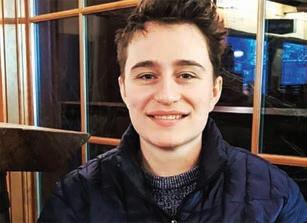
is a writer based in the D.C. area. He is a transgender man and was featured in National Geographic’s “Gender Revolution” documentary. He serves on the board of the LGBT Democrats of Virginia. Contact him at isaac.amend35@ gmail.com or on Instagram at @literatipapi.
Information collected for ‘research’
Something important recently happened in Tennessee — and it demands far more scrutiny than it’s getting.
The Tennessee state House passed a bill — HB 754 — that requires clinics and insurers to report data on patients receiving gender-affirming care to the state. On paper, it is framed as a neutral effort: a way to “study trends,” “understand outcomes,” and bring clarity to a politically charged area of medicine. That is how its supporters describe it.
But laws are not judged solely by their stated intent. They are judged by their structure, their context, and the foreseeable ways they can be used.
And in structure and context alike, this bill edges dangerously close to something far more unsettling: a system of tracking a politically targeted minority.
The mechanics matter. Under the legislation, providers must submit detailed information about transgender patients — data that will ultimately be compiled into state reports and made public in aggregated form.
Supporters emphasize a key safeguard: the data is supposed to be “de-identified.” No names, no Social Security numbers. In theory, no direct link to any one individual.
But that reassurance collapses under even minimal scrutiny. Because data does not need to contain a name to identify a person. In smaller communities—rural counties, tight-knit towns— granular data points like age, treatment type, and geography can easily narrow a dataset down to a handful of individuals. In some cases, to one.
Privacy experts have been warning about this problem for years. Re-identification is not a hypothetical risk — it is a well-documented reality. And when the dataset concerns a stigmatized population, the stakes are not abstract. They are personal, immediate, and potentially dangerous.
That is why critics of the bill are not calling it “data collection.” They are calling it what it resembles: a registry in all but name. And history gives that word weight.
Governments have always justified registries as tools of order and knowledge. Lists of dissidents. Lists of immigrants. Lists of the sick, the criminal, the different. They begin as bureaucratic exercises — tidy, rational, even boring. Only later do we confront what those lists enable.
To be clear, HB 754 is not a list of names published online. It is not, at least yet, a direct catalogue of individuals. But the architecture it builds—centralized data collection on a specific, politically contested group—is the same architecture that makes such lists possible. And that is where context becomes unavoidable.
This bill does not exist in isolation. It comes after years of escalating legislation targeting transgender people in Tennessee—from restrictions on healthcare to limits on public expression. The trajectory is not ambiguous. It is cumulative.
When a government repeatedly singles out a group for legal scrutiny, and then begins building systems to track that group—even indirectly—it crosses a conceptual line. It moves from regulating behavior to mapping people.
Supporters argue that none of this is the point. That the bill is about medical evidence, not identity. That policymakers need data to evaluate treatments.
But this argument collapses under its own selectivity.
If the true goal were neutral scientific inquiry, we would expect similarly aggressive data collection across other areas of medicine—cosmetic surgery, psychiatric medication, fertility treatments. We do not see that. The focus here is narrow, targeted, and politically charged.
That selectivity reveals something important: this is not just about healthcare. It is about governance—about which populations the state chooses to monitor, and why.
And once that monitoring infrastructure exists, its use is not fixed.
Data collected today for “research” can be repurposed tomorrow for enforcement, litigation, or exposure. Laws change. Administrations change. What remains is the dataset—and the precedent that it is acceptable to build it.
That is the real risk embedded in HB 754. Not necessarily what it does on day one, but what it normalizes over time.
It normalizes the idea that transgender people are a category to be tracked. It normalizes the idea that their private medical decisions are of special interest to the state. And perhaps most dangerously, it normalizes the idea that the boundary between public policy and personal identity can be quietly, bureaucratically eroded.
There is a tendency, especially among lawmakers, to view policy as modular—each bill evaluated in isolation, each provision defended on its own terms. But for the people living under those laws, the experience is cumulative. It is the pattern that matters.
And the pattern here is becoming harder to ignore.
A state that restricts your care, debates your existence, and then begins compiling data about you is not neutral. It is not merely studying you. It is defining you as a subject of governance.
That distinction—between citizen and subject—is subtle. But it is where the stakes of this bill ultimately lie.
Because once a government begins building lists—even partial, anonymized, “harmless” ones—it is no longer just making policy. It is deciding who counts.
PHONE 310-230-5266
E-MAIL arodriguez@losangelesblade.com
INTERNET losangelesblade.com
PUBLISHED BY Los Angeles Blade, LLC
PUBLISHER
ALEXANDER RODRIGUEZ
arodriguez@losangelesblade.com, 310-230-5266 x8080
EDITORIAL
NATIONAL EDITOR
KEVIN NAFF
kna @washblade.com, 202-747-2077 x8088
LOCAL NEWS REPORTER
KRISTIE SONG ksong@losangelesblade.com
CONTRIBUTING WRITER
KAREN OCAMB
karenocamb@losangelesblade.com
CONTRIBUTORS
MICHAEL K. LAVERS, TINASHE CHINGARANDE, JOHN PAUL KING, LOU CHIBBARO JR., SUSAN HORNIK, JOE REBERKENNY, DANIEL ITAI, ISAAC AMEND, PETER ROSENSTEIN, TERRI SCHLICHENMEYER, JOE PHILLIPS, ANKUSH KUMAR, ESTEBAN RIOSECO, SAM KISIKA, ELVIS KAWEDO, HENRY CARNELL, DAWN ENNIS, AJ SLOAN
SALES & ADMINISTRATION
SALES EXECUTIVE
SHANA WONG SOLARES swong@losangelesblade.com, 808-386-0872
MARKETING DIRECTOR
STEPHEN RUTGERS
srutgers@washblade.com, 202-747-2077 x8077
NATIONAL ADVERTISING
RIVENDELL MEDIA sales@rivendellmedia.com, 212-242-6863 ADMINISTRATION
PHILLIP G. ROCKSTROH prockstroh@washblade.com, 202-747-2077 x8092
CREATIVE DESIGN/PRODUCTION
MEAGHAN JUBA production@azercreative.com DISTRIBUTION
CHRISTOPHER JACKSON, 562-826-6602 All material in the Los Angeles Blade is protected by federal copyright law and may not be reproduced without the written consent of the Los Angeles Blade. e sexual orientation of advertisers, photographers, writers and cartoonists published herein is neither inferred nor implied. e appearance of names or pictorial representation does not necessarily indicate the sexual orientation of that person or persons. Although the Los Angeles Blade is supported by many ne advertisers, we cannot accept




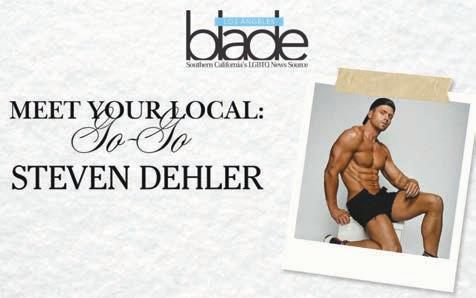
Go-go dancers offer a spicy jolt to nightlife. Their hot bodies and high-energy dancing inspire and titillate us, helping to make every night extra special. Steven Dehler has not only done that for the last decade in West Hollywood and Palm Springs, but he’s brought this same energy to the world of dance, fitness, and modeling.
You may have seen him at The Abbey or Beaches Tropicana, and he was even crowned this year’s Go-Go of the Year at the Los Angeles Blade’s Best of LA awards show. He’s an accomplished model for various fitness and underwear brands, as well as starring in fashion, editorials, print, runway, and appearing on romance novel covers.
Beyond the go-go box, he’s an accomplished musician and pianist. He has performed on stage for Voss Events burlesque shows, and you can see him on stage in Beauty of Burlesque at the historic Old Globe Theatre in Downtown LA. He’s worked in film and television, appearing on Ellen, Jimmy Kimmel Live!, and Will & Grace
He also co-hosts the podcast, On the Rocks, with the Blade’s own Alexander Rodriguez. He’s set to formally join the LA Blade family offering his physical prowess and fitness know-how to LA Blade readers in an upcoming Health and Fitness column for the Blade.
He took some time out to share his history, hot takes, and thoughts from both on and offstage for a look behind the g-string and into his life.
How long have you been performing?
I’ve been dancing for about thirteen years.
How did you get into go-go dancing?
I was already working in the clubs doing bottle service and wasn’t making particularly good money. The person I was dating at the time go-go danced,, and I saw how much money he was making and how much fun he was having so I started dancing with him.
What do you do besides dancing?
What don’t I do? Haha, God, I dip my feet in everything I can, and I’m discovering new ponds constantly. I’m a classically trained pianist, so I always try to incorporate that into my life. In the last few years, I ve gotten into burlesque,
By CHRISTIAN CINTRON
which has been so gratifying, especially learning choreography. I m not a trained dancer, and I’m pushing 40, so I’m getting into something at an age most dancers are retiring. I cohost a popular podcast called On the Rocks. And besides that, I’ve modeled for 20 years and acted as well.
What do you love about gogo dancing? And nightlife in LA?
I just love to dance. And as someone who’s introverted, I never thought I d be on stage in my underwear entertaining people. But here I am!
What do you think has changed about nightlife?
That’s a heavy question. So much has changed about nightlife. I’d say the 2010s were really the renaissance of nightlife, and that’s when I appeared on the scene. Since COVID and changes in dynamics with alcohol and Gen Z, nightlife is struggling. Clubs and bars are closing left and right, and many are hemorrhaging money. It’s depressing seeing all the empty businesses in West Hollywood. It s not good nowadays in LA compared to a decade ago.
What do you love about Los Angeles?
I love LA. I was born in Simi Valley, so I ve been LA-adjacent since birth. It’s rare for locals to stick around,, haha. This town is really difficult, but it’s full of such amazing people. If you’re true to yourself you ll find your people here. I’m always meeting new and beautiful people.
What brought you to LA, specifically?
I always thought I’d do great things in LA, and I’m not satisfied until I achieve them.
What is your passion?
Piano is my absolute passion. Music is always evolving, and there are always things for me to learn. I just recently learned a piece from a video game (my other passion) called “Expedition 33.” I’m a big gamer, so I play Super Mario music, Zelda, and Final Fantasy. Y’all do not realize how talented the musicians are who create the soundtracks to these games.
What’s an interesting thing you learned about life from dancing?
I don’t think I realized how socially awkward the general public is. I ve had people come up to me and just not speak when they wanted to. I experience so many awkward moments with people, but we make them fun and normal, and I think people appreciate that we dancers make them feel okay about who they are.
Favorite spot in Los Angeles?
I love Malibu. El Matador is my favorite spot ever. It s gorgeous and secluded. I’ve done many photo shoots there.
How has Los Angeles changed you? Los Angeles has made me more confident. You have to
be sure of yourself here. It really can suck you in and spit you out, and if you don’t have a strong sense of self then it can devour you. It s strengthened me in ways I didn t think I needed. Never jaded though! Take the lessons and rise above them!
What piece of advice would you give to your younger self?
I’d tell my younger self to work out my legs more LOL. I played soccer for 14 years, so when I started dancing, I was really top-heavy. I only worked out my upper body, and I did a disservice to myself by not working on my legs.
If you could make one wish for Los Angeles what would it be?
My one wish for Los Angeles would be to get rid of the smog!
What do you want for the queer community?
I want the queer community to come together more. This whole LGB without the T is so disgusting to me, and becoming more prevalent. There are a lot of people in our community who are just uneducated about the fact that our trans brothers and sisters are being targeted across the globe. We’ve got to be better about protecting them.
What do you look for in a person?
I look for humor. If we can laugh every day, then I m happy.
Celebrity crush?
Honestly, I’m not crushing on any celebrities right now. Bored.
What is your favorite thing to do in your downtime?
My favorite thing is playing video games. I’m such a huge gay-mer. My dad introduced me to games when I was like five, playing the original DOOM
What are your goals for the future?
My goal for the future is to continue to do what I love. It’s not easy. What you want to do doesn’t necessarily provide you a living, but you gotta do what you love in some aspect. So as long as I’m still doing what I love, I’ll be happy.
Are you excited about your new column with the LA Blade?
Absolutely! I’ve been working out for 20 years, and I’m a certified trainer and bodybuilding specialist, so I’m very excited to share my knowledge and advice with readers.
Keep an eye out for Dehler around town and in the pages of the Blade very soon. Follow him on Instagram and listen to him on the On the Rocks Podcast every week.
Submit your fitness or health questions to Steven at https://form.typeform.com/to/LK6w3CZJ.
From prep to play with sexcare that’s gentle on your skin and skincare that makes you feel fabulously sexy.

By JOHN PAUL KING
In 2024, when Richard Gadd’s “Baby Reindeer” became a stock-boosting hit for Netflix, there were few Americans who knew his name.
In the UK, however, the Scottish writer/comedian/actor had already emerged as a talent to be reckoned with, blending autobiographical stand-up comedy with theater to create a reputation as an edgy and provocative creator whose shows tended to be equal parts divisive and successful. One of these, his fictionalized true-life story of being stalked and sexually harassed by a female fan, became an Olivier Award-winning hit in the London theater; that was “Baby Reindeer,” and – in the form of a seven-episode miniseries adaptation – it became the vehicle that carried him to wider fame.
Two years later, Gadd has returned with another high-profile miniseries, this time for HBO Max, and like its predecessor, it’s a story that deals with queer sexual repression, unhealthy attachments, and a central relationship that can safely be described without exaggeration as “toxic” – and it’s an even darker (and more twisted) ride that stretches across decades.
“Half Man,” which debuted on April 23 and continues with one episode per week through May 14, is the story of two “brothers” – Niall (Jamie Bell) and Ruben (Gadd) – whose mothers (Neve McIntosh and Marianne McIvor) have become a lesbian couple after leaving their relationships with the boys’ respective fathers. They are seeming opposites in personality; Niall is quiet, sensitive, and secretly unsure about his sexuality, while Ruben is tough, rebellious, and prone to violence – and unsurprisingly, it’s a match made in hell.
We meet them at the top of the first episode as adults, on the day of Niall’s wedding, when Ruben shows up without warning; his appearance triggers what looks like fear in his “brother from another lover,” and a private meeting between them in a barn at the wedding site turns ugly, launching a flashback format that takes us back to their schooldays, when young Ruben (Stuart Campbell) – already in trouble with the law and trying for a new start – comes home from juvenile detention to become roommate, protector, and bully to young Niall (Mitchell Robertson), all in one.
It’s the dawn of a new and epic relationship, despite a history that has made Niall terrified of the older boy; their seemingly opposite qualities somehow mesh into a kind of symbiotic bubble, in which a tense equilibrium turns them into unlikely allies. Ruben makes sure Niall has nothing to fear from the sniggering schoolyard homophobes who target him, and Niall helps Ruben pass the tests he needs to pass in order to stay in school, Nevertheless, their dynamic is equal parts surprisingly tender and alarmingly lopsided. Though they form a bond, it’s a volatile one, and by the end of episode one – after an uncomfortable-to-watch late night incident that amounts to a sexual assault – there is little doubt that Ruben is a psychopath. By then, however, it’s too late; Niall has become hopelessly ensnared by his manipulations, and their dangerous attachment has taken permanent root.
In episode two, the timeline moves the past forward several years (while rolling the wedding-day story back a few hours as well), bringing Niall forward to his college years. Ruben is once again absent from his life, but the bond is still deep. He struggles to make connections in his new setting – including with another student, the openly gay Alby (Bilal Hasna), who recognizes a side of him that he has still yet to accept for himself. Though he gradually begins to adapt to his new social circle, his insecurities get the better of him – and despite warnings from his mother not to do so, he calls Ruben to come and visit. His arrival triggers another escalating series of incidents, this time entangling Niall’s new friends and culminating in a shocking, jealous-fueled explosion of violence.
Without going on with the story – after all, the two remaining episodes have yet to be released, so we wouldn’t want to spoil anything – it’s safe to say there’s a pattern here, and it’s intentional. Gadd has already been public about his own struggles with repression, which were directly explored (albeit fictionally) in “Baby Reindeer,” and it’s clear that he had more to say about the effects they had on his life and identity.
As he put it himself, in an interview with the Hollywood Reporter, “Themes of, I guess, masculinity, or what it means to be a man, or ‘I’ve gone through a masculinity crisis’ come into [the show] probably because I’ve been through that in my life, and I feel I can write to it and speak to it.
“I always think that the best kind of art is kept close to your chest, kept close to your heart, kept close to your experiences, and I guess with ‘Half Man,’ there’s a lot in it that I relate to. It’s not an autobiographical piece by any stretch, it’s purely fiction, but it certainly borrows from themes and struggles and issues that I understand.”
That understanding translates to the series through its focus on tracing the roots of Niall and Ruben’s relationship by methodically tracking the cause-and-effect chain that links the major events of their lives together. It explores the contradictory combination of worship and terror, the transgressive eroticism that intertwines danger and desire, the power of the forbidden to make us want it more, and the self-loathing that punishes itself through violence toward others. The inverted framework of the storytelling, which works both forward and back to meet at (we assume) some definitive point, makes following it a bit like putting together a puzzle, which also has the effect of building suspense as we wait to see the “moment of truth.”
Of course, those who prefer a more straightforward narrative might not appreciate the additional challenge, especially when the subject matter – which revolves around experiences, feelings, and behavior that might be entirely unfamiliar to many audiences – is challenging enough by itself, in its own way. Likewise, and for much the same reason, there will be viewers who are unable to relate to its characters, as some of the show’s less-favorable reviews have pointed out.
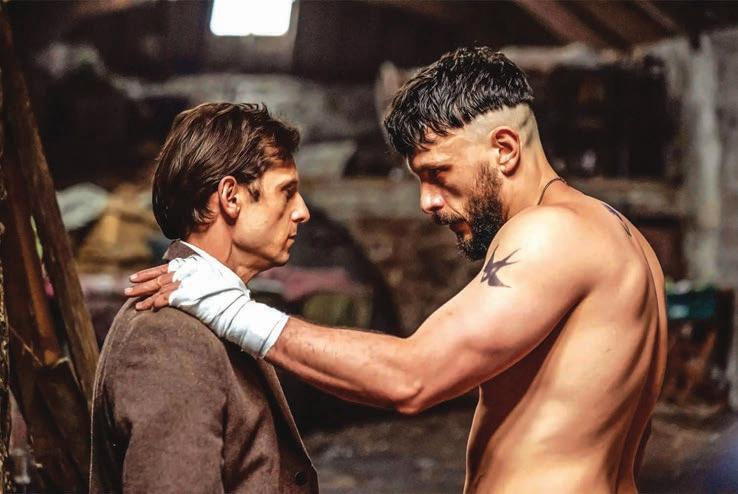
But it would be naive to assume that the themes in “Half Man” – of fragile masculinity, internalized homophobia, misdirected rage, nihilistic rebellion, conflicted desires, projected shame, and the other ingredients that infuse this shadow-boxing psychodrama with such a distinctive musky odor – do not apply to more men in today’s culture of incels, “looksmaxxers,” and “the Man-o-sphere” than any of them would like to admit. We’d wager that its portrait of a same-sex, sub/Dom, borderline incestuous relationship might resonate more urgently there than within a queer community that has been grappling with those issues for generations already and are just waiting for everybody else to catch up.
In any case, Gadd’s newest variation on a theme is a solidly crafted, well-acted, and hypnotically fascinating (if sometimes uncomfortable) exercise in the kind of “can’t look away” drama that makes for a perfect binge watch. Or, at least, it will once all the episodes drop.





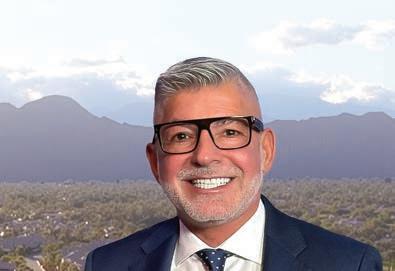



After stepping away from his life in hospitality to care for his father, Marco Colantonio arrived in West Hollywood, came out and began building a platform that would change the city’s conversation
By AJ SLOAN
Some people move to West Hollywood and find themselves. Others, like Marco Colantonio, seem to arrive already equipped with their own blueprint for the place and promptly get to work.
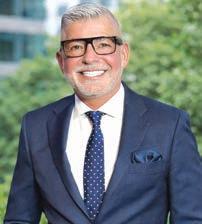
From founding the hyperlocal media outlet, Weho Times, that would rather proudly snatch the mic than whisper in the margins to building a real estate career grounded in something far more human than square footage and cookie-scented open houses, Colantonio has always worked with intention and heart. And he does this all with a fresh-pressed suit and smile from sea to shining sea.
In our conversation, Colantonio traces a path that’s anything but ordinary. From hospitality entrepreneur to caregiver, from being outed in a cheeky headline to becoming a voice for others who deserved to be heard on their own terms. Along the way, WeHo transforms from backdrop to wingman, a place where personal truth, storytelling, and a well-timed leap of faith all meet up for vodka sodas at Micky’s happy hour. The result is a perspective shaped not just by his accomplishments and accolades but by who he has chosen to be, and the communities he’s helped make just that much more seen and a lot more livable. The house is open.
What first drew you to West Hollywood, and more importantly, what kept you there?
My journey to West Hollywood wasn’t linear—it was deeply personal. I was working in hospitality on the East Coast and eventually developed a small global restaurant company, with Denver becoming our home base. Around that time, my father moved there, and shortly after, he was diagnosed with terminal cancer. I stepped away from a high-profile career to care for him.
When my father passed, something shifted in me. I was tired of looking in the mirror every morning and pretending to be someone I wasn’t, instead of embracing my true self. That was the moment I came out—fully and honestly—and it changed the course of my life. Around that same time, I was “outed” in The Denver Post—and I say that a bit tongue-in-cheek. I was already a recognizable figure in the community, and a friend of mine happened to be the gossip columnist. The headline read something like, “Well-known restaurateur and man about town comes out of the pantry.” It was very Denver… and very of its time. But storytelling and community had always been part of who I am. I even started a gay nightlife blog with a friend called GAY5280.com—which was a lot of fun, though definitely not paying the bills.
After that chapter, I made the decision to move to West Hollywood and start over—completely. I was 40 years old, and WeHo gave me something I didn’t fully realize I was searching for: a place where I could be fully seen, supported, and safe. It was a dream—a queer, tolerant, vibrant community where
you could truly begin again.
What kept me there was something even more profound. Early in my real estate career, I was managing a building on Harper Avenue when a young lesbian couple applied for an apartment. They didn’t meet the landlord’s financial criteria— on paper, they didn’t qualify. But they were both working two jobs, determined, and I asked them why this apartment—why West Hollywood?
Their answer has stayed with me forever. They said, “We just want to live in a neighborhood where we can walk down the street holding hands and feel safe—without being judged or harassed.” I advocated for them, and the landlord approved their application. They became incredible tenants—but more importantly, that moment defined my purpose. That’s what West Hollywood meant to me—and still does.A place where anyone—any two people—can walk down the street holding hands and feel safe. That’s not just a neighborhood. That’s a promise.
And it’s one I’ve carried with me ever since—so I guess, in a way, I did get the key to the city.
Take us back to the early days of WeHo Times… What was the original vision behind it, and what space were you trying to fill in the community with its creation?
West Hollywood embraced me in a way that was transformative. I became close with a Human Services Commissioner—my dear friend, Steven Davis—who encouraged me to apply for a Board for Commission seat. I was ultimately appointed, unanimously, to the Disabilities Advisory Board by the City Council. Sitting across from each councilmember during that process, I was struck by their passion and commitment. It inspired me.
At the same time, I formed friendships with some of the most respected voices in LGBTQ journalism—Paulo Murillo, Karen Ocamb, Tom Senzee, Dana Miller, and James Mills. Their passion for truth, accountability, and community storytelling left a lasting impression on me.
When WeHo News disappeared and WeHoVille emerged as a dominant platform, I became a contributor—but I often felt there wasn’t room for diverse perspectives. West Hollywood may be small in footprint, but it has a global impact. I believed it was too important to have a single voice shaping the narrative.
So late in 2016, I launched WeHo Times. It started light— community features, nightlife, culture—but very early on, everything changed. We broke what became one of the most significant stories in the city’s history: “Sex, Politics, Meth and Death in West Hollywood.” It was the story of Gemmel Moore, who died of a methamphetamine overdose in the home of a powerful political donor.
That story changed my life. It gave a voice to someone who no longer had one and helped spark an investigation that ultimately led to justice. When Ed Buck was finally convicted, Gemmel’s mother, LaTisha Nixon, reached out to me with a
message I will never forget—thanking me for listening, for believing her, and for having the courage to publish when others would not.
That remains the single most meaningful accomplishment of my life.
WeHo Times became more than a publication—it became a platform for accountability, truth, and community voice. From there, I was fortunate to see the publication evolve in extraordinary ways. I credit Paulo Murillo, who took over the fledgling platform as Editor-in-Chief and Publisher. With his talent as both a writer and photojournalist, along with his unwavering passion and commitment, he transformed WeHo Times into the #1 online source for news, culture, and entertainment in West Hollywood. I’m grateful to continue contributing today through my real estate column and to remain part of a platform that continues to inform, engage, and serve the community.
How would you describe the energy of West Hollywood during that era in contrast to today? What role did community-driven journalism play in sculpting queer identity and visibility in WeHo during this?
That era was electric! West Hollywood was nearing the end of its 20s as a city and about to enter its third decade, and many of the pioneers who fought for cityhood were still deeply engaged. Activism wasn’t just present—it was amplified. People believed their voices mattered, and they acted on it. You saw it in everything—from John D’Amico’s rise to City Council, to grassroots movements like Save Tara, to Stephanie Harker’s fight to preserve Plummer Park. These weren’t symbolic efforts—they created real change.
Community-driven journalism played a critical role in that environment. It informed, challenged, and amplified voices that might otherwise have been overlooked. It helped shape identity, visibility, and civic engagement within the LGBTQ community. There was a sense that every issue mattered— and that you could make a difference. And people did.
Do you feel some things have been lost while others have been gained regarding how LGBTQ+ narratives are shared? Then vs now?
Be careful what you wish for. We’ve gained visibility, representation, and broader acceptance—and that’s something to be grateful for. But there has also been a shift. The urban village feeling that once defined West Hollywood has, in many ways, disappeared as the city has evolved.
That said, I remain hopeful. West Hollywood is still a beacon for the LGBTQ community—especially for younger generations discovering their voice. My hope is that new voices continue to emerge, stay engaged, stay loud, and remain connected to the core values that built this city: tolerance, acceptance, hope, and community.