



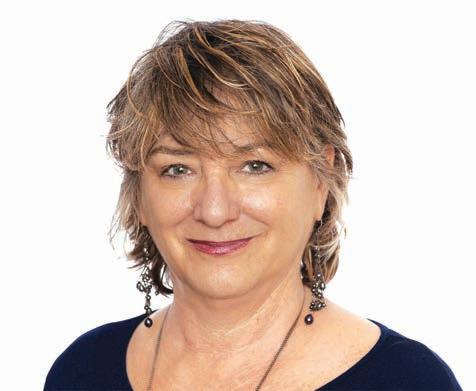
Morrill served 15 defining years on WeHo’s Chamber of Commerce. We discuss her future and how queer advocacy can’t be ignored in her legacy.
By KRISTIE SONG
It’s Feb. 4 when I sit down to call Genevieve Morrill, only a week after she officially stepped away from her longtime role as president and CEO of West Hollywood’s Chamber of Commerce. For 15 years, she paved the way for the City’s business ecosystem: creating robust opportunities for business owners and championing their rights.
Her leadership style has always been defined by forward-thinking, ambitious, and collectively-driven change. “I’m not here to tell you how to lead,” Morrill told the Blade. “I’m here to lead with you.” This focus on inclusivity and community empowerment stretched into advocacy for marginalized community members. From early on, Morrill has been a strong ally for BIPOC and LGBTQ+ people, creating pathways for diverse leaders and business owners.
Today, we dive into Morrill’s legacy of queer advocacy: one that has earned her this year’s “Local Hero” award at the upcoming Los Angeles Blade’s Best of LA Awards on Mar. 26.
In West Hollywood, and Los Angeles more broadly, Morrill is known for her dedication to shaping and revitalizing dormant spaces. The Chamber was “in trouble” when the board asked her to take over leadership in 2010. They were struggling under the pressure of the recession, and the next steps looked risky and obfuscated. Morrill readily accepted the challenge, her internal armor strengthened by a childhood that was always on the move.
Morrill’s father was a Methodist minister and would often move the family around to take part in “community development work” across the globe. She felt propelled by a sense of duty and mission from a young age. “It’s kind of in my DNA… [I grew up] in an organization that was focused on caring for the world,” Morrill said, who also attributed her strong sense of justice and community-oriented service to her parents’ involvement in civil rights and the women’s movement.
Her responsibility to the people led to major reforms at the Chamber of Commerce: the board tripled its budget, increased membership by 20%, and created widespread visibility for small businesses across West Hollywood. Under her guidance, the Chamber also established a small business task force as well as its philanthropic Small Business Foundation: an organization dedicated to expanding opportunities and providing training for queer and BIPOC business owners, as well as other minority community members.
This all sprouted from Morrill’s keen eye: while immersing herself deeply in the beast of WeHo s business ecosystem, she observed the lack of initiative employers would take when it came to hiring and empowering trans and queer workers. She began collaborating with Drian Juarez,
then the vice president of programming at Trans Can Work: a local workforce development organization that supports transgender and gender nonconforming people.
In the early 2010s, Morrill and Juarez hosted their first seminar together, where fewer than 10 people attended. “It was a real challenge to get people there,” Morrill said, who explained to the Blade that, even a decade ago, business owners were hesitant to adapt queer inclusivity into their branding. Queer stigma continued to be rampant and widespread.
Morrill refused to accept this. For the next seminar focused on trans people in the workplace, she called various local businesses and pushed them to attend. “You need to get there,” she recounted, remembering that her tone was urgent and stern. Over 50 people attended this second seminar. She recalls this early foray into queer advocacy as one of her many “significant” achievements.
These workshops then formed into a steady program: WeLead Academy, a professional development opportunity that uplifts queer and BIPOC entrepreneurs. Over two months, participants learn about money management, leveraging technological advancement for business growth, collaborating within the community, navigating government systems, and other essential business skills. It is powered through the Chamber’s Small Business Foundation.
In her years of service to West Hollywood, Morrill set a precedent for this expansion of inclusivity: to ensure that the City’s wide, varied fabric of people felt represented and capable of unlocking success. Morrill also recognizes that the spaces around us are ever-changing, and rather than stay locked in old ways, she questions: how can we preserve the spirit and histories of our environment, while allowing for growth that takes us to a more equitable future?
She reflects on older conversations she had with the late LGBTQ+ rights activist Ivy Bottini, where they would often discuss the loss of lesbian and sapphic sanctuaries. Even within queer spaces, there is still a need to constantly recalibrate and think about who we’re leaving out of the conversation. But Morrill thinks about these dilemmas with hope and continues to stand in solidarity with the queer communities “being attacked and trying to be erased” right now.
This new chapter ahead is marked by bittersweet excitement. On leaving the Chamber, Morrill explained that, as hard as it is to “break off” from these 15 memorable years and the space that defined her community work, it’s a necessary change.
This has been her whole life, up until now. “[When I] was asked if I was still going to leave at the end of 2025, my heart said no,” Morrill said. “But out of my mouth came: yes. I think my heart is still here in West Hollywood [and] with all the businesses…I know there’s still a need for some-
body to defend and fight for them.” Morrill’s successor is Len Lanzi, whom Morrill trusts will lead the Chamber well in its next era.
A return to the arts?
When I ask Morrill what the future looks like ahead, she is unsure but excitedly brings up an old passion project: a nonprofit she started in 2007, called “Books with Feet.” The concept is rooted in her core love for theater, books, and the arts: classic short stories are performed so that every single word, even in narration, is performed with exciting and dynamic movement.
Here, Morrill directed stories on the stage: a place she found success in during her adolescence. She recounts performing in a hit show in Chicago and giving it her all during its 14-week run. She studied under acting legends in the 1980s, before beginning to coach students herself.
“I think what happened for me was I didn’t really have a desire to hit the pavement with my headshot,” Morrill said. “But I had a desire to continue to be immersed in the arts.” So she ran Books with Feet until 2011, when it became impossible to manage both this and her Chamber role. “So, I might get back to that. Who knows?” Morrill said.
As we talk more, her entrepreneurial, innovative spirit springs forward, ripe with possibility. She discusses the possibility of creating cultural hubs across the county, revamping “dumpy” abandoned theaters and transforming them into lively arts districts of their own. “I feel like the strings have been cut,” Morrill said, of this new liberating freedom she feels for her path ahead. “As that happens, more space will open up for me [and] that will help me understand what the universe is going to present to me.”
Celebrate Morrill with the Blade at our upcoming Best of LA Awards on Mar. 26, held at the Abbey in West Hollywood. More information can be found at losangelesblade.com.
Kristie Song is a California Local News Fellow placed with the Los Angeles Blade. The California Local News Fellowship is a state-funded initiative to support and strengthen local news reporting. Learn more about it at fellowships.journalism. berkeley.edu/cafellows

Tello Films proves that, after 19 years, independent lesbian filmmaking is as necessary as ever.
By ALLISON REESE
In an era where LGBTQ representation in movies has hit a three-year low, Tello Films proves that, after 19 years, independent lesbian filmmaking is as necessary as ever. According to Sarah Kate Ellis, the CEO and President of GLAAD, “Nearly 1/3 of non-LGBTQ Americans say that LGBTQ inclusive films have changed their perception of our community… It is imperative that networks and streamers do not back down.”
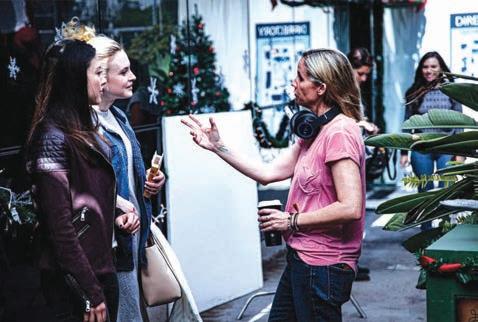
Meanwhile, the lesbian streaming service Tello Films celebrated its 19th birthday on February 6th. Says founder Christin Baker, “When I started it 19 years ago, I thought at some point maybe we wouldn’t be necessary, [...] I really do feel like representation saves lives…it’s still important for us to be around.” Often referred to as the “Lesbian Netflix”, the Nashville-based production company has a primary focus on lesbian and sapphic stories for the past 19 years and thankfully, is just getting started.
Tello Films was far ahead of its time. For those of you who didn’t live through or don’t remember, 2007 was a different time. Apple debuted the first iPhone, Barack Obama declared his run for the presidency, and the phrase “that’s so gay!” was prevalent as ever (at least at my high school). “We didn’t have marriage equality at that time. Civil unions were kind of starting here and there -the crazy thing (is that) ‘Don’t Ask Don’t Tell’ was still in effect.” Baker recalls, “There were still so many rights we didn’t have in 2007 when we started it, and we are still fighting for it.”
Tello Films’ beginnings were just the start of the lesbian legacy. Said Christin, “I never thought Tello would or could ever be my full-time job.” With the URL TelloFilms. com registered on February 6, 2007, the platform was an internet-based streaming company with all its movies formatted small to appease a 2007-era browser. While Netflix was only just beginning to offer streaming services, launching any streaming service in 2007 was bold; to
launch a streaming service entirely devoted to lesbian and sapphic stories was revolutionary. “I want to make lesbian stories.. I want to see things that represent me.”
In the past 19 years, Baker shares her career-defining moment came from the recently deceased Nancylee Myatt, showrunner for South of Nowhere. “We made a short-form series called Cowgirl Up. I felt like I put my big girl pants on. Nancylee was a huge mentor, and I was like, ‘Oh, I can do this. I can do this, and I can figure it out.’”
Tello went on to receive their first primetime Emmy nomination with Mindy Sterling of Austin Powers fame for Outstanding Actress in a Short Form Comedy or Drama Series. “We got two daytime Emmy nominations for two actresses, Liz Vassey and Carolyn Radere [...], then in 2018 we made our first lesbian Christmas movie,, Season of Love and that really kind of started us down the path, and I think we’re probably most well known for, which is our lesbian holiday rom-coms.”
We now live in the era of Chappell Roan, Doechii, Heated Rivalry, and so many more queer artists and pieces of media in the mainstream’s consciousness. The last several years in pop culture have proven that queer art and artists matter, not just as a salve to a society that still struggles to accept us, but to the mass audiences who continue to resonate with it.
Queer media is being devoured by folks outside of the LGBTQ community. “I think it (Heated Rivalry) shocked so many people (because) it was powerful and compelling [...] I wasn’t that surprised because I remember Brokeback Mountain being very much in that same vein; it was just cowboys instead of hockey players.” Authenticity and overcoming adversity are not just tenets of good storytelling; they are also ever-present themes within the lives of any queer you know.
As Christin sees it, the success of Heated Rivalry isn’t just rooted in its unabashed sexual themes, it has a very universal “lesbian” approach to its storytelling “There’s a ton of longing, and missing, and having a crush and not knowing if it’s reciprocated, [...] there’s a lot that you tap into just on a human level that Heated Rivalry really touched on.”
Themes that are at the forefront of the sapphic stories Tello has mastered telling. “We still don’t have enough LGBTQ holiday Christmas movies out there each year. Some people wouldn’t look at a Hallmark movie or Christmas rom-com as substantive, but I really do feel like representation saves lives.”
For so many in the LGBTQ community, representation isn’t theoretical- it’s personal. I know for myself, in the throes of a messy divorce, one of the only things that brought me comfort was the sapphic films on Tello. It was so difficult to find lighthearted queer stories. I recall searching through every streaming service as they were slowly but surely eliminating the LGBTQ sections from
their apps, as well as those queer characters and shows. But not Tello; I was able to find comfort and ease through a tough time in my personal life. “It’s such comfort, especially if you’ve gone through something that’s tough and your regular daily life is stressful, you need an escape to something that you know is not going to cause more anxiety.”
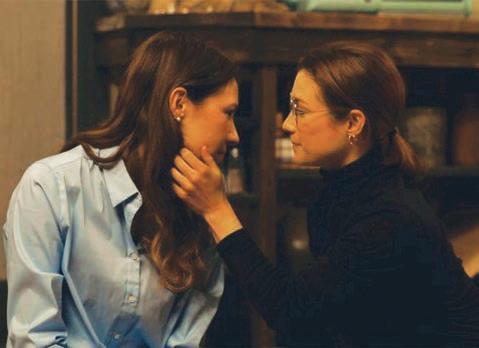
Having accessible ways to both tell and consume sapphic stories is tantamount to this moment in time. Independent filmmaking has the power to make sure authentic stories are heard. Being an independent voice as well as being able to support smaller budget stories that definitely wouldn’t get picked up, or even recognized or seen in mainstream, Christin and Tello Films are uplifting not just lesbian and sapphic stories, but lesbian and sapphic artists as well.
As for the future of lesbian filmmaking, it’s no secret that Hollywood is drowning, leaving a void for people like Christin and Tello Films to fill. Said Baker in light of the shrinkage in Hollywood and what that means for Tello Films, “We will get even more creative and tell even more stories, because we can’t be stopped.”
Encouraged by her fiancée, Stacey Lee Powell, Christin wants the world to know that Tello Films isn’t just a business, it’s personal. “I see Tello as an extension of me.” Says Baker, “In doing that, I hope that people see that Tello isn’t some corporate entity, I hope they see that it is someone who cares deeply. I’ve been doing this for 19 years, and every day I wake up trying to figure out how to tell our stories and how to serve our community.” Nineteen years later, Tello Films remains what it has always been: not a nameless, faceless corporation, but an extension of a storyteller’s dream to build a safe space for her community. Check out TelloFilms.com
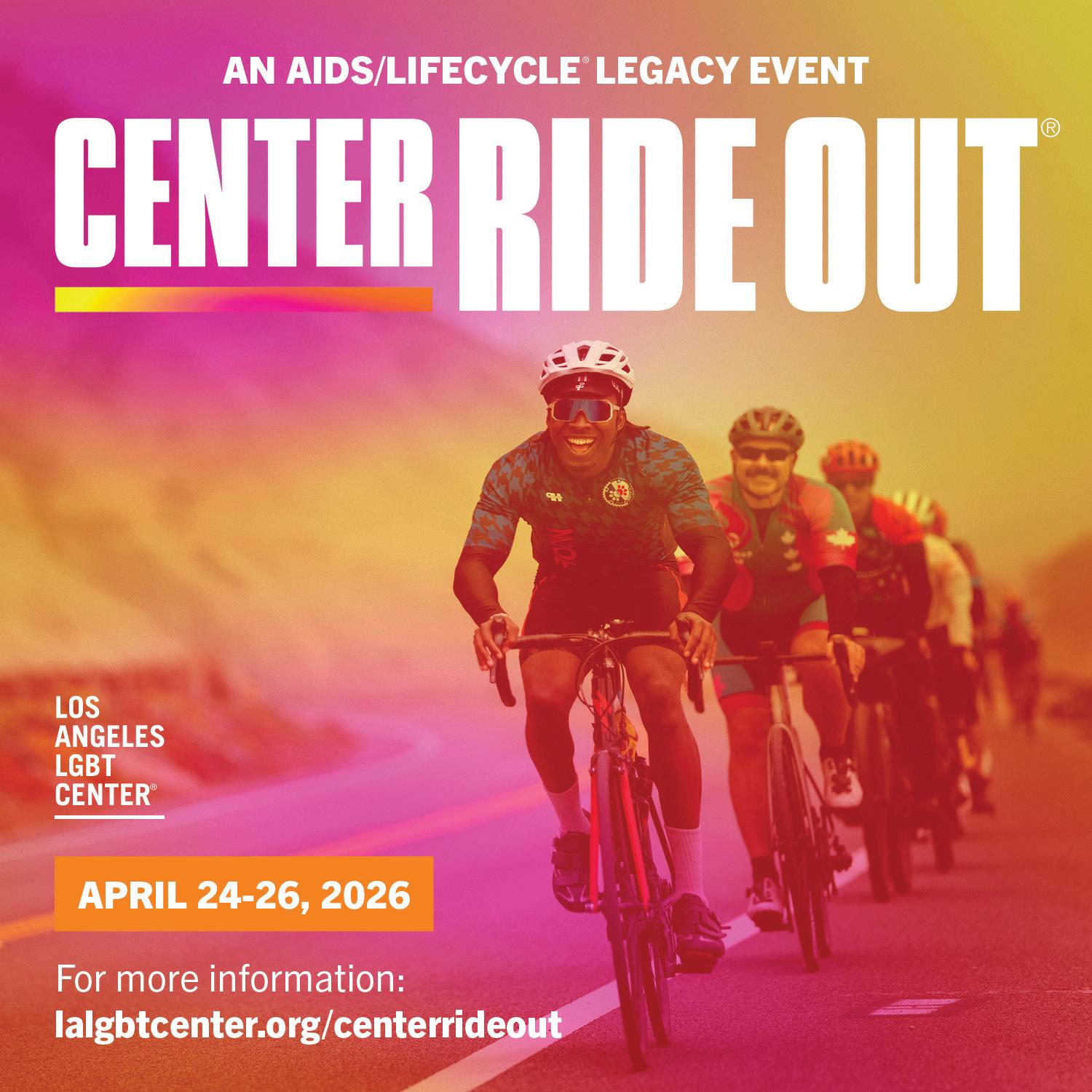
The LA LGBT Center will host its first ever “Center Ride Out,” a 3-day community cycling adventure from Los Angeles to San Diego.
By KRISTIE SONG
On April 24, 500 cyclists will meet at Elysian Park before dawn, stretching and preparing for a 110-mile ride through urban scenery and rolling hills. They will be part of the Los Angeles LGBT Center ’s inaugural “ Center Ride Out ,” a 3-day journey that takes riders through Los Angeles and Temecula, reeling to a stop at the San Diego LGBT Community Center .
The cycling adventure is a rejuvenating, communal queer experience that
taps into the importance of shared joy and advocacy in the fight to defend LGBTQ+ rights. Its roots are sacred for many queer elders: Center Ride Out rises from the legacy of the cherished AIDS/Life Cycle (ALC), a seven-day cycling adventure from San Francisco to L.A. that formed in 1994 and ended with its last ride in 2025.
In its 31-year run, ALC riders raised over $300 million for HIV and AIDS resources, services, and awareness. This
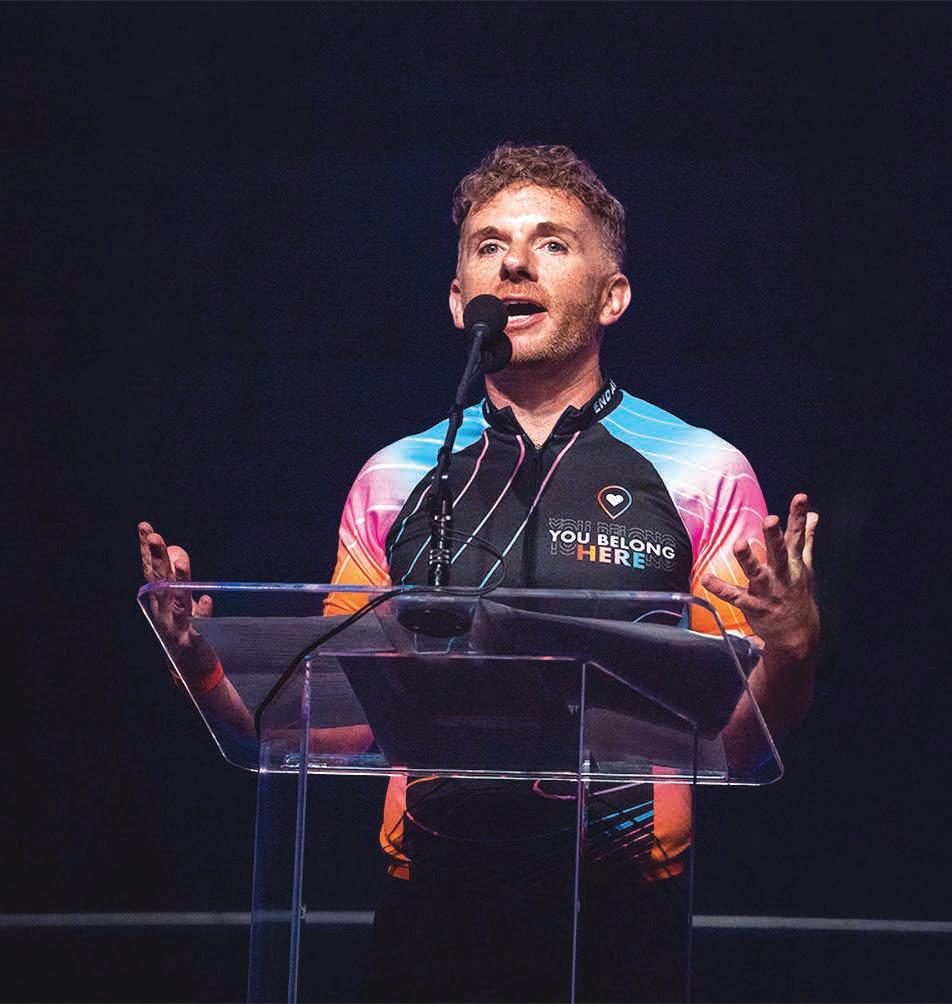
year, Center Ride Out provides a new, exciting extension of this important event, allowing cyclers to raise funds in support of the LA LGBT Center, The San Diego LGBT Community Center, and the LGBTQ Community Center of the Desert
This support is crucial as LGBTQ+ organizations face a new crisis: widespread defunding. In the last fiscal year, the LA LGBT Center lost $9 million in federal support, according to its CEO Joe Hollendoner. The funding raised by Center Ride Out ’ s participants will help offset this loss and keep the organization ’ s various programs and services, from gender affirming care and HIV prevention resources to LGBTQ+ senior and youth support, afloat. “We anticipate further divestment in our work by the Trump administration, [so Center Ride Out] allows people to align their own personal passions with our mission in a broader way,” Hollendoner told the Blade.
Altogether, Center Ride Out participants will cover nearly 200 miles of ground together. At the end of the first 110-mile day from L.A. to Temecula, where riders will get to look at historic landmarks and embark on a museum lunch stop together, the day culminates at campgrounds at Lake Skinner.
Here, riders can take a full rest day at their lakeside camp, where it will exude queer summer camp vibes. There will be massage and medical services, arts and crafts activities, dance parties, and time to relax and connect with the community. “ Folks [can] build relationships, have some fun, and feel safe. That ’ s a feeling a lot of people [need] right now, especially our trans and nonbinary siblings,” Hollendoner said.
Day 3 ends with an 87-mile downhill, coastal ride through the town of Rainbow in northern San Diego County, before ending with a celebratory bash at the San Diego LGBT Community Center. Hollendoner rode ALC five times
while it was active and is excited to be part of this new legacy from its very beginning. “ I’ve heard our community elders talk about how powerful it was to be at the start of AIDS/LifeCycle, and the idea that I can be here at the start of Center Ride Out, an event that I hope will go for three decades or longer…It feels really exciting to me,” Hollendoner said.
For newcomers and experienced cyclists alike, Center Ride Out aims to provide an accessible experience: paring down the initial weeklong ALC ride to three days. To take part, cyclists are expected to raise $2,500 by April 10. For those who may struggle to reach this minimum, staff members have established a community fund.
The community fund will also provide scholarships for BIPOC, trans, women, and femme participants — historically underrepresented communities at ALC — as well as microgrants for BIPOC and trans-led teams to encourage a diverse range of cyclists.
Come April, scores of queer cyclists will get to experience this adventure together: one that is both storied and fresh in its purpose, lineage, and joyful expression of queer togetherness. “ Center Ride Out is providing an exciting opportunity for people to not only fight back and be in community with one another, but to build resiliency and be surrounded by people who share values around liberation,” Hollendoner said.
To learn how to register, donate to or volunteer for Center Ride Out, more information can be found here. The three-day adventure takes place from April 24 to April 26.
Kristie Song is a California Local News Fellow placed with the Los Angeles Blade. The California Local News Fellowship is a state-funded initiative to support and strengthen local news reporting. Learn more about it at fellowships.journalism. berkeley.edu/cafellows .
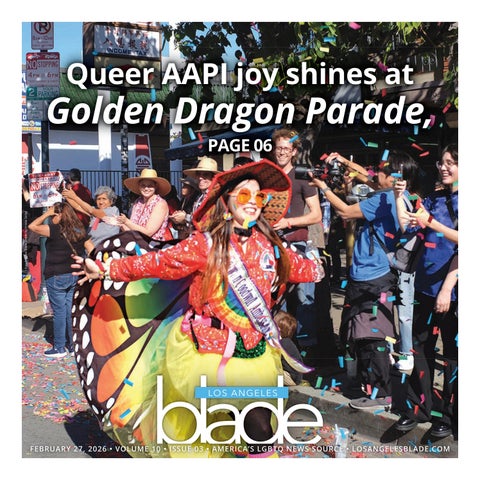
In this photo essay, the Blade documents resilience and queer euphoria at Saturday’s Lunar New Year festivities.
By KRISTIE SONG
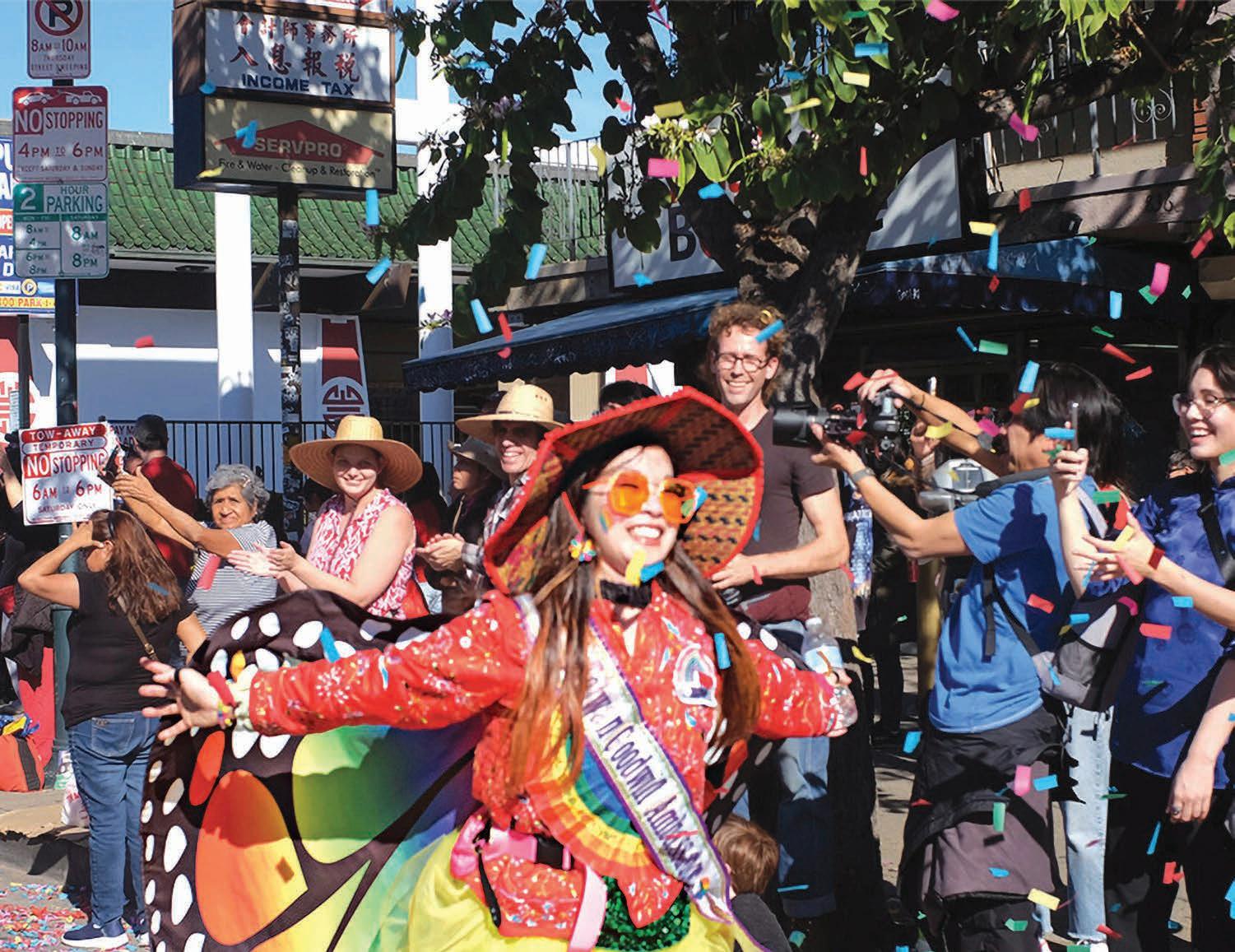
On Saturday afternoon, under a hot, beating sun, I marched at the annual Golden Dragon Parade in L.A.’s Chinatown with members of the API Rainbow Coalition: a network of organizations that protects, centers, and uplifts the safety and joy of queer and trans Asian American and Pacific Islander (QTAPI) people.
Composed of groups like Asian Americans Advancing Justice Southern California (AJSOCAL) , Okaeri , Access to Prevention Advocacy Intervention and Treatment (APAIT), and PFLAG San Gabriel Valley / API, the coalition has shown up for two decades to greet the parade ’ s spectators with warm wishes for the new year, and to combat anti-LGBTQ+ fear and hate with boundless joy and togetherness.
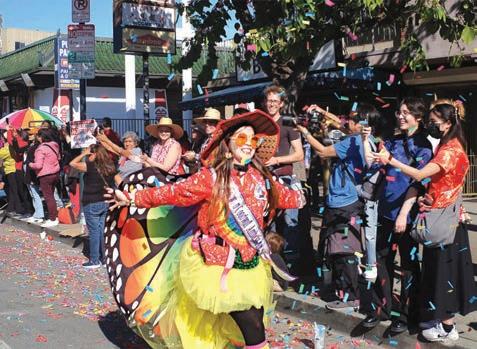
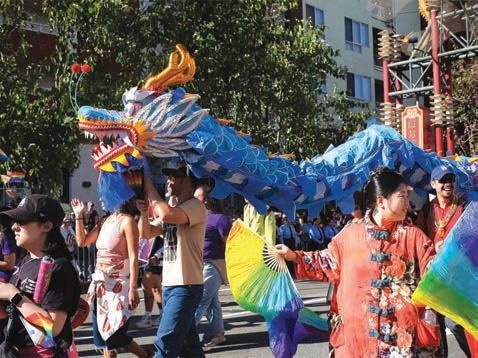
For myself and many others present on Saturday, it was our first time marching in the parade. It was our first time standing definitively, amidst thousands of people, as proud queer QTAPI people. Will Zhang, who was one of six people holding up a beautiful silk dragon that bore the pink and blue shades of the Trans Pride Flag rather than the symbol ’s traditional red and yellow hues, said that being with the community at events like these felt like
he could finally “ unmask.” He felt able to embody his full self.
For the first time back in my Southern Californian roots, I felt truly liberated. Adrenaline pulsed through my limbs, shocking me alive with a boldness I had never experienced as a closeted kid growing up in the San Gabriel Valley. At the parade, I cheered and jumped, waved at strangers with an elation that extended from deep within my body and then flew beyond me.
That uninhibited, childlike wonder that first trickled out, broke like a dam: a flooding of joy that was made possible only because I felt so safe and embraced alongside allies, both new and old, who continue to nurture a path of liberation for ourselves and for future generations.
There is hostility abound, but gathering allows us to rebel and become stronger. “ Goodness prevails,” Zhang said, as we continued to march ahead.


Kristie Song is a California Local News Fellow placed with the Los Angeles Blade. The California Local News Fellowship is a state-funded initiative to support and strengthen local news reporting. Learn more about it at fellowships.journalism.berkeley.edu/cafellows

PHONE 310-230-5266
E-MAIL arodriguez@losangelesblade.com
INTERNET losangelesblade.com
PUBLISHED BY Los Angeles Blade, LLC
PUBLISHER
ALEXANDER RODRIGUEZ
arodriguez@losangelesblade.com, 310-230-5266 x8080
EDITORIAL
NATIONAL EDITOR
KEVIN NAFF
kna @washblade.com, 202-747-2077 x8088
LOCAL NEWS REPORTER
KRISTIE SONG ksong@losangelesblade.com
CONTRIBUTING WRITER
KAREN OCAMB karenocamb@losangelesblade.com
CONTRIBUTORS
MICHAEL K. LAVERS, TINASHE CHINGARANDE, JOHN PAUL KING, LOU CHIBBARO JR., SUSAN HORNIK, JOE REBERKENNY, DANIEL ITAI, ISAAC AMEND, PETER ROSENSTEIN, TERRI SCHLICHENMEYER, JOE PHILLIPS, ANKUSH KUMAR, ESTEBAN RIOSECO, SAM KISIKA, ELVIS KAWEDO, HENRY CARNELL, DAWN ENNIS, AJ SLOAN
SALES & ADMINISTRATION
SALES EXECUTIVE
SHANA WONG SOLARES swong@losangelesblade.com, 808-386-0872
MARKETING DIRECTOR
STEPHEN RUTGERS srutgers@washblade.com, 202-747-2077 x8077
NATIONAL ADVERTISING
RIVENDELL MEDIA sales@rivendellmedia.com, 212-242-6863
ADMINISTRATION
PHILLIP G. ROCKSTROH prockstroh@washblade.com, 202-747-2077 x8092 CREATIVE DESIGN/PRODUCTION
MEAGHAN JUBA production@azercreative.com DISTRIBUTION
CHRISTOPHER JACKSON, 562-826-6602
All material in the Los Angeles Blade is protected by federal copyright law and may not be reproduced without the written consent of the Los Angeles Blade. e sexual orientation of advertisers, photographers, writers and cartoonists published herein is neither inferred nor implied. e appearance of names or pictorial representation does not necessarily indicate the sexual orientation of that person or persons. Although the Los Angeles Blade is supported by many ne advertisers, we cannot accept responsibility for claims made by advertisers. Unsolicited editorial material is accepted by the Los Angeles Blade, but the paper cannot take responsibility for its return. e editors reserve the right to accept, reject or edit any submission. A single copy of the Los Angeles Blade is available from authorized distribution points, to any individual within a 50-mile radius of Los Angeles, CA. Multiple copies are available from the Los Angeles Blade o ce only. Call for rates. If you cannot reach a convenient free distribution point, you may receive a 26-week mailed subscription for $125 per year or $5.00 per single issue. Checks can be sent to Phil Rockstroh at prockstroh@washblade.com. Or send him an email to request directions to make a payment online. Postmaster: Send address changes to the Los Angeles Blade, PO BOX 60664 Washington, DC 20039. e Los Angeles Blade is published bi-weekly, on Friday, by Los Angeles Blade, LLC. Rates for businesses/institutions are $450 per year. Periodical postage paid at Los Angeles, CA., and additional mailing o ces. Editorial positions of the Los Angeles Blade are expressed in editorials and in editors’ notes as determined by the paper’s editors. Other opinions are those of the writers and do not necessarily represent the opinion of the Los Angeles Blade or its sta . To submit a letter or commentary: Letters should be fewer than 400 words; commentaries should be fewer than 750 words. Submissions may be edited for content and length, and must include a name, address and phone number for veri cation. Send submissions by e-mail to kna @washblade.com.


Grindr’s shiny new Edge subscription epitomizes how dating and hook-up apps monetize loneliness by selling algorithmic control as a substitute for genuine human connection
By AJ SLOAN
This February, Grindr discreetly started testing out a brand new premium subscription tier, Edge (props on the wordplay), powered by its proprietary generative AI stack appropriately named “gAI™.” The catch is that some users are being asked to pay more or less the price of one hour of an escort’s time for one month’s subscription. This would place Grindr’s top tier soaring above most mainstream dating apps (Tinder, Hinge, Bumble, etc.) with prices higher than Nicki Minaj on a MAGA stage, some can’t help but wonder who the target consumer is.
At face(less) value, this feels like a corporate strategy to squeeze more money out of a perhaps struggling “dating” app. Grindr’s stock has gone limp, and it’s pushing AI as the ED med that will fluff it up into a smarter, faster, more personalized user experience. But when you really look at it, this pricing experiment speaks volumes about the current state of our gay community, intimacy, desire, and the toxic top that is capitalism in the age of artificial intelligence. Grindr entered the scene (and the app store) in 2009 as a simple and sweet grid of nearby dudes scoping out who’s around and down to get down. It was immediate. It was raw. And, perhaps most uniquely, it was physically grounded. But like most apps and platforms do over time, features were paywalled, and basic functions became privileges. The free portion of the grid shriveled like a pair in winter air. Ads multiplied and became more aggressive, like a digital strain of super gonorrhea. Want more? Pay. Want to be seen? Pay. The death grip of capitalism knows no lube.
This transformation is a testament to a larger pattern in tech called enshittification (aka crapification), where platforms become increasingly more hostile to their users as their money-goggles fog up with greed. Grindr’s Edge is the latest example; a subscription promising personalized AI-generated matches and chat insights, all with the promise of more “meaningful connections.” With price hikes reaching close to half a grand, one can’t help but wonder what is actually being commodified here.
Gay lust is no stranger to consumer culture. From marketing fitness (“Look Better Naked”) to gay-centric grooming (shoutout to Good Head, we see you king), sex drive and commerce have been bedfellows longer than the grandparents from Willy Wonka. Hookup and dating apps, simply put, commodify attention. Profiles are products. Swipes are currency. Desirability is now quantifiable, folks. Take this concept, feed it one too many bumps, and you’ve got Edge



What’s happening, my fellow homosexuals, is the premiumization of intimacy. Not just matchmaking, but the promise that technology can deliver connection… for the right price. And the price of this new tier of service says more about our collective culture at this moment than it does about the greedy little piggies behind
Grindr. We live in an age where AI is infringing on emotional territory once thought to be uniquely human. Algorithms already curate our newsfeeds, recommendations, and shopping lists. And now, well, we can tag “digitally omnipotent yenta” to the tally. The creation of Edge also highlights how modern capitalism treats desire as an inefficiency that can be solved. Grindr is utilizing a not-so-new strategy here: hone in on its users’ loneliness and fear of rejection and redesign features that address these feelings… at a premium. One undeniable takeaway is that genuine interactions are no longer occurring naturally.
On a psychological level, Grindr ’s Edge subscription tugs at the arguably universal hunger for control. In a world brimming with flirtations that flatline, DMs that die down, and dates that don’t pan out, the allure of AI as a fail-safe is, well, seductive. But what happens when that illusion of control clashes with the actual intimacy that we seek? Instead of enhancing connection, AI could fossilize it, making real human interactions that much more transactional than said apps have already made them out to be.
Grindr’s Edge experiment reveals how capitalism monetizes the desire for human connection, how tech sells the guarantee of ease void of authenticity, and how intimacy in the digital age increasingly becomes a slave to the algorithm. Yet resistance is already clapping back. Online discourse from users dragging Grindr for the high prices and migrating to alternative platforms shows us that many are not buying into the premiumized dream.
Ultimately, Edge feels less like an innovation and more like an admission: that instead of fostering environments where vulnerability and spontaneity thrive, platforms would rather engineer a shortcut and charge stratified admission. When the illusion of confidence is packaged as a purchasable upgrade, the entire thing starts to feel that much more bleak. Stripped of its shiny branding, it reeks of incel-scented desperation, a tech-mediated fantasy that mistakes control for chemistry and convenience for closeness. I may stand alone in this humble opinion, but a dude who’s audacious (or foolish) enough to sign up for such a service is a hard pass. In the end, shop local - hire an escort. At least then nobody is denying the pure transaction of it all.
Now available to view at the LA LGBT Center, “JOY!” is a raw preservation of Black queer nightlife, fantasy and self-discovery.
By KRISTIE SONG
It’s 2018, inside queer dance party Ostbahnhof , and the fl oor is packed with a sweaty, hypnotic energy as people groove to the sexy, lush soundscapes of techno and deep house. Photographer and visual artist Nikko Lamere rushes to grab their disposable camera, accidentally spilling some of their whiskey ginger on someone, and snaps a couple of shots of their friends: immortalizing their uninhibited joy and movement forever.
Eight years later, these photos LaMere captured across various local queer dance parties comprise their newest and largest photo exhibition yet: “JOY!” Displayed at the Los Angeles LGBT Center, “ JOY!” is a raw documentation of Black queer nightlife, fantasy, and euphoria. It includes two of LaMere ’ s major bodies of work and follows the artist s queer journey and creative evolution.
The exhibit ’ s opening on Feb. 13 is one of two events in the Center ’s “ Highly Favored” programming series that uplifts Black queer liberation every February. The next event comes this Saturday , and is a celebratory dance party akin to the ones documented in LaMere ’s photos.
Prior to this exhibit, LaMere was most known for their saturated and stylized editorial work with contemporary music phenoms like Doja Cat, SZA, Latto, Billie Eilish and Kehlani. Propelled at a young age into fl ashy spaces with modern-day tastemakers and legends, LaMere sought refuge in photography throughout their adolescence. Their fascination with the camera began in elementary school while growing up in Culver City, when their grandmother gifted them a Nickelodeon-themed camera to take photos with.
vious work. For the fi rst time, they couldn ’ t carefully and methodically create the shot; whatever they snapped was based purely on instinct, a fl eeting moment of true and embodied tenderness, ecstasy, and freedom.
“ To have this body of work shot all in black-and-white, for it to be so gay and Black — it feels really affi rming,” LaMere said. “ These are the most raw images and things I could create. There s no Photoshop. There ’ s no retouching. It ’ s literally straight from the camera. It just is. I think part of joy is being able to just be, and that ’ s what these images are.”
“ JOY!” also includes LaMere s work, “ Queer Fantasy,” a collection of 40 black-andwhite fi lm portraits and interviews with local queer performers, artists, and everyday people. This newer project grew from the core of “ In the Night,” and is another intentional project focused on highlighting the beauty and individuality of queer Angelenos. Each person is asked: “What is your queer fantasy?,” illustrating that queer fantasy is not only a transformative kind of rebirth: it is a process built by radical eff orts to cultivate joy, success, and safety in the face of violence and discrimination.
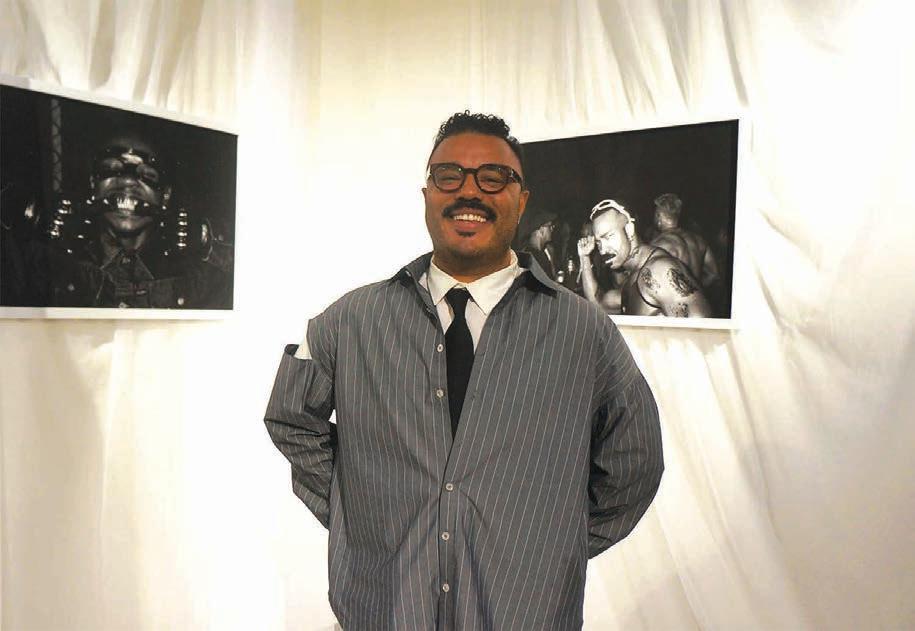
Their eye and talent were reinforced with praise, and this love for the craft grew from curiosity to solace in high school. Bullied for being gay and femme, LaMere sought refuge at the library, where they fi rst discovered the technicolor, surreal work of visionary photographer David LaChapelle. This became a direct pathway for LaMere ’ s own career: one that, though successful and fulfi lling in its own way, led to a need for change.
For so long, the camera was a means to fulfi ll someone else s vision. Now, LaMere began to use it as a tool for connection and raw documentation. In 2018, they didn ’t set out to create what is now their “ In the Night” photo series; they were simply trying to explore their own queer journey, and preserve the friendships and environments that made them feel comfortable in their own skin.
That vulnerable process of “ becoming” is one they hadn ’t touched upon in their pre-
For LaMere, “JOY!” is about this process and the moments of self-discovery found on the dance fl oor, where you can really feel tethered to the person you’ re becoming while “ the world is burning around you.” While speaking with LaMere, I am grounded by the words of DJ, artist and organizer Darryl DeAngelo Terrell
“Here, in this space we as black people [are] forced to fi nd liberation in our own bodies, it ’s in us, deeper than melanin, and it is activated by bodily acts,” Terrell writes. “We Move* in ways that others can not fathom to understand. Through these acts, we fi nd the most beautiful yet temporary forms of true freedom; we fi nd joy, peace in these acts.”
“JOY!” is available to the public on Wednesdays and Thursdays from 11 a.m. to 4 p.m. More information about the exhibit and “Highly Favored” can be found here. This Saturday’s queer dance party will also honor special guests Hailie Sahar, a starlet on the revolutionary FX show Pose, as well as filmmaker and ballroom culture documentarian Elegance Bratton.
Kristie Song is a California Local News Fellow placed with the Los Angeles Blade. The California Local News Fellowship is a state-funded initiative to support and strengthen local news reporting. Learn more about it at fellowships.journalism.berkeley.edu/cafellows .








By JOHN PAUL KING
When Colorado Poet Laureate Andrea Gibson died from ovarian cancer in the summer of 2025, the news of their passing may have prompted an outpouring of grief from their thousands of followers on social media, but it was hardly a surprise.
That’s because Gibson – who had risen to both fame and acclaim in the early 2000s with intense live performances of their work that made them a “superstar” at Poetry Slam events – had been documenting their health journey on Instagram ever since receiving the diagnosis in 2021. During the process, they gained even more followers, who were drawn in by the reflections and explorations they shared in their daily posts. It was really a continuation, a natural evolution of their work, through which their personal life had always been laid bare, from the struggles with queer sexuality and gender they experienced in their youth to the messy relationships and painful breakups of their adult life; now, with precarious health prohibiting a return to the stage, they had found a new platform from which to express their inner experience, and their fans – not only the queer ones for whom their poetry and activism had become a touchstone, but the thousands more who came to know them through the deep shared humanity that exuded through their online presence – were there for it, every step of the way.
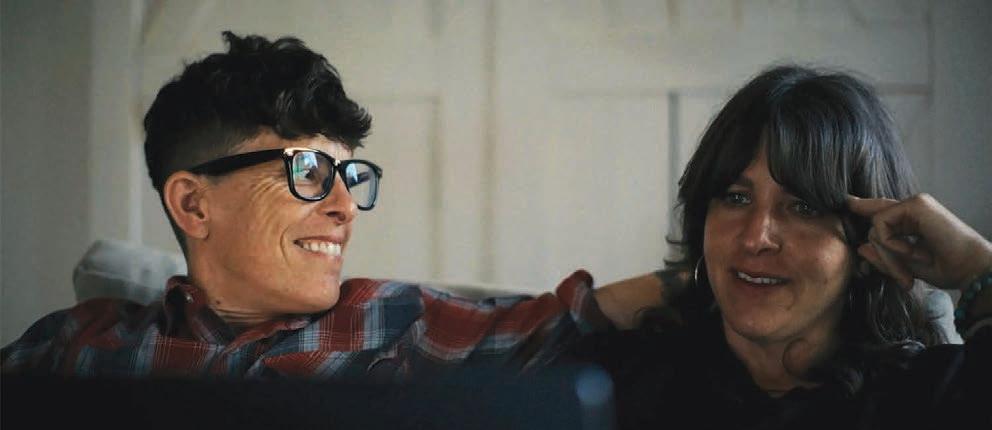
At the same time, and in that same spirit of sharing, there was another work in progress around Gibson: “Come See Me in the Good Light,” a film conceived by their friends Tig Notaro and Stef Willen and directed by seasoned documentarian Ryan White (“Ask Dr. Ruth”, “Good Night, Oppy”, “Pamela, a Love Story”), it was filmed throughout 2024, mostly at the Colorado home shared by Gibson and their wife, fellow poet Megan Falley, and debuted at the 2025 Sundance Film Festival before a release on Apple TV in November. Now, it’s nominated for an Academy Award.
Part life story, part career retrospective, and part chronicle of Gibson and Falley’s relationship as they negotiate the euphoric highs and heartbreaking lows of Gibson’s terminal illness together, it’s not a film to be approached without emotional courage; there’s a lot of pain to be vicariously endured, both emotional and physical, a lot of hopeful uplifts and a lot of crushing downfalls, a lot of spontaneous joy and a lot of sudden fear. There’s also a lot of love, which radiates not only from Gibson and Falley’s devotion and commitment to being there for each other, no matter what, but through the support and positivity they encounter from the extended community that surrounds them. From their circle of close friends, to the health care professionals that help them navigate the treatment and the difficult choices that go along with it, to the extended family represented by the community of fellow queer artists and poets who show up for Gibson when they make a triumphant return to the stage for a performance that everyone knows may well be their last,
nobody treats this situation as a downer. Rather, it’s a cause to celebrate a remarkable life, to relish friendship and feelings, to simply be present and embrace the here and now together, as both witness and participant.
At the same time, White makes sure to use his film as a channel for Gibson’s artistry, expertly weaving a showcase for their poetic voice into the narrative of their survival. It becomes a vibrant testament to the raw power of their work, framing the poet as a seminal figure in a radical, feminist, genderqueer movement which gave voice to a generation seeking to break free from the constraints of a limited past and imagine a future beyond its boundaries. Even in a world where queer existence has become – yet again – increasingly perilous in the face of systemically-stoked bigotry and bullying, it’s a blend that stresses resilience and self-empowerment over tragedy and victimhood, and it’s more than enough to help us find the aforementioned emotional courage necessary to turn what is ultimately a meditation on dying into a validation of life.
That in itself is enough to make “Come See Me in the Good Light” worthy of Oscar gold, and more than enough to call it a significant piece of queer filmmaking – but there’s another level that distinguishes it even further.
In capturing Gibson and Falley as they face what most of us like to think of as an unimaginable future, White’s quietly profound movie puts its audience face-to-face with a situation that transcends all differences not only of sexuality or gender, but of race, age, or economic status as well. It confronts us with the inevitability few of us are willing to consider until we have to, the unhappy ending that is rendered certain by the joyful beginning, the inescapable conclusion that has the power to make the words “happily
ever after” feel like a hollow promise. At the center of this loving portrait of a great American artist is a universal story of saying goodbye.
Yes, there is hope, and yes, good fortune often prevails –sometimes triumphantly – in the ongoing war against the cancer that has come to threaten the palpably genuine love this deeply-bonded couple has found together; but they (and we) know that, even in the best-case scenario, the end will surely come. All love stories, no matter how happy, are destined to end with loss and sorrow; it doesn’t matter that they are queer, or that their gender identities are not the same as ours – what this loving couple is going through, together, is a version of the same thing every loving couple lucky enough to hold each other for a lifetime must eventually face.
That they meet it head on, with such grace and mutual care, is the true gift of the movie.
Gibson lived long enough to see the film’s debut at Sundance, which adds a softening layer of comfort to the knowledge we have when watching it that they eventually lost the battle against their cancer; but even if they had not, what “Come See Me in the Good Light” shows us, and the unflinching candor with which it does so, delivers all the comfort we need.
Whether that’s enough to earn it an Oscar hardly matters, though considering the notable scarcity of queer and queer-themed movies in this year’s competition it might be our best shot at recognition.
Either way, it’s a moving and celebratory film statement with the power to connect us to our true humanity, and that speaks to a deeper experience of life than most movies will ever dare to do.





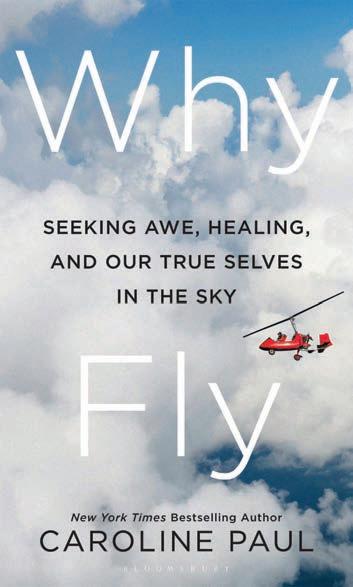
book chronicles a lifetime
By TERRI SCHLICHENMEYER
Tray table folded up.
Check. Your seat is in the upright position, the airflow above your head is just the way you like it, and you’re ready to go. The flight crew is making final preparations. The lights are off and the plane is backing up. All you need now is “Why Fly” by Caroline Paul, and buckle up.
When she was very young, Paul was “obsessed” with tales of adventure, devouring accounts written by men of their derring-do. The only female adventure-seeker she knew about then was Amelia Earhart; later, she learned of other adventuresome women, including aviatrix Bessie Coleman, and Paul was transfixed.
Time passed; Paul grew up to create a life of adventure all her own.
Then, the year her marriage started to fracture, she switched her obsession from general exploits to flight.
Specifically, Paul loves experimental aircraft, some of which, like her “trike,” can be made from a kit at home. Others, like Woodstock, her beloved yellow gyrocopter, are major purchases that operate under different FAA rules. All flying has rules, she says, even if it seems like it should be as freewheeling as the birds it mimics.
She loves the pre-flight checklist, which is pure anticipation as well as a series of safety measures; if only a relationship had the same ritual. Paul loves her hangar, as a place of comfort and for flight in all senses of the word. She enjoys thinking about historic tales of flying, going back before the Wright Brothers, and including a man who went aloft on a lawn chair via helium-filled weather balloons.
The mere idea that she can fly any time is like a gift to Paul.
She knows a lot of people are terrified of flying, but it’s near totally safe: generally, there’s a one in almost 14 million chance of perishing in a commercial airline disaster – although, to Paul’s embarrassment and her dismay, it’s possible that both the smallest planes and the grandest loves might crash.
If you’re a fan of flying, you know what to do here. If you fear it, pry your fingernails off the armrests, take a deep breath, and head to the shelves. “Why Fly” might help you change your mind.
By
Caroline Paul c.2026, Bloomsbury | $27.99 | 256 pages
It’s not just that author Caroline Paul enjoys being airborne, and she tells you. It’s not that she’s honest in her explanations of being in love and being aloft. It’s the meditative aura you’ll get as you’re reading this book that makes it so appealing, despite the sometimes technical information that may flummox you between the Zen-ness. It’s not overwhelming; it mixes well with the history Paul includes, biographies, the science, heartbreak, and exciting tales of adventure and risk, but it’s there. Readers and romantics who love the outdoors, can’t resist a good mountain, and crave activity won’t mind it, though, not at all.
If you own a plane – or want to – you’ll want this book, too. It’s a great waiting-atthe-airport tale, or a tuck-in-your-suitcasefor-later read. Find “Why Fly” and you’ll see that it’s an upright kind of book.