


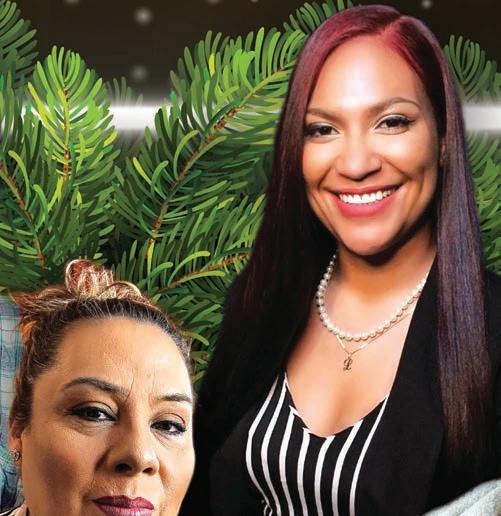












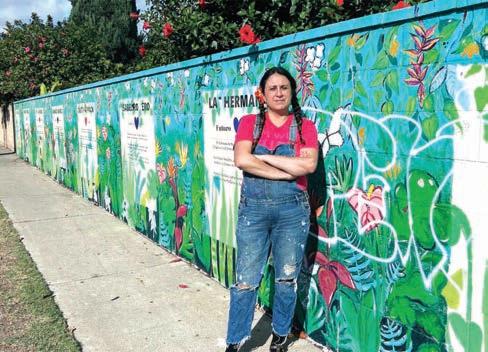
SANTA ANA, Calif. – A 28-year-old man pleaded guilty today to felony vandalism and a felony hate crime enhancement for spray painting white supremacy graffiti over a mural in Costa Mesa that recognizes prestigious Latinas from Orange County.
Daniel Hotte pleaded guilty to a court offer of one felony count of vandalism exceeding $400 and the hate crime enhancement. He was immediately sentenced to 180 days in county jail, placed on formal probation for two years and received 90 days of credit for completing a 90-day drug treatment program.
On Oct. 31, 2022, Hotte was seen by several witnesses scratching out several names on the Las Poderosas mural, a public mural created in 2020 to honor eight poderosas – or strong women. He also spray painted “white power” and “PEN1 737,” a reference to Public Enemy Number 1, a documented white supremacist gang.
“Defacing a mural in the name of hate that honors Latina women who have played prominent roles in Orange Coun-
ty is despicable and deplorable,” said Orange County District Attorney Todd Spitzer. “This was a cowardly act and incidents like this remind us that any attempts to divide our diverse communities will not be tolerated.”
At the time of Hotte’s arrest last October, Costa Mesa Mayor John Stephens said:
“Costa Mesa is a great city known for its inclusivity. We celebrate our diversity and are proud of our various backgrounds. This type of crime flies in the face of what we have achieved as a multi-cultural community. I’m grateful for the witnesses who came forward to help identify him and thankful the police stayed on the case and captured the suspect.”
“I represent a community rich in culture,” said Councilmember Loren Gameros. “This suspect came from another city into Costa Mesa to commit this crime and hurt the identity of some of our neighbors. That is unacceptable and now he will have to face justice.”
WEST HOLLYWOOD - At the regular West Hollywood City Council meeting on Monday, December 18, the Council unanimously elected the current Mayor Pro Tempore, John Erickson, as the new Mayor of West Hollywood for 2024. Additionally, Council Member Chelsea Byers was elected as Vice Mayor. During Monday’s council meeting, the Mayor Pro Tempore title was changed to Vice Mayor, making Council Member Byers the first to hold this title.
The Mayor and Vice Mayor will be officially installed on January 16, 2024, at the Reorganization Meeting, commencing at 6:00 p.m.
“I am truly honored to be named the city’s first Vice Mayor,” said newly elected Vice Mayor Chelsea Byers during
Council Comments. “I am thrilled to serve alongside Mayor Erickson and this incredible council. As we approach the end of this year and the beginning of a new one, I extend my deepest gratitude to the community for its ongoing support.”
Vice Mayor Byers extended her thanks to outgoing West Hollywood Mayor Sepi Shyne for her dedicated service, as well as to City Staff and board and commission members.
“Councilmember Byers, congratulations, soon-to-be Vice Mayor elect Byers,” said Mayor-elect Erickson. “I want to express my gratitude to my colleagues for this honor and thank Mayor Shyne for her leadership this past year. I am proud to be your colleague and even prouder to call you a
friend. Thank you for leading us through it. Happy holidays, everyone.”
City Council Members serve a four-year term and are elected at large. They select one of their members to serve as Mayor, with this office rotating among Council members during their yearly reorganization.
The reorganization, which previously occurred in April, was changed at the March 1, 2021 City Council meeting to better align with the November election. The election is now conducted in December, and the new Mayor and Mayor Pro Tempore are installed at a meeting in January, as directed by the City Council.
PAULO MURILLO
OAKLAND, Calif. - The aftermath of Hamas’ October 7 attack on Israel has sent shockwaves through the Jewish community in America, unveiling a complex tapestry of emotions and challenges. The rising tide of antisemitism has left many progressive Jews feeling abandoned, especially as once-supportive groups appear to embrace antisemitic sentiments.
In a recent interview with Ethnic Media Services, Jo Ellen Green Kaiser, CEO of J Jewish News of Northern California, provided insights into the growing sense of abandonment within the Jewish community, particularly among those who had actively participated in progressive movements. The interview exposed the isolation felt by Jewish people on the left, questioning the absence of solidarity from groups with whom they had marched side by side.
Antisemitic incidents have taken a troubling turn, with explicit expressions like “kill all the Jews” becoming distressingly common among progressive circles. This shift has left progressive Jews feeling alone, as former allies are now accused of embracing antisemitism.
The fear generated by the conflict and the subsequent rise in antisemitism goes beyond rhetoric to tangible acts of self-censorship within the Jewish community. Some Jews are refraining from displaying menorahs during Hanukkah, and parents, in particular, are grappling with concerns about
their children facing verbal abuse and derogatory slurs based on their Jewish identity.
In parallel, the Chabad Jewish Center of Oakland became a focal point for the community’s resilience after a 9-foottall menorah was vandalized and thrown into a lake during Hanukkah celebrations.
According to J Jewish News of Northern California, the 11-foot menorah used for public Hanukkah ceremonies at Oakland’s Lake Merritt was destroyed sometime between Tuesday night and Wednesday morning. Pieces of the hanukkiah were cut up and tossed across the sidewalk and into the water. Antisemitic graffiti was left on the base where it once stood.
The hate crime shocked the community and despite its destruction, the center inaugurated a new menorah, symbolizing unity and strength.
The incident prompted an active hate crime investigation by the Oakland Police Department. Oakland Mayor Sheng Thao urged treating the act as a hate crime, emphasizing that it was an attack not just on the city’s Jewish community but on shared values.
The menorah lighting at Lake Merritt, a long-standing tradition, became a powerful symbol of resilience. Rabbi Dovid Labkowski of the Chabad Jewish Center of Oakland ex-
pressed disbelief at the destruction of the menorah, stating, “I would never imagine that the menorah, which is a symbol of light, would be something that someone would want to destroy.”
Hateful graffiti accompanied the vandalism, further highlighting the depth of the act. The incident coincided with rising tensions related to the Israel-Hamas conflict, leading federal and local officials to warn about potential spillover into the United States.
Amid condemnation of the act, the Chabad Jewish Center of Oakland released a statement expressing inspiration from the community’s powerful display of Jewish pride. Muslim groups, including the Council on American-Islamic Relations’ San Francisco Bay Area office, condemned the vandalism, emphasizing the need for unity against antisemitism and bigotry.
As the community grapples with the aftermath of the October 7 attack, escalating antisemitism, and targeted acts of hatred, there is a collective effort to navigate through the complexities and foster unity amidst adversity. The challenges faced by progressive Jews underscore the imperative for continued dialogue, understanding, and support within and beyond the community.
SIMHA HADDAD

LOS ANGELES - The mere fact that LGBTQ people can claim refugee status and seek safe haven in this country based on dangers they face in their home country by anti-LGBTQ forces and laws was a hard fought, massive victory for LGBTQ refugees and one that has only been recently enacted.
In about 70 countries same-sex relations are criminalized and, in six countries, punishable by death. Many LGBTQ refugees and asylum seekers have endured years of exclusion, discrimination, and even violence by family, community, and authorities before being forced to flee home.
Many LGBTQ+ refugees and asylum seekers experience trauma inflicted by circumstances which led to them fleeing their nations of origin. That can have long-lasting mental health effects, including a range of mental health challenges, such as anxiety, depression, and post-traumatic stress disorder (PTSD).
Obtaining asylum status or permanent residency in the United States can also be a traumatizing experience as the process can take years of uncertainty.
Pew Research recently noted that since President Joe Biden took office in January 2021, his administration has acted on a number of fronts to reverse Trump Administration-era restrictions on immigration to the United States.
The steps included plans to boost refugee admissions, preserving deportation relief for unauthorized immigrants who came to the U.S. as children and not enforcing the “public charge” rule that denies green cards to immigrants who might use public benefits like Medicaid.
Scripps News journalist John Mone reported that the United Nations World Refugee Agency that by the end of 2022, close to 110 million people were forcibly displaced around the globe due to violence, persecution or human rights violations.
The Williams Institute at the UCLA School of Law, in its June 2022 report noted:
Only 37 countries formally grant asylum to individuals due to a well-founded fear of persecution on the basis of sexual orientation or gender identity (SOGI).
Studies show that a main obstacle to seeking asylum appears to be lack of awareness that sexual orientation and gender identity constitute viable grounds for an asylum claim.
• Research shows that the process of applying for asylum can itself have deleterious effects on LGBTQI+ persons. One recent study found that asylum applicants experience negative mental and physical health outcomes and economic insecurity as they wait in a precarious state of uncertainty.
• A number of studies show how the requirements for a successful asylum claim require that LGBTQI+ migrants “come out” to present themselves as a sexual or gender minority, but do so in a way that is “credible” and “legible” to asylum adjudicators. One study attributed the cause of most denied SOGI claims to “disbelief of sexual orientation” or “lack of credibility,” which are typically predicated on heteronormative and Western conceptions of sexuality and expectations of queer lifestyles often rooted in stereotypes or prejudice.
• A number of studies point to the challenge posed by
adjudicators who may conflate sex with sexuality to the extent that sexual behavior forms a key part of the claimant’s narrative about their sexual orientation. Applicants without sexual or romantic histories are therefore routinely discredited.
• “Proving” one’s identity is particularly challenging for transgender asylum seekers. Adjudicators often rely on outdated medicalized notions of what it means to be transgender in which, to be deemed “valid” and “real,” transgender people must desire and seek out medical intervention.
• Bisexual claimants are often denied asylum due to understandings of bisexuality based on stereotypes, that is, the notion that bisexual migrants can simply choose partners of the opposite sex.
• Documentation of country conditions is critical evidence to demonstrate a fear of persecution.
• The experience of “coming out under the gun” in the course of applying for asylum can be actively retraumatizing for vulnerable migrants.
The changes reportedly under discussion by the Biden administration include placing a cap on asylum seekers, expanding detention and deportation of asylum seekers, creating a Title 42-like policy that would expel those entering the U.S. without the chance to ask for asylum, raising the bar for asylum seekers to prove the danger they are facing, codifying aspects of the asylum ban such as a third-country transit ban for those seeking protection at the border, and restricting asylum based on how asylum seekers enter the country.
These policies will result in many people who could otherwise be eligible for asylum being returned to the very danger they are trying to escape — in direct contradiction of federal and international law.
Then there is also the fiscal reality for LGBTQ+ refugees and asylum seekers. To work legally in the country based on a Pending Asylum Application, asylum seekers are allowed apply for an Employment Authorization Document (EAD) known as a Form I-765, Application for Employment Authorization.
However, this can only be done in the time frame of 150 days after the asylum application has been filed. Many asylum seekers arrive with extremely limited funds and in many cases outside of charitable assistance by organizations, churches or private individuals, find themselves supporting themselves illegally, and in the cases of LGBTQ+ refugees and asylum seekers, this can include sex work which has the potential to lead to human trafficking.
The Los Angeles Blade teamed up with The Latino Outreach and Understanding Division (LOUD) to host a Holiday Party celebrating the journey’s of LGBTQ Asylum Seekers, DACA recipients and undocumented folks.
The event, to be held at HEART WeHo on December 22 at 8 PM, will feature an outstanding panel of affected people from the Latino community who will share their stories.
Gretta Soto Moreno, a Mexican trans woman who is an asylum seeker, seeking safety from the persecution she experienced there. Jesus Paizano is a 22-year-old Venezuelan asylum seeker who is deeply passionate about immigration equality and justice. Hans Vompakerth an undocumented 23-year-old gay man determined to find his
American dream. Laura Morales Garcia, a DACA recipient who arrived in this country at 2-years-old and who is fighting to strengthen the rights of people in her category.
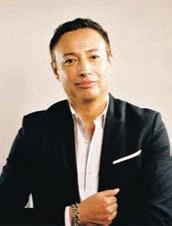
The panel will be moderated by Edwin Millan, a native of Lima-Peru. Edwin is the International President of The Latino Outreach and Understanding Division (LOUD), an affinity group of the AIDS Healthcare Foundation, which addresses the social and health disparities that threaten the Latino Community. By organizing events like the holiday party, LOUD, an affinity group of the AIDS Healthcare Foundation, establishes a worldwide reach and earns recognition as one of the most influential Latino advocacy organizations.
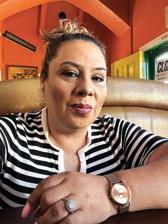
Gretta Soto Moreno’s journey is a testament to the hardships faced by asylum seekers and the struggles within the U.S. detention system. A transgender woman fleeing years of torment—enduring assaults and threats in Mexico, her home country —sadly found herself suffering similar abuses upon reaching the U.S. Mexico was not only violent, it was isolating and traumatizing. It’s a hard place to be your authentic self.
But there were happy moments, like the office Christmas party where she bravely presented herself as Gretta, stunning a Catholic colleague who Moreno says had no idea. “She was shocked because she noticed this ‘pretty woman’ managing the party; I was shocked too because when she realized it was me, she was ecstatic,” Moreno said. “Her reaction was so unexpected and it made me feel special.” She suffered the passing of her biggest champion when her grandmother passed away. She had been the most protective and supportive force in her life.. “When she died, I felt so alone and lost.. She always knew I was different that the rest of the kids but to her that made me very special.”
Realizing she was alone and that her life would never improve in Mexico, she chose to seek asylum in the U.S.. But, navigating immigration was full of challenges.
Moreno’s alcohol-related arrest and conviction compounded her plea for asylum. And as a trans person having to address past incarceration, things became very complicated, a story echoing the plight of many trans individuals in similar circumstances. “My alcohol convictions made it very hard to convince the immigration judge that my asylum claim was legitimate; and that is really hard because as a trans person, being believed or having your truth questioned is really traumatizing,” she said.
Jesus Paizano is a quick study who rarely misses a detail so, when he sets his sights on something, he confidently goes for it and there’s nothing or no one in his path who can stop him.
“My dad worked with the government of Hugo Chavez, and later president Nicolas Maduro. But he had a dispute with Diosdado Cabello, who is also one of Venezuela’s highest diplomats. My father refused to follow arbitrary orders

and in response to that he was politically ruined and removed from office.”
Paizano witnessed first hand the impact that had on his father and his entire family, as the norms of privilege, peace, position, possessions and their sense of safety were taken from them.
Venezuela since 2013, when Jesus was only 12-years-old, has slowly descended into extreme political violence and economic disaster that resulted in a humanitarian crisis and unprecedented exodus: more than 7 million people have fled.
In his teenage years, Paizano realized that his chances of success were very limited and the realization that being gay in a very closeted, macho culture was another strike against him. In fact he knows many young gay men who were victims of antigay violence, some of whom took their lives or who simply disappeared.
Determined to save himself, he became one of the more than 1 million Venezuelan asylum seekers. But the promise of a brighter future outweighed the pain of separation. And, besides, he was young and “never thought of it as goodbye.”
The journey to the U.S. border near San Diego was not as scary as actually crossing into the U.S.. Ever pragmatic, when he saw the police he decided to immediately surrender and begin to make his asylum plea. For the next six months he was routed from detention facility to detention facility.
“Detention was scary at times and I got very sick and also had Covid, but there was something about it that was rewarding,” he said. “There were other gay people there and some trans people and we watched out for one another.”
Eventually, he was connected to a sponsor in Los Angeles who sent him a ticket to LAX. “They picked me up and the first thing we did was go to The Abbey and then to the house. I had never felt such relief in my life.”
Paizano encountered a landscape starkly different from his homeland. The open embrace of his LGBTQ identity stands in stark contrast to the limitations he faced back home.












He says there is a dangerous gap in an immigrant’s ability to get justice through the ordinary court system. He noted “the difference between the rights an immigrant has and those of an American citizen has sets up a gap that can be used to control or manipulate and even exploit people.”
“I love this country and when I become a U.S. citizen, I will honor that as a privilege bestowed by one of the few countries where democracy still survives. But it has to do better to protect the rights of immigrants who are already here,” Paizano said.

Hans Vompakerth is a 23-yearold gay man from Medellin, Colombia and despite being undocumented, he says he has no fear telling his story.
“There are thousands of people like me and they do not have bad things happen to them, so why would I have to keep it a secret?”
“There were two occasions in which I entered the US near Tijuana. The first time they returned me to the Mexican side of the border,” he says. A year passed and he tried again.
”They captured me and processed me like before, but this time, instead of returning me to the Mexican side, they took me and a group of people in a white government car and left us in the middle of nowhere on the American side! We were left to set about looking for civilization.”
Vompakerth’s determination to come to the U.S. seems to come from his abiding respect and admiration he has for his hard working mother. They are so close that the only person who knew he was going to leave Colombia was her.
“I did it for her. She worked so hard to hold the family together and I guess, as the oldest son, I wanted to make life easier for her and provide for her, my 3 sisters and my younger brother,” he says.
Last March, however, the family suffered tragedy. His younger brother, 20, left home unannounced. After a few days of constant search and worry, the family was informed that his body had washed ashore on a nearby island.
“I felt powerless. I wasn’t able to return or do anything except help with all the expenses,” he said with heartache. “I had to take some comfort knowing that my sisters were

there to take care of her while she grieved.”
Despite family pressures, in the U.S., Vompakerth says he has a newfound sense of life that contrasts starkly with the dark challenges he faced back home.
“I feel I am much more respected and accepted by everyone. I feel much more resilient and happy and that has made it possible for me to get through everything. When my brother died, I grieved by working harder and using the money to cover funeral expenses. Everyday, I spent hours on WhatsApp with my mom and I still do.”
So, it wasn’t violence and homophobia that motivated Hans to leave Colombia. “I was never a victim of discrimination or violence in Colombia,” he says. “I fled a situation where there was a scarcity of everything, no resources in general- not even enough food. I lived in constant economic turmoil, even my own health was affected. There were no jobs.
“I didn’t experience violence or homophobia until I set foot in Mexico and had contact with immigration authorities from the U.S.,” he said. “They were awful to me.”
But since arriving in Los Angeles, Hans says he hasn’t experienced discrimination or violence.
“Moving to this country,” he declares, “has changed my life. “Living in the US has helped me pull myself up, to be disciplined, to be sensitive, to learn more, to care more about myself and to help everyone I care about.”
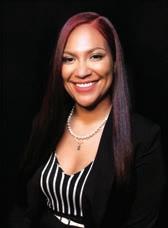
Laura Morales Garcia was born in Durango, Mexico and found her way to Los Angeles, CA at the young age of 2 years old, arriving with her undocumented family.
She has spent a lifetime advocating for DACA recipients and is one of the leading experts on the issue and a noted advocate. She graduated from Los Angeles High School and was the first in her family to attend college, obtaining her degree in Clinical-Psychology. Garcia is devoted to public service and works to educate high school students on the LGBTQ+ community.
She is an AHF Ambassador and AHF Pharmacy Representative & Community Liaison for prevention and care of HIV.
TROY MASTERS
SAUSALITO, Calif - Gay Sausalito City Councilmember Janelle Kellman has her eyes set on making political history in California come 2026 with her bid for lieutenant governor. Should she win the race, Kellman would be the first LGBTQ woman to hold statewide office in the Golden State.
But in order to smash through that pink ceiling in the state’s politics, Kellman knows she has to significantly boost her name recognition with voters throughout California. It is why, after quietly launching her campaign website over the summer, Kellman is now rolling out endorsements and hosting campaign events three years before her name will appear on the ballot for the state’s second-in-command position.
She is scheduled to be at a San Francisco fundraiser shortly after the new year on January 4 and in Oakland on January 20. Kellman told the Bay Area Reporter this week that she is also looking to line up events in Southern California in early 2024.
“I need as much help as I can get to boost my name recognition with voters,” Kellman acknowledged during a phone interview December 12.
A resident of Sausalito since 2001, Kellman won election to her council seat in 2020 and served as the bayside city’s ceremonial mayor last year. She helped launch the city’s first Pride event last summer, which also saw it unveil a rainbow crosswalk ahead of the event, as the B.A.R. reported in June.
Kellman told the B.A.R. she will not stand for election next fall for a second council term due to her running for statewide office.
“I want to stay wholly focused on this race,” explained Kellman.
In early December she held an event in Mill Valley to tout early endorsements she has garnered from Marin County officials. They include Supervisor Stephanie Moulton-Peters; Mill Valley City Councilmember Caroline Joachim; and San Rafael City Councilmember Rachel Kertz.
“I want to show my commitment to the role and my commitment to the state and doing the hard work to get my name and my platform out in front of as many people as possible. It is why we started early,” said Kellman.
Her recent gathering with her early endorsers netted Kellman a lead item by Marin Independent Journal columnist Dick Spotswood, long a chronicler of the North Bay’s political scene, in Tuesday’s paper. Not only noting how “unusual” it is for a first-term officeholder in the county to seek statewide office, Spotswood also pointed out the challenge Kellman faces seeking an elected office few people outside of politics pay attention to.
“Ask yourself the name of California’s current lieutenant governor. I award a blue ribbon to readers who, without Googling, know that it’s Eleni Kounalakis,” wrote Spots-
wood.
Kounalakis is running for governor in 2026, one of several statewide officeholders facing term limits that year who have already launched bids for higher office. The state’s executive officeholders can only serve two four-year terms.
Gay Insurance Commissioner Ricardo Lara will also be termed out in 2026 and has also pulled papers for a lieutenant governor bid that year. He was the first LGBTQ person to win statewide office in California with his election to a first term in 2018.
The first LGBTQ person believed to have held statewide office was Tony Miller, a gay man and Democratic lawyer who was appointed to the vacant secretary of state position in 1994. Miller, however, lost his bid that year for a full term in the position, and in 1998, he again came up short in his bid for lieutenant governor.
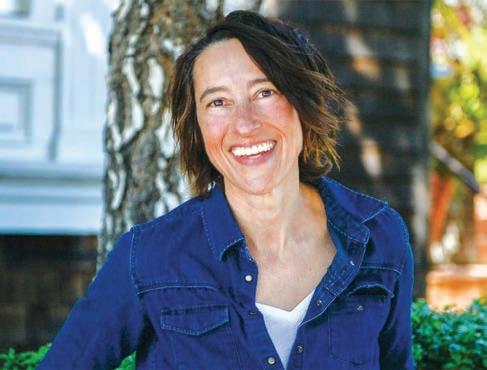
It remains to be seen if Lara officially launches a campaign for lieutenant governor, or if his pulling papers for the race is just a way to park his campaign contributions until he decides what his next political bid will be. State Treasurer Fiona Ma, a former San Francisco supervisor who will also be termed out in 2026, is actively campaigning and raising money for a lieutenant governor bid that year.
According to the secretary of state’s office, 27 political leaders have so far filed their intention to run for the position, with most doing so in order to raise funds likely for bids for other positions.
Among them are two lesbian state legislators who will be termed out in 2024, Senator Susan Talamantes Eggman (D-Stockton) and Senate President pro Tempore Toni G. At-
kins (D-San Diego). Atkins is highly expected to jump into the 2026 race to succeed termed out Governor Gavin Newsom (D).
It is what Kellman told the B.A.R. she expects when asked if she would drop her candidacy if Atkins decides to run for lieutenant governor. (Already in the gubernatorial race with Kounalakis is State Superintendent of Public Instruction Tony Thurmond.)
“My understanding is that Toni Atkins, who is so accomplished and so impressive, ... is running for governor,” said Kellman, adding that she has no plans to drop out of the race no matter who opts to run to succeed Kounalakis. “You never know. I am sure many wonderful people will come to the table. I can only focus on what I can bring to the state of California.”
Kellman, 50, has a history degree from Yale and a master’s in environmental management from Oxford. She graduated from Stanford Law and clerked for a judge in San Diego.
She spent time at the Woodrow Wilson Center at the Smithsonian, focused on how issues like water scarcity and civil unrest impact national security. She had her own private practice as a land use and environmental attorney then joined the Environmental Protection Agency working on water quality and species issues in its Region 9 office that includes California along with other western states. She has also worked in the private sector at firms focused on renewable energy. Two years ago she founded, and serves as CEO of, a global nonprofit called the Center for Sea Rise Solutions.
Her educational, professional, and political background make her well qualified to be the next lieutenant governor, argued Kellman. The position requires the officeholder to serve in a number of roles overseeing issues Kellman noted she already has experience tackling.
The lieutenant governor serves on the oversight bodies for the state’s community colleges, four-year colleges, and university system. The person also sits on the powerful California Coastal Commission and shares chairing of the State Lands Commission.
“When I was mayor I was dealing with issues that are of statewide importance, like homelessness, like affordable housing, like aging infrastructure and climate change,” said Kellman. “One of my very big wins was we went to the state of California and got $1 million to do a sea level rise vulnerability assessment for Sausalito. We just retained our consulting group to commence that in early 2024; I think they are saying it will take two years to complete it.”
To learn more about Kellman, and for information about her campaign events in early 2024, visit her website at janellekellman.com.
MATTHEW S. BAJKO


















A gay staffer for U.S. Sen. Ben Cardin (D-Md.) is no longer employed by the U.S. Senate, his office told the Washington Blade in a statement on Saturday, which followed reports that he had filmed amateur pornography in the workplace.
“We will have no further comment on this personnel matter,” Cardin’s office said.
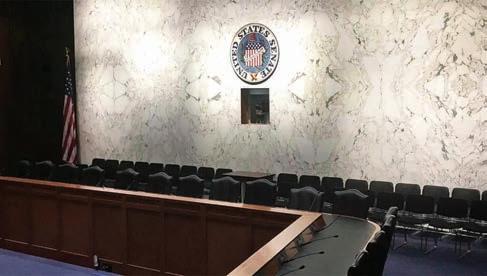
The Daily Caller, a right-wing site founded by former Fox News host Tucker Carlson, uploaded video and still images last Friday that purported to show leaked cell phone video of the staffer engaged in gay sex in a Senate hearing room of the Hart Senate Office Building, which is not in the U.S. Capitol building.
Shortly thereafter, unverified posts on X and multiple conservative or right-leaning news outlets identified him as an aide working in Cardin’s office. The 80-year-old lawmaker announced in May that he would not seek reelection next year.
The staffer later issued a statement on LinkedIn that appeared to deny the allegations: “This has been a difficult
time for me, as I have been attacked for who I love to pursue a political agenda,” he said.
The statement continued, “While some of my actions in the past have shown poor judgement, I love my job and would never disrespect my workplace. Any attempts to characterize my actions otherwise are fabricated and I will be exploring what legal options are available to me in these matters.”
The Blade has not independently verified the video posted to social media.
The Washington Free Beacon reported the staffer had published other pornographic images and video content on X, with an account that used a pseudonym but was public.
Earlier this week, this same staffer was accused by Republican U.S. Rep. Max Miller, who is Jewish, of aggressively confronting him over the conflict in Israel — charges he also denied in his LinkedIn post.
“As for the accusations regarding Congressman Max Mill-
er,” he said, “I have never seen the congressman and had no opportunity or cause to yell or confront him.”
NEW YORK — A federal appeals court reversed a decision by a U.S. district judge in Connecticut, green-lighting a lawsuit that seeks to end a longstanding state policy that allows female transgender student-athletes to compete with cisgender girls.
The case now returns to federal court in Connecticut, and will be decided by the same man who tossed it out, U.S. District Judge Robert Chatigny. He dismissed the lawsuit in April because all four plaintiffs — cisgender track and field athletes — are no longer high school students.
Although the narrowly-decided ruling by the full U.S. Court of Appeals for the 2nd Circuit restores their suit, it did not answer the primary question the four women have asked: Whether the Connecticut Interscholastic Athletic Conference policy allowing student-athletes to compete according to their gender identity violates Title IX of U.S. civil rights law.
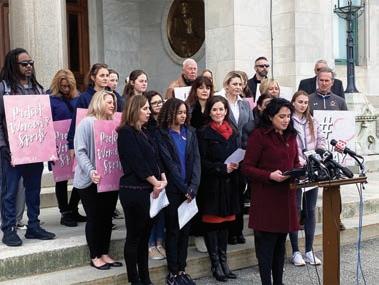
“The CIAC’s policy degraded each of their accomplishments and scarred their athletic records, irreparably harming each female athlete’s interest in accurate recognition of her athletic achievements,” said Roger Brooks, special counsel for the Alliance Defending Freedom, the religious conservative law group suing on behalf of the four women – Selena Soule, Chelsea Mitchell, Alanna Smith and Ansley Nicoletti. All four have since gone on to compete in college sports. The Southern Poverty Law Center has labeled the ADF as an extremist hate group for its anti-LGBTQ+ activism.
One of the judges on the appeals court who dissented with the majority opinion made some critical observations. Circuit Judge Denny Chin noted that three of the cisgender athletes alleged that only one track event in their high school careers was affected by the participation of transgender athletes while a fourth athlete alleged that four championship races were affected.
reported, is that the plaintiffs repeatedly outran the trans athletes, even after they filed their lawsuit in 2022. “The facts are that these plaintiffs repeatedly outperformed Andraya and Terry and won an impressive collection of first place trophies in the process,” said ACLU attorney Joshua Block.
The Alliance Defending Freedom also claimed victory Friday. “The en banc 2nd Circuit was right to allow these brave women to make their case under Title IX and set the record straight,” Brooks said. “This is imperative not only for the women who have been deprived of medals, potential scholarships, and other athletic opportunities, but for all female athletes across the country.”
In his dissent, Judge Chin pointed out that the plaintiffs failed to cite any precedent in which a sports governing body retroactively stripped an athlete of accomplishments when the athlete complied with all existing rules and did not cheat or take an illegal substance.
“It is not the business of the federal courts to grant such relief,” Chin said.
At least 20 states have already enacted bans on trans student-athletes, with more waiting in the wings.
The federal appeals court also did not address potential financial compensation sought by the plaintiffs. Those decisions are now in Chatigny’s hands.
Four cisgender plaintiffs want Connecticut to ban trans student-athletes and erase their records
What the reinstated suit could do, however, is force the CIAC to abandon its transgender participation policy and ban transgender female athletes from competing in the state with cisgender girls and women. The plaintiffs also demand the CIAC rewrite history by erasing all records set by trans athletes in Connecticut.
Chin wrote that all four plaintiffs not only compete on collegiate track-and-field teams, some were awarded scholarships, while neither of the transgender athletes who are misgendered in the case as “male athletes” have competed since high school.
In a statement Friday, the American Civil Liberties Union and the ACLU Foundation of Connecticut claimed the ruling is a victory for the two runners they represent — Andraya Yearwood and Terry Miller — noting that the 2nd Circuit wrote that the transgender runners have an “ongoing interest in litigating against any alteration of their public athletic records.”
Also important to note, as the Los Angeles Blade has
The Biden administration has proposed a policy to forbid blanket bans on transgender athletes playing on K-12 and collegiate sports teams. Although there have been delays and push back from both Republicans and advocacy groups for cisgender athletes, that new rule is set to be finalized by March 2024. It would establish that blanket bans violate Title IX, the landmark gender-equity legislation enacted in 1972 which requires schools receiving federal money to provide equal athletic opportunity to women.
Connecticut State Attorney General William Tong issued a statement Friday, noting that while Connecticut was not a party to the lawsuit, “…It is the law in Connecticut that transgender girls are girls and every woman and girl deserves protection against discrimination.”
LA BLADE STAFF
WASHINGTON - Fifty years ago this past Friday, on December 15, 1973, a decision by the American Psychiatric Association (APA) at its annual convention was hailed by gay rights activist Frank Kameny as the day “we were cured en masse by the psychiatrists.”
The board of trustees of the APA voted to remove homosexuality from its Diagnostic and Statistical Manual of Mental Disorders, which is used by health care professionals in the United States and much of the world as the authoritative guide to the diagnosis of mental disorders.
Washington Post writer Donald Beaulieu noted in an article published on the 50th anniversary that newspaper stories the next day mostly treated it as a technical change rather than a seismic shift that would transform the lives of gay people. But for gay rights activists Barbara Gittings, Kameny, Paul Kunstler, Jack Nichols, Elijah ‘Lige’ Clarke, Lilli Vincenz, and Kay Tobin Lahusen, it was groundbreaking. Kameny and Nichols in 1961 had formed The Mattachine Society of Washington, D.C., that the others were actively engaged in with the purpose of conducting gay rights protests at the White House, the United States Civil Service Commission, and the Pentagon. By the late 1960’s the group also focused on efforts to declassify homosexuality as a mental illness.
Kameny and Gittings were determined to get the APA to act. Nichols, Clarke, Gittings and Lahusen would create some of the earliest gay themed content, stories and columns in early gay national publications.
Nichols with his partner Clarke, wrote the column “The Homosexual Citizen” for Screw magazine, a pornographic ‘straight’ tabloid publication in 1968. Lahusen’s photographs of lesbians appeared on the cover of The Ladder as Gittings worked as its editor. The Ladder, published by the Daughters of Bilitis (DOB), was the first national lesbian magazine.
In the August 1964 issue of The Ladder, Gittings’ editorial blasted a medical report that described homosexuality as a disease, writing that it treated lesbians like her more as “curious specimens” than as humans.
In 1971, some seven years later at the annual meeting of the APA, Gittings, Kameny and fellow gay activists stormed the meeting and Kameny seized the microphone, demanding to be heard. The Washington Post reported: Kameny, who had lost his job as an astronomer with the Army Map Service in 1957 because he was gay, grabbed the microphone from a lecturer at the convention and addressed the room. “Psychiatry is the enemy incarnate,” he told the shocked audience. “Psychiatry has waged a relentless war of extermination against us. You may take this as a declaration of war against you.”
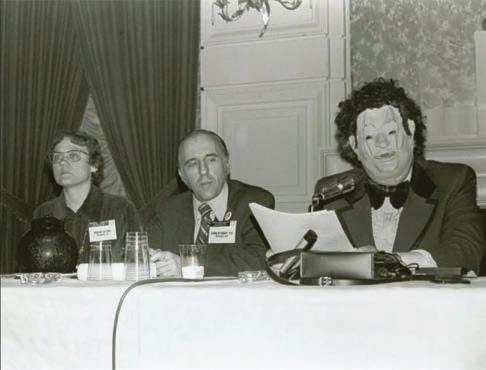
For the APA’s annual meeting in 1972, Kameny and Gittings organized a panel on homosexuality. When no gay psychiatrist would serve on it openly for fear of losing his medical license and patients, Gittings recruited Dr. H. Anonymous (John E. Fryer, M.D.), who appeared masked and using a voice modulator.
Gittings, Kameny and Dr. Anonymous asserted that the disease was not homosexuality, but toxic homophobia. Consequently, the APA formed a committee to determine whether there was scientific evidence to support their conclusion.
The Post noted: “This is the greatest loss: Our honest humanity,” Fryer said. “Pull up your courage by your bootstraps and discover ways in which you and homosexual psychiatrists can be closely involved in movements which attempt to change the attitudes of heterosexuals — and homosexuals — toward homosexuality.” Fryer received a standing ovation. He would not reveal his identity until 1994, 22 years later.
“In 1973, with Gittings and Kameny present by invitation, the APA announced its removal of the classification. Kameny described it as the day “we were cured en masse by the psychiatrists.” At the time, the “cures” for homosexuality included electric shock therapy, institutionalization and lobotomy. With the APA’s retraction, the gay rights movement was no longer encumbered by the label and its consequences.”
A symposium to address the issue occurred at the APA convention in Honolulu in May 1973 the Post reported Panel members would represent both sides of the argument. There were those who fought the reclassification including one speaker who advocated retaining the homosexuality diagnosis, Charles Socarides, who received mostly boos from the crowd. Socarides asserted during the discussion, “All of my gay patients are sick.” According to Lawrence Hartmann, a psychiatry professor at Harvard University who served as APA president in the early 1990s, another panelist replied, “All of my straight patients are sick.”
According the Post, the last to speak was Ronald Gold, media director for the Gay Activists Alliance and the only panelist who was not a psychiatrist. Gold, who as a child was subjected to aversion therapy by a psychoanalyst, told the packed ballroom, “Your profession of psychiatry — dedicated to making sick people well — is the cornerstone of oppression that makes people sick.” Gold’s speech got a standing ovation, just as Fryer’s had the year before.
The legacy of that December decision fifty years ago continued when in 1998, the APA announced that it op-
posed any psychiatric treatment, such as “reparative” or conversion therapy, which is based upon the assumption that homosexuality per se is a mental disorder or that a patient should change his/her homosexual orientation.
In 2005, the APA established The John Fryer Award, which honors an individual who has contributed to improving the mental health of sexual minorities. The award is named for Dr. John Fryer, a gay psychiatrist who played a crucial role in prompting APA to review the scientific data and to remove homosexuality from its diagnostic list of mental disorders in 1973.
Out gay psychiatrist Amir Ahuja, who serves as president of the Association of LGBTQ Psychiatrists, told the Blade at an event celebrating the 50th anniversary of the historic speech by then closeted Fryer, that the positive outcome from Fryer’s efforts has had a direct impact on his own career.
“I would say I think John Fryer opened the door for me to have a career and many of my colleagues who are LGBTQ+ psychiatrists in order to work in a field where we’re not stigmatized as having an illness,” Ahuja said. “Because we could have lost our job. That’s what happened to John Fryer multiple times,” according to Ahuja. “Before he gave that speech, he had lost two residencies at least. Because of his sexuality, people were discouraging him from continuing in the profession.”
“John Fryer’s courageous actions were a watershed moment for psychiatry, the APA, and the LGBTQ community,” said Saul Levin, M.D., M.P.A., CEO & Medical Director of the American Psychiatric Association. “Every day we work to honor the legacy of Dr. Fryer and the activists who fought alongside him to achieve freedom, equality and acceptance for LGBTQ people in America.”
BRODY LEVESQUE
is editor of the Washington Blade. Reach him at knaff@washblade.com
Liz Cheney is latest to see the light too late
It would be funny to watch all the pearl-clutching by so-called “moderate” Republicans now that the GOP has completed its devolution into MAGA cult status, if only it weren’t all so sad and damaging to our democracy.
Everyone from former RNC Chair Michael Steele to right-wing extremist Liz Cheney has apparently seen the light and turned their backs on their former party. Better late than never, I suppose, but where were all these newly sensible voices when they could have prevented this sad state of affairs?
opposes abortion rights and voted to repeal Obamacare. She voted in line with Donald Trump’s positions 93 percent of the time from 2017-2021, according to FiveThirtyEight. She voted for Trump for president in 2020.
ADDRESS
8237 Blackburn Avenue Ste. 201, Los Angeles, CA 90048
PHONE 310-230-5266
E-MAIL tmasters@losangelesblade.com
INTERNET losangelesblade.com
PUBLISHED BY Los Angeles Blade, LLC
PUBLISHER
TROY MASTERS tmasters@losangelesblade.com, 310-230-5266 x8080
SALES & ADMINISTRATION
SALES EXECUTIVE
SHANA WONG SOLARES
swong@losangelesblade.com, 808-386-0872
SALES/EVENT MARKETING EXECUTIVE
ANDREW BEAVER abeaver@losangelesblade.com, 646-907-4482
NATIONAL ADVERTISING
RIVENDELL MEDIA
sales@rivendellmedia.com, 212-242-6863
MARKETING DIRECTOR
to migrants, as Ronald Reagan once was. Today’s GOP demon-
blue cities. And the GOP’s “tough on crime” talk is just that — empty sloganeering with no action on gun
The stakes couldn’t be higher in 2024, as Cheney warned recently in a series of panicky TV interviews hawking her new book. She’s right that the future of the American experiment is on the line in the next election. It’s too late for America to ever reclaim “shining city on a hill” status again, given our weekly mass shootings and xenophobic attitudes toward immigrants. Gone are the Republican glory days of being tough on crime and welcoming to migrants, as Ronald Reagan once was. Today’s GOP demonizes immigrants and uses them as props in a cynical show of “strength,” shipping poor families in buses to progressive blue cities. And the GOP’s “tough on crime” talk is just that — empty sloganeering with no action on gun reform.
of respect in the world by again re-
We may not be that shining city, but we could cling to some semblance of respect in the world by again rejecting Donald Trump’s ignorance, racism, and criminality. And the Republican voices that are warning against Trump’s efforts at a second term are welcome, but they are late and themselves contributed to this sorry state of affairs.

Many of today’s prominent conservative commentators — everyone from Michael Steele to Bush flack Elise Jordan to rightwing extremist lawyer George Conway — now bashing Trump contributed to our current crisis by lowering the bar and promoting unqualified figures like Palin for the highest offices in the country.


The same Republican “moderates” now trashing Trump also embraced Sarah Palin, the vapid and woefully unqualified vice presidential nominee, and George W. Bush, a war criminal who killed untold thousands in an unprovoked war in Iraq and destroyed the U.S. economy in the process. Bush was a particularly unserious figure who lacked intellectual curiosity and had no business serving as president. But the GOP enablers cynically ignored that and rallied around the simpleton who had name recognition and deep pockets, unconcerned about elevating someone so out of his depth to the presidency.
Cheney, meanwhile, made headlines for years opposing marriage equality despite having an out lesbian sister. Although she belatedly evolved and told CBS News in 2021 that “I was wrong” on the issue, she later voted against the Equality Act. Cheney also
STEPHEN RUTGERS srutgers@washblade.com, 202-747-2077 x8077
EDITORIAL
CONTRIBUTING WRITER
KAREN OCAMB karenocamb@losangelesblade.com
NATIONAL EDITOR
washed-up

the worst instincts and prejudices in his supporters. In the process, Trump has val-

millions. They are now open about their
KEVIN NAFF kna @washblade.com, 202-747-2077 x8088
EDITOR
BRODY LEVESQUE
California
CONTRIBUTORS
MICHAEL K. LAVERS, TINASHE CHINGARANDE, ERNESTO VALLE, YARIEL VALDÉS GONZALEZ, PARKER PURIFOY, CHRISTOPHER KANE, AUSTIN MENDOZA, JOHN PAUL KING, JOEY DIGUGLIELMO, CHRIS JOHNSON, LOU CHIBBARO JR., REBEKAH SAGER, JON DAVIDSON, SUSAN HORNIK, CHANNING SARGENT, SAMSON AMORE, CHRISTOPHER CAPPIELLO, MICHAEL JORTNER, DAN ALLEN, SEAN SHEALY, SCOTT STIFFLER, RHEA LITRÉ ADMINISTRATION
PHILLIP G. ROCKSTROH
prockstroh@washblade.com, 202-747-2077 x8092 CREATIVE DESIGN/PRODUCTION AZERCREATIVE.COM
DISTRIBUTION
CHRISTOPHER JACKSON, 562-826-6602
cans helped us down this path but now what? Notably, even Liz Cheney
The GOP’s efforts started decades ago by routinely demonizing education (college graduates are “elitist”) and erecting barriers to voting access. The result: a washed-up reality TV show host and ‘80s relic won the presidency by appealing to the worst instincts and prejudices in his supporters. In the process, Trump has validated the bigoted, racist, homophobic, sexist, transphobic, xenophobic views of millions. They are now open about their hatred and racism and the result can be seen in skyrocketing rates of hate crimes reported by the FBI, elevated domestic terror threats, and the hundreds of state bills targeting the LGBTQ community. So-called “moderate” Republicans helped us down this path but now what? Notably, even Liz Cheney stopped short of endorsing President Biden’s re-election, even though that is literally the only way to stop Trump. Will the “moderates” reclaim their party? Not likely given Trump’s overwhelming lead in the primary polls. Will they start a new party of traditional conservatives? No, because that would doom all Republicans’ chances of winning a national election. And so they whine and complain about a status quo that they helped to create. They write books and belatedly trash Trump on talk shows. But it’s too late. They dreamed of breaking the Democratic Party’s traditional lock on white, non-college-educated, rural voters. They got their wish and now they’re stuck with those voters and their guns, racism, and love for authoritarians like Putin. Our only hope is an 81-year-old president who’s about to be impeached and whose approval number sits at 38 percent less than a year from Election Day. It’s not morning in America any longer. Sadly, the sun is quickly setting on our great American experiment.
All material in the Los Angeles Blade is protected by federal copyright law and may not be reproduced without the written consent of the Los Angeles Blade. e sexual orientation of advertisers, photographers, writers and cartoonists published herein is neither inferred nor implied. e appearance of names or pictorial representation does not necessarily indicate the sexual orientation of that person or persons. Although the Los Angeles Blade is supported by many ne advertisers, we cannot accept responsibility for claims
by advertisers. Unsolicited editorial material is accepted by
but the
responsibility for
e editors
the right to accept,
or
submission. A single copy of the Los Angeles Blade is available from authorized distribution points, to any individual within a 50-mile radius of Los Angeles, CA. Multiple copies are available from the Los Angeles Blade o ce only. Call for rates. If you are unable to get to a convenient free distribution point, you may receive a 52-week mailed subscription for




is a Democratic candidate to represent House District 75 in the Tennessee House of representatives.
CLARKSVILLE, Tenn. - Our government is pursuing a war on women. From the Supreme Court overturning Roe V. Wade in 2022 to women being denied life-saving abortions, from SCOTUS taking on a ruling to ban Mifepristone nationwide to women being charged for having miscarriages, there’s no sign it will stop anytime soon.
Kate Cox is a 31-year-old mother of two who was expecting her third child in the new year - but a routine genetic scan showed that her fetus had a fatal condition called Trisomy-18. Cox’s doctors warned that if Kate continued her pregnancy, it could risk future fertility or even her life. Seems like a no-brainer to seek out an abortion to protect her health, right?
Unfortunately, Kate lives in Texas, which has one of the strictest abortion bans across the country. Kate filed a lawsuit against the state seeking permission to get the necessary abortion, and though a lower court judge ruled in her favor, it was just the beginning.
Texas Attorney General Ken Paxton decided he knew what was best, blocking the judge’s ruling and sending a letter to every hospital in the area threatening that anyone who assisted in giving Kate an abortion would face legal prosecution. Then, the Texas Supreme Court joined Paxton in denying the judge’s ruling.
After a week of battling, Kate fled the state to receive the healthcare she needed. The outcome for Kate’s non-viable fetus would remain the same whether she got the abortion or
NEW AUTHORS WANTED! Page Publishing will help you self-publish your own book. FREE author submission kit! Limited offer! Why wait? Call now: 1-855-667-0380
Switch and save up to $250/year on your talk, text and data. No contract and no hidden fees. Unlimited talk and text with flexible data plans. Premium nationwide coverage. 100% U.S. based customer service. Limited time offer get $50 off on any new account. Use code GIFT50. For more information, call 1-844-908-0605
continued the pregnancy, but Paxton’s decision to force Kate to continue the pregnancy while prolonging her pain and suffering? That is abuse.
Separate from this, the SCOTUS has taken on the case of banning Mifepristone across the country.
Mifepristone is often used in the first ten weeks of pregnancy to stop fetal growth and expel it from the body. Deemed safe by the FDA more than two decades ago, over five million people have used this pill safely and effectively, both to terminate pregnancies but also in situations where a miscarriage takes place and the body doesn’t expel the fetal tissue on its own.
Banning Mifepristone is not rooted in scientific, medical, or rational evidence, but is politically-motivated. By removing access to abortions, Mifepristone, contraceptives, Plan B, and even IVF, it is becoming impossible for women to make their own life and healthcare decisions.
I myself had to face the forced birth laws in Tennessee in March of this year. I found out I was pregnant with my second child in November of 2022, and everything was progressing as normal until my routine anatomy scan at nineteen weeks. On that day, my husband and I found out our soon-to-be little girl had many fatal fetal anomalies and was deemed not compatible with life outside the womb; in fact, she was unlikely to even survive the full pregnancy. I was told by my medical team that the longer I stayed pregnant the worse her body would get and the higher risk to my health it would become.
WANTED! OLD PORSCHE. 356/911/912 for Restoration Hobbyist. 1948-1998 only. Any Condition. Top $ Paid. PLEASE LEAVE MESSAGE 1-707-339-5994 or email Porscherestoration@yahoo.com
DONATE YOUR CAR TO KIDS Fast Free Pickup – Running or Not - 24 Hour Response - Maximum Tax Donation – Help Find Missing Kids! Call 1-888-491-1453.
This Space Can Be Yours! Call 1-916-288-6011 Get the best ROI

Knowing that my six-year-old daughter needed me here, I couldn’t risk putting my life on the line for a fetus that wasn’t going to survive. Because of the stringent abortion laws in Tennessee, I had to look out-of-state for the care I needed and ultimately found a clinic in New York City.
Ten days after my high-risk appointment, I arrived at that clinic to learn that my daughter had already passed in utero and was rushed into an emergency abortion to avoid the risk of sepsis or infections. Upon returning home, I reached out to my representative to help me introduce Mileys Law, a bill that would give choice back to parents when diagnosed with a fetal anomaly.
During our meeting, I quickly learned how little my representative knew about women’s healthcare - but here he was, legislating it. This was one of the pivotal moments that led me to my decision to run for office, and now, I’m running against him for that seat.
Today, some doctors are looking at ninety-nine years in prison for performing an abortion on a raped ten-year-old child while the rapist is looking at just ten to fifteen years with the option for probation.
Today, women are being treated like second-class citizens: we are less than men with no control over our own bodies. Today, the Republican party screams about how they are “pro-life” and don’t want “big government,” but their actions say differently. It’s time to vote them out.
FREE high speed internet for those that qualify. Government program for recipients of select programs incl. Medicaid, SNAP, Housing Assistance, WIC, Veterans Pension, Survivor Benefits, Lifeline, Tribal. 15 GB internet service. Bonus offer: Android tablet FREE with onetime $20 copay. Free shipping & handling. Call Maxsip Telecom today! 1-855-480-0769
Over $10K in Debt? Be debt free in 24 to 48 months. No upfront fees to enroll. A+ BBB rated. Call National Debt Relief 1-888-231-4274.
Jacuzzi Bath Remodel can install a new, custom, bath or shower in as little as one day. For limited time, we’re waiving all installation costs! (Additional terms apply. Subject to change and vary by dealer. Offer ends 12/31/23). Call 1-833-985-4766
SAVE BIG on HOME INSURANCE! Compare 20 A-rated insurances companies. Get a quote within minutes. Average savings of $444/year! Call 1-844-410-9609! (M-F 8am-8pm Central)
This Space Can Be Yours! Call 1-916-288-6011 Get the best ROI
STROKE and CARDIOVASCULAR disease are leading causes of death according to the American Heart Association. Screenings can provide early detection! Contact Life Line Screening to schedule your screening. Special offer - 5 screenings for $149. Call 1-888-892-5598
SAFE STEP North America’s #1 Walk-In Tub. Comprehensive lifetime warranty. Top-of-theline installation and service. Now featuring our FREE Shower package and $1,600 off for a limited time. Financing available. Call 1-888-989-5749
RETIRED COUPLE
$1 MIL for business purpose Real Estate loans. Credit unimportant. V.I.P. Trust Deed Company www.viploan.com Call 1-818-248-0000 Brokerprincipal DRE 01041073. No Consumer Loans.
WANTED! OLD PORSCHE. 356/911/912 for Restoration Hobbyist. 1948-1998 only. Any Condition. Top $ Paid. PLEASE LEAVE MESSAGE 1-707-339-5994 or email Porscherestoration@yahoo.com
RETIRED COUPLE
$1 MIL for business purpose Real Estate loans. Credit unimportant. V.I.P. Trust Deed Company www.viploan.com Call 1-818-248-0000 Brokerprincipal DRE 01041073. No Consumer Loans.
New film a musical based on the Broadway show, not a Spielberg remake
Alice Walker’s 1982 novel “The Color Purple” never needed a Steven Spielberg film adaptation to become a cultural touchstone - it had already achieved that before the director’s 1986 movie version made it to the screen – but it didn’t hurt, either.
Making stars of Whoopi Goldberg and Oprah Winfrey in the process, Spielberg’s film – his foray into “serious” cinema – brought Walker’s epistolatory tale of early 20th-century Black life in Georgia to the attention of new audiences. Setting aside modern attitudes about Black narratives being interpreted by white storytellers, it was undeniably a “watershed moment,” when a seminal piece of Black literature – one that “spoke truth to power” while transcending notions of race, gender, and sexuality and asserting the rich cultural heritage of Black Americans – became part of mainstream consciousness.
That all happened nearly 40 years ago, but neither Walker’s book nor the multi-Oscar-nominated film it inspired have faded from public memory – and now, the latest evolution of the material that started it all has reached movie screens, just in time to become a must-see Christmas event for families across America. However, despite the impression one might get from watching the trailers, which largely evoke key moments from the Spielberg film, it’s not a remake.
Instead, “The Color Purple,” releasing on Christmas Day to join the fray for 2023’s “awards season” race, is a new iteration of Walker’s book, a stage-to-screen adaptation of the Tony-winning 2006 Broadway musical – originally crafted by playwright Marsha Norman with score and lyrics by Brenda Russell, Allee Willis, and Stephen Bray – penned by screenwriter Marcus Gardley. Again, the impression one might get from watching the film’s trailers, which downplay the movie’s identity as a musical to the point that many audiences will be surprised when its characters start singing, doesn’t exactly convey that information to anyone who isn’t already “in the know.”
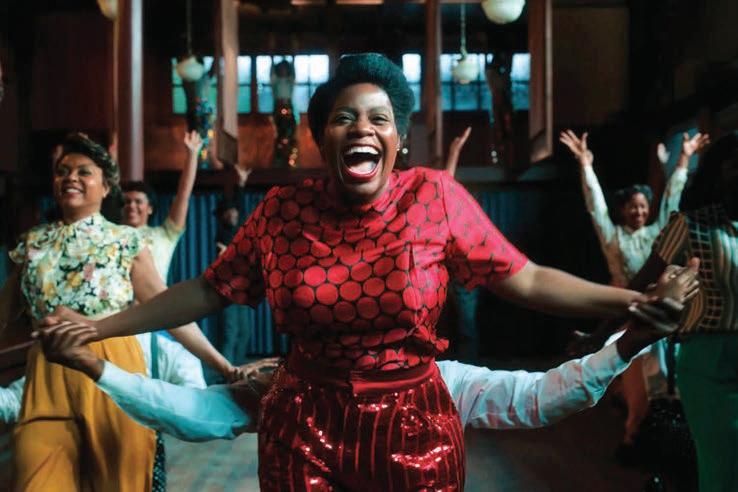
them in a milieu more closely related to a modern music video. The eloquent choreography (by Fatima Robinson) exists outside the film’s period setting, incorporating movement rooted as much in modern dance as in the traditional styles that might seem (for some) more fitting to the material, and the music to which it is set often feels closer in spirit and execution to present-day R&B than the old-fashioned gospel-and-blues influences we might expect. The result is both thrilling and jarring, an inspiring example of what can happen when a traditionally white mainstream genre is appropriated and reimagined by a rich and vibrant postmodern generation of blended ethnic bonds with the boldness and skill to make it their own – which, in the heightened sensitivity of our divided age, might be a step too far for some viewers, but seems to capable of breathing fresh life into the long-lamented musical genre, if such a thing were possible.
Still, it’s not the movie’s fault if Warner Brothers, true to form for big-ticket Hollywood studios since at least the early 1970s, tried to hedge its bets in promoting the latest attempt at a blockbuster movie musical, and we can hardly blame them – the success rate for such films, in terms of both critical and audience acceptance, has been hit-or-miss for decades. No matter how much talk one may hear of the genre making a comeback, it’s never really happened. For every Oscar-winner like “Chicago,” there’s an embarrassing dud like “Dear Evan Hansen,” and that’s not even counting the inevitable controversies over the merits of original musicals like “La La Land,” which are typically derided by purist fans even as they garner acclaim from critics and industry insiders. But though it excises several songs from the stage original’s playlist (while adding a few new ones, a common ploy for Hollywood adaptations angling for an Original Song Oscar, with Siedah Garrett stepping in to replace the late Willis), the film is unapologetic about being a musical from its very first frames, and therefore rises above the politics of publicity to fully inhabit the artistic space in which it was intended to exist.
In the hands of director Blitz Bazawule (aka “Blitz the Ambassador”), a Ghanaian director (“The Burial of Kojo,” Beyonce’s “Black is King”) whose artistic monikers also include author, visual artist, rapper, singer-songwriter, and record producer, “The Color Purple” is a stylistic homage that pays tribute to the nostalgic glory of classic Hollywood while remaining firmly rooted in a contemporary aesthetic. To put it more plainly, the film’s many musical set-pieces borrow heavily from iconic Golden Age movies – think choreographed flights of fancy evoking seminal creators from Busby Berkeley to Gene Kelly to Bob Fosse – yet present
Yet between its many musical interludes, Bazawule’s film equally invests itself in the dramatic narrative, emulating a host of “realistic” cinematic influences beyond Spielberg’s contribution. This goes a long way toward getting us invested in the story and characters, especially given the beyond-expectation performances of the cast. Reprising the role she first played on Broadway, Fantasia Barrino creates a Miss Celie that puts the stress on under appreciated intelligence rather than indoctrinated ignorance, giving us a different but no-less-compelling take on the character than Goldberg’s iconic turn, and Danielle Brooks (“Orange is the New Black”), also returning to her stage role, commands her every moment onscreen as the iron-willed Sofia. Taraji P. Henson, as free-spirited blues singer Shug Avery, captures the indomitable self-confidence and iron will that makes her a catalyst for more than one character’s change of heart, and Colman Domingo’s Mister succeeds at humanizing his toxicity sufficiently to clear a path for our empathy; in smaller but no-less-essential roles, Corey Hawkins and R&B singer H.E.R. (Gabriella Wilson) shine brightly enough to make their presence felt among the rest of the heavy-hitters, and up-and-comer Halle Bailey scores big as the long-separated sister that serves as a lifeline throughout Celie’s struggles.
All these stellar performances, coupled with a solid directorial vision from Bazawule, not to mention the non-ambiguous queerness with which it comports itself (the romance between Celie and Shug is allowed to blossom much more fully that we are shown in the Spielberg original), gives us ample reason for us to recommend “The Color Purple” – but we must also add a disclaimer that might be more a commentary on the stage musical than on the film derived from it.
Simply expressed, one can’t help but feel that there’s a disconnect between the sparsebut-richly-imagined prose that makes Walker’s book so compelling and the florid sentimentality of its translation into the musical format. The songs, while they might ring true as appropriate within the concept, never sufficiently illuminate what we are shown by the drama; they seem, at times, disconnected from everything else, a blatant appeal to our emotions rather than an integrated part of the whole. This is a particular problem for a film clearly rooted in the intertwined music and history of the Black culture it ostensibly tries to emulate.
Even so, such scholarly nitpicking is immaterial for most of our readers; while it may not deliver the most cohesive of musical conceits, it pulls off most of what it needs to, and for anybody who loves musicals as much as we do, that’s more than enough.
JOHN PAUL KING
What do you do when your partner snaps at you, big time, after you’ve already had a hard day? Do you snap back, which may feel great in the moment, but might lead to a rotten evening? Or do you find some way to calm yourself and see if you can stay connected?
What do you do when your friends all seem to have a strong opinion about something important to you and you strongly disagree with them? Do you speak up and risk their censure? Or do you stay silent, go along with the crowd, perhaps keep your friends, but betray your beliefs?
What do you do when someone close to you presses you to take some action that you wouldn’t respect yourself for doing? Do you disappoint them, or disappoint yourself?
Many of us lack any sort of plan or guiding philosophy for how we would handle character-defining moments under pressure. Instead, we react, out of fear or anxiety or anger.
My view is, our lives go better when we’re thoughtful about how we respond to the hard stuff. When we do what we believe is right, even when doing so is difficult, we tend to respect ourselves—and like ourselves better.
There’s a name for this approach: Differentiation—the ability to hold your own shape and behave in a way that your respect even when there’s outside pressure not to.
Holding a differentiated stance means staying as calm as you can in tough situations. It means standing up for what you believe is important even when there are consequences. It means operating with integrity. Differentiation is a necessary ingredient for any solid relationship, including romantic relationships, friendships, being a parent, and being adult sons and daughters to our parents.
Aspiring to hold a differentiated stance is always worthwhile, though it is not always achievable and is definitely not a steady state. Something or someone (often someone close to us) will frequently press our buttons and throw us off. That’s just the way life goes. My advice when this happens: don’t get discouraged. Differentiation is more a
journey than a destination.
How can you get better at keeping your hands on the steering wheel of your life? You start by paying attention to yourself and striving to pause before you act. Yes, it is almost that simple.
Viktor Frankl wrote, “Between stimulus and response, there is a space. In that space is our power to choose our response. In our response lies our growth and our freedom.”
In that pause, ask yourself why you’re having the reaction you’re having. When you have some understanding of what’s going on inside, you have more power over your response.
Also in that pause, strive to calm yourself as best you can. This will give you some bandwidth to focus on how you would like to respond, rather than simply reacting.
Of course, calming yourself is hard to do when you’re anxious or angry. Yet there are many ways to calm down even a little, including taking a short break from the interaction to collect your thoughts, or taking some slow, deep breaths. One powerful way to get a grip is to remind yourself, “I’m likely to respect myself a lot more if I can do what I think is right.”
Now your mind may be calm enough to think about how you want to respond. Yes, screaming may sometimes be the way to go, but escalating a personal conflict usually takes us nowhere good.
Here’s a question to ask yourself, not only in these moments, but all the time: “What would it mean for me to be a spouse/parent/friend/person whom I admire?” Answering this question gives you a standard you can aspire to reach and that you don’t want to sink below.
A related point especially for couples, but with wide applicability: Many people come into my office certain that it’s the other person’s fault that things go awry. I always tell them that no matter whom they think “started it,” it is each


Control your temper but set boundaries when dealing with conflict.
of their jobs, individually, to hold themselves together and respond from the best in themselves.
This means striving to avoid being the “winner.” Here’s an alternative: Be generous whenever possible; while also maintaining a boundary when it’s important to you, and accepting the other person’s having boundaries that are important to them. And remember: We all have to tolerate, be close to, and live with people who are very different from us in important ways.
Striving to be well-differentiated helps us develop into stronger and more resilient people. The more we work at responding in ways that we admire to our challenges and difficulties, the better we get at dealing with all the stuff that life throws at us, which makes this ride more tolerable, interesting, and even enjoyable.
And when we can look at the challenges we face as giving us strength and helping to give our lives meaning, our challenges may become easier to bear.
Wishing you a good new year.
(Michael Radkowsky, Psy.D. is a licensed psychologist who works with couples and individuals in D.C. He can be found online at michaelradkowsky.com. All identifying information has been changed for reasons of confidentiality. Have a question? Send it to michael@michaelradkowsky.com.)
MICHAEL RADKOWSKY

‘Fabulist’ chronicles the many lies of
New book a reminder to always follow the money
Feel that little tug?
It’s probably nothing to worry about, it’s not important. It’s just that someone’s trying to pull your leg, to make you believe something that’s not true or doesn’t exist. Just a little tug, right above your ankle, no problem. You might not even notice it unless, as in “The Fabulist” by Mark Chiusano, the wool’s pulled over your eyes, too.
A little more than four years ago, Mark Chiusano fi rst spoke with former Rep. George Santos over the phone for a newspaper story, and red fl ags popped up immediately. Says journalist Chiusano, Santos kept off ering confl icting stories about this or that in their initial interview and other, later, conversations featured uncomfortable inconsistencies. Soon, any contact with Santos began to have “an uneasiness to it.”
There was a reason: spinning stories, as it turned out, was something Santos had been practicing since he was young, and he was really good at doing it.
Santos was so good at tale-spinning that, while reporting on Santos, Chiusano watched as highly experienced detectives and other professionals accepted Santos’s lies as truth, though many of his stories were verifi ably false. He was so well-practiced at lying, Chiusano says, that eventually, Santos’s habit of telling rich childhood whoppers grew into a talent for creating giant cons, including the biggest one of all: running for public offi ce, and all that it entailed.
In politics, Chiusano notes, Santos was “suddenly surrounded by rich people” and they weren’t just random gullibles to cold call.
“Now,” says Chiusano,” they were at his fundraisers, or on his call lists.”

It’s been said that to know the story, follow the money but that’s not easy when you’re trying to understand George Santos. But let’s be clear, though: it’s not author Mark Chiusano’s fault here. The trail of allegations, cons, drag shows, pants-on-fi re, money-grabbing, and tall tales is a long and convoluted one (or more), and it nearly requires a mathematical diagram to untangle.
The diffi culty lies in the lies that, as recounted in “The Fabulist,” are unrelenting, astounding, and (let’s be honest), ridiculous in fl ashing neon, which makes them almost ruefully funny in their brazenness.
Shake your head. Go on.
At just about every page, you’ll ask yourself how this ever happened at a time when claims can so very easily be fact-checked. Absolutely, this will lead to a thick air of disbelief in the sheer amount of cons that “George and Anthony and Devolder and Santos” is said to have pulled off – and one way or another you’re likely going to have emotions about that.
On that subject, Chiusano cautions readers not to be armchair psychologists. Indeed, while you’ll note a bit of extrapolating in what you’ll read here, Chiusano seems mostly facts-only neutral, outside of his author’s note and introduction.
Readers may marvel at that, and the Herculean eff ort that might have taken.
Followers of politics and readers who’ve been watching the saga of George Santos will devour “The Fabulist.” If you love a good, romping head-shaker, pull this one off the shelves.
TERRI SCHLICHENMEYER

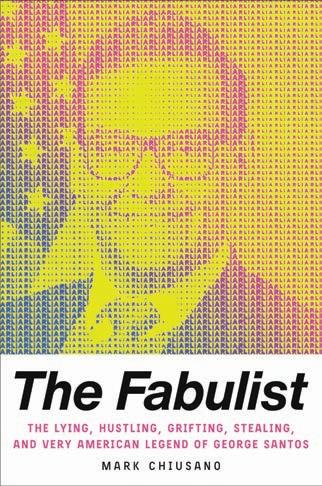
‘The Fabulist: The Lying, Hustling, Grifting, Stealing, and Very American Legend of George Santos’ By Mark Chiusano c.2023, Atria/One Signal | $28.99 | 320 pages



HOLLYWOOD - In 2006 when it arrived on the scene, the movie Boy Culture was billed as a film about a cynical anti-hero sex worker who adopts an unconventional chosen family with two roommates.
Over time, the film has been embraced instead as a “beloved LGBTQ romantic comedy.” Rotten Tomatoes has named it one of the top 200 LGBTQ movies of all time. Maybe that makes it our version of Pretty Woman?
Unlike many gay films of the time, Boy Culture resisted, for the most part, relying on two-dimensional cliché depictions of gay men. It also sought to tell a story beyond coming out, and the associated emotional injustices.
Director and co-writer Brocka states that the film resonated because it showed LGBTQ+ relationships “in a positive way that embraced our sexuality and sexual experiences. There were not a lot of films doing this unless they focused on our trauma.”
Derek Magyar starred as X (this was years before Elon Musk stole the name for Twitter), the street hustler with the heart of…well, more lead than gold, but by the end, some glint manages to peek through. He had the eyes of Zach Ephron and the snarl of Kathy Griffin. While he ran an ongoing commentary about his clientele and their natures, he was actually in love with roommate Andrew, played by Daryl Stephens. They both lived with 18 year old Joey, played by Jonathon Trent. “Joey” is a fitting name for the character who is essentially their bouncing playful child (a joey is a baby kangaroo).
So- spoiler alert for those who have not seen the original Boy Culture – X and Andrew get together as a couple in the end. That was then, and this is now, and the creative team behind the film, director and co-writer Q. Allan Brocka, producers Stephen Israel and Philip Pierce and co-writer Matthew Rettenmund, has launched a sequel called Boy Culture: Generation X. (Again, Elon Musk’s thunder stealing was unforeseen).
In the new film, the couple again has a young companion, 000a quick witted, trash talking twenty-something named Chayce (“With a Y”) inspirationally played by Jason Caceres. This time the young is not the protégé, but rather the trail blazer. The sex-working world X left did not wait for him to return. Clients were no longer fearful closet cases, but sex-positive enthusiasts with imagination. They are less worried about being outed, and more concerned that their fantasies are enacted correctly.
Recently Brocka and Caceres sat down with me on the Rated LGBT Radio podcast to talk about the film. Brocka’s first gay film, the classic Eating Out, started out as a joke in film school. He was supposed to write a script for a class and wanted to shock them with a depiction of being gay and filled with sex. They loved it, and it not only became a movie, it became a film series of four movies.

Brocka explains the new journey of the sequel, “the original focused on taking a risk to find love. Now, X has had love, and something’s not quite working, so he’s got to refocus on himself — who is he outside of love?”
The journey of making the film was an arc in itself, “We started pitching it during the Bush administration, wrote it in the Obama administration, shot it in the Trump administration, and now are releasing it during the Biden administration.”
Derek Magyar and Daryl Stephens are back as X and Andrew. It is now about a dozen years later, the pair has moved from Seattle (bye bye Joey) and now live in Los Angeles. Even though they are both nearing 40 years old, they each have retained most of their original Boy Culture looks.
Their relationship has apparently been an on again, off again romance over the years, and as BC:Generation X opens, they are broken up, but still living together for economic reasons. X, who had long given up his hustle, revives it in an effort to find and re-assert himself, and his money-making abilities.
Derek Magyar says of returning as X, “I love the character, the writing, the director. I think X has grown a lot, and still has a lot to learn. I think he is well-intentioned, but I don’t think he is the best communicator and often gets himself in trouble. He goes back to hustling because it’s something he knows he is good at, and he wants to show Andrew he can handle taking care of his part of the life that they share — or shared.”
Caceres essentially steals Generation X . As Chayce, he mentors the X character through the new business. At one point X looks at Chayce and has a revelation, realizing that Chayce is not his advisor but “my God… he’s my Pimp!”
Caceres sparkles in each scene he is in and takes charge. The script is well written, but Caceres succeeds in elevating beyond it with spot on expressions, reactions, and non-verbal cues. As X struggles, Chayce rolls his eyes, takes him figuratively by the scruff of the neck and guides him through the new exploding road ahead. Caceres credits the free-to-play environment Brocka established on set.
Caceres was a teenager when the original Boy Culture came out, sneaking to watch it as he was sorting out his own sexuality and feelings, “I was in high school and watched it at a highly inappropriate hour to avoid having any difficult conversations with the people in my life. I remember starving for any content that would help me understand what I was feeling,” he shares.
In watching the film, and after meeting Caceres, it is hard to believe that the fully realized Chayce was not based on him and his bubbling personality. It was not the case. He in fact, was one of the last cast, and Brocka was getting desperate to find the right person. Caceres had gotten wind of the production, and as a life-long fan of the original campaigned hard to get an audition. Brocha relates, “We had gone through well over one hundred people being considered for that part. Jason came in and inhabited the role immediately and knocked it out of the park.”
Boy Culture: Generation X is releasing via Dekkoo Films, a subsidiary of the Dekkoo streaming platform. It is available for TVOD rental across numerous platforms including Apple, Amazon, Google, and many others. It will release on the Dekkoo platform in 2024. For more information, visit www.dekkoo.com.
Generation X takes the audience into unpacking relationships and the pressures of money, sex. iove and self-actualization. No spoiler this time, will X and Andrew come together once again, like they did at the end of the original film? Or is Boy Culture: Generation X the end? You will have to see it for yourself to find out.
For those who watch the film, and get an inevitable crush on Caceres as Chayce, dreaming to help him “research” his next role, there is a word of caution.
Dropping the sweetie boy image, he hopes his next acting gig is as a deranged serial killer.
ROB WATSON