




By DAWN ENNIS
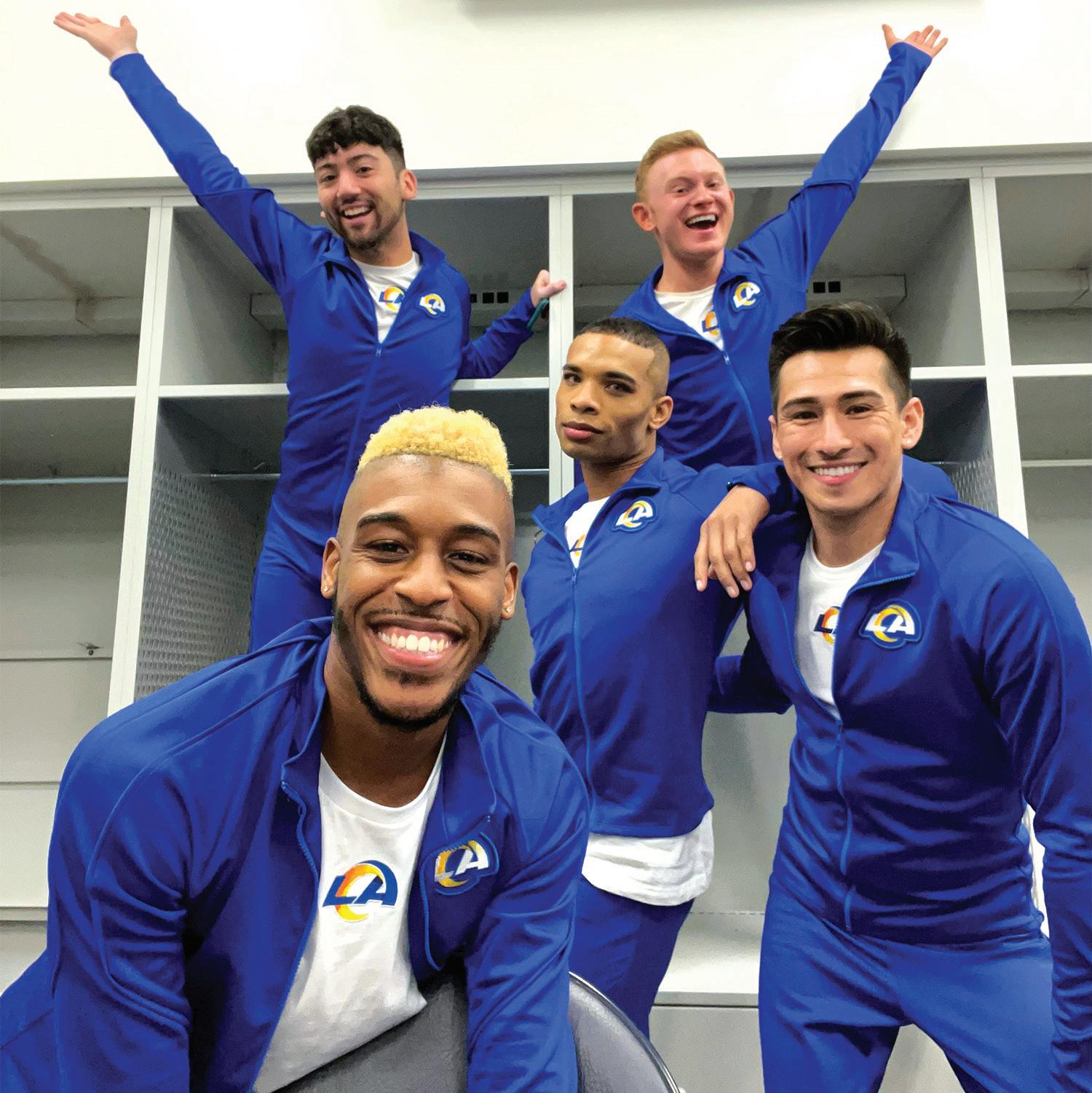
When the Los Angeles Rams brought the Vince Lombardi Trophy home to SoFi Stadium Sunday in the team’s 23-20 Super Bowl victory over the Cincinnati Bengals, it wasn’t just the coaches and the men in the jerseys, shoulder pads and cleats celebrating. The team won with the encouragement of five energetic, out and proud gay men, an essential part of the Rams squad of 28 cheerleaders.
“It’s like a dream,” co-captain Napoleon told the Los Angeles Blade in a media availability on Friday. “I feel like we’re bringing this army of out gay, proud men with us.” He described the feeling as being caught in “a whirlwind.”
“First, having it be at home in L.A., it feels amazing, seeing all the banners everywhere,” said Napoleon. The Super Bowl LVI logo adorning all those banners and everything else related to the big game was actually the work of a transgender woman. More about her story later on.
As ESPN reported, it was the Rams’ second Super Bowl championship and first title in Los Angeles since 1951.
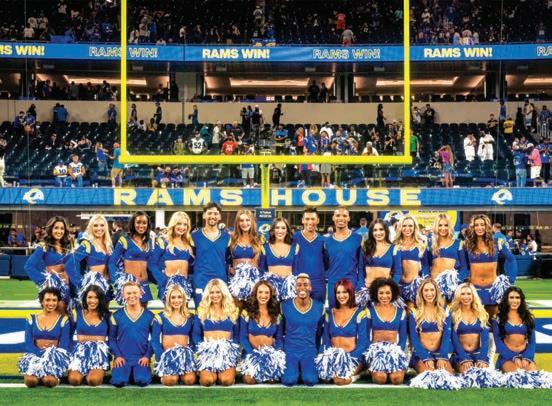
The other co-captain, Napoleon’s fellow trailblazer Quinton, called being on the sidelines on Sunday “a badge of honor.” Also, since this is also Black History Month, he said that makes their diversity even more special.
“We have Jose, who’s Hispanic. Eswinn’s Hispanic. Brendan’s white. Napoleon is Filipino Black. I’m Black. We have so much to choose from, and there’s no way a little boy or girl can look at our team and not see themselves, same with our female teammates. We have so much diversity, it’s awesome.”
Three years ago, Quinton, 29, and Napoleon, 31, broke the gender barrier as the NFL’s first male cheerleaders to work the sidelines of a Super Bowl. And while 11 NFL teams now have men on their squads, the Rams now have five.
“It was our rookie year when we went the first time,” Jinnies added. And now in their fourth season with the Rams, he and Peron are the elders, with Diaz being the only one of the rookies with two seasons under his belt.
So, with a record-setting five out gay men cheering on the Rams, the Big Game was a historic moment in sports and for the LGBTQ community, and that was not lost on these guys. Yet it also came amid rising anti-LGBTQ hate, which concerned at least one of the rookie cheerleaders.
“I’ve been having fear that I was going to be accepted and that all the men in the audience were not going to be kind,” said Eswinn, 29, from Long Beach. “But now, being on the field and performing, I remember that we get a lot of messages, kind messages from people saying how grateful and excited they are for us, and it means a lot to me and to all of us.”
Those supportive fans approached the rookie cheerleaders at an event Thursday in San-
ta Monica, said Jose, who’s from Indiana and records fun, informative videos for kids on the cheerleaders’ official Instagram account.
“We had a fan come up to us and say, ‘I remember when the first two men joined the team and now there are four of you.’ And we’re like, ‘No, there’s five.’ And he was like, ‘Oh my goodness! That is amazing news. I’m so happy to hear that. I love that there are more and more men on this team, and you guys are representing something far greater than just cheer and dance and yourselves.’ So, knowing that we have the support within ourselves and within our amazing little community is just something that really gets us through.”
“You know, I still pinch myself,” said Brendan, 22, from Shelby Township, Mich. He said he and Jose moved to California after college to try-out for the squad. “I still remember, watching Quentin and Napoleon on “Good Morning America” in 2018, and now they’re sleeping over at our house, like in between practice. I get to call these men who were my idols, my best friends now. And so, it still feels so surreal.”
“This is the right moment for it to happen,” said Jose, 22, remembering everything fans and athletes have been through during the COVID-19 pandemic. “To have five men on the field as cheerleaders for the Super Bowl, that’s history. That’s actually a huge moment for queer representation, and for the Rams and a first for the Super Bowl and at SoFi; just a lot of firsts. But the wait was worth it, for sure.”
Jose said he hoped fans in the stands and viewers watching on Sunday were aware that all this progress started with Black queer men.
“When Quentin and Napoleon first made the team, it gave me hope,” he said. “It gave me a new outlook on life, and it allowed me to believe that my dreams were able to be achieved. And now here I am dancing beside them, and it’s a really great feeling to become the representation that I wanted so badly as a kid.”
“As a Black man, I got into dancing because I saw somebody looked like me on TV,” noted Quinton. “I feel like we have so much representation and diversity on this team and we’re so inclusive. Also, who gets to say they’ve been to two Super Bowls in four years? Not many people can say that.”
This was Maureen Raisch’s first Super Bowl, and she scored an invite to all the festivities associated with it, including the NFL Honors awards ceremony. As the New Yorker walked the red carpet, almost everywhere she looked, she saw examples of her work as part of the NFL’s creative team.
That red, palm tree-layered logo with the roman numerals LVI was her design. And Raisch just happens to be a transgender woman.
“The concept was developed through 2020, actually through my transition,” Raisch told me. “And as I came out to the team, we were closing in on the actual mark, the final, what we call the primary mark, you know, the primary logo.”
The final image was part of what Raisch, 39, described as a collaborative effort.
“It’s got the reflectivity of California, like the idea of the golden hour sunset, tied to film. It’s a cinematic story of L.A.: The greatness, the entertainment value. And then kind of making the analogy of the bigger conclusion, the epic finale, if you will, of the NFL season and all the storylines. So, there’s some cool cohesion with the visual concept of L.A., between the city and connecting it to the Super Bowl,” with the Lombardi trophy reflecting a glimmer of that California red sunset.
That trophy now resides back in L.A. for the first time since 1951.
Raisch, who came out during Trans Awareness Week in November, said the NFL has been super supportive of her and her transition, and she sees her job as being a supporter of sports fans.
“The best work we do is when we take the fan experience, the fan culture and all that into account,” she said. “You take that into consideration and you’re doing work for the fans.”
Follow Maureen Raisch on Instagram at @maureendeets. Follow the L.A. Rams cheerleaders at @laramscheer. And watch a video of the cheerleaders’ media availability on YouTube by clicking here. Note: the Rams requested the Blade exclude the cheerleaders’ last names for their own protection.
hosted by RPDR’s Ongina with performances from Jessica Wild, Mariah Balenciaga, Victoria
“Porkchop” Parker & Denver’s Jessica L’whor
By STAFF REPORTS

LOS ANGELES – This past weekend, on February 6th, The Dru Project gathered at Precinct DTLA to raise money and awareness at their third annual Gun Violence is a Drag show.
Put on by co-producers Tennessee Martin, Domenic Vermeulen, and The Dru Project’s Communications Director Sara Grossman, the event was filled with celebrities, a drag show, and queer joy – one of the main tenants of The Dru Project’s mission.
The organization was launched in 2016, shortly after the Pulse Nightclub shooting, to honor victim Drew Leinonen. To date, the organization has given out over $100,000 in scholarships to LGBTQ+ leaders and grants to gay-straight alliances. In light of the “Don’t Say Gay” legislation currently being discussed in Florida, it is more important than ever to ensure LGBTQ+ youth are taken care of and affirmed.
Celebrities Jonathan Bennett, Jaymes Vaughan, and Melissa Rivers jumped on stage during the drag show’s intermission to help raise money. “Growing up, I was raised in a home that was very tolerant. The outsiders were the ones who weren’t. I know I disap-
pointed my mother by not being a gay man and then having a son who is also not gay, but we do what we can to support,” Melissa Rivers said of her late mother, Joan.
She also mentioned, “We have come a long way since wearing red ribbons. Now they’re rainbow so we may never forget what happened June 12, 2016.”
“The Downtown Los Angeles bar Precinct’s owners were amazing to work with,” Sara Grossman told The Blade. “You usually see these events take place in West Hollywood, but it’s fantastic to see the gay scene spreading out around the city.” Grossman said that Precinct generously donated the space, helped them plan for seating, and even pledged part of the event’s kitchen and bar revenue to the organization.
Other celebrities who showed out for the cause included the original Queer Eye’s Jai Rodriguez, Once Upon a Time’s Lana Parilla, and Katie Thurston from the Bachelorette. Together with the event’s sponsors – pride groups from different studios (Legendary, ATN Entertainment, Glamazon, A&E, Starz, and Lionsgate), the room raised $25,000 for LGBTQ+ youth.
Now in its 6th year operating, The Dru Project’s GSA guide has been downloaded in almost every state and in 14 different countries – something they know Drew Leinonen would be proud of. The show was hosted by RPDR’s Ongina and featured performances from Jessica Wild, Mariah Balenciaga, Victoria “Porkchop” Parker, and Denver’s Jessica L’whor.
“We can’t wait to return to Precinct for another Gun Violence is a Drag,” Grossman said. “It could not have been better if we tried. We strive every day to create a world that Drew would have been proud of. I think he’d be pleased with how things are going for us.”
Rapper shot at WeHo area restaurant during Bieber hosted after-party Justin Bieber had headlined a Super Bowl-week party dubbed “Homecoming Weekend” event at the Pacific Design Center in West Hollywood earlier
BEVERLY GROVE – The Los Angeles Police Department is searching for the person who opened fire on patrons outside a restaurant located at 401 North La Cienega Boulevard early Saturday morning.
Among those wounded was 24-year-old rapper Kodak Black, whose legal name is Bill Kapri, who gained notoriety after his prison sentence was commuted by former President Donald Trump.
LAPD spokesperson Drake Madison said that police responded to reports of the shooting at 2:45AM locating the victims outside of The NICE GUY restaurant, which is popular with celebrities. A 19-year-old man, a 24-year-old man, a 60-yearold man and possibly a 22-year-old man — who left the scene — were wounded, Madison said
By STAFF REPORTS

The restaurant was hosting an after-party for Justin Bieber, who had headlined a Super Bowl-week party dubbed “Homecoming Weekend” event at the Pacific Design Center in West Hollywood Friday evening. Upon arrival, officers located two victims of gunshot wounds. Preliminary investigation revealed there was a physical altercation between several individuals at the location. Gunshots were fired by an unknown suspect, who then fled south from the location.
Witnesses told detectives from the LAPD’s Wilshire Area that there was an altercation. Celebrity gossip website TMZ claimed that Kodak Black, Gunna and Lil Baby were standing on the street when a fight broke out. In a cell phone video, Kodak allegedly took a swing at
someone, then gunshots were heard.
Madison would not confirm TMZ’s reporting.
According to TMZ, the guest list included several A-list celebrities, including Bieber, his wife Hailey Rhode Bieber, Kendall Jenner, Khloe Kardashian, Leonardo DiCaprio and Tobey Maguire. However the LAPD would not confirm if the celebrities were present at the time of the shooting.
Los Angeles Fire Department paramedics responded and transported two victims to local hospitals with non-life-threatening injuries. Officers discovered there were two additional victims who self-transported to local hospitals, bringing the total shot to four. All four victims are listed in stable condition.
The suspect is described as a male Black. No arrests have been made.
Anyone with information on this crime is urged to call Wilshire Robbery Detective B. Romero, at (213) 922-8217.
During non-business hours or on the weekends, calls should be directed To 1-877-LAPD24-7 (877-527-3247). Anyone wishing to remain anonymous should call Crime Stoppers at 1-800-222-TIPS (800-222-8477).
Tipsters may also contact Crime Stoppers by texting to phone number 274637 (C-R-IM-E-S on most keypads) with a cell phone. All text messages should begin with the letters “LAPD.”
Tipsters may also go to www.LAPDONLINE.org, click on “webtips” and follow the prompts.
SB 964 increases investment in California’s mental health workforce and creates new opportunities for recent Masters in Social Work graduates
By STAFF REPORTS
SACRAMENTO – Out Senator Scott Wiener (D-San Francisco) introduced Senate Bill 964 Thursday, the Behavioral Health Workforce Revitalization Act. SB 964 increases California’s investment in its behavioral workforce in order to retain workers, increase the size of the behavioral health workforce, and support behavioral health workers who are facing a significant increase in demand for services.
“The key to better mental health and addiction care is investing in our mental health workforce,” said Senator Wiener. “Mental health workers are heroes, and they have some of the hardest jobs out there. They should be paid a living wage and given opportunities for career advancement. If we allow this shortage to grow, we will continue to fail to provide people – particularly our most underserved communities – with the mental health care they so badly need.”
“Our behavioral health workforce is strained and struggling,” said Maggie Merritt, Executive Director of the Steinberg Institute. “We urgently need to rebuild and invigorate it with a holistic approach. A revitalized workforce that is treated fairly and represents all Californians will ensure that our most vulnerable get the help they deserve.”
SB 964 is a critical investment in our behavioral health workforce. The legislation establishes a Behavioral Health Workforce Preservation and Restoration Fund to provide hiring and performance-based bonuses, salary increases or supplements, overtime pay, and hazard pay for workers in the behavioral health sector.
SB 964 also creates a stipend program for students in Master of Social Work (MSW) programs who specialize in public behavioral health. Students will be eligible for a stipend of $18,500 a year for up to two years, and will be required to complete two years of continuous, full-time employment in a public behavioral health agency.
In addition, SB 964:
Creates an online job board where licensed providers in California can post job openings for behavioral health workers in order to increases awareness about job opportunities
Expands access to culturally competent care by making peer support specialists a statewide Medi-Cal benefit and establishing a statewide certifying body to certify these peer specialists
Develops accelerated social work programs with new coursework focused on behavioral health
Amends the existing Medicaid Graduate Medical Education Code to add behavioral health providers to the list of those eligible under the program
REPORTS

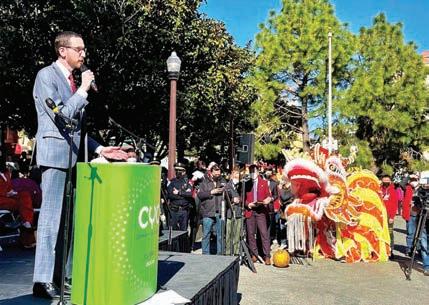
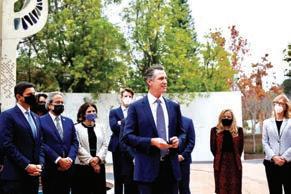
SAN FRANCISCO – As part of his landmark $1.1 billion Clean California initiative, Governor Gavin Newsom announced the award of $311.7 million for 126 beautification projects along the state highway system – with 98 percent of the projects benefiting historically underserved or excluded communities.
Designed to foster cultural connections and civic pride, the projects are expected to generate 3,600 jobs as part of the multiyear initiative led by Caltrans to remove trash and beautify community gateways and public areas along highways, streets
Creates new career ladders for peers and community health workers by developing an accelerated program from certification to associates, bachelors, and masters programs
Requires a study of California’s behavioral health licensing requirements to eliminate unnecessary bureaucratic barriers that keep welltrained and talented workers from entering the field and working at the top of their scope
Requires a comprehensive landscape analysis of the behavioral health workforce to further develop strategies for retaining workers
Currently, only one-third of Californians who live with a mental illness receive the care they need. One of the largest drivers of this failure is a shortage of behavioral healthcare workers. Today, 31 California counties in “high need” for mental health services report having a workforce shortage.
With healthcare workers resigning in droves and mental health needs skyrocketing as a result of the COVID-19 pandemic, the behavioral health workforce shortage has gone from challenge to crisis. Even with the increase in need for quality mental health and addiction treatment, facilities across the state are closing due to worker shortages. When workers can instead, for example, become traveling nurses and receive a $100,000 signing bonus, it becomes even more difficult for hospitals and other facilities to retain staff. And without essential behavioral health workers providing this important care, people with mild mental health symptoms can fall into severe mental illness.
and roads while creating thousands of jobs for Californians.
“With Clean California projects transforming more and more sites across the state, we’re taking the next step to create enriching public spaces that serve the needs of our diverse communities and that all of us can take pride in – starting in the neighborhoods that need it most,” said Newsom. “Working together, the state and local governments are advancing unique beautification projects that will make a positive impact for years to come.”
Developed in close collaboration with tribal and local governments, non-profits and businesses, the 126 state beautification projects will be completed in 47 of California’s 58 counties, including art installations, green space and proposals that improve safety and promote community connections. Construction will begin in April 2022, a full list of the projects can be found here.
Governor Newsom announced the grants Friday at an interchange in San Francisco, the site of a new $2.6 million project that will include a tree nursery, dog park and other features.
In addition to these awards for Clean California projects along the state right-of-way, the Administration in December announced the availability of almost $300 million in grants to cities and counties for local projects that will clean and beautify neighborhood streets, parks and transit centers throughout California.
Caltrans will review the project proposals from cities, counties, transit agencies, tribal governments and other governmental entities and announce grant recipients on March 1. The Governor’s California Blueprint proposes an additional $100 million to fund additional local Clean California grants. Over three years, Clean California will remove an additional 1.2 million cubic yards, or 21,000 tons, of trash from the state system alone – enough to fill the Rose Bowl three times over. The initiative has already resulted in 6,300 tons of litter removed from the State Highway System and, to date, Caltrans has hired 528 new team members, including 428 maintenance workers who collect litter and perform maintenance duties like graffiti removal.
By STAFF REPORTS
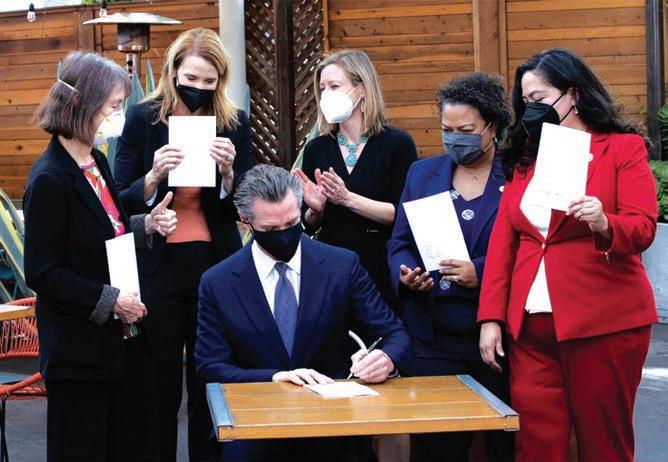
OAKLAND – Governor Gavin Newsom on Wednesday visited a small business in Oakland to sign legislation extending COVID-19 supplemental paid sick leave for workers, and early budget action to provide an additional $6.1 billion in tax relief, tax credits and direct grants for small businesses hit hard by the pandemic, bolstering the state’s historic COVID relief efforts and investing in California’s iconic entrepreneurial economy.
“As California continues to lead the nation’s economic recovery, today’s action deepens our commitment to supporting the workers and businesses that have sustained us all during this unprecedented pandemic and are driving our economy,” said Newsom. “We’re ensuring that workers have the time they need to take care of themselves and their loved ones, expanding our nation-leading small business relief grant program and supporting the businesses whose innovation and entrepreneurial spirit help make California the 5th largest economy in the world.”
Outlined by the Governor, Senate President pro Tempore Toni G. Atkins and Assembly Speaker Anthony Rendon in January, SB 114 by the Committee on Budget and Fiscal Review ensures that employees continue to have access to up to 80 hours of COVID-19 supplemental paid sick leave through September 30, 2022, which may be used by employees who have been advised to quarantine, those caring for COVID-impacted family members, attending a COVID-19 vaccination appointment, and more. Small businesses employing 25 or fewer workers are exempt from the legislation, which is retroactive to sick leave taken beginning January 1, 2022.
“Paid sick leave is key to ensuring workers don’t have to make the impossible choice between going to work sick or losing wages needed to pay rent and keep food on the table,” said Art Pulaski, Executive Secretary-Treasurer of the California Labor Federation. “By signing COVID paid sick leave into law today, Gov. Newsom provided critical protection to frontline workers and families across the state, and underscored California’s commitment to the essential workers that have given so much to help our communities weather this devastating pandemic.”
Building on last year’s robust support for small businesses impacted by the pandemic — including $6.2 billion in tax relief for small businesses that received Paycheck Protection Program loans — Governor Newsom today signed SB 113 by the Committee on Budget and Fiscal Review to provide an additional $6.1 billion in tax relief, tax credits and direct grants to the hardest hit businesses. SB 113 includes provisions that:
Provide a nearly $500 million tax cut for restaurants and venues: By conforming state tax policy for the federal Restaurant Revitalization Fund and federal Shuttered Venue Operators grant programs, grants received by such businesses will not be considered taxable by the state – translating into a tax cut totaling nearly $500 million over the coming years.
Restore $5.5 billion in tax credits and deductions for California businesses: By restoring business tax credits, including for research and development and the net operating loss deduction for businesses one year early, the near-term benefit for such businesses is estimated to reach $5.5 billion.
Invest $150 million in COVID-19 relief grants for California’s small businesses: SB 113 invests an additional $150 million in California’s Small Business COVID-19 Relief Grant Program to fund applicants on the waitlist – the program has provided grants of up to $25,000 for small businesses impacted by the pandemic.
“This business relief package of more than $6 billion will help to offset losses employers have incurred, help create good paying jobs, and will speed up our
economic recovery from the pandemic,” said Jennifer Barrera, CEO of the California Chamber of Commerce. “While we have more work to do, this sends the right message that California is investing in the success of our business community.”
“Paid sick leave is a life or death issue for grocery workers like me and the customers in our stores,” said Samantha Webster, a grocery store worker at Safeway in Hercules and a member of the United Food and Commercial Workers Local 5. “I’m proud of the way grocery workers came together to demand this important public health measure. Having access to supplemental paid sick leave will now let me stay home if I need to and not have to worry about getting my customers and coworkers sick.”
From the beginning of the pandemic, the Administration has taken action to protect and support California’s workforce, including expanding access to job-protected Paid Family Leave and workers’ compensation; more resources for critical child support services for essential employees and vulnerable populations; additional weekly unemployment benefits; building a pipeline of personal protective equipment to help workers stay safe on the job; and support for employees to isolate and quarantine outside their home, among other measures.
“I’m grateful to the Governor and our leaders in the Legislature for taking this urgent action to support teachers like me with the paid sick leave we need to keep ourselves, our families and colleagues safe while providing a safe learning environment for students,” said Johanna Garcia Normart, a teacher at Eden Gardens Elementary in Hayward. “This extension will help our schools continue to meet the unprecedented pandemic challenges we face every day.”
“Paid COVID sick leave really matters for all workers, and especially for health care workers, who need it in order to provide quality safe services to our patients and communities, and in order to take care of ourselves and families, too,” said Mayra Castaneda, a health care technologist and member of SEIU UHW.
For full text of the bills, visit: http://leginfo.legislature.ca.gov.
By STAFF REPORTS
SACRAMENTO –
Taking action to support teens and young adults experiencing homelessness, Governor Gavin Newsom today announced $38 million in new grants for community-based organizations across the state through the Homeless Youth Emergency Services and Housing Program. The grants will allow local service providers to deliver temporary housing and supportive services for youth experiencing homelessness.
“These grants will provide relief and emergency support to young people across California experiencing homelessness, who are too often left in dire situations to fend for themselves,” said Governor Newsom. “We’re providing immediate aid for those living on our streets – bringing resources and services directly to young people in need and helping them onto a path towards a stable future.”
The grants are being distributed through the Office of Emergency Services (Cal OES) to 12 community-based organizations from San Diego to Humboldt for local partners to provide youth experiencing homelessness with access to a range of housing options that meet their needs, as well as mental health support with crisis intervention and stabilization services.
“This funding represents an important lifeline in protecting some of the most vulnerable members of our communities,” said Cal OES Director Mark Ghilarducci. “Through the partnership with these community-based organizations we are able to provide meaningful support and change lives.”
“Addressing youth homelessness takes a village,” said Business, Consumer Services and Housing Agency Secretary Lourdes Castro Ramírez, who serves as Co-Chair of the California Interagency Council on Homelessness. “This is why this investment in community-based organizations that make up the village and provide bridges of support to young people is an important part of our efforts to prevent and end homelessness.”
The following organizations were awarded Homeless Youth Emergency Services and Housing Program grants:
Bill Wilson Center (Santa Clara County)
Center for Human Services (Stanislaus County)
Community Human Services (Monterey County)
Interface Children & Family Services (Ventura County)
Larkin Street Youth Services (San Francisco County)
Orangewood Foundation (Orange County)
Redwood Community Action Agency (Humboldt County)
Ruby’s Place (Alameda County)
San Diego Youth Services (San Diego County)
Volunteers of America Los Angeles (Los Angeles County)
Waking the Village (Sacramento County)
Women’s Center – Youth & Family Services (San Joaquin County)
The funds aim to ensure safe shelter for teens and young



adults experiencing short or long-term housing instability. California has the second highest rate of unsheltered youth experiencing homelessness in the nation, and the number is growing. Nearly 36 percent of all homeless youth in the United States are living in California without a safe place to call home. These targeted grants bolster Governor Newsom’s wider efforts to protect vulnerable Californians by combatting the root causes of homelessness and rebuilding the state’s mental and behavioral health infrastructure.
“Funding from the Homeless Youth Grant Program will provide meals, supportive engagement counselors, case management services, educational re-engagement services, and flexible housing funds that can be used for short-term hotel vouchers, food cards, and transportation cards, to ensure youth have a safe place off the streets as they await longer-term housing placements,” said Sherilyn Adams, Executive Director of Larkin Street Youth Services in San Francisco. “Larkin Street will utilize OES funds to ensure young people are quickly linked to transitional, supportive, and subsidy-based housing resources via low-barrier engagement programs in our Engagement and Community Center.”
“This grant will expand the range of housing options available to youth experiencing homelessness in Orange County and enable Orangewood to shepherd youth through the continuum of housing, ranging from emergency shelter to independent housing,” said Chris Simonsen, Chief Executive Officer of the Orangewood Foundation in Santa Ana.
“We urge you to ensure that public and private insurance plans cover Apretude at no cost to patients — just like the other forms of PrEP”
WASHINGTON – A pair of the openly gay Black members are leading a group of 58 House Democrats in calling on the Biden administration to require medical insurers to cover PrEP in its recently FDA-approved form as an injectable HIV preventative drug.
In a letter dated Feb. 4 and made public on Thursday, Reps.
Ritchie Torres (D-N.Y.) and Mondaire Jones (D-N.Y.) lead colleagues in urging the Centers for Medicare & Medicaid and the Centers for Disease Control to issue the new requirements for Apretude, which the Food & Drug Administration approved for use in December.
“To ensure that this life-saving medication is as accessible as possible to the people who need it most, particularly LGBTQ+ people and people of color, we urge you to ensure that public and private insurance plans cover Apretude at no cost to patients — just like the other forms of PrEP,” the letter says.
By STAFF REPORTS

While PrEP has emerged in recent years as an HIV prevention treatment in the form of a daily pill, commonly Truvada, the injectable drug offers patients as potential alternative or those who may experience pill fatigue with a shot expected to be taken one month apart, and then every two months thereafter, according to the FDA.
ViiV is the manufacturer of Apretude and expects to start shipping it to wholesalers and distributors early this year, according to the company website.
If the U.S. government were to issue rules requiring insurers to cover injectable PrEP, it would follow-up on earlier actions to make HIV prevention drugs more widely available. The CDC under the Trump administration made free PrEP available to those without insurance coverage, while the Biden administration issued requirements to make insurers include PrEP as part of their coverage.
According to a statement accompanying the letter, however, significant racial disparities remain in PrEP use: “While the HIV infection rate among Black Americans is eight times as high as among white Americans, just nine percent of the Black Americans for whom PrEP is recommended have been prescribed the medication, compared to 66 percent of their white counterparts. Similarly, while the HIV infection rate among Hispanic Americans is four times as high as among white Americans, only 16 percent of recommended Hispanic Americans have been prescribed PrEP.”
Tennessee considers LGBTQ+ education ban- ‘Don’t say gay’
“I think [LGBTQ+ education] is something that should be left to mom and dad at home,” state Rep. Bruce Griffey (R) said
By ZACHARY JARRELL
NASHVILLE – Lawmakers in Tennessee are considering a bill that would ban the teaching of LGBTQ+ issues and lifestyles in public schools.
The Tennessee legislation is similar to a bill going through the Florida legislature, referred to by opponents as the “Don’t Say Gay” bill, that has received national attention, including condemnation from the White House.
H.B. 800, introduced by state Rep. Bruce Griffey, would ban textbooks and other instructional materials in Tennessee public schools that “promote, normalize, support, or address controversial social issues, such as lesbian, gay, bi-sexual, and transgender (LGBT) lifestyles.”
The legislation states that LGBTQ+ issues and lifestyles are “inappropriate” and offend a “significant portion” of students, parents and Tennessee residents with “Christian values.”
“The promotion of LGBT issues and lifestyles should be subject to the same restrictions and limitations placed on the teaching of religion in public schools,” the bill reads.
Chris Sanders, the executive director of the statewide LGBTQ+ rights group the Tennessee Equality Project, said the bill would have a “devastating” effect on LGBTQ+ students.
“It erases them and stigmatizes them. It marginalizes students who have LGBTQ parents. It gives the green light to bullies because it sends the message that there is something wrong with our community, a message that many students are already hearing loud and clear without extra help from the Legislature,” Sanders told the Blade in an email.
Griffey did not immediately respond to a request for comment. However, during a recent state House Finance, Ways and Means Committee hearing, Griffey briefly spoke about the bill, which was introduced last year in what was a record year for anti-LGBTQ+ legislation.
“I think [LGBTQ+ education] is something that should be left to mom and dad at home,” he said.
Florida is considering a similar bill, deemed the “Don’t Say Gay” bill, which would ban
classroom discussions about sexual orientation and gender identity that are not “age-appropriate” in schools – though it is not clear what is considered “age-appropriate.”
LGBTQ+ advocates and Democrats around the nation have criticized the legislation. The White House recently said the bill was “cynically using our students as pawns in political warfare.”

“Just imagine what it would feel like to be a kid watching the leaders in your state bully you through legislation that tries to erase your existence,” a White House spokesperson said. “These types of attacks are the root cause of the mental health crisis that LGBTQI+ face. The president wants LGBTQI+ young people who may be feeling scared or alone because of these legislative attacks to know that they are loved exactly for who they are, and that he won’t stop fighting for the protections and safety they deserve.”
The bill continues to move through the Florida statehouse, with Republican Gov. Ron DeSantis signaling support for the legislation – saying it is “entirely inappropriate” for teachers and school administrators to have conversations with students about their gender identity.
The Tennessee bill has stalled for the time being, but, according to Sanders, it should be back before the House “soon.”





By ZACHARY JARRELL
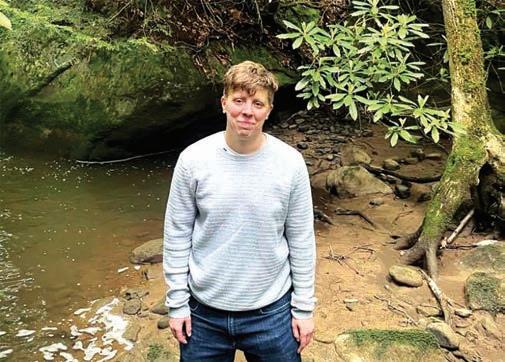
CHARLESTON, Wv. – A West Virginia Trans man won a three-year-long legal battle late last year, establishing legal precedent that protects LGBTQ+ people in the state from discrimination.
Robb Livingood, a Trans man, sued West Virginia’s Fifth Judicial Circuit Public Defender’s Office, alleging it denied the public defender a position he was qualified for because he was transitioning – publicly presenting as a masculine woman and privately experimenting with different pronouns. The job ended up going to someone with significantly less experience, the Mountain State Spotlight reported.
“I had spent a life building my resume and my qualifications, and I was bringing a lot to the table,” Livingood told the outlet, adding: “To be turned away from a job on a basis other than my qualifications, that just struck me as a gross injustice.”
In court filings, the Fifth Circuit Public Defender’s Office argued that Livingood was underqualified for the position and stated Trans people “are not a protected class under West Virginia’s Human Rights Act.” It also denied that the office discriminates on any basis in its hiring decisions, according to the Spotlight.
However, a December 2021 ruling from a judge on West Virginia’s Human Rights Commission disagreed with both claims, saying that the office did discriminate against Livingood.
The interpretation of the West Virginia civil rights laws gives LGBTQ+ people in the state protections against discrimination.
“It surprised me, in a good way,” Livingood told the Spotlight. The public defender’s office appealed the decision but did so after the deadline, the
outlet reported. The commission has yet to decide whether they’ll consider the late appeal.
The ruling comes as West Virginia lawmakers have tried to pass a bipartisan proposal, called the Fairness Act, to update human rights law to include explicit protections for LGBTQ+ people in the state. Though the legislation has been endorsed across the state, including more than 100 diverse faith leaders, it has not made it out of the state legislature.
In 2020, the U.S. Supreme Court ruled that existing federal law prohibiting discrimination in employment based on an employee’s sex also protects LGBTQ employees. LGBTQ people face a “patchwork of protections” against discrimination, according to Fairness West Virginia. The state is one of 29 states with no state law to ban discrimination in employment. According to a Norman Analytics and Research poll, 81% of West Virginians believe non-discrimination laws in the state should be strengthened.
The legislation was one of Arizona’s 15 anti-LGBTQ+ bills introduced so far this year, the most of any state
By ZACHARY JARRELL
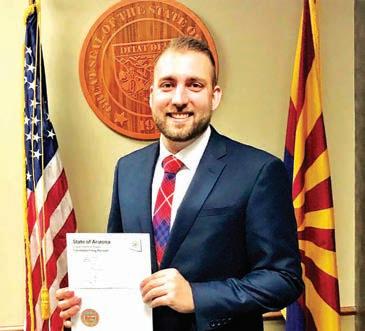
PHOENIX – A bill aiming to ban gender-affirming care for LGBTQ+ youth in Arizona is effectively dead after Republican state Sen. Tyler Pace broke from his party last week and voted against the legislation.
The rare and unexpected move came last Wednesday with Pace joining three Democratic colleagues on the Arizona Legislature’s Health and Human Services Committee, splitting the vote 4-4 and effectively stalling the bill.
Though Pace saw “both sides,” he attributed his vote to the testimony of LGBTQ+ youth and their parents against the anti-Trans youth health care bill.
“The testimonies we heard today about the many people who are using these avenues of medical treatments to save lives, to improve lives,” he said during the committee hearing, “I don’t want my vote to stop those great things.”
At the hearing, Trans youth and their families stood in front of the committee to testify against the anti-Trans bill.
“Kids like me should be able to be who they are without lawmakers attacking their rights,” said Samuel Cars, who identifies as Trans and bisexual. “I ask you when you vote on this bill to think about me and this question: What side of history do you want to be on? Because the only way to be on the right side is vote no on this bill.”
Other people who spoke to the committee noted how the bill could increase suicide rates
for Trans youth in the state. Late last year, LGBTQ+ youth suicide prevention group The Trevor Project found a strong link between gender-affirming therapy and lower rates of suicide and depression in Trans youth.
The legislation – S.B. 1138, which sought to ban gender-affirming care to Trans and nonbinary youth, including reversible puberty blockers, hormone therapy and surgeries – was one of Arizona’s 15 anti-LGBTQ+ bills introduced so far this year, the most of any state, according to NBC News.
Pro-LGBTQ+ activists and lawmakers grew so concerned over the legislative landscape that they hosted a press conference last month, sounding alarm bells over the anti-LGBTQ+ bills.
“This is an attack on human rights,” said Arizona state Rep. César Chávez, chairman of the Arizona LGBTQ Legislative Caucus, at the press conference hosted by the HRC. “We’re criminalizing individuals for being who they are. On top of that, we’re criminalizing doctors and health care workers, individuals that are doing their job.”
The Arizona state Senate passed an anti-Trans sports bill at the beginning of February that would restrict Trans women and girls from playing on school sports teams that match their gender identity. Pace voted in favor of the legislation.
Last year, Arkansas and Tennessee passed similar gender-affirming care bans, making them the only two states in the country to do so. However, a federal judge blocked the Arkansas ban last summer, according to LGBTQ+ research nonprofit the Movement Advancement Project (MAP).
MAP also notes that Tennessee’s law prohibits medical providers from providing hormone-related medication to “prepubertal minors.” “Best practice medical care for transgender youth only includes such medication once a youth has entered puberty, not prior to it, and this further illustrates how these legislative efforts reflect a fundamental lack of understanding of medical care for transgender youth,” it added. “However, this legislation sets a dangerous precedent for further restrictions of medical care for transgender youth.”
Hartzler has a long history of attacking the LGBTQ+ community & the Senator’s record on anti-LGBTQ+ animus is also lengthy
By BRODY LEVESQUE
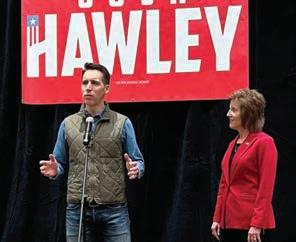
ST. CHARLES, Mo. – Speaking with reporters at the annual Missouri Republican Party statewide Lincoln Days Saturday, February 12th at St. Charles Convention Center in St Charles, U.S. Senator Josh Hawley, (R-MO) announced he was backing Missouri Rep. Vicky Hartzler’s campaign to land the state’s other U.S. Senate seat.
Hartzler has a long history of attacking the LGBTQ+ community. Her public animus first brought media attention in 2004 when as head of the Missouri Coalition to Protect Marriage, was a critical component of the successful campaign to install a statewide constitutional ban on same-sex marriage.
Her attacking LGBTQ+ Americans continued after her election to Congress in 2011. During the early summer of 2017, as a member of the U.S. House Armed Services Committee, Hartzler an amendment to the National Defense Authorization Act, (NDA) which is the annual defense policy bill, that would have banned the coverage of transition-related health care for Transgender military personnel.
After a procedural battle that failed to get the amendment through the committee, Hartzler, with support from other anti-LGBTQ+ Republicans including now former Rep. Steve King (Iowa), Rep. Mo Brooks, (Alabama), now former Rep. Duncan Hunter, (California) managed to get the amendment attached for debate and a vote on the House floor as part of the NDA. “This is different from somebody going in and having a cold,” she said during the floor debate.
The Hartzler Amendment was defeated: 214 No, 209 Yes. Undeterred, Hartzler along with the powerful chair of the
House Freedom Caucus and an ally of then-President Donald Trump, Rep. Mark Meadows lobbied then U.S. House Speaker Paul Ryan, (R-WI), and House Majority Leader Kevin McCarthy, (R-CA), to hold the amendment over as a separate bill for a House vote.
The Speaker and the Leader refused and Hartzler and Meadows approached the Trump White House. On July 26, 2017, then-President Donald Trump announced through a series of tweets that transgender individuals will no longer be allowed to serve in the U.S. military.
Meadows later went on to leave Congress and was the last White House Chief-of-Staff for Trump.
In 2019 Hartzler held a reception in her Capitol Hill office for proponents of the discredited practise of conversion therapy. The reception was held as Rep. Ted Lieu, (D-CA), introduced a bill to ban the practice- Lieu’s offices are immediately adjacent to Hartzler’s.
This weekend for her newly announced run for Senate she released a Transphobic campaign ad that attacks University of Pennsylvania Swimmer Lia Thomas, deadnaming and misgendering the collegiate athlete.
The Senator’s record on anti-LGBTQ+ animus is also lengthy. Following the Supreme Court’s Obergefell marriage equality ruling, as a Republican candidate for Missouri attorney general, Hawley wanted the state legislature to exempt businesses and religious groups from participating in samesex couples’ marriage ceremonies. At the time, gay rights advocacy group PROMO said Missouri law already permitted
such discrimination.
Senator Hawley falsely claimed at a Senate hearing for the Equality Act that it would force individuals, adoption agencies. In a profile written by GLAAD, it was noted that he also co-sponsored a bill targeting transgender children from participating in sports; voted to support an anti-transgender amendment tacked onto COVID-19 relief package; voted against COVID-19 relief that provided $2.8b to Missouri.
Hawley has also criticized the Supreme Court decision that bans discrimination based on sexual orientation and gender identity in the workplace. The court ruled that Title VII of the 1964 Civil Rights Act, which prohibits discrimination based on race, religion, national origin and sex, protects gay and transgender workers. “You know, to me, for someone who has said, Justice Gorsuch, who said that he’s a textualist and an originalist, I just don’t see how you get there with that methodology,” Hawley told the Washington Examiner.
He also said of the Supreme Court decision that protects gay and transgender workers: it “represents the end of the conservative legal movement.”
Charges of anti-LGBTQ+ discrimination at BYU dismissed DOE is “dismissing this complaint” pursuant to the religious exemption under Title IX of the Education Amendments of 1972
By CHRIS JOHNSON
WASHINGTON – The Biden administration has dismissed charges of alleging anti-LGBTQ discrimination against students at Brigham Young University on the basis that the religious exemption under Title IX prohibits changes against the school.
In a letter dated Feb. 8 and obtained Friday by the Washington Blade, an official with the Office of Civil Rights informs Brigham Young University President Kevin Worthen the Department of Education is “dismissing this complaint” pursuant to the religious exemption under Title IX of the Education Amendments of 1972.
“Because the University is exempt from the above-referenced regulatory provisions of Title IX to the extent that application of those provisions conflict with the religious tenets of its controlling religious organization, OCR lacks jurisdiction to address the complaint’s allegations,” writes Sandra Roesti, supervisory attorney with the Department of Education’s Office of Civil Rights.
The Department of Education letter emphasizes the determination is the result of “an individual OCR case,” therefore should not be considered as “a formal statement of OCR policy and should not be relied upon, cited, or construed as such.”
The initial complaint, which the letter was filed on March 9,
2020, challenged alleged Brigham Young University engages in the different treatment of students who are involved in samesex romantic relationships by stating that such relationships are not compatible with the principles of the University’s Honor Code. The filer of complaint isn’t identified.
Brigham Young University in an organizational statement stated the dismissal of charges against the Mormon university were no surprise because the U.S. government has consistently recognized the religious exemption under Title IX applies to the school.
“BYU had anticipated that OCR would dismiss the complaint because OCR has repeatedly recognized BYU’s religious exemption for Title IX requirements that are not consistent with the religious tenets of The Church of Jesus Christ of Latter-day Saints,” the statement says.
According to Brigham Young University, the school wasn’t aware of the complaint until Oct. 21, 2021, when the Office of Civil Rights gave the case had been opened. The school asserted its religious exemption and outlined relevant religious tenets of the Church of Jesus Christ, concluding the response from the Department of Education demonstrates the university “has a religious exemption that applies to this issue.”
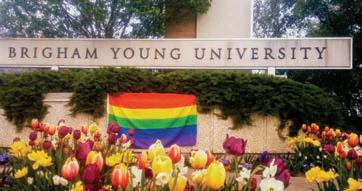
As a religiously affiliated university with a history of a hostile climate toward LGBTQ students, Brigham Young University has recently come under scrutiny for its policies. The school banned all protests from students on Y Mountain, a social place for students, after pro-LGBTQ students lit it up in rainbow colors, according to a media reports.
Paul Carlos Southwick, director of pro-LGBTQ student group known as the Religious Exemption Accountability Project, said in a statement the Department of Education’s dismissal of the charges “is another example of the federal government siding with discrimination and powerful institutions like BYU at the expense of vulnerable LGBTQ+ students.”
“By dismissing this investigation, the federal government has not only dashed the hopes of many LGBTQ+ students who saw the investigation as a sign of good things to come, but it has placed the government’s stamp of approval on BYU’s discriminatory practices, which the government not only funds, but has now formally handed out a license to discriminate,” Southwick said.

is a longtime LGBTQ rights and Democratic Party activist. He writes regularly for the Blade.
Time to stop ‘all or nothing’ drumbeat

If Democrats want a chance to win in 2022 they need to get smart now and pass some legislation. Time has come to move forward on the parts of the Build Back Better bill that can pass. Time to stop the “all or nothing” chant. If Democrats do this they just might get the chance to govern another day. Better than allowing Republicans to take back the Congress and spiral the nation backwards while destroying our democracy.
The progressive left should do what they finally did in 2020 when they got behind Joe Biden; recognize only a moderate candidate can win in swing districts. Those like Congressperson Cori Bush (D-Mo.) are just courting defeat by sticking with losing slogans like “Defund the Police.” She is a smart woman who must understand this was one of the things Republicans used effectively to defeat Democrats. Instead look at how Eric Adams, New York City’s new mayor, is dealing with the complicated issue of policing. Using debunked slogans is not the way to victory.
First lady Dr. Jill Biden spoke recently, saying unfortunately free community college is off the table for now. While she doesn’t like it, she recognized Congress must move forward with what is possible today. The American people do better with some progress. Democrats must accept our nation’s founders set up a government which calls for “compromise.” Not compromise on principles, but often compromise to make incremental progress.
Whether it’s voting rights, women’s rights, LGBTQ+ rights or other initiatives, forward progress is better than none. Blaming President Biden for things like not passing the Equality Act, first introduced by my then boss, Bella S. Abzug (D-N.Y.), in 1974, and which no Congress since then has passed, is ridiculous. As with many civil rights issues, while we have made progress there’s still have a long way to go. As an older gay man, I would never have believed being LGBTQ+ would be a benefit to getting a job. Yet today, in the Biden administration, it is; as is being a woman, African American, Latino or Asian. The push for diversity in this administration is real and strong. Just look at the Office of Presidential Personnel. The first “out” lesbian ambassador has recently been confirmed by the Senate, as has the first transgender official. That is real progress. Now it’s time for the Democratic-controlled Congress to stop falling into
the trap where “The perfect is the enemy of the good.” Recently, the Working Families Party in New York endorsed Jumaane Williams, the left-leaning NYC public advocate, for governor. If he did accidently win the Democratic nomination it would lead to the first Republican governor in New York in years. He won’t win and I assume the Working Families Party hopes endorsing him pushes Gov. Hochul to the left. In a recent poll she leads him 46 percent to 11 percent. It is time for Democrats to accept moderates will win in these difficult times, even in New York City and Buffalo as we saw in the 2021 mayoral races.
Many smart, principled, Democrats won’t give up fighting for progressive policies. Policies like a $15 minimum wage, universal healthcare, the Equality Act, free community college and legislation to fight climate change. But those smart Democrats also must acknowledge they won’t get them all at once. They must accept incremental progress and the opportunity to continue to fight for what they believe in future Congresses.
If Democrats stick together and can point to some progress on issues people care about Republicans are showing they will help us to win the 2022 elections. They are doing so by their in-fighting. It will help when a Democratic candidate can ask his/her Republican challenger if they support the Republican view of the nation which includes the Republican National Committee’s resolution saying Jan. 6 rioters engaged in “legitimate political discourse.” Even some Republican congressional leaders, including Senate Minority Leader Mitch McConnell, are attacking that and then having Trump attack them. It appears Donald Trump is finally causing a real fissure in the Republican Party and Democrats need to take advantage of that.
We can make progress and we are seeing the administration and some in the business community finally recognizing the inequality in our nation and slowly moving towards changing that. The Democratic Congress can make positive incremental changes. As they do Republican legislatures around the nation will continue to try to take us backwards. Democrats can show voters we are different and not play into Republican hands in 2022 with debunked slogans and lack of any progress. For once Democrats must be the smarter Party. If that happens, they will win.

ADDRESS
8237 Blackburn Avenue Ste. 201, Los Angeles, CA 90048
PHONE 310-230-5266
E-MAIL tmasters@losangelesblade.com
INTERNET losangelesblade.com
PUBLISHED BY Los Angeles Blade, LLC
PUBLISHER
TROY MASTERS
tmasters@losangelesblade.com 310-230-5266 x8080 (o), 917-406-1619 (c)
SALES & MARKETING
SALES EXECUTIVE
CHRIS WILMORE cmwilmore@losangelesblade.com 310-230-5266 x9461
NATIONAL ADVERTISING
RIVENDELL MEDIA
sales@rivendellmedia.com, 212-242-6863
MARKETING DIRECTOR
STEPHEN RUTGERS srutgers@washblade.com, 202-747-2077 x8077
EDITORIAL
CONTRIBUTING WRITER
KAREN OCAMB karenocamb@losangelesblade.com
NATIONAL EDITOR
KEVIN NAFF kna @washblade.com, 202-747-2077 x8088
EDITOR AT LARGE
BRODY LEVESQUE
California
CONTRIBUTORS
MICHAEL K. LAVERS, TINASHE CHINGARANDE, ERNESTO VALLE, YARIEL VALDÉS GONZALEZ, PARKER PURIFOY, CHRISTOPHER KANE, AUSTIN MENDOZA, JOHN PAUL KING, JOEY DIGUGLIELMO, CHRIS JOHNSON, LOU CHIBBARO JR., REBEKAH SAGER, JON DAVIDSON, SUSAN HORNIK, CHANNING SARGENT, SAMSON AMORE, CHRISTOPHER CAPPIELLO, MICHAEL JORTNER, DAN ALLEN, SEAN SHEALY, SCOTT STIFFLER, RHEA LITRÉ
CREATIVE DESIGN/PRODUCTION AZERCREATIVE.COM
DISTRIBUTION
CHRISTOPHER JACKSON, 562-826-6602
All material in the Los Angeles Blade is protected by federal copyright law and may not be reproduced without the written consent of the Los Angeles Blade. e sexual orientation of advertisers, photographers, writers and cartoonists published herein is neither inferred nor implied. e appearance of names or pictorial representation does not necessarily indicate the sexual orientation of that person or persons. Although the Los Angeles Blade is supported by many ne advertisers, we cannot accept responsibility for claims made by advertisers. Unsolicited editorial material is accepted by the Los Angeles Blade, but the paper cannot take responsibility for its return. e editors reserve the right to accept, reject or edit any submission. A single copy of the Los Angeles Blade is available from authorized distribution points, to any individual within a 50-mile radius of Los Angeles, CA. Multiple copies are available from the Los Angeles Blade o ce only. Call for rates. If you are unable to get to a convenient free distribution point, you may receive a 26-week mailed subscription for $195 per year or $5.00 per single issue. Checks or credit card orders can be sent to Phil Rockstroh at prockstroh@washblade.com. Postmaster: Send address changes to the Los Angeles Blade, PO BOX 53352 Washington, DC 20009. e Los Angeles Blade is published bi-weekly, on Friday, by Los Angeles Blade, LLC. Rates for businesses/institutions are $450 per year. Periodical postage paid at Los Angeles, CA., and additional mailing o ces. Editorial positions of the Los Angeles Blade are expressed in editorials and in editors’ notes as determined by the paper’s editors. Other opinions are those of the writers and do not necessarily represent the opinion of the Los Angeles Blade or its sta To submit a letter or commentary: Letters should be fewer than 400 words; commentaries should be


Progressive Catholics laud Fabre as anti-racist but ignore his extremist anti-LGBTQ track record
The Catholic Church is one of the most powerful forces in the U.S. pushing back against civil rights for LGBTQ people. Just in the past three years, the Church has spent millions to defeat state and national laws protecting queer people from discrimination. They’ve won critical court cases to exclude queer people from the protection of civil rights laws. Bishops have fired administrative LGBTQ staff in increasing waves of witch hunts and lobbied Congress to remove LGBTQ outreach from a federal suicide hotline.
Bishops are embracing conversion therapy, rejecting pro-LGBTQ Catholic groups like DignityUSA they had tacitly tolerated for decades, and in some cases even ordering priests to deny almost all sacramental and communal Church life to LGBTQ Catholics. It’s a war out there.
Pope Francis was supposed to change that Francis took over the reins of the Church in March of 2013, and he electrified the world with his “Who am I to judge” remark in response to a question about a gay priest. His remarks since have been confusing and often contradictory, but progressive Catholics (most lay Catholics in the U.S.) have clung to the notion that Francis will make the Church more welcoming and more healthy.
—Liberal Catholic news sources are keeping mum about Fabre’s staunch opposition to LGBTQ civil equality —
Despite the Pope’s contradictory words, U.S. Catholics say he’s making future change possible by appointing progressive bishops. But is he?
When Francis appointed Bishop John Doerfler to run the Church in Michigan’s upper peninsula despite an anti-LGBTQ track record, liberal Catholics waved the appointment away as a bureaucratic “mistake.” The consequences became dire for queer Catholics after Doerfler ordered his priests to withhold sacraments from transgender and gay people, but since the diocese is very small, the Pope’s “oopsie” only hurt a small number of people.
Surely Pope Francis had not intended this harm, commented U.S. Catholics, and surely he would be cautious not to repeat such a mistake.
But he just did.
This week.
In a decision with far broader consequences.
Francis just appointed an extremist homophobe to one of the most powerful positions in the U.S. Church
Tuesday, the Catholic press announced that Pope Francis chose Bishop Shelton Fabre, currently of Houma-Thibodaux, Louisiana, to be the new archbishop of Louisville, Kentucky. He will serve as only the second Black archbishop in the U.S. Church. Catholic journalists praised Fabre’s work on an anti-racism Church panel as they celebrated his promotion. Some journalists wrote that his appointment would bolster Francis’s “kinder” more “pastoral” vision of Church leadership.
So far, nobody has reported Fabre’s extremist anti-LGBTQ track record, not even publications that had reported on it explicitly in the past. Wire services are running the same bland reports about an “anti-racist” Black archbishop, and even liberal Catholic news sources are keeping mum about Fabre’s staunch opposition to LGBTQ civil equality.
Fabre aligns with a hardcore group of extremist anti-LGBTQ clergy
Last January, nine U.S. Catholic bishops, two of them retired, issued a statement titled, “God Is on Your Side: A Statement from Catholic Bishops on Protecting LGBT Youth.”
This tiny group of bishops issued the statement shortly after the U.S. Conference of Catholic Bishops (USCCB) lobbied Congress to kill a federal suicide hotline because it offers services specifically to LGBTQ people. The statement appeared to offer support for the LGBTQ Equality Act, which the House of Representatives was about to take up. The statement read in part:
“The Catholic Church values the God-given dignity of all human life and we take this opportunity to say to our LGBT friends, especially young people, that we stand with you
is a former Air Force intelligence analyst, long-time LGBTQ activist, an alumnus of Queer Nation and Act Up NY, a frequent columnist for the LA Blade, a contributor to other LGBTQ news outlets, and an “agented” but unpublished novelist.
and oppose any form of violence, bullying or harassment directed at you. Most of all, know that God created you, God loves you and God is on your side.“
Marianne Duddy-Burke of the pro-LGBTQ DignityUSA said in a statement she hoped more bishops would sign the pro-LGBTQ statement: “Given that this statement asks for nothing more than human dignity, I would hope that more bishops would add their names.”
Fabre signed a dueling, mean-spirited endorsement of homophobia instead
In what became a battle of dueling statements, a much larger group of bishops issued a harsh statement opposing LGBTQ equality in the name of the USCCB, doubling down on opposition to the Equality Act, reaffirming the Church’s right to discriminate against LGBTQ people when delivering state-contracted services, reaffirming opposition to civil same-sex marriage, and support for health care workers to deny medical care to LGBTQ people on religious grounds.
Bishop Fabre signed the harsh homophobic statement in his capacity as chairman of of the USCCB’s Ad Hoc Committee Against Racism, sending an implicit message — Don’t be racist, don’t discriminate against Black people, who are fully deserving of human dignity. DO DISCRIMINATE against LGBTQ people, who are NOT fully deserving of human dignity.
When Fabre signed that statement, he joined a short list of some of the most notorious homophobes in the U.S. Church — like Cardinal Timothy Dolan, an outspoken enemy of LGBTQ Catholics. Another signatory, Archbishop Paul Coakley, bemoans the U.S. Supreme Court decision legalizing same-sex marriage a “tragic error,” insisting that Catholic doctrine should play a role in denying equal marriage even to people of other faiths or no faith. This hardcore faction is largely seen as fighting against Pope Francis’s perceived progressive spirit.
Fabre issued a hypocritical statement on Tuesday
In a press conference, Fabre told reporters his work in anti-racism is framed in “a call to respect the human life and human dignity of each and every person.” He did not explain how his opposition to equal human and civil rights for LGBTQ people fits into that framing. Apparently, “each and every person” actually means each and every cisgender, straight person.
So far the Catholic press is silent on the question of why Pope Francis promoted an extremist homophobe to one of the most powerful leadership positions in the U.S. Church. Is this just another “oopsie,” a bureaucratic blunder?
That’s what many progressive Catholics claimed when Francis promoted Doerfler and when he personally signed off on a document forbidding priests from blessing LGBTQ people in committed relationships or marriages, saying, “God can’t bless sin.” Some claim Francis didn’t pay close attention to the document and didn’t realize what it said, even though a Papal signature on such a document is an extraordinary breach of custom.
Maybe Doerfler’s appointment was really a mistake, maybe barring priests from blessing gay people, which the German Catholic clergy are rebelling over, was really a mistake.
But now Fabre, a notorious homophobic hardliner? The mistake hypothesis is wearing increasingly thin.
It’s commendable that the Pope promoted a Black man and an anti-racist to a powerful position, but I have a question. Is it not possible to identify a U.S. Catholic leader who is Black and anti-racist but is NOT a hardcore homophobic bigot?
Two LGBTQ Catholic advocacy leaders I contacted told me “on background” that such an appointment would indeed be possible, and that they are bitterly disappointed Pope Francis elevated Fabre instead.
So, here we go again with the Papal rollercoaster, with contradictory statements and actions from a man who can’t seem to decide where he wants to lead the Church, and can’t get real about treating queer people with dignity and equality.
Will the real Pope Francis please stand up?
(The preceding article was previously published by Prism & Pen– Amplifying LGBTQ voices through the art of storytelling and is republished by permission.)
In summing up LGBTQ inclusion among this year’s nominees for the Academy Awards, you can’t get much more accurate and succinct than this statement from GLAAD President and CEO Sarah Kate Ellis:
“This year’s Oscar nominations for performances from queer actors including Ariana DeBose and Kristen Stewart, as well for powerful LGBTQ stories in films like ‘West Side Story,’ ‘Flee,’ and ‘The Mitchells vs. The Machines,’ are clear reminders of the opportunities that exist with audiences and critics when Hollywood invests in queer talent and tells diverse stories in bold and original ways. With several worthy LGBTQ stories, actors, and creators absent from this year’s list, the industry and Academy should prioritize investing in and recognizing creators and stories from LGBTQ and other marginalized communities that audiences both crave and connect with.”
By JOHN PAUL KING

Ellis is on target with both observations. Oscar’s slate of nominated films is peppered with queerness, though only a few place it front-and-center, and having two openly LGBTQ performers nominated within a single year is a record. Nevertheless, it’s a notable fact that several high-profile out contenders didn’t make the cut (Lady Gaga for “House of Gucci,” Tessa Thompson for “Passing,” Abbi Jacobson for “The Mitchells vs. the Machines,” and Colman Domingo for “Zola”) in a year when the front-runner for Best Picture is widely considered to be “The Power of the Dog” – a film that explores the queer dynamic in a relationship between two men, both played by non-LGBTQ actors.
Some of the potential LGBTQ nominees were long-shots, of course (Jacobson, for example, would have been the first person ever nominated for a voice performance in an animated film), and the significance of “Flee” – an animated docudrama about a queer Afghan refugee telling his story on the eve of his marriage – receiving nods in three categories (Best Documentary Feature, Best International Feature, and Best Animated Feature) should not be understated. Given the high level of acclaim it has received, not to mention the momentum it’s picked up in the “Awards Season” buzz, it stands as the best chance for an LGBTQ-focused film to pick up some gold on Oscar night.
That is, of course, unless you count “The Power of the Dog,” the year’s most-nominated film with nods in 12 categories. Director Jane Campion (now the first woman to earn more than one nomination for Best Director) weaves queerness throughout the fabric of her adaptation of Thomas Savage’s novel – the premise and plot both depend upon it – but can it truly be called an LGBTQ film? Neither of its two central characters are clearly identified as queer, though it’s perhaps obvious that Benedict Cumberbatch’s hyper-masculine rancher has compartmentalized his queerness into a ritualized blend of hero worship and sexual fetish.
There’s also the uncomfortable but unavoidable interplay of toxic tropes as the two characters come together to confront both the archetype of the he-man cowboy as idealized masculine image and the expectation of a sexual “mentorship” between an older and younger gay man – not to mention the inescapable connection to the old rules of the “celluloid closet,” in which one of the only acceptable roles for a gay character was that of (spoiler alert) cold-blooded murderer.
Yet the inclusion of these elements – which might be seen as “problematic” by some in the community – is a deliberate choice intended for the precise purpose of turning them inside out and upside down, something Campion’s movie achieves with subtle and chilling brilliance. Seen as a disavowal of these outdated assumptions, “Dog” is very much a movie that rejects the oppressive worldviews of the past and strikes a blow for a more contem-
porary – and less rigidly moralistic – perception of LGBTQ+ identity.
The GLAAD statement makes no direct mention of “Dog,” though it is presumably included in the acknowledgment of LGBTQ content among the nominees. The advocacy organization is more concerned in the context of Oscar with the direct inclusion of queer talent, and rightly so. Nevertheless, it’s worth recognizing that “Dog” is a movie which could not have been made in a world where queerness was still forbidden on our screens, and its elevation to the top of the Awards race of 2021 is a victory for the community, whether it takes home the big prizes or not.
As to that, Campion’s film seems sure to win in several categories, including Picture, Best Cinematography, and Best Actor (though some pundits have speculated an upset from Will Smith for “King Richard” or Andrew Garfield for “tick, tick… BOOM!”). Cumberbatch, for his part, fully deserves a win –even if it does make him the latest straight actor to snag an Oscar for playing gay. So, too, does Kodi Smith-McPhee, nominated for Supporting Actor, whose delicate interpretation of Cumberbatch’s sensitive but inscrutable nephew implies queerness while remaining ambiguous.
It’s a category full of wild cards (including fellow “Dog” star Jesse Plemons), but he could easily ride the movie’s Oscar wave into a win. Supporting Actress nominee Kristin Dunst stands a strong chance at victory for her much-lauded performance as McPhee’s beleaguered mother, but she would have to beat DeBose’s electric turn as Anita in Steven Spielberg’s “West Side Story” – and the odds seem in favor of DeBose to be of the few clear-cut winners at the ceremony, something that would also make her the first queer woman of color to win an Academy Award for performance.
“West Side Story” itself, which features a supporting queer character expanded and more clearly defined than in the source material, earned six additional nominations, including for Best Picture and for Spielberg’s direction. It’s not likely to displace either “Dog” of Campion from the top spot in those categories, but it could take home some of the less high-profile awards for which it has been tapped – Best Production and Costume Design seem its best shots.
“The Mitchells vs. the Machines,” with its bisexual teenage heroine, is a dark horse for Best Animated Feature, but fellow nominee “Flee” could conceivably be carried by its buzz into taking the category over Disney’s “Encanto,” widely viewed as the front-runner. The latter film also has an edge for Documentary Feature, and though International Feature seems destined for Ryusuke Hamaguchi’s “Drive My Car” (which also snagged nods in the Picture and Director categories), it’s a possible winner there, as well.
Finally, out actress Kristen Stewart, nominated for Leading Actress as Lady Diana in “Spencer,” has a shot, but also some strong competition – Nicole Kidman in “Being the Ricardos” and Olivia Colman in “The Lost Daughter” seem locked in tight contention for their performances, and Jessica Chastain’s turn in “The Eyes of Tammy Faye” should not be counted out, either.
No matter which, or even if, any of these nominations convert to LGBTQ-friendly wins on presentation night, it’s safe to say that Oscar 2021 gives us hope for continuing acceptance and visibility in the Hollywood entertainment machine.
It’s also safe to say there’s still plenty of room for improvement.
The Academy Awards are set to broadcast on ABC, Sunday, March 27. You can find a full list of the nominees at the Oscars website.
Pulse families ask for these to be the take-away of the new memorial: a feeling of love, hope, community, courage, strength and acceptance
By ROB WATSON
WEST HOLLYWOOD – Her story…. We never know about life’s path. We never know how following our loves and our passion can lead to heartbreak, and we don’t know how our heartbreaks can then be transformed into new hope.
No one can attest to this truth more than Barbara Poma. Barbara is the owner of Pulse nightclub in Orlando Florida. On the night of June 12th, 2016, a man named Omar Mateen walked into her life and her vision and not only demolished it, but left her grieving for 49 of her cherished patrons. It was not the first time in her life where her path made of a glorious rainbow had been shattered. Barbara had known grief before.
Barbara’s venture into the fabulous life started with her big brother, John. John was gay and came out at 18. Barbara was 14 at the time. “John was everything I’m not. He was very witty and funny and he was not serious. He was a rule breaker, and I was a rule follower. I was check all the boxes, follow all the rules. For John, none of that was happening. He was my first very best friend in life, I loved being with him. It was really though him that I connected into the LGBTQ+ community and grew up in it,” she told me during our conversation on the podcast Rated LGBT Radio.
John’s coming out was harsh in their Italian catholic family. He found ways to embrace it however. He would take his kid sister to “the beach”, but not a beach his mother imagined. It was the gay beach and T dances on the Fort Lauderdale strip. “So I grew up with drag queens and gay men. It was my normal. It was everything I knew and loved. I thought everyone had a fabulous older gay brother. I was extraordinarily lucky. That was my connection to the community.”
Pulse was, it was where everyone who walked in could see people just like them. Girls and boys alike. We had girls on the bar, boys on the bar—which everyone told us would never work, but it did. Everyone of different races, gender and sizes, was represented every night. That was something we worked hard to build.”
Barbara’s new rainbow connection had emerged.
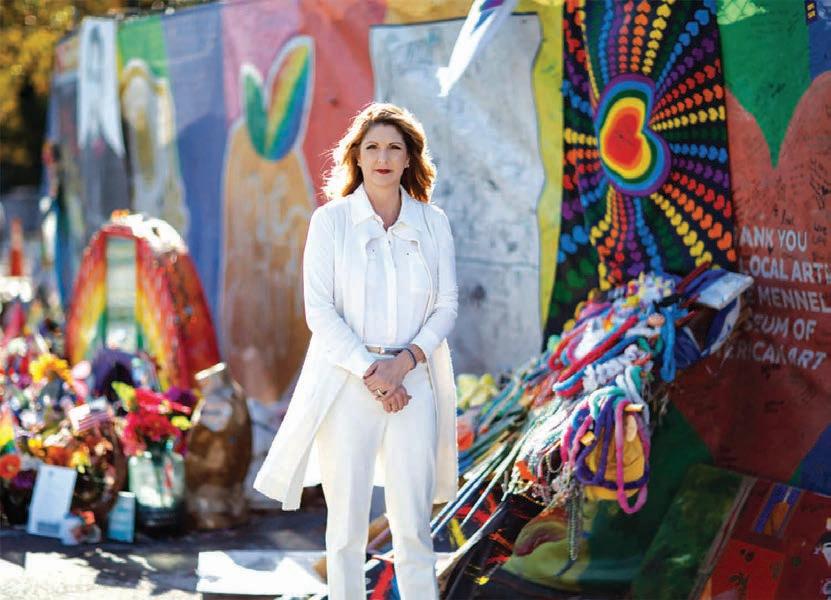
On February 13th, 1991 Barbara lost that lifeline to the community she fell in love with. John, her brother and best friend, died of AIDS. Life would go on, as it did for many of us at that time, until Barbara found a way to channel the celebration of John into a new entity, a nightclub. A friend brought her a proposition and a business plan for a gay bar, and her husband agreed to fund it… if she would run it.
She embraced it even though it had never been her intention to be an owner of a gay business. She wanted to create the neighborhood’s safe space. “It was a blast. It was to me though, going back to a time warp, the club filled with people dancing, and having their friends with them, their straight friends, because that was really important to us when we first started Pulse. We wanted it to be a beautiful clean space where you would be proud to bring your mom. It was really important to us, and it was,” she recalls. “We started off with that mission that everyone who walks in that door is welcome, everyone who walks in is family. That’s how we were.
That’s how the staff was. We were a place unlike other bars where it’s just ‘twinks’ or ‘girls’ or ‘bears’ or just ‘the most gorgeous men with their shirts off’. That is not what
On that June night, she was in Cancun Mexico on a mother/daughter trip celebrating her daughter’s high school graduation. At 2am her time, she got a call she will never forget. It was her manager shouting “He’s shooting! He’s shooting! He’s shooting!” Everything was noisy where she was and she had trouble grasping what he was saying. It did not make sense to her. There had been a shooting elsewhere in Orlando the night before, but they had never had any trouble at Pulse. She asked if he meant the previous shooting. “NO, he is inside Pulse shooting inside right NOW,” was the answer.
“I was completely in a state of shock. I can only explain it as the darkest scariest moments of your life, all I kept saying to my manager was “please tell me no one is dead, please tell me that everyone is OK.” I could not grasp what he was saying. We did not know this was a terrorist attack, we didn’t know –he had gotten out so fast. I started doing a roll call of the staff. Where’s Bobbie? Where’s Kate… just going through everybody. Where’s Brian? Made him try to contact people, find out whether they were still inside or whether they had gotten out,” she says.
She was on a plane back the next morning. “It took me a while to grasp the reaction of the city and of the world. I did not know if one day had passed or five days had passed. I did not have any concept of time. I could not sleep, I could not eat. I was just trying to wrap my brain around what was happening. I was not allowed to leave the house—the people who surrounded me, kept me home.
The press was allowed to be at Pulse, but I wasn’t allowed to be at Pulse. I tried not to watch too much TV because it was too hard. I just wanted to be down there and be with everyone but I was isolated here at home. When it started to click in, it was really hard to digest and understand.”
Four weeks and two days later, when she finally was given possession of Pulse back by the FBI, she walked into her club. “I entered the building and experienced what I can only describe is what happens when a soul leaves a human body. I experienced it when my brother took his last breath, all of a sudden, he was a shell of himself. Pulse was completely a shell of itself. It was gone. The spirit of it was gone. It was not what it was, you could feel it. And I knew instantly that we could not dance in there again.”
CONTINUED ON PAGE 19
By JOHN PAUL KING
“My Best Part,” the English-language title of actor Nicolas Maury’s feature film directorial debut, which opens for a limited theatrical run and simultaneously drops on VOD platforms Feb. 25, is a reasonably suitable name for a movie about an actor with mommy issues, in that it plays on both its main character’s profession and the self-searching battle with his own insecurities which lies at the center of the story, but it is not the original one.
In France, where the film opened in 2020 after being named as an official selection at Cannes, though it was never screened there due to COVID-19, it goes by the title “Chiffon Garçon,” derived from the affectionate nickname bestowed upon its hapless lead by his mother, and it’s easy to understand why the decision was made to change it for English-speaking audiences. The word “chiffon,” which is translated in the subtitles as “napkin” but in French usage typically refers to any rag or cloth used to wipe something clean, is one of those linguistic transplants that conveys a more limited sense in English than it does in its country of origin, and neither “Napkin Boy” or “Rag Boy” really get the point across — besides which, they don’t exactly roll off the tongue.
It’s not uncommon for international films to go by different titles in different countries, of course, so it’s no surprise Maury’s romantic “dramedy” went with that option. It’s worth mentioning, however, because the change of name doesn’t make it any easier to acclimate American audiences to the almost quintessentially French sensibility of his movie.

Maury — known to American audiences from the popular French comedy series “Call My Agent,” which gained a cult following among binge-hungry Netflix viewers during the pandemic — stars as Jérémie, a still-young-but-aging actor in Paris whose career is as much on the skids as his personal life; his relationship with Albert (Arnaud Valois), a handsome veterinarian who clearly loves him, has been sabotaged by his extreme jealousy, and he’s abruptly been fired as the lead in an upcoming movie on a whim from its director. Weighing perhaps most heavily on him, his father has just committed suicide by shotgun, sparking an existential depression that makes his problems feel even more insurmountable. A glimmer of hope appears, however, when he lands an audition for a stage role he seems born to play.
Hoping for a respite from his insecurities while he prepares for it, Jérémie heads off to spend time with his clear-headed mother Bernadette (Nathalie Baye) at her country house, counting on her solace and support to help him find a more positive outlook.
When he arrives, however, he is surprised by the presence of Kévin (Théo Christine), a new handyman whose presence in the household feels like a replacement for his own. Despite the somewhat gloomy set of circumstances that lead into its premise, “My Best Part” is not a heavy affair — at least, not all the time — but aims at the sort of quirky, lighthearted approach favored by most contemporary romcoms. To this end, Maury makes the perfect centerpiece; fey and fragile, with a perennially hangdog expression, he seems cut from the same cloth as many classic cinema clowns — childlike, eternally out of step with the world around him, and just handsome enough to be an appealing romantic figure, yet with enough gravitas behind the eyes to carry the weight when he’s required to get serious. There’s a distinctly European flavor to his comedic persona, a tendency toward sentiment that sometimes leans dangerously close to the maudlin — for American tastes, at least — but there’s also a touch of “l’enfant terrible” that undercuts his most pitiable moments and turns them into shrewd self-satire. He’s also openly, unquestionably, and unapologetically gay, a welcome twist that sets his image apart from that of predecessors like Buster Keaton, Jacques Tati or even Paul Reubens’ Pee-Wee Herman. The chance for LGBTQ audiences to see a classic cinema formula reframed through a queer perspective is obviously a treat, and still a rare enough experience to make it noteworthy. Maury brings his queerness to the screen without a filter, and it’s glorious, whether you find him maudlin or not.
As a director, Maury draws from a rangy set of influences. There’s a nostalgia about his film, a deference to the classics that nevertheless finds expression in a style more in tune with contemporary arthouse cinema than the stylized romantic comedies of the past. At times, the resulting blend feels a bit uneven — the comedy a little bitter, the wisdom a little pat — and veers unpredictably between styles so that we sometimes feel as if we are watching two different movies cut together into one. Nevertheless, he has a keen eye behind the camera, and a boldly intuitive approach to filmmaking that — though it may occasionally disorient us, in the moment — never loses our interest, even when it takes a surreal turn into Jacques Demy territory for a surreal “Hollywood” ending.
If “My Best Part” has a shortfall, it comes in its ambitious screenplay, which perhaps tries to pack too much substance into what feels like it should be as airy as a souffle. Penned by Maury with Sophie Fillières and Maud Ameline, it excels both in its broad satirical strokes — particularly its savage lampoon of fragile show business ego — and in its illumination of Jérémie’s inner struggles. Where its ambitions exceed its grasp are the places where it aims closer to the heart; there’s a yearning for resolution in the relationships that never quite earns fulfillment, instead opting to funnel its accumulated emotional stakes into a climactic crisis involving an adorable puppy, who, for the record, gives a brilliant canine performance.
As for the human actors, Maury dominates the screen, despite sharing it for much of the time with his co-star, 10-time Cesar Award nominee (and four-time winner) and French cinema icon Nathalie Baye. She gives a warm, genuine, and layered performance, but even her grounded presence is not enough to bring full depth to the relationship between their characters, which ultimately feels less important than the stress that’s placed upon it sets us up to expect. Valois, known to American audiences from his powerful performance in 2018’s “B.P.M.,” makes his too-good-to-be-true character seem true, and Christine manages to do the same, even as the film sweeps him along into its barely plausible (but undeniably crowd-pleasing) denouement.
Ultimately, of course, plausibility is not what makes “My Best Part” (or “Chiffon Garçon,” if you prefer) a fun movie — and it is a fun movie, quibbling aside. While it never quite wins our heart, it makes us care about its characters, even the underwritten and overdrawn ones, and in the end, perhaps that’s more important. There’s a truth in it, somewhere, that can’t quite be explained — much in the way that the full French meaning of “chiffon” is not conveyed in English. Something is lost in the translation. For a lot of people, that might make it difficult to enjoy; but for those who can simply give in and appreciate its offbeat charm, it comes highly recommended.
is an unforgettable masterpiece will cure your Valentine’s blues
Hanya Yanagihara’s new novel consists of three novellas
By KATHI WOLFE
“To Paradise,” the new novel by Hanya Yanagihara, editor-in-chief of T: The New York Times Style Magazine and author of the bestselling novel “A Little Life,” is unforgettable.
Yanagihara, 47, an Asian American woman who was born in Los Angeles and grew up in Hawaii, is known for writing about queer (especially, gay male) characters.
Some in the LGBTQ+ community think that Yanagihara portrays queer characters as stereotypes! Others love Yanagihara’s work. Queer author Edmund White has compared “To Paradise” to Tolstoy’s “War and Peace.”
“To Paradise” is a “War and Peace”-like masterpiece.
But with Tolstoy, you know how things end — what happens to Pierre, Prince Andrew, Natasha and their families.
“To Paradise” consists of three novellas. It takes place over 200 years and features characters with the same names in different time periods and families.
It’s beautifully written. You’ll care about the characters. But, at the end, you won’t know what will happen to them.
The first novella “Washington Square,” is an homage to the Henry James novel with the same title, takes place in 1893 in Greenwich Village in New York. It is much like a James or Edith Wharton novel. It’s upper-crust families are preoccupied with status, wealth and ensuring that their children marry well.
In Yanagihara’s reimagining of American history, America didn’t become a unified nation of states after the Civil War.
In her imagining, after the war, America became a loosely connected set of territories. New York is in the territory called the Free States. In the Free States, both same-sex marriage and arranged marriages are legal.
David Bingham, who is gay and prone to “nervous troubles,” lives in a mansion with his grandfather. His grandfather is concerned that David will have difficulty finding a husband because of his “illnesses.” He arranges for David to marry Charles Griffith, a rich man. Charles falls in love with David.
But David doesn’t want to marry Charles. He loves Edward Bishop, a poor man who teaches music. David longs to escape from his grandfather — to live “in color.” He and Ed are set to go to California, where, unlike in the Free States, life is risky for gay people.
The second novella of “To Paradise,” “Lipo-Wao-Nahele,” is set in late 20th century New York in the same Greenwich Village mansion and in Hawaii.
In the first section of this novella, a paralegal, also, named David Bingham, lives with his wealthy lover, also named Charles Griffith.
David struggles with his conflicted feelings about Charles.
“He knew he should feel infantilized by how obviously unequal their life together was,” Yanagihara writes, “and yet he didn’t ... it was a relief not to think.”
“To
By Hanya Yanagihara
c.2022, Doubleday
$32.50 | 720 pages

David grew up in Hawaii. He became estranged from his father, a descendent of Hawaiian royalty.
The second, and longest, section of this novella is in the form of a seemingly endless letter from David’s father to David. “To Paradise” is a gripping book. But reading this letter is like being a child traveling with your parents. You keep wondering: are we there yet?
“Zone Eight,” the third novella is set in 2093. It spans several decades (going back to the 2070s) over a serious of pandemics. New York is now Zone Eight and run by an authoritarian government.
There is no Internet, access to books is restricted and flies monitor conversations. Pandemic life in “Zone Eight” makes our COVID-19 era seem like carefree.
In “Zone Eight,” yet another Charles Griffith, a research scientist, tries to keep his granddaughter Charlie safe.
“Zone Eight,” is narrated by Charlie and by Charles. Charlie is in an arranged marriage to a gay man. At age 10, she became intellectually disabled from medication she received when she had a virus.
Charlie is an interesting character. She works at a lab and knows what’s going on in her life and world. She wants to be loved.
But Charlie’s voice is often flat and childlike. I can’t help but think that there’s some ableism in Yanagihara’s depiction of Charlie.
Despite this quibble, “To Paradise” is an enthralling book. It may make you cry or squirm, but you won’t stop reading it.
By JOE PHILLIPS
There’s a twisted allure to bad boys and mean girls. Me, I like nasty toys — vehicles so wild and crazy they overrule common sense. A Bronco? That’s not the name for a mild-mannered ride. Even the Defender 90 sounds like some sort of sci-fi creation from a “Star Trek” episode. But then, when it comes to being seduced by an untamed beast, perhaps Spock and the Borg say it best: Resistance is futile.
$30,000
MPG: 20 city / 24 highway
0 to 60 mph: 7.7 seconds
Last year I raved about the return of the four-door Ford Bronco after a 25-year absence. This time I test drove the two-door model, which is even more playful. It’s also 16 inches shorter, which somehow makes the bold and brawny styling even more pronounced. This includes two upright protruding hood handles, which look like devil’s horns but can be used to help tie down a kayak or camping gear on the roof. As with a sports coupe, the two-door Bronco exudes wanderlust and excitement. Ground clearance is really high, but it’s great for driver visibility. To help you climb inside, chunky grab handles are tastefully sculpted into each end of the dashboard. And while the back seats aren’t the easiest to access, they are comfortable once you get there. Choice of two brisk engines, along with some butch-sounding trim levels: Big Bend, Black Diamond, Badlands and Wildtrak. A nifty Trail Assist feature allows you to make turns that are sharper than expected, and the one-pedal driving system automatically applies the brakes just by lifting your foot off the accelerator. Other niceties: Standard all-wheel drive, an optional manual transmission and removable roof and doors. The tall roof also helps the cabin seem a bit more spacious, and those vinyl seats and rubber surfaces can easily be hosed down after a day of off-roading. Despite its Spartan appearance, this stubby SUV boasts the latest infotainment and safety features, but at a price. Fully loaded, a two-door Bronco can easily top $60,000.
$50,000 MPG: 18 city / 21 highway 0 to 60 mph: 7.6 seconds
As with the Ford Bronco, the Land Rover Defender 90 leans into its retro roots. But the styling here is far more futuristic and the off-road prowess much more formidable. To overcome challenging landscapes, a Terrain Response system lets you choose from various modes: Grass/gravel/snow, mud/ruts, rock crawl and wade. The adjustable air-suspension system raises and lowers the vehicle, allowing the Defender to travel through streams up to 35.4 inches deep while a sensor detects the depth automatically. The novel tailgate is hinged at the side, with a full-spare wheel attached — an anomaly in today’s world of donut spare tires. Though the four- and six-cylinder engines are mighty enough, this year there’s a new supercharged 518-hp V8 that can thrust this studly two-door SUV from 0 to 60 mph in just 4.9 seconds. But despite such gusto, Land Rover also sprinkles in plenty of glitz. This includes the exquisite and high-quality interior fit and finish, with wood-grain trim, tasteful ambient lighting and heated/ cooled 12-way seats made of fine faux-suede material. There’s also smartphone integration, in-car Wi-Fi and a large infotainment touchscreen. And forget Coachella or any world-class concert hall — the optional 14-speaker Meridian stereo sounds just as nice. Like the Bronco, such options don’t come cheap — up to $120,000 for a completely decked-out Defender 90. And both of these two-door vehicles are only so practical, with less passenger room and cargo space than in a four-door SUV. But oh my, these adult Tonka toys are a helluva lot of fun to drive.


CONTINUED FROM PAGE 15
If the Universe had not learned anything, it needed to learn this: it could burn Barbara Poma’s fabulousness down, but she will always rise with the next new hope. That new hope is the onePULSE foundation. The foundation is creating a monument of wonder in the spot where the worst LGBTQ massacre occurred. President Biden has already signed the bill with the national monument designation. It will consist of a permanent museum, a permanent memorial, and a “Survivor’s Walk” which is a walkway from Pulse to the trauma unit that saved so many lives.
onePULSE also features an education program based on intersectionality. “96 percent of our victims that night were black and brown. It is a large consideration to incorporate that fact,” Barbara states. It includes a tribute program to the fallen 49 called Think, Relate and Influence. It trains organizations on inclusivity. They have a safe space education for religious pastors on turning churches to be more affirming.
Barbara has also laid down the gauntlet of making the 49 more than victims, she has opened the door for them to be angels. She has given the means for each of them to find a sense of immortality by sending off into the world others who will carry on their individual inspiration.
“We have our 49 Legacy Scholarship, which we have a scholarship in each one of the victim’s names, that was designated by their family members in that victims career aspirations or career where they achieved it, for example, Alcamenda Alverez wanted to become a nurse but had not achieved it yet, so her family set up a scholarship for people seeking a nursing career. We are in our third cycle. These range from EMT, to cosmetology to medical. These are national scholarships opened to everyone. The criteria for recipients is how can you move forward the legacy of that one of the 49 angels.”
Working with the commissions for Oklahoma City and 9/11, Barbara gained guidance. Each surveyed their communities on how people should feel visiting the memorial site for each horror. Oklahoma City and New York designed theirs to capture “grief, anger, sorrow, loss, sadness.” They succeeded. Those are the feelings you experience in visiting those sites.
Pulse families ask for these to be the take-away of the new memorial: a feeling of love, hope, community, courage, strength and acceptance. “Our families want this to be a beautiful space that people want to come to. We want people to know the joy of Pulse where people were having the time of their lives. Our goal, when you visit the memorial and museum when they are ready, is that you take the spirit with you and impart it then wherever you live, “ Barbara explains.
Barbara Poma has a vision. She is on a mission to make the Pulse memorial a reality, she won’t quit until it is done, and she WILL succeed. She will stand yet again in a rainbow of hope.
She still talks to her brother John, looking skyward she asks, “Really, is this what this was all meant to be about?”
She does not get a reply. I ended our conversation with this: Barbara, I did not know your brother, but as a gay man with a kid sister myself, I know, I KNOW he is looking down at you right now.
And he is very, very proud.
ROB WATSON is the host of RATED LGBT RADIO, a national podcast and he’s one of the founders of the evolequals.com
A gay dad, business man, community activist and a blogger/writer, Watson is a contributor to the Los Angeles Blade covering entertainment, film, television, and culture with occasional politics tossed in.