Losangelesblade.com, Volume 4, Issue 49, December 04, 2020
Important Facts About DOVATO
This is only a brief summary of important information about DOVATO and does not replace talking to your healthcare provider about your condition and treatment. What is the most important information I should know about DOVATO?
If you have both human immunodeficiency virus-1 (HIV-1) and hepatitis B virus (HBV) infection, DOVATO can cause serious side effects, including:
• Resistant HBV infection. Your healthcare provider will test you for HBV infection before you start treatment with DOVATO. If you have HIV-1 and hepatitis B, the hepatitis B virus can change (mutate) during your treatment with DOVATO and become harder to treat (resistant). It is not known if DOVATO is safe and effective in people who have HIV-1 and HBV infection.
• Worsening of HBV infection. If you have HIV-1 and HBV infection, your HBV may get worse (flare-up) if you stop taking DOVATO. A “flare-up” is when your HBV infection suddenly returns in a worse way than before. Worsening liver disease can be serious and may lead to death.
° Do not run out of DOVATO. Refill your prescription or talk to your healthcare provider before your DOVATO is all gone.
° Do not stop DOVATO without first talking to your healthcare provider. If you stop taking DOVATO, your healthcare provider will need to check your health often and do blood tests regularly for several months to check your liver.
What is DOVATO?
DOVATO is a prescription medicine that is used without other HIV-1 medicines to treat human immunodeficiency virus-1 (HIV-1) infection in adults: who have not received HIV-1 medicines in the past, or to replace their current HIV-1 medicines when their healthcare provider determines that they meet certain requirements. HIV-1 is the virus that causes Acquired Immune Deficiency Syndrome (AIDS). It is not known if DOVATO is safe and effective in children.
Who should not take DOVATO?
Do not take DOVATO if you:
• have ever had an allergic reaction to a medicine that contains dolutegravir or lamivudine.
• take dofetilide.
What should I tell my healthcare provider before using DOVATO?
Tell your healthcare provider about all of your medical conditions, including if you:
• have or have had liver problems, including hepatitis B or C infection.
• have kidney problems.
• are pregnant or plan to become pregnant. One of the medicines in DOVATO (dolutegravir) may harm your unborn baby.
° Your healthcare provider may prescribe a different medicine than DOVATO if you are planning to become pregnant or if pregnancy is confirmed during the first 12 weeks of pregnancy.
° If you can become pregnant, your healthcare provider will perform a pregnancy test before you start treatment with DOVATO.
° If you can become pregnant, you should consistently use effective birth control (contraception) during treatment with DOVATO.
° Tell your healthcare provider right away if you are planning to become pregnant, you become pregnant, or think you may be pregnant during treatment with DOVATO.
• are breastfeeding or plan to breastfeed. Do not breastfeed if you take DOVATO.
° You should not breastfeed if you have HIV-1 because of the risk of passing HIV-1 to your baby.
° One of the medicines in DOVATO (lamivudine) passes into your breastmilk.
° Talk with your healthcare provider about the best way to feed your baby.
Tell your healthcare provider about all the medicines you take, including prescription and over-the-counter medicines, vitamins, and herbal supplements.
Some medicines interact with DOVATO. Keep a list of your medicines and show it to your healthcare provider and pharmacist when you get a new medicine.
• You can ask your healthcare provider or pharmacist for a list of medicines that interact with DOVATO.
• Do not start taking a new medicine without telling your healthcare provider. Your healthcare provider can tell you if it is safe to take DOVATO with other medicines. What are possible side effects of DOVATO?
DOVATO can cause serious side effects, including:
• Those in the “What is the most important information I should know about DOVATO?” section.
• Allergic reactions. Call your healthcare provider right away if you develop a rash with DOVATO. Stop taking DOVATO and get medical help right away if you develop a rash with any of the following signs or symptoms: fever; generally ill feeling; tiredness; muscle or joint aches; blisters or sores in mouth; blisters or peeling of the skin; redness or swelling of the eyes; swelling of the mouth, face, lips, or tongue; problems breathing.
• Liver problems. People with a history of hepatitis B or C virus may have an increased risk of developing new or worsening changes in certain liver tests during treatment with DOVATO. Liver problems, including liver failure, have also happened in people without a history of liver disease or other risk factors. Your healthcare provider may do blood tests to check your liver.
Tell your healthcare provider right away if you get any of the following signs or symptoms of liver problems: your skin or the white part of your eyes turns yellow (jaundice); dark or “tea-colored” urine; light-colored stools (bowel movements); nausea or vomiting; loss of appetite; and/or pain, aching, or tenderness on the right side of your stomach area.
• Too much lactic acid in your blood (lactic acidosis). Lactic acidosis is a serious medical emergency that can lead to death. Tell your healthcare provider right away if you get any of the following symptoms that could be signs of lactic acidosis: feel very weak or tired; unusual (not normal) muscle pain; trouble breathing; stomach pain with nausea and vomiting; feel cold, especially in your arms and legs; feel dizzy or lightheaded; and/or a fast or irregular heartbeat.
• Lactic acidosis can also lead to severe liver problems, which can lead to death. Your liver may become large (hepatomegaly) and you may develop fat in your liver (steatosis). Tell your healthcare provider right away if you get any of the signs or symptoms of liver problems which are listed above under “Liver problems.” You may be more likely to get lactic acidosis or severe liver problems if you are female or very overweight (obese).
• Changes in your immune system (Immune Reconstitution Syndrome) can happen when you start taking HIV-1 medicines. Your immune system may get stronger and begin to fight infections that have been hidden in your body for a long time. Tell your healthcare provider right away if you start having new symptoms after you start taking DOVATO.
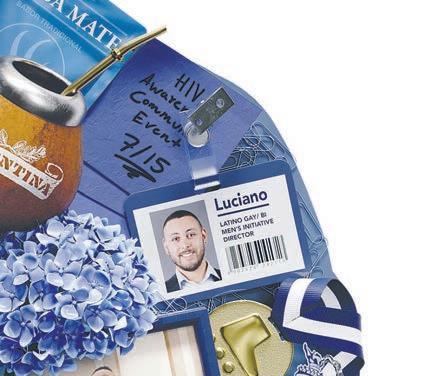
SO MUCH GOES INTO WHO I AM
HIV MEDICINE IS ONE PART OF IT.
Why could DOVATO be right for you? DOVATO is proven to help control HIV with just 2 medicines in 1 pill. That means fewer medicines* in your body while taking DOVATO. It’s proven as effective as an HIV treatment with 3 or 4 medicines. Learn more about fewer medicines at DOVATO.com
DOVATO is a complete prescription regimen to treat HIV-1 in adults who have not received HIV-1 medicines in the past or to replace their current HIV-1 medicines when their doctor determines they meet certain requirements.
Results may vary.
*As compared with 3- or 4-drug regimens.
What are possible side effects of DOVATO? (cont’d)
• The most common side effects of DOVATO include: headache; nausea; diarrhea; trouble sleeping; tiredness; and anxiety.
These are not all the possible side effects of DOVATO. Call your doctor for medical advice about side effects. You are encouraged to report negative side effects of prescription drugs to the FDA. Visit www.fda.gov/medwatch, or call 1-800-FDA-1088.
Where can I find more information?
• Talk to your healthcare provider or pharmacist.
• Go to DOVATO.com or call 1-877-844-8872, where you can also get FDA-approved labeling.
August 2020 DVT:4PIL
Trademark is owned by or licensed to the ViiV Healthcare group of companies.
New to treatment? Considering a switch? Ask your doctor about DOVATO.
Worst week of pandemic yet in LA County Newsom warns he may reinstate stay-at-home order
By BRODY LEVESQUE
Los Angeles County public health officials say that the one day rise in coronavirus cases confirms the worst fears of officials that the pandemic’s serious spiral into levels recorded Tuesday, are indicative that circumstances are rapidly approaching a place where containment may not be possible unless drastic measures are taken.
“Today, Tuesday, December 1, 2020, is the worst day thus far of the COVID-19 pandemic in Los Angeles County,” Dr. Barbara Ferrer, Director of Public Health said. “However, it will likely not remain the worst day of the pandemic in Los Angeles County. That will be tomorrow, and the next day and the next as cases, hospitalizations and deaths increase,” she added.
The Los Angeles County Department of Public Health announced the highest number of new COVID-19 cases and people hospitalized with COVID-19 that L.A. County has ever experienced throughout the pandemic.
The department has confirmed 46 new deaths and 7,593 new cases of COVID-19. The number of new COVID-19 cases significantly surpassed the previous high of 6,124 new cases seen last week, and signals that the virus is infecting more people at a faster rate than ever seen in L.A. County before. The daily test positivity rate today is almost 12%, up from 7% one week ago.
The county surpassed 400,000 cumulative coronavirus cases Monday as it broke a record for COVID-19 hospitalizations.
“Every resident and every business needs to take immediate action if we are to dampen this alarming surge. We are in the middle of an accelerating surge in a pandemic of huge magnitude,“ Ferrer warned. “This is not the time to skirt or debate the safety measures that protect us because we need every single person to use every tool available to stop the surge and save lives.”
There are 2,316 people with COVID-19 currently hospitalized and 24% of these people are in the ICU. This exceeds the peak of 2,232 people hospitalized with COVID-19 during the July surge. The daily number of people hospitalized with COVID-19 has increased nearly every day since November 1 when the daily number of people hospitalized with COVID-19 was 799.
Speaking to reporters during his regularly scheduled weekly remote press conference, California Gov. Gavin Newsom warned that as California starts to see record numbers of coronavirus cases and overwhelmed hospitals, he may need to reinstate a stay-at-home order. The Governor last week ordered a 10 pm to 6 am curfew in cities and counties that were experiencing surging new cases and increased hospitalizations.
Currently, 51 of 58 counties are in the “purple” tier of the state’s COVID-19 system, meaning they are under the strictest restrictions. Those counties also account for most of the state’s population.
“If these trends continue, we’re going to have to take much more dramatic, arguably drastic, action,” Newsom said. “Current projections show hospitalizations could increase two to three times the current amount in one month.”
According to projections by the California Department of Health made public during the Governor’s press conference, overall the state is expected to be at 112 percent hospital bed capacity by December 24 without stronger measures by officials to intervene.
A spokesperson told the Blade Tuesday that officials will determine whether to reimpose a stay-at-home order for the counties worst hit in the next day or two which would include Los Angeles, Orange, San Diego, and Ventura Newsom also announced Monday assistance for small businesses suffering financially because of COVID-19 restrictions and lower sales.
Items included an automatic three-month extension for those reporting less than $1 million in sales tax; interest-free payments for companies with up to $5
million in sales tax; and $500 million in grants of up to $25,000 each available to small businesses.
“California’s small businesses embody the best of the California Dream and we can’t let this pandemic take that away,” Newsom told reporters.
“We have to lead with health to reopen our economy safely and sustainably while doing all we can to keep our small businesses afloat. With this financial assistance and tax relief, California is stepping up where the federal government isn’t. By providing potentially billions in immediate relief and support, our small businesses can weather the next month as we continue partnering with the Legislature to secure additional funding and investments in small businesses in the new year.”
In Los Angeles County, ‘The Keep Los Angeles County Dining Grant Program’ started this week to assist restaurants that have lost business due to coronavirus health regulations.
Eligible eateries — excluding those in the cities of Los Angeles and Pasadena — can receive up to $30,000 in assistance for employee payroll, capital to continue operations, payment of outstanding business expenses and adaptive business practices needed to remain open.
A total of roughly $5.6 million is available, split among the county’s five supervisorial districts.
“This pandemic and the recent closure of outdoor dining has been devastating to our restaurants and restaurant workers,” LA County Supervisor Janice Hahn said in a statement. “These grants are meant to help as many restaurants as possible make ends meet and make it through this crisis. We know it won’t be enough. We need another federal stimulus package to get a lifeline to all of our businesses and workers that are struggling.”
Additional program information is available at keeplacountydining.lacda.org or by calling 626-943-3833
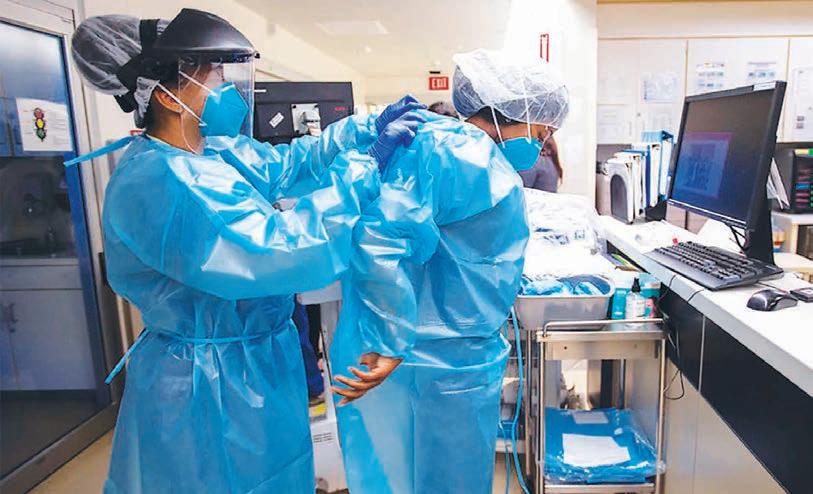
Doctors and nurses care for COVID-19 patients in the ICU and Emergency Department at LACUSC Medical Center. (Photo courtesy Los Angeles County)
Lawmakers, Equality California map out 2021 legislative priorities Teacher training,
By BRODY LEVESQUE
criminal justice reform
among hot topics
As lawmakers from the LGBT Caucus prepare for the new 2021 session of California’s legislative body, priorities are already being eyed in several key areas. However, the ongoing coronavirus pandemic is always at the forefront of considerations.
The 2020 legislative session was interrupted a few times as lawmakers and staff tested positive for the disease. There were also instances of lawmakers skipping scheduled hearings or votes after exposure to people who had tested positive. According to the Associated Press, 2020 marked a departure from 158 years of continuous deliberation and sessions by both the state’s Senate and the Assembly.
For outgoing LGBT Caucus Chair, Sen. Scott Wiener, (D-SF) some issues needing to be addressed are a carry-over from last year’s session. Speaking to the Blade Tuesday by phone, Wiener said that while he was happy that several critical bills were passed and then signed into law in September by Gov. Gavin Newsom, there are still gaps to be filled in implementation of at least one critical bill.
SB 932, which aligns with emergency regulations announced by the California Department of Public Health this past July, requires better and more timely collection and reporting of communicable disease data from providers and laboratories on a patient’s gender identity and sexual orientation. The problem, however, is that the data is still not available.
The Blade pointed out that its recent audit of California’s online portal to the state’s COVID19 response revealed that there was no data available detailing the numbers of LGBTQ people affected by the virus. Wiener agreed telling the Blade, “I’ve recently had two separate tests [coronavirus] and while there was a place to indicate my gender- there wasn’t any to indicate my being gay or LGBT.”
Wiener said that among issues under consideration include a bill on surgical procedures for intersex babies, a bill for funding HIV centers that are able to execute rapid testing for syphilis, and budgetary requests to expand funding for transgender programs.
He also noted that COVID hasn’t changed the urgent need to address the housing crisis in California, which directly impacts the LGBTQ community. In addition to a lack of housing stock there are not enough subsidized homes for low income Californians coupled with the fact that renters in the state still are facing instability.
Wiener also wants expanded efforts in addressing mental health concerns as well as enacting reforms in the criminal justice system in the state particularly for Black and Latinx residents.
Echoing the senator’s concerns, Equality California’s Rick Zbur told the Blade that his organization is looking at ways to work together in the area of criminal justice reform with lawmakers in the Black Caucus offering proactive support.
In a Monday phone call with the Blade, Zbur also said that focusing on the needs of the one out of five LGBTQ+ families enrolled in social safety net programs will be a priority especially in devoting resources and ensuring political representation that reflects their needs.
Zbur said that another primary focus will be working with lawmakers and educators across the state for LGBT competency training for teachers. By ensuring awareness he noted, it reduces the likelihood of bullying or exclusionary behaviors especially in increasing awareness for Trans students and non-binary/queer students.
Zbur’s legislative goals mirror Wiener’s in areas of housing, mental health, and especially in expanding services for low-income LGBTQ people and vulnerable seniors.
Assemblymember Evan Low, who was elected in 2014 to represent Silicon Valley in the State Assembly, will serve as chair of the LGBTQ Caucus in the coming session, while Senatorelect Susan Talamantes Eggman, currently an Assemblymember from Stockton, will serve as vice chair.
“The pandemic is our first, second and last priority this coming year, and that’s because the virus poses so many different challenges,” Low said to the Blade in an emailed statement.
“We know state health officials need to be transparent in tracking cases and deaths in the LGBTQ+ community, but we also need to tackle the devastating economic toll the virus has had on LGBTQ+ businesses and workers. Once we have a cure in hand, the focus will shift to distributing a vaccine and we know the LGBTQ+ community will play a vital role in leading those efforts.”
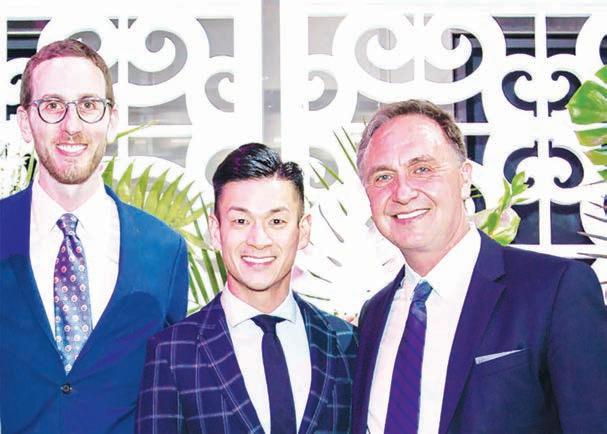
Sen. SCOTT WIENER, Assembly member EVAN LOW and Equality California Executive Director RICK CHAVEZ ZBUR at an inaugural celebration for California Insurance Commissioner Ricardo Lara hosted by Equality California Institute in Sacramento on Jan. 7, 2019. (Photo courtesy of Equality California)
Elliot Page comes out as transgender, non-binary ‘I
By PARKER PURIFOY
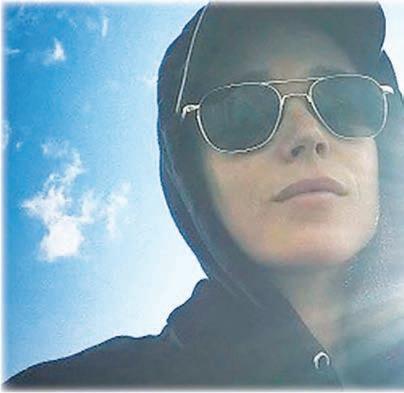
Oscar-nominated actor and star of Netflix’s “The Umbrella Academy” Elliot Page, came out Tuesday as transgender and non-binary in a message posted to his social media accounts.
“I love that I am trans. And I love that I am queer,” he said in the message. “And the more I hold myself close and fully embrace who I am, the more I dream, the more my heart grows and the more I thrive. To all the trans people who deal with harassment, self-loathing, abuse and the threat of violence every day: I see you, I love you and I will do everything I can to change this world for the better.”
Page became a breakout star with his role in “Juno” where he played a teenager dealing with an unplanned pregnancy. He earned nominations for an Academy Award, a BAFTA Award, a Golden Globe Award and others.
In his coming out message, Page mentioned his fear at being discriminated against because of his gender identity.
“The statistics are staggering. The discrimination towards trans people is rife, insidious, and cruel, resulting in horrific consequences,” he said. “To the political leaders who work to criminalize trans health care and deny our rights to exist and to all those with a massive platform who continue to spew hostility towards the trans community: You have blood on your hands.”
Before coming out as trans, Page was one of the most prominent out gay actors in Hollywood. By coming out as trans, he joins a small yet slowly growing list of openly gender non-conforming creators in the business.
Page has also held roles in Christopher Nolan’s “Inception,” “Whip It!” and Sony’s reboot of “Flatliners.” He previously produced and starred in movies “Tallulah” and “Freeheld,” and directed
“There’s Something in The Water,” a documentary on environmental racism in Canada.
“Elliot Page has given us fantastic characters on-screen, and has been an outspoken advocate for all LGBTQ people,” GLAAD Director of Transgender Media Nick Adams said in a statement. “He will now be an inspiration to countless trans and non-binary people. All transgender people deserve the chance to be ourselves and to be accepted for who we are. We celebrate the remarkable Elliot Page today.”
Human Rights Campaign President Alphonso David also congratulated Page.
“Thank you for sharing your truth with us, and for shining a bright light on the challenges too many in our community face,” tweeted David. “We are proud of you, and we love you. And we will never stop fighting alongside you for change.”
Canadian Prime Minister Justin Trudeau in his own tweet thanked Elliot “for sharing these words and speaking your truth.”
“Your bravery and strength are inspiring, and your authenticity and vulnerability will mean so much to so many,” said Trudeau. “Sophie and I wish you the very best, and we send you — and the trans community — all our support.”
Page was born and raised in Nova Scotia.
‘It’s Not Over’ WeHo pop-up exhibit to honor early AIDS fight Amplifying voices of activists and community organizers
Every year we have the privilege of being able to celebrate, remember, and mourn those who lost their lives to AIDS. Dec. 1 marks World AIDS Day where people come together to remember the shared history of the fight against AIDS, but more broadly, oppression against members of the LGTBQ+ community.
This year, in particular, is unique due to the fact that we are currently in a global pandemic, which makes it difficult for people to come together. More than 700,000 people have died of HIV/AIDS in the U.S. since the beginning of the HIV epidemic in the 1980’s and nearly 13,000 people with AIDS in the United States die each year.
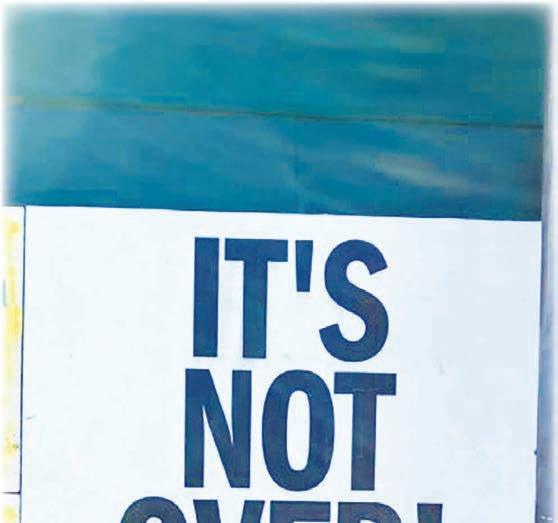
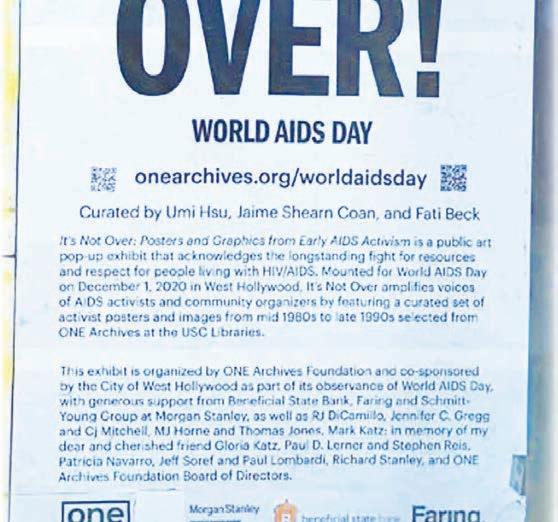
The ONE National Gay and Lesbian Archives at the University of Southern California Libraries put together an exhibit in the heart of West Hollywood that contains LGBTQ+ artwork and messages from organizations like ACT-UP who were pivotal in challenging homophobia and stigma against the LGBTQ+ community. The exhibit is titled “It’s Not Over” in an effort to show the population that the fight against AIDS and homophobia is a battle that needs to be continued and is something that shouldn’t be forgotten.
According to the ONE Archives Foundation, “It’s Not Over” amplifies voices of AIDS activists and community organizers by featuring a curated set of activist posters and images from the mid 1980s to late 1990s selected from the ONE Archives.
One of the main artists that was featured at the exhibit was Keith Haring who was a leader in the fight against the AIDS epidemic. There were many posters that had a picture of Keith Haring with the statement “STOP THE CHURCH” which was a statement against certain churches homophobic practices.
One of Keith Haring’s pieces was a great reminder of how policy-making has/had the power to reinforce homophobia. The piece with the “No on 64” writing on it was a direct response to Proposition 64 which, if passed, would have classified AIDS as a communicable disease which would have led to further persecution of LGBTQ+ individuals.
California Proposition 64, or the Acquired Immune Deficiency Syndrome Act of 1986, would have declared that Acquired Immune Deficiency Syndrome (AIDS) and the “condition of being a carrier” of the virus that causes AIDS are communicable diseases. It would have required the State Department of Health Services to add these conditions to the list of diseases that must be reported.
Because AIDS cases are already being reported, the main impact of Proposition 64 would have been to require of public health officials that they were mandatorily required to report to health authorities about those who are “carriers of the AIDS virus.” The
By NOAH CHRISTIANSEN
measure was defeated in part due to the activists like Haring.
Artwork and messages like these serve as a perfect reminder that this fight isn’t over and that we should recognize all of the effort put into decreasing stigma.
Another noticeable part of the exhibit were posters of Rev. Carl Bean with a pink triangle behind him. For those that don’t know, Rev. Carl Bean was one of the first pastors of a church to openly accept LGBTQ+ people. The strides that Rev. Carl Bean made in the LGBTQ+ community were immeasurable. Unity Fellowship Church, Los Angeles (UFCLA) was founded in 1982 by Bean for openly gay and lesbian African Americans.
The city of West Hollywood remembers the AIDS crisis of the 80’s all too well because of its hard work and effort for decades trying to eradicate HIV/AIDS as well as the stigma associated with it. Historically, West Hollywood was “one of the first government entities to provide social services grants to local HIV/AIDS organizations” West Hollywood’s Mayor, Lindsey P. Horvath, recognizes this telling the Blade in an emailed statement;
“The City’s annual recognition of World AIDS Day is a chance for us each to stop and take note of the extraordinary loss that our community has experienced during nearly four decades, as well as our remarkable resilience in the face of that loss.” She went on to say, “So many of our friends, neighbors, and loved ones have been taken due to HIV and AIDS; yet we continue our fight to end their transmission through education, access to medical care, and resources for ALL people. Our reflection and commemoration is an occasion to deepen our resolve to our City’s vision of ending HIV and AIDS.”
Now, although exhibits like these are important to challenge stereotypes and stigmas used against the LGBTQ+ community, many might ask what next?
The City of West Hollywood has special plans to eradicate HIV/AIDS in their city. According to the City of West Hollywood, “The City of West Hollywood actively participates in the development of programs that can bring awareness about the HIV/AIDS epidemic and services to people living with HIV/AIDS. In January 2015, the City announced its vision to become an ‘HIV Zero’ city. The City is currently implementing its HIV Zero Initiative.”
Exhibits and initiatives show remembrance and efforts to eradicate HIV/AIDS and the stigma associated with it. The “It’s Not Over” exhibit is located on 8954 Santa Monica Blvd. in WeHo.
Whether it be an AIDS quilt or a pop-up exhibit–remembering those who stood with the LGBTQI+ community in the ongoing fight against AIDS is important.
‘It’s Not Over’ exhibit in West Hollywood (Blade photo by Noah Christiansen)
AIDS Day panelists see parallels to COVID
Disproportionate
This World AIDS Day some of LA’s voices who survived the AIDS crisis spoke about their role and the challenges faced in the age of COVID. The Blade held an online panel with prominent figures in the LGBTQ+ community in honor of World AIDS Day 2020.
Rob Watson, host of Rated LGBT Radio Hollywood, moderated, guiding the discussion and asking questions about everything ranging from the organization ACT-UP to the history behind the HIV/AIDS crisis in the 1980s. In the context of the coronavirus, there are a litany of comparisons to be made between the AIDS crisis and COVID-19. In addition to Watson, Richard Zaldivar, Mary Lucey, Karen Ocamb, Thomas Davis, and John J. Duran participated.
The panel kicked off with everyone sharing their names, titles, and how they worked to help make change during the AIDS crisis and how we can combat issues facing the LGBTQ+ community today.
Duran, former city council member for the city of West Hollywood, started the discussion off in a serious tone where he described the historical implications of the AIDS crisis.
“In 1975, six years before AIDS started, homosexuality was illegal. When HIV started, we had just started this process of coming out,” Duran said.
The issue of coming out was highlighted by Duran, but he then noted that “you couldn’t seek the shelter of the closet” because the symptoms of AIDS cannot be hidden. This set a somber tone as the panelists talked about their specific experiences and challenges that they dealt with during the crisis.
By NOAH CHRISTIANSEN
Mary Lucey, diagnosed with HIV in 1989, talked about how she lost friends and family members because of her support for the LGBTQ+ population. People didn’t want to be associated with her because of her proximity to the disease along with her vocal support for ACT-UP and activism for trying to get access to life-saving drugs.
It wasn’t just losing support from friends and family, but it was literally about losing friends and family due to the disease.
Karen Ocamb, the Blade’s former news editor, described her experiences and how she would have to watch people who were incredibly sick die days after they entered the hospital.
“I lost 100 plus friends. I stopped counting in 1990 — I have PTSD because of that,” Ocamb told the panel.
On a community level, there were a lot of coalitions that were created during the HIV/AIDS crisis. There was a large
discussion surrounding the lesbians that organized to help the gay men dying from AIDS. Lucey noted, “We [lesbians] were organizers.”
Duran commented on this saying, “I had a lot of opinions that I had to see were wrong.” Duran noted that this was in the context of how the LGBTQ+ community was able to come together regardless of their differences.
“Although people relegate HIV/AIDS to the 1980s, we cannot forget that these issues still plague our communities,” Ocamb pointed out.
Thomas Davis, the youngest person on the panel said, “A lot of the challenges, seem to be around the same thin — not being educated, not being able to access treatment.”
In the context of the coronavirus, there are some stark similarities between AIDS and the global pandemic –specifically with access to treatment. Davis commented on this by talking about what it’s like to be a gay Black man living with HIV and how the rhetoric surrounding the coronavirus is very similar to the rhetoric during the AIDS crisis – on top of this, the fact that both AIDS and the coronavirus affect Black individuals disproportionately proves that these viruses get politicized and proves the need for groups coming together.
Zaldivar, founder and executive director of The Wall Las Memorias Project, a nonprofit organization dedicated to promoting wellness and preventing illness among Latino populations affected by HIV/AIDS, talked about how marginalized groups need to help other marginalized groups. The event was co-sponsored by the Ariadne Getty Foundation.
A crossroads in HIV/AIDS fight
Will Biden build off Trump plan or go his own way?
By CHRIS JOHNSON | cjohnson@washblade.com
With the transition underway from President Trump to President-elect Joe Biden, advocates in the fight against HIV/AIDS are at a crossroads on whether to hold firm or seek a change in plans as the Department of Health & Human Services is floating an updated National AIDS Strategy that would carry over into the next administration.
The decision on the way forward carries high stakes for people in the LGBTQ community, who continue to become infected at higher rates. As documented by the draft 87-page document made public on Tuesday, gay and bisexual men make up 67 percent of new infections. In new data, the draft report also finds 14 percent of transgender women have HIV, including 44 percent of Black transgender women.
A key component of the draft document, the first update on the National AIDS Strategy since the Obama administration in 2015, is the Trump administration’s plan to end the domestic HIV epidemic by 2030. The cross-agency, PrEP-centric initiative was one of a few policies during the Trump administration that stood out as beneficial to the LGBTQ community, despite an overall anti-LGBTQ record.
“The HIV Plan covers the entire country, has a broader focus across federal departments and agencies beyond HHS and all sectors of society, and addresses the integration of several key components that are vital to our collective work, including stigma, discrimination and social determinants of health,” the draft report says in the introduction.
Carl Schmid, executive director of the HIV+Hepatitis Policy Institute, said in a statement the updated draft strategy makes additional commitments on the uptake of PrEP, eliminating stigma and addressing disparities in priority populations.
“It is also reassuring to see an emphasis on the integration of efforts related to the syndemics of viral hepatitis, sexually transmitted infections, substance use and mental health along with a focus on stigma and discrimination and the social determinants of health,” Schmid said.
As part of the draft review process, which is set to last until Dec. 14, HHS asks interested parties to submit comments in consideration for the final report. The final report is expected to come out in mid-January 2021, an HHS spokesperson told the Washington Blade.
In contrast, Biden has campaigned on beating HIV by 2025, although the strategy isn’t as thorough as the plan developed by HHS during the current administration. In his World AIDS Day statement on Tuesday, Biden fleshed out his vision by saying he plans to reinstate the Office of National AIDS Policy, release a new comprehensive National Strategy on HIV/AIDS, and expand support for global programs like the President’s Emergency Plan for AIDS Relief, or PEPFAR, and the Global Fund to Fight AIDS, Tuberculosis & Malaria.
“An AIDS-free generation is not only imaginable, it is within our reach,” Biden said. “And under a Biden-Harris administration, America’s response to the HIV/AIDS epidemic in this moment will match their unparalleled example.”
It remains to be seen whether the Biden plan builds off the Trump plan, including the draft National AIDS Strategy, or scraps those efforts in favor of a new plan. A Biden transition spokesperson referred the Washington Blade to the Biden campaign’s health plan and the president-elect’s statement on World AIDS Day in response to a request to comment.
As proposed by the Trump administration, the National AIDS Strategy breaks down current numbers for HIV/AIDS in the United States, observing the number of new infections, including 36,400 in 2018, has become stable since the 1980s. That stabilization, the report says, has opened the door to combat the disease with renewed focus and coordinated development of the HIV plan, which seeks a 75 percent reduction in new HIV infections by 2025 and a 90 percent reduction by 2030.
The draft report indicates gay and bisexual men, Black gay and bisexual men continue to face the brunt of HIV/AIDS. The prevalence of HIV is more than 150 times higher in gay, bisexual, and other men who have sex with men and in transgender women than straight men and women.
Gay, bisexual and other men who have sex with men are “the population most affected by HIV in the United States” and make up 61.7 percent of the estimated 1.2 million people with HIV in the United States and 67 percent of the new infections, the draft report says. Within this group of men who have sex with men, Black men are most severely affected by
HIV, accounting for 26 percent of new HIV infections in the United States and 39 percent of new infections among all gay and bisexual men, while Latino men are also heavily afflicted and make up 22 percent of new HIV infections and 33 percent of new infections among gay and bisexual men, the draft report says.
For the first time, the draft report also includes data on transgender women, finding an estimated 14 percent have HIV. Broken down by race, an estimated 44 percent of Black transgender women, 26 percent of Latina transgender women, and 7 percent of white transgender women have HIV. Among the 3 million HIV testing events reported to CDC in 2017, the percentage of transgender people who received a new HIV diagnosis was three times the national average.
With regard to whether or not this plan will carry over into the Biden administration, Schmid said advocates in the fight against HIV/AIDS are in a wait-and-see mode until the transition team announces nominees for the chief health officials for the next administration.
“We’re anxiously awaiting who’s going to be the secretary and who’s going to be the head of CDC and all those agencies because a lot of the leadership was really dedicated and very vocal on HIV and I hope that will continue until the next administration,” Schmid said. Schmid said he thinks the framework established under the Trump administration is “spot on,” but also was hopeful about the Biden administration because of the president-elect’s commitment to the Affordable Care Act, Medicaid and LGBTQ non-discrimination in health care.
“My hope is that the Biden administration will continue and ramp up this initiative,” Schmid said. “It’s sound, it’s targeted, it’s exactly what we want and it’s exactly what other countries are doing as well. I think they will have some welcome policy changes that could help speed implementation. Biden has already said he wants to end HIV by 2025 and we need to hold him accountable to that.”
Late last month, the Act Now: End AIDS Coalition announced it has reached out to the Biden transition team for a meeting on several concerns related to the federal Ending the HIV Epidemic: A Plan for America initiative. A community-driven policy paper from the coalition highlighted the need for transparency with the HIV community and when allocating resources from the federal government against the disease. The coalition didn’t immediately respond Wednesday morning to a request for an update.
Meanwhile, advocates in the global fight against HIV/AIDS are pushing hard for Biden to make new commitments to PEPFAR, which distributes anti-viral drugs to countries heavily afflicted by HIV, including countries in Africa. Trump had repeatedly sought drastic cuts to global AIDS programs, including PEPFAR, although Congress continued to fund the program at existing levels.
The Center for Health & Gender Equity is calling on the incoming Biden administration to make a massive $1 billion investment in PEPFAR in the DREAMS program, the first HIV prevention program aimed at adolescent girls and young women.
CHANGE President Serra Sippel said in a statement the investment “is not only the right thing to do, it is the smart thing to do because it contributes to the overall health and wellbeing of communities and countries.”
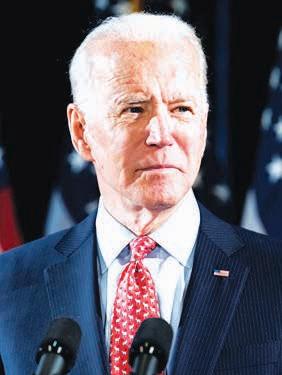
Will President-elect JOE BIDEN build off PRESIDENT TRUMP’s HIV plan or go his own way?
National AIDS Memorial honors Fauci, Ho Commemorating 2020 World AIDS Day virtually
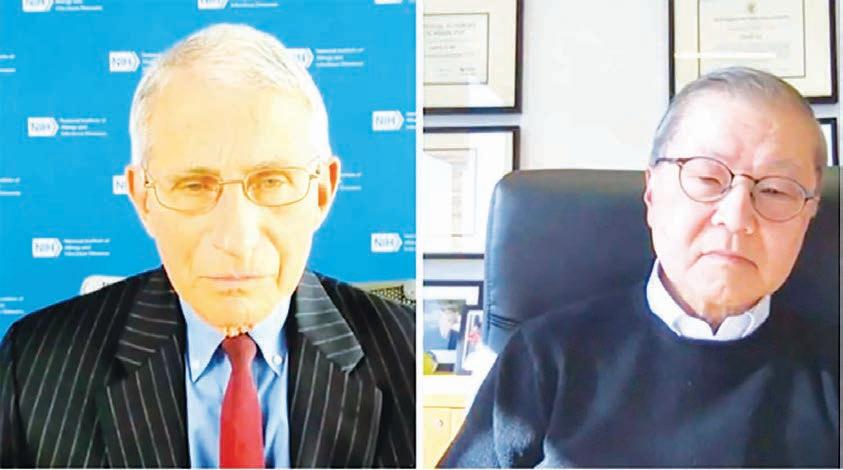
The National AIDS Memorial on Tuesday honored Drs. Anthony Fauci and David Ho during its virtual World AIDS Day event.
Fauci, who is director of the National Institute of Allergies and Infectious Diseases at the National Institutes of Health, during a panel that ABC News Chief Health and Medical Correspondent Dr. Jennifer Ashton moderated talked about treating people with HIV/AIDS during the fi rst years of the epidemic.
“You related to these people,” said Fauci. “They were young men who previously had been very healthy and they were in a mysterious disease.”
“In 1981, 2 and 3 we knew it was an infection. It had to be an infection,” he added. “We knew that it was new, but it was a very unique experience dealing with something that was killing a lot of people and you didn’t know what it was. That is a very unique experience in medicine.”
By MICHAEL K. LAVERS | mlavers@washblade.com
Ho, director of Columbia University’s Aaron Diamond AIDS Research Center, echoed Fauci.
“This was a mysterious illness, that was seemingly transmissible and it was killing young gay men one after another,” said Ho.
Ho, like Fauci, also said many gay men with HIV/AIDS died alone because their families had shunned them.
“They were often dying alone, shunned by family and friends because of this transmissible illness and we knew it was obviously spreading and yet there was no eff ective intervention that was meaningful in any way,” said Ho.
Ho and Fauci received the National AIDS Memorial’s National Recognition Leadership Award. John Cunningham, executive director of the San Francisco-based organization, during the event announced Ho and Fauci’s names have been added to the memorial’s “Circle of Friends” in the city’s Golden Gate Park.
“For nearly four decades, these two individuals have stood at the forefront,” said Cunningham.
This year’s World AIDS Day took place nearly four decades after the fi rst cases of what became known as AIDS were reported. It also coincides with the coronavirus pandemic.
Johns Hopkins University of Medicine’s Coronavirus Resource Center notes there are 13,696,060 confi rmed coronavirus cases in the U.S. The pandemic has also killed more than 270,000 Americans.
Robert Garcia, the openly gay mayor of Long Beach, Calif., is among those who participated in the virtual World AIDS Day event.
Garcia during a panel with New York City Mayor Bill de Blasio, Chicago Mayor Lori Lightfoot and Atlanta Mayor Keisha Lance Bottoms that ABC News’ “GMA3” CoAnchor T.J. Holmes moderated noted his mother and stepfather both died from the coronavirus over the summer. Garcia also discussed both pandemics’ impact on the LGBTQ community.
“As we think about and remember everyone that has left us because of HIV and AIDS, for me as a gay man, it means an enormous amount knowing the amount of sacrifi ce that has happened within our own LGBTQ+ community throughout this terrible virus
and the damage it’s done to our community, to friends of mine, to people and mentors that I look up to and respect,” said Garcia. “And it reminds us that we have to be strong because things can get better and that’s the case with this COVID-19 pandemic.”
Ho also drew parallels between the HIV/AIDS epidemic and the coronavirus pandemic.
“HIV/AIDS was relatively speaking slow and insidious and yet COVID-19 hit us like a tsunami,” he said.
Ho also noted “it looks like the vaccines and therapies are emerging extremely rapidly in an unprecedented fashion” for the coronavirus, whereas an HIV vaccine remains elusive. Ho and Fauci also discussed the way that behavioral changes can curb the spread of HIV and the coronavirus.
“Human behavior is quite challenging to predict and certainly to modify,” said Ho. “We have learned that in HIV for example, wearing a condom could go a long way in preventing sexual prevention of the virus. And in COVID-19 wearing a mask would similarly cut down transmission, but it’s very hard for people to apply some of these measures.”
Fauci acknowledged “one of the things that has been dominant and very, very diffi cult to deal with with COVID-19 is the divisiveness in our society in which messaging and conduct related to one’s own personal responsibility as well as your societal responsibility has been really completely distorted by the divisiveness as where public health measures have taken on an almost a statement as opposed whether it’s going to have an impact on the broad health of everyone.” He also pointed to continued resistance to wearing masks and other prevention measures in parts of the country where coronavirus rates continue to skyrocket.
“You still have people who refuse to wear a mask, who refuse to have physical distancing because they think all for this is a hoax or its fake news,” said Fauci.
“We didn’t have that with HIV,” he added. “There were another set of behavioral issues that got in the way, but this is an extra added something that I have never experienced with and I am really stunned by it.”
House Speaker Nancy Pelosi (D-Calif.) and Human Rights Campaign President Alphonso David also participated in the event that actress Judith Light hosted.
Black Lives Matter Co-founder Alicia Garza, Marked by COVID Co-Founder Kristin Urquiza and Cleve Jones participated in a panel that David moderated. Rev. Naomi Washington-Leaphart, director of Philadelphia’s Faith-Based and Interfaith Aff airs, delivered the invocation.
“This year has been an unprecedented year for global health, unprecedented even by pandemic standards,” said Light. “We face a grim reality. Our nation continues to struggle in the fi ght against COVID-19 … 2020 also marks 40 years since the fi rst cases of AIDS were reported in the United States.”
“On this World AIDS Day, our hearts and minds open we are spotlighting the interconnectedness between two pandemics that while having their diff erences, have haunting similarities,” she added.
Dr. ANTHONY FAUCI and Dr. DAVID HO during the National AIDS Memorial’s virtual World AIDS Day commemoration on Dec. 1.
EARL D. FOWLKES, JR. is president and CEO of the Center for Black Equity.
Importing drugs endangers lives Exposes millions
of Americans to potentially counterfeit
meds
By EARL D. FOWLKES JR.
On most issues, Democrats and Republicans remain deeply divided. But there’s one policy that unites both parties — prescription drug importation.
Earlier this year, the Trump administration issued an executive order enabling states and individuals to import cheaper medications from foreign countries. The Biden camp has similarly voiced support for allowing Americans to buy drugs from Canada.
Both parties have good intentions. Making medicines more affordable for patients is a goal nearly everyone shares. But importation isn’t the right solution. It would expose millions of Americans to potentially counterfeit medications while offering few, if any, actual savings.
The FDA’s drug approval process is the gold standard in ensuring that medicines are safe and effective. But imported drugs wouldn’t go through that process — the FDA lacks the resources to subject them to the same rigorous scrutiny. And while there are plenty of legitimate online pharmacies in Canada, there are also plenty of scammers looking to make an easy buck by shipping bottles of fake pills to vulnerable Americans.
That’s why four former FDA commissioners sent a letter to Congress highlighting the dangers of circumventing our nation’s drug supply chain, which is currently the safest in the world. They warned that importing drugs would “harm patients and consumers and compromise the carefully constructed system that guards the safety of our nation’s medical products.”
Canadian health officials agree that importation could endanger American patients. They’ve previously warned that Canada will “not assure that products being sold to U.S. citizens are safe, effective, and of high quality.” The FDA itself openly states that it “cannot ensure the safety and effectiveness of drugs that it has not approved.”
This lack of oversight means that many “Canadian drugs,” which often originate in other countries and are merely shipped through Canada, are adulterated. One FDA study found that 85 percent of confiscated drugs that were supposedly imported from Canada were actually manufactured in 27 other countries. Of those drugs, many didn’t include English instructions, and some were counterfeits.
Counterfeit drugs pose a significant danger to patients here in the United States, especially the most vulnerable populations. Sixty percent of Americans suffer from chronic diseases that require regular adherence to medication. Communities of color, who suffer from chronic illness at higher rates than do white Americans, face even higher risks.
As someone who suffers from hypertension and Type 2 diabetes, I’m keenly aware of the perils of receiving counterfeit medicines. Over the years, some Americans have illegally imported medicines from what they thought were legitimate Canadian pharmacies, but the drugs turned out to have no active ingredients, or worse, contained toxic substances. If patients take ineffective drugs that amount to little more than sugar pills, their chronic conditions could spiral out of control.
Even if importation were completely safe — and it isn’t — it wouldn’t save Americans nearly as much money as proponents believe. That’s because Canada has no interest, and no ability, to act as America’s pharmacy.
There are simply too many American patients. Americans fill 4.5 billion prescriptions annually. Canada’s population is about 90 percent smaller than the U.S. population, so demand from the United States could overwhelm the Canadian drug market in just 38 days, according to one study. More than 1,500 drugs sit on Canada’s drug shortage list — the Canadian healthcare system hardly has the bandwidth to support billions of new requests from Americans.
That’s why Canadian patient groups have urged their leaders not to facilitate any large-scale drugs exports to the United States. And those leaders are listening. According to an internal briefing from the Canadian foreign ministry, Canada would “not support actions that could adversely affect the supply of prescription drugs in Canada.”
Drug importation, though well intentioned, is doomed to fail and could endanger many Americans’ health. It’s up to a Biden administration to reverse course and either rescind the Trump administration’s importation rule, or at the very least, instruct the FDA to not approve any state applications for importation programs.
ADDRESS
5455 Wilshire Blvd, 21st Floor, Los Angeles, CA 90036
ROMAN NAVARRETTE roman@losangelesblade.com 310-435-3022
PALM SPRINGS ACCOUNT EXEC
BRAD FUHR, 760-813-2020. brad@gaydesertguide.com
NATIONAL ADVERTISING
RIVENDELL MEDIA
sales@rivendellmedia.com, 212-242-6863
MARKETING DIRECTOR
STEPHEN RUTGERS
srutgers@washblade.com, 202-747-2077 x8077
EDITORIAL
CONTRIBUTING WRITER
KAREN OCAMB karenocamb@losangelesblade.com
NATIONAL EDITOR
KEVIN NAFF kna @washblade.com, 202-747-2077 x8088
INTERNATIONAL EDITOR
MICHAEL K. LAVERS mlavers@washblade.com
EDITOR AT LARGE
BRODY LEVESQUE
California
CONTRIBUTORS
ERNESTO VALLE, YARIEL VALDÉS GONZALEZ, PARKER PURIFOY, CHRISTOPHER KANE, AUSTIN MENDOZA, JOHN PAUL KING, JOEY DIGUGLIELMO, CHRIS JOHNSON, LOU CHIBBARO JR., MARIAH COOPER, REBEKAH SAGER, JON DAVIDSON, SUSAN HORNIK, CHANNING SARGENT, SAMSON AMORE, CHRISTOPHER CAPPIELLO, MICHAEL JORTNER, DAN ALLEN, SEAN SHEALY, SCOTT STIFFLER
CREATIVE DESIGN/PRODUCTION AZERCREATIVE.COM
DISTRIBUTION
CHRISTOPHER JACKSON, 562-826-6602
All material in the Los Angeles Blade is protected by federal copyright law and may not be reproduced without the written consent of the Los Angeles Blade. e sexual orientation of advertisers, photographers, writers and cartoonists published herein is neither inferred nor implied. e appearance of names or pictorial representation does not necessarily indicate the sexual orientation of that person or persons. Although the Los Angeles Blade is supported by many ne advertisers, we cannot accept responsibility for claims made by advertisers. Unsolicited editorial material is accepted by the Los Angeles Blade, but the paper cannot take responsibility for its return. e editors reserve the right to accept, reject or edit any submission. A single copy of the Los Angeles Blade is available from authorized distribution points, to any individual within a 50-mile radius of Los Angeles, CA. Multiple copies are available from the Los Angeles Blade o ce only. Call for rates. If you are unable to get to a convenient free distribution point, you may receive a 26-week mailed subscription for $195 per year or $5.00 per single issue. Checks or credit card orders can be sent to Phil Rockstroh
RICK CHAVEZ ZBUR is executive director of Equality California.
Innovation was key to counting LGBTQ people in Census Overcoming obstacles amid the pandemic
By RICK ZBUR
The Los Angeles County Board of Supervisors chambers was abuzz on a drizzly March morning earlier this year. More than two dozen people connected to various community organizations were excited to announce the launch of one of the largest collaborative efforts in the Golden State to engage Californians and encourage them to fill out the 2020 Census.
Many — like Equality California, the nation’s largest statewide LGBTQ+ civil rights organization — had worked for more than a year putting together innovative and unique outreach programs targeting marginalized communities historically underrepresented in government and policy making. Then, minutes before the press conference was set to begin, a shocking message came through: Due to new information about a concerning virus, the county of Los Angeles would be going on a mandatory lockdown.
Our best-laid Census plans — which included the recent launch of a milliondollar statewide outreach campaign to make sure LGBTQ+ Californians are counted in the 2020 census — came to a sudden halt. We feared the worst: the COVID-19 pandemic would obliterate our best efforts. That the Californians we needed to respond to the Census would be left out again.
However, as the executive director of Equality California, I’m proud to say our team quickly pivoted our education campaign that included door-to-door and inperson outreach to a virtual endeavor where face-to-face visits became virtual events and peer-to-peer conversations became interactions over the phone and text.
We understood the need to remain safe and cautious in the face of this new threat, but we also know that one out of five LGBTQ+ families are enrolled in social safety net programs and have been consistently undercounted in the Census. Our inclusion in the count was critically important to ensure we received the community programs and resources and political representation that reflects our needs.
Getting Californians to prioritize something beyond the immediate crisis facing them was no small task. The dynamics that paralyzed participation ranged from economic hard times, families sheltering in place, social unrest to fear of government or sharing their personal information.
Even after the Trump-Pence administration scrapped plans to include questions regarding sexual orientation and gender identity in the 2020 census, participation was still crucial. For the first time this Census form included a question allowing same-sex couples to identify as either as spouses or unmarried partners.
But in many ways, the ability to respond online – this being the first Census that did not explicitly require the return of paper forms – worked to our advantage as we explored unconventional tactics and communicated digitally through social media live events, online ads and emergency resources.
In fact, like all of California, we moved more online. With the help of our data, we compiled showing where the hardest-to-count areas were and combining it with self-response rate information, we were able to adapt and pivot more quickly.
Our engagement strategies happened on screens, phones and signage, all at a distance of 6 feet or more. We worked with the Latino Equality Alliance, The Gender Health Center, The LGBT Asylum Project, The SOURCE LGBT+ Center, The Dolores Huerta Foundation, Arming Minorities Against Addiction and Disease Institute and San Diego LGBT Pride.
And when it was over, across the state, more than 1 million more Californians responded on their own to the Census in 2020 than in 2010, and nearly two million more Californians responded compared to 2000. Neighborhoods in San Diego, Los Angeles and San Francisco set records with the highest self-response ever.
The final U.S. Census count for California won’t be released for weeks or months, but our final self-response rate shows that our network helped accomplish a herculean task – nearly 70 percent of Californians responded, which will help ensure the most accurate foundation upon which the U.S. Census will do its remaining work. Our participation this time around will make a difference for our community and the vulnerable populations to which we belong for these next 10 years.
Thanks to broad cooperation, a unified message and active participation from lawmakers, we were able to reach people across the state in safe and creative ways at a time they were staying at home and staying apart.
This shift in how government and community organizations reach Californians speaks to our collective desire to improve our outcomes as a whole. Effective government strategies can and must work for underserved communities.
As the nation considers how we must spur innovation to help bring us out of these dark times, the Census effort can offer important lessons for educating, motivating and activating California’s communities: use the power of digital tools, deliver in-language messages using trusted messengers with trusted messages.
This framework should be a tool to continue engaging neighborhoods, on health programs, social issues, economic prosperity or rapidly emerging issues – and for the 2030 Census to ensure questions regarding sexual orientation and gender identity are included.
California can be proud of its collective efforts to make sure ALL Californians were counted during the 2020 Census by driving up the self-response as high as possible to support the most accurate count possible.
Now is the time to think different, be innovative and strive for positive change. Let’s work together to achieve the same success to keep moving us forward –here’s to start planning for the 2030 Census.
Wild, wild West ‘Drag Race’ vet recreates classic John Waters characters in new holiday video
By JOEY DiGUGLIELMO| joeyd@washblade.com
Nina West has two new videos she’s unleashed on the world. In “Cha Cha Heels” she pays homage to John Waters playing iconic characters from three of his movies — Dawn Davenport in “Female Trouble,” Beverly Sutphin in “Serial Mom” and Tracy Turnblad in “Hairspray.” The song is from her 2019 Christmas EP “The West Christmas Ever.”
And in “Quarantine Dream” she worked with friend and Disney animator Dan Lund, a veteran of many classic movies such as “Frozen,” “Aladdin,” “The Lion King” and more, to mix live action/animation for the West-penned song about coping with COVID-19 induced quarantine. The three-and-a-half-minute mini-musical was filmed with a cell phone and inspired by the Disney classic “Mary Poppins.” Both are on YouTube.
West, aka Andrew Levitt, is a Columbus, Ohio-based drag performer who came to fame on season 11 of “RuPaul’s Drag Race,” where she finished sixth and was named Miss Congeniality. She made history at the 2019 Emmys for being the first to walk the red carpet in drag and was named one of the “most powerful drag queens in America” by New York Magazine the same year. West, 42, has been performing for 18 years.
LOS ANGELES BLADE: So how did the concept for the “Cha Cha Heels” video come about?
NINA WEST: I’d had this big idea of a big flash mob and this huge cast and filming in the street with a bunch of people and then COVID hit. So the intention was always to do a “Cha Cha Heels” video, but we had to really adjust quickly when the time came to pull the trigger and film the video because (of restrictions). I worked with a really great director, who is a tremendous John Waters fan named Brad Hammer, and he suggested doing three different female characters in three different John Waters movies. … We filmed it with a cast of four including myself, all people were already in my bubble, so we made all the adjustments we needed to make to have a safe shoot and went there and I think the video ended up being much better for it.
BLADE: Where was it shot?
WEST: We shot it in a day in two locations here in Columbus. BLADE: Do you have to get permission from Waters or whomever owns the films before you do something like this or is it considered a parody and thus fair game?
WEST: Yeah, it’s seen as parody so you don’t have to get a green light really. We weren’t recreating it shot by shot or telling the same story but we were lucky enough that when John saw it last week, he sent me an e-mail … saying how much he loved it and how much Divine would have loved it … so that was pretty fantastic.
BLADE: Oh wow, that must have been incredible.
WEST: I practically fell over, yeah. I’m 42 so queer Andrew coming out, John Waters movies were a huge rite of passage just as I was coming into my queerness. I wanted this to be a love letter to a queer trailblazer who has had more impact and power than I think any of us really recognize.
BLADE: Tell us about “Quarantine Dream.” How do you know Dan Lund?
WEST: I worked with him on a project called “Coaster” where he was the executive producer and we have remained in touch. He’s one of these people who’s just always talking and dreaming. His brain is constantly rolling. The day after I flew home in March,
he called ….
BLADE: Where had you been?
WEST: I was on tour in Europe and then I was going back and forth from New York to L.A. working on a couple projects and I ended up in New York and I was supposed to be going to the opening of the Broadway musical “Six,” but the day it was supposed to open everything was shut down. I was panicking trying to get a flight home.
BLADE: Oh wow.
WEST: Yeah. So he suggested this and I was like, “Sure, um, OK.” I didn’t really know what he meant but then he pitched this whole treatment inspired by “Mary Poppins,” which I’m a huge, through-and-through Disney queen and “Mary Poppins” is my favorite film of all time, so when you have a Disney artist who’s worked on all these cultural touchstones, yeah, OK, I’m not gonna say no. That’s how it happened. I worked with a songwriter Markaholic who is super prolific. If you’ve seen the RuPaul Old Navy commercials, he wrote that song, he’s worked with Ru a lot and is just super talented.
BLADE: You were a fan of the show a long time before you were on it. What seemed the most different seeing it all in real life vs. watching it on TV?
WEST: Oh wow, my brain is going in like 17 different directions. It was all overwhelming. You never forget walking into the workroom for the first time. … Also seeing RuPaul for the first time is really overwhelming. People always ask why we always react so wildly seeing him walk in the workroom. It’s the same person coming through the same door and you know it’s gonna happen, but he really is just so larger than life, I don’t know how else to explain it. He’s so magnetic and so those moments to me were always supremely overwhelming.
BLADE: I can imagine that.
WEST: One thing I didn’t expect that wasn’t so great was realizing later that there are parts of the fandom that are extremely toxic. When I was eliminated and saw the anger and disgust and vitriol and poison directed at Silky (Nutmeg Ganache), that was surprising. It’s not the show’s fault but there are sections of the fandom that cultivates and allows itself to breed this incestuous, toxic hate.
BLADE: What are your plans for the holidays?
BLADE: So you basically are encouraging people to take the pandemic seriously but in a fun way?
WEST: Yes. We thought it was a fun way to say, “Hey, it sucks, but let’s all stay home and like instead of having the fatigue, maybe we can just take a step back and dream a little bit. We’re gonna get through this. We were gonna release it earlier in the year, but we felt like it wouldn’t have as much impact but now here we are, oddly enough, going into round two and people are getting more sick than ever before and this fatigue of anger and frustration has settled in … so I think the message it sends if very different than it would have been six months ago.
BLADE: How different has your year been?
WEST: Oh my god, I started off with a full calendar and full plate and watched it all disappear. Some things are being rescheduled, some things have been canceled, some things are being reimagined. I hate the word pivot, but that’s kind of what we’ve all been doing. …. I never thought I would be doing drag primarily by phone for almost a year of my life (laughs).
BLADE: Who was your favorite season 11 celebrity guest judge on “Drag Race”?
WEST: Oh my gosh, I really love Bobby Moynihan. I’m an SNL fanatic so he was on my season. I also was really gagged when we had Lena Waithe and Wanda Sykes. That was the episode I went home, but it was still pretty awesome because I’m gigantic fans of both of them.
BLADE: What was your favorite challenge?
WEST: Probably the magic challenge. It was supremely challenging but it allowed me to show off all my skills in one 10-minute segment. I was glad I got that in before I went home. Some of them were really hard, just really, really arduous. “Trump the Rusical” was so hard. When they say it’s the drag Olympics, it really is.
WEST: My parents live about 10 minutes away from me so we talked about maybe doing a quarantine for two weeks then a rapid test before Christmas, and I’m willing to do that, but my siblings and I are all just trying to be super responsible so we may just do a Zoom Christmas. I know it’s really hard but I think it’s important for all of us to work collectively to pull ourselves out of this any way we can.
BLADE: Are you and the queens from your season all constantly on group text and Zoom and all that. Whom are you closest with?
WEST: Yeah, I’m in touch with several people from my season. I talk to Silky, I talk to Brooke Lynn (Hytes). I talk to Vanjie once in a while. … Those relationships from that six-week experience, I can’t explain it — you come to rely on these people in a whole other way. It’s not something tangible or that you can even explain. It’s very life changing to go through that together.
BLADE: What’s gonna happen with season 13? Did they do something this summer?
WEST: I don’t know anything official but yesterday I saw a casting call for season 14 so that tells me season 13 must be in the can. I think it’s like full speed ahead for “Drag Race,” which is great because we all love to watch it and fall in love with new people.
BLADE: You auditioned many times before you got on. Was it discouraging or were you just that tenacious you weren’t gonna be deterred or what?
WEST: Oh no, no, no. (laughs) I’m positive but girl, I’m not that positive. I was broken. It really broke me. My last audition was authentically gonna be my last audition and I don’t even remember who said this to me but one of the production people said it had been stated that, “Nina is either on this season or she’s not, this is the last time we’re watching these tapes.” I don’t know if that’s true or not, but I think we all just felt it had come to like a shit-or-get-off-the-pot type moment. I had to move on with my life in a way. I wanted it so badly and for so many years it just was not happening. Finally my last time, I was the most like, “I don’t care, let’s just get it done, whatever,” and that was the one that got me on. So I think tenacity is one thing, but wearing them down is another.
NINA WEST says being on ‘Drag Race’ was a life-changing experience. (Photo courtesy West)
Thanks to Ryan Murphy, Netflix throws an inclusive ‘Prom’ A queer story with mainstream pop appeal
According to Ryan Murphy, he wanted to make a film version of “The Prom” since the moment he saw it on Broadway.
Watching the new Netflix movie that resulted from that spark of inspiration, it’s not hard to see why. The musical, which found a hardcore fan audience despite a less-thanprofitable Broadway run, is a piece that is a perfect match for the entertainment mogul’s brand, a frothy mix that exists on the thin line between camp and hokum, blending sharpedged wit with inspirational sentiment and over-the-top farce with activism. It’s a queer story with mainstream pop appeal that leans heavily into a love of All Things Broadway. Unless there was also a serial killer thrown in somewhere, how could anything be more Ryan Murphy than that?
There was more behind Murphy’s enthusiasm for the piece than just a savvy selection of tailor-made grist for the entertainment mill that is his contract with Netflix, however. As an LGBTQ person who grew up in a small Indiana town himself, the show-biz powerhouse found a personal connection to its story of an Indiana teen who has to fight against the homophobia of her small town community in order to take her girlfriend to their high school prom. It spoke to his own memories and hopes – and as it turns out, that heart connection is the ingredient that makes his translated-to-film version of “The Prom” much better than it probably deserves to be.
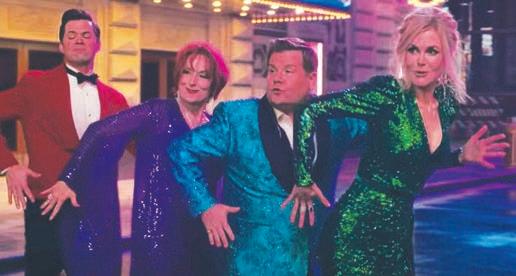
Inspired by the real-life experience of Mississippi high schooler Constance McMillen, the story centers on Emma Nolan (Jo Ellen Pellman), an out lesbian senior whose plan to take her secret girlfriend Alyssa (Ariana DeBose) to the prom is thwarted by her school’s PTA-mandated no-samesex-date policy. Her cause is taken up by a group of downon-their-luck Broadway actors — including a famous but fading diva (Meryl Streep) and her GBF (James Corden) — whose co-starring turn in a musical based on the life of Eleanor Roosevelt has just closed after only a single performance. They hit upon the scheme of creating an activist cause around her in order to garner some careerboosting publicity.
Along with Emma’s supportive principal (Keegan-Michael Key), they succeed in forcing the school to hold an inclusive prom; but when the PTA president (Kerry Washington) uses a loophole to shut Emma out anyway, the cadre of showfolk will have to dive deeper than their own self-centered motivations if they are going to be able to make things right again and score a decisive win against homophobia in the heart of small-town America.
As written by Bob Martin and Chad Beguelin (with the latter providing lyrics to music by Matthew Sklar), the musical is unabashedly designed to be a crowd-pleaser, full of comedy and heart, with just enough drama to make it mean something and a message only a bigot could refute; the score, spiced up with youthful flourishes but nevertheless grounded in a stylistic base that is pure traditional Broadway, is exuberant and infectious, and allows plenty of opportunity for the kind of show-stopping dance numbers that make an evening of live
musical theater an experience quite unlike any other. Presumably out of a desire to maintain the integrity of the show’s original voice, producer-director Murphy enlisted the trio of original writers to adapt their work to the screen; the result is an expanded but mostly faithful reimagining that maintains the bones of its stage-bound architecture while also deepening some of its more sensitive moments with the kind of embellishment made possible by cinematic technique and a no-expense-spared budget.
That budget is also behind the film’s other biggest asset, a stellar dream cast headed by Streep and Corden, with Nicole Kidman and Andrew Rannells in close support – all in addition to the other talented stars mentioned above. It’s clear this high-profile ensemble is having a blast in their roles; Streep is in fine form, as always, and Corden is capable of charming us in anything (even, almost, the horror that was “Cats”), but everyone else performs at an equally high level; special mention should go to Kidman, though, for managing to take on the role of an aging chorus girl and making us believe that she’s been dancing in the background for 20 years without ever getting noticed – as if she weren’t, well, a superstar like Nicole Kidman.
These players are gifted enough to take the broadest, corniest, most cliched bits of the script – which, in truth, amounts to most of it, by design – and giving it not just the extra dimension it needs to be more than a goofy pastiche, but the enthusiasm and all-around show-biz moxie that keeps an audience engaged and entertained even when the story lags.
And it does lag, there is no denying it. As any aficionado of musical theater will surely tell you, all but the most remarkable of shows suffer from what’s often called the “second-act slump,” and “The Prom” is no exception. Indeed, it’s exacerbated here by the script’s reliance on the triedand-true “beats” that have formed the core of the genre’s dramatic structure since the days when musicals made the transition from the era of Ziegfeld’s Follies to the age of “Oklahoma.” Onstage, this slavish adherence to traditional format is surely part of the show’s charm, another function of its lovingly self-mocking tone. But on film, without the in-person visceral excitement that comes from seeing those aforementioned dance numbers exploding before your eyes, it can be an obstacle to keeping the interest of audiences used to more sophisticated fare.
Thankfully, the film rendition of “The Prom” never lets its slow spots hold it back for long. Murphy the director relies on the strengths of his cast while filling the screen with the kind of artfully kitschy, colorful visual spectacle that makes even his pulpiest endeavors a feast for the eyes; and while his quick-edit cinematic style fails to capture the majesty of its dance sequences (choreographed with vigor and an aptly satirical touch by Casey Nicholaw) in the same way as the long takes of the classic Hollywood musicals that so clearly inform his palette here, the flash and movement with which he instills every moment of them is more than enough to keep us appropriately dazzled by them.
More importantly, though, he makes “The Prom” a
By JOHN PAUL KING
success despite its flaws because of that heart connection that led him to make it in the first place; in the midst of all the larger-than-life “zazz” (to borrow a phrase from the film), he never lets us forget the importance of the human story underneath it, and the powerful message of acceptance that was intended to be the show’s reason all along.
It has to be acknowledged that Murphy’s track record is somewhat hit-or-miss for all but his most ardent fans, and that “The Prom” is the kind of bubbly, lightweight musical theater that you’re probably not going to like if you’re not a fan of that kind of material.
For everybody else though, it’s worth putting at the top of your Netflix queue when the streaming platform drops it on Dec. 11.
The cast of ‘The Prom.’ (Photo courtesy Netflix)
Obama memoir addresses evolution on LGBTQ rights
‘A Promised Land’ packed with wit, insights
By KATHI WOLFE
Most memoirs of politicians are pablum — ghost-written snooze-inducers. At best, good door-stops.
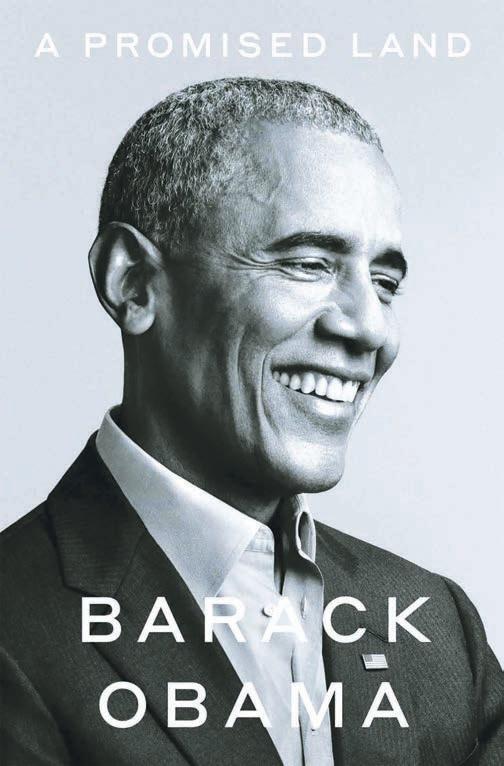
“A Promised Land,” former President Barack Obama’s new memoir, breaks that mold. Though it’s over 700 pages, you won’t be tempted to turn away from this, by turns, measured, moving, detailed, witty, and self-aware volume. The memoir, narrated by Obama, is a great listen (29 hours, 10 minutes) on Audible.
I need a COVID-19 test.
Unlike most politicos, Obama can write! Many of us ink-stained wretches would give anything to have his writing chops. Obama’s first book, “Dreams from My Father,” Obama’s critically acclaimed 1995 coming-of-age memoir, came out years before he was a player on the national political stage.
I need groceries.
Like many, I knew some of the highlights of Obama’s life before I picked up “A Promised Land”: his spouse and best friend Michelle, his daughters, his dog Bo, his rapid rise from Illinois state senator to U.S. senator to president of the United States.
As a lesbian, I knew of the many things that Obama and his administration did to support LGBTQ rights – from issuing Pride proclamations to the repeal of “Don’t Ask Don’t Tell.” At his last press conference, Obama called on Blade reporter Chris Johnson to ask a question. (Obama was the first U.S. president to call on a LGBTQ press reporter at a press conference.) No wonder many of us think of Obama as the “first gay president.”
I need a COVID-19 test.
I need groceries. I need to pay rent.
I need health
If this memoir had been hacked out by a ghostwriter for a typical politico (even a queerfriendly politico), I’d probably just skim through it. But, because of Obama’s superb writing, the breadth of his thinking and the wide-ranging events of his administration (from his meetings with foreign leaders to the passage of the Affordable Care Act), I was hooked from the get-go on “A Promised Land.” The Republican opposition to his every move (no matter how bipartisan he tries to be) is an underlying theme.
care.
I need health care. I need to report a hate crime.
I need a shelter.
I need a shelter.
“For a month, Michelle and I slept late, ate leisurely dinners, went for long walks, swam in the ocean, took stock,” Obama writes in the memoir’s preface of what life was like for him and Michelle after he left office in January 2017, “replenished our friendship, rediscovered our love, and planned for a less eventful but hopefully no less satisfying second act.”
I need to pay rent.
No way could I stop reading after that!
I need to report a hate crime.
I need a legal referral.
I need a support group. I need help. 211LA
“A Promised Land” is the first of two volumes. It begins with a preface in which Obama says he wants to give an “honest rendering” of the events that happened on his watch and ends with the death of Osama bin Laden.
I need a legal referral.
I need a support group. I need help.
211LA
The first third of the memoir is about his life before he becomes president. Here, Obama writes of his family, youth, college years, law school life, how he met Michelle, his time as a community organizer and political campaigns.
Obama writes personally about his evolving attitudes toward LGBTQ rights. He believes that the “American family” includes LGBTQ people and immigrants. “How could I believe otherwise, when some of the same arguments for their exclusion had so often been used to exclude those who looked like me?” Obama writes.
But, he doesn’t, he writes, dismiss those with differing views on queers and immigrants as bigots. He remembers that his own beliefs weren’t always so “enlightened.”
“I grew up in the 1970s, a time when LGBTQ life was far less visible to those outside the community,” Obama writes.
His Aunt Arlene, “felt obliged to introduce her partner of twenty years as ‘my close friend Marge’ whenever she visited us in Hawaii,” he recalls.
SERVING THE LGBTQ+ COMMUNITY IN LOS ANGELES COUNTY
SERVING THE LGBTQ+ COMMUNITY IN LOS ANGELES COUNTY
Free & low-cost resources Meet us at 211LA.org or call 2-1-1
Free & low-cost resources Meet us at 211LA.org or call 2-1-1
When Obama was a teen, he and his peers used anti-gay slurs. “And like many teenage boys in those years, my friends and I sometimes threw around words like ‘fag’ or ‘gay’ at each other as casual put downs,” Obama writes, “callow attempts to fortify our masculinity and hide our insecurities.”
After nearly four years of Donald Trump, it’s a pleasure to read a presidential memoir written with intelligence, wit, and insight. Whether you’re a political junkie, a lover of gossip or a fan of engaging writing, “A Promised Land” will leave you wanting more.
Therapeutic Journal
By MIKEY ROX
In a year filled with more craziness than any of us ever expected, at least we have the holidays. What will they look like this year? Bright, beautiful and back to basics. Treat yourself and your loved ones to these come-on-be-happy presents handpicked for LGBTQ+ friends and family.
We Are Beautiful Ring
There wasn’t much glitter or glam in The Year That Wasn’t, but you can change that. Onehundred percent of proceeds from Pharoun’s 22k gold, rainbow-edged We Are Beautiful cocktail ring (also available in sterling silver) will benefit civil-rights organization Southerners on New Ground. $115-$145; pharaoun.com
Stressed? Join the club – if clubs were a thing right now. Until then, try the Write Here & Tear therapeutic journal, which encourages users to jot down their troubles then tear ’em up. Journaling and paper tearing have proven results, too, with 55 percent of survey respondents
The ultimate guide to queer gift giving 2020 Ideas for all tastes and budgets
reporting relief, and another 35 percent relaxation. $20; shop.nicolerussell.com
Queer Agenda Card Game
Made by and for the LGBTQ+ community, the Queer Agenda card game prompts players to participate in rowdy dares and answer inappropriate questions – because you’re goddamn right it should. $25; fitzgames.com
Embossed Rolling Pin
Imprint whimsical holiday scenes
– including detailed snowflakes, trees and reindeer – onto sugar cookies, pie crusts, and even pastas from solid beech wood rolling pins that’ll give Martha a run for her bakingmaven money. $35; embossedco.com
Rainbow Safety Razor
Iridescent anodized zinc and brass alloy add a splash of queer panache to your Dopp kit on a safety razor – can’t be too careful in 2020 – that changes appearance depending how light hits it. $30; shave.net
The We Are Beautiful cocktail ring benefits Southerners on New Ground.
(Photo courtesy pharaoun.com)
The Rainbow Safety Razor adds a splash of queer panache to your Dopp kit.
(Photo courtesy manufacturer)
Heated Towel Rack
Spas and bathhouses were but a memory this year, but you can bask in hot hugs from the comfort of your own home. This heated towel rack keeps your fluffy terrys dry and 90 percent more hygienic between washes – an appreciated feature during a COVID-19 Christmas. $500+; bathroombutleronline.com
Holiday Icon Dessert Set
Set your socially distanced dessert table in style with Molly Hatch’s modern heirloom ceramic plates and mugs featuring matching icon prints of candy canes, Christmas trees, gingerbread folx, holly, ice skates, and snowflakes. $16-$18 each; mollyhatch.com
Sustainable Swabs and Tissues
LastSwab and LastTissue replace single-use Q-Tips and Kleenex with convenient, washable, good-for-you-and-the-environment stocking stuffers. Because there is no Planet B. $12-$24; lastobject.com
Pot for Pot Kit
Pot for Pot DIY cannabis growing kits produce up to eight ounces of ganj in 80 days so you can turn your kitchen, patio or desk with natural or artificial light into a money-saving personal dispensary. Ships to all 50 states – and states of mind. $100; apotforpot.com
Gummy Sweat Treat Tower
Taste the rainbow of a foot-high sweets tower from Dylan’s Candy Bar – including bears (gummy ones, of course), Razzmataz rainbow bites, red Australian licorice, and sour poppers (not the kind you’re used to) – packaged in striped, tiered boxes and tied with a bow. $50; dylanscandybar.com
#FakeFacts Game
No, this card game isn’t based on Donald Trump’s presidency – not entirely, at least – but it will provide hours of fun trying to identify and fools others with bizarre, surprising, and unpredictable trivia. Easy to play virtually over Zoom, too. $15; thegamecrafter.com
Craft Caribbean Rum
You can file the bright and radiant Don Q Reserve 7 aged Puerto Rican rum under “Fucking Necessary,” and serve it on the rocks at this year’s six-feet-from-insanity holiday party. $25, donq.com
Spongebob Pride Pop!
Pride celebrations were largely cancelled this year – because what wasn’t – but you can shine on anytime of year, queer, with a Funko Pop! Pride stocking stuffer in the form of verified gaycon Spongebob Squarepants. $11; funko.com
Robot Vacuum
Yeedi’s K650 automated vacuum – boasting bigger suction, less noise, high-efficiency filtration, and made of durable anti-scratch tempered glass – lessens the Cinderell-y workload while you work from home. $220; amazon.com
Evil Eye Earrings
Fourteen-karat-gold evil-eye earrings encrusted with .08 carats of diamonds will provide cheeky edge to a New Year’s Eve look that’s not lookin’ back. 2021 or bust, baby! $260; styletypology.com
(Mikey Rox is an award-winning journalist and LGBT lifestyle expert whose work has been published in more than 100 outlets across the world. He lives in his van, ho-ho-hoing around the country. Connect with Mikey on Instagram @mikeyroxtravels.)
An embossed solid beech wood rolling pin makes a great gift for the baker in your life.