
Los Angeles event entertainment reimagined Page 16
(Photo by Jeff Dorta for Voss Events)

Los Angeles event entertainment reimagined Page 16
In the afraid new world of COVID-19 and Trumpian politics, the Los Angeles County Democratic Party threw a wellproduced, almost seamless virtual party that exceeded expectations and wove woke entertainers and honorees into delivering the same critical message: vote Nov. 3 as if your life depends upon it — because it does.
The election is so important, an otherwise problematic slip of the tongue by presumed Democratic presidential nominee Joe Biden during his video appearance was ignored in a chat room populated by strong Democratic activists. Silence = Shrug. Just another Biden gaffe.
By KAREN OCAMB
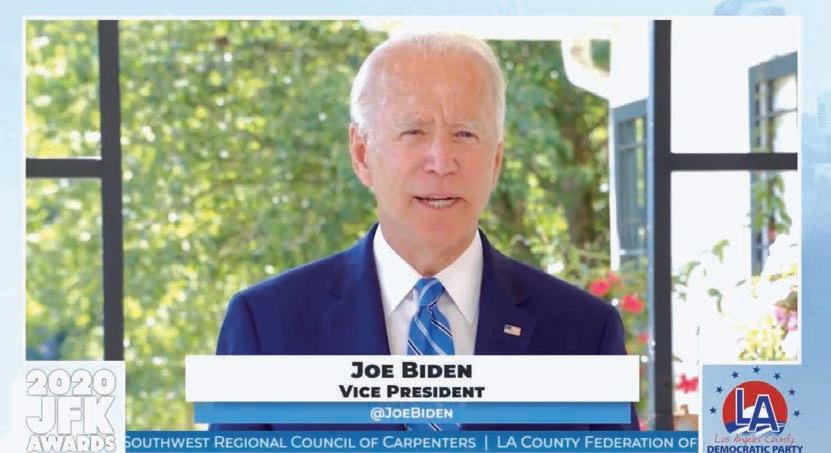
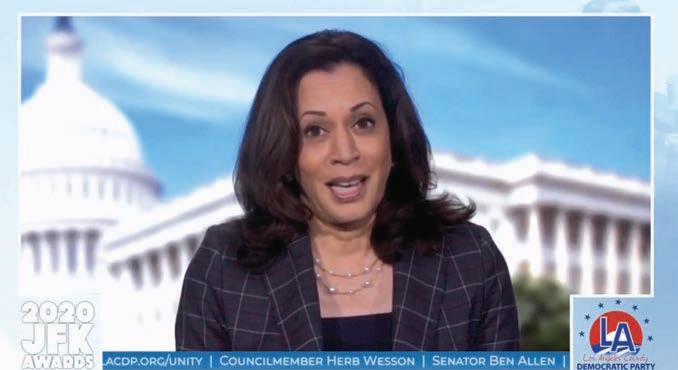
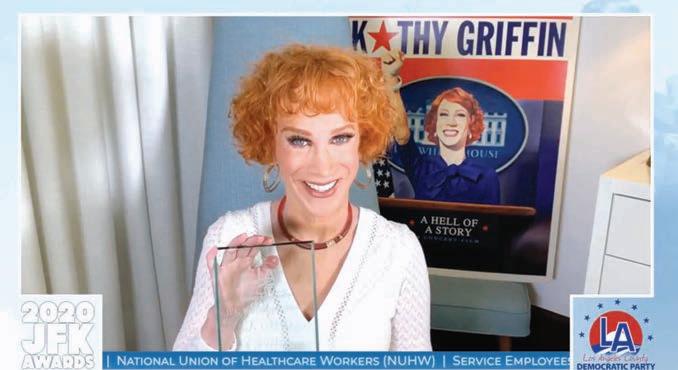
On the 100th anniversary of the 19th Amendment guaranteeing women the right to vote, the July 25 LA County Democratic Party (LACDP) JFK Awards honored four significant women. California Sen. Kamala Harris and comedienne Kathy Griffin were spotlighted with JFK Profile in Courage Awards, having fearlessly taken on and withstood attacks from President Donald Trump and his cult-like minions.
Legendary labor leader Dolores Huerta, 90, the Latina civil rights icon who co-founded the National Farm Workers Association with fellow organizer Cesar Chavez in 1962, received the Miguel Contreras Award from the late labor leader’s widow, Maria Elena Durazo, now a California State Senator. Dolores Huerta recalled how she recruited Contreras to the farm workers movement.
April Verrett, president of Service Employees International Union (SEIU), Local 2015 –the nation’s largest longterm care union representing 400,000 California home care and nursing home workers, was gushed over receiving the Kam Kuwata Partnership Award, named for the late veteran political consultant. The honor was particularly poignant since that Saturday afternoon the LA County Department of Public Health confirmed 3,628 new cases of COVID-19.
Roz Wyman, another LA political icon, first acknowledged the late civil rights icon Rep. John Lewis then said of the two young Democrats she chose to receive the Roz Wyman Democratic Youth Leadership Award — Erica Liepmann and Matthew Contreras — “they’re our future.”
The nearly two-hour show opened with an admonition from gay LACDP Chair Mark Gonzalez that “the fight for true equality is a continuous struggle” and a pledge that the local party’s 2.9 million Democrats will fight for the party’s endorsed candidates and ballot measures.
The indomitable Rep. Maxine Waters — fresh from the viral video showing her stopping to ensure a Black motorist was treated well during a traffic stop – underscored
the message that “the future of this country is at stake” in these elections. Out Assemblymember Evan Low followed Waters, the first of a slew of Asian-American participants.
Out LACDP Executive Director Drexel Heard II was the “live” host, casually connecting the Live Streamed presentations, produced by Jonathan Moulton, with humor and message repetition, underscoring not only voting for Biden but for downballot candidates, such as Christy Smith running against Trump super fan Rep. Mike Garcia in the 25th Congressional District.
Sec. of State Alex Padillia reminded viewers that “the right to vote is sacred.” Vote-by-mail ballots will be mailed out before the Nov. 3 election.
“Will & Grace” star Eric McCormick cracked the best joke of the night when congratulating Dolores Huerta: “I wish I could play you in a movie, but they’ll probably offer it to Scarlett Johansson.”
Griffin assumed that viewers knew about her frightening long battle with Trump and emphasized the importance of down-ballot voting by recalling the anti-LGBTQ religious right fanatic Kim Davis, who refused to issue a marriage license to a gay couple as an elected – and subsequently defeated — Kentucky county clerk.
There was some speculation before the virtual event that Biden would announce that he was selecting Harris to serve as his vice president. Harris had been friends with Biden’s late son Beau when the two served as attorneys general for California and Delaware, respectively. Harris sent shockwaves through the political establishment by challenging Biden over his civil rights record during a primary debate.
Biden and Harris made up and she has since been an ardent and outspoken Biden supporter.
She has also continued to speak out about hard truths, as she did at the LACDP event, talking about America’s two systems of justice — one for convicted felon Roger Stone, whose prison sentence was commuted by his friend Donald Trump, and one for Breonna Taylor, a Black ER technician in Louisville, Ken., who was shot by police in her own bed last March as they executed a search warrant. According to the Louisville Courier Journal, Taylor was still alive, struggling to breathe for at least five minutes after she was shot and received no medical attention for more than 20 minutes.
Those officers have not yet been held responsible for her shooting, sparking more protests in conjunction with the police murder of George Floyd.
Though Biden may have let go of the debate contretemps with Harris – just as Obama got over Biden’s criticism of him in 2008 — the former vice president’s inner political circle remains beyond upset with Harris.
The behind-the-scenes squabbling became public arena on July 27 when Politico published a story about former Sen. Chris Dodd’s “stunned” reaction to Harris when he interviewed her during the VP vetting process. Politico reported:
“She laughed and said, ‘that’s politics.’ She had no remorse,” Dodd told a longtime Biden supporter and donor, who relayed the exchange to POLITICO on condition of anonymity. “Dodd felt it was a gimmick, that it was cheap,” the donor said. The person added that Dodd’s concerns about Harris were so deep that he’s helped elevate California Rep. Karen Bass during the vetting process, urging Biden to pick her because “she’s a loyal No. 2. And that’s what Biden really wants.” Through an aide, Dodd declined to comment. Advisers to Harris also declined to comment.”
Perhaps sensing that Biden might have a Woman Problem after the Dodd leak, the Biden campaign released a policy platform on women.
Few paid attention. Online posts and the Twitter-verse were filled with disgust and reprimand over Dodd.
“If anything, Harris’s lack of ‘remorse’ should recommend her for the job. She is an able debater, and a tough inquisitor in Senate hearings. Harris also has the perspective that comes from growing up as a nonwhite woman in this country,” wrote Washington Post columnist Karen Tumulty. “This reported anxiety about Harris, however, suggests a different standard for women as running mates. They are apparently supposed to be window-dressing — demure and apologetic.”
Former Planned Parenthood head Cecile Richards picked up on that and tweeted: “Women are sick of being expected to ask forgiveness for every damn thing.”
BlackWomenViews Media did a little fact-checking: “I wonder if Chris Dodd’s abhorrence to Kamala saying it’s wrong to praise segregationists has anything to do with his praising a former KKK who voted against the Civil Rights Act ‘cannot think of a single moment… where he would not have been a valuable asset to this country,’” referring to former Sen. Robert C Byrd.
Writer Rebecca Traister was furious. “When your pals help you pick your lady VP based on how contrite she is about having challenged you in a debate. No no no no no nope this is gonna be the thing that ends me,” she tweeted, alluding to Dodd’s past accusation of sexual assault.
Women noticed. Just as people with HIV/AIDS and LGBTQ historians may have noted that while Biden tweeted about the 30th anniversary of the Americans with Disabilities Act, which he cosponsored, recalling the late Sen. Ted Kennedy – Biden failed to mention that Kennedy’s fight was to get HIV/AIDS into the ADA. The effort succeeded but was constantly challenged. It took four more years to make it final.
“In light of the immediacy with which the virus begins to damage the infected person’s white blood cells and the severity of the disease,” Supreme Court Justice Anthony M. Kennedy wrote, “we hold it is an impairment from the moment of the infection.”
Daniel Zingale, then-executive director of AIDS Action, called the ADA “the most important legal victory for people with HIV in the history of the epidemic.”
Biden didn’t mention HIV/AIDS at all in his longer paper on the ADA though, during the recent International AIDS Conference, a new World Health Organization report noted that “COVID-19 is having a devastating impact on the LGBTI+ community worldwide,”
Apparently, Joe Biden does not have a senior adviser who grasps cultural competency. How else to explain Biden’s choice of Dodd as a VP vetter, his failure to remember that HIV/AIDS is still an epidemic, and his startling gaffe during the LACDP event?
“We need leadership that strives to finally deliver on the Founding principles — ensure that all men are not only equal at their creation but treated equally throughout their lives,” Biden told the LACDP audience.
The look on Biden’s face suggested he knew something was off with that “all men” sentence. But he plowed ahead. And no one on his team caught it and suggested another take. It would have been simple to add the “wo” to “men,” as presumably the speechwriter intended. Instead Biden’s two-minute video for a Democratic event honoring women decried the inequality of men.
Biden’s little Freudian slip may be no big deal but it raises questions about Biden’s thinking process and who checks him. With so much at stake, such preventable gaffes can turn off and dampen the enthusiasm of voters he needs to defeat Trump.
That makes Biden’s choice for his vice-presidential candidate all the more important. Meanwhile, Gonzalez tells the Los Angeles Blade, “It’s a difficult time for Americans and it’s our job to make sure we’re doing whatever we can to represent and support working families all across LA County.”
The JFK show is posted at the LACDP website: www.lacdp.org/jfk2020
By BRODY LEVESQUE
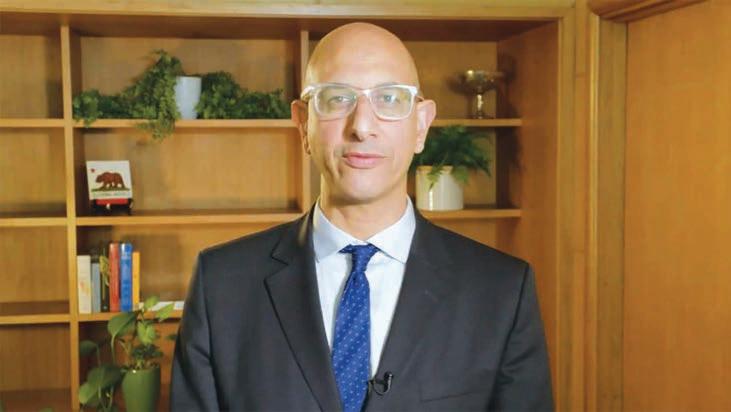
SACRAMENTO — Speaking to reporters Tuesday during a noon press briefing, California Health and Human Services Secretary Dr. Mark Ghaly announced that under new emergency regulations the state would immediately begin collecting sexual orientation & gender identity (SOGI) data on COVID-19 as well as “all other reportable diseases.”
Dr. Ghaly noted that by requiring healthcare providers and local health departments to collect and report voluntary data on the gender identity and sexual orientation of patients, it will allow the state’s public health officials to gain a better understanding on how the LGBTQI+ community is being impacted by COVID-19 as well as other potential future outbreaks.
Dr. Ghaly thanked lawmakers from the California LGBTQ legislative caucus, specifically State Sen. Scott Weiner, (D-SF), who had assisted in authoring and guiding Senate Bill 932, which specifically requires the state to collect data on the impact of COVID-19 and approximately 90 other reportable communicable diseases.
He also thanked LGBTQI+ advocacy group Equality California and others for their contributions to the effort to make this data collection a statewide mandate.
“The LGBTQ community has suffered a long history of government neglect when it comes to our healthcare system. I want to thank the state for listening to the LGBTQ community – namely, LGBTQ advocates and the California Legislative LGBTQ Caucus –and responding by enabling this data collection moving forward. It’s a deeply important and promising first step and I am grateful for Gov. Newsom’s leadership and allyship,” Weiner said in a written statement.
“This is just the beginning. SB 932 is more important than ever because we must codify this change into law. This data collection, not just for COVID-19 but for all reportable communicable diseases, is essential to ensure that our community gets the resources it needs moving forward. We can’t keep leaving the LGTBQ behind when it comes to public health. California can and should lead the way in giving the LGTBQ community the health justice it deserves,” he added.
Senate Bill 932 which passed the State Senate unanimously on June 25, 2020, is currently in the Assembly Committee on Health, where it is scheduled to be heard on Tuesday, August 4. If passed and signed into law by Governor Gavin Newsom, the bill would take effect immediately. The bill is co-authored by all members of the California Legislative LGBTQ Caucus, as well as Assemblymember David Chiu (D-San Francisco), and co-sponsored by Equality California and the California LGBTQ Health and Human Services Network.
“The COVID-19 crisis has devastated the LGBTQ+ community. But for months, we haven’t had the data to understand how, why or exactly what to do about it. From the beginning of this crisis, we have been clear: If LGBTQ+ people are left out of COVID-19 data, we will be left out of California’s data-driven response. Thanks to Gov. Newsom’s leadership and his administration’s hard work, we will start to have answers,” Equality California Executive Director Rick Chavez Zbur noted in a statement.
“We appreciate that the governor, his staff, Dr. Ghaly, and Dr. Angell understood the urgency of this problem […] This data will finally give our government, our public health leaders and our community an understanding of the degree to which this pandemic is devastating LGBTQ+ people — and what steps need to be taken to save lives,” he added.
Because rates of respiratory issues (from smoking), HIV/AIDS, cancer, and homelessness are higher in the LGBTQ+ community, LGBTQ+ people are likely experiencing greater health impacts from COVID-19 according to studies by the Williams Institute.
In Los Angeles County, Supervisors Kathryn Barger and Sheila Kuehl had pushed a way to collect LGBTQ data locally, through the LA County Department of Public Health COVID portal.
On June 18, Kuehl and the county announced that SOGI questions are now being
included in the general questionnaire asked of all people seeking an appointment to test for the coronavirus. This is the same questionnaire used by providers asking data questions on race, age, and sex.
“LGBT people experience disproportionate rates of underlying illness, poverty, homelessness, and discrimination,” Kuehl said in a statement to the Los Angeles Blade. “That’s why it’s so important that we capture sexual orientation and gender identity information as people get tested for COVID-19. Knowing how COVID-19 is affecting LGBT populations will allow us to appropriately allocate resources and address needs within the community. I’m very grateful to the many people in government and local nonprofits who worked quickly to make sure we could start this data collection as quickly as possible.”
In the question and answer segment of the press briefing, the Los Angeles Blade asked Dr. Ghaly about the COVID testing and contact tracing prioritization among the homeless population specifically LGBTQI+ youth who comprise roughly 40% of homeless youth across California and the nation.
Ghaly noted that the state had refocused efforts in two of the governor’s initiatives, Project Home-Key and Project Room-Key which were implemented to expand housing and shelters for the state’s homeless people and explained that efforts were being placed into further expanding the testing and contact tracing in the homeless population.
He also noted that testing supplies and quicker laboratory turnaround for shelters and social service agencies in support of homeless shelters and service providers continues to be a priority in delivering needed equipment and PPE.
The Blade also asked if his department was working toward greater penetration of the state’s Latino/Latinx population, which has seen the greatest amount of positive results for the coronavirus, with more bilingual personnel and contact tracing cohorts.
Ghaly said that a push was underway to expand testing capabilities beyond “brick and mortar facilities” and that emphasis was being placed on drive-thru testing sites and noted the need for greater penetration in the agricultural/factory workers population. He said that state health care workers will also be conducting disease investigation and contact tracing with sensitivity to “in-language” for accurate data collection.



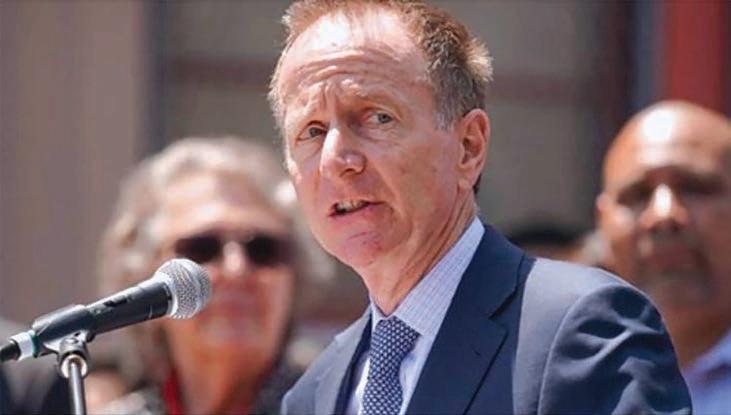
The annual late-summer rituals of back-to-schoolshopping for clothes and school supplies across the LA basin is on hold this year due to the coronavirus pandemic as school districts announced that in-classroom instruction would be replaced by distance (virtual) learning.
California Gov. Gavin Newsom issued new guidance last Friday on the re-opening of the state’s schools, saying that if the schools are in counties that have stayed off the state’s COVID-19 monitoring list for 14 days, in-person instruction could commence in August.
“Learning is non-negotiable,” Newsom told reporters July 17.“The virus will be with us for a year or more, and school districts must provide meaningful instruction in the midst of this pandemic. In California, health data will determine when a school can be physically open – and when it must close – but learning should never stop. Students, staff, and parents all prefer in-classroom instruction, but only if it can be done safely.”
Superintendent Austin Beutner of the Los Angeles Unified Schools District- the nation’s second-largest school district, announced on July 13 that the LAUSD would continue with distance learning until at least January of 2021. The decision affects the education of half a million children who have been out of their classrooms since mid-March.
“While it is disheartening and unfortunate that Los Angeles County students can’t plan for a normal first day back at school, we respect the governor’s decision to insist that counties reduce the rate of community transmission before schools re-open for in-person classroom learning,” said Dr. Barbara Ferrer, the Director of the Los Angeles County Department of Public Health.
New guidance issued Thursday from the Centers for Disease Control, which was strongly urged on by President Donald Trump, is in favor of sending students back to the classrooms. The CDC stated, “available evidence shows that coronavirus does not possess as great a risk to children.”
The president pressed again Thursday during his afternoon coronavirus briefing for the nation’s schools to reopen. “We’re asking Congress to provide $105 billion to schools in the next stimulus bill,” he announced.
“We cannot indefinitely stop 50 million children from going to school,” Trump said. “Reopening our schools is also critical to ensuring parents can go to work and provide for their families.”
In its new guidance announcement, the CDC said that children appear to be at lower risk for contracting COVID-19 as compared to adults. “To put this in perspective,” according to the CDC, “as of July 17, 2020, the United States reported that children and adolescents under 18 years old account for under 7 percent of COVID-19 cases and less than 0.1 percent of COVID-19-related deaths.”
“Scientific studies suggest that COVID-19 transmission
By BRODY LEVESQUE
among children in schools may be low. International studies that have assessed how readily COVID-19 spreads in schools also reveal low rates of transmission when community transmission is low.”
The CDC states that there are few reports of children being the driving force of transmission within families. “This is consistent with data from both virus and antibody testing, suggesting that children are not the primary drivers of COVID-19 spread in schools or in the community.”
“No studies are conclusive, but the available evidence provides reason to believe that in-person schooling is in the best interest of students, particularly in the context of appropriate mitigation measures similar to those implemented at essential workplaces,” the CDC asserted in its statement.
“It is critically important for our public health to open schools this fall,” CDC Director Dr. Robert Redfield said in the statement announcing the new guidance Thursday.
“School closures have disrupted normal ways of life for children and parents, and they have had negative health consequences on our youth. CDC is prepared to work with K-12 schools to safely reopen while protecting the most vulnerable,” Redfield said.
While the White House is pressing for schools to reopen, LAUSD Superintendent Beutner told KABC7 Los Angeles that without sufficient funding for COVID-19 testing and contact tracing his more than 700,000 students at more than 1,000 schools are facing “an education crisis.”
According to Beutner, regularly testing students would cost $300 to $400 per pupil for the LAUSD, which already
spends about $17,000 annually on each student.
“The Dodgers are being tested to go back to work. Shouldn’t teachers and students be tested to go back to school?” Beutner stated.
“This health crisis is turning into an education crisis,” Beutner told KABC. “Our students haven’t been at schools for five months by the time August rolls around. We’ve seen studies about a short summer break and how students regress.”
Also at issue is the impact on students from lowerincome or moderate-income households, which make up nearly 80% of LAUSD students, coupled with students with special needs, and those students in alternative educational settings.
The CDC also took the position that virtual learning can be a disadvantage to American students maintaining that children are more to succeed with the services and instruction offered in school.
“It can lead to severe learning loss, and the need for inperson instruction is particularly important for students with heightened behavioral needs,” the CDC statement said.
“We have this society of haves and have-nots, and it’s mostly have-nots in public education,” Beutner said “Is it because children aren’t represented in the Legislature? I’m not sure. But we have to get to a different place in this conversation and recognize the importance of education.”
A solid education is “the path out of poverty” for many students, he added. “This is about something that can’t be measured in dollars and cents — it’s about creating opportunity for children.”
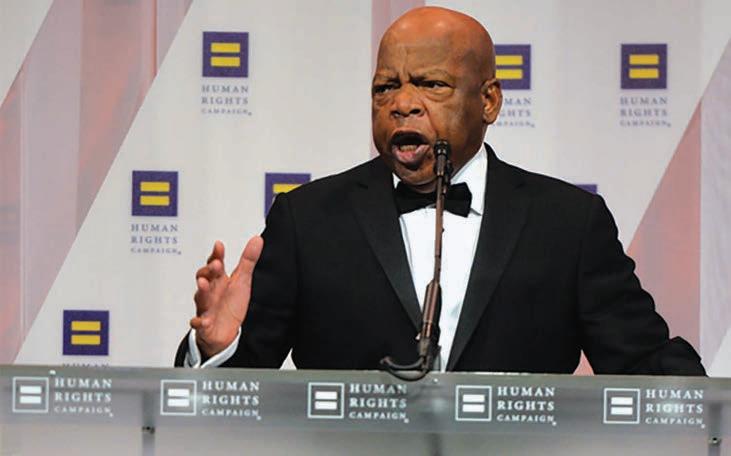
Members of Congress and the public paid tribute to the late U.S. Rep. John Lewis (DGa.) this week at the U.S. Capitol in both a ceremony in the Capitol Rotunda, where his American flag draped coffin was placed, and on the steps outside the East Front of the Capitol, where members of the public also paid their respects to the civil rights legend.
Lewis, who was serving his 17th term in Congress, died July 18 at the age of 80 from complications associated with pancreatic cancer.
LGBTQ rights advocates, who considered Lewis a strong ally in the cause of LGBTQ rights, may remember that Lewis’s commitment to LGBTQ equality was on full display at the Capitol nearly 16 years ago when on Sept. 30, 2004, Lewis delivered a speech on the House floor strongly opposing a proposed constitutional amendment to ban same-sex marriage.
By LOU CHIBBARO JR. lchibbaro@washblade.com
It was at a time when more than a dozen states had passed their own laws or state constitutional amendments banning same-sex marriage. Lewis’s floor speech also took place in the midst of the 2004 presidential election when then-President George W. Bush backed the proposed federal constitutional ban on same-sex marriage in what political commentators called an attempt to create a wedge issue to boost support for his reelection.
Even Democratic presidential candidate John Kerry of Massachusetts, while opposing the constitutional amendment, said he did not support same-sex marriage but supported civil unions for gays and lesbians instead.
Lewis’s floor speech opposing the constitutional amendment came during a two-and-ahalf-hour House debate on the proposal in which several supporters of the amendment submitted petitions from black churches backing the amendment and denouncing samesex marriage.
This reporter, who watched the debate from the House Press Gallery, observed Lewis using his skills as an orator with his characteristic booming voice to refute arguments in favor of the amendment. The vocal emphasis he gave in saying why he opposed the amendment isn’t completely reflected in the written transcript of his speech, which the Blade is publishing today.
Among other things, Lewis referred to the famous 1965 civil rights protest he led across the Edmund Pettus Bridge in Selma, Ala., in which he suffered a concussion when he and other protesters were beaten by state troopers. He said he was demonstrating then to “end discrimination, segregation and separation” and his opposition to the socalled Marriage Protection Amendment was based on his longstanding opposition to discrimination.
“To pass this legislation would be a step backward,” he told his House colleagues. “The institution of marriage is not begging this Congress for protection,” he said. “No one is running around this building saying protect us.”
At the conclusion of the debate the House defeated the proposed same-sex marriage
ban by failing to reach a required two-thirds majority for a constitutional amendment. But the proposed amendment nevertheless received a majority vote of 227 in favor and 186 against, with 22 House members not voting.
Congressional Record
September 30, 2004
House of Representatives Debate on the Marriage Protection Amendment, a proposed constitutional amendment to ban same sex marriage in the United States. The proposed amendment stated, “Marriage in the United States shall consist solely of the union of a man and a woman. Neither this constitution, nor the constitution of any State shall be construed to require that marriage or the legal incidents thereof be conferred upon any union other than a man and a woman.”
Mr. LEWIS of Georgia. Mr. Speaker, over the years, this Nation has worked hard to take discrimination out of the Constitution, and today, we want to put it back in.
I can recall just a few short years ago that there were laws inscribed in some State constitutions saying that blacks and whites could not marry. We changed that.
Today, we look back on those days, and we laugh. There will come a time when generations yet unborn will look back on this Congress, look back on this debate, and laugh at us. This is not a good day in America. This is a sad day in the House of the people.
For one who faced death, who was beaten and left bloody and unconscious at the Greyhound bus station in Montgomery, Alabama, in May of 1961; for one who had a concussion at the bridge in Selma on March 7, 1965, demonstrating, trying to end discrimination, segregation and separation, this is not the way.
This is unbelievable. It is unreal. I thought as a Nation and as a people we had moved so far down the road toward one family, one House, one America.
To pass this legislation would be a step backward.
The institution of marriage is not begging this Congress for protection. No one is running through the halls of Congress. No one is running around this building saying protect us.
Whose marriage is threatened? Whose marriage is in danger if two people, in the privacy of their own hearts, decide they want to be committed to each other? Whose marriage is threatened?
Whose marriage is in danger if we decide to recognize the dignity, the worth and humanity of all human beings?
The constitution is a sacred document. It defines who we are as a Nation and as a people. Over the years, we have tried to make it more and more inclusive. We cannot turn back. We do not want to go back. We want to go forward. Today it is gay marriage; tomorrow it will be something else.
Forget about the politics; vote your conscience. Vote with your heart, vote with your soul, vote with your gut. Do what is right and defeat this amendment.






By CHRIS JOHNSON cjohnson@washblade.com
With Ritchie Torres declaring victory in the Democratic primary for New York’s 15th congressional district, the New York City Council member appears on his way to becoming one of the first openly gay black men elected to Congress — but progressive advocates say that took a dedicated campaign to flip the script on his anti-LGBTQ, anti-abortion opponent.
Claims the New York City Council is “controlled by the homosexual community” and LGBTQ people are “cursed” were among the anti-LGBTQ views Bronx City Council member Ruben Diaz Sr. have expressed, making him a rare breed among Democrats.
As a state senator in New York, Diaz Sr. was the chief Democratic opponent of legalizing marriage equality in 2011. In addition, Diaz Sr. called New York the “abortion capital of the United States” and voted against pro-choice bills.
Although Diaz Sr. was initially in the lead in the crowded primary per early polls, the trend was reversed shortly before the primary, which cleared the way for Torres. Although the Associated Press has yet to call the race and the results aren’t official, Diaz Sr. has announced his retirement from politics in the wake of the primary and Torres has declared victory.
“The counting is all but over,” Torres tweeted. “On Primary Day, we were ahead by 4516 votes. As of yesterday evening, our lead had grown to 7803 (far larger than the # of uncounted ballots). Even if our nearest rival were to win every single one, we would remain ahead by a wide margin.”
Progressive groups trumpeted the declared win by Torres as a victory for their values, asserting grassroots and digital efforts were responsible for changing the outcome of the race, which by early indications looked like a win for Diaz Sr. Ben Needham, director of strategic initiatives in the policy and political affairs department at the Human Rights Campaign, said in an interview with the Blade the interest of progressive groups in the race “started a lot longer before the polling came out.”
“We were looking at the candidates and where they stood on issues as they related to LGBTQ equality,” Needham said. “And we came to the decision that Ritchie Torres was just the best candidate, as it related to the issues that we want to advance like the Equality Act, and other LGBTQ issues in Congress, and so that led to us making a decision to endorse Ritchie.”
After a conversation with independent expenditure partner groups, Needham said progressive groups concluded Torres had a path to success, but a campaign against Diaz Sr. was necessary because it “didn’t seem that people fully understood that he was a Democrat in name only.”
A coalition of groups — Planned Parenthood Action Fund, LGBTQ Victory Fund, NARAL Pro-Choice America, Latino
Victory Fund, the Congressional Hispanic Caucus BOLD PAC, Bend the Arc Jewish Action, Congressional Progressive Caucus PAC, Human Rights Campaign, Equality PAC and People for the American Way — launched in May a social media-focused campaign on the record of Diaz Sr.
A chief component of this campaign, Needham said, was a background document on Diaz Sr.’s’ “bad rhetoric and bad votes around LGBTQ issues around women’s reproductive rights” developed by the Human Rights Campaign’s research team, which was highlighted in video ads on social media.
“We had a ton of equality voters in the district, and these are people that said they would vote for a candidate based on their stance around LGBTQ issues,” Needham said. “And so, we took the process of communicating with Diaz Sr. and making sure that people understood his record, but also making sure people understood that Richard Torres was going to be an advocate for the LGBTQ community, not just because he was part of our community, but because of his record as well.”
Lucas Acosta, a spokesperson for the Human Rights Campaign, said the social media post from the campaign had 1.1 million imprints and 417,000 on Facebook alone.
The amount of money allocated for the campaign, Acosta said, was a “5-figure buy and our largest expenditure in any race outside the presidential this cycle,” but he declined to give an exact figure.
Initial polling found Diaz Sr. was favored to win the primary. A Data for Progress poll earlier this month showed Díaz receiving 22 percent of the vote from likely voters and Torres with 20 percent. The next three closest competitors, all progressives, received support from just six percent of likely voters.
Bronx United, a political action committee, had similar data in April, finding Diaz was favored to win the primary by at least double digits, taking home nearly one-third of the vote.
But a subsequent memo on the primary results from Bronx United noticed a change in Diaz Sr.’s trajectory as the race went on, crediting that with negative press on the candidate’s anti-LGBTQ views.
“This relentless onslaught of negative press and active social media pushback on his events and antics helped freeze any last-second political support Diaz Sr. may have picked up during the home stretch of the race,” the memo says. “The effort also exposed his shady tactics. In the end, Diaz Sr. could not hold a single event without Bronx United monitoring it and hammering him for improprieties.”
The shift became apparent on the night of the election, when early results showed Torres had won the primary and media outlets predicted he was on his way to Congress. According to initial results with 40,791 ballots cast, Torres has won with 30.5 percent, followed by New York Assembly
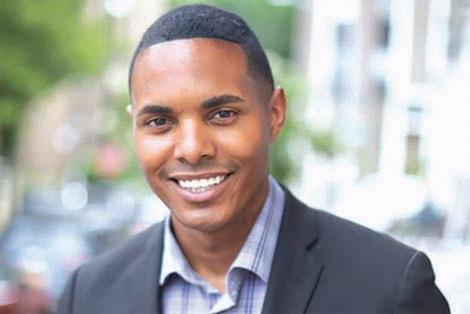
member Michael Blake with 19.4 percent and Diaz Sr. with 14.8 percent.
Needham said with primary voters disaffected with Diaz Sr., they naturally were drawn to Torres, in part because of the charismatic way he engaged with the district amid civil unrest over the death of George Floyd.
“I think if you just saw Ritchie Torres out in the streets with advocates, calling for reforms to the policing and saying ‘Black Lives Matter’ really sort of resonated with voters in that district,” Needham said. “And so I think it was a combination of everything, but I do think that we had to tell the story of Diaz’s record but also tell the story of why Ritchie Torres was the better choice.”
But the results are still not yet official. A New York Board of Elections spokesperson told the Blade about two-thirds of ballots cast in the state primary were absentee ballots, which is an unprecedented amount, and when counting will be done is “impossible to say.” An Associated Press spokesperson said Friday the media outlet is awaiting the “results of mail-in ballots from the Bronx, which have yet to be released” before making the call.
Jenny Lawson, executive director of Planned Parenthood Votes, was among the progressive activists nonetheless saying it’s clear based on the known results that the prochoice candidate has come out on top.
“New York primary voters delivered a resounding message: When politicians come for our reproductive rights, we’ll leave them behind at the ballot box,” Lawson said. “Rubén Díaz Sr.’s record of opposing abortion and LGBTQ+ rights is way out of step with the voters of New York’s 15th congressional district.”




‘Thank you to the people who have welcomed me without discrimination’
By MICHAEL K. LAVERS & YARIEL VALDEZ GONZALEZ
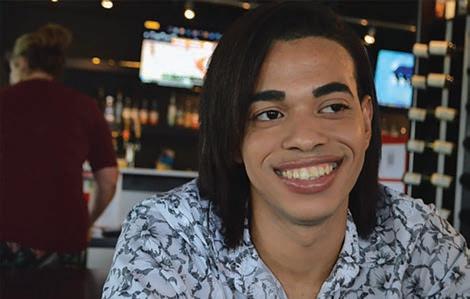
JACKSONVILLE, Fla. — A transgender woman who spent nearly eight months in U.S. Immigration and Customs Enforcement custody won asylum in the U.S. last August because of the persecution she suffered in her native Cuba.
Dayana Mena López on July 25 noted to the Blade during an interview at a restaurant in Jacksonville, Fla., where she now lives that she suffered persecution in her homeland because of her gender identity and her opposition to the Cuban government.
Mena, who is of African descent, is from the town of Placetas in Cuba’s Villa Clara province.
She told the Blade she came out as trans when she lived in Cienfuegos, a city in Central Cuba. Mena said her family supported her.
“I would have been able to consider myself lucky and happy in this regard because my entire family accepted me: my parents, my grandparents,” she said. “My entire family always accepted me and I never had any problem in my neighborhood with my neighbors in this sense. In this sense I lived well, with respect to this part of my life.”
A federal lawsuit the Southern Poverty Law Center filed on behalf of Mena and other ICE detainees who had been denied parole that would have allowed her to pursue her case out of detention notes she “refused to complete compulsory military service” in the Communist country, but “authorities misidentified her as a gay man and attempted to force her to serve in the military.”
Mena told the Blade the men in the unit to which she was brought insulted her because she is trans. Mena said she could not wear a female uniform and was unable to do her make up or hair.
“The environment was very tense,” she said. The Southern Poverty Law Center lawsuit further details her life in Cuba.
“Due to her political beliefs and identity, Cuban authorities have beaten her, taunted her with homophobic slurs, locked her in a frigid chamber for hours, and held her under arrest,” it reads.
Mena said she received death threats. She also told the Blade that police officers harass trans women who gather along Havana’s oceanfront promenade known as the Malecón because they think they are sex workers.
Mariela Castro, the daughter of former Cuban President Raúl Castro who directs the country’s National Center for Sexual Education, spearheads LGBTQ-specific issues on the island.
Her supporters note Cuba provides free sex-reassignment surgery under its health care system. They also point out that Mariela Castro, who is a member of the Cuban National Assembly, in 2013 voted against a proposal to ban anti-gay discrimination in the workplace because it did not include gender identity.
“She is something very, very fake,” said Mena in response to the Blade’s question about Mariela Castro. “She is something
created, (they are creating something) fake to sell an image.”
Mena left Cuba on Dec. 22, 2018.
“I left Cuba to flee persecution and physical and psychological abuse I also suffered because I am a trans woman,” she said.
Mena said a friend helped her pay for the flight from Havana to Panama. The Panamanian government granted Mena a visa that allowed her to travel to the country, but she told the Blade she could not return to Cuba.
“I had to stay there in Panama because they would have detained me if I returned to Cuba,” she said.
Mena and a gay man from Cuba asked for asylum in the U.S. at a port of entry in El Paso, Texas, in January 2019. Mena presented herself as a gay man, as opposed to a trans woman, because her friend did not want to be separated from her.
“He was very afraid to be alone,” said Mena. “That’s why I asked for asylum like this.”
Mena was separated from her friend when ICE transferred her to the Cibola County Correctional Center, a privately run detention center in Milan, N.M., that once had a unit for trans ICE detainees. The friend with whom she entered the U.S. was eventually deported back to Cuba.
ICE transferred Mena to the Tallahatchie County Correctional Center, another privately run prison in Tutwiler, Miss.
The Southern Poverty Law Center lawsuit notes Mena “again identified as trans” and she was held in solitary confinement for a month while she waited for her credible fear interview.
Mena told the Blade she was isolated “supposedly for my protection, to not suffer violations, etc.” Mena said she was able to speak with fellow detainees through the glass window of her cell’s door. She also said a guard of Puerto Rican descent allowed her to leave her cell and did not close the door when he was on duty.
ICE initially placed Mena in the general population when it transferred her to the Pine Prairie ICE Processing Center, another privately run detention center in Pine Prairie, La. The Southern Poverty Law Center lawsuit notes ICE placed her back into solitary confinement for “several days” after she told a psychologist she is trans.
“The prison warden had me placed in the hole for four days when, after a medical and psychological evaluation, I said that I identified as a transgender person,” Mena told the Blade. “I was detained together with another companion.”
Mena said Southern Poverty Law Center lawyers raised the issue with the warden and challenged the decision.
“They then freed us from the hole and they made us sign a paper that said it was our responsibility if something happened,” Mena told the Blade. “They also gave me another paper to present to officials saying that they couldn’t check me or even touch me.”
“I never had problems with anyone,” she said. “I was not
a victim of homophobia, to the contrary. The Cubans were always defending me.”
Mena’s attorneys in May 2019 asked ICE to transfer her to the Cibola County Correctional Center’s unit for trans women, but the request was not granted.
Mena’s final hearing in her asylum case took place on Aug. 1, 2019, which took place against the backdrop of the Trump administration’s hardline immigration policy that, among other things, seeks to drastically limit the number of asylum seekers allowed into the U.S. Mena told the Blade her hearing lasted upwards of six hours.
“I had a super bad time with the [government] prosecutor, who treated me badly,” said Mena. “He called me a liar, even as an expert the day before my court hearing examined my body to verify the injuries and scars that I had on my body were real.”
The judge granted her asylum, but ICE did not release her until Aug. 5, 2019.
“The day that I saw my name on the list to leave I cried more than anyone in this world,” Mena told the Blade. “I cried more than when I left Cuba. I cried because I had a happiness that many other people crave.”
“I couldn’t eat that day and I saw people next to me crying,” she added. “The entire pod, 140 people, clapped for me when I left through the door. It is something gratifying, but at the same time it hurt a lot.”
A friend of Mena’s father picked her up and drove her to Jacksonville.
Nearly a year later, she is working two jobs. Mena told the Blade her life in Jacksonville “has been awesome for me,” even though none of her relatives live in the city.
“Thank you to the people and the city who have welcomed me without discrimination, who have given me support and helped me get ahead in a country as difficult as this,” she said.
Mena further described the U.S. as “free.”
“I am hopeful that the new laws that allow people like me to live free don’t change,” she added.

We remember John Robert Lewis who died on July 17 at the age of 80 as an icon of the civil rights movement. A congressman who Speaker Nancy Pelosi and others have called the ‘moral conscience’ of the United States Congress.
It was Martin Luther King, Jr. who gave him the nickname, “The boy from Troy.” Lewis said when he first met him: “Dr. King said, ‘Are you the boy from Troy? Are you John Lewis?’ And I said, ‘I am John Robert Lewis,’ I gave my whole name. And he still called me ‘the boy from Troy.’”
That was 63 years ago in Montgomery, Ala., at King’s First Baptist Church. Over the years we know how much John Lewis did to further the rights of African Americans in this country. He was president of the Student Non-Violent Coordinating Committee (SNCC). He wanted to motivate other young people like himself to get involved in the fight for civil rights. But he, like King, tried to make it a non-violent fight. When riots erupted like the one at the Edmund Pettis Bridge in Selma, it was others who started those riots. John Lewis did nothing but try to walk across that bridge to demand his rights when he was nearly beaten to death on what became known as Bloody Sunday. He always said that when he got into trouble it was ‘good trouble.’ Edmund Pettus, whom the bridge was named after, was head of the Alabama Ku Klux Klan, and a U.S. senator. He was honored for his role in supporting slavery and racism. Because of that there is a movement today to rename the bridge. One suggestion is to name it the John Robert Lewis Bridge.
In the six days of remembrances planned for Congressman Lewis, the changes he and those who fought in the civil rights movement made can be plainly seen. He is being accompanied on his last trip over the Pettus Bridge by Alabama state troopers whose predecessors were the ones who nearly beat him to death on Bloody Sunday. His body will be taken to the Alabama State Capitol in Montgomery where he will lie in state. His
body will be met and welcomed by Gov. Kay Ivey in the place where in 1963 after being elected governor George Wallace stood and said in his inaugural address, “segregation now, segregation tomorrow, segregation forever.”
Lewis was an amazing man who lived many lives in his 80 years. From his humble beginnings, his parents were sharecroppers in Troy, Ala., to the heights of power and respect in the United States Congress. In his lifetime he witnessed the passing of the 1964 Civil Rights Act and the 1965 Voting Rights Act. He saw the Supreme Court issue its unanimous decision in Brown v. Board of Education, ruling that racial segregation in public schools violated the Equal Protection Clause of the 14th Amendment. He saw the nation slowly move forward on the promise of equal protection under the law promised in our founding documents. But he always knew there was much more to do. Then he saw the nation elect Donald Trump, a racist, who made racist statements and gave tacit permission for others to do the same.
In his last days he saw the shooting of George Floyd and the strengthening of the Black Lives Matter movement. One of the last things he witnessed was the spectacle of a president using federal troops to shoot rubber bullets and tear gas at peaceful protesters in front of the White House, which must have brought his thoughts back to Bloody Sunday. Then shortly before his death he stood with D.C. Mayor Muriel Bowser on Black Lives Matter Plaza.
He knew what he had accomplished and surely he trusted the next John Lewis’s, whoever they would be, to continue the fight for full equality, a fight he made for all people including women and the LGBTQ community. I am sure John Lewis felt confident there are young men and women who will take the torch he passed to them and lead the way to a better future for all.
ADDRESS
5455 Wilshire Blvd, 21st Floor, Los Angeles, CA 90036
PHONE 310-230-5266
E-MAIL tmasters@losangelesblade.com
INTERNET losangelesblade.com
PUBLISHED BY Los Angeles Blade, LLC
PUBLISHER
TROY MASTERS tmasters@losangelesblade.com
310-230-5266 x8080 (o), 917-406-1619 (c) SALES & MARKETING
SALES EXECUTIVE
ROMAN NAVARRETTE roman@losangelesblade.com 310-435-3022
PALM SPRINGS ACCOUNT EXEC BRAD FUHR, 760-813-2020. brad@gaydesertguide.com
NATIONAL ADVERTISING
RIVENDELL MEDIA sales@rivendellmedia.com, 212-242-6863
MARKETING DIRECTOR
STEPHEN RUTGERS srutgers@washblade.com, 202-747-2077 x8077
EDITORIAL
CONTRIBUTING WRITER
KAREN OCAMB karenocamb@losangelesblade.com
NATIONAL EDITOR
KEVIN NAFF kna @washblade.com, 202-747-2077 x8088
INTERNATIONAL EDITOR
MICHAEL K. LAVERS mlavers@washblade.com
CONTRIBUTORS
CHRISTOPHER KANE, AUSTIN MENDOZA, JOHN PAUL KING, JOEY DIGUGLIELMO, CHRIS JOHNSON, LOU CHIBBARO JR., MARIAH COOPER, REBEKAH SAGER, JON DAVIDSON, SUSAN HORNIK, CHANNING SARGENT, SAMSON AMORE, CHRISTOPHER CAPPIELLO, MICHAEL JORTNER, DAN ALLEN, SEAN SHEALY, SCOTT STIFFLER CREATIVE DESIGN/PRODUCTION
AZERCREATIVE.COM
DISTRIBUTION
CHRISTOPHER JACKSON, 562-826-6602
All
not be
without
and
consent of the Los Angeles Blade. e sexual orientation of advertisers, photographers, writers and cartoonists published herein is neither inferred nor implied. e appearance of names or pictorial representation does not necessarily indicate the sexual orientation of that person or persons. Although the Los Angeles Blade is supported by many ne advertisers, we cannot



By JOHN PAUL KING
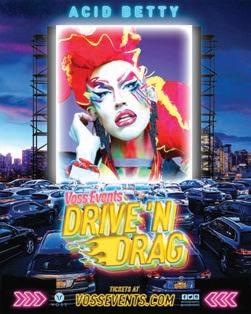
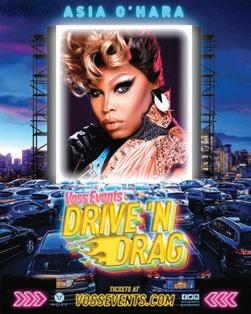
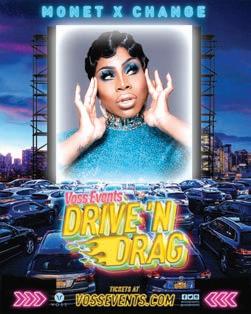
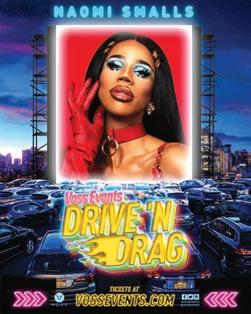
Even in a pandemic, any drag fan will tell you that you can’t keep a good queen down.
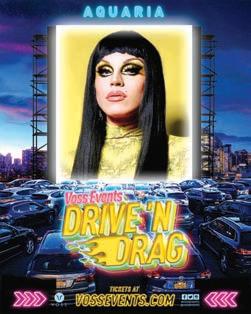
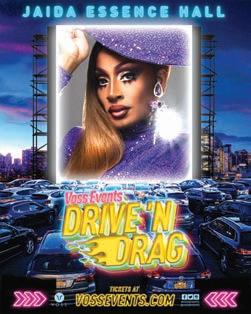
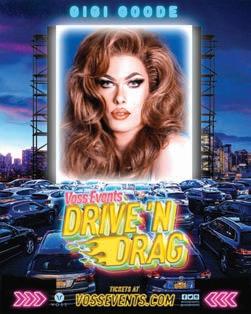
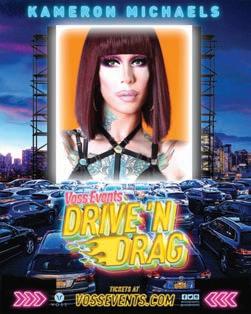
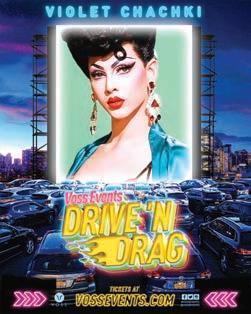
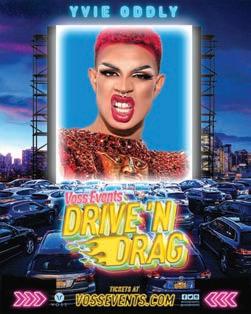
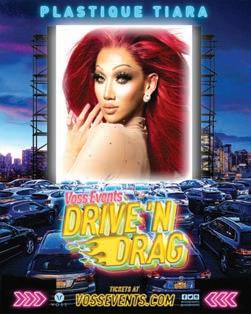
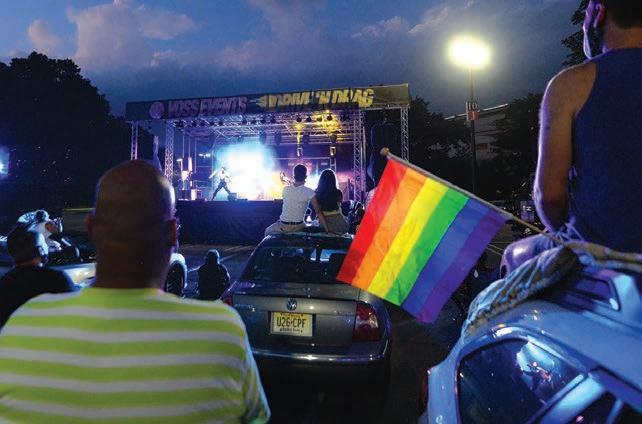
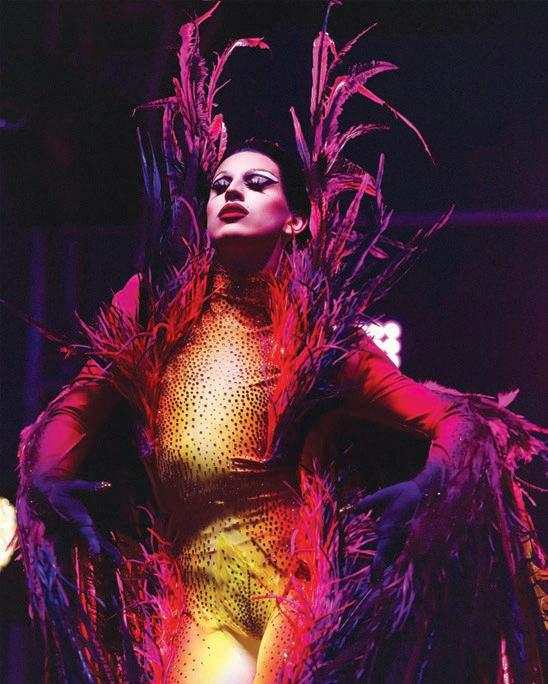
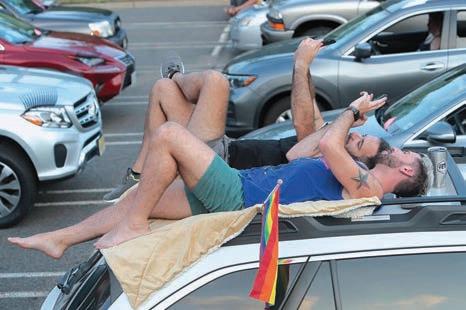
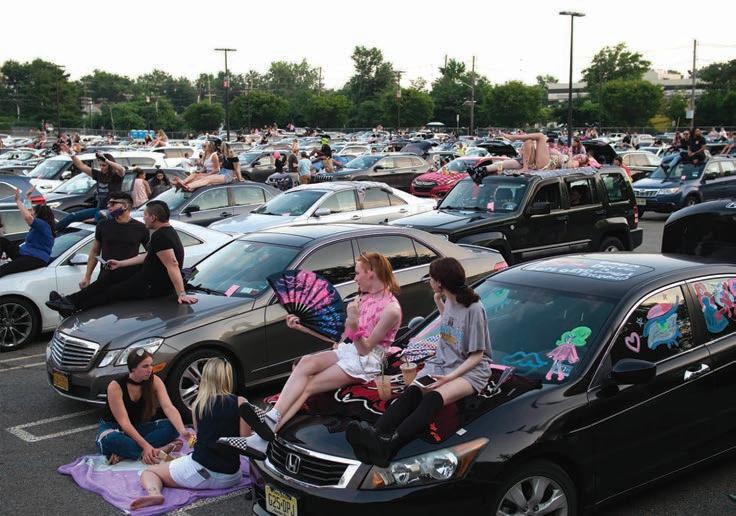
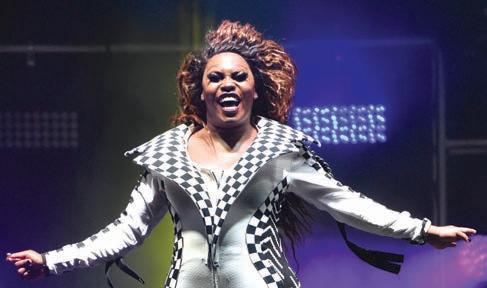
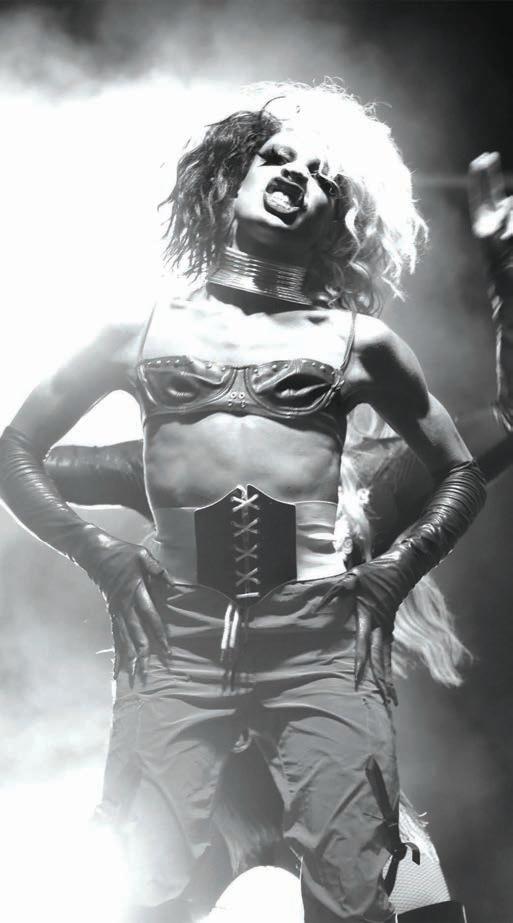
If any proof of that statement were needed (it’s not), you can surely find it at the Rose Bowl Stadium in Pasadena this weekend. That’s where a gallery of gorgeous fan favorites from “RuPaul’s Drag Race” will converge for a three-day, socially distant extravaganza, aptly titled “Drive ‘N Drag!” and described in press materials as “a brand-new experience for drag fans.”
It’s the second installment of the outdoor summer concert series, coming on the heels of an opening weekend at New Jersey’s Westfield Garden State Plaza that featured five sold-out shows. The concept is as much retro as it is timely in the here and now of the Summer of Covid; essentially, it’s a drive-in, only instead of a movie, it’s a live theatrical experience. Complete with concertstyle stage and lighting, Jumbotron screens, and sound being pumped from the stage both outside and via FM transmitters, it allows attendees to enjoy the show from the safety of their vehicle – either inside or on top of it – at multiple performances happening all weekend long. And as if all that weren’t enough of a lure, there’s food and drink involved, too, via gourmet food trucks.
The tour comes from Voss Events, famous for its “Drag Brunch” events as well as “RuPaul’s Drag Race Live” at Las Vegas’ Flamingo Hotel and the “Werq the World” tour (postponed due to coronavirus until 2021), and is conceived to bring the people an essential need (drag, of course) during an unprecedented time.
“Our ‘Werq the World’ Tour typically plays inside large theaters and arenas,” says producer Brandon Voss, “but we’ve moved the show outside to continue providing much needed entertainment during these crazy times. A pandemic won’t keep our queens from ruling the stage. The drag show must go on!”
Voss tells the Blade that he had no problem getting queens to commit to going on the road in the middle
of the coronavirus crisis. “I ran the idea by a lot of them before fully bringing it to fruition,” he says. “Once I reviewed all safety precautions, everyone was ready to get out of the house and perform.”
Among the queens he enlisted to star in “Drag ‘N Drive” are “RuPaul’s Drag Race” winners Jaida Essence Hall, Yvie Oddly and Aquaria. They are joined by fan favorites Asia O’Hara, Acid Betty, Gigi Goode, Monet X’ Change, Kameron Michaels, Naomi Smalls, Plastique, Vanessa Vanjie and Violet Chachki.
Aquaria tells us she’s thrilled to be a part of it.
“The opening weekend was honestly so exciting,” she gushes. “As practically the first drag concert of its kind, there were certainly a few bumps in the road and some kinks we worked out over the weekend, however, just as we have always done as queer artists and event producers, we quickly adapted to the learning curve.
“Drag artists are always some of the first to adapt to any circumstance or hardship, and we have proved our place as essential entertainment over the past few months by constantly working to bring a smile to people’s faces against any and all odds. It’s special today that we now are presented with this opportunity to entertain in a format other than digitally and we absolutely can still feel the love the fans are telepathically sending us on stage.”
Though she says it’s a bit “surreal” performing under such unusual conditions, Aquaria thinks they succeed in creating “a memorable experience for fans,” and gives shared kudos to the whole team responsible for “Drive ‘N Drag.” “It takes a group of real professionals not only to put together an event this unique and safe,” she tells us, “but to do it flawlessly in all the same costumes, wigs, pads, makeup, etc. as we regularly do... and then doing it in muggy 90+ degree weather?!?!? Both the fans and the queens are true champions.”
Fellow queen Plastique also commented to the Blade, to tell fans in LA to expect “one amazing show.”

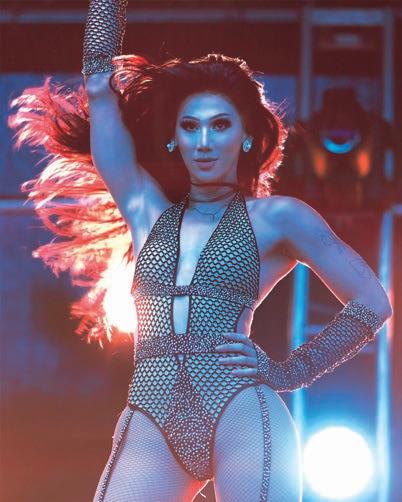
“Be ready to be entertained,” she tells us, quickly adding, “and to remain socially distant and wear the mask!”
“Be inspired by the gorgeous Valentina and keep it on.”
Multiple shows will run all weekend long, starting at 7 p.m. on Friday, July 31 and continuing Saturday, Aug. 1 and Sunday, Aug. 2, with performances beginning at 4:30 p.m. both days. Tickets are $60 per car for two people, with spots assigned upon arrival – but if you want to be assured the best possible view, 100 close-to-the-stage VIP spots are also available for $120 per spot. Whichever option you choose, additional passengers are $20 each.
After their stop at the Rose Bowl, they’ll take their show
to Chicago, Seattle, and Washington, D.C., with additional cities reportedly in the works.
No matter where they stop off, Voss assures fans they can expect a great time.
“I think there are lots of fun surprises in store for everyone attending – and what will be best about it is getting out of the house to enjoy a show!”
To purchase tickets or for more information about Drive ’N Drag, visit vossevents.com/drive-n-drag.


To purchase tickets or for more information, you can head to the Voss Events website (https://vossevents. com/drive-n-drag/) any time – but hurry, because these performances are likely to sell out fast.
By TERRI SCHLICHENMEYER
You didn’t need the extra heat.
No, the evening was balmy; it had been all day, but you needed to watch the embers. There’s something about a campfire that’s relaxing, isn’t there? Something romantic about it, too, which means things can heat up or, as in the new novel “Camp” by L.C. Rosen, things can go all up in flames.
Sixteen-year-old Randall Kappelhoff had been thinking about his plan all winter. This year at Camp Outland, a camp for queer teens, everything would be different. He’d cut his hair and change his name – no more “Randy,” he’d be “Del” at camp. He’d act totally masc, sign up for sports, and he’d reluctantly give up performing in the annual play. And at the end of the four weeks of camp, Hudson Aaronson-Lim would be Randy – um, Del’s – boyfriend.
He’d been hot for Hudson every summer for years. This plan had to work. And it does. At first.
Hudson is everything Del wants: he’s solid, sweet, and his kisses are ah-mayzing. And as much as Del wants to “get naked” with Hudson, he knows he has to wait. Every past summer, while he lusted after Hudson, he watched Hudson find some random boy, let the boy fall in love with him, and then he’d dump said boy within two weeks. That was not going to happen to Del. Hudson would be permanent; he just didn’t know it yet.
But staying in character was not easy. Del’s cabin-mate, George, brought nail polish to camp but while Randy would wear nail polish, “Del” could not. Everyone in Del’s cabin was really into theatre and they were all looking forward to the camp show but “Del” was too masc for singing and dancing. Still, Hudson was worth it.
Almost everyone in camp knew about Del’s rom-com plans – everyone, that is, except Hudson. Del knew that he’d eventually have to tell Hudson the truth but by that time, he was sure Hudson would be in love with him and nothing else would matter.
The plan had to work.
Until it didn’t.
OK, this: “Camp” is adorable. It’s all puppyish first love and awkward kisses and fumbling virginity loss. It can also feel long.
That may be the first thing you notice, since author L.C. Rosen jumps right into the beginning of Randy’s first week at camp, and the plan. That doesn’t leave much literary foreplay and it makes for a rough opening; fortunately, it doesn’t last and it doesn’t drag.
To the good, the teen angst inside this book is perfect, as is the authenticity of its language. There’s also a great mix of LGBTQ+ characters but the story’s neonsign is the thing most readers will celebrate: to wit: be true to yourself... but be careful.
Read the book. As if the ending of it isn’t surprise enough.
Beware: this is a cute story with a strong message, but also contains some pages of explicitness. For older queer teens who need to read, though, “Camp” is just right, with a little heat.
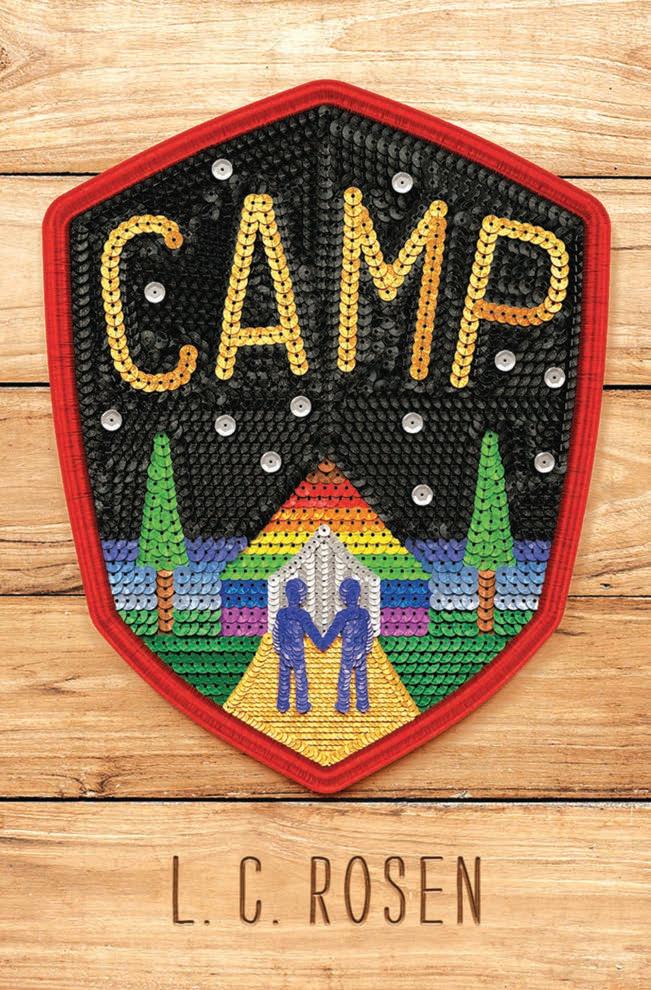
By L.C. Rosen c.2020, Little, Brown 374 pages $17.99
Movies you might have missed with a water theme
By BRIAN T. CARNEY
As temperatures soar all over the country, it’s time for a refreshing and revitalizing dive into the water. Here’s a collection of recent queer movies where characters take the plunge, both literally and metaphorically.
“Stranger by the Lake.” This award-winning French film was billed as an erotic gay thriller and it lived up to that description. The action unfolds on the banks of a lake where men meet for sex, which is shown in graphic detail. The thriller starts when the seemingly innocent Franck watches Michel swim out into a lake with a man and swim back to shore alone. Director Alain Guiraudie skillfully captures the mundane yet thrilling rituals of cruising and the inscrutable passion that arises between Franck and Michel. (In French with English subtitles).
“End of the Century.” Ocho, an Argentinian poet, is visiting Barcelona. He goes to the beach and sees Javi. As Ocho wanders the city, he keeps noticing Javi. When the two finally meet, they realize they have met each other before, and that they may have a future together. To say any more would spoil the intriguing twists and turns that out Argentinian director Lucio Castro magically weaves into his debut feature film. Castro writes and directs with the confident flair of a master filmmaker, making bold and innovative choices that gently support the cinematic magic realism of his epic love story. (In Spanish with English subtitles).

“Portrait of a Lady on Fire.” This sumptuous French period drama tells the story of a young female artist who falls in love with her subject. The movie is largely set on an isolated wind-swept island in Brittany at the end of the 18th century. Marianne (Noémie Merlant) is a struggling young artist who is hired by La Comtesse (Valeria Golino) to paint a wedding portrait of her daughter Heloise (Adèle Haenel). There’s only one catch: Heloise must not know that Marianne is painting her.
The richly sensuous and thoughtful exploration of art and romance won the Queer Palm at Cannes where lesbian filmmaker Céline Sciamma also won the screenwriting award. (In French with English subtitles).
“Pain and Glory (Dolor y Gloria),” the latest movie from queer auteur Pedro Almodóvar, starts with an amazing (and somewhat disturbing) shot of Antonio Banderas sitting at the bottom of a pool. In this deeply moving story based very loosely on the filmmaker’s own life, the long-time Almodóvar collaborator plays gay filmmaker Salvador Mallo whose physical and psychological ailments have kept him away from the camera. Banderas won the Best Actor prize at Cannes; Almodóvar veterans Penelope Cruz and Julieta Serrano and a great supporting cast turn in richly nuanced performances. (In Spanish with English subtitles).
“Rocketman.” When you end up at the bottom of your swimming pool during a glamorous pool party, you may have reached the end of your yellow brick road. Using the pop superstar and gay icon’s own music, director Dexter Fletcher leads audiences on a fantastic journey through Elton John’s early life, including his childhood, his rise to international stardom, his coming out, his addictions and his decision to enter rehab. Taron Egerton is fantastic as Elton and the costumes by Julian Day are, of course, fabulous. Finally, the power of water (both literal and metaphorical) is at the center of “The Shape of Water,” a visionary queer retelling of Cold War-era paranoid monster movies like “The Creature from the Black Lagoon.” The film centers on a cleaning woman who discovers that a gentle creature is being tortured at a government research lab. She falls in love with “Amphibian Man” and with the help of her friends, she develops a plot to free him. The movie won several Academy Awards, including Best Picture, Best Director (Guillermo del Toro), Best Production Design and Best Original Score (Alexandre Desplat). Academy Award nominee Sally Hawkins stars as Elisa Esposito; the outstanding supporting cast includes Octavia Spencer, Michael Shannon, Michael Shuhlbarg, Doug Jones and Richard Jenkins as Giles, Elisa’s gay best friend.