






CSW cites ‘changing demographics,’ ‘collaboration with other movements’
By TROY MASTERS
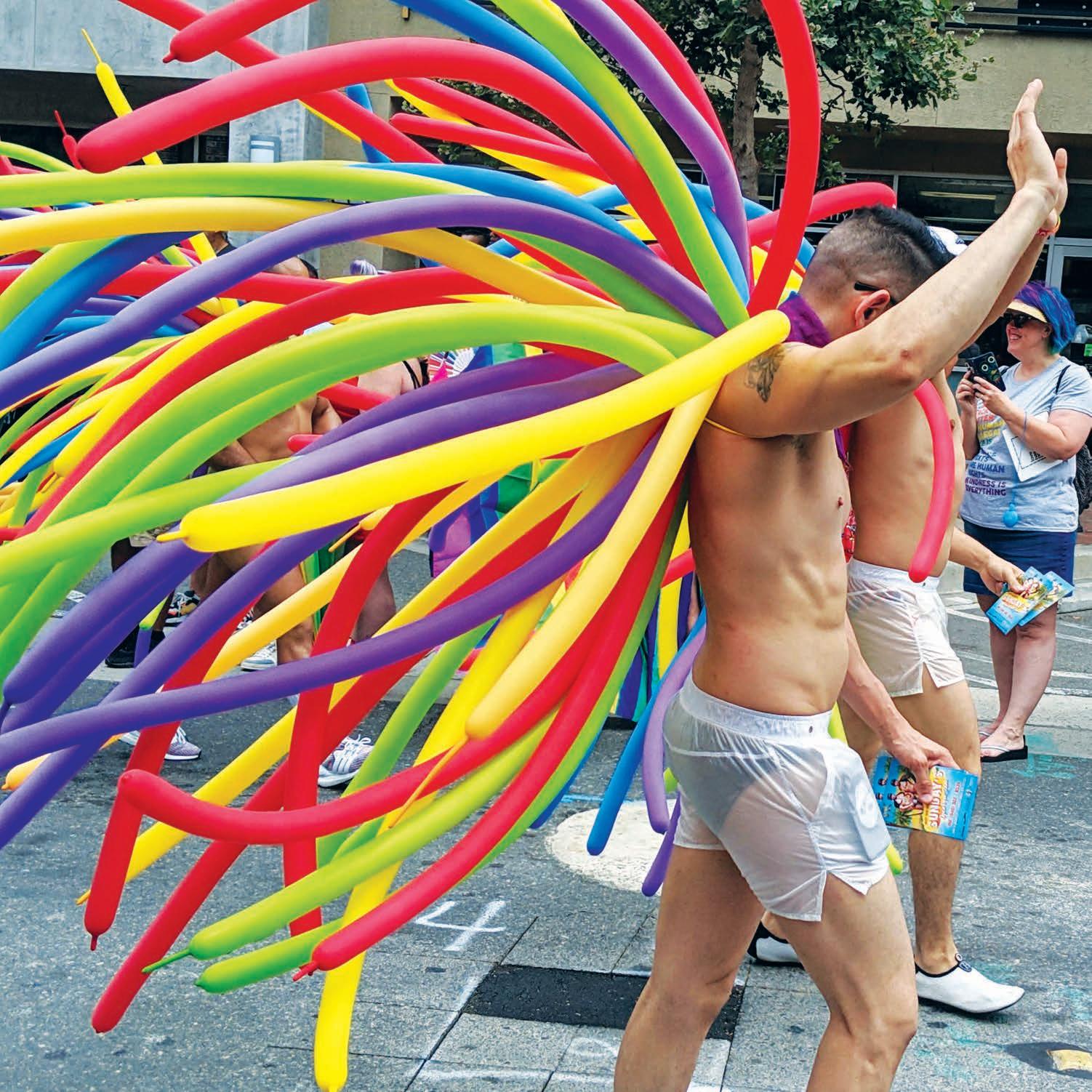
LA Pride announced today in a letter to the City of West Hollywood that it will relocate the event to an unspecified location in Los Angeles in 2021.
LA Pride and the Board of Christopher Street West (CSW), the organizer of the event, told the City of West Hollywood City Council “and other concerned parties,” that “as our non-profit organization continues to evolve and grow, we want to inform you of our intention to move the LA Pride Parade and Festival out of West Hollywood in 2021.
“The Board of Directors has decided to take this approach for several reasons. These include construction in West Hollywood Park, the changing demographics of Greater Los Angeles, our commitment to being responsive to the LGBTQIA+ community’s needs, and our allyship and collaboration with other movements for social change.”
The event, which represents several million dollars in tax receipts for West Hollywood, is one of the region’s largest outdoor events, bringing hundreds of thousands of visitors, vendors, and major talent for both the parade and two-day festival.
According to an economic impact study from CSW’s independent research firm Beacon Economics, the 2019 LA Pride Parade and Festival generated $74.7 million in economic output and $42.2 million in direct expenditures in Los Angeles County.
The research claims the event resulted in the following financial benefits: increased economic output in Los Angeles County by $74.7 million of which $27.7 million was concentrated in West Hollywood and $18.2 million in the City of Los Angeles; Increased labor income for workers in Los Angeles County by $33.1 million, including $14.7 million in West Hollywood and $7.4 in the City of Los Angeles; supported the annual equivalent of 830 jobs in LA County, including 397 in West Hollywood and 191 in the City of Los Angeles; estimated $2.5 million in tax revenue generated in LA County, including $896,100 in West Hollywood and $332,800 in the City of Los Angeles.
West Hollywood Mayor Lindsey Horvath told the Los Angeles Blade that she “wishes CSW the very best in its future efforts. For decades, the City of West Hollywood and CSW have enjoyed an incredible partnership and, on a personal note, I will treasure the memories I have made celebrating Pride with CSW within our City.”
Horvath pointedly added: “The City of West Hollywood remains the heart of the region’s LGBTQ community and we take Pride in celebrating each and every day, year-round.”
When pressed on the suddenness of the decision, the mayor said, “While this morning’s email was a surprise to me, it’s content makes clear this decision has been some time in the making.”
Council member and former Mayor John D’Amico recently
added an agenda item for the next Council meeting, which is a formal request for a 2021 Pride event. The item calls for a Request For Proposal (RFP) for event organizers without reference to LA Pride or Christopher Street West.
On Facebook, Council member John Duran posted: “four weeks ago, my colleague councilmember D’Amico and I suggested that we open up the bidding to other possible producers for our annual pride event besides CSW.” Duran claims “their announcement was their response to our comments.”
He told the Los Angeles Blade that “West Hollywood will continue to have its own Pride weekend as we have for the past 49 years.”
“Santa Monica Boulevard and this historic Boystown district will remain the heart and center of Pride month as we always have,” he said.
Duran recently came under fire from trans activists for criticizing the painting of a trans flag in the intersection of Santa Monica Boulevard and San Vicente, telling a local blog that protecting the installation “sets a precedent and (that if) a group wants to paint a Confederate flag on Santa Monica Boulevard, we can’t say ‘oh we agree with trans rights so that unauthorized mural can stay, but your Confederate flag has to go.’ His comments swift drew outrage.
LA Pride had attempted to organize a solidarity march but, after controversy, deferred to Black trans voices in the community instead and cancelled their plans.
On the day LA Pride’s parade would have been held, All Black Lives Matter held a protest march — one of the city’s largest events in recent years — along Hollywood Boulevard to Sunset and into West Hollywood along Santa Monica Boulevard. The ABLM march echoed the spirit of protest and the need for changes that were the impetus for the organizers of the Christopher Street March in June of 1970 in both New York City and Los Angeles.
With the departure of LA Pride, West Hollywood joins Santa Monica, Compton, Long Beach, and other communities in hosting smaller scale celebrations, however no calendar has emerged.
LA Pride has been a long-time fixture in the city since the event was founded by Morris Kight and Troy Perry in 1970, where the first event was held on Hollywood Boulevard. This year was set to be a banner year as the organization was set to celebrate the event’s 50th anniversary. However, the City of West Hollywood announced in tandem with Christopher Street West in April that a live, in-person event would be canceled in 2020 because of the COVID-19 pandemic.
2020 LA Pride was celebrated in late June during a virtual telecast on ABC-7.
LA Pride President Estevan Montemayor and Executive Director said their statement will act as their comment.
By KAREN OCAMB
The 23rd International AIDS Conference made history when it opened its July 6-11 conference this year. Scientists and AIDS activists were forced to deal with the twin pandemics of both AIDS and the novel coronavirus – both of which severely impact the LGBTQ community.
That prompted many to compare President Donald Trump’s failed response to COVID-19 to President Ronald Reagan’s disastrous neglect of the AIDS crisis in the 1980s.
The comparison was underscored on May 24 when the New York Times filled its entire front page with the names of those lost as the number approached 100,000 COVID dead.
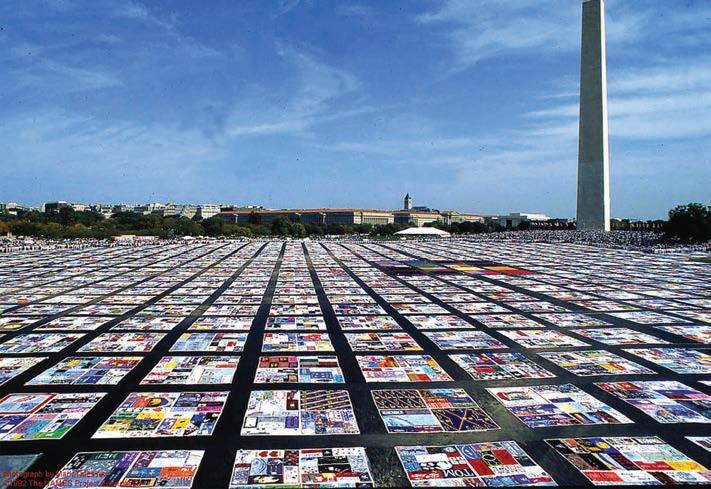
The gasp heard around the world was similar to the tears shed when the Names Project AIDS Memorial Quilt was unfurled on the Washington Mall in 1993.
This year’s international AIDS conference returned to San Francisco, though under very different circumstances than the explosive 1990 conference where ACT UP demanded urgency and accountability. Because of the coronavirus, AIDS/2020:Virtual was virtually attended by delegates from 175 countries with talks and debates that included ending systemic racism and how COVID-19 has disrupted HIV/AIDS services, especially for LGBTQ people.
“Epidemics run along the fault lines of inequalities and we can and must close the gaps,” UNAIDS Executive Director Winnie Byanyima said at the opening news conference.
World Health Organization DirectorGeneral Dr Tedros Adhanom Ghebreyesus also presented findings of a new WHO survey showing significant economic devastation and disruptions caused by the coronavirus pandemic in access to HIV treatment.
Fearing erasure is precisely why gay activist Cleve Jones started the AIDS Quilt in 1987.
“Within just a few years, almost everyone I knew was dead or dying or caring for someone who was dying. And one of the things that frightened me and led really to the creation of the Quilt was my fear that all of these people would just disappear, that their stories would not be known,” Jones said during a Zoom news conference July 6.
“And my friends were such remarkable people and I wanted them to be remembered,” he continued. “Now when we look at the complexities of COVID-19, there are just so many parallels -- the importance of testing; the significant racial disparities that we’re seeing; the importance of community action; the difficulties, the challenges of persuading people to modify their behavior in ways that can save lives. So, I think it just underscores that this Quilt still has a role to play.”
“A survey of 13,562 people in 138 countries conducted from mid-April until midMay showed that COVID-19 is having a devastating impact on the LGBTI+ community worldwide,” WHO said in a AIDS/2020:Virtual press release.
Meanwhile, on July 6 at the White House, Trump never mentioned the AIDS conference in his Twitter storm about confederate statues, China, NASCAR driver Bubba Wallace, the “Sanctuary City card,” “angry, violent, criminal mobs taking over certain (Democrat run) cities,” opening schools, as well as spouting more dangerous COVID-19 lies about hydroxychloroquine, the success of US testing and “lowest” mortality rate.
Trump did, however, officially notify the UN Secretary-General of the US withdrawal from the WHO, effective on July 6, 2021.
As an ironic mirror to the COVID crisis, which is not counting LGBTQ cases or deaths, the San Francisco-based National AIDS Memorial, the non-profit that oversees The Names Project AIDS Memorial Quilt, launched a new interactive website displaying the entire 48,000 Quilt panels online, as well as a new initiative to collect and share stories about those who died and those impacted over the 40 years of the AIDS pandemic.
Jones added: “The Quilt was never intended to be a passive Memorial. The Quilt was about revealing the lives and the humanity behind the statistics. It was about shaming a government whose inaction had created such a catastrophe. It was a tool for the media to help them understand how the disease was spreading and communities that it was affecting. So, it was never intended to be just a passive thing. And today, as we see people hoping for a vaccine, hoping for a cure, it brings back a lot of very painful memories for me -- and I think all of us. This is just bringing back a lot of really, really difficult memories --- but those are exactly the memories we need to keep in the front of our minds right now, as we endeavor to face this new challenge.”
John Cunningham, Executive Director of the National AIDS Memorial, underscored the importance of honoring and telling the stories of those lost and inspire a new generation to take action.
“We do have a pandemic we’re in the middle of right now and there are lessons that we can carry forward to bring about solutions,” said Cunningham. “And I think the most profound one is for us to ensure that we stand up and that we take action and become activists as we were back in the day, to hold our elected officials in our government responsible for the inaction that they are taking at the present time for stigmatizing a virus as was done in the early days of the epidemic.”
Turning the actual tactile fabric of The Names Project AIDS Memorial Quilt into a metaphor, Cunningham said: “That’s part of what’s in the fabric of our nation -- challenging the bases of power to bring about profound change in our society.”
Two days later, the US reported more than 3 million COVID-19 cases and 134,000 reported deaths. But how many of those deaths are LGBTQ may never be known. Apparently, LGBTQ lives do not matter.
For more on the Quilt, visit https://www.aidsmemorial.org/
1155 N. La Cienaga #1109, West Hollywood, CA 90069 | MLS# 20-578060 | $1,350,000




This posh full-service high rise with breathtaking views of Beverly Hills, Century City, and The Hollywood Hills; located in the heart of West Hollywood. This customized 3 bed (converted into 2, can easily be turned back into 3) 3 bath Luxury Condo has sleek modern lines and a spacious floor plan in the exclusive Westview Towers and is the home of an A list film & TV star for the past 20+ years. Everything in this unique condo is customized with a chef’s kitchen, temperature-controlled wine refrigerator. Spectacular views from the steam room/sauna, custom closet 2nd bathroom has brand new tub & sink for luxusious bathing.




By KAREN OCAMB
After 10 years of arguments, a federal judge has finally ordered the release of videotapes from the historic 2010 Federal District Court trial against Proposition 8 in San Francisco that put marriage equality on the line. At stake: can the state deny the right to marry to some Americans based solely on who those individuals choose to marry?
LGBTQ people privately celebrated their relationships until the AIDS crisis when longtime lovers, considered “legal strangers” were kept from the hospital bedsides of their dying partners and were evicted when estranged families showed up.
But anti-gay Republicans made gay marriage an ugly political issue, brandishing anti-gay marriage initiatives in red and swing states and a federal constitutional amendment through President George W. Bush.
The barrage of countering lawsuits illustrated just how many benefits, automatically granted heterosexual couples, were explicitly denied same-sex couples. Eventually, the California Supreme Court ruled in May 2008 that marriage was a fundamental right for same-sex couples.
Anti-gay religious forces fought back with biasbased Proposition 8, which passed on Nov. 4, 2008, making California the 29th state to pass a constitutional amendment banning marriage equality.
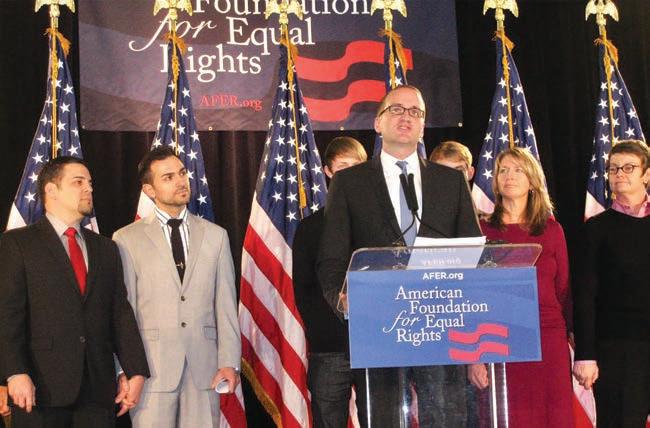
Trying to overturn Prop 8 in federal court was risky since the case would invariably go to the Supreme Court. But Los Angeles-based political strategist Chad Griffin argued that too many lives were being deeply and unnecessarily harmed to wait any longer. He and several friends founded the American Foundation for Equal Rights (AFER) and hired famed Republican attorney Ted Olson and his 2000 opponent in Bush v Gore, David Boies, to serve as lead counsel.
U.S. District Court Judge Vaughn Walker originally ordered Hollingsworth v. Perry to be broadcast live in five public courthouses and on YouTube. But Prop 8 proponents, claiming fear of gay retribution, secured an emergency injunction from the Supreme Court to temporarily stay live streaming of the proceedings.
Despite an appeal from a coalition of media groups, the Court eventually ruled 5-4 to disallow live streaming but let Walker record the proceedings for his own use, a nod to the Prop 8 defendant-intervenors who hyped their “victim” claims.
AFER, journalists and bloggers reported the historic events as they unfolded and in important books and films later, but the court didn’t budge on the tapes until now, setting Aug. 12, 2020 for their release.
On June 28, 2013, the Supreme Court upheld Walker’s ruling. So why are the District Court tapes so important?
AFER calls the trial “America’s truth commission on marriage equality. For the first time, a federal court heard testimony on marriage for gay and lesbian couples. It’s easy to appeal to people’s fears and prejudices in campaign literature and 30-second television ads. But when you come into court and swear under oath, the lies melt away and the truth comes out.”
It was love versus institutional homophobia: plaintiffs
Jeff Zarrillo & Paul Katami and Kris Perry & Sandy Stier — standing in for America’s same sex couples — courageously told their love stories, their struggles and withstood badgering from the Prop 8 attorneys.
“I just want to get married,” said Katami on the witness stand. “It’s as simple as that. I love someone. I want to get married. My state is supposed to protect me. It’s not supposed to discriminate against me.”
“I’m just trying to get the rights that the Constitution already says I have,” said Stier who calmly handled rude questions from a Prop 8 attorney incredulous that she could have once loved, married and had children with a man and now loves a woman.
Some moments were incredibly painful. “I remember my mother looking at me and telling me that I was going to burn in hell,” testified so-called “conversion therapy” survivor Ryan Kendall. “[M]y mother would tell me that she hated me, or that I was disgusting, or that I was repulsive. Once she told me that she wished she had had an abortion instead of a gay son.”
In her book “Forcing the Spring: Inside the Fight for Marriage Equality,” Jo Becker later reported that Cooper’s daughter had come out to him during the trial. He subsequently helped plan her wedding.
One of the most startling moments was courtesy pro-Prop 8 David Blankenhorn, founder and president, Institute for American Values. AFER attorney David Boies challenged his qualifications as an “expert” and Walker
There were also moments of unintended humor, as when AFER attorney Theodore Boutrous asked Harvard University historian Nancy Cott if the state has a “compelling interest” in limiting marriage to heterosexual couples for the purpose of procreation. President George Washington, “the father of our country,” Cott replied, was married and sterile. “Procreative ability has never been a qualification for marriage.”
The courtroom quietly gasped after Walker asked famed Republican Prop 8 attorney Charles Cooper how the state promotion of heterosexual marriage would be harmed if gays were allowed to wed. Cooper took a long beat and then replied: “Your honor, my answer is, I don’t know. I don’t know.”
agreed, ruling Blankenhorn’s opinion testimony to be “unreliable and entitled to essentially no weight.”
Nonetheless, Blankenhorn caused a flutter when he switched sides on the witness stand. Under oath, Blankenhorn said: “I believe that today the principle of equal human dignity must apply to gay and lesbian persons. In that sense, insofar as we are a nation founded on this principle, we would be more American on the day we permitted same-sex marriage than we were on the day before.”
The Prop 8 trial tapes are a record of how LGBTQ people and allies fought systemic and institutionalized homophobia and won. Not unsurprisingly, on July 14 Cooper filed an appeal to the 9th Circuit to stop the tapes’ release.
Lawmakers call on Trump to implement Bostock ruling

(Photo
More than 100 members of Congress last week called on President Trump to implement last month’s U.S. Supreme Court decision that says Title VII of the Civil Rights Act of 1964 bans anti-LGBTQ employment discrimination.
“In light of the Supreme Court’s landmark decision in Bostock v. Clayton County, we request that your administration direct all relevant agencies to undertake a review of all regulations, executive orders, and agency policies that implicate legal protections for LGBTQ individuals under federal civil rights laws,” reads the letter.
The letter notes the Trump administration “has repeatedly issued dozens of regulatory and agency actions premised almost entirely on the claim that federal bans on sex discrimination do not prohibit discrimination based on sexual orientation or gender identity” and points out the White House “argued against the employees in Bostock.” The letter also calls upon the Trump administration to identify “the steps it is taking to implement the Bostock decision and fully enforce our nation’s civil rights laws that prohibit sex discrimination.
“All people should have confidence that their federal government is working to protect — not undermine — their rights,” reads the letter. “We therefore ask that you take immediate steps to ensure that LGBTQ people enjoy the full protections of the nation’s federal civil rights laws.”
U.S. Sens. Chris Van Hollen (D-Md.), Congresswoman Eleanor Holmes Norton (D-D.C.) and U.S. Reps. Jamie Raskin (D-Md.) and Jennifer Wexton (D-Va.) are among the lawmakers to who signed the letter.
A separate letter that 116 members of Congress signed last week urges Defense Secretary Mark Esper and U.S. Attorney General William Barr to rescind the ban on openly transgender service members. The letter of which Norton, Raskin and Wexton are among the signatories also notes the Supreme Court’s ruling in the Bostock case.
“This policy is an attack on transgender service members who are risking their lives to serve our country and it should be reversed immediately,” reads the letter.
MICHAEL
K. LAVERS
Trump sued again over trans health rule
Several advocacy groups last week filed a federal lawsuit against the Trump administration over its decision to remove transgender protections from the Affordable Care Act.
Boston Alliance of Gay, Lesbian, Bisexual and Transgender Youth; Callen-Lorde Community Health Center; Campaign for Southern Equality; Equality California; Fenway Health and the Transgender Emergency Fund are plaintiffs in the lawsuit the Transgender Legal Defense and Education Fund, the Transgender Law Center, the National Women’s Law Center, the Harvard Law School’s Center for Health Law and Policy Innovation and the private law firm Hogan Lovells filed on their behalf in the U.S. District Court for the District of Massachusetts on behalf of the LGBTQ organizations. Darren Lazor, a trans man who lives near Cleveland, is also named as a plaintiff.
The Obama administration under Section 1557 of the Affordable Care Act determined discrimination based on sex applied to trans people. The U.S. Department of Health and Human Services on June 12 announced the Trump administration’s plan to reverse the rule had been made final.
The U.S. Supreme Court three days later ruled Title VII of the Civil Rights Act of 1964 bans employment discrimination based on gender identity and sexual orientation.
A press release that announced the lawsuit notes the reversal of the Affordable Care Act policy “violates the Administrative Procedures Act by being contrary to law and arbitrary and capricious.”
“I have experienced feeling like a doctor doesn’t care if I live or die — which is just shameful,” said Lazor in the press release. “No one should be denied life-saving health care or be discriminated against the way I have simply because of who they are. I hope that sharing my story can help others understand that transgender people are who we are, and we deserve to be treated fairly under the law.”
Equality California Executive Director Rick Chavez Zbur added “ripping healthcare away from millions of Americans is wrong; to do so in the middle of a global health crisis is just plain evil.”
“As long as President Trump keeps attacking transgender people like Darren and other LGBTQ+ Equality California members simply because of who they are, we’ll keep fighting the Administration in court,” he said.
The Human Rights Campaign and the D.C.-based law firm Baker Hostetler have filed a separate lawsuit against the policy’s rescission in the U.S. District Court for the Eastern District of New York on behalf of two trans women of color. Lambda Legal has also challenged the Trump administration’s decision in federal court.
MICHAEL K. LAVERS
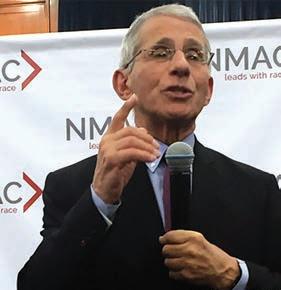
Dr. Anthony Fauci last week said it remains unclear whether people with HIV are more vulnerable to the coronavirus.
“The story is not yet completely out in individuals with HIV,” he said during a panel that took place on the final day of the 2020 International AIDS Conference.
“Those with HIV that’s not controlled in the sense of controlled viremia as opposed to those with good control. That knowledge store is still evolving.”
Fauci in his presentation also said there is a “significant issue” in the U.S. “with a disproportionate disparity or serious illness among our minority population” with Black people, Latinos and Native Americans most impacted. Dr. Deborah Birx, the coordinator of the White House’s coronavirus task force, echoed Fauci in her own remarks during the panel.
“This is like HIV and that there are specific vulnerable groups, either by race, ethnicity or their relationship in poverty,” she said.
Both Birx and Fauci said hypertension, diabetes and obesity are among the underlying health issues that make people more vulnerable to coronavirus.
Dr. Sarah Henn, chief medical officer at WhitmanWalker Health in D.C., told the Blade in March that older people with underlying medical conditions and those who have chronic illnesses are most vulnerable to the pandemic. Immigration Equality and other advocacy groups have also said U.S. Immigration and Customs Enforcement detainees with HIV are also at risk.
“When I think of people who are at increased risk or high risk for coronavirus I think of people who are significantly immunosuppressed,” Henn told the Blade. “I think of people who are going through cancer chemotherapy, people who are immunosuppressed with medications with a history of organ transplants, and people with a very low CD4 count and uncontrolled HIV and AIDS.”
The International AIDS Conference was to have taken place this week in San Francisco and Oakland, Calif., but it happened virtually because of the coronavirus pandemic. Johns Hopkins University of Medicine’s Coronavirus Resource Center notes there are more than 3.2 million confirmed coronavirus cases in the U.S. Their statistics also indicate the pandemic has killed 134,729 people in this country.
MICHAEL K. LAVERS
By CHRIS JOHNSON cjohnson@washblade.com
As the three-year anniversary approaches of President Trump tweeting he’d ban transgender people from the armed forces “in any capacity,” his administration is showing no signs of reconsidering the policy.
White House Press Secretary Kayleigh McEnany dodged on Monday when asked by the Washington Blade whether Trump would reconsider the ban in the wake of a letter from 116 lawmakers led by Rep. Suzan DelBene (D-Wash.) calling on the administration to lift the anti-transgender policy. Instead, McEnany enumerated other initiatives she said demonstrates the administration is supportive of the LGBTQ community.
“I haven’t talked to him about that specific policy, but this president is proud that in 2019 we launched a global initiative to end the criminalization of homosexuality throughout the world,” McEnany said. “He has a great record when it comes to the LGBT community. The Trump administration eased a ban on blood donations from gay and bisexual men and he launched a plan to end the AIDS epidemic by 2030, so we’re very proud of our achievements.”
It should be noted for one of those initiatives, easing the ban on gay blood donations to require a 3-month period of abstinence as opposed to a 12- month period, Trump distanced himself from the change when asked about it by the Blade, saying he “didn’t know anything” about it.
As the Blade pointed out, the ban on transgender service — which Trump directed the Pentagon to implement via tweet on July 26, 2017 — flies in the face of polls showing upwards of 70 percent of Americans support transgender service, major medical and psychological groups saying there’s no problem with it and an estimated 14,700 transgender service members grandfathered in under open service in the final year of the Obama administration.
Moreover, the transgender ban is increasingly unlikely to survive judicial scrutiny after the recent Supreme Court decision in Bostock v. Clayton County, which determined anti-transgender discrimination is a form of sex discrimination under the law. Although no law bars sex discrimination in the U.S. armed forces, laws enabling sex discrimination are subject to heightened scrutiny under U.S. legal jurisprudence. Now that the Supreme Court has determined anti-trans discrimination is a form of sex discrimination in the workforce, that logic should apply to all antitransgender policies across the board, including the transgender military ban.
McEnany, a Harvard law graduate, downplayed the Bostock’s ruling implications on the transgender ban by citing the dissent from U.S. Associate Justice Brett Kavanaugh, even though dissents have no bearing on U.S. legal jurisprudence.
“I have no updates for you, but several of the events that you cited, like the Supreme Court ruling, I would refer you back to Justice Kavanaugh, who said, ‘We are judges, we’re not members of Congress. Instead of a hard earned victory won through the

Democratic process, today’s victory is brought about by judicial dictates,’” McEnany said. “So we’ll always stand on the side of correct statutory interpretation.”
Lucas Acosta, a spokesperson for the Human Rights Campaign, said in a statement McEnany “is living in a delusion” if she thinks the Trump administration is pro-LGBTQ.
“They have issued rules sanctioning discrimination against LGBTQ people, particularly transgender people, in healthcare programs and activities,” Acosta said. “They have ignored antiLGBTQ atrocities in Chechnya and anti-trans violence here at home. They have banned trans people from serving in the military and turned away trans children with civil rights complaints from the Department of Education. They have endorsed allowing businesses to discriminate against LGBTQ people solely because of who they are or who they love. They are denying trans people equal access to emergency shelters, needlessly and cruelly putting one of the most vulnerable groups in the country in greater danger.”
The Defense Department has insisted the transgender military ban is not a ban, but a medical-based policy applying to all service members, pointing out they’re free to identify as transgender and remain in the armed forces.
But the policy, which went into effect in April 2019, requires the discharge of any service member who’s diagnosed with gender dysphoria, a defining characteristic of being transgender, or seeks transition-related care. Individuals with a history of gender dysphoria can only enlist if they’re willing to serve in accordance with their sex designated at birth.
The ban has an exemption to allow transgender service members to continue serving if they came out when open service was instituted in 2016 under the Obama administration. Additionally, the policy allows senior defense officials to grant waivers to transgender individuals facing discharge wishing to enlist in the armed forces.
DelBene responded to McEnany’s dodge on the transgender military ban in a statement to the Washington Blade by reasserting the policy is unlawful after the Supreme Court ruling. “Why doesn’t the White House have a justifiable reason to continue the ban on transgender service members? Because it’s an indefensible policy,” DelBene said. “The Supreme Court recently affirmed that workplace discrimination based on gender identity and sexual orientation is unconstitutional. This should apply to military service as well. Thousands of transgender service members have already served their country with pride and distinction. This ban should be eliminated immediately.”
In related news, several advocacy groups last week filed a federal lawsuit against the Trump administration over its decision to remove transgender protections from the Affordable Care Act. Boston Alliance of Gay, Lesbian, Bisexual and Transgender Youth; Callen-Lorde Community Health Center; Campaign for Southern Equality; Equality California; Fenway Health and the Transgender Emergency Fund are plaintiffs in the lawsuit the Transgender Legal Defense and Education Fund, the Transgender Law Center, the National Women’s Law Center, the Harvard Law School’s Center for Health Law and Policy Innovation and the private law firm Hogan Lovells filed on their behalf in the U.S. District Court for the District of Massachusetts on behalf of the LGBTQ organizations. Darren Lazor, a trans man who lives near Cleveland, is also named as a plaintiff.
The Obama administration under Section 1557 of the Affordable Care Act determined discrimination based on sex applied to trans people. The U.S. Department of Health and Human Services on June 12 announced the Trump administration’s plan to reverse the rule had been made final.
The U.S. Supreme Court three days later ruled Title VII of the Civil Rights Act of 1964 bans employment discrimination based on gender identity and sexual orientation.
A press release that announced the lawsuit notes the reversal of the Affordable Care Act policy “violates the Administrative Procedures Act by being contrary to law and arbitrary and capricious.”
“I have experienced feeling like a doctor doesn’t care if I live or die — which is just shameful,” said Lazor in the press release. “No one should be denied life-saving health care or be discriminated against the way I have simply because of who they are. I hope that sharing my story can help others understand that transgender people are who we are, and we deserve to be treated fairly under the law.”
Equality California Executive Director Rick Chavez Zbur added “ripping healthcare away from millions of Americans is wrong; to do so in the middle of a global health crisis is just plain evil.”
“As long as President Trump keeps attacking transgender people like Darren and other LGBTQ+ Equality California members simply because of who they are, we’ll keep fighting the Administration in court,” he said.
Michael K. Lavers contributed to this report.














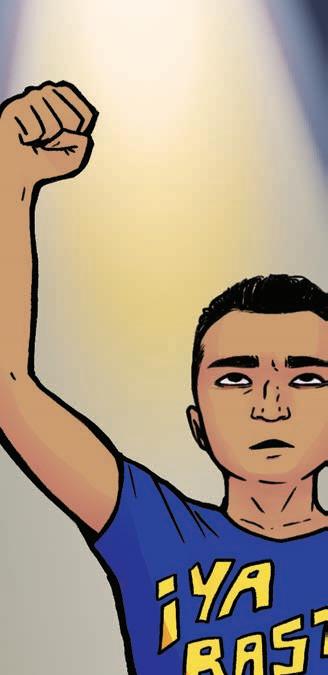







































The anti-LGBTQ president of Poland won re-election on Sunday.
The Associated Press reported Andrzej Duda defeated Warsaw Mayor Rafal Trzaskowski by a 51.248.8 percent margin. The two men ran against each other in a runoff because they didn’t receive a majority of the vote in the first round of Poland’s presidential election that took place on June 28.
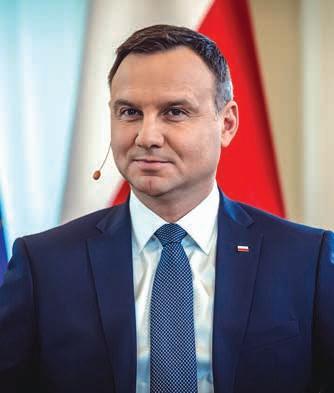
Polish President ANDRZEJ DUDA said LGBTQ ‘ideology’ is more harmful than communism.
Activists have sharply criticized Duda — head of Poland’s conservative Law and Justice party — over his antiLGBTQ rhetoric.
Duda last month said LGBTQ “ideology” is more harmful than communism. Justyna Nakielska of Kampania Przeciw Homofobii, a Polish LGBTQ advocacy group, told the Washington Blade last month noted the Law and Justice party ahead of last October’s parliamentary elections described LGBTQ Poles as “a threat to the family” and said they “want to sexualize children.”
Duda on June 24 met with President Trump at the White House.
“As there is a feeling of huge disappointment we need to remember that almost half of Polish voters said firmly no to the hatred campaign waged by Duda, and showed they are in favor of a democratic, modern and open Poland,” Magdalena Świder of Kampania Przeciw Homofobii, a Polish LGBTQ advocacy group, told the Blade. “We will keep on fighting, as the community needs us. All the incitement to hate by president Duda resulted in many instances of LGBT people being physically attacked or their homes being marked with homophobic vandalism, so our main goal is to press for protection of sexual orientation and gender identity to be included in the hate crime and hate speech legislation.”
Human Rights Campaign President Alphonso David echoed Świder in his own statement.
“President Andrezj Duda’s reelection after running on a virulently anti-LGBTQ election platform is confirmation that the fight for LGBTQ rights and freedoms is far from over,” said David. “However, Duda’s narrow victory demonstrates that there are a great number of Polish people who do not support his views, including his cruel campaign pledge to ban same-sex couples from adopting children that need loving homes, and his extreme anti-LGBTQ rhetoric.”
“Despite Duda’s victory, LGBTQ advocates will continue to fight in Poland and elsewhere for the basic respect and dignity that our community deserves,” he added.
MICHAEL K. LAVERS
The U.N. last week formally called for a ban on so-called conversion therapy.
Victor Madrigal-Borloz, the independent U.N. expert on LGBTQ issues, compiled 130 submissions on practices and testimonies of victims who have experienced conversion therapy from civil society organizations, faith-based organizations, medical practitioners and individuals.
These practices, which have been widely denounced by scientists, often result in long-term negative health effects that include suicidal thoughts, anxiety, depression, substance abuse and unemployment.
Tyler Adamson, a researcher who authored “The Global State of Conversion Therapy” report, said a global ban is important to the advancement of the recognition of LGBTQ people globally. He says the ban will eliminate the practice itself, while exposing the increased amount of conversion therapies that occur in the U.S. and other Western countries, as well as improve the broader reflection of how societies view LGBTQ people.
The report by Adamson, in collaboration with the LGBT Foundation, Johns Hopkins University and Hornet, found about five percent of respondents indicated that government representatives employed conversion therapy techniques. The report also found four percent of reports involved school personnel, which Adamson said may put LGBTQ youth at further risk.
The Trevor Project this month published a report titled “Self-Reported Conversion Efforts and Suicidality Among U.S. LGBTQ Youths and Young Adults.”
It also found that LGBTQ youths who experience conversion therapy were more than twice as likely to report having attempted suicide and having multiple suicide
attempts.
Sahar Moazami, a U.N. program officer with OutRight Action International, also said many survivors of the practice do not realize what they experienced was conversion therapy. They added a global ban would not only will contribute to ending the practice, but bring visibility to the issue.
Adamson has high hopes a global ban will formerly pass, but said the process will most likely be slow. Many countries still allow conversion therapy, so getting a majority to vote to pass this prohibition may be difficult, he said.
Moazami also said a global ban is a complex issue and “is going to take some time.” For this ban to be successful, the legal propositions need to match the cultural attitudes towards conversion therapy, they said.
“These efforts, for them to be effective and helpful, legal change has to be done in parallel with societal change,” said Moazami. “The demand for so-called conversion therapy will only decrease if acceptance of LGBTQI people grows.”
Moazami also said when looking at how a global ban will be structured, it is important to bring in conversations with all actors — survivors, grassroots organizers and health professionals — to develop effective policy.
While scientists and LGBTQ activists have denounced conversion therapy is ineffective, it is still commonly practiced around the world.
“We have this archaic view that LGBT people are somehow changeable or different, viewed as less than or we completely devalue the existence,” Adamson said. “It’s the idea that something outside of the norm is somehow a bad thing and not to be celebrated and needs to be eliminated or hidden.”
KAELA ROEDER
Actor Billy Porter is among those who participated in the first-ever global Black Pride event that took place on July 10.
Global Black Gay Men Connect organized the 12-hour virtual event — the First Global Black Gay Pride is a Riot — with the support of upwards of a dozen LGBTQ advocacy groups. They include OutRight Action International, Mobilizing Our Brothers Initiative (MOBI) in New York City, GLAAD, the Caribbean Equality Forum, the Eastern Caribbean Alliance, BlackOutUK, the Love Tank, Living Free UK, Pan Africa ILGA and the House of Rainbow.
Grindr provided technical support for the event. Canadian Minister of Diversity and Inclusion Bardish Chagger also participated.
“We created the event to provide a space for Black queer people across the globe to connect and celebrate each other,” Micheal Ighodaro, a member of Global Black Gay Men Connect’s board of directors, told the Washington Blade on Tuesday in an email. “Its hard to believe this was the first global Black Pride. we wanted to create this space for dialogue and also getting Black
LGBTQI people across the globe to engage each other in art and activism.”
The coronavirus pandemic has forced the cancellation of hundreds of in-person Pride celebrations around the world.
Former Vice President Joe Biden, Canadian Prime Minister Justin Trudeau, New Zealand Prime Minister Jacinda Ardern, actress Laverne Cox and singer Adam Lambert are among the hundreds of people who participated in last month’s virtual Global Pride 2020 that sought to amplify the Black Lives Matter movement. Ighodaro told the Blade the Canadian government is the only government that responded to First Global Black Gay Pride is a Riot organizers’ request to participate in the event.
“This says a lot about how we see Black LGBTQI people and Black LGBTQI-led initiatives,” he said.
Ighodaro told the Blade organizers hope next year’s global Black Pride event will be in person.
MICHAEL
K. LAVERS
ADDRESS
5455 Wilshire Blvd, 21st Floor, Los Angeles, CA 90036
PHONE 310-230-5266
E-MAIL tmasters@losangelesblade.com
INTERNET losangelesblade.com
PUBLISHED BY Los Angeles Blade, LLC
PUBLISHER
TROY MASTERS
tmasters@losangelesblade.com
310-230-5266 x8080 (o), 917-406-1619 (c)
SALES & MARKETING
SALES EXECUTIVE
ROMAN NAVARRETTE
roman@losangelesblade.com
310-435-3022
PALM SPRINGS ACCOUNT EXEC
BRAD FUHR, 760-813-2020. brad@gaydesertguide.com
NATIONAL ADVERTISING
RIVENDELL MEDIA
sales@rivendellmedia.com, 212-242-6863
MARKETING DIRECTOR
STEPHEN RUTGERS
srutgers@washblade.com, 202-747-2077 x8077
EDITORIAL
CONTRIBUTING WRITER
KAREN OCAMB
karenocamb@losangelesblade.com
NATIONAL EDITOR
KEVIN NAFF
kna @washblade.com, 202-747-2077 x8088
INTERNATIONAL EDITOR
MICHAEL K. LAVERS
mlavers@washblade.com
CONTRIBUTORS
CHRISTOPHER KANE, AUSTIN MENDOZA, JOHN PAUL KING, JOEY DIGUGLIELMO, CHRIS JOHNSON, LOU CHIBBARO JR., MARIAH COOPER, REBEKAH SAGER, JON DAVIDSON, SUSAN HORNIK, CHANNING SARGENT, SAMSON AMORE, CHRISTOPHER CAPPIELLO, MICHAEL JORTNER, DAN ALLEN, SEAN SHEALY, SCOTT STIFFLER
CREATIVE DESIGN/PRODUCTION
AZERCREATIVE.COM
DISTRIBUTION
CHRISTOPHER JACKSON, 562-826-6602
All material in the Los Angeles Blade is protected by federal copyright law and may not be reproduced without the written consent of the Los Angeles Blade. e sexual orientation of advertisers, photographers, writers and cartoonists published herein is neither inferred nor implied. e appearance of names or pictorial representation does not necessarily indicate the sexual orientation of that person or persons. Although the Los Angeles Blade is supported by many ne advertisers, we cannot accept responsibility for claims made by advertisers. Unsolicited editorial material is accepted by the Los Angeles Blade, but the paper cannot take responsibility for its return. e editors reserve the right to accept, reject or edit any submission. A single copy of the Los Angeles Blade is available from authorized distribution points, to any individual within a 50-mile radius of Los Angeles, CA. Multiple copies are available from the Los Angeles Blade o ce only. Call for rates. If you are unable to get to a convenient free distribution point, you may receive a 26-week mailed subscription for $195 per year or $5.00 per single issue. Checks or credit card orders can be sent to Phil Rockstroh at prockstroh@washblade.com. Postmaster: Send address changes to the Los Angeles Blade, PO BOX 53352 Washington, DC 20009. e Los Angeles Blade is published bi-weekly, on Friday, by Los Angeles Blade, LLC. Rates for businesses/institutions are $450 per year. Periodical postage paid at Los Angeles, CA., and additional mailing o ces. Editorial positions of the Los Angeles Blade are expressed in editorials and in editors’ notes as determined by the paper’s editors. Other opinions are those of the writers and do not necessarily represent the opinion of the Los Angeles Blade or its sta To submit a letter or commentary: Letters should be fewer than 400 words; commentaries should be fewer than 750 words. Submissions may be edited for content and length, and must include a name, address and phone number for veri cation. Send submissions by e-mail to tmasters@losangelesblade.com.
In times like these, there is no denying that white supremacy, racism, and criminalization put Black, Brown and transgender people at severe risk of violence. The COVID-19 outbreak has disproportionately impacted Black and Brown people. Counties with higher populations of Black residents accounting for 52 percent of coronavirus diagnoses and 58 percent of coronavirus deaths nationally, according to a recent amfAR study.
And, following the murder of George Floyd, the Black Lives Matter movement has once again demanded an end to the systemic inequalities and senseless violence against Black people by law enforcement.
The life-or-death impact of hate and discrimination doesn’t stop there. When it comes to sex workers in the U.S. and around the globe, many of whom are Black, Brown and transgender, discrimination and criminalization of sex work have put them at a high risk of violence, contracting preventable diseases like COVID-19 and HIV, and have exposed them to police brutality. Yet the U.S. continues to weaponize life-saving global AIDS assistance programs against sex workers by demanding recipients of PEPFAR funding to officially adopt a position opposing prostitution and acquiesce to the U.S. conflation of sex work and trafficking.
The Supreme Court has just ruled in favor of the Anti-Prostitution Loyalty Oath (APLO), a provision in the 2003 United States Leadership Against HIV/ AIDS, Tuberculosis, and Malaria Act, that required all recipients of funding through the President’s Emergency Plan for AIDS Relief (PEPFAR) to “have a policy explicitly opposing prostitution.” The policy goes on to conflate consensual sex work with human trafficking, and refuses funds to non-U.S.-based organizations that do not have a policy explicitly opposing “prostitution and sex trafficking.” While a prior 2013 decision ruled that the APLO is unconstitutional as applied to U.S.based organizations, Monday’s ruling declined to extend those protections to their foreign affiliates, a ruling that will further divide and hamper the global AIDS response.
The APLO is and always has been a bad policy. There is no evidence that the policy improves health outcomes. In fact, there is evidence that it hurts them.
Since the policy’s inception 17 years ago, the provision has done nothing to advance its stated goals of defeating HIV and AIDS and the trafficking of persons.
This is despite the consistent and vocal leadership of members like Rep. Barbara Lee, who have consistently fought the dangerous, counterproductive, and inefficient aid conditionality of the APLO.
Whereas there is no evidence that proclaiming opposition to sex work is an effective public health intervention, there is evidence that decriminalization of sex work would have an astounding impact on reducing the HIV epidemic, averting between 3346 percent of new infections over a decade. Yet the APLO directly blocks organizations from halting the spread of HIV.
Sex workers are disproportionately impacted by HIV and AIDS globally. Halting the spread of HIV simply cannot happen without trusted engagement and leadership from sex workers. Over the past 17 years, the policy has promoted stigma and discrimination of


sex workers. It oftentimes blocks sex workers from engaging in the design, development, implementation, and assessment of HIV and AIDS programs and services. HIV prevention and treatment programs are more successful when they include sex workers involvement and leadership. For some organizations around the world, working with sex workers while declaring opposition to sex work feels hypocritical. It was for these reasons that Brazil rejected $40 million in U.S. global AIDS money in 2005, noting that such restrictions undermined the very programs responsible for Brazil’s success in reducing the spread of HIV.
International health and development agencies including UNAIDS, UNFPA, UNDP, the WHO, and the World Bank have recognized the role that decriminalization of sex work plays in advancing public health outcomes while also advancing the human rights of sex workers.
In conclusion, APLO is a punitive rule that makes it difficult for sex workers to access comprehensive, accessible and affordable health care. But everyone deserves access to quality care. Social stigmas that disproportionately impact and undermine the sexual and reproductive health rights of people across the globe do not belong in our nation’s foreign aid programs, and nothing should change that.
Serra Sippel is president of the Center for Health and Gender Equity.

In 2005, I saw the movie “Good Night and Good Luck.” Directed by George Clooney, shot in gorgeous black and white, featuring jazz singer Dianne Reeves, it’s catnip to Mid-Century style aficionados. But, the movie is about the ugliness behind the era’s glam. It tells the story of how legendary journalist Edward R. Murrow investigated and reported on demagogue Sen. Joe McCarthy on the CBS show “See It Now.” In the midst of the Cold War, McCarthy waged a witch hunt against Communists and gay people.
Watching Murrow (played by David Strathairn) unmask McCarthy’s demagoguery, I thought: This is horrible! But that was another time. Nixon had his enemies list. But McCarthy likely wouldn’t happen again.
Wow, was I wrong! “Demagogue: The Life and Long Shadow of Senator Joe McCarthy” by Larry Tye is an account of McCarthy’s rise to power to his fall (he was censured by the Senate in 1954). Chillingly, Tye, author of “Bobby Kennedy,” shows the similarities between the demagoguery of McCarthy and Donald J. Trump.

McCarthy, Tye writes, is “one of the most reviled figures in U.S. history.”
He’s so reviled that an ism — “McCarthyism” — is named after him.
McCarthyism, Tye says, is a synonym for “reckless accusation, guilt by association, fearmongering, and political doubledealing.”
Today, some folks haven’t heard of McCarthyism. McCarthy died in 1957, more than 60 years ago. I wasn’t surprised the other day when a 20-something friend looked at
me blankly when I mentioned McCarthy. Many of us either weren’t alive or were kids during McCarthy’s heyday.
Still, some memories of McCarthy and his bullying tactics haven’t died. When I was a teenager, my father (who voted for Republicans as often as he did for Democrats) told me to “watch out for hucksters selling fake conspiracies.”
My Dad told me about a friend of his who’d had job problems because he’d been (falsely) suspected of being a communist. McCarthy stoked paranoia and wallowed in (bogus) conspiracies. He promised to wage “a holy war against a communist ‘conspiracy so immense and an infamy so black as to dwarf any previous venture in the history of man,’” Tye writes.
As Trump would decades later, McCarthy understood how to manipulate the press. Brandishing a piece of paper, he’d tell reporters that he had a list of 205 communist spies working in the U.S. State Department. During his four-year anti-communist, antigay crusade (from 1950 until the Senate condemned him in 1954), he waved his “list” of “traitors” about. There was one striking detail: McCarthy never let reporters see his list. Why? Because the list was fraudulent.
McCarthy played the press brilliantly, Tye told Terry Gross on NPR’s “Fresh Air.” He understood that if you lobbed one bombshell and that [proved] to be a fraud,” Tye said, “rather than waiting for the press the next day to expose it as a fraud, he had a fresh bombshell ready to go.”
McCarthy’s false allegations devastated many lives. U.S. Sen. Lester Hunt killed himself because McCarthy tried to blackmail him because his son was gay. Many could no longer work or were imprisoned because McCarthy (and his supporters) said they were communists or queer. There were “the hundreds of thousands he browbeat into a tongue-tied silence,” Tye writes.
“His targets all learned the futility of taking on a tyrant who recognized no restraints and would do anything – anything – to win,” he adds.
Unfortunately, as Tye says, McCarthy with his bullying and conspiracy-mongering isn’t an isolated phenomenon. “A uniquely American strain of demagoguery has pushed through the nation’s veins from its founding days,” he writes.
It’s telling that McCarthy’s chief legal counsel (a closeted gay man who died of AIDS) was Trump’s lawyer and mentor in the 1970s. Trump learned his lessons in bullying and anti-gay, antiimmigration, racist fear-mongering all too well from Roy Cohn. Let’s hope that in November Trump (like McCarthy) falls from power!
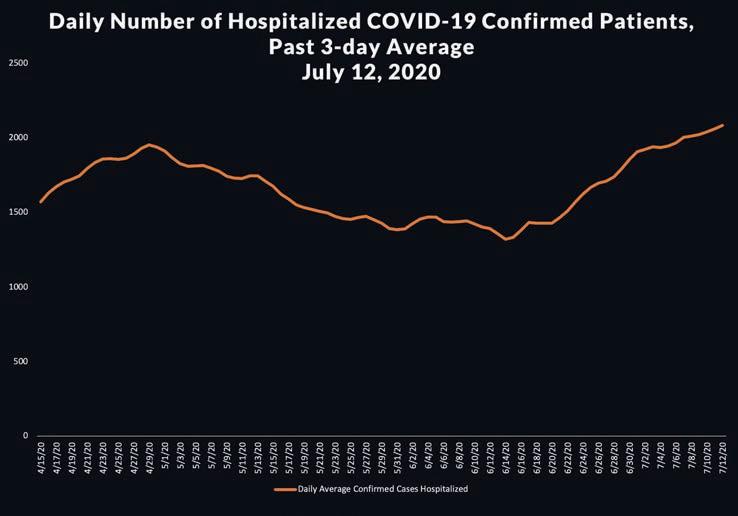
LOS ANGELES — At the close of Tuesday another grim milestone was reached in the ongoing coronavirus pandemic as the state of California recorded 346,007 positive cases of COVID-19 and 7,237 deaths. In Los Angeles, the County Public Health Department confirmed the highest number of new COVID-19 cases and hospitalizations reported in a single 24hour period with 4,244 new cases and 2,103 people currently hospitalized. Public Health officials also reported 73 additional deaths on Tuesday.
This sharp increase has been attributed partially to better access and faster test results, a source at LACDPH told the Blade. But the sharp uptick is also the result of Angelenos who have not complied with the requirements of social distancing, facial masks, and avoiding large crowds, the official said.
Dr. Barbara Ferrer, the county’s Director of Public Health, modified the County Health Order in alignment with Gov. Gavin Newsom’s roll-back on Monday of some reopening of portions of the business sector this past, and pleaded with residents to adhere to the requirements.
“As a community, we must slow the spread of COVID-19 to prevent an overwhelming surge of COVID-19 in our hospitals and more untimely deaths. I urge you to wear a face covering, stay at home as much as possible, avoid close contact with people you don’t live with and wash your hands. Together, we can stop the spread of this deadly virus,” Ferrer said Tuesday.
“Today’s numbers are alarming and unfortunately are the result of many businesses and individuals not adhering to the basic public health requirements of distancing and wearing face coverings. We are just not able to continue on a recovery journey without everyone doing their part. Keeping businesses open is only possible if we get back to slowing the spread,” she added.
A spokesperson for Dr. Mark Ghaly, the California Secretary of the Health and Human Agency, told the Blade that while the active rates of cases were spiking, officials are doubling their testing efforts to reach more Californians and to reduce the backlog of COVID-19 test results.
During a briefing on Tuesday, Ghaly said his agency officials are working with health care practices across the state to work with the state to bring COVID-19 testing for their patients which should reduce the demand. He noted that state health officials are also working with universities to bring test processing into their labs to help ease the
By BRODY LEVESQUE
stress on county labs and that. an emergency regulation would also be issued to help ensure reimbursement for all COVID-19 testing is covered by the state.
As of Wednesday, the Golden State has reported a 14-day average of executing a little more than 105,000 coronavirus tests per day. Dr. Ghaly also acknowledged that LA County accounts for nearly half of all active cases in the state Ghaly told reporters that the state is also looking to increase its number of contact tracers. Currently, the state has around 10,000 tracers.
Governor Newsom reversed more of the reopening of California’s economy telling reporters during his Monday noon press conference that the state is suspending indoor dining at restaurants statewide due to the surge in coronavirus cases.
Newsom also said that in addition to the restaurant order he is suspending operations for Wineries, Movie theaters, family entertainment, Zoos, museums, and Cardrooms statewide. He added that all Bars must close all operations.
Newsom’s order also ends indoor church ceremonies, and indoor operations for fitness centers, offices for non-critical sectors, personal care services, hair salons and barbershops, and indoor retail operations at malls.
The business sector has been only one area of concern as August and the normal openings of school systems for the next academic year are being disrupted by the pandemic. The Los Angeles Unified School District, the nation’s secondlargest school system will continue with online learning until further notice because of the worsening coronavirus surge,
Superintendent Austin Beutner announced Monday. The decision affects the education of half a million children who have been out of their classrooms since mid-March.
The decision came after the county’s largest teacher’s union leadership along with many parents stated opposition to reopening telling LAUSD officials that under the current circumstances it is not safe to bring children back on campus as COVID-19 cases across the County are surging.
“We all want to physically open schools and be back with our students, but lives hang in the balance. Safety has to be the priority. We need to get this right for our communities,” United Teachers LA Union President Cecily Myart-Cruz tweeted last Friday.
While the LAUSD and other districts including the San Diego Unified School District announced their plans to stay with remote learning, CNN reported that the Orange County Board of Education approved its recommendations for the reopening of its schools for the new academic year. The board voted 4-1 to approve a set of guidelines, including regular temperature checks, frequent hand washing and thorough cleanings of classrooms, offices and buses. The board did not, however, require the use of masks or social distancing. In fact, it advised against the measures, KTLA reported.
Across this backdrop, this week the United States saw COVID-19 cases spike in nearly 38 states, the worst hit in addition to California were Texas, Arizona, and Florida. Florida sets new records daily with over 15K over twenty hours each day. The U. S. has 3,448,625 active cases recorded and 136,699 deaths.
While the resurgence of the virus in 30 of California’s 58 counties has been alarming, late Tuesday afternoon the Associated Press reported that the first COVID-19 vaccine tested in the U.S. revved up people’s immune systems just the way scientists had hoped, researchers told the news service Tuesday — as the shots are poised to begin key final testing.
“No matter how you slice this, this is good news,” Dr. Anthony Fauci, the U.S. government’s top infectious disease expert, told The Associated Press.
The experimental vaccine, developed by Fauci’s colleagues at the National Institutes of Health and Moderna Inc., will start its most important step around July 27: A 30,000-person human trial study to prove if the shots really are strong enough to protect against the coronavirus.

By JOHN PAUL KING
If you were Latinx during the final decades of the last century – and even if you weren’t –odds are good that the face of Walter Mercado was a familiar sight.
Already a local celebrity as a dancer and actor in his native Puerto Rico, Mercado began his rise to international stardom after an impromptu discussion of astrology during a TV interview proved so popular that he was asked to return to the show with regular daily reports on the same subject. Flaunting a carefully crafted yet unabashedly flamboyant persona, he became a staple of daily life in homes across Latin America and Europe, his popularity eventually spilling over into the U.S. and beyond to make him an icon at a level comparable to figures such as Oprah or even the Pope within Latinx cultures across the world.
The esteemed status to which he rose is even more remarkable considering the image he presented. Draped in ornate and theatrical robes, sporting make-up and a stylishly coiffed head of strawberry blond-ish hair, he made no effort to mask his feminine side; he wasn’t merely androgynous, he expressed gender in a way for which there was no non-insulting label back then, and yet he managed to transcend the stigma around sexual and gender nonconformity to find an audience within a community known – especially then – for traditional beliefs that often went hand-in-hand with homophobia and transphobia.
For a generation that grew up watching this larger-than-life figure with their abuelas on the couch, waiting eagerly for him to deliver his daily forecast for their own sign of the Zodiac, he was as comforting a presence as he was an outrageous one. Though these lifelong fans (such as fellow Puerto Rican Lin-Manuel Miranda) have remembered him with a bubbly, childlike reverence, few of them knew the reason behind his sudden disappearance from public view nearly a decade-and-a-half ago – at least until last week, when Netflix debuted its new documentary, “Mucho Mucho Amor: The Legend of Walter Mercado,” a loving portrait that provides answers to that mystery while allowing the octogenarian trailblazer to take a muchdeserved final bow before his passing at the age of 87 a few months after filming completed.
Deriving its title from Mercado’s customary expression of love at the end of his forecasts, the film gets up close and – gradually – personal with its subject, who was 85 when the filmmakers (directors Cristina Costantini and Kareem Tabsch, and producer Alex Fumero) began working with him on the project in 2017. Warm and welcoming from the start, Mercado clearly relishes his return to a place in front of the cameras and endeavors to show us that age and a retreat from the limelight have done nothing to diminish the grandeur of his style or his radiance; later, as things progress and he grows more comfortable and trusting of his cinematic biographers, he relaxes enough to give us glimpses of vulnerability, both in his reminiscences and in his willingness to participate despite his declining physical health as filming progresses – but even in his most fragile moments, he is never anything less than regal.
Much is revealed over the course of the documentary’s 96 minutes. Some of it, like hearing about how Walter’s “Character” was inspired and defined by happenstance and costume, serves as illuminating trivia that further augments his legend; other parts, such as the chronicle of betrayed trust and legal wrangling that resulted in his departure from the airwaves, carry a sense of loss that make his story more bittersweet than our knowledge that


his appearance on our screen is now a posthumous one.
While such biographical detail may be informative, however, it’s at least partly because of what is NOT revealed that “Mucho Mucho Amor” stands out as something more remarkable than just another stream-of-the-week documentary.
Never apologetic or misleading about his sexuality or gender identity, Mercado nevertheless declined throughout his public life to put a label on himself; he used masculine pronouns, but beyond that he was neither male nor female, gay nor straight – he was simply Walter. The aged pioneer of alternative gender presentation maintains the same coquettish coyness around these topics here; we are introduced to his longtime partner, Willy Acosta, but told by both that their relationship is not a romantic or sexual one; we watch him field the curiosity of TV hosts in archival footage from his heyday, and we are informed of his dislike for imitations of himself (such as that done by famous Mexican comedian Eugenio Derbez, who offers his own comments in the film) that he sees as parodying of those aspects of his persona.
This reticence to spill those kinds of secrets does not come off as obfuscation; rather, it is accompanied by a sparkly-eyed attitude that seems more like a friendly wink and smile than a deceptive dodge of the issue. The Mercado persona was always carefully crafted in a way which enveloped his gender-blending qualities in the shroud of his position as a populist spiritual leader, rendering acceptable that which might have been seen as taboo in someone with a more worldly role, and though a representative of his younger generation of fans might be able to describe him on camera as “non-binary” and “asexual,” it would be as disappointing as it was surprising were he to say those things about himself, even in today’s more welcoming atmosphere.
Yet, as the self-described “magician” at the center of this infectiously uplifting documentary might tell you himself, his refusal to identify is not a ploy to hide himself; he knows who he is, and he knows that we recognize him – even if we’re not sure whether to believe him entirely when he says his only relationship is with his faith. The ambiguity part of the image, and part of his message, too – an encouragement by example to embrace and live one’s truth without shame, and a loving challenge to those with closed minds about “otherness” to look past their judgments and open their hearts instead. It might be naïve to assume that Mercado, the veteran showman, would have intended all along for this elegantly polite subversion to be the entire point of the legend he created, but it’s probably fair to say it was always a light he intended to shine.
As for the legend itself, “Mucho Mucho Amor” leaves that more than intact. If anything, Mercado’s star shines brighter after viewing it, thanks to the persuasive authenticity of his belief in the mélange of spiritual and occult traditions he concocted around himself as he delivered his message – adamantly and always a positive one – to the millions of followers he touched throughout his life. For Walter Mercado, all religions were true, so why should he not take the things that spoke to him from each to create his own and believe in that one, too?
That sincerity, which came across in his broadcasts, still rings through loud and clear in “Mucho Mucho Amor,” and it carries, as always, an invitation to celebrate the power of love.

By TERRI SCHLICHENMEYER
Have you heard about....?
It’s true. You learned it from your best friend’s husband’s boss’s wife at a neighborhood get-together last month and it was confirmed last weekend. You don’t like to spread stories but, well, actually you do because who doesn’t love a little gossip in their life? Who doesn’t crave knowing the skinny about the fat cats? You, nah, you love it, and in “Gatecrasher” by Ben Widdicombe, you’ll get an eyeful.
The very idea of living in New York City was exciting.
When Ben Widdicombe and his “handsome and naughty boyfriend Horacio” told friends they were moving from Australia to the Big Apple, most were supportive. One, a conman who insinuated that he was of aristocratic descent, even offered them a flat in The Dakota which, of course, never materialized.
This perhaps should’ve been a good indication of what was to come for Widdicombe.
A few minor pays-the-bills jobs and several different apartments later, after exploring their new hometown, getting their bearings, and enjoying the thrill of celeb-spotting, Widdicombe and his boyfriend accidentally moved into a building across the street from the founder of Hintmag.com, one of the internet’s first online-only fashion mags.
«By watching and listening,” Widdicombe says, “I picked up a few things,” which led him and Horatio to suggest a fashion-industry gossip column for the e-zine. They called it “Chic Happens.”
That was fun while it lasted, and it pointed Widdicombe in the direction of what became a career in society-watching, storytelling, and dirt-dishing. It also gave him a front row seat in an ultimate cultural shift.
Back in the mid-to-late ‘90s, many of this country’s celebrities were “’high-net-worth individuals’” in the process of “becoming embraced as a sub-culture,” he says. When the new millennium arrived, wealth began to be perceived not as something one was born into or worked hard to get, but as a “bold lifestyle choice” which could be enhanced by outrageous behavior and plenty of publicity. And ultimately, says Widdicombe, this shift in celebrity attitude got us where we are, politically.
Between deliciously dishy tales and cleverly analogous turns of word, “Gatecrasher” is 100 percent delightful to read. Separate from the fun, it’s also informative.
From its first page, there’s very little holding back in this book, which is gleefully wonderful; even when author and New York Times columnist Ben Widdicombe can’t name names, he offers precise-enough hints that most readers will know to whom he’s referring. In that, we’re whispered-to here, but not pandered-to; pleasantly scandalized but not insulted.
Even better, unlike so many memoirs of this ilk, the life of a gossip columnist isn’t presented as all diamonds-and-Champagne: Widdicombe also writes of the frustrations of the industry, the everything-faux realities, and the let-down of clearly seeing both. You shake your head at the latest in tabloid TV. You sigh at Washington politics. You scan the tabs at the supermarket check-out line, and so this is a book for you. Indeed, “Gatecrasher” may be the summer’s most fun book you’ve heard about.
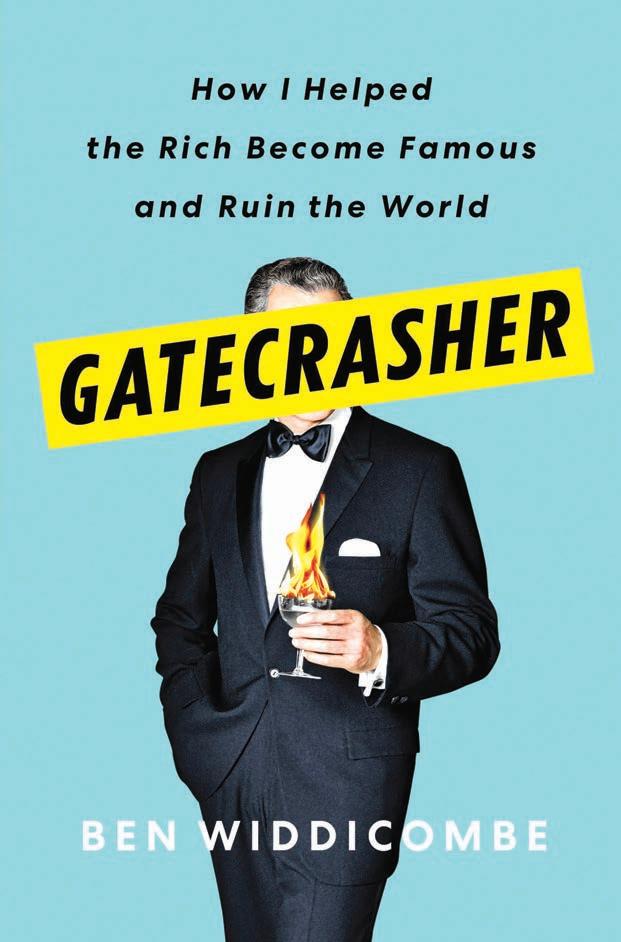
“Gatecrasher: How I helped the Rich Become Famous and Ruin the World”
By Ben Widdicombe c.2020, Simon & Schuster $27.00/305 pages
By BRIAN T. CARNEY
In the middle of a turbulent summer, the season opener for POV, the acclaimed documentary series on PBS, gives us something to celebrate and offers a badly needed moment of inspiration and hope.
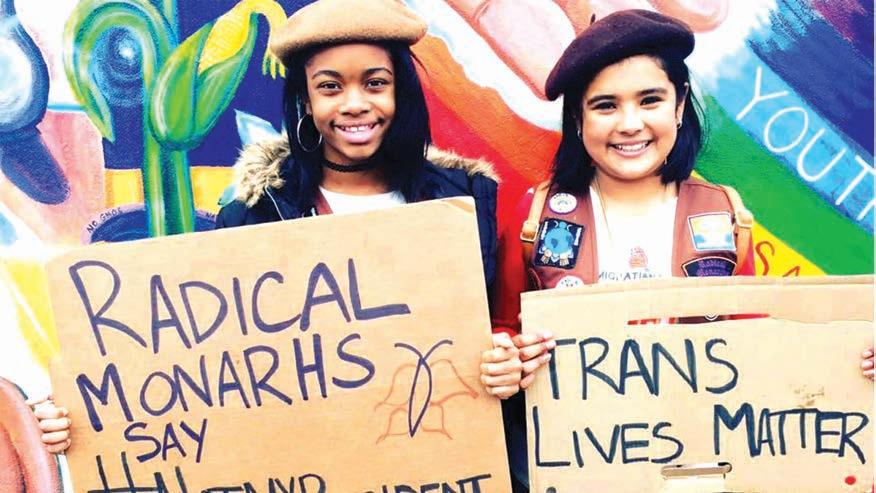
The 33rd season of POV kicks off with “We Are The Radical Monarchs,” an excellent film by Linda Goldstein Knowlton about an innovative program to create and inspire a new generation of activists
The stirring film starts by showing the “Radical Monarchs” in action. A small group of Black and Brown girls with matching uniform pieces are silk-screening protest posters that read, “Education is Liberation.” As they work, they talk about what it means to be radical:
“Radical means just being yourself, what makes you unique, what makes you pretty, what makes you cool.”
“Fierce, strong, powerful, community.”
“You make a difference in the world. You’re not just sitting in the background.”
“Loud and proud.”
“Respecting others while you stand up for yourself.”
Oakland City Council and meeting with elected officials in the state capital of Sacramento. Meanwhile, while Knowlton follows the first group of Radical Monarchs through their graduation from the program (and the 2016 election), she also looks at the time and money it takes for Martinez and Hollinquest to administer the troop. Both women are veteran activists and educators with full-time jobs and families of their own. Knowlton clearly shows the hard work that goes into lining up interesting guest speakers and developing age-appropriate curricula.
Knowlton also shows how interest in the program begins to spread. Commentators on Fox News are quick to denounce the program while parents across the country are interested in setting up their own troops. Martinez and Hollinquest are interested in expanding the program, but fundraising is a challenge.
Knowlton then looks at the history—and future—of the program that helped shape these remarkable girls with their pride, confidence and caring.
The Radical Monarchs were founded in December 2014 in Oakland, Calif., by two queer women of color, Anayvette Martinez and Marilyn Hollinquest, to be a more inclusive and diverse alternative to traditional scouting organizations. They wanted to center the experience on girls of color and to develop opportunities to create fierce sisterhood, celebrate their identities and contribute radically to their communities. The participants range from ages 8 to 13.
As Hollinquest realized, “we need to teach social justice like we teach STEM subjects.” Instead of selling cookies, the girls earn badges for “Radical Pride, “Radical Bodies,” “Black Lives Matter,” “Radical Roots” and “Radical Beauty.” The film shows the girls learning about LGBTQ allyship, environmental racism and disability justice; meeting with an original member of the Black Panthers and joining in rallies and protest marches. The girls also work on a “Radical Advocacy” badge by presenting testimony to the
Knowlton clearly has a fun time working with the Radical Monarchs and she quickly creates compelling capsule portraits of each of the girls. Their dynamic energy and inquisitiveness is infectious. It’s great to watch them dive into a group art project or to engage in a spirited discussion with one of the guest speakers. It’s sobering that young girls need to learn about police brutality; it’s inspiring to see them develop the confidence and tools to fight social injustice.
“We Are The Radical Monarchs” will stream on the website for the PBS POV series at pbs.org/pov/watch/.
More information on the Radical Monarchs can be found on their website at radicalmonarchs.org/.
The season premiere of POV will be followed by the season premiere of POV Shorts with three stories that reflect the many faces of love through memory, community and family. With great charm, “True Love in Pueblo Textil” introduces us to nine-yearold Maribel who tells us what it is like to fall in love. “When I Write It” is a love letter to the rapidly gentrifying Bay Area from two teenage artist natives who spend a day in creative and community fellowship. “La Lectora” captures the long-standing Cuban cigar factory tradition of a reader who entertains the cigar makers while they go about their work.