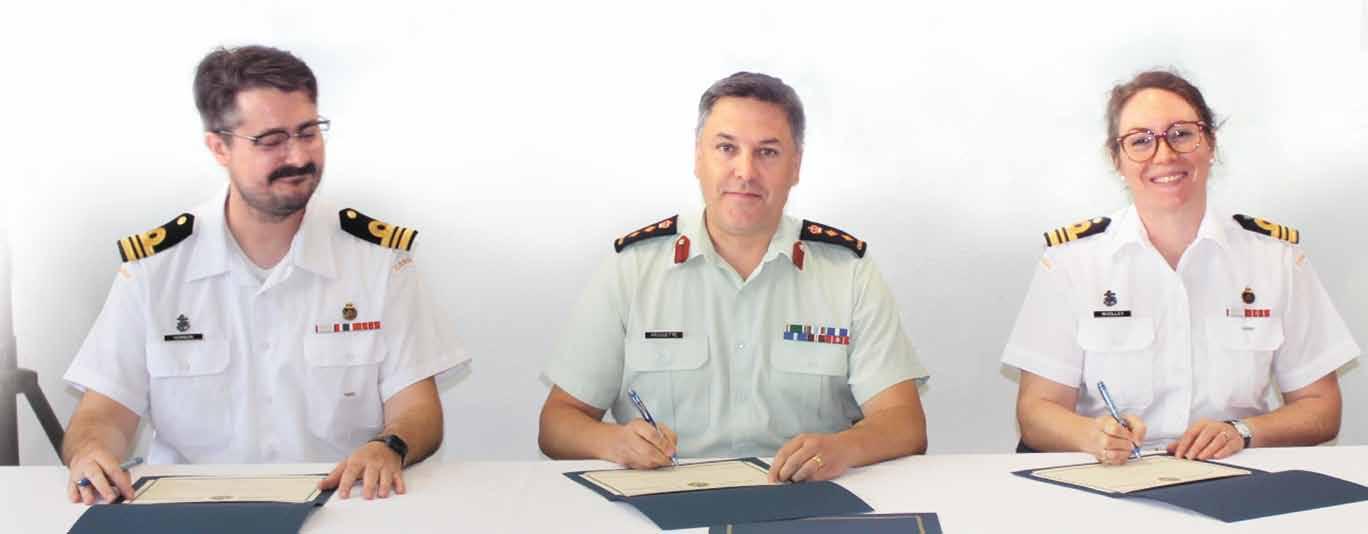
In a milestone ceremony on June 25, Lieutenant-Commander (LCdr)
Chantal Woolley made history as she became the first female commanding officer (CO) of Canadian Forces Ammunition Depot (CFAD) Rocky Point.
She takes over from LCdr Craig Newman, who led the depot for the past three years. The change of command ceremony marked the continuation of CFAD Rocky Point’s proud 70-year history of providing ammunition and explosives support to the Royal Canadian Navy and
LCdr Woolley brings a unique perspective to the role: having previously served at Rocky Point, she returns with both familiarity and fresh vision. In her remarks, she expressed excitement about returning to the depot.
“It truly is an honor and a privilege to be the commanding officer of a unit which has great history and a lot of wisdom,” LCdr Woolley said. “It’s a great responsibility for which I’m grateful, and for the trust bestowed in me.”
The event marked not just a leadership transition, but also highlighted the evolving face of Canada’s
military logistics and support operations. LCdr Woolley’s appointment is part of a broader shift in ammunition depot leadership across Canada: by summer’s end, women will command three of the country’s four ammunition depots, a milestone LCdr Woolley noted with pride.
The ceremony underscored the vital, yet often overlooked, role of ammunition depots. In his farewell address, LCdr Newman reflected on his tenure as the depot supported fleet operations worldwide.
“Giving as much as I did to the unit for them to succeed in whatever they’re working on – that’s what I’m
Lieutenant-Commander (LCdr) Craig Newman, outgoing Commanding Officer (CO) of Canadian Forces Ammunition Depot (CFAD) Rocky Point, Colonel Guillaume Arciuette, Commander Canadian Material Support Group, and LCdr Chantal Woolley, incoming CO, attend a Change of Command Ceremony at CFAP Rocky Point.
most proud of,” said LCdr Newman.
He noted key accomplishments included support to Ukraine, exercise Rim of the Pacific (RIMPAC) 2022, and numerous ship ammunition loadouts.
Looking ahead, LCdr Woolley emphasized the importance of teamwork and leveraging the depot’s collective expertise.
“I see this as a collaborative relationship,” she said. “We are all members of the ammunition community, regardless of our trade or occupation. This depot has the depth and breadth to be successful in these exciting times.” She also identified maintaining
a cohesive team and infrastructure improvements as top priorities. With major naval projects on the horizon, she emphasized the depot’s vital role in supporting new capabilities.
“I’m hoping that’s something I can continue to champion at the right levels,” LCdr Woolley said.
“My hope is to leave this place better than I found it.”
As CFAD Rocky Point enters this new chapter, it stands as a testament to the CAF’s commitment to diversity, expertise, and operational excellence in meeting the challenges of 21st-century naval warfare support.
Kate Bandura Lookout Editor
Peter Mallett Staff Writer
The Pacific Fleet has a new Deputy Commander to assist Commodore (Cmdre) David Mazur in the business of leading its ships and shore units.
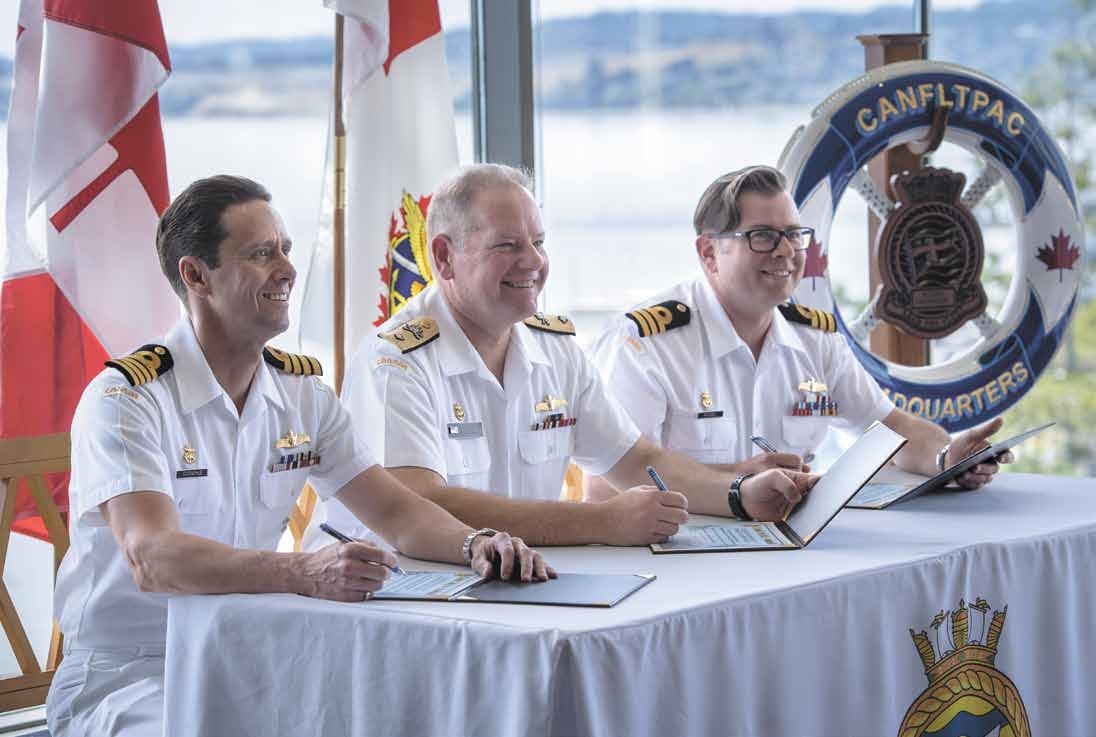
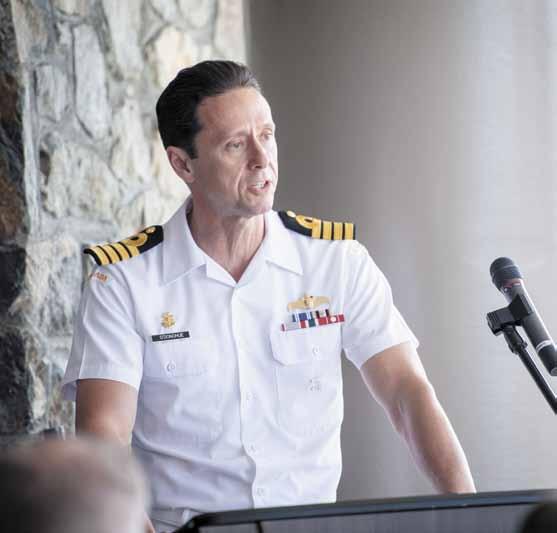
Commander (Cdr) Sam Patchell succeeded Captain (Navy) Mark O’Donohue in a Change of Appointment Ceremony for Deputy Commander of Canadian Fleet Pacific (CANFLTPAC) on June 25.
“I look forward to doing the best as your Deputy Commander; Sir, I have the watch,” said Cdr Patchell after he, Cmdre Mazur and Capt(N) O’Donohue made the appointment official.
The job of CANFLTPAC Deputy Commander includes advising and assisting the Commodore while enhancing fleet readiness and sustainability of all surface assets and shore units, including Fleet Diving Unit (Pacific) and the Naval Tactical Operations Group.
During his address, Cmdre Mazur thanked Capt(N) O’Donohue for his
diligence and excellent work during his two-year posting at the job. Both men emphasized how managing the fleet had become more difficult under their watch, chiefly due to the impact of restrictions during the COVID-19 pandemic and the Royal Canadian Navy’s personnel challenges.
“Despite the personnel and technical challenges faced by the Pacific Fleet over the past two years, I am proud to report our ships and shore-based units successfully completed all their assigned missions and tasks,” said Capt(N) O’Donohue. “I am continually amazed by the perseverance, resilience, hard work and dedication of the extraordinary men and women who crew our ships and units.”
Capt(N) O’Donohue will soon retire after completing 25 years of service.
Before taking on the role of Deputy Commander, Capt(N) O’Donohue commanded HMCS Calgary from July 2020 to April 2022. During this time, he received a Chief of Defence Staff Unit Commendation for successfully executing maritime interdiction operations in
Commodore welcomes fleet’s new 2iC
Captain (Navy) Mark O’Donohue, Commodore David Mazur and Commander Sam Patchell sign off on documents to confirm the Change of Appointment for Commander Patchell as Deputy Commander of Canadian Fleet Pacific, June 25.
Photos: Master Sailor Valerie LeClair
the Gulf of Oman, breaking two international records for the seizure of illicit narcotics.
Cdr Patchell’s last posting was as commanding officer of HMCS Ottawa. In 2023 he led the ship on its deployment to the South China Sea in fulfillment of Canada’s Indo-Pacific strategy. In his welcome message, Cmdre Mazur marveled at his new deputy’s experience as a ship’s commander.
“You bring a currency to the leadership team and have a great understanding of how to bring a team together during deployments,” said Cmdre Mazur. “I am looking forward to your leadership because I know you are an empathetic leader, a good tactician and thinker, and have a lot of acumen.”
Cdr Patchell said the pillars of his military values include loyalty, integrity, courage, excellence, inclusiveness and accountability; these have guided him well throughout his career and would continue to influence his decision making in his latest posting.
Born in North Vancouver, Commander Patchell joined the Canadian Armed Forces in 2001 and completed his Naval Warfare Officer Training at HMCS Venture and later earned his Bridge Watch-keeping and Naval Officer Professional Qualifications (NOPQ) aboard HMCS Charlottetown Key deployments during his career include his time aboard HMCS Athabaskan as Deck Officer where he participated in Operation Hestia, Canada’s response to the 2010 earthquake in Haiti. As HMCS Vancouver Operations Room Officer, he deployed on Operation Mobile, Canada’s 2011 Military Intervention in Libya.
In 2018, he and his family moved to Pyeongtaek, South Korea, where he served as Executive Assistant to the Deputy Commander, United Nations Command.
Commander Sam Patchell
Captain (Navy) Mark O’Donohue, outgoing Deputy Commander of Canadian Fleet Pacific.
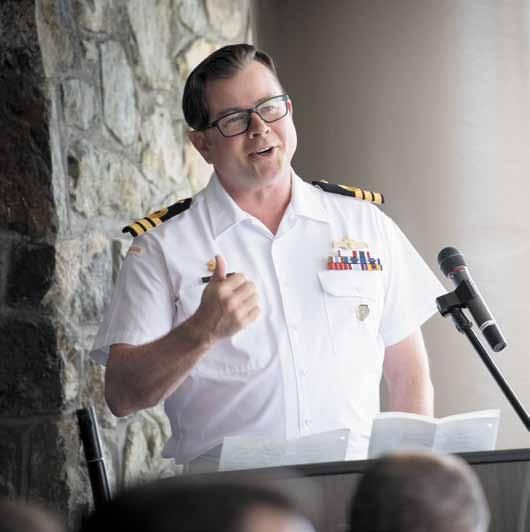
Commander Sam Patchell, incoming Deputy Commander of Canadian Fleet Pacific.
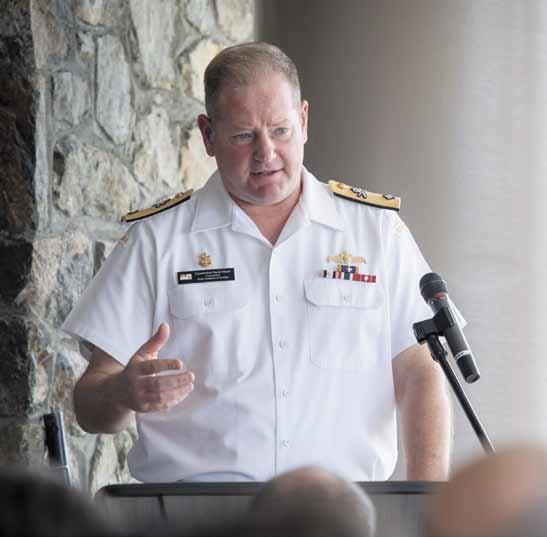
Commodore David Mazur, Commander Canadian Fleet Pacific.
Managing Editor
Jazmin Holdway jazmin.holdway@forces.gc.ca
Editor Kate Bandura
Writ E r
250-363-3130 kateryna.bandura@forces.gc.ca
Peter Mallett mallett.peter@cfmws.com
P rod UC tion
Teresa Laird production @lookoutnewspaper.com
Leslie Eaton
250-363-3127 leslie.eaton@lookoutnewspaper.com
a d M inistration and aCC o U nts
Andrea Modesto
adv E rtising
Joshua Buck
250-363-3127
Andrea.Modesto@forces.gc.ca
778-977-5433 military.base.advertising@gmail.com
E ditoria L advisors
Lt(N) Wilson Ho
Ashley Evans
250-363-4006
250-363-7060
Published each Monday, under the authority of Capt(N) K. Whiteside, Base Commander. The editor reserves the right to edit, abridge or reject copy or advertising to adhere to policy as outlined in PSP Policy Manual. Views and opinions expressed are not necessarily those of the Department of National Defence.
Circulation: 4,000 plus online engagement per week
Follow us on Facebook and Instagram to join our growing social media community. A Division of Personnel Support Programs
Web: www.lookoutnewspaper.com Fax: 250-363-3015
Canadian Mail Product Sales Agreement 40063331
Dreams and Trauma PTSD
Throughout human history, dreams have always had a glow of mystery or luminosity. The first recorded dream dates back about 5,000 years to ancient Mesopotamia and Egypt. During this era, dreams were perceived as messages from the Gods; some were viewed as prophetic. For example, in the oldest piece of written literature – The Epic of Gilgamesh, written approximately 4,000 years ago – characters use dreams as the basis for foreseeing future events, as well as motivation to fulfil something bigger than themselves.
Moving forward in time, the Greeks (1200-100 BC) and the Romans followed a similar thread of thought, understanding that dreams can be used to gain insights into their subconscious mind and potentially into the future. The renowned Greek physician Hippocrates was one of the first recorded medical physicians to use dreams to diagnose and treat ailments and diseases. In his work (Regimen IV or Dreams) he pointed out that dreams can reveal information about the body’s state and provide insight into the overall health of the individual.
Throughout the Middle Ages (500-1500 AD), dream interpretation wasn in the hands of the clergy. The Catholic Church believed dreams were divine guidance and would look to dreams to acquire messages. This shifted when secularism became more
accepted during the Age of Enlightenment (1500-1800 AD) with philosophers such as Descartes and Kant utilizing dreams to understand the human mind.
This way of thinking gave way to the birth of psychology, and the scientific study of the human condition. From the outset, Freud and Jung understood dreams as a way to access the unconscious mind and become aware of one’s psychological blind spots. This brings us to today, where dreams are being used in a variety of ways for therapeutic and spiritual purposes.
Dreams often feel like thoughts. They come into our awareness and quickly flee out of our capacity to recall them. There; and, gone. However, there are dreams that stick with us for a lifetime, unshakeable. Sometimes they occur after something utterly devastating happens to us. It might not be at that moment, it may not even be months from then, but it may bubble up out of our unconscious when we least expect it...
Not all reccurring dreams or nightmares are related to a trauma, because that would devalue the word and its meaning. However, when there is a recurring theme there must be some inquiry about why this may be surfacing. It makes sense to at least consider what it means. If we don’t give it at least some attention, then we would be doing a disservice to ourselves.
Traumatic dreams often appear as nightmares; those dizzying and frightening dreams that at the very least give us an unsettling feeling when we wake up.
However, sometimes trauma-based dreams can be a little more deceptive to interpret. Nevertheless, some common themes are often present in trauma-based dreams. One of them is being chased or stalked by an intense force or presence. We try and hide, but it seems there’s nothing we can do to evade the feeling that something is after us.
Another common theme is falling. A survey found that 54 per cent of people have had this experience in their dreams. It can indicate that something is freefalling in your life, out of your control and there’s uncertainty on when it is going to end.
Another common theme is seeing people from past trauma. This may be obvious on the surface, but dreams are based on the individual. For instance, if you see someone in your dream who was a bystander in the event, it may suggest that you may be still a bystander to your trauma.
Dreams have been used for millennia to gain insight and process our psychological condition. They can garner a deeper understanding of ourselves, and help unlock ourselves from the stagnating trauma.
Thomas Goenczi is an RCN Veteran and MA Clinical Counsellor with a private practice: Well Then Therapy.
The content is not intended to substitute professional advice, diagnosis, or treatment. Always seek the advice of your mental health professional or other qualified health provider with any questions regarding your condition.
thomas goenczi Lookout contributor
Peter Mallett Staff Writer
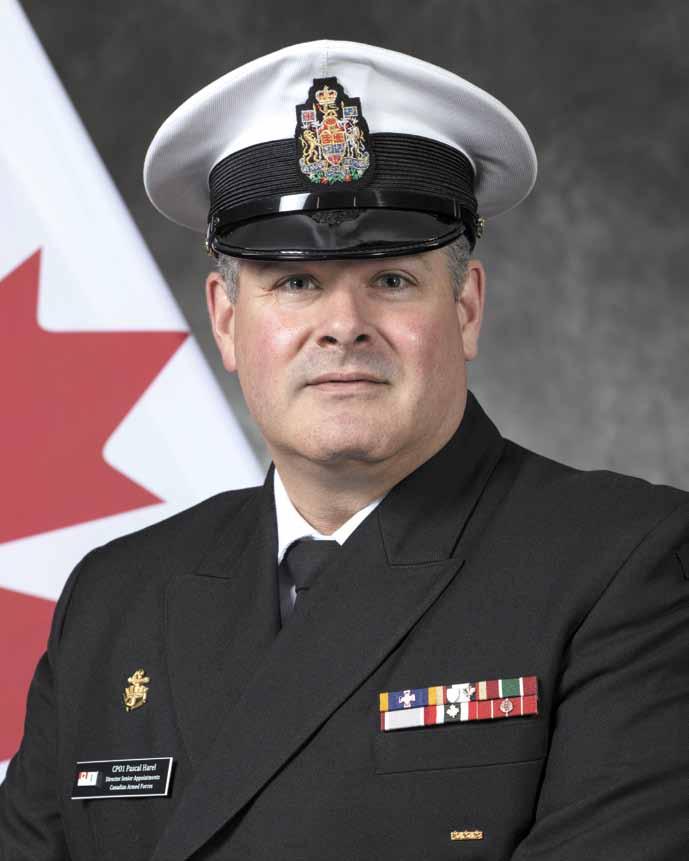
A seasoned Chief Petty Officer 1st Class (CPO1) with strong ties to the Pacific Coast bristles with optimism over his next posting as the Royal Canadian Navy’s (RCN) senior NonCommissioned Member.
With 28 years of experience in Canada’s military, CPO1 Pascal Harel will become the 22nd Command Chief Petty Officer of the RCN following a Change of Appointment Ceremony this month in Ottawa. His new responsibilities include providing the commander of the RCN with the perspective of non-commissioned sailors and acting as a liaison with senior leadership and the RCN commander.
“This is very exciting for me as I will be going back home to the RCN where I will be directly helping sailors,” said CPO1 Harel. “This is the ultimate noncommissioned position in the RCN where I influence policy to enhance the life of our sailors.”
Command Chief for all three branches of Canada’s military. During a Change of Appointment Ceremony on July 11, he will replace CPO1 Tom Lizotte as the Navy’s Command Chief Petty Officer.
CPO1 Harel already enjoys a close working relationship with CPO1 Lizotte and fully understands the importance of his new position.
“I will represent the sailors and to do this effectively, I need to stay close to them and communicate and engage with them often,” said CPO1 Harel.
“I will also need to understand the needs of the leadership team and Vice-Admiral (VAdm) Angus Topshee, Commander of the Royal Canadian Navy, to effectively advise him on a sailor’s needs while also comprehending how the RCN operates at the strategic level to provide accurate and proper advice on improving conditions for sailors.”
His last two postings since 2022 were at Department of National Defence (DND) headquarters in Ottawa where he worked as Director General Military Careers Chief, and most recently, Professional Conduct and Culture
CPO1 Harel joined the Navy in 1996 at the age of 19, first working as a boatswain before switching to the electrician trade at the end of his basic training. He spent most of his career on the West Coast, spending many of his years aboard HMCS Regina, where he was deployed to the Persian Gulf, and also HMCS Protecteur, RCN’s former supply ship. He also worked as an instructor at Naval Fleet School (Pacific), serving as Career Manager for the roll-
out of the Marine Technician (MarTech) trade. He was a Coxswain aboard HMCS Yellowknife, HMCS Edmonton and HMCS Winnipeg. Throughout his career, he completed seven deployments along with several iterations of Rim of The Pacific (RIMPAC), and Operations Caribbe and Wesploy. His last posting in Esquimalt was Unit Chief of the Personnel Coordination Centre (PCC) in 2022. He also served in a supervisory role at Fleet Maintenance Facility (FMF) Cape Breton, Base Administration and the Sea Training Division.
A Canadian Forces General Message said CPO1 Harel was chosen for the job for being ‘objective and consist-
ent’ throughout his career. On March 12 in an official communication VAdm Topshee introduced CPO1 Harel as the RCN’s 22nd Command Chief Petty Officer.
“Your appointment reflects your significant contributions to both the CAF [Canadian Armed Forces] and RCN,” said VAdm Topshee. “As my senior non-commissioned advisor on all issues concerning the welfare and service of our sailors, defence team members and families as well as RCN culture and our readiness to fight, I know that you will embody the CAF ethos, lead by example and exemplify the high level of trust, which our members deserve.”
22nd Command Chief Petty offiCer of the rCn
Chief Petty Officer 1st Class Pascal Harel
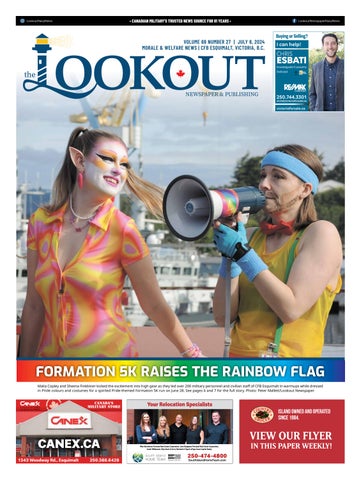
Military members and civilian staff who ran June’s Formation 5K race did so with pride.
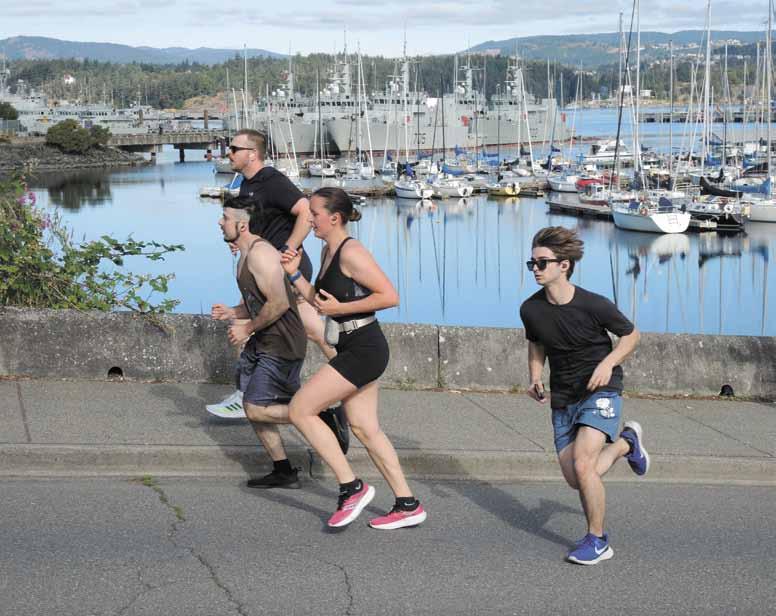
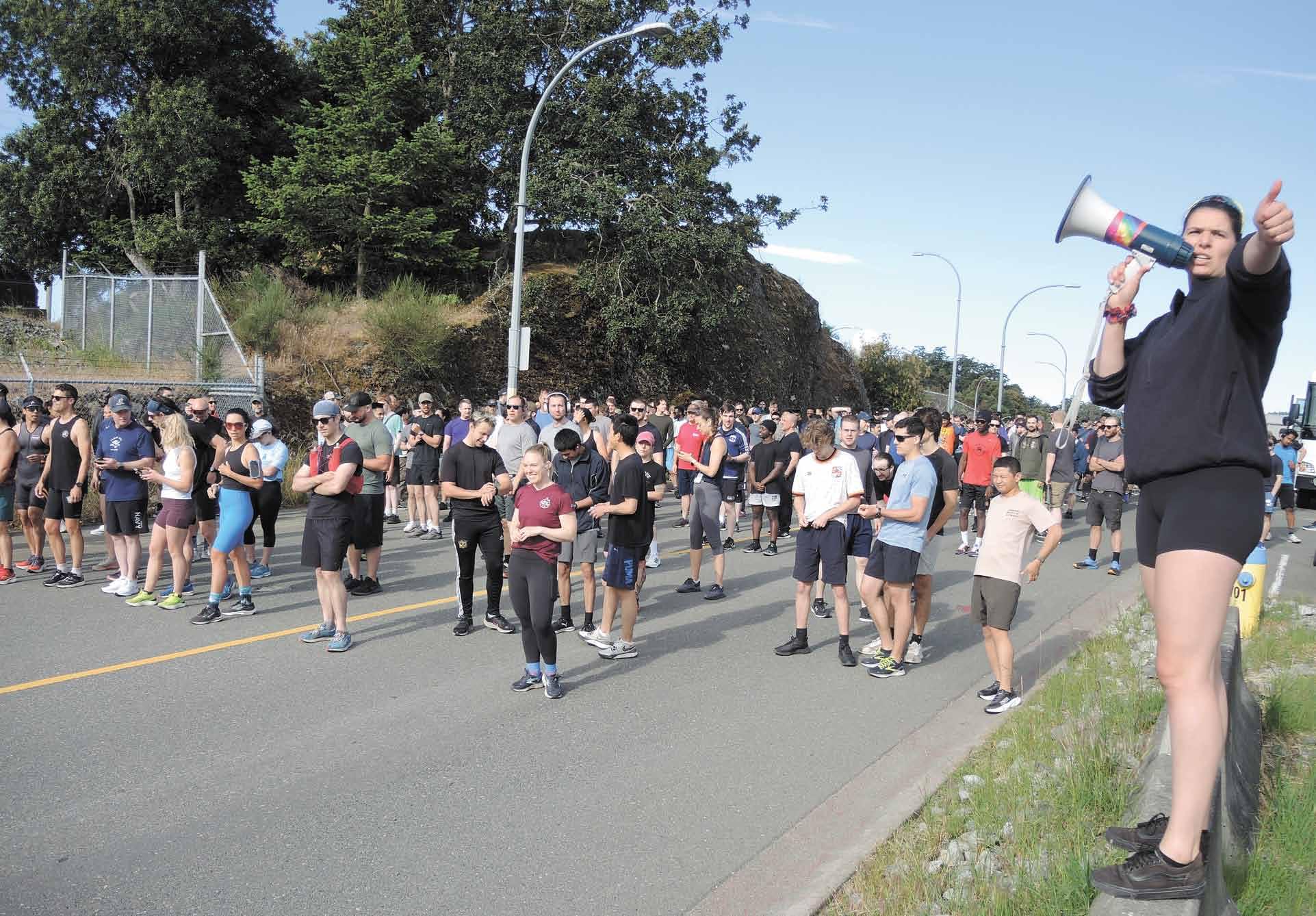
Over 200 runners set off from Y-Jetty at 8:30 a.m. on June 28, running a loop through the streets at Naden and Dockyard in the Victoria Pride Week themed event. While organizers from Personnel Support Programs (PSP) handed out rainbow pride flags along with water and snacks during warmups at the starters table, a handful of participants went a step further and donned rainbow-colored attire to celebrate the occasion.
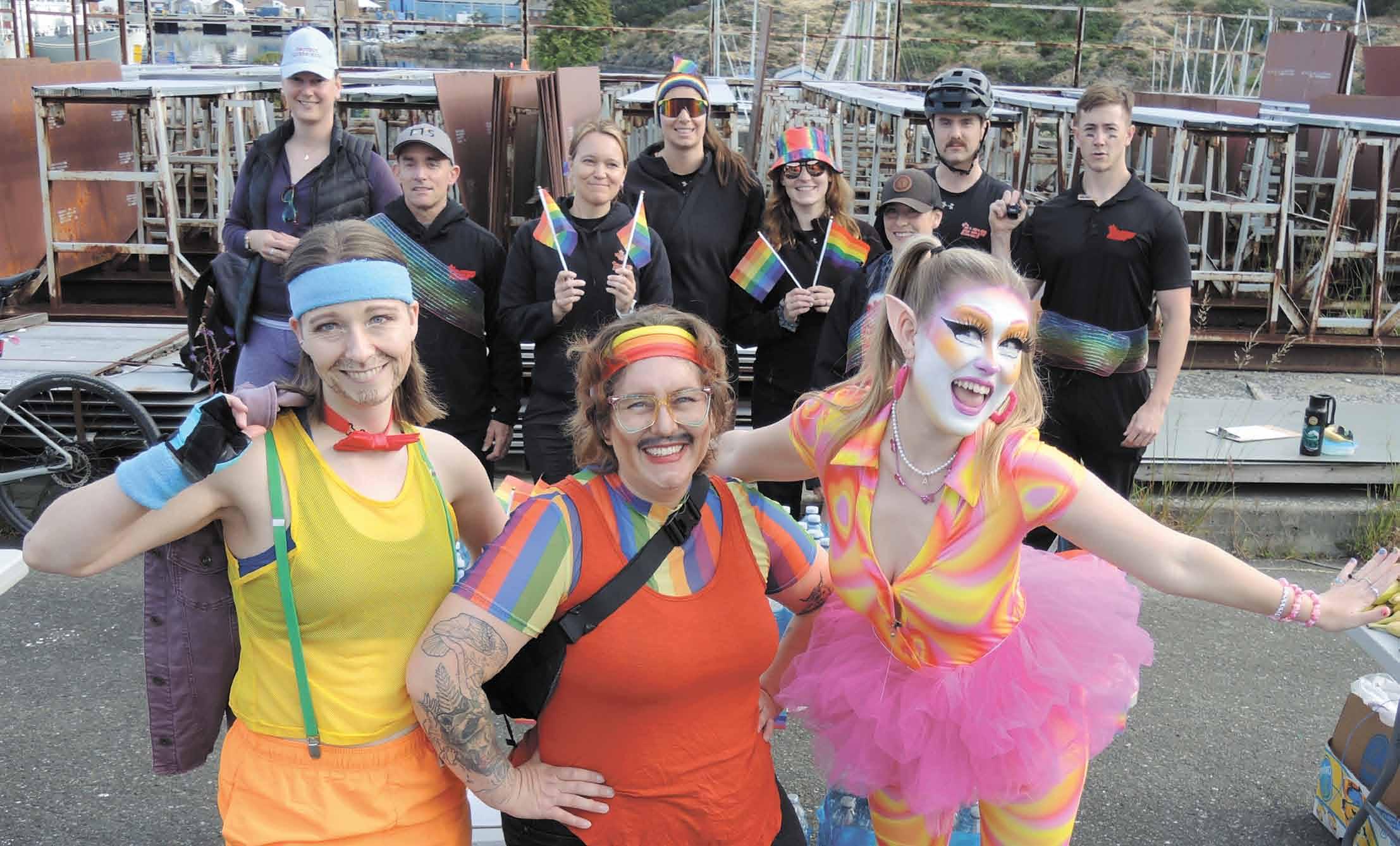
Among the most colourful of runners in the crowd was Lieutenant (Navy) Lindsey Bookham of the PSP Fitness Cell. She took part in the run dressed in rainbow-colored costume alongside two of her civilian friends, Malia ‘Chastity’ Copley and Sheena ‘Charlie Chapstick’
Finkbiner, also in colorful costume and makeup. All three perform in drag shows with local dance studio Passion and Performance and each said they jumped at the chance to wear costume for the Formation 5K.
“Having a pride-themed run is a very visible way to promote and celebrate pride,” said Lt(N) Bookham who goes by the stage name ‘Java the Butt’.
Copley shared in the sentiment, adding that it’s ‘very cool’ the military is showing such great support and promoting pride.
Captain (Navy) Kevin Whiteside, CFB Esquimalt Base Commander, was also among the participants.
“The Defence Team is really a crosssection of Canadian society, and our mission is all about celebrating and encouraging diversity within the formation. It’s great to have Pride Week celebrations as part of this popular athletic event,” said Capt(N) Whiteside.
Organizers say the Pride theme component was an effort to promote inclu-
sivity and support Pride initiatives taking place for Victoria Pride Week (June 27 to July 7), says Kiana Deland, one of Fitness and Sport Instructors who oversees the monthly Formation 5K.
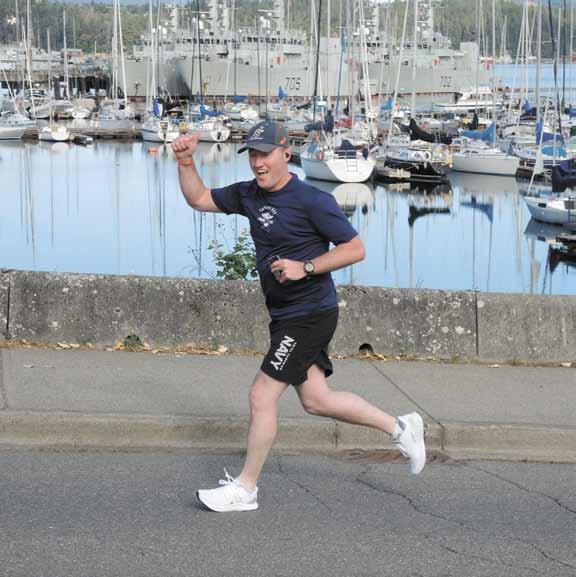
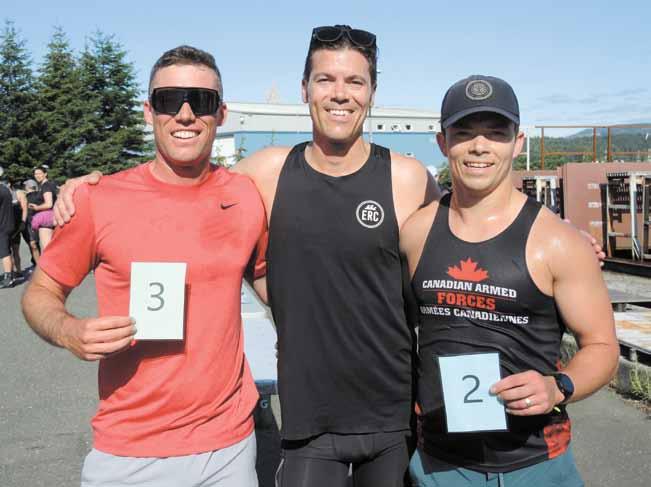
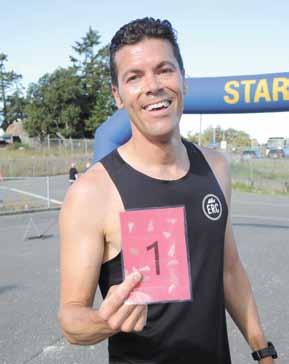
Matt Carlson, Base Public Affairs Projects Officer, was first to cross the finish line and pumped his fists in triumphantly after clocking in with a time of 16:44. He was followed by Lt(N) Adrian Thow (17:38) and Lt(N) Rodney Newcombe (18:08).
Carlson, who has won the Formation 5K several times over the past ten years said it felt great to win the first Formation 5K pride run.
“Having a pride run is a great fit for the Base and its objectives of providing a welcoming and inclusive environment for military members and employees,” said Carlson.
The Formation 5K run focuses on increasing engagement and focusing on esprit de corps and teambuilding across the formation. The run occurs on the last Friday of every month, rain or shine.
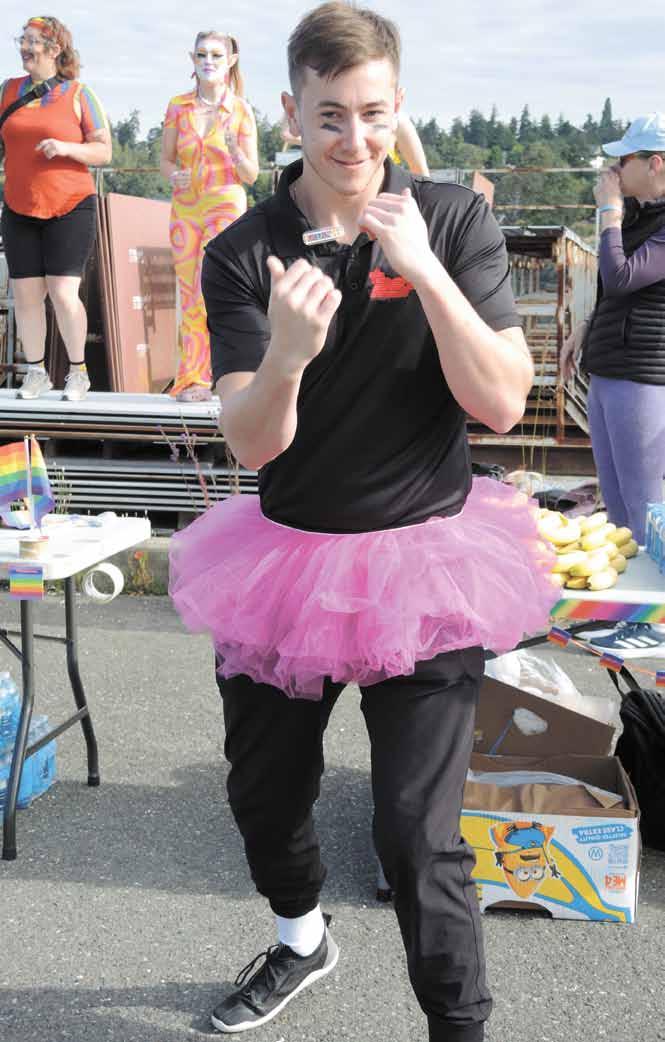
Captain (Navy) Kevin Whiteside, CFB Esquimalt Base Commander, was an enthusiastic participant. A PSP staffer tries his boxing and ballet moves during the pre-race warmup.
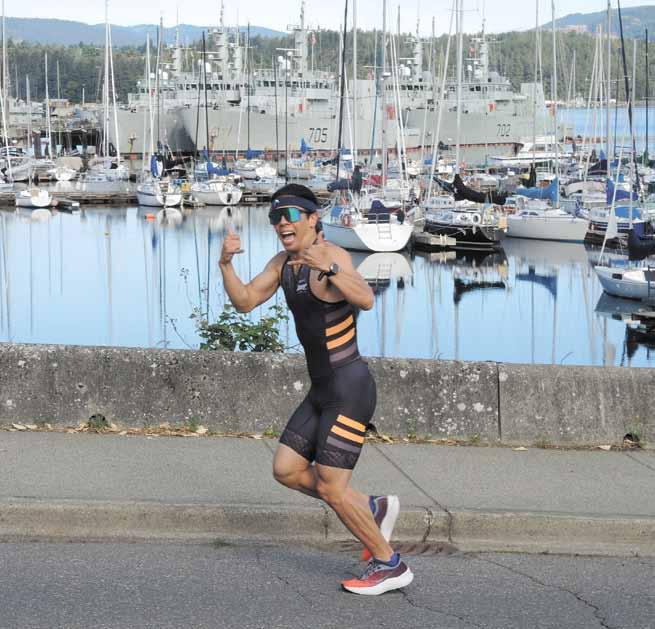
Runners vie for position as they near the halfway point.
Sheena Finkbiner, Lt(N) Lindsey Bookham and Malia Copley strike a pose with PSP staff while wearing pride colours ahead of warmups. Photos: Peter Mallett/Lookout Newspaper
Peter Mallett Staff Writer
royal Canadian navy moves into seCond year oF
naval experience Program
Last spring, the Royal Canadian Navy (RCN) embarked on a new initiative, the Naval Experience Program (NEP), aimed at reimagining how we attract, recruit, and train new sailors, and the first cohort of the program enrolled in June. The program has now reached the end of its first year. As the RCN moves into the second year of NEP, RCN leadership is hopeful that the program will continue to attract enthusiastic new recruits to the Navy.
“We hope the honest feedback of NEP sailors who have decided to join our fleets, other elements of the Canadian Armed Forces, or even leave the Navy and return to their civilian lives will inspire other Canadians to give the programme a try,” said Rear-Admiral Christopher Robinson, RCN Assistant Chief of Naval Staff, Personnel and Training.
NEP has three main objectives: attract and enroll, provide training and occupation exposure, and retain as many participants as possible into full-time naval service. Over the past year, NEP sailors have delved into life in the Navy, experiencing both the challenges and rewards of a naval career. Now, they stand at the threshold of their decision, contemplating whether to embark on a long-term naval career with the RCN.
The most common naval occupations requested by NEP sailors are Weapons Engineering Technician, Naval Electronic Sensor Operator, Naval Combat Information Operator and Sound Navigation and Ranging (SONAR) Operator. Next in popularity are the Marine Technician and Boatswain occupations.
NEP is meant to provide participants with hands on experience and training opportunities. Examples of program activities during the first year that helped participants decide whether a career in the Navy was right for them included: deploying on
HMC Ships while on international operations and exercises, supporting naval occupational training onboard RCN vessels and participating in RCN ceremonial events.
Implementing such a unique program is not without challenges. During the rollout of the program, concerns were raised about incorporating NEP sailors into existing training programs, knowing there are current sailors awaiting career training and qualifications. Training for current members has not been delayed by NEP. Ultimately, the goal of NEP is to bolster our naval force, a shared priority for all members of the RCN.
Transitioning into year two of NEP, the RCN is taking lessons learned from year-one into account and adjusting the program. Some elements the RCN will action include the continuous enrollment of applicants into the program; streamlining the occupational selection process to potentially include trades belonging to other operational environments; and further exploration of naval experiences which will offer the most value to both NEP sailors and nonNEP sailors awaiting training.
Canadians and permanent residents who are interested in learning more about NEP can reach out to their nearest Naval Reserve Division, Canadian Forces Recruiting Centre to find out more, or start an application online at Naval Experience Program - Canada.ca.
Preliminary data indicates that 74 per cent of the inaugural cohort of NEP participants have opted to stay in the Canadian Armed Forces (CAF) after their one-year engagement. A more comprehensive analysis of retention data will be available in the fall of 2024, following the completion of a larger cohort’s one-year engagement. Encouraged by these findings, the RCN will continue enrolling sailors in the program to address personnel shortages within regular force Navy non-commissioned member occupations.
royal Canadian navy
It’s been one year since the first participants joined the Naval Experience Program (NEP) and now they are sharing their stories and deciding whether to stick with the Navy or move on.
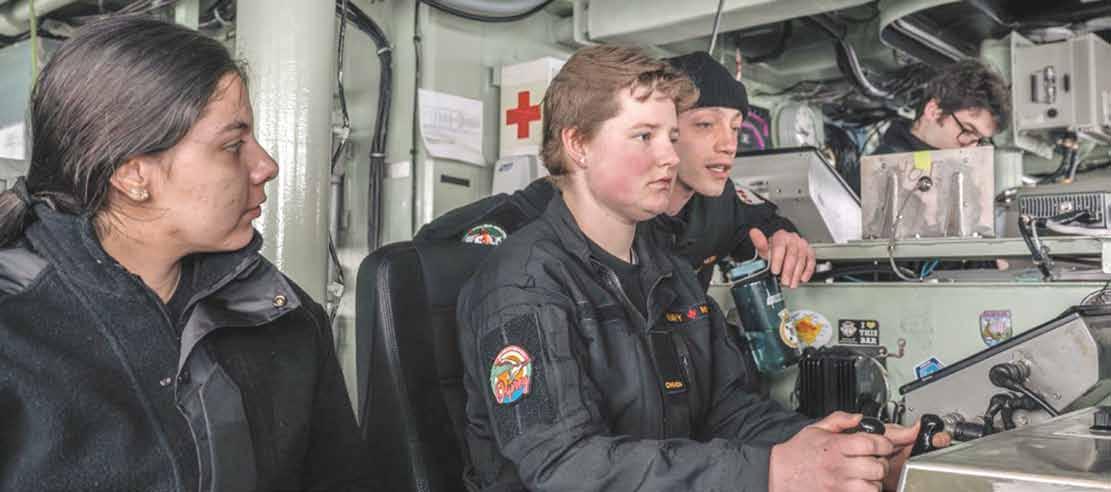
“I joined the Naval Experience Program because my dad, a Chief Warrant Officer, told me about the program after talking to Royal Canadian Navy (RCN) Chiefs,” said Emma Duncan, now a Sailor 3rd Class (S3) from Winnipeg, Man. “The opportunity to explore the Navy without a long-term commitment was too good to pass up. Serving Canada like my father and brother felt like the biggest honor.”
S3 Duncan’s experience has been fulfilling, she said, from participating in the Battle of the Atlantic Ceremony to being part of the Honor Guard for HMCS William Hall’s commissioning.
The NEP offers a taste of life in the Navy, letting people try different roles to see if they want to make it a career. But even in the short term, adapting to life in the Navy comes with its challenges. S3
Duncan noted that being away from home has been the hardest part.
“I am very family-oriented, and not being able to have dinner with my family every night has been tough,” she said.
Luckily, the sense of camaraderie helped her overcome this challenge.
“The Navy is like one big family,” she said. “I have made lots of friends here in Halifax, and we spend a lot of time together, making it feel like home.”
For S3 Ulia Wahn, a participant from Brandon, Man, the most significant challenge was adjusting to the fast-paced environment during a three-week sail on HMCS Charlottetown
“I found myself lagging behind the qualified sailors, hesitant because of the fast-paced environment. It was challenging, but asking questions and taking one step forward helped me find my confidence,” said S3 Wahn.
“I got to participate in the crossing the line ceremony, work with the aircrew, and even sit in the Cyclone’s cockpit,” said S3 Duncan, recalling her three-week sail aboard HMCS Charlottetown during
Operation Reassurance
S3 Wahn’s most memorable experience was crossing the Arctic Circle in HMCS Charlottetown and participating in the King Neptune ceremony.
Both S3 Duncan and Wahn plan to pursue full-time careers in the Navy. S3 Duncan has signed on as a Sonar Operator, excited about the adventures and opportunities that lie ahead. S3 Wahn, too, looks forward to a long-term naval career, valuing the sense of community and the skills she has gained.
As of June 2024, approximately 1,459 individuals applied to the NEP; 179 sailors have been successfully enrolled, surpassing the initial goal of 144, demonstrating a promising start for NEP. Over 500 applicants are currently in various stages of the recruitment process. Of the first group of NEP participants completing their one-year engagement, 74 per cent have chosen to embark on a career with the Regular Force. The RCN will have more detailed data in the fall of 2024, as most current NEP participants complete their one-year engagement.
Now open for submissions: Support Our Troops national scholarships program
The Support Our Troops national scholarship program is now open for applications until July 18.
Made possible through the generosity of Support Our Troops donors, the National Scholarship Program helps military family members pursue their academic dreams.
Due to the unique circumstances of military life, funds for pursuing postsecondary education can be a barrier for
Canadian Armed Forces families. The National Scholarship Program works to alleviate some of those barriers. Successful applicants can receive up to $5,000 towards the cost of their tuition.
To find out if you or someone you know is eligible and apply today visit: National Scholarship Program - Support Our Troops. Applications close Thursday, July 18, at 5PM (EST).
Support Our Troops is the official charitable cause of the Canadian Armed Forces. It is administered by Canadian Forces Morale and Welfare Services (CFMWS).
Support Our Troops provides direct financial support and assistance to CAF members, veterans and their respective families in a number of important and often life-changing ways that are not provided by core public funding.
To find out more about their work, visit the Support Our Troops page at supportourtroops.ca or email scholarships@cfmws.com for details.
3. New class of ships. (5 letters)
5. RCN flagship (5 letters)
7. The exercise HMCS Vancouver is deployed on. (6 letters)
8. Five minutes before Taps. (6 letters)
9. Ammunition Depot and name of a local RCN celebrity/ influencer. (5 letters)
10. 443 Squadron designation during the Second World War. (6 letters)
DOWN:
1. Vertical walls within the ship. (8 letters)
2. Defensive weapon system against incoming missiles and aircraft. (4 letters)
4. A shower stall. (10 letters)
6. Name of the Fleet Maintenance Facility in Esquimalt. (6 letters)
the l ookout is seeking people who want to ‘have their say’ in print. if you have something to say, and want to collaborate, contact Kateryna.b andura@forces.gc.ca
This is a volunteer position
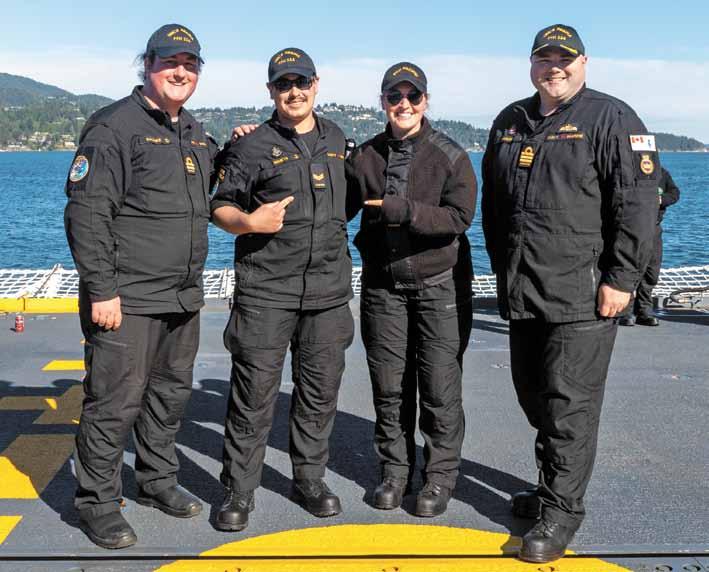
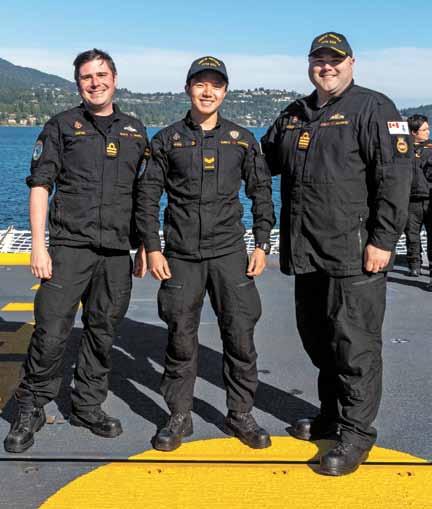
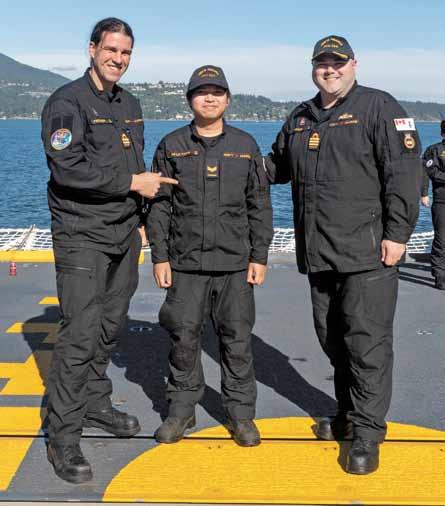
Commander Jeremy Samson (right), Lieutenant (Navy) Delaney Macphee (left), Sailor 1st Class Alexandra Healy (third from left) promote Sailor 1st Class Christopher Nemeth to current rank.
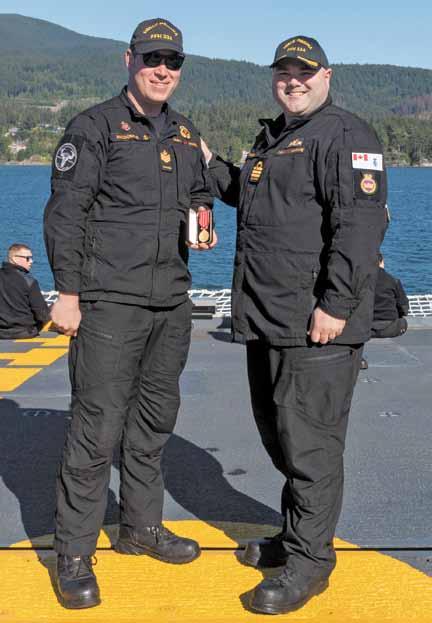
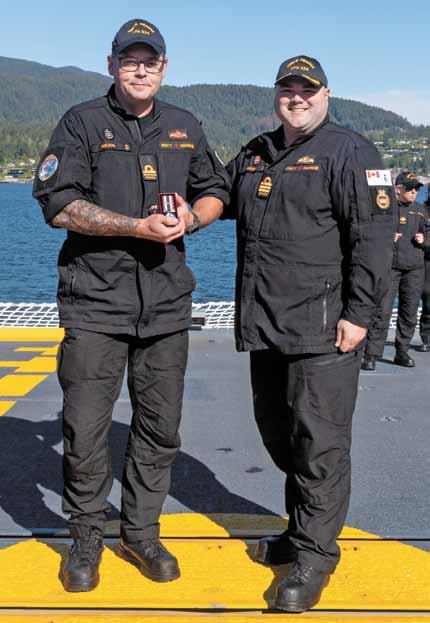
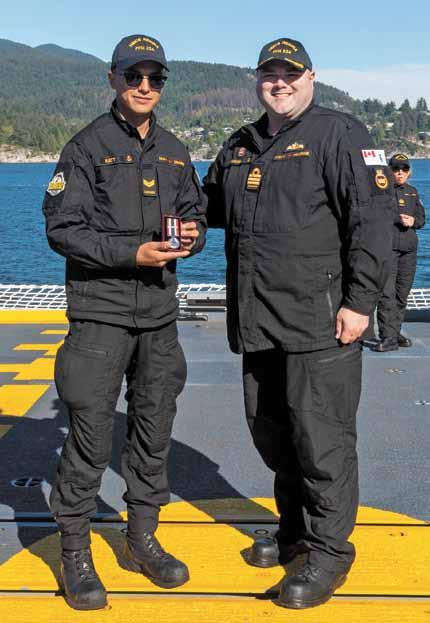
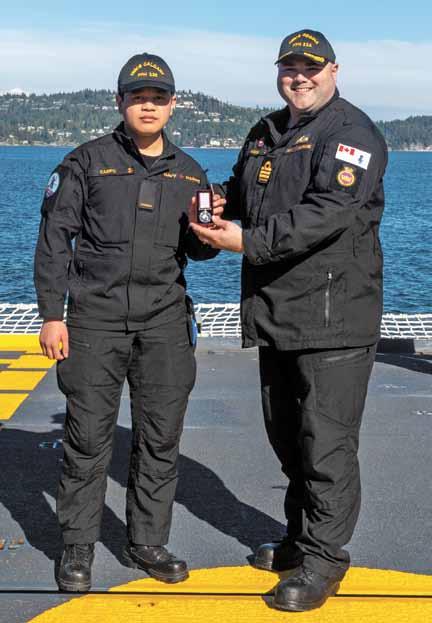
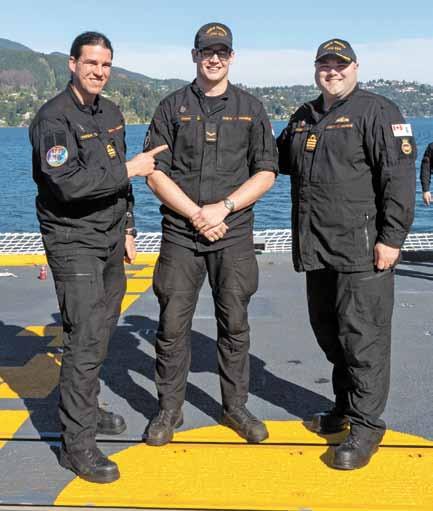
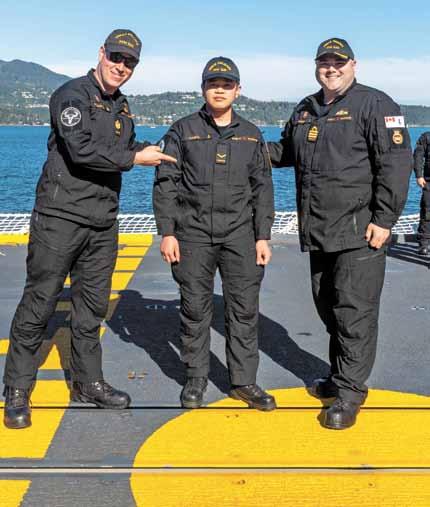
Commander Jeremy Samson, Commanding Officer of hmCS Regina, presented awards and promotions while at sea on may 22.
Photos: Sailor First Class Brendan McLoughlin, MARPAC Imaging Services
Petty Officer 2nd Class Grant Macdonald receives Canadian Forces Decoration for 12 years of service.
Sub-Lieutenant Nauris Nikans receives Special Service Medal.
Sailor 1st Class Nickolas Ratt receives Special Service Medal.
Commander Jeremy Samson (right) and Petty Officer 2nd Class Grant Macdonald (left) promote Sailor 2nd Class Campo to current rank.
Commander Jeremy Samson (right) and Lieutenant (Navy) Daniel Presseau (left) promote Sailor 2nd Class Johns to current rank.
Sailor 3rd Class Campo receives Operational Service Medal – Humanitas.
Commander Jeremy Samson (right) and Lieutenant (Navy) Daniel Presseau (left) promotes Sailor 1st Class De La Torre to current rank.
Commander Jeremy Samson (right) and Lieutenant (Navy) Gordon Dupuis (left) promote Sailor 1st Class Yang to current rank.
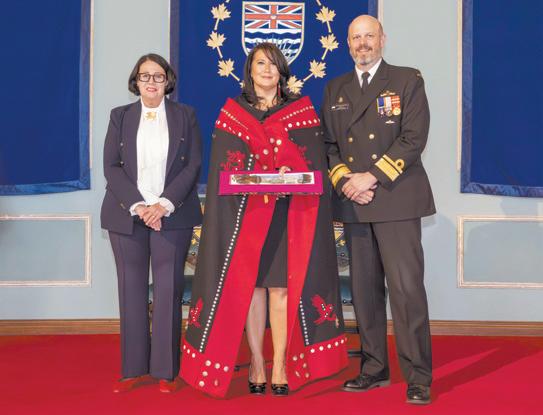
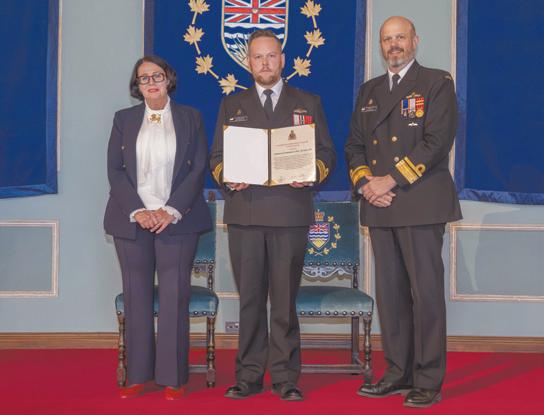
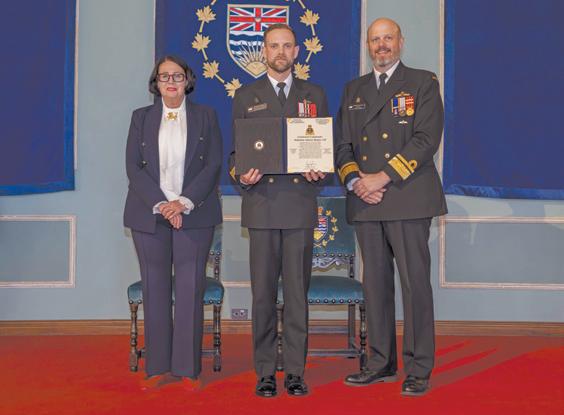
Maritime Pacific Honours and Recognition Ceremony
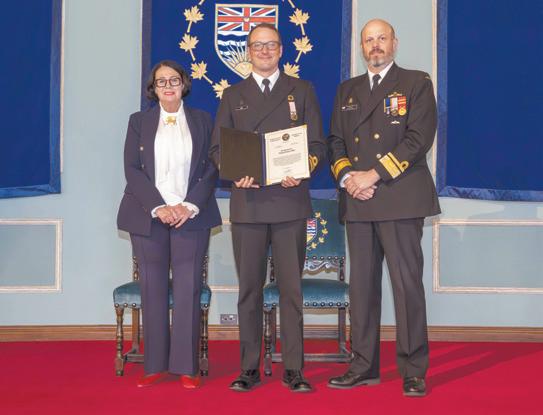
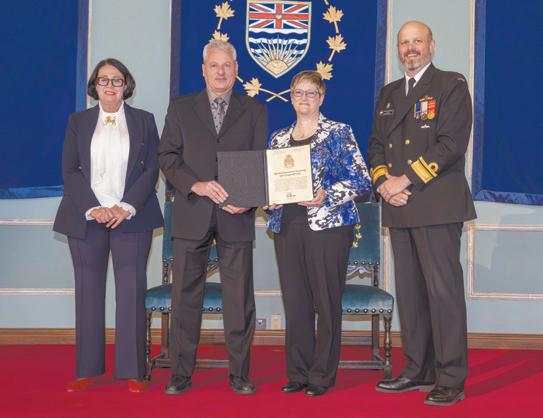
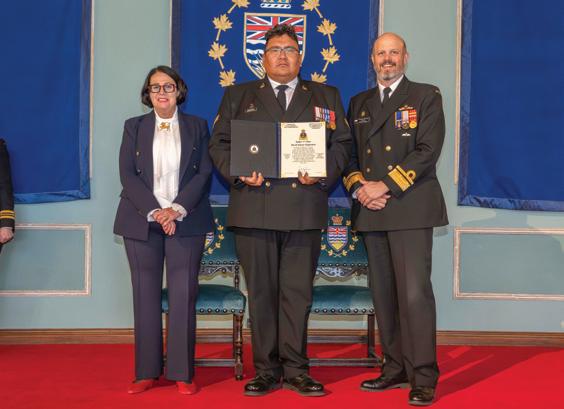
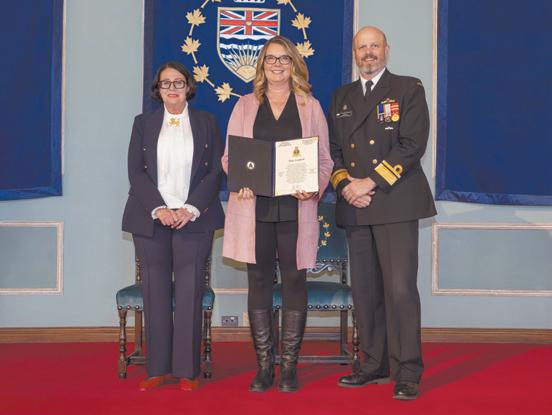
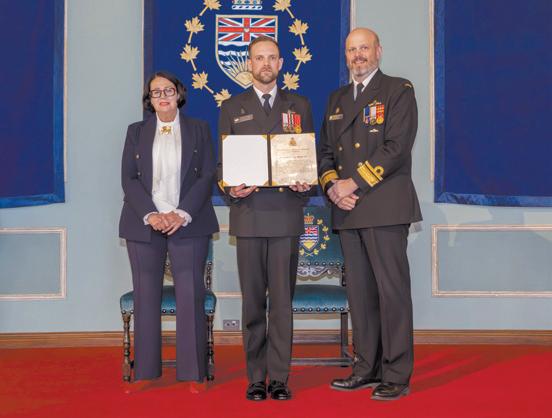
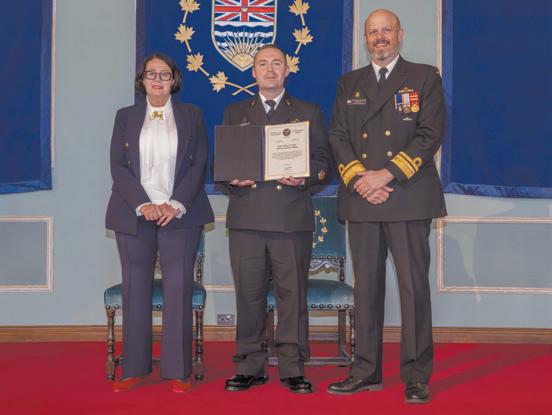
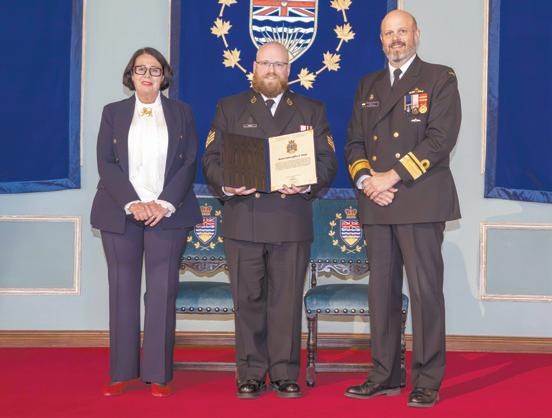
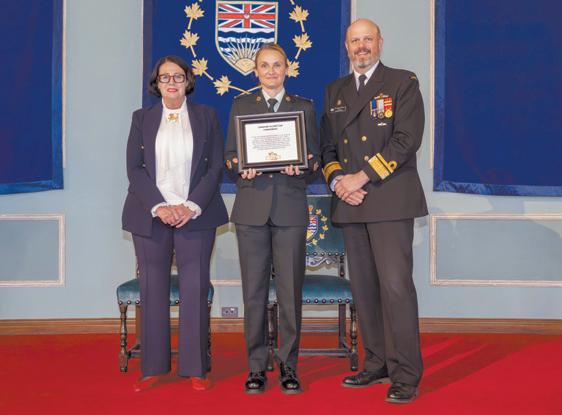
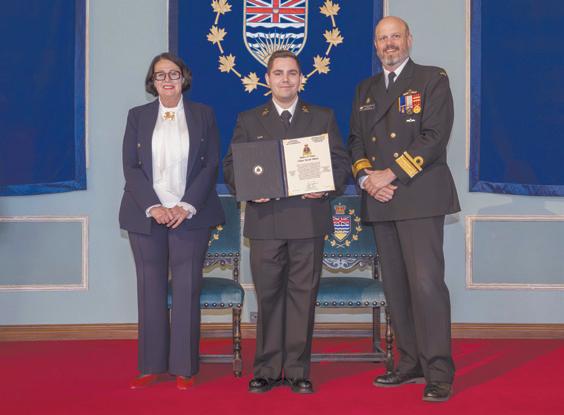
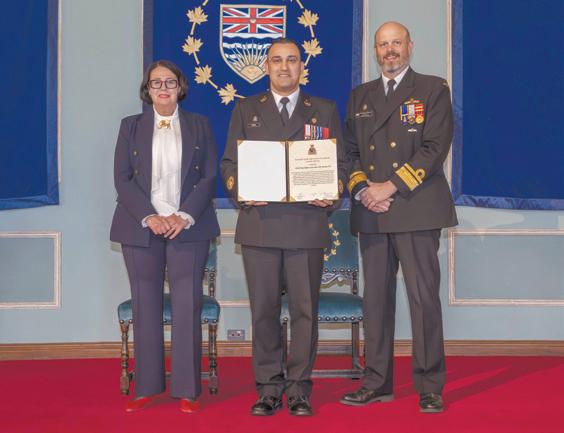
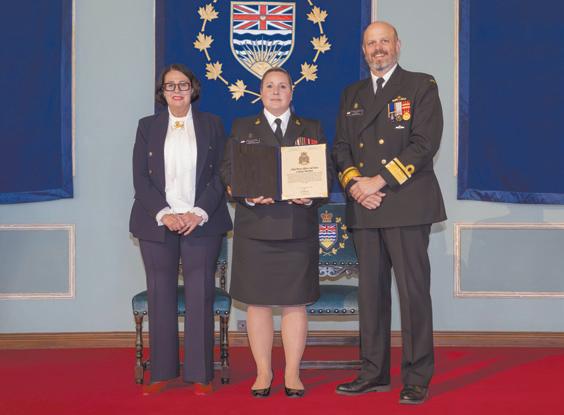
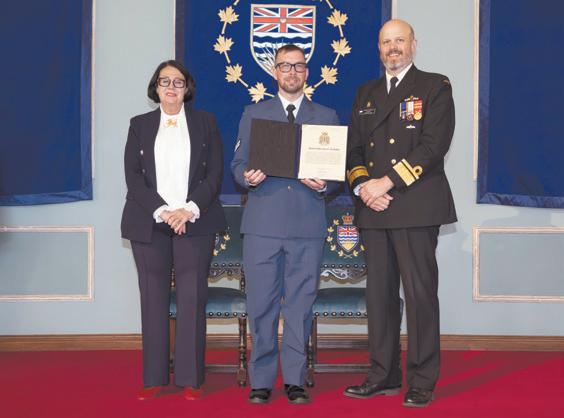
Awards were presented by Lieutenant Governor of British Columbia, The Honourable Janet Austin and Rear-Admiral Christopher Robinson, Commander Maritime Forces Pacific, at Government House on 30 May.