
Legislative actions affect municipal utilities and public works departments
By Lash Chaffin Utilities Section Director
In addition to the changes in the bidding laws discussed in the April Utilities Section Newsletter , the 2026 Legislature adopted a number of other measures that will affect municipal utilities and public works departments.
LB 397 amended the Nebraska Workers’ Compensation Act to remove the requirement of employers subject to the Act to have a safety committee. Employers have been required to have a safety committee since 1994. The safety committees create and maintain written injury prevention programs.
LB 838 was adopted to deal with the federal government’s decision to cease the minting of pennies due to rising production costs. Under the bill, cash transactions are impacted but it does not apply to digital or non-cash payment methods such as credit cards, debit cards, checks, or electronic transfers, where exact cent amounts can still be processed without physical currency. If the final digit of a cash transaction ends in 1, 2, 6, or 7, the amount is rounded down to the nearest multiple of five cents. If the final digit of the cash transaction ends in 3, 4, 8, or 9, the amount is rounded up to the nearest multiple of five cents. For transactions totaling only 1 or 2 cents, the amount shall be rounded up to 5 cents.
1335 L Street
Lincoln, NE 68508
(402) 476-2829
info@lonm.org
LB 972 broadens the authority of cities and villages to adopt an ordinance to authorize the operation of all-terrain vehicles and utility-type vehicles between sunrise and sunset and prior to sunrise for snow removal. LB 972 enables municipalities to adopt an ordinance to authorize the operation of all-terrain vehicles and utilitytype vehicles between sunset and sunrise if they meet the following conditions:
• The headlight for the all-terrain vehicle or utility-type vehicle must display a white light.
• For multiple beam headlights, the uppermost beam must sufficiently illuminate a person, vehicle, or object at a distance of at least 100 feet in front of the vehicle and the lowermost beam must illuminate them at a distance of at least 50 feet in front of the vehicle.
• For single beam headlights, the headlight must illuminate a person, vehicle, or object at a distance of a least 100 feet in front of the vehicle, and the high intensity portion of the light must not project higher than the level of the center of the headlight.
• ATV and utility-type vehicles

LEGISLATIVE SESSION 2026
must also have a rear, red taillight that is plainly visible from a distance of 500 feet behind the vehicle.
LB 1261 allows and clarifies the authority of a private entity to own a privately owned electric generation facility that is constructed to provide electricity to an industrial customer at a single site if the customer is projected to require a load greater than 1,000 megawatts. Several conditions must be met to allow this type of facility.
• The privately owned generation facility must be co-located on or adjacent to the industrial customer, has an electrically equivalent point of grid interconnection to the customer, and has received approval from the Nebraska Power Review Board.
• The privately owned electric supplier and consumer-owned utility providing retail electric service within the service area of the industrial customer must have executed a long-term
Continued on page 2
Utilities Section Newsletter
Legislative actions
Continued from page 1
power purchase agreement, lease, joint venture, or other commercial contractual structure that:
(a) preserves the exclusive right of the consumerowned utility to serve retail customers in the relevant service area and, where applicable, the contractual right of the consumer-owned wholesale power supplier to supply the consumer-owned retail utility,
(b) provides commercial benefits acceptable to the consumer-owned utility or utilities,
(c) prohibits resale of electricity by the industrial customer, and
(d) includes a contractual waiver of the authority to exercise eminent domain to acquire the subject generation assets for the duration of the contract.
• The industrial customer pays all costs, fees, and upgrade costs incurred by the consumer-owned utility for the project and the privately owned generation facility.
• The privately owned electric generation facility shall only be used to serve the industrial customer, unless that requirement is waived by the consumerowned utility or utilities with which the industrial customer has contracted.
LB 759 included provisions that transfer most regulatory duties related to swimming pools, recreation camps, and mobile home parks from the Nebraska Department of Water, Energy, and Environment (NDWEE) to local governments (county, city, village, or health district) that have jurisdiction over such facilities. Some cities already have assumed this authority. The League will be working with the regional health districts very soon to try to coordinate efforts to ensure that pools will be adequately regulated.
LB 759 also authorizes NDWEE to start charging both permit application fees and annual fees on wastewater treatment facility NPDES permits, stormwater NPDES permits, and pretreatment NPDES permits. The bill does not specify a specific amount for these fees, but the amounts would need to be approved by the Nebraska Environmental Control Council. Also, well registration fees will increase from $40 to $200.
LB 798 allows villages and cities of the second class to have the option for a three-member planning commission. Currently, villages and cities of the second class can have five, seven, or nine members on the planning commission. It is increasingly difficult for
smaller municipalities to fill positions on their planning commissions.
LB 798 also allows a city of the second class the option to elect council members by ward or at-large.
LB 935 clarifies that a political subdivision may request attorney’s fees and court costs when it must defend a frivolous or harassing claim.
LB 1010 regulates private entities desiring to build very large battery storage units in Nebraska that could charge at times when electric power is plentiful and discharge when power is needed. The bill provides for the Power Review Board's approval authority over stand-alone energy storage resources and requires written consent of the impacted electric supplier prior to construction. The bill requires a private electric supplier to enter into a joint transmission development agreement with a public power entity and to maintain a contractual agreement with a public power entity for the output of the privately owned energy storage resource.
In addition to several items affecting public notice, LB 596 defines “reasonable advance publicized notice” as notice provided by political subdivisions given at least FOUR times a year of the regular meeting schedule, location, and the method designated by the public body to provide reasonable advance publicized notice. Such notice shall be given by publication in a legal newspaper of general circulation within the public body’s jurisdiction. This publication requirement does “not apply in the case of the governing body of a city of the second class or village, any advisory committee of such governing body, the governing body of a rural or suburban fire protection district, or any public body that only meets intermittently and is not required to hold regular meetings.”
LB 596 also provides procedures for a “safe harbor provision” in case of refusal, neglect, or inability of the newspaper to publish notice IF a public body decides to publish notice in a newspaper of general circulation within the public body’s jurisdiction to meet the notice requirement of providing reasonable advance publicized notice of the time and place of each meeting.
LB 596 also deletes the word “posted” from the requirement that at least one current copy of the Open Meetings Act be “in the meeting room at a location accessible to members of the public.” After the effective date of LB 596, at least one copy of the Open Meetings Act could be on a table; of course, a copy could be “posted” on the wall, but it no longer has to be “posted,” it just has to be accessible in the meeting room.
Outdoor Safety: Staying safe as temperatures rise
By Jackson Sash, Utilities Field Rep./ Training Coordinator
As temperatures begin to rise and crews spend more time working outdoors, summer brings a new set of hazards that should never be overlooked. Utility workers, landfill operators, field crews, and anyone working outside face increased risks from heat, prolonged sun exposure, dehydration, severe weather, and other seasonal dangers. A few extra precautions during the warmer months can prevent serious injuries and illnesses while helping crews stay safe and productive.
One of the most serious summertime hazards is heat-related illness. High temperatures combined with humidity and physical labor can quickly overwhelm the body’s ability to cool itself. Heat exhaustion often begins with symptoms such as heavy sweating, dizziness, headaches, nausea, muscle cramps, and fatigue. Workers experiencing these symptoms should immediately move to a cooler area, rest, and begin drinking water or electrolyte fluids. Ignoring the warning signs can allow the condition to progress into heat stroke, which is a medical emergency. Confusion, loss of consciousness, hot skin, and a rapid

pulse are all signs that immediate medical attention is needed. Preventing heat illness starts long before symptoms appear. Staying hydrated throughout the day is critical, especially during physically demanding work. Workers should drink water regularly, even before
Continued on page 4

Utilities Section Newsletter
Outdoor Safety: Staying safe as temperatures rise
Continued from page 3
feeling thirsty, since thirst alone is not always an early warning sign of dehydration. Taking breaks in shaded or air-conditioned areas can help the body recover from prolonged heat exposure. Lightweight, breathable clothing and cooling towels can also make a significant difference. Supervisors and coworkers should continue watching for signs of heat stress in others, since workers experiencing heat illness may not always recognize the symptoms themselves.
Sun exposure is another hazard that often gets underestimated. Long hours outdoors place workers at greater risk for sunburn and long-term skin damage caused by ultraviolet, or UV, radiation. Even on cloudy days, harmful UV rays can penetrate through the clouds and affect exposed skin. Repeated exposure over time increases the risk of skin cancer and can also contribute to eye damage. Wearing sunscreen with adequate SPF protection, sunglasses designed to block UV rays, and lightweight long


sleeves can help reduce the risks associated with prolonged time in direct sunlight.
Fatigue can become another hidden danger during hot weather. Extended hours in the heat often reduce concentration, slow reaction times, and increase the likelihood of accidents or injuries. Physical tasks that may seem routine under normal conditions can become much more demanding during periods of extreme heat. Taking scheduled breaks, pacing work
Continued on page 5


Utilities Section Newsletter
Outdoor Safety: Staying safe as temperatures rise
Continued from page 4
activities appropriately, and recognizing personal limits are all important parts of maintaining safety during the summer months.
Summer also brings an increase in seasonal hazards such as insects and severe weather. Mosquitoes, ticks, bees, and wasps become more active during warmer months and can create additional safety concerns for outdoor crews. Workers operating in grassy or wooded areas should remain aware of ticks and other biting insects, while anyone with known allergies to stings should ensure emergency medications are readily available.
Severe weather deserves particular attention during the summer season because conditions can change rapidly with little warning. Thunderstorms can develop quickly during the afternoon hours, bringing dangerous lightning, high winds, hail, and heavy rainfall. For utility workers and field crews who spend much of the day around metal equipment, elevated structures, and open work areas, lightning can become a life-threatening hazard in a matter of minutes. Workers should monitor weather conditions throughout the day and never ignore approaching storms or thunder in the distance. If thunder is heard, crews should immediately begin moving to a safe shelter rather than attempting to finish a task before conditions worsen.
High winds associated with severe storms can create additional risks by bringing down tree limbs, blowing debris into work zones, and destabilizing ladders or elevated equipment. Heavy rain can quickly reduce visibility, create slippery surfaces, and increase the

likelihood of vehicle accidents or falls. In some cases, flash flooding may develop in low-lying areas or near drainage systems, creating hazards for workers operating vehicles or equipment. Supervisors should ensure crews have a clear plan for stopping work and seeking shelter when severe weather approaches, and workers should always know where the nearest safe shelter is located before beginning outdoor operations. Outdoor work is essential to keeping utility systems and public services operating reliably, but warmer weather conditions require additional awareness and preparation. Staying hydrated, protecting against sun exposure, recognizing the early signs of heat illness, and remaining alert to changing weather conditions can help ensure every worker returns home safely at the end of the day.


Utilities Section Newsletter

Maintenance/Water and Wastewater Operator: The Village of Clearwater is seeking a full-time maintenance/water and wastewater operator. Applicant must hold or be willing to obtain a Grade IV Water Operators Certificate and a Class I Wastewater License with the State of Nebraska; hold or be willing to obtain, at minimum, a Class B State of Nebraska CDL driver’s license; have the ability to operate large equipment and vehicles; read and interpret gauges, understand electrical and mechanical equipment used in the regular operations of water and wastewater systems; make minor repairs to water and wastewater systems; ability to maintain and make minor repairs to vehicles and equipment; ability to supervise others, withstand extreme weather conditions, distinguish colors, lift up to 75 pounds, crawl, climb, bend, stoop, reach and work in confined spaces and at extended heights. Applicant should reside or be willing to relocate within five miles of Clearwater village limits. Duties will include, but are not limited to: street maintenance, including patching and snow removal; maintenance, upkeep, testing and recordkeeping of water, wastewater, and backflow systems; mowing and weed eating for all village properties; maintain park and playground, including trash removal; maintain tree dump and ensure only authorized items are being dumped; animal control; and other responsibilities as required or requested by supervisors. For more information, contact Angie Hupp at 402-485-2365 or clerk@clearwaterne.com. The Village of Clearwater is an Equal Opportunity Employer. Journeyman Lineman. The Village of Morrill

(Population 934) is accepting applications for the position of full-time Electric Journeyman Line Worker with a pay range of $30-$50 per hour DOQ. This individual will perform skilled line work in the operation, construction, maintenance, and repair of overhead and underground electric distribution and transmission systems. A Class B CDL with Airbrakes is required. Applications, with resumes, will be accepted until the position is filled. A complete job description for this position and an application is available at www.villageofmorrill. com or at the Village Office located at 118 S Center Avenue, Morrill, NE. This position includes an excellent benefit package including health insurance, retirement, vacation, sick leave, and paid holidays. The Village of Morrill is an Equal Opportunity Employer. The Village does not discriminate on the basis of race, color, religion, sex, national origin, disability, age, sexual orientation, gender identity, and veteran status. This applies to all employment decisions, including hiring, training, and promotions. The Village celebrates diversity and are committed to creating an inclusive environment for all employees and all hiring decisions are based on merit, skills, and business needs.
Two Super T Series Self-Priming Centrifugal Pumps. The Village of Sterling has two Gorman-Rupp Pumps for sale: Model #T4A71S-B/F; Imp. Diameter STD; Unit weight 675 lbs. One is new in the crate, and the other was used for a short time. Both have been in storage for some time. The Village of Sterling upgraded and these are just taking up space. Click here for pump specs and pictures. Contact the Village of Sterling at 402-866-4545 for questions or to schedule a time to come look at them.
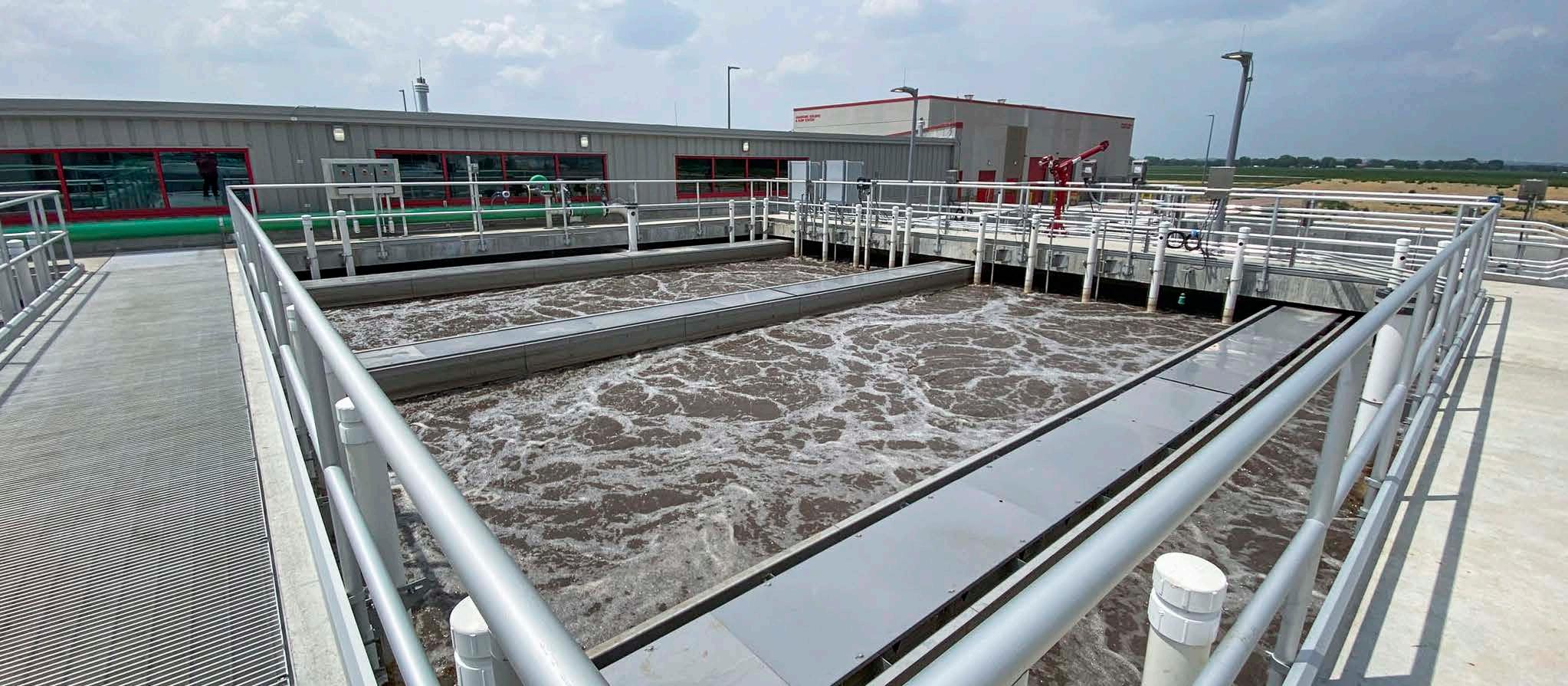
At HDR, we’re helping our clients push open the doors to what’s possible, every day.
hdrinc.com
Utilities Section Newsletter
Poison Hemlock: A dangerous plant to watch for
By Jackson Sash, Utilities Field Rep./ Training Coordinator
As warmer weather returns, poison hemlock is once again becoming visible along roadsides, ditches, fields, and waterways throughout many communities. This invasive and highly toxic plant can pose serious risks to both humans and animals, making proper identification especially important for utility crews, landowners, and outdoor workers who spend time near overgrown vegetation. Poison hemlock is a tall plant that
can grow between six and 10 feet high and is often mistaken for wild carrot or Queen Anne’s lace. One of the easiest ways to identify it is by its smooth green stem marked with distinctive purple or reddish blotches. The plant also produces clusters of small white flowers shaped like umbrellas and has fern-like leaves. Unlike many other weeds, poison hemlock has no hairs on its stems.
All parts of the plant are toxic if ingested, and even handling the plant can cause skin irritation in some individuals. Mowing or cutting poison hemlock may also


release particles into the air that can irritate the eyes and respiratory system.
If poison hemlock is found near work areas or public spaces, it should be handled carefully using proper protective equipment and removal methods. Awareness and early identification are key to limiting exposure and preventing the spread of this dangerous plant.

Utilities Section Newsletter
2026 Training Calendar
Visit our website for a complete list of workshops and conferences.
June
June 17-19 Municipal Accounting & Finance Conference Cornhusker Marriott Hotel, Lincoln
July
July 29-30 NECC Power & Equipment Show NECC Chuck Pohlman Ag Complex, Norfolk
August
Aug. 11 Water Operator Training Workshop O’Neill
Aug. 12 ......... Backflow Workshop ............................................ Wayne
Aug. 13 Water Operator Training Workshop Fremont
September
Sept. 15 ........ Water Operator Training Workshop .................... Gering
Sept. 16 Backflow Workshop Ogallala
Sept. 17 Water Operator Training Workshop Lexington
Sept. 23-25 ... League Annual Conference ................................. Cornhusker Marriott Hotel, Lincoln
October
Oct. 20 .......... Water Operator Training Workshop .................... Ainsworth
Oct. 21 Water Operator Training Workshop St. Paul
Oct. 22 Backflow Workshop Beatrice
December
Dec. 8 Water Operator Training Workshop Lincoln
Dec. 10 ......... Water Operator Training Workshop .................... Auburn
2026-27 Utilities Section Executive Board
President
Gary Thurlow Utility Supt. Atkinson
1st Vice President
2nd Vice President
Board Member
Jeramie Van Leer Utility Supt. Ord
Board Member
Ryan Schmitz Utilities Director Grand Island
Board Member
Joel Hansen Street & Planning Director Wayne
Ex Officio Member
Kyle Svec City Admin./Utilities Supervisor Geneva